EP4040390B1 - Verfahren zur bestimmung einer orientierung eines flurförderzeugs - Google Patents
Verfahren zur bestimmung einer orientierung eines flurförderzeugs Download PDFInfo
- Publication number
- EP4040390B1 EP4040390B1 EP22154327.5A EP22154327A EP4040390B1 EP 4040390 B1 EP4040390 B1 EP 4040390B1 EP 22154327 A EP22154327 A EP 22154327A EP 4040390 B1 EP4040390 B1 EP 4040390B1
- Authority
- EP
- European Patent Office
- Prior art keywords
- image
- points
- camera
- industrial truck
- horizontal
- Prior art date
- Legal status (The legal status is an assumption and is not a legal conclusion. Google has not performed a legal analysis and makes no representation as to the accuracy of the status listed.)
- Active
Links
Images



Classifications
-
- B—PERFORMING OPERATIONS; TRANSPORTING
- B65—CONVEYING; PACKING; STORING; HANDLING THIN OR FILAMENTARY MATERIAL
- B65G—TRANSPORT OR STORAGE DEVICES, e.g. CONVEYORS FOR LOADING OR TIPPING, SHOP CONVEYOR SYSTEMS OR PNEUMATIC TUBE CONVEYORS
- B65G1/00—Storing articles, individually or in orderly arrangement, in warehouses or magazines
- B65G1/02—Storage devices
- B65G1/04—Storage devices mechanical
- B65G1/0485—Check-in, check-out devices
-
- B—PERFORMING OPERATIONS; TRANSPORTING
- B65—CONVEYING; PACKING; STORING; HANDLING THIN OR FILAMENTARY MATERIAL
- B65G—TRANSPORT OR STORAGE DEVICES, e.g. CONVEYORS FOR LOADING OR TIPPING, SHOP CONVEYOR SYSTEMS OR PNEUMATIC TUBE CONVEYORS
- B65G1/00—Storing articles, individually or in orderly arrangement, in warehouses or magazines
- B65G1/02—Storage devices
- B65G1/04—Storage devices mechanical
- B65G1/0492—Storage devices mechanical with cars adapted to travel in storage aisles
-
- G—PHYSICS
- G01—MEASURING; TESTING
- G01B—MEASURING LENGTH, THICKNESS OR SIMILAR LINEAR DIMENSIONS; MEASURING ANGLES; MEASURING AREAS; MEASURING IRREGULARITIES OF SURFACES OR CONTOURS
- G01B11/00—Measuring arrangements characterised by the use of optical techniques
- G01B11/24—Measuring arrangements characterised by the use of optical techniques for measuring contours or curvatures
-
- G—PHYSICS
- G01—MEASURING; TESTING
- G01B—MEASURING LENGTH, THICKNESS OR SIMILAR LINEAR DIMENSIONS; MEASURING ANGLES; MEASURING AREAS; MEASURING IRREGULARITIES OF SURFACES OR CONTOURS
- G01B11/00—Measuring arrangements characterised by the use of optical techniques
- G01B11/26—Measuring arrangements characterised by the use of optical techniques for measuring angles or tapers; for testing the alignment of axes
-
- G—PHYSICS
- G01—MEASURING; TESTING
- G01C—MEASURING DISTANCES, LEVELS OR BEARINGS; SURVEYING; NAVIGATION; GYROSCOPIC INSTRUMENTS; PHOTOGRAMMETRY OR VIDEOGRAMMETRY
- G01C3/00—Measuring distances in line of sight; Optical rangefinders
- G01C3/24—Measuring distances in line of sight; Optical rangefinders using a parallactic triangle with fixed angles and a base of variable length in the observation station, e.g. in the instrument
-
- G—PHYSICS
- G06—COMPUTING OR CALCULATING; COUNTING
- G06T—IMAGE DATA PROCESSING OR GENERATION, IN GENERAL
- G06T7/00—Image analysis
- G06T7/10—Segmentation; Edge detection
- G06T7/13—Edge detection
-
- G—PHYSICS
- G06—COMPUTING OR CALCULATING; COUNTING
- G06T—IMAGE DATA PROCESSING OR GENERATION, IN GENERAL
- G06T7/00—Image analysis
- G06T7/60—Analysis of geometric attributes
-
- G—PHYSICS
- G06—COMPUTING OR CALCULATING; COUNTING
- G06T—IMAGE DATA PROCESSING OR GENERATION, IN GENERAL
- G06T7/00—Image analysis
- G06T7/70—Determining position or orientation of objects or cameras
- G06T7/73—Determining position or orientation of objects or cameras using feature-based methods
-
- G—PHYSICS
- G06—COMPUTING OR CALCULATING; COUNTING
- G06T—IMAGE DATA PROCESSING OR GENERATION, IN GENERAL
- G06T2207/00—Indexing scheme for image analysis or image enhancement
- G06T2207/10—Image acquisition modality
- G06T2207/10004—Still image; Photographic image
-
- G—PHYSICS
- G06—COMPUTING OR CALCULATING; COUNTING
- G06T—IMAGE DATA PROCESSING OR GENERATION, IN GENERAL
- G06T2207/00—Indexing scheme for image analysis or image enhancement
- G06T2207/20—Special algorithmic details
- G06T2207/20024—Filtering details
-
- G—PHYSICS
- G06—COMPUTING OR CALCULATING; COUNTING
- G06T—IMAGE DATA PROCESSING OR GENERATION, IN GENERAL
- G06T2207/00—Indexing scheme for image analysis or image enhancement
- G06T2207/30—Subject of image; Context of image processing
- G06T2207/30248—Vehicle exterior or interior
- G06T2207/30252—Vehicle exterior; Vicinity of vehicle
Definitions
- the present invention relates to a method for orienting an industrial truck.
- Industrial trucks are regularly used in a warehouse environment to pick up and place goods, loads, and other objects.
- the objects to be transported by the industrial truck are usually carried on load carriers and stored, for example, in shelves and other storage locations.
- load carriers To pick up and place a load, it is important that the industrial truck picks up the load in the correct orientation.
- Orientation relative to the load or a structure in the warehouse area refers, for example, to an angle between the vehicle's longitudinal direction and an edge or surface of the structure. It is commonly said that an industrial truck approaches a shelf or load vertically in order to pick up or place the load.
- the object of the invention is to provide a method for determining an orientation of the industrial truck relative to a structure, which can reliably determine the orientation of the industrial truck using the simplest possible means.
- US 2020/380694 A1 proposes a method for determining the yaw angle of a vehicle relative to shelves using horizontal lines, whereby the angle is detected from the perspective vanishing angle of this line.
- the method according to the invention is intended and intended to determine an orientation of the industrial truck relative to a structure with horizontal elements.
- the industrial truck is equipped with a camera that is directed towards the structure with the horizontal elements.
- the method according to the invention The method comprises a series of steps which are carried out, whereby different sequences of steps are possible, particularly in the image processing steps.
- an image of the structure with at least one horizontal element is recorded.
- the image of the structure is a two-dimensional image which also includes the horizontal element. Due to the spatial orientation between the camera and the structure, horizontal lines in space do not run horizontally in the recorded image.
- at least two geometric quantities are determined in the recorded image. Geometric quantities can be points, lines, angles or fields.
- the geometric quantities are assigned to the horizontal element or are part of the image of the horizontal element. According to the invention, an intersection angle between an image plane and a vertical plane through the horizontal element is then determined using the at least two geometric quantities.
- the basic idea here is that the two geometric quantities belong to an object that runs obliquely in the image and thus allow an identification of the intersection angle, whereby the intersection angle also exists between a plane parallel to the image plane and a vertical plane through the horizontal element.
- an edge is identified in the recorded image.
- Edge detection in images is a known method.
- the method according to the invention preferably identifies edges that, based on their location, may originate from horizontal structures in space.
- the two geometric variables are image coordinates of a reference point in the image and an inclination angle of the edge in the image. From the reference variable of the image coordinates (X, Y) and a For example, the angle of inclination of the edge in the image can be used to determine a cutting angle using an assignment rule.
- the angle of inclination of the edge is preferably determined by the angle of the edge in the image.
- the slope of the edge in the image can be determined.
- the two geometric quantities represent a distance and a distance angle to a point on the object.
- polar coordinates can be used as the two geometric quantities, which, starting from the observing camera, describe a distance and an angle.
- the angle of intersection of the horizontal structure with the image plane can be determined using the distance and angle.
- Another option for particularly favorable geometric dimensions is to identify at least two points along the identified edge.
- the points should preferably be far apart on the edge to achieve the most accurate angular resolution possible.
- a ray is determined, each of whose points is mapped to the respective image point in a 3D coordinate system. These are rays from points in three-dimensional space that are mapped to the image point. For these rays, the intersection angle can be determined for a pair of points, each with a point on the rays. The intersection angle is preferably calculated in the three-dimensional coordinate system.
- the camera is directed at a load rack with one or more horizontal load rack supports.
- the method according to the invention is therefore particularly suitable for industrial trucks that move in spatial areas containing a large number of horizontal elements.
- a load rack with its horizontal load rack supports can be identified particularly easily and reliably during image processing. No complex or otherwise sophisticated image processing is necessary to remove vertical or predominantly vertical edges from the recorded image and to determine horizontal or, depending on the orientation, approximately horizontal lines.
- the camera is attached to the industrial truck such that it has a defined orientation relative to the industrial truck, and in particular relative to the longitudinal axis of the industrial truck, even during operation of the industrial truck.
- the camera Upon attachment, the camera is given a preferably predetermined orientation relative to the industrial truck.
- the camera is attached vertically to the industrial truck such that the image plane of the camera is perpendicular to the vehicle's longitudinal axis. In this way, the intersection angle between the connecting line of the points from the point pair and the image plane can be directly converted into the orientation angle of the vehicle's longitudinal axis to the horizontal element.
- a line outside the image center is selected for the at least one line to be evaluated. Lines outside the image center are viewed by the camera at a special perspective angle, which allows for a more precise evaluation of the orientation.
- the camera is designed as a 2D camera. Furthermore, the camera is calibrated, i.e., its imaging ratios are known. From the imaging ratio, a direction vector for the ray in the 3D coordinate system can be calculated for image coordinates. During this conversion, the two image points lying in the plane are converted into the ray, with all points in the 3D coordinate system lying on the ray being imaged by the camera onto the image point.
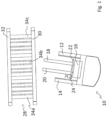
- Figure 1 shows a top view of an industrial truck 10, which in the example is designed as a reach truck with two wheel arms 12, 14. Between the wheel arms 12, 14 is a schematically illustrated lifting frame 16 with two forks 18, 20 as load-bearing means.
- a 2D camera 24 is attached to the rear wall 22 of the forks 18, 20.
- the 2D camera 24 is in Figure 1 shown schematically and can be securely attached to the industrial truck for use so that it cannot be damaged or covered by a transported load. the industrial truck, it must be taken into account that the camera 24 changes its position with the mast 16. The change in position consists in raising or lowering the camera 24 and in pushing the mast forwards or backwards relative to the support arms.
- the industrial truck is positioned with its longitudinal axis relative to a load rack 28, which is shown in a top view.
- the load rack 28 has a front side 30 facing the industrial truck 10.
- the load rack 28 has a rear side 32 on the side facing away from the industrial truck 10.
- Figure 1 A view of three load-carrying devices 34a-c is shown.
- the load-carrying devices 34 are each pallets stored in the load rack, which are shown empty for clarity.
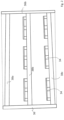
- Figure 2 shows a schematic view of the image from the 2D camera 24.
- the front side 30 of the load rack 28 is visible.
- the front side 30 of the rack is formed by two vertical rack supports 36a, b.
- Horizontally extending load rack supports 38a, b, c are arranged between the rack supports 36a, b.
- the term horizontally extending load rack supports or elements is used for Figure 2 needs explanation: As in Figure 2 As you might know, the image of the load-bearing rack supports is not horizontal. The left side of Figure 2 appears larger and closer than the right side of the shelf. Therefore, there is a perspective tapering in the image. Despite the perspective tapering, the load shelf support 38 is horizontal. Load aids 34 are drawn into the load shelf supports.
- the image in Figure 2 This is a so-called gradient image, in which areas of the image that extend into spatial depth are filtered out, leaving only the front edge visible. This focus on the front edges, closest to the camera, reduces the information content of the image because depth information is lost.
- Figure 3 shows a further step of image processing, in which horizontal lines 40 are drawn into the image. These are determined from the existing image data, for example, by edge extraction.
- the lines 40 formed do not run parallel to each other, but reflect the perspective tapering resulting from the orientation of the industrial truck relative to the shelf.
- Figure 4 shows a further step in which an initial filtering is performed towards the information-bearing edges. Vertical lines are filtered out. Likewise, the constructed horizontal lines 40 are reduced back to the edges of the image.
- Figure 5 shows the step of removing the horizontal lines in the image that run approximately through the center of the image or an area around the center. What remains are the information-bearing image edges 44, which most clearly demonstrate the perspective taper.
- an image edge is selected, for example, the image edge 46 of a stored pallet.
- points are determined, for example, the endpoints L 48 and R 50. Finding the endpoints is a common process in image processing.
- Figure 6 the geometric relationships. Starting from the camera 24, a vector leads to the end point L 48 l ⁇ .
- the vector l ⁇ describes a ray 52 as well as ray 54.
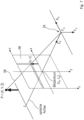
- Figure 7 helps to understand the concept of rays.
- Figure 7 shows the origin F c of the idealized camera 24.
- a right-handed oriented tripod X c , Y c and Z c hangs from this.
- the Z-axis is the optical axis of the camera and for simplicity be considered as parallel to the vehicle's longitudinal direction.
- the camera 24 generates an image plane 56.
- the points in the image plane 56 can be described as u- and v-coordinates, as two-dimensional image coordinates.
- an image pixel is drawn in the first quadrant of the image. Since the imaging ratios of camera 24 are known, a ray 58 can be constructed to the image point (u, v).
- Each point P on ray 58 is imaged on the camera image in the pixel (u, v).
- This system thus describes how a ray 58 can be constructed from the pixel values for a camera whose imaging ratios are known.
- Figure 7 also clearly shows that the distance of point P from camera 24 cannot be determined from the image point (u,v). This is not surprising, since the three-dimensional coordinates are mapped onto the two-dimensional image using the camera.
- the focal length of the camera in particular the three axes X c , Y c , and Z c , must be known to reconstruct the ray with the possible image points P.
- the quantities contained in the equation are the coordinates of the rays leading to the points. These coordinates depend on the focal length f x f y of the camera 24 in the X and Y directions.
- the quantities x' and y' are auxiliary quantities that, together with the focal lengths f x , f y and the image center c x , y x , describe the image in the image coordinates UV.
- the ray in the three-dimensional coordinates (X, Y, Z) results in a direction (X', Y', 1). Note that this direction vector of the ray is not normalized, which is not necessary for further calculations.
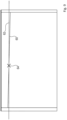
- Fig. 9 shows an image with a drawn edge 60.
- the edge 60 is inclined with respect to the horizontal 62.
- a point 64 on the edge 60 is also determined.
- Various approaches can be chosen for determining the point 64.
- the center of the edge 60 can be chosen.
- a point 64 can also be chosen at which the enclosed image area between the edge 60 and the horizontal 62 is the same size on both sides of the point 64.
- two geometric quantities arise: the point and the angle, which can collectively be referred to as (X, Y, ⁇ ).
- the look-up table can be calculated in advance and is thus accessible for quick evaluation.
- a look-up table can prove particularly helpful when many edges in the image are to be evaluated.
- Fig. 10 shows a very similar situation as in Fig. 9 , where an edge 66 runs diagonally in the image.
- a distance r, 72 and an angle ⁇ , 74 are determined.
- the angle 74 is fixed with respect to a horizontal 68.
- distance 72 is perpendicular to edge 66. In principle, the distance could also be perpendicular to the horizontal 68 and intersect edge 66 at an angle.
- an intersection angle is looked up and used for the geometric quantities r and ⁇ using a look-up table. If 70 different intersection angles arise for several points or 66 different intersection angles for several edges, these can be statistically evaluated.
Landscapes
- Engineering & Computer Science (AREA)
- Physics & Mathematics (AREA)
- General Physics & Mathematics (AREA)
- Computer Vision & Pattern Recognition (AREA)
- Theoretical Computer Science (AREA)
- Mechanical Engineering (AREA)
- Geometry (AREA)
- Electromagnetism (AREA)
- Radar, Positioning & Navigation (AREA)
- Remote Sensing (AREA)
- Length Measuring Devices By Optical Means (AREA)
- Image Analysis (AREA)
Description
- Die vorliegende Erfindung betrifft ein Verfahren zur Orientierung eines Flurförderzeugs.
- Flurförderzeuge werden regelmäßig in einer Lagerumgebung eingesetzt, um Waren, Lasten und andere Gegenstände aufzunehmen und abzusetzen. Die von dem Flurförderzeug zu transportierenden Gegenstände werden in der Regel auf Lastträgern transportiert und beispielsweise in Regalen und anderen Lagerplätzen gelagert. Für das Aufnehmen und Absetzen einer Last ist es wichtig, dass das Flurförderzeug die Last unter einer richtigen Orientierung aufnimmt. Orientierung gegenüber der Last oder einer Struktur im Lagerbereich bezeichnet beispielsweise einen Winkel der Fahrzeuglängsrichtung zu einer Kante oder Fläche der Struktur. Gemeinhin spricht man davon, dass ein Flurförderzeug ein Regal oder eine Last senkrecht anfährt, um die Last aufnehmen oder absetzen zu können.
- Die erfindungsgemäße Aufgabe besteht darin, ein Verfahren zur Bestimmung einer Orientierung des Flurförderzeugs relativ zu einer Struktur bereitzustellen, das mit möglichst einfachen Mitteln zuverlässig die Orientierung des Flurförderzeugs ermitteln kann.
- Hierzu stellt das Dokument
US 2020/380694 A1 ein Verfahren zur Bestimmung des Gierwinkels eines Fahrzeugs relativ zu Regalen anhand von horizontalen Linien vor, wobei der Winkel aus dem perspektivischen Fluchtwinkel dieser Linie erkannt wird. - Erfindungsgemäß wird die Aufgabe durch ein Verfahren mit den Merkmalen nach Anspruch 1 gelöst. Vorteilhafte Ausgestaltungen bilden die Gegenstände der Unteransprüche.
- Das erfindungsgemäße Verfahren ist vorgesehen und bestimmt, eine Orientierung des Flurförderzeugs relativ zu einer Struktur mit horizontalen Elementen zu ermitteln. Das Flurförderzeug ist bei dem Verfahren mit einer Kamera ausgestattet, die auf die Struktur mit den horizontalen Elementen gerichtet ist. Das erfindungsgemäße Verfahren besitzt eine Reihe von Schritten, die durchlaufen werden, wobei insbesondere bei den Schritten der Bildverarbeitung verschiedene Reihenfolgen der Schritte möglich sind. Bei dem erfindungsgemäßen Verfahren erfolgt das Aufzeichnen eines Bildes der Struktur mit mindestens einem horizontalen Element. Es ist dabei so, dass das Bild der Struktur ein zweidimensionales Bild ist, das auch das horizontale Element beinhaltet. Aufgrund der räumlichen Orientierung zwischen der Kamera und der Struktur verlaufen horizontale Linien im Raum nicht horizontal in dem aufgezeichneten Bild. In einem weiteren Schritt werden mindestens zwei geometrische Größen in dem aufgezeichneten Bild bestimmt. Bei geometrischen Größen kann es sich um Punkte, Linien, Winkel oder Felder handeln. Die geometrischen Größen sind dabei dem horizontalen Element zugeordnet bzw. Teil der Abbildung des horizontalen Elements. Erfindungsgemäß wird nun unter Verwendung der mindestens zwei geometrischen Größen ein Schnittwinkel zwischen einer Bildebene und einer vertikalen Ebene durch das horizontale Element bestimmt. Der grundlegende Gedanke hierbei ist, dass die beiden geometrischen Größen zu einem schräg im Bild verlaufenden Gegenstand gehören und somit eine Identifikation des Schnittwinkels zulassen, wobei der Schnittwinkel auch zwischen einer zur Bildebene parallelen Ebene und einer vertikalen Ebene durch das horizontale Element vorliegt.
- In einer bevorzugten Ausgestaltung wird in dem aufgezeichneten Bild eine Kante identifiziert. Die Kantendetektion in Bildern ist ein an sich bekanntes Verfahren. Bei dem erfindungsgemäßen Verfahren werden bevorzugt Kanten identifiziert, die ihrer Lage nach von horizontalen Strukturen im Raum stammen können.
- In einer bevorzugten Ausgestaltung sind die beiden geometrischen Größen Bildkoordinaten eines Bezugspunkts in dem Bild und ein Neigungswinkel der Kante in dem Bild. Aus der Bezugsgröße der Bildkoordinaten (X, Y) und einem Neigungswinkel der Kante im Bild kann beispielsweise durch eine Zuordnungsvorschrift ein Schnittwinkel bestimmt werden.
- Für den Neigungswinkel der Kante wird dabei bevorzugt der Winkel der Kante im Bild bestimmt. Hierzu kann beispielsweise die Steigung der Kante im Bild bestimmt werden.
- In einer alternativen Ausgestaltung, die selbstverständlich auch zusätzlich verwendet werden kann, bilden die zwei geometrischen Größen einen Abstand und einen Abstandswinkel zu einem Punkt des Gegenstands. Hier können als die beiden geometrischen Größen Polarkoordinaten angesetzt werden, die, ausgehend von der beobachtenden Kamera, einen Abstand und einen Winkel beschreiben. Auch hier kann mit Hilfe des Abstandes und des Winkels der Schnittwinkel der horizontalen Struktur mit der Bildebene bestimmt werden.
- Eine weitere Möglichkeit für besonders günstige geometrische Größen besteht darin, entlang der identifizierten Kante mindestens zwei Punkte zu identifizieren. Bevorzugt liegen die Punkte auf der Kante weit auseinander, um möglichst eine genaue Winkelauflösung zu bekommen.
- Bevorzugt wird, ausgehend von den zwei Punkten, jeweils ein Strahl bestimmt, dessen jeweiligen Punkte in einem 3D-Koordinatensystem auf den jeweiligen Bildpunkt abgebildet werden. Es handelt es sich hierbei um Strahlen von Punkten im dreidimensionalen Raum, die auf den Bildpunkt abgebildet werden. Bei diesen Strahlen kann für ein Punktpaar mit jeweils einem Punkt auf den Strahlen der Schnittwinkel bestimmt werden. Bevorzugt erfolgt hierbei die Berechnung des Schnittwinkels im dreidimensionalen Koordinatensystem.
- Die vorstehend aufgezählten drei Möglichkeiten sind hierbei lediglich Beispiele für zwei aus dem Bild gewonnene geometrische Größen, die eine Bestimmung des Schnittwinkels zwischen der Bildebene und der Struktur mit dem horizontalen Element zulassen. Weitere Paare von geometrischen Größen sind ebenfalls möglich.
- In einer bevorzugten Ausgestaltung wird die Kamera auf ein Lastregal mit einem oder mehreren horizontalen Lastregalträgern gerichtet. Das erfindungsgemäße Verfahren ist damit besonders für Flurförderzeuge geeignet, die sich in Raumbereichen bewegen, in denen eine Vielzahl von horizontalen Elementen vorliegt. Ein Lastregal mit seinen horizontalen Lastregalträgern ist im Zuge der Bildverarbeitung besonders einfach und zuverlässig erkennbar. Es ist keine aufwändige oder sonst wie ausgefeilte Bildverarbeitung notwendig, um vertikale oder überwiegend vertikale Kanten aus dem aufgezeichneten Bild zu entfernen und horizontale bzw. je nach Orientierung annähernd horizontale Linien zu bestimmen.
- In einer bevorzugten Weiterbildung wird die Kamera an dem Flurförderzeug angebracht, so dass sie auch im Betrieb des Flurförderzeugs eine definierte Orientierung relativ zu dem Flurförderzeug und insbesondere relativ zu der Längsachse des Flurförderzeugs besitzt. Mit der Anbringung erhält die Kamera eine bevorzugt vorbestimmte Orientierung relativ zu dem Flurförderzeug. Bevorzugt ist die Kamera vertikal an dem Flurförderzeug angebracht, so dass die Bildebene der Kamera senkrecht zur Fahrzeuglängsachse steht. Auf diese Weise kann der Schnittwinkel zwischen der Verbindungslinie der Punkte aus dem Punktpaar und der Bildebene direkt in den Orientierungswinkel der Fahrzeuglängsachse zu dem horizontalen Element umgerechnet werden.
- Als besonders vorteilhaft hat es sich herausgestellt, aus dem aufgezeichneten Bild vertikale Bildkanten herauszufiltern. Indem das Herausfiltern beispielsweise vorgenommen wird, bevor die Linie zu dem horizontalen Element ermittelt wird, vermeiden die fehlenden vertikalen Linien Fehler beim Ermitteln der Linien zu dem horizontalen Element. In einer bevorzugten Ausgestaltung wird für die mindestens eine auszuwertende Linie eine Linie außerhalb der Bildmitte gewählt. Linien außerhalb der Bildmitte werden unter einem besonderen perspektivischen Winkel von der Kamera betrachtet, der eine genauere Auswertung der Orientierung zulässt.
- In einer bevorzugten Weiterbildung ist die Kamera als eine 2D-Kamera ausgebildet. Zudem ist die Kamera kalibriert, d. h. ihre Abbildungsverhältnisse sind bekannt. Aus dem Abbildungsverhältnis kann für Bildkoordinaten ein Richtungsvektor für den Strahl in dem 3D-Koordinatensystem berechnet werden. Bei dieser Umrechnung werden die beiden in der Ebene liegenden Bildpunkte in den Strahl umgerechnet, wobei alle Punkte im 3D-Koordinatensystem, die auf dem Strahl liegen, durch die Kamera auf den Bildpunkt abgebildet.
- Es hat sich als besonders vorteilhaft herausgestellt, nicht nur mit einem Punktpaar zu arbeiten, sondern zur Bestimmung des Orientierungswinkels eine Vielzahl von Punktpaaren einzusetzen und die gewonnenen Ergebnisse wie unabhängige Messungen statistisch auszuwerten, beispielsweise mit dem Mittelwert.
- Die Erfindung wird nachfolgend an einem Ausführungsbeispiel näher erläutert. Es zeigen:
- Fig. 1
- eine Draufsicht auf ein Flurförderzeug vor einem Lastregal,
- Fig. 2
- eine schräge Sicht auf das Lastregal,
- Fig. 3
- die Konstruktion von horizontalen Bildkanten, die waagerechten Elementen entsprechen,
- Fig. 4
- das Ergebnis einer ersten Filterung, bei der vertikale Linien unterdrückt sind,
- Fig. 5
- ein Abstellen auf die außermittigen horizontalen Bildlinien,
- Fig. 6
- die Bestimmung der Endpunkte L, R bei einer horizontalen Linie als Durchstoßpunkte einer horizontalen Ebene,
- Fig. 7
- die Umrechnung der Bildpunkte in einem Strahl mit 3D-Koordinaten,
- Fig. 8
- die Berechnung des Winkels zur Orientierung des Flurförderzeugs relativ zu der Bildebene,
- Fig. 9
- in einer schematischen Ansicht eine schräg im Bild verlaufende Kante, zu der ein Bildpunkt und ein Neigungswinkel α bestimmt wird und
- Fig. 10
- die Bestimmung der geometrischen Größen als Polarkoordinaten.
-
Figur 1 zeigt in einer Draufsicht ein Flurförderzeug 10, das in dem Beispiel als Schubmaststapler mit zwei Radarmen 12, 14 ausgebildet ist. Zwischen den Radarmen 12, 14 befindet sich ein schematisch dargestelltes Hubgerüst 16 mit zwei Gabelzinken 18, 20 als Lasttragmittel. An der Rückwand 22 der Gabelzinken 18, 20 ist eine 2D-Kamera 24 angebracht. Die 2D-Kamera 24 ist inFigur 1 schematisch dargestellt und kann für den Einsatz am Flurförderzeug sicher angebracht werden, so dass sie nicht von einer transportierten Last beschädigt oder verdeckt werden kann. Auch kann in dem Flurförderzeug berücksichtigt werden, dass die Kamera 24 mit dem Hubgerüst 16 ihre Position ändert. Die Positionsänderung besteht hierbei im Anheben oder Senken der Kamera 24 und in einem Vor- oder Zurückschieben des Hubgerüsts relativ zu den Radarmen. - Das Flurförderzeug steht mit seiner Längsachse relativ zu einem Lastregal 28, das in einer Draufsicht von oben dargestellt ist. Das Lastregal 28 besitzt ein Frontseite 30, die dem Flurförderzeug 10 zugewandt ist. Ebenso besitzt das Lastregal 28 eine Rückseite 32 auf der dem Flurförderzeug 10 abgewandten Seite. Zwischen Frontseite 30 und Rückseite 32 ist in
Figur 1 ein Blick auf drei Lasthilfsmittel 34a-c dargestellt. Bei den Lasthilfsmitteln 34 handelt es sich jeweils um in das Lastregal eingelagerte Paletten, die zur besseren Übersicht leer dargestellt sind. -
Figur 2 zeigt in einer schematischen Ansicht das Bild der 2D-Kamera 24. Zu erkennen ist die Frontseite 30 des Lastregals 28. Die Frontseite 30 des Regals wird von zwei vertikalen Regalstützen 36a, b gebildet. Zwischen den Regalstützen 36a, b angeordnet sind horizontal verlaufende Lastregalträger 38a, b, c. Der Begriff horizontal verlaufende Lastregalträger oder Elemente ist fürFigur 2 erläuterungsbedürftig: Wie inFigur 2 ohne weiteres zu kennen, verläuft das Bild der Lastregalträger nicht horizontal. Die linke Seite vonFigur 2 wirkt größer und näher als die rechte Seite des Regals. Es liegt also eine perspektivische Verjüngung in dem Bild vor. Gleichwohl ist trotz der perspektivischen Verjüngung im Bild der Lastregalträger 38 horizontal. In den Lastregalträgern sind Lasthilfsmittel 34 eingezeichnet. Das Bild inFigur 2 ist ein sogenanntes Gradientenbild, bei dem räumlich in die Tiefe gehende Bereiche des Bildes herausgefiltert sind und nur die vordere Seite im Bild dargestellt ist. Ein solches Abstellen auf die vorderen, der Kamera zugewandten Kanten reduziert den Informationsgehalt des Bildes, weil Tiefeninformationen verlorengehen. -
Figur 3 zeigt einen weiteren Schritt der Bildverarbeitung, in dem horizontale Linien 40 in das Bild eingezeichnet werden. Diese werden aus den vorhandenen Bilddaten ermittelt, beispielsweise durch Kantenextraktion. InFigur 3 ist zu erkennen, dass die gebildeten Linien 40 nicht parallel zueinander verlaufen, sondern die perspektivische Verjüngung, die sich aus der Orientierung des Flurförderzeugs gegenüber dem Regal ergibt, widerspiegeln. -
Figur 4 zeigt einen weiteren Schritt, bei dem eine erste Filterung hin zu den informationstragenden Kanten erfolgt. Vertikale Linien werden hierbei herausgefiltert. Ebenso werden die konstruierten horizontalen Linien 40 wieder auf die Kanten aus dem Bild reduziert. -
Figur 5 zeigt den Schritt, dass die horizontalen Linien im Bild, die ungefähr durch die Bildmitte oder einen Bereich um die Bildmitte verlaufen, herausgenommen werden. Übrig bleiben die informationstragenden Bildkanten 44, die am deutlichsten, die perspektivische Verjüngung zeigen. - Aus diesen informationstragenden Bildkanten wird eine Bildkante, beispielsweise die Bildkante 46 einer gelagerten Palette herausgegriffen. Für diese Bildkante 46 werden Punkte hier beispielsweise die Endpunkte L 48 und R 50 bestimmt. Das Herausfinden der Endpunkte ist ein in der Bildverarbeitung geläufiger Vorgang. Zu den Endpunkten L und R zeigt
Figur 6 die geometrischen Verhältnisse. Ausgehend von der Kamera 24 führt zu dem Endpunkt L 48 ein Vektor

-
Figur 7 hilft das Konzept der Strahlen zu verstehen.Figur 7 zeigt den Ursprung Fc der idealisierten Kamera 24. Hieran hängt ein rechtshändig orientiertes Dreibein Xc, Yc und Zc. Die Z-Achse sei die optische Achse der Kamera und möge der Einfachheit halber als parallel zur Fahrzeuglängsrichtung gedacht werden. Die Kamera 24 erzeugt eine Bildebene 56. Die Punkte in der Bildebene 56 können als u-, v-Koordinaten, als zweidimensionale Bildkoordinaten beschrieben werden. InFigur 7 ist beispielhaft ein Bildpixel im ersten Quadranten des Bildes eingezeichnet. Da die Abbildungsverhältnisse der Kamera 24 bekannt sind, kann zu dem Bildpunkt (u, v) ein Strahl 58 konstruiert werden. Jeder Punkt P auf dem Strahl 58 wird auf dem Bild der Kamera in dem Pixel (u, v) abgebildet. Dieses System beschreibt also, wie aus den Pixelwerten für eine Kamera, deren Abbildungsverhältnisse bekannt sind, ein Strahl 58 konstruiert werden kann.Figur 7 zeigt auch anschaulich, dass die Entfernung des Punktes P von der Kamera 24 nicht aus dem Bildpunkt (u,v) ermittelt werden kann. Dies ist auch nicht verwunderlich, da die dreidimensionalen Koordinaten mithilfe der Kamera auf das zweidimensionale Bild abgebildet werden. Für die Kamera 24 muss zur Rekonstruktion des Strahls mit den möglichen Bildpunkten P die Brennweite der Kamera, insbesondere der drei Achsen Xc, Yc und Zc. bekannt sein. - Betrachten wir noch einmal
Figur 6 . Hier gibt es zwei Richtungsvektoren L-Vektor


Figur 6 dargestellt. Sie besitzt den inFigur 6 dargestellten Verlauf. - Den letzten Schritt verdeutlicht
Figur 8 . Hier ist das Kameradreibein in der Durchstoßebene mit seinen X-, Z-Koordinaten dargestellt. Nun ist bekannt, dass die beiden Punkte, die auf den Strahlen L, R liegen, die gleiche Y-Koordinate besitzen. Hieraus werden dann die gleichen Koordinaten errechnet. Es sei:

- Unter der Annahme, dass die Y-Koordinaten der beiden Strahlen L und R gleich sind ergibt sich:

- Aus diesen beiden Gleichungen ergibt sich durch einfaches Umformen, dass das dargestellte Dreieck in
Figur 8 für den Winkel α eine Ankathete der Länge a besitzt: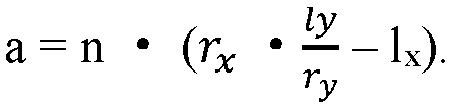
- Die Größe der Gegenkathete b kann ebenfalls direkt abgelesen werden und ergibt sich zu:

- Das Besondere an dem erfindungsgemäßen Ansatz ist nur, dass sich für die Berechnung des Winkels α die Unbekannte n heraus kürzt. Betrachten wir den Tangens des Orientierungswinkels so ergibt sich:


- Die in der Gleichung enthaltenen Größen sind die Koordinaten aus den Strahlen, die zu den Punkten führen. Diese Koordinaten sind abhängig von der Brennweite fxfy der Kamera 24 in Richtung der X- und der Y-Richtung. Die Berechnung dieser Koordinaten aus den Bildkoordinaten ist hinlänglich bekannt, und ergibt sich aus der folgenden Gleichung:


- Die Größen x' und y' sind Hilfsgrößen, die zusammen mit den Brennweiten fx, fy und dem Bildzentrum cx, yx die Abbildung in den Bildkoordinaten UV beschreibt. Durch eine einfache Umformung ergibt sich folgender Zusammenhang:


- Zusammen mit den aus der Kamerakalibrierung bekannten Größen cx, cy, fx, fy ergibt sich für die dreidimensionalen Koordinaten (X, Y, Z) der Strahl in den dreidimensionalen Koordinaten mit einer Richtung (X', Y', 1). Zu beachten ist, dass dieser Richtungsvektor des Strahls nicht normiert ist, was aber auch für die weitere Berechnung nicht erforderlich ist.
- Das Beispiel in
Fig. 9 zeigt ein Bild mit einer eingezeichneten Kante 60. Die Kante 60 ist gegenüber der Horizontalen 62 geneigt. In dem Bild wird zudem ein Punkt 64 auf der Kante 60 bestimmt. Für die Bestimmung des Punktes 64 können verschiedenste Ansätze gewählt werden. Beispielsweise kann die Mitte der Kante 60 gewählt werden. Es kann aber auch ein Punkt 64 gewählt werden, bei dem die eingeschlossene Bildfläche zwischen der Kante 60 und der Horizontalen 62 auf beiden Seiten des Punktes 64 gleich groß ist. Aus der Auswertung der Kante 60 ergeben sich mit dem Punkt und dem Winkel zwei geometrische Größen, die insgesamt als (X, Y, α) bezeichnet werden können. Für die Auswertung ist es nun möglich, beispielsweise in einer Look-Up-Tabelle zu den Werten X, Y, α einen Schnittwinkel nachzusehen. Die Look-Up-Tabelle kann bereits im Vorfeld berechnet werden und ist damit für eine schnelle Auswertung zugänglich. Insbesondere unter dem Aspekt, dass viele Kanten in dem Bild ausgewertet werden sollen, kann sich eine Look-Up-Tabelle als hilfreich erweisen. -
Fig. 10 zeigt eine sehr ähnliche Situation wie inFig. 9 , bei der eine Kante 66 schräg im Bild verläuft. Zur Bestimmung der beiden geometrischen Größen wird, ausgehend von einem Punkt 70, auf der Kante 66 wird ein Abstand r, 72 und ein Winkel φ, 74 bestimmt. Der Winkel 74 ist hierbei gegenüber einer Horizontalen 68 festgelegt. Der Abstand 72 steht in diesem Beispiel senkrecht auf der Kante 66. Grundsätzlich könnte der Abstand auch senkrecht auf der Horizontalen 68 stehen und unter einem Neigungswinkel die Kante 66 schneiden. - Auch bei diesem Ansatz wird beispielsweise über eine Look-Up-Tabelle für die geometrischen Größen r, φ ein Schnittwinkel nachgesehen und verwendet. Sollten für mehrere Punkte 70 oder mehrere Kanten 66 unterschiedliche Schnittwinkel entstehen, so können diese statistisch ausgewertet werden.
-
- 10
- Flurförderzeug
- 12
- Radarm
- 14
- Radarm
- 16
- Hubgerüst
- 18
- Gabelzinken
- 20
- Gabelzinken
- 22
- Rückwand
- 24
- 2D-Kamera
- 28
- Lastregal
- 30
- Frontseite des Lastregals
- 32
- Rückseite des Lastregals
- 34a-c
- Lasthilfsmittel
- 36a-b
- Regalstützen
- 38a-c
- Lastregalträger
- 40
- horizontale Linien
- 44
- Bildkante
- 46
- Bildkante
- 48
- Endpunkt L
- 50
- Endpunkt R
- 52
- Strahl
- 56
- Bildebene
- 58
- Strahl
- 60
- Kante
- 62
- Horizontale
- 64
- Punkt
- 66
- Kante
- 68
- Horizontale
- 70
- Punkt
- 72
- Abstand r
- 74
- Winkel φ
Claims (9)
- Verfahren zur Bestimmung einer Orientierung eines Flurförderzeugs (10) relativ zu einer Struktur mit mindestens einem horizontalen Element, wobei das Flurförderzeug (10) eine 2D-Kamera (24) aufweist, die auf die Struktur gerichtet ist, wobei das Verfahren die folgenden Verfahrensschritte aufweist:∘ Aufzeichnen eines Bildes der Struktur mit dem mindestens einem horizontalen Element, wobei in dem aufgezeichneten Bild eine Kante identifiziert wird,∘ in dem aufgezeichneten Bild werden entlang der identifizierten Kante mindestens zwei Punkte (L, R) (48, 50) identifiziert, die dem horizontalen Element entsprechen,∘ Bestimmen jeweils eines Strahls (
l ,r ) (52, 58) zu einem der beiden Punkte (L, R), dessen jeweilige Punkte in einem 3D-Koordinatensystem auf den jeweiligen Punkt (L, R) im Bild abgebildet werden, und∘ Bestimmen eines Schnittwinkels zwischen einer Bildebene (56) und einer vertikalen Ebene durch das horizontale Element aus einem Punktpaar mit jeweils einem Punkt auf den Strahlen, die auf gleicher Höhe in dem 3D-Koordinatensystem liegen. - Verfahren nach Anspruch 1, dadurch gekennzeichnet, dass von mindestens einem Punktpaar mit jeweils einem Punkt in einem der beiden Strahlen (52, 58) in dem 3D-Koordinatensystem der Schnittwinkel bestimmt wird.
- Verfahren nach einem der vorherigen Ansprüche, dadurch gekennzeichnet, dass die Kamera (24) auf ein Lastregal (28) mit horizontalen Lastregalträgern (38a-c) gerichtet wird.
- Verfahren nach einem der vorherigen Ansprüche, dadurch gekennzeichnet, dass die Kamera (24) an dem Flurförderzeug (10) angebracht ist.
- Verfahren nach einem der vorherigen Ansprüche, dadurch gekennzeichnet, dass die Bildebene der Kamera (24) eine vorbestimmte Orientierung, insbesondere eine vertikale Orientierung an dem Flurförderzeug (10) aufweist.
- Verfahren nach einem der vorherigen Ansprüche, dadurch gekennzeichnet, dass in dem aufgezeichneten Bild vertikale Kanten herausgefiltert werden.
- Verfahren nach einem der vorherigen Ansprüche, dadurch gekennzeichnet, dass Linien in einem Bereich der Bildmitte herausgefiltert werden.
- Verfahren nach einem der vorherigen Ansprüche, dadurch gekennzeichnet, dass die Kamera (24) kalibriert ist und ein Punkt mit den Bildkoordinaten (u, v) in einen Richtungsvektor (x', y', 1) für einen Strahl umgerechnet wird, dessen Punkte in dem 3D-Koordinatensystem jeweils auf den Punkt mit den Bildkoordinaten abgebildet werden.
- Verfahren nach einem der vorherigen Ansprüche, dadurch gekennzeichnet, dass eine Vielzahl der jeweils mindestens zwei Punkte ausgewertet wird, wobei die sich ergebende Vielzahl von Schnittwinkeln statistisch ausgewertet wird.
Applications Claiming Priority (1)
| Application Number | Priority Date | Filing Date | Title |
|---|---|---|---|
| DE102021102633.4A DE102021102633A1 (de) | 2021-02-04 | 2021-02-04 | Verfahren zur Bestimmung einer Orientierung eines Flurförderzeugs |
Publications (2)
| Publication Number | Publication Date |
|---|---|
| EP4040390A1 EP4040390A1 (de) | 2022-08-10 |
| EP4040390B1 true EP4040390B1 (de) | 2025-05-07 |
Family
ID=80119389
Family Applications (1)
| Application Number | Title | Priority Date | Filing Date |
|---|---|---|---|
| EP22154327.5A Active EP4040390B1 (de) | 2021-02-04 | 2022-01-31 | Verfahren zur bestimmung einer orientierung eines flurförderzeugs |
Country Status (4)
| Country | Link |
|---|---|
| US (1) | US12154292B2 (de) |
| EP (1) | EP4040390B1 (de) |
| CN (1) | CN114858085A (de) |
| DE (1) | DE102021102633A1 (de) |
Family Cites Families (15)
| Publication number | Priority date | Publication date | Assignee | Title |
|---|---|---|---|---|
| JP3663263B2 (ja) * | 1996-10-24 | 2005-06-22 | 株式会社ダイフク | 搬送車 |
| JP3690260B2 (ja) | 2000-10-18 | 2005-08-31 | 日産自動車株式会社 | 車間距離計測方法 |
| DE202006012637U1 (de) | 2006-08-16 | 2006-11-16 | Sick Ag | Vorrichtung zum Kollisionsschutz zwischen aufeinanderfolgenden spurgeführten Fahrzeugen |
| JP2008309595A (ja) | 2007-06-13 | 2008-12-25 | Horiba Ltd | オブジェクト認識装置及びそれに用いられるプログラム |
| DE102008041761A1 (de) | 2008-09-02 | 2010-03-04 | Robert Bosch Gmbh | Verfahren und Vorrichtung zur Ermittlung eines relativen Gierwinkels |
| RU2009113008A (ru) * | 2009-04-08 | 2010-10-20 | Михаил Юрьевич Воробьев (RU) | Способ определения позиции и ориентации прицепа транспортного средства и устройство для его осуществления |
| DE102010056217A1 (de) | 2010-12-24 | 2012-06-28 | Valeo Schalter Und Sensoren Gmbh | Verfahren zum Betreiben eines Fahrerassistenzsystems in einem Kraftfahrzeug, Fahrerassistenzsystem und Kraftfahrzeug |
| DE102013002554A1 (de) | 2013-02-15 | 2014-08-21 | Jungheinrich Aktiengesellschaft | Verfahren zur Erkennung von Objekten in einem Lager und/oder zur räumlichen Orientierung in einem Lager |
| FR3034555B1 (fr) * | 2015-04-03 | 2017-04-21 | Continental Automotive France | Procede de determination du sens du mouvement d'un vehicule automobile |
| US9986150B2 (en) * | 2015-09-30 | 2018-05-29 | Ricoh Co., Ltd. | Algorithm to estimate yaw errors in camera pose |
| EP3174007A1 (de) * | 2015-11-30 | 2017-05-31 | Delphi Technologies, Inc. | Verfahren zur kalibrierung der ausrichtung einer an ein fahrzeug montierten kamera |
| US11080880B2 (en) * | 2017-08-25 | 2021-08-03 | Maker Trading Pte Ltd | Machine vision system and method for identifying locations of target elements |
| CN110222700A (zh) * | 2019-05-30 | 2019-09-10 | 五邑大学 | 基于多尺度特征与宽度学习的sar图像识别方法及装置 |
| US11200677B2 (en) * | 2019-06-03 | 2021-12-14 | Zebra Technologies Corporation | Method, system and apparatus for shelf edge detection |
| JP7136141B2 (ja) * | 2020-02-07 | 2022-09-13 | カシオ計算機株式会社 | 情報管理装置、情報管理方法及びプログラム |
-
2021
- 2021-02-04 DE DE102021102633.4A patent/DE102021102633A1/de active Pending
-
2022
- 2022-01-29 CN CN202210109551.6A patent/CN114858085A/zh active Pending
- 2022-01-31 EP EP22154327.5A patent/EP4040390B1/de active Active
- 2022-02-03 US US17/591,662 patent/US12154292B2/en active Active
Also Published As
| Publication number | Publication date |
|---|---|
| US12154292B2 (en) | 2024-11-26 |
| EP4040390A1 (de) | 2022-08-10 |
| DE102021102633A1 (de) | 2022-08-04 |
| CN114858085A (zh) | 2022-08-05 |
| US20220245854A1 (en) | 2022-08-04 |
Similar Documents
| Publication | Publication Date | Title |
|---|---|---|
| DE102022120971B4 (de) | Gabelstapler und Verfahren zur Erfassung der Beladungsposition für einen Gabelstapler | |
| EP2275990B1 (de) | 3D-Sensor | |
| EP1987371B1 (de) | Verfahren zur detektion von objekten mit einer schwenkbaren sensoreinrichtung | |
| EP2767925B1 (de) | Verfahren zur Erkennung von Objekten in einem Lager und/oder zur räumlichen Orientierung in einem Lager | |
| EP3316181B1 (de) | Verfahren zum erkennen von objekten in einem lager und flurförderzeug mit einer einrichtung zum erkennen von objekten in einem lager | |
| DE102018122374B4 (de) | Verfahren zum Bestimmen eines ein Kraftfahrzeug umgebenden Freiraums, Computerprogrammprodukt, Freiraumbestimmungseinrichtung und Kraftfahrzeug | |
| DE102021201369A1 (de) | Verfahren und System zur Bestimmung einer Okklusion bzw. Verdeckung innerhalb eines Kamerasichtfelds | |
| EP3403404B1 (de) | Stereobilderfassungssystem | |
| DE102008019373A1 (de) | Messvorrichtung und Verfahren zum Kalibrieren einer Messvorrichtung eines Krans | |
| DE102011111440A1 (de) | Verfahren zur Umgebungsrepräsentation | |
| EP3308361B1 (de) | Verfahren zur erzeugung eines virtuellen bildes einer fahrzeugumgebung | |
| EP2888715B1 (de) | Verfahren und vorrichtung zum betreiben eines fahrzeugs | |
| EP2198390A2 (de) | Verfahren zum kalibrieren einer anordnung mit mindestens einer omnidirektionalen kamera und einer optischen anzeigeeinheit | |
| DE102022102562A1 (de) | Effektives berechnungsverfahren des mindestabstands zu dynamischen objekten | |
| DE102014114221A1 (de) | Verfahren zum Detektieren von einem Objekt in einem Umgebungsbereich eines Kraftfahrzeugs, Fahrerassistenzsystem und Kraftfahrzeug | |
| DE102015112194A1 (de) | Verfahren zur Planung oder Überwachung der Bewegung eines Kranes sowie Kran | |
| EP4040390B1 (de) | Verfahren zur bestimmung einer orientierung eines flurförderzeugs | |
| DE102017205630A1 (de) | Kameravorrichtung und Verfahren zur Erfassung eines Umgebungsbereichs eines Fahrzeugs | |
| DE102007056604A1 (de) | Stapelvorrichtung und Stapeleinheit für Container | |
| EP3292023B1 (de) | Verfahren zur darstellung einer fahrzeugumgebung eines fahrzeuges | |
| DE102023105893A1 (de) | Fahrzeugrückwärtiges überwachungssystem und fahrzeugrückwärtiges überwachungsverfahren | |
| DE1813743C3 (de) | Anordnung zur Abtastung eines Feldes in zwei Richtungen | |
| EP4374341A1 (de) | Verfahren zur überwachung eines laderaums | |
| EP3820805B1 (de) | Zuverlässige erkennung von containerkran und geschirr | |
| EP3216746A1 (de) | Flurförderzeug mit umgebungssensoren |
Legal Events
| Date | Code | Title | Description |
|---|---|---|---|
| PUAI | Public reference made under article 153(3) epc to a published international application that has entered the european phase |
Free format text: ORIGINAL CODE: 0009012 |
|
| STAA | Information on the status of an ep patent application or granted ep patent |
Free format text: STATUS: THE APPLICATION HAS BEEN PUBLISHED |
|
| AK | Designated contracting states |
Kind code of ref document: A1 Designated state(s): AL AT BE BG CH CY CZ DE DK EE ES FI FR GB GR HR HU IE IS IT LI LT LU LV MC MK MT NL NO PL PT RO RS SE SI SK SM TR |
|
| STAA | Information on the status of an ep patent application or granted ep patent |
Free format text: STATUS: REQUEST FOR EXAMINATION WAS MADE |
|
| 17P | Request for examination filed |
Effective date: 20230208 |
|
| RBV | Designated contracting states (corrected) |
Designated state(s): AL AT BE BG CH CY CZ DE DK EE ES FI FR GB GR HR HU IE IS IT LI LT LU LV MC MK MT NL NO PL PT RO RS SE SI SK SM TR |
|
| P01 | Opt-out of the competence of the unified patent court (upc) registered |
Effective date: 20230628 |
|
| GRAP | Despatch of communication of intention to grant a patent |
Free format text: ORIGINAL CODE: EPIDOSNIGR1 |
|
| STAA | Information on the status of an ep patent application or granted ep patent |
Free format text: STATUS: GRANT OF PATENT IS INTENDED |
|
| RIC1 | Information provided on ipc code assigned before grant |
Ipc: G06T 7/73 20170101AFI20241002BHEP |
|
| INTG | Intention to grant announced |
Effective date: 20241104 |
|
| GRAJ | Information related to disapproval of communication of intention to grant by the applicant or resumption of examination proceedings by the epo deleted |
Free format text: ORIGINAL CODE: EPIDOSDIGR1 |
|
| STAA | Information on the status of an ep patent application or granted ep patent |
Free format text: STATUS: REQUEST FOR EXAMINATION WAS MADE |
|
| GRAP | Despatch of communication of intention to grant a patent |
Free format text: ORIGINAL CODE: EPIDOSNIGR1 |
|
| INTC | Intention to grant announced (deleted) | ||
| STAA | Information on the status of an ep patent application or granted ep patent |
Free format text: STATUS: GRANT OF PATENT IS INTENDED |
|
| GRAS | Grant fee paid |
Free format text: ORIGINAL CODE: EPIDOSNIGR3 |
|
| INTG | Intention to grant announced |
Effective date: 20250227 |
|
| GRAA | (expected) grant |
Free format text: ORIGINAL CODE: 0009210 |
|
| STAA | Information on the status of an ep patent application or granted ep patent |
Free format text: STATUS: THE PATENT HAS BEEN GRANTED |
|
| AK | Designated contracting states |
Kind code of ref document: B1 Designated state(s): AL AT BE BG CH CY CZ DE DK EE ES FI FR GB GR HR HU IE IS IT LI LT LU LV MC MK MT NL NO PL PT RO RS SE SI SK SM TR |
|
| REG | Reference to a national code |
Ref country code: GB Ref legal event code: FG4D Free format text: NOT ENGLISH |
|
| REG | Reference to a national code |
Ref country code: CH Ref legal event code: EP |
|
| REG | Reference to a national code |
Ref country code: DE Ref legal event code: R096 Ref document number: 502022003819 Country of ref document: DE |
|
| REG | Reference to a national code |
Ref country code: IE Ref legal event code: FG4D Free format text: LANGUAGE OF EP DOCUMENT: GERMAN |
|
| REG | Reference to a national code |
Ref country code: SE Ref legal event code: TRGR |
|
| PGFP | Annual fee paid to national office [announced via postgrant information from national office to epo] |
Ref country code: FR Payment date: 20250528 Year of fee payment: 5 |
|
| REG | Reference to a national code |
Ref country code: NL Ref legal event code: MP Effective date: 20250507 |
|
| PG25 | Lapsed in a contracting state [announced via postgrant information from national office to epo] |
Ref country code: FI Free format text: LAPSE BECAUSE OF FAILURE TO SUBMIT A TRANSLATION OF THE DESCRIPTION OR TO PAY THE FEE WITHIN THE PRESCRIBED TIME-LIMIT Effective date: 20250507 Ref country code: ES Free format text: LAPSE BECAUSE OF FAILURE TO SUBMIT A TRANSLATION OF THE DESCRIPTION OR TO PAY THE FEE WITHIN THE PRESCRIBED TIME-LIMIT Effective date: 20250507 Ref country code: PT Free format text: LAPSE BECAUSE OF FAILURE TO SUBMIT A TRANSLATION OF THE DESCRIPTION OR TO PAY THE FEE WITHIN THE PRESCRIBED TIME-LIMIT Effective date: 20250908 |
|
| REG | Reference to a national code |
Ref country code: LT Ref legal event code: MG9D |
|
| PG25 | Lapsed in a contracting state [announced via postgrant information from national office to epo] |
Ref country code: GR Free format text: LAPSE BECAUSE OF FAILURE TO SUBMIT A TRANSLATION OF THE DESCRIPTION OR TO PAY THE FEE WITHIN THE PRESCRIBED TIME-LIMIT Effective date: 20250808 Ref country code: NO Free format text: LAPSE BECAUSE OF FAILURE TO SUBMIT A TRANSLATION OF THE DESCRIPTION OR TO PAY THE FEE WITHIN THE PRESCRIBED TIME-LIMIT Effective date: 20250807 |
|
| PG25 | Lapsed in a contracting state [announced via postgrant information from national office to epo] |
Ref country code: PL Free format text: LAPSE BECAUSE OF FAILURE TO SUBMIT A TRANSLATION OF THE DESCRIPTION OR TO PAY THE FEE WITHIN THE PRESCRIBED TIME-LIMIT Effective date: 20250507 Ref country code: NL Free format text: LAPSE BECAUSE OF FAILURE TO SUBMIT A TRANSLATION OF THE DESCRIPTION OR TO PAY THE FEE WITHIN THE PRESCRIBED TIME-LIMIT Effective date: 20250507 |
|
| PG25 | Lapsed in a contracting state [announced via postgrant information from national office to epo] |
Ref country code: BG Free format text: LAPSE BECAUSE OF FAILURE TO SUBMIT A TRANSLATION OF THE DESCRIPTION OR TO PAY THE FEE WITHIN THE PRESCRIBED TIME-LIMIT Effective date: 20250507 |
|
| PG25 | Lapsed in a contracting state [announced via postgrant information from national office to epo] |
Ref country code: HR Free format text: LAPSE BECAUSE OF FAILURE TO SUBMIT A TRANSLATION OF THE DESCRIPTION OR TO PAY THE FEE WITHIN THE PRESCRIBED TIME-LIMIT Effective date: 20250507 |
|
| PG25 | Lapsed in a contracting state [announced via postgrant information from national office to epo] |
Ref country code: RS Free format text: LAPSE BECAUSE OF FAILURE TO SUBMIT A TRANSLATION OF THE DESCRIPTION OR TO PAY THE FEE WITHIN THE PRESCRIBED TIME-LIMIT Effective date: 20250807 |
|
| PG25 | Lapsed in a contracting state [announced via postgrant information from national office to epo] |
Ref country code: IS Free format text: LAPSE BECAUSE OF FAILURE TO SUBMIT A TRANSLATION OF THE DESCRIPTION OR TO PAY THE FEE WITHIN THE PRESCRIBED TIME-LIMIT Effective date: 20250907 |
|
| PG25 | Lapsed in a contracting state [announced via postgrant information from national office to epo] |
Ref country code: LV Free format text: LAPSE BECAUSE OF FAILURE TO SUBMIT A TRANSLATION OF THE DESCRIPTION OR TO PAY THE FEE WITHIN THE PRESCRIBED TIME-LIMIT Effective date: 20250507 |
|
| PG25 | Lapsed in a contracting state [announced via postgrant information from national office to epo] |
Ref country code: DK Free format text: LAPSE BECAUSE OF FAILURE TO SUBMIT A TRANSLATION OF THE DESCRIPTION OR TO PAY THE FEE WITHIN THE PRESCRIBED TIME-LIMIT Effective date: 20250507 Ref country code: SM Free format text: LAPSE BECAUSE OF FAILURE TO SUBMIT A TRANSLATION OF THE DESCRIPTION OR TO PAY THE FEE WITHIN THE PRESCRIBED TIME-LIMIT Effective date: 20250507 |
|
| PG25 | Lapsed in a contracting state [announced via postgrant information from national office to epo] |
Ref country code: CZ Free format text: LAPSE BECAUSE OF FAILURE TO SUBMIT A TRANSLATION OF THE DESCRIPTION OR TO PAY THE FEE WITHIN THE PRESCRIBED TIME-LIMIT Effective date: 20250507 |
|
| PG25 | Lapsed in a contracting state [announced via postgrant information from national office to epo] |
Ref country code: EE Free format text: LAPSE BECAUSE OF FAILURE TO SUBMIT A TRANSLATION OF THE DESCRIPTION OR TO PAY THE FEE WITHIN THE PRESCRIBED TIME-LIMIT Effective date: 20250507 |
|
| PG25 | Lapsed in a contracting state [announced via postgrant information from national office to epo] |
Ref country code: SK Free format text: LAPSE BECAUSE OF FAILURE TO SUBMIT A TRANSLATION OF THE DESCRIPTION OR TO PAY THE FEE WITHIN THE PRESCRIBED TIME-LIMIT Effective date: 20250507 |
|
| PG25 | Lapsed in a contracting state [announced via postgrant information from national office to epo] |
Ref country code: IT Free format text: LAPSE BECAUSE OF FAILURE TO SUBMIT A TRANSLATION OF THE DESCRIPTION OR TO PAY THE FEE WITHIN THE PRESCRIBED TIME-LIMIT Effective date: 20250507 |
|
| REG | Reference to a national code |
Ref country code: DE Ref legal event code: R097 Ref document number: 502022003819 Country of ref document: DE |
|
| PLBE | No opposition filed within time limit |
Free format text: ORIGINAL CODE: 0009261 |
|
| STAA | Information on the status of an ep patent application or granted ep patent |
Free format text: STATUS: NO OPPOSITION FILED WITHIN TIME LIMIT |
|
| REG | Reference to a national code |
Ref country code: CH Ref legal event code: L10 Free format text: ST27 STATUS EVENT CODE: U-0-0-L10-L00 (AS PROVIDED BY THE NATIONAL OFFICE) Effective date: 20260318 |
|
| PGFP | Annual fee paid to national office [announced via postgrant information from national office to epo] |
Ref country code: SE Payment date: 20260121 Year of fee payment: 5 |
|
| PGFP | Annual fee paid to national office [announced via postgrant information from national office to epo] |
Ref country code: DE Payment date: 20260120 Year of fee payment: 5 |
|
| 26N | No opposition filed |
Effective date: 20260210 |