EP4034864B1 - Bereitstellung eines hinweises auf die zahnfleischgesundheit einer person - Google Patents
Bereitstellung eines hinweises auf die zahnfleischgesundheit einer person Download PDFInfo
- Publication number
- EP4034864B1 EP4034864B1 EP20758145.5A EP20758145A EP4034864B1 EP 4034864 B1 EP4034864 B1 EP 4034864B1 EP 20758145 A EP20758145 A EP 20758145A EP 4034864 B1 EP4034864 B1 EP 4034864B1
- Authority
- EP
- European Patent Office
- Prior art keywords
- light
- fluid
- volume
- saliva
- person
- Prior art date
- Legal status (The legal status is an assumption and is not a legal conclusion. Google has not performed a legal analysis and makes no representation as to the accuracy of the status listed.)
- Active
Links
Images

Classifications
-
- A—HUMAN NECESSITIES
- A61—MEDICAL OR VETERINARY SCIENCE; HYGIENE
- A61B—DIAGNOSIS; SURGERY; IDENTIFICATION
- A61B5/00—Measuring for diagnostic purposes; Identification of persons
- A61B5/45—For evaluating or diagnosing the musculoskeletal system or teeth
- A61B5/4538—Evaluating a particular part of the muscoloskeletal system or a particular medical condition
- A61B5/4542—Evaluating the mouth, e.g. the jaw
- A61B5/4552—Evaluating soft tissue within the mouth, e.g. gums or tongue
-
- G—PHYSICS
- G01—MEASURING; TESTING
- G01N—INVESTIGATING OR ANALYSING MATERIALS BY DETERMINING THEIR CHEMICAL OR PHYSICAL PROPERTIES
- G01N21/00—Investigating or analysing materials by the use of optical means, i.e. using sub-millimetre waves, infrared, visible or ultraviolet light
- G01N21/17—Systems in which incident light is modified in accordance with the properties of the material investigated
- G01N21/47—Scattering, i.e. diffuse reflection
-
- A—HUMAN NECESSITIES
- A46—BRUSHWARE
- A46B—BRUSHES
- A46B15/00—Other brushes; Brushes with additional arrangements
- A46B15/0002—Arrangements for enhancing monitoring or controlling the brushing process
- A46B15/0004—Arrangements for enhancing monitoring or controlling the brushing process with a controlling means
-
- A—HUMAN NECESSITIES
- A46—BRUSHWARE
- A46B—BRUSHES
- A46B15/00—Other brushes; Brushes with additional arrangements
- A46B15/0002—Arrangements for enhancing monitoring or controlling the brushing process
- A46B15/0016—Arrangements for enhancing monitoring or controlling the brushing process with enhancing means
- A46B15/0034—Arrangements for enhancing monitoring or controlling the brushing process with enhancing means with a source of radiation, e.g. UV, IR, LASER, X-ray for irradiating the teeth and associated surfaces
-
- A—HUMAN NECESSITIES
- A47—FURNITURE; DOMESTIC ARTICLES OR APPLIANCES; COFFEE MILLS; SPICE MILLS; SUCTION CLEANERS IN GENERAL
- A47G—HOUSEHOLD OR TABLE EQUIPMENT
- A47G19/00—Table service
- A47G19/22—Drinking vessels or saucers used for table service
- A47G19/2205—Drinking glasses or vessels
- A47G19/2227—Drinking glasses or vessels with means for amusing or giving information to the user
-
- A—HUMAN NECESSITIES
- A61—MEDICAL OR VETERINARY SCIENCE; HYGIENE
- A61B—DIAGNOSIS; SURGERY; IDENTIFICATION
- A61B10/00—Instruments for taking body samples for diagnostic purposes; Other methods or instruments for diagnosis, e.g. for vaccination diagnosis, sex determination or ovulation-period determination; Throat striking implements
- A61B10/0045—Devices for taking samples of body liquids
- A61B10/0051—Devices for taking samples of body liquids for taking saliva or sputum samples
-
- A—HUMAN NECESSITIES
- A61—MEDICAL OR VETERINARY SCIENCE; HYGIENE
- A61B—DIAGNOSIS; SURGERY; IDENTIFICATION
- A61B5/00—Measuring for diagnostic purposes; Identification of persons
- A61B5/0059—Measuring for diagnostic purposes; Identification of persons using light, e.g. diagnosis by transillumination, diascopy, fluorescence
- A61B5/0075—Measuring for diagnostic purposes; Identification of persons using light, e.g. diagnosis by transillumination, diascopy, fluorescence by spectroscopy, i.e. measuring spectra, e.g. Raman spectroscopy, infrared absorption spectroscopy
-
- A—HUMAN NECESSITIES
- A61—MEDICAL OR VETERINARY SCIENCE; HYGIENE
- A61B—DIAGNOSIS; SURGERY; IDENTIFICATION
- A61B5/00—Measuring for diagnostic purposes; Identification of persons
- A61B5/0059—Measuring for diagnostic purposes; Identification of persons using light, e.g. diagnosis by transillumination, diascopy, fluorescence
- A61B5/0082—Measuring for diagnostic purposes; Identification of persons using light, e.g. diagnosis by transillumination, diascopy, fluorescence adapted for particular medical purposes
- A61B5/0088—Measuring for diagnostic purposes; Identification of persons using light, e.g. diagnosis by transillumination, diascopy, fluorescence adapted for particular medical purposes for oral or dental tissue
-
- A—HUMAN NECESSITIES
- A61—MEDICAL OR VETERINARY SCIENCE; HYGIENE
- A61B—DIAGNOSIS; SURGERY; IDENTIFICATION
- A61B5/00—Measuring for diagnostic purposes; Identification of persons
- A61B5/02—Detecting, measuring or recording for evaluating the cardiovascular system, e.g. pulse, heart rate, blood pressure or blood flow
- A61B5/02042—Determining blood loss or bleeding, e.g. during a surgical procedure
-
- A—HUMAN NECESSITIES
- A61—MEDICAL OR VETERINARY SCIENCE; HYGIENE
- A61B—DIAGNOSIS; SURGERY; IDENTIFICATION
- A61B5/00—Measuring for diagnostic purposes; Identification of persons
- A61B5/145—Measuring characteristics of blood in vivo, e.g. gas concentration or pH-value ; Measuring characteristics of body fluids or tissues, e.g. interstitial fluid or cerebral tissue
- A61B5/1455—Measuring characteristics of blood in vivo, e.g. gas concentration or pH-value ; Measuring characteristics of body fluids or tissues, e.g. interstitial fluid or cerebral tissue using optical sensors, e.g. spectral photometrical oximeters
- A61B5/14551—Measuring characteristics of blood in vivo, e.g. gas concentration or pH-value ; Measuring characteristics of body fluids or tissues, e.g. interstitial fluid or cerebral tissue using optical sensors, e.g. spectral photometrical oximeters for measuring blood gases
- A61B5/14552—Details of sensors specially adapted therefor
-
- A—HUMAN NECESSITIES
- A61—MEDICAL OR VETERINARY SCIENCE; HYGIENE
- A61B—DIAGNOSIS; SURGERY; IDENTIFICATION
- A61B5/00—Measuring for diagnostic purposes; Identification of persons
- A61B5/68—Arrangements of detecting, measuring or recording means, e.g. sensors, in relation to patient
- A61B5/6801—Arrangements of detecting, measuring or recording means, e.g. sensors, in relation to patient specially adapted to be attached to or worn on the body surface
- A61B5/6813—Specially adapted to be attached to a specific body part
- A61B5/6814—Head
- A61B5/682—Mouth, e.g., oral cavity; tongue; Lips; Teeth
-
- A—HUMAN NECESSITIES
- A61—MEDICAL OR VETERINARY SCIENCE; HYGIENE
- A61C—DENTISTRY; APPARATUS OR METHODS FOR ORAL OR DENTAL HYGIENE
- A61C17/00—Devices for cleaning, polishing, rinsing or drying teeth, teeth cavities or prostheses; Saliva removers; Dental appliances for receiving spittle
- A61C17/16—Power-driven cleaning or polishing devices
- A61C17/22—Power-driven cleaning or polishing devices with brushes, cushions, cups, or the like
-
- A—HUMAN NECESSITIES
- A61—MEDICAL OR VETERINARY SCIENCE; HYGIENE
- A61C—DENTISTRY; APPARATUS OR METHODS FOR ORAL OR DENTAL HYGIENE
- A61C17/00—Devices for cleaning, polishing, rinsing or drying teeth, teeth cavities or prostheses; Saliva removers; Dental appliances for receiving spittle
- A61C17/16—Power-driven cleaning or polishing devices
- A61C17/22—Power-driven cleaning or polishing devices with brushes, cushions, cups, or the like
- A61C17/225—Handles or details thereof
-
- A—HUMAN NECESSITIES
- A61—MEDICAL OR VETERINARY SCIENCE; HYGIENE
- A61C—DENTISTRY; APPARATUS OR METHODS FOR ORAL OR DENTAL HYGIENE
- A61C19/00—Dental auxiliary appliances
- A61C19/04—Measuring instruments specially adapted for dentistry
-
- G—PHYSICS
- G01—MEASURING; TESTING
- G01J—MEASUREMENT OF INTENSITY, VELOCITY, SPECTRAL CONTENT, POLARISATION, PHASE OR PULSE CHARACTERISTICS OF INFRARED, VISIBLE OR ULTRAVIOLET LIGHT; COLORIMETRY; RADIATION PYROMETRY
- G01J3/00—Spectrometry; Spectrophotometry; Monochromators; Measuring colours
- G01J3/02—Details
- G01J3/0267—Sample holders for colorimetry
-
- G—PHYSICS
- G01—MEASURING; TESTING
- G01J—MEASUREMENT OF INTENSITY, VELOCITY, SPECTRAL CONTENT, POLARISATION, PHASE OR PULSE CHARACTERISTICS OF INFRARED, VISIBLE OR ULTRAVIOLET LIGHT; COLORIMETRY; RADIATION PYROMETRY
- G01J3/00—Spectrometry; Spectrophotometry; Monochromators; Measuring colours
- G01J3/02—Details
- G01J3/0272—Handheld
-
- G—PHYSICS
- G01—MEASURING; TESTING
- G01J—MEASUREMENT OF INTENSITY, VELOCITY, SPECTRAL CONTENT, POLARISATION, PHASE OR PULSE CHARACTERISTICS OF INFRARED, VISIBLE OR ULTRAVIOLET LIGHT; COLORIMETRY; RADIATION PYROMETRY
- G01J3/00—Spectrometry; Spectrophotometry; Monochromators; Measuring colours
- G01J3/02—Details
- G01J3/0291—Housings; Spectrometer accessories; Spatial arrangement of elements, e.g. folded path arrangements
-
- G—PHYSICS
- G01—MEASURING; TESTING
- G01J—MEASUREMENT OF INTENSITY, VELOCITY, SPECTRAL CONTENT, POLARISATION, PHASE OR PULSE CHARACTERISTICS OF INFRARED, VISIBLE OR ULTRAVIOLET LIGHT; COLORIMETRY; RADIATION PYROMETRY
- G01J3/00—Spectrometry; Spectrophotometry; Monochromators; Measuring colours
- G01J3/28—Investigating the spectrum
- G01J3/42—Absorption spectrometry; Double beam spectrometry; Flicker spectrometry; Reflection spectrometry
-
- G—PHYSICS
- G01—MEASURING; TESTING
- G01N—INVESTIGATING OR ANALYSING MATERIALS BY DETERMINING THEIR CHEMICAL OR PHYSICAL PROPERTIES
- G01N21/00—Investigating or analysing materials by the use of optical means, i.e. using sub-millimetre waves, infrared, visible or ultraviolet light
- G01N21/17—Systems in which incident light is modified in accordance with the properties of the material investigated
- G01N21/25—Colour; Spectral properties, i.e. comparison of effect of material on the light at two or more different wavelengths or wavelength bands
- G01N21/31—Investigating relative effect of material at wavelengths characteristic of specific elements or molecules, e.g. atomic absorption spectrometry
-
- G—PHYSICS
- G01—MEASURING; TESTING
- G01N—INVESTIGATING OR ANALYSING MATERIALS BY DETERMINING THEIR CHEMICAL OR PHYSICAL PROPERTIES
- G01N21/00—Investigating or analysing materials by the use of optical means, i.e. using sub-millimetre waves, infrared, visible or ultraviolet light
- G01N21/17—Systems in which incident light is modified in accordance with the properties of the material investigated
- G01N21/47—Scattering, i.e. diffuse reflection
- G01N21/4738—Diffuse reflection, e.g. also for testing fluids, fibrous materials
- G01N21/474—Details of optical heads therefor, e.g. using optical fibres
-
- G—PHYSICS
- G01—MEASURING; TESTING
- G01N—INVESTIGATING OR ANALYSING MATERIALS BY DETERMINING THEIR CHEMICAL OR PHYSICAL PROPERTIES
- G01N21/00—Investigating or analysing materials by the use of optical means, i.e. using sub-millimetre waves, infrared, visible or ultraviolet light
- G01N21/17—Systems in which incident light is modified in accordance with the properties of the material investigated
- G01N21/47—Scattering, i.e. diffuse reflection
- G01N21/49—Scattering, i.e. diffuse reflection within a body or fluid
- G01N21/51—Scattering, i.e. diffuse reflection within a body or fluid inside a container, e.g. in an ampoule
-
- G—PHYSICS
- G01—MEASURING; TESTING
- G01N—INVESTIGATING OR ANALYSING MATERIALS BY DETERMINING THEIR CHEMICAL OR PHYSICAL PROPERTIES
- G01N33/00—Investigating or analysing materials by specific methods not covered by groups G01N1/00 - G01N31/00
- G01N33/48—Biological material, e.g. blood, urine; Haemocytometers
- G01N33/483—Physical analysis of biological material
- G01N33/487—Physical analysis of biological material of liquid biological material
-
- A—HUMAN NECESSITIES
- A46—BRUSHWARE
- A46B—BRUSHES
- A46B2200/00—Brushes characterized by their functions, uses or applications
- A46B2200/10—For human or animal care
- A46B2200/1066—Toothbrush for cleaning the teeth or dentures
-
- A—HUMAN NECESSITIES
- A47—FURNITURE; DOMESTIC ARTICLES OR APPLIANCES; COFFEE MILLS; SPICE MILLS; SUCTION CLEANERS IN GENERAL
- A47G—HOUSEHOLD OR TABLE EQUIPMENT
- A47G19/00—Table service
- A47G19/22—Drinking vessels or saucers used for table service
- A47G19/2205—Drinking glasses or vessels
- A47G19/2227—Drinking glasses or vessels with means for amusing or giving information to the user
- A47G2019/2238—Drinking glasses or vessels with means for amusing or giving information to the user with illumination means
-
- G—PHYSICS
- G01—MEASURING; TESTING
- G01N—INVESTIGATING OR ANALYSING MATERIALS BY DETERMINING THEIR CHEMICAL OR PHYSICAL PROPERTIES
- G01N21/00—Investigating or analysing materials by the use of optical means, i.e. using sub-millimetre waves, infrared, visible or ultraviolet light
- G01N21/01—Arrangements or apparatus for facilitating the optical investigation
- G01N2021/0106—General arrangement of respective parts
- G01N2021/0118—Apparatus with remote processing
- G01N2021/0125—Apparatus with remote processing with stored program or instructions
- G01N2021/0131—Apparatus with remote processing with stored program or instructions being externally stored
-
- G—PHYSICS
- G01—MEASURING; TESTING
- G01N—INVESTIGATING OR ANALYSING MATERIALS BY DETERMINING THEIR CHEMICAL OR PHYSICAL PROPERTIES
- G01N21/00—Investigating or analysing materials by the use of optical means, i.e. using sub-millimetre waves, infrared, visible or ultraviolet light
- G01N21/17—Systems in which incident light is modified in accordance with the properties of the material investigated
- G01N21/47—Scattering, i.e. diffuse reflection
- G01N21/4738—Diffuse reflection, e.g. also for testing fluids, fibrous materials
- G01N21/474—Details of optical heads therefor, e.g. using optical fibres
- G01N2021/4752—Geometry
- G01N2021/4757—Geometry 0/45° or 45/0°
-
- G—PHYSICS
- G01—MEASURING; TESTING
- G01N—INVESTIGATING OR ANALYSING MATERIALS BY DETERMINING THEIR CHEMICAL OR PHYSICAL PROPERTIES
- G01N21/00—Investigating or analysing materials by the use of optical means, i.e. using sub-millimetre waves, infrared, visible or ultraviolet light
- G01N21/17—Systems in which incident light is modified in accordance with the properties of the material investigated
- G01N21/47—Scattering, i.e. diffuse reflection
- G01N21/4738—Diffuse reflection, e.g. also for testing fluids, fibrous materials
- G01N2021/4764—Special kinds of physical applications
- G01N2021/4769—Fluid samples, e.g. slurries, granulates; Compressible powdery of fibrous samples
-
- G—PHYSICS
- G01—MEASURING; TESTING
- G01N—INVESTIGATING OR ANALYSING MATERIALS BY DETERMINING THEIR CHEMICAL OR PHYSICAL PROPERTIES
- G01N2201/00—Features of devices classified in G01N21/00
- G01N2201/02—Mechanical
- G01N2201/022—Casings
- G01N2201/0221—Portable; cableless; compact; hand-held
Definitions
- the invention relates to a system configured to provide an indication of a person's gum health.
- the invention also relates to a method of providing an indication of a person's gum health.
- the invention also relates to a computer program product comprising code to cause a processor, when the code is executed on the processor, to cause the system as mentioned to execute the method as mentioned.
- the invention also relates to a remote device having a processor, comprising the computer program product as mentioned.
- WO 84/03143 A1 discloses a probe for insertion into a periodontal pocket, for measuring a depth. It uses analysis of reflected light to determine a depth of saliva in the pocket and hence a pocket depth.
- US 2011/050431 A1 discloses a beverage container incorporating a sensor, for example for determining an amount of glucose and carbohydrates in the beverage.
- EP 3 441 764 A1 discloses a system for analyzing a blood content in saliva in order to determine a stage of periodontal disease.
- Gingivitis is inflammation of the gums, characterized by swollen gums, oedema and redness.
- the primary cause of gingivitis is plaque build-up, mostly in the gingival sulcus (pockets). Gingivitis most often occurs in hard to reach areas, such as interproximal areas, i.e. areas between adjacent teeth, and around the posterior teeth, which are difficult to clean properly.
- Gingivitis can be reversed by improved oral hygiene, especially in an early stage of the inflammation. As gingivitis can propagate to irreversible periodontitis, it is important to maintain a high level of oral health and to detect gingivitis as soon as possible.
- DRS Dense Reflective Spectroscopy
- the invention is based on an insight that it is possible to diagnose gingivitis on the basis of measurements aimed at determining whether or not blood is present in saliva or a fluid-saliva mixture, wherein the saliva or fluid-saliva mixture may be obtained during an action in the person's mouth involving a gum agitation effect, or after such an action has taken place.
- such an action is an oral care action such as brushing or flossing.
- an oral care action such as brushing or flossing.
- a sufficiently sensitive method has been developed by means of which it is possible to trace even very small quantities of blood in saliva or a fluid-saliva mixture, so that gingivitis may be diagnosed in an early stage.
- an optical analysis of saliva or a fluid-saliva mixture is performed in order to check whether the saliva or fluid-saliva mixture contains blood.
- light received from a representative volume of fluid containing saliva is detected and analyzed, which light is obtained by emitting light to the volume of fluid and receiving the light back from the volume of fluid.
- the analysis is done in a particular way and comprises the steps as defined in the foregoing.
- investigating a representative volume of fluid is done during or after an oral care action is performed in the person's mouth.
- the invention relies on determination of one or more measurement values of light received by the light-receiving unit for no more than a single wavelength of the light.
- the single wavelength of the light is a wavelength related to relatively high light absorption by a constituent of blood, wherein it is noted that the constituent of blood as mentioned may particularly be hemoglobin.
- the invention is based on the insight that the measurement configuration as determined by the positioning of the light-emitting unit and the light-receiving unit with respect to each other and the volume of fluid between the respective units can be chosen such that it is possible to regard the volume of fluid as a semi-infinite layer, which implies that out of the three factors normally determining the features of the light received by the light-receiving unit, i.e. reflection, absorption and transmission, transmission may be regarded to be zero.
- a presence of blood in a volume of fluid mainly influences the absorption of the light, especially when a wavelength of the light is chosen to be a wavelength related to relatively high light absorption by a constituent of blood, as is the case according to the invention.
- the intensity of reflected light can be taken as a measure of the extent to which the light is absorbed by the volume of fluid, as the absorption of the light by the volume of fluid becomes the only factor changing reflection of the light, and thereby a measure of an extent to which blood is present in the volume of fluid.
- the light-receiving unit is configured to receive reflected light back from the volume of fluid, so that the measurements at the single wavelength can be performed in a proper manner and useful measurement results may be expected.
- the at least one algorithm is designed to determine measurement values real-time during an action in the person's mouth involving a gum agitation effect, and to monitor a development of the measurement values over time and assess whether a deviation from a gradual course of the development of the measurement values occurs in the development.
- a gradual course of development of the measurement values may be expected, i.e. the development of the measurement values may be expected to be of a more or less steady/constant character.
- a deviation from a gradual course of the development of the measurement values may indicate that a release of blood from the gums has taken place.
- the at least one algorithm may be designed to determine the measurement values at successive discrete moments in time, and to involve determining differences between successive measurement values in assessing whether a deviation from a gradual course of the development of the measurement values occurs in the development.
- the at least one algorithm may particularly be designed to involve checking whether each of differences from at least a predetermined number of successive differences is larger than each of differences from at least a predetermined number of preceding differences by at least a predefined minimum percentage in assessing whether a deviation from a gradual course of the development of the measurement values occurs in the development.
- the at least one algorithm may be designed to determine that the measurement values are indicative of the presence of blood in a volume of fluid containing saliva when a deviation from a gradual course of the development of the measurement values is found in the development.
- the hemoglobin of blood has a light absorption spectrum in which absorption peaks can clearly be distinguished at wavelength values in a range of about 400 to 440 nm.
- the absorption of hemoglobin is significantly lower.
- oxyhemoglobin i.e. hemoglobin with bound oxygen
- deoxygenated hemoglobin i.e. hemoglobin without bound oxygen.
- a practical example of the single wavelength of the light is a wavelength in the said range of 400 to 440 nm.
- a single wavelength is mentioned, or where a specific wavelength value is mentioned in relation to a device such as a light source or a filter, this is to be understood for its practical meaning rather than its theoretical meaning, taking into account that in fact a tolerance window is applicable.
- the at least one measurement value of light received by the light-receiving unit may be regarded as being representative of information that is related to a person's gum health in some way, and as being suitable to be used for the purpose of determining output representative of the person's gum health.
- the determination of the at least one measurement value it is possible for the determination of the at least one measurement value to be followed by a further step that involves determination whether or not the at least one measurement value is indicative of the presence of blood in a volume of fluid containing saliva.
- Such a further step may be performed in any appropriate way, and may involve, for example, comparing the at least one measurement value to at least one reference value, or keeping track of a development of measurement values over time in order to see whether deviations in a gradual course of the development can be found, as explained in the foregoing.
- a warning signal is emitted in case an indication of the presence of blood in a volume of fluid under investigation is found.
- the system according to the invention may be equipped with any suitable type of warning mechanism as will further be explained in the following.
- the analysis unit of the system according to the invention is configured to perform at least the determination of the at least one measurement value.
- output of the analysis unit may come in the form of the at least one measurement value.
- the analysis unit is configured to perform the further step, in which case output of the analysis unit may come in a form that does not require further interpretation but is a direct indication as to whether or not blood is present in a volume of fluid and/or whether or not oral health issues may be assumed.
- output of the analysis unit may come in a form that does not require further interpretation but is a direct indication as to whether or not blood is present in a volume of fluid and/or whether or not oral health issues may be assumed.
- a notable advantage of the invention resides in the fact that there is no need for performing complex actions or using sophisticated and expensive equipment for performing the analysis of a volume of fluid containing saliva.
- the invention it is possible to put the invention to practice in such a way that all that is needed for obtaining a volume of fluid that is suitable for investigation is performing a normal oral care action.
- the volume of fluid can be obtained in various ways, ranging from having an area on an oral care appliance that is particularly shaped for this purpose to having a person spit out some saliva.
- the analysis unit may be provided in the form of a preprogrammed microprocessor or a general microprocessor in combination with a suitable app or the like for controlling operation of the microprocessor, to mention two practical examples.
- the light-emitting unit is configured to emit light at only the single wavelength, and may, for example, comprise a suitable LED to that end, and the light-receiving unit comprises a bandpass filter/light detector combination including a bandpass filter that is configured to only allow light at the single wavelength or a narrow wavelength band to pass.
- the system according to the invention may be equipped with a warning mechanism configured to emit a signal in case the at least one measurement value is analyzed and found to be indicative of the presence of blood in a volume of fluid.
- the signal may be a visible signal and/or an audible signal, for example.
- the system according to the invention may be equipped with an output interface configured to communicate the information about gum health in a person's mouth, as determined and output by the analysis unit, to a user of the output interface, who may be the person herself/himself and/or another person such as a dentist. Outputting the information may be done through an app on the user's phone, for example, or on a suitable display.
- the output interface is adapted to generate output in a humanly processable form, i.e. in a form that can be detected by at least one of the human senses and processed in the human brain so as to make a human aware of the output of the output interface.
- Practical examples of output in a humanly processable form include output as can be detected by human vision, output as can be detected by human hearing and tactile output. In respect of the latter example, it is noted that when the invention involves use of an oral care appliance such as a power toothbrush, tactile output may be provided by varying the frequency and/or the amplitude of the motion of a functional unit (head) thereof.
- the analysis unit may be configured to transmit an information signal as a wireless signal, wherein there is no need for the analysis unit and the output interface to be physically connected in any way.
- the internet may be used for conveying the information signal to any person to whom the information generated by the analysis unit may be of interest.
- the results of successive analysis actions may be saved and may be subjected to further analysis so as to perform an assessment of trends over time.
- the system comprises a remote device having a processor, wherein the analysis unit comprises the processor of the remote device, and wherein the at least one algorithm to be executed by the analysis unit is defined by an app installed on the remote device.
- the remote device may also comprise a light module and an image chip, in which case it may be advantageous if the light-emitting unit comprises the light module of the remote device and the light-receiving unit comprises the image chip of the remote device.
- Examples of a remote device include a mobile/portable device such as a smartphone, a smartwatch, a tablet or a laptop, and also a non-portable computer.
- a mobile/portable device such as a smartphone, a smartwatch, a tablet or a laptop
- a non-portable computer such as a configuration in which an app by means of which the at least one algorithm is defined is not installed on a mobile/portable device or a non-portable computer but on a remote server that is accessible by a mobile/portable device or a non-portable computer, or a configuration in which the analysis unit is arranged outside of a mobile/portable device or a non-portable computer, in which case the mobile/portable device or the non-portable computer can be provided with an app that is designed to enable measurement data to be transmitted to the analysis unit.
- the system comprises a power toothbrush or power flosser configured to perform an oral care action that involves a gum agitation effect, wherein at least the light-emitting unit and the light-receiving unit are incorporated in the oral care appliance.
- the oral care appliance has a handle portion and a head portion, in which case the light-emitting unit and the light-receiving unit may be arranged at the position of the head portion.
- the disclosure also relates to a handle portion of an oral care appliance, the oral care appliance being configured to perform an oral care action that involves a gum agitation effect and further having a head portion, and the handle portion being configured to be used with the head portion and to be used in the system disclosed in the foregoing, wherein the handle portion accommodates at least the analysis unit of the system.
- the oral care appliance is configured to be used in both a process of performing an oral care action which may lead to the release of blood from the gums in case of reduced or poor gum health, and a process of determining whether or not blood is present in the saliva.
- the analysis unit may be provided outside of the oral care appliance, in which case it is advantageous if the oral care appliance is equipped with at least one unit that is designed to communicate with the analysis unit in a wireless fashion and/or another appropriate fashion.
- an oral care appliance that is designed for use in the system according to the invention to comprise an area for accommodating a volume of fluid containing a person's saliva realized as a recess in the oral care appliance.
- This provides a possibility of collecting and evaluating the volume of fluid containing the person's saliva in the person's mouth, which is an optimal way of obtaining an indication whether or not a person may suffer from reduced or poor gum health during an oral care routine performed on a regular basis.
- a container of which at least a bottom is transparent to light, particularly light at the single wavelength in which case the volume of fluid containing a person's saliva can be obtained by letting the person under investigation spit in the container, and light reflection can be measured at the single wavelength.
- the invention provides a practical way of providing an indication of a person's gum health.
- the presence of blood traces in a volume of fluid containing a person's saliva is evaluated by performing optical measurements and analyzing the results of the measurements, wherein an appropriate choice is made when it comes to a single wavelength at which the results are considered in the process.
- the invention is particularly aimed at providing a way of detecting blood traces in saliva or a toothpaste-saliva mixture for the purpose of obtaining an indication that the person whose saliva is under investigation may suffer from (early stage) gingivitis or from another condition affecting gum health.
- the invention provides a reliable method for detecting low hemoglobin concentrations, by using optical detection based on the known absorption peaks in the hemoglobin absorption spectrum. As is generally known, hemoglobin is an important constituent of blood.
- Fig. 1 shows two absorption spectra of hemoglobin, wherein the spectrum that is indicated by reference numeral 11 is related to oxyhemoglobin, i.e. hemoglobin with bound oxygen, and wherein the spectrum that is indicated by reference numeral 12 is related to deoxygenated hemoglobin, i.e. hemoglobin without bound oxygen.
- the wavelength of light expressed in nm is at the x axis of the spectra, and the absorption coefficient expressed in cm -1 is at the y axis of the spectra. It appears from the figure that there are some specific, highly absorbing wavelength ranges. Especially the blue wavelength range of 410 to 420 nm involves relatively high values of the absorption coefficient of the hemoglobin. The broader range of high absorption is 400 to 440 nm.
- the invention involves a method of assessing optical behavior of a volume of fluid containing saliva, which volume of fluid may be obtained during or after an action in a person's mouth involving a gum agitation effect, an oral care action selected from brushing or flossing is used in the present invention to provide such action. It is known that in the wavelength range of 400 to 440 nm as mentioned, the absorption coefficient of water is relatively low. As water is the main constituent of saliva, there is no need to take the saliva factor into account.
- the absorption and reflection characteristics of toothpaste may be assumed to be a more or less constant factor, at least in relation to a possible presence of blood in the saliva.
- a notable insight is that measurements can be performed in such a way as to justify regarding the volume of fluid as a semi-infinite layer, so that transmission of light may be assumed to be zero.
- the presence of blood in the saliva causes absorption of light to be high at a wavelength chosen from the above-mentioned range, wherein the absorption increases as the concentration of the blood increases, this leads to the conclusion that an indication about an extent to which blood is present can be obtained by considering reflection of light at such a wavelength.
- the insight that the volume of fluid may be regarded as a semi-infinite layer has been verified by means of a test.
- a brush head provided with a light source and a light detector arranged between the bristle tufts, a container for containing a volume of fluid, and a mirror were used.
- the container was filled with a volume of toothpaste-saliva mixtures of different concentrations, and for each of those toothpaste-saliva mixtures, it was assessed whether or not the light intensity measured at the light detector would vary as a result of varying a distance between the brush head and the mirror.
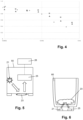
- Fig. 2 diagrammatically shows a light source 21, a collimator 22, a volume of fluid 23 to be investigated as present on a support 24, and a light detector 25 coupled to an analysis unit 26, wherein the light detector 25 is arranged so as to be in a position for receiving light from the light source 21 through reflection. Toothpaste and water were mixed in a 1:5 ratio after which small amounts of sheep blood were added to the mixture.
- Fig. 3 provides an illustration of the results of light reflection measurements for a mixture of toothpaste and saliva in the 1:5 ratio mentioned in the foregoing.
- the figure shows reflection values measured at a wavelength of 420 nm, plotted against blood concentration values, wherein the latter are expressed as the x value in a 1:x ratio of the blood and the mixture of toothpaste and saliva, so that an increasing x value indicates a decreasing amount of blood.
- the reflection values are expressed in arbitrary units. It follows from the figure that there is a relation between the reflection values and the blood concentration values, such that higher reflection values are found for lower blood concentration values, indeed, and that this relation is applicable even when 10,000 times more toothpaste and water than blood is present in a volume of fluid.
- Fig. 4 provides an illustration of the results of light reflection measurements for a mixture of toothpaste and saliva in various ratios. Measurement results indicated by means of a square relate to a 1:7 ratio, measurement results indicated by means of a triangle relate to a 1:5 ratio, and measurement results indicated by means of a circle relate to a 1:3 ratio.
- Reflection values measured at a wavelength of 420 nm are normalized to a maximum reflection of 1, which maximum reflection is associated with the absence of blood in the toothpaste-saliva mixture.
- the normalized reflection values are plotted against blood concentration values. Also this figure demonstrates that there is a relation between the reflection values and the blood concentration values, such that higher reflection values are found for lower blood concentration values, indeed.
- the invention provides a way of detecting much lower blood concentrations in a toothpaste-saliva mixture than can be done by the human eye, and therefore enables detection of gingivitis or other conditions affecting gum health in an early, reversible stage. The detection can be done with as little influence on normal oral care routines as possible. For example, when the invention is realized in an oral care appliance as will be explained later, it is even possible that a voluime of fluid containing saliva is collected automatically and is subjected automatically to optical analysis.
- a first example relates to a diffuse reflective setup of the arrangement for obtaining measurement results suitable for use in assessing a person's gum health, which, as follows from the foregoing, involves the advantage of not requiring a separate container for receiving the volume of fluid containing saliva. This does not alter the fact that within the framework of the disclosure, it is possible to use one, as will become appararent from an explanation of a second example.
- a diffuse reflective probe 50 as illustrated in Fig. 5 including an illumination spot coupled to a light source 21, for illumination of a volume of fluid 23 to be analyzed.
- the light source 21 is modulated to reject ambient light.
- the diffuse reflective probe 50 further includes a light detector 25 coupled to an analysis unit 26 configured to determine whether or not blood is present in the volume of fluid 23 and to provide an indication that it is likely that a person suffers from reduced or poor gum health, or not.
- paths of the emitted light and the reflected light are indicated by means of arrows.
- reflected light is detected and analyzed for only a single wavelength in order to obtain a measurement value that can be evaluated in order to see whether the measurement supports a presence of blood in the volume of fluid 23.
- the probe 50 may be equipped with a suitable warning mechanism for issuing a warning signal in case blood appears to be detected.
- the light detector 25 can be realized in various suitable ways.
- the light detector 25 may comprise a photodiode or a bandpass filter/detector combination.
- the light source 21 can comprise an incandescent lamp or an LED, capable of emitting light at the single wavelength or being provided with a narrowband bandpass filter.
- a simple drinking glass 60 is equipped with a light source 21 and a light detector 25 near a transparent bottom of the glass 60, as illustrated in Fig. 6 .
- a person spits toothpaste-saliva foam in the glass 60.
- Light that enters through the glass 60 from the light source 21 is reflected from the foam towards the light detector 25, as indicated by arrows in the figure.
- a separate cradle for receiving and supporting a drinking glass 60 of which at least the bottom is transparent to light is used, wherein a light source 21 and a light detector 25 are integrated in the cradle.
- an oral care appliance is configured to perform one or more functions in a process of detecting blood traces in a volume of fluid containing saliva.
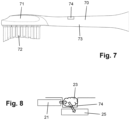
- Figs. 7 and 8 An example of this option is illustrated in Figs. 7 and 8 .
- Fig. 7 a brush head portion 70 of a power toothbrush is shown.
- toothpaste-saliva foam will collect automatically on the brush head 71 between the bristle tufts 72 during operation of the power toothbrush.
- the toothpaste-saliva foam will also collect automatically on the backside of the brush head 71. It may therefore also be practical if an optical window, in accordance with the invention, is provided in the backside of the brush head 71.
- the neck portion 73 of the brush head part 70 may be provided with a recess 74 for the purpose of collecting toothpaste-saliva foam during a brushing action.
- a recess 74 may be used for detecting a presence of blood traces through light reflection measurement, as illustrated in Fig. 8 , which is the case when the light detector 25 is arranged outside of a light path from the light source 21 and is at a position for receiving light reflected by the toothpaste-saliva foam 23.
- the invention covers the possibility that a power toothbrush or power flosser has an optical window at an appropriate position on the device, such as on a functional head of the device or on a neck portion or body portion, and a light-emitting unit and a light-receiving unit associated with the optical window. It is practical for the optical window to be arranged at a position of an area where saliva accumulates during use of the oral care appliance, which may be the position of a recess, as explained.
- an oral care appliance does not necessarily need to have an optical window and an associated light source 21 and light detector 25 arranged in a part of the device that is destined to be put into a person's mouth during use of the device.
- an oral care appliance is equipped with components as mentioned at a bottom of a handle portion thereof, in which case the device is suitable to be used for detecting light reflection characteristics of a volume of saliva that has been spit on a surface.
- Designing a power toothbrush or power flosser for putting the invention to practice involves the advantage that the detection of blood traces for the purpose of assessing a person's gum health can be performed automatically during an oral care action, or requires only minimum additional effort without the need for additional tools.
- denoting light absorption as higher or relatively high on the one hand and as lower or relatively low on the other hand implies that the one light absorption is notably higher than the other light absorption.
- higher or relatively high light absorption is related to peaks of the spectrum, whereas lower or relatively low light absorption is not and is rather related to valleys of the spectrum.
- the invention involves an optical analysis of saliva or a fluid-saliva mixture in order to check whether the saliva or fluid-saliva mixture contains blood, which allows for determining whether or not a person may suffer from gingivitis or another condition affecting gum health.
- light received from a representative volume of fluid 23 containing saliva is detected and analyzed.
- the analysis involves determination of at least one measurement value of light received by a light-receiving unit 25 for only single wavelength of the light, particularly a wavelength that is associated with high absorption by a constituent of blood. It this respect, it is practical if the light-receiving unit 25 is configured to receive reflected light back from the volume of fluid 23.
- the optical analysis may be performed real-time during an action in a person's mouth involving a gum agitation effect, or after such action has taken place, for example.
Landscapes
- Health & Medical Sciences (AREA)
- Life Sciences & Earth Sciences (AREA)
- Physics & Mathematics (AREA)
- General Health & Medical Sciences (AREA)
- Engineering & Computer Science (AREA)
- Pathology (AREA)
- Biomedical Technology (AREA)
- Public Health (AREA)
- Veterinary Medicine (AREA)
- Animal Behavior & Ethology (AREA)
- Spectroscopy & Molecular Physics (AREA)
- Surgery (AREA)
- Molecular Biology (AREA)
- Medical Informatics (AREA)
- Heart & Thoracic Surgery (AREA)
- Biophysics (AREA)
- Dentistry (AREA)
- General Physics & Mathematics (AREA)
- Oral & Maxillofacial Surgery (AREA)
- Chemical & Material Sciences (AREA)
- Biochemistry (AREA)
- Analytical Chemistry (AREA)
- Immunology (AREA)
- Hematology (AREA)
- Optics & Photonics (AREA)
- Epidemiology (AREA)
- Audiology, Speech & Language Pathology (AREA)
- Pulmonology (AREA)
- Cardiology (AREA)
- Nuclear Medicine, Radiotherapy & Molecular Imaging (AREA)
- Physiology (AREA)
- Physical Education & Sports Medicine (AREA)
- Rheumatology (AREA)
- Orthopedic Medicine & Surgery (AREA)
- Urology & Nephrology (AREA)
- Food Science & Technology (AREA)
- Medicinal Chemistry (AREA)
- Investigating Or Analysing Biological Materials (AREA)
- Measurement Of The Respiration, Hearing Ability, Form, And Blood Characteristics Of Living Organisms (AREA)
- Investigating Or Analysing Materials By Optical Means (AREA)
Claims (12)
- System, das dazu konfiguriert ist, einen Hinweis auf die Zahnfleischgesundheit einer Person auf der Grundlage einer Auswertung des Vorhandenseins von Blutspuren in einem Flüssigkeitsvolumen (23), das den Speichel der Person enthält, bereitzustellen, das System umfassend:- ein Mundpflegegerät, das dazu konfiguriert ist, Zähneputzen oder Reinigen mit Zahnseide durchzuführen, wobei das Mundpflegegerät eine elektrische Zahnbürste, die einen Bürstenkopf (71) und Borstenbüscheln (72) aufweist, oder eine elektrische Zahnseideapparatur ist;- eine Licht emittierende Einheit (21), die dazu konfiguriert ist, Licht an ein Flüssigkeitsvolumen (23) zu emittieren, das den Speichel der Person enthält, der während des Zähneputzens oder des Reinigens mit Zahnseide unter Verwendung des Mundpflegegeräts gewonnen wurde, wobei sich das Flüssigkeitsvolumen in einem Bereich befindet, in dem sich Speichel auf einem Fenster des Mundpflegegeräts ansammelt,- eine Licht empfangende Einheit (25), die dazu konfiguriert ist, Licht von dem Flüssigkeitsvolumen (23) zurück zu empfangen, wobei mindestens die Licht emittierende Einheit und die Licht empfangende Einheit in das Mundpflegegerät eingebunden und zu dem optischen Fenster zugehörig sind, und- eine Analyseeinheit (26), die dazu konfiguriert ist, eine Analyse des von der Licht empfangenden Einheit (25) empfangenen Lichts durchzuführen und eine Ausgabe bereitzustellen, die für die Zahnfleischgesundheit der Person repräsentativ ist, und die dazu konfiguriert ist, mindestens einen Algorithmus auszuführen, der dazu ausgelegt ist, mindestens einen Messwert des von der Licht empfangenden Einheit (25) empfangenen Lichts für nicht mehr als eine einzige Wellenlänge des Lichts zu bestimmen, die mit einer relativ hohen Lichtabsorption durch einen Bestandteil des Bluts im Zusammenhang steht.
- System nach Anspruch 1, wobei die Licht empfangende Einheit (25) dazu konfiguriert ist, vom Flüssigkeitsvolumen (23) reflektiertes Licht zurück zu empfangen.
- System nach Anspruch 1 oder 2, wobei der mindestens eine Algorithmus dazu ausgelegt ist,- Messwerte während einer Handlung im Mund der Person, die eine Zahnfleischreizwirkung involviert, in Echtzeit zu bestimmen, und- eine Entwicklung der Messwerte mit der Zeit zu beobachten und zu beurteilen, ob bei der Entwicklung eine Abweichung von einem allmählichen Verlauf der Entwicklung der Messwerte auftritt.
- System nach Anspruch 3, wobei der mindestens eine Algorithmus dazu ausgelegt ist,- die Messwerte zu aufeinanderfolgenden diskreten Zeitpunkten zu bestimmen, und- ein Bestimmen von Unterschieden zwischen aufeinanderfolgenden Messwerten beim Beurteilen, ob bei der Entwicklung eine Abweichung von einem allmählichen Verlauf der Entwicklung der Messwerte auftritt, zu involvieren.
- System nach Anspruch 3 oder 4, wobei der mindestens eine Algorithmus dazu ausgelegt ist,- zu bestimmen, dass die Messwerte auf das Vorhandensein von Blut in einem Speichel enthaltenden Flüssigkeitsvolumen (23) hinweisen, wenn bei der Entwicklung eine Abweichung von einem allmählichen Verlauf der Entwicklung der Messwerte festgestellt wird.
- System nach einem der Ansprüche 1-5, wobei die Licht emittierende Einheit (21) dazu konfiguriert ist, Licht nur bei der einzigen Wellenlänge zu emittieren und/oder die Licht empfangende Einheit (25) eine Bandpassfilter/Lichtdetektor- Kombination umfasst, die einen Bandpassfilter einschließt, der dazu konfiguriert ist, Licht nur bei einer einzigen Wellenlänge oder einem schmalen Wellenlängenband durchzulassen.
- System nach einem der Ansprüche 1-6, umfassend eine entfernte Vorrichtung, die einen Prozessor aufweist, wobei die Analyseeinheit (26) den Prozessor der entfernten Vorrichtung umfasst, und wobei der mindestens eine von der Analyseeinheit (26) auszuführende Algorithmus durch eine auf der entfernten Vorrichtung installierten Anwendung definiert ist.
- Verfahren zum Bereitstellen eines Hinweises auf die Zahnfleischgesundheit einer Person auf der Grundlage einer Auswertung des Vorhandenseins von Blutspuren in einem Flüssigkeitsvolumen (23), das den Speichel der Person enthält, umfassend:- Empfangen eines Flüssigkeitsvolumens (23), das den Speichel der Person enthält, während des Zähneputzens oder des Reinigens mit Zahnseide unter Verwendung eines Mundpflegegeräts, wobei das Mundpflegegerät eine elektrische Zahnbürste, die einen Bürstenkopf (71) und Borstenbüschel (72) aufweist, oder eine elektrische Zahnseideapparatur ist, wobei sich das Flüssigkeitsvolumen in einem Bereich befindet, in dem sich Speichel auf einem Fenster des Mundpflegegeräts ansammelt,- Emittieren von Licht an das Flüssigkeitsvolumen (23), das den Speichel der Person enthält, und Empfangen des Lichts zurück von dem Flüssigkeitsvolumen (23) unter Verwendung einer Licht emittierenden Einheit und einer Licht empfangenden Einheit, die in das Mundpflegegerät eingebunden und zu dem optischen Fenster zugehörig sind, und Analysieren des empfangenen Lichts, und- Bestimmen von mindestens einem Messwert des von dem Flüssigkeitsvolumen (23) zurück empfangenen Lichts für nicht mehr als eine einzige Wellenlänge des Lichts, die mit einer relativ hohen Lichtabsorption durch einen Bestandteil des Bluts im Zusammenhang steht.
- Verfahren nach Anspruch 8, umfassend ein Beobachten einer Entwicklung von Messwerten über die Zeit und ein Bewerten, ob bei der Entwicklung eine Abweichung von einem allmählichen Verlauf der Entwicklung der Messwerte auftritt.
- Verfahren nach Anspruch 9, umfassend ein Bestimmen, dass die Messwerte auf das Vorhandensein von Blut in einem Speichel enthaltenden Flüssigkeitsvolumen (23) hinweisen, wenn bei der Entwicklung eine Abweichung von einem allmählichen Verlauf der Entwicklung der Messwerte festgestellt wird.
- Computerprogrammprodukt, umfassend Code, um einen Prozessor zu veranlassen, wenn der Code auf dem Prozessor ausgeführt wird, das System nach einem der Ansprüche 1 bis 7 zu veranlassen, das Verfahren nach einem der Ansprüche 8-10 auszuführen.
- Entfernte Vorrichtung, die einen Prozessor aufweist, umfassend das Computerprogrammprodukt nach Anspruch 11.
Applications Claiming Priority (3)
| Application Number | Priority Date | Filing Date | Title |
|---|---|---|---|
| PCT/EP2019/071926 WO2020035562A1 (en) | 2018-08-17 | 2019-08-15 | System and method for providing an indication of a person's gum health |
| EP20157431.6A EP3865048A1 (de) | 2020-02-14 | 2020-02-14 | Bereitstellung eines hinweises auf die zahnfleischgesundheit einer person |
| PCT/EP2020/072825 WO2021028557A1 (en) | 2019-08-15 | 2020-08-14 | Providing an indication of a person's gum health |
Publications (3)
| Publication Number | Publication Date |
|---|---|
| EP4034864A1 EP4034864A1 (de) | 2022-08-03 |
| EP4034864B1 true EP4034864B1 (de) | 2024-10-09 |
| EP4034864C0 EP4034864C0 (de) | 2024-10-09 |
Family
ID=69630157
Family Applications (2)
| Application Number | Title | Priority Date | Filing Date |
|---|---|---|---|
| EP20157431.6A Withdrawn EP3865048A1 (de) | 2019-08-15 | 2020-02-14 | Bereitstellung eines hinweises auf die zahnfleischgesundheit einer person |
| EP20758145.5A Active EP4034864B1 (de) | 2019-08-15 | 2020-08-14 | Bereitstellung eines hinweises auf die zahnfleischgesundheit einer person |
Family Applications Before (1)
| Application Number | Title | Priority Date | Filing Date |
|---|---|---|---|
| EP20157431.6A Withdrawn EP3865048A1 (de) | 2019-08-15 | 2020-02-14 | Bereitstellung eines hinweises auf die zahnfleischgesundheit einer person |
Country Status (5)
| Country | Link |
|---|---|
| US (1) | US20220322954A1 (de) |
| EP (2) | EP3865048A1 (de) |
| JP (1) | JP7479447B2 (de) |
| CN (1) | CN114222910A (de) |
| WO (1) | WO2021028557A1 (de) |
Families Citing this family (1)
| Publication number | Priority date | Publication date | Assignee | Title |
|---|---|---|---|---|
| US20230400459A1 (en) * | 2022-06-09 | 2023-12-14 | Hero Scientific Ltd. | Gargle specimen sampling |
Family Cites Families (19)
| Publication number | Priority date | Publication date | Assignee | Title |
|---|---|---|---|---|
| WO1984003143A1 (en) * | 1983-02-03 | 1984-08-16 | Ljs Practice Management Ltd | Optical probe to measure the depth of a cavity |
| US6623698B2 (en) * | 2001-03-12 | 2003-09-23 | Youti Kuo | Saliva-monitoring biosensor electrical toothbrush |
| US7386333B1 (en) * | 2005-04-29 | 2008-06-10 | Henryk Birecki | Test subject monitoring device |
| US9024766B2 (en) * | 2009-08-28 | 2015-05-05 | The Invention Science Fund, Llc | Beverage containers with detection capability |
| RU2548474C2 (ru) * | 2009-12-23 | 2015-04-20 | Конинклейке Филипс Электроникс Н.В. | Система для защиты мягких тканей от вещества для отбеливания зубов |
| US9308064B2 (en) * | 2010-07-26 | 2016-04-12 | Johnson & Johnson Consumer Inc. | Devices and methods for collecting and analyzing fluid samples from the oral cavity |
| WO2014049984A1 (ja) * | 2012-09-28 | 2014-04-03 | パナソニック株式会社 | 生体情報取得端末、情報管理方法及び情報表示方法 |
| US20140159912A1 (en) * | 2012-12-10 | 2014-06-12 | Jacob Fraden | Biomedical monitor for smartphone |
| US9517015B2 (en) * | 2012-12-21 | 2016-12-13 | Koninklijke Philips N.V. | Dental apparatus and method of utilizing the same |
| US9668842B2 (en) * | 2012-12-21 | 2017-06-06 | Koninklijke Philips N.V. | Plaque detection using a stream probe |
| JP2016535654A (ja) * | 2013-11-06 | 2016-11-17 | ケアストリーム ヘルス インク | 歯周病検出システムおよび方法 |
| WO2015116854A1 (en) * | 2014-01-30 | 2015-08-06 | Podoly Erez | System for saliva collection |
| WO2016095202A1 (en) * | 2014-12-19 | 2016-06-23 | The Procter & Gamble Company | Gum condition assessment |
| EP3291762B1 (de) * | 2015-06-12 | 2019-12-25 | Colgate-Palmolive Company | Elektrische zahnbürste |
| CN104880391B (zh) * | 2015-06-23 | 2018-03-06 | 好来化工(中山)有限公司 | 用于检测唾液中颗粒物质的装置 |
| JP6763515B2 (ja) | 2016-04-05 | 2020-09-30 | ライオン株式会社 | 歯周病ステージの判定方法 |
| EP3723587B1 (de) * | 2017-12-12 | 2025-10-01 | Koninklijke Philips N.V. | System zur verbesserten messung von lokalisierter oraler entzündung mittels schwerpunktabtastung |
| CN111712185B (zh) * | 2017-12-12 | 2025-01-03 | 皇家飞利浦有限公司 | 用于在局部口腔炎症测量期间改善移动鲁棒性的方法和系统 |
| EP3611494A1 (de) * | 2018-08-17 | 2020-02-19 | Koninklijke Philips N.V. | System und verfahren zur bereitstellung eines hinweises auf die zahnfleischgesundheit eines menschen |
-
2020
- 2020-02-14 EP EP20157431.6A patent/EP3865048A1/de not_active Withdrawn
- 2020-08-14 CN CN202080057491.7A patent/CN114222910A/zh active Pending
- 2020-08-14 WO PCT/EP2020/072825 patent/WO2021028557A1/en not_active Ceased
- 2020-08-14 JP JP2022504149A patent/JP7479447B2/ja active Active
- 2020-08-14 EP EP20758145.5A patent/EP4034864B1/de active Active
- 2020-08-14 US US17/634,264 patent/US20220322954A1/en not_active Abandoned
Also Published As
| Publication number | Publication date |
|---|---|
| EP4034864C0 (de) | 2024-10-09 |
| JP2023516103A (ja) | 2023-04-18 |
| JP7479447B2 (ja) | 2024-05-08 |
| CN114222910A (zh) | 2022-03-22 |
| US20220322954A1 (en) | 2022-10-13 |
| WO2021028557A1 (en) | 2021-02-18 |
| EP3865048A1 (de) | 2021-08-18 |
| EP4034864A1 (de) | 2022-08-03 |
Similar Documents
| Publication | Publication Date | Title |
|---|---|---|
| EP3837530B1 (de) | System und verfahren zur bereitstellung eines hinweises auf die zahnfleischgesundheit eines menschen | |
| US5820557A (en) | Blood glucose measurement apparatus | |
| KR101125908B1 (ko) | 흡연행위 분석기 | |
| EP2756303B1 (de) | Messung eines fluoreszierenden analyten mittels gewebeerregung | |
| US20120143025A1 (en) | Method and circuit for indicating quality and accuracy of physiological measurements | |
| JP2002095652A (ja) | 血中吸光物質濃度測定装置 | |
| Hanioka et al. | Hemoglobin concentration and oxygen saturation of clinically healthy and inflamed gingiva in human subjects | |
| KR102262071B1 (ko) | 치주병 스테이지의 판정 방법 | |
| US20220117525A1 (en) | Sensor and system for neonatal jaundice monitoring and management | |
| WO2017198981A1 (en) | Non-invasive blood analysis | |
| KR20090036996A (ko) | 복수 개의 단일 파장 광원을 이용한 투과와 반사 병행방식의 무채혈 혈당기 | |
| US20220322954A1 (en) | Providing an indication of a person's gum health | |
| JP7343569B2 (ja) | 歯肉炎検出器における測定値選択およびプローブガイドのためのシステムおよび方法 | |
| EP3850338B1 (de) | Optisches verfahren zur detektion von gingivitis | |
| RU2799877C2 (ru) | Система и способ для указания состояния десен человека | |
| JP2023516103A5 (de) | ||
| JP2021535400A (ja) | 歯肉炎検出のための大きなダイナミックレンジ検出器 | |
| JP2011153964A (ja) | 濃度測定装置 | |
| JP2026060404A (ja) | パルスオキシメーター | |
| CN119317390A (zh) | 口腔分析装置 | |
| RU2022106452A (ru) | Обеспечение указания состояния десен человека | |
| WO2020053110A1 (en) | Wavelength and bandwidth selection for diffuse reflective spectroscopy based gingivitis detection |
Legal Events
| Date | Code | Title | Description |
|---|---|---|---|
| STAA | Information on the status of an ep patent application or granted ep patent |
Free format text: STATUS: UNKNOWN |
|
| STAA | Information on the status of an ep patent application or granted ep patent |
Free format text: STATUS: THE INTERNATIONAL PUBLICATION HAS BEEN MADE |
|
| PUAI | Public reference made under article 153(3) epc to a published international application that has entered the european phase |
Free format text: ORIGINAL CODE: 0009012 |
|
| STAA | Information on the status of an ep patent application or granted ep patent |
Free format text: STATUS: REQUEST FOR EXAMINATION WAS MADE |
|
| 17P | Request for examination filed |
Effective date: 20220408 |
|
| AK | Designated contracting states |
Kind code of ref document: A1 Designated state(s): AL AT BE BG CH CY CZ DE DK EE ES FI FR GB GR HR HU IE IS IT LI LT LU LV MC MK MT NL NO PL PT RO RS SE SI SK SM TR |
|
| DAV | Request for validation of the european patent (deleted) | ||
| DAX | Request for extension of the european patent (deleted) | ||
| STAA | Information on the status of an ep patent application or granted ep patent |
Free format text: STATUS: EXAMINATION IS IN PROGRESS |
|
| 17Q | First examination report despatched |
Effective date: 20230324 |
|
| GRAP | Despatch of communication of intention to grant a patent |
Free format text: ORIGINAL CODE: EPIDOSNIGR1 |
|
| STAA | Information on the status of an ep patent application or granted ep patent |
Free format text: STATUS: GRANT OF PATENT IS INTENDED |
|
| RIC1 | Information provided on ipc code assigned before grant |
Ipc: G01N 21/01 20060101ALN20240321BHEP Ipc: A61C 19/04 20060101ALI20240321BHEP Ipc: A46B 15/00 20060101ALI20240321BHEP Ipc: A61B 5/02 20060101ALI20240321BHEP Ipc: A61B 5/1455 20060101ALI20240321BHEP Ipc: A61C 17/22 20060101ALI20240321BHEP Ipc: A61B 10/00 20060101ALI20240321BHEP Ipc: A47G 19/22 20060101ALI20240321BHEP Ipc: A61B 5/00 20060101ALI20240321BHEP Ipc: G01N 33/487 20060101ALI20240321BHEP Ipc: G01J 3/42 20060101ALI20240321BHEP Ipc: G01J 3/02 20060101ALI20240321BHEP Ipc: G01N 21/51 20060101ALI20240321BHEP Ipc: G01N 21/47 20060101ALI20240321BHEP Ipc: G01N 21/31 20060101AFI20240321BHEP |
|
| RIC1 | Information provided on ipc code assigned before grant |
Ipc: G01N 21/01 20060101ALN20240327BHEP Ipc: A61C 19/04 20060101ALI20240327BHEP Ipc: A46B 15/00 20060101ALI20240327BHEP Ipc: A61B 5/02 20060101ALI20240327BHEP Ipc: A61B 5/1455 20060101ALI20240327BHEP Ipc: A61C 17/22 20060101ALI20240327BHEP Ipc: A61B 10/00 20060101ALI20240327BHEP Ipc: A47G 19/22 20060101ALI20240327BHEP Ipc: A61B 5/00 20060101ALI20240327BHEP Ipc: G01N 33/487 20060101ALI20240327BHEP Ipc: G01J 3/42 20060101ALI20240327BHEP Ipc: G01J 3/02 20060101ALI20240327BHEP Ipc: G01N 21/51 20060101ALI20240327BHEP Ipc: G01N 21/47 20060101ALI20240327BHEP Ipc: G01N 21/31 20060101AFI20240327BHEP |
|
| INTG | Intention to grant announced |
Effective date: 20240415 |
|
| GRAS | Grant fee paid |
Free format text: ORIGINAL CODE: EPIDOSNIGR3 |
|
| GRAA | (expected) grant |
Free format text: ORIGINAL CODE: 0009210 |
|
| STAA | Information on the status of an ep patent application or granted ep patent |
Free format text: STATUS: THE PATENT HAS BEEN GRANTED |
|
| AK | Designated contracting states |
Kind code of ref document: B1 Designated state(s): AL AT BE BG CH CY CZ DE DK EE ES FI FR GB GR HR HU IE IS IT LI LT LU LV MC MK MT NL NO PL PT RO RS SE SI SK SM TR |
|
| REG | Reference to a national code |
Ref country code: CH Ref legal event code: EP |
|
| REG | Reference to a national code |
Ref country code: DE Ref legal event code: R096 Ref document number: 602020039131 Country of ref document: DE |
|
| REG | Reference to a national code |
Ref country code: IE Ref legal event code: FG4D |
|
| U01 | Request for unitary effect filed |
Effective date: 20241009 |
|
| U07 | Unitary effect registered |
Designated state(s): AT BE BG DE DK EE FI FR IT LT LU LV MT NL PT RO SE SI Effective date: 20241025 |
|
| PG25 | Lapsed in a contracting state [announced via postgrant information from national office to epo] |
Ref country code: HR Free format text: LAPSE BECAUSE OF FAILURE TO SUBMIT A TRANSLATION OF THE DESCRIPTION OR TO PAY THE FEE WITHIN THE PRESCRIBED TIME-LIMIT Effective date: 20241009 Ref country code: IS Free format text: LAPSE BECAUSE OF FAILURE TO SUBMIT A TRANSLATION OF THE DESCRIPTION OR TO PAY THE FEE WITHIN THE PRESCRIBED TIME-LIMIT Effective date: 20250209 |
|
| PG25 | Lapsed in a contracting state [announced via postgrant information from national office to epo] |
Ref country code: ES Free format text: LAPSE BECAUSE OF FAILURE TO SUBMIT A TRANSLATION OF THE DESCRIPTION OR TO PAY THE FEE WITHIN THE PRESCRIBED TIME-LIMIT Effective date: 20241009 |
|
| PG25 | Lapsed in a contracting state [announced via postgrant information from national office to epo] |
Ref country code: NO Free format text: LAPSE BECAUSE OF FAILURE TO SUBMIT A TRANSLATION OF THE DESCRIPTION OR TO PAY THE FEE WITHIN THE PRESCRIBED TIME-LIMIT Effective date: 20250109 |
|
| PG25 | Lapsed in a contracting state [announced via postgrant information from national office to epo] |
Ref country code: GR Free format text: LAPSE BECAUSE OF FAILURE TO SUBMIT A TRANSLATION OF THE DESCRIPTION OR TO PAY THE FEE WITHIN THE PRESCRIBED TIME-LIMIT Effective date: 20250110 |
|
| PG25 | Lapsed in a contracting state [announced via postgrant information from national office to epo] |
Ref country code: PL Free format text: LAPSE BECAUSE OF FAILURE TO SUBMIT A TRANSLATION OF THE DESCRIPTION OR TO PAY THE FEE WITHIN THE PRESCRIBED TIME-LIMIT Effective date: 20241009 |
|
| PG25 | Lapsed in a contracting state [announced via postgrant information from national office to epo] |
Ref country code: RS Free format text: LAPSE BECAUSE OF FAILURE TO SUBMIT A TRANSLATION OF THE DESCRIPTION OR TO PAY THE FEE WITHIN THE PRESCRIBED TIME-LIMIT Effective date: 20250109 |
|
| PG25 | Lapsed in a contracting state [announced via postgrant information from national office to epo] |
Ref country code: SM Free format text: LAPSE BECAUSE OF FAILURE TO SUBMIT A TRANSLATION OF THE DESCRIPTION OR TO PAY THE FEE WITHIN THE PRESCRIBED TIME-LIMIT Effective date: 20241009 |
|
| PG25 | Lapsed in a contracting state [announced via postgrant information from national office to epo] |
Ref country code: SK Free format text: LAPSE BECAUSE OF FAILURE TO SUBMIT A TRANSLATION OF THE DESCRIPTION OR TO PAY THE FEE WITHIN THE PRESCRIBED TIME-LIMIT Effective date: 20241009 |
|
| PG25 | Lapsed in a contracting state [announced via postgrant information from national office to epo] |
Ref country code: CZ Free format text: LAPSE BECAUSE OF FAILURE TO SUBMIT A TRANSLATION OF THE DESCRIPTION OR TO PAY THE FEE WITHIN THE PRESCRIBED TIME-LIMIT Effective date: 20241009 |
|
| PLBE | No opposition filed within time limit |
Free format text: ORIGINAL CODE: 0009261 |
|
| STAA | Information on the status of an ep patent application or granted ep patent |
Free format text: STATUS: NO OPPOSITION FILED WITHIN TIME LIMIT |
|
| 26N | No opposition filed |
Effective date: 20250710 |
|
| U20 | Renewal fee for the european patent with unitary effect paid |
Year of fee payment: 6 Effective date: 20250901 |
|
| PGFP | Annual fee paid to national office [announced via postgrant information from national office to epo] |
Ref country code: GB Payment date: 20250826 Year of fee payment: 6 |
|
| REG | Reference to a national code |
Ref country code: CH Ref legal event code: H13 Free format text: ST27 STATUS EVENT CODE: U-0-0-H10-H13 (AS PROVIDED BY THE NATIONAL OFFICE) Effective date: 20260324 |
|
| PG25 | Lapsed in a contracting state [announced via postgrant information from national office to epo] |
Ref country code: MC Free format text: LAPSE BECAUSE OF FAILURE TO SUBMIT A TRANSLATION OF THE DESCRIPTION OR TO PAY THE FEE WITHIN THE PRESCRIBED TIME-LIMIT Effective date: 20241009 |
|
| PG25 | Lapsed in a contracting state [announced via postgrant information from national office to epo] |
Ref country code: CH Free format text: LAPSE BECAUSE OF NON-PAYMENT OF DUE FEES Effective date: 20250831 |