EP4033192B1 - Heat exchangers - Google Patents
Heat exchangers Download PDFInfo
- Publication number
- EP4033192B1 EP4033192B1 EP22162154.3A EP22162154A EP4033192B1 EP 4033192 B1 EP4033192 B1 EP 4033192B1 EP 22162154 A EP22162154 A EP 22162154A EP 4033192 B1 EP4033192 B1 EP 4033192B1
- Authority
- EP
- European Patent Office
- Prior art keywords
- heat exchanger
- flow
- tubes
- tube
- fluid
- Prior art date
- Legal status (The legal status is an assumption and is not a legal conclusion. Google has not performed a legal analysis and makes no representation as to the accuracy of the status listed.)
- Active
Links
Images

















Classifications
-
- F—MECHANICAL ENGINEERING; LIGHTING; HEATING; WEAPONS; BLASTING
- F02—COMBUSTION ENGINES; HOT-GAS OR COMBUSTION-PRODUCT ENGINE PLANTS
- F02C—GAS-TURBINE PLANTS; AIR INTAKES FOR JET-PROPULSION PLANTS; CONTROLLING FUEL SUPPLY IN AIR-BREATHING JET-PROPULSION PLANTS
- F02C7/00—Features, components parts, details or accessories, not provided for in, or of interest apart form groups F02C1/00 - F02C6/00; Air intakes for jet-propulsion plants
- F02C7/12—Cooling of plants
- F02C7/14—Cooling of plants of fluids in the plant, e.g. lubricant or fuel
- F02C7/141—Cooling of plants of fluids in the plant, e.g. lubricant or fuel of working fluid
-
- F—MECHANICAL ENGINEERING; LIGHTING; HEATING; WEAPONS; BLASTING
- F28—HEAT EXCHANGE IN GENERAL
- F28D—HEAT-EXCHANGE APPARATUS, NOT PROVIDED FOR IN ANOTHER SUBCLASS, IN WHICH THE HEAT-EXCHANGE MEDIA DO NOT COME INTO DIRECT CONTACT
- F28D7/00—Heat-exchange apparatus having stationary tubular conduit assemblies for both heat-exchange media, the media being in contact with different sides of a conduit wall
- F28D7/08—Heat-exchange apparatus having stationary tubular conduit assemblies for both heat-exchange media, the media being in contact with different sides of a conduit wall the conduits being otherwise bent, e.g. in a serpentine or zig-zag
- F28D7/082—Heat-exchange apparatus having stationary tubular conduit assemblies for both heat-exchange media, the media being in contact with different sides of a conduit wall the conduits being otherwise bent, e.g. in a serpentine or zig-zag with serpentine or zig-zag configuration
- F28D7/085—Heat-exchange apparatus having stationary tubular conduit assemblies for both heat-exchange media, the media being in contact with different sides of a conduit wall the conduits being otherwise bent, e.g. in a serpentine or zig-zag with serpentine or zig-zag configuration in the form of parallel conduits coupled by bent portions
-
- F—MECHANICAL ENGINEERING; LIGHTING; HEATING; WEAPONS; BLASTING
- F28—HEAT EXCHANGE IN GENERAL
- F28D—HEAT-EXCHANGE APPARATUS, NOT PROVIDED FOR IN ANOTHER SUBCLASS, IN WHICH THE HEAT-EXCHANGE MEDIA DO NOT COME INTO DIRECT CONTACT
- F28D7/00—Heat-exchange apparatus having stationary tubular conduit assemblies for both heat-exchange media, the media being in contact with different sides of a conduit wall
- F28D7/08—Heat-exchange apparatus having stationary tubular conduit assemblies for both heat-exchange media, the media being in contact with different sides of a conduit wall the conduits being otherwise bent, e.g. in a serpentine or zig-zag
-
- F—MECHANICAL ENGINEERING; LIGHTING; HEATING; WEAPONS; BLASTING
- F28—HEAT EXCHANGE IN GENERAL
- F28D—HEAT-EXCHANGE APPARATUS, NOT PROVIDED FOR IN ANOTHER SUBCLASS, IN WHICH THE HEAT-EXCHANGE MEDIA DO NOT COME INTO DIRECT CONTACT
- F28D1/00—Heat-exchange apparatus having stationary conduit assemblies for one heat-exchange medium only, the media being in contact with different sides of the conduit wall, in which the other heat-exchange medium is a large body of fluid, e.g. domestic or motor car radiators
- F28D1/02—Heat-exchange apparatus having stationary conduit assemblies for one heat-exchange medium only, the media being in contact with different sides of the conduit wall, in which the other heat-exchange medium is a large body of fluid, e.g. domestic or motor car radiators with heat-exchange conduits immersed in the body of fluid
- F28D1/04—Heat-exchange apparatus having stationary conduit assemblies for one heat-exchange medium only, the media being in contact with different sides of the conduit wall, in which the other heat-exchange medium is a large body of fluid, e.g. domestic or motor car radiators with heat-exchange conduits immersed in the body of fluid with tubular conduits
- F28D1/047—Heat-exchange apparatus having stationary conduit assemblies for one heat-exchange medium only, the media being in contact with different sides of the conduit wall, in which the other heat-exchange medium is a large body of fluid, e.g. domestic or motor car radiators with heat-exchange conduits immersed in the body of fluid with tubular conduits the conduits being bent, e.g. in a serpentine or zig-zag
- F28D1/0472—Heat-exchange apparatus having stationary conduit assemblies for one heat-exchange medium only, the media being in contact with different sides of the conduit wall, in which the other heat-exchange medium is a large body of fluid, e.g. domestic or motor car radiators with heat-exchange conduits immersed in the body of fluid with tubular conduits the conduits being bent, e.g. in a serpentine or zig-zag the conduits being helically or spirally coiled
-
- B—PERFORMING OPERATIONS; TRANSPORTING
- B64—AIRCRAFT; AVIATION; COSMONAUTICS
- B64D—EQUIPMENT FOR FITTING IN OR TO AIRCRAFT; FLIGHT SUITS; PARACHUTES; ARRANGEMENT OR MOUNTING OF POWER PLANTS OR PROPULSION TRANSMISSIONS IN AIRCRAFT
- B64D27/00—Arrangement or mounting of power plants in aircraft; Aircraft characterised by the type or position of power plants
- B64D27/02—Aircraft characterised by the type or position of power plants
- B64D27/026—Aircraft characterised by the type or position of power plants comprising different types of power plants, e.g. combination of a piston engine and a gas-turbine
-
- B—PERFORMING OPERATIONS; TRANSPORTING
- B64—AIRCRAFT; AVIATION; COSMONAUTICS
- B64D—EQUIPMENT FOR FITTING IN OR TO AIRCRAFT; FLIGHT SUITS; PARACHUTES; ARRANGEMENT OR MOUNTING OF POWER PLANTS OR PROPULSION TRANSMISSIONS IN AIRCRAFT
- B64D33/00—Arrangement in aircraft of power plant parts or auxiliaries not otherwise provided for
- B64D33/08—Arrangement in aircraft of power plant parts or auxiliaries not otherwise provided for of power plant cooling systems
- B64D33/10—Radiator arrangement
-
- F—MECHANICAL ENGINEERING; LIGHTING; HEATING; WEAPONS; BLASTING
- F02—COMBUSTION ENGINES; HOT-GAS OR COMBUSTION-PRODUCT ENGINE PLANTS
- F02C—GAS-TURBINE PLANTS; AIR INTAKES FOR JET-PROPULSION PLANTS; CONTROLLING FUEL SUPPLY IN AIR-BREATHING JET-PROPULSION PLANTS
- F02C7/00—Features, components parts, details or accessories, not provided for in, or of interest apart form groups F02C1/00 - F02C6/00; Air intakes for jet-propulsion plants
- F02C7/12—Cooling of plants
- F02C7/16—Cooling of plants characterised by cooling medium
- F02C7/18—Cooling of plants characterised by cooling medium the medium being gaseous, e.g. air
-
- F—MECHANICAL ENGINEERING; LIGHTING; HEATING; WEAPONS; BLASTING
- F02—COMBUSTION ENGINES; HOT-GAS OR COMBUSTION-PRODUCT ENGINE PLANTS
- F02K—JET-PROPULSION PLANTS
- F02K9/00—Rocket-engine plants, i.e. plants carrying both fuel and oxidant therefor; Control thereof
-
- F—MECHANICAL ENGINEERING; LIGHTING; HEATING; WEAPONS; BLASTING
- F28—HEAT EXCHANGE IN GENERAL
- F28D—HEAT-EXCHANGE APPARATUS, NOT PROVIDED FOR IN ANOTHER SUBCLASS, IN WHICH THE HEAT-EXCHANGE MEDIA DO NOT COME INTO DIRECT CONTACT
- F28D7/00—Heat-exchange apparatus having stationary tubular conduit assemblies for both heat-exchange media, the media being in contact with different sides of a conduit wall
- F28D7/04—Heat-exchange apparatus having stationary tubular conduit assemblies for both heat-exchange media, the media being in contact with different sides of a conduit wall the conduits being spirally coiled
-
- F—MECHANICAL ENGINEERING; LIGHTING; HEATING; WEAPONS; BLASTING
- F28—HEAT EXCHANGE IN GENERAL
- F28F—DETAILS OF HEAT-EXCHANGE AND HEAT-TRANSFER APPARATUS, OF GENERAL APPLICATION
- F28F17/00—Removing ice or water from heat-exchange apparatus
- F28F17/005—Means for draining condensates from heat exchangers, e.g. from evaporators
-
- F—MECHANICAL ENGINEERING; LIGHTING; HEATING; WEAPONS; BLASTING
- F28—HEAT EXCHANGE IN GENERAL
- F28F—DETAILS OF HEAT-EXCHANGE AND HEAT-TRANSFER APPARATUS, OF GENERAL APPLICATION
- F28F19/00—Preventing the formation of deposits or corrosion, e.g. by using filters or scrapers
-
- F—MECHANICAL ENGINEERING; LIGHTING; HEATING; WEAPONS; BLASTING
- F28—HEAT EXCHANGE IN GENERAL
- F28F—DETAILS OF HEAT-EXCHANGE AND HEAT-TRANSFER APPARATUS, OF GENERAL APPLICATION
- F28F9/00—Casings; Header boxes; Auxiliary supports for elements; Auxiliary members within casings
- F28F9/007—Auxiliary supports for elements
- F28F9/013—Auxiliary supports for elements for tubes or tube-assemblies
-
- F—MECHANICAL ENGINEERING; LIGHTING; HEATING; WEAPONS; BLASTING
- F28—HEAT EXCHANGE IN GENERAL
- F28F—DETAILS OF HEAT-EXCHANGE AND HEAT-TRANSFER APPARATUS, OF GENERAL APPLICATION
- F28F9/00—Casings; Header boxes; Auxiliary supports for elements; Auxiliary members within casings
- F28F9/02—Header boxes; End plates
- F28F9/0243—Header boxes having a circular cross-section
-
- F—MECHANICAL ENGINEERING; LIGHTING; HEATING; WEAPONS; BLASTING
- F28—HEAT EXCHANGE IN GENERAL
- F28F—DETAILS OF HEAT-EXCHANGE AND HEAT-TRANSFER APPARATUS, OF GENERAL APPLICATION
- F28F9/00—Casings; Header boxes; Auxiliary supports for elements; Auxiliary members within casings
- F28F9/26—Arrangements for connecting different sections of heat-exchange elements, e.g. of radiators
-
- B—PERFORMING OPERATIONS; TRANSPORTING
- B64—AIRCRAFT; AVIATION; COSMONAUTICS
- B64C—AEROPLANES; HELICOPTERS
- B64C30/00—Supersonic type aircraft
-
- F—MECHANICAL ENGINEERING; LIGHTING; HEATING; WEAPONS; BLASTING
- F05—INDEXING SCHEMES RELATING TO ENGINES OR PUMPS IN VARIOUS SUBCLASSES OF CLASSES F01-F04
- F05D—INDEXING SCHEME FOR ASPECTS RELATING TO NON-POSITIVE-DISPLACEMENT MACHINES OR ENGINES, GAS-TURBINES OR JET-PROPULSION PLANTS
- F05D2260/00—Function
- F05D2260/20—Heat transfer, e.g. cooling
- F05D2260/213—Heat transfer, e.g. cooling by the provision of a heat exchanger within the cooling circuit
-
- F—MECHANICAL ENGINEERING; LIGHTING; HEATING; WEAPONS; BLASTING
- F28—HEAT EXCHANGE IN GENERAL
- F28D—HEAT-EXCHANGE APPARATUS, NOT PROVIDED FOR IN ANOTHER SUBCLASS, IN WHICH THE HEAT-EXCHANGE MEDIA DO NOT COME INTO DIRECT CONTACT
- F28D21/00—Heat-exchange apparatus not covered by any of the groups F28D1/00 - F28D20/00
- F28D2021/0019—Other heat exchangers for particular applications; Heat exchange systems not otherwise provided for
- F28D2021/0021—Other heat exchangers for particular applications; Heat exchange systems not otherwise provided for for aircrafts or cosmonautics
-
- F—MECHANICAL ENGINEERING; LIGHTING; HEATING; WEAPONS; BLASTING
- F28—HEAT EXCHANGE IN GENERAL
- F28F—DETAILS OF HEAT-EXCHANGE AND HEAT-TRANSFER APPARATUS, OF GENERAL APPLICATION
- F28F2260/00—Heat exchangers or heat exchange elements having special size, e.g. microstructures
- F28F2260/02—Heat exchangers or heat exchange elements having special size, e.g. microstructures having microchannels
-
- F—MECHANICAL ENGINEERING; LIGHTING; HEATING; WEAPONS; BLASTING
- F28—HEAT EXCHANGE IN GENERAL
- F28F—DETAILS OF HEAT-EXCHANGE AND HEAT-TRANSFER APPARATUS, OF GENERAL APPLICATION
- F28F2265/00—Safety or protection arrangements; Arrangements for preventing malfunction
- F28F2265/26—Safety or protection arrangements; Arrangements for preventing malfunction for allowing differential expansion between elements
-
- F—MECHANICAL ENGINEERING; LIGHTING; HEATING; WEAPONS; BLASTING
- F28—HEAT EXCHANGE IN GENERAL
- F28F—DETAILS OF HEAT-EXCHANGE AND HEAT-TRANSFER APPARATUS, OF GENERAL APPLICATION
- F28F2280/00—Mounting arrangements; Arrangements for facilitating assembling or disassembling of heat exchanger parts
Definitions
- the present invention relates to heat exchangers such as of the type which may be used in aerospace applications or in industrial or other applications.
- the invention also relates to engines such as aircraft or aerospace engines including such heat exchangers and to aircraft including such heat exchangers or engines.
- GB-A-2241319 discloses a heat exchanger with inter-nested spiral tube sections. An inlet manifold is located on one wall and an outlet manifold is located on another wall at the end of the apparatus.
- it is difficult to build such a heat exchanger which will be subject to considerable temperature variations and in a form capable of enduring the numerous cycles that are desirable in certain heat exchangers such as when used in reusable vehicles.
- the heat exchanger has rather limited cycle functionality and it is difficult to configure heat exchangers, to accommodate them in an engine and provide a system with low weight and low pressure drop. Also, to achieve sufficient performance it has proven necessary to design a cycle which cools atmospheric air before it enters a compression section downstream of such a heat exchanger at a temperature below 0°C.
- GB-A-2241537 discloses an air intake for aerospace propulsion which includes a first heat exchanger for cooling incoming air, a water separator downstream of the first heat exchanger, a liquid oxygen injector downstream of the water separator and a second heat exchanger downstream of the liquid oxygen injector.
- the injector reduces the airflow temperature so that water remaining in the airflow downstream of the water separator is converted to small dry ice crystals.
- the structure requires the use of two entirely separate heat exchangers and takes up a very considerable axial distance in a flow path along a duct between the two heat exchangers.
- the liquid oxygen is used to reduce the temperature of the flow from between 5° and 13°C to minus 50°C or lower, such that a considerable amount of liquid oxygen needs to be used, to cool the air in a duct where there is already air containing oxygen which may be used downstream in the propulsion.
- US5318110A discloses a heat exchanger having internally cooled spacer supports for heat exchange tubes. Spacer supports are connected to a matrix of heat exchange tubes of a heat exchanger to maintain the heat exchange tubes in spaced relation and resist overheating by hot fluid flowing around the tubes and the spacer supports.
- US5318110A discloses a heat exchanger according to the preamble of claim 1.
- US2008/121387A1 discloses a heat exchanger formed by connecting tube-group blocks along a tube axis, where each one of the tube-group blocks includes a plurality of substrates having a large number of through holes, which communicate with insides of a plurality of tubes placed between the substrates.
- WO2008/123603A1 discloses a heat exchange device in which heat exchangers are sequentially connected through header tanks.
- GB2241319A discloses a heat exchanger comprising concentric annular arrays of parallel feeder tubes and receiver tubes which are interconnected by generally circumferentially extending heat exchanger tubes.
- US3638719A discloses a heat exchanger comprising a bundle of substantially parallel pipes, the ends of said pipes presenting a convex configuration at one end of the bundle and a concave configuration at the other end of the bundle.
- WO2008/030669A1 discloses a tube joint for joining dissimilar metal sections of a superheater or reheater tube formed using a hot isostatic press process applied to at least two different materials.
- GB2075397A discloses a transition piece for joining together tubular pieces.
- a heat exchanger having at least one first conduit section for the flow of a first fluid in heat exchange with a second fluid in a flow path which passes the at least one first conduit section, in which each first conduit section comprises a flow path via at least one tube from an inlet to an outlet, and in which an intermediate header is provided in the flow path between the inlet and outlet for flow communication with an intermediate fluid flow path.
- each of the inlet and outlet comprises a header tube.
- the header tubes are straight.
- the at least one first conduit section includes a plurality first flow tubes extending from the inlet to the intermediate header for flow therebetween and a plurality of second flow tubes extending from the intermediate header to the outlet for flow therebetween.
- the length of a first flow tube plus the length of a second flow tube is about 2 to 3 metres.
- first flow tubes and/or the second flow tubes are about 1 mm in diameter.
- the first flow tubes and/or the second flow tubes have wall thickness of about 20 to 40 microns.
- said first conduit section comprises a spiral section having the first and second flow tubes extending in a spiral shape alongside and spaced from one another in rows.
- said heat exchanger includes a controller for controlling pressure in the intermediate flow path.
- the controller includes a flow valve.
- the intermediate header comprises an outer enclosure for enclosing first fluid and an injector for injecting intermediate fluid flow into the outer enclosure.
- the injector comprises a tube having a series of flow apertures spaced therealong for injecting fluid into the outer enclosure.
- each of the outer enclosure and the injector comprises a straight elongate tube.
- said rows include a plurality of rows spaced apart from one another along the longitudinal direction of the outer enclosure, the tubes in said spaced apart rows being fluidly coupled to the outer enclosure at respective spaced locations along the length thereof.
- tubes are made at least partly of alloy material, such as Nickel alloys or Aluminium alloys.
- each tube comprising a first portion made of a first material and a second portion made of a second material.
- the first portion may terminate at one end of such a tube, such as at a header and the second portion may terminate at a second end of such a tube as at a further header.
- the first and second portions may be connected to one another such as by a sleeve. This may enable temperature capability to be increased by the use of a first material at a relatively hot region of the heat exchanger but a second material for reasons of density or lost to be used in a colder region.
- an aluminium alloy may be used in a colder region and a ceramic or heat resistant alloy in a hotter region.
- Each of the first and second portions may be connected at one end thereof to the intermediate header.
- a method of operating a heat exchanger according to the invention with or without any optional feature thereof which comprises flowing helium through the at least one first conduit and through the intermediate fluid flow path.
- said method of operating a heat exchanger comprises flowing air as the second fluid in the flow path past the at least one first conduit.
- an engine such as a vehicle engine, including a combustion section and a heat exchanger according to invention with or without any optional feature thereof, adapted to cool air (as the second fluid) in a flow path directed towards the combustion section.
- said engine includes a helium supply for providing helium as the first fluid.
- a flying machine such as an aircraft or orbital launch vehicle, which includes a heat exchanger according to invention with or without any optional feature thereof.
- a flying machine such as an aircraft or orbital launch vehicle, which includes an engine according to the above further aspect with or without any optional feature thereof.
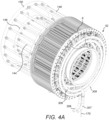
- the heat exchanger is generally drum-shaped and includes a multitude of spiral sections each containing numerous small diameter metal alloy tubes.
- the spiral sections spiral inside one another.
- the tubes in some examples are each about 2 to 3 metres long and about 1 millimetre in diameter and have a wall thickness of about 20 to 40 microns or thereabouts.
- Each spiral section has an axially-extending coolant inlet header tube which is fixedly attached to a central support sleeve.
- the tubes of each spiral section are sealingly connected at one end thereof, such as by brazing, to the inlet header tube and extend in a small plurality of rows radially (such as about 1 to 10 rows, 2, 3, 4, 5, 6 or 7 rows being some examples) and in a large number of rows axially such as about 75 to 100 rows or in excess of 100 rows.
- These various thin tubes all spiral out from the inlet header tube to an outlet header tube to which they are also sealingly connected, such as by brazing.
- the flow direction could be reversed such that the inlet headers are at a radially outward location and the outlet headers at a radially inward location and air may flow through the heat exchanger in a radially outward direction in a generally counter-flow to the coolant in the tubes which may be helium.
- the inlet header tubes remain fixed substantially in position relative to the internal support sleeve.
- the length of the small diameter tubes changes and the various spiral sections slide over one another in a generally circumferential fashion, the outlet header tubes also moving relative to the internal support sleeve. Therefore, the heat exchanger may be thermally cycled many times due to substantial alleviation of thermal stress, even though over 100 or up to 200 or more full flight cycles.
- each spiral section may be supportingly fixed together such as by brazing and each row of tubes which is adjacent to a row of an adjacent spiral section may be provided with a baffle plate, spacer or shim which extends fully along the tubes in the axial direction and slightly radially approximately 1 to 10 millimetres or so.
- the baffle plates or shims in adjacent spiral sections may slideably abut against one another or a baffle plate or shim of one spiral section may slideably engage upon adjacent fluid flow tubes of an adjacent spiral section.
- curved ducting may be provided radially outside the heat exchanger to curve approaching axial air flow into the heat exchanger or exiting axial air flow leaving the heat exchanger in the case of outwardly travelling airflow though the heat exchanger.
- the heat exchanger tubes are relatively well protected and in the event of a problem such as bird strike or other ingestion causing an engine failure after take-off (EFATO), the helium tubes are unlikely to be damaged, the engine may easily be shut down and, with or without dumping fuel to come below maximum landing weight, the vehicle may have a good probability of performing a successful landing with the respective engine shut down.
- EFATO engine failure after take-off
- the internal sleeve may be provided with a perforated or "bird cage” construction to enable the heatant, such as air, to pass therethrough without significant losses.
- the sleeve may comprise circular hoops at either end thereof, as series of mutually circumferentially spaced and axially extending longeron members, such as about 10 to 50 said longeron members, as well as one or more intermediate circumferential hoops space in a series along the support sleeve.
- the longeron members may be spaced from one another roughly the same distance that the hoops are spaced from one another to form generally square shapes or spaces which may be reinforced by x-shaped diagonal members such that all of the perforations through the internal support sleeve are triangles.
- This structure has been found to provide a lightweight form which is noticeably strong for resisting substantially radially inward loads which may be placed thereon without producing significant flow losses and also carries gravitational and inertial loads during flight.
- a similar support sleeve or bird cage could be provided radially outside the coolant tubes.
- the tubes may conceptionally be thought of as "cut” part way along their length and with each of the cut ends attached to the intermediate header tube.
- An internal intermediate supply tube may be inserted within the intermediate header tube to extend substantially all of the way along its length, the intermediate supply tube having a series of outlet apertures formed in a series therethrough a long its length.
- coolant may be fed into the heat exchanger not only at the inlet header tubes but also at the internal intermediate supply tubes such that further coolant may be added at the intermedial header tubes and different mass flow rates of coolant may flow through different parts of the heat exchanger, allowing the single heat exchanger construction to act as though it is a plurality of different heat exchangers but with roughly only the cost and complexity of building one.
- the pressure of the supply at the intermediate header tubes may be controlled to be similar or the same as the pressure of the nearby coolant inside the small diameter tubes.
- the use of the internal intermediate supply tubes with the series of outlet apertures formed in a series therethrough ensures that the uniform flow conditions can be achieved along the axial length of the heat exchanger.
- the heat exchanger of the preferred embodiment to be described herein includes a frost control system and after an actual test carried out on a test heat exchanger in confidential conditions for the European Space Agency on behalf of the United Kingdom government, the European Space Agency confirm a successful demonstration of the frost control mechanism at laboratory scale.
- the tested heat exchanger included a total of over 40 kilometres of the small diameter tubes at a weight of less than 50 kilograms and the incoming airstream was cooled to minus 150°C in under 20 milliseconds. No frost blockage was noted during low temperature operation and the European Space Agency stated they are now confident that a ground engine demonstrating test may now be performed.
- the heat exchanger thus may be provided with one or more dogleg zones in each spiral section, each dogleg zone in including a short radially extending section.
- each spiral section is not fully spiral in shape but comprises a first substantially spiral portion then a short radial portion which is followed by another substantially spiral portion and so on. This construction causes the provision of a substantially arcuate box shape between the doglegs of adjacent spiral sections.
- Each catcher element may comprise a tube having an interior which can be connected to a suction system for sucking on the contents of a plurality of exterior pockets spaced along the capture element on the leading face thereof, the pockets being connected via through-apertures to the interior of the tube.
- the capture element leading face pockets may be covered with 50-micron silica-coated mesh to form a porous front face to the pocket.
- a wetting agent other than silica may be used in other embodiments as may meshes of different sizes.
- a methanol, or other anti-freeze substance, injection system is located upstream of the capture elements and as water condenses out of the flow it mixes with the methanol which maintains the water as a liquid rather than freezing and this mixture is separated from the air flow by inertial separation upon contact with the wet mesh of the capture elements, then being sucked by vacuum via the pockets and through-apertures and carried away along the capture elements.
- a further set of similar catcher elements may be employed in further-resulting arcuate box spaces.
- pure or relatively concentrated methanol may be injected at or just upstream of the radially innermost arcuate box section and then at least partially caught in a mixture with water by the respective catcher elements, and this more dilute mixture may then be recycled further radially outboard in the heat exchanger where the temperature is higher and caught again.
- the methanol may be considered in this embodiment to run in overall radial counterflow relative to the air which reduces the required methanol consumption to prevent freezing and blockage.
- the methanol could be fully separated from the water after use but it may alternatively be allowed to pass with the engine supply air to a combustion section of the engine where it may contribute to thrust. While the thrust control system is running, the methanol's (combustion product) weight ejected backwards from the main engine rocket nozzles may in some embodiments add 2% to thrust. Also, the loss of the methanol's weight from the vehicle may be desirable in order to enable a higher vehicle velocity to be achieved in response to engine thrust later on during flight.
- the frost control system described herein can remove typically 99% of the water content from air.
- the conditions in the heat exchanger may be carefully controlled such that operation when considered on a water-methanol solid-liquid phase diagram the environment in the vicinity of the coldest catcher elements is in the region of about 80 mol% or about 88wt% methanol as the temperature approaches about minus 100°C.
- the two above-mentioned radially spaced and circumferentially staggered rows of catcher elements can be configured with the leading row elements circumferentially about half way between the adjacent elements of the trailing row.
- the leading capture elements may act as bluff bodies which deflect condensed fluid, which may have built up on the narrow coolant-containing tubes, in the flow generally towards the capture elements in the trailing row. This means that about 95% of the fluid removed by the two rows may be removed by the trailing row and only 5% by the leading row.
- the leading row of capture elements may be replaced by a passive row of bluff body elements, which could be flat sheets with slots or slits opposite the capture elements.
- the heat exchanger may be provided with deflector-shaped foil shims in the region of the short radially extending portions of the small diameter tubes in order to ensure that the liquid flow is directed towards the capture elements and does not easily take a short cut across the tubes in the regions of these radial sections. Also, the gaps between the tubes in the radially extending portions are preferably sealed.
- the frost control system may be used in the low atmosphere to remove water content from the air flow such that icing up and blockage of the heat exchanger does not occur.
- the frost control system can be switched off by shutting down methanol pumps and capture element suction pumps.
- the frost control system is set up so that the great majority of the water is removed with methanol at a higher temperature further back in the heat exchanger.
- any remaining methanol-water liquid content will, if it solidifies, turn directly to mass ice rather than the feathery frost that can be formed at higher temperatures, by direct sublimation from the vapour, and so causes less of a blocking issue.
- air inlet nacelles to the engine may be closed. Even with no air passing through the heat exchanger, helium may be cycled around the small diameter tubes in order to prevent overheating of the heat exchanger and potentially also nearby components due to aerodynamic heating via the outside body of the engine upon atmospheric re-entry.
- fluids other than helium may be flowed along inside the heat exchanger tubes, such as hydrogen.
- the heat exchanger may act as a hydrogen/other fluid heat exchanger (for example).
- the heat exchanger tubes are generally circular in cross-section in the preferred embodiment although other shapes could be used in other embodiments.
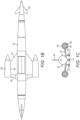
- an aircraft 10 with a retractable undercarriage 12, 14, 16 has a fuselage 18 with fuel and oxidant stores 20, 22 and payload region 24.
- a moving tail fin arrangement 26 and all moving canard arrangement 28 are attached to the fuselage 18.
- Main wings 34 with elevons 36 are attached to either side of the fuselage 18 and each wing 34 has an engine module 38 attached to a wingtip 40 thereof.
- a rear of each engine module 38 is provided with four rocket nozzles 40 surrounded by various bypass burners 42.
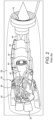
- the prior art engine module 38 includes an air inlet 43, heat exchanger 44 in four parts, a turbo compressor 46 and cycle conduits 48.
- part of the incoming air passing through the air inlet 43 passes through the heat exchanger 44 to the turbo compressor 46 and part is bypassed along bypass duct 50 to the bypass burners 42.
- the prior art heat exchanger 44 is replaced with the heat exchanger or pre-cooler 52 or a plurality of said heat exchangers 52 operable in parallel.
- Figure 3 shows a schematic view of the cycle for the modified engine module 38, which has been simplified for the purposes of clarity to show only one rocket nozzle 40 instead of four.
- the air passing through the heat exchanger 52 is then compressed in a compressor 54 of the turbo compressor 46 before passing through valve 56 to rocket nozzle 40 and partly also to the pre-burner 58 before passing through heat exchanger 60 before passing with uncombusted hydrogen in pre-burner exhaust products for further combustion at the rocket 40.
- a liquid hydrogen pump 62 driven by a turbine 64 drives hydrogen through a heat exchanger 66 and the turbine 64 through a turbine 68 of a helium circulator 70 to the pre-burner 58 for partial pre-burner combustion, although some of the liquid hydrogen may be bypassed by valve 72 along the conduit 74 for combustion in the bypass burners 42.
- the helium circulator 70 includes compressor 76 which drives gaseous helium through the heat exchanger 52 in counter-flow heat exchange with the air passing in the opposite direction (considering radial components of the paths of the air and helium), the helium then passing through heat exchanger 60 before travelling through helium turbine 78 before being cooled by the hydrogen in heat exchanger 66 and then passing back to the helium compressor 76.
- compressor 76 which drives gaseous helium through the heat exchanger 52 in counter-flow heat exchange with the air passing in the opposite direction (considering radial components of the paths of the air and helium), the helium then passing through heat exchanger 60 before travelling through helium turbine 78 before being cooled by the hydrogen in heat exchanger 66 and then passing back to the helium compressor 76.
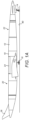
- the aircraft 10 is able to take off horizontally from stationary on the ground 80 ( Figure 1A ).
- the aircraft 10 may switch from the air breathing mode into a full rocket mode.
- the air inlet 43 is closed; the path of hydrogen through the cycle conduit 48 is similar to that in the air breathing mode although no hydrogen is diverted by the valve 72 to the bypass burner 42.
- the turbo compressor 46 is inactive.
- the gaseous helium now flows from the helium compressor 76 through heat exchanger 52 and heat exchanger 60 but then to turbine 82 before returning to the heat exchanger 66 and then to the helium compressor 76.
- the helium turbine 82 drives liquid oxygen pump 84 which directs oxygen towards the rocket nozzle 40 as well as partly via the pre-burner 58 and then as a pre-burner exhaust product together with unburnt hydrogen to the rocket nozzle 40 for combustion therein.
- the valve 56 is closed in the full rocket mode.
- the aircraft 10 may accelerate up through high Mach numbers and into orbit.
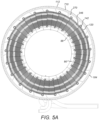
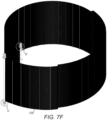
- the heat exchanger 52 has a support in the form of a central bird cage or generally cylindrical perforated drum 84.
- the drum 84 has two end support rings 86 spaced apart from one another and three intermediate support rings 88 which are spaced apart in an even series between the end support rings 88.
- a series of 21 longeron members 90 extend along between the two end support rings 86 and are supported by all five of the support rings 86, 88.
- the longeron members 90 comprise substantially flat radially aligned and thin plates.
- the longeron members 90 are attached by threaded bobbin members 92 to the two end support rings 86 and have a series of three slots 94 near radially inner edges 96 thereof.
- the slots 94 extend approximately one quarter to three quarters of the radial extent along each longeron member 90 and enabling supporting engagement between the longeron members 90 and the intermediate support rings 88.
- the intermediate support rings 88 also have slots, which correspond, to enable the engagement shown in Figure 6 .
- the support drum 84 also includes an internal stiffener tube 98 which comprises a perforated tubular element having longitudinal members engaging along the full length of each of the longeron members 90, circumferentially extending members 102 extending along the full circumferential extent and engaging each of the support rings 86, 88, as well as X-shaped bracing members 104 located adjacent to generally square spaces 106 formed between the various longeron members 90 and support rings 86, 88.
- the stiffener tube 98 therefore forms a very stiff perforated lattice within the drum 84 which is designed to carry shear loads.
- the drum is capable of accepting a high radially inward load and the four triangles formed in the region of each X-shaped bracing member 104 enable substantial airflow to pass radially through the perforated drum 84 without a significant pressure drop.
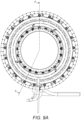
- spiral conduit sections may be secured around the perforated drum with an inlet header 106 of each modular spiral section 108 secured to the support drum 84, the spiral section 108 spiralling outwardly radially away from the central axis of the drum 84 as it extends circumferentially substantially 360° around the support drum 84 to an outlet header tube 110.
- Each spiral section 108 may be modified in other embodiments to extend a greater or less angle around.
- the modular spiral section 108 includes first 112' and second 114' dogleg sections containing short radially extending sections of heat exchanger tubing as will be described below. In other embodiments more than two such dogleg sections may be used, such as three, four or five in each spiral section 108.
- Figure 10B shows how the inlet header tube 106 includes a series of five mounting flanges 112 (only some of which are shown in Figure 10B ) which have apertures (not shown) engaged by a locking rod 114 to lock the inlet header tube 106 in position to each of the support rings 86, 88.
- an optional longeron shoe 116' covers the radially outer edge of each longeron member 90 to protect the spiral sections 108 which may engage therewith.
- the longeron shoes 116' are not used in other embodiments.
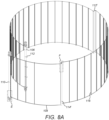
- Figure 8A also shows the location of baffle stations 116 which are regularly spaced along the spiral sections 108.
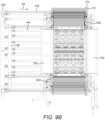
- FIG 8B shows that the outlet header 110 (and the inlet header 106 is similar) has within it a series of 800 apertures 118 configured to accept 800 corresponding helium heat exchange tubes 120 only three of which are shown in Figure 8B .
- Other embodiments may employ fewer or, indeed, more such tubes 120.
- the helium tubes 120 are brazed into the apertures 118.
- To prepare the helium tubes 120 for brazing preferably the tubes are scanned for defects, wall thickness is measured (OD), a pressurization test is conducted, and the tubes are optionally electrochemically milled, washed, dried, and then cut and formed to shape.
- the brazing is preferably carried out under vacuum.
- the helium tubes 120 are arranged in 200 rows spaced along the axial direction of the headers 106, 110 and four rows radially.
- the helium tubes 120 extend all of the way along from each inlet header 106 to each outlet header 110. Since there are 21 spiral sections 108 and each tube 120 is approximately 2 to 3 meters long, the heat exchanger 52 contains approximately 40 kilometres of the tubes 120.
- the tubes 120 are approximately 1 millimetre in diameter or somewhat more and have a wall thickness of about 20 to 40 microns.
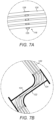
- FIG 8C shows how the tubes 120 pass the doglegs 112', 114' with short radial portions 122 and J-shaped foils or joggles 124 located either side of the doglegs 112', 114' to direct flow away from the radial portions 122.
- This is also shown in Figure 7B .
- race track section baffle elements 125 are brazed to the inner side of each of the four rows of helium tubes 120 in any given spiral section 108 and a flat shim plate 126 is based to the outer side of the radially outer tubes 120 in the four rows.
- the baffle elements 125 are made by flattening tube the same as the helium tubes 120.
- the baffle elements and shim plates 126 extend axially the full length of all of the 200 rows of tubes 120 in the axial direction.
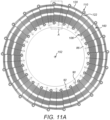
- the baffle stations 116 of the 21 spiral sections 108 are substantially aligned with one another wherever there is a longeron member 90 so as to be orthogonal to the matrix tubes 120, although offset slightly angularly from the true radial direction R (see Figure 11B ) from the central axis 128 of the heat exchanger 52 (see Figure 11A ).
- the shoe 116' on the longeron member 90 engages the bottom baffle element 125 of a first spiral section 108 and radial force can be transmitted through the baffle station 116 to the shim plate 126 which engages the bottom of another radially inner baffle element of the next inter-nested spiral section.
- a radially extending I-beam 130 may transmit the substantially radial load to the next spiral section 108.
- the air inlet temperature to the heat exchanger 52 at the radially outermost side in particular may be substantial, for example over 800 or even 1000°C.
- the temperature variation may cause a significant thermal change to the tubes 120 which, in particular, may grow in length with increasing temperature. Therefore, although the inlet header tube 106 is fixed in position to the perforated support drum 84, the outlet headers 110 may move as the tubes 120 grow in length.
- the shim plates 126 of each spiral section 108 may therefore slide relative to the adjacent baffle elements 125 to enable sliding substantially circumferential motion of the spiral sections 108 relative to one another.
- the line of thrust of the baffle stations 116 through the baffle elements 125, shim plates 126 and I-beams 130 may rotate to be more in line with the truly radial direction of R from the centre axis 152 of the exchanger 52.
- the line of the baffle elements 125 is maintained substantially orthogonal to the tubes 120. Therefore, thermal expansion and contraction of the tubes in the circumferential (lengthwise) section of the tubes 120 may be allowed for.
- the tubes 120 and other components may expand in the radial direction as they expand and contract with temperature and allowance for this is also provided.
- each inlet header tube 106 is fitted with inlet header fittings 140 at either end thereof and the outlet header tubes 110 are fitted with outlet header fittings 142 at the respective two ends thereof.
- the inlet header fittings 140 at one end of the inlet headers 106 are fluidly connected by flexible hoses 144 to the inlet manifold 146 for the helium flow, and outlet header fittings 142 at the same end thereof are fluidly connected by flexible hoses 148 to helium outlet ring manifold 150 for the helium.
- the inlet header fittings 140 at the other end of the header tubes 106 may be blocked off or may be fluidly connected via a ring manifold to the adjacent header fitting 140. The same is so for the outlet header fittings 142 at the other end of the outlet header tubes 110.
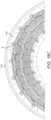
- generally rectangular (but arcuate) pockets (or box sections) 160 are created extending axially all of the way along the heat exchanger 52 between the tubes 120 of adjacent spiral sections 108 in the regions of I-beams 130 and the respective doglegs 112', 114'.
- These generally rectangular but arcuate pockets 160 contain capture elements 162 of a frost control system of the heat exchanger 52 which will now be described.
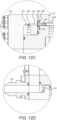
- a methanol supply tube 170 feeds methanol to an annular gallery 172 of a methanol injection ring 174.
- the parts 176 in the gallery 172 are sections through tubes 214 where these enter the gallery 172.
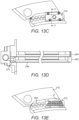
- the methanol injection ring has a series of 180 injector tubes assemblies 182 ( Figure 12E ) (this arrangement could differ in other embodiments) located in a series spaced circumferentially around the heat exchanger 52, each injector tube assembly 182 including an injector tube 184 extending axially between annular manifold 173 forming the annular gallery 172 and a further support ring 175 into which tapered ends 190 of end plugs 192 are fixed.
- Each of the injector tubes 184 includes a series of 22 injection holes 194 (one of which is shown in Figure 12F ) spaced therealong in a series along the tube 184, the diameter of each of the holes 194 being 0.2 mm.
- the end 196 of each tube opposite the tapered end 190 is secured to an injector fitting 198 having a non-circular flange 200 with a flat 202 for rotationally aligning the tube 184 by matching of the flat 202 with a corresponding formation in a support ring 177 attached to the ring 173.
- a circular seal 204 is provided for sealing in an annular recess 206 of the fitting 198.
- a methanol pump 210 ( Figure 3 ) is operated to pump methanol along a conduit 212 which is connected to the methanol supply tube 170, the methanol is forced through the gallery 172 and through supply channels 214 of the ring 173 and interior channels 216 of the fittings 198 to pump methanol into the interior of the tubes 184 and then out through the injection holes 194. Accordingly, methanol is injected into airflow just about to enter into the volume defined by the spiral sections 108 of the tubes 120.
- the methanol is able to prevent the formation of ice in the heat exchanger 52 which would block the airflow through the same.
- the methanol lowers the freezing temperature of water droplets condensed out within the heat exchanger to do this and a substantial proportion of the methanol and water are together removed from the airflow by catcher elements as will now be described.
- each outer one of the two pockets 160 shown in Figure 11B has nine mutually spaced catcher elements located therein and each inner one of the pockets 160 has seven catcher elements 162 located therein.
- the catcher elements 162 will now be described.
- These Figures show one outer catcher assembly 240 having nine catcher elements.
- the inner catcher assemblies are similar apart from the number of catcher elements (since they only have seven).
- each catcher assembly 240 has an outer row 242 of four catcher elements 162 and an inner row 244 of five catcher elements 162.
- the numbers of catcher elements and the numbers of doglegs and rows (radially) of pockets may differ in other embodiments.
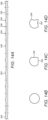
- Each catcher element 162 comprises a hydro-formed tube 246 with a varying cross-section along the length thereof as shown in Figures 14A to 14D .
- the tube 246 is circular in section at respective ends 248, 250 thereof and has eight pocket depressions 252 formed therein between peaks 254 where the cross-section of the tube 246 is as shown in Figure 14C , the cross-section a mid-point 256 between the peaks 254 being as shown in Figure 14D in which there are two outwardly concave portions 258.
- the tubes 246 are covered with a stainless steel 50 micron filter mesh 258 (other meshes may be used in other embodiments) which is coated with a wetting agent such as silica.
- Each mesh 258 is generally cylindrical (it may vary in other embodiments) and forms a pair of cavities 260, 262 at each of the pocket depressions 252, such that there are sixteen cavities 260, 262 in total per catcher tube 246. Scavenge holes 264 are positioned through the wall of the tube 246 in each cavity 260, 262 - this number may differ in other embodiments.
- the catcher assembly 240 includes a control plate 270 and one end 248 of each catcher tube 246 is fitted to a non-rotational fitting 272 such that all nine catcher element tubes 246 communicate with the interior of a catcher suction manifold assembly 274 having a suction port 276 leading, via piping 278 ( Figure 3 ), to suction source 280.
- the catcher elements 162 are capable of operating upside down and also when used in any axially or otherwise accelerating flying vehicle.
- the catcher control plates 270 includes circular apertures 290 therethrough.
- the outlet header tubes 110 of the heat exchanger 52 pass through these apertures 290.
- the catcher plate 270 includes nine extra apertures 292. The reason for this is that the adjacent catcher assembly 240 spaced one circumferentially around the heat exchanger 52 is arranged with the manifold 272 and end plugs 284 at opposite ends. Therefore, the apertures 292 serve to engage around the circular ends 250 of the catcher elements 162 of the adjacent catcher assembly 240 so that all of the catcher tubes 246 are supported at both ends. With a vacuum applied at the suction port 276, there is suction at the scavenge holes 266.
- the mesh 258 is shown with a circular section for the purposes of clarity in Figure 13I , as shown in Figure 14F , the mesh in fact stretches out to a flatter configuration over the cavities 262/260/pockets 252. As shown in Figure 14E the peaks (or lands) 254 are configured generally flat. The lands 254 engage the mesh 258 so as to separate the pockets from one another. Thus, if one pocket should lose its integrity, for example if debris is ingested into the heat exchanger, the other pockets 252 will remain operational.
- the outer catcher suction manifold assemblies 274 are connected by flexible S-shaped vacuum tubes 300 - the S-shape allows for manufacturing differences and for thermal expansion but need not be employed in other embodiments - to annular frost control catcher ring manifold 302 and the inner catcher element manifold plates 304 (corresponding to the manifold plates 274 but for only seven catcher elements) are connected by similar S-shaped flexible hoses 306 to frost control catcher ring manifold 308.
- the ring 308 leads to a vacuum outlet conduit 309 and ring 306 to a vacuum outlet conduit 307 both leading via the piping 278 to vacuum source 280.
- the spacing between the catcher elements 162 along the length of each of the rows 242, 244 is approximately one third of the diameter of the catcher elements 162. It will also be noted that the distance between the catcher elements 162 in the row 242 and the catcher elements in the row 244 is approximately the same or slightly less.
- liquid droplets 400 approach the outer row 242 they may travel and turn approximately as shown by arrows 402. Droplets flow through the matrix of tubes 120 and whilst growing on the tubes are focused laterally by the airflow accelerating into the gaps between the catcher elements 162 of the outer row 242. Therefore, the droplets 400 tend to be diverted by the catcher elements 162 in the first row 242 to be travelling almost straight towards the catcher elements 162 in the next row 244.
- the catcher elements 162 in the row 242 may act as bluff bodies and about 5% of the water extracted by the catcher assembly 240 may be extracted in the front row 242 (in the sense of airflow direction) and 95% in the next row 244.
- the front row catcher elements 162 of the row 242 may be replaced with solid bodies with no mesh or suction function.
- the temperature at the inner catcher elements and/or outer ones may be monitored by a temperature sensor 350 which may send data to a controller 352 ( Figure 3 ) which may control a valve such as the valve 354 with a diverter part 356 for altering the helium flow through the heat exchanger 52.
- a controller 352 Figure 3
- the temperature at the catcher elements 162 may be controlled.
- the water and methanol removed from the airflow may be added back into the airflow approaching the rocket nozzle 40 and may in some embodiments add 2% to thrust.
- the loss of the methanol's weight from the vehicle may be desirable also in order to enable a higher vehicle velocity to be achieved in response to engine thrust later on during flight.
- the frost control system described herein can typically remove 99% of the water content from air.
- the control provided by the controller 352 just described may be such that on a water-methanol solid-liquid phase diagram the environment in the vicinity of the coldest catcher elements 162 is in the region of about 65 mole % or about 82 wt. % methanol as the temperature approaches about -100°C. Even though the heat exchanger could cool the air down to its liquification point if necessary near the air outlet from the heat exchanger, the frost control system is set up so that the great majority of the water is removed with methanol at a higher temperature further back in the heat exchanger.
- the spiral sections 108 incorporate an intermediate header 440.
- the intermediate header 440 may have two sets of apertures, into one set of which all of the tubes 120 arriving from the inlet header 106 may be fixed by brazing and into which other set all of the tubes 120 leading to the outlet header 110 may be so fixed.
- the intermediate header 440 has an outer tube 442 thus into which the tubes 120 communicate.
- the inlet header 440 may include an interior tube 444 having a series of injector apertures 446 located in a series at spaced locations therealong for injecting helium into the intermediate header 440. Therefore, the tubes 120 downstream of the intermediate header 440 may carry more mass flow rate of helium than the tubes 120 upstream.
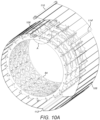
- a shim plate 500 is located in each pocket 160 located radially outside the catcher elements 162 of the rows 242,244.
- Figure 19A shows the shim plate 500 for the outer pockets 160, the inner pockets with seven catcher elements 162 having similar shim plates 500 (although the number of longitudinal slots 512,514,516 may be changed e.g. reduced).
- Each shim plate has a first side wall 502, a top wall 504 and a second side wall 506.
- Each side wall 502,506 comprises a downwardly slanted portion 508 joined to the top wall 504, the downwardly slanted portion 508 being connected to a lower generally radially extending portion 510 of the side wall 502.
- the top wall 504 defines generally all of the way therealong three longitudinally extending slots 512,514,516, the slots 512,514,516 being interrupted by a series of small cross-connectors 518.
- the three slots 512,514,516 are aligned along respective radial paths with the three middle-most catcher elements 126 of the second row 244 of catcher elements 126. Therefore, as shown by the five air flow lines 520 shown in Figure 19D , the slots 512,514,516 in the shim plates 500 tend to assist in directing the flow onto the catcher elements 126 in the second row 244.
- the arrangement may be modified by omitting the first row 242 of catcher elements 126 and potentially by placing the top wall 504 of each shim plate 500 nearer to the remaining "second" row 244 with the slots 512,514,516 still being substantially aligned with the catcher elements 126 thereof.
- the shim plates may have one slot (or slit) per catcher element 126 in this row. There are not necessarily three slots. There could be, for example five.
- the shim plates 500 are optional. They locally increase air flow velocity so that aerodynamic forces are dominant over gravity. Gravity may tend to cause drops to move diagonally between catcher elements without hitting them and being caught. The shim plates 500 thus assist in the production of aerodynamic loads on droplets of water/anti-freeze which tend to direct them onto the catcher elements 126, 244. Other structures than the shim plates 500 be used in other embodiments for a similar purpose.
- the heat exchanger is provided with a front bulkhead 530 and a corresponding rear bulkhead 532, these bulkheads being essentially mirror images of one another.
- the bulkheads 530, 532 are secured with attachments to allow for movement due to thermal expansion.
- the front bulkhead 520 has an inner ring 534 sitting around and secured to the support drum 84.
- the inner ring 534 is connected by a series of generally radially extending spokes 536 with an outer ring 538 of the bulkhead 530.
- Outer ends 540 of the spokes 536 are connected to the methanol injection ring 174.
- an outer header retainer spring 542 is spring-located to the ring 538 of the bulkhead 530 and to a tab washer 544 for the header tube 110 attached to each catcher assembly control plate 270.
- a spring 542 applies a light radial clamping load to the matrix of tubes 120 whilst allowing thermal expansions.
- Spokes 536 are slightly spiral in shape in this embodiment to provide a clearance but could be truly radial or have other configurations in other embodiments.
- Figure 18 shows a modification to the heat exchanger to incorporate recycling of the methanol or other antifreeze used to prevent blocking of the heat exchanger due to frost or ice formation.
- the air flow flows through the heat exchanger annularly inwardly, as before, shown schematically in the direction of the airflow arrows A,B with the air flow being cooled by the helium tubes 120 (not shown in Figure 18 for the purposes of clarity) and make it not shown in Figure 18 (for the purposes of clarity).
- Methanol (or other antifreeze) is fed from a source/pump 550 along a conduit 552 to a first injector manifold 554 located at a relatively cold downstream location in the air flow in the heat exchanger 52.
- the methanol is then collected or a significant portion of it is collected with water in the air flow at a first downstream capture or removal arrangement 556.
- This captured methanol, diluted with the water is then recycled by a pump 558 along a conduit 560 to a more upstream methanol/water injection manifold 562 and this mixture is then (at least partly) captured along with more water from the air flow at a further capture or removal arrangement 564.
- This methanol (together with water) is then pumped by a further pump 566 along a further conduit 568 with the methanol further diluted to an upstream methanol/water injector manifold 570 where it is injected into the air flow.
- This further diluted methanol (diluted with water) is then collected or substantially all collected at an upstream catcher or removal arrangement 572 from where it is led away to an exit 574, which may lead to a combustion or thrust producing section of the engine in order to be ejected from the engine to supply additional thrust.
- This recycling of the methanol in which it is re-injected each time at a location further upstream (and thus can conceptually be considered in counter flow to the air flow even though as shown by schematic arrows 577 the methanol flows along with the air while in the air flow) enables consumption of methanol or other antifreeze to be optimised to a minimum.
- the methanol and water may be lead away from the exit 574 to a methanol separator, such as a distillation system, for re-concentrating the methanol for re-use so as to reduce overall methanol consumption and the weight of methanol to be carried.
- a methanol separator such as a distillation system
- catcher sections like catcher arrangement 572 in series (one after the other along the air flow path) after each injection manifold (like 562) and before the next ejection manifold.
- the heat exchanger 52 (or pre-cooler) may be assembled in a test rig 580 together with a front passive heat exchanger simulator 582 and a rear passive heat exchanger simulator 584.
- the simulators 582,584 have similar air flow characteristics to the heat exchanger 52.
- the air flow simulators 582,584 and heat exchanger 52 are arranged annularly around an outlet duct 586 with a centre line or axis 588.
- the front and rear passive air flow simulators 582,584 may be replaced by additional heat exchangers 52 which may be substantially identical to the middle heat exchanger 52.
- These three heat exchangers 52 may thus accept incoming air flows 590 from duct 592 leading from inlet 43 and the outlet duct 586 may lead to the air compressor 54 of the turbo compressor 46 shown in Figure 3 .
- the airflow simulators 582,584 and heat exchanger 52 are each radially inwardly bounded by a series 594,596,598 of overlapping guide vanes 600, each guide vane being an annular or ring-like element co-axial with the central axis 588.
- Each guide vane has a longitudinal extent along the axis 588 and in cross-section as shown in Figure 21B has a curved generally radiused leading portion 602 extending approximately 20% of the longitudinal extent of the guide vane and a trailing portion 604 extending the remaining approximately 80% of the longitudinal extent of the guide vane 600 which is substantially conical - although Figure 21B shoes the leading edge portion 604 to be several flattened portions it is in fact preferably smoothly curved.
- each guide vane 600 is substantially the same width all the way along from its leading edge 610 to a trailing edge 612 thereof but this could be changed in other embodiments.
- the leading edge 610 (or leading edge portion 614) of each guide vane 600 is angled at approximately 10 degrees to radial, i.e. the angle A in Figure 21B .
- the trailing edge 612 (or trailing edge portion 616) of the guide vane 600 is angled at approximately 10 degrees to the longitudinal axis 588 of the duct 586, i.e. the angle B in Figure 21B .
- the guide vanes 600 serve to locally turn and accelerate the air flow up to the air velocity generally in the outlet duct 586 such that upstream velocity distribution, i.e. upstream of the front and rear passive air flow simulators 582,584 and the heat exchanger 52, is forced to become more uniform such that the same or substantially the same air mass flow rate will flow through each even though they are different distances along the duct 586.
- the turning vanes 600 alleviate this problem locally at the exit of the drum-like air flow simulators 582,584 and heat exchanger 52. Although between neighbouring vanes 600 there will still be a pressure gradient in the axial direction, this is now constrained between boundaries of vane pairs. Hence by splitting the flow into a sufficient number of turning segments, the larger outlet duct pressure gradient can be removed or at least reduced. Not only are more even mass flow rates drawn through the three drums 582,584,52 but the streamlines across the heat exchanger 52 become almost radial (reducing a tendency without the vanes for more flow to pass through the heat exchanger 52 at one axial position than another), thereby helping to ensure a more uniform flow field through the heat exchanger 52 for the purposes of heat transfer.
- the pressure ratio i.e. the ratio of pressure in the duct 586 in the region of the front airflow simulator 586 to the pressure in the region of the rear simulator 584 was seen to improve from a ratio of 72% without the guide vanes 600 to 89% with the guide vanes installed as shown in Figure 21A .
- the vanes 600 are thus shown to offer a solution to re-distributing the mass flow through a heat exchanger assembly having a longitudinal extent and leading to an axially-flowing duct and/or arrangements with multiple heat exchanger modules like the module 52 together with similar modules replacing the passive air flow simulators 582,584.
- the vanes 600 provide more uniform radial velocity distributions through the heat exchanger 52.
- the blade outlet angles (B) may be varied along the axial length of the installation to increase uniformity of flow yet further and it is envisaged that a centre body 603 may be added as well such that a combined turning vane and centre body geometry can be utilised to provide a highly uniform flow distribution with minimal total pressure loss.
- the centre body 603 With the outlet duct 586 generally cylindrical, the centre body 603 may be parabolic in cross-section, as schematically shown, in order to provide generally linear area increase per unit length (due to the 3D annular shape), enabling mass flux to remain substantially constant.
- each heat exchanger 52 may also be provided with a series of outer guide vanes 601 extending fully along the axial length thereof, or substantially so. Only three such outer vanes 601 are shown in Fig. 21A for the purposes of clarity.
- the outer vanes 601 are preferably each slotted as shown in Fig. 21A since pressure increases and the flow velocity slows as flow passes the vanes 601 and the slotting stops flow stall. Slotting is not needed on the inner vanes 606 since pressure decreases and flow accelerates across them. With the flow reversed outwardly radial in other embodiments, the inner vanes may be slotted. In some embodiments, either the inner 600 or the outer 601 vanes may be omitted.
- the catcher plates 270 have pegs 700 which protrude into the catcher pockets in the matrix of tubes 120 which allows them to follow the catcher pockets as the matrix moves under thermal and pressure displacements. It will be appreciated that the catch plates 270 overlap so as to prevent axial air leakage between them; and it is noted that and the catcher plates do not normally bear radially on each other or the front and rear bulkheads.
- a flight-ready engine may have at least two injection points at different radial locations or more radial locations as shown in Figure 18 .
- transition tubes 702 shown in Figure 9B may be useful in test rigs and may be removed in operational engines.
- the concave dished pockets in the catcher elements 126 are approximately 50mm long.
- the mesh 258 is wrapped tightly around the catcher tubes and secured to them. This forms 50mm long pockets where each catcher tube 126 is dished, separated by the lands 254 where the mesh 258 contacts the tube so as to compartmentalise the suction cavities into separate pockets so that in case of screen damage remaining pockets remain operational.
- the temperature control components including the temperature sensor 350 and controller 352 may be adapted or replaced in other embodiments with other apparatus known to the skilled person in the art form maintaining a constant airside temperature profile for frost control by providing the correct amount of methanol/water condensation at the particular catcher locations.
- the control in at least some embodiments is adapted to control the last (coldest) catcher row to be located at about -80 to -100 degrees C air temperature where the methanol concentration should be about 80% mole fraction or 88% mass fraction to delay the freezing point to the lowest possible temperature.
- frost control system requires very little consumable materials compared to the previous publications mentioned above, i.e. the mass of methanol required is very low, translating into increased vehicle payload and improved economics.
- connection of the methanol manifold 174 to the spokes 536 is preferably via slotted holes (not shown) to allow for radial thermal expansion.
- the methanol injector ring 174 shown in the drawings is composed of active injection tubes 710 with alternate plain non-fluid injecting tubes 712 of larger diameter. This arrangement provides increased air velocity close to the injection tubes 710 but the plain tubes 712 may be removed in other embodiments.
- the light pressing of the outlet headers 110 against the matrix of tubes 120 using the springs 542 applies an initial preload which is augmented by the airside pressure drop when the engine is running and it also prevents the module spirals 108 from swinging open when the axis of the heat exchanger 52 is horizontal.
- the helium bypass controls, 350,352,354 may be replaced in other embodiments and the circuitry may be changed to include a recirculation loop and for alternative designs of catcher temperature control.
- the heat exchanger may be used in other applications than with the engine shown and is not limited to use in the particular aerospace application described and may be used in various other aerospace and industrial applications.
- the tube support structure including the bird cage drum 84 and I-beams 130 may be reversed such that the drum 84 is positioned radially outside the spiral tubes 120 so as to resist outward loading thereon.
- frost control apparatus e.g., the methanol injection system, the catcher assemblies 240, the shims 500, the doglegs 112',114', I-beams 130 in the region of the spiral sections 108, arcuate pockets 160, radial portions 122 and foils/joggles 124) from the heat exchanger, to, for example, reduce weight when the heat exchanger is used with an engine (such as the engine disclosed in GB 1318111.0 ).
Landscapes
- Engineering & Computer Science (AREA)
- Mechanical Engineering (AREA)
- General Engineering & Computer Science (AREA)
- Physics & Mathematics (AREA)
- Thermal Sciences (AREA)
- Chemical & Material Sciences (AREA)
- Combustion & Propulsion (AREA)
- Aviation & Aerospace Engineering (AREA)
- Heat-Exchange Devices With Radiators And Conduit Assemblies (AREA)
Description
- The present invention relates to heat exchangers such as of the type which may be used in aerospace applications or in industrial or other applications. The invention also relates to engines such as aircraft or aerospace engines including such heat exchangers and to aircraft including such heat exchangers or engines.
-
GB-A-2241319 - Also, with a substantial airflow through the heat exchanger radially past the tubes, the drag of the airflow on the tubes produces a high radial force on the tubes and the tubes are difficult to support and make last a long time. Additionally, the heat exchanger has rather limited cycle functionality and it is difficult to configure heat exchangers, to accommodate them in an engine and provide a system with low weight and low pressure drop. Also, to achieve sufficient performance it has proven necessary to design a cycle which cools atmospheric air before it enters a compression section downstream of such a heat exchanger at a temperature below 0°C. This can unfortunately very easily result in a very rapid blocking of the heat exchanger with ice because there is often a considerable amount of water vapour in the lower atmosphere where the launch of a vehicle containing the heat exchanger for air cooling may take place, making the entire vehicle unviable. This has proven an exceptionally difficult problem which has been looked at for many years and has been a significant hurdle in being able to provide a reusable vehicle which can operate in a relatively economical horizontal take-off air-breathing mode, and either continue, such as the LAPCAT vehicle which is intended to be capable of transporting three hundred passengers from Brussels, Belgium to Sydney, Australia in about 4.6 hours in an approximately Mach 5 cruising mode, or switch, like the SKYLON vehicle, into a rocket mode for travel out of the atmosphere into orbit.
-
GB-A-2241537 US5318110A discloses a heat exchanger having internally cooled spacer supports for heat exchange tubes. Spacer supports are connected to a matrix of heat exchange tubes of a heat exchanger to maintain the heat exchange tubes in spaced relation and resist overheating by hot fluid flowing around the tubes and the spacer supports.US5318110A discloses a heat exchanger according to the preamble of claim 1.US2008/121387A1 discloses a heat exchanger formed by connecting tube-group blocks along a tube axis, where each one of the tube-group blocks includes a plurality of substrates having a large number of through holes, which communicate with insides of a plurality of tubes placed between the substrates.WO2008/123603A1 discloses a heat exchange device in which heat exchangers are sequentially connected through header tanks.GB2241319A US3638719A discloses a heat exchanger comprising a bundle of substantially parallel pipes, the ends of said pipes presenting a convex configuration at one end of the bundle and a concave configuration at the other end of the bundle.WO2008/030669A1 discloses a tube joint for joining dissimilar metal sections of a superheater or reheater tube formed using a hot isostatic press process applied to at least two different materials.GB2075397A - According to a first aspect, there is provided a heat exchanger according to claim 1.
- Further advantageous embodiments of the invention are defined in claims 2-14.
- According to the invention, there is provided a heat exchanger having at least one first conduit section for the flow of a first fluid in heat exchange with a second fluid in a flow path which passes the at least one first conduit section, in which each first conduit section comprises a flow path via at least one tube from an inlet to an outlet, and in which an intermediate header is provided in the flow path between the inlet and outlet for flow communication with an intermediate fluid flow path.
- Optionally, each of the inlet and outlet comprises a header tube.
- Optionally, the header tubes are straight.
- Optionally, the at least one first conduit section includes a plurality first flow tubes extending from the inlet to the intermediate header for flow therebetween and a plurality of second flow tubes extending from the intermediate header to the outlet for flow therebetween.
- Optionally, the length of a first flow tube plus the length of a second flow tube is about 2 to 3 metres.
- Optionally, the first flow tubes and/or the second flow tubes are about 1 mm in diameter.
- Optionally, the first flow tubes and/or the second flow tubes have wall thickness of about 20 to 40 microns.
- Optionally, said first conduit section comprises a spiral section having the first and second flow tubes extending in a spiral shape alongside and spaced from one another in rows.
- Optionally, said heat exchanger includes a controller for controlling pressure in the intermediate flow path.
- Optionally, the controller includes a flow valve.
- According to the invention the intermediate header comprises an outer enclosure for enclosing first fluid and an injector for injecting intermediate fluid flow into the outer enclosure.
- Optionally, the injector comprises a tube having a series of flow apertures spaced therealong for injecting fluid into the outer enclosure.
- Optionally, each of the outer enclosure and the injector comprises a straight elongate tube.
- Optionally, said rows include a plurality of rows spaced apart from one another along the longitudinal direction of the outer enclosure, the tubes in said spaced apart rows being fluidly coupled to the outer enclosure at respective spaced locations along the length thereof.
- In some embodiments tubes are made at least partly of alloy material, such as Nickel alloys or Aluminium alloys. Optionally, each tube comprising a first portion made of a first material and a second portion made of a second material. The first portion may terminate at one end of such a tube, such as at a header and the second portion may terminate at a second end of such a tube as at a further header. The first and second portions may be connected to one another such as by a sleeve. This may enable temperature capability to be increased by the use of a first material at a relatively hot region of the heat exchanger but a second material for reasons of density or lost to be used in a colder region.
- For example, an aluminium alloy may be used in a colder region and a ceramic or heat resistant alloy in a hotter region. Each of the first and second portions may be connected at one end thereof to the intermediate header.
- According to another aspect, there is provided a method of operating a heat exchanger according to the invention with or without any optional feature thereof, which comprises flowing helium through the at least one first conduit and through the intermediate fluid flow path.
- Optionally, said method of operating a heat exchanger comprises flowing air as the second fluid in the flow path past the at least one first conduit.
- According to a further aspect, there is provided an engine, such as a vehicle engine, including a combustion section and a heat exchanger according to invention with or without any optional feature thereof, adapted to cool air (as the second fluid) in a flow path directed towards the combustion section.
- Optionally, said engine includes a helium supply for providing helium as the first fluid.
- According to a further aspect, there is provided a flying machine, such as an aircraft or orbital launch vehicle, which includes a heat exchanger according to invention with or without any optional feature thereof.
- According to a further aspect, there is provided a flying machine, such as an aircraft or orbital launch vehicle, which includes an engine according to the above further aspect with or without any optional feature thereof.
- In some embodiments the heat exchanger is generally drum-shaped and includes a multitude of spiral sections each containing numerous small diameter metal alloy tubes. The spiral sections spiral inside one another. The tubes in some examples are each about 2 to 3 metres long and about 1 millimetre in diameter and have a wall thickness of about 20 to 40 microns or thereabouts.
- Each spiral section has an axially-extending coolant inlet header tube which is fixedly attached to a central support sleeve. The tubes of each spiral section are sealingly connected at one end thereof, such as by brazing, to the inlet header tube and extend in a small plurality of rows radially (such as about 1 to 10 rows, 2, 3, 4, 5, 6 or 7 rows being some examples) and in a large number of rows axially such as about 75 to 100 rows or in excess of 100 rows. These various thin tubes all spiral out from the inlet header tube to an outlet header tube to which they are also sealingly connected, such as by brazing. In other embodiments, the flow direction could be reversed such that the inlet headers are at a radially outward location and the outlet headers at a radially inward location and air may flow through the heat exchanger in a radially outward direction in a generally counter-flow to the coolant in the tubes which may be helium.
- Also, as temperature changes during operation of the heat exchanger or otherwise, the inlet header tubes remain fixed substantially in position relative to the internal support sleeve. However, due to the thermal expansion, the length of the small diameter tubes changes and the various spiral sections slide over one another in a generally circumferential fashion, the outlet header tubes also moving relative to the internal support sleeve. Therefore, the heat exchanger may be thermally cycled many times due to substantial alleviation of thermal stress, even though over 100 or up to 200 or more full flight cycles.
- Also, at various points along their length, the tubes in each spiral section may be supportingly fixed together such as by brazing and each row of tubes which is adjacent to a row of an adjacent spiral section may be provided with a baffle plate, spacer or shim which extends fully along the tubes in the axial direction and slightly radially approximately 1 to 10 millimetres or so. The baffle plates or shims in adjacent spiral sections may slideably abut against one another or a baffle plate or shim of one spiral section may slideably engage upon adjacent fluid flow tubes of an adjacent spiral section. Due to the supporting fixing of the tubes in each section and the sliding abutment, not only are all of the spiral sections easily able to expand and contract as they desire during thermal cycling but the radial drag load of heatant such as air, passing through the heat exchanger outside and between the small diameter tubes may be transmitted inwardly (or outwardly) through all of these spiral sections in a strong substantially radial load path and may be reacted against by the internal support sleeve, or by an external support sleeve in the case of radially outward air flow.
- With counter flow heat exchange between radially travelling air flow (heatant) and oppositely radially spiralling helium coolant flow in the narrow tubes, curved ducting may be provided radially outside the heat exchanger to curve approaching axial air flow into the heat exchanger or exiting axial air flow leaving the heat exchanger in the case of outwardly travelling airflow though the heat exchanger. Due to this type of construction, the heat exchanger tubes are relatively well protected and in the event of a problem such as bird strike or other ingestion causing an engine failure after take-off (EFATO), the helium tubes are unlikely to be damaged, the engine may easily be shut down and, with or without dumping fuel to come below maximum landing weight, the vehicle may have a good probability of performing a successful landing with the respective engine shut down.
- The internal sleeve may be provided with a perforated or "bird cage" construction to enable the heatant, such as air, to pass therethrough without significant losses. The sleeve may comprise circular hoops at either end thereof, as series of mutually circumferentially spaced and axially extending longeron members, such as about 10 to 50 said longeron members, as well as one or more intermediate circumferential hoops space in a series along the support sleeve. The longeron members may be spaced from one another roughly the same distance that the hoops are spaced from one another to form generally square shapes or spaces which may be reinforced by x-shaped diagonal members such that all of the perforations through the internal support sleeve are triangles. This structure has been found to provide a lightweight form which is noticeably strong for resisting substantially radially inward loads which may be placed thereon without producing significant flow losses and also carries gravitational and inertial loads during flight. In the case of an arrangement with radially outwardly travelling air, a similar support sleeve or bird cage could be provided radially outside the coolant tubes.
- It is possible to arrange one or more intermediate header tubes located part of the way along the route of the small diameter tubes from the inlet heads thereof to the outlet headers thereof. Thus, the tubes may conceptionally be thought of as "cut" part way along their length and with each of the cut ends attached to the intermediate header tube. An internal intermediate supply tube may be inserted within the intermediate header tube to extend substantially all of the way along its length, the intermediate supply tube having a series of outlet apertures formed in a series therethrough a long its length. During operation of the heat exchanger coolant may be fed into the heat exchanger not only at the inlet header tubes but also at the internal intermediate supply tubes such that further coolant may be added at the intermedial header tubes and different mass flow rates of coolant may flow through different parts of the heat exchanger, allowing the single heat exchanger construction to act as though it is a plurality of different heat exchangers but with roughly only the cost and complexity of building one. It will be appreciated that to add the further coolant at the intermediate header tubes, the pressure of the supply at the intermediate header tubes may be controlled to be similar or the same as the pressure of the nearby coolant inside the small diameter tubes. The use of the internal intermediate supply tubes with the series of outlet apertures formed in a series therethrough ensures that the uniform flow conditions can be achieved along the axial length of the heat exchanger.
- The heat exchanger of the preferred embodiment to be described herein includes a frost control system and after an actual test carried out on a test heat exchanger in confidential conditions for the European Space Agency on behalf of the United Kingdom government, the European Space Agency confirm a successful demonstration of the frost control mechanism at laboratory scale. The tested heat exchanger included a total of over 40 kilometres of the small diameter tubes at a weight of less than 50 kilograms and the incoming airstream was cooled to minus 150°C in under 20 milliseconds. No frost blockage was noted during low temperature operation and the European Space Agency stated they are now confident that a ground engine demonstrating test may now be performed.
- The heat exchanger thus may be provided with one or more dogleg zones in each spiral section, each dogleg zone in including a short radially extending section. Thus, each spiral section is not fully spiral in shape but comprises a first substantially spiral portion then a short radial portion which is followed by another substantially spiral portion and so on. This construction causes the provision of a substantially arcuate box shape between the doglegs of adjacent spiral sections.
- Within the arcuate box spaces are located a series of one or two radially spaced and circumferential staggered rows of catcher elements. Each catcher element may comprise a tube having an interior which can be connected to a suction system for sucking on the contents of a plurality of exterior pockets spaced along the capture element on the leading face thereof, the pockets being connected via through-apertures to the interior of the tube. The capture element leading face pockets may be covered with 50-micron silica-coated mesh to form a porous front face to the pocket. A wetting agent other than silica may be used in other embodiments as may meshes of different sizes.
- In this embodiment, a methanol, or other anti-freeze substance, injection system is located upstream of the capture elements and as water condenses out of the flow it mixes with the methanol which maintains the water as a liquid rather than freezing and this mixture is separated from the air flow by inertial separation upon contact with the wet mesh of the capture elements, then being sucked by vacuum via the pockets and through-apertures and carried away along the capture elements. When there are a plurality of said dogleg zones in each spiral section, a further set of similar catcher elements may be employed in further-resulting arcuate box spaces. In this case, in an example when the air flow is radially inward and is being cooled, for example by helium in the narrow tubes, pure or relatively concentrated methanol may be injected at or just upstream of the radially innermost arcuate box section and then at least partially caught in a mixture with water by the respective catcher elements, and this more dilute mixture may then be recycled further radially outboard in the heat exchanger where the temperature is higher and caught again. Thus, the methanol may be considered in this embodiment to run in overall radial counterflow relative to the air which reduces the required methanol consumption to prevent freezing and blockage.
- The methanol could be fully separated from the water after use but it may alternatively be allowed to pass with the engine supply air to a combustion section of the engine where it may contribute to thrust. While the thrust control system is running, the methanol's (combustion product) weight ejected backwards from the main engine rocket nozzles may in some embodiments add 2% to thrust. Also, the loss of the methanol's weight from the vehicle may be desirable in order to enable a higher vehicle velocity to be achieved in response to engine thrust later on during flight.
- The frost control system described herein can remove typically 99% of the water content from air.
- The conditions in the heat exchanger may be carefully controlled such that operation when considered on a water-methanol solid-liquid phase diagram the environment in the vicinity of the coldest catcher elements is in the region of about 80 mol% or about 88wt% methanol as the temperature approaches about minus 100°C.
- The two above-mentioned radially spaced and circumferentially staggered rows of catcher elements can be configured with the leading row elements circumferentially about half way between the adjacent elements of the trailing row. The leading capture elements may act as bluff bodies which deflect condensed fluid, which may have built up on the narrow coolant-containing tubes, in the flow generally towards the capture elements in the trailing row. This means that about 95% of the fluid removed by the two rows may be removed by the trailing row and only 5% by the leading row. Thus, in some embodiments, the leading row of capture elements may be replaced by a passive row of bluff body elements, which could be flat sheets with slots or slits opposite the capture elements.
- The heat exchanger may be provided with deflector-shaped foil shims in the region of the short radially extending portions of the small diameter tubes in order to ensure that the liquid flow is directed towards the capture elements and does not easily take a short cut across the tubes in the regions of these radial sections. Also, the gaps between the tubes in the radially extending portions are preferably sealed.
- Thus, it is anticipated that the frost control system may be used in the low atmosphere to remove water content from the air flow such that icing up and blockage of the heat exchanger does not occur. As the vehicle travels up towards the top of troposphere and towards the stratosphere, for example at an altitude of about 10 kilometres, thereabouts or somewhat higher, there is no longer enough water vapour present to cause troublesome icing and the frost control system can be switched off by shutting down methanol pumps and capture element suction pumps.
- Even though the heat exchanger could cool the air down to its liquification point if necessary near the air outlet from the heat exchanger, i.e. near the internal bird cage when the flow is radially inward, the frost control system is set up so that the great majority of the water is removed with methanol at a higher temperature further back in the heat exchanger. At very low temperatures, down below about minus 50°C and all of the way down to near minus 140°C any remaining methanol-water liquid content will, if it solidifies, turn directly to mass ice rather than the feathery frost that can be formed at higher temperatures, by direct sublimation from the vapour, and so causes less of a blocking issue.
- When a reusable vehicle in which the heat exchanger is used, such as a SKYLON vehicle or similar craft, is travelling back into the atmosphere at high speed, air inlet nacelles to the engine may be closed. Even with no air passing through the heat exchanger, helium may be cycled around the small diameter tubes in order to prevent overheating of the heat exchanger and potentially also nearby components due to aerodynamic heating via the outside body of the engine upon atmospheric re-entry.
- In other embodiments, fluids other than helium may be flowed along inside the heat exchanger tubes, such as hydrogen. Instead of acting as a helium/air heat exchanger, the heat exchanger may act as a hydrogen/other fluid heat exchanger (for example). The heat exchanger tubes are generally circular in cross-section in the preferred embodiment although other shapes could be used in other embodiments.
- The present invention may be carried out in various ways and one preferred embodiment of a heat exchanger, an engine and an aircraft in accordance with the invention will now be described by way of example with reference to the accompanying drawings, in which:
-
Figure 1A is a side elevation of one preferred embodiment of an aircraft incorporating an engine with a heat exchanger in accordance with a preferred embodiment of the present invention; -
Figure 1B is a top plan view of the aircraft ofFigure 1A ; -
Figure 1C is a rear elevation of the aircraft ofFigure 1A ; -
Figure 2 is a schematic view of a prior art engine; -
Figure 3 is a schematic cycle diagram for the engine ofFigure 2 which has been modified to include a heat exchanger in accordance with a preferred embodiment of the present invention; -
Figure 4A is an isometric view of a preferred embodiment of a heat exchanger in accordance with the invention as used as a modified heat exchanger in a modification of the engine ofFigure 2 with a cycle as illustrated inFigure 3 ; -
Figure 4B is a detail view on area A ofFigure 4A ; -
Figure 5A is a section on Y-Y inFigure 5B of the heat exchanger; -
Figure 5B is a side elevation of the heat exchanger viewed in a radially inward direction; -
Figure 6 is an isometric view of a drum-shaped bird cage or perforated sleeve support for the heat exchanger; -
Figure 7A is a detail view of detail A inFigure 7E ; -
Figure 7B is a detail view on detail B inFigure 7E ; -
Figure 7C is a detail view on detail C inFigure 7F ; -
Figure 7D is a detail view on detail D inFigure 7F ; -
Figure 7E is a schematic section through the spiral section of the heat exchanger shown inFigure 7F as though looking up from below inFigure 7F ; -
Figure 7F is an isometric view of a spiral section of heat exchanger tubes of the heat exchanger; -
Figure 8A is a view similar toFigure 7F but with a substantial proportion of the heat exchanger tubes of the spiral section removed for the purposes of clarity so as to show positions of baffle stations along the curved generally circumferential length of the heat exchanger section; -
Figure 8B is a detail view isometric on detail E inFigure 8A ; -
Figure 8C is a detail view isometric on detail F inFigure 8A ; -
Figure 9A is rear elevational view on the heat exchanger in thedirection 9A inFigure 9B ; -
Figure 9B is a cross-sectional view of the heat exchanger on the two planes represented by the line A-A inFigure 9A ; -
Figure 10A shows the support member ofFigure 6 with optional longeron shoes fitted to longeron elements of the support and with the components of the spiral section shown inFigure 8A fitted in a spiralling fashion therearound; -
Figure 10B shows a detail isometric view on detail A inFigure 10A ; -
Figure 11A is an end view of the support ofFigure 6 with all 21 spiral sections fitted but with the capture elements and a methanol injection ring omitted for the purposes of clarity; -
Figure 11B shows an elevational detail view on detail A inFigure 11A ; -
Figure 12A shows a front elevational view of the methanol injector assembly of the heat exchanger; -
Figure 12B shows a section on the plane A-A inFigure 12A ; -
Figure 12C is a detail view on detail B inFigure 12B ; -
Figure 12D is a detail view on detail C inFigure 12B ; -
Figure 12E is a partly shortened cross-sectional view on the plane D-D inFigure 12G showing one of the injector tube assemblies of the injector assembly; -
Figure 12F is a detail view on detail E ofFigure 12E ; -
Figure 12G is an elevational view along the direction 12G inFigure 12E of the injector tube assembly; -
Figure 12H is an isometric view of the injector assembly ofFigure 12A ; -
Figure 13A is an isometric view of part of an outer capture assembly for removing liquid from the heat exchanger in the frost control system; -
Figure 13B is a view in isometric of part of the components shown inFigure 13A ; -
Figure 13C is an end view of the components shown inFigure 13A ; -
Figure 13D is a section on the plane C-C inFigure 13C ; -
Figure 13E is a view similar toFigure 13C but with a capture manifold plate of the capture assemble removed; -
Figure 13F is a detail view on detail D inFigure 13E ; -
Figure 13G is an elevational view in a circumferential direction (around the drum center axis of the heat exchanger) of the parts shown inFigure 13A ; -
Figure 13H is a section on the plane A-A inFigure 13G ; -
Figure 13I is a detail view on the detail B inFigure 13H ; -
Figure 14A is an elevational view in a circumferential direction of a capture tube of the capture assembly as hydroformed; -
Figure 14B shows the cross-sectional profile of the hydroformed capture tube ofFigure 14A at a circular end spigot thereof; -
Figure 14C shows the profile section of the capture tube ofFigure 14A at a raised point of the profile shown inFigure 14A , at one end of each of two adjacent liquid capture pockets; -
Figure 14D shows the profile of the tube mid-way between two such pocket ends; -
Figure 14E shows a perspective view of the tube ofFigure 14A ; -
Figure 14F shows a sectioned perspective view of the tube ofFigure 14A with a silica-coated mesh wrapped tightly therearound; -
Figure 15 is a schematic view the spiral sections including an intermediate header in accordance with the invention; -
Figure 16 is a schematic view showing the heat exchanger and intermediate header fluid flow path; -
Figure 17 shows a schematic view of part of the spiral section viewed in thedirection 17 inFigure 15 ; -
Figure 18 shows schematically a modified injection system in which methanol (or other antifreeze) is recycled and injected more than once into the air flow; -
Figure 19A shows a shim plate used with catcher elements of the capture assemblies; -
Figure 19B shows the shim plate ofFigure 19A positioned relative to the catcher elements; -
Figure 19C is a partial end view of the heat exchanger; -
Figure 19D is a detail view on detail E ofFigure 19C ; -
Figure 20A is a front view of the heat exchanger with circular catcher ring manifolds and S-shaped connection hoses thereof removed for the purposes of clarity; -
Figure 20B is a detail view on detail A ofFigure 20A ; -
Figure 21A is a schematic view of the heat exchanger placed around an outlet duct together with two passive units, the outlet duct leading in a longitudinal direction towards an air compressor of the engine; and -
Figure 21B is a detail view on detail B ofFigure 21A . - As shown in
Figures 1A ,1B and 1C , anaircraft 10 with aretractable undercarriage fuselage 18 with fuel andoxidant stores payload region 24. A movingtail fin arrangement 26 and all movingcanard arrangement 28 are attached to thefuselage 18.Main wings 34 withelevons 36 are attached to either side of thefuselage 18 and eachwing 34 has anengine module 38 attached to awingtip 40 thereof. As shown inFigures 1C and2 , a rear of eachengine module 38 is provided with fourrocket nozzles 40 surrounded byvarious bypass burners 42. - As shown in
Figure 2 , the priorart engine module 38 includes anair inlet 43,heat exchanger 44 in four parts, aturbo compressor 46 andcycle conduits 48. In an air breathing mode of theengine module 38 inside the Earth's atmosphere, part of the incoming air passing through theair inlet 43 passes through theheat exchanger 44 to theturbo compressor 46 and part is bypassed alongbypass duct 50 to thebypass burners 42. - In the preferred embodiment, the prior
art heat exchanger 44 is replaced with the heat exchanger or pre-cooler 52 or a plurality of saidheat exchangers 52 operable in parallel. -
Figure 3 shows a schematic view of the cycle for the modifiedengine module 38, which has been simplified for the purposes of clarity to show only onerocket nozzle 40 instead of four. - Thus, as shown in
Figure 3 , in the air breathing mode, air enters theintake 43 and passes either to theheat exchanger 52 or via thebypass duct 50 to thebypass burners 42. The air passing through theheat exchanger 52 is then compressed in acompressor 54 of theturbo compressor 46 before passing throughvalve 56 torocket nozzle 40 and partly also to the pre-burner 58 before passing throughheat exchanger 60 before passing with uncombusted hydrogen in pre-burner exhaust products for further combustion at therocket 40. - A
liquid hydrogen pump 62 driven by aturbine 64 drives hydrogen through aheat exchanger 66 and theturbine 64 through aturbine 68 of ahelium circulator 70 to the pre-burner 58 for partial pre-burner combustion, although some of the liquid hydrogen may be bypassed byvalve 72 along theconduit 74 for combustion in thebypass burners 42. - The
helium circulator 70 includescompressor 76 which drives gaseous helium through theheat exchanger 52 in counter-flow heat exchange with the air passing in the opposite direction (considering radial components of the paths of the air and helium), the helium then passing throughheat exchanger 60 before travelling throughhelium turbine 78 before being cooled by the hydrogen inheat exchanger 66 and then passing back to thehelium compressor 76. In this air breathing mode, theaircraft 10 is able to take off horizontally from stationary on the ground 80 (Figure 1A ). - Once the
aircraft 10 is travelling at a significant speed of approximately Mach 5, it may switch from the air breathing mode into a full rocket mode. In the full rocket mode, theair inlet 43 is closed; the path of hydrogen through thecycle conduit 48 is similar to that in the air breathing mode although no hydrogen is diverted by thevalve 72 to thebypass burner 42. Theturbo compressor 46 is inactive. In the helium circuit, the gaseous helium now flows from thehelium compressor 76 throughheat exchanger 52 andheat exchanger 60 but then toturbine 82 before returning to theheat exchanger 66 and then to thehelium compressor 76. Thehelium turbine 82 drivesliquid oxygen pump 84 which directs oxygen towards therocket nozzle 40 as well as partly via the pre-burner 58 and then as a pre-burner exhaust product together with unburnt hydrogen to therocket nozzle 40 for combustion therein. Thevalve 56 is closed in the full rocket mode. - In the full rocket mode, the
aircraft 10 may accelerate up through high Mach numbers and into orbit. - As shown in
Figure 6 , theheat exchanger 52 has a support in the form of a central bird cage or generally cylindricalperforated drum 84. Thedrum 84 has two end support rings 86 spaced apart from one another and three intermediate support rings 88 which are spaced apart in an even series between the end support rings 88. A series of 21longeron members 90 extend along between the two end support rings 86 and are supported by all five of the support rings 86, 88. Thelongeron members 90 comprise substantially flat radially aligned and thin plates. Thelongeron members 90 are attached by threadedbobbin members 92 to the two end support rings 86 and have a series of threeslots 94 near radiallyinner edges 96 thereof. Theslots 94 extend approximately one quarter to three quarters of the radial extent along eachlongeron member 90 and enabling supporting engagement between thelongeron members 90 and the intermediate support rings 88. The intermediate support rings 88 also have slots, which correspond, to enable the engagement shown inFigure 6 . - The
support drum 84 also includes aninternal stiffener tube 98 which comprises a perforated tubular element having longitudinal members engaging along the full length of each of thelongeron members 90, circumferentially extendingmembers 102 extending along the full circumferential extent and engaging each of the support rings 86, 88, as well as X-shaped bracingmembers 104 located adjacent to generallysquare spaces 106 formed between thevarious longeron members 90 and support rings 86, 88. Thestiffener tube 98 therefore forms a very stiff perforated lattice within thedrum 84 which is designed to carry shear loads. The drum is capable of accepting a high radially inward load and the four triangles formed in the region of each X-shaped bracingmember 104 enable substantial airflow to pass radially through theperforated drum 84 without a significant pressure drop. - As shown in
Figure 10A ,21 spiral conduit sections, only one of which is shown and which is only partly shown in this Figure, may be secured around the perforated drum with aninlet header 106 of eachmodular spiral section 108 secured to thesupport drum 84, thespiral section 108 spiralling outwardly radially away from the central axis of thedrum 84 as it extends circumferentially substantially 360° around thesupport drum 84 to anoutlet header tube 110. Eachspiral section 108 may be modified in other embodiments to extend a greater or less angle around. As can be seen inFigure 10A , themodular spiral section 108 includes first 112' and second 114' dogleg sections containing short radially extending sections of heat exchanger tubing as will be described below. In other embodiments more than two such dogleg sections may be used, such as three, four or five in eachspiral section 108. -
Figure 10B shows how theinlet header tube 106 includes a series of five mounting flanges 112 (only some of which are shown inFigure 10B ) which have apertures (not shown) engaged by a lockingrod 114 to lock theinlet header tube 106 in position to each of the support rings 86, 88. As can be seen inFigure 10B , an optional longeron shoe 116' covers the radially outer edge of eachlongeron member 90 to protect thespiral sections 108 which may engage therewith. The longeron shoes 116' are not used in other embodiments.Figure 8A also shows the location ofbaffle stations 116 which are regularly spaced along thespiral sections 108. -
Figure 8B shows that the outlet header 110 (and theinlet header 106 is similar) has within it a series of 800 apertures 118 configured to accept 800 corresponding heliumheat exchange tubes 120 only three of which are shown inFigure 8B . Other embodiments may employ fewer or, indeed, moresuch tubes 120. Thehelium tubes 120 are brazed into the apertures 118. To prepare thehelium tubes 120 for brazing, preferably the tubes are scanned for defects, wall thickness is measured (OD), a pressurization test is conducted, and the tubes are optionally electrochemically milled, washed, dried, and then cut and formed to shape. The brazing is preferably carried out under vacuum. - The
helium tubes 120 are arranged in 200 rows spaced along the axial direction of theheaders helium tubes 120 extend all of the way along from eachinlet header 106 to eachoutlet header 110. Since there are 21spiral sections 108 and eachtube 120 is approximately 2 to 3 meters long, theheat exchanger 52 contains approximately 40 kilometres of thetubes 120. Thetubes 120 are approximately 1 millimetre in diameter or somewhat more and have a wall thickness of about 20 to 40 microns. -
Figure 8C shows how thetubes 120 pass the doglegs 112', 114' with shortradial portions 122 and J-shaped foils orjoggles 124 located either side of the doglegs 112', 114' to direct flow away from theradial portions 122. This is also shown inFigure 7B . As can be seen inFigure 7A , at thebaffle stations 116, race track section baffleelements 125 are brazed to the inner side of each of the four rows ofhelium tubes 120 in any givenspiral section 108 and aflat shim plate 126 is based to the outer side of the radiallyouter tubes 120 in the four rows. Thebaffle elements 125 are made by flattening tube the same as thehelium tubes 120. The baffle elements andshim plates 126 extend axially the full length of all of the 200 rows oftubes 120 in the axial direction. As shown inFigure 11B , thebaffle stations 116 of the 21spiral sections 108 are substantially aligned with one another wherever there is alongeron member 90 so as to be orthogonal to thematrix tubes 120, although offset slightly angularly from the true radial direction R (seeFigure 11B ) from the central axis 128 of the heat exchanger 52 (seeFigure 11A ). Therefore, the shoe 116' on thelongeron member 90 engages thebottom baffle element 125 of afirst spiral section 108 and radial force can be transmitted through thebaffle station 116 to theshim plate 126 which engages the bottom of another radially inner baffle element of the next inter-nested spiral section. After the 11thspiral section 108, a radially extending I-beam 130 may transmit the substantially radial load to thenext spiral section 108. After a further seven sets ofbaffle elements 125 andshims 126 of a further sevenspiral sections 108, there is a further substantially radially extending I-beam 130 for transmitting radial load and there are then a further threesections 108 that are passed in the radial direction until thespiral sections 108, all twenty-one of them, have been fully counted. This configuration is illustrative only and may differ in other embodiments. - When the heat exchanger is operational, there is a substantial inward flow radially of air past all of the
tubes 120 placing a substantial radially inward aerodynamic load on them. This load is countered by the substantially alignedshim plates 126, baffleelements 125, I-beams 130 andlongeron members 90 which are aligned substantially in the radial direction. Accordingly, despite the very substantial aerodynamic loads, thetubes 120 may be securely supported. - In some cases, particularly at high Mach numbers, the air inlet temperature to the
heat exchanger 52 at the radially outermost side in particular may be substantial, for example over 800 or even 1000°C. The temperature variation may cause a significant thermal change to thetubes 120 which, in particular, may grow in length with increasing temperature. Therefore, although theinlet header tube 106 is fixed in position to theperforated support drum 84, theoutlet headers 110 may move as thetubes 120 grow in length. Theshim plates 126 of eachspiral section 108 may therefore slide relative to theadjacent baffle elements 125 to enable sliding substantially circumferential motion of thespiral sections 108 relative to one another. With lengthening of thetubes 120 due to increased temperature, the line of thrust of thebaffle stations 116 through thebaffle elements 125,shim plates 126 and I-beams 130 may rotate to be more in line with the truly radial direction of R from thecentre axis 152 of theexchanger 52. The line of thebaffle elements 125 is maintained substantially orthogonal to thetubes 120. Therefore, thermal expansion and contraction of the tubes in the circumferential (lengthwise) section of thetubes 120 may be allowed for. Naturally, thetubes 120 and other components may expand in the radial direction as they expand and contract with temperature and allowance for this is also provided. - As can be seen in
Figure 7D , eachinlet header tube 106 is fitted withinlet header fittings 140 at either end thereof and theoutlet header tubes 110 are fitted withoutlet header fittings 142 at the respective two ends thereof. As shown inFigures 4A and5B , theinlet header fittings 140 at one end of theinlet headers 106 are fluidly connected byflexible hoses 144 to theinlet manifold 146 for the helium flow, andoutlet header fittings 142 at the same end thereof are fluidly connected byflexible hoses 148 to heliumoutlet ring manifold 150 for the helium. - The
inlet header fittings 140 at the other end of theheader tubes 106 may be blocked off or may be fluidly connected via a ring manifold to the adjacent header fitting 140. The same is so for theoutlet header fittings 142 at the other end of theoutlet header tubes 110. - As can be seen for example in
Figures 11A and11B , generally rectangular (but arcuate) pockets (or box sections) 160 are created extending axially all of the way along theheat exchanger 52 between thetubes 120 ofadjacent spiral sections 108 in the regions of I-beams 130 and the respective doglegs 112', 114'. These generally rectangular butarcuate pockets 160 containcapture elements 162 of a frost control system of theheat exchanger 52 which will now be described. - As shown in
Figures 4A and12A , amethanol supply tube 170 feeds methanol to anannular gallery 172 of amethanol injection ring 174. Theparts 176 in thegallery 172 are sections throughtubes 214 where these enter the gallery 172.The methanol injection ring has a series of 180 injector tubes assemblies 182 (Figure 12E ) (this arrangement could differ in other embodiments) located in a series spaced circumferentially around theheat exchanger 52, eachinjector tube assembly 182 including aninjector tube 184 extending axially betweenannular manifold 173 forming theannular gallery 172 and afurther support ring 175 into which tapered ends 190 of end plugs 192 are fixed. Each of theinjector tubes 184 includes a series of 22 injection holes 194 (one of which is shown inFigure 12F ) spaced therealong in a series along thetube 184, the diameter of each of theholes 194 being 0.2 mm. Theend 196 of each tube opposite thetapered end 190 is secured to aninjector fitting 198 having anon-circular flange 200 with a flat 202 for rotationally aligning thetube 184 by matching of the flat 202 with a corresponding formation in asupport ring 177 attached to thering 173. Acircular seal 204 is provided for sealing in anannular recess 206 of the fitting 198. - When a methanol pump 210 (
Figure 3 ) is operated to pump methanol along aconduit 212 which is connected to themethanol supply tube 170, the methanol is forced through thegallery 172 and throughsupply channels 214 of thering 173 andinterior channels 216 of thefittings 198 to pump methanol into the interior of thetubes 184 and then out through the injection holes 194. Accordingly, methanol is injected into airflow just about to enter into the volume defined by thespiral sections 108 of thetubes 120. - The methanol is able to prevent the formation of ice in the
heat exchanger 52 which would block the airflow through the same. The methanol lowers the freezing temperature of water droplets condensed out within the heat exchanger to do this and a substantial proportion of the methanol and water are together removed from the airflow by catcher elements as will now be described. - Each outer one of the two
pockets 160 shown inFigure 11B has nine mutually spaced catcher elements located therein and each inner one of thepockets 160 has sevencatcher elements 162 located therein. With reference toFigures 13A to 14D of the drawings, thecatcher elements 162 will now be described. These Figures show oneouter catcher assembly 240 having nine catcher elements. The inner catcher assemblies are similar apart from the number of catcher elements (since they only have seven). As shown inFigure 13A and13H , eachcatcher assembly 240 has anouter row 242 of fourcatcher elements 162 and aninner row 244 of fivecatcher elements 162. Again, the numbers of catcher elements and the numbers of doglegs and rows (radially) of pockets may differ in other embodiments. Eachcatcher element 162 comprises a hydro-formedtube 246 with a varying cross-section along the length thereof as shown inFigures 14A to 14D . In particular, thetube 246 is circular in section at respective ends 248, 250 thereof and has eightpocket depressions 252 formed therein betweenpeaks 254 where the cross-section of thetube 246 is as shown inFigure 14C , the cross-section a mid-point 256 between thepeaks 254 being as shown inFigure 14D in which there are two outwardlyconcave portions 258. As shown inFigure 13I , thetubes 246 are covered with astainless steel 50 micron filter mesh 258 (other meshes may be used in other embodiments) which is coated with a wetting agent such as silica. Eachmesh 258 is generally cylindrical (it may vary in other embodiments) and forms a pair ofcavities pocket depressions 252, such that there are sixteencavities catcher tube 246. Scavenge holes 264 are positioned through the wall of thetube 246 in eachcavity 260, 262 - this number may differ in other embodiments. Thecatcher assembly 240 includes acontrol plate 270 and oneend 248 of eachcatcher tube 246 is fitted to anon-rotational fitting 272 such that all ninecatcher element tubes 246 communicate with the interior of a catchersuction manifold assembly 274 having asuction port 276 leading, via piping 278 (Figure 3 ), to suctionsource 280. Thecatcher elements 162 are capable of operating upside down and also when used in any axially or otherwise accelerating flying vehicle. - As shown in
Figures 13A and13D , the distal ends 282 of thecatcher elements 246 are securely closed by end plugs 284. - It will be seen that the
catcher control plates 270 includescircular apertures 290 therethrough. Theoutlet header tubes 110 of theheat exchanger 52 pass through theseapertures 290. It will also be seen that thecatcher plate 270 includes nineextra apertures 292. The reason for this is that theadjacent catcher assembly 240 spaced one circumferentially around theheat exchanger 52 is arranged with the manifold 272 and end plugs 284 at opposite ends. Therefore, theapertures 292 serve to engage around the circular ends 250 of thecatcher elements 162 of theadjacent catcher assembly 240 so that all of thecatcher tubes 246 are supported at both ends. With a vacuum applied at thesuction port 276, there is suction at the scavenge holes 266. With methanol and water in liquid form in the region of thecatcher element 162, when the liquid touches the silica coatedmesh 258, it becomes wetted onto themesh 258 and is sucked through the mesh (thecavities 262 operating at a low pressure due to the small mesh pores), into thecavities pockets 252, then through the scavenge holes 266 and along inside thecatcher tubes 246 to therespective manifold 274 andsuction port 276. The scavenge holes 266 control the air flow sucked through with the liquid to a low level. In this way, a substantial proportion of the water vapour in the incoming air may be removed from the flow such that theheat exchanger 52 does not block with ice. Whereas themesh 258 is shown with a circular section for the purposes of clarity inFigure 13I , as shown inFigure 14F , the mesh in fact stretches out to a flatter configuration over thecavities 262/260/pockets 252. As shown inFigure 14E the peaks (or lands) 254 are configured generally flat. Thelands 254 engage themesh 258 so as to separate the pockets from one another. Thus, if one pocket should lose its integrity, for example if debris is ingested into the heat exchanger, theother pockets 252 will remain operational. - As shown in
Figure 4B , the outer catchersuction manifold assemblies 274 are connected by flexible S-shaped vacuum tubes 300 - the S-shape allows for manufacturing differences and for thermal expansion but need not be employed in other embodiments - to annular frost controlcatcher ring manifold 302 and the inner catcher element manifold plates 304 (corresponding to themanifold plates 274 but for only seven catcher elements) are connected by similar S-shapedflexible hoses 306 to frost controlcatcher ring manifold 308. Thering 308 leads to avacuum outlet conduit 309 andring 306 to avacuum outlet conduit 307 both leading via the piping 278 to vacuumsource 280. - Since there are similar
vacuum manifold plates flexible hoses Figure 5B with similar reference numerals denoting similar features. - It will be noted from
Figure 13H that the spacing between thecatcher elements 162 along the length of each of therows catcher elements 162. It will also be noted that the distance between thecatcher elements 162 in therow 242 and the catcher elements in therow 244 is approximately the same or slightly less. When liquid droplets 400 approach theouter row 242 they may travel and turn approximately as shown byarrows 402. Droplets flow through the matrix oftubes 120 and whilst growing on the tubes are focused laterally by the airflow accelerating into the gaps between thecatcher elements 162 of theouter row 242. Therefore, the droplets 400 tend to be diverted by thecatcher elements 162 in thefirst row 242 to be travelling almost straight towards thecatcher elements 162 in thenext row 244. In practice, this means that thecatcher elements 162 in therow 242 may act as bluff bodies and about 5% of the water extracted by thecatcher assembly 240 may be extracted in the front row 242 (in the sense of airflow direction) and 95% in thenext row 244. In other embodiments, the frontrow catcher elements 162 of therow 242 may be replaced with solid bodies with no mesh or suction function. - With the
heat exchanger 52 in operation, the temperature at the inner catcher elements and/or outer ones may be monitored by atemperature sensor 350 which may send data to a controller 352 (Figure 3 ) which may control a valve such as thevalve 354 with adiverter part 356 for altering the helium flow through theheat exchanger 52. In this way or in a similar way, the temperature at thecatcher elements 162 may be controlled. The water and methanol removed from the airflow may be added back into the airflow approaching therocket nozzle 40 and may in some embodiments add 2% to thrust. The loss of the methanol's weight from the vehicle may be desirable also in order to enable a higher vehicle velocity to be achieved in response to engine thrust later on during flight. The frost control system described herein can typically remove 99% of the water content from air. The control provided by thecontroller 352 just described may be such that on a water-methanol solid-liquid phase diagram the environment in the vicinity of thecoldest catcher elements 162 is in the region of about 65 mole % or about 82 wt. % methanol as the temperature approaches about -100°C. Even though the heat exchanger could cool the air down to its liquification point if necessary near the air outlet from the heat exchanger, the frost control system is set up so that the great majority of the water is removed with methanol at a higher temperature further back in the heat exchanger. At very low temperatures down below about -50°C and all of the way down to near -140°C any remaining methanol/water liquid content will, if it solidifies, turn directly to mass ice rather than the feathery frost that can be formed at higher temperatures, by direct sublimation from the vapour, and so causes less of a blocking issue. - As shown in
Figure 15 , thespiral sections 108 incorporate anintermediate header 440. Theintermediate header 440 may have two sets of apertures, into one set of which all of thetubes 120 arriving from theinlet header 106 may be fixed by brazing and into which other set all of thetubes 120 leading to theoutlet header 110 may be so fixed. Theintermediate header 440 has anouter tube 442 thus into which thetubes 120 communicate. Theinlet header 440 may include aninterior tube 444 having a series ofinjector apertures 446 located in a series at spaced locations therealong for injecting helium into theintermediate header 440. Therefore, thetubes 120 downstream of theintermediate header 440 may carry more mass flow rate of helium than thetubes 120 upstream. This may be extremely useful in cycle design to be able to vary heat exchange characteristics substantially, for example to prevent exceeding allowable metal temperatures at high flight Mach, and in what is only oneheat exchanger 52 essentially provides a system which may act like two different heat exchangers with different flows of coolant, helium or another coolant, flowing in them. This may be seen schematically inFigure 16 where air is seen flowing along onepath 450, andinlet header 106 may conceptually be thought of at an inlet point in theheat exchanger 52,intermediate header 440 at an intermediate point and anoutlet header 110 at an outlet point. Acontrol valve 452 is schematically shown for controlling the flow of coolant into theintermediate header 440. - As shown in
Figures 19A to 19B , ashim plate 500 is located in eachpocket 160 located radially outside thecatcher elements 162 of the rows 242,244.Figure 19A shows theshim plate 500 for theouter pockets 160, the inner pockets with sevencatcher elements 162 having similar shim plates 500 (although the number of longitudinal slots 512,514,516 may be changed e.g. reduced). Each shim plate has afirst side wall 502, atop wall 504 and asecond side wall 506. Each side wall 502,506 comprises a downwardly slantedportion 508 joined to thetop wall 504, the downwardly slantedportion 508 being connected to a lower generally radially extendingportion 510 of theside wall 502. Thetop wall 504 defines generally all of the way therealong three longitudinally extending slots 512,514,516, the slots 512,514,516 being interrupted by a series ofsmall cross-connectors 518. The three slots 512,514,516 are aligned along respective radial paths with the threemiddle-most catcher elements 126 of thesecond row 244 ofcatcher elements 126. Therefore, as shown by the fiveair flow lines 520 shown inFigure 19D , the slots 512,514,516 in theshim plates 500 tend to assist in directing the flow onto thecatcher elements 126 in thesecond row 244. The arrangement may be modified by omitting thefirst row 242 ofcatcher elements 126 and potentially by placing thetop wall 504 of eachshim plate 500 nearer to the remaining "second"row 244 with the slots 512,514,516 still being substantially aligned with thecatcher elements 126 thereof. In some embodiments, the shim plates may have one slot (or slit) percatcher element 126 in this row. There are not necessarily three slots. There could be, for example five. - The
shim plates 500 are optional. They locally increase air flow velocity so that aerodynamic forces are dominant over gravity. Gravity may tend to cause drops to move diagonally between catcher elements without hitting them and being caught. Theshim plates 500 thus assist in the production of aerodynamic loads on droplets of water/anti-freeze which tend to direct them onto thecatcher elements shim plates 500 be used in other embodiments for a similar purpose. - As shown in
Figure 20A , andFigure 9B , the heat exchanger is provided with afront bulkhead 530 and a correspondingrear bulkhead 532, these bulkheads being essentially mirror images of one another. Thebulkheads Figure 20A , thefront bulkhead 520 has aninner ring 534 sitting around and secured to thesupport drum 84. Theinner ring 534 is connected by a series of generally radially extendingspokes 536 with anouter ring 538 of thebulkhead 530. Outer ends 540 of thespokes 536 are connected to themethanol injection ring 174. As shown inFigure 20B , an outerheader retainer spring 542 is spring-located to thering 538 of thebulkhead 530 and to atab washer 544 for theheader tube 110 attached to each catcherassembly control plate 270. Aspring 542 applies a light radial clamping load to the matrix oftubes 120 whilst allowing thermal expansions. -
Spokes 536 are slightly spiral in shape in this embodiment to provide a clearance but could be truly radial or have other configurations in other embodiments. -
Figure 18 shows a modification to the heat exchanger to incorporate recycling of the methanol or other antifreeze used to prevent blocking of the heat exchanger due to frost or ice formation. The air flow flows through the heat exchanger annularly inwardly, as before, shown schematically in the direction of the airflow arrows A,B with the air flow being cooled by the helium tubes 120 (not shown inFigure 18 for the purposes of clarity) and make it not shown inFigure 18 (for the purposes of clarity). Methanol (or other antifreeze) is fed from a source/pump 550 along aconduit 552 to afirst injector manifold 554 located at a relatively cold downstream location in the air flow in theheat exchanger 52. The methanol is then collected or a significant portion of it is collected with water in the air flow at a first downstream capture orremoval arrangement 556. This captured methanol, diluted with the water is then recycled by apump 558 along aconduit 560 to a more upstream methanol/water injection manifold 562 and this mixture is then (at least partly) captured along with more water from the air flow at a further capture orremoval arrangement 564. This methanol (together with water) is then pumped by afurther pump 566 along afurther conduit 568 with the methanol further diluted to an upstream methanol/water injector manifold 570 where it is injected into the air flow. This further diluted methanol (diluted with water) is then collected or substantially all collected at an upstream catcher orremoval arrangement 572 from where it is led away to anexit 574, which may lead to a combustion or thrust producing section of the engine in order to be ejected from the engine to supply additional thrust. This recycling of the methanol in which it is re-injected each time at a location further upstream (and thus can conceptually be considered in counter flow to the air flow even though as shown by schematic arrows 577 the methanol flows along with the air while in the air flow) enables consumption of methanol or other antifreeze to be optimised to a minimum. - It is envisaged that in some embodiments the methanol and water may be lead away from the
exit 574 to a methanol separator, such as a distillation system, for re-concentrating the methanol for re-use so as to reduce overall methanol consumption and the weight of methanol to be carried. - Instead of the arrangement shown in
Fig. 18 it would be possible to have two or more catcher sections (like catcher arrangement 572) in series (one after the other along the air flow path) after each injection manifold (like 562) and before the next ejection manifold. - As shown in
Figure 21A the heat exchanger 52 (or pre-cooler) may be assembled in atest rig 580 together with a front passiveheat exchanger simulator 582 and a rear passiveheat exchanger simulator 584. The simulators 582,584 have similar air flow characteristics to theheat exchanger 52. The air flow simulators 582,584 andheat exchanger 52 are arranged annularly around anoutlet duct 586 with a centre line oraxis 588. In practice for a flight-ready arrangement of three (or another multiple of)heat exchangers 52 next to one another in a similar configuration, the front and rear passive air flow simulators 582,584 may be replaced byadditional heat exchangers 52 which may be substantially identical to themiddle heat exchanger 52. These threeheat exchangers 52 may thus accept incoming air flows 590 fromduct 592 leading frominlet 43 and theoutlet duct 586 may lead to theair compressor 54 of theturbo compressor 46 shown inFigure 3 . - The airflow simulators 582,584 and
heat exchanger 52 are each radially inwardly bounded by a series 594,596,598 of overlappingguide vanes 600, each guide vane being an annular or ring-like element co-axial with thecentral axis 588. Each guide vane has a longitudinal extent along theaxis 588 and in cross-section as shown inFigure 21B has a curved generally radiused leadingportion 602 extending approximately 20% of the longitudinal extent of the guide vane and a trailingportion 604 extending the remaining approximately 80% of the longitudinal extent of theguide vane 600 which is substantially conical - althoughFigure 21B shoes theleading edge portion 604 to be several flattened portions it is in fact preferably smoothly curved. Due to the configuration of the vanes in which they are curved and internested, and in which anexit area 606 betweenadjacent guide vanes 600 is considerably smaller than anentrance area 608 between or near leadingedges 610 thereof (bearing in mind both a smaller slot length transverse to flow as shown in cross section and a smaller circumference at theexit area 606 too), the flow is turned and accelerated through theguide vane 600. Eachguide vane 600 is substantially the same width all the way along from its leadingedge 610 to a trailingedge 612 thereof but this could be changed in other embodiments. The leading edge 610 (or leading edge portion 614) of eachguide vane 600 is angled at approximately 10 degrees to radial, i.e. the angle A inFigure 21B . The trailing edge 612 (or trailing edge portion 616) of theguide vane 600 is angled at approximately 10 degrees to thelongitudinal axis 588 of theduct 586, i.e. the angle B inFigure 21B . - The guide vanes 600 serve to locally turn and accelerate the air flow up to the air velocity generally in the
outlet duct 586 such that upstream velocity distribution, i.e. upstream of the front and rear passive air flow simulators 582,584 and theheat exchanger 52, is forced to become more uniform such that the same or substantially the same air mass flow rate will flow through each even though they are different distances along theduct 586. - Although it was originally assumed that a centre body inserted into the
outlet duct 586 would eradicate the problem of static pressure distribution along the outlet duct reducing in the direction towards the engine, such a centre body unexpectedly did not when tested by the present applicants have the desired effect and forced even more of the flow to be drawn through the rear of the installation, the reason for this (the present applicants have worked out) being that the air entering the outlet duct enters in the radial direction but subsequently follows a curved path in order that it turns through 90 degrees to exit the outlet duct and whenever the fluid follows a curved path there is a pressure gradient perpendicular to the flow and the flow entering the outlet duct towards the rear of the installation (nearer duct exit 589) was found to follow a tighter radius of curvature than the air entering the duct from nearer thefront 591 thereof, with the tighter radius of curvature and high velocity towards the rear causing larger pressure gradients and resulting in a higher pressure region underneath the frontpassive airflow simulator 582 compared to the rearpassive airflow simulator 584, thus causing higher velocities drawn across the rear passiveair flow simulator 584 than the frontpassive airflow simulator 582. - The turning
vanes 600 alleviate this problem locally at the exit of the drum-like air flow simulators 582,584 andheat exchanger 52. Although betweenneighbouring vanes 600 there will still be a pressure gradient in the axial direction, this is now constrained between boundaries of vane pairs. Hence by splitting the flow into a sufficient number of turning segments, the larger outlet duct pressure gradient can be removed or at least reduced. Not only are more even mass flow rates drawn through the three drums 582,584,52 but the streamlines across theheat exchanger 52 become almost radial (reducing a tendency without the vanes for more flow to pass through theheat exchanger 52 at one axial position than another), thereby helping to ensure a more uniform flow field through theheat exchanger 52 for the purposes of heat transfer. - With the turning
vanes 600 installed, the pressure ratio, i.e. the ratio of pressure in theduct 586 in the region of thefront airflow simulator 586 to the pressure in the region of therear simulator 584 was seen to improve from a ratio of 72% without theguide vanes 600 to 89% with the guide vanes installed as shown inFigure 21A . - The
vanes 600 are thus shown to offer a solution to re-distributing the mass flow through a heat exchanger assembly having a longitudinal extent and leading to an axially-flowing duct and/or arrangements with multiple heat exchanger modules like themodule 52 together with similar modules replacing the passive air flow simulators 582,584. Thevanes 600 provide more uniform radial velocity distributions through theheat exchanger 52. - The blade outlet angles (B) may be varied along the axial length of the installation to increase uniformity of flow yet further and it is envisaged that a
centre body 603 may be added as well such that a combined turning vane and centre body geometry can be utilised to provide a highly uniform flow distribution with minimal total pressure loss. With theoutlet duct 586 generally cylindrical, thecentre body 603 may be parabolic in cross-section, as schematically shown, in order to provide generally linear area increase per unit length (due to the 3D annular shape), enabling mass flux to remain substantially constant. - As shown in
Fig. 21A , as well asinner guide vanes 600, eachheat exchanger 52 may also be provided with a series ofouter guide vanes 601 extending fully along the axial length thereof, or substantially so. Only three suchouter vanes 601 are shown inFig. 21A for the purposes of clarity. Theouter vanes 601 are preferably each slotted as shown inFig. 21A since pressure increases and the flow velocity slows as flow passes thevanes 601 and the slotting stops flow stall. Slotting is not needed on theinner vanes 606 since pressure decreases and flow accelerates across them. With the flow reversed outwardly radial in other embodiments, the inner vanes may be slotted. In some embodiments, either the inner 600 or the outer 601 vanes may be omitted. - As shown, for example, in
Fig. 13B , thecatcher plates 270 havepegs 700 which protrude into the catcher pockets in the matrix oftubes 120 which allows them to follow the catcher pockets as the matrix moves under thermal and pressure displacements. It will be appreciated that thecatch plates 270 overlap so as to prevent axial air leakage between them; and it is noted that and the catcher plates do not normally bear radially on each other or the front and rear bulkheads. - Although the embodiment shown in the majority of the drawings has only a single antifreeze/methanol injection point radially outside the matrix of
tubes 120, it is envisaged that a flight-ready engine may have at least two injection points at different radial locations or more radial locations as shown inFigure 18 . - The
transition tubes 702 shown inFigure 9B may be useful in test rigs and may be removed in operational engines. - The concave dished pockets in the
catcher elements 126 are approximately 50mm long. Themesh 258 is wrapped tightly around the catcher tubes and secured to them. This forms 50mm long pockets where eachcatcher tube 126 is dished, separated by thelands 254 where themesh 258 contacts the tube so as to compartmentalise the suction cavities into separate pockets so that in case of screen damage remaining pockets remain operational. - The temperature control components including the
temperature sensor 350 andcontroller 352 may be adapted or replaced in other embodiments with other apparatus known to the skilled person in the art form maintaining a constant airside temperature profile for frost control by providing the correct amount of methanol/water condensation at the particular catcher locations. The control in at least some embodiments is adapted to control the last (coldest) catcher row to be located at about -80 to -100 degrees C air temperature where the methanol concentration should be about 80% mole fraction or 88% mass fraction to delay the freezing point to the lowest possible temperature. - The frost control system requires very little consumable materials compared to the previous publications mentioned above, i.e. the mass of methanol required is very low, translating into increased vehicle payload and improved economics.
- The connection of the
methanol manifold 174 to thespokes 536 is preferably via slotted holes (not shown) to allow for radial thermal expansion. - The
methanol injector ring 174 shown in the drawings is composed ofactive injection tubes 710 with alternate plain non-fluid injecting tubes 712 of larger diameter. This arrangement provides increased air velocity close to theinjection tubes 710 but the plain tubes 712 may be removed in other embodiments. - The light pressing of the
outlet headers 110 against the matrix oftubes 120 using thesprings 542 applies an initial preload which is augmented by the airside pressure drop when the engine is running and it also prevents the module spirals 108 from swinging open when the axis of theheat exchanger 52 is horizontal. The helium bypass controls, 350,352,354 may be replaced in other embodiments and the circuitry may be changed to include a recirculation loop and for alternative designs of catcher temperature control. - The heat exchanger may be used in other applications than with the engine shown and is not limited to use in the particular aerospace application described and may be used in various other aerospace and industrial applications.
- Various features shown in the drawings may be varied to what is shown and described without departing from the scope of the invention. For example the end walls formed by the catcher plates 127 and bulkheads 530,532 may be in other embodiments formed in thin sheet material.
- In embodiments with generally radially outward air flow (inside of radially inward), the tube support structure including the
bird cage drum 84 and I-beams 130 may be reversed such that thedrum 84 is positioned radially outside thespiral tubes 120 so as to resist outward loading thereon. - In situations where the fluid (such as air) being cooled does not contain water vapor, or if the fluid will not be cooled below a degrees, there is a relatively low likelihood that frost formation will impede the operation of the heat exchanger. In such situations, it may be advantageous to eliminate the frost control apparatus (e.g., the methanol injection system, the
catcher assemblies 240, theshims 500, the doglegs 112',114', I-beams 130 in the region of thespiral sections 108,arcuate pockets 160,radial portions 122 and foils/joggles 124) from the heat exchanger, to, for example, reduce weight when the heat exchanger is used with an engine (such as the engine disclosed inGB 1318111.0 - Various modifications may be made to the described embodiments without departing from the scope of the invention as defined by the accompanying claims.
Claims (14)
- A heat exchanger (52), comprising:at least one first conduit section (108) for the flow of a first fluid in heat exchange with a second fluid in a flow path which passes the at least one first conduit section (108), in which each first conduit section (108) comprises a flow path via at least one tube (120) from an inlet (106) to an outlet (110); andan intermediate header (440) provided in the flow path between the inlet (106) and (110) outlet for flow communication with an intermediate fluid flow path;wherein the intermediate header (440) comprises an outer enclosure (442) for enclosing first fluid characterised in that the intermediate header further comprises an injector for injecting intermediate fluid flow into the outer enclosure (442).
- A heat exchanger (52) as claimed in claim 1, wherein each of the inlet (106) and outlet (110) comprises a header tube, preferably wherein the header tubes are straight.
- A heat exchanger (52) as claimed in claim 2, wherein the at least one first conduit section (108) comprises a plurality of first flow tubes (120) extending from the inlet (106) to the intermediate header (440) for flow therebetween and a plurality of second flow tubes (120) extending from the intermediate header (440) to the outlet (110) for flow therebetween.
- A heat exchanger (52) as claimed in claim 3, wherein the length of one first flow tube (120) plus the length of one second flow tube (120) is about 2 to 3 metres and/or wherein the first flow tubes (120) and/or the second flow tubes (120) are about 1mm in diameter.
- A heat exchanger (52) as claimed in any one of claims 3 to 4, wherein the first flow tubes (120) and/or the second flow tubes (120) have wall thickness of about 20 to 40 microns.
- A heat exchanger (52) as claimed in any one of claims 3 to 5, wherein each said first conduit section (108) comprises a spiral section having the first and second flow tubes (120) extending in a generally spiral shape alongside and spaced from one another in rows.
- A heat exchanger (52) as claimed in any one of claims 1 to 6, further comprising a controller (352) for controlling pressure in the intermediate flow path, preferably wherein the controller (352) comprises a flow valve (354).
- A heat exchanger (52) as claimed in any one of claims 1 to 7, in which the injector comprises a tube (444) having a series of flow apertures (446) spaced therealong for injecting fluid into the outer enclosure (442), and preferably wherein each of the outer enclosure (442) and the injector comprises a straight elongate tube.
- A heat exchanger (52) as claimed in claim 8, comprising a plurality of rows of tubes (120) spaced apart from one another along the longitudinal direction of the outer enclosure (442), the tubes (120) in said spaced apart rows being fluidly coupled to the outer enclosure (442) at respective spaced locations along the length thereof.
- A method of operating a heat exchanger (52) as claimed in any one of claims 1 to 9, comprising flowing helium through the at least one first conduit section (108) and through the intermediate fluid flow path.
- A method of operating a heat exchanger (52) as claimed in claim 10, which comprises flowing air as the second fluid in the flow path past the at least one first conduit section (108).
- An engine, such as a vehicle engine, comprising a combustion section and a heat exchanger (52) as claimed in any one of claims 1 to 9, wherein the heat exchanger is adapted to cool air as the second fluid in a flow path directed towards the combustion section.
- An engine as claimed in claim 12, further comprising a helium supply for providing helium as the first fluid.
- A flying machine, such as an aircraft or orbital launch vehicle, comprising a heat exchanger (52) as claimed in any one of claims 1 to 9, or comprising an engine as claimed in claim 12 or claim 13.
Priority Applications (1)
| Application Number | Priority Date | Filing Date | Title |
|---|---|---|---|
| EP23186536.1A EP4242570B1 (en) | 2013-10-11 | 2014-10-10 | Heat exchangers |
Applications Claiming Priority (9)
| Application Number | Priority Date | Filing Date | Title |
|---|---|---|---|
| GB1318100.3A GB2521113B (en) | 2013-10-11 | 2013-10-11 | Heat exchangers |
| GB1318099.7A GB2519148B (en) | 2013-10-11 | 2013-10-11 | Heat exchangers |
| GB1318098.9A GB2519147B (en) | 2013-10-11 | 2013-10-11 | Heat exchangers |
| GB1318109.4A GB2519153B (en) | 2013-10-11 | 2013-10-11 | Heat exchangers |
| GB1318107.8A GB2521114B (en) | 2013-10-11 | 2013-10-11 | Heat exchangers |
| US14/296,603 US11162424B2 (en) | 2013-10-11 | 2014-06-05 | Heat exchangers |
| PCT/GB2014/000405 WO2015052469A1 (en) | 2013-10-11 | 2014-10-10 | Heat exchanger |
| EP14784336.1A EP3055637B1 (en) | 2013-10-11 | 2014-10-10 | Heat exchanger |
| EP19173170.2A EP3553451B1 (en) | 2013-10-11 | 2014-10-10 | Heat exchanger |
Related Parent Applications (2)
| Application Number | Title | Priority Date | Filing Date |
|---|---|---|---|
| EP19173170.2A Division EP3553451B1 (en) | 2013-10-11 | 2014-10-10 | Heat exchanger |
| EP14784336.1A Division EP3055637B1 (en) | 2013-10-11 | 2014-10-10 | Heat exchanger |
Related Child Applications (2)
| Application Number | Title | Priority Date | Filing Date |
|---|---|---|---|
| EP23186536.1A Division EP4242570B1 (en) | 2013-10-11 | 2014-10-10 | Heat exchangers |
| EP23186536.1A Division-Into EP4242570B1 (en) | 2013-10-11 | 2014-10-10 | Heat exchangers |
Publications (3)
| Publication Number | Publication Date |
|---|---|
| EP4033192A2 EP4033192A2 (en) | 2022-07-27 |
| EP4033192A3 EP4033192A3 (en) | 2022-08-10 |
| EP4033192B1 true EP4033192B1 (en) | 2023-08-23 |
Family
ID=52808487
Family Applications (4)
| Application Number | Title | Priority Date | Filing Date |
|---|---|---|---|
| EP19173170.2A Active EP3553451B1 (en) | 2013-10-11 | 2014-10-10 | Heat exchanger |
| EP23186536.1A Active EP4242570B1 (en) | 2013-10-11 | 2014-10-10 | Heat exchangers |
| EP22162154.3A Active EP4033192B1 (en) | 2013-10-11 | 2014-10-10 | Heat exchangers |
| EP14784336.1A Active EP3055637B1 (en) | 2013-10-11 | 2014-10-10 | Heat exchanger |
Family Applications Before (2)
| Application Number | Title | Priority Date | Filing Date |
|---|---|---|---|
| EP19173170.2A Active EP3553451B1 (en) | 2013-10-11 | 2014-10-10 | Heat exchanger |
| EP23186536.1A Active EP4242570B1 (en) | 2013-10-11 | 2014-10-10 | Heat exchangers |
Family Applications After (1)
| Application Number | Title | Priority Date | Filing Date |
|---|---|---|---|
| EP14784336.1A Active EP3055637B1 (en) | 2013-10-11 | 2014-10-10 | Heat exchanger |
Country Status (12)
| Country | Link |
|---|---|
| US (6) | US11162424B2 (en) |
| EP (4) | EP3553451B1 (en) |
| JP (1) | JP6577460B2 (en) |
| KR (3) | KR102271688B1 (en) |
| CN (6) | CN113218212A (en) |
| AU (1) | AU2014333583B2 (en) |
| CA (1) | CA2926174C (en) |
| DE (1) | DE202014011373U1 (en) |
| IL (1) | IL244980A0 (en) |
| RU (1) | RU2675734C2 (en) |
| UA (1) | UA120420C2 (en) |
| WO (1) | WO2015052469A1 (en) |
Cited By (1)
| Publication number | Priority date | Publication date | Assignee | Title |
|---|---|---|---|---|
| FR3158500A1 (en) * | 2024-01-19 | 2025-07-25 | Airbus Operations | Hydrogen propulsion unit comprising an inert gas injection device, aircraft comprising at least one such propulsion unit |
Families Citing this family (58)
| Publication number | Priority date | Publication date | Assignee | Title |
|---|---|---|---|---|
| NO342628B1 (en) * | 2012-05-24 | 2018-06-25 | Fmc Kongsberg Subsea As | Active control of underwater coolers |
| US10234361B2 (en) | 2013-07-01 | 2019-03-19 | Knew Value Llc | Heat exchanger testing device |
| EP3017289B1 (en) * | 2013-07-01 | 2019-11-06 | Knew Value LLC | A process for monitoring a heat exchanger |
| US11162424B2 (en) | 2013-10-11 | 2021-11-02 | Reaction Engines Ltd | Heat exchangers |
| EP2910765B1 (en) * | 2014-02-21 | 2017-10-25 | Rolls-Royce Corporation | Single phase micro/mini channel heat exchangers for gas turbine intercooling and corresponding method |
| CN105275619B (en) * | 2015-11-05 | 2017-07-21 | 北京航空航天大学 | A kind of frost prevention method suitable for Aero-Space engine forecooler |
| US10821509B2 (en) | 2016-01-20 | 2020-11-03 | General Electric Company | Additive heat exchanger mixing chambers |
| US10151247B2 (en) * | 2016-03-18 | 2018-12-11 | United Technologies Corporation | Heat exchanger suspension system with pipe-to-linkage spring rate ratio |
| CN106014637B (en) * | 2016-06-07 | 2017-12-19 | 中国人民解放军国防科学技术大学 | Air precooling compresses aero-engine and Hypersonic Aircraft |
| US10782071B2 (en) | 2017-03-28 | 2020-09-22 | General Electric Company | Tubular array heat exchanger |
| CN107218133B (en) * | 2017-05-25 | 2019-02-19 | 中国人民解放军装备学院 | A high-efficiency and compact pre-cooling heat exchanger for pre-cooling aspirated engines |
| US20190033020A1 (en) * | 2017-07-27 | 2019-01-31 | United Technologies Corporation | Thin-walled heat exchanger with improved thermal transfer features |
| CN107989699B (en) * | 2017-11-27 | 2019-09-27 | 北京航空航天大学 | Ramjet-strong precooling combined aircraft propulsion system based on dual-fuel composite cooling |
| WO2019152506A1 (en) | 2018-01-31 | 2019-08-08 | The Penn State Research Foundation | Monocoque shell and tube heat exchanger |
| CN112313147B (en) * | 2018-03-16 | 2025-07-22 | 杰欧比飞行有限公司 | Aircraft drag reduction system and internal cooling electric motor system and aircraft using same |
| RU2694703C1 (en) * | 2018-05-22 | 2019-07-16 | Федеральное государственное бюджетное образовательное учреждение высшего образования "Юго-Западный государственный университет" (ЮЗГУ) | Device for protection against heat radiation fixation facilities |
| CN109372657B (en) * | 2018-08-31 | 2021-09-07 | 西安航天动力研究所 | Novel precooling air combination engine |
| CN109506498B (en) * | 2018-10-26 | 2020-08-04 | 中国石油大学(华东) | Tubular ultra-high temperature gas cooler |
| CN109506497B (en) * | 2018-10-26 | 2020-09-01 | 中国石油大学(华东) | An efficient and compact capillary heat exchanger |
| BE1026909B1 (en) * | 2018-12-21 | 2020-07-22 | Safran Aero Boosters Sa | FUEL OIL HEAT EXCHANGER |
| CN109780923B (en) * | 2018-12-25 | 2021-07-06 | 航天海鹰(哈尔滨)钛业有限公司 | A defrosting method based on a heat exchanger defrosting device |
| CN109780922B (en) * | 2018-12-25 | 2021-07-02 | 航天海鹰(哈尔滨)钛业有限公司 | A heat exchanger with a defrosting device |
| CN109780921B (en) * | 2018-12-25 | 2021-07-06 | 航天海鹰(哈尔滨)钛业有限公司 | A defrosting device for intensive heat exchangers |
| CN109780920B (en) * | 2018-12-25 | 2021-07-02 | 航天海鹰(哈尔滨)钛业有限公司 | A heat exchanger with a defrosting device |
| US10890381B2 (en) * | 2019-01-15 | 2021-01-12 | Hamilton Sundstrand Corporation | Cross-flow heat exchanger |
| GB2581840B (en) * | 2019-03-01 | 2021-10-06 | Reaction Engines Ltd | Heat exchanger |
| FR3095264B1 (en) * | 2019-04-17 | 2021-03-19 | Safran Aircraft Engines | Secondary air / fluid heat exchanger, its manufacturing process and bypass turbomachine equipped with this exchanger |
| US11274602B2 (en) | 2019-05-24 | 2022-03-15 | Pratt & Whitney Canada Corp. | Air cooler for gas turbine engine |
| GB2584331B (en) | 2019-05-30 | 2021-10-27 | Reaction Engines Ltd | Engine |
| US11692479B2 (en) | 2019-10-03 | 2023-07-04 | General Electric Company | Heat exchanger with active buffer layer |
| CN111058937B (en) * | 2019-10-30 | 2021-04-20 | 北京动力机械研究所 | Diaphragm type micro-fine tube precooler cooling working medium gas collecting device |
| CN110906358A (en) * | 2019-11-07 | 2020-03-24 | 北京动力机械研究所 | Air precooler adopting gradient heat exchange material |
| CN111015139B (en) * | 2019-11-26 | 2021-05-18 | 西安远航真空钎焊技术有限公司 | Preparation method of ground test precooler |
| CN111140361B (en) * | 2019-12-24 | 2022-09-13 | 航天海鹰(哈尔滨)钛业有限公司 | Microchannel heat exchanger core for gas turbine system |
| US11378341B2 (en) | 2020-01-03 | 2022-07-05 | Raytheon Technologies Corporation | Gas turbine engine heat exchanger for annular flowpaths |
| CN111121522B (en) * | 2020-01-09 | 2025-03-18 | 中核能源科技有限公司 | A heat exchanger with a thermal displacement compensation support mechanism |
| RS20200036A1 (en) * | 2020-01-13 | 2021-07-30 | Stamenic Aleksandar | The device for energy exchange between media with improved structure and performance |
| US11519670B2 (en) | 2020-02-11 | 2022-12-06 | Airborne ECS, LLC | Microtube heat exchanger devices, systems and methods |
| GB2592221B (en) * | 2020-02-19 | 2022-08-24 | Reaction Engines Ltd | Heat exchanger |
| WO2021172320A1 (en) * | 2020-02-27 | 2021-09-02 | 三菱重工業株式会社 | Heat exchanger core and heat exchanger |
| US11454451B2 (en) | 2020-10-23 | 2022-09-27 | Raytheon Technologies Corporation | Tube bank heat exchanger |
| GB2600759A (en) * | 2020-11-10 | 2022-05-11 | Reaction Engines Ltd | Guiding array |
| US12510299B2 (en) * | 2020-12-02 | 2025-12-30 | Shanghai Xingye Materials Technology Co., Ltd. | Spiral heat exchanger and heat exchange device |
| US11859910B2 (en) | 2021-05-14 | 2024-01-02 | Rtx Corporation | Heat exchanger tube support |
| US11892250B2 (en) | 2021-05-14 | 2024-02-06 | Rtx Corporation | Heat exchanger tube support |
| US12416453B1 (en) | 2021-07-22 | 2025-09-16 | Intergalactic Spaceworx, LLC | Heat exchange header with refrigerant distribution by capillary wicking porous insert |
| CN114508425B (en) * | 2021-12-06 | 2023-06-06 | 中国空气动力研究与发展中心空天技术研究所 | Engine inlet air cooling method based on heat exchange, jet flow and oxygen supplementing |
| CN114440692A (en) * | 2021-12-31 | 2022-05-06 | 北京动力机械研究所 | Internal frame of precooler for supporting tube bundle |
| CN114353561B (en) * | 2022-01-04 | 2025-09-30 | 张化机(苏州)重装有限公司 | A cooler |
| CN116733611B (en) * | 2022-03-04 | 2026-01-23 | 中国航发商用航空发动机有限责任公司 | Fuel oil radiator and aeroengine comprising same |
| US12421897B2 (en) | 2022-07-15 | 2025-09-23 | Rtx Corporation | Aircraft heat exchanger |
| CN115638053A (en) * | 2022-10-24 | 2023-01-24 | 北京动力机械研究所 | A Design Method of Conical Structure of Combined Engine Precooler |
| CN115597420B (en) * | 2022-12-15 | 2023-04-25 | 四川大学 | Staggered counter-flow type precooling heat exchanger |
| US20240375781A1 (en) * | 2023-05-12 | 2024-11-14 | Raytheon Technologies Corporation | Modular heat exchanger for an aircraft powerplant |
| CN116733537B (en) * | 2023-07-06 | 2025-11-21 | 西安热工研究院有限公司 | Turbine movable blade and gas turbine with same |
| US12259194B2 (en) | 2023-07-10 | 2025-03-25 | General Electric Company | Thermal management system |
| EP4495530B1 (en) * | 2023-07-21 | 2026-04-22 | Airbus Operations, S.L.U. | Heat exchanger |
| CN118111119B (en) * | 2024-04-29 | 2024-07-12 | 西安交通大学 | Thermal fluid guide device for aerospace engine combustion-heat exchange integrated helium heater |
Family Cites Families (97)
| Publication number | Priority date | Publication date | Assignee | Title |
|---|---|---|---|---|
| GB614160A (en) * | 1945-03-05 | 1948-12-10 | Power Jets Res & Dev Ltd | Improvements relating to combustion turbine power plant |
| GB659151A (en) | 1948-06-02 | 1951-10-17 | Westinghouse Electric Int Co | Improvements in or relating to gas turbine power plants |
| US2662553A (en) * | 1950-06-22 | 1953-12-15 | Power Jets Res & Dev Ltd | Gaseous fluid flow system |
| US2686407A (en) | 1952-09-05 | 1954-08-17 | Ansul Chemical Co | Method of elimination of refrigeration frost |
| GB883530A (en) | 1957-10-14 | 1961-11-29 | Power Jets Res & Dev Ltd | Improvements in and relating to gas turbine plant |
| US3064947A (en) * | 1959-02-20 | 1962-11-20 | United Aircraft Corp | Involute flat tube and plate fin radiator |
| FR1254852A (en) * | 1959-05-06 | 1961-02-24 | Dehydag Gmbh | Electrolytic nickel plating baths |
| US3267906A (en) * | 1963-07-03 | 1966-08-23 | Babcock & Wilcox Ltd | Compact heat source and heat exchanger |
| US3638719A (en) * | 1964-02-20 | 1972-02-01 | Texaco Inc | Heat exchanger |
| US3169381A (en) | 1964-04-13 | 1965-02-16 | Frigoscandia Ltd | Fluidized freezer |
| NL136726C (en) * | 1965-04-07 | |||
| US3519024A (en) * | 1966-01-06 | 1970-07-07 | Gen Electric | Device for the prepatterned control of flow distribution in fluid flow experiencing a change in area and/or direction |
| IE33169B1 (en) | 1969-06-20 | 1974-04-03 | Kennett Ch White | Improvements in or relating to electric power distribution |
| US3846660A (en) | 1969-08-06 | 1974-11-05 | Gen Electric | Electron beam generating system with collimated focusing means |
| AT326706B (en) * | 1969-09-26 | 1975-12-29 | Waagner Biro Ag | RADIAL FLOW HEAT EXCHANGER |
| GB1318111A (en) | 1970-01-09 | 1973-05-23 | Ici Ltd | Reactive dyestuff compositions |
| JPS4931355B1 (en) | 1970-02-28 | 1974-08-21 | ||
| GB1318099A (en) | 1970-07-31 | 1973-05-23 | British Domestic Appliances | Suction cleaners |
| GB1318100A (en) | 1970-08-08 | 1973-05-23 | Ciba Geigy Uk Ltd | Preparation of bisphenols |
| GB1413473A (en) | 1971-10-21 | 1975-11-12 | Svenska Rotor Maskiner Ab | Regenerative heat exchangers |
| US3828570A (en) | 1973-05-24 | 1974-08-13 | Niagara Blower Co | Heat exchange apparatus |
| CH573571A5 (en) | 1974-01-11 | 1976-03-15 | Sulzer Ag | |
| US3858646A (en) * | 1974-05-28 | 1975-01-07 | Harry E Naylor | Heat exchanger |
| CH584837A5 (en) | 1974-11-22 | 1977-02-15 | Sulzer Ag | |
| US3968834A (en) * | 1975-02-07 | 1976-07-13 | Caterpillar Tractor Co. | Heat exchanger mounting for a turbine engine |
| US4088184A (en) | 1976-03-10 | 1978-05-09 | General Atomic Company | Tube support and protection system for helical coil heat exchangers |
| US4127389A (en) | 1977-04-04 | 1978-11-28 | Pullman Incorporated | Exchanger reactor |
| US4227855A (en) * | 1978-08-25 | 1980-10-14 | Cummins Engine Company, Inc. | Turbomachine |
| DE3010816A1 (en) * | 1980-03-20 | 1981-09-24 | Kraftwerk Union AG, 4330 Mülheim | Air-cooled condenser assembly - has cooling elements connected to pipe supplying heated air |
| US4333670A (en) * | 1980-05-05 | 1982-06-08 | General Atomic Company | Stepped transition joint |
| JPS572939A (en) | 1980-06-06 | 1982-01-08 | Nippon Denso Co Ltd | Air conditioning apparatus |
| US4422411A (en) * | 1981-05-29 | 1983-12-27 | International Coal Refining Company | Convective heater |
| JPS59153095A (en) | 1983-02-21 | 1984-08-31 | Babcock Hitachi Kk | Heat exchanger |
| EP0123995A1 (en) * | 1983-04-27 | 1984-11-07 | Etablissement Agura | Condensing boiler with a spirally coiled heat exchanger part |
| JPS6021873U (en) * | 1983-07-18 | 1985-02-15 | 三菱重工業株式会社 | Heat exchanger |
| FR2568363B1 (en) * | 1984-07-26 | 1986-12-26 | Novatome | EMERGENCY HEAT EXCHANGER FOR COOLING THE PRIMARY FLUID OF A NUCLEAR REACTOR AND METHOD FOR MOUNTING SUCH A HEAT EXCHANGER |
| SU1232917A1 (en) * | 1985-01-09 | 1986-05-23 | Предприятие П/Я Р-6956 | Heat exchanger |
| US4685511A (en) * | 1985-10-08 | 1987-08-11 | Westinghouse Electric Corp. | Tube support for moisture separator reheater |
| DE3539311A1 (en) | 1985-11-06 | 1987-05-07 | Borbely Gyoergy | Chimney, ventilation and firing system |
| FR2612250B1 (en) * | 1986-12-18 | 1991-04-05 | Vibrachoc Sa | EXHAUST DEVICE OF A GAS TURBINE, COMPRISING A JET DIFFUSER |
| GB2241319B (en) | 1987-08-15 | 1991-11-27 | Rolls Royce Plc | Heat exchanger |
| US4874041A (en) * | 1987-10-19 | 1989-10-17 | Combustion Engineering, Inc. | Bar support shim and method |
| GB2241537B (en) | 1988-03-23 | 1992-08-12 | Rolls Royce Plc | The prevention of icing in the intakes of aerospace propulsors. |
| DE3840460A1 (en) * | 1988-12-01 | 1990-06-07 | Mtu Muenchen Gmbh | HEAT EXCHANGER |
| US5025634A (en) * | 1989-04-25 | 1991-06-25 | Dressler William E | Heating and cooling apparatus |
| US5113669A (en) | 1990-11-19 | 1992-05-19 | General Electric Company | Self-powered heat exchange system |
| DE4139104C1 (en) * | 1991-11-28 | 1993-05-27 | Mtu Muenchen Gmbh | |
| JPH0571682U (en) | 1992-02-28 | 1993-09-28 | 大阪瓦斯株式会社 | Coil support for cylindrical heat exchanger |
| JPH06317363A (en) | 1993-05-07 | 1994-11-15 | Showa Alum Corp | Heat exchanger |
| US5398752A (en) * | 1993-08-19 | 1995-03-21 | Abbott; Roy W. | Strip fin and tube heat exchanger |
| BR9405757A (en) | 1993-12-10 | 1995-11-28 | Cabot Corp | Process to increase combined cycle installation capacity and efficiency and liquefied natural gas combined cycle installation system |
| US5531266A (en) * | 1993-12-28 | 1996-07-02 | Uop | Method of indirect heat exchange for two phase flow distribution |
| US5782290A (en) * | 1995-11-17 | 1998-07-21 | Cook; David R. | Tubular heat exchange system |
| JPH1137674A (en) | 1997-07-15 | 1999-02-12 | Mitsubishi Materials Corp | Annular heat exchanger |
| TW445366B (en) * | 1998-05-15 | 2001-07-11 | Noboru Maruyama | Assembly body of heat exchange coils |
| JP2001241606A (en) | 2000-03-01 | 2001-09-07 | Babcock Hitachi Kk | Structure for supporting heat exchanger tube in exhaust gas boiler |
| WO2002029347A2 (en) * | 2000-10-06 | 2002-04-11 | E.I. Du Pont De Nemours And Company | Heat exchanger made from bendable plastic tubing |
| US6736191B1 (en) * | 2001-10-09 | 2004-05-18 | Power Engineering Contractors, Inc. | Heat exchanger having longitudinal structure and mounting for placement in seawater under piers for heating and cooling of buildings |
| FR2835046B1 (en) * | 2002-01-21 | 2004-05-28 | Rhodia Polyamide Intermediates | COIL FOR CIRCULATING A HEAT COIL, METHOD FOR MANUFACTURING SUCH COIL AND REACTOR INCLUDING SUCH COIL |
| DE10218521A1 (en) * | 2002-04-25 | 2003-11-06 | Behr Gmbh & Co | Exhaust gas heat exchanger, especially for motor vehicles |
| US7172016B2 (en) * | 2002-10-04 | 2007-02-06 | Modine Manufacturing Company | Internally mounted radial flow, high pressure, intercooler for a rotary compressor machine |
| KR100533650B1 (en) | 2003-09-25 | 2005-12-06 | 한국과학기술연구원 | Frostless heat exchanger and method thereof |
| CA2471969A1 (en) * | 2004-06-23 | 2005-12-23 | Lionel Gerber | Heat exchanger for use in an ice machine |
| KR20070088654A (en) | 2004-11-30 | 2007-08-29 | 마츠시타 덴끼 산교 가부시키가이샤 | Heat exchanger and its manufacturing method |
| JP2006162157A (en) | 2004-12-08 | 2006-06-22 | Hitachi Engineering & Services Co Ltd | Spiral heat exchanger |
| CN100453950C (en) * | 2005-02-16 | 2009-01-21 | 吕学能 | Vortex cold medium coiler and fin-free condenser |
| AU2006260975B2 (en) * | 2005-06-23 | 2009-09-17 | Embaffle B.V. | Assembly of baffles and seals and method of assembling a heat exchanger |
| DE102006059289A1 (en) * | 2005-12-13 | 2007-09-20 | Behr Gmbh & Co. Kg | Heat exchanger e.g. evaporator for a refrigerant fluid in a motor vehicle air conditioning system, has improved heat transfer by use of turbulence promoters for vapour and liquid mixing |
| US20080067214A1 (en) * | 2006-09-06 | 2008-03-20 | Keegan William A | Dissimilar metal transition for superheater or reheater tubes |
| DE102006042936A1 (en) * | 2006-09-13 | 2008-03-27 | Modine Manufacturing Co., Racine | Heat exchanger, in particular exhaust gas heat exchanger |
| US8387362B2 (en) | 2006-10-19 | 2013-03-05 | Michael Ralph Storage | Method and apparatus for operating gas turbine engine heat exchangers |
| JP2008249252A (en) | 2007-03-30 | 2008-10-16 | Denso Corp | Heat exchanger |
| ITMI20071685A1 (en) * | 2007-08-22 | 2009-02-23 | Luciano Cinotti | NUCLEAR REACTOR, IN PARTICULAR NUCLEAR REACTOR COOLED TO LIQUID METAL, WITH COMPACT PRIMARY HEAT EXCHANGER |
| US8225852B2 (en) * | 2008-04-30 | 2012-07-24 | Dana Canada Corporation | Heat exchanger using air and liquid as coolants |
| DE102009020306A1 (en) * | 2008-05-12 | 2010-02-11 | Modine Manufacturing Co., Racine | Heat exchanger and method of assembly |
| GB0813938D0 (en) | 2008-07-30 | 2008-09-03 | Heat Recovery Solutions Ltd | Heat exchanger |
| JP2010112596A (en) | 2008-11-05 | 2010-05-20 | Sanden Corp | Heat exchanger and hot water supply device using the same |
| DE102009004290B3 (en) | 2009-01-10 | 2010-05-20 | Sven Rose | Heat exchanger, has carrier for holding pipeline, where upper and lower carrier sections of carrier are formed from U-profile and turned towards each other with its rear side and connected with one another |
| WO2010096825A2 (en) | 2009-02-23 | 2010-08-26 | The Regents Of The University Of California | A wicking condensate evaporator for an air conditioning system |
| KR101092058B1 (en) * | 2009-05-28 | 2011-12-12 | 코오롱건설주식회사 | A method for controlling uniform flow amounts of Geothermal heat exchanger |
| CN106901881B (en) * | 2009-10-30 | 2019-06-18 | 科迪斯公司 | With improved flexible and durability intraluminal device |
| US8397797B2 (en) | 2010-03-31 | 2013-03-19 | Denso International America, Inc. | Low thermal strain multi-cooler |
| US8747765B2 (en) * | 2010-04-19 | 2014-06-10 | Exxonmobil Chemical Patents Inc. | Apparatus and methods for utilizing heat exchanger tubes |
| JP2011230655A (en) | 2010-04-28 | 2011-11-17 | Sanden Corp | Vehicle interior heat exchanger |
| WO2012084486A1 (en) * | 2010-12-24 | 2012-06-28 | Arcelik Anonim Sirketi | A cooling device comprising a condenser cooled by a fan |
| GB2487240B (en) * | 2011-01-17 | 2016-03-16 | Ford Global Tech Llc | A Combined Cabin Heater and EGR Heat Exchanger |
| CN102390013B (en) * | 2011-05-19 | 2013-08-21 | 上海锅炉厂有限公司 | Assembling and locating device for multi-end membrane type educing pipe and assembling method thereof |
| ITCO20110033A1 (en) | 2011-08-25 | 2013-02-26 | Nuovo Pignone Spa | INTEGRATED HEAT EXCHANGER WITH PRESSURE COMPENSATION AND METHOD |
| JP2013120027A (en) | 2011-12-08 | 2013-06-17 | Panasonic Corp | Double tube heat exchanger |
| CN102419128A (en) | 2011-12-13 | 2012-04-18 | 毛俊法 | Heat exchanger with intermediate collector tube |
| RU2489663C1 (en) * | 2012-01-13 | 2013-08-10 | Открытое акционерное общество "Татнефть" имени В.Д. Шашина | Heat exchanger |
| WO2013113308A1 (en) * | 2012-02-02 | 2013-08-08 | Ixetic Bad Homburg Gmbh | Compressor-heat exchanger unit for a heating-cooling module for a motor vehicle |
| US9605912B2 (en) * | 2012-04-18 | 2017-03-28 | Kennieth Neal | Helical tube EGR cooler |
| FR2991034B1 (en) * | 2012-05-25 | 2014-06-06 | Valeo Systemes Thermiques | INTERCALAR FOR THERMAL EXCHANGER AND THERMAL EXCHANGER |
| US9517950B2 (en) * | 2012-09-14 | 2016-12-13 | Kevin E. Munro | Water purification systems and methods |
| US11162424B2 (en) | 2013-10-11 | 2021-11-02 | Reaction Engines Ltd | Heat exchangers |
| GB201401092D0 (en) * | 2014-01-23 | 2014-03-12 | Rolls Royce Plc | Heat exchanger support |
-
2014
- 2014-06-05 US US14/296,603 patent/US11162424B2/en active Active
- 2014-10-10 KR KR1020167011822A patent/KR102271688B1/en active Active
- 2014-10-10 KR KR1020217019875A patent/KR102413993B1/en active Active
- 2014-10-10 CN CN202110298089.4A patent/CN113218212A/en active Pending
- 2014-10-10 EP EP19173170.2A patent/EP3553451B1/en active Active
- 2014-10-10 CN CN201480057326.6A patent/CN105637314B/en active Active
- 2014-10-10 CN CN202110296520.1A patent/CN113188348B/en active Active
- 2014-10-10 WO PCT/GB2014/000405 patent/WO2015052469A1/en not_active Ceased
- 2014-10-10 DE DE202014011373.4U patent/DE202014011373U1/en not_active Expired - Lifetime
- 2014-10-10 AU AU2014333583A patent/AU2014333583B2/en active Active
- 2014-10-10 RU RU2016111700A patent/RU2675734C2/en active
- 2014-10-10 KR KR1020227021398A patent/KR102549422B1/en active Active
- 2014-10-10 CN CN202110298038.1A patent/CN113218209B/en active Active
- 2014-10-10 UA UAA201603349A patent/UA120420C2/en unknown
- 2014-10-10 EP EP23186536.1A patent/EP4242570B1/en active Active
- 2014-10-10 EP EP22162154.3A patent/EP4033192B1/en active Active
- 2014-10-10 CN CN202110298061.0A patent/CN113218210A/en active Pending
- 2014-10-10 CN CN202110298073.3A patent/CN113218211B/en active Active
- 2014-10-10 EP EP14784336.1A patent/EP3055637B1/en active Active
- 2014-10-10 CA CA2926174A patent/CA2926174C/en active Active
- 2014-10-10 JP JP2016521292A patent/JP6577460B2/en active Active
-
2016
- 2016-04-07 IL IL244980A patent/IL244980A0/en active IP Right Grant
-
2019
- 2019-05-31 US US16/428,541 patent/US11203975B2/en active Active
-
2021
- 2021-05-10 US US17/316,538 patent/US11661888B2/en active Active
-
2023
- 2023-04-19 US US18/136,366 patent/US20230340908A1/en not_active Abandoned
- 2023-04-19 US US18/136,364 patent/US12158106B2/en active Active
- 2023-04-19 US US18/136,365 patent/US20230250759A1/en not_active Abandoned
Cited By (1)
| Publication number | Priority date | Publication date | Assignee | Title |
|---|---|---|---|---|
| FR3158500A1 (en) * | 2024-01-19 | 2025-07-25 | Airbus Operations | Hydrogen propulsion unit comprising an inert gas injection device, aircraft comprising at least one such propulsion unit |
Also Published As
Similar Documents
| Publication | Publication Date | Title |
|---|---|---|
| US12158106B2 (en) | Heat exchangers | |
| GB2519147A (en) | Heat exchangers | |
| GB2519153A (en) | Heat exchangers | |
| GB2519148A (en) | Heat exchangers | |
| US20210310442A1 (en) | Engine module | |
| GB2521114A (en) | Heat exchangers | |
| GB2521113A (en) | Heat exchangers | |
| GB2578262A (en) | Heat exchangers |
Legal Events
| Date | Code | Title | Description |
|---|---|---|---|
| PUAI | Public reference made under article 153(3) epc to a published international application that has entered the european phase |
Free format text: ORIGINAL CODE: 0009012 |
|
| STAA | Information on the status of an ep patent application or granted ep patent |
Free format text: STATUS: THE APPLICATION HAS BEEN PUBLISHED |
|
| PUAL | Search report despatched |
Free format text: ORIGINAL CODE: 0009013 |
|
| AC | Divisional application: reference to earlier application |
Ref document number: 3055637 Country of ref document: EP Kind code of ref document: P Ref document number: 3553451 Country of ref document: EP Kind code of ref document: P |
|
| AK | Designated contracting states |
Kind code of ref document: A2 Designated state(s): AL AT BE BG CH CY CZ DE DK EE ES FI FR GB GR HR HU IE IS IT LI LT LU LV MC MK MT NL NO PL PT RO RS SE SI SK SM TR |
|
| AK | Designated contracting states |
Kind code of ref document: A3 Designated state(s): AL AT BE BG CH CY CZ DE DK EE ES FI FR GB GR HR HU IE IS IT LI LT LU LV MC MK MT NL NO PL PT RO RS SE SI SK SM TR |
|
| RIC1 | Information provided on ipc code assigned before grant |
Ipc: F28F 19/00 20060101ALI20220701BHEP Ipc: F28F 17/00 20060101ALI20220701BHEP Ipc: F28F 9/26 20060101ALI20220701BHEP Ipc: F28F 9/02 20060101ALI20220701BHEP Ipc: F28D 21/00 20060101ALI20220701BHEP Ipc: F28D 7/04 20060101ALI20220701BHEP Ipc: F28D 1/047 20060101ALI20220701BHEP Ipc: F02K 9/00 20060101ALI20220701BHEP Ipc: F02C 7/141 20060101ALI20220701BHEP Ipc: B64D 27/02 20060101ALI20220701BHEP Ipc: B64C 30/00 20060101ALI20220701BHEP Ipc: B64D 33/10 20060101ALI20220701BHEP Ipc: F28D 7/08 20060101ALI20220701BHEP Ipc: F28F 9/013 20060101AFI20220701BHEP |
|
| STAA | Information on the status of an ep patent application or granted ep patent |
Free format text: STATUS: REQUEST FOR EXAMINATION WAS MADE |
|
| 17P | Request for examination filed |
Effective date: 20230206 |
|
| GRAP | Despatch of communication of intention to grant a patent |
Free format text: ORIGINAL CODE: EPIDOSNIGR1 |
|
| RBV | Designated contracting states (corrected) |
Designated state(s): AL AT BE BG CH CY CZ DE DK EE ES FI FR GB GR HR HU IE IS IT LI LT LU LV MC MK MT NL NO PL PT RO RS SE SI SK SM TR |
|
| STAA | Information on the status of an ep patent application or granted ep patent |
Free format text: STATUS: GRANT OF PATENT IS INTENDED |
|
| INTG | Intention to grant announced |
Effective date: 20230316 |
|
| GRAS | Grant fee paid |
Free format text: ORIGINAL CODE: EPIDOSNIGR3 |
|
| GRAA | (expected) grant |
Free format text: ORIGINAL CODE: 0009210 |
|
| STAA | Information on the status of an ep patent application or granted ep patent |
Free format text: STATUS: THE PATENT HAS BEEN GRANTED |
|
| AC | Divisional application: reference to earlier application |
Ref document number: 3055637 Country of ref document: EP Kind code of ref document: P Ref document number: 3553451 Country of ref document: EP Kind code of ref document: P |
|
| AK | Designated contracting states |
Kind code of ref document: B1 Designated state(s): AL AT BE BG CH CY CZ DE DK EE ES FI FR GB GR HR HU IE IS IT LI LT LU LV MC MK MT NL NO PL PT RO RS SE SI SK SM TR |
|
| P01 | Opt-out of the competence of the unified patent court (upc) registered |
Effective date: 20230713 |
|
| REG | Reference to a national code |
Ref country code: GB Ref legal event code: FG4D |
|
| REG | Reference to a national code |
Ref country code: CH Ref legal event code: EP |
|
| REG | Reference to a national code |
Ref country code: IE Ref legal event code: FG4D |
|
| REG | Reference to a national code |
Ref country code: DE Ref legal event code: R096 Ref document number: 602014088094 Country of ref document: DE |
|
| REG | Reference to a national code |
Ref country code: LT Ref legal event code: MG9D |
|
| REG | Reference to a national code |
Ref country code: NL Ref legal event code: MP Effective date: 20230823 |
|
| REG | Reference to a national code |
Ref country code: AT Ref legal event code: MK05 Ref document number: 1603069 Country of ref document: AT Kind code of ref document: T Effective date: 20230823 |
|
| PG25 | Lapsed in a contracting state [announced via postgrant information from national office to epo] |
Ref country code: GR Free format text: LAPSE BECAUSE OF FAILURE TO SUBMIT A TRANSLATION OF THE DESCRIPTION OR TO PAY THE FEE WITHIN THE PRESCRIBED TIME-LIMIT Effective date: 20231124 |
|
| PG25 | Lapsed in a contracting state [announced via postgrant information from national office to epo] |
Ref country code: IS Free format text: LAPSE BECAUSE OF FAILURE TO SUBMIT A TRANSLATION OF THE DESCRIPTION OR TO PAY THE FEE WITHIN THE PRESCRIBED TIME-LIMIT Effective date: 20231223 |
|
| PG25 | Lapsed in a contracting state [announced via postgrant information from national office to epo] |
Ref country code: SE Free format text: LAPSE BECAUSE OF FAILURE TO SUBMIT A TRANSLATION OF THE DESCRIPTION OR TO PAY THE FEE WITHIN THE PRESCRIBED TIME-LIMIT Effective date: 20230823 Ref country code: RS Free format text: LAPSE BECAUSE OF FAILURE TO SUBMIT A TRANSLATION OF THE DESCRIPTION OR TO PAY THE FEE WITHIN THE PRESCRIBED TIME-LIMIT Effective date: 20230823 Ref country code: PT Free format text: LAPSE BECAUSE OF FAILURE TO SUBMIT A TRANSLATION OF THE DESCRIPTION OR TO PAY THE FEE WITHIN THE PRESCRIBED TIME-LIMIT Effective date: 20231226 Ref country code: NO Free format text: LAPSE BECAUSE OF FAILURE TO SUBMIT A TRANSLATION OF THE DESCRIPTION OR TO PAY THE FEE WITHIN THE PRESCRIBED TIME-LIMIT Effective date: 20231123 Ref country code: NL Free format text: LAPSE BECAUSE OF FAILURE TO SUBMIT A TRANSLATION OF THE DESCRIPTION OR TO PAY THE FEE WITHIN THE PRESCRIBED TIME-LIMIT Effective date: 20230823 Ref country code: LV Free format text: LAPSE BECAUSE OF FAILURE TO SUBMIT A TRANSLATION OF THE DESCRIPTION OR TO PAY THE FEE WITHIN THE PRESCRIBED TIME-LIMIT Effective date: 20230823 Ref country code: LT Free format text: LAPSE BECAUSE OF FAILURE TO SUBMIT A TRANSLATION OF THE DESCRIPTION OR TO PAY THE FEE WITHIN THE PRESCRIBED TIME-LIMIT Effective date: 20230823 Ref country code: IS Free format text: LAPSE BECAUSE OF FAILURE TO SUBMIT A TRANSLATION OF THE DESCRIPTION OR TO PAY THE FEE WITHIN THE PRESCRIBED TIME-LIMIT Effective date: 20231223 Ref country code: HR Free format text: LAPSE BECAUSE OF FAILURE TO SUBMIT A TRANSLATION OF THE DESCRIPTION OR TO PAY THE FEE WITHIN THE PRESCRIBED TIME-LIMIT Effective date: 20230823 Ref country code: GR Free format text: LAPSE BECAUSE OF FAILURE TO SUBMIT A TRANSLATION OF THE DESCRIPTION OR TO PAY THE FEE WITHIN THE PRESCRIBED TIME-LIMIT Effective date: 20231124 Ref country code: FI Free format text: LAPSE BECAUSE OF FAILURE TO SUBMIT A TRANSLATION OF THE DESCRIPTION OR TO PAY THE FEE WITHIN THE PRESCRIBED TIME-LIMIT Effective date: 20230823 Ref country code: AT Free format text: LAPSE BECAUSE OF FAILURE TO SUBMIT A TRANSLATION OF THE DESCRIPTION OR TO PAY THE FEE WITHIN THE PRESCRIBED TIME-LIMIT Effective date: 20230823 |
|
| PG25 | Lapsed in a contracting state [announced via postgrant information from national office to epo] |
Ref country code: PL Free format text: LAPSE BECAUSE OF FAILURE TO SUBMIT A TRANSLATION OF THE DESCRIPTION OR TO PAY THE FEE WITHIN THE PRESCRIBED TIME-LIMIT Effective date: 20230823 |
|
| PG25 | Lapsed in a contracting state [announced via postgrant information from national office to epo] |
Ref country code: ES Free format text: LAPSE BECAUSE OF FAILURE TO SUBMIT A TRANSLATION OF THE DESCRIPTION OR TO PAY THE FEE WITHIN THE PRESCRIBED TIME-LIMIT Effective date: 20230823 |
|
| PG25 | Lapsed in a contracting state [announced via postgrant information from national office to epo] |
Ref country code: SM Free format text: LAPSE BECAUSE OF FAILURE TO SUBMIT A TRANSLATION OF THE DESCRIPTION OR TO PAY THE FEE WITHIN THE PRESCRIBED TIME-LIMIT Effective date: 20230823 Ref country code: RO Free format text: LAPSE BECAUSE OF FAILURE TO SUBMIT A TRANSLATION OF THE DESCRIPTION OR TO PAY THE FEE WITHIN THE PRESCRIBED TIME-LIMIT Effective date: 20230823 Ref country code: ES Free format text: LAPSE BECAUSE OF FAILURE TO SUBMIT A TRANSLATION OF THE DESCRIPTION OR TO PAY THE FEE WITHIN THE PRESCRIBED TIME-LIMIT Effective date: 20230823 Ref country code: EE Free format text: LAPSE BECAUSE OF FAILURE TO SUBMIT A TRANSLATION OF THE DESCRIPTION OR TO PAY THE FEE WITHIN THE PRESCRIBED TIME-LIMIT Effective date: 20230823 Ref country code: DK Free format text: LAPSE BECAUSE OF FAILURE TO SUBMIT A TRANSLATION OF THE DESCRIPTION OR TO PAY THE FEE WITHIN THE PRESCRIBED TIME-LIMIT Effective date: 20230823 Ref country code: CZ Free format text: LAPSE BECAUSE OF FAILURE TO SUBMIT A TRANSLATION OF THE DESCRIPTION OR TO PAY THE FEE WITHIN THE PRESCRIBED TIME-LIMIT Effective date: 20230823 Ref country code: SK Free format text: LAPSE BECAUSE OF FAILURE TO SUBMIT A TRANSLATION OF THE DESCRIPTION OR TO PAY THE FEE WITHIN THE PRESCRIBED TIME-LIMIT Effective date: 20230823 |
|
| REG | Reference to a national code |
Ref country code: DE Ref legal event code: R097 Ref document number: 602014088094 Country of ref document: DE |
|
| PG25 | Lapsed in a contracting state [announced via postgrant information from national office to epo] |
Ref country code: IT Free format text: LAPSE BECAUSE OF FAILURE TO SUBMIT A TRANSLATION OF THE DESCRIPTION OR TO PAY THE FEE WITHIN THE PRESCRIBED TIME-LIMIT Effective date: 20230823 Ref country code: MC Free format text: LAPSE BECAUSE OF FAILURE TO SUBMIT A TRANSLATION OF THE DESCRIPTION OR TO PAY THE FEE WITHIN THE PRESCRIBED TIME-LIMIT Effective date: 20230823 |
|
| REG | Reference to a national code |
Ref country code: CH Ref legal event code: PL |
|
| REG | Reference to a national code |
Ref country code: BE Ref legal event code: MM Effective date: 20231031 |
|
| PG25 | Lapsed in a contracting state [announced via postgrant information from national office to epo] |
Ref country code: LU Free format text: LAPSE BECAUSE OF NON-PAYMENT OF DUE FEES Effective date: 20231010 |
|
| PLBE | No opposition filed within time limit |
Free format text: ORIGINAL CODE: 0009261 |
|
| STAA | Information on the status of an ep patent application or granted ep patent |
Free format text: STATUS: NO OPPOSITION FILED WITHIN TIME LIMIT |
|
| PG25 | Lapsed in a contracting state [announced via postgrant information from national office to epo] |
Ref country code: LU Free format text: LAPSE BECAUSE OF NON-PAYMENT OF DUE FEES Effective date: 20231010 |
|
| PG25 | Lapsed in a contracting state [announced via postgrant information from national office to epo] |
Ref country code: CH Free format text: LAPSE BECAUSE OF NON-PAYMENT OF DUE FEES Effective date: 20231031 |
|
| 26N | No opposition filed |
Effective date: 20240524 |
|
| PG25 | Lapsed in a contracting state [announced via postgrant information from national office to epo] |
Ref country code: CH Free format text: LAPSE BECAUSE OF NON-PAYMENT OF DUE FEES Effective date: 20231031 Ref country code: SI Free format text: LAPSE BECAUSE OF FAILURE TO SUBMIT A TRANSLATION OF THE DESCRIPTION OR TO PAY THE FEE WITHIN THE PRESCRIBED TIME-LIMIT Effective date: 20230823 |
|
| PG25 | Lapsed in a contracting state [announced via postgrant information from national office to epo] |
Ref country code: BE Free format text: LAPSE BECAUSE OF NON-PAYMENT OF DUE FEES Effective date: 20231031 |
|
| PG25 | Lapsed in a contracting state [announced via postgrant information from national office to epo] |
Ref country code: IE Free format text: LAPSE BECAUSE OF NON-PAYMENT OF DUE FEES Effective date: 20231010 |
|
| PG25 | Lapsed in a contracting state [announced via postgrant information from national office to epo] |
Ref country code: IE Free format text: LAPSE BECAUSE OF NON-PAYMENT OF DUE FEES Effective date: 20231010 |
|
| PG25 | Lapsed in a contracting state [announced via postgrant information from national office to epo] |
Ref country code: BG Free format text: LAPSE BECAUSE OF FAILURE TO SUBMIT A TRANSLATION OF THE DESCRIPTION OR TO PAY THE FEE WITHIN THE PRESCRIBED TIME-LIMIT Effective date: 20230823 |
|
| PG25 | Lapsed in a contracting state [announced via postgrant information from national office to epo] |
Ref country code: BG Free format text: LAPSE BECAUSE OF FAILURE TO SUBMIT A TRANSLATION OF THE DESCRIPTION OR TO PAY THE FEE WITHIN THE PRESCRIBED TIME-LIMIT Effective date: 20230823 |
|
| PG25 | Lapsed in a contracting state [announced via postgrant information from national office to epo] |
Ref country code: CY Free format text: LAPSE BECAUSE OF FAILURE TO SUBMIT A TRANSLATION OF THE DESCRIPTION OR TO PAY THE FEE WITHIN THE PRESCRIBED TIME-LIMIT; INVALID AB INITIO Effective date: 20141010 |
|
| PG25 | Lapsed in a contracting state [announced via postgrant information from national office to epo] |
Ref country code: HU Free format text: LAPSE BECAUSE OF FAILURE TO SUBMIT A TRANSLATION OF THE DESCRIPTION OR TO PAY THE FEE WITHIN THE PRESCRIBED TIME-LIMIT; INVALID AB INITIO Effective date: 20141010 |
|
| PGFP | Annual fee paid to national office [announced via postgrant information from national office to epo] |
Ref country code: GB Payment date: 20250927 Year of fee payment: 12 |
|
| PGFP | Annual fee paid to national office [announced via postgrant information from national office to epo] |
Ref country code: FR Payment date: 20250926 Year of fee payment: 12 |
|
| PG25 | Lapsed in a contracting state [announced via postgrant information from national office to epo] |
Ref country code: TR Free format text: LAPSE BECAUSE OF FAILURE TO SUBMIT A TRANSLATION OF THE DESCRIPTION OR TO PAY THE FEE WITHIN THE PRESCRIBED TIME-LIMIT Effective date: 20230823 |
|
| PGFP | Annual fee paid to national office [announced via postgrant information from national office to epo] |
Ref country code: DE Payment date: 20260320 Year of fee payment: 12 |