EP4030221B1 - Brillenglas zur unterdrückung des fortschreitens von myopie - Google Patents
Brillenglas zur unterdrückung des fortschreitens von myopie Download PDFInfo
- Publication number
- EP4030221B1 EP4030221B1 EP21217476.7A EP21217476A EP4030221B1 EP 4030221 B1 EP4030221 B1 EP 4030221B1 EP 21217476 A EP21217476 A EP 21217476A EP 4030221 B1 EP4030221 B1 EP 4030221B1
- Authority
- EP
- European Patent Office
- Prior art keywords
- region
- suppressing
- myopia
- lens
- progression
- Prior art date
- Legal status (The legal status is an assumption and is not a legal conclusion. Google has not performed a legal analysis and makes no representation as to the accuracy of the status listed.)
- Active
Links
Images





Classifications
-
- G—PHYSICS
- G02—OPTICS
- G02C—SPECTACLES; SUNGLASSES OR GOGGLES INSOFAR AS THEY HAVE THE SAME FEATURES AS SPECTACLES; CONTACT LENSES
- G02C7/00—Optical parts
- G02C7/02—Lenses; Lens systems ; Methods of designing lenses
-
- G—PHYSICS
- G02—OPTICS
- G02C—SPECTACLES; SUNGLASSES OR GOGGLES INSOFAR AS THEY HAVE THE SAME FEATURES AS SPECTACLES; CONTACT LENSES
- G02C7/00—Optical parts
- G02C7/02—Lenses; Lens systems ; Methods of designing lenses
- G02C7/022—Ophthalmic lenses having special refractive features achieved by special materials or material structures
-
- G—PHYSICS
- G02—OPTICS
- G02C—SPECTACLES; SUNGLASSES OR GOGGLES INSOFAR AS THEY HAVE THE SAME FEATURES AS SPECTACLES; CONTACT LENSES
- G02C7/00—Optical parts
- G02C7/02—Lenses; Lens systems ; Methods of designing lenses
- G02C7/06—Lenses; Lens systems ; Methods of designing lenses bifocal; multifocal ; progressive
-
- G—PHYSICS
- G02—OPTICS
- G02C—SPECTACLES; SUNGLASSES OR GOGGLES INSOFAR AS THEY HAVE THE SAME FEATURES AS SPECTACLES; CONTACT LENSES
- G02C2202/00—Generic optical aspects applicable to one or more of the subgroups of G02C7/00
- G02C2202/24—Myopia progression prevention
-
- G—PHYSICS
- G02—OPTICS
- G02C—SPECTACLES; SUNGLASSES OR GOGGLES INSOFAR AS THEY HAVE THE SAME FEATURES AS SPECTACLES; CONTACT LENSES
- G02C7/00—Optical parts
- G02C7/02—Lenses; Lens systems ; Methods of designing lenses
- G02C7/06—Lenses; Lens systems ; Methods of designing lenses bifocal; multifocal ; progressive
- G02C7/061—Spectacle lenses with progressively varying focal power
Definitions
- the present invention relates to an eyeglass lens for suppressing the progression of myopia, capable of performing myopia refractive correction and suppressing the progression of myopia at the same time.
- hyperopic blur forming a clear image behind the retina
- accommodation lag when viewing a near distance
- lens accommodation power required for focusing on a near object Insufficient or omission of lens accommodation with respect to lens accommodation power required for focusing on a near object. That is, a process is undergone in which a focal point of the central part of the retina is behind the retina, and an eye axis accordingly extends, and the eye becomes long in the front-rear direction, and as a result, myopia progresses. Therefore, provision of power for assisting accommodation power by eyeglasses when viewing a near distance to prevent a clear image from being formed behind the retina leads to suppression of the progression of myopia.
- Patent Document 1 discloses an eyeglass lens for suppressing the progression of myopia by forming a second refraction area of a plurality of convex lens-like island-shaped areas 2 independent from each other formed in a ring shape around a first ametropia correcting area 1 that corrects myopia as illustrated in, for example, FIG. 1 .
- a focal point on the retina periphery is corrected to be formed in front of the retina due to the plurality of island areas 2, so that the progression of myopia can be suppressed.
- Patent Document 2 discloses anti-myopia-progression spectacles of another type.
- Patent Document 1 US Patent No. 10268050
- Patent Document 2 US Patent application No. 2020/089023
- the eyeglass lens of Patent Document 1 is effective as an eyeglass lens for suppressing the progression of myopia, however, when a visual line is directed downward to view a near distance, the second refraction area (that is, island-shaped areas 2) is in a ring shape, so that the visual line may overlap the second refraction area, and downward viewability may not be good.
- the second refraction area that is, island-shaped areas 2
- an accommodation lag occurs theoretically, so that the myopia progression suppressing effect for a user who often views a near distance may deteriorate.
- an eyeglass lens for suppressing the progression of myopia which realizes good viewability through myopia refractive correction viewability and suppression of the progression of myopia at the same time.
- an eyeglass lens according to claim 1 includes a first region for viewing a comparatively far distance, disposed at an upper side of a lens, and a second region disposed at a lower side than the first region and having more positive refractive power relatively than the first region, wherein a myopia progression suppressing region is disposed to surround a periphery of the first region and the second region.
- a focal point on the retina periphery is disposed in front of the retina due to the myopia progression suppressing region surrounding the periphery of the first region and the second region, so that an effect of suppressing the progression of myopia is obtained.
- the second region having more positive refractive power than the first region can be used, so that an accommodation lag is less likely to occur, and the effect of suppressing the progression of myopia is less likely to deteriorate.
- the "first region for viewing a comparatively far distance, disposed at an upper side of a lens” and the "second region having more positive refractive power than the first region” is a lens having a lens power progressively added so as not to have a discontinuous portion between the first region and the second region namely a progressive power lens.
- Other examples not forming part of the claimed invention may be a lens having a discontinuous portion between the first region and the second region such as, for example, a BF (bifocal) lens accompanied by a small lens or a Franklin lens divided into two upper and lower portions.
- the region may have a portion overlapping a part (outer side) of the first region and the second region.
- the myopia progression suppressing region is a region that prevents an image of incident light directed toward the retina periphery from being formed behind the retina by an optical effect, and is a region in which a landscape through the eyeglass lens cannot be clearly viewed.
- the myopia progression suppressing region is a region that transmits light but cannot form a focal point in the vicinity of the retina when a lens wearer views, such as, a group of several convex lenses according to the claimed invention, rough surface and other examples not falling within the scope of the claimed invention, described later.
- the myopia progression suppressing region consists of a group of a large number of convex lenses having a larger curvature than a front surface of the lens and spaced from each other so as to spread in two-dimensional directions.
- the convex lens is a convex lens with a larger curvature than the lens front surface
- the second region having more positive refractive power than the first region can be used, so that an accommodation lag is less likely to occur, and the effect of suppressing the progression of myopia is less likely to deteriorate.
- the visual line is transmitted through, so that a clear vision region is accordingly widened.
- each convex lens preferably has a diameter of approximately 0.1 to 3 mm. All convex lenses may have or may not have the same size.
- a pupil diameter of a lens wearer is approximately 3 mm, and if the convex lenses become sufficiently larger than this pupil diameter, when the visual line passes through the convex lens portion, viewability depends on only the convex lenses, and the visual field is obstructed.
- the large number means not only a plurality but also a number necessary for obtaining the optical effect.
- the group of convex lenses can suppress obstruction of the visual field in the myopia progression suppressing region to some degree by creating a state where light rays that do not pass through the convex lenses and light rays that pass through the convex lenses are mixed in a constant ratio in light rays passing through the pupil.
- an interval between the convex lenses adjacent to each other is equal to the diameter of the convex lenses .
- the adjacent interval does not necessarily have to be equal to the diameter.
- the convex lenses do not necessarily have to all have the same shape, and may be arranged at even intervals or may be arranged randomly.
- the convex lenses are preferably arranged so that a density of a portion overlapping the visual field (portion close to the lens center in the vertical direction), in particular, a near vision portion is lower (sparse) than a density of a portion far from the visual field.
- the convex lenses may be arranged at narrower intervals or at no intervals.
- the convex lenses are preferably arranged at sufficient intervals.
- convex lenses are arranged at a high density by reducing or eliminating adjacent intervals, and accordingly, an effect of causing the wearer to notice the sliding down of the eyeglasses can also be obtained.
- the myopia progression suppressing region consisting of a large number of convex lenses may be disposed as a ring-shaped region around the first region and the second region, or may be disposed at the left and the right so that major portions of the first region and second region at upper and lower sides from the center remain.
- the myopia progression suppressing region is disposed at the left and the right, the myopia progression suppressing regions are preferably disposed in a region lower than the center. This disposition is preferable since the visual field in the region lower than the center is narrower than in the upper region although it is desirable to secure the visual field in a region higher than the center.
- An eyeglass lens having these convex lenses is preferably manufactured by, for example, using a lens mold and curing a thermosetting monomer.
- the group of the convex lenses disposed close to a center side of the lens has a smaller curvature than the group of the convex lenses disposed close to an outer circumference of the lens.
- a portion close to the center side of the lens is likely to enter the visual field of a user, so that by setting a curvature to be relatively smaller than that of a portion close to the outer circumference of the lens, a sense of discomfort in use can be reduced.
- the group of a large number of the convex lenses consists of convex lenses having toroidal surface shapes, and are disposed at an angle that cancels out astigmatism of the lens.
- the toroidal surface is a surface with different curvatures in perpendicular directions on a toric surface like a surface of a donut.
- Astigmatism is aberration caused by a difference between refractive powers in perpendicular directions on a lens surface, so that when a convex lens is a convex lens having a toroidal surface shape, by disposing a convex lens at an angle that cancels out astigmatism of the lens surface, the astigmatism is reduced.
- the myopia progression suppressing region is a rough surface region in which the lens front surface scatters light, and is configured to surround the periphery of the first region and the second region.
- an image of incident light directed toward the retina periphery is not formed behind the retina, so that the effect of suppressing the progression of myopia is obtained.
- the rough surface region is a region in which light can be viewed although light is scattered and cannot be clearly viewed.
- the rough surface region may be formed of a surface enabling the entirety of the inside of the rough surface region to scatter light, and a large number of regions that scatter light may be arranged as a large number of spots spaced from each other so as to spread in two-dimensional directions in a planar view.
- the rough surface region is preferably formed to have a large number of fine protrusions having a large number of surfaces different in angle as illustrated in FIGS. 15A to 15C . According to this configuration, a frosted glass that scatters light is formed.
- a rough surface may be formed by directly applying sand blasting to the eyeglass lens, or an eyeglass lens having a rough surface region may be manufactured by using a lens mold after forming a rough surface on the lens mold by sand blasting.
- the myopia progression suppressing region is configured so as to include a rough surface region that is formed into two or more independent island shapes.
- the island-shaped rough surface region may be formed at the same height position as the reference surface as illustrated in FIG. 15A , may be formed at a position projecting upward as illustrated in FIG. 15B , or conversely, may be formed at a recessed position so as to form a recess as illustrated in FIG. 15C .
- a rough surface region may be composed of a number of independent island-shaped spots.
- the myopia progression suppressing region is a region that surrounds the first region and the second region from the circumference so as to assume a ring-shaped donut form.
- the myopia progression suppressing region is a surrounding region assuming a ring-shaped donut form, it covers the entire region of the retina periphery, so that the effect of suppressing the progression of myopia increases.
- the myopia progression suppressing region is disposed at left and right positions across the first region and the second region.
- the myopia progression suppressing region is provided at both sides of the first region and the second region, the visual field is secured from a distance field to a near field, and normal use as eyeglasses becomes less stressful.
- a distribution density of the group of the convex lenses according to the claimed invention or the rough surface regions distributed in the myopia progression suppressing region is set to become lower at the lower side than at the upper side.
- the distribution density may discontinuously or continuously and gradually change.
- a distribution density of the group of the convex lenses according to the claimed invention or the rough surface region composed of a number of independent island-shaped spots disposed close to the center side of the lens is set to be lower than a distribution density at a position close to the outer circumference of the lens.
- the convex lenses disposed in the left-right direction of the second region produce smaller positive power than the convex lenses not disposed in the left-right direction of the second region.
- a progressive zone region in which refractive power progressively changes is provided between the first region and the second region, and an addition gradient is set so that addition power is gradually added from the first region to the second region.
- the lens has a progressive power surface as a progressive power lens.
- the eyeglass lens for suppressing the progression of myopia uses the first region and the second region as the progressive power lens described above, the visual line can be smoothly moved without image discontinuity (prism jump) on the boundary between the far vision portion and the near vision portion, and when viewing a near distance, the second region can be used and an accommodation lag is less likely to occur.
- the myopia progression suppressing region is disposed at left and right positions across the progressive zone region and the second region.
- the myopia progression suppressing region is not disposed in the first region having a wide visual field, and since the visual field becomes comparatively narrow when viewing a near distance, by disposing the myopia progression suppressing region on both sides of the progressive zone region and the second region of the lower region, the progression of myopia can be suppressed while the visual field is secured.
- the myopia progression suppressing region is preferably a region surrounding the first region from a position 3 mm or more higher than a center of the first region.
- the myopia progression suppressing region is formed on a surface on a side different from either the front surface or the back surface of the lens on which the first region, the second region, and the progressive zone region are provided.
- the lens surface on the side where the convex lenses are formed can be formed into a base surface with a simple shape, so that the convex lenses can be easily designed, and a myopia progression suppressing region with a uniform shape is easily formed.
- the myopia progression suppressing region side is preferably formed as a surface on the object side.
- the area ratio in the vicinity of the first region is smaller than the area ratio in the vicinity of the second region.
- the vicinity of the second region, in particular, left and right regions have a concentration of astigmatism and distortion, and frequency of viewing an object through these portions is low.
- these regions are regions that easily cause hyperopic blur in the retina periphery when viewing a near distance . Therefore, with this means, for example, bulges as the convex lens are disposed at a relatively higher density in these portions to efficiently exert the myopia progression suppressing effect without comparatively losing the visual field.
- the myopia progression suppressing region consists of the group of the convex lenses, and refractive power of the convex lens disposed in the vicinity of the progressive zone region and the second region is set to be more positive than refractive power of the convex lens in the myopia progression suppressing region disposed in the vicinity of the first region.
- the regions across the second region have a concentration of astigmatism and distortion of the progressive power lens, so that the frequency of viewing an object through these portions is low.
- these regions are regions that easily cause hyperopic blur in the retina periphery. Therefore, in the present means, by disposing convex lenses with more positive power in these regions, the myopia progression suppressing effect can be efficiently exerted without comparatively losing the visual field.
- an eyeglass lens for suppressing the progression of myopia By wearing an eyeglass lens for suppressing the progression of myopia according to the invention as claimed in this application, due to the myopia progression suppressing region surrounding the first region and the second region, a focal point on the retina periphery is disposed in front of the retina, so that an effect of suppressing the progression of myopia of a wearer is obtained.
- the second region having more positive refractive power relatively than the first region can be used, so that an accommodation lag is less likely to occur, and the effect of suppressing the progression of myopia is less likely to deteriorate.
- myopia suppressing lens an eyeglass lens for suppressing the progression of myopia
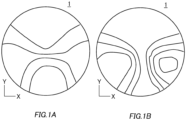
- a myopia suppressing lens 1 having progressive properties illustrated in FIGS. 1A and 1B on a lens back surface was manufactured.
- the X direction represents the horizontal direction during use of the eyeglass lens
- the Y direction represents the vertical direction in the same state.
- Basic design conditions for the myopia suppressing lens 1 are as follows.
- the far vision region higher than the center is a wide region and has no astigmatism, and this region narrows toward a lower side and becomes a narrow progressive zone region, and expands again in the near vision region.
- the region without astigmatism of the near vision region is narrower than the far vision region, but is wide enough when viewing a near distance. Astigmatism concentrates on left and right sides of the progressive zone region.
- the myopia suppressing lens 1 is an aspheric lens made of a material with a refractive index of 1.60, and has:
- myopia progression suppressing regions 2 are formed on a lens front surface of the myopia suppressing lens 1.
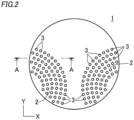
- the X direction in FIG. 2 is a horizontal direction during use of the eyeglass lens, and the Y direction is a vertical direction in the same state.
- the myopia progression suppressing region 2 consists of a group of a large number of dome-shaped small spots 3.
- an area ratio of an area occupied by all spots 3 and an area occupied by a portion other than the spots 3 is set to 1 to 1 in the first embodiment.
- the myopia progression suppressing regions 2 are disposed at both left and right positions avoiding a progressive zone at the center in a lens vertical direction in a lens lower region so as not to overlap a far vision region. These disposed positions are regions that approximately overlap with regions having a concentration of astigmatism in the astigmatism distribution chart in FIG. 1B . That is, the myopia progression suppressing regions 2 are disposed in regions that do not obstruct the visual field in the far vision region, the progressive zone region, and a near vision region, and are regions in which incident light is focused on the retina periphery.
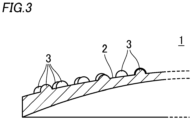
- the spots 3 in the first embodiment are dome-shaped convex lenses with a diameter of 2 mm molded integrally with the myopia suppressing lens 1.
- the spot 3 has a perfect circular external shape as viewed from a vertex direction of the spot 3.
- the myopia progression suppressing regions 2 consist of groups of six curved rows separated into left and right and substantially along astigmatism directions convex inward respectively formed of pluralities of spots 3 arranged in series.
- the spots 3 are arranged at intervals of 2 mm, and the rows are successively arranged in an orderly manner so that a distance between row centerlines is 4 mm.
- the curve of the spots 3 is 5.0 curve based on 1.523.
- the myopia suppressing lens 1 illustrated in the first embodiment an effect of suppressing the progression of myopia of a wearer is obtained, and when viewing a near distance through this lens, the near vision region can be used, so that an accommodation lag is less likely to occur, and in this respect as well, the progression of myopia is suppressed.
- the myopia progression suppressing regions 2 are disposed in regions having a concentration of astigmatism, and do not obstruct normal vision.
- a second embodiment is a variation of the first embodiment.
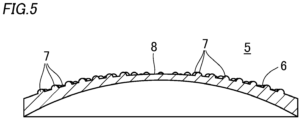
- a myopia suppressing lens 5 of the second embodiment has the same properties as the progressive properties illustrated in FIGS. 1A and 1B of the myopia suppressing lens 1 of the first embodiment, and are designed under the same basic design conditions as those of the myopia suppressing lens 1.
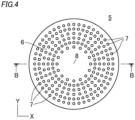
- a myopia progression suppressing region 6 is formed in a ring shape so as to surround a clear vision region 8 disposed at the lens center as illustrated in FIG. 4 .
- Spots 7 of the myopia suppressing lens 5 are individually shaped into the same convex lenses as the spots 3 of the first embodiment, but are arranged in a different pattern.
- the myopia progression suppressing region 6 consists of a group of 6 toric curved rows formed by concentrically arranging a large number of spots 7.
- the large number of spots 7 are successively arranged at intervals of 2 to 3 mm in the row direction, and the rows are arranged in an orderly manner so that a distance between row centerlines is 4 mm.
- the myopia suppressing lens 5 of the second embodiment it is assumed to obtain an effect of suppressing the progression of myopia by suppressing hyperopic blur in the retina periphery, and an effect of suppressing the progression of myopia by preventing an accommodation lag is further added.
- the effect can be prevented from being reduced by half due to a failure of alignment between a wearer, s eye position and the lens, such as sliding down of the eyeglasses.
- a vertically long elliptic non-spot portion is provided so that the far vision portion and the near vision portion are formed as non-spot portions.
- a third embodiment is also a variation of the first embodiment.
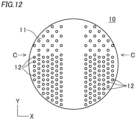
- a myopia suppressing lens 10 of the third embodiment has the same properties as the progressive properties illustrated in FIGS. 1A and 1B of the myopia suppressing lens 1 of the first embodiment, and are designed under the same basic design conditions as those of the myopia suppressing lens 1.
- myopia progression suppressing regions 11 of the third embodiment are disposed at both left and right sides avoiding, in particular, a region in which the visual line moves up and down (width of approximately 20 to 30% of a lens diameter length in the left-right direction) at the center in a lens vertical direction.
- Spots 12 of the myopia suppressing lens 11 are individually shaped into the same convex lenses as the spots 3 of the first embodiment, but are arranged in a different pattern.
- the myopia progression suppressing regions 11 consist of groups disposed separately at the left and the right and each including 7 linear rows.
- the large number of spots 12 are arranged at intervals of 3 mm in the row direction, and the rows are successively arranged in an orderly manner so that a distance between row centerlines is 4 mm.
- the spots 12 are absent in the far vision region and the near vision region, while usability as an eyeglass lens is improved, an effect of suppressing the progression of myopia is extracted by surrounding the visual field by the myopia suppressing regions at the lateral portions.
- spots are disposed at the lateral sides of the far vision portion as well, so that the effect of suppressing the progression of myopia caused by hyperopic blur in the retina periphery is considered to become relatively great.
- a fourth embodiment is also a variation of the first embodiment.
- the myopia suppressing lens 10 of the fourth embodiment has the same properties as the progressive properties illustrated in FIGS. 1A and 1B of the myopia suppressing lens 1 of the first embodiment, and are designed under the same basic design conditions as those of the myopia suppressing lens 1.
- spots 16 of myopia progression suppressing regions 15 disposed on a lens front surface have different shapes and different arrangement angles.
- description is given by focusing on the shapes and arrangement angles of the spots 16.
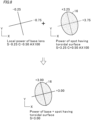
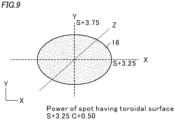
- the large number of spots 16 of the fourth embodiment are formed of toroidal surfaces the lengths and curvatures of which become maximum and minimum in longitudinal and transverse directions orthogonal to each other. As illustrated in FIG.
- the myopia suppressing lens 10 that becomes a base has a local power of S -0.25D C -0.50D and an astigmatic axial direction (AX)100 based on the X direction.
- the toroidal surface of the spot 16 is expressed as S +3.25D and C +0.50D in terms of diopter, and when the spot 16 overlaps the myopia suppressing lens 10 in a state where the phase is changed by 100° rotation (AX100) based on the X direction, their C powers cancel each other and disappear.
- C power is astigmatism, and astigmatism at this position can be canceled out by disposing the spot 16 at a proper angle (phase) .
- the proper angle is an angle that causes a maximum power direction of the local power of the myopia suppressing lens 10 and a maximum power direction of the toroidal surface of the spot 16 to become orthogonal to each other.
- a slight angle deviation is allowed, so that by roughly disposing the spots in such angle directions, astigmatism in the myopia progression suppressing region 15 can be canceled, and the burden on the wearer's eye can be reduced.
- the spots 16 are disposed to cancel the astigmatism.
- the maximum power direction of the toroidal surface of the spot 16 disposed on a contour line of astigmatism is substantially orthogonal to the astigmatism.
- a phase of the spot 16 not on the contour line is also determined in consideration of astigmatism.
- a larger number of spots (also in various sizes) than in FIG. 7 can be disposed according to the direction of astigmatism.
- the focal depth of the light ray is prevented from being extended according to astigmatism of the base lens, and the image can be stably formed before the retina.
- a fifth embodiment is a variation of the second embodiment.
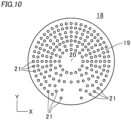
- the shape of a myopia progression suppressing region 19 is formed around a clear vision region 20 as with the ring-shaped myopia progression suppressing region 6 of the second embodiment.
- spots 21 constituting the myopia progression suppressing region 19 are disposed to become sparser, that is, lower in density toward the lower side.
- the curves of the convex lens shapes of the spots 3, 7, 12, and 16 are formed with the same curvature, and accordingly, positive powers added by the spots 3, 7, 12, and 16 are also the same in the myopia progression suppressing regions 6, 11, 15, and 19.
- the lens power (S power) of the near vision region is positive, so that when the positive powers of the spots 3, 7, 12, and 16 are added, a portion overlapping a region to which power is added in the near vision region provides excessive correction. Therefore, it is preferable that positive powers of the spots 3, 7, 12, and 16 disposed in and lower than the near vision region are made smaller (smaller in curvature) than positive powers of the higher spots 3, 7, 12, and 16.
- a seventh embodiment is a variation of the second embodiment.
- the myopia progression suppressing region 6 consisting of the spots 3 is disposed in a ring shape so as to surround the clear vision region 8 disposed at a lens center.
- the spots 3 disposed close to the center side of the lens are disposed at a lower distribution density than the spots 3 disposed close to the outer circumference of the lens.
- An eighth embodiment is a variation of the third embodiment.
- a distribution state of the spots 12 in two-dimensional directions in the myopia progression suppressing regions 11 in a planar view is the same as in the third embodiment. That is, as in the third embodiment, the myopia progression suppressing regions 11 are disposed at both left and right positions avoiding in particular a region in which the visual line moves up and down (width of approximately 20 to 30% of a lens diameter length in the left-right direction) at the center in a lens vertical direction.
- refractive power of the spots 12 in a progressive zone region and a near vision region lower than the C line in FIG. 6 is designed to be more positive than refractive power of the spots 12 in the far vision region higher than the C line. In this eighth embodiment, the refractive power is more positive by 1.00D.
- a ninth embodiment is a variation of the eighth embodiment.
- the spots 3 disposed around the far vision region and the spots 3 disposed around the near vision region are made different in refractive power from each other, however, instead of changing the refractive power from a certain line as in the eighth embodiment, the area ratio of the spots may be gradually changed.
- the ninth embodiment is an embodiment in which a distribution density (area ratio) of spots in the myopia progression suppressing region is changed.
- an area ratio of the spots 3 and a portion other than the spots 3 is set to "sparse" (for example, approximately 0.3 to 1), and in a region lower than the vicinity of the C line, the area ratio of the spots 3 and the portion other than the spots 3 is set to "dense" relative to the region higher than the C line (for example, approximately 0.8 to 1).
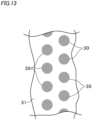
- a tenth example is an example in which a large number of spots in a myopia progression suppressing region are not convex lenses but rough surfaces .
- opaque glass-like island-shaped spots 30 are formed on a transparent lens base material in a planar view.
- a myopia suppressing lens in which the spots 30 are disposed at the same positions as, for example, distributed positions of the spots 3, 7, 12, and 16 in planar views in FIGS. 2 , 4 , 6 , 7 , 10 , 11 , and 12 can be formed.
- a myopia suppressing lens 31 having a myopia progression suppressing region including a large number of spots 30 successively disposed at intervals in two-dimensional directions can bring about the same effect as that of the myopia suppressing lenses of the first to ninth embodiments described above.
Landscapes
- Health & Medical Sciences (AREA)
- Ophthalmology & Optometry (AREA)
- Physics & Mathematics (AREA)
- General Health & Medical Sciences (AREA)
- General Physics & Mathematics (AREA)
- Optics & Photonics (AREA)
- Eyeglasses (AREA)
Claims (12)
- Brillenglas zum Unterdrücken von Myopieprogression, umfassend: einen ersten Bereich zum Betrachten einer vergleichsweise weiten Entfernung, der an einer Oberseite einer Linse (1) angeordnet ist; und einen zweiten Bereich, der an einer niedrigeren Seite als der erste Bereich angeordnet ist und eine positivere Brechkraft als der erste Bereich aufweist, wobeiein Myopieprogression-Unterdrückungsbereich (2) angeordnet ist, um einen Rand des ersten Bereichs und des zweiten Bereichs zu umgeben,wobei der Myopieprogression-Unterdrückungsbereich (2) aus einer Gruppe von mehreren konvexen Linsen (3) besteht, die eine größere Krümmung als eine vordere Oberfläche der Linse (1) aufweisen und voneinander beabstandet sind, sodass sie sich in zweidimensionale Richtungen auszubreiten,dadurch gekennzeichnet, dass das Brillenglas eine Linse progressiver Stärke ist, unddass die Gruppe von mehreren konvexen Linsen aus konvexen Linsen besteht, die toroidale Oberflächenformen (16) aufweisen und in einem Winkel angeordnet ist, der einen Astigmatismus der Linse (10) ausgleicht.
- Brillenglas zum Unterdrücken von Myopieprogression nach Anspruch 1, wobei die Gruppe der konvexen Linsen (3), die nahe einer mittleren Seite der Linse (1) angeordnet sind, eine geringere Krümmung aufweist als die Gruppe der konvexen Linsen (3), die nahe eines äußeren Umfangs des Brillenglases (1) angeordnet sind.
- Brillenglas zum Unterdrücken von Myopieprogression nach Anspruch 1 oder 2, wobei der das Fortschreiten der Myopie unterdrückende Bereich ein Bereich (6) ist, der den ersten Bereich (8) und den zweiten Bereich von dem Umfang umgibt, um eine ringförmige Donutform anzunehmen.
- Brillenglas zum Unterdrücken von Myopieprogression nach einem der Ansprüche 1 bis 3, wobei der Myopieprogression-Unterdrückungsbereich (11) an linken und rechten Positionen in dem ersten Bereich und dem zweiten Bereich angeordnet ist.
- Brillenglas zum Unterdrücken von Myopieprogression nach einem der Ansprüche 1 bis 4, wobei eine Verteilungsdichte der Gruppe von mehreren konvexen Linsen (21), die in dem Myopieprogression-Unterdrückungsbereich (19) verteilt sind, eingestellt ist, um an der unteren Seite geringer zu werden als an der oberen Seite.
- Brillenglas zum Unterdrücken von Myopieprogression nach einem der Ansprüche 1 bis 4, wobei eine Verteilungsdichte der Gruppe von mehreren konvexen Linsen (7), die nahe der mittleren Seite der Linse (21) angeordnet sind, eingestellt ist, um niedriger zu sein als eine Verteilungsdichte an einer Position nahe dem äußeren Umfang der Linse (21).
- Brillenglas zum Unterdrücken von Myopieprogression nach Anspruch 1 oder 2, wobei die in einer Links-Rechts-Richtung des zweiten Bereichs angeordneten konvexen Linsen eine geringere positive Stärke erzeugen als die nicht in der Links-Rechts-Richtung des zweiten Bereichs angeordneten konvexen Linsen.
- Brillenglas zum Unterdrücken von Myopieprogression nach einem der Ansprüche 1 bis 7, wobei zwischen dem ersten Bereich und dem zweiten Bereich ein progressiver Zonenbereich bereitgestellt ist, in dem sich die Brechkraft progressiv ändert, und ein Additionsgradient eingestellt ist, sodass die Additionskraft allmählich von dem ersten Bereich zu dem zweiten Bereich hinzugefügt wird.
- Brillenglas zum Unterdrücken von Myopieprogression nach Anspruch 8, wobei der Myopieprogression-Unterdrückungsbereich an linken und rechten Positionen in dem progressiven Zonenbereich und dem zweiten Bereich angeordnet ist.
- Brillenglas zum Unterdrücken von Myopieprogression nach Anspruch 8 oder 9, wobei der Myopieprogression-Unterdrückungsbereich (2) auf einer Oberfläche auf einer Seite gebildet ist, die sich entweder von der vorderen Oberfläche oder der hinteren Oberfläche des Brillenglases (1) unterscheidet, auf der der erste Bereich, der zweite Bereich und der progressive Zonenbereich bereitgestellt sind.
- Brillenglas zum Unterdrücken von Myopieprogression nach Anspruch 9 oder 10, wobei das Flächenverhältnis in der Nähe des ersten Bereichs in Bezug auf ein Flächenverhältnis, das durch Teilen einer Gesamtfläche, die von dem Myopieprogression-Unterdrückungsbereich (2) eingenommen wird, durch eine Gesamtfläche, die von einem anderen Abschnitt als dem Myopieprogression-Unterdrückungsbereich (2) eingenommen wird, erlangt wird, kleiner ist als das Flächenverhältnis in der Nähe des zweiten Bereichs.
- Brillenglas zum Unterdrücken von Myopieprogression nach einem der Ansprüche 8 bis 11, wobei der Myopieprogression-Unterdrückungsbereich (2) aus der Gruppe der konvexen Linsen (3) besteht und die Brechkraft der konvexen Linse (3), die in der Nähe des progressiven Zonenbereichs (2) und des zweiten Bereichs angeordnet ist, eingestellt ist, um positiver zu sein als die Brechkraft der konvexen Linse (3) in dem Myopieprogression-Unterdrückungsbereich (2), der in der Nähe des ersten Bereichs angeordnet ist.
Applications Claiming Priority (1)
| Application Number | Priority Date | Filing Date | Title |
|---|---|---|---|
| JP2020213185 | 2020-12-23 |
Publications (3)
| Publication Number | Publication Date |
|---|---|
| EP4030221A2 EP4030221A2 (de) | 2022-07-20 |
| EP4030221A3 EP4030221A3 (de) | 2022-09-07 |
| EP4030221B1 true EP4030221B1 (de) | 2024-12-18 |
Family
ID=79164450
Family Applications (1)
| Application Number | Title | Priority Date | Filing Date |
|---|---|---|---|
| EP21217476.7A Active EP4030221B1 (de) | 2020-12-23 | 2021-12-23 | Brillenglas zur unterdrückung des fortschreitens von myopie |
Country Status (4)
| Country | Link |
|---|---|
| US (1) | US20220197058A1 (de) |
| EP (1) | EP4030221B1 (de) |
| JP (1) | JP2022100249A (de) |
| CN (1) | CN114114711A (de) |
Cited By (1)
| Publication number | Priority date | Publication date | Assignee | Title |
|---|---|---|---|---|
| EP4488744A4 (de) * | 2022-03-03 | 2026-03-18 | Hoya Lens Thailand Ltd | Brillenglas, verfahren zur herstellung eines brillenglases, verfahren zum entwurf eines brillenglases, brille und verfahren zur herstellung einer brille |
Families Citing this family (8)
| Publication number | Priority date | Publication date | Assignee | Title |
|---|---|---|---|---|
| JP7787644B2 (ja) * | 2021-03-22 | 2025-12-17 | ホヤ レンズ タイランド リミテッド | 眼鏡レンズ、および眼鏡レンズの設計方法 |
| CA3219042A1 (en) * | 2022-05-30 | 2023-11-30 | Su Wang | Ophthalmic lenses and frame eyeglasses with the same |
| JP2023177794A (ja) * | 2022-06-03 | 2023-12-14 | 東海光学株式会社 | 眼鏡用レンズ |
| EP4365668A1 (de) * | 2022-11-04 | 2024-05-08 | Carl Zeiss Vision International GmbH | Brillenglas mit nichtkonzentrischen mikrostrukturen |
| EP4390519A1 (de) * | 2022-12-21 | 2024-06-26 | Essilor International | Prismenmikrolinsen auf pal für korrekturbeitrag |
| DE102023110569B3 (de) * | 2023-04-25 | 2024-10-31 | Rodenstock Gmbh | Brillenglas zum Myopie Management mit dualer Progressionskontrolle, Verfahren sowie Verwendung |
| CN116953957A (zh) * | 2023-07-21 | 2023-10-27 | 江苏康耐特光学有限公司 | 一种近视防控眼镜片 |
| WO2025141575A1 (en) * | 2023-12-29 | 2025-07-03 | Shamir Optical Industry Ltd. | Lens system for children with handedness and a method thereof |
Family Cites Families (19)
| Publication number | Priority date | Publication date | Assignee | Title |
|---|---|---|---|---|
| US5285222A (en) * | 1992-11-20 | 1994-02-08 | Gentex Optics, Inc. | Progressive lens series |
| US6343861B1 (en) * | 1998-06-12 | 2002-02-05 | Sola International Holdings, Ltd. | Myopia lens |
| EP2069854B1 (de) * | 2006-09-15 | 2015-04-08 | Carl Zeiss Vision Australia Holdings Ltd. | Augenoptisches linsenelement |
| CN201749260U (zh) * | 2010-07-12 | 2011-02-16 | 段亚东 | 近视渐进周边离焦矫正眼镜 |
| CN104678572B (zh) * | 2013-11-29 | 2018-04-27 | 豪雅镜片泰国有限公司 | 眼镜片 |
| SG10201400920RA (en) * | 2014-03-24 | 2015-10-29 | Menicon Singapore Pte Ltd | Apparatus and methods for controlling axial growth with an ocular lens |
| ES2967716T3 (es) * | 2015-04-15 | 2024-05-03 | Hoya Optical Labs Of America Inc | Lente oftálmica con microlentes graduadas |
| US10268050B2 (en) | 2015-11-06 | 2019-04-23 | Hoya Lens Thailand Ltd. | Spectacle lens |
| EP3491456B1 (de) * | 2016-08-01 | 2025-06-18 | The University of Washington | Brillengläser zur behandlung von kurzsichtigkeit |
| KR102619407B1 (ko) * | 2016-10-25 | 2024-01-02 | 브리엔 홀덴 비전 인스티튜트 리미티드 | 근시 제어를 위한 장치, 시스템 및/또는 방법 |
| EP4696489A2 (de) * | 2017-05-08 | 2026-02-18 | SIGHTGLASS VISION, Inc. | Herstellungsverfahren von kontaktlinsen zur reduzierung von myopie |
| US10921612B2 (en) * | 2018-03-29 | 2021-02-16 | Reopia Optics, Llc. | Spectacles and associated methods for presbyopia treatment and myopia progression control |
| CA3200410A1 (en) * | 2018-07-12 | 2020-01-16 | Sightglass Vision, Inc. | Methods and devices for reducing myopia in children |
| TWI888168B (zh) * | 2018-11-30 | 2025-06-21 | 美商賽特眼鏡視光有限公司 | 用於治療近視的光散射鏡片及包含該鏡片之眼鏡 |
| CN111103701B (zh) * | 2020-01-02 | 2020-12-11 | 温州医科大学 | 一种表面具有环带柱面微结构的眼镜片 |
| EP3809168B1 (de) * | 2020-04-21 | 2024-03-20 | Essilor International | Optische linse |
| CN220553053U (zh) * | 2020-08-07 | 2024-03-01 | 卡尔蔡司光学国际有限公司 | 用于近视控制的渐进多焦点镜片 |
| CN111880323A (zh) * | 2020-08-17 | 2020-11-03 | 徐向阳 | 一种防控进展性近视远近两用多点离焦棱透组合镜片 |
| EP4006626A1 (de) * | 2020-11-26 | 2022-06-01 | Carl Zeiss Vision International GmbH | Brillenglas design, brillenglas kit und herstellungsmethode eines brillenglases |
-
2021
- 2021-11-22 CN CN202111388239.7A patent/CN114114711A/zh active Pending
- 2021-12-01 JP JP2021195206A patent/JP2022100249A/ja active Pending
- 2021-12-22 US US17/559,521 patent/US20220197058A1/en not_active Abandoned
- 2021-12-23 EP EP21217476.7A patent/EP4030221B1/de active Active
Cited By (1)
| Publication number | Priority date | Publication date | Assignee | Title |
|---|---|---|---|---|
| EP4488744A4 (de) * | 2022-03-03 | 2026-03-18 | Hoya Lens Thailand Ltd | Brillenglas, verfahren zur herstellung eines brillenglases, verfahren zum entwurf eines brillenglases, brille und verfahren zur herstellung einer brille |
Also Published As
| Publication number | Publication date |
|---|---|
| CN114114711A (zh) | 2022-03-01 |
| EP4030221A3 (de) | 2022-09-07 |
| JP2022100249A (ja) | 2022-07-05 |
| US20220197058A1 (en) | 2022-06-23 |
| EP4030221A2 (de) | 2022-07-20 |
Similar Documents
| Publication | Publication Date | Title |
|---|---|---|
| EP4030221B1 (de) | Brillenglas zur unterdrückung des fortschreitens von myopie | |
| US12019312B2 (en) | Spectacle lens | |
| CN104678572B (zh) | 眼镜片 | |
| EP0809127B9 (de) | Mehrstärkenglas für Brillen und Brillenglas | |
| CN101208628B (zh) | 眼用透镜 | |
| GB2595079A (en) | Light scattering lens for treating myopia and eyeglasses containing the same | |
| US8042940B2 (en) | Opthalmic lenses having reduced base out prism | |
| EP0809126A1 (de) | Multifokale linse mit brechungsindexgradienten für brillengläser und herstellungverfaren | |
| EP0702257B1 (de) | Progressive, Presbyopie-korrigierende Brillengläser | |
| CN115243643A (zh) | 高清晰度和扩展景深人工晶状体 | |
| KR20250079051A (ko) | 안경 렌즈 및 안경 렌즈의 설계 방법 | |
| EP3004973B1 (de) | Bifokale linse mit nichtprogressivem korridor und berührungsgrenze von nahen und fernen sehfeldern | |
| US8757799B2 (en) | Progressive multifocal ophthalmic lens | |
| KR20230110663A (ko) | 안경 렌즈 설계, 안경 렌즈 키트, 및 안경 렌즈 제조 방법 | |
| JPH07294859A (ja) | 累進多焦点レンズ | |
| EP4500268A1 (de) | Linsenelement | |
| EP4137877B1 (de) | Linsensatz | |
| JP2023114018A (ja) | 眼鏡用レンズ | |
| KR20250042707A (ko) | 굴절 이상의 진행을 억제하기 위한 안경용 렌즈 | |
| JPS6338688B2 (de) | ||
| JP2015135529A (ja) | 累進屈折力レンズの製造方法 | |
| CN121620725A (zh) | 眼镜镜片和眼镜 | |
| EP4500267A1 (de) | Linsenelement | |
| JPH03121412A (ja) | 累進焦点レンズ | |
| JPS6028330B2 (ja) | 累進焦点複視野レンズ |
Legal Events
| Date | Code | Title | Description |
|---|---|---|---|
| PUAI | Public reference made under article 153(3) epc to a published international application that has entered the european phase |
Free format text: ORIGINAL CODE: 0009012 |
|
| STAA | Information on the status of an ep patent application or granted ep patent |
Free format text: STATUS: THE APPLICATION HAS BEEN PUBLISHED |
|
| AK | Designated contracting states |
Kind code of ref document: A2 Designated state(s): AL AT BE BG CH CY CZ DE DK EE ES FI FR GB GR HR HU IE IS IT LI LT LU LV MC MK MT NL NO PL PT RO RS SE SI SK SM TR |
|
| PUAL | Search report despatched |
Free format text: ORIGINAL CODE: 0009013 |
|
| AK | Designated contracting states |
Kind code of ref document: A3 Designated state(s): AL AT BE BG CH CY CZ DE DK EE ES FI FR GB GR HR HU IE IS IT LI LT LU LV MC MK MT NL NO PL PT RO RS SE SI SK SM TR |
|
| RIC1 | Information provided on ipc code assigned before grant |
Ipc: G02C 7/06 20060101ALI20220729BHEP Ipc: G02C 7/02 20060101AFI20220729BHEP |
|
| STAA | Information on the status of an ep patent application or granted ep patent |
Free format text: STATUS: REQUEST FOR EXAMINATION WAS MADE |
|
| 17P | Request for examination filed |
Effective date: 20230227 |
|
| RBV | Designated contracting states (corrected) |
Designated state(s): AL AT BE BG CH CY CZ DE DK EE ES FI FR GB GR HR HU IE IS IT LI LT LU LV MC MK MT NL NO PL PT RO RS SE SI SK SM TR |
|
| GRAP | Despatch of communication of intention to grant a patent |
Free format text: ORIGINAL CODE: EPIDOSNIGR1 |
|
| STAA | Information on the status of an ep patent application or granted ep patent |
Free format text: STATUS: GRANT OF PATENT IS INTENDED |
|
| INTG | Intention to grant announced |
Effective date: 20240722 |
|
| GRAS | Grant fee paid |
Free format text: ORIGINAL CODE: EPIDOSNIGR3 |
|
| GRAA | (expected) grant |
Free format text: ORIGINAL CODE: 0009210 |
|
| STAA | Information on the status of an ep patent application or granted ep patent |
Free format text: STATUS: THE PATENT HAS BEEN GRANTED |
|
| AK | Designated contracting states |
Kind code of ref document: B1 Designated state(s): AL AT BE BG CH CY CZ DE DK EE ES FI FR GB GR HR HU IE IS IT LI LT LU LV MC MK MT NL NO PL PT RO RS SE SI SK SM TR |
|
| REG | Reference to a national code |
Ref country code: CH Ref legal event code: EP |
|
| REG | Reference to a national code |
Ref country code: DE Ref legal event code: R096 Ref document number: 602021023511 Country of ref document: DE |
|
| REG | Reference to a national code |
Ref country code: IE Ref legal event code: FG4D |
|
| REG | Reference to a national code |
Ref country code: LT Ref legal event code: MG9D |
|
| PG25 | Lapsed in a contracting state [announced via postgrant information from national office to epo] |
Ref country code: HR Free format text: LAPSE BECAUSE OF FAILURE TO SUBMIT A TRANSLATION OF THE DESCRIPTION OR TO PAY THE FEE WITHIN THE PRESCRIBED TIME-LIMIT Effective date: 20241218 |
|
| PG25 | Lapsed in a contracting state [announced via postgrant information from national office to epo] |
Ref country code: FI Free format text: LAPSE BECAUSE OF FAILURE TO SUBMIT A TRANSLATION OF THE DESCRIPTION OR TO PAY THE FEE WITHIN THE PRESCRIBED TIME-LIMIT Effective date: 20241218 |
|
| PG25 | Lapsed in a contracting state [announced via postgrant information from national office to epo] |
Ref country code: BG Free format text: LAPSE BECAUSE OF FAILURE TO SUBMIT A TRANSLATION OF THE DESCRIPTION OR TO PAY THE FEE WITHIN THE PRESCRIBED TIME-LIMIT Effective date: 20241218 |
|
| PG25 | Lapsed in a contracting state [announced via postgrant information from national office to epo] |
Ref country code: NO Free format text: LAPSE BECAUSE OF FAILURE TO SUBMIT A TRANSLATION OF THE DESCRIPTION OR TO PAY THE FEE WITHIN THE PRESCRIBED TIME-LIMIT Effective date: 20250318 |
|
| REG | Reference to a national code |
Ref country code: NL Ref legal event code: MP Effective date: 20241218 |
|
| PG25 | Lapsed in a contracting state [announced via postgrant information from national office to epo] |
Ref country code: LV Free format text: LAPSE BECAUSE OF FAILURE TO SUBMIT A TRANSLATION OF THE DESCRIPTION OR TO PAY THE FEE WITHIN THE PRESCRIBED TIME-LIMIT Effective date: 20241218 Ref country code: GR Free format text: LAPSE BECAUSE OF FAILURE TO SUBMIT A TRANSLATION OF THE DESCRIPTION OR TO PAY THE FEE WITHIN THE PRESCRIBED TIME-LIMIT Effective date: 20250319 |
|
| PG25 | Lapsed in a contracting state [announced via postgrant information from national office to epo] |
Ref country code: RS Free format text: LAPSE BECAUSE OF FAILURE TO SUBMIT A TRANSLATION OF THE DESCRIPTION OR TO PAY THE FEE WITHIN THE PRESCRIBED TIME-LIMIT Effective date: 20250318 |
|
| PG25 | Lapsed in a contracting state [announced via postgrant information from national office to epo] |
Ref country code: NL Free format text: LAPSE BECAUSE OF FAILURE TO SUBMIT A TRANSLATION OF THE DESCRIPTION OR TO PAY THE FEE WITHIN THE PRESCRIBED TIME-LIMIT Effective date: 20241218 |
|
| REG | Reference to a national code |
Ref country code: AT Ref legal event code: MK05 Ref document number: 1752706 Country of ref document: AT Kind code of ref document: T Effective date: 20241218 |
|
| PG25 | Lapsed in a contracting state [announced via postgrant information from national office to epo] |
Ref country code: SM Free format text: LAPSE BECAUSE OF FAILURE TO SUBMIT A TRANSLATION OF THE DESCRIPTION OR TO PAY THE FEE WITHIN THE PRESCRIBED TIME-LIMIT Effective date: 20241218 |
|
| PG25 | Lapsed in a contracting state [announced via postgrant information from national office to epo] |
Ref country code: PL Free format text: LAPSE BECAUSE OF FAILURE TO SUBMIT A TRANSLATION OF THE DESCRIPTION OR TO PAY THE FEE WITHIN THE PRESCRIBED TIME-LIMIT Effective date: 20241218 |
|
| PG25 | Lapsed in a contracting state [announced via postgrant information from national office to epo] |
Ref country code: ES Free format text: LAPSE BECAUSE OF FAILURE TO SUBMIT A TRANSLATION OF THE DESCRIPTION OR TO PAY THE FEE WITHIN THE PRESCRIBED TIME-LIMIT Effective date: 20241218 |
|
| PG25 | Lapsed in a contracting state [announced via postgrant information from national office to epo] |
Ref country code: IS Free format text: LAPSE BECAUSE OF FAILURE TO SUBMIT A TRANSLATION OF THE DESCRIPTION OR TO PAY THE FEE WITHIN THE PRESCRIBED TIME-LIMIT Effective date: 20250418 |
|
| PG25 | Lapsed in a contracting state [announced via postgrant information from national office to epo] |
Ref country code: PT Free format text: LAPSE BECAUSE OF FAILURE TO SUBMIT A TRANSLATION OF THE DESCRIPTION OR TO PAY THE FEE WITHIN THE PRESCRIBED TIME-LIMIT Effective date: 20250421 |
|
| PG25 | Lapsed in a contracting state [announced via postgrant information from national office to epo] |
Ref country code: EE Free format text: LAPSE BECAUSE OF FAILURE TO SUBMIT A TRANSLATION OF THE DESCRIPTION OR TO PAY THE FEE WITHIN THE PRESCRIBED TIME-LIMIT Effective date: 20241218 |
|
| PG25 | Lapsed in a contracting state [announced via postgrant information from national office to epo] |
Ref country code: AT Free format text: LAPSE BECAUSE OF FAILURE TO SUBMIT A TRANSLATION OF THE DESCRIPTION OR TO PAY THE FEE WITHIN THE PRESCRIBED TIME-LIMIT Effective date: 20241218 Ref country code: RO Free format text: LAPSE BECAUSE OF FAILURE TO SUBMIT A TRANSLATION OF THE DESCRIPTION OR TO PAY THE FEE WITHIN THE PRESCRIBED TIME-LIMIT Effective date: 20241218 |
|
| PG25 | Lapsed in a contracting state [announced via postgrant information from national office to epo] |
Ref country code: SK Free format text: LAPSE BECAUSE OF FAILURE TO SUBMIT A TRANSLATION OF THE DESCRIPTION OR TO PAY THE FEE WITHIN THE PRESCRIBED TIME-LIMIT Effective date: 20241218 |
|
| PG25 | Lapsed in a contracting state [announced via postgrant information from national office to epo] |
Ref country code: CZ Free format text: LAPSE BECAUSE OF FAILURE TO SUBMIT A TRANSLATION OF THE DESCRIPTION OR TO PAY THE FEE WITHIN THE PRESCRIBED TIME-LIMIT Effective date: 20241218 |
|
| PG25 | Lapsed in a contracting state [announced via postgrant information from national office to epo] |
Ref country code: IT Free format text: LAPSE BECAUSE OF FAILURE TO SUBMIT A TRANSLATION OF THE DESCRIPTION OR TO PAY THE FEE WITHIN THE PRESCRIBED TIME-LIMIT Effective date: 20241218 |
|
| REG | Reference to a national code |
Ref country code: CH Ref legal event code: PL |
|
| PG25 | Lapsed in a contracting state [announced via postgrant information from national office to epo] |
Ref country code: LU Free format text: LAPSE BECAUSE OF NON-PAYMENT OF DUE FEES Effective date: 20241223 |
|
| PG25 | Lapsed in a contracting state [announced via postgrant information from national office to epo] |
Ref country code: SE Free format text: LAPSE BECAUSE OF FAILURE TO SUBMIT A TRANSLATION OF THE DESCRIPTION OR TO PAY THE FEE WITHIN THE PRESCRIBED TIME-LIMIT Effective date: 20241218 |
|
| PG25 | Lapsed in a contracting state [announced via postgrant information from national office to epo] |
Ref country code: MC Free format text: LAPSE BECAUSE OF FAILURE TO SUBMIT A TRANSLATION OF THE DESCRIPTION OR TO PAY THE FEE WITHIN THE PRESCRIBED TIME-LIMIT Effective date: 20241218 |
|
| REG | Reference to a national code |
Ref country code: DE Ref legal event code: R097 Ref document number: 602021023511 Country of ref document: DE |
|
| REG | Reference to a national code |
Ref country code: BE Ref legal event code: MM Effective date: 20241231 |
|
| PG25 | Lapsed in a contracting state [announced via postgrant information from national office to epo] |
Ref country code: DK Free format text: LAPSE BECAUSE OF FAILURE TO SUBMIT A TRANSLATION OF THE DESCRIPTION OR TO PAY THE FEE WITHIN THE PRESCRIBED TIME-LIMIT Effective date: 20241218 |
|
| PG25 | Lapsed in a contracting state [announced via postgrant information from national office to epo] |
Ref country code: BE Free format text: LAPSE BECAUSE OF NON-PAYMENT OF DUE FEES Effective date: 20241231 |
|
| PG25 | Lapsed in a contracting state [announced via postgrant information from national office to epo] |
Ref country code: CH Free format text: LAPSE BECAUSE OF NON-PAYMENT OF DUE FEES Effective date: 20241231 |
|
| PG25 | Lapsed in a contracting state [announced via postgrant information from national office to epo] |
Ref country code: IE Free format text: LAPSE BECAUSE OF NON-PAYMENT OF DUE FEES Effective date: 20241223 |
|
| PLBE | No opposition filed within time limit |
Free format text: ORIGINAL CODE: 0009261 |
|
| STAA | Information on the status of an ep patent application or granted ep patent |
Free format text: STATUS: NO OPPOSITION FILED WITHIN TIME LIMIT |
|
| 26N | No opposition filed |
Effective date: 20250919 |
|
| PGFP | Annual fee paid to national office [announced via postgrant information from national office to epo] |
Ref country code: DE Payment date: 20251028 Year of fee payment: 5 |
|
| PGFP | Annual fee paid to national office [announced via postgrant information from national office to epo] |
Ref country code: GB Payment date: 20251030 Year of fee payment: 5 |
|
| PGFP | Annual fee paid to national office [announced via postgrant information from national office to epo] |
Ref country code: FR Payment date: 20251110 Year of fee payment: 5 |