EP4029208B1 - Bluetooth-mesh-routing mit subnetzen - Google Patents
Bluetooth-mesh-routing mit subnetzen Download PDFInfo
- Publication number
- EP4029208B1 EP4029208B1 EP20776031.5A EP20776031A EP4029208B1 EP 4029208 B1 EP4029208 B1 EP 4029208B1 EP 20776031 A EP20776031 A EP 20776031A EP 4029208 B1 EP4029208 B1 EP 4029208B1
- Authority
- EP
- European Patent Office
- Prior art keywords
- subnet
- peripheral
- message
- mesh network
- sending
- Prior art date
- Legal status (The legal status is an assumption and is not a legal conclusion. Google has not performed a legal analysis and makes no representation as to the accuracy of the status listed.)
- Active
Links
Images

Classifications
-
- H—ELECTRICITY
- H04—ELECTRIC COMMUNICATION TECHNIQUE
- H04L—TRANSMISSION OF DIGITAL INFORMATION, e.g. TELEGRAPHIC COMMUNICATION
- H04L45/00—Routing or path finding of packets in data switching networks
- H04L45/02—Topology update or discovery
- H04L45/04—Interdomain routing, e.g. hierarchical routing
-
- H—ELECTRICITY
- H04—ELECTRIC COMMUNICATION TECHNIQUE
- H04W—WIRELESS COMMUNICATION NETWORKS
- H04W40/00—Communication routing or communication path finding
- H04W40/24—Connectivity information management, e.g. connectivity discovery or connectivity update
- H04W40/246—Connectivity information discovery
-
- H—ELECTRICITY
- H04—ELECTRIC COMMUNICATION TECHNIQUE
- H04W—WIRELESS COMMUNICATION NETWORKS
- H04W4/00—Services specially adapted for wireless communication networks; Facilities therefor
- H04W4/12—Messaging; Mailboxes; Announcements
-
- H—ELECTRICITY
- H04—ELECTRIC COMMUNICATION TECHNIQUE
- H04W—WIRELESS COMMUNICATION NETWORKS
- H04W40/00—Communication routing or communication path finding
- H04W40/02—Communication route or path selection, e.g. power-based or shortest path routing
-
- H—ELECTRICITY
- H04—ELECTRIC COMMUNICATION TECHNIQUE
- H04W—WIRELESS COMMUNICATION NETWORKS
- H04W40/00—Communication routing or communication path finding
- H04W40/02—Communication route or path selection, e.g. power-based or shortest path routing
- H04W40/04—Communication route or path selection, e.g. power-based or shortest path routing based on wireless node resources
- H04W40/10—Communication route or path selection, e.g. power-based or shortest path routing based on wireless node resources based on available power or energy
-
- H—ELECTRICITY
- H04—ELECTRIC COMMUNICATION TECHNIQUE
- H04W—WIRELESS COMMUNICATION NETWORKS
- H04W40/00—Communication routing or communication path finding
- H04W40/24—Connectivity information management, e.g. connectivity discovery or connectivity update
- H04W40/28—Connectivity information management, e.g. connectivity discovery or connectivity update for reactive routing
-
- H—ELECTRICITY
- H04—ELECTRIC COMMUNICATION TECHNIQUE
- H04W—WIRELESS COMMUNICATION NETWORKS
- H04W52/00—Power management, e.g. Transmission Power Control [TPC] or power classes
- H04W52/02—Power saving arrangements
- H04W52/0209—Power saving arrangements in terminal devices
-
- H—ELECTRICITY
- H04—ELECTRIC COMMUNICATION TECHNIQUE
- H04W—WIRELESS COMMUNICATION NETWORKS
- H04W52/00—Power management, e.g. Transmission Power Control [TPC] or power classes
- H04W52/02—Power saving arrangements
- H04W52/0209—Power saving arrangements in terminal devices
- H04W52/0261—Power saving arrangements in terminal devices managing power supply demand, e.g. depending on battery level
-
- H—ELECTRICITY
- H04—ELECTRIC COMMUNICATION TECHNIQUE
- H04L—TRANSMISSION OF DIGITAL INFORMATION, e.g. TELEGRAPHIC COMMUNICATION
- H04L45/00—Routing or path finding of packets in data switching networks
- H04L45/20—Hop count for routing purposes, e.g. TTL
-
- H—ELECTRICITY
- H04—ELECTRIC COMMUNICATION TECHNIQUE
- H04W—WIRELESS COMMUNICATION NETWORKS
- H04W4/00—Services specially adapted for wireless communication networks; Facilities therefor
- H04W4/06—Selective distribution of broadcast services, e.g. multimedia broadcast multicast service [MBMS]; Services to user groups; One-way selective calling services
-
- H—ELECTRICITY
- H04—ELECTRIC COMMUNICATION TECHNIQUE
- H04W—WIRELESS COMMUNICATION NETWORKS
- H04W4/00—Services specially adapted for wireless communication networks; Facilities therefor
- H04W4/80—Services using short range communication, e.g. near-field communication [NFC], radio-frequency identification [RFID] or low energy communication
-
- H—ELECTRICITY
- H04—ELECTRIC COMMUNICATION TECHNIQUE
- H04W—WIRELESS COMMUNICATION NETWORKS
- H04W84/00—Network topologies
- H04W84/18—Self-organising networks, e.g. ad-hoc networks or sensor networks
Definitions
- the subject matter disclosed herein generally relates to the field of computing, and more particularly to mesh networking of wireless messaging devices.
- Bluetooth is a popular wireless communication protocol for transmitting data over short distances. Bluetooth is commonly used with today's mobile electronic devices, connecting devices such as headphones, headsets, watches, keyboard, mice, mobile phones, tablets, and sporting equipment. While the above-described devices are a one-to-one connection, there can be a desire to couple together many devices in a mesh network.
- US 8 724 513 B2 discloses methods and apparatus for distribution of IP layer routing information in peer-to-peer overlay networks. This includes transmitting an advertisement to a first subnet of a first network advertising the accessibility of a second subnet in a second network.
- a method for communicating amongst a plurality of peripherals within a mesh network including a first subnet and a second subnet including the following steps performed by a sending peripheral of the plurality of peripherals: receiving an advertisement from one or more peripherals of the plurality of peripherals, the advertisement including a hop count, a subnet identifier, and a unique subnet device identifier, the subnet identifier indicating the first subnet or the second subnet and the unique subnet device identifier indicating a specific peripheral of the plurality of peripherals within the mesh network; triggering a message send event; determining a desired stream direction within the mesh network, wherein the desired stream direction is upstream or downstream; determining a desired subnet of the mesh network, the desired subnet being either the first subnet of the mesh network or the second subnet of the mesh network; determining a destination peripheral of the one or more peripherals within the desired subnet and in the desired stream direction in response to the hop count, the sub
- Triggering the message send event may include receiving a message.
- the message is a message bundle; and wherein the method further includes: adding information to the message bundle prior to sending the message.
- Triggering the message send event may include expiration of an audit timer or an event occurrence.
- data sent after expiration of the audit timer includes: battery status, diagnostic information, entry events, and room temperature.
- the event occurrence includes a door unlocked, a door locked, a door opened, a door closed, or a privacy lock enabled.
- the unique identifier indicates a type of device.
- the type of device may be at least one of a door lock, a wireless signal repeater, a thermostat, or a room management system.
- a sending peripheral of a plurality of peripherals within a mesh network including a first subnet and a second subnet including: a processor; and a memory including computer-executable instructions that, when executed by the processor, cause the processor to perform operations, the operations including: receiving an advertisement from one or more peripherals of the plurality of peripherals, the advertisement including a hop count, a subnet identifier, and a unique subnet device identifier, the subnet identifier indicating the first subnet or the second subnet and the unique subnet device identifier indicating a specific peripheral of the plurality of peripherals within the mesh network; triggering a message send event; determining a desired stream direction within the mesh network, wherein the desired stream direction is upstream or downstream; determining a desired subnet of the mesh network, the desired subnet being either the first subnet of the mesh network or the second subnet of the mesh network; determining a destination peripheral of the one or more peripherals within the desired sub
- Triggering the message send event may include receiving a message.
- the message is a message bundle; and wherein the operations further include: adding information to the message bundle prior to sending the message.
- triggering the message send event includes expiration of an audit timer or an event occurrence.
- data sent after expiration of the audit timer includes: battery status, diagnostic information, entry events, and room temperature.
- the sending peripheral is a door lock, a wireless signal repeater, a thermostat, or a room management system.
- the event occurrence includes a door unlocked, a door locked, a door opened, a door closed, or a privacy lock enabled.
- the unique identifier may indicate a type of device.
- the type of device may be at least one of a door lock, a wireless signal repeater, a thermostat, or a room management system.
- inventions of the present invention include organizing a mesh network of peripherals into two or more subnets and directing messages through specific subnets.
- Bluetooth is a wireless protocol commonly used to couple together electronic devices. Because the electronic devices that use Bluetooth might be portable, those devices typically use batteries to power the Bluetooth connectivity. While some embodiments are described herein with respect to Bluetooth, it should be understood that embodiments can be used with any type of wireless messaging protocol, such as Wi-Fi, ZigBee, Z-Wave, or any wireless protocol currently in existence or developed in the future.
- a mesh network is a network topology that includes multiple nodes. Different types of mesh networks are discussed within US Non-Provisional Application 16/181,565 filed November 6, 2018 (published as US 2019/141616 A1 ), US Non-Provisional Application 16/184,118 filed November 8, 2018 , PCT Application PCT/US2019/028703 filed April 23, 2019 , PCT Application PCT/US2019/028757 filed April 23, 2019 , EP Application EP19181647.9 filed June 21, 2019 , and EP Application EP19181733.7 filed June 21, 2019 .
- Each node in the mesh network relays data for the mesh network. All the nodes cooperate in the distribution of data in the mesh network.
- the nodes may be organized in to multiple different mesh network subnets.
- data exclusive to a particular subnet may be sent exclusively in the subnet, thus speed up communication times within the subnet and saving power by not transferring these messages out of the subnet.
- congestion in one subnet it would not affect data routing within a second subnet.
- the subnet could still operate as a unit for a subset of system functionality.
- roles within a subnet could be predefined based on the subnet ID allowing messages to be addressed to specific device types based on the subnet ID.
- This subnet ID eliminates the need for predefined routes within the subnet as direction can be determined by the combination of hop count and subnet ID.
- a message in a mesh network travels from a source node to a destination node, possibly by "hopping" through intermediate routing nodes.
- a node may be a source node, a destination node, a routing node or any combination of these.
- the performance of a mesh network may be related to the number of hops between the source node and the destination node and to how quickly a message can be transmitted through routing nodes. The number of hops between the source node and the destination node may be counted within a single subnet of the mesh network.
- a routing node is an extra device used specifically to route messages in a mesh network (in other words, they do not typically serve as a source node or a destination node). These routing nodes are generally highly available and ready to route a message for the quickest possible latency. These routing nodes are typically powered devices, because the power consumption required to be highly available is detrimental to battery life (because radio receivers consume a large amount of energy).
- a source node When a source node generates a message, it can quickly connect and send messages through a routing node.
- a node must periodically check-in or otherwise synchronize to a timing signal from a routing node at regular intervals. The length of the regular interval is a key factor in determining the overall message delivery latency and also in determining battery life of the destination node.
- peer-to-peer messages are used to create a mesh network for sending messages without the use of intermediate routing nodes.
- each node in the mesh network switches between being a source, a destination, or a routing node.
- a node periodically advertises its availability by waking up briefly to advertise, be available, and then return to a sleep mode. If a source node connects during the short available period and passes a message along, the node will handle the message by determining that it is the destination, or by routing the message on to another destination node. Thereafter, the node again returns to sleep mode until its next scheduled available period.
- the source node can be in a routing mode only when it has a message to send and only for as long as it takes to identify a destination node.
- the result is a mesh network implemented without the use of a powered intermediate routing node where the battery life of each node can be tuned relative to the message delivery latency by increasing or decreasing the advertising availability.
- Method 10 is merely exemplary and is not limited to the embodiments presented herein. Method 10 can be employed in many different embodiments or examples not specifically depicted or described herein. In some embodiments, the procedures, processes, and/or activities of method 10 can be performed in the order presented. In other embodiments, one or more of the procedures, processes, and/or activities of method 10 can be combined or skipped. In one or more embodiments, method 10 is performed by a processor as it is executing instructions.
- Method 10 illustrates the steps taken by a node within a mesh network that begins by operating as a single Bluetooth peripheral and where the mesh network includes multiple other nodes also operating as Bluetooth peripherals.
- the node advertises itself (block 12) as a Bluetooth peripheral. This advertising can comprise a periodic Bluetooth advertising message that indicates that the node is available and ready to be connected to by another node.
- the advertisement may include a mesh network subnet identifier that the node may belong to and a hop count explained further herein.
- the node does not itself connect and communicate with other nodes unless there is a message to send.
- the node When there is a message to send the node assumes the role of Bluetooth central until the message is sent and then returns to Bluetooth peripheral mode. Thus, most of the time when operating as a Bluetooth peripheral, the node is only awake for a brief period of time when advertising (a first time period) prior to being turned off, or to a sleep state, for a second time period.
- the second time period is longer than the first time period.
- the first and second time period can be adjusted.
- the battery life is related to the second time period, as a longer second time period leads to a longer battery life because the peripheral is consuming much less energy during the second time period than it consumes by advertising during the first time period.
- a longer second time period can result in lower latency, as will be described below.
- the node By making the second time period adjustable, a user can balance battery life with latency. Because each node in the network spends most of its time operating as a Bluetooth peripheral, and only assumes the Bluetooth central role when a message needs to be transmitted, the node is generally referred to herein as a peripheral.
- a message send event occurs at block 14.
- a desired stream direction (e.g., upstream or downstream) within the mesh network may be determined from the message send event.
- the desired stream direction may be that the message is require to be sent upstream within the mesh network or downstream within the mesh network.
- a desired subnet within the mesh network may be determined from the message send event.
- nodes may be organized in to multiple different mesh network subnets and one subnet may be desired over another.
- a peripheral can have data to be sent for a variety of reasons.
- the data to be sent might originate with the peripheral.
- the peripheral can receive data from another node in the mesh network and desire to forward the data to another node in the mesh network. Either of these situations can be considered a trigger message.
- a message contains the data to be sent from one node in the mesh to another.
- the words data, information, and message are used interchangeably herein but essentially mean the same thing, however more specifically a message will contain data that encodes information.
- the message is transferable from one node to another.
- the data can be processed by a receiving node to determine the information.
- the message may contain additional data that is an indication of the source node, source node subnet association, final destination node, routing information, priority information, message integrity information or other information typically transferred in a digital message.
- Data contained in messages may be encrypted using various methods well known in the art of message delivery.
- the peripheral determines a destination node (block 16).
- the additional data contained in the message can be used to determine the destination node.
- determining the destination (block 16) may be using a pre-programmed destination that may be configured in the peripheral and associated with the type of trigger. Some data from the peripheral may need to be sent to a central node. Other data from the peripheral may need to be sent to another destination node.
- the destination node may be the final destination for the message or it may be a receiving node as the next step in the route on the way to a final destination node.
- the peripheral can operate briefly as a Bluetooth central and perform a Bluetooth scan to find a receiving node operating as a peripheral within the same mesh network subnet.
- the scan can detect an advertisement of the receiving peripheral, where the advertisement is similar to the advertisement of block 12.
- the receiving node can be determine without the need for a routing table.
- the sending peripheral node determines that the receiving peripheral is within the same mesh network subnet (block 17) and determines whether the receiving peripheral is upstream or downstream of the sending peripheral from the hop count (block 15).
- the mesh network subnet of the receiving peripheral may be determined from the advertisement of the receiving peripheral. Additionally, whether or not the peripheral is upstream or downstream of the sending peripheral would be indicative of whether will be sent in the desired stream direction (e.g., upstream or downstream).
- the sending peripheral node When the sending peripheral detects the receiving peripheral is within the same mesh network subnet and in the desired stream direction, the sending peripheral node, again temporarily operating as a Bluetooth central, establishes a connection with the receiving peripheral node within the same mesh network subnet, which is operating as a Bluetooth peripheral (block 18).
- the detection occurs when the sending peripheral detects the receiving peripheral's advertisement. Latency is the delay that occurs between when the sending peripheral first attempts to send the data at block 16 and when the peripheral finally connects with the receiving peripheral at block 18.
- the peripheral sends the data to the receiving peripheral (block 20). Thereafter, the peripheral disconnects and returns to normal operation again as a Bluetooth peripheral (block 22). At this point, the receiving node may utilize method 10 to also transfer the message to yet another node in the same mesh network subnet.
- a mesh network utilizing method 10 takes advantage of the fact that each peripheral in the mesh network is only on for a very short period of time during the advertisement phase (block 12) and is off for longer periods of time.
- the length of the advertisement phase (the first time period) is on the order of 5 milliseconds and is just long enough to send one Bluetooth advertisement on each advertising channel
- the length of the idle phase (the second time period) is on the order of 1 second. While a long idle phase might not be feasible in some Bluetooth connections (for example, a headset, a keyboard, or mouse needs to transmit data much more often), other types of peripherals can greatly benefit from such a mesh network.
- Particularly included in this category are peripherals that only need to transmit data relatively rarely.
- One such peripheral can include door locks, as will be described in further detail below.
- the above described method uses less battery power because each peripheral in the mesh network is only "on" for a short period of time-if there is no data to transmit, the peripheral turns off again. There is also no need of a synchronized clock between a node and a routing node which lessens the power requirement of each peripheral.
- the clocks do not need to be synchronized, because, when data needs to be sent, a peripheral merely searches for an advertisement signal from a neighboring peripheral, then begins transmission. Because the advertisement signals are periodic from each node, the additional time required to scan for the next advertisement adds an understood and minimal amount to the message latency in a way that is tunable by the time period.
- each hop or transmission of a message from one node to another will add time to the overall message latency corresponding to the amount of the second time period.
- the second time period is 1 second, then on average it will take 1 ⁇ 2 of the second time period, or 1 ⁇ 2 second to detect the receiving peripheral and then 1 more second to connect to the receiving peripheral on its next available period.
- the overall message latency would be 5 times the single hop latency, or 5 times 1 ⁇ 2 second, or a total of 2.5 seconds of time to get from the source to the destination.
- synchronizing the time period between advertisement signals is not required for the purpose of ensuring latency when sending or receiving messages.
- some messages can be held by a peripheral for a period of time, while other messages (termed "exceptions") should be sent immediately upon the generation of the message.
- Each of the peripherals can be considered a "peer”.
- the mesh of peripherals can be considered a peer-to-peer network
- the above method can also be advantageously applied in situations where peripherals are required to be available for connection to a mobile device.
- An example is a mobile phone being used to open a hotel lock.
- the hotel lock may be periodically advertising as a Bluetooth peripheral so that it is available for connection at any time by a mobile device in order for a guest to open their hotel room door.
- a mesh network can easily be added to the hotel door locks without requiring any additional Bluetooth operation by the door lock except for when a message is triggered (block 14) to be sent or routed (blocks 16, 18, and 20). If a traditional mesh network topology was used, either expensive routing nodes would be installed within range of all door locks or an additional wireless protocol would be added to communicate with routing nodes.
- the advantage of this method is the simplicity of operation of the network and its optimization for balancing between battery life and message latency.
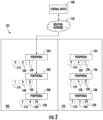
- Mesh network 101 includes a first subnet 102 and a second subnet 202.
- Mesh network 101 includes peripherals 204, 206, 208 and peripherals 104, 106, 108.
- the first subnet 102 includes peripheral 104, peripheral 106, and peripheral 108.
- the second subnet 202 includes peripheral 204, peripheral 206, and peripheral 208.
- Mesh network 101 can also include a central device 100.
- Central device 100 can be any type of device that is used to communicate with each of peripherals 204, 206, 208 and peripherals 104, 106, 108.
- central device 100 can include database capabilities, in order to store data transmitted by peripherals 204, 206, 208 and peripherals 104, 106, 108.
- central device 100 can include programming capabilities such that central device 100 can produce instructions for any one of peripherals 204, 206, 208 and peripherals 104, 106, 108.
- Central device 100 can be embodied as a laptop computer, a desktop computer, a server, a cloud, a mobile electronic device, or any other type of computing device. While 14 peripherals are illustrated in FIG. 2 , it should be understood that a greater or lesser number of peripherals can be present in other embodiments.
- the subnets 102, 202 are each separate rooms and the peripherals 204-208, 104-108 represent different devices within each separate room.
- central device 100 wants to send information to peripheral 208.
- the central device 100 sends the information to peripheral 204 through a network connection 150.
- the network connection 150 may be a computer network (e.g., LAN connection) and/or a powered device that provides access to the computer network.
- the network connection provides high speed communications between the central device 100 and a head node or peripheral of the mesh network 101, whereas the communication between the network connection 150 and mesh network 101 is using method 10 in FIG. 1 .
- the communication of the network connection 150 may be via a high-speed network.
- the high-speed networks may be wireless, for example Wi-Fi, Cellular, or the like. High-speed networks may also be wired, for example Ethernet, fiber optic, or the like. In general, the high-speed network is of a type typically installed as a data communications network in a building, between buildings, or as available for communications with mobile equipment.
- the central device 100 sends information (e.g., messages) to nodes or peripherals of the mesh network.
- Each message has a "from address” and a "to address” and by using the address each message can be routed from the source to the destination.
- Each node or peripheral in the mesh network 101 has a unique address.
- the address is composed of two parts including a subnet identifier 520 and a unique subnet device identifier 530.
- the central device 100 sends information (e.g., messages) through the network connection to the head node or head peripheral in each subnet. If a message is destined for a particular peripheral in a particular subnet, the central device 100 sends it to subnet head peripheral.
- the subnet is determined by the address which parses into the subnet identifier 520 and the unique subnet device identifier 530.
- the unique subnet device identifier 530 could be a pre-defined value for peripherals that are the 'head peripheral' of each subnet. For example, this pre-fined value for peripherals that are the 'head peripheral' may be "I", as illustrated in FIG. 2 .
- the central device 100 may have an IP address or some other means to identify exactly how to reach a particular 'head peripheral'. Alternatively, it may send the message to all 'head peripheral' and the one responsible peripheral will route the data onto their subnet.
- data or information may be sent from the central device 100 to the destination node or destination peripheral, which is peripheral 208 in FIG. 2 .
- the central device 100 may identify the destination node or the destination peripheral by including the subnet identifier 520 and the unique subnet device identifier 530 in the data to be sent.
- Peripheral 204 follows the method 10 shown in FIG. 1 .
- peripheral 204 is off, or unavailable.
- peripheral 204 advertises its availability, hop count 510, subnet identifier 520, and unique subnet device identifier 530.
- the hop count 510 is the number of hops or peripherals away from peripheral nearest the network connection 150 within the respective subnet.
- peripheral 104 is nearest the network connection 150 within the first subnet 102 and thus peripheral 104 has a hop count 510 equal to 0 within the first subnet 102.
- Peripheral 106 has a hop count 510 equal to 1 within the first subnet 102.
- Peripheral 108 has a hop count 510 equal to 2 within the first subnet 102.
- peripheral 204 is nearest the network connection 150 within the second subnet 202 and thus peripheral 204 has a hop count 510 equal to 0 within the second subnet 202.
- Peripheral 206 has a hop count 510 equal to 1 within the second subnet 202.
- Peripheral 208 has a hop count 510 equal to 2 within the second subnet 202.
- the peripherals 104, 106, 108 of the first subnet 102 may each have a subnet identifier 520 of "A”.
- the peripherals 204, 206, 208 of the second subnet 202 may each have a subnet identifier 520 of "B".
- the subnet identifier 520 may be a title or nomenclature that identifies the particular subnet and differentiates the particular subnet from other subnet. It is understood that subnet identifiers 520 of "A" and "B" are exemplary and subnets 102, 202 may have different subnet identifiers 520.
- All peripheral devices in a subnet may be assigned a unique subnet device identifier that allows each peripheral device to be uniquely identified within its subnet.
- the peripheral 104 of the first subnet 102 may have a unique subnet device identifier 530 of "I”.
- the peripheral 106 of the first subnet 102 may have a unique subnet device identifier 530 of "II”.
- the peripheral 108 of the first subnet 102 may have a unique subnet device identifier 530 of "III”.
- the peripheral 204 of the second subnet 202 may have a unique subnet device identifier 530 of "I”.
- the peripheral 206 of the second subnet 202 may have a unique subnet device identifier 530 of "II”.
- the peripheral 208 of the second subnet 202 may have a unique subnet device identifier 530 of "III". It is understood that unique subnet device identifiers 530 of "I”, “11”, “III” are exemplary and peripheral devices 104, 106, 108, 204, 206, 208 may have different subnet device identifiers 530.
- the combination of the subnet identifier 520 and the unique subnet device identifier 530 provides unique and independent identification of every peripheral device within the mesh network 101.
- subnet device identifier 530 values may be assigned to specific device types.
- subnet device identifier 530 "I” may be assigned to thermostats within the mesh network 101
- subnet device identifier 530 "II” may be assigned to wireless signal repeaters in the mesh network 101
- subnet device identifier 530 "III” may be assigned to door locks in the mesh network 101. This allows the device type to be identified based on its unique subnet device identifier 230.
- peripheral 204 advertises its availability, hop count 510, subnet identifier 520, and unique subnet device identifier 530.
- central device 100 establishes communication with peripheral 204, identifies the subnet of the peripheral 204, and transmits data to peripheral 204 through the network connection 150. Thereafter, this triggers peripheral 204, block 14 in FIG. 1 , to search for another peripheral to send the data to within the same subnet as peripheral 204 (i.e., the second subnet 202). It eventually finds peripheral 206 and ignores peripherals outside of the same subnet, even though the adjacent devices may be within Bluetooth range (i.e. 104 and 106).
- peripheral 206 receives the data. This process is repeated for the transmission of data from peripheral 206 to peripheral 208. As the final destination peripheral, peripheral 208 can then process, store, or otherwise use the data that was originally transmitted by central device 100. As aforementioned, peripheral 208 was originally identified by the central device 100 as the destination peripheral by including the subnet identifier 520 and the unique subnet device identifier 530 in the data sent by the central device 100.
- peripheral 208 can send an acknowledgement back to central device 100 such that central device 100 can verify that the data was received by the destination peripheral.
- the above-described path also can be used to transmit data from central device 100 to each of the peripherals 204, 206, 208.
- a universal configuration can be sent in such path.
- a query can be sent to each of the peripherals 204, 206, 208 (or subset thereof) in order to determine which peripheral meets a certain criteria.
- the above described path would have 3 hops and the overall latency would be determined as described above where the time required for each hop is related to the second time period.
- the information can be in the form of a "message bundle."
- a message from one peripheral can be appended to a message from another peripheral prior to being forwarded.
- a variety of different formats can be used for the message bundle. For example, there can be a portion of the message that notes the sending peripheral, followed by the message. Thus, a message from peripheral 204 can include "204" followed by the information. If peripheral 206 wanted to append to the message bundle, the resulting message bundle could include "204" followed by the information followed by "206,” followed by its information.
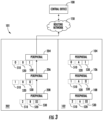
- FIG. 3 sending a message upstream in a mesh network 101 having multiple subnets 102, 202 that each include multiple peripherals is presented.
- a peripheral 208 is attempting to send a message upstream to central device 100. While only 6 peripherals 204, 206, 208, 104, 106, 108 are illustrated in FIG. 3 , it should be understood that a greater number of peripherals can be present in other embodiments.
- Peripheral 208 sends the data to peripheral 206, using method 10 such as that described with respect to FIG. 1 .
- peripheral 208 performs block 14 in FIG. 1 , to search for another peripheral to send the data upstream to within the same subnet as peripheral 204 (i.e., the second subnet 202).
- a lower hop number 510 than the hop number of the peripheral 208 will indicate that the peripheral is upstream from peripheral 208.
- Peripheral 208 may receive advertisements from peripheral 108 and subsequently ignore advertisements from peripheral 108 because peripheral 108 has a different subnet identifier 520 than peripheral 208 and an equivalent hop count 510 to peripheral 208.
- Peripheral 208 eventually finds peripheral 206, which has a lower hop number 510 and a subnet identifier 520 indicating that peripheral 206 is in the same subnet as peripheral 208 (i.e., the second subnet 202). The above-described steps are undertaken and peripheral 206 receives the data. This process is repeated for the transmission of data from peripheral 206 to peripheral 208. As the final destination peripheral, peripheral 208 can then process, store, or otherwise use the data that was originally transmitted by central device 100. In some embodiments, peripheral 208 can send an acknowledgement back to central device 100 such that central device 100 can verify that the data was received by the destination peripheral.
- Peripheral 206 also may have data to send to central device 100. After peripheral 206 receives the data from peripheral 208, peripheral 206 may append the data it wants to send to central device 100 to the data it received from peripheral 208. This message bundle of data is then transmitted by peripheral 208 to the next device. As illustrated by the solid arrows, the message bundle is sent to peripheral 204 before being sent to central device 350. It should be understood that the message bundle is sent from one peripheral to the next peripheral using techniques illustrated in FIG. 1 . It should be understood that, although only a single peripheral (peripheral 206) adding to the message bundle is discussed, any number of peripherals can add to the message bundle. For example, in an embodiment where each peripheral sends a periodic status update, each peripheral can add their status to the message bundle before sending the message bundle to the next peripheral. By using the message bundle, the total number of messages transmitted throughout the mesh network is reduced.
- data may be required to stay within the same subnet.
- data may not be required to stay within the same subnet but rather one subnet of a mesh network 101 may be given priority (e.g., priority subnet) and the data (e.g., message) may be sent outside of the priority subnet in specific instances. For example, if a subnet node in the priority subnet cannot be identified, then the data may be sent outside of the priority subnet in order to send the message on. Traveling outside of the priority subnet may be allowed for data going to the central device 100, whereas data going to the 'head node' of the priority subnet may be required stay within the priority subnet.
- priority subnet e.g., priority subnet
- peripheral 208 would like to send data to the central device 100 and the second subnet 202 is the priority subnet, it would be OK for the data to go outside of the second subnet 202, as long as the data is sent to the central device 100.
- peripheral 208 would like to send data to peripheral 204 and the second subnet 202 is the priority subnet, the data may be required to stay within the second subnet 202, so that the data routing is not effected by congestion or outages within other parts of the mesh network 101.
- FIGS. 2 and 3 The above described mesh network in FIGS. 2 and 3 can be used with respect to door locks, thermostats, room management systems, and/or wireless signal repeaters.
- a hospitality entity such as a hotel, motel, or resort
- peripherals 104, 204 may be thermostats.
- peripherals 106, 206 may be wireless signal repeaters.
- peripherals 108, 208 may be door locks.
- central device 100 may be a computing device located at a front desk of a hotel.
- peripherals 108, 208 are door locks and the central device can be a computer system that is accessible by a variety of hotel employees, such as reservations, the front desk, housekeeping, and security. There are a variety of operations that can be performed from a central device to a door lock.
- the front desk of a hotel might desire to reprogram a door lock to accept a certain key card or to not accept a certain key card or to accept an entry via a mobile electronic device (such as a smartphone).
- a mobile electronic device such as a smartphone
- the front desk of the hotel would use their computer system to direct the central device to issue an instruction to the correct door lock.
- Information from the door locks to the central device might be sent more rarely. There can be audit information transmitted from each door lock to the central device.
- the audit information can include information as to when the door lock was accessed, by which card was the lock accessed, and at what time.
- the information may be transmitted in real-time (e.g., directly after events have occurred) in response to an event occurrence or after the expiration of an audit timer.
- An event occurrence may include but is not limited to a door unlocked, a door locked, a door opened, a door closed, or a privacy lock enabled.
- An event occurrence may include any event that is communicated to both other devices within the subnet and the central device 100.
- each of the door locks can contain a memory and use the memory to store the audit information. Thereafter, in a periodic manner (such as twice a day) based on expiration of an audit timer, the door lock sends its audit information to the central device, using the embodiments described herein.
- Other type of information that could be treated as "store and forward" type of information includes battery status, diagnostic information, how long a guest was in the room, the time of use of each lock, room temperature, and each time the room was accessed by staff.
- the central device also can send information to all of the door locks at regular intervals, such as calendar date and time synchronization information or instructions to send audit information or diagnostic information.
- Another type of information that can be sent from the central device to each of the door locks is information that is used by each door lock, such as information to deactivate a master key. Such information is needed by each door lock in the mesh network, so it would be sent in a broadcast format.
- a broadcast format is a type of message bundle in which each door lock not only retrieves and uses the information, but also forwards the message bundle to the next message bundle.
- An exception can be generated and the information is immediately sent to the central device.
- a master key is used when it is not supposed to be used.
- a housekeeper who is supposed to be cleaning floor 5 uses her key card to open a door on floor 4.
- Other type of information that is treated as an exception can include a door being held open for a long period of time, a locking plan change (e.g., when each key card is set to automatically expire after checkout).
- the central device can also send a query to the door locks to request information. For example, if the central device wants to know the last time a specific master key was used, it can send a query to each door lock in the mesh network (or subset thereof). The response to the query can be treated in the same manner as an exception in that the response is immediately transmitted to the central device, as opposed to being stored in the door lock for later transmission during the periodic audit.
- a door lock could send a message indicating that a guest just entered the room to a thermostat or similar device that is part of a room management system.
- the thermostat could operate to a set point for comfort rather than for a set point for energy savings.
- the thermostat or room management device could also operate as a gateway device network connection 150 as shown in FIGS. 2 and 3 with a high-speed connection to the central device 100 also as shown in FIGS. 2 and 3 .
- gateway devices may include lighting systems, lighted exit signs, wireless network routers, to mention a few non-limiting examples.
- embodiments can be in the form of processor-implemented processes and devices for practicing those processes, such as processor.
- Embodiments can also be in the form of computer program code (e.g., computer program product) containing instructions embodied in tangible media, such as floppy diskettes, CD ROMs, hard drives, or any other non-transitory computer readable medium, wherein, when the computer program code is loaded into and executed by a computer, the computer becomes a device for practicing the embodiments.
- computer program code e.g., computer program product
- Embodiments can also be in the form of computer program code, for example, whether stored in a storage medium, loaded into and/or executed by a computer, or transmitted over some transmission medium, loaded into and/or executed by a computer, or transmitted over some transmission medium, such as over electrical wiring or cabling, through fiber optics, or via electromagnetic radiation, wherein, when the computer program code is loaded into and executed by a computer, the computer becomes an device for practicing the exemplary embodiments.
- the computer program code segments configure the microprocessor to create specific logic circuits.
Landscapes
- Engineering & Computer Science (AREA)
- Computer Networks & Wireless Communication (AREA)
- Signal Processing (AREA)
- Mobile Radio Communication Systems (AREA)
Claims (15)
- Verfahren zur Kommunikation unter einer Vielzahl von Peripheriegeräten (104, 106, 108, 204, 206, 208) innerhalb eines Mesh-Netzwerks (101), das ein erstes Subnetz (102) und ein zweites Subnetz (202) umfasst, wobei das Verfahren die folgenden Schritte umfasst, die von einem sendenden Peripheriegerät der Vielzahl von Peripheriegeräten (104, 106, 108, 204, 206, 208) durchgeführt werden:Empfangen einer Anzeige von einem oder mehreren Peripheriegeräten der Vielzahl von Peripheriegeräten (104, 106, 108, 204, 206, 208), wobei die Anzeige eine Hop-Anzahl (510), eine Subnetz-Kennung (520) und eine eindeutige Subnetz-Vorrichtungskennung (530) beinhaltet, wobei die Subnetz-Kennung (520) das erste Subnetz (102) oder das zweite Subnetz (202) angibt und die eindeutige Subnetz-Vorrichtungskennung (530) ein bestimmtes Peripheriegerät der Vielzahl von Peripheriegeräten (104, 106, 108, 204, 206, 208) innerhalb des Mesh-Netzwerks (101) angibt;Auslösen eines Nachrichtensendeereignisses;Bestimmen einer gewünschten Stream-Richtung innerhalb des Mesh-Netzwerks (101), wobei die gewünschte Stream-Richtung stromaufwärts oder stromabwärts ist;Bestimmen eines gewünschten Subnetzes des Mesh-Netzwerks (101), wobei das gewünschte Subnetz entweder das erste Subnetz (102) des Mesh-Netzwerks (101) oder das zweite Subnetz (202) des Mesh-Netzwerks (101) ist;Bestimmen eines Zielperipheriegeräts des einen oder mehrerer Peripheriegeräte (104, 106, 108, 204, 206, 208) innerhalb des gewünschten Subnetzes und in der gewünschten Stream-Richtung als Reaktion auf die Hop-Anzahl (510), die Subnetz-Kennung (520) und die eindeutige Subnetz-Vorrichtungskennung (530), wobei, wenn die gewünschte Stream-Richtung stromabwärts ist, das Zielperipheriegerät eine Hop-Anzahl (510) aufweist, die größer ist als die Hop-Anzahl (510) des sendenden Peripheriegeräts, und wenn die gewünschte Stream-Richtung stromaufwärts ist, das Zielperipheriegerät eine Hop-Anzahl (510) aufweist, die kleiner ist als die Hop-Anzahl (510) des sendenden Peripheriegeräts;Verbinden mit dem Zielperipheriegerät über drahtlose Nachrichtenübermittlung; undSenden der Nachricht an das Zielperipheriegerät.
- Verfahren nach Anspruch 1, wobei Auslösen des Nachrichtensendeereignisses Empfangen einer Nachricht umfasst.
- Verfahren nach Anspruch 1 wobei:
die Nachricht ein Nachrichtenbündel ist; und wobei das Verfahren weiter umfasst:
Hinzufügen von Informationen zum Nachrichtenbündel vor dem Senden der Nachricht. - Verfahren nach Anspruch 1, wobei:
Auslösen des Nachrichtensendeereignisses Ablauf eines Audit-Timers oder Auftreten eines Ereignisses umfasst. - Verfahren nach Anspruch 4, wobei:
Daten, die nach Ablauf des Audit-Timers gesendet werden, beinhalten: Batteriestatus, Diagnoseinformationen, Eintrittsereignisse und Raumtemperatur. - Verfahren nach Anspruch 4, wobei:
das Auftreten des Ereignisses eine unverriegelte Tür, eine verriegelte Tür, eine geöffnete Tür, eine geschlossene Tür oder eine aktivierte Datenschutzsperre beinhaltet. - Verfahren nach Anspruch 1, wobei:die eindeutige Kennung eine Art von Vorrichtung angibt;wobei die Art von Vorrichtung optional mindestens eines von einem Türschloss, einem drahtlosen Signalverstärker, einem Thermostat oder einem Raummanagementsystem ist.
- Sendendes Peripheriegerät, das Teil einer Vielzahl von Peripheriegeräten (104, 106, 108, 204, 206, 208) innerhalb eines Mesh-Netzwerks (101) ist, das ein erstes Subnetz (102) und ein zweites Subnetz (202) umfasst, wobei das sendende Peripheriegerät umfasst:einen Prozessor; undeinen Speicher, der computerausführbare Anweisungen umfasst, die, wenn sie von dem Prozessor ausgeführt werden, den Prozessor veranlassen, die Operationen durchzuführen, wobei die Operationen umfassen:Empfangen einer Anzeige von einem oder mehreren Peripheriegeräten der Vielzahl von Peripheriegeräten (104, 106, 108, 204, 206, 208), wobei die Anzeige eine Hop-Anzahl (510), eine Subnetz-Kennung (520) und eine eindeutige Subnetz-Vorrichtungskennung (530) beinhaltet, wobei die Subnetz-Kennung (520) das erste Subnetz (102) oder das zweite Subnetz (202) angibt und die eindeutige Subnetz-Vorrichtungskennung (530) ein bestimmtes Peripheriegerät der Vielzahl von Peripheriegeräten (104, 106, 108, 204, 206, 208) innerhalb des Mesh-Netzwerks (101) angibt;Auslösen eines Nachrichtensendeereignisses;Bestimmen einer gewünschten Stream-Richtung innerhalb des Mesh-Netzwerks (101), wobei die gewünschte Stream-Richtung stromaufwärts oder stromabwärts ist;Bestimmen eines gewünschten Subnetzes des Mesh-Netzwerks (101), wobei das gewünschte Subnetz entweder das erste Subnetz (102) des Mesh-Netzwerks (101) oder das zweite Subnetz (202) des Mesh-Netzwerks (101) ist;Bestimmen eines Zielperipheriegeräts des einen oder mehrerer Peripheriegeräte (104, 106, 108, 204, 206, 208) innerhalb des gewünschten Subnetzes und in der gewünschten Stream-Richtung als Reaktion auf die Hop-Anzahl (510), die Subnetz-Kennung (520) und die eindeutige Subnetz-Vorrichtungskennung (530), wobei, wenn die gewünschte Stream-Richtung stromabwärts ist, das Zielperipheriegerät eine Hop-Anzahl (510) aufweist, die größer ist als die Hop-Anzahl (510) des sendenden Peripheriegeräts, und wenn die gewünschte Stream-Richtung stromaufwärts ist, das Zielperipheriegerät eine Hop-Anzahl (510) aufweist, die kleiner ist als die Hop-Anzahl (510) des sendenden Peripheriegeräts;Verbinden mit dem Zielperipheriegerät über drahtlose Nachrichtenübermittlung; undSenden der Nachricht an das Zielperipheriegerät.
- Sendendes Peripheriegerät nach Anspruch 8, wobei Auslösen des Nachrichtensendeereignisses Empfangen einer Nachricht umfasst.
- Sendendes Peripheriegerät nach Anspruch 8, wobei:
die Nachricht ein Nachrichtenbündel ist; und wobei die Operationen weiter umfassen:
Hinzufügen von Informationen zum Nachrichtenbündel vor dem Senden der Nachricht. - Sendendes Peripheriegerät nach Anspruch 8, wobei:
Auslösen des Nachrichtensendeereignisses Ablauf eines Audit-Timers oder Auftreten eines Ereignisses umfasst. - Sendendes Peripheriegerät nach Anspruch 11, wobei:
Daten, die nach Ablauf des Audit-Timers gesendet werden, beinhalten: Batteriestatus, Diagnoseinformationen, Eintrittsereignisse und Raumtemperatur. - Sendendes Peripheriegerät nach Anspruch 8, wobei:
das sendende Peripheriegerät ein Türschloss, ein drahtloser Signalverstärker, ein Thermostat oder ein Raummanagementsystem ist. - Sendendes Peripheriegerät nach Anspruch 11, wobei:
das Auftreten des Ereignisses eine unverriegelte Tür, eine verriegelte Tür, eine geöffnete Tür, eine geschlossene Tür oder eine aktivierte Datenschutzsperre beinhaltet. - Sendendes Peripheriegerät nach Anspruch 8, wobei:
die eindeutige Kennung eine Art von Vorrichtung angibt; wobei die Art von Vorrichtung optional mindestens eines von einem Türschloss, einem drahtlosen Signalverstärker, einem Thermostat oder einem Raummanagementsystem ist.
Applications Claiming Priority (2)
| Application Number | Priority Date | Filing Date | Title |
|---|---|---|---|
| US201962898685P | 2019-09-11 | 2019-09-11 | |
| PCT/US2020/050055 WO2021050633A1 (en) | 2019-09-11 | 2020-09-10 | Bluetooth mesh routing with subnets |
Publications (2)
| Publication Number | Publication Date |
|---|---|
| EP4029208A1 EP4029208A1 (de) | 2022-07-20 |
| EP4029208B1 true EP4029208B1 (de) | 2025-05-21 |
Family
ID=72614030
Family Applications (1)
| Application Number | Title | Priority Date | Filing Date |
|---|---|---|---|
| EP20776031.5A Active EP4029208B1 (de) | 2019-09-11 | 2020-09-10 | Bluetooth-mesh-routing mit subnetzen |
Country Status (4)
| Country | Link |
|---|---|
| US (1) | US11917520B2 (de) |
| EP (1) | EP4029208B1 (de) |
| CN (1) | CN112789873B (de) |
| WO (1) | WO2021050633A1 (de) |
Families Citing this family (6)
| Publication number | Priority date | Publication date | Assignee | Title |
|---|---|---|---|---|
| CN113438634B (zh) * | 2021-06-22 | 2023-04-07 | 全民认证科技(杭州)有限公司 | 基于物联网的智能门锁蓝牙节点角色切换和组网方法 |
| CN115701724B (zh) * | 2021-08-02 | 2024-05-03 | 华为技术有限公司 | 用于设备连接的方法、电子设备和系统 |
| US12375558B2 (en) | 2022-09-07 | 2025-07-29 | Qualcomm Incorporated | Role switching in a mesh network using periodic advertisement |
| CN116233969A (zh) * | 2022-12-29 | 2023-06-06 | 赛尔富电子有限公司 | 一种大规模无线设备的组网方法、装置、设备及存储介质 |
| US11929983B1 (en) * | 2023-05-22 | 2024-03-12 | Uab 360 It | Enabling partial access to a local area network via a meshnet device |
| US20250081215A1 (en) * | 2023-08-28 | 2025-03-06 | Avago Technologies International Sales Pte. Limited | Enhanced Bluetooth Low Energy Broadcast |
Family Cites Families (36)
| Publication number | Priority date | Publication date | Assignee | Title |
|---|---|---|---|---|
| US20120027008A1 (en) * | 2001-10-12 | 2012-02-02 | Spice I2I Limited | Addressing Techniques For Voice Over Internet Protocol Router |
| US7420952B2 (en) | 2002-10-28 | 2008-09-02 | Mesh Dynamics, Inc. | High performance wireless networks using distributed control |
| US7350077B2 (en) * | 2002-11-26 | 2008-03-25 | Cisco Technology, Inc. | 802.11 using a compressed reassociation exchange to facilitate fast handoff |
| CA2520494A1 (en) * | 2003-04-17 | 2004-11-04 | Cisco Technology, Inc. | 802.11 using a compressed reassociation exchange to facilitate fast handoff |
| US7639681B2 (en) * | 2004-11-23 | 2009-12-29 | Microsoft Corporation | System and method for a distributed server for peer-to-peer networks |
| US10588004B2 (en) | 2006-05-16 | 2020-03-10 | RedSky Technologies, Inc. | Method and system for locating a network device in an emergency situation |
| ES2496593T3 (es) | 2006-10-16 | 2014-09-19 | Assa Abloy Hospitality, Inc. | Red inalámbrica centralizada para propiedades de gran tamaño con múltiples habitaciones |
| KR100853998B1 (ko) * | 2007-05-02 | 2008-08-25 | 주식회사 플레넷 | 전력선 통신에서의 데이터 전송경로 라우팅 방법 |
| CN102342163B (zh) | 2009-03-04 | 2014-09-03 | 鲁门无线电通信公司 | 无线网络 |
| US8724513B2 (en) | 2009-09-25 | 2014-05-13 | Qualcomm Incorporated | Methods and apparatus for distribution of IP layer routing information in peer-to-peer overlay networks |
| US8570168B2 (en) | 2009-10-08 | 2013-10-29 | Bringrr Systems, Llc | System, method and device to interrogate for the presence of objects |
| CN103080693B (zh) | 2010-08-04 | 2015-04-22 | 株式会社普利司通 | 轮胎外形测量数据校正方法和轮胎外观检查装置 |
| US8665176B2 (en) | 2010-10-01 | 2014-03-04 | Sony Corporation | Display apparatus |
| US8774147B2 (en) | 2012-02-23 | 2014-07-08 | Dahrwin Llc | Asynchronous wireless dynamic ad-hoc network |
| WO2013170635A1 (en) | 2012-05-17 | 2013-11-21 | The Hong Kong University Of Science And Technology | Systems and methods facilitating joint channel and routing assignment for wireless mesh networks |
| US8886785B2 (en) | 2012-07-17 | 2014-11-11 | The Procter & Gamble Company | Home network of connected consumer devices |
| US20140022917A1 (en) | 2012-07-17 | 2014-01-23 | Procter And Gamble, Inc. | Home network of connected consumer devices |
| US10165654B2 (en) | 2012-07-17 | 2018-12-25 | The Procter & Gamble Company | Home network of connected consumer devices |
| US9385949B2 (en) * | 2012-12-20 | 2016-07-05 | Mellanox Technologies Tlv Ltd. | Routing controlled by subnet managers |
| US9437063B2 (en) | 2014-01-04 | 2016-09-06 | Latchable, Inc. | Methods and systems for multi-unit real estate management |
| US10268485B2 (en) * | 2014-02-28 | 2019-04-23 | Tyco Fire & Security Gmbh | Constrained device and supporting operating system |
| US10111071B2 (en) | 2014-09-19 | 2018-10-23 | Avago Technologies General Ip (Singapore) Pte. Ltd. | Bluetooth low energy automation mesh network |
| US9479894B2 (en) | 2014-11-28 | 2016-10-25 | Iloda Solutions Limited | Locating and tracking system |
| US10541916B2 (en) * | 2014-12-17 | 2020-01-21 | Google Llc | Tunneled routing |
| US9369374B1 (en) * | 2015-02-03 | 2016-06-14 | Google Inc. | Mesh network addressing |
| US20170099567A1 (en) * | 2015-10-02 | 2017-04-06 | Lg Electronics Inc. | Method and device for transmitting and receiving data in mesh network using bluetooth |
| US9967884B2 (en) | 2015-11-10 | 2018-05-08 | Netgear, Inc. | Dedicated backhaul for whole home coverage |
| US9521009B1 (en) | 2016-01-20 | 2016-12-13 | Creston Electronics, Inc. | Auto-configuration and automation of a building management system |
| US10791172B2 (en) | 2016-07-22 | 2020-09-29 | Tinker Pte. Ltd. | Systems and methods for interacting with nearby people and devices |
| US10158555B2 (en) | 2016-09-29 | 2018-12-18 | At&T Intellectual Property I, L.P. | Facilitation of route optimization for a 5G network or other next generation network |
| US10045184B2 (en) | 2016-11-11 | 2018-08-07 | Carnival Corporation | Wireless guest engagement system |
| US10432523B2 (en) * | 2017-05-31 | 2019-10-01 | Juniper Networks, Inc. | Routing protocol signaling of multiple next hops and their relationship |
| CN207219050U (zh) | 2017-09-28 | 2018-04-10 | 无锡商业职业技术学院 | 一种增强基站信号的蓝牙网络系统 |
| EP3484209B1 (de) | 2017-11-08 | 2022-08-24 | Carrier Corporation | Mesh-vernetzung unter verwendung von peer-to-peer-nachrichten für gastfreundschaftseinheit |
| US20190141616A1 (en) * | 2017-11-08 | 2019-05-09 | Carrier Corporation | Mesh networking using peer to peer messages |
| KR102331886B1 (ko) | 2017-12-21 | 2021-11-29 | 삼성전자주식회사 | 네트워크에서 노드를 제어하는 전자 장치 및 제어 방법 |
-
2020
- 2020-09-10 EP EP20776031.5A patent/EP4029208B1/de active Active
- 2020-09-10 WO PCT/US2020/050055 patent/WO2021050633A1/en not_active Ceased
- 2020-09-10 CN CN202080003558.9A patent/CN112789873B/zh active Active
- 2020-09-10 US US16/972,376 patent/US11917520B2/en active Active
Also Published As
| Publication number | Publication date |
|---|---|
| US11917520B2 (en) | 2024-02-27 |
| CN112789873B (zh) | 2025-07-11 |
| EP4029208A1 (de) | 2022-07-20 |
| CN112789873A (zh) | 2021-05-11 |
| WO2021050633A1 (en) | 2021-03-18 |
| US20220303868A1 (en) | 2022-09-22 |
Similar Documents
| Publication | Publication Date | Title |
|---|---|---|
| EP4029208B1 (de) | Bluetooth-mesh-routing mit subnetzen | |
| US11784950B2 (en) | Mesh networking using peer to peer messages for a hospitality entity | |
| EP3484208A1 (de) | Mesh-netzwerk mit peer-to-peer-nachrichten | |
| US9730173B2 (en) | Synchronization between devices of same or different wireless network | |
| US11202242B2 (en) | Low power sensor node operation for wireless network | |
| CN100379183C (zh) | 移动无线自组织网络的互同步方法 | |
| US10057130B2 (en) | D2HCP protocol in ad hoc networks: merging of sub-networks and address conflict resolution | |
| US20040018839A1 (en) | Protocol and structure for mobile nodes in a self-organizing communication network | |
| US20220352999A1 (en) | Systems and methods for synchronizing device clocks | |
| EP3785468B1 (de) | Automatisiertes routing in einem mesh-netzwerk von drahtlosen nachrichtenübermittlungsvorrichtungen | |
| KR102098156B1 (ko) | 원격 저전력 ble 메쉬 네트워크 시스템 및 그 구성 방법 | |
| JP2010050520A (ja) | 無線lan中継装置、無線lan中継方法およびコンピュータプログラム | |
| EP3785467B1 (de) | Automatisiertes routing in einem mesh-netzwerk von drahtlosen nachrichtenübermittlungsvorrichtungen | |
| US9504020B2 (en) | Method for exchanging information between communication terminals, and communication terminal | |
| CN108605300A (zh) | 一种nan设备发送同步信标消息的方法和设备 | |
| Hu et al. | PLI-sync: Prefetch loss-insensitive sync for NDN group streaming | |
| US8233443B2 (en) | Wireless communication apparatus and wireless communication method | |
| CN114585041A (zh) | 路由协议方法、移动自组织网络、站点及存储介质 | |
| JP2015106916A (ja) | データ伝送システム及び方法 | |
| EP4138460B1 (de) | Schlüsselaktualisierungsverfahren, netzwerkvorrichtung, system und speichermedium | |
| CN117335839A (zh) | 一种通信方法及相关设备 | |
| Shekastehband et al. | A new routing algorithm in cluster-based wireless sensor networks with mobile sinks |
Legal Events
| Date | Code | Title | Description |
|---|---|---|---|
| STAA | Information on the status of an ep patent application or granted ep patent |
Free format text: STATUS: UNKNOWN |
|
| STAA | Information on the status of an ep patent application or granted ep patent |
Free format text: STATUS: THE INTERNATIONAL PUBLICATION HAS BEEN MADE |
|
| PUAI | Public reference made under article 153(3) epc to a published international application that has entered the european phase |
Free format text: ORIGINAL CODE: 0009012 |
|
| STAA | Information on the status of an ep patent application or granted ep patent |
Free format text: STATUS: REQUEST FOR EXAMINATION WAS MADE |
|
| 17P | Request for examination filed |
Effective date: 20210109 |
|
| AK | Designated contracting states |
Kind code of ref document: A1 Designated state(s): AL AT BE BG CH CY CZ DE DK EE ES FI FR GB GR HR HU IE IS IT LI LT LU LV MC MK MT NL NO PL PT RO RS SE SI SK SM TR |
|
| DAV | Request for validation of the european patent (deleted) | ||
| DAX | Request for extension of the european patent (deleted) | ||
| P01 | Opt-out of the competence of the unified patent court (upc) registered |
Effective date: 20230527 |
|
| REG | Reference to a national code |
Ref country code: DE Free format text: PREVIOUS MAIN CLASS: H04L0012715000 Ref country code: DE Ref legal event code: R079 Ref document number: 602020051683 Country of ref document: DE Free format text: PREVIOUS MAIN CLASS: H04L0012715000 Ipc: H04L0045020000 |
|
| GRAP | Despatch of communication of intention to grant a patent |
Free format text: ORIGINAL CODE: EPIDOSNIGR1 |
|
| STAA | Information on the status of an ep patent application or granted ep patent |
Free format text: STATUS: GRANT OF PATENT IS INTENDED |
|
| RIC1 | Information provided on ipc code assigned before grant |
Ipc: H04W 4/06 20090101ALN20241003BHEP Ipc: H04L 45/00 20220101ALN20241003BHEP Ipc: H04W 40/28 20090101ALI20241003BHEP Ipc: H04W 4/12 20090101ALI20241003BHEP Ipc: H04W 4/80 20180101ALI20241003BHEP Ipc: H04L 45/02 20220101AFI20241003BHEP |
|
| GRAJ | Information related to disapproval of communication of intention to grant by the applicant or resumption of examination proceedings by the epo deleted |
Free format text: ORIGINAL CODE: EPIDOSDIGR1 |
|
| STAA | Information on the status of an ep patent application or granted ep patent |
Free format text: STATUS: REQUEST FOR EXAMINATION WAS MADE |
|
| INTG | Intention to grant announced |
Effective date: 20241022 |
|
| RIC1 | Information provided on ipc code assigned before grant |
Ipc: H04W 4/06 20090101ALN20241014BHEP Ipc: H04L 45/00 20220101ALN20241014BHEP Ipc: H04W 40/28 20090101ALI20241014BHEP Ipc: H04W 4/12 20090101ALI20241014BHEP Ipc: H04W 4/80 20180101ALI20241014BHEP Ipc: H04L 45/02 20220101AFI20241014BHEP |
|
| RAP1 | Party data changed (applicant data changed or rights of an application transferred) |
Owner name: HONEYWELL INTERNATIONAL INC. |
|
| INTC | Intention to grant announced (deleted) | ||
| GRAP | Despatch of communication of intention to grant a patent |
Free format text: ORIGINAL CODE: EPIDOSNIGR1 |
|
| STAA | Information on the status of an ep patent application or granted ep patent |
Free format text: STATUS: GRANT OF PATENT IS INTENDED |
|
| RIC1 | Information provided on ipc code assigned before grant |
Ipc: H04W 4/06 20090101ALN20241216BHEP Ipc: H04L 45/00 20220101ALN20241216BHEP Ipc: H04W 40/28 20090101ALI20241216BHEP Ipc: H04W 4/12 20090101ALI20241216BHEP Ipc: H04W 4/80 20180101ALI20241216BHEP Ipc: H04L 45/02 20220101AFI20241216BHEP |
|
| INTG | Intention to grant announced |
Effective date: 20250103 |
|
| GRAS | Grant fee paid |
Free format text: ORIGINAL CODE: EPIDOSNIGR3 |
|
| GRAA | (expected) grant |
Free format text: ORIGINAL CODE: 0009210 |
|
| STAA | Information on the status of an ep patent application or granted ep patent |
Free format text: STATUS: THE PATENT HAS BEEN GRANTED |
|
| AK | Designated contracting states |
Kind code of ref document: B1 Designated state(s): AL AT BE BG CH CY CZ DE DK EE ES FI FR GB GR HR HU IE IS IT LI LT LU LV MC MK MT NL NO PL PT RO RS SE SI SK SM TR |
|
| REG | Reference to a national code |
Ref country code: GB Ref legal event code: FG4D |
|
| REG | Reference to a national code |
Ref country code: CH Ref legal event code: EP |
|
| REG | Reference to a national code |
Ref country code: DE Ref legal event code: R096 Ref document number: 602020051683 Country of ref document: DE |
|
| REG | Reference to a national code |
Ref country code: IE Ref legal event code: FG4D |
|
| REG | Reference to a national code |
Ref country code: NL Ref legal event code: MP Effective date: 20250521 |
|
| PG25 | Lapsed in a contracting state [announced via postgrant information from national office to epo] |
Ref country code: ES Free format text: LAPSE BECAUSE OF FAILURE TO SUBMIT A TRANSLATION OF THE DESCRIPTION OR TO PAY THE FEE WITHIN THE PRESCRIBED TIME-LIMIT Effective date: 20250521 Ref country code: FI Free format text: LAPSE BECAUSE OF FAILURE TO SUBMIT A TRANSLATION OF THE DESCRIPTION OR TO PAY THE FEE WITHIN THE PRESCRIBED TIME-LIMIT Effective date: 20250521 Ref country code: PT Free format text: LAPSE BECAUSE OF FAILURE TO SUBMIT A TRANSLATION OF THE DESCRIPTION OR TO PAY THE FEE WITHIN THE PRESCRIBED TIME-LIMIT Effective date: 20250922 |
|
| PGFP | Annual fee paid to national office [announced via postgrant information from national office to epo] |
Ref country code: DE Payment date: 20250926 Year of fee payment: 6 |
|
| REG | Reference to a national code |
Ref country code: LT Ref legal event code: MG9D |
|
| PG25 | Lapsed in a contracting state [announced via postgrant information from national office to epo] |
Ref country code: NO Free format text: LAPSE BECAUSE OF FAILURE TO SUBMIT A TRANSLATION OF THE DESCRIPTION OR TO PAY THE FEE WITHIN THE PRESCRIBED TIME-LIMIT Effective date: 20250821 Ref country code: GR Free format text: LAPSE BECAUSE OF FAILURE TO SUBMIT A TRANSLATION OF THE DESCRIPTION OR TO PAY THE FEE WITHIN THE PRESCRIBED TIME-LIMIT Effective date: 20250822 |
|
| PG25 | Lapsed in a contracting state [announced via postgrant information from national office to epo] |
Ref country code: NL Free format text: LAPSE BECAUSE OF FAILURE TO SUBMIT A TRANSLATION OF THE DESCRIPTION OR TO PAY THE FEE WITHIN THE PRESCRIBED TIME-LIMIT Effective date: 20250521 Ref country code: PL Free format text: LAPSE BECAUSE OF FAILURE TO SUBMIT A TRANSLATION OF THE DESCRIPTION OR TO PAY THE FEE WITHIN THE PRESCRIBED TIME-LIMIT Effective date: 20250521 |
|
| PG25 | Lapsed in a contracting state [announced via postgrant information from national office to epo] |
Ref country code: BG Free format text: LAPSE BECAUSE OF FAILURE TO SUBMIT A TRANSLATION OF THE DESCRIPTION OR TO PAY THE FEE WITHIN THE PRESCRIBED TIME-LIMIT Effective date: 20250521 |
|
| PGFP | Annual fee paid to national office [announced via postgrant information from national office to epo] |
Ref country code: GB Payment date: 20250923 Year of fee payment: 6 |
|
| PG25 | Lapsed in a contracting state [announced via postgrant information from national office to epo] |
Ref country code: HR Free format text: LAPSE BECAUSE OF FAILURE TO SUBMIT A TRANSLATION OF THE DESCRIPTION OR TO PAY THE FEE WITHIN THE PRESCRIBED TIME-LIMIT Effective date: 20250521 |
|
| PGFP | Annual fee paid to national office [announced via postgrant information from national office to epo] |
Ref country code: FR Payment date: 20250925 Year of fee payment: 6 |
|
| PG25 | Lapsed in a contracting state [announced via postgrant information from national office to epo] |
Ref country code: RS Free format text: LAPSE BECAUSE OF FAILURE TO SUBMIT A TRANSLATION OF THE DESCRIPTION OR TO PAY THE FEE WITHIN THE PRESCRIBED TIME-LIMIT Effective date: 20250821 |
|
| PG25 | Lapsed in a contracting state [announced via postgrant information from national office to epo] |
Ref country code: IS Free format text: LAPSE BECAUSE OF FAILURE TO SUBMIT A TRANSLATION OF THE DESCRIPTION OR TO PAY THE FEE WITHIN THE PRESCRIBED TIME-LIMIT Effective date: 20250921 |
|
| PG25 | Lapsed in a contracting state [announced via postgrant information from national office to epo] |
Ref country code: LV Free format text: LAPSE BECAUSE OF FAILURE TO SUBMIT A TRANSLATION OF THE DESCRIPTION OR TO PAY THE FEE WITHIN THE PRESCRIBED TIME-LIMIT Effective date: 20250521 |
|
| REG | Reference to a national code |
Ref country code: AT Ref legal event code: MK05 Ref document number: 1797817 Country of ref document: AT Kind code of ref document: T Effective date: 20250521 |
|
| PG25 | Lapsed in a contracting state [announced via postgrant information from national office to epo] |
Ref country code: DK Free format text: LAPSE BECAUSE OF FAILURE TO SUBMIT A TRANSLATION OF THE DESCRIPTION OR TO PAY THE FEE WITHIN THE PRESCRIBED TIME-LIMIT Effective date: 20250521 Ref country code: AT Free format text: LAPSE BECAUSE OF FAILURE TO SUBMIT A TRANSLATION OF THE DESCRIPTION OR TO PAY THE FEE WITHIN THE PRESCRIBED TIME-LIMIT Effective date: 20250521 Ref country code: SM Free format text: LAPSE BECAUSE OF FAILURE TO SUBMIT A TRANSLATION OF THE DESCRIPTION OR TO PAY THE FEE WITHIN THE PRESCRIBED TIME-LIMIT Effective date: 20250521 |
|
| PG25 | Lapsed in a contracting state [announced via postgrant information from national office to epo] |
Ref country code: CZ Free format text: LAPSE BECAUSE OF FAILURE TO SUBMIT A TRANSLATION OF THE DESCRIPTION OR TO PAY THE FEE WITHIN THE PRESCRIBED TIME-LIMIT Effective date: 20250521 |
|
| PG25 | Lapsed in a contracting state [announced via postgrant information from national office to epo] |
Ref country code: EE Free format text: LAPSE BECAUSE OF FAILURE TO SUBMIT A TRANSLATION OF THE DESCRIPTION OR TO PAY THE FEE WITHIN THE PRESCRIBED TIME-LIMIT Effective date: 20250521 |
|
| PG25 | Lapsed in a contracting state [announced via postgrant information from national office to epo] |
Ref country code: RO Free format text: LAPSE BECAUSE OF FAILURE TO SUBMIT A TRANSLATION OF THE DESCRIPTION OR TO PAY THE FEE WITHIN THE PRESCRIBED TIME-LIMIT Effective date: 20250521 Ref country code: SK Free format text: LAPSE BECAUSE OF FAILURE TO SUBMIT A TRANSLATION OF THE DESCRIPTION OR TO PAY THE FEE WITHIN THE PRESCRIBED TIME-LIMIT Effective date: 20250521 |
|
| PG25 | Lapsed in a contracting state [announced via postgrant information from national office to epo] |
Ref country code: IT Free format text: LAPSE BECAUSE OF FAILURE TO SUBMIT A TRANSLATION OF THE DESCRIPTION OR TO PAY THE FEE WITHIN THE PRESCRIBED TIME-LIMIT Effective date: 20250521 |