EP4027740B1 - Verfahren zur durchführung von direktzugriffskanalverfahren in einem unlizenzierten band und vorrichtung dafür - Google Patents
Verfahren zur durchführung von direktzugriffskanalverfahren in einem unlizenzierten band und vorrichtung dafür Download PDFInfo
- Publication number
- EP4027740B1 EP4027740B1 EP20869707.8A EP20869707A EP4027740B1 EP 4027740 B1 EP4027740 B1 EP 4027740B1 EP 20869707 A EP20869707 A EP 20869707A EP 4027740 B1 EP4027740 B1 EP 4027740B1
- Authority
- EP
- European Patent Office
- Prior art keywords
- msg
- message
- transmission
- pusch
- prach
- Prior art date
- Legal status (The legal status is an assumption and is not a legal conclusion. Google has not performed a legal analysis and makes no representation as to the accuracy of the status listed.)
- Active
Links
Images





Classifications
-
- H—ELECTRICITY
- H04—ELECTRIC COMMUNICATION TECHNIQUE
- H04W—WIRELESS COMMUNICATION NETWORKS
- H04W52/00—Power management, e.g. Transmission Power Control [TPC] or power classes
- H04W52/04—Transmission power control [TPC]
- H04W52/38—TPC being performed in particular situations
- H04W52/42—TPC being performed in particular situations in systems with time, space, frequency or polarisation diversity
-
- H—ELECTRICITY
- H04—ELECTRIC COMMUNICATION TECHNIQUE
- H04W—WIRELESS COMMUNICATION NETWORKS
- H04W52/00—Power management, e.g. Transmission Power Control [TPC] or power classes
- H04W52/04—Transmission power control [TPC]
- H04W52/06—TPC algorithms
-
- H—ELECTRICITY
- H04—ELECTRIC COMMUNICATION TECHNIQUE
- H04W—WIRELESS COMMUNICATION NETWORKS
- H04W16/00—Network planning, e.g. coverage or traffic planning tools; Network deployment, e.g. resource partitioning or cells structures
- H04W16/14—Spectrum sharing arrangements between different networks
-
- H—ELECTRICITY
- H04—ELECTRIC COMMUNICATION TECHNIQUE
- H04W—WIRELESS COMMUNICATION NETWORKS
- H04W16/00—Network planning, e.g. coverage or traffic planning tools; Network deployment, e.g. resource partitioning or cells structures
- H04W16/24—Cell structures
- H04W16/28—Cell structures using beam steering
-
- H—ELECTRICITY
- H04—ELECTRIC COMMUNICATION TECHNIQUE
- H04W—WIRELESS COMMUNICATION NETWORKS
- H04W52/00—Power management, e.g. Transmission Power Control [TPC] or power classes
- H04W52/04—Transmission power control [TPC]
- H04W52/06—TPC algorithms
- H04W52/14—Separate analysis of uplink or downlink
- H04W52/146—Uplink power control
-
- H—ELECTRICITY
- H04—ELECTRIC COMMUNICATION TECHNIQUE
- H04W—WIRELESS COMMUNICATION NETWORKS
- H04W52/00—Power management, e.g. Transmission Power Control [TPC] or power classes
- H04W52/04—Transmission power control [TPC]
- H04W52/30—Transmission power control [TPC] using constraints in the total amount of available transmission power
- H04W52/36—Transmission power control [TPC] using constraints in the total amount of available transmission power with a discrete range or set of values, e.g. step size, ramping or offsets
-
- H—ELECTRICITY
- H04—ELECTRIC COMMUNICATION TECHNIQUE
- H04W—WIRELESS COMMUNICATION NETWORKS
- H04W52/00—Power management, e.g. Transmission Power Control [TPC] or power classes
- H04W52/04—Transmission power control [TPC]
- H04W52/30—Transmission power control [TPC] using constraints in the total amount of available transmission power
- H04W52/36—Transmission power control [TPC] using constraints in the total amount of available transmission power with a discrete range or set of values, e.g. step size, ramping or offsets
- H04W52/362—Aspects of the step size
-
- H—ELECTRICITY
- H04—ELECTRIC COMMUNICATION TECHNIQUE
- H04W—WIRELESS COMMUNICATION NETWORKS
- H04W52/00—Power management, e.g. Transmission Power Control [TPC] or power classes
- H04W52/04—Transmission power control [TPC]
- H04W52/38—TPC being performed in particular situations
- H04W52/50—TPC being performed in particular situations at the moment of starting communication in a multiple access environment
-
- H—ELECTRICITY
- H04—ELECTRIC COMMUNICATION TECHNIQUE
- H04W—WIRELESS COMMUNICATION NETWORKS
- H04W72/00—Local resource management
- H04W72/12—Wireless traffic scheduling
- H04W72/1263—Mapping of traffic onto schedule, e.g. scheduled allocation or multiplexing of flows
- H04W72/1268—Mapping of traffic onto schedule, e.g. scheduled allocation or multiplexing of flows of uplink data flows
-
- H—ELECTRICITY
- H04—ELECTRIC COMMUNICATION TECHNIQUE
- H04W—WIRELESS COMMUNICATION NETWORKS
- H04W74/00—Wireless channel access
- H04W74/002—Transmission of channel access control information
-
- H—ELECTRICITY
- H04—ELECTRIC COMMUNICATION TECHNIQUE
- H04W—WIRELESS COMMUNICATION NETWORKS
- H04W74/00—Wireless channel access
- H04W74/002—Transmission of channel access control information
- H04W74/004—Transmission of channel access control information in the uplink, i.e. towards network
-
- H—ELECTRICITY
- H04—ELECTRIC COMMUNICATION TECHNIQUE
- H04W—WIRELESS COMMUNICATION NETWORKS
- H04W74/00—Wireless channel access
- H04W74/002—Transmission of channel access control information
- H04W74/006—Transmission of channel access control information in the downlink, i.e. towards the terminal
-
- H—ELECTRICITY
- H04—ELECTRIC COMMUNICATION TECHNIQUE
- H04W—WIRELESS COMMUNICATION NETWORKS
- H04W74/00—Wireless channel access
- H04W74/08—Non-scheduled access, e.g. ALOHA
- H04W74/0808—Non-scheduled access, e.g. ALOHA using carrier sensing, e.g. carrier sense multiple access [CSMA]
-
- H—ELECTRICITY
- H04—ELECTRIC COMMUNICATION TECHNIQUE
- H04W—WIRELESS COMMUNICATION NETWORKS
- H04W74/00—Wireless channel access
- H04W74/08—Non-scheduled access, e.g. ALOHA
- H04W74/0833—Random access procedures, e.g. with 4-step access
-
- H—ELECTRICITY
- H04—ELECTRIC COMMUNICATION TECHNIQUE
- H04B—TRANSMISSION
- H04B7/00—Radio transmission systems, i.e. using radiation field
- H04B7/02—Diversity systems; Multi-antenna system, i.e. transmission or reception using multiple antennas
- H04B7/04—Diversity systems; Multi-antenna system, i.e. transmission or reception using multiple antennas using two or more spaced independent antennas
- H04B7/06—Diversity systems; Multi-antenna system, i.e. transmission or reception using multiple antennas using two or more spaced independent antennas at the transmitting station
- H04B7/0613—Diversity systems; Multi-antenna system, i.e. transmission or reception using multiple antennas using two or more spaced independent antennas at the transmitting station using simultaneous transmission
- H04B7/0615—Diversity systems; Multi-antenna system, i.e. transmission or reception using multiple antennas using two or more spaced independent antennas at the transmitting station using simultaneous transmission of weighted versions of same signal
- H04B7/0617—Diversity systems; Multi-antenna system, i.e. transmission or reception using multiple antennas using two or more spaced independent antennas at the transmitting station using simultaneous transmission of weighted versions of same signal for beam forming
-
- H—ELECTRICITY
- H04—ELECTRIC COMMUNICATION TECHNIQUE
- H04W—WIRELESS COMMUNICATION NETWORKS
- H04W74/00—Wireless channel access
- H04W74/08—Non-scheduled access, e.g. ALOHA
- H04W74/0833—Random access procedures, e.g. with 4-step access
- H04W74/0836—Random access procedures, e.g. with 4-step access with 2-step access
Definitions
- the present disclosure relates to a method of performing a random access procedure by a user equipment on an unlicensed band and apparatus therefor, and more particularly, to a method of setting a transmit power of a signal to perform a random access procedure by a user equipment and apparatus therefor.
- 5G next-generation system
- 5G next-generation system
- eMBB enhanced mobile broadband
- URLLC ultra-reliable and low-latency communication
- mMTC massive machine-Type communications
- eMBB is a next-generation mobile communication scenario characterized by high spectral efficiency, high user experienced data rate, and high peak data rate.
- URLLC is a next-generation mobile communication scenario characterized by ultra-high reliability, ultra-low latency, and ultra-high availability (e.g., vehicle-to-everything (V2X), emergency service, and remote control).
- mMTC is a next-generation mobile communication scenario characterized by low cost, low energy, short packet, and massive connectivity (e.g., Internet of things (IoT)).
- WO 2019/119317 A1 which generally relates to a method for transmitting random access preamble, and terminal device
- EP 3 471 495 A1 which generally relates to a method and user equipment for transmitting random access preamble
- US 2019/268060 A1 which generally relates to power ramping for random access channel (RACH) preamble transmissions with beam switching
- WO 2018/231553 A2 which generally relates to power ramping and control in new radio (NR) devices.
- One technical task of the present disclosure is to provide a method of performing a random access procedure by a user equipment on an unlicensed band and apparatus therefor.
- a transmit power of a signal for a user equipment to perform a random access procedure can be set efficiently.
- LTE long term evolution
- LTE-A long term evolution-advanced
- NewRAT new radio access technology
- NR new radio access technology
- base station encompasses "remote radio head (RRH)", “evolved node B (eNode B or eNB)", “transmission point (TP)”, “reception point (RP)”, “relay”, and so on.
- RRH remote radio head
- eNode B or eNB evolved node B
- TP transmission point
- RP reception point
- the 3GPP communication standards define downlink (DL) physical channels corresponding to resource elements (REs) carrying information originated from a higher layer and DL physical signals corresponding to REs which are used in the physical (PHY) layer but do not carry information originated from a higher layer.
- the DL physical channels include physical downlink shared channel (PDSCH), physical broadcast channel (PBCH), physical multicast channel (PMCH), physical control format indicator channel (PCFICH), physical downlink control channel (PDCCH), and physical hybrid automatic repeat request indicator channel (PHICH).
- the DL physical signals include, for example, reference signal (RS) and synchronization signal (SS).
- the RS is also called pilot, which is a signal of a predefined special waveform known to both a next-generation node B (gNB) and a user equipment (UE).
- RSs include cell-specific RS, UE-specific RS (UE-RS), positioning RS (PRS), and channel state information (CSI) RS (CSI-RS).
- UE-RS UE-specific RS
- PRS positioning RS
- CSI-RS channel state information
- the 3GPP LTE/LTE-A standards define uplink (UL) physical channels corresponding to REs carrying information originated from a higher layer, and UL physical signals corresponding to REs which are used in the PHY layer but do not carry information originated from a higher layer.
- the UL physical channels include physical uplink shared channel (PUSCH), physical uplink control channel (PUCCH), and physical random access channel (PRACH).
- the UL physical signals include demodulation reference signal (DMRS) for UL control and data signals, and sounding reference signal (SRS) used for
- the PDCCH, PCFICH, PHICH, and PDSCH refer to sets of time-frequency resources or REs that carry downlink control information (DCI), a control format indicator (CFI), a DL acknowledgment/negative acknowledgment (ACK/NACK), and DL data, respectively.
- DCI downlink control information
- CFI control format indicator
- ACK/NACK DL acknowledgment/negative acknowledgment
- the PUCCH, PUSCH, and PRACH refer to sets of time-frequency resources or REs that carry uplink control information (UCI), UL data, and a random access signal, respectively.
- time-frequency resources or REs allocated to or belonging to the PDCCH, PCFICH, PHICH, PDSCH, PUCCH, PUSCH, and PRACH are referred to as PDCCH, PCFICH, PHICH, PDSCH, PUCCH, PUSCH, and PRACH resources or REs, respectively.
- PDCCH, PCFICH, PHICH, PDSCH, PUCCH, PUSCH, and PRACH resources or REs respectively.
- the gNB transmits the PDCCH, PCFICH, PHICH, or PDSCH
- OFDM symbols, carriers, subcarriers, and REs allocated to or configured with the CRS, DMRS, CSI-RS, SRS, and UE-RS are referred to CRS, DMRS, CSI-RS, SRS, and UE-RS symbols, carriers, subcarriers, and REs, respectively.
- an OFDM symbol allocated to or configured with a tracking reference signal (TRS) is referred to as a TRS symbol
- a subcarrier allocated to or configured with the TRS is referred to as a TRS subcarrier
- an RE allocated to or configured with the TRS is referred to as a TRS RE.
- a subframe configured for TRS transmission is referred to as a TRS subframe.
- a subframe carrying a broadcast signal is referred to as a broadcast subframe or a PBCH subframe
- a subframe carrying an SS e.g., a primary synchronization signal (PSS) and/or a secondary synchronization signal (SSS)
- PSS primary synchronization signal
- SSS secondary synchronization signal
- An OFDM symbol, subcarrier, and RE allocated to or configured with the PSS/SSS are referred to as a PSS/SSS symbol, subcarrier, and RE, respectively.
- a CRS port, a UE-RS port, a CSI-RS port, and a TRS port is an antenna port configured for CRS transmission, an antenna port configured for UE-RS transmission, an antenna port configured for CSI-RS transmission, and an antenna port configured for TRS transmission, respectively.
- Antenna ports configured for transmission of CRSs may be distinguished from each other by the positions of REs occupied by the CRSs according to CRS ports.
- Antenna ports configured for transmission of UE-RSs may be distinguished from each other by the positions of REs occupied by the UE-RSs according to UE-RS ports.
- Antenna ports configured for transmission of CSI-RSs may be distinguished from each other by the positions of REs occupied by the CSI-RSs according to CSI-RS ports. Accordingly, the terms CRS port, UE-RS port, CSI-RS port, and TRS port are used in the meaning of patterns of REs occupied by the CRS, UE-RS, the CSI-RS, and the TRS, respectively.
- AI refers to the field of studying AI or methodology for making the same
- machine learning refers to the field of defining various issues dealt with in the AI field and studying methodology for solving the various issues.
- the machine learning is defined as an algorithm that enhances the performance of a certain task through consistent experiences with the task.
- An artificial neural network is a model used in the machine learning and may mean a whole model of problem-solving ability which is composed of artificial neurons (nodes) that form a network by synaptic connections.
- the ANN may be defined by a connection pattern between neurons in different layers, a learning process for updating model parameters, and an activation function for generating an output value.
- the ANN may include an input layer, an output layer, and optionally one or more hidden layers. Each layer includes one or more neurons, and the ANN may include a synapse that links neurons. In the ANN, each neuron may output the function value of the activation function for input signals, weights, and bias input through the synapse.
- the model parameter refers to a parameter determined through learning and includes the weight value of a synaptic connection and the bias of a neuron.
- a hyperparameter means a parameter to be set in the machine learning algorithm before learning and includes a learning rate, a repetition number, a mini-batch size, and an initialization function.
- the purpose of the learning of the ANN may be to determine the model parameter that minimizes a loss function.
- the loss function may be used as an index to determine the optimal model parameter in the learning process of the ANN.
- Machine learning may be classified into supervised learning, unsupervised learning, and reinforcement learning according to learning mechanisms.
- the supervised learning may refer to a method of training the ANN in a state that labels for learning data are given, and the label may mean a correct answer (or result value) that the ANN must infer when the learning data is input to the ANN.
- the unsupervised learning may refer to a method of training the ANN in a state that labels for learning data are not given.
- the reinforcement learning may refer to a method of learning an agent defined in a certain environment to select a behavior or a behavior sequence that maximizes cumulative compensation in each state.
- Deep learning Machine learning implemented with a deep neural network (DNN) including a plurality of hidden layers among ANNs is referred to as deep learning.
- the deep running is part of the machine running.
- the machine learning used herein includes the deep running.
- a robot may refer to a machine that automatically processes or operates a given task based on its own ability.
- a robot having a function of recognizing an environment and making a self-determination may be referred to as an intelligent robot.
- Robots may be classified into industrial robots, medical robots, home robots, military robots, etc. according to use purposes or fields.
- the robot may include a driving unit having an actuator or a motor and perform various physical operations such as moving a robot joint.
- a movable robot may include a driving unit having a wheel, a brake, a propeller, etc. and may travel on the ground or fly in the air through the driving unit.
- Autonomous driving refers to a technique of driving by itself.
- An autonomous driving vehicle refers to a vehicle moving with no user manipulation or with minimum user manipulation.
- the autonomous driving may include a technology for maintaining a current lane, a technology for automatically adjusting a speed such as adaptive cruise control, a technique for automatically moving along a predetermined route, and a technology for automatically setting a route and traveling along the route when a destination is determined.
- the vehicle may include a vehicle having only an internal combustion engine, a hybrid vehicle having an internal combustion engine and an electric motor together, and an electric vehicle having only an electric motor. Further, the vehicle may include not only an automobile but also a train, a motorcycle, etc.
- the autonomous driving vehicle may be regarded as a robot having the autonomous driving function.
- Extended reality is collectively referred to as virtual reality (VR), augmented reality (AR), and mixed reality (MR).
- VR virtual reality
- AR augmented reality
- MR mixed reality
- the VR technology provides real-world objects and backgrounds as CG images
- the AR technology provides virtual CG images on real object images
- the MR technology is a computer graphic technology of mixing and combining virtual objects with the real world.
- the MR technology is similar to the AR technology in that real and virtual objects are shown together. However, the MR technology is different from the AR technology in that the AR technology uses virtual objects to complement real objects, whereas the MR technology deal with virtual and real objects in the same way.
- the XR technology may be applied to a HMD, a head-up display (HUD), a mobile phone, a tablet PC, a laptop computer, a desktop computer, a TV, a digital signage, etc.
- a device to which the XR technology is applied may be referred to as an XR device.
- NR new radio access technology
- enhanced mobile broadband eMBB
- massive machine type communication mMTC
- ultra-reliable and low latency communications URLLC
- KPI key performance indicator
- eMBB goes far beyond basic mobile Internet access and covers rich interactive work, media and entertainment applications in the cloud or augmented reality (AR).
- Data is one of the key drivers for 5G and in the 5G era, we may for the first time see no dedicated voice service.
- voice is expected to be handled as an application program, simply using data connectivity provided by a communication system.
- the main drivers for an increased traffic volume are the increase in the size of content and the number of applications requiring high data rates.
- Streaming services (audio and video), interactive video, and mobile Internet connectivity will continue to be used more broadly as more devices connect to the Internet. Many of these applications require always-on connectivity to push real time information and notifications to users.
- Cloud storage and applications are rapidly increasing for mobile communication platforms. This is applicable for both work and entertainment.
- Cloud storage is one particular use case driving the growth of uplink data rates.
- 5G will also be used for remote work in the cloud which, when done with tactile interfaces, requires much lower end-to-end latencies in order to maintain a good user experience.
- Entertainment for example, cloud gaming and video streaming, is another key driver for the increasing need for mobile broadband capacity. Entertainment will be very essential on smart phones and tablets everywhere, including high mobility environments such as trains, cars and airplanes.
- Another use case is AR for entertainment and information search, which requires very low latencies and significant instant data volumes.
- 5G is one of areas that play key roles in enabling smart city, asset tracking, smart utility, agriculture, and security infrastructure.
- URLLC includes services which will transform industries with ultra-reliable/available, low latency links such as remote control of critical infrastructure and self-driving vehicles.
- the level of reliability and latency are vital to smart-grid control, industrial automation, robotics, drone control and coordination, and so on.
- 5G may complement fiber-to-the home (FTTH) and cable-based broadband (or data-over-cable service interface specifications (DOCSIS)) as a means of providing streams at data rates of hundreds of megabits per second to giga bits per second.
- FTTH fiber-to-the home
- DOCSIS data-over-cable service interface specifications
- VR and AR applications mostly include immersive sport games.
- a special network configuration may be required for a specific application program.
- game companies may have to integrate a core server with an edge network server of a network operator in order to minimize latency.
- the automotive sector is expected to be a very important new driver for 5G, with many use cases for mobile communications for vehicles. For example, entertainment for passengers requires simultaneous high capacity and high mobility mobile broadband, because future users will expect to continue their good quality connection independent of their location and speed.
- Other use cases for the automotive sector are AR dashboards. These display overlay information on top of what a driver is seeing through the front window, identifying objects in the dark and telling the driver about the distances and movements of the objects.
- wireless modules will enable communication between vehicles themselves, information exchange between vehicles and supporting infrastructure and between vehicles and other connected devices (e.g., those carried by pedestrians).
- Safety systems may guide drivers on alternative courses of action to allow them to drive more safely and lower the risks of accidents.
- the next stage will be remote-controlled or self-driving vehicles.
- Smart cities and smart homes often referred to as smart society, will be embedded with dense wireless sensor networks.
- Distributed networks of intelligent sensors will identify conditions for cost- and energy-efficient maintenance of the city or home.
- a similar setup can be done for each home, where temperature sensors, window and heating controllers, burglar alarms, and home appliances are all connected wirelessly.
- Many of these sensors are typically characterized by low data rate, low power, and low cost, but for example, real time high definition (HD) video may be required in some types of devices for surveillance.
- HD high definition
- a smart grid interconnects such sensors, using digital information and communications technology to gather and act on information. This information may include information about the behaviors of suppliers and consumers, allowing the smart grid to improve the efficiency, reliability, economics and sustainability of the production and distribution of fuels such as electricity in an automated fashion.
- a smart grid may be seen as another sensor network with low delays.
- the health sector has many applications that may benefit from mobile communications.
- Communications systems enable telemedicine, which provides clinical health care at a distance. It helps eliminate distance barriers and may improve access to medical services that would often not be consistently available in distant rural communities. It is also used to save lives in critical care and emergency situations.
- Wireless sensor networks based on mobile communication may provide remote monitoring and sensors for parameters such as heart rate and blood pressure.
- Wireless and mobile communications are becoming increasingly important for industrial applications. Wires are expensive to install and maintain, and the possibility of replacing cables with reconfigurable wireless links is a plausible opportunity for many industries. However, achieving this requires that the wireless connection works with a similar delay, reliability and capacity as cables and that its management is simplified. Low delays and very low error probabilities are new requirements that need to be addressed with 5G.
- logistics and freight tracking are important use cases for mobile communications that enable the tracking of inventory and packages wherever they are by using location-based information systems.
- the logistics and freight tracking use cases typically require lower data rates but need wide coverage and reliable location information.
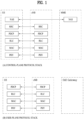
- FIG. 1 illustrates control-plane and user-plane protocol stacks in a radio interface protocol architecture conforming to a 3GPP wireless access network standard between a UE and an evolved UMTS terrestrial radio access network (E-UTRAN).
- the control plane is a path in which the UE and the E-UTRAN transmit control messages to manage calls
- the user plane is a path in which data generated from an application layer, for example, voice data or Internet packet data is transmitted.
- a physical (PHY) layer at layer 1 (L1) provides information transfer service to its higher layer, a medium access control (MAC) layer.
- the PHY layer is connected to the MAC layer via transport channels.
- the transport channels deliver data between the MAC layer and the PHY layer.
- Data is transmitted on physical channels between the PHY layers of a transmitter and a receiver.
- the physical channels use time and frequency as radio resources. Specifically, the physical channels are modulated in orthogonal frequency division multiple access (OFDMA) for downlink (DL) and in single carrier frequency division multiple access (SC-FDMA) for uplink (UL).
- OFDMA orthogonal frequency division multiple access
- SC-FDMA single carrier frequency division multiple access
- the MAC layer at layer 2 provides service to its higher layer, a radio link control (RLC) layer via logical channels.
- the RLC layer at L2 supports reliable data transmission.
- RLC functionality may be implemented in a function block of the MAC layer.
- a packet data convergence protocol (PDCP) layer at L2 performs header compression to reduce the amount of unnecessary control information and thus efficiently transmit Internet protocol (IP) packets such as IP version 4 (IPv4) or IP version 6 (IPv6) packets via an air interface having a narrow bandwidth.
- IP Internet protocol
- IPv4 IP version 4
- IPv6 IP version 6
- a radio resource control (RRC) layer at the lowest part of layer 3 (or L3) is defined only on the control plane.
- the RRC layer controls logical channels, transport channels, and physical channels in relation to configuration, reconfiguration, and release of radio bearers.
- a radio bearer refers to a service provided at L2, for data transmission between the UE and the E-UTRAN.
- the RRC layers of the UE and the E-UTRAN exchange RRC messages with each other. If an RRC connection is established between the UE and the E-UTRAN, the UE is in RRC Connected mode and otherwise, the UE is in RRC Idle mode.
- a Non-Access Stratum (NAS) layer above the RRC layer performs functions including session management and mobility management.
- NAS Non-Access Stratum
- DL transport channels used to deliver data from the E-UTRAN to UEs include a broadcast channel (BCH) carrying system information, a paging channel (PCH) carrying a paging message, and a shared channel (SCH) carrying user traffic or a control message.
- BCH broadcast channel
- PCH paging channel
- SCH shared channel
- DL multicast traffic or control messages or DL broadcast traffic or control messages may be transmitted on a DL SCH or a separately defined DL multicast channel (MCH).
- UL transport channels used to deliver data from a UE to the E-UTRAN include a random access channel (RACH) carrying an initial control message and a UL SCH carrying user traffic or a control message.
- RACH random access channel
- Logical channels that are defined above transport channels and mapped to the transport channels include a broadcast control channel (BCCH), a paging control channel (PCCH), a Common Control Channel (CCCH), a multicast control channel (MCCH), a multicast traffic channel (MTCH), etc.
- BCCH broadcast control channel
- PCCH paging control channel
- CCCH Common Control Channel
- MCCH multicast control channel
- MTCH multicast traffic channel
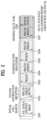
- FIG. 2 illustrates physical channels and a general method for transmitting signals on the physical channels in the 3GPP system.
- the UE when a UE is powered on or enters a new cell, the UE performs initial cell search (S201).
- the initial cell search involves acquisition of synchronization to an eNB. Specifically, the UE synchronizes its timing to the eNB and acquires a cell identifier (ID) and other information by receiving a primary synchronization channel (P-SCH) and a secondary synchronization channel (S-SCH) from the eNB. Then the UE may acquire information broadcast in the cell by receiving a physical broadcast channel (PBCH) from the eNB.
- PBCH physical broadcast channel
- the UE may monitor a DL channel state by receiving a downlink reference signal (DL RS).
- DL RS downlink reference signal
- the UE may acquire detailed system information by receiving a physical downlink control channel (PDCCH) and receiving a physical downlink shared channel (PDSCH) based on information included in the PDCCH (S202).
- PDCCH physical downlink control channel
- PDSCH physical downlink shared channel
- the UE may perform a random access procedure with the eNB (S203 to S206).
- the UE may transmit a predetermined sequence as a preamble on a physical random access channel (PRACH) (S203 and S205) and may receive a response message to the preamble on a PDCCH and a PDSCH associated with the PDCCH (S204 and S206).
- PRACH physical random access channel
- the UE may additionally perform a contention resolution procedure.
- the UE may receive a PDCCH and/or a PDSCH from the eNB (S207) and transmit a physical uplink shared channel (PUSCH) and/or a physical uplink control channel (PUCCH) to the eNB (S208), which is a general DL and UL signal transmission procedure.
- the UE receives downlink control information (DCI) on a PDCCH.
- the DCI includes control information such as resource allocation information for the UE. Different DCI formats are defined according to different usages of DCI.
- Control information that the UE transmits to the eNB on the UL or receives from the eNB on the DL includes a DL/UL acknowledgment/negative acknowledgment (ACK/NACK) signal, a channel quality indicator (CQI), a precoding matrix index (PMI), a rank indicator (RI), etc.
- ACK/NACK DL/UL acknowledgment/negative acknowledgment
- CQI channel quality indicator
- PMI precoding matrix index
- RI rank indicator
- the UE may transmit control information such as a CQI, a PMI, an RI, etc. on a PUSCH and/or a PUCCH.
- an ultra-high frequency band that is, a millimeter frequency band at or above 6GHz is under consideration in the NR system to transmit data in a wide frequency band, while maintaining a high transmission rate for multiple users.
- the 3GPP calls this system NR.
- the system will also be referred to as an NR system.
- various numerologies or subcarrier spacings may be supported to support various 5G services.
- SCSs subcarrier spacings
- a wide area in traditional cellular bands may be supported, while with an SCS of 30kHz or 60kHz, a dense urban area, a lower latency, and a wide carrier bandwidth may be supported.
- an SCS of 60kHz or higher a bandwidth larger than 24.25kHz may be supported to overcome phase noise.
- An NR frequency band may be defined by two types of frequency ranges, FR1 and FR2.
- FR1 may be a sub 6GHz range
- FR2 may be an above 6GHz range called millimeter wave (mmW).
- mmW millimeter wave
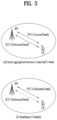
- FIG. 3 is a diagram illustrating an exemplary wireless communication system supporting an unlicensed band to which various embodiments of the present disclosure are applicable.
- a cell operating in a licensed band (hereinafter, referred to as L-band) is defined as an L-cell, and a carrier of the L-cell is defined as a (DL/UL) LCC.
- a cell operating in an unlicensed band (hereinafter, referred to as a U-band) is defined as a U-cell, and a carrier of the U-cell is defined as a (DL/UL) UCC.
- the carrier/carrier-frequency of a cell may refer to the operating frequency (e.g., center frequency) of the cell.
- a cell/carrier e.g., component carrier (CC)
- CC component carrier
- the LCC when the UE and the BS transmit and receive signals in carrier-aggregated LCC and UCC, the LCC may be configured as a primary CC (PCC) and the UCC may be configured as a secondary CC (SCC).
- PCC primary CC
- SCC secondary CC
- the UE and the BS may transmit and receive signals in one UCC or a plurality of carrier-aggregated LCC and UCC. That is, the UE and the BS may transmit and receive signals only in the UCC(s) without the LCC.
- An operation of transmitting and receiving a signal in an unlicensed band as described in various embodiments of the present disclosure may be performed based on all the deployment scenarios described above (unless otherwise stated).
- LTE frame structure type 3 or an NR frame structure may be used for operation in an unlicensed band.
- the configuration of OFDM symbols occupied for a UL/DL signal transmission in the frame structure for the unlicensed band may be configured by the BS.
- an OFDM symbol may be replaced with an SC-FDM(A) symbol.
- the BS may indicate the configuration of OFDM symbols used in subframe #n to the UE by signaling.
- a subframe may be replaced with a slot or a TU.
- the UE may assume (or identify) the configuration of OFDM symbols occupied in subframe #n by a specific field (e.g., a Subframe configuration for LAA field) in DCI received in subframe #n-1 or subframe #n from the BS.
- a specific field e.g., a Subframe configuration for LAA field
- Table 2 illustrates an exemplary method of indicating the configuration of OFDM symbols used for transmission of a DL physical channel and/or physical signal in a current and/or next subframe by the Subframe configuration for LAA field in the wireless communication system.
- [Table 2] Value of 'Subframe configuration for LAA' field in current subframe Configuration of occupied OFDM symbols (current subframe, next subframe) 0000 (-,14) 0001 (-,12) 0010 (-,11) 0011 (-,10) 0100 (-,9) 0101 (-.6) 0110 (-,3) 0111 (14,*) 1000 (12,-) 1001 (11,-) 1010 (10,-) 1011 (9,-) 1100 (6,-) 1101 (3,-) 1110 reserved 1111 reserved NOTE: - (-, Y) means UE may assume the first Y symbols are occupied in next subframe and other symbols in the next subframe are not occupied.
- - (X,-) means UE may assume the first X symbols are occupied in current subframe and other symbols in the current subframe are not occupied.
- - (X,*) means UE may assume the first X symbols are occupied in current subframe, and at least the first OFDM symbol of the next subframe is not occupied.
- the BS may transmit information about a UL transmission period to the UE by signaling.
- the UE may acquire 'UL duration' and 'UL offset' information for subframe #n from a 'UL duration and offset' field in detected DCI.
- Table 3 illustrates an exemplary method of indicating a UL offset and UL duration configuration by the UL duration and offset field in the wireless communication system.
- the BS may perform a DL channel access procedure (CAP) for the unlicensed band as follows.
- CAP DL channel access procedure
- This subclause describes CAPs to be performed by the BS, in which a time duration spanned by sensing slots sensed to be idle before DL transmission(s) is random. This subclause is applicable to the following transmissions:
- a BS may sense whether a channel is in an idle state during a sensing slot period of a defer duration Td, and perform a transmission after a counter N becomes 0 in the following step 4.
- the counter N is adjusted by channel sensing for an additional sensing slot duration according to the following procedure.
- FIG. 4 is a diagram illustrating a DL CAP for transmission in an unlicensed band, to which various embodiments of the present disclosure are applicable.
- a Type 1 DL CAP for transmission in an unlicensed band may be summarized as follows.
- a transmission node e.g., a BS
- the BS may randomly select a backoff counter N within a contention window (CW) according to step 1.
- N is set to an initial value N init (2020).
- N init is a random value selected between 0 and CW p .
- the BS terminates the CAP (2032).
- the BS may then perform a transmission (Tx) burst transmission (2034).
- the backoff counter value N is not 0 (2030; N)
- the BS decrements the backoff counter value by 1 according to step 2 (2040).
- the BS checks whether the channel is idle (2050). If the channel is idle (2050; Y), the BS determines whether the backoff counter value is 0 (2030).
- the BS determines whether the channel is idle during a longer defer duration T d (25usec or longer) than a sensing slot duration (e.g., 9usec) (2060). If the channel is idle during the defer duration (2070; Y), the BS may resume the CAP.
- T d 25usec or longer
- a sensing slot duration e.g. 9usec
- the BS senses the channel during the defer duration and determines whether the channel is idle. If the channel is idle during the defer duration, the BS may resume the CAP from the backoff counter value 5 (or from the backoff counter value 4 obtained by decrementing the backoff counter value 5 by 1), instead of setting the backoff counter value N init .
- the BS determines again whether the channel is idle during a new defer duration by performing step 2060 again.
- the BS may perform the transmission on the channel, if the following condition is satisfied:
- the BS is ready to transmit and the channel is sensed to be idle during at least a sensing slot duration T sl , and if the channel has been sensed to be idle during all the sensing slot durations of a defer duration T d immediately before this transmission.
- the BS proceeds to step 1 after sensing the channel to be idle during the sensing slot durations of the defer duration T sl .
- Each sensing slot duration T sl is 9us and the duration Tf includes an idle sensing slot duration T sl at the start of the duration Tf.
- Table 4 illustrates that mp, a minimum CW, a maximum CW, a maximum channel occupancy time (MCOT), and an allowed CW size applied to a CAP vary according to a channel access priority class.
- Channel Access Priority Class ( p ) m p CW min, p CW max, p T m cot, p allowed CW p sizes 1 1 3 7 2 ms ⁇ 3,7 ⁇ 2 1 7 15 3 ms ⁇ 7,15 ⁇ 3 3 15 63 8 or 10 ms ⁇ 15,31,63 ⁇ 4 7 15 1023 8 or 10 ms ⁇ 15,31,63,127,255,511,1023 ⁇
- Tf includes a sensing slot at the start of T f . If two sensing slots within T short dl are sensed to be idle, the channel is considered to be idle for T short dl .
- Tf includes a sensing slot occurring within last 9 us of Tf.
- the channel is sensed to be in an idle state at least total 5us or more along with sensing of at least 4us occurring in the sensing slot, the channel is considered as idle during Tf.
- a duration corresponding to the transmission is maximum 584 us.
- the BS may access multiple channels on which a transmission is performed in one of the following Type A and Type B procedures.
- a counter N considered in a CAP is determined for each channel c i , and in this case, the counter for each channel is represented as N c i .
- the counter N considered in the CAP is determined independently for each channel c i , and the counter for each channel is represented as N c i .
- the BS may resume N c i reduction, when an idle slot is detected after waiting for a duration of 4 ⁇ T sl or reinitializing N c i , for each channel ci (where ci is different from cj ( c i ⁇ c j )).
- the counter N for each channel c j ⁇ C may be determined according to the aforedescribed subclause 1.8.3., and is denoted by N c j .
- c j may mean a channel having the largest CWp value.
- N c i N c j .
- the BS When the BS ceases a transmission on any one channel for which N c i has been determined, the BS reinitializes N c i for all channels.
- the BS may select a channel c j ⁇ C as follows.
- the BS For a transmission on a channel c j , the BS performs channel access on the channel c j according to the procedure described in subclause 1.8.3.1 along with the modification described in subclause 1.8.4.2.1. or subclause 1.8.4.2.2.
- the BS may perform a transmission on the channel c i immediately after sensing that the channel c i is idle during at least the sensing interval T mc .
- the channel c i may be considered to be idle for T mc .
- the BS does not continuously perform transmissions on the channel c i ⁇ c j ( c i ⁇ C ) for a period exceeding T mcot,p as given in Table 15.
- T mcot,p is determined using a channel access parameter used for the channel c j .
- the channel frequency of the channel set C selected by the gNB is one subset of a predefined channel frequency set.
- a single CWp value is maintained for a channel set C .
- step 2 in the procedure described in subclause 1.8.3.1 is modified as follows.
- a CWp value is maintained independently for each channel c i ⁇ C .
- the CWp value of the channel c j 1 ⁇ C is used.
- c j 1 is a channel having the largest CWp among all channels of the set C.
- the UE and the BS that schedules a UL transmission for the UE perform the following procedure for access to a channel (on which LAA SCell transmission(s) is performed).
- a channel on which LAA SCell transmission(s) is performed.
- UL CAP operations applicable to the present disclosure will be described below in detail, with the unlicensed bands represented as LAA SCells.
- the UL CAP operations may be applied in the same manner even when only an unlicensed band is configured for the UE and the BS.
- the UE may access a channel on which UL transmission(s) is performed according to a Type 1 or Type 2 UL CAP.
- Table 5 illustrates that mp, a minimum CW, a maximum CW, an MCOT, and an allowed CW size applied to a CAP vary according to a channel access priority class.
- This subclause describes a CAP performed by a UE, in which a time duration spanned by sensing slots sensed to be idle before a UL transmission(s) is random. This subclause is applicable to the following transmissions:
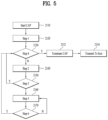
- FIG. 5 is a diagram illustrating a UL CAP for transmission in an unlicensed band to which various embodiments of the present disclosure are applicable.
- the Type 1 UL CAP of the UE for transmission in the unlicensed band may be summarized as follows.
- a transmission node e.g., a UE may initiate a CAP to operate in an unlicensed band (2110).
- the UE may select a backoff counter N randomly within a CW according to step 1.
- N is set to an initial value N init (2120).
- N init is a value randomly selected between 0 and CW p .
- the UE ends the CAP (2132). The UE may then transmit a Tx burst (2134). On the other hand, if the backoff counter value is not 0 (2130; N), the UE decrements the backoff counter value by 1 according to step 2 (2140).
- the UE checks whether a channel is idle (2150). If the channel is idle (2150; Y), the UE checks whether the backoff counter value is 0 (2130).
- the UE checks whether the channel is idle during a defer duration T d (of 25usec or more) longer than a slot duration (e.g., 9usec) according to step 5 (2160). If the channel is idle for the defer duration (2170; Y), the UE may resume the CAP.
- T d of 25usec or more
- a slot duration e.g. 9usec
- the UE senses the channel during the defer duration and determines whether the channel is idle. If the channel is idle during the defer duration, the UE may perform the CAP again from the backoff counter value 5 (or the backoff counter value 4 after decrementing the backoff counter value by 1), instead of setting the backoff counter value N init .
- the UE checks again whether the channel is idle during a new defer duration by performing operation 2160 again.
- the UE may perform the UL transmission on the channel, if the following conditions are satisfied.
- the UE proceeds to step 1 after sensing the channel to be idle during the slot durations of the defer duration T d .
- the UE uses the Type 2A UL CAP for a UL transmission.
- the channel is considered to be idle for T short_ul , if two sensing slots within T short_ul are sensed to be idle.
- a UE uses a type 2B channel access procedure for UL transmission.
- Tf includes a sensing slot occurring within last 9 us of Tf.
- the channel is considered as idle during Tf.
- a UE If a UE is instructed to perform a type 2C UL channel access procedure, the UE does not sense a channel to perform a transmission before performing the transmission.
- a duration corresponding to the transmission is maximum 584 us.
- Tx Transmission
- a terminal e.g., a User Equipment (UE) and/or a mobile device
- controlling the transmit power of the UE and/or the mobile device may be referred to as uplink power control.
- a transmission (Tx) power control method may be applied to satisfy requirements (e.g., a Signal-to-Noise Ratio (SNR), a Bit Error Ratio (BER), a Block Error Ratio (BLER), etc.) at a base station (e.g., gNB, eNB, etc.).
- SNR Signal-to-Noise Ratio
- BER Bit Error Ratio
- BLER Block Error Ratio
- the power control may be performed by an open-loop power control method or a closed-loop power control method.
- the open-loop power control method refers to a method of controlling transmit power without feedback from a TX device (e.g., a base station, etc.) to a Reception (Rx) device (e.g., a UE, etc.) and/or feedback from the RX device to the Tx device.
- a TX device e.g., a base station, etc.
- Rx Reception
- a UE may receive a specific channel/signal (pilot channel/signal) from a Base Station (BS) and estimate the strength of Rx power using the same. Thereafter, the UE may control the transmit power using the estimated strength of the Rx power.
- BS Base Station
- the closed loop power control method refers to a method of controlling transmit power based on feedback from a Tx device to a Rx device and/or feedback from the Rx device to the Tx device.
- a BS receives a specific channel/signal from a UE and determines an optimal power level of the UE based on a power level measured via the received specific channel/signal, SNR, BER, BLER, etc.
- the BS transmits information (i.e., feedback) on the determined optimal power level to the UE through a control channel or the like, and the corresponding UE may control the transmit power using the feedback provided by the BS.
- PUSCH Physical Uplink Shared Channel
- PUCCH Physical Uplink Control Channel
- SRS Sounding Reference Signal
- PRACH Physical Random Access Channel
- a transmission occasion (i.e., Tx time unit) (i) for PUSCH, PUCCH, SRS, and/or PRACH may be defined by a slot index n_s in a frame of a System Frame Number (SFN), a first symbol S in a slot, the number L of consecutive symbols, and the like.
- SFN System Frame Number
- a power control method will be described below based on a case where a UE performs PUSCH transmission for convenience of description. Yet, the corresponding power control method is not limited to the PUCSH transmission and may be extended and applied to other uplink data channels supported by a wireless communication system.
- a UE may calculate a linear power value of Tx power determined by Equation 1 below. Thereafter, the UE may control Tx power based on the calculated linear power value in consideration of the number of antenna ports, the number of SRS ports, and/or the like.
- the UE may determine a PUSCH Tx power P PUSCH ,b,f,c ( i,j,q d ,l ) (dBm) on a PUSCH transmission occasion (i).
- P PUSCH , b , ⁇ , c i j q d l min P CMAX , ⁇ , c i , P O _ PUSCH , b , ⁇ , c j + 10 log 10 2 ⁇ ⁇ M RB , b , ⁇ , c PUSCH i + ⁇ b , ⁇ , c j ⁇ PL b , ⁇ , c q d + ⁇ TF , b , ⁇ , c i + ⁇ b , ⁇ , c i l
- an index j indicates an index for an open-loop power control parameter (e.g., Po, alpha ( ⁇ ), etc.), and maximum 32 parameter sets may be configured per cell.
- An index q_d indicates an index of a DL RS resource for a PathLoss (PL) measurement (e.g., PL b,f,c ( q d )), and maximum 4 measurement values may be configured per cell.
- An index l indicates an index for a closed-loop power control process, and maximum 2 processes may be configured per cell.
- PL PathLoss
- Po (e.g., P O_PUSCH, b,f,c ( j )) is a parameter broadcasted as a part of system information and may indicate a target Rx power on an Rx side.
- the corresponding Po value may be configured in consideration of throughput of a UE, capacity of a cell, noise, interference, and/or the like.
- alpha (e.g., ⁇ b,f,c ( j )) may indicate a rate of performing compensation for a pathloss.
- the alpha may be configured as a value ranging 0 to 1, and a full pathloss compensation or a fractional pathloss compensation may be performed depending of the configured value.
- the alpha value may be configured in consideration of inter-UE interference, data rate, and/or the like.
- P CMAX, f,c ( i ) may indicate a configured UE transmit power.
- the configured UE transmit power may be interpreted as ⁇ configured maximum UE output power)' defined in 3GPP TS 38.101-1 and/or TS 38.101-2.
- M RB , b , ⁇ , c PUSCH i may indicate a bandwidth of PUSCH resource allocation represented as the number of Resource Blocks (RBs) for a PUSCH transmission occasion based on subcarrier spacing ( ⁇ ).
- f b,f,c ( i,l ) related to a PUSCH power control adjustment state may be configured or indicated based on a TPC command field of DCI (e.g., DCI format 0_0, DCI format 0_1, DCI format 2_2, DCI format 2_3, etc.).
- DCI e.g., DCI format 0_0, DCI format 0_1, DCI format 2_2, DCI format 2_3, etc.
- a Radio Resource Control (RRC) parameter (e.g., SRI-PUSCHPowerControl-Mapping, etc.) may indicate the linkage between an SRI (SRS Resource Indicator) field of Downlink Control Information (DCI) and the aforementioned indexes j, q_d, l and the like. So to speak, the aforementioned indexes j, q_d, l and the like may be associated with a beam, a panel, a spatial domain transmission filter, and/or the like based on specific information. Through this, a PUSCH Tx power control in unit of a beam, a panel, and/or a spatial domain transmission filter may be performed.
- RRC Radio Resource Control
- the above-described parameters and/or information for the PUSCH power control may be individually (i.e., independently) configured per BWP.
- the corresponding parameters and/or information may be configured or indicated through higher layer signaling (e.g., RRC signaling, Medium Access Control-Control Element (MAC-CE), etc.), DCI and/or the like.
- the parameters and/or information for the PUSCH power control may be delivered through RRC signaling PUSCH-ConfigCommon, PUSCH-PowerControl, etc.
- a power control method will be described below based on a case where a UE performs PUCCH transmission for convenience of description. Yet, the corresponding power control method is not limited to the PUCCH transmission and may be extended and applied to other uplink data channels supported by a wireless communication system.
- the UE may determine a PUCCH transmit power P PUCCH, b,f,c ( i,q u ,q d ,l ) (dBm) on a PUCCH transmission occasion (i) based on Equation 2 below.
- P PUCCH , b , ⁇ , c i q u q d l min P CMAX , ⁇ , c i , P O _ PUCCH , b , ⁇ , c q u + 10 log 10 2 ⁇ ⁇ M RB , b , ⁇ , c PUCCH i + PL b , ⁇ , c q d + ⁇ F_PUCCH F + ⁇ TF , b , ⁇ , c i + g b , ⁇ , c i l
- Equation 2 q_u indicates an index for an open-loop power control parametrer (e.g., Po, etc.), and maximum 8 parameter values may be configured per cell.
- An index q_d indicates an index of a DL RS resource for a PathLoss (PL) measurement (e.g., PL b,f,c ( q d )), and maximum 4 measurement values may be configured per cell.
- An index l indicates an index for a closed-loop power control process, and maximum 2 processes may be configured per cell.
- Po (e.g., P O_PUCCH, b,f,c ( q u )) is a parameter broadcasted as a part of system information and may indicate a target Rx power on an Rx side.
- the corresponding Po value may be configured in consideration of throughput of a UE, capacity of a cell, noise, interference, and/or the like.
- P CMAX, f,c ( i ) may indicate a configured UE transmit power.
- the configured UE transmit power may be interpreted as ⁇ configured maximum UE output power)' defined in 3GPP TS 38.101-1 and/or TS 38.101-2.
- M RB , b , ⁇ , c PUCCH i may indicate a bandwidth of PUCCH resource allocation represented as the number of Resource Blocks (RBs) for a PUCCH transmission occasion based on subcarrier spacing ( ⁇ ).
- a delta function e.g., ⁇ F_PUCCH ( F ), ⁇ TF, b,F,c ( i )
- a PUCCH format e.g., PUCCH formats 0, 1, 2, 3, 4, etc.
- g b,f,c ( i , l ) related to a PUCCH power control adjustment state may be configured or indicated based on a TPC command field of DCI (e.g., , etc.) received or detected by the UE.
- a specific RRC parameter e.g., PUCCH-SpatialRelationInfo, etc.
- a specific MAC-CE command e.g., PUCCH spatial relation Activation/Deactivation , etc.
- PUCCH spatial relation Activation/Deactivation command in MAC-CE may activate or deactivate the linkage between the PUCCH resource and the aforementioned indexes q_u, q_d and l based on an RRC parameter PUCCH-SpatialRelationInfo.
- the aforementioned indexes q_u, q_d, l and the like may be associated with a beam, a panel, a spatial domain transmission filter, and/or the like based on specific information.
- a PUCCH Tx power control in unit of a beam, a panel, and/or a spatial domain transmission filter may be performed.
- the above-described parameters and/or information for the PUCCH power control may be individually (i.e., independently) configured per BWP.
- the corresponding parameters and/or information may be configured or indicated through higher layer signaling (e.g., RRC signaling, Medium Access Control-Control Element (MAC-CE), etc.), DCI and/or the like.
- the parameters and/or information for the PUCCH power control may be delivered through RRC signaling PUCCH-ConfigCommon, PUCCH-PowerControl, etc.
- the UE may determine a PRACH transmit power P PRACH, b,f,c ( i ) (dBm) on a PRACH transmission occasion (i) based on Equation 3 below.
- P PRACH , b , ⁇ , c i min P CMAX , ⁇ , c i , P PRACH , target , ⁇ , c + PL b , ⁇ , c
- P CMAX, f,c ( i ) may indicate a configured UE transmit power.
- the configured UE transmit power may be interpreted as 'configured maximum UE output power' defined in 3GPP TS 38.101-1 and/or TS38.101-2.
- P PRACH, target, f,c indicates a PRACH target reception power provided through higher layer signaling (e.g., RRC signaling, MAC-CE, etc.) for an active UL BWP.
- PL b,f,c indicates a pathloss for an active UL BWP, and may be determined based on a DL RS associated with PRACH transmission on an active DL BWP of a serving cell (c).
- the UE may determine a pathloss related to PRACH transmission based on Synchronization Signal/Physical Broadcast Channel (SS/PBCH) block and the like associated with the PRACH transmission.
- SS/PBCH Synchronization Signal/Physical Broadcast Channel
- the above-described parameters and/or information for the PRACH power control may be individually (i.e., independently) configured per BWP.
- the corresponding parameters and/or information may be configured or indicated through higher layer signaling (e.g., RRC signaling, MAC-CE, etc.).
- the parameters and/or information for the PRACH power control may be delivered through RRC signaling RACH-ConfigGeneric, etc.
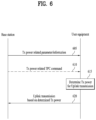
- FIG. 6 is a diagram to describe an embodiment of a procedure for controlling an uplink transmit power.
- a User Equipment may receive a parameter and/or information related to a Transmission (Tx) power from a Base Station (BS) [605].
- the UE may receive the parameter and/or information through higher layer signaling (e.g., RRC signaling, MAC-CE, etc.).
- RRC signaling e.g., RRC signaling, MAC-CE, etc.
- the UE may receive the parameter and/or information related to the aforementioned Tx power control.
- the UE may receive a TPC command related to a Tx power from the BS [610].
- the UE may receive the corresponding TPC command through lower layer signaling (e.g., DCI, etc.).
- DCI e.g., DCI, etc.
- the UE may receive information on a TPC command, which is to be used for determination of a power control adjustment state and the like, through a TPC command field of a predetermined DCI format.
- the corresponding step may be skipped.
- the UE may determine (or calculate) a Tx power for Uplink (UL) transmission [615]. For example, based on the above-described method (e.g., Equation 1, Equation 2, Equation 3, etc.), the UE may determine a PUSCH Tx power, a PUCCH Tx power, an SRS Tx power, and/or a PRACH Tx power. And/or, like such a situation as carrier aggregation, if two or more UL channels and/or signals need to be transmitted by overlapping with each other, the UE may determine a Tx power for UL transmission in consideration of the above-described priority and the like.
- Equation 1, Equation 2, Equation 3, etc. the UE may determine a PUSCH Tx power, a PUCCH Tx power, an SRS Tx power, and/or a PRACH Tx power.
- the UE may determine a Tx power for UL transmission in consideration of the above-described priority and the like.
- the UE may perform transmission of one or more UL channels and/or signals (e.g., PUSCH, PUCCH, SRS, PRACH, etc.) to the BS [620].
- one or more UL channels and/or signals e.g., PUSCH, PUCCH, SRS, PRACH, etc.
- FIG. 7 and FIG. 8 Prior to detailed description, an example of implementing operations of a UE and a BS according to an embodiment of the present disclosure will be described with reference to FIG. 7 and FIG. 8 .
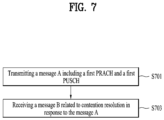
- FIG. 7 is a diagram to describe an implementation example of an operation of a UE according to an embodiment of the present disclosure.
- a message A including a first PRACH (Physical Random Access Channel) and a first PUSCH (Physical Uplink shared Channel) may be transmitted [S701].
- a UE may receive a message B related to contention resolution in response to the message A [S703].
- a specific method of transmitting the message A and receiving the message B by the UE in S701 to S703 may be based on embodiments and features described below.
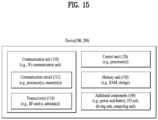
- the UE of FIG. 7 may be any one of various wireless devices disclosed in FIGs. 14 to 17 .
- the UE of FIG. 7 may be a first wireless device 100 of FIG. 14 or wireless devices 100 and 200 of FIG. 15 .
- the operation process of FIG. 7 may be performed and executed by any one of the various wireless devices disclosed in FIG. 14 and FIG. 15 .
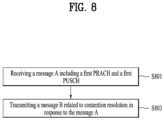
- FIG. 8 is a diagram to describe an implementation example of an operation of a base station according to an embodiment of the present disclosure.
- a BS may receive a message A including a first PRACH (Physical Random Access Channel) and a first PUSCH (Physical Uplink shared Channel) [S801]. Thereafter, the BS may transmit a message B related to contention resolution in response to the message A [S803].
- a specific method of receiving the message A and transmitting the message B by the BS in S801 to S803 may be based on embodiments and features described below.
- the BS of FIG. 8 may be any one of various wireless devices disclosed in FIGs. 14 to 17 .
- the BS of FIG. 8 may be a second wireless device 200 of FIG. 14 or wireless devices 100 and 200 of FIG. 15 .
- the operation process of FIG. 8 may be performed and executed by any one of the various wireless devices disclosed in FIGs. 14 to 17 .
- a UE may perform UL transmission through a random access process (RACH procedure) without receiving a schedule of a direct Uplink (UL) transmission from a given BS or cell.
- RACH procedure random access process
- a random access procedure in LTE and/or NR system includes a 4-step procedure: 1) transmission of a random access preamble; 2) reception of a Message (Msg) 2 corresponding to a Random Access Response (RAR); 3) transmission of a Msg 3 including a Physical Uplink Shared Channel (PUSCH); and 4) reception of a Msg 4 icnluding information on contention resolution.
- the Msg 2 is a message of allocating a UL resource, which will be used by a UE having transmitted the preamble to transmit the Msg 3, by a BS having received a random preamble.
- the UE may transmit information on a connection request along with its identification information such as an International Mobile Subscriber Identity (IMSI), a Temporary Mobile Subscriber Identity (TMSI) and the like.
- IMSI International Mobile Subscriber Identity
- TMSI Temporary Mobile Subscriber Identity
- the BS having received the Msg 3 transmits identification information of the corresponding UE and informations necessary for a random access through the Msg 4, thereby preventing collision that may occur between different UEs in the random access procedure and completing the random access procedure for the corresponding UE.
- 2-step RACH the step of transmitting a Message 3 (Msg 3) containing a physical uplink shared channel (PUSCH) and a step of transmitting a Msg 4 containing a contention resolution message and the like in the existing 4-step RACH are omitted.
- Msg 3 Message 3
- PUSCH physical uplink shared channel
- a UE directly transmits a message corresponding to the Msg 3 to a BS together with a preamble.
- the BS transmits a Msg 4 as a message corresponding to the Msg 4 together with an RAR to the UE.
- the UE decodes the Msg B to complete the random access procedure and then performs data transmission/reception.
- FIG. 9 is a diagram illustrating a basic process of 2-step RACH.
- a UE may receive 2-step RACH related configuration information included in system information broadcasted from a BS [S901].
- the UE Upon receiving the 2-step RACH related configuration information, the UE transmits a Msg A including an RACH preamble (or a PRACH preamble) and PUSCH based on the corresponding configuration information to perform a random access procedure for the BS [S903].
- the RACH preamble and the PUSCH may be transmitted with a predetermined gap in-between or consecutively in a time domain, and Identifier (ID) information of the UE is included in the corresponding PUSCH.
- ID Identifier
- the BS may detect the preamble, thereby predicting and receiving a PUSCH having the corresponding gap or the consecutive PUSCH.
- the BS receives an access request and/or response from a higher layer based on the UE's ID information transmitted through the PUSCH, and then transmits a Msg B including information such as RAR, contention resolution and the like to the UE in response to the Msg A [S905]. Thereafter, depending on whether the UE receives the Msg B, the UE may complete an access to the BS and transceive data with the BS in the same or similar manner as after the operation of receiving the Msg 4 in the existing 4-step RACH procedure.
- a Listen Before Talk (LBT) process required for signal transmission/reception on the unlicensed band may also be applied to signal transmission/reception for the random access procedure. That is, in the NR-Unlicensed (NR-U) spectrum system, a BS and a UE always perform LBT to check an idle or busy state of a Tx/Rx channel before transceiving a signal, which may be performed in the same manner in a procedure for transmitting/receiving Msg A and Msg B for a 2-step RACH procedure on an unlicensed band.
- LBT Listen Before Talk
- a random access procedure performed subsequently may vary depending on the success or failure of LBT for the Msg A PRACH preamble and the Msg A PUSCH. For example, if the UE successfully performs LBT prior to the transmission of the Msg A PRACH preamble and the Msg A PUSCH and transmits up to the Msg A PUSCH without any problems, the BS may receive both of the Msg A PRACH preamble and the Msg A PUSCH correctly, transmit a Msg B including contention resolution information to the UE, and complete the 2-step RACH procedure.
- the UE fails in LBT for the Msg A PRACH preamble or the Msg A PUSCH, the UE l may not successfully transmit a Msg A.
- the BS failing to receive the Msg A may give an instruction of retransmission of the Msg A or fall-back to the 4-step RACH procedure.
- whether to retransmit the Msg A according to the LBT failure may be handled differently depending on a time gap between a Msg A PRACH preamble Tx time and a Msg A PUSCH Tx time.
- a retransmission procedure of the Msg A may vary depending on whether it is a situation that the UE consecutively transmit a Msg A PUSCH after transmitting a Msg A PRACH preamble or a situation that a time gap greater than a minimum time for requiring LBT exists until the UE transmits the Msg A PUSCH after transmitting the Msg A PRACH preamble.
- a Msg A PRACH preamble and a Msg A PUSCH are transmitted consecutively, it may refer to a case that the Msg A PRACH preamble and the Msg A PUSCH are consecutively transmitted in a single slot or a case that the Msg A PRACH preamble and the Msg A PUSCH linked thereto are transmitted in consecutive slots.
- the case that the Msg A PRACH preamble and the Msg A PUSCH are consecutively transmitted includes a case that a time gap amounting to a minimum time for requiring LBT does not exist between the transmission of the Msg A PRACH preamble and the transmission of the Msg A PUSCH, and a situation as shown in FIG. 10 may be an example thereof.
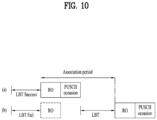
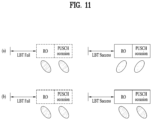
- FIG. 10 is a diagram illustrating an embodiment of Msg A transmission according to LBT success or failure of a UE and a transmission beam direction configuration.
- FIG. 10 (a) shows that a UE consecutively transmits a Msg A PRACH preamble and a Msg A PUSCH as succeeding in LBT at a specific timing.
- FIG. 10 (b) shows that a UE consecutively transmits a Msg A PRACH preamble and a Msg A PUSCH as succeeding in LBT at a next timing after having failed in LBT at a specific timing.
- the UE Since a time gap amounting to an LBT-required condition time does not exist between a Tx timing of the Msg A PRACH preamble and a Tx timing of the Msg A PUSCH in both FIG. 10 (a) and FIG. 10 (b) , the UE performs LBT only before the Msg A PRACH preamble transmission and performs consecutive transmission intactly without performing LBT in transmitting the Msg A PUSCH. Therefore, for such a case, depending on success or failure of LBT performed before a Msg A PRACH preamble transmission, a signal transmission operation of a UE and a BS and a power control for signal transmission thereof may be configured differently.
- the UE may perform LBT for Msg A PRACH preamble transmission again for a next RACH Occasion (RO) after an association period from an LBT failure timing.
- RO RACH Occasion
- the UE if the UE fails in LBT for Msg A PRACH preamble transmission at a predetermined timing, the UE newly starts a random access resource selection procedure, performs SSB selection based on SSB (Synchronization Signal and Physical Broadcast Channel (SS/PBCH)) or a Reference Signal Received Power (RSRP) of Channel State Information-Reference Signal (CSI-RS), and selects an RO and a Random Access Preamble Index (RAPID) associated with the SSB, thereby transmitting a Msg A PRACH preamble on the corresponding RO, and the UE may consecutively transmit a Msg A PUSCH as well.
- SSB Synchron Generation
- RSRP Reference Signal Received Power
- RAPID Random Access Preamble Index
- contents and modulation order included in the Msg A PUSCH may be configured different from the previous Msg A PUSCH transmission to meet a channel environment in which the Msg A PUSCH is transmitted. For example, when a state of a channel at a Msg A PUSCH Tx timing is good, the UE may transmit a Msg A PUSCH in which a larger amount of information is included and may apply a high modulation order thereto.
- Tx factors such as a maximum Tx count for Msg A retransmission, a ramping step size, a power ramping counter and the like need to be configured separately. Specifically, for the configuration of the power ramping counter and the maximum Tx count of the Msg A among the factors, the specific methods described later may be considered.
- a power ramping counter since a Msg A PRACH preamble and a Msg A PUSCH are consecutively transmitted, it may be appropriate to use a common power ramping counter for the Msg A PRACH preamble and the Msg A PUSCH. If a UE fails to transmit the Msg A PRACH preamble on a determined RO according to LBT, the UE may perform the LBT again on a next RO as shown in FIG. 10 (b) and then transmit the Msg A PRACH preamble after succeeding in the LBT.
- the UE may configure a power ramping counter with a maintained or increased value by comparing with a power ramping counter supposed to be configured to transmit the Msg A PRACH preamble in case of previous LBT failure.
- the power ramping counter mentioned in the present disclosure may refer to a power ramping counter used for general retransmission.
- a UE may first maintain a value of a power ramping counter as it is. That is, if the UE succeeds in LBT by performing the LBT for a next RO due to LBT failure for a previous RO and then transmits a Msg A, since the Msg A was not transmitted on the previous RO substantially from the perspective of the UE, randomly increasing a Tx power of the UE may cause inefficient power waste. As a result, the UE may transmit the Msg A by maintaining a Tx power originally intended in a manner of maintaining the value of the power ramping counter as it is.
- a UE may determine a Tx power by increasing a value of a power ramping counter. Although the UE succeeds in LBT by performing the LBT for a next RO due to LBT failure for a previous RO and then transmits a Msg A, the UE may determine the Tx power by configuring the power ramping counter in a manner of increasing a previous value by +1.
- a Msg A Tx power is determined by applying the power ramping counter increased by +1, considering that other UEs having attempted the same RACH at a timing of the previous RO may attempt RACH at a timing of a next RO with a Tx power increased by ramping a power, it is able to prevent a problem of having difficulty in detecting a Msg A PRACH preamble of the UE due to a relatively small Tx power.
- the purpose of the introduction of a 2-step RACH procedure is to further reduce the latency occurring in the 4-step RACH procedure if possible, so latency can be reduced a little by raising detection probability in a manner that the UE consumes an additional power for each retransmission, unlike the 4-step RACH procedure, for a fast network access as latency falls behind due to LBT in NR-U.
- the UE may regard the LBT failure for the previous RO as Msg A transmission failure, increase a power ramping counter by +1, and then apply it to transmission of a Msg A PRACH preamble and a Msg A PUSCH.
- a UE may use a method of maintaining or increasing a power ramping counter according to a Tx beam direction. That is, unlike the method 1) of maintaining a power irrespective of a beam direction and the method 2) of increasing a power irrespective of a beam direction, according to the corresponding method, a UE determines LBT failure for a previous RO as retransmission but a power ramping counter is increased or maintained depending on a Tx beam of the UE.
- FIG. 11 is a diagram illustrating maintaining or increasing a power ramping counter depending on a Tx direction of a UE according to an embodiment of the present disclosure.
- a UE may transmit a Msg A by maintain a power ramping counter of the same value as the previous.
- a UE may transmit a Msg A by increasing a power ramping counter higher than the previous.
- the UE configures a Tx power by maintaining or increasing a power ramping counter depending on whether a Tx spatial beam direction is equal to that of the transmission or retransmission of a previous Msg A.
- the UE since the Tx spatial beam direction for the transmission or retransmission of the Msg A may be associated with an SSB selected by the UE for the transmission or retransmission of the Msg A, the UE may be interpreted as configuring a Tx power by maintaining or increasing a power ramping counter depending on whether the SSB selected by the UE for the transmission or retransmission of the Msg A is the same as an SSB selected for transmission or retransmission of a previous Msg A.
- the Tx spatial beam direction for the transmission or retransmission of the previous Msg A may be conceptually understood as including a Tx spatial beam direction configured for transmission or retransmission of a previous PRACH.
- a UE when a UE transmits or retransmits a Msg A, if not receiving an indication of LBT failure for the transmission or retransmission of the corresponding Msg A from a lower layer, the UE compares an SSB selected by itself with an SSB selected for transmission or retransmission of a previous PRACH. If the SSB selected by itself is not changed, the UE may transmit the Msg A by configuring a Tx power in a manner of increasing a power ramping counter higher by 1 than the previous.
- a UE when a UE transmits or retransmits a Msg A, if not receiving an indication of LBT failure for the transmission or retransmission of the corresponding Msg A from a lower layer, the UE compares an SSB selected by itself with an SSB selected for transmission or retransmission of a previous PRACH. If the SSB selected by itself is changed, the UE may transmit the Msg A by configuring a Tx power in a manner of maintaining a power ramping counter with the same value as the previous.
- a UE When a UE transmits or retransmits a Msg A, if receiving an indication of LBT failure for the transmission or retransmission of the corresponding Msg A, the UE performs retransmission by determining such LBT failure as retransmission. In doing so, if an indication for LBT failure recovery is configured in the UE, the UE may perform a random access resource selection procedure for a 2-step RACH procedure.
- a UE may maintain or increase a power ramping counter depending on the relation between an RO of a 2-step RACH procedure and an RO of a 4-step RACH procedure. Namely, depending on whether an RO of a 2-step RACH procedure and an RO of a 4-step RACH procedure are shared with each other or configured by being separated from each other.
- the RO of a the-step RACH procedure and the RO of the 4-step RACH procedure may be basically shared.
- the ROs are shared, it means that a Msg 1 preamble in the 4-step RACH procedure and a Msg A PRACH preamble in the 2-step RACH procedure are transmitted on the same RO.
- the ROs are configured by being separated from each other, it means that a time/frequency resource for the Msg 1 preamble in the 4-step RACH procedure and a time/frequency resource for the Msg A PRACH preamble in the 2-step RACH procedure exist independently from each other.
- the methods 1) to 3) described above deal with operations in a UE and BS irrespective of whether ROs are shared or configured by being separated from each other, and thus the corresponding method applies a different power ramping counter determining method with respect to whether ROs are shared or configured by being separated from each other. Namely, when an RO for a 2-step RACH procedure and an RO for a 4-step RACH procedure are configured by being separated from each other, a UE performing the 2-step RACH procedure increases a value of a power ramping counter for retransmission by recognizing the LBT failure on RO as Transmission/Reception (Tx/Rx) failure like the methods 2) and 3) described above.
- the UE maintains a value of the power ramping counter like the foregoing method 1) in the same manner of the existing 4-step RACH procedure of NR-U without separation between the 2-step RACH procedure and the 4-step RACH procedure.
- a maximum Tx count of a Msg A in a 2-step RACH procedure may be give separately from a 4-step RACH procedure, and may follow a maximum Tx count configured for a Msg 1 of the 4-step RACH procedure if there is no value given separately. If a value of a power ramping counter is configured greater by 1 than a maximum Tx count of a Msg A, a UE may progress a reestablishment procedure according to Radio Link Failure (RLF).
- RLF Radio Link Failure
- a maximum Tx count of a Msg 1 for the 4-step RACH procedure is configured greater than that of a Msg A in the2-step RACH procedure
- the UE may transmit the Msg 1 only from the time when the power ramping counter becomes greater by 1 than the maximum Tx count of the Msg A.
- a value of a ramping step size may determine a Tx power for retransmission by applying a ramping step size for the Msg 1 from the time when the power ramping counter becomes greater by 1 than the maximum Tx count of the Msg A. In this case, fallback and RLF operations of the UE with respect to a value and of each counter and a maximum value may be applicable not only to NR-U but also to NR.
- the corresponding case means that a time gap greater than an LBT-required minimum time exists until a UE transmits a Msg A PUSCH after having transmitted a Msg A PRACH preamble. Since transmission of the Msg A PRACH preamble and transmission of the Msg A PUSCH are performed discontinuously with a predetermined gap, the UE performs LBT on both of the Msg A PRACH preamble transmission and the Msg A PUSCH transmission. Therefore, operations of the UE and BS may vary differently depending on whether to succeed or fail in LBT for a Tx timing of each signal.
- a Msg A PRACH preamble and a Msg A PUSCH are transmitted with a predetermined gap, it is able to consider both a signal counter sharing a power ramping counter to use in relation to retransmission power configurations of the Msg A PRACH preamble and the Msg A PUSCH and a dual counter configuring to use a power ramping counter for each retransmission power configuration of the Msg A PRACH preamble and the Msg A PUSCH.
- a maximum Tx count of a Msg A is not applied in common to the Msg A PRACH preamble and the Msg A PUSCH, but a maximum Tx count for each of the Msg A PRACH preamble and the Msg A PUSCH may be configured.
- a condition in which a value of the counter is increased or maintained may be a presence or non-presence of a change in a direction of a Tx spatial beam for Msg A PRACH preamble transmission in Msg A retransmission. That is, if the Tx spatial beam direction for the Msg A PRACH preamble transmission is the same as the previous transmission, the counter value increases. If the Tx spatial beam direction for the Msg A PRACH preamble transmission is different from the previous transmission, the counter value is maintained.
- the condition under which the value of each counter is increased or maintained may be a presence or absence of a change in a Tx spatial beam direction for each of the Msg A PRACH preamble and the Msg APUSCH, compared to the previous transmission. That is, for the Msg A PRACH preamble and the Msg A PUSCH, the value of each counter increases if the Tx spatial beam direction for transmission of each signal is the same as the previous transmission, or the value of each counter is maintained if the Tx spatial beam direction for transmission of each signal is different from the previous transmission.
- the term 'reattempt' mentioned in the present disclosure below means that a Msg A PRACH preamble is not transmitted on an original RO due to LBT failure but is transmitted on a next RO, or that a Msg A PUSCH is not transmitted on an original PO due to LBT failure but is transmitted on a next PO.
- a case of transmitting a different Msg A PRACH preamble on an originally scheduled RO despite being unable to transmit a Msg A PRACH preamble intended to transmit originally due to LBT failure does not mean the 'reattempt' mentioned in the present disclosure, and in this case, the counter value does not increase as well.
- the UE may increase or maintain a corresponding common power ramping counter value according to the aforementioned embodiments for a case that the Msg A PRACH preamble and the Msg A PUSCH are transmitted consecutively.
- a value of the counter for each of the Msg A PRACH preamble and the Msg A PUCSH may be independently increased or maintained. Particularly, if a Tx spatial beam direction configured for transmission of each signal is the same as the previous transmission, a value of each counter is increased. If a Tx spatial beam direction configured for transmission of each signal is different from the previous transmission, a value of each counter is maintained.
- the UE may continuously transmit the Msg A or fall back to the 4-step of transmitting a Msg 1 only. According to each method, operations of the UE and BS may be changed.
- an operation of the UE may be changed according to whether a PO is configured to include a time gap for LBT or whether a PO is configured to exclude a time gap for LBT.
- the UE performs LBT within a time gap for the corresponding LBT. If succeeding in the LBT, the UE may transmit a Msg A PUSCH simultaneously with the success. Alternatively, the UE performs the LBT within the time gap for the corresponding LBT. If succeeding in the LBT, the UE may transmit a random signal before a starting symbol of Msg A PUSCH, which is preconfigured for exclusive occupation of a channel till a timing for intending to transmit a Msg A PUSCH originally, and then transmit a Msg A PUSCH from the starting symbol of Msg A PUSCH.
- a PO when a PO is configured to exclude a time gap for LBT, if a UE performs the LBT before the corresponding PO and fails to succeed in the LBT until a starting symbol of the corresponding PO, the UE, like the embodiments described below, may perform LBT for transmitting a Msg A PUSCH only on a next PO and attempt transmission of a Msg A PUSCH, may perform LBT again to transmit a Msg A PRACH preamble on a next RO and reattempt transmission of a Msg A, or may fall back to a 4-step RACH procedure by transmitting a Msg 1 only.
- HARQ-ACK Hybrid Automatic Repeat reQuest-Acknowledgement
- a BS may UE-specifically designate a resource for PUCCH to be transmitted by a UE using PDCCH (DCI) of a Msg 4.
- DCI PDCCH
- PDCCH for scheduling a Msg 4 is configured as DCI format 1_0 scrambled with a Temporary Cell-Radio Network Temporary Identifier (TC-RNTI), unlike the case of DCI format 1_0 scrambled with a Random Access-RNTI (RA-RNTI), five DCI field elements except 1 bit for indicating a DCI format may be additionally indicated as follows.
- TC-RNTI Temporary Cell-Radio Network Temporary Identifier
- RA-RNTI Random Access-RNTI
- a maximum 3-bit PUCCH resource indicator and 3-bit PDSCH-to-HARQ_feedback timing indicator may be used for indication of a PUCCH resource.
- the PDSCH-to-HARQ_feedback timing indicator is used to indicate a slot interval between a PDSCH including a Msg 4 and a PUCCH including HARQ-ACK to be transmitted by a UE and may indicate a value selected from ⁇ 0, 1, 2, 3, 4, 5, 6, 7 ⁇ .
- the PDSCH-to-HARQ_feedback timing indicator indicates a value selected from ⁇ 0, 1, 2, 3, 4, 5, 6, 7 ⁇ as a slot interval k, and the UE transmits the PUCCH including HARQ-ACK in a slot #n+k.
- the PUCCH resource indicator is used to indicate several parameters for a PUCCH resource configuration and uses a resource mapped according to a bit for dl-DataToUL-ACK SEQUENCE (SIZE (1..8)) OF INTEGER (0..15) of a higher layer parameter PUCCH-Config dl-DataToUL-ACK SEQUENCE (SIZE (1..8)) OF INTEGER.
- the PUCCH resource indicator is 3 bits. When indicating a specific one of two sets consisting of 8 resources each through Remaining Minimum System Information (RMSI), the PUCCH resource indicator exists to configure a PUCCH of one of the corresponding sets.
- RMSI Remaining Minimum System Information
- a 2-step RACH procedure may need a method of designating a PUCCH resource in response to a Msg B.
- a method of delivering an indication for a PUCCH resource a method of utilizing a DCI or MAC (Medium Access Control) Msg B may be considered. Since total 16 PUCCH resources index 0 to index 15 may be configured as PUCCH resources at a prescribed timing, when a BS transmits a Msg B, it should configure and transmit the Msg B by considering the corresponding PUCCH resources.
- an initial PUCCH resource index is designated as n
- the UEs when UEs are allocated sequentially from an index n, if the PUCCH resource index exceeds 15, the UEs may be circularly allocated from an index 0 to an index n.
- a corresponding method is a method of designating a PUCCH resource to be used for HARQ-ACK transmission of a UE by utilizing only a DCI for scheduling a Msg B.
- a BS may indicate a PDSCH-to-HARQ_feedback timing indicator only through DCI so as to enable the UE to implicitly calculate a PUCCH resource, or may explicitly indicate a PDSCH-to-HARQ_feedback timing indicator and an initial PUCCH resource index or a PUCCH resource indicator through DCI.
- a BS in transmitting a MAC Msg B (success RAR), a BS configures a PDSCH-to-HARQ_feedback timing indicator (3 bits) and a PUCCH resource index (4 bits) or a PUCCH resource indicator (3 bits) for each UE, which is a method of explicitly indicating 6- or 7-bit information through a Msg B (success RAR).
- a PUCCH Tx resource may be indicated by a 4-bit PUCCH resource related indication field in the successRAR and a PUCCH Tx resource may be indicated by a 3-bit PDSCH-to-HARQ feedback timing indication field in the successRAR.
- the present method has a disadvantage in that a size of a Msg B (success RAR) increases as the Msg B (success RAR) includes a plurality of informations, it has an advantage in that a BS can designate a PUCCH resource of each UE with full flexibility.
- the corresponding method is a method of taking advantage of the above-described methods (1) and (2) by excluding the extremes, and utilizes both DCI and MAC Msg B (success RAR).
- the method may have various embodiments as follows, depending on transmitting parameters such as a PDSCH-to-HARQ_feedback timing indicator and a PUCCH resource index or a PUCCH resource indicator and the like through which information of DCI and MAC Msg B (success RAR).
- a PDSCH-to-HARQ_feedback timing indicator parameter is basically transmitted by DCI
- signaling overhead increases, which may be compensated in a manner of designating a PUCCH resource offset value for each UE in a MAC Msg B (success RAR).
- a PUCCH resource index or a PUCCH resource indicator is transmitted by the DCI as well, thereby designating an initial PUCCH resource index like the aforementioned methods.
- an offset value indicated by the MAC Msg B (success RAR) may be N bits, and the offset may be utilized in the following manners.
- a UE receives assignment of its own PUCCH resource index according to a subheader index of a MAC Msg B (success RAR) sequentially with reference to an initial PUCCH resource index designated through a DCI. If an offset is indicated to the UE through a MAC Msg B (success RAR), the UE transmits HARQ-ACK on a PUCCH resource having an index increased or decreased by a corresponding offset value.
- an offset value may become +1 or -1. If a bit indicating an offset is 2, an offset value may indicate a value of ⁇ +2, +1, -1, -2 ⁇ , a value of ⁇ +4, +3, +2, +1 ⁇ , or a value of ⁇ -4, -3, -2, -1 ⁇ .
- an initial PUCCH resource index is #M
- a UE having detected its RAPID and UE-ID from a K th subheader receives assignment of a PUCCH resource index #M+K. If a value of #M+K is greater than 15, a value according to a cyclic shift is assigned.
- the UE transmits HARQ-ACK on a PUCCH resource of an index #M+K+a or #M+K-a.
- An offset indicated by a MAC Msg B may be utilized by being applied with reference to a location of a previous UE. Namely, while offsets cumulated for previous UEs are applied as they are, it is able to determine a PUCCH resource to use by additionally applying an offset indicated for a MAC subheader of a UE itself.
- an initial PUCCH resource index is #M
- a first UE having detected its RAPID and UE-ID through a first subheader receives an indication of an offset amounting to 3
- the corresponding first UE transmits HARQ-ACK on a PUCCH resource of an index #M+3.
- a second UE having detected its RAPID and UE-ID through a second subheader receives an indication of an offset amounting to 2
- the second UE transmits HARQ-ACK on a PUCCH resource of #M+3+2 in a state that the offset value amounting to 3 applied to the first UE is cumulatively applied thereto.
- a PDSCH-to-HARQ_feedback timing indicator (3 bits) is included in a DCI, and each PRI to indicate a PUCCH resource indictor (3 bits) is included in a MAC Msg B (success RAR).
- the corresponding embodiment delivers a common PUCCH Tx slot via DCI and UE-specifically designates a PUCCH resource index or a PUCCH resource indicator for each UE through a MAC Msg B (success RAR).
- signaling overhead may increase more than the aforementioned method of indicating an offset in a MAC Msg B (success RAR), but flexibility for a PUCCH resource indication of a BS can be increased.
- a PUCCH resource index (4 bits) or a PUCCH resource indicator (3 bits) is included in DCI, and each PDSCH-to-HARQ_feedback timing indicator (3 bits) is included in a MAC Msg B (success RAR).
- the corresponding embodiment is a method of classifying each PUCCH resource by differentiating a time (slot) configuration of each PUCCH resource. That is, a BS designates a DCI common PUCCH resource index and a PUCCH resource according to the corresponding index is used. Alternatively, when information of a PUCCH resource index is not included in a DCI, all UEs initially use a PUCCH resource according to a PUCCH resource index #0, and each UE transmits a PUCCH through a corresponding slot by referring to a slot timing determined according to information included in a MAC Msg B (success RAR).
- FIG. 12 is a diagram illustrating an operation flow of a user equipment and base station to perform a 2-step RACH procedure based on embodiments of the present disclosure.
- a UE and a BS transceive RACH configuration information for performing a 2-step RACH procedure, and information (e.g., a ramping step size and/or a ramping counter, a Tx beam or a spatial filter, etc.) related to the embodiments of the present disclosure may be included in the corresponding information as well [S1201].
- the BS may transmit RACH configuration information using Synchronization Signal Block (SSB) such as Master Information Block (MIB) and System Information Block (SIB) and/or RRC signaling.
- SSB Synchronization Signal Block
- MIB Master Information Block
- SIB System Information Block
- the step S1201 may be skipped in case of a UE having established a connection state such as a UE having received the RACH configuration information or a UE re-accessing the BS having transmitted the RACH configuration information. Since the corresponding UEs have obtained the RACH configuration information already, the corresponding step may be skipped to reduce a processing delay due to redundant transmission/reception of the already-received RACH configuration information.
- the UE in the step S 1201 may include the first wireless device 100 of FIG. 14 or the wireless device 100/200 of FIG. 15
- the BS may include the second wireless device 200 of FIG. 14 or the wireless device 100/200 of FIG. 15
- the step S1201 of receiving the RACH configuration information from the BS by the UE may be implemented by various wireless devices that will be described below in FIGs. 14 to 17 .
- a processor 102 of FIG. 14 may control one or more transceivers 106 and/or one or more memories 104 and the like to receive the RACH configuration information, and the one or more transceivers 106 may receive the RACH configuration information from the BS.
- the UE may obtain informations (contents) on a Msg A based on the RACH configuration information received from the BS, and may transmit the Msg A for performing a 2-step RACH procedure by selecting a RACH Occasion(RO)/Preamble and a PUSCH Occasion(PO)/PUSCH resource unit(PRU) according to the obtained informations [S1203].
- the UE may transmit the Msg A based on such configurations related to the embodiments of the present disclosure as a ramping step size and/or counter, a Tx beam or spatial filter, etc. for Tx power configuration of the Msg A.
- the UE in the step S 1203 may include the first wireless device 100 of FIG. 14 or the wireless device 100/200 of FIG. 15
- the BS may include the second wireless device 200 of FIG. 14 or the wireless device 100/200 of FIG. 15
- the step S1203 of transmitting the Msg A to the BS by the UE may be implemented by various wireless devices that will be described below in FIGs. 14 to 17 .
- a processor 102 of FIG. 14 may control one or more transceivers 106 and/or one or more memories 104 and the like to transmit the Msg A, and the one or more transceivers 106 may transmit the Msg A to the BS.
- an RO in a 2-step RACH procedure may be configured: i) an independent RO and preamble are configured for each of the 2-step RACH procedure and the 4-step RACH procedure; ii) the same RO is shared but a preamble is separately configured each of the 2-step RACH procedure and the 4-step RACH procedure; or iii) the same RO and preamble are shared for the 2-step RACH procedure and the 4-step RACH procedure.
- a PRU for transmission of a Msg A PUSCH may be defined by considering a PO, a DMRS port and a DMRS sequence, and the PO may be defined as a time-frequency resource for payload transmission.
- a PO for PUSCH of a Msg A may be separately configured from an RO or may be configured as a relative time and/or frequency position in consideration of an associated RO, and one or more PO(s) may be configured within a configuration cycle of the Msg A PUSCH.
- PRACH and PUSCH included in a Msg A may be transmitted in different slots by Time Division Multiplexing (TDM), or may be transmitted in the same slot. So to speak, Msg A PUSCH and Msg A PRACH may be transmitted in a time domain consecutively or by leaving a specific gap in between.
- TDM Time Division Multiplexing
- PRACH and PUSCH included in a Msg A may be transmitted: i) using the same beam or Tx spatial filter; ii) using the same or different beams or Tx spatial filters according to UE's determination; or iii) using a beam or Tx spatial filter configured by a BS.
- a UE may configure a Random Access Response (RAR) window for monitoring a Msg B.
- RAR Random Access Response
- the UE may configure a retransmission counter of the Msg A, and a maximum value of the counter may be configured by a BS or network.
- a BS may detect a preamble of a Msg A PRACH and process payload/data of the Msg A PUSCH by decoding. If the BS fails to detect the preamble of the Msg A PRACH, the BS may not deliver any information to a UE.
- a Tx power for the Msg A may be configured or indicated based on the methods according to the embodiments of the present disclosure described above.
- the UE may receive a Msg B [S1205].
- the Msg B may be scheduled through PDCCH corresponding to DMRS, and may be transmitted through PDSCH corresponding to the DMRS.
- Informations (contents) included in the Msg B may be changed according to the decoding and processing results of the Msg A PUSCH.
- the Msg B may include a contention resolution ID (as a success RAR) such as a UE identifier transmitted as Common Control Channel (CCCH) Service Data Unit (SDU) by the UE.
- a contention resolution ID such as a UE identifier transmitted as Common Control Channel (CCCH) Service Data Unit (SDU) by the UE.
- the Msg B may include RAPID and UL grant information for retransmission of the Msg A PUSCH as a fallback RAR.
- the BS transmits a fallback RAR through the Msg B the UE successfully having decoded the RAPID and UL grant included in the Msg B may fall back to the 4-step RACH procedure.
- the UE in the step S 1205 may include the first wireless device 100 of FIG. 14 or the wireless device 100/200 of FIG. 15
- the BS may include the second wireless device 200 of FIG. 14 or the wireless device 100/200 of FIG. 15
- the step S1205 of receiving the Msg B from the BS by the UE may be implemented by various wireless devices that will be described below in FIGs. 14 to 17 .
- a processor 102 of FIG. 14 may control one or more transceivers 106 and/or one or more memories 104 and the like to receive the Msg B, and the one or more transceivers 106 may receive the Msg B from the BS.
- the UE may take an operation, which is identical or similar to an operation after a UE performing the existing 4-step RACH procedure has received a Msg 4, depending on a presence or non-presence of decoding and reception of the Msg B. If the UE successfully receives the Msg B within the RAR window, the UE may determine that the 2-step RACH procedure is successful. Alternatively, when the UE receives a fallback RAR, the UE may perform a Msg3 transmission procedure on the 4-step RACH procedure based on information included in the Msg B, such as UL grant.
- the UE may retransmit a Msg A to reattempt the 2-step RACH procedure if a retransmission counter is smaller than a maximum value. If the retransmission counter reaches the maximum value, the UE may perform a backoff operation by determining the failure in the 2-step RACH procedure.
- the retransmission of the Msg A may mean retransmission of a Msg A PRACH including reselection of a preamble and retransmission of a Msg A PUSCH. If a Tx beam or spatial filter for the retransmission of the Msg A PRACH is different from that of a Msg APRACH recently transmitted, a power ramping counter of the Msg A PRACH may not increase.
- Embodiments related to the 2-step RACH procedure of the present disclosure described above may also be applicable to RRC_INACTIVE, RRC_CONNECTED, and RRC_IDLE states, and may include a general Medium Access Control (MAC) procedure.
- MAC Medium Access Control
- embodiments related to the 2-step RACH Procedure of the above-described disclosure may not be exceptionally applied to a System Information (SI) request and/or a Beam Failure Recovery (BFR) procedure.
- SI System Information
- BFR Beam Failure Recovery
- an operation of re-performing the existing 4-step RACH procedure may be configured in consideration of the fallback in the 2-step RACH procedure described above.
- FIG. 13 illustrates a communication system 1 applied to the present disclosure.
- the communication system 1 applied to the present disclosure includes wireless devices, BSs, and a network.
- the wireless devices are devices performing communication using RAT (e.g., 5G NR or LTE) and may be referred to as communication/radio/5G devices.
- the wireless devices may include, but not limited to, a robot 100a, vehicles 100b-1 and 100b-2, an extended reality (XR) device 100c, a hand-held device 100d, a home appliance 100e, an IoT device 100f, and an artificial intelligence (AI) device/server 400.
- the vehicles may include a vehicle having a wireless communication function, an autonomous driving vehicle, and a vehicle capable of performing communication between vehicles.
- the vehicles may include an unmanned aerial vehicle (UAV) (e.g., a drone).
- UAV unmanned aerial vehicle
- the XR device may include an augmented reality (AR)/virtual reality (VR)/mixed reality (MR) device, and may be implemented in the form of a head-mounted device (HMD), a head-up display (HUD) mounted in a vehicle, a television, a smartphone, a computer, a wearable, a home appliance, a digital signage, a vehicle, a robot, and so on.
- HMD head-mounted device
- HUD head-up display
- the hand-held device may include a smartphone, a smart pad, a wearable device (e.g., a smart watch or a smart glasses), and a computer (e.g., a laptop).
- the home appliance may include a television, a refrigerator, and a washing machine.
- the IoT device may include a sensor and a smart meter.
- the BSs and the network may be implemented as wireless devices, and a specific wireless device 200a may operate as a BS/network node for other wireless devices.
- the wireless devices 100a to 100f may be connected to the network 300 via the BSs 200.
- AI technology may be applied to the wireless devices 100a to 100f, and the wireless devices 100a to 100f may be connected to the AI server 400 via the network 300.
- the network 300 may be configured using a 3G network, a 4G (e.g., LTE) network, or a 5G (e.g., NR) network.
- the wireless devices 100a to 100f may communicate with each other through the BSs 200 or the network 300, the wireless devices 100a to 100f may perform direct communication (e.g., sidelink communication) with each other without intervention of the BSs or the network.
- the vehicles 100b-1 and 100b-2 may perform direct communication (e.g. V2V/V2X communication).
- the loT device e.g., a sensor
- IoT devices e.g., sensors
- Wireless communication/connections 150a, 150b, or 150c may be established between the wireless devices 100a to 100f and the BSs 200, or between BSs 200.
- the wireless communication/connections may be established through various RATs (e.g., 5G NR) such as UL/DL communication 150a, sidelink communication 150b (or, D2D communication), or inter-BS communication 150c (e.g. relay and integrated access backhaul (IAB)).
- Radio signals may be transmitted and received between the wireless devices, between the wireless devices and the BSs, and between the BSs through the wireless communication/connections 150a, 150b, and 150c.
- signals may be transmitted and received on various physical signals through the wireless communication/connections 150a, 150b, and 150c.
- various configuration information configuring processes various signal processing processes (e.g., channel encoding/decoding, modulation/demodulation, and resource mapping/demapping), and resource allocating processes, for transmitting/receiving radio signals may be performed based on the various proposals of the present disclosure.
- various signal processing processes e.g., channel encoding/decoding, modulation/demodulation, and resource mapping/demapping
- resource allocating processes for transmitting/receiving radio signals
- FIG. 14 illustrates wireless devices applicable to the present disclosure.
- a first wireless device 100 and a second wireless device 200 may transmit radio signals through a variety of RATs (e.g., LTE and NR).
- ⁇ the first wireless device 100 and the second wireless device 200 ⁇ may correspond to ⁇ the wireless device 100x and the BS 200 ⁇ and/or ⁇ the wireless device 100x and the wireless device 100x ⁇ of FIG. 13 .
- the first wireless device 100 may include one or more processors 102 and one or more memories 104, and further include one or more transceivers 106 and/or one or more antennas 108.
- the processor(s) 102 may control the memory(s) 104 and/or the transceiver(s) 106 and may be configured to implement the descriptions, functions, procedures, proposals, methods, and/or operational flowcharts disclosed in this document.
- the processor(s) 102 may process information within the memory(s) 104 to generate first information/signals and then transmit radio signals including the first information/signals through the transceiver(s) 106.
- the processor(s) 102 may receive radio signals including second information/signals through the transceiver(s) 106 and then store information obtained by processing the second information/signals in the memory(s) 104.
- the memory(s) 104 may be connected to the processor(s) 102 and may store various pieces of information related to operations of the processor(s) 102.
- the memory(s) 104 may store software code including commands for performing all or a part of processes controlled by the processor(s) 102 or for performing the descriptions, functions, procedures, proposals, methods, and/or operational flowcharts disclosed in this document.
- the processor(s) 102 and the memory(s) 104 may be part of a communication modem/circuit/chip designed to implement RAT (e.g., LTE or NR).
- the transceiver(s) 106 may be connected to the processor(s) 102 and transmit and/or receive radio signals through the one or more antennas 108.
- Each of the transceiver(s) 106 may include a transmitter and/or a receiver.
- the transceiver(s) 106 may be interchangeably used with RF unit(s).
- a wireless device may refer to a communication modem/circuit/chip.
- commands stored in a memory 104 and/or operations, which are controlled by a processor 102 of the second wireless device 100 according to an embodiment of the present disclosure will be described below.
- the processor 102 may control a transceiver 106 to transmit a PRACH and a PUSCH in Msg A.
- the processor 102 may control the transceiver 106 to receive Msg B related to contention resolution.
- a specific method of controlling the transceiver 106 to transmit Msg A and receive Msg B by the processor 102 may be based on the foregoing embodiments.
- commands stored in a memory 204 and/or operations, which are controlled by a processor 202 of the second wireless device 200 according to an embodiment of the present disclosure will be described below.
- a processor 202 may control a transceiver 206 to receive a PRACH and a PUSCH in Msg A.
- the processor 202 may control the transceiver 206 to transmit Msg B related to contention resolution.
- a specific method of controlling the transceiver 106 to receive Msg A and transmit Msg B by the processor 202 may be based on the foregoing embodiments.
- One or more protocol layers may be implemented by, but not limited to, one or more processors 102 and 202.
- the one or more processors 102 and 202 may implement one or more layers (e.g., functional layers such as PHY, MAC, RLC, PDCP, RRC, and SDAP).
- the one or more processors 102 and 202 may generate one or more protocol data units (PDUs) and/or one or more service data unit (SDUs) according to the descriptions, functions, procedures, proposals, methods, and/or operational flowcharts disclosed in this document.
- PDUs protocol data units
- SDUs service data unit
- the one or more processors 102 and 202 may generate messages, control information, data, or information according to the descriptions, functions, procedures, proposals, methods, and/or operational flowcharts disclosed in this document.
- the one or more processors 102 and 202 may generate signals (e.g., baseband signals) including PDUs, SDUs, messages, control information, data, or information according to the descriptions, functions, procedures, proposals, methods, and/or operational flowcharts disclosed in this document and provide the generated signals to the one or more transceivers 106 and 206.
- the one or more processors 102 and 202 may receive signals (e.g., baseband signals) from the one or more transceivers 106 and 206 and acquire PDUs, SDUs, messages, control information, data, or information according to the descriptions, functions, procedures, proposals, methods, and/or operational flowcharts disclosed in this document.
- signals e.g., baseband signals
- the one or more processors 102 and 202 may be referred to as controllers, microcontrollers, microprocessors, or microcomputers.
- the one or more processors 102 and 202 may be implemented by hardware, firmware, software, or a combination thereof.
- ASICs application specific integrated circuits
- DSPs digital signal processors
- DSPDs digital signal processing devices
- PLDs programmable logic devices
- FPGAs field programmable gate arrays
- the descriptions, functions, procedures, proposals, methods, and/or operational flowcharts disclosed in this document may be implemented using firmware or software and the firmware or software may be configured to include the modules, procedures, or functions.
- Firmware or software configured to perform the descriptions, functions, procedures, proposals, methods, and/or operational flowcharts disclosed in this document may be included in the one or more processors 102 and 202 or stored in the one or more memories 104 and 204 so as to be driven by the one or more processors 102 and 202.
- the descriptions, functions, procedures, proposals, methods, and/or operational flowcharts disclosed in this document may be implemented using firmware or software in the form of code, instructions, and/or a set of instructions.
- the one or more memories 104 and 204 may be connected to the one or more processors 102 and 202 and store various types of data, signals, messages, information, programs, code, instructions, and/or commands.
- the one or more memories 104 and 204 may be configured by read-only memories (ROMs), random access memories (RAMs), electrically erasable programmable read-only memories (EPROMs), flash memories, hard drives, registers, cash memories, computer-readable storage media, and/or combinations thereof.
- the one or more memories 104 and 204 may be located at the interior and/or exterior of the one or more processors 102 and 202.
- the one or more memories 104 and 204 may be connected to the one or more processors 102 and 202 through various technologies such as wired or wireless connection.
- the one or more transceivers 106 and 206 may transmit, to one or more other devices, user data, control information, and/or radio signals/channels mentioned in the methods and/or operational flowcharts of this document.
- the one or more transceivers 106 and 206 may receive, from one or more other devices, user data, control information, and/or radio signals/channels mentioned in the descriptions, functions, procedures, proposals, methods, and/or operational flowcharts disclosed in this document.
- the one or more transceivers 106 and 206 may be connected to the one or more processors 102 and 202 and transmit and receive radio signals.
- the one or more processors 102 and 202 may perform control so that the one or more transceivers 106 and 206 may transmit user data, control information, or radio signals to one or more other devices.
- the one or more processors 102 and 202 may control the one or more transceivers 106 and 206 to receive user data, control information, or radio signals from one or more other devices.
- the one or more transceivers 106 and 206 may be connected to the one or more antennas 108 and 208 and configured to transmit and receive user data, control information, and/or radio signals/channels, mentioned in the descriptions, functions, procedures, proposals, methods, and/or operational flowcharts disclosed in this document, through the one or more antennas 108 and 208.
- the one or more antennas may be a plurality of physical antennas or a plurality of logical antennas (e.g., antenna ports).
- the one or more transceivers 106 and 206 may convert received radio signals/channels from RF band signals into baseband signals in order to process received user data, control information, and radio signals/channels using the one or more processors 102 and 202.
- the one or more transceivers 106 and 206 may convert the user data, control information, and radio signals/channels processed using the one or more processors 102 and 202 from the base band signals into the RF band signals.
- the one or more transceivers 106 and 206 may include (analog) oscillators and/or filters.
- FIG. 15 illustrates another exemplary a wireless device applied to the present disclosure.
- the wireless device may be implemented in various forms according to a use case/service (refer to FIG. 13 ).
- wireless devices 100 and 200 may correspond to the wireless devices 100 and 200 of FIG. 25 and may be configured with various elements, components, units/portions, and/or modules.
- each of the wireless devices 100 and 200 may include a communication unit 110, a control unit 120, a memory unit 130, and additional components 140.
- the communication unit may include a communication circuit 112 and transceiver(s) 114.
- the communication circuit 112 may include the one or more processors 102 and 202 and/or the one or more memories 104 and 204 of FIG. 25.
- the transceiver(s) 114 may include the one or more transceivers 106 and 206 and/or the one or more antennas 108 and 208 of FIG. 15 .
- the control unit 120 is electrically connected to the communication unit 110, the memory 130, and the additional components 140 and controls overall operations of the wireless devices. For example, the control unit 120 may control an electric/mechanical operation of the wireless device based on programs/code/commands/information stored in the memory unit 130.
- the control unit 120 may transmit the information stored in the memory unit 130 to the outside (e.g., other communication devices) through the communication unit 110 via a wireless/wired interface or store, in the memory unit 130, information received from the outside (e.g., other communication devices) through the communication unit 110 via the wireless/wired interface.
- a specific operation of the control unit 120 and programs/code/commands/information stored in the memory unit 130 according to the present disclosure may corresponding to at least one operation of the processors 102 and 202 and at least one operation of the memories 104 and 204 illustrated in FIG. 15 .
- the additional components 140 may be configured in various ways according to the type of wireless device.
- the additional components 140 may include at least one of a power unit/battery, input/output (I/O) unit, a driving unit, or a computing unit.
- the wireless device may be implemented in the form of, but not limited to, the robot (100a of FIG. 13 ), the vehicles (100b-1 and 100b-2 of FIG. 13 ), the XR device (100c of FIG. 13 ), the hand-held device (100d of FIG. 13 ), the home appliance (100e of FIG. 13 ), the IoT device (100f of FIG.
- the wireless device may be used in a mobile or fixed place according to a use case/service.
- all of the various elements, components, units/portions, and/or modules in the wireless devices 100 and 200 may be inter-connected through a wired interface or at least a part thereof may be wirelessly inter-connected through the communication unit 110.
- the control unit 120 and the communication unit 110 may be connected by wire, and the control unit 120 and first units (e.g., 130 and 140) may be connected wirelessly through the communication unit 110.
- Each element, component, unit/portion, and/or module in the wireless devices 100 and 200 may further include one or more elements.
- the control unit 120 may be configured as a set of one or more processors.
- control unit 120 may be configured as a set of a communication control processor, an application processor, an electronic control unit (ECU), a graphical processing unit, and a memory control processor.
- memory unit 130 may be configured as a RAM, a DRAM, a ROM, a flash memory, a volatile memory, a nonvolatile memory, and/or a combination thereof.
- FIG. 16 illustrates a hand-held device applied to the present disclosure.
- the hand-held device may include a smartphone, a smart pad, a wearable device (e.g., a smart watch or smart glasses), or a portable computer (e.g., a laptop).
- the hand-held device may be referred to as a mobile station (MS), a user terminal (UT), a mobile subscriber station (MSS), a subscriber station (SS), an advanced mobile station (AMS), or a wireless terminal (WT).
- MS mobile station
- UT user terminal
- MSS mobile subscriber station
- SS subscriber station
- AMS advanced mobile station
- WT wireless terminal
- a hand-held device 100 may include an antenna unit 108, a communication unit 110, a control unit 120, a memory unit 130, a power supply unit 140a, an interface unit 140b, and an I/O unit 140c.
- the antenna unit 108 may be configured as a part of the communication unit 110.
- Blocks 110 to 130/140a to 140c correspond to the blocks 110 to 130/140 of FIG. 15 , respectively.
- the communication unit 110 may transmit and receive signals (e.g., data and control signals) to and from other wireless devices or BSs.
- the control unit 120 may perform various operations by controlling components of the hand-held device 100.
- the control unit 120 may include an application processor (AP).
- the memory unit 130 may store data/parameters/programs/code/commands needed to drive the hand-held device 100.
- the memory unit 130 may store input/output data/information.
- the power supply unit 140a may supply power to the hand-held device 100 and include a wired/wireless charging circuit, a battery, and so on.
- the interface unit 140b may support connection between the hand-held device 100 and other external devices.
- the interface unit 140b may include various ports (e.g., an audio I/O port and a video I/O port) for connection to external devices.
- the I/O unit 140c may input or output video information/signals, audio information/signals, data, and/or information input by a user.
- the I/O unit 140c may include a camera, a microphone, a user input unit, a display unit 140d, a speaker, and/or a haptic module.
- the I/O unit 140c may acquire information/signals (e.g., touch, text, voice, images, or video) input by the user and the acquired information/signals may be stored in the memory unit 130.
- the communication unit 110 may convert the information/signals stored in the memory into radio signals and transmit the radio signals to other wireless devices directly or to a BS.
- the communication unit 110 may receive radio signals from other wireless devices or the BS and then restore the received radio signals to original information/signals.
- the restored information/signals may be stored in the memory unit 130 and output as various types (e.g., text, voice, images, video, or haptic) through the I/O unit 140c.
- FIG. 17 illustrates a vehicle or an autonomous driving vehicle applied to the present disclosure.
- the vehicle or autonomous driving vehicle may be implemented as a mobile robot, a car, a train, a manned/unmanned aerial vehicle (AV), a ship, or the like.
- AV manned/unmanned aerial vehicle
- a vehicle or autonomous driving vehicle 100 may include an antenna unit 108, a communication unit 110, a control unit 120, a driving unit 140a, a power supply unit 140b, a sensor unit 140c, and an autonomous driving unit 140d.
- the antenna unit 108 may be configured as a part of the communication unit 110.
- the blocks 110/130/140a to 140d correspond to the blocks 110/130/140 of FIG. 15 , respectively.
- the communication unit 110 may transmit and receive signals (e.g., data and control signals) to and from external devices such as other vehicles, BSs (e.g., gNBs and road side units), and servers.
- the control unit 120 may perform various operations by controlling components of the vehicle or the autonomous driving vehicle 100.
- the control unit 120 may include an ECU.
- the driving unit 140a may cause the vehicle or the autonomous driving vehicle 100 to drive on a road.
- the driving unit 140a may include an engine, a motor, a powertrain, a wheel, a brake, a steering device, and so on.
- the power supply unit 140b may supply power to the vehicle or the autonomous driving vehicle 100 and include a wired/wireless charging circuit, a battery, and so on.
- the sensor unit 140c may acquire information a vehicle state, ambient environment information, user information, and so on.
- the sensor unit 140c may include an inertial measurement unit (IMU) sensor, a collision sensor, a wheel sensor, a speed sensor, an inclination sensor, a weight sensor, a heading sensor, a position module, a vehicle forward/backward sensor, a battery sensor, a fuel sensor, a tire sensor, a steering sensor, a temperature sensor, a humidity sensor, an ultrasonic sensor, an illumination sensor, a pedal position sensor, and so on.
- IMU inertial measurement unit
- the autonomous driving unit 140d may implement technology for maintaining a lane on which the vehicle is driving, technology for automatically adjusting speed, such as adaptive cruise control, technology for autonomously driving along a determined path, technology for driving by automatically setting a path if a destination is set, and the like.
- the communication unit 110 may receive map data, traffic information data, and so on from an external server.
- the autonomous driving unit 140d may generate an autonomous driving path and a driving plan based on the obtained data.
- the control unit 120 may control the driving unit 140a to drive the vehicle or the autonomous driving vehicle 100 along the autonomous driving path according to the driving plan (e.g., speed/direction control).
- the communication unit 110 may aperiodically or periodically acquire the latest traffic information data from the external server and acquire surrounding traffic information data from neighboring vehicles.
- the sensor unit 140c may obtain information about a vehicle state and/or surrounding environment information.
- the autonomous driving unit 140d may update the autonomous driving path and the driving plan based on the newly obtained data/information.
- the communication unit 110 may transfer information about a vehicle position, the autonomous driving path, and the driving plan to the external server.
- the external server may predict traffic information data using AI technology based on the information collected from vehicles or autonomous driving vehicles, and provide the predicted traffic information data to the vehicles or the autonomous driving vehicles.
- the wireless communication technology implemented in the wireless devices 100 and 200 of the present specification may include Narrowband Internet of Things for low power communication as well as LTE, NR, and 6G.
- NB-IoT technology may be an example of Low Power Wide Area Network (LPWAN) technology, and may be implemented in standards such as LTE Cat NB 1 and/or LTE Cat NB2, but is not limited to the above-described names.
- LPWAN Low Power Wide Area Network
- the wireless communication technology implemented in the wireless devices 100 and 200 of the present specification may perform communication based on the LTE-M technology.
- the LTE-M technology may be an example of LPWAN technology, and may be referred to by various names such as enhance Machine Type Communication (eMTC) and the like.
- eMTC enhance Machine Type Communication
- LTE-M technology may be implemented by at least one of various standards such as 1) LTE CATO, 2) LTE Cat M1, 3) LTE Cat M2, 4) LTE non-Bandwidth Limited (non-BL), 5) LTE-MTC, 6) LTE Machine Type Communication, and/or 7) LTE M, but is not limited to the above-described names.
- the wireless communication technology implemented in the wireless devices 100 and 200 of the present specification may include at least one of ZigBee, Bluetooth, and Low Power Wide Area Network (LPWAN) in consideration of low power communication, but is not limited to the above names.
- ZigBee technology can generate Personal Area Networks (PANs) related to small/low-power digital communication based on various specifications such as IEEE 802.15.4, etc., and may be referred to as various names.
- PANs Personal Area Networks
- a specific operation described as performed by the BS may be performed by an upper node of the BS. Namely, it is apparent that, in a network comprised of a plurality of network nodes including a BS, various operations performed for communication with a UE may be performed by the BS, or network nodes other than the BS.
- the term BS may be replaced with the term fixed station, gNode B (gNB), Node B, enhanced Node B (eNode B or eNB), access point, and so on.
- a method and apparatus for performing a random access procedure on an unlicensed band are described based on an example of applying to the 5th generation NewRAT system, but are applicable to various wireless communication systems as well as to the 5th generation NewRAT system.
Landscapes
- Engineering & Computer Science (AREA)
- Computer Networks & Wireless Communication (AREA)
- Signal Processing (AREA)
- Mobile Radio Communication Systems (AREA)
Claims (9)
- Verfahren zum Durchführen eines Direktzugriffskanal-, RACH, Verfahrens auf einem unlizenzierten Band durch eine Benutzergerät, wobei das Verfahren umfasst:Senden (S701) einer ersten Nachricht A über einen physikalischen Direktzugriffskanal, PRACH, und einen gemeinsam genutzten physikalischen Uplink-Kanal, PUSCH, an eine Basisstation; underneutes Senden der Nachricht A über den PRACH und den PUSCH basierend darauf, dass eine Nachricht, die auf die erste Nachricht A antwortet, nicht von der Basisstation empfangen wird;Empfangen (S703) einer Nachricht B in Bezug auf eine Konfliktlösung als Antwort auf die zweite Nachricht A von der Basisstation,wobei basierend darauf, dass der PRACH und der PUSCH in einem Zeitbereich kontinuierlich sind, eine Sendeleistung der zweiten Nachricht A basierend auf einem einzelnen Leistungsrampenzähler, der für eine Nachricht A konfiguriert ist, bestimmt wird undwobei, basierend auf einer Einbeziehung einer Zeitlücke zwischen dem PRACH und dem PUSCH, die Sendeleistung der zweiten Nachricht A basierend sowohl auf einem ersten Leistungsrampenzähler, der für den PRACH konfiguriert ist, als auch auf einem zweiten Leistungsrampenzähler, der für den PUSCH konfiguriert ist, bestimmt wird.
- Verfahren nach Anspruch 1, weiterhin umfassend: Durchführen eines Listen-Before-Talk-, LBT, Verfahrens in Bezug auf eine Übertragung der ersten Nachricht A.
- Verfahren nach Anspruch 1, wobei der einzelne Leistungsrampenzähler basierend darauf, dass der Übertragungsraumfilter des PRACH in Bezug auf die zweite Nachricht A und ein Übertragungsraumfilter des PRACH in Bezug auf die erste Nachricht A gleich sind, inkrementiert wird.
- Verfahren nach Anspruch 1, wobei der einzelne Leistungsrampenzähler basierend auf einem Übertragungsraumfilter des PRACH in Bezug auf die zweite Nachricht A, der von einem Übertragungsraumfilter des PRACH in Bezug auf die erste Nachricht A verschieden ist, beibehalten wird.
- Benutzergerät (100), das ein Direktzugriffskanal-, RACH, Verfahren auf einem unlizenzierten Band durchführt, wobei das Benutzergerät (100) umfasst:zumindest einen Transceiver (106);zumindest einen Prozessor (102); undzumindest einen Speicher (104), der betriebsmäßig mit dem zumindest einen Prozessor (102) verbunden ist und Anweisungen speichert, die es dem zumindest einen Prozessor (102) ermöglichen, bei Ausführung einen bestimmten Vorgang auszuführen, wobei der bestimmte Vorgang umfasst:Senden einer ersten Nachricht A über einen physikalischen Direktzugriffskanal, PRACH, und einen gemeinsam genutzten physikalischen Uplink-Kanal, PUSCH, an eine Basisstation; underneutes Senden der Nachricht A über den PRACH und den PUSCH basierend darauf, dass eine Nachricht, die auf die erste Nachricht A antwortet, nicht von der Basisstation empfangen wird;Empfangen einer Nachricht B in Bezug auf eine Konfliktlösung als Antwort auf die zweite Nachricht A von der Basisstation,wobei basierend darauf, dass der PRACH und der PUSCH in einem Zeitbereich kontinuierlich sind, eine Sendeleistung der zweiten Nachricht A basierend auf einem einzelnen Leistungsrampenzähler, der für eine Nachricht A konfiguriert ist, bestimmt wird undwobei, basierend auf einer Einbeziehung einer Zeitlücke zwischen dem PRACH und dem PUSCH, die Sendeleistung der zweiten Nachricht A basierend sowohl auf einem ersten Leistungsrampenzähler, der für den PRACH konfiguriert ist, als auch auf einem zweiten Leistungsrampenzähler, der für den PUSCH konfiguriert ist, bestimmt wird.
- Benutzergerät (100) nach Anspruch 5, weiterhin umfassend: Durchführen eines Listen-Before-Talk-, LBT, Verfahrens in Bezug auf eine Übertragung der ersten Nachricht A.
- Benutzergerät nach (100) Anspruch 5, wobei der einzelne Leistungsrampenzähler basierend darauf, dass der Übertragungsraumfilter des PRACH in Bezug auf die zweite Nachricht A und ein Übertragungsraumfilter des PRACH in Bezug auf die erste Nachricht A gleich sind, inkrementiert wird.
- Benutzergerät (100) nach Anspruch 5, wobei der einzelne Leistungsrampenzähler basierend auf einem Übertragungsraumfilter des PRACH in Bezug auf die zweite Nachricht A, der von einem Übertragungsraumfilter des PRACH in Bezug auf die erste Nachricht A verschieden ist, beibehalten wird.
- Computerlesbares Speichermedium, das zumindest ein Computerprogramm speichert, das Anweisungen enthält, um es zumindest einem Prozessor zu ermöglichen, Vorgänge für eine Benutzergerät bei Ausführung durch den zumindest einen Prozessor auszuführen, wobei die Vorgänge umfassen:Senden (S701) einer ersten Nachricht A über einen physikalischen Direktzugriffskanal, PRACH, und einen gemeinsam genutzten physikalischen Uplink-Kanal, PUSCH, an eine Basisstation; underneutes Senden der Nachricht A über den PRACH und den PUSCH basierend darauf, dass eine Nachricht, die auf die erste Nachricht A antwortet, nicht von der Basisstation empfangen wird;Empfangen (S703) einer Nachricht B in Bezug auf eine Konfliktlösung als Antwort auf die zweite Nachricht A von der Basisstation,wobei basierend darauf, dass der PRACH und der PUSCH in einem Zeitbereich kontinuierlich sind, eine Sendeleistung der zweiten Nachricht A basierend auf einem einzelnen Leistungsrampenzähler, der für eine Nachricht A konfiguriert ist, bestimmt wird undwobei, basierend auf einer Einbeziehung einer Zeitlücke zwischen dem PRACH und dem PUSCH, die Sendeleistung der zweiten Nachricht A basierend sowohl auf einem ersten Leistungsrampenzähler, der für den PRACH konfiguriert ist, als auch auf einem zweiten Leistungsrampenzähler, der für den PUSCH konfiguriert ist, bestimmt wird.
Applications Claiming Priority (3)
| Application Number | Priority Date | Filing Date | Title |
|---|---|---|---|
| KR20190118399 | 2019-09-25 | ||
| KR20190120135 | 2019-09-27 | ||
| PCT/KR2020/013070 WO2021060912A1 (ko) | 2019-09-25 | 2020-09-25 | 비면허 대역에서 임의 접속 과정을 수행하는 방법 및 이를 위한 장치 |
Publications (3)
| Publication Number | Publication Date |
|---|---|
| EP4027740A1 EP4027740A1 (de) | 2022-07-13 |
| EP4027740A4 EP4027740A4 (de) | 2023-10-04 |
| EP4027740B1 true EP4027740B1 (de) | 2024-11-06 |
Family
ID=75165920
Family Applications (1)
| Application Number | Title | Priority Date | Filing Date |
|---|---|---|---|
| EP20869707.8A Active EP4027740B1 (de) | 2019-09-25 | 2020-09-25 | Verfahren zur durchführung von direktzugriffskanalverfahren in einem unlizenzierten band und vorrichtung dafür |
Country Status (5)
| Country | Link |
|---|---|
| US (1) | US11743831B2 (de) |
| EP (1) | EP4027740B1 (de) |
| KR (1) | KR102541189B1 (de) |
| CN (1) | CN114451060B (de) |
| WO (1) | WO2021060912A1 (de) |
Families Citing this family (7)
| Publication number | Priority date | Publication date | Assignee | Title |
|---|---|---|---|---|
| WO2021088075A1 (zh) * | 2019-11-08 | 2021-05-14 | 华为技术有限公司 | 信息指示方法及装置 |
| KR20220079933A (ko) * | 2020-10-15 | 2022-06-14 | 엘지전자 주식회사 | 무선 통신 시스템에서 신호를 송수신하는 방법 및 장치 |
| EP4342232A1 (de) * | 2021-05-19 | 2024-03-27 | Nokia Technologies Oy | Rach-verfahren für antennenverteilte netzwerke |
| CN114980144B (zh) * | 2022-05-25 | 2024-04-02 | 东南大学 | 低时延下评估多信道免授权重传方案概率的方法 |
| EP4595505A1 (de) * | 2022-09-28 | 2025-08-06 | Qualcomm Incorporated | Zeitvorlauf mit mehreren prach-übertragungen mit verschiedenen räumlichen filtern |
| CN116615953A (zh) * | 2023-03-21 | 2023-08-18 | 北京小米移动软件有限公司 | 功率抬升确定方法、装置及通信设备 |
| WO2025026297A1 (zh) * | 2023-08-02 | 2025-02-06 | 维沃移动通信有限公司 | 功率爬升计数器处理方法、命令发送方法、装置及设备 |
Family Cites Families (12)
| Publication number | Priority date | Publication date | Assignee | Title |
|---|---|---|---|---|
| US10477591B2 (en) * | 2015-09-10 | 2019-11-12 | Intel IP Corporation | Random access procedure for beam based cell-less operation in 5G RAT |
| US11116006B2 (en) * | 2016-12-16 | 2021-09-07 | Qualcomm Incorporated | Uplink transmission parameter selection for random access initial message transmission and retransmission |
| EP3471495B1 (de) * | 2017-03-07 | 2021-09-01 | LG Electronics Inc. | Verfahren und benutzergerät zur übertragung von direktzugriffspräambel |
| US10568050B2 (en) * | 2017-05-04 | 2020-02-18 | Ofinno, Llc | RACH power adjustment |
| US20180332625A1 (en) * | 2017-05-12 | 2018-11-15 | Mediatek Inc. | Apparatuses and methods for beam selection during a physical random access channel (prach) transmission or retransmission |
| EP3639579A4 (de) * | 2017-06-16 | 2021-01-20 | Apple Inc. | Leistungssteigerung und -steuerung in new-radio-vorrichtungen |
| KR102482875B1 (ko) * | 2017-07-26 | 2022-12-30 | 삼성전자 주식회사 | 안테나 어레이를 사용하는 무선 통신을 위한 방법 및 장치 |
| KR102428113B1 (ko) * | 2017-12-20 | 2022-08-01 | 광동 오포 모바일 텔레커뮤니케이션즈 코포레이션 리미티드 | 무작위 접속 프리앰블을 전송하는 방법과 단말 장치 |
| US11038577B2 (en) * | 2018-02-27 | 2021-06-15 | Qualcomm Incorporated | Power ramping for random access channel (RACH) preamble transmissions with beam switching |
| EP3766300A1 (de) * | 2018-04-04 | 2021-01-20 | Convida Wireless, LLC | Direktzugriff mit unlizenzierten new-radio-zellen |
| US11013036B2 (en) * | 2018-06-14 | 2021-05-18 | Samsung Electronics Co., Ltd. | Method and apparatus on enhancements of NR random access for unlicensed operations |
| US11350463B2 (en) * | 2019-01-31 | 2022-05-31 | Qualcomm Incorporated | Random access channel (RACH) procedure power control |
-
2020
- 2020-09-25 KR KR1020227013780A patent/KR102541189B1/ko active Active
- 2020-09-25 CN CN202080067198.9A patent/CN114451060B/zh active Active
- 2020-09-25 EP EP20869707.8A patent/EP4027740B1/de active Active
- 2020-09-25 WO PCT/KR2020/013070 patent/WO2021060912A1/ko not_active Ceased
-
2022
- 2022-03-16 US US17/696,254 patent/US11743831B2/en active Active
Also Published As
| Publication number | Publication date |
|---|---|
| CN114451060A (zh) | 2022-05-06 |
| US11743831B2 (en) | 2023-08-29 |
| EP4027740A4 (de) | 2023-10-04 |
| KR102541189B1 (ko) | 2023-06-13 |
| EP4027740A1 (de) | 2022-07-13 |
| KR20220072856A (ko) | 2022-06-02 |
| CN114451060B (zh) | 2025-06-03 |
| US20220217641A1 (en) | 2022-07-07 |
| WO2021060912A1 (ko) | 2021-04-01 |
Similar Documents
| Publication | Publication Date | Title |
|---|---|---|
| US12369150B2 (en) | Method for transmitting uplink data in wireless communication system supporting narrowband internet of things, and apparatus therefor | |
| EP4027740B1 (de) | Verfahren zur durchführung von direktzugriffskanalverfahren in einem unlizenzierten band und vorrichtung dafür | |
| EP4050960B1 (de) | Verfahren zum senden und empfangen von signalen zur durchführung eines direktzugriffsverfahrens in einem unlizenzierten band und vorrichtung dafür | |
| EP4024966B1 (de) | Verfahren zur übertragung von einem sidelink-signal in einem drahtloskommunikationssystem | |
| EP4054083B1 (de) | Verfahren zum senden/empfangen eines uplink-steuerkanals und vorrichtung dafür | |
| US12213141B2 (en) | Method for transmitting and receiving physical uplink control channel in wireless communication system, and apparatus therefor | |
| US12245288B2 (en) | Method for receiving downlink signal on basis of random-access channel procedure in unlicensed band, and device therefor | |
| US20230143581A1 (en) | Method of transmitting/receiving downlink control information and apparatus for same | |
| EP4050963B1 (de) | Verfahren zum durchführen von kanalzugriffsverfahren und vorrichtung dafür | |
| US20220338301A1 (en) | Method for transmitting/receiving signal in wireless communication system | |
| US20230156786A1 (en) | Method for performing channel access procedure and device therefor | |
| US20240064738A1 (en) | Method for transmitting and receiving signal in unlicensed band, and apparatus therefor | |
| EP4429389A1 (de) | Verfahren und vorrichtung zur unterstützung von erstzugriff und pucch-übertragung von benutzergeräten mit reduzierter kapazität (redcap ue) in einem drahtloskommunikationssystem | |
| EP4518554A1 (de) | Verfahren zum senden oder empfangen eines sidelink-signals und vorrichtung dafür | |
| US20230247670A1 (en) | Method for receiving, by terminal, physical downlink control channel in unlicensed band and apparatus therefor | |
| US12452867B2 (en) | Method of transmitting and receiving uplink control channel and apparatus therefor | |
| US20240064750A1 (en) | Method for transmitting and receiving uplink control channel and device for same | |
| US20220304040A1 (en) | Method for transmitting and receiving sounding reference signal, and device therefor | |
| EP4462936A1 (de) | Verfahren zum senden und empfangen eines uplink-signals und/oder downlink-signals und vorrichtung dafür | |
| US20250097977A1 (en) | Method for transmitting/receiving uplink signal and apparatus for same | |
| EP4572472A1 (de) | Verfahren, benutzergerät und verarbeitungsvorrichtung zum empfang eines bohrlochsignals, speichermedium und verfahren und basisstation zur übertragung eines downlink-signals |
Legal Events
| Date | Code | Title | Description |
|---|---|---|---|
| STAA | Information on the status of an ep patent application or granted ep patent |
Free format text: STATUS: THE INTERNATIONAL PUBLICATION HAS BEEN MADE |
|
| PUAI | Public reference made under article 153(3) epc to a published international application that has entered the european phase |
Free format text: ORIGINAL CODE: 0009012 |
|
| STAA | Information on the status of an ep patent application or granted ep patent |
Free format text: STATUS: REQUEST FOR EXAMINATION WAS MADE |
|
| 17P | Request for examination filed |
Effective date: 20220406 |
|
| AK | Designated contracting states |
Kind code of ref document: A1 Designated state(s): AL AT BE BG CH CY CZ DE DK EE ES FI FR GB GR HR HU IE IS IT LI LT LU LV MC MK MT NL NO PL PT RO RS SE SI SK SM TR |
|
| DAV | Request for validation of the european patent (deleted) | ||
| DAX | Request for extension of the european patent (deleted) | ||
| A4 | Supplementary search report drawn up and despatched |
Effective date: 20230901 |
|
| RIC1 | Information provided on ipc code assigned before grant |
Ipc: H04W 16/14 20090101ALN20230828BHEP Ipc: H04B 7/06 20060101ALN20230828BHEP Ipc: H04W 52/50 20090101ALI20230828BHEP Ipc: H04W 72/12 20090101ALI20230828BHEP Ipc: H04W 52/14 20090101ALI20230828BHEP Ipc: H04W 52/42 20090101ALI20230828BHEP Ipc: H04W 52/36 20090101ALI20230828BHEP Ipc: H04W 74/00 20090101ALI20230828BHEP Ipc: H04W 74/08 20090101AFI20230828BHEP |
|
| GRAP | Despatch of communication of intention to grant a patent |
Free format text: ORIGINAL CODE: EPIDOSNIGR1 |
|
| STAA | Information on the status of an ep patent application or granted ep patent |
Free format text: STATUS: GRANT OF PATENT IS INTENDED |
|
| RIC1 | Information provided on ipc code assigned before grant |
Ipc: H04W 74/0808 20240101ALN20240404BHEP Ipc: H04W 16/14 20090101ALN20240404BHEP Ipc: H04B 7/06 20060101ALN20240404BHEP Ipc: H04W 74/0833 20240101ALI20240404BHEP Ipc: H04W 52/50 20090101ALI20240404BHEP Ipc: H04W 72/12 20090101ALI20240404BHEP Ipc: H04W 52/14 20090101ALI20240404BHEP Ipc: H04W 52/42 20090101ALI20240404BHEP Ipc: H04W 52/36 20090101ALI20240404BHEP Ipc: H04W 74/00 20090101ALI20240404BHEP Ipc: H04W 74/08 20090101AFI20240404BHEP |
|
| RIC1 | Information provided on ipc code assigned before grant |
Ipc: H04W 74/0808 20240101ALN20240417BHEP Ipc: H04W 16/14 20090101ALN20240417BHEP Ipc: H04B 7/06 20060101ALN20240417BHEP Ipc: H04W 74/0833 20240101ALI20240417BHEP Ipc: H04W 52/50 20090101ALI20240417BHEP Ipc: H04W 72/12 20090101ALI20240417BHEP Ipc: H04W 52/14 20090101ALI20240417BHEP Ipc: H04W 52/42 20090101ALI20240417BHEP Ipc: H04W 52/36 20090101ALI20240417BHEP Ipc: H04W 74/00 20090101ALI20240417BHEP Ipc: H04W 74/08 20090101AFI20240417BHEP |
|
| INTG | Intention to grant announced |
Effective date: 20240503 |
|
| GRAS | Grant fee paid |
Free format text: ORIGINAL CODE: EPIDOSNIGR3 |
|
| GRAA | (expected) grant |
Free format text: ORIGINAL CODE: 0009210 |
|
| STAA | Information on the status of an ep patent application or granted ep patent |
Free format text: STATUS: THE PATENT HAS BEEN GRANTED |
|
| AK | Designated contracting states |
Kind code of ref document: B1 Designated state(s): AL AT BE BG CH CY CZ DE DK EE ES FI FR GB GR HR HU IE IS IT LI LT LU LV MC MK MT NL NO PL PT RO RS SE SI SK SM TR |
|
| REG | Reference to a national code |
Ref country code: GB Ref legal event code: FG4D |
|
| REG | Reference to a national code |
Ref country code: CH Ref legal event code: EP |
|
| REG | Reference to a national code |
Ref country code: DE Ref legal event code: R096 Ref document number: 602020041040 Country of ref document: DE |
|
| REG | Reference to a national code |
Ref country code: IE Ref legal event code: FG4D |
|
| REG | Reference to a national code |
Ref country code: LT Ref legal event code: MG9D |
|
| REG | Reference to a national code |
Ref country code: NL Ref legal event code: MP Effective date: 20241106 |
|
| PG25 | Lapsed in a contracting state [announced via postgrant information from national office to epo] |
Ref country code: IS Free format text: LAPSE BECAUSE OF FAILURE TO SUBMIT A TRANSLATION OF THE DESCRIPTION OR TO PAY THE FEE WITHIN THE PRESCRIBED TIME-LIMIT Effective date: 20250306 Ref country code: PT Free format text: LAPSE BECAUSE OF FAILURE TO SUBMIT A TRANSLATION OF THE DESCRIPTION OR TO PAY THE FEE WITHIN THE PRESCRIBED TIME-LIMIT Effective date: 20250306 Ref country code: HR Free format text: LAPSE BECAUSE OF FAILURE TO SUBMIT A TRANSLATION OF THE DESCRIPTION OR TO PAY THE FEE WITHIN THE PRESCRIBED TIME-LIMIT Effective date: 20241106 |
|
| PG25 | Lapsed in a contracting state [announced via postgrant information from national office to epo] |
Ref country code: FI Free format text: LAPSE BECAUSE OF FAILURE TO SUBMIT A TRANSLATION OF THE DESCRIPTION OR TO PAY THE FEE WITHIN THE PRESCRIBED TIME-LIMIT Effective date: 20241106 Ref country code: NL Free format text: LAPSE BECAUSE OF FAILURE TO SUBMIT A TRANSLATION OF THE DESCRIPTION OR TO PAY THE FEE WITHIN THE PRESCRIBED TIME-LIMIT Effective date: 20241106 |
|
| REG | Reference to a national code |
Ref country code: AT Ref legal event code: MK05 Ref document number: 1740798 Country of ref document: AT Kind code of ref document: T Effective date: 20241106 |
|
| PG25 | Lapsed in a contracting state [announced via postgrant information from national office to epo] |
Ref country code: BG Free format text: LAPSE BECAUSE OF FAILURE TO SUBMIT A TRANSLATION OF THE DESCRIPTION OR TO PAY THE FEE WITHIN THE PRESCRIBED TIME-LIMIT Effective date: 20241106 |
|
| PG25 | Lapsed in a contracting state [announced via postgrant information from national office to epo] |
Ref country code: ES Free format text: LAPSE BECAUSE OF FAILURE TO SUBMIT A TRANSLATION OF THE DESCRIPTION OR TO PAY THE FEE WITHIN THE PRESCRIBED TIME-LIMIT Effective date: 20241106 |
|
| PG25 | Lapsed in a contracting state [announced via postgrant information from national office to epo] |
Ref country code: NO Free format text: LAPSE BECAUSE OF FAILURE TO SUBMIT A TRANSLATION OF THE DESCRIPTION OR TO PAY THE FEE WITHIN THE PRESCRIBED TIME-LIMIT Effective date: 20250206 |
|
| PG25 | Lapsed in a contracting state [announced via postgrant information from national office to epo] |
Ref country code: LV Free format text: LAPSE BECAUSE OF FAILURE TO SUBMIT A TRANSLATION OF THE DESCRIPTION OR TO PAY THE FEE WITHIN THE PRESCRIBED TIME-LIMIT Effective date: 20241106 Ref country code: GR Free format text: LAPSE BECAUSE OF FAILURE TO SUBMIT A TRANSLATION OF THE DESCRIPTION OR TO PAY THE FEE WITHIN THE PRESCRIBED TIME-LIMIT Effective date: 20250207 Ref country code: AT Free format text: LAPSE BECAUSE OF FAILURE TO SUBMIT A TRANSLATION OF THE DESCRIPTION OR TO PAY THE FEE WITHIN THE PRESCRIBED TIME-LIMIT Effective date: 20241106 |
|
| PG25 | Lapsed in a contracting state [announced via postgrant information from national office to epo] |
Ref country code: PL Free format text: LAPSE BECAUSE OF FAILURE TO SUBMIT A TRANSLATION OF THE DESCRIPTION OR TO PAY THE FEE WITHIN THE PRESCRIBED TIME-LIMIT Effective date: 20241106 |
|
| PG25 | Lapsed in a contracting state [announced via postgrant information from national office to epo] |
Ref country code: RS Free format text: LAPSE BECAUSE OF FAILURE TO SUBMIT A TRANSLATION OF THE DESCRIPTION OR TO PAY THE FEE WITHIN THE PRESCRIBED TIME-LIMIT Effective date: 20250206 |
|
| PG25 | Lapsed in a contracting state [announced via postgrant information from national office to epo] |
Ref country code: SM Free format text: LAPSE BECAUSE OF FAILURE TO SUBMIT A TRANSLATION OF THE DESCRIPTION OR TO PAY THE FEE WITHIN THE PRESCRIBED TIME-LIMIT Effective date: 20241106 |
|
| PG25 | Lapsed in a contracting state [announced via postgrant information from national office to epo] |
Ref country code: DK Free format text: LAPSE BECAUSE OF FAILURE TO SUBMIT A TRANSLATION OF THE DESCRIPTION OR TO PAY THE FEE WITHIN THE PRESCRIBED TIME-LIMIT Effective date: 20241106 |
|
| PG25 | Lapsed in a contracting state [announced via postgrant information from national office to epo] |
Ref country code: EE Free format text: LAPSE BECAUSE OF FAILURE TO SUBMIT A TRANSLATION OF THE DESCRIPTION OR TO PAY THE FEE WITHIN THE PRESCRIBED TIME-LIMIT Effective date: 20241106 |
|
| PG25 | Lapsed in a contracting state [announced via postgrant information from national office to epo] |
Ref country code: RO Free format text: LAPSE BECAUSE OF FAILURE TO SUBMIT A TRANSLATION OF THE DESCRIPTION OR TO PAY THE FEE WITHIN THE PRESCRIBED TIME-LIMIT Effective date: 20241106 |
|
| PG25 | Lapsed in a contracting state [announced via postgrant information from national office to epo] |
Ref country code: SK Free format text: LAPSE BECAUSE OF FAILURE TO SUBMIT A TRANSLATION OF THE DESCRIPTION OR TO PAY THE FEE WITHIN THE PRESCRIBED TIME-LIMIT Effective date: 20241106 |
|
| PG25 | Lapsed in a contracting state [announced via postgrant information from national office to epo] |
Ref country code: CZ Free format text: LAPSE BECAUSE OF FAILURE TO SUBMIT A TRANSLATION OF THE DESCRIPTION OR TO PAY THE FEE WITHIN THE PRESCRIBED TIME-LIMIT Effective date: 20241106 |
|
| PG25 | Lapsed in a contracting state [announced via postgrant information from national office to epo] |
Ref country code: IT Free format text: LAPSE BECAUSE OF FAILURE TO SUBMIT A TRANSLATION OF THE DESCRIPTION OR TO PAY THE FEE WITHIN THE PRESCRIBED TIME-LIMIT Effective date: 20241106 |
|
| REG | Reference to a national code |
Ref country code: DE Ref legal event code: R097 Ref document number: 602020041040 Country of ref document: DE |
|
| PG25 | Lapsed in a contracting state [announced via postgrant information from national office to epo] |
Ref country code: SE Free format text: LAPSE BECAUSE OF FAILURE TO SUBMIT A TRANSLATION OF THE DESCRIPTION OR TO PAY THE FEE WITHIN THE PRESCRIBED TIME-LIMIT Effective date: 20241106 |
|
| PLBE | No opposition filed within time limit |
Free format text: ORIGINAL CODE: 0009261 |
|
| STAA | Information on the status of an ep patent application or granted ep patent |
Free format text: STATUS: NO OPPOSITION FILED WITHIN TIME LIMIT |
|
| PGFP | Annual fee paid to national office [announced via postgrant information from national office to epo] |
Ref country code: DE Payment date: 20250805 Year of fee payment: 6 |
|
| 26N | No opposition filed |
Effective date: 20250807 |