EP4027264B1 - Lesesystem für informationscodes - Google Patents
Lesesystem für informationscodes Download PDFInfo
- Publication number
- EP4027264B1 EP4027264B1 EP20861040.2A EP20861040A EP4027264B1 EP 4027264 B1 EP4027264 B1 EP 4027264B1 EP 20861040 A EP20861040 A EP 20861040A EP 4027264 B1 EP4027264 B1 EP 4027264B1
- Authority
- EP
- European Patent Office
- Prior art keywords
- code
- rule
- display
- information
- information code
- Prior art date
- Legal status (The legal status is an assumption and is not a legal conclusion. Google has not performed a legal analysis and makes no representation as to the accuracy of the status listed.)
- Active
Links
Images










Classifications
-
- G—PHYSICS
- G06—COMPUTING OR CALCULATING; COUNTING
- G06K—GRAPHICAL DATA READING; PRESENTATION OF DATA; RECORD CARRIERS; HANDLING RECORD CARRIERS
- G06K19/00—Record carriers for use with machines and with at least a part designed to carry digital markings
- G06K19/06—Record carriers for use with machines and with at least a part designed to carry digital markings characterised by the kind of the digital marking, e.g. shape, nature, code
- G06K19/06009—Record carriers for use with machines and with at least a part designed to carry digital markings characterised by the kind of the digital marking, e.g. shape, nature, code with optically detectable marking
- G06K19/06037—Record carriers for use with machines and with at least a part designed to carry digital markings characterised by the kind of the digital marking, e.g. shape, nature, code with optically detectable marking multi-dimensional coding
-
- G—PHYSICS
- G06—COMPUTING OR CALCULATING; COUNTING
- G06K—GRAPHICAL DATA READING; PRESENTATION OF DATA; RECORD CARRIERS; HANDLING RECORD CARRIERS
- G06K19/00—Record carriers for use with machines and with at least a part designed to carry digital markings
- G06K19/06—Record carriers for use with machines and with at least a part designed to carry digital markings characterised by the kind of the digital marking, e.g. shape, nature, code
- G06K19/06009—Record carriers for use with machines and with at least a part designed to carry digital markings characterised by the kind of the digital marking, e.g. shape, nature, code with optically detectable marking
- G06K19/06046—Constructional details
- G06K19/06093—Constructional details the marking being constructed out of a plurality of similar markings, e.g. a plurality of barcodes randomly oriented on an object
-
- G—PHYSICS
- G06—COMPUTING OR CALCULATING; COUNTING
- G06K—GRAPHICAL DATA READING; PRESENTATION OF DATA; RECORD CARRIERS; HANDLING RECORD CARRIERS
- G06K19/00—Record carriers for use with machines and with at least a part designed to carry digital markings
- G06K19/06—Record carriers for use with machines and with at least a part designed to carry digital markings characterised by the kind of the digital marking, e.g. shape, nature, code
- G06K19/06009—Record carriers for use with machines and with at least a part designed to carry digital markings characterised by the kind of the digital marking, e.g. shape, nature, code with optically detectable marking
- G06K19/06046—Constructional details
- G06K19/06112—Constructional details the marking being simulated using a light source, e.g. a barcode shown on a display or a laser beam with time-varying intensity profile
-
- G—PHYSICS
- G06—COMPUTING OR CALCULATING; COUNTING
- G06K—GRAPHICAL DATA READING; PRESENTATION OF DATA; RECORD CARRIERS; HANDLING RECORD CARRIERS
- G06K7/00—Methods or arrangements for sensing record carriers, e.g. for reading patterns
- G06K7/10—Methods or arrangements for sensing record carriers, e.g. for reading patterns by electromagnetic radiation, e.g. optical sensing; by corpuscular radiation
- G06K7/10544—Methods or arrangements for sensing record carriers, e.g. for reading patterns by electromagnetic radiation, e.g. optical sensing; by corpuscular radiation by scanning of the records by radiation in the optical part of the electromagnetic spectrum
- G06K7/10821—Methods or arrangements for sensing record carriers, e.g. for reading patterns by electromagnetic radiation, e.g. optical sensing; by corpuscular radiation by scanning of the records by radiation in the optical part of the electromagnetic spectrum further details of bar or optical code scanning devices
- G06K7/1095—Methods or arrangements for sensing record carriers, e.g. for reading patterns by electromagnetic radiation, e.g. optical sensing; by corpuscular radiation by scanning of the records by radiation in the optical part of the electromagnetic spectrum further details of bar or optical code scanning devices the scanner comprising adaptations for scanning a record carrier that is displayed on a display-screen or the like
-
- G—PHYSICS
- G06—COMPUTING OR CALCULATING; COUNTING
- G06K—GRAPHICAL DATA READING; PRESENTATION OF DATA; RECORD CARRIERS; HANDLING RECORD CARRIERS
- G06K7/00—Methods or arrangements for sensing record carriers, e.g. for reading patterns
- G06K7/10—Methods or arrangements for sensing record carriers, e.g. for reading patterns by electromagnetic radiation, e.g. optical sensing; by corpuscular radiation
- G06K7/14—Methods or arrangements for sensing record carriers, e.g. for reading patterns by electromagnetic radiation, e.g. optical sensing; by corpuscular radiation using light without selection of wavelength, e.g. sensing reflected white light
- G06K7/1404—Methods for optical code recognition
- G06K7/1408—Methods for optical code recognition the method being specifically adapted for the type of code
- G06K7/1417—2D bar codes
-
- G—PHYSICS
- G06—COMPUTING OR CALCULATING; COUNTING
- G06K—GRAPHICAL DATA READING; PRESENTATION OF DATA; RECORD CARRIERS; HANDLING RECORD CARRIERS
- G06K7/00—Methods or arrangements for sensing record carriers, e.g. for reading patterns
- G06K7/10—Methods or arrangements for sensing record carriers, e.g. for reading patterns by electromagnetic radiation, e.g. optical sensing; by corpuscular radiation
- G06K7/14—Methods or arrangements for sensing record carriers, e.g. for reading patterns by electromagnetic radiation, e.g. optical sensing; by corpuscular radiation using light without selection of wavelength, e.g. sensing reflected white light
- G06K7/1404—Methods for optical code recognition
- G06K7/1408—Methods for optical code recognition the method being specifically adapted for the type of code
- G06K7/1426—Multi-level bar codes
-
- G—PHYSICS
- G06—COMPUTING OR CALCULATING; COUNTING
- G06K—GRAPHICAL DATA READING; PRESENTATION OF DATA; RECORD CARRIERS; HANDLING RECORD CARRIERS
- G06K7/00—Methods or arrangements for sensing record carriers, e.g. for reading patterns
- G06K7/10—Methods or arrangements for sensing record carriers, e.g. for reading patterns by electromagnetic radiation, e.g. optical sensing; by corpuscular radiation
- G06K7/14—Methods or arrangements for sensing record carriers, e.g. for reading patterns by electromagnetic radiation, e.g. optical sensing; by corpuscular radiation using light without selection of wavelength, e.g. sensing reflected white light
- G06K7/1404—Methods for optical code recognition
- G06K7/146—Methods for optical code recognition the method including quality enhancement steps
- G06K7/1465—Methods for optical code recognition the method including quality enhancement steps using several successive scans of the optical code
-
- G—PHYSICS
- G06—COMPUTING OR CALCULATING; COUNTING
- G06K—GRAPHICAL DATA READING; PRESENTATION OF DATA; RECORD CARRIERS; HANDLING RECORD CARRIERS
- G06K7/00—Methods or arrangements for sensing record carriers, e.g. for reading patterns
- G06K7/10—Methods or arrangements for sensing record carriers, e.g. for reading patterns by electromagnetic radiation, e.g. optical sensing; by corpuscular radiation
- G06K7/14—Methods or arrangements for sensing record carriers, e.g. for reading patterns by electromagnetic radiation, e.g. optical sensing; by corpuscular radiation using light without selection of wavelength, e.g. sensing reflected white light
- G06K7/1404—Methods for optical code recognition
- G06K7/146—Methods for optical code recognition the method including quality enhancement steps
- G06K7/1491—Methods for optical code recognition the method including quality enhancement steps the method including a reconstruction step, e.g. stitching two pieces of bar code together to derive the full bar code
Definitions
- the present invention relates to an information code reading system in which an information code is read by an information code reading device using information displayed on the screen of an information code display device.
- information codes such as barcodes or QR codes (registered trademark)
- QR codes registered trademark
- an information code displayed on a screen can be imaged and optically read using a mobile terminal having a camera, so that predetermined information corresponding to the information code can be easily acquired.
- a system in which an encrypted information code is delivered to a user and the user displays the delivered information code on a screen, so that a store or the like where the information code on the screen is shown can provide services according to the information code, identify the user, or present values to the user.
- the information code can be easily replicated, which raises issues from the perspective of security or operational safety. For example, if a QR code imparted with financial information is imaged and replicated, the financial information may be fraudulently used. Also, for example, if a QR code for authentication is imaged and replicated, the authentication information may be fraudulently used.
- patent document JP 2007 - 079 781 A discloses a split screen method.
- a two-dimensional code is displayed being split into multiple two-dimensional code segments so that the two-dimensional code information cannot be acquired by simply imaging one two-dimensional code segment displayed.
- simply splitting one information code into multiple code segments may raise an issue of allowing replication of the original information code by imaging all the split code segments and combining the imaged segments.
- patent document JP 2016 - 062 260 A discloses an information code display apparatus including: a drawing frame creation module which divides an information code to be displayed, into a plurality of sub codes, to generate a synthesizing image including one of the sub codes, for all the sub codes; and a display module which displays a plurality of images including a plurality of synthesizing images on a display screen at predetermined display intervals cyclically.
- An information code reading apparatus includes: a camera module which captures a display screen in a row at predetermined shutter speed; and an information code synthesizing tool which forms one synthesized information code, on the basis of the sub codes included in each of the synthesizing images captured, and decodes the synthesized information code by decoding processing.
- Patent document JP 2006 - 195 912 A discloses an authentication information generating system which generates authentication information and then a two-dimensional code pattern based on inputted prescribed information. Next the authentication information generating system divides the two-dimensional code pattern in two, and generates the divided code pieces, and issues two cards on which the divided code pieces are printed to be distributed to the users A and B, respectively.
- the users A and B want to enter a room (unlock the room), they make a two-dimensional code reader of the authentication system sequentially read the divided code pieces printed on respective cards.
- the authentication system synthesizes the read data, evaluates the authenticity of the synthesized data and outputs an unlocking signal if authentication can be carried out correctly.
- patent document JP 4 752 413 B2 discloses that when a QR code is to be an object, a QR code image recording desired information is divided to a plurality of pieces so as to contain at least a single specific pattern.
- resulting divided QR code images are read, the present position of each divided QR code image and the size of a display cell can be determined rapidly by the presence of the specific pattern and a contrast pattern can be recognized.
- the present invention has been made to solve the issues set forth above and aims to provide a configuration contributing to preventing unauthorized use of an information code displayed on a screen.
- a first exemplary example of the present disclosure is:
- a second exemplary example of the present disclosure is:
- a fifth exemplary example of the present disclosure is:
- a plurality of types of partial code images are prepared from an image of an information code on which predetermined information is recorded, each partial code image being produced as a result of removing part of cells configuring a code area of the information code so as to meet the first rule.
- the plurality of partial code images prepared in this way are cyclically displayed on a display screen (medium carrying the code) of a display based on the first rule.
- a second rule is received in the information code reading device from the server in response to a second request to the server, images of the display screen are captured at imaging intervals according to the second rule to decode one information code that has been composed according to the second rule using the plurality of images thus captured.
- the server is ensured to set a rule, which is related to display of the partial code images, according to time of receiving a request. Specifically, when the first request is received from the information code display device, a rule that is set according to time of receiving the first rule is transmitted to the information code display device as the first rule. When the second request is received from the information code reading device, a rule that is set according to time of receiving the second request is transmitted to the information code reading device as the second rule.
- the information code reading device captures images of the display screen of the information code display device at imaging intervals according to the second rule received from the server in response to the second request
- the information code display device cyclically displays partial code images, which have been prepared to meet the first rule received from the server, on the display screen based on the first rule. Therefore, if the timing of the first request and the timing of the second request are close to each other, the first rule and the second rule are set so as to be compatible with each other. Accordingly, the information code reading device can sequentially and reliably capture images of the partial code images cyclically displayed by the information code display device.
- the information code reading device which can easily keep track of how the images of the partial code images are captured according to the second rule, can compose one information code from the partial code images in a decodable manner.
- the information code reading device can read one information code by capturing images of the display screen on which the information code images are cyclically displayed by the information code display device.
- the display screen of the information code display device is simply imaged, only an image of one partial code image can be captured, without capturing an image of the information code on which predetermined information is recorded, and thus the information code can be prevented from being replicated.
- the display screen of the information code display device is simply imaged multiple times, not all of the partial code images can be imaged unless the second rule received at the imaging timing is used, and thus one information code cannot be decodably composed. Thus, unauthorized use (replication) of the information code displayed on the screen can be reliably prevented.
- a first rule when a first rule is received in the information code display device from a server in response to a first request to the server, a plurality of information codes stored in the storage unit are cyclically displayed on the display screen of the display unit according to the first rule. Then, when a first rule is received in the information code reading device from the server in response to a second request to the server, images of the display screen are captured at imaging intervals according to the second rule, and decoding processing of decoding an information code is performed for the series of plurality of images thus captured. If decoding results for the images are different from those which are expected from the second rule, predetermined notification is performed. The server is ensured to set a rule related to display of an information code according to time of receiving a request.
- a rule that is set according to time of receiving the first request is transmitted to the information code display device as the first rule.
- a rule that is set according to time of receiving the second request is transmitted to the information code reading device as the second rule.
- the information code reading device captures images of the display screen of the information code display device at imaging intervals according to the second rule received from the server in response to the second request
- the information code display device is in the act of cyclically displaying the plurality of information codes on the display screen, according to the first rule received from the server. Therefore, if the timing of the first request and the timing of the second request are close to each other, the first rule and the second rule are set so as to be compatible with each other. Accordingly, the information code reading device can sequentially capture images of all the information codes cyclically displayed by the information code display device without fail.
- the information code reading device can determine that another information code or the like different from the display screen of the information code display device is being imaged, and can perform predetermined notification.
- the predetermined notification can be performed.
- information related to an expiration period is included in a first rule. If the expiration period included in the first rule elapses from reception of the first rule, the display side communication unit newly makes a first request to the server. Thus, the information code display device can update the first rule at appropriate timing according to the expiration period included in the first rule.
- a display condition code is produced and displayed on the display screen.
- the display condition code information related to display conditions that are acceptable to the display unit and specific information that can specify the information code display device are recorded. Then, when the display condition code is decoded by the information reading device, a second request is made including decoding results for the display condition code.
- the server sets a first rule and a second rule so as to change display conditions according to the decoding results, and send the rules respectively to the information code display device and the information code reading device.
- the display conditions following the received first rule are conditions that are unacceptable, the state of displaying the display condition code is maintained in the information code display device, so that the display condition code can be imaged and decoded by the information code reading device.
- the first rule and the second rule are changed so that they can be accepted by the information code display device. Accordingly, even when display conditions that are not suitable for the display performance of the information code display device are instructed from the server through the first rule as received, the display conditions can be appropriately changed, and in addition, the information code reading device can receive a second rule according to the changed display conditions.
- the code image preparation unit of the information code display device prepares a plurality of types of combination code images with part of cells replaced, based on an information code on which predetermined information is recorded using cells arranged in the code area.
- the combination code images are prepared by changing positions of the replacement cell areas which are target of replacement.
- the plurality of types of combination code images thus prepared are cyclically displayed on the display screen of the display unit.
- images of the display screen are captured at predetermined imaging intervals, so that the combination unit can compose one information code from the plurality of images thus captured according to the predetermined rule, for decoding by the decoding unit.
- one information code can be decodably composed from cells that are not targets of replacement in the combination code images, according to the predetermined rule.
- the information code reading device can read one information code by capturing images of the display screen of the information code display device on which the combination code images are cyclically displayed.
- the display screen of the information code display device is simply imaged, only an image of one combination code image can be captured, without capturing an image of the information code on which predetermined information is recorded, and thus the information code can be prevented from being replicated.
- the display screen of the information code display device is imaged multiple times to capture images of all the combination code images, the information code on which predetermined information is recorded cannot be decodably composed unless the predetermined rule is used. Thus, unauthorized use (replication) of the information code displayed on the screen can be reliably prevented.
- cells in the replacement cell areas form part of a predetermined cell pattern corresponding to the code area.
- the outline of each combination code image is prevented from becoming indistinct, which would otherwise occur due to the replacement cell areas being formed of only white cells.
- part of the code area is formed by arranging a plurality of data blocks each formed of a predetermined number of cells, and the replacement cell areas are set in units of data blocks. Furthermore, the predetermined rule is set for the data blocks located at the same positions in a plurality of types of combination code images, so that one of the combination code images will include a cell arrangement that is the same as that of the code area, and that the remaining combination code images will include replacement cell areas.
- the replacement cell areas are set in units of data blocks in each combination code image, the replacement cell areas that are not necessary for combination can be easily distinguished from the cell areas necessary for combination, thereby reducing processing load during the combination processing performed by the combination unit.
- the display unit cyclically displays determination code images on the display screen, in addition to the plurality of types of combination code images prepared by the code image preparation unit, the determination code images recording determination information for determining for each data block whether cell arrangement is the same as that of the code area.
- the determination code images recording determination information for determining for each data block whether cell arrangement is the same as that of the code area.
- the information code reading device may be configured to include a storage unit in which information related to the predetermined rule is stored in advance.
- the plurality of types of combination code images individually include information related to the predetermined rule.
- the information code reading device does not have to acquire the information related to the predetermined rule in advance.
- security can be improved, while enhancing convenience of the system.
- the code image preparation unit prepares a plurality of types of first combination code images from a first information code image on which first information is recorded, the plurality of types of first combination code images being individually prepared so that part of cell areas forming a code area of the first information code is replaced to meet the predetermined rule, and prepares a plurality of types of second combination code images from a second information code image on which second information is recorded, the plurality of types of second combination code images being individually prepared so that part of cell areas forming a code area of the second information code is replaced to meet the predetermined rule.
- the plurality of types of first combination code images and the plurality of types of second combination code images prepared in this way are cyclically displayed on the display screen of the display unit. Then, the combination unit composes the first information code and the second information code from the plurality of images captured by the imaging unit, based on the predetermined rule.
- images of the combination code images cyclically displayed on the display screen of the display unit are captured to read two pieces of information (first information and second information). Accordingly, unauthorized use (replication) of the information code displayed on the screen can be more reliably prevented, while increasing the amount of information that can be read.
- the code image preparation unit produces and prepares a plurality of types of combination code images so that, for cells located at the same positions in a predetermined combination area targeted to cell replacement in the code area, light and darkness obtained from light and darkness of cells of the plurality of types of combination code images and the predetermined rule match light and darkness of cells of the information code.
- the information code can be decodably composed based on light and darkness obtained from cells of the combination code images in the predetermined combination area and the predetermined rule.
- the images of all the combination code images are captured by imaging the display screen of the information code display device multiple times, the information code on which predetermined information is recorded cannot be decodably composed unless the predetermined rule is used.
- unauthorized use (replication) of the information code displayed on the screen can be reliably prevented.
- a plurality of predetermined combination areas are set, and the predetermined rule is different between the predetermined combination areas.
- the predetermined rule set for one combination area is fraudulently acquired, the information code on which predetermined information is recorded cannot be decodably composed unless acquiring other predetermined rules or information related to the combination areas in which other predetermined rules are set. Accordingly, security can be further improved for the information code displayed on the screen.
- other information code images, on which information related to the predetermined rule is recorded are cyclically displayed on the display screen of the display unit, in addition to the plurality of types of combination code images prepared by the code image preparation unit.
- the set rule can be read from other information codes imaged together with the plurality of combination code images. Accordingly, the information reading device does not have to acquire information related to the predetermined rule in advance.
- security can be improved, while enhancing convenience of the system.
- An information code reading system 10 is a system for preventing unauthorized use, such as replication, of an information code displayed on a screen of a display means, such as a display or a display unit.
- the information code reading system 10 includes an information code display device 20, an information code reading device 30, and a server 40 that can communicate with the information code display device 20 and the information code reading device 30.
- the information code reading system 10 is a payment system used for payment processing performed in a POS register (not shown) installed in a store.
- the information code display device 20 is configured by a mobile terminal which is used by the user (purchaser) for payment
- the information code reading device 30 is configured by a terminal placed near the POS register.
- the information code display device 20 of the present embodiment is a mobile information terminal carried by the user and used in various places to display an information code on the screen.
- the information code display device 20 can be configured such as by a smartphone installing an application program for displaying payment (also termed payment display application hereinafter) described later.
- the information code display device 20 includes a control unit 21 including a CPU, a memory unit 22 including a semiconductor memory, such as a ROM and RAM, an imaging unit 23 configured as a camera, a touch panel display unit 24 of which the contents of display are controlled by the control unit 21, an operation unit 25 outputting an operation signal to the control unit 21 in response to touch operation or key operation for the touch panel, and a communication unit 26 communicating with external devices, such as the server 40.
- the communication unit 26 can correspond to an example of the display-side communication unit.
- the control unit 21, the memory unit 22, and the communication unit 27 configure a processor 20A.
- the control unit 21 is mainly configured by a computer including a CPU (central processing unit) 21A playing a central role of calculation, and a main memory 21B serving as a work area to perform various calculations and overall control of the system described later.
- the memory unit 22 is configured including a ROM (read only memory (e.g., EEPROM)) 22A and a RAM (random access memory) 22B and, as necessary, including known memory media, such as an HDD and a nonvolatile memory, not shown, to store in advance various application programs such as for payment display processing, predetermined databases, and the like so as to be available for the control unit 21 (i.e., CPU 21A).
- ROM read only memory
- RAM random access memory
- the ROM 22A serves as a non-transitory computer-readable recording medium, and stores procedures for the application programs and other control/processing programs as source codes.
- the non-transitory computer-readable recording medium may be configured by a RAM of a type that does not lose stored information.
- the RAM 22B is configured so that the data being processed by the CPU 21A can be temporarily stored therein.
- the main memory 21B is configured by a RAM.
- the configuration of the processor 21A is only an example, and thus other configurations may be used as long as the configurations can execute programs related to processing of necessary authentication and control.
- the configurations may be that a plurality of CPUs perform decentralized control, or may be that a redundant system is incorporated therein.
- the CPU 21A is a component playing a central role of calculation in the computer system and thus, as a matter of course, it may be called differently (e.g., arithmetic device, processor, or microprocessor), as long as it has similar functions.
- the memory unit 22 there are prepared and stored a plurality of partial code images when installing the payment display application.
- the partial code images are images to be combined with each other, and are each produced removing part of cells of the code area from an image of one information code. By combining the plurality of partial code images with each other, an image of the above one information code can be produced.
- the memory unit 22 stores in advance, as the partial code images, partial code images P11 to P13 produced by dividing an information code C formed of a QR code (registered trademark) shown in Fig. 3 into three partial codes C11 to C13 shown in Figs.
- the information code C is produced so as to record thereon the personal payment information of the user carrying the information code display device 20 or terminal information with which the information code display device 20 can be specified, and other information, as predetermined information to be read.
- the memory unit 22 in which the partial code images are stored in advance and the control unit 21 can correspond to an example of the partial code image preparation unit.
- the partial code images P11 to P13 are produced so as to provide a match between the positions of the partial codes in these images and the positions of the code areas of the information code C.
- the partial code image P11 is produced so that, when the information code C is disposed at a reference position (e.g., center of the screen), the partial code C11 is disposed at a position that is occupied by the partial code C11 in the information code C.
- a reference position e.g., center of the screen
- the partial code image P12 is produced so that, when the information code C is disposed at the reference position, the partial code C12 is disposed at a position that is occupied by the partial code C12 in the information code C.
- the partial code image P13 is produced so that, when the information code C is disposed at the reference position, the partial code C13 is disposed at a position that is occupied by the partial code C13 in the information code C.
- the partial code images P21 to 24 are produced so as to provide a match between the positions of the partial codes in these images and the positions of the code areas of the information code C.
- a first rule is received from the server 40 in response to a first request, so that the partial code images are cyclically displayed on a display screen 24A (serving as a medium carrying the code) of the display unit 24 based on the first rule.
- a first frame rate e.g., 50 fps
- the partial code images P21 to P24 are cyclically displayed at this frame rate.
- a second frame rate e.g. 60 fps
- the information code reading device 30 of the present embodiment is a terminal disposed near a POS register, and can be configured by a tablet terminal or the like in which an application program for payment reading (also termed payment reading application hereinafter) is installed.
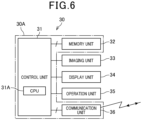
- the information code reading device 30 includes a control unit 31 including a CPU 31A, a memory unit 32 including a semiconductor memory, such as a ROM 22A and RAM 22B, an imaging unit 33 configured as a camera, a touch panel display unit 34 of which the contents of display are controlled by the control unit 31 (e.g., CPU 31A), an operation unit 35 outputting an operation signal to the control unit 31 in response to touch operation or key operation for the touch panel, and a communication unit 36 communicating with external devices, such as the server 40.
- the communication unit 36 can correspond to an example of the reading-side communication unit.
- images are captured by the imaging unit 33 at imaging intervals (shutter speed) according to a second rule received from the server 40 in response to a second request, and a plurality of images obtained by the imaging are combined based on the second rule to restore an information code to be read.
- the reading results as a result of reading the restored information code are outputted to the POS register as payment information.
- the server 40 is configured as a computer having a function of performing rule transmission processing in which the display conditions and the imaging conditions for the partial code images are synchronized between the information code display device 20 and the information code reading device 30.
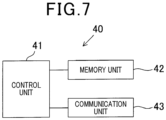
- the server 40 mainly includes a control unit 41 performing overall control of the server 40, a memory unit 42, and a communication unit 43.
- the control unit 41 is mainly configured by a microcomputer and includes a CPU, a system bus, and an input/output interface to serve as an information processor together with the memory unit 42.
- the memory unit 42 includes a ROM, RAM, and HDD to store in advance an application program for executing the rule transmission processing and predetermined databases so as to be available for the control unit 41.
- the communication unit 43 is controlled by the control unit 41 and is configured to have a function as a communication means for communicating with other external devices, such as the information code display device 20 and the information code reading device 30, via a predetermined network N, such as the Internet. It should be noted that the communication unit 43 can correspond to an example of the server-side communication unit.
- a rule related to display of an information code is set according to the time of receiving a request from the information code display device 20 or the information code reading device 30, and the set rule is transmitted to the information code display device 20 or the information code reading device 30.
- the rule related to display of an information code there are prepared three parameters which are the number of segments of the information code, segmenting positions, and frame rate, so as to be selectively used. The parameters to be selected when receiving a request are ensured to be switched after the lapse of a predetermined period (e.g., 10 minutes).
- a first rule is set so that the number of segments, segmenting positions, and frame rate are selected according to the time of receiving a first request from the information code display device 20, and the set first rule is transmitted to the information code display device 20.
- the first rule transmitted to the information code display device 20 includes information associated with an expiration period corresponding to the above predetermined period.
- the information code display device 20 again makes a first request to the server 40 after the lapse of the expiration period after receiving the first rule.
- a second rule is set so that the number of segments, segmenting positions, and imaging intervals corresponding to the frame rate (shutter speed) are selected according to the time of receiving the second request from the information code reading device 30, and the set second rule is transmitted to the information code reading device 30.
- the first rule and the second rule can be set so as to be compatible with each other.
- This processing is performed when the user (purchaser) carrying the information code display device 20 makes a payment at a store or the like where the information code reading device 30 is installed.
- request processing indicated at step S101 of Fig. 8 is performed to make a first request to the server 40 via the communication unit 26. If a first rule is received as described above in response to the first request (Yes at step S103), display processing indicated at step S105 is performed to cyclically display partial code images on the display screen 24A (corresponding to a physical medium carrying the code) of the display unit 24, based on the first rule received.
- step S109 if the expiration period has elapsed in the state in which cyclic display of the partial code images continues (Yes at step S109), the processing from step S101 is again performed to again make a first request to thereby update the first rule for commencement of a new expiration period.
- Payment reading processing is started when store staff or the like have started the payment reading application and performed predetermined operation for capturing images of the display screen 24A of the information code display device 20. With the start of this processing, request processing indicated at step S201 of Fig. 9 is performed to make a second request to the server 40 via the communication unit 36. If a second rule is received as described above in response to the second request (Yes at step S203), control proceeds to step S205 where imaging processing is performed to continuously perform imaging for a predetermined period at imaging intervals according to the received second rule.
- control unit 31 performing the processing of step S207 can correspond to an example of the combination unit, and the control unit 31 performing the processing of step S211 can correspond to an example of the decoding unit.
- step S215 if no single information code that can be decoded is acquired, e.g., if all the images captured show the same information code, combination processing is determined to be unsuccessful (No at step S209), and then control proceeds to step S215 where notification processing is performed.
- notification processing the fact that no payment can be made due to no authentic information code being imaged is notified using display or the like of the display unit 34, and then the present payment reading processing is terminated.
- the notification does not necessarily have to be visually provided, but may be, for example, audibly provided using an alarm, beep or the like to notify the fact that no payment can be made due to no authentic information code having been imaged.
- step S301 and S303 of Fig. 10 determination processing of steps S301 and S303 of Fig. 10 is performed to determine whether either of a first request and a second request has been received. If neither of the first and second requests has been received, a No determination is repeatedly made in the determination processing of steps S301 and S303.
- step S305 first rule selection processing is performed.
- a suitable number of segments, suitable segmenting positions, and a suitable frame rate are selected according to the time of receiving the first request, from among several data for the number of segments, segmenting positions, and frame rate prepared in advance.
- the number of segments, segmenting positions, and frame rate selected in this way are transmitted to the information code display device 20 as a first rule, together with information related to expiration period (step S309).
- step S307 second rule selection processing is performed.
- a suitable number of segments, suitable segmenting positions, and a suitable imaging interval are selected according to the time of receiving the second request, from among several data for the number of segments, segmenting positions, and imaging intervals (shutter speed) prepared in advance.
- the number of segments, segmenting positions, and imaging intervals selected in this way are transmitted to the information code reading device 30 as a second rule (step S309).
- the control unit 41 performing the processing of steps S305 and S307 can correspond to an example of the setting unit that sets rules related to display of partial code images according to the time of receiving the requests.
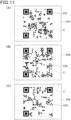
- control unit 40 may receive a first request from the information code display device 20 and, at this reception time, may select the number of segments and segmenting positions for obtaining three segments, i.e., upper, middle and lower segments shown in Figs. 4(A) to 4(C) , and a frame rate of 50 fps. Then, a first rule according to the results of the selection may be transmitted to the information code display device 20.
- control unit 40 may select the number of segments and segmenting positions for providing three segments, i.e., upper, middle and lower segments, and imaging intervals (shutter speed) corresponding to the frame rate of 50 fps to transmit a second rule according to the results of the selection to the information code reading device 30.
- the partial code images P11 to P13 are cyclically displayed on the display screen 24A of the display unit 24 at the frame rate of 50 fps, while in the information code reading device 30, the display screen 24A is imaged at the imaging intervals corresponding to the frame rate of 50 fps according to the received second rule to capture the partial code images P11 to P13 in this order.
- the information code C shown in Fig. 3 can be decodably composed from the captured partial code images C11 to C13 because the positions of the three partial codes C11 to C13 are obtained from the second rule.
- control unit 40 may select the number of segments and segmenting positions for providing four segments shown in Figs. 5(A) to 5(D) , and a frame rate of 60 fps, at the time of receiving a first request from the information code display device 20 to transmit a first rule according to the results of the selection to the information code display device 20.
- control unit 40 may select the number of segments and segmenting positions for providing the four segments mentioned above, and imaging interval (shutter speed) corresponding to the frame rate 60 of fps to transmit a second rule according to the results of the selection to the information code reading device 30.
- the partial code images P21 to P24 are cyclically displayed on the display screen 24A of the display unit 24 at the frame rate of 60 fps, while in the information code reading device 30, the display screen 24A is imaged at the imaging intervals corresponding to the frame rate of 60 fps, according to the received second rule to capture the partial code images P21 to P24 in this order.
- the information code C shown in Fig. 3 can be decodably composed from the captured partial code images C21 to C24 in the combination processing of step S207 because the positions of the four partial codes C21 to C24 are obtained from the second rule.
- the displays shown in Fig. 5 and the subsequent figures each include a display screen as in the display shown in Fig. 4 . These displays, although not shown, are similarly referred to as the display screen 24A.
- the information code reading system 10 of the present embodiment when a first rule is received in the information code display device 20 from the server 40 in response to a first request to the server 40, a plurality of partial code images are cyclically displayed on the display screen 24A of the display unit 24 based on the first rule. Then, when a second rule is received in the information code reading device 30 from the server 40 in response to a second request to the server 40, images of the display screen 24A are captured at imaging intervals according to the second rule to decode the information code C composed from the captured plurality of images based on the second rule.
- the server 40 is ensured to set a rule related to display of the partial code images according to the time of receiving a request.
- a set rule is transmitted to the information code display device 20 as a first rule according to the time of receiving the first request. Also, if a second request is received from the information code reading device 30, a set rule is transmitted to the information code reading device 30 as a second rule according to the time of receiving the second request.
- the information code reading device 30 captures images of the display screen of the information code display device 20 at the imaging intervals according to the second rule that has been received from the server 40 in response to the second request
- the information code display device 20 is in the act of cyclically displaying the partial code images, which have been prepared to meet the first rule received from the server 40, according to the first rule. Accordingly, if the timing of the first request is close to the timing of the second request, the first and second rules are set so that the rules are compatible with each other. Therefore, the information code reading device 30 can sequentially capture images of the partial code images cyclically displayed on the information code display device 20 without fail.
- the information code reading device 30 can easily keep track of how images of the partial code images are captured based on the second rule, and thus can decodably compose one information code from the partial code images.
- the information code reading device 30 can read one information code by capturing images of the display screen on which the partial code images are cyclically displayed by the information code display device 20.
- the display screen of the information code display device 20 is simply imaged, only an image of one partial code image can be captured. Therefore, no image of an information code on which predetermined information is recorded can be captured, and thus the information code can be prevented from being replicated.
- the first rule includes information related to an expiration period, and after the lapse of the expiration period included in the first rule (Yes at step S109), a first rule is newly requested to the server 40 in the payment display processing performed by the control unit 21.
- the information code display device 20 can update the first rule at appropriate timing according to the expiration period included in the first rule.
- a partial code image is not limited to being prepared including one of three or four segments of an information code C, but may be prepared including one of five or more segments of the information code C.
- a partial code image is not limited to being prepared including one of a plurality of segments of an information code C, but may be prepared omitting part of the cells forming a code area of the information code C from the image of the information code C.
- partial codes C31 to C33 may be prepared by thinning out cells from the information code C in the range of disabling error correction.
- each partial code image may be produced by leaving specific patterns therein, such as the finder patterns of a QR code, and removing part of the cells from the remaining data recording area portions.
- all the partial code images similarly include specific patterns, use of the specific patterns as references for combination can quicken reading of an information code composed.
- the second embodiment is mainly different from the first embodiment in that the first rule can be changed if the display conditions following the first rule are unacceptable. Accordingly, the same reference signs are designated to the components which are substantially the same as those of the first embodiment to omit repeated explanation.
- display conditions following the received first rule may be unacceptable, depending on the display performance and the like of the information code display device 20. For example, if a high frame rate is specified, the partial code images cannot be necessarily cyclically displayed at this high frame rate.
- a display condition code is produced as an information code for the information code reading device 30 to read, so that the information code reading device 30 can request the server 40 to change the first rule and the second rule.
- the display condition code there are recorded information related to display conditions that are acceptable to the display unit 24 (also termed acceptable display information hereinafter), and specific information that can specify the information code display device 20.
- step S111 determination processing is performed to determine whether the received display conditions following the first rule are acceptable. If the display conditions following the first rule are acceptable (Yes at step S111), processing of step S105 onward is performed. It should be noted that the control unit 21 that performs the determination processing of step S111 can correspond to an example of the determination unit.
- step S111 determines whether the display conditions following the first rule are acceptable. If the display conditions following the first rule are not acceptable, a No determination is made at step S111 and control proceeds to step S113 where display condition code production processing is performed.
- a display condition code is produced to record thereon the above acceptable display information (e.g., information indicating that a frame rate of 30 fps or less is an acceptable display condition) and the specific information.
- control proceeds to step S115 where display condition code displaying processing is performed to display the display condition code, which is in a stationary state and produced as mentioned above, on the display unit 24. Then, the determination processing of step S103 is performed and the display condition code is continued to be displayed until a first rule is newly received.
- the control unit 21 that performs the processing of step S113 can correspond to an example of the production unit.
- control unit 31 of the information code reading device 30 when a second rule is received from the server 40 in response to a second request (Yes at step S203 of Fig. 13 ), the control unit 31 performs processing for composing one information code based on the second rule, from a plurality of images captured thereafter (step S207).
- step S217 determination processing is performed to determine whether a display condition code has been read. If the display condition code displayed on the display unit 24 as described above has been imaged, the acceptable display information and the specific information recorded on the display condition code are decoded. Therefore, a Yes determination is made at step S217 and control proceeds to step S219 where request for change processing is performed. In this processing, a second request including the read acceptable display information and specific information is transmitted to the server 40 as a request for change.
- step S313 rule change processing is performed.
- a first rule is set according to the acceptable display information included in the request for change and, at the same time, a second rule is also set to meet the first rule. For example, if the received acceptable display information indicates that a frame rate of 30 fps or less is an acceptable display condition, a first rule is set according to this display condition so as to be acceptable.
- step S309 transmission processing is performed to transmit the first rule to the information code display device 20 which has been specified from the specific information included in the request for change, and transmit the second rule to the information code reading device 30 that has requested change.
- step S111 the display conditions following the first rule as received become acceptable (Yes at step S111).
- processing of step S105 onward is performed, so that partial code images can be cyclically displayed on the display screen 24A of the display unit 24 based on the newly received first rule.
- images of the partial code images can be captured at the imaging intervals according to the newly received second rule because the partial code images are being cyclically displayed on the display unit 24 of the information code display device 20 as described above. Accordingly, one information code can be decodably composed from the partial code images.
- a display condition code on which acceptable display information and specific information are recorded is produced (step S113) and displayed on the display screen 24A of the display unit 24 (step S115). Then, in the information code reading device 30, when the display condition code is decoded (Yes at step S217), a second request including the results of decoding the display condition code is made as a request for change (step S219).
- a first request and a second request are set to change display conditions according to the results of decoding (step S313), and first and second requests are respectively transmitted to the information code display device 20 and the information code reding device 30 (step S309).
- the display condition code is continued to be displayed.
- the first rule and the second rule are changed so as to meet the display conditions that are acceptable by the information code display device 20.
- the display conditions can be appropriately changed, and in addition to that, the information code reading device 30 can receive a second rule according to the changed display conditions.
- the third embodiment is mainly different from the first embodiment in that a plurality of information codes are cyclically displayed instead of partial codes. Accordingly, the same reference signs are designated to the components which are substantially the same as those of the first embodiment to omit repeated explanation.
- the information code display device 20 of the present embodiment cyclically displays a plurality of types of information codes on the display screen 24A of the display unit 24 based on a first rule received from the server 40 in response to a first request. Therefore, there are prepared in advance, for example, three code images respectively including information codes to cyclically display three types of information codes, four code images respectively including information codes to cyclically display four types of information codes, and other images, and these images are stored in the memory unit 22.
- the information codes which are a series of information codes, are decoded, and from the results of the decoding, there are acquired personal payment information of the user carrying the information code display device 20, terminal information that can specify the information code display device 20, and other information. Thus, these pieces of information are produced so that secret information cannot be read from one information code.
- the information code reading device 30 captures images of the display screen at imaging intervals according to a second rule received from the server 40 in response to a second request, and performs decoding processing for the plurality of serial images captured in this way to decode the information code. If these decoding results match the results estimated from the second rule, it is determined that a regular information code is being read, and if they are different from the results estimated from the second rule, predetermined notification is given to prevent unauthorized use of the information code.
- the server 40 sets a rule related to display of information codes according to the time of receiving a request from the information code display device 20 or the information code reading device 30, and transmits the set rule to the information coed display device 20 or the information code reading device 30.
- two parameters i.e., the number of information codes to be displayed, that is, the number of information codes to be cyclically displayed, and frame rate, are selectably prepared for the rule related to display of an information code.
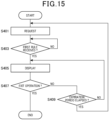
- step S401 of Fig. 15 When payment display processing is started by starting the above payment display application in response to the user's predetermined operation, request processing is performed at step S401 of Fig. 15 to make a first request to the server 40 via the communication unit 26. If a first rule is received as described above in response to the first request (Yes at step S403), control proceeds to step S405 where display processing is performed to cyclically display the code images stored in the memory unit 22 on the display screen 24A of the display unit 24 based on the received first rule.
- step S409 processing is again performed from step S401 to again make a first request and update the first rule for commencement of a new expiration period.
- Payment reading processing is started when store staff or the like has started the payment reading application and performed predetermined operation for capturing images of the display screen 24A of the information code display device 20. With the start of this processing, request processing indicated at step S501 of Fig. 16 is performed to make a second request to the server 40 via the communication unit 36. If a second rule is received as described above in response to the second request (Yes at step S503), control proceeds to step S505 where imaging processing is performed to continuously perform imaging for a predetermined period at imaging intervals according to the received second rule.
- control proceeds to step S507 where decoding processing is performed to decode each of the information codes for the plurality of images captured as described above. Then, control proceeds to step S509 where determination processing is performed to determine whether the results of the decoding are as estimated from the second rule. In this case, if the number of displayed information codes is set to n in the second rule and if n decoding results are repeatedly obtained from the captured images, it is determined that the decoding results are as estimated from the second rule and thus a Yes determination is made at step S509. Then, control proceeds to step S511 where output processing is performed to output the n decoding results that have been read as mentioned above into the POS register as payment information and then the present payment reading processing is terminated. In the POS register or the like, personal payment information, terminal information, ang the like can be acquired from the n decoding results. It should be noted that the control unit 31 performing the processing of step S507 can correspond to an example of the decoding unit.
- step S509 control proceeds to step S513 where notification processing is performed. In this processing, the fact that no payment can be made due to no regular information code being imaged is notified using display or the like of the display unit 34, and then the present payment reading processing is terminated.
- the notification does not necessarily have to be visually provided, but may be, for example, audibly provided using an alarm, beep or the like to notify the fact that no payment can be made due to no regular information code being imaged.
- the display unit 34 and other components can correspond to an example of the notification unit.
- step S601 and S603 of Fig. 17 is performed to determine whether either of a first request and a second request has been received. If neither of the first and second requests has been received, a No determination is repeatedly made in the determination processing of steps S601 and S603.
- step S605 first rule selection processing is performed.
- a suitable number of displaying information codes and a frame rate are selected according to the time of receiving the first request, from among several items of data for the number of displaying information codes and frame rate prepared in advance.
- the number of displaying information codes and the frame rate selected in this way are transmitted to the information code display device 20 as a first rule, together with information related to expiration period (step S609).
- step S607 second rule selection processing is performed.
- a suitable number of displaying information codes and imaging intervals are selected according to the time of receiving the second request, from among several data for the number of displaying information codes and imaging intervals (shutter speed) prepared in advance.
- the number of displaying information codes and the imaging intervals selected in this way are transmitted to the information reading device 30 as a second rule (step S609).
- the control unit 41 performing the processing of step S605 and the processing of step S607 can correspond to an example of the setting unit that sets rules related to display of information codes according to the time of receiving requests.
- the information code reading system 10 of the present embodiment when the information code display device 20 receives a first rule from the server 40 in response to a first request to the server 40, a plurality of information codes stored in the memory unit 22 are cyclically displayed on the display screen 24A of the display unit 24 according to the first rule. Then, when the information code reading device 30 receives a second rule from the server 40 in response to a second request to the server 40, images of the display screen are captured at imaging intervals according to the second rule to perform decoding processing in which each information code is decoded for the plurality of serial images captured in this way. If the decoding results are different from those which are estimated from the second rule (No at step S509), predetermined notification is performed (step S513).
- the server 40 is ensured to set a rule related to display of information codes according to the time of receiving a request. Specifically, the server 40 sets and transmits a rule, as a first rule, to the information code display device 20 in response to a first request received from the information code display device 20, according to the time of receiving the first request, and also sets and transmits a rule, as the second rule, to the information code reading device 30 in response to a second request received from the information code reading device 30, according to the time of receiving the second request.
- the information code reading device 30 captures images of the display screen 24A of the information code display device 20 at imaging intervals according to the second rule received from the server 40 in response to the second request, the information code display device 20 cyclically displays the plurality of information codes on the display screen 24A to meet the first rule received from the server.
- the timing of making the first request is close to the timing of making the second request, the first and second rules are set so as to be compatible with each other. Accordingly, the information code reading device 30 can sequentially capture images of all the cyclically displayed information codes without fail.
- the information code reading device 30 can determine that another information code or the like different from that on the display screen 24A of the information code display device 20 is being imaged, and can perform predetermined notification. In other words, if another information code or the like different from that displayed on the display screen 24A of the information code display device 20 is being imaged, the predetermined notification can be performed to prevent unauthorized use of the information code displayed on the screen.
- the rule may be changed. Specifically, when the information code display device 20 receives a first rule and if the display conditions following the first rule are determined not to be display conditions that are acceptable to the display unit, a display condition code, on which acceptable display information and specific information are recorded, may be produced and displayed on the display screen 24A of the display unit 24. Then, after decoding the display condition code, the information code reading device 30 may make a second request, as a request for change, including the decoding results of the display condition code.
- the server 40 may set a first rule and a second rule to change the display conditions according to the decoding results, and may respectively transmit the rules to the information code display device 20 and the information code reading device 30.
- the display conditions can be appropriately changed, and in addition to that, the information code reading device 30 can receive a second rule according to the changed display conditions.
- the fourth embodiment is mainly different from the first embodiment in that the server 40 has been omitted, the frame rate of cyclical display in the information code display device is constant, and images are captured by the information code reading device at imaging intervals (shutter speed) conforming to the predetermined constant frame rate. Accordingly, the same reference signs are designated to the components which are substantially the same as those of the first embodiment to omit repeated explanation.
- an information code reading system 10a serves as a system for preventing unauthorized use, such as replication, of an information code displayed on a screen.
- the information code reading system 10a is configured to include an information code display device 20a and an information code reading device 30a respectively having functions equivalent to those of the information code display device 20 and the information code reading device 30 of the information code reading system 10 described above, omitting the server 40.
- the information code display device 20a of the present embodiment when an application program for displaying payment (also termed second payment display application hereinafter) used in the present embodiment is installed, a plurality of combination code images are prepared and stored in the memory unit 22. Each combination code image is produced with part of the cells replaced according to a predetermined rule, based on an information code on which predetermined information is recorded using light color-based cells and dark color-based cells arranged in a code area (also termed original code hereinafter). A plurality of combination code images are prepared by changing positions of replacement cell areas which are target of replacement. Thus, an image of the original code can be produced by combining the combination code images according to the predetermined rule.
- the predetermined information may include personal payment information of the user carrying the information code display device 20a, terminal information that can specify the information code display device 20a, and other information.
- the predetermined rule is set for a data recording area of a code area except for specific patterns, such as finder patterns, so that correct codewords recorded on respective data blocks (each formed of eight cells) forming the data recording area of an original code are distributed in units of data blocks.
- the predetermined rule is set for the data blocks located at the same positions in a plurality of types of combination code images, so that one of the combination code images will include a cell arrangement that is the same as that of the code area, and that the remaining combination code images will include replacement cell areas.
- a first combination code may be produced so that correct codewords are recorded on a (3k+1) st data block, such as a first data block DB1 (see Fig. 22(A) ) or a fourth data block DB4, and dummy cells are arranged in other data blocks as replacement cell areas.
- a second combination code may be produced so that correct codewords are recorded on a (3k+2) nd data block, such as a second data block DB2 (see Fig. 22(B) ) or a fifth data block, and dummy cells are arranged in other data blocks as replacement cell areas.
- a third combination code may be produced so that correct codewords are recorded on a (3k+3) rd data block, such as a third data block DB3 (see Fig. 22(C) ) or a sixth data block, and dummy cells are arranged in other data blocks as replacement cell areas.
- the dummy cells arranged in the first, second and third combination codes are set with the same code size and cell size as those of a predetermined cell pattern having a QR code arrangement, so as to have cell arrangements of the data blocks located at the same positions.
- the present embodiment uses, for example, a checkered pattern shown in Fig. 20 as the predetermined cell pattern; however, without being limited to this, for example, a pattern that can assist reading, such as a mask pattern used for QR codes, may be used.
- the dummy cells may all be formed of light color-based cells, or may all be formed of dark color-based cells. It should be noted that in Fig. 20 and in Fig. 22 and other figures referred to later, the dark color-based cells forming dummy cells are cross hatched for the sake of convenience.
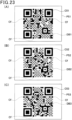
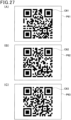
- three combination codes C41 to C43 as shown in Figs. 22(A) to 22(C) are produced based on the predetermined rule, from an original code Ca shown in Fig. 21 formed of a QR code, to prepare in advance combination code images P41 to P43 for the respective combination codes, for storage in the memory unit 22.
- the combination code images P41 to P43 are produced so that the positions of the code areas match each other.
- the memory unit 22 that stores combination code images in advance to prepare the combination code images, and the control unit 21 can correspond to an example of the code image preparation unit.
- the combination code images P41 to P43 are cyclically displayed on the display screen 24A of the display unit 24 at a predetermined specified frame rate.
- images are captured by the imaging unit 33 at predetermined imaging intervals corresponding to the specified frame rate.
- the captured combination code images are subjected to combination processing in which these images are combined with each other based on the predetermined rule to restore an information code to be read.
- information related to the predetermined rule is stored in advance in the memory unit 32 of the information code reading device 30a.
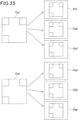
- the combination processing is performed based on the predetermined rule, using the 3k+1 st data block of the first combination code C41 of the combination code image P41, the 3k+2 nd data block of the second combination code C42 of the combination code image P42, and the 3k+3 rd data block of the third combination code C43 of the combination code image P43 to compose the original code Ca.
- the original code Ca composed in this way is decoded by performing decoding processing to read the predetermined information recorded on the original code Ca.
- the control unit 31 performing the combination processing can correspond to an example of the combination unit
- the control unit 31 performing the decoding processing can correspond to an example of the decoding unit.
- a plurality of types combination code images are prepared according to the predetermined rule, with part of cells replaced, by changing positions of the replacement cell areas as targets of replacement, based on the information code (Ca) on which predetermined information is recorded using light color-based cells and dark color-based cells arranged in the code area.
- the plurality of types of combination code images prepared in this way are cyclically displayed on the display screen 24A of the display unit 24.
- images of the display screen are captured at the predetermined imaging intervals, and one information code produced based on the predetermined rule by combining the plurality of captured images is decoded through decoding processing.
- the information code reading device 30a can decodably compose one information code from cells, which are not targets of replacement, of the combination code images, based on the predetermined rule.
- the information code reading device 30a can read one information code by capturing images of the display screen of the information code display device 20a on which the combination code images are cyclically displayed.
- the display screen of the information code display device 20a is simply imaged, only an image of one combination code image can be captured without capturing an image of an information code on which predetermined information is recorded, and thus replication of the information code can be prevented.
- the dummy cells in other data blocks forming replacement areas form part of the predetermined cell pattern corresponding to the code area.
- the outline of each combination code image is prevented from becoming indistinct, which would otherwise occur due to the replacement cell areas being formed of only white cells.
- part of the code area is formed by arranging a plurality of data blocks each formed of a predetermined number of cells, while, as can be seen from Fig. 19 , the replacement cell areas are set in units of data blocks.
- the predetermined rule is set for the data blocks located at the same positions in a plurality of types of combination code images, so that one of the combination code images will include a cell arrangement that is the same as that of the code area, and that the remaining combination code images will include replacement cell areas.
- each replacement cell area in the combination code images is set in units of data blocks, and thus the replacement cell areas that are not necessary for combination can be easily distinguished from the cell areas necessary for combination, thereby reducing processing load during the combination processing.
- combination code images may be produced so as to individually include information related to the predetermined rule, such as information indicating the order of the image.
- information related to the predetermined rule such as information indicating the order of the image
- information related to the predetermined rule may be individually recorded on an area Cf which corresponds to a format information area of a QR code having an error correction function, so that an original code can be more accurately composed.
- the information code reading device 30a is not required to acquire the information related to the predetermined rule in advance.
- the predetermined rule can be changed for each information code, security can be improved, while enhancing convenience of the system.
- the number of the combination code images cyclically displayed on the screen is not limited to three, but two combination code images, or four or more combination code images may be cyclically displayed on the screen.
- the replacement cell areas are not limited to being set in units of data blocks, but may be set in arbitrary regions that can be specified from the predetermined rule.
- the fifth embodiment is mainly different from the fourth embodiment in that determination code images are cyclically displayed on the display screen of the display unit, in addition to a plurality of types of combination code images. Accordingly, the same reference signs designate the components which are substantially the same as those of the fourth embodiment to omit repeated explanation.
- a determination code on which a parity value (determination information) is recorded, is produced for each data block to determine whether the cell arrangement is the same as that of the code area.
- An image of this determination code is added to the plurality of types of the combination code images and cyclically displayed on the display screen of the display unit.
- a value obtained by adding 1 to the number of dark color-based cells forming a data block may be used as a parity value corresponding to the data block to produce a determination code.
- the parity value is set to 5.
- a value obtained by adding 1 to the number of dark color-based cells forming the data block is compared with the parity value read from the determination code corresponding the data block. If there is no match between these two values, the data block can have a high probability of being erroneously read.
- the composed original code can be determined for each data block as to whether the data block has been correctly composed. Therefore, for example, the data block in which the two values are determined not to be the same is not used for error correction to enhance the error correction performance, and thus readability can be improved.
- the sixth embodiment is mainly different from the fourth embodiment in that a plurality of types of combination code images respectively produced from a plurality of original codes are cyclically displayed on the display screen of the display unit. Accordingly, the same reference signs are designated to the components which are substantially the same as those of the fourth embodiment to omit repeated explanation.
- a plurality of types of first combination code images are prepared from a first information code image on which first information is recorded.
- part of cell areas forming a code area of the first information code are individually replaced to meet the predetermined rule.
- a plurality of types of second combination code images are prepared from a second information code image on which second information is recorded.
- part of cell areas forming a code area of the second information code are individually replaced to meet the predetermined rule.
- the plurality of types of first combination code images and the plurality of types of second combination code images prepared in this way are cyclically displayed on the display screen of the display unit 24.
- a first information code and a second information code are composed from a plurality of images captured by the imaging unit 33, based on the predetermined rule.
- the information code reading device 30a can compose the first original code Ca1 and the second original code Ca2 from a plurality of images captured by the imaging unit 33, based on the predetermined rule, and can read the first information and the second information respectively from the first original code Ca1 and the second original code Ca2.
- the information code reading device 30a can capture the combination code images cyclically displayed on the display screen of the display unit 24 to read two pieces of information (first information and second information).
- first information and second information the amount of readable information can be increased, while preventing unauthorized use (replication) of the information code displayed on the screen.
- the number of original codes (Ca1, Ca2) from which a plurality of types of combination code images (Pa1 to Pa6) are produced and cyclically displayed on the display screen of the display unit 24 is not limited to two, but a plurality of types of combination code images may be produced respectively from three or more original codes and cyclically displayed on the display screen of the display unit 24.
- the information code reading device 30a can read pieces of information from three or more original codes, and thus the amount of readable information can be further increased.
- the seventh embodiment is different from the fourth embodiment in that a plurality of combination code images are produced so that, for cells located at the same positions in a predetermined combination area targeted to cell replacement in the code area, light and darkness obtained from the light and darkness of the cells of the plurality of types of combination code images and a predetermined rule match the light and darkness of the cells of the original code. Accordingly, the same reference signs are designated to the components which are substantially the same as those of the fourth embodiment to omit repeated explanation.
- the data recording area is set in the predetermined combination area targeted to cell replacement, and combination code images are produced so that, in this predetermined combination area, light or darkness obtained from the light or darkness of the cells in the combination code images and a predetermined rule match the light and darkness of the cells of the original code.
- combination code images P61 to P63 of three combination codes C61 to C63 having the same code size and the same cell size are prepared as shown in Figs. 27(A) to 27(C) according to the predetermined rule.
- the predetermined rule adopted is that when the number of combination codes with light color-based cells is compared with the number of combination codes with dark color-based cells, for cells located at the same positions in the combination codes, the light and darkness of the cells of the original code should match the light and darkness of the cells whichever the number is greater.
- two or all the combination codes have light color-based cells
- two or all the combination codes have dark color-based cells.
- cells of the original code Cb which become light color-based cells in all the combination codes are indicated with white cells
- cells of the original code Cb which become light color-based cells in two combination codes and become dark color-based cells in the remaining one combination code are indicated with hatching.
- cells of the original code Cb which become dark color-based cells in two combination codes and become light color-based cells in the remaining one combination code are indicated with cross hatching, and cells of the original code Cb which become dark color-based cells in all the combination codes are indicated with black cells.
- combination codes (C61 to C63) are produced based on the predetermined rule, and combination code images (P61 to P63) are prepared in advance for the respective combination codes, for storage in the memory unit 22. Then, in the second payment display processing performed by the control unit 21 with the start of the second payment display application, the combination code images (P61 to P63) are cyclically displayed on the display screen of the display unit 24 at a predetermined specified frame rate.
- images are captured by the imaging unit 33 at predetermined imaging intervals corresponding to the specified frame rate, and an information code to be read is restored by performing combination processing in which the combination code images captured are combined according to the predetermined rule.
- information related to the predetermined rule is stored in advance in the memory unit 32 of the information code reading device 30a.
- the combination processing is performed according to the predetermined rule, so that cells at positions where they become light color-based cells in two or more combination codes become light color-based cells, and cells at positions where they become dark color-based cells in two or more combination codes become dark color-based cells to thereby compose an original code Cb.
- a plurality of types of combination code images (P61 to P63) are produced so that, for cells located at the same positions in a predetermined combination area targeted to cell replacement in the code area, light and darkness obtained from the light and darkness of the cells of the plurality of types of combination code images and the predetermined rule match the light and darkness of the cells of the original code (Cb).
- the information code reading device 30a can decodably compose the information code, based on the light and darkness of the cells in the predetermined combination area in the combination code images, and the predetermined rule.
- the information code on which the predetermined information is recorded cannot be decodably composed unless the predetermined rule is used. Therefore, unauthorized use (replication) of the information code displayed on the screen can be prevented.
- the predetermined rule is not limited to being set so as to simply use the majority rule for the number of cells, as described above, but may be set, for example, so as to use logical OR (OR) or exclusive OR (XOR) relating to light and darkness of the cells located at the same positions in the combination codes, or may be set to use the results of logical OR of part of the combination codes and exclusive OR of the remaining combination codes.
- the predetermined combination area targeted to cell replacement is not limited to being set so as to be present in the data recording area, but may be set so as to be present in part of the data recording area. In this case, combination codes are produced so that cells located outside the predetermined combination area will all have the same light and darkness array.
- the information code display device 20a may cyclically display an image P64 of a different information code Cc on which information related to the predetermined rule is recorded, on the display screen of the display unit 24, in addition to the plurality of types of combination code images (P61 to P63).
- the information code reading device 30a can read the predetermined rule from the information code Cc which is imaged together with the plurality of types of combination code images. Therefore, the information code reading device 30a is not required to acquire the information related to the predetermined rule in advance. Since the predetermined rule can be changed for each information code, security can be improved, while enhancing convenience of the system. It should be noted that the information code Cc may be produced, as shown in Fig. 28(D) , as a QR code having the same code size and cell size as those of the combination codes, or may be produced as a different type of information code, such as Data Matrix code or MaxiCode, so as to be easily distinguished from the combination codes.
- the present embodiment and other embodiments may also use the area Cf or the like corresponding to the format information area of a QR code having an error correction function, so that the combination code images can be produced to individually include the information and the like related to the predetermined rule.
- the information code reading device 30a is not required to acquire the information related to the predetermined rule in advance. Since the predetermined rule can be changed for each information code, security can be improved, while enhancing convenience of the system.
- the eighth embodiment is mainly different from the seventh embodiment in that a plurality of predetermined combination areas targeted to cell replacement are set, and the predetermined rule related to cell replacement is different between the predetermined combination areas. Accordingly, the same reference signs are designated to the components which are substantially the same as those of the seventh embodiment to omit repeated explanation.
- the combination areas may be set so that the simple majority rule for the number of cells is used for the rule of the combination area E1, logical OR (OR) is used for the rule of the combination area E2, and exclusive OR (XOR) is used for the rule of the combination area E3.
- the rule related to cell replacement is differently set between the plurality of combination areas, if the predetermined rule set for one combination area is fraudulently acquired, the original code on which predetermined information is recorded cannot be decodably composed, unless other predetermined rules or information related to the combination areas including other predetermined rules are acquired. Accordingly, security can be further improved for the information code displayed on the screen.
- an image of a different information code, on which information related to rules for cell replacement is recorded may be cyclically displayed on the screen together with the combination code images.
- the area Cf or the like corresponding to the format information area of a QR code having an error correction function may be used, so that the combination code images can individually include information related to rules for cell replacement and other information.
- the number of combination areas provided to the data recording area is not limited to three, but two, or four or more combination areas may be provided to at least part of the data recording area.
Landscapes
- Engineering & Computer Science (AREA)
- Physics & Mathematics (AREA)
- Theoretical Computer Science (AREA)
- General Physics & Mathematics (AREA)
- Electromagnetism (AREA)
- General Health & Medical Sciences (AREA)
- Artificial Intelligence (AREA)
- Computer Vision & Pattern Recognition (AREA)
- Toxicology (AREA)
- Health & Medical Sciences (AREA)
- Quality & Reliability (AREA)
- Optics & Photonics (AREA)
- Editing Of Facsimile Originals (AREA)
- Cash Registers Or Receiving Machines (AREA)
Claims (4)
- Informationscodelesesystem (10), aufweisend eine Informationscodeanzeigevorrichtung (20), die einen Informationscode (C) anzeigt, eine Informationscodelesevorrichtung (30), die den Informationscode (C) liest, und einen Server (40), der mit der Informationscodeanzeigevorrichtung (20) und der Informationscodelesevorrichtung (30) kommuniziert, wobeidie Informationscodeanzeigevorrichtung (20) beinhalteteine anzeigeseitige Kommunikationseinheit (21, 26), die darauf ausgelegt ist, als Reaktion auf eine erste Anfrage von der anzeigeseitigen Kommunikationseinheit (21, 26) an den Server (40) eine erste von dem Server (40) übertragene Regel zu empfangen, wobei die erste Regel nicht nur Anzeigebedingungen, die eine Framerate des Informationscodes (C) oder die Mehrzahl an Teilcodebildern (P11, P12, P13: P21, P22, P23, P24), beinhalten, sondern auch ein Ablaufdatum bestimmt, undeine Anzeigeeinheit (24), die mit einem Anzeigebildschirm (24A) versehen und darauf ausgelegt ist, zyklisch auf dem Anzeigebildschirm (24A) entweder i) eine Mehrzahl an Informationscodes (C), die jeweils aus dem Informationscode (C) bestehen, oder ii) eine Mehrzahl an Teilcodebildern (P11, P12, P13: P21, P22, P23, P24), die jeweils von dem Informationscode (C) segmentiert sind, darzustellen, wobei die Mehrzahl an Teilcodebildern (P11, P12, P13: P21, P22, P23, P24) erzeugt wird, indem ein bestimmter Teil von Zellen, der einen Codebereich des Informationscodes (C) konfiguriert, von einem Bild des Informationscodes (C) entfernt wird, so dass die erste Regel eingehalten wird, die durch die anzeigeseitige Kommunikationseinheit (26) empfangen wird;wobei die Informationscodelesevorrichtung (30) beinhaltet:eine leseseitige Kommunikationseinheit (31, 36), die darauf ausgelegt ist, als Reaktion auf eine zweite Anfrage von der leseseitigen Kommunikationseinheit (31, 36) an den Server (40) eine zweite von dem Server (40) übertragene Regel zu empfangen, wobei die zweite Regel Bildgebungsbedingungen, die den Anzeigebedingungen entsprechen, und Bildgebungsintervalle zum Anzeigen der Mehrzahl an Informationscodes (C) oder der Mehrzahl an Teilcodebildern (P11, P12, P13: P21, P22, P23, P24) beinhalten, bestimmt;eine Bildgebungseinheit (33), die darauf ausgelegt ist, Bilder des Anzeigebildschirms (24A) zu den Bildgebungsintervallen gemäß der zweiten Regel aufzuzeichnen, wenn die zweite Regel durch die leseseitige Kommunikationseinheit (36) empfangen wird, undeine Verarbeitungseinheit (31), die darauf ausgelegt ist, die durch die Bildgebungseinheit (33) aufgezeichneten Bilder zu verarbeiten; undwobei der Server (40) beinhaltet:eine Einstelleinheit (41), die darauf ausgelegt ist, die erste Regel und die zweite Regel gemäß der Empfangszeit der ersten Regel und der zweiten Regel einzustellen, undeine serverseitige Kommunikationseinheit (41, 43), die darauf ausgelegt ist, die erste Regel an die Informationscodeanzeigevorrichtung (20) zu übertragen, wenn die erste Anfrage von der Informationscodeanzeigevorrichtung (20) empfangen wird, wobei die erste Regel durch die Einstelleinheit (41) gemäß der Empfangszeit der ersten Anfrage eingestellt wird, und die zweite Regel an die Informationscodelesevorrichtung (30) zu übertragen, wenn die zweite Anfrage von der Informationscodelesevorrichtung (30) empfangen wird, wobei die zweite Regel durch die Einstelleinheit (41) gemäß der Empfangszeit der zweiten Anfrage eingestellt wird,wobei die anzeigeseitige Kommunikationseinheit (21, 26) darauf ausgelegt ist, zu bestimmen, ob die Ablaufzeit seit dem Empfang der ersten Regel von dem Server (40) verstrichen ist, die Mehrzahl an Informationscodes (C) oder die Mehrzahl an Teilcodebildern (P11, P12, P13: P21, P22, P23, P24) zyklisch anzuzeigen, wenn bestimmt wird, dass die Ablaufzeit seit dem Empfang der ersten Regel nicht verstrichen ist, und die erste Regel an den Server (40) erneut anzufragen, nachdem die Ablaufzeit verstrichen ist.
- Informationscodelesesystem nach Anspruch 1, wobeidie Anzeigebedingungen eine Segmentierungszahl und Segmentierungspositionen der Mehrzahl an Teilcodebildern (P11, P12, P13: P21, P22, P23, P24) beinhalten, die gemäß einer Empfangszeit der ersten Anfrage vorliegen;die Bildgebungsbedingungen eine Segmentierungszahl und Segmentierungspositionen der Mehrzahl an Teilcodebildern (P11, P12, P13: P21, P22, P23, P24) beinhalten, die gemäß einer Empfangszeit der zweiten Anfrage vorliegen;die Informationscodeanzeigevorrichtung (20) beinhaltet:eine Vorbereitungseinheit (21, 22) für Teilcodebilder, die darauf ausgelegt ist, die Mehrzahl an Teilcodebildern vorzubereiten, wenn die erste Regel durch die anzeigeseitige Kommunikationseinheit (21, 26) empfangen wird;wobei die Anzeigeeinheit (24) darauf ausgelegt ist, die Mehrzahl an Teilcodebildern (P11, P12, P13: P21, P22, P23, P24), die durch die Vorbereitungseinheit (21, 22) für Teilcodebilder vorbereitet sind, auf dem Anzeigebildschirm (24A) auf Basis der ersten Regel zyklisch anzuzeigen;wobei die Verarbeitungseinheit (31) mit Folgendem versehen ist:einer Kombinationseinheit (31), die darauf ausgelegt ist, einen Informationscode aus der Mehrzahl an Bildern auf Basis der zweiten Regel zu erstellen, undeine Dekodierungseinheit (31), die darauf ausgelegt ist, den durch die Kombinationseinheit (31) erstellten Informationscode zu dekodieren.
- Informationscodelesesystem nach Anspruch 1, wobeidie Anzeigebedingungen eine Anzeigezahl der Informationscodes (C) gemäß einer Empfangszeit der ersten Anfrage beinhalten;die Bildgebungsbedingungen eine Anzeigezahl des Informationscodes (C) gemäß einer Empfangszeit der zweiten Anfrage beinhalten;die Informationscodeanzeigevorrichtung (20) eine Speichereinheit (32) beinhaltet, welche die Mehrzahl an Informationscodes (C) speichert;die Anzeigeeinheit (24) darauf ausgelegt ist, die Mehrzahl an Informationscodes (C) auf Basis der durch die anzeigeseitige Kommunikationseinheit (21, 26) empfangenen ersten Regel auf dem Anzeigebildschirm (24A) zyklisch anzuzeigen;wobei die Verarbeitungseinheit (31) aufweisteine Dekodierungseinheit (31), die darauf ausgelegt ist, eine Dekodierungsverarbeitung zu dekodieren, bei der ein Informationscode für die Mehrzahl an seriellen Bildern dekodiert wird, die durch die Bildgebungseinheit (33) aufgezeichnet werden, undeine Benachrichtigungseinheit (34), die darauf ausgelegt ist, eine vorgegebene Benachrichtigung in dem Fall durchzuführen, bei dem Dekodierungsergebnisse des durch die Dekodierungseinheit (31) durchgeführten Dekodierens der seriellen Bilder sich von Ergebnissen unterscheiden, die aus der zweiten Regel geschätzt werden.
- Informationscodelesesystem nach Anspruch 2 oder 3, wobeidie Informationscodeanzeigevorrichtung (20) beinhalteteine Bestimmungseinheit (21), die darauf ausgelegt ist, wenn die erste Regel empfangen wird, zu bestimmen, ob die Anzeigebedingungen gemäß der ersten Regel Anzeigebedingungen sind, die für die Anzeigeeinheit (24) akzeptabel sind, undeine Erstellungseinheit (21), die darauf ausgelegt ist, einen Anzeigebedingungscode zu erstellen, der als der Informationscode dient, wenn die Bestimmungseinheit (21) bestimmt, dass die Anzeigebedingungen für die Anzeigeeinheit (24) nicht akzeptabel sind, wobei der Anzeigebedingungscode darin i) Informationen, die sich auf Anzeigebedingungen beziehen, die für die Anzeigeeinheit (24) akzeptabel sind, und ii) spezifische Informationen, die darauf ausgelegt sind, die Informationscodeanzeigevorrichtung (20) zu spezifizieren, aufzeichnet;wobei die Anzeigeeinheit (24) darauf ausgelegt ist, den Anzeigebedingungscode auf dem Anzeigebildschirm (24A) anzuzeigen, wenn der Anzeigebedingungscode durch die Erstellungseinheit (21) erstellt wird;wobei in der Informationscodelesevorrichtung (30),wenn der Anzeigebedingungscode durch die Dekodierungseinheit (31) dekodiert wurde, die leseseitige Kommunikationseinheit (31, 36) darauf ausgelegt ist, die zweite Anfrage einschließlich der Dekodierungsergebnisse für den Anzeigebedingungscode zu stellen; undwobei in dem Server (40),wenn die zweite Anfrage einschließlich der Dekodierungsergebnisse für den Anzeigebedingungscode von der Informationscodelesevorrichtung (30) empfangen wird, die Einstelleinheit (41) darauf ausgelegt ist, die erste Regel und die zweite Regel einzustellen, so dass die Anzeigebedingungen gemäß der Dekodierungsergebnisse geändert werden, unddie serverseitige Kommunikationseinheit (41, 43) darauf ausgelegt ist, die erste Regel und die zweite Regel, die durch die Einstelleinheit (41) eingestellt werden, entsprechend an die Informationscodeanzeigevorrichtung (20) und die Informationscodelesevorrichtung (30) zu übertragen.
Applications Claiming Priority (3)
| Application Number | Priority Date | Filing Date | Title |
|---|---|---|---|
| JP2019159733 | 2019-09-02 | ||
| JP2020139384A JP7495613B2 (ja) | 2019-09-02 | 2020-08-20 | 情報コード読取システム |
| PCT/JP2020/033047 WO2021045040A1 (ja) | 2019-09-02 | 2020-09-01 | 情報コード読取システム |
Publications (3)
| Publication Number | Publication Date |
|---|---|
| EP4027264A1 EP4027264A1 (de) | 2022-07-13 |
| EP4027264A4 EP4027264A4 (de) | 2022-12-28 |
| EP4027264B1 true EP4027264B1 (de) | 2024-11-06 |
Family
ID=74849090
Family Applications (1)
| Application Number | Title | Priority Date | Filing Date |
|---|---|---|---|
| EP20861040.2A Active EP4027264B1 (de) | 2019-09-02 | 2020-09-01 | Lesesystem für informationscodes |
Country Status (4)
| Country | Link |
|---|---|
| US (1) | US11657244B2 (de) |
| EP (1) | EP4027264B1 (de) |
| JP (1) | JP7495613B2 (de) |
| WO (1) | WO2021045040A1 (de) |
Families Citing this family (3)
| Publication number | Priority date | Publication date | Assignee | Title |
|---|---|---|---|---|
| JPWO2023127501A1 (de) * | 2021-12-27 | 2023-07-06 | ||
| JP7749455B2 (ja) * | 2021-12-28 | 2025-10-06 | 株式会社電通 | 二次元コードイラスト作成システム |
| WO2026058582A1 (ja) * | 2024-09-13 | 2026-03-19 | 株式会社Jvcケンウッド | 2次元コード生成装置、2次元コード復元装置、及び2次元コード復号装置 |
Family Cites Families (7)
| Publication number | Priority date | Publication date | Assignee | Title |
|---|---|---|---|---|
| JP4225823B2 (ja) | 2003-04-22 | 2009-02-18 | 富士フイルム株式会社 | データ送信サーバ、携帯端末装置、読み取り装置、データ処理システム、及びデータ送信方法 |
| JP4539340B2 (ja) * | 2005-01-17 | 2010-09-08 | 株式会社デンソーウェーブ | 認証システム |
| JP4752413B2 (ja) * | 2005-09-13 | 2011-08-17 | 株式会社デンソーウェーブ | 2次元コード分割表示方法、2次元コード読取方法および2次元コード読取装置 |
| JP6361406B2 (ja) | 2014-09-17 | 2018-07-25 | 株式会社デンソーウェーブ | 情報コード読取システム |
| DE102015207032A1 (de) | 2015-04-17 | 2016-10-20 | Crewpharm Gmbh | System und Verfahren zur Kennzeichnung eines Produkts |
| TWI610243B (zh) * | 2016-05-17 | 2018-01-01 | 以複數條碼產生具備完整資訊條碼之系統及方法 | |
| JP2018028807A (ja) | 2016-08-18 | 2018-02-22 | 望 樋口 | 情報取得システム |
-
2020
- 2020-08-20 JP JP2020139384A patent/JP7495613B2/ja active Active
- 2020-09-01 US US17/639,861 patent/US11657244B2/en active Active
- 2020-09-01 EP EP20861040.2A patent/EP4027264B1/de active Active
- 2020-09-01 WO PCT/JP2020/033047 patent/WO2021045040A1/ja not_active Ceased
Also Published As
| Publication number | Publication date |
|---|---|
| JP2021039752A (ja) | 2021-03-11 |
| EP4027264A4 (de) | 2022-12-28 |
| WO2021045040A1 (ja) | 2021-03-11 |
| JP7495613B2 (ja) | 2024-06-05 |
| US11657244B2 (en) | 2023-05-23 |
| EP4027264A1 (de) | 2022-07-13 |
| US20220343093A1 (en) | 2022-10-27 |
Similar Documents
| Publication | Publication Date | Title |
|---|---|---|
| EP4027264A1 (de) | Lesesystem für informationscodes | |
| AU2014331291B2 (en) | Data transmission using optical codes | |
| EP3779793B1 (de) | Informationscode und informationscodelesevorrichtung | |
| AU2014331291A1 (en) | Data transmission using optical codes | |
| EP3937063A1 (de) | Lesesystem für informationscodes | |
| JP2016062260A (ja) | 情報コード読取システムおよび情報コード表示装置 | |
| CN113127829A (zh) | 业务处理方法和系统、可穿戴设备、计算机可读存储介质 | |
| CN109636399A (zh) | 一种超脸识别系统及识别方法 | |
| JP2016162351A (ja) | 情報伝達システム | |
| EP3496016B1 (de) | Verfahren und system zum lesen von informationscodes | |
| JP7580750B2 (ja) | 動的二次元コード群生成方法及びシステム | |
| WO2024190636A1 (ja) | 二次元コード、二次元コード読取装置及び二次元コード読取方法 | |
| WO2021116359A1 (en) | Screen capturing via mobile computing devices using matrix code | |
| WO2017119191A1 (ja) | 端末装置、情報処理方法、及び記録媒体 | |
| JP6488434B1 (ja) | 認証対象発行装置、認証対象発行システム、認証対象発行方法、及びプログラム | |
| CN113837751A (zh) | 数字货币的交易实现方法以及装置 | |
| KR102905184B1 (ko) | Pod를 위한 촬영이미지 편집 및 제품 인증 서비스 제공 장치 및 방법 | |
| CN114913578B (zh) | 一种人脸检测方法、装置、设备、介质以及产品 | |
| JP7455855B2 (ja) | 対象交換行為の検出方法、装置、電子機器及び記憶媒体 | |
| JP2023165010A (ja) | 情報コード、情報コード読取システム及び情報コード生成方法 | |
| US20260019235A1 (en) | Systems and methods for pseudorandom batch code printing and product authentication via a two-dimensional (2d) code using a dot code | |
| JP6502882B2 (ja) | 情報コード読取装置、情報コード生成方法、及び情報コード表示媒体 | |
| CN109584087B (zh) | 信息处理方法、装置和存储介质 | |
| CN115272387A (zh) | 一种阈值调节方法、阈值调节装置、计算设备及存储介质 | |
| WO2023279201A1 (en) | System and method for determining an orthodontic occlusion class |
Legal Events
| Date | Code | Title | Description |
|---|---|---|---|
| STAA | Information on the status of an ep patent application or granted ep patent |
Free format text: STATUS: THE INTERNATIONAL PUBLICATION HAS BEEN MADE |
|
| PUAI | Public reference made under article 153(3) epc to a published international application that has entered the european phase |
Free format text: ORIGINAL CODE: 0009012 |
|
| STAA | Information on the status of an ep patent application or granted ep patent |
Free format text: STATUS: REQUEST FOR EXAMINATION WAS MADE |
|
| 17P | Request for examination filed |
Effective date: 20220324 |
|
| AK | Designated contracting states |
Kind code of ref document: A1 Designated state(s): AL AT BE BG CH CY CZ DE DK EE ES FI FR GB GR HR HU IE IS IT LI LT LU LV MC MK MT NL NO PL PT RO RS SE SI SK SM TR |
|
| DAV | Request for validation of the european patent (deleted) | ||
| DAX | Request for extension of the european patent (deleted) | ||
| STAA | Information on the status of an ep patent application or granted ep patent |
Free format text: STATUS: EXAMINATION IS IN PROGRESS |
|
| A4 | Supplementary search report drawn up and despatched |
Effective date: 20221128 |
|
| RIC1 | Information provided on ipc code assigned before grant |
Ipc: G06K 19/06 20060101ALI20221122BHEP Ipc: G06K 17/00 20060101ALI20221122BHEP Ipc: G06K 7/10 20060101ALI20221122BHEP Ipc: G06K 7/14 20060101AFI20221122BHEP |
|
| 17Q | First examination report despatched |
Effective date: 20221213 |
|
| GRAP | Despatch of communication of intention to grant a patent |
Free format text: ORIGINAL CODE: EPIDOSNIGR1 |
|
| STAA | Information on the status of an ep patent application or granted ep patent |
Free format text: STATUS: GRANT OF PATENT IS INTENDED |
|
| INTG | Intention to grant announced |
Effective date: 20240507 |
|
| GRAS | Grant fee paid |
Free format text: ORIGINAL CODE: EPIDOSNIGR3 |
|
| GRAA | (expected) grant |
Free format text: ORIGINAL CODE: 0009210 |
|
| STAA | Information on the status of an ep patent application or granted ep patent |
Free format text: STATUS: THE PATENT HAS BEEN GRANTED |
|
| AK | Designated contracting states |
Kind code of ref document: B1 Designated state(s): AL AT BE BG CH CY CZ DE DK EE ES FI FR GB GR HR HU IE IS IT LI LT LU LV MC MK MT NL NO PL PT RO RS SE SI SK SM TR |
|
| REG | Reference to a national code |
Ref country code: GB Ref legal event code: FG4D |
|
| REG | Reference to a national code |
Ref country code: CH Ref legal event code: EP |
|
| REG | Reference to a national code |
Ref country code: DE Ref legal event code: R096 Ref document number: 602020041016 Country of ref document: DE |
|
| REG | Reference to a national code |
Ref country code: IE Ref legal event code: FG4D |
|
| REG | Reference to a national code |
Ref country code: LT Ref legal event code: MG9D |
|
| REG | Reference to a national code |
Ref country code: NL Ref legal event code: MP Effective date: 20241106 |
|
| PG25 | Lapsed in a contracting state [announced via postgrant information from national office to epo] |
Ref country code: PT Free format text: LAPSE BECAUSE OF FAILURE TO SUBMIT A TRANSLATION OF THE DESCRIPTION OR TO PAY THE FEE WITHIN THE PRESCRIBED TIME-LIMIT Effective date: 20250306 Ref country code: IS Free format text: LAPSE BECAUSE OF FAILURE TO SUBMIT A TRANSLATION OF THE DESCRIPTION OR TO PAY THE FEE WITHIN THE PRESCRIBED TIME-LIMIT Effective date: 20250306 Ref country code: HR Free format text: LAPSE BECAUSE OF FAILURE TO SUBMIT A TRANSLATION OF THE DESCRIPTION OR TO PAY THE FEE WITHIN THE PRESCRIBED TIME-LIMIT Effective date: 20241106 |
|
| PG25 | Lapsed in a contracting state [announced via postgrant information from national office to epo] |
Ref country code: FI Free format text: LAPSE BECAUSE OF FAILURE TO SUBMIT A TRANSLATION OF THE DESCRIPTION OR TO PAY THE FEE WITHIN THE PRESCRIBED TIME-LIMIT Effective date: 20241106 Ref country code: NL Free format text: LAPSE BECAUSE OF FAILURE TO SUBMIT A TRANSLATION OF THE DESCRIPTION OR TO PAY THE FEE WITHIN THE PRESCRIBED TIME-LIMIT Effective date: 20241106 |
|
| REG | Reference to a national code |
Ref country code: AT Ref legal event code: MK05 Ref document number: 1740170 Country of ref document: AT Kind code of ref document: T Effective date: 20241106 |
|
| PG25 | Lapsed in a contracting state [announced via postgrant information from national office to epo] |
Ref country code: BG Free format text: LAPSE BECAUSE OF FAILURE TO SUBMIT A TRANSLATION OF THE DESCRIPTION OR TO PAY THE FEE WITHIN THE PRESCRIBED TIME-LIMIT Effective date: 20241106 |
|
| PG25 | Lapsed in a contracting state [announced via postgrant information from national office to epo] |
Ref country code: ES Free format text: LAPSE BECAUSE OF FAILURE TO SUBMIT A TRANSLATION OF THE DESCRIPTION OR TO PAY THE FEE WITHIN THE PRESCRIBED TIME-LIMIT Effective date: 20241106 |
|
| PG25 | Lapsed in a contracting state [announced via postgrant information from national office to epo] |
Ref country code: NO Free format text: LAPSE BECAUSE OF FAILURE TO SUBMIT A TRANSLATION OF THE DESCRIPTION OR TO PAY THE FEE WITHIN THE PRESCRIBED TIME-LIMIT Effective date: 20250206 |
|
| PG25 | Lapsed in a contracting state [announced via postgrant information from national office to epo] |
Ref country code: GR Free format text: LAPSE BECAUSE OF FAILURE TO SUBMIT A TRANSLATION OF THE DESCRIPTION OR TO PAY THE FEE WITHIN THE PRESCRIBED TIME-LIMIT Effective date: 20250207 Ref country code: LV Free format text: LAPSE BECAUSE OF FAILURE TO SUBMIT A TRANSLATION OF THE DESCRIPTION OR TO PAY THE FEE WITHIN THE PRESCRIBED TIME-LIMIT Effective date: 20241106 Ref country code: AT Free format text: LAPSE BECAUSE OF FAILURE TO SUBMIT A TRANSLATION OF THE DESCRIPTION OR TO PAY THE FEE WITHIN THE PRESCRIBED TIME-LIMIT Effective date: 20241106 |
|
| PG25 | Lapsed in a contracting state [announced via postgrant information from national office to epo] |
Ref country code: PL Free format text: LAPSE BECAUSE OF FAILURE TO SUBMIT A TRANSLATION OF THE DESCRIPTION OR TO PAY THE FEE WITHIN THE PRESCRIBED TIME-LIMIT Effective date: 20241106 |
|
| PG25 | Lapsed in a contracting state [announced via postgrant information from national office to epo] |
Ref country code: RS Free format text: LAPSE BECAUSE OF FAILURE TO SUBMIT A TRANSLATION OF THE DESCRIPTION OR TO PAY THE FEE WITHIN THE PRESCRIBED TIME-LIMIT Effective date: 20250206 |
|
| PG25 | Lapsed in a contracting state [announced via postgrant information from national office to epo] |
Ref country code: SM Free format text: LAPSE BECAUSE OF FAILURE TO SUBMIT A TRANSLATION OF THE DESCRIPTION OR TO PAY THE FEE WITHIN THE PRESCRIBED TIME-LIMIT Effective date: 20241106 |
|
| PG25 | Lapsed in a contracting state [announced via postgrant information from national office to epo] |
Ref country code: DK Free format text: LAPSE BECAUSE OF FAILURE TO SUBMIT A TRANSLATION OF THE DESCRIPTION OR TO PAY THE FEE WITHIN THE PRESCRIBED TIME-LIMIT Effective date: 20241106 |
|
| PG25 | Lapsed in a contracting state [announced via postgrant information from national office to epo] |
Ref country code: EE Free format text: LAPSE BECAUSE OF FAILURE TO SUBMIT A TRANSLATION OF THE DESCRIPTION OR TO PAY THE FEE WITHIN THE PRESCRIBED TIME-LIMIT Effective date: 20241106 |
|
| PG25 | Lapsed in a contracting state [announced via postgrant information from national office to epo] |
Ref country code: RO Free format text: LAPSE BECAUSE OF FAILURE TO SUBMIT A TRANSLATION OF THE DESCRIPTION OR TO PAY THE FEE WITHIN THE PRESCRIBED TIME-LIMIT Effective date: 20241106 |
|
| PG25 | Lapsed in a contracting state [announced via postgrant information from national office to epo] |
Ref country code: SK Free format text: LAPSE BECAUSE OF FAILURE TO SUBMIT A TRANSLATION OF THE DESCRIPTION OR TO PAY THE FEE WITHIN THE PRESCRIBED TIME-LIMIT Effective date: 20241106 |
|
| PG25 | Lapsed in a contracting state [announced via postgrant information from national office to epo] |
Ref country code: CZ Free format text: LAPSE BECAUSE OF FAILURE TO SUBMIT A TRANSLATION OF THE DESCRIPTION OR TO PAY THE FEE WITHIN THE PRESCRIBED TIME-LIMIT Effective date: 20241106 |
|
| PG25 | Lapsed in a contracting state [announced via postgrant information from national office to epo] |
Ref country code: IT Free format text: LAPSE BECAUSE OF FAILURE TO SUBMIT A TRANSLATION OF THE DESCRIPTION OR TO PAY THE FEE WITHIN THE PRESCRIBED TIME-LIMIT Effective date: 20241106 |
|
| REG | Reference to a national code |
Ref country code: DE Ref legal event code: R097 Ref document number: 602020041016 Country of ref document: DE |
|
| PG25 | Lapsed in a contracting state [announced via postgrant information from national office to epo] |
Ref country code: SE Free format text: LAPSE BECAUSE OF FAILURE TO SUBMIT A TRANSLATION OF THE DESCRIPTION OR TO PAY THE FEE WITHIN THE PRESCRIBED TIME-LIMIT Effective date: 20241106 |
|
| PLBE | No opposition filed within time limit |
Free format text: ORIGINAL CODE: 0009261 |
|
| STAA | Information on the status of an ep patent application or granted ep patent |
Free format text: STATUS: NO OPPOSITION FILED WITHIN TIME LIMIT |
|
| 26N | No opposition filed |
Effective date: 20250807 |
|
| REG | Reference to a national code |
Ref country code: CH Ref legal event code: H13 Free format text: ST27 STATUS EVENT CODE: U-0-0-H10-H13 (AS PROVIDED BY THE NATIONAL OFFICE) Effective date: 20260425 |