EP4026699A1 - Method for manufacturing printed matter - Google Patents
Method for manufacturing printed matter Download PDFInfo
- Publication number
- EP4026699A1 EP4026699A1 EP20860594.9A EP20860594A EP4026699A1 EP 4026699 A1 EP4026699 A1 EP 4026699A1 EP 20860594 A EP20860594 A EP 20860594A EP 4026699 A1 EP4026699 A1 EP 4026699A1
- Authority
- EP
- European Patent Office
- Prior art keywords
- ink
- film
- printed material
- producing
- layer
- Prior art date
- Legal status (The legal status is an assumption and is not a legal conclusion. Google has not performed a legal analysis and makes no representation as to the accuracy of the status listed.)
- Pending
Links
- 238000000034 method Methods 0.000 title claims abstract description 53
- 238000004519 manufacturing process Methods 0.000 title description 6
- 239000000463 material Substances 0.000 claims abstract description 52
- 229920005862 polyol Polymers 0.000 claims abstract description 41
- 150000003077 polyols Chemical class 0.000 claims abstract description 40
- 238000007639 printing Methods 0.000 claims abstract description 39
- 239000004417 polycarbonate Substances 0.000 claims abstract description 31
- 229920000515 polycarbonate Polymers 0.000 claims abstract description 31
- 239000004814 polyurethane Substances 0.000 claims abstract description 29
- 229920002635 polyurethane Polymers 0.000 claims abstract description 29
- 239000004952 Polyamide Substances 0.000 claims abstract description 21
- 229920002647 polyamide Polymers 0.000 claims abstract description 21
- 230000001678 irradiating effect Effects 0.000 claims abstract description 5
- NIXOWILDQLNWCW-UHFFFAOYSA-M Acrylate Chemical compound [O-]C(=O)C=C NIXOWILDQLNWCW-UHFFFAOYSA-M 0.000 claims description 69
- 238000010894 electron beam technology Methods 0.000 claims description 40
- 238000007645 offset printing Methods 0.000 claims description 32
- 125000002887 hydroxy group Chemical group [H]O* 0.000 claims description 28
- 239000000049 pigment Substances 0.000 claims description 23
- 125000001931 aliphatic group Chemical group 0.000 claims description 20
- 238000005259 measurement Methods 0.000 claims description 16
- JOYRKODLDBILNP-UHFFFAOYSA-N Ethyl urethane Chemical compound CCOC(N)=O JOYRKODLDBILNP-UHFFFAOYSA-N 0.000 claims description 15
- 239000004925 Acrylic resin Substances 0.000 claims description 14
- 229920000178 Acrylic resin Polymers 0.000 claims description 14
- 239000002253 acid Substances 0.000 claims description 8
- 230000003746 surface roughness Effects 0.000 claims description 7
- CKUAXEQHGKSLHN-UHFFFAOYSA-N [C].[N] Chemical compound [C].[N] CKUAXEQHGKSLHN-UHFFFAOYSA-N 0.000 claims description 5
- 238000009835 boiling Methods 0.000 abstract description 30
- 230000001954 sterilising effect Effects 0.000 abstract description 10
- 238000004659 sterilization and disinfection Methods 0.000 abstract description 10
- 239000000976 ink Substances 0.000 description 201
- 239000010408 film Substances 0.000 description 152
- 238000000576 coating method Methods 0.000 description 34
- 239000011347 resin Substances 0.000 description 29
- 229920005989 resin Polymers 0.000 description 29
- 239000000758 substrate Substances 0.000 description 25
- XLYOFNOQVPJJNP-UHFFFAOYSA-N water Substances O XLYOFNOQVPJJNP-UHFFFAOYSA-N 0.000 description 25
- -1 carbonate compound Chemical class 0.000 description 23
- 239000011248 coating agent Substances 0.000 description 23
- 150000003254 radicals Chemical class 0.000 description 22
- 150000001875 compounds Chemical class 0.000 description 19
- 150000002009 diols Chemical class 0.000 description 18
- 239000003999 initiator Substances 0.000 description 15
- 239000000203 mixture Substances 0.000 description 15
- 125000003178 carboxy group Chemical group [H]OC(*)=O 0.000 description 13
- 238000001459 lithography Methods 0.000 description 12
- 238000001723 curing Methods 0.000 description 9
- 230000000052 comparative effect Effects 0.000 description 8
- 230000002708 enhancing effect Effects 0.000 description 8
- 238000011156 evaluation Methods 0.000 description 8
- 230000000694 effects Effects 0.000 description 7
- 238000005516 engineering process Methods 0.000 description 7
- 150000002148 esters Chemical group 0.000 description 7
- 239000002245 particle Substances 0.000 description 7
- 238000012360 testing method Methods 0.000 description 7
- IISBACLAFKSPIT-UHFFFAOYSA-N bisphenol A Chemical group C=1C=C(O)C=CC=1C(C)(C)C1=CC=C(O)C=C1 IISBACLAFKSPIT-UHFFFAOYSA-N 0.000 description 6
- PXKLMJQFEQBVLD-UHFFFAOYSA-N bisphenol F Chemical compound C1=CC(O)=CC=C1CC1=CC=C(O)C=C1 PXKLMJQFEQBVLD-UHFFFAOYSA-N 0.000 description 6
- 125000004432 carbon atom Chemical group C* 0.000 description 6
- 238000005227 gel permeation chromatography Methods 0.000 description 6
- 230000035945 sensitivity Effects 0.000 description 6
- 239000000126 substance Substances 0.000 description 5
- PEDCQBHIVMGVHV-UHFFFAOYSA-N Glycerine Chemical compound OCC(O)CO PEDCQBHIVMGVHV-UHFFFAOYSA-N 0.000 description 4
- VYPSYNLAJGMNEJ-UHFFFAOYSA-N Silicium dioxide Chemical compound O=[Si]=O VYPSYNLAJGMNEJ-UHFFFAOYSA-N 0.000 description 4
- WNLRTRBMVRJNCN-UHFFFAOYSA-N adipic acid Chemical compound OC(=O)CCCCC(O)=O WNLRTRBMVRJNCN-UHFFFAOYSA-N 0.000 description 4
- 235000011037 adipic acid Nutrition 0.000 description 4
- 125000002723 alicyclic group Chemical group 0.000 description 4
- 238000006243 chemical reaction Methods 0.000 description 4
- 125000005442 diisocyanate group Chemical group 0.000 description 4
- 239000003995 emulsifying agent Substances 0.000 description 4
- 238000002474 experimental method Methods 0.000 description 4
- 239000012948 isocyanate Substances 0.000 description 4
- QQVIHTHCMHWDBS-UHFFFAOYSA-N isophthalic acid Chemical compound OC(=O)C1=CC=CC(C(O)=O)=C1 QQVIHTHCMHWDBS-UHFFFAOYSA-N 0.000 description 4
- 239000007788 liquid Substances 0.000 description 4
- 239000005056 polyisocyanate Substances 0.000 description 4
- 229920001228 polyisocyanate Polymers 0.000 description 4
- 239000000243 solution Substances 0.000 description 4
- WMYINDVYGQKYMI-UHFFFAOYSA-N 2-[2,2-bis(hydroxymethyl)butoxymethyl]-2-ethylpropane-1,3-diol Chemical compound CCC(CO)(CO)COCC(CC)(CO)CO WMYINDVYGQKYMI-UHFFFAOYSA-N 0.000 description 3
- 239000004793 Polystyrene Substances 0.000 description 3
- NRCMAYZCPIVABH-UHFFFAOYSA-N Quinacridone Chemical compound N1C2=CC=CC=C2C(=O)C2=C1C=C1C(=O)C3=CC=CC=C3NC1=C2 NRCMAYZCPIVABH-UHFFFAOYSA-N 0.000 description 3
- 150000001252 acrylic acid derivatives Chemical class 0.000 description 3
- 125000003118 aryl group Chemical group 0.000 description 3
- 125000005587 carbonate group Chemical group 0.000 description 3
- 239000008119 colloidal silica Substances 0.000 description 3
- 230000003247 decreasing effect Effects 0.000 description 3
- GPLRAVKSCUXZTP-UHFFFAOYSA-N diglycerol Chemical compound OCC(O)COCC(O)CO GPLRAVKSCUXZTP-UHFFFAOYSA-N 0.000 description 3
- 229920001971 elastomer Polymers 0.000 description 3
- UHESRSKEBRADOO-UHFFFAOYSA-N ethyl carbamate;prop-2-enoic acid Chemical compound OC(=O)C=C.CCOC(N)=O UHESRSKEBRADOO-UHFFFAOYSA-N 0.000 description 3
- 239000001257 hydrogen Substances 0.000 description 3
- 229910052739 hydrogen Inorganic materials 0.000 description 3
- 229910052751 metal Inorganic materials 0.000 description 3
- 239000002184 metal Substances 0.000 description 3
- 229910001507 metal halide Inorganic materials 0.000 description 3
- 150000005309 metal halides Chemical class 0.000 description 3
- 239000011859 microparticle Substances 0.000 description 3
- WXZMFSXDPGVJKK-UHFFFAOYSA-N pentaerythritol Chemical compound OCC(CO)(CO)CO WXZMFSXDPGVJKK-UHFFFAOYSA-N 0.000 description 3
- 229920002223 polystyrene Polymers 0.000 description 3
- 239000002994 raw material Substances 0.000 description 3
- 239000005060 rubber Substances 0.000 description 3
- 239000002904 solvent Substances 0.000 description 3
- 238000001228 spectrum Methods 0.000 description 3
- WNZVVHVYAKZZBU-UHFFFAOYSA-N 1,17-Heptadecanediol Chemical compound OCCCCCCCCCCCCCCCCCO WNZVVHVYAKZZBU-UHFFFAOYSA-N 0.000 description 2
- ANLVEXKNRYNLDH-UHFFFAOYSA-N 1,3-dioxonan-2-one Chemical compound O=C1OCCCCCCO1 ANLVEXKNRYNLDH-UHFFFAOYSA-N 0.000 description 2
- BTJPUDCSZVCXFQ-UHFFFAOYSA-N 2,4-diethylthioxanthen-9-one Chemical compound C1=CC=C2C(=O)C3=CC(CC)=CC(CC)=C3SC2=C1 BTJPUDCSZVCXFQ-UHFFFAOYSA-N 0.000 description 2
- TXBCBTDQIULDIA-UHFFFAOYSA-N 2-[[3-hydroxy-2,2-bis(hydroxymethyl)propoxy]methyl]-2-(hydroxymethyl)propane-1,3-diol Chemical compound OCC(CO)(CO)COCC(CO)(CO)CO TXBCBTDQIULDIA-UHFFFAOYSA-N 0.000 description 2
- VVBLNCFGVYUYGU-UHFFFAOYSA-N 4,4'-Bis(dimethylamino)benzophenone Chemical compound C1=CC(N(C)C)=CC=C1C(=O)C1=CC=C(N(C)C)C=C1 VVBLNCFGVYUYGU-UHFFFAOYSA-N 0.000 description 2
- CSCPPACGZOOCGX-UHFFFAOYSA-N Acetone Chemical compound CC(C)=O CSCPPACGZOOCGX-UHFFFAOYSA-N 0.000 description 2
- VTYYLEPIZMXCLO-UHFFFAOYSA-L Calcium carbonate Chemical compound [Ca+2].[O-]C([O-])=O VTYYLEPIZMXCLO-UHFFFAOYSA-L 0.000 description 2
- BVKZGUZCCUSVTD-UHFFFAOYSA-L Carbonate Chemical compound [O-]C([O-])=O BVKZGUZCCUSVTD-UHFFFAOYSA-L 0.000 description 2
- 238000004435 EPR spectroscopy Methods 0.000 description 2
- KMTRUDSVKNLOMY-UHFFFAOYSA-N Ethylene carbonate Chemical compound O=C1OCCO1 KMTRUDSVKNLOMY-UHFFFAOYSA-N 0.000 description 2
- IAYPIBMASNFSPL-UHFFFAOYSA-N Ethylene oxide Chemical class C1CO1 IAYPIBMASNFSPL-UHFFFAOYSA-N 0.000 description 2
- 239000004606 Fillers/Extenders Substances 0.000 description 2
- 239000005057 Hexamethylene diisocyanate Substances 0.000 description 2
- UQSXHKLRYXJYBZ-UHFFFAOYSA-N Iron oxide Chemical compound [Fe]=O UQSXHKLRYXJYBZ-UHFFFAOYSA-N 0.000 description 2
- 239000004721 Polyphenylene oxide Substances 0.000 description 2
- GOOHAUXETOMSMM-UHFFFAOYSA-N Propylene oxide Chemical class CC1CO1 GOOHAUXETOMSMM-UHFFFAOYSA-N 0.000 description 2
- PPBRXRYQALVLMV-UHFFFAOYSA-N Styrene Chemical compound C=CC1=CC=CC=C1 PPBRXRYQALVLMV-UHFFFAOYSA-N 0.000 description 2
- XSTXAVWGXDQKEL-UHFFFAOYSA-N Trichloroethylene Chemical compound ClC=C(Cl)Cl XSTXAVWGXDQKEL-UHFFFAOYSA-N 0.000 description 2
- ZJCCRDAZUWHFQH-UHFFFAOYSA-N Trimethylolpropane Chemical compound CCC(CO)(CO)CO ZJCCRDAZUWHFQH-UHFFFAOYSA-N 0.000 description 2
- XLOMVQKBTHCTTD-UHFFFAOYSA-N Zinc monoxide Chemical compound [Zn]=O XLOMVQKBTHCTTD-UHFFFAOYSA-N 0.000 description 2
- HVVWZTWDBSEWIH-UHFFFAOYSA-N [2-(hydroxymethyl)-3-prop-2-enoyloxy-2-(prop-2-enoyloxymethyl)propyl] prop-2-enoate Chemical compound C=CC(=O)OCC(CO)(COC(=O)C=C)COC(=O)C=C HVVWZTWDBSEWIH-UHFFFAOYSA-N 0.000 description 2
- 231100000987 absorbed dose Toxicity 0.000 description 2
- NIXOWILDQLNWCW-UHFFFAOYSA-N acrylic acid group Chemical group C(C=C)(=O)O NIXOWILDQLNWCW-UHFFFAOYSA-N 0.000 description 2
- 239000000654 additive Substances 0.000 description 2
- 230000000996 additive effect Effects 0.000 description 2
- 239000000853 adhesive Substances 0.000 description 2
- 239000001361 adipic acid Substances 0.000 description 2
- 150000001279 adipic acids Chemical class 0.000 description 2
- PNEYBMLMFCGWSK-UHFFFAOYSA-N aluminium oxide Inorganic materials [O-2].[O-2].[O-2].[Al+3].[Al+3] PNEYBMLMFCGWSK-UHFFFAOYSA-N 0.000 description 2
- 239000012298 atmosphere Substances 0.000 description 2
- 238000005102 attenuated total reflection Methods 0.000 description 2
- 238000007611 bar coating method Methods 0.000 description 2
- TZCXTZWJZNENPQ-UHFFFAOYSA-L barium sulfate Chemical compound [Ba+2].[O-]S([O-])(=O)=O TZCXTZWJZNENPQ-UHFFFAOYSA-L 0.000 description 2
- 230000015572 biosynthetic process Effects 0.000 description 2
- VYHBFRJRBHMIQZ-UHFFFAOYSA-N bis[4-(diethylamino)phenyl]methanone Chemical compound C1=CC(N(CC)CC)=CC=C1C(=O)C1=CC=C(N(CC)CC)C=C1 VYHBFRJRBHMIQZ-UHFFFAOYSA-N 0.000 description 2
- 238000004364 calculation method Methods 0.000 description 2
- FOTKYAAJKYLFFN-UHFFFAOYSA-N decane-1,10-diol Chemical compound OCCCCCCCCCCO FOTKYAAJKYLFFN-UHFFFAOYSA-N 0.000 description 2
- 125000000664 diazo group Chemical group [N-]=[N+]=[*] 0.000 description 2
- 238000007607 die coating method Methods 0.000 description 2
- 238000007865 diluting Methods 0.000 description 2
- VFHVQBAGLAREND-UHFFFAOYSA-N diphenylphosphoryl-(2,4,6-trimethylphenyl)methanone Chemical compound CC1=CC(C)=CC(C)=C1C(=O)P(=O)(C=1C=CC=CC=1)C1=CC=CC=C1 VFHVQBAGLAREND-UHFFFAOYSA-N 0.000 description 2
- 238000009826 distribution Methods 0.000 description 2
- GHLKSLMMWAKNBM-UHFFFAOYSA-N dodecane-1,12-diol Chemical compound OCCCCCCCCCCCCO GHLKSLMMWAKNBM-UHFFFAOYSA-N 0.000 description 2
- 238000001125 extrusion Methods 0.000 description 2
- 235000011187 glycerol Nutrition 0.000 description 2
- 238000007756 gravure coating Methods 0.000 description 2
- GJBXIPOYHVMPQJ-UHFFFAOYSA-N hexadecane-1,16-diol Chemical compound OCCCCCCCCCCCCCCCCO GJBXIPOYHVMPQJ-UHFFFAOYSA-N 0.000 description 2
- RRAMGCGOFNQTLD-UHFFFAOYSA-N hexamethylene diisocyanate Chemical compound O=C=NCCCCCCN=C=O RRAMGCGOFNQTLD-UHFFFAOYSA-N 0.000 description 2
- 239000003112 inhibitor Substances 0.000 description 2
- 239000001023 inorganic pigment Substances 0.000 description 2
- ZFSLODLOARCGLH-UHFFFAOYSA-N isocyanuric acid Chemical compound OC1=NC(O)=NC(O)=N1 ZFSLODLOARCGLH-UHFFFAOYSA-N 0.000 description 2
- GWVMLCQWXVFZCN-UHFFFAOYSA-N isoindoline Chemical compound C1=CC=C2CNCC2=C1 GWVMLCQWXVFZCN-UHFFFAOYSA-N 0.000 description 2
- 150000002531 isophthalic acids Chemical class 0.000 description 2
- NLYAJNPCOHFWQQ-UHFFFAOYSA-N kaolin Chemical compound O.O.O=[Al]O[Si](=O)O[Si](=O)O[Al]=O NLYAJNPCOHFWQQ-UHFFFAOYSA-N 0.000 description 2
- 150000002689 maleic acids Chemical class 0.000 description 2
- NYGZLYXAPMMJTE-UHFFFAOYSA-M metanil yellow Chemical group [Na+].[O-]S(=O)(=O)C1=CC=CC(N=NC=2C=CC(NC=3C=CC=CC=3)=CC=2)=C1 NYGZLYXAPMMJTE-UHFFFAOYSA-M 0.000 description 2
- LUUFSCNUZAYHAT-UHFFFAOYSA-N octadecane-1,18-diol Chemical compound OCCCCCCCCCCCCCCCCCCO LUUFSCNUZAYHAT-UHFFFAOYSA-N 0.000 description 2
- 239000012860 organic pigment Substances 0.000 description 2
- IEQIEDJGQAUEQZ-UHFFFAOYSA-N phthalocyanine Chemical compound N1C(N=C2C3=CC=CC=C3C(N=C3C4=CC=CC=C4C(=N4)N3)=N2)=C(C=CC=C2)C2=C1N=C1C2=CC=CC=C2C4=N1 IEQIEDJGQAUEQZ-UHFFFAOYSA-N 0.000 description 2
- 229920000728 polyester Polymers 0.000 description 2
- 229920000570 polyether Polymers 0.000 description 2
- 229920000642 polymer Polymers 0.000 description 2
- 238000006116 polymerization reaction Methods 0.000 description 2
- 230000005855 radiation Effects 0.000 description 2
- 239000005871 repellent Substances 0.000 description 2
- 241000894007 species Species 0.000 description 2
- 238000003860 storage Methods 0.000 description 2
- 150000005846 sugar alcohols Polymers 0.000 description 2
- 238000010998 test method Methods 0.000 description 2
- YRHRIQCWCFGUEQ-UHFFFAOYSA-N thioxanthen-9-one Chemical compound C1=CC=C2C(=O)C3=CC=CC=C3SC2=C1 YRHRIQCWCFGUEQ-UHFFFAOYSA-N 0.000 description 2
- 238000012546 transfer Methods 0.000 description 2
- HCEPYODGJFPWOI-UHFFFAOYSA-N tridecane-1,13-diol Chemical compound OCCCCCCCCCCCCCO HCEPYODGJFPWOI-UHFFFAOYSA-N 0.000 description 2
- XSMIOONHPKRREI-UHFFFAOYSA-N undecane-1,11-diol Chemical compound OCCCCCCCCCCCO XSMIOONHPKRREI-UHFFFAOYSA-N 0.000 description 2
- 238000005406 washing Methods 0.000 description 2
- DTCCVIYSGXONHU-CJHDCQNGSA-N (z)-2-(2-phenylethenyl)but-2-enedioic acid Chemical compound OC(=O)\C=C(C(O)=O)\C=CC1=CC=CC=C1 DTCCVIYSGXONHU-CJHDCQNGSA-N 0.000 description 1
- GFNDFCFPJQPVQL-UHFFFAOYSA-N 1,12-diisocyanatododecane Chemical compound O=C=NCCCCCCCCCCCCN=C=O GFNDFCFPJQPVQL-UHFFFAOYSA-N 0.000 description 1
- MYWOJODOMFBVCB-UHFFFAOYSA-N 1,2,6-trimethylphenanthrene Chemical compound CC1=CC=C2C3=CC(C)=CC=C3C=CC2=C1C MYWOJODOMFBVCB-UHFFFAOYSA-N 0.000 description 1
- ZTNJGMFHJYGMDR-UHFFFAOYSA-N 1,2-diisocyanatoethane Chemical compound O=C=NCCN=C=O ZTNJGMFHJYGMDR-UHFFFAOYSA-N 0.000 description 1
- VGHSXKTVMPXHNG-UHFFFAOYSA-N 1,3-diisocyanatobenzene Chemical compound O=C=NC1=CC=CC(N=C=O)=C1 VGHSXKTVMPXHNG-UHFFFAOYSA-N 0.000 description 1
- ALQLPWJFHRMHIU-UHFFFAOYSA-N 1,4-diisocyanatobenzene Chemical compound O=C=NC1=CC=C(N=C=O)C=C1 ALQLPWJFHRMHIU-UHFFFAOYSA-N 0.000 description 1
- OVBFMUAFNIIQAL-UHFFFAOYSA-N 1,4-diisocyanatobutane Chemical compound O=C=NCCCCN=C=O OVBFMUAFNIIQAL-UHFFFAOYSA-N 0.000 description 1
- SBJCUZQNHOLYMD-UHFFFAOYSA-N 1,5-Naphthalene diisocyanate Chemical compound C1=CC=C2C(N=C=O)=CC=CC2=C1N=C=O SBJCUZQNHOLYMD-UHFFFAOYSA-N 0.000 description 1
- JWTSVUUPJIIXTO-UHFFFAOYSA-N 1,5-bis[4-(dimethylamino)phenyl]penta-1,4-dien-3-one Chemical compound C1=CC(N(C)C)=CC=C1C=CC(=O)C=CC1=CC=C(N(C)C)C=C1 JWTSVUUPJIIXTO-UHFFFAOYSA-N 0.000 description 1
- ATOUXIOKEJWULN-UHFFFAOYSA-N 1,6-diisocyanato-2,2,4-trimethylhexane Chemical compound O=C=NCCC(C)CC(C)(C)CN=C=O ATOUXIOKEJWULN-UHFFFAOYSA-N 0.000 description 1
- ALVZNPYWJMLXKV-UHFFFAOYSA-N 1,9-Nonanediol Chemical compound OCCCCCCCCCO ALVZNPYWJMLXKV-UHFFFAOYSA-N 0.000 description 1
- GWQSENYKCGJTRI-UHFFFAOYSA-N 1-chloro-4-iodobenzene Chemical compound ClC1=CC=C(I)C=C1 GWQSENYKCGJTRI-UHFFFAOYSA-N 0.000 description 1
- YIKSHDNOAYSSPX-UHFFFAOYSA-N 1-propan-2-ylthioxanthen-9-one Chemical compound S1C2=CC=CC=C2C(=O)C2=C1C=CC=C2C(C)C YIKSHDNOAYSSPX-UHFFFAOYSA-N 0.000 description 1
- RHNJVKIVSXGYBD-UHFFFAOYSA-N 10-prop-2-enoyloxydecyl prop-2-enoate Chemical compound C=CC(=O)OCCCCCCCCCCOC(=O)C=C RHNJVKIVSXGYBD-UHFFFAOYSA-N 0.000 description 1
- ZZVPZQYRTWBZQT-UHFFFAOYSA-N 2,2,4,4-tetramethylpentane-1,5-diol Chemical compound OCC(C)(C)CC(C)(C)CO ZZVPZQYRTWBZQT-UHFFFAOYSA-N 0.000 description 1
- DJKWDKJYFYUEBQ-UHFFFAOYSA-N 2,2,9,9-tetramethyldecane-1,10-diol Chemical compound OCC(C)(C)CCCCCCC(C)(C)CO DJKWDKJYFYUEBQ-UHFFFAOYSA-N 0.000 description 1
- YAKFFAOIJNJMIM-UHFFFAOYSA-N 2,2-bis(ethenyl)propane-1,3-diol Chemical compound OCC(CO)(C=C)C=C YAKFFAOIJNJMIM-UHFFFAOYSA-N 0.000 description 1
- YLGYJFCPJNBYDI-UHFFFAOYSA-N 2,2-diethynylpropane-1,3-diol Chemical compound C(#C)C(CO)(CO)C#C YLGYJFCPJNBYDI-UHFFFAOYSA-N 0.000 description 1
- HYRZFKCRTXTLLZ-UHFFFAOYSA-N 2,2-dimethoxypropane-1,3-diol Chemical compound COC(CO)(CO)OC HYRZFKCRTXTLLZ-UHFFFAOYSA-N 0.000 description 1
- NDYJEAUUNHDJMC-UHFFFAOYSA-N 2,2-diphenylpropane-1,3-diol Chemical compound C=1C=CC=CC=1C(CO)(CO)C1=CC=CC=C1 NDYJEAUUNHDJMC-UHFFFAOYSA-N 0.000 description 1
- FEHXIYHZAFEJED-UHFFFAOYSA-N 2,3-bis[[4-(diethylamino)phenyl]methylidene]cyclopentan-1-one Chemical compound C1=CC(N(CC)CC)=CC=C1C=C(CCC1=O)C1=CC1=CC=C(N(CC)CC)C=C1 FEHXIYHZAFEJED-UHFFFAOYSA-N 0.000 description 1
- YXQINXKZKRYRQM-UHFFFAOYSA-N 2,6-bis[[4-(dimethylamino)phenyl]methylidene]-4-methylcyclohexan-1-one Chemical compound O=C1C(=CC=2C=CC(=CC=2)N(C)C)CC(C)CC1=CC1=CC=C(N(C)C)C=C1 YXQINXKZKRYRQM-UHFFFAOYSA-N 0.000 description 1
- XRJCFZUOXQVWGF-UHFFFAOYSA-N 2,6-bis[[4-(dimethylamino)phenyl]methylidene]cyclohexan-1-one Chemical compound C1=CC(N(C)C)=CC=C1C=C(CCC1)C(=O)C1=CC1=CC=C(N(C)C)C=C1 XRJCFZUOXQVWGF-UHFFFAOYSA-N 0.000 description 1
- PNUQIIZSWAPMFF-UHFFFAOYSA-N 2-(1-hydroxy-2-methylpropan-2-yl)oxy-2-methylpropan-1-ol Chemical compound OCC(C)(C)OC(C)(C)CO PNUQIIZSWAPMFF-UHFFFAOYSA-N 0.000 description 1
- MSCMZVKMVHDOBE-UHFFFAOYSA-N 2-(1-hydroxy-2-methylpropan-2-yl)sulfanyl-2-methylpropan-1-ol Chemical compound OCC(C)(C)SC(C)(C)CO MSCMZVKMVHDOBE-UHFFFAOYSA-N 0.000 description 1
- HYVGFUIWHXLVNV-UHFFFAOYSA-N 2-(n-ethylanilino)ethanol Chemical compound OCCN(CC)C1=CC=CC=C1 HYVGFUIWHXLVNV-UHFFFAOYSA-N 0.000 description 1
- BPZIYBJCZRUDEG-UHFFFAOYSA-N 2-[3-(1-hydroxy-2-methylpropan-2-yl)-2,4,8,10-tetraoxaspiro[5.5]undecan-9-yl]-2-methylpropan-1-ol Chemical compound C1OC(C(C)(CO)C)OCC21COC(C(C)(C)CO)OC2 BPZIYBJCZRUDEG-UHFFFAOYSA-N 0.000 description 1
- YZTUIKZEIMOMGF-UHFFFAOYSA-N 2-[3-[4-(dimethylamino)phenyl]prop-2-enylidene]-3h-inden-1-one Chemical compound C1=CC(N(C)C)=CC=C1C=CC=C1C(=O)C2=CC=CC=C2C1 YZTUIKZEIMOMGF-UHFFFAOYSA-N 0.000 description 1
- YCKZAOPKIOWTEH-UHFFFAOYSA-N 2-[[4-(dimethylamino)phenyl]methylidene]-3h-inden-1-one Chemical compound C1=CC(N(C)C)=CC=C1C=C1C(=O)C2=CC=CC=C2C1 YCKZAOPKIOWTEH-UHFFFAOYSA-N 0.000 description 1
- LWAFETVQZHKDIS-UHFFFAOYSA-N 2-[n-(2-hydroxyethyl)-2-methylanilino]ethanol Chemical compound CC1=CC=CC=C1N(CCO)CCO LWAFETVQZHKDIS-UHFFFAOYSA-N 0.000 description 1
- MWGATWIBSKHFMR-UHFFFAOYSA-N 2-anilinoethanol Chemical compound OCCNC1=CC=CC=C1 MWGATWIBSKHFMR-UHFFFAOYSA-N 0.000 description 1
- DSKYSDCYIODJPC-UHFFFAOYSA-N 2-butyl-2-ethylpropane-1,3-diol Chemical compound CCCCC(CC)(CO)CO DSKYSDCYIODJPC-UHFFFAOYSA-N 0.000 description 1
- ZCDADJXRUCOCJE-UHFFFAOYSA-N 2-chlorothioxanthen-9-one Chemical compound C1=CC=C2C(=O)C3=CC(Cl)=CC=C3SC2=C1 ZCDADJXRUCOCJE-UHFFFAOYSA-N 0.000 description 1
- OMIGHNLMNHATMP-UHFFFAOYSA-N 2-hydroxyethyl prop-2-enoate Chemical compound OCCOC(=O)C=C OMIGHNLMNHATMP-UHFFFAOYSA-N 0.000 description 1
- LWRBVKNFOYUCNP-UHFFFAOYSA-N 2-methyl-1-(4-methylsulfanylphenyl)-2-morpholin-4-ylpropan-1-one Chemical compound C1=CC(SC)=CC=C1C(=O)C(C)(C)N1CCOCC1 LWRBVKNFOYUCNP-UHFFFAOYSA-N 0.000 description 1
- JPFNKCYHAFWXPA-UHFFFAOYSA-N 2-pentyl-2-propylpropane-1,3-diol Chemical compound CCCCCC(CO)(CO)CCC JPFNKCYHAFWXPA-UHFFFAOYSA-N 0.000 description 1
- KTALPKYXQZGAEG-UHFFFAOYSA-N 2-propan-2-ylthioxanthen-9-one Chemical compound C1=CC=C2C(=O)C3=CC(C(C)C)=CC=C3SC2=C1 KTALPKYXQZGAEG-UHFFFAOYSA-N 0.000 description 1
- TYWJYUWRBOESON-UHFFFAOYSA-N 3-[4,4-bis(diethylamino)cyclohexa-1,5-dien-1-yl]-1-phenylprop-2-en-1-one Chemical compound C1=CC(N(CC)CC)(N(CC)CC)CC=C1C=CC(=O)C1=CC=CC=C1 TYWJYUWRBOESON-UHFFFAOYSA-N 0.000 description 1
- RXIWJOWQOAIOKU-UHFFFAOYSA-N 3-[4,4-bis(dimethylamino)cyclohexa-1,5-dien-1-yl]-1-phenylprop-2-en-1-one Chemical compound C1=CC(N(C)C)(N(C)C)CC=C1C=CC(=O)C1=CC=CC=C1 RXIWJOWQOAIOKU-UHFFFAOYSA-N 0.000 description 1
- HAHWYTLUKCIGPH-UHFFFAOYSA-N 3-methylbutyl 2-(diethylamino)benzoate Chemical compound CCN(CC)C1=CC=CC=C1C(=O)OCCC(C)C HAHWYTLUKCIGPH-UHFFFAOYSA-N 0.000 description 1
- ARXVXVOLXMVYIT-UHFFFAOYSA-N 3-methylbutyl 2-(dimethylamino)benzoate Chemical compound CC(C)CCOC(=O)C1=CC=CC=C1N(C)C ARXVXVOLXMVYIT-UHFFFAOYSA-N 0.000 description 1
- UPMLOUAZCHDJJD-UHFFFAOYSA-N 4,4'-Diphenylmethane Diisocyanate Chemical compound C1=CC(N=C=O)=CC=C1CC1=CC=C(N=C=O)C=C1 UPMLOUAZCHDJJD-UHFFFAOYSA-N 0.000 description 1
- NWESMFGMVBRWBM-UHFFFAOYSA-N 4-ethyldecane-1,10-diol Chemical compound OCCCC(CC)CCCCCCO NWESMFGMVBRWBM-UHFFFAOYSA-N 0.000 description 1
- XARXNQGICYQJAT-UHFFFAOYSA-N 4-hydroxy-2-(1-hydroxy-2-methylpropan-2-yl)-3,3-dimethylbutanenitrile Chemical compound OCC(C)(C)C(C#N)C(C)(C)CO XARXNQGICYQJAT-UHFFFAOYSA-N 0.000 description 1
- ZCYVEMRRCGMTRW-UHFFFAOYSA-N 7553-56-2 Chemical compound [I] ZCYVEMRRCGMTRW-UHFFFAOYSA-N 0.000 description 1
- OKTJSMMVPCPJKN-UHFFFAOYSA-N Carbon Chemical compound [C] OKTJSMMVPCPJKN-UHFFFAOYSA-N 0.000 description 1
- CURLTUGMZLYLDI-UHFFFAOYSA-N Carbon dioxide Chemical compound O=C=O CURLTUGMZLYLDI-UHFFFAOYSA-N 0.000 description 1
- OIFBSDVPJOWBCH-UHFFFAOYSA-N Diethyl carbonate Chemical compound CCOC(=O)OCC OIFBSDVPJOWBCH-UHFFFAOYSA-N 0.000 description 1
- 238000005033 Fourier transform infrared spectroscopy Methods 0.000 description 1
- CERQOIWHTDAKMF-UHFFFAOYSA-N Methacrylic acid Chemical compound CC(=C)C(O)=O CERQOIWHTDAKMF-UHFFFAOYSA-N 0.000 description 1
- VVQNEPGJFQJSBK-UHFFFAOYSA-N Methyl methacrylate Chemical compound COC(=O)C(C)=C VVQNEPGJFQJSBK-UHFFFAOYSA-N 0.000 description 1
- 241000533901 Narcissus papyraceus Species 0.000 description 1
- PULHRJBWHYSMLE-UHFFFAOYSA-N OCCCC(C)CCCCCCO Chemical compound OCCCC(C)CCCCCCO PULHRJBWHYSMLE-UHFFFAOYSA-N 0.000 description 1
- 239000004698 Polyethylene Substances 0.000 description 1
- 239000004743 Polypropylene Substances 0.000 description 1
- GWEVSGVZZGPLCZ-UHFFFAOYSA-N Titan oxide Chemical compound O=[Ti]=O GWEVSGVZZGPLCZ-UHFFFAOYSA-N 0.000 description 1
- 238000010521 absorption reaction Methods 0.000 description 1
- 125000005396 acrylic acid ester group Chemical group 0.000 description 1
- 238000007259 addition reaction Methods 0.000 description 1
- 230000001070 adhesive effect Effects 0.000 description 1
- 150000001298 alcohols Chemical class 0.000 description 1
- 125000002947 alkylene group Chemical group 0.000 description 1
- 229910052782 aluminium Inorganic materials 0.000 description 1
- XAGFODPZIPBFFR-UHFFFAOYSA-N aluminium Chemical compound [Al] XAGFODPZIPBFFR-UHFFFAOYSA-N 0.000 description 1
- 125000003277 amino group Chemical group 0.000 description 1
- 239000007864 aqueous solution Substances 0.000 description 1
- 230000000712 assembly Effects 0.000 description 1
- 238000000429 assembly Methods 0.000 description 1
- 238000004630 atomic force microscopy Methods 0.000 description 1
- IRERQBUNZFJFGC-UHFFFAOYSA-L azure blue Chemical compound [Na+].[Na+].[Na+].[Na+].[Na+].[Na+].[Na+].[Na+].[Al+3].[Al+3].[Al+3].[Al+3].[Al+3].[Al+3].[S-]S[S-].[O-][Si]([O-])([O-])[O-].[O-][Si]([O-])([O-])[O-].[O-][Si]([O-])([O-])[O-].[O-][Si]([O-])([O-])[O-].[O-][Si]([O-])([O-])[O-].[O-][Si]([O-])([O-])[O-] IRERQBUNZFJFGC-UHFFFAOYSA-L 0.000 description 1
- 239000000440 bentonite Substances 0.000 description 1
- 229910000278 bentonite Inorganic materials 0.000 description 1
- SVPXDRXYRYOSEX-UHFFFAOYSA-N bentoquatam Chemical compound O.O=[Si]=O.O=[Al]O[Al]=O SVPXDRXYRYOSEX-UHFFFAOYSA-N 0.000 description 1
- 229910052793 cadmium Inorganic materials 0.000 description 1
- BDOSMKKIYDKNTQ-UHFFFAOYSA-N cadmium atom Chemical compound [Cd] BDOSMKKIYDKNTQ-UHFFFAOYSA-N 0.000 description 1
- 229910000019 calcium carbonate Inorganic materials 0.000 description 1
- 239000006229 carbon black Substances 0.000 description 1
- 235000011089 carbon dioxide Nutrition 0.000 description 1
- 150000004649 carbonic acid derivatives Chemical class 0.000 description 1
- 150000001732 carboxylic acid derivatives Chemical class 0.000 description 1
- 150000001735 carboxylic acids Chemical class 0.000 description 1
- 230000015556 catabolic process Effects 0.000 description 1
- 239000000919 ceramic Substances 0.000 description 1
- 239000000470 constituent Substances 0.000 description 1
- 238000001816 cooling Methods 0.000 description 1
- 150000004696 coordination complex Chemical class 0.000 description 1
- 229920001577 copolymer Polymers 0.000 description 1
- XCJYREBRNVKWGJ-UHFFFAOYSA-N copper(II) phthalocyanine Chemical compound [Cu+2].C12=CC=CC=C2C(N=C2[N-]C(C3=CC=CC=C32)=N2)=NC1=NC([C]1C=CC=CC1=1)=NC=1N=C1[C]3C=CC=CC3=C2[N-]1 XCJYREBRNVKWGJ-UHFFFAOYSA-N 0.000 description 1
- 238000004132 cross linking Methods 0.000 description 1
- 230000001186 cumulative effect Effects 0.000 description 1
- 125000004122 cyclic group Chemical group 0.000 description 1
- 238000006731 degradation reaction Methods 0.000 description 1
- QLVWOKQMDLQXNN-UHFFFAOYSA-N dibutyl carbonate Chemical compound CCCCOC(=O)OCCCC QLVWOKQMDLQXNN-UHFFFAOYSA-N 0.000 description 1
- 150000001991 dicarboxylic acids Chemical class 0.000 description 1
- KORSJDCBLAPZEQ-UHFFFAOYSA-N dicyclohexylmethane-4,4'-diisocyanate Chemical compound C1CC(N=C=O)CCC1CC1CCC(N=C=O)CC1 KORSJDCBLAPZEQ-UHFFFAOYSA-N 0.000 description 1
- IEJIGPNLZYLLBP-UHFFFAOYSA-N dimethyl carbonate Chemical compound COC(=O)OC IEJIGPNLZYLLBP-UHFFFAOYSA-N 0.000 description 1
- 238000003618 dip coating Methods 0.000 description 1
- ROORDVPLFPIABK-UHFFFAOYSA-N diphenyl carbonate Chemical compound C=1C=CC=CC=1OC(=O)OC1=CC=CC=C1 ROORDVPLFPIABK-UHFFFAOYSA-N 0.000 description 1
- 238000001035 drying Methods 0.000 description 1
- 238000002296 dynamic light scattering Methods 0.000 description 1
- 239000003822 epoxy resin Substances 0.000 description 1
- 238000005530 etching Methods 0.000 description 1
- 239000007888 film coating Substances 0.000 description 1
- 238000009501 film coating Methods 0.000 description 1
- 238000007647 flexography Methods 0.000 description 1
- 235000011087 fumaric acid Nutrition 0.000 description 1
- 150000002238 fumaric acids Chemical class 0.000 description 1
- 125000003055 glycidyl group Chemical group C(C1CO1)* 0.000 description 1
- VOZRXNHHFUQHIL-UHFFFAOYSA-N glycidyl methacrylate Chemical compound CC(=C)C(=O)OCC1CO1 VOZRXNHHFUQHIL-UHFFFAOYSA-N 0.000 description 1
- 239000010439 graphite Substances 0.000 description 1
- 229910002804 graphite Inorganic materials 0.000 description 1
- 238000007646 gravure printing Methods 0.000 description 1
- LNEPOXFFQSENCJ-UHFFFAOYSA-N haloperidol Chemical compound C1CC(O)(C=2C=CC(Cl)=CC=2)CCN1CCCC(=O)C1=CC=C(F)C=C1 LNEPOXFFQSENCJ-UHFFFAOYSA-N 0.000 description 1
- 238000010438 heat treatment Methods 0.000 description 1
- 235000019239 indanthrene blue RS Nutrition 0.000 description 1
- UHOKSCJSTAHBSO-UHFFFAOYSA-N indanthrone blue Chemical compound C1=CC=C2C(=O)C3=CC=C4NC5=C6C(=O)C7=CC=CC=C7C(=O)C6=CC=C5NC4=C3C(=O)C2=C1 UHOKSCJSTAHBSO-UHFFFAOYSA-N 0.000 description 1
- 230000002401 inhibitory effect Effects 0.000 description 1
- 238000009434 installation Methods 0.000 description 1
- 239000011630 iodine Substances 0.000 description 1
- 229910052740 iodine Inorganic materials 0.000 description 1
- DCYOBGZUOMKFPA-UHFFFAOYSA-N iron(2+);iron(3+);octadecacyanide Chemical compound [Fe+2].[Fe+2].[Fe+2].[Fe+3].[Fe+3].[Fe+3].[Fe+3].N#[C-].N#[C-].N#[C-].N#[C-].N#[C-].N#[C-].N#[C-].N#[C-].N#[C-].N#[C-].N#[C-].N#[C-].N#[C-].N#[C-].N#[C-].N#[C-].N#[C-].N#[C-] DCYOBGZUOMKFPA-UHFFFAOYSA-N 0.000 description 1
- YOBAEOGBNPPUQV-UHFFFAOYSA-N iron;trihydrate Chemical compound O.O.O.[Fe].[Fe] YOBAEOGBNPPUQV-UHFFFAOYSA-N 0.000 description 1
- IQPQWNKOIGAROB-UHFFFAOYSA-N isocyanate group Chemical group [N-]=C=O IQPQWNKOIGAROB-UHFFFAOYSA-N 0.000 description 1
- NIMLQBUJDJZYEJ-UHFFFAOYSA-N isophorone diisocyanate Chemical compound CC1(C)CC(N=C=O)CC(C)(CN=C=O)C1 NIMLQBUJDJZYEJ-UHFFFAOYSA-N 0.000 description 1
- 239000005001 laminate film Substances 0.000 description 1
- PBOSTUDLECTMNL-UHFFFAOYSA-N lauryl acrylate Chemical compound CCCCCCCCCCCCOC(=O)C=C PBOSTUDLECTMNL-UHFFFAOYSA-N 0.000 description 1
- MOUPNEIJQCETIW-UHFFFAOYSA-N lead chromate Chemical compound [Pb+2].[O-][Cr]([O-])(=O)=O MOUPNEIJQCETIW-UHFFFAOYSA-N 0.000 description 1
- 238000011068 loading method Methods 0.000 description 1
- 238000000344 low-energy electron-beam lithography Methods 0.000 description 1
- 239000001755 magnesium gluconate Substances 0.000 description 1
- 230000007246 mechanism Effects 0.000 description 1
- QSHDDOUJBYECFT-UHFFFAOYSA-N mercury Chemical compound [Hg] QSHDDOUJBYECFT-UHFFFAOYSA-N 0.000 description 1
- 229910052753 mercury Inorganic materials 0.000 description 1
- AYLRODJJLADBOB-QMMMGPOBSA-N methyl (2s)-2,6-diisocyanatohexanoate Chemical compound COC(=O)[C@@H](N=C=O)CCCCN=C=O AYLRODJJLADBOB-QMMMGPOBSA-N 0.000 description 1
- 238000012986 modification Methods 0.000 description 1
- 230000004048 modification Effects 0.000 description 1
- 239000000178 monomer Substances 0.000 description 1
- 230000017513 negative regulation of heat generation Effects 0.000 description 1
- SLCVBVWXLSEKPL-UHFFFAOYSA-N neopentyl glycol Chemical compound OCC(C)(C)CO SLCVBVWXLSEKPL-UHFFFAOYSA-N 0.000 description 1
- 238000006386 neutralization reaction Methods 0.000 description 1
- OEIJHBUUFURJLI-UHFFFAOYSA-N octane-1,8-diol Chemical compound OCCCCCCCCO OEIJHBUUFURJLI-UHFFFAOYSA-N 0.000 description 1
- 235000006408 oxalic acid Nutrition 0.000 description 1
- 150000002913 oxalic acids Chemical class 0.000 description 1
- NWVVVBRKAWDGAB-UHFFFAOYSA-N p-methoxyphenol Chemical compound COC1=CC=C(O)C=C1 NWVVVBRKAWDGAB-UHFFFAOYSA-N 0.000 description 1
- 238000007719 peel strength test Methods 0.000 description 1
- ZBPYFGWSQQFVCJ-UHFFFAOYSA-N pentadecane-1,15-diol Chemical compound OCCCCCCCCCCCCCCCO ZBPYFGWSQQFVCJ-UHFFFAOYSA-N 0.000 description 1
- 239000003208 petroleum Substances 0.000 description 1
- 239000005011 phenolic resin Substances 0.000 description 1
- 125000001997 phenyl group Chemical group [H]C1=C([H])C([H])=C(*)C([H])=C1[H] 0.000 description 1
- 150000003022 phthalic acids Chemical class 0.000 description 1
- 229920003023 plastic Polymers 0.000 description 1
- 239000004033 plastic Substances 0.000 description 1
- 239000002985 plastic film Substances 0.000 description 1
- 229920006255 plastic film Polymers 0.000 description 1
- 229920000647 polyepoxide Polymers 0.000 description 1
- 229920005906 polyester polyol Polymers 0.000 description 1
- 239000004645 polyester resin Substances 0.000 description 1
- 229920001225 polyester resin Polymers 0.000 description 1
- 229920000573 polyethylene Polymers 0.000 description 1
- 239000003505 polymerization initiator Substances 0.000 description 1
- 229920000193 polymethacrylate Polymers 0.000 description 1
- 229920001155 polypropylene Polymers 0.000 description 1
- 229920000166 polytrimethylene carbonate Polymers 0.000 description 1
- 229920005749 polyurethane resin Polymers 0.000 description 1
- XRVCFZPJAHWYTB-UHFFFAOYSA-N prenderol Chemical compound CCC(CC)(CO)CO XRVCFZPJAHWYTB-UHFFFAOYSA-N 0.000 description 1
- 229950006800 prenderol Drugs 0.000 description 1
- 230000008569 process Effects 0.000 description 1
- YPFDHNVEDLHUCE-UHFFFAOYSA-N propane-1,3-diol Chemical class OCCCO YPFDHNVEDLHUCE-UHFFFAOYSA-N 0.000 description 1
- 229960003351 prussian blue Drugs 0.000 description 1
- 239000013225 prussian blue Substances 0.000 description 1
- 238000007348 radical reaction Methods 0.000 description 1
- 230000009467 reduction Effects 0.000 description 1
- 230000001105 regulatory effect Effects 0.000 description 1
- 230000002441 reversible effect Effects 0.000 description 1
- NQKRZUPZIGCOFV-UHFFFAOYSA-N s-(2-phenyltetrazol-5-yl) benzenecarbothioate Chemical compound C=1C=CC=CC=1C(=O)SC(=N1)N=NN1C1=CC=CC=C1 NQKRZUPZIGCOFV-UHFFFAOYSA-N 0.000 description 1
- 229920006395 saturated elastomer Polymers 0.000 description 1
- 238000007650 screen-printing Methods 0.000 description 1
- 150000003330 sebacic acids Chemical class 0.000 description 1
- 239000007787 solid Substances 0.000 description 1
- 238000005507 spraying Methods 0.000 description 1
- 230000000087 stabilizing effect Effects 0.000 description 1
- 229910052623 talc Inorganic materials 0.000 description 1
- 239000008399 tap water Substances 0.000 description 1
- 235000020679 tap water Nutrition 0.000 description 1
- 150000003504 terephthalic acids Chemical class 0.000 description 1
- XLKZJJVNBQCVIX-UHFFFAOYSA-N tetradecane-1,14-diol Chemical compound OCCCCCCCCCCCCCCO XLKZJJVNBQCVIX-UHFFFAOYSA-N 0.000 description 1
- 230000008719 thickening Effects 0.000 description 1
- 239000010409 thin film Substances 0.000 description 1
- OGIDPMRJRNCKJF-UHFFFAOYSA-N titanium oxide Inorganic materials [Ti]=O OGIDPMRJRNCKJF-UHFFFAOYSA-N 0.000 description 1
- 238000004448 titration Methods 0.000 description 1
- DVKJHBMWWAPEIU-UHFFFAOYSA-N toluene 2,4-diisocyanate Chemical compound CC1=CC=C(N=C=O)C=C1N=C=O DVKJHBMWWAPEIU-UHFFFAOYSA-N 0.000 description 1
- RUELTTOHQODFPA-UHFFFAOYSA-N toluene 2,6-diisocyanate Chemical compound CC1=C(N=C=O)C=CC=C1N=C=O RUELTTOHQODFPA-UHFFFAOYSA-N 0.000 description 1
- 238000005809 transesterification reaction Methods 0.000 description 1
- 150000004072 triols Chemical class 0.000 description 1
- 238000009736 wetting Methods 0.000 description 1
- 229910052724 xenon Inorganic materials 0.000 description 1
- FHNFHKCVQCLJFQ-UHFFFAOYSA-N xenon atom Chemical compound [Xe] FHNFHKCVQCLJFQ-UHFFFAOYSA-N 0.000 description 1
- 201000008559 xeroderma pigmentosum group F Diseases 0.000 description 1
- 239000011787 zinc oxide Substances 0.000 description 1
- NDKWCCLKSWNDBG-UHFFFAOYSA-N zinc;dioxido(dioxo)chromium Chemical compound [Zn+2].[O-][Cr]([O-])(=O)=O NDKWCCLKSWNDBG-UHFFFAOYSA-N 0.000 description 1
Images
Classifications
-
- B—PERFORMING OPERATIONS; TRANSPORTING
- B41—PRINTING; LINING MACHINES; TYPEWRITERS; STAMPS
- B41C—PROCESSES FOR THE MANUFACTURE OR REPRODUCTION OF PRINTING SURFACES
- B41C1/00—Forme preparation
- B41C1/10—Forme preparation for lithographic printing; Master sheets for transferring a lithographic image to the forme
- B41C1/1091—Forme preparation for lithographic printing; Master sheets for transferring a lithographic image to the forme by physical transfer from a donor sheet having an uniform coating of lithographic material using thermal means as provided by a thermal head or a laser; by mechanical pressure, e.g. from a typewriter by electrical recording ribbon therefor
-
- B—PERFORMING OPERATIONS; TRANSPORTING
- B05—SPRAYING OR ATOMISING IN GENERAL; APPLYING FLUENT MATERIALS TO SURFACES, IN GENERAL
- B05D—PROCESSES FOR APPLYING FLUENT MATERIALS TO SURFACES, IN GENERAL
- B05D1/00—Processes for applying liquids or other fluent materials
- B05D1/28—Processes for applying liquids or other fluent materials performed by transfer from the surfaces of elements carrying the liquid or other fluent material, e.g. brushes, pads, rollers
-
- B—PERFORMING OPERATIONS; TRANSPORTING
- B05—SPRAYING OR ATOMISING IN GENERAL; APPLYING FLUENT MATERIALS TO SURFACES, IN GENERAL
- B05D—PROCESSES FOR APPLYING FLUENT MATERIALS TO SURFACES, IN GENERAL
- B05D3/00—Pretreatment of surfaces to which liquids or other fluent materials are to be applied; After-treatment of applied coatings, e.g. intermediate treating of an applied coating preparatory to subsequent applications of liquids or other fluent materials
- B05D3/06—Pretreatment of surfaces to which liquids or other fluent materials are to be applied; After-treatment of applied coatings, e.g. intermediate treating of an applied coating preparatory to subsequent applications of liquids or other fluent materials by exposure to radiation
- B05D3/068—Pretreatment of surfaces to which liquids or other fluent materials are to be applied; After-treatment of applied coatings, e.g. intermediate treating of an applied coating preparatory to subsequent applications of liquids or other fluent materials by exposure to radiation using ionising radiations (gamma, X, electrons)
-
- B—PERFORMING OPERATIONS; TRANSPORTING
- B05—SPRAYING OR ATOMISING IN GENERAL; APPLYING FLUENT MATERIALS TO SURFACES, IN GENERAL
- B05D—PROCESSES FOR APPLYING FLUENT MATERIALS TO SURFACES, IN GENERAL
- B05D7/00—Processes, other than flocking, specially adapted for applying liquids or other fluent materials to particular surfaces or for applying particular liquids or other fluent materials
- B05D7/02—Processes, other than flocking, specially adapted for applying liquids or other fluent materials to particular surfaces or for applying particular liquids or other fluent materials to macromolecular substances, e.g. rubber
- B05D7/04—Processes, other than flocking, specially adapted for applying liquids or other fluent materials to particular surfaces or for applying particular liquids or other fluent materials to macromolecular substances, e.g. rubber to surfaces of films or sheets
-
- B—PERFORMING OPERATIONS; TRANSPORTING
- B32—LAYERED PRODUCTS
- B32B—LAYERED PRODUCTS, i.e. PRODUCTS BUILT-UP OF STRATA OF FLAT OR NON-FLAT, e.g. CELLULAR OR HONEYCOMB, FORM
- B32B27/00—Layered products comprising a layer of synthetic resin
- B32B27/16—Layered products comprising a layer of synthetic resin specially treated, e.g. irradiated
-
- B—PERFORMING OPERATIONS; TRANSPORTING
- B32—LAYERED PRODUCTS
- B32B—LAYERED PRODUCTS, i.e. PRODUCTS BUILT-UP OF STRATA OF FLAT OR NON-FLAT, e.g. CELLULAR OR HONEYCOMB, FORM
- B32B27/00—Layered products comprising a layer of synthetic resin
- B32B27/36—Layered products comprising a layer of synthetic resin comprising polyesters
-
- B—PERFORMING OPERATIONS; TRANSPORTING
- B32—LAYERED PRODUCTS
- B32B—LAYERED PRODUCTS, i.e. PRODUCTS BUILT-UP OF STRATA OF FLAT OR NON-FLAT, e.g. CELLULAR OR HONEYCOMB, FORM
- B32B27/00—Layered products comprising a layer of synthetic resin
- B32B27/40—Layered products comprising a layer of synthetic resin comprising polyurethanes
-
- B—PERFORMING OPERATIONS; TRANSPORTING
- B41—PRINTING; LINING MACHINES; TYPEWRITERS; STAMPS
- B41C—PROCESSES FOR THE MANUFACTURE OR REPRODUCTION OF PRINTING SURFACES
- B41C1/00—Forme preparation
- B41C1/003—Forme preparation the relief or intaglio pattern being obtained by imagewise deposition of a liquid, e.g. by an ink jet
-
- B—PERFORMING OPERATIONS; TRANSPORTING
- B41—PRINTING; LINING MACHINES; TYPEWRITERS; STAMPS
- B41M—PRINTING, DUPLICATING, MARKING, OR COPYING PROCESSES; COLOUR PRINTING
- B41M1/00—Inking and printing with a printer's forme
- B41M1/26—Printing on other surfaces than ordinary paper
- B41M1/30—Printing on other surfaces than ordinary paper on organic plastics, horn or similar materials
-
- B—PERFORMING OPERATIONS; TRANSPORTING
- B41—PRINTING; LINING MACHINES; TYPEWRITERS; STAMPS
- B41M—PRINTING, DUPLICATING, MARKING, OR COPYING PROCESSES; COLOUR PRINTING
- B41M5/00—Duplicating or marking methods; Sheet materials for use therein
- B41M5/50—Recording sheets characterised by the coating used to improve ink, dye or pigment receptivity, e.g. for ink-jet or thermal dye transfer recording
- B41M5/52—Macromolecular coatings
- B41M5/5263—Macromolecular coatings characterised by the use of polymers obtained otherwise than by reactions only involving carbon-to-carbon unsaturated bonds
- B41M5/5281—Polyurethanes or polyureas
-
- B—PERFORMING OPERATIONS; TRANSPORTING
- B41—PRINTING; LINING MACHINES; TYPEWRITERS; STAMPS
- B41M—PRINTING, DUPLICATING, MARKING, OR COPYING PROCESSES; COLOUR PRINTING
- B41M7/00—After-treatment of prints, e.g. heating, irradiating, setting of the ink, protection of the printed stock
- B41M7/0081—After-treatment of prints, e.g. heating, irradiating, setting of the ink, protection of the printed stock using electromagnetic radiation or waves, e.g. ultraviolet radiation, electron beams
-
- C—CHEMISTRY; METALLURGY
- C09—DYES; PAINTS; POLISHES; NATURAL RESINS; ADHESIVES; COMPOSITIONS NOT OTHERWISE PROVIDED FOR; APPLICATIONS OF MATERIALS NOT OTHERWISE PROVIDED FOR
- C09D—COATING COMPOSITIONS, e.g. PAINTS, VARNISHES OR LACQUERS; FILLING PASTES; CHEMICAL PAINT OR INK REMOVERS; INKS; CORRECTING FLUIDS; WOODSTAINS; PASTES OR SOLIDS FOR COLOURING OR PRINTING; USE OF MATERIALS THEREFOR
- C09D11/00—Inks
- C09D11/02—Printing inks
- C09D11/10—Printing inks based on artificial resins
- C09D11/101—Inks specially adapted for printing processes involving curing by wave energy or particle radiation, e.g. with UV-curing following the printing
-
- C—CHEMISTRY; METALLURGY
- C09—DYES; PAINTS; POLISHES; NATURAL RESINS; ADHESIVES; COMPOSITIONS NOT OTHERWISE PROVIDED FOR; APPLICATIONS OF MATERIALS NOT OTHERWISE PROVIDED FOR
- C09D—COATING COMPOSITIONS, e.g. PAINTS, VARNISHES OR LACQUERS; FILLING PASTES; CHEMICAL PAINT OR INK REMOVERS; INKS; CORRECTING FLUIDS; WOODSTAINS; PASTES OR SOLIDS FOR COLOURING OR PRINTING; USE OF MATERIALS THEREFOR
- C09D11/00—Inks
- C09D11/02—Printing inks
- C09D11/10—Printing inks based on artificial resins
- C09D11/102—Printing inks based on artificial resins containing macromolecular compounds obtained by reactions other than those only involving unsaturated carbon-to-carbon bonds
-
- C—CHEMISTRY; METALLURGY
- C09—DYES; PAINTS; POLISHES; NATURAL RESINS; ADHESIVES; COMPOSITIONS NOT OTHERWISE PROVIDED FOR; APPLICATIONS OF MATERIALS NOT OTHERWISE PROVIDED FOR
- C09D—COATING COMPOSITIONS, e.g. PAINTS, VARNISHES OR LACQUERS; FILLING PASTES; CHEMICAL PAINT OR INK REMOVERS; INKS; CORRECTING FLUIDS; WOODSTAINS; PASTES OR SOLIDS FOR COLOURING OR PRINTING; USE OF MATERIALS THEREFOR
- C09D11/00—Inks
- C09D11/30—Inkjet printing inks
- C09D11/32—Inkjet printing inks characterised by colouring agents
- C09D11/322—Pigment inks
-
- B—PERFORMING OPERATIONS; TRANSPORTING
- B05—SPRAYING OR ATOMISING IN GENERAL; APPLYING FLUENT MATERIALS TO SURFACES, IN GENERAL
- B05D—PROCESSES FOR APPLYING FLUENT MATERIALS TO SURFACES, IN GENERAL
- B05D2201/00—Polymeric substrate or laminate
- B05D2201/02—Polymeric substrate
-
- B—PERFORMING OPERATIONS; TRANSPORTING
- B05—SPRAYING OR ATOMISING IN GENERAL; APPLYING FLUENT MATERIALS TO SURFACES, IN GENERAL
- B05D—PROCESSES FOR APPLYING FLUENT MATERIALS TO SURFACES, IN GENERAL
- B05D2252/00—Sheets
- B05D2252/02—Sheets of indefinite length
-
- B—PERFORMING OPERATIONS; TRANSPORTING
- B05—SPRAYING OR ATOMISING IN GENERAL; APPLYING FLUENT MATERIALS TO SURFACES, IN GENERAL
- B05D—PROCESSES FOR APPLYING FLUENT MATERIALS TO SURFACES, IN GENERAL
- B05D2502/00—Acrylic polymers
- B05D2502/005—Acrylic polymers modified
-
- B—PERFORMING OPERATIONS; TRANSPORTING
- B05—SPRAYING OR ATOMISING IN GENERAL; APPLYING FLUENT MATERIALS TO SURFACES, IN GENERAL
- B05D—PROCESSES FOR APPLYING FLUENT MATERIALS TO SURFACES, IN GENERAL
- B05D5/00—Processes for applying liquids or other fluent materials to surfaces to obtain special surface effects, finishes or structures
- B05D5/04—Processes for applying liquids or other fluent materials to surfaces to obtain special surface effects, finishes or structures to obtain a surface receptive to ink or other liquid
-
- B—PERFORMING OPERATIONS; TRANSPORTING
- B32—LAYERED PRODUCTS
- B32B—LAYERED PRODUCTS, i.e. PRODUCTS BUILT-UP OF STRATA OF FLAT OR NON-FLAT, e.g. CELLULAR OR HONEYCOMB, FORM
- B32B2305/00—Condition, form or state of the layers or laminate
- B32B2305/72—Cured, e.g. vulcanised, cross-linked
-
- B—PERFORMING OPERATIONS; TRANSPORTING
- B32—LAYERED PRODUCTS
- B32B—LAYERED PRODUCTS, i.e. PRODUCTS BUILT-UP OF STRATA OF FLAT OR NON-FLAT, e.g. CELLULAR OR HONEYCOMB, FORM
- B32B2307/00—Properties of the layers or laminate
- B32B2307/40—Properties of the layers or laminate having particular optical properties
- B32B2307/402—Coloured
- B32B2307/4023—Coloured on the layer surface, e.g. ink
-
- B—PERFORMING OPERATIONS; TRANSPORTING
- B32—LAYERED PRODUCTS
- B32B—LAYERED PRODUCTS, i.e. PRODUCTS BUILT-UP OF STRATA OF FLAT OR NON-FLAT, e.g. CELLULAR OR HONEYCOMB, FORM
- B32B2307/00—Properties of the layers or laminate
- B32B2307/70—Other properties
- B32B2307/732—Dimensional properties
-
- B—PERFORMING OPERATIONS; TRANSPORTING
- B41—PRINTING; LINING MACHINES; TYPEWRITERS; STAMPS
- B41C—PROCESSES FOR THE MANUFACTURE OR REPRODUCTION OF PRINTING SURFACES
- B41C2210/00—Preparation or type or constituents of the imaging layers, in relation to lithographic printing forme preparation
- B41C2210/16—Waterless working, i.e. ink repelling exposed (imaged) or non-exposed (non-imaged) areas, not requiring fountain solution or water, e.g. dry lithography or driography
-
- B—PERFORMING OPERATIONS; TRANSPORTING
- B41—PRINTING; LINING MACHINES; TYPEWRITERS; STAMPS
- B41C—PROCESSES FOR THE MANUFACTURE OR REPRODUCTION OF PRINTING SURFACES
- B41C2210/00—Preparation or type or constituents of the imaging layers, in relation to lithographic printing forme preparation
- B41C2210/26—Preparation or type or constituents of the imaging layers, in relation to lithographic printing forme preparation characterised by a macromolecular compound or binder obtained by reactions not involving carbon-to-carbon unsaturated bonds
- B41C2210/264—Polyesters; Polycarbonates
-
- B—PERFORMING OPERATIONS; TRANSPORTING
- B41—PRINTING; LINING MACHINES; TYPEWRITERS; STAMPS
- B41C—PROCESSES FOR THE MANUFACTURE OR REPRODUCTION OF PRINTING SURFACES
- B41C2210/00—Preparation or type or constituents of the imaging layers, in relation to lithographic printing forme preparation
- B41C2210/26—Preparation or type or constituents of the imaging layers, in relation to lithographic printing forme preparation characterised by a macromolecular compound or binder obtained by reactions not involving carbon-to-carbon unsaturated bonds
- B41C2210/266—Polyurethanes; Polyureas
-
- B—PERFORMING OPERATIONS; TRANSPORTING
- B41—PRINTING; LINING MACHINES; TYPEWRITERS; STAMPS
- B41M—PRINTING, DUPLICATING, MARKING, OR COPYING PROCESSES; COLOUR PRINTING
- B41M1/00—Inking and printing with a printer's forme
- B41M1/06—Lithographic printing
- B41M1/08—Dry printing
-
- B—PERFORMING OPERATIONS; TRANSPORTING
- B41—PRINTING; LINING MACHINES; TYPEWRITERS; STAMPS
- B41M—PRINTING, DUPLICATING, MARKING, OR COPYING PROCESSES; COLOUR PRINTING
- B41M5/00—Duplicating or marking methods; Sheet materials for use therein
- B41M5/0041—Digital printing on surfaces other than ordinary paper
- B41M5/0064—Digital printing on surfaces other than ordinary paper on plastics, horn, rubber, or other organic polymers
Definitions
- the present invention relates to a method of producing a printed material.
- an active energy ray-curable printing ink that can be instantaneously cured by irradiation with an active energy ray such as ultraviolet light has been expanding in many fields in view of installations, safety, environment, and high productivity.
- an active energy ray-curable lithographic ink for which a washing solution containing no volatile solvent and containing water as a main component can be used is disclosed in the context where a large amount of petroleum solvent is used as a washing solution for an ink to be used in printing processes.
- An active energy ray-curable printing ink can be cured at room temperature in a short time, and thus, is considered to be an optimal material for forming a coating on a plastic substrate lacking in heat resistance.
- the adhesion between the ink and the film is insufficient.
- Patent Literature 1 an active energy ray-curable printing ink having excellent adhesion to a film is being developed.
- Patent Literature 2 to 3 a technology by which the surface of a film is modified to enhance adhesion between an ink and the film is being developed.
- the adhesion between an ink and a film is insufficient.
- the adhesion between an ink and the film can be much decreased when the ink-printed film is boiled for boiling sterilization or retorting sterilization.
- an object of the present invention is to provide a method of producing a printed material that has good adhesion between the ink and the film even after undergoing boiling treatment such as boiling sterilization or retorting sterilization.
- the present invention includes a method of producing a printed material, including the steps of: printing an ink on a film; and irradiating the ink-printed face with an active energy ray; wherein the film contains: a polyamide film layer; and a layer that, as the outermost layer of at least one face of the film, contains a polyurethane obtained by use of a polycarbonate polyol as a diol component.
- a method of producing a printed material according to the present invention makes it possible to retain adhesion well between an ink and a film even after undergoing boiling treatment such as boiling sterilization or retorting sterilization.
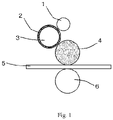
- FIG. 1 is a side view depicting one example of a method of producing a printed material according to an embodiment of the present invention.
- an ink is printed on a film, and then, the ink-coated face is irradiated with an active energy ray.
- the film is characterized by containing: a polyamide film layer (hereinafter, this layer is referred to as a "polyamide substrate layer" in some cases); and a layer that, as the outermost layer of at least one face of the film, contains a polyurethane obtained by use of a polycarbonate polyol as a polyol component.
- a specific embodiment of such a method of producing a printed material is, for example, as below-mentioned.
- the ink is cured to obtain a printed material.
- Examples of methods of coating a film with an ink include known methods such as flexography, lithography, gravure printing, screen printing, bar coater coating, and the like.
- lithography is preferably used because lithography makes it possible to coat a material to be printed with an ink at high speed, and at the same time, to produce large quantities of printing at low cost.
- Lithography encompasses the method in which a waterless offset printing plate is used and the method in which an offset printing plate is used.
- a waterless offset printing plate is preferably used.
- dampening water is not used during printing, and thus, radicals can be generated stably in the ink being irradiated with an active energy ray. This method makes it possible to cure the ink sufficiently, and retain adhesion sufficiently between the ink and the film.
- the ink on a printed material preferably has a thickness of 0.1 to 50 ⁇ m.
- the ink having a thickness within this range makes it possible to retain good printing quality, and at the same time, to decrease the ink cost, without decreasing the adhesion between the ink and the film.
- FIG. 1 is used to describe one example of a method of producing a printed material according to an embodiment of the present invention, in which embodiment a waterless offset printing plate is used.
- a blanket 4 is used will be described below, but the present invention is not limited to the example. It is possible that, without using the blanket 4, an active energy ray-curable ink from an ink roller 1 is directly adhered to the surface of a lithography plate 2 attached to a printing cylinder 3, and then, the ink is directly transferred to a lithographic substrate.
- an example in which the ink is supplied from above a film 5 will be described below, and the ink may be supplied from below the film 5.
- FIG. 1 does not include a mechanism for radiating an active energy ray.
- the lithography plate 2 is attached to the printing cylinder 3.
- the lithography plate 2 has an ink-repellent layer and a thermosensitive layer (neither is shown) in a desired pattern on the surface of the lithography plate.
- ink is supplied to the ink roller 1.
- the ink supplied to the ink roller 1 adheres to the surface of the thermosensitive layer on the surface of the lithography plate 2 attached to the printing cylinder 3.
- the ink does not adhere to the ink-repellent layer.
- the ink adhered to the surface of the thermosensitive layer on the lithography plate 2 is transferred to the surface of the blanket 4 at the point of contact with the blanket 4.
- the ink adhered to the blanket 4 is transferred to the film 5 at the point of contact with the film 5 disposed on a support roller 6.
- the film 5 is irradiated with an active energy ray so that the ink is cured to obtain a printed material.
- the active energy ray is subject to no particular limitation provided that such a ray has an excited energy desired for the curing reaction of the ink. Examples of such rays to be preferably used include ultraviolet light and an electron beam. In particular, an electron beam is preferably used to enhance adhesion between a film and an ink.
- an ultraviolet light irradiation device such as a high-pressure mercury lamp, xenon lamp, metal halide lamp, or light-emitting diode is preferably used.
- a light-emitting diode that emits a bright line having a wavelength of 350 to 420 nm is preferable from a viewpoint of inhibition of heat generation and also from viewpoints of power saving and cost reduction.
- a light-emitting diode that emits a bright line having a wavelength of 385 nm it is preferable from a productivity viewpoint that curing is performed using a light-emitting diode having an illuminance having an irradiation intensity of 5 to 20 mW/cm 2 with a conveyor at a conveying speed of 50 to 150 m/minute.
- an electron beam apparatus having an energy ray of 100 to 500 keV is preferably used.
- the curing performed using an electron beam is characterized, for example, in that even an ink containing a dye such as a pigment is less likely to become less transmissive, thus making it more likely that the inside of the ink is cured.
- This electron dose is measured using a film dosimeter, preferably a radiochromic dosimeter.
- an electron dose desired to cure an ink using an electron beam depends on the film thickness of the ink, the density of the pigment, and the like, and is preferably 5 kGy to 100 kGy, more preferably 10 kGy to 50 kGy, still more preferably 15 to 30 kGy.
- the rotational speed of each roller is not subject to any particular limitation, and can be suitably set in accordance with the quality desired for a printed material, the tact time, and the property of the ink.
- the ink remaining on the ink roller 1, the lithography plate 2, and the blanket 4 can be easily removed using water or an aqueous solution containing water as a main component.
- a film to be used contains: a polyamide substrate layer; and a layer that, as the outermost layer of at least one face of the film, contains a polyurethane obtained by use of a polycarbonate polyol as a polyol component (hereinafter, this layer is referred to as an "easy adhesion layer" in some cases).
- a polyurethane is usually synthesized using a polyisocyanate and a polyol as raw materials, and changing the kind of the polyol in particular significantly varies the characteristics associated with heat resistance and water resistance.
- using a polycarbonate polyol as a polyol component makes it possible to enhance the heat resistance and water resistance of the polyurethane. That such a layer containing a polyurethane is the outermost layer of the film makes it possible to retain adhesion well between the ink and the ink-coated film even after undergoing boiling treatment for boiling sterilization or retorting sterilization.
- Examples of well-known polyols include diols having two hydroxyl groups and triols having three hydroxyl groups, and any one of a diol and a triol is suitably used in the present invention. Accordingly, any one of a polycarbonate diol and a polycarbonate triol is preferably used, and a polycarbonate diol is more suitably used from viewpoints of production quantity and cost.
- a polycarbonate diol can be synthesized through transesterification reaction using a dihydroxy compound and a carbonate compound as raw material monomers.
- dihydroxy compounds include: 2,2-dialkyl-substituted 1,3-propane diols such as 2,2-dimethyl-1,3-propane diol, 2-ethyl-2-butyl-1,3-propane diol, 2,2-diethyl-1,3-propane diol, and 2-pentyl-2-propyl-1,3-propane diol; tetraalkyl-substituted alkylene diols such as 2,2,4,4-tetramethyl-1,5-pentane diol and 2,2,9,9-tetramethyl-1,10-decane diol; diols containing a cyclic group, such as 3,9-bis(1,1-dimethyl-2-hydroxyethyl)-2,4,8,10-tetraoxaspiro[5.5] undecane; 2,2-diphenyl-1,3-propane diol; 2,2-divinyl-1,3-propane
- carbonate compound is not subject to any limitation provided that such a compound does not impair the present invention
- examples of carbonate compounds include dialkyl carbonate, diaryl carbonate, and alkylene carbonate. Specific examples include dimethyl carbonate, diethyl carbonate, dibutyl carbonate, diphenyl carbonate, ethylene carbonate, hexamethylene carbonate, and the like, and alkylene carbonates such as ethylene carbonate and hexamethylene carbonate are preferable from viewpoints of providing high flexibility and enhancing the adhesion.
- a polyisocyanate that is generally used is a diisocyanate having two isocyanate groups in one molecule.
- aromatic isocyanates such as 1,3-phenylene diisocyanate, 1,4-phenylene diisocyanate, 2,4-tolylene diisocyanate (TDI), 2,6-tolylene diisocyanate, 4,4'-diphenyl methane diisocyanate (MDI), 2,4-diphenyl methane diisocyanate, and 1,5-naphthylene diisocyanate
- aliphatic isocyanates such as ethylene diisocyanate, tetramethylene diisocyanate, hexamethylene diisocyanate (HDI), dodecamethylene diisocyanate, 1,6,11-undecane triisocyanate, 2,2,4-trimethyl hexamethylene diisocyanate, and lysine diisocyanate
- alicyclic isocyanates such as 1,3-phen
- the present invention includes, as the outermost layer, a layer containing a polyurethane obtained by use of a polycarbonate polyol as a polyol component, and it is preferable that the polyurethane used in the layer has substantially no other copolymerized polymer species.
- substantially means that the amount of the repeating unit of another polymer species, for example, an alkyl acrylate ester unit or an alkyl methacrylate ester unit is 5 mol% or less, preferably 1 mol or less, in the molecule.
- the present invention it is possible to use a film in which such a polyurethane-containing layer (easy adhesion layer) as above-mentioned is preliminarily provided on the surface of a substrate film, or it is possible to use such a polyurethane-containing layer as above-mentioned that is later formed on the surface of a film as a substrate by a coating method or the like.
- Examples of methods to be preferably used to form an easy adhesion layer include, but are not limited particularly to, a coating method. Specifically, the method encompasses: a method of performing the formation in a step other than a step of producing a substrate, what is called an off-line coating method; and a method of performing the coating in a production step, what is called an in-line coating method.
- off-line coating methods include a roll coating method, dip coating method, bar coating method, die coating method, gravure coating method, and the like, and these methods can be used in combination.
- An in-line coating method is preferably used from viewpoints of production cost and film thickness uniformity.
- An in-line coating method refers to a method in which coating is performed at an arbitrary stage from the melt-extrusion of a resin as a substrate to the reel-up of the resin. It is usual that coating is performed on any of the following substrates: a substantially noncrystalline unstretched (unoriented) substrate (A) obtained through melt-extrusion followed by rapid cooling; an uniaxially-stretched (uniaxially-oriented) substrate (B) obtained through the subsequent stretching in the longitudinal direction; a biaxially-stretched (biaxially-oriented) substrate (C) obtained through further stretching in the width direction before heat treatment.
- a coating method that can be used is any known technique, and examples of such methods that can be used include a reverse coating method, spray coating method, bar coating method, gravure coating method, rod coating method, die coating method, and the like. It is preferable to adopt a method in which any of the above-mentioned substrates (A) and (B) before undergoing completion of the crystalline orientation is coated with a coating liquid, the substrate coated with the coating liquid is then stretched uniaxially or biaxially, and heat-treated at a temperature higher than the boiling point of the solvent to undergo completion of the crystalline orientation of the resin as a substrate, and the resulting resin is provided with an easy adhesion layer.
- This method makes it possible to perform the film formation of the substrate and the application and drying of the coating liquid at the same time, and thus, is advantageous from a production cost viewpoint. In addition, it is easier to make the thickness of the easy adhesion layer thinner to perform stretching after coating.
- an excellent method is a method in which the substrate (B) uniaxially-stretched in the longitudinal direction is coated with a coating liquid, then stretched in the width direction, and heat-treated.
- the film on which an ink is printed preferably has a thickness of 5 ⁇ m or more and 200 ⁇ m or less, preferably 10 ⁇ m or more and 30 ⁇ m or less.
- the number of radicals present in the outer layer of a film on which an ink is printed is preferably 2 ⁇ 10 18 radicals or more per 1 g of the film, that is, 2 ⁇ 10 18 radicals/g or more, as the film surface on the easy adhesion layer side is irradiated with a 30-kGy (kilogray) electron beam.
- the number of radicals is preferably 3.4 ⁇ 10 15 radicals or more per 1 cm 2 of the film, that is, 3.4 ⁇ 10 15 radicals/cm 2 or more, in terms of the number per unit of area.
- the absorbed dose of the electron beam is denoted by unit kGy (kilogray), and 1 kGy denotes the absorption of 1 joule of energy per 1 kg of matter irradiated.
- the number of radicals present in the outer layer of the film, in which the outer layer of the film is irradiated with an electron beam, can be measured using an electron spin resonance (ESR) device.
- ESR electron spin resonance
- the number of free radicals present in the outer layer of the film radiated with a 30-kGy electron beam is the above-mentioned number of radicals.
- the substrate is, for example, a polyethylene film, polypropylene film, polyamide film, or the like.
- a polyamide film that is easy to coat is used.
- a polyamide film is a film having excellent physical strengths, such as tensile strength, impact strength, and pinhole strength, and excellent heat resistance.
- examples of materials that can be used as a polyamide substrate layer include: "BONYL-Q” manufactured by Kohjin Film & Chemicals Co., Ltd.; and the like.
- the ratio v1/v2 of the peak intensity v1 of the stretching vibration of the carbon-nitrogen single bond to the peak intensity v2 of the stretching vibration of the carbon-oxygen double bond is preferably in the range of from 0.5 to 1, as determined by measurements made on the surface on the easy adhesion layer side using an FT-IR-ATR method (hereinafter, the ratio of the peak intensity v1 of the stretching vibration of the carbon-nitrogen single bond to the peak intensity v2 of the stretching vibration of the carbon-oxygen double bond is simply represented by v1/v2).
- the peak intensity v1 of the stretching vibration of the carbon-nitrogen single bond can be expressed by the area of a peak that appears at and around a wavenumber of approximately 1530 cm -1 .
- the peak intensity v2 of the stretching vibration of the carbon-oxygen double bond can be expressed by the area of a peak that appears at and around a wavenumber of approximately 1740 cm -1 .
- the peak is excluded in the determination of v1/v2.
- the peak intensity v1 of the stretching vibration of the carbon-nitrogen single bond reflects the existence amount of the urethane bond
- the peak intensity v2 of the stretching vibration of the carbon-oxygen double bond reflects the existence amount of the carbonate bond due to the polyol. That is, allowing v1/v2 to be 0.5 or more allows the ratio of the urethane bond to be sufficient, thus making it possible to retain adhesion well between the ink and the film. On the other hand, allowing v1/v2 to be 1 or less allows the ratio of the polyol component to be sufficient, thus enabling the easy adhesion layer to have high flexibility and good heat resistance.
- An electron beam irradiation device that can be used is any conventionally known such device, and examples of such devices that can be suitably used include a curtain type electron beam irradiation device, a line irradiation type low-energy electron beam irradiation device, and the like.
- the surface on the easy adhesion layer side preferably has a surface roughness Ra of 5 to 30 nm. Bringing Ra to 5 nm or more generates an anchor effect on the interface of the ink, thus making it possible to raise the adhesion to an ink. In addition, bringing Ra to 30 nm or less does not impede the wetting of the ink.
- the surface roughness Ra can be measured using, for example, an atomic force microscope (AFM) and the like in accordance with the method described in JIS R 1683: 2007.
- AFM atomic force microscope
- the easy adhesion layer contains microparticles having an average particle diameter D50 of approximately 10 to 20 nm.
- the amount of the microparticles contained in the easy adhesion layer is preferably, but not limited particularly to, 0.1 to 10 parts by mass with respect to 100 parts by mass of the polyurethane.
- the average particle diameter D50 refers to a particle diameter at which the cumulative percentage of passing material from the smaller-particle-diameter side reaches 50% in a volumetric particle diameter distribution obtained through measurement by dynamic light scattering.
- microparticles that are suitably used include silica particles, alumina particles, and the like from viewpoints of dispersibility, stability, and cost.
- An ink to be suitably used in the present invention is an ink that is cured with an active energy ray. Irradiation with an active energy ray enables the ink on a printed material to be cured. When the ink is cured with an active energy ray, internal stress due to cure shrinkage is generally more likely to be generated, thus resulting in becoming a factor which causes a decrease in adhesion between the ink and the film. However, that a film to be printed is such a film as above-mentioned makes it possible to retain the adhesion well between the ink and the film.
- an ink to be used in the present invention is an active energy ray-curable printing ink
- a resin to be contained in the ink is preferably (a) an acrylic resin having an acid value of 30 mgKOH/g or more and 250 mgKOH/g or less.
- the acid value is more preferably 60 mgKOH/g or more and 200 mgKOH/g or less, particularly preferably 75 mgKOH/g or more and 150 mgKOH/g or less.
- Having an acid value in the range makes it possible to enhance the sensitivity of the ink curing reaction by an active energy ray, and to obtain a good ink cured film even with low-energy irradiation, and in addition, makes it possible to achieve high water resistance.
- the acid value can be determined in accordance with "3.1 neutralization titration" in the test method of JIS K 0070: 1992.
- the above-mentioned acrylic resin preferably has an ethylenic unsaturated group. Having an ethylenic unsaturated group leads to having high-sensitivity active energy ray-curability, and in addition, affording excellent water resistance to the cured film.
- having an ethylenic unsaturated group in the side chain allows the resin having an ethylenic unsaturated group to be itself curable by irradiation with an active energy ray. Accordingly, the irradiation with an active energy ray allows the ink to be cured by radical reaction between the high-molecular-weight resins, and thus, the irradiation amount of the active energy ray desired for the curing can be small, resulting in affording high-sensitivity active energy ray-curability.
- irradiation using ultraviolet light as an active energy ray makes it possible to achieve sufficient ink curability even with a small amount of ultraviolet light radiation in UV printing that involves curing ink instantaneously.
- enhancing the printing speed leads to enhancing the productivity significantly, that using a power-saving UV light source (for example, a metal halide lamp or an LED) leads to achieving lower cost, and the like.
- the above-mentioned acrylic resin contains an ethylenic unsaturated group, and in addition, has a suitable acid value, and thus, the adhesion is excellent between the ink produced using the resin and the above-mentioned film.
- the above-mentioned outer layer of the film contains a polyurethane obtained by use of a polycarbonate polyol as a diol component, thus allowing the carboxyl group contained in the resin in the ink and the amino group or the like present in the surface of the film to form a bond therebetween.
- an ink used in the present invention can preferably contain a resin that is other than the above-mentioned acrylic resin and is a resin having an ethylenic unsaturated group and a carboxyl group.
- An ink containing such a resin has high-sensitivity active energy ray-curability, and in addition, affords excellent water resistance to the cured film.
- the resin other than the acrylic resin preferably has an acid value of 30 mgKOH/g or more and 250 mgKOH/g or less. Examples of such resins include styrene maleic acid resins, rosin-modified maleic acid resins, epoxy resins, polyester resins, polyurethane resins, phenol resins, and the like.
- the acrylic resin and the resin that is other than the acrylic resin and has an ethylenic unsaturated group and a carboxyl group preferably have a weight-average molecular weight of 5,000 or more, more preferably 15,000 or more, still more preferably 20,000 or more.
- the weight-average molecular weight is preferably 100,000 or less, more preferably 75,000 or less, and still more preferably 50,000 or less in order to afford water solubility to the resin.
- the weight-average molecular weight can be determined by measurement in terms of polystyrene using gel permeation chromatography (GPC).
- the acrylic resin and the resin that is other than the acrylic resin and has an ethylenic unsaturated group and a carboxyl group are contained preferably in an amount of 5 mass% or more, more preferably 10 mass% or more, in the ink used in the present invention in order to afford ink viscosity desired for printing and sensitivity desired for curing.
- the amount is preferably 60 mass% or less, more preferably 50 mass% or less, still more preferably 40 mass% or less, in order to afford ink fluidity and roller-to-roller transferability that are desired for printing.
- the ink used in the present invention preferably contains (b) a pigment and (c) a (meth)acrylate having a hydroxyl group.
- the (b) pigment to be preferably used is at least one selected from inorganic pigments and organic pigments.
- inorganic pigments used in the present invention include titanium oxide, zinc oxide, calcium carbonate, barium sulfate, iron red, cadmium red, chrome yellow, zinc yellow, Prussian blue, ultramarine, organic bentonite, alumina white, iron oxide, carbon black, graphite, aluminum, and the like.
- organic pigments include phthalocyanine pigments, soluble azo pigments, insoluble azo pigments, lake pigments, quinacridone pigments, isoindoline pigments, indanthrene pigment, and metal complex pigments. More specific examples include phthalocyanine blue, phthalocyanine green, azo red, monoazo red, monoazo yellow, disazo red, disazo yellow, quinacridone red, quinacridone magenta, isoindoline yellow, and the like.
- the amount of the (b) pigment contained in the ink used in the present invention is preferably 5 mass% or more, more preferably 10 mass% or more, still more preferably 15 mass% or more, in 100 mass% of the ink in order to afford density to the printing face.
- the amount is preferably 50 mass% or less, more preferably 45 mass% or less, still more preferably 40 mass% or less, in 100 mass% of the ink in order to enhance the fluidity of the ink and to afford good roller-to-roller transferability.
- the (c) (meth)acrylate having a hydroxyl group makes it possible to enhance the fluidity of the ink, and to adjust ink properties such as viscosity and a leveling property because a hydroxyl group has the effect of dispersing and stabilizing a pigment.
- the irradiation with an active energy ray cures the ink, thus making it possible to enhance the water resistance of the cured film.
- the hydroxyl value is more preferably 75 mgKOH/g or more, still more preferably 100 mgKOH/g or more.
- the hydroxyl value is 200 mgKOH/g or less makes it possible to retain the fluidity of the ink well, and thus, is preferable.
- the hydroxyl value is more preferably 180 mgKOH/g or less, still more preferably 160 mgKOH/g or less.
- the (c) (meth)acrylate having a hydroxyl group include a poly(meth)acrylate of a polyhydric alcohol such as trimethylolpropane, glycerin, pentaerythritol, diglycerine, ditrimethylolpropane, isocyanuric acid, or dipentaerythritol, and alkylene oxide adducts thereof.
- a polyhydric alcohol such as trimethylolpropane, glycerin, pentaerythritol, diglycerine, ditrimethylolpropane, isocyanuric acid, or dipentaerythritol, and alkylene oxide adducts thereof.
- More specific examples include di(meth)acrylate of trimethylolpropane, di(meth)acrylate of glycerin, di- or tri(meth)acrylate of pentaerythritol, di- or tri(meth)acrylate of diglycerine, di- or tri(meth)acrylate of ditrimethylolpropane, di-, tri-, tetra-, or penta(meth)acrylate of dipentaerythritol, and ethylene oxide adducts, propylene oxide adducts, and tetraethylene oxide adducts thereof.
- a (meth)acrylate obtained by allowing a compound having a plurality of hydroxyl groups and carboxyl groups to react with a glycidyl (meth)acrylate examples include bisphenol A, hydrogenated bisphenol A, bisphenol F, and hydrogenated bisphenol F. More specific examples include di(meth)acrylate of bisphenol A, di(meth)acrylate of bisphenol F, di(meth)acrylate of hydrogenated bisphenol A, di(meth)acrylate of hydrogenated bisphenol F, and ethylene oxide adducts, propylene oxide adducts, and tetraethylene oxide adducts thereof.
- pentaerythritol tri(meth)acrylate, diglycerine tri(meth)acrylate, and ditrimethylolpropane tri(meth)acrylate are particularly preferable from viewpoints of excellent pigment dispersibility and enhanced scumming resistance.
- the amount of the (c) (meth)acrylate having a hydroxyl group is preferably 10 mass% or more, more preferably 20 mass% or more, still more preferably 30 mass% or more, in 100 mass% of the ink because such an amount makes it possible to afford ink viscosity suitable for printing.
- the amount is preferably 70 mass% or less, more preferably 60 mass% or less, still more preferably 50 mass% or less, because such an amount makes it possible to obtain a cured film having good sensitivity and sufficient water resistance.
- the ink used in the present invention preferably further contains (d) a difunctional (meth)acrylate having a C 8-18 linear aliphatic skeleton (hereinafter referred to as the "(d) aliphatic difunctional (meth)acrylate”).
- a difunctional (meth)acrylate having a C 8-18 linear aliphatic skeleton hereinafter referred to as the "(d) aliphatic difunctional (meth)acrylate”
- the (d) aliphatic difunctional (meth)acrylates such (meth)acrylates having a hydroxyl group are classified into the (c) (meth)acrylate having a hydroxyl group.
- the (d) aliphatic difunctional (meth)acrylate has a hydroxyl value of 5 mgKOH/g or less, and exhibits hydrophobicity.
- the linear aliphatic skeleton of the (d) aliphatic difunctional (meth)acrylate may be either a straight-chain skeleton or a branched skeleton, and may have a saturated bond or an unsaturated bond.
- the (d) aliphatic difunctional (meth)acrylate that exhibits hydrophobicity has suitably poor compatibility with the (b) resin having an ethylenic unsaturated group and a carboxyl group and the (c) (meth)acrylate having a hydroxyl group, and inhibits the molecular chains in the ink from being entwined with one another, thus inhibiting the spinnability of the ink being transferred, and enhancing the ink transferability.
- the ink used in the present invention contains the (d) aliphatic difunctional (meth)acrylate which exhibits hydrophobicity leads to decreasing the surface tension of the ink, enhancing the wettability to the substrate, and thus enhancing the ink transferability and the adhesion to the substrate.
- the ink transferability refers to a transfer rate achieved when the ink is transferred from a rubber (metal) roller to a rubber (metal) roller, from a rubber (metal) roller to a plate, from a plate to a blanket, or from a blanket to a substrate.
- the (d) aliphatic difunctional (meth)acrylate preferably has 8 or more carbon atoms, more preferably 9 or more carbon atoms, still more preferably 10 or more carbon atoms, in order to retain, to a suitable degree, the compatibility with the (b) resin having an ethylenic unsaturated group and a carboxyl group and the (c) (meth)acrylate having a hydroxyl group, and to enhance the ink transferability.
- the (d) aliphatic difunctional (meth)acrylate preferably has 18 or less carbon atoms, more preferably 16 or less carbon atoms, still more preferably 14 or less carbon atoms, in order to inhibit a decrease in the compatibility with the (b) resin having an ethylenic unsaturated group and a carboxyl group and the (c) (meth)acrylate having a hydroxyl group, an increase in the ink viscosity, and a decrease in the ink transferability.
- the amount of the (d) aliphatic difunctional (meth)acrylate contained in the ink is preferably 1 mass% or more, more preferably 2 mass% or more, still more preferably 3 mass% or more, with respect to the total mass of the ink in order to retain the compatibility to a suitable degree and enhance the ink transferability.
- the amount of the (d) aliphatic difunctional (meth)acrylate is preferably 20 mass% or less, more preferably 15 mass% or less, still more preferably 10 mass% or less, still more preferably 8 mass% or less, in 100 mass% of the ink used in the present invention.
- (d) aliphatic difunctional (meth)acrylate examples include 1,8-octanediol di(meth)acrylate, 1,9-nonanediol di(meth)acrylate, 1,10-decanediol di(meth)acrylate, 1,11-undecanediol di(meth)acrylate, 1,12-dodecanediol di(meth)acrylate, 1,13-tridecanediol di(meth)acrylate, 1,14-tetradecanediol di(meth)acrylate, 1,15-pentadecanediol di(meth)acrylate, 1,16-hexadecanediol di(meth)acrylate, 1,17-heptadecanediol di(meth)acrylate, 1,18-octadecanediol di(meth)acrylate, 4-methyl-1,10-decanediol di(meth
- polyester di(meth)acrylates having a C 8-18 aliphatic skeleton as a repeating unit.
- 1,10-decanediol di(meth)acrylate is particularly preferable in order to retain, to a suitable degree, the compatibility with the (b) resin having an ethylenic unsaturated group and a carboxyl group and the (c) (meth)acrylate having a hydroxyl group, and to enhance the ink transferability.
- the functional number refers to the number of (meth)acrylate-derived structures.
- the (d) aliphatic difunctional (meth)acrylate preferably has a weight-average molecular weight of 100 or more, more preferably 150 or more, still more preferably 200 or more, in order to makes it possible to make the ink coating flexible and provide the ink with adhesion to the substrate.
- the weight-average molecular weight is preferably 1,000 or less, more preferably 700 or less, still more preferably 500 or less, because such a weight-average molecular weight leads to retaining the viscosity of the ink and improving the fluidity.
- the weight-average molecular weight is the molecular weight of the compound itself. Additionally, in cases where the compound has a molecular weight distribution, the weight-average molecular weight can be obtained by measurement in terms of polystyrene using gel permeation chromatography (GPC).
- the ratio of the (d) aliphatic difunctional (meth)acrylate is preferably 0.10 part by mass or more, more preferably 0.15 part by mass or more, still more preferably 0.20 part by mass or more, on the basis (1.00 part by mass) of the total amount of the (b) resin having an ethylenic unsaturated group and a carboxyl group, in order to retain the compatibility with the (a) resin to a suitable degree and to enhance the ink transferability.
- the ratio of the (d) aliphatic difunctional (meth)acrylate is preferably 0.60 part by mass or less, more preferably 0.45 part by mass or less, still more preferably 0.30 part by mass or less, on the basis (1.00 part by mass) of the total amount of the (b) resin having an ethylenic unsaturated group and a carboxyl group.
- the ink according to the present invention preferably further contains (e) a urethane (meth)acrylate.
- Hydrogen bonding between urethane bonds contained in the (e) urethane (meth)acrylate forms a hard segment, making it possible to impart tenacity to an ink coating, and in addition, enabling the ink coating to be firmly bonded to the surface of a plastic film or the like to thereby have good adhesion.
- the similarity in the molecular structural characteristics to the easy adhesion layer in the outer layer of the film according to the present invention makes it possible to enhance high affinity with the easy adhesion layer of the ink, and obtain extremely good adhesion.
- the (e) urethane (meth)acrylate contains a polyol to thereby form a soft segment, thus making it possible to impart flexibility to the ink coating.
- the (e) urethane (meth)acrylate preferably has any one or more of an ester structure and a polycarbonate structure.
- the urethane (meth)acrylate having any one or more of an ester structure and a polycarbonate structure enables such a rigid structure to effectively enhance the heat resistance and coating properties of an ink.
- the rigid structure inhibits entwinement of the molecular chains formed, makes the viscosity of the ink low, enhances the fluidity of the ink, and thus, makes it possible to achieve good transfer during printing.
- Examples of preferable alcohols that give an ester structure include a polyhydric alcohol.
- examples of dicarboxylic acids that give an ester structure include, but are not limited particularly to: phthalic acids, isophthalic acids, terephthalic acids, adipic acids, oxalic acids, maleic acids, fumaric acids, sebacic acids, and the like.
- isophthalic acids and adipic acids are relatively inexpensive, have good heat resistance, retain good compatibility with ink, and thus, are particularly preferable.
- examples of carbonate polyols that give a urethane having a carbonate structure include pentamethylene carbonate diol, hexamethylene carbonate diol, hexane carbonate diol, decane carbonate diol, and the like.
- pentamethylene carbonate diol or hexamethylene carbonate diol which has a branched chain that inhibits the hydrogen bonding strength of carbonate bonds, is particularly preferable.
- the (e) urethane (meth)acrylate that can be preferably adopted satisfies any one of the below-mentioned characteristics (1) to (6):
- the (e) urethane (meth)acrylate preferably has a weight-average molecular weight of 100 or more because such a weight-average molecular weight makes it possible to enhance the hot-water resistance of the ink.
- the weight-average molecular weight is more preferably 300 or more, still more preferably 500 or more, still more preferably 800 or more, still more preferably 1,000 or more, still more preferably 1,500 or more, from a viewpoint of allowing the ratio of the soft segment composed of a polyol component to be equal to or greater than a given value in one molecule, and thus making it possible to impart flexibility to the coating to enhance the adhesion.
- the weight-average molecular weight is preferably 10,000 or less, more preferably 7,000 or less, still more preferably 5,000 or less, from the viewpoint that retaining compatibility with the ink leads to retaining the fluidity of the ink, and making it possible to achieve a good coating appearance (leveling property) and scumming resistance during printing.
- the weight-average molecular weight of the resin can be calculated on the basis of measurement in terms of polystyrene using gel permeation chromatography (GPC).
- the amount of the (e) urethane (meth)acrylate with respect to the total amount of the ink is preferably 1 mass% or more, more preferably 3 mass% or more, more preferably 5 mass% or more, still more preferably 7 mass% or more, because such an amount affords good adhesion.
- regulating the amount to 30 mass% or less, more preferably 20 mass% or less, still more preferably 15 mass% or less makes it possible to retain good compatibility with the resin.
- Such an amount makes it possible to inhibit a rise in the tack of the ink and obtain a printed material the picture on which has good positional accuracy.
- such an amount makes it possible to retain the fluidity of the ink suitably, thus making it possible to obtain a printed material having a good leveling property, and in addition, having no scum, and thus, is preferable.
- the ink to be used in the present invention preferably contains a photopolymerization initiator particularly when the ink is cured with ultraviolet light.
- the ink may contain a sensitizer to assist the effect of the photopolymerization initiator.
- Examples of general photopolymerization initiators include ⁇ -aminoalkylphenon initiators, thioxanthone initiators, and the like, and the ink preferably contains an acylphosphine oxide compound in addition to the initiator.
- the acylphosphine oxide compound absorbs light in a long-wavelength region of 350 nm or more, and thus, has high sensitivity also in a system containing a pigment that absorbs or reflects ultraviolet light.
- such an acylphosphine oxide compound has a photobleaching effect, by which the compound no longer absorbs light once the compound has undergone reaction, and this effect provides excellent internal curability.
- ⁇ -aminoalkylphenon initiators include 2-benzyl-2-dimethylamino-1-(4-morpholinophenyl)-butanone-1,2-dimethylamino-2-(4-methyl-benzyl)-1-(4-morpholin-4-yl-phenyl)-butane-1-one, and 2-methyl-1-[-4(methylthio)phenyl]-2-morpholinopropane-one. These may be used singly or in combination. These polymerization initiators are preferable from a viewpoint of easy availability.
- thioxanthone initiators examples include 2,4-diethylthioxanthone, 2-isopropylthioxanthone, 2-chlorothioxanthone, and the like.
- the ink containing such a photopolymerization initiator in an amount of 0.1 mass% or more with respect to the total mass of the ink makes it possible to obtain good sensitivity, and thus, is preferable.
- the amount is more preferably 1 mass% or more, still more preferably 3 mass% or more.
- the ink containing such a photopolymerization initiator in an amount of 20 mass% or less leads to enhancing the storage stability of the ink, and thus, is preferable.
- the amount is more preferably 15 mass% or less, and still more preferably 10 mass% or less.
- sensitizers include 2,4-diethylthioxanthone, isopropylthioxanthone, 2,3-bis(4-diethylaminobenzal)cyclopentanone, 2,6-bis(4-dimethylaminobenzal)cyclohexanone, 2,6-bis(4-dimethylaminobenzal)-4-methylcyclohexanone, Michler's ketone, 4,4-bis(diethylamino)-benzophenone, 4,4-bis(dimethylamino)chalcone, 4,4-bis(diethylamino)chalcone, p-dimethylaminocinnamylidene indanone, p-dimethylaminobenzylidene indanone, 2-(p-dimethylamino phenyl vinylene)-isonaphthothiazole, 1,3-bis(4-dimethylaminobenzal)acetone, 1,3-carbonyl-
- the amount of the sensitizer is preferably 0.1 mass% or more, more preferably 1 mass% or more, still more preferably 3 mass% or more, in the ink because such an ink can obtain good sensitivity. Additionally, from a viewpoint of enhancing the storage stability of the ink, the amount is preferably 20 mass% or less of the ink, more preferably 15 mass% or less, still more preferably 10 mass% or less.
- the photopolymerization initiator and the sensitizer can be used singly or in combination of two or more kinds thereof.
- the ink used in the present invention preferably contains an emulsifier.
- the ink containing an emulsifier makes it possible that the ink takes in a suitable amount (generally said to be 10 to 20 mass% of the total amount of the ink) of dampening water and is emulsified during offset printing, thus increasing the repellency of the non-image area against the dampening water to thereby enhance the scumming resistance of the ink.
- the ink used in the present invention may contain another component to the extent that containing such a component does not impair the effects of the present invention.
- Suitable examples of the ink used in the present invention include the inks described in WO2017/47817 and WO2018/163941 .
- Acrylic resin 1 this acrylic resin 1 was obtained by allowing 0.6 equivalent weight of glycidyl methacrylate to undergo addition reaction with the carboxyl group of a copolymer composed of 25 mass% of methyl methacrylate, 25 mass% of styrene, and 50 mass% of methacrylic acid.
- the resin 1 obtained had a weight-average molecular weight of 34,000, an acid value of 102 mgKOH/g, and an iodine value of 2.0 mol/kg.
- Hydroxyl (meth)acrylate "Miramer” (registered trademark) M340 (manufactured by Miwon Specialty Chemical Co., Ltd.); a mixture of (meth)acrylate having a hydroxyl group, pentaerythritol triacrylate, and pentaerythritol tetraacrylate; having a hydroxyl value of 115 mgKOH/g
- Aliphatic difunctional (meth)acrylate 1,10-decanediol diacrylate (NK ester A-DOD-N, manufactured by Shin-Nakamura Chemical Co., Ltd.); having a hydroxyl value of 0 mgKOH/g
- Urethane acrylate this urethane acrylate is composed of an alicyclic diisocyanate (hydrogenated XDI), carboxylic acids (isophthalic acid and adipic acid), a polyol, and 2-hydroxyethyl acrylate, having a weight-average molecular weight (Mw) of 3600, and having a urethane bond fraction of 8 mass%.
- hydroXDI alicyclic diisocyanate
- carboxylic acids isophthalic acid and adipic acid
- 2-hydroxyethyl acrylate having a weight-average molecular weight (Mw) of 3600, and having a urethane bond fraction of 8 mass%.
- Photopolymerization initiator 1 2,4,6-trimethylbenzoyl-diphenyl-phosphine oxide "LUCIRIN” (registered trademark) TPO (manufactured by BASF SE)
- Photopolymerization initiator 2 2-[4-(methylthio)benzoyl]-2-(4-morpholinyl)propane "IRGACURE” (registered trademark) 907 (manufactured by BASF SE)
- Sensitizer 4,4-bis(diethylamino)benzophenone (manufactured by Hodogaya Chemical Co., Ltd.).
- Extender pigment "MICRO ACE” (registered trademark) P-3 (manufactured by Nippon Talc Co., Ltd.)
- Emulsifier "RHEODOL” (registered trademark) TW-L120 (manufactured by Kao Corporation) having an HLB value of 16.7
- Wax "KTL” (registered trademark) 4N (manufactured by Kitamura Limited).
- Film 1 a polyamide film "BONYL-Q" (manufactured by Kohjin Film & Chemicals Co., Ltd.); a film having an easy adhesion layer; having a film thickness of 15 ⁇ m.
- the easy adhesion layer contains a polyurethane obtained by use of a polycarbonate polyol as a diol component.
- Film 2 a polyamide film "EMBLEM” (registered trademark) ON (manufactured by Unitika Ltd.) the surface of which was coated with "ETERNACOLL” (registered trademark) UW5502 (a polyurethane obtained by use of a polycarbonate polyol as a diol component, (manufactured by Ube Industries, Ltd.)) 10-fold diluted with water; having a film thickness of 15 ⁇ m.
- ETERNACOLL registered trademark
- UW5502 a polyurethane obtained by use of a polycarbonate polyol as a diol component, (manufactured by Ube Industries, Ltd.)
- Film 3 a polyamide film "EMBLEM” (registered trademark) ON (manufactured by Unitika Ltd.) the surface of which was coated with a mixture obtained by adding 1 part by mass of "SNOWTEX” (registered trademark) ST-C (colloidal silica having a particle diameter of 12 nm, manufactured by Nissan Chemical Corporation) to 100 parts by mass of "ETERNACOLL” (registered trademark) UW5502 (a polyurethane obtained by use of a polycarbonate polyol as a diol component, (manufactured by Ube Industries, Ltd.)) followed by diluting the resulting mixture with water 10-fold; having a film thickness of 15 ⁇ m.
- ETERNACOLL registered trademark
- Film 4 a polyamide film "EMBLEM” (registered trademark) ON (manufactured by Unitika Ltd.) the surface of which was coated with a mixture obtained by adding 5 parts by mass of "SNOWTEX” (registered trademark) ST-C (colloidal silica having a particle diameter of 12 nm, manufactured by Nissan Chemical Corporation) to 100 parts by mass of "ETERNACOLL” (registered trademark) UW5502 (a polyurethane obtained by use of a polycarbonate polyol as a diol component, (manufactured by Ube Industries, Ltd.)) followed by diluting the resulting mixture with water 10-fold; having a film thickness of 15 ⁇ m.
- ETERNACOLL registered trademark
- Film 5 a polyamide film "EMBLEM” (registered trademark) ON (manufactured by Unitika Ltd.) the surface of which was coated with "ETERNACOLL” (registered trademark) UW5002E (a polyurethane obtained by use of a polycarbonate polyol as a diol component, (manufactured by Ube Industries, Ltd.)) 10-fold diluted with water; having a film thickness of 15 ⁇ m.
- ETERNACOLL registered trademark
- UW5002E a polyurethane obtained by use of a polycarbonate polyol as a diol component, (manufactured by Ube Industries, Ltd.)
- Film 6 a polyamide film "EMBLEM” (registered trademark) ON (manufactured by Unitika Ltd.) the surface of which was coated with "ETERNACOLL” (registered trademark) UW3018 (a polyurethane obtained by use of a polycarbonate polyol as a diol component, (manufactured by Ube Industries, Ltd.)) 10-fold diluted with water; having a film thickness of 15 ⁇ m.
- ETERNACOLL registered trademark
- Film 7 a polyamide film "EMBLEM” (registered trademark) ON (manufactured by Unitika Ltd.) the surface of which was coated with "ELASTRON” (registered trademark) H38 (a polyurethane containing a polyether polyol as a diol component, manufactured by DKS Co., Ltd.) 10-fold diluted with water; having a film thickness of 15 ⁇ m.
- EBLEM polyamide film
- ELASTRON registered trademark
- Film 8 a polyamide film "EMBLEM” (registered trademark) ON (manufactured by Unitika Ltd.) the surface of which was coated with "ELASTRON” (registered trademark) E37 (a polyurethane containing a polyester polyol as a diol component, manufactured by DKS Co., Ltd.) 10-fold diluted with water; having a film thickness of 15 ⁇ m.
- EBLEM polyamide film
- ELASTRON registered trademark
- E37 a polyurethane containing a polyester polyol as a diol component
- An electron spin resonance (ESR) device ELEXSSYS E580 (manufactured by Bruker Corporation) was used to measure the number of radicals present in the outer layer of the film irradiated with a 30-kGy electron beam.
- ESR electron spin resonance
- the film sample irradiated with an electron beam was stored in a low-temperature atmosphere using dry ice immediately after the irradiation, and was brought back in a roomtemperature atmosphere immediately before a measurement was taken of the number of radicals.
- the conditions in detail are as below-mentioned.
- the outer layer of the film was subjected to measurement by an attenuated total reflection (ATR) method using an FT-IR device ("FTS-55A", manufactured by Bio-Rad Digilab), wherein the layer was each of the easy adhesion layer-containing face of the film 1 and the coating face sides of the films 2 to 8.
- ATR attenuated total reflection
- FTS-55A manufactured by Bio-Rad Digilab
- the v1/v2 value was calculated from the spectrum obtained, assuming that the area of a peak present between 1510 to 1550 cm -1 was the peak intensity v1 of the stretching vibration of the nitrogen-hydrogen single bond, and that the area of a peak present between 1720 to 1760 cm -1 was the peak intensity v2 of the stretching vibration of the carbon-oxygen double bond.
- vl a straight line was drawn between the value at 1510 cm -1 and the value at 1550 cm -1 , and used as a baseline. In the range of from 1510 cm -1 to 1550 cm -1 , the area surrounded by this baseline and the spectrum obtained was calculated as v1. In the same manner, for calculation of v2, a straight line was drawn between the value at 1720 cm -1 and the value at 1760 cm -1 , and in the range of from 1720 to 1760 cm -1 , the area surrounded by this baseline and the spectrum obtained was calculated as v2.
- the evaluation results of v1/v2 are tabulated in Table 1.
- the easy adhesion layer-containing face of the film 1 and the coating faces of the films 2 to 8 were subjected to surface roughness Ra measurement in accordance with JIS R 1683: 2007, the standard titled “Test method for surface roughness of ceramic thin films by atomic force microscopy", using an atomic force microscope Dimension Fast Scan (manufactured by Bruker Corporation).
- the measurement results of Ra are tabulated in Table 1.
- a waterless offset printing plate (TAN-E, manufactured by Toray Industries, Inc.) was mounted on an offset press (Oliver 266EPZ, manufactured by Sakurai Graphic Systems Corporation), and a printed material was obtained by printing a film using each ink having each of the compositions described in Examples 1 to 4, 6 to 10, and Comparative Examples 1 and 2.
- An offset printing plate (XP-F, manufactured by Fujifilm Corporation) was mounted on an offset press (Oliver 266EPZ, manufactured by Sakurai Graphic Systems Corporation), and a printed material was obtained by printing a film using the ink of Example 5 and using, as dampening water, a mixture of tap water and 3% by weight of etching solution (SOLAIA-505, manufactured by T & K Toka Co., Ltd.).
- An electron beam irradiation device (LB1036, manufactured by Eye Electron Beam Co., Ltd.) was used to cure an ink under conditions at an accelerating voltage of 110 kV, a beam current of 5.0 mA, and an absorbed dose of 30 kGy to produce a printed material.
- An ultraviolet light irradiation device (having one ultra-high-pressure metal halide lamp, 120 W/cm; manufactured by Ushio Inc.) was used to cure an ink at a belt conveyor speed of 50 m/minute to produce a printed material.
- a sheet of high-quality paper was used as paper white (the criterion of the reflectance density of 0) to evaluate the density of the solid image portion using a reflectance densitometer (SpectroEye, status E, manufactured by GretagMacbeth GmbH). A larger ink transferability value was judged to be better.
- the peel strength test for a printed material on a film and the evaluation criterion were based on the standard number JIS K 6854-2: 1999 titled "Adhesives - Determination of peel strength of bonded assemblies - Part 2: 180-degree peel”.
- An active energy ray-curable lithographic ink described in each of Examples and Comparative Examples was used to perform a waterless offset printing test (Examples 1 to 4, 6 to 10, and Comparative Examples 1 to 2) or an offset printing test (Example 5), and each film listed in Table 2 was printed 1,000 m at a printing speed of 200 m/minute at an active energy ray-curable lithographic ink supply amount of 50%.
- the ink was cured using an electron beam or ultraviolet light to produce a printed material.
- a two-component adhesive agent (LX-500/KR-90S, manufactured by DIC Corporation) was applied to the surface of a printed material so as to be 3.5 g/m 2 , and to the resulting material, a laminate film was adhered. Then, the resulting material was placed in an oven, left to stand at a temperature of 60°C for 1 day, and thus cured to produce a peel strength evaluation sample. In addition, part of the peel strength evaluation sample was immersed in hot water at 100°C for 30 minutes to produce a boiled peel strength evaluation sample.
- the sample was cut to have a width of 15 mm, and used to measure the peel strength of each of the printed material and the film.
- a tensile tester was used to perform a 180-degree peel test at a loading rate of 100 mm/minute.
- the components of the ink were weighed out as per the composition mentioned in Table 2, and passed three times through a three roll mill "EXAKT” (registered trademark) M-80S (manufactured by Exakt Technologies, Inc.) under the Gap 1 conditions to obtain the ink.
- the ink produced was printed on the film 1 by a waterless offset printing method, and cured using an electron beam irradiation device to produce a printed material.
- the ink transferability was 1.60, which was good.
- the peel strength was 5.7 N/15 mm, that is, the adhesion was extremely good.
- the peel strength after boiling was 5.8 N/15 mm, that is, the adhesion after boiling was extremely good.
- the components of the ink were weighed out as per the composition mentioned in Table 2, and passed three times through a three roll mill "EXAKT” (registered trademark) M-80S (manufactured by Exakt Technologies, Inc.) under the Gap 1 conditions to obtain the ink.
- the ink produced was printed on the film 1 by a waterless offset printing method, and cured using an electron beam irradiation device to produce a printed material.
- the ink transferability was 1.75, which was extremely good.
- the peel strength was 6.4 N/15 mm, that is, the adhesion was extremely good.
- the peel strength after boiling was 6.6 N/15 mm, that is, the adhesion after boiling was extremely good.
- the components of the ink were weighed out as per the composition mentioned in Table 2, and passed three times through a three roll mill "EXAKT” (registered trademark) M-80S (manufactured by Exakt Technologies, Inc.) under the Gap 1 conditions to obtain the ink.
- the ink produced was printed on the film 1 by a waterless offset printing method, and cured using an electron beam irradiation device to produce a printed material.
- the ink transferability was 1.72, which was extremely good.
- the peel strength was 8.1 N/15 mm, that is, the adhesion was extremely good.
- the peel strength after boiling was 8.5 N/15 mm, that is, the adhesion after boiling was extremely good.
- the components of the ink were weighed out as per the composition mentioned in Table 2, and passed three times through a three roll mill "EXAKT” (registered trademark) M-80S (manufactured by Exakt Technologies, Inc.) under the Gap 1 conditions to obtain the ink.
- the ink produced was printed on the film 1 by a waterless offset printing method, and cured using an ultraviolet light irradiation device to produce a printed material.
- the ink transferability was 1.60, which was good.
- the peel strength was 4.6 N/15 mm, that is, the adhesion was good.
- the peel strength after boiling was 4.4 N/15 mm, that is, the adhesion after boiling was good.
- the components of the ink were weighed out as per the composition mentioned in Table 2, and passed three times through a three roll mill "EXAKT” (registered trademark) M-80S (manufactured by Exakt Technologies, Inc.) under the Gap 1 conditions to obtain the ink.
- the ink produced was printed on the film 1 by an offset printing method, and cured using an electron beam irradiation device to produce a printed material.
- the ink transferability was 1.55, which was good.
- the peel strength was 3.5 N/15 mm, that is, the adhesion was good.
- the peel strength after boiling was 3.3 N/15 mm, that is, the adhesion after boiling was good.
- the printing experiment was performed by the same operation as in Example 1 except that the kind of the film was changed to the film 2 (Example 6), film 3 (Example 7), and film 4 (Example 8).
- the ink transferability and the adhesion to the film were evaluated.
- the ink transferability of each film was 1.60, which was good.
- the peel strength was 4.8 N/15 mm in Example 6, that is, the adhesion was good.
- the peel strength was 5.1 N/15 mm and 6.1 N/15 mm respectively, that is, the adhesion was very good.
- the peel strength after boiling was 4.5 N/15 mm in Example 6, that is, the adhesion after boiling was good.
- the peel strength was 5.2 N/15 mm and 5.9 N/15 mm respectively, that is, the adhesion after boiling was very good.
- the printing experiment was performed by the same operation as in Example 1 except that the kind of the film was changed to the film 5 (Example 9) and film 6 (Example 10).
- the ink transferability and the adhesion to the film were evaluated.
- the ink transferability of each film was 1.60, which was good.
- the peel strength was 6.1 N/15 mm in Example 9, that is, the adhesion was very good.
- the peel strength was 4.4 N/15 mm in Example 10, that is, the adhesion was good.
- the peel strength after boiling was 4.7 N/15 mm in Example 9 and 4.6 N/15 mm in Example 10, that is, the adhesion after boiling was good.
- the printing experiment was performed by the same operation as in Example 1 except that the kind of the film was changed to the film 7.
- the ink transferability and the adhesion to the film were evaluated.
- the ink transferability was 1.60, which was good.
- the peel strength was 4.2 N/15 mm, that is, the adhesion was good.
- the peel strength after boiling was 1.6 N/15 mm, that is, the adhesion after boiling was insufficient.
- the printing experiment was performed by the same operation as in Example 1 except that the kind of the film was changed to the film 8.
- the ink transferability and the adhesion to the film were evaluated.
- the ink transferability was 1.60, which was good.
- the peel strength was 4.6 N/15 mm, that is, the adhesion was good.
- the peel strength after boiling was 1.9 N/15 mm, that is, the adhesion after boiling was insufficient.
Landscapes
- Chemical & Material Sciences (AREA)
- Engineering & Computer Science (AREA)
- Life Sciences & Earth Sciences (AREA)
- Wood Science & Technology (AREA)
- Organic Chemistry (AREA)
- Materials Engineering (AREA)
- Physics & Mathematics (AREA)
- Manufacturing & Machinery (AREA)
- Chemical Kinetics & Catalysis (AREA)
- Health & Medical Sciences (AREA)
- General Health & Medical Sciences (AREA)
- Toxicology (AREA)
- Optics & Photonics (AREA)
- Mechanical Engineering (AREA)
- Plasma & Fusion (AREA)
- Electromagnetism (AREA)
- Inks, Pencil-Leads, Or Crayons (AREA)
Abstract
Description
- The present invention relates to a method of producing a printed material.
- In recent years, use of an active energy ray-curable printing ink that can be instantaneously cured by irradiation with an active energy ray such as ultraviolet light has been expanding in many fields in view of installations, safety, environment, and high productivity. In addition, an active energy ray-curable lithographic ink for which a washing solution containing no volatile solvent and containing water as a main component can be used is disclosed in the context where a large amount of petroleum solvent is used as a washing solution for an ink to be used in printing processes.
- An active energy ray-curable printing ink can be cured at room temperature in a short time, and thus, is considered to be an optimal material for forming a coating on a plastic substrate lacking in heat resistance. However, in some of the cases where an active energy ray-curable printing ink is used for printing on a film, the adhesion between the ink and the film is insufficient.
- In this context, an active energy ray-curable printing ink having excellent adhesion to a film is being developed (see, for example, Patent Literature 1). In addition, a technology by which the surface of a film is modified to enhance adhesion between an ink and the film is being developed (see, for example,
Patent Literature 2 to 3). -
- Patent Literature 1:
JP2015-168730A - Patent Literature 2:
JP2011-94125A - Patent Literature 3:
WO2018/163941 - However, in some of the cases where one of such technologies is used, the adhesion between an ink and a film is insufficient. In particular, in cases where a food package film is printed, the adhesion between an ink and the film can be much decreased when the ink-printed film is boiled for boiling sterilization or retorting sterilization.
- In view of this, an object of the present invention is to provide a method of producing a printed material that has good adhesion between the ink and the film even after undergoing boiling treatment such as boiling sterilization or retorting sterilization.
- The present invention includes a method of producing a printed material, including the steps of: printing an ink on a film; and irradiating the ink-printed face with an active energy ray; wherein the film contains: a polyamide film layer; and a layer that, as the outermost layer of at least one face of the film, contains a polyurethane obtained by use of a polycarbonate polyol as a diol component.
- A method of producing a printed material according to the present invention makes it possible to retain adhesion well between an ink and a film even after undergoing boiling treatment such as boiling sterilization or retorting sterilization.
-
FIG. 1 is a side view depicting one example of a method of producing a printed material according to an embodiment of the present invention. - Below, suitable embodiments of a method of producing a printed material according to the present invention will be described in detail. However, the present invention is not to be construed as limited to the below-illustrated embodiments, and can be variously modified and embodied in accordance with the purpose or application to the extent that such modifications do not depart from the spirit of the present invention.
- In a method of producing a printed material according to an embodiment of the present invention, an ink is printed on a film, and then, the ink-coated face is irradiated with an active energy ray. In addition, the film is characterized by containing: a polyamide film layer (hereinafter, this layer is referred to as a "polyamide substrate layer" in some cases); and a layer that, as the outermost layer of at least one face of the film, contains a polyurethane obtained by use of a polycarbonate polyol as a polyol component.
- A specific embodiment of such a method of producing a printed material is, for example, as below-mentioned. First, an ink coating is produced on a face of a film in a step of coating the film with an ink. Next, in a step of irradiating the ink coating thus produced on the film with an active energy ray, the ink is cured to obtain a printed material.
- Examples of methods of coating a film with an ink include known methods such as flexography, lithography, gravure printing, screen printing, bar coater coating, and the like. In particular, lithography is preferably used because lithography makes it possible to coat a material to be printed with an ink at high speed, and at the same time, to produce large quantities of printing at low cost.
- Lithography encompasses the method in which a waterless offset printing plate is used and the method in which an offset printing plate is used. In a method of producing a printed material according to the present invention, a waterless offset printing plate is preferably used. In a method in which a waterless offset printing plate is used, dampening water is not used during printing, and thus, radicals can be generated stably in the ink being irradiated with an active energy ray. This method makes it possible to cure the ink sufficiently, and retain adhesion sufficiently between the ink and the film.
- The ink on a printed material preferably has a thickness of 0.1 to 50 µm. The ink having a thickness within this range makes it possible to retain good printing quality, and at the same time, to decrease the ink cost, without decreasing the adhesion between the ink and the film.
- Next,
FIG. 1 is used to describe one example of a method of producing a printed material according to an embodiment of the present invention, in which embodiment a waterless offset printing plate is used. In this regard, an example in which ablanket 4 is used will be described below, but the present invention is not limited to the example. It is possible that, without using theblanket 4, an active energy ray-curable ink from anink roller 1 is directly adhered to the surface of alithography plate 2 attached to aprinting cylinder 3, and then, the ink is directly transferred to a lithographic substrate. In addition, an example in which the ink is supplied from above afilm 5 will be described below, and the ink may be supplied from below thefilm 5. In this regard,FIG. 1 does not include a mechanism for radiating an active energy ray. - First, the
lithography plate 2 is attached to theprinting cylinder 3. Thelithography plate 2 has an ink-repellent layer and a thermosensitive layer (neither is shown) in a desired pattern on the surface of the lithography plate. - Next, ink is supplied to the
ink roller 1. The ink supplied to theink roller 1 adheres to the surface of the thermosensitive layer on the surface of thelithography plate 2 attached to theprinting cylinder 3. The ink does not adhere to the ink-repellent layer. - The ink adhered to the surface of the thermosensitive layer on the
lithography plate 2 is transferred to the surface of theblanket 4 at the point of contact with theblanket 4. The ink adhered to theblanket 4 is transferred to thefilm 5 at the point of contact with thefilm 5 disposed on asupport roller 6. - Then, the
film 5 is irradiated with an active energy ray so that the ink is cured to obtain a printed material. The active energy ray is subject to no particular limitation provided that such a ray has an excited energy desired for the curing reaction of the ink. Examples of such rays to be preferably used include ultraviolet light and an electron beam. In particular, an electron beam is preferably used to enhance adhesion between a film and an ink. - In cases where ultraviolet light is used for curing, an ultraviolet light irradiation device such as a high-pressure mercury lamp, xenon lamp, metal halide lamp, or light-emitting diode is preferably used. Using a light-emitting diode that emits a bright line having a wavelength of 350 to 420 nm is preferable from a viewpoint of inhibition of heat generation and also from viewpoints of power saving and cost reduction. For example, in cases where a light-emitting diode that emits a bright line having a wavelength of 385 nm is used, it is preferable from a productivity viewpoint that curing is performed using a light-emitting diode having an illuminance having an irradiation intensity of 5 to 20 mW/cm2 with a conveyor at a conveying speed of 50 to 150 m/minute.
- In cases where an ink is cured using an electron beam, an electron beam apparatus having an energy ray of 100 to 500 keV is preferably used. The curing performed using an electron beam is characterized, for example, in that even an ink containing a dye such as a pigment is less likely to become less transmissive, thus making it more likely that the inside of the ink is cured. This electron dose is measured using a film dosimeter, preferably a radiochromic dosimeter.
- In the present invention, an electron dose desired to cure an ink using an electron beam depends on the film thickness of the ink, the density of the pigment, and the like, and is preferably 5 kGy to 100 kGy, more preferably 10 kGy to 50 kGy, still more preferably 15 to 30 kGy.
- In the above-illustrated production method, the rotational speed of each roller is not subject to any particular limitation, and can be suitably set in accordance with the quality desired for a printed material, the tact time, and the property of the ink.
- After printing, the ink remaining on the
ink roller 1, thelithography plate 2, and theblanket 4 can be easily removed using water or an aqueous solution containing water as a main component. - In the present invention, a film to be used contains: a polyamide substrate layer; and a layer that, as the outermost layer of at least one face of the film, contains a polyurethane obtained by use of a polycarbonate polyol as a polyol component (hereinafter, this layer is referred to as an "easy adhesion layer" in some cases). A polyurethane is usually synthesized using a polyisocyanate and a polyol as raw materials, and changing the kind of the polyol in particular significantly varies the characteristics associated with heat resistance and water resistance. In the present invention, using a polycarbonate polyol as a polyol component makes it possible to enhance the heat resistance and water resistance of the polyurethane. That such a layer containing a polyurethane is the outermost layer of the film makes it possible to retain adhesion well between the ink and the ink-coated film even after undergoing boiling treatment for boiling sterilization or retorting sterilization.
- Examples of well-known polyols include diols having two hydroxyl groups and triols having three hydroxyl groups, and any one of a diol and a triol is suitably used in the present invention. Accordingly, any one of a polycarbonate diol and a polycarbonate triol is preferably used, and a polycarbonate diol is more suitably used from viewpoints of production quantity and cost.
- A polycarbonate diol can be synthesized through transesterification reaction using a dihydroxy compound and a carbonate compound as raw material monomers.
- Examples of dihydroxy compounds include: 2,2-dialkyl-substituted 1,3-propane diols such as 2,2-dimethyl-1,3-propane diol, 2-ethyl-2-butyl-1,3-propane diol, 2,2-diethyl-1,3-propane diol, and 2-pentyl-2-propyl-1,3-propane diol; tetraalkyl-substituted alkylene diols such as 2,2,4,4-tetramethyl-1,5-pentane diol and 2,2,9,9-tetramethyl-1,10-decane diol; diols containing a cyclic group, such as 3,9-bis(1,1-dimethyl-2-hydroxyethyl)-2,4,8,10-tetraoxaspiro[5.5] undecane; 2,2-diphenyl-1,3-propane diol; 2,2-divinyl-1,3-propane diol; 2,2-diethynyl-1,3-propane diol; 2,2-dimethoxy-1,3-propane diol; bis(2-hydroxy-1,1-dimethylethyl) ether; bis(2-hydroxy-1,1-dimethylethyl) thioether; 2,2,4,4-tetramethyl-3-cyano-1,5-pentane diol; and the like.
- In addition, the carbonate compound is not subject to any limitation provided that such a compound does not impair the present invention, and examples of carbonate compounds include dialkyl carbonate, diaryl carbonate, and alkylene carbonate. Specific examples include dimethyl carbonate, diethyl carbonate, dibutyl carbonate, diphenyl carbonate, ethylene carbonate, hexamethylene carbonate, and the like, and alkylene carbonates such as ethylene carbonate and hexamethylene carbonate are preferable from viewpoints of providing high flexibility and enhancing the adhesion.
- A polyisocyanate that is generally used is a diisocyanate having two isocyanate groups in one molecule. Specific examples include, but are not limited to: aromatic isocyanates such as 1,3-phenylene diisocyanate, 1,4-phenylene diisocyanate, 2,4-tolylene diisocyanate (TDI), 2,6-tolylene diisocyanate, 4,4'-diphenyl methane diisocyanate (MDI), 2,4-diphenyl methane diisocyanate, and 1,5-naphthylene diisocyanate; aliphatic isocyanates such as ethylene diisocyanate, tetramethylene diisocyanate, hexamethylene diisocyanate (HDI), dodecamethylene diisocyanate, 1,6,11-undecane triisocyanate, 2,2,4-trimethyl hexamethylene diisocyanate, and lysine diisocyanate; and alicyclic isocyanates such as isophorone diisocyanate (IPDI), 4,4'-dicyclohexylmethane diisocyanate (hydrogenated MDI), cyclohexylene diisocyanate, and methylcyclohexylene diisocyanate (hydrogenated TDI).
- As above-mentioned, the present invention includes, as the outermost layer, a layer containing a polyurethane obtained by use of a polycarbonate polyol as a polyol component, and it is preferable that the polyurethane used in the layer has substantially no other copolymerized polymer species. The term "substantial" as used herein means that the amount of the repeating unit of another polymer species, for example, an alkyl acrylate ester unit or an alkyl methacrylate ester unit is 5 mol% or less, preferably 1 mol or less, in the molecule.
- In the present invention, it is possible to use a film in which such a polyurethane-containing layer (easy adhesion layer) as above-mentioned is preliminarily provided on the surface of a substrate film, or it is possible to use such a polyurethane-containing layer as above-mentioned that is later formed on the surface of a film as a substrate by a coating method or the like.
- Examples of methods to be preferably used to form an easy adhesion layer include, but are not limited particularly to, a coating method. Specifically, the method encompasses: a method of performing the formation in a step other than a step of producing a substrate, what is called an off-line coating method; and a method of performing the coating in a production step, what is called an in-line coating method.
- Examples of off-line coating methods include a roll coating method, dip coating method, bar coating method, die coating method, gravure coating method, and the like, and these methods can be used in combination.
- An in-line coating method is preferably used from viewpoints of production cost and film thickness uniformity. An in-line coating method refers to a method in which coating is performed at an arbitrary stage from the melt-extrusion of a resin as a substrate to the reel-up of the resin. It is usual that coating is performed on any of the following substrates: a substantially noncrystalline unstretched (unoriented) substrate (A) obtained through melt-extrusion followed by rapid cooling; an uniaxially-stretched (uniaxially-oriented) substrate (B) obtained through the subsequent stretching in the longitudinal direction; a biaxially-stretched (biaxially-oriented) substrate (C) obtained through further stretching in the width direction before heat treatment.
- A coating method that can be used is any known technique, and examples of such methods that can be used include a reverse coating method, spray coating method, bar coating method, gravure coating method, rod coating method, die coating method, and the like. It is preferable to adopt a method in which any of the above-mentioned substrates (A) and (B) before undergoing completion of the crystalline orientation is coated with a coating liquid, the substrate coated with the coating liquid is then stretched uniaxially or biaxially, and heat-treated at a temperature higher than the boiling point of the solvent to undergo completion of the crystalline orientation of the resin as a substrate, and the resulting resin is provided with an easy adhesion layer. This method makes it possible to perform the film formation of the substrate and the application and drying of the coating liquid at the same time, and thus, is advantageous from a production cost viewpoint. In addition, it is easier to make the thickness of the easy adhesion layer thinner to perform stretching after coating. Among these, an excellent method is a method in which the substrate (B) uniaxially-stretched in the longitudinal direction is coated with a coating liquid, then stretched in the width direction, and heat-treated.
- In the present invention, the film on which an ink is printed preferably has a thickness of 5 µm or more and 200 µm or less, preferably 10 µm or more and 30 µm or less.
- In the present invention, the number of radicals present in the outer layer of a film on which an ink is printed is preferably 2 × 10¹⁸ radicals or more per 1 g of the film, that is, 2 × 10¹⁸ radicals/g or more, as the film surface on the easy adhesion layer side is irradiated with a 30-kGy (kilogray) electron beam. In addition, the number of radicals is preferably 3.4 × 10¹⁵ radicals or more per 1 cm2 of the film, that is, 3.4 × 10¹⁵ radicals/cm2 or more, in terms of the number per unit of area. In this regard, the absorbed dose of the electron beam is denoted by unit kGy (kilogray), and 1 kGy denotes the absorption of 1 joule of energy per 1 kg of matter irradiated. When the outer layer of the film is irradiated with an electron beam, radicals are generated in the ink, and as a result, the ink is cured, but the electron beam transmitted through the ink acts also on the outer layer of the film, and thus, radicals are generated from another constituent such as the outer layer of the film, that is, the easy adhesion layer and the polyamide substrate layer present in the vicinity of the surface. Conceivably, the higher the number of radicals present in the outer layer of the film is, the more the cross-linking reaction between the ink and the outer layer of the film is facilitated, hence the higher the adhesion between the printed material as the cured ink and the outer layer of the film.
- The number of radicals present in the outer layer of the film, in which the outer layer of the film is irradiated with an electron beam, can be measured using an electron spin resonance (ESR) device. The number of free radicals present in the outer layer of the film radiated with a 30-kGy electron beam is the above-mentioned number of radicals.
- In order that the number of radicals generated by irradiating the outer layer of the film with an electron beam can be within the above-mentioned range, the substrate is, for example, a polyethylene film, polypropylene film, polyamide film, or the like. In the present invention, a polyamide film that is easy to coat is used. A polyamide film is a film having excellent physical strengths, such as tensile strength, impact strength, and pinhole strength, and excellent heat resistance.
- In the present invention, examples of materials that can be used as a polyamide substrate layer include: "BONYL-Q" manufactured by Kohjin Film & Chemicals Co., Ltd.; and the like.
- The ratio v1/v2 of the peak intensity v1 of the stretching vibration of the carbon-nitrogen single bond to the peak intensity v2 of the stretching vibration of the carbon-oxygen double bond is preferably in the range of from 0.5 to 1, as determined by measurements made on the surface on the easy adhesion layer side using an FT-IR-ATR method (hereinafter, the ratio of the peak intensity v1 of the stretching vibration of the carbon-nitrogen single bond to the peak intensity v2 of the stretching vibration of the carbon-oxygen double bond is simply represented by v1/v2). The peak intensity v1 of the stretching vibration of the carbon-nitrogen single bond can be expressed by the area of a peak that appears at and around a wavenumber of approximately 1530 cm-1. In addition, the peak intensity v2 of the stretching vibration of the carbon-oxygen double bond can be expressed by the area of a peak that appears at and around a wavenumber of approximately 1740 cm-1. In this regard, if a peak derived from the polyamide substrate layer is observed, the peak is excluded in the determination of v1/v2.
- It is considered that the peak intensity v1 of the stretching vibration of the carbon-nitrogen single bond reflects the existence amount of the urethane bond, and that the peak intensity v2 of the stretching vibration of the carbon-oxygen double bond reflects the existence amount of the carbonate bond due to the polyol. That is, allowing v1/v2 to be 0.5 or more allows the ratio of the urethane bond to be sufficient, thus making it possible to retain adhesion well between the ink and the film. On the other hand, allowing v1/v2 to be 1 or less allows the ratio of the polyol component to be sufficient, thus enabling the easy adhesion layer to have high flexibility and good heat resistance.
- An electron beam irradiation device that can be used is any conventionally known such device, and examples of such devices that can be suitably used include a curtain type electron beam irradiation device, a line irradiation type low-energy electron beam irradiation device, and the like.
- In the present invention, the surface on the easy adhesion layer side preferably has a surface roughness Ra of 5 to 30 nm. Bringing Ra to 5 nm or more generates an anchor effect on the interface of the ink, thus making it possible to raise the adhesion to an ink. In addition, bringing Ra to 30 nm or less does not impede the wetting of the ink.
- The surface roughness Ra can be measured using, for example, an atomic force microscope (AFM) and the like in accordance with the method described in JIS R 1683: 2007.
- For Ra to be within the above-mentioned range, it is preferable, for example, that the easy adhesion layer contains microparticles having an average particle diameter D50 of approximately 10 to 20 nm. The amount of the microparticles contained in the easy adhesion layer is preferably, but not limited particularly to, 0.1 to 10 parts by mass with respect to 100 parts by mass of the polyurethane. In this regard, the average particle diameter D50 refers to a particle diameter at which the cumulative percentage of passing material from the smaller-particle-diameter side reaches 50% in a volumetric particle diameter distribution obtained through measurement by dynamic light scattering. Examples of microparticles that are suitably used include silica particles, alumina particles, and the like from viewpoints of dispersibility, stability, and cost.
- An ink to be suitably used in the present invention is an ink that is cured with an active energy ray. Irradiation with an active energy ray enables the ink on a printed material to be cured. When the ink is cured with an active energy ray, internal stress due to cure shrinkage is generally more likely to be generated, thus resulting in becoming a factor which causes a decrease in adhesion between the ink and the film. However, that a film to be printed is such a film as above-mentioned makes it possible to retain the adhesion well between the ink and the film.
- One embodiment of an ink to be used in the present invention is an active energy ray-curable printing ink, and a resin to be contained in the ink is preferably (a) an acrylic resin having an acid value of 30 mgKOH/g or more and 250 mgKOH/g or less. The acid value is more preferably 60 mgKOH/g or more and 200 mgKOH/g or less, particularly preferably 75 mgKOH/g or more and 150 mgKOH/g or less. Having an acid value in the range makes it possible to enhance the sensitivity of the ink curing reaction by an active energy ray, and to obtain a good ink cured film even with low-energy irradiation, and in addition, makes it possible to achieve high water resistance. The acid value can be determined in accordance with "3.1 neutralization titration" in the test method of JIS K 0070: 1992.
- In addition, the above-mentioned acrylic resin preferably has an ethylenic unsaturated group. Having an ethylenic unsaturated group leads to having high-sensitivity active energy ray-curability, and in addition, affording excellent water resistance to the cured film.
- In addition, having an ethylenic unsaturated group in the side chain allows the resin having an ethylenic unsaturated group to be itself curable by irradiation with an active energy ray. Accordingly, the irradiation with an active energy ray allows the ink to be cured by radical reaction between the high-molecular-weight resins, and thus, the irradiation amount of the active energy ray desired for the curing can be small, resulting in affording high-sensitivity active energy ray-curability.
- Accordingly, for example, irradiation using ultraviolet light as an active energy ray makes it possible to achieve sufficient ink curability even with a small amount of ultraviolet light radiation in UV printing that involves curing ink instantaneously. This in turn makes it possible that enhancing the printing speed leads to enhancing the productivity significantly, that using a power-saving UV light source (for example, a metal halide lamp or an LED) leads to achieving lower cost, and the like.
- Furthermore, the above-mentioned acrylic resin contains an ethylenic unsaturated group, and in addition, has a suitable acid value, and thus, the adhesion is excellent between the ink produced using the resin and the above-mentioned film. This is considered to be because the above-mentioned outer layer of the film contains a polyurethane obtained by use of a polycarbonate polyol as a diol component, thus allowing the carboxyl group contained in the resin in the ink and the amino group or the like present in the surface of the film to form a bond therebetween.
- In addition, an ink used in the present invention can preferably contain a resin that is other than the above-mentioned acrylic resin and is a resin having an ethylenic unsaturated group and a carboxyl group. An ink containing such a resin has high-sensitivity active energy ray-curability, and in addition, affords excellent water resistance to the cured film. In addition, the resin other than the acrylic resin preferably has an acid value of 30 mgKOH/g or more and 250 mgKOH/g or less. Examples of such resins include styrene maleic acid resins, rosin-modified maleic acid resins, epoxy resins, polyester resins, polyurethane resins, phenol resins, and the like.
- To afford water resistance to the cured film, the acrylic resin and the resin that is other than the acrylic resin and has an ethylenic unsaturated group and a carboxyl group preferably have a weight-average molecular weight of 5,000 or more, more preferably 15,000 or more, still more preferably 20,000 or more. In addition, the weight-average molecular weight is preferably 100,000 or less, more preferably 75,000 or less, and still more preferably 50,000 or less in order to afford water solubility to the resin. In this DESCRIPTION, the weight-average molecular weight can be determined by measurement in terms of polystyrene using gel permeation chromatography (GPC).
- The acrylic resin and the resin that is other than the acrylic resin and has an ethylenic unsaturated group and a carboxyl group are contained preferably in an amount of 5 mass% or more, more preferably 10 mass% or more, in the ink used in the present invention in order to afford ink viscosity desired for printing and sensitivity desired for curing. The amount is preferably 60 mass% or less, more preferably 50 mass% or less, still more preferably 40 mass% or less, in order to afford ink fluidity and roller-to-roller transferability that are desired for printing.
- In addition, the ink used in the present invention preferably contains (b) a pigment and (c) a (meth)acrylate having a hydroxyl group.
- The (b) pigment to be preferably used is at least one selected from inorganic pigments and organic pigments.
- Specific examples of inorganic pigments used in the present invention include titanium oxide, zinc oxide, calcium carbonate, barium sulfate, iron red, cadmium red, chrome yellow, zinc yellow, Prussian blue, ultramarine, organic bentonite, alumina white, iron oxide, carbon black, graphite, aluminum, and the like.
- Specific examples of organic pigments include phthalocyanine pigments, soluble azo pigments, insoluble azo pigments, lake pigments, quinacridone pigments, isoindoline pigments, indanthrene pigment, and metal complex pigments. More specific examples include phthalocyanine blue, phthalocyanine green, azo red, monoazo red, monoazo yellow, disazo red, disazo yellow, quinacridone red, quinacridone magenta, isoindoline yellow, and the like.
- These (b) pigments can be used singly or in mixture of two or more kinds thereof.
- The amount of the (b) pigment contained in the ink used in the present invention is preferably 5 mass% or more, more preferably 10 mass% or more, still more preferably 15 mass% or more, in 100 mass% of the ink in order to afford density to the printing face. In addition, the amount is preferably 50 mass% or less, more preferably 45 mass% or less, still more preferably 40 mass% or less, in 100 mass% of the ink in order to enhance the fluidity of the ink and to afford good roller-to-roller transferability.
- In addition, using the (c) (meth)acrylate having a hydroxyl group makes it possible to enhance the fluidity of the ink, and to adjust ink properties such as viscosity and a leveling property because a hydroxyl group has the effect of dispersing and stabilizing a pigment. In addition, the irradiation with an active energy ray cures the ink, thus making it possible to enhance the water resistance of the cured film.
- That the (c) (meth)acrylate having a hydroxyl group has a hydroxyl value of 50 mgKOH/g or more enhances the pigment dispersibility, and thus, is preferable. The hydroxyl value is more preferably 75 mgKOH/g or more, still more preferably 100 mgKOH/g or more. In addition, that the hydroxyl value is 200 mgKOH/g or less makes it possible to retain the fluidity of the ink well, and thus, is preferable. The hydroxyl value is more preferably 180 mgKOH/g or less, still more preferably 160 mgKOH/g or less.
- Specific examples of the (c) (meth)acrylate having a hydroxyl group include a poly(meth)acrylate of a polyhydric alcohol such as trimethylolpropane, glycerin, pentaerythritol, diglycerine, ditrimethylolpropane, isocyanuric acid, or dipentaerythritol, and alkylene oxide adducts thereof. More specific examples include di(meth)acrylate of trimethylolpropane, di(meth)acrylate of glycerin, di- or tri(meth)acrylate of pentaerythritol, di- or tri(meth)acrylate of diglycerine, di- or tri(meth)acrylate of ditrimethylolpropane, di-, tri-, tetra-, or penta(meth)acrylate of dipentaerythritol, and ethylene oxide adducts, propylene oxide adducts, and tetraethylene oxide adducts thereof. In addition, it is possible to use a (meth)acrylate obtained by allowing a compound having a plurality of hydroxyl groups and carboxyl groups to react with a glycidyl (meth)acrylate. Examples of compounds having a plurality of hydroxyl groups and carboxyl groups include bisphenol A, hydrogenated bisphenol A, bisphenol F, and hydrogenated bisphenol F. More specific examples include di(meth)acrylate of bisphenol A, di(meth)acrylate of bisphenol F, di(meth)acrylate of hydrogenated bisphenol A, di(meth)acrylate of hydrogenated bisphenol F, and ethylene oxide adducts, propylene oxide adducts, and tetraethylene oxide adducts thereof. Among these, pentaerythritol tri(meth)acrylate, diglycerine tri(meth)acrylate, and ditrimethylolpropane tri(meth)acrylate are particularly preferable from viewpoints of excellent pigment dispersibility and enhanced scumming resistance.
- The amount of the (c) (meth)acrylate having a hydroxyl group is preferably 10 mass% or more, more preferably 20 mass% or more, still more preferably 30 mass% or more, in 100 mass% of the ink because such an amount makes it possible to afford ink viscosity suitable for printing. In addition, the amount is preferably 70 mass% or less, more preferably 60 mass% or less, still more preferably 50 mass% or less, because such an amount makes it possible to obtain a cured film having good sensitivity and sufficient water resistance.
- The ink used in the present invention preferably further contains (d) a difunctional (meth)acrylate having a C8-18 linear aliphatic skeleton (hereinafter referred to as the "(d) aliphatic difunctional (meth)acrylate"). Among the (d) aliphatic difunctional (meth)acrylates, however, such (meth)acrylates having a hydroxyl group are classified into the (c) (meth)acrylate having a hydroxyl group. It is preferable that the (d) aliphatic difunctional (meth)acrylate has a hydroxyl value of 5 mgKOH/g or less, and exhibits hydrophobicity. The linear aliphatic skeleton of the (d) aliphatic difunctional (meth)acrylate may be either a straight-chain skeleton or a branched skeleton, and may have a saturated bond or an unsaturated bond. The (d) aliphatic difunctional (meth)acrylate that exhibits hydrophobicity has suitably poor compatibility with the (b) resin having an ethylenic unsaturated group and a carboxyl group and the (c) (meth)acrylate having a hydroxyl group, and inhibits the molecular chains in the ink from being entwined with one another, thus inhibiting the spinnability of the ink being transferred, and enhancing the ink transferability. In addition, that the ink used in the present invention contains the (d) aliphatic difunctional (meth)acrylate which exhibits hydrophobicity leads to decreasing the surface tension of the ink, enhancing the wettability to the substrate, and thus enhancing the ink transferability and the adhesion to the substrate. Here, the ink transferability refers to a transfer rate achieved when the ink is transferred from a rubber (metal) roller to a rubber (metal) roller, from a rubber (metal) roller to a plate, from a plate to a blanket, or from a blanket to a substrate.
- The (d) aliphatic difunctional (meth)acrylate preferably has 8 or more carbon atoms, more preferably 9 or more carbon atoms, still more preferably 10 or more carbon atoms, in order to retain, to a suitable degree, the compatibility with the (b) resin having an ethylenic unsaturated group and a carboxyl group and the (c) (meth)acrylate having a hydroxyl group, and to enhance the ink transferability. The (d) aliphatic difunctional (meth)acrylate preferably has 18 or less carbon atoms, more preferably 16 or less carbon atoms, still more preferably 14 or less carbon atoms, in order to inhibit a decrease in the compatibility with the (b) resin having an ethylenic unsaturated group and a carboxyl group and the (c) (meth)acrylate having a hydroxyl group, an increase in the ink viscosity, and a decrease in the ink transferability.
- The amount of the (d) aliphatic difunctional (meth)acrylate contained in the ink is preferably 1 mass% or more, more preferably 2 mass% or more, still more preferably 3 mass% or more, with respect to the total mass of the ink in order to retain the compatibility to a suitable degree and enhance the ink transferability. For the same reason, the amount of the (d) aliphatic difunctional (meth)acrylate is preferably 20 mass% or less, more preferably 15 mass% or less, still more preferably 10 mass% or less, still more preferably 8 mass% or less, in 100 mass% of the ink used in the present invention.
- Specific examples of the (d) aliphatic difunctional (meth)acrylate include 1,8-octanediol di(meth)acrylate, 1,9-nonanediol di(meth)acrylate, 1,10-decanediol di(meth)acrylate, 1,11-undecanediol di(meth)acrylate, 1,12-dodecanediol di(meth)acrylate, 1,13-tridecanediol di(meth)acrylate, 1,14-tetradecanediol di(meth)acrylate, 1,15-pentadecanediol di(meth)acrylate, 1,16-hexadecanediol di(meth)acrylate, 1,17-heptadecanediol di(meth)acrylate, 1,18-octadecanediol di(meth)acrylate, 4-methyl-1,10-decanediol di(meth)acrylate, 4-ethyl-1,10-decanediol di(meth)acrylate, and the like. Other examples include polyester di(meth)acrylates having a C8-18 aliphatic skeleton as a repeating unit. In addition, it is possible to contain two or more of these. Among the above-mentioned examples, 1,10-decanediol di(meth)acrylate is particularly preferable in order to retain, to a suitable degree, the compatibility with the (b) resin having an ethylenic unsaturated group and a carboxyl group and the (c) (meth)acrylate having a hydroxyl group, and to enhance the ink transferability. Here, the functional number refers to the number of (meth)acrylate-derived structures.
- The (d) aliphatic difunctional (meth)acrylate preferably has a weight-average molecular weight of 100 or more, more preferably 150 or more, still more preferably 200 or more, in order to makes it possible to make the ink coating flexible and provide the ink with adhesion to the substrate. In addition, the weight-average molecular weight is preferably 1,000 or less, more preferably 700 or less, still more preferably 500 or less, because such a weight-average molecular weight leads to retaining the viscosity of the ink and improving the fluidity. In cases where the chemical structure is known, the weight-average molecular weight is the molecular weight of the compound itself. Additionally, in cases where the compound has a molecular weight distribution, the weight-average molecular weight can be obtained by measurement in terms of polystyrene using gel permeation chromatography (GPC).
- The ratio of the (d) aliphatic difunctional (meth)acrylate is preferably 0.10 part by mass or more, more preferably 0.15 part by mass or more, still more preferably 0.20 part by mass or more, on the basis (1.00 part by mass) of the total amount of the (b) resin having an ethylenic unsaturated group and a carboxyl group, in order to retain the compatibility with the (a) resin to a suitable degree and to enhance the ink transferability. For the same reason, the ratio of the (d) aliphatic difunctional (meth)acrylate is preferably 0.60 part by mass or less, more preferably 0.45 part by mass or less, still more preferably 0.30 part by mass or less, on the basis (1.00 part by mass) of the total amount of the (b) resin having an ethylenic unsaturated group and a carboxyl group.
- The ink according to the present invention preferably further contains (e) a urethane (meth)acrylate.
- Hydrogen bonding between urethane bonds contained in the (e) urethane (meth)acrylate forms a hard segment, making it possible to impart tenacity to an ink coating, and in addition, enabling the ink coating to be firmly bonded to the surface of a plastic film or the like to thereby have good adhesion. In particular, the similarity in the molecular structural characteristics to the easy adhesion layer in the outer layer of the film according to the present invention makes it possible to enhance high affinity with the easy adhesion layer of the ink, and obtain extremely good adhesion. Furthermore, the (e) urethane (meth)acrylate contains a polyol to thereby form a soft segment, thus making it possible to impart flexibility to the ink coating.
- In addition, the (e) urethane (meth)acrylate preferably has any one or more of an ester structure and a polycarbonate structure. The urethane (meth)acrylate having any one or more of an ester structure and a polycarbonate structure enables such a rigid structure to effectively enhance the heat resistance and coating properties of an ink. In addition, the rigid structure inhibits entwinement of the molecular chains formed, makes the viscosity of the ink low, enhances the fluidity of the ink, and thus, makes it possible to achieve good transfer during printing.
- Examples of preferable alcohols that give an ester structure include a polyhydric alcohol. In addition, examples of dicarboxylic acids that give an ester structure include, but are not limited particularly to: phthalic acids, isophthalic acids, terephthalic acids, adipic acids, oxalic acids, maleic acids, fumaric acids, sebacic acids, and the like. Among these, isophthalic acids and adipic acids are relatively inexpensive, have good heat resistance, retain good compatibility with ink, and thus, are particularly preferable.
- In addition, examples of carbonate polyols that give a urethane having a carbonate structure include pentamethylene carbonate diol, hexamethylene carbonate diol, hexane carbonate diol, decane carbonate diol, and the like. However, the high cohesive force of carbonate bonds leads to thickening and degradation of compatibility with ink as the amount of carbonate bonds increases. Accordingly, pentamethylene carbonate diol or hexamethylene carbonate diol, which has a branched chain that inhibits the hydrogen bonding strength of carbonate bonds, is particularly preferable.
- In addition, the (e) urethane (meth)acrylate that can be preferably adopted satisfies any one of the below-mentioned characteristics (1) to (6):
- (1) a compound having: a urethane structure obtained from a polyisocyanate having at least an aromatic ring structure or an alicyclic structure; and an ester structure obtained from a carboxylic acid;
- (2) a compound having: a urethane bond structure obtained from a diisocyanate having at least an alicyclic structure; and an ester structure obtained from an adipic acid or an isophthalic acid;
- (3) a compound having: a urethane structure obtained from a polyisocyanate having at least an aromatic ring structure or an alicyclic structure; and a carbonate structure composed of a carbonate dipolyol;
- (4) a compound having: a urethane structure obtained from a diisocyanate having at least an alicyclic structure; and a carbonate structure selected from at least one selected from polypentamethylene carbonate diol and polyhexamethylene carbonate diol;
- (5) a compound having a urethane structure and an acrylic group, wherein the compound is obtained by allowing a hydroxyl-group-containing acrylic acid ester to react with an isocyanate compound; and
- (6) a compound having: a urethane structure obtained by allowing a pentaerythritol triacrylate to react with a diisocyanate compound having an aromatic ring structure; and an acrylic group.
- The (e) urethane (meth)acrylate preferably has a weight-average molecular weight of 100 or more because such a weight-average molecular weight makes it possible to enhance the hot-water resistance of the ink. In addition, the weight-average molecular weight is more preferably 300 or more, still more preferably 500 or more, still more preferably 800 or more, still more preferably 1,000 or more, still more preferably 1,500 or more, from a viewpoint of allowing the ratio of the soft segment composed of a polyol component to be equal to or greater than a given value in one molecule, and thus making it possible to impart flexibility to the coating to enhance the adhesion. In addition, the weight-average molecular weight is preferably 10,000 or less, more preferably 7,000 or less, still more preferably 5,000 or less, from the viewpoint that retaining compatibility with the ink leads to retaining the fluidity of the ink, and making it possible to achieve a good coating appearance (leveling property) and scumming resistance during printing. The weight-average molecular weight of the resin can be calculated on the basis of measurement in terms of polystyrene using gel permeation chromatography (GPC).
- The amount of the (e) urethane (meth)acrylate with respect to the total amount of the ink is preferably 1 mass% or more, more preferably 3 mass% or more, more preferably 5 mass% or more, still more preferably 7 mass% or more, because such an amount affords good adhesion. In addition, regulating the amount to 30 mass% or less, more preferably 20 mass% or less, still more preferably 15 mass% or less, makes it possible to retain good compatibility with the resin. Such an amount makes it possible to inhibit a rise in the tack of the ink and obtain a printed material the picture on which has good positional accuracy. In addition, such an amount makes it possible to retain the fluidity of the ink suitably, thus making it possible to obtain a printed material having a good leveling property, and in addition, having no scum, and thus, is preferable.
- The ink to be used in the present invention preferably contains a photopolymerization initiator particularly when the ink is cured with ultraviolet light. In addition, the ink may contain a sensitizer to assist the effect of the photopolymerization initiator.
- Examples of general photopolymerization initiators include α-aminoalkylphenon initiators, thioxanthone initiators, and the like, and the ink preferably contains an acylphosphine oxide compound in addition to the initiator. The acylphosphine oxide compound absorbs light in a long-wavelength region of 350 nm or more, and thus, has high sensitivity also in a system containing a pigment that absorbs or reflects ultraviolet light. In addition, such an acylphosphine oxide compound has a photobleaching effect, by which the compound no longer absorbs light once the compound has undergone reaction, and this effect provides excellent internal curability.
- Specific examples of α-aminoalkylphenon initiators include 2-benzyl-2-dimethylamino-1-(4-morpholinophenyl)-butanone-1,2-dimethylamino-2-(4-methyl-benzyl)-1-(4-morpholin-4-yl-phenyl)-butane-1-one, and 2-methyl-1-[-4(methylthio)phenyl]-2-morpholinopropane-one. These may be used singly or in combination. These polymerization initiators are preferable from a viewpoint of easy availability.
- Examples of thioxanthone initiators include 2,4-diethylthioxanthone, 2-isopropylthioxanthone, 2-chlorothioxanthone, and the like.
- The ink containing such a photopolymerization initiator in an amount of 0.1 mass% or more with respect to the total mass of the ink makes it possible to obtain good sensitivity, and thus, is preferable. The amount is more preferably 1 mass% or more, still more preferably 3 mass% or more. In addition, the ink containing such a photopolymerization initiator in an amount of 20 mass% or less leads to enhancing the storage stability of the ink, and thus, is preferable. The amount is more preferably 15 mass% or less, and still more preferably 10 mass% or less.
- Specific examples of sensitizers include 2,4-diethylthioxanthone, isopropylthioxanthone, 2,3-bis(4-diethylaminobenzal)cyclopentanone, 2,6-bis(4-dimethylaminobenzal)cyclohexanone, 2,6-bis(4-dimethylaminobenzal)-4-methylcyclohexanone, Michler's ketone, 4,4-bis(diethylamino)-benzophenone, 4,4-bis(dimethylamino)chalcone, 4,4-bis(diethylamino)chalcone, p-dimethylaminocinnamylidene indanone, p-dimethylaminobenzylidene indanone, 2-(p-dimethylamino phenyl vinylene)-isonaphthothiazole, 1,3-bis(4-dimethylaminobenzal)acetone, 1,3-carbonyl-bis(4-diethylaminobenzal)acetone, 3,3-carbonyl-bis(7-diethylamino coumarin), N-phenyl-N-ethyl ethanolamine, N-phenylethanolamine, N-tolyldiethanolamine, isoamyl dimethylaminobenzoate, isoamyl diethylaminobenzoate, 3-phenyl-5-benzoylthiotetrazole, and 1-phenyl-5-ethoxycarbonyl thiotetrazole, and the like.
- In cases where the ink contains a sensitizer, the amount of the sensitizer is preferably 0.1 mass% or more, more preferably 1 mass% or more, still more preferably 3 mass% or more, in the ink because such an ink can obtain good sensitivity. Additionally, from a viewpoint of enhancing the storage stability of the ink, the amount is preferably 20 mass% or less of the ink, more preferably 15 mass% or less, still more preferably 10 mass% or less.
- In the ink used in the present invention, the photopolymerization initiator and the sensitizer can be used singly or in combination of two or more kinds thereof.
- The ink used in the present invention preferably contains an emulsifier. The ink containing an emulsifier makes it possible that the ink takes in a suitable amount (generally said to be 10 to 20 mass% of the total amount of the ink) of dampening water and is emulsified during offset printing, thus increasing the repellency of the non-image area against the dampening water to thereby enhance the scumming resistance of the ink.
- The ink used in the present invention may contain another component to the extent that containing such a component does not impair the effects of the present invention.
- Suitable examples of the ink used in the present invention include the inks described in
WO2017/47817 WO2018/163941 . - Below, the present invention will be specifically described with reference to Examples. However, the present invention is not to be construed as limited to these Examples.
- Acrylic resin 1: this
acrylic resin 1 was obtained by allowing 0.6 equivalent weight of glycidyl methacrylate to undergo addition reaction with the carboxyl group of a copolymer composed of 25 mass% of methyl methacrylate, 25 mass% of styrene, and 50 mass% of methacrylic acid. Theresin 1 obtained had a weight-average molecular weight of 34,000, an acid value of 102 mgKOH/g, and an iodine value of 2.0 mol/kg. - Hydroxyl (meth)acrylate: "Miramer" (registered trademark) M340 (manufactured by Miwon Specialty Chemical Co., Ltd.); a mixture of (meth)acrylate having a hydroxyl group, pentaerythritol triacrylate, and pentaerythritol tetraacrylate; having a hydroxyl value of 115 mgKOH/g
- Aliphatic difunctional (meth)acrylate: 1,10-decanediol diacrylate (NK ester A-DOD-N, manufactured by Shin-Nakamura Chemical Co., Ltd.); having a hydroxyl value of 0 mgKOH/g
- Urethane acrylate: this urethane acrylate is composed of an alicyclic diisocyanate (hydrogenated XDI), carboxylic acids (isophthalic acid and adipic acid), a polyol, and 2-hydroxyethyl acrylate, having a weight-average molecular weight (Mw) of 3600, and having a urethane bond fraction of 8 mass%.
- Photopolymerization initiator 1: 2,4,6-trimethylbenzoyl-diphenyl-phosphine oxide "LUCIRIN" (registered trademark) TPO (manufactured by BASF SE)
- Photopolymerization initiator 2: 2-[4-(methylthio)benzoyl]-2-(4-morpholinyl)propane "IRGACURE" (registered trademark) 907 (manufactured by BASF SE)
- Sensitizer: 4,4-bis(diethylamino)benzophenone (manufactured by Hodogaya Chemical Co., Ltd.).
- Extender pigment: "MICRO ACE" (registered trademark) P-3 (manufactured by Nippon Talc Co., Ltd.)
- Polymerization inhibitor: p-methoxyphenol (manufactured by Wako Pure Chemical Industries, Ltd.)
- Emulsifier: "RHEODOL" (registered trademark) TW-L120 (manufactured by Kao Corporation) having an HLB value of 16.7
- Additive: lauryl acrylate (manufactured by Wako Pure Chemical Industries, Ltd.)
- Wax: "KTL" (registered trademark) 4N (manufactured by Kitamura Limited).
- Film 1: a polyamide film "BONYL-Q" (manufactured by Kohjin Film & Chemicals Co., Ltd.); a film having an easy adhesion layer; having a film thickness of 15 µm. The easy adhesion layer contains a polyurethane obtained by use of a polycarbonate polyol as a diol component.
- Film 2: a polyamide film "EMBLEM" (registered trademark) ON (manufactured by Unitika Ltd.) the surface of which was coated with "ETERNACOLL" (registered trademark) UW5502 (a polyurethane obtained by use of a polycarbonate polyol as a diol component, (manufactured by Ube Industries, Ltd.)) 10-fold diluted with water; having a film thickness of 15 µm.
- Film 3: a polyamide film "EMBLEM" (registered trademark) ON (manufactured by Unitika Ltd.) the surface of which was coated with a mixture obtained by adding 1 part by mass of "SNOWTEX" (registered trademark) ST-C (colloidal silica having a particle diameter of 12 nm, manufactured by Nissan Chemical Corporation) to 100 parts by mass of "ETERNACOLL" (registered trademark) UW5502 (a polyurethane obtained by use of a polycarbonate polyol as a diol component, (manufactured by Ube Industries, Ltd.)) followed by diluting the resulting mixture with water 10-fold; having a film thickness of 15 µm.
- Film 4: a polyamide film "EMBLEM" (registered trademark) ON (manufactured by Unitika Ltd.) the surface of which was coated with a mixture obtained by adding 5 parts by mass of "SNOWTEX" (registered trademark) ST-C (colloidal silica having a particle diameter of 12 nm, manufactured by Nissan Chemical Corporation) to 100 parts by mass of "ETERNACOLL" (registered trademark) UW5502 (a polyurethane obtained by use of a polycarbonate polyol as a diol component, (manufactured by Ube Industries, Ltd.)) followed by diluting the resulting mixture with water 10-fold; having a film thickness of 15 µm.
- Film 5: a polyamide film "EMBLEM" (registered trademark) ON (manufactured by Unitika Ltd.) the surface of which was coated with "ETERNACOLL" (registered trademark) UW5002E (a polyurethane obtained by use of a polycarbonate polyol as a diol component, (manufactured by Ube Industries, Ltd.)) 10-fold diluted with water; having a film thickness of 15 µm.
- Film 6: a polyamide film "EMBLEM" (registered trademark) ON (manufactured by Unitika Ltd.) the surface of which was coated with "ETERNACOLL" (registered trademark) UW3018 (a polyurethane obtained by use of a polycarbonate polyol as a diol component, (manufactured by Ube Industries, Ltd.)) 10-fold diluted with water; having a film thickness of 15 µm.
- Film 7: a polyamide film "EMBLEM" (registered trademark) ON (manufactured by Unitika Ltd.) the surface of which was coated with "ELASTRON" (registered trademark) H38 (a polyurethane containing a polyether polyol as a diol component, manufactured by DKS Co., Ltd.) 10-fold diluted with water; having a film thickness of 15 µm.
- Film 8: a polyamide film "EMBLEM" (registered trademark) ON (manufactured by Unitika Ltd.) the surface of which was coated with "ELASTRON" (registered trademark) E37 (a polyurethane containing a polyester polyol as a diol component, manufactured by DKS Co., Ltd.) 10-fold diluted with water; having a film thickness of 15 µm.
- An electron spin resonance (ESR) device ELEXSSYS E580 (manufactured by Bruker Corporation) was used to measure the number of radicals present in the outer layer of the film irradiated with a 30-kGy electron beam. In this regard, the film sample irradiated with an electron beam was stored in a low-temperature atmosphere using dry ice immediately after the irradiation, and was brought back in a roomtemperature atmosphere immediately before a measurement was taken of the number of radicals. The conditions in detail are as below-mentioned.
-
- Measurement temperature: room temperature
- Central magnetic field: at and around 3368 G
- Range of magnetic field sweep: 400 G
- Modulation: 100 kHz, 2 G
- Microwave: 9.44 GHz, 0.1 mW
- Sweep time: 83.89 s × 4.
- Time constant: 163.84 ms
- Number of data points: 1024 points
- Cavity: Super-High-Q
- The measurement results of the number of radicals are tabulated in Table 1.
- The outer layer of the film was subjected to measurement by an attenuated total reflection (ATR) method using an FT-IR device ("FTS-55A", manufactured by Bio-Rad Digilab), wherein the layer was each of the easy adhesion layer-containing face of the
film 1 and the coating face sides of thefilms 2 to 8. The v1/v2 value was calculated from the spectrum obtained, assuming that the area of a peak present between 1510 to 1550 cm-1 was the peak intensity v1 of the stretching vibration of the nitrogen-hydrogen single bond, and that the area of a peak present between 1720 to 1760 cm-1 was the peak intensity v2 of the stretching vibration of the carbon-oxygen double bond. Here, for calculation of vl, a straight line was drawn between the value at 1510 cm-1 and the value at 1550 cm-1, and used as a baseline. In the range of from 1510 cm-1 to 1550 cm-1, the area surrounded by this baseline and the spectrum obtained was calculated as v1. In the same manner, for calculation of v2, a straight line was drawn between the value at 1720 cm-1 and the value at 1760 cm-1, and in the range of from 1720 to 1760 cm-1, the area surrounded by this baseline and the spectrum obtained was calculated as v2. The evaluation results of v1/v2 are tabulated in Table 1. - The easy adhesion layer-containing face of the
film 1 and the coating faces of thefilms 2 to 8 were subjected to surface roughness Ra measurement in accordance with JIS R 1683: 2007, the standard titled "Test method for surface roughness of ceramic thin films by atomic force microscopy", using an atomic force microscope Dimension Fast Scan (manufactured by Bruker Corporation). The measurement results of Ra are tabulated in Table 1. - A waterless offset printing plate (TAN-E, manufactured by Toray Industries, Inc.) was mounted on an offset press (Oliver 266EPZ, manufactured by Sakurai Graphic Systems Corporation), and a printed material was obtained by printing a film using each ink having each of the compositions described in Examples 1 to 4, 6 to 10, and Comparative Examples 1 and 2.
- An offset printing plate (XP-F, manufactured by Fujifilm Corporation) was mounted on an offset press (Oliver 266EPZ, manufactured by Sakurai Graphic Systems Corporation), and a printed material was obtained by printing a film using the ink of Example 5 and using, as dampening water, a mixture of tap water and 3% by weight of etching solution (SOLAIA-505, manufactured by T & K Toka Co., Ltd.).
- An electron beam irradiation device (LB1036, manufactured by Eye Electron Beam Co., Ltd.) was used to cure an ink under conditions at an accelerating voltage of 110 kV, a beam current of 5.0 mA, and an absorbed dose of 30 kGy to produce a printed material.
- An ultraviolet light irradiation device (having one ultra-high-pressure metal halide lamp, 120 W/cm; manufactured by Ushio Inc.) was used to cure an ink at a belt conveyor speed of 50 m/minute to produce a printed material.
- An active energy ray-curable lithographic ink described in each of Examples and Comparative Examples was used to perform a waterless offset printing test (Examples 1 to 4, 6 to 10, and Comparative Examples 1 to 2) or an offset printing test (Example 5), and each film listed in Table 2 was printed 1,000 m at a printing speed of 200 m/minute at an active energy ray-curable lithographic ink supply amount of 50%. Then, the ink was cured using an electron beam or ultraviolet light to produce a printed material. A sheet of high-quality paper was used as paper white (the criterion of the reflectance density of 0) to evaluate the density of the solid image portion using a reflectance densitometer (SpectroEye, status E, manufactured by GretagMacbeth GmbH). A larger ink transferability value was judged to be better.
- The peel strength test for a printed material on a film and the evaluation criterion were based on the standard number JIS K 6854-2: 1999 titled "Adhesives - Determination of peel strength of bonded assemblies - Part 2: 180-degree peel". An active energy ray-curable lithographic ink described in each of Examples and Comparative Examples was used to perform a waterless offset printing test (Examples 1 to 4, 6 to 10, and Comparative Examples 1 to 2) or an offset printing test (Example 5), and each film listed in Table 2 was printed 1,000 m at a printing speed of 200 m/minute at an active energy ray-curable lithographic ink supply amount of 50%. Then, the ink was cured using an electron beam or ultraviolet light to produce a printed material. A two-component adhesive agent (LX-500/KR-90S, manufactured by DIC Corporation) was applied to the surface of a printed material so as to be 3.5 g/m2, and to the resulting material, a laminate film was adhered. Then, the resulting material was placed in an oven, left to stand at a temperature of 60°C for 1 day, and thus cured to produce a peel strength evaluation sample. In addition, part of the peel strength evaluation sample was immersed in hot water at 100°C for 30 minutes to produce a boiled peel strength evaluation sample. Using a cutter, the sample was cut to have a width of 15 mm, and used to measure the peel strength of each of the printed material and the film. For the measurement, a tensile tester was used to perform a 180-degree peel test at a loading rate of 100 mm/minute.
- With a peel strength of less than 1 N/15 mm, the adhesion was judged extremely insufficient; with 1 N/15 mm or more and less than 3 N/15 mm, the adhesion was judged insufficient; with 3 N/15 mm or more and less than 5 N/15 mm, the adhesion was judged good; and with 5 N/15 mm or more, the adhesion was judged extremely good.
- The components of the ink were weighed out as per the composition mentioned in Table 2, and passed three times through a three roll mill "EXAKT" (registered trademark) M-80S (manufactured by Exakt Technologies, Inc.) under the
Gap 1 conditions to obtain the ink. The ink produced was printed on thefilm 1 by a waterless offset printing method, and cured using an electron beam irradiation device to produce a printed material. The ink transferability was 1.60, which was good. The peel strength was 5.7 N/15 mm, that is, the adhesion was extremely good. In addition, the peel strength after boiling was 5.8 N/15 mm, that is, the adhesion after boiling was extremely good. - The components of the ink were weighed out as per the composition mentioned in Table 2, and passed three times through a three roll mill "EXAKT" (registered trademark) M-80S (manufactured by Exakt Technologies, Inc.) under the
Gap 1 conditions to obtain the ink. The ink produced was printed on thefilm 1 by a waterless offset printing method, and cured using an electron beam irradiation device to produce a printed material. The ink transferability was 1.75, which was extremely good. The peel strength was 6.4 N/15 mm, that is, the adhesion was extremely good. In addition, the peel strength after boiling was 6.6 N/15 mm, that is, the adhesion after boiling was extremely good. - The components of the ink were weighed out as per the composition mentioned in Table 2, and passed three times through a three roll mill "EXAKT" (registered trademark) M-80S (manufactured by Exakt Technologies, Inc.) under the
Gap 1 conditions to obtain the ink. The ink produced was printed on thefilm 1 by a waterless offset printing method, and cured using an electron beam irradiation device to produce a printed material. The ink transferability was 1.72, which was extremely good. The peel strength was 8.1 N/15 mm, that is, the adhesion was extremely good. In addition, the peel strength after boiling was 8.5 N/15 mm, that is, the adhesion after boiling was extremely good. - The components of the ink were weighed out as per the composition mentioned in Table 2, and passed three times through a three roll mill "EXAKT" (registered trademark) M-80S (manufactured by Exakt Technologies, Inc.) under the
Gap 1 conditions to obtain the ink. The ink produced was printed on thefilm 1 by a waterless offset printing method, and cured using an ultraviolet light irradiation device to produce a printed material. The ink transferability was 1.60, which was good. The peel strength was 4.6 N/15 mm, that is, the adhesion was good. In addition, the peel strength after boiling was 4.4 N/15 mm, that is, the adhesion after boiling was good. - The components of the ink were weighed out as per the composition mentioned in Table 2, and passed three times through a three roll mill "EXAKT" (registered trademark) M-80S (manufactured by Exakt Technologies, Inc.) under the
Gap 1 conditions to obtain the ink. The ink produced was printed on thefilm 1 by an offset printing method, and cured using an electron beam irradiation device to produce a printed material. The ink transferability was 1.55, which was good. The peel strength was 3.5 N/15 mm, that is, the adhesion was good. In addition, the peel strength after boiling was 3.3 N/15 mm, that is, the adhesion after boiling was good. - The printing experiment was performed by the same operation as in Example 1 except that the kind of the film was changed to the film 2 (Example 6), film 3 (Example 7), and film 4 (Example 8). The ink transferability and the adhesion to the film were evaluated. The ink transferability of each film was 1.60, which was good. The peel strength was 4.8 N/15 mm in Example 6, that is, the adhesion was good. In Examples 7 and 8, the peel strength was 5.1 N/15 mm and 6.1 N/15 mm respectively, that is, the adhesion was very good. In addition, the peel strength after boiling was 4.5 N/15 mm in Example 6, that is, the adhesion after boiling was good. In Examples 7 and 8, the peel strength was 5.2 N/15 mm and 5.9 N/15 mm respectively, that is, the adhesion after boiling was very good.
- The printing experiment was performed by the same operation as in Example 1 except that the kind of the film was changed to the film 5 (Example 9) and film 6 (Example 10). The ink transferability and the adhesion to the film were evaluated. The ink transferability of each film was 1.60, which was good. The peel strength was 6.1 N/15 mm in Example 9, that is, the adhesion was very good. The peel strength was 4.4 N/15 mm in Example 10, that is, the adhesion was good. In addition, the peel strength after boiling was 4.7 N/15 mm in Example 9 and 4.6 N/15 mm in Example 10, that is, the adhesion after boiling was good.
- The printing experiment was performed by the same operation as in Example 1 except that the kind of the film was changed to the film 7. The ink transferability and the adhesion to the film were evaluated. The ink transferability was 1.60, which was good. The peel strength was 4.2 N/15 mm, that is, the adhesion was good. However, the peel strength after boiling was 1.6 N/15 mm, that is, the adhesion after boiling was insufficient.
- The printing experiment was performed by the same operation as in Example 1 except that the kind of the film was changed to the film 8. The ink transferability and the adhesion to the film were evaluated. The ink transferability was 1.60, which was good. The peel strength was 4.6 N/15 mm, that is, the adhesion was good. However, the peel strength after boiling was 1.9 N/15 mm, that is, the adhesion after boiling was insufficient.
[Table 1] Film Type of film (number) 1 2 3 4 5 6 7 8 Easy adhesion layer Yes Yes Yes Yes Yes Yes Yes Yes Composition of easy adhesion layer Polyurethane Type of polyol Poly carbonate Poly carbonate Polycarbonate Poly carbonate Poly carbonate Poly carbonate Polyether Polyester Amount of polyurethane (parts by weight) 100 100 100 100 100 100 100 100 Amount of colloidal silica (parts by weight) - - 1 5 - - - - Film thickness (µm) 15 15 15 15 15 15 15 15 Evaluation Number of radicals per 1 g of film after irradiation with electron beam (× 1018) radicals/g 2.1 2.3 2.2 2.3 2.2 2.1 1.4 1.7 Number of radicals per 1 cm2 of film after irradiation with electron beam (× 1015) radicals /cm2 3.6 3.9 3.7 3.9 3.7 3.6 2.4 2.9 vl/v2 1.4 1.4 1.4 1.4 0.8 2.2 - - Surface roughness Ra (nm) 6.5 3.2 5.4 10.2 3.5 3.1 3.5 3.3 [Table 2] Examples Comparative Examples 1 2 3 4 5 6 7 8 9 10 1 2 Composition of ink (mass%) Pigment 18.0 18.0 18.0 18.0 18.0 18.0 18.0 18.0 18.0 18.0 18.0 18.0 Acrylic resin 1 11.9 11.9 11.9 11.9 11.9 11.9 11.9 11.9 11.9 11.9 11.9 11.9 Hydroxyl (meth)acrvlate 63.0 60.0 58.0 48.0 62.0 63.0 63.0 63.0 63.0 63.0 63.0 63.0 Aliphatic difunctional (meth)acrylate 3.0 Urethane acrylate 5.0 Extender pigment 2.0 2.0 2.0 2.0 2.0 2.0 2.0 2.0 2.0 2.0 2.0 Photopolymerization initiator 1 7.0 Photopolymerization initiator 2 4.0 Sensitizer 4.0 Polymerization inhibitor 0.1 0.1 0.1 0.1 0.1 0.1 0.1 0.1 0.1 0.1 0.1 0.1 Emulsifier 1.0 Additive 4.0 4.0 4.0 4.0 4.0 4.0 4.0 4.0 4.0 4.0 4.0 4.0 Wax 1.0 1.0 1.0 1.0 1.0 1.0 1.0 1.0 1.0 1.0 1.0 1.0 Film Type of film (number) 1 1 1 1 1 2 3 4 5 6 7 8 Lithographic printing method Waterless offset printing Waterless offset printing Waterless offset printing Waterless offset printing Offset printing Waterless offset printing Waterless offset printing Waterless offset printing Waterless offset printing Waterless offset printing Waterless offset printing Waterless offset printing Ink curing method Electron beam Electron beam Electron beam Ultraviolet light Electron beam Electron beam Electron beam Electron beam Electron beam Electron beam Electron beam Electron beam Evaluation Ink transferability 1.60 1.75 1.72 1.60 1.55 1.60 1.60 1.60 1.60 1.60 1.60 1.60 Peel strength (N/15 mm) 5.7 6.4 8.1 4.6 3.5 4.8 5.1 6.1 6.1 4.4 4.2 4.6 Peel strength after boiling (N/15 mm) 5.8 6.6 8.5 4.4 3.3 4.5 5.2 5.9 4.7 4.6 1.6 1.9 -
- 1
- Ink roller
- 2
- Lithography plate
- 3
- Printing cylinder
- 4
- Blanket
- 5
- Film
- 6
- Support roller
Claims (12)
- A method of producing a printed material, comprising the steps of: printing an ink on a film; and irradiating the ink-printed face with an active energy ray; wherein said film contains: a polyamide film layer; and a layer that, as the outermost layer of at least one face of said film, contains a polyurethane obtained by use of a polycarbonate polyol as a polyol component.
- The method of producing a printed material according to claim 1, wherein an electron beam is radiated as said active energy ray.
- The method of producing a printed material according to claim 1 or 2, wherein the outer layer of said film has radicals the number of which is 2 × 10¹⁸ radicals/g or more as a 30-kGy electron beam is radiated to the outer-side surface of the layer containing a polyurethane obtained by use of a polycarbonate polyol as a polyol component.
- The method of producing a printed material according to any one of claims 1 to 3, wherein a surface of said film has a surface roughness Ra of 5 to 30 nm, said surface being the outer side of the layer containing a polyurethane obtained by use of a polycarbonate polyol as a polyol component.
- The method of producing a printed material according to any one of claims 1 to 4, wherein, in the measurement on the film surface that is the outer side of said layer containing a polyurethane obtained by use of a polycarbonate polyol as a polyol component, v1/v2, which is the ratio of the peak intensity v1 of the stretching vibration of the carbon-nitrogen single bond to the peak intensity v2 of the stretching vibration of the carbon-oxygen double bond, is in the range of from 1 to 2, as determined by an FT-IR-ATR method.
- The method of producing a printed material according to any one of claims 1 to 5, wherein said film has a thickness of 10 µm or more and 30 µm or less.
- The method of producing a printed material according to any one of claims 1 to 6, wherein an active energy ray-curable ink containing (a) an acrylic resin having an acid value of 30 mgKOH/g or more and 250 mgKOH/g or less is used as said ink.
- The method of producing a printed material according to claim 7, wherein said acrylic resin has an ethylenic unsaturated group, and wherein said ink contains (b) a pigment and (c) a (meth)acrylate having a hydroxyl group.
- The method of producing a printed material according to claim 7 or 8, wherein said ink further contains (d) a difunctional (meth)acrylate having a C8-18 linear aliphatic skeleton.
- The method of producing a printed material according to any one of claims 7 to 9, wherein said ink further contains (e) a urethane (meth)acrylate.
- The method of producing a printed material according to any one of claims 1 to 10, wherein the step of printing an ink on a film is performed using a waterless offset printing plate.
- A laminate comprising: a film containing a polyamide film layer and a layer that, as the outermost layer of at least one face of said film, contains a polyurethane obtained by use of a polycarbonate polyol as a polyol component; and a cured product of an active energy ray-curable printing ink, wherein said cured product is laminated on a face of said film, said face being the outer side of the layer containing a polyurethane having a polycarbonate polyol used as a polyol component.
Applications Claiming Priority (3)
| Application Number | Priority Date | Filing Date | Title |
|---|---|---|---|
| JP2019160394 | 2019-09-03 | ||
| JP2020031217 | 2020-02-27 | ||
| PCT/JP2020/031077 WO2021044838A1 (en) | 2019-09-03 | 2020-08-18 | Method for manufacturing printed matter |
Publications (2)
| Publication Number | Publication Date |
|---|---|
| EP4026699A1 true EP4026699A1 (en) | 2022-07-13 |
| EP4026699A4 EP4026699A4 (en) | 2023-09-13 |
Family
ID=74852443
Family Applications (1)
| Application Number | Title | Priority Date | Filing Date |
|---|---|---|---|
| EP20860594.9A Pending EP4026699A4 (en) | 2019-09-03 | 2020-08-18 | Method for manufacturing printed matter |
Country Status (5)
| Country | Link |
|---|---|
| US (1) | US20220281217A1 (en) |
| EP (1) | EP4026699A4 (en) |
| JP (1) | JP7625861B2 (en) |
| CN (1) | CN114364542B (en) |
| WO (1) | WO2021044838A1 (en) |
Families Citing this family (3)
| Publication number | Priority date | Publication date | Assignee | Title |
|---|---|---|---|---|
| JP7465554B2 (en) * | 2021-03-24 | 2024-04-11 | 尾池工業株式会社 | Gas barrier layer transfer film and method for manufacturing article |
| CN115960489A (en) * | 2022-12-26 | 2023-04-14 | 黄山新力油墨科技有限公司 | Flexible plastic ink applied to extrusion compounding process |
| CN116704874B (en) * | 2023-08-07 | 2023-10-20 | 山东新华医疗器械股份有限公司 | Chemical indicator and preparation method thereof |
Family Cites Families (14)
| Publication number | Priority date | Publication date | Assignee | Title |
|---|---|---|---|---|
| JP3772341B2 (en) | 1999-11-30 | 2006-05-10 | 日本ポリウレタン工業株式会社 | Printing ink binder and printing ink |
| JP2003212954A (en) * | 2002-01-21 | 2003-07-30 | Showa Denko Kk | Phosphorus-containing urethane (meth)acrylate compound and photosensitive composition |
| JP5594019B2 (en) | 2009-09-29 | 2014-09-24 | 東レ株式会社 | Coating composition and laminated film |
| JP6339383B2 (en) | 2014-03-05 | 2018-06-06 | サカタインクス株式会社 | Active energy ray-curable ink composition for offset printing and method for producing printed matter using the same |
| ES2902031T3 (en) * | 2014-11-20 | 2022-03-24 | Toray Industries | Procedure for the manufacture of printed material |
| EP3267255B1 (en) * | 2015-03-06 | 2023-07-12 | Toray Industries, Inc. | Lithographic printing original plate, method for producing lithographic printing plate using same, and method for producing printed matter |
| TW201720881A (en) | 2015-09-17 | 2017-06-16 | Toray Industries | Lithographic printing ink, varnish for lithographic inks, and method for producing printed matter using said ink |
| JP6931989B2 (en) * | 2016-11-21 | 2021-09-08 | Dicグラフィックス株式会社 | Active energy ray-curable offset ink composition |
| WO2018163941A1 (en) * | 2017-03-07 | 2018-09-13 | 東レ株式会社 | Method for producing printed material and printing machine |
| TW201842089A (en) * | 2017-03-31 | 2018-12-01 | 日商東洋紡股份有限公司 | Active energy ray-curable ink composition |
| US20190039362A1 (en) | 2017-08-02 | 2019-02-07 | Covestro Llc | One component polyurethane dispersion for vinyl windows and other substrates with good chemical resistance |
| JP2019059850A (en) | 2017-09-27 | 2019-04-18 | 東レ株式会社 | Active energy ray-curable printing ink and method of manufacturing printed matter |
| JP7247516B2 (en) | 2017-10-31 | 2023-03-29 | Ube株式会社 | emulsion composition |
| JP7062934B2 (en) | 2017-12-13 | 2022-05-09 | Dicグラフィックス株式会社 | Printed matter |
-
2020
- 2020-08-18 US US17/639,659 patent/US20220281217A1/en not_active Abandoned
- 2020-08-18 EP EP20860594.9A patent/EP4026699A4/en active Pending
- 2020-08-18 JP JP2020545204A patent/JP7625861B2/en active Active
- 2020-08-18 WO PCT/JP2020/031077 patent/WO2021044838A1/en not_active Ceased
- 2020-08-18 CN CN202080061559.9A patent/CN114364542B/en active Active
Also Published As
| Publication number | Publication date |
|---|---|
| CN114364542A (en) | 2022-04-15 |
| US20220281217A1 (en) | 2022-09-08 |
| WO2021044838A1 (en) | 2021-03-11 |
| JP7625861B2 (en) | 2025-02-04 |
| JPWO2021044838A1 (en) | 2021-03-11 |
| EP4026699A4 (en) | 2023-09-13 |
| CN114364542B (en) | 2023-09-29 |
Similar Documents
| Publication | Publication Date | Title |
|---|---|---|
| EP4026699A1 (en) | Method for manufacturing printed matter | |
| EP3277505B1 (en) | Polymeric gravure printing form and process for preparing the same with curable composition having a multifunctional urethane | |
| JP7559554B2 (en) | Printing ink and method for producing printed matter using the same | |
| JP7384022B2 (en) | Active energy ray-curable lithographic printing ink and method for producing printed matter using the same | |
| US20080108760A1 (en) | Active Energy Curable Ink Composition for Multicoat Printing | |
| JP7040609B2 (en) | Printed matter manufacturing method | |
| JPH06507983A (en) | flexo printing plate | |
| JP7416060B2 (en) | Coating agent for printing film, laminate, and method for producing printed matter | |
| JP7302602B2 (en) | Actinic energy ray-curable lithographic printing ink and method for producing printed matter using the same | |
| JPH06107993A (en) | Screen printing ink composition | |
| JP7501243B2 (en) | Manufacturing method of printed matter | |
| JP5063389B2 (en) | Circuit board resin sheet, circuit board sheet, and display circuit board | |
| JP4738801B2 (en) | Multilayer film and method for producing the same | |
| JP2001009972A (en) | Decorative sheet for building materials | |
| TW201343690A (en) | Active energy ray curable composition, active energy ray curable coating and active energy ray curable printing ink using the same | |
| EP3775063B1 (en) | Radiation curable compositions | |
| JP5609372B2 (en) | LAMINATED FILM AND MANUFACTURING METHOD | |
| JP7767922B2 (en) | printed matter | |
| TWI918664B (en) | Printed materials | |
| JP2001009986A (en) | Decorative sheet for building materials | |
| JPH0686580B2 (en) | UV-curable anchor coating agent and method for producing printed matter | |
| EP4610055A1 (en) | Method for producing printed material | |
| JP2022025217A (en) | Method for producing printed matter | |
| JP6254894B2 (en) | Ink composition for low gloss design and laminated coating film using the same | |
| JPH08199088A (en) | Overcoat varnish curable with active energy ray and its cured item |
Legal Events
| Date | Code | Title | Description |
|---|---|---|---|
| STAA | Information on the status of an ep patent application or granted ep patent |
Free format text: STATUS: THE INTERNATIONAL PUBLICATION HAS BEEN MADE |
|
| PUAI | Public reference made under article 153(3) epc to a published international application that has entered the european phase |
Free format text: ORIGINAL CODE: 0009012 |
|
| STAA | Information on the status of an ep patent application or granted ep patent |
Free format text: STATUS: REQUEST FOR EXAMINATION WAS MADE |
|
| 17P | Request for examination filed |
Effective date: 20220309 |
|
| AK | Designated contracting states |
Kind code of ref document: A1 Designated state(s): AL AT BE BG CH CY CZ DE DK EE ES FI FR GB GR HR HU IE IS IT LI LT LU LV MC MK MT NL NO PL PT RO RS SE SI SK SM TR |
|
| DAV | Request for validation of the european patent (deleted) | ||
| DAX | Request for extension of the european patent (deleted) | ||
| A4 | Supplementary search report drawn up and despatched |
Effective date: 20230810 |
|
| RIC1 | Information provided on ipc code assigned before grant |
Ipc: B41M 5/52 20060101ALI20230804BHEP Ipc: C09D 11/101 20140101ALI20230804BHEP Ipc: B41M 1/30 20060101ALI20230804BHEP Ipc: B41M 1/08 20060101ALI20230804BHEP Ipc: B32B 27/40 20060101ALI20230804BHEP Ipc: B32B 27/36 20060101ALI20230804BHEP Ipc: B32B 27/16 20060101ALI20230804BHEP Ipc: B05D 7/24 20060101ALI20230804BHEP Ipc: B05D 7/04 20060101ALI20230804BHEP Ipc: B05D 3/06 20060101ALI20230804BHEP Ipc: B41M 3/00 20060101AFI20230804BHEP |