EP4024545B1 - Automatic electrode feeding device for manufacturing a secondary battery and automatic electrode feeding method using the same. - Google Patents
Automatic electrode feeding device for manufacturing a secondary battery and automatic electrode feeding method using the same. Download PDFInfo
- Publication number
- EP4024545B1 EP4024545B1 EP20886922.2A EP20886922A EP4024545B1 EP 4024545 B1 EP4024545 B1 EP 4024545B1 EP 20886922 A EP20886922 A EP 20886922A EP 4024545 B1 EP4024545 B1 EP 4024545B1
- Authority
- EP
- European Patent Office
- Prior art keywords
- electrode
- splicing
- plate
- support member
- automatic
- Prior art date
- Legal status (The legal status is an assumption and is not a legal conclusion. Google has not performed a legal analysis and makes no representation as to the accuracy of the status listed.)
- Active
Links
Images



Classifications
-
- B—PERFORMING OPERATIONS; TRANSPORTING
- B65—CONVEYING; PACKING; STORING; HANDLING THIN OR FILAMENTARY MATERIAL
- B65H—HANDLING THIN OR FILAMENTARY MATERIAL, e.g. SHEETS, WEBS, CABLES
- B65H21/00—Apparatus for splicing webs
-
- B—PERFORMING OPERATIONS; TRANSPORTING
- B65—CONVEYING; PACKING; STORING; HANDLING THIN OR FILAMENTARY MATERIAL
- B65H—HANDLING THIN OR FILAMENTARY MATERIAL, e.g. SHEETS, WEBS, CABLES
- B65H19/00—Changing the web roll
-
- B—PERFORMING OPERATIONS; TRANSPORTING
- B65—CONVEYING; PACKING; STORING; HANDLING THIN OR FILAMENTARY MATERIAL
- B65H—HANDLING THIN OR FILAMENTARY MATERIAL, e.g. SHEETS, WEBS, CABLES
- B65H19/00—Changing the web roll
- B65H19/10—Changing the web roll in unwinding mechanisms or in connection with unwinding operations
-
- H—ELECTRICITY
- H01—ELECTRIC ELEMENTS
- H01M—PROCESSES OR MEANS, e.g. BATTERIES, FOR THE DIRECT CONVERSION OF CHEMICAL ENERGY INTO ELECTRICAL ENERGY
- H01M10/00—Secondary cells; Manufacture thereof
- H01M10/04—Construction or manufacture in general
- H01M10/0404—Machines for assembling batteries
-
- B—PERFORMING OPERATIONS; TRANSPORTING
- B65—CONVEYING; PACKING; STORING; HANDLING THIN OR FILAMENTARY MATERIAL
- B65H—HANDLING THIN OR FILAMENTARY MATERIAL, e.g. SHEETS, WEBS, CABLES
- B65H2301/00—Handling processes for sheets or webs
- B65H2301/40—Type of handling process
- B65H2301/46—Splicing
- B65H2301/4601—Splicing special splicing features or applications
- B65H2301/46018—Splicing special splicing features or applications involving location or further processing of splice
- B65H2301/460186—Splicing special splicing features or applications involving location or further processing of splice detect location of splice
-
- B—PERFORMING OPERATIONS; TRANSPORTING
- B65—CONVEYING; PACKING; STORING; HANDLING THIN OR FILAMENTARY MATERIAL
- B65H—HANDLING THIN OR FILAMENTARY MATERIAL, e.g. SHEETS, WEBS, CABLES
- B65H2301/00—Handling processes for sheets or webs
- B65H2301/40—Type of handling process
- B65H2301/46—Splicing
- B65H2301/461—Processing webs in splicing process
- B65H2301/4615—Processing webs in splicing process after splicing
- B65H2301/4617—Processing webs in splicing process after splicing cutting webs in splicing process
- B65H2301/46172—Processing webs in splicing process after splicing cutting webs in splicing process cutting expiring web only
-
- B—PERFORMING OPERATIONS; TRANSPORTING
- B65—CONVEYING; PACKING; STORING; HANDLING THIN OR FILAMENTARY MATERIAL
- B65H—HANDLING THIN OR FILAMENTARY MATERIAL, e.g. SHEETS, WEBS, CABLES
- B65H2301/00—Handling processes for sheets or webs
- B65H2301/40—Type of handling process
- B65H2301/46—Splicing
- B65H2301/462—Form of splice
- B65H2301/4621—Overlapping article or web portions
-
- B—PERFORMING OPERATIONS; TRANSPORTING
- B65—CONVEYING; PACKING; STORING; HANDLING THIN OR FILAMENTARY MATERIAL
- B65H—HANDLING THIN OR FILAMENTARY MATERIAL, e.g. SHEETS, WEBS, CABLES
- B65H2701/00—Handled material; Storage means
- B65H2701/10—Handled articles or webs
- B65H2701/19—Specific article or web
-
- Y—GENERAL TAGGING OF NEW TECHNOLOGICAL DEVELOPMENTS; GENERAL TAGGING OF CROSS-SECTIONAL TECHNOLOGIES SPANNING OVER SEVERAL SECTIONS OF THE IPC; TECHNICAL SUBJECTS COVERED BY FORMER USPC CROSS-REFERENCE ART COLLECTIONS [XRACs] AND DIGESTS
- Y02—TECHNOLOGIES OR APPLICATIONS FOR MITIGATION OR ADAPTATION AGAINST CLIMATE CHANGE
- Y02E—REDUCTION OF GREENHOUSE GAS [GHG] EMISSIONS, RELATED TO ENERGY GENERATION, TRANSMISSION OR DISTRIBUTION
- Y02E60/00—Enabling technologies; Technologies with a potential or indirect contribution to GHG emissions mitigation
- Y02E60/10—Energy storage using batteries
Definitions
- the present invention relates to an apparatus for automatically supplying an electrode in various processes for manufacturing a secondary battery and an automatic electrode supply method, and more particularly to an apparatus capable of successively supplying an electrode, the apparatus including a plurality of chuck splicing units each configured to supply an electrode, and an automatic electrode supply method using the same.
- secondary batteries which are energy sources substituting for fossil fuels causing air pollution, have been applied to an electric vehicle (EV), a hybrid electric vehicle (HEV), and a plug-in hybrid electric vehicle (P-HEV), and therefore there is an increasing necessity for development of secondary batteries.
- EV electric vehicle
- HEV hybrid electric vehicle
- P-HEV plug-in hybrid electric vehicle
- Such a secondary battery includes an electrode assembly in which electrodes and separators are alternately stacked and a case configured to receive the electrode assembly.
- the electrode assembly which is a power-generating element configured to have a structure in which a positive electrode and a negative electrode are stacked in the state in which a separator is interposed between the positive electrode and the negative electrode, is classified as a jelly-roll type electrode assembly, which is configured to have a structure in which a long sheet type positive electrode and a long sheet type negative electrode, to which active materials are applied, are wound in the state in which a separator is interposed between the positive electrode and the negative electrode, or a stacked type electrode assembly, which is configured to have a structure in which a plurality of positive electrodes having a predetermined size and a plurality of negative electrodes having a predetermined size are sequentially stacked in the state in which separators are interposed respectively between the positive electrodes and the negative electrodes.
- a stacked/folded type electrode assembly which is configured to have a structure in which mono-cells, each of which has a positive electrode/separator/negative electrode structure of a predetermined unit size, or bicells, each of which has a positive electrode (negative electrode)/separator/negative electrode (positive electrode)/separator/positive electrode (negative electrode) structure, are folded using a continuous separation film having a long length, has been developed as an electrode assembly having an improved structure, which is a combination of the jelly-roll type electrode assembly and the stacked type electrode assembly.
- a laminated/stacked type electrode assembly which is configured to have a structure in which unit cells, in each of which electrodes and separators are alternately stacked and laminated, are stacked in order to improve processability of a conventional stacked type electrode assembly and to satisfy the demand for secondary batteries having various shapes, has also been developed.
- a positive electrode used for such an electrode assembly is manufactured by applying a mixture of a positive electrode active material, a conductive agent, and a binder to a positive electrode current collector, such as metal foil, and drying the mixture.
- a filler may be further added as needed.
- a negative electrode is manufactured by applying a negative electrode material to a negative electrode current collector, such as metal foil, and drying the negative electrode material. Ingredients described above in connection with the positive electrode may be further optionally included as needed.
- KR 1479724 A discloses a secondary battery electrode production system including a plurality of electrode reels configured to store an electrode material in a wound state in order to successively supply the electrode material, an unwinding portion configured to successively supply the electrode material from the plurality of electrode reels, a line position control (LPC) sensor or an edge position control (EPC) sensor, and a meandering adjustment means configured to align the position of the electrode material such that the electrode material moves along a predetermined movement path.
- LPC line position control
- EPC edge position control
- meandering adjustment means configured to align the position of the electrode material such that the electrode material moves along a predetermined movement path.
- the present invention has been made in view of the above problems, and it is an object of the present invention to provide an apparatus for automatically supplying an electrode in succession in various processes for manufacturing a secondary battery and an automatic electrode supply method.
- the present invention provides an automatic electrode supply apparatus including a first chuck splicing unit including a splicing portion having a traveling electrode located thereon and a second chuck splicing unit including a splicing portion having a standby electrode located thereon, wherein each of the first and second chuck splicing units includes an edge position control, EPC, sensor configured to measure the position of the edge of a corresponding one of the traveling electrode and the standby electrode, wherein the EPC sensor can avoid distortion or fracture defect of the electrode due to the positional deviation between the traveling electrode and the standby electrode, and wherein the EPC sensor comprises a controller configured to compensate the position of the edge of the electrode.
- EPC edge position control
- the splicing portion may include a splicing plate and an electrode cutter and may be movable in a direction parallel to a floor surface.
- the splicing plate may include an upper plate and a lower plate, each of the upper plate and the lower plate having a suction hole, configured to suction an electrode in order to fix the electrode, formed in the surface thereof contacting the electrode, and an incision recess provided between the upper plate and the lower plate, the incision recess being configured to allow the electrode cutter to be moved therein.
- each of the first and second chuck splicing units may further include a lower support member configured to support the chuck splicing unit, an upper support member located above the lower support member, the upper support member being configured to support the splicing portion, and a rotary shaft located between the lower support member and the upper support member, the rotary shaft being configured to rotate the upper support member.
- the upper support member may include a horizontal portion and a vertical portion.
- the chuck splicing unit may further include a splicing portion support member located on the vertical portion of the upper support member, the splicing portion support member being configured to support the splicing portion.
- the EPC sensor may be fixed to the vertical portion of the upper support member or to the splicing portion support member.
- the present invention provides an automatic electrode supply method including (i) preparing a traveling electrode on a splicing plate of a first chuck splicing unit, (ii) preparing a standby electrode on a splicing plate of a second chuck splicing unit, (iii) rotating the second chuck splicing unit to move the splicing plate having the standby electrode prepared thereon so as to face the splicing plate having the traveling electrode prepared thereon, (iv) measuring the position of the edge of the standby electrode using an EPC sensor, (v) calculating positional deviation between the edge of the traveling electrode and the edge of the standby electrode, (vi) moving the splicing plate having the standby electrode prepared thereon to correct the positional deviation, and (vii) laminating the plate having the standby electrode suctioned thereto and the plate having the traveling electrode suctioned thereto with each other to connect the traveling electrode and the standby electrode to each other.
- step (i) may include allowing the splicing plate to suction the traveling electrode and cutting the portion of the suctioned traveling electrode under the upper plate using the electrode cutter.
- step (ii) may include attaching a connection tape to one surface of the end of the standby electrode and allowing the standby electrode having the connection tape attached thereto to be suctioned to the lower part of the splicing plate of the second chuck splicing unit.
- the automatic electrode supply method according to the present invention may further include (viii) separating the connected electrodes from the splicing plates after step (vii).
- An automatic electrode supply apparatus and an automatic electrode supply method according to the present invention have an advantage in that a plurality of chuck splicing units having the same function and structure is used to successively supply an electrode, whereby it is possible to successively supply an electrode while minimizing loss in production time in various processes for manufacturing a secondary battery.
- the automatic electrode supply apparatus and the automatic electrode supply method according to the present invention have an advantage in that an EPC sensor is used to measure positional deviation and the measured positional deviation is corrected, whereby it is possible to prevent distortion or fracture defect of an electrode due to positional deviation between a traveling electrode and a standby electrode, which may occur when the electrode is successively supplied.
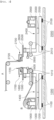
- FIG. 1 is a schematic view of an automatic electrode supply apparatus according to a first preferred embodiment of the present invention.
- the automatic electrode supply apparatus includes a first chuck splicing unit 1000, at which a traveling electrode A is located, and a second chuck splicing unit 2000, at which a standby electrode B is located.
- the first chuck splicing unit 1000 includes a lower driving means 1100 disposed abutting a floor surface, the lower driving means being configured to support the first chuck splicing unit 1000, a lower support member 1200 located on the lower driving means 1100, an upper support member 1400 located above the lower support member 1200, and a rotary shaft 1300 located between the lower support member 1200 and the upper support member 1400, the rotary shaft being configured to rotate the upper support member 1400.
- the first chuck splicing unit 1000 includes a splicing portion support member 1500 located on the upper support member 1400, a splicing portion driving means 1600 located on the splicing portion support member 1500, the splicing portion driving means being configured to drive a splicing portion 1700, the splicing portion 1700 being located on the splicing portion driving means 1600, the splicing portion 1700 being configured to suction an electrode, an edge position control (EPC) sensor 1800, and a winding roll holder 1900 located on the upper support member 1400, the winding roll holder being configured to hold an electrode winding roll.
- EPC edge position control
- the lower driving means 1100 may be realized by an assembly of a linear motion (LM) guide and a servomotor such that the first chuck splicing unit 1000 can be rectilinearly moved in one direction.
- LM linear motion
- the present invention is not limited thereto. Any of various known devices capable of performing rectilinear reciprocation may be used.
- the upper support member 1400 includes a horizontal portion 1410 and a vertical portion 1420.
- the winding roll holder 1900 is located on the horizontal portion 1410, and a guide roller 1010 configured to transfer a roll type electrode is fixed to the vertical portion.
- the splicing portion driving means 1600 may be realized by an assembly of an LM guide, a rack and pinion, and a driving means, such as a servomotor or an actuator, such that the splicing portion 1700 can be rectilinearly reciprocated on the splicing portion support member 1500.
- a driving means such as a servomotor or an actuator
- the present invention is not limited thereto. Any of various known devices capable of performing rectilinear reciprocation may be used.
- the splicing portion 1700 includes an electrode cutter 1710 configured to cut an electrode and a splicing plate 1720 configured to suction the electrode.
- FIG. 2 is a schematic view of a splicing plate 1720 according to a first preferred embodiment of the present invention.
- the splicing plate 1720 will be described in detail with reference to FIG. 2 .
- the splicing plate 1720 includes an upper plate 1721, a lower plate 1722, an incision recess 1723 provided between the upper plate 1721 and the lower plate 1722, the incision recess being configured to allow the electrode cutter 1710, which is configured to cut an electrode, to be moved therein, and suction holes 1724 formed in the upper plate and the lower plate.
- the EPC sensor 1800 which is a sensor configured to measure the position of the edge of an electrode in order to determine the extent to which the position of the electrode deviates, may be fixed to the vertical portion 1420 of the upper support member or to the splicing portion support member 1500.
- the EPC sensor may measure the position of the edge of an electrode, and may be located at another portion of the chuck splicing unit within a range within which the operation of other devices is not disturbed.
- FIG. 3 is a schematic view of an automatic electrode supply apparatus according to a second preferred embodiment of the present invention.
- FIG. 3 is identical to FIG. 1 except that the standby electrode B is located at the first chuck splicing unit 1000 and the traveling electrode A is located at the second chuck splicing unit 2000.
- the first chuck splicing unit 1000 and the second chuck splicing unit 2000 which have the same structure, are alternately used to successively supply an electrode to a manufacturing process, and loss in time necessary to introduce the standby electrode is minimized.
- the automatic electrode supply apparatus according to the embodiment of the present invention has been described above. Hereinafter, a method of automatically supplying an electrode using the automatic electrode supply apparatus will be described.
- An automatic electrode supply method includes (i) a step of preparing a traveling electrode A on the splicing plate 1720 of the first chuck splicing unit 1000, (ii) a step of preparing a standby electrode B on the splicing plate 2720 of the second chuck splicing unit 2000, (iii) a step of rotating the second chuck splicing unit to move the splicing plate 2720, on which the standby electrode is prepared, to a position at which the splicing plate 2720 faces the splicing plate 1720, on which the traveling electrode is prepared, (iv) a step of measuring the position of the edge of the standby electrode using the EPC sensor 2800, (v) a step of calculating positional deviation between the edges of the traveling electrode and the standby electrode, (vi) a step of moving the splicing plate having the standby electrode prepared thereon to correct the positional deviation, (vii) a step of laminating the plate having the standby electrode
- step (i) includes a step of moving the splicing plate 1720 of the first chuck splicing unit 1000 in a direction toward the traveling electrode A and allowing the plate to suction the traveling electrode A using the suction holes formed in one surface of the plate and a step of cutting the portion of the traveling electrode under the upper plate 1721 through the incision recess 1723 using the electrode cutter 1710 in order to connect the standby electrode B to the traveling electrode A suctioned by the plate, as shown in FIGS. 4(b) and 4(c) .
- step (v) i.e. the step of calculating positional deviation
- the positional deviation is calculated based on the value of the position of the edge of the standby electrode measured in step (iv) and the value of the position of the edge of the traveling electrode.
- the traveling electrode is an electrode that has already been introduced into the process before step (i).
- the value of the position of the edge of the traveling electrode is frequently measured before introduction into the process and during the process in order to prevent meandering of the traveling electrode.
- the value of the position of the edge of the traveling electrode may not be additionally measured while the automatic electrode supply method according to the present invention is performed.
- the EPC sensor described above but also any one selected from among all measurement devices capable of measuring the position of an edge, such as various kinds of known sensors and cameras, may be used as the device configured to measure the position of each of the traveling electrode and the standby electrode.
- step (vi) the splicing plate 2720 having the standby electrode suctioned thereto is finely moved in a predetermined direction (a direction that is perpendicular to the direction in which the splicing plate is moved in order to suction the traveling electrode and the plates are moved in order to laminate the traveling electrode and the standby electrode with each other and that is parallel to the ground, i.e. a Y-axis direction in FIG. 4 ), in order to correct the positional deviation.
- a predetermined direction a direction that is perpendicular to the direction in which the splicing plate is moved in order to suction the traveling electrode and the plates are moved in order to laminate the traveling electrode and the standby electrode with each other and that is parallel to the ground, i.e. a Y-axis direction in FIG. 4
- the connected electrodes are introduced into the manufacturing process using a transfer roller 3010, whereby production is continuously performed.
- the standby electrode is prepared in the first chuck splicing unit 1000, in which the traveling electrode was located conventionally, such that the standby electrode is connected to the traveling electrode according to steps (i) to (viii) described above after the traveling electrode prepared in the second chuck splicing unit 2000 is consumed, whereby it is possible to minimize loss in time incurred for electrode replacement.
- a method of using the lower driving means 1100 or 2100 to drive the entirety of the chuck splicing unit, a method of providing a separate driving means (not shown) on the splicing portion support member 1500 or 2500 to drive only the splicing portion 1700 or 2700, or a method of providing a separate driving means (not shown) between the splicing portion support member 1500 or 2500 and the vertical portion 1420 or 2420 of the upper support member to simultaneously drive the splicing portion support member 1500 or 2500 and the splicing portion 1700 or 2700 may be used as a method of moving the splicing plate 1720 or 2720 in the predetermined direction (the Y-axis direction) in order to correct the positional deviation.
- any of various known driving means capable of performing rectilinear reciprocation may be used as the driving means described above.
- position correction be performed to the extent to which it is possible to minimize distortion or fracture defect of the electrode due to the positional deviation between the traveling electrode and the standby electrode.
- Table 1 shows a change in the number of defects depending on the positional deviation between the traveling electrode and the standby electrode in the process of connecting the standby electrode using the automatic electrode supply apparatus after the traveling electrode wound on the traveling electrode winding roll is consumed.
- Positional deviation (mm) 0.5 1.0 1.5 2.0 2.5 3.0 5.0 Number of defects 4 10 12 10 11 35 37
- the positional deviation (the path line deviation) be corrected to 2.5 mm or less in order to prevent distortion or fracture defect of the electrode due to the positional deviation between the traveling electrode and the standby electrode. More preferably, it can be seen that a very small number of defects due to the positional deviation occurs in the case in which the positional deviation is corrected to less than 1 mm.
Landscapes
- Engineering & Computer Science (AREA)
- Manufacturing & Machinery (AREA)
- Chemical & Material Sciences (AREA)
- Chemical Kinetics & Catalysis (AREA)
- Electrochemistry (AREA)
- General Chemical & Material Sciences (AREA)
- Battery Electrode And Active Subsutance (AREA)
- Secondary Cells (AREA)
Description
- This application claims the benefit of priority to
Korean Patent Application No. 2019-0145198 filed on November 13, 2019 - The present invention relates to an apparatus for automatically supplying an electrode in various processes for manufacturing a secondary battery and an automatic electrode supply method, and more particularly to an apparatus capable of successively supplying an electrode, the apparatus including a plurality of chuck splicing units each configured to supply an electrode, and an automatic electrode supply method using the same.
- With technological development of mobile devices, such as mobile phones, laptop computers, camcorders, and digital cameras, and an increase in the demand therefor, research on secondary batteries, which are capable of being charged and discharged, has been actively conducted. In addition, secondary batteries, which are energy sources substituting for fossil fuels causing air pollution, have been applied to an electric vehicle (EV), a hybrid electric vehicle (HEV), and a plug-in hybrid electric vehicle (P-HEV), and therefore there is an increasing necessity for development of secondary batteries.
- Such a secondary battery includes an electrode assembly in which electrodes and separators are alternately stacked and a case configured to receive the electrode assembly. The electrode assembly, which is a power-generating element configured to have a structure in which a positive electrode and a negative electrode are stacked in the state in which a separator is interposed between the positive electrode and the negative electrode, is classified as a jelly-roll type electrode assembly, which is configured to have a structure in which a long sheet type positive electrode and a long sheet type negative electrode, to which active materials are applied, are wound in the state in which a separator is interposed between the positive electrode and the negative electrode, or a stacked type electrode assembly, which is configured to have a structure in which a plurality of positive electrodes having a predetermined size and a plurality of negative electrodes having a predetermined size are sequentially stacked in the state in which separators are interposed respectively between the positive electrodes and the negative electrodes.
- A stacked/folded type electrode assembly, which is configured to have a structure in which mono-cells, each of which has a positive electrode/separator/negative electrode structure of a predetermined unit size, or bicells, each of which has a positive electrode (negative electrode)/separator/negative electrode (positive electrode)/separator/positive electrode (negative electrode) structure, are folded using a continuous separation film having a long length, has been developed as an electrode assembly having an improved structure, which is a combination of the jelly-roll type electrode assembly and the stacked type electrode assembly.
- In addition, a laminated/stacked type electrode assembly, which is configured to have a structure in which unit cells, in each of which electrodes and separators are alternately stacked and laminated, are stacked in order to improve processability of a conventional stacked type electrode assembly and to satisfy the demand for secondary batteries having various shapes, has also been developed.
- A positive electrode used for such an electrode assembly is manufactured by applying a mixture of a positive electrode active material, a conductive agent, and a binder to a positive electrode current collector, such as metal foil, and drying the mixture. A filler may be further added as needed.
- In addition, a negative electrode is manufactured by applying a negative electrode material to a negative electrode current collector, such as metal foil, and drying the negative electrode material. Ingredients described above in connection with the positive electrode may be further optionally included as needed.
- There is an increasing necessity for an apparatus capable of stably and successively supplying an electrode in an electrode and electrode assembly manufacturing process in order to improve productivity of a secondary battery manufacturing process and to reduce a process defect rate.
-
KR 1479724 A - Further prior art is described
KR 101 819 729 B1 KR 102 043 024 B1 KR 2015 0049474 A - The present invention has been made in view of the above problems, and it is an object of the present invention to provide an apparatus for automatically supplying an electrode in succession in various processes for manufacturing a secondary battery and an automatic electrode supply method.
- It is another object of the present invention to provide an automatic electrode supply apparatus and an automatic electrode supply method capable of preventing distortion or fracture defect of an electrode due to positional deviation between a traveling electrode and a standby electrode in the above processes.
- In order to accomplish the above object, the present invention provides an automatic electrode supply apparatus including a first chuck splicing unit including a splicing portion having a traveling electrode located thereon and a second chuck splicing unit including a splicing portion having a standby electrode located thereon, wherein each of the first and second chuck splicing units includes an edge position control, EPC, sensor configured to measure the position of the edge of a corresponding one of the traveling electrode and the standby electrode, wherein the EPC sensor can avoid distortion or fracture defect of the electrode due to the positional deviation between the traveling electrode and the standby electrode, and wherein the EPC sensor comprises a controller configured to compensate the position of the edge of the electrode.
- Also, in the automatic electrode supply apparatus according to the present invention, the splicing portion may include a splicing plate and an electrode cutter and may be movable in a direction parallel to a floor surface.
- Also, in the automatic electrode supply apparatus according to the present invention, the splicing plate may include an upper plate and a lower plate, each of the upper plate and the lower plate having a suction hole, configured to suction an electrode in order to fix the electrode, formed in the surface thereof contacting the electrode, and an incision recess provided between the upper plate and the lower plate, the incision recess being configured to allow the electrode cutter to be moved therein.
- Also, in the automatic electrode supply apparatus according to the present invention, each of the first and second chuck splicing units may further include a lower support member configured to support the chuck splicing unit, an upper support member located above the lower support member, the upper support member being configured to support the splicing portion, and a rotary shaft located between the lower support member and the upper support member, the rotary shaft being configured to rotate the upper support member.
- Also, in the automatic electrode supply apparatus according to the present invention, the upper support member may include a horizontal portion and a vertical portion.
- Also, in the automatic electrode supply apparatus according to the present invention, the chuck splicing unit may further include a splicing portion support member located on the vertical portion of the upper support member, the splicing portion support member being configured to support the splicing portion.
- Also, in the automatic electrode supply apparatus according to the present invention, the EPC sensor may be fixed to the vertical portion of the upper support member or to the splicing portion support member.
- In addition, the present invention provides an automatic electrode supply method including (i) preparing a traveling electrode on a splicing plate of a first chuck splicing unit, (ii) preparing a standby electrode on a splicing plate of a second chuck splicing unit, (iii) rotating the second chuck splicing unit to move the splicing plate having the standby electrode prepared thereon so as to face the splicing plate having the traveling electrode prepared thereon, (iv) measuring the position of the edge of the standby electrode using an EPC sensor, (v) calculating positional deviation between the edge of the traveling electrode and the edge of the standby electrode, (vi) moving the splicing plate having the standby electrode prepared thereon to correct the positional deviation, and (vii) laminating the plate having the standby electrode suctioned thereto and the plate having the traveling electrode suctioned thereto with each other to connect the traveling electrode and the standby electrode to each other.
- Also, in the automatic electrode supply method according to the present invention, step (i) may include allowing the splicing plate to suction the traveling electrode and cutting the portion of the suctioned traveling electrode under the upper plate using the electrode cutter.
- Also, in the automatic electrode supply method according to the present invention, step (ii) may include attaching a connection tape to one surface of the end of the standby electrode and allowing the standby electrode having the connection tape attached thereto to be suctioned to the lower part of the splicing plate of the second chuck splicing unit.
- Also, the automatic electrode supply method according to the present invention may further include (viii) separating the connected electrodes from the splicing plates after step (vii).
- An automatic electrode supply apparatus and an automatic electrode supply method according to the present invention have an advantage in that a plurality of chuck splicing units having the same function and structure is used to successively supply an electrode, whereby it is possible to successively supply an electrode while minimizing loss in production time in various processes for manufacturing a secondary battery.
- In addition, the automatic electrode supply apparatus and the automatic electrode supply method according to the present invention have an advantage in that an EPC sensor is used to measure positional deviation and the measured positional deviation is corrected, whereby it is possible to prevent distortion or fracture defect of an electrode due to positional deviation between a traveling electrode and a standby electrode, which may occur when the electrode is successively supplied.
-
-
FIG. 1 is a schematic view of an automatic electrode supply apparatus according to a first preferred embodiment of the present invention. -
FIG. 2 is a schematic view of a splicing plate of the present invention. -
FIG. 3 is a schematic view of an automatic electrode supply apparatus according to a second preferred embodiment of the present invention. -
FIG. 4 is a schematic view showing a method of automatically supplying an electrode using the automatic electrode supply apparatus according to the present invention. - In the present application, it should be understood that the terms "comprises," "has," "includes," etc. specify the presence of stated features, numbers, steps, operations, elements, components, or combinations thereof, but do not preclude the presence or addition of one or more other features, numbers, steps, operations, elements, components, or combinations thereof.
- In addition, the same reference numbers will be used throughout the drawings to refer to parts that perform similar functions or operations. In the case in which one part is said to be connected to another part in the specification, not only may the one part be directly connected to the other part, but also, the one part may be indirectly connected to the other part via a further part. In addition, that a certain element is included does not mean that other elements are excluded, but means that such elements may be further included unless mentioned otherwise.
- Hereinafter, an automatic electrode supply apparatus and an automatic electrode supply method according to the present invention will be described with reference to the accompanying drawings.
-
FIG. 1 is a schematic view of an automatic electrode supply apparatus according to a first preferred embodiment of the present invention. - Referring to
FIG. 1 , the automatic electrode supply apparatus according to the first preferred embodiment of the present invention includes a firstchuck splicing unit 1000, at which a traveling electrode A is located, and a secondchuck splicing unit 2000, at which a standby electrode B is located. - The first
chuck splicing unit 1000 includes a lower driving means 1100 disposed abutting a floor surface, the lower driving means being configured to support the firstchuck splicing unit 1000, alower support member 1200 located on the lower driving means 1100, anupper support member 1400 located above thelower support member 1200, and arotary shaft 1300 located between thelower support member 1200 and theupper support member 1400, the rotary shaft being configured to rotate theupper support member 1400. - In addition, the first
chuck splicing unit 1000 includes a splicingportion support member 1500 located on theupper support member 1400, a splicing portion driving means 1600 located on the splicingportion support member 1500, the splicing portion driving means being configured to drive asplicing portion 1700, thesplicing portion 1700 being located on the splicing portion driving means 1600, thesplicing portion 1700 being configured to suction an electrode, an edge position control (EPC)sensor 1800, and awinding roll holder 1900 located on theupper support member 1400, the winding roll holder being configured to hold an electrode winding roll. - Respective components of the first
chuck splicing unit 1000 will be described in detail. First, the lower driving means 1100 may be realized by an assembly of a linear motion (LM) guide and a servomotor such that the firstchuck splicing unit 1000 can be rectilinearly moved in one direction. However, the present invention is not limited thereto. Any of various known devices capable of performing rectilinear reciprocation may be used. - In addition, the
upper support member 1400 includes ahorizontal portion 1410 and avertical portion 1420. Thewinding roll holder 1900 is located on thehorizontal portion 1410, and aguide roller 1010 configured to transfer a roll type electrode is fixed to the vertical portion. - The splicing portion driving means 1600 may be realized by an assembly of an LM guide, a rack and pinion, and a driving means, such as a servomotor or an actuator, such that the
splicing portion 1700 can be rectilinearly reciprocated on the splicingportion support member 1500. However, the present invention is not limited thereto. Any of various known devices capable of performing rectilinear reciprocation may be used. - In addition, the
splicing portion 1700 includes anelectrode cutter 1710 configured to cut an electrode and asplicing plate 1720 configured to suction the electrode. -
FIG. 2 is a schematic view of asplicing plate 1720 according to a first preferred embodiment of the present invention. - The
splicing plate 1720 will be described in detail with reference toFIG. 2 . Thesplicing plate 1720 includes anupper plate 1721, alower plate 1722, anincision recess 1723 provided between theupper plate 1721 and thelower plate 1722, the incision recess being configured to allow theelectrode cutter 1710, which is configured to cut an electrode, to be moved therein, andsuction holes 1724 formed in the upper plate and the lower plate. - Next, the
EPC sensor 1800, which is a sensor configured to measure the position of the edge of an electrode in order to determine the extent to which the position of the electrode deviates, may be fixed to thevertical portion 1420 of the upper support member or to the splicingportion support member 1500. However, the present invention is not limited thereto. The EPC sensor may measure the position of the edge of an electrode, and may be located at another portion of the chuck splicing unit within a range within which the operation of other devices is not disturbed. - In addition, the EPC sensor includes: a detector configured to measure a position;
- an amplifier configured to amplify a detected signal; and
- a controller configured to calculate positional deviation from a measured value and to control the device in order to correct the position based thereon.
- Any of various kinds of already known EPC sensors may be used.
- The second
chuck splicing unit 2000 is a device having the same structure and function as the firstchuck splicing unit 1000. Consequently, the description of the firstchuck splicing unit 1000 can be referred to and a detailed description of respective components of the second chuck splicing unit will be omitted. -
FIG. 3 is a schematic view of an automatic electrode supply apparatus according to a second preferred embodiment of the present invention. - Referring to
FIG. 3, FIG. 3 is identical toFIG. 1 except that the standby electrode B is located at the firstchuck splicing unit 1000 and the traveling electrode A is located at the secondchuck splicing unit 2000. - That is, in this construction, the first
chuck splicing unit 1000 and the secondchuck splicing unit 2000, which have the same structure, are alternately used to successively supply an electrode to a manufacturing process, and loss in time necessary to introduce the standby electrode is minimized. - The automatic electrode supply apparatus according to the embodiment of the present invention has been described above. Hereinafter, a method of automatically supplying an electrode using the automatic electrode supply apparatus will be described.
- An automatic electrode supply method according to an embodiment of the present invention includes (i) a step of preparing a traveling electrode A on the
splicing plate 1720 of the firstchuck splicing unit 1000, (ii) a step of preparing a standby electrode B on thesplicing plate 2720 of the secondchuck splicing unit 2000, (iii) a step of rotating the second chuck splicing unit to move thesplicing plate 2720, on which the standby electrode is prepared, to a position at which thesplicing plate 2720 faces thesplicing plate 1720, on which the traveling electrode is prepared, (iv) a step of measuring the position of the edge of the standby electrode using theEPC sensor 2800, (v) a step of calculating positional deviation between the edges of the traveling electrode and the standby electrode, (vi) a step of moving the splicing plate having the standby electrode prepared thereon to correct the positional deviation, (vii) a step of laminating the plate having the standby electrode suctioned thereto and the plate having the traveling electrode suctioned thereto with each other to connect the traveling electrode and the standby electrode to each other, and (viii) a step of separating the connected electrodes from the splicing plates. - Respective steps will be described in detail with reference to
FIGS. 1 ,3 , and4 . First, step (i) includes a step of moving thesplicing plate 1720 of the firstchuck splicing unit 1000 in a direction toward the traveling electrode A and allowing the plate to suction the traveling electrode A using the suction holes formed in one surface of the plate and a step of cutting the portion of the traveling electrode under theupper plate 1721 through theincision recess 1723 using theelectrode cutter 1710 in order to connect the standby electrode B to the traveling electrode A suctioned by the plate, as shown inFIGS. 4(b) and 4(c) . - Next, referring to
FIG. 4(d) , step (ii) includes a step of attaching a connection tape C to one surface of the end of the standby electrode B so as to be connected to the traveling electrode and a step of allowing the standby electrode having the connection tape attached thereto to be suctioned to the lower part of thesplicing plate 2720 of the secondchuck splicing unit 2000. - Also, in step (v), i.e. the step of calculating positional deviation, the positional deviation is calculated based on the value of the position of the edge of the standby electrode measured in step (iv) and the value of the position of the edge of the traveling electrode. Here, the traveling electrode is an electrode that has already been introduced into the process before step (i). The value of the position of the edge of the traveling electrode is frequently measured before introduction into the process and during the process in order to prevent meandering of the traveling electrode. The value of the position of the edge of the traveling electrode may not be additionally measured while the automatic electrode supply method according to the present invention is performed.
- Meanwhile, not only the EPC sensor described above but also any one selected from among all measurement devices capable of measuring the position of an edge, such as various kinds of known sensors and cameras, may be used as the device configured to measure the position of each of the traveling electrode and the standby electrode.
- Next, referring to
FIG. 4(f) , in step (vi), thesplicing plate 2720 having the standby electrode suctioned thereto is finely moved in a predetermined direction (a direction that is perpendicular to the direction in which the splicing plate is moved in order to suction the traveling electrode and the plates are moved in order to laminate the traveling electrode and the standby electrode with each other and that is parallel to the ground, i.e. a Y-axis direction inFIG. 4 ), in order to correct the positional deviation. - After step (viii), the connected electrodes are introduced into the manufacturing process using a
transfer roller 3010, whereby production is continuously performed. Referring toFIG. 3 , the standby electrode is prepared in the firstchuck splicing unit 1000, in which the traveling electrode was located conventionally, such that the standby electrode is connected to the traveling electrode according to steps (i) to (viii) described above after the traveling electrode prepared in the secondchuck splicing unit 2000 is consumed, whereby it is possible to minimize loss in time incurred for electrode replacement. - Meanwhile, a method of using the lower driving means 1100 or 2100 to drive the entirety of the chuck splicing unit, a method of providing a separate driving means (not shown) on the splicing
portion support member splicing portion portion support member vertical portion portion support member splicing portion splicing plate - Also, it is preferable that position correction be performed to the extent to which it is possible to minimize distortion or fracture defect of the electrode due to the positional deviation between the traveling electrode and the standby electrode.
- Specifically, Table 1 below shows a change in the number of defects depending on the positional deviation between the traveling electrode and the standby electrode in the process of connecting the standby electrode using the automatic electrode supply apparatus after the traveling electrode wound on the traveling electrode winding roll is consumed.
[Table 1] Positional deviation (mm) 0.5 1.0 1.5 2.0 2.5 3.0 5.0 Number of defects 4 10 12 10 11 35 37 - As shown in Table 1 above, it is preferable that the positional deviation (the path line deviation) be corrected to 2.5 mm or less in order to prevent distortion or fracture defect of the electrode due to the positional deviation between the traveling electrode and the standby electrode. More preferably, it can be seen that a very small number of defects due to the positional deviation occurs in the case in which the positional deviation is corrected to less than 1 mm.
- Although the specific details of the present invention have been described in detail, those skilled in the art will appreciate that the detailed description thereof discloses only preferred embodiments of the present invention and thus does not limit the scope of the present invention.
-
- 1000: First chuck splicing unit
- 2000: Second chuck splicing unit
- 1010, 2010: Guide rollers
- 1100, 2100: Lower driving means
- 1200, 2200: Lower support members
- 1300, 2300: Rotary shafts
- 1400, 2400: Upper support members
- 1410, 2410: Horizontal portions of upper support members
- 1420, 2420: Vertical portions of upper support members
- 1500, 2500: Splicing portion support members
- 1600, 2600: Splicing portion driving means
- 1700, 2700: Splicing portions
- 1710, 2710: Electrode cutters
- 1720, 2720: Splicing plates
- 1721, 2721: Upper plates
- 1722, 2722: Lower plates
- 1723, 2723: Incision recesses
- 1724, 2724: Suction holes
- 1800, 2800: EPC sensors
- 1900, 2900: Winding roll holders
- 3010: Transfer roller
- A: Traveling electrode
- B: Standby electrode
- C: Connection tape
Claims (11)
- An automatic electrode supply apparatus configured to automatically supply an electrode in various processes for manufacturing a secondary battery, the automatic electrode supply apparatus comprising:a first chuck splicing unit (1000) comprising a splicing portion (1700) having a traveling electrode (A) located thereon; anda second chuck splicing unit (2000) comprising a splicing portion (2700) having a standby electrode (B) located thereon,characterized in that each of the first and second chuck splicing units (1000, 2000) comprises an edge position control, EPC, sensor (1800, 2800) configured to measure a position of an edge of a corresponding one of the traveling electrode (A) and the standby electrode (B),wherein the EPC sensor (1800, 2800) can avoid distortion or fracture defect of the electrode due to the positional deviation between the traveling electrode (A) and the standby electrode (B), and wherein the EPC sensor (1800, 2800) comprises a controller configured to compensate the position of the edge of the electrode.
- The automatic electrode supply apparatus according to claim 1, wherein the splicing portion (1700, 2700) comprises a splicing plate (1720, 2720) and an electrode cutter (1710, 2710), and
wherein the splicing portion (1700, 2700) is movable in a direction parallel to a floor surface. - The automatic electrode supply apparatus according to claim 2, wherein the splicing plate (1720, 2720) comprises:an upper plate (1721, 2721) and a lower plate (1722, 2722), each of the upper plate (1721, 2721) and the lower plate (1722, 2722) having suction holes (1724, 2724), configured to suction an electrode (A; B) in order to fix the electrode (A; B), formed in a surface thereof contacting the electrode (A; B); andan incision recess (1723; 2723) provided between the upper plate (1721, 2721) and the lower plate (1722, 2722), the incision recess (1723, 2723) being configured to allow the electrode cutter (1710, 2710) to be moved therein.
- The automatic electrode supply apparatus according to claim 1, wherein each of the first (1000) and second (2000) chuck splicing units further comprises:a lower support member (1200, 2200) configured to support the chuck splicing unit (1000, 2000);an upper support member (1400, 2400) located above the lower support member (1200, 2200), the upper support member (1400, 2400) being configured to support the splicing portion (1700, 2700); anda rotary shaft (1300, 2300) located between the lower support member (1200, 2200) and the upper support member (1400, 2400), the rotary shaft (1300, 2300) being configured to rotate the upper support member (1400, 2400).
- The automatic electrode supply apparatus according to claim 4, wherein the upper support member (1400, 2400) comprises a horizontal portion (1410, 2410) and a vertical portion (1420, 2420).
- The automatic electrode supply apparatus according to claim 5, wherein the chuck splicing unit (1000, 2000) further comprises a splicing portion support member (1500, 2500) located on the vertical portion (1420, 2420) of the upper support member (1400, 2400), the splicing portion support member (1500, 2500) being configured to support the splicing portion (1700, 2700).
- The automatic electrode supply apparatus according to claim 6, wherein the EPC sensor (1800, 2800) is fixed to the vertical portion (1420, 2420) of the upper support member (1400, 2400) or to the splicing portion support member (1500, 2500).
- An automatic electrode supply method for automatically supplying an electrode using the automatic electrode supply apparatus according to any one of claims 1 to 7, the automatic electrode supply method comprising:i) preparing a traveling electrode (A) on the splicing plate (1720) of the first chuck splicing unit (1000);ii) preparing a standby electrode (B) on the splicing plate (2720) of the second chuck splicing unit (2000);iii) rotating the second chuck splicing unit (2000) to move the splicing plate (2720) having the standby electrode (B) prepared thereon so as to face the splicing plate (1720) having the traveling electrode (A) prepared thereon;iv) measuring a position of an edge of the standby electrode (B) using the EPC sensor (2800);v) calculating positional deviation between an edge of the traveling electrode (A) and the edge of the standby electrode (B);vi) moving the splicing plate (2720) having the standby electrode (B) prepared thereon to correct the positional deviation; andvii) laminating the plate (2720) having the standby electrode (B) suctioned thereto and the plate (1720) having the traveling electrode (A) suctioned thereto with each other to connect the traveling electrode (A) and the standby electrode (B) to each other.
- The automatic electrode supply method according to claim 8, wherein step i) comprises:allowing the splicing plate (1720) to suction the traveling electrode (A); andcutting a portion of the suctioned traveling electrode (A) under the upper plate (1721) using the electrode cutter (1710).
- The automatic electrode supply method according to claim 8, wherein step ii) comprises:attaching a connection tape (C) to one surface of an end of the standby electrode (B); andallowing the standby electrode (B) having the connection tape (C) attached thereto to be suctioned to a lower part of the splicing plate (2720) of the second chuck splicing unit (2000).
- The automatic electrode supply method according to claim 8, further comprising viii) separating the connected electrodes (A; B) from the splicing plates (1720, 2720) after step vii).
Applications Claiming Priority (2)
| Application Number | Priority Date | Filing Date | Title |
|---|---|---|---|
| KR1020190145198A KR102818607B1 (en) | 2019-11-13 | 2019-11-13 | Electrode automatic supply device for secondary battery manufacturing and electrode automatic supply method using the same |
| PCT/KR2020/013743 WO2021096068A1 (en) | 2019-11-13 | 2020-10-08 | Automatic electrode supply apparatus for manufacturing secondary battery and automatic electrode supply method using same |
Publications (3)
| Publication Number | Publication Date |
|---|---|
| EP4024545A1 EP4024545A1 (en) | 2022-07-06 |
| EP4024545A4 EP4024545A4 (en) | 2024-07-31 |
| EP4024545B1 true EP4024545B1 (en) | 2025-04-30 |
Family
ID=75912755
Family Applications (1)
| Application Number | Title | Priority Date | Filing Date |
|---|---|---|---|
| EP20886922.2A Active EP4024545B1 (en) | 2019-11-13 | 2020-10-08 | Automatic electrode feeding device for manufacturing a secondary battery and automatic electrode feeding method using the same. |
Country Status (7)
| Country | Link |
|---|---|
| US (1) | US12358746B2 (en) |
| EP (1) | EP4024545B1 (en) |
| KR (1) | KR102818607B1 (en) |
| CN (1) | CN114531926B (en) |
| ES (1) | ES3031875T3 (en) |
| HU (1) | HUE071801T2 (en) |
| WO (1) | WO2021096068A1 (en) |
Families Citing this family (6)
| Publication number | Priority date | Publication date | Assignee | Title |
|---|---|---|---|---|
| HUE071845T2 (en) * | 2021-12-08 | 2025-09-28 | Lg Energy Solution Ltd | Auto splicing device and auto splicing method for electrode |
| KR20240047647A (en) * | 2022-10-05 | 2024-04-12 | 주식회사 엘지에너지솔루션 | Egectrode notching apparatus |
| EP4428073A1 (en) * | 2023-03-06 | 2024-09-11 | G.D S.p.A. | Method and apparatus for implementing a change of coil of electrode web for the production of electrochemical cells |
| IT202300004026A1 (en) * | 2023-03-06 | 2024-09-06 | Gd Spa | METHOD AND APPARATUS FOR REALIZING AN ELECTRODE TAPE COIL CHANGE FOR THE PRODUCTION OF ELECTROCHEMICAL CELLS |
| KR102876577B1 (en) * | 2024-05-31 | 2025-10-30 | (주)하나기술 | Automatic splicing equipment for secondary battery and method thereof |
| KR20250179766A (en) * | 2024-06-21 | 2025-12-31 | 삼성에스디아이 주식회사 | Electrode transfer table, electrode transfer device, and electrode manufacturing system including same |
Family Cites Families (24)
| Publication number | Priority date | Publication date | Assignee | Title |
|---|---|---|---|---|
| JP3560702B2 (en) | 1995-08-21 | 2004-09-02 | 東芝電池株式会社 | Meandering prevention device |
| JPH10279149A (en) | 1997-04-04 | 1998-10-20 | Kazuo Hishinuma | Adjusting method of deviation of joint |
| JP2000159400A (en) * | 1998-11-24 | 2000-06-13 | Ykk Corp | Tape end positioning device for tape end joining machine |
| US6364244B1 (en) * | 2000-01-31 | 2002-04-02 | New Era Converting Machinery, Inc. | Automatic two-ply web splicer |
| US6808581B2 (en) * | 2001-06-15 | 2004-10-26 | 3M Innovative Properties Company | Method and apparatus for automatically applying a flying splicing tape to a roll of sheet material |
| US7011004B2 (en) | 2001-07-06 | 2006-03-14 | Honda Giken Kogyo Kabushiki Kaisha | Trimming apparatus and method for fuel cell membrane/electrode coupling and transporting apparatus |
| JP4878417B2 (en) * | 2001-07-06 | 2012-02-15 | 本田技研工業株式会社 | Membrane / electrode assembly trim device for fuel cells |
| JP2005066858A (en) | 2003-08-26 | 2005-03-17 | Sumitomo Heavy Ind Ltd | Bonding apparatus and method |
| JP2008127093A (en) * | 2006-11-24 | 2008-06-05 | Ishida Co Ltd | Film supply apparatus and packaging apparatus provided with the same |
| KR101287415B1 (en) * | 2010-12-21 | 2013-07-19 | (주)열린기술 | Apparatus for manufacturing electrode assembly of small polymer secondary battery |
| JP5691873B2 (en) * | 2011-06-20 | 2015-04-01 | トヨタ自動車株式会社 | Membrane electrode assembly manufacturing apparatus and manufacturing method |
| KR101561445B1 (en) | 2012-03-16 | 2015-10-21 | 주식회사 엘지화학 | Electrode Manufacturing Device of Novel Structure |
| KR101863382B1 (en) * | 2013-10-30 | 2018-05-31 | 주식회사 엘지화학 | Cell Assembly Winding Apparatus And Winding Method Of Winding Cell Assembly |
| KR101479724B1 (en) | 2013-11-25 | 2015-01-08 | 유일에너테크(주) | System for producing electrodes of battery |
| KR101695650B1 (en) * | 2015-05-12 | 2017-01-12 | 주식회사 디에이테크놀로지 | Apparatus for Automatically Changing Electrode Films |
| KR101818729B1 (en) | 2015-10-13 | 2018-02-22 | 한국기계연구원 | Method and apparatus for sterilizing heat sink of thermoelectric device assembly |
| KR102474885B1 (en) * | 2015-11-10 | 2022-12-06 | 삼성에스디아이 주식회사 | Materials Exchanging Device Of Winding Equipment For Secondary Battery |
| JP6713278B2 (en) | 2015-12-25 | 2020-06-24 | Ckd株式会社 | Winding device and method of manufacturing wound body |
| KR102133915B1 (en) | 2016-03-29 | 2020-07-15 | 주식회사 엘지화학 | Defect detecting system and method of electrode assembly |
| KR101819729B1 (en) * | 2016-10-20 | 2018-03-02 | 유일에너테크(주) | System for producing electrodes of battery |
| KR101857396B1 (en) | 2017-09-29 | 2018-05-11 | 정연길 | System for producing electrodes of battery |
| KR101874281B1 (en) * | 2018-01-04 | 2018-07-03 | 유일에너테크(주) | System for producing electrodes of battery |
| WO2020045772A1 (en) * | 2018-08-29 | 2020-03-05 | 정연길 | Secondary battery electrode production system |
| KR102043024B1 (en) * | 2019-05-29 | 2019-11-12 | 주식회사 우원기술 | Splicing Device of Secondary Battery Electrode Film |
-
2019
- 2019-11-13 KR KR1020190145198A patent/KR102818607B1/en active Active
-
2020
- 2020-10-08 HU HUE20886922A patent/HUE071801T2/en unknown
- 2020-10-08 WO PCT/KR2020/013743 patent/WO2021096068A1/en not_active Ceased
- 2020-10-08 CN CN202080066826.1A patent/CN114531926B/en active Active
- 2020-10-08 ES ES20886922T patent/ES3031875T3/en active Active
- 2020-10-08 US US17/765,587 patent/US12358746B2/en active Active
- 2020-10-08 EP EP20886922.2A patent/EP4024545B1/en active Active
Also Published As
| Publication number | Publication date |
|---|---|
| CN114531926A (en) | 2022-05-24 |
| KR102818607B1 (en) | 2025-06-10 |
| CN114531926B (en) | 2025-01-24 |
| EP4024545A1 (en) | 2022-07-06 |
| HUE071801T2 (en) | 2025-09-28 |
| KR20210058130A (en) | 2021-05-24 |
| US12358746B2 (en) | 2025-07-15 |
| WO2021096068A1 (en) | 2021-05-20 |
| US20220363505A1 (en) | 2022-11-17 |
| EP4024545A4 (en) | 2024-07-31 |
| ES3031875T3 (en) | 2025-07-11 |
Similar Documents
| Publication | Publication Date | Title |
|---|---|---|
| EP4024545B1 (en) | Automatic electrode feeding device for manufacturing a secondary battery and automatic electrode feeding method using the same. | |
| KR102676855B1 (en) | Cell stack manufacturing equipment for secondary batteries | |
| US12087932B2 (en) | Secondary battery electrode production system | |
| KR101956763B1 (en) | Edge Position Control System for Secondary Battery Cell Manufacturing Machine | |
| US20180076470A1 (en) | Apparatus for manufacturing membrane-electrode assembly for fuel cell and membrane-electrode assembly manufactured using the same | |
| KR102606920B1 (en) | Battery cell stacking system for secondary batteries | |
| KR102772417B1 (en) | The Apparatus And The Method For Manufacturing Unit Cell | |
| CN111342107B (en) | A hot composite high-speed lamination machine | |
| CN111168765A (en) | Cutting apparatus and method for manufacturing membrane electrode assembly for fuel cell | |
| KR20230018776A (en) | Manufacturing device and manufacturing method for electrode assembly | |
| KR102496215B1 (en) | Secondary Cell Rotary Mult Distech Stacking Apparatus | |
| EP4213256A1 (en) | Electrode cell manufacturing apparatus and control method therefor | |
| CN115000493A (en) | Battery core lamination device and battery core production line | |
| KR102644861B1 (en) | Device for folding electrode assembly | |
| KR102322793B1 (en) | electrode cell manufacturing method of secondary battery | |
| KR200493852Y1 (en) | Electrode Lamination Device Comprising Feeding Conveyor | |
| KR102003712B1 (en) | Electrode Tab-Feeding Device Comprising Guide for Positioning Electrode Tab at Correct Point | |
| KR102952001B1 (en) | Separator automatic feeder | |
| CN117546324A (en) | Electrode cutting device and battery cell manufacturing apparatus including the same | |
| US20260106132A1 (en) | Electrode Notching Apparatus and Electrode Manufacturing | |
| US20250140889A1 (en) | Sheet connection device and method for secondary battery | |
| KR102836260B1 (en) | apparatus and method for cutting cathode materials of laminating process of secondary battery | |
| US20240021935A1 (en) | Method and system for manufacturing battery cell | |
| KR20230171637A (en) | System for automatically aligning an electrode roll and method therefor | |
| CN118336135A (en) | Lamination method and lamination equipment |
Legal Events
| Date | Code | Title | Description |
|---|---|---|---|
| STAA | Information on the status of an ep patent application or granted ep patent |
Free format text: STATUS: THE INTERNATIONAL PUBLICATION HAS BEEN MADE |
|
| PUAI | Public reference made under article 153(3) epc to a published international application that has entered the european phase |
Free format text: ORIGINAL CODE: 0009012 |
|
| STAA | Information on the status of an ep patent application or granted ep patent |
Free format text: STATUS: REQUEST FOR EXAMINATION WAS MADE |
|
| 17P | Request for examination filed |
Effective date: 20220331 |
|
| AK | Designated contracting states |
Kind code of ref document: A1 Designated state(s): AL AT BE BG CH CY CZ DE DK EE ES FI FR GB GR HR HU IE IS IT LI LT LU LV MC MK MT NL NO PL PT RO RS SE SI SK SM TR |
|
| DAV | Request for validation of the european patent (deleted) | ||
| DAX | Request for extension of the european patent (deleted) | ||
| A4 | Supplementary search report drawn up and despatched |
Effective date: 20240701 |
|
| RIC1 | Information provided on ipc code assigned before grant |
Ipc: B65H 21/00 20060101ALI20240625BHEP Ipc: B65H 19/10 20060101ALI20240625BHEP Ipc: H01M 10/04 20060101AFI20240625BHEP |
|
| GRAP | Despatch of communication of intention to grant a patent |
Free format text: ORIGINAL CODE: EPIDOSNIGR1 |
|
| STAA | Information on the status of an ep patent application or granted ep patent |
Free format text: STATUS: GRANT OF PATENT IS INTENDED |
|
| INTG | Intention to grant announced |
Effective date: 20250117 |
|
| P01 | Opt-out of the competence of the unified patent court (upc) registered |
Free format text: CASE NUMBER: APP_6050/2025 Effective date: 20250205 |
|
| GRAS | Grant fee paid |
Free format text: ORIGINAL CODE: EPIDOSNIGR3 |
|
| GRAA | (expected) grant |
Free format text: ORIGINAL CODE: 0009210 |
|
| STAA | Information on the status of an ep patent application or granted ep patent |
Free format text: STATUS: THE PATENT HAS BEEN GRANTED |
|
| AK | Designated contracting states |
Kind code of ref document: B1 Designated state(s): AL AT BE BG CH CY CZ DE DK EE ES FI FR GB GR HR HU IE IS IT LI LT LU LV MC MK MT NL NO PL PT RO RS SE SI SK SM TR |
|
| REG | Reference to a national code |
Ref country code: CH Ref legal event code: EP Ref country code: GB Ref legal event code: FG4D |
|
| REG | Reference to a national code |
Ref country code: IE Ref legal event code: FG4D |
|
| REG | Reference to a national code |
Ref country code: DE Ref legal event code: R096 Ref document number: 602020050616 Country of ref document: DE |
|
| REG | Reference to a national code |
Ref country code: ES Ref legal event code: FG2A Ref document number: 3031875 Country of ref document: ES Kind code of ref document: T3 Effective date: 20250711 |
|
| REG | Reference to a national code |
Ref country code: NL Ref legal event code: MP Effective date: 20250430 |
|
| REG | Reference to a national code |
Ref country code: AT Ref legal event code: MK05 Ref document number: 1790932 Country of ref document: AT Kind code of ref document: T Effective date: 20250430 |
|
| REG | Reference to a national code |
Ref country code: HU Ref legal event code: AG4A Ref document number: E071801 Country of ref document: HU |
|
| PG25 | Lapsed in a contracting state [announced via postgrant information from national office to epo] |
Ref country code: FI Free format text: LAPSE BECAUSE OF FAILURE TO SUBMIT A TRANSLATION OF THE DESCRIPTION OR TO PAY THE FEE WITHIN THE PRESCRIBED TIME-LIMIT Effective date: 20250430 Ref country code: PT Free format text: LAPSE BECAUSE OF FAILURE TO SUBMIT A TRANSLATION OF THE DESCRIPTION OR TO PAY THE FEE WITHIN THE PRESCRIBED TIME-LIMIT Effective date: 20250901 |
|
| REG | Reference to a national code |
Ref country code: LT Ref legal event code: MG9D |
|
| PG25 | Lapsed in a contracting state [announced via postgrant information from national office to epo] |
Ref country code: NO Free format text: LAPSE BECAUSE OF FAILURE TO SUBMIT A TRANSLATION OF THE DESCRIPTION OR TO PAY THE FEE WITHIN THE PRESCRIBED TIME-LIMIT Effective date: 20250730 Ref country code: GR Free format text: LAPSE BECAUSE OF FAILURE TO SUBMIT A TRANSLATION OF THE DESCRIPTION OR TO PAY THE FEE WITHIN THE PRESCRIBED TIME-LIMIT Effective date: 20250731 |
|
| PG25 | Lapsed in a contracting state [announced via postgrant information from national office to epo] |
Ref country code: PL Free format text: LAPSE BECAUSE OF FAILURE TO SUBMIT A TRANSLATION OF THE DESCRIPTION OR TO PAY THE FEE WITHIN THE PRESCRIBED TIME-LIMIT Effective date: 20250430 Ref country code: NL Free format text: LAPSE BECAUSE OF FAILURE TO SUBMIT A TRANSLATION OF THE DESCRIPTION OR TO PAY THE FEE WITHIN THE PRESCRIBED TIME-LIMIT Effective date: 20250430 |
|
| PG25 | Lapsed in a contracting state [announced via postgrant information from national office to epo] |
Ref country code: BG Free format text: LAPSE BECAUSE OF FAILURE TO SUBMIT A TRANSLATION OF THE DESCRIPTION OR TO PAY THE FEE WITHIN THE PRESCRIBED TIME-LIMIT Effective date: 20250430 |
|
| PGFP | Annual fee paid to national office [announced via postgrant information from national office to epo] |
Ref country code: BE Payment date: 20250922 Year of fee payment: 6 Ref country code: GB Payment date: 20250922 Year of fee payment: 6 |
|
| PG25 | Lapsed in a contracting state [announced via postgrant information from national office to epo] |
Ref country code: HR Free format text: LAPSE BECAUSE OF FAILURE TO SUBMIT A TRANSLATION OF THE DESCRIPTION OR TO PAY THE FEE WITHIN THE PRESCRIBED TIME-LIMIT Effective date: 20250430 |
|
| PG25 | Lapsed in a contracting state [announced via postgrant information from national office to epo] |
Ref country code: AT Free format text: LAPSE BECAUSE OF FAILURE TO SUBMIT A TRANSLATION OF THE DESCRIPTION OR TO PAY THE FEE WITHIN THE PRESCRIBED TIME-LIMIT Effective date: 20250430 |
|
| PGFP | Annual fee paid to national office [announced via postgrant information from national office to epo] |
Ref country code: FR Payment date: 20250925 Year of fee payment: 6 |
|
| PG25 | Lapsed in a contracting state [announced via postgrant information from national office to epo] |
Ref country code: RS Free format text: LAPSE BECAUSE OF FAILURE TO SUBMIT A TRANSLATION OF THE DESCRIPTION OR TO PAY THE FEE WITHIN THE PRESCRIBED TIME-LIMIT Effective date: 20250731 |
|
| PG25 | Lapsed in a contracting state [announced via postgrant information from national office to epo] |
Ref country code: IS Free format text: LAPSE BECAUSE OF FAILURE TO SUBMIT A TRANSLATION OF THE DESCRIPTION OR TO PAY THE FEE WITHIN THE PRESCRIBED TIME-LIMIT Effective date: 20250830 |
|
| PG25 | Lapsed in a contracting state [announced via postgrant information from national office to epo] |
Ref country code: LV Free format text: LAPSE BECAUSE OF FAILURE TO SUBMIT A TRANSLATION OF THE DESCRIPTION OR TO PAY THE FEE WITHIN THE PRESCRIBED TIME-LIMIT Effective date: 20250430 |
|
| PGFP | Annual fee paid to national office [announced via postgrant information from national office to epo] |
Ref country code: HU Payment date: 20251029 Year of fee payment: 6 |
|
| PGFP | Annual fee paid to national office [announced via postgrant information from national office to epo] |
Ref country code: DE Payment date: 20250922 Year of fee payment: 6 |
|
| PG25 | Lapsed in a contracting state [announced via postgrant information from national office to epo] |
Ref country code: DK Free format text: LAPSE BECAUSE OF FAILURE TO SUBMIT A TRANSLATION OF THE DESCRIPTION OR TO PAY THE FEE WITHIN THE PRESCRIBED TIME-LIMIT Effective date: 20250430 Ref country code: SM Free format text: LAPSE BECAUSE OF FAILURE TO SUBMIT A TRANSLATION OF THE DESCRIPTION OR TO PAY THE FEE WITHIN THE PRESCRIBED TIME-LIMIT Effective date: 20250430 |
|
| PG25 | Lapsed in a contracting state [announced via postgrant information from national office to epo] |
Ref country code: CZ Free format text: LAPSE BECAUSE OF FAILURE TO SUBMIT A TRANSLATION OF THE DESCRIPTION OR TO PAY THE FEE WITHIN THE PRESCRIBED TIME-LIMIT Effective date: 20250430 |
|
| PG25 | Lapsed in a contracting state [announced via postgrant information from national office to epo] |
Ref country code: EE Free format text: LAPSE BECAUSE OF FAILURE TO SUBMIT A TRANSLATION OF THE DESCRIPTION OR TO PAY THE FEE WITHIN THE PRESCRIBED TIME-LIMIT Effective date: 20250430 |
|
| PG25 | Lapsed in a contracting state [announced via postgrant information from national office to epo] |
Ref country code: SK Free format text: LAPSE BECAUSE OF FAILURE TO SUBMIT A TRANSLATION OF THE DESCRIPTION OR TO PAY THE FEE WITHIN THE PRESCRIBED TIME-LIMIT Effective date: 20250430 Ref country code: RO Free format text: LAPSE BECAUSE OF FAILURE TO SUBMIT A TRANSLATION OF THE DESCRIPTION OR TO PAY THE FEE WITHIN THE PRESCRIBED TIME-LIMIT Effective date: 20250430 |
|
| PG25 | Lapsed in a contracting state [announced via postgrant information from national office to epo] |
Ref country code: IT Free format text: LAPSE BECAUSE OF FAILURE TO SUBMIT A TRANSLATION OF THE DESCRIPTION OR TO PAY THE FEE WITHIN THE PRESCRIBED TIME-LIMIT Effective date: 20250430 |
|
| PGFP | Annual fee paid to national office [announced via postgrant information from national office to epo] |
Ref country code: ES Payment date: 20251117 Year of fee payment: 6 |
|
| REG | Reference to a national code |
Ref country code: DE Ref legal event code: R097 Ref document number: 602020050616 Country of ref document: DE |
|
| PLBE | No opposition filed within time limit |
Free format text: ORIGINAL CODE: 0009261 |
|
| STAA | Information on the status of an ep patent application or granted ep patent |
Free format text: STATUS: NO OPPOSITION FILED WITHIN TIME LIMIT |
|
| REG | Reference to a national code |
Ref country code: CH Ref legal event code: L10 Free format text: ST27 STATUS EVENT CODE: U-0-0-L10-L00 (AS PROVIDED BY THE NATIONAL OFFICE) Effective date: 20260311 |
|
| 26N | No opposition filed |
Effective date: 20260202 |