EP4014271B1 - Elektrodeneinheit und redox-flow-zelle - Google Patents
Elektrodeneinheit und redox-flow-zelle Download PDFInfo
- Publication number
- EP4014271B1 EP4014271B1 EP20742159.5A EP20742159A EP4014271B1 EP 4014271 B1 EP4014271 B1 EP 4014271B1 EP 20742159 A EP20742159 A EP 20742159A EP 4014271 B1 EP4014271 B1 EP 4014271B1
- Authority
- EP
- European Patent Office
- Prior art keywords
- electrode unit
- substrate
- redox flow
- coating
- flow cell
- Prior art date
- Legal status (The legal status is an assumption and is not a legal conclusion. Google has not performed a legal analysis and makes no representation as to the accuracy of the status listed.)
- Active
Links
Images


Classifications
-
- H—ELECTRICITY
- H01—ELECTRIC ELEMENTS
- H01M—PROCESSES OR MEANS, e.g. BATTERIES, FOR THE DIRECT CONVERSION OF CHEMICAL ENERGY INTO ELECTRICAL ENERGY
- H01M4/00—Electrodes
- H01M4/02—Electrodes composed of, or comprising, active material
- H01M4/64—Carriers or collectors
- H01M4/66—Selection of materials
- H01M4/665—Composites
- H01M4/667—Composites in the form of layers, e.g. coatings
-
- H—ELECTRICITY
- H01—ELECTRIC ELEMENTS
- H01M—PROCESSES OR MEANS, e.g. BATTERIES, FOR THE DIRECT CONVERSION OF CHEMICAL ENERGY INTO ELECTRICAL ENERGY
- H01M8/00—Fuel cells; Manufacture thereof
- H01M8/18—Regenerative fuel cells, e.g. redox flow batteries or secondary fuel cells
- H01M8/184—Regeneration by electrochemical means
- H01M8/188—Regeneration by electrochemical means by recharging of redox couples containing fluids; Redox flow type batteries
-
- H—ELECTRICITY
- H01—ELECTRIC ELEMENTS
- H01M—PROCESSES OR MEANS, e.g. BATTERIES, FOR THE DIRECT CONVERSION OF CHEMICAL ENERGY INTO ELECTRICAL ENERGY
- H01M4/00—Electrodes
- H01M4/86—Inert electrodes with catalytic activity, e.g. for fuel cells
- H01M4/8647—Inert electrodes with catalytic activity, e.g. for fuel cells consisting of more than one material, e.g. consisting of composites
- H01M4/8657—Inert electrodes with catalytic activity, e.g. for fuel cells consisting of more than one material, e.g. consisting of composites layered
-
- H—ELECTRICITY
- H01—ELECTRIC ELEMENTS
- H01M—PROCESSES OR MEANS, e.g. BATTERIES, FOR THE DIRECT CONVERSION OF CHEMICAL ENERGY INTO ELECTRICAL ENERGY
- H01M4/00—Electrodes
- H01M4/02—Electrodes composed of, or comprising, active material
- H01M4/64—Carriers or collectors
- H01M4/66—Selection of materials
- H01M4/661—Metal or alloys, e.g. alloy coatings
-
- H—ELECTRICITY
- H01—ELECTRIC ELEMENTS
- H01M—PROCESSES OR MEANS, e.g. BATTERIES, FOR THE DIRECT CONVERSION OF CHEMICAL ENERGY INTO ELECTRICAL ENERGY
- H01M4/00—Electrodes
- H01M4/02—Electrodes composed of, or comprising, active material
- H01M4/64—Carriers or collectors
- H01M4/66—Selection of materials
- H01M4/664—Ceramic materials
-
- H—ELECTRICITY
- H01—ELECTRIC ELEMENTS
- H01M—PROCESSES OR MEANS, e.g. BATTERIES, FOR THE DIRECT CONVERSION OF CHEMICAL ENERGY INTO ELECTRICAL ENERGY
- H01M4/00—Electrodes
- H01M4/86—Inert electrodes with catalytic activity, e.g. for fuel cells
- H01M4/88—Processes of manufacture
- H01M4/8825—Methods for deposition of the catalytic active composition
- H01M4/8867—Vapour deposition
-
- Y—GENERAL TAGGING OF NEW TECHNOLOGICAL DEVELOPMENTS; GENERAL TAGGING OF CROSS-SECTIONAL TECHNOLOGIES SPANNING OVER SEVERAL SECTIONS OF THE IPC; TECHNICAL SUBJECTS COVERED BY FORMER USPC CROSS-REFERENCE ART COLLECTIONS [XRACs] AND DIGESTS
- Y02—TECHNOLOGIES OR APPLICATIONS FOR MITIGATION OR ADAPTATION AGAINST CLIMATE CHANGE
- Y02E—REDUCTION OF GREENHOUSE GAS [GHG] EMISSIONS, RELATED TO ENERGY GENERATION, TRANSMISSION OR DISTRIBUTION
- Y02E60/00—Enabling technologies; Technologies with a potential or indirect contribution to GHG emissions mitigation
- Y02E60/30—Hydrogen technology
- Y02E60/50—Fuel cells
Definitions
- the invention relates to an electrode unit of a redox flow cell, comprising at least one metallic substrate and a coating which is applied to the substrate.
- the invention further relates to a redox flow cell with at least one such electrode unit.
- Electrode units of the type mentioned at the beginning and redox flow cells equipped with them, in particular redox flow batteries or flow batteries, are well known.
- the redox flow battery is a storage device for electrical energy, whereby the electrical energy is stored in liquid chemical compounds or electrolytes, a so-called anolyte and a so-called catholyte.
- the electrolytes are located in two reaction spaces that are separated from each other by a polymer electrolyte membrane. An ion exchange between anolyte and catholyte takes place via this membrane, releasing electrical energy.
- the electrical energy released is tapped via an electrode unit that is in contact with the anolyte and catholyte.
- the electrolytes are circulated in the reaction spaces using pumps and flow along the respective facing surface of the membrane. Since the electrolytes can be stored in tanks of any size, the amount of energy stored in the redox flow battery only depends on the size of the tanks used.
- Flow battery systems as storage systems enable a sustainable energy supply for stationary and mobile applications using renewable energies.
- the aim is to have battery stacks that are as compact as possible.
- high power densities pose major challenges for the individual components of a battery stack.
- the WO 2018/145720 A1 describes an electrode unit of the type mentioned at the beginning and a redox flow battery in which the electrode unit is used.
- the substrate is made from a composite material.
- the WO 2018/146342 A1 discloses various lignin-based electrolyte compositions for use in redox flow batteries.
- plate-shaped composites made of plastic and graphite are often used as corrosion-resistant substrates for electrode units of redox flow batteries due to the use of strongly basic or acidic electrolytes. These substrates are usually provided with a carbon coating applied on both sides or there is a flow-through carbon felt between the membrane and the electrode unit. A total plate thickness of the electrode unit in the range of approximately 0.7 - 1.2 mm is usual.
- Such electrode units are often held in a plastic frame, which involves additional costs for the frame and the assembly process. The size and manufacturing requirements of such electrode units currently stand in the way of a space-saving geometry of redox flow cells and their rational industrial production.
- a further object of the invention is to provide a redox flow cell with such an electrode unit.
- the electrode unit of a redox flow cell comprising at least one metallic substrate and a coating which is applied to the substrate, in that the coating has at least one protective layer on its side facing away from the substrate, which is formed from titanium niobium nitride (TiNbN) and / or titanium niobium carbide (TiNbC).
- TiNbN titanium niobium nitride
- TiNbC titanium niobium carbide
- the electrode unit with a metallic substrate is impermeable to the electrolytes, ensuring perfect separation of the reaction spaces within a redox flow cell.
- such electrode units have surfaces that, in addition to the high requirements for electrochemical stability, also meet the requirements for low interfacial resistance and high catalytic activity.
- the protective layer preferably has a layer thickness in the range of 50 - 400 nm, in particular 200 - 300 nm.
- the coating further comprises at least one adhesion promoter layer which is arranged between the protective layer and the substrate.
- the at least one adhesion promoter layer is preferably made of metal.
- a metallic adhesion promoter layer made of titanium niobium (TiNb) has proven particularly useful.
- the adhesion promoter layer preferably has a layer thickness in the range from 1 to 100 nm.
- the substrate is made of stainless steel, 16MnCr5 or a rolling bearing steel. 100Cr6 or steel type 1.4404 have proven particularly useful.
- the metallic substrate is preferably formed by a metal sheet or a metal plate with a thickness of a maximum of 1 mm, in particular a maximum of 0.5 mm.
- the industrial processing of large metal sheets or thin metallic plates can be carried out cost-effectively.
- the substrate is impermeable to the electrolytes, so it is not porous and can be designed as a one-piece component.
- the substrate preferably has a three-dimensional profiling on one side or preferably on both sides, at least in some areas, forming a flow field.
- a flow field directs the flow of the electrolyte in defined paths and is equivalent to a three-dimensional structure in the area of the surface of the substrate. It ensures a homogeneous distribution and flow of the electrolyte on and along the membrane.
- the coating is preferably formed on the substrate using a PVD process or a combined PVD/PACVD process. It is advantageous if the coating is deposited as pore-free as possible or at least only has pores with a diameter of less than 0.1 mm in order to prevent the electrolyte from corrosively attacking the metallic substrate.
- the coating has a total thickness in the range of 200 to 550 nm.
- the coating covers the substrate at least on one side, preferably on both or all sides. Particularly in the area of the edges of a plate-shaped substrate, there may be uncoated areas or areas with a very small layer thickness, which, however, are usually not in contact with an electrolyte due to the separation of the electrolyte spaces and are therefore not critical. At least the coating should form a contact area with the substrate Cover the electrolyte of the redox flow cell, i.e. in an area that is used in direct contact with an anolyte or catholyte.
- a redox flow cell in particular a redox flow battery, comprising at least one electrode unit according to the invention.
- flow batteries with aqueous electrolytes comprising a redox-active species on the anolyte side are preferred applications for the electrode units according to the invention.
- the redox flow cell preferably comprises at least two electrode units, a first reaction space and a second reaction space, each reaction space being in contact with one of the electrode units and the reaction spaces being separated from one another by a polymer electrolyte membrane.
- redox flow batteries Due to the small possible thicknesses of the electrode units, small-sized redox flow batteries can be produced, which also have a low production price.
- Electrolyte combinations with aqueous electrolytes with a redox-active organic species on the anolyte side are preferably used to form a redox flow cell or a redox flow battery.
- Figure 1 shows an electrode unit 1 according to the invention comprising a metallic substrate 2, in particular made of sheet steel of grade 1.4404 with a thickness of less than 0.5 mm, with a coating 3 which is applied to the substrate 2 on both sides.
- the coating 3 here only comprises a protective layer 4 made of TiNbN.
- FIG. 2 shows a cross section through the electrode unit 1 Figure 1 . Same reference numbers as in Figure 1 indicate similar elements.
- Figure 3 shows a cross section through an electrode unit 1 not according to the invention, comprising a metallic substrate 2 and a coating 3, which is applied to one side of the substrate 2.
- the coating 3 here comprises an adhesion promoter layer 5 made of TiNb, a protective layer 4 made of TiNbN and a cover layer 6 made of IrC or pure carbon.
- Figure 4 shows a cross section through a further electrode unit 1 according to the invention comprising a metallic substrate 2 and a coating 3 which is applied to the substrate 2 on both sides.
- the coating 3 here comprises an adhesion promoter layer 5 made of TiNb and a protective layer 4 made of TiNbC.
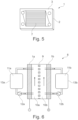
- Figure 5 shows an electrode unit 1 in a three-dimensional view comprising a substrate and a coating 3.
- a flow field 7 is embossed into the substrate 2 on both sides, so that a three-dimensional structuring of the surface of the electrode unit 1 results.
- Figure 6 shows a redox flow cell 8 or a redox flow battery with a redox flow cell 8.
- the redox flow cell 8 comprises two electrode units 1a, 1b, a first reaction space 10a and a second reaction space 10b, each Reaction space 10a, 10b is in contact with one of the electrode units 1a, 1b.
- the reaction spaces 10a, 10b are separated from one another by a polymer electrolyte membrane 9.
- a liquid anolyte 11a is pumped from a tank 13a via a pump 12a into the first reaction space 10a and passed between the electrode unit 1a and the polymer electrolyte membrane 9.
- a liquid catholyte 11b is pumped from a tank 13b via a pump 12b into the second reaction space 10b and between the electrode unit 1b and the polymer electrolyte membrane 9 passed through.
- An ion exchange takes place across the polymer electrolyte membrane 9, with electrical energy being released due to the redox reaction at the electrode units 1a, 1b.
Landscapes
- Chemical & Material Sciences (AREA)
- General Chemical & Material Sciences (AREA)
- Chemical Kinetics & Catalysis (AREA)
- Electrochemistry (AREA)
- Engineering & Computer Science (AREA)
- Manufacturing & Machinery (AREA)
- Sustainable Development (AREA)
- Life Sciences & Earth Sciences (AREA)
- Sustainable Energy (AREA)
- Materials Engineering (AREA)
- Composite Materials (AREA)
- Ceramic Engineering (AREA)
- Fuel Cell (AREA)
- Inert Electrodes (AREA)
Description
- Die Erfindung betrifft eine Elektrodeneinheit einer Redox-Flow-Zelle, umfassend zumindest ein metallisches Substrat und eine Beschichtung, welche auf dem Substrat aufgebracht ist. Weiterhin betrifft die Erfindung eine Redox-Flow-Zelle mit mindestens einer solchen Elektrodeneinheit.
- Elektrodeneinheiten der eingangs genannten Art sowie damit ausgestattete Redox-Flow-Zellen, insbesondere Redox-Flow-Batterien oder Flussbatterien, sind hinreichend bekannt.
- Die Redox-Flow-Batterie ist ein Speicher für elektrische Energie, wobei die elektrische Energie in flüssigen chemischen Verbindungen beziehungsweise Elektrolyten, einem sogenannten Anolyt und einem sogenannten Katholyt, gespeichert vorliegt. Die Elektrolyte befinden sich in zwei Reaktionsräumen, die durch eine Polymerelektrolytmembran voneinander getrennt sind. Über diese Membran erfolgt ein Ionenaustausch zwischen Anolyt und Katholyt, wobei elektrische Energie frei wird. Die frei werdende elektrische Energie wird über je eine Elektrodeneinheit, die in Kontakt zum Anolyten und Katholyten steht, abgegriffen. Die Elektrolyte werden in den Reaktionsräumen mittels Pumpen jeweils zirkuliert und fließen an der jeweiligen zugewandten Oberfläche der Membran entlang. Da die Elektrolyte in beliebig groß ausgeführten Tanks gespeichert werden können, ist die in der Redox-Flow-Batterie gespeicherte Energiemenge nur von der Größe der verwendeten Tanks abhängig.
- Flussbatteriesysteme als Speichersysteme ermöglichen eine nachhaltige Energieversorgung für stationäre und mobile Anwendungsfelder mittels erneuerbarer Energien. Um hohe Wirkungsgrade und Leistungsdichten zu erreichen, werden möglichst kompakte Batteriestacks angestrebt. Hohe Leistungsdichten stellen jedoch große Herausforderungen an die einzelnen Komponenten eines Batteriestacks dar.
- Die
WO 2018/145720 A1 beschreibt eine Elektrodeneinheit der eingangs genannten Art sowie eine Redox-Flow-Batterie, in welcher die Elektrodeneinheit eingesetzt wird. - Dabei ist unter anderem beschrieben, das Substrat aus einem Kompositmaterial auszubilden.
- Die
WO 2018/146342 A1 offenbart verschiedene Elektrolyt-Zusammensetzungen auf Lignin-Basis zur Verwendung für Redox-Flow-Batterien. - Die Veröffentlichung "A biomimetic high-capacity phenazine-based anolyte for aqueous organic redox flow batteries", Aaron Hollas et al., Nature energy, Vol. 3, Juni 2018, Seiten 508 - 514, beschreibt Anolyte für Redox-Flow-Batterien auf Basis wässriger "organischer" Elektrolyte beziehungsweise auf Basis wässriger Elektrolyte mit einer redox-aktiven organischen Spezies. Diese gewinnen zunehmend an Bedeutung.
- Derzeit werden als korrosionsbeständige Substrate für Elektrodeneinheiten von Redox-Flow-Batterien aufgrund der Verwendung stark basischer oder saurer Elektrolyte häufig plattenförmige Komposite aus Kunststoff und Graphit verwendet. Diese Substrate sind meist mit einer beidseitig aufgebrachten Kohlenstoffbeschichtung versehen oder es ist ein durchströmbarer Kohlenstoff-Filz zwischen der Membran und der Elektrodeneinheit vorhanden. Eine Gesamtplattendicke der Elektrodeneinheit im Bereich von etwa 0,7 - 1,2 mm ist dabei üblich. Solche Elektrodeneinheiten werden häufig in einem Kunststoffrahmen gehalten, was mit zusätzlichem Kostenaufwand für den Rahmen und das Montageverfahren verbunden ist. Die Größe und die Herstellungserfordernisse solcher Elektrodeneinheiten stehen einer platzsparenden Geometrie von Redox-Flow-Zellen und deren rationeller industrieller Fertigung derzeit im Wege.
- Es ist Aufgabe der Erfindung, eine Elektrodeneinheit für eine Redox-Flow-Zelle bereitzustellen, die bei geringen Dicken-Abmessungen einfach herzustellen ist. Weiterhin ist es Aufgabe der Erfindung eine Redox-Flow-Zelle mit einer solchen Elektrodeneinheit bereitzustellen.
- Die Aufgabe wird für die Elektrodeneinheit einer Redox-Flow-Zelle, umfassend zumindest ein metallisches Substrat und eine Beschichtung, welche auf dem Substrat aufgebracht ist, dadurch gelöst, dass die Beschichtung mindestens eine Schutzschicht auf ihrer dem Substrat abgewandten Seite umfasst, die aus Titanniobnitrid (TiNbN) und/oder Titanniobkarbid (TiNbC) gebildet ist.
- Bisher wurden metallische Substrate für Elektrodeneinheiten von Redox-Flow-Zellen nicht erfolgreich eingesetzt, da diese sich in den verwendeten Elektrolyten nicht als ausreichend korrosions- und damit langzeitstabil erwiesen haben. Der Einsatz eines metallischen Substrats ist erfindungsgemäß nun durch die genannte Beschichtung möglich. Der Einsatz der Elektrodeneinheit ermöglicht geringe Abstände zur Membran und damit einen platzsparenden Aufbau einer Redox-Flow-Zelle.
- Die Elektrodeneinheit mit metallischem Substrat ist undurchlässig für die Elektrolyte, so dass eine einwandfreie Trennung der Reaktionsräume innerhalb einer Redox-Flow-Zelle gewährleistet ist. Gleichzeitig weisen derartige Elektrodeneinheiten Oberflächen auf, die neben den hohen Anforderungen an die elektrochemische Stabilität auch den Forderungen nach einem niedrigen Grenzflächenwiderstand sowie hoher katalytischer Aktivität gerecht werden.
- Es hat sich bewährt, wenn lediglich eine Schutzschicht aus TiNbN oder aus TiNbC die Beschichtung bildet. Es können aber auch Einzelschichten aus TiNbN und TiNbC abwechselnd nacheinander zur Bildung einer Schutzschicht auf das Substrat gebracht sein oder es kann eine Mischung aus TiNbN und TiNbC innerhalb einer Einzelschicht als Schutzschicht vorliegen.
- Die Schutzschicht weist vorzugsweise eine Schichtdicke im Bereich von 50 - 400 nm, insbesondere von 200 - 300 nm auf.
- In einer Ausführungsform einer Elektrodeneinheit umfasst die Beschichtung weiterhin mindestens eine Haftvermittlerschicht, die zwischen der Schutzschicht und dem Substrat angeordnet ist. Die mindestens eine Haftvermittlerschicht ist vorzugsweise metallisch ausgebildet. Insbesondere hat sich eine metallische Haftvermittlerschicht aus Titanniob (TiNb) bewährt. Die Haftvermittlerschicht weist vorzugsweise eine Schichtdicke im Bereich von 1 bis 100 nm auf.
- Es hat sich bewährt, wenn das Substrat aus Edelstahl, 16MnCr5 oder einem Wälzlagerstahl gebildet ist. Insbesondere haben sich 100Cr6 oder Stahl vom Typ 1.4404 bewährt.
- Das metallische Substrat ist vorzugsweise durch ein Metallblech oder eine Metallplatte mit einer Dicke von maximal 1 mm, insbesondere von maximal 0,5 mm, gebildet. Die industrielle Verarbeitung von großflächigen Metallblechen oder dünnen metallischen Platten ist kostengünstig ausführbar. Das Substrat ist undurchlässig für die Elektrolyte, ist also nicht porös und kann als ein einteiliges Bauteil ausgeführt werden.
- Bevorzugt weist das Substrat einseitig oder vorzugsweise beidseitig zumindest bereichsweise eine dreidimensionale Profilierung unter Ausbildung eines Flussfeldes auf. Die Einbringung eines solches Flussfeldes in ein metallisches Substrat ist durch Prägen oder dergleichen in kostengünstiger Weise möglich. Ein solches Flussfeld lenkt die Strömung des Elektrolyten in definierte Bahnen und ist gleichbedeutend mit einer dreidimensionalen Struktur im Bereich der Oberfläche des Substrats. Es sorgt für eine homogene Verteilung und Strömung des Elektrolyten an und entlang der Membran.
- Die Beschichtung ist vorzugsweise mittels eines PVD-Verfahrens oder eines kombinierten PVD/PACVD-Verfahrens auf dem Substrat gebildet. Dabei ist es von Vorteil, wenn die Beschichtung möglichst porenfrei abgeschieden ist oder zumindest nur Poren mit einem Durchmesser kleiner 0,1 mm aufweist, um einen korrosiven Angriff des Elektrolyten auf das metallische Substrat zu verhindern.
- Es hat sich bewährt, wenn die Beschichtung insgesamt eine Dicke im Bereich von 200 bis 550 nm aufweist.
- Es hat sich bewährt, wenn die Beschichtung das Substrat zumindest einseitig, bevorzugt beid- oder allseitig bedeckt. Insbesondere im Bereich der Kanten eines plattenförmigen Substrats können unbeschichtete Bereiche oder Bereiche mit sehr geringer Schichtdicke vorliegen, die allerdings üblicherweise aufgrund der Trennung der Elektrolyträume nicht in Kontakt mit einem Elektrolyten stehen und daher unkritisch sind. Zumindest sollte die Beschichtung das Substrat in einem Kontaktbereich zu einem Elektrolyten der Redox-Flow-Zelle bedecken, also in einem Bereich, der in direktem Kontakt zu einem Anolyten oder Katholyten eingesetzt wird.
- Nachfolgend sind einige bevorzugte Beispiele für Beschichtungen auf metallischen Substraten zur Ausbildung von erfindungsgemäßen Elektrodeneinheiten aufgeführt:
- Beispiel 1
- Metallisches Substrat: 16MnCr5
- Haftvermittlerschicht: keine
- Schutzschicht: TiNbN oder TiNbC
- Beispiel 2
- Metallisches Substrat: 100Cr6
- Haftvermittlerschicht: TiNb
- Schutzschicht: TiNbN oder TiNbC
- Die Aufgabe wird für eine Redox-Flow-Zelle, insbesondere Redox-Flow-Batterie, umfassend mindestens eine erfindungsgemäße Elektrodeneinheit gelöst. Insbesondere Flussbatterien mit wässrigen Elektrolyten umfassend eine redox-aktive Spezie auf der Anolyt-Seite sind bevorzugte Anwendungen für die erfindungsgemäßen Elektrodeneinheiten.
- Bevorzugt umfasst die Redox-Flow-Zelle dabei mindestens zwei Elektrodeneinheiten, einen ersten Reaktionsraum und einen zweiten Reaktionsraum, wobei jeder Reaktionsraum in Kontakt mit einer der Elektrodeneinheiten steht und wobei die Reaktionsräume durch eine Polymerelektrolytmembran voneinander getrennt sind.
- Es können aufgrund der geringen möglichen Dicken der Elektrodeneinheiten kleinbauende Redox-Flow-Batterien hergestellt werden, die zudem einen geringen Herstellungspreis aufweisen. So werden zur Ausbildung einer Redox-Flow-Batterie bevorzugt mehr als 10, insbesondere mehr als 50 Redox-Flow-Zellen elektrisch miteinander verschaltet eingesetzt.
- Als für eine Redox-Flow-Zelle oder eine Redox-Flow-Batterie geeigneter Anolyt wird hier beispielhaft genannt:
- 1.4 M 7,8-Dihydroxyphenazin-2-sulfonsäure (kurz: DHPS)
- gelöst in 1 molarer Natronlauge
- Als für eine Redox-Flow-Zelle oder eine Redox-Flow-Batterie geeigneter Katholyt wird hier beispielhaft genannt:
- 0.31 M Kaliumhexacyanoferrat(II) und 0.31 M Kaliumhexacyanoferrat(III)
- gelöst in 2 molarer Natronlauge.
- Es werden bevorzugt Elektrolyt-Kombinationen mit wässrigen Elektrolyten mit einer redox-aktiven organischen Spezies auf der Anolyt-Seite zur Bildung einer Redox-Flow-Zelle oder einer Redox-Flow-Batterie verwendet.
- Die
Figuren 1 bis 6 zeigen beispielhaft Elektrodeneinheiten und eine Redox-Flow-Zelle beziehungsweise eine Redox-Flow-Batterie. So zeigt - Figur 1
- eine Elektrodeneinheit umfassend ein metallisches Substrat mit einer Beschichtung,
- Figur 2
- einen Querschnitt durch die erfindungsgemäße Elektrodeneinheit nach
Figur 1 , - Figur 3
- einen Querschnitt durch eine nicht erfindungsgemäße Elektrodeneinheit,
- Figur 4
- einen Querschnitt durch eine weitere erfindungsgemäße Elektrodeneinheit, und
- Figur 5
- eine Elektrodeneinheit mit einem Flussfeld,
- Figur 6
- eine Redox-Flow-Zelle beziehungsweise eine Redox-Flow-Batterie mit einer Redox-Flow-Zelle.
-
Figur 1 zeigt eine erfindungsgemäße Elektrodeneinheit 1 umfassend ein metallisches Substrat 2, insbesondere aus Stahlblech der Sorte 1.4404 in einer Dicke kleiner 0,5 mm, mit einer Beschichtung 3, die beidseitig auf das Substrat 2 aufgebracht ist. Die Beschichtung 3 umfasst hier lediglich eine Schutzschicht 4 aus TiNbN. -
Figur 2 zeigt einen Querschnitt durch die Elektrodeneinheit 1 nachFigur 1 . Gleiche Bezugszeichen wie inFigur 1 kennzeichnen gleiche Elemente. -
Figur 3 zeigt einen Querschnitt durch eine nicht erfindungsgemäße Elektrodeneinheit 1 umfassend ein metallisches Substrat 2 und eine Beschichtung 3, die einseitig auf das Substrat 2 aufgebracht ist. Die Beschichtung 3 umfasst hier eine Haftvermittlerschicht 5 aus TiNb, eine Schutzschicht 4 aus TiNbN und eine Deckschicht 6 aus IrC oder reinem Kohlenstoff. -
Figur 4 zeigt einen Querschnitt durch eine weitere erfindungsgemäße Elektrodeneinheit 1 umfassend ein metallisches Substrat 2 und eine Beschichtung 3, die beidseitig auf das Substrat 2 aufgebracht ist. Die Beschichtung 3 umfasst hier eine Haftvermittlerschicht 5 aus TiNb und eine Schutzschicht 4 aus TiNbC. -
Figur 5 zeigt eine Elektrodeneinheit 1 in dreidimensionaler Ansicht umfassend ein Substrat und eine Beschichtung 3. In das Substrat 2 ist beidseitig ein Flussfeld 7 eingeprägt, so dass eine dreidimensionale Strukturierung der Oberfläche der Elektrodeneinheit 1 resultiert. -
Figur 6 zeigt eine Redox-Flow-Zelle 8 beziehungsweise eine Redox-Flow-Batterie mit einer Redox-Flow-Zelle 8. Die Redox-Flow-Zelle 8 umfasst zwei Elektrodeneinheiten 1a, 1b, einen ersten Reaktionsraum 10a und einen zweiten Reaktionsraum 10b, wobei jeder Reaktionsraum 10a, 10b in Kontakt mit einer der Elektrodeneinheiten 1a, 1b steht. Die Reaktionsräume 10a, 10b sind durch eine Polymerelektrolytmembran 9 voneinander getrennt. Ein flüssiger Anolyt 11a wird aus einem Tank 13a über eine Pumpe 12a in den ersten Reaktionsraum 10a gepumpt und zwischen der Elektrodeneinheit 1a und der Polymerelektrolytmembran 9 hindurchgeführt. Ein flüssiger Katholyt 11b wird aus einem Tank 13b über eine Pumpe 12b in den zweiten Reaktionsraum 10b gepumpt und zwischen der Elektrodeneinheit 1b und der Polymerelektrolytmembran 9 hindurchgeführt. Es erfolgt ein Ionentausch über die Polymerelektrolytmembran 9 hinweg, wobei aufgrund der Redox-Reaktion and den Elektrodeneinheiten 1a, 1b elektrische Energie frei wird. -
- 1, 1a, 1b
- Elektrodeneinheit
- 2
- metallisches Substrat
- 3
- Beschichtung
- 4
- Schutzschicht
- 5
- Haftvermittlerschicht
- 6
- Deckschicht
- 7
- Flussfeld
- 8
- Redox-Flow-Zelle oder Redox-Flow-Batterie
- 9
- Polymerelektrolytmembran
- 10a
- erster Reaktionsraum
- 10b
- zweiter Reaktionsraum
- 11a
- Anolyt
- 11b
- Katholyt
- 12a, 12b
- Pumpe
- 13a, 13b
- Tank
- D
- Dicke der Beschichtung
Claims (11)
- Elektrodeneinheit (1, 1a, 1b) einer Redox-Flow-Zelle (8), umfassend zumindest ein metallisches Substrat (2) und eine Beschichtung (3), welche auf dem Substrat (2) aufgebracht ist, dadurch gekennzeichnet, dass die Beschichtung (3) mindestens eine Schutzschicht (4) auf ihrer dem Substrat (2) abgewandten Seite umfasst, die aus Titanniobnitrid (TiNbN) und/oder Titanniobkarbid (TiNbC) gebildet ist.
- Elektrodeneinheit (1, 1a, 1b) nach Anspruch 1, dadurch gekennzeichnet, dass die Beschichtung (3) weiterhin mindestens eine Haftvermittlerschicht (5) umfasst, die zwischen der Schutzschicht (4) und dem Substrat (2) angeordnet ist.
- Elektrodeneinheit (1, 1a, 1b) nach Anspruch 2, dadurch gekennzeichnet, dass die mindestens eine Haftvermittlerschicht (5) metallisch ausgebildet ist, insbesondere aus Titanniob (TiNb) gebildet ist.
- Elektrodeneinheit (1, 1a, 1b) nach einem der Ansprüche 1 bis 3, dadurch gekennzeichnet, dass das Substrat (2) aus Edelstahl, 16MnCr5 oder einem Wälzlagerstahl gebildet ist.
- Elektrodeneinheit (1, 1a, 1b) nach einem der Ansprüche 1 bis 4, dadurch gekennzeichnet, dass das Substrat (2) durch ein Metallblech oder eine Metallplatte mit einer Dicke von maximal 1 mm gebildet ist.
- Elektrodeneinheit (1, 1a, 1b) nach einem der Ansprüche 1 bis 5, dadurch gekennzeichnet, dass das Substrat ein- oder beidseitig zumindest bereichsweise eine dreidimensionale Profilierung unter Ausbildung eines Flussfeldes (7) aufweist.
- Elektrodeneinheit (1, 1a, 1b) nach einem der Ansprüche 1 bis 6, dadurch gekennzeichnet, dass die Beschichtung (3) mittels eines PVD-Verfahrens oder eines kombinierten PVD/PACVD-Verfahrens auf dem Substrat (2) gebildet ist.
- Elektrodeneinheit (1, 1a, 1b) nach einem der Ansprüche 1 bis 7, dadurch gekennzeichnet, dass die Beschichtung (2) insgesamt eine Dicke (D) im Bereich von 200 bis 550 nm aufweist.
- Elektrodeneinheit (1, 1a, 1b) nach einem der Ansprüche 1 bis 8, dadurch gekennzeichnet, dass die Beschichtung (3) das Substrat (2) zumindest in einem Kontaktbereich zu einem Elektrolyten der Redox-Flow-Zelle (8) bedeckt.
- Redox-Flow-Zelle (8), insbesondere Redox-Flow-Batterie, umfassend mindestens eine Elektrodeneinheit (1, 1a, 1b) nach einem der Ansprüche 1 bis 9.
- Redox-Flow-Zelle (8) nach Anspruch 10, umfassend mindestens zwei Elektrodeneinheiten (1a, 1b), einen ersten Reaktionsraum (10a) und einen zweiten Reaktionsraum (10b), wobei jeder Reaktionsraum (10a, 10b) in Kontakt mit einer der Elektrodeneinheiten (1a, 1b) steht und wobei die Reaktionsräume (10a, 10b) durch eine Polymerelektrolytmembran (9) voneinander getrennt sind.
Applications Claiming Priority (2)
| Application Number | Priority Date | Filing Date | Title |
|---|---|---|---|
| DE102019121673.7A DE102019121673A1 (de) | 2019-08-12 | 2019-08-12 | Elektrodeneinheit und Redox-Flow-Zelle |
| PCT/DE2020/100589 WO2021027988A1 (de) | 2019-08-12 | 2020-07-03 | Elektrodeneinheit und redox-flow-zelle |
Publications (2)
| Publication Number | Publication Date |
|---|---|
| EP4014271A1 EP4014271A1 (de) | 2022-06-22 |
| EP4014271B1 true EP4014271B1 (de) | 2023-09-27 |
Family
ID=71661605
Family Applications (1)
| Application Number | Title | Priority Date | Filing Date |
|---|---|---|---|
| EP20742159.5A Active EP4014271B1 (de) | 2019-08-12 | 2020-07-03 | Elektrodeneinheit und redox-flow-zelle |
Country Status (8)
| Country | Link |
|---|---|
| US (1) | US12160006B2 (de) |
| EP (1) | EP4014271B1 (de) |
| JP (1) | JP7346713B2 (de) |
| KR (1) | KR102941459B1 (de) |
| CN (1) | CN114080706B (de) |
| DE (1) | DE102019121673A1 (de) |
| ES (1) | ES2962921T3 (de) |
| WO (1) | WO2021027988A1 (de) |
Families Citing this family (9)
| Publication number | Priority date | Publication date | Assignee | Title |
|---|---|---|---|---|
| DE102022107044A1 (de) | 2022-03-25 | 2023-06-15 | Schaeffler Technologies AG & Co. KG | Redox-Flusszelle |
| DE102022110114A1 (de) | 2022-04-27 | 2023-11-02 | Schaeffler Technologies AG & Co. KG | Redox-Flusszelle |
| USD1073491S1 (en) * | 2022-12-05 | 2025-05-06 | Oxford Nanopore Technologies Plc | Sensor device |
| USD1072637S1 (en) * | 2022-12-05 | 2025-04-29 | Oxford Nanopore Technologies Plc | Sensor device |
| USD1086898S1 (en) * | 2022-12-05 | 2025-08-05 | Oxford Nanopore Technologies Plc | Sensor device |
| USD1072638S1 (en) * | 2022-12-05 | 2025-04-29 | Oxford Nanopore Technologies Plc | Sensor device |
| USD1072635S1 (en) * | 2022-12-05 | 2025-04-29 | Oxford Nanopore Technologies Plc | Sensor device |
| USD1095884S1 (en) * | 2022-12-05 | 2025-09-30 | Oxford Nanopore Technologies Plc | Sensor device |
| USD1072636S1 (en) * | 2022-12-05 | 2025-04-29 | Oxford Nanopore Technologies Plc | Sensor device |
Family Cites Families (10)
| Publication number | Priority date | Publication date | Assignee | Title |
|---|---|---|---|---|
| JP2010086935A (ja) | 2008-09-03 | 2010-04-15 | Sharp Corp | レドックスフロー電池 |
| DE102009035314B4 (de) | 2009-07-30 | 2011-07-21 | Bauer, Bernd, Dr., 71665 | Redoxbatterie mit Flüssigelektrolyt und Verfahren zum Erzeugen elektrischer Energie unter Einsatz einer solchen Batterie |
| WO2013118277A1 (ja) | 2012-02-09 | 2013-08-15 | 日新電機株式会社 | 電力貯蔵電池 |
| DE102014109321B4 (de) | 2014-07-03 | 2025-07-03 | Deutsches Zentrum für Luft- und Raumfahrt e.V. | Verfahren zur Herstellung einer Bipolarplatte, Bipolarplatte für eine elektrochemische Zelle und elektrochemische Zelle |
| DE102016202372A1 (de) | 2016-02-17 | 2017-08-17 | Friedrich-Alexander-Universität Erlangen-Nürnberg | Schicht und Schichtsystem, sowie Bipolarplatte, Brennstoffzelle und Elektrolyseur |
| CN106025061B (zh) | 2016-07-14 | 2018-07-31 | 中国科学院上海微系统与信息技术研究所 | 一种新型量子霍尔器件及其制备方法 |
| JP2019164882A (ja) | 2016-08-02 | 2019-09-26 | 住友電気工業株式会社 | レドックスフロー電池、及びレドックスフロー電池の運転方法 |
| WO2018145720A1 (en) | 2017-02-10 | 2018-08-16 | Cmblu Projekt Ag | Flow-by electrode unit and use thereof, redox flow battery system and use thereof, method of manufacturing a flow-by electrode unit, method of operating a redox flow battery system |
| WO2018146342A1 (en) | 2017-02-13 | 2018-08-16 | Cmblu Projekt Ag | Redox flow battery electrolytes |
| JP6743869B2 (ja) | 2018-11-14 | 2020-08-19 | ダイキン工業株式会社 | 空気調和機 |
-
2019
- 2019-08-12 DE DE102019121673.7A patent/DE102019121673A1/de not_active Withdrawn
-
2020
- 2020-07-03 JP JP2022508840A patent/JP7346713B2/ja active Active
- 2020-07-03 EP EP20742159.5A patent/EP4014271B1/de active Active
- 2020-07-03 KR KR1020217042838A patent/KR102941459B1/ko active Active
- 2020-07-03 US US17/632,845 patent/US12160006B2/en active Active
- 2020-07-03 WO PCT/DE2020/100589 patent/WO2021027988A1/de not_active Ceased
- 2020-07-03 ES ES20742159T patent/ES2962921T3/es active Active
- 2020-07-03 CN CN202080045696.3A patent/CN114080706B/zh active Active
Also Published As
| Publication number | Publication date |
|---|---|
| CN114080706A (zh) | 2022-02-22 |
| US20220293960A1 (en) | 2022-09-15 |
| ES2962921T3 (es) | 2024-03-21 |
| WO2021027988A1 (de) | 2021-02-18 |
| DE102019121673A1 (de) | 2021-02-18 |
| JP7346713B2 (ja) | 2023-09-19 |
| EP4014271A1 (de) | 2022-06-22 |
| KR20220047216A (ko) | 2022-04-15 |
| CN114080706B (zh) | 2024-10-01 |
| US12160006B2 (en) | 2024-12-03 |
| JP2022544388A (ja) | 2022-10-18 |
| KR102941459B1 (ko) | 2026-03-20 |
Similar Documents
| Publication | Publication Date | Title |
|---|---|---|
| DE102019121673A1 (de) | Elektrodeneinheit und Redox-Flow-Zelle | |
| EP3532654B1 (de) | Verwendung einer bipolarplatte und einer porösen transportschicht in einem elektrolyseur | |
| DE102007032116A1 (de) | Bipolarplatte für eine Brennstoffzelle und Brennstoffzellen-Stack | |
| DE112006001829B4 (de) | Beschichtete bipolare Stahlplatten | |
| DE102007057699A1 (de) | Ein elektrisches Kontaktelement für eine Brennstoffzelle mit einer leitenden Beschichtung mit monoatomarer Schicht | |
| EP4130341A1 (de) | Elektrolysezelle zur polymerelektrolytmembran-elektrolyse und verfahren zu deren herstellung | |
| DE102022101159A1 (de) | Redox-Flow-Zelle | |
| DE102004053582A1 (de) | Neues elektrisches Kontaktelement für eine Brennstoffzelle | |
| EP3456866A1 (de) | Verfahren zur herstellung eines interkonnektors, interkonnektor und dessen verwendung | |
| EP4248506A1 (de) | Bauteil einer redox-flow-zelle sowie redox-flow-zelle und redox-flow-batterie | |
| EP4141145A1 (de) | Elektrolysezelle zur polymerelektrolytmembran-elektrolyse und korrosionsfeste beschichtung | |
| WO2022105960A1 (de) | Bauteil für eine elektrochemische zelle, sowie redox-flow-zelle, brennstoffzelle und elektrolyseur | |
| DE102022127150A1 (de) | Gasdiffusionssubstrat aus einem porösen Metallsubstrat und einer gasdurchlässigen Polymerschicht, Verfahren zu dessen Herstellung sowie Gasdiffusionselektrode und elektrochemische Zelle mit einem Gasdiffusionssubstrat | |
| WO2022105959A1 (de) | Bauteil für eine elektrochemische zelle, sowie redox-flow-zelle, brennstoffzelle und elektrolyseur | |
| DE102021126534B4 (de) | Elektrodenplatte für eine elektrochemische Zelle, Redox-Flow-Zelle sowie Redox-Flow-Batterie | |
| DE102024105383A1 (de) | Bauteil für eine elektrochemische Zelle, sowie Redox-Flow-Zelle, Brennstoffzelle und Elektrolyseur | |
| EP4222798B1 (de) | Elektrode, redox-flow-zelle sowie redox-flow-batterie | |
| DE102023136387A1 (de) | Poröse transportlage, einheit mit einer separatorplatte und einer porösen transportlage, elektrochemische zelle sowie verfahren zur herstellung einer derartigen porösen transportlage | |
| EP4677665A1 (de) | Bauteil für eine elektrochemische zelle, sowie redox-flow-zelle, brennstoffzelle und elektrolyseur | |
| DE102022110114A1 (de) | Redox-Flusszelle | |
| EP3780200B1 (de) | Beschichtung, verteilerplatte, brennstoffzelle und verfahren zur beschichtung | |
| EP4302344A1 (de) | Redox-flow-zelle | |
| DE112006001838B4 (de) | Elektrisch leitende Fluidverteilungsplatte sowie damit ausgestaltete Brennstoffzelle | |
| DE102021126138A1 (de) | Redox-Flussbatterie | |
| EP4278402A1 (de) | Redox-flussbatterie |
Legal Events
| Date | Code | Title | Description |
|---|---|---|---|
| STAA | Information on the status of an ep patent application or granted ep patent |
Free format text: STATUS: UNKNOWN |
|
| STAA | Information on the status of an ep patent application or granted ep patent |
Free format text: STATUS: THE INTERNATIONAL PUBLICATION HAS BEEN MADE |
|
| PUAI | Public reference made under article 153(3) epc to a published international application that has entered the european phase |
Free format text: ORIGINAL CODE: 0009012 |
|
| STAA | Information on the status of an ep patent application or granted ep patent |
Free format text: STATUS: REQUEST FOR EXAMINATION WAS MADE |
|
| 17P | Request for examination filed |
Effective date: 20220314 |
|
| AK | Designated contracting states |
Kind code of ref document: A1 Designated state(s): AL AT BE BG CH CY CZ DE DK EE ES FI FR GB GR HR HU IE IS IT LI LT LU LV MC MK MT NL NO PL PT RO RS SE SI SK SM TR |
|
| DAV | Request for validation of the european patent (deleted) | ||
| DAX | Request for extension of the european patent (deleted) | ||
| STAA | Information on the status of an ep patent application or granted ep patent |
Free format text: STATUS: EXAMINATION IS IN PROGRESS |
|
| 17Q | First examination report despatched |
Effective date: 20230224 |
|
| GRAP | Despatch of communication of intention to grant a patent |
Free format text: ORIGINAL CODE: EPIDOSNIGR1 |
|
| STAA | Information on the status of an ep patent application or granted ep patent |
Free format text: STATUS: GRANT OF PATENT IS INTENDED |
|
| P01 | Opt-out of the competence of the unified patent court (upc) registered |
Effective date: 20230523 |
|
| INTG | Intention to grant announced |
Effective date: 20230620 |
|
| GRAS | Grant fee paid |
Free format text: ORIGINAL CODE: EPIDOSNIGR3 |
|
| GRAA | (expected) grant |
Free format text: ORIGINAL CODE: 0009210 |
|
| STAA | Information on the status of an ep patent application or granted ep patent |
Free format text: STATUS: THE PATENT HAS BEEN GRANTED |
|
| AK | Designated contracting states |
Kind code of ref document: B1 Designated state(s): AL AT BE BG CH CY CZ DE DK EE ES FI FR GB GR HR HU IE IS IT LI LT LU LV MC MK MT NL NO PL PT RO RS SE SI SK SM TR |
|
| REG | Reference to a national code |
Ref country code: GB Ref legal event code: FG4D Free format text: NOT ENGLISH |
|
| REG | Reference to a national code |
Ref country code: CH Ref legal event code: EP |
|
| REG | Reference to a national code |
Ref country code: DE Ref legal event code: R096 Ref document number: 502020005418 Country of ref document: DE |
|
| REG | Reference to a national code |
Ref country code: IE Ref legal event code: FG4D Free format text: LANGUAGE OF EP DOCUMENT: GERMAN |
|
| REG | Reference to a national code |
Ref country code: LT Ref legal event code: MG9D |
|
| PG25 | Lapsed in a contracting state [announced via postgrant information from national office to epo] |
Ref country code: GR Free format text: LAPSE BECAUSE OF FAILURE TO SUBMIT A TRANSLATION OF THE DESCRIPTION OR TO PAY THE FEE WITHIN THE PRESCRIBED TIME-LIMIT Effective date: 20231228 |
|
| PG25 | Lapsed in a contracting state [announced via postgrant information from national office to epo] |
Ref country code: SE Free format text: LAPSE BECAUSE OF FAILURE TO SUBMIT A TRANSLATION OF THE DESCRIPTION OR TO PAY THE FEE WITHIN THE PRESCRIBED TIME-LIMIT Effective date: 20230927 Ref country code: RS Free format text: LAPSE BECAUSE OF FAILURE TO SUBMIT A TRANSLATION OF THE DESCRIPTION OR TO PAY THE FEE WITHIN THE PRESCRIBED TIME-LIMIT Effective date: 20230927 Ref country code: NO Free format text: LAPSE BECAUSE OF FAILURE TO SUBMIT A TRANSLATION OF THE DESCRIPTION OR TO PAY THE FEE WITHIN THE PRESCRIBED TIME-LIMIT Effective date: 20231227 Ref country code: LV Free format text: LAPSE BECAUSE OF FAILURE TO SUBMIT A TRANSLATION OF THE DESCRIPTION OR TO PAY THE FEE WITHIN THE PRESCRIBED TIME-LIMIT Effective date: 20230927 Ref country code: LT Free format text: LAPSE BECAUSE OF FAILURE TO SUBMIT A TRANSLATION OF THE DESCRIPTION OR TO PAY THE FEE WITHIN THE PRESCRIBED TIME-LIMIT Effective date: 20230927 Ref country code: HR Free format text: LAPSE BECAUSE OF FAILURE TO SUBMIT A TRANSLATION OF THE DESCRIPTION OR TO PAY THE FEE WITHIN THE PRESCRIBED TIME-LIMIT Effective date: 20230927 Ref country code: GR Free format text: LAPSE BECAUSE OF FAILURE TO SUBMIT A TRANSLATION OF THE DESCRIPTION OR TO PAY THE FEE WITHIN THE PRESCRIBED TIME-LIMIT Effective date: 20231228 Ref country code: FI Free format text: LAPSE BECAUSE OF FAILURE TO SUBMIT A TRANSLATION OF THE DESCRIPTION OR TO PAY THE FEE WITHIN THE PRESCRIBED TIME-LIMIT Effective date: 20230927 |
|
| REG | Reference to a national code |
Ref country code: NL Ref legal event code: MP Effective date: 20230927 |
|
| PG25 | Lapsed in a contracting state [announced via postgrant information from national office to epo] |
Ref country code: NL Free format text: LAPSE BECAUSE OF FAILURE TO SUBMIT A TRANSLATION OF THE DESCRIPTION OR TO PAY THE FEE WITHIN THE PRESCRIBED TIME-LIMIT Effective date: 20230927 |
|
| REG | Reference to a national code |
Ref country code: ES Ref legal event code: FG2A Ref document number: 2962921 Country of ref document: ES Kind code of ref document: T3 Effective date: 20240321 |
|
| PG25 | Lapsed in a contracting state [announced via postgrant information from national office to epo] |
Ref country code: IS Free format text: LAPSE BECAUSE OF FAILURE TO SUBMIT A TRANSLATION OF THE DESCRIPTION OR TO PAY THE FEE WITHIN THE PRESCRIBED TIME-LIMIT Effective date: 20240127 |
|
| PG25 | Lapsed in a contracting state [announced via postgrant information from national office to epo] |
Ref country code: SM Free format text: LAPSE BECAUSE OF FAILURE TO SUBMIT A TRANSLATION OF THE DESCRIPTION OR TO PAY THE FEE WITHIN THE PRESCRIBED TIME-LIMIT Effective date: 20230927 Ref country code: RO Free format text: LAPSE BECAUSE OF FAILURE TO SUBMIT A TRANSLATION OF THE DESCRIPTION OR TO PAY THE FEE WITHIN THE PRESCRIBED TIME-LIMIT Effective date: 20230927 Ref country code: IS Free format text: LAPSE BECAUSE OF FAILURE TO SUBMIT A TRANSLATION OF THE DESCRIPTION OR TO PAY THE FEE WITHIN THE PRESCRIBED TIME-LIMIT Effective date: 20240127 Ref country code: EE Free format text: LAPSE BECAUSE OF FAILURE TO SUBMIT A TRANSLATION OF THE DESCRIPTION OR TO PAY THE FEE WITHIN THE PRESCRIBED TIME-LIMIT Effective date: 20230927 Ref country code: CZ Free format text: LAPSE BECAUSE OF FAILURE TO SUBMIT A TRANSLATION OF THE DESCRIPTION OR TO PAY THE FEE WITHIN THE PRESCRIBED TIME-LIMIT Effective date: 20230927 Ref country code: SK Free format text: LAPSE BECAUSE OF FAILURE TO SUBMIT A TRANSLATION OF THE DESCRIPTION OR TO PAY THE FEE WITHIN THE PRESCRIBED TIME-LIMIT Effective date: 20230927 Ref country code: PT Free format text: LAPSE BECAUSE OF FAILURE TO SUBMIT A TRANSLATION OF THE DESCRIPTION OR TO PAY THE FEE WITHIN THE PRESCRIBED TIME-LIMIT Effective date: 20240129 |
|
| PG25 | Lapsed in a contracting state [announced via postgrant information from national office to epo] |
Ref country code: PL Free format text: LAPSE BECAUSE OF FAILURE TO SUBMIT A TRANSLATION OF THE DESCRIPTION OR TO PAY THE FEE WITHIN THE PRESCRIBED TIME-LIMIT Effective date: 20230927 |
|
| REG | Reference to a national code |
Ref country code: DE Ref legal event code: R097 Ref document number: 502020005418 Country of ref document: DE |
|
| PG25 | Lapsed in a contracting state [announced via postgrant information from national office to epo] |
Ref country code: DK Free format text: LAPSE BECAUSE OF FAILURE TO SUBMIT A TRANSLATION OF THE DESCRIPTION OR TO PAY THE FEE WITHIN THE PRESCRIBED TIME-LIMIT Effective date: 20230927 |
|
| PG25 | Lapsed in a contracting state [announced via postgrant information from national office to epo] |
Ref country code: DK Free format text: LAPSE BECAUSE OF FAILURE TO SUBMIT A TRANSLATION OF THE DESCRIPTION OR TO PAY THE FEE WITHIN THE PRESCRIBED TIME-LIMIT Effective date: 20230927 |
|
| PLBE | No opposition filed within time limit |
Free format text: ORIGINAL CODE: 0009261 |
|
| STAA | Information on the status of an ep patent application or granted ep patent |
Free format text: STATUS: NO OPPOSITION FILED WITHIN TIME LIMIT |
|
| 26N | No opposition filed |
Effective date: 20240628 |
|
| PG25 | Lapsed in a contracting state [announced via postgrant information from national office to epo] |
Ref country code: SI Free format text: LAPSE BECAUSE OF FAILURE TO SUBMIT A TRANSLATION OF THE DESCRIPTION OR TO PAY THE FEE WITHIN THE PRESCRIBED TIME-LIMIT Effective date: 20230927 |
|
| PG25 | Lapsed in a contracting state [announced via postgrant information from national office to epo] |
Ref country code: SI Free format text: LAPSE BECAUSE OF FAILURE TO SUBMIT A TRANSLATION OF THE DESCRIPTION OR TO PAY THE FEE WITHIN THE PRESCRIBED TIME-LIMIT Effective date: 20230927 |
|
| PG25 | Lapsed in a contracting state [announced via postgrant information from national office to epo] |
Ref country code: BG Free format text: LAPSE BECAUSE OF FAILURE TO SUBMIT A TRANSLATION OF THE DESCRIPTION OR TO PAY THE FEE WITHIN THE PRESCRIBED TIME-LIMIT Effective date: 20230927 |
|
| PG25 | Lapsed in a contracting state [announced via postgrant information from national office to epo] |
Ref country code: BG Free format text: LAPSE BECAUSE OF FAILURE TO SUBMIT A TRANSLATION OF THE DESCRIPTION OR TO PAY THE FEE WITHIN THE PRESCRIBED TIME-LIMIT Effective date: 20230927 |
|
| PG25 | Lapsed in a contracting state [announced via postgrant information from national office to epo] |
Ref country code: MC Free format text: LAPSE BECAUSE OF FAILURE TO SUBMIT A TRANSLATION OF THE DESCRIPTION OR TO PAY THE FEE WITHIN THE PRESCRIBED TIME-LIMIT Effective date: 20230927 |
|
| REG | Reference to a national code |
Ref country code: CH Ref legal event code: PL |
|
| PG25 | Lapsed in a contracting state [announced via postgrant information from national office to epo] |
Ref country code: LU Free format text: LAPSE BECAUSE OF NON-PAYMENT OF DUE FEES Effective date: 20240703 |
|
| PG25 | Lapsed in a contracting state [announced via postgrant information from national office to epo] |
Ref country code: LU Free format text: LAPSE BECAUSE OF NON-PAYMENT OF DUE FEES Effective date: 20240703 |
|
| PG25 | Lapsed in a contracting state [announced via postgrant information from national office to epo] |
Ref country code: CH Free format text: LAPSE BECAUSE OF NON-PAYMENT OF DUE FEES Effective date: 20240731 Ref country code: BE Free format text: LAPSE BECAUSE OF NON-PAYMENT OF DUE FEES Effective date: 20240731 |
|
| REG | Reference to a national code |
Ref country code: BE Ref legal event code: MM Effective date: 20240731 |
|
| PG25 | Lapsed in a contracting state [announced via postgrant information from national office to epo] |
Ref country code: IE Free format text: LAPSE BECAUSE OF NON-PAYMENT OF DUE FEES Effective date: 20240703 |
|
| PGFP | Annual fee paid to national office [announced via postgrant information from national office to epo] |
Ref country code: ES Payment date: 20250827 Year of fee payment: 6 |
|
| PGFP | Annual fee paid to national office [announced via postgrant information from national office to epo] |
Ref country code: DE Payment date: 20250919 Year of fee payment: 6 |
|
| PGFP | Annual fee paid to national office [announced via postgrant information from national office to epo] |
Ref country code: IT Payment date: 20250724 Year of fee payment: 6 |
|
| PGFP | Annual fee paid to national office [announced via postgrant information from national office to epo] |
Ref country code: GB Payment date: 20250724 Year of fee payment: 6 |
|
| PGFP | Annual fee paid to national office [announced via postgrant information from national office to epo] |
Ref country code: AT Payment date: 20251020 Year of fee payment: 5 Ref country code: FR Payment date: 20250725 Year of fee payment: 6 |
|
| PG25 | Lapsed in a contracting state [announced via postgrant information from national office to epo] |
Ref country code: CY Free format text: LAPSE BECAUSE OF FAILURE TO SUBMIT A TRANSLATION OF THE DESCRIPTION OR TO PAY THE FEE WITHIN THE PRESCRIBED TIME-LIMIT; INVALID AB INITIO Effective date: 20200703 |
|
| PG25 | Lapsed in a contracting state [announced via postgrant information from national office to epo] |
Ref country code: HU Free format text: LAPSE BECAUSE OF FAILURE TO SUBMIT A TRANSLATION OF THE DESCRIPTION OR TO PAY THE FEE WITHIN THE PRESCRIBED TIME-LIMIT; INVALID AB INITIO Effective date: 20200703 |