EP4013293B1 - Elektrophysiologische kathetersysteme - Google Patents
Elektrophysiologische kathetersysteme Download PDFInfo
- Publication number
- EP4013293B1 EP4013293B1 EP20758302.2A EP20758302A EP4013293B1 EP 4013293 B1 EP4013293 B1 EP 4013293B1 EP 20758302 A EP20758302 A EP 20758302A EP 4013293 B1 EP4013293 B1 EP 4013293B1
- Authority
- EP
- European Patent Office
- Prior art keywords
- stimulation
- signal
- control means
- detection
- atrial
- Prior art date
- Legal status (The legal status is an assumption and is not a legal conclusion. Google has not performed a legal analysis and makes no representation as to the accuracy of the status listed.)
- Active
Links
Images






Classifications
-
- A—HUMAN NECESSITIES
- A61—MEDICAL OR VETERINARY SCIENCE; HYGIENE
- A61B—DIAGNOSIS; SURGERY; IDENTIFICATION
- A61B5/00—Measuring for diagnostic purposes; Identification of persons
- A61B5/24—Detecting, measuring or recording bioelectric or biomagnetic signals of the body or parts thereof
- A61B5/25—Bioelectric electrodes therefor
- A61B5/279—Bioelectric electrodes therefor specially adapted for particular uses
- A61B5/28—Bioelectric electrodes therefor specially adapted for particular uses for electrocardiography [ECG]
- A61B5/283—Invasive
- A61B5/287—Holders for multiple electrodes, e.g. electrode catheters for electrophysiological study [EPS]
-
- A—HUMAN NECESSITIES
- A61—MEDICAL OR VETERINARY SCIENCE; HYGIENE
- A61B—DIAGNOSIS; SURGERY; IDENTIFICATION
- A61B5/00—Measuring for diagnostic purposes; Identification of persons
- A61B5/24—Detecting, measuring or recording bioelectric or biomagnetic signals of the body or parts thereof
- A61B5/316—Modalities, i.e. specific diagnostic methods
- A61B5/318—Heart-related electrical modalities, e.g. electrocardiography [ECG]
- A61B5/346—Analysis of electrocardiograms
- A61B5/349—Detecting specific parameters of the electrocardiograph cycle
- A61B5/364—Detecting abnormal ECG interval, e.g. extrasystoles, ectopic heartbeats
-
- A—HUMAN NECESSITIES
- A61—MEDICAL OR VETERINARY SCIENCE; HYGIENE
- A61B—DIAGNOSIS; SURGERY; IDENTIFICATION
- A61B5/00—Measuring for diagnostic purposes; Identification of persons
- A61B5/72—Signal processing specially adapted for physiological signals or for diagnostic purposes
- A61B5/7203—Signal processing specially adapted for physiological signals or for diagnostic purposes for noise prevention, reduction or removal
- A61B5/7217—Signal processing specially adapted for physiological signals or for diagnostic purposes for noise prevention, reduction or removal of noise originating from a therapeutic or surgical apparatus, e.g. from a pacemaker
-
- A—HUMAN NECESSITIES
- A61—MEDICAL OR VETERINARY SCIENCE; HYGIENE
- A61B—DIAGNOSIS; SURGERY; IDENTIFICATION
- A61B5/00—Measuring for diagnostic purposes; Identification of persons
- A61B5/72—Signal processing specially adapted for physiological signals or for diagnostic purposes
- A61B5/7225—Details of analogue processing, e.g. isolation amplifier, gain or sensitivity adjustment, filtering, baseline or drift compensation
-
- A—HUMAN NECESSITIES
- A61—MEDICAL OR VETERINARY SCIENCE; HYGIENE
- A61N—ELECTROTHERAPY; MAGNETOTHERAPY; RADIATION THERAPY; ULTRASOUND THERAPY
- A61N1/00—Electrotherapy; Circuits therefor
- A61N1/18—Applying electric currents by contact electrodes
- A61N1/32—Applying electric currents by contact electrodes alternating or intermittent currents
- A61N1/36—Applying electric currents by contact electrodes alternating or intermittent currents for stimulation
- A61N1/36014—External stimulators, e.g. with patch electrodes
- A61N1/36017—External stimulators, e.g. with patch electrodes with leads or electrodes penetrating the skin
-
- A—HUMAN NECESSITIES
- A61—MEDICAL OR VETERINARY SCIENCE; HYGIENE
- A61N—ELECTROTHERAPY; MAGNETOTHERAPY; RADIATION THERAPY; ULTRASOUND THERAPY
- A61N1/00—Electrotherapy; Circuits therefor
- A61N1/18—Applying electric currents by contact electrodes
- A61N1/32—Applying electric currents by contact electrodes alternating or intermittent currents
- A61N1/36—Applying electric currents by contact electrodes alternating or intermittent currents for stimulation
- A61N1/3605—Implantable neurostimulators for stimulating central or peripheral nerve system
- A61N1/3606—Implantable neurostimulators for stimulating central or peripheral nerve system adapted for a particular treatment
- A61N1/36114—Cardiac control, e.g. by vagal stimulation
-
- A—HUMAN NECESSITIES
- A61—MEDICAL OR VETERINARY SCIENCE; HYGIENE
- A61B—DIAGNOSIS; SURGERY; IDENTIFICATION
- A61B2505/00—Evaluating, monitoring or diagnosing in the context of a particular type of medical care
- A61B2505/05—Surgical care
-
- A—HUMAN NECESSITIES
- A61—MEDICAL OR VETERINARY SCIENCE; HYGIENE
- A61B—DIAGNOSIS; SURGERY; IDENTIFICATION
- A61B5/00—Measuring for diagnostic purposes; Identification of persons
- A61B5/40—Detecting, measuring or recording for evaluating the nervous system
- A61B5/4029—Detecting, measuring or recording for evaluating the nervous system for evaluating the peripheral nervous systems
- A61B5/4035—Evaluating the autonomic nervous system
-
- A—HUMAN NECESSITIES
- A61—MEDICAL OR VETERINARY SCIENCE; HYGIENE
- A61B—DIAGNOSIS; SURGERY; IDENTIFICATION
- A61B5/00—Measuring for diagnostic purposes; Identification of persons
- A61B5/48—Other medical applications
- A61B5/4848—Monitoring or testing the effects of treatment, e.g. of medication
Definitions
- the present disclosure relates to electrophysiological catheter systems, for example for use in the treatment of atrial fibrillation. It has particular application in the location and ablation of sources of atrial fibrillation.
- Atrial fibrillation is the most common cardiac arrhythmia experienced worldwide. The condition affects primarily people over the age of 50 and therefore its prevalence is expected to increase in the future due to the rising trends in average age of populations.
- Pulmonary Vein Isolation is an alternative to pharmaceuticals as a treatment for the condition, with a current 50-70% success rate. PVI involves the ablation of tissue around all four pulmonary veins to isolate the left atrium from known external AF inducing electrical activity.
- GP sites are regions of the autonomic nervous system inside the left atrium where AF-type events have been shown to originate from. These sites are not specifically targeted by PVI.
- Experimental GP-based treatment has been performed which involves ablation only at the active GP sites with the aim of eliminating the AF inducing pathways inside the left atrium. Preliminary results from human trials indicate that this method can be as effective as PVI whilst using much lower ablation energy; damaging lower volumes of tissue.
- GP sites involved in AF can only be identified using specific electrical stimuli to induce AF-related events, as the number and location of the active sites is patient-dependent. There is no equipment currently available dedicated to performing GP stimulation, which results in the process of identifying and classifying the GP sites being laborious, inconsistent and time consuming.
- the present disclosure provides apparatus for electrophysiological studies, the apparatus comprising at least one output channel including a stimulation channel, a plurality of detection channels, and control means.
- the control means is arranged to provide a stimulation signal to the stimulation channel and to process detection signals from the detection channels thereby to identify ectopy events in the detection signals.
- the detection channels include an atrial channel and at least one reference channel.
- the control means is arranged to process the detection signal from the at least one reference channel to identify ventricular activation events, thereby to distinguish between ventricular activation events and ectopy events in the detection signal from the atrial channel.
- the apparatus may further comprise one or more further stimulation channels, and the control means may be arranged to provide a further stimulation signal for each of the further stimulation channels.
- the control means may be further arranged to identify ventricular activation events in the detection signals.
- the control means may be arranged to control the stimulation signal in response to the outcome of the processing of the detection signals.
- the control means may be arranged to stop producing the stimulation signal in response to detection of a predetermined number of ectopy events.
- the predetermined number may be one.
- the detection channels may include a plurality of atrial channels.
- the control means may be arranged to process a detection signal from each of the atrial channels.
- the control means may be arranged to identify an event as an ectopy event only if it is detected in the detection signal from each of the atrial channels.
- the control means may be arranged to determine the timing of an ectopy event on each of said plurality of atrial channels.
- the control means may be arranged, from the timings, to locate the source of the ectopy event.
- the apparatus may further comprise an atrial catheter.
- the atrial channel may be connected to at least one electrode on the atrial catheter.
- the apparatus may further comprise a ventricular catheter.
- One of the at least one reference channels may be connected to at least one electrode on the ventricular catheter.
- the apparatus may further comprise an ECG electrode set.
- One of the at least one reference channels may be connected to the ECG electrode set.
- the at least one output channel may include a pacing channel.
- the pacing channel may be the stimulation channel or it may be a separate channel.
- the control means may be arranged to provide a pacing signal to the pacing channel.
- the control means may be arranged to identify ventricular activation events that are caused by the pacing signal.
- the control means may be arranged to modify or stop the pacing signal in response to the identification of a predetermined number of ventricular activation events that are identified as caused by the pacing signal.
- the control means may be arranged to operate in a ventricular activation test mode, or to perform a ventricular activation test, in which the pacing signal is output without the stimulation signal.
- the number of ventricular activations detected during the test may be compared with a threshold number to determine whether the test is passed or failed. If the test is passed the control means may enable the stimulation signal. If the test is failed, the stimulation signal may be inhibited. For example a user interface may only enable a user to start the stimulation signal if the test has been passed.
- the control means may be arranged to identify ventricular events.
- the control means may be arranged to measure a delay between consecutive ventricular events.
- the control means may be arranged to determine whether the delay exceeds a predetermined time period.
- the control means may be arranged to determine, from the delay, the presence of one or more atrioventricular node slowing GPs.
- the stimulation signal may comprise a plurality of stimulation pulses, which may be arranged in groups or may be output in a continuous sequence, for example at a constant frequency.
- the pacing signal may comprise a pacing pulse.
- the pacing pulse may precede each of said groups of stimulation pulses.
- the control means may be operable in an ectopy triggering mode in which the system is arranged to produce the pacing pulses and the groups of stimulation pulses, and an atrioventricular node slowing mode in which the system is arranged to produce the stimulation pulses without the pacing pulses.
- the control means may comprise a user interface arranged to enable a user to select one of the modes and to adjust at least one parameter of the stimulation signal or the pacing signal.
- Each of the stimulation pulses may be a bipolar voltage pulse.
- the control means may be arranged to define a target current and to control the stimulation signal, during each of the stimulation pulses, or between the stimulation pulses, to achieve the target current.
- the stimulation signal may be applied across two stimulation electrodes. For example it may be applied as a voltage difference between the two electrodes.
- the control means may be arranged to control the impedance between the stimulation electrodes between the stimulation pulses thereby to control an offset voltage between the electrodes. For example the control means may be arranged to reduce the impedance between the electrodes for the periods between the stimulation pulses.
- the apparatus may further comprise artefact reduction means arranged to reduce the effect of the pacing signal on the detection signal.
- the artefact reduction means may comprise at least one analogue component, and/or it may comprise digital signal processing means.
- the system may comprise a user interface 100 which may be in the form of a PC or laptop computer 102, a control system 104, a stimulator and one or more detectors.
- the detectors will typically be in the form of one or more catheters which may for example include an atrial probe 106 and a ventricular probe 108, and an ECG electrode set 110.
- the stimulator may comprise a separate probe, or may be one of the detector probes, specifically it may be the atrial probe 106 which may therefore comprise stimulation and detection electrodes.
- the control system may comprise a cardiac mapping system 112 which is arranged to generate a 3D model of the cardiac chambers and track in real time the position of the atrial and ventricular probes 106, 108, so that measurements made using the probes can be mapped onto the 3D model of the heart.
- a cardiac mapping system 112 which is arranged to generate a 3D model of the cardiac chambers and track in real time the position of the atrial and ventricular probes 106, 108, so that measurements made using the probes can be mapped onto the 3D model of the heart.
- Such systems are well known, such as the Biosense Webster Carto 3 system.
- the control system may further comprise a processing unit 114, in the form of a hardware signal processing module, which is arranged to process signals received from the atrial and ventricular probes 106, 108.
- the signal processing module 114 may further be arranged to generate a stimulation signal for transmission to one of the probes which acts as the stimulator.
- the computer 102 may run software that provides
- the atrial probe 106 has a number of electrodes 116 spaced along its length.
- One of these 116a may be a stimulation electrode, or pair of electrodes, and the others 116b, 116c, 116d may be detection electrodes, or detection electrode pairs.
- the arrangement of the electrodes will depend on a number of factors, including whether unipolar or bipolar signals are used. If the system is operating in unipolar mode, a reference electrode will also be provided as a patch on the surface of the body and the voltage on each of the electrodes 116a-116d on the probe is measured relative to the voltage of the reference electrode. If the system is operating in bipolar mode, then the voltage difference between the two electrodes in each pair is measured.
- the processing unit 114 may comprise a data controller 202 and a number of detection channels 204 and a stimulation channel 206.
- the detection channels 204 may include one or more groups 208, 210 of bipolar channels arranged to receive bipolar detection signals across two electrodes, and one or more groups 212 of unipolar channels.
- Each of the detection channels typically provides filtering and amplification of the detection signals as will be described in more detail below.
- Each of the detection channels 208, 210, 212 also typically operates in the analogue domain and the filtering and amplification is provided by a number of hardware components.
- Each of the detection channels 208, 210, 212 may therefore be connected to the data controller 202 via an analogue-to-digital converter (ADC) 214, 216.
- the stimulation channel is arranged to receive a digital stimulation signal from the data controller 202.
- it may comprise a micro-controller unit (MCU) 218 including a digital-to-analogue converter 220 arranged to receive the digital stimulation signal and convert it to an analogue stimulation signal.
- MCU micro-controller unit
- V to I stage 222 which is arranged to receive the analogue stimulation signal as an input of varying voltage and control the current of the analogue stimulation signal so that it varies with the voltage of the input.
- V to I stage 222 which is arranged to receive the analogue stimulation signal as an input of varying voltage and control the current of the analogue stimulation signal so that it varies with the voltage of the input.
- Each of the detection channels of one of the groups 208 of bipolar detection channels may comprise a subtraction unit 230, such as a comparator, having two inputs 232, 234 each connected to a respective one of the two input terminals 236, 238 of the channel, and an output in the form of a difference signal that varies with the difference between the signals on the two input terminals 236, 238.
- the channel may further comprise a band pass filter 240 connected to the output of the subtraction unit 230, and arranged to filter the difference signal so as to pass only components of that signal within frequency band.
- the filter may pass signals with frequencies in the range from 30 to 250Hz.
- the output of the band pass filter 240 may be connected to the input of an amplifier 242 which is arranged to amplify the filtered difference signal.
- the output of the amplifier 242 is connected to the ADC 214 which is arranged to digitize the amplified filtered difference signal and input it to the data controller 202.
- These channels are suitable for detection signals that will not include significant interference from the stimulation pulse. Examples may include electrodes on the ventricular probe 108 or the ECG electrode set, and electrodes on the atrial probe 106 which are remote from the stimulation electrodes 116a.
- Each of the detection channels of another one of the groups 210 of bipolar detection channels may include all of the components of the first group 208, which will not be described again and are indicated by the same reference numerals, but may also comprise one or more notch filters 241 each of which is arranged to filter out components of the detection signals in a narrow band about a predetermined frequency.
- the notch filter frequencies may be set to the frequency of the stimulation signal and/or one or more harmonics of the frequency of the stimulation signal as will be described in more detail below.
- the notch filters 241 also may be tunable so that they can be adjusted to match the stimulation signal if the frequency of the stimulation signal is varied.
- the notch filters 241 may be arranged between the subtraction unit 230 and the amplifier 242, for example connected between the output of the band pass filter 240 and the input of the amplifier 242. These channels are suitable for detection signals that will include significant interference from the stimulation pulse. Examples may include electrodes on the atrial probe 106 close to the stimulation electrodes 116a. However it will be appreciated that the notch filters may be included for all detection signals.
- Each of the unipolar detection channels 212 may comprise a subtraction unit 250, such as a comparator, having two inputs 252, 254 one of which 252 is connected to the unipolar input terminal 256 of the channel and the other of which 254 is connected to a reference voltage 258, such as a reference electrode on the body surface or an intra-cardiac reference electrode.
- the subtraction unit 250 may therefore produce an output in the form of a unipolar difference signal that varies with the difference between the signal on the input terminal 256 and the reference voltage 258.
- the channel may further comprise filter components, such as a high pass filter 260 and a low pass filter 261 connected in series to the output of the subtraction unit 250, and arranged to filter the unipolar difference signal so as to pass only components of that signal within a frequency band between the cut-off frequency of the high pass filter 260 and the cut-off frequency of the low pass filter 261.
- the low pass filter 261 may pass signals with frequencies above 250Hz and the low pass filter may be tunable have a variable cut-off frequency.
- the output of the low pass filter 261 may be connected to the input of an amplifier 262 which is arranged to amplify the filtered unipolar difference signal.
- the output of the amplifier 262 may be connected to the ADC 216 which is arranged to digitize the amplified filtered difference signal and input it to the data controller 202.
- Each of the detection channels 208, 210, 212 may comprise an output connected to the respective channel, for example between the filters in the channel and the amplifier in the channel, which is arranged for connection to an external recorder. This allows the filtered detection signals, for example the pre-gain detection signals as shown in Figure 2 , to be output for use with other electrophysiological systems.
- the processing unit 114 may further comprise a bipolar power supply module 270 arranged for connection to a DC power supply.
- the power supply module 270 may be arranged to output positive or negative voltage power signals at a number of different voltages.
- the power supply module 270 is connected to the stimulation channel 206 so that the stimulation signals can be varied between maximum positive and negative voltages, producing a bipolar stimulation signal.
- the computer 102 is connected to the data controller 202, for example by a USB interface, and may also provide power to the data controller 202.
- the computer 102 is arranged to run software that enables it to act as a graphical or other user interface for the system.
- the software may enable a user to set various parameters of the system as will be described in more detail below.
- a user can set appropriate parameters of the stimulation signal, such as peak voltage or current, pulse length and pulse frequency, via the user interface 100, which is then arranged to communicate those parameters to the control system 104.
- the data controller 202 is arranged to generate from the parameters a digital stimulation signal which it then transmits to the stimulation channel 206 where it is converted to an analogue stimulation signal which is output via the stimulation terminals 224, 226 of the processing unit 114, and via the mapping system 112, to two of the electrodes on the atrial probe 106, or a dedicated stimulation probe if appropriate.
- the stimulation signal maybe arranged, for example, to stimulate activity in the heart, such as by stimulating any ganglionated plexi.
- the resulting activity can generate electrical signals in each of the probes 106, 108 and the ECG electrode set 110, which are input, via the mapping system 112, to the terminals of the detection channels 208, 210, 212.
- the detection signals from the atrial probe 106, the detection signals from the ventricular probe 118, and/or the detection signals from the ECG electrode set 110 are input on one or more of the detection channels 208, 210, 212, where they are filtered, amplified and digitized, before being transmitted to the computer 102.
- the computer 102 using appropriate software, is arranged analyse the digital detection signals to determine the location of any GP sites detected, and provide feedback or analysis to the user as appropriate.
- the system may be arranged to build up a map of the GP locations in the left atrium as the atrial probe is moved around the atrium, so that the map can be used subsequently to guide ablation.
- the location of a detected GP site can be determined within a few seconds, and so ablation of each detected site may be carried out when it is detected.
- the system of Figures 1 and 2 may be operated in a variety of modes and some of those will be described as examples.
- the system may be arranged to deliver, via the stimulation probe 206, standard pulse trains that are used for patients undergoing Electrophysiology Studies with Programmed Stimulation. Examples, are the ability to provide bursts (e.g. 8 beats at 250ms intervals), or burst with an 'extra' (e.g. 8 beats at 400ms intervals followed by an extra beat at 300ms).
- bursts e.g. 8 beats at 250ms intervals
- an 'extra' e.g. 8 beats at 400ms intervals followed by an extra beat at 300ms.
- the system may be arranged to provide autonomic stimulation.
- the system may be arranged, when the patient is in sinus rhythm, to detect ganglionated plexi that trigger ectopy.
- the system may be arranged, when the patient is in atrial fibrillation, to detect ganglionated plexi that slow the atrioventricular node.
- the system may be arranged to produce high frequency stimulation pulses to stimulate ectopy-triggering GPs, and to analyse the detection signals received on one or more of the detectors to detect the presence of a GP and/or determine the location of each GP.
- the stimulation signal may comprise a pacing pulse 300 and a group 302 of stimulation pulses 303. These pulses may be single phase as shown in Figure 3 or they may be biphasic. If the pulses are single phase the pacing pulse 300 is typically a single short pulse and the stimulation pulse group 302 typically a short group of individual pulses 303 at a stimulation pulse frequency.
- Each stimulation pulse 302 may trigger a GP in the atrium which produces ectopy, i.e. a premature activation originating from the GP in the atrium. This pattern of stimulation pulses is referred to as synchronous stimulation. However ventricular events, i.e. events resulting from ventricular activation, may also occur. These are not caused by the GP and therefore need to be distinguished from the ectopy.
- the pacing pulse 300 will produce a corresponding pulse 300a in the detection signal on each of the detection channels, which will in general appear as a biphasic pulse, even for monophasic stimulation pulses, as a result of the filtering in the detection channels. It should also be noted that as the output of the stimulator is galvanically isolated from the detector, the reference potentials on the channels may not be at the same voltage. The magnitude of the detected pacing pulse 300a will depend on the location of the electrode at which it is generated, but provided it can be detected on each of the channels it can be used in the analysis of the detection signals. Similarly the stimulation pulse group 302 will produce a corresponding biphasic pulse group 302a on each of the detection channels.
- These pulses 300a, 302a will generally be weaker in the detection signals from the ECG electrodes 110 or ventricular probe 118.
- those notch filters 241 will of course filter out the stimulation pulse group 302a from the detection signal.
- the notch filters are adjusted to filter out the fundamental frequency of the stimulation pulse group 302 and at one or more harmonics of that fundamental frequency. For example the first three or four harmonics may be filtered out separately by the adjustable notch filters.
- Atrial ectopic events may be triggered. These can be detected and used to detect and locate ectopy-triggering GPs. Also ventricular events may be triggered. These need to be distinguished from atrial ectopic events. Atrial ectopic events will produce a pulse 304a in each atrial detection signal, i.e. the detection signals from the detection electrodes on the atrial probe 104, and also a pulse 304b in the ventricular detection signal, i.e. the detection signal from the ventricular probe 108, and the ECG detection signal, i.e. the detection signal from the ECG electrodes. This atrial ectopic pulse will be relatively strong in the atrial detection signals and relatively weak in the ECG and ventricular detection signals. Ventricular events will also be detected, but these will appear as a relatively strong ventricular pulse 306b in the ventricular detection signal and a relatively weak pulse 306a in the atrial detection signals.
- each signal is put through a Canny edge detector, and then rectified and filtered. The result is as shown by the broken line for the first atrial detection signal in Figure 3 .
- the events are then classified by determining the timing of events in the different detection signals, and comparing them with each other and with the timing of the pacing and stimulation pulses.
- the timing of the pacing pulses 300 is known. Therefore, all sensed events that coincide, to within a predetermined time period, with the transmission of a pacing pulse, are excluded from classification as due to atrial ectopy. For example there may be a 'blanking period' of 20ms for each pacing pulse during which any events in the detection signals are omitted from further analysis.
- step 400 If the event is identified as a pacing pulse, the process returns to step 400 to identify another event. If it is not, then the process proceeds to the next step 404 which is to determine whether the event is a stimulation pulse.
- the timing of the stimulation pulses is also known, and if the event coincides, to within a predetermined period, with transmission of a stimulation pulse, it is identified as a stimulation pulse, and the process returns to step 400 to identify another event. If the event is not identified as a stimulation pulse, then the process proceeds to step 406 which is to determine whether the event is a ventricular event.
- the surface ECG signals can be used to detect ventricular events.
- a ventricular event is detected in the ECG or ventricular detection signals, any events detected on the atrial channels that coincide with the ventricular event, to within a predetermined time period, are treated as related to ventricular activation and are discarded from further analysis. For example there may be a 'blanking period' of 50ms either side of each ventricular event during which any events in the atrial detection signals are omitted from further analysis. Therefore, if the event in the atrial detection signal is within a predetermined time period of the ventricular event then it is identified as a ventricular event, and the process returns to step 400 to identify another event.
- any event identified in the atrial detection signals which is not identified as being due to pacing or HFS stimulus artefact, or due to ventricular artefact, is identified as indicative of a true atrial activation and classified as an atrial activation event.
- the detection algorithm compares the timing of the detected activation in other atrial recordings (A1, A2, ... , An). An atrial ectopic event will only be registered if present in all, or at least a predetermined number, of the atrial detection signals. This provides additional capability to accurately assess ectopy in the presence of measurement noise.
- the timings of the event in the different atrial detection signals, together with the locations of the catheter electrodes from which those signals are obtained, are used to determine the position of the source of the atrial ectopic event. Essentially this is done by assuming a constant speed of propagation of activation from the source to the electrodes, and therefore using the timings of the event in the different atrial detection signals to estimate the distance of the source from all of the electrodes.
- that location is recorded at step 412 on the 3D model of the heart which is stored in the mapping system 112. This can subsequently be used to locate the GP for ablation.
- the timing and stimulation pulses are transmitted at an appropriate frequency and the detection signals analysed immediately. This allows the stimulation signal to be controlled and modified in response to the detected events, as will now be described.
- the process of Figure 4 may be run continuously with the atrial probe 106 being moved around the left atrium to build up a map of possible GP locations.
- continuous stimulation may be undesirable and therefore the control software may be arranged to monitor the results of the event classification process and to control the stimulation signal in response to the results.
- the system may operate in a test mode in which slow (safe) high output pacing pulses may be generated and transmitted on the stimulation channel, without any additional stimulation pulses, for a predetermined period of time, in order to make sure that the ventricle is not within range of the pacing catheter. If a predetermined number of ventricular activation events, which may just be one event, are detected by the software algorithms, using the ECG or ventricular detection signals as described above, then the user is alerted via the user interface 100 and autonomic stimulation is temporarily disabled. If no ventricular events are detected then. The operation of the user interface 100 is described in more detail below.
- the user interface 100 may be arranged to indicate this to the user, and the software enables the user to select and start one of the detection modes, such as one of the GP detection modes described above, during which the stimulation signal with stimulation pulses with or without the pacing pulses may be started.
- the detection modes such as one of the GP detection modes described above.
- a short burst or group 302 of high-frequency stimulation pulses 303 are generated to attempt ganglionated plexus stimulation. If a premature atrial ectopic 304a is detected, then this is a positive response. The positive response is automatically detected by the signal processing algorithm as described above.
- Further high frequency stimulation may then be stopped to avoid additional risk of inducing atrial fibrillation, and the user may be alerted to the result via the graphical user interface 100.
- the user may then move the atrial probe 106 and re-start the pacing pulses to check again for stimulated ventricular activation. If no stimulated ventricular activation is detected in response to the stimulation pulse 302, the high frequency stimulation pulse may be repeated, and the repeating pulses may be continued until a further atrial activation event is detected.
- control software may be arranged to temporarily disable or stop it so as to avoid excessive stimulation which may result in AF, and again this may be indicated to the user via the user interface 100.
- the system may be arranged to detect and locate atrioventricular node slowing ganglionated plexus (AVN-GP).
- APN-GP atrioventricular node slowing ganglionated plexus
- the software algorithm is therefore arranged in this mode to analyse the detection signals to identify ventricular activation events, as described above, and to analyse the timings of those events. If a pause of at least a predetermined time period, or delay, between consecutive ventricular activation events is detected, which may for example be 2s or 3s, then this is taken as indicative of the presence of AVN-GP. In response to the detection of such a pause, the autonomic stimulation signal is stopped and the user is alerted via the computer 102.
- the stimulation channel in a modification to the embodiment of Figure 2 the stimulation channel, as well as including the MCU 218 and the V to I stage 222, includes an impedance control switch 233 connected between the output terminals 224, 226 of the stimulation channel.
- This switch 233 is controlled by the data controller 202 so that its operation is coordinated with the stimulation signal.
- the impedance control switch 233 is opened and closed to vary the impedance between the output terminals 224, 226 of the stimulation channel during the stimulation cycle.
- the switch 233 is opened during the active part of the stimulation cycle, i.e. when the stimulation pulses are being produced to maintain a high impedance between the terminals 224, 226 so that the stimulation current flows through the heart.
- the switch 233 is closed so as to reduce the impedance between the terminals 224, 226 and reduce the voltage between the terminals 224, 226.
- Figure 6 shows one example of the timing of the impedance control switch 233, in which the switch 233 is opened at the beginning of each pulse S1 in the stimulation signal and closed at the end of each pulse S1 of the stimulation signal. With this approach any signals recorded between the pulses will be attenuated.
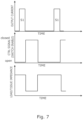
- Figure 7 shows an alternative timing of the impedance control switch 233 in which the switch is closed at the end of each pulse S1 of the stimulation signal, but opened at an intermediate time between consecutive stimulation pulses. This allows a period between the pulses during which signals can be detected without attenuation.
- the minimum discharge time, for which the switch 233 needs to be closed after each stimulation pulse, will depend on the stimulation pulse width, the output amplifier, the pulse frequency, and the target offset voltage between the electrodes 224, 226.
- FIG. 9 further tests were carried out using the system of Figure 2 with the impedance modification of Figure 5 for each of three pulse patterns.
- the signal from electrode 116a at the tip of the probe was used as the reference signal
- a stimulation signal was applied to electrode 116b and the signals at each of electrodes 116c, 116d measured relative to that reference as MAP2, MAP3, MAP4 respectively.
- Figure 9a shows the results for a 10V pulsed signal applied to the stimulation channel using the known Grass system. As can be seen the signal on electrode 116b peaked significantly higher than those on the other two electrodes 116c, 116d, and also remained substantially higher between stimulation pulses.
- Figure 9b shows the results for a 60mA 100Hz square wave applied to the stimulation channel using the system of Figure 3 .
- the signal on electrode 116b again peaked significantly higher than those on the other two electrodes 116c, 116d, but fell to a level closer to the other two electrodes between stimulation pulses.
- Figure 9c shows the results for a 60mA biphasic stimulation signal applied to the stimulation channel using the system of Figure 3 .
- the signal on electrode 116b again peaked significantly higher than those on the other two electrodes 116c, 116d, but all three signals retuned to close to zero between stimulation pulses.
- the graphical user interface may take a variety of forms and may be arranged, as described above, to direct the user through various steps during operation of the system.
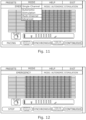
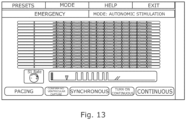
- the GUI may for example allow a user to select autonomic stimulation from a list of mode options, which may also include other more conventional modes of operation. If autonomic stimulation is selected, then the GUI does not provide an option to select synchronous or continuous stimulation, but only presents a pacing option which, if selected, starts the system in the test mode in which just a sequence of pacing pulses is produced in the stimulation channel.
- the signals on the detection channels may be displayed on the GUI to enable the user to determine whether any ventricular response is produced.
- the GUI may give the user the option to confirm that there has been no ventricular activation. In response to that confirmation the GUI may switch to the screen of Figure 13 from which the user can select synchronous or continuous stimulation and set the parameters of those modes, such as the frequency and duration of the pulses.
- the autonomic stimulation options may be made available to a user of the system only on certain conditions.
- the conventional modes of operation mentioned above with reference to Figure 10 may always be available, but access to the autonomic stimulation options may controlled by the system software or other methods. This allows the autonomic stimulation options to be made available only to selected users, or only on payment made for use of those options.
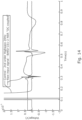
- FIG. 14 shows a simulated raw measured signal including a pacing pulse at time 0.1s followed by pulses produced by activation, together with a simulated filtered version of the same signal.
- the amplitude of the pacing pulse is 10V whereas the amplitude of the activation pulses is of the order of 1mV.
- the filtered signal takes a significant time, about 0.1s, to return to baseline after the pacing pulse, which itself only lasts about 10ms. During high frequency stimulation there may only be about 30ms between stimulation pulses and so this long settling time would interfere significantly with the detection of activation pulses between the stimulation pulses. It is therefore advantageous to include in the stimulation and recording system one or more mechanisms to remove these stimulation artefacts.
- an analogue copy of the post-processed signal may be outputted, for example through the pre-gain outputs shown in Figure 2 , and used as an input to other external recording systems, thus enabling retrofitting of all artefact reduction capabilities onto existing EP recorders.
- Oversampling ⁇ 4KSPS
- high resolution ADC/DAC ⁇ 16-bit
- ⁇ 4KSPS high resolution ADC/DAC
- Various removal methods will be described below.
- Each of these may be provided as separate module between the input terminal(s) 236, 238, 256 and the other components of the detection channels shown in Figure 2 , or between those components and the data controller 202, or may be incorporated with the filtering and amplification components or the data controller as appropriate depending on whether they involve analogue filtering, analogue amplification, or digital signal processing.
- This circuit is arranged to operate in two modes
- Such a filter would retain all relevant filter characteristics during normal recordings but make use of internal diodes to improve the transient characteristics immediately after stimulation. Vth characteristics would be identical to the voltage limiter circuit.
- a suitable circuit is described in Texas Instruments (2019). Fast-settling low-pass filter circuit. Analog Engineer's Circuit: Amplifiers. SBOA244-January 2019 http://www.tij.co.jp/jp/lit/an/sboa244/sboa244.pdf .
- High-gain mode may be used when recording normally for optimal signal-to-noise performance.
- Low-gain mode would be employed only during stimulation to prevent amplifier saturation and improve transient performance; by limiting the amplitude of all fast transitions induced by stimuli.
- the analogue inputs may be disconnected during stimulation using an analogue switch. They may be left floating or connected to a fixed external potential.
- the analogue inputs may be connected to a sample and hold circuit.
- the input will be tracked during normal recording and held at the pre-stimulation potential during stimulation.
- Wideband analogue filtering DC of frequencies between 0.05Hz to F sampling /2 where F sampling is the digital sampling frequency of the analogue signal
- F sampling is the digital sampling frequency of the analogue signal
- a detection channel used in a simulation of an embodiment of the invention comprises a differential amplifier 330, having two inputs 232, 234 each connected to a respective one of two input terminals 336, 338 of the channel, and an output in the form of a difference signal that varies with the difference between the signals on the two input terminals 336, 338.
- the channel further comprises a sample and hold circuit 340 for artefact reduction by disconnecting the analogue front-end filter inputs from the rest of the circuit during stimulation as described above, and a high pass filter 342 and low pass filter 344.
- the channel comprises an amplifier 346 and an ADC 348.
- the conventional channel comprises the same components which are indicated by the same reference numerals superseded by the letter 'a'.
- the sample and hold circuit 340 is not present in the conventional channel. Apart from that, the main difference is the reduced front-end gain in the channel of Figure 16a to prevent amplifier/ADC saturation (this is compensated for by using high-resolution ADC as described above).
- simulated ectopic pulses 504a and simulated ventricular pulses 506a (with a 1V offset to show that the method is not affected by large input DC offsets which may be induced during stimulation).
- HFS stimulation pulses 502a are also added into the simulated input signal.
- the simulated output signal is shown in Figure 16c .
- the simulated ectopic pulses 504a and simulated ventricular pulses 506a were first generated, but then a continuous series of HFS stimulation 508 was introduced into the input signal.
- the simulated output signal is shown in Figure 1c.
Landscapes
- Health & Medical Sciences (AREA)
- Life Sciences & Earth Sciences (AREA)
- Engineering & Computer Science (AREA)
- Public Health (AREA)
- Heart & Thoracic Surgery (AREA)
- Biomedical Technology (AREA)
- Veterinary Medicine (AREA)
- Animal Behavior & Ethology (AREA)
- General Health & Medical Sciences (AREA)
- Cardiology (AREA)
- Biophysics (AREA)
- Signal Processing (AREA)
- Physics & Mathematics (AREA)
- Pathology (AREA)
- Surgery (AREA)
- Molecular Biology (AREA)
- Medical Informatics (AREA)
- Physiology (AREA)
- Computer Vision & Pattern Recognition (AREA)
- Psychiatry (AREA)
- Artificial Intelligence (AREA)
- Neurology (AREA)
- Radiology & Medical Imaging (AREA)
- Nuclear Medicine, Radiotherapy & Molecular Imaging (AREA)
- Neurosurgery (AREA)
- Power Engineering (AREA)
- Measurement And Recording Of Electrical Phenomena And Electrical Characteristics Of The Living Body (AREA)
- Electrotherapy Devices (AREA)
Claims (15)
- Vorrichtung für elektrophysiologische Untersuchungen, wobei die Vorrichtung folgende Elemente umfasst:mindestens einen Ausgabekanal (206);eine Vielzahl von Detektionskanälen (204); undSteuermittel (114), wobeider mindestens eine Ausgabekanal einen Stimulationskanal (206) beinhaltet,die Steuermittel (114) dazu eingerichtet ist, ein Stimulationssignal (302) für den Stimulationskanal bereitzustellen und Detektionssignale aus den Detektionskanälen (204) zu verarbeiten, um dadurch Ektopie-Ereignisse in den Detektionssignalen zu identifizieren,wobei die Detektionskanäle (204) einen Vorhofkanal (210) und mindestens einen Referenzkanal (254) beinhalten, und dadurch gekennzeichnet, dassdas Steuermittel dazu eingerichtet ist, das Detektionssignal aus dem mindestens einen Referenzkanal zum Identifizieren von ventrikulären Aktivierungsereignissen zu verarbeiten, um dadurch zwischen ventrikulären Aktivierungsereignissen undEktopie-Ereignissen im Detektionssignal vom Vorhofkanal (210) zu unterscheiden.
- Vorrichtung nach Anspruch 1, wobei das Steuermittel (114) dazu eingerichtet ist, das Stimulationssignal als Reaktion auf das Ergebnis der Verarbeitung der Detektionssignale zu steuern.
- Vorrichtung nach Anspruch 1 oder Anspruch 2, wobei das Steuermittel (114) dazu eingerichtet ist, das Erzeugen des Stimulationssignals als Reaktion auf die Detektion einer vorbestimmten Anzahl von Ektopie-Ereignissen zu stoppen.
- Vorrichtung nach einem der vorhergehenden Ansprüche, wobei Detektionskanäle (204) eine Vielzahl von Vorhofkanälen (210) beinhalten und das Steuermittel (114) dazu eingerichtet ist, ein Detektionssignal von jedem der Vorhofkanäle (210) zu verarbeiten und ein Ereignis nur dann als Ektopie-Ereignis zu identifizieren, wenn es im Detektionssignal von jedem der Vorhofkanäle detektiert wird; und das Steuermittel (114) dazu eingerichtet ist, den Zeitverlauf eines Ektopie-Ereignisses auf jedem der Vielzahl von Vorhofkanälen (210) zu bestimmen und aus den Zeitverläufen die Quelle des Ektopie-Ereignisses zu lokalisieren.
- Vorrichtung nach einem der vorhergehenden Ansprüche, ferner umfassend einen Vorhofkatheter (106), wobei der Vorhofkanal mit mindestens einer Elektrode (116) am Vorhofkatheter verbunden ist.
- Vorrichtung nach einem der vorhergehenden Ansprüche, ferner umfassend einen ventrikulären Katheter (108), wobei einer vom mindestens einen Referenzkanal mit mindestens einer Elektrode (118) am ventrikulären Katheter verbunden ist.
- Vorrichtung nach einem der vorhergehenden Ansprüche, ferner umfassend einen EKG-Elektrodensatz (110), wobei einer vom mindestens einen Referenzkanal mit dem EKG-Elektrodensatz verbunden ist.
- Vorrichtung nach einem der vorhergehenden Ansprüche, wobei der mindestens eine Ausgabekanal (206) einen Schrittmacherkanal umfasst und das Steuermittel dazu eingerichtet ist, ein Schrittmachersignal (300) für den Schrittmacherkanal bereitzustellen, und das Steuermittel (114) ferner dazu eingerichtet ist, ventrikuläre Aktivierungsereignisse zu identifizieren, die durch das Schrittmachersignal (300) verursacht werden, und das Schrittmachersignal als Reaktion auf die Identifizierung einer vorbestimmten Anzahl von ventrikulären Aktivierungsereignissen, die als durch das Schrittmachersignal verursacht identifiziert werden, zu modifizieren oder zu stoppen.
- Vorrichtung nach Anspruch 8, wobei das Steuermittel (114) dazu eingerichtet ist, einen ventrikulären Aktivierungstest durchzuführen, bei dem das Schrittmachersignal (300) ohne das Stimulationssignal (302) ausgegeben wird, und das Stimulationssignal erst dann freizugeben, wenn der ventrikuläre Aktivierungstest erfolgreich war.
- Vorrichtung nach einem der Ansprüche 1 bis 7, wobei das Steuermittel (114) dazu eingerichtet ist, ventrikuläre Ereignisse zu identifizieren, eine Verzögerung zwischen aufeinanderfolgenden ventrikulären Ereignissen zu messen und zu bestimmen, ob die Verzögerung eine vorbestimmte Zeitspanne überschreitet.
- Vorrichtung nach einem der vorhergehenden Ansprüche, wobei: das Stimulationssignal (302) eine Vielzahl von Stimulationsimpulsen umfasst; und die Stimulationsimpulse in Gruppen angeordnet sind.
- Vorrichtung nach Anspruch 11 in Abhängigkeit von Anspruch 8, wobei: das Schrittmachersignal (300) einen Schrittmacherimpuls umfasst, der jeder der Gruppen von Stimulationsimpulsen vorausgeht; das Steuermittel (114) in einem Ektopie-Auslösemodus, in dem das System dazu eingerichtet ist, die Schrittmacherimpulse (300) und die Gruppen (302) von Stimulationsimpulsen zu erzeugen, und in einem atrioventrikulären Knotenverlangsamungsmodus, in dem das System dazu eingerichtet ist, die Stimulationsimpulse (302) ohne die Schrittmacherimpulse (300) zu erzeugen, betreibbar ist; das Steuermittel (114) eine Benutzerschnittstelle umfasst, die dazu eingerichtet ist, einem Benutzer zu ermöglichen, einen der Modi auszuwählen und mindestens einen Parameter des Stimulationssignals (302) oder des Schrittmachersignals (300) einzustellen; und wobei die Benutzerschnittstelle einem Benutzer nur ermöglicht, das Stimulationssignal (302) zu starten, nachdem der ventrikuläre Stimulationstest abgeschlossen wurde.
- Vorrichtung nach Anspruch 11 oder Anspruch 12, wobei jeder der Stimulationsimpulse (302) ein bipolarer Spannungsimpuls ist.
- Vorrichtung nach einem der Ansprüche 16 bis 22, wobei das Steuermittel (114) dazu eingerichtet ist, einen Zielstrom zu definieren und das Stimulationssignal während jedes der Stimulationsimpulse so zu steuern, das der Zielstrom erreicht wird.
- Vorrichtung nach einem der Ansprüche 11 bis 14, wobei das Stimulationssignal (302) über zwei Stimulationselektroden angelegt wird und das Steuermittel (114) dazu eingerichtet ist, die Impedanz zwischen den Stimulationselektroden zwischen den Stimulationsimpulsen so zu steuern, dass dadurch eine Offsetspannung zwischen den Elektroden gesteuert wird.
Applications Claiming Priority (2)
| Application Number | Priority Date | Filing Date | Title |
|---|---|---|---|
| GBGB1911731.6A GB201911731D0 (en) | 2019-08-15 | 2019-08-15 | Electrophysiological Catheter Systems |
| PCT/GB2020/051951 WO2021028699A1 (en) | 2019-08-15 | 2020-08-14 | Electrophysiological catheter systems |
Publications (3)
| Publication Number | Publication Date |
|---|---|
| EP4013293A1 EP4013293A1 (de) | 2022-06-22 |
| EP4013293C0 EP4013293C0 (de) | 2025-01-22 |
| EP4013293B1 true EP4013293B1 (de) | 2025-01-22 |
Family
ID=68099421
Family Applications (1)
| Application Number | Title | Priority Date | Filing Date |
|---|---|---|---|
| EP20758302.2A Active EP4013293B1 (de) | 2019-08-15 | 2020-08-14 | Elektrophysiologische kathetersysteme |
Country Status (4)
| Country | Link |
|---|---|
| US (1) | US20220296148A1 (de) |
| EP (1) | EP4013293B1 (de) |
| GB (1) | GB201911731D0 (de) |
| WO (1) | WO2021028699A1 (de) |
Families Citing this family (2)
| Publication number | Priority date | Publication date | Assignee | Title |
|---|---|---|---|---|
| JP2021153613A (ja) * | 2020-03-25 | 2021-10-07 | ソニーグループ株式会社 | 測定装置および測定方法 |
| US20250032049A1 (en) * | 2023-07-25 | 2025-01-30 | Biosense Webster (Israel) Ltd. | Filtering intracardiac electrograms in the presence of pacing spikes |
Family Cites Families (8)
| Publication number | Priority date | Publication date | Assignee | Title |
|---|---|---|---|---|
| US9713723B2 (en) * | 1996-01-11 | 2017-07-25 | Impulse Dynamics Nv | Signal delivery through the right ventricular septum |
| US6101416A (en) * | 1998-07-29 | 2000-08-08 | Pacesetter, Inc. | System and method for atrial autocapture in single-chamber pacemaker modes using far-field detection |
| CN102223838B (zh) * | 2008-11-24 | 2015-10-07 | 皇家飞利浦电子股份有限公司 | 用于对心脏成像的成像设备 |
| US8538524B2 (en) * | 2011-09-12 | 2013-09-17 | Pacesetter, Inc. | Systems and methods for detecting far-field oversensing based on signals sensed by the proximal electrode of a multipolar LV lead |
| JP6207130B2 (ja) * | 2012-07-30 | 2017-10-04 | フクダ電子株式会社 | 心臓電気刺激装置 |
| US10271893B2 (en) * | 2014-12-15 | 2019-04-30 | Medtronic Ablation Frontiers Llc | Timed energy delivery |
| WO2017096332A1 (en) * | 2015-12-03 | 2017-06-08 | Blake Robert Clayton Iii | Systems and methods for identifying optimized ablation targets for treating and preventing arrhythmias sustained by reentrant circuits |
| EP3468657B1 (de) * | 2016-06-10 | 2022-05-11 | Purdue Research Foundation | System zur drahtlosen aufzeichnung und stimulierung von bioelektrischen ereignisse |
-
2019
- 2019-08-15 GB GBGB1911731.6A patent/GB201911731D0/en not_active Ceased
-
2020
- 2020-08-14 US US17/635,563 patent/US20220296148A1/en active Pending
- 2020-08-14 WO PCT/GB2020/051951 patent/WO2021028699A1/en not_active Ceased
- 2020-08-14 EP EP20758302.2A patent/EP4013293B1/de active Active
Also Published As
| Publication number | Publication date |
|---|---|
| WO2021028699A1 (en) | 2021-02-18 |
| US20220296148A1 (en) | 2022-09-22 |
| EP4013293C0 (de) | 2025-01-22 |
| GB201911731D0 (en) | 2019-10-02 |
| EP4013293A1 (de) | 2022-06-22 |
Similar Documents
| Publication | Publication Date | Title |
|---|---|---|
| JP7404516B2 (ja) | パルス電界アブレーション中の異所性心電図信号を検出するためのシステム、装置、及び方法 | |
| US11197716B2 (en) | Monitoring nerve activity | |
| US4905708A (en) | Apparatus for recognizing cardiac rhythms | |
| US11000202B2 (en) | Systems and methods for mapping and modulating repolarization | |
| JP5656293B2 (ja) | 埋め込み型心臓刺激(ics)システム | |
| EP2448632B1 (de) | Herztonerfassung zur minimierung von unangemessener tachyarrhythmiebehandlung | |
| CN101583397B (zh) | 植入式心脏治疗装置中的信号分析 | |
| JP2002521079A (ja) | デジタルecg検出システム | |
| US11324453B2 (en) | System for adaptive filtering of cardiac signals | |
| JPH09508819A (ja) | ペースメーカによる心臓の捕捉確認法 | |
| EP4013293B1 (de) | Elektrophysiologische kathetersysteme | |
| US20240350065A1 (en) | Method for detecting a cardiac isolation status of a measurement location in the presence of far field interference | |
| WO2010053766A1 (en) | System and method for detecting cardiac arrhythmias from heart nerve activity | |
| JP6994027B2 (ja) | 電気生理学的信号を記録するためのフィルタリング装置 | |
| EP3764889B1 (de) | System und verfahren zur verarbeitung von elektrophysiologischen signalen | |
| Sperzel et al. | Reduction of pacing output coupling capacitance for sensing the evoked response | |
| Keane et al. | Signal‐averaged electrocardiography of the sinus and paced P wave in sinus node disease | |
| WO2011134499A1 (en) | Arrhythmia classification | |
| Butter et al. | Clinical validation of new pacing‐sensing configurations for atrial automatic capture verification in pacemakers | |
| Dube et al. | Automatic detection and classification of human epicardial atrial unipolar electrograms | |
| Morava et al. | Pulsed Field Ablation In Patients With Cardiac Implantable Electronic Devices-Technical Aspects of Interaction: Observational Case Study | |
| EP4628018A1 (de) | Verfahren zur analyse der lokalen restaktivität nach einer gepulsten feldablation eines menschlichen herzens | |
| WO2025210143A1 (en) | Method of analyzing an intracardiac electrogram | |
| Koch et al. | Algorithm for suppression of artefacts on the evoked EMG signal of internal anal sphincter |
Legal Events
| Date | Code | Title | Description |
|---|---|---|---|
| STAA | Information on the status of an ep patent application or granted ep patent |
Free format text: STATUS: UNKNOWN |
|
| STAA | Information on the status of an ep patent application or granted ep patent |
Free format text: STATUS: THE INTERNATIONAL PUBLICATION HAS BEEN MADE |
|
| PUAI | Public reference made under article 153(3) epc to a published international application that has entered the european phase |
Free format text: ORIGINAL CODE: 0009012 |
|
| STAA | Information on the status of an ep patent application or granted ep patent |
Free format text: STATUS: REQUEST FOR EXAMINATION WAS MADE |
|
| 17P | Request for examination filed |
Effective date: 20220218 |
|
| AK | Designated contracting states |
Kind code of ref document: A1 Designated state(s): AL AT BE BG CH CY CZ DE DK EE ES FI FR GB GR HR HU IE IS IT LI LT LU LV MC MK MT NL NO PL PT RO RS SE SI SK SM TR |
|
| DAV | Request for validation of the european patent (deleted) | ||
| DAX | Request for extension of the european patent (deleted) | ||
| REG | Reference to a national code |
Ref country code: DE Ref legal event code: R079 Free format text: PREVIOUS MAIN CLASS: A61B0005000000 Ipc: A61B0005364000 Ref document number: 602020045172 Country of ref document: DE |
|
| GRAP | Despatch of communication of intention to grant a patent |
Free format text: ORIGINAL CODE: EPIDOSNIGR1 |
|
| STAA | Information on the status of an ep patent application or granted ep patent |
Free format text: STATUS: GRANT OF PATENT IS INTENDED |
|
| RIC1 | Information provided on ipc code assigned before grant |
Ipc: A61B 5/287 20210101ALI20241010BHEP Ipc: A61B 5/364 20210101AFI20241010BHEP |
|
| INTG | Intention to grant announced |
Effective date: 20241031 |
|
| GRAS | Grant fee paid |
Free format text: ORIGINAL CODE: EPIDOSNIGR3 |
|
| GRAA | (expected) grant |
Free format text: ORIGINAL CODE: 0009210 |
|
| STAA | Information on the status of an ep patent application or granted ep patent |
Free format text: STATUS: THE PATENT HAS BEEN GRANTED |
|
| AK | Designated contracting states |
Kind code of ref document: B1 Designated state(s): AL AT BE BG CH CY CZ DE DK EE ES FI FR GB GR HR HU IE IS IT LI LT LU LV MC MK MT NL NO PL PT RO RS SE SI SK SM TR |
|
| REG | Reference to a national code |
Ref country code: GB Ref legal event code: FG4D |
|
| REG | Reference to a national code |
Ref country code: CH Ref legal event code: EP |
|
| REG | Reference to a national code |
Ref country code: IE Ref legal event code: FG4D |
|
| REG | Reference to a national code |
Ref country code: DE Ref legal event code: R096 Ref document number: 602020045172 Country of ref document: DE |
|
| U01 | Request for unitary effect filed |
Effective date: 20250122 |
|
| U07 | Unitary effect registered |
Designated state(s): AT BE BG DE DK EE FI FR IT LT LU LV MT NL PT RO SE SI Effective date: 20250212 |
|
| PG25 | Lapsed in a contracting state [announced via postgrant information from national office to epo] |
Ref country code: RS Free format text: LAPSE BECAUSE OF FAILURE TO SUBMIT A TRANSLATION OF THE DESCRIPTION OR TO PAY THE FEE WITHIN THE PRESCRIBED TIME-LIMIT Effective date: 20250422 |
|
| PG25 | Lapsed in a contracting state [announced via postgrant information from national office to epo] |
Ref country code: PL Free format text: LAPSE BECAUSE OF FAILURE TO SUBMIT A TRANSLATION OF THE DESCRIPTION OR TO PAY THE FEE WITHIN THE PRESCRIBED TIME-LIMIT Effective date: 20250122 |
|
| PG25 | Lapsed in a contracting state [announced via postgrant information from national office to epo] |
Ref country code: ES Free format text: LAPSE BECAUSE OF FAILURE TO SUBMIT A TRANSLATION OF THE DESCRIPTION OR TO PAY THE FEE WITHIN THE PRESCRIBED TIME-LIMIT Effective date: 20250122 |
|
| PGFP | Annual fee paid to national office [announced via postgrant information from national office to epo] |
Ref country code: GB Payment date: 20250624 Year of fee payment: 6 |
|
| PG25 | Lapsed in a contracting state [announced via postgrant information from national office to epo] |
Ref country code: NO Free format text: LAPSE BECAUSE OF FAILURE TO SUBMIT A TRANSLATION OF THE DESCRIPTION OR TO PAY THE FEE WITHIN THE PRESCRIBED TIME-LIMIT Effective date: 20250422 Ref country code: IS Free format text: LAPSE BECAUSE OF FAILURE TO SUBMIT A TRANSLATION OF THE DESCRIPTION OR TO PAY THE FEE WITHIN THE PRESCRIBED TIME-LIMIT Effective date: 20250522 |
|
| PG25 | Lapsed in a contracting state [announced via postgrant information from national office to epo] |
Ref country code: HR Free format text: LAPSE BECAUSE OF FAILURE TO SUBMIT A TRANSLATION OF THE DESCRIPTION OR TO PAY THE FEE WITHIN THE PRESCRIBED TIME-LIMIT Effective date: 20250122 |
|
| PG25 | Lapsed in a contracting state [announced via postgrant information from national office to epo] |
Ref country code: GR Free format text: LAPSE BECAUSE OF FAILURE TO SUBMIT A TRANSLATION OF THE DESCRIPTION OR TO PAY THE FEE WITHIN THE PRESCRIBED TIME-LIMIT Effective date: 20250423 |
|
| U20 | Renewal fee for the european patent with unitary effect paid |
Year of fee payment: 6 Effective date: 20250625 |
|
| PG25 | Lapsed in a contracting state [announced via postgrant information from national office to epo] |
Ref country code: SM Free format text: LAPSE BECAUSE OF FAILURE TO SUBMIT A TRANSLATION OF THE DESCRIPTION OR TO PAY THE FEE WITHIN THE PRESCRIBED TIME-LIMIT Effective date: 20250122 |
|
| PG25 | Lapsed in a contracting state [announced via postgrant information from national office to epo] |
Ref country code: CZ Free format text: LAPSE BECAUSE OF FAILURE TO SUBMIT A TRANSLATION OF THE DESCRIPTION OR TO PAY THE FEE WITHIN THE PRESCRIBED TIME-LIMIT Effective date: 20250122 |
|
| PG25 | Lapsed in a contracting state [announced via postgrant information from national office to epo] |
Ref country code: SK Free format text: LAPSE BECAUSE OF FAILURE TO SUBMIT A TRANSLATION OF THE DESCRIPTION OR TO PAY THE FEE WITHIN THE PRESCRIBED TIME-LIMIT Effective date: 20250122 |
|
| PLBE | No opposition filed within time limit |
Free format text: ORIGINAL CODE: 0009261 |
|
| STAA | Information on the status of an ep patent application or granted ep patent |
Free format text: STATUS: NO OPPOSITION FILED WITHIN TIME LIMIT |
|
| REG | Reference to a national code |
Ref country code: CH Ref legal event code: L10 Free format text: ST27 STATUS EVENT CODE: U-0-0-L10-L00 (AS PROVIDED BY THE NATIONAL OFFICE) Effective date: 20251203 |
|
| 26N | No opposition filed |
Effective date: 20251023 |
|
| REG | Reference to a national code |
Ref country code: CH Ref legal event code: H13 Free format text: ST27 STATUS EVENT CODE: U-0-0-H10-H13 (AS PROVIDED BY THE NATIONAL OFFICE) Effective date: 20260324 |
|
| PG25 | Lapsed in a contracting state [announced via postgrant information from national office to epo] |
Ref country code: MC Free format text: LAPSE BECAUSE OF FAILURE TO SUBMIT A TRANSLATION OF THE DESCRIPTION OR TO PAY THE FEE WITHIN THE PRESCRIBED TIME-LIMIT Effective date: 20250122 |