EP4011540B1 - Dissimilar material solid phase bonding method - Google Patents
Dissimilar material solid phase bonding method Download PDFInfo
- Publication number
- EP4011540B1 EP4011540B1 EP20849258.7A EP20849258A EP4011540B1 EP 4011540 B1 EP4011540 B1 EP 4011540B1 EP 20849258 A EP20849258 A EP 20849258A EP 4011540 B1 EP4011540 B1 EP 4011540B1
- Authority
- EP
- European Patent Office
- Prior art keywords
- bonding
- bonded
- temperature
- interface
- solid phase
- Prior art date
- Legal status (The legal status is an assumption and is not a legal conclusion. Google has not performed a legal analysis and makes no representation as to the accuracy of the status listed.)
- Active
Links
Images








Classifications
-
- B—PERFORMING OPERATIONS; TRANSPORTING
- B23—MACHINE TOOLS; METAL-WORKING NOT OTHERWISE PROVIDED FOR
- B23K—SOLDERING OR UNSOLDERING; WELDING; CLADDING OR PLATING BY SOLDERING OR WELDING; CUTTING BY APPLYING HEAT LOCALLY, e.g. FLAME CUTTING; WORKING BY LASER BEAM
- B23K20/00—Non-electric welding by applying impact or other pressure, with or without the application of heat, e.g. cladding or plating
-
- B—PERFORMING OPERATIONS; TRANSPORTING
- B23—MACHINE TOOLS; METAL-WORKING NOT OTHERWISE PROVIDED FOR
- B23K—SOLDERING OR UNSOLDERING; WELDING; CLADDING OR PLATING BY SOLDERING OR WELDING; CUTTING BY APPLYING HEAT LOCALLY, e.g. FLAME CUTTING; WORKING BY LASER BEAM
- B23K20/00—Non-electric welding by applying impact or other pressure, with or without the application of heat, e.g. cladding or plating
- B23K20/12—Non-electric welding by applying impact or other pressure, with or without the application of heat, e.g. cladding or plating the heat being generated by friction; Friction welding
- B23K20/121—Control circuits therefor
-
- B—PERFORMING OPERATIONS; TRANSPORTING
- B23—MACHINE TOOLS; METAL-WORKING NOT OTHERWISE PROVIDED FOR
- B23K—SOLDERING OR UNSOLDERING; WELDING; CLADDING OR PLATING BY SOLDERING OR WELDING; CUTTING BY APPLYING HEAT LOCALLY, e.g. FLAME CUTTING; WORKING BY LASER BEAM
- B23K20/00—Non-electric welding by applying impact or other pressure, with or without the application of heat, e.g. cladding or plating
- B23K20/02—Non-electric welding by applying impact or other pressure, with or without the application of heat, e.g. cladding or plating by means of a press ; Diffusion bonding
- B23K20/023—Thermo-compression bonding
-
- B—PERFORMING OPERATIONS; TRANSPORTING
- B23—MACHINE TOOLS; METAL-WORKING NOT OTHERWISE PROVIDED FOR
- B23K—SOLDERING OR UNSOLDERING; WELDING; CLADDING OR PLATING BY SOLDERING OR WELDING; CUTTING BY APPLYING HEAT LOCALLY, e.g. FLAME CUTTING; WORKING BY LASER BEAM
- B23K20/00—Non-electric welding by applying impact or other pressure, with or without the application of heat, e.g. cladding or plating
- B23K20/12—Non-electric welding by applying impact or other pressure, with or without the application of heat, e.g. cladding or plating the heat being generated by friction; Friction welding
-
- B—PERFORMING OPERATIONS; TRANSPORTING
- B23—MACHINE TOOLS; METAL-WORKING NOT OTHERWISE PROVIDED FOR
- B23K—SOLDERING OR UNSOLDERING; WELDING; CLADDING OR PLATING BY SOLDERING OR WELDING; CUTTING BY APPLYING HEAT LOCALLY, e.g. FLAME CUTTING; WORKING BY LASER BEAM
- B23K20/00—Non-electric welding by applying impact or other pressure, with or without the application of heat, e.g. cladding or plating
- B23K20/12—Non-electric welding by applying impact or other pressure, with or without the application of heat, e.g. cladding or plating the heat being generated by friction; Friction welding
- B23K20/1205—Non-electric welding by applying impact or other pressure, with or without the application of heat, e.g. cladding or plating the heat being generated by friction; Friction welding using translation movement
-
- B—PERFORMING OPERATIONS; TRANSPORTING
- B23—MACHINE TOOLS; METAL-WORKING NOT OTHERWISE PROVIDED FOR
- B23K—SOLDERING OR UNSOLDERING; WELDING; CLADDING OR PLATING BY SOLDERING OR WELDING; CUTTING BY APPLYING HEAT LOCALLY, e.g. FLAME CUTTING; WORKING BY LASER BEAM
- B23K20/00—Non-electric welding by applying impact or other pressure, with or without the application of heat, e.g. cladding or plating
- B23K20/22—Non-electric welding by applying impact or other pressure, with or without the application of heat, e.g. cladding or plating taking account of the properties of the materials to be welded
-
- B—PERFORMING OPERATIONS; TRANSPORTING
- B23—MACHINE TOOLS; METAL-WORKING NOT OTHERWISE PROVIDED FOR
- B23K—SOLDERING OR UNSOLDERING; WELDING; CLADDING OR PLATING BY SOLDERING OR WELDING; CUTTING BY APPLYING HEAT LOCALLY, e.g. FLAME CUTTING; WORKING BY LASER BEAM
- B23K20/00—Non-electric welding by applying impact or other pressure, with or without the application of heat, e.g. cladding or plating
- B23K20/22—Non-electric welding by applying impact or other pressure, with or without the application of heat, e.g. cladding or plating taking account of the properties of the materials to be welded
- B23K20/227—Non-electric welding by applying impact or other pressure, with or without the application of heat, e.g. cladding or plating taking account of the properties of the materials to be welded with ferrous layer
-
- B—PERFORMING OPERATIONS; TRANSPORTING
- B23—MACHINE TOOLS; METAL-WORKING NOT OTHERWISE PROVIDED FOR
- B23K—SOLDERING OR UNSOLDERING; WELDING; CLADDING OR PLATING BY SOLDERING OR WELDING; CUTTING BY APPLYING HEAT LOCALLY, e.g. FLAME CUTTING; WORKING BY LASER BEAM
- B23K20/00—Non-electric welding by applying impact or other pressure, with or without the application of heat, e.g. cladding or plating
- B23K20/22—Non-electric welding by applying impact or other pressure, with or without the application of heat, e.g. cladding or plating taking account of the properties of the materials to be welded
- B23K20/227—Non-electric welding by applying impact or other pressure, with or without the application of heat, e.g. cladding or plating taking account of the properties of the materials to be welded with ferrous layer
- B23K20/2275—Non-electric welding by applying impact or other pressure, with or without the application of heat, e.g. cladding or plating taking account of the properties of the materials to be welded with ferrous layer the other layer being aluminium
-
- B—PERFORMING OPERATIONS; TRANSPORTING
- B23—MACHINE TOOLS; METAL-WORKING NOT OTHERWISE PROVIDED FOR
- B23K—SOLDERING OR UNSOLDERING; WELDING; CLADDING OR PLATING BY SOLDERING OR WELDING; CUTTING BY APPLYING HEAT LOCALLY, e.g. FLAME CUTTING; WORKING BY LASER BEAM
- B23K2103/00—Materials to be soldered, welded or cut
- B23K2103/02—Iron or ferrous alloys
-
- B—PERFORMING OPERATIONS; TRANSPORTING
- B23—MACHINE TOOLS; METAL-WORKING NOT OTHERWISE PROVIDED FOR
- B23K—SOLDERING OR UNSOLDERING; WELDING; CLADDING OR PLATING BY SOLDERING OR WELDING; CUTTING BY APPLYING HEAT LOCALLY, e.g. FLAME CUTTING; WORKING BY LASER BEAM
- B23K2103/00—Materials to be soldered, welded or cut
- B23K2103/02—Iron or ferrous alloys
- B23K2103/04—Steel or steel alloys
- B23K2103/05—Stainless steel
-
- B—PERFORMING OPERATIONS; TRANSPORTING
- B23—MACHINE TOOLS; METAL-WORKING NOT OTHERWISE PROVIDED FOR
- B23K—SOLDERING OR UNSOLDERING; WELDING; CLADDING OR PLATING BY SOLDERING OR WELDING; CUTTING BY APPLYING HEAT LOCALLY, e.g. FLAME CUTTING; WORKING BY LASER BEAM
- B23K2103/00—Materials to be soldered, welded or cut
- B23K2103/18—Dissimilar materials
-
- B—PERFORMING OPERATIONS; TRANSPORTING
- B23—MACHINE TOOLS; METAL-WORKING NOT OTHERWISE PROVIDED FOR
- B23K—SOLDERING OR UNSOLDERING; WELDING; CLADDING OR PLATING BY SOLDERING OR WELDING; CUTTING BY APPLYING HEAT LOCALLY, e.g. FLAME CUTTING; WORKING BY LASER BEAM
- B23K2103/00—Materials to be soldered, welded or cut
- B23K2103/18—Dissimilar materials
- B23K2103/20—Ferrous alloys and aluminium or alloys thereof
-
- B—PERFORMING OPERATIONS; TRANSPORTING
- B23—MACHINE TOOLS; METAL-WORKING NOT OTHERWISE PROVIDED FOR
- B23K—SOLDERING OR UNSOLDERING; WELDING; CLADDING OR PLATING BY SOLDERING OR WELDING; CUTTING BY APPLYING HEAT LOCALLY, e.g. FLAME CUTTING; WORKING BY LASER BEAM
- B23K2103/00—Materials to be soldered, welded or cut
- B23K2103/18—Dissimilar materials
- B23K2103/24—Ferrous alloys and titanium or alloys thereof
-
- B—PERFORMING OPERATIONS; TRANSPORTING
- B23—MACHINE TOOLS; METAL-WORKING NOT OTHERWISE PROVIDED FOR
- B23K—SOLDERING OR UNSOLDERING; WELDING; CLADDING OR PLATING BY SOLDERING OR WELDING; CUTTING BY APPLYING HEAT LOCALLY, e.g. FLAME CUTTING; WORKING BY LASER BEAM
- B23K2103/00—Materials to be soldered, welded or cut
- B23K2103/18—Dissimilar materials
- B23K2103/26—Alloys of Nickel and Cobalt and Chromium
Definitions
- the present invention relates to a dissimilar material solid phase bonding method for solid phase bonding between metal materials, see claim 1.
- Patent Document 1 International Publication No. 2017/022184 discloses a friction welding method where surfaces to be bonded of two metal members to be bonded are made slide in contact with each other, wherein; at least one of the metal members to be bonded is a ferrous material, and a maximum temperature reached during bonding is equal to or less than the As point or equal to or less than the A cm point of the ferrous material.
- the conventional frictional bonding is a bonding method using frictional heat, but in the frictional bonding method described in Patent Document 1, by positively utilizing the processing heat generated by the plastic deformation of the metal materials to be bonded, a good bonding can be obtained even at a low bonding temperature.
- Patent Document 2 Japanese Unexamined Patent Publication No. 2018-122344 discloses a linear friction welding method, comprising: a first step of forming the interface to be welded by bringing one member into contact with the other member, a second step of repeatedly sliding the one member and the other member on the same locus while applying a pressure substantially perpendicular to the interface to be welded, and discharging flash from the interface to be welded, a third step of forming a welding surface by stopping the sliding, wherein; setting the pressure to be greater than or equal to the yield stress and less than or equal to the tensile strength of the one member and/or the other member at the desired welding temperature.
- Patent Document 3 suggests a friction welding method of two dissimilar metals in which, before friction welding is performed, one metal is preheated in a furnace to a temperature at which a deformation resistance of one metal having a larger deformation resistance is substantially the same as that of a metal having a smaller deformation resistance.
- Patent Document 4 suggests a linear friction joining method for solid-bonding metal materials to each other.
- Patent Document 5 suggests a method for solid phase bonding of dissimilar materials which does not use an intermediate material or the like
- Patent Document 6 (describing all the steps of the preamble of claim 1) suggests a joined structure of dissimilar metallic materials having different characteristics.
- an object of the present invention is to provide a dissimilar solid phase bonding capable of efficiently forming a strong bonded portion of metal materials having different compositions.
- Another object of the present invention is to provide a dissimilar solid phase bonding structure having a dissimilar solid phase bonded portion in which metal materials having different compositions are firmly bonded.
- the present inventor has done intensive study as to deformation behavior of the interface to be bonded in the vicinity of the interface to be bonded during solid phase bonding of dissimilar materials, and have found that it is extremely important to control the bonding temperature by setting the bonding pressure to deform the materials to be bonded having different compositions together, and have reached the present invention.
- the present invention provides a dissimilar material solid phase bonding method as set forth in claim 1.
- the dissimilar material solid phase bonding method of the present invention is a method of bonding members having different compositions, and it is important that the one member and the other member have "temperatures having substantially the same strength".
- the strength of the metal material depends on the temperature, both members are deformed at the interface to be bonded by subjecting to solid phase bonding at a temperature at which the strength of the one member and the strength of the other member (for example, tensile strength) are substantially the same, to form new surfaces on the surface to be bonded of both members, and a good bonding can be obtained by contacting the new surfaces with each other.
- substantially the same strength does not mean that the strengths are completely the same, and it may be a strength range in which the formation of the new surfaces at the interface to be bonded proceeds to the same extent. Further, when the shape and/or size of the one member and the other member are different, since the heat conduction is different, the deformation behaviors in the vicinity of the interface to be bonded are different (for example, it is expected that the temperature of the larger member will drop slightly). Therefore, a difference of about several tens of MPa is allowed for "substantially the same strength".
- the method for raising the temperature in the vicinity of the interface to be bonded is “friction welding” in which a rotating columnar material is pressed against a fixed material to be bonded, “linear friction welding” in which the materials to be bonded are reciprocated in contact with each other, or resistance heating.
- the bonding temperature is determined by the pressure (force to discharge burrs) which is applied to the softened material. That is, when the applied pressure is set high, the material to be bonded with higher strength (state with high yield strength) can be discharged as burrs.
- the "state with higher yield strength” means the "state with lower temperature”
- the “bonding temperature” decreases as the applied pressure increases. Since the relationship between the yield strength and the temperature is substantially constant depending on the material, the bonding temperature can be controlled extremely accurately.
- the bonding temperature is controlled by setting the pressure at the time of solid phase bonding to be equal to or higher than the yield stress of the one member and the other member and equal to or lower than the tensile strength at a desired bonding temperature.
- the pressure at the time of solid phase bonding is set to be equal to or higher than the yield stress of the material to be bonded, the discharge of burrs from the interface to be bonded is started, and when the pressure is increased up to the tensile strength, the discharge of burrs is accelerated. Similar to the yield stress, since the tensile strength at a specific temperature is substantially constant depending on the material to be bonded, the bonding temperature corresponding to the set pressure can be realized.
- the pressure applied during bonding may be optionally finely adjusted according to the size and shape of the material to be bonded from the viewpoint of the actually obtained bonding temperature, it is preferable to set the yield stress of the one member and the other member at the desired bonding temperature.
- the discharge of burrs starts at the moment when the pressure reaches the yield stress, the desired bonding temperature can be realized more accurately in comparison with the case when the pressure is set to a higher value (up to the tensile strength).
- the one member and the other member having different compositions are bonded, and, for example, it can be applied not only the case that the main elements are different such as a steel member and a titanium alloy member, but also the case of combination in which the main element is the same but the additive element is different such as a steel members having different compositions.
- the temperature of the interface to be bonded by the frictional heat generated by the sliding of the one member and the other member it is not necessary to provide other external heating mechanism or the like.
- the oxide film and the like can be effectively removed from the interface to be bonded, and the new surfaces can be efficiently bonded to each other.
- the temperature of the interface to be bonded it is preferable to raise the temperature of the interface to be bonded by using resistance heating.
- resistance heating it is difficult to remove the oxide film or the like from the interface to be bonded only by the heating step, as in the case of using sliding between the materials to be bonded.
- friction welding there may be a temperature difference between the central part and the outer peripheral part of the material to be bonded, but in the case of resistance heating, it is relatively easy to maintain the temperature distribution at the interface to be bonded constant depending on the resistance conditions and the like.
- the burn-off length it is preferable to set the burn-off length so that the new surfaces of the one member and the other member are formed in substantially the entire area of the interface to be bonded in the one member and/or the other member.
- the joint is obtained by abutting the new surfaces of the materials to be bonded, and in the one member and/or the other member, by forming the new surfaces in substantially the entire area of the interface to be bonded, a good joint is formed.
- it is desirable that the new surface is formed over the entire interface to be bonded in both the one member and the other member.
- the one member and/or the other member is an iron-based metal member.
- Iron-based metal members such as steel are the most frequently used metal materials, and there is a great demand for bonding dissimilar materials.
- the iron-based metals have mechanical properties that can withstand the bonding process of various solid phase bonding, by using the iron-based metal as the material to be bonded, it is possible to prevent deformation at unnecessary points during the bonding process, and the like.
- the dissimilar material bonding method of the present invention is solid phase bonding, and it is possible to suppress the deterioration of the mechanical properties of the bonded portion, which is remarkably observed in general melt welding.
- the iron-based metal means a metal mainly composed of iron in the composition, and includes, for example, various steels, cast iron, and the like.
- the bonding temperature is basically determined by the combination of the one member and the other member, it is preferable to set the bonding temperature to an A 1 point or less of the iron-based metal used as the material to be bonded.
- the iron-based metals there is a case that brittle martensite is formed by phase transformation to make bonding difficult and to make the bonded portion brittle.
- the bonding temperature is set to the A1 point or less, since any phase transformation does not occur, the formation of brittle martensite can be completely suppressed.
- the bonding temperature can be controlled more accurately.
- FIG. 1 is a schematic diagram which shows the situation during the linear friction welding.
- the linear friction welding is a solid phase bonding in which the frictional heat generated when the materials to be bonded are rubbed against each other by linear motion is the main heat source.
- the material softened by the temperature rise is discharged as burrs from the interface to be bonded to remove the oxide film formed on the interface to be bonded, and the new surfaces are brought into contact with each other to obtain the bonded portion.
- the frictional heat increases when the applied pressure of the linear friction welding is increased, but since the softened material becomes burrs and is continuously discharged, the "bonding temperature" is determined by the pressure (force to discharge burrs) which is applied to the softened material. That is, when the applied pressure is set high, the material to be bonded with higher strength (state with high yield strength) can be discharged as burrs.
- the "state with higher yield strength” means the "state with lower temperature”
- the “bonding temperature” decreases as the applied pressure increases. Since the relationship between the yield strength and the temperature is substantially constant depending on the material, the bonding temperature can be controlled extremely accurately.
- the bonding temperature is controlled by setting the pressure at the time of solid phase bonding to be equal to or higher than the yield stress of the one member and the other member and equal to or lower than the tensile strength at a desired bonding temperature.
- the pressure at the time of solid phase bonding is set to be equal to or higher than the yield stress of the material to be bonded, the discharge of burrs from the interface to be bonded is started, and when the pressure is increased up to the tensile strength, the discharge of burrs is accelerated. Similar to the yield stress, since the tensile strength at a specific temperature is substantially constant depending on the material to be bonded, the bonding temperature corresponding to the set pressure can be realized.
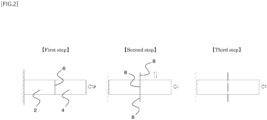
- FIG. 2 is a schematic diagram which shows the bonding process of the linear friction welding.
- the linear friction welding method consists of a first step of bringing the one member 2 into contact with the other member 4 to form an interface 6 to be bonded, a second step of repeatedly sliding the one member 2 and the other member 4 on the same locus a state while applying a pressure substantially perpendicular to the interface 6 to be bonded to discharge the burr 8 from the interface to be bonded substantially parallel to and substantially perpendicular to the sliding direction, and a third step of forming a bonding surface by stopping the sliding.
- the one member 2 and the other member 4 having different compositions are used as materials to be bonded, and the temperature at which the strengths of the one member 2 and the other member 4 are substantially the same may be the bonding temperature.
- the bonding temperature can be accurately controlled by the bonding load applied substantially perpendicular to the interface to be bonded.
- the first step is a step of bringing the one member 2 into contact with the other member 4 to form an interface 6 to be bonded.
- the one member 2 and/or the other member 4 is moved to a position where the formation of the bonded portion is desired, and the surfaces to be bonded are brought into contact with each other to form the interface 6 to be bonded.
- the shape and size of the one member 2 and the other member 4 are not particularly limited as long as the effects of the present invention are not impaired, and may be anyone that the temperature in the vicinity of the interface to be bonded can be raised by sliding between the materials to be bonded, resistance heating, or the like.
- the interface 6 to be bonded is square or rectangular. By making the interface 6 to be bonded square or rectangular, it is possible to determine the timing at which the bonding (sliding) is stopped by using the discharge status of the burr 8 as an index.
- the second step is a step of repeatedly sliding the one member 2 and the other member 4 on the same locus a state while applying a pressure P substantially perpendicular to the interface 6 to be bonded to discharge the burr 8 from the interface 6 to be bonded substantially parallel to and substantially perpendicular to the sliding direction.
- the method of repeatedly sliding the one member 2 and the other member 4 on the same locus is not particularly limited as long as the effect of the present invention is not impaired, and may be a method in which both members are vibrated together, or a method in which one is vibrated while the other is fixed.
- the pressure P at the time of the linear friction welding is set to the strength at a temperature at which the strengths of the one member 2 and the other member 4 are substantially the same.
- the "strength" is set to be equal to or higher than the yield stress and to be equal to or lower than the tensile strength of the one member 2 and the other member 4, and preferably set to the yield stress.
- both members are deformed at the interface 6 to be bonded, and new surfaces are formed on the surfaces to be bonded of both members, so that the new surfaces come into contact with each other to obtain a good bonded portion.
- the temperature dependence of the strength is different between the one member 2 and the other member 4, though the deformation behavior and the burr discharge status in the vicinity of the interface 6 to be bonded are also different, it may be allowable if a new surface is formed at the interface 6 to be bonded due to the deformation and burr discharge.
- FIG. 3 shows the deformation stress (yield stress) of the carbon steel at each temperature
- FIG. 4 shows the tensile strength of various metals at each temperature.
- FIG. 3 is a graph published in "Iron and Steel, No. 11, the 67 th year(1981), p. 140", and
- FIG. 4 is "Iron and Steel, No. 6, the 72 th year(1986), p.55”. It is a graph published in "Page”.
- the tensile strength and yield stress at a specific temperature are substantially constant depending on the material.
- the bonding temperature can be lowered. Further, as shown in FIG. 3 and FIG. 4 , since the tensile strength and the yield stress at a specific temperature are substantially constant depending on the material, the bonding temperature can be controlled extremely accurately.
- the pressure P in order to control the bonding temperature more accurately, it is preferable to set the pressure P to the yield stress of the one member and the other member at a desired bonding temperature.
- the discharge of burrs 8 starts at the moment when the pressure P reaches the yield stress, the desired bonding temperature can be realized more accurately in comparison with the case when the pressure P is set to a higher value (up to the tensile strength).
- the yield stress of the material to be bonded decreases due to the temperature rise due to frictional heat, and the discharge of the burr 8 starts at the moment when the yield stress becomes lower than the pressure P.
- the rate of temperature rise increases by increasing the amplitude and frequency at which the material to be bonded is slid, the maximum temperature reached (bonding temperature) does not change.
- bonding parameters frequency and amplitude for exciting the material to be bonded, bonding time, burn-off length, and the like
- these values are not limited as long as the effect of the present invention is not impaired, and may be appropriately set depending on the property, shape, size and the like of the material to be bonded.
- the frequency and the amplitude affect the temperature rise rate, but do not affect the bonding temperature.
- the bonding temperature is set to an A 1 point or less of the iron-based metal used as the material to be bonded.
- the bonding temperature is set to the A1 point or less, since any phase transformation does not occur, the formation of brittle martensite can be completely suppressed.
- the bonding temperature is preferably set to be equal to or lower than the ⁇ transus temperature of titanium or the titanium alloy.
- the bonding temperature is preferably set to be equal to or lower than the ⁇ transus temperature of titanium or a titanium alloy.
- the third step is a step of stopping sliding in the second step to form a bonding surface.
- a good bonded body can be obtained by stopping the sliding after the burrs 8 are discharged from the entire surface of the interface 6 to be bonded.
- the pressure P applied to the material to be bonded in the second step may be maintained as it is, or may be set to a higher value for the purpose of discharging the burr 8 and making the new surface being brought into contact more strongly.
- the timing at which the sliding is stopped is not limited as long as the burr 8 is discharged from the entire surface of the interface 6 to be bonded, in the one member 2 and/or the other member 4, it is preferable to set the burn-off length so that the new surface is formed in the entire area of the interface 6 to be bonded in the one member 2 and the other member 4, and is more preferable to form the new surfaces in the entire area of the interface 6 to be bonded in both the one member 2 and the other member 4.
- the new surfaces of the one member 2 and the other member 4 come into contact with each other, a strong bonding can be obtained.
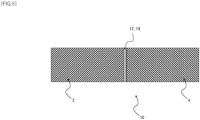
- FIG. 5 is a schematic sectional view which shows one example of the dissimilar material bonding structure.
- the dissimilar material bonding structure 10 is one in which the one member 2 and the other member 4 having different compositions are solid-phase bonded.
- the one member 2 and the other member 4 are metallurgically bonded via the solid phase bonding interface 12, and an intermetallic compound layer 14 having a thickness of less than 500 nm is formed over the entire solid phase bonding interface 12.
- the intermetallic compound layer 14 does not necessarily have to be observed, and when it is not clearly observed, it indicates that the thickness is less than 500 nm. Further, the more preferable thickness of the intermetallic compound layer 14 is less than 300 nm, and the most preferable thickness of the intermetallic compound layer 14 is less than 100 nm.
- the solid phase bonding interface 12 contains recrystallized grains. Since the structure in the vicinity of the bonding interface becomes fine equiaxial recrystallized grains, it is possible to make the bonded portion having excellent mechanical properties such as strength, toughness, and reliability.
- the one member 2 is an iron-based metal and the other member 4 is an aluminum alloy or a titanium alloy.
- a brittle intermetallic compound layer 14 is formed at the interface between the iron-based metal / aluminum alloy and the iron-based metal / titanium alloy, when the thickness of the intermetallic compound layer 14 is less than 500 nm in the entire solid phase bonding interface 12, it is possible to realize a dissimilar material bonding structure 10 which exhibits substantially the same tensile strength as the base metal in the tensile test.
- the width of the one member 2 and/or the other member 4 is 10 mm or more.
- the width of the material to be bonded becomes large, since it becomes difficult to control the bonding temperature at the interface 6 to be bonded, it is not possible to form a homogeneous bonding interface by the conventional bonding method.
- the thickness of the intermetallic compound layer 14 is less than 500 nm in the entire solid phase bonding interface 12 even when the width is 10 mm or more.
- the width of the one member 2 and/or the other member 4 is preferably 15 mm or more, and more preferably 20 mm or more.
- the solid phase bonding interface 12 having good mechanical properties is formed, even when there is no temperature at which the tensile strength or yield strength of the one member 2 and the other member 4 are substantially the same.
- Titanium alloy Ti-6Al-4V (ASTM F 136-13) and austenitic stainless steel SUS316L (JIS G4303) were used as test materials.
- the dimensions of the test material were 65 mmL ⁇ 25 mmW ⁇ 5 mmT, and the surface of the 25 mmW ⁇ 5 mmT was subjected to the dissimilar material linear friction welding as the surface to be bonded.
- the bonding conditions were a pressure to be applied of 400 MPa, an amplitude of 0.85 to 1 mm, a frequency of 25 to 30 Hz, and a burn-off length of 4 to 5 mm.
- the 400 MPa used as the pressure to be applied was set as a value at which the bonding temperature was substantially the same as the tensile strength of the titanium alloy Ti-6Al-4V and the austenitic stainless steel SUS316L.
- FIG. 6 A tensile test piece shown in FIG. 6 was cut out from the obtained dissimilar solid phase bonding joint and subjected to a tensile test.
- the size of the parallel portion of the tensile test piece is a plate thickness of 5 mm, a width of 6 mm, and a length of 25 mm.
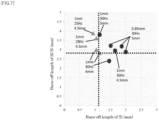
- FIG. 7 shows the relationship between the obtained tensile strength and the burn-off length of each material to be bonded (the total of the burn-off length of the titanium alloy Ti-6Al-4V and the austenitic stainless steel SUS316L).
- the tensile strength is 500 MPa or more, it is plotted as ⁇ , and when being 200 to 500 MPa, it is plotted as ⁇ , and the bonding conditions are described in the vicinity of each plot.
- the bonding conditions are amplitude, frequency, and burn-off length from the top.
- the tensile strengths of all the dissimilar solid phase joints are 200 MPa or more, and in the case that the new surface is sufficiently formed on the surface to be bonded of the titanium alloy Ti-6Al-4V and the austenitic stainless steel SUS316L (upper right in the figure), the tensile strength is 500 MPa or more.
- the dotted line in the figure indicates, in relation to each material to be bonded, the burn-off length where substantially the entire surface of the interface to be bonded becomes a new surface.
- a burn-off length that is equal to or greater than the dotted line by realizing a burn-off length that is equal to or greater than the dotted line, a strong joint in which the new surfaces are brought into contact with each other can be reliably obtained.
- the value of the dotted line is different in the titanium alloy Ti-6Al-4V and the austenitic stainless steel SUS316L, because the amount of deformation and the amount of burrs discharged and the shape in the vicinity of the interface to be bonded are different.
- FIG. 8 shows an external photograph of a typical dissimilar solid phase joint. It can be seen that the titanium alloy Ti-6Al-4V and the austenitic stainless steel SUS316L are both deformed in the vicinity of the interface to be bonded, and the new surfaces of the materials to be bonded are in contact with each other to achieve the bonding. Further, the area of the interface to be bonded, which was 125 mm 2 before bonding, was 267 mm 2 for the titanium alloy Ti-6Al-4V and 248 mm 2 for the austenitic stainless steel SUS316L, due to the state of the deformation and the state of the discharge of burrs of the material to be bonded, and both have about twice the area.
- the twice increase of the surface area indicates that a new surface was formed in all areas of the bonded surface before bonding, and the new surface of the titanium alloy Ti-6Al-4V and the new surface of the austenitic stainless steel SUS316L were brought into contact with each other to formed a robust bonding interface.
- the burn-off length of each material to be bonded may be set so that the new surfaces are brought into contact with each other.
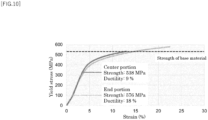
- FIG. 10 shows the tensile strength of the austenitic stainless steel SUS316L, and it was confirmed that the strength of the bonded portion is equivalent to that of the base metal at both the central portion and the end portion. This indicates that the robust bonding between the new surfaces is achieved over the entire interface to be bonded.
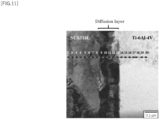
- FIG. 11 shows a TEM photograph of the interface of the dissimilar solid phase bonding joint shown in FIG. 8 .
- FIG. 11 no clear intermetallic compound layer is confirmed, and it can be seen that an extremely good bonding interface is formed.
- the region having dark contrast at the bonded interface was a diffusion layer (the thickness of the diffusion layer is about 100 nm).
- the plots in the photograph show the measurement points (1 to 20) of the point analysis, and the ratio of the constituent elements at each measurement point is as shown in TABLE 1.
- Dissimilar material solid phase bonding was performed in the same manner as in the Example except that the pressures to be applied during the bonding were changed to 200, 300, and 500 MPa.
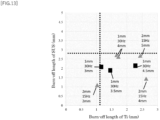
- FIGs. 12 , 13 and 14 show the relationship between the tensile strength and the burn-off length of each material to be bonded when the pressure to be applied is 200, 300 and 500 MPa.
- the tensile strength is 200 to 500 MPa or more, it is plotted as ⁇ , and when being 200 MPa or less, it is plotted as ⁇ , and the bonding conditions are described in the vicinity of each plot.
- the bonding conditions are amplitude, frequency, and burn-off length from the top.
- the burn-off length of the titanium alloy Ti-6Al-4V increases, and at the pressure to be applied of 500 MPa ( FIG. 14 ) where the bonding temperature is lower than the intersection point, the burn-off length of the austenitic stainless steel SUS316L increases. That is, under any of the bonding conditions, a new surface cannot be formed to the same extent at the bonded interfaces of the titanium alloy Ti-6Al-4V and the austenitic stainless steel SUS316L.
Landscapes
- Engineering & Computer Science (AREA)
- Mechanical Engineering (AREA)
- Pressure Welding/Diffusion-Bonding (AREA)
Applications Claiming Priority (2)
| Application Number | Priority Date | Filing Date | Title |
|---|---|---|---|
| JP2019144978 | 2019-08-07 | ||
| PCT/JP2020/026796 WO2021024687A1 (ja) | 2019-08-07 | 2020-07-09 | 異材固相接合方法及び異材固相接合構造物 |
Publications (3)
| Publication Number | Publication Date |
|---|---|
| EP4011540A1 EP4011540A1 (en) | 2022-06-15 |
| EP4011540A4 EP4011540A4 (en) | 2022-11-09 |
| EP4011540B1 true EP4011540B1 (en) | 2024-02-28 |
Family
ID=74502947
Family Applications (1)
| Application Number | Title | Priority Date | Filing Date |
|---|---|---|---|
| EP20849258.7A Active EP4011540B1 (en) | 2019-08-07 | 2020-07-09 | Dissimilar material solid phase bonding method |
Country Status (5)
| Country | Link |
|---|---|
| US (1) | US20250353103A1 (https=) |
| EP (1) | EP4011540B1 (https=) |
| JP (1) | JP7262144B2 (https=) |
| CN (1) | CN114206535B (https=) |
| WO (1) | WO2021024687A1 (https=) |
Families Citing this family (7)
| Publication number | Priority date | Publication date | Assignee | Title |
|---|---|---|---|---|
| US12611725B2 (en) * | 2021-03-09 | 2026-04-28 | Osaka University | Dissimilar material solid-phase bonding method and dissimilar material solid-phase bonded structure |
| JP7617430B2 (ja) | 2021-08-20 | 2025-01-20 | 日本製鉄株式会社 | 摩擦圧接継手、テーラードブランク材、成形品、及び摩擦圧接継手の製造方法 |
| CN114473175B (zh) * | 2022-02-10 | 2022-12-27 | 山东大学 | 一种同步优化异种金属摩擦焊接头成形成性行为的工艺 |
| CN118829508A (zh) * | 2022-03-04 | 2024-10-22 | 国立大学法人大阪大学 | 线性摩擦接合方法和线性摩擦接合接头以及接合构造物 |
| WO2024219208A1 (ja) * | 2023-04-21 | 2024-10-24 | 国立大学法人大阪大学 | 線形摩擦接合方法及び接合継手 |
| CN117620600A (zh) * | 2023-10-31 | 2024-03-01 | 河海大学 | 一种铜-铝异质金属接头及其冷压扭接复合方法 |
| WO2025263239A1 (ja) * | 2024-06-17 | 2025-12-26 | 国立大学法人大阪大学 | 異材接合方法及び異材接合体 |
Family Cites Families (34)
| Publication number | Priority date | Publication date | Assignee | Title |
|---|---|---|---|---|
| JPS5452648A (en) * | 1977-10-05 | 1979-04-25 | Hitachi Ltd | Friction welding method for dissimilar metals |
| JPS60133987A (ja) * | 1983-12-21 | 1985-07-17 | Kawasaki Heavy Ind Ltd | 異材接合法 |
| JPS63188484A (ja) * | 1987-01-30 | 1988-08-04 | Hitachi Ltd | 異種材料の固相接合方法 |
| JPH0255684A (ja) * | 1988-08-23 | 1990-02-26 | Nkk Corp | 異材継手 |
| JPH05131280A (ja) * | 1991-11-08 | 1993-05-28 | Daido Steel Co Ltd | 摩擦圧接方法 |
| CA2254349C (en) * | 1997-11-19 | 2003-11-04 | Kabushiki Kaisha Toshiba | Joined structure of dissimilar metallic materials |
| JP2002283070A (ja) * | 2001-03-22 | 2002-10-02 | Japan Space Utilization Promotion Center | 異種金属材料の摩擦撹拌接合方法 |
| JP4537132B2 (ja) | 2004-07-07 | 2010-09-01 | 川崎重工業株式会社 | スポット接合用摩擦攪拌接合方法 |
| US7998090B2 (en) * | 2004-08-31 | 2011-08-16 | Abbott Cardiovascular Systems Inc. | Guide wire with core having welded wire segments |
| DE102004057138A1 (de) * | 2004-11-26 | 2006-06-08 | Daimlerchrysler Ag | Abgasturbolader für einen Verbrennungsmotor |
| JP5044128B2 (ja) * | 2006-03-22 | 2012-10-10 | 本田技研工業株式会社 | アルミ合金と鋼板との摩擦攪拌接合方法および摩擦攪拌接合部材 |
| JP4858763B2 (ja) | 2006-06-27 | 2012-01-18 | 住友軽金属工業株式会社 | 摩擦撹拌点接合体 |
| GB0712225D0 (en) * | 2007-06-23 | 2007-08-01 | Rolls Royce Plc | Welding enclosure |
| US8286852B2 (en) * | 2008-02-29 | 2012-10-16 | Gesenkschmiede Schneider Gmbh | Method of friction welding of a piston having a cooling duct |
| JP2011056534A (ja) | 2009-09-09 | 2011-03-24 | Yazaki Corp | 摩擦攪拌接合方法及び異種金属接合体 |
| JP5799501B2 (ja) * | 2010-06-24 | 2015-10-28 | 日産自動車株式会社 | 接合方法および接合装置 |
| WO2012047562A2 (en) * | 2010-09-28 | 2012-04-12 | National Oilwell Varco, L.P. | Welded downhole components and method of forming same |
| US8784065B2 (en) * | 2011-05-24 | 2014-07-22 | Caterpillar Inc. | Friction welding of titanium aluminide turbine to titanium alloy shaft |
| JP5721189B2 (ja) * | 2013-03-12 | 2015-05-20 | 株式会社 東北テクノアーチ | 耐熱性Ni基合金及びその製造方法 |
| US20160207140A1 (en) * | 2015-01-19 | 2016-07-21 | The Regents Of The University Of Michigan | Method for joining dissimilar metal parts for improved weldability, weld quality, mechanical performance |
| CN107848065B (zh) * | 2015-07-31 | 2020-03-13 | 国立大学法人大阪大学 | 摩擦焊接方法 |
| ITUB20160356A1 (it) * | 2016-01-15 | 2017-07-15 | Thales Alenia Space Italia Spa Con Unico Socio | Meccanismo di rilascio non esplosivo basato su fusione ad induzione elettromagnetica |
| GB201603247D0 (en) * | 2016-02-25 | 2016-04-13 | Rolls Royce Plc | Friction welding |
| DE102016217024A1 (de) * | 2016-09-07 | 2018-03-08 | Mahle International Gmbh | Herstellungsverfahren einer Nockenwelle |
| US10799979B2 (en) * | 2016-11-28 | 2020-10-13 | Ohio State Innovation Foundation | Systems and methods for determining efficiency of friction welding processes |
| JP6819959B2 (ja) * | 2017-02-02 | 2021-01-27 | 国立大学法人大阪大学 | 線形摩擦接合方法 |
| JP6819958B2 (ja) * | 2017-02-02 | 2021-01-27 | 国立大学法人大阪大学 | 線形摩擦接合方法 |
| JP6796839B2 (ja) * | 2017-02-02 | 2020-12-09 | 国立大学法人大阪大学 | 線形摩擦接合方法及び線形摩擦接合装置 |
| JP6739854B2 (ja) * | 2017-03-17 | 2020-08-12 | 国立大学法人大阪大学 | 摩擦圧接方法 |
| US11465243B2 (en) * | 2017-11-06 | 2022-10-11 | The Boeing Company | Interlayered structures for joining dissimilar materials and methods for joining dissimilar metals |
| EP3769894B1 (en) * | 2018-03-20 | 2025-09-24 | Osaka University | Metal material solid-phase bonding method and solid-phase bonding device |
| WO2020017514A1 (ja) * | 2018-07-18 | 2020-01-23 | シチズン時計株式会社 | 工作機械 |
| DE102019110664A1 (de) * | 2019-04-25 | 2020-10-29 | Kuka Deutschland Gmbh | Verfahren und Vorrichtung zum Reibstromfügen |
| US11872651B2 (en) * | 2019-11-12 | 2024-01-16 | Osaka University | Dissimilar material solid phase bonding method, dissimilar material solid phase bonded structure, and dissimilar material solid phase bonding device |
-
2020
- 2020-07-09 US US17/632,714 patent/US20250353103A1/en active Pending
- 2020-07-09 CN CN202080055988.5A patent/CN114206535B/zh active Active
- 2020-07-09 JP JP2021537636A patent/JP7262144B2/ja active Active
- 2020-07-09 EP EP20849258.7A patent/EP4011540B1/en active Active
- 2020-07-09 WO PCT/JP2020/026796 patent/WO2021024687A1/ja not_active Ceased
Also Published As
| Publication number | Publication date |
|---|---|
| CN114206535B (zh) | 2024-04-02 |
| EP4011540A1 (en) | 2022-06-15 |
| JP7262144B2 (ja) | 2023-04-21 |
| US20250353103A1 (en) | 2025-11-20 |
| CN114206535A (zh) | 2022-03-18 |
| JPWO2021024687A1 (https=) | 2021-02-11 |
| EP4011540A4 (en) | 2022-11-09 |
| WO2021024687A1 (ja) | 2021-02-11 |
Similar Documents
| Publication | Publication Date | Title |
|---|---|---|
| EP4011540B1 (en) | Dissimilar material solid phase bonding method | |
| JP6579596B2 (ja) | 金属材の低温接合方法及び接合構造物 | |
| US11872651B2 (en) | Dissimilar material solid phase bonding method, dissimilar material solid phase bonded structure, and dissimilar material solid phase bonding device | |
| JP7242112B2 (ja) | 固相点接合方法及び固相点接合装置 | |
| JP6739854B2 (ja) | 摩擦圧接方法 | |
| EP3330034A1 (en) | Friction bonding method | |
| JP6819959B2 (ja) | 線形摩擦接合方法 | |
| US8881964B2 (en) | Friction stir welding and processing of oxide dispersion strengthened (ODS) alloys | |
| KR20020074068A (ko) | 철기 미세결정체의 접합방법 및 그 구조물 | |
| JPWO2019181360A1 (ja) | 金属材の固相接合方法及び固相接合装置 | |
| JP6819958B2 (ja) | 線形摩擦接合方法 | |
| EP2656959A1 (en) | Rotating tool | |
| US12611725B2 (en) | Dissimilar material solid-phase bonding method and dissimilar material solid-phase bonded structure | |
| Cheniti et al. | Effect of WC-Co cermet positioning and NiCr interlayer on the microstructure and mechanical response of the dissimilar WC-Co/AISI 304 L rotary friction joint | |
| CN114929422A (zh) | 在没有有害金属间化合物的情况下接合异种金属的方法 | |
| US20240157467A1 (en) | Linear friction-joining method and linear friction-joining structure | |
| WO2024219208A1 (ja) | 線形摩擦接合方法及び接合継手 |
Legal Events
| Date | Code | Title | Description |
|---|---|---|---|
| STAA | Information on the status of an ep patent application or granted ep patent |
Free format text: STATUS: THE INTERNATIONAL PUBLICATION HAS BEEN MADE |
|
| PUAI | Public reference made under article 153(3) epc to a published international application that has entered the european phase |
Free format text: ORIGINAL CODE: 0009012 |
|
| STAA | Information on the status of an ep patent application or granted ep patent |
Free format text: STATUS: REQUEST FOR EXAMINATION WAS MADE |
|
| 17P | Request for examination filed |
Effective date: 20220204 |
|
| AK | Designated contracting states |
Kind code of ref document: A1 Designated state(s): AL AT BE BG CH CY CZ DE DK EE ES FI FR GB GR HR HU IE IS IT LI LT LU LV MC MK MT NL NO PL PT RO RS SE SI SK SM TR |
|
| A4 | Supplementary search report drawn up and despatched |
Effective date: 20221007 |
|
| RIC1 | Information provided on ipc code assigned before grant |
Ipc: B23K 103/24 20060101ALN20220930BHEP Ipc: B23K 103/20 20060101ALN20220930BHEP Ipc: B23K 103/18 20060101ALN20220930BHEP Ipc: B23K 103/04 20060101ALN20220930BHEP Ipc: B23K 20/227 20060101ALI20220930BHEP Ipc: B23K 20/12 20060101ALI20220930BHEP Ipc: B23K 20/02 20060101AFI20220930BHEP |
|
| DAV | Request for validation of the european patent (deleted) | ||
| DAX | Request for extension of the european patent (deleted) | ||
| REG | Reference to a national code |
Ref country code: DE Ref legal event code: R079 Free format text: PREVIOUS MAIN CLASS: B23K0020000000 Ipc: B23K0020020000 Ref document number: 602020026575 Country of ref document: DE |
|
| RIC1 | Information provided on ipc code assigned before grant |
Ipc: B23K 103/24 20060101ALN20230807BHEP Ipc: B23K 103/20 20060101ALN20230807BHEP Ipc: B23K 103/18 20060101ALN20230807BHEP Ipc: B23K 103/04 20060101ALN20230807BHEP Ipc: B23K 20/227 20060101ALI20230807BHEP Ipc: B23K 20/12 20060101ALI20230807BHEP Ipc: B23K 20/02 20060101AFI20230807BHEP |
|
| GRAP | Despatch of communication of intention to grant a patent |
Free format text: ORIGINAL CODE: EPIDOSNIGR1 |
|
| STAA | Information on the status of an ep patent application or granted ep patent |
Free format text: STATUS: GRANT OF PATENT IS INTENDED |
|
| INTG | Intention to grant announced |
Effective date: 20231002 |
|
| RIN1 | Information on inventor provided before grant (corrected) |
Inventor name: AOKI, YASUHIRO Inventor name: MORISADA, YOSHIAKI Inventor name: FUJII, HIDETOSHI |
|
| GRAJ | Information related to disapproval of communication of intention to grant by the applicant or resumption of examination proceedings by the epo deleted |
Free format text: ORIGINAL CODE: EPIDOSDIGR1 |
|
| STAA | Information on the status of an ep patent application or granted ep patent |
Free format text: STATUS: REQUEST FOR EXAMINATION WAS MADE |
|
| GRAJ | Information related to disapproval of communication of intention to grant by the applicant or resumption of examination proceedings by the epo deleted |
Free format text: ORIGINAL CODE: EPIDOSDIGR1 |
|
| GRAP | Despatch of communication of intention to grant a patent |
Free format text: ORIGINAL CODE: EPIDOSNIGR1 |
|
| GRAP | Despatch of communication of intention to grant a patent |
Free format text: ORIGINAL CODE: EPIDOSNIGR1 |
|
| STAA | Information on the status of an ep patent application or granted ep patent |
Free format text: STATUS: GRANT OF PATENT IS INTENDED |
|
| INTC | Intention to grant announced (deleted) | ||
| RIC1 | Information provided on ipc code assigned before grant |
Ipc: B23K 103/24 20060101ALN20231106BHEP Ipc: B23K 103/20 20060101ALN20231106BHEP Ipc: B23K 103/18 20060101ALN20231106BHEP Ipc: B23K 103/04 20060101ALN20231106BHEP Ipc: B23K 20/227 20060101ALI20231106BHEP Ipc: B23K 20/12 20060101ALI20231106BHEP Ipc: B23K 20/02 20060101AFI20231106BHEP |
|
| INTG | Intention to grant announced |
Effective date: 20231123 |
|
| INTG | Intention to grant announced |
Effective date: 20231128 |
|
| RIC1 | Information provided on ipc code assigned before grant |
Ipc: B23K 103/24 20060101ALN20231120BHEP Ipc: B23K 103/20 20060101ALN20231120BHEP Ipc: B23K 103/18 20060101ALN20231120BHEP Ipc: B23K 103/04 20060101ALN20231120BHEP Ipc: B23K 20/227 20060101ALI20231120BHEP Ipc: B23K 20/12 20060101ALI20231120BHEP Ipc: B23K 20/02 20060101AFI20231120BHEP |
|
| GRAS | Grant fee paid |
Free format text: ORIGINAL CODE: EPIDOSNIGR3 |
|
| GRAA | (expected) grant |
Free format text: ORIGINAL CODE: 0009210 |
|
| STAA | Information on the status of an ep patent application or granted ep patent |
Free format text: STATUS: THE PATENT HAS BEEN GRANTED |
|
| AK | Designated contracting states |
Kind code of ref document: B1 Designated state(s): AL AT BE BG CH CY CZ DE DK EE ES FI FR GB GR HR HU IE IS IT LI LT LU LV MC MK MT NL NO PL PT RO RS SE SI SK SM TR |
|
| REG | Reference to a national code |
Ref country code: GB Ref legal event code: FG4D |
|
| REG | Reference to a national code |
Ref country code: CH Ref legal event code: EP |
|
| REG | Reference to a national code |
Ref country code: DE Ref legal event code: R096 Ref document number: 602020026575 Country of ref document: DE |
|
| REG | Reference to a national code |
Ref country code: IE Ref legal event code: FG4D |
|
| REG | Reference to a national code |
Ref country code: LT Ref legal event code: MG9D |
|
| PG25 | Lapsed in a contracting state [announced via postgrant information from national office to epo] |
Ref country code: IS Free format text: LAPSE BECAUSE OF FAILURE TO SUBMIT A TRANSLATION OF THE DESCRIPTION OR TO PAY THE FEE WITHIN THE PRESCRIBED TIME-LIMIT Effective date: 20240628 |
|
| REG | Reference to a national code |
Ref country code: NL Ref legal event code: MP Effective date: 20240228 |
|
| PG25 | Lapsed in a contracting state [announced via postgrant information from national office to epo] |
Ref country code: LT Free format text: LAPSE BECAUSE OF FAILURE TO SUBMIT A TRANSLATION OF THE DESCRIPTION OR TO PAY THE FEE WITHIN THE PRESCRIBED TIME-LIMIT Effective date: 20240228 |
|
| PG25 | Lapsed in a contracting state [announced via postgrant information from national office to epo] |
Ref country code: GR Free format text: LAPSE BECAUSE OF FAILURE TO SUBMIT A TRANSLATION OF THE DESCRIPTION OR TO PAY THE FEE WITHIN THE PRESCRIBED TIME-LIMIT Effective date: 20240529 |
|
| PG25 | Lapsed in a contracting state [announced via postgrant information from national office to epo] |
Ref country code: NL Free format text: LAPSE BECAUSE OF FAILURE TO SUBMIT A TRANSLATION OF THE DESCRIPTION OR TO PAY THE FEE WITHIN THE PRESCRIBED TIME-LIMIT Effective date: 20240228 Ref country code: RS Free format text: LAPSE BECAUSE OF FAILURE TO SUBMIT A TRANSLATION OF THE DESCRIPTION OR TO PAY THE FEE WITHIN THE PRESCRIBED TIME-LIMIT Effective date: 20240528 Ref country code: HR Free format text: LAPSE BECAUSE OF FAILURE TO SUBMIT A TRANSLATION OF THE DESCRIPTION OR TO PAY THE FEE WITHIN THE PRESCRIBED TIME-LIMIT Effective date: 20240228 |
|
| PG25 | Lapsed in a contracting state [announced via postgrant information from national office to epo] |
Ref country code: ES Free format text: LAPSE BECAUSE OF FAILURE TO SUBMIT A TRANSLATION OF THE DESCRIPTION OR TO PAY THE FEE WITHIN THE PRESCRIBED TIME-LIMIT Effective date: 20240228 |
|
| PG25 | Lapsed in a contracting state [announced via postgrant information from national office to epo] |
Ref country code: RS Free format text: LAPSE BECAUSE OF FAILURE TO SUBMIT A TRANSLATION OF THE DESCRIPTION OR TO PAY THE FEE WITHIN THE PRESCRIBED TIME-LIMIT Effective date: 20240528 Ref country code: NO Free format text: LAPSE BECAUSE OF FAILURE TO SUBMIT A TRANSLATION OF THE DESCRIPTION OR TO PAY THE FEE WITHIN THE PRESCRIBED TIME-LIMIT Effective date: 20240528 Ref country code: NL Free format text: LAPSE BECAUSE OF FAILURE TO SUBMIT A TRANSLATION OF THE DESCRIPTION OR TO PAY THE FEE WITHIN THE PRESCRIBED TIME-LIMIT Effective date: 20240228 Ref country code: LT Free format text: LAPSE BECAUSE OF FAILURE TO SUBMIT A TRANSLATION OF THE DESCRIPTION OR TO PAY THE FEE WITHIN THE PRESCRIBED TIME-LIMIT Effective date: 20240228 Ref country code: IS Free format text: LAPSE BECAUSE OF FAILURE TO SUBMIT A TRANSLATION OF THE DESCRIPTION OR TO PAY THE FEE WITHIN THE PRESCRIBED TIME-LIMIT Effective date: 20240628 Ref country code: HR Free format text: LAPSE BECAUSE OF FAILURE TO SUBMIT A TRANSLATION OF THE DESCRIPTION OR TO PAY THE FEE WITHIN THE PRESCRIBED TIME-LIMIT Effective date: 20240228 Ref country code: GR Free format text: LAPSE BECAUSE OF FAILURE TO SUBMIT A TRANSLATION OF THE DESCRIPTION OR TO PAY THE FEE WITHIN THE PRESCRIBED TIME-LIMIT Effective date: 20240529 Ref country code: FI Free format text: LAPSE BECAUSE OF FAILURE TO SUBMIT A TRANSLATION OF THE DESCRIPTION OR TO PAY THE FEE WITHIN THE PRESCRIBED TIME-LIMIT Effective date: 20240228 Ref country code: ES Free format text: LAPSE BECAUSE OF FAILURE TO SUBMIT A TRANSLATION OF THE DESCRIPTION OR TO PAY THE FEE WITHIN THE PRESCRIBED TIME-LIMIT Effective date: 20240228 Ref country code: BG Free format text: LAPSE BECAUSE OF FAILURE TO SUBMIT A TRANSLATION OF THE DESCRIPTION OR TO PAY THE FEE WITHIN THE PRESCRIBED TIME-LIMIT Effective date: 20240228 |
|
| PG25 | Lapsed in a contracting state [announced via postgrant information from national office to epo] |
Ref country code: PL Free format text: LAPSE BECAUSE OF FAILURE TO SUBMIT A TRANSLATION OF THE DESCRIPTION OR TO PAY THE FEE WITHIN THE PRESCRIBED TIME-LIMIT Effective date: 20240228 Ref country code: PT Free format text: LAPSE BECAUSE OF FAILURE TO SUBMIT A TRANSLATION OF THE DESCRIPTION OR TO PAY THE FEE WITHIN THE PRESCRIBED TIME-LIMIT Effective date: 20240628 |
|
| REG | Reference to a national code |
Ref country code: AT Ref legal event code: MK05 Ref document number: 1660804 Country of ref document: AT Kind code of ref document: T Effective date: 20240228 |
|
| PG25 | Lapsed in a contracting state [announced via postgrant information from national office to epo] |
Ref country code: SE Free format text: LAPSE BECAUSE OF FAILURE TO SUBMIT A TRANSLATION OF THE DESCRIPTION OR TO PAY THE FEE WITHIN THE PRESCRIBED TIME-LIMIT Effective date: 20240228 Ref country code: PT Free format text: LAPSE BECAUSE OF FAILURE TO SUBMIT A TRANSLATION OF THE DESCRIPTION OR TO PAY THE FEE WITHIN THE PRESCRIBED TIME-LIMIT Effective date: 20240628 Ref country code: PL Free format text: LAPSE BECAUSE OF FAILURE TO SUBMIT A TRANSLATION OF THE DESCRIPTION OR TO PAY THE FEE WITHIN THE PRESCRIBED TIME-LIMIT Effective date: 20240228 Ref country code: LV Free format text: LAPSE BECAUSE OF FAILURE TO SUBMIT A TRANSLATION OF THE DESCRIPTION OR TO PAY THE FEE WITHIN THE PRESCRIBED TIME-LIMIT Effective date: 20240228 |
|
| PG25 | Lapsed in a contracting state [announced via postgrant information from national office to epo] |
Ref country code: DK Free format text: LAPSE BECAUSE OF FAILURE TO SUBMIT A TRANSLATION OF THE DESCRIPTION OR TO PAY THE FEE WITHIN THE PRESCRIBED TIME-LIMIT Effective date: 20240228 |
|
| PG25 | Lapsed in a contracting state [announced via postgrant information from national office to epo] |
Ref country code: SM Free format text: LAPSE BECAUSE OF FAILURE TO SUBMIT A TRANSLATION OF THE DESCRIPTION OR TO PAY THE FEE WITHIN THE PRESCRIBED TIME-LIMIT Effective date: 20240228 |
|
| PG25 | Lapsed in a contracting state [announced via postgrant information from national office to epo] |
Ref country code: CZ Free format text: LAPSE BECAUSE OF FAILURE TO SUBMIT A TRANSLATION OF THE DESCRIPTION OR TO PAY THE FEE WITHIN THE PRESCRIBED TIME-LIMIT Effective date: 20240228 Ref country code: EE Free format text: LAPSE BECAUSE OF FAILURE TO SUBMIT A TRANSLATION OF THE DESCRIPTION OR TO PAY THE FEE WITHIN THE PRESCRIBED TIME-LIMIT Effective date: 20240228 |
|
| PG25 | Lapsed in a contracting state [announced via postgrant information from national office to epo] |
Ref country code: AT Free format text: LAPSE BECAUSE OF FAILURE TO SUBMIT A TRANSLATION OF THE DESCRIPTION OR TO PAY THE FEE WITHIN THE PRESCRIBED TIME-LIMIT Effective date: 20240228 |
|
| PG25 | Lapsed in a contracting state [announced via postgrant information from national office to epo] |
Ref country code: SK Free format text: LAPSE BECAUSE OF FAILURE TO SUBMIT A TRANSLATION OF THE DESCRIPTION OR TO PAY THE FEE WITHIN THE PRESCRIBED TIME-LIMIT Effective date: 20240228 |
|
| PG25 | Lapsed in a contracting state [announced via postgrant information from national office to epo] |
Ref country code: SM Free format text: LAPSE BECAUSE OF FAILURE TO SUBMIT A TRANSLATION OF THE DESCRIPTION OR TO PAY THE FEE WITHIN THE PRESCRIBED TIME-LIMIT Effective date: 20240228 Ref country code: SK Free format text: LAPSE BECAUSE OF FAILURE TO SUBMIT A TRANSLATION OF THE DESCRIPTION OR TO PAY THE FEE WITHIN THE PRESCRIBED TIME-LIMIT Effective date: 20240228 Ref country code: RO Free format text: LAPSE BECAUSE OF FAILURE TO SUBMIT A TRANSLATION OF THE DESCRIPTION OR TO PAY THE FEE WITHIN THE PRESCRIBED TIME-LIMIT Effective date: 20240228 Ref country code: EE Free format text: LAPSE BECAUSE OF FAILURE TO SUBMIT A TRANSLATION OF THE DESCRIPTION OR TO PAY THE FEE WITHIN THE PRESCRIBED TIME-LIMIT Effective date: 20240228 Ref country code: DK Free format text: LAPSE BECAUSE OF FAILURE TO SUBMIT A TRANSLATION OF THE DESCRIPTION OR TO PAY THE FEE WITHIN THE PRESCRIBED TIME-LIMIT Effective date: 20240228 Ref country code: CZ Free format text: LAPSE BECAUSE OF FAILURE TO SUBMIT A TRANSLATION OF THE DESCRIPTION OR TO PAY THE FEE WITHIN THE PRESCRIBED TIME-LIMIT Effective date: 20240228 Ref country code: AT Free format text: LAPSE BECAUSE OF FAILURE TO SUBMIT A TRANSLATION OF THE DESCRIPTION OR TO PAY THE FEE WITHIN THE PRESCRIBED TIME-LIMIT Effective date: 20240228 |
|
| REG | Reference to a national code |
Ref country code: DE Ref legal event code: R097 Ref document number: 602020026575 Country of ref document: DE |
|
| PLBE | No opposition filed within time limit |
Free format text: ORIGINAL CODE: 0009261 |
|
| STAA | Information on the status of an ep patent application or granted ep patent |
Free format text: STATUS: NO OPPOSITION FILED WITHIN TIME LIMIT |
|
| 26N | No opposition filed |
Effective date: 20241129 |
|
| PG25 | Lapsed in a contracting state [announced via postgrant information from national office to epo] |
Ref country code: MC Free format text: LAPSE BECAUSE OF FAILURE TO SUBMIT A TRANSLATION OF THE DESCRIPTION OR TO PAY THE FEE WITHIN THE PRESCRIBED TIME-LIMIT Effective date: 20240228 |
|
| REG | Reference to a national code |
Ref country code: CH Ref legal event code: PL |
|
| PG25 | Lapsed in a contracting state [announced via postgrant information from national office to epo] |
Ref country code: LU Free format text: LAPSE BECAUSE OF NON-PAYMENT OF DUE FEES Effective date: 20240709 |
|
| PG25 | Lapsed in a contracting state [announced via postgrant information from national office to epo] |
Ref country code: LU Free format text: LAPSE BECAUSE OF NON-PAYMENT OF DUE FEES Effective date: 20240709 |
|
| PG25 | Lapsed in a contracting state [announced via postgrant information from national office to epo] |
Ref country code: SI Free format text: LAPSE BECAUSE OF FAILURE TO SUBMIT A TRANSLATION OF THE DESCRIPTION OR TO PAY THE FEE WITHIN THE PRESCRIBED TIME-LIMIT Effective date: 20240228 Ref country code: BE Free format text: LAPSE BECAUSE OF NON-PAYMENT OF DUE FEES Effective date: 20240731 Ref country code: CH Free format text: LAPSE BECAUSE OF NON-PAYMENT OF DUE FEES Effective date: 20240731 |
|
| REG | Reference to a national code |
Ref country code: BE Ref legal event code: MM Effective date: 20240731 |
|
| PG25 | Lapsed in a contracting state [announced via postgrant information from national office to epo] |
Ref country code: IE Free format text: LAPSE BECAUSE OF NON-PAYMENT OF DUE FEES Effective date: 20240709 |
|
| PGFP | Annual fee paid to national office [announced via postgrant information from national office to epo] |
Ref country code: DE Payment date: 20250722 Year of fee payment: 6 |
|
| PGFP | Annual fee paid to national office [announced via postgrant information from national office to epo] |
Ref country code: IT Payment date: 20250724 Year of fee payment: 6 |
|
| PGFP | Annual fee paid to national office [announced via postgrant information from national office to epo] |
Ref country code: GB Payment date: 20250722 Year of fee payment: 6 |
|
| PGFP | Annual fee paid to national office [announced via postgrant information from national office to epo] |
Ref country code: FR Payment date: 20250725 Year of fee payment: 6 |
|
| PG25 | Lapsed in a contracting state [announced via postgrant information from national office to epo] |
Ref country code: CY Free format text: LAPSE BECAUSE OF FAILURE TO SUBMIT A TRANSLATION OF THE DESCRIPTION OR TO PAY THE FEE WITHIN THE PRESCRIBED TIME-LIMIT; INVALID AB INITIO Effective date: 20200709 |
|
| PG25 | Lapsed in a contracting state [announced via postgrant information from national office to epo] |
Ref country code: HU Free format text: LAPSE BECAUSE OF FAILURE TO SUBMIT A TRANSLATION OF THE DESCRIPTION OR TO PAY THE FEE WITHIN THE PRESCRIBED TIME-LIMIT; INVALID AB INITIO Effective date: 20200709 |