EP4011227A1 - Garment - Google Patents
Garment Download PDFInfo
- Publication number
- EP4011227A1 EP4011227A1 EP20850819.2A EP20850819A EP4011227A1 EP 4011227 A1 EP4011227 A1 EP 4011227A1 EP 20850819 A EP20850819 A EP 20850819A EP 4011227 A1 EP4011227 A1 EP 4011227A1
- Authority
- EP
- European Patent Office
- Prior art keywords
- adhesives
- fabric
- curvature radius
- opening
- edge
- Prior art date
- Legal status (The legal status is an assumption and is not a legal conclusion. Google has not performed a legal analysis and makes no representation as to the accuracy of the status listed.)
- Granted
Links
Images



Classifications
-
- A—HUMAN NECESSITIES
- A41—WEARING APPAREL
- A41D—OUTERWEAR; PROTECTIVE GARMENTS; ACCESSORIES
- A41D27/00—Details of garments or of their making
- A41D27/24—Hems; Seams
- A41D27/245—Hems; Seams made by welding or gluing
-
- A—HUMAN NECESSITIES
- A41—WEARING APPAREL
- A41B—SHIRTS; UNDERWEAR; BABY LINEN; HANDKERCHIEFS
- A41B9/00—Undergarments
- A41B9/06—Undershirts; Chemises
-
- A—HUMAN NECESSITIES
- A41—WEARING APPAREL
- A41D—OUTERWEAR; PROTECTIVE GARMENTS; ACCESSORIES
- A41D27/00—Details of garments or of their making
Definitions
- the present invention relates to a garment.
- Patent Literature 1 a related technique is proposed in which, when an outer fabric is folded back for a hem of a swimsuit, for example, the hem is formed by bonding with a hot-melt sheet.
- Patent Literature 2 a technique to join the fabrics forming the garment to each other with an adhesive that is applied in a dot pattern is known.
- Patent Literature 2 a technique is proposed in which, when the body and sleeves of an undershirt are joined, they are bonded together with an adhesive that is repeatedly applied in a dot pattern.
- the present invention has been made in view of the foregoing, and it is an object thereof to provide a garment with which, even when a fabric edge that is curved in a concave shape at an opening and has portions having different curvature radii is folded over and is fastened with dotted adhesives, reduction in adhesive strength can be prevented and poor appearance can be mitigated.
- a garment according to the present invention is a garment made of a stretchable fabric and having an opening through which a body part of a wearer is passed.
- the opening has a structure in which a fabric edge is folded back, and the fabric edge is fastened to a main body of the fabric with dotted adhesives that are applied in a single row or multiple rows along the fabric edge, a part of the opening is formed with a pattern in which curvature of the opening changes, and a row of the adhesives that are applied on a side closest to the edge of the fabric is applied within 2 mm from the edge of the fabric, and a difference between an average of spacings between adjacent adhesives applied in a row in a 3-cm section of a portion having the largest curvature radius at the opening and an average of spacings between adjacent adhesives applied in a row in a 3-cm section of a portion having a smaller curvature radius at the opening is within 15%.
- a folded width of the fabric edge is 2 to 25 mm.
- a row of the adhesives on a side closest to a fold line is applied at a spacing of 0.5 mm or more away from the fold line.
- the adhesives are a reactive hot-melt adhesive.
- the fabric edge having such a pattern that the curvature radius of the concave shape at the opening changes is folded over and fastened with an adhesive that is arranged in a dot pattern, poor appearance of this portion and reduction in adhesive strength can be mitigated.
- FIG. 1 is a diagram illustrating a configuration of a garment according to a first embodiment.
- the garment 1 illustrated in this diagram is one example of upper wear of short-sleeved underwear, and has openings 2, 3, and 4 through which a head, arms, and a torso are passed.
- the openings 2, 3, and 4 are formed in such patterns that their curvatures change, and respectively have portions 5, 7, and 9 curved in a concave shape and having the smallest curvature radii and portions 6, 8, and 10 curved in a concave shape and having the largest curvature radii.
- the portions 5, 7, and 9 of the openings 2, 3, and 4 curved in a concave shape and having the smallest curvature radii and the portions 6, 8, and 10 curved in a concave shape and having the largest curvature radii are mainly described.
- the openings 2, 3, and 4 also have portions having curvature radii that are intermediate between each of the portions 5, 7, and 9 curved in a concave shape and having the smallest curvature radii and the corresponding one of the portions 6, 8, and 10 curved in a concave shape and having the largest curvature radii.
- the garment 1 is made of a stretchable fabric.
- a circular-knitted or warp-knitted material has stretchability required for accomplishing the present invention if it is a knitted material provided as a general clothing material, and is not limited to a particular one.
- a material having stretchability for clothing is suitable for the present invention even if it is a woven material. It can be used as a material for general underwear and inner wear with cups, and also for outerwear such as T-shirts and cut-and-sew clothes, and the use thereof is not limited to a particular one.
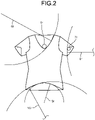
- FIG. 2 is a diagram indicating, at the openings 2, 3, and 4 of the garment 1, curvature radii 5r, 7r, and 9r of the portions 5, 7, and 9 curved in a concave shape and having the smallest curvature radii and curvature radii 6r, 8r, and 10r of the portions 6, 8, and 10 curved in a concave shape and having the largest curvature radii.
- 5r is 2 cm
- 6r is 60 cm
- 7r is 1.5 cm
- 8r is 70 cm
- 9r is 13 cm
- 10r is 70 cm, for example.
- the curvature radii herein are curvature radii that are radii of circles substantially corresponding to curves that form the respective shapes of the openings 2, 3, and 4 of the garment 1 in each section of 3 cm.
- the curves that form the shapes of the openings 2, 3, and 4 of the garment 1 are considered separately for each fabric that forms the garment 1. Specifically, if the opening 2 through which the head is passed is divided into front and back bodies, these respective bodies are considered separately.
- FIG. 3(a) is a diagram illustrating one example of a positional relation between a fabric edge of a portion having a larger curvature radius at an opening of the garment 1 and adhesives applied thereto in a single row.
- FIG. 3(b) is a diagram illustrating a positional relation between the fabric edge and the adhesives when the fabric edge has been folded back along a fold line at the opening of FIG. 3(a).
- FIG. 3(c) is a diagram illustrating one example of a positional relation between a fabric edge of a portion having a smaller curvature radius at the opening of the garment 1 and adhesives applied thereto in a single row.
- FIG. 3(d) is a diagram illustrating a positional relation between the fabric edge and the adhesives when the fabric edge has been folded back along a fold line at the opening of FIG. 3(c) .
- dotted adhesives 11 are arranged in a single row along the edge 13 of the fabric curved in a concave shape. If the distance d1 between the edge 13 of the fabric and the row of the adhesives 11 increases, the edge 13 of the fabric becomes a free end and a problem of bending backward is more likely occur when the edge 13 of the fabric has been folded back along the fold line 12. Thus, it is important that the distance d1 between the edge 13 of the fabric and the row of the adhesives 11 is set within 2 mm, and is preferably set within 1 mm.
- the adhesives 11 are arranged on the side closer to the fabric edge relative to the fold line 12, but can be arranged also on the side closer to the main body of the fabric relative to the fold line 12.
- the adhesives 11 are arranged on the side closer to the main body of the fabric relative to the fold line 12 and the folded width of the fabric edge is reduced, there is a risk that the fabric edge and the main body of the fabric cannot be reliably bonded to each other with the adhesives 11, depending on the precision in the arrangement of the adhesives 11 or the precision in the width of the folded fabric edge.
- the adhesives 11 are preferably arranged on the side closer to the fabric edge relative to the fold line 12.
- the garment 1 it is important that, at each of the openings 2, 3, and 4 of the garment 1, a difference between an average of spacings between adjacent dotted adhesives 11 applied in a 3-cm section of a portion having the largest curvature radius and an average of spacings between adjacent dotted adhesives 11 applied in a 3-cm section of a portion having a smaller curvature radius is set within 15%.
- the spacings between the adhesives 11 are similar to each other, and thus the adhesive strength per unit width can be set substantially uniform and the poor appearance can be mitigated.
- the difference between the average of the spacings between adjacent dotted adhesives 11 applied in the 3-cm section of the portion having the largest curvature radius and the average of the spacings between adjacent dotted adhesives 11 applied in the 3-cm section of the portion having a smaller curvature radius is within 13%.
- the portion having a smaller curvature radius is a portion the curvature radius of which is smaller than that of the portion having the largest curvature radius, and means all portions other than the portion having the largest curvature radius.
- the curvature radius at each opening herein is the curvature radius of an outer peripheral curve of each of the openings 2, 3, and 4 of the garment 1 according to the present invention.
- the 3-cm section of the portion having the largest curvature radius at each of the openings 2, 3, and 4 of the garment 1 means a range of 1.5 cm on both sides of the point of contact with a circle the curvature radius of which is substantially the same as that of the portion having the largest curvature radius. The same applies to the portion having a smaller curvature radius.
- the portion having the largest curvature radius at each of the openings 2, 3, and 4 of the garment 1 may be formed in a pattern that is infinitely close to a straight line under certain circumstances.
- the edge 13 of the fabric which forms each of the openings 2, 3, and 4 of the garment 1, may be in such a state that the fabric has been just cut and left raw, may be hemmed by overlocking or be piped with a tape-type sewing material, or is not limited to a particular one as long as the fabric edge can be folded back even if it has been cut by heat cutting or a laser and left raw.
- the stretch property of the fabric it is preferable that the stretch property of the fabric be not impaired by them.
- the difference between the average of the spacings between adjacent adhesives 11 applied in a row in the 3-cm section of the portion having the largest curvature radius and the average of the spacings between adjacent adhesives 11 applied in a row in the 3-cm section of the portion having a smaller curvature radius is within 15%.
- dotted adhesives 11 each having a diameter of 1 mm are applied at spacings of 2 mm in a single row so as to extend along a position at 1 mm from the edge 13 of the fabric, and the fabric edge is folded back in a width of 3 mm and fastened.
- the average of spacings between adjacent dotted adhesives 11 in the 3-cm section of the portion 7 having the smallest curvature radius after the folding back and fastening is 2.62 mm, and that of the portion 8 having the largest curvature radius is 2.01 mm.
- the difference therebetween is about 30.3%, which causes a difference in adhesive strength due to the difference in curvature radius, and there is a risk that peeling-off may occur and also the appearance becomes unnatural.
- the spacing between adhesives 11 to be applied to the fabric edge needs to be changed in advance in accordance with the curvature radius thereof.
- the average of spacings between the dotted adhesives 11 applied to the portion 7 having a smaller curvature radius is set to 1.70 mm
- the average of dot spacings after folding back and fastening becomes 2.22 mm, and thus the difference therebetween can be reduced to 10.4%.
- the adhesive strength per unit width at the opening 3 in which the curvature of the concave shape changes can be made substantially uniform, and also the appearance can be improved.
- dotted adhesives 11 each having a diameter of 1 mm are applied at spacings of 2 mm in a single row so as to extend along a position at 1 mm from the edge 13 of the fabric, and the fabric edge is folded back in a width of 15 mm and fastened.
- the average of spacings between adjacent dotted adhesives 11 in the 3-cm section of the portion 9 having the smallest curvature radius after the folding back and fastening is 2.48 mm, and that of the portion 10 having the largest curvature radius is 2.08 mm.
- the difference therebetween is about 19.2%, which causes a difference in adhesive strength due to the difference in curvature radius, and there is a risk that peeling-off may occur and also the appearance may become poor.
- the dot spacing needs to be changed in advance in accordance with the curvature radius thereof.
- the average of spacings between dotted adhesives 11 applied to the portion 9 having the smallest curvature radius is set to 1.90 mm
- the average of dot spacings after the folding back and fastening becomes 2.36 mm, and thus the difference therebetween can be reduced to 13.5%.
- the adhesive strength per unit width at the opening 4 in which the curvature of the concave shape changes can be made substantially uniform, and also the poor appearance can be mitigated.
- dotted adhesives 11 each having a diameter of 1 mm are applied at spacings of 2 mm in a single row so as to extend along a position at 1 mm from the edge 13 of the fabric, and the fabric edge is folded back in a width of 5 mm and fastened.
- the average of spacings between adjacent dotted adhesives 11 in the 3-cm section of the portion 5 having the smallest curvature radius after the folding back and fastening is 3.00 mm, and that of the portion 6 having the largest curvature radius is 2.03 mm.
- the difference therebetween is about 47.8%, which causes a difference in adhesive strength due to the difference in curvature radius, and there is a risk that peeling-off may occur and also the appearance may become poor.
- the dot spacing needs to be changed in advance in accordance with the curvature radius thereof.
- the average of spacings between dotted adhesives 11 applied to the portion 5 having the smallest curvature radius is set to 1.50 mm
- the average of dot spacings after the folding back and fastening becomes 2.25 mm, and thus the difference therebetween can be reduced to 10.8%.
- the adhesive strength per unit width at the opening 2 in which the curvature of the concave shape changes can be made substantially uniform, and also the poor appearance can be mitigated.
- Values obtained by calculation of the difference between the averages of spacings of adhesives described above include positive ones and also negative ones.
- the relative difference between the averages of spacings of adhesives can be considered to increase.
- a resin of which the adhesives 11 are made is preferably a synthetic resin rather than a natural resin, and more preferably a thermoplastic resin thereof.
- a synthetic resin rather than a natural resin
- thermoplastic resin for example, in addition to polyethylene, polypropylene, polyvinyl chloride, polystyrene, polyvinyl acetate, polyurethane, polytetrafluoroethylene, polyacryl, polyamide, polyacetal, polycarbonate, polyphenylene ether, polyester, polyphenylene sulfide, polysulfone, polyether sulfone, polyether ether ketone, polyimide, and polyamide imide, various types of resins that are not limited to particular ones may be used if they are made of high molecular compounds.
- the durometer D hardness measured according to the testing methods for durometer hardness of plastics described in "JIS K 7215 1986" is 10 to 90, and more preferably 10 to 60.
- the relative density measured according to the method of measuring the relative density of plastics described in "JIS K 7112 1999" is 1.00 to 1.30, and more preferably 1.10 to 1.20.
- the resin of which the adhesives 11 are made is preferably a reactive hot-melt one.
- the resin is softened or dissolved to be impregnated into the structure of the part to be bonded, and after being cooled and solidified, the resin reacts with surrounding moisture, whereby the cross-linking proceeds and a bonded structure having excellent heat resistance and excellent solvent resistance can be formed.
- the suitable size of dotted adhesives 11 differs depending on the composition and the thickness of a fabric that forms the garment 1.
- a dot having a diameter of about 1.0 to 2.0 mm can easily have a relatively high adhesive strength, such dotted adhesives may seep through a fabric to the outer side thereof and may become conspicuous when the fabric is thin, which may impair the appearance.
- the dot is preferably smaller within a range in which required adhesive strength can be obtained.
- the diameter thereof is preferably 1.0 mm or smaller because such adhesives are less likely to seep even when the fabric is for an inner wear having a fabric thickness of about 0.5 to 0.8 mm.
- the diameter is preferably 0.6 mm or smaller because seepage of such adhesives are less likely to be conspicuous even when the fabric is still thinner so as to have a fabric thickness of about 0.3 to 0.5 mm.
- the adhesives 11 can be reinforced by reducing the spacing therebetween.
- the diameter of the adhesives 11 means a length in a planar direction.
- the height of adhesives 11 is substantially the same as the diameter thereof when applied to a fabric edge, but does not affect the thickness of the clothing 1 because the adhesives 11 permeate into the fabric once being fastened.
- the folded width of the fabric edge is preferably 2 to 25 mm.
- the folded width is preferably 2 to 10 mm.
- FIG. 4(a) is a diagram illustrating one example of a positional relation between a fabric edge of an opening of the garment 1 and adhesives applied thereto in multiple rows.
- FIG. 4(b) is a diagram illustrating a positional relation between the fabric edge and the adhesives when the fabric edge has been folded back along a fold line at the opening of FIG. 4(a) .
- dotted adhesives 11-1 and 11-2 are arranged in two rows along the edge 13 of the fabric in a pattern curved in a concave shape. As illustrated in FIG.
- Patent Literature 1 described above describes that, when an outer fabric for a hem of a swimsuit, for example, is folded back, it is folded back along a hot-melt sheet that has been bonded.
- this technique is applied to the garment according to the present invention (the folding position at the opening and the row of the adhesives are adjacent to each other), pressure marks of the dotted adhesives that are applied repeatedly appear when the folded edge at the opening is stretched, whereby projections and depressions are formed on an edge of the opening and the appearance becomes poor.
- the adhesives 11-2 forming a row closest to the opening is preferably applied at a spacing of 0.5 mm or more away from the position of the fold line 12 as the edge of the opening. More preferably, they are applied at a spacing of 1.0 mm or more away therefrom.
- the adhesives 11-1 and 11-2 are arranged in two rows is illustrated in FIG. 4 , even when being applied in one row, the adhesives 11 are preferably applied at a spacing of 0.5 mm or more away from the fold line 12. Even when the adhesives are applied in three or more rows, the row of the adhesives to be applied closest to the fold line is preferably applied at a spacing of 0.5 mm or more away from the fold line.
- the adhesives 11 applied in a dot pattern have the shape of a circle in the first embodiment, the shape is not limited to this.
- shapes that allow the adhesives 11 to be repeatedly applied in a separated state only need to be used, linear shapes or geometric shapes may be used, and also shapes in combination therewith may be used.
- FIG. 5 is a diagram illustrating a configuration of a garment according to a second embodiment.
- the garment 20 illustrated in this diagram is one example of lower wear of underwear, and has openings 21 and 22 through which legs and the torso are passed.
- the openings 21 and 22 are formed in such patterns that their curvatures change, and respectively have portions 24 and 26 curved in a concave shape and having the smallest curvature radii and portions 25 and 27 curved in a concave shape and having the largest curvature radii.
- the second embodiment also, it is needless to say that effects of the present invention can be obtained under the same concept as in the first embodiment.
- Example 1 in a design for general underwear as illustrated in FIG. 2 , at an opening 3 through which an arm was to be passed, the curvature radius 7r of the portion 7 having the smallest curvature radius was set to 1.5 cm, and the curvature radius 8r of the portion 8 having the largest curvature radius was set to 70 cm.
- dotted adhesives 11 each having a diameter of 1 mm were applied at spacings of 1.70 mm in a single row for the portion 7 having the smallest curvature radius, and was applied at the spacings of 2.00 mm in a single row for the portion 8 having the largest curvature radius.
- Example 1 When the fabric edge had been folded back in a width of 3 mm and fastened, the average of spacings between adjacent dots in the 3-cm section of the portion 7 having the smallest curvature radius was 2.22 mm, and that of the portion 8 having the largest curvature radius was 2.01 mm. The difference therebetween was about 10.4%.
- the configuration and the appearance evaluation of Example 1 are given in Table 1.
- Example 2 in the same underwear design as in Example 1, at the opening 4 through which the torso was to be passed, the curvature radius 9r of the portion 9 having the smallest curvature radius was set to 13 cm, and the curvature radius 10r of the portion 10 having the largest curvature radius was set to 70 cm.
- dotted adhesives 11-1 and 11-2 each having a diameter of 1 mm were applied at spacings of 1.90 mm in two rows for the portion 9 having the smallest curvature radius, and were applied at spacings of 2.00 mm for the portion 10 having the largest curvature radius.
- Example 2 When the fabric edge had been folded back in a width of 15 mm and fastened, the average of spacings between adjacent adhesives 11-1 on the side closest to the fabric edge in the 3-cm section of the portion 9 having the smallest curvature radius was 2.36 mm, and that of the portion 10 having the largest curvature radius was 2.08 mm. The difference therebetween was 13.5%.
- the configuration and the appearance evaluation of Example 2 are given in Table 1.
- Example 3 in the same underwear design as in Example 1, at the opening 2 through which the head was to be passed, the curvature radius 5r of the portion 5 having the smallest curvature radius was set to 2 cm, and the curvature radius 6r of the portion 6 having the largest curvature radius was set to 60 cm.
- dotted adhesives 11 each having a diameter of 1 mm were applied at spacings of 1.5 mm in a single row for the portion 5 having the smallest curvature radius, and were applied at spacings of 2.00 mm in a single row for the portion 6 having the largest curvature radius.
- Example 3 When the fabric edge had been folded back in a width of 5 mm and fastened, the average of spacings between adjacent dots in the 3-cm section of the portion 5 having the smallest curvature radius was 2.25 mm, and that of the portion 6 having the largest curvature radius was 2.03 mm. The difference therebetween was about 10.8%.
- the configuration and the appearance evaluation of Example 3 are given in Table 1.
- Comparative Example 1 had the same configuration as in Example 1 except that the adhesives 11 were applied at spacings of 2.00 mm in a single row for both of the portion 7 having the smallest curvature radius and the portion 8 having the largest one. After the folding back and fastening, the average of spacings between adjacent dots in the 3-cm section of the portion 7 having the smallest curvature radius was 2.62 mm, that of the portion 8 having the largest curvature radius was 2.01 mm, and the difference therebetween was 30.3%.
- the configuration and the appearance evaluation of Comparative Example 1 are given in Table 1.
- Comparative Example 2 had the same configuration as in Example 2 except that the adhesives 11-1 and 11-2 were applied at spacings of 2.00 mm in two rows at positions at 1 mm and 15 mm from the edge 13 of the fabric edge for both of the portion 9 having the smallest curvature radius and the portion 10 having the largest one.
- the fabric edge had been folded back in a width of 15 mm along the positions of the dotted adhesives, the average of spacings between adjacent adhesives 11-1 on the side closest to the fabric edge in the 3-cm section of the portion 9 having the smallest curvature radius was 2.48 mm, that of the portion 10 having the largest curvature radius was 2.08 mm, and the difference therebetween was 19.2%.
- Comparative Example 3 had the same configuration as in Example 3 except that the adhesives 11 were applied at spacings of 2.00 mm in a single row at a position at 3 mm from the edge 13 of the fabric edge for both of the portion 5 having the smallest curvature radius and the portion 6 having the largest one and the fabric edge was folded back in a width of 7 mm and fastened. After the fastening, the average of spacings between adjacent dots in the 3-cm section of the portion 5 having the smallest curvature radius was 3.00 mm, that of the portion 6 having the largest curvature radius was 2.03 mm, and the difference therebetween was 47.8%.
- the configuration and the appearance evaluation of Comparative Example 3 are given 1. Reference Signs List
Landscapes
- Engineering & Computer Science (AREA)
- Textile Engineering (AREA)
- Details Of Garments (AREA)
- Undergarments, Swaddling Clothes, Handkerchiefs Or Underwear Materials (AREA)
Abstract
Description
- The present invention relates to a garment.
- Conventionally, as a technique to process an edge of a fabric forming a garment at an opening of the garment, a technique to bond together and fasten the edge of the fabric, which is folded over, with an adhesive tape is known. For example, in
Patent Literature 1, a related technique is proposed in which, when an outer fabric is folded back for a hem of a swimsuit, for example, the hem is formed by bonding with a hot-melt sheet. - Meanwhile, as a technique to join a plurality of fabrics forming a garment to each other, a technique to join the fabrics forming the garment to each other with an adhesive that is applied in a dot pattern is known. For example, in
Patent Literature 2, a technique is proposed in which, when the body and sleeves of an undershirt are joined, they are bonded together with an adhesive that is repeatedly applied in a dot pattern. -
- Patent Literature 1:
Japanese Patent Application Laid-open No. 2005-264394 - Patent Literature 2:
Japanese Patent No. 6249821 - However, for example, when an edge of a fabric forming a garment at an opening of the garment is folded back and joined with an adhesive that is applied in a dot pattern, in a portion of a folded-back fabric edge that is curved in a concave shape and has a smaller curvature radius, a side closer to the fabric edge is stretched and widened due to the difference between its inner and outer circumferences, whereby the spacing between adjacent adhesives is widened. When the spacing between the adhesives has been widened, the appearance thereof becomes different from that of a portion curved in a concave shape and having a larger curvature radius, and also there is a problem in that the adhesive strength per unit width decreases. Furthermore, in the portion of the fabric edge at an opening curved in a concave shape and having a smaller curvature radius, there is a problem in that bonded portions are more likely to peel off than the portion that has a larger curvature radius because the side closer to the fabric edge is stretched and widened whereby the tensile stress increases therein.
- The present invention has been made in view of the foregoing, and it is an object thereof to provide a garment with which, even when a fabric edge that is curved in a concave shape at an opening and has portions having different curvature radii is folded over and is fastened with dotted adhesives, reduction in adhesive strength can be prevented and poor appearance can be mitigated.
- To solve the problem described above and to achieve the object, a garment according to the present invention is a garment made of a stretchable fabric and having an opening through which a body part of a wearer is passed. The opening has a structure in which a fabric edge is folded back, and the fabric edge is fastened to a main body of the fabric with dotted adhesives that are applied in a single row or multiple rows along the fabric edge, a part of the opening is formed with a pattern in which curvature of the opening changes, and a row of the adhesives that are applied on a side closest to the edge of the fabric is applied within 2 mm from the edge of the fabric, and a difference between an average of spacings between adjacent adhesives applied in a row in a 3-cm section of a portion having the largest curvature radius at the opening and an average of spacings between adjacent adhesives applied in a row in a 3-cm section of a portion having a smaller curvature radius at the opening is within 15%.
- In the garment according to the present invention, a folded width of the fabric edge is 2 to 25 mm. In the garment according to the present invention, a row of the adhesives on a side closest to a fold line is applied at a spacing of 0.5 mm or more away from the fold line.
- In the garment according to the present invention, the adhesives are a reactive hot-melt adhesive.
- According to the present invention, when the fabric edge having such a pattern that the curvature radius of the concave shape at the opening changes is folded over and fastened with an adhesive that is arranged in a dot pattern, poor appearance of this portion and reduction in adhesive strength can be mitigated.
-
-
FIG. 1 is a diagram illustrating an appearance of a garment according to a first embodiment. -
FIG. 2 is a diagram illustrating curvature radii at openings of the garment illustrated inFIG. 1 . -
FIG. 3 includes diagrams schematically illustrating states in which adhesives are applied at openings of the garment illustrated inFIG. 1 . -
FIG. 4 includes diagrams schematically illustrating states in which adhesives are applied at an opening of the garment illustrated inFIG. 1 . -
FIG. 5 is a diagram illustrating an appearance of a garment according to a second embodiment. - Modes for embodying the present invention (hereinafter, called "embodiments") will now be described with reference to the attached drawings. Herein, the drawings are merely schematic ones.
-
FIG. 1 is a diagram illustrating a configuration of a garment according to a first embodiment. Thegarment 1 illustrated in this diagram is one example of upper wear of short-sleeved underwear, and hasopenings openings portions portions portions openings portions portions portions openings portions portions - The
garment 1 is made of a stretchable fabric. For example, a circular-knitted or warp-knitted material has stretchability required for accomplishing the present invention if it is a knitted material provided as a general clothing material, and is not limited to a particular one. A material having stretchability for clothing is suitable for the present invention even if it is a woven material. It can be used as a material for general underwear and inner wear with cups, and also for outerwear such as T-shirts and cut-and-sew clothes, and the use thereof is not limited to a particular one. -
FIG. 2 is a diagram indicating, at theopenings garment 1,curvature radii portions curvature radii portions - The curvature radii herein are curvature radii that are radii of circles substantially corresponding to curves that form the respective shapes of the
openings garment 1 in each section of 3 cm. The curves that form the shapes of theopenings garment 1 are considered separately for each fabric that forms thegarment 1. Specifically, if theopening 2 through which the head is passed is divided into front and back bodies, these respective bodies are considered separately. -
FIG. 3(a) is a diagram illustrating one example of a positional relation between a fabric edge of a portion having a larger curvature radius at an opening of thegarment 1 and adhesives applied thereto in a single row.FIG. 3(b) is a diagram illustrating a positional relation between the fabric edge and the adhesives when the fabric edge has been folded back along a fold line at the opening ofFIG. 3(a). FIG. 3(c) is a diagram illustrating one example of a positional relation between a fabric edge of a portion having a smaller curvature radius at the opening of thegarment 1 and adhesives applied thereto in a single row.FIG. 3(d) is a diagram illustrating a positional relation between the fabric edge and the adhesives when the fabric edge has been folded back along a fold line at the opening ofFIG. 3(c) . - As illustrated in
FIGS. 3(a) and (c) , dottedadhesives 11 are arranged in a single row along theedge 13 of the fabric curved in a concave shape. If the distance d1 between theedge 13 of the fabric and the row of theadhesives 11 increases, theedge 13 of the fabric becomes a free end and a problem of bending backward is more likely occur when theedge 13 of the fabric has been folded back along thefold line 12. Thus, it is important that the distance d1 between theedge 13 of the fabric and the row of theadhesives 11 is set within 2 mm, and is preferably set within 1 mm. Herein, theadhesives 11 are arranged on the side closer to the fabric edge relative to thefold line 12, but can be arranged also on the side closer to the main body of the fabric relative to thefold line 12. However, when theadhesives 11 are arranged on the side closer to the main body of the fabric relative to thefold line 12 and the folded width of the fabric edge is reduced, there is a risk that the fabric edge and the main body of the fabric cannot be reliably bonded to each other with theadhesives 11, depending on the precision in the arrangement of theadhesives 11 or the precision in the width of the folded fabric edge. Thus, theadhesives 11 are preferably arranged on the side closer to the fabric edge relative to thefold line 12. - When the
edge 13 of the fabric has been folded back along thefold line 12, the fabric edge on which theadhesives 11 are arranged is stretched and widened due to the difference between its inner and outer circumferences, and the spacings d2' and d2" between theadhesives 11 accordingly become wider than the spacing d2 when theadhesives 11 were applied. As illustrated inFIGS. 3(b) and (d) , when theadhesives 11 are arranged at the same spacings d2 on the fabric edge of the portion having a larger curvature radius and on the fabric edge of the portion having a smaller curvature radius and theedge 13 of the fabric is folded back along thefold line 12, the spacing d2" between theadhesives 11 on the fabric edge of the portion having a smaller curvature radius becomes larger than the spacing d2' between theadhesives 11 on the fabric edge of the portion having a larger curvature radius. It was found that, when the difference between the spacings d2' and d2" between theadhesives 11 is excessively large, the appearance becomes poor and the adhesive strength decreases. Specifically, in thegarment 1 according to the present invention, it is important that, at each of theopenings garment 1, a difference between an average of spacings between adjacent dottedadhesives 11 applied in a 3-cm section of a portion having the largest curvature radius and an average of spacings between adjacent dottedadhesives 11 applied in a 3-cm section of a portion having a smaller curvature radius is set within 15%. By this setting, even if the curvature radius of the curve of the concave shape changes, the spacings between theadhesives 11 are similar to each other, and thus the adhesive strength per unit width can be set substantially uniform and the poor appearance can be mitigated. More preferably, at each of theopenings adhesives 11 applied in the 3-cm section of the portion having the largest curvature radius and the average of the spacings between adjacent dottedadhesives 11 applied in the 3-cm section of the portion having a smaller curvature radius is within 13%. Herein, the portion having a smaller curvature radius is a portion the curvature radius of which is smaller than that of the portion having the largest curvature radius, and means all portions other than the portion having the largest curvature radius. Furthermore, the curvature radius at each opening herein is the curvature radius of an outer peripheral curve of each of theopenings garment 1 according to the present invention. - At each of the
openings garment 1, in order to set the difference between the average of the spacings between adjacentdotted adhesives 11 applied in the 3-cm section of the portion having the largest curvature radius and the average of the spacings between adjacentdotted adhesives 11 applied in the 3-cm section of the portion having a smaller curvature radius within 15%, it is important to apply theadhesives 11 at dot spacings that are predetermined to be necessary in consideration of widening of dot spacing, which are estimated based on the relation between the size of curvature radius drawn by the row of the dottedadhesives 11 and the folded width to be folded back. In other words, it is important to change the spacing between thedotted adhesives 11 in accordance with the curvature radius of the pattern of each of theopenings garment 1. - The 3-cm section of the portion having the largest curvature radius at each of the
openings garment 1 means a range of 1.5 cm on both sides of the point of contact with a circle the curvature radius of which is substantially the same as that of the portion having the largest curvature radius. The same applies to the portion having a smaller curvature radius. - The portion having the largest curvature radius at each of the
openings garment 1 may be formed in a pattern that is infinitely close to a straight line under certain circumstances. - The
edge 13 of the fabric, which forms each of theopenings garment 1, may be in such a state that the fabric has been just cut and left raw, may be hemmed by overlocking or be piped with a tape-type sewing material, or is not limited to a particular one as long as the fabric edge can be folded back even if it has been cut by heat cutting or a laser and left raw. However, for the fabric edge to be folded back, it is preferable that the stretch property of the fabric be not impaired by them. - In the
clothing 1 according to the present invention, at each of theopenings adjacent adhesives 11 applied in a row in the 3-cm section of the portion having the largest curvature radius and the average of the spacings betweenadjacent adhesives 11 applied in a row in the 3-cm section of the portion having a smaller curvature radius is within 15%. The difference between the average of the spacings betweenadjacent adhesives 11 in the portion having the largest curvature radius and the average of the spacings betweenadjacent adhesives 11 in the portion having a smaller curvature radius can be calculated by the following formulas.
- ds: the average of spacings between the adhesives in the portion having a smaller curvature radius
- db: the average of spacings between the adhesives in the portion having the largest curvature radius
- For example, a case for the
curvature radius 7r (1.5 cm) of theportion 7 having the smallest curvature radius and thecurvature radius 8r (70 cm) of theportion 8 having the largest curvature radius at anopening 3 of thegarment 1 illustrated inFIG. 2 through which an arm is passed will be described, in which dottedadhesives 11 each having a diameter of 1 mm are applied at spacings of 2 mm in a single row so as to extend along a position at 1 mm from theedge 13 of the fabric, and the fabric edge is folded back in a width of 3 mm and fastened. In this case, the average of spacings between adjacentdotted adhesives 11 in the 3-cm section of theportion 7 having the smallest curvature radius after the folding back and fastening is 2.62 mm, and that of theportion 8 having the largest curvature radius is 2.01 mm. Thus, the difference therebetween is about 30.3%, which causes a difference in adhesive strength due to the difference in curvature radius, and there is a risk that peeling-off may occur and also the appearance becomes unnatural. In order to make the adhesive strength uniform, the spacing betweenadhesives 11 to be applied to the fabric edge needs to be changed in advance in accordance with the curvature radius thereof. For example, when the average of spacings between thedotted adhesives 11 applied to theportion 7 having a smaller curvature radius is set to 1.70 mm, the average of dot spacings after folding back and fastening becomes 2.22 mm, and thus the difference therebetween can be reduced to 10.4%. By this setting, the adhesive strength per unit width at theopening 3 in which the curvature of the concave shape changes can be made substantially uniform, and also the appearance can be improved. When a portion having a curvature radius that is intermediate between theportion 7 having the smallest curvature radius and theportion 8 having the largest curvature radius is present, it is necessary to change the spacing betweenadhesives 11 to be applied to the fabric edge of the portion having the intermediate curvature radius such that also the difference between the average of spacings between adjacentdotted adhesives 11 in the 3-cm section of theportion 8 having the largest curvature radius and the average of spacings between adjacentdotted adhesives 11 in the 3-cm section of the portion having the intermediate curvature radius is within 15%. - Furthermore, for example, a case for the
curvature radius 9r (13 cm) of theportion 9 having the smallest curvature radius and thecurvature radius 10r (70 cm) of theportion 10 having the largest curvature radius at theopening 4 of thegarment 1 illustrated inFIG. 2 through which the torso is passed will be described, in which dottedadhesives 11 each having a diameter of 1 mm are applied at spacings of 2 mm in a single row so as to extend along a position at 1 mm from theedge 13 of the fabric, and the fabric edge is folded back in a width of 15 mm and fastened. In this case, the average of spacings between adjacentdotted adhesives 11 in the 3-cm section of theportion 9 having the smallest curvature radius after the folding back and fastening is 2.48 mm, and that of theportion 10 having the largest curvature radius is 2.08 mm. Thus, the difference therebetween is about 19.2%, which causes a difference in adhesive strength due to the difference in curvature radius, and there is a risk that peeling-off may occur and also the appearance may become poor. In order to make the adhesive strength uniform, the dot spacing needs to be changed in advance in accordance with the curvature radius thereof. For example, when the average of spacings betweendotted adhesives 11 applied to theportion 9 having the smallest curvature radius is set to 1.90 mm, the average of dot spacings after the folding back and fastening becomes 2.36 mm, and thus the difference therebetween can be reduced to 13.5%. By this setting, the adhesive strength per unit width at theopening 4 in which the curvature of the concave shape changes can be made substantially uniform, and also the poor appearance can be mitigated. When a portion having a curvature radius that is intermediate between theportion 9 having the smallest curvature radius and theportion 10 having the largest curvature radius is present, it is necessary to change the spacing betweenadhesives 11 to be applied to the fabric edge of the portion having the intermediate curvature radius such that also the difference between the average of spacings between adjacentdotted adhesives 11 in the 3-cm section of theportion 10 having the largest curvature radius and the average of spacings between adjacentdotted adhesives 11 in the 3-cm section of the portion having the intermediate curvature radius is within 15%. - Furthermore, for example, a case for the
curvature radius 5r (2 cm) of theportion 5 having the smallest curvature radius and thecurvature radius 6r (60 cm) of theportion 6 having the largest curvature radius at theopening 2 of thegarment 1 illustrated inFIG. 2 through which the head is passed will be described, in which dottedadhesives 11 each having a diameter of 1 mm are applied at spacings of 2 mm in a single row so as to extend along a position at 1 mm from theedge 13 of the fabric, and the fabric edge is folded back in a width of 5 mm and fastened. In this case, the average of spacings between adjacentdotted adhesives 11 in the 3-cm section of theportion 5 having the smallest curvature radius after the folding back and fastening is 3.00 mm, and that of theportion 6 having the largest curvature radius is 2.03 mm. Thus, the difference therebetween is about 47.8%, which causes a difference in adhesive strength due to the difference in curvature radius, and there is a risk that peeling-off may occur and also the appearance may become poor. In order to make the adhesive strength uniform, the dot spacing needs to be changed in advance in accordance with the curvature radius thereof. For example, when the average of spacings betweendotted adhesives 11 applied to theportion 5 having the smallest curvature radius is set to 1.50 mm, the average of dot spacings after the folding back and fastening becomes 2.25 mm, and thus the difference therebetween can be reduced to 10.8%. By this setting, the adhesive strength per unit width at theopening 2 in which the curvature of the concave shape changes can be made substantially uniform, and also the poor appearance can be mitigated. When a portion having a curvature radius that is intermediate between theportion 5 having the smallest curvature radius and theportion 6 having the largest curvature radius is present, it is necessary to change the spacing betweenadhesives 11 to be applied to the fabric edge of the portion having the intermediate curvature radius such that also the difference between the average of spacings between adjacentdotted adhesives 11 in the 3-cm section of theportion 5 having the largest curvature radius and the average of spacings between adjacentdotted adhesives 11 in the 3-cm section of the portion having the intermediate curvature radius is within 15%. - Values obtained by calculation of the difference between the averages of spacings of adhesives described above include positive ones and also negative ones. For example, when a plurality of arbitrary values as averages ds of spacings between adhesives in portions having smaller curvature radii exist with fluctuations on both sides of the positive side and the negative side, the relative difference between the averages of spacings of adhesives can be considered to increase. In such a case, it is preferable that the difference between the averages of spacings of adhesives in both the portions be within 15% from the spacing db between adhesives in the portion having the largest curvature radius.
- A resin of which the
adhesives 11 are made is preferably a synthetic resin rather than a natural resin, and more preferably a thermoplastic resin thereof. For example, in addition to polyethylene, polypropylene, polyvinyl chloride, polystyrene, polyvinyl acetate, polyurethane, polytetrafluoroethylene, polyacryl, polyamide, polyacetal, polycarbonate, polyphenylene ether, polyester, polyphenylene sulfide, polysulfone, polyether sulfone, polyether ether ketone, polyimide, and polyamide imide, various types of resins that are not limited to particular ones may be used if they are made of high molecular compounds. - As a preferable hardness of the resin of which the
adhesives 11 are made, the durometer D hardness measured according to the testing methods for durometer hardness of plastics described in "JIS K 7215 1986" is 10 to 90, and more preferably 10 to 60. - As a preferable relative density of the resin of which the
adhesives 11 are made, the relative density measured according to the method of measuring the relative density of plastics described in "JIS K 7112 1999" is 1.00 to 1.30, and more preferably 1.10 to 1.20. - The resin of which the
adhesives 11 are made is preferably a reactive hot-melt one. When the resin is a reactive hot-melt one, the resin is softened or dissolved to be impregnated into the structure of the part to be bonded, and after being cooled and solidified, the resin reacts with surrounding moisture, whereby the cross-linking proceeds and a bonded structure having excellent heat resistance and excellent solvent resistance can be formed. - The suitable size of dotted
adhesives 11 differs depending on the composition and the thickness of a fabric that forms thegarment 1. Although a dot having a diameter of about 1.0 to 2.0 mm can easily have a relatively high adhesive strength, such dotted adhesives may seep through a fabric to the outer side thereof and may become conspicuous when the fabric is thin, which may impair the appearance. Thus, the dot is preferably smaller within a range in which required adhesive strength can be obtained. The diameter thereof is preferably 1.0 mm or smaller because such adhesives are less likely to seep even when the fabric is for an inner wear having a fabric thickness of about 0.5 to 0.8 mm. Furthermore, the diameter is preferably 0.6 mm or smaller because seepage of such adhesives are less likely to be conspicuous even when the fabric is still thinner so as to have a fabric thickness of about 0.3 to 0.5 mm. When the diameter ofadhesives 11 is smaller and the adhesive strength decreases accordingly, theadhesives 11 can be reinforced by reducing the spacing therebetween. Herein, the diameter of theadhesives 11 means a length in a planar direction. The height ofadhesives 11 is substantially the same as the diameter thereof when applied to a fabric edge, but does not affect the thickness of theclothing 1 because theadhesives 11 permeate into the fabric once being fastened. - The folded width of the fabric edge is preferably 2 to 25 mm. When the fabric edge that has been folded back is fastened with the dotted
adhesives 11, it can be fastened even by folding back in a very thin width in comparison with fastening by machine sewing. Because the folded width is thin, even a fabric edge having a small curvature radius can be easily folded back. The folded width is preferably 2 to 10 mm. -
FIG. 4(a) is a diagram illustrating one example of a positional relation between a fabric edge of an opening of thegarment 1 and adhesives applied thereto in multiple rows.FIG. 4(b) is a diagram illustrating a positional relation between the fabric edge and the adhesives when the fabric edge has been folded back along a fold line at the opening ofFIG. 4(a) . In the example ofFIG. 4(a) , dotted adhesives 11-1 and 11-2 are arranged in two rows along theedge 13 of the fabric in a pattern curved in a concave shape. As illustrated inFIG. 4(b) , it is important that the distance d3 between the adhesives 11-2 forming a row that is the closest to the opening, i.e., thefold line 12, and thefold line 12 is 0.5 mm or more.Patent Literature 1 described above describes that, when an outer fabric for a hem of a swimsuit, for example, is folded back, it is folded back along a hot-melt sheet that has been bonded. However, when this technique is applied to the garment according to the present invention (the folding position at the opening and the row of the adhesives are adjacent to each other), pressure marks of the dotted adhesives that are applied repeatedly appear when the folded edge at the opening is stretched, whereby projections and depressions are formed on an edge of the opening and the appearance becomes poor. In view of this, in thegarment 1 according to the present invention, the adhesives 11-2 forming a row closest to the opening, i.e., thefold line 12, is preferably applied at a spacing of 0.5 mm or more away from the position of thefold line 12 as the edge of the opening. More preferably, they are applied at a spacing of 1.0 mm or more away therefrom. Although a case in which the adhesives 11-1 and 11-2 are arranged in two rows is illustrated inFIG. 4 , even when being applied in one row, theadhesives 11 are preferably applied at a spacing of 0.5 mm or more away from thefold line 12. Even when the adhesives are applied in three or more rows, the row of the adhesives to be applied closest to the fold line is preferably applied at a spacing of 0.5 mm or more away from the fold line. - Although the
adhesives 11 applied in a dot pattern have the shape of a circle in the first embodiment, the shape is not limited to this. In order to enable the spacing betweenadhesives 11 to be changed, shapes that allow theadhesives 11 to be repeatedly applied in a separated state only need to be used, linear shapes or geometric shapes may be used, and also shapes in combination therewith may be used. -
FIG. 5 is a diagram illustrating a configuration of a garment according to a second embodiment. Thegarment 20 illustrated in this diagram is one example of lower wear of underwear, and hasopenings openings portions portions - Although the embodiments of the present invention have been described above, the present invention should not be limited to the above-described embodiments. For example, the same effects may be imparted to openings of garments such as hats and sleevelets.
- In Example 1, in a design for general underwear as illustrated in
FIG. 2 , at anopening 3 through which an arm was to be passed, thecurvature radius 7r of theportion 7 having the smallest curvature radius was set to 1.5 cm, and thecurvature radius 8r of theportion 8 having the largest curvature radius was set to 70 cm. As illustrated inFIG. 3 , so as to extend along a position at 1 mm from theedge 13 of the fabric, dottedadhesives 11 each having a diameter of 1 mm were applied at spacings of 1.70 mm in a single row for theportion 7 having the smallest curvature radius, and was applied at the spacings of 2.00 mm in a single row for theportion 8 having the largest curvature radius. When the fabric edge had been folded back in a width of 3 mm and fastened, the average of spacings between adjacent dots in the 3-cm section of theportion 7 having the smallest curvature radius was 2.22 mm, and that of theportion 8 having the largest curvature radius was 2.01 mm. The difference therebetween was about 10.4%. The configuration and the appearance evaluation of Example 1 are given in Table 1.Table 1 Example 1 Example 2 Example 3 Comparative Example 1 Comparative Example 2 Comparative Example 3 Location Sleeve opening Bottom opening Collar opening Sleeve opening Bottom opening Collar opening Smallest curvature radius cm 1.5 13 2 1.5 13 2 Largest curvature radius cm 70 70 60 70 70 60 Folded width of fabric edge mm 3 15 5 3 15 7 The number of dot rows row(s) 1 2 1 1 2 1 Distance(s) of the dot row(s) from the edge of the fabric edge mm 1 1 and 4 1 1 1 and 15 3 Distance of the dot row from the fold line mm 1 11 4 1 0 4 Spacing between dots applied to the fabric edge having the smallest curvature radius mm 1.7 1.9 1.5 2.0 2.0 2.0 Spacing between dots applied to the fabric edge having the largest curvature radius mm 2.0 2.0 2.0 2.0 2.0 2.0 Difference between averages of dot spacings % 10.4 13.5 10.8 30.3 19.2 47.8 Appearance evaluation Good Good Good Felt unnatural because dot spacings were not uniform Pressure marks of dots appeared as projections and depressions when the opening was stretched and widened The edge of the folded-back fabric edge was pulled to be stood up and felt unnatural. - In Example 2, in the same underwear design as in Example 1, at the
opening 4 through which the torso was to be passed, thecurvature radius 9r of theportion 9 having the smallest curvature radius was set to 13 cm, and thecurvature radius 10r of theportion 10 having the largest curvature radius was set to 70 cm. As illustrated inFIG. 4 , at positions at 1 mm and 4 mm from theedge 13 of the fabric, dotted adhesives 11-1 and 11-2 each having a diameter of 1 mm were applied at spacings of 1.90 mm in two rows for theportion 9 having the smallest curvature radius, and were applied at spacings of 2.00 mm for theportion 10 having the largest curvature radius. When the fabric edge had been folded back in a width of 15 mm and fastened, the average of spacings between adjacent adhesives 11-1 on the side closest to the fabric edge in the 3-cm section of theportion 9 having the smallest curvature radius was 2.36 mm, and that of theportion 10 having the largest curvature radius was 2.08 mm. The difference therebetween was 13.5%. The configuration and the appearance evaluation of Example 2 are given in Table 1. - In Example 3, in the same underwear design as in Example 1, at the
opening 2 through which the head was to be passed, thecurvature radius 5r of theportion 5 having the smallest curvature radius was set to 2 cm, and thecurvature radius 6r of theportion 6 having the largest curvature radius was set to 60 cm. As illustrated inFIG. 3 , so as to extend along a position at 1 mm from theedge 13 of the fabric, dottedadhesives 11 each having a diameter of 1 mm were applied at spacings of 1.5 mm in a single row for theportion 5 having the smallest curvature radius, and were applied at spacings of 2.00 mm in a single row for theportion 6 having the largest curvature radius. When the fabric edge had been folded back in a width of 5 mm and fastened, the average of spacings between adjacent dots in the 3-cm section of theportion 5 having the smallest curvature radius was 2.25 mm, and that of theportion 6 having the largest curvature radius was 2.03 mm. The difference therebetween was about 10.8%. The configuration and the appearance evaluation of Example 3 are given in Table 1. - Comparative Example 1 had the same configuration as in Example 1 except that the
adhesives 11 were applied at spacings of 2.00 mm in a single row for both of theportion 7 having the smallest curvature radius and theportion 8 having the largest one. After the folding back and fastening, the average of spacings between adjacent dots in the 3-cm section of theportion 7 having the smallest curvature radius was 2.62 mm, that of theportion 8 having the largest curvature radius was 2.01 mm, and the difference therebetween was 30.3%. The configuration and the appearance evaluation of Comparative Example 1 are given in Table 1. - Comparative Example 2 had the same configuration as in Example 2 except that the adhesives 11-1 and 11-2 were applied at spacings of 2.00 mm in two rows at positions at 1 mm and 15 mm from the
edge 13 of the fabric edge for both of theportion 9 having the smallest curvature radius and theportion 10 having the largest one. When the fabric edge had been folded back in a width of 15 mm along the positions of the dotted adhesives, the average of spacings between adjacent adhesives 11-1 on the side closest to the fabric edge in the 3-cm section of theportion 9 having the smallest curvature radius was 2.48 mm, that of theportion 10 having the largest curvature radius was 2.08 mm, and the difference therebetween was 19.2%. At this time, the position of the adhesives 11-2 on the side closest to the fold line was the same as the position of the fold line, and thus there was no spacing between the positions of the fold line and the adhesives. The configuration and the appearance evaluation of Comparative Example 2 are given in Table 1. - Comparative Example 3 had the same configuration as in Example 3 except that the
adhesives 11 were applied at spacings of 2.00 mm in a single row at a position at 3 mm from theedge 13 of the fabric edge for both of theportion 5 having the smallest curvature radius and theportion 6 having the largest one and the fabric edge was folded back in a width of 7 mm and fastened. After the fastening, the average of spacings between adjacent dots in the 3-cm section of theportion 5 having the smallest curvature radius was 3.00 mm, that of theportion 6 having the largest curvature radius was 2.03 mm, and the difference therebetween was 47.8%. The configuration and the appearance evaluation of Comparative Example 3 are given 1. Reference Signs List -
- 1 garment
- 2 opening through which the head is passed
- 3 opening through which an arm is passed
- 4 opening through which the torso is passed
- 5, 7, 9, 24, 26 portion having the smallest curvature radius
- 6, 8, 10, 25, 27 portion having the largest curvature radius
- 11, 11-1, 11-2 adhesive
- 12 fold line
- 13 edge of a fabric
- 20 garment
- 21 opening through which the torso is passed
- 22 opening through which a leg is passed
Claims (4)
- A garment made of a stretchable fabric and having an opening through which a body part of a wearer is passed, whereinthe opening has a structure in which a fabric edge is folded back, and the fabric edge is fastened to a main body of the fabric with dotted adhesives that are applied in a single row or multiple rows along the fabric edge,a part of the opening is formed with a pattern in which curvature of the opening changes, and a row of the adhesives that are applied on a side closest to the edge of the fabric is applied within 2 mm from the edge of the fabric, anda difference between an average of spacings between adjacent adhesives applied in a row in a 3-cm section of a portion having the largest curvature radius at the opening and an average of spacings between adjacent adhesives applied in a row in a 3-cm section of a portion having a smaller curvature radius at the opening is within 15%.
- The garment according to claim 1, wherein a folded width of the fabric edge is 2 to 25 mm.
- The garment according to claim 1 or 2, wherein a row of the adhesives on a side closest to a fold line is applied at a spacing of 0.5 mm or more away from the fold line.
- The garment according to any one of claims 1 to 3, wherein the adhesives are a reactive hot-melt adhesive.
Applications Claiming Priority (2)
| Application Number | Priority Date | Filing Date | Title |
|---|---|---|---|
| JP2019144059A JP6916844B2 (en) | 2019-08-05 | 2019-08-05 | clothing |
| PCT/JP2020/029838 WO2021025021A1 (en) | 2019-08-05 | 2020-08-04 | Garment |
Publications (4)
| Publication Number | Publication Date |
|---|---|
| EP4011227A1 true EP4011227A1 (en) | 2022-06-15 |
| EP4011227A4 EP4011227A4 (en) | 2023-08-02 |
| EP4011227B1 EP4011227B1 (en) | 2025-02-12 |
| EP4011227C0 EP4011227C0 (en) | 2025-02-12 |
Family
ID=74503860
Family Applications (1)
| Application Number | Title | Priority Date | Filing Date |
|---|---|---|---|
| EP20850819.2A Active EP4011227B1 (en) | 2019-08-05 | 2020-08-04 | Garment |
Country Status (7)
| Country | Link |
|---|---|
| US (1) | US12075851B2 (en) |
| EP (1) | EP4011227B1 (en) |
| JP (1) | JP6916844B2 (en) |
| CN (1) | CN114206146B (en) |
| ES (1) | ES3015279T3 (en) |
| TW (1) | TWI845732B (en) |
| WO (1) | WO2021025021A1 (en) |
Families Citing this family (5)
| Publication number | Priority date | Publication date | Assignee | Title |
|---|---|---|---|---|
| JP2023174638A (en) * | 2022-05-28 | 2023-12-08 | 株式会社石川技研 | Underwear, undershirts and underpants |
| WO2024048518A1 (en) * | 2022-09-02 | 2024-03-07 | 東レ株式会社 | Garment |
| WO2024150718A1 (en) | 2023-01-11 | 2024-07-18 | 東レ株式会社 | Garment |
| CN222776987U (en) * | 2024-04-18 | 2025-04-22 | 北京合节科技有限公司 | Bodysuit |
| WO2026000520A1 (en) * | 2024-06-27 | 2026-01-02 | 东丽纤维研究所(中国)有限公司 | Garment |
Family Cites Families (21)
| Publication number | Priority date | Publication date | Assignee | Title |
|---|---|---|---|---|
| US3873999A (en) * | 1973-10-25 | 1975-04-01 | Artzt W | Undershirts and similar sleeveless garments |
| CH625107A5 (en) * | 1977-10-06 | 1981-09-15 | Bollag Charles Soehne | |
| JPS5641720A (en) | 1979-09-10 | 1981-04-18 | Tokyo Shibaura Electric Co | Gate circuit of thyristor converter |
| JP2002338908A (en) * | 2001-05-15 | 2002-11-27 | Toray Ind Inc | Thermal adhesive tape, fiber product and method for producing the same |
| JP2005264394A (en) * | 2004-03-19 | 2005-09-29 | Goldwin Technical Center:Kk | Clothes and method for producing the same |
| JP2007186829A (en) * | 2006-01-16 | 2007-07-26 | Utax:Kk | Apparel and method of manufacturing apparel |
| CN100521990C (en) | 2006-01-25 | 2009-08-05 | 虎谷生央 | Garment such as shorts or swimwear |
| JP2009215676A (en) * | 2008-03-11 | 2009-09-24 | Triumph International (Japan) Ltd | Ladies' bottom garment |
| US20130007947A1 (en) * | 2011-07-08 | 2013-01-10 | Hurley International, Llc | Water Shorts |
| JP6249821B2 (en) * | 2013-03-05 | 2017-12-20 | グンゼ株式会社 | Undershirt |
| JP6105424B2 (en) * | 2013-07-25 | 2017-03-29 | ゴールドフラッグ株式会社 | Women's underwear |
| CN104413823A (en) | 2013-09-09 | 2015-03-18 | 东丽纤维研究所(中国)有限公司 | Clothes and production method thereof |
| JP6320156B2 (en) * | 2014-05-01 | 2018-05-09 | グンゼ株式会社 | Cylindrical member manufacturing equipment |
| JP6343526B2 (en) * | 2014-09-02 | 2018-06-13 | グンゼ株式会社 | Inner wear |
| JP6347716B2 (en) * | 2014-10-06 | 2018-06-27 | グンゼ株式会社 | clothing |
| JP6916594B2 (en) | 2016-02-29 | 2021-08-11 | 株式会社Mic | Women's clothing that forms the hips |
| JP2017222969A (en) * | 2016-06-09 | 2017-12-21 | 株式会社金星 | No-sew garment |
| KR101810927B1 (en) * | 2016-11-08 | 2017-12-20 | 주식회사 실론 | Hot-melt sticking film for seamless and clothes manufacture method usiing it |
| WO2018120205A1 (en) | 2016-12-30 | 2018-07-05 | 科德宝宝翎衬布(南通)有限公司 | Bottom hem of garment, and garment |
| CN109674124A (en) | 2019-03-01 | 2019-04-26 | 李宁(中国)体育用品有限公司 | Using the clothes and production method of seamless gluing process |
| CN112334032A (en) * | 2019-06-05 | 2021-02-05 | 维珍妮国际(集团)有限公司 | method of making clothes |
-
2019
- 2019-08-05 JP JP2019144059A patent/JP6916844B2/en active Active
-
2020
- 2020-08-04 US US17/632,672 patent/US12075851B2/en active Active
- 2020-08-04 EP EP20850819.2A patent/EP4011227B1/en active Active
- 2020-08-04 ES ES20850819T patent/ES3015279T3/en active Active
- 2020-08-04 CN CN202080055806.4A patent/CN114206146B/en active Active
- 2020-08-04 WO PCT/JP2020/029838 patent/WO2021025021A1/en not_active Ceased
- 2020-08-05 TW TW109126520A patent/TWI845732B/en active
Also Published As
| Publication number | Publication date |
|---|---|
| ES3015279T3 (en) | 2025-04-30 |
| EP4011227B1 (en) | 2025-02-12 |
| CN114206146A (en) | 2022-03-18 |
| EP4011227A4 (en) | 2023-08-02 |
| JP2021025157A (en) | 2021-02-22 |
| US20220279862A1 (en) | 2022-09-08 |
| US12075851B2 (en) | 2024-09-03 |
| WO2021025021A1 (en) | 2021-02-11 |
| EP4011227C0 (en) | 2025-02-12 |
| CN114206146B (en) | 2024-07-05 |
| TW202119953A (en) | 2021-06-01 |
| TWI845732B (en) | 2024-06-21 |
| JP6916844B2 (en) | 2021-08-11 |
Similar Documents
| Publication | Publication Date | Title |
|---|---|---|
| EP4011227B1 (en) | Garment | |
| EP1513422B1 (en) | Brassiere with shaped supports | |
| EP4115759A1 (en) | Clothing | |
| CN113116005B (en) | Composite clothing article | |
| CN112351700B (en) | Modesty supportive clothing for young people | |
| JP7309584B2 (en) | clothing | |
| JP7313261B2 (en) | clothing | |
| JP2007186829A (en) | Apparel and method of manufacturing apparel | |
| EP4581971A1 (en) | Garment | |
| JP7501210B2 (en) | Clothing and clothing manufacturing method | |
| JP7750219B2 (en) | clothing | |
| EP4649846A1 (en) | Garment | |
| CN211241781U (en) | Jacket | |
| JP3119729U (en) | clothes | |
| WO2025231957A1 (en) | Garment with elastic part | |
| US20190150524A1 (en) | Underwire casing | |
| CN117479860A (en) | Adjustable strap system | |
| JPH0738127U (en) | Clothing parts |
Legal Events
| Date | Code | Title | Description |
|---|---|---|---|
| STAA | Information on the status of an ep patent application or granted ep patent |
Free format text: STATUS: THE INTERNATIONAL PUBLICATION HAS BEEN MADE |
|
| PUAI | Public reference made under article 153(3) epc to a published international application that has entered the european phase |
Free format text: ORIGINAL CODE: 0009012 |
|
| STAA | Information on the status of an ep patent application or granted ep patent |
Free format text: STATUS: REQUEST FOR EXAMINATION WAS MADE |
|
| 17P | Request for examination filed |
Effective date: 20220126 |
|
| AK | Designated contracting states |
Kind code of ref document: A1 Designated state(s): AL AT BE BG CH CY CZ DE DK EE ES FI FR GB GR HR HU IE IS IT LI LT LU LV MC MK MT NL NO PL PT RO RS SE SI SK SM TR |
|
| DAV | Request for validation of the european patent (deleted) | ||
| DAX | Request for extension of the european patent (deleted) | ||
| A4 | Supplementary search report drawn up and despatched |
Effective date: 20230703 |
|
| RIC1 | Information provided on ipc code assigned before grant |
Ipc: A41D 27/24 20060101ALI20230627BHEP Ipc: A41B 9/06 20060101AFI20230627BHEP |
|
| GRAP | Despatch of communication of intention to grant a patent |
Free format text: ORIGINAL CODE: EPIDOSNIGR1 |
|
| STAA | Information on the status of an ep patent application or granted ep patent |
Free format text: STATUS: GRANT OF PATENT IS INTENDED |
|
| INTG | Intention to grant announced |
Effective date: 20240618 |
|
| GRAJ | Information related to disapproval of communication of intention to grant by the applicant or resumption of examination proceedings by the epo deleted |
Free format text: ORIGINAL CODE: EPIDOSDIGR1 |
|
| STAA | Information on the status of an ep patent application or granted ep patent |
Free format text: STATUS: REQUEST FOR EXAMINATION WAS MADE |
|
| INTC | Intention to grant announced (deleted) | ||
| GRAP | Despatch of communication of intention to grant a patent |
Free format text: ORIGINAL CODE: EPIDOSNIGR1 |
|
| STAA | Information on the status of an ep patent application or granted ep patent |
Free format text: STATUS: GRANT OF PATENT IS INTENDED |
|
| INTG | Intention to grant announced |
Effective date: 20240930 |
|
| GRAS | Grant fee paid |
Free format text: ORIGINAL CODE: EPIDOSNIGR3 |
|
| GRAA | (expected) grant |
Free format text: ORIGINAL CODE: 0009210 |
|
| STAA | Information on the status of an ep patent application or granted ep patent |
Free format text: STATUS: THE PATENT HAS BEEN GRANTED |
|
| AK | Designated contracting states |
Kind code of ref document: B1 Designated state(s): AL AT BE BG CH CY CZ DE DK EE ES FI FR GB GR HR HU IE IS IT LI LT LU LV MC MK MT NL NO PL PT RO RS SE SI SK SM TR |
|
| RAP3 | Party data changed (applicant data changed or rights of an application transferred) |
Owner name: TORAY INDUSTRIES (HONGKONG) LTD. (THK) Owner name: TORAY INDUSTRIES, INC. |
|
| REG | Reference to a national code |
Ref country code: GB Ref legal event code: FG4D |
|
| REG | Reference to a national code |
Ref country code: CH Ref legal event code: EP |
|
| REG | Reference to a national code |
Ref country code: DE Ref legal event code: R096 Ref document number: 602020046075 Country of ref document: DE |
|
| REG | Reference to a national code |
Ref country code: IE Ref legal event code: FG4D |
|
| U01 | Request for unitary effect filed |
Effective date: 20250305 |
|
| U07 | Unitary effect registered |
Designated state(s): AT BE BG DE DK EE FI FR IT LT LU LV MT NL PT RO SE SI Effective date: 20250312 |
|
| REG | Reference to a national code |
Ref country code: ES Ref legal event code: FG2A Ref document number: 3015279 Country of ref document: ES Kind code of ref document: T3 Effective date: 20250430 |
|
| PG25 | Lapsed in a contracting state [announced via postgrant information from national office to epo] |
Ref country code: RS Free format text: LAPSE BECAUSE OF FAILURE TO SUBMIT A TRANSLATION OF THE DESCRIPTION OR TO PAY THE FEE WITHIN THE PRESCRIBED TIME-LIMIT Effective date: 20250512 |
|
| PG25 | Lapsed in a contracting state [announced via postgrant information from national office to epo] |
Ref country code: PL Free format text: LAPSE BECAUSE OF FAILURE TO SUBMIT A TRANSLATION OF THE DESCRIPTION OR TO PAY THE FEE WITHIN THE PRESCRIBED TIME-LIMIT Effective date: 20250212 |
|
| PG25 | Lapsed in a contracting state [announced via postgrant information from national office to epo] |
Ref country code: IS Free format text: LAPSE BECAUSE OF FAILURE TO SUBMIT A TRANSLATION OF THE DESCRIPTION OR TO PAY THE FEE WITHIN THE PRESCRIBED TIME-LIMIT Effective date: 20250612 Ref country code: NO Free format text: LAPSE BECAUSE OF FAILURE TO SUBMIT A TRANSLATION OF THE DESCRIPTION OR TO PAY THE FEE WITHIN THE PRESCRIBED TIME-LIMIT Effective date: 20250512 |
|
| PG25 | Lapsed in a contracting state [announced via postgrant information from national office to epo] |
Ref country code: HR Free format text: LAPSE BECAUSE OF FAILURE TO SUBMIT A TRANSLATION OF THE DESCRIPTION OR TO PAY THE FEE WITHIN THE PRESCRIBED TIME-LIMIT Effective date: 20250212 |
|
| PG25 | Lapsed in a contracting state [announced via postgrant information from national office to epo] |
Ref country code: GR Free format text: LAPSE BECAUSE OF FAILURE TO SUBMIT A TRANSLATION OF THE DESCRIPTION OR TO PAY THE FEE WITHIN THE PRESCRIBED TIME-LIMIT Effective date: 20250513 |
|
| U20 | Renewal fee for the european patent with unitary effect paid |
Year of fee payment: 6 Effective date: 20250818 |
|
| PG25 | Lapsed in a contracting state [announced via postgrant information from national office to epo] |
Ref country code: SM Free format text: LAPSE BECAUSE OF FAILURE TO SUBMIT A TRANSLATION OF THE DESCRIPTION OR TO PAY THE FEE WITHIN THE PRESCRIBED TIME-LIMIT Effective date: 20250212 |
|
| PGFP | Annual fee paid to national office [announced via postgrant information from national office to epo] |
Ref country code: ES Payment date: 20250901 Year of fee payment: 6 |
|
| PGFP | Annual fee paid to national office [announced via postgrant information from national office to epo] |
Ref country code: GB Payment date: 20250721 Year of fee payment: 6 |
|
| PG25 | Lapsed in a contracting state [announced via postgrant information from national office to epo] |
Ref country code: CZ Free format text: LAPSE BECAUSE OF FAILURE TO SUBMIT A TRANSLATION OF THE DESCRIPTION OR TO PAY THE FEE WITHIN THE PRESCRIBED TIME-LIMIT Effective date: 20250212 |
|
| PG25 | Lapsed in a contracting state [announced via postgrant information from national office to epo] |
Ref country code: SK Free format text: LAPSE BECAUSE OF FAILURE TO SUBMIT A TRANSLATION OF THE DESCRIPTION OR TO PAY THE FEE WITHIN THE PRESCRIBED TIME-LIMIT Effective date: 20250212 |
|
| PLBE | No opposition filed within time limit |
Free format text: ORIGINAL CODE: 0009261 |
|
| STAA | Information on the status of an ep patent application or granted ep patent |
Free format text: STATUS: NO OPPOSITION FILED WITHIN TIME LIMIT |
|
| REG | Reference to a national code |
Ref country code: CH Ref legal event code: L10 Free format text: ST27 STATUS EVENT CODE: U-0-0-L10-L00 (AS PROVIDED BY THE NATIONAL OFFICE) Effective date: 20251224 |
|
| 26N | No opposition filed |
Effective date: 20251113 |
|
| REG | Reference to a national code |
Ref country code: CH Ref legal event code: H13 Free format text: ST27 STATUS EVENT CODE: U-0-0-H10-H13 (AS PROVIDED BY THE NATIONAL OFFICE) Effective date: 20260324 |
|
| PG25 | Lapsed in a contracting state [announced via postgrant information from national office to epo] |
Ref country code: MC Free format text: LAPSE BECAUSE OF FAILURE TO SUBMIT A TRANSLATION OF THE DESCRIPTION OR TO PAY THE FEE WITHIN THE PRESCRIBED TIME-LIMIT Effective date: 20250212 |
|
| PG25 | Lapsed in a contracting state [announced via postgrant information from national office to epo] |
Ref country code: CH Free format text: LAPSE BECAUSE OF NON-PAYMENT OF DUE FEES Effective date: 20250831 |
|
| PG25 | Lapsed in a contracting state [announced via postgrant information from national office to epo] |
Ref country code: IE Free format text: LAPSE BECAUSE OF NON-PAYMENT OF DUE FEES Effective date: 20250804 |