EP4008743B1 - Wasserdampf-resistente transparente polyamide - Google Patents
Wasserdampf-resistente transparente polyamide Download PDFInfo
- Publication number
- EP4008743B1 EP4008743B1 EP21205798.8A EP21205798A EP4008743B1 EP 4008743 B1 EP4008743 B1 EP 4008743B1 EP 21205798 A EP21205798 A EP 21205798A EP 4008743 B1 EP4008743 B1 EP 4008743B1
- Authority
- EP
- European Patent Office
- Prior art keywords
- polyamide
- acid
- range
- mol
- moulding compound
- Prior art date
- Legal status (The legal status is an assumption and is not a legal conclusion. Google has not performed a legal analysis and makes no representation as to the accuracy of the status listed.)
- Active
Links
Images
Classifications
-
- C—CHEMISTRY; METALLURGY
- C08—ORGANIC MACROMOLECULAR COMPOUNDS; THEIR PREPARATION OR CHEMICAL WORKING-UP; COMPOSITIONS BASED THEREON
- C08G—MACROMOLECULAR COMPOUNDS OBTAINED OTHERWISE THAN BY REACTIONS ONLY INVOLVING UNSATURATED CARBON-TO-CARBON BONDS
- C08G69/00—Macromolecular compounds obtained by reactions forming a carboxylic amide link in the main chain of the macromolecule
- C08G69/02—Polyamides derived from amino-carboxylic acids or from polyamines and polycarboxylic acids
- C08G69/36—Polyamides derived from amino-carboxylic acids or from polyamines and polycarboxylic acids derived from amino acids, polyamines and polycarboxylic acids
-
- C—CHEMISTRY; METALLURGY
- C08—ORGANIC MACROMOLECULAR COMPOUNDS; THEIR PREPARATION OR CHEMICAL WORKING-UP; COMPOSITIONS BASED THEREON
- C08G—MACROMOLECULAR COMPOUNDS OBTAINED OTHERWISE THAN BY REACTIONS ONLY INVOLVING UNSATURATED CARBON-TO-CARBON BONDS
- C08G69/00—Macromolecular compounds obtained by reactions forming a carboxylic amide link in the main chain of the macromolecule
- C08G69/02—Polyamides derived from amino-carboxylic acids or from polyamines and polycarboxylic acids
- C08G69/26—Polyamides derived from amino-carboxylic acids or from polyamines and polycarboxylic acids derived from polyamines and polycarboxylic acids
- C08G69/265—Polyamides derived from amino-carboxylic acids or from polyamines and polycarboxylic acids derived from polyamines and polycarboxylic acids from at least two different diamines or at least two different dicarboxylic acids
-
- C—CHEMISTRY; METALLURGY
- C08—ORGANIC MACROMOLECULAR COMPOUNDS; THEIR PREPARATION OR CHEMICAL WORKING-UP; COMPOSITIONS BASED THEREON
- C08G—MACROMOLECULAR COMPOUNDS OBTAINED OTHERWISE THAN BY REACTIONS ONLY INVOLVING UNSATURATED CARBON-TO-CARBON BONDS
- C08G69/00—Macromolecular compounds obtained by reactions forming a carboxylic amide link in the main chain of the macromolecule
- C08G69/02—Polyamides derived from amino-carboxylic acids or from polyamines and polycarboxylic acids
- C08G69/26—Polyamides derived from amino-carboxylic acids or from polyamines and polycarboxylic acids derived from polyamines and polycarboxylic acids
- C08G69/32—Polyamides derived from amino-carboxylic acids or from polyamines and polycarboxylic acids derived from polyamines and polycarboxylic acids from aromatic diamines and aromatic dicarboxylic acids with both amino and carboxylic groups aromatically bound
-
- C—CHEMISTRY; METALLURGY
- C08—ORGANIC MACROMOLECULAR COMPOUNDS; THEIR PREPARATION OR CHEMICAL WORKING-UP; COMPOSITIONS BASED THEREON
- C08J—WORKING-UP; GENERAL PROCESSES OF COMPOUNDING; AFTER-TREATMENT NOT COVERED BY SUBCLASSES C08B, C08C, C08F, C08G or C08H
- C08J3/00—Processes of treating or compounding macromolecular substances
- C08J3/12—Powdering or granulating
-
- C—CHEMISTRY; METALLURGY
- C08—ORGANIC MACROMOLECULAR COMPOUNDS; THEIR PREPARATION OR CHEMICAL WORKING-UP; COMPOSITIONS BASED THEREON
- C08K—Use of inorganic or non-macromolecular organic substances as compounding ingredients
- C08K5/00—Use of organic ingredients
- C08K5/04—Oxygen-containing compounds
- C08K5/09—Carboxylic acids; Metal salts thereof; Anhydrides thereof
-
- C—CHEMISTRY; METALLURGY
- C08—ORGANIC MACROMOLECULAR COMPOUNDS; THEIR PREPARATION OR CHEMICAL WORKING-UP; COMPOSITIONS BASED THEREON
- C08L—COMPOSITIONS OF MACROMOLECULAR COMPOUNDS
- C08L77/00—Compositions of polyamides obtained by reactions forming a carboxylic amide link in the main chain; Compositions of derivatives of such polymers
- C08L77/06—Polyamides derived from polyamines and polycarboxylic acids
-
- C—CHEMISTRY; METALLURGY
- C08—ORGANIC MACROMOLECULAR COMPOUNDS; THEIR PREPARATION OR CHEMICAL WORKING-UP; COMPOSITIONS BASED THEREON
- C08G—MACROMOLECULAR COMPOUNDS OBTAINED OTHERWISE THAN BY REACTIONS ONLY INVOLVING UNSATURATED CARBON-TO-CARBON BONDS
- C08G2390/00—Containers
-
- C—CHEMISTRY; METALLURGY
- C08—ORGANIC MACROMOLECULAR COMPOUNDS; THEIR PREPARATION OR CHEMICAL WORKING-UP; COMPOSITIONS BASED THEREON
- C08J—WORKING-UP; GENERAL PROCESSES OF COMPOUNDING; AFTER-TREATMENT NOT COVERED BY SUBCLASSES C08B, C08C, C08F, C08G or C08H
- C08J2377/00—Characterised by the use of polyamides obtained by reactions forming a carboxylic amide link in the main chain; Derivatives of such polymers
- C08J2377/06—Polyamides derived from polyamines and polycarboxylic acids
Definitions
- the present invention relates to transparent polyamides based on cycloaliphatic diamine building blocks and aromatic dicarboxylic acid building blocks, which are characterized by particular resistance to water vapor and by good mechanical properties.
- the invention further relates to processes for producing such transparent polyamides, uses of such polyamides and components made from such polyamides.
- Transparent amorphous copolyamide molding compounds and transparent amorphous polyamide moldings that can be produced from them are known from the state of the art.
- transparent polyamides a basic distinction is made between two types of polymer: microcrystalline transparent polyamides and amorphous transparent polyamides.
- Microcrystalline transparent copolyamide moulding compounds and their use for spectacle frames, equipment sight glasses and covers and light covers are known from the DE-A-43 10 970
- the polyamides described there are produced from 4,4'-diaminocyclohexylmethane as the diamine component and dodecanedioic acid as the acid component.
- amorphous polyamides based on cycloaliphatic diamines and a C12 dicarboxylic acid are also known with, among other things, excellent stress cracking resistance in most solvents.
- Such transparent systems based on cycloaliphatic diamines can also contain aromatic building blocks.
- From the US-2009/306308 Transparent systems of the type PACMT/PACM10/12 and the type PACMT/PACM14/12 and PACMT/MACM14/12 are known, each with a high aliphatic content and insufficient thermomechanical properties.
- US$5,416,172 discloses transparent systems of type MACMI/MACMT/MACM6/12.
- EP-A-0603813 describes molded articles made of transparent copolyamides and the transparent copolyamides themselves, composed of long-chain monomers with 9 to 12 C atoms and of monomers for partially aromatic polyamides in statistical distribution, which are characterized by rigidity, strength, high toughness and excellent solvent resistance even in the conditioned state.
- the transparent polyamides mentioned at the beginning have, depending on the setting, good mechanical properties and good transparency.
- the transparent polyamide systems known from the state of the art have insufficient resistance to repeated exposure to water vapor.
- the known systems usually develop hairline cracks under these conditions, thereby losing their transparency and impairing their mechanical properties and possibly also their tightness when it comes to separating rooms from one another using such materials.
- one of the objects of the present invention is to provide a transparent polyamide molding compound that is improved over the prior art, in particular a transparent molding compound that is based on cycloaliphatic diamines and aromatic dicarboxylic acids as well as other aliphatic building blocks and that has a high resistance to water vapor.
- the components are also scratch-resistant and absorb little water, and they have a high chemical resistance, which also means that, for example, if they are exposed to food or chemicals with colorants, they can be easily cleaned again without leaving any coloring.
- the present invention accordingly relates to a polyamide molding compound according to claim 1, or uses of such a polyamide molding compound, production processes for such polyamide molding compounds and molded parts produced therefrom.
- the present invention relates to a polyamide molding compound containing at least one copolyamide.
- This copolyamide is composed at least of the polyamide units AB/AC/D, as defined below.
- complex structures can be constructed.
- the polyamide can then be written as A'B/A"C/D as a short form, but on closer inspection it is a system with the following polyamide units: A'B/A'C/A"B/A"C/D.
- polyamide molding compounds made from this copolyamide can overcome the disadvantages of the transparent molding compounds known from the prior art and can provide good thermomechanical properties with good transparency and, in particular, are stable even when exposed to frequent contact with steam at a temperature of 100 °C, namely they experience little or no clouding and/or hairline cracks. Accordingly, such molded parts are not only suitable for use in the kitchen and for use in the dishwasher, but are also particularly suitable for food processors with steam treatment.
- the transparency of a plate made from the transparent molding compound with a thickness of 2 mm, measured as light transmission according to ASTM D1003, is preferably over 90%, particularly preferably at least 92% and the haze (cloudiness) is preferably a maximum of 5%, particularly preferably a maximum of 3%.
- rigidities tensile modulus of elasticity greater than 1500 MPa
- high toughness preferably impact strength at 23 °C and -30 °C: without breakage
- the value of the light transmission which is used as a measure of transparency, is always to be understood in the context of this application as being determined according to the ASTM D1003:2013 method (light type CIE-C).
- the measurement of the light transmission was carried out in the experiments listed below on a device called Haze Guard Plus from BYK Gardner (DE) on round plates 70 x 2 mm or plates measuring 60 x 60 x 2 mm.
- the transmission value is defined for the visible wavelength range according to CIE-C, i.e. with essential intensities between approximately 400 and 770 nm.
- the round plates 70 x 2 mm or square plates 60 x 60 x 2 mm are manufactured for this purpose on an Arburg injection molding machine in a polished tool, with the cylinder temperature between 200 °C and 340 °C and the tool temperature between 20 °C and 140 °C.
- the copolyamide has a glass transition temperature (Tg) of 150 °C to 200 °C, particularly preferably of 160 °C to 180 °C.
- a first preferred embodiment of the polyamide molding compound is characterized in that the sum of the aliphatic polyamide units AC and D is in the range of 55-65 mol%, preferably in the range of 58-64 mol%. It is found that the specific selection of the aliphatic units in this range increases in particular the resistance to water vapor at high temperatures.
- the proportions of the polyamide units AB are in the range of 35-45 mol%, preferably in the range of 36-42 mol%.
- the proportions of the polyamide units AC are in the range of 31-38, preferably in the range of 32-35 mol-%.
- the proportions of the polyamide units D are in the range of 22-31, preferably in the range of 25-30 mol-%.
- copolyamide AB/AC/D is amorphous and when (A) is selected as exclusively bis-(4-amino-3-methyl-cyclohexyl)methane (MACM).
- Amorphous in the sense of the invention means that the copolyamide has an enthalpy of fusion determined according to ISO 11357-3 (2012) of less than or equal to 3 J/g.
- the ratio of isophthalic acid (I) to terephthalic acid (T) is preferably in the range from 40:60 to 60:40, particularly preferably in the range from 45:55 to 55:45.
- the two building blocks are used essentially in a ratio of 1:1.
- (C) is selected exclusively from dodecanedioic acid and (D) is selected exclusively from laurolactam (LC 12).
- the copolyamide consists exclusively of the polyamide units AB/AC/D.
- this is the short form, and if, for example, two different cycloaliphatic diamines are used for (A), the exclusively present structure A'B/A"C/D as a short form also includes the actual system with the following polyamide units: A'B/A'C/A"B/A"C/D.
- a particularly preferred embodiment of the polyamide molding compound has the following structure: MACMT/MACMI/MACM12/12, i.e. it is composed exclusively of MACM, terephthalic acid, isophthalic acid, dodecanedioic acid and laurolactam.
- the polyamide units are preferably distributed as follows, where the percentages refer to moles and add up to 100%: MACMT/MACMI/MACM12/12: 17-22%/17-22%/31-36%/24-31%.
- Such a polyamide molding compound can and typically is additionally mixed with the additives required to adjust the properties for many applications.
- the polyamide molding compounds according to the invention can therefore contain the usual additives in the usually small proportions, such as less than 15% by weight, preferably less than 10% by weight, particularly preferably less than 0.1-5.0% by weight.
- Preferred polyamides other than the copolyamide AB/AC/D according to the invention are PA11, PA12, PA 610, PA612, PA614, PA616, PA1010, PA1012, PA1014 and PA1016, PA12 is particularly preferred.
- Preferred impact modifiers come from the group selected from acid or acid anhydride modified ethylene- ⁇ -olefin copolymers, ethylene-glycidyl methacrylic acid copolymers and methacrylate-butadiene-styrene copolymers.
- Fillers or reinforcing agents can also be added to the molding compounds according to the invention.
- the molded parts made from the molding compounds are of course not necessarily transparent.
- reinforcing agents that can be used are those based on renewable raw materials and bio-contents of over 50%. Natural fibers such as cellulose, hemp, flax, cotton, wool or wood fibers are particularly preferred.
- such a polyamide molding compound does not contain any additives in the form of particulate and/or fibrous fillers and/or additives.
- the present invention relates to a process for producing a polyamide molding compound as described above, this process preferably being characterized in that the production of the copolyamide composed of at least the polyamide units AB/AC/D takes place in pressure vessels, with a pressure phase at 270 °C to 330 °C with subsequent relaxation at 260 °C to 320 °C, with subsequent degassing at 260 °C to 320 °C and discharge of the polyamide molding compound in strand form, cooling, granulating and drying the granules, optionally compounding with additives as granules and forming in an extruder at mass temperatures of 250 °C to 350 °C to form a strand, cutting with suitable granulators to form pellets.
- the copolyamides according to the invention preferably have a solution viscosity ( ⁇ rel ) determined on solutions of 0.5 g polymer in 100 ml m-cresol according to ISO 307 (2013) at 20°C between 1.5 and 2.5, particularly preferably between 1.6 and 2.0 and most preferably between 1.65 and 1.85.
- ⁇ rel solution viscosity
- either the diamine or the dicarboxylic acids can be used in a slight excess of 0.01 to 3 mol%.
- the regulation is preferably carried out with monoamine or monocarboxylic acids of 0.01 to 2.0 wt.%, preferably 0.05 to 0.5 wt.%.
- Suitable regulators are benzoic acid, acetic acid, propionic acid, stearylamine or mixtures thereof.
- regulators with amine or carboxylic acid groups which additionally contain stabilizer groups of the HALS type or of the tert-butyl phenol type, such as triacetonediamine or isophthalic acid-di-triacetonediamine derivatives.
- Suitable catalysts for accelerating the polycondensation reaction are phosphorus-containing acids, such as H3PO2, H3PO3, H3PO4, their salts or organic derivatives, which simultaneously reduce discoloration during processing.
- the catalysts are added in the range from 0.01 to 0.5% by weight, preferably in the range from 0.03 to 0.1% by weight.
- Suitable defoamers for preventing foam formation during degassing are aqueous emulsions containing silicones or silicone derivatives in the range from 0.001 to 1.0% by weight, preferably in the range from 0.01 to 0.10 for a 10% emulsion.
- Suitable heat or UV stabilizers can be added to the mixture in amounts of 0.01 to 0.5% by weight before polycondensation. High-melting types are preferably used. Irganox 1098 is particularly preferably used.
- the present invention also relates to molded parts made from such a polyamide molding compound.
- the invention relates to water vapor-resistant, transparent molded parts made from a polyamide molding compound or with at least one region made from a polyamide molding compound as described above, preferably produced by means of injection molding processes and/or injection compression molding processes at melt temperatures of 230 °C to 320 °C, the tool being set at temperatures of 40 °C to 130 °C and the tool optionally applying an embossing pressure to the hot molded part at temperatures of 40 °C to 130 °C after filling the cavity.
- a particularly suitable method for producing defect-free, low-stress surfaces of the molded part from the transparent polyamide molding compounds according to the invention, such as lenses for spectacles or high-quality housing parts is an expansion injection molding process, in which cavities with wall thicknesses of 1 to 5 mm are filled and the mold cavity is then permanently filled is expanded to higher wall thicknesses.
- Suitable processes for producing films, pipes and semi-finished products in single or multi-layer design from the transparent polyamide molding compounds according to the invention are extrusion processes on single or multi-screw extruders with melt temperatures between 250 °C and 350 °C, whereby suitable adhesion promoters in the form of corresponding copolymers or blends can be used depending on the compatibility of the various layers.
- Molded parts can be mass-colored or subsequently colored using so-called immersion baths. Molded parts are processed by milling, drilling, grinding, laser marking, cutting and/or welding if necessary.
- Such molded parts are particularly preferably characterized in that they have a resistance to water vapor cycles of more than 700, preferably more than 1000.
- Such a molded part can preferably be a line or a container, preferably for contact with water and/or water vapor. It is particularly preferably a line or a container in process technology (including heating technology), in food technology, in particular a container for the production and/or processing and/or heating of food, preferably in the baby and/or toddler food sector.
- Such a molded part is preferably characterized by a light transmission, measured according to ASTM D1003 (2013), determined on plates with a dimension of 2 x 60 x 60 mm or on round plates with a dimension of 2 x 70 mm, at a temperature of 23 °C, with the Haze Gard Plus measuring device from Byk Gardner with the CIE illuminant C, wherein the light transmission is at least 88%, preferably at least 90% and particularly preferably at least 92%.
- the present invention also relates to the use of such a molded part as part of a household appliance, in particular a food container or part thereof, in particular as part of a kitchen appliance, in particular for the production and/or processing and/or heating of food using steam.
- the transparent copolyamides according to the invention are produced in a manner known per se in known, stirrable pressure autoclaves with a receiver vessel and a reaction vessel:
- Deionized water (25% by weight based on the batch in Table 1) is placed in the receiving vessel and the monomers and additives are added.
- the mixture is then inerted several times with nitrogen gas.
- the mixture is heated to 180 to 230 °C under the resulting pressure while stirring in order to obtain a homogeneous solution.
- This solution is pumped through a sieve into the reaction vessel and heated there to the desired reaction temperature of 260 to 350 °C at a maximum pressure of 30 bar.
- the mixture is kept at the reaction temperature for 2 to 4 hours in the pressure phase. In the subsequent relaxation phase, the pressure is reduced to atmospheric pressure within 1 to 2 hours, during which the temperature may drop slightly.
- the batch is kept at a temperature of 270 to 350 °C at atmospheric pressure for 0.5 to 1 hour.
- the polymer melt is discharged in strand form, cooled in a water bath at 15 to 80 °C and granulated.
- the granules are dried for 12 hours at 80 to 120 °C under nitrogen or in a vacuum to a water content of less than 0.1 wt.%.
- HDT A (1.8 MPa) and HDT B (0.45 MPa): ISO 75; ISO impact bar 80x10x4.
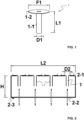
- a steam inlet pipe 2-2 protrudes from below into the apparatus for each molded part, which is positioned vertically below the molded part at a distance of 5 cm.
- the steam supply is controlled by valves.
- the device for determining steam resistance 2 has external dimensions of 60 ⁇ 20 ⁇ 15 (L2 ⁇ H ⁇ D) cm.
- the molded parts are exposed to a steam flow at a temperature of 100°C for 75 minutes.
- the steam flow through a steam supply line is 0.3 g/min. Condensed water vapor can flow out through an opening 2-3 in the lower part of the test apparatus, while the non-condensing portion of the water vapor can escape through the openings in the molded parts.
- the steam supply is turned off and the molded parts are allowed to cool for a period of 75 minutes.
- the ambient temperature is 23°C and the relative humidity is 60%.
- the new cycle begins again with the steam coating of the molded parts.
- the molded parts are visually assessed for the formation of hairline cracks. Hairline cracks form particularly on the pipe near the steam supply line and in the area of the transition to the flange.
- the table shows the number of test cycles in which hairline cracks were first observed on the molded part. If the molded parts do not show any hairline cracks even after 1001 cycles, the test is aborted.
- test specimens are produced on an Arburg injection moulding machine, model Allrounder 420 C 1000-250. Cylinder temperatures between 230 and 320 °C are used. The mold temperature is 80 °C. Polished molds are used for the plates for the transmission measurement and the molded parts for determining the steam resistance.
- the examples and comparison examples show that the good Combination of (thermo)mechanical properties (in particular good values for HDT, modulus of elasticity and elongation at break as well as notched impact strength) and good load-bearing capacity with steam cycles can only be achieved for the polyamide molding compounds according to the invention.
- a comparison with VB1 shows that dodecanedioic acid (or corresponding long-chain diacids as claimed) is a crucial building block
- a comparison with VB2 shows that laurolactam (or corresponding long-chain lactams as claimed) is a crucial building block. Without these building blocks, the properties according to the invention cannot be achieved.
- a comparison with VB3 and VB4 shows that the specific setting of the proportions is crucial.
Landscapes
- Chemical & Material Sciences (AREA)
- Health & Medical Sciences (AREA)
- Chemical Kinetics & Catalysis (AREA)
- Medicinal Chemistry (AREA)
- Polymers & Plastics (AREA)
- Organic Chemistry (AREA)
- Life Sciences & Earth Sciences (AREA)
- Proteomics, Peptides & Aminoacids (AREA)
- Compositions Of Macromolecular Compounds (AREA)
- Polyamides (AREA)
Description
- Die vorliegende Erfindung betrifft transparente Polyamide auf Basis von cycloaliphatischen Diamin-Bausteinen und aromatischen Dicarbonsäure-Bausteinen, die sich durch besondere Widerstandsfähigkeit gegenüber Wasserdampf auszeichnen, sowie durch gute mechanische Eigenschaften. Weiter betrifft die Erfindung Verfahren zur Herstellung derartiger transparenter Polyamide, Verwendungen derartiger Polyamide und Bauteile aus derartigen Polyamiden.
- Transparente amorphe Copolyamidformmassen und daraus herstellbare transparente amorphe Polyamidformkörper sind aus dem Stand der Technik bekannt. Grundsätzlich werden dabei im Bereich der transparenten Polyamide zwei Polymertypen unterschieden, und zwar zum einen mikrokristalline transparente Polyamide und zum anderen amorphe transparente Polyamide.
- Mikrokristalline transparente Copolyamidformmassen und deren Verwendung für Brillengestelle, Apparateschaugläser sowie -abdeckungen und Leuchtenabdeckungen sind z.B. aus der
DE-A-43 10 970 bekannt. Die dort beschriebenen Polyamide werden aus 4,4'-Diaminocyclohexylmethan als Diaminkomponente und Dodecandisäure als Säurekomponente hergestellt. - In der
EP-A-1 595 907 sind transparente amorphe Polyamide beschrieben, die auf cycloaliphatischen Diaminen und einer C14-Dicarbonsäure basieren. - Aus der
EP-A-0 725 101 sind zudem transparente, amorphe Polyamide auf Basis von cycloaliphatischen Diaminen und einer C12-Dicarbonsäure bekannt mit u.a. ausgezeichneter Spannungsrissbeständigkeit in den meisten Lösungsmitteln. - Solche transparente Systeme auf Basis von cycloaliphatischen Diaminen können auch aromatische Bausteine enthalten. So sind beispielsweise aus der
EP-A-725100 DE-C-2642244 , derWO-A-2007/087896 und derEP-A-2 666 803 transparente Systeme des Typs MACMI/MACMT/12, respektive aus derEP-A-055 335 US-2009/306308 sind transparente Systeme des Typs PACMT/PACM10/12 respektive des Typs PACMT/PACM14/12 sowie PACMT/MACM14/12 bekannt, jeweils mit einem hohen aliphatischen Anteil und ungenügenden thermomechanischen Eigenschaften.US 5,416,172 offenbart transparente Systeme des Typs MACMI/MACMT/MACM6/12. -
EP-A-0603813 beschreibt Formkörper aus transparenten Copolyamiden und die transparenten Copolyamide selbst, aufgebaut aus langkettigen Monomeren mit 9 bis 12 C-Atomen und aus Monomeren für teilaromatische Polyamide in statistischer Verteilung, die sich auch im konditionierten Zustand durch Steifigkeit, Festigkeit, hohe Zähigkeit und ausgezeichnete Lösemittelbeständigkeit auszeichnen. - Die einleitend erwähnten transparenten Polyamide verfügen, je nach Einstellung, über gute mechanische Eigenschaften und über eine gute Transparenz. Es zeigt sich aber, dass die aus dem Stand der Technik bekannten transparenten Polyamid-Systeme eine ungenügende Widerstandsfähigkeit gegenüber wiederholten Aussetzens von Wasserdampf aufweisen. Insbesondere zeigt es sich, dass die bekannten Systeme in der Regel unter diesen Bedingungen Haarrisse ausbilden, und dadurch sowohl ihre Transparenz verlieren, als auch die mechanischen Eigenschaften beeinträchtigt werden und gegebenenfalls auch die Dichtigkeit, wenn es darum geht, durch derartige Materialien Räume voneinander abzugrenzen.
- Es ist entsprechend unter anderem Aufgabe der vorliegenden Erfindung, eine gegenüber dem Stand der Technik verbesserte transparente Polyamid-Formmasse bereitzustellen, insbesondere eine transparente Formmasse, die auf cycloaliphatischen Diaminen und aromatischen Dicarbonsäuren sowie weiteren aliphatischen Bausteinen beruht, und die eine hohe Widerstandsfähigkeit gegenüber Wasserdampf zeigt. Die Bauteile sind zudem kratzfest und nehmen wenig Wasser auf, und sie weisen eine hohe Chemikalienbeständigkeit auf, was auch bedeutet, dass sie beispielsweise, wenn sie Nahrungsmitteln oder Chemikalien mit Farbstoffen ausgesetzt sind, ohne weiteres wieder gereinigt werden können ohne dass Färbungen zurückbleiben.
- Gegenstand der vorliegenden Erfindung ist entsprechend eine Polyamidformmasse gemäss Anspruch 1, respektive Verwendungen einer derartigen Polyamidformmasse, Herstellungsverfahren für derartige Polyamidformmassen und daraus erzeugte Formteile. Konkret betrifft die vorliegende Erfindung eine Polyamidformmasse enthaltend mindestens ein Copolyamid. Dieses Copolyamid ist aufgebaut wenigstens aus den Polyamid-Einheiten AB/AC/D, wie unten definiert. Es kann dabei auch noch weitere Polyamid-Einheiten in diesem Copolyamid geben, bevorzugt gibt es aber nur diese Polyamid-Einheiten. Insbesondere wenn beispielsweise für (A) wie unten definiert zwei verschiedene Systeme ausgewählt werden, können komplexe Strukturen aufgebaut werden.
- Werden beispielsweise für (A) zwei verschiedene Systeme A' und A" ausgewählt, so kann das Polyamid anschliessend geschrieben werden als A'B/A"C/D als Kurzform, bei genauer Betrachtung handelt es sich aber um ein System mit folgenden Polyamid-Einheiten: A'B/A'C/A"B/A"C/D.
- Die Bausteine des Copolyamids aufgebaut wenigstens aus den Polyamid-Einheiten AB/AC/D sind dabei wie folgt definiert:
- (A) ist ausgewählt als wenigstens ein cycloaliphatisches Diamin aus der Gruppe: Bis-(4-amino-3-methyl-cyclohexyl)methan (MACM) und Bis-(4-amino-cyclohexyl)methan (PACM).
- (B) ist ausgewählt als wenigstens eine aromatische Dicarbonsäure aus der Gruppe: Isophthalsäure (I), Naphtalindicarbonsäure, und Terephthalsäure (T).
- (C) ist ausgewählt als wenigstens eine aliphatische Dicarbonsäure aus der Gruppe: Decandisäure, Undecandisäure, Dodecandisäure, Tridecandisäure, Tetradecandisäure, Pentadecandisäure, Hexadecandisäure.
- (D) ist ausgewählt als wenigstens ein Lactam oder eine α,ω-Aminocarbonsäure aus der Gruppe: Laurinlactam (LC 12), Undecanolactam (LC 11), 12-Aminododecansäure, und 11-Aminoundecansäure.
- Dabei gelten folgende Massgaben:
- die Anteile der Polyamid-Einheiten AB liegen im Bereich von 30 bis 45 mol-%,
- die Anteile der Polyamid-Einheiten AC liegen im Bereich von 30 bis 40 mol-% und
- die Anteile der Polyamid-Einheiten D liegen im Bereich von 20 bis 32 mol-%,
- wobei die Summe der Polyamid-Einheiten AB, AC und D 100 mol-% beträgt.
- Es zeigt sich, dass Polyamidformmassen aus diesem Copolyamid die Nachteile der transparenten aus dem Stand der Technik bekannten Formmassen überwinden können, und bei guter Transparenz gute thermomechanische Eigenschaften bereitstellen können, und insbesondere auch gegenüber häufigem Kontakt mit Wasserdampf einer Temperatur von 100 °C stabil sind, namentlich keine oder nur wenig Trübung erfahren und/oder Haarrisse ausbilden. Entsprechend sind derartige Formteile nicht nur für den Küchenbereich und zur Verwendung in der Spülmaschine geeignet, sondern sie sind auch für Foodprozessoren mit Dampfbehandlung besonders geeignet.
- Es zeigt sich insbesondere, dass diese Eigenschaften nur erreicht werden können, wenn es eben die langkettigen aliphatischen Dicarbonsäuren als Bausteine neben den langkettigen Lactamen oder α,ω-Aminocarbonsäuren gibt, in Kombination mit wenigstens einem cycloaliphatischen Diamin und wenigstens einer aromatischen Dicarbonsäure. Wird einer dieser Bausteine weggelassen, lassen sich die Eigenschaften nicht erreichen. Werden zudem die Komponenten nicht in den beanspruchten Proportionen eingesetzt, lassen sich die Eigenschaften ebenfalls nicht erreichen, wie weiter unten anhand der
- Ausführungsbeispiele dargelegt werden wird.
- Die Transparenz einer aus der transparenten Formmasse hergestellten Platte mit Dicke von 2 mm, gemessen als Lichttransmission gemäss ASTM D1003, beträgt bevorzugt über 90%, insbesondere bevorzugt mindestens 92% und der Haze (Trübung) bevorzugtermassen maximal 5%, insbesondere bevorzugt maximal 3%. Für die angestrebte Verwendung der erfindungsgemässen Formmassen werden Steifigkeiten (Zug-E-Modul grösser 1500 MPa) und hohe Zähigkeiten (bevorzugtermassen Schlagzähigkeit bei 23 °C und -30 °C: ohne Bruch) erzielt.
- Der Wert der Lichttransmission, welche als Mass für die Transparenz verwendet wird, ist dabei im Rahmen der vorliegenden Anmeldung stets als bestimmt nach der Methode ASTM D1003:2013 (Lichtart CIE-C) zu verstehen. Die Messung der Lichttransmission wurde dabei in den unten angeführten Experimenten auf einem Gerät mit dem Namen Haze Guard Plus der Firma BYK Gardner (DE) an Rundplatten 70 x 2 mm oder Platten der Dimension 60 x 60 x 2 mm durchgeführt. Der Transmissionswert wird für den sichtbaren Wellenlängenbereich definiert nach CIE-C d. h. mit wesentlichen Intensitäten ca. zwischen 400 und 770nm, angegeben. Die Rundplatten 70 x 2 mm bzw. quadratischen Platten 60 x 60 x 2 mm werden z. B. dafür auf einer Arburg Spritzgussmaschine im polierten Werkzeug hergestellt, wobei die Zylindertemperatur zwischen 200 °C und 340 °C und die Werkzeugtemperatur zwischen 20 °C und 140 °C liegt.
- Gemäss einer weiteren bevorzugten Ausführungsform weist das Copolyamid eine Glasübergangstemperatur (Tg) von 150 °C bis 200 °C, besonders bevorzugt von 160 °C bis 180 °C auf.
- Eine erste bevorzugte Ausführungsform der Polyamidformmasse ist dadurch gekennzeichnet, dass die Summe der aliphatischen Polyamid-Einheiten AC und D im Bereich von 55-65 mol-%, vorzugsweise im Bereich von 58-64 mol-% liegt. Es zeigt sich, dass die spezifische Auswahl der aliphatischen Einheiten in diesem Bereich insbesondere die Widerstandsfähigkeit gegenüber Wasserdampf einer hohen Temperatur erhöht. Bevorzugtermassen liegen die Anteile der Polyamid-Einheiten AB im Bereich von 35 - 45 mol-%, vorzugsweise im Bereich von 36-42 mol-%.
- Weiter bevorzugtermassen liegen die Anteile der Polyamid-Einheiten AC im Bereich von 31-38, vorzugsweise im Bereich von 32-35 mol-%.
- Gemäss einer weiteren bevorzugten Ausführungsform liegen die Anteile der Polyamid-Einheiten D im Bereich von 22-31, vorzugsweise im Bereich von 25-30 mol-%.
- Besonders gute Eigenschaften für die Polyamidformmasse werden erhalten, wenn das Copolyamid AB/AC/D amorph ist und wenn (A) ausgewählt ist als ausschliesslich Bis-(4-amino-3-methyl-cyclohexyl)methan (MACM). Amorph im Sinne der Erfindung bedeutet, dass das Copolyamid eine Schmelzenthalpie bestimmt nach ISO 11357-3 (2012) von kleiner gleich 3 J/g aufweist.
- (B) ist bevorzugtermassen ausgewählt als eine Mischung von Isophthalsäure (I) und Terephthalsäure (T). Dabei liegt vorzugsweise das Verhältnis von Isophthalsäure (I) zu Terephthalsäure (T) im Bereich von 40:60 bis 60:40, insbesondere bevorzugt im Bereich von 45:55 bis 55:45. Typischerweise werden die beiden Bausteine im Wesentlichen in einem Verhältnis 1:1 eingesetzt.
- Wie erwähnt ist es für die Erreichung der Effekte wichtig, dass eine langkettige Dicarbonsäure eingesetzt wird. Besonders gute Eigenschaften können erhalten werden, wenn (C) ausgewählt ist ausschliesslich aus Dodecandisäure.
- Weiterhin ist es bevorzugt, dass (C) ausgewählt ist ausschliesslich aus Dodecandisäure und (D) ausgewählt ist ausschliesslich aus Laurinlactam (LC 12).
- Besonders stabile Eigenschaften können erhalten werden, wenn das Copolyamid ausschliesslich aus den Polyamid-Einheiten AB/AC/D besteht. Dabei ist wie oben erwähnt zu berücksichtigen, dass darunter die Kurzform zu verstehen ist, und wenn beispielsweise zwei verschiedene cycloaliphatische Diamine für (A) eingesetzt werden, so umfasst die ausschliesslich vorliegende Struktur A'B/A"C/D als Kurzform auch das eigentlich vorliegende System mit folgenden Polyamid-Einheiten: A'B/A'C/A"B/A"C/D.
- Eine ganz besonders bevorzugte Ausführungsform der Polyamidformmasse verfügt über folgenden Aufbau: MACMT/MACMI/MACM12/12, d. h. ist aufgebaut ausschliesslich aus MACM, Terephthalsäure, Isophthalsäure, Dodecandisäure und Laurinlactam. Dabei sind bevorzugt die Polyamid-Einheiten verteilt wie folgt, wobei sich die Prozente auf Mol beziehen und auf 100% addieren:
MACMT/MACMI/MACM12/12: 17-22 %/17-22 %/31-36 %/24-31 %. - Eine derartige Polyamidformmasse kann und wird typischerweise für viele Anwendungen zusätzlich mit den für die Einstellung der Eigenschaften erforderlichen Additiven versetzt. Die erfindungsgemässen Polyamidformmassen können also die üblichen Additive in den üblicherweise geringen Anteilen, wie z.B. weniger als 15 Gew.-%, bevorzugtermassen weniger als 10 Gew.-%, insbesondere bevorzugt weniger als 0.1-5.0 Gew.-% aufweisen.
- Entsprechend betrifft die vorliegende Erfindung gemäss einer weiteren bevorzugten Ausführungsform eine derartige Polyamidformmasse, die besteht aus
- 85-100 Gew.-%, vorzugsweise 90-100 Gew.-%, insbesondere vorzugsweise 95.0-99.9 Gew.% Copolyamid aufgebaut wenigstens aus den Polyamid-Einheiten AB/AC/D wie oben dargelegt;
- 0-15 Gew.-%, vorzugsweise 0-10 Gew.-%, insbesondere vorzugsweise 0.1-5.0 Gew.% Additiven, vorzugsweise ausgewählt aus der Gruppe: vom erfindungsgemässen Copolyamid AB/AC/D verschiedene Polyamide; UV-Stabilisatoren; Hitzestabilisatoren; Radikalfänger; Verarbeitungshilfsstoffe; Einschlussverhinderer; Gleitmittel; Entformungshilfsstoffe, einschliesslich Metallstearate oder -montanate, wobei das Metall vorzugsweise ausgewählt ist aus der Gruppe bestehend aus Magnesium, Calcium, Barium, Mineralöle oder Fettsäureamide; Entschäumer; Weichmacher; funktionelle Additive zur Beeinflussung der optischen Eigenschaften, insbesondere des Brechungsindexes; Schlagzähmodifikatoren; Füll- und/oder Zuschlagsstoffe; optische Aufheller; Farbstoffe oder Mischungen davon, wobei die Füll- und/oder Zuschlagstoffe bevorzugtermassen nanoskalig sind und/oder ausgewählt sind aus folgender Gruppe: Glasfasern, Glaskugeln, Carbonfasern, Russ, Graphit, Flammschutzmittel, Mineral einschliesslich Titandioxid, Calciumcarbonat oder Bariumsulfat, oder Mischungen davon.
- Bevorzugte vom erfindungsgemässen Copolyamid AB/AC/D verschiedene Polyamide sind PA11, PA12, PA 610, PA612, PA614, PA616, PA1010, PA1012, PA1014 und PA1016, insbesondere bevorzugt ist PA12.
- Bevorzugte Schlagzähmodifikatoren stammen aus der Gruppe, ausgewählt aus säure- oder säureanhydridmodifizierten Ethylen-α-Olefin-Copolymeren, Ethylen-Glycidylmethacryl-säure-Copoly¬meren und Methacrylat-Butadien-Styrol-Copolymeren.
- Den erfindungsgemässen Formmassen können also auch Füll- oder Verstärkungsmittel zugegeben werden. In diesem Fall sind die aus den Formmassen hergestellten Formteile natürlich nicht notwendigerweise transparent. Neben Glas- und Kohlenstofffasern können als Verstärkungsmittel besonders solche auf Basis von nachwachsenden Rohstoffen und Bioanteilen über 50% eingesetzt werden. Besonders bevorzugt werden Naturfasern, wie z. B. Cellulose-, Hanf-, Flachs-, Baumwoll-, Woll- oder Holzfasern eingesetzt. Bevorzugtermassen verfügt eine solche Polyamidformmasse aber über keine Additive in Form von partikel- und/oder faserförmigen Füll- und/oder Zuschlagstoffe.
- Zudem betrifft die vorliegende Erfindung ein Verfahren zur Herstellung einer Polyamidformmasse wie oben beschrieben, wobei dieses Verfahren bevorzugt dadurch gekennzeichnet ist, dass die Herstellung des Copolyamids aufgebaut wenigstens aus den Polyamid-Einheiten AB/AC/D in Druckgefässen erfolgt, mit einer Druckphase bei 270 °C bis 330 °C mit einer nachfolgenden Entspannung bei 260 °C bis 320 °C, mit einer nachfolgenden Entgasung bei 260 °C bis 320 °C sowie Austragen der Polyamidformmasse in Strangform, Abkühlen, Granulieren und Trocknen des Granulats, ggf. Compoundieren mit Additiven als Granulat und Formen in einem Extruder bei Massetemperaturen von 250 °C bis 350 °C zu einem Strang, Schneiden mit geeigneten Granulatoren zu Pellets. Bevorzugt weisen die erfindungsgemässen Copolyamide eine Lösungsviskosität (ηrel) bestimmt an Lösungen von 0.5 g Polymer in 100 ml m-Kresol gemäss ISO 307 (2013) bei 20°C zwischen 1.5 und 2.5, besonders bevorzugt zwischen 1.6 und 2.0 und ganz besonders bevorzugt zwischen 1.65 und 1.85 auf.
- Zur Einstellung der gewünschten relativen Viskosität, gemessen in einer Lösung von 0.5 g Polymer in 100 ml m-Kresol bei 20 °C, können entweder das Diamin oder die Dicarbonsäuren in geringem Überschuss von 0.01 bis 3 Mol-% eingesetzt werden. Bevorzugt wird die Regelung mit Monoamin oder Monocarbonsäuren von 0.01 bis 2.0 Gew.-%, bevorzugt 0.05 bis 0.5 Gew.-% durchgeführt. Geeignete Regler sind Benzoesäure, Essigsäure, Propionsäure, Stearylamin oder deren Mischungen. Besonders bevorzugt sind Regler mit Amin- oder Carbonsäuregruppen, die zusätzlich Stabilisatorgruppen des Typs HALS oder des Typs tert-Butyl-Phenol enthalten, wie beispielsweise Triacetondiamin oder Isophthalsäure-Di-Triacetondiamin-Derivate. Besonders bevorzugt wird eine Regelung der Viskosität mit einer Kombination aus Diamin-Überschuss und Monocarbonsäure. Geeignete Katalysatoren zur Beschleunigung der Polykondensationsreaktion sind phosphorhaltige Säuren, wie beispielsweise H3PO2, H3PO3, H3PO4, deren Salze oder organischen Derivate, die gleichzeitig eine Reduzierung der Verfärbung während der Verarbeitung bewirken. Die Katalysatoren werden im Bereich von 0.01 bis 0.5 Gew.-%, bevorzugt im Bereich von 0.03 bis 0.1 Gew.-% zugegeben. Geeignete Entschäumer zur Vermeidung der Schaumbildung während der Entgasung sind wässrige Emulsionen, die Silicone oder Siliconderivate im Bereich von 0.001 bis 1,0 Gew.%, bevorzugt im Bereich von 0.01 bis 0.10 bei 10%iger Emulsion enthalten.
- Geeignete Hitze- oder UV-Stabilisatoren können bereits vor der Polykondensation dem Ansatz in Mengen von 0.01 bis 0.5 Gew.-% zugegeben werden. Bevorzugt werden hochschmelzende Typen eingesetzt. Besonders bevorzugt wird Irganox 1098 verwendet. Zudem betrifft die vorliegende Erfindung Formteile aus einer derartigen Polyamidformmasse. Insbesondere betrifft die Erfindung wasserdampf-beständige, transparente Formteils, aus einer Polyamidformmasse oder mit wenigstens einem Bereich aus einer Polyamidformmasse wie oben beschrieben, vorzugsweise hergestellt mittels Spritzgiessverfahren und/oder Spritzprägeverfahren bei Massetemperaturen von 230 °C bis 320 °C, wobei das Werkzeug mit Temperaturen von 40 °C bis 130 °C eingestellt wird und wobei gegebenenfalls das Werkzeug mit Temperaturen von 40 °C bis 130 °C nach dem Füllen der Kavität einen Prägedruck auf das heisse Formteil aufbringt.
- Besonders geeignete Verfahren zur Herstellung von fehlerfreien, spannungsarmen Oberflächen des Formteils aus den erfindungsgemässen, transparenten Polyamidformmassen, wie beispielsweise Linsen für Brillen oder hochwertige Gehäuseteile, ist ein Expansionsspritzprägeprozess, wobei Kavitäten mit Wandstärken von 1 bis 5 mm gefüllt werden und anschliessend die Werkzeugkavität bei permanenter Füllung auf höhere Wandstärken auseinandergefahren wird.
- Geeignete Verfahren zur Herstellung von Folien, Rohren und Halbzeugen in Ein- oder Mehrschichtausführung aus den erfindungsgemässen, transparenten Polyamidformmassen sind Extrusionsverfahren auf Ein- oder Mehrwellenextrudern mit Massetemperaturen zwischen 250 °C bis 350 °C, wobei je nach Verträglichkeit der verschiedenen Schichten geeignete Haftvermittler in Form entsprechender Copolymere oder Blends eingesetzt werden können.
- Formteile können massegefärbt oder mittels sogenannter Tauchbäder nachträglich eingefärbt werden. Formteile werden gegebenenfalls durch Fräsen, Bohren, Schleifen, Lasermarkieren, -schneiden und/oder -schweissen bearbeitet.
- Derartige Formteile sind insbesondere bevorzugt dadurch gekennzeichnet, dass sie eine Widerstandsfähigkeit gegenüber Wasserdampfzyklen von mehr als 700, vorzugsweise von mehr als 1000 aufweist.
- Bei einem solchen Formteil kann es sich bevorzugt um eine Leitung oder einen Behälter handeln, vorzugsweise für Kontakt mit Wasser und/oder Wasserdampf. Insbesondere bevorzugt handelt es sich um eine Leitung oder einen Behälter in der Prozesstechnologie (inklusive Heizungstechnik), in der Nahrungsmitteltechnologie, insbesondere um einen Behälter für die Herstellung und/oder Verarbeitung und/oder das Aufwärmen von Nahrungsmitteln, bevorzugt im Baby- und/oder Kleinkindernahrungsmittelbereich.
- Ein derartiges Formteil ist bevorzugtermassen gekennzeichnet durch eine Lichttransmission, gemessen nach ASTM D1003 (2013), bestimmt an Platten mit einer Dimension 2 x 60 x 60 mm oder an Rundplatten der Dimension 2 x 70 mm, bei einer Temperatur von 23 °C, mit dem Messgerät Haze Gard Plus der Firma Byk Gardner mit der CIE Lichtart C, wobei die Lichttransmission wenigstens 88%, bevorzugt wenigstens 90% und besonders bevorzugt wenigstens 92% beträgt.
- Zu guter Letzt betrifft die vorliegende Erfindung auch die Verwendung eines derartigen Formteils als Teil eines Haushaltsgerätes, insbesondere Nahrungsmittelbehälter oder Teil davon, insbesondere als Teil eines Küchengeräts, insbesondere für die Herstellung und/oder Verarbeitung und/oder das Aufwärmen von Nahrungsmitteln unter Verwendung von Wasserdampf.
- Weitere Ausführungsformen sind in den abhängigen Ansprüchen angegeben.
- Bevorzugte Ausführungsformen der Erfindung werden im Folgenden anhand der Zeichnungen beschrieben, die lediglich zur Erläuterung dienen und nicht einschränkend auszulegen sind. In den Zeichnungen zeigen:
- Fig. 1
- Formteil zur Bestimmung der Wasserdampf-Beständigkeit;
- Fig. 2
- Gerät zur Bestimmung der Wasserdampf-Beständigkeit.
- Bevorzugte Ausführungsformen der Erfindung werden im Folgenden anhand der Ausführungsbeispiele beschrieben, die lediglich zur Erläuterung dienen und nicht einschränkend auszulegen sind.
- Die Herstellung der erfindungsgemässen transparenten Copolyamide erfolgt in an sich bekannter Weise in bekannten, rührbaren Druckautoklaven mit einem Vorlagegefäss und einem Reaktionsgefäss:
Im Vorlagegefäss wird deionisiertes Wasser (25 Gew.-% bezogen auf den Ansatz in Tabelle 1) vorgelegt und die Monomere und Zusatzstoffe zugegeben. Danach wird mehrfach mit Stickstoffgas inertisiert. Unter Rühren wird auf 180 bis 230 °C unter dem sich einstellenden Druck aufgeheizt, um eine homogene Lösung zu erhalten. Diese Lösung wird durch ein Sieb in das Reaktionsgefäss gepumpt und dort auf die gewünschte Reaktionstemperatur von 260 bis 350 °C bei einem Druck von maximal 30 bar aufgeheizt. Der Ansatz wird in der Druckphase für 2 bis 4 Stunden auf der Reaktionstemperatur gehalten. In der anschliessenden Entspannungsphase wird der Druck innerhalb von 1 bis 2 Stunden auf atmosphärischen Druck reduziert, wobei die Temperatur leicht sinken kann. - In der folgenden Entgasungsphase wird der Ansatz bei atmosphärischem Druck für 0.5 bis 1 Stunden auf einer Temperatur von 270 bis 350 °C gehalten. Die Polymerschmelze wird in Strangform ausgetragen, im Wasserbad bei 15 bis 80 °C abgekühlt und granuliert. Das Granulat wird für 12 Stunden bei 80 bis 120 °C unter Stickstoff oder im Vakuum auf einen Wassergehalt von weniger als 0.1 Gew.-% getrocknet.
- Zur Herstellung der in den Beispielen und Vergleichsbeispielen beschriebenen Copolyamide werden die folgenden Monomere verwendet:
- 3,3'-dimethyl-4,4'-diaminodicyclohexylmethan (MACM): Gefrierbereich nach ASTM D1015-55: - 7 bis - 0.6 °C; Hersteller: BASF AG, Deutschland.
- Dodecandisäure (DDS): Schmelzbereich: 128 bis 132 °C; Hersteller: Invista Nederland B.V., Niederlande.
- Isophthalsäure (IPS): Schmelzbereich: 345 bis 348 °C; Hersteller: Flint Hills Resources, Schweiz.
- Terephthalsäure (TPS): Schmelzbereich: > 400 °C; Hersteller: BP Amoco Chemical Company, USA.
- Laurinlactam (LL): Schmelzbereich: 149 bis 153 °C; Hersteller: EMS-CHEMIE AG, Schweiz
- Zusätzlich wurden ca. 0.15 Gew.-% Benzoesäure als Kettenregler und ca, 0.01 Gew.-% Antifoam RD als Entschäumer (10 Gew.-% Emulsion, Dow Corning S.A., Belgien) eingesetzt, wobei sich die Konzentrationen jeweils auf den Ansatz in Tabelle 1 beziehen.
- Die Messungen wurden nach den folgenden Normen und an den folgenden Prüfkörpern durchgeführt.
- ISO 527 (2012) mit einer Zuggeschwindigkeit von 1 mm/min ISO-Zugstab, Norm: ISO/CD 3167, Typ A1, 170 x 20/10 x 4 mm Temperatur 23 °C.
- ISO 527 (2012) mit einer Zuggeschwindigkeit von 50 mm/min ISO-Zugstab, Norm: ISO/CD 3167, Typ A1, 170 x 20/10 x 4 mm Temperatur 23 °C.
- ISO 179/*eA (* 2 = instrumentiert) (2011); ISO-Prüfstab, Norm: ISO/CD 3167, Typ B1, 80 x 10 × 4 mm; Temperatur 23 °C.
- ISO-Norm 11357-1, 11357-2, 11357-3 (2013); Granulat; Die Differential Scanning Calorimetry (DSC) wurde mit dem Gerät DSC 2920 der Firma TA Instruments mit einer Aufheizrate von 20 K/min und einer Abkühlrate von 5 K/min durchgeführt. Das Thermogramm wurde mit dem Programm Universal Analysis 2000 der Firma TA Instruments ausgewertet. Zur Bestimmung der Glasübergangstemperatur wurde die Probe nach der ersten Aufheizung in Trockeneis abgeschreckt. Die Glasübergangstemperatur (Tg) wurde bei der zweiten Aufheizung bestimmt. Der Mittelpunkt des Glasübergangsbereichs, welcher als Glasübergangstemperatur (Tg) angegeben wurde, wurde nach der Methode "Half Height" ermittelt.
- ASTM D 1003 (2013); Rundplatte 70 mm oder Platte 60 x 60 mm, Dicke 2 mm, Temperatur 23 °C; Messgerät Haze Gard plus der Firma Byk Gardner mit CIE Lichtart C. Der Lichttransmissionswert wird in % der eingestrahlten Lichtmenge angegeben.
- ISO 307 (2007); 0,5 g in 100 ml Lösungsmittel in m-Kresol Temperatur 20 °C; Berechnung der relativen Viskosität (RV) nach RV = t/to in Anlehnung an Abschnitt 11 der Norm.
- HDT A (1,8 MPa) und HDT B (0.45 MPa):
ISO 75; ISO-Schlagstab 80x10x4. - Die Formteile 1, Rohrstücke mit einseitigem Flansch (vgl.
Fig. 1 ), werden im Spritzguss aus den beschriebenen Materialien hergestellt und haben die im Folgenden angegebenen Dimensionen: Rohrlänge L1 = 100 mm, Innendurchmesser Rohr D1 = 20 mm, Wandstärke von Rohr und Flansch= 2 mm, Flanschdurchmesser F1 = 100 mm, Radius zwischen Rohr und Flansch = 5 mm. Für den Test werden 4 Formteile von oben in die Öffnungen des Gerätes zur Bestimmung der Wasserdampf-Beständigkeit 2 (vgl.Fig. 2 ) eingesetzt, so dass das Rohr 1-1 in den Innenraum des Gerätes hineinragt und der Flansch 1-2 in Bezug auf die Öffnung 2-1 (Durchmesser der Öffnung D2 = 50 mm) zentriert auf der Aussenseite aufliegt. Damit die Formteile diese Position während des Tests beibehalten, sind auf der Oberseite der Testapparatur Führungselemente angebracht. Von unten ragt pro Formteil je ein Wasserdampfeinleitungsrohr 2-2 in die Apparatur hinein, das senkrecht unterhalb des Formteils zentrisch in einem Abstand von 5 cm positioniert ist. Die Dampfzufuhr wird über Ventile gesteuert. Das Gerät zur Bestimmung der Dampfbeständigkeit 2 hat die Aussenmasse 60 × 20 × 15 (L2 × H × T) cm. - Während des ersten Teils des Tests, der Dampfbehandlung, werden die Formteile 75 Minuten einem Dampfstrom mit einer Temperatur von 100°C ausgesetzt. Der Dampfstrom einer Dampfzuleitung beträgt dabei 0.3 g/min. Kondensierter Wasserdampf kann über eine Öffnung 2-3 im unteren Teil der Testapparatur abfliessen, während der nicht kondensierende Anteil des Wasserdampfes durch die Öffnungen der Formteile entweichen kann.
- Nach 75 Minuten Dampfbehandlung wird die Dampfzufuhr abgestellt und die Formteile können für einen Zeitraum von 75 Minuten abkühlen. Die Umgebungstemperatur beträgt dabei 23°C und die relative Luftfeuchte 60%.
- Nach Beendigung der Abkühlungsphase beginnt der neue Zyklus wiederum mit der Bedampfung der Formteile.
- Im Laufe des Tests werden die Formteile optisch auf die Bildung von Haarrissen beurteilt. Haarrisse bilden sich insbesondere am Rohr nahe der Dampfzuleitung und im Bereich des Übergangs zum Flansch aus. In der Tabelle ist die jeweilige Anzahl an Testzyklen aufgeführt, bei der erstmals Haarrisse am Formteil beobachtet wurden. Zeigen die Formteile auch nach 1001 Zyklen keine Haarrisse, so wird der Test abgebrochen.
- Die Prüfkörper werden auf einer Spritzgussmaschine der Firma Arburg, Modell Allrounder 420 C 1000-250 hergestellt. Dabei werden Zylindertemperaturen zwischen 230 und 320 °C verwendet. Die Formtemperatur beträgt 80 °C. Bei den Platten für die Transmissionsmessung und den Formteilen für die Bestimmung der Dampfbeständigkeit werden polierte Formen verwendet.
- In der unten abgebildeten Tabelle 1 werden die erfindungsgemässen Beispiele (B1 und B2) den Vergleichsbeispielen (VB1-VB4) gegenübergestellt.
Tabelle 1: Edukte Einheit B1 B2 VB1 VB2 VB3 VB4 TPS 9 6196 7200 13671 4652 8314 3520 IPS 9 6196 7200 7595 11048 8314 8810 DDS 9 16218 15500 0 18540 11034 14650 LL 9 11924 10425 25634 0 11002 15350 MACM 9 34972 36700 30913 41706 35288 32830 Struktureinheiten MACMT mol-% 18.15 20.96 31.91 16 24.56 9.83 MACMI mol-% 18.15 20.96 17.73 38 24.56 24.59 MACM12 mol-% 34.28 32.54 0 46 23.51 29.5 12 mol-% 29.41 25.55 50.37 0 27.36 36.08 MACMT + MACMI mol-% 36.3 41.92 49.64 54 49.12 34.42 MACM12+12 mol-% 63.69 58.09 50.37 46 50.88 65.58 Eigenschaften Tg °C 170 174 169 203 185 162 HDT B °C 153 157 150 189 175 139 HDT A °C 133 136 136 162 146 125 E-Modul MPa 1900 2000 2000 2130 2000 1930 Bruchfestigkeit MPa 74 76 79 78 80 76 Bruchdehnung % 120 115 90 91 72 115 Kerbschlagzähigkeit kJ/m2 12 12 11 12 11 10 Transparenz % 93.5 93.5 92.5 93.2 93.2 93.3 Dampfzyklen > 1000 >1000 530 570 620 680 Relative Viskosität 1.72 1.70 1.67 1.60 1.64x 1.74x - Anhand der Beispiele und der Vergleichsbeispiele lässt sich erkennen, dass die gute Kombination aus (thermo)mechanischen Eigenschaften (insbesondere gute Werte für HDT, E-Modul und Bruchdehnung sowie Kerbschlagzähigkeit) und guter Belastbarkeit mit Dampfzyklen nur für die erfindungsgemässen Polyamidformmassen erreicht werden kann. Insbesondere zeigt sich bei einem Vergleich mit VB1, dass Dodecandisäure (oder entsprechende langkettige Disäuren wie beansprucht) als Baustein entscheidend ist, und beim Vergleich mit VB2, dass das Laurinlactam (oder entsprechende langkettige Lactame wie beansprucht) als Baustein entscheidend ist. Ohne diese Bausteine können die erfindungsgemässen Eigenschaften nicht erreicht werden. Weiter zeigt sich beim Vergleich mit VB3 und mit VB4, dass die spezifische Einstellung der Proportionen entscheidend ist. So kann (vergleiche VB3) eine Formmasse mit zu wenig Dodecandisäure und zu viel aromatischen Dicarbonsäuren die Widerstandsfähigkeit gegenüber Dampfzyklen nicht gewährleisten. Weiter zeigt sich im Vergleich mit VB4, dass ein zu hoher Anteil an aliphatischen Blöcken ebenfalls keine genügende Widerstandsfähigkeit gegenüber Dampfzyklen zeigt.
- Die Beispiele zeigen im Vergleich mit den Vergleichsbeispielen also auf, dass die einzelnen Polyamid-Einheiten respektive Bausteine für die Gewährleistung der entscheidenden Eigenschaften kritisch verantwortlich sind, und dass die Proportionen nur im Rahmen der engen beanspruchten Bereiche zulässig sind, um die entscheidenden Eigenschaften auch wirklich bereitzustellen.
BEZUGSZEICHENLISTE 1 Formteil zur Bestimmung der Wasserdampf-Beständigkeit D1 Innendurchmesser von 1-1 F1 Durchmesser von 1-2 1-1 Rohr von 1 L1 Länge von 1 1-2 Flansch von 1 2 Gerät zur Bestimmung der Wasserdampf-Beständigkeit D2 Durchmesser von 2.1 2-1 Öffnung in 2 für 1 H Höhe von 2 2-2 Wasserdampfeinleitungsrohr L2 Länge von 2 2-3 Abflussöffnung
Claims (15)
- Polyamidformmasse enthaltend mindestens ein Copolyamid aufgebaut wenigstens aus den Polyamid-Einheiten AB/AC/D, wobei(A) als wenigstens ein cycloaliphatisches Diamin aus der Gruppe: Bis-(4-amino-3-methyl-cyclohexyl)methan (MACM) und Bis-(4-amino-cyclohexyl)methan (PACM), ausgewählt ist;(B) als wenigstens eine aromatische Dicarbonsäure aus der Gruppe: Isophthalsäure (I), Naphtalindicarbonsäure, und Terephthalsäure (T), ausgewählt ist;(C) als wenigstens eine aliphatische Dicarbonsäure aus der Gruppe: Decandisäure, Undecandisäure, Dodecandisäure, Tridecandisäure, Tetradecandisäure, Pentadecandisäure, Hexadecandisäure ausgewählt ist;(D) als wenigstens ein Lactam oder eine α,ω-Aminocarbonsäure aus der Gruppe: Laurinlactam (LC 12), Undecanolactam (LC 11), 12-Aminododecansäure, und 11-Aminoundecansäure, ausgewählt ist,wobeidie Anteile der Polyamid-Einheiten AB im Bereich von 30 bis 45 mol-%,die Anteile der Polyamid-Einheiten AC im Bereich von 30 bis 40 mol-% unddie Anteile der Polyamid-Einheiten D im Bereich von 20 bis 32 mol-% liegen,
undwobei die Summe der Polyamid-Einheiten AB, AC und D 100 mol-% beträgt. - Polyamidformmasse nach Anspruch 1, dadurch gekennzeichnet, dass die Summe der aliphatischen Polyamid-Einheiten AC und D im Bereich von 55-65 mol-%, vorzugsweise im Bereich von 58-64 mol-% liegt, und die Anteile der Polyamid-Einheiten AB im Bereich von 35 - 45 mol-% respektive im Bereich von 36 - 42 mol-% liegen.
- Polyamidformmasse nach einem der vorhergehenden Ansprüche, dadurch gekennzeichnet, dassund/oder die Anteile der Polyamid-Einheiten AC im Bereich von 31-38, vorzugsweise im Bereich von 32-35 mol-%,und/oder die Anteile der Polyamid-Einheiten D im Bereich von 22-31, vorzugsweise im Bereich von 25-30 mol-% liegen.
- Polyamidformmasse nach einem der vorhergehenden Ansprüche, dadurch gekennzeichnet, dass (A) ausgewählt ist als ausschliesslich Bis-(4-amino-3-methylcyclohexyl)methan (MACM).
- Polyamidformmasse nach einem der vorhergehenden Ansprüche, dadurch gekennzeichnet, dass (B) ausgewählt ist als eine Mischung von Isophthalsäure (I) und Terephthalsäure (T), wobei vorzugsweise das Verhältnis von Isophthalsäure (I) zu Terephthalsäure (T) im Bereich von 40:60 bis 60:40 liegt, insbesondere bevorzugt im Bereich von 45:55 bis 55:45.
- Polyamidformmasse nach einem der vorhergehenden Ansprüche, dadurch gekennzeichnet, dass (C) ausgewählt ist ausschliesslich aus Dodecandisäure.
- Polyamidformmasse nach einem der vorhergehenden Ansprüche, dadurch gekennzeichnet, dass (D) ausgewählt ist ausschliesslich aus Laurinlactam (LC 12).
- Polyamidformmasse nach einem der vorhergehenden Ansprüche, dadurch gekennzeichnet, dass das Copolyamid ausschliesslich aus den Polyamid-Einheiten AB/AC/D besteht.
- Polyamidformmasse nach einem der vorhergehenden Ansprüche, dadurch gekennzeichnet, dass sie besteht aus85-100 Gew.-%, vorzugsweise 90-100 Gew.-%, insbesondere vorzugsweise 95.0-99.9 Gew.% Copolyamid aufgebaut wenigstens aus den Polyamid-Einheiten AB/AC/D;0-15 Gew.-%, vorzugsweise 0-10 Gew.-%, insbesondere vorzugsweise 0.1-5.0 Gew.% Additiven, vorzugsweise ausgewählt aus der Gruppe: vom Copolyamid AB/AC/D verschiedene Polyamide; UV-Stabilisatoren; Hitzestabilisatoren; Radikalfänger; Verarbeitungshilfsstoffe; Einschlussverhinderer; Gleitmittel; Entformungshilfsstoffe, einschliesslich Metallstearate oder-montanate, wobei das Metall vorzugsweise ausgewählt ist aus der Gruppe bestehend aus Magnesium, Calcium, Barium, Mineralöle oder Fettsäureamide; Entschäumer; Weichmacher; funktionelle Additive zur Beeinflussung der optischen Eigenschaften, insbesondere des Brechungsindexes; Schlagzähmodifikatoren; Füll- und/oder Zuschlagsstoffe; optische Aufheller; Farbstoffe oder Mischungen davon, wobei die Füll- und/oder Zuschlagstoffe bevorzugtermassen nanoskalig sind und/oder ausgewählt sind aus folgender Gruppe: Glasfasern, Glaskugeln, Carbonfasern, Russ, Graphit, Flammschutzmittel, Mineral einschliesslich Titandioxid, Calciumcarbonat oder Bariumsulfat, oder Mischungen davon.
- Polyamidformmasse nach Anspruch 9, dadurch gekennzeichnet, dass die Additive keine partikel- und/oder faserförmigen Füll- und/oder Zuschlagstoffe enthalten.
- Verfahren zur Herstellung einer Polyamidformmasse gemäss einem der Ansprüche 1 bis 10, dadurch gekennzeichnet, dass die Herstellung des Copolyamids aufgebaut wenigstens aus den Polyamid-Einheiten AB/AC/D in Druckgefässen erfolgt, mit einer Druckphase bei 180°C bis 330 °C, vorzugsweise 270 °C bis 330 °C mit einer nachfolgenden Entspannung bei 260°C bis 350 °C, vorzugsweise 260 °C bis 320 °C, mit einer nachfolgenden Entgasung bei 260 °C bis 350°C, vorzugsweise 270°C bis 320 °C sowie Austragen der Polyamidformmasse in Strangform, Abkühlen, Granulieren und Trocknen des Granulats, ggf. Compoundieren mit Additiven als Granulat und Formen in einem Extruder bei Massetemperaturen von 250 °C bis 350 °C zu einem Strang, Schneiden mit geeigneten Granulatoren zu Pellets.
- Formteil, insbesondere wasserdampf-beständiges, transparentes Formteil, aus einer Polyamidformmasse oder mit wenigstens einem Bereich aus einer Polyamidformmasse gemäss einem der Ansprüche 1 bis 10, vorzugsweise hergestellt mittels Spritzgiessverfahren und/oder Spritzprägeverfahren bei Massetemperaturen von 230 °C bis 320 °C, wobei das Werkzeug mit Temperaturen von 40 °C bis 130 °C eingestellt wird und wobei gegebenenfalls das Werkzeug mit Temperaturen von 40 °C bis 130 °C nach dem Füllen der Kavität einen Prägedruck auf das heisse Formteil aufbringt.
- Formteil nach Anspruch 12, dadurch gekennzeichnet, dass es eine Widerstandsfähigkeit gegenüber Dampfzyklen von mehr als 700, vorzugsweise von mehr als 1000 aufweist.
- Formteil nach einem der vorhergehenden Ansprüche, dadurch gekennzeichnet, dass es sich um eine Leitung oder einen Behälter handelt, vorzugsweise für Kontakt mit Wasser und/oder Wasserdampf, insbesondere bevorzugt um eine Leitung oder einen Behälter in der Prozesstechnologie, in der Nahrungsmitteltechnologie, insbesondere um einen Behälter für die Herstellung und/oder Verarbeitung und/oder das Aufwärmen von Nahrungsmitteln, bevorzugt im Baby- und/oder Kleinkindernahrungsmittelbereich.
- Verwendung eines Formteils nach einem der Ansprüche 12-14 als Nahrungsmittelbehälter oder Teil davon, insbesondere als Teil eines Küchengeräts, insbesondere für die Herstellung und/oder Verarbeitung und/oder das Aufwärmen von Nahrungsmitteln unter Verwendung von Wasserdampf.
Applications Claiming Priority (1)
| Application Number | Priority Date | Filing Date | Title |
|---|---|---|---|
| EP20211736 | 2020-12-04 |
Publications (3)
| Publication Number | Publication Date |
|---|---|
| EP4008743A1 EP4008743A1 (de) | 2022-06-08 |
| EP4008743C0 EP4008743C0 (de) | 2024-09-04 |
| EP4008743B1 true EP4008743B1 (de) | 2024-09-04 |
Family
ID=73726568
Family Applications (1)
| Application Number | Title | Priority Date | Filing Date |
|---|---|---|---|
| EP21205798.8A Active EP4008743B1 (de) | 2020-12-04 | 2021-11-01 | Wasserdampf-resistente transparente polyamide |
Country Status (5)
| Country | Link |
|---|---|
| US (1) | US12275818B2 (de) |
| EP (1) | EP4008743B1 (de) |
| JP (1) | JP2022089811A (de) |
| CN (1) | CN114605632A (de) |
| MY (1) | MY206910A (de) |
Families Citing this family (1)
| Publication number | Priority date | Publication date | Assignee | Title |
|---|---|---|---|---|
| CN120584145A (zh) | 2022-11-28 | 2025-09-02 | 索尔维特殊聚合物美国有限责任公司 | 生物基透明聚酰胺 |
Family Cites Families (20)
| Publication number | Priority date | Publication date | Assignee | Title |
|---|---|---|---|---|
| CH624970A5 (en) | 1975-09-22 | 1981-08-31 | Inventa Ag | Process for the preparation of glass-transparent polyamide |
| ATE11053T1 (de) | 1980-12-12 | 1985-01-15 | Dynamit Nobel Aktiengesellschaft | Transparentes, kochwasserbestaendiges und sterilisationsfestes polyamid. |
| FR2685703B1 (fr) | 1991-12-31 | 1995-02-24 | Atochem | Compositions polyamides transparentes a tenue aux agents chimiques elevee. |
| CH684756A5 (de) | 1992-12-24 | 1994-12-15 | Inventa Ag | Formkörper aus transparenten Copolyamiden. |
| DE4310970A1 (de) | 1993-04-03 | 1994-10-06 | Huels Chemische Werke Ag | Farblose und transparente, amorph zu verarbeitende Polyamidformmassen mit guter Spannungsrißbeständigkeit und Schlagzähigkeit |
| CH688624A5 (de) | 1995-02-01 | 1997-12-15 | Inventa Ag | Amorphe Polyamid-Formmassen und -Formteile. |
| CH689422A5 (de) | 1995-02-01 | 1999-04-15 | Inventa Ag | Transparente Copolyamide, ihre Herstellung sowie Formkoerper aus den transparenten Copolyamiden. |
| EP1595907A1 (de) | 2004-05-14 | 2005-11-16 | Arkema | Transparent amorphe Polyamide auf Basis von Diaminen und Tetradecanedicarbonsaüre |
| CA2640692C (en) * | 2006-01-31 | 2013-05-14 | Ems-Chemie Ag | Polyamide molding material and its use for producing transparent, steam-sterilizable moldings and extrudates |
| EP1826229A1 (de) | 2006-02-27 | 2007-08-29 | Arkema France | Amorphe Copolyamide enthaltend P-bis(aminocyclohexyl)Methane und Terephtalsäure |
| EP2113535A1 (de) * | 2008-04-30 | 2009-11-04 | Ems-Patent Ag | Polyamidformmassen, enthaltend Copolyamide, zur Herstellung von transparenten Formteilen mit geringem Verzug im Klimatest |
| WO2011132456A1 (ja) * | 2010-04-20 | 2011-10-27 | 三菱瓦斯化学株式会社 | ポリアミド化合物 |
| EP2666803B1 (de) * | 2012-05-23 | 2018-09-05 | Ems-Patent Ag | Kratzfeste, transparente und zähe Copolyamidformmassen, hieraus hergestellte Formkörper und deren Verwendung |
| EP2949704B1 (de) * | 2012-12-21 | 2019-04-24 | Ems-Patent Ag | Anfärberesistente artikel und ihre verwendung |
| JP6364183B2 (ja) * | 2013-11-29 | 2018-07-25 | ロッテ アドバンスト マテリアルズ カンパニー リミテッド | ポリアミド樹脂およびその製造方法 |
| EP2957598A1 (de) * | 2014-06-20 | 2015-12-23 | Ems-Patent Ag | Komposit enthaltend ein matrixmaterial aus einem amorphen polyamid und dessen verwendung |
| CN105330848A (zh) * | 2015-11-30 | 2016-02-17 | 广东优巨先进材料研究有限公司 | 一种共聚透明聚酰胺的合成方法 |
| CA2987189C (en) * | 2016-12-16 | 2025-01-14 | Ems-Patent Ag | TRANSPARENT POLYAMIDE MOLDING COMPOSITIONS WITH HIGH BREAKAGE STRENGTH |
| EP3444113B1 (de) * | 2017-08-18 | 2021-01-20 | Ems-Chemie Ag | Verstärkte polyamid-formmassen mit geringem haze und formkörper daraus |
| EP3502188B1 (de) * | 2017-12-22 | 2020-08-19 | EMS-Patent AG | Verwendung einer polyamid-formmasse mit niedrigem extraktwert zur herstellung von formteilen im trinkwasserbereich sowie entsprechende formteile |
-
2021
- 2021-11-01 EP EP21205798.8A patent/EP4008743B1/de active Active
- 2021-11-05 MY MYPI2021006612A patent/MY206910A/en unknown
- 2021-12-02 CN CN202111471869.0A patent/CN114605632A/zh active Pending
- 2021-12-02 US US17/457,309 patent/US12275818B2/en active Active
- 2021-12-06 JP JP2021197504A patent/JP2022089811A/ja active Pending
Also Published As
| Publication number | Publication date |
|---|---|
| US20220177649A1 (en) | 2022-06-09 |
| JP2022089811A (ja) | 2022-06-16 |
| CN114605632A (zh) | 2022-06-10 |
| US12275818B2 (en) | 2025-04-15 |
| EP4008743C0 (de) | 2024-09-04 |
| EP4008743A1 (de) | 2022-06-08 |
| MY206910A (en) | 2025-01-15 |
Similar Documents
| Publication | Publication Date | Title |
|---|---|---|
| EP3336131B1 (de) | Transparente polyamid-formmassen mit hoher bruchdehnung | |
| EP2203521B1 (de) | Polyamidformmassen, enthaltend copolyamide zur herstellung von transparenten formteilen mit geringem verzug im klimatest | |
| EP2291457B1 (de) | Polyamidformmassen, enthaltend teilkristalline, transparente copolyamide, zur herstellung von transparenten formteilen mit hoher flexibilität, hoher kerbschlagzähigkeit, niedriger wasseraufnahme und ausgezeichneter chemikalienbeständigkeit | |
| DE3600015C2 (de) | ||
| EP0725101B2 (de) | Transparente, farblose amorphe Polyamide und Formteile | |
| EP1979396B1 (de) | Polyamidformmasse und deren verwendung zur herstellung von transparenten,heissdampfsterilisierbaren formteilen und extrudaten | |
| DE69408833T3 (de) | Mineralgefüllte copolyamdidzusammensetzungen | |
| EP0299444B2 (de) | Teilaromatische Copolyamide mit verringertem Triamingehalt | |
| DE3717928C2 (de) | ||
| EP1120443A2 (de) | Leichtfliessende transparente Polyamid-Formmasse | |
| EP2857437B2 (de) | Polyamidmischung | |
| EP3156435A1 (de) | Copolyamide, diese enthaltende formmassen und daraus hergestellte formkörper | |
| EP1601709B1 (de) | Copolyamide | |
| EP2666803A1 (de) | Kratzfeste, transparente und zähe Copolyamidformmassen, hieraus hergestellte Formkörper und deren Verwendung | |
| EP2460858A1 (de) | Polyamidformmassen auf Basis von Mischungen aus transparenten Copolyamiden und aliphatischen Homopolyamiden zur Herstellung von transparenten Formteilen | |
| EP3502191B1 (de) | Polyamid-formmasse | |
| CH624970A5 (en) | Process for the preparation of glass-transparent polyamide | |
| EP3444112A1 (de) | Verstärkte polyamid-formmassen mit geringem haze und formkörper daraus | |
| EP3222649A1 (de) | Hochtemperaturbeständige polyamidformmassen und deren verwendungen insbesondere im automobilbereich | |
| DE3486381T2 (de) | Kristalline Copolyamide von Terephthalsäure, Isophthalsäure und Hexamethylendiamin. | |
| WO2004041937A1 (de) | Polyamidformmasse, daraus herstellbare formteile und deren verwendung | |
| EP4008743B1 (de) | Wasserdampf-resistente transparente polyamide | |
| EP2644647A1 (de) | Thermoplastische Formmassen mit erhöhter Hydrolyse-Beständigkeit | |
| DE69924329T2 (de) | Polyamid mit ausgezeichneten Dehneigenschaften | |
| DE2729190C2 (de) | Copolyamide auf Basis von Hexamethylenadipamid |
Legal Events
| Date | Code | Title | Description |
|---|---|---|---|
| PUAI | Public reference made under article 153(3) epc to a published international application that has entered the european phase |
Free format text: ORIGINAL CODE: 0009012 |
|
| STAA | Information on the status of an ep patent application or granted ep patent |
Free format text: STATUS: THE APPLICATION HAS BEEN PUBLISHED |
|
| AK | Designated contracting states |
Kind code of ref document: A1 Designated state(s): AL AT BE BG CH CY CZ DE DK EE ES FI FR GB GR HR HU IE IS IT LI LT LU LV MC MK MT NL NO PL PT RO RS SE SI SK SM TR |
|
| STAA | Information on the status of an ep patent application or granted ep patent |
Free format text: STATUS: REQUEST FOR EXAMINATION WAS MADE |
|
| 17P | Request for examination filed |
Effective date: 20220914 |
|
| RBV | Designated contracting states (corrected) |
Designated state(s): AL AT BE BG CH CY CZ DE DK EE ES FI FR GB GR HR HU IE IS IT LI LT LU LV MC MK MT NL NO PL PT RO RS SE SI SK SM TR |
|
| GRAP | Despatch of communication of intention to grant a patent |
Free format text: ORIGINAL CODE: EPIDOSNIGR1 |
|
| STAA | Information on the status of an ep patent application or granted ep patent |
Free format text: STATUS: GRANT OF PATENT IS INTENDED |
|
| RIC1 | Information provided on ipc code assigned before grant |
Ipc: C08J 3/12 20060101ALI20240412BHEP Ipc: C08L 77/06 20060101ALI20240412BHEP Ipc: C08G 69/36 20060101AFI20240412BHEP |
|
| INTG | Intention to grant announced |
Effective date: 20240507 |
|
| GRAS | Grant fee paid |
Free format text: ORIGINAL CODE: EPIDOSNIGR3 |
|
| GRAA | (expected) grant |
Free format text: ORIGINAL CODE: 0009210 |
|
| STAA | Information on the status of an ep patent application or granted ep patent |
Free format text: STATUS: THE PATENT HAS BEEN GRANTED |
|
| AK | Designated contracting states |
Kind code of ref document: B1 Designated state(s): AL AT BE BG CH CY CZ DE DK EE ES FI FR GB GR HR HU IE IS IT LI LT LU LV MC MK MT NL NO PL PT RO RS SE SI SK SM TR |
|
| REG | Reference to a national code |
Ref country code: GB Ref legal event code: FG4D Free format text: NOT ENGLISH |
|
| REG | Reference to a national code |
Ref country code: CH Ref legal event code: EP |
|
| REG | Reference to a national code |
Ref country code: IE Ref legal event code: FG4D Free format text: LANGUAGE OF EP DOCUMENT: GERMAN |
|
| REG | Reference to a national code |
Ref country code: DE Ref legal event code: R096 Ref document number: 502021005037 Country of ref document: DE |
|
| U01 | Request for unitary effect filed |
Effective date: 20240904 |
|
| U07 | Unitary effect registered |
Designated state(s): AT BE BG DE DK EE FI FR IT LT LU LV MT NL PT RO SE SI Effective date: 20240920 |
|
| U20 | Renewal fee for the european patent with unitary effect paid |
Year of fee payment: 4 Effective date: 20241126 |
|
| PG25 | Lapsed in a contracting state [announced via postgrant information from national office to epo] |
Ref country code: NO Free format text: LAPSE BECAUSE OF FAILURE TO SUBMIT A TRANSLATION OF THE DESCRIPTION OR TO PAY THE FEE WITHIN THE PRESCRIBED TIME-LIMIT Effective date: 20241204 |
|
| PG25 | Lapsed in a contracting state [announced via postgrant information from national office to epo] |
Ref country code: GR Free format text: LAPSE BECAUSE OF FAILURE TO SUBMIT A TRANSLATION OF THE DESCRIPTION OR TO PAY THE FEE WITHIN THE PRESCRIBED TIME-LIMIT Effective date: 20241205 Ref country code: PL Free format text: LAPSE BECAUSE OF FAILURE TO SUBMIT A TRANSLATION OF THE DESCRIPTION OR TO PAY THE FEE WITHIN THE PRESCRIBED TIME-LIMIT Effective date: 20240904 |
|
| PG25 | Lapsed in a contracting state [announced via postgrant information from national office to epo] |
Ref country code: HR Free format text: LAPSE BECAUSE OF FAILURE TO SUBMIT A TRANSLATION OF THE DESCRIPTION OR TO PAY THE FEE WITHIN THE PRESCRIBED TIME-LIMIT Effective date: 20240904 |
|
| PG25 | Lapsed in a contracting state [announced via postgrant information from national office to epo] |
Ref country code: ES Free format text: LAPSE BECAUSE OF FAILURE TO SUBMIT A TRANSLATION OF THE DESCRIPTION OR TO PAY THE FEE WITHIN THE PRESCRIBED TIME-LIMIT Effective date: 20240904 Ref country code: RS Free format text: LAPSE BECAUSE OF FAILURE TO SUBMIT A TRANSLATION OF THE DESCRIPTION OR TO PAY THE FEE WITHIN THE PRESCRIBED TIME-LIMIT Effective date: 20241204 |
|
| PG25 | Lapsed in a contracting state [announced via postgrant information from national office to epo] |
Ref country code: RS Free format text: LAPSE BECAUSE OF FAILURE TO SUBMIT A TRANSLATION OF THE DESCRIPTION OR TO PAY THE FEE WITHIN THE PRESCRIBED TIME-LIMIT Effective date: 20241204 Ref country code: PL Free format text: LAPSE BECAUSE OF FAILURE TO SUBMIT A TRANSLATION OF THE DESCRIPTION OR TO PAY THE FEE WITHIN THE PRESCRIBED TIME-LIMIT Effective date: 20240904 Ref country code: NO Free format text: LAPSE BECAUSE OF FAILURE TO SUBMIT A TRANSLATION OF THE DESCRIPTION OR TO PAY THE FEE WITHIN THE PRESCRIBED TIME-LIMIT Effective date: 20241204 Ref country code: HR Free format text: LAPSE BECAUSE OF FAILURE TO SUBMIT A TRANSLATION OF THE DESCRIPTION OR TO PAY THE FEE WITHIN THE PRESCRIBED TIME-LIMIT Effective date: 20240904 Ref country code: GR Free format text: LAPSE BECAUSE OF FAILURE TO SUBMIT A TRANSLATION OF THE DESCRIPTION OR TO PAY THE FEE WITHIN THE PRESCRIBED TIME-LIMIT Effective date: 20241205 Ref country code: ES Free format text: LAPSE BECAUSE OF FAILURE TO SUBMIT A TRANSLATION OF THE DESCRIPTION OR TO PAY THE FEE WITHIN THE PRESCRIBED TIME-LIMIT Effective date: 20240904 |
|
| PG25 | Lapsed in a contracting state [announced via postgrant information from national office to epo] |
Ref country code: IS Free format text: LAPSE BECAUSE OF FAILURE TO SUBMIT A TRANSLATION OF THE DESCRIPTION OR TO PAY THE FEE WITHIN THE PRESCRIBED TIME-LIMIT Effective date: 20250104 |
|
| PG25 | Lapsed in a contracting state [announced via postgrant information from national office to epo] |
Ref country code: SM Free format text: LAPSE BECAUSE OF FAILURE TO SUBMIT A TRANSLATION OF THE DESCRIPTION OR TO PAY THE FEE WITHIN THE PRESCRIBED TIME-LIMIT Effective date: 20240904 |
|
| PG25 | Lapsed in a contracting state [announced via postgrant information from national office to epo] |
Ref country code: CZ Free format text: LAPSE BECAUSE OF FAILURE TO SUBMIT A TRANSLATION OF THE DESCRIPTION OR TO PAY THE FEE WITHIN THE PRESCRIBED TIME-LIMIT Effective date: 20240904 |
|
| PG25 | Lapsed in a contracting state [announced via postgrant information from national office to epo] |
Ref country code: SK Free format text: LAPSE BECAUSE OF FAILURE TO SUBMIT A TRANSLATION OF THE DESCRIPTION OR TO PAY THE FEE WITHIN THE PRESCRIBED TIME-LIMIT Effective date: 20240904 |
|
| PG25 | Lapsed in a contracting state [announced via postgrant information from national office to epo] |
Ref country code: MC Free format text: LAPSE BECAUSE OF FAILURE TO SUBMIT A TRANSLATION OF THE DESCRIPTION OR TO PAY THE FEE WITHIN THE PRESCRIBED TIME-LIMIT Effective date: 20240904 |
|
| PLBE | No opposition filed within time limit |
Free format text: ORIGINAL CODE: 0009261 |
|
| STAA | Information on the status of an ep patent application or granted ep patent |
Free format text: STATUS: NO OPPOSITION FILED WITHIN TIME LIMIT |
|
| 26N | No opposition filed |
Effective date: 20250605 |
|
| PG25 | Lapsed in a contracting state [announced via postgrant information from national office to epo] |
Ref country code: IE Free format text: LAPSE BECAUSE OF NON-PAYMENT OF DUE FEES Effective date: 20241101 |
|
| REG | Reference to a national code |
Ref country code: CH Ref legal event code: U11 Free format text: ST27 STATUS EVENT CODE: U-0-0-U10-U11 (AS PROVIDED BY THE NATIONAL OFFICE) Effective date: 20251201 |
|
| U20 | Renewal fee for the european patent with unitary effect paid |
Year of fee payment: 5 Effective date: 20251127 |
|
| PGFP | Annual fee paid to national office [announced via postgrant information from national office to epo] |
Ref country code: GB Payment date: 20251121 Year of fee payment: 5 |
|
| PGFP | Annual fee paid to national office [announced via postgrant information from national office to epo] |
Ref country code: CH Payment date: 20251201 Year of fee payment: 5 |
|
| PG25 | Lapsed in a contracting state [announced via postgrant information from national office to epo] |
Ref country code: HU Free format text: LAPSE BECAUSE OF FAILURE TO SUBMIT A TRANSLATION OF THE DESCRIPTION OR TO PAY THE FEE WITHIN THE PRESCRIBED TIME-LIMIT; INVALID AB INITIO Effective date: 20211101 |