EP4003554B1 - Modular electronic dice system - Google Patents
Modular electronic dice system Download PDFInfo
- Publication number
- EP4003554B1 EP4003554B1 EP20750775.7A EP20750775A EP4003554B1 EP 4003554 B1 EP4003554 B1 EP 4003554B1 EP 20750775 A EP20750775 A EP 20750775A EP 4003554 B1 EP4003554 B1 EP 4003554B1
- Authority
- EP
- European Patent Office
- Prior art keywords
- dice
- roll
- die
- gravity vector
- result
- Prior art date
- Legal status (The legal status is an assumption and is not a legal conclusion. Google has not performed a legal analysis and makes no representation as to the accuracy of the status listed.)
- Active
Links
Images


Classifications
-
- A—HUMAN NECESSITIES
- A63—SPORTS; GAMES; AMUSEMENTS
- A63F—CARD, BOARD, OR ROULETTE GAMES; INDOOR GAMES USING SMALL MOVING PLAYING BODIES; VIDEO GAMES; GAMES NOT OTHERWISE PROVIDED FOR
- A63F9/00—Games not otherwise provided for
- A63F9/04—Dice; Dice-boxes; Mechanical dice-throwing devices
- A63F9/0468—Electronic dice; electronic dice simulators
-
- A—HUMAN NECESSITIES
- A63—SPORTS; GAMES; AMUSEMENTS
- A63F—CARD, BOARD, OR ROULETTE GAMES; INDOOR GAMES USING SMALL MOVING PLAYING BODIES; VIDEO GAMES; GAMES NOT OTHERWISE PROVIDED FOR
- A63F9/00—Games not otherwise provided for
- A63F9/24—Games using electronic circuits not otherwise provided for
- A63F2009/2401—Detail of input, input devices
- A63F2009/2436—Characteristics of the input
- A63F2009/2442—Sensors or detectors
- A63F2009/2447—Motion detector
-
- A—HUMAN NECESSITIES
- A63—SPORTS; GAMES; AMUSEMENTS
- A63F—CARD, BOARD, OR ROULETTE GAMES; INDOOR GAMES USING SMALL MOVING PLAYING BODIES; VIDEO GAMES; GAMES NOT OTHERWISE PROVIDED FOR
- A63F9/00—Games not otherwise provided for
- A63F9/24—Games using electronic circuits not otherwise provided for
- A63F2009/2483—Other characteristics
- A63F2009/2488—Remotely playable
-
- A—HUMAN NECESSITIES
- A63—SPORTS; GAMES; AMUSEMENTS
- A63F—CARD, BOARD, OR ROULETTE GAMES; INDOOR GAMES USING SMALL MOVING PLAYING BODIES; VIDEO GAMES; GAMES NOT OTHERWISE PROVIDED FOR
- A63F9/00—Games not otherwise provided for
- A63F9/24—Games using electronic circuits not otherwise provided for
- A63F2009/2483—Other characteristics
- A63F2009/2488—Remotely playable
- A63F2009/2489—Remotely playable by radio transmitters, e.g. using RFID
-
- A—HUMAN NECESSITIES
- A63—SPORTS; GAMES; AMUSEMENTS
- A63F—CARD, BOARD, OR ROULETTE GAMES; INDOOR GAMES USING SMALL MOVING PLAYING BODIES; VIDEO GAMES; GAMES NOT OTHERWISE PROVIDED FOR
- A63F9/00—Games not otherwise provided for
- A63F9/24—Games using electronic circuits not otherwise provided for
- A63F2009/2483—Other characteristics
- A63F2009/2491—Other characteristics with a detachable memory
-
- A—HUMAN NECESSITIES
- A63—SPORTS; GAMES; AMUSEMENTS
- A63F—CARD, BOARD, OR ROULETTE GAMES; INDOOR GAMES USING SMALL MOVING PLAYING BODIES; VIDEO GAMES; GAMES NOT OTHERWISE PROVIDED FOR
- A63F9/00—Games not otherwise provided for
- A63F9/04—Dice; Dice-boxes; Mechanical dice-throwing devices
- A63F9/0415—Details of dice, e.g. non-cuboid dice
Definitions
- the finding and object of the invention relates to the field of so-called electronic dice, i.e., to those devices which, in practice, are used for board games and parlour games characterized by the support of electronic components. More precisely, the invention relates to a device for the tracking and remote communication of the orientation of a die and the relative method of use, said invention being conveniently employable to transmit the result of the roll of a die to a remote electronic device such as, for example, a PC, a tablet, a smartphone or a game console.
- a remote electronic device such as, for example, a PC, a tablet, a smartphone or a game console.
- Said system allowing to track, using the same removable and transferable hardware component, a plurality of dice different from each other in type, shape, results and functions, i.e., being usable regardless of the generic number of faces of the die (N) and being usable regardless of the type of symbols shown on said faces.
- Said system can be further used to track simultaneous rolls of multiple dice, possibly heterogeneous, whose results/values must be further combined with each other.
- Dice have been used in the world of games since Roman times, but their use has changed over time and today the use of these playful elements is very widespread in applications and games in which an element of chance is to be introduced. Precisely with this objective, in order to manage different statistical situations and probability, in addition to the traditional cube-shaped dice, dice with a different number of faces have recently been created, generally consisting of regular polyhedra or at least isohedra, i.e., with all the same faces, which expand the possible cases of the results and allow to manage different probabilistic situations.
- a typical example of this is the dice of various shapes used in so-called role playing games or in some board games, said dice are characterized by shapes such as the tetrahedron (pyramid with 4 faces consisting of equilateral triangles), the cube (traditional shape with 6 square faces), the octahedron (polyhedron with 8 faces consisting of equilateral triangles), the dodecahedron (with 12 faces consisting of regular pentagons) and the icosahedron (with 20 faces consisting of equilateral triangles), to which is added, in some applications, the decahedron (a polyhedron with 10 faces consisting of polygons called kites).
- shapes such as the tetrahedron (pyramid with 4 faces consisting of equilateral triangles), the cube (traditional shape with 6 square faces), the octahedron (polyhedron with 8 faces consisting of equilateral triangles), the dodecahedron (with 12 faces consisting of regular pentagons)
- dice have recently been developed, known commercially as electronic dice, which present the features of a traditional die, but further integrate an automatic orientation detection system and a radio communication system, said systems are powered by appropriate internal batteries and are used to communicate the result of a roll of the die to other connected electronic devices such as a PC, smartphone, tablet, console and the like.
- the resolving scheme employed in these patents is that currently predominant in the field of commercial electronic dice and consists in providing a prefixed and symmetrical recess inside the die in which control electronics are placed and in carrying out the transmission to the external system of the gravity vector, said vector being detected following the roll of the die.
- the remote device interprets the data received from the electronic die, and in particular the gravity vector, verifying its orientation by means of a table which defines a priori the unique correspondence between the N faces of the die and the gravity vector received, according to the possible result combinations of the roll.
- Said solution is an improvement on the previous patents and allows to track the roll of dice with different types of geometries and number of faces, but at the same time it still presents open problems.
- the system proposed in the aforementioned patents allows to track dice with a number of faces greater than the classic six-sided cube, but, for each type of dice (for example with 8, 10, 12, 20 faces, etc.), requires specific calibrations for each geometry and, consequently, provides for the use of a dedicated electronic board for each type of die, that is, closely related to the shape and number of faces of the die used.
- the system referred to in the aforementioned patent is characterized, like the majority of the electronic dice currently on the market, for remotely transmitting all the data obtained from the inertial platform (accelerometer and/or gyroscope), delegating to the receiving system the interpretation of the data, which involves a high use of the radio communication protocol, resulting in energy expenditure which, from a constructive point of view, forces the use of bulky batteries.
- the inertial platform accelerelerometer and/or gyroscope
- the creation of a system is desired to track the result of the roll of a die which is easily adaptable to different types of dice. More precisely, it is desired to create a single hardware structure for the tracking and remote transmission of the result of the roll of a die, which is adaptable and usable for various types of dice and possibly transferable between said dice, even if heterogeneous in shape, functions and mode of use; said structure being programmable to recognize and automatically adapt to the different shape and type of dice in which it is applied.
- this structure contrary to the commercial electronic dice currently available, is not limited to transmitting all the data obtained from the inertial platform (accelerometer, gyroscope, etc.) to the remote system, but is equipped with its own intelligence and operates in a functionally and energetically more efficient manner, being able to directly transmit the result of the roll, depending on the type of dice in which it is housed and depending on the different expected results (numbers, symbols, characters, commands, etc.) characterizing said die.
- said apparatus for tracking the roll of a die is compatible with the acquisition of the result of simultaneous rolls of multiple dice, possibly heterogeneous, and allows the further processing of the results of the rolls, according to formulas and rules provided for the games in which the dice are otherwise used.
- the solution to the aforementioned problems is achieved through a "core" of specific shape, which can be inserted at will in a specific location to be prepared, in advance, in each die, regardless of the number of faces and the type of results which characterize said faces (numbers, symbols, letters, etc.).
- the core internally houses both the electronic board, responsible for position detection and responsible for remote data transmission, and the battery for the power supply of the electronic board; said core is, therefore, freely insertable, removable and transferable between the various dice, of various shapes and characteristics.
- the components installed on the electronic board housed in the core are completely equivalent to those integrated in some of the common commercial electronic dice and include an accelerometer, a Radio Frequency transmitter - preferably but not necessarily of the Bluetooth type - a CPU and a memory for information management and process control.
- the components installed on the electronic board may comprise a gyroscope in place of or in combination with said accelerometer.
- the core does not constitute a trivial container of the electronics of the die but also represents a modular and highly flexible mechanical tool which, due to the specific shape and functions thereof, allows the free use of the same electronic board for the tracking of the roll and the remote transmission of the result in a plurality of different dice, regardless of the physical and functional characteristics thereof, and that, furthermore, allows the transfer of said same electronic board from one die to another and, further, avoids all customizations that are currently necessary to adapt the electronics of commercial dice to the physical shape of the casings thereof (faces, values, dimensions).
- the core consists of a nucleus of intentionally asymmetrical geometric shape, which houses both the electronic board responsible for identifying and transmitting the result of the roll of a die, and the power supply battery.
- said geometric shape corresponds exactly to a dedicated seat previously arranged in the body of dice subject to tracking, regardless of their type.
- the core can be freely inserted inside dice or hollow bodies, typically polyhedral, as long as they are arranged with the aforementioned seat, said seat being suitable and corresponding to the shape of the core itself.
- a priori a table of values for each type of shape and number of faces of said die, for each type of roll result, for each type of rule which interprets the roll results.
- Said tables being able to be predetermined a priori, on the basis of the physical and geometric characteristics of the different polyhedra and dice containing said core.
- the remote terminal connected PC, tablet, smartphone, console or any intermediate mediation and communication hardware
- the system object of the invention may in fact provide for the use of intermediate mediation and communication hardware, which uses the same radio communication protocol of the electronic boards integrated in the dice cores (not necessarily Bluetooth therefore), thus being able to acquire all the results of the different rolls and to retransmit them, individually or in combination with each other, according to the rules of the game and/or the use scenario, to the remote electronic device (PC, tablet, smartphone, console, etc.) through a further radio or wired communication interface.
- Said transceiver apparatus may be provided with an appropriate processing unit comprising a memory in which the results of the roll of each of the dice can be stored and a microcontroller capable of combining the different results, according to different rules and expected game situations.
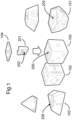
- Fig. 1 of the same an example of the system object of the invention is represented and in particular a series of dice characterized by different shapes (100), (101), (102), (103) is represented.
- Said dice in this example there are four, but they may be a generic number of Q elements) may be characterized by a number N of possibly different faces as well as possibly different geometric shapes and sizes and characterized by values, or face symbols, which are different and not homogeneous, for example numbers, symbols, characters and/or other signs.
- the dice are constructed in such a way as to constitute possibly openable casings comprising a closure (104) or casings sectionable into parts (101), (103).
- the opening of the dice allows access to a seat (200) in which a core element (201) can be inserted uniquely and according to a single orientation.
- a core element (201) Inside said core (201) is an electronic board (202); said board used to determine the result of the roll of said die housed in the core itself.
- the core 201 may then be optionally transferred between various dice (100), (101), (102), (103) and optionally moved into additional dice.
- the insertion of the core takes place by opening the different casings of said dice and inserting the core in the same seat (200) obtained in each of the usable dice (100), (101), (102), (103).
- the core (201) is depicted in detail and in particular the shape and components housed therein.
- the core (201) contains the aforementioned electronic board (202) and a battery (203) for the power supply of said board.
- the electronic board (202) further comprises a CPU (204), an accelerometer (205), a memory (206) and a radio frequency remote transmission system (207), said radio frequency remote transmission system (207) being preferably but not necessarily of the Bluetooth type. Also with reference to the drawings of Fig.
- a preferable, but not exclusive, form of the physicality of the core (201) and particularly of the asymmetrical profile thereof is represented, highlighted by its different perspectives (208), (209), (210), said asymmetric profile being used to obtain a unique interlocking with the shape of the corresponding seat (200).
- Said constructive asymmetry ensures that the insertion of the core (201) into the seat (200) can only take place according to a single direction, guaranteeing a fixed orientation, known a priori and predetermined of the accelerometer reference system (205), by varying all possible dice in which the core (201) is inserted.
- a look-up-table (300) which has sub-tables (301), (302), (303).
- This look-up-table with the variation of all the dice which can be used [1,..., q, ..., Q] and the variation of the Nq possible faces of said dice, represents the values assumed by the components of the gravity vector [Vx,Vy,Vz] detected by the accelerometer (205), at each of the Nq faces.
- the various sub-tables (301), (302), (303) etc. therefore represent all the different possible creations (depending on the types of dice, the type of faces, the type of rules or game to be used) and allow the core to be pre-programmed to interpret the roll of any die, in any context, for each possible type and application scope and allow the core to, from time to time, select, load and use the sub-table (301), (302), (303), etc., adapted and corresponding to the game context.
- the matrix of the look-up-table (300) further contains a column in which an asymptotic stability parameter of the roll of the die DV is written, settable a priori.
- This parameter will typically but not necessarily be identical for all dice and determines after how long the gravity vector measured by the accelerometer (205) can be considered as a stable and reliable value. This is to avoid that the data provided by the accelerometer (205) are considered valid results during the rolling of the die or during oscillations and small involuntary movements, not related to actual use, which would cause errors in the detection of the result.
- the look-up-table (300) contains a further parameter dV, which is also settable a priori.
- Said parameter defines the spatial or geometric stability of the roll, which is instead dependent on the physical shape of the die, particularly on the number of faces thereof.
- the spatial stability parameter dV of the die is used to interpret and, if necessary, compensate for small inconsistencies between the gravity vector actually measured by the accelerometer (205) during rolls with respect to the gravity vector values provided by the look-up table (300). Such inconsistencies may be attributable, for example, to irregularities in the gaming table on which the dice are rolled.
- the parameter dV allows to set the limit within which said deviations are acceptable and varies depending on the type of die because, as the number of faces which characterize a die increases, said deviations obviously become more dangerous and, as a result, greater precision is required to discern the correctness and regularity of the roll.
- a column of RESULTS is represented; since the same die with the same number of faces may have different symbols and values on the faces. For this reason, a sub-table is provided for each different embodiment and use of the die, so that, depending on the sub-type of die used, the system is able to communicate the correct result (for example, a die of 6 can have results 1, 2, 3, 4, 5, 6 or A, B, C, D, E, F. etc.).
- the number of sub-tables which form the overall look-up-table (300) will be reasonably higher or at most equal to that of the Q dice usable with the same core (201).
- a device (500) with gateway or mediator function to a connected remote electronic device (501).
- Said device may be available if it is necessary to manage and intermediate the roll data of one or more dice, useful, for example, for a large number of dice to be managed or if a pre-processing stage of the results of rolls related to the dice used (100), (101), (102), (103) is required, depending on the type of game or application scope in which said dice are used.
- the connection between said device used as a mediator (500) and the remote electronic device (501) may be wired, as shown in Fig. 5 , or wireless, using different transmission protocols useful for the purpose.
- the invention can be realized with technical equivalents, with supplementary materials or solutions suitable for the purpose and the application scope.
- Conformation and dimensions of the constituent parts may vary in a suitable, but consistent way with the proposed solution.
- the geometric shapes of the involved parts may be varied while maintaining the above-mentioned functionalities.
- the shapes of the core (201) and the corresponding seats (200) obtained in the cavities of the dice (100) may change.
- the hardware level it will be possible to change the number and type of sensors installed on the board (202), including any and additional types of sensors for detecting the spatial orientation assumed by the die itself, therefore, alternative or additional to the aforementioned accelerometer such as a gyroscope.
- the technology implemented for the wireless transmission of data between the die and the receiving electronic device and, in particular, the type of protocol used may be changed, without however going beyond the scope of the peculiar characteristics and functions of the system proposed and claimed below.
- the invention may also be partially realized.
Landscapes
- Engineering & Computer Science (AREA)
- Multimedia (AREA)
- Toys (AREA)
- Arrangements For Transmission Of Measured Signals (AREA)
- General Factory Administration (AREA)
Applications Claiming Priority (2)
| Application Number | Priority Date | Filing Date | Title |
|---|---|---|---|
| IT201900013365 | 2019-07-30 | ||
| PCT/IT2020/050186 WO2021019586A1 (en) | 2019-07-30 | 2020-07-27 | Modular electronic dice system |
Publications (3)
| Publication Number | Publication Date |
|---|---|
| EP4003554A1 EP4003554A1 (en) | 2022-06-01 |
| EP4003554B1 true EP4003554B1 (en) | 2023-08-09 |
| EP4003554C0 EP4003554C0 (en) | 2023-08-09 |
Family
ID=69024474
Family Applications (1)
| Application Number | Title | Priority Date | Filing Date |
|---|---|---|---|
| EP20750775.7A Active EP4003554B1 (en) | 2019-07-30 | 2020-07-27 | Modular electronic dice system |
Country Status (5)
| Country | Link |
|---|---|
| US (1) | US12179121B2 (pl) |
| EP (1) | EP4003554B1 (pl) |
| ES (1) | ES2960520T3 (pl) |
| PL (1) | PL4003554T3 (pl) |
| WO (1) | WO2021019586A1 (pl) |
Families Citing this family (4)
| Publication number | Priority date | Publication date | Assignee | Title |
|---|---|---|---|---|
| WO2024102084A1 (en) * | 2022-11-08 | 2024-05-16 | Candan Emrah Gazi | A device developed for board games |
| USD1026103S1 (en) * | 2023-06-28 | 2024-05-07 | Guohua Wang | Dice device |
| WO2025220050A1 (en) | 2024-04-17 | 2025-10-23 | Garofalo Davide | Tracking system for board games with dice |
| USD1062886S1 (en) * | 2024-09-30 | 2025-02-18 | Huanyu Tao | Set of dice |
Family Cites Families (12)
| Publication number | Priority date | Publication date | Assignee | Title |
|---|---|---|---|---|
| IL121666A (en) | 1997-08-31 | 2001-03-19 | Bronfeld Joshua | Electronic dice |
| IL128762A0 (en) | 1999-02-28 | 2000-01-31 | Cibro Technologies Ltd | Electronic dice |
| US8490971B2 (en) | 2004-10-25 | 2013-07-23 | Koninklijke Philips Electronics N.V. | Autonomous wireless die |
| JP2007275107A (ja) * | 2006-04-03 | 2007-10-25 | Nec Tokin Corp | 正多面体姿勢表示装置 |
| US20090210101A1 (en) * | 2008-02-15 | 2009-08-20 | Scott Allan Hawkins | Electronic dice |
| US8678925B1 (en) * | 2008-06-11 | 2014-03-25 | Dp Technologies, Inc. | Method and apparatus to provide a dice application |
| US9155958B2 (en) | 2011-03-03 | 2015-10-13 | Jack Zylkin | Die for use in game play |
| PL394858A1 (pl) | 2011-05-13 | 2012-11-19 | Strzelewicz Patryk Q-Workshop | Sposób i urzadzenie do elektromechanicznej selekcji elementu ze zbioru elementów |
| US9908037B2 (en) * | 2013-07-11 | 2018-03-06 | Board Of Regents, The University Of Texas System | Electronic gaming die |
| WO2016178257A1 (en) | 2015-05-05 | 2016-11-10 | Garofalo Enrico | Contactless detection system of the position of objects on a surface |
| IT201700020955A1 (it) | 2017-02-24 | 2018-08-24 | Xplored S R L | Metodo ed apparato per controllare videogiochi |
| IT201700094362A1 (it) | 2017-08-18 | 2019-02-18 | Xplored S R L | Sistema di controllo elettronico per giochi da tavolo |
-
2020
- 2020-07-27 US US17/628,647 patent/US12179121B2/en active Active
- 2020-07-27 EP EP20750775.7A patent/EP4003554B1/en active Active
- 2020-07-27 PL PL20750775.7T patent/PL4003554T3/pl unknown
- 2020-07-27 ES ES20750775T patent/ES2960520T3/es active Active
- 2020-07-27 WO PCT/IT2020/050186 patent/WO2021019586A1/en not_active Ceased
Also Published As
| Publication number | Publication date |
|---|---|
| EP4003554A1 (en) | 2022-06-01 |
| PL4003554T3 (pl) | 2024-02-19 |
| EP4003554C0 (en) | 2023-08-09 |
| WO2021019586A1 (en) | 2021-02-04 |
| US12179121B2 (en) | 2024-12-31 |
| ES2960520T3 (es) | 2024-03-05 |
| US20220274009A1 (en) | 2022-09-01 |
Similar Documents
| Publication | Publication Date | Title |
|---|---|---|
| EP4003554B1 (en) | Modular electronic dice system | |
| EP2709737B1 (en) | Video game with concurrent processing of game-related physical objects | |
| US6947913B1 (en) | Systems and methods for generating string correlithm objects | |
| US8777620B1 (en) | Firearm trigger pull training system and methods | |
| EP3368977B1 (en) | Computing device having user-input accessory | |
| US20170225073A1 (en) | Game system | |
| CN107293099B (zh) | 一种姿态监测方法、装置和穿戴设备 | |
| US10846188B2 (en) | Device and method for producing test data | |
| EP3847418B1 (en) | Method and system for calibrating sensors | |
| EP3183017A1 (en) | Medicament injection device or injection mock-up demo device with motion detector to log and track user behaviour | |
| KR101956625B1 (ko) | 스마트 교실에서의 수업 제공 방법 및 그 시스템 | |
| US11769032B2 (en) | Electronic system, portable electronic device and counting information updating method | |
| US10380468B2 (en) | Proactive transmission of measured values to mobile devices | |
| US11007423B2 (en) | Game systems and methods | |
| CN109045679B (zh) | 棋牌识别系统及棋牌系统 | |
| EP2428877B1 (en) | Information processing system for sensor calibration | |
| CN106767817A (zh) | 一种获取飞行定位信息的方法及飞行器 | |
| CN113516092B (zh) | 目标行为的确定方法及装置、存储介质及电子装置 | |
| CN113554741A (zh) | 一种对象三维重建的方法、装置、电子设备及存储介质 | |
| US20240252910A1 (en) | Universal signaling system for board games | |
| CN104332022A (zh) | 一种防止幼儿进食异物的警报系统及方法 | |
| CN118505461A (zh) | 一种基于虚拟现实技术的数字化教育优化方法及系统 | |
| US20210232949A1 (en) | Information processing device, information processing method, and program | |
| CN118545416A (zh) | 一种位置修正方法、物品取放方法以及相关设备 | |
| CN108112058B (zh) | 一种网络接入控制方法及无线接入器 |
Legal Events
| Date | Code | Title | Description |
|---|---|---|---|
| STAA | Information on the status of an ep patent application or granted ep patent |
Free format text: STATUS: UNKNOWN |
|
| STAA | Information on the status of an ep patent application or granted ep patent |
Free format text: STATUS: THE INTERNATIONAL PUBLICATION HAS BEEN MADE |
|
| PUAI | Public reference made under article 153(3) epc to a published international application that has entered the european phase |
Free format text: ORIGINAL CODE: 0009012 |
|
| STAA | Information on the status of an ep patent application or granted ep patent |
Free format text: STATUS: REQUEST FOR EXAMINATION WAS MADE |
|
| 17P | Request for examination filed |
Effective date: 20220224 |
|
| AK | Designated contracting states |
Kind code of ref document: A1 Designated state(s): AL AT BE BG CH CY CZ DE DK EE ES FI FR GB GR HR HU IE IS IT LI LT LU LV MC MK MT NL NO PL PT RO RS SE SI SK SM TR |
|
| DAV | Request for validation of the european patent (deleted) | ||
| DAX | Request for extension of the european patent (deleted) | ||
| GRAP | Despatch of communication of intention to grant a patent |
Free format text: ORIGINAL CODE: EPIDOSNIGR1 |
|
| STAA | Information on the status of an ep patent application or granted ep patent |
Free format text: STATUS: GRANT OF PATENT IS INTENDED |
|
| INTG | Intention to grant announced |
Effective date: 20230309 |
|
| GRAS | Grant fee paid |
Free format text: ORIGINAL CODE: EPIDOSNIGR3 |
|
| GRAA | (expected) grant |
Free format text: ORIGINAL CODE: 0009210 |
|
| STAA | Information on the status of an ep patent application or granted ep patent |
Free format text: STATUS: THE PATENT HAS BEEN GRANTED |
|
| AK | Designated contracting states |
Kind code of ref document: B1 Designated state(s): AL AT BE BG CH CY CZ DE DK EE ES FI FR GB GR HR HU IE IS IT LI LT LU LV MC MK MT NL NO PL PT RO RS SE SI SK SM TR |
|
| REG | Reference to a national code |
Ref country code: GB Ref legal event code: FG4D |
|
| REG | Reference to a national code |
Ref country code: CH Ref legal event code: EP |
|
| REG | Reference to a national code |
Ref country code: IE Ref legal event code: FG4D |
|
| REG | Reference to a national code |
Ref country code: DE Ref legal event code: R096 Ref document number: 602020015519 Country of ref document: DE |
|
| U01 | Request for unitary effect filed |
Effective date: 20230911 |
|
| U07 | Unitary effect registered |
Designated state(s): AT BE BG DE DK EE FI FR IT LT LU LV MT NL PT SE SI Effective date: 20231027 |
|
| REG | Reference to a national code |
Ref country code: GR Ref legal event code: EP Ref document number: 20230402124 Country of ref document: GR Effective date: 20231211 |
|
| PG25 | Lapsed in a contracting state [announced via postgrant information from national office to epo] |
Ref country code: IS Free format text: LAPSE BECAUSE OF FAILURE TO SUBMIT A TRANSLATION OF THE DESCRIPTION OR TO PAY THE FEE WITHIN THE PRESCRIBED TIME-LIMIT Effective date: 20231209 |
|
| PG25 | Lapsed in a contracting state [announced via postgrant information from national office to epo] |
Ref country code: RS Free format text: LAPSE BECAUSE OF FAILURE TO SUBMIT A TRANSLATION OF THE DESCRIPTION OR TO PAY THE FEE WITHIN THE PRESCRIBED TIME-LIMIT Effective date: 20230809 Ref country code: NO Free format text: LAPSE BECAUSE OF FAILURE TO SUBMIT A TRANSLATION OF THE DESCRIPTION OR TO PAY THE FEE WITHIN THE PRESCRIBED TIME-LIMIT Effective date: 20231109 Ref country code: IS Free format text: LAPSE BECAUSE OF FAILURE TO SUBMIT A TRANSLATION OF THE DESCRIPTION OR TO PAY THE FEE WITHIN THE PRESCRIBED TIME-LIMIT Effective date: 20231209 Ref country code: HR Free format text: LAPSE BECAUSE OF FAILURE TO SUBMIT A TRANSLATION OF THE DESCRIPTION OR TO PAY THE FEE WITHIN THE PRESCRIBED TIME-LIMIT Effective date: 20230809 |
|
| REG | Reference to a national code |
Ref country code: ES Ref legal event code: FG2A Ref document number: 2960520 Country of ref document: ES Kind code of ref document: T3 Effective date: 20240305 |
|
| PG25 | Lapsed in a contracting state [announced via postgrant information from national office to epo] |
Ref country code: SM Free format text: LAPSE BECAUSE OF FAILURE TO SUBMIT A TRANSLATION OF THE DESCRIPTION OR TO PAY THE FEE WITHIN THE PRESCRIBED TIME-LIMIT Effective date: 20230809 Ref country code: RO Free format text: LAPSE BECAUSE OF FAILURE TO SUBMIT A TRANSLATION OF THE DESCRIPTION OR TO PAY THE FEE WITHIN THE PRESCRIBED TIME-LIMIT Effective date: 20230809 Ref country code: CZ Free format text: LAPSE BECAUSE OF FAILURE TO SUBMIT A TRANSLATION OF THE DESCRIPTION OR TO PAY THE FEE WITHIN THE PRESCRIBED TIME-LIMIT Effective date: 20230809 Ref country code: SK Free format text: LAPSE BECAUSE OF FAILURE TO SUBMIT A TRANSLATION OF THE DESCRIPTION OR TO PAY THE FEE WITHIN THE PRESCRIBED TIME-LIMIT Effective date: 20230809 |
|
| REG | Reference to a national code |
Ref country code: DE Ref legal event code: R097 Ref document number: 602020015519 Country of ref document: DE |
|
| PLBE | No opposition filed within time limit |
Free format text: ORIGINAL CODE: 0009261 |
|
| STAA | Information on the status of an ep patent application or granted ep patent |
Free format text: STATUS: NO OPPOSITION FILED WITHIN TIME LIMIT |
|
| U20 | Renewal fee for the european patent with unitary effect paid |
Year of fee payment: 5 Effective date: 20240605 |
|
| 26N | No opposition filed |
Effective date: 20240513 |
|
| PG25 | Lapsed in a contracting state [announced via postgrant information from national office to epo] |
Ref country code: MC Free format text: LAPSE BECAUSE OF FAILURE TO SUBMIT A TRANSLATION OF THE DESCRIPTION OR TO PAY THE FEE WITHIN THE PRESCRIBED TIME-LIMIT Effective date: 20230809 |
|
| REG | Reference to a national code |
Ref country code: CH Ref legal event code: PL |
|
| PG25 | Lapsed in a contracting state [announced via postgrant information from national office to epo] |
Ref country code: CH Free format text: LAPSE BECAUSE OF NON-PAYMENT OF DUE FEES Effective date: 20240731 |
|
| PGFP | Annual fee paid to national office [announced via postgrant information from national office to epo] |
Ref country code: PL Payment date: 20250515 Year of fee payment: 6 |
|
| PGFP | Annual fee paid to national office [announced via postgrant information from national office to epo] |
Ref country code: GB Payment date: 20250605 Year of fee payment: 6 |
|
| U20 | Renewal fee for the european patent with unitary effect paid |
Year of fee payment: 6 Effective date: 20250606 |
|
| PGFP | Annual fee paid to national office [announced via postgrant information from national office to epo] |
Ref country code: GR Payment date: 20250618 Year of fee payment: 6 |
|
| PG25 | Lapsed in a contracting state [announced via postgrant information from national office to epo] |
Ref country code: IE Free format text: LAPSE BECAUSE OF NON-PAYMENT OF DUE FEES Effective date: 20240727 |
|
| PGFP | Annual fee paid to national office [announced via postgrant information from national office to epo] |
Ref country code: ES Payment date: 20250805 Year of fee payment: 6 |
|
| PGFP | Annual fee paid to national office [announced via postgrant information from national office to epo] |
Ref country code: TR Payment date: 20250710 Year of fee payment: 6 |
|
| U1O | Appointed representative for the unitary patent procedure deleted after the registration of the unitary effect | ||
| PG25 | Lapsed in a contracting state [announced via postgrant information from national office to epo] |
Ref country code: CY Free format text: LAPSE BECAUSE OF FAILURE TO SUBMIT A TRANSLATION OF THE DESCRIPTION OR TO PAY THE FEE WITHIN THE PRESCRIBED TIME-LIMIT; INVALID AB INITIO Effective date: 20200727 |
|
| PG25 | Lapsed in a contracting state [announced via postgrant information from national office to epo] |
Ref country code: HU Free format text: LAPSE BECAUSE OF FAILURE TO SUBMIT A TRANSLATION OF THE DESCRIPTION OR TO PAY THE FEE WITHIN THE PRESCRIBED TIME-LIMIT; INVALID AB INITIO Effective date: 20200727 |