EP3999552B1 - Caoutchoucs de diène à terminaison carboxy - Google Patents
Caoutchoucs de diène à terminaison carboxy Download PDFInfo
- Publication number
- EP3999552B1 EP3999552B1 EP20739683.9A EP20739683A EP3999552B1 EP 3999552 B1 EP3999552 B1 EP 3999552B1 EP 20739683 A EP20739683 A EP 20739683A EP 3999552 B1 EP3999552 B1 EP 3999552B1
- Authority
- EP
- European Patent Office
- Prior art keywords
- unsubstituted
- saturated
- unsaturated
- polysubstituted
- mono
- Prior art date
- Legal status (The legal status is an assumption and is not a legal conclusion. Google has not performed a legal analysis and makes no representation as to the accuracy of the status listed.)
- Active
Links
Classifications
-
- B—PERFORMING OPERATIONS; TRANSPORTING
- B60—VEHICLES IN GENERAL
- B60C—VEHICLE TYRES; TYRE INFLATION; TYRE CHANGING; CONNECTING VALVES TO INFLATABLE ELASTIC BODIES IN GENERAL; DEVICES OR ARRANGEMENTS RELATED TO TYRES
- B60C1/00—Tyres characterised by the chemical composition or the physical arrangement or mixture of the composition
- B60C1/0016—Compositions of the tread
-
- C—CHEMISTRY; METALLURGY
- C08—ORGANIC MACROMOLECULAR COMPOUNDS; THEIR PREPARATION OR CHEMICAL WORKING-UP; COMPOSITIONS BASED THEREON
- C08C—TREATMENT OR CHEMICAL MODIFICATION OF RUBBERS
- C08C19/00—Chemical modification of rubber
- C08C19/22—Incorporating nitrogen atoms into the molecule
-
- C—CHEMISTRY; METALLURGY
- C08—ORGANIC MACROMOLECULAR COMPOUNDS; THEIR PREPARATION OR CHEMICAL WORKING-UP; COMPOSITIONS BASED THEREON
- C08C—TREATMENT OR CHEMICAL MODIFICATION OF RUBBERS
- C08C19/00—Chemical modification of rubber
- C08C19/30—Addition of a reagent which reacts with a hetero atom or a group containing hetero atoms of the macromolecule
- C08C19/34—Addition of a reagent which reacts with a hetero atom or a group containing hetero atoms of the macromolecule reacting with oxygen or oxygen-containing groups
- C08C19/36—Addition of a reagent which reacts with a hetero atom or a group containing hetero atoms of the macromolecule reacting with oxygen or oxygen-containing groups with carboxy radicals
-
- C—CHEMISTRY; METALLURGY
- C08—ORGANIC MACROMOLECULAR COMPOUNDS; THEIR PREPARATION OR CHEMICAL WORKING-UP; COMPOSITIONS BASED THEREON
- C08C—TREATMENT OR CHEMICAL MODIFICATION OF RUBBERS
- C08C19/00—Chemical modification of rubber
- C08C19/30—Addition of a reagent which reacts with a hetero atom or a group containing hetero atoms of the macromolecule
- C08C19/42—Addition of a reagent which reacts with a hetero atom or a group containing hetero atoms of the macromolecule reacting with metals or metal-containing groups
- C08C19/44—Addition of a reagent which reacts with a hetero atom or a group containing hetero atoms of the macromolecule reacting with metals or metal-containing groups of polymers containing metal atoms exclusively at one or both ends of the skeleton
-
- C—CHEMISTRY; METALLURGY
- C08—ORGANIC MACROMOLECULAR COMPOUNDS; THEIR PREPARATION OR CHEMICAL WORKING-UP; COMPOSITIONS BASED THEREON
- C08F—MACROMOLECULAR COMPOUNDS OBTAINED BY REACTIONS ONLY INVOLVING CARBON-TO-CARBON UNSATURATED BONDS
- C08F236/00—Copolymers of compounds having one or more unsaturated aliphatic radicals, at least one having two or more carbon-to-carbon double bonds
- C08F236/02—Copolymers of compounds having one or more unsaturated aliphatic radicals, at least one having two or more carbon-to-carbon double bonds the radical having only two carbon-to-carbon double bonds
- C08F236/04—Copolymers of compounds having one or more unsaturated aliphatic radicals, at least one having two or more carbon-to-carbon double bonds the radical having only two carbon-to-carbon double bonds conjugated
- C08F236/06—Butadiene
-
- C—CHEMISTRY; METALLURGY
- C08—ORGANIC MACROMOLECULAR COMPOUNDS; THEIR PREPARATION OR CHEMICAL WORKING-UP; COMPOSITIONS BASED THEREON
- C08F—MACROMOLECULAR COMPOUNDS OBTAINED BY REACTIONS ONLY INVOLVING CARBON-TO-CARBON UNSATURATED BONDS
- C08F236/00—Copolymers of compounds having one or more unsaturated aliphatic radicals, at least one having two or more carbon-to-carbon double bonds
- C08F236/02—Copolymers of compounds having one or more unsaturated aliphatic radicals, at least one having two or more carbon-to-carbon double bonds the radical having only two carbon-to-carbon double bonds
- C08F236/04—Copolymers of compounds having one or more unsaturated aliphatic radicals, at least one having two or more carbon-to-carbon double bonds the radical having only two carbon-to-carbon double bonds conjugated
- C08F236/10—Copolymers of compounds having one or more unsaturated aliphatic radicals, at least one having two or more carbon-to-carbon double bonds the radical having only two carbon-to-carbon double bonds conjugated with vinyl-aromatic monomers
-
- C—CHEMISTRY; METALLURGY
- C08—ORGANIC MACROMOLECULAR COMPOUNDS; THEIR PREPARATION OR CHEMICAL WORKING-UP; COMPOSITIONS BASED THEREON
- C08F—MACROMOLECULAR COMPOUNDS OBTAINED BY REACTIONS ONLY INVOLVING CARBON-TO-CARBON UNSATURATED BONDS
- C08F8/00—Chemical modification by after-treatment
- C08F8/30—Introducing nitrogen atoms or nitrogen-containing groups
- C08F8/32—Introducing nitrogen atoms or nitrogen-containing groups by reaction with amines
-
- C—CHEMISTRY; METALLURGY
- C08—ORGANIC MACROMOLECULAR COMPOUNDS; THEIR PREPARATION OR CHEMICAL WORKING-UP; COMPOSITIONS BASED THEREON
- C08F—MACROMOLECULAR COMPOUNDS OBTAINED BY REACTIONS ONLY INVOLVING CARBON-TO-CARBON UNSATURATED BONDS
- C08F8/00—Chemical modification by after-treatment
- C08F8/46—Reaction with unsaturated dicarboxylic acids or anhydrides thereof, e.g. maleinisation
-
- C—CHEMISTRY; METALLURGY
- C08—ORGANIC MACROMOLECULAR COMPOUNDS; THEIR PREPARATION OR CHEMICAL WORKING-UP; COMPOSITIONS BASED THEREON
- C08L—COMPOSITIONS OF MACROMOLECULAR COMPOUNDS
- C08L15/00—Compositions of rubber derivatives
-
- C—CHEMISTRY; METALLURGY
- C08—ORGANIC MACROMOLECULAR COMPOUNDS; THEIR PREPARATION OR CHEMICAL WORKING-UP; COMPOSITIONS BASED THEREON
- C08L—COMPOSITIONS OF MACROMOLECULAR COMPOUNDS
- C08L9/00—Compositions of homopolymers or copolymers of conjugated diene hydrocarbons
- C08L9/06—Copolymers with styrene
-
- C—CHEMISTRY; METALLURGY
- C08—ORGANIC MACROMOLECULAR COMPOUNDS; THEIR PREPARATION OR CHEMICAL WORKING-UP; COMPOSITIONS BASED THEREON
- C08K—Use of inorganic or non-macromolecular organic substances as compounding ingredients
- C08K3/00—Use of inorganic substances as compounding ingredients
- C08K3/18—Oxygen-containing compounds, e.g. metal carbonyls
- C08K3/20—Oxides; Hydroxides
- C08K3/22—Oxides; Hydroxides of metals
- C08K2003/2296—Oxides; Hydroxides of metals of zinc
Definitions
- the invention pertains to carboxyterminated diene rubbers, their production and use.
- the wet slip resistance and rolling resistance of a tire tread largely depend on the dynamic mechanical properties of the rubbers used in compound manufacture. Rubbers with high rebound elasticity at higher temperatures (60 °C to 100 °C) are used for the tread to reduce rolling resistance. On the other hand, rubbers with a high damping factor at low temperatures (0 to 23 °C) or low rebound elasticity in the range 0 °C to 23 °C are advantageous for improving wet grip. In order to meet this complex requirement profile, compounds of various rubbers are used in the tread.
- styrene-butadiene rubber and one or more rubbers with a relatively low glass transition temperature
- Unsaturated anionically polymerized solution rubbers such as solution polybutadiene and solution styrene-butadiene rubbers, have advantages over corresponding emulsion rubbers in the production of low rolling resistance tire treads.
- the advantages include the controllability of the vinyl content and the associated glass transition temperature and molecule branching. In practical application, this results in particular advantages in the relationship between wet slip resistance and rolling resistance of the tire.
- Significant contributions to energy dissipation and thus to rolling resistance in tire treads result from free polymer chain ends and from the reversible build-up and breakdown of the filler network, which is formed by the filler used in the tire tread compound (mostly silica and/or carbon black).
- EP 0 180 141 A1 describes the use of 4,4'-bis(dimethyl-amino)-benzophenone or N-methylcaprolactam as functionalization reagents.
- the use of ethylene oxide and N-vinylpyrrolidone is also known from EP 0 864 606 A1 .
- a number of other possible functionalization reagents are listed in US 4,417,029 .
- silanes and cyclosiloxanes having in total at least two halogen and/or alkoxy and/or aryloxy substituents on silicon are well suited for the end group functionalization of diene rubbers, since one of the substituents mentioned on the Si atom can be easily replaced by an anionic diene polymer chain end in a rapid substitution reaction and the further substituent or substituents mentioned above on Si is or are available as a functional group which can interact with the filler of the tire tread compound, if appropriate after hydrolysis.
- Examples of such silanes can be found in US 3,244,664 , US 4,185,042 , EP 0 778 311 A1 and US 2005/0203251 A1 .
- these silanes have functional groups which are bonded directly to the Si atom or connected to Si via a spacer and which can interact with the surface of the silica filler in the rubber compound.
- These functional groups are usually alkoxy groups or halogens directly attached to Si, or tertiary amino substituents attached to Si via a spacer.
- Disadvantages of these silanes are the possible reaction of several anionic polymer chain ends per silane molecule, elimination of interfering components and coupling under formation of Si-O-Si bonds during processing and storage. The introduction of carboxy groups by means of these silanes is not described.
- the carboxy group as a strongly polar, bidentate ligand can interact particularly well with the surface of the silica filler in the rubber mixture.
- Methods for introducing carboxy groups along the polymer chain of diene rubbers produced in solution are known and described for example in DE 26 531 44 A1 , EP 1 000 971 A1 , EP 1 050 545 A1 , WO 2009/034001 A1 .
- These methods have several disadvantages, for example that long reaction times are required, that only an incomplete conversion of the functionalization reagents takes place and that a change of the polymer chains occurs by side reactions such as branching. In addition, these methods do not enable the particularly effective functionalization of the polymer chain ends.
- US 4465809 discloses the termination using an epoxide and a cyclic acid anhydride.
- EP 2796471 pertains to styrene-butadiene polymers terminated with a silane-containing carboxyl group.
- US 3242129 discloses the preparation of carboxy-terminated polymers using carbon dioxide. None of those references discloses or teaches in any way the use use or benefits of carboxyend-groups according to formula (I) of this invention.
- WO 2014/173706 A1 describes a method for introducing carboxy end groups to diene rubbers by avoiding coupling reactions by using silalactones. Further methods for coupling-free carboxy termination of diene rubbers are not known.
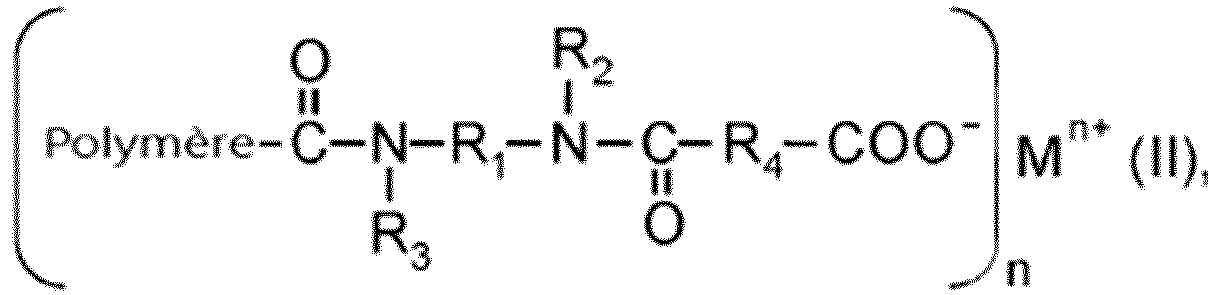
- end group functionalized diene rubbers according to the invention may preferably be present as carboxylates according to formula (II), wherein
- alkyl, saturated or unsaturated' encompasses saturated alkyl as well as unsaturated alkyl such as alkenyl, alkynyl, and the like.
- alkyl as used herein means normal, secondary, or tertiary, linear or branched hydrocarbon with no site of unsaturation.
- Examples are methyl, ethyl, 1-propyl (n-propyl), 2-propyl (iPr), 1-butyl, 2-methyl-1-propyl(i-Bu), 2-butyl (s-Bu), 2-dimethyl-2-propyl (t-Bu), 1-pentyl (n-pentyl), 2-pentyl, 3-pentyl, 2-methyl-2-butyl, 3-methyl-2-butyl, 3-methyl-1-butyl, 2-methyl-1-butyl, 1-hexyl, 2-hexyl, 3-hexyl, 2-methyl-2-pentyl, 3-methyl-2-pentyl, 4-methyl-2-pentyl, 3-methyl-3-pentyl, 2-methyl-3-pentyl, 2,3-dimethyl-2-butyl, and 3,3-dimethyl-2-butyl.
- the double bond may be in the cis or trans configuration.
- alkynyf' as used herein means normal, secondary, tertiary, linear or branched hydrocarbon with at least one site (usually 1 to 3, preferably 1) of unsaturation, namely a carbon-carbon, sp triple bond. Examples include, but are not limited to: ethynyl (-C ⁇ CH), and 1-propynyl (propargyl, -CH 2 C ⁇ CH).
- alkylene, saturated or unsaturated' encompasses saturated alkylene as well as unsaturated alkylene such as alkenylene, alkynylene, alkenynylene and the like.
- alkylene as used herein means saturated, linear or branched chain hydrocarbon radical having two monovalent radical centers derived by the removal of two hydrogen atoms from the same or two different carbon atoms of a parent alkane.
- alkylene radicals include, but are not limited to: methylene (-CH 2 -), 1,2-ethyl (-CH 2 CH 2 -), 1,3-propyl (-CH 2 CH 2 CH 2 -), 1,4-butyl (-CH 2 CH 2 CH 2 CH 2 -), and the like.
- alkenylene as used herein means linear or branched chain hydrocarbon radical with at least one site (usually 1 to 3, preferably 1) of unsaturation, namely a carbon-carbon, sp2 double bond, and having two monovalent radical centers derived by the removal of two hydrogen atoms from the same or two different carbon atoms of a parent alkene.
- alkynylene as used herein means linear or branched chain hydrocarbon radical with at least one site (usually 1 to 3, preferably 1) of unsaturation, namely a carbon-carbon, sp triple bond, and having two monovalent radical centers derived by the removal of two hydrogen atoms from the same or two different carbon atoms of a parent alkyne.
- heteroalkyl saturated or unsaturated' as used herein encompasses saturated heteroalkyl as well as unsaturated heteroalkyl such as heteroalkenyl, heteroalkynyl, heteroalkenynyl and the like.
- heteroalkyl as used herein means linear or branched chain alkyl wherein one or more carbon atoms (usually 1, 2 or 3) are replaced by a heteroatom, i.e. an oxygen, nitrogen, sulfur or silicon atom, with the proviso that said chain may not contain two adjacent O atoms or two adjacent S atoms.
- one or more -CH 3 of said alkyl can be replaced by -NH 2 and/or that one or more -CH 2 - of said alkyl can be replaced by -NH-, -O-, -S- or -Si-.
- the S atoms in said chains may be optionally oxidized with one or two oxygen atoms, to afford sulfoxides and sulfones, respectively.
- the heteroalkyl groups in the benzofurane derivatives of the invention can contain an oxo or thio group at any carbon or heteroatom that will result in a stable compound.
- heteroalkyl groups include, but are not limited to, alcohols, alkyl ethers (such as for example -methoxy, -ethoxy, -butoxy,...), primary, secondary, and tertiary alkyl amines, amides, ketones, esters, alkyl sulfides, and alkyl sulfones.
- alkyl ethers such as for example -methoxy, -ethoxy, -butoxy, etc.
- primary, secondary, and tertiary alkyl amines such as for example -methoxy, -ethoxy, -butoxy, etc.
- heteroalkenyl means linear or branched chain alkenyl wherein one or more carbon atoms (usually 1, 2 or 3) are replaced by an oxygen, nitrogen or sulfur atom, with the proviso that said chain may not contain two adjacent O atoms or two adjacent S atoms.
- heteroalkenyl thus comprises imines, -O-alkenyl, -NH-alkenyl, -N(alkenyl) 2 , -N(alkyl)(alkenyl), and -S-alkenyl.
- heteroalkynyf as used herein means linear or branched chain alkynyl wherein one or more carbon atoms (usually 1, 2 or 3) are replaced by an oxygen, nitrogen or sulfur atom, with the proviso that said chain may not contain two adjacent O atoms or two adjacent S atoms.
- heteroalkynyl thus comprises -cyano, -O-alkynyl, - NH-alkynyl, -N(alkynyl) 2 , -N(alkyl)(alkynyl), -N(alkenyl)(alkynyl), and -S-alkynyl.
- heteroalkylene saturated or unsaturated encompasses saturated heteroalkylene as well as unsaturated heteroalkylene such as heteroalkenylene, heteroalkynylene, heteroalkenynylene and the like.
- heteroalkylene as used herein means linear or branched chain alkylene wherein one or more carbon atoms (usually 1, 2 or 3) are replaced by a heteroatom, i.e. an oxygen, nitrogen or sulfur atom, with the proviso that said chain may not contain two adjacent O atoms or two adjacent S atoms.
- heteroalkenylene as used herein means linear or branched chain alkenylene wherein one or more carbon atoms (usually 1, 2 or 3) are replaced by an oxygen, nitrogen or sulfur atom, with the proviso that said chain may not contain two adjacent O atoms or two adjacent S atoms.
- heteroalkynylene as used herein means linear or branched chain alkynylene wherein one or more carbon atoms (usually 1, 2 or 3) are replaced by an oxygen, nitrogen or sulfur atom, with the proviso that said chain may not contain two adjacent O atoms or two adjacent S atoms.
- cycloalkyl, saturated or unsaturated encompasses saturated cycloalkyl as well as unsaturated cycloalkyl such as cycloalkenyl, cycloalkynyl and the like.
- cycloalkyl as used herein and unless otherwise stated means a saturated cyclic hydrocarbon radical, such as for instance cyclopropyl, cyclobutyl, cyclopentyl, cyclohexyl, cycloheptyl, cyclooctyl, norbornyl, fenchyl, decalinyl, adamantyl and the like.
- cycloalkenyl as used herein means a non-aromatic cyclic hydrocarbon radical with at least one site (usually 1 to 3, preferably 1) of unsaturation, namely a carbon-carbon, sp2 double bond. Examples include, but are not limited to cyclopentenyl and cyclohexenyl. The double bond may be in the cis or trans configuration.
- cycloalkynyl as used herein means a non-aromatic cyclic hydrocarbon radical with at least one site (usually 1 to 3, preferably 1) of unsaturation, namely a carbon-carbon, sp triple. An example is cyclohept-1-yne.
- Fused systems of a cycloalkyl ring with a heterocycloalkyl ring are considered as heterocycloalkyl irrespective of the ring that is bound to the core structure.
- Fused systems of a cycloalkyl ring with an aryl ring are considered as aryl irrespective of the ring that is bound to the core structure.
- Fused systems of a cycloalkyl ring with a heteroaryl ring are considered as heteroaryl irrespective of the ring that is bound to the core structure.
- heterocycloalkyl saturated or unsaturated encompasses saturated heterocycloalkyl as well as unsaturated non-aromatic heterocycloalkyl including at least one heteroatom, i.e. an N, O, or S as ring member.
- heterocycloalkyl as used herein and unless otherwise stated means “cycloalkyl” wherein one or more carbon atoms (usually 1, 2 or 3) are replaced by an oxygen, nitrogen or sulfur atom, with the proviso that said chain may not contain two adjacent O atoms or two adjacent S atoms.
- heterocycloalkenyl as used herein and unless otherwise stated means “cycloalkenyl” wherein one or more carbon atoms (usually 1, 2 or 3) are replaced by an oxygen, nitrogen or sulfur atom, with the proviso that said chain may not contain two adjacent O atoms or two adjacent S atoms.
- heterocycloalkynyf' as used herein and unless otherwise stated means “cycloalkynyf' wherein one or more carbon atoms (usually 1, 2 or 3) are replaced by an oxygen, nitrogen or sulfur atom, with the proviso that said chain may not contain two adjacent O atoms or two adjacent S atoms.
- saturated and unsaturated heterocycloalkyl include but are not limited to azepane, 1,4-oxazepane, azetane, azetidine, aziridine, azocane, diazepane, dioxane, dioxolane, dithiane, dithiolane, imidazolidine, isothiazolidine, isoxalidine, morpholine, oxazolidine, oxepane, oxetane, oxirane, piperazine, piperidine, pyrazolidine, pyrrolidine, quinuclidine, tetrahydrofurane, tetrahydropyrane, tetrahydrothiopyrane, thiazolidine, thietane, thiirane, thiolane, thiomorpholine, indoline, dihydrobenzofurane, dihydrobenzothiophene, 1,1-dio
- heterocycloalkyl When the heterocycloalkyl contains no nitrogen as ring member, it is typically bonded through carbon. When the heterocycloalkyl contains nitrogen as ring member, it may be bonded through nitrogen or carbon.
- Fused systems of heterocycloalkyl ring with a cycloalkyl ring are considered as heterocycloalkyl irrespective of the ring that is bound to the core structure.
- Fused systems of a heterocycloalkyl ring with an aryl ring are considered as heterocycloalkyl irrespective of the ring that is bound to the core structure.
- Fused systems of a heterocycloalkyl ring with a heteroaryl ring are considered as heteroaryl irrespective of the ring that is bound to the core structure.
- aryl as used herein means an aromatic hydrocarbon.
- Typical aryl groups include, but are not limited to 1 ring, or 2 or 3 rings fused together, radicals derived from benzene, naphthalene, anthracene, biphenyl, and the like.
- Fused systems of an aryl ring with a cycloalkyl ring are considered as aryl irrespective of the ring that is bound to the core structure.
- Fused systems of an aryl ring with a heterocycloalkyl ring are considered as heterocycloalkyl irrespective of the ring that is bound to the core structure.
- indoline, dihydrobenzofurane, dihydrobenzothiophene and the like are considered as heterocycloalkyl according to the invention.
- Fused systems of an aryl ring with a heteroaryl ring are considered as heteroaryl irrespective of the ring that is bound to the core structure.
- arylene as used herein means bivalent groups derived from arenes by removal of a hydrogen atom from two ring carbon atoms.
- a synonym is arenediyl groups. Examples of arylene include but are not limited to phenylene and benzene-1,2-diyl.
- heteroaryl as used herein means an aromatic ring system including at least one heteroatom, i.e. N, O, or S as ring member of the aromatic ring system.
- heteroaryl include but are not limited to benzimidazole, benzisoxazole, benzoazole, benzodioxole, benzofurane, benzothiadiazole, benzothiazole, benzothiophene, carbazole, cinnoline, dibenzofurane, furane, furazane, imidazole, imidazopyridine, indazole, indole, indolizine, isobenzofurane, isoindole, isoquinoline, isothiazole, isoxazole, naphthyridine, oxadiazole, oxazole, oxindole, phthalazine, purine, pyrazine, pyrazole, pyridazine,
- heteroarylene as used herein means bivalent groups derived from heteroarenes by removal of a hydrogen atom from two ring carbon atoms.
- the end group functionalized diene rubbers according to the invention are prepared or obtainable by a copolymerization of conjugated dienes with vinylaromatic monomers and subsequent reaction with suitable functionalization reagents, wherein the conjugated diene comprises 1,3-butadiene and wherein the vinylaromatic monomer comprises styrene.
- the preferred conjugated dienes that can be copolymerized with 1,3-butadiene areisoprene, 1,3-pentadiene, 2,3-dimethylbutadiene, 1-phenyl-1,3-butadiene, 1,3-hexadiene, myrcene, ocimenes and/or farnesenes.
- o-, m- and/or p-methylstyrene, p-tert-butylstyrene, -methylstyrene, vinyl naphthalene, divinylbenzene, trivinylbenzene and/or divinylnaphthalene can be used as additional vinylaromatic comonomers.
- the carboxyterminated polymer according to the invention comprises a "polymer” that is obtainable by copolymerization of 1,3-butadiene with styrene.
- Coordination catalysts in this context are Ziegler-Natta catalysts or monometallic catalyst systems.
- Preferred coordination catalysts are those based on Ni, Co, Ti, Zr, Nd, V, Cr, Mo, W or Fe.
- Initiators for anionic solution polymerization are those based on alkali or alkaline earth metals, e.g. methyl lithium, ethyl lithium, isopropyllithium, n-butyllithium, sec-butyllithium, pentyllithium, n-hexyllithium, cyclohexyllithium, octyllithium, decyl-lithium, 2-(6-lithio-n-hexoxy)tetrahydropyran, 3-(tert-butyldimethylsiloxy)-1-propyllithium, phenyllithium, 4-butylphenyllithium, 1-naphthyllithium, p-toluyllithium and allyllithium compounds, derived from tertiary N-allylamines such as [1-(dimethylamino)-2-propenyl]lithium, [1-[bis(phenylmethyl)amino
- allyllithium compounds and these lithium amides can also be prepared in situ by reacting an organolithium compound with the respective tertiary N-allylamines or with the respective secondary amines.
- Di- and polyfunctional organolithium compounds can also be used, for example 1,4-dilithiobutane, dilithium piperazide.
- n-butyllithium and sec-butyllithium are used.
- the well-known randomizers and control agents can be used for the microstructure of the polymer, for example diethyl ether, di-n-propylether, diisopropyl ether, di-n-butylether, ethylene glycol dimethyl ether, Ethylene glycol diethyl ether, ethylene glycol di-n-butyl ether, ethylene glycol di-tert-butyl ether, diethylene glycol dimethyl ether, diethylene glycol diethyl ether, diethylene glycol di-n-butyl ether, diethylene glycol di-tert-butyl ether, 2-(2-ethoxyethoxy)-2-methyl-propane, triethylene glycol dimethyl ether, tetrahydrofuran, ethyltetrahydrofurfuryl ether, hexyltetrahydrofurfuryl ether, 2,2-bis(2-tetrahydrofuryl)propane, dioxane, tri
- the production of the copolymers preferably takes place in a solvent.
- the preferred solvents for polymerization are inert aprotic solvents such as aliphatic hydrocarbons such as isomeric butanes, pentanes, hexanes, heptanes, octanes, decanes and cyclopentane, methylcyclopentane, cyclohexane, methylcyclohexane, ethylcyclohexane or 1,4-dimethylcyclohexane or alkenes such as 1-butene or aromatic hydrocarbons such as benzene, toluene, ethylbenzene, xylene, diethylbenzene or propylbenzene. These solvents can be used individually or in combination.
- Preferred solvents are cyclohexane, methylcyclopentane and n-hexane. Mixing with polar solvents is also possible.
- the amount of solvent in the invention process is usually in the range from 100 to 1000 g, preferably in the range from 200 to 700 g, based on 100 g of the total amount of monomer used. However, it is also possible to polymerize the monomers used in the absence of solvents.
- Polymerization can be carried out by first introducing the monomers and the solvent and then starting the polymerization by adding the initiator or catalyst. It is also possible to polymerize in a feed process where the polymerization reactor is filled by adding monomers and solvents, the initiator or catalyst being introduced or added with the monomers and solvent. Variations are possible, such as the introduction of the solvent in the reactor, the addition of the initiator or catalyst and then the addition of the monomers. Furthermore, polymerization can be carried out in a continuous mode. Further monomer and solvent addition during or at the end of polymerization is possible in all cases.
- the polymerization time can vary from a few minutes to several hours. Polymerization is usually carried out within a period of 10 minutes to 8 hours, preferably 20 minutes to 4 hours. It can be carried out both at normal pressure and at elevated pressure (from 1 to 10 bar).
- the cyclic urea derivatives are compounds of the formula (III) where
- R 1 is -CH 2 -CH 2 - and/or R 2 and R 3 are both -CH 3 .
- Preferred examples of compounds of formula (III) include but are not limited to: 1,3-Dimethyl-2-imidazolidinone (1), 1,3-diethyl-2-imidazolidinone (2), 1-methyl-3-phenyl-2-imidazolidinone (3), 1,3-diphenyl-2-imidazolidinone (4), 1,3-dimethyl-2-imidazolidinone (3), 1,3-dimethyl-2-imidazolidinone (3), 1,3-dimethyl-2-imidazolidinone (3), 1,3-dimethyl-2-imidazolidinone (3), 1,3-dimethyl-2-imidazolidinone (3), 1,3-dimethyl-2-imidazolidinone (4), 1,3-dimethyl-2-imidazolidinone (4), 1,3-dimethyl-2-imidazolidinone (3), 3-diethenyl-2-imidazolidinone (5), 1,3,4-trimethyl-2-imidazolidinone (6), 1,3-bis(
- a particularly preferred example of compounds of formula (III) is 1,3-Dimethyl-2-imidazolidinone (1):
- Cyclic carboxylic anhydrides are compounds of formula (IV) where R 4 is a saturated or unsaturated divalent organic radical which, in addition to C and H, may contain one or more heteroatoms, preferably independently of one another selected from O, N, S or Si.
- Particularly preferred examples of compounds of the formula (IV) include but are not limited to tetrapropenyl succinic anhydride (20), 3-(trimethoxysilyl)propyl succinic anhydride (22), citraconic anhydride (26), glutaric anhydride (29):
- end group functionalized diene rubbers according to the invention can be prepared by successive reaction of reactive polymer chain ends from anionic diene polymerization with first a cyclic urea derivative and subsequently with a cyclic carboxylic acid anhydride and optionally, subsequent protonation of the resulting carboxylate end group to the carboxy end group.
- Another aspect of the invention relates to the successive use of first a cyclic urea derivative and then a cyclic carboxylic acid anhydride as functionalizing reagents for the preparation of the invention end group-functionalized diene rubbers with end groups of the formulae (I) or (II) as described herein.
- the end group functionalized polymers according to the invention preferably have average molecular weights (number average, Mn) of 10,000 to 2,000,000 g/mol, preferably of 100,000 to 1,000,000 g/mol and glass transition temperatures of -110 °C to +20 °C, preferably of -110 °C to 0 °C, and Mooney viscosities [ML 1+4 (100 °C)] of 10 to 200, preferably of 30 to 150 Mooney units.
- Mn number average
- Another aspect of the invention is a process for the preparation of the inventive end group functionalized polymers, according to which one or more compounds of the formula (III), as pure substance, solution or suspension, are first added to polymers with reactive polymer chain ends. Addition preferably takes place after completion of polymerization, but may also take place before complete monomer conversion.
- the reaction of compounds of formula (III) with polymers having reactive polymer chain ends preferably takes place at the temperatures normally used for polymerization.
- the reaction times for the reaction of compounds of the formula (III) with the reactive polymer chain ends may range from a few minutes to several hours.
- the amount of these compounds can be selected so that all reactive polymer chain ends react with compounds of the formula (III), or an undersupply of these compounds can be used.
- the amounts of compounds of formula (III) used can cover a wide range. The preferred amounts are in the range from 0.3 to 2 molar equivalents, particularly preferably in the range from 0.6 to 1.5 molar equivalents based on the amount of initiator or catalyst used for polymerization.
- compounds of the formula (IV) are then added as pure material, solution or suspension to the polymers obtained from the preceding step by adding compounds of the formula (III).
- the reaction of compounds of formula (IV) preferably takes place at the temperatures normally used for polymerization.
- the reaction times for the reaction of compounds of formula (IV) may range from a few minutes to several hours.
- the quantities of compounds of formula (IV) used can cover a wide range.
- the preferred amounts are in the range from 0.3 to 2 molar equivalents, particularly preferably in the range from 0.6 to 1.5 molar equivalents based on the amount of compounds of the formula (III) used.
- the coupling reagents typical for anionic diene polymerization can also be used for reaction with the reactive polymer chain ends.
- Examples of such coupling reagents are silicon tetrachloride, methyltrichlorosilane, dimethyldichlorosilane, tin tetrachloride, dibutyltin dichloride, tetraalkoxysilanes, ethylene glycol diglycidyl ether, 1,2,4-tris(chloromethyl)benzene.
- Such coupling reagents may be added before, together with or after the compounds of formula (III).
- the usual antioxidants such as sterically hindered phenols, aromatic amines, phosphites, thioethers, are preferably added before or during the working up of the carboxyl-terminated or carboxyl-terminated polymers according to the invention.
- the usual extender oils used for diene rubbers such as TDAE (Treated Distillate Aromatic Extract)-, MES (Mild Extraction Solvates)-, RAE (Residual Aromatic Extract)-, TRAE (Treated Residual Aromatic Extract)-, naphthenic and heavy naphthenic oils can be added. It is also possible to add fillers such as carbon black and silica, rubbers and rubber additives.
- the solvent can be removed from the polymerization process by the usual methods, such as distillation, stripping with steam or applying a vacuum, if necessary at higher temperatures.
- a further aspect of invention is the use of the end group functionalized polymers according to the invention for the production of vulcanizable rubber compositions.
- these vulcanizable rubber compositions contain other rubbers, fillers, rubber chemicals, processing aids and extender oils.
- Additional rubbers are, for example, natural rubber and synthetic rubber. If present, their quantity is usually in the range from 0.5 to 95 % by weight, preferably in the range from 10 to 80 % by weight, based on the total polymer quantity in the mixture. The amount of additional rubber added again depends on the intended use of the invention.
- BR polybutadiene
- acrylic acid alkyl ester copolymers IR (polyisoprene)
- E-SBR styrene-butadiene copolymers produced by emulsion polymerization
- S-SBR styrene-butadiene copolymers produced by solution polymerization
- IIR isobutylene-isoprene copolymers
- NBR butadiene-acrylonitrile copolymers
- HNBR partially or completely hydrogenated NBR rubber
- EPDM ethylenepropylene-diene terpolymers
- Natural rubber, E-SBR and S-SBR with a glass temperature above -60°C, polybutadiene rubber with a high cis content (> 90%) produced with catalysts based on Ni, Co, Ti or Nd, polybutadiene rubber with a vinyl content of up to 80% and mixtures thereof are of particular interest for the manufacture of automotive tires.
- fillers used in the rubber industry can be considered as fillers for the rubber compositions according to the invention. These include both active and inactive fillers.
- Examples include but are not limited to:
- the rubber compositions contain as fillers a mixture of light fillers, such as highly dispersed silicas, and carbon black, the mixing ratio of light fillers to carbon black being from 0.01:1 to 50:1, preferably from 0.05:1 to 20:1 parts by weight.
- the fillers are used in quantities ranging from 10 to 500 parts by weight based on 100 parts by weight rubber. Quantities in the range of 20 to 200 parts by weight are preferred.
- the rubber compositions also contain rubber auxiliaries which, for example, improve the processing properties of the rubber compositions, serve to crosslink the rubber compositions, improve the physical properties of the vulcanizates produced from the rubber compositions corresponding to the invention for their special purpose, improve the interaction between the rubber and the filler or serve to bond the rubber to the filler.
- rubber auxiliaries which, for example, improve the processing properties of the rubber compositions, serve to crosslink the rubber compositions, improve the physical properties of the vulcanizates produced from the rubber compositions corresponding to the invention for their special purpose, improve the interaction between the rubber and the filler or serve to bond the rubber to the filler.
- Rubber auxiliaries include crosslinking agents such as sulfur or sulfur-supplying compounds, as well as reaction accelerators, antioxidants, heat stabilizers, light stabilizers, ozone stabilizers, processing aids, plasticizers, tackifiers, blowing agents, dyes, pigments, waxes, extenders, organic acids, silanes, retarders, metal oxides, extender oils such as DAE (Distillate Aromatic Extract)-, TDAE (Treated Distillate Aromatic Extract)-, MES (Mild Extraction Solvates)-, RAE (Residual Aromatic Extract)-, TRAE (Treated Residual Aromatic Extract)-, naphthenic and heavy naphthenic oils as well as activators.
- crosslinking agents such as sulfur or sulfur-supplying compounds, as well as reaction accelerators, antioxidants, heat stabilizers, light stabilizers, ozone stabilizers, processing aids, plasticizers, tackifiers, blowing agents, dyes, pigments, waxe
- the total amount of rubber additives ranges from 1 to 300 parts by weight, based on 100 parts by weight of total rubber. Preferably quantities in the range of 5 to 150 parts by weight of rubber auxiliaries are used.
- the vulcanizable rubber compositions can be produced in a single-stage or a multi-stage process, with 2 to 3 mixing stages being preferred.
- sulfur and accelerator can be added in a separate mixing stage on a roller, with temperatures in the range of 30 °C to 90 °C being preferred.
- Sulfur and accelerator are preferably added in the final mixing stage.
- Aggregates suitable for the production of vulcanizable rubber compositions include rollers, kneaders, internal mixers or mixing extruders.
- Another aspect of the invention relates to the use of end-group-functionalized polymers having end groups of the formula (I) or (II) as described herein for the preparation of vulcanizable rubber compositions.
- Another aspect of the invention relates to vulcanizable rubber compositions containing a) end-group-functionalized polymers having end groups of the formula (I) or (II) as described herein; optionally together with b) stabilizers, extender oils, fillers, rubbers and/or further rubber auxiliaries.
- a further aspect of the invention is the use of the vulcanizable rubber compositions according to the invention for the production of rubber vulcanizates, in particular for the production of tires, in particular tire treads, which exhibit particularly low rolling resistance with high wet slip resistance and abrasion resistance.
- vulcanizable rubber compositions in accordance with the invention are also suitable for the manufacture of molded articles, for example for the manufacture of cable sheaths, hoses, drive belts, conveyor belts, roll linings, shoe soles, sealing rings and damping elements.
- Another aspect of the invention relates to a molded article, in particular a tire, obtainable by the above use, i.e. prepared from a vulcanizable rubber composition according to the invention involving vulcanization.
- the number-average molecular weight Mn, the polydispersity Mw/Mn and the degree of coupling of the styrene-butadiene rubbers were determined using GPC (PS calibration).
- the Mooney viscosity ML(1+4)100 °C was measured according to DIN 52523/52524.
- the vinyl and styrene content was determined by FTIR spectroscopy on rubber films.
- the glass transition temperature Tg was determined using DSC from the 2nd heating curve at a heating rate of 20 K/min.
- the loss factors tan ⁇ were measured at 0 °C and tan ⁇ at 60 °C to determine the temperature-dependent dynamic-mechanical properties.
- An Eplexor device (Eplexor 500 N) from Gabo was used for this purpose. The measurements were carried out in accordance with DIN 53513 at 10 Hz on Ares strips in the temperature range from -100 °C to 100 °C. The Eplexor 500 N was used for this purpose.
- ⁇ G' was determined as the difference between the shear modulus at 0.5% strain and the shear modulus at 15% strain as well as the maximum loss factor tan ⁇ max.
- the rebound elasticity was determined at 60 °C according to DIN 53512.
- Example 1 Synthesis of styrene-butadiene copolymer, non-functionalized (comparative example)
- the number-average molecular weight Mn, the molecular weight distribution Mw/Mn, the degree of coupling (all from the GPC measurement with PS calibration), the Mooney viscosity ML1+4@100°C, the vinyl and styrene content (from the FTIR measurement, data in % by weight, based on the total polymer), as well as the glass transition temperature Tg (from the DSC measurement) were determined on the dried rubber crumbs. The values are listed in Table 1.
- Example 2 Functionalization of styrene-butadiene copolymer by reaction with 1,3-dimethyl-2-imidazolidinone (comparative example)
- Example 3 Functionalization of styrene-butadiene copolymer by reaction with citraconic anhydride (comparative example)
- Example 4 Functionalization of styrene-butadiene copolymer by successive reaction with 1,3-dimethyl-2-imidazolidinone and citraconic anhydride (example according to invention)
- Example 5 Functionalization of styrene-butadiene copolymer by reaction with tetrapropenyl succinic anhydride (comparative example)
- Example 6 Functionalization of styrene-butadiene copolymer by successive reaction with 1,3-dimethyl-2-imidazolidinone and tetrapropenyl succinic anhydride (example according to invention)
- Example 7 Functionalization of styrene-butadiene copolymer by reaction with glutaric anhydride (comparative example)
- Example 8 Functionalization of styrene-butadiene copolymer by successive reaction with 1,3-dimethyl-2-imidazolidinone and glutaric anhydride (example according to invention)
- Example 9 Functionalization of styrene-butadiene copolymer by reaction with 3-(trimethoxysilyl)propyl succinic anhydride (comparative example)
- Example 10 Functionalization of styrene-butadiene copolymer by successive reaction with 1,3-dimethyl-2-imidazolidinone and 3-(trimethoxysilyl)-propyl succinic anhydride (example according to invention)
- Table 1 shows that the carboxy-terminated polymers of examples 4, 6, 8 and 10, prepared by successive addition of the two functionalization reagents according to formula (III) and (IV), according to the invention, have significantly reduced coupling degrees compared to the polymers of examples 3, 5, 7 and 9, prepared by addition of functionalization reagents according to formula (IV) without prior addition of a functionalization reagent according to formula (III).
- the carboxy terminated polymers of examples 4, 6, 8 and 10 according to invention exhibit significantly higher Mooney viscosities. This can be explained by the association formation of the carboxyterminated polymers via the carboxy or carboxylate end groups in the undiluted state (relevant for Mooney measurement), which is no longer effective in diluted solution (relevant for GPC measurement).
- Tire tread rubber compounds containing the styrene-butadiene copolymers of examples 1-10 were produced.
- the components are listed in Table 2.
- the components (without sulfur and accelerator) were mixed in a 1.5 L kneader.
- the components sulfur and accelerator were mixed in on a roller at 40 °C.
- the individual steps in the preparation of the mixture are listed in Table 3.
- Table 1 Properties of the styrene-butadiene copolymers according to Examples 1-10 S-SBR from Example functionalizat ion reagent according to formula (III) functionalizat ion reagent according to formula (IV) M n [kg/mol] M w / M n Degree of coupling [%] ML1+4 [MU] vinyl-content [wt.-%] styrene-content [wt.-%] Tg [°C] 1 (comparative) - - 275 1.15 0 54 49.8 21.2 -24.7 2 (comparative) (1) - 261 1.19 1 57 50.9 21.1 -23.6 3 (comparative) - (26) 254 1.52 42 81 50.5 20.9 -23.5 4 (inventive) (1) (26) 200 1.28 1 76 50.1 21.0 -25.1 5 (comparative) - (20) 241 1.66 51 75 50.0 21.0 -24.3 6 (inventive) (1) (20) 238 1.29 4 67
- the rubber compounds were vulcanized at 160 °C for 20 minutes.
- the physical properties of the corresponding vulcanizates 11-20 are listed in Table 4.
- the vulcanizate properties of the vulcanized rubber compound from comparison example 11 with the non-functionalized styrene-butadiene copolymer as the compound component are given an index of 100. All values greater than 100 in Table 4 indicate a corresponding percentage improvement of the respective test property.
- the rebound elasticity at 60 °C, the loss factor tan ⁇ at 60 °C from the temperature-dependent dynamic-mechanical measurement as well as the tan ⁇ maximum and the modulus difference G' between low and high strain from the strain-dependent dynamic-mechanical measurement are indicators for the rolling resistance in the tire.
- the loss factor tan ⁇ at 0 °C is an indicator for the wet slip resistance of the tire.
- vulcanizates containing functionalized diene rubbers are characterized by improved values for the wet grip indicator and the rolling resistance indicators.
- the vulcanizates from the inventive examples 14, 16, 18 and 20 have better properties than the vulcanizates from the corresponding examples 13, 15, 17 and 19, in which styrene-butadiene rubbers were used which were only reacted with cyclic anhydrides.
Landscapes
- Chemical & Material Sciences (AREA)
- Organic Chemistry (AREA)
- Health & Medical Sciences (AREA)
- Chemical Kinetics & Catalysis (AREA)
- Medicinal Chemistry (AREA)
- Polymers & Plastics (AREA)
- General Chemical & Material Sciences (AREA)
- Engineering & Computer Science (AREA)
- Mechanical Engineering (AREA)
- Addition Polymer Or Copolymer, Post-Treatments, Or Chemical Modifications (AREA)
- Polysaccharides And Polysaccharide Derivatives (AREA)
- Organic Low-Molecular-Weight Compounds And Preparation Thereof (AREA)
- Steroid Compounds (AREA)
- Tires In General (AREA)
Claims (14)
- Polymère terminé par carboxy selon la formule générale (I),
 le polymère étant un caoutchouc de diène et contenant au moins une double liaison carbone-carbone et,R2, R3 étant identiques ou différents et représentant des radicaux organiques saturés ou insaturés qui peuvent contenir un ou plusieurs hétéroatomes choisis dans le groupe constitué par O, N, S et Si ; etR1, R4 étant identiques ou différents et représentant des radicaux organiques divalents saturés ou insaturés qui, en plus de C et H, peuvent contenir un ou plusieurs autres hétéroatomes choisis dans le groupe constitué par O, N, S et Si, etle polymère pouvant être obtenu par une copolymérisation de diènes conjugués et de monomères vinylaromatiques, les diènes conjugués comprenant le 1,3-butadiène et les monomères vinylaromatiques comprenant le styrène.
 - Polymère terminé par carboxy selon la revendication 1, le polymère pouvant être obtenu par une copolymérisation de 1,3-butadiène avec le styrène.
- Polymère terminé par carboxy selon l'une quelconque des revendications précédentes,- R1 étant choisi dans le groupe constitué par(i) un -C1-C6-alkylène qui est saturé ou insaturé et qui est soit non substitué, soit monosubstitué, soit polysubstitué ;(ii) un -C1-C6-hétéroalkylène qui est saturé ou insaturé et qui est non substitué, monosubstitué ou polysubstitué ; et(iii) un arylène à 6 à 14 chaînons qui est non substitué, monosubstitué ou polysubstitué ;- R2 étant choisi dans le groupe constitué par(i) un -C1-C24alkyle qui est saturé ou insaturé, et qui est non substitué, monosubstitué ou polysubstitué ; ou(ii) un -C1-C24-hétéroalkyle qui est saturé ou insaturé, et qui est non substitué, monosubstitué ou polysubstitué ;(iii) un aryle à 6 à 24 chaînons qui est non substitué, monosubstitué ou polysubstitué, ledit aryle à 6 à 24 chaînons étant éventuellement relié par le biais d'un - C1-C6-alkylène ou d'un -C1-C6-hétéroalkylène, qui en chaque cas est saturé ou insaturé, et qui est non substitué, monosubstitué ou polysubstitué ;(iv) un hétéroaryle à 5 à 24 chaînons qui est non substitué, monosubstitué ou polysubstitué, ledit hétéroaryle à 5 à 24 chaînons étant éventuellement relié par le biais d'un -C1-C6-alkylène ou d'un -C1-C6-hétéroalkylène, qui est en chaque cas saturé ou insaturé, et qui est non substitué, monosubstitué ou polysubstitué ;(v) un cycloalkyle à 3 à 24 chaînons qui est saturé ou insaturé et qui est non substitué, monosubstitué ou polysubstitué, ledit cycloalkyle à 3 à 24 chaînons étant éventuellement relié par le biais d'un -C1-C6-alkylène ou d'un -C1-C6-hétéroalkylène, qui est en chaque cas saturé ou insaturé, et qui est non substitué, monosubstitué ou polysubstitué ; et(vi) un hétérocycloalkyle à 3 à 24 chaînons qui est saturé ou insaturé et qui est non substitué, monosubstitué ou polysubstitué, ledit hétérocycloalkyle à 3 à 24 chaînons étant éventuellement relié par le biais de -C1-C6-alkylène ou -C1-C6-hétéroalkylène, qui est en chaque cas saturé ou insaturé, et qui est non substitué, monosubstitué ou polysubstitué ;- R3 étant choisi dans le groupe constitué par(i) -C1-C24-alkyle qui est saturé ou insaturé, et qui est non substitué, monosubstitué ou polysubstitué ;(ii) -C1-C24-hétéroalkyle qui est saturé ou insaturé, et qui est non substitué, monosubstitué ou polysubstitué ;(iii) aryle à 6 à 24 chaînons qui est non substitué, monosubstitué ou polysubstitué, ledit aryle à 6 à 24 chaînons étant éventuellement relié par le biais d'un - C1-C6-alkylène ou d'un -C1-C6-hétéroalkylène, qui est en chaque cas saturé ou insaturé, et qui est non substitué, monosubstitué ou polysubstitué ;(iv) un hétéroaryle à 5 à 24 chaînons qui est non substitué, monosubstitué ou polysubstitué, ledit hétéroaryle à 5 à 24 chaînons étant éventuellement relié par le biais d'un -C1-C6-alkylène ou d'un -C1-C6-hétéroalkylène, qui est en chaque cas saturé ou insaturé, et qui est non substitué, monosubstitué ou polysubstitué ;(v) un cycloalkyle à 3 à 24 chaînons qui est saturé ou insaturé et qui est non substitué, monosubstitué ou polysubstitué, ledit cycloalkyle à 3 à 24 chaînons étant éventuellement relié par le biais d'un -C1-C6-alkylène ou d'un -C1-C6-hétéroalkylène, qui est en chaque cas saturé ou insaturé, et qui est non substitué, monosubstitué ou polysubstitué ; et(vi) un hétérocycloalkyle à 3 à 24 chaînons qui est saturé ou insaturé et qui est non substitué, monosubstitué ou polysubstitué, ledit hétérocycloalkyle à 3 à 24 chaînons étant éventuellement relié par le biais d'un -C1-C6-alkylène ou d'un -C1-C6-hétéroalkylène, qui est en chaque cas saturé ou insaturé, et qui est non substitué, monosubstitué ou polysubstitué ;- R4 étant choisi dans le groupe constitué par« monosubstitué ou polysubstitué » signifiant substitué par un substituant, dans le cas de « monosubstitué », ou par plus d'un substituant, dans le cas de « polysubstitué », et les substituants étant choisis indépendamment dans le groupe constitué par -F, -Cl, -Br, -I, -CN, =O, -CF3, -CF2H, -CFH2, -CF2Cl, -CFCl2, un -C1-C18-alkyle qui est saturé ou insaturé et qui est non substitué, et un -C1-C18-hétéroalkyle qui est saturé ou insaturé et qui est non substitué.(i) un -C1-C6-alkylène qui est saturé ou insaturé et qui est non substitué, monosubstitué ou polysubstitué ;(ii) un -C1-C6-hétéroalkylène qui est saturé ou insaturé et qui est non substitué, monosubstitué ou polysubstitué ; et(iii) un arylène à 6 à 14 chaînons qui est non substitué, monosubstitué ou polysubstitué ;
- Polymère terminé par carboxy selon l'une quelconque des revendications précédentes,- R1 étant un -C1-C6-alkylène qui est saturé ou insaturé et qui est non substitué ;- R2 étant un -C1-C6-alkyle qui est saturé ou insaturé et qui est non substitué ;- R3 étant un -C1-C6-alkyle qui est saturé ou insaturé et qui est non substitué ; et- R4 étant un -C1-C6-alkylène qui est saturé ou insaturé et qui est soit non substitué, soit monosubstitué, soit polysubstitué ;« monosubstitué ou polysubstitué » signifiant substitué par un substituant, dans le cas de « monosubstitué », ou par plus d'un substituant, dans le cas de « polysubstitué », et les substituants étant choisis indépendamment dans le groupe constitué par -F, -Cl, -Br, -I, -CN, -CF3, - CF2H, -CFH2, -CF2Cl, -CFCl2, un -C1-C18-alkyle qui est saturé ou insaturé et qui est non substitué, et un -C1-C18-hétéroalkyle qui est saturé ou insaturé et qui est non substitué.
- Polymère terminé par carboxy selon l'une quelconque des revendications précédentes, R1 étant un -C1-C6-alkylène qui est saturé ou insaturé et qui est non substitué ; R2 étant un -C1-C6-alkyle qui est saturé ou insaturé et qui est non substitué ; R3 étant un -C1-C6-alkyle qui est saturé ou insaturé et qui est non substitué ; et R4 étant un -C1-C6-alkylène qui est saturé ou insaturé et qui est soit non substitué, soit monosubstitué soit polysubstitué ; « monosubstitué ou polysubstitué » signifiant substitué par un substituant, dans le cas de « monosubstitué », ou par plus d'un substituant, dans le cas de « polysubstitué », et les substituants étant choisis indépendamment dans le groupe constitué par un - C1-C18-alkyle qui est saturé et non substitué ou un -C1-C6-alkyl-Si(O-C1-C6-alkyle)3, en chaque cas le -C1-C6-alkyle étant saturé ou insaturé.
- Polymère terminé par carboxy selon l'une quelconque des revendications précédentes, le polymère pouvant être obtenu par une copolymérisation de 1,3-butadiène avec le styrène et, R1 étant un -C1-C3-alkylène qui est saturé ou insaturé et qui est non substitué ; R2 étant un -C1-C2-alkyle qui est saturé ou insaturé et qui est non substitué ; R3 étant un -C1-C2-alkyle qui est saturé ou insaturé et qui est non substitué ; et R4 étant un -C1-C3-alkylène qui est saturé ou insaturé et qui est non substitué, monosubstitué ou polysubstitué ; « monosubstitué ou polysubstitué » signifiant substitué par un substituant, dans le cas de « monosubstitué », ou par plus d'un substituant, dans le cas de « polysubstitué », et les substituants étant choisis indépendamment dans le groupe constitué par un -C1-C18-alkyle qui est saturé ou insaturé et non substitué, et un -C1-C6-alkyl-Si (O-C1-C6-alkyle)3 qui est saturé.
- Polymère terminé par carboxy selon l'une quelconque des revendications précédentes, le polymère pouvant être obtenu par une copolymérisation de 1,3-butadiène avec le styrène et, R1 étant un -C1-C3-alkylène qui est saturé ou insaturé et qui est non substitué ; R2 étant un -C1-C2-alkyle qui est saturé ou insaturé et qui est non substitué ; R3 étant un -C1-C2-alkyle qui est saturé ou insaturé et qui est non substitué ; et R4 étant choisi parmi -CH2-CHCkH2k+1, -CH2CH((CH2)1-5Si(OC1-C4alkyle)3, -CH=C (C1-C4-alkyle), et -(CH2)2-4, k étant un entier allant de 8 à 16.
- Polymère terminé par carboxy selon l'une quelconque des revendications précédentes, qui est présent en tant qu'un carboxylate selon la formule générale (II),
 le polymère, R1, R2, R3 et R4 étant tels que définis dans l'une quelconque des revendications précédentes ;n étant un entier de 1 à 4 ; etM étant un métal ou un semi-métal de valence 1 à 4 choisi parmi Li, Na, K, Mg, Ca, Zn, Fe, Co, Ni, Al, Nd, Ti, Sn, Si, Zr, V, Mo ou W.
 - Procédé pour la préparation d'un polymère terminé par carboxy selon la formule générale (I),

 (a) la fourniture d'un polymère contenant au moins une double liaison carbone-carbone par une polymérisation comprenant une copolymérisation de 1,3-butadiène avec le styrène ;(b) la fourniture d'un dérivé d'urée cyclique de la formule générale (III)
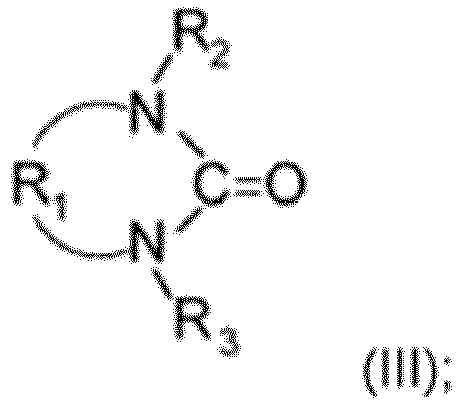 (c) la fourniture d'un anhydride carboxylique cyclique de la formule générale (IV)
 (d) l'ajout du dérivé d'urée cyclique de formule générale (III) au polymère en tant qu'un premier réactif de fonctionnalisation pour former un intermédiaire de polymère fonctionnalisé ; et(e) subséquemment l'ajout de l'anhydride carboxylique cyclique de la formule générale (IV) à l'intermédiaire de polymère fonctionnalisé en tant qu'un deuxième réactif de fonctionnalisation pour former le polymère terminé par carboxy selon la formule générale (I) ou (II) ;le polymère, n, M, R1, R2, R3 et R4 étant tels que définis dans l'une quelconque des revendications 1 à 8.
 - Procédé selon la revendication 8, l'étape (a) étant réalisée par une polymérisation en solution anionique, ou une polymérisation utilisant un catalyseur de coordination, le catalyseur de coordination étant préférablement un catalyseur Ziegler-Natta ou un système de catalyseur monométallique.
- Procédé selon la revendication 9 ou 10, l'étape (a) étant réalisée en la présence d'un solvant, le solvant étant préférablement choisi dans le groupe constitué par le cyclohexane, le méthylcyclopentane, le n-hexane et des mélanges correspondants ; et/ou un initiateur, qui est préférablement le n-butyllithium ou le sec-butyllithium.
- Procédé selon l'une quelconque des revendications 9 à 11, l'étape (a) étant réalisée dans une période de 10 minutes à 8 heures, préférablement 20 minutes à 4 heures.
- Procédé selon l'une quelconque des revendications 9 à 12, qui comprend l'étape ou les étapes supplémentaires d'ajout(f) d'un réactif de couplage avant, ensemble avec ou après l'ajout du dérivé d'urée cyclique de formule générale (III), le réactif de couplage étant préférablement choisi dans le groupe constitué par le tétrachlorure de silicium, le méthyltrichlorosilane, le diméthyldichlorosilane, le tétrachlorure d'étain, le dichlorure de dibutylétain, des tétraalcoxysilanes, l'éther de diglycidyle d'éthylène glycol et le 1,2,4-tris(chlorométhyl)benzène ; et/ou(g) d'un antioxydant après que le dérivé d'urée cyclique de la formule générale (III) et que l'anhydride carboxylique cyclique de formule générale (IV) ont été ajoutés, l'antioxydant étant préférablement choisi dans le groupe constitué par des phénols stériquement encombrés, des amines aromatiques, des phosphites et des thioéthers ; et/ou(h) d'une huile d'extension, l'huile d'extension étant préférablement choisie dans le groupe constitué par un TDAE (extrait aromatique de distillat traité), un MES (solvates d'extraction légère), un RAE (extrait aromatique résiduel), un TRAE (extrait aromatique résiduel traité), une huile naphténique et une huile naphténique lourde ; et/ou(i) d'une charge, qui est préférablement du noir de carbone ou une silice ; et/ou(j) de caoutchoucs et/ou d'additifs de caoutchouc.
- Article moulé, préférablement un pneu, préparé par vulcanisation d'une composition vulcanisable comprenant le polymère terminé par carboxy selon l'une quelconque des revendications 1 à 8.
Applications Claiming Priority (2)
| Application Number | Priority Date | Filing Date | Title |
|---|---|---|---|
| EP19186585 | 2019-07-16 | ||
| PCT/EP2020/069846 WO2021009154A1 (fr) | 2019-07-16 | 2020-07-14 | Caoutchoucs diéniques à terminaison carboxy |
Publications (2)
| Publication Number | Publication Date |
|---|---|
| EP3999552A1 EP3999552A1 (fr) | 2022-05-25 |
| EP3999552B1 true EP3999552B1 (fr) | 2025-03-05 |
Family
ID=67314682
Family Applications (1)
| Application Number | Title | Priority Date | Filing Date |
|---|---|---|---|
| EP20739683.9A Active EP3999552B1 (fr) | 2019-07-16 | 2020-07-14 | Caoutchoucs de diène à terminaison carboxy |
Country Status (8)
| Country | Link |
|---|---|
| US (1) | US20220251246A1 (fr) |
| EP (1) | EP3999552B1 (fr) |
| JP (1) | JP2022542816A (fr) |
| KR (1) | KR20220035375A (fr) |
| CN (1) | CN114026132B (fr) |
| BR (1) | BR112022000725A2 (fr) |
| MX (1) | MX2022000632A (fr) |
| WO (1) | WO2021009154A1 (fr) |
Families Citing this family (8)
| Publication number | Priority date | Publication date | Assignee | Title |
|---|---|---|---|---|
| CN117836334A (zh) | 2021-08-17 | 2024-04-05 | 阿朗新科德国有限责任公司 | 官能化聚合物 |
| CN117897280A (zh) | 2021-08-27 | 2024-04-16 | 阿朗新科德国有限责任公司 | 包含有机酸和用包含羧酸基团的单元官能化的二烯橡胶的稳定聚合物组合物 |
| JP2024546597A (ja) | 2021-12-07 | 2024-12-26 | アランセオ・ドイチュランド・ゲーエムベーハー | 不飽和シロキサン系カップリング剤を用いて製造したジエンゴム |
| US20250115702A1 (en) | 2022-02-11 | 2025-04-10 | Arlanxeo Deutschland Gmbh | Modified diene rubbers |
| JP2025515581A (ja) | 2022-05-12 | 2025-05-20 | アランセオ・ドイチュランド・ゲーエムベーハー | エチレンコポリマー系の官能基化ゴムを含むタイヤ組成物 |
| WO2023227763A1 (fr) | 2022-05-27 | 2023-11-30 | Arlanxeo Deutschland Gmbh | Composés de caoutchouc de caoutchoucs diènes conjugués fonctionnalisés et charges de silice |
| KR20250028256A (ko) | 2022-06-23 | 2025-02-28 | 아란세오 도이치란드 게엠베하 | 알파-오메가-작용화된 중합체 |
| WO2025242516A1 (fr) | 2024-05-22 | 2025-11-27 | Arlanxeo Deutschland Gmbh | Caoutchouc diénique ramifié |
Family Cites Families (28)
| Publication number | Priority date | Publication date | Assignee | Title |
|---|---|---|---|---|
| US3244664A (en) | 1960-10-24 | 1966-04-05 | Phillips Petroleum Co | Silicon-containing polymers |
| US3242129A (en) * | 1963-03-11 | 1966-03-22 | Phillips Petroleum Co | Carboxy terminated polymers as processing aids for polybutadiene |
| DE2653144C2 (de) | 1976-11-23 | 1984-12-20 | Bayer Ag, 5090 Leverkusen | Verfahren zur Herstellung von modifiziertem Polybutadien |
| GB1597500A (en) | 1977-12-29 | 1981-09-09 | Shell Int Research | Polymers |
| US4417029A (en) | 1981-08-03 | 1983-11-22 | Atlantic Richfield Company | Derivatization of star-block copolymers |
| US4465809A (en) * | 1982-11-05 | 1984-08-14 | Phillips Petroleum Company | Conversion of polymer lithium to polymer carboxylate |
| US4616069A (en) | 1984-10-26 | 1986-10-07 | Nippon Zeon Co., Ltd. | Process for making diene polymer rubbers |
| JPH0643448B2 (ja) * | 1985-06-26 | 1994-06-08 | 日本エラストマ−株式会社 | 分岐状ランダムスチレン−ブタジエン共重合体 |
| WO1987002369A1 (fr) * | 1985-10-11 | 1987-04-23 | Asahi Kasei Kogyo Kabushiki Kaisha | Copolymere bloc a terminaisons modifiees et composition contenant ce copolymere |
| GB9002804D0 (en) | 1990-02-08 | 1990-04-04 | Secr Defence | Anionic polymerisation |
| US5332810A (en) | 1992-10-02 | 1994-07-26 | Bridgestone Corporation | Solubilized anionic polymerization initiator and preparation thereof |
| DE69311666T2 (de) | 1992-10-19 | 1997-11-20 | Bridgestone Corp | Verfahren zur Herstellung eines Polymers mit einem Initiator auf Lithium basiertem in situ hergestelltem Initiator |
| US5416168A (en) | 1994-03-31 | 1995-05-16 | Shell Oil Company | Protected functional initiators for making terminally functionalized polymers |
| US5496940A (en) | 1995-02-01 | 1996-03-05 | Bridgestone Corporation | Alkyllithium compounds containing cyclic amines and their use in polymerization |
| FR2740778A1 (fr) | 1995-11-07 | 1997-05-09 | Michelin & Cie | Composition de caoutchouc a base de silice et de polymere dienique fonctionalise ayant une fonction silanol terminale |
| JP3622803B2 (ja) | 1995-11-28 | 2005-02-23 | 日本ゼオン株式会社 | ゴム組成物 |
| EP1000971B1 (fr) | 1998-11-16 | 2003-10-15 | Bayer Aktiengesellschaft | Compositions de caoutchouc comprenant du caoutchouc polymérisé en solution ayant des groupements carboxyl |
| ATE281473T1 (de) | 1999-05-05 | 2004-11-15 | Michelin Soc Tech | Verfahren zur herstellung von polymeren mit mindestens einer doppelbindung und carbonylgruppen entlang der kette |
| CN1649907B (zh) * | 2002-04-10 | 2010-10-13 | 旭化成化学株式会社 | 改性聚合物及包含所述改性聚合物的组合物 |
| WO2004003027A1 (fr) * | 2002-06-27 | 2004-01-08 | Asahi Kasei Chemicals Corporation | Copolymere hydrogene et composition sur la base de celle-ci |
| US20050203251A1 (en) | 2004-03-11 | 2005-09-15 | Sumitomo Chemical Company, Limited | Process for producing modified diene polymer rubber |
| JP5464781B2 (ja) * | 2006-06-09 | 2014-04-09 | 株式会社ブリヂストン | ゴム組成物及びそれを用いたタイヤ |
| US8063165B2 (en) | 2007-06-18 | 2011-11-22 | Bridgestone Corporation | Functional polymers prepared with sulfur-containing initiators |
| DE102007044175A1 (de) | 2007-09-15 | 2009-03-19 | Lanxess Deutschland Gmbh | Funktionalisierte Hochvinyl-Dienkautschuke |
| US8759451B2 (en) * | 2011-12-21 | 2014-06-24 | The Goodyear Tire & Rubber Company | Method of making a graft copolymer |
| JP2014031417A (ja) * | 2012-08-02 | 2014-02-20 | Nissin Kogyo Co Ltd | 変性共役ジエン系ゴム組成物、タイヤ用ゴム組成物及びそのゴム組成物を用いたタイヤ |
| EP2796471A1 (fr) * | 2013-04-24 | 2014-10-29 | LANXESS Deutschland GmbH | Polymère carboxyterminé contenant du silane |
| US10577434B2 (en) * | 2015-09-10 | 2020-03-03 | Bridgestone Corporation | Methods for preparation of functionalized polymers |
-
2020
- 2020-07-14 MX MX2022000632A patent/MX2022000632A/es unknown
- 2020-07-14 JP JP2022502520A patent/JP2022542816A/ja active Pending
- 2020-07-14 BR BR112022000725A patent/BR112022000725A2/pt not_active Application Discontinuation
- 2020-07-14 KR KR1020227001063A patent/KR20220035375A/ko not_active Ceased
- 2020-07-14 CN CN202080047060.2A patent/CN114026132B/zh active Active
- 2020-07-14 EP EP20739683.9A patent/EP3999552B1/fr active Active
- 2020-07-14 WO PCT/EP2020/069846 patent/WO2021009154A1/fr not_active Ceased
- 2020-07-14 US US17/628,101 patent/US20220251246A1/en not_active Abandoned
Also Published As
| Publication number | Publication date |
|---|---|
| US20220251246A1 (en) | 2022-08-11 |
| CN114026132A (zh) | 2022-02-08 |
| BR112022000725A2 (pt) | 2022-03-08 |
| EP3999552A1 (fr) | 2022-05-25 |
| KR20220035375A (ko) | 2022-03-22 |
| CN114026132B (zh) | 2023-12-12 |
| MX2022000632A (es) | 2022-03-11 |
| JP2022542816A (ja) | 2022-10-07 |
| WO2021009154A1 (fr) | 2021-01-21 |
Similar Documents
| Publication | Publication Date | Title |
|---|---|---|
| EP3999553B1 (fr) | Caoutchoucs diéniques à terminaison 1-amino-3-(oxyalkylalkoxysilyl)-2-propanol | |
| US9920149B2 (en) | Silane-containing carboxy-terminated polymers | |
| KR101716539B1 (ko) | 실란을 함유하는 메탄올-말단 중합체 | |
| CN114026132B (zh) | 羧基封端的二烯橡胶 | |
| CN105143315B (zh) | 具有良好加工行为的冷流降低的聚合物 | |
| CN104271657B (zh) | 含胺的甲醇封端的聚合物 | |
| US9718912B2 (en) | Carbinol-terminated polymers containing allylamine | |
| US10421825B2 (en) | Methanol-terminated polymers containing ether | |
| KR101716540B1 (ko) | 트리알킬실릴옥시-말단 중합체 | |
| KR20210110224A (ko) | 변성 공액디엔계 중합체, 이의 제조방법 및 이를 포함하는 고무 조성물 | |
| KR102724304B1 (ko) | 변성 공액디엔계 중합체, 이의 제조방법 및 이를 포함하는 고무 조성물 | |
| HK1222187B (en) | Carboxyl-terminated polymers containing silanes |
Legal Events
| Date | Code | Title | Description |
|---|---|---|---|
| STAA | Information on the status of an ep patent application or granted ep patent |
Free format text: STATUS: UNKNOWN |
|
| STAA | Information on the status of an ep patent application or granted ep patent |
Free format text: STATUS: THE INTERNATIONAL PUBLICATION HAS BEEN MADE |
|
| PUAI | Public reference made under article 153(3) epc to a published international application that has entered the european phase |
Free format text: ORIGINAL CODE: 0009012 |
|
| STAA | Information on the status of an ep patent application or granted ep patent |
Free format text: STATUS: REQUEST FOR EXAMINATION WAS MADE |
|
| 17P | Request for examination filed |
Effective date: 20220216 |
|
| AK | Designated contracting states |
Kind code of ref document: A1 Designated state(s): AL AT BE BG CH CY CZ DE DK EE ES FI FR GB GR HR HU IE IS IT LI LT LU LV MC MK MT NL NO PL PT RO RS SE SI SK SM TR |
|
| DAV | Request for validation of the european patent (deleted) | ||
| DAX | Request for extension of the european patent (deleted) | ||
| STAA | Information on the status of an ep patent application or granted ep patent |
Free format text: STATUS: EXAMINATION IS IN PROGRESS |
|
| 17Q | First examination report despatched |
Effective date: 20230306 |
|
| P01 | Opt-out of the competence of the unified patent court (upc) registered |
Effective date: 20230608 |
|
| GRAP | Despatch of communication of intention to grant a patent |
Free format text: ORIGINAL CODE: EPIDOSNIGR1 |
|
| STAA | Information on the status of an ep patent application or granted ep patent |
Free format text: STATUS: GRANT OF PATENT IS INTENDED |
|
| INTG | Intention to grant announced |
Effective date: 20240613 |
|
| GRAJ | Information related to disapproval of communication of intention to grant by the applicant or resumption of examination proceedings by the epo deleted |
Free format text: ORIGINAL CODE: EPIDOSDIGR1 |
|
| STAA | Information on the status of an ep patent application or granted ep patent |
Free format text: STATUS: EXAMINATION IS IN PROGRESS |
|
| INTC | Intention to grant announced (deleted) | ||
| GRAP | Despatch of communication of intention to grant a patent |
Free format text: ORIGINAL CODE: EPIDOSNIGR1 |
|
| STAA | Information on the status of an ep patent application or granted ep patent |
Free format text: STATUS: GRANT OF PATENT IS INTENDED |
|
| INTG | Intention to grant announced |
Effective date: 20241107 |
|
| GRAS | Grant fee paid |
Free format text: ORIGINAL CODE: EPIDOSNIGR3 |
|
| GRAA | (expected) grant |
Free format text: ORIGINAL CODE: 0009210 |
|
| STAA | Information on the status of an ep patent application or granted ep patent |
Free format text: STATUS: THE PATENT HAS BEEN GRANTED |
|
| AK | Designated contracting states |
Kind code of ref document: B1 Designated state(s): AL AT BE BG CH CY CZ DE DK EE ES FI FR GB GR HR HU IE IS IT LI LT LU LV MC MK MT NL NO PL PT RO RS SE SI SK SM TR |
|
| REG | Reference to a national code |
Ref country code: GB Ref legal event code: FG4D |
|
| REG | Reference to a national code |
Ref country code: CH Ref legal event code: EP |
|
| REG | Reference to a national code |
Ref country code: IE Ref legal event code: FG4D |
|
| REG | Reference to a national code |
Ref country code: DE Ref legal event code: R096 Ref document number: 602020047211 Country of ref document: DE |
|
| PG25 | Lapsed in a contracting state [announced via postgrant information from national office to epo] |
Ref country code: RS Free format text: LAPSE BECAUSE OF FAILURE TO SUBMIT A TRANSLATION OF THE DESCRIPTION OR TO PAY THE FEE WITHIN THE PRESCRIBED TIME-LIMIT Effective date: 20250605 |
|
| PG25 | Lapsed in a contracting state [announced via postgrant information from national office to epo] |
Ref country code: FI Free format text: LAPSE BECAUSE OF FAILURE TO SUBMIT A TRANSLATION OF THE DESCRIPTION OR TO PAY THE FEE WITHIN THE PRESCRIBED TIME-LIMIT Effective date: 20250305 |
|
| REG | Reference to a national code |
Ref country code: NL Ref legal event code: MP Effective date: 20250305 |
|
| PG25 | Lapsed in a contracting state [announced via postgrant information from national office to epo] |
Ref country code: ES Free format text: LAPSE BECAUSE OF FAILURE TO SUBMIT A TRANSLATION OF THE DESCRIPTION OR TO PAY THE FEE WITHIN THE PRESCRIBED TIME-LIMIT Effective date: 20250305 |
|
| PGFP | Annual fee paid to national office [announced via postgrant information from national office to epo] |
Ref country code: GB Payment date: 20250529 Year of fee payment: 6 |
|
| REG | Reference to a national code |
Ref country code: LT Ref legal event code: MG9D |
|
| PG25 | Lapsed in a contracting state [announced via postgrant information from national office to epo] |
Ref country code: NO Free format text: LAPSE BECAUSE OF FAILURE TO SUBMIT A TRANSLATION OF THE DESCRIPTION OR TO PAY THE FEE WITHIN THE PRESCRIBED TIME-LIMIT Effective date: 20250605 |
|
| PG25 | Lapsed in a contracting state [announced via postgrant information from national office to epo] |
Ref country code: HR Free format text: LAPSE BECAUSE OF FAILURE TO SUBMIT A TRANSLATION OF THE DESCRIPTION OR TO PAY THE FEE WITHIN THE PRESCRIBED TIME-LIMIT Effective date: 20250305 |
|
| PG25 | Lapsed in a contracting state [announced via postgrant information from national office to epo] |
Ref country code: LV Free format text: LAPSE BECAUSE OF FAILURE TO SUBMIT A TRANSLATION OF THE DESCRIPTION OR TO PAY THE FEE WITHIN THE PRESCRIBED TIME-LIMIT Effective date: 20250305 |
|
| PGFP | Annual fee paid to national office [announced via postgrant information from national office to epo] |
Ref country code: FR Payment date: 20250610 Year of fee payment: 6 |
|
| PG25 | Lapsed in a contracting state [announced via postgrant information from national office to epo] |
Ref country code: BG Free format text: LAPSE BECAUSE OF FAILURE TO SUBMIT A TRANSLATION OF THE DESCRIPTION OR TO PAY THE FEE WITHIN THE PRESCRIBED TIME-LIMIT Effective date: 20250305 Ref country code: GR Free format text: LAPSE BECAUSE OF FAILURE TO SUBMIT A TRANSLATION OF THE DESCRIPTION OR TO PAY THE FEE WITHIN THE PRESCRIBED TIME-LIMIT Effective date: 20250606 |
|
| REG | Reference to a national code |
Ref country code: AT Ref legal event code: MK05 Ref document number: 1772902 Country of ref document: AT Kind code of ref document: T Effective date: 20250305 |
|
| PG25 | Lapsed in a contracting state [announced via postgrant information from national office to epo] |
Ref country code: NL Free format text: LAPSE BECAUSE OF FAILURE TO SUBMIT A TRANSLATION OF THE DESCRIPTION OR TO PAY THE FEE WITHIN THE PRESCRIBED TIME-LIMIT Effective date: 20250305 |
|
| PG25 | Lapsed in a contracting state [announced via postgrant information from national office to epo] |
Ref country code: SE Free format text: LAPSE BECAUSE OF FAILURE TO SUBMIT A TRANSLATION OF THE DESCRIPTION OR TO PAY THE FEE WITHIN THE PRESCRIBED TIME-LIMIT Effective date: 20250305 |
|
| PG25 | Lapsed in a contracting state [announced via postgrant information from national office to epo] |
Ref country code: SM Free format text: LAPSE BECAUSE OF FAILURE TO SUBMIT A TRANSLATION OF THE DESCRIPTION OR TO PAY THE FEE WITHIN THE PRESCRIBED TIME-LIMIT Effective date: 20250305 |
|
| PG25 | Lapsed in a contracting state [announced via postgrant information from national office to epo] |
Ref country code: PT Free format text: LAPSE BECAUSE OF FAILURE TO SUBMIT A TRANSLATION OF THE DESCRIPTION OR TO PAY THE FEE WITHIN THE PRESCRIBED TIME-LIMIT Effective date: 20250707 |
|
| PGFP | Annual fee paid to national office [announced via postgrant information from national office to epo] |
Ref country code: DE Payment date: 20250604 Year of fee payment: 6 |
|
| PG25 | Lapsed in a contracting state [announced via postgrant information from national office to epo] |
Ref country code: PL Free format text: LAPSE BECAUSE OF FAILURE TO SUBMIT A TRANSLATION OF THE DESCRIPTION OR TO PAY THE FEE WITHIN THE PRESCRIBED TIME-LIMIT Effective date: 20250305 |
|
| PGFP | Annual fee paid to national office [announced via postgrant information from national office to epo] |
Ref country code: IT Payment date: 20250623 Year of fee payment: 6 |
|
| PG25 | Lapsed in a contracting state [announced via postgrant information from national office to epo] |
Ref country code: AT Free format text: LAPSE BECAUSE OF FAILURE TO SUBMIT A TRANSLATION OF THE DESCRIPTION OR TO PAY THE FEE WITHIN THE PRESCRIBED TIME-LIMIT Effective date: 20250305 |
|
| PG25 | Lapsed in a contracting state [announced via postgrant information from national office to epo] |
Ref country code: CZ Free format text: LAPSE BECAUSE OF FAILURE TO SUBMIT A TRANSLATION OF THE DESCRIPTION OR TO PAY THE FEE WITHIN THE PRESCRIBED TIME-LIMIT Effective date: 20250305 Ref country code: EE Free format text: LAPSE BECAUSE OF FAILURE TO SUBMIT A TRANSLATION OF THE DESCRIPTION OR TO PAY THE FEE WITHIN THE PRESCRIBED TIME-LIMIT Effective date: 20250305 |
|
| PG25 | Lapsed in a contracting state [announced via postgrant information from national office to epo] |
Ref country code: RO Free format text: LAPSE BECAUSE OF FAILURE TO SUBMIT A TRANSLATION OF THE DESCRIPTION OR TO PAY THE FEE WITHIN THE PRESCRIBED TIME-LIMIT Effective date: 20250305 |
|
| PG25 | Lapsed in a contracting state [announced via postgrant information from national office to epo] |
Ref country code: SK Free format text: LAPSE BECAUSE OF FAILURE TO SUBMIT A TRANSLATION OF THE DESCRIPTION OR TO PAY THE FEE WITHIN THE PRESCRIBED TIME-LIMIT Effective date: 20250305 |
|
| PG25 | Lapsed in a contracting state [announced via postgrant information from national office to epo] |
Ref country code: IS Free format text: LAPSE BECAUSE OF FAILURE TO SUBMIT A TRANSLATION OF THE DESCRIPTION OR TO PAY THE FEE WITHIN THE PRESCRIBED TIME-LIMIT Effective date: 20250705 |
|
| REG | Reference to a national code |
Ref country code: DE Ref legal event code: R097 Ref document number: 602020047211 Country of ref document: DE |
|
| PLBE | No opposition filed within time limit |
Free format text: ORIGINAL CODE: 0009261 |
|
| STAA | Information on the status of an ep patent application or granted ep patent |
Free format text: STATUS: NO OPPOSITION FILED WITHIN TIME LIMIT |
|
| PG25 | Lapsed in a contracting state [announced via postgrant information from national office to epo] |
Ref country code: DK Free format text: LAPSE BECAUSE OF FAILURE TO SUBMIT A TRANSLATION OF THE DESCRIPTION OR TO PAY THE FEE WITHIN THE PRESCRIBED TIME-LIMIT Effective date: 20250305 |
|
| REG | Reference to a national code |
Ref country code: CH Ref legal event code: L10 Free format text: ST27 STATUS EVENT CODE: U-0-0-L10-L00 (AS PROVIDED BY THE NATIONAL OFFICE) Effective date: 20260114 |
|
| 26N | No opposition filed |
Effective date: 20251208 |
|
| REG | Reference to a national code |
Ref country code: CH Ref legal event code: H13 Free format text: ST27 STATUS EVENT CODE: U-0-0-H10-H13 (AS PROVIDED BY THE NATIONAL OFFICE) Effective date: 20260224 |
|
| PG25 | Lapsed in a contracting state [announced via postgrant information from national office to epo] |
Ref country code: LU Free format text: LAPSE BECAUSE OF NON-PAYMENT OF DUE FEES Effective date: 20250714 |
|
| REG | Reference to a national code |
Ref country code: BE Ref legal event code: MM Effective date: 20250731 |
|
| PG25 | Lapsed in a contracting state [announced via postgrant information from national office to epo] |
Ref country code: BE Free format text: LAPSE BECAUSE OF NON-PAYMENT OF DUE FEES Effective date: 20250731 |
|
| PG25 | Lapsed in a contracting state [announced via postgrant information from national office to epo] |
Ref country code: CH Free format text: LAPSE BECAUSE OF NON-PAYMENT OF DUE FEES Effective date: 20250731 |
|
| PG25 | Lapsed in a contracting state [announced via postgrant information from national office to epo] |
Ref country code: LT Free format text: LAPSE BECAUSE OF FAILURE TO SUBMIT A TRANSLATION OF THE DESCRIPTION OR TO PAY THE FEE WITHIN THE PRESCRIBED TIME-LIMIT Effective date: 20250305 |
|
| PG25 | Lapsed in a contracting state [announced via postgrant information from national office to epo] |
Ref country code: IE Free format text: LAPSE BECAUSE OF NON-PAYMENT OF DUE FEES Effective date: 20250714 |
|
| PG25 | Lapsed in a contracting state [announced via postgrant information from national office to epo] |
Ref country code: MC Free format text: LAPSE BECAUSE OF FAILURE TO SUBMIT A TRANSLATION OF THE DESCRIPTION OR TO PAY THE FEE WITHIN THE PRESCRIBED TIME-LIMIT Effective date: 20250305 |
|
| PG25 | Lapsed in a contracting state [announced via postgrant information from national office to epo] |
Ref country code: CY Free format text: LAPSE BECAUSE OF FAILURE TO SUBMIT A TRANSLATION OF THE DESCRIPTION OR TO PAY THE FEE WITHIN THE PRESCRIBED TIME-LIMIT Effective date: 20250305 |