EP3995358A1 - Housse pour siège, siège associé et véhicule comportant un tel siège - Google Patents
Housse pour siège, siège associé et véhicule comportant un tel siège Download PDFInfo
- Publication number
- EP3995358A1 EP3995358A1 EP21206132.9A EP21206132A EP3995358A1 EP 3995358 A1 EP3995358 A1 EP 3995358A1 EP 21206132 A EP21206132 A EP 21206132A EP 3995358 A1 EP3995358 A1 EP 3995358A1
- Authority
- EP
- European Patent Office
- Prior art keywords
- seat
- screen
- cover
- user
- cushion
- Prior art date
- Legal status (The legal status is an assumption and is not a legal conclusion. Google has not performed a legal analysis and makes no representation as to the accuracy of the status listed.)
- Granted
Links
Images

Classifications
-
- B—PERFORMING OPERATIONS; TRANSPORTING
- B60—VEHICLES IN GENERAL
- B60N—SEATS SPECIALLY ADAPTED FOR VEHICLES; VEHICLE PASSENGER ACCOMMODATION NOT OTHERWISE PROVIDED FOR
- B60N2/00—Seats specially adapted for vehicles; Arrangement or mounting of seats in vehicles
- B60N2/58—Seat coverings
- B60N2/60—Removable protective coverings
- B60N2/6009—Removable protective coverings covering more than only the seat
-
- B—PERFORMING OPERATIONS; TRANSPORTING
- B60—VEHICLES IN GENERAL
- B60N—SEATS SPECIALLY ADAPTED FOR VEHICLES; VEHICLE PASSENGER ACCOMMODATION NOT OTHERWISE PROVIDED FOR
- B60N2/00—Seats specially adapted for vehicles; Arrangement or mounting of seats in vehicles
- B60N2/64—Back-rests or cushions
- B60N2/66—Lumbar supports
- B60N2/663—Lumbar supports portable with attachment to the back-rest
-
- B—PERFORMING OPERATIONS; TRANSPORTING
- B60—VEHICLES IN GENERAL
- B60N—SEATS SPECIALLY ADAPTED FOR VEHICLES; VEHICLE PASSENGER ACCOMMODATION NOT OTHERWISE PROVIDED FOR
- B60N2/00—Seats specially adapted for vehicles; Arrangement or mounting of seats in vehicles
- B60N2/75—Arm-rests
- B60N2/79—Adaptations for additional use of the arm-rests
-
- B—PERFORMING OPERATIONS; TRANSPORTING
- B60—VEHICLES IN GENERAL
- B60N—SEATS SPECIALLY ADAPTED FOR VEHICLES; VEHICLE PASSENGER ACCOMMODATION NOT OTHERWISE PROVIDED FOR
- B60N2/00—Seats specially adapted for vehicles; Arrangement or mounting of seats in vehicles
- B60N2/80—Head-rests
- B60N2/879—Head-rests with additional features not related to head-rest positioning, e.g. heating or cooling devices or loudspeakers
-
- B—PERFORMING OPERATIONS; TRANSPORTING
- B60—VEHICLES IN GENERAL
- B60N—SEATS SPECIALLY ADAPTED FOR VEHICLES; VEHICLE PASSENGER ACCOMMODATION NOT OTHERWISE PROVIDED FOR
- B60N2/00—Seats specially adapted for vehicles; Arrangement or mounting of seats in vehicles
- B60N2/90—Details or parts not otherwise provided for
- B60N2/91—Panels between front seats
-
- B—PERFORMING OPERATIONS; TRANSPORTING
- B61—RAILWAYS
- B61C—LOCOMOTIVES; MOTOR RAILCARS
- B61C3/00—Electric locomotives or railcars
-
- B—PERFORMING OPERATIONS; TRANSPORTING
- B64—AIRCRAFT; AVIATION; COSMONAUTICS
- B64D—EQUIPMENT FOR FITTING IN OR TO AIRCRAFT; FLIGHT SUITS; PARACHUTES; ARRANGEMENT OR MOUNTING OF POWER PLANTS OR PROPULSION TRANSMISSIONS IN AIRCRAFT
- B64D11/00—Passenger or crew accommodation; Flight-deck installations not otherwise provided for
- B64D11/06—Arrangements of seats, or adaptations or details specially adapted for aircraft seats
- B64D11/0606—Arrangements of seats, or adaptations or details specially adapted for aircraft seats with privacy shells, screens, separators or the like
Definitions
- the present invention relates to a cover for a seat.
- the present invention also relates to a seat comprising such a cover and to a vehicle comprising such a seat.
- a large number of seats are arranged close to each other, for example in trains or buses, or even in theaters or conferences.
- these seats are identical to one another, or have a limited number of different types, in order to facilitate the management of the seats by the operator of the hall or of the transport system.
- the seats are then designed in such a way as to present an acceptable level of comfort for the intended users, and present functions chosen to meet the needs of the majority of users without increasing the price of the seats by adding functions which would only be useful for a minority of users.
- the seats are generally arranged at a distance from each other such that the privacy of the occupants of the seats is not preserved if people occupy the neighboring seats.
- the small distance between people can facilitate the transmission of diseases between their occupants.
- An important criterion to take into account is, moreover, to allow easy movement of users between or next to the seats, which limits the possibility of equipping the seats with means, such as screens, increasing the level of privacy. perceived, since it is not desirable to multiply obstacles which would prevent a user of the seat from leaving it quickly in case of need such as an accident or a fire.
- a single seat or a small number of seats are arranged in a space of small dimensions, such as a car, which means that the presence of a screen could hinder the entry or exit of users. .
- a cover intended to cover a seat, in particular a seat of a public transport vehicle, in a removable manner, comprising at least a first cover element and a folding screen, the first cover element comprising a support face provided for a user to press his head against the support face when the user is seated on the seat, the screen comprising a set of panels and having an unfolded configuration and a folded configuration, the panels being stacked against each other along a stacking direction when the screen is in the folded configuration, the screen extending forward of the seat from a transverse end of the front press when the screen is in the unfolded configuration.
- a seat equipped with a cover as previously described, as well as a vehicle, in particular a public transport vehicle, comprising such a seat.
- Two seats 10 each equipped with a cover 15 are represented on the figure 1 .
- the two seats 10 are, in particular, arranged side by side and face in the same direction.
- Each seat 10 is configured to allow a user to sit on the seat 10.
- the seat 10 is capable of providing acceptable comfort to users even when no cover 15 covers the seat 10.
- a longitudinal direction L, a vertical direction V and a transverse direction T are defined for each seat 10.
- a front and a rear are defined for the longitudinal direction L.
- the user seated on the seat 10 faces the front of the seat 10.
- the longitudinal direction L is, for example, a horizontal direction.
- the transverse direction T is a horizontal direction.
- the transverse direction T is perpendicular to the longitudinal direction L.
- the transverse direction T is, for example, the direction in which the shoulders of the user seated on the seat 10 and facing the front extend.
- Each seat 10 is, for example, a seat of a vehicle such as a public transport vehicle, in particular a train, a bus, a metro or a tramway.
- a vehicle such as a public transport vehicle, in particular a train, a bus, a metro or a tramway.
- each seat 10 is a seat in a building such as a performance hall, cinema or conference hall.
- Each seat 10 comprises a seat 20, a backrest 25, and, for example, at least one armrest 30.
- the seat 20 extends forward from the backrest 25.
- the seat 20 is configured to support a user seated on the seat 10.
- the seat 20 includes a cushion on its upper face.
- the backrest 25 is configured to allow a user seated on the seat 10 to press his back and his head against the backrest. When the user is seated on the seat 10, the backrest 25 is arranged behind the user.
- the backrest 25 comprises, for example, a main portion 35 provided so that the user presses his back against the main portion 35, and a headrest 40 extending vertically upwards from an upper end of the portion. main 35.
- the backrest 25 extends from the seat 20 in a direction of extension of the backrest 25.
- the main portion 35 and the headrest 40 include, in particular, each a cushion on their respective front face, as well as a support or a shell suitable for supporting the cushion and providing mechanical rigidity to the main portion 35 or to headrest 40.
- the or each armrest 30 extends forward from the backrest 25.
- Each armrest 30 is, for example, connected to the backrest 25 by a pivot connection configured to allow the armrest 30 to pivot between a lowered configuration in which the armrest 30 is substantially horizontal and extends forwards and a configuration raised in which the armrest 30 is substantially vertical.
- Each cover 15 at least partially covers the corresponding seat 10.
- the cover 15 removably covers the seat 10.
- the cover 15 is intended to be put in place and removed from the seat 10 simply and quickly.
- the cover 15 comprises at least a first cover element 45 and a screen 50.
- the cover 15 further comprises a second cover element 52 and a third cover element 54.
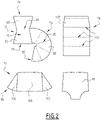
- the different parts of the cover 15 are represented in particular on the figure 2 , which features a cover pattern 15.
- the first cover element 45 is configured to at least partially cover an upper part of the backrest 25, in particular the headrest 40.
- the first cover element 45 comprises, for example, a first portion 55 and a second portion 60, these two portions 55, 60 being connected to each other and being configured to be folded against each other on along a 65 fold line.
- the first portion 55 and the second portion 60 are, for example, integral with each other, being in particular formed by the same piece of fabric.
- Each of the first portion 55 and the second portion 60 has an end 70 of the first cover element 45, the fold line 65 being interposed between the two ends 70 when the first cover element 45 is unfolded.
- Each end 70 is, for example, straight and delimited along a direction parallel to the fold line 65 by two corners.
- the cover 15 covers the seat 10
- a portion of the backrest 25, in particular the headrest 40 is for example sandwiched between the first portion 55 and the second portion 60.
- the line of folding 65 is a horizontal line when the cover 15 covers the seat 10.
- the first cover element 45 further comprises means for fixing the first portion 55 to the second portion 60.
- the fixing means are, in particular, configured to exert, when the first cover element 45 covers the head restraint 40, a force tending to bring the first portion 55 closer to the second portion 60, so as to maintain the headrest 40 clamped between the two portions 55, 60 of the first cover element.
- the fixing means are, for example, provided for fixing the two ends 70 of the first cover element 45 to each other, in particular for fixing the corners of the two ends 70 two by two.
- the fastening means comprise, for example, a strap fastened to a corner of one of the ends 70 and cooperating with a buckle fastened to a corner of the other end 70, or even press-studs each fastened to a corner and cooperating two by two.
- the first portion 55 is provided to be interposed between the user's head and the headrest 40 when the cover 15 covers the seat 10 and the user is seated on the seat 10.
- one of the faces of the first portion 55 called “support face” 75, is configured so that the user presses his head against the support face 75 when he is seated on the seat 10.
- the screen 50 is fixed to the first cover element 45, in particular to the first portion 55.
- the screen 50 is fixed, in particular sewn, to the support face 75.
- the screen 50 is, in particular, fixed to a transverse end of the first cover element 45, in particular of the support face 75.
- the cover 15 comprises two screens 50 each fixed to a transverse end of the support face 75 and between which the head of the user is interposed when the user presses his head against the headrest 40.
- the screen 50 comprises a set of panels 80A, 80B, 80C, for example between two and ten panels 80A, 80B, 80C, in particular between four and six panels 80A, 80B, 80C.
- a screen 50 with five panels 80A, 80B, 80C is represented, however the number of panels 80A, 80B, 80C is liable to vary.
- the screen 50 is, for example, made from a piece of fabric or several superimposed pieces of fabric.
- the screen 50 is formed by two pieces of fabric superposed and fixed to each other, between which a stuffing material such as felt is sandwiched.
- the screen 50 is unfoldable.
- the screen 50 has a folded configuration and an unfolded configuration, the screen 50 passing from the unfolded position to the folded position by folding, that is to say by folding down at least part of the screen 50 on another part.
- the stacking direction is, for example, the transverse direction T.
- the stacking direction is, for example, the longitudinal direction L.
- the screen 50 When the screen 50 is in the unfolded configuration, the screen extends forward of the seat 10. In particular, when the screen 50 is in the unfolded configuration, the screen 50 is offset transversely with respect to the user's head.
- the screen 50 When the screen 50 is in the unfolded configuration, the screen 50 has a total height, measured in the vertical direction, comprised, for example, between 40 centimeters (cm) and 70 cm, in particular equal to 60 cm, at 10 percent (%) near.
- the screen 50 When the screen 50 is in the unfolded configuration, the screen 50 has a total width, measured along the longitudinal direction L, comprised, for example, between 25 cm and 50 cm, in particular equal to 33 cm.
- the screen 50 When the screen 50 is in the unfolded configuration, the screen 50 has a lower end 83.
- the panels 80A, 80B, 80C are connected to each other.
- each panel 80A, 80B, 80C is connected to at least one other panel delimiting the panel 80A, 80B, 80C considered.
- the set of panels 80A, 80B, 80C comprises, for example, a first panel 80A, one end of which is fixed to the first cover element 35, one or more second panel(s) 80B, in particular three second panels 80B and a third panel 80C.
- the second panels 80B are successively interposed between the first panel 80A and the third panel 80C when the screen 50 is in the unfolded configuration.
- the third panel 80C is, for example, in contact with the backrest 25 or with the second cover element 55.
- the lower end 83 is, in particular, a point of the third panel 80C.
- the panels 80A, 80B, 80C are, for example, delimited from each other by seams 85 of the screen 50, and configured to be stacked against each other by folding along the seams 85.
- Each panel 80A, 80B, 80C is, for example, delimited by two line segments, the line segments of the panel 80A, 80B, 80C being segments of two concurrent lines.
- the lines corresponding to the line segments of the different panels 80A, 80B, 80C meet at a single point.
- Each line segment is materialized by a corresponding seam 65 which extends along the line segment considered.
- each panel 80A, 80B, 80C is in the shape of a circular sector, a triangle, or even an isosceles trapezium.
- the panel 80A, 80B, 80C is delimited by two concentric circles, the center of the circles being the point of intersection of the lines, and by the two line segments associated with the panel 80A, 80B, 80C.
- the screen 50 is, in particular, configured to be folded in a fan shape from the unfolded configuration to the folded configuration.
- each panel 80A, 80B, 80C is folded by rotation in one direction around one of the line segments which delimit the panel 80A, 80B, 80C considered, the panel 80A, 80B, 80C adjacent to the panel in question being folded by rotation in the opposite direction around one of the corresponding line segments.
- the seams 85 are configured to force the folding of the panels 80A, 80B, 80C in a fan shape when the user folds the screen 50.
- the cover 15 comprises traction means configured to exert on the lower end 83, when the screen 50 is in the unfolded configuration, a force tending to pull the lower end 83 downwards.
- the traction means comprise, for example, a strap fixed to the lower end 83 and intended to be fixed to an armrest 30 arranged below the screen 50.
- one end of the strap is fixed to the lower end 83, the other end of the strap being fixed to the armrest 30.
- the other end comprises a loop intended to be threaded around the armrest 30.
- thong is understood to mean any type of flexible link, chain, string, ribbon or the like. Each strap is, in particular, capable of being elastic.
- the traction means are suitable for fixing the end 83 to the second cover element 52.
- the traction means comprise a button fixed to the end 83 and a corresponding button mounted on the second cover element 52 .
- the cover 15 further comprises means for holding the screen 50 in the folded configuration, for example a strap or other flexible link provided to enclose the panels 80A, 80B, 80C when they are stacked against each other. others.
- means for holding the screen 50 in the folded configuration for example a strap or other flexible link provided to enclose the panels 80A, 80B, 80C when they are stacked against each other. others.
- the second cover element 52 is provided to at least partially cover the backrest 25, in particular to cover the main portion 35 of the backrest 25.
- the second cover element 52 comprises, for example, a front portion 90 and a rear portion 95, these two portions 90 and 95 being for example formed by two separate parts, but being in a variant two portions of the same part.
- Each of the front portion 90 and the rear portion 95 is, for example, made from a piece of fabric or several superposed pieces of fabric.
- the front portion 90 and the rear portion 95 are each formed by two pieces of fabric superimposed and fixed to one another, between which a padding material such as felt is sandwiched.
- the front portion 90 is designed to be partially interposed between the user's back and the main portion 35 of the backrest 25.
- the front portion 90 comprises a main panel 100 and two side panels 105, which are for example made in one piece and delimited from each other by seams.
- the main panel 100 is intended to be interposed between the back of the user and the main portion 35 of the backrest 25.
- the main panel 100 has, for example, a width (measured along the direction T) of between 40 and 50 cm, and a height of between 30 and 40 cm.
- the side panels 105 are shown in the picture 2 , but omitted from the figure 1 so as not to overload it.
- the side panels 105 together frame the main panel in the transverse direction T.
- Each side panel 105 extends in the longitudinal direction L forward from a transverse end of the main panel 100 when the second cover element 52 covers the seat 10.
- the seams delimiting each side panel 105 of the main panel 100 are configured to orient the side panels 105 forward.
- Each side panel 105 is, for example, in the shape of a triangle.
- the rear portion 95 is configured so that the front portion 90 and the rear portion 95 surround the main portion 35 of the backrest in the longitudinal direction L.
- the front portion 90 and the rear portion 95 are, for example, configured to be fixed to each other so as to grip the backrest 25 to hold the second cover element 54 in position.
- At least one portion among the front portion 90 and the rear portion 95 comprises means for attaching the portion in question to the main portion 35, for example a system for hanging by textile hooks and loops cooperating with a corresponding system of the cushion of the main portion 35.
- the side panels 105 are provided to be clamped between the cushion and the support of the main portion 35 so as to hold the front portion 90 in position.
- the third cover element 54 is, for example, arranged vertically below the second cover element 52, at the level of the lower back of a user seated on the seat. In particular, the third cover element 54 is interposed between the second cover element 52 and the seat 20.
- the third cover element 54 is interposed between the user's back and the backrest 25, in particular the main portion 35.
- the third cover element 54 comprises at least a first cushion 110, and, optionally, a second cushion 115.
- the first cushion 110 is capable of forming a lumbar support for the user.
- the first cushion 110 is interposed between the user's back and the backrest 25.
- the first cushion 110 is, for example, in contact with the seat 20.
- the second cushion 115 is movable between a first position and a second position.
- the second cushion 115 is shown in the first position on the figure 1 .
- the second cushion 115 When the second cushion 115 is in the first position, the second cushion 115 is able to form a lumbar support for the user.
- the second cushion 115 When the second cushion 115 is in the first position, the second cushion 115 is interposed between the back and the user and the backrest 25.
- the first cushion 110 and the second cushion 115 are superposed in the vertical direction V.
- the first cushion 110 is interposed in the vertical direction V between the second cushion 115 and the seat 20.
- the second cushion 115 When the second cushion 115 is in the second position, the second cushion 115 is interposed between the back of the user and the first cushion 110.
- the second cushion 115 is, for example, configured to pivot around a horizontal axis between the first position and the second position.
- the first cushion 110 and the second cushion 115 are, for example, wrapped in a single piece of fabric 117 folded over itself.
- the axis is, for example, materialized by a seam 120 of the piece of fabric 117, this seam 120 separating the cushions 110 and 115 from each other.
- Part 117 is, for example, separated into four panels by three seams 120, these panels being fixed two by two to form two pockets each containing one of the cushions 110 and 115.
- the cover 15 makes it easy to equip an existing seat 10 with a screen 50 improving the feeling of privacy perceived by the user.
- some of the seats 10 of a room or a vehicle can be personalized by adding new functions at the discretion of users, in particular to limit the risk of disease transmission, since the screen forms a barrier to germs and virus.
- the foldable screen 50 makes it possible, when folded, not to oppose the passage of users near the seats 10, and thus not to interfere with the evacuation of users if necessary.
- a fan-folding screen 50 takes up particularly little space and is easy to unfold and fold up. Furthermore, the seams 85 contribute to the rigidity of the screen 50 when it is unfolded.
- the traction means make it possible, by the force exerted on the lower end 83, to hold the screen 50 in position in the unfolded configuration, and in particular to prevent the screen 50 from pivoting away from the user. and thus fulfills its function of screening the user in the transverse direction T.
- a strap connecting the end 83 to the armrest 30 makes it possible to exert such a force in a simple manner.
- the traction means fix the lower end 83 to the second cover element 52, the cover is compatible with a large number of seats 10, with or without armrests, or with armrests 30 of various sizes.
- the first cushion 110 makes it possible to improve the comfort of the user.
- the second cushion 115 makes it possible to optimize the support provided by the third cover element to the user according to the latter's position, since when the user is standing upright, the second cushion 115 in the first position makes it possible to support a larger portion of the back, while a user slumped in the seat 10 and whose lower back is further from the backrest 25 will be better supported by the second cushion 115 in the second position.
Landscapes
- Engineering & Computer Science (AREA)
- Aviation & Aerospace Engineering (AREA)
- Transportation (AREA)
- Mechanical Engineering (AREA)
- Seats For Vehicles (AREA)
- Toilet Supplies (AREA)
Abstract
Description
- La présente invention concerne une housse pour un siège. La présente invention concerne également un siège comportant une telle housse et un véhicule comportant un tel siège.
- Dans de nombreux contextes, un grand nombre de sièges sont disposés près les uns des autres, par exemple dans les trains ou les bus, ou encore dans les salles de spectacles ou de conférences. De manière générale, ces sièges sont identiques les uns aux autres, ou présentent un nombre restreint de types différents, afin de faciliter la gestion des sièges par l'exploitant de la salle ou du système de transport.
- Les sièges sont alors conçus de manière à présenter un niveau de confort acceptable pour les usagers prévus, et présentent des fonctions choisies pour répondre aux besoins de la majorité des usagers sans augmenter le prix des sièges par l'ajout de fonctions qui ne seraient utiles que pour une minorité d'usagers.
- Afin d'assurer une bonne rentabilité pour l'exploitant, les sièges sont en général disposés à une distance les uns des autres telle que l'intimité des occupants des sièges n'est pas préservée si des personnes occupent les sièges voisins. En outre, la faible distance entre les personnes peut faciliter la transmission de maladies entre leurs occupants.
- Un critère important à prendre en compte est, en outre, de permettre une circulation aisée des usagers entre ou à côté des sièges, ce qui limite la possibilité d'équiper les sièges de moyens, tels que des écrans, augmentant le niveau d'intimité perçue, puisqu'il n'est pas souhaitable de multiplier des obstacles qui empêcheraient un usager du siège de le quitter rapidement en cas de besoin tel qu'un accident ou un incendie.
- Dans d'autres cas, un unique siège ou un faible nombre de sièges sont disposés dans un espace de faibles dimensions, tel qu'une voiture, ce qui fait que la présence d'un écran pourrait entraver l'entrée ou la sortie des usagers.
- Ces facteurs font que les usagers assis sur les sièges peuvent se sentir vulnérables et exposés, ce qui limite le confort perçu par ces usagers.
- Il existe donc un besoin pour un système qui permette d'augmenter le confort perçu en termes d'intimité par les usagers de sièges sans complexifier la structure du siège ni obstruer le passage pour les usagers.
- A cet effet, il est proposé une housse destinée à recouvrir un siège, notamment un siège d'un véhicule de transport en commun, de manière amovible, comportant au moins un premier élément de housse et un écran repliable, le premier élément de housse comportant une face d'appui prévue pour qu'un usager appuie sa tête contre la face d'appui lorsque l'usager est assis sur le siège, l'écran comportant un ensemble de panneaux et présentant une configuration dépliée et une configuration repliée, les panneaux étant empilés les uns contre les autres le long d'une direction d'empilement lorsque l'écran est dans la configuration repliée, l'écran s'étendant vers l'avant du siège à partir d'une extrémité transversale de la face d'appui lorsque l'écran est dans la configuration dépliée.
- Selon des modes de réalisation avantageux mais non obligatoires, la housse présente une ou plusieurs des caractéristiques suivantes, prise(s) isolément ou selon toutes les combinaisons techniquement possibles :
- l'écran est configuré pour être replié en éventail depuis la configuration dépliée jusqu'à la configuration repliée.
- l'écran présente une extrémité inférieure lorsque l'écran est dans la configuration dépliée, la housse comportant des moyens de traction configurés pour exercer sur l'extrémité inférieure une force tendant à tirer l'extrémité inférieure vers le bas.
- les moyens de traction comportent une lanière présentant une première extrémité fixée à l'extrémité inférieure et une deuxième extrémité configurée pour être fixée à un accoudoir du siège.
- la housse comporte un deuxième élément de housse configuré pour être interposé entre un dossier du siège et le dos de l'usager lorsque l'usager est assis sur le siège, les moyens de traction étant configurés pour fixer l'extrémité inférieure au deuxième élément de housse.
- la housse comporte un troisième élément de housse configuré pour être interposé entre un dossier du siège et le dos de l'usager lorsque l'usager est assis sur le siège, le troisième élément de housse comportant au moins un premier coussin prévu pour former un support lombaire pour l'usager.
- la housse comporte un deuxième coussin prévu pour former un support lombaire pour l'usager, le deuxième coussin étant mobile entre une première position dans laquelle le deuxième coussin est interposé entre le dossier et le dos de l'usager, le premier coussin et le deuxième coussin étant superposés selon une direction verticale, et une deuxième position dans laquelle le deuxième coussin est interposé entre le premier coussin et le dos de l'usager.
- Il est également proposé un siège équipé d'une housse telle que précédemment décrite, ainsi qu'un véhicule, notamment un véhicule de transport en commun, comportant un tel siège.
- Des caractéristiques et avantages de l'invention apparaîtront à la lecture de la description qui va suivre, donnée uniquement à titre d'exemple non limitatif, et faite en référence aux dessins annexés, sur lesquels :
- La
figure 1 est une vue en perspective de deux sièges équipés chacun d'une housse selon l'invention, et - La
figure 2 est un patron des différentes pièces composant la housse de lafigure 1 . - Deux sièges 10 équipés chacun d'une housse 15 sont représenté sur la
figure 1 . Les deux sièges 10 sont, notamment, disposés côte-à-côte et font face dans la même direction. - Chaque siège 10 est configuré pour permettre à un usager de s'asseoir sur le siège 10. Par exemple, le siège 10 est propre à fournir un confort acceptable aux usagers même lorsqu'aucune housse 15 ne recouvre le siège 10.
- Il est défini une direction longitudinale L, une direction verticale V et une direction transversale T pour chaque siège 10.
- Il est défini un avant et un arrière pour la direction longitudinale L. L'usager assis sur le siège 10 fait face à l'avant du siège 10.
- La direction longitudinale L est, par exemple, une direction horizontale.
- La direction transversale T est une direction horizontale.
- La direction transversale T est perpendiculaire à la direction longitudinale L.
- La direction transversale T est, par exemple, la direction selon laquelle les épaules de l'usager assis sur le siège 10 et faisant face à l'avant s'étendent.
- Chaque siège 10 est, par exemple, un siège d'un véhicule tel qu'un véhicule de transport en commun, notamment d'un train, d'un bus, d'un métro ou d'un tramway. En variante, chaque siège 10 est un siège d'un bâtiment tel qu'une salle de spectacle, de cinéma ou de conférence.
- Chaque siège 10 comporte une assise 20, un dossier 25, et, par exemple, au moins un accoudoir 30.
- L'assise 20 s'étend vers l'avant à partir du dossier 25.
- L'assise 20 est configurée pour supporter un usager assis sur le siège 10. Par exemple, l'assise 20 comporte un coussin sur sa face supérieure.
- Le dossier 25 est configuré pour permettre à un usager assis sur le siège 10 d'appuyer son dos et sa tête contre le dossier. Lorsque l'usager est assis sur le siège 10, le dossier 25 est disposé à l'arrière de l'usager.
- Le dossier 25 comporte, par exemple, une portion principale 35 prévue pour que l'usager appuie son dos contre la portion principale 35, et un appuie-tête 40 s'étendant verticalement vers le haut à partir d'une extrémité supérieure de la portion principale 35.
- Le dossier 25 s'étend à partir de l'assise 20 selon une direction d'extension du dossier 25.
- La portion principale 35 et l'appuie-tête 40 comportent, notamment, chacun un coussin sur leur face avant respective, ainsi qu'un support ou une coque propre à soutenir le coussin et à apporter une rigidité mécanique à la portion principale 35 ou à l'appuie-tête 40.
- Le ou chaque accoudoir 30 s'étend vers l'avant à partir du dossier 25.
- Chaque accoudoir 30 est, par exemple, relié au dossier 25 par une liaison pivot configurée pour permettre à l'accoudoir 30 de pivoter entre une configuration abaissée dans laquelle l'accoudoir 30 est sensiblement horizontal et s'étend vers l'avant et une configuration relevée dans laquelle l'accoudoir 30 est sensiblement vertical.
- Chaque housse 15 recouvre au moins partiellement le siège 10 correspondant.
- En particulier, la housse 15 recouvre de manière amovible le siège 10. Par exemple, la housse 15 est prévue pour être mise en place et enlevée du siège 10 de manière simple et rapide.
- La housse 15 comporte au moins un premier élément de housse 45 et un écran 50. De manière optionnelle, la housse 15 comporte, en outre, un deuxième élément de housse 52 et un troisième élément de housse 54.
- Les différentes parties de la housse 15 sont notamment représentées sur la
figure 2 , qui présente un patron de la housse 15. - Le premier élément de housse 45 est configuré pour recouvrir au moins partiellement une partie supérieure du dossier 25, notamment l'appuie-tête 40.
- Le premier élément de housse 45 comporte, par exemple, une première portion 55 et une deuxième portion 60, ces deux portions 55, 60 étant reliées l'une à l'autre et étant configurées pour être repliées l'une contre l'autre le long d'une ligne de pliage 65.
- La première portion 55 et la deuxième portion 60 sont, par exemple, venues de matière l'une avec l'autre, étant notamment formées par une même pièce de tissu.
- Chacune de la première portion 55 et la deuxième portion 60 présente une extrémité 70 du premier élément de housse 45, la ligne de pliage 65 étant interposée entre les deux extrémités 70 lorsque le premier élément de housse 45 est déplié.
- Chaque extrémité 70 est, par exemple, rectiligne et délimitée selon une direction parallèle à la ligne de pliage 65 par deux coins.
- Lorsque la housse 15 recouvre le siège 10, une portion du dossier 25, notamment l'appuie-tête 40, est par exemple enserrée entre la première portion 55 et la deuxième portion 60. Dans l'exemple représenté sur les figures, la ligne de pliage 65 est une ligne horizontale lorsque la housse 15 recouvre le siège 10.
- Le premier élément de housse 45 comporte, en outre, des moyens de fixation de la première portion 55à la deuxième portion 60. Les moyens de fixation sont, notamment, configurés pour exercer, lorsque le premier élément de housse 45 recouvre l'appuie-tête 40, une force tendant à rapprocher la première portion 55 de la deuxième portion 60, de manière à maintenir l'appuie-tête 40 enserré entre les deux portions 55, 60 du premier élément de housse.
- Les moyens de fixation sont, par exemple, prévus pour fixer l'une à l'autre les deux extrémités 70 du premier élément de housse 45, notamment pour fixer deux à deux des coins des deux extrémités 70.
- Les moyens de fixation comprennent, par exemple, une lanière fixée à un coin de l'une des extrémités 70 et coopérant avec une boucle fixée à un coin de l'autre extrémité 70, ou encore des boutons-pression fixés chacun à un coin et coopérant deux à deux.
- La première portion 55 est prévue pour être interposée entre la tête de l'usager et l'appuie-tête 40 lorsque la housse 15 recouvre le siège 10 et l'usager est assis sur le siège 10. En particulier, l'une des faces de la première portion 55, appelée « face d'appui » 75, est configurée pour que l'usager appuie sa tête contre la face d'appui 75 lorsqu'il est assis sur le siège 10.
- L'écran 50 est fixé au premier élément de housse 45, notamment à la première portion 55. En particulier, l'écran 50 est fixé, notamment cousu, à la face d'appui 75.
- L'écran 50 est, notamment, fixé à une extrémité transversale du premier élément de housse 45, en particulier de la face d'appui 75.
- Selon une variante, la housse 15 comporte deux écrans 50 fixés chacun à une extrémité transversale de la face d'appui 75 et entre lesquels la tête de l'usager est interposée lorsque l'usager appuie sa tête contre l'appuie-tête 40.
- L'écran 50 comporte un ensemble de panneaux 80A, 80B, 80C, par exemple entre deux et dix panneaux 80A, 80B, 80C, notamment entre quatre et six panneaux 80A, 80B, 80C. Sur les figures, un exemple d'écran 50 à cinq panneaux 80A, 80B, 80C est représenté, toutefois le nombre de panneaux 80A, 80B, 80C est susceptible de varier.
- L'écran 50 est, par exemple, fabriqué dans une pièce de tissu ou plusieurs pièces de tissu superposées. En particulier, l'écran 50 est formé par deux pièces de tissu superposées et fixées l'une à l'autre, entre lesquelles un matériau de rembourrage tel que de la feutrine est enserré.
- L'écran 50 est dépliable. En d'autres termes, l'écran 50 présente une configuration repliée et une configuration dépliée, l'écran 50 passant de la position dépliée à la position repliée par pliage, c'est-à-dire en rabattant au moins une partie de l'écran 50 sur une autre partie.
- En particulier, lorsque l'écran 50 est dans la configuration repliée, les panneaux 80A, 80B, 80C sont empilés les uns contre les autres se long d'une direction d'empilement. La direction d'empilement est, par exemple, la direction transversale T. En variante, la direction d'empilement est par exemple la direction longitudinale L.
- Lorsque l'écran 50 est dans la configuration dépliée, l'écran s'étend vers l'avant du siège 10. En particulier, lorsque l'écran 50 est dans la configuration dépliée, l'écran 50 est décalé transversalement par rapport à la tête de l'usager.
- Lorsque l'écran 50 est dans la configuration dépliée, l'écran 50 présente une hauteur totale, mesurée selon la direction verticale, comprise, par exemple, entre 40 centimètres (cm) et 70 cm, notamment égale à 60 cm, à 10 pourcents (%) près.
- Lorsque l'écran 50 est dans la configuration dépliée, l'écran 50 présente une largeur totale, mesurée selon la direction longitudinale L, comprise, par exemple, entre 25 cm et 50 cm, notamment égale à 33 cm.
- Lorsque l'écran 50 est dans la configuration dépliée, l'écran 50 présente une extrémité inférieure 83.
- Les panneaux 80A, 80B, 80C sont reliés les uns aux autres. En particulier, chaque panneau 80A, 80B, 80C est relié à au moins un autre panneau délimitant le panneau 80A, 80B, 80C considéré.
- L'ensemble de panneaux 80A, 80B, 80C comporte, par exemple, un premier panneau 80A dont une extrémité est fixée au premier élément de housse 35, un ou plusieurs deuxième(s) panneau 80B, notamment trois deuxièmes panneaux 80B et un troisième panneau 80C.
- Les deuxièmes panneaux 80B sont successivement interposés entre le premier panneau 80A et le troisième panneau 80C lorsque l'écran 50 est dans la configuration dépliée.
- Lorsque l'écran 50 est dans la configuration dépliée, le troisième panneau 80C est, par exemple, en contact avec le dossier 25 ou avec le deuxième élément de housse 55.
- L'extrémité inférieure 83 est, notamment, un point du troisième panneau 80C.
- Les panneaux 80A, 80B, 80C sont, par exemple, délimités les uns des autres par des coutures 85 de l'écran 50, et configurés pour être empilés les uns contre les autres par pliage le long des coutures 85.
- Chaque panneau 80A, 80B, 80C est, par exemple, délimité par deux segments de droite, les segments de droite du panneau 80A, 80B, 80C étant des segments de deux droites concourantes. En particulier, lorsque l'écran 50 est dans la configuration dépliée, les droites correspondant aux segments de droite des différents panneaux 80A, 80B, 80C concourent en un unique point.
- Chaque segment de droite est matérialisé par une couture 65 correspondante qui s'étend le long du segment de droite considéré.
- Par exemple, chaque panneau 80A, 80B, 80C est en forme de secteur circulaire, de triangle, ou encore de trapèze isocèle. En variante, le panneau 80A, 80B, 80C est délimité par deux cercles concentriques, le centre des cercles étant le point d'intersection des droites, et par les deux segments de droites associés au panneau 80A, 80B, 80C.
- L'écran 50 est, notamment, configuré pour être replié en éventail depuis la configuration dépliée jusqu' à la configuration repliée.
- Il est en particulier entendu par « en éventail » que chaque panneau 80A, 80B, 80C est replié par rotation dans un sens autour d'un des segments de droite qui délimitent le panneau 80A, 80B, 80C considéré, le panneau 80A, 80B, 80C voisin du panneau considéré étant replié par rotation dans le sens opposé autour d'un des segments de droite correspondants.
- De manière connue en soi, les coutures 85 sont configurées pour forcer le pliage des panneaux 80A, 80B, 80C en éventail lorsque l'usager replie l'écran 50.
- Selon un mode de réalisation, la housse 15 comporte des moyens de traction configurés pour exercer sur l'extrémité inférieure 83, lorsque l'écran 50 est dans la configuration dépliée, une force tendant à tirer l'extrémité inférieure 83 vers le bas.
- Les moyens de traction comportent, par exemple, une lanière fixée à l'extrémité inférieure 83 et prévue pour être fixée à un accoudoir 30 disposé en-dessous de l'écran 50. Par exemple, une extrémité de la lanière est fixée à l'extrémité inférieure 83, l'autre extrémité de la lanière étant fixée à l'accoudoir 30. En particulier, l'autre extrémité comporte une boucle destinée à être enfilée autour de l'accoudoir 30.
- Il est entendu par « lanière » tout type de lien souple, chaîne, ficelle, ruban ou assimilé. Chaque lanière est, en particulier, susceptible d'être élastique.
- En variante, les moyens de traction sont propres à fixer l'extrémité 83 au deuxième élément de housse 52. Par exemple, les moyens de traction comportent un bouton fixé à l'extrémité 83 et un bouton correspondant monté sur le deuxième élément de housse 52.
- Optionnellement, la housse 15 comporte, en outre, des moyens pour maintenir l'écran 50 dans la configuration repliée, par exemple une lanière ou autre lien souple prévue pour enserrer les panneaux 80A, 80B, 80C lorsqu'ils sont empilés les uns contre les autres.
- Le deuxième élément de housse 52 est prévu pour recouvrir au moins partiellement le dossier 25, notamment pour recouvrir la portion principale 35 du dossier 25.
- Le deuxième élément de housse 52 comporte, par exemple, une portion avant 90 et une portion arrière 95, ces deux portions 90 et 95 étant par exemple formées par deux pièces séparées, mais étant en variante deux portions d'une même pièce.
- Chacune de la portion avant 90 et de la portion arrière 95 est, par exemple, fabriquée dans une pièce de tissu ou plusieurs pièces de tissu superposées. En particulier, la portion avant 90 et la portion arrière 95 sont formées chacune par deux pièces de tissu superposées et fixées l'une à l'autre, entre lesquelles un matériau de rembourrage tel que de la feutrine est enserré.
- La portion avant 90 est prévue pour être partiellement interposée entre le dos de l'usager et la portion principale 35 du dossier 25.
- La portion avant 90 comporte un panneau principal 100 et deux panneaux latéraux 105, qui sont par exemple venus de matière et délimités les uns des autres par des coutures.
- Le panneau principal 100 est prévu pour être interposé entre le dos de l'usager et la portion principale 35 du dossier 25.
- Le panneau principal 100 présente, par exemple, une largeur (mesurée selon la direction T) comprise entre 40 et 50 cm, et une hauteur comprise entre 30 et 40 cm.
- Les panneaux latéraux 105 sont représentés sur la
figure 2 , mais omis de lafigure 1 pour ne pas surcharger celle-ci. - Les panneaux latéraux 105, ensemble, encadrent le panneau principal selon la direction transversale T.
- Chaque panneau latéral 105 s'étend selon la direction longitudinale L vers l'avant à partir d'une extrémité transversale du panneau principal 100 lorsque le deuxième élément de housse 52 recouvre le siège 10. Par exemple, les coutures délimitant chaque panneau latéral 105 du panneau principal 100 sont configurées pour orienter les panneaux latéraux 105 vers l'avant.
- Chaque panneau latéral 105 est, par exemple, en forme de triangle.
- La portion arrière 95 est configurée pour que la portion avant 90 et la portion arrière 95 enserrent la portion principale 35 du dossier selon la direction longitudinale L.
- La portion avant 90 et la portion arrière 95 sont, par exemple, configurées pour être fixées l'une à l'autre de manière à enserrer le dossier 25 pour maintenir le deuxième élément de housse 54 en position.
- En variante, au moins une portion parmi la portion avant 90 et la portion arrière 95 comporte des moyens pour fixer la portion considérée à la portion principale 35, par exemple un système d'accroché par crochets et boucles textiles coopérant avec un système correspondant du coussin de la portion principale 35.
- Selon une autre variante, les panneaux latéraux 105 sont prévus pour être enserrés entre le coussin et le support de la portion principale 35 de manière à maintenir la portion avant 90 en position.
- Le troisième élément de housse 54 est, par exemple, disposé verticalement en-dessous du deuxième élément de housse 52, au niveau des lombaires d'un usager assis sur le siège. En particulier, le troisième élément de housse 54 est interposé entre le deuxième élément de housse 52 et l'assise 20.
- Le troisième élément de housse 54 est interposé entre le dos de l'usager et le dossier 25, notamment la portion principale 35.
- Le troisième élément de housse 54 comporte au moins un premier coussin 110, et, optionnellement, un deuxième coussin 115.
- Le premier coussin 110 est propre à former un support lombaire pour l'usager. En particulier, le premier coussin 110 est interposé entre le dos de l'usager et le dossier 25.
- Le premier coussin 110 est, par exemple, en contact avec l'assise 20.
- Le deuxième coussin 115 est mobile entre une première position et une deuxième position. Le deuxième coussin 115 est représenté dans la première position sur la
figure 1 . - Lorsque le deuxième coussin 115 est dans la première position, le deuxième coussin 115 est propre à former un support lombaire pour l'usager.
- Lorsque le deuxième coussin 115 est dans la première position, le deuxième coussin 115 est interposé entre le dos et l'usager et le dossier 25.
- Lorsque le deuxième coussin 115 est dans la première position, le premier coussin 110 et le deuxième coussin 115 sont superposés selon la direction verticale V. En particulier, le premier coussin 110 est interposé selon la direction verticale V entre le deuxième coussin 115 et l'assise 20.
- Lorsque le deuxième coussin 115 est dans la deuxième position, le deuxième coussin 115 est interposé entre le dos de l'usager et le premier coussin 110.
- Le deuxième coussin 115 est, par exemple, configuré pour pivoter autour d'un axe horizontal entre la première position et la deuxième position.
- Le premier coussin 110 et le deuxième coussin 115 sont, par exemple, enveloppés dans une unique pièce de tissu 117 repliée sur elle-même. L'axe est, par exemple, matérialisé par une couture 120 de la pièce de tissu 117, cette couture 120 séparant les coussins 110 et 115 l'un de l'autre.
- La pièce 117 est, par exemple, séparée en quatre panneaux par trois coutures 120, ces panneaux étant fixés deux à deux pour former deux poches contenant chacune l'un des coussins 110 et 115.
- Il est à noter que les dimensions des différentes parties de la housse 15 sont susceptibles de varier en fonction des dimensions et de la forme du siège 10.
- La housse 15 permet d'équiper aisément un siège 10 existant d'un écran 50 améliorant la sensation d'intimité perçue par l'usager. Ainsi, certains des sièges 10 d'une salle ou d'un véhicule peuvent être personnalisés par l'ajout de nouvelles fonctions au gré des usagers, notamment pour limiter les risques de transmission de maladies, puisque l'écran forme une barrière aux germes et virus.
- En outre, l'écran 50 dépliable permet, lorsqu'il est replié, de ne pas s'opposer au passage des usagers à proximité des sièges 10, et ainsi de ne pas gêner l'évacuation des usagers en cas de besoin.
- Un écran 50 se repliant en éventail occupe particulièrement peu de place et est aisé à déplier et à replier. En outre, les coutures 85 participent à la rigidité de l'écran 50 lorsqu'il est déplié.
- Les moyens de traction permettent, par la force exercée sur l'extrémité inférieure 83, de maintenir l'écran 50 en position dans la configuration dépliée, et notamment d'éviter que l'écran 50 ne pivote en s'éloignant de l'usager et ainsi remplisse bien sa fonction d'écrantage de l'usager selon la direction transversale T.
- Une lanière reliant l'extrémité 83 à l'accoudoir 30 permet d'exercer une telle force de manière simple. Lorsque les moyens de traction fixent l'extrémité inférieure 83 au deuxième élément de housse 52, la housse est compatible avec un grand nombre de sièges 10, avec ou sans accoudoirs, ou avec des accoudoirs 30 de dimensions variées.
- Le premier coussin 110 permet d'améliorer le confort de l'usager.
- Le deuxième coussin 115 permet d'optimiser le soutien apporté par le troisième élément de housse à l'usager en fonction de la position de celui-ci, puisque lorsque l'usager se tient droit, le deuxième coussin 115 dans la première position permet de soutenir une plus large portion du dos, tandis qu'un usager affalé dans le siège 10 et dont la partie inférieure du dos est plus éloignée du dossier 25 sera mieux soutenu par le deuxième coussin 115 dans la deuxième position.
Claims (10)
- Housse (15) destinée à recouvrir un siège (10), notamment un siège d'un véhicule de transport en commun, de manière amovible, comportant au moins un premier élément de housse (45) et un écran (50) repliable, le premier élément de housse (45) comportant une face d'appui (75) prévue pour qu'un usager appuie sa tête contre la face d'appui (75) lorsque l'usager est assis sur le siège (10), l'écran (50) comportant un ensemble de panneaux (80A, 80B, 80C) et présentant une configuration dépliée et une configuration repliée, les panneaux (80A, 80B, 80C) étant empilés les uns contre les autres le long d'une direction d'empilement (T ; L) lorsque l'écran (50) est dans la configuration repliée, l'écran (50) s'étendant vers l'avant du siège (10) à partir d'une extrémité transversale de la face d'appui (75) lorsque l'écran (50) est dans la configuration dépliée.
- Housse selon la revendication 1, dans laquelle l'écran (50) est configuré pour être replié en éventail depuis la configuration dépliée jusqu'à la configuration repliée.
- Housse selon la revendication 1 ou 2, dans lequel l'écran (50) présente une extrémité inférieure (83) lorsque l'écran (50) est dans la configuration dépliée, la housse (15) comportant des moyens de traction configurés pour exercer sur l'extrémité inférieure (83) une force tendant à tirer l'extrémité inférieure (83) vers le bas.
- Housse selon la revendication précédence, dans laquelle les moyens de traction comportent une lanière présentant une première extrémité fixée à l'extrémité inférieure (83) et une deuxième extrémité configurée pour être fixée à un accoudoir (30) du siège (10).
- Housse selon la revendication 3, comportant un deuxième élément de housse (52) configuré pour être interposé entre un dossier (25) du siège (10) et le dos de l'usager lorsque l'usager est assis sur le siège (10), les moyens de traction étant configurés pour fixer l'extrémité inférieure (83) au deuxième élément de housse (52).
- Housse selon l'une quelconque des revendications précédentes, comportant un troisième élément de housse (54) configuré pour être interposé entre un dossier (25) du siège (10) et le dos de l'usager lorsque l'usager est assis sur le siège (10), le troisième élément de housse (54) comportant au moins un premier coussin (110) prévu pour former un support lombaire pour l'usager.
- Housse selon la revendication précédente, comportant un deuxième coussin (115) prévu pour former un support lombaire pour l'usager, le deuxième coussin (115) étant mobile entre une première position dans laquelle le deuxième coussin (115) est interposé entre le dossier (25) et le dos de l'usager, le premier coussin (110) et le deuxième coussin (115) étant superposés selon une direction verticale, et une deuxième position dans laquelle le deuxième coussin (115) est interposé entre le premier coussin (110) et le dos de l'usager.
- Housse selon l'une quelconque des revendications précédentes, dans laquelle l'écran (50) comporte entre deux et dix panneaux (80A, 80B, 80C), de préférence entre quatre et six panneaux (80A, 80B, 80C).
- Siège (10), notamment siège pour véhicule, comportant une housse (15) selon l'une quelconque des revendications précédentes.
- Véhicule, notamment véhicule de transport en commun, comportant un siège (10) selon la revendication précédente.
Applications Claiming Priority (1)
| Application Number | Priority Date | Filing Date | Title |
|---|---|---|---|
| FR2011307A FR3115740B1 (fr) | 2020-11-04 | 2020-11-04 | Housse pour siège, siège associé et véhicule comportant un tel siège |
Publications (2)
| Publication Number | Publication Date |
|---|---|
| EP3995358A1 true EP3995358A1 (fr) | 2022-05-11 |
| EP3995358B1 EP3995358B1 (fr) | 2023-05-10 |
Family
ID=74045848
Family Applications (1)
| Application Number | Title | Priority Date | Filing Date |
|---|---|---|---|
| EP21206132.9A Active EP3995358B1 (fr) | 2020-11-04 | 2021-11-03 | Housse pour siège, siège associé et véhicule comportant un tel siège |
Country Status (3)
| Country | Link |
|---|---|
| EP (1) | EP3995358B1 (fr) |
| ES (1) | ES2953394T3 (fr) |
| FR (1) | FR3115740B1 (fr) |
Cited By (1)
| Publication number | Priority date | Publication date | Assignee | Title |
|---|---|---|---|---|
| FR3149301A1 (fr) * | 2023-06-05 | 2024-12-06 | Safran Seats | Panneau, notamment pour un élement de mobilier, en particulier d'une unité de siège |
Families Citing this family (3)
| Publication number | Priority date | Publication date | Assignee | Title |
|---|---|---|---|---|
| US11534003B2 (en) * | 2020-08-21 | 2022-12-27 | Exemplis Llc | Chair ganger with interpersonal shield |
| US20240017833A1 (en) * | 2022-07-13 | 2024-01-18 | Supernal, Llc | Vehicle seat |
| US12280877B2 (en) * | 2022-10-19 | 2025-04-22 | Safran Seats Usa Llc | Swivel backrest with adjustable headrest |
Citations (5)
| Publication number | Priority date | Publication date | Assignee | Title |
|---|---|---|---|---|
| DE29902113U1 (de) * | 1999-02-09 | 1999-06-10 | Formosa Saint Jose Corp., Taipeh/T'ai-Pei | Auf Kraftfahrzeugsitzbezügen verwendetes Sitzbezugskissen |
| DE20317794U1 (de) * | 2003-11-18 | 2004-02-19 | Gebert, Georg | Sitzrücklehne mit ausziehbarer Haube zum Abschirmen im Kopfbereich beim Kippen |
| US20120193958A1 (en) * | 2008-11-25 | 2012-08-02 | Depasquale Josette A | Travel cocoon wrap |
| US10479506B1 (en) * | 2018-05-25 | 2019-11-19 | The Boeing Company | Deployable partition systems and methods for seat assemblies |
| US10723461B2 (en) * | 2017-12-28 | 2020-07-28 | Phillip Edouard Cornell | Cantilevered mattress |
-
2020
- 2020-11-04 FR FR2011307A patent/FR3115740B1/fr active Active
-
2021
- 2021-11-03 EP EP21206132.9A patent/EP3995358B1/fr active Active
- 2021-11-03 ES ES21206132T patent/ES2953394T3/es active Active
Patent Citations (5)
| Publication number | Priority date | Publication date | Assignee | Title |
|---|---|---|---|---|
| DE29902113U1 (de) * | 1999-02-09 | 1999-06-10 | Formosa Saint Jose Corp., Taipeh/T'ai-Pei | Auf Kraftfahrzeugsitzbezügen verwendetes Sitzbezugskissen |
| DE20317794U1 (de) * | 2003-11-18 | 2004-02-19 | Gebert, Georg | Sitzrücklehne mit ausziehbarer Haube zum Abschirmen im Kopfbereich beim Kippen |
| US20120193958A1 (en) * | 2008-11-25 | 2012-08-02 | Depasquale Josette A | Travel cocoon wrap |
| US10723461B2 (en) * | 2017-12-28 | 2020-07-28 | Phillip Edouard Cornell | Cantilevered mattress |
| US10479506B1 (en) * | 2018-05-25 | 2019-11-19 | The Boeing Company | Deployable partition systems and methods for seat assemblies |
Cited By (2)
| Publication number | Priority date | Publication date | Assignee | Title |
|---|---|---|---|---|
| FR3149301A1 (fr) * | 2023-06-05 | 2024-12-06 | Safran Seats | Panneau, notamment pour un élement de mobilier, en particulier d'une unité de siège |
| WO2024251734A1 (fr) * | 2023-06-05 | 2024-12-12 | Safran Seats | Panneau, notamment pour un élement de mobilier, en particulier d'une unité de siège |
Also Published As
| Publication number | Publication date |
|---|---|
| FR3115740B1 (fr) | 2022-11-18 |
| FR3115740A1 (fr) | 2022-05-06 |
| EP3995358B1 (fr) | 2023-05-10 |
| ES2953394T3 (es) | 2023-11-10 |
Similar Documents
| Publication | Publication Date | Title |
|---|---|---|
| EP3995358B1 (fr) | Housse pour siège, siège associé et véhicule comportant un tel siège | |
| EP1364874B1 (fr) | Module individuel pour passager d'aéronef | |
| EP1020212B1 (fr) | Dispositif de retenue d'un passager dans un siège d'installation pour parc d'attraction | |
| FR2588462A1 (fr) | Lit portable pour enfant | |
| FR2888541A1 (fr) | Banquette arriere de vehicule automobile | |
| EP0575243A1 (fr) | Perfectionnements aux sièges de véhicules à réglages multiples | |
| KR20170099158A (ko) | 접이식 컴팩트 체어 | |
| EP3995357B1 (fr) | Housse pour siège, siège associé et véhicule comportant un tel siège | |
| EP0385861B1 (fr) | Siège de passagers convertible à tablette escamotable | |
| EP0127511A2 (fr) | Fauteuil roulant pliable | |
| EP0731657A1 (fr) | Siege dont le dossier articule fait office de couverture de protection pour l'assise lorsqu'il est rabattu | |
| EP1083808B1 (fr) | Siege du type a misericorde | |
| FR2911561A3 (fr) | Dispositif de retenue d'enfant pour le transport dans un autobus | |
| EP1083809A1 (fr) | Siege anatomique comprenant un appui lombaire et une assise presentant au moins une depression pour ischions | |
| FR2798331A1 (fr) | Agencement d'un siege pour vehicule automobile de transport et banquette comportant un tel agencement | |
| WO2018104595A1 (fr) | Dispositif d'appui antérieur pour les membres inférieurs | |
| EP2110292B1 (fr) | Ensemble de sièges pour véhicule ferroviaire | |
| FR2727611A1 (fr) | Housse pour sieges | |
| FR2541568A1 (fr) | Siege transformable | |
| FR2621797A1 (fr) | Canape-lit pouvant etre replie partiellement le long d'un mur | |
| JP2768263B2 (ja) | アームレスト付きベンチシート | |
| FR3115981A1 (fr) | Fauteuil roulant, présentant des jambes support de roues, articulées sur une platine support d’assise en vue d’être regroupées en position de pliage | |
| JPH0811604A (ja) | チャイルドシート付き車両用シート | |
| FR2987005A1 (fr) | Accessoire amovible pour passager, notamment pour passager de transport aerien | |
| EP1541408A1 (fr) | Siège de véhicule comportant un coussin pivotant susceptible de constituer un élément d'appui ou de retenue |
Legal Events
| Date | Code | Title | Description |
|---|---|---|---|
| PUAI | Public reference made under article 153(3) epc to a published international application that has entered the european phase |
Free format text: ORIGINAL CODE: 0009012 |
|
| STAA | Information on the status of an ep patent application or granted ep patent |
Free format text: STATUS: THE APPLICATION HAS BEEN PUBLISHED |
|
| AK | Designated contracting states |
Kind code of ref document: A1 Designated state(s): AL AT BE BG CH CY CZ DE DK EE ES FI FR GB GR HR HU IE IS IT LI LT LU LV MC MK MT NL NO PL PT RO RS SE SI SK SM TR |
|
| STAA | Information on the status of an ep patent application or granted ep patent |
Free format text: STATUS: REQUEST FOR EXAMINATION WAS MADE |
|
| 17P | Request for examination filed |
Effective date: 20220712 |
|
| RBV | Designated contracting states (corrected) |
Designated state(s): AL AT BE BG CH CY CZ DE DK EE ES FI FR GB GR HR HU IE IS IT LI LT LU LV MC MK MT NL NO PL PT RO RS SE SI SK SM TR |
|
| GRAP | Despatch of communication of intention to grant a patent |
Free format text: ORIGINAL CODE: EPIDOSNIGR1 |
|
| RIC1 | Information provided on ipc code assigned before grant |
Ipc: B60N 2/90 20180101ALI20221103BHEP Ipc: B61C 3/00 20060101ALI20221103BHEP Ipc: B64D 11/06 20060101ALI20221103BHEP Ipc: B60N 2/75 20180101ALI20221103BHEP Ipc: B60N 2/879 20180101ALI20221103BHEP Ipc: B60N 2/60 20060101AFI20221103BHEP Ipc: B61D 33/00 20060101ALI20221103BHEP Ipc: B60N 2/66 20060101ALI20221103BHEP |
|
| STAA | Information on the status of an ep patent application or granted ep patent |
Free format text: STATUS: GRANT OF PATENT IS INTENDED |
|
| INTG | Intention to grant announced |
Effective date: 20221208 |
|
| GRAS | Grant fee paid |
Free format text: ORIGINAL CODE: EPIDOSNIGR3 |
|
| GRAA | (expected) grant |
Free format text: ORIGINAL CODE: 0009210 |
|
| STAA | Information on the status of an ep patent application or granted ep patent |
Free format text: STATUS: THE PATENT HAS BEEN GRANTED |
|
| AK | Designated contracting states |
Kind code of ref document: B1 Designated state(s): AL AT BE BG CH CY CZ DE DK EE ES FI FR GB GR HR HU IE IS IT LI LT LU LV MC MK MT NL NO PL PT RO RS SE SI SK SM TR |
|
| REG | Reference to a national code |
Ref country code: GB Ref legal event code: FG4D Free format text: NOT ENGLISH |
|
| REG | Reference to a national code |
Ref country code: AT Ref legal event code: REF Ref document number: 1566388 Country of ref document: AT Kind code of ref document: T Effective date: 20230515 Ref country code: CH Ref legal event code: EP |
|
| REG | Reference to a national code |
Ref country code: DE Ref legal event code: R096 Ref document number: 602021002324 Country of ref document: DE |
|
| REG | Reference to a national code |
Ref country code: IE Ref legal event code: FG4D Free format text: LANGUAGE OF EP DOCUMENT: FRENCH |
|
| REG | Reference to a national code |
Ref country code: LT Ref legal event code: MG9D |
|
| REG | Reference to a national code |
Ref country code: NL Ref legal event code: MP Effective date: 20230510 |
|
| P01 | Opt-out of the competence of the unified patent court (upc) registered |
Effective date: 20230823 |
|
| RAP2 | Party data changed (patent owner data changed or rights of a patent transferred) |
Owner name: ALSTOM HOLDINGS |
|
| REG | Reference to a national code |
Ref country code: AT Ref legal event code: MK05 Ref document number: 1566388 Country of ref document: AT Kind code of ref document: T Effective date: 20230510 |
|
| PG25 | Lapsed in a contracting state [announced via postgrant information from national office to epo] |
Ref country code: SE Free format text: LAPSE BECAUSE OF FAILURE TO SUBMIT A TRANSLATION OF THE DESCRIPTION OR TO PAY THE FEE WITHIN THE PRESCRIBED TIME-LIMIT Effective date: 20230510 Ref country code: PT Free format text: LAPSE BECAUSE OF FAILURE TO SUBMIT A TRANSLATION OF THE DESCRIPTION OR TO PAY THE FEE WITHIN THE PRESCRIBED TIME-LIMIT Effective date: 20230911 Ref country code: NO Free format text: LAPSE BECAUSE OF FAILURE TO SUBMIT A TRANSLATION OF THE DESCRIPTION OR TO PAY THE FEE WITHIN THE PRESCRIBED TIME-LIMIT Effective date: 20230810 Ref country code: NL Free format text: LAPSE BECAUSE OF FAILURE TO SUBMIT A TRANSLATION OF THE DESCRIPTION OR TO PAY THE FEE WITHIN THE PRESCRIBED TIME-LIMIT Effective date: 20230510 Ref country code: AT Free format text: LAPSE BECAUSE OF FAILURE TO SUBMIT A TRANSLATION OF THE DESCRIPTION OR TO PAY THE FEE WITHIN THE PRESCRIBED TIME-LIMIT Effective date: 20230510 |
|
| REG | Reference to a national code |
Ref country code: ES Ref legal event code: FG2A Ref document number: 2953394 Country of ref document: ES Kind code of ref document: T3 Effective date: 20231110 |
|
| PG25 | Lapsed in a contracting state [announced via postgrant information from national office to epo] |
Ref country code: RS Free format text: LAPSE BECAUSE OF FAILURE TO SUBMIT A TRANSLATION OF THE DESCRIPTION OR TO PAY THE FEE WITHIN THE PRESCRIBED TIME-LIMIT Effective date: 20230510 Ref country code: PL Free format text: LAPSE BECAUSE OF FAILURE TO SUBMIT A TRANSLATION OF THE DESCRIPTION OR TO PAY THE FEE WITHIN THE PRESCRIBED TIME-LIMIT Effective date: 20230510 Ref country code: LV Free format text: LAPSE BECAUSE OF FAILURE TO SUBMIT A TRANSLATION OF THE DESCRIPTION OR TO PAY THE FEE WITHIN THE PRESCRIBED TIME-LIMIT Effective date: 20230510 Ref country code: LT Free format text: LAPSE BECAUSE OF FAILURE TO SUBMIT A TRANSLATION OF THE DESCRIPTION OR TO PAY THE FEE WITHIN THE PRESCRIBED TIME-LIMIT Effective date: 20230510 Ref country code: IS Free format text: LAPSE BECAUSE OF FAILURE TO SUBMIT A TRANSLATION OF THE DESCRIPTION OR TO PAY THE FEE WITHIN THE PRESCRIBED TIME-LIMIT Effective date: 20230910 Ref country code: HR Free format text: LAPSE BECAUSE OF FAILURE TO SUBMIT A TRANSLATION OF THE DESCRIPTION OR TO PAY THE FEE WITHIN THE PRESCRIBED TIME-LIMIT Effective date: 20230510 Ref country code: GR Free format text: LAPSE BECAUSE OF FAILURE TO SUBMIT A TRANSLATION OF THE DESCRIPTION OR TO PAY THE FEE WITHIN THE PRESCRIBED TIME-LIMIT Effective date: 20230811 |
|
| PG25 | Lapsed in a contracting state [announced via postgrant information from national office to epo] |
Ref country code: FI Free format text: LAPSE BECAUSE OF FAILURE TO SUBMIT A TRANSLATION OF THE DESCRIPTION OR TO PAY THE FEE WITHIN THE PRESCRIBED TIME-LIMIT Effective date: 20230510 |
|
| PG25 | Lapsed in a contracting state [announced via postgrant information from national office to epo] |
Ref country code: SK Free format text: LAPSE BECAUSE OF FAILURE TO SUBMIT A TRANSLATION OF THE DESCRIPTION OR TO PAY THE FEE WITHIN THE PRESCRIBED TIME-LIMIT Effective date: 20230510 |
|
| PG25 | Lapsed in a contracting state [announced via postgrant information from national office to epo] |
Ref country code: SM Free format text: LAPSE BECAUSE OF FAILURE TO SUBMIT A TRANSLATION OF THE DESCRIPTION OR TO PAY THE FEE WITHIN THE PRESCRIBED TIME-LIMIT Effective date: 20230510 Ref country code: SK Free format text: LAPSE BECAUSE OF FAILURE TO SUBMIT A TRANSLATION OF THE DESCRIPTION OR TO PAY THE FEE WITHIN THE PRESCRIBED TIME-LIMIT Effective date: 20230510 Ref country code: RO Free format text: LAPSE BECAUSE OF FAILURE TO SUBMIT A TRANSLATION OF THE DESCRIPTION OR TO PAY THE FEE WITHIN THE PRESCRIBED TIME-LIMIT Effective date: 20230510 Ref country code: EE Free format text: LAPSE BECAUSE OF FAILURE TO SUBMIT A TRANSLATION OF THE DESCRIPTION OR TO PAY THE FEE WITHIN THE PRESCRIBED TIME-LIMIT Effective date: 20230510 Ref country code: DK Free format text: LAPSE BECAUSE OF FAILURE TO SUBMIT A TRANSLATION OF THE DESCRIPTION OR TO PAY THE FEE WITHIN THE PRESCRIBED TIME-LIMIT Effective date: 20230510 Ref country code: CZ Free format text: LAPSE BECAUSE OF FAILURE TO SUBMIT A TRANSLATION OF THE DESCRIPTION OR TO PAY THE FEE WITHIN THE PRESCRIBED TIME-LIMIT Effective date: 20230510 |
|
| REG | Reference to a national code |
Ref country code: DE Ref legal event code: R097 Ref document number: 602021002324 Country of ref document: DE |
|
| PLBE | No opposition filed within time limit |
Free format text: ORIGINAL CODE: 0009261 |
|
| STAA | Information on the status of an ep patent application or granted ep patent |
Free format text: STATUS: NO OPPOSITION FILED WITHIN TIME LIMIT |
|
| 26N | No opposition filed |
Effective date: 20240213 |
|
| PG25 | Lapsed in a contracting state [announced via postgrant information from national office to epo] |
Ref country code: SI Free format text: LAPSE BECAUSE OF FAILURE TO SUBMIT A TRANSLATION OF THE DESCRIPTION OR TO PAY THE FEE WITHIN THE PRESCRIBED TIME-LIMIT Effective date: 20230510 |
|
| PG25 | Lapsed in a contracting state [announced via postgrant information from national office to epo] |
Ref country code: SI Free format text: LAPSE BECAUSE OF FAILURE TO SUBMIT A TRANSLATION OF THE DESCRIPTION OR TO PAY THE FEE WITHIN THE PRESCRIBED TIME-LIMIT Effective date: 20230510 Ref country code: IT Free format text: LAPSE BECAUSE OF FAILURE TO SUBMIT A TRANSLATION OF THE DESCRIPTION OR TO PAY THE FEE WITHIN THE PRESCRIBED TIME-LIMIT Effective date: 20230510 |
|
| PG25 | Lapsed in a contracting state [announced via postgrant information from national office to epo] |
Ref country code: MC Free format text: LAPSE BECAUSE OF FAILURE TO SUBMIT A TRANSLATION OF THE DESCRIPTION OR TO PAY THE FEE WITHIN THE PRESCRIBED TIME-LIMIT Effective date: 20230510 |
|
| PG25 | Lapsed in a contracting state [announced via postgrant information from national office to epo] |
Ref country code: LU Free format text: LAPSE BECAUSE OF NON-PAYMENT OF DUE FEES Effective date: 20231103 |
|
| PG25 | Lapsed in a contracting state [announced via postgrant information from national office to epo] |
Ref country code: MC Free format text: LAPSE BECAUSE OF FAILURE TO SUBMIT A TRANSLATION OF THE DESCRIPTION OR TO PAY THE FEE WITHIN THE PRESCRIBED TIME-LIMIT Effective date: 20230510 Ref country code: LU Free format text: LAPSE BECAUSE OF NON-PAYMENT OF DUE FEES Effective date: 20231103 |
|
| REG | Reference to a national code |
Ref country code: BE Ref legal event code: MM Effective date: 20231130 |
|
| REG | Reference to a national code |
Ref country code: IE Ref legal event code: MM4A |
|
| PG25 | Lapsed in a contracting state [announced via postgrant information from national office to epo] |
Ref country code: IE Free format text: LAPSE BECAUSE OF NON-PAYMENT OF DUE FEES Effective date: 20231103 |
|
| PG25 | Lapsed in a contracting state [announced via postgrant information from national office to epo] |
Ref country code: BE Free format text: LAPSE BECAUSE OF NON-PAYMENT OF DUE FEES Effective date: 20231130 |
|
| PG25 | Lapsed in a contracting state [announced via postgrant information from national office to epo] |
Ref country code: IE Free format text: LAPSE BECAUSE OF NON-PAYMENT OF DUE FEES Effective date: 20231103 Ref country code: BE Free format text: LAPSE BECAUSE OF NON-PAYMENT OF DUE FEES Effective date: 20231130 |
|
| PG25 | Lapsed in a contracting state [announced via postgrant information from national office to epo] |
Ref country code: BG Free format text: LAPSE BECAUSE OF FAILURE TO SUBMIT A TRANSLATION OF THE DESCRIPTION OR TO PAY THE FEE WITHIN THE PRESCRIBED TIME-LIMIT Effective date: 20230510 |
|
| PG25 | Lapsed in a contracting state [announced via postgrant information from national office to epo] |
Ref country code: BG Free format text: LAPSE BECAUSE OF FAILURE TO SUBMIT A TRANSLATION OF THE DESCRIPTION OR TO PAY THE FEE WITHIN THE PRESCRIBED TIME-LIMIT Effective date: 20230510 |
|
| REG | Reference to a national code |
Ref country code: CH Ref legal event code: PL |
|
| REG | Reference to a national code |
Ref country code: CH Ref legal event code: PL |
|
| PG25 | Lapsed in a contracting state [announced via postgrant information from national office to epo] |
Ref country code: CH Free format text: LAPSE BECAUSE OF NON-PAYMENT OF DUE FEES Effective date: 20241130 |
|
| PG25 | Lapsed in a contracting state [announced via postgrant information from national office to epo] |
Ref country code: CY Free format text: LAPSE BECAUSE OF FAILURE TO SUBMIT A TRANSLATION OF THE DESCRIPTION OR TO PAY THE FEE WITHIN THE PRESCRIBED TIME-LIMIT; INVALID AB INITIO Effective date: 20211103 |
|
| PG25 | Lapsed in a contracting state [announced via postgrant information from national office to epo] |
Ref country code: TR Free format text: LAPSE BECAUSE OF FAILURE TO SUBMIT A TRANSLATION OF THE DESCRIPTION OR TO PAY THE FEE WITHIN THE PRESCRIBED TIME-LIMIT Effective date: 20230510 |
|
| PGFP | Annual fee paid to national office [announced via postgrant information from national office to epo] |
Ref country code: DE Payment date: 20251119 Year of fee payment: 5 |
|
| PGFP | Annual fee paid to national office [announced via postgrant information from national office to epo] |
Ref country code: FR Payment date: 20251126 Year of fee payment: 5 |
|
| PGFP | Annual fee paid to national office [announced via postgrant information from national office to epo] |
Ref country code: ES Payment date: 20251229 Year of fee payment: 5 |
|
| PG25 | Lapsed in a contracting state [announced via postgrant information from national office to epo] |
Ref country code: HU Free format text: LAPSE BECAUSE OF FAILURE TO SUBMIT A TRANSLATION OF THE DESCRIPTION OR TO PAY THE FEE WITHIN THE PRESCRIBED TIME-LIMIT; INVALID AB INITIO Effective date: 20211103 |