EP3995291A1 - Musterweises aufbringen von antisintermitteln durch oberflächenenergiemodulation für den 3d-drucken - Google Patents
Musterweises aufbringen von antisintermitteln durch oberflächenenergiemodulation für den 3d-drucken Download PDFInfo
- Publication number
- EP3995291A1 EP3995291A1 EP21206459.6A EP21206459A EP3995291A1 EP 3995291 A1 EP3995291 A1 EP 3995291A1 EP 21206459 A EP21206459 A EP 21206459A EP 3995291 A1 EP3995291 A1 EP 3995291A1
- Authority
- EP
- European Patent Office
- Prior art keywords
- sintering
- feedstock
- depositing
- sinterable
- surface energy
- Prior art date
- Legal status (The legal status is an assumption and is not a legal conclusion. Google has not performed a legal analysis and makes no representation as to the accuracy of the status listed.)
- Withdrawn
Links
Images


Classifications
-
- B—PERFORMING OPERATIONS; TRANSPORTING
- B29—WORKING OF PLASTICS; WORKING OF SUBSTANCES IN A PLASTIC STATE IN GENERAL
- B29C—SHAPING OR JOINING OF PLASTICS; SHAPING OF MATERIAL IN A PLASTIC STATE, NOT OTHERWISE PROVIDED FOR; AFTER-TREATMENT OF THE SHAPED PRODUCTS, e.g. REPAIRING
- B29C64/00—Additive manufacturing, i.e. manufacturing of three-dimensional [3D] objects by additive deposition, additive agglomeration or additive layering, e.g. by 3D printing, stereolithography or selective laser sintering
- B29C64/10—Processes of additive manufacturing
- B29C64/165—Processes of additive manufacturing using a combination of solid and fluid materials, e.g. a powder selectively bound by a liquid binder, catalyst, inhibitor or energy absorber
-
- B—PERFORMING OPERATIONS; TRANSPORTING
- B22—CASTING; POWDER METALLURGY
- B22F—WORKING METALLIC POWDER; MANUFACTURE OF ARTICLES FROM METALLIC POWDER; MAKING METALLIC POWDER; APPARATUS OR DEVICES SPECIALLY ADAPTED FOR METALLIC POWDER
- B22F10/00—Additive manufacturing of workpieces or articles from metallic powder
-
- B—PERFORMING OPERATIONS; TRANSPORTING
- B22—CASTING; POWDER METALLURGY
- B22F—WORKING METALLIC POWDER; MANUFACTURE OF ARTICLES FROM METALLIC POWDER; MAKING METALLIC POWDER; APPARATUS OR DEVICES SPECIALLY ADAPTED FOR METALLIC POWDER
- B22F12/00—Apparatus or devices specially adapted for additive manufacturing; Auxiliary means for additive manufacturing; Combinations of additive manufacturing apparatus or devices with other processing apparatus or devices
- B22F12/80—Plants, production lines or modules
-
- B—PERFORMING OPERATIONS; TRANSPORTING
- B22—CASTING; POWDER METALLURGY
- B22F—WORKING METALLIC POWDER; MANUFACTURE OF ARTICLES FROM METALLIC POWDER; MAKING METALLIC POWDER; APPARATUS OR DEVICES SPECIALLY ADAPTED FOR METALLIC POWDER
- B22F1/00—Metallic powder; Treatment of metallic powder, e.g. to facilitate working or to improve properties
- B22F1/10—Metallic powder containing lubricating or binding agents; Metallic powder containing organic material
- B22F1/107—Metallic powder containing lubricating or binding agents; Metallic powder containing organic material containing organic material comprising solvents, e.g. for slip casting
-
- B—PERFORMING OPERATIONS; TRANSPORTING
- B22—CASTING; POWDER METALLURGY
- B22F—WORKING METALLIC POWDER; MANUFACTURE OF ARTICLES FROM METALLIC POWDER; MAKING METALLIC POWDER; APPARATUS OR DEVICES SPECIALLY ADAPTED FOR METALLIC POWDER
- B22F10/00—Additive manufacturing of workpieces or articles from metallic powder
- B22F10/10—Formation of a green body
- B22F10/16—Formation of a green body by embedding the binder within the powder bed
-
- B—PERFORMING OPERATIONS; TRANSPORTING
- B22—CASTING; POWDER METALLURGY
- B22F—WORKING METALLIC POWDER; MANUFACTURE OF ARTICLES FROM METALLIC POWDER; MAKING METALLIC POWDER; APPARATUS OR DEVICES SPECIALLY ADAPTED FOR METALLIC POWDER
- B22F10/00—Additive manufacturing of workpieces or articles from metallic powder
- B22F10/60—Treatment of workpieces or articles after build-up
- B22F10/62—Treatment of workpieces or articles after build-up by chemical means
-
- B—PERFORMING OPERATIONS; TRANSPORTING
- B22—CASTING; POWDER METALLURGY
- B22F—WORKING METALLIC POWDER; MANUFACTURE OF ARTICLES FROM METALLIC POWDER; MAKING METALLIC POWDER; APPARATUS OR DEVICES SPECIALLY ADAPTED FOR METALLIC POWDER
- B22F10/00—Additive manufacturing of workpieces or articles from metallic powder
- B22F10/60—Treatment of workpieces or articles after build-up
- B22F10/64—Treatment of workpieces or articles after build-up by thermal means
-
- B—PERFORMING OPERATIONS; TRANSPORTING
- B22—CASTING; POWDER METALLURGY
- B22F—WORKING METALLIC POWDER; MANUFACTURE OF ARTICLES FROM METALLIC POWDER; MAKING METALLIC POWDER; APPARATUS OR DEVICES SPECIALLY ADAPTED FOR METALLIC POWDER
- B22F12/00—Apparatus or devices specially adapted for additive manufacturing; Auxiliary means for additive manufacturing; Combinations of additive manufacturing apparatus or devices with other processing apparatus or devices
- B22F12/40—Radiation means
- B22F12/44—Radiation means characterised by the configuration of the radiation means
-
- B—PERFORMING OPERATIONS; TRANSPORTING
- B22—CASTING; POWDER METALLURGY
- B22F—WORKING METALLIC POWDER; MANUFACTURE OF ARTICLES FROM METALLIC POWDER; MAKING METALLIC POWDER; APPARATUS OR DEVICES SPECIALLY ADAPTED FOR METALLIC POWDER
- B22F12/00—Apparatus or devices specially adapted for additive manufacturing; Auxiliary means for additive manufacturing; Combinations of additive manufacturing apparatus or devices with other processing apparatus or devices
- B22F12/50—Means for feeding of material, e.g. heads
- B22F12/53—Nozzles
-
- B—PERFORMING OPERATIONS; TRANSPORTING
- B22—CASTING; POWDER METALLURGY
- B22F—WORKING METALLIC POWDER; MANUFACTURE OF ARTICLES FROM METALLIC POWDER; MAKING METALLIC POWDER; APPARATUS OR DEVICES SPECIALLY ADAPTED FOR METALLIC POWDER
- B22F12/00—Apparatus or devices specially adapted for additive manufacturing; Auxiliary means for additive manufacturing; Combinations of additive manufacturing apparatus or devices with other processing apparatus or devices
- B22F12/50—Means for feeding of material, e.g. heads
- B22F12/55—Two or more means for feeding material
-
- B—PERFORMING OPERATIONS; TRANSPORTING
- B28—WORKING CEMENT, CLAY, OR STONE
- B28B—SHAPING CLAY OR OTHER CERAMIC COMPOSITIONS; SHAPING SLAG; SHAPING MIXTURES CONTAINING CEMENTITIOUS MATERIAL, e.g. PLASTER
- B28B1/00—Producing shaped prefabricated articles from the material
- B28B1/001—Rapid manufacturing of 3D objects by additive depositing, agglomerating or laminating of material
-
- B—PERFORMING OPERATIONS; TRANSPORTING
- B29—WORKING OF PLASTICS; WORKING OF SUBSTANCES IN A PLASTIC STATE IN GENERAL
- B29C—SHAPING OR JOINING OF PLASTICS; SHAPING OF MATERIAL IN A PLASTIC STATE, NOT OTHERWISE PROVIDED FOR; AFTER-TREATMENT OF THE SHAPED PRODUCTS, e.g. REPAIRING
- B29C64/00—Additive manufacturing, i.e. manufacturing of three-dimensional [3D] objects by additive deposition, additive agglomeration or additive layering, e.g. by 3D printing, stereolithography or selective laser sintering
- B29C64/10—Processes of additive manufacturing
- B29C64/188—Processes of additive manufacturing involving additional operations performed on the added layers, e.g. smoothing, grinding or thickness control
-
- B—PERFORMING OPERATIONS; TRANSPORTING
- B29—WORKING OF PLASTICS; WORKING OF SUBSTANCES IN A PLASTIC STATE IN GENERAL
- B29C—SHAPING OR JOINING OF PLASTICS; SHAPING OF MATERIAL IN A PLASTIC STATE, NOT OTHERWISE PROVIDED FOR; AFTER-TREATMENT OF THE SHAPED PRODUCTS, e.g. REPAIRING
- B29C64/00—Additive manufacturing, i.e. manufacturing of three-dimensional [3D] objects by additive deposition, additive agglomeration or additive layering, e.g. by 3D printing, stereolithography or selective laser sintering
- B29C64/20—Apparatus for additive manufacturing; Details thereof or accessories therefor
- B29C64/227—Driving means
- B29C64/241—Driving means for rotary motion
-
- B—PERFORMING OPERATIONS; TRANSPORTING
- B33—ADDITIVE MANUFACTURING TECHNOLOGY
- B33Y—ADDITIVE MANUFACTURING, i.e. MANUFACTURING OF THREE-DIMENSIONAL [3D] OBJECTS BY ADDITIVE DEPOSITION, ADDITIVE AGGLOMERATION OR ADDITIVE LAYERING, e.g. BY 3D PRINTING, STEREOLITHOGRAPHY OR SELECTIVE LASER SINTERING
- B33Y10/00—Processes of additive manufacturing
-
- B—PERFORMING OPERATIONS; TRANSPORTING
- B33—ADDITIVE MANUFACTURING TECHNOLOGY
- B33Y—ADDITIVE MANUFACTURING, i.e. MANUFACTURING OF THREE-DIMENSIONAL [3D] OBJECTS BY ADDITIVE DEPOSITION, ADDITIVE AGGLOMERATION OR ADDITIVE LAYERING, e.g. BY 3D PRINTING, STEREOLITHOGRAPHY OR SELECTIVE LASER SINTERING
- B33Y30/00—Apparatus for additive manufacturing; Details thereof or accessories therefor
-
- B—PERFORMING OPERATIONS; TRANSPORTING
- B33—ADDITIVE MANUFACTURING TECHNOLOGY
- B33Y—ADDITIVE MANUFACTURING, i.e. MANUFACTURING OF THREE-DIMENSIONAL [3D] OBJECTS BY ADDITIVE DEPOSITION, ADDITIVE AGGLOMERATION OR ADDITIVE LAYERING, e.g. BY 3D PRINTING, STEREOLITHOGRAPHY OR SELECTIVE LASER SINTERING
- B33Y40/00—Auxiliary operations or equipment, e.g. for material handling
- B33Y40/20—Post-treatment, e.g. curing, coating or polishing
-
- B—PERFORMING OPERATIONS; TRANSPORTING
- B33—ADDITIVE MANUFACTURING TECHNOLOGY
- B33Y—ADDITIVE MANUFACTURING, i.e. MANUFACTURING OF THREE-DIMENSIONAL [3D] OBJECTS BY ADDITIVE DEPOSITION, ADDITIVE AGGLOMERATION OR ADDITIVE LAYERING, e.g. BY 3D PRINTING, STEREOLITHOGRAPHY OR SELECTIVE LASER SINTERING
- B33Y70/00—Materials specially adapted for additive manufacturing
-
- B—PERFORMING OPERATIONS; TRANSPORTING
- B22—CASTING; POWDER METALLURGY
- B22F—WORKING METALLIC POWDER; MANUFACTURE OF ARTICLES FROM METALLIC POWDER; MAKING METALLIC POWDER; APPARATUS OR DEVICES SPECIALLY ADAPTED FOR METALLIC POWDER
- B22F10/00—Additive manufacturing of workpieces or articles from metallic powder
- B22F10/10—Formation of a green body
-
- B—PERFORMING OPERATIONS; TRANSPORTING
- B22—CASTING; POWDER METALLURGY
- B22F—WORKING METALLIC POWDER; MANUFACTURE OF ARTICLES FROM METALLIC POWDER; MAKING METALLIC POWDER; APPARATUS OR DEVICES SPECIALLY ADAPTED FOR METALLIC POWDER
- B22F2301/00—Metallic composition of the powder or its coating
- B22F2301/10—Copper
-
- B—PERFORMING OPERATIONS; TRANSPORTING
- B22—CASTING; POWDER METALLURGY
- B22F—WORKING METALLIC POWDER; MANUFACTURE OF ARTICLES FROM METALLIC POWDER; MAKING METALLIC POWDER; APPARATUS OR DEVICES SPECIALLY ADAPTED FOR METALLIC POWDER
- B22F2301/00—Metallic composition of the powder or its coating
- B22F2301/15—Nickel or cobalt
-
- B—PERFORMING OPERATIONS; TRANSPORTING
- B22—CASTING; POWDER METALLURGY
- B22F—WORKING METALLIC POWDER; MANUFACTURE OF ARTICLES FROM METALLIC POWDER; MAKING METALLIC POWDER; APPARATUS OR DEVICES SPECIALLY ADAPTED FOR METALLIC POWDER
- B22F2301/00—Metallic composition of the powder or its coating
- B22F2301/20—Refractory metals
- B22F2301/205—Titanium, zirconium or hafnium
-
- B—PERFORMING OPERATIONS; TRANSPORTING
- B22—CASTING; POWDER METALLURGY
- B22F—WORKING METALLIC POWDER; MANUFACTURE OF ARTICLES FROM METALLIC POWDER; MAKING METALLIC POWDER; APPARATUS OR DEVICES SPECIALLY ADAPTED FOR METALLIC POWDER
- B22F2301/00—Metallic composition of the powder or its coating
- B22F2301/35—Iron
-
- B—PERFORMING OPERATIONS; TRANSPORTING
- B22—CASTING; POWDER METALLURGY
- B22F—WORKING METALLIC POWDER; MANUFACTURE OF ARTICLES FROM METALLIC POWDER; MAKING METALLIC POWDER; APPARATUS OR DEVICES SPECIALLY ADAPTED FOR METALLIC POWDER
- B22F2302/00—Metal Compound, non-Metallic compound or non-metal composition of the powder or its coating
- B22F2302/25—Oxide
- B22F2302/253—Aluminum oxide (Al2O3)
-
- B—PERFORMING OPERATIONS; TRANSPORTING
- B22—CASTING; POWDER METALLURGY
- B22F—WORKING METALLIC POWDER; MANUFACTURE OF ARTICLES FROM METALLIC POWDER; MAKING METALLIC POWDER; APPARATUS OR DEVICES SPECIALLY ADAPTED FOR METALLIC POWDER
- B22F2999/00—Aspects linked to processes or compositions used in powder metallurgy
-
- B—PERFORMING OPERATIONS; TRANSPORTING
- B22—CASTING; POWDER METALLURGY
- B22F—WORKING METALLIC POWDER; MANUFACTURE OF ARTICLES FROM METALLIC POWDER; MAKING METALLIC POWDER; APPARATUS OR DEVICES SPECIALLY ADAPTED FOR METALLIC POWDER
- B22F3/00—Manufacture of workpieces or articles from metallic powder characterised by the manner of compacting or sintering; Apparatus specially adapted therefor ; Presses and furnaces
- B22F3/10—Sintering only
- B22F3/1017—Multiple heating or additional steps
- B22F3/1021—Removal of binder or filler
-
- B—PERFORMING OPERATIONS; TRANSPORTING
- B22—CASTING; POWDER METALLURGY
- B22F—WORKING METALLIC POWDER; MANUFACTURE OF ARTICLES FROM METALLIC POWDER; MAKING METALLIC POWDER; APPARATUS OR DEVICES SPECIALLY ADAPTED FOR METALLIC POWDER
- B22F3/00—Manufacture of workpieces or articles from metallic powder characterised by the manner of compacting or sintering; Apparatus specially adapted therefor ; Presses and furnaces
- B22F3/10—Sintering only
- B22F3/1039—Sintering only by reaction
-
- B—PERFORMING OPERATIONS; TRANSPORTING
- B33—ADDITIVE MANUFACTURING TECHNOLOGY
- B33Y—ADDITIVE MANUFACTURING, i.e. MANUFACTURING OF THREE-DIMENSIONAL [3D] OBJECTS BY ADDITIVE DEPOSITION, ADDITIVE AGGLOMERATION OR ADDITIVE LAYERING, e.g. BY 3D PRINTING, STEREOLITHOGRAPHY OR SELECTIVE LASER SINTERING
- B33Y70/00—Materials specially adapted for additive manufacturing
- B33Y70/10—Composites of different types of material, e.g. mixtures of ceramics and polymers or mixtures of metals and biomaterials
-
- Y—GENERAL TAGGING OF NEW TECHNOLOGICAL DEVELOPMENTS; GENERAL TAGGING OF CROSS-SECTIONAL TECHNOLOGIES SPANNING OVER SEVERAL SECTIONS OF THE IPC; TECHNICAL SUBJECTS COVERED BY FORMER USPC CROSS-REFERENCE ART COLLECTIONS [XRACs] AND DIGESTS
- Y02—TECHNOLOGIES OR APPLICATIONS FOR MITIGATION OR ADAPTATION AGAINST CLIMATE CHANGE
- Y02P—CLIMATE CHANGE MITIGATION TECHNOLOGIES IN THE PRODUCTION OR PROCESSING OF GOODS
- Y02P10/00—Technologies related to metal processing
- Y02P10/25—Process efficiency
Definitions
- This disclosure relates to 3D printing, more particularly to 3D printing of sinterable, cohesive, dense, feedstocks.
- Selective inhibition sintering is a 3D printing technique in which metal feedstock, typically metal powder, undergoes pattern-wise sintering to create a 3D geometry of interest.
- the patterning results from deposition of a sintering inhibitor on a thin layer of the feedstock, typically the metal powder mixed with a binder, in a pattern that corresponds to the cross-sectional boundary of the geometry of interest. This process repeats layer-by-layer to build up the 3D part.
- the sintering inhibitor creates a barrier on the metal particle surfaces which prevents particle-particle connections during sintering, creating a release boundary to separate the part from the surrounding area.
- a common approach patterns the inhibitor via ink-jetting, where a print head deposits a solution of suspended inhibitor agent in the desired pattern. Enabling complete penetration of the inhibitor agent may involve an extra mechanism to debind the binder from the metal or other sinterable feedstock in a first pattern-wise fashion before the inhibitor agent is then applied also in a pattern-wise fashion. This requires precise registration and alignment between the debinding and the deposition steps.
- a spatial light modulator such as a Grating Light Valve (GLV) or Digital Micromirror Device (DMD) system that provides on-the-fly patterning of high intensity laser light on the layer of metal feedstock plus binder to thermally remove or decompose the binder.
- GLV Grating Light Valve
- DMD Digital Micromirror Device
- This is followed by precise alignment of an ink-jet print head that adds the patterned anti-sintering agent solution on top of the thermally debound pattern.
- this requires precise and expensive alignment between the two patterning systems to register the two patterns, and can lead to defects in the final part in case of registration or alignment errors.
- This also results in the ultimate speed of the print system to be limited by the slowest step, typically the laser patterning or ink-jetting, as both processes need to be implemented in sync for the process to work correctly.
- a system having a surface, a feedstock deposition head arranged to deposit a sinterable feedstock having a binder onto the surface, a patterning system arranged adjacent the surface to change the feedstock surface energy according to a pattern to form selective surface energy patterns on the feedstock, a sintering-selectivity material deposition head arranged adjacent the feedstock deposition head to deposit sintering-selectivity fluid, the sintering-selectivity fluid selected to conform to the selective surface energy patterns, and a sintering chamber to sinter the feedstock after deposition of the anti-sintering agent.
- a method of forming three-dimensional objects includes depositing a sinterable feedstock comprising a binder onto a surface, forming a surface energy pattern in the sinterable feedstock by pattern-wise debinding of the binder from the sinterable feedstock, depositing a fluid comprising a sintering-selectivity material mixed with a solvent selected to cause the sintering-selectivity material to conform to the surface energy pattern, and sintering the feedstock.
- the metal powder is typically mixed with a polymer binder.
- a sintering selectivity material The process uses the material to create boundaries between individual parts being manufactured.
- the material may form a negative pattern, in which the material acts as sintering inhibitor that causes the areas to which the material is applied to not undergo sintering.
- the process will apply a sintering inhibitor in the negative spaces around the parts. This allows the sintered parts to separate from the unsintered feedstock.
- the material may form a positive pattern in which the sintering selectivity material acts as a sintering promoter, causing the parts to undergo sintering where the boundaries do not.
- the sintering selectivity material be able to penetrate through the thickness of the feedstock layer, which may be approximately 100 microns thick, in order to provide a contiguous boundary between parts.
- the process first thermally debinds the binder according to a pattern, such as by vaporizing, chemically decomposing, or burning off the binder using a patterned energy source like a laser before the sintering selectivity material is applied.
- a patterned energy source like a laser
- the embodiments here solve this registration problem by utilizing inherent surface energy and surface tension properties of the binder containing metal powder, the combination of which makes up the feedstock, and the sintering selectivity material.
- the embodiments may use a single patterning system and a sintering selectivity material that carries a sintering prohibitor or promoter agent that penetrates when the debinding process causes a surface energy contrast. This obviates the need for a separate sintering selectivity material patterning system. This reduces complexity and cost, and eliminates potential defects that may arise due to imprecise registration between the debound pattern and the sintering selectivity material pattern.
- the embodiments enable continuous high speed 3D printing of sinterable, cohesive, dense feedstocks.
- the term “dense” means a material having a porosity of 30 % or less.
- the term “cohesive” means the feedstock has a tensile yield stress of 100 kPa or more after being deposited or fixed, 10 kPa or more, 1 kPa or more, 100 Pa or more, or a 50 Pa or more.
- a "cohesive" feedstock is also one that is not a flowing powder, not a flow powder after being deposited, or not a flowing powder immediately prior to deposition.
- the material may have a porosity of 20%, 10%, 5%, or 1%, or less.
- Continuous high-speed 3D printing which may be referred to as EHTAL (Embedded High-speed Turning for Additive Layering)
- EHTAL Embedded High-speed Turning for Additive Layering
- the technology has the potential to enable high speed production of parts including high value ceramic and metal parts.
- the feedstock is only supported by a central rod or cylinder.
- the feedstocks for this type of manufacturing need to be cohesive, dense, and self-supporting.
- the embodiments solve these problems by using appropriate combinations of binder and a sintering selectivity material, such that the pattern-wise thermal debinding step creates a wetting zone only where the binder has been thermally removed by the directed energy pattern.
- the thermal debinding process thus provides a surface energy pattern that results in the desired selectivity for through-penetration of the sintering selectivity material, and avoids a separate patterning step that requires alignment and registration.
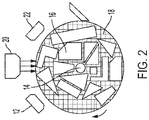
- the manufacturing system 10 has a rotating cylinder has a feedstock applied to it by a deposition device 12.
- a deposition device 12 Many types of deposition devices could be used, as discussed regarding Figure 2 .
- the most recently applied feedstock layer receives a pattern of sintering selectivity material from the deposition device 12 and may undergo debinding, a process in which the sinterable material is separated from a binder.
- the binder allows powdered sinterable materials to exist in a cohesive form, which may also be referred to as a paste, melt, emulsion, or slurry, for application to the cylinder 14.
- the sintering selectivity material marks a boundary, either positively or negatively, to define the part.
- the sintering selectivity material deposition acts on the current layer of feedstock before the next layer is applied.
- the build 18 grows, which consists of at least the feedstock of sinterable material and binder plus the sintering selectivity material, the parts such as 16 are defined within it.
- the build undergoes sintering in sintering chamber 20 and separation, resulting in the individual parts such as 16 shown below.
- the layers still receive sintering selectivity material, but do so after the surface energy of the most current layer has undergone patterning to define where the material will apply.
- the cylinder 14 passes by the deposition device 12 to receive the feedstock.
- the parts such as 16 are differentiated from the build at each layer, forming the parts after multiple passes.
- the feedstock may be dense and cohesive, or may comprise an unbound powder that could be processed by the patterning illumination system 20 and then receiving the sintering selectivity material at 22.
- the deposition device 12 may be located as shown in Figure 2 , and with dense, cohesive feedstocks it may be located as shown in Figure 1 . Either option may be used in any and all embodiments.
- the system directs energy such as laser light, UV light, etc., towards the surface of the layer, forming a defined surface energy pattern.
- the deposition head 22 deposits the sintering selectivity fluid in the defined zones.
- the defined zones may consist of the negative space around the parts to define boundaries between parts, or positive space defining the parts themselves.
- the cylinder then continues to rotate to receive the next layer of material from the deposition head 12 and the process continues until the build is completed. The build then undergoes sintering and separation.
- the patterning illumination system may comprise a light or other energy source and a pattern-wise transfer device that transfers the energy to the surface of the current layer in accordance with a pattern.
- the energy source may comprise a laser, a UV light source, infrared, X-ray, etc.
- the pattern-wise transfer device may comprise a spatial light modulator, such as an array of grating light valves (GLV), a digital micromirror device (DMD), or other arrays of light valves or shutters. Any apparatus that can transfer the energy to the surface in accordance with a pattern will serve. No limitation to any particular device is intended and none should be implied.
- Figures 1 and 2 show the feedstock deposition head 12 as a doctor blade, the system may employ any means of material deposition.
- the sintering selectivity deposition may also result from a doctor blade, roller, or any other means of material deposition.
- surface energy patterning could be achieved by exposing the surface to ion or particle bombardment, plasma treatment, oxygen plasma treatment, electron bombardment, or chemical modifiers in a patterned manner, instead of or in addition to photon-based energy sources such as lasers, or UV sources.
- Figure 3 shows a summary of the process.
- the system deposits sinterable feedstock.
- the surface energy pattern is formed at 32.
- the system then deposits the sintering selectivity material at 34.
- the process duplicates these steps as necessary to achieve the desired part geometries.
- the printed parts are sintered at 36.
- Some examples of materials that can be sintered are: stainless steel alloys such as 17-4PH, carbonyl iron, 316, magnetic alloys, copper-nickel alloys, titanium, copper, alumina, zirconia, aluminosilicate minerals and glasses, polymer particles, and many others including various metals, metal alloys, ceramics, and plastics / polymers.
- Binder for the feedstock may be hydrophobic or hydrophilic, and it may contain thermoplastic or thermoset components.
- Some active binder materials include: polyethylene, polypropylene, polyoxymethylene, paraffin, carnuba wax, polypropylene oxide, polybutylene oxide (hydrophobic thermoplastics); polyethylene oxide, polypropylene carbonate, polybutylene carbonate, alginate, agar, cellulose, methylcellulose, methylcellulose-based compounds, sodium lignosulfonate, polyvinyl alcohol, polyvinyl butyral, polyacrylate salts, polylactic acid, (hydrophilic thermoplastics), and hydrophobic or hydrophilic UV-curable acrylate and methacrylate resins (thermosets).
- Binders can contain additional components such as surfactants to promote adhesion with the sinterable components, these may include stearic acid, oleic acid, oleyl amine, fish oil, Pluronic surfactants, block copolymers of polyethylene oxide and polypropylene oxide, sodium dodecyl sulfate, molecules containing a hydrophobic moiety and a hydrophilic moiety. These molecules may include phosphate, sulfate, ammonium, carboxylates, or other amphiphilic molecules.
- surfactants to promote adhesion with the sinterable components these may include stearic acid, oleic acid, oleyl amine, fish oil, Pluronic surfactants, block copolymers of polyethylene oxide and polypropylene oxide, sodium dodecyl sulfate, molecules containing a hydrophobic moiety and a hydrophilic moiety. These molecules may include phosphate, sulfate, ammonium, carboxylates,
- Binder can contain viscosity modifiers such as oligomers, meaning short chain polymers, typically below 5 kg/mol or below 1 kg/mol, of the polymers listed above, glycerin, phthalate-containing molecules, dibutyl phthalate, dioctyl phthalate or solvents such as water, or organic solvents, such as toluene, xylenes, alkanes, decane, hexane, isopar, n-methylpyrrolidone, dimethylformamide, tetrahydrofuran, dimethylsulfoxide, acetophenone, and others.
- viscosity modifiers such as oligomers, meaning short chain polymers, typically below 5 kg/mol or below 1 kg/mol, of the polymers listed above, glycerin, phthalate-containing molecules, dibutyl phthalate, dioctyl phthalate or solvents such as water, or organic solvents, such as toluene, xylenes
- the active sintering selectivity material is a material that sinters at a higher temperature than the metal, often a refractory ceramic, a precursor to a refractory ceramic, or an oxidizing agent that selectively transforms the metal into a refractory ceramic.
- the inhibiting material either forms a layer on or adjacent to the sinterable particles in the pattern, separate particles.
- aluminosilicate minerals alumina, zirconia, iron oxide, chromite, ceria, yttria, silicon
- Suitable salts include aluminum nitrate, aluminum bromide, aluminum chloride, aluminum hydroxide, aluminum iodide, aluminum phosphate, aluminum lactate, aluminum sulfate, aluminum monostearate, zirconium nitrate, zirconium carbonate, ammonium zirconate, zirconyl chloride, zirconyl nitrate, yttrium carbonate, yttrium chloride, yttrium nitrate, iron acetyl aetonate, ferrocene, iron citrate, iron chloride, iron bromide, iron oxalate, iron phosphate, iron sulfate, iron nitrate, cerium bromide, cerium chloride, cerium hydroxide, cerium nitrate, cerium oxalate, cerium sulfate, ceric ammonium nitrate, vanadium chloride, vanadium chloride tetrahydrofuran, vanadium oxy
- the non-metal ion in the metal-salt can be selected to be an oxidizing agent such as sulfate, ammonium nitrate, chlorate, chlorite, hypochlorite, perchlorate, permanganate, persulfate, or nitrate, to enhance the sintering inhibition.
- an oxidizing agent such as sulfate, ammonium nitrate, chlorate, chlorite, hypochlorite, perchlorate, permanganate, persulfate, or nitrate.
- Some metal ions also enhance oxidizing behavior, such as cerium ions.
- These oxidizing ions could also be part of a compound that does not contain a metal ion, such that the sintering selectivity material acts solely to oxidize the sintering metals in the inhibition pattern.
- the active component of the material is a reducing agent or flux to facilitate sintering.
- the reducing agent could be particles of graphite, graphene, carbon nanotubes, fullerenes, other forms of carbon with sp2 bonding, sodium borohydride, reducing sugars, glucose, compounds containing tin(II), compounds containing iron (II), oxalic acid, formic acid, ascorbic acid, acetol, alphahydroxy ketones, phosphorous acid, phosphites, hypophosphites, borax, ammonium chloride, hydrochloric acid, and others.
- the active sintering selectivity material for negative patterned ceramics can use a similar strategy for the active selective sintering agent as negatively patterned metals, by introducing a material with a higher sintering temperature than the ceramic to be sintered, either directly through particles, or indirectly through chemical precursors.
- the oxidative strategy for sintering inhibition is not generally used.
- the active sintering selectivity material for positive patterned ceramics varies widely based on the type of ceramic. Addition of ceramic fluxes or precursors to ceramic fluxes is one strategy. Ceramic fluxes are typically oxides of or compounds containing lead, sodium, potassium, lithium, calcium, magnesium, barium, zinc, strontium, and manganese, feldspars, boron, and glass frit particles with low glass transition.
- the polymer to be sintered would be embedded in a binder that has a lower processing temperature, such as the glass transition or melting point.
- Sintering selectivity material could be a lubricant, surfactant that prevents bonding, negative selectivity, or a plasticizer/solvent selective for the feedstock polymer, chemical linker or selective adhesive to promote adhesion between particles.
- Polymer sintering is generally applicable to thermoplastic materials. Examples of polymers suitable for sintering are fluorinated ethylene propylene, polytetrafluoroethylene, polyetheretherketone, polyamides, polyacrylonitrile butadiene styrene, polylactic acid, or other polymers used in SLS or FDM processes.
- solvents to suspend or dissolve other components, viscosity modifiers, surfactants, and stabilizers.
- solvents are: water, organic solvents, volatile solvents, or high boiling point solvents, polar, or non-polar solvents, toluene, xylenes, alkanes, decane, hexane, isopar, n-methylpyrrolidone, dimethylformamide, tetrahydrofuran, dimethylsulfoxide, acetophenone, and others.
- Viscosity modifiers and surfactants can be the same as chemicals used in the feedstock as binders, surfactants, and viscosity modifier components of the feedstock. Some of these are: glycerin, polymers or oligomers that are soluble in the solvent, small quantities of materials used as binders in the feedstocks, stearic acid, sodium dodecyl sulfate, and others discussed in more detail above. For example, to pattern sintering selectivity material using a piezo-driven inkjet print head, material viscosity in the range of 10-14 cP is desired. If the ink contains components that can undergo slow degradation, stabilizers can be used to extend shelf life. Some stabilizers are antioxidants, UV absorbers, butylated hydroxytoluene, 4-methoxyphenol, and others.
- the below table shows a list of single solvents and the results of whether 50 mg salt plus 1 milliliter solvent dissolves.
- Simple solvents do not simultaneously dissolve feedstock and a sintering inhibitor used as the sintering-selectivity fluid, in this case Al(NO 3 ) 3 .
- Polar solvents such as NMP and DMF (dimethylformamide) dissolve the inhibiting salts.
- Non-polar solvents dissolve the feedstock.
- the sintering selectivity material For the sintering selectivity material to penetrate the feedstock layer, the sintering selectivity material has to dissolve both.
- Simple solvents do not simultaneously dissolve feedstock and a sintering inhibitor, such as Al(NO 3 ) 3 .
- Polar solvents such as NMP and DMF dissolve the inhibiting salts.
- Non-polar solvents dissolve the feedstock.
- the sintering selectivity material For sintering selectivity material to penetrate a feedstock layer, the sintering selectivity material has to dissolve both.
- Table 1 shows examples of simple solvents
- Table 2 shows examples of co-solvents.
- NMP is n-methylpyrrolidone
- DMSO dimethysulfoxide
- PC is propylene carbonate.
- NMP and xylenes as co-solvents can dissolve both a salt and the feedstock, but the form a phase-separated 2-liquid system.
- the embodiments here provide a solution to the registration problem discussed above by utilizing inherent surface energy and surface tension properties of the binder containing the dense, cohesive, sinterable feedstock and the sintering selectivity material.
- the sintering selectivity is obtained when the thermal debinding results in surface energy contrast. This obviates the need for a separate liquid patterning system, reducing complexity and cost, and also eliminates potential defects that may arise due to imprecise registration between the thermal debound pattern and the sintering selectivity material.
- the experiments showed that a surface energy contrast formed by laser based patterning to debind the feedstock can achieve changes in the surface energy that allows deposition of the sintering selectivity material to the pattern.
- the experiments also allowed measurement of the contact angle, or wetting angle, difference between the bond and debound feed stock. The results are below.
Landscapes
- Engineering & Computer Science (AREA)
- Chemical & Material Sciences (AREA)
- Materials Engineering (AREA)
- Manufacturing & Machinery (AREA)
- Mechanical Engineering (AREA)
- Physics & Mathematics (AREA)
- Optics & Photonics (AREA)
- Toxicology (AREA)
- Health & Medical Sciences (AREA)
- General Health & Medical Sciences (AREA)
- General Chemical & Material Sciences (AREA)
- Thermal Sciences (AREA)
- Chemical Kinetics & Catalysis (AREA)
- Ceramic Engineering (AREA)
- Powder Metallurgy (AREA)
- Producing Shaped Articles From Materials (AREA)
Applications Claiming Priority (1)
| Application Number | Priority Date | Filing Date | Title |
|---|---|---|---|
| US17/094,506 US20220143695A1 (en) | 2020-11-10 | 2020-11-10 | Pattern-wise deposition of anti-sintering agents via surface energy modulation for 3d printing |
Publications (1)
| Publication Number | Publication Date |
|---|---|
| EP3995291A1 true EP3995291A1 (de) | 2022-05-11 |
Family
ID=78528719
Family Applications (1)
| Application Number | Title | Priority Date | Filing Date |
|---|---|---|---|
| EP21206459.6A Withdrawn EP3995291A1 (de) | 2020-11-10 | 2021-11-04 | Musterweises aufbringen von antisintermitteln durch oberflächenenergiemodulation für den 3d-drucken |
Country Status (4)
| Country | Link |
|---|---|
| US (1) | US20220143695A1 (de) |
| EP (1) | EP3995291A1 (de) |
| JP (1) | JP2022077024A (de) |
| CN (1) | CN114453598A (de) |
Families Citing this family (2)
| Publication number | Priority date | Publication date | Assignee | Title |
|---|---|---|---|---|
| US11938537B2 (en) | 2022-08-01 | 2024-03-26 | Xerox Corporation | System and method for high throughput additive manufacturing of sintered parts with low anisotropy |
| KR102909684B1 (ko) * | 2023-01-20 | 2026-01-09 | 한국기계연구원 | 원통형 3d 프린터 및 프린팅 방법 |
Citations (4)
| Publication number | Priority date | Publication date | Assignee | Title |
|---|---|---|---|---|
| WO2016186609A1 (en) * | 2015-05-15 | 2016-11-24 | Hewlett-Packard Development Company, L.P. | Three-dimensional printing systems |
| US20170297109A1 (en) * | 2016-04-14 | 2017-10-19 | Desktop Metal, Inc. | Three-dimensional fabrication with locally activated binding of sinterable powders |
| WO2018199995A1 (en) * | 2017-04-28 | 2018-11-01 | Hewlett-Packard Development Company, L.P. | Metallic build material granules |
| WO2020145980A1 (en) * | 2019-01-10 | 2020-07-16 | Hewlett-Packard Development Company, L.P. | Three-dimensional printing |
Family Cites Families (2)
| Publication number | Priority date | Publication date | Assignee | Title |
|---|---|---|---|---|
| EP3681719A4 (de) * | 2018-02-09 | 2021-03-10 | Hewlett-Packard Development Company, L.P. | Systeme zum dreidimensionalen drucken |
| US20200108559A1 (en) * | 2018-10-05 | 2020-04-09 | General Electric Company | Additive manufacturing machine having reconfigurable gas nozzles |
-
2020
- 2020-11-10 US US17/094,506 patent/US20220143695A1/en not_active Abandoned
-
2021
- 2021-10-27 CN CN202111252785.8A patent/CN114453598A/zh active Pending
- 2021-11-04 EP EP21206459.6A patent/EP3995291A1/de not_active Withdrawn
- 2021-11-10 JP JP2021182941A patent/JP2022077024A/ja active Pending
Patent Citations (4)
| Publication number | Priority date | Publication date | Assignee | Title |
|---|---|---|---|---|
| WO2016186609A1 (en) * | 2015-05-15 | 2016-11-24 | Hewlett-Packard Development Company, L.P. | Three-dimensional printing systems |
| US20170297109A1 (en) * | 2016-04-14 | 2017-10-19 | Desktop Metal, Inc. | Three-dimensional fabrication with locally activated binding of sinterable powders |
| WO2018199995A1 (en) * | 2017-04-28 | 2018-11-01 | Hewlett-Packard Development Company, L.P. | Metallic build material granules |
| WO2020145980A1 (en) * | 2019-01-10 | 2020-07-16 | Hewlett-Packard Development Company, L.P. | Three-dimensional printing |
Also Published As
| Publication number | Publication date |
|---|---|
| US20220143695A1 (en) | 2022-05-12 |
| JP2022077024A (ja) | 2022-05-20 |
| CN114453598A (zh) | 2022-05-10 |
Similar Documents
| Publication | Publication Date | Title |
|---|---|---|
| Peng et al. | Ceramic robocasting: recent achievements, potential, and future developments | |
| JP4351998B2 (ja) | 焼結の選択的阻害(sis)法を利用する金属部材の製造 | |
| US11702367B2 (en) | Binder jetting in additive manufacturing of inhomogeneous three-dimensional parts | |
| EP3995291A1 (de) | Musterweises aufbringen von antisintermitteln durch oberflächenenergiemodulation für den 3d-drucken | |
| US11530170B2 (en) | Material and method of manufacture for engineered reactive matrix composites | |
| EP3988283A1 (de) | Materialien zum selektiven sintern kohäsiver rohstoffe | |
| US20210086266A1 (en) | Additive manufacturing components and methods | |
| US20180250739A1 (en) | Additive manufacturing method and apparatus | |
| JP2019522720A (ja) | 焼結可能な粉末の局所的に活性化された結合による三次元造形 | |
| WO2015069849A1 (en) | Production of monolithic bodies from a porous matrix using low temperature solidification in an additive manufacturing process | |
| US20210114110A1 (en) | Additive fabrication with infiltration barriers | |
| WO2016187624A2 (en) | Exothermic powders for additive manufacturing | |
| US20190388966A1 (en) | Methods of forming three-dimensional objects using additive metal manufacturing | |
| US20210147665A1 (en) | Thermal debinding techniques for additive manufacturing and related systems and methods | |
| US20210260654A1 (en) | Thermal debinding techniques for additive manufacturing and related systems and methods | |
| KR102727882B1 (ko) | 3차원 프린팅용 잉크 조성물 및 이를 이용한 3차원 구조체 제조방법 | |
| WO2020037054A1 (en) | Distortion mitigation during sintering of ceramics through the incorporation of ceramic precursor solutions | |
| US11938537B2 (en) | System and method for high throughput additive manufacturing of sintered parts with low anisotropy | |
| US20220362850A1 (en) | Three-dimensional printing | |
| US12138687B2 (en) | Methods of forming articles including microchannels therein, and related articles | |
| US20260048438A1 (en) | Methods of forming three-dimensional structures by additive manufacturing | |
| WO2019236058A1 (en) | Material sets | |
| WO2020194873A1 (ja) | 粉末積層造形用粉末材料及び造形物の製造方法 | |
| JP2020019203A (ja) | セラミックス焼結体の製造方法 |
Legal Events
| Date | Code | Title | Description |
|---|---|---|---|
| PUAI | Public reference made under article 153(3) epc to a published international application that has entered the european phase |
Free format text: ORIGINAL CODE: 0009012 |
|
| STAA | Information on the status of an ep patent application or granted ep patent |
Free format text: STATUS: THE APPLICATION HAS BEEN PUBLISHED |
|
| AK | Designated contracting states |
Kind code of ref document: A1 Designated state(s): AL AT BE BG CH CY CZ DE DK EE ES FI FR GB GR HR HU IE IS IT LI LT LU LV MC MK MT NL NO PL PT RO RS SE SI SK SM TR |
|
| STAA | Information on the status of an ep patent application or granted ep patent |
Free format text: STATUS: REQUEST FOR EXAMINATION WAS MADE |
|
| 17P | Request for examination filed |
Effective date: 20221111 |
|
| RBV | Designated contracting states (corrected) |
Designated state(s): AL AT BE BG CH CY CZ DE DK EE ES FI FR GB GR HR HU IE IS IT LI LT LU LV MC MK MT NL NO PL PT RO RS SE SI SK SM TR |
|
| RIC1 | Information provided on ipc code assigned before grant |
Ipc: B22F 12/55 20210101ALI20231103BHEP Ipc: B22F 12/53 20210101ALI20231103BHEP Ipc: B22F 12/44 20210101ALI20231103BHEP Ipc: B22F 10/10 20210101ALI20231103BHEP Ipc: B22F 3/10 20060101ALI20231103BHEP Ipc: B29C 64/188 20170101ALI20231103BHEP Ipc: B33Y 10/00 20150101ALI20231103BHEP Ipc: B33Y 30/00 20150101ALI20231103BHEP Ipc: B33Y 70/00 20200101ALI20231103BHEP Ipc: B22F 10/50 20210101ALI20231103BHEP Ipc: B29C 64/241 20170101ALI20231103BHEP Ipc: B29C 64/165 20170101AFI20231103BHEP |
|
| GRAP | Despatch of communication of intention to grant a patent |
Free format text: ORIGINAL CODE: EPIDOSNIGR1 |
|
| STAA | Information on the status of an ep patent application or granted ep patent |
Free format text: STATUS: GRANT OF PATENT IS INTENDED |
|
| INTG | Intention to grant announced |
Effective date: 20231219 |
|
| STAA | Information on the status of an ep patent application or granted ep patent |
Free format text: STATUS: THE APPLICATION IS DEEMED TO BE WITHDRAWN |
|
| 18D | Application deemed to be withdrawn |
Effective date: 20240420 |