EP3992115B1 - Shuttle für horizontalen und vertikalen antrieb in einem regalsystem - Google Patents
Shuttle für horizontalen und vertikalen antrieb in einem regalsystem Download PDFInfo
- Publication number
- EP3992115B1 EP3992115B1 EP20204204.0A EP20204204A EP3992115B1 EP 3992115 B1 EP3992115 B1 EP 3992115B1 EP 20204204 A EP20204204 A EP 20204204A EP 3992115 B1 EP3992115 B1 EP 3992115B1
- Authority
- EP
- European Patent Office
- Prior art keywords
- shuttle
- propelling
- wheel
- vertical
- climbing
- Prior art date
- Legal status (The legal status is an assumption and is not a legal conclusion. Google has not performed a legal analysis and makes no representation as to the accuracy of the status listed.)
- Active
Links
Images





Classifications
-
- B—PERFORMING OPERATIONS; TRANSPORTING
- B65—CONVEYING; PACKING; STORING; HANDLING THIN OR FILAMENTARY MATERIAL
- B65G—TRANSPORT OR STORAGE DEVICES, e.g. CONVEYORS FOR LOADING OR TIPPING, SHOP CONVEYOR SYSTEMS OR PNEUMATIC TUBE CONVEYORS
- B65G1/00—Storing articles, individually or in orderly arrangement, in warehouses or magazines
- B65G1/02—Storage devices
-
- B—PERFORMING OPERATIONS; TRANSPORTING
- B65—CONVEYING; PACKING; STORING; HANDLING THIN OR FILAMENTARY MATERIAL
- B65G—TRANSPORT OR STORAGE DEVICES, e.g. CONVEYORS FOR LOADING OR TIPPING, SHOP CONVEYOR SYSTEMS OR PNEUMATIC TUBE CONVEYORS
- B65G1/00—Storing articles, individually or in orderly arrangement, in warehouses or magazines
- B65G1/02—Storage devices
- B65G1/04—Storage devices mechanical
- B65G1/0492—Storage devices mechanical with cars adapted to travel in storage aisles
Definitions
- the present invention generally relates to shuttles for propelling horizontally and vertically in a racking system comprising horizontal tracks and vertical tracks.
- Racking systems comprising horizontal tracks and vertical tracks are known in the art.
- Such racking systems may be automated small parts shuttle racking systems. They allow storage of a multitude of goods in racks at different levels in the racks.
- Shuttles to collect and/or store the goods may automatically move horizontally in the aisles between the racks as well as up and down in the racks.
- Such shuttles use horizontal tracks to propel in a horizontal direction in the aisles.
- the shuttles may use vertical or inclined tracks to reach different levels in the racking system.
- Shuttles moving in such automated small parts shuttle racking system require high precision of the racking elements to guarantee proper and precise functioning of the system and satisfactory and accurate movement of the shuttle inside the system. Elements of the racks not adequately positioned may cause damage to both the racks and the shuttles. So there is a need for shuttles which can cope with such less accurate tolerances of the racking elements, while being able to propel accurately in horizontal and vertical direction in the aisles of the racking system, making use of horizontal and vertical tracks in the racking system.
- the shuttles need to be able to propel swiftly and without causing too much vibration to the racking system.
- the shuttles have a need for coupling systems to couple to the vertical tracks in a prudent way with little or no risk for damage to the coupling system and the vertical tracks when coupling.
- a shuttle for propelling horizontally and vertically in a racking system such as an automated small parts shuttle racking systems, comprising horizontal tracks and vertical tracks.
- the shuttle comprises a horizontal propelling system for propelling on horizontal tracks and a vertical propelling system for propelling in vertical tracks.
- the horizontal propelling system comprises at least 4 propelling wheels, which wheels each are retractable and extendable to and from one of the left and right side of the shuttle.
- the vertical propelling system comprises at least a first climbing system comprising a vertical wing retractable and extendable to and from the left or right side of the shuttle.
- This at least first vertical wing comprises at least two rotatable wheels, each rotatable around a wheel axis, the at least two rotatable wheels being
- This at least first vertical wing further comprises a pivoting means adapted to pivot the two rotatable wheel axes of the two rotatable wheels around a pivot axis between a first position, wherein the climbing and press wheel are free of contacting the first and second vertical surface, and a second position, wherein the climbing and press wheel contact the first respectively the second vertical surface.
- pivot axis and the two rotatable wheel axes are parallel.
- a vertical wing is to be understood as a wing being an extendable vertical propelling unit.
- the counter-pressure is the pressure needed to compensate the pressure exercised by the climbing wheel on the first vertical surface during vertical propelling.
- the pivoting means hence can bring the axes of the rotatable wheels, and by consequence the two rotatable wheels themselves, from a first to a second position, and back from the second position to the first position.
- the two rotatable wheel axes are positioned substantially one above the other when these axes are in the first position.
- the pivoting means by pivoting the rotatable wheel axes to the second position, may bring the two rotatable wheels in contact with the respective vertical surfaces of the vertical track.
- the shuttle By driving the climbing wheel, the shuttle may propel up- or downwards along the vertical track. During the propelling, the shuttle may hang cantilevered in the vertical track.
- the at least 4 propelling wheels from the horizontal propelling system may be retracted to the shuttle, such they pass next to the horizontal tracks during vertical propelling up- or downwards.
- at least two of the at least four propelling wheels are positioned at the left side of the shuttle, at least two of the at least four propelling wheels are positioned at the right side of the shuttle.
- at least two of the at least four propelling wheels are positioned at the front side of the shuttle, at least two of the at least four propelling wheels are positioned at the backside of the shuttle.
- the pivoting means may comprise
- the pivoting means may, alternatively or additionally, comprise a pneumatic system and/or an electromagnetic system to pivot the two wheel axes of the two rotatable wheels around a pivot axis from a first position to a second position and back from the second position to the first position.
- the pivoting means may, alternatively or additionally, comprise a wedge system to pivot the two wheel axes of the two rotatable wheels around a pivot axis from a first position to a second position and back from the second position to the first position.
- the pivoting means may, alternatively or additionally, comprise any mechanical system converting a linear to a rotational movement, to pivot the two wheel axes of the two rotatable wheels around a pivot axis from a first position to a second position and back from the second position to the first position.
- the pivoting axis may be coinciding with one of the two rotating wheel axes or is positioned below, above or crossing with an imaginary line connecting the two rotating wheel axes.
- the wing may comprise a cam system to conduct the pivoting means, the cam-system comprising a lever, the cam system being one of
- the cam system hence comprises a cam which can be
- the two rotatable wheels are coupled to the lever, most preferably one of the wheels at each outer end of the lever.
- the pivot axis is the rotation axis of the lever, also referred to as lever axis.
- lever axis is preferably parallel to the two rotatable wheel axes.
- the climbing wheel may be driven by a driving means, which can be on board of the shuttle.
- a driving means By means of a driving shaft and optionally a transmission system, the driving means may provide a rotational movement to the climbing wheel. Possibly, the lever axis is coinciding with the axis of the driving shaft.
- the rotational movement of the driving shaft may be transferred to the climbing wheel by means of an appropriate transmission means, e.g. a driving wheel being in contact with the climbing wheel.
- This driving wheel may e.g. be a gearwheel when the climbing wheel is a gearwheel itself.
- the transmission means may make use of chains, belts or a similar transmission mechanism.
- the width of the extended wing may be less than 35mm enabling to pass the horizontal tracks while vertically propelling.
- the shuttle To propel from one level in the racking to another level, the shuttle climbs up or down by its vertical propelling system which is in contact with a vertical track.
- the horizontal track At the position where the wing, while being extended towards the vertical track, passes a horizontal track, the horizontal track needs to be interrupted in order to allow the wing passing the horizontal path that the shuttles may follow along this horizontal track.
- the interruption or 'gap' of the horizontal tracks at the position where they cross the vertical tracks needs to be as small as possible. Consequently, at the position where the wing which needs to pass through this interruption, the wing must be as thin as possible.
- the width of the wing in extended condition and in this position is to be limited, and preferably to be less than 35mm.
- the gap or interruption of the horizontal track is preferably less than 50mm.
- the interruption of the horizontal track needs to be wider than the width of the wing in extended condition and at the position in direction of extension along the extended wing where the wing crosses the horizontal track.
- the width at a given position along the wing in the direction of extension is the distance in horizontal direction between the point of the wing closest to the front end of the shuttle at this given position along the wing in the direction of extension and the point of the wing closest to the backend of the shuttle at this given position along the wing in the direction of extension.
- the elements bridging the outmost point of the extended wing in direction of extension and the side or chassis of the shuttle itself are preferably positioned in a vertical plane.
- Such elements may be a driving shaft and extendable support bars and alike.
- the climbing wheel is one of
- the climbing wheel is preferably a wheel with a profiled circumference.
- the profile may be provided in radial direction around the wheel. In case of a gearwheel or a sprocket, this radial profile is a toothed profile.
- the profile engages with a corresponding profile on the first vertical surface of the vertical track.
- This first vertical surface may be at the inner side of a profile, comprising at least the first and second flange of the profile of the vertical track, and a web.
- the first and second vertical surface may be mutually opposed in the vertical track. They may be e.g. the flanges of a profile, like a U, C, C+, sigma, sigma+ or omega profile.
- the pivoting means will bring the climbing wheel from a first position, where it is not in contact, hence is free of contact, with the first vertical surface, to a second position, where the climbing wheel will make contact with the first vertical surface.
- the press wheel will be brought from a first position, where it is not contacting, hence is free of contact, with the second vertical surface, to a second position where it makes contact with this second vertical surface.
- the axes of these two rotatable wheels which are preferably parallel, define a substantially vertical plane.
- the width of the wing at the position of the rotatable wheels can be kept minimal, such as being the maximum diameter of the largest rotatable wheel. Because this part of the wing is preferably inserted in a vertical track recess, the opening of the vertical track, e.g. when being a profile, can be kept minimal as well.
- the climbing wheel is a gearwheel, a sprocket or a profiled wheel, a distance wheel is provided adjacent to and on the same axis as said climbing wheel, the distance wheel limits the penetration depth of the climbing wheel in respectively the toothed bar, the chain or the profile present on the first vertical surface of the vertical track.
- the depth of penetration of the profile into the corresponding profile on the first vertical surface is preferably kept within allowable ranges.
- a distance wheel adjacent and coaxial with the climbing wheel which distance wheel contacts a surface adjacent the profiled part of the first surface of the vertical track, and limiting the depth of penetration, may prevent to some extend too early wear out of the climbing wheel and/or the profiled first surface of the vertical track.
- the climbing wheel and the distance wheel may be coupled to each other, and are coaxial.
- the distance wheel may be a cylindrical flange which is provided to the climbing wheel. In the alternative, distance wheels non coaxial with the climbing wheel may be used.
- the distance wheel may have a flat surface, or may be provided with an axial profile, such as a protrusion, e.g. a rib or rill, or a recess around the whole circumference of the distance wheel.
- a protrusion e.g. a rib or rill
- a recess around the whole circumference of the distance wheel.
- the distance wheel may engage with a corresponding elongate profile on the surface with which the distance wheel makes contact.
- Such axial profiled distance wheel may prevent drifting of the shuttle in a direction in a horizontal direction perpendicular to the horizontal propelling direction.
- the distance wheel functions also as a guiding wheel.
- the press wheel may have a flat surface, or may be provided with an axial profile, such as a protrusion, e.g. a rib or rill, or a recess around the whole circumference of the press wheel.
- a protrusion e.g. a rib or rill
- a recess around the whole circumference of the press wheel.
- the press wheel may engage with a corresponding elongate profile on the second vertical.
- Such axial profiled press wheel may prevent drifting of the shuttle in a horizontal direction perpendicular to the horizontal propelling direction.
- the press wheel may function as a guiding wheel.
- the distance between the gravity point and the first vertical surface of the vertical track may be less than the distance between the gravity point and the second vertical surface of the vertical track.
- the distance between the gravity point and the first vertical surface of the vertical track may be less than the distance between the gravity point and the second vertical surface of the vertical track. Positioning the gravity point as such, may cause a guaranteed engaging between the climbing wheel and the first vertical surface of the vertical track when the shuttle is cantilevered in the vertical track or tracks.
- the distance between the gravity point and the first vertical surface of the vertical track, such as in unloaded condition is kept small, such as less than or equal to 250mm.
- a small distance between the gravity point and the first vertical surface of the vertical track may limit the horizontal pressure between the climbing wheel and the first vertical surface of the vertical track, and between the press wheel and the second vertical surface of the vertical track. This may allow lighter constructions to be used and may reduce the couple needed to drive the climbing wheel.
- the vertical propelling system may comprise a first and a second climbing system, one climbing system at each of the left and right side of the shuttle.
- the vertical propelling system may comprise a first and a second climbing system, one climbing system at each of the left and right side of the shuttle, the shuttle comprises a first and a second motor, the first motor driving the first climbing system, the second motor driving the second climbing system.
- the two climbing systems may comprise the same elements and may function in an identical or similar way. Preferably they are both present at the same position of the shuttle in the direction parallel to the horizontal propelling direction. Most preferably they are both present at the front or backend of the shuttle.
- the two climbing systems may be mirrored images one from the other.
- Driving the climbing systems each with a motor provide that the two climbing systems are decoupled and function independently one from the other.
- one of the climbing systems may tune the position of the climbing wheel independently from the other climbing system to enable the climbing wheel and the first vertical surface of this one climbing system to match snuggly.
- the two climbing systems may be driven by one motor, where the driving system may include a friction element or a differential to decouple to some extent the two climbing systems actions.
- the horizontal propelling system comprising at least four propelling wheels, two being positioned at the left side of the shuttle, two being positioned at the right side of the shuttle, at least one of the propelling wheels at the left side may be driven by the first motor, at least one of the propelling wheels at the right side may be driven by the second motor.
- each motor may be provided with a coupling means to couple the motor to either at least one of the propelling wheels or to the climbing system.
- the horizontal propelling system comprises at least four pairs of propelling wheels, two pairs being positioned at the left side of the shuttle, two pairs being positioned at the right side of the shuttle, at least one pair of the propelling wheels at the left side may be driven by the first motor, at least one pair of the propelling wheels at the right side may be driven by the second motor.
- the shuttle may comprise only one motor, i.e. the central motor, to drive the horizontal propelling system and the climbing systems.
- Appropriate coupling means are provided to couple this central motor to the horizontal propelling system and/or the climbing systems.
- the shuttle may further comprise electrical components to control and steer the shuttle actions.
- the shuttle may also comprise a battery to store the electrical energy needed to feed the motors and electrical components.
- the motors used are preferably electromotors.
- the used motors may be DC motors, such as brushless DC motors.
- the motors preferably are individually steered thereby allowing to compensate deviation between the propelling distances on the propelling tracks followed.
- Additional motors may be used to rotate a cam, rotate a lever, rotate the pivot means, extend or retract the wings and/or the propelling wheels and alike.
- the shuttle During propelling on a level in the racking system, the shuttle is vertically supported by the propelling wheels on the horizontal tracks.
- the provision of a pivot wheel which extends lower than the lowest propelling wheel cause the shuttle to be vertically supported by the pivot wheel and some of the propelling wheels, usually the two propelling wheels which are most remote from the pivot wheel, one at the left side of the shuttle, the other at the right side of the shuttle.
- each propelling wheel has a lowest point being coplanar with the lowest points of the other propelling wheels.
- the horizontal propelling system further may comprise horizontal guiding wheels, which are retractable and extendable together with the retraction and extension of the propelling wheels.
- These wheels being an example of horizontal guiding means, which may be provided to the shuttle, will guide the shuttle during its propelling on the horizontal tracks within the aisles of the racking system.
- it may be roller balls mount in e.g. a swivel frame.
- the horizontal guiding means e.g. wheels or roller balls, may be mount spring-loaded.
- the horizontal guiding means may compensate to small deviations on the horizontal track on which the shuttle propels.
- at least four horizontal guiding means are provided, one near each corner of the shuttle.
- the propelling wheels are paired, the interaxial distance between the propelling wheels of each of the pairs of propelling wheels may be adapted to span the gap between adjacent horizontal tracks.
- the horizontal propelling system comprises at least four pairs of propelling wheels, two pairs being positioned at the left side of the shuttle, two pairs being positioned at the right side of the shuttle, at least one pair of the propelling wheels at the left side may be driven by the first motor, at least one pair of the propelling wheels at the right side may be driven by the second motor.
- the use of pairs of propelling wheels is preferred, as this may reduce the vibration caused in the racking system when propelling the shuttle over the interruptions or "gaps" of the horizontal tracks.
- the interaxial distance of the propelling wheels in the pairs of propelling wheels is preferably larger than the width of the interruption of the horizontal tracks, e.g. larger than 35mm such as larger than 50mm. As such, possibly always one of the pair of propelling wheels is in contact with a horizontal track, avoiding to a large extent bumping actions of the shuttle passing the interruptions.
- a method to propel a shuttle in a racking system such as an automated small parts shuttle racking system, is provided.
- the method comprises the steps:
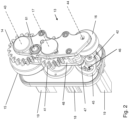
- a shuttle 10 for propelling horizontally and vertically in a racking system 50 comprising horizontal tracks 55 and vertical tracks 100 is shown in figure 1 .
- the vertical track 100 is positioned between two uprights 54 of the racking system.
- the shuttle 10 comprises a horizontal propelling system 20 for propelling on horizontal tracks and a vertical propelling system 30 for propelling in vertical tracks.
- the horizontal propelling system 20 comprises 8 propelling wheels 11 and 12, 2 pairs at each side of the shuttle 10. One of the pairs of wheels 11 are driven wheels. The other pairs of wheels 12 are not driven.
- the wheels each are retractable and extendable to and from one of the left and right side of the shuttle 10.
- the wheels 11 and 12 turn on a horizontal surface 59 of the horizontal tracks 55.
- the wheels 12 and the wing 13 on one side of the shuttle are driven by a first motor, while the wheels 12 and the wing 13 on the other side of the shuttle are driven by a second motor.
- the vertical propelling system 30 comprises two climbing systems 31, one at each side of the shuttle 10.
- Each climbing system 31 comprises a vertical wing 13 which is retractable and extendable to and from the left or right side of the shuttle.
- Each wing 13 comprises one climbing wheel 14, in this embodiment being a gearwheel, adapted to exercise a rotating movement for vertical propelling over a first vertical surface, being a profiled surface 211 of a toothed bar 116 being part of a vertical track 100.
- a guiding wheel 15 Coaxially with this climbing wheel 14 is a guiding wheel 15 which is slightly larger in diameter as compared to the climbing wheel.
- the guiding wheel 15 contacts a flat surface 212 being part of the toothed bar 116 and being adjacent the profiled surface 211.
- the wing 13 of the climbing system 31 further comprises a press wheel 16 which is adapted to provide vertical guidance of the shuttle and to provide counter-pressure during vertical propelling to a second surface 221 of the vertical track.
- the wing is retractable and extendable to and from the left or right side of the shuttle by means of two support bars 19.
- the climbing system is driven by means of a central drive axis 18. This drive axis 18 drives a second gearwheel 41, which is in contact with and transfers its rotation to the climbing wheel 14.
- the vertical wing 13 comprises a pivoting means 42 adapted to pivot the axes 43 and 44 of the climbing wheel 14 and the press wheel 16 around a pivot axis 17 between a first position, wherein the climbing and press wheel are free of contacting the first and second vertical surface, and a second position, wherein the climbing and press wheel contact the respective vertical surfaces.
- the pivoting means 42 comprises a wheel 44 provided with a slot 46 in which a pin 47, being coupled to a lever 48, is slidably positioned. Rotating of the wheel 45 will cause the axes 43 and 44 of the climbing wheel 14 and the press wheel 16 to pivot around pivot axis 17 between a first position and a second position.
- the pivot axis 17 is coinciding with the axis of the second gearwheel 41 transferring the driving power to the climbing wheel.
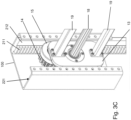
- the contacts between the vertical track 100 and the elements of the vertical wing 13 are illustrated in figures 3A to 3C , in which figures a part of the web of the vertical track is removed from the view.
- the pivoting means 42 is in its second position where the climbing and press wheel is contacting the first and second surface of the vertical track 100.
- the press wheel 16 presses against the second surface 221 of the vertical track 100.
- the climbing wheel 14 is in contact with the toothed bar 116, more particularly with the profiled surface 211 of the vertical track 100.
- the guiding wheel 15 is in contact with the flat surface 212 of the vertical track 100.
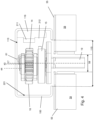
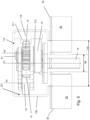
- the vertical wing 13 being inserted in the recess 114 of the vertical track 100 is shown in its first and second position.
- the vertical wing 13 is in its first position where there is no contact between the climbing wheel 14 and the press wheel 16 and the respective surfaces 211 and 221 of the vertical track 100.
- the wing 13 can slide nicely into the recess 114 by passing the wing 13 through the opening 115 at the front side of the vertical track 100.
- the axes 43 and 44 of the climbing wheel 14 and the press wheel 16 are pivoted around a pivot axis 17 to the second position, as shown in figure 5 , the climbing wheel 14 and press wheel 16 contact the profiled surface 211 and the flat surface 221.
- the guiding wheel 15 will contact flat surface 212.
- the surfaces 211 and 212 are provided by a toothed bar 116, which can be positioned and adjusted in the profile of the vertical track 100.
- FIG 5 it is shown that the horizontal tracks 55 are interrupted at each crossing with a vertical track 100.
- Two horizontal tracks 55 are coplanar, while between the two ends of the horizontal tracks 55, a gap 58 is provided. This allows the support bars 19 and the drive axis 18 to pass through the gap 58 when the shuttle 10 propels vertically between two levels of the racking system.
- a guiding means 61 to prevent the shuttle to move sideways in direction of the axis of the climbing wheel beyond a maximum distance is provided.
- This guiding means 61 contacts the inner surface 113 of the web of the profiled vertical track 100.
- the guiding means 61 can be a roller ball being spring loaded.
- Figures 6A to 6N show various embodiments of possible pivoting means which are adapted to pivoted around a pivot axis 17 from a first position I where no contact with the vertical surfaces 211and 221 is made by the climbing wheel 14 and the press wheel 16, to a second position II where the climbing wheel 14 and the press wheel 16 contact the vertical surfaces 211 and 221.
- the first position is indicated with "I”
- the second position is indicated “II”.
- the pivot axis 17 is central in view of the lever 48 coupling the climbing wheel 14 and the press wheel 16. From the first position I, the rotation around the pivot axis 17 to the second position II (and back) is torque driven in the embodiment of figure 6A .
- the pivot axis 17 coincides with the wheel axis of the climbing wheel 14. From the first position I, the rotation around the pivot axis 17 to the second position II (and back) is torque driven in the embodiment of figure 6D .
- the rotation of a cam 149 generates the rotation of the pivot axis 17 from the first position I to the second position II and back.
- a lever 148 is rotated, generating the rotation around the pivot axis 17 from the first position I to the second position II (and back).
- the wheel axis of the press wheel 16 coincides with the pivot axis 17. From the first position I, the rotation around the pivot axis 17 to the second position II (and back) is torque driven in the embodiment of figure 6G .
- the rotation of a cam 149 generates the rotation of the pivot axis 17 from the first position I to the second position II and back.
- a lever 148 is rotated, generating the rotation around the pivot axis 17 from the first position I to the second position II (and back).
- the rotation around the pivot axis 17 is caused by a forward movement of the shuttle, while the wing is inserted in the vertical track.
- a contact wheel 150 being coupled to the lever 48, meets one of the vertical surfaces, in these embodiments surface 221, before the press wheel 16 contacts this surface.
- the forward movement of the shuttle, and the rigid coupling of the contact wheel 150 and the lever 48 cause the lever 48, and hence the climbing wheel 14 and press wheel 16 to pivot around a pivot axis 17.
- This pivot axis 17 may be located coinciding with the axis of the press wheel 16 ( figure 6J ) or with the axis of the climbing wheel 14 ( figure 6K ). in another embodiment in figure 6H , the pivot axis 17 may be centrally between the climbing wheel 14 and the press wheel 16.
- the pivot axis 17 is located offset the lever 48 coupling the climbing wheel 14 and the press wheel 16.
- the pivot axis 17 is coupled to the climbing wheel 14 and the press wheel 16 with two coupling means 151 and 152.
- a torque driven rotation of the coupling means in opposite direction, or by an upwards movement of the pivot axis 17 the climbing wheel 14 and press wheel 16 are rotated to the surfaces to contact.
- the opposite movement from position II to position I is made by the reverse action.
- FIG. 6N A further alternative embodiment is shown in figure 6N .
- the pivot axis 17 is central of the lever 48 coupling the climbing wheel 14 and the press wheel 16.
- a second climbing wheel 214 and a second the press wheel 216 are provided, being coupled with a lever 248.
- the two levers 48 and 248 cross centrally at pivot axis 17.
- the two pairs of wheels are both rotatable around the same pivot axis 17. These rotations are torque driven, but the rotations are in an opposite direction.
- the two climbing wheels 14 and 214 are brought in to contact with the first surface 211, while the two press wheels 16 and 216 are contacting the second surface 221.
- the opposite rotations the wheels are disconnected from the surfaces and brought from position II to position I.
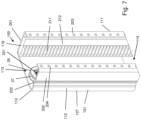
- Figure 7 shows an alternative embodiment of the vertical track 100.
- Figure 7 shows vertical track 100 being a C-profile 107, which additionally has a non-flat surface 221.
- the surface 221 is provided with a rib, a bulge or a protrusion 222 directed inwards the recess 114 of the profile.
- This protrusion will guide a profiled press wheel 26.
- the profiled press wheel 26 will contact the non-flat surface 221 having a protrusion 222.
- the profiled press wheel has a profile like a groove or recess 27 around its circumference.
- the protrusion 222 and recess 27 match and as such, during vertical propelling, of the shuttle the recess will run over the protrusion, thereby avoiding horizontal drifting of the shuttle while vertically propelling in the vertical track 107.
- FIG. 8A A sequence of actions executed by the shuttle 10 when propelling vertically between different levels in the racking system is shown in figures 8A to 8E .
- the vertical tracks and uprights at the right side of the shuttle are not shown.
- a first step the shuttle is horizontally propelled until the climbing systems, more particular the wings 13 of the climbing system, are in front of the vertical track 100 ( figure 8B ).
- the wings 13 are in retracted position in the shuttle 10.
- the wheels 11 and 12 are in extended position and the shuttle 10 rests on the horizontal tracks 55 by the wheels 11 and 12.
- a second step the wings 13 of the climbing systems at both sides of the shuttle are extended until they are positioned in the recess 114 of the vertical track 100.
- the pivot means is in its first position.
- the pivot means is brought in its second position.
- the climbing wheel and the press wheel is brought in contact with the respective surfaces inside the vertical track 100.
- the shuttle 10 is lifted from the horizontal tracks 55 by rotating the climbing wheel.
- the shuttle 10 is now cantilevered in the vertical track 100. This is shown in figure 8D .
- the wheels 11 and 12 are retracted towards the shuttle 10 (see figure 8E ).
- the shuttle 10 is now able to pass from one level in the racking system to another level.
- the shuttle can vertically propel.
- the shuttle 10 is vertically propelled until the shuttle 10 is positioned such that its wheels 11 and 12 are above the horizontal tracks of the level it is propelling to.
- the steps shown in figures 8A to 8E are now executed in reverse order.
- the shuttle 10 is in a position as shown in figure 8E . Its wheels 11 and 12 are extended until they are above the horizontal surfaces of the horizontal tracks 55 ( figure 8D ).
- the shuttle 10 is moved down until the wheels 11 and 12 contact the horizontal surfaces of the horizontal tracks 55 while the pivot means is in its second position ( figure 8C ).
- the pivot means is pivoted in its first position ( figure 8B ), and the wings 13 are retracted to the shuttle 10.
- the shuttle 10 can now propel horizontally on the new level of the racking system (shown in figure 8A ).
Landscapes
- Engineering & Computer Science (AREA)
- Mechanical Engineering (AREA)
- Handcart (AREA)
Claims (14)
- Shuttle (10) zum horizontalen und vertikalen Antreiben in einem Regalsystem (50), das horizontale Schienen (55) und vertikale Schienen (100) umfasst, wobei das Shuttle ein horizontales Antriebssystem (20) zum Antreiben auf horizontalen Schienen und ein vertikales Antriebssystem (30) zum Antreiben auf vertikalen Schienen umfasst,• wobei das horizontale Antriebssystem zumindest 4 Antriebsräder (11, 12) umfasst, wobei die Räder jeweils zu und von einer von der linken und rechten Seite des Shuttles einziehbar und erweiterbar sind;
dadurch gekennzeichnet, dass• das vertikale Antriebssystem zumindest ein erstes Klettersystem umfassend einen vertikalen Flügel (13) umfasst, der zu und von der linken oder rechten Seite des Shuttles einziehbar und erweiterbar ist;wobei der zumindest erste vertikale Flügel zumindest zwei drehbare Räder (14, 15, 16) umfasst, die jeweils um eine Radachse drehbar sind, wobei die zumindest zwei drehbaren Räder wie folgt sind:• ein Kletterrad (14), das ausgelegt ist, um eine Drehbewegung zum vertikalen Antreiben über eine erste vertikale Oberfläche einer vertikalen Schiene auszuführen;• ein Druckrad (15, 16), das ausgelegt ist, um vertikale Führung des Shuttles bereitzustellen und um Gegendruck während des vertikalen Antreibens auf eine zweite Oberfläche der vertikalen Schiene bereitzustellen;wobei der zumindest erste vertikale Flügel ein Schwenkmittel (42) umfasst, das ausgelegt ist, um die zwei drehbaren Radachsen (43, 44) der zwei drehbaren Räder um eine Schwenkachse (17) zwischen einer ersten Position, wobei das Kletter- und das Druckrad die erste und die zweite vertikale Oberfläche nicht kontaktieren, und einer zweiten Position, wobei das Kletter- und das Druckrad die erste bzw. zweite vertikale Oberfläche kontaktieren, zu schwenken. - Shuttle nach Anspruch 1, wobei das Schwenkmittel Folgendes umfasst:• ein Nockensystem, und/oder• einen Motor, und/oder• einen Hebel (48), und/oder• ein Umwandlungsmittel zum Umwandeln einer horizontalen Bewegung des Shuttles in ein Schwenken der zwei Radachsen der zwei drehbaren Räder um eine Schwenkachse von einer ersten Position zu einer zweiten Position.
- Shuttle nach Anspruch 1 oder 2, wobei der Flügel ein Nockensystem (149) umfasst, um das Schwenkmittel zu leiten, wobei das Nockensystem einen Hebel umfasst, wobei das Nockensystem eines von Folgendem ist:• einem Exzenterrad oder Exzenterzylinder, optional mit einem unregelmäßigen Außenumfang, der den Hebel drückt;• einem Rad oder Zylinder, der mit einem Schlitz bereitgestellt ist, in dem ein Stift, der an den Hebel gekoppelt ist, verschiebbar in dem Schlitz positioniert ist.
- Shuttle nach einem der Ansprüche 1 bis 3, wobei die Breite des erweiterten Flügels weniger als 35 mm ist, wodurch ein Passieren der horizontalen Schienen während des vertikalen Antreibens ermöglicht wird.
- Shuttle nach einem der vorhergehenden Ansprüche, wobei das Kletterrad eines von Folgendem ist:• einem Zahnrad (41), das ausgelegt ist, um in eine Zahnstange einzugreifen, die an der ersten vertikalen Oberfläche der vertikalen Schiene bereitgestellt ist;• einem Kettenrad, das ausgelegt ist, um in eine vertikale Kette einzugreifen, die an einer ersten vertikalen Oberfläche der vertikalen Schiene vorhanden ist;• einem profilierten Kletterrad, das ausgelegt ist, um in ein entsprechendes Profil einzugreifen, das an der ersten vertikalen Oberfläche der vertikalen Schiene vorhanden ist;• einem Reibrad, das ausgelegt ist, um in die erste vertikale Oberfläche der vertikalen Schiene einzugreifen.
- Shuttle nach Anspruch 5, wobei das Kletterrad ein Zahnrad, ein Kettenrad oder ein profiliertes Rad ist, wobei ein Abstandsrad benachbart zu und auf der gleichen Achse wie das Kletterrad bereitgestellt ist, wobei das Abstandsrad die Eindringtiefe des Kletterrads in jeweils die Zahnstange, die Kette oder das Profil begrenzt, die/das an der ersten vertikalen Oberfläche der vertikalen Schiene vorhanden ist.
- Shuttle nach einem der vorhergehenden Ansprüche, wobei, wenn das Schwenkungsmittel in der zweiten Position ist, der Abstand zwischen dem Schwerpunkt und der ersten vertikalen Oberfläche der vertikalen Schiene geringer als der Abstand zwischen dem Schwerpunkt und der zweiten vertikalen Oberfläche der vertikalen Schiene ist.
- Shuttle nach einem der vorhergehenden Ansprüche, wobei das vertikale Antriebssystem ein erstes und ein zweites Klettersystem, ein Klettersystem auf jeder von der linken und rechten Seite des Shuttles umfasst, wobei das Shuttle einen ersten und einen zweiten Motor umfasst, wobei der erste Motor das erste Klettersystem antreibt, wobei der zweite Motor das zweite Klettersystem antreibt.
- Shuttle nach Anspruch 8, wobei das horizontale Antriebssystem zumindest vier Antriebsräder umfasst, wobei zwei auf der linken Seite des Shuttles positioniert sind, wobei zwei auf der rechten Seite des Shuttles positioniert sind, wobei zumindest eines der Antriebsräder auf der linken Seite durch den ersten Motor angetrieben wird, wobei zumindest eines der Antriebsräder auf der rechten Seite durch den zweiten Motor angetrieben wird.
- Shuttle nach Anspruch 9, wobei jeder Motor mit einem Kopplungsmittel bereitgestellt ist, um den Motor an eines von zumindest einem der Antriebsräder oder an das Klettersystem zu koppeln.
- Shuttle nach einem der vorhergehenden Ansprüche, wobei der Flügel ein Führungsmittel (61) umfasst, um zu verhindern, dass sich das Shuttle seitwärts in Richtung der Achse des Kletterrads über einen maximalen Abstand hinaus bewegt.
- Shuttle nach einem der vorhergehenden Ansprüche, wobei das Shuttle ferner ein Schwenkrad an einer von der Vorder- oder der Rückseite des Shuttles umfasst, wobei die Ebene, die durch den tiefsten Punkt des Schwenkrads und die tiefsten Punkte von zwei Antriebsrädern auf der linken und der rechten Seite des Shuttles definiert ist, wobei zwei Antriebsräder einander auf der Vorder- der und Rückseite des Shuttles am nächsten sind, in Bezug auf die Ebene, die durch die tiefsten Punkte der Antriebsräder auf der linken und der rechten Seite des Shuttles definiert ist, nach unten geneigt ist.
- Shuttle nach einem der vorhergehenden Ansprüche, wobei das horizontale Antriebssystem ferner horizontale Führungsräder umfasst, die zusammen mit dem Einziehen und Erweitern der Antriebsräder einziehbar und erweiterbar sind.
- Shuttle nach einem der vorhergehenden Ansprüche, wobei auf jeder Seite des Shuttles die Antriebsräder gepaart sind, wobei der Zwischenachsabstand zwischen den Antriebsrädern von jedem der Paare von Antriebsrädern ausgelegt ist, um die Lücke zwischen benachbarten horizontalen Schienen zu überbrücken.
Priority Applications (9)
| Application Number | Priority Date | Filing Date | Title |
|---|---|---|---|
| EP20204204.0A EP3992115B1 (de) | 2020-10-27 | 2020-10-27 | Shuttle für horizontalen und vertikalen antrieb in einem regalsystem |
| ES20204204T ES3006034T3 (en) | 2020-10-27 | 2020-10-27 | A shuttle for propelling horizontally and vertically in a racking system |
| PL20204204.0T PL3992115T3 (pl) | 2020-10-27 | 2020-10-27 | Wahadłowiec do przemieszczania poziomego i pionowego w systemie regałowym |
| PL21769421.5T PL4237349T3 (pl) | 2020-10-27 | 2021-08-27 | Wahadłowiec do przemieszczania poziomego i pionowego w systemie regałowym |
| CA3195130A CA3195130A1 (en) | 2020-10-27 | 2021-08-27 | A shuttle for propelling horizontally and vertically in a racking system |
| ES21769421T ES3007284T3 (en) | 2020-10-27 | 2021-08-27 | A shuttle for propelling horizontally and vertically in a racking system |
| EP21769421.5A EP4237349B1 (de) | 2020-10-27 | 2021-08-27 | Shuttle für horizontalen und vertikalen antrieb in einem regalsystem |
| US18/033,944 US20230391550A1 (en) | 2020-10-27 | 2021-08-27 | A shuttle for propelling horizontally and vertically in a racking system |
| PCT/EP2021/073790 WO2022089811A1 (en) | 2020-10-27 | 2021-08-27 | A shuttle for propelling horizontally and vertically in a racking system |
Applications Claiming Priority (1)
| Application Number | Priority Date | Filing Date | Title |
|---|---|---|---|
| EP20204204.0A EP3992115B1 (de) | 2020-10-27 | 2020-10-27 | Shuttle für horizontalen und vertikalen antrieb in einem regalsystem |
Publications (3)
| Publication Number | Publication Date |
|---|---|
| EP3992115A1 EP3992115A1 (de) | 2022-05-04 |
| EP3992115B1 true EP3992115B1 (de) | 2024-12-18 |
| EP3992115C0 EP3992115C0 (de) | 2024-12-18 |
Family
ID=73043022
Family Applications (2)
| Application Number | Title | Priority Date | Filing Date |
|---|---|---|---|
| EP20204204.0A Active EP3992115B1 (de) | 2020-10-27 | 2020-10-27 | Shuttle für horizontalen und vertikalen antrieb in einem regalsystem |
| EP21769421.5A Active EP4237349B1 (de) | 2020-10-27 | 2021-08-27 | Shuttle für horizontalen und vertikalen antrieb in einem regalsystem |
Family Applications After (1)
| Application Number | Title | Priority Date | Filing Date |
|---|---|---|---|
| EP21769421.5A Active EP4237349B1 (de) | 2020-10-27 | 2021-08-27 | Shuttle für horizontalen und vertikalen antrieb in einem regalsystem |
Country Status (6)
| Country | Link |
|---|---|
| US (1) | US20230391550A1 (de) |
| EP (2) | EP3992115B1 (de) |
| CA (1) | CA3195130A1 (de) |
| ES (2) | ES3006034T3 (de) |
| PL (2) | PL3992115T3 (de) |
| WO (1) | WO2022089811A1 (de) |
Families Citing this family (7)
| Publication number | Priority date | Publication date | Assignee | Title |
|---|---|---|---|---|
| FR3139560B1 (fr) * | 2022-09-14 | 2024-11-08 | Exotec | Interface de centrage et de soutien, et rack de stockage comprenant une telle interface. |
| FR3139810B1 (fr) | 2022-09-20 | 2025-10-10 | Exotec | Méthode et système pour la gestion d’énergie dans un système de stockage et de récupération automatisé |
| AT525735B1 (de) | 2022-10-06 | 2023-07-15 | Knapp Ag | Automatisiertes Lagersystem mit einem Shuttle zum Transport von Lagerhilfsmitteln |
| FR3140876B1 (fr) | 2022-10-13 | 2024-09-06 | Exotec | Organe longiligne présentant au moins une crémaillère, rack de stockage comprenant un tel organe longiligne, et système de transport et de stockage comprenant un tel rack de stockage |
| EP4414295A1 (de) * | 2023-02-13 | 2024-08-14 | Movu | Shuttle zum dreidimensionalen transport von waren in einem automatisierten lager |
| FR3146266B1 (fr) | 2023-03-03 | 2025-01-17 | Exotec | Montant pour rack de stockage |
| FR3160966A1 (fr) * | 2024-04-05 | 2025-10-10 | Exotec Product France | Ensemble pour système automatisé de stockage et de récupération |
Family Cites Families (11)
| Publication number | Priority date | Publication date | Assignee | Title |
|---|---|---|---|---|
| ITMO20020076A1 (it) * | 2002-03-29 | 2003-09-29 | Ronflette Sa | Magazzino automatico |
| HU229022B1 (hu) * | 2009-03-02 | 2013-07-29 | Antal Zombori | Tárolóberendezés raktározáshoz |
| JP5431427B2 (ja) * | 2011-08-31 | 2014-03-05 | アマゾン ドット コム インコーポレイテッド | 自動倉庫システム |
| PL3288865T3 (pl) * | 2015-04-27 | 2022-04-25 | Attabotics Inc. | Układ magazynowy i pobierania |
| WO2016196815A1 (en) | 2015-06-02 | 2016-12-08 | Alert Corporation | Storage and retrieval system |
| EP3307652A4 (de) * | 2015-06-09 | 2019-03-13 | Commonsense Robotics Ltd. | Robotische inventurhandhabung |
| WO2018189110A1 (fr) * | 2017-04-12 | 2018-10-18 | Exotec Solutions | Système de préparation de commandes |
| FR3042182B1 (fr) * | 2015-10-13 | 2020-09-18 | Exotec Solutions | Systeme de preparation de commandes |
| CN112166538A (zh) * | 2018-02-08 | 2021-01-01 | 阿勒特创新股份有限公司 | 用于自动存储和取回系统的机会性充电系统 |
| US11780676B2 (en) * | 2019-08-14 | 2023-10-10 | Opex Corporation | Systems and methods for managing inventory |
| CN110329707B (zh) * | 2019-08-15 | 2024-06-21 | 广东嘉腾机器人自动化有限公司 | 可爬升agv及仓储系统 |
-
2020
- 2020-10-27 PL PL20204204.0T patent/PL3992115T3/pl unknown
- 2020-10-27 ES ES20204204T patent/ES3006034T3/es active Active
- 2020-10-27 EP EP20204204.0A patent/EP3992115B1/de active Active
-
2021
- 2021-08-27 US US18/033,944 patent/US20230391550A1/en active Pending
- 2021-08-27 PL PL21769421.5T patent/PL4237349T3/pl unknown
- 2021-08-27 CA CA3195130A patent/CA3195130A1/en active Pending
- 2021-08-27 WO PCT/EP2021/073790 patent/WO2022089811A1/en not_active Ceased
- 2021-08-27 EP EP21769421.5A patent/EP4237349B1/de active Active
- 2021-08-27 ES ES21769421T patent/ES3007284T3/es active Active
Also Published As
| Publication number | Publication date |
|---|---|
| CA3195130A1 (en) | 2022-05-05 |
| ES3006034T3 (en) | 2025-03-17 |
| ES3007284T3 (en) | 2025-03-19 |
| WO2022089811A1 (en) | 2022-05-05 |
| EP3992115A1 (de) | 2022-05-04 |
| US20230391550A1 (en) | 2023-12-07 |
| EP4237349B1 (de) | 2024-12-18 |
| EP4237349A1 (de) | 2023-09-06 |
| EP3992115C0 (de) | 2024-12-18 |
| PL3992115T3 (pl) | 2025-04-22 |
| PL4237349T3 (pl) | 2025-06-23 |
| EP4237349C0 (de) | 2024-12-18 |
Similar Documents
| Publication | Publication Date | Title |
|---|---|---|
| EP3992115B1 (de) | Shuttle für horizontalen und vertikalen antrieb in einem regalsystem | |
| CN111731727B (zh) | 仓储机器人 | |
| US7658273B2 (en) | Carriage-type conveyance device | |
| CN110744524A (zh) | 驱动导向机构及挂轨机器人 | |
| CN214919222U (zh) | 一种自适应行走机构 | |
| CN105442981A (zh) | 塞拉门开闭装置和塞拉门设备 | |
| EP4414295A1 (de) | Shuttle zum dreidimensionalen transport von waren in einem automatisierten lager | |
| KR101775509B1 (ko) | 수직 순환형 주차장비 | |
| CN210437866U (zh) | 仓储机器人 | |
| CN117022986B (zh) | 一种摆轮分拣机及其方法 | |
| EP0098738A2 (de) | Transportsysteme für Roboter | |
| CN111137688A (zh) | 一种拆码垛机构 | |
| CN114408531B (zh) | 一种抓取装置的改进结构 | |
| CN115215080B (zh) | 步进式条筒双向输送机 | |
| CN215709452U (zh) | 转轨装置 | |
| CN211895155U (zh) | 一种拆码垛机构 | |
| CN213706942U (zh) | 升降输送线 | |
| CN117067182A (zh) | 弯曲轨道组件 | |
| CN212776665U (zh) | 一种无人管理用库房监控设备 | |
| CN121590894A (zh) | 一种导轨式穿梭货架及其导轨机构 | |
| CN120621999B (zh) | 一种牲畜屠宰流水线用自动变轨机构 | |
| CN222793273U (zh) | 一种智能机器人无人驾驶车充电装置 | |
| CN108398764B (zh) | 棱镜调节机构 | |
| CN121523505A (zh) | 一种省力推进结构 | |
| US8201480B2 (en) | Barrel drive mechanism for pallets |
Legal Events
| Date | Code | Title | Description |
|---|---|---|---|
| PUAI | Public reference made under article 153(3) epc to a published international application that has entered the european phase |
Free format text: ORIGINAL CODE: 0009012 |
|
| STAA | Information on the status of an ep patent application or granted ep patent |
Free format text: STATUS: THE APPLICATION HAS BEEN PUBLISHED |
|
| AK | Designated contracting states |
Kind code of ref document: A1 Designated state(s): AL AT BE BG CH CY CZ DE DK EE ES FI FR GB GR HR HU IE IS IT LI LT LU LV MC MK MT NL NO PL PT RO RS SE SI SK SM TR |
|
| STAA | Information on the status of an ep patent application or granted ep patent |
Free format text: STATUS: REQUEST FOR EXAMINATION WAS MADE |
|
| 17P | Request for examination filed |
Effective date: 20221104 |
|
| RBV | Designated contracting states (corrected) |
Designated state(s): AL AT BE BG CH CY CZ DE DK EE ES FI FR GB GR HR HU IE IS IT LI LT LU LV MC MK MT NL NO PL PT RO RS SE SI SK SM TR |
|
| GRAP | Despatch of communication of intention to grant a patent |
Free format text: ORIGINAL CODE: EPIDOSNIGR1 |
|
| STAA | Information on the status of an ep patent application or granted ep patent |
Free format text: STATUS: GRANT OF PATENT IS INTENDED |
|
| RAP1 | Party data changed (applicant data changed or rights of an application transferred) |
Owner name: MOVU |
|
| INTG | Intention to grant announced |
Effective date: 20240801 |
|
| GRAS | Grant fee paid |
Free format text: ORIGINAL CODE: EPIDOSNIGR3 |
|
| GRAA | (expected) grant |
Free format text: ORIGINAL CODE: 0009210 |
|
| STAA | Information on the status of an ep patent application or granted ep patent |
Free format text: STATUS: THE PATENT HAS BEEN GRANTED |
|
| AK | Designated contracting states |
Kind code of ref document: B1 Designated state(s): AL AT BE BG CH CY CZ DE DK EE ES FI FR GB GR HR HU IE IS IT LI LT LU LV MC MK MT NL NO PL PT RO RS SE SI SK SM TR |
|
| REG | Reference to a national code |
Ref country code: CH Ref legal event code: EP |
|
| REG | Reference to a national code |
Ref country code: DE Ref legal event code: R096 Ref document number: 602020043272 Country of ref document: DE |
|
| REG | Reference to a national code |
Ref country code: IE Ref legal event code: FG4D |
|
| U01 | Request for unitary effect filed |
Effective date: 20250107 |
|
| U07 | Unitary effect registered |
Designated state(s): AT BE BG DE DK EE FI FR IT LT LU LV MT NL PT RO SE SI Effective date: 20250116 |
|
| REG | Reference to a national code |
Ref country code: ES Ref legal event code: FG2A Ref document number: 3006034 Country of ref document: ES Kind code of ref document: T3 Effective date: 20250317 |
|
| PG25 | Lapsed in a contracting state [announced via postgrant information from national office to epo] |
Ref country code: HR Free format text: LAPSE BECAUSE OF FAILURE TO SUBMIT A TRANSLATION OF THE DESCRIPTION OR TO PAY THE FEE WITHIN THE PRESCRIBED TIME-LIMIT Effective date: 20241218 |
|
| PG25 | Lapsed in a contracting state [announced via postgrant information from national office to epo] |
Ref country code: GR Free format text: LAPSE BECAUSE OF FAILURE TO SUBMIT A TRANSLATION OF THE DESCRIPTION OR TO PAY THE FEE WITHIN THE PRESCRIBED TIME-LIMIT Effective date: 20250319 |
|
| PG25 | Lapsed in a contracting state [announced via postgrant information from national office to epo] |
Ref country code: RS Free format text: LAPSE BECAUSE OF FAILURE TO SUBMIT A TRANSLATION OF THE DESCRIPTION OR TO PAY THE FEE WITHIN THE PRESCRIBED TIME-LIMIT Effective date: 20250318 |
|
| PG25 | Lapsed in a contracting state [announced via postgrant information from national office to epo] |
Ref country code: SM Free format text: LAPSE BECAUSE OF FAILURE TO SUBMIT A TRANSLATION OF THE DESCRIPTION OR TO PAY THE FEE WITHIN THE PRESCRIBED TIME-LIMIT Effective date: 20241218 |
|
| PG25 | Lapsed in a contracting state [announced via postgrant information from national office to epo] |
Ref country code: IS Free format text: LAPSE BECAUSE OF FAILURE TO SUBMIT A TRANSLATION OF THE DESCRIPTION OR TO PAY THE FEE WITHIN THE PRESCRIBED TIME-LIMIT Effective date: 20250418 |
|
| PG25 | Lapsed in a contracting state [announced via postgrant information from national office to epo] |
Ref country code: SK Free format text: LAPSE BECAUSE OF FAILURE TO SUBMIT A TRANSLATION OF THE DESCRIPTION OR TO PAY THE FEE WITHIN THE PRESCRIBED TIME-LIMIT Effective date: 20241218 |
|
| PG25 | Lapsed in a contracting state [announced via postgrant information from national office to epo] |
Ref country code: CZ Free format text: LAPSE BECAUSE OF FAILURE TO SUBMIT A TRANSLATION OF THE DESCRIPTION OR TO PAY THE FEE WITHIN THE PRESCRIBED TIME-LIMIT Effective date: 20241218 |
|
| PGFP | Annual fee paid to national office [announced via postgrant information from national office to epo] |
Ref country code: PL Payment date: 20250922 Year of fee payment: 6 |
|
| PLBE | No opposition filed within time limit |
Free format text: ORIGINAL CODE: 0009261 |
|
| STAA | Information on the status of an ep patent application or granted ep patent |
Free format text: STATUS: NO OPPOSITION FILED WITHIN TIME LIMIT |
|
| REG | Reference to a national code |
Ref country code: CH Ref legal event code: L10 Free format text: ST27 STATUS EVENT CODE: U-0-0-L10-L00 (AS PROVIDED BY THE NATIONAL OFFICE) Effective date: 20251029 |
|
| REG | Reference to a national code |
Ref country code: CH Ref legal event code: U11 Free format text: ST27 STATUS EVENT CODE: U-0-0-U10-U11 (AS PROVIDED BY THE NATIONAL OFFICE) Effective date: 20251101 |
|
| 26N | No opposition filed |
Effective date: 20250919 |
|
| U20 | Renewal fee for the european patent with unitary effect paid |
Year of fee payment: 6 Effective date: 20251031 |
|
| PGFP | Annual fee paid to national office [announced via postgrant information from national office to epo] |
Ref country code: GB Payment date: 20251022 Year of fee payment: 6 |
|
| PGFP | Annual fee paid to national office [announced via postgrant information from national office to epo] |
Ref country code: NO Payment date: 20251024 Year of fee payment: 6 |
|
| PGFP | Annual fee paid to national office [announced via postgrant information from national office to epo] |
Ref country code: TR Payment date: 20251020 Year of fee payment: 6 |
|
| PGFP | Annual fee paid to national office [announced via postgrant information from national office to epo] |
Ref country code: CH Payment date: 20251101 Year of fee payment: 6 |
|
| PGFP | Annual fee paid to national office [announced via postgrant information from national office to epo] |
Ref country code: IE Payment date: 20251024 Year of fee payment: 6 |
|
| PGFP | Annual fee paid to national office [announced via postgrant information from national office to epo] |
Ref country code: ES Payment date: 20251216 Year of fee payment: 6 |