EP3989596B1 - Messsystem und messinfrastruktur mit einem messsystem und einer zentraleinheit - Google Patents
Messsystem und messinfrastruktur mit einem messsystem und einer zentraleinheit Download PDFInfo
- Publication number
- EP3989596B1 EP3989596B1 EP21189938.0A EP21189938A EP3989596B1 EP 3989596 B1 EP3989596 B1 EP 3989596B1 EP 21189938 A EP21189938 A EP 21189938A EP 3989596 B1 EP3989596 B1 EP 3989596B1
- Authority
- EP
- European Patent Office
- Prior art keywords
- processing device
- measuring system
- voltage
- signature
- central unit
- Prior art date
- Legal status (The legal status is an assumption and is not a legal conclusion. Google has not performed a legal analysis and makes no representation as to the accuracy of the status listed.)
- Active
Links
Images
Classifications
-
- H—ELECTRICITY
- H04—ELECTRIC COMMUNICATION TECHNIQUE
- H04Q—SELECTING
- H04Q9/00—Arrangements in telecontrol or telemetry systems for selectively calling a substation from a main station, in which substation desired apparatus is selected for applying a control signal thereto or for obtaining measured values therefrom
Definitions
- the present disclosure relates to the technical field of measuring systems for the calibrated measurement of electrical energy, wherein the measuring system provides additional functions. Furthermore, the present disclosure relates to a measuring system that is communicatively connected to a central unit.
- MsbG Metering Point Operating Area Act
- Modern metering devices do not include a communication unit by default, but can be upgraded to an "intelligent metering system" with a “smart meter gateway” designed as a communication unit.
- smart meter gateway designed as a communication unit.
- most energy grid operators do not use smart meter gateways for cost reasons, especially for customers with an annual consumption of less than 6,000 kWh, so the use of modern metering devices provides only limited added value.
- the US 2012/022813 A1 relates to an end-user electricity network connected to an electricity transmission cable via a main switch.
- the end-user electricity network comprises a primary part with a calibrated electrical meter that measures the amount of electricity consumed in the network, and a secondary part connected to the primary part and comprising power supplies electrically connected in parallel in the network.
- the primary part is further provided with a first current sensor arranged to measure a total current flowing through the primary part.
- the US 2019/0033354 A1 relates to a system and method for synchronizing a central controller wirelessly connected to at least one self-powered power sensor (SPPS).
- the method comprises: sampling an electrical signal by at least one SPPS, estimating the time of a sample of the electrical signal by at least one SPPS, generating a packet comprising packet components including a preamble, a synchronization field, and message data, generating synchronization information for the synchronization field of the packet, wirelessly transmitting the packet components, determining a time offset value for the packet, wherein the time offset is calculated from the time of the sample of the electrical signal and a transmission timestamp of the synchronization information, and transmitting the time offset value by appending it to the packet, wherein the time offset value is used to calculate at least one electrical parameter.
- SPPS self-powered power sensor
- the present disclosure is based on the object of providing a measuring system which, in addition to measuring energy consumption in accordance with calibration law, enables additional services.
- a measuring system which comprises a calibrated digital electricity meter, a voltage and current measuring device configured to generate digital voltage and current measured values with a sampling frequency in the kilohertz range (kHz range), a processing device configured to process the digital voltage and current measured values to determine processed digital data, and a communication device configured to send the processed digital data to a central unit.
- the calibrated digital electricity meter can be a so-called "modern measuring device (mME),” i.e., a calibrated electronic electricity meter that is protected against unnoticed or unauthorized external access (e.g., by sealing the meter housing).
- the calibrated digital electricity meter can operate with a sampling frequency below the kHz range, for example, with a sampling frequency of 1 to 3 Hz.
- the digital electricity meter can feature a digital display that allows a user to view the current meter reading and, after entering a PIN, the current total power of all connected electrical devices and detailed consumption values for various periods (e.g., day, week, month, and year).
- the voltage and current measuring device is a separate device that is configured to measure the voltages and currents independently of the calibrated digital electricity meter.
- the voltage and current measuring device measures the same voltages and currents as the calibrated digital electricity meter, but in contrast to the calibrated digital electricity meter, at a high frequency.
- the voltage and current measuring device can be connected to the same electrical lines as the calibrated digital electricity meter.
- the voltage and current measuring device can comprise a current sensor, a voltage sensor, and an analog-to-digital converter for AD converting the measured values of the current sensor and the voltage sensor.
- the voltage and current measuring device is configured to generate at least 4,000 voltage and current measured values per second, preferably 10,000 to 15,000 voltage and current measured values per second, more preferably 10,000 voltage and current measured values per second.
- the voltage and current measuring device may further be configured to determine the voltage and current measured values in a three-phase system in each of three phases.
- the processing device may be a processor device with an operating system running thereon, which is configured to apply detection and/or filtering algorithms to the digital voltage and current measured values.
- the processing device is configured to process the digital voltage and current measured values in time intervals, for example, in the millisecond range.
- the processing device may be configured to process medium-order harmonic oscillations.
- the communication device can be any type of communication interface configured to send the digital voltage and current measured values wirelessly (e.g., via Wi-Fi or Bluetooth) and/or wired (e.g., via Ethernet) to the central unit.
- the measuring system can comprise an "Azure Sphere Module" from Microsoft, which performs the tasks of both the processing device and the communication device.
- the communication device can also be a "Smart Meter Gateway, SMGW,” which, together with the mME, forms an “intelligent measuring system.”
- SMGW comprises a "Local Metrological Network, LMN” interface for connecting an end-user's measuring devices to the SMGW, a "Wide Area Network, WAN” interface for connecting the SMGW to external market participants, and a "Home Network, HAN” interface for connecting controllable devices.
- LMN Local Metrological Network
- WAN Wide Area Network
- Home Network, HAN for connecting controllable devices.
- the central unit may be a so-called “backend” configured to communicate with the communication device to perform gateway administration, data management, data processing, and/or network management functions.
- the central unit is a cloud computer that communicates with the communication device via the Internet and/or a mobile network.
- the digital electricity meter is located within a calibration-relevant part of the measuring system, and the voltage and current measuring device is located outside the calibration-relevant part of the measuring system.
- the calibration-relevant part of the measuring system can be a sealed part (e.g., a sealed housing) of the measuring system.
- the processing device can be a freely programmable, digital processing device.
- the communication device can be configured to program the processing device.
- the processing device and/or the communication device can also be located outside the calibration-relevant part of the measuring system.
- the central unit usually has a computing power many times higher than the processing device of the measuring system, so it is generally advisable to process the digital voltage and current measured values in the central unit.
- a sampling frequency in the kilohertz range generates large amounts of measurement data. Depending on the sampling frequency, it is possible to generate 14 GB of measurement data per hour.
- sending this amount of data from the voltage and current measuring device to the central unit requires a relatively high level of hardware complexity or relatively high processor power.
- the required storage capacity is also relatively large.
- the processing device can be configured to process the digital voltage and current measured values in such a way that the data volume of the processed digital data is smaller than the data volume of the generated voltage and current measured values.
- the processing device can be configured to pre-process the digital voltage and current measured values, e.g., to perform a high-resolution preliminary analysis, and to send only relevant data to the central unit.
- pre-process the digital voltage and current measured values e.g., to perform a high-resolution preliminary analysis
- the data, broken down by electrical load can then be output or visualized in real time, along with the respective power consumption.
- it is possible to determine the different states of an electrical load thus tracking the various stages of an electrical load's aging process. Additionally or alternatively, it is conceivable to collect data on the status of the electrical power grid.
- the measurement system further comprises a first storage device configured to store the digital voltage and current measurement values.
- the storage device may be a random access memory, RAM, and/or flash memory.
- the storage device may also be, for example, a memory unit in an Azure Sphere module.
- the processing device In order to pre-process the voltage and current measured values in the measuring system and to avoid large amounts of stored data, the processing device is configured to determine an increase above a threshold value and/or a decrease below a threshold value of the digital voltage and/or current measured values, and the first storage device is configured to, in response to the determination of an increase above a threshold value and/or a decrease below a threshold value of the digital
- the processing device stores the digital voltage and/or current measured values for a time interval corresponding to the rise and/or fall.
- the threshold values may, in particular, be voltage and/or current measured values that differ from mains noise.
- the threshold values may also be values related to voltages and/or currents.
- the processing device can be configured to generate a characteristic signature based on the digital voltage and current measured values stored for the time interval.
- the characteristic signature can be a so-called "fingerprint” that characterizes or uniquely identifies an electrical consumer, for example, a washing machine or a dishwasher.
- the fingerprint can comprise a characteristic curve in a time domain and/or a frequency domain.
- the generation of the characteristic signature can comprise a transformation of the temporal curve of the voltage and current measured values from the time domain to the frequency domain, for example, using a Fourier transform (FT), in particular a fast Fourier transform (FFT).
- FT Fourier transform
- FFT fast Fourier transform
- the characteristic signature in the frequency domain can be a frequency spectrum comprising a plurality of characteristic peaks.
- the processing device can further be configured to detect noise emitted by electrical consumers in the power grid (i.e. interference voltages), which are at different frequencies, so that conclusions about the electrical consumer are possible.
- noise emitted by electrical consumers in the power grid i.e. interference voltages
- the processing device can be configured to compare the characteristic signature with a predetermined signature and, depending on the comparison, to instruct the communication device to send the digital voltage and current measured values stored for the time interval and/or the characteristic signature to the central unit.
- the predetermined signature can be a reference signature, wherein the comparison can comprise a difference calculation between the characteristic signature and the predetermined signature.
- the comparison can comprise a scaling of the characteristic signature and the predetermined signature, so that When forming differences, only the characteristic forms of the signatures are compared, but no absolute values.
- the processing device can be configured to send the characteristic signature and/or digital voltage and current measured values relating to the characteristic signature to the central unit. This can be the case if the comparison results in the detection of an electrical consumer, for example a washing machine, which is to be monitored and analyzed more closely by the central unit. However, it is also conceivable that if the comparison by the processing device results in a match between the characteristic signature and the predetermined signature, the characteristic signature and/or digital voltage and current measured values relating to the characteristic signature are discarded.
- a pre-analysis can be carried out in an intelligent manner so that only relevant data is sent to the central unit, which can reduce the data communication between the communication device and the central unit.
- the digital voltage and current measurements relating to the characteristic signature can also be derived quantities, such as harmonics, active power, and/or reactive power.
- the processing device can determine these quantities locally, since the specified signature may contain quantities that are compared live (i.e., in real time) (live stream of the characteristic signatures).
- the predefined signature can be stored in the first storage device. Additionally or alternatively, it is conceivable for the predefined signature to be stored in a second storage device in the central unit. In this case, it is possible for the measuring system to receive the predefined signature from the central unit for each comparison.
- the second storage device can be a cloud storage device.
- the first storage device and/or the second storage device can be configured to store the characteristic signature in the first storage device and/or the second storage device if the comparison by the processing device does not result in a match between the characteristic signature and the predetermined signature.
- new measurement data or signatures can be sent to the central unit, where, with the aid of special detection algorithms, it can be determined which electrical device the unrecognized characteristic signature refers to.
- the central unit can send a new predefined signature to the measuring system for future identification of the new electrical load.
- the communication device can be configured to receive the predefined signature from the central unit and send it to the processing device. The processing device can then use the received predefined signature for comparison.
- Characteristic signatures of electrical consumers can change over time due to aging. Often, the characteristic signature changes only slightly. Such changes (in the time domain, in the frequency domain, and/or in current or voltage peaks) can provide information about wear and tear on the electrical consumer. For example, a defective seal on a refrigerator can lead to increased energy consumption.
- the processing device can be configured to initiate the output of a signal, in particular a message, to the central unit indicating wear and tear if the comparison of the characteristic signature with the predetermined signature reveals a deviation that is above a first threshold but below a second threshold.
- the central unit can then commission appropriate maintenance or repair measures. For this purpose, it is conceivable that the central unit automatically sends an order (for example, via email) to a maintenance company.
- the measuring system can further comprise a machine learning device configured to train the comparison of the characteristic signature with the predetermined signature by the processing device based on a training set of comparison results between characteristic signatures and predetermined signatures.
- the machine learning device can be provided in the processing device.
- the training set of comparison results can be a data set that the machine learning device receives from the central unit and that is used to improve the comparison by the processing device.
- the training set can be generated or expanded in the central unit (or an external training unit) through comparisons and verifications between different characteristic signatures. Creating or expanding a training set can comprise the steps of creating, training, and providing the training set.
- the processing device can apply a freely programmable algorithm, for example an energy disaggregation algorithm, to the digital voltage and current measured values.
- a freely programmable algorithm for example an energy disaggregation algorithm
- the communication device can further be configured to receive a freely programmable algorithm, for example an energy disaggregation algorithm, from the central unit and send the algorithm to the processing device, and the processing device can be configured to apply the algorithm to the digital voltage and current measured values in order to determine the processed digital data.
- the energy disaggregation algorithm can be, for example, Discriminative Disaggregation Sparse Coding (DDSC), Energy Disaggregation via Particle Filtering (EDPF), or Additive Factorial Approximate Maximum A Posteriori (AFAMAP)-based algorithms.
- DDSC Discriminative Disaggregation Sparse Coding
- EDPF Energy Disaggregation via Particle Filtering
- AFAMAP Additive Factorial Approximate Maximum A Posteriori
- the central processing unit can act as an update unit for the processing device.
- the processing device can further be configured to Based on the digital voltage and current measurements, active power values, reactive power values, apparent power values, and/or phase shift values are calculated and sent to the central unit as processed digital data.
- active power values, reactive power values, apparent power values, and/or phase shift values are calculated and sent to the central unit as processed digital data.
- this makes it possible to provide local analyses of the quality of the electrical power grid or statements regarding the degree of pollution in the electrical power grid. It is also possible to compare the active power values, reactive power values, apparent power values, and/or phase shift values with measured values from the digital electricity meter. This allows measurement inaccuracies to be detected at an early stage.
- the processing device can be configured to compress the digital voltage and current measured values. Compression can occur, in particular, as part of the generation of the characteristic signature by the processing device. Furthermore, the data can be digitally signed before transmission.
- the processing device is configured to determine the processed digital data based on the digital voltage and current measured values of the voltage and current measuring device and the electrical work recorded by the calibrated digital electricity meter. This makes it possible, for example, to perform data verification using the measurement data from the calibrated digital electricity meter to check whether the digital voltage and current measured values generated by the voltage and current measuring device were determined correctly. If the data verification reveals an error, this may be an indication that the voltage and current measuring device needs to be replaced or recalibrated. This can be particularly advantageous if the voltage and current measuring device is not officially calibrated by default.
- the communication device can be configured to send the electrical energy recorded by the calibrated digital electricity meter to the central unit.
- This data can be compressed and/or digitally signed before transmission.
- the processing device and/or the central unit can create a status report that includes 3-phase current and Voltage, harmonics, and power. Reports can also be generated according to EN 50160 and EN 61000-2-4.
- the communication device can be configured to receive environmental measurement data from an environmental sensor and send the environmental measurement data to the processing device, and the processing device can be configured to determine the processed digital data based on the digital voltage and current measurement values and the environmental measurement data.
- the environmental measurement data can be temperature measurements from a temperature sensor located near an air conditioning system. The measured temperature can be used by the processing device to determine whether the air conditioning system is in operation. This allows the processing device to verify whether a characteristic signature of the air conditioning system has been correctly recognized. The verification result can then be sent from the processing device to the machine learning device to improve the signature recognition.
- the present disclosure relates to a measuring system which is calibrated and/or certified according to the Measuring Instruments Directive, MID.
- Another aspect of the present disclosure relates to a measurement infrastructure comprising a measurement system as described above and a central unit.
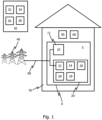
- the Fig. 1 shows a schematic representation of an embodiment of a measuring system 5 with a calibrated digital electricity meter 10 and a voltage and current measuring device 22.
- the measuring system 5 comprises, in addition to the calibrated digital electricity meter 10 and the additional voltage and current measuring device 22, a first processing device 24, a first communication device 26, a first storage device 28 and a first machine learning device 29.
- the voltage and current measuring device 22 is a voltage and current measuring device which is not located in a calibration-relevant part of the measuring system 5, in particular an additional voltage and current measuring device without any effect on the calibration-relevant part of the measuring system, the first processing device 24 is a freely programmable, in particular an additional, processing device, and the first communication device 26 is an additional communication device.
- the calibrated digital electricity meter 10, the voltage and current measuring device 22, the first processing device 24, the first communication device 26, the first storage device 28, and the first machine learning device 29 are arranged in a housing 20, in particular a sealed housing 20 (non-calibrated or non-calibration-relevant area).
- the digital electricity meter 10 is also located in a (separately) sealed housing 11 (calibrated or calibration-relevant area).
- the measuring system 5 is located in a housing 6.
- the calibrated digital electricity meter 10 and the non-calibrated area 20 can also be mounted in separate housings, decoupled from one another.
- the first machine learning device 29 can be provided optionally.
- the measuring system 5 is arranged in a building 70.
- a power supply network 40 supplies the building 70 with electricity via a supply line 80.
- the Building 70 contains a plurality of electrical consumers connected via a home network, of which only electrical consumer 60 is shown as an example. In this exemplary embodiment, electrical consumer 60 is a washing machine. Furthermore, building 70 contains an optional environmental sensor 50.
- Both the digital electricity meter 10 and the voltage and current measuring device 22 are connected to the supply line 80.
- the calibrated digital electricity meter 10 determines the total energy consumed in the building 70, in particular the electrical energy consumed by the electrical consumer 60 in kilowatt hours (kWh).
- the consumed electrical energy is used by the operator of the energy supply network 40 to bill the owner of the building 70 for energy costs.
- the voltage and current measuring device 22 measures the currents flowing through the electrical line 80 and the voltages applied to the electrical line 80 in the kilohertz range.
- the voltage and current measuring device 22 comprises a current sensor, a voltage sensor and an analog/digital converter (in Fig. 1 not shown) for converting analog voltage and current measured values into digital voltage and current measured values.
- the voltage and current measuring device 22 measures at least 4000 voltage and current measured values per second.
- the voltage and current measuring device can measure 10000 to 15000 voltage and current measured values per second, more preferably 10000 voltage and current measured values per second.
- the voltage and current measuring device 22 determines, in particular, voltage and current measured values in a three-phase system in each of the three phases.
- the first storage device 28 is configured to store the digital voltage and current measured values determined by the voltage and current measuring device 22.
- the Fig. 1 a central unit 30, which includes a second storage device 32, a second processing device 34, a second communication device 36, and a second machine learning device 38.
- the units of the measuring system 5 are referred to as “first” units and the units of the central unit 30 as “second" units.
- the voltage and current measuring device 22 Since the voltage and current measuring device 22 generates a large amount of measurement data due to the sampling frequency in the kilohertz range, it is only possible with relatively great effort to send all measurement data via the first communication device 26 to the second communication device 36 in the central unit 30. For this reason, a preliminary analysis and sorting of the measurement data generated by the voltage and current measuring device 22 takes place in the measuring system 5, i.e., by the first processing device 24, so that the data volume of the digital data processed by the first processing device 24 is smaller than the data volume of the measured voltage and current measured values. This means that not all voltage and current measured values generated by the voltage and current measuring device 22 are sent to the central unit 30 via the first communication device 26. Thus, in the present embodiment, an intelligent compromise is chosen between processing all measurement data in the measuring system 5 and sending all measurement data to the central unit 30 for data processing.
- the first processing device 24 is configured to determine an increase above a threshold and/or a decrease below a threshold of the digital voltage and/or current measured values.
- the first processing device 24 is configured to detect when the electrical load 50 is put into operation or deactivated.
- the threshold or trigger event can also be based on a power value.
- the first storage device 28 is configured to store the digital voltage and current measured values for a time interval corresponding to the increase and/or decrease in the digital voltage and/or current measured values in response to the first processing device 24 determining an increase above a threshold value and/or a decrease below a threshold value.
- the first processing device 24 has access to this stored data, so that the first processing device 24 can process this data.
- the first processing device 24 Based on the digital voltage and current measurement values stored for the time interval, the first processing device 24 generates a characteristic signature, for example, a fingerprint.
- the fingerprint comprises a characteristic curve of power values over a time interval.
- the first processing device 24 compares the characteristic signature with a predetermined signature.
- the first processing device 24 compares the characteristic signature determined from the measurement data with a known signature of the washing machine 50. If the comparison reveals a match between the characteristic signature and the predetermined signature, the first processing device 24 has recognized the washing machine 50.
- the measurement data relating to the washing machine 50 is sent to the central unit 30 via the first communication device 26.
- the voltage and current measurement values received by the second communication device 36 of the central unit 30 are stored in the second storage device 32 and can be further processed there by the second processing device 34.
- the measurement data can be evaluated over time in the central unit 30.
- the washing machine 50 is of no importance to the central unit 30, it can also be provided that the voltage and current measurement values relating to the washing machine 50 are discarded, i.e., deleted from the first storage device 28 and not sent to the central unit 30.
- the first communication device 26 can send the corresponding voltage and current measured values to the central unit 30, where the second processing device 34 checks whether the new signature or the voltage and current measured values relating to this signature refer to a new electrical consumer or which new electrical consumer it refers to.
- the second processing device 34 of the central unit 30 can determine and label the newly determined signature as "wine refrigerator,” and include this signature in the set of predefined signatures so that the first processing device 24 of the measuring system 5 can always recognize the wine refrigerator in the future.
- the second processing device 34 can specify to the first processing device 24 whether a detected operation of the wine refrigerator should be reported to the central unit 30, which includes sending the corresponding voltage and current measured values to the central unit 30, or whether voltage and current measured values relating to the wine refrigerator should be discarded.
- Characteristic signatures of electrical loads can change over time due to aging. Often, the characteristic signature changes only slightly. Such changes can allow conclusions to be drawn about wear and tear on the electrical load.
- the first processing device 24 can be configured to send a warning signal, in particular a message signaling wear, to the central unit 30 if the comparison of the characteristic signature with the predetermined signature results in a deviation that is above a first threshold value but below a second threshold value. The central unit 30 can then commission maintenance or repair measures accordingly.
- the first machine learning device 29 can be provided in the measuring system 5.
- This first machine learning device is configured to train the comparison of the characteristic signature with the predetermined signature by the first processing device 24 based on a training set of comparison results between characteristic signatures and predetermined signatures.
- the first machine learning device 29 can also be provided in the first processing device 24.
- the training of the training set can also be carried out by the second machine learning device 38 in the central unit 30.
- the first communication device 26 is further configured to receive an energy disaggregation algorithm from the central unit 30 and to send the energy disaggregation algorithm to the first processing device 24.
- the first processing device 24 is configured to apply the received energy disaggregation algorithm to the digital voltage and current measurements to determine the processed digital data.
- the first processing device 24 is further configured to calculate active power values, reactive power values, apparent power values and/or phase shift values based on the digital voltage and current measured values and to send these as processed digital data to the central unit 30.
- the first processing device 24 is configured to compress the digital voltage and current measured values before sending them to the central unit via the first communication device 26. Furthermore, the processing device 24 can digitally sign the data before sending it.
- the first processing device 24 is configured to determine the processed digital data based on the digital voltage and current measured values and the electrical work recorded by the calibrated digital electricity meter 10.
- the processing device 24 uses the measurement data from the digital electricity meter 10 to check the measurement data from the voltage and current measuring device 22 for plausibility.
- the first communication device 26 can further be configured to send the electrical work recorded by the calibrated digital electricity meter 10 to the central unit 30.
- the data processing can take place in the second processing device 34. Before sending, the data can also be compressed and/or digitally signed.
- the first communication device 26 can be configured to receive environmental measurement data from the environmental sensor 50 and to send the environmental measurement data to the first processing device 24.
- the first processing device 24 is configured to, based on the digital Voltage and current measurement values of the voltage and current measuring device 22 and the environmental measurement data to determine the processed digital data.
- the environmental sensor 50 is configured as a motion sensor directed toward an entrance door of the building 70 that opens and closes with the aid of a motor for entry control. If the motion sensor detects an opening or closing of the entrance door, which includes operation of the motor, this information can be used by the first processing device 24 to detect, verify, or learn a characteristic signature of the motor.
- the present disclosure includes identifying connected electrical consumers and determining their states, preprocessing digitized measured values and compressing them, forwarding the compressed measured values to a central unit 30 configured as a cloud computer for data post-processing, comparing and building a database of all connected electrical consumers in the central unit 30 configured as a cloud computer, and updating local detection algorithms in the measuring system 5 with the aid of the central unit.
- the present disclosure provides a multitude of advantages. For example, it enables a computational breakdown of total consumption into individual electrical consumers, i.e., a breakdown of a large number of electrical consumers in the total energy consumption is provided without the need for additional sensors. Furthermore, the determination of different states of electrical consumers and thus the detection of different stages in the aging process of electrical consumers is enabled. Data acquisition for analyzing the condition of the electrical power grid 40 is also possible.
- the present disclosure provides the following additional advantages: Costs are reduced and added value is increased by expanding existing modern measuring devices. Additional electronic components for high-frequency measurement of voltages and currents, particularly in a three-phase system, for local data processing and radio communication are integrated alongside the existing hardware of a modern measuring device. The non-interference nature of the legally protected measuring and reading electronics of the modern measuring device is taken into account.
- High-frequency measurement (e.g., with a 10 kHz sampling frequency) allows additional new services to be created through local data analysis. For example, predictions can be made regarding when electrical loads require maintenance or replacement. Furthermore, local energy quality analyses can be performed to determine the degree of pollution in the electrical grid.
- the present disclosure thus provides a platform that can provide residential and business customers with new services in the future that are still unknown today. Furthermore, the measuring system 5 is remotely maintainable through multiple, secure IT mechanisms and can be equipped with new application software at any time.
- the data connection via communication devices 26 and 36 also provides a secure connection to the central unit 30.
- Firmware updates can be enabled via a secure channel.
- energy transparency is provided for residential and business customers, leading to increased energy efficiency and sustainability.
- customer-specific services such as alarm functions for electrical consumers, are enabled.
Landscapes
- Engineering & Computer Science (AREA)
- Computer Networks & Wireless Communication (AREA)
- Remote Monitoring And Control Of Power-Distribution Networks (AREA)
- Arrangements For Transmission Of Measured Signals (AREA)
- Measurement Of Current Or Voltage (AREA)
Priority Applications (1)
| Application Number | Priority Date | Filing Date | Title |
|---|---|---|---|
| HRP20250671TT HRP20250671T1 (hr) | 2020-10-26 | 2021-08-05 | Mjerni sustav i mjerna infrastruktura koja se sastoji od mjernog sustava i centralne jedinice |
Applications Claiming Priority (1)
| Application Number | Priority Date | Filing Date | Title |
|---|---|---|---|
| DE102020128102.1A DE102020128102A1 (de) | 2020-10-26 | 2020-10-26 | Messsystem und Messinfrastruktur mit einem Messsystem und einer Zentraleinheit |
Publications (3)
| Publication Number | Publication Date |
|---|---|
| EP3989596A1 EP3989596A1 (de) | 2022-04-27 |
| EP3989596B1 true EP3989596B1 (de) | 2025-05-07 |
| EP3989596C0 EP3989596C0 (de) | 2025-05-07 |
Family
ID=77226736
Family Applications (1)
| Application Number | Title | Priority Date | Filing Date |
|---|---|---|---|
| EP21189938.0A Active EP3989596B1 (de) | 2020-10-26 | 2021-08-05 | Messsystem und messinfrastruktur mit einem messsystem und einer zentraleinheit |
Country Status (4)
| Country | Link |
|---|---|
| EP (1) | EP3989596B1 (pl) |
| DE (1) | DE102020128102A1 (pl) |
| HR (1) | HRP20250671T1 (pl) |
| PL (1) | PL3989596T3 (pl) |
Citations (1)
| Publication number | Priority date | Publication date | Assignee | Title |
|---|---|---|---|---|
| US20190033354A1 (en) * | 2017-07-26 | 2019-01-31 | Panoramic Power Ltd. | System and method for transmission of time stamps of current samples sampled by a self-powered power sensor |
Family Cites Families (1)
| Publication number | Priority date | Publication date | Assignee | Title |
|---|---|---|---|---|
| NL2002457C2 (nl) * | 2009-01-27 | 2010-07-28 | Liandon B V | Eindgebruiker-elektriciteitsnetwerk, gebruik, werkwijze en samenstel. |
-
2020
- 2020-10-26 DE DE102020128102.1A patent/DE102020128102A1/de active Pending
-
2021
- 2021-08-05 HR HRP20250671TT patent/HRP20250671T1/hr unknown
- 2021-08-05 PL PL21189938.0T patent/PL3989596T3/pl unknown
- 2021-08-05 EP EP21189938.0A patent/EP3989596B1/de active Active
Patent Citations (1)
| Publication number | Priority date | Publication date | Assignee | Title |
|---|---|---|---|---|
| US20190033354A1 (en) * | 2017-07-26 | 2019-01-31 | Panoramic Power Ltd. | System and method for transmission of time stamps of current samples sampled by a self-powered power sensor |
Also Published As
| Publication number | Publication date |
|---|---|
| DE102020128102A1 (de) | 2022-04-28 |
| HRP20250671T1 (hr) | 2025-08-01 |
| PL3989596T3 (pl) | 2025-09-15 |
| EP3989596C0 (de) | 2025-05-07 |
| EP3989596A1 (de) | 2022-04-27 |
Similar Documents
| Publication | Publication Date | Title |
|---|---|---|
| EP2697888B1 (de) | Verfahren zur bestimmung der topologie eines niederspannungsnetzes | |
| EP2779527A1 (de) | System und Verfahren zur Analyse des Energieverbrauchs von elektrischen Verbrauchern in einem Netz | |
| EP2864847A1 (de) | Überwachung einer ersten ausrüstung einer technischen anlage zur herstellung eines produkts | |
| EP3210088B1 (de) | Verfahren und assistenzsystem zur erkennung einer störung in einer anlage | |
| CH709416B1 (de) | Verfahren und Vorrichtung für die permanente Strommessung in den Kabel-Verteilkabinen der 230 V/400 V-Netzebene. | |
| DE102012215946A1 (de) | Schaltung zum Leiten eines elektrischen Stromes | |
| WO2020064331A1 (de) | Verfahren und vorrichtung zur bestimmung des netzzustandes eines niederspannungsnetzes eines energieversorgungssystems | |
| DE102010046417A1 (de) | Verfahren und Vorrichtung zur Erkennung von Verbrauchern | |
| DE102020103491A1 (de) | Anordnung zur Bewertung des Zustandes und der Qualität von Niederspannungsnetzen | |
| DE102019205663A1 (de) | Verfahren und Vorrichtung zur Überwachung und Überprüfung eines Stromversorgungssystems eines Kraftfahrzeugs | |
| EP3989596B1 (de) | Messsystem und messinfrastruktur mit einem messsystem und einer zentraleinheit | |
| EP4075622A1 (de) | Ermitteln der netztopologie eines stromnetzes sowie regelung eines stromnetzes | |
| DE102020117900A1 (de) | Verfahren zum betrieb eines stromverbrauchsmesssystems und stromverbrauchsmesssystem | |
| EP2910903A1 (de) | Verfahren zum Erkennen von Stromdiebstahl in einem Niederspannungsnetz | |
| EP3688861A1 (de) | Überwachung eines energieparameters in einer verteilstation | |
| EP4487433A1 (de) | Verfahren und system zum überwachen eines spannungsnetzes, verfahren zum trainieren einer künstlichen intelligenz zur prognose eines zukünftigen zustands eines spannungsnetzes, computerprogramm sowie computerlesbarer datenträger | |
| EP3759505B1 (de) | Verfahren zur bewertung des zustandes und der qualität von niederspannungsnetzen | |
| DE102012025178A1 (de) | Verfahren und Vorrichtung zur automatischen Charakterisierung und Überwachung eines elektrischen Netzes oder eines Stromnetzabschnitts eines elektrischen Netzes oder einer elektrischen Anlage | |
| DE102016101021A1 (de) | Verfahren und Vorrichtung zur Erkennung von in einem Versorgungsnetz vorhandenen Verbrauchern | |
| DE102020117892A1 (de) | Verfahren zum betrieb eines stromverbrauchsmesssystems und stromverbrauchsmesssystem | |
| DE102013008812B4 (de) | System und Verfahren zur Bestimmung elektrischer Kenngrößen | |
| EP3712624A1 (de) | Verfahren zum überwachen eines technischen geräts | |
| DE102022106405B4 (de) | Verfahren zur Ermittlung von aktuellen Verbräuchen elektrischer Energie und Computerprogramm, Energiemessgerät und Energieversorgungsanlage hierzu | |
| DE102019125873B4 (de) | Verfahren sowie sensor- und auswerteinrichtung zur dezentralen ermittlung von diagnoseinformationen über elektrische verbraucher einer maschinenanlage | |
| CN116718867A (zh) | 基于多源数据的变电智能网关设备状态检测方法及装置 |
Legal Events
| Date | Code | Title | Description |
|---|---|---|---|
| REG | Reference to a national code |
Ref country code: HR Ref legal event code: TUEP Ref document number: P20250671T Country of ref document: HR |
|
| PUAI | Public reference made under article 153(3) epc to a published international application that has entered the european phase |
Free format text: ORIGINAL CODE: 0009012 |
|
| STAA | Information on the status of an ep patent application or granted ep patent |
Free format text: STATUS: THE APPLICATION HAS BEEN PUBLISHED |
|
| AK | Designated contracting states |
Kind code of ref document: A1 Designated state(s): AL AT BE BG CH CY CZ DE DK EE ES FI FR GB GR HR HU IE IS IT LI LT LU LV MC MK MT NL NO PL PT RO RS SE SI SK SM TR |
|
| STAA | Information on the status of an ep patent application or granted ep patent |
Free format text: STATUS: REQUEST FOR EXAMINATION WAS MADE |
|
| 17P | Request for examination filed |
Effective date: 20220609 |
|
| RBV | Designated contracting states (corrected) |
Designated state(s): AL AT BE BG CH CY CZ DE DK EE ES FI FR GB GR HR HU IE IS IT LI LT LU LV MC MK MT NL NO PL PT RO RS SE SI SK SM TR |
|
| RAP3 | Party data changed (applicant data changed or rights of an application transferred) |
Owner name: E.ON GRID SOLUTIONS GMBH Owner name: E.ON SE |
|
| STAA | Information on the status of an ep patent application or granted ep patent |
Free format text: STATUS: EXAMINATION IS IN PROGRESS |
|
| 17Q | First examination report despatched |
Effective date: 20240514 |
|
| GRAP | Despatch of communication of intention to grant a patent |
Free format text: ORIGINAL CODE: EPIDOSNIGR1 |
|
| STAA | Information on the status of an ep patent application or granted ep patent |
Free format text: STATUS: GRANT OF PATENT IS INTENDED |
|
| INTG | Intention to grant announced |
Effective date: 20241209 |
|
| GRAS | Grant fee paid |
Free format text: ORIGINAL CODE: EPIDOSNIGR3 |
|
| GRAA | (expected) grant |
Free format text: ORIGINAL CODE: 0009210 |
|
| STAA | Information on the status of an ep patent application or granted ep patent |
Free format text: STATUS: THE PATENT HAS BEEN GRANTED |
|
| AK | Designated contracting states |
Kind code of ref document: B1 Designated state(s): AL AT BE BG CH CY CZ DE DK EE ES FI FR GB GR HR HU IE IS IT LI LT LU LV MC MK MT NL NO PL PT RO RS SE SI SK SM TR |
|
| REG | Reference to a national code |
Ref country code: GB Ref legal event code: FG4D Free format text: NOT ENGLISH |
|
| REG | Reference to a national code |
Ref country code: CH Ref legal event code: EP |
|
| REG | Reference to a national code |
Ref country code: DE Ref legal event code: R096 Ref document number: 502021007387 Country of ref document: DE |
|
| REG | Reference to a national code |
Ref country code: IE Ref legal event code: FG4D Free format text: LANGUAGE OF EP DOCUMENT: GERMAN |
|
| U01 | Request for unitary effect filed |
Effective date: 20250529 |
|
| U07 | Unitary effect registered |
Designated state(s): AT BE BG DE DK EE FI FR IT LT LU LV MT NL PT RO SE SI Effective date: 20250606 |
|
| REG | Reference to a national code |
Ref country code: HR Ref legal event code: T1PR Ref document number: P20250671 Country of ref document: HR |
|
| REG | Reference to a national code |
Ref country code: HR Ref legal event code: ODRP Ref document number: P20250671 Country of ref document: HR Payment date: 20250730 Year of fee payment: 5 |
|
| U20 | Renewal fee for the european patent with unitary effect paid |
Year of fee payment: 5 Effective date: 20250826 |
|
| PG25 | Lapsed in a contracting state [announced via postgrant information from national office to epo] |
Ref country code: ES Free format text: LAPSE BECAUSE OF FAILURE TO SUBMIT A TRANSLATION OF THE DESCRIPTION OR TO PAY THE FEE WITHIN THE PRESCRIBED TIME-LIMIT Effective date: 20250507 |
|
| PG25 | Lapsed in a contracting state [announced via postgrant information from national office to epo] |
Ref country code: GR Free format text: LAPSE BECAUSE OF FAILURE TO SUBMIT A TRANSLATION OF THE DESCRIPTION OR TO PAY THE FEE WITHIN THE PRESCRIBED TIME-LIMIT Effective date: 20250808 Ref country code: NO Free format text: LAPSE BECAUSE OF FAILURE TO SUBMIT A TRANSLATION OF THE DESCRIPTION OR TO PAY THE FEE WITHIN THE PRESCRIBED TIME-LIMIT Effective date: 20250807 |
|
| PGFP | Annual fee paid to national office [announced via postgrant information from national office to epo] |
Ref country code: PL Payment date: 20250805 Year of fee payment: 5 |
|
| PGFP | Annual fee paid to national office [announced via postgrant information from national office to epo] |
Ref country code: GB Payment date: 20250818 Year of fee payment: 5 |
|
| PGFP | Annual fee paid to national office [announced via postgrant information from national office to epo] |
Ref country code: HR Payment date: 20250730 Year of fee payment: 5 |
|
| PG25 | Lapsed in a contracting state [announced via postgrant information from national office to epo] |
Ref country code: RS Free format text: LAPSE BECAUSE OF FAILURE TO SUBMIT A TRANSLATION OF THE DESCRIPTION OR TO PAY THE FEE WITHIN THE PRESCRIBED TIME-LIMIT Effective date: 20250807 |
|
| PGFP | Annual fee paid to national office [announced via postgrant information from national office to epo] |
Ref country code: CZ Payment date: 20250723 Year of fee payment: 5 |
|
| PG25 | Lapsed in a contracting state [announced via postgrant information from national office to epo] |
Ref country code: IS Free format text: LAPSE BECAUSE OF FAILURE TO SUBMIT A TRANSLATION OF THE DESCRIPTION OR TO PAY THE FEE WITHIN THE PRESCRIBED TIME-LIMIT Effective date: 20250907 |
|
| PG25 | Lapsed in a contracting state [announced via postgrant information from national office to epo] |
Ref country code: SM Free format text: LAPSE BECAUSE OF FAILURE TO SUBMIT A TRANSLATION OF THE DESCRIPTION OR TO PAY THE FEE WITHIN THE PRESCRIBED TIME-LIMIT Effective date: 20250507 |
|
| PG25 | Lapsed in a contracting state [announced via postgrant information from national office to epo] |
Ref country code: SK Free format text: LAPSE BECAUSE OF FAILURE TO SUBMIT A TRANSLATION OF THE DESCRIPTION OR TO PAY THE FEE WITHIN THE PRESCRIBED TIME-LIMIT Effective date: 20250507 |
|
| PLBE | No opposition filed within time limit |
Free format text: ORIGINAL CODE: 0009261 |
|
| STAA | Information on the status of an ep patent application or granted ep patent |
Free format text: STATUS: NO OPPOSITION FILED WITHIN TIME LIMIT |
|
| REG | Reference to a national code |
Ref country code: CH Ref legal event code: L10 Free format text: ST27 STATUS EVENT CODE: U-0-0-L10-L00 (AS PROVIDED BY THE NATIONAL OFFICE) Effective date: 20260318 |
|
| REG | Reference to a national code |
Ref country code: CH Ref legal event code: H13 Free format text: ST27 STATUS EVENT CODE: U-0-0-H10-H13 (AS PROVIDED BY THE NATIONAL OFFICE) Effective date: 20260324 |
|
| PG25 | Lapsed in a contracting state [announced via postgrant information from national office to epo] |
Ref country code: MC Free format text: LAPSE BECAUSE OF FAILURE TO SUBMIT A TRANSLATION OF THE DESCRIPTION OR TO PAY THE FEE WITHIN THE PRESCRIBED TIME-LIMIT Effective date: 20250507 |
|
| 26N | No opposition filed |
Effective date: 20260210 |
|
| PG25 | Lapsed in a contracting state [announced via postgrant information from national office to epo] |
Ref country code: CH Free format text: LAPSE BECAUSE OF NON-PAYMENT OF DUE FEES Effective date: 20250831 |