EP3989549B1 - Video image processing method and device, and storage medium - Google Patents
Video image processing method and device, and storage medium Download PDFInfo
- Publication number
- EP3989549B1 EP3989549B1 EP19935736.9A EP19935736A EP3989549B1 EP 3989549 B1 EP3989549 B1 EP 3989549B1 EP 19935736 A EP19935736 A EP 19935736A EP 3989549 B1 EP3989549 B1 EP 3989549B1
- Authority
- EP
- European Patent Office
- Prior art keywords
- bit
- mode
- cclm
- chrominance prediction
- indicate
- Prior art date
- Legal status (The legal status is an assumption and is not a legal conclusion. Google has not performed a legal analysis and makes no representation as to the accuracy of the status listed.)
- Active
Links
Images


Classifications
-
- H—ELECTRICITY
- H04—ELECTRIC COMMUNICATION TECHNIQUE
- H04N—PICTORIAL COMMUNICATION, e.g. TELEVISION
- H04N19/00—Methods or arrangements for coding, decoding, compressing or decompressing digital video signals
- H04N19/10—Methods or arrangements for coding, decoding, compressing or decompressing digital video signals using adaptive coding
- H04N19/134—Methods or arrangements for coding, decoding, compressing or decompressing digital video signals using adaptive coding characterised by the element, parameter or criterion affecting or controlling the adaptive coding
- H04N19/157—Assigned coding mode, i.e. the coding mode being predefined or preselected to be further used for selection of another element or parameter
-
- H—ELECTRICITY
- H04—ELECTRIC COMMUNICATION TECHNIQUE
- H04N—PICTORIAL COMMUNICATION, e.g. TELEVISION
- H04N19/00—Methods or arrangements for coding, decoding, compressing or decompressing digital video signals
- H04N19/10—Methods or arrangements for coding, decoding, compressing or decompressing digital video signals using adaptive coding
- H04N19/134—Methods or arrangements for coding, decoding, compressing or decompressing digital video signals using adaptive coding characterised by the element, parameter or criterion affecting or controlling the adaptive coding
- H04N19/146—Data rate or code amount at the encoder output
- H04N19/149—Data rate or code amount at the encoder output by estimating the code amount by means of a model, e.g. mathematical model or statistical model
-
- H—ELECTRICITY
- H04—ELECTRIC COMMUNICATION TECHNIQUE
- H04N—PICTORIAL COMMUNICATION, e.g. TELEVISION
- H04N19/00—Methods or arrangements for coding, decoding, compressing or decompressing digital video signals
- H04N19/10—Methods or arrangements for coding, decoding, compressing or decompressing digital video signals using adaptive coding
- H04N19/102—Methods or arrangements for coding, decoding, compressing or decompressing digital video signals using adaptive coding characterised by the element, parameter or selection affected or controlled by the adaptive coding
- H04N19/103—Selection of coding mode or of prediction mode
- H04N19/105—Selection of the reference unit for prediction within a chosen coding or prediction mode, e.g. adaptive choice of position and number of pixels used for prediction
-
- H—ELECTRICITY
- H04—ELECTRIC COMMUNICATION TECHNIQUE
- H04N—PICTORIAL COMMUNICATION, e.g. TELEVISION
- H04N19/00—Methods or arrangements for coding, decoding, compressing or decompressing digital video signals
- H04N19/10—Methods or arrangements for coding, decoding, compressing or decompressing digital video signals using adaptive coding
- H04N19/102—Methods or arrangements for coding, decoding, compressing or decompressing digital video signals using adaptive coding characterised by the element, parameter or selection affected or controlled by the adaptive coding
- H04N19/103—Selection of coding mode or of prediction mode
- H04N19/11—Selection of coding mode or of prediction mode among a plurality of spatial predictive coding modes
-
- H—ELECTRICITY
- H04—ELECTRIC COMMUNICATION TECHNIQUE
- H04N—PICTORIAL COMMUNICATION, e.g. TELEVISION
- H04N19/00—Methods or arrangements for coding, decoding, compressing or decompressing digital video signals
- H04N19/10—Methods or arrangements for coding, decoding, compressing or decompressing digital video signals using adaptive coding
- H04N19/102—Methods or arrangements for coding, decoding, compressing or decompressing digital video signals using adaptive coding characterised by the element, parameter or selection affected or controlled by the adaptive coding
- H04N19/13—Adaptive entropy coding, e.g. adaptive variable length coding [AVLC] or context adaptive binary arithmetic coding [CABAC]
-
- H—ELECTRICITY
- H04—ELECTRIC COMMUNICATION TECHNIQUE
- H04N—PICTORIAL COMMUNICATION, e.g. TELEVISION
- H04N19/00—Methods or arrangements for coding, decoding, compressing or decompressing digital video signals
- H04N19/10—Methods or arrangements for coding, decoding, compressing or decompressing digital video signals using adaptive coding
- H04N19/134—Methods or arrangements for coding, decoding, compressing or decompressing digital video signals using adaptive coding characterised by the element, parameter or criterion affecting or controlling the adaptive coding
- H04N19/157—Assigned coding mode, i.e. the coding mode being predefined or preselected to be further used for selection of another element or parameter
- H04N19/159—Prediction type, e.g. intra-frame, inter-frame or bidirectional frame prediction
-
- H—ELECTRICITY
- H04—ELECTRIC COMMUNICATION TECHNIQUE
- H04N—PICTORIAL COMMUNICATION, e.g. TELEVISION
- H04N19/00—Methods or arrangements for coding, decoding, compressing or decompressing digital video signals
- H04N19/10—Methods or arrangements for coding, decoding, compressing or decompressing digital video signals using adaptive coding
- H04N19/169—Methods or arrangements for coding, decoding, compressing or decompressing digital video signals using adaptive coding characterised by the coding unit, i.e. the structural portion or semantic portion of the video signal being the object or the subject of the adaptive coding
- H04N19/17—Methods or arrangements for coding, decoding, compressing or decompressing digital video signals using adaptive coding characterised by the coding unit, i.e. the structural portion or semantic portion of the video signal being the object or the subject of the adaptive coding the unit being an image region, e.g. an object
- H04N19/176—Methods or arrangements for coding, decoding, compressing or decompressing digital video signals using adaptive coding characterised by the coding unit, i.e. the structural portion or semantic portion of the video signal being the object or the subject of the adaptive coding the unit being an image region, e.g. an object the region being a block, e.g. a macroblock
-
- H—ELECTRICITY
- H04—ELECTRIC COMMUNICATION TECHNIQUE
- H04N—PICTORIAL COMMUNICATION, e.g. TELEVISION
- H04N19/00—Methods or arrangements for coding, decoding, compressing or decompressing digital video signals
- H04N19/10—Methods or arrangements for coding, decoding, compressing or decompressing digital video signals using adaptive coding
- H04N19/169—Methods or arrangements for coding, decoding, compressing or decompressing digital video signals using adaptive coding characterised by the coding unit, i.e. the structural portion or semantic portion of the video signal being the object or the subject of the adaptive coding
- H04N19/184—Methods or arrangements for coding, decoding, compressing or decompressing digital video signals using adaptive coding characterised by the coding unit, i.e. the structural portion or semantic portion of the video signal being the object or the subject of the adaptive coding the unit being bits, e.g. of the compressed video stream
-
- H—ELECTRICITY
- H04—ELECTRIC COMMUNICATION TECHNIQUE
- H04N—PICTORIAL COMMUNICATION, e.g. TELEVISION
- H04N19/00—Methods or arrangements for coding, decoding, compressing or decompressing digital video signals
- H04N19/10—Methods or arrangements for coding, decoding, compressing or decompressing digital video signals using adaptive coding
- H04N19/169—Methods or arrangements for coding, decoding, compressing or decompressing digital video signals using adaptive coding characterised by the coding unit, i.e. the structural portion or semantic portion of the video signal being the object or the subject of the adaptive coding
- H04N19/186—Methods or arrangements for coding, decoding, compressing or decompressing digital video signals using adaptive coding characterised by the coding unit, i.e. the structural portion or semantic portion of the video signal being the object or the subject of the adaptive coding the unit being a colour or a chrominance component
-
- H—ELECTRICITY
- H04—ELECTRIC COMMUNICATION TECHNIQUE
- H04N—PICTORIAL COMMUNICATION, e.g. TELEVISION
- H04N19/00—Methods or arrangements for coding, decoding, compressing or decompressing digital video signals
- H04N19/46—Embedding additional information in the video signal during the compression process
- H04N19/463—Embedding additional information in the video signal during the compression process by compressing encoding parameters before transmission
-
- H—ELECTRICITY
- H04—ELECTRIC COMMUNICATION TECHNIQUE
- H04N—PICTORIAL COMMUNICATION, e.g. TELEVISION
- H04N19/00—Methods or arrangements for coding, decoding, compressing or decompressing digital video signals
- H04N19/50—Methods or arrangements for coding, decoding, compressing or decompressing digital video signals using predictive coding
- H04N19/593—Methods or arrangements for coding, decoding, compressing or decompressing digital video signals using predictive coding involving spatial prediction techniques
-
- H—ELECTRICITY
- H04—ELECTRIC COMMUNICATION TECHNIQUE
- H04N—PICTORIAL COMMUNICATION, e.g. TELEVISION
- H04N19/00—Methods or arrangements for coding, decoding, compressing or decompressing digital video signals
- H04N19/70—Methods or arrangements for coding, decoding, compressing or decompressing digital video signals characterised by syntax aspects related to video coding, e.g. related to compression standards
-
- H—ELECTRICITY
- H04—ELECTRIC COMMUNICATION TECHNIQUE
- H04N—PICTORIAL COMMUNICATION, e.g. TELEVISION
- H04N19/00—Methods or arrangements for coding, decoding, compressing or decompressing digital video signals
- H04N19/90—Methods or arrangements for coding, decoding, compressing or decompressing digital video signals using coding techniques not provided for in groups H04N19/10-H04N19/85, e.g. fractals
- H04N19/91—Entropy coding, e.g. variable length coding [VLC] or arithmetic coding
Definitions
- the present disclosure relates to the technical field of video encoding/decoding and, more specifically, to a video image processing method and device, and a storage medium.
- chrominance prediction uses multiple prediction modes including the cross-component linear mode (CCML) to improve the accuracy of chrominance component prediction.
- CCML prediction mode is used to analyze the number of the chrominance prediction mode of an image block, there is a dependency on the bit analysis of different predictions.
- the encoding/decoding method of the bit in the fourth position of the image block needs to refer to the value of the bit in the third position. Using this method will lead to higher encoding/decoding complexity and lower encoding/decoding efficiency. Therefore, how to better improve the encoding/decoding efficiency has become the focus of research.
- US 2018/077426 A1 discloses a method of decoding video data, including receiving an encoded block of luma samples for a first block of video data, decoding the encoded block of luma samples to create reconstructed luma samples, and predicting chroma samples for the first block of video data using the reconstructed luma samples for the first block of video data and two or more linear prediction models.
- the embodiments of the present disclosure provide a video image encoding/decoding method and device, which implement parallel encoding/decoding, reduce the complexity of the encoding/decoding process, save encoding/decoding time, and improve the encoding/decoding efficiency.
- the invention is defined by the subject matter of the independent claims. Advantageous embodiments are subject to the dependent claims.
- the video processing method provided in the embodiments of the present disclosure can be applied to a video processing device, and the video processing device can be set on a smart terminal (such as a mobile phone, a tablet, etc.).
- a smart terminal such as a mobile phone, a tablet, etc.
- the embodiments of the present disclosure can be applied to aircrafts (such as unmanned aerial vehicles).
- the embodiments of the present disclosure can also be applied to other movable platforms (such as unmanned ships, unmanned vehicles, robots, etc.), which is not limited in the embodiments of the present disclosure.
- the video image processing method provided in the embodiments of the present disclosure is mainly applied to codecs that comply with the international video coding standard H.264, the high efficiency video coding (HEVC), VVC, and the Chinese audio video coding standard (AVS), AVS+, AVS2, and AVS3.
- HEVC high efficiency video coding
- VVC high efficiency video coding
- AVS+ Chinese audio video coding standard
- AVS2 AVS3
- the input of video coding is a video sequence in YUV format, where Y is the luminance component, and U and V are the chrominance components.
- VVC video coding standard
- the CCLM mode is introduced to improve the accuracy of chrominance component prediction.
- FIG. 1A is a schematic diagram of a CCLM according to an embodiment of the present disclosure
- FIG. 1B is a schematic diagram of another CCLM according to an embodiment of the present disclosure.
- FIG. 1A shows the current chrominance blocks
- FIG. 1B shows the chrominance prediction blocks based on the current chrominance blocks of FIG. 1A . Since there is a strong correlation between the different components of the video sequence, the coding performance can be improved by using the correlation between the different components of the video sequence.
- the chrominance component can be predicted based on the reconstructed luminance component in the same block, and the following linear model can be used.
- pred C is the chrominance prediction block
- B is the down-sampled luminance component of the luminance coding block at the same position
- the parameters ⁇ and ⁇ are derived by minimizing the regression error between adjacent reconstructed luminance and chrominance samples, as shown in the following formula (1) and formula (2).
- L(n) represents the reconstructed luminance sample after the down-sampling of the adjacent column on the left and the adjacent row above
- C(n) represents the reconstructed chrominance samples adjacent to the left and above of the current chrominance block.
- ⁇ and ⁇ may not need to be transmitted, and ⁇ and ⁇ may be calculated in the same way in the decoder.
- Intra-frame prediction uses reconstructed neighboring pixels to obtain prediction blocks through different prediction modes.
- the chrominance prediction mode also introduces a new CCLM mode.
- a frame of image can be first divided into coding areas (coding tree units (CTUs)) of the same size, such as 64 ⁇ 64 or 128 ⁇ 128. Each CTU may be further divided into square or rectangular coding units (CUs).
- CTUs coding tree units
- Each CTU may be further divided into square or rectangular coding units (CUs).
- the luminance component and the chrominance component may have different divisions.
- the bidirectional predictive interpolation coding frame B frame and the forward predictive coding frame P frame the luminance component and the chrominance component may have the same division method.
- the number of the chrominance prediction mode of the image block may be transmitted in the bitstream.
- the intra-frame prediction technologies in mainstream video coding standards mainly include the Planar mode, DC mode, and 65 angle mode.
- the chrominance prediction mode also includes the CCLM mode.
- the CCLM mode may include various types, such as including at least one of the three predictions modes of LT_CCLM, T_CCLM, and L_CCLM.
- the number of the chrominance prediction mode may be transmitted in the bitstream. In order to reduce coding complexity, in an example, there may be five or eight chrominance prediction modes based on whether the CCLM mode is turned on.
- Table 1 shows the chrominance prediction modes when CCLM is turned off.
- Number 0 may be the Planar mode
- Number 1 may be the DC mode
- Number 50 may be the vertical angle mode
- Number 18 may be the horizon angle mode.
- the number of the chrominance prediction mode may be searched by looking up the number of the chrominance prediction mode corresponding to the luminance mode through Table 1 based on the luminance mode.
- Table 1 will be used as an example to illustrate the process of looking up the luminance mode by using Table 1.
- the luminance mode is the Number 0 Planar mode and the chrominance prediction mode number is Number 1
- it can be determined that the Number 0 luminance mode and the Number 1 chrominance prediction mode that can correspond to the luminance mode is the vertical angle mode Number 50 in the third row and the second column.
- the CCLM mode when the CCLM mode is turned off, if the luminance mode is the Number 18 horizon angle mode and the chrominance prediction mode is Number 3, then based on Table 1, it can be determined that the Number 18 luminance mode and the Number 3 chrominance prediction mode that can correspond to the luminance mode is the DC mode Number 1 in the fifth row and the third column.
- a bit string may be obtained by binarizing the chrominance prediction mode of the image block to encode/decode the bits in the bit string.
- the bits may represent the encoding/decoding bits or the encoding/decoding binary symbols (bin)
- Table 1 When the CCLM mode is turned off, the method of binarizing the chrominance prediction modes shown in Table 1 may be as shown in Table 2 below, where the Number 4 mode may be the chrominance DM mode.
- Table 2 Chrominance Prediction Mode Number Binarization 4 0 0 100 1 101 2 110 3 111
- the bit in the first position of the bit string may be coded using the context of Number 0, and both the second position and the third position of the bit string may use the equal probability bypass mode. At this time, there may be no dependence on the bits in different positions of the coded chrominance prediction mode number.
- context can refer to a model that updates the occurrence probability of different bins based on the recently encoded/decoded bins in the context-based adaptive binary arithmetic encoding/decoding process.
- the eight chrominance prediction modes correspond to Table 3 below, where the chrominance prediction mode Numbers 4, 5, and 6 correspond to the LT_CCLM, L_CCLM, and T_CCLM modes, respectively, Number 7 is the DM mode, and Numbers 0, 1, 2, and 3 are other modes or regular intra-frame chrominance prediction modes.
- Table 3 will be used as an example to illustrate the process of looking up the luminance mode by using Table 3.
- the luminance mode is the Number 0 Planar mode and the chrominance prediction mode number is the Number 5 L_CCLM mode, then based on Table 3, it can be determined that the luminance mode corresponding to the luminance mode Number 0 and the chrominance prediction mode Number 5 is the Number 82 mode in the seventh row and the second column.
- the luminance mode is the Number 18 horizon angle mode and the chrominance prediction mode number is the Number 7 DM mode, then based on Table 3, it can be determined that the luminance mode corresponding to the luminance mode Number 18 and the chrominance prediction mode Number 8 is the horizon angle mode Number 18 in the ninth row and the fourth column.
- the chrominance prediction mode shown in Table 3 may be binarized as shown in Table 4 below.
- Table 4 Chrominance Prediction Mode Number Binarization 7 0 4 10 5 1110 6 1111 0 11000 1 11001 2 11010 3 11011
- the number of the chrominance prediction mode may have a different value range, and the bit string after binarization may be encoded and transmitted in the bitstream.
- the bit at the first position in the bit string may be used to indicate whether to use the DM mode or other modes.
- the other modes other than the DM mode may include, but are not limited to, the CCLM mode or the regular intra-frame chrominance prediction mode. For example, if the bit string after the binarization of the chrominance prediction mode Number 7 is 0 and the bit in the first position is 0, then the DM mode can be determined to be used. In another example, if the bit string after the binarization of the chrominance prediction mode Number 4 is 10 and the bit in the first position is 1, then other modes other than the DM mode can be determined to be used.
- the bit in the second position may be used to indicate whether to use the LT_CCLM mode. For example, if the bit string after the binarization of the chrominance prediction mode Number 4 is 10 and the bit in the second position is 0, then the LT_CCLM mode can be determined to be used.
- the bit in the third position may be used to indicate that other modes other than the LT_CCLM mode is used when the bit in the second position indicates that the LT_CCLM mode is not used.
- the bit in the third position of the chrominance prediction mode Numbers 5, 6, 0, 1, 2, and 3 after binarization may be used to indicate the use of other modes other than the LT_CCLM mode.
- the bit in the fourth position may be used to indicate that L_CCLM mode or T_CCLM mode is used when the bit in the third position is 1. For example, if the bit string of the chrominance prediction mode Number 5 after binarization is 1110 and the bit in the fourth position is 0, then it can be determined that the L_CCLM mode is used. In another example, if the bit string of the chrominance prediction mode Number 6 after binarization is 1111 and the bit in the fourth position is 1, then it can be determined that the T_CCLM mode is used.
- the bit in the fourth position and the bit in the fifth position may be used to indicate the number of the chrominance prediction mode being used.
- the bit string after binarization of chrominance prediction mode Number 0 may be 11000
- the bit string after binarization of chrominance prediction mode Number 1 may be 11001
- the bit string after binarization of chrominance prediction mode Number 2 may be 11010
- the bit string after binarization of chrominance prediction mode Number 3 may be 11011.
- the bit string may be a 1-bit bit string. Take Table 4 as an example, the bit string corresponding to the binarization of the chrominance prediction mode Number 7 is 0, then it can be determined that the chrominance prediction mode Number 7 is using the DM mode.
- the bit string may include two adjacent bits. Take Table 4 as an example, assuming that the video image processing device binarizes the chrominance prediction mode Number 4 of the image block of the to-be-encoded/decoded image, and the obtained the bit string is 10, and the bit in the first position is 1, then it can be determined that the chrominance prediction mode of the image block does not use the DM mode, that is, other modes other than the DM mode is used. The CCLM mode or the regular intra-frame chrominance prediction mode may be used. Further, the bit in the second position is 0, then it can be determined that the chrominance prediction mode of the image block uses the LT_CCLM mode in the CCLM mode.
- the chrominance prediction modes increase from five to eight.
- the bit at the first position, the bit at the second position, and the bit at the third position of the bit string may be coded with the contexts of Number 0, 1, and 2, respectively.
- the encoding method may need to be determined based on the value of the bit in the third position.
- the bit in the fourth position and the bit in the fifth position may be coded using bypass.
- the bit in the fourth position may be coded with the context of Number 2.
- the decoding process may need to determine the value of the bit at the third position before further decoding the bit at the fourth position.
- the coding process of the chrominance prediction mode number may be as shown in Table 5 below.
- Table 5 Syntax Element Bit Position Idx 0 1 2 3 4 Chrominance prediction mode not using the CCLM mode 0 bypass bypass na na Chrominance prediction mode using the CCLM mode and the bit value of the bit position Idx equals 2 is 0 0 1 2 bypass bypass Chrominance prediction mode using the CCLM mode and the bit value of the bit position Idx equals 2 is 1 0 1 2 2 na where na is used to indicate an empty coding mode, bypass is used to indicate a corresponding bypass coding mode below.
- the bit position Idx includes 0, 1, 2, 3, and 4, where 0 is used to indicate the bit position of the first position, 1 is used to indicate the bit position of the second position, that is, the first bit position, 2 is used to indicate the bit position of the third position, that is, the second bit position, 3 is used to indicate the bit position of the fourth position, that is, the third bit position, and 4 is used to indicate the bit position of the fourth position, that is, the third bit position.
- an embodiment of the invention proposes to perform binarization on the chrominance prediction mode of the image block of the to-be-encoded/decoded image to obtain a bit string, the bit string including at least three adjacent bits.
- the to-be-encoded/decoded image may use an inter-component linear model CCLM and/or a regular intra-frame chrominance prediction mode.
- the CCLM includes at least a first mode, a second mode, and a third mode, and the regular intra-frame chrominance prediction mode may be another chrominance prediction mode other than the CCLM.
- the first bit of the three adjacent bits may be used to indicate whether to use the first mode of the CCLM.
- the second bit may be used to indicate whether a CCLM mode other than the first mode is used when the first bit indicates that the first mode of the CCLM is not used.
- the third bit may be used to indicate whether the image block uses the second mode or the third mode of the CCLM when the second bit indicates that other modes of the CCLM other than the first mode is
- Mutually independent probability models are used to respectively encode/decode the second bit and the third bit. Further, mutually independent probability models are used to respectively encode/decode the three adjacent bits.
- the first bit of the three adjacent bits may be used to indicate whether to use the CCLM.
- the second bit may be used to indicate whether to use the first mode of the CCLM.
- the third bit may be used to indicate whether the second mode or the third mode of the CCLM is used.
- Mutually independent probability models are used to respectively encode the first bit and the second bit. Further, mutually independent probability models are used to encode/decode the three adjacent bits.
- the three adjacent bits may be positioned in the same syntax element (e.g., the three adjacent bits may be all position in the intra-frame chrominance prediction mode).
- the implementation methods can effectively reduce the complexity of hardware analysis while maintaining a variety of chrominance prediction modes to increase performance.
- the improved chrominance mode encoding/decoding method proposed in the present disclosure can improve the parallelism of hardware analysis, remove the encoding/decoding dependence of different bit positions, simplify the encoding/decoding of each bit, and improve the encoding/decoding efficiency without significant loss of the encoding/decoding performance.
- FIG. 2 is a flowchart of a video image processing method according to an embodiment of the present disclosure.
- the method can be applied to a video image processing device.
- the explanation of the video image processing device is described above, which will not be repeated here. More specifically, the method of an embodiment of the present disclosure may include the following processes.
- the CCLM may include at least a first mode, a second mode, and a third mode
- the regular intra-frame chrominance prediction mode may be another chrominance prediction mode other than the CCLM.
- the video image processing device may binarize the chrominance prediction mode of the image block of the to-be-encoded/decoded image to obtain a bit string, and the bit string may include at least three adjacent bits.
- the to-be-encoded/decoded image may use an inter-component linear model CCLM and/or a regular intra-frame chrominance prediction mode.
- the CCLM may include at least a first mode, a second mode, and a third mode, and the regular intra-frame chrominance prediction mode may be another chrominance prediction mode other than the CCLM.
- the first bit of the three adjacent bits may be used to indicate whether to use the first mode of the CCLM.
- the second bit may be used to indicate whether other modes of the CCLM other than the first mode is used.
- the third bit may be used to indicate that the image block uses the second mode or the third mode of the CCLM.
- the first bit may be the bit at the second position in the bit string
- the second bit may be the bit at the third position in the bit string
- the third bit may be the bit at the fourth position of the bit string.
- the third bit may also be used to indicate the used of one of the regular intra-frame chrominance prediction modes when the second bit indicates that the CCLM modes other than the first mode is not used.
- the regular intra-frame chrominance prediction modes may include one or more of the Planar mode, DC mode, and 65-angle mode.
- the first mode may include the LT_CCLM mode
- the second mode may include the L_CCLM mode
- the third mode may include the T_CCLM mode.
- the CCLM mode may be a chrominance prediction mode of the intra-frame prediction. Take Table 4 as an example for illustration.
- the binarized bit string of the chrominance prediction mode Number 410 corresponds to the first mode, that is, the LT_CCLM mode
- the binarized bit string of the chrominance prediction mode Number 5 1110 corresponds to the second mode, that is, the L_CCLM mode
- the binarized bit string of the chrominance prediction mode Number 6 1111 corresponds to the third mode, that is, the T_CCLM mode.
- the first mode, the second mode, and the third mode may be modes other than the LT_CCLM mode, the L_CCLM mode, and the T_CCLM mode.
- the image blocks in the to-be-encoded/decoded image may be squares and/or rectangles.
- bit position in the bit string may be expressed in the form of "bin" in arithmetic encoding/decoding.
- bit position may also be expressed in other forms, which is not specifically limited here.
- the to-be-encoded/decoded image may be a to-be-encoded/decoded image with CCLM enabled.
- the to-be-encoded/decoded image may include at least one image block in which the CCLM is in an on state.
- whether the CCLM is in the on state may be determined by an identifier added during encoding.
- an identifier may be added to a video parameter set (VPS), a sequence parameter set (SPS), a picture parameter set (PPS), a sequence header, a slice header, or an image header.
- the identifier may be used to indicate whether the CCLM is permitted to be used in the to-be-encoded image or the to-be-encoded image block, and different values of the identifier may indicate different situations.
- the identifier is a second value (e.g., 1), it may indicate that the use of CCLM is permitted, and if the identifier is a first value (e.g., 0), it may indicate that the use of CCLM is not permitted.
- whether the to-be-decoded image or the to-be-decoded image block is permitted to use of CCLM may be determined based on the decoded identifier.
- the decoded identifier may be stored in the VPS, SPS, PPS, sequence header, slice header, or image header.
- the identifier exists in the VPS and the identifier is the second value (e.g., 1), it may indicate that the use of CCLM is permitted, and if the identifier is the first value (e.g., 0), it may indicate that the CCLM is not permitted.
- the second value e.g. 1
- the first value e.g. 0
- the permission to use CCLM may have the same meaning as when the CCLM is in the on state. That is, if it is determined that the CCLM is in the on state, it may be determined that the CCLM is permitted to be used in the to-be-encoded/decoded image.
- the to-be-encoded/decoded image may include at least one image block with CCLM in the on state and at least one image block with CCLM in an off state.
- the second bit and the third bit of the image block may be encoded/decoded using mutually independent probability models.
- the second bit when the first bit is used to indicate the first mode of the CCLM and the second bit satisfies the second value, the second bit may be used to indicate that the second mode or the third mode of the CCLM is used.
- the third bit when the second bit is used to indicate that the second mode or the third mode of the CCLM is used, and the third bit satisfied the first value, the third bit may be used to indicate that the second mode of the CCLM is used.
- the third bit when the second bit is used to indicate that the second mode or the third mode of the CCLM is used, and the third bit satisfied the second value, the third bit may be used to indicate that the third mode of the CCLM is used.
- the second value may be 1.
- the video image processing device binarizes the chrominance prediction mode of the image block of the to-be-encoded/decoded image to obtain a bit string of 1110, the bit of the first position is 1, then it can be determined that the chrominance prediction mode of the image block is the CCLM mode or the regular intra-frame chrominance prediction mode; the bit of the second position 1, then it can be determined that the chrominance prediction mode of the image block is not using the LT_CCLM mode in the CCLM mode; the bit of the third position is 1, then it can be determined that the chrominance prediction mode of the image block uses the L_CCLM mode or the T_CCLM mode; and, the bit of the fourth position is 0, then it can be determined that the chrominance prediction mode of the image block uses the L_CCLM mode.
- the video image processing device binarizes the chrominance prediction mode of the image block of the to-be-encoded/decoded image to obtain a bit string of 1111
- the bit of the first position is 1, then it can be determined that the chrominance prediction mode of the image block is the CCLM mode or the regular intra-frame chrominance prediction mode;
- the bit of the second position 1, then it can be determined that the chrominance prediction mode of the image block is not using the LT_CCLM mode in the CCLM mode;
- the bit of the third position is 1, then it can be determined that the chrominance prediction mode of the image block uses the L_CCLM mode or the T_CCLM mode;
- the bit of the fourth position is 1, then it can be determined that the chrominance prediction mode of the image block uses the T_CCLM mode
- the last two bits adjacent to the second bit may be used to indicate the number of the regular intra-frame chrominance prediction mode.
- the bit string includes four adjacent bits, it may be determined that the image block uses the regular intra-frame chrominance prediction mode.
- the video image processing device binarizes the chrominance prediction mode of the image block of the to-be-encoded/decoded image to obtain a bit string of 11000, the bit of the first position is 1, then it can be determined that the chrominance prediction mode of the image block is the CCLM mode or the regular intra-frame chrominance prediction mode; the bit of the second position 1, then it can be determined that the chrominance prediction mode of the image block is not using the LT_CCLM mode in the CCLM mode; the bit of the third position is 0, then it can be determined that the chrominance prediction mode of the image block uses the regular intra-frame chrominance prediction mode; and, the bit of the fourth position and the bit of the fifth position are 00, then the number of the regular chrominance prediction mode can be determined as 0.
- the video image processing device binarizes the chrominance prediction mode of the image block of the to-be-encoded/decoded image to obtain a bit string of 11001
- the bit of the first position is 1, then it can be determined that the chrominance prediction mode of the image block is the CCLM mode or the regular intra-frame chrominance prediction mode;
- the bit of the second position 1, then it can be determined that the chrominance prediction mode of the image block is not using the LT_CCLM mode in the CCLM mode;
- the bit of the third position is 0, then it can be determined that the chrominance prediction mode of the image block uses the regular intra-frame chrominance prediction mode; and, the bit of the fourth position and the bit of the fifth position are 01, then the number of the regular chrominance prediction mode can be determined as 1.
- the video image processing device binarizes the chrominance prediction mode of the image block of the to-be-encoded/decoded image to obtain a bit string of 11010, the bit of the first position is 1, then it can be determined that the chrominance prediction mode of the image block is the CCLM mode or the regular intra-frame chrominance prediction mode; the bit of the second position 1, then it can be determined that the chrominance prediction mode of the image block is not using the LT_CCLM mode in the CCLM mode; the bit of the third position is 0, then it can be determined that the chrominance prediction mode of the image block uses the regular intra-frame chrominance prediction mode; and, the bit of the fourth position and the bit of the fifth position are 10, then the number of the regular chrominance prediction mode can be determined as 2.
- the video image processing device binarizes the chrominance prediction mode of the image block of the to-be-encoded/decoded image to obtain a bit string of 11011
- the bit of the first position is 1, then it can be determined that the chrominance prediction mode of the image block is the CCLM mode or the regular intra-frame chrominance prediction mode;
- the bit of the second position 1, then it can be determined that the chrominance prediction mode of the image block is not using the LT_CCLM mode in the CCLM mode;
- the bit of the third position is 0, then it can be determined that the chrominance prediction mode of the image block uses the regular intra-frame chrominance prediction mode; and, the bit of the fourth position and the bit of the fifth position are 11, then the number of the regular chrominance prediction mode can be determined as 3.
- the video image processing device may use independent probability models to respectively encode/decode the second bit and the third bit.
- the third bit may be encoded using the same probability model and will not be affected by the value of the second bit.
- the second bit and the third bit may be encoded/decoded using different context probability models, which can improve the papalism of the second bit and the third bit's encoding/decoding.
- the second bit and the third bit may also be encoded/decoded using the bypass probability model.
- one of the second bit and the third bit may also be encoded/decoded using the bypass probability model, and the other may encoded/decoded using the context probability model, which can also improve the parallelism of encoding/decoding of the second bit and the third bit.
- a new context may be added to the third bit of the image block, and the next bit adjacent to the third bit may be encoded/decoded in a bypass mode.
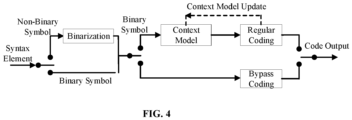
- the bypass mode may be a corresponding bypass coding mode hereinafter. More specifically, FIG. 4 can be used as an example to illustrate the bypass coding mode. As shown in FIG. 4 , the input non-binary value syntax element is first binarized, and the binary bit string generated by the binarization process then enters the encoding stage. At this time, if the bypass coding mode is selected, then the 0s and 1s in the bit string generated by the binarization may be considered as equal probability distributions and sent to the bypass coding module for coding, and then the coding result may be output. This mode can reduce the complexity of implementation and speed up the encoding and decoding process.
- the video image processing device may add a context number 1 to the third bit of the image block for encoding/decoding.
- the bypass mode may also be used to encode/decode the next bit adjacent to the third bit.
- the encoding/decoding modes of the third bit and the adjacent next bit can be determined to be independent of each other, which removes the encoding/decoding dependency between bits in different positions, simplifies the complexity of encoding/decoding for each bit, and improves the encoding/decoding efficiency.
- the encoding/decoding modes of the third bit and the adjacent next bit can be determined to be independent of each other, which removes the encoding/decoding dependency between bits in different positions, simplifies the complexity of encoding/decoding for each bit, and improves the encoding/decoding efficiency.
- the third bit of the image block may use a bypass mode.
- a new context may be added to the next bit adjacent to the third bit to perform encoding/decoding.
- the encoding/decoding modes of the third bit and the adjacent next bit can be determined to be independent of each other, which removes the encoding/decoding dependency between bits in different positions, simplifies the complexity of encoding/decoding for each bit, and improves the encoding/decoding efficiency.
- the third bit of the image block may use the same context as the second bit for encoding/decoding.
- the encoding/decoding modes of the third bit and the second bit can be determined to be independent of each other, which removes the encoding/decoding dependency between the third bit and the second bit, simplifies the complexity of encoding/decoding for each bit, and improves the encoding/decoding efficiency.
- the same Number 1 context of the second bit may also be used to encode/decode the third bit of the image block.
- the encoding/decoding modes of the third bit and the second bit can be determined to be independent of each other, which removes the encoding/decoding dependency between the third bit and the second bit, simplifies the complexity of encoding/decoding for each bit, and improves the encoding/decoding efficiency.
- the video image processing device may binarize the chrominance prediction mode of the image block of the to-be-encoded/decoded image to obtain a bit string.
- the bit string includes at least three adjacent bits, and the second bit and the third bit in the bit string are respectively encoded/decoded using mutually independent probability models.
- the eight chrominance prediction modes may correspond to the chrominance prediction modes in Table 6.
- Numbers 4, 5, and 6 may be chrominance prediction modes that correspond to LT_CCLM, L_CCLM, and T_CCLM modes, respectively
- Number 7 may be the DM mode
- Numbers 1, 2, and 3 may be other modes or regular intra-frame chrominance prediction modes.
- Table 6 will be used as an example to illustrate the process of looking up the luminance mode by using Table 6.
- the CCLM mode is turned on, if the luminance mode Number is 0 and the chrominance prediction mode Number is 5, then based on Table 6, it can be determined that the chrominance prediction mode is using the Number 82 prediction mode. It should be understood that the prediction mode number is not limited to the examples shown in Table 3 or Table 6 above.
- the second bit when the first bit indicates to use the CCLM, the second bit may be used to indicate whether to use the first mode of the CCLM.
- the third bit may be used to indicate whether the second mode or the third mode of the CCLM is used. Table 7 below is a specific example.
- the chrominance prediction mode number e.g., the chrominance prediction mode number shown in Table 6
- the second bit when the first bit indicates to use the CCLM, the second bit may be used to indicate whether to use the first mode of the CCLM.
- the third bit may be used to indicate whether the second mode or the third mode of the CCLM is used.
- the fourth bit may be used to indicate whether a four mode or a fifth mode of the regular intra-frame chrominance prediction mode is used.
- the probability model used in the encoding/decoding of the chrominance prediction mode number in Table 7 can be as shown in Table 8 below.
- Table 8 Syntax Element Bit Position Idx 0 1 2 3 4 ⁇ 5 Chrominance prediction mode not using the CCLM mode na 1 bypass na na Chrominance prediction mode using the CCLM mode and the bit value of the bit position Idx equals 0 is 0 0 1 bypass bypass na na Chrominance prediction mode using the CCLM mode and the bit value of the bit position Idx equals 0 is 1 0 1 bypass na na na where na is used to indicate an empty coding model, and bypass is used to indicate a bypass coding mode.
- the bit position Idx includes 0-3, which are used to indicate four bits respectively.
- the first bit mentioned above may be the bit at the first position in the bit string (that is, the bit numbered 0)
- the second bit may be the bit at the second position in the bit string (that is, the bit numbered 1)
- the third bit may be the bit at the third position in the bit string (that is, the bit numbered 2).
- the probability model used by the second bit may not vary with the value of the first bit.
- the analyzing process of the second bit and the third bit may be independent of each other.
- the probability model used by the third bit may not vary with the value of the second bit.
- the first bit and the second bit may use the same context probability model (also referred to as context) for encoding/decoding.
- context probability model also referred to as context
- CCLM mode when the CCLM mode is turned on and off, different tables may be used to query the specific prediction mode corresponding to the chrominance prediction mode number. For example, when the CCLM mode is turned off, Table 1 may be used to query the prediction mode corresponding to the chrominance prediction mode number, and when CCLM is turned on, Table 3 may be used to query the prediction mode corresponding to the chrominance prediction mode number.
- the same table may also be used to query the specific prediction mode corresponding to the chrominance prediction mode number.
- Table 6 may be used to query the prediction mode corresponding to the chrominance prediction mode number when the CCLM is turned off and when it is turned on.
- the bit string obtained by binarizing the chrominance prediction mode number may be as shown in Table 7.
- the first bit (the first bit of the bit string corresponding to numbers 0-4 in Table 7, which is "0") in the binarization result may be deleted and then entropy coding may be performed. That is, when the CCLM mode is turned off, the binarization result corresponding to the chrominance prediction mode number may be still as shown in Table 2.
- the video image processing device includes a memory 301, a processor 302, and a data interface 303.
- the memory 301 can be configured to store program instructions.
- the processor 302 can call the program instructions stored in the memory 301 to binarize the chrominance prediction mode of the image block of the to-be-encoded/decoded image to obtain a bit string, the bit string including at least three adjacent bits.
- the to-be-encoded/decoded image may use an inter-component linear model CCLM and/or a regular intra-frame chrominance prediction mode.
- the CCLM may include at least a first mode, a second mode, and a third mode, and the regular intra-frame chrominance prediction mode may be another chrominance prediction mode other than the CCLM.
- the first bit of the three adjacent bits is used to indicate whether to use the first mode of the CCLM.
- the second bit is used to indicate whether other modes of the CCLM other than the first mode is used.
- the third bit is used to indicate that the image block uses the second mode or the third mode of the CCLM.
- the first bit of the three adjacent bits is used to indicate whether to use the CCLM.
- the second bit is used to indicate whether to use the first mode of the CCLM.
- the third bit is used to indicate whether the second mode or the third mode of the CCLM is used.
- the processor 302 is further configured to use mutually independent probability models to respectively encode/decode the second bit and the third bit.
- the third bit may also be used to indicate the used of one of the regular intra-frame chrominance prediction modes when the second bit indicates that the CCLM modes other than the first mode is not used.
- the to-be-encoded/decoded image may include at least one image block in which the CCLM is in an on state.
- the to-be-encoded/decoded image may include at least one image block with the CCLM in the on state and at least one image block with the CCLM in an off state.
- the second bit and the third bit of the image block may be encoded/decoded using mutually independent probability models.
- the first bit when the value of the first bit satisfies the first value, the first bit may be used to indicate that the first mode of the CCLM is used.
- the second bit may be used to indicate that the regular intra-frame chrominance prediction mode is used.
- the first value may be 0.
- the second bit may be used to indicate that the second mode or the third mode of the CCLM is used.
- the third bit may be used to indicate that the second mode of the CCLM is used.
- the third bit may be used to indicate that the third mode of the CCLM is used.
- the second value may be 1.
- the last two bits adjacent to the second bit may be used to indicate the number of the regular intra-frame chrominance prediction mode.
- the processor 302 uses mutually independent probability models to respectively encode/decode the second bit and the third bit
- the third bit of the image block may be encoded/decoded in a bypass mode.
- processor 302 uses mutually independent probability models to respectively encode/decode the second bit and the third bit
- a new context may be added to the third bit of the image block, and the bypass mode may be used to encode/decode the next bit adjacent to the third bit.
- a new context may be added to the third bit of the image block, and a new context may be added to the next bit adjacent to the third bit to perform encoding/decoding.
- the third bit of the image block may use the bypass mode, and a new context may be added to the next bit adjacent to the third bit to perform encoding/decoding.
- the processor 302 uses mutually independent probability models to respectively encode/decode the second bit and the third bit
- the third bit of the image block may be encoded/decoded in the same context as the second bit.
- the first mode may include the LT_CCLM mode
- the second mode may include the L_CCLM mode
- the third mode may include the T_CCLM mode.
- the CCLM mode may be a chrominance prediction mode of the intra-frame prediction.
- image blocks in the to-be-encoded/decoded image may be squares and/or rectangles.
- the first bit may be a bit at the second position in the bit string
- the second bit may be a bit at the third position in the bit string
- the third bit may be a bit at the fourth position in the bit string.
- the regular intra-frame chrominance prediction modes may include one or more of the Planar mode, DC mode, and 65-angle mode.
- the first bit of the three adjacent bits may be used to indicate whether to use the CCLM.
- the second bit may be used to indicate whether to use the first mode of the CCLM.
- the third bit may be used to indicate whether the second mode or the third mode of the CCLM is used.
- mutually independent probability models may be used to respectively encode/decode the first bit and the second bit.
- the second bit may be used to indicate whether one of the regular intra-frame chrominance prediction modes is used.
- the second bit may be used to indicate whether the first mode in the regular intra-frame chrominance prediction modes is used.
- the third bit may be used to indicate whether the second mode or the third mode in the regular intra-frame chrominance prediction mode is used.
- the bit string may further include a fourth bit.
- the fourth bit may be used to indicate whether the second or the third mode in the regular intra-frame chrominance prediction mode is specifically used.
- the fourth bit may be used to indicate whether a four mode or a fifth mode of the regular intra-frame chrominance prediction mode is used.
- using the mutually independent probability models to respectively encode/decode the first bit and the second bit may include using different context probability models to respectively encode/decode the first bit and the second bit.
- the mutually independent probability models may be used to encode/decode the three adjacent bits respectively.
- the video image processing device may binarize the chrominance prediction mode of the image block of the to-be-encoded/decoded image to obtain a bit string.
- the bit string may include at least three adjacent bits, and the second bit and the third bit in the bit string may be respectively encoded/decoded using mutually independent probability models.
- the embodiments of the present disclosure also provide a computer-readable storage medium storing a computer program.
- the computer program is executed by the processor, the video image processing method in FIG. 2 may be implemented, and the video image processing device in FIG. 4 may be implemented, and detailed description thereof is omitted herein.
- the processes of the method described above can be executed by hardware running program instructions.
- the program may be stored in a computer-readable storage medium. When the program is executed, one or any combination of the processes of the method are executed.
- the computer-readable storage medium can include a magnetic disk, an optical disk, a read-only memory (ROM) or a random-access memory (RAM), or the like.
Landscapes
- Engineering & Computer Science (AREA)
- Multimedia (AREA)
- Signal Processing (AREA)
- Physics & Mathematics (AREA)
- Algebra (AREA)
- General Physics & Mathematics (AREA)
- Mathematical Analysis (AREA)
- Mathematical Optimization (AREA)
- Pure & Applied Mathematics (AREA)
- Compression Or Coding Systems Of Tv Signals (AREA)
Priority Applications (1)
| Application Number | Priority Date | Filing Date | Title |
|---|---|---|---|
| EP25154049.8A EP4521747A3 (en) | 2019-06-25 | 2019-07-09 | Video image processing method and device, and storage medium |
Applications Claiming Priority (2)
| Application Number | Priority Date | Filing Date | Title |
|---|---|---|---|
| PCT/CN2019/092869 WO2020258056A1 (zh) | 2019-06-25 | 2019-06-25 | 一种视频图像处理方法、设备及存储介质 |
| PCT/CN2019/095328 WO2020258378A1 (zh) | 2019-06-25 | 2019-07-09 | 一种视频图像处理方法、设备及存储介质 |
Related Child Applications (2)
| Application Number | Title | Priority Date | Filing Date |
|---|---|---|---|
| EP25154049.8A Division-Into EP4521747A3 (en) | 2019-06-25 | 2019-07-09 | Video image processing method and device, and storage medium |
| EP25154049.8A Division EP4521747A3 (en) | 2019-06-25 | 2019-07-09 | Video image processing method and device, and storage medium |
Publications (3)
| Publication Number | Publication Date |
|---|---|
| EP3989549A1 EP3989549A1 (en) | 2022-04-27 |
| EP3989549A4 EP3989549A4 (en) | 2022-08-31 |
| EP3989549B1 true EP3989549B1 (en) | 2025-03-05 |
Family
ID=72189643
Family Applications (2)
| Application Number | Title | Priority Date | Filing Date |
|---|---|---|---|
| EP19935736.9A Active EP3989549B1 (en) | 2019-06-25 | 2019-07-09 | Video image processing method and device, and storage medium |
| EP25154049.8A Pending EP4521747A3 (en) | 2019-06-25 | 2019-07-09 | Video image processing method and device, and storage medium |
Family Applications After (1)
| Application Number | Title | Priority Date | Filing Date |
|---|---|---|---|
| EP25154049.8A Pending EP4521747A3 (en) | 2019-06-25 | 2019-07-09 | Video image processing method and device, and storage medium |
Country Status (5)
| Country | Link |
|---|---|
| US (3) | US11871004B2 (enExample) |
| EP (2) | EP3989549B1 (enExample) |
| JP (2) | JP7560495B2 (enExample) |
| KR (2) | KR102793315B1 (enExample) |
| CN (5) | CN114827609B (enExample) |
Families Citing this family (3)
| Publication number | Priority date | Publication date | Assignee | Title |
|---|---|---|---|---|
| WO2020258056A1 (zh) * | 2019-06-25 | 2020-12-30 | 北京大学 | 一种视频图像处理方法、设备及存储介质 |
| JP7560495B2 (ja) | 2019-06-25 | 2024-10-02 | エスゼット ディージェイアイ テクノロジー カンパニー リミテッド | ビデオ画像処理方法、装置、および記憶媒体 |
| WO2025040103A1 (en) * | 2023-08-21 | 2025-02-27 | Douyin Vision Co., Ltd. | Method, apparatus, and medium for video processing |
Family Cites Families (31)
| Publication number | Priority date | Publication date | Assignee | Title |
|---|---|---|---|---|
| EP2773047A3 (en) | 2011-10-24 | 2015-01-14 | BlackBerry Limited | Significance map encoding and decoding using partition selection |
| US9344722B2 (en) | 2011-11-18 | 2016-05-17 | Futurewei Technologies, Inc. | Scanning of prediction residuals in high efficiency video coding |
| CN104093025B (zh) * | 2012-01-20 | 2017-09-19 | 华为技术有限公司 | 编解码方法和装置 |
| CN103260018B (zh) | 2012-02-16 | 2017-09-22 | 乐金电子(中国)研究开发中心有限公司 | 帧内图像预测编解码方法及视频编解码器 |
| CA2896637C (en) | 2013-03-26 | 2018-02-13 | Mediatek Inc. | Method of cross color intra prediction |
| CN118301359A (zh) * | 2013-10-07 | 2024-07-05 | Vid拓展公司 | 用于多层视频编码的组合可分级性处理 |
| US10200700B2 (en) * | 2014-06-20 | 2019-02-05 | Qualcomm Incorporated | Cross-component prediction in video coding |
| WO2016115708A1 (en) | 2015-01-22 | 2016-07-28 | Mediatek Singapore Pte. Ltd. | Methods for chroma component coding with separate intra prediction mode |
| US10321140B2 (en) * | 2015-01-22 | 2019-06-11 | Mediatek Singapore Pte. Ltd. | Method of video coding for chroma components |
| JP6543578B2 (ja) * | 2016-01-27 | 2019-07-10 | 富士通株式会社 | 情報処理装置、情報処理方法、およびプログラム |
| CN109479134A (zh) * | 2016-08-10 | 2019-03-15 | 松下电器(美国)知识产权公司 | 编码装置、解码装置、编码方法及解码方法 |
| US10326986B2 (en) * | 2016-08-15 | 2019-06-18 | Qualcomm Incorporated | Intra video coding using a decoupled tree structure |
| US10368107B2 (en) * | 2016-08-15 | 2019-07-30 | Qualcomm Incorporated | Intra video coding using a decoupled tree structure |
| US10390015B2 (en) * | 2016-08-26 | 2019-08-20 | Qualcomm Incorporated | Unification of parameters derivation procedures for local illumination compensation and cross-component linear model prediction |
| US10652575B2 (en) * | 2016-09-15 | 2020-05-12 | Qualcomm Incorporated | Linear model chroma intra prediction for video coding |
| US11025903B2 (en) * | 2017-01-13 | 2021-06-01 | Qualcomm Incorporated | Coding video data using derived chroma mode |
| US10694181B2 (en) | 2017-01-27 | 2020-06-23 | Qualcomm Incorporated | Bilateral filters in video coding with reduced complexity |
| WO2018174357A1 (ko) * | 2017-03-22 | 2018-09-27 | 엘지전자 주식회사 | 영상 코딩 시스템에서 영상 디코딩 방법 및 장치 |
| US11190762B2 (en) | 2017-06-21 | 2021-11-30 | Lg Electronics, Inc. | Intra-prediction mode-based image processing method and apparatus therefor |
| CN109274969B (zh) * | 2017-07-17 | 2020-12-22 | 华为技术有限公司 | 色度预测的方法和设备 |
| CA3078240A1 (en) | 2017-10-02 | 2019-04-11 | Arris Enterprises Llc | System and method for reducing blocking artifacts and providing improved coding efficiency |
| WO2020139013A1 (ko) * | 2018-12-28 | 2020-07-02 | 한국전자통신연구원 | 영상 부호화/복호화 방법, 장치 및 비트스트림을 저장한 기록 매체 |
| CN113382256B (zh) * | 2019-06-21 | 2022-05-20 | 杭州海康威视数字技术股份有限公司 | 一种编解码方法、装置、设备及存储介质 |
| US11330298B2 (en) | 2019-06-25 | 2022-05-10 | Qualcomm Incorporated | Simplified intra chroma mode coding in video coding |
| GB2585040A (en) * | 2019-06-25 | 2020-12-30 | Sony Corp | Image data encoding and decoding |
| JP7560495B2 (ja) | 2019-06-25 | 2024-10-02 | エスゼット ディージェイアイ テクノロジー カンパニー リミテッド | ビデオ画像処理方法、装置、および記憶媒体 |
| CN117459744A (zh) * | 2019-07-20 | 2024-01-26 | 北京字节跳动网络技术有限公司 | 调色板模式使用指示的条件相关编解码 |
| CN114145013B (zh) * | 2019-07-23 | 2023-11-14 | 北京字节跳动网络技术有限公司 | 调色板模式编解码的模式确定 |
| WO2021018167A1 (en) * | 2019-07-29 | 2021-02-04 | Beijing Bytedance Network Technology Co., Ltd. | Palette mode coding in prediction process |
| US11503342B2 (en) * | 2020-06-10 | 2022-11-15 | Sharp Kabushiki Kaisha | Systems and methods for signaling sequence parameter information in video coding |
| US12355982B2 (en) * | 2022-01-04 | 2025-07-08 | Alibaba (China) Co., Ltd | Decoder-side chroma intra prediction mode gradient-based derivation |
-
2019
- 2019-07-09 JP JP2021576141A patent/JP7560495B2/ja active Active
- 2019-07-09 KR KR1020217042458A patent/KR102793315B1/ko active Active
- 2019-07-09 EP EP19935736.9A patent/EP3989549B1/en active Active
- 2019-07-09 CN CN202210308472.8A patent/CN114827609B/zh active Active
- 2019-07-09 CN CN202210308544.9A patent/CN114827611B/zh active Active
- 2019-07-09 CN CN201980008812.1A patent/CN111602396B/zh active Active
- 2019-07-09 CN CN202210308473.2A patent/CN114827610B/zh active Active
- 2019-07-09 EP EP25154049.8A patent/EP4521747A3/en active Pending
- 2019-07-09 CN CN202210308545.3A patent/CN114827612B/zh active Active
- 2019-07-09 KR KR1020257010969A patent/KR20250052469A/ko active Pending
-
2021
- 2021-12-23 US US17/645,930 patent/US11871004B2/en active Active
-
2023
- 2023-12-19 US US18/544,589 patent/US12363311B2/en active Active
-
2024
- 2024-05-09 JP JP2024076754A patent/JP7758792B2/ja active Active
-
2025
- 2025-06-10 US US19/233,196 patent/US20250301150A1/en active Pending
Non-Patent Citations (2)
| Title |
|---|
| SULLIVAN (MICROSOFT) G J ET AL: "Meeting Report of the 15th JVET Meeting (Gothenburg, SE, 3-12 July 2019)", no. JVET-O2000, 30 September 2019 (2019-09-30), XP030293930, Retrieved from the Internet <URL:https://jvet-experts.org/doc_end_user/documents/15_Gothenburg/wg11/JVET-O2000-v1.zip JVET-O2000-v1.docx> [retrieved on 20190930] * |
| ZHANG (PKU) J Q ET AL: "Non-CE3: Removal of CCLM context derivation dependency", no. JVET-O0416 ; m48535, 5 July 2019 (2019-07-05), XP030219513, Retrieved from the Internet <URL:http://phenix.int-evry.fr/jvet/doc_end_user/documents/15_Gothenburg/wg11/JVET-O0416-v3.zip JVET-O0416_v3.docx> [retrieved on 20190705] * |
Also Published As
| Publication number | Publication date |
|---|---|
| EP3989549A4 (en) | 2022-08-31 |
| US20250301150A1 (en) | 2025-09-25 |
| US11871004B2 (en) | 2024-01-09 |
| CN114827611B (zh) | 2023-09-12 |
| KR102793315B1 (ko) | 2025-04-07 |
| CN111602396B (zh) | 2022-04-29 |
| KR20250052469A (ko) | 2025-04-18 |
| CN114827609A (zh) | 2022-07-29 |
| US20220124346A1 (en) | 2022-04-21 |
| JP7758792B2 (ja) | 2025-10-22 |
| JP7560495B2 (ja) | 2024-10-02 |
| CN114827609B (zh) | 2023-09-12 |
| EP4521747A3 (en) | 2025-05-21 |
| CN111602396A (zh) | 2020-08-28 |
| US12363311B2 (en) | 2025-07-15 |
| CN114827610B (zh) | 2023-04-11 |
| CN114827612B (zh) | 2023-04-11 |
| KR20220011182A (ko) | 2022-01-27 |
| US20240195981A1 (en) | 2024-06-13 |
| EP4521747A2 (en) | 2025-03-12 |
| JP2022546898A (ja) | 2022-11-10 |
| CN114827612A (zh) | 2022-07-29 |
| CN114827610A (zh) | 2022-07-29 |
| EP3989549A1 (en) | 2022-04-27 |
| CN114827611A (zh) | 2022-07-29 |
| JP2024102288A (ja) | 2024-07-30 |
Similar Documents
| Publication | Publication Date | Title |
|---|---|---|
| US12293551B2 (en) | Method, device, and storage medium for data encoding/decoding | |
| US12363311B2 (en) | Video image processing method and device, and storage medium | |
| US10368092B2 (en) | Encoder-side decisions for block flipping and skip mode in intra block copy prediction | |
| US10390050B2 (en) | Method of video coding using separate coding tree for luma and chroma | |
| EP3972251A1 (en) | Image component prediction method, encoder, decoder, and storage medium | |
| EP2991349A1 (en) | Method of palette index signaling for image and video coding | |
| US20160007020A1 (en) | Encoding or decoding method and apparatus | |
| EP3076668A1 (en) | Image encoding and decoding method and device | |
| US20170289572A1 (en) | Method for color index coding using a generalized copy previous mode | |
| US20090022219A1 (en) | Enhanced Compression In Representing Non-Frame-Edge Blocks Of Image Frames | |
| US20250119592A1 (en) | U-net and transformer based in-loop filtering for video coding | |
| CN111699681B (zh) | 一种视频图像处理方法、设备及存储介质 | |
| CN112449201B (zh) | 解码方法、编码方法、相应的装置、电子设备及存储介质 | |
| US20250220209A1 (en) | Resnet based in-loop filter for video coding with attention modules | |
| US20250299375A1 (en) | Resnet based in-loop filter for video coding with integer transformer modules | |
| US20250119556A1 (en) | Neural network with transformer based video coding tool |
Legal Events
| Date | Code | Title | Description |
|---|---|---|---|
| STAA | Information on the status of an ep patent application or granted ep patent |
Free format text: STATUS: THE INTERNATIONAL PUBLICATION HAS BEEN MADE |
|
| PUAI | Public reference made under article 153(3) epc to a published international application that has entered the european phase |
Free format text: ORIGINAL CODE: 0009012 |
|
| STAA | Information on the status of an ep patent application or granted ep patent |
Free format text: STATUS: REQUEST FOR EXAMINATION WAS MADE |
|
| 17P | Request for examination filed |
Effective date: 20211222 |
|
| AK | Designated contracting states |
Kind code of ref document: A1 Designated state(s): AL AT BE BG CH CY CZ DE DK EE ES FI FR GB GR HR HU IE IS IT LI LT LU LV MC MK MT NL NO PL PT RO RS SE SI SK SM TR |
|
| REG | Reference to a national code |
Ref country code: DE Ref legal event code: R079 Free format text: PREVIOUS MAIN CLASS: H04N0019117000 Ipc: H04N0019130000 Ref country code: DE Ref legal event code: R079 Ref document number: 602019067066 Country of ref document: DE Free format text: PREVIOUS MAIN CLASS: H04N0019117000 Ipc: H04N0019130000 |
|
| A4 | Supplementary search report drawn up and despatched |
Effective date: 20220801 |
|
| RIC1 | Information provided on ipc code assigned before grant |
Ipc: H04N 19/70 20140101ALI20220726BHEP Ipc: H04N 19/186 20140101ALI20220726BHEP Ipc: H04N 19/176 20140101ALI20220726BHEP Ipc: H04N 19/11 20140101ALI20220726BHEP Ipc: H04N 19/105 20140101ALI20220726BHEP Ipc: H04N 19/184 20140101ALI20220726BHEP Ipc: H04N 19/463 20140101ALI20220726BHEP Ipc: H04N 19/13 20140101AFI20220726BHEP |
|
| DAV | Request for validation of the european patent (deleted) | ||
| DAX | Request for extension of the european patent (deleted) | ||
| STAA | Information on the status of an ep patent application or granted ep patent |
Free format text: STATUS: EXAMINATION IS IN PROGRESS |
|
| 17Q | First examination report despatched |
Effective date: 20230509 |
|
| GRAP | Despatch of communication of intention to grant a patent |
Free format text: ORIGINAL CODE: EPIDOSNIGR1 |
|
| STAA | Information on the status of an ep patent application or granted ep patent |
Free format text: STATUS: GRANT OF PATENT IS INTENDED |
|
| INTG | Intention to grant announced |
Effective date: 20241008 |
|
| GRAS | Grant fee paid |
Free format text: ORIGINAL CODE: EPIDOSNIGR3 |
|
| GRAA | (expected) grant |
Free format text: ORIGINAL CODE: 0009210 |
|
| STAA | Information on the status of an ep patent application or granted ep patent |
Free format text: STATUS: THE PATENT HAS BEEN GRANTED |
|
| AK | Designated contracting states |
Kind code of ref document: B1 Designated state(s): AL AT BE BG CH CY CZ DE DK EE ES FI FR GB GR HR HU IE IS IT LI LT LU LV MC MK MT NL NO PL PT RO RS SE SI SK SM TR |
|
| REG | Reference to a national code |
Ref country code: GB Ref legal event code: FG4D |
|
| REG | Reference to a national code |
Ref country code: CH Ref legal event code: EP |
|
| REG | Reference to a national code |
Ref country code: IE Ref legal event code: FG4D |
|
| REG | Reference to a national code |
Ref country code: DE Ref legal event code: R096 Ref document number: 602019067066 Country of ref document: DE |
|
| PG25 | Lapsed in a contracting state [announced via postgrant information from national office to epo] |
Ref country code: RS Free format text: LAPSE BECAUSE OF FAILURE TO SUBMIT A TRANSLATION OF THE DESCRIPTION OR TO PAY THE FEE WITHIN THE PRESCRIBED TIME-LIMIT Effective date: 20250605 |
|
| PG25 | Lapsed in a contracting state [announced via postgrant information from national office to epo] |
Ref country code: FI Free format text: LAPSE BECAUSE OF FAILURE TO SUBMIT A TRANSLATION OF THE DESCRIPTION OR TO PAY THE FEE WITHIN THE PRESCRIBED TIME-LIMIT Effective date: 20250305 |
|
| REG | Reference to a national code |
Ref country code: NL Ref legal event code: MP Effective date: 20250305 |
|
| PG25 | Lapsed in a contracting state [announced via postgrant information from national office to epo] |
Ref country code: ES Free format text: LAPSE BECAUSE OF FAILURE TO SUBMIT A TRANSLATION OF THE DESCRIPTION OR TO PAY THE FEE WITHIN THE PRESCRIBED TIME-LIMIT Effective date: 20250305 |
|
| REG | Reference to a national code |
Ref country code: LT Ref legal event code: MG9D |
|
| PG25 | Lapsed in a contracting state [announced via postgrant information from national office to epo] |
Ref country code: NO Free format text: LAPSE BECAUSE OF FAILURE TO SUBMIT A TRANSLATION OF THE DESCRIPTION OR TO PAY THE FEE WITHIN THE PRESCRIBED TIME-LIMIT Effective date: 20250605 |
|
| PG25 | Lapsed in a contracting state [announced via postgrant information from national office to epo] |
Ref country code: HR Free format text: LAPSE BECAUSE OF FAILURE TO SUBMIT A TRANSLATION OF THE DESCRIPTION OR TO PAY THE FEE WITHIN THE PRESCRIBED TIME-LIMIT Effective date: 20250305 |
|
| PG25 | Lapsed in a contracting state [announced via postgrant information from national office to epo] |
Ref country code: LV Free format text: LAPSE BECAUSE OF FAILURE TO SUBMIT A TRANSLATION OF THE DESCRIPTION OR TO PAY THE FEE WITHIN THE PRESCRIBED TIME-LIMIT Effective date: 20250305 |
|
| PG25 | Lapsed in a contracting state [announced via postgrant information from national office to epo] |
Ref country code: GR Free format text: LAPSE BECAUSE OF FAILURE TO SUBMIT A TRANSLATION OF THE DESCRIPTION OR TO PAY THE FEE WITHIN THE PRESCRIBED TIME-LIMIT Effective date: 20250606 Ref country code: BG Free format text: LAPSE BECAUSE OF FAILURE TO SUBMIT A TRANSLATION OF THE DESCRIPTION OR TO PAY THE FEE WITHIN THE PRESCRIBED TIME-LIMIT Effective date: 20250305 |
|
| REG | Reference to a national code |
Ref country code: AT Ref legal event code: MK05 Ref document number: 1774026 Country of ref document: AT Kind code of ref document: T Effective date: 20250305 |
|
| PG25 | Lapsed in a contracting state [announced via postgrant information from national office to epo] |
Ref country code: NL Free format text: LAPSE BECAUSE OF FAILURE TO SUBMIT A TRANSLATION OF THE DESCRIPTION OR TO PAY THE FEE WITHIN THE PRESCRIBED TIME-LIMIT Effective date: 20250305 |
|
| PG25 | Lapsed in a contracting state [announced via postgrant information from national office to epo] |
Ref country code: SE Free format text: LAPSE BECAUSE OF FAILURE TO SUBMIT A TRANSLATION OF THE DESCRIPTION OR TO PAY THE FEE WITHIN THE PRESCRIBED TIME-LIMIT Effective date: 20250305 |
|
| PG25 | Lapsed in a contracting state [announced via postgrant information from national office to epo] |
Ref country code: SM Free format text: LAPSE BECAUSE OF FAILURE TO SUBMIT A TRANSLATION OF THE DESCRIPTION OR TO PAY THE FEE WITHIN THE PRESCRIBED TIME-LIMIT Effective date: 20250305 |
|
| PG25 | Lapsed in a contracting state [announced via postgrant information from national office to epo] |
Ref country code: PT Free format text: LAPSE BECAUSE OF FAILURE TO SUBMIT A TRANSLATION OF THE DESCRIPTION OR TO PAY THE FEE WITHIN THE PRESCRIBED TIME-LIMIT Effective date: 20250707 |
|
| PGFP | Annual fee paid to national office [announced via postgrant information from national office to epo] |
Ref country code: DE Payment date: 20250722 Year of fee payment: 7 |
|
| PG25 | Lapsed in a contracting state [announced via postgrant information from national office to epo] |
Ref country code: PL Free format text: LAPSE BECAUSE OF FAILURE TO SUBMIT A TRANSLATION OF THE DESCRIPTION OR TO PAY THE FEE WITHIN THE PRESCRIBED TIME-LIMIT Effective date: 20250305 Ref country code: IT Free format text: LAPSE BECAUSE OF FAILURE TO SUBMIT A TRANSLATION OF THE DESCRIPTION OR TO PAY THE FEE WITHIN THE PRESCRIBED TIME-LIMIT Effective date: 20250305 |
|
| PGFP | Annual fee paid to national office [announced via postgrant information from national office to epo] |
Ref country code: GB Payment date: 20250722 Year of fee payment: 7 |
|
| PG25 | Lapsed in a contracting state [announced via postgrant information from national office to epo] |
Ref country code: AT Free format text: LAPSE BECAUSE OF FAILURE TO SUBMIT A TRANSLATION OF THE DESCRIPTION OR TO PAY THE FEE WITHIN THE PRESCRIBED TIME-LIMIT Effective date: 20250305 |
|
| PGFP | Annual fee paid to national office [announced via postgrant information from national office to epo] |
Ref country code: FR Payment date: 20250725 Year of fee payment: 7 |
|
| PG25 | Lapsed in a contracting state [announced via postgrant information from national office to epo] |
Ref country code: CZ Free format text: LAPSE BECAUSE OF FAILURE TO SUBMIT A TRANSLATION OF THE DESCRIPTION OR TO PAY THE FEE WITHIN THE PRESCRIBED TIME-LIMIT Effective date: 20250305 Ref country code: EE Free format text: LAPSE BECAUSE OF FAILURE TO SUBMIT A TRANSLATION OF THE DESCRIPTION OR TO PAY THE FEE WITHIN THE PRESCRIBED TIME-LIMIT Effective date: 20250305 |
|
| PG25 | Lapsed in a contracting state [announced via postgrant information from national office to epo] |
Ref country code: RO Free format text: LAPSE BECAUSE OF FAILURE TO SUBMIT A TRANSLATION OF THE DESCRIPTION OR TO PAY THE FEE WITHIN THE PRESCRIBED TIME-LIMIT Effective date: 20250305 |
|
| PG25 | Lapsed in a contracting state [announced via postgrant information from national office to epo] |
Ref country code: SK Free format text: LAPSE BECAUSE OF FAILURE TO SUBMIT A TRANSLATION OF THE DESCRIPTION OR TO PAY THE FEE WITHIN THE PRESCRIBED TIME-LIMIT Effective date: 20250305 |
|
| PG25 | Lapsed in a contracting state [announced via postgrant information from national office to epo] |
Ref country code: IS Free format text: LAPSE BECAUSE OF FAILURE TO SUBMIT A TRANSLATION OF THE DESCRIPTION OR TO PAY THE FEE WITHIN THE PRESCRIBED TIME-LIMIT Effective date: 20250705 |