EP3989328B1 - Battery cell comprising separator having magnetic body formed therein and method for evaluating battery cell safety against internal short circuit by using same - Google Patents
Battery cell comprising separator having magnetic body formed therein and method for evaluating battery cell safety against internal short circuit by using same Download PDFInfo
- Publication number
- EP3989328B1 EP3989328B1 EP20865693.4A EP20865693A EP3989328B1 EP 3989328 B1 EP3989328 B1 EP 3989328B1 EP 20865693 A EP20865693 A EP 20865693A EP 3989328 B1 EP3989328 B1 EP 3989328B1
- Authority
- EP
- European Patent Office
- Prior art keywords
- battery cell
- separator
- perforated line
- magnetic body
- short circuit
- Prior art date
- Legal status (The legal status is an assumption and is not a legal conclusion. Google has not performed a legal analysis and makes no representation as to the accuracy of the status listed.)
- Active
Links
Images




Classifications
-
- H—ELECTRICITY
- H01—ELECTRIC ELEMENTS
- H01M—PROCESSES OR MEANS, e.g. BATTERIES, FOR THE DIRECT CONVERSION OF CHEMICAL ENERGY INTO ELECTRICAL ENERGY
- H01M10/00—Secondary cells; Manufacture thereof
- H01M10/42—Methods or arrangements for servicing or maintenance of secondary cells or secondary half-cells
-
- G—PHYSICS
- G01—MEASURING; TESTING
- G01R—MEASURING ELECTRIC VARIABLES; MEASURING MAGNETIC VARIABLES
- G01R31/00—Arrangements for testing electric properties; Arrangements for locating electric faults; Arrangements for electrical testing characterised by what is being tested not provided for elsewhere
- G01R31/36—Arrangements for testing, measuring or monitoring the electrical condition of accumulators or electric batteries, e.g. capacity or state of charge [SoC]
- G01R31/392—Determining battery ageing or deterioration, e.g. state of health
-
- G—PHYSICS
- G01—MEASURING; TESTING
- G01R—MEASURING ELECTRIC VARIABLES; MEASURING MAGNETIC VARIABLES
- G01R31/00—Arrangements for testing electric properties; Arrangements for locating electric faults; Arrangements for electrical testing characterised by what is being tested not provided for elsewhere
- G01R31/50—Testing of electric apparatus, lines, cables or components for short-circuits, continuity, leakage current or incorrect line connections
- G01R31/52—Testing for short-circuits, leakage current or ground faults
-
- H—ELECTRICITY
- H01—ELECTRIC ELEMENTS
- H01M—PROCESSES OR MEANS, e.g. BATTERIES, FOR THE DIRECT CONVERSION OF CHEMICAL ENERGY INTO ELECTRICAL ENERGY
- H01M10/00—Secondary cells; Manufacture thereof
- H01M10/05—Accumulators with non-aqueous electrolyte
- H01M10/052—Li-accumulators
-
- H—ELECTRICITY
- H01—ELECTRIC ELEMENTS
- H01M—PROCESSES OR MEANS, e.g. BATTERIES, FOR THE DIRECT CONVERSION OF CHEMICAL ENERGY INTO ELECTRICAL ENERGY
- H01M10/00—Secondary cells; Manufacture thereof
- H01M10/05—Accumulators with non-aqueous electrolyte
- H01M10/058—Construction or manufacture
- H01M10/0585—Construction or manufacture of accumulators having only flat construction elements, i.e. flat positive electrodes, flat negative electrodes and flat separators
-
- H—ELECTRICITY
- H01—ELECTRIC ELEMENTS
- H01M—PROCESSES OR MEANS, e.g. BATTERIES, FOR THE DIRECT CONVERSION OF CHEMICAL ENERGY INTO ELECTRICAL ENERGY
- H01M10/00—Secondary cells; Manufacture thereof
- H01M10/42—Methods or arrangements for servicing or maintenance of secondary cells or secondary half-cells
- H01M10/4235—Safety or regulating additives or arrangements in electrodes, separators or electrolyte
-
- H—ELECTRICITY
- H01—ELECTRIC ELEMENTS
- H01M—PROCESSES OR MEANS, e.g. BATTERIES, FOR THE DIRECT CONVERSION OF CHEMICAL ENERGY INTO ELECTRICAL ENERGY
- H01M10/00—Secondary cells; Manufacture thereof
- H01M10/42—Methods or arrangements for servicing or maintenance of secondary cells or secondary half-cells
- H01M10/44—Methods for charging or discharging
-
- H—ELECTRICITY
- H01—ELECTRIC ELEMENTS
- H01M—PROCESSES OR MEANS, e.g. BATTERIES, FOR THE DIRECT CONVERSION OF CHEMICAL ENERGY INTO ELECTRICAL ENERGY
- H01M10/00—Secondary cells; Manufacture thereof
- H01M10/42—Methods or arrangements for servicing or maintenance of secondary cells or secondary half-cells
- H01M10/48—Accumulators combined with arrangements for measuring, testing or indicating the condition of cells, e.g. the level or density of the electrolyte
-
- H—ELECTRICITY
- H01—ELECTRIC ELEMENTS
- H01M—PROCESSES OR MEANS, e.g. BATTERIES, FOR THE DIRECT CONVERSION OF CHEMICAL ENERGY INTO ELECTRICAL ENERGY
- H01M50/00—Constructional details or processes of manufacture of the non-active parts of electrochemical cells other than fuel cells, e.g. hybrid cells
- H01M50/40—Separators; Membranes; Diaphragms; Spacing elements inside cells
- H01M50/409—Separators, membranes or diaphragms characterised by the material
-
- H—ELECTRICITY
- H01—ELECTRIC ELEMENTS
- H01M—PROCESSES OR MEANS, e.g. BATTERIES, FOR THE DIRECT CONVERSION OF CHEMICAL ENERGY INTO ELECTRICAL ENERGY
- H01M50/00—Constructional details or processes of manufacture of the non-active parts of electrochemical cells other than fuel cells, e.g. hybrid cells
- H01M50/40—Separators; Membranes; Diaphragms; Spacing elements inside cells
- H01M50/409—Separators, membranes or diaphragms characterised by the material
- H01M50/411—Organic material
- H01M50/414—Synthetic resins, e.g. thermoplastics or thermosetting resins
-
- H—ELECTRICITY
- H01—ELECTRIC ELEMENTS
- H01M—PROCESSES OR MEANS, e.g. BATTERIES, FOR THE DIRECT CONVERSION OF CHEMICAL ENERGY INTO ELECTRICAL ENERGY
- H01M50/00—Constructional details or processes of manufacture of the non-active parts of electrochemical cells other than fuel cells, e.g. hybrid cells
- H01M50/40—Separators; Membranes; Diaphragms; Spacing elements inside cells
- H01M50/409—Separators, membranes or diaphragms characterised by the material
- H01M50/431—Inorganic material
-
- H—ELECTRICITY
- H01—ELECTRIC ELEMENTS
- H01M—PROCESSES OR MEANS, e.g. BATTERIES, FOR THE DIRECT CONVERSION OF CHEMICAL ENERGY INTO ELECTRICAL ENERGY
- H01M50/00—Constructional details or processes of manufacture of the non-active parts of electrochemical cells other than fuel cells, e.g. hybrid cells
- H01M50/40—Separators; Membranes; Diaphragms; Spacing elements inside cells
- H01M50/409—Separators, membranes or diaphragms characterised by the material
- H01M50/446—Composite material consisting of a mixture of organic and inorganic materials
-
- H—ELECTRICITY
- H01—ELECTRIC ELEMENTS
- H01M—PROCESSES OR MEANS, e.g. BATTERIES, FOR THE DIRECT CONVERSION OF CHEMICAL ENERGY INTO ELECTRICAL ENERGY
- H01M50/00—Constructional details or processes of manufacture of the non-active parts of electrochemical cells other than fuel cells, e.g. hybrid cells
- H01M50/40—Separators; Membranes; Diaphragms; Spacing elements inside cells
- H01M50/409—Separators, membranes or diaphragms characterised by the material
- H01M50/449—Separators, membranes or diaphragms characterised by the material having a layered structure
- H01M50/451—Separators, membranes or diaphragms characterised by the material having a layered structure comprising layers of only organic material and layers containing inorganic material
-
- H—ELECTRICITY
- H01—ELECTRIC ELEMENTS
- H01M—PROCESSES OR MEANS, e.g. BATTERIES, FOR THE DIRECT CONVERSION OF CHEMICAL ENERGY INTO ELECTRICAL ENERGY
- H01M50/00—Constructional details or processes of manufacture of the non-active parts of electrochemical cells other than fuel cells, e.g. hybrid cells
- H01M50/40—Separators; Membranes; Diaphragms; Spacing elements inside cells
- H01M50/46—Separators, membranes or diaphragms characterised by their combination with electrodes
-
- H—ELECTRICITY
- H01—ELECTRIC ELEMENTS
- H01M—PROCESSES OR MEANS, e.g. BATTERIES, FOR THE DIRECT CONVERSION OF CHEMICAL ENERGY INTO ELECTRICAL ENERGY
- H01M50/00—Constructional details or processes of manufacture of the non-active parts of electrochemical cells other than fuel cells, e.g. hybrid cells
- H01M50/40—Separators; Membranes; Diaphragms; Spacing elements inside cells
- H01M50/463—Separators, membranes or diaphragms characterised by their shape
-
- H—ELECTRICITY
- H01—ELECTRIC ELEMENTS
- H01M—PROCESSES OR MEANS, e.g. BATTERIES, FOR THE DIRECT CONVERSION OF CHEMICAL ENERGY INTO ELECTRICAL ENERGY
- H01M50/00—Constructional details or processes of manufacture of the non-active parts of electrochemical cells other than fuel cells, e.g. hybrid cells
- H01M50/50—Current conducting connections for cells or batteries
- H01M50/572—Means for preventing undesired use or discharge
- H01M50/584—Means for preventing undesired use or discharge for preventing incorrect connections inside or outside the batteries
- H01M50/586—Means for preventing undesired use or discharge for preventing incorrect connections inside or outside the batteries inside the batteries, e.g. incorrect connections of electrodes
-
- H—ELECTRICITY
- H01—ELECTRIC ELEMENTS
- H01M—PROCESSES OR MEANS, e.g. BATTERIES, FOR THE DIRECT CONVERSION OF CHEMICAL ENERGY INTO ELECTRICAL ENERGY
- H01M2200/00—Safety devices for primary or secondary batteries
-
- Y—GENERAL TAGGING OF NEW TECHNOLOGICAL DEVELOPMENTS; GENERAL TAGGING OF CROSS-SECTIONAL TECHNOLOGIES SPANNING OVER SEVERAL SECTIONS OF THE IPC; TECHNICAL SUBJECTS COVERED BY FORMER USPC CROSS-REFERENCE ART COLLECTIONS [XRACs] AND DIGESTS
- Y02—TECHNOLOGIES OR APPLICATIONS FOR MITIGATION OR ADAPTATION AGAINST CLIMATE CHANGE
- Y02E—REDUCTION OF GREENHOUSE GAS [GHG] EMISSIONS, RELATED TO ENERGY GENERATION, TRANSMISSION OR DISTRIBUTION
- Y02E60/00—Enabling technologies; Technologies with a potential or indirect contribution to GHG emissions mitigation
- Y02E60/10—Energy storage using batteries
-
- Y—GENERAL TAGGING OF NEW TECHNOLOGICAL DEVELOPMENTS; GENERAL TAGGING OF CROSS-SECTIONAL TECHNOLOGIES SPANNING OVER SEVERAL SECTIONS OF THE IPC; TECHNICAL SUBJECTS COVERED BY FORMER USPC CROSS-REFERENCE ART COLLECTIONS [XRACs] AND DIGESTS
- Y02—TECHNOLOGIES OR APPLICATIONS FOR MITIGATION OR ADAPTATION AGAINST CLIMATE CHANGE
- Y02P—CLIMATE CHANGE MITIGATION TECHNOLOGIES IN THE PRODUCTION OR PROCESSING OF GOODS
- Y02P70/00—Climate change mitigation technologies in the production process for final industrial or consumer products
- Y02P70/50—Manufacturing or production processes characterised by the final manufactured product
Definitions
- the present invention relates to a battery cell including a separator formed with a magnetic body and a method for evaluating the safety of the battery cell according to an internal short circuit using the same.
- a secondary battery assembles an electrode assembly by using a positive electrode, a negative electrode, and interposing a separator between the positive electrode and the negative electrode.
- the assembled electrode assembly is mounted on a battery case and an electrolyte is injected to manufacture a battery cell.
- lithium secondary batteries are used in various fields due to their excellent electrical properties.
- the lithium secondary battery has a problem of low safety.
- a lithium secondary battery may ignite or explode in abnormal operating conditions such as overcharging, overdischarging, exposure to high temperatures, or electrical short circuits.
- heat and gas are generated as active materials or electrolytes, which are components of the battery cell, cause a decomposition reaction.
- the generated heat and gas increase the temperature and pressure inside the battery cell.
- the elevated temperature and pressure further accelerate the decomposition reaction and eventually cause ignition or explosion.
- one of the methods is to evaluate the safety of the battery cell when an internal short circuit occurs.
- a method of putting a heating element inside the battery cell to induce an internal short circuit and induce internal heat a method of pre-drilling a separator and treating the area with chemicals to thereby be dissolved at a certain temperature, or a method of inducing an internal short circuit by tearing the separator by inserting a certain type of metallic material and applying external force, etc.
- these methods have limitations in that the separator is deformed or is different from the actual use environment of the battery cell.
- KR20040107999A relates to a secondary battery
- the present invention is invented to solve the above problems, and an object of the present invention is to provide a battery cell capable of testing the safety of an internal short circuit without physically changing the structure of the battery cell, and a battery cell safety evaluation method according to an internal short circuit using the same.
- the battery cell according to the present invention a structure in which an electrode assembly including a positive electrode, a negative electrode, and a separator interposed between the positive electrode and the negative electrode is housed in a battery case, and the separator includes: a perforated line formed in all or part of the separator; and a magnetic body which is formed in a region adjacent to the perforated line and does not overlap, and is arranged continuously or discontinuously at a position spaced apart from each other along the perforated line.
- the perforated line forms a two-dimensional closed shape on the surface of the separator.
- the perforated line has a structure in which a plurality of through-type slits or bead-type non-penetrating grooves are arranged discontinuously.
- the magnetic body is in a form of a powder, and is in a state of being fully or partially impregnated in the separator. Further, in another example, the magnetic body has a bar shape, and a is attached to one side or both sides of the separator.
- the magnetic body has a structure including a core having magnetic properties and an insulating polymer shell surrounding the core.
- the core is an alloy made of one or more selected from the group consisting of iron (Fe), nickel (Ni), cobalt (Co), gadolinium (Gd), terbium (Tb), and dysprosium (Dy).
- the insulating polymer shell has a structure formed of a polymer film.
- the battery cell according to the present invention is a lithium secondary battery.
- the present invention provides a method for evaluating the safety of a battery cell according to an internal short circuit using the battery cell described above.
- the evaluation method includes inducing a short circuit inside the battery cell.
- the battery cell according to the present invention has a structure in which an electrode assembly including a positive electrode, a negative electrode, and a separator interposed between the positive electrode and the negative electrode is housed in a battery case.
- the separator includes: a perforated line formed in all or part of the separator; and a magnetic body which is formed in a region adjacent to the perforated line and does not overlap, and is arranged continuously or discontinuously at a position spaced apart from each other along the perforated line.
- the magnet is rotated while the magnet is adjacent to or in contact with the outer peripheral surface of the battery cell, and the perforated line of the separator is partially or completely broken in response to the rotational motion of the magnet.
- the perforated line forms a two-dimensional closed shape on the surface of the separator.
- the step of inducing a short circuit inside the battery cell is performed during a charge/discharge cycle for the battery cell.
- the battery cell according to the present invention can induce an internal short circuit without physically changing the structure of the battery cell, and can be effectively applied to a method for evaluating the safety of a battery cell according to the internal short circuit.
- a portion such as a layer, a film, an area, a plate, etc. is referred to as being "on” another portion, this includes not only the case where the portion is “directly on” the another portion but also the case where further another portion is interposed therebetween.
- a portion such as a layer, a film, an area, a plate, etc. is referred to as being "under” another portion, this includes not only the case where the portion is “directly under” the another portion but also the case where further another portion is interposed therebetween.
- to be disposed “on” in the present application may include the case disposed at the bottom as well as the top.
- the present invention relates to a battery cell in which a perforated line and a magnetic body are formed in a separator.
- the battery cell according to the present invention has a structure in which an electrode assembly including a positive electrode, a negative electrode, and a separator interposed between the positive electrode and the negative electrode is housed in a battery case.
- the separator may include a perforated line formed in all or part of the separator; and a magnetic body formed in a region adjacent to the perforated line but not overlapping, and arranged continuously or discontinuously at a position spaced apart from each other along the perforated line.
- the battery cell according to the present invention can be effectively applied to an internal short circuit test.
- the magnetic body is in a state of being bonded to the separator, and when the magnet is moved from the outside, the magnetic body is also moved in response to the movement of the magnet. Stress is also applied to the separator according to the direction of movement of the magnetic body. For example, when the magnet is moved or rotated while the magnet is in contact with or adjacent to the outside of the battery cell, the magnetic body formed in the separator is moved in response to the movement of the magnet. When the magnetic body is moved, the perforated line adjacent to the magnetic body is broken, thereby inducing an internal short circuit of the battery cell.
- the magnetic body according to the present invention is formed in a region adjacent to the perforated line but not overlapping, but is continuously or discontinuously arranged at a position spaced apart at a predetermined interval along the perforated line.
- a perforated line including a linear section is formed in the separator, a first point of the perforated line and a second point spaced apart from the first point at a predetermined interval are set.
- Magnetic bodies are formed in regions adjacent to the first and second points of the perforated line, respectively.
- the magnetic body may be a linearly connected shape or a structure formed separately near the first and second points.
- the magnetic body located near the first point and the magnetic body located near the second point of the perforated line move in different directions.
- stress is applied to the perforated line formed in the separator in different directions. The stress applied in different directions partially breaks the perforated line and induces an internal short circuit of the battery cell.
- the perforated line forms a two-dimensional closed shape on the surface of the separator.
- the present invention more clearly induces an internal short circuit of the battery cell due to the rotation of the external magnet by forming a closed-shaped perforated line.
- the length in one direction may be different from the length in the direction perpendicular to the one direction. This is to facilitate the breakage of the perforated line when the magnet is rotated outside the battery cell.
- the two-dimensional closed shape formed by the perforated line is an oval, a rectangle, or a triangular shape having a different side length.
- the perforated line has a structure in which a plurality of through-type slits or bead-type non-penetrating grooves are arranged discontinuously.
- the perforated line has a structure in which a plurality of through-type slits or bead-type non-penetrating grooves are spaced apart from each other at regular intervals. Arranging the perforated line discontinuously prevents the perforated line portions of the separator from being broken even by a small impact.
- the magnetic body has a structure that is bonded to the separator in various forms.
- the magnetic body is in the form of a powder, and is in a state of being fully or partially impregnated in the separator.
- the magnetic body has a bar shape, and is attached to one side or both sides of the separator.
- the magnetic body may be applied near the perforated line while being mixed with a binder on one surface of the separator.
- the magnetic body may be bonded to a separator with a binder interposed therebetween.
- the magnetic body has a structure including a core having magnetic properties and an insulating polymer shell surrounding the core.
- the core is an alloy made of one or more selected from the group consisting of iron (Fe), nickel (Ni), cobalt (Co), gadolinium (Gd), terbium (Tb), and dysprosium (Dy).
- the insulating polymer shell has a structure formed of a polymer film.
- the present invention provides a method for evaluating the safety of a battery cell according to an internal short circuit using the battery cell described above.
- the evaluation method includes inducing a short circuit inside the battery cell.
- the battery cell has a structure in which an electrode assembly including a positive electrode, a negative electrode, and a separator interposed between the positive electrode and the negative electrode is housed in a battery case.
- the separator may include a perforated line formed in all or part of the separator; and a magnetic body formed in a region adjacent to the perforated line but not overlapping, and arranged continuously or discontinuously at a position spaced apart by a certain distance along the perforated line.
- the magnet in the step of inducing a short circuit inside the battery cell, the magnet is rotated while the magnet is adjacent to or in contact with the outer peripheral surface of the battery cell, and the perforated line of the separator is partially or completely broken in response to the rotational motion of the magnet.
- the perforated line forms a two-dimensional closed shape on the surface of the separator.
- the shape formed by the perforated line is as described above.
- the step of inducing a short circuit inside the battery cell is performed during a charge/discharge cycle for the battery cell.
- a charge/discharge cycle test may be performed on the battery cell, and an internal short circuit test of the battery cell may be performed assuming a case in which an internal short circuit occurs during the charge/discharge cycle.
- the internal short circuit test is a test for evaluating the resistance to cell internal short circuit among the safety tests of the battery cell, and is a test simulated when a positive electrode and a negative electrode are shorted inside the battery cell.
- a cell internal short circuit is generated for a fully charged battery cell, and the behavior of the battery cell is evaluated.
- the voltage decreases as the battery cell is discharged, and when the voltage decreases to a certain value or less, the battery cell is evaluated for rupture, voltage or temperature change.
- the battery cell according to the present invention includes: an electrode assembly including a positive electrode, a negative electrode, and a separator interposed between the positive electrode and the negative electrode; a non-aqueous electrolyte solution impregnating the electrode assembly; and a battery case accommodating the electrode assembly and the electrolyte solution.
- the positive electrode has a structure in which a positive electrode active material layer is stacked on one or both sides of a positive electrode current collector.
- the positive electrode active material layer includes a positive electrode active material, a conductive material, and a binder polymer, and if necessary, may further include a positive electrode additive commonly used in the art.
- the positive electrode active material may be a lithium-containing oxide, and may be the same or different.
- a lithium-containing transition metal oxide may be used as the lithium-containing oxide.
- the positive electrode active material may be included in the range of 94.0 to 98.5 wt% in the positive electrode active material layer.
- the content of the positive electrode active material satisfies the above range, it is advantageous in terms of manufacturing a high-capacity battery and providing sufficient conductivity of the positive electrode or adhesion between electrode materials.
- the current collector used for the positive electrode is a metal having high conductivity, and any metal which the positive electrode active material slurry may be easily attached to and which is not reactive in the voltage range of the electrochemical device can be used.
- the current collector for the positive electrode include aluminum, nickel, or a foil manufactured by a combination thereof.
- the positive electrode active material layer further includes a conductive material.
- the conductive material is usually added in an amount of 1 to 30% by weight based on the total weight of the mixture including the positive electrode active material.
- a conductive material is not particularly limited as long as it has conductivity without causing a chemical change in the secondary battery.
- graphite such as natural graphite or artificial graphite
- carbon black such as carbon black, acetylene black, ketjen black, channel black, furnace black, lamp black, or thermal black
- conductive fiber such as carbon fiber or metal fiber
- metal powder such as carbon fluoride, aluminum, or nickel powder
- conductive whiskey such as zinc oxide or potassium titanate
- conductive metal oxide such as titanium oxide
- polyphenylene derivative may be used as the conductive material.
- binder polymer a binder commonly used in the art may be used without limitation.
- various kinds of binders such as polyvinylidene fluoride-co-hexafluoropropylene (PVDF-co-HFP), polyvinylidene fluoride (PVDF), polyacrylonitrile, polymethyl methacrylate, styrene-butadiene rubber (SBR), and carboxyl methyl cellulose (CMC) may be used.
- PVDF-co-HFP polyvinylidene fluoride-co-hexafluoropropylene
- PVDF polyvinylidene fluoride
- SBR styrene-butadiene rubber
- CMC carboxyl methyl cellulose
- the content of the binder polymer is proportional to the content of the conductive material included in the upper positive electrode active material layer and the lower positive electrode active material layer. This is to impart adhesion to conductive materials whose particle size is relatively small compared to the active material and is because when the content of the conductive material increases, more binder polymer is required, and when the content of the conductive material decreases, less binder polymer can be used.
- the negative electrode has a structure in which a negative electrode active material layer is stacked on one or both sides of a negative electrode current collector.
- the negative electrode active material layer includes a negative electrode active material, a conductive material, and a binder polymer, and if necessary, may further include a negative electrode additive commonly used in the art.
- the negative electrode active material may include a carbon material, lithium metal, silicon or tin.
- a carbon material is used as the negative electrode active material, both low crystalline carbon and high crystalline carbon may be used.
- Representative examples of low crystalline carbon include soft carbon and hard carbon.
- Representative examples of high crystalline carbon include natural graphite, kish graphite, pyrolytic carbon, mesophase pitch based carbon fiber, mesocarbon microbeads, mesophase pitches, and high-temperature calcined carbons such as petroleum or coal tar pitch derived cokes.
- Non-limiting examples of the current collector used for the negative electrode include copper, gold, nickel, or a foil manufactured by a copper alloy or a combination thereof.
- the current collector may be used by stacking substrates made of the above materials.
- the negative electrode may include a conductive material and a binder commonly used in the art.
- the separator may be made of any porous substrate used in a lithium secondary battery, and for example, a polyolefin-based porous membrane or a nonwoven fabric may be used, but the present invention is not particularly limited thereto.
- polystyrene-based porous membrane examples include polyethylene such as high density polyethylene, linear low density polyethylene, low density polyethylene, ultra high molecular weight polyethylene, and a membrane in which polyolefin-based polymers, such as polypropylene, polybutylene, and polypentene, are each formed alone or in a mixture thereof.
- polyethylene such as high density polyethylene, linear low density polyethylene, low density polyethylene, ultra high molecular weight polyethylene
- polyolefin-based polymers such as polypropylene, polybutylene, and polypentene
- Polyethyleneterephthalate, polybutyleneterephthalate, polyester, polyacetal, polyamide, polycarbonate, polyimide, polyetheretherketone, polyethersulfone, polyphenyleneoxide, polyphenylenesulfide, polyethylenenaphthalene, etc. may be used individually or as a polymer by a mixture thereof, to thereby form the non-woven fabric, in addition to polyolefin-based nonwoven fabric.
- the structure of the nonwoven fabric may be a spunbond nonwoven fabric composed of long fibers or a melt blown nonwoven fabric.
- the thickness of the porous substrate is not particularly limited, but may be 5 to 50 ⁇ m, and the pore size and porosity present in the porous substrate are also not particularly limited, but may be 0.01 to 50 ⁇ m and 10 to 95%, respectively.
- a porous coating layer including inorganic particles and a binder polymer may be further included on at least one surface of the porous substrate.
- the electrolyte may contain an organic solvent and an electrolyte salt, and the electrolyte salt is a lithium salt.
- Those conventionally used in the electrolyte for lithium secondary batteries may be used as the lithium salt without limitation.
- organic solvent included in the electrolyte described above those conventionally used in electrolytes for lithium secondary batteries may be used without limitation, and for example, ethers, esters, amides, linear carbonates, and cyclic carbonates may be used alone or in combination of two or more.
- ethers, esters, amides, linear carbonates, and cyclic carbonates may be used alone or in combination of two or more.
- representatively, a cyclic carbonate, a linear carbonate, or a carbonate compound that is a mixture thereof may be included.
- cyclic carbonate compound examples include any one selected from the group consisting of ethylene carbonate (EC), propylene carbonate (PC), 1,2-butylene carbonate, 2,3-butylene carbonate, 1,2-pentylene carbonate, 2,3-pentylene carbonate, vinylene carbonate, vinylethylene carbonate, and a halide thereof, and a mixture thereof.
- halides include, for example, fluoroethylene carbonate (FEC), but are not limited thereto.
- linear carbonate compound examples include any one selected from the group consisting of dimethyl carbonate (DMC), diethyl carbonate (DEC), dipropyl carbonate, ethylmethyl carbonate (EMC), methylpropyl carbonate, and ethylpropyl carbonate, or the mixture of two or more of them may be typically used, but is not limited thereto.
- DMC dimethyl carbonate
- DEC diethyl carbonate
- EMC ethylmethyl carbonate
- methylpropyl carbonate methylpropyl carbonate
- ethylpropyl carbonate methylpropyl carbonate
- ethylpropyl carbonate methylpropyl carbonate
- ethylpropyl carbonate or the mixture of two or more of them may be typically used, but is not limited thereto.
- ethylene carbonate and propylene carbonate which are cyclic carbonates
- any one selected from the group consisting of dimethyl ether, diethyl ether, dipropyl ether, methylethyl ether, methylpropyl ether, and ethylpropyl ether, or a mixture of two or more thereof may be used, but is not limited thereto.
- esters among the organic solvents include any one selected from the group consisting of methyl acetate, ethyl acetate, propyl acetate, methyl propionate, ethyl propionate, propyl propionate, ⁇ -butyrolactone, ⁇ -valerolactone, and ⁇ -caprolactone, or a mixture of two or more of them, but the present invention is not limited thereto.
- the injection of the non-aqueous electrolyte may be performed at an appropriate step in the manufacturing process of the electrochemical device, depending on the manufacturing process and required physical properties of the final product. That is, it can be applied before assembling the electrochemical device or at the final stage of assembling the electrochemical device.
- the battery cell according to the present invention refers to an electrochemical device that undergoes an electrochemical reaction.
- the battery cell is a lithium secondary battery including a lithium metal secondary battery, a lithium ion secondary battery, a lithium polymer secondary battery, or a lithium ion polymer secondary battery, etc.
- FIG. 1 is an exploded view schematically showing the structure of a battery cell according to an embodiment of the present invention.
- the battery cell 100 includes: an electrode assembly including a positive electrode 120, a negative electrode 130, and a separator 110 interposed between the positive electrode 120 and the negative electrode 130; a non-aqueous electrolyte solution (not shown) to impregnate the electrode assembly; and battery cases 140 and 150 accommodating the electrode assembly and the electrolyte solution.
- a positive electrode tab 121 is formed to protrude and extend in one direction of the positive electrode 120, and a negative electrode tab 131 is formed to protrude and extend in one direction opposite to the protruding and extending direction of the positive electrode tab 121.
- the separator 110 has a rectangular perforated line 111 formed thereon, and the perforated line 111 has a structure in which a plurality of linear slits or linear grooves are arranged at regular intervals.
- a magnetic body 112 is arranged in a position adjacent to the perforated line 111.
- the magnetic body 112 has a bar shape and is located inside each side of a rectangular structure formed by a perforated line.
- FIGS. 2 to 5 are front views each schematically showing a separator provided with a perforated line and a magnetic body according to an embodiment of the present invention.
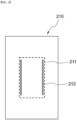
- the separator 210 according to an embodiment of the present invention has a rectangular perforated line 211 formed thereon, and the perforated line 211 has a structure in which a plurality of linear slits are arranged at regular intervals.
- the magnetic body 212 is arranged so as to be adjacent to the perforated line 211.
- the magnetic body 212 has a bar shape and is positioned in parallel while forming an 11 shape inside a rectangular structure formed by the perforated line.
- the separator 310 has a rectangular perforated line 311 formed thereon, and the perforated line 311 has a structure in which a plurality of linear grooves are arranged at regular intervals.
- the magnetic body 312 is arranged so as to be adjacent to the perforated line 311.
- the magnetic body 312 has a shape in which short bars are arranged at regular intervals, and is positioned in parallel while forming an 11 shape inside a rectangular structure formed by a perforated line.
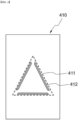
- the separator 410 has a triangular perforated line 411 formed thereon, and the perforated line 411 has a structure in which a plurality of linear grooves are arranged at regular intervals.
- the magnetic body 412 is arranged so as to be adjacent to the perforated line 411.
- the magnetic body 412 has a bar shape and is located inside the triangular structure formed by the perforated line and adjacent to the perforated line.
- the separator 510 has a triangular perforated line 511 formed thereon, and the perforated line 511 has a structure in which a plurality of linear slits are arranged at regular intervals.
- the magnetic body 512 is arranged so as to be adjacent to the perforated line 511.
- the magnetic body 512 has a shape in which short bars are arranged at regular intervals, and is located inside the triangular structure formed by the perforated line and adjacent to the perforated line.
- FIG. 6 is a schematic diagram showing a process of inducing an internal short circuit in a battery cell according to an embodiment of the present invention by using a magnet.
- safety evaluation according to an internal short circuit is possible using the battery cell 100 according to an embodiment of the present invention.
- the magnetic body attached adjacent to the perforated line of the separator also moves in response to the movement of the magnet 400.
- the magnetic body coupled to the separator moves in response to the movement of the magnet 400.
- the perforated line adjacent to the magnetic body is broken, thereby inducing an internal short circuit of the battery cell 100.
Landscapes
- Chemical & Material Sciences (AREA)
- Chemical Kinetics & Catalysis (AREA)
- Electrochemistry (AREA)
- General Chemical & Material Sciences (AREA)
- Engineering & Computer Science (AREA)
- Manufacturing & Machinery (AREA)
- Inorganic Chemistry (AREA)
- Physics & Mathematics (AREA)
- General Physics & Mathematics (AREA)
- Composite Materials (AREA)
- Materials Engineering (AREA)
- Secondary Cells (AREA)
- Cell Separators (AREA)
Description
- This application claims the benefit of priority based on
Korean Patent Application No. 10-2019-0116176, filed on September 20, 2019 - The present invention relates to a battery cell including a separator formed with a magnetic body and a method for evaluating the safety of the battery cell according to an internal short circuit using the same.
- In recent years, as the price of energy sources increases due to the depletion of fossil fuels and the interest of environmental pollution is amplified, the demand for environmentally friendly alternative energy sources has become an indispensable factor for future life. In particular, as technology development and demand for mobile devices increase, the demand for secondary batteries as energy sources is rapidly increasing.
- In general, a secondary battery assembles an electrode assembly by using a positive electrode, a negative electrode, and interposing a separator between the positive electrode and the negative electrode. The assembled electrode assembly is mounted on a battery case and an electrolyte is injected to manufacture a battery cell.
- Among secondary batteries, lithium secondary batteries are used in various fields due to their excellent electrical properties. However, the lithium secondary battery has a problem of low safety. For example, a lithium secondary battery may ignite or explode in abnormal operating conditions such as overcharging, overdischarging, exposure to high temperatures, or electrical short circuits. Specifically, heat and gas are generated as active materials or electrolytes, which are components of the battery cell, cause a decomposition reaction. The generated heat and gas increase the temperature and pressure inside the battery cell. The elevated temperature and pressure further accelerate the decomposition reaction and eventually cause ignition or explosion.
- Therefore, it is very important to ensure the safety of the battery cell, and one of the methods is to evaluate the safety of the battery cell when an internal short circuit occurs. However, there have been a method of putting a heating element inside the battery cell to induce an internal short circuit and induce internal heat, a method of pre-drilling a separator and treating the area with chemicals to thereby be dissolved at a certain temperature, or a method of inducing an internal short circuit by tearing the separator by inserting a certain type of metallic material and applying external force, etc. However, these methods have limitations in that the separator is deformed or is different from the actual use environment of the battery cell.
-
KR20040107999A - The present invention is invented to solve the above problems, and an object of the present invention is to provide a battery cell capable of testing the safety of an internal short circuit without physically changing the structure of the battery cell, and a battery cell safety evaluation method according to an internal short circuit using the same.
- In order to achieve the above purpose, the battery cell according to the present invention a structure in which an electrode assembly including a positive electrode, a negative electrode, and a separator interposed between the positive electrode and the negative electrode is housed in a battery case, and
the separator includes: a perforated line formed in all or part of the separator; and a magnetic body which is formed in a region adjacent to the perforated line and does not overlap, and is arranged continuously or discontinuously at a position spaced apart from each other along the perforated line. - In one example, the perforated line forms a two-dimensional closed shape on the surface of the separator. In another example, the perforated line has a structure in which a plurality of through-type slits or bead-type non-penetrating grooves are arranged discontinuously.
- In one example, the magnetic body is in a form of a powder, and is in a state of being fully or partially impregnated in the separator. Further, in another example, the magnetic body has a bar shape, and a is attached to one side or both sides of the separator.
- In a specific example, the magnetic body has a structure including a core having magnetic properties and an insulating polymer shell surrounding the core. For example, the core is an alloy made of one or more selected from the group consisting of iron (Fe), nickel (Ni), cobalt (Co), gadolinium (Gd), terbium (Tb), and dysprosium (Dy). In addition, the insulating polymer shell has a structure formed of a polymer film.
- In one example, the battery cell according to the present invention is a lithium secondary battery.
- In addition, the present invention provides a method for evaluating the safety of a battery cell according to an internal short circuit using the battery cell described above.
- In one example, the evaluation method includes inducing a short circuit inside the battery cell. In a specific example, the battery cell according to the present invention has a structure in which an electrode assembly including a positive electrode, a negative electrode, and a separator interposed between the positive electrode and the negative electrode is housed in a battery case. the separator includes: a perforated line formed in all or part of the separator; and a magnetic body which is formed in a region adjacent to the perforated line and does not overlap, and is arranged continuously or discontinuously at a position spaced apart from each other along the perforated line. Further, in the step of inducing a short circuit inside the battery cell, the magnet is rotated while the magnet is adjacent to or in contact with the outer peripheral surface of the battery cell, and the perforated line of the separator is partially or completely broken in response to the rotational motion of the magnet.
- In one example, the perforated line forms a two-dimensional closed shape on the surface of the separator.
- In a specific example, the step of inducing a short circuit inside the battery cell is performed during a charge/discharge cycle for the battery cell.
- The battery cell according to the present invention can induce an internal short circuit without physically changing the structure of the battery cell, and can be effectively applied to a method for evaluating the safety of a battery cell according to the internal short circuit.
-
-
FIG. 1 is an exploded view schematically showing the structure of a battery cell according to an embodiment of the present invention. -
FIGS. 2 to 5 are front views each schematically showing a separator provided with a perforated line and a magnetic body according to an embodiment of the present invention. -
FIG. 6 is a schematic diagram showing a process of inducing an internal short circuit in a battery cell according to an embodiment of the present invention by using a magnet. - In this application, it should be understood that terms such as "include" or "have" are intended to indicate that there is a feature, number, step, operation, component, part, or a combination thereof described on the specification, and they do not exclude in advance the possibility of the presence or addition of one or more other features or numbers, steps, operations, components, parts or combinations thereof.
- Also, when a portion such as a layer, a film, an area, a plate, etc. is referred to as being "on" another portion, this includes not only the case where the portion is "directly on" the another portion but also the case where further another portion is interposed therebetween. On the other hand, when a portion such as a layer, a film, an area, a plate, etc. is referred to as being "under" another portion, this includes not only the case where the portion is "directly under" the another portion but also the case where further another portion is interposed therebetween. In addition, to be disposed "on" in the present application may include the case disposed at the bottom as well as the top.
- Hereinafter, the present invention will be described in detail.
- The present invention relates to a battery cell in which a perforated line and a magnetic body are formed in a separator. Specifically, the battery cell according to the present invention has a structure in which an electrode assembly including a positive electrode, a negative electrode, and a separator interposed between the positive electrode and the negative electrode is housed in a battery case. In addition, the separator may include a perforated line formed in all or part of the separator; and a magnetic body formed in a region adjacent to the perforated line but not overlapping, and arranged continuously or discontinuously at a position spaced apart from each other along the perforated line.
- The battery cell according to the present invention can be effectively applied to an internal short circuit test. The magnetic body is in a state of being bonded to the separator, and when the magnet is moved from the outside, the magnetic body is also moved in response to the movement of the magnet. Stress is also applied to the separator according to the direction of movement of the magnetic body. For example, when the magnet is moved or rotated while the magnet is in contact with or adjacent to the outside of the battery cell, the magnetic body formed in the separator is moved in response to the movement of the magnet. When the magnetic body is moved, the perforated line adjacent to the magnetic body is broken, thereby inducing an internal short circuit of the battery cell.
- In addition, the magnetic body according to the present invention is formed in a region adjacent to the perforated line but not overlapping, but is continuously or discontinuously arranged at a position spaced apart at a predetermined interval along the perforated line. For example, when a perforated line including a linear section is formed in the separator, a first point of the perforated line and a second point spaced apart from the first point at a predetermined interval are set. Magnetic bodies are formed in regions adjacent to the first and second points of the perforated line, respectively. In this case, the magnetic body may be a linearly connected shape or a structure formed separately near the first and second points. In the present invention, when the magnet rotates outside the battery cell, the magnetic body located near the first point and the magnetic body located near the second point of the perforated line move in different directions. Through this, when the magnetic body formed by being spaced apart from the two points moves in different directions, stress is applied to the perforated line formed in the separator in different directions. The stress applied in different directions partially breaks the perforated line and induces an internal short circuit of the battery cell.
- In one example, the perforated line forms a two-dimensional closed shape on the surface of the separator. The present invention more clearly induces an internal short circuit of the battery cell due to the rotation of the external magnet by forming a closed-shaped perforated line. In a specific example, in the two-dimensional closed shape formed by the perforated line, the length in one direction may be different from the length in the direction perpendicular to the one direction. This is to facilitate the breakage of the perforated line when the magnet is rotated outside the battery cell. For example, the two-dimensional closed shape formed by the perforated line is an oval, a rectangle, or a triangular shape having a different side length.
- In another example, the perforated line has a structure in which a plurality of through-type slits or bead-type non-penetrating grooves are arranged discontinuously. Specifically, the perforated line has a structure in which a plurality of through-type slits or bead-type non-penetrating grooves are spaced apart from each other at regular intervals. Arranging the perforated line discontinuously prevents the perforated line portions of the separator from being broken even by a small impact.
- In the present invention, the magnetic body has a structure that is bonded to the separator in various forms. For example, the magnetic body is in the form of a powder, and is in a state of being fully or partially impregnated in the separator. For another example, the magnetic body has a bar shape, and is attached to one side or both sides of the separator. When the magnetic body is in the form of powder, the magnetic body may be applied near the perforated line while being mixed with a binder on one surface of the separator. In addition, when the magnetic body has a bar shape, the magnetic body may be bonded to a separator with a binder interposed therebetween.
- In one example, the magnetic body has a structure including a core having magnetic properties and an insulating polymer shell surrounding the core. For example, the core is an alloy made of one or more selected from the group consisting of iron (Fe), nickel (Ni), cobalt (Co), gadolinium (Gd), terbium (Tb), and dysprosium (Dy). In addition, the insulating polymer shell has a structure formed of a polymer film. By forming the insulating polymer shell on the magnetic core, there is an effect of imparting electrical insulation without deteriorating the magnetism of the magnetic body.
- In addition, the present invention provides a method for evaluating the safety of a battery cell according to an internal short circuit using the battery cell described above.
- In one example, the evaluation method includes inducing a short circuit inside the battery cell. The battery cell has a structure in which an electrode assembly including a positive electrode, a negative electrode, and a separator interposed between the positive electrode and the negative electrode is housed in a battery case. The separator may include a perforated line formed in all or part of the separator; and a magnetic body formed in a region adjacent to the perforated line but not overlapping, and arranged continuously or discontinuously at a position spaced apart by a certain distance along the perforated line. Specifically, in the step of inducing a short circuit inside the battery cell, the magnet is rotated while the magnet is adjacent to or in contact with the outer peripheral surface of the battery cell, and the perforated line of the separator is partially or completely broken in response to the rotational motion of the magnet.
- In one example, the perforated line forms a two-dimensional closed shape on the surface of the separator. The shape formed by the perforated line is as described above.
- In a specific example, the step of inducing a short circuit inside the battery cell is performed during a charge/discharge cycle for the battery cell. For example, a charge/discharge cycle test may be performed on the battery cell, and an internal short circuit test of the battery cell may be performed assuming a case in which an internal short circuit occurs during the charge/discharge cycle.
- In the present invention, the internal short circuit test is a test for evaluating the resistance to cell internal short circuit among the safety tests of the battery cell, and is a test simulated when a positive electrode and a negative electrode are shorted inside the battery cell. In the internal short circuit test, a cell internal short circuit is generated for a fully charged battery cell, and the behavior of the battery cell is evaluated. In general, when a short circuit occurs inside the cell, the voltage decreases as the battery cell is discharged, and when the voltage decreases to a certain value or less, the battery cell is evaluated for rupture, voltage or temperature change.
- In one example, the battery cell according to the present invention includes: an electrode assembly including a positive electrode, a negative electrode, and a separator interposed between the positive electrode and the negative electrode; a non-aqueous electrolyte solution impregnating the electrode assembly; and a battery case accommodating the electrode assembly and the electrolyte solution.
- The positive electrode has a structure in which a positive electrode active material layer is stacked on one or both sides of a positive electrode current collector. In one example, the positive electrode active material layer includes a positive electrode active material, a conductive material, and a binder polymer, and if necessary, may further include a positive electrode additive commonly used in the art.
- The positive electrode active material may be a lithium-containing oxide, and may be the same or different. A lithium-containing transition metal oxide may be used as the lithium-containing oxide.
- For example, the lithium-containing transition metal oxide may be any one or a mixture of two or more selected from the group consisting of LixCoO2(0.5<x<1.3), LixNiO2(0.5<x<1.3), LixMnO2(0.5<x<1.3), LixMn2O4(0.5<x<1.3), Lix(NiaCobMnc)O2(0.5<x<1.3, 0<a<1, 0<b<1, 0<c<1, a+b+c=1), LixNi1-yCoyO2(0.5<x<1.3, 0<y<1), LixCo1-yMnyO2(0.5<x<1.3, 0≤y<1), LixNi1-yMnyO2(0.5<x<1.3, O≤y<1), Lix(NiaCobMnc)O4(0.5<x<1.3, 0<a<2, 0<b<2, 0<c<2, a+b+c=2), LixMn2-zNizO4(0.5<x<1.3, 0<z<2), LixMn2-zCozO4(0.5<x<1.3, 0<z<2), LixCoPO4(0.5<x<1.3) and LixFePO4(0.5<x<1.3), and the lithium-containing transition metal oxide may be coated with a metal or metal oxide such as aluminum (Al). Further, in addition to the lithium-containing transition metal oxide, sulfide, selenide, and halide may be used.
- The positive electrode active material may be included in the range of 94.0 to 98.5 wt% in the positive electrode active material layer. When the content of the positive electrode active material satisfies the above range, it is advantageous in terms of manufacturing a high-capacity battery and providing sufficient conductivity of the positive electrode or adhesion between electrode materials.
- The current collector used for the positive electrode is a metal having high conductivity, and any metal which the positive electrode active material slurry may be easily attached to and which is not reactive in the voltage range of the electrochemical device can be used. Specifically, non-limiting examples of the current collector for the positive electrode include aluminum, nickel, or a foil manufactured by a combination thereof.
- The positive electrode active material layer further includes a conductive material. The conductive material is usually added in an amount of 1 to 30% by weight based on the total weight of the mixture including the positive electrode active material. Such a conductive material is not particularly limited as long as it has conductivity without causing a chemical change in the secondary battery. For example, graphite such as natural graphite or artificial graphite; carbon black such as carbon black, acetylene black, ketjen black, channel black, furnace black, lamp black, or thermal black; conductive fiber such as carbon fiber or metal fiber; metal powder such as carbon fluoride, aluminum, or nickel powder; conductive whiskey such as zinc oxide or potassium titanate; conductive metal oxide such as titanium oxide; and polyphenylene derivative may be used as the conductive material.
- As the binder polymer, a binder commonly used in the art may be used without limitation. For example, various kinds of binders such as polyvinylidene fluoride-co-hexafluoropropylene (PVDF-co-HFP), polyvinylidene fluoride (PVDF), polyacrylonitrile, polymethyl methacrylate, styrene-butadiene rubber (SBR), and carboxyl methyl cellulose (CMC) may be used.
- The content of the binder polymer is proportional to the content of the conductive material included in the upper positive electrode active material layer and the lower positive electrode active material layer. This is to impart adhesion to conductive materials whose particle size is relatively small compared to the active material and is because when the content of the conductive material increases, more binder polymer is required, and when the content of the conductive material decreases, less binder polymer can be used.
- The negative electrode has a structure in which a negative electrode active material layer is stacked on one or both sides of a negative electrode current collector. In one example, the negative electrode active material layer includes a negative electrode active material, a conductive material, and a binder polymer, and if necessary, may further include a negative electrode additive commonly used in the art.
- The negative electrode active material may include a carbon material, lithium metal, silicon or tin. When a carbon material is used as the negative electrode active material, both low crystalline carbon and high crystalline carbon may be used. Representative examples of low crystalline carbon include soft carbon and hard carbon. Representative examples of high crystalline carbon include natural graphite, kish graphite, pyrolytic carbon, mesophase pitch based carbon fiber, mesocarbon microbeads, mesophase pitches, and high-temperature calcined carbons such as petroleum or coal tar pitch derived cokes.
- Non-limiting examples of the current collector used for the negative electrode include copper, gold, nickel, or a foil manufactured by a copper alloy or a combination thereof. In addition, the current collector may be used by stacking substrates made of the above materials.
- In addition, the negative electrode may include a conductive material and a binder commonly used in the art.
- The separator may be made of any porous substrate used in a lithium secondary battery, and for example, a polyolefin-based porous membrane or a nonwoven fabric may be used, but the present invention is not particularly limited thereto.
- Examples of the polyolefin-based porous membrane include polyethylene such as high density polyethylene, linear low density polyethylene, low density polyethylene, ultra high molecular weight polyethylene, and a membrane in which polyolefin-based polymers, such as polypropylene, polybutylene, and polypentene, are each formed alone or in a mixture thereof.
- Polyethyleneterephthalate, polybutyleneterephthalate, polyester, polyacetal, polyamide, polycarbonate, polyimide, polyetheretherketone, polyethersulfone, polyphenyleneoxide, polyphenylenesulfide, polyethylenenaphthalene, etc. may be used individually or as a polymer by a mixture thereof, to thereby form the non-woven fabric, in addition to polyolefin-based nonwoven fabric. The structure of the nonwoven fabric may be a spunbond nonwoven fabric composed of long fibers or a melt blown nonwoven fabric.
- The thickness of the porous substrate is not particularly limited, but may be 5 to 50 µm, and the pore size and porosity present in the porous substrate are also not particularly limited, but may be 0.01 to 50 µm and 10 to 95%, respectively.
- Meanwhile, in order to improve mechanical strength of the separator composed of the porous substrate and to suppress a short circuit between the positive electrode and the negative electrode, a porous coating layer including inorganic particles and a binder polymer may be further included on at least one surface of the porous substrate.
- The electrolyte may contain an organic solvent and an electrolyte salt, and the electrolyte salt is a lithium salt. Those conventionally used in the electrolyte for lithium secondary batteries may be used as the lithium salt without limitation. For example, one or more selected from the group consisting of F-, Cl-, Br-, I-, NO3 -, N(CN)2 -, BF4 -, ClO4 -, PF6 -, (CF3)2PF4 -, (CF3)3PF3 -, (CF3)4PF2 -, (CF3)5PF-, (CF3)6P-, CF3SO3 -, CF3CF2SO3 -, (CF3SO2)2N-, (FSO2)2N-, CF3CF2(CF3)2CO-, (CF3SO2)2CH-, (SF5)3C-, CF3(CF2)7SO3 -, CF3CO2 -, CH3CO2 -, SCN- and (CF3CF2SO2)2N- may be included as the anion of the lithium salt.
- As the organic solvent included in the electrolyte described above, those conventionally used in electrolytes for lithium secondary batteries may be used without limitation, and for example, ethers, esters, amides, linear carbonates, and cyclic carbonates may be used alone or in combination of two or more. Among them, representatively, a cyclic carbonate, a linear carbonate, or a carbonate compound that is a mixture thereof may be included.
- Specific examples of the cyclic carbonate compound include any one selected from the group consisting of ethylene carbonate (EC), propylene carbonate (PC), 1,2-butylene carbonate, 2,3-butylene carbonate, 1,2-pentylene carbonate, 2,3-pentylene carbonate, vinylene carbonate, vinylethylene carbonate, and a halide thereof, and a mixture thereof. These halides include, for example, fluoroethylene carbonate (FEC), but are not limited thereto.
- In addition, specific examples of the linear carbonate compound include any one selected from the group consisting of dimethyl carbonate (DMC), diethyl carbonate (DEC), dipropyl carbonate, ethylmethyl carbonate (EMC), methylpropyl carbonate, and ethylpropyl carbonate, or the mixture of two or more of them may be typically used, but is not limited thereto.
- In particular, among the carbonate-based organic solvents, ethylene carbonate and propylene carbonate, which are cyclic carbonates, are organic solvents of high viscosity and have high dielectric constants, so that lithium salts in the electrolyte can be more easily dissociated, and if the cyclic carbonate is mixed with a low viscosity, low dielectric constant linear carbonate such as dimethyl carbonate and diethyl carbonate in an appropriate ratio, an electrolyte solution having a higher electrical conductivity can be prepared.
- In addition, as the ether of the organic solvent, any one selected from the group consisting of dimethyl ether, diethyl ether, dipropyl ether, methylethyl ether, methylpropyl ether, and ethylpropyl ether, or a mixture of two or more thereof may be used, but is not limited thereto.
- And esters among the organic solvents include any one selected from the group consisting of methyl acetate, ethyl acetate, propyl acetate, methyl propionate, ethyl propionate, propyl propionate, γ-butyrolactone, γ-valerolactone, and γ-caprolactone, or a mixture of two or more of them, but the present invention is not limited thereto.
- The injection of the non-aqueous electrolyte may be performed at an appropriate step in the manufacturing process of the electrochemical device, depending on the manufacturing process and required physical properties of the final product. That is, it can be applied before assembling the electrochemical device or at the final stage of assembling the electrochemical device.
- The battery cell according to the present invention refers to an electrochemical device that undergoes an electrochemical reaction. For example, the battery cell is a lithium secondary battery including a lithium metal secondary battery, a lithium ion secondary battery, a lithium polymer secondary battery, or a lithium ion polymer secondary battery, etc.
- As the inventive concept allows for various changes and numerous embodiments, particular embodiments will be illustrated in the drawings and described in detail in the text.
- Hereinafter, the present invention will be described in more detail through drawings and the like.
-
FIG. 1 is an exploded view schematically showing the structure of a battery cell according to an embodiment of the present invention. Referring toFIG. 1 , thebattery cell 100 according to the present invention includes: an electrode assembly including apositive electrode 120, anegative electrode 130, and aseparator 110 interposed between thepositive electrode 120 and thenegative electrode 130; a non-aqueous electrolyte solution (not shown) to impregnate the electrode assembly; andbattery cases positive electrode tab 121 is formed to protrude and extend in one direction of thepositive electrode 120, and anegative electrode tab 131 is formed to protrude and extend in one direction opposite to the protruding and extending direction of thepositive electrode tab 121. - The
separator 110 has a rectangularperforated line 111 formed thereon, and theperforated line 111 has a structure in which a plurality of linear slits or linear grooves are arranged at regular intervals. Amagnetic body 112 is arranged in a position adjacent to theperforated line 111. Themagnetic body 112 has a bar shape and is located inside each side of a rectangular structure formed by a perforated line. -
FIGS. 2 to 5 are front views each schematically showing a separator provided with a perforated line and a magnetic body according to an embodiment of the present invention. Referring toFIG. 2 , theseparator 210 according to an embodiment of the present invention has a rectangularperforated line 211 formed thereon, and theperforated line 211 has a structure in which a plurality of linear slits are arranged at regular intervals. Themagnetic body 212 is arranged so as to be adjacent to theperforated line 211. Themagnetic body 212 has a bar shape and is positioned in parallel while forming an 11 shape inside a rectangular structure formed by the perforated line. - Referring to
FIG. 3 , theseparator 310 according to an embodiment of the present invention has a rectangularperforated line 311 formed thereon, and theperforated line 311 has a structure in which a plurality of linear grooves are arranged at regular intervals. Themagnetic body 312 is arranged so as to be adjacent to theperforated line 311. Themagnetic body 312 has a shape in which short bars are arranged at regular intervals, and is positioned in parallel while forming an 11 shape inside a rectangular structure formed by a perforated line. - Referring to
FIG. 4 , theseparator 410 according to an embodiment of the present invention has a triangularperforated line 411 formed thereon, and theperforated line 411 has a structure in which a plurality of linear grooves are arranged at regular intervals. Themagnetic body 412 is arranged so as to be adjacent to theperforated line 411. Themagnetic body 412 has a bar shape and is located inside the triangular structure formed by the perforated line and adjacent to the perforated line. - Referring to
FIG. 5 , theseparator 510 according to an embodiment of the present invention has a triangularperforated line 511 formed thereon, and theperforated line 511 has a structure in which a plurality of linear slits are arranged at regular intervals. Themagnetic body 512 is arranged so as to be adjacent to theperforated line 511. Themagnetic body 512 has a shape in which short bars are arranged at regular intervals, and is located inside the triangular structure formed by the perforated line and adjacent to the perforated line. -
FIG. 6 is a schematic diagram showing a process of inducing an internal short circuit in a battery cell according to an embodiment of the present invention by using a magnet. Referring toFIG. 6 , safety evaluation according to an internal short circuit is possible using thebattery cell 100 according to an embodiment of the present invention. When themagnet 400 is moved from the outside of thebattery cell 100, the magnetic body attached adjacent to the perforated line of the separator also moves in response to the movement of themagnet 400. Specifically, when themagnet 400 is rotated in place while themagnet 400 is in contact with or adjacent to the outside of thebattery cell 100, the magnetic body coupled to the separator moves in response to the movement of themagnet 400. When the magnetic body is moved, the perforated line adjacent to the magnetic body is broken, thereby inducing an internal short circuit of thebattery cell 100.
Claims (12)
- A secondary battery having a structure in which an electrode assembly including a positive electrode (120), a negative electrode (130), and a separator (110, 210, 410, 510) interposed between the positive electrode (120) and the negative electrode (130) is housed in a battery case (140, 150),
wherein the separator (110, 210, 410, 510) includes:a perforated line (111, 211, 311, 411, 511) formed in all or part of the separator (110, 210, 410, 510); anda magnetic body (112, 212, 312, 412, 512) formed in an area adjacent to the perforated line (111, 211, 311, 411, 511) that does not overlap, and arranged continuously or discontinuously at a position spaced apart from each other along the perforated line (111). - The battery cell (100) of claim 1, wherein the perforated line (111, 211, 311, 411, 511) forms a two-dimensional closed shape on a surface of the separator (110, 210, 410, 510).
- The battery cell (100) of claim 1, wherein the perforated line (111, 211, 311, 411, 511) has a structure in which a plurality of through-type slits or bead-type non-penetrating grooves are arranged discontinuously.
- The battery cell (100) of claim 1, wherein the magnetic body (112, 212, 312, 412, 512) is in a form of a powder and is fully or partially impregnated in the separator (110, 210, 410, 510).
- The battery cell (100) of claim 1, wherein the magnetic body (112, 212, 312, 412, 512) is in a form of a bar, and is attached to one side or both sides of the separator (110, 210, 410, 510).
- The battery cell (100) of claim 1, wherein the magnetic body (112, 212, 312, 412, 512) has a structure including a core having magnetic properties and an insulating polymer shell surrounding the core.
- The battery cell (100) of claim 6, wherein the core is an alloy made of one or more selected from the group consisting of iron (Fe), nickel (Ni), cobalt (Co), gadolinium (Gd), terbium (Tb), and dysprosium (Dy).
- The battery cell (100) of claim 6, wherein the insulating polymer shell is formed of a polymer film.
- The battery cell (100) of claim 1, wherein the battery cell is a lithium secondary battery.
- A method of evaluating a safety of a battery cell according to an internal short circuit, the method comprising:a step of inducing a short circuit inside a battery cell,wherein the battery cell (100) has a structure in which an electrode assembly including a positive electrode (120), a negative electrode (130), and a separator (110, 210, 410, 510) interposed between the positive electrode (120) and the negative electrode (130) is housed in a battery case (140, 150),wherein the separator (110, 210, 410, 510) includes: a perforated line (111, 211, 311, 411, 511) formed in all or part of the separator (110, 210, 410, 510); and a magnetic body (112, 212, 312, 412, 512) which is formed in a region adjacent to the perforated line (111, 211, 311, 411, 511) and does not overlap, and is arranged continuously or discontinuously at a position spaced apart from each other along the perforated line (111, 211, 311, 411, 511), andwherein, in the step of inducing the short circuit inside the battery cell (100), the magnet (400) is rotated while the magnet (400) is adjacent to or in contact with an outer peripheral surface of the battery cell (100), and the perforated line (111, 211, 311, 411, 511) of the separator (110, 210, 410, 510) is partially or completely broken in response to the rotational motion of the magnet (400).
- The method of claim 10, wherein the perforated line (111, 211, 311, 411, 511) forms a two-dimensional closed shape on a surface of the separator (110, 210, 410, 510).
- The method of claim 10, wherein the step of inducing the short circuit inside the battery cell (100) is performed during a charge/discharge cycle for the battery cell (100).
Applications Claiming Priority (2)
| Application Number | Priority Date | Filing Date | Title |
|---|---|---|---|
| KR1020190116176A KR102695978B1 (en) | 2019-09-20 | 2019-09-20 | Battery cell comprising seperator having magnetic part and evaluation method for safety upon internal short circuit of the same |
| PCT/KR2020/011447 WO2021054636A1 (en) | 2019-09-20 | 2020-08-27 | Battery cell comprising separator having magnetic body formed therein and method for evaluating battery cell safety against internal short circuit by using same |
Publications (3)
| Publication Number | Publication Date |
|---|---|
| EP3989328A1 EP3989328A1 (en) | 2022-04-27 |
| EP3989328A4 EP3989328A4 (en) | 2022-10-05 |
| EP3989328B1 true EP3989328B1 (en) | 2024-07-31 |
Family
ID=74883859
Family Applications (1)
| Application Number | Title | Priority Date | Filing Date |
|---|---|---|---|
| EP20865693.4A Active EP3989328B1 (en) | 2019-09-20 | 2020-08-27 | Battery cell comprising separator having magnetic body formed therein and method for evaluating battery cell safety against internal short circuit by using same |
Country Status (9)
| Country | Link |
|---|---|
| US (1) | US12009484B2 (en) |
| EP (1) | EP3989328B1 (en) |
| JP (1) | JP7334329B2 (en) |
| KR (1) | KR102695978B1 (en) |
| CN (1) | CN114175352B (en) |
| ES (1) | ES2989396T3 (en) |
| HU (1) | HUE067902T2 (en) |
| PL (1) | PL3989328T3 (en) |
| WO (1) | WO2021054636A1 (en) |
Families Citing this family (2)
| Publication number | Priority date | Publication date | Assignee | Title |
|---|---|---|---|---|
| KR102892937B1 (en) * | 2021-10-26 | 2025-11-27 | 주식회사 엘지에너지솔루션 | Electrode assembly for lithium secondary battery including magnet, and secondary battery comprising the same |
| DE102022106393A1 (en) | 2022-03-18 | 2023-09-21 | Volkswagen Aktiengesellschaft | Battery cell and method for producing such a battery cell |
Family Cites Families (36)
| Publication number | Priority date | Publication date | Assignee | Title |
|---|---|---|---|---|
| CA1335442C (en) * | 1988-02-29 | 1995-05-02 | Robert N. O'brien | Spacer for an electrochemical apparatus |
| US5523730C1 (en) * | 1995-06-02 | 2002-01-15 | Van Anthony J Zeeland | Switch with mangnetically-coupled armature |
| JP3183139B2 (en) | 1995-12-15 | 2001-07-03 | 松下電器産業株式会社 | Short-circuit detection method for cylindrical batteries |
| JP3677993B2 (en) | 1998-04-06 | 2005-08-03 | 松下電器産業株式会社 | Battery electrode group short circuit inspection method and short circuit inspection apparatus therefor |
| JP2002373672A (en) | 2001-06-15 | 2002-12-26 | Bridgestone Corp | Separator for fuel cell, and fuel cell |
| JP2003242963A (en) | 2002-02-19 | 2003-08-29 | Mitsubishi Chemicals Corp | Battery |
| JP2004003907A (en) * | 2002-06-03 | 2004-01-08 | Yokogawa Electric Corp | Electromagnetic flow meter |
| KR100529097B1 (en) | 2003-06-16 | 2005-11-16 | 삼성에스디아이 주식회사 | Secondary battery |
| JP4139906B2 (en) * | 2006-03-27 | 2008-08-27 | 国立大学法人宇都宮大学 | Polishing method and magnetic polishing apparatus for thin plate with opening pattern |
| US8163409B2 (en) | 2006-12-15 | 2012-04-24 | Panasonic Corporation | Evaluation method for safety upon battery internal short circuit, evaluation device for safety upon battery internal short circuit, battery, battery pack, and manufacturing method for battery and battery pack |
| JP2008192495A (en) | 2007-02-06 | 2008-08-21 | Matsushita Electric Ind Co Ltd | Battery internal short-circuit evaluation method, internal short-circuit evaluation apparatus, battery, battery pack and manufacturing method thereof |
| JP2008192496A (en) | 2007-02-06 | 2008-08-21 | Matsushita Electric Ind Co Ltd | Battery internal short-circuit evaluation method, battery, battery pack and manufacturing method thereof |
| KR100908977B1 (en) | 2007-03-29 | 2009-07-22 | 삼성에스디아이 주식회사 | Electrode Assembly of Secondary Battery |
| JP5209896B2 (en) | 2007-04-24 | 2013-06-12 | パナソニック株式会社 | Battery internal short-circuit safety evaluation method |
| KR20080095460A (en) * | 2007-04-24 | 2008-10-29 | 이창원 | Rotating device using permanent magnet and auxiliary power means |
| JP4709859B2 (en) | 2008-01-10 | 2011-06-29 | パナソニック株式会社 | Discharge lamp and lighting device |
| CN101790811B (en) | 2008-05-30 | 2013-09-25 | 松下电器产业株式会社 | MEA components and solid polymer fuel cells |
| JP5503183B2 (en) | 2009-04-10 | 2014-05-28 | 株式会社Kri | Safety evaluation method for power storage devices |
| KR100988694B1 (en) | 2009-06-16 | 2010-10-18 | 삼성에스디아이 주식회사 | Secondary battery |
| CN102738502B (en) | 2011-04-15 | 2016-03-23 | 比克国际(天津)有限公司 | Short test lithium ion battery and preparation method thereof in forcing |
| KR20120126630A (en) | 2011-05-12 | 2012-11-21 | 삼성전기주식회사 | Energy storage apparatus and method for preparing the same |
| JP6167353B2 (en) | 2012-03-30 | 2017-07-26 | エリーパワー株式会社 | Test battery case and test battery |
| JP6167917B2 (en) | 2013-09-27 | 2017-07-26 | トヨタ自動車株式会社 | Secondary battery inspection method and inspection device |
| DE102013224251A1 (en) * | 2013-11-27 | 2015-05-28 | Robert Bosch Gmbh | Method for reducing dendritic metal deposition on an electrode and lithium-ion accumulator making use of this method |
| JP6237271B2 (en) | 2014-01-29 | 2017-11-29 | 日産自動車株式会社 | Manufacturing apparatus for metal separator for fuel cell and manufacturing method for metal separator for fuel cell |
| US20180019476A1 (en) * | 2015-01-30 | 2018-01-18 | The Regents Of The University Of California | Modified charge collectors and cell cases for enhanced battery-cell robustness |
| JP2017003325A (en) | 2015-06-05 | 2017-01-05 | 国立大学法人 東京大学 | Secondary battery inspection method |
| KR102124945B1 (en) | 2016-01-21 | 2020-06-19 | 주식회사 엘지화학 | Electrode Assembly and Secondary battery with the Same and Method of thereof |
| JP6631792B2 (en) | 2016-03-29 | 2020-01-15 | 三菱自動車工業株式会社 | Secondary battery short-circuit evaluation method |
| WO2018098506A1 (en) * | 2016-11-28 | 2018-05-31 | Sila Nanotechnologies Inc. | High-capacity battery electrodes with improved binders, construction, and performance |
| JP2018137141A (en) * | 2017-02-22 | 2018-08-30 | パナソニック株式会社 | Battery test method |
| KR102072619B1 (en) * | 2017-04-24 | 2020-02-03 | 주식회사 엘지화학 | Pouch Type Lithium Secondary Battery comprising Micro-perforated Lead having Adhesion Properties |
| KR102440816B1 (en) * | 2017-10-26 | 2022-09-06 | 주식회사 엘지에너지솔루션 | Separator Having Melting-Cutting Part and Electrochemical Device Prepared Thereby |
| CN208333899U (en) * | 2018-07-05 | 2019-01-04 | 亿昇(天津)科技有限公司 | A kind of simulated testing system of magnetic-suspension high-speed blower |
| US11870083B2 (en) * | 2018-11-01 | 2024-01-09 | Nec Corporation | Exterior body, abnormality detector, and abnormality detection system |
| KR102767792B1 (en) | 2019-09-19 | 2025-02-17 | 삼성전기주식회사 | Multi-layered ceramic electroic components |
-
2019
- 2019-09-20 KR KR1020190116176A patent/KR102695978B1/en active Active
-
2020
- 2020-08-27 ES ES20865693T patent/ES2989396T3/en active Active
- 2020-08-27 EP EP20865693.4A patent/EP3989328B1/en active Active
- 2020-08-27 HU HUE20865693A patent/HUE067902T2/en unknown
- 2020-08-27 US US17/631,367 patent/US12009484B2/en active Active
- 2020-08-27 JP JP2022503882A patent/JP7334329B2/en active Active
- 2020-08-27 CN CN202080055203.4A patent/CN114175352B/en active Active
- 2020-08-27 WO PCT/KR2020/011447 patent/WO2021054636A1/en not_active Ceased
- 2020-08-27 PL PL20865693.4T patent/PL3989328T3/en unknown
Also Published As
| Publication number | Publication date |
|---|---|
| KR20210034339A (en) | 2021-03-30 |
| US20220328889A1 (en) | 2022-10-13 |
| JP2022542040A (en) | 2022-09-29 |
| HUE067902T2 (en) | 2024-11-28 |
| PL3989328T3 (en) | 2024-10-21 |
| US12009484B2 (en) | 2024-06-11 |
| EP3989328A4 (en) | 2022-10-05 |
| CN114175352B (en) | 2024-04-05 |
| EP3989328A1 (en) | 2022-04-27 |
| CN114175352A (en) | 2022-03-11 |
| JP7334329B2 (en) | 2023-08-28 |
| ES2989396T3 (en) | 2024-11-26 |
| KR102695978B1 (en) | 2024-08-19 |
| WO2021054636A1 (en) | 2021-03-25 |
Similar Documents
| Publication | Publication Date | Title |
|---|---|---|
| EP3826097B1 (en) | Battery cell including short-circuit inducing member and safety evaluation method using same | |
| EP3886232B1 (en) | Press jig and method of manufacturing secondary battery using same | |
| US12224402B2 (en) | Electrochemical element for inducing internal short circuit, and method for evaluating safety using same | |
| EP4044307B1 (en) | Electrode assembly stacking fault detection method, electrode assembly including insulating member, and battery cell including same | |
| EP4358194A2 (en) | Secondary battery cathode having improved thermal stability and manufacturing method therefor | |
| KR102835553B1 (en) | Cathode for lithium secondary battery, manufacturuing method thereof and lithium secondary battery comprising the same | |
| KR102121277B1 (en) | Organic/inorganic composite porous separator and electrochemical device including the same | |
| US20240178533A1 (en) | Battery cell for testing internal short circuit, and method for testing internal short circuit of battery cell by using same | |
| EP3989328B1 (en) | Battery cell comprising separator having magnetic body formed therein and method for evaluating battery cell safety against internal short circuit by using same | |
| KR20210030000A (en) | Manufacturing method for pouch type secondary battery | |
| US12270864B2 (en) | Electrochemical device comprising short circuit inducing member, and safety evaluation method using same | |
| KR101579940B1 (en) | Manufacturing method of lithium secondary battery and lithium secondary battery formed therefrom | |
| KR20220037294A (en) | Test cell for simullating ignition by short circuit and ignition simulation method by short circuit using the same | |
| KR102900628B1 (en) | Battery cell for short induction evaluation, manufacturing method thereof, and safety evaluation method of battery cell | |
| KR20250099002A (en) | Lithium secondary battery | |
| KR20250098525A (en) | Lithium secondary battery | |
| CN119301797A (en) | Lithium ion secondary battery and method for manufacturing the same | |
| KR20210056836A (en) | Negative electrode including a plurality of current collectos disposed in parallel and secondary battery comprising the same | |
| KR20140144583A (en) | Electrochemical device including a porous core element |
Legal Events
| Date | Code | Title | Description |
|---|---|---|---|
| STAA | Information on the status of an ep patent application or granted ep patent |
Free format text: STATUS: THE INTERNATIONAL PUBLICATION HAS BEEN MADE |
|
| PUAI | Public reference made under article 153(3) epc to a published international application that has entered the european phase |
Free format text: ORIGINAL CODE: 0009012 |
|
| STAA | Information on the status of an ep patent application or granted ep patent |
Free format text: STATUS: REQUEST FOR EXAMINATION WAS MADE |
|
| 17P | Request for examination filed |
Effective date: 20220120 |
|
| AK | Designated contracting states |
Kind code of ref document: A1 Designated state(s): AL AT BE BG CH CY CZ DE DK EE ES FI FR GB GR HR HU IE IS IT LI LT LU LV MC MK MT NL NO PL PT RO RS SE SI SK SM TR |
|
| A4 | Supplementary search report drawn up and despatched |
Effective date: 20220905 |
|
| RIC1 | Information provided on ipc code assigned before grant |
Ipc: G01R 31/52 20200101ALI20220830BHEP Ipc: H01M 10/052 20100101ALI20220830BHEP Ipc: H01M 10/0585 20100101ALI20220830BHEP Ipc: H01M 10/42 20060101AFI20220830BHEP |
|
| DAV | Request for validation of the european patent (deleted) | ||
| DAX | Request for extension of the european patent (deleted) | ||
| GRAP | Despatch of communication of intention to grant a patent |
Free format text: ORIGINAL CODE: EPIDOSNIGR1 |
|
| STAA | Information on the status of an ep patent application or granted ep patent |
Free format text: STATUS: GRANT OF PATENT IS INTENDED |
|
| INTG | Intention to grant announced |
Effective date: 20240418 |
|
| P01 | Opt-out of the competence of the unified patent court (upc) registered |
Effective date: 20240430 |
|
| GRAS | Grant fee paid |
Free format text: ORIGINAL CODE: EPIDOSNIGR3 |
|
| GRAA | (expected) grant |
Free format text: ORIGINAL CODE: 0009210 |
|
| STAA | Information on the status of an ep patent application or granted ep patent |
Free format text: STATUS: THE PATENT HAS BEEN GRANTED |
|
| AK | Designated contracting states |
Kind code of ref document: B1 Designated state(s): AL AT BE BG CH CY CZ DE DK EE ES FI FR GB GR HR HU IE IS IT LI LT LU LV MC MK MT NL NO PL PT RO RS SE SI SK SM TR |
|
| REG | Reference to a national code |
Ref country code: CH Ref legal event code: EP Ref country code: GB Ref legal event code: FG4D |
|
| REG | Reference to a national code |
Ref country code: DE Ref legal event code: R096 Ref document number: 602020035047 Country of ref document: DE |
|
| REG | Reference to a national code |
Ref country code: NL Ref legal event code: FP Ref country code: IE Ref legal event code: FG4D |
|
| REG | Reference to a national code |
Ref country code: SE Ref legal event code: TRGR |
|
| REG | Reference to a national code |
Ref country code: LT Ref legal event code: MG9D |
|
| REG | Reference to a national code |
Ref country code: ES Ref legal event code: FG2A Ref document number: 2989396 Country of ref document: ES Kind code of ref document: T3 Effective date: 20241126 |
|
| REG | Reference to a national code |
Ref country code: HU Ref legal event code: AG4A Ref document number: E067902 Country of ref document: HU |
|
| PG25 | Lapsed in a contracting state [announced via postgrant information from national office to epo] |
Ref country code: PT Free format text: LAPSE BECAUSE OF FAILURE TO SUBMIT A TRANSLATION OF THE DESCRIPTION OR TO PAY THE FEE WITHIN THE PRESCRIBED TIME-LIMIT Effective date: 20241202 |
|
| REG | Reference to a national code |
Ref country code: AT Ref legal event code: MK05 Ref document number: 1709359 Country of ref document: AT Kind code of ref document: T Effective date: 20240731 |
|
| PG25 | Lapsed in a contracting state [announced via postgrant information from national office to epo] |
Ref country code: PT Free format text: LAPSE BECAUSE OF FAILURE TO SUBMIT A TRANSLATION OF THE DESCRIPTION OR TO PAY THE FEE WITHIN THE PRESCRIBED TIME-LIMIT Effective date: 20241202 |
|
| PG25 | Lapsed in a contracting state [announced via postgrant information from national office to epo] |
Ref country code: NO Free format text: LAPSE BECAUSE OF FAILURE TO SUBMIT A TRANSLATION OF THE DESCRIPTION OR TO PAY THE FEE WITHIN THE PRESCRIBED TIME-LIMIT Effective date: 20241031 |
|
| PG25 | Lapsed in a contracting state [announced via postgrant information from national office to epo] |
Ref country code: FI Free format text: LAPSE BECAUSE OF FAILURE TO SUBMIT A TRANSLATION OF THE DESCRIPTION OR TO PAY THE FEE WITHIN THE PRESCRIBED TIME-LIMIT Effective date: 20240731 Ref country code: GR Free format text: LAPSE BECAUSE OF FAILURE TO SUBMIT A TRANSLATION OF THE DESCRIPTION OR TO PAY THE FEE WITHIN THE PRESCRIBED TIME-LIMIT Effective date: 20241101 |
|
| PG25 | Lapsed in a contracting state [announced via postgrant information from national office to epo] |
Ref country code: BG Free format text: LAPSE BECAUSE OF FAILURE TO SUBMIT A TRANSLATION OF THE DESCRIPTION OR TO PAY THE FEE WITHIN THE PRESCRIBED TIME-LIMIT Effective date: 20240731 |
|
| PG25 | Lapsed in a contracting state [announced via postgrant information from national office to epo] |
Ref country code: LV Free format text: LAPSE BECAUSE OF FAILURE TO SUBMIT A TRANSLATION OF THE DESCRIPTION OR TO PAY THE FEE WITHIN THE PRESCRIBED TIME-LIMIT Effective date: 20240731 |
|
| PG25 | Lapsed in a contracting state [announced via postgrant information from national office to epo] |
Ref country code: AT Free format text: LAPSE BECAUSE OF FAILURE TO SUBMIT A TRANSLATION OF THE DESCRIPTION OR TO PAY THE FEE WITHIN THE PRESCRIBED TIME-LIMIT Effective date: 20240731 Ref country code: IS Free format text: LAPSE BECAUSE OF FAILURE TO SUBMIT A TRANSLATION OF THE DESCRIPTION OR TO PAY THE FEE WITHIN THE PRESCRIBED TIME-LIMIT Effective date: 20241130 |
|
| PG25 | Lapsed in a contracting state [announced via postgrant information from national office to epo] |
Ref country code: HR Free format text: LAPSE BECAUSE OF FAILURE TO SUBMIT A TRANSLATION OF THE DESCRIPTION OR TO PAY THE FEE WITHIN THE PRESCRIBED TIME-LIMIT Effective date: 20240731 |
|
| PG25 | Lapsed in a contracting state [announced via postgrant information from national office to epo] |
Ref country code: RS Free format text: LAPSE BECAUSE OF FAILURE TO SUBMIT A TRANSLATION OF THE DESCRIPTION OR TO PAY THE FEE WITHIN THE PRESCRIBED TIME-LIMIT Effective date: 20241031 |
|
| PG25 | Lapsed in a contracting state [announced via postgrant information from national office to epo] |
Ref country code: RS Free format text: LAPSE BECAUSE OF FAILURE TO SUBMIT A TRANSLATION OF THE DESCRIPTION OR TO PAY THE FEE WITHIN THE PRESCRIBED TIME-LIMIT Effective date: 20241031 Ref country code: NO Free format text: LAPSE BECAUSE OF FAILURE TO SUBMIT A TRANSLATION OF THE DESCRIPTION OR TO PAY THE FEE WITHIN THE PRESCRIBED TIME-LIMIT Effective date: 20241031 Ref country code: LV Free format text: LAPSE BECAUSE OF FAILURE TO SUBMIT A TRANSLATION OF THE DESCRIPTION OR TO PAY THE FEE WITHIN THE PRESCRIBED TIME-LIMIT Effective date: 20240731 Ref country code: IS Free format text: LAPSE BECAUSE OF FAILURE TO SUBMIT A TRANSLATION OF THE DESCRIPTION OR TO PAY THE FEE WITHIN THE PRESCRIBED TIME-LIMIT Effective date: 20241130 Ref country code: HR Free format text: LAPSE BECAUSE OF FAILURE TO SUBMIT A TRANSLATION OF THE DESCRIPTION OR TO PAY THE FEE WITHIN THE PRESCRIBED TIME-LIMIT Effective date: 20240731 Ref country code: GR Free format text: LAPSE BECAUSE OF FAILURE TO SUBMIT A TRANSLATION OF THE DESCRIPTION OR TO PAY THE FEE WITHIN THE PRESCRIBED TIME-LIMIT Effective date: 20241101 Ref country code: FI Free format text: LAPSE BECAUSE OF FAILURE TO SUBMIT A TRANSLATION OF THE DESCRIPTION OR TO PAY THE FEE WITHIN THE PRESCRIBED TIME-LIMIT Effective date: 20240731 Ref country code: BG Free format text: LAPSE BECAUSE OF FAILURE TO SUBMIT A TRANSLATION OF THE DESCRIPTION OR TO PAY THE FEE WITHIN THE PRESCRIBED TIME-LIMIT Effective date: 20240731 Ref country code: AT Free format text: LAPSE BECAUSE OF FAILURE TO SUBMIT A TRANSLATION OF THE DESCRIPTION OR TO PAY THE FEE WITHIN THE PRESCRIBED TIME-LIMIT Effective date: 20240731 |
|
| REG | Reference to a national code |
Ref country code: CH Ref legal event code: PL |
|
| PG25 | Lapsed in a contracting state [announced via postgrant information from national office to epo] |
Ref country code: DK Free format text: LAPSE BECAUSE OF FAILURE TO SUBMIT A TRANSLATION OF THE DESCRIPTION OR TO PAY THE FEE WITHIN THE PRESCRIBED TIME-LIMIT Effective date: 20240731 Ref country code: SM Free format text: LAPSE BECAUSE OF FAILURE TO SUBMIT A TRANSLATION OF THE DESCRIPTION OR TO PAY THE FEE WITHIN THE PRESCRIBED TIME-LIMIT Effective date: 20240731 Ref country code: RO Free format text: LAPSE BECAUSE OF FAILURE TO SUBMIT A TRANSLATION OF THE DESCRIPTION OR TO PAY THE FEE WITHIN THE PRESCRIBED TIME-LIMIT Effective date: 20240731 |
|
| PG25 | Lapsed in a contracting state [announced via postgrant information from national office to epo] |
Ref country code: LU Free format text: LAPSE BECAUSE OF NON-PAYMENT OF DUE FEES Effective date: 20240827 |
|
| PG25 | Lapsed in a contracting state [announced via postgrant information from national office to epo] |
Ref country code: MC Free format text: LAPSE BECAUSE OF FAILURE TO SUBMIT A TRANSLATION OF THE DESCRIPTION OR TO PAY THE FEE WITHIN THE PRESCRIBED TIME-LIMIT Effective date: 20240731 Ref country code: CH Free format text: LAPSE BECAUSE OF NON-PAYMENT OF DUE FEES Effective date: 20240831 Ref country code: EE Free format text: LAPSE BECAUSE OF FAILURE TO SUBMIT A TRANSLATION OF THE DESCRIPTION OR TO PAY THE FEE WITHIN THE PRESCRIBED TIME-LIMIT Effective date: 20240731 |
|
| PG25 | Lapsed in a contracting state [announced via postgrant information from national office to epo] |
Ref country code: CZ Free format text: LAPSE BECAUSE OF FAILURE TO SUBMIT A TRANSLATION OF THE DESCRIPTION OR TO PAY THE FEE WITHIN THE PRESCRIBED TIME-LIMIT Effective date: 20240731 |
|
| PG25 | Lapsed in a contracting state [announced via postgrant information from national office to epo] |
Ref country code: SK Free format text: LAPSE BECAUSE OF FAILURE TO SUBMIT A TRANSLATION OF THE DESCRIPTION OR TO PAY THE FEE WITHIN THE PRESCRIBED TIME-LIMIT Effective date: 20240731 |
|
| REG | Reference to a national code |
Ref country code: DE Ref legal event code: R097 Ref document number: 602020035047 Country of ref document: DE |
|
| PLBE | No opposition filed within time limit |
Free format text: ORIGINAL CODE: 0009261 |
|
| STAA | Information on the status of an ep patent application or granted ep patent |
Free format text: STATUS: NO OPPOSITION FILED WITHIN TIME LIMIT |
|
| REG | Reference to a national code |
Ref country code: BE Ref legal event code: MM Effective date: 20240831 |
|
| 26N | No opposition filed |
Effective date: 20250501 |
|
| PG25 | Lapsed in a contracting state [announced via postgrant information from national office to epo] |
Ref country code: IT Free format text: LAPSE BECAUSE OF NON-PAYMENT OF DUE FEES Effective date: 20240827 Ref country code: BE Free format text: LAPSE BECAUSE OF NON-PAYMENT OF DUE FEES Effective date: 20240831 |
|
| PG25 | Lapsed in a contracting state [announced via postgrant information from national office to epo] |
Ref country code: IE Free format text: LAPSE BECAUSE OF NON-PAYMENT OF DUE FEES Effective date: 20240827 |
|
| PGFP | Annual fee paid to national office [announced via postgrant information from national office to epo] |
Ref country code: NL Payment date: 20250722 Year of fee payment: 6 |
|
| PGFP | Annual fee paid to national office [announced via postgrant information from national office to epo] |
Ref country code: HU Payment date: 20250827 Year of fee payment: 6 |
|
| PGFP | Annual fee paid to national office [announced via postgrant information from national office to epo] |
Ref country code: ES Payment date: 20250911 Year of fee payment: 6 |
|
| PGFP | Annual fee paid to national office [announced via postgrant information from national office to epo] |
Ref country code: DE Payment date: 20250721 Year of fee payment: 6 |
|
| PGFP | Annual fee paid to national office [announced via postgrant information from national office to epo] |
Ref country code: TR Payment date: 20250723 Year of fee payment: 6 Ref country code: PL Payment date: 20250725 Year of fee payment: 6 |
|
| PGFP | Annual fee paid to national office [announced via postgrant information from national office to epo] |
Ref country code: GB Payment date: 20250722 Year of fee payment: 6 |
|
| PGFP | Annual fee paid to national office [announced via postgrant information from national office to epo] |
Ref country code: FR Payment date: 20250725 Year of fee payment: 6 |
|
| PGFP | Annual fee paid to national office [announced via postgrant information from national office to epo] |
Ref country code: SE Payment date: 20250722 Year of fee payment: 6 |
|
| PG25 | Lapsed in a contracting state [announced via postgrant information from national office to epo] |
Ref country code: CY Free format text: LAPSE BECAUSE OF FAILURE TO SUBMIT A TRANSLATION OF THE DESCRIPTION OR TO PAY THE FEE WITHIN THE PRESCRIBED TIME-LIMIT; INVALID AB INITIO Effective date: 20200827 |