EP3985602A1 - Ein echtzeit-verhinderungs- und notfallmanagementsystem und jeweilige betriebsmethode - Google Patents
Ein echtzeit-verhinderungs- und notfallmanagementsystem und jeweilige betriebsmethode Download PDFInfo
- Publication number
- EP3985602A1 EP3985602A1 EP20202430.3A EP20202430A EP3985602A1 EP 3985602 A1 EP3985602 A1 EP 3985602A1 EP 20202430 A EP20202430 A EP 20202430A EP 3985602 A1 EP3985602 A1 EP 3985602A1
- Authority
- EP
- European Patent Office
- Prior art keywords
- event
- local
- agent
- central processing
- processing unit
- Prior art date
- Legal status (The legal status is an assumption and is not a legal conclusion. Google has not performed a legal analysis and makes no representation as to the accuracy of the status listed.)
- Withdrawn
Links
Images


Classifications
-
- G—PHYSICS
- G08—SIGNALLING
- G08B—SIGNALLING SYSTEMS, e.g. PERSONAL CALLING SYSTEMS; ORDER TELEGRAPHS; ALARM SYSTEMS
- G08B29/00—Checking or monitoring of signalling or alarm systems; Prevention or correction of operating errors, e.g. preventing unauthorised operation
- G08B29/18—Prevention or correction of operating errors
- G08B29/185—Signal analysis techniques for reducing or preventing false alarms or for enhancing the reliability of the system
- G08B29/186—Fuzzy logic; neural networks
-
- G—PHYSICS
- G06—COMPUTING OR CALCULATING; COUNTING
- G06N—COMPUTING ARRANGEMENTS BASED ON SPECIFIC COMPUTATIONAL MODELS
- G06N5/00—Computing arrangements using knowledge-based models
- G06N5/04—Inference or reasoning models
-
- G—PHYSICS
- G06—COMPUTING OR CALCULATING; COUNTING
- G06N—COMPUTING ARRANGEMENTS BASED ON SPECIFIC COMPUTATIONAL MODELS
- G06N5/00—Computing arrangements using knowledge-based models
- G06N5/04—Inference or reasoning models
- G06N5/043—Distributed expert systems; Blackboards
-
- G—PHYSICS
- G06—COMPUTING OR CALCULATING; COUNTING
- G06Q—INFORMATION AND COMMUNICATION TECHNOLOGY [ICT] SPECIALLY ADAPTED FOR ADMINISTRATIVE, COMMERCIAL, FINANCIAL, MANAGERIAL OR SUPERVISORY PURPOSES; SYSTEMS OR METHODS SPECIALLY ADAPTED FOR ADMINISTRATIVE, COMMERCIAL, FINANCIAL, MANAGERIAL OR SUPERVISORY PURPOSES, NOT OTHERWISE PROVIDED FOR
- G06Q50/00—Information and communication technology [ICT] specially adapted for implementation of business processes of specific business sectors, e.g. utilities or tourism
- G06Q50/10—Services
- G06Q50/18—Legal services
-
- G—PHYSICS
- G08—SIGNALLING
- G08B—SIGNALLING SYSTEMS, e.g. PERSONAL CALLING SYSTEMS; ORDER TELEGRAPHS; ALARM SYSTEMS
- G08B19/00—Alarms responsive to two or more different undesired or abnormal conditions, e.g. burglary and fire, abnormal temperature and abnormal rate of flow
-
- G—PHYSICS
- G08—SIGNALLING
- G08B—SIGNALLING SYSTEMS, e.g. PERSONAL CALLING SYSTEMS; ORDER TELEGRAPHS; ALARM SYSTEMS
- G08B25/00—Alarm systems in which the location of the alarm condition is signalled to a central station, e.g. fire or police telegraphic systems
- G08B25/01—Alarm systems in which the location of the alarm condition is signalled to a central station, e.g. fire or police telegraphic systems characterised by the transmission medium
- G08B25/014—Alarm signalling to a central station with two-way communication, e.g. with signalling back
-
- G—PHYSICS
- G08—SIGNALLING
- G08B—SIGNALLING SYSTEMS, e.g. PERSONAL CALLING SYSTEMS; ORDER TELEGRAPHS; ALARM SYSTEMS
- G08B27/00—Alarm systems in which the alarm condition is signalled from a central station to a plurality of substations
- G08B27/001—Signalling to an emergency team, e.g. firemen
-
- G—PHYSICS
- G06—COMPUTING OR CALCULATING; COUNTING
- G06N—COMPUTING ARRANGEMENTS BASED ON SPECIFIC COMPUTATIONAL MODELS
- G06N20/00—Machine learning
Definitions
- the present invention is enclosed in the field of intelligence warning and actuation. More particularly, the present invention relates to systems and methods for performing risk prevention and emergency management of events.
- Document US6408404 describes an architecture for intelligent systems used to perform terrorist activity analysis, low intensity conflict monitoring, military intelligence, and strategic threat assessment. It provides monitorization of data streams, more particularly, providing situation awareness by monitoring incoming data streams using a rule base. Said incoming data streams may be sent by several agents or can be incoming message traffic. According to said document, it is provided a method and system in which one or more data streams are sent to a computer and then are sorted using a rule base into streams representative of events, and can be displayed as event streams on a time line. Actions can be taken based upon specified events.
- document US9292874 discloses an integrated risk management tool, including a persistent object database to store information about actors (individuals and/or groups), physical surroundings, historical events and other information.
- the risk management tool also includes a decision support system that uses data objects from the database and advanced decision theory techniques, such as Bayesian Networks, to infer the relative risk of an undesirable event.
- advanced decision theory techniques such as Bayesian Networks
- the tool uses a simulation and gaming environment in which artificially intelligent actors interact with the environment to determine susceptibility to the undesired event.
- the existing solutions are probability based and are a form of risk measurement matrix. Because of that, the actions to be taken in each case are triggered based on inferred probabilities and on rules which makes such methodology unable to adapt effectively and in a reasonable time to unexpected events and its respective multidisciplinary challenges. Therefore, the present solutions cannot be as efficient as they could be if they were based on active feedback provided by agents or sensor's infrastructures installed in the vicinities or actually at the site where the event occurred. Moreover, none of the existing solutions are able to or even considers the natural evolution that an event, such as a fire or a terrorist attack, may have and its impact on the intelligence indications to be provided.
- Such system and method provides real-time management of emergencies preventing and securing emergency situations in multiple sectors that span a wide spectrum. From quality control and crisis prevention to ongoing event management, the system is tailored to prevent, mitigate and manage emergency events through innovative channels of activity, and can handle any emergency situation by intelligently analysing active feedback collected from the event's site and/or its vicinities.
- the system consists of creating a real time prevention and emergency management platform for a plurality of scenarios. Due to the technical architecture and respective elements that embodies the system, it is possible to identify suspicious behaviour, people, activity in real time through a very intelligent automatic methodology that detects and identifies suspicious signals, performs real time analysis and generates an automatic process that delivers an actual threat classification and risk level which generates an event report to relevant sources and delivers exact directives for specific response mechanisms.
- the system is able to translate human intelligent data and generate the solution associated with that risk.
- the system Based on the type of event, the system automatically generates a set of response tools that diffuse critical data to different Agent Entities depending on their location, proximity to the event's site, capabilities and status.
- the system also can diffuse automatically the processed relevant data automatically to the most relevant emergency organizations that need to reach the affected area.
- An advantage of the system is related to providing to people affected by the emergency a specific automatically generated set of tools. In addition, all these activities are automatically generated in real time into a live dashboard that generates automatic dynamic solutions until the event is finished.
- the technical elements that define the architecture of the system now developed are adapted to: a) provide multi-site and automatically adaptation to the particularities of any event; b) generate real-time automatic reports; c) implement an adaptative flow of action; d) provide automatic directives, protocols or live suggestions; e) automatically generate briefings, best practices based on type of event; f) perform deductive and inductive automatic processes through an algorithm that delivers output through incoming details of the event; g) neutralize distortions, wrong perceptions and personal interpretation, transform the decision-making process into an objective rational process in few seconds.
- an event is a situation that poses an immediate risk to health, life, property or environment. Therefore, by way of example only, a type of event may relate to a fire, a terrorist attack, a robbery, a traffic accident or a natural catastrophe.
- a suspicious event in the context of performing real-time prevention management, relates to evidences that are detected by the elements of the system and that could lead to the occurrence of an actual event.
- an event's raw data relates to data of an event or a suspicious event, that is collected from the event's site or its vicinities.
- Agent Entity such as the heart rate, blood pressure, body temperature, motion evaluation.
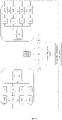
- the system is network-based and comprises a Central Processing Unit (1), a plurality of Local Units (2), a plurality of Local Entities (3) and a plurality of Agent Entities (4). All the elements are connected to each other by means of a network (5) which is used for data-exchange purposes. Any type of communication network (5) can be used, depending on the specificities and practical implementation considerations of each case.
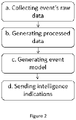
- the Central Processing Unit (1) is the core-knowledge and processing element. It comprises processing means programmed to generate event models of an event or of a suspicious event, based on processed-data that is sent by Local Units (2). Due to the stratification imposed by the architecture of the system, the Central Processing Unit (1) is able to process event's data collected from different geographic locations at the same time, which represents an advantage in case of multiple events occurring where particular intelligence indications must be provided for each one. In that case, the Central Processing Unit (1) is able to process each event independently and to generate different event models each one containing intelligence indications adapted to the respective specificities.
- An event model is a report that includes information regarding the event, particularly the type of the event, the time of the event, the location of the event, the number of Agent Entities (4) that reported it and also contain information associated to the event's raw data collected by the Local Entities (3) and by the Agent Entities (4). It is based on that information that intelligence indications are generated by the Central Processing Unit (3).
- a Local Unit (2) is a processing module able to be incorporated in an ordinary security system of an organization such as an hospital, a shopping mall or an airport.
- the role of a Local Unit (2) is to gather event's raw data, either related to an event or a suspicious event, collected by a plurality of Local Entities (3) and Agent Entities (4) located within the respective geographical cluster (7), and to generate processed-data to be sent to the Central Processing Unit (1), for the purpose of preparing at least one event model and generating intelligence indications.
- the geographical clusters (7) are associated to each Local Unit (2) and define a predefined geographical extension within which the Agent Entities (4) and Local Entities (3) are assigned to the respective Local Unit (2).
- the geographic extension of each cluster may vary being defined by the Central Processing Unit (1).
- a Local Entity (3) and an Agent Entity (4) are sensory entities that are responsible for feeding the Central Processing Unit (1) with event's data.
- a Local Entity (3) comprises sensory means adapted to collect event's raw data from an event's site or its vicinity, located within the geographical cluster of the Local Unit (2) to which is assigned.
- a Local Entity (3) may be any monitoring apparatus projected to periodically or continuously collect sensorial data. It may relate to devices or systems already operating in an organization, or to indoor or outdoor surveillance camera systems installed in streets or shops, for example.
- the sensory means of a Local Entity (3) includes video and audio sensors configured to collect raw data in the form of a stream of video or audio data, respectively.
- the sensory means of a Local Entity (3) may further include a plurality of sensor units, such sensor units being of acoustic, sound, vibration, chemical, temperature, environment or proximity type.
- an Agent Entity (4) is a processing device comprising input and output means configured to collect event's raw data, from an event's site or its vicinity, within a geographical cluster of the Local Unit (2) to which is assigned and to receive event's intelligence indications.
- the Agent Entity (4) may be smartphone, making use of its sensory abilities to collect event's raw data of different types, either related to the event or to a user carrying it.
- the smartphone may establish a connection with a wearable health device being used, for the purpose of collecting data related to heart rate, blood pressure, body temperature, allowing to provide information about the health status of a person carrying the Agent Entity (4).
- each Local Unit (2) further comprises an Agent's list management Entity.
- Said Entity is adapted to manage a list of the Agent Entities (4) which are assigned to a Local Unit (2) at a given time, being comprised by processing means programmed to assign an Agent Entity (4) which current geographic location is within the geographical cluster (7) of a Local Unit (2), and update the list of Agents, and to remove an Agent Entity (4) from the list of Agents assigned to a Local Unit (2) which current geographic location is not within the geographical cluster (7) of said Local Unit (2).
- the list of Agents of each Local Unit (2) is also shared with the Central Processing Unit (1), so the Central Processing Unit (1) knows what are Agent Entities (4) assigned with each Local Unit (2) at any instant, allowing to control more rigorously the impact of each event and the generation of intelligence indications directed to each Agent Entity (4).
- the Local Unit (2) is configured to establish a bidirectional communication channel with at least one Agent Entity (4) of the list of Agents assigned to it. Based on said communication channel, the Local Unit (2) may request to an Agent Entity (4) to provide supplementary event's raw data, for the purpose of preparing the processed-data to be sent to the Central Processing Unit (1).
- Said request for supplementary event's raw data may have a form of a query interface comprising a set of question for which further event's site information is required.
- Said supplementary raw data may be provided automatically by the Agent Entity (4) or may be inputted by a user carrying the Agent Entity (4).
- the Central Processing Unit (1) further comprises an event base-model database where past event models and respective intelligence indications are stored.
- the Central Processing Unit (1) is further programmed to access to the event base-model database (6) to select an event model based on processed-data sent by Local Units (2). By using data from past events, the Central Processing Unit (1) is able to provide more exact intelligence indications and also to predict more accurately the evolution of an event.
- the Central Processing Unit (1) further comprises an Artificial Intelligence module. Said Artificial Intelligence Module is configured to determine an event's thread classification and a risk level, based on the processed-data sent by Local Units (2) and based on the event models stored in the event base-model database (6). Furthermore, the Artificial Intelligence Module is configured to generate the event model and the respective intelligence indications based on said thread classification and risk level.
- each Agent Entity (4) may be of a collective or a singular type.
- a collective-Agent may be a multidisciplinary processing device further comprising means for controlling a plurality of emergency actuation modules. Therefore, apart from being a sensory entity in a first place, a collective-player has also the role of implementing intelligence indications that requires interactions with physical structures or the environment surround the event.
- Emergency actuation modules may be or not be a part of an ordinary security system wherein a Local Unit (2) is incorporated, and may relate to dedicated sirens, speakers, alarm sounds, entrance control mechanisms and emergency light guidance mechanism.
- a singular-Agent is any mobile processing device, such as a smartphone.
- the Central Processing Unit (1) comprises a manager Entity configured to implement a multilevel-hierarchical scheme, wherein to each Agent Entity (4) is attributed a rank value. More particularly, the manager Entity is programmed to dynamically attribute a rank value of each Agent Entity (4) based on the thread classification and risk level of the event model, the type of Agent Entity (4); and the Agent's location and the Local Unit to which it is assigned, in relation to the location of the event.
- a list of Agents and respective rank values are stored in memory means of the Central Processing Unit (1), and for that purpose, the manager Entity and the Agent's list management Entity of each Local Unit (2) are operatively connected.
- the implementation of such hierarchical scheme allows the Central Processing Unit (1) to generate custom intelligence indications according to the different characteristics of each Agent Entity (4), offering a greater flexibility in terms of dissemination and implementation of security protocols and preventive measures.
- the advantageous aspects of the present system also allow to take into consideration the evolution of an event in time, and its repercussions on neighbouring geographical clusters (7).
- the intelligence indications contained in an event model are generated by the Central Processing Unit (1) for each Agent Entity (4), based on the respective rank value.
- the intelligence indications may contain live recommendations, security directives and emergency protocol instructions to be followed by users and/or to actuate any emergency actuation module.
- the system further comprises a communication platform configured to establish a bidirectional data communication protocol adapted to transmit event's intelligence indications from the Central Processing Unit (1) to Agent Entities (4) via SMS, phone call, audio signal, video signal, push notifications, email or coded control information.
- coded control information may relate to operative instructions configured to operate an emergency actuation module.
- the communication platform also comprises an interface module configured receive input parameters from an Agent Entity (4) and to implement a graphical interface of a dashboard of events.
- the Central Processing Unit (1) is further configured to update the dashboard of events based on processed-data sent by Local Units (2) and on event's intelligence indications generated to a particular Agent Entity (4) by the Central Processing Unit (1).
- the Central Processing Unit (1) is adapted to operate in two modes of operation:
- the intelligence indications are generated by the Artificial Intelligence module of the Central Processing Unit (1), based on a thread classification and on a risk level, and the Central Processing Unit (1) is adapted to operate in both modes of operation at the same time depending on the Agent's location within a geographical cluster (7) of a Local Unit (2), in relation to the location of an event and of a suspicious event.
- the Central Processing Unit (1) can operate in the emergency mode (c1.) for generating intelligence indications for Agent Entities (4) within a geographical cluster (7) where the event took place, and operate in the preventive mode (c2.) for Agent Entities (4) of neighbouring clusters (7), for which the event may evolve.
- the Central Processing Unit (1) is further adapted to operate in a training mode (c3.), wherein the Artificial Module of the Central Processing Unit (1) is adapted to simulate a real event based on the event's raw data related to a suspicious event and on the event models stored at an event base-model database (6).
- the output of the training mode (c3.) may be used by the Artificial Intelligence Module of the Central Processing Unit (1) to improve the accuracy and efficiency of the intelligence indications generated for each case.
- the Central Processing Unit (1) generates an event model depending on:
Landscapes
- Engineering & Computer Science (AREA)
- Physics & Mathematics (AREA)
- General Physics & Mathematics (AREA)
- Theoretical Computer Science (AREA)
- Software Systems (AREA)
- Business, Economics & Management (AREA)
- Mathematical Physics (AREA)
- Evolutionary Computation (AREA)
- Artificial Intelligence (AREA)
- Data Mining & Analysis (AREA)
- General Engineering & Computer Science (AREA)
- Computing Systems (AREA)
- Emergency Management (AREA)
- Computational Linguistics (AREA)
- Tourism & Hospitality (AREA)
- Medical Informatics (AREA)
- Computer Vision & Pattern Recognition (AREA)
- General Business, Economics & Management (AREA)
- Health & Medical Sciences (AREA)
- Economics (AREA)
- Human Resources & Organizations (AREA)
- General Health & Medical Sciences (AREA)
- Technology Law (AREA)
- Automation & Control Theory (AREA)
- Fuzzy Systems (AREA)
- Computer Security & Cryptography (AREA)
- Strategic Management (AREA)
- Primary Health Care (AREA)
- Marketing (AREA)
- Alarm Systems (AREA)
Applications Claiming Priority (1)
| Application Number | Priority Date | Filing Date | Title |
|---|---|---|---|
| PT11682320 | 2020-10-14 |
Publications (1)
| Publication Number | Publication Date |
|---|---|
| EP3985602A1 true EP3985602A1 (de) | 2022-04-20 |
Family
ID=76213411
Family Applications (1)
| Application Number | Title | Priority Date | Filing Date |
|---|---|---|---|
| EP20202430.3A Withdrawn EP3985602A1 (de) | 2020-10-14 | 2020-10-16 | Ein echtzeit-verhinderungs- und notfallmanagementsystem und jeweilige betriebsmethode |
Country Status (2)
| Country | Link |
|---|---|
| US (1) | US11030884B1 (de) |
| EP (1) | EP3985602A1 (de) |
Families Citing this family (2)
| Publication number | Priority date | Publication date | Assignee | Title |
|---|---|---|---|---|
| US11855861B2 (en) | 2020-05-28 | 2023-12-26 | Axellio Inc. | High performance packet capture and analytics architecture |
| US20230261956A1 (en) | 2022-02-16 | 2023-08-17 | Axellio Inc. | Architecture for Network Entity and Event Models |
Citations (7)
| Publication number | Priority date | Publication date | Assignee | Title |
|---|---|---|---|---|
| US6408404B1 (en) | 1998-07-29 | 2002-06-18 | Northrop Grumman Corporation | System and method for ensuring and managing situation awareness |
| US7644056B2 (en) | 2006-01-05 | 2010-01-05 | Sundri Kaur Khalsa | System and method for providing terrorism intelligence indications and warnings |
| US9292874B2 (en) | 1999-12-03 | 2016-03-22 | Haystax Technology, Inc. | Method and apparatus for risk management |
| US20170289650A1 (en) * | 2016-04-05 | 2017-10-05 | Tyco Fire & Security Gmbh | Sensor Based System And Method For Premises Safety And Operational Profiling Based On Drift Analysis |
| US20180364654A1 (en) * | 2017-06-15 | 2018-12-20 | Johnson Controls Technology Company | Building management system with artificial intelligence for unified agent based control of building subsystems |
| US20200051189A1 (en) * | 2016-12-15 | 2020-02-13 | David H. Williams | Systems and methods for developing, monitoring, and enforcing agreements, understandings, and/or contracts |
| WO2020092446A2 (en) * | 2018-10-29 | 2020-05-07 | Strong Force TX Portfolio 2018, LLC | Methods and systems for improving machines and systems that automate execution of distributed ledger and other transactions in spot and forward markets for energy, compute, storage and other resources |
Family Cites Families (3)
| Publication number | Priority date | Publication date | Assignee | Title |
|---|---|---|---|---|
| US7693589B2 (en) * | 2007-08-14 | 2010-04-06 | International Business Machines Corporation | Anomaly anti-pattern |
| US10585724B2 (en) * | 2018-04-13 | 2020-03-10 | Banjo, Inc. | Notifying entities of relevant events |
| US10957185B2 (en) * | 2019-01-24 | 2021-03-23 | Sentry Systems, Inc. | Method and system for wildfire detection and management |
-
2020
- 2020-10-16 EP EP20202430.3A patent/EP3985602A1/de not_active Withdrawn
- 2020-10-28 US US17/082,345 patent/US11030884B1/en active Active
Patent Citations (7)
| Publication number | Priority date | Publication date | Assignee | Title |
|---|---|---|---|---|
| US6408404B1 (en) | 1998-07-29 | 2002-06-18 | Northrop Grumman Corporation | System and method for ensuring and managing situation awareness |
| US9292874B2 (en) | 1999-12-03 | 2016-03-22 | Haystax Technology, Inc. | Method and apparatus for risk management |
| US7644056B2 (en) | 2006-01-05 | 2010-01-05 | Sundri Kaur Khalsa | System and method for providing terrorism intelligence indications and warnings |
| US20170289650A1 (en) * | 2016-04-05 | 2017-10-05 | Tyco Fire & Security Gmbh | Sensor Based System And Method For Premises Safety And Operational Profiling Based On Drift Analysis |
| US20200051189A1 (en) * | 2016-12-15 | 2020-02-13 | David H. Williams | Systems and methods for developing, monitoring, and enforcing agreements, understandings, and/or contracts |
| US20180364654A1 (en) * | 2017-06-15 | 2018-12-20 | Johnson Controls Technology Company | Building management system with artificial intelligence for unified agent based control of building subsystems |
| WO2020092446A2 (en) * | 2018-10-29 | 2020-05-07 | Strong Force TX Portfolio 2018, LLC | Methods and systems for improving machines and systems that automate execution of distributed ledger and other transactions in spot and forward markets for energy, compute, storage and other resources |
Also Published As
| Publication number | Publication date |
|---|---|
| US11030884B1 (en) | 2021-06-08 |
Similar Documents
| Publication | Publication Date | Title |
|---|---|---|
| US8204836B2 (en) | Dynamic discrete decision simulation system | |
| Yang et al. | On-site information systems design for emergency first responders | |
| US11934410B2 (en) | Computer-implemented system and method for generating recurring events | |
| EP3989136A1 (de) | Ortsevakuierungssystem | |
| CN110009541A (zh) | 公共安全事件的处理方法、装置、计算机设备和存储介质 | |
| US12299557B1 (en) | Response plan modification through artificial intelligence applied to ambient data communicated to an incident commander | |
| KR20220071880A (ko) | 지하공동구 맞춤형 디지털트윈 재난 관리 시스템 | |
| US11030884B1 (en) | Real-time prevention and emergency management system and respective method of operation | |
| Mittelstädt et al. | An integrated in-situ approach to impacts from natural disasters on critical infrastructures | |
| US20220093275A1 (en) | Systems and methods for a multi-modal geographic information system (gis) dashboard for real-time mapping of perceived stress, health and safety behaviors, facilities design and operations, and movement | |
| CN120542937A (zh) | 一种多模态ai分析的区域消防风险分析方法及系统 | |
| EP2592606A1 (de) | Gebäude Evakuationssystem mit Evakuierungsmethode der Bewohner | |
| Didar et al. | Integrated evacuation and rescue management system in response to fire incidents | |
| Schoenharl et al. | WIPER: Leveraging the cell phone network for emergency response | |
| Perez et al. | Monograph No. 11: SimDrug: Exploring the complexity of heroin use in Melbourne | |
| Verma et al. | Implementation Of IoT and Applications in Smart City in Achieving the Smart Environment | |
| Mattioli et al. | A crisis response situation model | |
| Sharma et al. | Statistical and machine learning models for predicting fire and other emergency events in the city of edmonton | |
| Kalaivani et al. | Ai–based iot real time air monitoring system | |
| Ibri | A compendious review of agent-based disaster management | |
| Ghorpade et al. | Review on evacuation systems for indoor fire situation | |
| Hewitt | Siting a fire station by leveraging soft constraints and supporting science | |
| Jafarian et al. | Technology-Driven Emergency Mass Evacuation: An Operations and Engineering Management Perspective | |
| Subrahmanyam | The Role of AI in Crisis Management and Disaster Response | |
| KR102751773B1 (ko) | 인공지능 및 빅데이터에 기반하여 동적정보를 이용하는 건설사고 예측방법 및 장치 |
Legal Events
| Date | Code | Title | Description |
|---|---|---|---|
| STAA | Information on the status of an ep patent application or granted ep patent |
Free format text: STATUS: UNKNOWN |
|
| PUAI | Public reference made under article 153(3) epc to a published international application that has entered the european phase |
Free format text: ORIGINAL CODE: 0009012 |
|
| STAA | Information on the status of an ep patent application or granted ep patent |
Free format text: STATUS: THE APPLICATION HAS BEEN PUBLISHED |
|
| AK | Designated contracting states |
Kind code of ref document: A1 Designated state(s): AL AT BE BG CH CY CZ DE DK EE ES FI FR GB GR HR HU IE IS IT LI LT LU LV MC MK MT NL NO PL PT RO RS SE SI SK SM TR |
|
| STAA | Information on the status of an ep patent application or granted ep patent |
Free format text: STATUS: REQUEST FOR EXAMINATION WAS MADE |
|
| RBV | Designated contracting states (corrected) |
Designated state(s): AL AT BE BG CH CY CZ DE DK EE ES FI FR GB GR HR HU IE IS IT LI LT LU LV MC MK MT NL NO PL PT RO RS SE SI SK SM TR |
|
| 17P | Request for examination filed |
Effective date: 20221018 |
|
| RAP1 | Party data changed (applicant data changed or rights of an application transferred) |
Owner name: LEVY, SAM |
|
| RIN1 | Information on inventor provided before grant (corrected) |
Inventor name: LEVY, SAM |
|
| STAA | Information on the status of an ep patent application or granted ep patent |
Free format text: STATUS: EXAMINATION IS IN PROGRESS |
|
| 17Q | First examination report despatched |
Effective date: 20240226 |
|
| STAA | Information on the status of an ep patent application or granted ep patent |
Free format text: STATUS: THE APPLICATION IS DEEMED TO BE WITHDRAWN |
|
| 18D | Application deemed to be withdrawn |
Effective date: 20241224 |