EP3982002B1 - Dämpfungsvorrichtung aus zwei materialien für raumfahrzeuge und verfahren zur herstellung dieser dämpfungsvorrichtung - Google Patents
Dämpfungsvorrichtung aus zwei materialien für raumfahrzeuge und verfahren zur herstellung dieser dämpfungsvorrichtung Download PDFInfo
- Publication number
- EP3982002B1 EP3982002B1 EP21201811.3A EP21201811A EP3982002B1 EP 3982002 B1 EP3982002 B1 EP 3982002B1 EP 21201811 A EP21201811 A EP 21201811A EP 3982002 B1 EP3982002 B1 EP 3982002B1
- Authority
- EP
- European Patent Office
- Prior art keywords
- metal part
- metal
- damping
- damping device
- elastomer
- Prior art date
- Legal status (The legal status is an assumption and is not a legal conclusion. Google has not performed a legal analysis and makes no representation as to the accuracy of the status listed.)
- Active
Links
Images


Classifications
-
- F—MECHANICAL ENGINEERING; LIGHTING; HEATING; WEAPONS; BLASTING
- F16—ENGINEERING ELEMENTS AND UNITS; GENERAL MEASURES FOR PRODUCING AND MAINTAINING EFFECTIVE FUNCTIONING OF MACHINES OR INSTALLATIONS; THERMAL INSULATION IN GENERAL
- F16F—SPRINGS; SHOCK-ABSORBERS; MEANS FOR DAMPING VIBRATION
- F16F1/00—Springs
- F16F1/36—Springs made of rubber or other material having high internal friction, e.g. thermoplastic elastomers
- F16F1/38—Springs made of rubber or other material having high internal friction, e.g. thermoplastic elastomers with a sleeve of elastic material between a rigid outer sleeve and a rigid inner sleeve or pin, i.e. bushing-type
- F16F1/3863—Springs made of rubber or other material having high internal friction, e.g. thermoplastic elastomers with a sleeve of elastic material between a rigid outer sleeve and a rigid inner sleeve or pin, i.e. bushing-type characterised by the rigid sleeves or pin, e.g. of non-circular cross-section
-
- F—MECHANICAL ENGINEERING; LIGHTING; HEATING; WEAPONS; BLASTING
- F16—ENGINEERING ELEMENTS AND UNITS; GENERAL MEASURES FOR PRODUCING AND MAINTAINING EFFECTIVE FUNCTIONING OF MACHINES OR INSTALLATIONS; THERMAL INSULATION IN GENERAL
- F16F—SPRINGS; SHOCK-ABSORBERS; MEANS FOR DAMPING VIBRATION
- F16F1/00—Springs
- F16F1/36—Springs made of rubber or other material having high internal friction, e.g. thermoplastic elastomers
- F16F1/38—Springs made of rubber or other material having high internal friction, e.g. thermoplastic elastomers with a sleeve of elastic material between a rigid outer sleeve and a rigid inner sleeve or pin, i.e. bushing-type
- F16F1/3842—Method of assembly, production or treatment; Mounting thereof
-
- F—MECHANICAL ENGINEERING; LIGHTING; HEATING; WEAPONS; BLASTING
- F16—ENGINEERING ELEMENTS AND UNITS; GENERAL MEASURES FOR PRODUCING AND MAINTAINING EFFECTIVE FUNCTIONING OF MACHINES OR INSTALLATIONS; THERMAL INSULATION IN GENERAL
- F16F—SPRINGS; SHOCK-ABSORBERS; MEANS FOR DAMPING VIBRATION
- F16F1/00—Springs
- F16F1/36—Springs made of rubber or other material having high internal friction, e.g. thermoplastic elastomers
- F16F1/38—Springs made of rubber or other material having high internal friction, e.g. thermoplastic elastomers with a sleeve of elastic material between a rigid outer sleeve and a rigid inner sleeve or pin, i.e. bushing-type
- F16F1/387—Springs made of rubber or other material having high internal friction, e.g. thermoplastic elastomers with a sleeve of elastic material between a rigid outer sleeve and a rigid inner sleeve or pin, i.e. bushing-type comprising means for modifying the rigidity in particular directions
- F16F1/3876—Springs made of rubber or other material having high internal friction, e.g. thermoplastic elastomers with a sleeve of elastic material between a rigid outer sleeve and a rigid inner sleeve or pin, i.e. bushing-type comprising means for modifying the rigidity in particular directions by means of inserts of more rigid material
-
- F—MECHANICAL ENGINEERING; LIGHTING; HEATING; WEAPONS; BLASTING
- F16—ENGINEERING ELEMENTS AND UNITS; GENERAL MEASURES FOR PRODUCING AND MAINTAINING EFFECTIVE FUNCTIONING OF MACHINES OR INSTALLATIONS; THERMAL INSULATION IN GENERAL
- F16F—SPRINGS; SHOCK-ABSORBERS; MEANS FOR DAMPING VIBRATION
- F16F2224/00—Materials; Material properties
- F16F2224/02—Materials; Material properties solids
-
- F—MECHANICAL ENGINEERING; LIGHTING; HEATING; WEAPONS; BLASTING
- F16—ENGINEERING ELEMENTS AND UNITS; GENERAL MEASURES FOR PRODUCING AND MAINTAINING EFFECTIVE FUNCTIONING OF MACHINES OR INSTALLATIONS; THERMAL INSULATION IN GENERAL
- F16F—SPRINGS; SHOCK-ABSORBERS; MEANS FOR DAMPING VIBRATION
- F16F2224/00—Materials; Material properties
- F16F2224/02—Materials; Material properties solids
- F16F2224/0208—Alloys
Definitions
- This disclosure relates to the field of aeronautical devices, and in particular rocket engines.
- This disclosure relates in particular to a damping device for damping vibrations between a component to be isolated from the rocket engine and a supporting structure of this engine, and a method of manufacturing such a device.
- Liquid propellant space engines must operate in severe vibration environments. These vibrations can be generated by their own operation, by pressure waves and acoustic waves generated by solid boosters, or by the dynamic excitation that the launcher imposes on the engines at their interface points (gimbals and jack attachments). These launcher vibrations can themselves result from the excitation of solid boosters, from the excitation of cryogenic engines, or from the excitation due to unsteady aerodynamic loads in the atmosphere.
- damping systems can be classified into two main families: a first family using shock absorbers such as mechanical, pneumatic, hydraulic, passive or active shock absorbers, and a second family based on the insertion of so-called “soft” materials. and shock absorbing, between the component to be protected and the supporting structure generating the high dynamic stresses.
- shock absorbers such as mechanical, pneumatic, hydraulic, passive or active shock absorbers
- the first family is very effective in terms of damping, but generally heavy, expensive and/or complex to implement.
- the second family has the disadvantage of damping less well than the first family. It must also not be excessively compressed so as not to compromise its damping function. However, the clamping forces of the component to be isolated on its supporting structure must often be significant, to withstand significant dynamic loads, which considerably reduces the damping efficiency of this family of dampers.
- the first metal part includes an outer skeleton and an inner housing within the outer skeleton, the solid elastomer damping structure being disposed in the inner housing, and the second metal part being disposed at least partially within the inner housing of the first metal part.
- solid elastomer means an elastomer in the solid state, such as rubber, that is to say after solidification of an elastomer in the liquid state.
- the internal housing of the first metal part may be initially filled with an elastomer in the liquid state, before solidification by polymerization of the latter.
- the second metal part being arranged at least partly inside the internal housing of the first metal part, the solidified elastomer is therefore in contact both with the first metal part, more precisely with the wall of the external skeleton, and with the second metal part.
- the vibration movements cause relative movements between the supporting structure and the component to be isolated, consequently generating relative movements between the first metal part secured to the supporting structure, and the second metal part secured to the component to be isolated.
- These relative movements between the first and second metal parts cause shearing of the solid elastomer arranged inside the internal housing and in contact with the first and second metal parts.
- the damping device according to the present disclosure has the advantage of being easy to produce.
- the metal structure, comprising the first and second metal parts is in fact produced by additive manufacturing, then filled with an elastomer.
- the surface condition of the metal parts, produced by additive manufacturing also does not require precise requirements, which makes it possible to further limit manufacturing costs. On the contrary, greater roughness tends to improve the strength of the bond between the elastomer and the metal.
- this damping device has the advantage of being modular. Indeed, depending on the application, the metal structure can be manufactured in various materials (titanium, nickel-based superalloy, aluminum for example). The nature of the elastomer can also be chosen according to the technical specifications of the system (damped frequencies or temperature resistance for example). The elastomer can for example include polyurethane, neoprene, butyl elastomer, or any other type of elastomer. It should also be noted that this device can be reusable. Indeed, it is possible to chemically remove, or by pyrolysis, the elastomer present in the internal housing, then to refill this internal housing with a new elastomer in the liquid state, followed by its polymerization.
- the first and second metal parts are two separate parts connected together only by the damping structure.
- the damping device can have a damping effect until contact between the first and/or second metal parts and the load-bearing structure and/or the component to be insulated, or contact between the first and second metal parts, occurs.
- the metal structure comprises at least one metal connecting element, the first and second metal parts being connected to each other by the damping structure and by the metal connecting element.
- a metal-metal contact exists between the first and second metal parts, in the initial state, via the metal connecting element.
- This connecting element is manufactured at the same time as the first and second metal parts, during the manufacture of the metal structure by additive manufacturing.
- the connecting element extends into the internal housing, between the external skeleton and the second metal part.
- the remainder of the volume of the internal housing, i.e. the part of the internal housing not comprising the connecting element, comprises the elastomer damping structure.
- the metal structure is therefore formed in a single piece, comprising the first and second metal parts, and the connecting element.
- the first and second metal parts are two separate parts of the metal structure fixed respectively to the supporting structure and to the component to be isolated, but are not independent of each other.
- the damping device according to this embodiment thus has a stiffness that evolves according to the intensity and direction of the loading.
- This configuration also has the advantage of providing additional damping thanks to the non-linear nature of the stiffness of the device, and of allowing greater mechanical loads to be transmitted through the device.
- the metal connecting element has a lattice network structure, or is a flexible metal wire.
- the metal structure is obtained by additive manufacturing such that at least a portion of the surface of the first metal part and/or the second metal part, in contact with the damping structure, has a lattice network structure.
- a portion of the inner surface of the outer skeleton, delimiting the inner housing, and/or a portion of the surface of the portion of the second metal part arranged in the inner housing has a lattice network structure.
- the entire surface of the first metal part and the second metal part in contact with the elastomer damping structure has a lattice network structure.
- This structure is provided during the manufacture of the metal structure by additive manufacturing, in which the connecting element, when such an element is provided, can also be made in such a way as to have a lattice network structure.
- This structure can take the form, for example, of a mesh network, alternating full and empty areas, in a manner similar to a fence.
- This configuration further limits the mass of the damping device. It also improves the quality of the bond between the metal and non-metal parts (elastomer), thanks to total impregnation of the elastomer in the liquid state in the metal network, before polymerization. This structure also gives the metal structure a surface state with increased roughness, improving the bond between the metal structure and the damping structure. Furthermore, the mesh design of the lattice network can be chosen so as to maximize the shear forces.
- the at least first metal part has a tube shape comprising a longitudinal axis, the second metal part being disposed at least partially in the space within the tube.
- the first metal part at least has a tube shape comprising a longitudinal axis, the external skeleton being the wall of the tube, and the internal housing being the space inside the tube.
- the second metal part may be a cylinder coaxial with the tube forming the first metal part and being fitted into this tube, of tubular shape, the first metal part having a smaller diameter than the internal diameter of the first metal part.
- a portion of the second metal part is thus inside the first metal part, that is to say inside the tube formed by the external skeleton.
- This portion of the second metal part inside the tube, that is to say inside the internal housing, is therefore impregnated in the elastomer damping structure. It may further be spaced from the external skeleton of the first metal part, and therefore separated from the latter by the damping structure only, or be connected to the latter, by means of the metal connecting element.
- This structure provides a damping function for different movements of the component to be isolated relative to the supporting structure, in particular axial movements along the longitudinal axis of the tube forming the first metal part, transverse movements relative to this longitudinal axis, rotations around this axis, or bending in different directions.
- a plurality of radial metal rods extending into the damping structure, projecting radially from the first metal part or the second metal part, and including a free end disposed in the damping structure.
- radial and its derivatives correspond to a transverse direction relative to the longitudinal axis of the tube forming the first metal part, or of the cylinder forming the second metal part, this transverse direction being perpendicular or substantially inclined relative to the longitudinal direction.
- the free end of the metal rods arranged in the damping structure while being impregnated therein has a spherical shape.
- the damping device includes radial metal walls projecting from one of the first metal part or the second metal part, the free ends of at least a portion of the metal rods projecting from the other of the first metal part or the second metal part being disposed between two metal walls.
- the free ends of at least some of them are arranged between two radial metal walls arranged on the inner wall of the outer skeleton of the first metal part. This configuration allows to locally maximize the shear stresses in the elastomer damping structure.
- the present disclosure also relates to a damping device for a spacecraft as defined in claim 8, wherein the first and second metal parts have a branched structure, the solid elastomer damping structure being disposed between the first metal part and the second metal part so as to be in contact with both branches of the branched structure of the first metal part and branches of the branched structure of the first metal part.
- branched structure is meant a tree-shaped structure, comprising a main trunk extending in a main direction and being fixed to the supporting structure and to the component to be insulated, the main trunk dividing into two or more secondary branches, themselves dividing into several branches, up to a top of the branched structure.
- the elastomer damping structure is arranged between and around the branches of the branched structure of the first metal part and the second metal part.
- branches of the branched structure of the first metal part, as well as branches of the branched structure of the second metal part are impregnated in the elastomer of the damping structure.
- the respective vertices of the branched structure of the first and second metal parts may be disjointed or, alternatively, connected to each other, so as to give the metal structure a single-piece configuration.
- This structure provides a damping function for different movements of the component to be isolated relative to the supporting structure, in particular axial movements along the main direction of the branched structure, transverse movements relative to this main direction, rotations around this direction, or bending in different directions.
- the first and second metal parts comprise an ovoid portion, the ovoid portion of the second metal part being arranged inside the ovoid portion of the first metal part.
- the outer skeleton comprises the outer shell of the ovoid portion of the first metal part
- the inner housing is the space inside said outer shell, in which the ovoid portion of the second metal part is arranged.
- the first and second metal parts may comprise a rod-shaped or trunk-shaped portion extending along a longitudinal axis from the supporting structure and the component to be insulated, at the end of which is the ovoid portion.
- the damping device may take the form of a ball joint. More specifically, the ovoid portion of the second metal part is arranged inside the ovoid portion of the first metal part, being impregnated in the solid elastomer damping structure. Furthermore, the ovoid portion of the second metal part may be spaced from the ovoid portion of the first metal part by the damping structure only. Alternatively, the ovoid portion of the second metal part may be locally in contact with the ovoid portion of the first metal part.
- This structure makes it possible to provide a damping function for different movements of the component to be isolated relative to the supporting structure, in particular axial movements along the longitudinal axis of the rods of the first and second metal parts, transverse movements relative to this longitudinal axis, rotations around this axis, or bending in different directions.
- the present disclosure also relates to a spacecraft comprising a damping device according to any of the preceding embodiments.
- the first metal part comprises an outer skeleton and an inner housing within the outer skeleton, and the second metal part is disposed at least partially within the inner housing of the first metal part, the liquid elastomer being cast into the inner housing of the first metal part, the elastomer then being polymerized in the inner housing so as to obtain a solid elastomer damping structure.
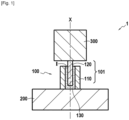
- FIG. 1 schematically represents a sectional view of a portion of a spacecraft 1 comprising a supporting structure 200, for example a fixed casing of the spacecraft 1, a component to be insulated 300, for example a small fluid line or small equipment such as an electrical box or a solenoid valve, and a damping device 100 according to the present disclosure.
- the damping device 100 is axisymmetric about a longitudinal direction X, and is configured to dampen the relative movements of the component to be isolated 300 with respect to the supporting structure 200 along or around this longitudinal direction X, or in directions transverse to this longitudinal direction X.
- the damping device 100 essentially comprises two distinct materials, namely a metal structure 101 comprising a first metal part 110 and a second metal part 120, and a damping structure 130 made of solid elastomer.
- the metal structure 101 comprises for example titanium, a nickel-based superalloy or aluminum
- the damping structure 130 made of solid elastomer comprises for example polyurethane, neoprene, or butyl elastomer.
- the first metal part 110 has a tubular shape whose central axis corresponds to the longitudinal direction X, and is fixed to the supporting structure 200, for example by welding, brazing or screw connection.
- the first metal part 110 comprises an external skeleton 111, corresponding to the wall of the tube, this external skeleton 111 forming an internal housing I, corresponding to the center of the tube.
- the second metal part 120 has a cylindrical shape whose central axis also corresponds to the longitudinal direction X, and is fixed to the component to be insulated 300, for example by welding, brazing or screw connection.
- This cylindrical shape is not limiting, the second metal part 120 can also have a tubular shape, for example.
- a portion of the second metal part 120 is arranged in the internal housing I. In other words, the second metal part 120 is partly fitted into the first metal part 110.
- the internal housing I is filled, preferably entirely, by the solid elastomer damping structure 130. Consequently, the portion of the second metal part 130 arranged in the internal housing I is impregnated in the solid elastomer of the damping structure 130.
- the metal structure 101 is manufactured by additive manufacturing, i.e. by laser fusion of successive layers of metal powder, for example a steel, a nickel alloy (Inconel 718 ® , Waspaloy X ® ), a titanium alloy or an aluminum alloy. It is therefore understood that the first metal part 110 and the second metal part 120 are manufactured during the same operation, possibly in a single piece when the first metal part 110 and the second metal part 120 are connected to each other by a metal connecting element.
- an elastomer in the liquid state is poured into the internal housing I, so as to impregnate the walls of the first metal part 110 and the second metal part 120.
- the liquid elastomer is then solidified by polymerization, so as to form the damping structure 130.
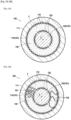
- FIGS. 2A and 2B represent a cross section, that is to say a section perpendicular to the longitudinal direction X, of the damping device 100 of the figure 1 , according to a first embodiment.
- the walls of the first and second metal parts 110, 120, in contact with the damping structure 130 are not smooth, but have a lattice network structure 112, 122 (represented by crosses on the Figures 2A and 2B ). More specifically, the radially inner wall of the outer skeleton 111 of the first metal part 110 comprises a first lattice network 112, and the radially outer wall of the second metal part 120 comprises a first lattice network 122. It will be noted that the terms "radially outer” or “radially inner” and their derivatives are considered with respect to the longitudinal direction X, a radial direction therefore being perpendicular to this longitudinal direction X. This configuration is not limiting, only one of the first and second metal parts being able to comprise a lattice network structure, or only a portion of the surface of these walls can comprise this structure, and not necessarily the entire surface.
- This lattice network structure 112, 122 is provided during the manufacture of the metal structure 101 by additive manufacturing described above.
- This structure can take the form of, for example, a mesh network, alternating solid areas and empty areas, in a manner similar to a grid. Consequently, when the internal housing I is filled with the liquid elastomer, the latter infiltrates into the empty areas between these meshes. Thus, after solidification of the elastomer by polymerization, the connection between the metal of the metal structure 101 and the damping structure 130 is improved.
- FIG. 2A represents a first example of this embodiment, in which the first metal part 110 and the second metal part 120 are disjointed, and separated from each other by the damping structure 130 only. In other words, no metallic connection exists between these two metal parts.
- FIG. 2B represents a second example of this embodiment, in which the first metal part 110 and the second metal part 120 are joined together by a metal connecting element.
- the first metal part 110 and the second metal part 120 are not separated from each other only by the damping structure 130, but are also connected by the metal connecting element.
- This metal connecting element may be a first metal connecting element 141, having a lattice network structure analogous to the first lattice network 112 and the second lattice network 122, or a second metal connecting element 142, comprising flexible metal wires.
- the damping device 100 may comprise only the first metal connecting element 141, or only the second metal connecting element 142.
- the internal housing I has the shape of an annular space. However, in this figure, only a part of the circumference of this annular space is occupied by the metal connecting element. However, the first metal connecting element 141 or the second metal connecting element 142 may be present over the entire circumference of this annular space.
- the solid elastomer damping structure 130 is impregnated between each mesh, that is to say between each empty zone of the lattice network structure of the first metal connecting element 141.
- the first or second metal connecting element 141, 142 are manufactured during the same operation as the first metal part 110 and the second metal part 120, during the manufacture of the metal structure 101 by additive manufacturing.
- the metal structure 101 thus forms a single-piece part, comprising the first metal part 110, the second metal part 120 and the metal connecting part 141 and/or 142.
- the metal connecting elements 141 or 142 are also impregnated with this elastomer, and trapped in this elastomer after hardening of the latter by polymerization.
- figure 3 represents a cross section, i.e. a section perpendicular to the longitudinal direction X, of the damping device 100 of the figure 1 , according to a second embodiment.
- the walls of the first and second metal parts 110, 120, in contact with the damping structure 130 are not smooth, but comprise elements projecting from these surfaces.
- the radially inner wall of the outer skeleton 111 of the first metal part 110 comprises radial metal walls 114 projecting from said radially inner wall of the outer skeleton 111, in the direction of the center of the damping device, that is to say in the direction of the longitudinal direction X.
- radial metal walls 114 projecting from said radially inner wall of the outer skeleton 111, in the direction of the center of the damping device, that is to say in the direction of the longitudinal direction X.
- the radially outer wall of the second metal part 120 comprises pins, or rods 150, projecting from said radially outer wall of the second metal part 120, in a direction moving away from the longitudinal direction X.
- These rods 150 each comprise a connecting arm 152 projecting from the second metal part 120, to a free end arranged in the damping structure 130, this free end comprising a protuberance 151, having a spherical shape, for example.
- the structure of the damping device 100 illustrated in the figure 3 thus has a radiating shape, or even a dandelion shape.
- the spherical shape of the free ends is not limiting, other shapes, such as a cubic shape, can be envisaged, since the free end of these rods 150 makes it possible to increase the contact surface, and therefore the shear, between the metal structure 101 and the damping structure 130.
- the 150 rods can have different lengths. In the example illustrated on the figure 3 , rods 150 of two different lengths are shown.
- the rods 150 of greater lengths are configured such that the spherical protuberance 151, at their free end, is arranged between two adjacent radial metal walls 114.
- the rods 150 are preferably distributed over the entire circumference of the annular space between the first metal part 110 and the second metal part 120.
- the damping device 100 comprises a number of rods 150 greater than ten, preferably greater than thirty, more preferably greater than fifty.
- the radial metal walls 114 and the rods 150 are manufactured during the same operation as the first metal part 110 and the second metal part 120, during the manufacture of the metal structure 101 by additive manufacturing.
- the first metal part 110 and the second metal part 120 are two parts independent of each other, connected to each other only by the damping structure 130 made of solid elastomer.
- the radial metal walls 114 and the rods 150 are also impregnated with this elastomer, and trapped in this elastomer after hardening of the latter by polymerization.
- FIGS. 4A and 4B represent a longitudinal section, that is to say a section parallel to the longitudinal direction X, of the damping device 100 according to a third embodiment.
- each of the first and second metal parts 110, 120 does not have a shape of revolution such as the tubular or cylindrical shape according to the first and second embodiments, but has a branched structure, or tree structure.
- the external skeleton 111 of the first metal part 110 comprises the branches of the branched structure
- the internal housing I comprises the spaces between these branches.
- the internal housing I also includes the space around these branches, particularly in the vicinity of the top of these branches.
- the first metal part 110 comprises a single main trunk 115 secured to the supporting structure 200 (not shown in the figure 4 ), and extending in the longitudinal direction X from this supporting structure 200.
- This main trunk 115 then divides into two or more secondary branches, themselves dividing into several branches, up to the vertices 113 of each branch of the branched structure.
- the second metal part 120 comprises a single main trunk 125 secured to the component to be insulated 300 (not shown in the figure 4 ), and extending in the longitudinal direction X from this component to be isolated 300.
- This main trunk 125 then divides into two or more secondary branches, themselves dividing into several branches, up to vertices 123 of each branch of the branched structure.
- These vertices 123 are configured to be arranged at least partly in the internal housing I, that is to say in the spaces between the branches of the branched structure of the first metal part 110.
- the peaks 113 and 123 are also impregnated with this elastomer, and trapped in this elastomer after hardening of the latter by polymerization.
- FIG. 4A represents a first example of this embodiment, in which the respective vertices 113 and 123 of the first metal part 110 and the second metal part 120 are disjoint from each other.
- the first metal part 110 and the second metal part 120 are disjoint and separated from each other by the damping structure 130 only.
- the damping structure 130 only.
- no metallic connection exists between these two metal parts.
- the vertices 113 and 123 of the branches are shown at a distance from each other.
- the vertices 123 of the branched structure of the second metal part 120 may be arranged in the spaces between the vertices 113 of the branched structure of the first metal part 110, being entangled between the branches of the latter.
- FIG. 4B shows a second example of this embodiment, in which the first metal part 110 and the second metal part 120 are joined together by a metal connecting element.
- the first metal part 110 and the second metal part 120 are not separated from each other only by the damping structure 130, but are also connected by the metal connecting element.
- the metal connecting element is in fact an extension of the respective ends of the branches of the branched structure of the first and second metal parts 110, 120, such that at least some of the vertices 113 and 123 are joined together.
- the first metal part 110 and the second metal part 120 are manufactured during the manufacture of the metal structure 101 by additive manufacturing.
- the metal structure 101 thus forms a single-piece part, comprising the branched structure of the first metal part 110 and the second metal part 120, of which at least some of the vertices 113 and 123 are joined.
- FIG. 5 represents a longitudinal section, that is to say a section parallel to the longitudinal direction X, of the damping device 100 according to a fourth embodiment.
- the first and second metal parts 110, 120 do not have a tubular or cylindrical shape as according to the first and second embodiments, but have an ovoid structure, or even an onion-shaped structure.
- the first metal part 110 comprises a main trunk 117 secured to the supporting structure 200 (not shown in the figure 5 ), and extending in the longitudinal direction X from this supporting structure 200.
- This main trunk 117 comprises at its end an ovoid portion 118.
- This ovoid portion 118 constitutes the external skeleton 111 of the first metal part 110.
- the second metal part 120 comprises a main trunk 127 secured to the component to be insulated 300 (not shown in the figure 5 ), and extending in the longitudinal direction X from this component to be isolated 300.
- This main trunk 127 comprises at its end an ovoid portion 128.
- This ovoid portion 128, in the shape of an onion, is arranged in the internal housing I of the first metal part 110, being impregnated in the damping structure 130 made of solid elastomer, present in this internal housing I.
- the damping device 100 thus takes the form of a ball joint, making it possible to accompany and dampen the movements between the component to be isolated 300 and the supporting structure 200, in the longitudinal direction X, but also in the directions transverse to this longitudinal direction X, and the rotational movements around these different directions.
- the ovoid portion 128 is likely to come into abutment against the ovoid portion 118 in directions transverse to the longitudinal direction X, but also in the longitudinal direction X.
- the ovoid portion 118 comprises, at its end, an opening 118a through which the trunk 127 of the second metal part 120 is engaged, this opening 118a having a smaller diameter than the diameter of the ovoid portion 128, arranged inside the ovoid portion 118.
- the first metal part 110 and the second metal part 120 are disjointed and separated from each other by the damping structure 130 only. Thus, no metal connection exists between these two metal parts.
- the ovoid portions 118 and 128 of the first metal part 110 and the second metal part 120 respectively may be connected to each other.
- the ovoid portion 128 may have fibrous outgrowths on its surface, these outgrowths being connected to the surface of the ovoid portion 118.
- Each of these connecting arms may preferably be arranged in a spiral around the direction longitudinal X so as to connect the two ovoid portions 118, 128. This pattern makes it possible to generate a rotation of the component to be isolated 300 relative to the supporting structure 200, when the component to be isolated 300 moves away from the supporting structure 200.
- a portion of the spiral connecting arms may be arranged in a first pattern, in which each of the arms is oriented in a clockwise spiral, and another portion of the spiral connecting arms may be arranged in a second pattern, in which each of the arms is oriented in a counterclockwise spiral. This makes it possible to avoid a coupling of “traction-torsion” type behavior.
- FIG 6 represents a modified example of the damping device 100 illustrated in the figure 5 .
- the first and second metal parts 110, 120 comprise, at the end of their respective main trunk 117, 127, a plurality of elongated portions 119, 129, nested within each other.
- the external skeleton 111 of the first metal part 110 comprises the elongated portions 119, and the internal housing I are the spaces between these elongated portions 119, comprising the damping structure 130 made of solid elastomer.
- the damping device 100 thus takes the form of a “tulip” or “knee bone”, making it possible to accompany and dampen the movements between the component to be isolated 300 and the supporting structure 200, in the longitudinal direction X, but also in the directions transverse to this longitudinal direction X.
- the elongated portions 129 are likely to come into abutment against the elongated portions 119, in directions transverse to the longitudinal direction X only.
- the first and second metal parts 110, 120 do not come into abutment with each other in the longitudinal direction X, the diameters of the elongated portions 129 being less than the diameters of the spaces between the elongated portions 119, in which the elongated portions 129 are nested.
Landscapes
- Engineering & Computer Science (AREA)
- General Engineering & Computer Science (AREA)
- Mechanical Engineering (AREA)
- Manufacturing & Machinery (AREA)
- Vibration Prevention Devices (AREA)
- Vibration Dampers (AREA)
- Laminated Bodies (AREA)
- Insulating Bodies (AREA)
Claims (11)
- Dämpfungsvorrichtung (100) für Raumschiff (1), die konfiguriert ist, um die Schwingungen zwischen einer zu isolierenden Komponente (300) und einer tragenden Struktur (200) des Raumschiffs (1) zu dämpfen, die Dämpfungsvorrichtung (100) umfassend:- eine Metallstruktur (101), die durch additive Fertigung erlangt wird und umfassend ein erstes Metallteil (110), das konfiguriert ist, um an einem der zu isolierenden Komponente (300) oder der tragenden Struktur (200) befestigt zu sein, und ein zweites Metallteil (120), das konfiguriert ist, um an dem anderen der zu isolierenden Komponente (300) oder der tragenden Struktur (200) befestigt zu sein,- eine Dämpfungsstruktur (130) aus einem festen Elastomer, die zwischen dem ersten Metallteil (110) und dem zweiten Metallteil (120) angeordnet ist, sodass sie sowohl mit Wänden des ersten Metallteils (110) als auch mit Wänden des zweiten Metallteils (120) in Kontakt ist, wobei die Metallstruktur (101) durch additive Fertigung erlangt wird, sodass zumindest ein Teil der Oberfläche des ersten Metallteils (110) und/oder des zweiten Metallteils (120) in Kontakt mit der Dämpfungsstruktur (130) eine Gitternetzstruktur (112, 122) aufweist, dadurch gekennzeichnet, dass das erste Metallteil (110) ein äußeres Skelett (111) und eine innere Aufnahme (I) innerhalb des äußeren Skeletts (111) umfasst, wobei die Dämpfungsstruktur (130) aus einem festen Elastomer in der inneren Aufnahme (I) angeordnet ist, und das zweite Metallteil (120) zumindest teilweise innerhalb der inneren Anordnung (I) des ersten Metallteils (110) angeordnet ist.
- Dämpfungsvorrichtung (100) nach Anspruch 1, wobei das erste und das zweite Metallteil (110, 120) zwei getrennte Teile sind, die nur durch die Dämpfungsstruktur (130) miteinander verbunden sind.
- Dämpfungsvorrichtung (100) nach Anspruch 1, wobei die Metallstruktur (101) mindestens ein metallisches Verbindungselement (141, 142) umfasst, wobei das erste und das zweite Metallteil (110, 120) durch die Dämpfungsstruktur (130) und durch das metallische Verbindungselement (141, 142) miteinander verbunden sind.
- Dämpfungsvorrichtung (100) nach Anspruch 3, wobei das metallische Verbindungselement (141, 142) eine Gitternetzstruktur (141) aufweist oder ein flexibler Metalldraht (142) ist.
- Dämpfungsvorrichtung (100) nach einem der Ansprüche 1 bis 4, wobei das erste Metallteil (110) zumindest eine Rohrform aufweist, umfassend eine Längsachse (X), wobei das zweite Metallteil (120) zumindest teilweise in dem Raum im Innern des Rohrs angeordnet ist.
- Dämpfungsvorrichtung (100) nach Anspruch 5, umfassend eine Vielzahl von radialen Metallstäben (150), die sich in der Dämpfungsstruktur (130) erstrecken, radial von dem ersten Metallteil (110) oder dem zweiten Metallteil (120) hervorstehen und umfassend ein freies Ende (151), das in der Dämpfungsstruktur (130) angeordnet ist.
- Dämpfungsvorrichtung (100) nach Anspruch 6, umfassend radiale Metallwände (114), die von einem von dem ersten Metallteil (110) oder dem zweiten Metallteil (120) hervorstehen, wobei die freien Enden (151) von zumindest einem Teil der Metallstäbe (150), die von dem anderen von dem ersten Metallteil (110) oder dem zweiten Metallteil (120) hervorstehen, zwischen zwei Metallwänden (114) angeordnet sind.
- Dämpfungsvorrichtung (100) für Raumschiff (1), die konfiguriert ist, um die Schwingungen zwischen einer zu isolierenden Komponente (300) und einer tragenden Struktur (200) des Raumschiffs (1) zu dämpfen, die Dämpfungsvorrichtung (100) umfassend:- eine Metallstruktur (101), die durch additive Fertigung erlangt wird und umfassend ein erstes Metallteil (110), das konfiguriert ist, um an einem der zu isolierenden Komponente (300) oder der tragenden Struktur (200) befestigt zu sein, und ein zweites Metallteil (120), das konfiguriert ist, um an dem anderen der zu isolierenden Komponente (300) oder der tragenden Struktur (200) befestigt zu sein,- eine Dämpfungsstruktur (130) aus einem festen Elastomer, die zwischen dem ersten Metallteil (110) und dem zweiten Metallteil (120) angeordnet ist, sodass sie sowohl mit Wänden des ersten Metallteils (110) als auch mit Wänden des zweiten Metallteils (120) in Kontakt ist, wobei die Metallstruktur (101) durch additive Fertigung erlangt wird, sodass zumindest ein Teil der Oberfläche des ersten Metallteils (110) und/oder des zweiten Metallteils (120) in Kontakt mit der Dämpfungsstruktur (130) eine Gitternetzstruktur (112, 122) aufweist, dadurch gekennzeichnet, dass das erste und das zweite Metallteil (110, 120) eine verzweigte Struktur aufweisen, umfassend einen Hauptstamm, der sich in einer Hauptrichtung erstreckt und an der tragenden Struktur und der zu isolierenden Komponente befestigt ist, wobei sich der Hauptstamm in zwei oder mehrere sekundäre Zweige aufteilt, die sich wiederum bis zu einem Gipfel der verzweigten Struktur in mehrere Zweige aufteilen, die Dämpfungsstruktur (130) aus einem festen Elastomer zwischen dem ersten Metallteil (110) und dem zweiten Metallteil (120) angeordnet ist, sodass sie sowohl mit Zweigen der verzweigten Struktur des ersten Metallteils (110) als auch mit Schenkeln der verzweigten Struktur des ersten Metallteils (120) in Kontakt sind.
- Dämpfungsvorrichtung (100) nach Anspruch 1, wobei das erste und das zweite Metallteil (110, 120) einen eiförmigen Abschnitt (118, 128) umfassen, wobei der eiförmige Abschnitt (128) des zweiten Metallteils (120) innerhalb des eiförmigen Abschnitts (118) des ersten Metallteils (110) angeordnet ist.
- Raumschiff (1), umfassend eine Dämpfungsvorrichtung (100) nach einem der vorherigen Ansprüche.
- Herstellungsverfahren einer Dämpfungsvorrichtung (100) für ein Raumschiff (1) nach einem der Ansprüche 1 bis 7, 9 und 10, umfassend:- Herstellen der Metallstruktur (101) durch additive Fertigung, die Metallstruktur (101) umfassend ein erstes Metallteil (110) und ein zweites Metallteil (120), wobei das erste Metallteil (110) ein äußeres Skelett (111) und eine innere Aufnahme (I) im Innern des äußeren Skeletts (111) umfasst, wobei das zweite Metallteil (120) zumindest teilweise im Innern der inneren Aufnahme (I) des ersten Metallteils (110) angeordnet ist- Gießen eines flüssigen Elastomers in die innere Aufnahme (I) des ersten Metallteils (110) zwischen dem ersten Metallteil (110) und dem zweiten Metallteil (120), sodass das flüssige Elastomer sowohl mit Wänden des ersten Metallteils (110) als auch mit Wänden des zweiten Metallteils (120) in Kontakt ist,- Polymerisieren des flüssigen Elastomers in der inneren Aufnahme (I), um eine Dämpfungsstruktur (130) aus festem Elastomer zu erlangen, wobei die Metallstruktur (101) durch additive Fertigung erlangt wird, sodass mindestens ein Teil der Oberfläche des ersten Metallteils (110) und/oder des zweiten Metallteils (120), die mit der Dämpfungsstruktur (130) in Kontakt ist, eine Gitternetzstruktur (112, 122) aufweist.
Applications Claiming Priority (1)
| Application Number | Priority Date | Filing Date | Title |
|---|---|---|---|
| FR2010406A FR3115083B1 (fr) | 2020-10-12 | 2020-10-12 | Dispositif d’amortissement bi-matériaux pour engin spatial et procédé de fabrication du dispositif d’amortissement |
Publications (3)
| Publication Number | Publication Date |
|---|---|
| EP3982002A1 EP3982002A1 (de) | 2022-04-13 |
| EP3982002B1 true EP3982002B1 (de) | 2024-08-14 |
| EP3982002C0 EP3982002C0 (de) | 2024-08-14 |
Family
ID=74859992
Family Applications (1)
| Application Number | Title | Priority Date | Filing Date |
|---|---|---|---|
| EP21201811.3A Active EP3982002B1 (de) | 2020-10-12 | 2021-10-11 | Dämpfungsvorrichtung aus zwei materialien für raumfahrzeuge und verfahren zur herstellung dieser dämpfungsvorrichtung |
Country Status (3)
| Country | Link |
|---|---|
| EP (1) | EP3982002B1 (de) |
| ES (1) | ES2993499T3 (de) |
| FR (1) | FR3115083B1 (de) |
Families Citing this family (3)
| Publication number | Priority date | Publication date | Assignee | Title |
|---|---|---|---|---|
| CN115434825B (zh) * | 2022-04-22 | 2026-01-06 | 西北工业大学 | 一种混合结构连接件及其制备方法 |
| FR3141225B1 (fr) * | 2022-10-25 | 2025-03-14 | Safran Electronics & Defense | Element de liaison pour equipement de vision infrarouge |
| CN118066237B (zh) * | 2024-03-26 | 2025-12-19 | 长光卫星技术股份有限公司 | 一种共固化式隔热减振一体化结构及其成型方法 |
Family Cites Families (2)
| Publication number | Priority date | Publication date | Assignee | Title |
|---|---|---|---|---|
| FR3031146B1 (fr) * | 2014-12-24 | 2017-01-13 | Airbus Defence & Space Sas | Dispositif de fixation amortissant entre deux elements a assembler, procede de fabrication d'un tel dispositif, ensemble de deux elements assembles a l'aide d'un tel dispositif, et procede d'assemblage |
| EP3477144B1 (de) * | 2017-10-25 | 2020-05-06 | Airbus Operations GmbH | Drehgelenk |
-
2020
- 2020-10-12 FR FR2010406A patent/FR3115083B1/fr active Active
-
2021
- 2021-10-11 ES ES21201811T patent/ES2993499T3/es active Active
- 2021-10-11 EP EP21201811.3A patent/EP3982002B1/de active Active
Also Published As
| Publication number | Publication date |
|---|---|
| EP3982002A1 (de) | 2022-04-13 |
| FR3115083B1 (fr) | 2023-10-20 |
| FR3115083A1 (fr) | 2022-04-15 |
| ES2993499T3 (en) | 2025-01-02 |
| EP3982002C0 (de) | 2024-08-14 |
Similar Documents
| Publication | Publication Date | Title |
|---|---|---|
| EP3982002A1 (de) | Dämpfungsvorrichtung aus zwei materialien für raumfahrzeuge und verfahren zur herstellung dieser dämpfungsvorrichtung | |
| EP3237762B1 (de) | Vorrichtung zur stossdämpfenden befestigung zweier zu montierender elemente, verfahren zur herstellung solch einer vorrichtung, satz aus zwei anhand solch einer vorrichtung montierten elementen und montageverfahren | |
| EP3587274B1 (de) | Gondel einer flugzeugantriebsanordnung mit mehreren dämpfungselementen zwischen vorderem und hauptteil und zugehöriger flugzeugantriebsanordnung | |
| EP2479101B1 (de) | Schwimmende Konstruktion für Offshore-Struktur vom Typ Windkraftanlage | |
| EP3146155B1 (de) | Konstruktionselement zur erzeugung eines tunnels, tunnel mit solch einem element und verfahren zur konstruktion solch eines elements und solch eines tunnels | |
| EP2808595B1 (de) | Behälter und sein Herstellungsverfahren | |
| EP3180528B1 (de) | Gelenkverbindungsanordnung | |
| EP1054173B1 (de) | Stange zur Begrenzung der Relativbewegung zwischen zwei starren Elementen | |
| EP0043299B1 (de) | Behälter mit schwingungsdämpfender Aufhängung | |
| FR2978985A1 (fr) | Suspension du canal de flux froid d'un turboreacteur par des bielles avec douilles en elastomere | |
| FR3051854A1 (fr) | Carter d'echappement de turbomachine | |
| EP3985277B1 (de) | Dämpfungsvorrichtung für raumfahrzeuge und verfahren zur herstellung dieser dämpfungsvorrichtung | |
| FR2480374A1 (fr) | Moyen de fixation supportant une charge et absorbant les chocs et les vibrations | |
| FR2671158A1 (fr) | Raidisseur renforce et son procede de realisation. | |
| FR2883939A1 (fr) | Bielle et procede de fabrication d'une telle bielle | |
| FR3123395A1 (fr) | Ensemble de liaison de type double excentrique comprenant une bague en materiau deformable, pour une liaison entre deux structures d’un aeronef, et aeronef comprenant un tel ensemble | |
| EP4380861B1 (de) | Verfahren zur herstellung eines membranhalters für einen oleopneumatischen stossdämpfer | |
| FR3105290A1 (fr) | Ensemble pour turbomachine | |
| WO2005005091A2 (fr) | Moyens d’assemblage de pieces comportant au moins un cordon de soudure realise par transparence | |
| FR2909740A1 (fr) | Revetement absorbant | |
| EP3973172B1 (de) | Nicht-lineares dämpfungssystem umfassend blattfedern für einen raketenantrieb | |
| EP3973171B1 (de) | Nicht-lineares dämpfungssystem für einen racketenantrieb | |
| EP3619444B1 (de) | Hydroelastische vorrichtung, ein verriegelungssystem umfassend | |
| EP4251857A1 (de) | Gehäuse mit inneren und/oder äusseren versteifungen | |
| WO2022184993A1 (fr) | Elément tubulaire fileté à segment |
Legal Events
| Date | Code | Title | Description |
|---|---|---|---|
| PUAI | Public reference made under article 153(3) epc to a published international application that has entered the european phase |
Free format text: ORIGINAL CODE: 0009012 |
|
| STAA | Information on the status of an ep patent application or granted ep patent |
Free format text: STATUS: REQUEST FOR EXAMINATION WAS MADE |
|
| 17P | Request for examination filed |
Effective date: 20211011 |
|
| AK | Designated contracting states |
Kind code of ref document: A1 Designated state(s): AL AT BE BG CH CY CZ DE DK EE ES FI FR GB GR HR HU IE IS IT LI LT LU LV MC MK MT NL NO PL PT RO RS SE SI SK SM TR |
|
| P01 | Opt-out of the competence of the unified patent court (upc) registered |
Effective date: 20230612 |
|
| GRAP | Despatch of communication of intention to grant a patent |
Free format text: ORIGINAL CODE: EPIDOSNIGR1 |
|
| STAA | Information on the status of an ep patent application or granted ep patent |
Free format text: STATUS: GRANT OF PATENT IS INTENDED |
|
| INTG | Intention to grant announced |
Effective date: 20240312 |
|
| GRAS | Grant fee paid |
Free format text: ORIGINAL CODE: EPIDOSNIGR3 |
|
| GRAA | (expected) grant |
Free format text: ORIGINAL CODE: 0009210 |
|
| STAA | Information on the status of an ep patent application or granted ep patent |
Free format text: STATUS: THE PATENT HAS BEEN GRANTED |
|
| AK | Designated contracting states |
Kind code of ref document: B1 Designated state(s): AL AT BE BG CH CY CZ DE DK EE ES FI FR GB GR HR HU IE IS IT LI LT LU LV MC MK MT NL NO PL PT RO RS SE SI SK SM TR |
|
| REG | Reference to a national code |
Ref country code: GB Ref legal event code: FG4D Free format text: NOT ENGLISH |
|
| REG | Reference to a national code |
Ref country code: CH Ref legal event code: EP |
|
| REG | Reference to a national code |
Ref country code: DE Ref legal event code: R096 Ref document number: 602021017121 Country of ref document: DE |
|
| REG | Reference to a national code |
Ref country code: IE Ref legal event code: FG4D Free format text: LANGUAGE OF EP DOCUMENT: FRENCH |
|
| U01 | Request for unitary effect filed |
Effective date: 20240913 |
|
| U07 | Unitary effect registered |
Designated state(s): AT BE BG DE DK EE FI FR IT LT LU LV MT NL PT RO SE SI Effective date: 20241001 |
|
| U20 | Renewal fee for the european patent with unitary effect paid |
Year of fee payment: 4 Effective date: 20241025 |
|
| REG | Reference to a national code |
Ref country code: ES Ref legal event code: FG2A Ref document number: 2993499 Country of ref document: ES Kind code of ref document: T3 Effective date: 20250102 |
|
| PG25 | Lapsed in a contracting state [announced via postgrant information from national office to epo] |
Ref country code: NO Free format text: LAPSE BECAUSE OF FAILURE TO SUBMIT A TRANSLATION OF THE DESCRIPTION OR TO PAY THE FEE WITHIN THE PRESCRIBED TIME-LIMIT Effective date: 20241114 |
|
| PG25 | Lapsed in a contracting state [announced via postgrant information from national office to epo] |
Ref country code: GR Free format text: LAPSE BECAUSE OF FAILURE TO SUBMIT A TRANSLATION OF THE DESCRIPTION OR TO PAY THE FEE WITHIN THE PRESCRIBED TIME-LIMIT Effective date: 20241115 Ref country code: PL Free format text: LAPSE BECAUSE OF FAILURE TO SUBMIT A TRANSLATION OF THE DESCRIPTION OR TO PAY THE FEE WITHIN THE PRESCRIBED TIME-LIMIT Effective date: 20240814 |
|
| PG25 | Lapsed in a contracting state [announced via postgrant information from national office to epo] |
Ref country code: IS Free format text: LAPSE BECAUSE OF FAILURE TO SUBMIT A TRANSLATION OF THE DESCRIPTION OR TO PAY THE FEE WITHIN THE PRESCRIBED TIME-LIMIT Effective date: 20241214 |
|
| PG25 | Lapsed in a contracting state [announced via postgrant information from national office to epo] |
Ref country code: HR Free format text: LAPSE BECAUSE OF FAILURE TO SUBMIT A TRANSLATION OF THE DESCRIPTION OR TO PAY THE FEE WITHIN THE PRESCRIBED TIME-LIMIT Effective date: 20240814 |
|
| PG25 | Lapsed in a contracting state [announced via postgrant information from national office to epo] |
Ref country code: RS Free format text: LAPSE BECAUSE OF FAILURE TO SUBMIT A TRANSLATION OF THE DESCRIPTION OR TO PAY THE FEE WITHIN THE PRESCRIBED TIME-LIMIT Effective date: 20241114 |
|
| PG25 | Lapsed in a contracting state [announced via postgrant information from national office to epo] |
Ref country code: RS Free format text: LAPSE BECAUSE OF FAILURE TO SUBMIT A TRANSLATION OF THE DESCRIPTION OR TO PAY THE FEE WITHIN THE PRESCRIBED TIME-LIMIT Effective date: 20241114 Ref country code: PL Free format text: LAPSE BECAUSE OF FAILURE TO SUBMIT A TRANSLATION OF THE DESCRIPTION OR TO PAY THE FEE WITHIN THE PRESCRIBED TIME-LIMIT Effective date: 20240814 Ref country code: NO Free format text: LAPSE BECAUSE OF FAILURE TO SUBMIT A TRANSLATION OF THE DESCRIPTION OR TO PAY THE FEE WITHIN THE PRESCRIBED TIME-LIMIT Effective date: 20241114 Ref country code: IS Free format text: LAPSE BECAUSE OF FAILURE TO SUBMIT A TRANSLATION OF THE DESCRIPTION OR TO PAY THE FEE WITHIN THE PRESCRIBED TIME-LIMIT Effective date: 20241214 Ref country code: HR Free format text: LAPSE BECAUSE OF FAILURE TO SUBMIT A TRANSLATION OF THE DESCRIPTION OR TO PAY THE FEE WITHIN THE PRESCRIBED TIME-LIMIT Effective date: 20240814 Ref country code: GR Free format text: LAPSE BECAUSE OF FAILURE TO SUBMIT A TRANSLATION OF THE DESCRIPTION OR TO PAY THE FEE WITHIN THE PRESCRIBED TIME-LIMIT Effective date: 20241115 |
|
| PG25 | Lapsed in a contracting state [announced via postgrant information from national office to epo] |
Ref country code: SM Free format text: LAPSE BECAUSE OF FAILURE TO SUBMIT A TRANSLATION OF THE DESCRIPTION OR TO PAY THE FEE WITHIN THE PRESCRIBED TIME-LIMIT Effective date: 20240814 |
|
| PG25 | Lapsed in a contracting state [announced via postgrant information from national office to epo] |
Ref country code: CZ Free format text: LAPSE BECAUSE OF FAILURE TO SUBMIT A TRANSLATION OF THE DESCRIPTION OR TO PAY THE FEE WITHIN THE PRESCRIBED TIME-LIMIT Effective date: 20240814 |
|
| PG25 | Lapsed in a contracting state [announced via postgrant information from national office to epo] |
Ref country code: SK Free format text: LAPSE BECAUSE OF FAILURE TO SUBMIT A TRANSLATION OF THE DESCRIPTION OR TO PAY THE FEE WITHIN THE PRESCRIBED TIME-LIMIT Effective date: 20240814 |
|
| REG | Reference to a national code |
Ref country code: CH Ref legal event code: PL |
|
| PLBE | No opposition filed within time limit |
Free format text: ORIGINAL CODE: 0009261 |
|
| STAA | Information on the status of an ep patent application or granted ep patent |
Free format text: STATUS: NO OPPOSITION FILED WITHIN TIME LIMIT |
|
| PG25 | Lapsed in a contracting state [announced via postgrant information from national office to epo] |
Ref country code: MC Free format text: LAPSE BECAUSE OF FAILURE TO SUBMIT A TRANSLATION OF THE DESCRIPTION OR TO PAY THE FEE WITHIN THE PRESCRIBED TIME-LIMIT Effective date: 20240814 |
|
| 26N | No opposition filed |
Effective date: 20250515 |
|
| PG25 | Lapsed in a contracting state [announced via postgrant information from national office to epo] |
Ref country code: CH Free format text: LAPSE BECAUSE OF NON-PAYMENT OF DUE FEES Effective date: 20241031 |
|
| PG25 | Lapsed in a contracting state [announced via postgrant information from national office to epo] |
Ref country code: IE Free format text: LAPSE BECAUSE OF NON-PAYMENT OF DUE FEES Effective date: 20241011 |
|
| U20 | Renewal fee for the european patent with unitary effect paid |
Year of fee payment: 5 Effective date: 20251028 |
|
| PGFP | Annual fee paid to national office [announced via postgrant information from national office to epo] |
Ref country code: GB Payment date: 20251022 Year of fee payment: 5 |
|
| PG25 | Lapsed in a contracting state [announced via postgrant information from national office to epo] |
Ref country code: CY Free format text: LAPSE BECAUSE OF FAILURE TO SUBMIT A TRANSLATION OF THE DESCRIPTION OR TO PAY THE FEE WITHIN THE PRESCRIBED TIME-LIMIT; INVALID AB INITIO Effective date: 20211011 |
|
| PGFP | Annual fee paid to national office [announced via postgrant information from national office to epo] |
Ref country code: ES Payment date: 20251216 Year of fee payment: 5 |
|
| PG25 | Lapsed in a contracting state [announced via postgrant information from national office to epo] |
Ref country code: HU Free format text: LAPSE BECAUSE OF FAILURE TO SUBMIT A TRANSLATION OF THE DESCRIPTION OR TO PAY THE FEE WITHIN THE PRESCRIBED TIME-LIMIT; INVALID AB INITIO Effective date: 20211011 |
|
| PG25 | Lapsed in a contracting state [announced via postgrant information from national office to epo] |
Ref country code: TR Free format text: LAPSE BECAUSE OF FAILURE TO SUBMIT A TRANSLATION OF THE DESCRIPTION OR TO PAY THE FEE WITHIN THE PRESCRIBED TIME-LIMIT Effective date: 20240814 |