EP3981674B1 - Headlight device and leaning vehicle including headlight device - Google Patents
Headlight device and leaning vehicle including headlight device Download PDFInfo
- Publication number
- EP3981674B1 EP3981674B1 EP20836739.1A EP20836739A EP3981674B1 EP 3981674 B1 EP3981674 B1 EP 3981674B1 EP 20836739 A EP20836739 A EP 20836739A EP 3981674 B1 EP3981674 B1 EP 3981674B1
- Authority
- EP
- European Patent Office
- Prior art keywords
- emission area
- vehicle
- emission
- headlight
- leaning
- Prior art date
- Legal status (The legal status is an assumption and is not a legal conclusion. Google has not performed a legal analysis and makes no representation as to the accuracy of the status listed.)
- Active
Links
Images



Classifications
-
- B—PERFORMING OPERATIONS; TRANSPORTING
- B62—LAND VEHICLES FOR TRAVELLING OTHERWISE THAN ON RAILS
- B62J—CYCLE SADDLES OR SEATS; AUXILIARY DEVICES OR ACCESSORIES SPECIALLY ADAPTED TO CYCLES AND NOT OTHERWISE PROVIDED FOR, e.g. ARTICLE CARRIERS OR CYCLE PROTECTORS
- B62J6/00—Arrangement of optical signalling or lighting devices on cycles; Mounting or supporting thereof; Circuits therefor
- B62J6/02—Headlights
- B62J6/022—Headlights specially adapted for motorcycles or the like
- B62J6/023—Headlights specially adapted for motorcycles or the like responsive to the lean angle of the cycle, e.g. changing intensity or switching sub-lights when cornering
-
- B—PERFORMING OPERATIONS; TRANSPORTING
- B60—VEHICLES IN GENERAL
- B60Q—ARRANGEMENT OF SIGNALLING OR LIGHTING DEVICES, THE MOUNTING OR SUPPORTING THEREOF OR CIRCUITS THEREFOR, FOR VEHICLES IN GENERAL
- B60Q1/00—Arrangement of optical signalling or lighting devices, the mounting or supporting thereof or circuits therefor
- B60Q1/02—Arrangement of optical signalling or lighting devices, the mounting or supporting thereof or circuits therefor the devices being primarily intended to illuminate the way ahead or to illuminate other areas of way or environments
- B60Q1/04—Arrangement of optical signalling or lighting devices, the mounting or supporting thereof or circuits therefor the devices being primarily intended to illuminate the way ahead or to illuminate other areas of way or environments the devices being headlights
- B60Q1/06—Arrangement of optical signalling or lighting devices, the mounting or supporting thereof or circuits therefor the devices being primarily intended to illuminate the way ahead or to illuminate other areas of way or environments the devices being headlights adjustable, e.g. remotely-controlled from inside vehicle
- B60Q1/08—Arrangement of optical signalling or lighting devices, the mounting or supporting thereof or circuits therefor the devices being primarily intended to illuminate the way ahead or to illuminate other areas of way or environments the devices being headlights adjustable, e.g. remotely-controlled from inside vehicle automatically
- B60Q1/12—Arrangement of optical signalling or lighting devices, the mounting or supporting thereof or circuits therefor the devices being primarily intended to illuminate the way ahead or to illuminate other areas of way or environments the devices being headlights adjustable, e.g. remotely-controlled from inside vehicle automatically due to steering position
-
- B—PERFORMING OPERATIONS; TRANSPORTING
- B62—LAND VEHICLES FOR TRAVELLING OTHERWISE THAN ON RAILS
- B62J—CYCLE SADDLES OR SEATS; AUXILIARY DEVICES OR ACCESSORIES SPECIALLY ADAPTED TO CYCLES AND NOT OTHERWISE PROVIDED FOR, e.g. ARTICLE CARRIERS OR CYCLE PROTECTORS
- B62J6/00—Arrangement of optical signalling or lighting devices on cycles; Mounting or supporting thereof; Circuits therefor
- B62J6/02—Headlights
- B62J6/022—Headlights specially adapted for motorcycles or the like
- B62J6/024—Switching between high and low beam
-
- F—MECHANICAL ENGINEERING; LIGHTING; HEATING; WEAPONS; BLASTING
- F21—LIGHTING
- F21S—NON-PORTABLE LIGHTING DEVICES; SYSTEMS THEREOF; VEHICLE LIGHTING DEVICES SPECIALLY ADAPTED FOR VEHICLE EXTERIORS
- F21S41/00—Illuminating devices specially adapted for vehicle exteriors, e.g. headlamps
- F21S41/60—Illuminating devices specially adapted for vehicle exteriors, e.g. headlamps characterised by a variable light distribution
- F21S41/65—Illuminating devices specially adapted for vehicle exteriors, e.g. headlamps characterised by a variable light distribution by acting on light sources
- F21S41/663—Illuminating devices specially adapted for vehicle exteriors, e.g. headlamps characterised by a variable light distribution by acting on light sources by switching light sources
-
- B—PERFORMING OPERATIONS; TRANSPORTING
- B60—VEHICLES IN GENERAL
- B60Q—ARRANGEMENT OF SIGNALLING OR LIGHTING DEVICES, THE MOUNTING OR SUPPORTING THEREOF OR CIRCUITS THEREFOR, FOR VEHICLES IN GENERAL
- B60Q2300/00—Indexing codes for automatically adjustable headlamps or automatically dimmable headlamps
- B60Q2300/05—Special features for controlling or switching of the light beam
- B60Q2300/054—Variable non-standard intensity, i.e. emission of various beam intensities different from standard intensities, e.g. continuous or stepped transitions of intensity
-
- B—PERFORMING OPERATIONS; TRANSPORTING
- B60—VEHICLES IN GENERAL
- B60Q—ARRANGEMENT OF SIGNALLING OR LIGHTING DEVICES, THE MOUNTING OR SUPPORTING THEREOF OR CIRCUITS THEREFOR, FOR VEHICLES IN GENERAL
- B60Q2300/00—Indexing codes for automatically adjustable headlamps or automatically dimmable headlamps
- B60Q2300/05—Special features for controlling or switching of the light beam
- B60Q2300/056—Special anti-blinding beams, e.g. a standard beam is chopped or moved in order not to blind
-
- B—PERFORMING OPERATIONS; TRANSPORTING
- B60—VEHICLES IN GENERAL
- B60Q—ARRANGEMENT OF SIGNALLING OR LIGHTING DEVICES, THE MOUNTING OR SUPPORTING THEREOF OR CIRCUITS THEREFOR, FOR VEHICLES IN GENERAL
- B60Q2300/00—Indexing codes for automatically adjustable headlamps or automatically dimmable headlamps
- B60Q2300/40—Indexing codes relating to other road users or special conditions
- B60Q2300/41—Indexing codes relating to other road users or special conditions preceding vehicle
-
- B—PERFORMING OPERATIONS; TRANSPORTING
- B60—VEHICLES IN GENERAL
- B60Q—ARRANGEMENT OF SIGNALLING OR LIGHTING DEVICES, THE MOUNTING OR SUPPORTING THEREOF OR CIRCUITS THEREFOR, FOR VEHICLES IN GENERAL
- B60Q2300/00—Indexing codes for automatically adjustable headlamps or automatically dimmable headlamps
- B60Q2300/40—Indexing codes relating to other road users or special conditions
- B60Q2300/42—Indexing codes relating to other road users or special conditions oncoming vehicle
-
- F—MECHANICAL ENGINEERING; LIGHTING; HEATING; WEAPONS; BLASTING
- F21—LIGHTING
- F21W—INDEXING SCHEME ASSOCIATED WITH SUBCLASSES F21K, F21L, F21S and F21V, RELATING TO USES OR APPLICATIONS OF LIGHTING DEVICES OR SYSTEMS
- F21W2102/00—Exterior vehicle lighting devices for illuminating purposes
- F21W2102/10—Arrangement or contour of the emitted light
- F21W2102/13—Arrangement or contour of the emitted light for high-beam region or low-beam region
- F21W2102/135—Arrangement or contour of the emitted light for high-beam region or low-beam region the light having cut-off lines, i.e. clear borderlines between emitted regions and dark regions
-
- F—MECHANICAL ENGINEERING; LIGHTING; HEATING; WEAPONS; BLASTING
- F21—LIGHTING
- F21W—INDEXING SCHEME ASSOCIATED WITH SUBCLASSES F21K, F21L, F21S and F21V, RELATING TO USES OR APPLICATIONS OF LIGHTING DEVICES OR SYSTEMS
- F21W2107/00—Use or application of lighting devices on or in particular types of vehicles
- F21W2107/10—Use or application of lighting devices on or in particular types of vehicles for land vehicles
- F21W2107/13—Use or application of lighting devices on or in particular types of vehicles for land vehicles for cycles
- F21W2107/17—Use or application of lighting devices on or in particular types of vehicles for land vehicles for cycles for motorcycles
Definitions
- the present teaching relates to a headlight device for use in a leaning vehicle, and specifically relates to a headlight device that changes an emission area without any operation made by a rider of the leaning vehicle.
- a leaning vehicle such as a motorcycle is conventionally known.
- the leaning vehicle includes a vehicle body.
- the vehicle body leans to the left when the leaning vehicle turns to the left, and leans to the right when the leaning vehicle turns to the right.
- a headlight device for use in a leaning vehicle the headlight device being configured to change its emission area without any operation made by a rider of the leaning vehicle.
- a headlight device of this type is disclosed in WO2018/168249 .
- WO 2019/039051 A1 discloses a headlight device according to claim 1, except that in this prior art device, when the oncoming vehicle and/or the preceding vehicle is/ are present in the upper left respectively right emission area while the leaning vehicle is turning in the left respectively right direction, the upper left respectively right emission area is reduced (instead of maintained as in the present invention) at least in its brightness as compared to when neither the oncoming vehicle nor the preceding vehicle is present in the upper left respectively right emission area while the leaning vehicle is turning in the left respectively right direction.
- the headlight device shown in the Literature above offers an increase in convenience.
- the present teaching aims to increase the convenience of a headlight device for use in a leaning vehicle, the headlight device being configured to change its emission area without any operation made by a rider of the leaning vehicle.
- the inventors of the present application conducted a test run of the leaning vehicle that includes a headlight device that changes its emission area without any operation made by a rider of the leaning vehicle. Consequently, the inventors found out the following.
- the inventors of the present application conducted a test run of the leaning vehicle that includes a headlight device that emits light to form an emission area including at least one of a lower emission area; an upper central emission area disposed farther in the upward direction than the lower emission area; an upper left emission area disposed farther in the left direction than the upper central emission area; or an upper right emission area disposed farther in the right direction than the upper central emission area.
- the foregoing headlight device changes its emission area while the leaning vehicle is turning. More specifically, when the leaning vehicle turns left, the headlight device forms the upper left emission area. But if an oncoming vehicle and/or a preceding vehicle is/are present in the upper left emission area, the headlight device does not form the upper left emission area. A case of the leaning vehicle turning right will not be described herein, because it is simply the left-right opposite to the case of the leaning vehicle turning left.
- the upper left emission area is formed in a region that is covered by the view of a rider of the leaning vehicle during the turn of the leaning vehicle.
- the ease of viewing which is a benefit of formation of the upper left emission area, cannot be obtained.
- the left-right opposite side i.e., to the case of the leaning vehicle turning right.
- the inventors of the present application studied how dazzling the upper left emission area is to a rider of an oncoming vehicle or a preceding vehicle that is present in the upper left emission area while the leaning vehicle is turning left. It was consequently discovered that the rider of the oncoming vehicle or the preceding vehicle is not dazzled so much even though the upper left emission area is formed. The inventors conducted the same studies also for the case of the leaning vehicle turning right, and obtained the same discovery.
- a headlight device is used in a leaning vehicle including a vehicle body that leans in a left direction when turning in the left direction and leans in a right direction when turning in the right direction.
- the headlight device includes a headlight and a control device.
- the headlight is configured to emit light frontward of the leaning vehicle to form: a lower emission area; an upper central emission area disposed farther in an upward direction than the lower emission area; an upper left emission area disposed farther in the left direction than the upper central emission area; and an upper right emission area disposed farther in the right direction than the upper central emission area.
- the control device controls light emission from the headlight such that the light emission from the headlight changes without any operation made by a rider of the leaning vehicle.
- the control device controls light emission from the headlight such that when neither an oncoming vehicle nor a preceding vehicle is present in the upper left emission area while the leaning vehicle is traveling straight, the upper left emission area is formed, and when the oncoming vehicle and/or the preceding vehicle is/are present in the upper left emission area while the leaning vehicle is traveling straight, the upper left emission area is reduced at least in its brightness as compared to when neither the oncoming vehicle nor the preceding vehicle is present in the upper left emission area while the leaning vehicle is traveling straight.
- the control device controls light emission from the headlight such that when neither the oncoming vehicle nor the preceding vehicle is present in the upper left emission area while the leaning vehicle is turning in the left direction, the upper left emission area is formed, and when the oncoming vehicle and/or the preceding vehicle is/are present in the upper left emission area while the leaning vehicle is turning in the left direction, the upper left emission area is maintained at least in its brightness as compared to when neither the oncoming vehicle nor the preceding vehicle is present in the upper left emission area while the leaning vehicle is turning in the left direction.
- the control device controls light emission from the headlight such that when neither the oncoming vehicle nor the preceding vehicle is present in the upper right emission area while the leaning vehicle is traveling straight, the upper right emission area is formed, and when the oncoming vehicle and/or the preceding vehicle is/are present in the upper right emission area while the leaning vehicle is traveling straight, the upper right emission area is reduced at least in its brightness as compared to when neither the oncoming vehicle nor the preceding vehicle is present in the upper right emission area while the leaning vehicle is traveling straight.
- the control device controls light emission from the headlight such that when neither the oncoming vehicle nor the preceding vehicle is present in the upper right emission area while the leaning vehicle is turning in the right direction, the upper right emission area is formed, and when the oncoming vehicle and/or the preceding vehicle is/are present in the upper right emission area while the leaning vehicle is turning in the right direction, the upper right emission area is maintained at least in its brightness as compared to when neither the oncoming vehicle nor the preceding vehicle is present in the upper right emission area while the leaning vehicle is turning in the right direction.
- the foregoing headlight device can offer an increase in convenience, specifically as follows.
- the foregoing headlight device forms the upper left emission area and maintains the brightness of the upper left emission area irrespective of whether or not the oncoming vehicle and/or the preceding vehicle is/are present.
- the upper left emission area is formed in a region that is covered by the view of the rider of the leaning vehicle while the leaning vehicle is turning in the left direction.
- the direction in which the headlight illuminates is the same as the direction in which the rider of the leaning vehicle looks while the leaning vehicle is turning in the left direction. Accordingly, the foregoing headlight device can expand the field of view of the rider of the leaning vehicle while the leaning vehicle is turning in the left direction.
- a case of the leaning vehicle turning in the right direction will not be described herein, because it is simply the left-right opposite to the case of the leaning vehicle turning in the left direction.
- an emission area is formed by, for example, a light source provided to the headlight emitting light frontward of the leaning vehicle.
- the light source is, for example, a light emitting diode, a semiconductor laser, an HID (High-Intensity Discharge) valve, a halogen bulb, an incandescent light bulb, or the like.
- the light source may directly emit light frontward of the leaning vehicle, or may emit light frontward of the leaning vehicle via a reflection member that reflects light.
- the control device is an ECU (Electric Control Unit), for example.
- the ECU is implemented by, for example, a combination of an IC (Integrated Circuit), an electronic component, a circuit board, and the like.
- a control performed by the control device is implemented by, for example, a CPU (Central Processing Unit) reading out a program stored in a non-volatile memory and executing a predetermined process in accordance with the program.
- a CPU Central Processing Unit
- the oncoming vehicle is not particularly limited, and the only limitation thereon is that it is a vehicle traveling in a direction opposite to a direction in which a leaning vehicle including the headlight device according to the embodiment of the present teaching is traveling.
- the preceding vehicle is not particularly limited, and the only limitation thereon is that it is a vehicle traveling in the same direction as the direction in which a leaning vehicle including the headlight device according to the embodiment of the present teaching is traveling.
- the preceding vehicle may not always need to be traveling in the same driving lane as the driving lane where a leaning vehicle including the headlight device according to the embodiment of the present teaching is traveling.
- the term "operation” in the wording "without any operation made by the rider of the leaning vehicle” does not include, for example, an operation that the rider of the leaning vehicle performs to select a control mode in which the emission area is changed in accordance with a traveling status of the vehicle.
- an aspect in which the upper central emission area is formed farther in the upward direction than the lower emission area is not particularly limited, and the only limitation thereon is that the center of the upper central emission area is formed above the center of the lower emission area.
- the lower end of the upper central emission area may overlap the upper end of the lower emission area, may be above the upper end of the lower emission area, or may be below the upper end of the lower emission area.
- An aspect in which the lower end of the upper central emission area overlaps the upper end of the lower emission area encompasses an aspect in which at least a part of the lower end of the upper central emission area overlaps at least a part of the upper end of the lower emission area.
- an aspect in which the upper left emission area is formed farther in the left direction than the upper central emission area is not particularly limited, and the only limitation thereon is that the center of the upper left emission area is formed to the left of the center of the upper central emission area.
- the right end of the upper left emission area may overlap the left end of the upper central emission area, may be to the left of the left end of the upper central emission area, or may be to the right of the left end of the upper central emission area.
- An aspect in which the right end of the upper left emission area overlaps the left end of the upper central emission area encompasses an aspect in which at least a part of the right end of the upper left emission area overlaps at least a part of the left end of the upper central emission area.
- an aspect in which the upper right emission area is formed farther in the right direction than the upper central emission area is not particularly limited, and the only limitation thereon is that the center of the upper right emission area is formed to the right of the center of the upper central emission area.
- the left end of the upper right emission area may overlap the right end of the upper central emission area, may be to the right of the right end of the upper central emission area, or may be to the left of the right end of the upper central emission area.
- An aspect in which the left end of the upper right emission area overlaps the right end of the upper central emission area encompasses an aspect in which at least a part of the left end of the upper right emission area overlaps at least a part of the right end of the upper central emission area.
- the wording "maintain the brightness of the emission area” means that the brightness of the emission area given by light emitted from the headlight is kept constant or substantially constant.
- a state where the light source is controlled so as to keep the brightness of the emission area constant, and as a result the brightness of the emission area appears to be kept constant to a rider is one example of the state where the brightness of the emission area given by light emitted from the headlight is kept constant.
- a voltage applied to the light source is controlled so as to maintain the brightness of the emission area, but nevertheless the brightness of the emission area changes due to disturbance.
- the disturbance is, for example, a voltage fluctuation occurring in a battery that is provided in the leaning vehicle and stores electric power to be supplied to the light source.
- An aspect in which the light source is controlled so as to keep the brightness of the emission area constant encompasses, for example, an aspect in which the light source comprises plural light sources for emitting light to form the emission area, and voltages applied to the plural light sources are adjusted relative to one another.
- the aspect in which the voltages applied to the plural light sources are adjusted relative to one another encompasses, for example, an aspect in which a voltage applied to one light source is set lower while a voltage applied to another light source is set higher.
- an aspect in which the emission area is reduced in its brightness encompasses an aspect in which the emission area is partially reduced in its brightness, for example.
- the aspect in which the emission area is reduced in its brightness encompasses an aspect in which the emission area is removed.
- the aspect in which the emission area is reduced in its brightness encompasses not only an aspect in which the light source for emitting light to form the emission area is turned on in a dimmed state but also an aspect in which the light source for emitting light to form the emission area is turned off.
- the control device may control light emission from the headlight such that while the leaning vehicle is turning in the left direction, at least one of the lower emission area, the upper central emission area, or the upper right emission area is reduced in its brightness.
- the control device may control light emission from the headlight such that while the leaning vehicle is turning in the right direction, at least one of the lower emission area, the upper central emission area, or the upper left emission area is reduced in its brightness.
- the lower emission area may include a lower central emission area formed farther in a downward direction than the upper central emission area, a lower left emission area formed farther in the downward direction than the upper left emission area and farther in the left direction than the lower central emission area, and a lower right emission area formed farther in the downward direction than the upper right emission area and farther in the right direction than the lower central emission area.
- the lower left emission area, the lower right emission area, the upper left emission area, and the upper right emission area may each include plural sub-emission areas that are arranged in an up-down direction of the vehicle body.
- the control device may control light emission from the headlight such that the lower central emission area is formed while the upper central emission area is not formed.
- a left low-beam emission area which is located below a horizontal reference line and closest to the horizontal reference line, may be formed in accordance with a lean angle of the vehicle body, the left low-beam emission area being formed out of the plural sub-emission areas included in the lower left emission area and the plural sub-emission areas included in the upper left emission area.
- a right low-beam emission area which is located below the horizontal reference line and closest to the horizontal reference line, may be formed in accordance with a lean angle of the vehicle body, the right low-beam emission area being formed out of the plural sub-emission areas included in the lower right emission area and the plural sub-emission areas included in the upper right emission area.
- the horizontal reference line is a straight line formed by extending a boundary line in each of the left direction and the right direction of the leaning vehicle, the boundary line being a line that defines the upper end of the lower central emission area and extends in a left-right direction of the leaning vehicle when the vehicle body is upright.
- the wording "the left low-beam emission area being located below a horizontal reference line and closest to the horizontal reference line" refers to a sub-emission area whose center is closest to the horizontal reference line among the plural sub-emission areas that are formed farther in the left direction than the lower central emission area and have their centers located below the horizontal reference line, for example. If a sub-emission area is formed as the left low-beam emission area but its center is then displaced as a result of a change in the lean angle of the vehicle body so that its center overlaps the horizontal reference line or comes above the horizontal reference line, the sub-emission area is no longer formed as the left low-beam emission area.
- the wording "the right low-beam emission area being located below the horizontal reference line and closest to the horizontal reference line” refers to a sub-emission area whose center is closest to the horizontal reference line among the plural sub-emission areas that are formed farther in the right direction than the lower central emission area and have their centers located below the horizontal reference line, for example. If a sub-emission area is formed as the right low-beam emission area but its center is then displaced as a result of a change in the lean angle of the vehicle body so that its center overlaps the horizontal reference line or comes above the horizontal reference line, the sub-emission area is no longer formed as the right low-beam emission area.
- the headlight device may further include a detection device.
- the detection device detects an oncoming vehicle and/or a preceding vehicle.
- the detection device may be configured to detect light emitted from the oncoming vehicle and/or the preceding vehicle.
- the headlight may include: at least one light source that emits light frontward the leaning vehicle; and a housing that accommodates the at least one light source.
- the housing accommodates the detection device.
- the housing may include a housing body and an outer lens.
- the outer lens is attached to the housing body, and is disposed more frontward than the at least one light source. When viewed in the rear direction of the leaning vehicle, the outer lens has a circular shape, for example.
- the housing may accommodate the control device.
- a leaning vehicle includes: a vehicle body that leans in a left direction when turning in the left direction and leans in a right direction when turning in the right direction; and the headlight device according to the above-described embodiment of the present teaching.
- the convenience of a headlight device for use in a leaning vehicle can be increased, the headlight device being configured to change its emission area without any operation made by a rider of the leaning vehicle.
- FIG. 1 a leaning vehicle 10 according to the embodiment of the present teaching will be described.
- a diagram in FIG. 1 contains a left side view of the leaning vehicle 10 and a block diagram of a headlight device 100 included in the leaning vehicle 10.
- the leaning vehicle 10 includes a vehicle body 20, plural wheels 30, a power unit 40, and a handlebar 50. These will be described below.
- the vehicle body 20 leans in a left direction L when the leaning vehicle 10 turns in the left direction L, and leans in a right direction R when the leaning vehicle 10 turns in the right direction R.
- the vehicle body 20 includes a vehicle body frame 201 and a seat 202.
- the vehicle body frame 201 supports the power unit 40.
- the power unit 40 includes, for example, an engine as a drive source, a transmission, and the like.
- On the seat 202 a rider of the leaning vehicle 10 sits.
- the vehicle body 20 supports the plural wheels 30.
- the plural wheels 30 lean in the left direction L together with the vehicle body 20 when the leaning vehicle 10 turns in the left direction L, and lean in the right direction R together with the vehicle body 20 when the leaning vehicle 10 turns in the right direction R.
- the plural wheels 30 include a front wheel 30F and a rear wheel 30R, the front wheel 30F being steered by the rider operating the handlebar 50, the rear wheel 30R being rotated by receiving power of the power unit 40.
- the leaning vehicle 10 further includes the headlight device 100.
- the headlight device 100 includes a headlight 60 and a control device 70.
- the headlight 60 emits light frontward of the leaning vehicle 10.
- the headlight 60 includes plural light sources 62. Each of the plural light sources 62 emits light frontward of the leaning vehicle 10.
- the headlight 60 is supported by the vehicle body 20.
- the plural light sources 62 include at least one lower light source 62D, at least one upper central light source 62UC, at least one upper left light source 62UL, and at least one upper right light source 62UR.
- the plural light sources 62 include at least one lower light source 62D, at least one upper central light source 62UC, at least one upper left light source 62UL, and at least one upper right light source 62UR.
- FIG. 1 for reasons of expediency, one lower light source 62D, one upper central light source 62UC, one upper left light source 62UL, and one upper right light source UR are shown.
- the lower light source 62D emits light such that a lower emission area is formed.
- the upper central light source 62UC emits light such that an upper central emission area is formed farther in the upward direction than the lower emission area.
- the upper left light source 62UL emits light such that an upper left emission area is formed farther in the left direction than the upper central emission area.
- the upper right light source 62UR emits light such that an upper right emission area is formed farther in the right direction than the upper central emission area.
- the emission areas are formed by the headlight 60 emitting light frontward of the leaning vehicle 10.
- the emission areas can be checked by placing a screen in front of the leaning vehicle 10 and causing the headlight 60 to emit light toward the screen.
- the control device 70 controls light emission from the headlight 60, by turning on the headlight 60 in such a manner that at least one of the plural light sources 62 is turned off or dimmed in accordance with a traveling status of the leaning vehicle 10 and without any operation made by the rider of the leaning vehicle 10.
- the control device 70 controls light emission from the headlight 60 such that an emission area of the headlight 60 changes in accordance with the traveling status of the leaning vehicle 10.
- the control device 70 controls light emission from the headlight 60 such that the light emission from the headlight 60 changes in accordance with the traveling status of the leaning vehicle 10.
- the traveling status of the leaning vehicle 10 encompasses leaning of the vehicle body 20 and the presence of an oncoming vehicle and/or a preceding vehicle, for example.
- the leaning of the vehicle body 20 is determined based on a signal from a lean angle detection device configured to detect a lean angle of the vehicle body 20, for example.
- the presence of an oncoming vehicle and/or a preceding vehicle is determined based on a signal from a vehicle detection device configured to detect an oncoming vehicle and/or a preceding vehicle, for example.
- the control device 70 controls light emission from the headlight 60 such that when neither an oncoming vehicle nor a preceding vehicle is present in the upper left emission area while the leaning vehicle 10 is traveling straight, the upper left emission area is formed, and when an oncoming vehicle and/or a preceding vehicle is/are present in the upper left emission area while the leaning vehicle 10 is traveling straight, the upper left emission area is reduced at least in its brightness as compared to when neither an oncoming vehicle nor a preceding vehicle is present in the upper left emission area while the leaning vehicle 10 is traveling straight.
- the control device 70 controls light emission from the headlight 60 such that when neither an oncoming vehicle nor a preceding vehicle is present in the upper left emission area while the leaning vehicle 10 is turning in the left direction L, the upper left emission area is formed, and when an oncoming vehicle and/or a preceding vehicle is/are present in the upper left emission area while the leaning vehicle 10 is turning in the left direction L, the upper left emission area is maintained at least in its brightness as compared to when neither an oncoming vehicle nor a preceding vehicle is present in the upper left emission area while the leaning vehicle 10 is turning in the left direction L.
- the control device 70 maintains the brightness of the upper left emission area and reduces the brightness of at least one of the upper central emission area, the upper right emission area, or the lower emission area as compared to when neither an oncoming vehicle nor a preceding vehicle is present in the upper left emission area while the leaning vehicle 10 is turning in the left direction L, or the control device 70 maintains the brightness of the upper left emission area, the brightness of the upper central emission area, the brightness of the upper right emission area, and the brightness of the lower emission area as compared to when neither an oncoming vehicle nor a preceding vehicle is present in the upper left emission area while the leaning vehicle 10 is turning in the left direction L.
- the control device 70 controls light emission from the headlight 60 such that when neither an oncoming vehicle nor a preceding vehicle is present in the upper right emission area while the leaning vehicle 10 is traveling straight, the upper right emission area is formed, and when an oncoming vehicle and/or a preceding vehicle is/are present in the upper right emission area while the leaning vehicle 10 is traveling straight, the upper right emission area is reduced at least in its brightness as compared to when neither an oncoming vehicle nor a preceding vehicle is present in the upper right emission area while the leaning vehicle 10 is traveling straight.
- the control device 70 controls light emission from the headlight 60 such that when neither an oncoming vehicle nor a preceding vehicle is present in the upper right emission area while the leaning vehicle 10 is turning in the right direction R, the upper right emission area is formed, and when an oncoming vehicle and/or a preceding vehicle is/are present in the upper right emission area while the leaning vehicle 10 is turning in the right direction R, the upper right emission area is maintained at least in its brightness as compared to when neither an oncoming vehicle nor a preceding vehicle is present in the upper right emission area while the leaning vehicle 10 is turning in the right direction R.
- the control device 70 maintains the brightness of the upper right emission area and reduces the brightness of at least one of the upper central emission area, the upper left emission area, or the lower emission area as compared to when neither an oncoming vehicle nor a preceding vehicle is present in the upper right emission area while the leaning vehicle 10 is turning in the right direction R, or the control device 70 maintains the brightness of the upper left emission area, the brightness of the upper central emission area, the brightness of the upper right emission area, and the brightness of the lower emission area as compared to when neither an oncoming vehicle nor a preceding vehicle is present in the upper right emission area while the leaning vehicle 10 is turning in the right direction R.
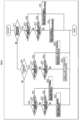
- FIG. 2 is a flowchart showing the emission mode switching control performed by the control device 70.
- step S11 the control device 70 determines whether or not the leaning vehicle 10 is traveling straight. If the leaning vehicle 10 is traveling straight (step S11: YES), the control device 70 determines whether or not an oncoming vehicle is present (step S12). If no oncoming vehicle is present (step S12: NO), the control device 70 determines whether or not a preceding vehicle is present (step S13).
- step S14 the control device 70 controls light emission from the headlight 60 so as to have emission in a first straight-traveling emission mode (step S14).
- the first straight-traveling emission mode for example, the lower light source 62D, the upper central light source 62UC, the upper left light source 62UL, and the upper right light source 62UR are turned on. Then, the control device 70 terminates the emission mode switching control.
- step S12 If an oncoming vehicle is present (step S12: YES), the control device 70 controls light emission from the headlight 60 so as to have emission in a second straight-traveling emission mode (step S15). In the second straight-traveling emission mode, for example, the lower light source 62D is turned on. Then, the control device 70 terminates the emission mode switching control.
- step S13 If a preceding vehicle is present (step S13: YES), the control device 70 executes the processing of step S15 and subsequent steps.
- step S11 determines whether or not the leaning vehicle 10 is traveling straight (step S11: NO). If the leaning vehicle 10 is turning in the left direction L (step S16). If the leaning vehicle 10 is turning in the left direction L (step S16: YES), the control device 70 determines whether or not an oncoming vehicle is present in the upper left emission area (step S17). If no oncoming vehicle is present (step S17: NO), the control device 70 determines whether or not a preceding vehicle is present in the upper left emission area (step S18).
- the control device 70 controls light emission from the headlight 60 so as to have emission in a first left-turning emission mode (step S19).
- the first left-turning emission mode for example, the lower light source 62D, the upper central light source 62UC, and the upper left light source 62UL are turned on. Then, the control device 70 terminates the emission mode switching control.
- step S17 If an oncoming vehicle is present in the upper left emission area (step S17: YES), the control device 70 controls light emission from the headlight 60 so as to have emission in a second left-turning emission mode (step S20).
- the second left-turning emission mode for example, the lower light source 62D and the upper left light source 62UL are turned on. Then, the control device 70 terminates the emission mode switching control.
- step S18 If a preceding vehicle is present in the upper left emission area (step S18: YES), the control device 70 executes the processing of step S20 and subsequent steps.
- step S21 determines whether or not an oncoming vehicle is present in the upper right emission area. If no oncoming vehicle is present in the upper right emission area (step S21: NO), the control device 70 determines whether or not a preceding vehicle is present in the upper right emission area (step S22).
- the control device 70 controls light emission from the headlight 60 so as to have emission in a first right-turning emission mode (step S23).
- the first right-turning emission mode for example, the lower light source 62D, the upper central light source 62UC, and the upper right light source 62UR are turned on. Then, the control device 70 terminates the emission mode switching control.
- step S21 If an oncoming vehicle is present in the upper right emission area (step S21: YES), the control device 70 controls light emission from the headlight 60 so as to have emission in a second right-turning emission mode (step S24).
- the second right-turning emission mode for example, the lower light source 62D and the upper right light source 62UR are turned on. Then, the control device 70 terminates the emission mode switching control.
- step S22 If a preceding vehicle is present in the upper right emission area (step S22: YES), the control device 70 executes the processing of step S24 and subsequent steps.
- the headlight device 100 included in the leaning vehicle 10 can offer an increase in convenience, specifically as follows.
- the headlight device 100 When the leaning vehicle 10 is turning in the left direction L, the headlight device 100 forms the upper left emission area and maintains the brightness of the upper left emission area irrespective of whether or not an oncoming vehicle and/or a preceding vehicle is/are present in the upper left emission area.
- the upper left emission area is formed in a region that is covered by the view of the rider of the leaning vehicle 10 while the leaning vehicle 10 is turning in the left direction L.
- the direction in which the headlight 60 illuminates is the same as the direction in which the rider of the leaning vehicle 10 looks while the leaning vehicle 10 is turning in the left direction L.
- the headlight device 100 can expand the field of view of the rider of the leaning vehicle 10 while the leaning vehicle 10 is turning in the left direction L.
- a case of the leaning vehicle 10 turning in the right direction R will not be described herein, because it is simply the left-right opposite to the case of the leaning vehicle 10 turning in the left direction L.
- FIG. 3 shows some variations (A1)-(B3) of how the emission area changes while the leaning vehicle is traveling straight.
- the emission areas shown left are emission areas obtained when neither an oncoming vehicle nor a preceding vehicle is present while the leaning vehicle is traveling straight
- the emission areas shown right are emission areas obtained when an oncoming vehicle and/or a preceding vehicle is/are present in the upper left emission area while the leaning vehicle is traveling straight.
- the emission areas shown left are emission areas obtained when neither an oncoming vehicle nor a preceding vehicle is present while the leaning vehicle is traveling straight
- the emission areas shown right are emission areas obtained when an oncoming vehicle and/or a preceding vehicle is/are present in the upper right emission area while the leaning vehicle is traveling straight.
- FIG. 4A to FIG. 5B show some variations (A1)-(F6) of how the emission area changes while the leaning vehicle is turning.
- the leftmost emission areas are emission areas obtained when neither an oncoming vehicle nor a preceding vehicle is present while the leaning vehicle is traveling straight
- the middle emission areas are emission areas obtained when neither an oncoming vehicle nor a preceding vehicle is present in the upper left emission area (or in the upper right emission area in the cases of FIG. 5A and FIG. 5B ) while the leaning vehicle is turning in the left direction L (or in the right direction R in the cases of FIG. 5A and FIG. 5B )
- the rightmost emission areas are emission areas obtained when an oncoming vehicle and/or a preceding vehicle is/are present in the upper left emission area (or in the upper right emission area in the cases of FIG. 5A and FIG.
- an emission area corresponding to a light source being turned on is outlined with a solid line and rendered hatching.
- An emission area corresponding to a light source being turned off or being turned on in a dimmed manner is outlined with a broken line and not rendered hatching.
- the emission area formed by light emission from the headlight includes an upper left emission area UL, an upper central emission area UC, an upper right emission area UR, a lower left emission area DL, a lower central emission area DC, and a lower right emission area DR.
- the at least one lower light source includes at least one lower left light source that emits light so as to form the lower left emission area DL, at least one lower central light source that emits light so as to form the lower central emission area DC, and at least one lower right light source that emits light so as to form the lower right emission area DR.
- the headlight capable of forming the above-described emission areas is disclosed in WO2018/168249 for example, and therefore a detailed description thereof is omitted herein.
- Variations of how the emission area changes are not limited to the ones illustrated in FIG. 3 through FIG. 5B .
- FIG. 4A and FIG. 4B it may be possible that only either the lower central light source or the lower right light source is turned off or dimmed, if an oncoming vehicle and/or a preceding vehicle emerge(s) in the upper left emission area while the leaning vehicle is turning in the left direction L with the lower left light source, the lower central light source, and the lower right light source being turned on.
- the headlight may include plural lower left light sources, a lower central light source, plural lower right light sources, plural upper left light sources, an upper central light source, and plural upper right light sources.
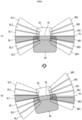
- the headlight having such a configuration emits light to form an emission area, an example of which is shown in FIG. 6 .
- the plural lower left light sources form plural lower left sub-emission areas DL1, DL2, DL3 included in the lower left emission area.
- the lower central light source forms a lower central emission area DC.
- the plural lower right light sources form plural lower right sub-emission areas DR1, DR2, DR3 included in the lower right emission area.
- the plural upper left light sources form plural upper left sub-emission areas UL1, UL2, UL3 included in the upper left emission area.
- the upper central light source forms an upper central emission area UC.
- the plural upper right light sources form plural upper right sub-emission areas UR1, UR2, UR3 included in the upper right emission area.
- the headlight capable of forming the above-described emission areas is disclosed in WO2018/168249 for example, and therefore a detailed description thereof is omitted herein.
- the control device may control light emission from the headlight such that the lower central emission area DC is formed while the upper central emission area UC is not formed.
- a left light source selected from the plural left light sources composed of the plural upper left light sources and the plural lower left light sources is turned on such that a left low-beam emission area, which is located below a horizontal reference line HL and closest to the horizontal reference line HL, is formed in accordance with the lean angle of the vehicle body.
- the left low-beam emission area is formed out of the plural lower left sub-emission areas DL1, DL2, DL3 and the plural upper left sub-emission areas UL1, UL2, UL3 in accordance with the lean angle of the vehicle body.
- a right light source selected from the plural right light sources composed of the plural upper right light sources and the plural lower right light sources is turned on such that a right low-beam emission area, which is located below the horizontal reference line HL and closest to the horizontal reference line HL, is formed in accordance with the lean angle of the vehicle body.
- the right low-beam emission area is formed out of the plural lower right sub-emission areas DR1, DR2, DR3 and the plural upper right sub-emission areas UR1, UR2, UR3 in accordance with the lean angle of the vehicle body.
- each of the left low-beam emission area, the lower central emission area DC, and the right low-beam emission area is rendered hatching.
- the left low-beam emission area and the right low-beam emission area in the pattern (B), which is adopted when the vehicle body leans in the left direction L, are different from those in the pattern (A), which is adopted when the vehicle body is upright.
- the horizontal reference line HL refers to a straight line formed by extending a boundary line BL in each the left direction L and the right direction R of the leaning vehicle, the boundary line BL being a line that defines the upper end of the lower central emission area DC and extends in the left-right direction of the leaning vehicle when the vehicle body is upright.
- the above-described headlight device can emit a low beam in an expanded range.
Landscapes
- Engineering & Computer Science (AREA)
- Mechanical Engineering (AREA)
- General Engineering & Computer Science (AREA)
- Lighting Device Outwards From Vehicle And Optical Signal (AREA)
Description
- The present teaching relates to a headlight device for use in a leaning vehicle, and specifically relates to a headlight device that changes an emission area without any operation made by a rider of the leaning vehicle.
- A leaning vehicle such as a motorcycle is conventionally known. The leaning vehicle includes a vehicle body. The vehicle body leans to the left when the leaning vehicle turns to the left, and leans to the right when the leaning vehicle turns to the right.
- Recently known is a headlight device for use in a leaning vehicle, the headlight device being configured to change its emission area without any operation made by a rider of the leaning vehicle. A headlight device of this type is disclosed in
WO2018/168249 . -
WO 2019/039051 A1 discloses a headlight device according toclaim 1, except that in this prior art device, when the oncoming vehicle and/or the preceding vehicle is/ are present in the upper left respectively right emission area while the leaning vehicle is turning in the left respectively right direction, the upper left respectively right emission area is reduced (instead of maintained as in the present invention) at least in its brightness as compared to when neither the oncoming vehicle nor the preceding vehicle is present in the upper left respectively right emission area while the leaning vehicle is turning in the left respectively right direction. - Technical Problem
- It is desired that the headlight device shown in the Literature above offers an increase in convenience.
- The present teaching aims to increase the convenience of a headlight device for use in a leaning vehicle, the headlight device being configured to change its emission area without any operation made by a rider of the leaning vehicle.
- The inventors of the present application conducted a test run of the leaning vehicle that includes a headlight device that changes its emission area without any operation made by a rider of the leaning vehicle. Consequently, the inventors found out the following.
- The inventors of the present application conducted a test run of the leaning vehicle that includes a headlight device that emits light to form an emission area including at least one of a lower emission area; an upper central emission area disposed farther in the upward direction than the lower emission area; an upper left emission area disposed farther in the left direction than the upper central emission area; or an upper right emission area disposed farther in the right direction than the upper central emission area.
- The foregoing headlight device changes its emission area while the leaning vehicle is turning. More specifically, when the leaning vehicle turns left, the headlight device forms the upper left emission area. But if an oncoming vehicle and/or a preceding vehicle is/are present in the upper left emission area, the headlight device does not form the upper left emission area. A case of the leaning vehicle turning right will not be described herein, because it is simply the left-right opposite to the case of the leaning vehicle turning left.
- While the leaning vehicle is turning left, the upper left emission area is formed in a region that is covered by the view of a rider of the leaning vehicle during the turn of the leaning vehicle. Thus, if the upper left emission area is not formed because of the presence of an oncoming vehicle and/or a preceding vehicle in the upper left emission area while the leaning vehicle is turning left, the ease of viewing, which is a benefit of formation of the upper left emission area, cannot be obtained. The same applies to the left-right opposite side, i.e., to the case of the leaning vehicle turning right.
- The inventors of the present application studied how dazzling the upper left emission area is to a rider of an oncoming vehicle or a preceding vehicle that is present in the upper left emission area while the leaning vehicle is turning left. It was consequently discovered that the rider of the oncoming vehicle or the preceding vehicle is not dazzled so much even though the upper left emission area is formed. The inventors conducted the same studies also for the case of the leaning vehicle turning right, and obtained the same discovery.
- This knowledge was not obtained until the present inventors conducted the studies. The present teaching is accomplished based on such knowledge.
- A headlight device according to an embodiment of the present teaching is used in a leaning vehicle including a vehicle body that leans in a left direction when turning in the left direction and leans in a right direction when turning in the right direction. The headlight device includes a headlight and a control device. The headlight is configured to emit light frontward of the leaning vehicle to form: a lower emission area; an upper central emission area disposed farther in an upward direction than the lower emission area; an upper left emission area disposed farther in the left direction than the upper central emission area; and an upper right emission area disposed farther in the right direction than the upper central emission area. The control device controls light emission from the headlight such that the light emission from the headlight changes without any operation made by a rider of the leaning vehicle.
- In the headlight device according to the embodiment of the present teaching, the control device controls light emission from the headlight such that when neither an oncoming vehicle nor a preceding vehicle is present in the upper left emission area while the leaning vehicle is traveling straight, the upper left emission area is formed, and when the oncoming vehicle and/or the preceding vehicle is/are present in the upper left emission area while the leaning vehicle is traveling straight, the upper left emission area is reduced at least in its brightness as compared to when neither the oncoming vehicle nor the preceding vehicle is present in the upper left emission area while the leaning vehicle is traveling straight. The control device controls light emission from the headlight such that when neither the oncoming vehicle nor the preceding vehicle is present in the upper left emission area while the leaning vehicle is turning in the left direction, the upper left emission area is formed, and when the oncoming vehicle and/or the preceding vehicle is/are present in the upper left emission area while the leaning vehicle is turning in the left direction, the upper left emission area is maintained at least in its brightness as compared to when neither the oncoming vehicle nor the preceding vehicle is present in the upper left emission area while the leaning vehicle is turning in the left direction. The control device controls light emission from the headlight such that when neither the oncoming vehicle nor the preceding vehicle is present in the upper right emission area while the leaning vehicle is traveling straight, the upper right emission area is formed, and when the oncoming vehicle and/or the preceding vehicle is/are present in the upper right emission area while the leaning vehicle is traveling straight, the upper right emission area is reduced at least in its brightness as compared to when neither the oncoming vehicle nor the preceding vehicle is present in the upper right emission area while the leaning vehicle is traveling straight. The control device controls light emission from the headlight such that when neither the oncoming vehicle nor the preceding vehicle is present in the upper right emission area while the leaning vehicle is turning in the right direction, the upper right emission area is formed, and when the oncoming vehicle and/or the preceding vehicle is/are present in the upper right emission area while the leaning vehicle is turning in the right direction, the upper right emission area is maintained at least in its brightness as compared to when neither the oncoming vehicle nor the preceding vehicle is present in the upper right emission area while the leaning vehicle is turning in the right direction.
- The foregoing headlight device can offer an increase in convenience, specifically as follows.
- When the leaning vehicle is turning in the left direction, the foregoing headlight device forms the upper left emission area and maintains the brightness of the upper left emission area irrespective of whether or not the oncoming vehicle and/or the preceding vehicle is/are present. Here, the upper left emission area is formed in a region that is covered by the view of the rider of the leaning vehicle while the leaning vehicle is turning in the left direction. In other words, the direction in which the headlight illuminates is the same as the direction in which the rider of the leaning vehicle looks while the leaning vehicle is turning in the left direction. Accordingly, the foregoing headlight device can expand the field of view of the rider of the leaning vehicle while the leaning vehicle is turning in the left direction. A case of the leaning vehicle turning in the right direction will not be described herein, because it is simply the left-right opposite to the case of the leaning vehicle turning in the left direction.
- In the headlight device according to the embodiment of the present teaching, an emission area is formed by, for example, a light source provided to the headlight emitting light frontward of the leaning vehicle. The light source is, for example, a light emitting diode, a semiconductor laser, an HID (High-Intensity Discharge) valve, a halogen bulb, an incandescent light bulb, or the like. The light source may directly emit light frontward of the leaning vehicle, or may emit light frontward of the leaning vehicle via a reflection member that reflects light.
- In the headlight device according to the embodiment of the present teaching, the control device is an ECU (Electric Control Unit), for example. The ECU is implemented by, for example, a combination of an IC (Integrated Circuit), an electronic component, a circuit board, and the like. A control performed by the control device is implemented by, for example, a CPU (Central Processing Unit) reading out a program stored in a non-volatile memory and executing a predetermined process in accordance with the program.
- In the present teaching, the oncoming vehicle is not particularly limited, and the only limitation thereon is that it is a vehicle traveling in a direction opposite to a direction in which a leaning vehicle including the headlight device according to the embodiment of the present teaching is traveling.
- In the present teaching, the preceding vehicle is not particularly limited, and the only limitation thereon is that it is a vehicle traveling in the same direction as the direction in which a leaning vehicle including the headlight device according to the embodiment of the present teaching is traveling. The preceding vehicle may not always need to be traveling in the same driving lane as the driving lane where a leaning vehicle including the headlight device according to the embodiment of the present teaching is traveling.
- In the headlight device according to the embodiment of the present teaching, the term "operation" in the wording "without any operation made by the rider of the leaning vehicle" does not include, for example, an operation that the rider of the leaning vehicle performs to select a control mode in which the emission area is changed in accordance with a traveling status of the vehicle.
- In the headlight device according to the embodiment of the present teaching, an aspect in which the upper central emission area is formed farther in the upward direction than the lower emission area is not particularly limited, and the only limitation thereon is that the center of the upper central emission area is formed above the center of the lower emission area. The lower end of the upper central emission area may overlap the upper end of the lower emission area, may be above the upper end of the lower emission area, or may be below the upper end of the lower emission area. An aspect in which the lower end of the upper central emission area overlaps the upper end of the lower emission area encompasses an aspect in which at least a part of the lower end of the upper central emission area overlaps at least a part of the upper end of the lower emission area.
- In the headlight device according to the embodiment of the present teaching, an aspect in which the upper left emission area is formed farther in the left direction than the upper central emission area is not particularly limited, and the only limitation thereon is that the center of the upper left emission area is formed to the left of the center of the upper central emission area. The right end of the upper left emission area may overlap the left end of the upper central emission area, may be to the left of the left end of the upper central emission area, or may be to the right of the left end of the upper central emission area. An aspect in which the right end of the upper left emission area overlaps the left end of the upper central emission area encompasses an aspect in which at least a part of the right end of the upper left emission area overlaps at least a part of the left end of the upper central emission area.
- In the headlight device according to the embodiment of the present teaching, an aspect in which the upper right emission area is formed farther in the right direction than the upper central emission area is not particularly limited, and the only limitation thereon is that the center of the upper right emission area is formed to the right of the center of the upper central emission area. The left end of the upper right emission area may overlap the right end of the upper central emission area, may be to the right of the right end of the upper central emission area, or may be to the left of the right end of the upper central emission area. An aspect in which the left end of the upper right emission area overlaps the right end of the upper central emission area encompasses an aspect in which at least a part of the left end of the upper right emission area overlaps at least a part of the right end of the upper central emission area.
- In the headlight device according to the embodiment of the present teaching, the wording "maintain the brightness of the emission area" means that the brightness of the emission area given by light emitted from the headlight is kept constant or substantially constant. A state where the light source is controlled so as to keep the brightness of the emission area constant, and as a result the brightness of the emission area appears to be kept constant to a rider is one example of the state where the brightness of the emission area given by light emitted from the headlight is kept constant. For instance, there can be a situation where a voltage applied to the light source is controlled so as to maintain the brightness of the emission area, but nevertheless the brightness of the emission area changes due to disturbance. This is one example of the state where the brightness of the emission area given by light emitted from the headlight is kept substantially constant. The disturbance is, for example, a voltage fluctuation occurring in a battery that is provided in the leaning vehicle and stores electric power to be supplied to the light source. An aspect in which the light source is controlled so as to keep the brightness of the emission area constant encompasses, for example, an aspect in which the light source comprises plural light sources for emitting light to form the emission area, and voltages applied to the plural light sources are adjusted relative to one another. The aspect in which the voltages applied to the plural light sources are adjusted relative to one another encompasses, for example, an aspect in which a voltage applied to one light source is set lower while a voltage applied to another light source is set higher. In short, in a case of forming the emission area by the plural light sources emitting light, it is acceptable to adjust voltages applied to the plural light sources relative to one another, as long as the brightness of the emission area appears to be kept constant to the rider. To obtain a state where the brightness of the emission area looks constant to the rider, it is just required that, for example, the brightness of a portion of the emission area that looks brightest to the rider appears to be kept constant to the rider. Accordingly, for example, even if the brightest-looking portion of the emission area is displaced as a result of adjusting the voltages applied to the plural light sources relative to one another, such a state is still included in the state where the brightness of the emission area is kept constant, as long as the brightness of the brightest-looking portion is kept constant. Even when a control for changing the brightness is performed to an extent that the brightness of the emission area is still kept constant to the rider, such a state is one example of the state where the brightness of the emission area given by light emitted from the headlight is kept substantially constant.
- In the headlight device according to the embodiment of the present teaching, an aspect in which the emission area is reduced in its brightness encompasses an aspect in which the emission area is partially reduced in its brightness, for example.
- In the headlight device according to the embodiment of the present teaching, the aspect in which the emission area is reduced in its brightness encompasses an aspect in which the emission area is removed. Thus, the aspect in which the emission area is reduced in its brightness encompasses not only an aspect in which the light source for emitting light to form the emission area is turned on in a dimmed state but also an aspect in which the light source for emitting light to form the emission area is turned off.
- In the headlight device according to the embodiment of the present teaching, the control device may control light emission from the headlight such that while the leaning vehicle is turning in the left direction, at least one of the lower emission area, the upper central emission area, or the upper right emission area is reduced in its brightness. The control device may control light emission from the headlight such that while the leaning vehicle is turning in the right direction, at least one of the lower emission area, the upper central emission area, or the upper left emission area is reduced in its brightness.
- In the headlight device according to the embodiment of the present teaching, the lower emission area may include a lower central emission area formed farther in a downward direction than the upper central emission area, a lower left emission area formed farther in the downward direction than the upper left emission area and farther in the left direction than the lower central emission area, and a lower right emission area formed farther in the downward direction than the upper right emission area and farther in the right direction than the lower central emission area.
- In the headlight device according to the embodiment of the present teaching, the lower left emission area, the lower right emission area, the upper left emission area, and the upper right emission area may each include plural sub-emission areas that are arranged in an up-down direction of the vehicle body. The control device may control light emission from the headlight such that the lower central emission area is formed while the upper central emission area is not formed. In this case, a left low-beam emission area, which is located below a horizontal reference line and closest to the horizontal reference line, may be formed in accordance with a lean angle of the vehicle body, the left low-beam emission area being formed out of the plural sub-emission areas included in the lower left emission area and the plural sub-emission areas included in the upper left emission area. A right low-beam emission area, which is located below the horizontal reference line and closest to the horizontal reference line, may be formed in accordance with a lean angle of the vehicle body, the right low-beam emission area being formed out of the plural sub-emission areas included in the lower right emission area and the plural sub-emission areas included in the upper right emission area. The horizontal reference line is a straight line formed by extending a boundary line in each of the left direction and the right direction of the leaning vehicle, the boundary line being a line that defines the upper end of the lower central emission area and extends in a left-right direction of the leaning vehicle when the vehicle body is upright.
- In the headlight device according to the embodiment of the present teaching, the wording "the left low-beam emission area being located below a horizontal reference line and closest to the horizontal reference line" refers to a sub-emission area whose center is closest to the horizontal reference line among the plural sub-emission areas that are formed farther in the left direction than the lower central emission area and have their centers located below the horizontal reference line, for example. If a sub-emission area is formed as the left low-beam emission area but its center is then displaced as a result of a change in the lean angle of the vehicle body so that its center overlaps the horizontal reference line or comes above the horizontal reference line, the sub-emission area is no longer formed as the left low-beam emission area.
- In the headlight device according to the embodiment of the present teaching, the wording "the right low-beam emission area being located below the horizontal reference line and closest to the horizontal reference line" refers to a sub-emission area whose center is closest to the horizontal reference line among the plural sub-emission areas that are formed farther in the right direction than the lower central emission area and have their centers located below the horizontal reference line, for example. If a sub-emission area is formed as the right low-beam emission area but its center is then displaced as a result of a change in the lean angle of the vehicle body so that its center overlaps the horizontal reference line or comes above the horizontal reference line, the sub-emission area is no longer formed as the right low-beam emission area.
- The headlight device according to the embodiment of the present teaching may further include a detection device. The detection device detects an oncoming vehicle and/or a preceding vehicle. The detection device may be configured to detect light emitted from the oncoming vehicle and/or the preceding vehicle.
- In the headlight device according to the embodiment of the present teaching, the headlight may include: at least one light source that emits light frontward the leaning vehicle; and a housing that accommodates the at least one light source. The housing accommodates the detection device. The housing may include a housing body and an outer lens. The outer lens is attached to the housing body, and is disposed more frontward than the at least one light source. When viewed in the rear direction of the leaning vehicle, the outer lens has a circular shape, for example. The housing may accommodate the control device.
- A leaning vehicle according to an embodiment of the present teaching includes: a vehicle body that leans in a left direction when turning in the left direction and leans in a right direction when turning in the right direction; and the headlight device according to the above-described embodiment of the present teaching.
- These and other objects, features, aspects and advantages of the present teaching will become apparent from the following detailed description, which, taken in conjunction with the accompanying drawings, discloses some embodiments of the present teaching. As used herein, the term "and/or" includes any and all combinations of one or more of the associated listed items. As used herein, the terms "including", "comprising", or "having", and variations thereof specify the presence of stated features, steps, operations, elements, components, and/or equivalents thereof, and can include one or more of steps, operations, elements, components, and/or their groups. Unless otherwise defined, all terms (including technical and scientific terms) used herein have the same meaning as commonly understood by one of ordinary skill in the art to which the present teaching belongs. It will be further understood that terms, such as those defined in commonly used dictionaries, should be interpreted as having a meaning that is consistent with their meaning in the context of the present disclosure and relevant art and should not be interpreted in an idealized or overly formal sense unless expressly so defined herein. It will be understood that the description of the present teaching discloses a number of techniques and steps. Each of these has individual benefit and each can also be used in conjunction with one or more, or in some cases all, of the other disclosed techniques. Accordingly, for the sake of clarity, this description will refrain from repeating every possible combination of the individual steps in an unnecessary fashion. In the description given below, for the purposes of explanation, numerous specific details are set forth in order to provide a thorough understanding of the present teaching. It will be apparent, however, that those skilled in the art may practice the present teaching without these specific details. The present disclosure is to be considered as an exemplification of the present teaching, and is not intended to limit the present teaching to the specific embodiments illustrated by drawings or descriptions below. The scope of protection is defined by the appended claims.
- According to the present teaching, the convenience of a headlight device for use in a leaning vehicle can be increased, the headlight device being configured to change its emission area without any operation made by a rider of the leaning vehicle.
-
- [
FIG. 1 ] A diagram containing a left side view of a leaning vehicle according to an embodiment of the present teaching, and a block diagram showing a schematic configuration of a headlight device included in the leaning vehicle. - [
FIG. 2 ] A flowchart showing an emission mode switching control, which is performed by a control device. - [
FIG. 3 ] A diagram for illustrating how an emission area changes in response to emergence of an oncoming vehicle and/or a preceding vehicle while the leaning vehicle is traveling straight. - [
FIG. 4A ] A diagram for illustrating how the emission area changes in response to a situation where the leaning vehicle traveling straight with no presence of either an oncoming vehicle or a preceding vehicle turns left, and then an oncoming vehicle and/or a preceding vehicle emerges while the leaning vehicle is turning left. - [
FIG. 4B ] A diagram for illustrating how the emission area changes in response to the situation where the leaning vehicle traveling straight with no presence of either an oncoming vehicle or a preceding vehicle turns left, and then an oncoming vehicle and/or a preceding vehicle emerges while the leaning vehicle is turning left. - [
FIG. 5A ] A diagram for illustrating how the emission area changes in response to a situation where the leaning vehicle traveling straight with no presence of either an oncoming vehicle or a preceding vehicle turns right, and then an oncoming vehicle and/or a preceding vehicle emerges while the leaning vehicle is turning right. - [
FIG. 5B ] A diagram for illustrating how the emission area changes in response to the situation where the leaning vehicle traveling straight with no presence of either an oncoming vehicle or a preceding vehicle turns right, and then an oncoming vehicle and/or a preceding vehicle emerges while the leaning vehicle is turning right. - [
FIG. 6 ] A diagram for illustrating another example of an emission area that is formed by light emitted from a headlight, and for illustrating how the emission area changes in response to a shift from a state where a vehicle body is upright to a state where the vehicle body is leaning left. - In the following, details of a leaning vehicle according to an embodiment of the present teaching will be described with reference to the drawings. The embodiment described below is just an example. The present teaching should not be limited in any way by the embodiment described below.
- Referring to
FIG. 1 , a leaningvehicle 10 according to the embodiment of the present teaching will be described. A diagram inFIG. 1 contains a left side view of the leaningvehicle 10 and a block diagram of aheadlight device 100 included in the leaningvehicle 10. - Referring to
FIG. 1 , the leaningvehicle 10 includes avehicle body 20,plural wheels 30, apower unit 40, and ahandlebar 50. These will be described below. - The
vehicle body 20 leans in a left direction L when the leaningvehicle 10 turns in the left direction L, and leans in a right direction R when the leaningvehicle 10 turns in the right direction R. Thevehicle body 20 includes avehicle body frame 201 and aseat 202. Thevehicle body frame 201 supports thepower unit 40. Thepower unit 40 includes, for example, an engine as a drive source, a transmission, and the like. On theseat 202, a rider of the leaningvehicle 10 sits. - The
vehicle body 20 supports theplural wheels 30. Theplural wheels 30 lean in the left direction L together with thevehicle body 20 when the leaningvehicle 10 turns in the left direction L, and lean in the right direction R together with thevehicle body 20 when the leaningvehicle 10 turns in the right direction R. Theplural wheels 30 include afront wheel 30F and arear wheel 30R, thefront wheel 30F being steered by the rider operating thehandlebar 50, therear wheel 30R being rotated by receiving power of thepower unit 40. - The leaning
vehicle 10 further includes theheadlight device 100. Theheadlight device 100 includes aheadlight 60 and acontrol device 70. - The
headlight 60 emits light frontward of the leaningvehicle 10. Theheadlight 60 includes plural light sources 62. Each of the plural light sources 62 emits light frontward of the leaningvehicle 10. Theheadlight 60 is supported by thevehicle body 20. - The plural light sources 62 include at least one
lower light source 62D, at least one upper central light source 62UC, at least one upper left light source 62UL, and at least one upper right light source 62UR. InFIG. 1 , for reasons of expediency, onelower light source 62D, one upper central light source 62UC, one upper left light source 62UL, and one upper right light source UR are shown. - The lower
light source 62D emits light such that a lower emission area is formed. The upper central light source 62UC emits light such that an upper central emission area is formed farther in the upward direction than the lower emission area. The upper left light source 62UL emits light such that an upper left emission area is formed farther in the left direction than the upper central emission area. The upper right light source 62UR emits light such that an upper right emission area is formed farther in the right direction than the upper central emission area. - The emission areas are formed by the
headlight 60 emitting light frontward of the leaningvehicle 10. The emission areas can be checked by placing a screen in front of the leaningvehicle 10 and causing theheadlight 60 to emit light toward the screen. - The
control device 70 controls light emission from theheadlight 60, by turning on theheadlight 60 in such a manner that at least one of the plural light sources 62 is turned off or dimmed in accordance with a traveling status of the leaningvehicle 10 and without any operation made by the rider of the leaningvehicle 10. Thus, thecontrol device 70 controls light emission from theheadlight 60 such that an emission area of theheadlight 60 changes in accordance with the traveling status of the leaningvehicle 10. In other words, thecontrol device 70 controls light emission from theheadlight 60 such that the light emission from theheadlight 60 changes in accordance with the traveling status of the leaningvehicle 10. Here, the traveling status of the leaningvehicle 10 encompasses leaning of thevehicle body 20 and the presence of an oncoming vehicle and/or a preceding vehicle, for example. The leaning of thevehicle body 20 is determined based on a signal from a lean angle detection device configured to detect a lean angle of thevehicle body 20, for example. The presence of an oncoming vehicle and/or a preceding vehicle is determined based on a signal from a vehicle detection device configured to detect an oncoming vehicle and/or a preceding vehicle, for example. - The
control device 70 controls light emission from theheadlight 60 such that when neither an oncoming vehicle nor a preceding vehicle is present in the upper left emission area while the leaningvehicle 10 is traveling straight, the upper left emission area is formed, and when an oncoming vehicle and/or a preceding vehicle is/are present in the upper left emission area while the leaningvehicle 10 is traveling straight, the upper left emission area is reduced at least in its brightness as compared to when neither an oncoming vehicle nor a preceding vehicle is present in the upper left emission area while the leaningvehicle 10 is traveling straight. The control device 70 controls light emission from the headlight 60 such that when neither an oncoming vehicle nor a preceding vehicle is present in the upper left emission area while the leaning vehicle 10 is turning in the left direction L, the upper left emission area is formed, and when an oncoming vehicle and/or a preceding vehicle is/are present in the upper left emission area while the leaning vehicle 10 is turning in the left direction L, the upper left emission area is maintained at least in its brightness as compared to when neither an oncoming vehicle nor a preceding vehicle is present in the upper left emission area while the leaning vehicle 10 is turning in the left direction L. Here, it may be possible that when an oncoming vehicle and/or a preceding vehicle is/are present in the upper left emission area while the leaning vehicle 10 is turning in the left direction L, the control device 70 maintains the brightness of the upper left emission area and reduces the brightness of at least one of the upper central emission area, the upper right emission area, or the lower emission area as compared to when neither an oncoming vehicle nor a preceding vehicle is present in the upper left emission area while the leaning vehicle 10 is turning in the left direction L, or the control device 70 maintains the brightness of the upper left emission area, the brightness of the upper central emission area, the brightness of the upper right emission area, and the brightness of the lower emission area as compared to when neither an oncoming vehicle nor a preceding vehicle is present in the upper left emission area while the leaning vehicle 10 is turning in the left direction L. - The
control device 70 controls light emission from theheadlight 60 such that when neither an oncoming vehicle nor a preceding vehicle is present in the upper right emission area while the leaningvehicle 10 is traveling straight, the upper right emission area is formed, and when an oncoming vehicle and/or a preceding vehicle is/are present in the upper right emission area while the leaningvehicle 10 is traveling straight, the upper right emission area is reduced at least in its brightness as compared to when neither an oncoming vehicle nor a preceding vehicle is present in the upper right emission area while the leaningvehicle 10 is traveling straight. The control device 70 controls light emission from the headlight 60 such that when neither an oncoming vehicle nor a preceding vehicle is present in the upper right emission area while the leaning vehicle 10 is turning in the right direction R, the upper right emission area is formed, and when an oncoming vehicle and/or a preceding vehicle is/are present in the upper right emission area while the leaning vehicle 10 is turning in the right direction R, the upper right emission area is maintained at least in its brightness as compared to when neither an oncoming vehicle nor a preceding vehicle is present in the upper right emission area while the leaning vehicle 10 is turning in the right direction R. Here, it may be possible that when an oncoming vehicle and/or a preceding vehicle is/are present in the upper right emission area while the leaning vehicle 10 is turning in the right direction R, the control device 70 maintains the brightness of the upper right emission area and reduces the brightness of at least one of the upper central emission area, the upper left emission area, or the lower emission area as compared to when neither an oncoming vehicle nor a preceding vehicle is present in the upper right emission area while the leaning vehicle 10 is turning in the right direction R, or the control device 70 maintains the brightness of the upper left emission area, the brightness of the upper central emission area, the brightness of the upper right emission area, and the brightness of the lower emission area as compared to when neither an oncoming vehicle nor a preceding vehicle is present in the upper right emission area while the leaning vehicle 10 is turning in the right direction R. - An emission mode switching control, which is performed by the
control device 70, will be described with reference toFIG. 2. FIG. 2 is a flowchart showing the emission mode switching control performed by thecontrol device 70. - First, in step S11, the
control device 70 determines whether or not the leaningvehicle 10 is traveling straight. If the leaningvehicle 10 is traveling straight (step S11: YES), thecontrol device 70 determines whether or not an oncoming vehicle is present (step S12). If no oncoming vehicle is present (step S12: NO), thecontrol device 70 determines whether or not a preceding vehicle is present (step S13). - If no preceding vehicle is present (step S13: NO), the
control device 70 controls light emission from theheadlight 60 so as to have emission in a first straight-traveling emission mode (step S14). In the first straight-traveling emission mode, for example, the lowerlight source 62D, the upper central light source 62UC, the upper left light source 62UL, and the upper right light source 62UR are turned on. Then, thecontrol device 70 terminates the emission mode switching control. - If an oncoming vehicle is present (step S12: YES), the
control device 70 controls light emission from theheadlight 60 so as to have emission in a second straight-traveling emission mode (step S15). In the second straight-traveling emission mode, for example, the lowerlight source 62D is turned on. Then, thecontrol device 70 terminates the emission mode switching control. - If a preceding vehicle is present (step S13: YES), the
control device 70 executes the processing of step S15 and subsequent steps. - If the leaning
vehicle 10 is not traveling straight (step S11: NO), thecontrol device 70 determines whether or not the leaningvehicle 10 is turning in the left direction L (step S16). If the leaningvehicle 10 is turning in the left direction L (step S16: YES), thecontrol device 70 determines whether or not an oncoming vehicle is present in the upper left emission area (step S17). If no oncoming vehicle is present (step S17: NO), thecontrol device 70 determines whether or not a preceding vehicle is present in the upper left emission area (step S18). - If no preceding vehicle is present in the upper left emission area (step S18: NO), the
control device 70 controls light emission from theheadlight 60 so as to have emission in a first left-turning emission mode (step S19). In the first left-turning emission mode, for example, the lowerlight source 62D, the upper central light source 62UC, and the upper left light source 62UL are turned on. Then, thecontrol device 70 terminates the emission mode switching control. - If an oncoming vehicle is present in the upper left emission area (step S17: YES), the
control device 70 controls light emission from theheadlight 60 so as to have emission in a second left-turning emission mode (step S20). In the second left-turning emission mode, for example, the lowerlight source 62D and the upper left light source 62UL are turned on. Then, thecontrol device 70 terminates the emission mode switching control. - If a preceding vehicle is present in the upper left emission area (step S18: YES), the
control device 70 executes the processing of step S20 and subsequent steps. - If the leaning
vehicle 10 is turning in the right direction R (step S16: NO), thecontrol device 70 determines whether or not an oncoming vehicle is present in the upper right emission area (step S21). If no oncoming vehicle is present in the upper right emission area (step S21: NO), thecontrol device 70 determines whether or not a preceding vehicle is present in the upper right emission area (step S22). - If no preceding vehicle is present in the upper right emission area (step S22: NO), the
control device 70 controls light emission from theheadlight 60 so as to have emission in a first right-turning emission mode (step S23). In the first right-turning emission mode, for example, the lowerlight source 62D, the upper central light source 62UC, and the upper right light source 62UR are turned on. Then, thecontrol device 70 terminates the emission mode switching control. - If an oncoming vehicle is present in the upper right emission area (step S21: YES), the
control device 70 controls light emission from theheadlight 60 so as to have emission in a second right-turning emission mode (step S24). In the second right-turning emission mode, for example, the lowerlight source 62D and the upper right light source 62UR are turned on. Then, thecontrol device 70 terminates the emission mode switching control. - If a preceding vehicle is present in the upper right emission area (step S22: YES), the
control device 70 executes the processing of step S24 and subsequent steps. - The
headlight device 100 included in the leaningvehicle 10 can offer an increase in convenience, specifically as follows. - When the leaning
vehicle 10 is turning in the left direction L, theheadlight device 100 forms the upper left emission area and maintains the brightness of the upper left emission area irrespective of whether or not an oncoming vehicle and/or a preceding vehicle is/are present in the upper left emission area. Here, the upper left emission area is formed in a region that is covered by the view of the rider of the leaningvehicle 10 while the leaningvehicle 10 is turning in the left direction L. In other words, the direction in which theheadlight 60 illuminates is the same as the direction in which the rider of the leaningvehicle 10 looks while the leaningvehicle 10 is turning in the left direction L. Accordingly, theheadlight device 100 can expand the field of view of the rider of the leaningvehicle 10 while the leaningvehicle 10 is turning in the left direction L. A case of the leaningvehicle 10 turning in the right direction R will not be described herein, because it is simply the left-right opposite to the case of the leaningvehicle 10 turning in the left direction L. - Variations of the headlight device will be described with reference to
FIG. 3 through FIG. 5B .FIG. 3 shows some variations (A1)-(B3) of how the emission area changes while the leaning vehicle is traveling straight. In the variations (A1)-(A3), the emission areas shown left are emission areas obtained when neither an oncoming vehicle nor a preceding vehicle is present while the leaning vehicle is traveling straight, and the emission areas shown right are emission areas obtained when an oncoming vehicle and/or a preceding vehicle is/are present in the upper left emission area while the leaning vehicle is traveling straight. In the variations (B1)-(B3), the emission areas shown left are emission areas obtained when neither an oncoming vehicle nor a preceding vehicle is present while the leaning vehicle is traveling straight, and the emission areas shown right are emission areas obtained when an oncoming vehicle and/or a preceding vehicle is/are present in the upper right emission area while the leaning vehicle is traveling straight.FIG. 4A to FIG. 5B show some variations (A1)-(F6) of how the emission area changes while the leaning vehicle is turning. In each of the variations, the leftmost emission areas are emission areas obtained when neither an oncoming vehicle nor a preceding vehicle is present while the leaning vehicle is traveling straight, the middle emission areas are emission areas obtained when neither an oncoming vehicle nor a preceding vehicle is present in the upper left emission area (or in the upper right emission area in the cases ofFIG. 5A andFIG. 5B ) while the leaning vehicle is turning in the left direction L (or in the right direction R in the cases ofFIG. 5A andFIG. 5B ), and the rightmost emission areas are emission areas obtained when an oncoming vehicle and/or a preceding vehicle is/are present in the upper left emission area (or in the upper right emission area in the cases ofFIG. 5A andFIG. 5B ) while the leaning vehicle is turning in the left direction L (or in the right direction R in the cases ofFIG. 5A andFIG. 5B ). InFIG. 3 through FIG. 5B , an emission area corresponding to a light source being turned on is outlined with a solid line and rendered hatching. An emission area corresponding to a light source being turned off or being turned on in a dimmed manner is outlined with a broken line and not rendered hatching. - In
FIG. 3 through FIG. 5B , the emission area formed by light emission from the headlight includes an upper left emission area UL, an upper central emission area UC, an upper right emission area UR, a lower left emission area DL, a lower central emission area DC, and a lower right emission area DR. Thus, the at least one lower light source includes at least one lower left light source that emits light so as to form the lower left emission area DL, at least one lower central light source that emits light so as to form the lower central emission area DC, and at least one lower right light source that emits light so as to form the lower right emission area DR. The headlight capable of forming the above-described emission areas is disclosed inWO2018/168249 for example, and therefore a detailed description thereof is omitted herein. - Variations of how the emission area changes are not limited to the ones illustrated in
FIG. 3 through FIG. 5B . For example, inFIG. 4A andFIG. 4B , it may be possible that only either the lower central light source or the lower right light source is turned off or dimmed, if an oncoming vehicle and/or a preceding vehicle emerge(s) in the upper left emission area while the leaning vehicle is turning in the left direction L with the lower left light source, the lower central light source, and the lower right light source being turned on. For example, inFIG. 5A andFIG. 5B , it may be possible that only either the lower central light source or the lower left light source is turned off or dimmed, if an oncoming vehicle and/or a preceding vehicle emerge(s) in the upper right emission area while the leaning vehicle is turning in the right direction R with the lower left light source, the lower central light source, and the lower right light source being turned on. - The headlight may include plural lower left light sources, a lower central light source, plural lower right light sources, plural upper left light sources, an upper central light source, and plural upper right light sources. The headlight having such a configuration emits light to form an emission area, an example of which is shown in
FIG. 6 . - Referring to
FIG. 6 , the plural lower left light sources form plural lower left sub-emission areas DL1, DL2, DL3 included in the lower left emission area. The lower central light source forms a lower central emission area DC. The plural lower right light sources form plural lower right sub-emission areas DR1, DR2, DR3 included in the lower right emission area. The plural upper left light sources form plural upper left sub-emission areas UL1, UL2, UL3 included in the upper left emission area. The upper central light source forms an upper central emission area UC. The plural upper right light sources form plural upper right sub-emission areas UR1, UR2, UR3 included in the upper right emission area. The headlight capable of forming the above-described emission areas is disclosed inWO2018/168249 for example, and therefore a detailed description thereof is omitted herein. - The control device may control light emission from the headlight such that the lower central emission area DC is formed while the upper central emission area UC is not formed. In this case, a left light source selected from the plural left light sources composed of the plural upper left light sources and the plural lower left light sources is turned on such that a left low-beam emission area, which is located below a horizontal reference line HL and closest to the horizontal reference line HL, is formed in accordance with the lean angle of the vehicle body. In other words, the left low-beam emission area is formed out of the plural lower left sub-emission areas DL1, DL2, DL3 and the plural upper left sub-emission areas UL1, UL2, UL3 in accordance with the lean angle of the vehicle body. A right light source selected from the plural right light sources composed of the plural upper right light sources and the plural lower right light sources is turned on such that a right low-beam emission area, which is located below the horizontal reference line HL and closest to the horizontal reference line HL, is formed in accordance with the lean angle of the vehicle body. In other words, the right low-beam emission area is formed out of the plural lower right sub-emission areas DR1, DR2, DR3 and the plural upper right sub-emission areas UR1, UR2, UR3 in accordance with the lean angle of the vehicle body. In
FIG. 6 , each of the left low-beam emission area, the lower central emission area DC, and the right low-beam emission area is rendered hatching. The left low-beam emission area and the right low-beam emission area in the pattern (B), which is adopted when the vehicle body leans in the left direction L, are different from those in the pattern (A), which is adopted when the vehicle body is upright. It should be noted that the horizontal reference line HL refers to a straight line formed by extending a boundary line BL in each the left direction L and the right direction R of the leaning vehicle, the boundary line BL being a line that defines the upper end of the lower central emission area DC and extends in the left-right direction of the leaning vehicle when the vehicle body is upright. - The above-described headlight device can emit a low beam in an expanded range.
-
- 10
- leaning vehicle
- 20
- vehicle body
- 60
- headlight
- 62
- light source
- 62D
- lower light source
- 62UC
- upper central light source
- 62UL
- upper left light source
- 62UR
- upper right light source
- 70
- control device
- 100
- headlight device
Claims (5)
- A headlight device (100) for use in a leaning vehicle (10) including a vehicle body (20) that leans in a left direction when turning in the left direction and leans in a right direction when turning in the right direction, the headlight device (100) comprising:a headlight (60) configured to emit light frontward of the leaning vehicle (10) to form: a lower emission area; an upper central emission area (UC) disposed farther in an upward direction than the lower emission area; an upper left emission area (UL) disposed farther in the left direction than the upper central emission area (UC); and an upper right emission area (UR) disposed farther in the right direction than the upper central emission area (UC); anda control device (70) that is configured to control light emission from the headlight (60) such that the light emission from the headlight (60) changes without any operation made by a rider of the leaning vehicle (10),the control device (70) being configured tocontrol light emission from the headlight (60) such that when neither an oncoming vehicle nor a preceding vehicle is present in the upper left emission area (UL) while the leaning vehicle (10) is traveling straight, the upper left emission area (UL) is formed, and when the oncoming vehicle and/or the preceding vehicle is/are present in the upper left emission area (UL) while the leaning vehicle (10) is traveling straight, the upper left emission area (UL) is reduced at least in its brightness as compared to when neither the oncoming vehicle nor the preceding vehicle is present in the upper left emission area (UL) while the leaning vehicle (10) is traveling straight,control light emission from the headlight (60) such that when neither the oncoming vehicle nor the preceding vehicle is present in the upper left emission area (UL) while the leaning vehicle (10) is turning in the left direction, the upper left emission area (UL) is formed, and when the oncoming vehicle and/or the preceding vehicle is/are present in the upper left emission area (UL) while the leaning vehicle (10) is turning in the left direction, the upper left emission area (UL) is maintained at least in its brightness as compared to when neither the oncoming vehicle nor the preceding vehicle is present in the upper left emission area (UL) while the leaning vehicle (10) is turning in the left direction,control light emission from the headlight (60) such that when neither the oncoming vehicle nor the preceding vehicle is present in the upper right emission area (UR) while the leaning vehicle (10) is traveling straight, the upper right emission area (UR) is formed, and when the oncoming vehicle and/or the preceding vehicle is/are present in the upper right emission area (UR) while the leaning vehicle (10) is traveling straight, the upper right emission area (UR) is reduced at least in its brightness as compared to when neither the oncoming vehicle nor the preceding vehicle is present in the upper right emission area (UR) while the leaning vehicle (10) is traveling straight, andcontrol light emission from the headlight (60) such that when neither the oncoming vehicle nor the preceding vehicle is present in the upper right emission area (UR) while the leaning vehicle (10) is turning in the right direction, the upper right emission area (UR) is formed, and when the oncoming vehicle and/or the preceding vehicle is/are present in the upper right emission area (UR) while the leaning vehicle (10) is turning in the right direction, the upper right emission area (UR) is maintained at least in its brightness as compared to when neither the oncoming vehicle nor the preceding vehicle is present in the upper right emission area (UR) while the leaning vehicle (10) is turning in the right direction.
- The headlight device (100) according to claim 1, wherein
the control device (70) is configured tocontrol light emission from the headlight (60) such that while the leaning vehicle (10) is turning in the left direction, at least one of the lower emission area, the upper central emission area (UC), or the upper right emission area (UR) is reduced in its brightness, andcontrol light emission from the headlight (60) such that while the leaning vehicle (10) is turning in the right direction, at least one of the lower emission area, the upper central emission area (UC), or the upper left emission area (UL) is reduced in its brightness. - The headlight device (100) according to claim 1 or 2, wherein
the lower emission area includesa lower central emission area (DC) formed farther in a downward direction than the upper central emission area (UC),a lower left emission area (DL) formed farther in the downward direction than the upper left emission area (UL) and farther in the left direction than the lower central emission area (DC), anda lower right emission area (DR) formed farther in the downward direction than the upper right emission area (UR) and farther in the right direction than the lower central emission area (DC). - The headlight device (100) according to claim 3, whereinthe lower left emission area (DL), the lower right emission area (DR), the upper left emission area (UL), and the upper right emission area (UR) each include plural sub-emission areas that are arranged in an up-down direction of the vehicle body (20), andin a case of controlling light emission from the headlight (60) such that the lower central emission area (DC) is formed while the upper central emission area (UC) is not formed, the control device (70) is configured toform a left low-beam emission area in accordance with a lean angle of the vehicle body (20), the left low-beam emission area being formed out of the plural sub-emission areas (DL1, DL2, DL3) included in the lower left emission area (DL) and the plural sub-emission areas (UL1, UL2, UL3) included in the upper left emission area (UL), the left low-beam emission area being located below a horizontal reference line (HL) and closest to the horizontal reference line (HL), the horizontal reference line (HL) being a straight line formed by extending a boundary line in each the left direction and the right direction of the leaning vehicle (10), the boundary line being a line that defines the upper end of the lower central emission area (DC) and extends in a left-right direction of the leaning vehicle (10) when the vehicle body (20) is upright, andform a right low-beam emission area in accordance with a lean angle of the vehicle body (20), the right low-beam emission area being formed out of the plural sub-emission areas (DR1, DR2, DR3) included in the lower right emission area (DR) and the plural sub-emission areas (UR1, UR2, UR3) included in the upper right emission area (UR), the right low-beam emission area being located below the horizontal reference line (HL) and closest to the horizontal reference line (HL).
- A leaning vehicle (10) comprising:a vehicle body (20) that is configured to lean in a left direction when turning in the left direction and to lean in a right direction when turning in the right direction; andthe headlight device (100) according to any one of claims 1 to 4.
Applications Claiming Priority (2)
| Application Number | Priority Date | Filing Date | Title |
|---|---|---|---|
| PCT/JP2019/026901 WO2021005666A1 (en) | 2019-07-05 | 2019-07-05 | Headlight device, and tilting vehicle comprising said headlight device |
| PCT/JP2020/026028 WO2021006176A1 (en) | 2019-07-05 | 2020-07-02 | Headlight device and tilting vehicle comprising said headlight device |
Publications (3)
| Publication Number | Publication Date |
|---|---|
| EP3981674A1 EP3981674A1 (en) | 2022-04-13 |
| EP3981674A4 EP3981674A4 (en) | 2022-08-03 |
| EP3981674B1 true EP3981674B1 (en) | 2023-10-25 |
Family
ID=74115204
Family Applications (1)
| Application Number | Title | Priority Date | Filing Date |
|---|---|---|---|
| EP20836739.1A Active EP3981674B1 (en) | 2019-07-05 | 2020-07-02 | Headlight device and leaning vehicle including headlight device |
Country Status (5)
| Country | Link |
|---|---|
| US (2) | US20220119061A1 (en) |
| EP (1) | EP3981674B1 (en) |
| JP (1) | JP7329600B2 (en) |
| ES (1) | ES2969571T3 (en) |
| WO (2) | WO2021005666A1 (en) |
Families Citing this family (2)
| Publication number | Priority date | Publication date | Assignee | Title |
|---|---|---|---|---|
| DE112020006135T5 (en) * | 2019-12-16 | 2022-11-03 | Koito Manufacturing Co., Ltd. | vehicle lamp |
| JP7504733B2 (en) * | 2020-09-14 | 2024-06-24 | 株式会社小糸製作所 | Vehicle lighting device and vehicle system |
Family Cites Families (15)
| Publication number | Priority date | Publication date | Assignee | Title |
|---|---|---|---|---|
| US7445364B2 (en) * | 2001-01-19 | 2008-11-04 | Stephan Gropp | Headlight unit for single-track two-wheeled vehicles |
| TW489809U (en) * | 2001-04-04 | 2002-06-01 | Gnpack Corp | Improved structure for super-thin type multi-stage telescopic insertion rod structure |
| JP2013193562A (en) * | 2012-03-19 | 2013-09-30 | Yamaha Motor Co Ltd | Sub-headlight unit and sub-headlight system for vehicle turning in lean attitude, and vehicle turning in lean attitude |
| JP2013230774A (en) * | 2012-04-27 | 2013-11-14 | Yamaha Motor Co Ltd | Headlight unit and headlight system for vehicle that leans into turn, and vehicle that leans into turn |
| TWM489809U (en) | 2014-01-27 | 2014-11-11 | Univ Yuanpei | Active motorcycle headlight control device based on head gesture |
| CN106471309B (en) * | 2014-07-08 | 2019-04-23 | 三菱电机株式会社 | headlamp module |
| JP5946502B2 (en) * | 2014-09-24 | 2016-07-06 | ヤマハ発動機株式会社 | Headlamp system and saddle-ride type vehicle |
| JP6710048B2 (en) * | 2015-12-28 | 2020-06-17 | 川崎重工業株式会社 | vehicle |
| EP3401590B1 (en) * | 2016-03-17 | 2019-10-30 | Honda Motor Co., Ltd. | Lighting system |
| KR101832967B1 (en) * | 2016-05-16 | 2018-02-28 | 엘지전자 주식회사 | Control device mounted on vehicle and method for controlling the same |
| DE102016214120A1 (en) * | 2016-08-01 | 2018-02-01 | Robert Bosch Gmbh | Lighting device for a vehicle, vehicle with a lighting device and method for operating a lighting device for a vehicle |
| WO2018168249A1 (en) * | 2017-03-14 | 2018-09-20 | ヤマハ発動機株式会社 | Inclined vehicle headlight apparatus and inclined vehicle |
| JPWO2019039051A1 (en) * | 2017-08-24 | 2020-08-06 | 株式会社小糸製作所 | Vehicle lighting |
| EP3703977B1 (en) * | 2017-11-02 | 2024-06-26 | J.W. Speaker Corporation | Headlight matrix systems and methods for a vehicle |
| US10850661B2 (en) * | 2018-06-05 | 2020-12-01 | Indian Motorcycle International, LLC | Adaptive lighting system |
-
2019
- 2019-07-05 WO PCT/JP2019/026901 patent/WO2021005666A1/en not_active Ceased
-
2020
- 2020-07-02 WO PCT/JP2020/026028 patent/WO2021006176A1/en not_active Ceased
- 2020-07-02 EP EP20836739.1A patent/EP3981674B1/en active Active
- 2020-07-02 JP JP2021530658A patent/JP7329600B2/en active Active
- 2020-07-02 ES ES20836739T patent/ES2969571T3/en active Active
-
2021
- 2021-12-30 US US17/565,561 patent/US20220119061A1/en not_active Abandoned
-
2024
- 2024-04-25 US US18/646,085 patent/US12258091B2/en active Active
Also Published As
| Publication number | Publication date |
|---|---|
| US12258091B2 (en) | 2025-03-25 |
| ES2969571T3 (en) | 2024-05-21 |
| JP7329600B2 (en) | 2023-08-18 |
| WO2021005666A1 (en) | 2021-01-14 |
| JPWO2021006176A1 (en) | 2021-01-14 |
| EP3981674A4 (en) | 2022-08-03 |
| EP3981674A1 (en) | 2022-04-13 |
| US20240270341A1 (en) | 2024-08-15 |
| US20220119061A1 (en) | 2022-04-21 |
| WO2021006176A1 (en) | 2021-01-14 |
Similar Documents
| Publication | Publication Date | Title |
|---|---|---|
| US12258091B2 (en) | Headlight device and leaning vehicle including headlight device | |
| JP4782051B2 (en) | Motorcycle headlights | |
| JP4970145B2 (en) | Vehicle headlamp | |
| JP5719697B2 (en) | Vehicle headlamp device | |
| JP6745620B2 (en) | Headlamps for motorcycles | |
| JP6889588B2 (en) | Vehicle lighting | |
| JP5898930B2 (en) | Vehicle lighting | |
| EP2682306A2 (en) | Vehicle lamp system | |
| JP6370533B2 (en) | Light distribution control method and light distribution control device for vehicle headlamp | |
| JP2016215692A (en) | Lighting control device for vehicle headlamp, vehicle headlamp system | |
| US20250319938A1 (en) | Headlight device and leaning vehicle | |
| JP6266860B2 (en) | Motorcycle headlamp | |
| JP2010018120A (en) | Headlight system for bicycle | |
| JP7052165B2 (en) | Headlight controller | |
| TWI769736B (en) | Light emitting device and leaning vehicle | |
| WO2022085713A1 (en) | Headlight apparatus and tilting vehicle | |
| JP2010137616A (en) | Lighting system for vehicle | |
| JP2017137026A (en) | Vehicle headlight system | |
| JP2009126264A (en) | Vehicle lighting device | |
| US12403971B2 (en) | Headlight device and leaning vehicle | |
| WO2022185887A1 (en) | Vehicle lamp | |
| JPH04342622A (en) | Headlight device for vehicle | |
| JP2010137824A (en) | Headlight device for vehicle and control method of the same | |
| KR20250123423A (en) | Apparatus for operating led and control method thereof | |
| JP2013256292A (en) | Lighting device for vehicle |
Legal Events
| Date | Code | Title | Description |
|---|---|---|---|
| STAA | Information on the status of an ep patent application or granted ep patent |
Free format text: STATUS: THE INTERNATIONAL PUBLICATION HAS BEEN MADE |
|
| PUAI | Public reference made under article 153(3) epc to a published international application that has entered the european phase |
Free format text: ORIGINAL CODE: 0009012 |
|
| STAA | Information on the status of an ep patent application or granted ep patent |
Free format text: STATUS: REQUEST FOR EXAMINATION WAS MADE |
|
| 17P | Request for examination filed |
Effective date: 20220104 |
|
| AK | Designated contracting states |
Kind code of ref document: A1 Designated state(s): AL AT BE BG CH CY CZ DE DK EE ES FI FR GB GR HR HU IE IS IT LI LT LU LV MC MK MT NL NO PL PT RO RS SE SI SK SM TR |
|
| A4 | Supplementary search report drawn up and despatched |
Effective date: 20220630 |
|
| RIC1 | Information provided on ipc code assigned before grant |
Ipc: F21W 107/17 20180101ALI20220624BHEP Ipc: F21W 102/135 20180101ALI20220624BHEP Ipc: F21S 41/663 20180101ALI20220624BHEP Ipc: B62J 6/024 20200101ALI20220624BHEP Ipc: B60Q 1/14 20060101ALI20220624BHEP Ipc: B60Q 1/10 20060101ALI20220624BHEP Ipc: B62J 6/023 20200101AFI20220624BHEP |
|
| DAV | Request for validation of the european patent (deleted) | ||
| DAX | Request for extension of the european patent (deleted) | ||
| RIC1 | Information provided on ipc code assigned before grant |
Ipc: F21W 107/17 20180101ALI20230330BHEP Ipc: F21W 102/135 20180101ALI20230330BHEP Ipc: F21S 41/663 20180101ALI20230330BHEP Ipc: B62J 6/024 20200101ALI20230330BHEP Ipc: B60Q 1/12 20060101ALI20230330BHEP Ipc: B62J 6/023 20200101AFI20230330BHEP |
|
| GRAP | Despatch of communication of intention to grant a patent |
Free format text: ORIGINAL CODE: EPIDOSNIGR1 |
|
| STAA | Information on the status of an ep patent application or granted ep patent |
Free format text: STATUS: GRANT OF PATENT IS INTENDED |
|
| INTG | Intention to grant announced |
Effective date: 20230511 |
|
| P01 | Opt-out of the competence of the unified patent court (upc) registered |
Effective date: 20230527 |
|
| GRAS | Grant fee paid |
Free format text: ORIGINAL CODE: EPIDOSNIGR3 |
|
| GRAA | (expected) grant |
Free format text: ORIGINAL CODE: 0009210 |
|
| STAA | Information on the status of an ep patent application or granted ep patent |
Free format text: STATUS: THE PATENT HAS BEEN GRANTED |
|
| AK | Designated contracting states |
Kind code of ref document: B1 Designated state(s): AL AT BE BG CH CY CZ DE DK EE ES FI FR GB GR HR HU IE IS IT LI LT LU LV MC MK MT NL NO PL PT RO RS SE SI SK SM TR |
|
| REG | Reference to a national code |
Ref country code: GB Ref legal event code: FG4D |
|
| REG | Reference to a national code |
Ref country code: CH Ref legal event code: EP |
|
| REG | Reference to a national code |
Ref country code: DE Ref legal event code: R096 Ref document number: 602020019991 Country of ref document: DE |
|
| REG | Reference to a national code |
Ref country code: IE Ref legal event code: FG4D |
|
| REG | Reference to a national code |
Ref country code: LT Ref legal event code: MG9D |
|
| REG | Reference to a national code |
Ref country code: NL Ref legal event code: MP Effective date: 20231025 |
|
| REG | Reference to a national code |
Ref country code: AT Ref legal event code: MK05 Ref document number: 1624406 Country of ref document: AT Kind code of ref document: T Effective date: 20231025 |
|
| PG25 | Lapsed in a contracting state [announced via postgrant information from national office to epo] |
Ref country code: NL Free format text: LAPSE BECAUSE OF FAILURE TO SUBMIT A TRANSLATION OF THE DESCRIPTION OR TO PAY THE FEE WITHIN THE PRESCRIBED TIME-LIMIT Effective date: 20231025 |
|
| PG25 | Lapsed in a contracting state [announced via postgrant information from national office to epo] |
Ref country code: GR Free format text: LAPSE BECAUSE OF FAILURE TO SUBMIT A TRANSLATION OF THE DESCRIPTION OR TO PAY THE FEE WITHIN THE PRESCRIBED TIME-LIMIT Effective date: 20240126 |
|
| PG25 | Lapsed in a contracting state [announced via postgrant information from national office to epo] |
Ref country code: IS Free format text: LAPSE BECAUSE OF FAILURE TO SUBMIT A TRANSLATION OF THE DESCRIPTION OR TO PAY THE FEE WITHIN THE PRESCRIBED TIME-LIMIT Effective date: 20240225 |
|
| PG25 | Lapsed in a contracting state [announced via postgrant information from national office to epo] |
Ref country code: LT Free format text: LAPSE BECAUSE OF FAILURE TO SUBMIT A TRANSLATION OF THE DESCRIPTION OR TO PAY THE FEE WITHIN THE PRESCRIBED TIME-LIMIT Effective date: 20231025 |
|
| PG25 | Lapsed in a contracting state [announced via postgrant information from national office to epo] |
Ref country code: AT Free format text: LAPSE BECAUSE OF FAILURE TO SUBMIT A TRANSLATION OF THE DESCRIPTION OR TO PAY THE FEE WITHIN THE PRESCRIBED TIME-LIMIT Effective date: 20231025 |
|
| PG25 | Lapsed in a contracting state [announced via postgrant information from national office to epo] |
Ref country code: LT Free format text: LAPSE BECAUSE OF FAILURE TO SUBMIT A TRANSLATION OF THE DESCRIPTION OR TO PAY THE FEE WITHIN THE PRESCRIBED TIME-LIMIT Effective date: 20231025 Ref country code: IS Free format text: LAPSE BECAUSE OF FAILURE TO SUBMIT A TRANSLATION OF THE DESCRIPTION OR TO PAY THE FEE WITHIN THE PRESCRIBED TIME-LIMIT Effective date: 20240225 Ref country code: GR Free format text: LAPSE BECAUSE OF FAILURE TO SUBMIT A TRANSLATION OF THE DESCRIPTION OR TO PAY THE FEE WITHIN THE PRESCRIBED TIME-LIMIT Effective date: 20240126 Ref country code: BG Free format text: LAPSE BECAUSE OF FAILURE TO SUBMIT A TRANSLATION OF THE DESCRIPTION OR TO PAY THE FEE WITHIN THE PRESCRIBED TIME-LIMIT Effective date: 20240125 Ref country code: AT Free format text: LAPSE BECAUSE OF FAILURE TO SUBMIT A TRANSLATION OF THE DESCRIPTION OR TO PAY THE FEE WITHIN THE PRESCRIBED TIME-LIMIT Effective date: 20231025 Ref country code: PT Free format text: LAPSE BECAUSE OF FAILURE TO SUBMIT A TRANSLATION OF THE DESCRIPTION OR TO PAY THE FEE WITHIN THE PRESCRIBED TIME-LIMIT Effective date: 20240226 |
|
| REG | Reference to a national code |
Ref country code: ES Ref legal event code: FG2A Ref document number: 2969571 Country of ref document: ES Kind code of ref document: T3 Effective date: 20240521 |
|
| PG25 | Lapsed in a contracting state [announced via postgrant information from national office to epo] |
Ref country code: SE Free format text: LAPSE BECAUSE OF FAILURE TO SUBMIT A TRANSLATION OF THE DESCRIPTION OR TO PAY THE FEE WITHIN THE PRESCRIBED TIME-LIMIT Effective date: 20231025 Ref country code: RS Free format text: LAPSE BECAUSE OF FAILURE TO SUBMIT A TRANSLATION OF THE DESCRIPTION OR TO PAY THE FEE WITHIN THE PRESCRIBED TIME-LIMIT Effective date: 20231025 Ref country code: PL Free format text: LAPSE BECAUSE OF FAILURE TO SUBMIT A TRANSLATION OF THE DESCRIPTION OR TO PAY THE FEE WITHIN THE PRESCRIBED TIME-LIMIT Effective date: 20231025 Ref country code: NO Free format text: LAPSE BECAUSE OF FAILURE TO SUBMIT A TRANSLATION OF THE DESCRIPTION OR TO PAY THE FEE WITHIN THE PRESCRIBED TIME-LIMIT Effective date: 20240125 Ref country code: LV Free format text: LAPSE BECAUSE OF FAILURE TO SUBMIT A TRANSLATION OF THE DESCRIPTION OR TO PAY THE FEE WITHIN THE PRESCRIBED TIME-LIMIT Effective date: 20231025 Ref country code: HR Free format text: LAPSE BECAUSE OF FAILURE TO SUBMIT A TRANSLATION OF THE DESCRIPTION OR TO PAY THE FEE WITHIN THE PRESCRIBED TIME-LIMIT Effective date: 20231025 |
|
| PG25 | Lapsed in a contracting state [announced via postgrant information from national office to epo] |
Ref country code: DK Free format text: LAPSE BECAUSE OF FAILURE TO SUBMIT A TRANSLATION OF THE DESCRIPTION OR TO PAY THE FEE WITHIN THE PRESCRIBED TIME-LIMIT Effective date: 20231025 |
|
| PG25 | Lapsed in a contracting state [announced via postgrant information from national office to epo] |
Ref country code: CZ Free format text: LAPSE BECAUSE OF FAILURE TO SUBMIT A TRANSLATION OF THE DESCRIPTION OR TO PAY THE FEE WITHIN THE PRESCRIBED TIME-LIMIT Effective date: 20231025 |
|
| REG | Reference to a national code |
Ref country code: DE Ref legal event code: R097 Ref document number: 602020019991 Country of ref document: DE |
|
| PG25 | Lapsed in a contracting state [announced via postgrant information from national office to epo] |
Ref country code: SK Free format text: LAPSE BECAUSE OF FAILURE TO SUBMIT A TRANSLATION OF THE DESCRIPTION OR TO PAY THE FEE WITHIN THE PRESCRIBED TIME-LIMIT Effective date: 20231025 |
|
| PG25 | Lapsed in a contracting state [announced via postgrant information from national office to epo] |
Ref country code: SM Free format text: LAPSE BECAUSE OF FAILURE TO SUBMIT A TRANSLATION OF THE DESCRIPTION OR TO PAY THE FEE WITHIN THE PRESCRIBED TIME-LIMIT Effective date: 20231025 Ref country code: SK Free format text: LAPSE BECAUSE OF FAILURE TO SUBMIT A TRANSLATION OF THE DESCRIPTION OR TO PAY THE FEE WITHIN THE PRESCRIBED TIME-LIMIT Effective date: 20231025 Ref country code: RO Free format text: LAPSE BECAUSE OF FAILURE TO SUBMIT A TRANSLATION OF THE DESCRIPTION OR TO PAY THE FEE WITHIN THE PRESCRIBED TIME-LIMIT Effective date: 20231025 Ref country code: EE Free format text: LAPSE BECAUSE OF FAILURE TO SUBMIT A TRANSLATION OF THE DESCRIPTION OR TO PAY THE FEE WITHIN THE PRESCRIBED TIME-LIMIT Effective date: 20231025 Ref country code: DK Free format text: LAPSE BECAUSE OF FAILURE TO SUBMIT A TRANSLATION OF THE DESCRIPTION OR TO PAY THE FEE WITHIN THE PRESCRIBED TIME-LIMIT Effective date: 20231025 Ref country code: CZ Free format text: LAPSE BECAUSE OF FAILURE TO SUBMIT A TRANSLATION OF THE DESCRIPTION OR TO PAY THE FEE WITHIN THE PRESCRIBED TIME-LIMIT Effective date: 20231025 |
|
| PLBE | No opposition filed within time limit |
Free format text: ORIGINAL CODE: 0009261 |
|
| STAA | Information on the status of an ep patent application or granted ep patent |
Free format text: STATUS: NO OPPOSITION FILED WITHIN TIME LIMIT |
|
| 26N | No opposition filed |
Effective date: 20240726 |
|
| PG25 | Lapsed in a contracting state [announced via postgrant information from national office to epo] |
Ref country code: SI Free format text: LAPSE BECAUSE OF FAILURE TO SUBMIT A TRANSLATION OF THE DESCRIPTION OR TO PAY THE FEE WITHIN THE PRESCRIBED TIME-LIMIT Effective date: 20231025 |
|
| PG25 | Lapsed in a contracting state [announced via postgrant information from national office to epo] |
Ref country code: SI Free format text: LAPSE BECAUSE OF FAILURE TO SUBMIT A TRANSLATION OF THE DESCRIPTION OR TO PAY THE FEE WITHIN THE PRESCRIBED TIME-LIMIT Effective date: 20231025 |
|
| PG25 | Lapsed in a contracting state [announced via postgrant information from national office to epo] |
Ref country code: MC Free format text: LAPSE BECAUSE OF FAILURE TO SUBMIT A TRANSLATION OF THE DESCRIPTION OR TO PAY THE FEE WITHIN THE PRESCRIBED TIME-LIMIT Effective date: 20231025 |
|
| REG | Reference to a national code |
Ref country code: CH Ref legal event code: PL |
|
| PG25 | Lapsed in a contracting state [announced via postgrant information from national office to epo] |
Ref country code: LU Free format text: LAPSE BECAUSE OF NON-PAYMENT OF DUE FEES Effective date: 20240702 |
|
| PG25 | Lapsed in a contracting state [announced via postgrant information from national office to epo] |
Ref country code: LU Free format text: LAPSE BECAUSE OF NON-PAYMENT OF DUE FEES Effective date: 20240702 |
|
| PG25 | Lapsed in a contracting state [announced via postgrant information from national office to epo] |
Ref country code: BE Free format text: LAPSE BECAUSE OF NON-PAYMENT OF DUE FEES Effective date: 20240731 Ref country code: CH Free format text: LAPSE BECAUSE OF NON-PAYMENT OF DUE FEES Effective date: 20240731 |
|
| REG | Reference to a national code |
Ref country code: BE Ref legal event code: MM Effective date: 20240731 |
|
| PG25 | Lapsed in a contracting state [announced via postgrant information from national office to epo] |
Ref country code: IE Free format text: LAPSE BECAUSE OF NON-PAYMENT OF DUE FEES Effective date: 20240702 |
|
| PG25 | Lapsed in a contracting state [announced via postgrant information from national office to epo] |
Ref country code: FI Free format text: LAPSE BECAUSE OF FAILURE TO SUBMIT A TRANSLATION OF THE DESCRIPTION OR TO PAY THE FEE WITHIN THE PRESCRIBED TIME-LIMIT Effective date: 20231025 |
|
| PGFP | Annual fee paid to national office [announced via postgrant information from national office to epo] |
Ref country code: ES Payment date: 20250827 Year of fee payment: 6 |
|
| PGFP | Annual fee paid to national office [announced via postgrant information from national office to epo] |
Ref country code: DE Payment date: 20250722 Year of fee payment: 6 |
|
| PGFP | Annual fee paid to national office [announced via postgrant information from national office to epo] |
Ref country code: IT Payment date: 20250724 Year of fee payment: 6 |
|
| PGFP | Annual fee paid to national office [announced via postgrant information from national office to epo] |
Ref country code: GB Payment date: 20250722 Year of fee payment: 6 |
|
| PGFP | Annual fee paid to national office [announced via postgrant information from national office to epo] |
Ref country code: FR Payment date: 20250725 Year of fee payment: 6 |
|
| PG25 | Lapsed in a contracting state [announced via postgrant information from national office to epo] |
Ref country code: CY Free format text: LAPSE BECAUSE OF FAILURE TO SUBMIT A TRANSLATION OF THE DESCRIPTION OR TO PAY THE FEE WITHIN THE PRESCRIBED TIME-LIMIT; INVALID AB INITIO Effective date: 20200702 |
|
| PG25 | Lapsed in a contracting state [announced via postgrant information from national office to epo] |
Ref country code: HU Free format text: LAPSE BECAUSE OF FAILURE TO SUBMIT A TRANSLATION OF THE DESCRIPTION OR TO PAY THE FEE WITHIN THE PRESCRIBED TIME-LIMIT; INVALID AB INITIO Effective date: 20200702 |