EP3981525A1 - Surfactant composition for foaming sand - Google Patents
Surfactant composition for foaming sand Download PDFInfo
- Publication number
- EP3981525A1 EP3981525A1 EP20819378.9A EP20819378A EP3981525A1 EP 3981525 A1 EP3981525 A1 EP 3981525A1 EP 20819378 A EP20819378 A EP 20819378A EP 3981525 A1 EP3981525 A1 EP 3981525A1
- Authority
- EP
- European Patent Office
- Prior art keywords
- sup
- mass
- group
- component
- mold
- Prior art date
- Legal status (The legal status is an assumption and is not a legal conclusion. Google has not performed a legal analysis and makes no representation as to the accuracy of the status listed.)
- Pending
Links
- 239000000203 mixture Substances 0.000 title claims abstract description 45
- 239000004576 sand Substances 0.000 title claims abstract description 30
- 239000004094 surface-active agent Substances 0.000 title claims abstract description 25
- 238000005187 foaming Methods 0.000 title abstract description 21
- 125000001183 hydrocarbyl group Chemical group 0.000 claims abstract description 35
- QGZKDVFQNNGYKY-UHFFFAOYSA-O Ammonium Chemical compound [NH4+] QGZKDVFQNNGYKY-UHFFFAOYSA-O 0.000 claims abstract description 21
- 229910052783 alkali metal Inorganic materials 0.000 claims abstract description 10
- 150000001340 alkali metals Chemical class 0.000 claims abstract description 10
- 229910052784 alkaline earth metal Inorganic materials 0.000 claims abstract description 10
- 150000001342 alkaline earth metals Chemical class 0.000 claims abstract description 10
- 239000002280 amphoteric surfactant Substances 0.000 claims abstract description 9
- 150000001875 compounds Chemical class 0.000 claims abstract description 6
- 125000006353 oxyethylene group Chemical group 0.000 claims abstract description 6
- 229910006146 SO3M1 Inorganic materials 0.000 claims description 3
- 235000014113 dietary fatty acids Nutrition 0.000 description 28
- 239000000194 fatty acid Substances 0.000 description 28
- 229930195729 fatty acid Natural products 0.000 description 28
- 150000004665 fatty acids Chemical class 0.000 description 28
- KWIUHFFTVRNATP-UHFFFAOYSA-N Betaine Natural products C[N+](C)(C)CC([O-])=O KWIUHFFTVRNATP-UHFFFAOYSA-N 0.000 description 19
- 125000000217 alkyl group Chemical group 0.000 description 16
- -1 sulfate ester salt Chemical class 0.000 description 15
- 230000000052 comparative effect Effects 0.000 description 13
- 238000000034 method Methods 0.000 description 12
- DGAQECJNVWCQMB-PUAWFVPOSA-M Ilexoside XXIX Chemical compound C[C@@H]1CC[C@@]2(CC[C@@]3(C(=CC[C@H]4[C@]3(CC[C@@H]5[C@@]4(CC[C@@H](C5(C)C)OS(=O)(=O)[O-])C)C)[C@@H]2[C@]1(C)O)C)C(=O)O[C@H]6[C@@H]([C@H]([C@@H]([C@H](O6)CO)O)O)O.[Na+] DGAQECJNVWCQMB-PUAWFVPOSA-M 0.000 description 10
- 229960003237 betaine Drugs 0.000 description 10
- 235000019865 palm kernel oil Nutrition 0.000 description 10
- 239000003346 palm kernel oil Substances 0.000 description 10
- 229910052708 sodium Inorganic materials 0.000 description 10
- 239000011734 sodium Substances 0.000 description 10
- 238000012360 testing method Methods 0.000 description 10
- 125000003438 dodecyl group Chemical group [H]C([H])([H])C([H])([H])C([H])([H])C([H])([H])C([H])([H])C([H])([H])C([H])([H])C([H])([H])C([H])([H])C([H])([H])C([H])([H])C([H])([H])* 0.000 description 9
- 238000011156 evaluation Methods 0.000 description 7
- 239000000463 material Substances 0.000 description 7
- 238000000465 moulding Methods 0.000 description 7
- 235000019482 Palm oil Nutrition 0.000 description 6
- ZMANZCXQSJIPKH-UHFFFAOYSA-N Triethylamine Chemical compound CCN(CC)CC ZMANZCXQSJIPKH-UHFFFAOYSA-N 0.000 description 6
- 239000003240 coconut oil Substances 0.000 description 6
- 235000019864 coconut oil Nutrition 0.000 description 6
- POULHZVOKOAJMA-UHFFFAOYSA-N dodecanoic acid Chemical compound CCCCCCCCCCCC(O)=O POULHZVOKOAJMA-UHFFFAOYSA-N 0.000 description 6
- 125000001421 myristyl group Chemical group [H]C([*])([H])C([H])([H])C([H])([H])C([H])([H])C([H])([H])C([H])([H])C([H])([H])C([H])([H])C([H])([H])C([H])([H])C([H])([H])C([H])([H])C([H])([H])C([H])([H])[H] 0.000 description 6
- 239000002540 palm oil Substances 0.000 description 6
- XLYOFNOQVPJJNP-UHFFFAOYSA-N water Substances O XLYOFNOQVPJJNP-UHFFFAOYSA-N 0.000 description 6
- 238000004898 kneading Methods 0.000 description 5
- 229910052751 metal Inorganic materials 0.000 description 5
- 239000002184 metal Substances 0.000 description 5
- WWZKQHOCKIZLMA-UHFFFAOYSA-N octanoic acid Chemical group CCCCCCCC(O)=O WWZKQHOCKIZLMA-UHFFFAOYSA-N 0.000 description 5
- OYPRJOBELJOOCE-UHFFFAOYSA-N Calcium Chemical compound [Ca] OYPRJOBELJOOCE-UHFFFAOYSA-N 0.000 description 4
- 229910052791 calcium Inorganic materials 0.000 description 4
- 239000011575 calcium Substances 0.000 description 4
- 239000011203 carbon fibre reinforced carbon Substances 0.000 description 4
- 235000019353 potassium silicate Nutrition 0.000 description 4
- NTHWMYGWWRZVTN-UHFFFAOYSA-N sodium silicate Chemical compound [Na+].[Na+].[O-][Si]([O-])=O NTHWMYGWWRZVTN-UHFFFAOYSA-N 0.000 description 4
- 239000003232 water-soluble binding agent Substances 0.000 description 4
- 239000005639 Lauric acid Substances 0.000 description 3
- 229920003171 Poly (ethylene oxide) Polymers 0.000 description 3
- 235000015278 beef Nutrition 0.000 description 3
- 210000000988 bone and bone Anatomy 0.000 description 3
- 230000000694 effects Effects 0.000 description 3
- 235000013305 food Nutrition 0.000 description 3
- 235000014593 oils and fats Nutrition 0.000 description 3
- 125000001117 oleyl group Chemical group [H]C([*])([H])C([H])([H])C([H])([H])C([H])([H])C([H])([H])C([H])([H])C([H])([H])C([H])([H])/C([H])=C([H])\C([H])([H])C([H])([H])C([H])([H])C([H])([H])C([H])([H])C([H])([H])C([H])([H])C([H])([H])[H] 0.000 description 3
- 125000000913 palmityl group Chemical group [H]C([*])([H])C([H])([H])C([H])([H])C([H])([H])C([H])([H])C([H])([H])C([H])([H])C([H])([H])C([H])([H])C([H])([H])C([H])([H])C([H])([H])C([H])([H])C([H])([H])C([H])([H])C([H])([H])[H] 0.000 description 3
- 125000004079 stearyl group Chemical group [H]C([*])([H])C([H])([H])C([H])([H])C([H])([H])C([H])([H])C([H])([H])C([H])([H])C([H])([H])C([H])([H])C([H])([H])C([H])([H])C([H])([H])C([H])([H])C([H])([H])C([H])([H])C([H])([H])C([H])([H])C([H])([H])[H] 0.000 description 3
- 239000003760 tallow Substances 0.000 description 3
- XDOFQFKRPWOURC-UHFFFAOYSA-N 16-methylheptadecanoic acid Chemical compound CC(C)CCCCCCCCCCCCCCC(O)=O XDOFQFKRPWOURC-UHFFFAOYSA-N 0.000 description 2
- XPALGXXLALUMLE-UHFFFAOYSA-N 2-(dimethylamino)tetradecanoic acid Chemical compound CCCCCCCCCCCCC(N(C)C)C(O)=O XPALGXXLALUMLE-UHFFFAOYSA-N 0.000 description 2
- HZAXFHJVJLSVMW-UHFFFAOYSA-N 2-Aminoethan-1-ol Chemical compound NCCO HZAXFHJVJLSVMW-UHFFFAOYSA-N 0.000 description 2
- MSHRLZROIXIQJV-UHFFFAOYSA-N 2-methyl-2-(propylamino)propanoic acid Chemical compound CCCNC(C)(C)C(O)=O MSHRLZROIXIQJV-UHFFFAOYSA-N 0.000 description 2
- WHXSMMKQMYFTQS-UHFFFAOYSA-N Lithium Chemical compound [Li] WHXSMMKQMYFTQS-UHFFFAOYSA-N 0.000 description 2
- ZQPPMHVWECSIRJ-UHFFFAOYSA-N Oleic acid Natural products CCCCCCCCC=CCCCCCCCC(O)=O ZQPPMHVWECSIRJ-UHFFFAOYSA-N 0.000 description 2
- ZLMJMSJWJFRBEC-UHFFFAOYSA-N Potassium Chemical compound [K] ZLMJMSJWJFRBEC-UHFFFAOYSA-N 0.000 description 2
- GSEJCLTVZPLZKY-UHFFFAOYSA-N Triethanolamine Chemical compound OCCN(CCO)CCO GSEJCLTVZPLZKY-UHFFFAOYSA-N 0.000 description 2
- 125000003342 alkenyl group Chemical group 0.000 description 2
- 150000003973 alkyl amines Chemical class 0.000 description 2
- 125000005210 alkyl ammonium group Chemical group 0.000 description 2
- 150000001408 amides Chemical class 0.000 description 2
- 150000001412 amines Chemical class 0.000 description 2
- 229910052788 barium Inorganic materials 0.000 description 2
- DSAJWYNOEDNPEQ-UHFFFAOYSA-N barium atom Chemical compound [Ba] DSAJWYNOEDNPEQ-UHFFFAOYSA-N 0.000 description 2
- 125000002511 behenyl group Chemical group [H]C([*])([H])C([H])([H])C([H])([H])C([H])([H])C([H])([H])C([H])([H])C([H])([H])C([H])([H])C([H])([H])C([H])([H])C([H])([H])C([H])([H])C([H])([H])C([H])([H])C([H])([H])C([H])([H])C([H])([H])C([H])([H])C([H])([H])C([H])([H])C([H])([H])C([H])([H])[H] 0.000 description 2
- GHVNFZFCNZKVNT-UHFFFAOYSA-N decanoic acid Chemical compound CCCCCCCCCC(O)=O GHVNFZFCNZKVNT-UHFFFAOYSA-N 0.000 description 2
- 238000010586 diagram Methods 0.000 description 2
- ZBCBWPMODOFKDW-UHFFFAOYSA-N diethanolamine Chemical compound OCCNCCO ZBCBWPMODOFKDW-UHFFFAOYSA-N 0.000 description 2
- 229940043237 diethanolamine Drugs 0.000 description 2
- HPNMFZURTQLUMO-UHFFFAOYSA-N diethylamine Chemical compound CCNCC HPNMFZURTQLUMO-UHFFFAOYSA-N 0.000 description 2
- UKMSUNONTOPOIO-UHFFFAOYSA-N docosanoic acid Chemical compound CCCCCCCCCCCCCCCCCCCCCC(O)=O UKMSUNONTOPOIO-UHFFFAOYSA-N 0.000 description 2
- ZQPPMHVWECSIRJ-MDZDMXLPSA-N elaidic acid Chemical compound CCCCCCCC\C=C\CCCCCCCC(O)=O ZQPPMHVWECSIRJ-MDZDMXLPSA-N 0.000 description 2
- IPCSVZSSVZVIGE-UHFFFAOYSA-N hexadecanoic acid Chemical compound CCCCCCCCCCCCCCCC(O)=O IPCSVZSSVZVIGE-UHFFFAOYSA-N 0.000 description 2
- FUZZWVXGSFPDMH-UHFFFAOYSA-N hexanoic acid Chemical compound CCCCCC(O)=O FUZZWVXGSFPDMH-UHFFFAOYSA-N 0.000 description 2
- VKOBVWXKNCXXDE-UHFFFAOYSA-N icosanoic acid Chemical compound CCCCCCCCCCCCCCCCCCCC(O)=O VKOBVWXKNCXXDE-UHFFFAOYSA-N 0.000 description 2
- 239000004615 ingredient Substances 0.000 description 2
- QXJSBBXBKPUZAA-UHFFFAOYSA-N isooleic acid Natural products CCCCCCCC=CCCCCCCCCC(O)=O QXJSBBXBKPUZAA-UHFFFAOYSA-N 0.000 description 2
- 229910052744 lithium Inorganic materials 0.000 description 2
- DVEKCXOJTLDBFE-UHFFFAOYSA-N n-dodecyl-n,n-dimethylglycinate Chemical compound CCCCCCCCCCCC[N+](C)(C)CC([O-])=O DVEKCXOJTLDBFE-UHFFFAOYSA-N 0.000 description 2
- HLERILKGMXJNBU-UHFFFAOYSA-N norvaline betaine Chemical compound CCCC(C([O-])=O)[N+](C)(C)C HLERILKGMXJNBU-UHFFFAOYSA-N 0.000 description 2
- SECPZKHBENQXJG-FPLPWBNLSA-N palmitoleic acid Chemical compound CCCCCC\C=C/CCCCCCCC(O)=O SECPZKHBENQXJG-FPLPWBNLSA-N 0.000 description 2
- 229910052700 potassium Inorganic materials 0.000 description 2
- 239000011591 potassium Substances 0.000 description 2
- 229930195734 saturated hydrocarbon Natural products 0.000 description 2
- 239000007787 solid Substances 0.000 description 2
- 229910052712 strontium Inorganic materials 0.000 description 2
- CIOAGBVUUVVLOB-UHFFFAOYSA-N strontium atom Chemical compound [Sr] CIOAGBVUUVVLOB-UHFFFAOYSA-N 0.000 description 2
- 229940086542 triethylamine Drugs 0.000 description 2
- 229960004418 trolamine Drugs 0.000 description 2
- 229930195735 unsaturated hydrocarbon Natural products 0.000 description 2
- OYHQOLUKZRVURQ-NTGFUMLPSA-N (9Z,12Z)-9,10,12,13-tetratritiooctadeca-9,12-dienoic acid Chemical compound C(CCCCCCC\C(=C(/C\C(=C(/CCCCC)\[3H])\[3H])\[3H])\[3H])(=O)O OYHQOLUKZRVURQ-NTGFUMLPSA-N 0.000 description 1
- WRIDQFICGBMAFQ-UHFFFAOYSA-N (E)-8-Octadecenoic acid Natural products CCCCCCCCCC=CCCCCCCC(O)=O WRIDQFICGBMAFQ-UHFFFAOYSA-N 0.000 description 1
- LQJBNNIYVWPHFW-UHFFFAOYSA-N 20:1omega9c fatty acid Natural products CCCCCCCCCCC=CCCCCCCCC(O)=O LQJBNNIYVWPHFW-UHFFFAOYSA-N 0.000 description 1
- DDGPBVIAYDDWDH-UHFFFAOYSA-N 3-[dodecyl(dimethyl)azaniumyl]-2-hydroxypropane-1-sulfonate Chemical compound CCCCCCCCCCCC[N+](C)(C)CC(O)CS([O-])(=O)=O DDGPBVIAYDDWDH-UHFFFAOYSA-N 0.000 description 1
- QSBYPNXLFMSGKH-UHFFFAOYSA-N 9-Heptadecensaeure Natural products CCCCCCCC=CCCCCCCCC(O)=O QSBYPNXLFMSGKH-UHFFFAOYSA-N 0.000 description 1
- QGZKDVFQNNGYKY-UHFFFAOYSA-N Ammonia Chemical compound N QGZKDVFQNNGYKY-UHFFFAOYSA-N 0.000 description 1
- 235000021357 Behenic acid Nutrition 0.000 description 1
- ZXSXAPSNAHDIKM-UHFFFAOYSA-N C(CC)NC(C(=O)O)(C)C.C(CCCCCCCCCCC)(=O)N Chemical compound C(CC)NC(C(=O)O)(C)C.C(CCCCCCCCCCC)(=O)N ZXSXAPSNAHDIKM-UHFFFAOYSA-N 0.000 description 1
- 239000005632 Capric acid (CAS 334-48-5) Substances 0.000 description 1
- 239000005635 Caprylic acid (CAS 124-07-2) Substances 0.000 description 1
- 239000005642 Oleic acid Substances 0.000 description 1
- 235000021314 Palmitic acid Nutrition 0.000 description 1
- 235000021319 Palmitoleic acid Nutrition 0.000 description 1
- 235000021355 Stearic acid Nutrition 0.000 description 1
- 125000002252 acyl group Chemical group 0.000 description 1
- 239000000654 additive Substances 0.000 description 1
- 230000000996 additive effect Effects 0.000 description 1
- 125000005157 alkyl carboxy group Chemical group 0.000 description 1
- 150000005215 alkyl ethers Chemical class 0.000 description 1
- DTOSIQBPPRVQHS-PDBXOOCHSA-N alpha-linolenic acid Chemical compound CC\C=C/C\C=C/C\C=C/CCCCCCCC(O)=O DTOSIQBPPRVQHS-PDBXOOCHSA-N 0.000 description 1
- 235000020661 alpha-linolenic acid Nutrition 0.000 description 1
- 125000000129 anionic group Chemical group 0.000 description 1
- 229940116226 behenic acid Drugs 0.000 description 1
- 239000011230 binding agent Substances 0.000 description 1
- 238000005266 casting Methods 0.000 description 1
- 125000002091 cationic group Chemical group 0.000 description 1
- 239000002738 chelating agent Substances 0.000 description 1
- SECPZKHBENQXJG-UHFFFAOYSA-N cis-palmitoleic acid Natural products CCCCCCC=CCCCCCCCC(O)=O SECPZKHBENQXJG-UHFFFAOYSA-N 0.000 description 1
- 239000000417 fungicide Substances 0.000 description 1
- 229940094506 lauryl betaine Drugs 0.000 description 1
- 229960004488 linolenic acid Drugs 0.000 description 1
- KQQKGWQCNNTQJW-UHFFFAOYSA-N linolenic acid Natural products CC=CCCC=CCC=CCCCCCCCC(O)=O KQQKGWQCNNTQJW-UHFFFAOYSA-N 0.000 description 1
- WQEPLUUGTLDZJY-UHFFFAOYSA-N n-Pentadecanoic acid Natural products CCCCCCCCCCCCCCC(O)=O WQEPLUUGTLDZJY-UHFFFAOYSA-N 0.000 description 1
- QIQXTHQIDYTFRH-UHFFFAOYSA-N octadecanoic acid Chemical compound CCCCCCCCCCCCCCCCCC(O)=O QIQXTHQIDYTFRH-UHFFFAOYSA-N 0.000 description 1
- OQCDKBAXFALNLD-UHFFFAOYSA-N octadecanoic acid Natural products CCCCCCCC(C)CCCCCCCCC(O)=O OQCDKBAXFALNLD-UHFFFAOYSA-N 0.000 description 1
- 229960002446 octanoic acid Drugs 0.000 description 1
- 239000003002 pH adjusting agent Substances 0.000 description 1
- 239000002304 perfume Substances 0.000 description 1
- 230000000704 physical effect Effects 0.000 description 1
- 239000000049 pigment Substances 0.000 description 1
- 239000002994 raw material Substances 0.000 description 1
- 150000003839 salts Chemical class 0.000 description 1
- 235000003441 saturated fatty acids Nutrition 0.000 description 1
- 150000004671 saturated fatty acids Chemical class 0.000 description 1
- 238000004904 shortening Methods 0.000 description 1
- 239000008117 stearic acid Substances 0.000 description 1
- TUNFSRHWOTWDNC-HKGQFRNVSA-N tetradecanoic acid Chemical compound CCCCCCCCCCCCC[14C](O)=O TUNFSRHWOTWDNC-HKGQFRNVSA-N 0.000 description 1
- 125000002889 tridecyl group Chemical group [H]C([*])([H])C([H])([H])C([H])([H])C([H])([H])C([H])([H])C([H])([H])C([H])([H])C([H])([H])C([H])([H])C([H])([H])C([H])([H])C([H])([H])C([H])([H])[H] 0.000 description 1
- 235000021122 unsaturated fatty acids Nutrition 0.000 description 1
- 150000004670 unsaturated fatty acids Chemical class 0.000 description 1
Images

Classifications
-
- B—PERFORMING OPERATIONS; TRANSPORTING
- B22—CASTING; POWDER METALLURGY
- B22C—FOUNDRY MOULDING
- B22C1/00—Compositions of refractory mould or core materials; Grain structures thereof; Chemical or physical features in the formation or manufacture of moulds
- B22C1/16—Compositions of refractory mould or core materials; Grain structures thereof; Chemical or physical features in the formation or manufacture of moulds characterised by the use of binding agents; Mixtures of binding agents
- B22C1/18—Compositions of refractory mould or core materials; Grain structures thereof; Chemical or physical features in the formation or manufacture of moulds characterised by the use of binding agents; Mixtures of binding agents of inorganic agents
- B22C1/186—Compositions of refractory mould or core materials; Grain structures thereof; Chemical or physical features in the formation or manufacture of moulds characterised by the use of binding agents; Mixtures of binding agents of inorganic agents contaming ammonium or metal silicates, silica sols
- B22C1/188—Alkali metal silicates
-
- B—PERFORMING OPERATIONS; TRANSPORTING
- B22—CASTING; POWDER METALLURGY
- B22C—FOUNDRY MOULDING
- B22C1/00—Compositions of refractory mould or core materials; Grain structures thereof; Chemical or physical features in the formation or manufacture of moulds
- B22C1/02—Compositions of refractory mould or core materials; Grain structures thereof; Chemical or physical features in the formation or manufacture of moulds characterised by additives for special purposes, e.g. indicators, breakdown additives
-
- C—CHEMISTRY; METALLURGY
- C09—DYES; PAINTS; POLISHES; NATURAL RESINS; ADHESIVES; COMPOSITIONS NOT OTHERWISE PROVIDED FOR; APPLICATIONS OF MATERIALS NOT OTHERWISE PROVIDED FOR
- C09K—MATERIALS FOR MISCELLANEOUS APPLICATIONS, NOT PROVIDED FOR ELSEWHERE
- C09K23/00—Use of substances as emulsifying, wetting, dispersing, or foam-producing agents
- C09K23/017—Mixtures of compounds
- C09K23/018—Mixtures of two or more different organic oxygen-containing compounds
-
- B—PERFORMING OPERATIONS; TRANSPORTING
- B22—CASTING; POWDER METALLURGY
- B22C—FOUNDRY MOULDING
- B22C1/00—Compositions of refractory mould or core materials; Grain structures thereof; Chemical or physical features in the formation or manufacture of moulds
- B22C1/02—Compositions of refractory mould or core materials; Grain structures thereof; Chemical or physical features in the formation or manufacture of moulds characterised by additives for special purposes, e.g. indicators, breakdown additives
- B22C1/10—Compositions of refractory mould or core materials; Grain structures thereof; Chemical or physical features in the formation or manufacture of moulds characterised by additives for special purposes, e.g. indicators, breakdown additives for influencing the hardening tendency of the mould material
-
- B—PERFORMING OPERATIONS; TRANSPORTING
- B22—CASTING; POWDER METALLURGY
- B22C—FOUNDRY MOULDING
- B22C1/00—Compositions of refractory mould or core materials; Grain structures thereof; Chemical or physical features in the formation or manufacture of moulds
- B22C1/16—Compositions of refractory mould or core materials; Grain structures thereof; Chemical or physical features in the formation or manufacture of moulds characterised by the use of binding agents; Mixtures of binding agents
- B22C1/18—Compositions of refractory mould or core materials; Grain structures thereof; Chemical or physical features in the formation or manufacture of moulds characterised by the use of binding agents; Mixtures of binding agents of inorganic agents
-
- C—CHEMISTRY; METALLURGY
- C09—DYES; PAINTS; POLISHES; NATURAL RESINS; ADHESIVES; COMPOSITIONS NOT OTHERWISE PROVIDED FOR; APPLICATIONS OF MATERIALS NOT OTHERWISE PROVIDED FOR
- C09K—MATERIALS FOR MISCELLANEOUS APPLICATIONS, NOT PROVIDED FOR ELSEWHERE
- C09K23/00—Use of substances as emulsifying, wetting, dispersing, or foam-producing agents
- C09K23/04—Sulfonates or sulfuric acid ester salts derived from polyhydric alcohols or amino alcohols or derivatives thereof
-
- C—CHEMISTRY; METALLURGY
- C09—DYES; PAINTS; POLISHES; NATURAL RESINS; ADHESIVES; COMPOSITIONS NOT OTHERWISE PROVIDED FOR; APPLICATIONS OF MATERIALS NOT OTHERWISE PROVIDED FOR
- C09K—MATERIALS FOR MISCELLANEOUS APPLICATIONS, NOT PROVIDED FOR ELSEWHERE
- C09K23/00—Use of substances as emulsifying, wetting, dispersing, or foam-producing agents
- C09K23/08—Sulfation or sulfonation products of fats, oils, waxes, or higher fatty acids or esters thereof with monovalent alcohols
-
- C—CHEMISTRY; METALLURGY
- C09—DYES; PAINTS; POLISHES; NATURAL RESINS; ADHESIVES; COMPOSITIONS NOT OTHERWISE PROVIDED FOR; APPLICATIONS OF MATERIALS NOT OTHERWISE PROVIDED FOR
- C09K—MATERIALS FOR MISCELLANEOUS APPLICATIONS, NOT PROVIDED FOR ELSEWHERE
- C09K23/00—Use of substances as emulsifying, wetting, dispersing, or foam-producing agents
- C09K23/18—Quaternary ammonium compounds
Definitions
- the present invention is related to s surfactant composition for foamed sand which is excellent in rapid-foaming property of the foamed sand and capable of improving the strength of a mold in producing the mold such as a sand core or the like including the foamed sand.
- Patent document 1 is known as a prior technique relating to a cast molding apparatus. According to patent document 1, it is disclosed a cast molding apparatus of casting a mold, and a metal mold apparatus used therefor, by agitating a particulate bone material, water-soluble binder and water to obtain foamed mixture and by filling the foamed mixture under pressure into a cavity of a heated metal mold. It is thereby possible to utilize the foamed mixture effectively to provide a cast molding apparatus capable of sufficiently assuring the filling of flowing sand into the metal mold cavity and to provide the apparatus capable of considerably shortening the hardening time of the foamed mixture.
- Patent document 1 WO 2005/089984 A1
- a surfactant composition is added thereto. It is demanded, as the surfactant, the surfactant composition for foamed sand excellent in rapid-foaming property of the foamed sand and of improving the strength of a mold.
- An object of the present invention is, when a mold such as a sand core or the like including foamed sand is produced, to provide a surfactant composition for the foamed sand having excellent rapid-foaming property and capable of improving the strength of the mold.
- a surfactant composition for foamed sand has excellent rapid-foaming property of the foamed sand and the effect of improving the strength of the mold, in the case that the composition contains specific amounts of a specific sulfate ester salt of polyoxyethylene alkyl ether, of a specific alkyl sulfate ester salt and a specific amphoteric surfactant, and the present invention is completed.
- the present invention provides a surfactant composition for a formed sand, the surfactant composition comprising:
- the binder, sand, surfactant composition, water etc. can be sufficiently foamed only by kneading for a short time, and a mold with a high strength can be produced.
- the surfactant composition for the foamed sand of the present invention contains the component (A), component (B) and component (C). Further, the total of the respective mass ratios of the component (A), component (B) and component (C) is 100 mass % .
- the respective components are described below.
- the component (A) used in the present invention is the polyoxyethylene alkyl ether sulfate ester salt of the following formula (1).
- R 1 represents a hydrocarbon group having 6 to 22 carbons, and may preferably be a hydrocarbon group having 6 to 20 carbons.
- the hydrocarbon group may be a saturated hydrocarbon group or a hydrocarbon group having a carbon-carbon double bond (particularly preferably alkenyl group).
- the number of the double bonds may preferably be 3 or lower and more preferably be 2 or lower.
- such hydrocarbon group may be caprylic group, lauryl group, myristyl group, palmityl group, stearyl group, oleyl group, behenyl group or the like.
- hydrocarbon groups derived from mixed fatty acids containing two or more kinds of hydrocarbon groups may be used and, for example, hydrocarbon groups of coconut oil or hydrocarbon groups of palm kernel oil may be used. Among them, lauryl group, myristyl group, hydrocarbon groups of coconut oil and hydrocarbon groups of palm kernel oil are preferred, and myristyl group is more preferably contained.
- n represents an average molar number added of the oxyethylene group, and n is 1 to 10, preferably 2 to 6 and more preferably 3 to 4.
- M 1 represents an alkali metal, an alkaline earth metal, ammonium or an organic ammonium.
- the alkali metal may be lithium, sodium, potassium or the like, and preferably sodium.
- the alkaline earth metal may be calcium, strontium, barium or the like, and preferably calcium.
- Ammonium is represented by NH 4 + .
- the organic ammonium may be, for example, an alkanol ammonium derived from an alkanol amine such as monoethanol amine, diethanol amine, triethanol amine or the like, and an alkyl ammonium derived from an alkyl amine such as diethyl amine, triethyl amine or the like.
- one kind or two kinds or more of the components (A) may be appropriately selected and utilized.
- the content of the component (A) is 80 to 99.8 mass%, provided that 100 mass% is assigned to a total amount of the component (A), component (B) and component (C).
- the content is thus made 80 mass% or higher, preferably 85 mass% or higher and more preferably 90 mass% or higher.
- the content is made 99.8 mass% or lower, is preferably 97 mass% or lower and more preferably 95% or lower.
- the component (B) applied in the present invention is the alkyl sulfate ester salt represented by the following formula (2).
- R 2 represents a hydrocarbon group having 6 to 22 carbons, and preferably a hydrocarbon group having 6 to 20 carbons.
- the hydrocarbon group may be a saturated hydrocarbon group, or a hydrocarbon group (particularly preferably alkenyl group) having an unsaturated bond including a carbon-carbon double bond.
- the number of the double bonds may preferably be 3 or lower and more preferably be 2 or lower.
- such hydrocarbon group may be caprylic group, lauryl group, myristyl group, palmityl group, stearyl group, oleyl group, behenyl group or the like.
- hydrocarbon groups derived from mixed fatty acids containing two or more kinds of hydrocarbon groups may be used and, for example, hydrocarbon groups of coconut oil or hydrocarbon groups of palm kernel oil may be used. Among them, hydrocarbon groups of coconut oil and hydrocarbon groups of palm kernel oil are preferred.
- M 2 is an alkali metal, an alkaline earth metal, ammonium or an organic ammonium.
- the alkali metal may be lithium, sodium, potassium or the like, and preferably sodium.
- the alkaline earth metal may be calcium, strontium, barium or the like, and preferably calcium.
- the organic ammonium may be, for example, an alkanol ammonium derived from an alkanol amine such as monoethanol amine, diethanol amine, triethanol amine or the like, and an alkyl ammonium derived from an alkyl amine such as diethyl amine, triethyl amine or the like. According to the present invention, one kind or two kinds or more of the components (B) may be appropriately selected and utilized.
- the content of the component (B) is 0.1 to 10 mass%, provided that 100 mass% is assigned to a total of the contents of the component (A), component (B) and component (C).
- the content is made 0.1 mass % or higher and more preferably is 0.5 mass % or higher.
- the strength of the mold may possibly be deteriorated in the case that the content of the component (B) exceeds 10 mass%, the content is made 10 mass%, is preferably 7 mass% or lower and more preferably 5 mass% or lower.
- the component (C) applied in the present invention is an amphoteric surfactant and, for example, may be a surfactant having the structure including N-acyl group or N-alkyl group, a cationic group and an anionic group.
- the component (C) may be alkyl betaine, alkyl amide betaine, alkyl hydroxysulfo betaine, alkyl amide hydroxysulfo betaine, alkyl carboxy methyl hydroxy ethyl imidazolinium betaine, alkyl amide hydroxyethyl amino acid-type amphoteric surfactant, alkyl iminodiacetate salt or the like.
- the acyl group contained in the amphoteric surfactant described above may be, for example, a residual group of a straight chain or branched chain fatty acid having 6 to 22 carbons.
- the fatty acid of the fatty acid residual group may be, for example, saturated fatty acids such as caproic acid, caprylic acid, capric acid, lauric acid, myristic acid, palmitic acid, stearic acid, isostearic acid, arachidic acid, behenic acid or the like, unsaturated fatty acids such as palmitoleic acid, oleic acid, elaidic acid, linoleic acid, linolenic acid or the like, and palm oil fatty acid, palm kernel oil fatty acid, beef tallow fatty acid, hardened beef tallow fatty acid or the like which are the mixture thereof.
- lauric acid, palm oil fatty acid and palm kernel oil fatty acid are preferred. Lauric acid is particularly preferred.
- the alkyl group contained in the amphoteric surfactant described above may be, for example, a hydrocarbon group having 6 to 22 carbons, including alkyl groups derived from mixed fatty acids.
- alkyl groups such as caproyl group, caprilyl group, caprylic group, lauryl group, myristyl group, palmityl group, stearyl group, oleyl group or the like, and mixed alkyl groups such as palm oil alkyl groups, palm kernel oil alkyl groups, beef tallow alkyl groups or the like are listed.
- lauric group, palm oil alkyl groups and palm kernel oil alkyl groups are preferred. Lauryl group is particularly preferred.
- amphoteric surfactants of the component (C) include, for example, lauryl betaine, coconut oil fatty acid amide propyl betaine, palm kernel oil fatty acid amide propyl betaine, lauryl dimethyl amino acetic acid betaine, lauryl hydroxysulfo betaine or the like.
- one kind or two or more kinds of the component (C) may be appropriately selected and applied.
- the content of the component (C) is 0.1 to 10 mass%, provided that 100 mass% is assigned to a total of the contents of the component (A), component (B) and component (C).
- the content is made 0.1 mass% or higher, is preferably 3 mass% or higher and more preferably be 5 mass% or higher.
- the rapid-foaming property is deteriorated in the case that the content of the component (C) exceeds 10 mass%, the content is made 10 mass% or lower.
- the surfactant composition for foamed sand of the present invention may contain an additive in addition to the components described above, as far as the effects of the present invention is not inhibited.
- an additive for example, organic or inorganic salts, pH adjusting agents, fungicides, chelating agents, pigments, perfumes or the like are listed.
- Artificial sand is prepared as articulate bone material, water glass and the surfactant for the evaluation are prepared as water soluble binders, and water is prepared. The materials were charged into a kneading system in weight ratios of 100 of the artificial sand, 0.5 to 2.5 of the solid content of the water glass, 0.01 to 0.05 of the effective ingredient of the surfactant and 2 to 4 of water.
- the materials described above are kneaded by means of the kneading system for 120 seconds to obtain foamed mixture.
- the foamed and kneaded product is charged into an apparatus for measuring kinetic viscosity as shown in Fig. 1 .
- a weight of 1kg is mounted on the foamed and kneaded product, and a kinetic viscosity is measured as a time for the weight to pass each of standard lines at an interval of 50mm while the foamed and kneaded product is discharged through a hole at lower side having ⁇ of 6mm and the weight is moved downwardly.
- the rapid-foaming property is evaluated according to the following evaluation standard.
- the flexural strength of the mold containing the foamed sand is measured.
- Artificial sand is prepared as articulate bone material, water glass and the surfactant for the evaluation are prepared as water soluble binders, and water is prepared.
- the materials are charged into a kneading system in weight ratios of 100 of the artificial sand, 0.5 to 2.5 of the solid content of the water glass, 0.01 to 0.05 of the effective ingredient of the surfactant and 2 to 4 of water.
- the materials were kneaded by means of the kneading system for 300 seconds to obtain foamed mixture.
- the foamed mixture produced as described above is charged into a metal mold for molding by means of a system for molding a test piece for measuring the strength.
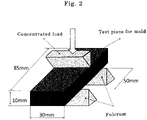
- test piece for molding (10mm ⁇ 30mmx 85mm) is sintered in a molding metal mold at 200 to 300°C for 30 to 120 seconds and thus molded.
- the thus molded and drawn test piece of the mold is cooled to room temperature.
- the test piece is set in the apparatus for testing the flexural strength for mold and the flexural strength of the test piece is measured to obtain the strength of the mold.
- the unit of the strength of the mold is kg/cm 2 .
- the strength of the mold is evaluated according to the following evaluation standard.
- the surfactant compositions for foamed sand of the inventive examples 1 to 8 of the present invention as the component (A), component (B) and component (C) are contained in specific ratios, the rapid-foaming property of the foamed sand was excellent and the strength of the mold was good.
Landscapes
- Engineering & Computer Science (AREA)
- Chemical & Material Sciences (AREA)
- Materials Engineering (AREA)
- Mechanical Engineering (AREA)
- Organic Chemistry (AREA)
- Mold Materials And Core Materials (AREA)
- Emulsifying, Dispersing, Foam-Producing Or Wetting Agents (AREA)
- Compositions Of Macromolecular Compounds (AREA)
Abstract
Description
- The present invention is related to s surfactant composition for foamed sand which is excellent in rapid-foaming property of the foamed sand and capable of improving the strength of a mold in producing the mold such as a sand core or the like including the foamed sand.
- Patent document 1 is known as a prior technique relating to a cast molding apparatus. According to patent document 1, it is disclosed a cast molding apparatus of casting a mold, and a metal mold apparatus used therefor, by agitating a particulate bone material, water-soluble binder and water to obtain foamed mixture and by filling the foamed mixture under pressure into a cavity of a heated metal mold. It is thereby possible to utilize the foamed mixture effectively to provide a cast molding apparatus capable of sufficiently assuring the filling of flowing sand into the metal mold cavity and to provide the apparatus capable of considerably shortening the hardening time of the foamed mixture.
- (Patent document 1)
WO 2005/089984 A1 - According to the method described in patent document 1, as it is required that the water-soluble binder has foaming property as well as essential binding performance for improving the foaming and flowing state of the foamed mixture, a surfactant composition is added thereto. It is demanded, as the surfactant, the surfactant composition for foamed sand excellent in rapid-foaming property of the foamed sand and of improving the strength of a mold.
- An object of the present invention is, when a mold such as a sand core or the like including foamed sand is produced, to provide a surfactant composition for the foamed sand having excellent rapid-foaming property and capable of improving the strength of the mold.
- As the inventors extensively researched for solving the above objects, it is found that a surfactant composition for foamed sand has excellent rapid-foaming property of the foamed sand and the effect of improving the strength of the mold, in the case that the composition contains specific amounts of a specific sulfate ester salt of polyoxyethylene alkyl ether, of a specific alkyl sulfate ester salt and a specific amphoteric surfactant, and the present invention is completed.
- That is, the present invention provides a surfactant composition for a formed sand, the surfactant composition comprising:
- 80 to 99.8 mass% of a compound (A) represented by the following formula (1);
- 0.1 to 10 mass% of a compound (B) represented by the following formula (B); and
- 0.1 to 10 mass% of an amphoteric surfactant (C).
R1O-(EO)n-SO3M1··· (1)
(In the formula (1),- R1 represents a hydrocarbon group having 6 to 22 carbons,
- EO represents oxyethylene group,
- n represents an average molar number added of said oxyethylene group and 1 to 10, and
- M 1 represents an alkali metal, an alkaline earth metal, ammonium or an organic ammonium.)
R2O-SO3M2 ···· (2)
(In the formula (2),- R 2 represents a hydrocarbon group having 6 to 22 carbons, and
- M 2 represents an alkali metal, an alkaline earth metal, ammonium or organic ammonium.)
- According to the surfactant composition for the foamed sand of the present invention, the binder, sand, surfactant composition, water etc. can be sufficiently foamed only by kneading for a short time, and a mold with a high strength can be produced.
-
-
Fig. 1 is a diagram schematically showing method of measuring a kinematic viscosity. -
Fig. 2 is a diagram schematically showing the state that a test piece is set in a machine for testing a flexural strength for a mold and that the flexural strength of the test piece is measured. - The surfactant composition for the foamed sand of the present invention contains the component (A), component (B) and component (C). Further, the total of the respective mass ratios of the component (A), component (B) and component (C) is 100 mass % . The respective components are described below.
- Further, the numerical range represented by "1 to 10" includes numerals at the upper and lower limits and means 1 or higher and 10 or lower.
- The component (A) used in the present invention is the polyoxyethylene alkyl ether sulfate ester salt of the following formula (1).
R1O-(EO)n-SO3M1··· (1)
- In the polyoxyethylene alkyl ether sulfate ester salt represented by the formula (1), R1 represents a hydrocarbon group having 6 to 22 carbons, and may preferably be a hydrocarbon group having 6 to 20 carbons. The hydrocarbon group may be a saturated hydrocarbon group or a hydrocarbon group having a carbon-carbon double bond (particularly preferably alkenyl group). In the case that the hydrocarbon group is the unsaturated hydrocarbon group having the carbon-carbon double bond, the number of the double bonds may preferably be 3 or lower and more preferably be 2 or lower. For example, such hydrocarbon group may be caprylic group, lauryl group, myristyl group, palmityl group, stearyl group, oleyl group, behenyl group or the like. Further, hydrocarbon groups derived from mixed fatty acids containing two or more kinds of hydrocarbon groups may be used and, for example, hydrocarbon groups of coconut oil or hydrocarbon groups of palm kernel oil may be used. Among them, lauryl group, myristyl group, hydrocarbon groups of coconut oil and hydrocarbon groups of palm kernel oil are preferred, and myristyl group is more preferably contained.
- In the formula (1), n represents an average molar number added of the oxyethylene group, and n is 1 to 10, preferably 2 to 6 and more preferably 3 to 4.
- In the formula (1), M 1 represents an alkali metal, an alkaline earth metal, ammonium or an organic ammonium. The alkali metal may be lithium, sodium, potassium or the like, and preferably sodium. The alkaline earth metal may be calcium, strontium, barium or the like, and preferably calcium. Ammonium is represented by NH4 +.
- The organic ammonium may be, for example, an alkanol ammonium derived from an alkanol amine such as monoethanol amine, diethanol amine, triethanol amine or the like, and an alkyl ammonium derived from an alkyl amine such as diethyl amine, triethyl amine or the like.
- According to the present invention, one kind or two kinds or more of the components (A) may be appropriately selected and utilized.
- Further, the content of the component (A) is 80 to 99.8 mass%, provided that 100 mass% is assigned to a total amount of the component (A), component (B) and component (C). As the strength of the mold is reduced in the case that the content of the component (A) is lower than 80 mass%, the content is thus made 80 mass% or higher, preferably 85 mass% or higher and more preferably 90 mass% or higher. Further, as the rapid-foaming property is deteriorated in the case that the content of the component (A) exceeds 99.8 mass%, the content is made 99.8 mass% or lower, is preferably 97 mass% or lower and more preferably 95% or lower.
- The component (B) applied in the present invention is the alkyl sulfate ester salt represented by the following formula (2).
R2O-SO3M2··· (2)
- In the alkyl sulfate ester salt represented by the formula (2), R 2 represents a hydrocarbon group having 6 to 22 carbons, and preferably a hydrocarbon group having 6 to 20 carbons. The hydrocarbon group may be a saturated hydrocarbon group, or a hydrocarbon group (particularly preferably alkenyl group) having an unsaturated bond including a carbon-carbon double bond. In the case that the hydrocarbon group is the unsaturated hydrocarbon group having the carbon-carbon double bond, the number of the double bonds may preferably be 3 or lower and more preferably be 2 or lower. For example, such hydrocarbon group may be caprylic group, lauryl group, myristyl group, palmityl group, stearyl group, oleyl group, behenyl group or the like. Further, hydrocarbon groups derived from mixed fatty acids containing two or more kinds of hydrocarbon groups may be used and, for example, hydrocarbon groups of coconut oil or hydrocarbon groups of palm kernel oil may be used. Among them, hydrocarbon groups of coconut oil and hydrocarbon groups of palm kernel oil are preferred.
- In the formula (2), M2 is an alkali metal, an alkaline earth metal, ammonium or an organic ammonium. The alkali metal may be lithium, sodium, potassium or the like, and preferably sodium. The alkaline earth metal may be calcium, strontium, barium or the like, and preferably calcium. The organic ammonium may be, for example, an alkanol ammonium derived from an alkanol amine such as monoethanol amine, diethanol amine, triethanol amine or the like, and an alkyl ammonium derived from an alkyl amine such as diethyl amine, triethyl amine or the like. According to the present invention, one kind or two kinds or more of the components (B) may be appropriately selected and utilized.
- The content of the component (B) is 0.1 to 10 mass%, provided that 100 mass% is assigned to a total of the contents of the component (A), component (B) and component (C). As the rapid-foaming property is deteriorated in the case that the content of the component (B) is below 0,1 mass %, the content is made 0.1 mass % or higher and more preferably is 0.5 mass % or higher. Further, as the strength of the mold may possibly be deteriorated in the case that the content of the component (B) exceeds 10 mass%, the content is made 10 mass%, is preferably 7 mass% or lower and more preferably 5 mass% or lower.
- The component (C) applied in the present invention is an amphoteric surfactant and, for example, may be a surfactant having the structure including N-acyl group or N-alkyl group, a cationic group and an anionic group. For example, specifically, the component (C) may be alkyl betaine, alkyl amide betaine, alkyl hydroxysulfo betaine, alkyl amide hydroxysulfo betaine, alkyl carboxy methyl hydroxy ethyl imidazolinium betaine, alkyl amide hydroxyethyl amino acid-type amphoteric surfactant, alkyl iminodiacetate salt or the like.
- The acyl group contained in the amphoteric surfactant described above may be, for example, a residual group of a straight chain or branched chain fatty acid having 6 to 22 carbons. The fatty acid of the fatty acid residual group may be, for example, saturated fatty acids such as caproic acid, caprylic acid, capric acid, lauric acid, myristic acid, palmitic acid, stearic acid, isostearic acid, arachidic acid, behenic acid or the like, unsaturated fatty acids such as palmitoleic acid, oleic acid, elaidic acid, linoleic acid, linolenic acid or the like, and palm oil fatty acid, palm kernel oil fatty acid, beef tallow fatty acid, hardened beef tallow fatty acid or the like which are the mixture thereof. Among them, lauric acid, palm oil fatty acid and palm kernel oil fatty acid are preferred. Lauric acid is particularly preferred.
- The alkyl group contained in the amphoteric surfactant described above may be, for example, a hydrocarbon group having 6 to 22 carbons, including alkyl groups derived from mixed fatty acids. For example, alkyl groups such as caproyl group, caprilyl group, caprylic group, lauryl group, myristyl group, palmityl group, stearyl group, oleyl group or the like, and mixed alkyl groups such as palm oil alkyl groups, palm kernel oil alkyl groups, beef tallow alkyl groups or the like are listed. Among them, lauric group, palm oil alkyl groups and palm kernel oil alkyl groups are preferred. Lauryl group is particularly preferred.
- Specific examples of the amphoteric surfactants of the component (C) include, for example, lauryl betaine, coconut oil fatty acid amide propyl betaine, palm kernel oil fatty acid amide propyl betaine, lauryl dimethyl amino acetic acid betaine, lauryl hydroxysulfo betaine or the like.
- According to the present invention, one kind or two or more kinds of the component (C) may be appropriately selected and applied.
- The content of the component (C) is 0.1 to 10 mass%, provided that 100 mass% is assigned to a total of the contents of the component (A), component (B) and component (C). As the strength of the mold is deteriorated in the case that the content of the component (C) is below 0.1 mass%, the content is made 0.1 mass% or higher, is preferably 3 mass% or higher and more preferably be 5 mass% or higher. Further, as the rapid-foaming property is deteriorated in the case that the content of the component (C) exceeds 10 mass%, the content is made 10 mass% or lower.
- The surfactant composition for foamed sand of the present invention may contain an additive in addition to the components described above, as far as the effects of the present invention is not inhibited. For example, organic or inorganic salts, pH adjusting agents, fungicides, chelating agents, pigments, perfumes or the like are listed.
- The present invention will be specifically described below, referring to the inventive examples and comparative examples.
- The respective raw materials of the inventive examples 1 to 8 and comparative examples 1 to 9 shown in tables 4 and 5 were charged into a beaker, and then agitated at 50°C for 1 hour by means of a magnetic stirrer to prepare the surfactant compositions for foamed sand. The blend ratios in the tables are in the term of mass%, and "-" represents 0 mass%.
- Further, the symbols etc. in the formula (1) of the respective components A1 to A4 shown in tables 4 and 5 are described in table 1, the symbols etc. in the formula (2) of components B1 and B2 shown in tables 4 and 5 are described in table 2, and the physical properties of the respective components C1 to C4 shown in tables 4 and 5 are described in table 3. Further, the specific contents of the respective components are as follows.
- A1 :
- "PERSOFT EF" (manufactured by NOF Corporation)
- A2 :
- "Trucks K-40" (manufactured by NOF Corporation)
- A3 :
- "PERSOFT EDO" (manufactured by NOF Corporation)
- A4 :
- "PERSOFT EL" (manufactured by NOF Corporation)
- B1 :
- "PERSOFT SK" (manufactured by NOF Corporation)
- B2 :
- "PERSOFT SP" (manufactured by NOF Corporation)
- C1 :
- "Nissan Anon BDL-SF" (manufactured by NOF Corporation)
- C2 :
- "Nissan Anon BDC-SF" (manufactured by NOF Corporation)
- C3 :
- "Nissan Anon BDF-SF" (manufactured by NOF Corporation)
- C4 :
- "Nissan Anon BL-SF" (manufactured by NOF Corporation)
- The following tests were performed for the thus obtained respective surfactant compositions for foamed sand. The evaluations of "⊚" and "○" were categorized as "passed" in each of the rests.
- Artificial sand is prepared as articulate bone material, water glass and the surfactant for the evaluation are prepared as water soluble binders, and water is prepared. The materials were charged into a kneading system in weight ratios of 100 of the artificial sand, 0.5 to 2.5 of the solid content of the water glass, 0.01 to 0.05 of the effective ingredient of the surfactant and 2 to 4 of water.
- The materials described above are kneaded by means of the kneading system for 120 seconds to obtain foamed mixture.
- The foamed and kneaded product is charged into an apparatus for measuring kinetic viscosity as shown in
Fig. 1 . - As shown in
Fig. 1 , a weight of 1kg is mounted on the foamed and kneaded product, and a kinetic viscosity is measured as a time for the weight to pass each of standard lines at an interval of 50mm while the foamed and kneaded product is discharged through a hole at lower side having ϕ of 6mm and the weight is moved downwardly. - The rapid-foaming property is evaluated according to the following evaluation standard.
- ○:
- Measured time is shorter than 2.00 seconds.
- △:
- Measured time is 2.00 seconds or longer and shorter than 2.20 seconds.
- ×
- Measured time is 2.20 seconds or longer.
- The flexural strength of the mold containing the foamed sand is measured.
- Artificial sand is prepared as articulate bone material, water glass and the surfactant for the evaluation are prepared as water soluble binders, and water is prepared. The materials are charged into a kneading system in weight ratios of 100 of the artificial sand, 0.5 to 2.5 of the solid content of the water glass, 0.01 to 0.05 of the effective ingredient of the surfactant and 2 to 4 of water.
- The materials were kneaded by means of the kneading system for 300 seconds to obtain foamed mixture.
- The foamed mixture produced as described above is charged into a metal mold for molding by means of a system for molding a test piece for measuring the strength.
- The test piece for molding (10mm× 30mmx 85mm) is sintered in a molding metal mold at 200 to 300°C for 30 to 120 seconds and thus molded.
- The thus molded and drawn test piece of the mold is cooled to room temperature.
- As shown in
Fig. 2 , the test piece is set in the apparatus for testing the flexural strength for mold and the flexural strength of the test piece is measured to obtain the strength of the mold. The unit of the strength of the mold is kg/cm2. - The strength of the mold is evaluated according to the following evaluation standard.
- ⊚:
- The strength of the mold is 31 or larger.
- ○:
- The strength of the mold is 30.5 or larger and below 31.
- △:
- The strength of the mold is 30 or larger and below 30.5
- ×:
- The strength of mold is below 30
- According to the surfactant compositions for foamed sand of the inventive examples 1 to 8 of the present invention, as the component (A), component (B) and component (C) are contained in specific ratios, the rapid-foaming property of the foamed sand was excellent and the strength of the mold was good.
- On the other hand, according to the comparative example 1, as the component (B) and component (C) were not contained, the rapid-foaming property and strength of the mold were deteriorated.
- According to the comparative example 2, as the component (A) and component (C) were not contained, the strength of the mold was lowered.
- According to the comparative example 3, as the component (B) and component (C) were not contained, the rapid-foaming property was deteriorated.
- According to the comparative example 4, as the component (B) and component (C) were not contained, the rapid-foaming property and strength of the mold were deteriorated.
- According to the comparative example 5, as the component (B) and component (C) were not contained, the rapid-foaming property was deteriorated.
- According to the comparative example 6, as the component (A) was not contained, the strength of the mold was lowered.
- According to the comparative example 7, as the content of the component (C) exceeded the upper limit of the defined range of the claim, the rapid-foaming property was deteriorated.
- According to the comparative example 8, as the content of the component (B) exceeds the upper limit of the defined range of the claim, the strength of the mold was lowered.
- According to the comparative example 9, as the component (C) was not contained, the strength of the mold was lowered.
| R1 | Number of carbons of R1 | n | M1 | |
| A1 | Lauryl group and myristyl group (68 : 32)  | 12, 14 | 3 | Sodium |
| A2 | Lauryl group | 12 | 4 | Sodium |
| A3 | Lauryl group and tridecyl group (42 : 58) | 12, 13 | 3 | Sodium |
| A4 | Palm oil alkyl group 2 | 6 to 20 | 3 | Sodium |
| |
| R2 | Number of carbons of R1 | M2 | |
| B1 | Palm oil alkyl group | 6 to 20 | Sodium |
| B2 | Lauryl group | 12 | Sodium |
| |
| Names of components | Number of carbons of alkyl group | |
| C1 | Lauric acid amide propyl dimethyl amino acetic acid betaine | 12 |
| C2 | Palm kernel oil fatty acid amide propyl dimethyl amino acetic acid betaine | 6 - 2 0 |
| C3 | Coconut oil fatty acid amide propyl dimethyl amino acetic acid betaine | 6 - 2 0 |
| C4 | Lauryl dimethyl amino acetic acid betaine | 1 2 |
| |
| Inventive Examples | |||||||||
| 1 | 2 | 3 | 4 | 5 | 6 | 7 | 8 | ||
| Component (A) (mass%) | A1 | 90 | 94,5 | 85 | 94,5 | 85 | 90 | 90 | 90 |
| Component (B) (mass%) | B1 | 5 | 5 | 5 | 0,5 | 10 | 5 | 5 | 5 |
| Component (C) (mass%) | C1 | 5 | 0,5 | 10 | 5 | 5 | - | - | - |
| C2 | - | - | - | - | - | 5 | - | - | |
| C3 | - | - | - | - | - | - | 5 | - | |
| C4 | - | - | - | - | - | - | - | 5 | |
| Evaluation results | (1)Rapid-foaming property kneaded for 120 seconds | ○ (1.95) | ○ (1.97) | ○ (1.96) | ○ (1.99) | ○ (1.91) | ○ (1.96) | ○ (1.98) | ○ (1.96) |
| (2)Strength of mold | ⊚ (32.5) | ○ (30.5) | ⊚ (33.5) | ⊚ (33.1) | ○ (30.9) | ○ (30.7) | ○ (30.7) | ○ (30.5) | |
| Comparative Examples | ||||||||||
| 1 | 2 | 3 | 4 | 5 | 6 | 7 | 8 | 9 | ||
| Component (A) (mass%) | A1 | 100 | - | - | - | - | - | 80 | 80 | 95 |
| A2 | - | - | 100 | - | - | - | - | - | - | |
| A3 | - | - | - | 100 | - | - | - | - | - | |
| A4 | - | - | - | - | 100 | - | - | - | - | |
| Component (B) (mass%) | B1 | - | 100 | - | - | - | - | 5 | 15 | 5 |
| B2 | - | - | - | - | - | 99,2 | - | - | - | |
| Component (C) (mass%) | C1 | - | - | - | - | - | 0,8 | 15 | 5 | - |
| Eval uation results | (1) Rapid-foaming property kneaded for 120 seconds | × (2.28) | ○ (1.97) | × (3.53) | × (2.55) | × (3.04) | ○ (1.53) | × (2.25) | ⊚ (1.93) | × (2.23) |
| (2)Strength of mold | × (29.0) | × (25.8) | ○ (30.8) | × (29.7) | ⊚ (33.3) | × (29.2) | ⊚ (32.1) | × (29.7) | × (27.0) | |
Claims (1)
- A surfactant composition for a formed sand, said surfactant composition comprising:80 to 99.8 mass% of a compound (A) represented by the following formula (1);0.1 to 10 mass% of a compound (B) represented by the following formula (B); and0.1 to 10 mass% of an amphoteric surfactant (C).
R1O-(EO)n-SO3M1··· (1)
(In the formula (1),
R1 represents a hydrocarbon group having 6 to 22 carbons,EO represents oxyethylene group,n represents an average molar number added of said oxyethylene group and 1 to 10, andM 1 represents an alkali metal, an alkaline earth metal, ammonium or an organic ammonium.)
R2O-SO3M2 ···· (2)
(In the formula (2),R2 represents a hydrocarbon group having 6 to 22 carbons, andM 2 represents an alkali metal, an alkaline earth metal, ammonium or an organic ammonium.)
Applications Claiming Priority (2)
| Application Number | Priority Date | Filing Date | Title |
|---|---|---|---|
| JP2019106698 | 2019-06-07 | ||
| PCT/JP2020/022084 WO2020246538A1 (en) | 2019-06-07 | 2020-06-04 | Surfactant composition for foaming sand |
Publications (2)
| Publication Number | Publication Date |
|---|---|
| EP3981525A1 true EP3981525A1 (en) | 2022-04-13 |
| EP3981525A4 EP3981525A4 (en) | 2022-07-20 |
Family
ID=73652228
Family Applications (1)
| Application Number | Title | Priority Date | Filing Date |
|---|---|---|---|
| EP20819378.9A Pending EP3981525A4 (en) | 2019-06-07 | 2020-06-04 | SURFACTANT COMPOSITION FOR FOAM SAND |
Country Status (6)
| Country | Link |
|---|---|
| US (1) | US12152189B2 (en) |
| EP (1) | EP3981525A4 (en) |
| JP (1) | JP7113142B2 (en) |
| CN (1) | CN113905837B (en) |
| BR (1) | BR112021023515A2 (en) |
| WO (1) | WO2020246538A1 (en) |
Families Citing this family (2)
| Publication number | Priority date | Publication date | Assignee | Title |
|---|---|---|---|---|
| JP7072155B1 (en) * | 2021-03-23 | 2022-05-20 | 新東工業株式会社 | Sand mold molding additives, sand mold molding compositions, sand mold manufacturing methods, and sand molds |
| EP4450183A4 (en) * | 2021-12-17 | 2026-03-11 | Nof Corp | SURFACE COMPOSITION FOR FOAM SAND |
Family Cites Families (11)
| Publication number | Priority date | Publication date | Assignee | Title |
|---|---|---|---|---|
| GB2107327B (en) | 1981-10-02 | 1985-05-30 | Politechnika Slaska Im Wincent | Moulding and core sand compositions |
| JPS63115649A (en) * | 1986-10-31 | 1988-05-20 | Sintokogio Ltd | Molding method for hollow core |
| JP4418081B2 (en) * | 2000-04-28 | 2010-02-17 | アシュランドジャパン株式会社 | Binder composition for gas curable molds |
| ATE489182T1 (en) | 2004-03-23 | 2010-12-15 | Sintokogio Ltd | DEVICE FOR PRODUCING A CASTING MOLD AND METAL MOLD UNIT FOR USE THEREIN |
| JP4854269B2 (en) * | 2005-10-31 | 2012-01-18 | クレトイシ株式会社 | Resinoid grinding wheel manufacturing method |
| BRPI0618910B1 (en) * | 2005-11-21 | 2014-06-17 | Sintokogio Ltd | MOLD MAKING PROCESS |
| DE102011115024A1 (en) * | 2011-10-07 | 2013-04-11 | Ask Chemicals Gmbh | Coating compositions for inorganic casting molds and cores comprising formic acid esters and their use |
| JP5734818B2 (en) * | 2011-11-28 | 2015-06-17 | トヨタ自動車株式会社 | Sand mold making method and sand mold |
| PL2921243T3 (en) * | 2012-11-19 | 2019-05-31 | Sintokogio Ltd | Sand for casting mold, manufacturing method for sand casting-mold, and core for metal casting |
| JP6593255B2 (en) * | 2016-06-06 | 2019-10-23 | 新東工業株式会社 | Binder composition for mold, aggregate mixture for mold, mold, and method for forming mold |
| WO2018043412A1 (en) * | 2016-08-31 | 2018-03-08 | 旭有機材株式会社 | Casting mold manufacturing method |
-
2020
- 2020-06-04 JP JP2021524898A patent/JP7113142B2/en active Active
- 2020-06-04 CN CN202080039493.3A patent/CN113905837B/en active Active
- 2020-06-04 EP EP20819378.9A patent/EP3981525A4/en active Pending
- 2020-06-04 US US17/615,385 patent/US12152189B2/en active Active
- 2020-06-04 WO PCT/JP2020/022084 patent/WO2020246538A1/en not_active Ceased
- 2020-06-04 BR BR112021023515A patent/BR112021023515A2/en not_active Application Discontinuation
Also Published As
| Publication number | Publication date |
|---|---|
| EP3981525A4 (en) | 2022-07-20 |
| US20220228067A1 (en) | 2022-07-21 |
| US12152189B2 (en) | 2024-11-26 |
| WO2020246538A1 (en) | 2020-12-10 |
| BR112021023515A2 (en) | 2022-01-18 |
| CN113905837B (en) | 2023-05-30 |
| JP7113142B2 (en) | 2022-08-04 |
| CN113905837A (en) | 2022-01-07 |
| JPWO2020246538A1 (en) | 2020-12-10 |
Similar Documents
| Publication | Publication Date | Title |
|---|---|---|
| DE69923711T2 (en) | CEMENT DISPERSANT AND CONCRETE COMPOSITION COMPRISING THIS | |
| JP2000034463A (en) | Use of amide of polymerized fatty acid as thickener | |
| US12152189B2 (en) | Surfactant composition for foaming sand | |
| JP2018130957A (en) | Flask release agent | |
| EP2170782B1 (en) | Methods and compositions for improving air entrainment in cementitious mixtures | |
| EP2888386B1 (en) | Anti-corrosion agent formulation for protecting against zinc corrosion and cadmium corrosion | |
| DE69209348T2 (en) | Binder made from alkaline phenol aldehyde resole resins | |
| EP3209707A1 (en) | Mono- and bisalkylene trialkoxysilanes as dispersants for hydraulic binders | |
| JPH05192737A (en) | Binder composition for molding sand and casting mold composition | |
| EP2157069A1 (en) | Coated hydraulic bonding agent | |
| EP4450183A1 (en) | Surfactant composition for foam sand | |
| WO2009004086A1 (en) | Alternative cold-box process | |
| JP6998094B1 (en) | Auxiliary agent for concrete release agent, concrete release agent and concrete manufacturing method | |
| DE112020004523T5 (en) | Additive for molding a sand mold, sand composition for molding a sand mold, method for making a sand mold and sand molds | |
| DE69917038T2 (en) | CARBONIC ACID ESTER ON CARRIER, AS ACCELERATOR AND THIXOTROPIER AGENT IN CEMENT | |
| JP7123775B2 (en) | Surfactant composition for foam sand | |
| CN101294083B (en) | Air film coke quenching additive agent | |
| JP4846641B2 (en) | Cement-based solidifying material | |
| JP2004067449A (en) | Cellular stabilizer for the production of lightweight cellular concrete | |
| CN108103511A (en) | A kind of fine module gear water-based antirust agent and preparation method thereof | |
| DE102009059149A1 (en) | Composition, useful e.g. as solvent pastes, comprises e.g. diaminediamide long-chain carboxylic acids, diamine monoamide, basic reaction products of e.g. dialkyldiamines, polyamines and/or alkanolamines, and free long chain carboxylic acid | |
| JPH0733502A (en) | Cement composition | |
| JP5508157B2 (en) | Neutralized concrete molding powdery alkaline recovery agent and neutralized concrete molding alkali recovery method | |
| EP2218699B1 (en) | Comprehensive additive for a constructional mixture | |
| EP0628366A1 (en) | Stock solution of parting compound for green sand molding |
Legal Events
| Date | Code | Title | Description |
|---|---|---|---|
| STAA | Information on the status of an ep patent application or granted ep patent |
Free format text: STATUS: THE INTERNATIONAL PUBLICATION HAS BEEN MADE |
|
| PUAI | Public reference made under article 153(3) epc to a published international application that has entered the european phase |
Free format text: ORIGINAL CODE: 0009012 |
|
| STAA | Information on the status of an ep patent application or granted ep patent |
Free format text: STATUS: REQUEST FOR EXAMINATION WAS MADE |
|
| 17P | Request for examination filed |
Effective date: 20211126 |
|
| AK | Designated contracting states |
Kind code of ref document: A1 Designated state(s): AL AT BE BG CH CY CZ DE DK EE ES FI FR GB GR HR HU IE IS IT LI LT LU LV MC MK MT NL NO PL PT RO RS SE SI SK SM TR |
|
| A4 | Supplementary search report drawn up and despatched |
Effective date: 20220620 |
|
| RIC1 | Information provided on ipc code assigned before grant |
Ipc: B22C 1/18 20060101ALI20220614BHEP Ipc: B22C 1/10 20060101ALI20220614BHEP Ipc: B22C 1/02 20060101AFI20220614BHEP |
|
| DAV | Request for validation of the european patent (deleted) | ||
| DAX | Request for extension of the european patent (deleted) | ||
| GRAP | Despatch of communication of intention to grant a patent |
Free format text: ORIGINAL CODE: EPIDOSNIGR1 |
|
| STAA | Information on the status of an ep patent application or granted ep patent |
Free format text: STATUS: GRANT OF PATENT IS INTENDED |
|
| INTG | Intention to grant announced |
Effective date: 20230524 |
|
| GRAJ | Information related to disapproval of communication of intention to grant by the applicant or resumption of examination proceedings by the epo deleted |
Free format text: ORIGINAL CODE: EPIDOSDIGR1 |
|
| STAA | Information on the status of an ep patent application or granted ep patent |
Free format text: STATUS: REQUEST FOR EXAMINATION WAS MADE |
|
| INTC | Intention to grant announced (deleted) | ||
| STAA | Information on the status of an ep patent application or granted ep patent |
Free format text: STATUS: EXAMINATION IS IN PROGRESS |
|
| P01 | Opt-out of the competence of the unified patent court (upc) registered |
Effective date: 20230802 |
|
| 17Q | First examination report despatched |
Effective date: 20230823 |