EP3976331B1 - Procédé et dispositif de préchauffage d'une natte de matière à presser - Google Patents
Procédé et dispositif de préchauffage d'une natte de matière à presser Download PDFInfo
- Publication number
- EP3976331B1 EP3976331B1 EP20725482.2A EP20725482A EP3976331B1 EP 3976331 B1 EP3976331 B1 EP 3976331B1 EP 20725482 A EP20725482 A EP 20725482A EP 3976331 B1 EP3976331 B1 EP 3976331B1
- Authority
- EP
- European Patent Office
- Prior art keywords
- steam
- mat
- material mat
- press material
- air mixture
- Prior art date
- Legal status (The legal status is an assumption and is not a legal conclusion. Google has not performed a legal analysis and makes no representation as to the accuracy of the status listed.)
- Active
Links
Images



Classifications
-
- B—PERFORMING OPERATIONS; TRANSPORTING
- B27—WORKING OR PRESERVING WOOD OR SIMILAR MATERIAL; NAILING OR STAPLING MACHINES IN GENERAL
- B27N—MANUFACTURE BY DRY PROCESSES OF ARTICLES, WITH OR WITHOUT ORGANIC BINDING AGENTS, MADE FROM PARTICLES OR FIBRES CONSISTING OF WOOD OR OTHER LIGNOCELLULOSIC OR LIKE ORGANIC MATERIAL
- B27N1/00—Pretreatment of moulding material
-
- B—PERFORMING OPERATIONS; TRANSPORTING
- B27—WORKING OR PRESERVING WOOD OR SIMILAR MATERIAL; NAILING OR STAPLING MACHINES IN GENERAL
- B27N—MANUFACTURE BY DRY PROCESSES OF ARTICLES, WITH OR WITHOUT ORGANIC BINDING AGENTS, MADE FROM PARTICLES OR FIBRES CONSISTING OF WOOD OR OTHER LIGNOCELLULOSIC OR LIKE ORGANIC MATERIAL
- B27N3/00—Manufacture of substantially flat articles, e.g. boards, from particles or fibres
- B27N3/08—Moulding or pressing
- B27N3/24—Moulding or pressing characterised by using continuously acting presses having endless belts or chains moved within the compression zone
-
- B—PERFORMING OPERATIONS; TRANSPORTING
- B27—WORKING OR PRESERVING WOOD OR SIMILAR MATERIAL; NAILING OR STAPLING MACHINES IN GENERAL
- B27N—MANUFACTURE BY DRY PROCESSES OF ARTICLES, WITH OR WITHOUT ORGANIC BINDING AGENTS, MADE FROM PARTICLES OR FIBRES CONSISTING OF WOOD OR OTHER LIGNOCELLULOSIC OR LIKE ORGANIC MATERIAL
- B27N3/00—Manufacture of substantially flat articles, e.g. boards, from particles or fibres
- B27N3/08—Moulding or pressing
- B27N3/18—Auxiliary operations, e.g. preheating, humidifying, cutting-off
-
- B—PERFORMING OPERATIONS; TRANSPORTING
- B30—PRESSES
- B30B—PRESSES IN GENERAL
- B30B15/00—Details of, or accessories for, presses; Auxiliary measures in connection with pressing
- B30B15/06—Platens or press rams
- B30B15/062—Press plates
- B30B15/064—Press plates with heating or cooling means
-
- B—PERFORMING OPERATIONS; TRANSPORTING
- B30—PRESSES
- B30B—PRESSES IN GENERAL
- B30B15/00—Details of, or accessories for, presses; Auxiliary measures in connection with pressing
- B30B15/30—Feeding material to presses
- B30B15/302—Feeding material in particulate or plastic state to moulding presses
- B30B15/308—Feeding material in particulate or plastic state to moulding presses in a continuous manner, e.g. for roller presses, screw extrusion presses
-
- B—PERFORMING OPERATIONS; TRANSPORTING
- B30—PRESSES
- B30B—PRESSES IN GENERAL
- B30B15/00—Details of, or accessories for, presses; Auxiliary measures in connection with pressing
- B30B15/34—Heating or cooling presses or parts thereof
-
- B—PERFORMING OPERATIONS; TRANSPORTING
- B30—PRESSES
- B30B—PRESSES IN GENERAL
- B30B5/00—Presses characterised by the use of pressing means other than those mentioned in the preceding groups
- B30B5/04—Presses characterised by the use of pressing means other than those mentioned in the preceding groups wherein the pressing means is in the form of an endless band
- B30B5/06—Presses characterised by the use of pressing means other than those mentioned in the preceding groups wherein the pressing means is in the form of an endless band co-operating with another endless band
-
- B—PERFORMING OPERATIONS; TRANSPORTING
- B27—WORKING OR PRESERVING WOOD OR SIMILAR MATERIAL; NAILING OR STAPLING MACHINES IN GENERAL
- B27N—MANUFACTURE BY DRY PROCESSES OF ARTICLES, WITH OR WITHOUT ORGANIC BINDING AGENTS, MADE FROM PARTICLES OR FIBRES CONSISTING OF WOOD OR OTHER LIGNOCELLULOSIC OR LIKE ORGANIC MATERIAL
- B27N3/00—Manufacture of substantially flat articles, e.g. boards, from particles or fibres
- B27N3/02—Manufacture of substantially flat articles, e.g. boards, from particles or fibres from particles
-
- B—PERFORMING OPERATIONS; TRANSPORTING
- B27—WORKING OR PRESERVING WOOD OR SIMILAR MATERIAL; NAILING OR STAPLING MACHINES IN GENERAL
- B27N—MANUFACTURE BY DRY PROCESSES OF ARTICLES, WITH OR WITHOUT ORGANIC BINDING AGENTS, MADE FROM PARTICLES OR FIBRES CONSISTING OF WOOD OR OTHER LIGNOCELLULOSIC OR LIKE ORGANIC MATERIAL
- B27N3/00—Manufacture of substantially flat articles, e.g. boards, from particles or fibres
- B27N3/04—Manufacture of substantially flat articles, e.g. boards, from particles or fibres from fibres
Definitions
- the invention further relates to a double belt preheating device for heating a pressed material mat and a system for producing wood-based panels.
- the pressed material mat to be heated (which is also simply referred to as a “mat”) is preferably a pressed material mat for the production of wood-based panels. In principle, the heating of other pressed material mats or material webs is also recorded.
- a pressed material mat for the production of wood-based panels usually consists of chips or fibers, in particular wood chips or wood fibers, preferably glued wood chips or wood fibers, which, for. B. be scattered on a spreading belt conveyor or the like to form a pressed material mat. This creates a continuous pressed material mat and consequently a pressed material mat strand, which passes through a double belt preheating device for heating and is then placed in a press, e.g. B. in a continuously working one Double belt press, which is pressed into a plate or a plate strand using pressure and heat.
- a particularly important property of a wood-based panel is the sealing profile across the panel thickness, which can be influenced in the desired direction during panel production in the press by adjusting the heating plate temperatures, the pressing pressures and the setting of the press gap.
- the relevant settings of the hot press e.g. B. a continuously operating double belt press are referred to as a pressing program.
- the pressing program of the continuous press can be adjusted so that higher densities are achieved in the area of the cover layers.
- the pressing program of the continuous press can be adjusted so that a higher density is achieved in the center of the plate.
- the aim is to achieve the desired and previously defined panel properties or to keep them above the limit while at the same time reducing production costs, especially by saving wood and glue.
- production costs can be reduced by simultaneously maximizing production capacity.
- various production parameters such as the amount of glue, the mat moisture and the pressing program (to optimize the shape of the density profile) are optimized.
- the pressed material mat is also preheated in a preheating device before the actual pressing process.
- preheating devices are used in production, e.g. B. in MDF production, preheating devices are used in which the pressed material mat z. B. is acted upon with a heated fluid (steam or a steam-air mixture) and is thereby heated.
- a heated fluid steam or a steam-air mixture
- moist air the heating of the mat with a steam-air mixture with a defined dew point
- the application of steam saturated steam or superheated steam without air content
- the mat preheating with the help of a steam-air mixture is usually carried out in a double belt preheating device in which the pressed material mat is flowed through with a steam-air mixture with a set dew point.
- the moist air is supplied to the mat on the top or bottom and sucked out on the opposite side, whereby the essential part of the steam contained in the mixture condenses in the mat and the mat is heated to the dew point set in the moist air (equal to the preheating temperature). becomes.
- the preheating temperature is usually not more than 75°C in order to avoid pre-hardening of the glue before the final board thickness is reached in the press. Overall, such steam-air preheating can increase production capacity through the heat input in front of the press.
- the alternatively known preheating with steam usually leads to heating only of the cover layers of the pressed material mat or to heating limited portions of the mat on the top and bottom.
- a temperature of approx. 100°C is usually reached on the mat surface, depending on the amount of steam supplied
- the amount of steam drops in a more or less wide transition range to the (initial) temperature of the mat on the forming line and consequently before it enters the preheating device.
- Such a preheating process using steam injection (on both sides) also leads to an overall increase in production capacity due to the amount of heat introduced into the mat, although this is usually lower than with uniform preheating with moist air (steam-air mixture).
- a method for preheating grit to a predeterminable preheating temperature in the course of producing wood-based panels by hot pressing a grit mat in a continuous press or a cycle press is, for example. B. from the DE 44 23 632 A1 known.
- the preheating is carried out with an air-conditioned fluid made of air and water vapor, which flows through the grit.
- the fluid has a temperature that is higher than the dew point by the dew point difference and the quantity flow of the fluid on the one hand, the dew point on the other hand and also the dew point difference are selected so that the predetermined preheating temperature of the heated grit is established. Condensation of the water vapor in the grit is accepted and, if necessary, the moisture of the heated grit is adjusted using additional process measures.
- the DE 197 01 596 C2 describes a method and a system for preheating pressed material mats made of glued grit, wherein the pressed material mat is subjected to a flow treatment in a preheating system, in which it is surrounded by an air-conditioned fluid made of air and water vapor at a temperature of below 100 ° C with a set dew point and a flow through the set dew point difference.
- the pressed material mats are treated in the direction of the mat thickness from above and below at the same time with the same air-conditioned fluid and in the same way specific mass flows flow through, with condensation fronts forming in the pressed material mats, which migrate towards one another in the pressed material from the surface of the pressed material mat and from the lower surface of the pressed material mat.
- the treatment of a grit mat with a steam-air mixture is also known in connection with the production of biodegradable insulation boards (cf. DE 196 35 410 A1 ).
- the mat or fleece is first compressed to the desired panel thickness and then a steam-air mixture is introduced into the compacted fleece in a heating zone over a period of 10 to 20 seconds, avoiding pre-hardening of the binder.
- a stream of hot air is passed through the compressed fleece in a further treatment step.
- the system known so far is therefore not used to preheat a mat for subsequent pressing in a separate press, but in the double belt press both the preheating takes place using a steam-air mixture and the mat is hardened and dried using hot air.
- Methods and devices for preheating pressed material mats in the course of the production of wood-based panels are also from the EP 2 213 432 A1 and the EP 2 588 286 B1 known.
- EP3181664A1 discloses the preambles of claims 1 and 9.
- the invention is based on the object of creating a method for preheating a pressed material mat with which the production capacity can be increased while at the same time optimizing plate properties.
- a corresponding preheating device and a system for the production of wood-based panels are to be created.
- the invention teaches in a generic method for preheating a pressed material mat that the pressed material mat in the double belt preheating device is initially heated in a first stage with a first heating unit with a steam-air mixture with a set dew point (ie with a set dew point temperature) and As a rule, a (set) temperature of less than 100 ° C is applied, which flows through the mat from one side or surface to the opposite side or surface and is thereby heated to a first temperature T1 over the entire mat thickness and that the pressed material mat in the double belt preheating device is then exposed to (pure) steam or a steam-air mixture on both sides in a second stage with a second heating unit and as a result only the cover layers near the surface are heated to a second temperature T2, which is higher than the first temperature is T1.
- Steam means in particular water vapor.
- a steam-air mixture flows through the mat and in the second stage, steam is applied to both sides.
- preheating can take place with a (first) steam-air mixture with a set dew point and with a (set) temperature of less than 100 ° C, and in the second stage there is also an exposure to a (second) Steam-air mixture, which, however, has a higher dew point and / or a higher temperature than the first steam-air mixture of the first stage, so that the surface layers near the surface are heated in this second stage.
- the invention is based on the knowledge that preheating with a steam-air mixture (moist air) on the one hand and preheating with steam (saturated steam or superheated steam) have different effects and lead to different effects in the production process, so that the production process is carried out by a combined , two-stage approach can be optimized overall.
- a steam-air mixture moist air
- steam saturated steam or superheated steam
- preheating the entire mat using moist air leads to a more or less pronounced "flattening" of the density profile, since a preheated mat can be compacted with less pressure because both the mat moisture and the mat temperature are increased during preheating.
- the minimum density or the middle layer density increases with a completely preheated mat, which basically has a positive effect on the transverse tension.
- the disadvantage is that the top layer density decreases to a greater or lesser extent, with corresponding negative effects on e.g. B. the bending stiffness.
- preheating with steam causes the outer layers to become warmer and moister and therefore softer, which means that very distinctive high-density outer layers can be created, while the cold and "hard” mat middle leads to rather low mat densities in the middle of the panel.
- production capacity can only be increased slightly due to the low heat input in the middle of the mat.
- higher amounts of steam are injected into the mat cover layers in order to increase production capacity, there is a risk that an ever larger proportion of the mat's basis weight will be "consumed” in the cover layers and there will no longer be enough material available in the middle of the panel to achieve the mat density required for the transverse pull.
- the two-stage preheating using a steam-air mixture in a first stage and using steam (or alternatively a steam-air mixture with a higher dew point) in the second stage increases both the production capacity and high material savings and an optimal Density profile (related to the important board properties such as transverse tensile strength and bending strength) is achieved simultaneously in a common preheating process and in a single preheating device.
- the previously "opposing goals”, namely high production capacity, high material savings and optimal density profile, will be achieved together in a combined process.
- the preheating in the first stage takes place with a steam-air mixture and consequently with moist air with a set dew point and a set temperature that is above the dew point by the so-called dew point difference.
- the dew point (which is also referred to as the dew point temperature) refers to the temperature at which the air in the steam-air mixture is just saturated with the amount of steam (especially water vapor) present. Below the dew point, condensation of the water vapor occurs as a result of supersaturation, so that the water vapor precipitates like a dew. At the dew point, the relative humidity is 100% and the air is (just) saturated with water vapor.
- the dew point or the dew point temperature (and, if applicable, the temperature or dew point difference) of the steam-air mixture can be specifically adjusted using known means and measures. This can be done e.g. B. Air is heated to a desired temperature (e.g. with the help of a heat exchanger) and then mixed with (fresh) steam (e.g. water vapor) in the desired ratio using a mixing device. A steam-air mixture with a dew point of 50°C to 85°C, preferably 60°C to 75°C, e.g. B. about 70 ° C used.
- the steam condenses in the mat and the mat is preferably heated to the set dew point, ie the preheating temperature T1 of the mat the first stage preferably corresponds to the dew point temperature of the steam-air mixture used, so that the pressed material mat in the first stage is preferably heated to a temperature T1 of 50 ° C to 85 ° C, preferably 60 ° C to 75 ° C.
- the steam-air mixture flows through the pressed material mat from one surface to the opposite surface, preferably being supplied to one surface (e.g. the top) and to the opposite side (e.g. the bottom). is sucked off.
- the first stage for the steam-air preheating consists of at least two zones arranged one behind the other, in which the steam-air mixture with the set dew point flows through the mat in alternating, opposite directions. So can e.g. B.
- the steam-air mixture in the first stage the steam-air mixture is pressed into the mat from above and sucked out of the mat from below and in the second zone it is pressed into the mat from below and sucked out of the mat from above, preferably the same Mixture with the same parameters, in particular identical dew point, is used. In this way, a particularly homogeneous heat input and thus even preheating of the mat across its entire thickness can be achieved.
- the cover layers near the surface are heated strongly, preferably to a temperature T2 of more than 85 ° C, preferably more than 95 ° C, e.g. B. about 100°C or more.
- (pure) steam e.g. water vapor
- the mat which was preheated to the temperature T1 over the entire thickness in the first stage for the purpose of increasing capacity, is consequently further warmed to the temperature T2 in the area of the cover layers in the second step, preferably using steam, so that with the help of the mats with warmer ones and softer cover layers, a particularly high cover layer density can be achieved with the described advantages of the board properties.
- a steam-air mixture flows completely through the mat in the first stage, the mat in the second stage is preferably exposed to steam from both sides at the same time without opposing suction.
- a steam-air mixture can also be used instead of steam in the second stage, which is used to heat the cover layer.
- a steam-air mixture and consequently moist air with a higher dew point and optionally higher temperature is used in the second stage, i.e. H.
- the steam-air mixture in the second stage has a higher dew point and/or a higher temperature or dew point difference than the steam-air mixture in the first stage, which is responsible for the uniform heating of the mat.
- the steam-air mixture can be pressed into the mat from both sides at the same time - just as with pure steam application.
- the steam-air mixture flows through the mat in one direction in the second stage (as in the first stage) and is consequently pressed into the mat from one side and sucked out on the other side.
- the second stage it is advisable to press the steam-air mixture (with a higher dew point) into the mat and/or suck it through the mat in two zones arranged one behind the other in alternating, opposite directions.
- the invention further relates to a double belt preheating device for heating a pressed material mat, in particular with or according to a method of the type described.
- This double belt preheating device has an upper, endlessly rotating, gas-permeable conveyor belt and a lower, endlessly rotating, gas-permeable conveyor belt, between which a treatment gap is formed, through which the mat can be passed along the transport direction (by means of the driven conveyor belts).
- the double belt preheating device has a heating unit, namely a first heating unit, which is designed as a steam-air supply device and with which the pressed material mat (in a first treatment stage) with a steam-air mixture with an adjustable dew point (and adjustable temperature ) can be acted upon, whereby this steam-air mixture (moist air) flows through the mat from one surface to the opposite surface and thereby heats the mat over the entire mat thickness, preferably to the set dew point of the steam-air mixture.
- the double belt preheating device additionally has a second heating unit, which is arranged downstream of the first heating unit and consequently of the steam-air supply device in the transport direction and which serves to treat the pressed material mat in a second treatment stage.
- the second heating device is preferably designed as a steam supply device with which the mat can be supplied with (pure) steam (preferably water vapor) for heating only the cover layers near the surface.
- the second heating device can be designed as a steam-air supply device, with which the mat is used to heat only the surface layers near the surface with a (second) steam-air mixture can be acted upon, which has a higher dew point and / or a higher temperature than the (first) steam-air mixture of the first heating unit.
- the first heating unit which is designed as a steam-air supply device, preferably has at least one supply-suction pair with a supply, e.g. B. a feed box on one side of the mat and a suction, e.g. B. a suction box, on the opposite side of the mat.
- the supply and/or the removal can be appropriate boxes, registers and/or plates, e.g. B. have perforated plates, grid plates or the like.
- several such devices are arranged distributed over the width of the mat, so that the loading and/or suction profile is variable over the width of the mat.
- the first heating unit particularly preferably has not only a single supply-suction pair for a flow through the mat in one direction, but rather several supply-suction pairs arranged one behind the other are provided, which are preferably designed for opposite flow directions, so that the mat is flowed through in opposite directions one after the other in at least two zones arranged one behind the other.
- a first feed e.g. B. a first feed box and on the opposite underside a first suction, e.g. B. a first suction box can be arranged.
- a second feed e.g. B. a second feed box and on the top a second suction, e.g. B. a second suction box may be provided.
- the reverse arrangement is also possible.
- the second heating unit is preferably designed as a (pure) steam supply device and has at least one supply pair with a supply on both sides of the mat, e.g. B. a feed box. This means that you can use the feeds from both sides, e.g. B. Feed boxes, simultaneously press steam (or alternatively a steam-air mixture) into the mat from both sides in order to heat the cover layers.
- the second heating unit (e.g. as a steam-air supply unit) can have several supply-suction pairs arranged one behind the other, which are designed for opposite flow directions, so that the construction of the second heating unit is essentially the construction of the first heating unit can correspond, but the second heating unit is designed for exposure to a steam-air mixture with a higher dew point.
- the conveyor belts of the preheating device are preferably designed as sieve belts.
- the double belt preheating device can be equipped with a compacting device for compacting the mat, this compacting device preferably being arranged downstream of the second heating unit. Consequently, preheating takes place first with the help of the first heating unit and the second heating unit and then optionally compression with the compacting device.
- a compacting device can e.g. B. have an upper and a lower compacting roller, the upper and / or the lower compacting roller having at least one power means, e.g. B. a press cylinder, can be acted upon or can be acted upon.
- the press cylinders can be e.g. B. are hydraulic cylinders.
- the preheating is followed by post-compression to ventilate the pressed material mat, with the aim of displacing air on the mat so that the subsequent pressing process in the downstream press is optimized and the risk of blowouts is reduced. In this way, an increased feed rate of the system and thus even greater cost-effectiveness are achieved.
- the focus is on the double belt preheating device described and its operation for preheating the pressed material mat.
- the invention also relates to a system for producing wood-based panels, with at least one spreading device for producing a pressed material mat and with a double belt preheating device of the type described and with a press for pressing the preheated pressed material mat.
- This press which is preferably designed as a continuously operating double belt press, is therefore preferably arranged behind the double belt preheating device according to the invention.
- the double belt preheating device is therefore not used to produce a finished product, but only to preheat a pressed material mat within the manufacturing process, i.e. H.
- the preheated pressed material mat is then pressed into the finished product in a separate press using pressure and heat.
- the press downstream of the preheating device is preferably designed as a double belt press.
- These press belts are e.g. B. supported on the heating plates or press plates with the interposition of rolling element units (e.g. rolling rods).
- One of the heating plates or both heating plates are subjected to press cylinders which are attached to the Press frame (e.g. on the press frame) are supported.
- the preheating device according to the invention can then be integrated into a conventional manufacturing process and combined with known double belt presses.
- the preheating device is particularly preferred in the production of fiberboard, e.g. B. MDF board (Medium Densified Fiber) is used, i.e. H. A pressed material mat made of wood fibers is preheated. Alternatively, it can also be used on chipboards and OSB boards and consequently the preheating of chipboards and OSB mats.
- fiberboard e.g. B. MDF board (Medium Densified Fiber) is used, i.e. H.
- H. High Densified Fiber
- Fig. 1 A simplified system for producing wood-based panels in continuous flow is shown.
- the grit to be pressed e.g. wood fibers
- the grit mat produced in this way is pretreated in a double belt preheating device 3 and then in a continuously operating press 4 using pressure and heat to form a plate or a plate-shaped strand, e.g. B. a fiberboard (preferably MDF board) pressed.
- the press 4 is preferably designed as a double belt press, which has an upper heating plate and a lower heating plate and endlessly rotating press belts (e.g.
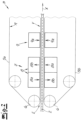
- the pressed material mat 1 is preheated according to the invention using the in Fig. 1 only indicated preheating device 3, which is otherwise in Fig. 2 is shown in more detail.
- This has an upper, endlessly rotating, gas-permeable conveyor belt 5a, e.g. B. a sieve belt 5a, and a lower, endlessly rotating, gas-permeable conveyor belt 5b, z. B. a sieve belt 5b.
- the conveyor belts or screen belts 5a, 5b are each guided around several rollers or rollers 6, of which at least for the upper part and the lower part one roller is designed as a drive roller.
- a treatment gap is formed between the conveyor belts 5a, 5b, through which the mat 2 is guided along the transport direction X from an inlet E to an outlet A.
- the area of the conveyor belt 5a, 5b which extends from the inlet E to the outlet A and in which the pressed material mat 2 is guided is referred to as the feed V and the adjoining area of the belts starting at the outlet A to the inlet E forms the Return R, which then merges into flow V at inlet E.
- the double belt preheating device 3 has a first heating unit 7 immediately behind the inlet E, which is designed as a steam-air supply device and with which the pressed material mat can be acted upon with a steam-air mixture with an adjustable dew point, which the mat from a surface flows through to the opposite surface and is thereby heated over the entire thickness of the mat.
- the first heating unit 7 has several feed-suction pairs 8 arranged one behind the other, each of which has a feed 8a and a suction 8b arranged on the opposite side of the mat, which can be designed as a feed box 8a and a suction box 8b. Details are not shown.
- the first feed-suction pair 8 has an upper feed 8a and a lower suction 8b, while the second feed-suction pair 8 has a lower feed 8a and an upper suction 8b.
- two zones 8 arranged one behind the other are therefore realized, in which a steam-air mixture is pressed through the mat 2 in opposite directions and sucked through the mat.
- the pressed material mat 2 is therefore in a first stage formed by the first heating unit 7 with a steam-air mixture with a set dew point (and set temperature). which flows through the mat from one surface to the opposite surface and thereby heats it over the entire mat thickness to a first temperature T1, which (approximately) corresponds to the (preset) dew point temperature of the steam-air mixture.
- the preheating device 3 has a second heating unit 9, which is arranged behind the first heating unit 7 in the transport direction X.
- this is designed as a steam supply device with which the mat 2 can be supplied with (pure) steam to heat only the cover layers near the surface.
- the steam feed device 9 has a feed pair with a feed 9a for the steam on both sides of the mat, these feeds 9a z. B. can be designed as feed boxes.
- steam e.g. water vapor
- the steam e.g. B. can have a temperature of 100 ° C or more.
- this second heating unit 9 steam is pressed into the mat 2 on both sides and as a result only the covering layers near the surface are heated to a second temperature T2, which is higher than the first temperature T1 to which the mat is heated in the first heating unit 7.
- the preheating device shown is followed by a two-stage preheating of the pressed material mat, namely in the first stage with the help of a steam-air mixture, with which the pressed material mat 2 is heated to a first temperature T1 evenly over the entire mat thickness.
- first temperature T1 evenly over the entire mat thickness.
- second stage only the surface layers near the surface are further heated to the second temperature T2.
- the heating in the first stage results in a high heat input, which leads to increased production capacity.
- the increase in temperature in the In the course of the subsequent pressing process, surface layers close to the surface lead to panels with improved properties, especially with regard to flexural strength and transverse tensile strength.
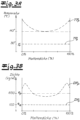
- the advantages achieved according to the invention are explained in detail using the graphic representations in the Fig. 3a , 3b to 6a , 6b explained in more detail.
- the Fig. 3a , 4a , 5a and 6a each show a temperature profile over the thickness of the plate, ie the temperature of the mat entering the press and the temperature of the plate after the press are plotted as a percentage of the plate thickness, depending on the location within the plate.
- a plate thickness of e.g. B. 16 mm means 0% 0 mm and 100% 16 mm
- ie the value 0% affects one plate surface
- the value 100% refers to the opposite plate surface and the values in between affect the inside of the plate.
- the thickness of the mat is of course significantly reduced in the pressing process in the continuous press, e.g. B. to a plate thickness of 16 mm.
- the Figures 3b , 4b , 5b and 6b show density profiles, on the one hand for the pressed material mat before it enters the press (e.g. DP 0 in Fig. 3b ) and on the other hand for the finished pressed plate behind the press, ie the density of the plate is plotted depending on the plate thickness or the location within the plate in relation to the plate thickness.
- the Figures 3a and 3b first show the conditions in the production of a fiberboard (e.g. MDF board) without any preheating before the press.
- the mat density ⁇ M is as follows Fig. 3b e.g. B. 120 kg/m 3 , homogeneously over the entire thickness of the pressed material mat (density profile DPa).
- Fig. 3b This occurs in the course of pressing Fig. 3b also shown density profile DP p , whereby the plate has an average density ⁇ P of z. B. 550 kg/m 3 .
- Fig. 3b It can be seen that the plate has a relatively low density in the middle of the plate and a relatively high density in the outer cover layers.
- the Figures 4a, 4b show the influence of heating the entire pressed material mat with a basically known preheating using a steam-air mixture (here abbreviated as DL in the indices), which z. B. has a dew point of 70 ° C, so that the mat is preheated over the entire width to a temperature T 1 of (approximately) 70 ° C.
- a steam-air mixture here abbreviated as DL in the indices
- DL steam-air mixture
- the pressing program is adapted to this preheating, so that the same temperature profile TP P is at the outlet of the press as in Fig. 3a is achieved, but with increased production capacity through the upstream preheating.
- Fig. 4b For comparison, the density profile DP P of the finished board without preheating (as in Fig. 3b ) shown.
- the density profile DP DL is shown, which occurs due to the described preheating with the steam-air mixture. It can be seen that the density in the middle of the mat is increased, which has a positive effect on the transverse tension. However, the cover layer densities decrease compared to processing without preheating, which is undesirable.
- the Figures 5a, 5b show the influence of preheating the cover layers by conventional steam application on both sides. It can be seen that the application of steam on both sides at a temperature of z. B. 100 ° C there is a strong increase in the mat temperature in the area of the surfaces or the cover layers (cf. Fig. 5a ). Starting from the homogeneous temperature profile TP 0 , the temperature profile TP D of the mat is established by the steam preheating. This leads to a plate with high density in the cover layers (cf. Fig. 5b ). Shown are the density profile DP P without preheating and the density profile DP D of the plate through steam preheating. The disadvantage here is the relatively low densities in the middle of the plate, which overall lead to the production capacity in the preheating process being limited Figures 5a, 5b is not increased as much as with the procedure Figures 4a, 4b .
- the Figures 6a, 6b show the influence of the two-stage preheating according to the invention by first using a steam-air mixture in a first stage and then by applying steam in a second stage.
- the mat temperature is raised to temperature T 1 over the entire thickness of the mat and the homogeneous temperature profile TP S1 is achieved.
- the temperature is raised to the temperature T 2 of approximately 100 ° C only in the area of the cover layers via the application of steam and the temperature profile TP S2 is achieved.
- the density profile DP K resulting from the subsequent pressing process through combined preheating is again in Fig. 6b shown in comparison to a density profile DP P without preheating.
- a system shown as an example in the figures or its preheating device also has conventional means for generating, adjusting, supplying and controlling or regulating the steam and the steam-air mixture, e.g. B. heat exchangers, mixing devices, etc. This allows the aforementioned parameters of the steam and in particular of the steam-air mixture to be adjusted, in particular the dew point and the temperature or dew point difference.
- conventional means for generating, adjusting, supplying and controlling or regulating the steam and the steam-air mixture e.g. B. heat exchangers, mixing devices, etc.
Landscapes
- Engineering & Computer Science (AREA)
- Life Sciences & Earth Sciences (AREA)
- Mechanical Engineering (AREA)
- Manufacturing & Machinery (AREA)
- Wood Science & Technology (AREA)
- Forests & Forestry (AREA)
- Dry Formation Of Fiberboard And The Like (AREA)
Claims (16)
- Procédé de préchauffage d'une natte de matériau comprimable (2) avant l'introduction dans une presse (4) en particulier au cours de la fabrication de panneaux à base de dérivés du bois,sachant que la natte de matériau comprimable (2) passe par un système de préchauffage à double bande (3) avec une bande transporteuse supérieure perméable aux gaz circulant en continu (5a) et une bande transporteuse inférieure perméable aux gaz circulant en continu (5b),sachant que la natte de matériau comprimable (2) est sollicitée par un fluide réchauffé, lequel contient de la vapeur, et est de ce fait chauffée,caractérisé en ce quela natte de matériau comprimable (2) est sollicitée dans le système de préchauffage à double bande (3) d'abord dans un premier niveau par une première unité de chauffage (7) avec un mélange vapeur-air avec un point de rosée établi, lequel traverse la natte de matériau comprimable (2) d'une surface à la surface opposée et est de ce fait chauffée sur toute l'épaisseur de natte à une température (T1), eten ce que la natte de matériau comprimable (2) est ensuite sollicitée des deux côtés dans le système de préchauffage à double bande (3) dans un deuxième niveau par une deuxième unité de chauffage (9) avec de la vapeur ou un mélange vapeur-air et que de ce fait seules les couches de couverture proches de la surface sont chauffées à une deuxième température (T2), qui est plus élevée que la première température (T1).
- Procédé selon la revendication 1, caractérisé en ce que dans le deuxième niveau, de la vapeur ou un mélange vapeur-air est comprimé simultanément dans les deux surfaces opposées de la natte de matériau comprimable (2) .
- Procédé selon la revendication 1 ou 2, caractérisé en ce que dans le deuxième niveau, un mélange vapeur-air ou de la vapeur est comprimé dans la natte de matériau comprimable (2) dans au moins deux zones disposées l'une derrière l'autre dans des directions opposées alternatives et/ou aspiré à travers la natte de matériau comprimable (2).
- Procédé selon l'une quelconque des revendications 1 à 3, caractérisé en ce que dans le premier niveau, un mélange vapeur-air est comprimé dans la natte de matériau comprimable (2) dans au moins deux zones disposées l'une derrière l'autre dans des directions opposées alternatives et/ou aspiré à travers la natte de matériau comprimable(2).
- Procédé selon l'une quelconque des revendications 1 à 4, caractérisé en ce que la natte de matériau comprimable (2) est réchauffée dans le premier niveau à une température (T1), qui correspond au point de rosée du mélange vapeur-air.
- Procédé selon l'une quelconque des revendications 1 à 5, caractérisé en ce que la natte de matériau comprimable (2) est réchauffée dans le premier niveau avec le mélange vapeur-air sur toute l'épaisseur à une température (T1) de 50°C à 85°C, de préférence de 60°C à 75°C.
- Procédé selon l'une quelconque des revendications 1 à 6, caractérisé en ce que dans le deuxième niveau, les deux couches de couverture proches de la surface de la natte de matériau comprimable (2) sont chauffées avec de la vapeur ou le mélange vapeur-air, à une température (T2) de plus de 85°C, de préférence de plus de 95°C, par ex. à peu près 100°C.
- Procédé selon l'une quelconque des revendications 1 à 7, caractérisé en ce que la natte de matériau comprimable (2) est compactée dans le système de préchauffage à double bande (3) après le deuxième niveau avec un système de compactage (10) disposé après la deuxième unité de chauffage (9).
- Système de préchauffage à double bande (3) pour le chauffage d'une natte de matériau comprimable (2), en particulier avec un procédé selon l'une quelconque des revendications 1 à 8,avec une bande transporteuse supérieure perméable aux gaz circulant en continu (5a) ou une bande transporteuse inférieure perméable aux gaz circulant en continu (5b), entre lesquelles est formé un espace de traitement à travers lequel la natte de matériau comprimable (2) peut être passée le long de la direction de transport (X),avec une première unité de chauffage (7), qui est constituée sous la forme d'un système d'alimentation vapeur-air et avec lequel la natte de matériau comprimable (2) peut être sollicitée par un mélange vapeur-air avec un point de rosée réglable, lequel traverse la natte de matériau comprimable (2) d'une surface à la surface opposée et est chauffée de ce fait sur toute l'épaisseur de natte,sachant qu'une deuxième unité de chauffage (9) est disposée dans la direction de transport (X) après la première unité de chauffage (7), c. à d. l'unité d'alimentation vapeur-air,caractérisé en ce quela deuxième unité de chauffage (9) est constituée, soit comme un système d'alimentation vapeur-air, avec lequel la natte peut être sollicitée avec de la vapeur pour le chauffage uniquement des couches de couverture proches de la surface,soitest constituée comme un système d'alimentation vapeur-air avec lequel la natte de matériau comprimable (2) peut être sollicitée avec un mélange vapeur-air pour le chauffage uniquement des couches de couverture proches de la surface, lequel comporte un point de rosée plus élevé et/ou une température plus élevée que le mélange vapeur-air de la première unité de chauffage (7).
- Dispositif selon la revendication 9, caractérisé en ce que la première unité de chauffage (7), c. à d. le système d'alimentation vapeur-air, comporte au moins une paire d'ensembles alimentation-aspiration (8) avec une alimentation (8a), par ex. avec un coffrage d'alimentation, sur un côté de la natte et une aspiration (8b), par ex. un coffrage d'aspiration, sur le côté opposé de la natte.
- Dispositif selon la revendication 9 ou 10, caractérisé en ce que la première unité de chauffage (7) comporte plusieurs paires d'ensembles alimentation-aspiration (8), qui sont conçues de préférence pour des directions d'écoulement opposées de telle manière qu'un mélange vapeur-air soit comprimé et/ou aspiré dans des directions opposées l'une derrière l'autre à travers la natte de matériau comprimable (2).
- Dispositif selon l'une quelconque des revendications 9 à 11, caractérisé en ce que la deuxième unité de chauffage (9), qui est constituée par ex. comme un système d'alimentation de vapeur, comporte une paire d'ensembles d'alimentation avec respectivement sur les deux côtés de la natte une alimentation (9a), par ex. un coffrage d'alimentation, avec lesquels la natte de matériau comprimable (2) peut être simultanément sollicitée des deux côtés avec de la vapeur ou un mélange vapeur-air.
- Dispositif selon l'une quelconque des revendications 9 à 12, caractérisé en ce que la deuxième unité de chauffage (7), par ex. en tant qu'unité d'alimentation vapeur-air, comporte plusieurs paires d'ensembles alimentation-aspiration, qui sont conçues pour des directions d'écoulement opposées de telle manière qu'un mélange vapeur-air est comprimé dans des directions opposées l'une derrière l'autre à travers la natte et/ou est aspiré à travers la natte.
- Dispositif selon l'une quelconque des revendications 1 à 13, caractérisé en ce que les bandes transporteuses (5a, 5b) sont constituées sous la forme d'une bande de tamisage.
- Dispositif selon l'une quelconque des revendications 9 à 14, caractérisé en ce qu'après la deuxième unité de chauffage (7) pour le compactage de la natte de matériau comprimable est disposé un système de compactage (10), qui comporte de préférence un rouleau de compactage supérieur et un rouleau de compactage inférieur (11), sachant que le rouleau de compactage supérieur et/ou inférieur (11) peut ou peuvent être sollicité(s) par au moins un moyen de force (12), par ex. : un vérin de compression.
- Installation de fabrication de panneaux à base de dérivés du bois, avec au moins un dispositif de dispersion (1) pour produire une natte de matériau comprimable (2), un système de préchauffage à double bande (3) selon l'une quelconque des revendications 9 à 15 pour le préchauffage de la natte de matériau comprimable et une presse (4) pour presser la natte de matériau comprimable préchauffée (2) en utilisant de la pression et de la chaleur.
Applications Claiming Priority (2)
| Application Number | Priority Date | Filing Date | Title |
|---|---|---|---|
| DE102019114021.8A DE102019114021B3 (de) | 2019-05-24 | 2019-05-24 | Verfahren und Vorrichtung zur Vorwärmung einer Pressgutmatte |
| PCT/EP2020/062857 WO2020239394A1 (fr) | 2019-05-24 | 2020-05-08 | Procédé et dispositif de préchauffage d'une natte de matière à presser |
Publications (3)
| Publication Number | Publication Date |
|---|---|
| EP3976331A1 EP3976331A1 (fr) | 2022-04-06 |
| EP3976331B1 true EP3976331B1 (fr) | 2024-02-07 |
| EP3976331C0 EP3976331C0 (fr) | 2024-02-07 |
Family
ID=70681817
Family Applications (1)
| Application Number | Title | Priority Date | Filing Date |
|---|---|---|---|
| EP20725482.2A Active EP3976331B1 (fr) | 2019-05-24 | 2020-05-08 | Procédé et dispositif de préchauffage d'une natte de matière à presser |
Country Status (4)
| Country | Link |
|---|---|
| EP (1) | EP3976331B1 (fr) |
| CN (1) | CN113748004B (fr) |
| DE (1) | DE102019114021B3 (fr) |
| WO (1) | WO2020239394A1 (fr) |
Family Cites Families (13)
| Publication number | Priority date | Publication date | Assignee | Title |
|---|---|---|---|---|
| DE3640682A1 (de) * | 1986-11-28 | 1988-06-09 | Baehre & Greten | Verfahren und vorrichtung zum kontinuierlichen vorwaermen eines vlieses fuer die herstellung von span-, faser- oder dergleichen platten |
| DE4415276A1 (de) * | 1994-04-30 | 1995-11-02 | Siempelkamp Gmbh & Co | Verfahren zur Herstellung von Holzwerkstoffplatten |
| DE4423632A1 (de) * | 1994-07-06 | 1996-01-11 | Siempelkamp Gmbh & Co | Verfahren zum Vorwärmen von Streugut auf eine vorgebbare Vorwärmtemperatur im Zuge der Herstellung von Holzwerkstoffplatten |
| DE19701595B4 (de) * | 1996-02-15 | 2004-09-09 | Siempelkamp Maschinen- Und Anlagenbau Gmbh & Co. Kg | Anlage für die Vorwärmung einer Preßgutmatte im Zuge der Herstellung von Holzwerkstoffplatten, insbesondere von Spanplatten |
| DE19635410C2 (de) * | 1996-08-31 | 2003-02-27 | Siempelkamp Gmbh & Co Maschine | Vorrichtung zum Verpressen eines Vlieses zu einem Plattenstrang |
| DE10206861A1 (de) * | 2002-02-18 | 2003-09-04 | Siempelkamp Masch & Anlagenbau | Verfahren zum Pressen und Aushärten von Pressgutmatten im Zuge einer kontinuierlichen Herstellung von Spanplatten, Faserplatten u. dgl. Holzwerkstoffplatten |
| DE102005016408A1 (de) | 2005-04-08 | 2006-10-12 | Dieffenbacher Gmbh + Co. Kg | Verfahren zur kontinuierlichen Vorwärmung eines Vlieses oder einer Matte und Vorrichtung zur Durchführung des Verfahrens |
| DE102005046879A1 (de) * | 2005-09-29 | 2007-04-05 | Dieffenbacher Gmbh + Co. Kg | Verfahren und Vorrichtung zur Vorwärmung einer gestreuten Pressgutmatte bei der Herstellung von Holzwerkstoffplatten |
| DE102008057557A1 (de) * | 2008-11-15 | 2010-05-20 | Dieffenbacher Gmbh + Co. Kg | Verfahren und Kalibrier- und Verschweißeinheit zur Herstellung von flexiblen Dämm-und/oder Schallschutzplatten oder flexiblem Halbzeug zur Weiterverarbeitung in Heißpressen |
| EP2213432A1 (fr) * | 2009-01-29 | 2010-08-04 | Imal S.R.L. | Appareil pour humidifier des tapis basé sur un matériau en bois en vrac |
| IT1401172B1 (it) * | 2010-07-02 | 2013-07-12 | Imal Srl | Apparato per il riscaldamento di materassi a base di materiale legnoso incoerente |
| DE102015121869A1 (de) * | 2015-12-15 | 2017-06-22 | Siempelkamp Maschinen- Und Anlagenbau Gmbh | Verfahren und Anlage zur kontinuierlichen Entwässerung von Wasser enthaltenem Gut, insbesondere zur Entwässerung von Braunkohle |
| CN110802711A (zh) * | 2019-10-11 | 2020-02-18 | 上海人造板机器厂有限公司 | 用于提高板坯温度的板坯预热方法及装置 |
-
2019
- 2019-05-24 DE DE102019114021.8A patent/DE102019114021B3/de active Active
-
2020
- 2020-05-08 EP EP20725482.2A patent/EP3976331B1/fr active Active
- 2020-05-08 WO PCT/EP2020/062857 patent/WO2020239394A1/fr not_active Ceased
- 2020-05-08 CN CN202080030287.6A patent/CN113748004B/zh active Active
Also Published As
| Publication number | Publication date |
|---|---|
| EP3976331A1 (fr) | 2022-04-06 |
| CN113748004A (zh) | 2021-12-03 |
| EP3976331C0 (fr) | 2024-02-07 |
| WO2020239394A1 (fr) | 2020-12-03 |
| CN113748004B (zh) | 2023-04-28 |
| DE102019114021B3 (de) | 2020-11-12 |
Similar Documents
| Publication | Publication Date | Title |
|---|---|---|
| DE69801228T2 (de) | Verfahren zum herstellen von holzspanplatten, faserplatten und ähnlichen platten | |
| DE4333614C2 (de) | Verfahren und Anlage zur kontinuierlichen Herstellung von Spanplatten | |
| DE69511242T2 (de) | Verfahren zum herstellen von lignocelluloseplatten | |
| EP0695609A2 (fr) | Procédé de préchauffage d'un matériau à étaler à une température fixe, pour la fabrication de panneaux de fibres | |
| DE102019114016B4 (de) | Verfahren und Vorrichtung zur Erwärmung einer Pressgutmatte | |
| EP2714351B1 (fr) | Procédé et installation de fabrication de panneaux de matériau | |
| EP1236552B1 (fr) | Procédé et installation pour la fabrication de panneaux en fibres lignocellulosiques | |
| DE10101952A1 (de) | Verfahren und Anlage zur Herstellung von Span- und Faserplatten | |
| EP3917739B1 (fr) | Dispositif et procédé de production de plaques isolantes | |
| EP0344192A1 (fr) | Procede et installation de fabrication de panneaux en copeaux de bois et materiaux similaires. | |
| DE866462C (de) | Verfahren und Vorrichtung zum kontinuierlichen Pressen, Trocknen und Formen von Material der verschiedensten Art | |
| EP3023210B1 (fr) | Procédé destiné au traitement de produits d'épandage. | |
| EP3976331B1 (fr) | Procédé et dispositif de préchauffage d'une natte de matière à presser | |
| EP4351856A1 (fr) | Appareil et procédé de fabrication de panneaux isolants | |
| DE102024001720B3 (de) | Verfahren zur Herstellung einer Werkstoffplatte sowie Werkstoffplatte und Verwendung einer Werkstoffplatte | |
| EP1851022B1 (fr) | Procede et dispositif de production de plaques de materiau isolant | |
| DE102005016408A1 (de) | Verfahren zur kontinuierlichen Vorwärmung eines Vlieses oder einer Matte und Vorrichtung zur Durchführung des Verfahrens | |
| DE102021005117B4 (de) | Verfahren und Vorrichtung zur Herstellung von Werkstoffplatten aus einer Pressgutmatte | |
| DE102004049473B4 (de) | Verfahren und Vorrichtung zur Herstellung von Holzwerkstoffplatten, insbesondere Faserplatten | |
| WO2016180881A1 (fr) | Procédé et dispositif pour disperser un mat au cours de la fabrication de panneaux de matériaux et panneau de matériau | |
| DE102023136273A1 (de) | Verfahren zur Herstellung einer Werkstoffplatte | |
| DE202015102415U1 (de) | Vorrichtung zum Streuen eines Vlieses im Zuge der Herstellung von Werkstoffplatten und eine Werkstoffplatte | |
| WO2002094522A1 (fr) | Procede de fabrication continue de panneaux de fibres | |
| DE102023136272A1 (de) | Verfahren zur Herstellung einer Werkstoffplatte | |
| DE102023136271A1 (de) | Verfahren zur Herstellung einer Werkstoffplatte |
Legal Events
| Date | Code | Title | Description |
|---|---|---|---|
| STAA | Information on the status of an ep patent application or granted ep patent |
Free format text: STATUS: UNKNOWN |
|
| STAA | Information on the status of an ep patent application or granted ep patent |
Free format text: STATUS: THE INTERNATIONAL PUBLICATION HAS BEEN MADE |
|
| PUAI | Public reference made under article 153(3) epc to a published international application that has entered the european phase |
Free format text: ORIGINAL CODE: 0009012 |
|
| STAA | Information on the status of an ep patent application or granted ep patent |
Free format text: STATUS: REQUEST FOR EXAMINATION WAS MADE |
|
| 17P | Request for examination filed |
Effective date: 20211020 |
|
| AK | Designated contracting states |
Kind code of ref document: A1 Designated state(s): AL AT BE BG CH CY CZ DE DK EE ES FI FR GB GR HR HU IE IS IT LI LT LU LV MC MK MT NL NO PL PT RO RS SE SI SK SM TR |
|
| DAV | Request for validation of the european patent (deleted) | ||
| DAX | Request for extension of the european patent (deleted) | ||
| GRAP | Despatch of communication of intention to grant a patent |
Free format text: ORIGINAL CODE: EPIDOSNIGR1 |
|
| STAA | Information on the status of an ep patent application or granted ep patent |
Free format text: STATUS: GRANT OF PATENT IS INTENDED |
|
| TPAC | Observations filed by third parties |
Free format text: ORIGINAL CODE: EPIDOSNTIPA |
|
| INTG | Intention to grant announced |
Effective date: 20231027 |
|
| GRAS | Grant fee paid |
Free format text: ORIGINAL CODE: EPIDOSNIGR3 |
|
| GRAA | (expected) grant |
Free format text: ORIGINAL CODE: 0009210 |
|
| STAA | Information on the status of an ep patent application or granted ep patent |
Free format text: STATUS: THE PATENT HAS BEEN GRANTED |
|
| AK | Designated contracting states |
Kind code of ref document: B1 Designated state(s): AL AT BE BG CH CY CZ DE DK EE ES FI FR GB GR HR HU IE IS IT LI LT LU LV MC MK MT NL NO PL PT RO RS SE SI SK SM TR |
|
| REG | Reference to a national code |
Ref country code: GB Ref legal event code: FG4D Free format text: NOT ENGLISH |
|
| REG | Reference to a national code |
Ref country code: CH Ref legal event code: EP |
|
| REG | Reference to a national code |
Ref country code: IE Ref legal event code: FG4D Free format text: LANGUAGE OF EP DOCUMENT: GERMAN |
|
| REG | Reference to a national code |
Ref country code: DE Ref legal event code: R096 Ref document number: 502020006944 Country of ref document: DE |
|
| U01 | Request for unitary effect filed |
Effective date: 20240214 |
|
| U07 | Unitary effect registered |
Designated state(s): AT BE BG DE DK EE FI FR IT LT LU LV MT NL PT SE SI Effective date: 20240223 |
|
| U20 | Renewal fee for the european patent with unitary effect paid |
Year of fee payment: 5 Effective date: 20240520 |
|
| PG25 | Lapsed in a contracting state [announced via postgrant information from national office to epo] |
Ref country code: IS Free format text: LAPSE BECAUSE OF FAILURE TO SUBMIT A TRANSLATION OF THE DESCRIPTION OR TO PAY THE FEE WITHIN THE PRESCRIBED TIME-LIMIT Effective date: 20240607 |
|
| PG25 | Lapsed in a contracting state [announced via postgrant information from national office to epo] |
Ref country code: GR Free format text: LAPSE BECAUSE OF FAILURE TO SUBMIT A TRANSLATION OF THE DESCRIPTION OR TO PAY THE FEE WITHIN THE PRESCRIBED TIME-LIMIT Effective date: 20240508 |
|
| PG25 | Lapsed in a contracting state [announced via postgrant information from national office to epo] |
Ref country code: HR Free format text: LAPSE BECAUSE OF FAILURE TO SUBMIT A TRANSLATION OF THE DESCRIPTION OR TO PAY THE FEE WITHIN THE PRESCRIBED TIME-LIMIT Effective date: 20240207 Ref country code: RS Free format text: LAPSE BECAUSE OF FAILURE TO SUBMIT A TRANSLATION OF THE DESCRIPTION OR TO PAY THE FEE WITHIN THE PRESCRIBED TIME-LIMIT Effective date: 20240507 |
|
| PG25 | Lapsed in a contracting state [announced via postgrant information from national office to epo] |
Ref country code: ES Free format text: LAPSE BECAUSE OF FAILURE TO SUBMIT A TRANSLATION OF THE DESCRIPTION OR TO PAY THE FEE WITHIN THE PRESCRIBED TIME-LIMIT Effective date: 20240207 |
|
| PG25 | Lapsed in a contracting state [announced via postgrant information from national office to epo] |
Ref country code: RS Free format text: LAPSE BECAUSE OF FAILURE TO SUBMIT A TRANSLATION OF THE DESCRIPTION OR TO PAY THE FEE WITHIN THE PRESCRIBED TIME-LIMIT Effective date: 20240507 Ref country code: NO Free format text: LAPSE BECAUSE OF FAILURE TO SUBMIT A TRANSLATION OF THE DESCRIPTION OR TO PAY THE FEE WITHIN THE PRESCRIBED TIME-LIMIT Effective date: 20240507 Ref country code: IS Free format text: LAPSE BECAUSE OF FAILURE TO SUBMIT A TRANSLATION OF THE DESCRIPTION OR TO PAY THE FEE WITHIN THE PRESCRIBED TIME-LIMIT Effective date: 20240607 Ref country code: HR Free format text: LAPSE BECAUSE OF FAILURE TO SUBMIT A TRANSLATION OF THE DESCRIPTION OR TO PAY THE FEE WITHIN THE PRESCRIBED TIME-LIMIT Effective date: 20240207 Ref country code: GR Free format text: LAPSE BECAUSE OF FAILURE TO SUBMIT A TRANSLATION OF THE DESCRIPTION OR TO PAY THE FEE WITHIN THE PRESCRIBED TIME-LIMIT Effective date: 20240508 Ref country code: ES Free format text: LAPSE BECAUSE OF FAILURE TO SUBMIT A TRANSLATION OF THE DESCRIPTION OR TO PAY THE FEE WITHIN THE PRESCRIBED TIME-LIMIT Effective date: 20240207 |
|
| PG25 | Lapsed in a contracting state [announced via postgrant information from national office to epo] |
Ref country code: PL Free format text: LAPSE BECAUSE OF FAILURE TO SUBMIT A TRANSLATION OF THE DESCRIPTION OR TO PAY THE FEE WITHIN THE PRESCRIBED TIME-LIMIT Effective date: 20240207 |
|
| PG25 | Lapsed in a contracting state [announced via postgrant information from national office to epo] |
Ref country code: PL Free format text: LAPSE BECAUSE OF FAILURE TO SUBMIT A TRANSLATION OF THE DESCRIPTION OR TO PAY THE FEE WITHIN THE PRESCRIBED TIME-LIMIT Effective date: 20240207 |
|
| PG25 | Lapsed in a contracting state [announced via postgrant information from national office to epo] |
Ref country code: SM Free format text: LAPSE BECAUSE OF FAILURE TO SUBMIT A TRANSLATION OF THE DESCRIPTION OR TO PAY THE FEE WITHIN THE PRESCRIBED TIME-LIMIT Effective date: 20240207 |
|
| PG25 | Lapsed in a contracting state [announced via postgrant information from national office to epo] |
Ref country code: CZ Free format text: LAPSE BECAUSE OF FAILURE TO SUBMIT A TRANSLATION OF THE DESCRIPTION OR TO PAY THE FEE WITHIN THE PRESCRIBED TIME-LIMIT Effective date: 20240207 |
|
| PG25 | Lapsed in a contracting state [announced via postgrant information from national office to epo] |
Ref country code: SK Free format text: LAPSE BECAUSE OF FAILURE TO SUBMIT A TRANSLATION OF THE DESCRIPTION OR TO PAY THE FEE WITHIN THE PRESCRIBED TIME-LIMIT Effective date: 20240207 |
|
| PG25 | Lapsed in a contracting state [announced via postgrant information from national office to epo] |
Ref country code: SM Free format text: LAPSE BECAUSE OF FAILURE TO SUBMIT A TRANSLATION OF THE DESCRIPTION OR TO PAY THE FEE WITHIN THE PRESCRIBED TIME-LIMIT Effective date: 20240207 Ref country code: SK Free format text: LAPSE BECAUSE OF FAILURE TO SUBMIT A TRANSLATION OF THE DESCRIPTION OR TO PAY THE FEE WITHIN THE PRESCRIBED TIME-LIMIT Effective date: 20240207 Ref country code: RO Free format text: LAPSE BECAUSE OF FAILURE TO SUBMIT A TRANSLATION OF THE DESCRIPTION OR TO PAY THE FEE WITHIN THE PRESCRIBED TIME-LIMIT Effective date: 20240207 Ref country code: CZ Free format text: LAPSE BECAUSE OF FAILURE TO SUBMIT A TRANSLATION OF THE DESCRIPTION OR TO PAY THE FEE WITHIN THE PRESCRIBED TIME-LIMIT Effective date: 20240207 |
|
| REG | Reference to a national code |
Ref country code: DE Ref legal event code: R097 Ref document number: 502020006944 Country of ref document: DE |
|
| PLBE | No opposition filed within time limit |
Free format text: ORIGINAL CODE: 0009261 |
|
| STAA | Information on the status of an ep patent application or granted ep patent |
Free format text: STATUS: NO OPPOSITION FILED WITHIN TIME LIMIT |
|
| REG | Reference to a national code |
Ref country code: CH Ref legal event code: PL |
|
| PG25 | Lapsed in a contracting state [announced via postgrant information from national office to epo] |
Ref country code: MC Free format text: LAPSE BECAUSE OF FAILURE TO SUBMIT A TRANSLATION OF THE DESCRIPTION OR TO PAY THE FEE WITHIN THE PRESCRIBED TIME-LIMIT Effective date: 20240207 |
|
| 26N | No opposition filed |
Effective date: 20241108 |
|
| GBPC | Gb: european patent ceased through non-payment of renewal fee |
Effective date: 20240508 |
|
| PG25 | Lapsed in a contracting state [announced via postgrant information from national office to epo] |
Ref country code: MC Free format text: LAPSE BECAUSE OF FAILURE TO SUBMIT A TRANSLATION OF THE DESCRIPTION OR TO PAY THE FEE WITHIN THE PRESCRIBED TIME-LIMIT Effective date: 20240207 Ref country code: CH Free format text: LAPSE BECAUSE OF NON-PAYMENT OF DUE FEES Effective date: 20240531 |
|
| PG25 | Lapsed in a contracting state [announced via postgrant information from national office to epo] |
Ref country code: IE Free format text: LAPSE BECAUSE OF NON-PAYMENT OF DUE FEES Effective date: 20240508 |
|
| PG25 | Lapsed in a contracting state [announced via postgrant information from national office to epo] |
Ref country code: GB Free format text: LAPSE BECAUSE OF NON-PAYMENT OF DUE FEES Effective date: 20240508 |
|
| U20 | Renewal fee for the european patent with unitary effect paid |
Year of fee payment: 6 Effective date: 20250520 |
|
| PG25 | Lapsed in a contracting state [announced via postgrant information from national office to epo] |
Ref country code: CY Free format text: LAPSE BECAUSE OF FAILURE TO SUBMIT A TRANSLATION OF THE DESCRIPTION OR TO PAY THE FEE WITHIN THE PRESCRIBED TIME-LIMIT; INVALID AB INITIO Effective date: 20200508 |
|
| PG25 | Lapsed in a contracting state [announced via postgrant information from national office to epo] |
Ref country code: HU Free format text: LAPSE BECAUSE OF FAILURE TO SUBMIT A TRANSLATION OF THE DESCRIPTION OR TO PAY THE FEE WITHIN THE PRESCRIBED TIME-LIMIT; INVALID AB INITIO Effective date: 20200508 |