EP3975673B1 - Enclosure for electronics - Google Patents
Enclosure for electronics Download PDFInfo
- Publication number
- EP3975673B1 EP3975673B1 EP20198650.2A EP20198650A EP3975673B1 EP 3975673 B1 EP3975673 B1 EP 3975673B1 EP 20198650 A EP20198650 A EP 20198650A EP 3975673 B1 EP3975673 B1 EP 3975673B1
- Authority
- EP
- European Patent Office
- Prior art keywords
- enclosure
- aperture
- axis
- relief chamber
- shell
- Prior art date
- Legal status (The legal status is an assumption and is not a legal conclusion. Google has not performed a legal analysis and makes no representation as to the accuracy of the status listed.)
- Active
Links
Images



Classifications
-
- G—PHYSICS
- G01—MEASURING; TESTING
- G01S—RADIO DIRECTION-FINDING; RADIO NAVIGATION; DETERMINING DISTANCE OR VELOCITY BY USE OF RADIO WAVES; LOCATING OR PRESENCE-DETECTING BY USE OF THE REFLECTION OR RERADIATION OF RADIO WAVES; ANALOGOUS ARRANGEMENTS USING OTHER WAVES
- G01S7/00—Details of systems according to groups G01S13/00, G01S15/00, G01S17/00
- G01S7/02—Details of systems according to groups G01S13/00, G01S15/00, G01S17/00 of systems according to group G01S13/00
- G01S7/027—Constructional details of housings, e.g. form, type, material or ruggedness
- G01S7/028—Miniaturisation, e.g. surface mounted device [SMD] packaging or housings
-
- H—ELECTRICITY
- H05—ELECTRIC TECHNIQUES NOT OTHERWISE PROVIDED FOR
- H05K—PRINTED CIRCUITS; CASINGS OR CONSTRUCTIONAL DETAILS OF ELECTRIC APPARATUS; MANUFACTURE OF ASSEMBLAGES OF ELECTRICAL COMPONENTS
- H05K5/00—Casings, cabinets or drawers for electric apparatus
- H05K5/06—Hermetically-sealed casings
- H05K5/068—Hermetically-sealed casings having a pressure compensation device, e.g. membrane
-
- B—PERFORMING OPERATIONS; TRANSPORTING
- B60—VEHICLES IN GENERAL
- B60R—VEHICLES, VEHICLE FITTINGS, OR VEHICLE PARTS, NOT OTHERWISE PROVIDED FOR
- B60R16/00—Electric or fluid circuits specially adapted for vehicles and not otherwise provided for; Arrangement of elements of electric or fluid circuits specially adapted for vehicles and not otherwise provided for
- B60R16/02—Electric or fluid circuits specially adapted for vehicles and not otherwise provided for; Arrangement of elements of electric or fluid circuits specially adapted for vehicles and not otherwise provided for electric constitutive elements
- B60R16/023—Electric or fluid circuits specially adapted for vehicles and not otherwise provided for; Arrangement of elements of electric or fluid circuits specially adapted for vehicles and not otherwise provided for electric constitutive elements for transmission of signals between vehicle parts or subsystems
- B60R16/0239—Electronic boxes
-
- H—ELECTRICITY
- H05—ELECTRIC TECHNIQUES NOT OTHERWISE PROVIDED FOR
- H05K—PRINTED CIRCUITS; CASINGS OR CONSTRUCTIONAL DETAILS OF ELECTRIC APPARATUS; MANUFACTURE OF ASSEMBLAGES OF ELECTRICAL COMPONENTS
- H05K5/00—Casings, cabinets or drawers for electric apparatus
- H05K5/0026—Casings, cabinets or drawers for electric apparatus provided with connectors and printed circuit boards [PCB], e.g. automotive electronic control units
- H05K5/0047—Casings, cabinets or drawers for electric apparatus provided with connectors and printed circuit boards [PCB], e.g. automotive electronic control units having a two-part housing enclosing a PCB
- H05K5/0056—Casings, cabinets or drawers for electric apparatus provided with connectors and printed circuit boards [PCB], e.g. automotive electronic control units having a two-part housing enclosing a PCB characterized by features for protecting electronic components against vibration and moisture, e.g. potting, holders for relatively large capacitors
Definitions
- the present disclosure relates to enclosures for electronics, and in particular those which provide an environmentally-protected chamber which is resistant to ingress of liquid and/or dust.
- enclosures may have applications in the protection of automotive electronics, and in particular the protection of sensor modules, such as radar sensor modules, for autonomous or semi-autonomous vehicles.
- sensor modules in autonomous or semi-autonomous vehicles, it is conventional to arrange sensor modules at or close to an external surface of the vehicle to send and/or receive signals, such as radar signals, from the environment around the vehicle.
- signals such as radar signals
- Such modules may come into contact with hostile environmental conditions more readily than other modules, for example by the application of jet-sprayed liquid, such as a mixture of water and cleaning agents, during a cleaning operation performed on the vehicle.
- unit containing such sensitive parts are environmentally-sealed to at least, for example, the IP 6K6K rating according to IEC standard 60529 which provides resistance to a high-pressure jet of liquid for an extended period.
- modules also are required to operate within a very wide temperature range, typically between -40° C and 85° C, both due to ambient environmental factors such as cold air temperatures or direct solar irradiation, and due to mounting of such modules in proximity to heat-generating or heat-dispersing automotive components such as internal combustion engines, electric motors, exhaust assemblies, heat exchangers and the like.
- a very wide temperature range typically between -40° C and 85° C, both due to ambient environmental factors such as cold air temperatures or direct solar irradiation, and due to mounting of such modules in proximity to heat-generating or heat-dispersing automotive components such as internal combustion engines, electric motors, exhaust assemblies, heat exchangers and the like.
- a conventional breathable, that is, gas-permeable but liquid-impermeable, membrane such as GORE TM membrane is provided to cover the aperture and to maintain the liquid-permeable seal.
- Such membranes having, for example, a microporous structure may allow air and gases to pass through freely, so pressures are equalized and moisture diffused, while the pores of the membrane block the entry of liquids, as well as fine dust and particulates.
- conventional approaches to arranging and fixing such membranes, for example by means of an adhesive bead around the pressure-relief aperture have been found to be insufficient to maintain the desirable IP 6K6K rating.
- an enclosure for electronics as recited in claim 1 below there is provided an enclosure for electronics as recited in claim 1 below.
- a through-axis of each opening may laterally and/or angularly be offset from a through-axis of the aperture.
- the partition may have a wall portion projecting inwardly from the shell and a roof portion extending from the wall portion to enclose the relief chamber.
- the roof portion may have the aperture.
- the enclosure further comprises first and second tunnel structures providing the respective first and second tunnels extending between the respective first and second opening and the relief chamber.
- each tunnel may extend in a straight line.
- each tunnel may extend in a direction at an angle to a through-axis of the aperture.
- each tunnel may extend in a direction perpendicular to a through-axis of the aperture.
- the through-axis of the second opening may be perpendicular to a through-axis of the first opening and perpendicular to a through-axis of the aperture.
- the gas-permeable membrane may be arranged on a main-chamber side of the partition.
- the shell is box-shaped and has plain are top and bottom walls, and plain are sidewalls extending between the top and bottom walls.
- the partition may extend inwardly from a top or bottom wall of the box, and the opening may be provided in a sidewall of the box.
- the enclosure may meet a rating of IP 6K6K according to IEC standard 60529.
- the enclosure is an enclosure for vehicle-mounted radar sensor electronics.
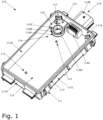
- Figure 1 shows a lower part 110 of an electronics enclosure 100.
- Electronics enclosure 100 has an upper part 130 shown in Figure 11 , having the form of a lid, which is configured to sealingly engage with lower part 110 to form the complete enclosure, as shown in Figure 12 .
- Lower part 110 in the configuration shown in Figure 1 has the form of a rectangular box having a generally planar lower wall 111, sidewalls 111A, 111B, 111C, and 111D which project vertically upwards from the plane of lower wall 111 so that an interior space 112 of enclosure 100 is partly enclosed on five sides.
- each of sidewalls 111 A, 111B, 111C, and 111D is recessed on an outer edge to provide a sealing rim over which the upper part 130 can sealingly engage.
- the upper part 130 has a corresponding projection formed on a lower surface thereof to be accommodated in recess 113, and may provide space for a seal, such as an o-ring seal or a bead of sealant, to be located between the lower part 110 and the upper part 130.
- the upper part 130 may, for example, be secured to lower part 110 by adhesive, or may be provided with fixtures such as locking clamps or screws to engage the upper part 130 to the lower part 110.
- the upper part 130 may be a generally flat structure as shown, or may itself partly enclosed interior space 112, for example by having a corresponding shape to the shape of the lower part 110 with an upper wall and sidewalls which continue, in the assembled state, from the sidewalls 111A, 111B, 111C and 111D of lower part 110.
- one of the sidewalls 111D is provided with connector assembly 114, which provides an internal terminal portion 114A a having conductors which extend through sidewall 111D to receptacle 114B.
- the conductors of terminal portion 114 a pass through sidewall 111D by means of appropriate sealing, for example by being in sealing contact with the material of sidewall 11D, or otherwise by passing through a seal block such as a rubber block which itself seals with sidewall 111D.
- a seal block such as a rubber block which itself seals with sidewall 111D.
- fixing points 115 which provide anchors for attaching, for example, an electronic component such as a printed circuit board (PCB).
- fixing points 115 extend from an interior surface of lower wall 111, but may also be provided at other locations such as on each of sidewalls 111A, 111B, 111C, 111D.
- fixing points 115 may be reinforced portions having a blind hole formed therein, into which a screw may be tapped. Arranging suitable holes in the electronic component over fixing points 115 and introducing a screw through the hole to the fixing point may be used to secure the electronic component.
- other means of securing electronic components within enclosure 100 may be provided by, for example, the use of adhesives, press-fit studs, retention clips or other fixtures.
- an aperture 117 is provided communicating between the interior space 112 and a relief chamber 118, which itself communicates with an exterior of the enclosure 100.
- aperture 117 is provided to a partition formed to extend from lower part 110 in the form of pedestal 116 which encloses the relief chamber 118.
- Relief chamber 118 communicates with the exterior of enclosure 100 through openings 119 and 120.
- Relief chamber 118 and openings 119 and 120 are not visible in Figure 1 , but are shown in the vertical cross-section of Figure 2 and the horizontal cross-section of Figure 3 .
- pedestal 116 has a wall portion 116 extending vertically from the plane of lower wall 111 and a roof portion 116B extending horizontally from wall portion 116A so as to enclose relief chamber 118.
- roof portion 116B is circular in periphery and wall portion 116 extends circumferentially around the periphery of roof portion 116B.
- roof portion may be, for example, domed, and/or wall portion 116 may be formed in a generally curved or in a polygonal shape, for example by a series of wall portions extending in a straight-line or curved configuration with angles defined therebetween. So, for example, pedestal 116 may, for example, be rectangular or hexagonal or octagonal in plan.
- tunnel structures 121 and 122 Extending between pedestal 116 and adjacent side walls 116B and 116D are tunnel structures 121 and 122. As shown in Figure 3 , tunnel structures 112 and 122 define tunnels 123 and 124 which extend from relief chamber 118 and which respectively terminate at openings 119 and 120.
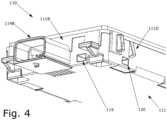
- Figure 4 shows an alternative view of lower part 110 from an underside direction, in which lower surface 111 is visible, as well as openings 119 and 120 formed in respective sidewalls 111B and 111D.
- an overall passage for gas exists between space 112 and the exterior of the enclosure 100 through, sequentially, aperture 117, relief chamber 118, tunnels 123 and 124 and openings 119 and 120, whereby an overpressure or underpressure inside enclosure 100 may be relieved.
- membrane 116D is provided to cover aperture 117.
- Membrane 116D is gas-permeable but liquid-impermeable, and may be formed of a breathable material such as GORE TM membrane. Such breathable materials known in the art, and may be selected according to requirements.
- underside of membrane 116 is sealingly adhered by means of, for example, a peripheral adhesive bead to an upper surface of roof portion 116B so as to cover aperture 117.
- Membrane 116D thereby prevents ingress of moisture and/or dust between relief chamber 118 and space 112 through aperture 117.
- a recess 116C having the same size and shape as membrane 116D is formed on roof portion 116B to accommodate membrane 116, but in other configurations membrane 116 may be affixed to a sufficiently flat surface of roof portion 116B without any recess.
- recess 116C matches the peripheral shape of membrane 116D.
- the pro shape of membrane 116D or recess 116 there is no limitation on the pro shape of membrane 116D or recess 116, and either or both of these may be circular, rectangular, octagonal, hexagonal, or of irregular outline.
- a relief chamber 118 is arranged between interior space 112 and an exterior of enclosure 100, communicating by means of aperture 117 and at least one of openings 119 and 120, the opportunity for an incident jet of liquid to impinge directly on membrane 116D is reduced. Therefore, the forces experienced by membrane 116D resulting from, for example, a cleaning process using liquid jets may be reduced. As a result, the seal provided by membrane may be more durable and the enclosure is made more resistant against incoming moisture.
- a through-axis of aperture 117 which may be regarded as being a direction normal to a cross-section of aperture 117, is offset, both laterally and in angular direction, from each through-axis of openings 119 and 120.
- two openings 119, 120, with associated tunnels 123, 124 are provided which communicate with relief chamber 118.
- Providing two such openings from the exterior of enclosure 100 allows for liquid, which has entered through one opening, easily to drain through the other opening. Accordingly, a jet of liquid through one opening will not lead to a build-up of liquid in relief chamber 118 and hence an undesirable increase of inward pressure against membrane 116.
- the ability of the enclosure to resist incident liquid can further be improved.
- openings 119, 120 are arranged with through-axes which are angularly offset one to another.
- openings 119, 120 are located on different sidewalls, particularly adjacent sidewalls 111D, 111B.
- adjacent sidewalls 111D, 111B extend at an inclination one to the other, shown as a perpendicular inclination.
- Such a configuration promotes more effective drainage of liquid from relief chamber 118.
- providing the through-axes of openings 119, 120 to be perpendicular particularly efficiently promotes drainage, especially if the enclosure 100 may, in use, be installed at different orientations.
- tunnels 123, 124 which terminate at openings 119, 120, extend at an angle one to another, and in particular are arranged to extend linearly in directions perpendicular one to another.
- Such a configuration permits the enclosure 100 to be installed in a variety of orientations and to retain the ability effectively to drain liquid which has entered into relief chamber 118 out from relief chamber 118 by the force of gravity.
- tunnels 123 and 124 need not be at right angles to one another, and may be arranged at other angles.
- tunnels 123 and 124 are depicted as being formed in a straight line with a constant cross-section, in other configurations the cross-section can be narrowed or expanded along each tunnel. Further, the path of tunnels 123 and 124 may each be made curving or labyrinthine in order further to resist the incursion of liquid.
- the enclosure may have a lower part 220 having openings 219 and 220. Openings 219 and 220, which terminate tunnels 223 and 224, may have different cross-sections.
- the cross-section of tunnel 223 may be rectangular and may have constant dimensions, while the cross-section of tunnel 224 and associated opening 220 may be round and may taper, for example toward relief chamber 228.
- Other configurations of cross-section are possible, without limitation.
- lower part 320 is provided with one opening 319 arranged at one side wall 311D of enclosure 320 and connected to relief chamber 218 by tunnel 323.
- Lower part 320 is also provided with at least one second opening 320, here shown as a group of second openings 320, formed in lower surface 311 of lower part 320 and extending directly between lower surface 311 and relief chamber 328.
- aperture 317 formed in roof portion 316B of pedestal 316 may still be adequately protected from direct incidence of liquid jets since, for some applications, the enclosure may be mounted with openings 320 facing another surface, such as a surface to which lower panel 320 is fixed and by which it is supported. Moreover, aperture 317 may be protected from direct incidence of liquid jets by arranging the one or more openings 320 with through-axes offset from a through-axis of aperture 117. In the configuration of Figures 7 to 10 , openings 320 have through-axes which are laterally offset from a through-axis of aperture 317, for example.
- each opening as a group of smaller holes, by covering each opening with a grid with sufficiently small mesh spacing, in each case so as to disrupt or reduce the force of any incident liquid jet.
- example has been used of an essentially rectangular box-shaped enclosure, but the present configuration is also applicable to box-type enclosures having square, hexagonal, octagonal, or other polygonal outline.
- the present disclosure is applicable to enclosures which may have a circular outline, and which may have domed or otherwise non-planar upper and/or lower surfaces.
- the present disclosure can be equivalently applied in a drum-like enclosure having a planar lower surface and a dome-shaped upper surface, and wherein openings are provided either to locations in the circumferential wall of the drum or on at one location on the circumferential wall of the drum and on a planar lower surface of the drum.
- the present disclosure is also applicable to configurations in which only one exterior opening is provided, or whether at a side surface or a lower surface, or another surface of the enclosure.
- the above disclosure has been exemplified with respect to a two-part enclosure having a lower part and an upper part which sealingly engages with the lower portion as shown in Figure 12 .
- the enclosure can be configured, for example, to have two lateral half-portions which each comprise an upper wall, lower wall and one or more sidewalls, and which are joined together at an open end of each lateral half-portion.
- no terminal portion and corresponding perceptible receptacle may be provided for communicating electrical signals between interior and exterior of the enclosure, and communication may be provided, for example, by wireless means.
- each of the lower part of the enclosure and the upper part of the enclosure have each been shown as integral, unitary structures which may each be formed, for example, by injection moulding.
- the respective parts of each of these structures may also be formed separately and then sealably joined together by any suitable means such as adhesive or welding.
- the material of the enclosure is not limited, and may advantageously be manufactured from a plastic or ceramic material.
- a gas-permeable membrane may be sealingly adhered to an upper surface of a pedestal structure which defines a relief chamber; however, in other configurations a membrane may be also formed as an insert to a relief aperture or may be adhered to an inner surface of the relief chamber.
- the relief aperture has been exemplified by a circular through-hole, the relief aperture may be formed with a variety of cross-sections and shapes.
- an embodiment of the disclosure may be implemented as an electronics module having the enclosure and a radar sensor accommodated in a space inside the enclosure, for example on a PCB implementing a radar sensor.
- the sensor may be fixed inside the enclosure and communicating with elements outside of the enclosure by electronic signals transmitted via the terminal portion.
- the enclosure may be made of radar-transparent material.
Landscapes
- Engineering & Computer Science (AREA)
- Microelectronics & Electronic Packaging (AREA)
- Radar, Positioning & Navigation (AREA)
- Remote Sensing (AREA)
- Physics & Mathematics (AREA)
- Computer Networks & Wireless Communication (AREA)
- General Physics & Mathematics (AREA)
- Mechanical Engineering (AREA)
- Casings For Electric Apparatus (AREA)
- Electromagnetism (AREA)
Description
- The present disclosure relates to enclosures for electronics, and in particular those which provide an environmentally-protected chamber which is resistant to ingress of liquid and/or dust. Such enclosures may have applications in the protection of automotive electronics, and in particular the protection of sensor modules, such as radar sensor modules, for autonomous or semi-autonomous vehicles.
- Each of published patent applications
GB 2 307 750 A US 2015/338299 A1 ,DE 10 2006 053114 A1 , andUS 2017/013741 A1 form part of the state of the art relative to the present disclosure. - In many fields of application, it is necessary to protect sensitive parts such as electronic components from damaging environments. For example, in the automotive field, engine control units, infotainment modules, and other control and or interface modules may need to be located at a location which is inadequately protected from, for example, liquid and/or dust ingress.
- As just one example, in autonomous or semi-autonomous vehicles, it is conventional to arrange sensor modules at or close to an external surface of the vehicle to send and/or receive signals, such as radar signals, from the environment around the vehicle. Such modules may come into contact with hostile environmental conditions more readily than other modules, for example by the application of jet-sprayed liquid, such as a mixture of water and cleaning agents, during a cleaning operation performed on the vehicle.
- Therefore, it is desirable that unit containing such sensitive parts are environmentally-sealed to at least, for example, the IP 6K6K rating according to IEC standard 60529 which provides resistance to a high-pressure jet of liquid for an extended period.
- However, such modules also are required to operate within a very wide temperature range, typically between -40° C and 85° C, both due to ambient environmental factors such as cold air temperatures or direct solar irradiation, and due to mounting of such modules in proximity to heat-generating or heat-dispersing automotive components such as internal combustion engines, electric motors, exhaust assemblies, heat exchangers and the like. When closed and sealed units are exposed to changes in temperature, the air inside such units will undergo a change in pressure, which, if not relieved, can lead to damage of the enclosed electronics or of the sealed enclosure of the unit.
- Therefore, it has been proposed to provide a pressure-relief aperture communicating between the exterior and interior of the unit in order to allow for changes in temperature without increasing or decreasing the internal pressure of the unit. The provision of such a relief aperture, however, breaks the overall sealing of the unit by introducing a route through which liquid and dust can enter the unit. The provision of such a relief aperture may therefore compromise the compliance with environmental sealing rating such as IP 6K6K.
- In one proposal, a conventional breathable, that is, gas-permeable but liquid-impermeable, membrane such as GORE™ membrane, is provided to cover the aperture and to maintain the liquid-permeable seal. Such membranes having, for example, a microporous structure may allow air and gases to pass through freely, so pressures are equalized and moisture diffused, while the pores of the membrane block the entry of liquids, as well as fine dust and particulates. However, conventional approaches to arranging and fixing such membranes, for example by means of an adhesive bead around the pressure-relief aperture have been found to be insufficient to maintain the desirable IP 6K6K rating.
- Therefore, there is need for an electronics enclosure, in particular for electronics modules used in automotive applications, which is better able to resist liquid ingress while permitting for relief of pressure from within the enclosure.
- According to a first aspect of the disclosure, there is provided an enclosure for electronics as recited in claim 1 below.
- The dependent claims define particular embodiments of the invention.
- In one configuration, a through-axis of each opening may laterally and/or angularly be offset from a through-axis of the aperture.
- In one configuration, the partition may have a wall portion projecting inwardly from the shell and a roof portion extending from the wall portion to enclose the relief chamber. The roof portion may have the aperture.
- In one configuration, the enclosure further comprises first and second tunnel structures providing the respective first and second tunnels extending between the respective first and second opening and the relief chamber.
- In one configuration, each tunnel may extend in a straight line.
- In one configuration, each tunnel may extend in a direction at an angle to a through-axis of the aperture.
- In one configuration, each tunnel may extend in a direction perpendicular to a through-axis of the aperture.
- In one configuration, the through-axis of the second opening may be perpendicular to a through-axis of the first opening and perpendicular to a through-axis of the aperture.
- In one configuration, the gas-permeable membrane may be arranged on a main-chamber side of the partition.
- In one configuration, the shell is box-shaped and has plain are top and bottom walls, and plain are sidewalls extending between the top and bottom walls.
- In one configuration, the partition may extend inwardly from a top or bottom wall of the box, and the opening may be provided in a sidewall of the box.
- In one configuration, the enclosure may meet a rating of IP 6K6K according to IEC standard 60529.
- In one configuration, the enclosure is an enclosure for vehicle-mounted radar sensor electronics.
- For a better understanding of the present disclosure and to show how the same may be carried into effect, reference will be made, by way of example only, to the accompanying drawings, in which:
-
Figure 1 shows an interior of a lower part of an enclosure according to an embodiment; -
Figure 2 shows a vertical cross-section through the lower part ofFigure 1 ; -
Figure 3 shows a horizontal cross-section through the lower part ofFigure 1 ; -
Figure 4 shows a detail of an exterior of the lower part ofFigure 1 ; -
Figure 5 shows a horizontal cross-section through a lower part of enclosure according to another embodiment; -
Figure 6 shows an exterior of the lower part ofFigure 4 ; -
Figure 7 shows an interior of the lower part of an enclosure according to another embodiment; -
Figure 8 shows a vertical-cross-section through the lower part ofFigure 7 ; -
Figure 9 shows an underside exterior of the lower part ofFigure 7 ; and -
Figure 10 shows a detail of the exterior of the lower part ofFigure 7 ; -
Figure 11 shows an upper part usable as part of any of the disclosed embodiments; and -
Figure 12 shows the upper part ofFigure 11 engaged with the lower part ofFigure 1 . -
Figure 1 shows alower part 110 of anelectronics enclosure 100.Electronics enclosure 100 has anupper part 130 shown inFigure 11 , having the form of a lid, which is configured to sealingly engage withlower part 110 to form the complete enclosure, as shown inFigure 12 .Lower part 110 in the configuration shown inFigure 1 has the form of a rectangular box having a generally planarlower wall 111,sidewalls lower wall 111 so that aninterior space 112 ofenclosure 100 is partly enclosed on five sides. - The upper end of each of
sidewalls upper part 130 can sealingly engage. Theupper part 130 has a corresponding projection formed on a lower surface thereof to be accommodated inrecess 113, and may provide space for a seal, such as an o-ring seal or a bead of sealant, to be located between thelower part 110 and theupper part 130. Theupper part 130 may, for example, be secured to lowerpart 110 by adhesive, or may be provided with fixtures such as locking clamps or screws to engage theupper part 130 to thelower part 110. Theupper part 130 may be a generally flat structure as shown, or may itself partly enclosedinterior space 112, for example by having a corresponding shape to the shape of thelower part 110 with an upper wall and sidewalls which continue, in the assembled state, from thesidewalls lower part 110. - As shown in
Figure 1 , one of thesidewalls 111D is provided withconnector assembly 114, which provides aninternal terminal portion 114A a having conductors which extend throughsidewall 111D toreceptacle 114B. The conductors of terminal portion 114 a pass throughsidewall 111D by means of appropriate sealing, for example by being in sealing contact with the material of sidewall 11D, or otherwise by passing through a seal block such as a rubber block which itself seals withsidewall 111D. Thereby, external electrical signals may be introduced to and obtained from electronics mounted at the interior ofenclosure 100 while maintaining a sealed state ofenclosure 100. - Also provided in
enclosure 100 arefixing points 115 which provide anchors for attaching, for example, an electronic component such as a printed circuit board (PCB). In the configuration ofFigure 1 ,fixing points 115 extend from an interior surface oflower wall 111, but may also be provided at other locations such as on each ofsidewalls fixing points 115 may be reinforced portions having a blind hole formed therein, into which a screw may be tapped. Arranging suitable holes in the electronic component overfixing points 115 and introducing a screw through the hole to the fixing point may be used to secure the electronic component. However, other means of securing electronic components withinenclosure 100 may be provided by, for example, the use of adhesives, press-fit studs, retention clips or other fixtures. - When
upper part 130 is sealingly engaged withlower part 110 ofenclosure 100, there is a need for pressure relief for air (or other gas) which may be present inspace 112 insideenclosure 100 to avoid pressure difference between an interior of the enclosure and an exterior of the enclosure from damaging the enclosure or the components housed therein. Accordingly, in the configuration ofFigure 1 , anaperture 117 is provided communicating between theinterior space 112 and arelief chamber 118, which itself communicates with an exterior of theenclosure 100. In the configuration ofFigure 1 ,aperture 117 is provided to a partition formed to extend fromlower part 110 in the form ofpedestal 116 which encloses therelief chamber 118.Relief chamber 118 communicates with the exterior ofenclosure 100 throughopenings Relief chamber 118 andopenings Figure 1 , but are shown in the vertical cross-section ofFigure 2 and the horizontal cross-section ofFigure 3 . - As can be seen in
Figure 2 ,pedestal 116 has awall portion 116 extending vertically from the plane oflower wall 111 and aroof portion 116B extending horizontally fromwall portion 116A so as to encloserelief chamber 118. In the configuration shown inFigure 1 ,roof portion 116B is circular in periphery andwall portion 116 extends circumferentially around the periphery ofroof portion 116B. However, other configurations are possible, in which roof portion may be, for example, domed, and/orwall portion 116 may be formed in a generally curved or in a polygonal shape, for example by a series of wall portions extending in a straight-line or curved configuration with angles defined therebetween. So, for example,pedestal 116 may, for example, be rectangular or hexagonal or octagonal in plan. - Extending between
pedestal 116 andadjacent side walls tunnel structures Figure 3 ,tunnel structures tunnels relief chamber 118 and which respectively terminate atopenings Figure 4 shows an alternative view oflower part 110 from an underside direction, in whichlower surface 111 is visible, as well asopenings respective sidewalls - In the configuration exemplified in
Figure 1 , an overall passage for gas exists betweenspace 112 and the exterior of theenclosure 100 through, sequentially,aperture 117,relief chamber 118,tunnels openings enclosure 100 may be relieved. - To prevent ingress of moisture and/or dust into
space 112 defined insideenclosure 100,membrane 116D is provided to coveraperture 117.Membrane 116D is gas-permeable but liquid-impermeable, and may be formed of a breathable material such as GORE™ membrane. Such breathable materials known in the art, and may be selected according to requirements. - In the configuration of
Figure 1 , underside ofmembrane 116 is sealingly adhered by means of, for example, a peripheral adhesive bead to an upper surface ofroof portion 116B so as to coveraperture 117.Membrane 116D thereby prevents ingress of moisture and/or dust betweenrelief chamber 118 andspace 112 throughaperture 117. In the embodiment ofFigure 1 , arecess 116C having the same size and shape asmembrane 116D is formed onroof portion 116B to accommodatemembrane 116, but inother configurations membrane 116 may be affixed to a sufficiently flat surface ofroof portion 116B without any recess. In the configuration ofFigure 1 ,recess 116C matches the peripheral shape ofmembrane 116D. However, there is no limitation on the pro shape ofmembrane 116D orrecess 116, and either or both of these may be circular, rectangular, octagonal, hexagonal, or of irregular outline. - By providing the configuration of
Figure 1 , in which arelief chamber 118 is arranged betweeninterior space 112 and an exterior ofenclosure 100, communicating by means ofaperture 117 and at least one ofopenings membrane 116D is reduced. Therefore, the forces experienced bymembrane 116D resulting from, for example, a cleaning process using liquid jets may be reduced. As a result, the seal provided by membrane may be more durable and the enclosure is made more resistant against incoming moisture. - In
Figure 1 , a through-axis ofaperture 117, which may be regarded as being a direction normal to a cross-section ofaperture 117, is offset, both laterally and in angular direction, from each through-axis ofopenings openings 119 and/or 120 andaperture 117, a jet of liquid which is incident onenclosure 100 and aligned with opening 119 or 120 will not travel directly throughaperture 117. Therefore, the force of the incident liquid onmembrane 116D may be reduced, and the ability ofmembrane 116D to resist the incident liquid may be improved. - Additionally, by providing
tunnels enclosure 100, the possibility for an incident jet of liquid toenclosure 100 can directly reach theaperture 117 is reduced. Similarly, by arrangingaperture 117 inroof portion 116B ofpartition 116, possibility for an incident jet of liquid to reachaperture 117 may further be reduced. Thus, by such a configuration exemplified in ofFigure 1 , there is no jet of liquid incident fromoutside enclosure 100 which can directly strikemembrane 116D. - In the configuration of
Figure 1 , twoopenings tunnels relief chamber 118. Providing two such openings from the exterior ofenclosure 100 allows for liquid, which has entered through one opening, easily to drain through the other opening. Accordingly, a jet of liquid through one opening will not lead to a build-up of liquid inrelief chamber 118 and hence an undesirable increase of inward pressure againstmembrane 116. By such a configuration, the ability of the enclosure to resist incident liquid can further be improved. - Moreover, in the configuration of
Figure 1 ,openings Figure 1 ,openings relief chamber 118. As shown inFigure 1 , providing the through-axes ofopenings enclosure 100 may, in use, be installed at different orientations. - Also, in the configuration of
Figure 1 ,tunnels openings enclosure 100 to be installed in a variety of orientations and to retain the ability effectively to drain liquid which has entered intorelief chamber 118 out fromrelief chamber 118 by the force of gravity. However, in other configurations,tunnels tunnels tunnels - The above disclosure has been exemplified in one configuration shown in
Figures 1 to 4 , but many variations are possible without departing from the advantageous functionality and associated structure disclosed above. Reference will now be made to exemplary further variant embodiments shown respectively inFigures 5 to 6 andFigures 7 to 10 . Where elements have not been described or labelled in connection these embodiments, is to be understood that like elements as disclosed in connection with the embodiment ofFigure 1 are present with corresponding structure and function. - For example, as shown in
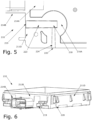
Figures 5 and 6 , in a variant configuration, the enclosure may have alower part 220 havingopenings Openings tunnels Figures 5 and 6 , the cross-section oftunnel 223 may be rectangular and may have constant dimensions, while the cross-section oftunnel 224 and associatedopening 220 may be round and may taper, for example toward relief chamber 228. Other configurations of cross-section are possible, without limitation. - In another exemplary configuration, as shown in
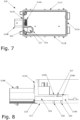
Figures 7 to 10 ,lower part 320 is provided with oneopening 319 arranged at oneside wall 311D ofenclosure 320 and connected torelief chamber 218 bytunnel 323.Lower part 320 is also provided with at least onesecond opening 320, here shown as a group ofsecond openings 320, formed inlower surface 311 oflower part 320 and extending directly betweenlower surface 311 and relief chamber 328. - In such a configuration,
aperture 317 formed inroof portion 316B ofpedestal 316 may still be adequately protected from direct incidence of liquid jets since, for some applications, the enclosure may be mounted withopenings 320 facing another surface, such as a surface to whichlower panel 320 is fixed and by which it is supported. Moreover,aperture 317 may be protected from direct incidence of liquid jets by arranging the one ormore openings 320 with through-axes offset from a through-axis ofaperture 117. In the configuration ofFigures 7 to 10 ,openings 320 have through-axes which are laterally offset from a through-axis ofaperture 317, for example. - Additional or alternative protection against direct incidence of liquid jets also be provided by implementing each opening as a group of smaller holes, by covering each opening with a grid with sufficiently small mesh spacing, in each case so as to disrupt or reduce the force of any incident liquid jet.
- Moreover, in the above disclosure has been made of a particular configuration which, having certain structural features, may exhibit certain functionality. However, as the skilled person will recognise, elements of the above-described structure may be modified or adapted or substituted by known equivalents without affecting the essential functionality.
- For example, in the above embodiments, example has been used of an essentially rectangular box-shaped enclosure, but the present configuration is also applicable to box-type enclosures having square, hexagonal, octagonal, or other polygonal outline.
- Similarly, the present disclosure is applicable to enclosures which may have a circular outline, and which may have domed or otherwise non-planar upper and/or lower surfaces. For example, the present disclosure can be equivalently applied in a drum-like enclosure having a planar lower surface and a dome-shaped upper surface, and wherein openings are provided either to locations in the circumferential wall of the drum or on at one location on the circumferential wall of the drum and on a planar lower surface of the drum.
- Moreover, the present disclosure is also applicable to configurations in which only one exterior opening is provided, or whether at a side surface or a lower surface, or another surface of the enclosure.
- The above disclosure has been exemplified with respect to a two-part enclosure having a lower part and an upper part which sealingly engages with the lower portion as shown in
Figure 12 . However, other configurations are possible, and the enclosure can be configured, for example, to have two lateral half-portions which each comprise an upper wall, lower wall and one or more sidewalls, and which are joined together at an open end of each lateral half-portion. - In a further configuration, no terminal portion and corresponding perceptible receptacle may be provided for communicating electrical signals between interior and exterior of the enclosure, and communication may be provided, for example, by wireless means.
- Further, in connection with the above disclosure, each of the lower part of the enclosure and the upper part of the enclosure have each been shown as integral, unitary structures which may each be formed, for example, by injection moulding. However, the respective parts of each of these structures may also be formed separately and then sealably joined together by any suitable means such as adhesive or welding. The material of the enclosure is not limited, and may advantageously be manufactured from a plastic or ceramic material.
- Also, in the above disclosure, it has been explained how a gas-permeable membrane may be sealingly adhered to an upper surface of a pedestal structure which defines a relief chamber; however, in other configurations a membrane may be also formed as an insert to a relief aperture or may be adhered to an inner surface of the relief chamber.
- Moreover, although the relief aperture has been exemplified by a circular through-hole, the relief aperture may be formed with a variety of cross-sections and shapes.
- Finally, although the above disclosure has been set out in relation to a generic enclosure, an embodiment of the disclosure may be implemented as an electronics module having the enclosure and a radar sensor accommodated in a space inside the enclosure, for example on a PCB implementing a radar sensor. The sensor may be fixed inside the enclosure and communicating with elements outside of the enclosure by electronic signals transmitted via the terminal portion. In such a configuration, the enclosure may be made of radar-transparent material.
- Accordingly, the foregoing disclosure is to be being understood purely to be exemplary and illustrative of the principles and essential features of the disclosure. Substitution or variation of materials and mechanisms among those known to one skilled in the art is contemplated without affecting the essential principles of the configurations herein disclosed and their associated effects and advantages. Accordingly, the claimed scope is to be understood as limited solely by the appended claims, taking due account of any equivalents.
Claims (13)
- An enclosure (100) for electronics, the enclosure comprising:a shell (130, 110) defining an exterior of the enclosure and accommodating a main chamber (112) inside the shell;a partition (116) defining a relief chamber (118) extending inwardly of the shell and having an aperture (117) communicating between the relief chamber and the main chamber; anda gas-permeable membrane (116D) arranged to cover the aperture,characterised in thatthe shell has first and second openings (119, 120) communicating between the relief chamber and the exterior of the enclosure,the first and second openings being arranged on adjacent sidewalls (111B, 111D) of the enclosure and communicating with the relief chamber by respective tunnels (123, 124) extending at an angle one to the other.
- The enclosure of any preceding claim, wherein a through-axis of each opening is laterally and/or angularly offset from a through-axis of the aperture.
- The enclosure of any preceding claim, wherein the partition has a wall portion (316A) projecting inwardly from the shell and a roof portion (316B) extending from the wall portion to enclose the relief chamber, the roof portion having the aperture.
- The enclosure of any preceding claim, further comprising first and second tunnel structures providing the respective first and second tunnels extending between the respective first and second openings and the relief chamber.
- The enclosure of claim 4, wherein each of the first and second tunnels extends in a straight line.
- The enclosure of claim 4 or 5, wherein each of the first and second tunnels extends in a direction at an angle to a through-axis of the aperture.
- The enclosure of claim 6, wherein each of the first and second tunnels extends in a direction perpendicular to a through-axis of the aperture.
- The enclosure of any preceding claim, wherein the through-axis of the second opening is perpendicular to a through-axis of the first opening and perpendicular to a through-axis of the aperture.
- The enclosure of any preceding claim, wherein the gas-permeable membrane is arranged on a main-chamber side of the partition.
- The enclosure of any preceding claim, wherein the shell is box-shaped, the box-shaped shell having planar top and bottom walls (111, 130) and planar side walls (111A, 111B, 111C, 111D) extending between the top and bottom walls.
- The enclosure of any one of claims 1-9,
wherein the partition extends inwardly from a top or bottom wall of the box, and wherein the opening is provided in a side wall of the box. - The enclosure of any preceding claim, wherein the enclosure meets IP6K6K according to IEC standard 60529.
- The enclosure of any preceding claim, wherein the enclosure is an enclosure for vehicle-mounted radar sensor electronics.
Priority Applications (4)
| Application Number | Priority Date | Filing Date | Title |
|---|---|---|---|
| EP20198650.2A EP3975673B1 (en) | 2020-09-28 | 2020-09-28 | Enclosure for electronics |
| US17/473,744 US11860295B2 (en) | 2020-09-28 | 2021-09-13 | Enclosure for electronics |
| CN202122338590.7U CN216560973U (en) | 2020-09-28 | 2021-09-26 | enclosures for electronics |
| CN202111127685.2A CN114325587B (en) | 2020-09-28 | 2021-09-26 | Housings for electronic devices |
Applications Claiming Priority (1)
| Application Number | Priority Date | Filing Date | Title |
|---|---|---|---|
| EP20198650.2A EP3975673B1 (en) | 2020-09-28 | 2020-09-28 | Enclosure for electronics |
Publications (2)
| Publication Number | Publication Date |
|---|---|
| EP3975673A1 EP3975673A1 (en) | 2022-03-30 |
| EP3975673B1 true EP3975673B1 (en) | 2024-04-10 |
Family
ID=72670489
Family Applications (1)
| Application Number | Title | Priority Date | Filing Date |
|---|---|---|---|
| EP20198650.2A Active EP3975673B1 (en) | 2020-09-28 | 2020-09-28 | Enclosure for electronics |
Country Status (3)
| Country | Link |
|---|---|
| US (1) | US11860295B2 (en) |
| EP (1) | EP3975673B1 (en) |
| CN (2) | CN216560973U (en) |
Families Citing this family (2)
| Publication number | Priority date | Publication date | Assignee | Title |
|---|---|---|---|---|
| EP3923428B1 (en) * | 2020-06-10 | 2022-12-14 | ABB Schweiz AG | A pressure relief arrangement |
| EP3975673B1 (en) * | 2020-09-28 | 2024-04-10 | Aptiv Technologies Limited | Enclosure for electronics |
Family Cites Families (9)
| Publication number | Priority date | Publication date | Assignee | Title |
|---|---|---|---|---|
| DE19544974C1 (en) * | 1995-12-01 | 1997-05-22 | Siemens Ag | Control device, in particular for triggering a restraint in a vehicle |
| US6854324B2 (en) * | 2002-12-20 | 2005-02-15 | The Goodyear Tire & Rubber Company | Tire monitoring apparatus |
| DE102006053114A1 (en) * | 2006-11-10 | 2008-05-15 | Robert Bosch Gmbh | Electronic circuit's i.e. controller circuit, housing, for vehicle i.e. motor vehicle, has pressure balancing element for balancing pressure of interior atmosphere of housing in relation to surroundings, arranged at plug connecting element |
| JP6105887B2 (en) * | 2012-09-28 | 2017-03-29 | 日立オートモティブシステムズ株式会社 | Electronic control unit |
| DE102014209874A1 (en) * | 2014-05-23 | 2015-11-26 | Conti Temic Microelectronic Gmbh | Control unit for a vehicle with a housing having a pressure sensor |
| US9769951B2 (en) * | 2015-07-08 | 2017-09-19 | Autoliv Asp, Inc. | Automotive radar system and automotive radar sensor module with breather structure |
| EP3250014B1 (en) * | 2016-05-24 | 2019-12-18 | Veoneer Sweden AB | A housing for electronic components |
| EP3468319B1 (en) * | 2017-10-04 | 2021-08-18 | Veoneer Sweden AB | Electronic control unit |
| EP3975673B1 (en) * | 2020-09-28 | 2024-04-10 | Aptiv Technologies Limited | Enclosure for electronics |
-
2020
- 2020-09-28 EP EP20198650.2A patent/EP3975673B1/en active Active
-
2021
- 2021-09-13 US US17/473,744 patent/US11860295B2/en active Active
- 2021-09-26 CN CN202122338590.7U patent/CN216560973U/en active Active
- 2021-09-26 CN CN202111127685.2A patent/CN114325587B/en active Active
Also Published As
| Publication number | Publication date |
|---|---|
| CN216560973U (en) | 2022-05-17 |
| US11860295B2 (en) | 2024-01-02 |
| CN114325587B (en) | 2024-12-13 |
| US20220099792A1 (en) | 2022-03-31 |
| CN114325587A (en) | 2022-04-12 |
| EP3975673A1 (en) | 2022-03-30 |
Similar Documents
| Publication | Publication Date | Title |
|---|---|---|
| US5392197A (en) | Moisture proof of electric device for motor vehicles | |
| EP3468319B1 (en) | Electronic control unit | |
| US10283853B2 (en) | Antenna module | |
| CN105791642B (en) | Camera module and camera for vehicle | |
| US11860295B2 (en) | Enclosure for electronics | |
| US20150303669A1 (en) | Electronic component unit and wire harness | |
| JP2013069735A (en) | Seal structure of electronic control device | |
| EP2914073B1 (en) | Electronic unit | |
| EP3584121B1 (en) | Housing, electric connection box and wire harness | |
| US9391437B2 (en) | Electrical junction box | |
| JP2013069736A (en) | Electronic control device | |
| JP2014209639A (en) | Electronic control device | |
| CN105658000A (en) | Pressure compensation device and ECU module including the same | |
| CN119895640A (en) | Battery cell monitoring circuit capable of performing wireless communication and battery module provided with same | |
| JP2018082090A (en) | Electronic device | |
| US10483729B1 (en) | Vented power distribution housing | |
| US12069814B2 (en) | Electronic unit | |
| JP4966647B2 (en) | Seal structure of electrical junction box | |
| KR101927120B1 (en) | Electronic control unit having inner wall | |
| CN103457115A (en) | Electrical connector receptacle for mounting within an explosion proof enclosure and method of mounting | |
| KR20230090597A (en) | Connector for battery | |
| CN210298241U (en) | Control box seal structure, control box and shared vehicle | |
| JP6733404B2 (en) | Waterproof fixing device for circuit board unit | |
| JP2008208648A (en) | Flood detection structure of casing | |
| US7683258B2 (en) | Wire harness that prevents water ingress |
Legal Events
| Date | Code | Title | Description |
|---|---|---|---|
| PUAI | Public reference made under article 153(3) epc to a published international application that has entered the european phase |
Free format text: ORIGINAL CODE: 0009012 |
|
| STAA | Information on the status of an ep patent application or granted ep patent |
Free format text: STATUS: THE APPLICATION HAS BEEN PUBLISHED |
|
| AK | Designated contracting states |
Kind code of ref document: A1 Designated state(s): AL AT BE BG CH CY CZ DE DK EE ES FI FR GB GR HR HU IE IS IT LI LT LU LV MC MK MT NL NO PL PT RO RS SE SI SK SM TR |
|
| STAA | Information on the status of an ep patent application or granted ep patent |
Free format text: STATUS: REQUEST FOR EXAMINATION WAS MADE |
|
| 17P | Request for examination filed |
Effective date: 20220920 |
|
| RBV | Designated contracting states (corrected) |
Designated state(s): AL AT BE BG CH CY CZ DE DK EE ES FI FR GB GR HR HU IE IS IT LI LT LU LV MC MK MT NL NO PL PT RO RS SE SI SK SM TR |
|
| RAP3 | Party data changed (applicant data changed or rights of an application transferred) |
Owner name: APTIV TECHNOLOGIES LIMITED |
|
| GRAP | Despatch of communication of intention to grant a patent |
Free format text: ORIGINAL CODE: EPIDOSNIGR1 |
|
| STAA | Information on the status of an ep patent application or granted ep patent |
Free format text: STATUS: GRANT OF PATENT IS INTENDED |
|
| INTG | Intention to grant announced |
Effective date: 20231116 |
|
| GRAS | Grant fee paid |
Free format text: ORIGINAL CODE: EPIDOSNIGR3 |
|
| GRAA | (expected) grant |
Free format text: ORIGINAL CODE: 0009210 |
|
| STAA | Information on the status of an ep patent application or granted ep patent |
Free format text: STATUS: THE PATENT HAS BEEN GRANTED |
|
| AK | Designated contracting states |
Kind code of ref document: B1 Designated state(s): AL AT BE BG CH CY CZ DE DK EE ES FI FR GB GR HR HU IE IS IT LI LT LU LV MC MK MT NL NO PL PT RO RS SE SI SK SM TR |
|
| REG | Reference to a national code |
Ref country code: GB Ref legal event code: FG4D |
|
| REG | Reference to a national code |
Ref country code: CH Ref legal event code: EP |
|
| P01 | Opt-out of the competence of the unified patent court (upc) registered |
Effective date: 20240313 |
|
| REG | Reference to a national code |
Ref country code: DE Ref legal event code: R096 Ref document number: 602020028646 Country of ref document: DE |
|
| REG | Reference to a national code |
Ref country code: IE Ref legal event code: FG4D |
|
| RAP2 | Party data changed (patent owner data changed or rights of a patent transferred) |
Owner name: APTIV TECHNOLOGIES AG |
|
| REG | Reference to a national code |
Ref country code: LT Ref legal event code: MG9D |
|
| REG | Reference to a national code |
Ref country code: NL Ref legal event code: MP Effective date: 20240410 |
|
| REG | Reference to a national code |
Ref country code: AT Ref legal event code: MK05 Ref document number: 1676222 Country of ref document: AT Kind code of ref document: T Effective date: 20240410 |
|
| PG25 | Lapsed in a contracting state [announced via postgrant information from national office to epo] |
Ref country code: NL Free format text: LAPSE BECAUSE OF FAILURE TO SUBMIT A TRANSLATION OF THE DESCRIPTION OR TO PAY THE FEE WITHIN THE PRESCRIBED TIME-LIMIT Effective date: 20240410 |
|
| RAP4 | Party data changed (patent owner data changed or rights of a patent transferred) |
Owner name: APTIV TECHNOLOGIES AG |
|
| PG25 | Lapsed in a contracting state [announced via postgrant information from national office to epo] |
Ref country code: NL Free format text: LAPSE BECAUSE OF FAILURE TO SUBMIT A TRANSLATION OF THE DESCRIPTION OR TO PAY THE FEE WITHIN THE PRESCRIBED TIME-LIMIT Effective date: 20240410 |
|
| PG25 | Lapsed in a contracting state [announced via postgrant information from national office to epo] |
Ref country code: IS Free format text: LAPSE BECAUSE OF FAILURE TO SUBMIT A TRANSLATION OF THE DESCRIPTION OR TO PAY THE FEE WITHIN THE PRESCRIBED TIME-LIMIT Effective date: 20240810 |
|
| PG25 | Lapsed in a contracting state [announced via postgrant information from national office to epo] |
Ref country code: BG Free format text: LAPSE BECAUSE OF FAILURE TO SUBMIT A TRANSLATION OF THE DESCRIPTION OR TO PAY THE FEE WITHIN THE PRESCRIBED TIME-LIMIT Effective date: 20240410 |
|
| PG25 | Lapsed in a contracting state [announced via postgrant information from national office to epo] |
Ref country code: HR Free format text: LAPSE BECAUSE OF FAILURE TO SUBMIT A TRANSLATION OF THE DESCRIPTION OR TO PAY THE FEE WITHIN THE PRESCRIBED TIME-LIMIT Effective date: 20240410 Ref country code: FI Free format text: LAPSE BECAUSE OF FAILURE TO SUBMIT A TRANSLATION OF THE DESCRIPTION OR TO PAY THE FEE WITHIN THE PRESCRIBED TIME-LIMIT Effective date: 20240410 |
|
| PG25 | Lapsed in a contracting state [announced via postgrant information from national office to epo] |
Ref country code: GR Free format text: LAPSE BECAUSE OF FAILURE TO SUBMIT A TRANSLATION OF THE DESCRIPTION OR TO PAY THE FEE WITHIN THE PRESCRIBED TIME-LIMIT Effective date: 20240711 |
|
| PG25 | Lapsed in a contracting state [announced via postgrant information from national office to epo] |
Ref country code: PT Free format text: LAPSE BECAUSE OF FAILURE TO SUBMIT A TRANSLATION OF THE DESCRIPTION OR TO PAY THE FEE WITHIN THE PRESCRIBED TIME-LIMIT Effective date: 20240812 |
|
| PG25 | Lapsed in a contracting state [announced via postgrant information from national office to epo] |
Ref country code: ES Free format text: LAPSE BECAUSE OF FAILURE TO SUBMIT A TRANSLATION OF THE DESCRIPTION OR TO PAY THE FEE WITHIN THE PRESCRIBED TIME-LIMIT Effective date: 20240410 |
|
| PG25 | Lapsed in a contracting state [announced via postgrant information from national office to epo] |
Ref country code: AT Free format text: LAPSE BECAUSE OF FAILURE TO SUBMIT A TRANSLATION OF THE DESCRIPTION OR TO PAY THE FEE WITHIN THE PRESCRIBED TIME-LIMIT Effective date: 20240410 |
|
| PG25 | Lapsed in a contracting state [announced via postgrant information from national office to epo] |
Ref country code: PL Free format text: LAPSE BECAUSE OF FAILURE TO SUBMIT A TRANSLATION OF THE DESCRIPTION OR TO PAY THE FEE WITHIN THE PRESCRIBED TIME-LIMIT Effective date: 20240410 |
|
| PG25 | Lapsed in a contracting state [announced via postgrant information from national office to epo] |
Ref country code: LV Free format text: LAPSE BECAUSE OF FAILURE TO SUBMIT A TRANSLATION OF THE DESCRIPTION OR TO PAY THE FEE WITHIN THE PRESCRIBED TIME-LIMIT Effective date: 20240410 |
|
| PG25 | Lapsed in a contracting state [announced via postgrant information from national office to epo] |
Ref country code: PT Free format text: LAPSE BECAUSE OF FAILURE TO SUBMIT A TRANSLATION OF THE DESCRIPTION OR TO PAY THE FEE WITHIN THE PRESCRIBED TIME-LIMIT Effective date: 20240812 Ref country code: PL Free format text: LAPSE BECAUSE OF FAILURE TO SUBMIT A TRANSLATION OF THE DESCRIPTION OR TO PAY THE FEE WITHIN THE PRESCRIBED TIME-LIMIT Effective date: 20240410 Ref country code: NO Free format text: LAPSE BECAUSE OF FAILURE TO SUBMIT A TRANSLATION OF THE DESCRIPTION OR TO PAY THE FEE WITHIN THE PRESCRIBED TIME-LIMIT Effective date: 20240710 Ref country code: LV Free format text: LAPSE BECAUSE OF FAILURE TO SUBMIT A TRANSLATION OF THE DESCRIPTION OR TO PAY THE FEE WITHIN THE PRESCRIBED TIME-LIMIT Effective date: 20240410 Ref country code: IS Free format text: LAPSE BECAUSE OF FAILURE TO SUBMIT A TRANSLATION OF THE DESCRIPTION OR TO PAY THE FEE WITHIN THE PRESCRIBED TIME-LIMIT Effective date: 20240810 Ref country code: HR Free format text: LAPSE BECAUSE OF FAILURE TO SUBMIT A TRANSLATION OF THE DESCRIPTION OR TO PAY THE FEE WITHIN THE PRESCRIBED TIME-LIMIT Effective date: 20240410 Ref country code: GR Free format text: LAPSE BECAUSE OF FAILURE TO SUBMIT A TRANSLATION OF THE DESCRIPTION OR TO PAY THE FEE WITHIN THE PRESCRIBED TIME-LIMIT Effective date: 20240711 Ref country code: FI Free format text: LAPSE BECAUSE OF FAILURE TO SUBMIT A TRANSLATION OF THE DESCRIPTION OR TO PAY THE FEE WITHIN THE PRESCRIBED TIME-LIMIT Effective date: 20240410 Ref country code: ES Free format text: LAPSE BECAUSE OF FAILURE TO SUBMIT A TRANSLATION OF THE DESCRIPTION OR TO PAY THE FEE WITHIN THE PRESCRIBED TIME-LIMIT Effective date: 20240410 Ref country code: BG Free format text: LAPSE BECAUSE OF FAILURE TO SUBMIT A TRANSLATION OF THE DESCRIPTION OR TO PAY THE FEE WITHIN THE PRESCRIBED TIME-LIMIT Effective date: 20240410 Ref country code: AT Free format text: LAPSE BECAUSE OF FAILURE TO SUBMIT A TRANSLATION OF THE DESCRIPTION OR TO PAY THE FEE WITHIN THE PRESCRIBED TIME-LIMIT Effective date: 20240410 Ref country code: RS Free format text: LAPSE BECAUSE OF FAILURE TO SUBMIT A TRANSLATION OF THE DESCRIPTION OR TO PAY THE FEE WITHIN THE PRESCRIBED TIME-LIMIT Effective date: 20240710 |
|
| REG | Reference to a national code |
Ref country code: DE Ref legal event code: R097 Ref document number: 602020028646 Country of ref document: DE |
|
| PG25 | Lapsed in a contracting state [announced via postgrant information from national office to epo] |
Ref country code: DK Free format text: LAPSE BECAUSE OF FAILURE TO SUBMIT A TRANSLATION OF THE DESCRIPTION OR TO PAY THE FEE WITHIN THE PRESCRIBED TIME-LIMIT Effective date: 20240410 |
|
| PG25 | Lapsed in a contracting state [announced via postgrant information from national office to epo] |
Ref country code: EE Free format text: LAPSE BECAUSE OF FAILURE TO SUBMIT A TRANSLATION OF THE DESCRIPTION OR TO PAY THE FEE WITHIN THE PRESCRIBED TIME-LIMIT Effective date: 20240410 |
|
| PG25 | Lapsed in a contracting state [announced via postgrant information from national office to epo] |
Ref country code: CZ Free format text: LAPSE BECAUSE OF FAILURE TO SUBMIT A TRANSLATION OF THE DESCRIPTION OR TO PAY THE FEE WITHIN THE PRESCRIBED TIME-LIMIT Effective date: 20240410 |
|
| PG25 | Lapsed in a contracting state [announced via postgrant information from national office to epo] |
Ref country code: RO Free format text: LAPSE BECAUSE OF FAILURE TO SUBMIT A TRANSLATION OF THE DESCRIPTION OR TO PAY THE FEE WITHIN THE PRESCRIBED TIME-LIMIT Effective date: 20240410 Ref country code: SK Free format text: LAPSE BECAUSE OF FAILURE TO SUBMIT A TRANSLATION OF THE DESCRIPTION OR TO PAY THE FEE WITHIN THE PRESCRIBED TIME-LIMIT Effective date: 20240410 |
|
| PG25 | Lapsed in a contracting state [announced via postgrant information from national office to epo] |
Ref country code: SM Free format text: LAPSE BECAUSE OF FAILURE TO SUBMIT A TRANSLATION OF THE DESCRIPTION OR TO PAY THE FEE WITHIN THE PRESCRIBED TIME-LIMIT Effective date: 20240410 |
|
| PG25 | Lapsed in a contracting state [announced via postgrant information from national office to epo] |
Ref country code: SM Free format text: LAPSE BECAUSE OF FAILURE TO SUBMIT A TRANSLATION OF THE DESCRIPTION OR TO PAY THE FEE WITHIN THE PRESCRIBED TIME-LIMIT Effective date: 20240410 Ref country code: SK Free format text: LAPSE BECAUSE OF FAILURE TO SUBMIT A TRANSLATION OF THE DESCRIPTION OR TO PAY THE FEE WITHIN THE PRESCRIBED TIME-LIMIT Effective date: 20240410 Ref country code: RO Free format text: LAPSE BECAUSE OF FAILURE TO SUBMIT A TRANSLATION OF THE DESCRIPTION OR TO PAY THE FEE WITHIN THE PRESCRIBED TIME-LIMIT Effective date: 20240410 Ref country code: EE Free format text: LAPSE BECAUSE OF FAILURE TO SUBMIT A TRANSLATION OF THE DESCRIPTION OR TO PAY THE FEE WITHIN THE PRESCRIBED TIME-LIMIT Effective date: 20240410 Ref country code: DK Free format text: LAPSE BECAUSE OF FAILURE TO SUBMIT A TRANSLATION OF THE DESCRIPTION OR TO PAY THE FEE WITHIN THE PRESCRIBED TIME-LIMIT Effective date: 20240410 Ref country code: CZ Free format text: LAPSE BECAUSE OF FAILURE TO SUBMIT A TRANSLATION OF THE DESCRIPTION OR TO PAY THE FEE WITHIN THE PRESCRIBED TIME-LIMIT Effective date: 20240410 |
|
| PG25 | Lapsed in a contracting state [announced via postgrant information from national office to epo] |
Ref country code: IT Free format text: LAPSE BECAUSE OF FAILURE TO SUBMIT A TRANSLATION OF THE DESCRIPTION OR TO PAY THE FEE WITHIN THE PRESCRIBED TIME-LIMIT Effective date: 20240410 |
|
| PLBE | No opposition filed within time limit |
Free format text: ORIGINAL CODE: 0009261 |
|
| STAA | Information on the status of an ep patent application or granted ep patent |
Free format text: STATUS: NO OPPOSITION FILED WITHIN TIME LIMIT |
|
| 26N | No opposition filed |
Effective date: 20250113 |
|
| PG25 | Lapsed in a contracting state [announced via postgrant information from national office to epo] |
Ref country code: MC Free format text: LAPSE BECAUSE OF FAILURE TO SUBMIT A TRANSLATION OF THE DESCRIPTION OR TO PAY THE FEE WITHIN THE PRESCRIBED TIME-LIMIT Effective date: 20240410 Ref country code: SI Free format text: LAPSE BECAUSE OF FAILURE TO SUBMIT A TRANSLATION OF THE DESCRIPTION OR TO PAY THE FEE WITHIN THE PRESCRIBED TIME-LIMIT Effective date: 20240410 |
|
| REG | Reference to a national code |
Ref country code: CH Ref legal event code: PL |
|
| PG25 | Lapsed in a contracting state [announced via postgrant information from national office to epo] |
Ref country code: LU Free format text: LAPSE BECAUSE OF NON-PAYMENT OF DUE FEES Effective date: 20240928 |
|
| REG | Reference to a national code |
Ref country code: BE Ref legal event code: MM Effective date: 20240930 |
|
| PG25 | Lapsed in a contracting state [announced via postgrant information from national office to epo] |
Ref country code: BE Free format text: LAPSE BECAUSE OF NON-PAYMENT OF DUE FEES Effective date: 20240930 |
|
| PG25 | Lapsed in a contracting state [announced via postgrant information from national office to epo] |
Ref country code: CH Free format text: LAPSE BECAUSE OF NON-PAYMENT OF DUE FEES Effective date: 20240930 |
|
| PG25 | Lapsed in a contracting state [announced via postgrant information from national office to epo] |
Ref country code: IE Free format text: LAPSE BECAUSE OF NON-PAYMENT OF DUE FEES Effective date: 20240928 |
|
| PG25 | Lapsed in a contracting state [announced via postgrant information from national office to epo] |
Ref country code: SE Free format text: LAPSE BECAUSE OF FAILURE TO SUBMIT A TRANSLATION OF THE DESCRIPTION OR TO PAY THE FEE WITHIN THE PRESCRIBED TIME-LIMIT Effective date: 20240410 |
|
| PGFP | Annual fee paid to national office [announced via postgrant information from national office to epo] |
Ref country code: DE Payment date: 20250814 Year of fee payment: 6 |
|
| PGFP | Annual fee paid to national office [announced via postgrant information from national office to epo] |
Ref country code: GB Payment date: 20250924 Year of fee payment: 6 |
|
| PGFP | Annual fee paid to national office [announced via postgrant information from national office to epo] |
Ref country code: FR Payment date: 20250908 Year of fee payment: 6 |
|
| PG25 | Lapsed in a contracting state [announced via postgrant information from national office to epo] |
Ref country code: CY Free format text: LAPSE BECAUSE OF FAILURE TO SUBMIT A TRANSLATION OF THE DESCRIPTION OR TO PAY THE FEE WITHIN THE PRESCRIBED TIME-LIMIT; INVALID AB INITIO Effective date: 20200928 |
|
| PG25 | Lapsed in a contracting state [announced via postgrant information from national office to epo] |
Ref country code: HU Free format text: LAPSE BECAUSE OF FAILURE TO SUBMIT A TRANSLATION OF THE DESCRIPTION OR TO PAY THE FEE WITHIN THE PRESCRIBED TIME-LIMIT; INVALID AB INITIO Effective date: 20200928 |
|
| PG25 | Lapsed in a contracting state [announced via postgrant information from national office to epo] |
Ref country code: TR Free format text: LAPSE BECAUSE OF FAILURE TO SUBMIT A TRANSLATION OF THE DESCRIPTION OR TO PAY THE FEE WITHIN THE PRESCRIBED TIME-LIMIT Effective date: 20240410 |
|
| PG25 | Lapsed in a contracting state [announced via postgrant information from national office to epo] |
Ref country code: LT Free format text: LAPSE BECAUSE OF FAILURE TO SUBMIT A TRANSLATION OF THE DESCRIPTION OR TO PAY THE FEE WITHIN THE PRESCRIBED TIME-LIMIT Effective date: 20240410 |