EP3974431A1 - Process for the preparation of a xanthine-based compound - Google Patents
Process for the preparation of a xanthine-based compound Download PDFInfo
- Publication number
- EP3974431A1 EP3974431A1 EP21202357.6A EP21202357A EP3974431A1 EP 3974431 A1 EP3974431 A1 EP 3974431A1 EP 21202357 A EP21202357 A EP 21202357A EP 3974431 A1 EP3974431 A1 EP 3974431A1
- Authority
- EP
- European Patent Office
- Prior art keywords
- methyl
- compound
- linagliptin
- preparation
- reaction
- Prior art date
- Legal status (The legal status is an assumption and is not a legal conclusion. Google has not performed a legal analysis and makes no representation as to the accuracy of the status listed.)
- Withdrawn
Links
Classifications
-
- C—CHEMISTRY; METALLURGY
- C07—ORGANIC CHEMISTRY
- C07D—HETEROCYCLIC COMPOUNDS
- C07D473/00—Heterocyclic compounds containing purine ring systems
- C07D473/02—Heterocyclic compounds containing purine ring systems with oxygen, sulphur, or nitrogen atoms directly attached in positions 2 and 6
- C07D473/04—Heterocyclic compounds containing purine ring systems with oxygen, sulphur, or nitrogen atoms directly attached in positions 2 and 6 two oxygen atoms
Definitions
- This invention relates to a method for preparation of a xanthine-based pharmaceutically active ingredient, namely Linagliptin, as well as to intermediates useful in such preparation.
- Linagliptin a process for the preparation of Linagliptin is disclosed in the references WO 2004/018468 and WO 2006/048427 .
- WO 2014/059938 describes a further process for preparation of Linagliptin involving a phase transfer catalyst and using protected (R)-piperidine-3-amine derivatives.
- the process of WO 2014/059938 requires an amine protecting group, such as tert -butyloxy carbonyl (Boc) protection and de-protection of the intermediates used in the late stage of the synthesis process.
- amine protecting group such as tert -butyloxy carbonyl (Boc) protection and de-protection of the intermediates used in the late stage of the synthesis process.
- (R)-piperidine-3-amine (or its dihydrochloride) is said to be used directly to react with 1-[(4-methyl-quinazolin-2-yl)methyl]-3-methyl-7-(2-butyn-1-yl)-8-bromo-xanthine in the presence of a suitable base (particularly K 2 CO 3 ) in an inert organic solvent (particularly DMF or MIBK) to give Linagliptin.
- a suitable base particularly K 2 CO 3
- an inert organic solvent particularly DMF or MIBK
- Linagliptin which is suitable for large scale production, particularly for pharmaceutical purposes.
- the present invention relates to a process for preparation of Linagliptin, intermediates useful in such process, and use of the process and the intermediates for preparation of Linagliptin for use as medicament.
- the invention further relates to a process for preparation of a pharmaceutical composition of Linagliptin, said process comprising i) preparing Linagliptin according to a process as described herein, and ii) combining Linagliptin with one or more pharmaceutically acceptable excipients in order to form the pharmaceutical composition.
- Cl or I can serve as the leaving groups in the 8-position of 1-[(4-methyl-quinazolin-2-yl)methyl]-3-methyl-7-(2-butyn-1-yl)-xanthine and their corresponding substrates, namely 1-[(4-methyl-quinazolin-2-yl)methyl]-3-methyl-7-(2-butyn-1-yl)-8-chloro-xanthine and 1-[(4-methyl-quinazolin-2-yl)methyl]-3-methyl-7-(2-butyn-1-yl)-8-iodo-xanthine, can be directly reacted with piperidine-3-amine [particularly (R)-piperidine-3-amine] or a salt thereof (such as the dihydrochloride salt), preferably (R)-piperidine-3-amine dihydrochloride, in the presence of a suitable base (such as an inorganic or organic base, e.g.
- a suitable base such as an inorganic or organic base,
- Na 2 CO 3 sodium carbonate
- K 2 CO 3 potassium carbonate
- NaHCO 3 sodium bicarbonate
- KHCO 3 potassium bicarbonate
- a suitable solvent such as an organic or aqueous solvent, or mixtures of solvents, particularly an aprotic polar solvent, e.g. NMP (N-methyl-2-pyrrolidone), DMSO (dimethyl sulfoxide), DMAc (N,N-dimethylacetamide) or DMF (N,N-dimethylformamide)
- NMP N-methyl-2-pyrrolidone
- DMSO dimethyl sulfoxide
- DMAc N,N-dimethylacetamide
- DMF N,N-dimethylformamide
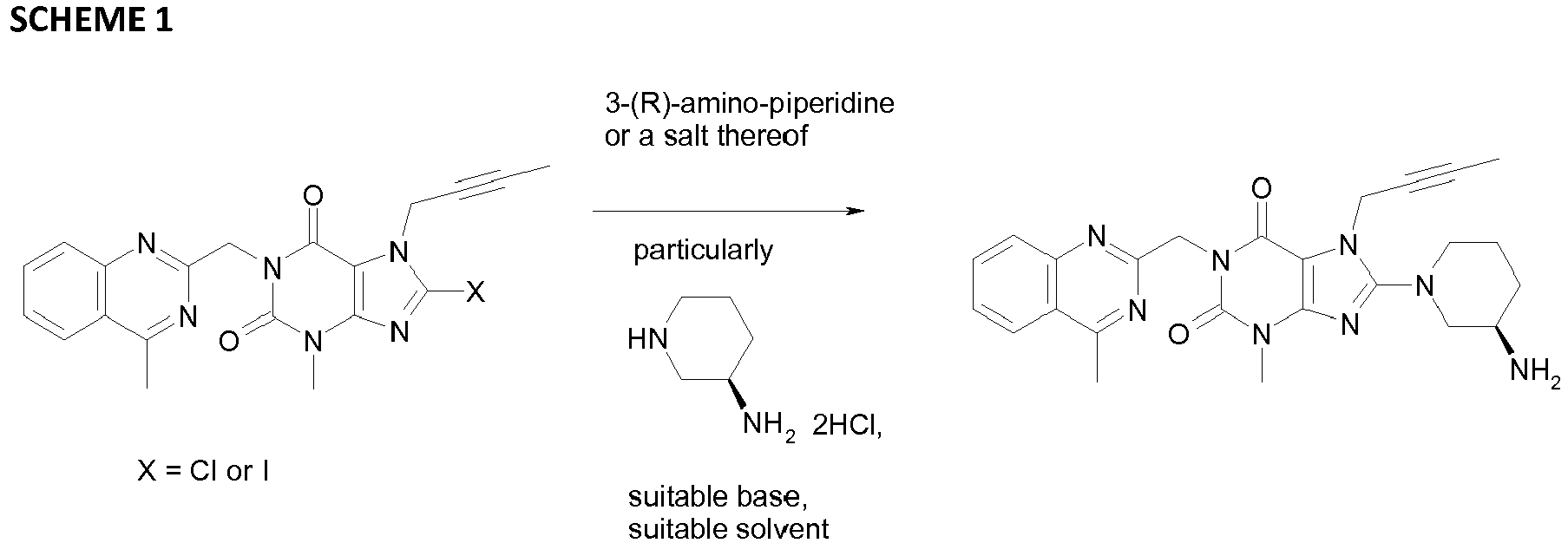
- a method for preparing Linagliptin is outlined in the following SCHEME 1 involving the coupling reaction according to the present invention.
- the present invention relates to the processes, methods and/or the individual process steps and/or the individual reaction conditions substantially as described by way of illustrative example in the following.
- a process for preparing Linagliptin is outlined in the following SCHEME 2.
- the present invention is directed to the multi-step synthetic method for preparing Linagliptin as substantially set forth in SCHEME 2 below.
- the invention is directed to each of the individual steps of SCHEME 2 and any combination of two or more successive steps of SCHEME 2.
- the invention is also directed to the intermediate compounds, e.g. as set forth in SCHEME 2.
- the synthesis may start with alkylation of 3-methyl-3,7-dihydro-purine-2,6-dione (7) for example with methanesulfonic acid but-2-ynyl ester (8) in the presence of a suitable base and a suitable solvent, such as in the presence of KHCO 3 in NMP to give Compound 9 with around 94% yield.
- Compound 9 may then be chlorinated for example by NCS such as in DMF to afford Compound 10 with around 83% yield.
- the chlorination may also be carried out in NMP, which makes one pot reaction from Compound 7 to Compound 10 possible.
- Compound 10 may be reacted with 2-chloromethyl-4-methyl-quinazoline (11) in the presence of a suitable base and a suitable solvent, such as in the presence of Na 2 CO 3 in NMP to give 7-but-2-ynyl-8-chloro-3-methyl-1-(4-methyl-quinazolin-2-ylmethyl)-3,7-dihydro-purine-2,6-dione (12) in 78% yield.
- Another process for preparing Linagliptin is outlined in the following SCHEME 3.
- the present invention is directed to the multi-step synthetic method for preparing Linagliptin as substantially set forth in SCHEME 3 below.
- the invention is directed to each of the individual steps of SCHEME 3 and any combination of two or more successive steps of SCHEME 3.
- the invention is also directed to the intermediate compounds, e.g. as set forth in SCHEME 3.
- the iodide analogue (17) may be used for the direct coupling with (R)-3-aminopiperidine dihydrochloride (13) to prepare Linagliptin (SCHEME 3).
- the synthesis may start with iodination of 3-methyl-3,7-dihydro-purine-2,6-dione (7) for example with NIS to give Compound 14 with around 91% yield, which may be followed by alkylation for example with 1-bromo-2-butyne (15) in the presence of a suitable base and a suitable solvent, such as in NMP in the presence of Na 2 CO 3 to give Compound 16 in 97% yield. Then, Compound 16 may be reacted with 2-chloromethyl-4-methyl-quinazoline (11) in the presence of a suitable base and a suitable solvent, such as in the presence of Na 2 CO 3 in NMP to give Compound 17 in 65% yield.
- Linagliptin The coupling reaction of Compound 17 with (R)-3-aminopiperidine dihydrochloride (13) to form Linagliptin can be worked in different kind of high polar solvents, like NMP, DMSO, DMAc, or DMF. Also, different kinds of bases can be used for this reaction, including but not limited to K 2 CO 3 , Na 2 CO 3 , NaHCO 3 , or KHCO 3 . Our study shows that the combination of DMSO as solvent and NaHCO 3 as base offers the best results in terms of the reaction conversion and cleanness of reaction profile. Finally, after purification, e.g. by column chromatography, Linagliptin is obtained in 54% yield with 99.0% purity.
- the alkylation reaction of Compound 7 or Compound 14 to prepare Compound 9 or Compound 16, respectively, can be represented as below. Based on our studies, the leaving group X used can be either of Br, I, OMs, or OTs in this reaction.
- the present invention relates to an indicated intermediate or final compound in isolated form, such as e.g. in solid, amorphous, lyophilized or crystalline form.
- the present invention relates to an indicated intermediate or final compound in solution form (such as e.g. present in a reaction solvent).
- the present invention relates to an indicated intermediate or final compound obtainable or obtained by a process or method according to the present invention.
- the present invention relates to Linagliptin isolated (such as e.g. crystallized) from the (reaction) solvents mentioned herein, such as e.g. toluene.
- the intermediates and final compounds of the invention may be obtained using methods of synthesis known in principle, or analogously or similarly to known procedures.
- the intermediates involved and the final compounds may be obtained by the following methods according to the invention which are described in more detailed example herein after.
- a process or method of this invention may comprise one or more steps of converting and/or reacting the mentioned intermediates with the appropriate reaction partners, suitably under conditions as disclosed herein (e.g. by using the indicated reagents and/or solvents and/or temperatures, etc.).
- reaction conditions and reaction times may vary depending on the particular reactants used. Unless otherwise specified, solvents, temperatures, pressures, and other reaction conditions may be readily selected by one of ordinary skill in the art. Specific procedures are provided in the Synthetic Examples section. Typically, reaction progress may be monitored by gas chromatography (GC), High Pressure Liquid Chromatography (HPLC) or Thin Layer Chromatography, if desired.
- GC gas chromatography
- HPLC High Pressure Liquid Chromatography
- Thin Layer Chromatography if desired.
Landscapes
- Chemical & Material Sciences (AREA)
- Organic Chemistry (AREA)
- Pharmaceuticals Containing Other Organic And Inorganic Compounds (AREA)
- Nitrogen Condensed Heterocyclic Rings (AREA)
Abstract
Description
- This invention relates to a method for preparation of a xanthine-based pharmaceutically active ingredient, namely Linagliptin, as well as to intermediates useful in such preparation.
- 1-[(4-Methyl-quinazolin-2-yl)methyl]-3-methyl-7-(2-butyn-1-yl)-8-(3-(R)-amino-piperidin-1-yl)- xanthine, whose international nonproprietary name is Linagliptin, has the following structure as shown below:

- Up to now, several synthetic routes to synthesize the molecule have been described by several references.
- For example, a process for the preparation of Linagliptin is disclosed in the references
WO 2004/018468 andWO 2006/048427 . - The reference
WO 2014/059938 describes a further process for preparation of Linagliptin involving a phase transfer catalyst and using protected (R)-piperidine-3-amine derivatives. The process ofWO 2014/059938 requires an amine protecting group, such as tert-butyloxy carbonyl (Boc) protection and de-protection of the intermediates used in the late stage of the synthesis process. - The reference
WO 2013/098775 describes a further process for preparation of Linagliptin: (R)-piperidine-3-amine (or its dihydrochloride) is said to be used directly to react with 1-[(4-methyl-quinazolin-2-yl)methyl]-3-methyl-7-(2-butyn-1-yl)-8-bromo-xanthine in the presence of a suitable base (particularly K2CO3) in an inert organic solvent (particularly DMF or MIBK) to give Linagliptin. However, the referenceWO 2013/098775 only discloses to use the 1-[(4-methyl-quinazolin-2-yl)methyl]-3-methyl-7-(2-butyn-1-yl)-8-bromo-xanthine as intermediate. - It is desired to find a further process for the preparation of Linagliptin which is suitable for large scale production, particularly for pharmaceutical purposes.
- It has now been found that the process, which is described in greater detail herein, does not require any amine protecting group and provides an efficient, short, robust and scalable method for preparation of Linagliptin and is particularly suitable for the preparation of pure Linagliptin such as for pharmaceutical and medical purposes.
- Accordingly, the present invention relates to a process for preparation of Linagliptin, intermediates useful in such process, and use of the process and the intermediates for preparation of Linagliptin for use as medicament.
- The invention further relates to a process for preparation of a pharmaceutical composition of Linagliptin, said process comprising i) preparing Linagliptin according to a process as described herein, and ii) combining Linagliptin with one or more pharmaceutically acceptable excipients in order to form the pharmaceutical composition.
- Based on our studies, besides Br as a leaving group, Cl or I can serve as the leaving groups in the 8-position of 1-[(4-methyl-quinazolin-2-yl)methyl]-3-methyl-7-(2-butyn-1-yl)-xanthine and their corresponding substrates, namely 1-[(4-methyl-quinazolin-2-yl)methyl]-3-methyl-7-(2-butyn-1-yl)-8-chloro-xanthine and 1-[(4-methyl-quinazolin-2-yl)methyl]-3-methyl-7-(2-butyn-1-yl)-8-iodo-xanthine, can be directly reacted with piperidine-3-amine [particularly (R)-piperidine-3-amine] or a salt thereof (such as the dihydrochloride salt), preferably (R)-piperidine-3-amine dihydrochloride, in the presence of a suitable base (such as an inorganic or organic base, e.g. Na2CO3 (sodium carbonate), K2CO3 (potassium carbonate), NaHCO3 (sodium bicarbonate) or KHCO3 (potassium bicarbonate)) in a suitable solvent (such as an organic or aqueous solvent, or mixtures of solvents, particularly an aprotic polar solvent, e.g. NMP (N-methyl-2-pyrrolidone), DMSO (dimethyl sulfoxide), DMAc (N,N-dimethylacetamide) or DMF (N,N-dimethylformamide)) to give Linagliptin with good yield and purity.
- A method for preparing Linagliptin is outlined in the following SCHEME 1 involving the coupling reaction according to the present invention.
- In certain more detailed embodiments of the invention, the present invention relates to the processes, methods and/or the individual process steps and/or the individual reaction conditions substantially as described by way of illustrative example in the following.
- A process for preparing Linagliptin is outlined in the following SCHEME 2. In one embodiment, the present invention is directed to the multi-step synthetic method for preparing Linagliptin as substantially set forth in SCHEME 2 below. In other embodiments, the invention is directed to each of the individual steps of SCHEME 2 and any combination of two or more successive steps of SCHEME 2. The invention is also directed to the intermediate compounds, e.g. as set forth in SCHEME 2.
- In more detailed example, the synthesis (SCHEME 2) may start with alkylation of 3-methyl-3,7-dihydro-purine-2,6-dione (7) for example with methanesulfonic acid but-2-ynyl ester (8) in the presence of a suitable base and a suitable solvent, such as in the presence of KHCO3 in NMP to give Compound 9 with around 94% yield. Compound 9 may then be chlorinated for example by NCS such as in DMF to afford Compound 10 with around 83% yield. Alternatively, the chlorination may also be carried out in NMP, which makes one pot reaction from Compound 7 to Compound 10 possible. Then, Compound 10 may be reacted with 2-chloromethyl-4-methyl-quinazoline (11) in the presence of a suitable base and a suitable solvent, such as in the presence of Na2CO3 in NMP to give 7-but-2-ynyl-8-chloro-3-methyl-1-(4-methyl-quinazolin-2-ylmethyl)-3,7-dihydro-purine-2,6-dione (12) in 78% yield.
- The coupling reaction of Compound 12 with (R)-3-aminopiperidine dihydrochloride (13) to form Linagliptin can be worked with different bases, like Na2CO3, NaHCO3, or KHCO3. For this coupling reaction, different kind of aprotic polar solvents can be used, including but not limited to NMP, DMSO, or DMF. The study shows that the combination of using NaHCO3 as base and NMP as solvent offers the best results in terms of conversion and cleanness of reaction profile. Finally, after purification, e.g. by recrystallization such as in toluene, Linagliptin is obtained in 77% yield with 99.2% purity.

- Another process for preparing Linagliptin is outlined in the following SCHEME 3. In one embodiment, the present invention is directed to the multi-step synthetic method for preparing Linagliptin as substantially set forth in SCHEME 3 below. In other embodiments, the invention is directed to each of the individual steps of SCHEME 3 and any combination of two or more successive steps of SCHEME 3. The invention is also directed to the intermediate compounds, e.g. as set forth in SCHEME 3.
- In more detailed example, the iodide analogue (17) may be used for the direct coupling with (R)-3-aminopiperidine dihydrochloride (13) to prepare Linagliptin (SCHEME 3).
- The synthesis may start with iodination of 3-methyl-3,7-dihydro-purine-2,6-dione (7) for example with NIS to give Compound 14 with around 91% yield, which may be followed by alkylation for example with 1-bromo-2-butyne (15) in the presence of a suitable base and a suitable solvent, such as in NMP in the presence of Na2CO3 to give Compound 16 in 97% yield. Then, Compound 16 may be reacted with 2-chloromethyl-4-methyl-quinazoline (11) in the presence of a suitable base and a suitable solvent, such as in the presence of Na2CO3 in NMP to give Compound 17 in 65% yield.
- The coupling reaction of Compound 17 with (R)-3-aminopiperidine dihydrochloride (13) to form Linagliptin can be worked in different kind of high polar solvents, like NMP, DMSO, DMAc, or DMF. Also, different kinds of bases can be used for this reaction, including but not limited to K2CO3, Na2CO3, NaHCO3, or KHCO3. Our study shows that the combination of DMSO as solvent and NaHCO3 as base offers the best results in terms of the reaction conversion and cleanness of reaction profile. Finally, after purification, e.g. by column chromatography, Linagliptin is obtained in 54% yield with 99.0% purity.

- The alkylation reaction of Compound 7 or Compound 14 to prepare Compound 9 or Compound 16, respectively, can be represented as below. Based on our studies, the leaving group X used can be either of Br, I, OMs, or OTs in this reaction.

- In certain embodiments, the present invention relates to an indicated intermediate or final compound in isolated form, such as e.g. in solid, amorphous, lyophilized or crystalline form.
- In certain embodiments, the present invention relates to an indicated intermediate or final compound in solution form (such as e.g. present in a reaction solvent).
- Further, the present invention relates to an indicated intermediate or final compound obtainable or obtained by a process or method according to the present invention.
- In an embodiment, the present invention relates to Linagliptin isolated (such as e.g. crystallized) from the (reaction) solvents mentioned herein, such as e.g. toluene.
- Accordingly, the invention further relates to the following particular Embodiments 1-10:
- 1. A method of preparing a compound of formula (I),

reacting a compound of formula (II)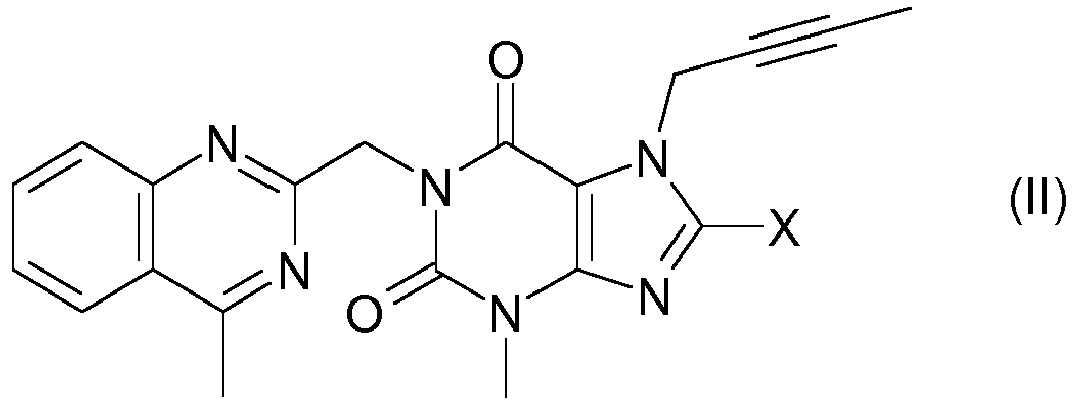
- with
- 3-aminopipderidine of formula (III), or an enantiomer thereof,

- or a salt thereof,
- optionally in the presence of a suitable base,
- optionally in the presence of a suitable solvent,
- to form the compound of formula (I).
- 2. The method according to Embodiment 1, wherein the compound of formula (I) has the following formula (I*):

- 3. The method according to Embodiment 1 or 2, wherein the 3-aminopipderidine of formula (III) used in the reaction is

- 4. The method according to Embodiment 1, 2 or 3, wherein the suitable base is Na2CO3, K2CO3, NaHCO3 or KHCO3.
- 5. The method according to Embodiment 1, 2, 3 or 4, wherein the suitable solvent comprises NMP, DMSO, DMAc or DMF.
- 6. The method according to Embodiment 1, 2, 3, 4 or 5, wherein X is Cl.
- 7. The method according to Embodiment 1, 2, 3, 4 or 5, wherein X is Cl, the suitable base is NaHCO3 and the suitable solvent is NMP.
- 8. The method according to Embodiment 1, 2, 3, 4 or 5, wherein X is I.
- 9. The method according to Embodiment 1, 2, 3, 4 or 5, wherein X is I, the suitable base is NaHCO3 and the suitable solvent is DMSO.
- 10. The method according to any one of Embodiments 1 to 9, wherein the reaction is conducted at elevated reaction temperature, such as from 20°C to 120°C, preferably 40°C to 110°C.
- 11. The method according to any one of Embodiments 1 to 10, further comprising (re-)-crystallizing the compound of formula (I) from a suitable solvent (e.g. toluene) or mixture of solvents.
- The intermediates and final compounds of the invention may be obtained using methods of synthesis known in principle, or analogously or similarly to known procedures. Preferably, the intermediates involved and the final compounds may be obtained by the following methods according to the invention which are described in more detailed example herein after.
- The process steps may be performed substantially as described herein by way of example. A process or method of this invention may comprise one or more steps of converting and/or reacting the mentioned intermediates with the appropriate reaction partners, suitably under conditions as disclosed herein (e.g. by using the indicated reagents and/or solvents and/or temperatures, etc.).
- Optimum reaction conditions and reaction times may vary depending on the particular reactants used. Unless otherwise specified, solvents, temperatures, pressures, and other reaction conditions may be readily selected by one of ordinary skill in the art. Specific procedures are provided in the Synthetic Examples section. Typically, reaction progress may be monitored by gas chromatography (GC), High Pressure Liquid Chromatography (HPLC) or Thin Layer Chromatography, if desired.
- In order that this invention would be more fully understood, the following examples are set forth. These examples are for the purpose of illustrating preferred (independent or dependent) embodiments of this invention, and are not to be construed as limiting the scope of the invention in any way.
-

- To a suspension of 20.0 g of 3-methyl-3,7-dihydro-purine-2,6-dione (7) and 13.2 g of KHCO3 in 140 mL of NMP at 50 °C, was charged a solution of 20.5 g of methanesulfonic acid but-2-ynyl ester (8) in 60 mL of NMP in 15 min. The reaction mixture was stirred at 50 °C for 7.5 h. Then, a total of 400 mL of water was added dropwise. The reaction mixture was cooled down to room temperature and stirred for 1 h. The product was collected by filtration and washed with 200 mL of water, then dried under vacuum. A total of 24.76 g (yield 94%) of Compound 9 was obtained as white solid with 97.6% HPLC purity. 1H NMR (500 MHz, D2O): δ 7.46 (s, 1H), 4.61 (d, 3H, J = 2.0 Hz), 3.03 (s, 3H), 1.57 (t, 3H, J = 2.0 Hz); 13C NMR (125 MHz, D2O): δ 164.87, 159.51, 149.98, 139.86, 108.56, 84.33, 71.44, 36.52, 29.22, 2.52; Mass (m/z): 219.1 (M+H)+, 241.1 (M+Na)+.
-

- To a solution of 24.5 g of 7-but-2-ynyl-3-methyl-3,7-dihydro-purine-2,6-dione (9) in 245 mL of DMF, was charged a total of 20.6 g of NCS (N-chlorosuccinimide). The reaction mixture was stirred at 70 °C (internal temperature) for 4 h and then cooled down to 50 °C. A total of 368 mL of water was added dropwise to the reaction mixture. The resulting suspension was cooled down to room temperature and stirred for 30 min. The product was collected by filtration and washed with 100 mL of water, then dried under vacuum. A total of 23.4 g (yield 83%) of Compound 10 was obtained as light brown solid with 97.0% HPLC purity. 1H NMR (500 MHz, DMSO-d6): δ 7.46 (s, 1H), 4.61 (d, 3H, J = 2.0 Hz), 3.03 (s, 3H), 1.57 (t, 3H, J = 2.0 Hz); 13C NMR (125 MHz, DMSO-d6): δ 153.96, 150.42, 148.13, 137.56, 107.07, 81.88, 72.15, 35.37, 28.53, 2.97; Mass (m/z): 253.1 (M+H)+, 275.0 (M+Na)+.
-

- A total of 23.4 g of 7-but-2-ynyl-8-chloro-3-methyl-3,7-dihydro-purine-2,6-dione (10), 18.2 g of 2-chloromethyl-4-methyl-quinazoline (11), 10.8 g of Na2CO3 and 70 mL of NMP was added into a 250 mL three-necked round-bottomed flask. The resulting reaction mixture was heated to 100 °C and stirred for 4 h, then cooled down to 60 °C. A total of 140 mL of EtOH and 140 mL of H2O was mixed together and added to the reaction mixture slowly in 20 min, followed by addition of 11.2 g of acetic acid. The resulting suspension was stirred at 60 °C for 30 min, then cooled down to 25 °C and stirred for another 30 min. The product was collected by filtration, washed with a mixture of 45 mL of water and 45 mL of EtOH, dried under vacuum. A total of 29.3 g (yield 78%) of Compound 12 was obtained as white solid with 91.2% HPLC purity. 1H NMR (500 MHz, DMSO-d6): δ 8.25 (d, 1H, J = 8.5 Hz), 7.92 (t, 1H, J = 8.0 Hz), 7.81 (d, 1H, J = 8.5 Hz), 7.68 (t, 1H, J = 7.5 Hz), 5.35 (s, 2H), 5.14 (d, 2H, J = 2.0 Hz), 3.43 (s, 3H), 2.89 (s, 3H), 1.79 (s, 3H); 13C NMR (125 MHz, DMSO-d6): δ 169.50, 160.87, 153.94, 151.06, 149.49, 147.49, 138.73, 134.66, 128.33, 127.74, 126.24, 123.00, 107.19, 82.51, 72.62, 46.28, 36.05, 30.10, 22.06, 3.46; Mass (m/z): 409.1 (M+H)+.
-

- A total of 10.0 g of 7-but-2-ynyl-8-chloro-3-methyl-l-(4-methyl-quinazolin-2-ylmethyl)-3,7-dihydro-purine-2,6-dione (12), 5.1 g of (R)-3-aminopiperidine dihydrochloride (13), 30 mL of NMP and 7.2 g of sodium bicarbonate was added into a 250 mL three-necked round-bottomed flask. The reaction mixture was heated to 90 °C and stirred for 2 h, then cooled down to 40 °C. Then, a total of 90 mL of dichloromethane (DCM) and 90 mL of water were charged, and the reaction mixture was stirred for 25 min. The organic phase was collected and the aqueous phase was extracted with another 30 mL of DCM. The combined organic phase was washed with 90 mL of H2O for 3 times (each washing takes no less than 20 min) and then stirred with 122.9 g of acetic acid solution (2.4 wt% in water) for 30 min. To the collected aqueous phase was charged with 120 mL of DCM and 49 mL of 1 N aq. NaOH solution. The resulting mixture was stirred for 30 min. The organic phase was collected and concentrated to dryness. The resulting yellow crude product was suspended in 30 mL of toluene and heated to reflux and stirred for 1 h. Then it was cooled down to 70 °C and stirred for 1 h. Next, it was cooled down to 50 °C slowly and stirred for 1 h. Finally, it was cooled down to 25 °C slowly and stirred for 2 h. The product was collected by filtration and dried under vacuum. A total of 8.9 g (yield 77%) of Linagliptin was obtained as pale yellow solid with 99.2% HPLC purity. 1H NMR (500 MHz, DMSO-d6): δ 8.22 (d, 1H, J = 8.0 Hz), 7.89 (m, 1H), 7.80 (d, 1H, J = 8.5 Hz), 7.68 (m, 1H), 5.32 (s, 2H), 4.90 (s, 2H), 3.59-3.67 (m, 2H), 3.00 (m, 1H), 2.88 (s, 3H), 2.81-2.85 (m, 1H), 2.74-2.78 (m, 1H), 1.78-1.88 (m, 5H), 1.59-1.66 (m, 3H), 1.20-1.27 (m, 1H); 13C NMR (125 MHz, DMSO-d6): δ 168.78, 160.97, 156.11, 153.20, 150.90, 149.01, 147.71, 134.01, 127.83, 127.08, 125.67, 122.45, 103.17, 81.10, 73.74, 57.61, 49.54, 47.27, 45.53, 35.47, 33.23, 29.39, 23.28, 21.53, 3.05; Mass (m/z): 473.2 (M+H)+.
-

- A total of 10.0 g of 3-methyl-3,7-dihydro-purine-2,6-dione(7), 17.9 g of NIS (N-iodosuccinimide) and 40 mL of DMSO was charged into the reactor. The resulting solution was stirred for 26 h at 40 °C. A total of 60 mL of water was added dropwise. The resulting mixture was stirred at 40 °C for 30 min. The product was collected by filtration, washed with 40 mL of 1:1 DMSO + water and 40 mL of water respectively. It was then dried under vacuum. A total of 16.3 g (yield 91%) of Compound 14 was obtained as yellow solid with 94% HPLC purity. 1H NMR (500 MHz, D2O): δ 2.69 (s, 3H); 13C NMR (125 MHz, D2O): δ 164.05, 156.11, 150.53, 118.40, 100.61, 27.40; Mass (m/z): 292.9 (M+H)+.
-

- A total of 7.2 g of 8-iodo-3-methyl-3,7-dihydro-purine-2,6-dione (14), 3.0 g of KHCO3 and 60 mL of NMP was charged to a 250 mL round-bottomed flask. The reaction mixture was heated to 55 °C. A solution of 3.93 g of 1-bromo-2-butyne (15) in 10 mL of NMP was added dropwise. The reaction mixture was stirred at 55 °C for 2 h. A total of 70 mL of water was charged into the reaction mixture. The reaction mixture was stirred at 60 °C for 20 min. The product was collected by filtration and dried under vacuum. A total of 8.3 g (yield 97%) of Compound 16 was obtained as white solid with 98.0% HPLC purity. 1H NMR (500 MHz, DMSO-d6): δ 11.26 (s, 1H), 5.00 (d, 1H, J = 2.5 Hz), 3.31 (s, 3H), 1.80 (t, 3H, J = 2.5Hz); 13C NMR (125 MHz, DMSO-d6): δ 153.55, 150.69, 109.08, 104.50, 81.90, 72.62, 28.51, 2.90; Mass (m/z): 345.0 (M+H)+, 366.9 (M+Na)+.
-

- A total of 6.88 g of 7-but-2-ynyl-8-iodo-3-methyl-3,7-dihydro-purine-2,6-dione (16), 2.33 g of Na2CO3, 3.85 g of 2-chloromethyl-4-methyl-quinazoline (11) and 20 mL of NMP was charged into a 250 mL three-necked round-bottomed flask. The reaction mixture was heated to 90 °C and stirred for 11 h. A total of 40 mL of EtOH was added, followed by addition of 40 mL of water and 2.4 g of acetic acid. The resulting suspension was cooled down to 60 °C and stirred for 0.5 h. It was then cooled down to 25 °C. The product was collected by filtration and dried under vacuum. A total of 6.52 g (yield 65%) of Compound 17 was obtained as pale yellow solid with 97% HPLC purity. 1H NMR (400 MHz, DMSO-d6): δ 8.25 (d, 1H, J = 7.5 Hz), 7.91 (m, 1H), 7.81 (d, 1H, J = 8.0 Hz), 7.68 (m, 1H), 5.34 (s, 2H), 5.06 (s, 2H), 3.43 (s, 3H), 2.88 (s, 3H), 1.79 (t, 3H, J = 2.4Hz); 13C NMR (100 MHz, DMSO-d6): δ 169.50, 160.95, 153.54, 151.12, 150.02, 149.46, 134.64, 128.34, 127.73, 126.26, 122.99, 109.10, 106.06, 82.38, 73.23, 46.24, 39.02, 30.03, 22.07, 3.50; Mass (m/z): 501.0 (M+H)+.
-

- A total of 5.0 g of 7-but-2-ynyl-8-iodo-3-methyl-1-(4-methyl-quinazolin-2-ylmethyl)-3,7-dihydro-purine-2,6-dione (17), 1.9 g of (R)-3-aminopiperidine dihydrochloride (13), 15 mL of DMSO and 2.77 g of NaHCO3 was charged into a three-necked roud-bottomed flask. The mixture was heated to 110 °C and stirred for 4 h, then cooled down to 40 °C. A total of 45 mL of water was added, followed by addition of 45 mL of dichloromethane. The mixture was stirred for 15 min. The organic phase was collected and the aqueous phase was extracted with 30 mL of dichloromethane. The combined organic phases was washed with 20 mL of water, then concentrated to dryness. The crude product was purified by column chromatography. A total of 2.53 g (yield 54%) of Linagliptin was obtained as pale yellow solid with 99.0% purity. 1H NMR (500 MHz, DMSO-d6): δ 8.22 (d, 1H, J = 8.0 Hz), 7.89 (m, 1H), 7.80 (d, 1H, J = 8.5 Hz), 7.68 (m, 1H), 5.32 (s, 2H), 4.90 (s, 2H), 3.59-3.67 (m, 2H), 3.00 (m, 1H), 2.88 (s,3H), 2.81-2.85 (m, 1H), 2.74-2.78 (m, 1H), 1.78-1.88 (m, 5H), 1.59-1.66 (m, 3H), 1.20-1.27 (m, 1H); 13C NMR (125 MHz, DMSO-d6): δ 168.78, 160.97, 156.11, 153.20, 150.90, 149.01, 147.71, 134.01, 127.83, 127.08, 125.67, 122.45, 103.17, 81.10, 73.74, 57.61, 49.54, 47.27, 45.53, 35.47, 33.23, 29.39, 23.28, 21.53, 3.05; Mass (m/z): 473.2 (M+H)+.
Claims (10)
- A method of preparing a compound of formula (I),

reacting a compound of formula (II) with3-aminopipderidine of formula (III), or an enantiomer thereof,
 or a salt thereof,optionally in the presence of a suitable base,optionally in the presence of a suitable solvent,to form the compound of formula (I).
 - The method according to Claim 1, wherein the compound of formula (I) has the following formula (I*):

- The method according to Claim 1 or 2, wherein the 3-aminopipderidine of formula (III) used in the reaction is

- The method according to Claim 1, 2 or 3, wherein the suitable base is Na2CO3, K2CO3, NaHCO3 or KHCO3.
- The method according to Claim 1, 2, 3 or 4, wherein the suitable solvent comprises NMP, DMSO, DMAc or DMF.
- The method according to Claim 1, 2, 3, 4 or 5, wherein X is Cl.
- The method according to Claim 1, 2, 3, 4 or 5, wherein X is Cl, the suitable base is NaHCO3 and the suitable solvent is NMP.
- The method according to Claim 1, 2, 3, 4 or 5, wherein X is I.
- The method according to Claim 1, 2, 3, 4 or 5, wherein X is I, the suitable base is NaHCO3 and the suitable solvent is DMSO.
- The method according to any one of Claims 1 to 9, wherein the reaction is conducted at elevated reaction temperature, such as from 20°C to 120°C, preferably 40°C to 110°C.
Applications Claiming Priority (3)
| Application Number | Priority Date | Filing Date | Title |
|---|---|---|---|
| CN2015082288 | 2015-06-25 | ||
| EP16732282.5A EP3313841A1 (en) | 2015-06-25 | 2016-06-24 | Process for the preparation of a xanthine-based compound |
| PCT/EP2016/064692 WO2016207364A1 (en) | 2015-06-25 | 2016-06-24 | Process for the preparation of a xanthine-based compound |
Related Parent Applications (2)
| Application Number | Title | Priority Date | Filing Date |
|---|---|---|---|
| EP16732282.5A Division EP3313841A1 (en) | 2015-06-25 | 2016-06-24 | Process for the preparation of a xanthine-based compound |
| PCT/EP2016/064692 Previously-Filed-Application WO2016207364A1 (en) | 2015-06-25 | 2016-06-24 | Process for the preparation of a xanthine-based compound |
Publications (1)
| Publication Number | Publication Date |
|---|---|
| EP3974431A1 true EP3974431A1 (en) | 2022-03-30 |
Family
ID=56235818
Family Applications (2)
| Application Number | Title | Priority Date | Filing Date |
|---|---|---|---|
| EP16732282.5A Withdrawn EP3313841A1 (en) | 2015-06-25 | 2016-06-24 | Process for the preparation of a xanthine-based compound |
| EP21202357.6A Withdrawn EP3974431A1 (en) | 2015-06-25 | 2016-06-24 | Process for the preparation of a xanthine-based compound |
Family Applications Before (1)
| Application Number | Title | Priority Date | Filing Date |
|---|---|---|---|
| EP16732282.5A Withdrawn EP3313841A1 (en) | 2015-06-25 | 2016-06-24 | Process for the preparation of a xanthine-based compound |
Country Status (4)
| Country | Link |
|---|---|
| US (1) | US10253026B2 (en) |
| EP (2) | EP3313841A1 (en) |
| JP (2) | JP6901976B2 (en) |
| WO (1) | WO2016207364A1 (en) |
Families Citing this family (6)
| Publication number | Priority date | Publication date | Assignee | Title |
|---|---|---|---|---|
| EP3313841A1 (en) * | 2015-06-25 | 2018-05-02 | Boehringer Ingelheim International GmbH | Process for the preparation of a xanthine-based compound |
| CN107936023B (en) * | 2017-12-28 | 2020-09-04 | 安庆奇创药业有限公司 | Synthetic method of linagliptin intermediate |
| IT201800005383A1 (en) | 2018-05-15 | 2019-11-15 | INTERMEDIATES AND PROCESSES FOR THE PREPARATION OF LINAGLIPTIN AND ITS SALTS | |
| CN111574463B (en) * | 2019-02-19 | 2023-07-14 | 鲁南制药集团股份有限公司 | Rivastigmine intermediate compound IV |
| US20210221792A1 (en) * | 2020-01-16 | 2021-07-22 | Hanmi Pharm Co., Ltd. | Convergent synthesis of poziotinib derivative |
| WO2023156675A1 (en) | 2022-02-21 | 2023-08-24 | Krka, D.D., Novo Mesto | Process for purification of linagliptin |
Citations (4)
| Publication number | Priority date | Publication date | Assignee | Title |
|---|---|---|---|---|
| DE102004054054A1 (en) * | 2004-11-05 | 2006-05-11 | Boehringer Ingelheim Pharma Gmbh & Co. Kg | Process for preparing chiral 8- (3-amino-piperidin-1-yl) -xanthines |
| WO2013098775A1 (en) * | 2011-12-28 | 2013-07-04 | Dr. Reddy's Laboratories Limited | Improved process for preparation of pure linagliptin |
| CN103450201A (en) * | 2012-05-30 | 2013-12-18 | 博瑞生物医药技术(苏州)有限公司 | Preparation method of chiral 8-(3-aminopiperidine-1-yl)-xanthine |
| WO2014009970A2 (en) * | 2012-07-09 | 2014-01-16 | Hetero Research Foundation | Linagliptin solid dispersion |
Family Cites Families (5)
| Publication number | Priority date | Publication date | Assignee | Title |
|---|---|---|---|---|
| AU6895801A (en) * | 2000-07-04 | 2002-01-14 | Novo Nordisk As | Heterocyclic compounds, which are inhibitors of the enzyme dpp-iv |
| US20060100199A1 (en) * | 2002-06-06 | 2006-05-11 | Seiji Yoshikawa | Novel condensed imidazole derivatives |
| CN102964347B (en) | 2002-08-21 | 2015-11-18 | 勃林格殷格翰制药两合公司 | 8-[3-amino-piperadine-1-base]-Xanthine compounds, its preparation method and the purposes as pharmaceutical preparation |
| CN103319483B (en) | 2012-10-19 | 2016-08-03 | 药源药物化学(上海)有限公司 | A kind of preparation method of important intermediate of linagliptin |
| EP3313841A1 (en) * | 2015-06-25 | 2018-05-02 | Boehringer Ingelheim International GmbH | Process for the preparation of a xanthine-based compound |
-
2016
- 2016-06-24 EP EP16732282.5A patent/EP3313841A1/en not_active Withdrawn
- 2016-06-24 WO PCT/EP2016/064692 patent/WO2016207364A1/en not_active Ceased
- 2016-06-24 JP JP2017566781A patent/JP6901976B2/en active Active
- 2016-06-24 EP EP21202357.6A patent/EP3974431A1/en not_active Withdrawn
- 2016-06-24 US US15/737,760 patent/US10253026B2/en active Active
-
2021
- 2021-04-09 JP JP2021066411A patent/JP2021119142A/en not_active Withdrawn
Patent Citations (4)
| Publication number | Priority date | Publication date | Assignee | Title |
|---|---|---|---|---|
| DE102004054054A1 (en) * | 2004-11-05 | 2006-05-11 | Boehringer Ingelheim Pharma Gmbh & Co. Kg | Process for preparing chiral 8- (3-amino-piperidin-1-yl) -xanthines |
| WO2013098775A1 (en) * | 2011-12-28 | 2013-07-04 | Dr. Reddy's Laboratories Limited | Improved process for preparation of pure linagliptin |
| CN103450201A (en) * | 2012-05-30 | 2013-12-18 | 博瑞生物医药技术(苏州)有限公司 | Preparation method of chiral 8-(3-aminopiperidine-1-yl)-xanthine |
| WO2014009970A2 (en) * | 2012-07-09 | 2014-01-16 | Hetero Research Foundation | Linagliptin solid dispersion |
Non-Patent Citations (1)
| Title |
|---|
| ECKHARDT MATTHIAS ET AL: "8-(3-(R)-aminopiperidin-1-yl)-7-but-2-ynyl-3-methyl-1-(4-methyl-quina zolin-2-ylmethyl)-3,7-dihydropurine-2,6-dione (BI 1356), a highly potent, selective, long-acting, and orally bioavailable DPP-4 inhibitor for the treatment of type 2 diabetes", JOURNAL OF MEDICINAL CHEMISTRY, AMERICAN CHEMICAL SOCIETY, US, vol. 50, no. 26, 1 December 2007 (2007-12-01), pages 6450 - 6453, XP002495244, ISSN: 0022-2623, [retrieved on 20071201], DOI: 10.1021/JM701280Z * |
Also Published As
| Publication number | Publication date |
|---|---|
| US20180179207A1 (en) | 2018-06-28 |
| EP3313841A1 (en) | 2018-05-02 |
| JP2021119142A (en) | 2021-08-12 |
| WO2016207364A1 (en) | 2016-12-29 |
| JP6901976B2 (en) | 2021-07-14 |
| JP2018522862A (en) | 2018-08-16 |
| US10253026B2 (en) | 2019-04-09 |
Similar Documents
| Publication | Publication Date | Title |
|---|---|---|
| JP2021119142A (en) | Method for preparation of xanthine-based compound | |
| JP6133931B2 (en) | Process for the preparation of methyl {4,6-diamino-2- [1- (2-fluorobenzyl) -1H-pyrazolo [3,4-b] pyridin-3-yl] pyrimidin-5-yl} methylcarbamate and pharmaceutical Purification method for use as an active compound | |
| HUE029528T2 (en) | A process for the preparation of 6-(7-((1-aminocyclopropyl)methoxy)-6-methoxyquinolin-4-yloxy)-N-methyl-1-naphthamide and synthetic intermediates thereof | |
| US10040771B2 (en) | Method for preparing prostacyclin receptor agonist 4-[N-(5,6-diphenylpyrazin-2-yl)-N-isopropylamino]-1-butanol | |
| EP3481200A1 (en) | Processes for the preparation of 4-alkoxy-3-(acyl or alkyl)oxypicolinamides | |
| TW201722959A (en) | Process for preparing ibrutinib and its intermediates | |
| ITMI20101239A1 (en) | PROCESS AND INTERMEDIATE FOR THE PREPARATION OF AN ACTIVE PRINCIPLE | |
| AU2013407577B2 (en) | A process for the preparation of regadenoson | |
| US7371737B2 (en) | 2-substituted-6-trifluoromethyl purine derivatives with adenosine-A3 antagonistic activity | |
| KR20190044652A (en) | Method for producing indolecarboxamide compound | |
| CN116829554B (en) | Intermediate for thiohydantoin drug and preparation method and application thereof | |
| JP6228210B2 (en) | Method for purifying fluvoxamine free base and method for producing high purity fluvoxamine maleate using the same | |
| CA2579302A1 (en) | 2-substituted-6-trifluoromethyl purine derivatives with adenosine-a3 antagonistic activity | |
| CN108623602B (en) | A method of preparing and purifying ibrutinib | |
| CN107722007B (en) | The preparation method of apixaban impurity | |
| CN103562207B (en) | For preparing the preparation method of 2-amino-9-((2-phenyl-1,3-dioxane-5-base epoxide) methyl)-1H-purine-6 (9H) the-one compound of valganciclovir | |
| JP7379381B2 (en) | Intermediates and processes for the manufacture of linagliptin and its salts | |
| KR20190049883A (en) | Method for producing phenylalanine compound | |
| WO2016071382A1 (en) | Synthesis of pi3k inhibitor and salts thereof | |
| KR101529963B1 (en) | Method for preparing everolimus and its intermediates | |
| EP3305780A1 (en) | Method for the preparation of h-arg(mis)-oh | |
| JP5420549B2 (en) | Method for the synthesis of anti-tumor derivatives of (poly) aminoalkylaminoacetamide of epipodophyllotoxin | |
| JP4596804B2 (en) | Method for producing cilazapril | |
| WO2007069265A1 (en) | A novel process for the synthesis of lamotrigine and its intermediate | |
| KR100265576B1 (en) | A method for production of 9-2(hydroxyethoxymethyl)guanine |
Legal Events
| Date | Code | Title | Description |
|---|---|---|---|
| PUAI | Public reference made under article 153(3) epc to a published international application that has entered the european phase |
Free format text: ORIGINAL CODE: 0009012 |
|
| STAA | Information on the status of an ep patent application or granted ep patent |
Free format text: STATUS: THE APPLICATION HAS BEEN PUBLISHED |
|
| AC | Divisional application: reference to earlier application |
Ref document number: 3313841 Country of ref document: EP Kind code of ref document: P |
|
| AK | Designated contracting states |
Kind code of ref document: A1 Designated state(s): AL AT BE BG CH CY CZ DE DK EE ES FI FR GB GR HR HU IE IS IT LI LT LU LV MC MK MT NL NO PL PT RO RS SE SI SK SM TR |
|
| STAA | Information on the status of an ep patent application or granted ep patent |
Free format text: STATUS: REQUEST FOR EXAMINATION WAS MADE |
|
| 17P | Request for examination filed |
Effective date: 20220930 |
|
| RBV | Designated contracting states (corrected) |
Designated state(s): AL AT BE BG CH CY CZ DE DK EE ES FI FR GB GR HR HU IE IS IT LI LT LU LV MC MK MT NL NO PL PT RO RS SE SI SK SM TR |
|
| STAA | Information on the status of an ep patent application or granted ep patent |
Free format text: STATUS: EXAMINATION IS IN PROGRESS |
|
| 17Q | First examination report despatched |
Effective date: 20250623 |
|
| STAA | Information on the status of an ep patent application or granted ep patent |
Free format text: STATUS: THE APPLICATION IS DEEMED TO BE WITHDRAWN |
|
| 18D | Application deemed to be withdrawn |
Effective date: 20251224 |