EP3972953B1 - Procede perfectionne de fabrication d'acrylates d'alkyle de purete elevee - Google Patents
Procede perfectionne de fabrication d'acrylates d'alkyle de purete elevee Download PDFInfo
- Publication number
- EP3972953B1 EP3972953B1 EP20734793.1A EP20734793A EP3972953B1 EP 3972953 B1 EP3972953 B1 EP 3972953B1 EP 20734793 A EP20734793 A EP 20734793A EP 3972953 B1 EP3972953 B1 EP 3972953B1
- Authority
- EP
- European Patent Office
- Prior art keywords
- stream
- column
- acid
- distillation column
- ester
- Prior art date
- Legal status (The legal status is an assumption and is not a legal conclusion. Google has not performed a legal analysis and makes no representation as to the accuracy of the status listed.)
- Active
Links
Images

Classifications
-
- C—CHEMISTRY; METALLURGY
- C07—ORGANIC CHEMISTRY
- C07C—ACYCLIC OR CARBOCYCLIC COMPOUNDS
- C07C67/00—Preparation of carboxylic acid esters
- C07C67/03—Preparation of carboxylic acid esters by reacting an ester group with a hydroxy group
-
- C—CHEMISTRY; METALLURGY
- C07—ORGANIC CHEMISTRY
- C07C—ACYCLIC OR CARBOCYCLIC COMPOUNDS
- C07C67/00—Preparation of carboxylic acid esters
- C07C67/08—Preparation of carboxylic acid esters by reacting carboxylic acids or symmetrical anhydrides with the hydroxy or O-metal group of organic compounds
-
- C—CHEMISTRY; METALLURGY
- C07—ORGANIC CHEMISTRY
- C07C—ACYCLIC OR CARBOCYCLIC COMPOUNDS
- C07C67/00—Preparation of carboxylic acid esters
- C07C67/48—Separation; Purification; Stabilisation; Use of additives
- C07C67/52—Separation; Purification; Stabilisation; Use of additives by change in the physical state, e.g. crystallisation
- C07C67/54—Separation; Purification; Stabilisation; Use of additives by change in the physical state, e.g. crystallisation by distillation
-
- C—CHEMISTRY; METALLURGY
- C07—ORGANIC CHEMISTRY
- C07C—ACYCLIC OR CARBOCYCLIC COMPOUNDS
- C07C69/00—Esters of carboxylic acids; Esters of carbonic or haloformic acids
- C07C69/52—Esters of acyclic unsaturated carboxylic acids having the esterified carboxyl group bound to an acyclic carbon atom
- C07C69/533—Monocarboxylic acid esters having only one carbon-to-carbon double bond
- C07C69/54—Acrylic acid esters; Methacrylic acid esters
Definitions
- the present invention relates to the production of alkyl (meth)acrylates by direct esterification of (meth)acrylic acid with the corresponding alcohol.
- esterification of (meth)acrylic acid is a balanced reaction with the generation of water, which must be eliminated during the reaction to shift the balance in the direction of the production of the ester (meth). )acrylic.
- acrylic acid ⁇ -hydroxypropionic acid
- AA dimer ⁇ -acryloxypropionic acid
- the AHP is probably formed from the AA dimer in the presence of water and in contact with the esterification catalyst. Its formation depends on the reaction operating conditions, the nature of the catalyst used, and the amount of water present in the reaction medium.
- impurities can also form in the case of methacrylic acid, especially ⁇ -hydroxymethylpropionic acid and ⁇ -methacryloxypropionic acid.
- the document WO 2016/016528 describes operating conditions allowing to optimize the yield of the reaction and to efficiently eliminate the water produced by the reaction, thus minimizing the secondary reactions responsible for the formation of acid impurities and heavy by-products. These operating conditions are based on an excess of alcohol for the esterification reaction and the circulation of a reaction loop comprising only the esterification reactor and a distillation column eliminating the water produced in the form of a azeotrope with esterifying alcohol. This process results in a purified ester containing low traces of acid-bound impurities.
- the patent application EP 2 659 943 describes a configuration of a partition column and its operation to produce high purity 2-ethylhexyl acrylate.
- this column is complex to manufacture and to operate, it has the advantage of reducing the cost of equipment and the energy consumption of the purification process, compared to a conventional installation comprising two distillation columns.
- the question of the stabilization necessary for the proper functioning of the partition column and the problems associated with the separation of the AHP forming an azeotrope with 2-ethylhexyl acrylate are not however resolved.
- the subject of the present invention is therefore a process for the recovery/purification of alkyl acrylate, which is simple to implement, leading to a product that meets the standards in terms of purity with optimized productivity, while limiting the size of the equipment to implement and the energy cost.
- the subject of the invention is a process for the recovery/purification of a C 4 -C 10 acrylic ester, from a crude reaction mixture obtained by direct esterification of acrylic acid with the corresponding alcohol, characterized in that that a stream rich in acid impurities such as ⁇ -hydroxypropionic acid and ⁇ -acryloxypropionic acid is withdrawn through a side outlet during the distillation of the crude reaction mixture.
- Stream rich in acid impurities means that most of these acid impurities generated during the esterification reaction are present in the stream which is withdrawn laterally from the distillation column supplied with the crude reaction mixture.
- This flux also includes acrylic ester, traces of unreacted reactants and heavy by-products with a boiling point higher than that of the acrylic ester, as well as traces of water.
- the profile of the distillation column used to carry out the elimination of the light compounds present in the crude reaction mixture has a concentration maximum (“concentration belly”) for the acid impurities, which makes it possible to eliminate said impurities by lateral withdrawal, using a distillation column equipped with a lateral withdrawal.
- the stream rich in acid impurities withdrawn can be in gaseous form or in liquid form, preferably in liquid form.
- the lateral withdrawal is preferably carried out at a lower level than the feed level of the distillation column, which makes it possible to minimize the presence of recoverable reagents such as acrylic acid and esterifying alcohol, in the withdrawn stream .
- the flow rich in acid impurities, withdrawn laterally is subjected to a treatment with water, in order to separate said acid impurities and recycle the treated flow in the distillation column.
- the treated stream free from most of the acid impurities is recycled to the distillation column.
- the treated stream free from the essential acid impurities can be recycled in the distillation column at a lower level or at a higher level than the side draw, preferably it is recycled at a higher level than the side draw.
- the treated stream free from the essential acid impurities is recycled to the distillation column at a level lower than the feed level of the distillation column.
- the invention applies advantageously to the production of 2-ethylhexyl acrylate or 2-octyl acrylate, meeting the standards of purity required for the production of polymers which can be used, for example, in the field of adhesives or coatings.
- Another object of the invention is a process for producing a C 4 -C 10 acrylic ester free of acid impurities by direct esterification of acrylic acid with the corresponding alcohol comprising the recovery/purification process such as defined above.
- the invention is based on the implementation of a purge of a flow rich in acidic impurities using a lateral withdrawal preferably fitted to a topping column in a process for the purification of a crude reaction mixture obtained by direct esterification of acrylic acid with a C 4 -C 10 alcohol.
- the esterifying alcohol can be a primary or secondary aliphatic alcohol, comprising a linear or branched alkyl chain comprising from 4 to 10 carbon atoms.
- examples of alcohols include butanol, 2-ethyl hexanol, n-octanol, 2-octanol, n-decanol and 2-propyl heptanol.
- the alcohol is 2-ethyl hexanol or 2-octanol.
- the esterification reaction is generally carried out in a reactor surmounted by a distillation column making it possible to extract the water generated by the reaction.
- the water of reaction is eliminated as it forms as an azeotrope with the esterifying alcohol in order to shift the esterification equilibrium.
- the operating conditions of the esterification reaction are not critical, the method according to the invention being able to be applied to the reaction mixture whatever its method of production.
- the reaction can be carried out in excess of acid or in excess of alcohol, at a temperature generally between 70° and 100°C, preferably between 75°C and 95°C.
- the reactor can be a fixed bed reactor or a slurry bed reactor.
- the distillation column surmounting the reactor, is generally packed and is equipped with an overhead condenser, a decanter, making it possible to decant the vapors condensed overhead and to separate an organic phase comprising alcohol and traces of ester, which is recycled in the column, and an aqueous phase which is removed.
- the column typically operates at a pressure ranging from 6.6 to 9.3 kPa (50 to 70 mmHg).
- a cationic resin is generally used, preferably a strong cationic resin, for example a sulfonated strong cationic resin of the styrene/divinyl benzene type with sulfonic groups.
- a strong cationic resin for example a sulfonated strong cationic resin of the styrene/divinyl benzene type with sulfonic groups.
- resins mention may be made of those marketed under the names DIAION ® PK208 or PK216 by the company Mitsubishi, or those marketed under the name LEWATIT ® K2620 or K2621 by the company Lanxess, or those marketed under the name AMBERLYST ® A15, A16 or A46 by Rohm & Haas.
- the esterification reaction is generally carried out in the presence of at least one polymerization inhibitor chosen from phenothiazine, hydroquinone (HQ), and its derivatives such as hydroquinone methyl ether (EMHQ), 2, 6-di-terbutyl-4-methyl phenol (BHT), 2,4-dimethyl-6-terbutyl phenol (Topanol A), salts of thiocarbamic or dithiocarbamic acid, N-oxyl compounds, such as 4- hydroxy-2,2,6,6-tetramethyl piperidinoxyl (4-OH Tempo), compounds with nitroso groups, such as N-nitroso phenyl hydroxylamine and its ammonium salts, quinones such as benzoquinone, and compounds amines such as para-phenylenediamine derivatives, at contents in the reaction medium which may be between 50 ppm and 5000 ppm, optionally in the presence of depleted air, but generally at contents of between 150 ppm and 1000 ppm.
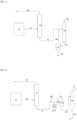
- the raw reaction mixture (2) leaving the reaction zone (1) is sent to a topping column (3 ) which separates, at the top, a stream (4) essentially comprising the unreacted reactants, and at the bottom, a stream (5) comprising mainly the desired ester with bound impurities to acid and alcohol and heavy by-products.
- the column (3) is for example a column with plates, of the perforated plate type, or with packing.
- the stream (5) is sent to a rectification column (6) leading at the top to a stream (7) of purified ester, and at the bottom to a stream (8) which is concentrated on a film evaporator (9) or distilled in a topping column (not shown) in order to recycle the light compounds (10) present towards the start of the purification section, such as traces of unreacted reagents, and to eliminate the final residue (11) of heavy products.
- Stream (4) essentially comprises the unreacted reactants, acrylic acid and esterifying alcohol, which are separated from the desired ester due to their lower boiling point. This recoverable stream (4) is recycled to the reaction.
- a water washing of the reaction mixture (2) after topping in the column (3) is carried out before separating impurities and heavy by-products in the rectification column (6).
- the bottoms stream (5) of the topping column is subjected to washing with an aqueous stream (20) leading, after decantation in a decanter (12), to an aqueous phase (22) comprising all of the acid impurities as well as an organic phase (13) comprising the desired ester, heavy by-products and traces of water and acrylic acid.
- the organic phase (13) obtained after washing with water is subjected to a water removal stage, by distillation using a distillation column or using a thin film evaporator ( 15), the recovered water (21) being able to be recycled to the washing stage.
- the water-free stream (14) is then sent to the last rectification column (6) of the pure ester, with removal at the bottom of a stream (16) of heavy by-products.
- the distilled product (7) at the head of column (6) is a purified ester containing substantially no more acid impurities.
- a large volume decanter is needed to treat the whole of the stream (5), it is necessary to treat part of the washed stream by passing it through an evaporator (15).
- This embodiment greatly increases the energy consumption and is not easily compatible with a process on an industrial scale.
- the invention overcomes the drawbacks of said processes of the prior art, by using a distillation column equipped with a lateral withdrawal as a topping column (3).
- reaction mixture (2) feeds a topping column with lateral withdrawal (3).
- Internals used for column (3) can be valve trays or perforated weir trays, or cross-flow trays such as Dual Flow, Ripple Trays, Turbo Grid Shell, or ordered packing such as structured packing such as the Mellapack 250X from Sulzer.
- the topping column (3) advantageously comprises an equivalent of 10 to 30 theoretical plates, preferably 15 to 20 theoretical stages.
- the topping column (3) is fed by the stream (2) generally in the upper third of this column, preferably between the theoretical plates 3 to 10 counted from the top of the column.
- the column operates with a reflux ratio (flow rate of condensed liquid returned to the column/flow rate (4) extracted at the top) advantageously between 115 and 1/1, preferably of the order of 1/3.
- the column (3) can operate under vacuum, in order to minimize the thermal exposure of the heat-sensitive compounds within the column.
- the column (3) operates under a vacuum ranging from 1.333 to 13.332 kPa (10 to 100 mm Hg).
- the top stream (4) of the column (3) essentially comprises the unreacted reactants. This recoverable stream (4) is advantageously recycled to the reaction.
- a stream (31) is withdrawn laterally from the column (3).
- This stream (31) can be in gaseous form or in liquid form, preferably in liquid form.
- THE Withdrawal is placed at a lower level than the column feed level, advantageously between theoretical plates 5 to 15, preferably between 8 and 12 counted from the column head.
- the location of this lateral withdrawal is judiciously chosen so as to maximize the concentration of AHP and that of di-AA while minimizing the presence of recoverable reagents (acrylic acid and esterifying alcohol).
- This side draw generally includes the quantity of stabilizers necessary for its operation without clogging. If necessary, in the case of withdrawal in the gas phase, another stabilizer can also be added.
- 100 to 5000 ppm of polymerization inhibitor are introduced into the purification system according to the method of the invention.
- the polymerization inhibitors used can be identical to those used to stabilize the esterification reaction.
- the stabilization of the topping column (3) is carried out using a first polymerization inhibitor, preferably injected at the top condenser.
- the acrylic ester as well as the AHP withdrawn laterally from the column in the form of a gas stream or as a liquid stream can be stabilized with a polymerization inhibitor different from the first inhibitor.
- the organic stream (33) may also be stabilized with the first inhibitor before being reintroduced into the topping column.
- oxygen, air or so-called depleted air at 7% O 2 can be injected at the bottom of the column (3).
- the quantity of oxygen injected corresponds to a content of 0.2% to 0.5% relative to the quantity of organic vapor in the column.
- the withdrawn stream (31) is sent to a decanter (30) to which water (32) is added. After cooling to a temperature preferably ranging from 20° C. to 70° C., water (32) is added in a proportion generally comprised between 5 and 50% with respect to the flow (31) coming from the side withdrawal.
- the organic phase (33) is reintroduced into the column (3), at a level which may be lower or higher than that of the side withdrawal, preferably at a level higher than that of the side withdrawal, and preferably at a level lower than the feed to the column, in particular between theoretical plates 5 to 15, preferably 7 to 12.
- the aqueous phase (34) comprising most of the acid impurities can be reused again to wash the stream 31, or sent for treatment to a biological station.
- the stream (5), separated at the bottom of the topping column (3) is sent to a rectification column (6) leading at the top to a stream (7) of purified ester and at the bottom to a stream (8) .
- the column (6) is for example a column with perforated plates or with packing.
- the internals used for the column can be valve trays or perforated weir trays, or cross-flow trays such as Dual Flow, Ripple Trays, Turbo Grid Shell, or ordered packing such as structured packing such as Mellapack 250X by Sulzer.
- Distillation column (6) advantageously comprises an equivalent of 2 to 15 theoretical plates, preferably 5 to 10 theoretical stages.
- Column (6) operates with a reflux ratio (flow rate of condensed liquid returned to the column/flow rate of flow (7)) ranging from 1/5 to 1/1, preferably of the order of 1/2.
- the column (6) can operate under vacuum, in order to minimize the thermal exposure of the heat-sensitive compounds within the column.
- the column (6) operates under a vacuum ranging from 1.333 to 13.332 kPa (10 to 100 mm Hg).
- its operating temperature is between 50°C and 160°C.
- the stream (8) separated at the bottom is concentrated on a wiped film evaporator (9) in order to recycle the light compounds present towards the start of the purification section upstream of the column (3) or of the column (6) and makes it possible to eliminate the residue (11) comprising the heavy products.
- the stream (7) at the head of the column (6) consists of the desired ester having, as specifications, an ester purity greater than 99.7%, a content of acid impurities (AHP+diAA+AA) less than 90ppm.
- the water content is generally less than 400 ppm.
- the feed stream 2 of a topping column (3) of a process for the purification of 2-ethylhexyl acrylate represented in Figure 1 contains 75 ppm of AHP in a first test, and 140 ppm of AHP in a second test.
- the energy involved in this test at the level of the boiler of columns 3 and 6 and of the evaporator 9 is 2222618 kcal/h, corresponding to 9299433 kJ/h.
- Test 2 of Example 1 is reproduced by changing certain operating conditions in order to find a product that meets the specifications.
- test 4 the reboiling flow rate of the topping column 3 is increased, with the consequence of an increase in the energy consumption of the purification process.
- test 3 lead to a product meeting the specifications, with a slightly lower energy consumption (2209593 kcal/h, corresponding to 9244937 kJ/h) than test 1.
- test 4 generate an A2EH conforming to the specifications and for a productivity equivalent to that of test 1, but with an energy overconsumption of the order of 10%.
- [Table 2] Flow 2 4 5 7 11 8 Temperature, °C 115 29.7 143.1 23.8 138 144.3 Trial 3 Mass flow, kf/hr 13600 8070.384 5800 4449.998 331,723 mass fraction AA 0.065 0.111 0 0 0 2EH 0.231 0.396 0 0 0 A2EH 0.649 0.442 0.937 0.998 0.326
- the bottom stream 5 from the topping column 3 is sent to a decanter 12 and is washed with 20% water at 70°C.
- the organic stream 13 is taken up by a film evaporator 15 before being subjected to distillation in column 6: the aqueous stream 22 is sent to biological treatment and the overhead stream 21 from the evaporator is returned to the decanter feed 12.
- the energy cost of this operation is 18% higher than that necessary for a process without intermediate washing.
- Example 1 is reproduced (test 2), but in a configuration according to the invention (represented on the Figure 3 ).
- Feed stream (2) contains 140 ppm AHP.
- Stream 31 is withdrawn from plate 26 of column 3 and washed in a decanter 30 with water 32.
- Organic phase 33 is recycled to plate 22 of column 3 and aqueous phase 34 is sent for biological treatment.
- the decantation in the decanter 30 is carried out with 20% water with respect to the stream 31 at a temperature of 70°C.
- Example 4 is reproduced by changing certain operating conditions, with A2EH production maintained at 119 T/d and the AHP content in feed stream 2 set at 140 ppm.
Landscapes
- Chemical & Material Sciences (AREA)
- Organic Chemistry (AREA)
- Crystallography & Structural Chemistry (AREA)
- Organic Low-Molecular-Weight Compounds And Preparation Thereof (AREA)
- Low-Molecular Organic Synthesis Reactions Using Catalysts (AREA)
Applications Claiming Priority (2)
| Application Number | Priority Date | Filing Date | Title |
|---|---|---|---|
| FR1905414A FR3096368B1 (fr) | 2019-05-23 | 2019-05-23 | Procede perfectionne de fabrication d’acrylates d’alkyle de purete elevee |
| PCT/FR2020/050691 WO2020234519A1 (fr) | 2019-05-23 | 2020-04-23 | Procede perfectionne de fabrication d'acrylates d'alkyle de purete elevee |
Publications (2)
| Publication Number | Publication Date |
|---|---|
| EP3972953A1 EP3972953A1 (fr) | 2022-03-30 |
| EP3972953B1 true EP3972953B1 (fr) | 2023-06-14 |
Family
ID=67514952
Family Applications (1)
| Application Number | Title | Priority Date | Filing Date |
|---|---|---|---|
| EP20734793.1A Active EP3972953B1 (fr) | 2019-05-23 | 2020-04-23 | Procede perfectionne de fabrication d'acrylates d'alkyle de purete elevee |
Country Status (6)
| Country | Link |
|---|---|
| US (1) | US12122746B2 (enExample) |
| EP (1) | EP3972953B1 (enExample) |
| JP (1) | JP7568655B2 (enExample) |
| CN (1) | CN113891874B (enExample) |
| FR (1) | FR3096368B1 (enExample) |
| WO (1) | WO2020234519A1 (enExample) |
Families Citing this family (1)
| Publication number | Priority date | Publication date | Assignee | Title |
|---|---|---|---|---|
| FR3119845B1 (fr) * | 2021-02-15 | 2023-01-06 | Arkema France | Procede perfectionne de fabrication d’acrylates d’alkyle de purete elevee |
Family Cites Families (7)
| Publication number | Priority date | Publication date | Assignee | Title |
|---|---|---|---|---|
| JP3981550B2 (ja) | 2001-12-03 | 2007-09-26 | 三菱化学株式会社 | アクリル酸エステルの製造方法 |
| KR101496488B1 (ko) * | 2010-12-29 | 2015-02-26 | 주식회사 엘지화학 | 고순도 2-에틸헥실-아크릴레이트 생산을 위한 분리벽형 증류탑 및 이를 이용한 제조방법 |
| US9895624B2 (en) | 2013-07-18 | 2018-02-20 | Lg Chem, Ltd. | Distillation device |
| FR3012140B1 (fr) | 2013-10-18 | 2016-08-26 | Arkema France | Unite et procede pour la purification de methacrylate de methyle brut |
| FR3024143B1 (fr) | 2014-07-28 | 2016-07-15 | Arkema France | Procede perfectionne de fabrication de (meth)acrylates d'alkyle |
| TW201825451A (zh) * | 2016-12-13 | 2018-07-16 | 德商巴斯夫歐洲公司 | 藉由蒸餾分離純(甲基)丙烯酸環己酯的方法 |
| WO2018114429A1 (de) | 2016-12-21 | 2018-06-28 | Basf Se | Verfahren zur destillativen gewinnung von rein-2-ethylhexylacrylat oder rein-2-propylheptylacrylat aus dem entsprechenden roh-alkylacrylat |
-
2019
- 2019-05-23 FR FR1905414A patent/FR3096368B1/fr not_active Expired - Fee Related
-
2020
- 2020-04-23 JP JP2021569408A patent/JP7568655B2/ja active Active
- 2020-04-23 CN CN202080038213.7A patent/CN113891874B/zh active Active
- 2020-04-23 EP EP20734793.1A patent/EP3972953B1/fr active Active
- 2020-04-23 US US17/612,590 patent/US12122746B2/en active Active
- 2020-04-23 WO PCT/FR2020/050691 patent/WO2020234519A1/fr not_active Ceased
Also Published As
| Publication number | Publication date |
|---|---|
| FR3096368B1 (fr) | 2021-04-23 |
| EP3972953A1 (fr) | 2022-03-30 |
| WO2020234519A1 (fr) | 2020-11-26 |
| KR20220012305A (ko) | 2022-02-03 |
| BR112021022500A2 (pt) | 2021-12-28 |
| FR3096368A1 (fr) | 2020-11-27 |
| US20220234982A1 (en) | 2022-07-28 |
| CN113891874A (zh) | 2022-01-04 |
| US12122746B2 (en) | 2024-10-22 |
| JP7568655B2 (ja) | 2024-10-16 |
| JP2022533439A (ja) | 2022-07-22 |
| CN113891874B (zh) | 2024-10-11 |
Similar Documents
| Publication | Publication Date | Title |
|---|---|---|
| FR3047004B1 (fr) | Procede de purification d'esters (meth)acryliques | |
| EP3606903B1 (fr) | Procede de purification d'acide (meth)acrylique incluant une colonne de distillation a paroi separatrice. | |
| EP2773608A1 (fr) | Procédé de production d'acrylate de 2-octyle par estérification directe | |
| EP3063123B1 (fr) | Procede de production d'esters (meth)acryliques legers | |
| EP3814316B1 (fr) | Procede de purification d'acrylates legers | |
| EP3914581B1 (fr) | Procede de purification d'esters (meth)acryliques a l'aide d'une colonne a partition | |
| EP3174844B1 (fr) | Procédé perfectionne de fabrication de (méth)acrylates d'alkyle | |
| EP3658249B1 (fr) | Procede de purification d'esters (meth)acryliques | |
| EP3972953B1 (fr) | Procede perfectionne de fabrication d'acrylates d'alkyle de purete elevee | |
| EP4291547B1 (fr) | Procede perfectionne de fabrication d'acrylates d'alkyle de purete elevee | |
| EP4423053A1 (fr) | Procede perfectionne de fabrication d'acrylate de butyle de purete elevee | |
| EP2807140B1 (fr) | Procede de production d'acrylate de 2-octyle par transesterification | |
| EP4392399B1 (fr) | Procede perfectionne de fabrication d'acrylate de butyle de purete elevee | |
| FR3149008A1 (fr) | Procede de purification d’acrylates legers | |
| FR3146894A1 (fr) | Procede de purification d’acrylates d’alkyle legers |
Legal Events
| Date | Code | Title | Description |
|---|---|---|---|
| STAA | Information on the status of an ep patent application or granted ep patent |
Free format text: STATUS: UNKNOWN |
|
| STAA | Information on the status of an ep patent application or granted ep patent |
Free format text: STATUS: THE INTERNATIONAL PUBLICATION HAS BEEN MADE |
|
| PUAI | Public reference made under article 153(3) epc to a published international application that has entered the european phase |
Free format text: ORIGINAL CODE: 0009012 |
|
| STAA | Information on the status of an ep patent application or granted ep patent |
Free format text: STATUS: REQUEST FOR EXAMINATION WAS MADE |
|
| 17P | Request for examination filed |
Effective date: 20211105 |
|
| AK | Designated contracting states |
Kind code of ref document: A1 Designated state(s): AL AT BE BG CH CY CZ DE DK EE ES FI FR GB GR HR HU IE IS IT LI LT LU LV MC MK MT NL NO PL PT RO RS SE SI SK SM TR |
|
| DAV | Request for validation of the european patent (deleted) | ||
| DAX | Request for extension of the european patent (deleted) | ||
| GRAP | Despatch of communication of intention to grant a patent |
Free format text: ORIGINAL CODE: EPIDOSNIGR1 |
|
| STAA | Information on the status of an ep patent application or granted ep patent |
Free format text: STATUS: GRANT OF PATENT IS INTENDED |
|
| INTG | Intention to grant announced |
Effective date: 20230222 |
|
| GRAS | Grant fee paid |
Free format text: ORIGINAL CODE: EPIDOSNIGR3 |
|
| GRAA | (expected) grant |
Free format text: ORIGINAL CODE: 0009210 |
|
| STAA | Information on the status of an ep patent application or granted ep patent |
Free format text: STATUS: THE PATENT HAS BEEN GRANTED |
|
| AK | Designated contracting states |
Kind code of ref document: B1 Designated state(s): AL AT BE BG CH CY CZ DE DK EE ES FI FR GB GR HR HU IE IS IT LI LT LU LV MC MK MT NL NO PL PT RO RS SE SI SK SM TR |
|
| REG | Reference to a national code |
Ref country code: CH Ref legal event code: EP |
|
| REG | Reference to a national code |
Ref country code: DE Ref legal event code: R096 Ref document number: 602020012536 Country of ref document: DE |
|
| REG | Reference to a national code |
Ref country code: AT Ref legal event code: REF Ref document number: 1579164 Country of ref document: AT Kind code of ref document: T Effective date: 20230715 |
|
| REG | Reference to a national code |
Ref country code: LT Ref legal event code: MG9D |
|
| REG | Reference to a national code |
Ref country code: NL Ref legal event code: MP Effective date: 20230614 |
|
| PG25 | Lapsed in a contracting state [announced via postgrant information from national office to epo] |
Ref country code: SE Free format text: LAPSE BECAUSE OF FAILURE TO SUBMIT A TRANSLATION OF THE DESCRIPTION OR TO PAY THE FEE WITHIN THE PRESCRIBED TIME-LIMIT Effective date: 20230614 Ref country code: NO Free format text: LAPSE BECAUSE OF FAILURE TO SUBMIT A TRANSLATION OF THE DESCRIPTION OR TO PAY THE FEE WITHIN THE PRESCRIBED TIME-LIMIT Effective date: 20230914 Ref country code: ES Free format text: LAPSE BECAUSE OF FAILURE TO SUBMIT A TRANSLATION OF THE DESCRIPTION OR TO PAY THE FEE WITHIN THE PRESCRIBED TIME-LIMIT Effective date: 20230614 |
|
| REG | Reference to a national code |
Ref country code: AT Ref legal event code: MK05 Ref document number: 1579164 Country of ref document: AT Kind code of ref document: T Effective date: 20230614 |
|
| PG25 | Lapsed in a contracting state [announced via postgrant information from national office to epo] |
Ref country code: RS Free format text: LAPSE BECAUSE OF FAILURE TO SUBMIT A TRANSLATION OF THE DESCRIPTION OR TO PAY THE FEE WITHIN THE PRESCRIBED TIME-LIMIT Effective date: 20230614 Ref country code: NL Free format text: LAPSE BECAUSE OF FAILURE TO SUBMIT A TRANSLATION OF THE DESCRIPTION OR TO PAY THE FEE WITHIN THE PRESCRIBED TIME-LIMIT Effective date: 20230614 Ref country code: LV Free format text: LAPSE BECAUSE OF FAILURE TO SUBMIT A TRANSLATION OF THE DESCRIPTION OR TO PAY THE FEE WITHIN THE PRESCRIBED TIME-LIMIT Effective date: 20230614 Ref country code: LT Free format text: LAPSE BECAUSE OF FAILURE TO SUBMIT A TRANSLATION OF THE DESCRIPTION OR TO PAY THE FEE WITHIN THE PRESCRIBED TIME-LIMIT Effective date: 20230614 Ref country code: HR Free format text: LAPSE BECAUSE OF FAILURE TO SUBMIT A TRANSLATION OF THE DESCRIPTION OR TO PAY THE FEE WITHIN THE PRESCRIBED TIME-LIMIT Effective date: 20230614 Ref country code: GR Free format text: LAPSE BECAUSE OF FAILURE TO SUBMIT A TRANSLATION OF THE DESCRIPTION OR TO PAY THE FEE WITHIN THE PRESCRIBED TIME-LIMIT Effective date: 20230915 |
|
| PG25 | Lapsed in a contracting state [announced via postgrant information from national office to epo] |
Ref country code: FI Free format text: LAPSE BECAUSE OF FAILURE TO SUBMIT A TRANSLATION OF THE DESCRIPTION OR TO PAY THE FEE WITHIN THE PRESCRIBED TIME-LIMIT Effective date: 20230614 |
|
| PG25 | Lapsed in a contracting state [announced via postgrant information from national office to epo] |
Ref country code: SK Free format text: LAPSE BECAUSE OF FAILURE TO SUBMIT A TRANSLATION OF THE DESCRIPTION OR TO PAY THE FEE WITHIN THE PRESCRIBED TIME-LIMIT Effective date: 20230614 |
|
| PG25 | Lapsed in a contracting state [announced via postgrant information from national office to epo] |
Ref country code: IS Free format text: LAPSE BECAUSE OF FAILURE TO SUBMIT A TRANSLATION OF THE DESCRIPTION OR TO PAY THE FEE WITHIN THE PRESCRIBED TIME-LIMIT Effective date: 20231014 |
|
| PG25 | Lapsed in a contracting state [announced via postgrant information from national office to epo] |
Ref country code: SM Free format text: LAPSE BECAUSE OF FAILURE TO SUBMIT A TRANSLATION OF THE DESCRIPTION OR TO PAY THE FEE WITHIN THE PRESCRIBED TIME-LIMIT Effective date: 20230614 Ref country code: SK Free format text: LAPSE BECAUSE OF FAILURE TO SUBMIT A TRANSLATION OF THE DESCRIPTION OR TO PAY THE FEE WITHIN THE PRESCRIBED TIME-LIMIT Effective date: 20230614 Ref country code: RO Free format text: LAPSE BECAUSE OF FAILURE TO SUBMIT A TRANSLATION OF THE DESCRIPTION OR TO PAY THE FEE WITHIN THE PRESCRIBED TIME-LIMIT Effective date: 20230614 Ref country code: PT Free format text: LAPSE BECAUSE OF FAILURE TO SUBMIT A TRANSLATION OF THE DESCRIPTION OR TO PAY THE FEE WITHIN THE PRESCRIBED TIME-LIMIT Effective date: 20231016 Ref country code: IS Free format text: LAPSE BECAUSE OF FAILURE TO SUBMIT A TRANSLATION OF THE DESCRIPTION OR TO PAY THE FEE WITHIN THE PRESCRIBED TIME-LIMIT Effective date: 20231014 Ref country code: EE Free format text: LAPSE BECAUSE OF FAILURE TO SUBMIT A TRANSLATION OF THE DESCRIPTION OR TO PAY THE FEE WITHIN THE PRESCRIBED TIME-LIMIT Effective date: 20230614 Ref country code: CZ Free format text: LAPSE BECAUSE OF FAILURE TO SUBMIT A TRANSLATION OF THE DESCRIPTION OR TO PAY THE FEE WITHIN THE PRESCRIBED TIME-LIMIT Effective date: 20230614 Ref country code: AT Free format text: LAPSE BECAUSE OF FAILURE TO SUBMIT A TRANSLATION OF THE DESCRIPTION OR TO PAY THE FEE WITHIN THE PRESCRIBED TIME-LIMIT Effective date: 20230614 |
|
| PG25 | Lapsed in a contracting state [announced via postgrant information from national office to epo] |
Ref country code: PL Free format text: LAPSE BECAUSE OF FAILURE TO SUBMIT A TRANSLATION OF THE DESCRIPTION OR TO PAY THE FEE WITHIN THE PRESCRIBED TIME-LIMIT Effective date: 20230614 |
|
| REG | Reference to a national code |
Ref country code: DE Ref legal event code: R097 Ref document number: 602020012536 Country of ref document: DE |
|
| PLBE | No opposition filed within time limit |
Free format text: ORIGINAL CODE: 0009261 |
|
| STAA | Information on the status of an ep patent application or granted ep patent |
Free format text: STATUS: NO OPPOSITION FILED WITHIN TIME LIMIT |
|
| PG25 | Lapsed in a contracting state [announced via postgrant information from national office to epo] |
Ref country code: DK Free format text: LAPSE BECAUSE OF FAILURE TO SUBMIT A TRANSLATION OF THE DESCRIPTION OR TO PAY THE FEE WITHIN THE PRESCRIBED TIME-LIMIT Effective date: 20230614 |
|
| PG25 | Lapsed in a contracting state [announced via postgrant information from national office to epo] |
Ref country code: SI Free format text: LAPSE BECAUSE OF FAILURE TO SUBMIT A TRANSLATION OF THE DESCRIPTION OR TO PAY THE FEE WITHIN THE PRESCRIBED TIME-LIMIT Effective date: 20230614 |
|
| 26N | No opposition filed |
Effective date: 20240315 |
|
| PG25 | Lapsed in a contracting state [announced via postgrant information from national office to epo] |
Ref country code: SI Free format text: LAPSE BECAUSE OF FAILURE TO SUBMIT A TRANSLATION OF THE DESCRIPTION OR TO PAY THE FEE WITHIN THE PRESCRIBED TIME-LIMIT Effective date: 20230614 Ref country code: IT Free format text: LAPSE BECAUSE OF FAILURE TO SUBMIT A TRANSLATION OF THE DESCRIPTION OR TO PAY THE FEE WITHIN THE PRESCRIBED TIME-LIMIT Effective date: 20230614 |
|
| PG25 | Lapsed in a contracting state [announced via postgrant information from national office to epo] |
Ref country code: BG Free format text: LAPSE BECAUSE OF FAILURE TO SUBMIT A TRANSLATION OF THE DESCRIPTION OR TO PAY THE FEE WITHIN THE PRESCRIBED TIME-LIMIT Effective date: 20230614 |
|
| PG25 | Lapsed in a contracting state [announced via postgrant information from national office to epo] |
Ref country code: MC Free format text: LAPSE BECAUSE OF FAILURE TO SUBMIT A TRANSLATION OF THE DESCRIPTION OR TO PAY THE FEE WITHIN THE PRESCRIBED TIME-LIMIT Effective date: 20230614 |
|
| PG25 | Lapsed in a contracting state [announced via postgrant information from national office to epo] |
Ref country code: MC Free format text: LAPSE BECAUSE OF FAILURE TO SUBMIT A TRANSLATION OF THE DESCRIPTION OR TO PAY THE FEE WITHIN THE PRESCRIBED TIME-LIMIT Effective date: 20230614 Ref country code: BG Free format text: LAPSE BECAUSE OF FAILURE TO SUBMIT A TRANSLATION OF THE DESCRIPTION OR TO PAY THE FEE WITHIN THE PRESCRIBED TIME-LIMIT Effective date: 20230614 |
|
| REG | Reference to a national code |
Ref country code: CH Ref legal event code: PL |
|
| PG25 | Lapsed in a contracting state [announced via postgrant information from national office to epo] |
Ref country code: LU Free format text: LAPSE BECAUSE OF NON-PAYMENT OF DUE FEES Effective date: 20240423 |
|
| GBPC | Gb: european patent ceased through non-payment of renewal fee |
Effective date: 20240423 |
|
| PG25 | Lapsed in a contracting state [announced via postgrant information from national office to epo] |
Ref country code: LU Free format text: LAPSE BECAUSE OF NON-PAYMENT OF DUE FEES Effective date: 20240423 |
|
| PG25 | Lapsed in a contracting state [announced via postgrant information from national office to epo] |
Ref country code: GB Free format text: LAPSE BECAUSE OF NON-PAYMENT OF DUE FEES Effective date: 20240423 |
|
| PG25 | Lapsed in a contracting state [announced via postgrant information from national office to epo] |
Ref country code: GB Free format text: LAPSE BECAUSE OF NON-PAYMENT OF DUE FEES Effective date: 20240423 Ref country code: CH Free format text: LAPSE BECAUSE OF NON-PAYMENT OF DUE FEES Effective date: 20240430 |
|
| PG25 | Lapsed in a contracting state [announced via postgrant information from national office to epo] |
Ref country code: IE Free format text: LAPSE BECAUSE OF NON-PAYMENT OF DUE FEES Effective date: 20240423 |
|
| PGFP | Annual fee paid to national office [announced via postgrant information from national office to epo] |
Ref country code: DE Payment date: 20250305 Year of fee payment: 6 |
|
| PG25 | Lapsed in a contracting state [announced via postgrant information from national office to epo] |
Ref country code: CY Free format text: LAPSE BECAUSE OF FAILURE TO SUBMIT A TRANSLATION OF THE DESCRIPTION OR TO PAY THE FEE WITHIN THE PRESCRIBED TIME-LIMIT; INVALID AB INITIO Effective date: 20200423 |
|
| PG25 | Lapsed in a contracting state [announced via postgrant information from national office to epo] |
Ref country code: HU Free format text: LAPSE BECAUSE OF FAILURE TO SUBMIT A TRANSLATION OF THE DESCRIPTION OR TO PAY THE FEE WITHIN THE PRESCRIBED TIME-LIMIT; INVALID AB INITIO Effective date: 20200423 |
|
| REG | Reference to a national code |
Ref country code: DE Ref legal event code: R081 Ref document number: 602020012536 Country of ref document: DE Owner name: ARKEMA FRANCE, FR Free format text: FORMER OWNER: ARKEMA FRANCE, COLOMBES, FR |
|
| REG | Reference to a national code |
Ref country code: BE Ref legal event code: PD Owner name: ARKEMA FRANCE; FR Free format text: DETAILS ASSIGNMENT: CHANGE OF OWNER(S), OTHER; FORMER OWNER NAME: ARKEMA FRANCE Effective date: 20250919 |
|
| PGFP | Annual fee paid to national office [announced via postgrant information from national office to epo] |
Ref country code: BE Payment date: 20260317 Year of fee payment: 7 |
|
| PGFP | Annual fee paid to national office [announced via postgrant information from national office to epo] |
Ref country code: FR Payment date: 20260309 Year of fee payment: 7 |