EP3971165B1 - Highly unsaturated fatty acid or highly unsaturated fatty acid ethyl ester with reduced environmental pollutants, and method for producing same - Google Patents
Highly unsaturated fatty acid or highly unsaturated fatty acid ethyl ester with reduced environmental pollutants, and method for producing same Download PDFInfo
- Publication number
- EP3971165B1 EP3971165B1 EP21206640.1A EP21206640A EP3971165B1 EP 3971165 B1 EP3971165 B1 EP 3971165B1 EP 21206640 A EP21206640 A EP 21206640A EP 3971165 B1 EP3971165 B1 EP 3971165B1
- Authority
- EP
- European Patent Office
- Prior art keywords
- highly unsaturated
- unsaturated fatty
- fatty acid
- fatty acids
- ethyl ester
- Prior art date
- Legal status (The legal status is an assumption and is not a legal conclusion. Google has not performed a legal analysis and makes no representation as to the accuracy of the status listed.)
- Active
Links
Classifications
-
- C—CHEMISTRY; METALLURGY
- C07—ORGANIC CHEMISTRY
- C07C—ACYCLIC OR CARBOCYCLIC COMPOUNDS
- C07C51/00—Preparation of carboxylic acids or their salts, halides or anhydrides
- C07C51/42—Separation; Purification; Stabilisation; Use of additives
- C07C51/43—Separation; Purification; Stabilisation; Use of additives by change of the physical state, e.g. crystallisation
- C07C51/44—Separation; Purification; Stabilisation; Use of additives by change of the physical state, e.g. crystallisation by distillation
-
- C—CHEMISTRY; METALLURGY
- C07—ORGANIC CHEMISTRY
- C07C—ACYCLIC OR CARBOCYCLIC COMPOUNDS
- C07C69/00—Esters of carboxylic acids; Esters of carbonic or haloformic acids
- C07C69/52—Esters of acyclic unsaturated carboxylic acids having the esterified carboxyl group bound to an acyclic carbon atom
- C07C69/587—Monocarboxylic acid esters having at least two carbon-to-carbon double bonds
-
- A—HUMAN NECESSITIES
- A23—FOODS OR FOODSTUFFS; TREATMENT THEREOF, NOT COVERED BY OTHER CLASSES
- A23L—FOODS, FOODSTUFFS OR NON-ALCOHOLIC BEVERAGES, NOT OTHERWISE PROVIDED FOR; PREPARATION OR TREATMENT THEREOF
- A23L33/00—Modifying nutritive qualities of foods; Dietetic products; Preparation or treatment thereof
- A23L33/10—Modifying nutritive qualities of foods; Dietetic products; Preparation or treatment thereof using additives
- A23L33/115—Fatty acids or derivatives thereof; Fats or oils
- A23L33/12—Fatty acids or derivatives thereof
-
- A—HUMAN NECESSITIES
- A61—MEDICAL OR VETERINARY SCIENCE; HYGIENE
- A61K—PREPARATIONS FOR MEDICAL, DENTAL OR TOILETRY PURPOSES
- A61K31/00—Medicinal preparations containing organic active ingredients
- A61K31/21—Esters, e.g. nitroglycerine, selenocyanates
- A61K31/215—Esters, e.g. nitroglycerine, selenocyanates of carboxylic acids
- A61K31/22—Esters, e.g. nitroglycerine, selenocyanates of carboxylic acids of acyclic acids, e.g. pravastatin
- A61K31/23—Esters, e.g. nitroglycerine, selenocyanates of carboxylic acids of acyclic acids, e.g. pravastatin of acids having a carboxyl group bound to a chain of seven or more carbon atoms
- A61K31/232—Esters, e.g. nitroglycerine, selenocyanates of carboxylic acids of acyclic acids, e.g. pravastatin of acids having a carboxyl group bound to a chain of seven or more carbon atoms having three or more double bonds, e.g. etretinate
-
- A—HUMAN NECESSITIES
- A61—MEDICAL OR VETERINARY SCIENCE; HYGIENE
- A61P—SPECIFIC THERAPEUTIC ACTIVITY OF CHEMICAL COMPOUNDS OR MEDICINAL PREPARATIONS
- A61P3/00—Drugs for disorders of the metabolism
- A61P3/02—Nutrients, e.g. vitamins, minerals
-
- B—PERFORMING OPERATIONS; TRANSPORTING
- B01—PHYSICAL OR CHEMICAL PROCESSES OR APPARATUS IN GENERAL
- B01D—SEPARATION
- B01D3/00—Distillation or related exchange processes in which liquids are contacted with gaseous media, e.g. stripping
- B01D3/14—Fractional distillation or use of a fractionation or rectification column
- B01D3/143—Fractional distillation or use of a fractionation or rectification column by two or more of a fractionation, separation or rectification step
-
- C—CHEMISTRY; METALLURGY
- C07—ORGANIC CHEMISTRY
- C07C—ACYCLIC OR CARBOCYCLIC COMPOUNDS
- C07C51/00—Preparation of carboxylic acids or their salts, halides or anhydrides
- C07C51/42—Separation; Purification; Stabilisation; Use of additives
- C07C51/47—Separation; Purification; Stabilisation; Use of additives by solid-liquid treatment; by chemisorption
-
- C—CHEMISTRY; METALLURGY
- C07—ORGANIC CHEMISTRY
- C07C—ACYCLIC OR CARBOCYCLIC COMPOUNDS
- C07C57/00—Unsaturated compounds having carboxyl groups bound to acyclic carbon atoms
- C07C57/02—Unsaturated compounds having carboxyl groups bound to acyclic carbon atoms with only carbon-to-carbon double bonds as unsaturation
- C07C57/03—Monocarboxylic acids
-
- C—CHEMISTRY; METALLURGY
- C07—ORGANIC CHEMISTRY
- C07C—ACYCLIC OR CARBOCYCLIC COMPOUNDS
- C07C57/00—Unsaturated compounds having carboxyl groups bound to acyclic carbon atoms
- C07C57/02—Unsaturated compounds having carboxyl groups bound to acyclic carbon atoms with only carbon-to-carbon double bonds as unsaturation
- C07C57/03—Monocarboxylic acids
- C07C57/12—Straight chain carboxylic acids containing eighteen carbon atoms
-
- C—CHEMISTRY; METALLURGY
- C07—ORGANIC CHEMISTRY
- C07C—ACYCLIC OR CARBOCYCLIC COMPOUNDS
- C07C67/00—Preparation of carboxylic acid esters
- C07C67/03—Preparation of carboxylic acid esters by reacting an ester group with a hydroxy group
-
- C—CHEMISTRY; METALLURGY
- C07—ORGANIC CHEMISTRY
- C07C—ACYCLIC OR CARBOCYCLIC COMPOUNDS
- C07C67/00—Preparation of carboxylic acid esters
- C07C67/48—Separation; Purification; Stabilisation; Use of additives
- C07C67/52—Separation; Purification; Stabilisation; Use of additives by change in the physical state, e.g. crystallisation
- C07C67/54—Separation; Purification; Stabilisation; Use of additives by change in the physical state, e.g. crystallisation by distillation
-
- C—CHEMISTRY; METALLURGY
- C07—ORGANIC CHEMISTRY
- C07C—ACYCLIC OR CARBOCYCLIC COMPOUNDS
- C07C67/00—Preparation of carboxylic acid esters
- C07C67/48—Separation; Purification; Stabilisation; Use of additives
- C07C67/56—Separation; Purification; Stabilisation; Use of additives by solid-liquid treatment; by chemisorption
-
- C—CHEMISTRY; METALLURGY
- C11—ANIMAL OR VEGETABLE OILS, FATS, FATTY SUBSTANCES OR WAXES; FATTY ACIDS THEREFROM; DETERGENTS; CANDLES
- C11B—PRODUCING, e.g. BY PRESSING RAW MATERIALS OR BY EXTRACTION FROM WASTE MATERIALS, REFINING OR PRESERVING FATS, FATTY SUBSTANCES, e.g. LANOLIN, FATTY OILS OR WAXES; ESSENTIAL OILS; PERFUMES
- C11B3/00—Refining fats or fatty oils
- C11B3/12—Refining fats or fatty oils by distillation
-
- C—CHEMISTRY; METALLURGY
- C11—ANIMAL OR VEGETABLE OILS, FATS, FATTY SUBSTANCES OR WAXES; FATTY ACIDS THEREFROM; DETERGENTS; CANDLES
- C11C—FATTY ACIDS FROM FATS, OILS OR WAXES; CANDLES; FATS, OILS OR FATTY ACIDS BY CHEMICAL MODIFICATION OF FATS, OILS, OR FATTY ACIDS OBTAINED THEREFROM
- C11C1/00—Preparation of fatty acids from fats, fatty oils, or waxes; Refining the fatty acids
- C11C1/02—Preparation of fatty acids from fats, fatty oils, or waxes; Refining the fatty acids from fats or fatty oils
- C11C1/04—Preparation of fatty acids from fats, fatty oils, or waxes; Refining the fatty acids from fats or fatty oils by hydrolysis
-
- C—CHEMISTRY; METALLURGY
- C11—ANIMAL OR VEGETABLE OILS, FATS, FATTY SUBSTANCES OR WAXES; FATTY ACIDS THEREFROM; DETERGENTS; CANDLES
- C11C—FATTY ACIDS FROM FATS, OILS OR WAXES; CANDLES; FATS, OILS OR FATTY ACIDS BY CHEMICAL MODIFICATION OF FATS, OILS, OR FATTY ACIDS OBTAINED THEREFROM
- C11C3/00—Fats, oils, or fatty acids by chemical modification of fats, oils, or fatty acids obtained therefrom
- C11C3/003—Fats, oils, or fatty acids by chemical modification of fats, oils, or fatty acids obtained therefrom by esterification of fatty acids with alcohols
-
- A—HUMAN NECESSITIES
- A23—FOODS OR FOODSTUFFS; TREATMENT THEREOF, NOT COVERED BY OTHER CLASSES
- A23D—EDIBLE OILS OR FATS, e.g. MARGARINES, SHORTENINGS OR COOKING OILS
- A23D9/00—Other edible oils or fats, e.g. shortenings or cooking oils
- A23D9/02—Other edible oils or fats, e.g. shortenings or cooking oils characterised by the production or working-up
-
- A—HUMAN NECESSITIES
- A23—FOODS OR FOODSTUFFS; TREATMENT THEREOF, NOT COVERED BY OTHER CLASSES
- A23L—FOODS, FOODSTUFFS OR NON-ALCOHOLIC BEVERAGES, NOT OTHERWISE PROVIDED FOR; PREPARATION OR TREATMENT THEREOF
- A23L33/00—Modifying nutritive qualities of foods; Dietetic products; Preparation or treatment thereof
- A23L33/10—Modifying nutritive qualities of foods; Dietetic products; Preparation or treatment thereof using additives
- A23L33/115—Fatty acids or derivatives thereof; Fats or oils
-
- A—HUMAN NECESSITIES
- A61—MEDICAL OR VETERINARY SCIENCE; HYGIENE
- A61K—PREPARATIONS FOR MEDICAL, DENTAL OR TOILETRY PURPOSES
- A61K31/00—Medicinal preparations containing organic active ingredients
- A61K31/185—Acids; Anhydrides, halides or salts thereof, e.g. sulfur acids, imidic, hydrazonic or hydroximic acids
- A61K31/19—Carboxylic acids, e.g. valproic acid
- A61K31/20—Carboxylic acids, e.g. valproic acid having a carboxyl group bound to a chain of seven or more carbon atoms, e.g. stearic, palmitic, arachidic acids
-
- A—HUMAN NECESSITIES
- A61—MEDICAL OR VETERINARY SCIENCE; HYGIENE
- A61K—PREPARATIONS FOR MEDICAL, DENTAL OR TOILETRY PURPOSES
- A61K31/00—Medicinal preparations containing organic active ingredients
- A61K31/185—Acids; Anhydrides, halides or salts thereof, e.g. sulfur acids, imidic, hydrazonic or hydroximic acids
- A61K31/19—Carboxylic acids, e.g. valproic acid
- A61K31/20—Carboxylic acids, e.g. valproic acid having a carboxyl group bound to a chain of seven or more carbon atoms, e.g. stearic, palmitic, arachidic acids
- A61K31/202—Carboxylic acids, e.g. valproic acid having a carboxyl group bound to a chain of seven or more carbon atoms, e.g. stearic, palmitic, arachidic acids having three or more double bonds, e.g. linolenic
-
- A—HUMAN NECESSITIES
- A61—MEDICAL OR VETERINARY SCIENCE; HYGIENE
- A61K—PREPARATIONS FOR MEDICAL, DENTAL OR TOILETRY PURPOSES
- A61K35/00—Medicinal preparations containing materials or reaction products thereof with undetermined constitution
- A61K35/12—Materials from mammals; Compositions comprising non-specified tissues or cells; Compositions comprising non-embryonic stem cells; Genetically modified cells
-
- A—HUMAN NECESSITIES
- A61—MEDICAL OR VETERINARY SCIENCE; HYGIENE
- A61K—PREPARATIONS FOR MEDICAL, DENTAL OR TOILETRY PURPOSES
- A61K35/00—Medicinal preparations containing materials or reaction products thereof with undetermined constitution
- A61K35/56—Materials from animals other than mammals
- A61K35/60—Fish, e.g. seahorses; Fish eggs
-
- A—HUMAN NECESSITIES
- A61—MEDICAL OR VETERINARY SCIENCE; HYGIENE
- A61K—PREPARATIONS FOR MEDICAL, DENTAL OR TOILETRY PURPOSES
- A61K35/00—Medicinal preparations containing materials or reaction products thereof with undetermined constitution
- A61K35/56—Materials from animals other than mammals
- A61K35/612—Crustaceans, e.g. crabs, lobsters, shrimps, krill or crayfish; Barnacles
-
- A—HUMAN NECESSITIES
- A61—MEDICAL OR VETERINARY SCIENCE; HYGIENE
- A61K—PREPARATIONS FOR MEDICAL, DENTAL OR TOILETRY PURPOSES
- A61K35/00—Medicinal preparations containing materials or reaction products thereof with undetermined constitution
- A61K35/66—Microorganisms or materials therefrom
-
- B—PERFORMING OPERATIONS; TRANSPORTING
- B01—PHYSICAL OR CHEMICAL PROCESSES OR APPARATUS IN GENERAL
- B01D—SEPARATION
- B01D15/00—Separating processes involving the treatment of liquids with solid sorbents; Apparatus therefor
- B01D15/08—Selective adsorption, e.g. chromatography
- B01D15/26—Selective adsorption, e.g. chromatography characterised by the separation mechanism
- B01D15/32—Bonded phase chromatography
- B01D15/325—Reversed phase
-
- C—CHEMISTRY; METALLURGY
- C11—ANIMAL OR VEGETABLE OILS, FATS, FATTY SUBSTANCES OR WAXES; FATTY ACIDS THEREFROM; DETERGENTS; CANDLES
- C11B—PRODUCING, e.g. BY PRESSING RAW MATERIALS OR BY EXTRACTION FROM WASTE MATERIALS, REFINING OR PRESERVING FATS, FATTY SUBSTANCES, e.g. LANOLIN, FATTY OILS OR WAXES; ESSENTIAL OILS; PERFUMES
- C11B3/00—Refining fats or fatty oils
- C11B3/16—Refining fats or fatty oils by mechanical means
Definitions
- the present invention relates to a method for reducing the quantities of environmental pollutants, in particular, dioxins, brominated flame retardants, and other substances contained in fats or oils containing the highly unsaturated fatty acids in the production of highly unsaturated fatty acid ethyl esters from the fats or oils.
- the present invention further relates to foods, supplements, medicines, cosmetics and feeds that are produced from the fats or oils prepared in accordance with such methods. It is to be understood that the present invention is as defined in the claims.
- Environmental pollutants typified by dioxins are found almost everywhere on Earth today. They are also known to exert effects on fishes living in polluted ocean areas. They are considered to have no direct effects on health if present in trace amounts but, nevertheless, the ingredients to be ingested by humans as foods or feeds desirably contain the least amounts of environmental pollutants.
- Marine product oils for example, fish oils contain highly unsaturated fatty acids such as EPA (eicosapentaenoic acid, C20:5, n-3, all-cis-5,8,11,14,17-eicosdapentaenoic acid) and DHA (docosahexaenoic acid, C22:6, n-3, all-cis-4,7,10,13,16,19-docosahexaenoic acid).
- EPA and DHA are used as ingredients of medicines, health foods, foods in general, feeds and the like.
- Various purification steps are applied to make use of the EPA and/or DHA in marine product oils.
- Non-Patent Document 1 discloses removing the insecticide DDT and its metabolites from fish oils by molecular distillation.
- Non-Patent Document 2 discloses that chlorinated hydrocarbons and free fatty acids can be removed from fats or oils using vacuum stripping or thin-film distillation.
- Non-Patent Document 3 discloses using physical refining and molecular distillation in order to remove free fatty acids and other undesired substances from oil compositions.
- Patent Document 1 and Non-Patent Document 4 each disclose a method for reducing the quantities of environmental pollutants in a mixture containing fats or oils which comprises the step of adding a volatile working fluid to the mixture and the step of subjecting the mixture to at least one stripping process together with the added volatile working fluid.
- Non-Patent Document 5 discloses that highly unsaturated fatty acids are decomposed thermally when fish oils are deodorized at high temperatures.
- Non-Patent Document 6 discloses removing dioxins, free fatty acids and cholesterols from fish oils by short path distillation so as to make them suitable for use as feedstocks for ethyl esters.
- Patent Document 2 relates to a specific process for obtaining a concentrate of esters of EPA and DHA from crude or refined marine oils.
- An object of the present invention is to provide a method for reducing the quantities of environmental pollutants, in particular, dioxins and brominated flame retardants, contained in fats or oils that contain the highly unsaturated fatty acids as constituent fatty acids in the production of ethyl esters of highly unsaturated fatty acids from the fats or oils; another object of the present invention is to provide ethyl esters having smaller contents of the dioxins and brominated flame retardants.
- the present invention is as defined in the claims and has been completed on the basis of the finding that if fats or oils in which those highly unsaturated fatty acids that are prone to deteriorate as through oxidation or isomerization are contained as constituent fatty acids are refined by performing molecular distillation or short path distillation under specified conditions, the concentrations of environmental pollutants can be reduced to very low levels while suppressing the deterioration of the highly unsaturated fatty acids. According to this method. the quantities of environmental pollutants in the fats or oils can be reduced in such a way that the total content of dioxins is less than 0.2 pg-TEQ/g where TEQ is short for toxicity equivalency quantity.
- ethyl esters can be obtained using the thus processed fats or oils as a feedstock.
- the quantities of dioxins in the ethyl esters can be further reduced.
- the present invention is as defined in the claims. In the following items (1) to (20), a summary of the present disclosure is provided. It is, however, to be awakestood that these items do not define the scope of the present invention.
- the method of the present invention ensures that by virtue of distillation at high temperatures in high vacuum over a short period of time, the quantities of environmental pollutants, and dioxins in particular, that are contained in fish oils and the like can be reduced to very low levels without affecting the percentage of highly unsaturated fatty acids in the sum of fatty acids and, hence, it is possible to provide feeds, foods, supplements, medicines and various other products as prepared from fish oils and other feedstocks with which there is no need to worry about contamination by dioxins.
- highly unsaturated fatty acids refers to fatty acids containing at least 18 carbon atoms and at least 3 double bonds, more preferably fatty acids containing at least 20 carbon atoms and at least 3 or 4 double bonds, and most preferably fatty acids containing at least 20 carbon atoms and at least 5 double bonds.
- ⁇ -linoleic acid (18:3, n-3), ⁇ -linoleic acid (18:3, n-6), dihomo- ⁇ -linoleic acid (20:3, n-6), arachidonic acid (20:4, n-6), eicosapentaenoic acid (20:5, n-3), docosapentaenoic acid (22:5, n-6), docosahexaenoic acid (22:6, n-3), etc.
- microorganism oils such as sardine oil, tuna oil, bonito oil, Men Hayden oil, cod liver oil, herring oil, capelin oil, and salmon oil
- marine animal oils as from crustaceans such as krill
- vegetable oils as from perilla, flax, soybean, and rapeseed
- fats or oils containing highly unsaturated fatty acids as constituent fatty acids means triglycerides or phospholipids.
- preliminary treatments may be performed before they are subjected to molecular distillation or short path distillation.
- the preliminary treatments may be exemplified by a degumming step, a decoloring step using activated clay or activated charcoal, and a washing step with water.
- the term "environmental pollutants” embraces: polychlorinated biphenyls (PCBs), DDTs, polychlorinated triphenyls (PCTs), dibenzo-dioxins (PCDDs), and dibenzo-furans (PCDFs); chlorophenols and hexachlorocyclohexanes (HCHs), toxaphenes, dioxins, brominated flame retardants, polyaromatic hydrocarbons (PAHs), organotin compounds (e.g. tributyltin and triphenyltin), organomercury compounds (e.g. methylmercury), etc.
- PCBs polychlorinated biphenyls
- PCTs polychlorinated triphenyls
- PCDDs dibenzo-dioxins
- PCDFs dibenzo-furans
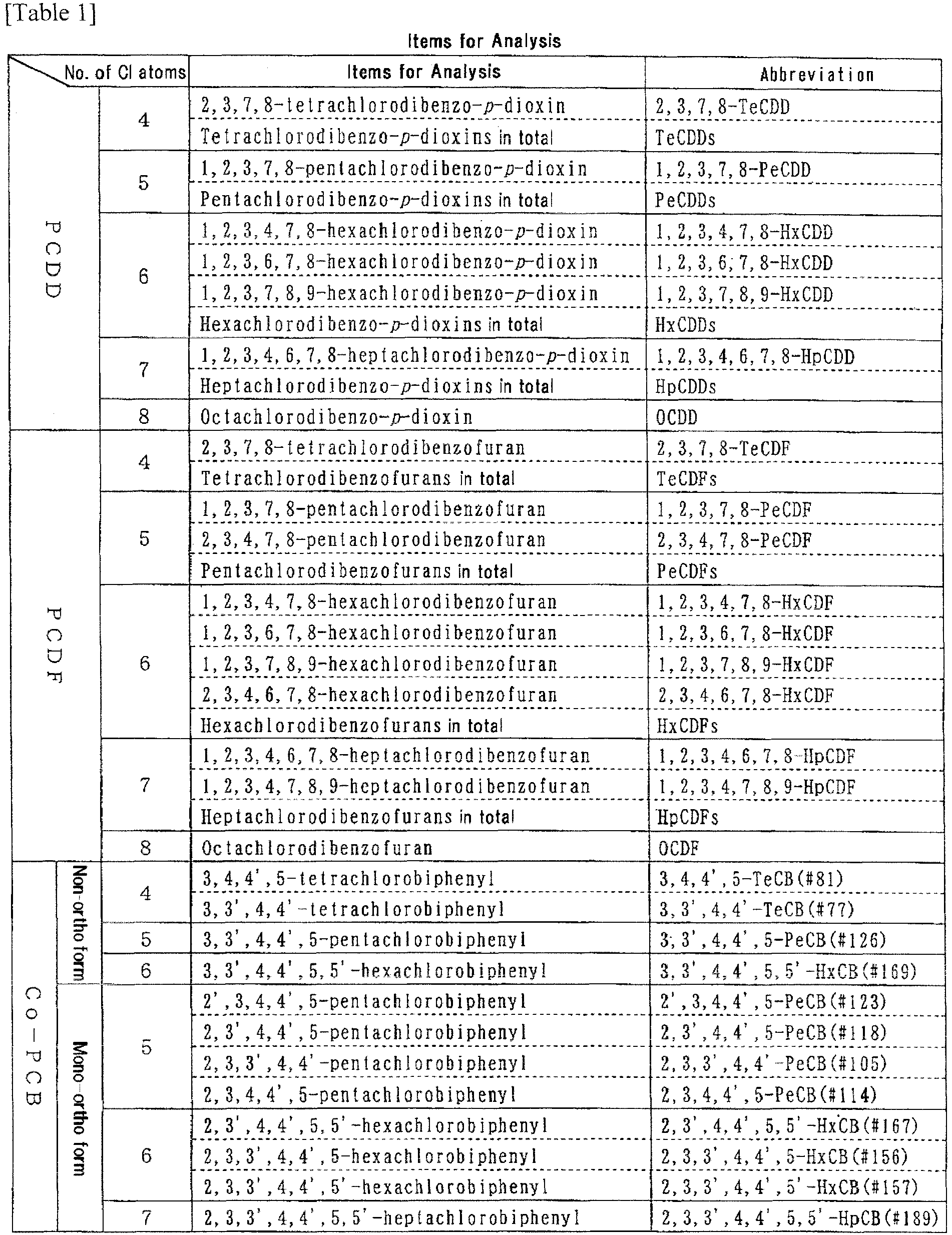
- dioxins refers to the sum of the polychlorinated dibenzoparadioxins (PCDDs), polychlorinated dibenzofurans (PCDFs), and coplanar PCBs (Co-PCBs) that are listed in Table 1 below; the contents of the respective members were measured, each measured value was multiplied by the corresponding toxicity equivalency factor, and summed up to calculate the toxicity equivalency quantity (pg-TEQ/g).
- PCDDs polychlorinated dibenzoparadioxins
- PCDFs polychlorinated dibenzofurans
- Co-PCBs coplanar PCBs
- brominated flame retardants collectively refers to the compounds listed in Table 9 below. Although contamination by dioxins in the environment has recently begun to decrease, contamination by brominated flame retardants still tends to increase and hence deserves special note. Applicable indicators are BDE-100, BDE-49, BDE-99, and BDE-47 which are relatively high amount in fish oils.
- dioxins are removed by thin-film distillation, preferably by molecular distillation or short path distillation (SPD).
- SPD short path distillation
- one that is performed with the condenser placed within a shorter distance than the mean free path of the vapor molecules evaporating from the heating surface at a specified pressure under a high vacuum ( ⁇ 0.1 Pa) is called molecular distillation.
- Short path distillation has been developed with a view to enhancing the distilling performance of molecular distillation.
- Short path distillation is performed at pressures in a medium vacuum region higher than 0.1 Pa, with the condenser placed at distances approximately equal to the mean free path of the evaporating molecules, so it is a practical method that is by far improved in distilling performance than molecular distillation.
- molecular distillation or short path distillation is carried out at a temperature of 200-270°C, preferably 220-260°C, and more preferably 220-250°C. Both types of distillation are carried out at a pressure lower than 5 Pa, preferably lower than 2 Pa, and more preferably lower than 1 Pa. They are performed by the thin-film method that is carried out at a flow rate of 20-200 (kg/h)/m 2 , preferably 25-120 (kg/h)/m 2 . If the flow volume is unduly small, the productivity will drop, so it is preferred to flow the feedstock oil in a maximum removable volume while ensuring that dioxins are being removed. If distillation is performed under these conditions, highly unsaturated fatty acids, although being heat-sensitive, will suffer little deterioration in quality.
- the quantities of dioxins PCDDs and PCDFs could be reduced to below the limit of measurement, or substantially zero.
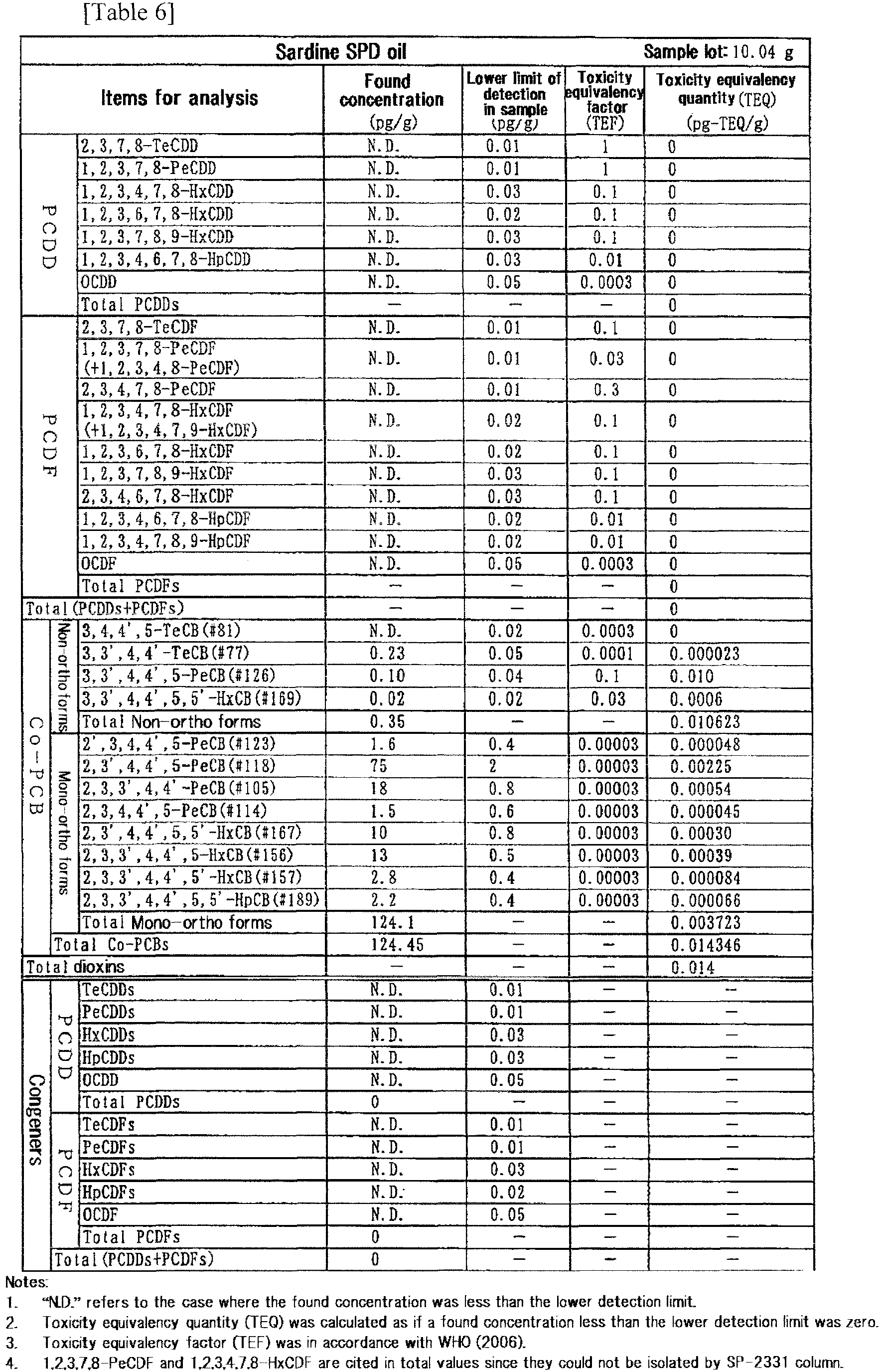
- the value zero typically means less than 0.043 pg-TEQ/g as calculated from the numerical values of detection limit listed in Table 6; in other words, the quantities of dioxins PCDDs and PCDFs can be reduced to less than 0.05 pg-TEQ/g.
- the quantities of coplanar PCBs can also be reduced to less than 0.2 pg-TEQ/g, even to less than 0.1 pg-TEQ/g, or to less than 0.05 pg-TEQ/g, or to less than 0.02 pg-TEQ/g, and even to less than 0.01 pg-TEQ/g.
- brominated flame retardants if BDE-100, BDE-49, BDE-99 and BDE-47 are chosen as indicators, their quantities can be reduced to less than 0.05 ⁇ g/g, preferably less than 0.03 ⁇ g/g, and more preferably less than 0.02 ⁇ g/g.
- the feedstock oil is preferably one that has been subjected to a degumming process as by washing with water.
- the washed feedstock oil is immediately subjected to molecular distillation or short path distillation under the conditions described above, so that cholesterols, free fatty acids, environmental pollutants and the like are removed as distillate fractions, yielding the residue containing triglycerides.
- the residue may be used either immediately or after being subjected to a decoloring process as with activated charcoal or activated clay or to a deodorizing process as by steam distillation.
- the refined fat or oil thus produced can be used as an ingredient in feeds, foods, or supplements.
- the above-mentioned residue may be used as a feedstock for producing ethyl esters containing dioxins in reduced amounts.
- ethyl alcohol and a catalyst or an enzyme are added to the residue and reaction is performed to generate esters of the constituent fatty acids of the triglyceride and the ethyl alcohol.
- This step of ethyl esterification may be performed by any known method. As shown in method claim 7, the formed ethyl ester is further refined. In order to increase the purity of EPA ethyl ester or DHA ethyl ester, an additional method such as molecular distillation, rectification or column chromatography may be applied.
- refining can be achieved by such methods as disclosed in JP H5-222392 (Family Patent EP0610506 ), JP H4-41457 (Family Patent EP0460917 ), JP H6-33088 , etc. It is to be understood that the method of the present invention is as defined in claim 7.
- Rectification is performed under a high vacuum with three or more distillation columns and the main distillate consisting of the EPA ethyl ester and/or DHA ethyl ester is separated from an initial fraction of the higher volatility and a bottoms fraction of the lower volatility.
- the conditions of rectification are such that the temperature is in the range of 150-200°C, preferably 160-190°C, more preferably 170-190°C and the pressure is in the range of 1-300 Pa, preferably 1-200 Pa, more preferably 1-133 Pa. It is preferred that the main distillate of 160-190°C, preferably 170-190°C is obtained with the degree of vacuum being chosen at 1-133 Pa.
- the method of the present invention includes performing column chromatography after rectification.
- the present inventors found that as the result of concentrating EPA and DHA by rectification, the relative concentrations of dioxins rose but that by means of subsequent column chromatography, they could be rendered lower than the levels prior to the rectification.
- silica gel, ion-exchange resin, activated clay, silver nitrate, etc. may be used in column chromatography, it is particularly preferred to perform column chromatography of reverse-phase distribution type.
- a reverse-phase distribution system may be created by using, for example, an alkyl group bound silica packing material (e.g. ODS column), with water, alcohols or ketones being used as solvent. Methanol is preferred. These solvents may be used either independently or in admixture.
- highly unsaturated fatty acids can be concentrated while reducing the concentrations of environmental pollutants.
- concentrations of highly unsaturated fatty acids say, EPA ethyl ester and/or DHA ethyl ester, can be increased to a purity of at least
- PCDDs and PCDFs can be reduced in content below their limits of measurement, namely, substantially zero (less than 0.043 pg-TEQ/g as calculated from the detection limits) and the contents of coplanar PCBs can also be lowered to less than 0.1 pg-TEQ/g, or less than 0.03 pg-TEQ/g, or even less than 0.01 pg-TEQ/g.
- the brominated flame retardants their quantities can be lowered to less than 0.18 ng/g in terms of BDE-47, to less than 0.03 ng/g in terms of BDE-100, to less than 0.05 ng/g in terms of BDE-49, and to less than 0.05 ng/g in terms of BDE-99.
- the quantities of BDE-100, BDE-49, BDE-99 and BDE-47 can be lowered to less than 0.05 ⁇ g/g, preferably less than 0.03 ⁇ g/g, more preferably less than 0.02 ⁇ g/g.
- the concentration of EPA ethyl ester and/or DHA ethyl ester is preferably equivalent to a purity of at least 96area%.
- the concentration of the highly unsaturated fatty acid(s) in the sum of fatty acids is at least 85area% as determined by gas chromatography.
- the above-described fatty acid esters that have high concentrations of highly unsaturated fatty acids but low concentrations of environmental pollutants are suitable for use as materials to prepare medicines and supplements that contain the highly unsaturated fatty acids as an active ingredient.
- the EPA and/or DHA in fatty acids need be concentrated to a higher content depending on the need.
- the highly unsaturated fatty acids in the glyceride may be concentrated by a method for selective concentration of highly unsaturated fatty acids through lipase reaction (as disclosed in WO2009/17102 ). Even the thus processed glyceride may be treated by the method of the present invention to have higher concentrations of highly unsaturated fatty acids but lower quantities of environmental pollutants.
- a measurement of brominated flame retardants was commissioned to "eurofins", a bio-analytical testing company.
- the method of the measurement was in accordance with high-resolution mass spectrometry (HRGC/HRMS).
- composition of fatty acids in a feedstock fish oil and that of fatty acids in the oil resulting from subsequent short path distillation were determined by gas chromatography after ethyl esterification of the fish oil.
- 1 mL of 1 N sodium ethylate/ethanol solution was added to 40 ⁇ L of fish oil and the resulting mixture was stirred for about 30 seconds.
- 1 mL of 1 N hydrochloric acid was added to neutralize the mixture, to which 2 mL of hexane and 3 mL of a saturated aqueous solution of ammonia sulfate were added; after allowing the stirred mixture to settle undisturbed, the upper layer was subjected to measurement by gas chromatography.
- the distillation apparatus used was a short path distillation (SPD) device KD 10 (product of UIC GmbH with a distillation surface area of 0.1 m 2 ).
- the distillation conditions (temperature, pressure, and flow rate) were as shown in Table 2. With the distillation temperature fixed at 250°C, the pressure and flow rate were varied within the ranges of 0.4-3.0 Pa and 25-121 (kg/hr)/m 2 , respectively.
- dioxins were removed from semi refined tuna oil (refined by degumming and deacidification) by distillation under the conditions listed in Table 3.
- Table 3 shows, the contents of dioxins in the tuna oil could also be reduced to less than 0.1 pg-TEQ/g by the method of the present invention (distilled at a temperature of 250°C, at a pressure of 0.1 Pa, and at a flow rate of 48 (kg/hr)/m 2 ).
- a crude sardine oil (with an acid value of 6 and containing 19% EPA and 8% DHA) was washed with warm (85°C) water (5% relative to the crude oil) and subjected to short path distillation using a short path distillation (SPD) device KD1800 (product of UIC GmbH, with a distillation surface area of 18 m 2 ).
- the distillation conditions were as follows: degree of vacuum, 0.7-1 Pa; device temperature, 250°C; feed volume, ca. 2000 kg/H (flow rate: 110 (kg/h)/ m 2 ).
- the results of measurement of dioxins in oil are shown in Table 5 (for the feedstock oil) and Table 6 (for the SPD oil).
- the total quantity of dioxins could be reduced from 3.0 pg-TEQ/g to 0.014 pg-TEQ/g in terms of toxicity equivalency quantity.
- the acid value of the SPD oil was less than 0.2 and there was no change in the composition of fatty acids from the crude oil.
- ARA arachidonic acid
- DPA docosapentaenoic acid
- the production procedure was as follows: the SPD oil was subjected to ethanolysis reaction with ethyl alcohol in the presence of an alkali catalyst to form an ethyl ester; after washing with warm water, the ethyl ester was dried and rectified with a degree of vacuum of 13 Pa to give the main distillate (with a temperature of ca. 176°C), which was treated by HPLC using column of reverse-phase distribution type (ODS); the solvent was subsequently distilled off to yield an ethyl ester of 97% pure EPA.
- ODS reverse-phase distribution type
- the rectification and column chromatographic processing in the refining step after ethyl esterification were verified for possible effects they might have on the concentration of dioxins.
- the feedstock oil was sardine oil that was simply diacidified and decolored without subsequent thin-film distillation. This was because use of fats or oils containing more dioxins would provide greater ease in observing the possible effects of the refining process.
- the feedstock oil was ethyl esterified using an alkali catalyst.
- the resulting ethyl esters were first subjected to a rectification step, thereby collecting fractions containing ethyl esters of C 20 fatty acids. Subsequently, a fraction of eicosapentaenoic acid ethyl ester was collected by ODS column chromatography.
- Table 9 shows data for the four components that experienced greater variations (in terms of absolute value and toxicity equivalency quantity) and the total of dioxins (in toxicity equivalency quantity).
- the rectification step caused the components #105 and #118 to be concentrated by far greater degrees than when they were just after the esterification. On the other hand, the content of #77 decreased rather than increased. It is assumed that in rectification, ethyl esters of eicosapentaenoic acid and other fatty acids behaved in a similar way to dioxins, so that the dioxins were concentrated as were the ethyl esters of eicosapentaenoic acid and other fatty acids.
- the amounts of environmental contaminants, especially dioxins and brominated flame retardants, that are contained in fats or oils that comprise highly unsaturated fatty acids as constituent fatty acid, as exemplified by fish oils containing EPA and DHA can be markedly reduced.
- the products thus obtained are suitable for use in feeds, foods, supplements, medicines, and the like.
Landscapes
- Chemical & Material Sciences (AREA)
- Organic Chemistry (AREA)
- Health & Medical Sciences (AREA)
- Life Sciences & Earth Sciences (AREA)
- Engineering & Computer Science (AREA)
- Oil, Petroleum & Natural Gas (AREA)
- Animal Behavior & Ethology (AREA)
- Pharmacology & Pharmacy (AREA)
- Veterinary Medicine (AREA)
- Public Health (AREA)
- Medicinal Chemistry (AREA)
- General Health & Medical Sciences (AREA)
- Chemical Kinetics & Catalysis (AREA)
- Epidemiology (AREA)
- Crystallography & Structural Chemistry (AREA)
- Wood Science & Technology (AREA)
- Nutrition Science (AREA)
- General Chemical & Material Sciences (AREA)
- Food Science & Technology (AREA)
- Polymers & Plastics (AREA)
- Microbiology (AREA)
- Emergency Medicine (AREA)
- Mycology (AREA)
- Nuclear Medicine, Radiotherapy & Molecular Imaging (AREA)
- Hematology (AREA)
- Diabetes (AREA)
- Bioinformatics & Cheminformatics (AREA)
- Obesity (AREA)
- Analytical Chemistry (AREA)
- Acyclic And Carbocyclic Compounds In Medicinal Compositions (AREA)
- Coloring Foods And Improving Nutritive Qualities (AREA)
- Organic Low-Molecular-Weight Compounds And Preparation Thereof (AREA)
- Fats And Perfumes (AREA)
- Edible Oils And Fats (AREA)
- Medicines Containing Material From Animals Or Micro-Organisms (AREA)
- Biomedical Technology (AREA)
- Cell Biology (AREA)
- Developmental Biology & Embryology (AREA)
- Immunology (AREA)
- Virology (AREA)
Description
- The present invention relates to a method for reducing the quantities of environmental pollutants, in particular, dioxins, brominated flame retardants, and other substances contained in fats or oils containing the highly unsaturated fatty acids in the production of highly unsaturated fatty acid ethyl esters from the fats or oils. The present invention further relates to foods, supplements, medicines, cosmetics and feeds that are produced from the fats or oils prepared in accordance with such methods. It is to be understood that the present invention is as defined in the claims.
- Environmental pollutants typified by dioxins are found almost everywhere on Earth today. They are also known to exert effects on fishes living in polluted ocean areas. They are considered to have no direct effects on health if present in trace amounts but, nevertheless, the ingredients to be ingested by humans as foods or feeds desirably contain the least amounts of environmental pollutants.
- Marine product oils, for example, fish oils contain highly unsaturated fatty acids such as EPA (eicosapentaenoic acid, C20:5, n-3, all-cis-5,8,11,14,17-eicosdapentaenoic acid) and DHA (docosahexaenoic acid, C22:6, n-3, all-cis-4,7,10,13,16,19-docosahexaenoic acid). Being known to have various physiological functions, EPA and DHA are used as ingredients of medicines, health foods, foods in general, feeds and the like. Various purification steps are applied to make use of the EPA and/or DHA in marine product oils.
- Non-Patent Document 1 discloses removing the insecticide DDT and its metabolites from fish oils by molecular distillation. Non-Patent Document 2 discloses that chlorinated hydrocarbons and free fatty acids can be removed from fats or oils using vacuum stripping or thin-film distillation. Non-Patent Document 3 discloses using physical refining and molecular distillation in order to remove free fatty acids and other undesired substances from oil compositions.
- Patent Document 1 and Non-Patent Document 4 each disclose a method for reducing the quantities of environmental pollutants in a mixture containing fats or oils which comprises the step of adding a volatile working fluid to the mixture and the step of subjecting the mixture to at least one stripping process together with the added volatile working fluid.
- Non-Patent Document 5 discloses that highly unsaturated fatty acids are decomposed thermally when fish oils are deodorized at high temperatures.
- Non-Patent Document 6 discloses removing dioxins, free fatty acids and cholesterols from fish oils by short path distillation so as to make them suitable for use as feedstocks for ethyl esters.
- Patent Document 2 relates to a specific process for obtaining a concentrate of esters of EPA and DHA from crude or refined marine oils. CITATION LIST
-
- Patent Document 1:
Japanese Patent No. 3905538 WO2004/007654 ) - Patent Document 2:
EP 2 438 819 -
- Non-Patent Document 1: K. Julshamn, L. Karlsen and O.R. Braekkan, Removal of DDT and its metabolites from fish oils by molecular distillation, Fiskeridirektoratetsskrifter; Serie teknologiske undersokelser, Vol. 5, No. 15 (1973)
- Non-Patent Document 2: Anthony P. Bimbo: Guidelines for characterization of food-grade fish oil. INFORM 9 (5), 473-483 (1998)
- Non-Patent Document 3: Jiri Cmolik, Jan Pokomy: Physical refining of edible oils, Eur. J. Lipid Sci. Technol. 102 (7), 472-486 (2000)
- Non-Patent Document 4: Harald Breivik, Olav Thorstad: Removal of organic environmental pollutants from fish oil by short-path distillation, Lipid Technology, 17 (3), 55-58 (2005)
- Non-Patent Document 5: Veronique Fournier et al.; Thermal degradation of long-chain polyunsaturated fatty acids during deodorization of fish oil., Eur. J. Lipid Sci. Technol., 108, 33-42 (2006)
- Non-Patent Document 6: YUSHI, 62(11), 38-39, 2009
- An object of the present invention is to provide a method for reducing the quantities of environmental pollutants, in particular, dioxins and brominated flame retardants, contained in fats or oils that contain the highly unsaturated fatty acids as constituent fatty acids in the production of ethyl esters of highly unsaturated fatty acids from the fats or oils; another object of the present invention is to provide ethyl esters having smaller contents of the dioxins and brominated flame retardants. The solution to these objectives is as defined in the claims.
- The present invention is as defined in the claims and has been completed on the basis of the finding that if fats or oils in which those highly unsaturated fatty acids that are prone to deteriorate as through oxidation or isomerization are contained as constituent fatty acids are refined by performing molecular distillation or short path distillation under specified conditions, the concentrations of environmental pollutants can be reduced to very low levels while suppressing the deterioration of the highly unsaturated fatty acids. According to this method. the quantities of environmental pollutants in the fats or oils can be reduced in such a way that the total content of dioxins is less than 0.2 pg-TEQ/g where TEQ is short for toxicity equivalency quantity. Further in addition, ethyl esters can be obtained using the thus processed fats or oils as a feedstock. By subjecting the thus obtained ethyl esters to distillation and column chromatographic treatment, the quantities of dioxins in the ethyl esters can be further reduced. The present invention is as defined in the claims. In the following items (1) to (20), a summary of the present disclosure is provided. It is, however, to be unterstood that these items do not define the scope of the present invention.
- (1) A highly unsaturated fatty acid or a highly unsaturated fatty acid ethyl ester which has been produced using as a feedstock oil a fat or oil that contains highly unsaturated fatty acids as constituent fatty acids and which has been reduced in the contents of environmental pollutants, wherein among the dioxins contained, polychlorinated dibenzoparadioxins (PCDDs) and polychlorinated dibenzofurans (PCDFs) are contained in amounts of less than 0.05 pg-TEQ/g and coplanar PCBs (Co-PCBs) in amounts of less than 0.03 pg-TEQ/g.
- (2) The highly unsaturated fatty acid or highly unsaturated fatty acid ethyl ester according to (1), wherein the content of a brominated flame retardant contained has been reduced to such a level that the amount of BDE-47 is less than 0.18 ng/g, the amount of BDE-100 is less than 0.03 ng/g, the amount of BDE-49 is less than 0.05 ng/g, or the amount of BDE-99 is less than 0.05 ng/g.
- (3) The highly unsaturated fatty acid ethyl ester according to (1) or (2), wherein the concentration as occupied by highly unsaturated fatty acids in the sum of fatty acids is at least 80area%, at least 85area%, at least 90area%, at least 95area%, or at least 96area%.
- (4) The highly unsaturated fatty acid or highly unsaturated fatty acid ethyl ester according to any one of (1) to (3), wherein the fat or oil containing highly unsaturated fatty acids as constituent fatty acids is fish oil, krill oil, marine mammal oil or microorganism oil.
- (5) The highly unsaturated fatty acid or highly unsaturated fatty acid ethyl ester according to any one of (1) to (4). wherein the highly unsaturated fatty acid is any one of eicosapentaenoic acid, docosahexaenoic acid, docosapentaenoic acid, dihomo-γ-linoleic acid and arachidonic acid or a combination thereof.
- (6) A medicine, supplement or food which comprises the highly unsaturated fatty acid or highly unsaturated fatty acid ethyl ester according to any one of (1) to (5) as an active ingredient.
- (7) A method for producing a highly unsaturated fatty acid or a highly unsaturated fatty acid ethyl ester with reduced contents of polychlorinated dibenzoparadioxins (PCDDs), polychlorinated dibenzofurans (PCDFs) and coplanar PCB (Co-PCBs) by the steps of:
- a) removing free fatty acids and environmental pollutants by thin-film distillation from a feedstock oil containing highly unsaturated fatty acids as constituent fatty acids;
- b) hydrolyzing or ethyl esterifying the resulting highly unsaturated fatty acid containing fat or oil; and
- c) refining the same by rectification and column chromatography.
- (8) The method according to (7), wherein the content of a brominated flame retardant is also reduced.
- (9) The method according to (7) or (8), wherein the concentration as occupied by highly unsaturated fatty acids in the sum of fatty acids in the highly unsaturated fatty acid or highly unsaturated fatty acid ethyl ester is at least 80area%, at least 85area%, at least 90area%, at least 95area%, or at least 96area%.
- (10) The method according to any one of (7) to (9), wherein the feedstock oil containing highly unsaturated fatty acids as constituent fatty acids is fish oil, krill oil, marine mammal oil or microorganism oil.
- (11) The method according to any one of (7) to (10). wherein the thin-film distillation is carried out at a temperature of 200-270°C, 220-260°C, or 220-250°C.
- (12) The method according to any one of (7) to (11), wherein the thin-film distillation is carried out at a pressure of 5 Pa or lower, 2 Pa or lower, or 1 Pa or lower.
- (13) The method according to any one of (7) to (12), wherein the thin-film distillation is carried out at a flow rate of 20-200 (kg/h)/m2 or 25-120 (kg/h)/m2.
- (14) The method according to any one of (7) to (13), wherein the thin-film distillation is molecular distillation or short path distillation.
- (15) The method according to any one of (7) to (14), wherein rectification is performed in three or more distillation columns.
- (16) The method according to any one of (7) to (15), wherein refining by column chromatography uses column chromatography of reverse-phase distribution type.
- (17) A highly unsaturated fatty acid or a highly unsaturated fatty acid ethyl ester that have been produced by the method according to any one of (7) to (16) and whose content of dioxins is less than 0.07 pg-TEQ/g or 0.05 pg-TEQ/g.
- (18) The highly unsaturated fatty acid or highly unsaturated fatty acid ethyl ester according to (17), wherein the content of a brominated flame retardant contained has been reduced to such a level that the amount of BDE-47 is less than 0.18 ng/g, the amount of BDE-100 is less than 0.03 ng/g, the amount of BDE-49 is less than 0.05 ng/g, or the amount of BDE-99 is less than 0.05 ng/g.
- (19) The highly unsaturated fatty acid or highly unsaturated fatty acid ethyl ester according to (17) or (18), wherein the concentration as occupied by highly unsaturated fatty acids in the sum of fatty acids is at least 80area%, at least 85area%, at least 90area%, at least 95area%, or at least 96area%.
- (20) A medicine, supplement or food which contains the highly unsaturated fatty acid or highly unsaturated fatty acid ethyl ester according to any one of (17) to (19).
- The method of the present invention ensures that by virtue of distillation at high temperatures in high vacuum over a short period of time, the quantities of environmental pollutants, and dioxins in particular, that are contained in fish oils and the like can be reduced to very low levels without affecting the percentage of highly unsaturated fatty acids in the sum of fatty acids and, hence, it is possible to provide feeds, foods, supplements, medicines and various other products as prepared from fish oils and other feedstocks with which there is no need to worry about contamination by dioxins.
- On the following pages, the present invention will be described in detail.
- As used herein, the term "highly unsaturated fatty acids" refers to fatty acids containing at least 18 carbon atoms and at least 3 double bonds, more preferably fatty acids containing at least 20 carbon atoms and at least 3 or 4 double bonds, and most preferably fatty acids containing at least 20 carbon atoms and at least 5 double bonds. Specific examples include α-linoleic acid (18:3, n-3), γ-linoleic acid (18:3, n-6), dihomo-γ-linoleic acid (20:3, n-6), arachidonic acid (20:4, n-6), eicosapentaenoic acid (20:5, n-3), docosapentaenoic acid (22:5, n-6), docosahexaenoic acid (22:6, n-3), etc.
- These are known to be abundant in certain kinds of microorganism oils, vegetable oils, and marine animal oils. Specific examples include: fish oils such as sardine oil, tuna oil, bonito oil, Men Hayden oil, cod liver oil, herring oil, capelin oil, and salmon oil; marine animal oils as from crustaceans such as krill; vegetable oils as from perilla, flax, soybean, and rapeseed; fats or oils produced by microorganisms belonging to the genus Mortierella, the genus Penicillium, the genus Aspergillus, the genus Rhodotorula, and the genus Fusarium.
- The method of the present invention is applied to fats or oils derived from marine products with which there are particular concerns about contamination by dioxins, as exemplified by fish oils, krill oil, or marine mammal oils.
- As used herein, the term "fats or oils containing highly unsaturated fatty acids as constituent fatty acids" means triglycerides or phospholipids.
- If these fats or oils are to be used as feedstock oils in the present invention, preliminary treatments may be performed before they are subjected to molecular distillation or short path distillation. The preliminary treatments may be exemplified by a degumming step, a decoloring step using activated clay or activated charcoal, and a washing step with water.
- As used herein, the term "environmental pollutants" embraces: polychlorinated biphenyls (PCBs), DDTs, polychlorinated triphenyls (PCTs), dibenzo-dioxins (PCDDs), and dibenzo-furans (PCDFs); chlorophenols and hexachlorocyclohexanes (HCHs), toxaphenes, dioxins, brominated flame retardants, polyaromatic hydrocarbons (PAHs), organotin compounds (e.g. tributyltin and triphenyltin), organomercury compounds (e.g. methylmercury), etc. To give a guide figure for the degree by which these environmental pollutants have been removed, the sum of dioxins which are representative of the ubiquitous and difficult-to-remove substances is designated in terms of toxic equivalency quantity (pg-TEQ/g).
- As used herein, the term "dioxins" refers to the sum of the polychlorinated dibenzoparadioxins (PCDDs), polychlorinated dibenzofurans (PCDFs), and coplanar PCBs (Co-PCBs) that are listed in Table 1 below; the contents of the respective members were measured, each measured value was multiplied by the corresponding toxicity equivalency factor, and summed up to calculate the toxicity equivalency quantity (pg-TEQ/g).
- Measurements were also made of brominated flame retardants. The term "brominated flame retardants" collectively refers to the compounds listed in Table 9 below. Although contamination by dioxins in the environment has recently begun to decrease, contamination by brominated flame retardants still tends to increase and hence deserves special note. Applicable indicators are BDE-100, BDE-49, BDE-99, and BDE-47 which are relatively high amount in fish oils.
- In the present invention, dioxins are removed by thin-film distillation, preferably by molecular distillation or short path distillation (SPD). Among applicable thin-film distillation methods, one that is performed with the condenser placed within a shorter distance than the mean free path of the vapor molecules evaporating from the heating surface at a specified pressure under a high vacuum (<0.1 Pa) is called molecular distillation. Short path distillation has been developed with a view to enhancing the distilling performance of molecular distillation. Short path distillation is performed at pressures in a medium vacuum region higher than 0.1 Pa, with the condenser placed at distances approximately equal to the mean free path of the evaporating molecules, so it is a practical method that is by far improved in distilling performance than molecular distillation.
- In molecular distillation or short path distillation, the feed to be distilled is exposed to high temperatures for such a short period of time that both methods are adapted to removal of unwanted components from triglycerides containing EPA, DHA and other heat-sensitive substances.
- In the present invention, molecular distillation or short path distillation is carried out at a temperature of 200-270°C, preferably 220-260°C, and more preferably 220-250°C. Both types of distillation are carried out at a pressure lower than 5 Pa, preferably lower than 2 Pa, and more preferably lower than 1 Pa. They are performed by the thin-film method that is carried out at a flow rate of 20-200 (kg/h)/m2, preferably 25-120 (kg/h)/m2. If the flow volume is unduly small, the productivity will drop, so it is preferred to flow the feedstock oil in a maximum removable volume while ensuring that dioxins are being removed. If distillation is performed under these conditions, highly unsaturated fatty acids, although being heat-sensitive, will suffer little deterioration in quality.
- By effecting distillation under these conditions, the quantities of dioxins PCDDs and PCDFs could be reduced to below the limit of measurement, or substantially zero. The value zero typically means less than 0.043 pg-TEQ/g as calculated from the numerical values of detection limit listed in Table 6; in other words, the quantities of dioxins PCDDs and PCDFs can be reduced to less than 0.05 pg-TEQ/g. The quantities of coplanar PCBs can also be reduced to less than 0.2 pg-TEQ/g, even to less than 0.1 pg-TEQ/g, or to less than 0.05 pg-TEQ/g, or to less than 0.02 pg-TEQ/g, and even to less than 0.01 pg-TEQ/g.
- As for the brominated flame retardants, if BDE-100, BDE-49, BDE-99 and BDE-47 are chosen as indicators, their quantities can be reduced to less than 0.05 µg/g, preferably less than 0.03 µg/g, and more preferably less than 0.02 µg/g.
- Embodiments of the invention method are described below more specifically.
- The feedstock oil is preferably one that has been subjected to a degumming process as by washing with water. The washed feedstock oil is immediately subjected to molecular distillation or short path distillation under the conditions described above, so that cholesterols, free fatty acids, environmental pollutants and the like are removed as distillate fractions, yielding the residue containing triglycerides. The residue may be used either immediately or after being subjected to a decoloring process as with activated charcoal or activated clay or to a deodorizing process as by steam distillation. The refined fat or oil thus produced can be used as an ingredient in feeds, foods, or supplements.
- The above-mentioned residue may be used as a feedstock for producing ethyl esters containing dioxins in reduced amounts.
- To this end, ethyl alcohol and a catalyst or an enzyme are added to the residue and reaction is performed to generate esters of the constituent fatty acids of the triglyceride and the ethyl alcohol. This step of ethyl esterification may be performed by any known method. As shown in method claim 7, the formed ethyl ester is further refined. In order to increase the purity of EPA ethyl ester or DHA ethyl ester, an additional method such as molecular distillation, rectification or column chromatography may be applied. Specifically, refining can be achieved by such methods as disclosed in
JP H5-222392 EP0610506 ),JP H4-41457 EP0460917 ),JP H6-33088 - Rectification is performed under a high vacuum with three or more distillation columns and the main distillate consisting of the EPA ethyl ester and/or DHA ethyl ester is separated from an initial fraction of the higher volatility and a bottoms fraction of the lower volatility. The conditions of rectification are such that the temperature is in the range of 150-200°C, preferably 160-190°C, more preferably 170-190°C and the pressure is in the range of 1-300 Pa, preferably 1-200 Pa, more preferably 1-133 Pa. It is preferred that the main distillate of 160-190°C, preferably 170-190°C is obtained with the degree of vacuum being chosen at 1-133 Pa.
- The method of the present invention includes performing column chromatography after rectification. The present inventors found that as the result of concentrating EPA and DHA by rectification, the relative concentrations of dioxins rose but that by means of subsequent column chromatography, they could be rendered lower than the levels prior to the rectification. While silica gel, ion-exchange resin, activated clay, silver nitrate, etc. may be used in column chromatography, it is particularly preferred to perform column chromatography of reverse-phase distribution type. A reverse-phase distribution system may be created by using, for example, an alkyl group bound silica packing material (e.g. ODS column), with water, alcohols or ketones being used as solvent. Methanol is preferred. These solvents may be used either independently or in admixture.
- By combining the above-described techniques of rectification and column chromatography, highly unsaturated fatty acids can be concentrated while reducing the concentrations of environmental pollutants. The concentrations of highly unsaturated fatty acids, say, EPA ethyl ester and/or DHA ethyl ester, can be increased to a purity of at least
- 85area%, or at least 90area%, or 95area%, or even at least 96area% while, at the same time, among the dioxins, PCDDs and PCDFs can be reduced in content below their limits of measurement, namely, substantially zero (less than 0.043 pg-TEQ/g as calculated from the detection limits) and the contents of coplanar PCBs can also be lowered to less than 0.1 pg-TEQ/g, or less than 0.03 pg-TEQ/g, or even less than 0.01 pg-TEQ/g. As for the brominated flame retardants, their quantities can be lowered to less than 0.18 ng/g in terms of BDE-47, to less than 0.03 ng/g in terms of BDE-100, to less than 0.05 ng/g in terms of BDE-49, and to less than 0.05 ng/g in terms of BDE-99. The quantities of BDE-100, BDE-49, BDE-99 and BDE-47 can be lowered to less than 0.05 µg/g, preferably less than 0.03 µg/g, more preferably less than 0.02 µg/g. For applications as medicines, the concentration of EPA ethyl ester and/or DHA ethyl ester is preferably equivalent to a purity of at least 96area%. In the highly unsaturated fatty acid ethyl ester(s) of the present invention, the concentration of the highly unsaturated fatty acid(s) in the sum of fatty acids is at least 85area% as determined by gas chromatography. The above-described fatty acid esters that have high concentrations of highly unsaturated fatty acids but low concentrations of environmental pollutants are suitable for use as materials to prepare medicines and supplements that contain the highly unsaturated fatty acids as an active ingredient.
- In the case of use for the preparation of medicines and dietary supplements, the EPA and/or DHA in fatty acids need be concentrated to a higher content depending on the need. In that case, the highly unsaturated fatty acids in the glyceride may be concentrated by a method for selective concentration of highly unsaturated fatty acids through lipase reaction (as disclosed in
WO2009/17102 - On the following pages, Examples of the present invention are described but they are by no means intended to limit the scope of the present invention.
- In the following Examples of the present invention, a measurement of dioxins was commissioned to JAPAN FOOD RESEARCH LABORATORIES. The method of the measurement was in accordance with the "Provisional Guidelines on the Methods of Measuring Dioxins in Foods (February 2008)" (EISHOKU No. 138 and EINYU No. 200 in 1999).
- A measurement of brominated flame retardants was commissioned to "eurofins", a bio-analytical testing company. The method of the measurement was in accordance with high-resolution mass spectrometry (HRGC/HRMS).
- In the Examples of the present invention, a measurement of acid value (AV) was conducted in accordance with the JOCS Standard Methods for the Analysis of Fats, Oils and Related Materials (2003 Edition) (compiled by Japan Oil Chemists' Society).
- The composition of fatty acids in a feedstock fish oil and that of fatty acids in the oil resulting from subsequent short path distillation were determined by gas chromatography after ethyl esterification of the fish oil. To be specific, 1 mL of 1 N sodium ethylate/ethanol solution was added to 40 µL of fish oil and the resulting mixture was stirred for about 30 seconds. Subsequently, 1 mL of 1 N hydrochloric acid was added to neutralize the mixture, to which 2 mL of hexane and 3 mL of a saturated aqueous solution of ammonia sulfate were added; after allowing the stirred mixture to settle undisturbed, the upper layer was subjected to measurement by gas chromatography.
-
- Device type: Agilent 6850 GC system (Agilent Technologies)
- Column: DB-WAX J&W 123-7032E
- Column temperature: 200°C
- Injection temperature: 300°C
- Injection method: Splitting
- Splitting ratio: 100:1
- Detector temperature: 300°C
- Detector: FID
- Carrier gas: Helium
- Two kinds of crude sardine oil different in acid value and dioxins content were distilled under various conditions to test for the removal of dioxins. The distillation apparatus used was a short path distillation (SPD) device KD 10 (product of UIC GmbH with a distillation surface area of 0.1 m2). The distillation conditions (temperature, pressure, and flow rate) were as shown in Table 2. With the distillation temperature fixed at 250°C, the pressure and flow rate were varied within the ranges of 0.4-3.0 Pa and 25-121 (kg/hr)/m2, respectively.
- The dioxins concentrations and acid values of the crude oils and the products of distillation are shown in Table 2.
- Irrespective of whether the crude oils had high or low acid values and also irrespective of whether they contained dioxins in large or small quantities, the contents of dioxins could be reduced to less than 0.1 pg-TEQ/g by distillation under all conditions employed.
[Table 2] Feedstock Crude sardine oil 1 Crude sardine oil 2 Feedstock oil 1 Condition Feedstock oil 2 Condition 1 2 3 4 5 6 PCDD+PCDF (pg-TEQ/g) 0.20 0.00 0.00 0.00 3.48 0.00 0.00 0.00 Coplaner PCBs (pg-TEQ/g) 3.20 0.00 0.01 0.03 11.12 0.04 0.01 0.07 Total (of dioxins) (pg-TEQ/g) 3.40 000 0.01 0.03 14.60 0.04 0.01 0.08 temperature °C 250 249 249 249 249 249 Pressure Pa 0.7 1.3 1.5 0.4 0.8 3.0 Flow rate (kg/h)/m2 25 78 112 30 72 121 Acid value 10.51 0.29 0.38 0.35 4.86 0.12 0.26 0.21 - Using the same apparatus as in Example 1, dioxins were removed from semi refined tuna oil (refined by degumming and deacidification) by distillation under the conditions listed in Table 3. As Table 3 shows, the contents of dioxins in the tuna oil could also be reduced to less than 0.1 pg-TEQ/g by the method of the present invention (distilled at a temperature of 250°C, at a pressure of 0.1 Pa, and at a flow rate of 48 (kg/hr)/m2).
- Using a different short path distillation (SPD) device KD 6 (product of UIC GmbH with a distillation surface area of 0.06 m2), dioxins were removed from crude sardine oil. As Table 3 shows, the contents of dioxins could also be reduced to less than 0.1 pg-TEQ/g by the method of the present invention (distilled at a temperature of 270°C, at a pressure of 0.6 Pa, and at a flow rate of 20 (kg/hr)/m2).
[Table 3] Feedstock Lightly refined tuna oil Crude sardine oil 3 Device used KD-10 KD-6 Feedstock oil 3 Condition 7 Feedstock oil 4 Condition 8 PCDD+PCDF (pg-TEQ/g) 1.72 0.00 0.11 0.00 Coplaner PCBs (pg-TEQ/g) 7.86 0.04 7.87 0.01 Total (of dioxins) (pg-TEQ/g) 9.58 0.04 7.98 0.01 Temperature °C 250 270 Pressure Flow rate Pa 0.1 0.6 (kg/h)/m2 48 20 Residue Distilled-off content wt% 99.2 92.1 wt% 0.8 7.9 Acid value -- -- 579 0.14 - Using a centrifugal, molecular distillation apparatus MS380 (product of NIPPON SHARYO, with a distillation surface area of 0.11 m2), dioxins were removed from crude sardine oils by distillation under the conditions listed in Table 4. As Table 4 shows, even the molecular distillation device was capable of reducing the contents of dioxins as in Examples 1 and 2, more specifically to less than 0.2 pg-TEQ/g.
[Table 4] Feedstock Crude sardine oil 4 Crude sardine oil 5 Feedstock oil 5 Condition Feedstock oil 6 Condition 9 10 11 12 PCDD+PCDF (pg-TEQ/g) 0.17 0.10 0.03 0.09 0.05 0.00 Coplanar PCBs (pg-TEQ/g) 1.12 0.05 0.00 0.52 0.01 0.00 Total (of dioxins) (pg-TEQ/g) 1.29 0.15 0.03 0.61 0.07 0.00 Temperature °C 220 240 240 260 Pressure Flow rate Pa 0.67 0.67 0.67 0.67 (kg/h)/m2 182 182 182 182 Acid value 5.61 0.31 0.12 2.85 0.17 0.11 - A crude sardine oil (with an acid value of 6 and containing 19% EPA and 8% DHA) was washed with warm (85°C) water (5% relative to the crude oil) and subjected to short path distillation using a short path distillation (SPD) device KD1800 (product of UIC GmbH, with a distillation surface area of 18 m2). The distillation conditions were as follows: degree of vacuum, 0.7-1 Pa; device temperature, 250°C; feed volume, ca. 2000 kg/H (flow rate: 110 (kg/h)/ m2).
- The results of measurement of dioxins in oil are shown in Table 5 (for the feedstock oil) and Table 6 (for the SPD oil). The total quantity of dioxins could be reduced from 3.0 pg-TEQ/g to 0.014 pg-TEQ/g in terms of toxicity equivalency quantity. The acid value of the SPD oil was less than 0.2 and there was no change in the composition of fatty acids from the crude oil.

- Crude sardine oil was subjected to short path distillation under the same conditions as in Example 4 and the composition of fatty acids was determined by the previously described method both before and after the distillation. The results are shown in Table 7. For fatty acids that had 18 or more carbon atoms with 3 or more double bonds and which were prone to oxidize, isomerize or otherwise deteriorate upon heating, the proportions of such fatty acids in the total fatty acids in the feedstock oil and the SPD oil, as well as the changes in such proportions are shown in the table. Each of the fatty acids under examination suffered only a little change in content and even those fatty acids with the greater number of double bonds did not experience any particularly great variations. From these results, it was verified that the method of the present invention is a good way to remove dioxins without causing deterioration of highly unsaturated fatty acids. In Table 7, ARA stands for arachidonic acid and DPA docosapentaenoic acid.
[Table 7] C18:3 n-6 C18:3 n- 3 C18:4 n-3 ARA C20:4 n-3 EPA DPA DHA Feedstock oil (area%) 0.65 0.62 2.55 1.25 0.85 21.89 2.60 7.67 After distillation (area%) 0.63 0.57 2.53 1.26 0.86 21.86 2.62 7.65 Relative change (After distillation - Feedstock oil) -0.02 -0.05 -0.03 0.01 0.01 -0.03 0.02 -0.01 - An ethyl ester of EPA was produced from the distilled oil as prepared in Example 4.
- The production procedure was as follows: the SPD oil was subjected to ethanolysis reaction with ethyl alcohol in the presence of an alkali catalyst to form an ethyl ester; after washing with warm water, the ethyl ester was dried and rectified with a degree of vacuum of 13 Pa to give the main distillate (with a temperature of ca. 176°C), which was treated by HPLC using column of reverse-phase distribution type (ODS); the solvent was subsequently distilled off to yield an ethyl ester of 97% pure EPA.
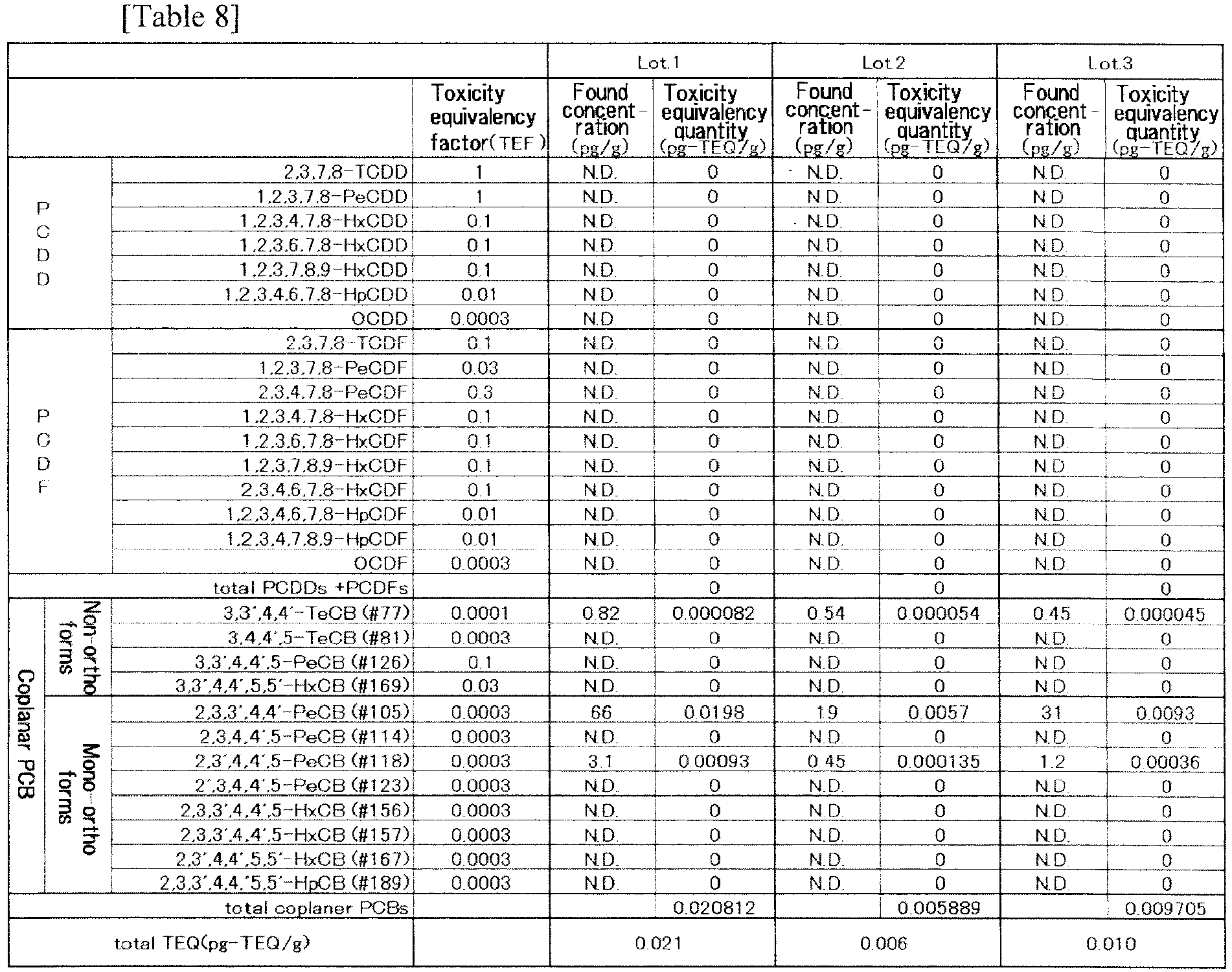
- The contents of dioxins in this ethyl ester were measured by the same method as in Example 4 and the results are shown in Table 8. No dioxins would be concentrated during the ethyl esterification and the subsequent refining step; use of the feedstock treated as in Example 4 enabled the production of EPA's ethyl ester samples in which the total quantity of dioxins was less than 0.07 pg-TEQ/g in terms of toxicity equivalency quantity. The data in Table 8 are for the production from three different lots of feedstock. It was verified that the method of the present invention enabled consistent production of EPA's ethyl ester samples in which the total quantity of dioxins was between 0.006 and 0.021 pg-TEQ/g in terms of toxicity equivalency quantity. As for NDs below the detection limit, calculation was made by inserting numeric values of detection limit and yet the increase was only 0.005 in numerical value, meaning that it is possible to produce EPA's ethyl ester samples with 0.011-0.026 pg-TEQ/g.
- The rectification and column chromatographic processing in the refining step after ethyl esterification were verified for possible effects they might have on the concentration of dioxins. The feedstock oil was sardine oil that was simply diacidified and decolored without subsequent thin-film distillation. This was because use of fats or oils containing more dioxins would provide greater ease in observing the possible effects of the refining process.
- The feedstock oil was ethyl esterified using an alkali catalyst. The resulting ethyl esters were first subjected to a rectification step, thereby collecting fractions containing ethyl esters of C20 fatty acids. Subsequently, a fraction of eicosapentaenoic acid ethyl ester was collected by ODS column chromatography.
- At the respective stages, the contents of dioxins were measured.
- Table 9 shows data for the four components that experienced greater variations (in terms of absolute value and toxicity equivalency quantity) and the total of dioxins (in toxicity equivalency quantity). The rectification step caused the components #105 and #118 to be concentrated by far greater degrees than when they were just after the esterification. On the other hand, the content of #77 decreased rather than increased. It is assumed that in rectification, ethyl esters of eicosapentaenoic acid and other fatty acids behaved in a similar way to dioxins, so that the dioxins were concentrated as were the ethyl esters of eicosapentaenoic acid and other fatty acids.
- Upon column treatment, the content of #77 remained substantially the same or increased a little whereas the contents of other components dropped considerably. It is assumed that in the column treatment, ethyl esters and dioxins behaved in a sufficiently different way to enable separation of the two components.
- Therefore, by combining rectification with the column treatment, the concentrating of the desired ethyl esters and the reduction of dioxins levels can be achieved simultaneously.
[Table 9] Non-ortho 3,3'4,4'-TeCB (#77) Non-ortho 3,3'4,4',5-PeCB (#126) Mono-ortho 2,3,3',4,4'-PeCB (#105) Mono-ortho 2,3',4,4',5-PeCB (#118) Total dioxins As esterified 380 pg/g (0.038pg-TEQ/g) 82 pg/g (8.2 pg-TEQ/g) 4700 pg/g (0.47 pg-TEQ/g) 9700 pg/g (0.97 pg-TEQ/g) (10.62 pg-TEQ/g) As rectified 250 (0.025) 170 (17) 24000 (2.4) 30000 (3) (23.44) As column treated 260 (0.026) 0.69 (0.069) 3700 (0.37) 180 (0.018) (0.48) - Crude sardine oil as feedstock was distilled by SPD as in Example 4 to give an SPD oil, which was ethyl esterified and refined by the same procedures as in Example 6 to yield EPA ethyl esters. They were measured for the contents of brominated flame retardants. The measurement was commissioned to the bio-analytical testing company "eurofins". The results are shown in Table 10. The contents of the respective brominated flame retardants in the feedstock sardine oil had been reduced to less than their detection limits. All of BDE-100, BDE-49, BDE-99, BDE-47, BDE-28, BDE-66, and BDE-154 that were contained in the feedstock oil in amounts equal to or greater than their detection limits had been reduced in concentration and, in particular, the concentrations of BDE-100, BDE-49, BDE-99 and BDE-47 were verified to have dropped distinctly .

- According to the present invention, the amounts of environmental contaminants, especially dioxins and brominated flame retardants, that are contained in fats or oils that comprise highly unsaturated fatty acids as constituent fatty acid, as exemplified by fish oils containing EPA and DHA can be markedly reduced.
- The products thus obtained are suitable for use in feeds, foods, supplements, medicines, and the like.
Claims (20)
- (A) highly unsaturated fatty acid ethyl ester(s) which has/have been produced using as a feedstock oil a fat or oil derived from a marine product that contains highly unsaturated fatty acids as constituent fatty acids and which has/have been reduced in the contents of environmental pollutants;wherein among the dioxins contained, polychlorinated dibenzoparadioxins (PCDDs) and polychlorinated dibenzofurans (PCDFs) are contained in amounts of less than 0.05 pg-TEQ/g and coplanar PCBs (Co-PCBs) in amounts of less than 0.03 pg-TEQ/g; wherein said TEQs are calculated based on the toxicity equivalency factors (TEFs) according to WHO (2006);wherein the highly unsaturated fatty acid(s) is/are (a) fatty acid(s) containing at least 18 carbon atoms and at least 3 double bonds; andwherein the concentration of the highly unsaturated fatty acid(s) in the sum of fatty acids is at least 85area% as determined by gas chromatography,wherein the polychlorinated dibenzoparadioxins (PCDDs) are selected from the group consisting of 2,3,7,8-tetrachlorodibenzo-p-dioxin, 1,2,3,7,8-pentachlorodibenzo-p-dioxin, 1,2,3,4,7,8-hexachlorodibenzo-p-dioxin, 1,2,3,6,7,8-hexachlorodibenzo-p-dioxin, 1,2,3,7,8,9-hexachlorodibenzo-p-dioxin, 1,2,3,4,6,7,8-heptachlorodibenzo-p-dioxin, and octachlorodibenzo-p-dioxin;wherein the polychlorinated dibenzofurans (PCDFs) are selected from the group consisting of 2,3,7,8-tetrachlorodibenzofuran, 1,2,3,7,8-pentachlorodibenzofuran, 2,3,4,7,8-pentachlorodibenzofuran, 1,2,3,4,7,8-hexachlorodibenzofuran, 1,2,3,6,7,8-hexachlorodibenzofuran, 1,2,3,7,8,9-hexachlorodibenzofuran, 2,3,4,6,7,8-hexachlorodibenzofuran, 1,2,3,4,6,7,8-heptachlorodibenzofuran, 1,2,3,4,7,8,9-heptachlorodibenzofuran, and octachlorodibenzofuran; andwherein the coplanar polychlorinate biphenyls (Co-PCBs) are selected from the group consisting of 3,4,4',5-tetrachlorobiphenyl, 3,3',4,4'-tetrachlorobiphenyl, 3,3',4,4',5-pentachlorobiphenyl, 3,3',4,4',5,5'-hexachlorobiphenyl, 2',3,4,4',5-pentachlorobiphenyl, 2,3',4,4',5-pentachlorobiphenyl, 2,3,3',4,4'-pentachlorobiphenyl, 2,3,4,4',5-pentachlorobiphenyl, 2,3',4,4',5,5'-hexachlorobiphenyl, 2,3,3',4,4',5-hexachlorobiphenyl, 2,3,3',4,4',5'-hexachlorobiphenyl, 2,3,3',4,4',5,5'-heptachlorobiphenyl.
- The highly unsaturated fatty acid ethyl ester(s) according to claim 1, wherein the content of a brominated flame retardant contained has been reduced to such a level that the amount of BDE-47 is less than 0.18 ng/g, the amount of BDE-100 is less than 0.03 ng/g, the amount of BDE-49 is less than 0.05 ng/g, or the amount of BDE-99 is less than 0.05 ng/g.
- The highly unsaturated fatty acid ethyl ester(s) according to claim 1 or 2, wherein the concentration of the highly unsaturated fatty acid(s) in the sum of fatty acids is at least 90area%, at least 95area%, or at least 96area%.
- The highly unsaturated fatty acid ethyl ester(s) according to any one of claims 1 to 3, wherein the fat or oil containing highly unsaturated fatty acids as constituent fatty acids is fish oil, krill oil, or marine mammal oil.
- The highly unsaturated fatty acid ethyl ester(s) according to any one of claims 1 to 4, wherein the highly unsaturated fatty acid(s) is/are any one of eicosapentaenoic acid, docosahexaenoic acid, docosapentaenoic acid, dihomo-γ-linoleic acid and arachidonic acid or a combination thereof.
- A medicine, supplement or food which comprises the highly unsaturated fatty acid ethyl ester(s) according to any one of claims 1 to 5 as an active ingredient.
- A method for producing (a) highly unsaturated fatty acid ethyl ester(s) with reduced contents of polychlorinated dibenzoparadioxins (PCDDs), polychlorinated dibenzofurans (PCDFs) and coplanar PCB (Co-PCBs) by the steps of:a) removing free fatty acids and environmental pollutants by thin-film distillation from a feedstock oil which is a fat or oil derived from a marine product and contains highly unsaturated fatty acids as constituent fatty acids;b) ethyl esterifying the resulting highly unsaturated fatty acid containing fat or oil; andc) refining the same by rectification and column chromatography;wherein the highly unsaturated fatty acid(s) is/are (a) fatty acid(s) containing at least 18 carbon atoms and at least 3 double bonds; andwherein the concentration of the highly unsaturated fatty acid(s) in the sum of fatty acids in the highly unsaturated fatty acid ethyl ester(s) is at least 85area% as determined by gas chromatography.
- The method according to claim 7, wherein the content of a brominated flame retardant is also reduced.
- The method according to claim 7 or 8, wherein the concentration of the highly unsaturated fatty acid(s) in the sum of fatty acids in the highly unsaturated fatty acid ethyl ester(s) is at least 90area%, at least 95area%, or at least 96area% as determined by gas chromatography.
- The method according to any one of claims 7 to 9, wherein the feedstock oil containing highly unsaturated fatty acids as constituent fatty acids is fish oil, krill oil, or marine mammal oil.
- The method according to any one of claims 7 to 10, wherein the thin-film distillation is carried out at a temperature of 200-270°C, 220-260°C, or 220-250°C.
- The method according to any one of claims 7 to 11, wherein the thin-film distillation is carried out at a pressure of 5 Pa or lower, 2 Pa or lower, or 1 Pa or lower.
- The method according to any one of claims 7 to 12, wherein the thin-film distillation is carried out at a flow rate of 20-200 (kg/h)/m2 or 25-120 (kg/h)/m2.
- The method according to any one of claims 7 to 13, wherein the thin-film distillation is molecular distillation or short path distillation.
- The method according to any one of claims 7 to 14, wherein rectification is performed in three or more distillation columns.
- The method according to any one of claims 7 to 15, wherein refining by column chromatography uses column chromatography of reverse-phase distribution type.
- (A) highly unsaturated fatty acid ethyl ester(s) that has/have been produced by the method according to any one of claims 7 to 16 and whose content of dioxins is less than 0.07 pg-TEQ/g or 0.05 pg-TEQ/g;wherein said TEQs are calculated based on the toxicity equivalency factors (TEFs) according to WHO (2006);wherein the highly unsaturated fatty acid(s) is/are (a) fatty acid(s) containing at least 18 carbon atoms and at least 3 double bonds; andwherein the concentration of the highly unsaturated fatty acid(s) in the sum of fatty acids is at least 85area% as determined by gas chromatography,wherein dioxins are the sum of the polychlorinated dibenzoparadioxins (PCDDs), polychlorinated dibenzofurans (PCDFs), and coplanar PCBs (Co-PCBs),wherein the polychlorinated dibenzoparadioxins (PCDDs) are selected from the group consisting of 2,3,7,8-tetrachlorodibenzo-p-dioxin, 1,2,3,7,8-pentachlorodibenzo-p-dioxin, 1,2,3,4,7,8-hexachlorodibenzo-p-dioxin, 1,2,3,6,7,8-hexachlorodibenzo-p-dioxin, 1,2,3,7,8,9-hexachlorodibenzo-p-dioxin, 1,2,3,4,6,7,8-heptachlorodibenzo-p-dioxin, and octachlorodibenzo-p-dioxin,wherein the polychlorinated dibenzofurans (PCDFs) are selected from the group consisting of 2,3,7,8-tetrachlorodibenzofuran, 1,2,3,7,8-pentachlorodibenzofuran, 2,3,4,7,8-pentachlorodibenzofuran, 1,2,3,4,7,8-hexachlorodibenzofuran, 1,2,3,6,7,8-hexachlorodibenzofuran, 1,2,3,7,8,9-hexachlorodibenzofuran, 2,3,4,6,7,8-hexachlorodibenzofuran, 1,2,3,4,6,7,8-heptachlorodibenzofuran, 1,2,3,4,7,8,9-heptachlorodibenzofuran, and octachlorodibenzofuran, andwherein the coplanar polychlorinate biphenyls (Co-PCBs) are selected from the group consisting of 3,4,4',5-tetrachlorobiphenyl, 3,3',4,4'-tetrachlorobiphenyl, 3,3',4,4',5-pentachlorobiphenyl, 3,3',4,4',5,5'-hexachlorobiphenyl, 2',3,4,4',5-pentachlorobiphenyl, 2,3',4,4',5-pentachlorobiphenyl, 2,3,3',4,4'-pentachlorobiphenyl, 2,3,4,4',5-pentachlorobiphenyl, 2,3',4,4',5,5'-hexachlorobiphenyl, 2,3,3',4,4',5-hexachlorobiphenyl, 2,3,3',4,4',5'-hexachlorobiphenyl, 2,3,3',4,4',5,5'-heptachlorobiphenyl.
- The highly unsaturated fatty acid ethyl ester(s) according to claim 17, wherein the content of a brominated flame retardant contained has been reduced to such a level that the amount of BDE-47 is less than 0.18 ng/g, the amount of BDE-100 is less than 0.03 ng/g, the amount of BDE-49 is less than 0.05 ng/g, or the amount of BDE-99 is less than 0.05 ng/g.
- The highly unsaturated fatty acid ethyl ester(s) according to claim 17 or 18, wherein the concentration of the highly unsaturated fatty acid(s) in the sum of fatty acids is at least 90area%, at least 95area%, or at least 96area% as determined by gas chromatography.
- A medicine, supplement or food which contains the highly unsaturated fatty acid ethyl ester(s) according to any one of claims 17 to 19.
Priority Applications (1)
| Application Number | Priority Date | Filing Date | Title |
|---|---|---|---|
| EP24178220.0A EP4414356A3 (en) | 2012-05-14 | 2013-05-14 | Highly unsaturated fatty acid or highly unsaturated fatty acid ethyl ester with reduced environmental pollutants, and method for producing same |
Applications Claiming Priority (3)
| Application Number | Priority Date | Filing Date | Title |
|---|---|---|---|
| JP2012110809 | 2012-05-14 | ||
| EP13790465.2A EP2851361B1 (en) | 2012-05-14 | 2013-05-14 | Highly unsaturated fatty acid or highly unsaturated fatty acid ethyl ester with reduced environmental pollutants, and method for producing same |
| PCT/JP2013/063425 WO2013172346A1 (en) | 2012-05-14 | 2013-05-14 | Highly unsaturated fatty acid or highly unsaturated fatty acid ethyl ester with reduced environmental pollutants, and method for producing same |
Related Parent Applications (1)
| Application Number | Title | Priority Date | Filing Date |
|---|---|---|---|
| EP13790465.2A Division EP2851361B1 (en) | 2012-05-14 | 2013-05-14 | Highly unsaturated fatty acid or highly unsaturated fatty acid ethyl ester with reduced environmental pollutants, and method for producing same |
Related Child Applications (2)
| Application Number | Title | Priority Date | Filing Date |
|---|---|---|---|
| EP24178220.0A Division EP4414356A3 (en) | 2012-05-14 | 2013-05-14 | Highly unsaturated fatty acid or highly unsaturated fatty acid ethyl ester with reduced environmental pollutants, and method for producing same |
| EP24178220.0A Division-Into EP4414356A3 (en) | 2012-05-14 | 2013-05-14 | Highly unsaturated fatty acid or highly unsaturated fatty acid ethyl ester with reduced environmental pollutants, and method for producing same |
Publications (3)
| Publication Number | Publication Date |
|---|---|
| EP3971165A1 EP3971165A1 (en) | 2022-03-23 |
| EP3971165B1 true EP3971165B1 (en) | 2024-08-07 |
| EP3971165C0 EP3971165C0 (en) | 2024-08-07 |
Family
ID=49583751
Family Applications (3)
| Application Number | Title | Priority Date | Filing Date |
|---|---|---|---|
| EP13790465.2A Active EP2851361B1 (en) | 2012-05-14 | 2013-05-14 | Highly unsaturated fatty acid or highly unsaturated fatty acid ethyl ester with reduced environmental pollutants, and method for producing same |
| EP21206640.1A Active EP3971165B1 (en) | 2012-05-14 | 2013-05-14 | Highly unsaturated fatty acid or highly unsaturated fatty acid ethyl ester with reduced environmental pollutants, and method for producing same |
| EP24178220.0A Pending EP4414356A3 (en) | 2012-05-14 | 2013-05-14 | Highly unsaturated fatty acid or highly unsaturated fatty acid ethyl ester with reduced environmental pollutants, and method for producing same |
Family Applications Before (1)
| Application Number | Title | Priority Date | Filing Date |
|---|---|---|---|
| EP13790465.2A Active EP2851361B1 (en) | 2012-05-14 | 2013-05-14 | Highly unsaturated fatty acid or highly unsaturated fatty acid ethyl ester with reduced environmental pollutants, and method for producing same |
Family Applications After (1)
| Application Number | Title | Priority Date | Filing Date |
|---|---|---|---|
| EP24178220.0A Pending EP4414356A3 (en) | 2012-05-14 | 2013-05-14 | Highly unsaturated fatty acid or highly unsaturated fatty acid ethyl ester with reduced environmental pollutants, and method for producing same |
Country Status (13)
| Country | Link |
|---|---|
| US (7) | US9540306B2 (en) |
| EP (3) | EP2851361B1 (en) |
| JP (8) | JP5592570B2 (en) |
| KR (8) | KR20240096704A (en) |
| CN (5) | CN104302615B (en) |
| CA (2) | CA3225865A1 (en) |
| CL (1) | CL2014003053A1 (en) |
| DE (1) | DE202013012875U1 (en) |
| DK (1) | DK2851361T3 (en) |
| ES (2) | ES2900618T3 (en) |
| HU (1) | HUE057283T2 (en) |
| PE (3) | PE20241184A1 (en) |
| WO (1) | WO2013172346A1 (en) |
Families Citing this family (14)
| Publication number | Priority date | Publication date | Assignee | Title |
|---|---|---|---|---|
| KR20240096704A (en) * | 2012-05-14 | 2024-06-26 | 가부시키가이샤 닛스이 | Highly unsaturated fatty acid or highly unsaturated fatty acid ethyl ester with reduced environmental pollutants, and method for producing same |
| CA2890216C (en) | 2012-11-02 | 2021-04-13 | Pronova Biopharma Norge As | Removal of undesired components from oil compositions |
| EP3733857A3 (en) | 2013-12-04 | 2020-12-09 | Nippon Suisan Kaisha, Ltd. | Dihomo-gamma-linolenic acid-containing microbial oil and dihomo-gamma-linolenic acid-containing microbial biomass |
| US9918953B2 (en) | 2014-09-17 | 2018-03-20 | Nippon Suisan Kaisha, Ltd. | Composition containing eicosapentaenoic acid alkyl ester, and method for producing same |
| EP3345986A4 (en) | 2015-08-31 | 2019-05-01 | Nippon Suisan Kaisha, Ltd. | COMPOSITION COMPRISING FREE POLYUNSATURATED FATTY ACID, AND PROCESS FOR PRODUCTION THEREOF |
| ITUB20153877A1 (en) * | 2015-09-24 | 2017-03-24 | Tiberio Bruzzese | Method of purification of glycerides of fatty acids, compositions derived from them, and their use |
| CN106349070A (en) * | 2016-08-31 | 2017-01-25 | 山东康曼生物科技有限公司 | Technology for producing Omega-3-ethyl gallate 90 from low-content ethyl ester fish oil |
| EP3517619B1 (en) * | 2016-09-23 | 2022-07-27 | CJ Cheiljedang Corporation | Method for preparing fatty acid ethyl ester |
| WO2019007918A1 (en) * | 2017-07-07 | 2019-01-10 | Bunge Loders Croklaan B.V. | Process for the preparation of a hydrogenated fat composition |
| CN109438220B (en) * | 2018-10-31 | 2021-04-13 | 苏州赛分科技有限公司 | Method for purifying EPA from fish oil |
| WO2020138282A1 (en) | 2018-12-26 | 2020-07-02 | 日清ファルマ株式会社 | Eicosapentaenoic acid alkyl ester-containing composition and method for producing same |
| CN111302940A (en) * | 2020-04-08 | 2020-06-19 | 燕园泽龙(涿鹿)生物科技有限公司 | Production method of high-purity α -ethyl linolenate |
| ES3062185T3 (en) | 2021-03-17 | 2026-04-09 | Nissui Corp | Purification method |
| CN114057574A (en) * | 2021-12-03 | 2022-02-18 | 浙江工商大学 | Method for preparing high-purity EPA ethyl ester |
Citations (10)
| Publication number | Priority date | Publication date | Assignee | Title |
|---|---|---|---|---|
| EP0610506A1 (en) | 1991-10-28 | 1994-08-17 | Nippon Suisan Kabushiki Kaisha | Process for producing high-purity eicosapentaenoic acid or ester thereof |
| JPH10310551A (en) | 1997-05-12 | 1998-11-24 | Nippon Wax Polymer Kaihatsu Kenkyusho:Kk | Purification method of eicosapentaenoic acid or its ester |
| WO1999064547A1 (en) | 1998-06-05 | 1999-12-16 | Merck Patent Gmbh | Contaminant reduced marine oil |
| WO2002006430A1 (en) | 2000-07-19 | 2002-01-24 | Lysi Hf. | Marine oils with reduced levels of contaminants |
| JP2008061571A (en) | 2006-09-07 | 2008-03-21 | Toyomac Ltd | Method for producing liquid oil and fat for animal feeding stuff, and mixed animal feeding stuff |
| EP1523541B1 (en) | 2002-07-11 | 2009-12-30 | Pronova BioPharma Norge AS | A process for decreasing environmental pollutants in an oil or a fat, a volatile environmental pollutants decreasing working fluid, a health supplement, and an animal feed product |
| WO2012048792A1 (en) | 2010-10-13 | 2012-04-19 | Cognis Ip Management Gmbh | Device and method for distilling temperature-sensitive substances |
| WO2012109539A1 (en) | 2011-02-11 | 2012-08-16 | E. I. Du Pont De Nemours And Company | An eicosapentaenoic acid concentrate |
| WO2013007315A1 (en) | 2011-07-14 | 2013-01-17 | Soluciones Extractivas Alimentarias, S.L. | New process for reducing pollutants in fats and oils and their derivatives |
| EP2438819B1 (en) | 2009-06-02 | 2013-04-24 | Golden Omega S.A. | Method for producing a concentrate of eicosapentaenoic and docosahexaenoic acid esters |
Family Cites Families (47)
| Publication number | Priority date | Publication date | Assignee | Title |
|---|---|---|---|---|
| JPS57149400A (en) | 1981-03-12 | 1982-09-14 | Kureha Chemical Ind Co Ltd | Manufacture of high purity long chain highly unsaturated fatty acid ester |
| JPS5888339A (en) | 1981-11-20 | 1983-05-26 | Kagakuhin Kensa Kyokai | Separating and purifying method of eicosapentaenoic acid or ester thereof and docosahexaenoic acid or ester thereof |
| NL8200559A (en) | 1982-02-15 | 1983-09-01 | Ir Jan Bart Le Poole Prof Dr | IRRADIATION DEVICE WITH BUNDLE SPLIT. |
| JPS60208940A (en) | 1984-03-31 | 1985-10-21 | Nippon Zeon Co Ltd | Separation and purification method of Changzhen unsaturated fatty acid compounds |
| DE3524656A1 (en) * | 1985-07-10 | 1987-01-15 | Stage Hermann | METHOD AND SYSTEM FOR THE DESODORATION AND / OR DE-ACIDIFICATION OF RELATIVELY SMALL, ALTERNATING BATCHES OF HIGH-SEEDING LIQUIDS |
| JP2603830B2 (en) * | 1987-06-15 | 1997-04-23 | 日清製油株式会社 | Production method of fats and oils |
| GB8819110D0 (en) | 1988-08-11 | 1988-09-14 | Norsk Hydro As | Antihypertensive drug & method for production |
| JPH0633088B2 (en) | 1990-02-20 | 1994-05-02 | 金沢樹脂工業株式会社 | Assembled forklift pallet |
| JP3290152B2 (en) | 1990-06-04 | 2002-06-10 | 日本水産株式会社 | High concentration eicosapentaenoic acid or its ester |
| CA2043615C (en) | 1990-06-04 | 2001-08-14 | Kazuhiko Hata | Method of producing eicosapentaenoic acid or the ester derivative thereof |
| JPH07105223B2 (en) | 1991-03-11 | 1995-11-13 | 日本碍子株式会社 | High temperature battery assembly |
| US5215630A (en) | 1991-06-04 | 1993-06-01 | Nippon Suisan Kaisha, Ltd. | Method of purifying eicosapentaenoic acid or the ester derivative thereof by fractional distillation |
| JP2988754B2 (en) | 1991-09-03 | 1999-12-13 | 日本水産株式会社 | High vacuum continuous distillation equipment |
| JP3614177B2 (en) | 1992-07-21 | 2005-01-26 | 日本水産株式会社 | Method for producing high-purity docosahexaenoic acid or its ester |
| GB9404483D0 (en) | 1994-03-08 | 1994-04-20 | Norsk Hydro As | Refining marine oil compositions |
| JPH08100191A (en) * | 1994-09-30 | 1996-04-16 | Nisshin Flour Milling Co Ltd | Purification of highly unsaturated fatty acid or ester thereof |
| NO314788B1 (en) | 1994-11-15 | 2003-05-26 | K D Pharma Gmbh | Process for recovering one or more compounds from a mixture |
| JPH09302380A (en) * | 1996-05-10 | 1997-11-25 | Nippon Wax Polymer Kaihatsu Kenkyusho:Kk | Purification method of eicosapentaenoic acid or its ester |
| JPH1095744A (en) | 1996-09-20 | 1998-04-14 | Nof Corp | Production of highly unsaturated aliphatic acid or its alkyl ester |
| CN1072711C (en) * | 1998-01-05 | 2001-10-10 | 山东禹王制药有限公司 | Industrial production of highly unsaturated fatty acid |
| JP2872986B1 (en) | 1998-01-21 | 1999-03-24 | 池田食研株式会社 | Purification method of lower alcohol ester of high purity highly unsaturated fatty acid |
| DE19923558A1 (en) | 1999-05-21 | 2000-11-23 | K D Pharma Bexbach Gmbh | Purification of natural oils to give odor-free and taste-free oil products, using aluminum oxide as adsorbent and without using solvent |
| ES2159257B1 (en) | 1999-11-19 | 2002-04-16 | Kd Iqa S L | NEW PROCEDURE FOR THE PREPARATION OF THE ETHYLIC ESTER OF THE PENTAENOIC EICOSA ACID. |
| EP1125914A1 (en) | 2000-02-14 | 2001-08-22 | Nisshin Flour Milling Co., Ltd. | Process for separating and purifying eicosapentaenoic acid or its ester |
| JP4752118B2 (en) * | 2000-02-17 | 2011-08-17 | 住友化学株式会社 | Process for producing fatty acid ester and fuel containing fatty acid ester |
| CA2336513C (en) | 2000-02-17 | 2010-08-24 | Tatsuo Tateno | Process for producing fatty acid esters and fuels comprising fatty acid ester |
| FR2894772B1 (en) * | 2005-12-20 | 2008-03-14 | Pierre Fabre Medicament Sa | DHA ENRICHMENT PROCESS |
| DE102006012866B4 (en) | 2006-03-19 | 2009-04-09 | Uic Gmbh | Process for the separation of highly volatile components from a mixture of substances and apparatus for carrying out this process |
| CA2685272A1 (en) * | 2007-04-26 | 2008-11-06 | Patrick Adlercreutz | A polyunsaturated fatty acid (pufa) enriched marine oil comprising eicosapentaenoic acid (epa) and docosahexaenoic acid (dha), and a process of production thereof |
| US9556401B2 (en) | 2007-07-30 | 2017-01-31 | Nippon Suisan Kaisha, Ltd. | Method for producing EPA-enriched oil and DHA-enriched oil |
| ES2361944T3 (en) | 2007-11-23 | 2011-06-24 | Reemtsma Cigarettenfabriken Gmbh | PROCEDURE FOR THE MANUFACTURE OF SMOKE TOBACCO ITEMS AND SMOKE TOBACCO ITEM FOR ORAL CONSUMPTION. |
| PL2268160T3 (en) | 2008-03-20 | 2013-05-31 | Virun Inc | Emulsions including a peg-derivative of tocopherol |
| EP2291499B1 (en) * | 2008-05-15 | 2020-02-12 | Basf As | Krill oil process |
| KR101357298B1 (en) | 2008-06-20 | 2014-01-28 | 에이케이 앤 엠엔 바이오팜 주식회사 | Purification and concentration method of high purity omega-3 polyunsaturated fatty acids |
| JP2010118383A (en) * | 2008-11-11 | 2010-05-27 | Nikon Corp | Illumination apparatus, exposure apparatus and device manufacturing method |
| ES2894340T3 (en) | 2009-03-09 | 2022-02-14 | Basf As | Compositions comprising a mixture of fatty acid oils and a surfactant, and methods and uses thereof |
| PE20130491A1 (en) | 2009-12-30 | 2013-05-02 | Basf Pharma Callanish Ltd | SIMULATED PROCESS OF CHROMATOGRAPHIC SEPARATION OF MOBILE BED FOR PURIFICATION OF POLYINSATURATED FATTY ACIDS |
| CA2792330C (en) | 2010-03-23 | 2017-01-03 | Virun, Inc | Nanoemulsion including a peg-derivative of vitamin e and a sucrose fatty acid ester |
| US20130123525A1 (en) | 2010-05-28 | 2013-05-16 | Nippon Suisan Kaisha, Ltd. | Method for producing oil containing polyunsaturated fatty acid using lipase |
| US8769868B2 (en) * | 2010-06-09 | 2014-07-08 | Photonz Corporation Limited | Compositions comprising eicosapentaenoic acid suitable for high purification |
| US9145533B2 (en) | 2010-09-24 | 2015-09-29 | Pronova Blopharm Norge AS | Process for concentrating omega-3 fatty acids |
| JP5650506B2 (en) | 2010-11-22 | 2015-01-07 | 優章 荒井 | Electrolyzed water production equipment |
| GB201111591D0 (en) * | 2011-07-06 | 2011-08-24 | Equateq Ltd | Further new process |
| CN104011191A (en) * | 2011-11-09 | 2014-08-27 | 赢创膜萃取技术有限公司 | Membrane-based processes for reducing at least one impurity and making a concentrate comprising at least one natural component from a non-marine fatty acid oil mixture, and compositions resulting thereof |
| US8258330B1 (en) * | 2012-01-04 | 2012-09-04 | Naturalis, S.A. | Carrier fluid composition comprising fatty acids ethyl esters and process for reducing the concentration of persistent organic pollutants in fish oil |
| KR20240096704A (en) * | 2012-05-14 | 2024-06-26 | 가부시키가이샤 닛스이 | Highly unsaturated fatty acid or highly unsaturated fatty acid ethyl ester with reduced environmental pollutants, and method for producing same |
| EP3733857A3 (en) * | 2013-12-04 | 2020-12-09 | Nippon Suisan Kaisha, Ltd. | Dihomo-gamma-linolenic acid-containing microbial oil and dihomo-gamma-linolenic acid-containing microbial biomass |
-
2013
- 2013-05-14 KR KR1020247018724A patent/KR20240096704A/en not_active Ceased
- 2013-05-14 PE PE2024000801A patent/PE20241184A1/en unknown
- 2013-05-14 PE PE2019001187A patent/PE20190969A1/en unknown
- 2013-05-14 CN CN201380024834.XA patent/CN104302615B/en active Active
- 2013-05-14 KR KR1020227034817A patent/KR20220140655A/en not_active Ceased
- 2013-05-14 CA CA3225865A patent/CA3225865A1/en active Pending
- 2013-05-14 KR KR1020257037818A patent/KR20250164338A/en active Pending
- 2013-05-14 US US14/400,652 patent/US9540306B2/en active Active
- 2013-05-14 KR KR1020207005902A patent/KR102117806B1/en active Active
- 2013-05-14 CA CA2873160A patent/CA2873160C/en active Active
- 2013-05-14 CN CN202110295239.6A patent/CN113045422A/en active Pending
- 2013-05-14 ES ES13790465T patent/ES2900618T3/en active Active
- 2013-05-14 DK DK13790465.2T patent/DK2851361T3/en active
- 2013-05-14 PE PE2014002012A patent/PE20142380A1/en active IP Right Grant
- 2013-05-14 KR KR1020227010218A patent/KR102453616B1/en active Active
- 2013-05-14 ES ES21206640T patent/ES2985397T3/en active Active
- 2013-05-14 HU HUE13790465A patent/HUE057283T2/en unknown
- 2013-05-14 DE DE202013012875.5U patent/DE202013012875U1/en not_active Expired - Lifetime
- 2013-05-14 WO PCT/JP2013/063425 patent/WO2013172346A1/en not_active Ceased
- 2013-05-14 JP JP2013546117A patent/JP5592570B2/en active Active
- 2013-05-14 CN CN201710031298.6A patent/CN106810446A/en active Pending
- 2013-05-14 KR KR1020207014617A patent/KR102229106B1/en active Active
- 2013-05-14 KR KR1020147034425A patent/KR102117725B1/en active Active
- 2013-05-14 CN CN202110299534.9A patent/CN113025434B/en active Active
- 2013-05-14 KR KR1020217007317A patent/KR102381331B1/en active Active
- 2013-05-14 EP EP13790465.2A patent/EP2851361B1/en active Active
- 2013-05-14 CN CN201710701544.4A patent/CN107602378B/en active Active
- 2013-05-14 EP EP21206640.1A patent/EP3971165B1/en active Active
- 2013-05-14 EP EP24178220.0A patent/EP4414356A3/en active Pending
-
2014
- 2014-06-03 JP JP2014114769A patent/JP6309828B2/en active Active
- 2014-11-10 CL CL2014003053A patent/CL2014003053A1/en unknown
-
2016
- 2016-12-01 US US15/366,522 patent/US10399922B2/en active Active
-
2017
- 2017-07-04 JP JP2017130947A patent/JP6434573B2/en active Active
-
2018
- 2018-04-03 JP JP2018071685A patent/JP6389579B2/en active Active
- 2018-06-27 US US16/019,992 patent/US10399923B2/en active Active
- 2018-09-27 JP JP2018181274A patent/JP6774469B2/en active Active
-
2019
- 2019-07-17 US US16/514,191 patent/US11034643B2/en active Active
-
2020
- 2020-10-02 JP JP2020167387A patent/JP2021004254A/en active Pending
-
2021
- 2021-05-11 US US17/317,179 patent/US11603347B2/en active Active
-
2022
- 2022-07-01 JP JP2022106906A patent/JP2022132317A/en not_active Withdrawn
-
2023
- 2023-02-06 US US18/164,765 patent/US12331015B2/en active Active
-
2024
- 2024-02-28 JP JP2024028104A patent/JP2024069262A/en active Pending
-
2025
- 2025-04-18 US US19/183,091 patent/US20250243146A1/en active Pending
Patent Citations (10)
| Publication number | Priority date | Publication date | Assignee | Title |
|---|---|---|---|---|
| EP0610506A1 (en) | 1991-10-28 | 1994-08-17 | Nippon Suisan Kabushiki Kaisha | Process for producing high-purity eicosapentaenoic acid or ester thereof |
| JPH10310551A (en) | 1997-05-12 | 1998-11-24 | Nippon Wax Polymer Kaihatsu Kenkyusho:Kk | Purification method of eicosapentaenoic acid or its ester |
| WO1999064547A1 (en) | 1998-06-05 | 1999-12-16 | Merck Patent Gmbh | Contaminant reduced marine oil |
| WO2002006430A1 (en) | 2000-07-19 | 2002-01-24 | Lysi Hf. | Marine oils with reduced levels of contaminants |
| EP1523541B1 (en) | 2002-07-11 | 2009-12-30 | Pronova BioPharma Norge AS | A process for decreasing environmental pollutants in an oil or a fat, a volatile environmental pollutants decreasing working fluid, a health supplement, and an animal feed product |
| JP2008061571A (en) | 2006-09-07 | 2008-03-21 | Toyomac Ltd | Method for producing liquid oil and fat for animal feeding stuff, and mixed animal feeding stuff |
| EP2438819B1 (en) | 2009-06-02 | 2013-04-24 | Golden Omega S.A. | Method for producing a concentrate of eicosapentaenoic and docosahexaenoic acid esters |
| WO2012048792A1 (en) | 2010-10-13 | 2012-04-19 | Cognis Ip Management Gmbh | Device and method for distilling temperature-sensitive substances |
| WO2012109539A1 (en) | 2011-02-11 | 2012-08-16 | E. I. Du Pont De Nemours And Company | An eicosapentaenoic acid concentrate |
| WO2013007315A1 (en) | 2011-07-14 | 2013-01-17 | Soluciones Extractivas Alimentarias, S.L. | New process for reducing pollutants in fats and oils and their derivatives |
Non-Patent Citations (86)
| Title |
|---|
| "Fish oils in nutrition ", 1 January 1990, VAN NOSTRAND REINHOLD, ISBN: 0-442-23748-0, article VIRGINIA F. STOUT, WILLIAM B. NILSSON, JUDITH KRZYNOWEK, AND HERMANN SCHLENK.: "Chapter 4: Fractionation of Fish Oils and their Fatty Acids", pages: 73 - 119, XP009561728 |
| "Omega-3 Oils: Applications in Functional Foods", 1 January 2011, ELSEVIER, ISBN: 978-1-893997-82-0, article ANTHONY P. BIMBO: "4 - Production of Marine Oils", pages: 73 - 105, XP009561971, DOI: 10.1016/B978-1-893997-82-0.50007-4 |
| "Omega-6/3 Fatty Acids: Functions, Sustainability Strategies and Perspectives", 1 January 2013, SPRINGER SCIENCE+BUSINESS MEDIA , New York, article LEMBKE PETER: "Production Techniques for Omega-3 Concentrates", pages: 353 - 364, XP093278429, DOI: 10.1007/978-1-62703-215-5_19 |
| BREIVIK, HARALD: "Long-chain omega-3 specialty oils", 1 January 2007, BRIDGWATER : OILY PRESS , US , ISBN: 978-0-9552512-1-4, article ANTHONY P. BIMBO: "Chapter 4 - Processing of marine oils", pages: 70 - 90, XP009561709 |
| BREIVIK, HARALD: "Long-chain omega-3 specialty oils", 1 January 2007, BRIDGWATER : OILY PRESS , US , ISBN: 978-0-9552512-1-4, article HARALD BREIVIK: "Chapter 5 - Concentrates", pages: 111 - 140, XP009561716, DOI: 10.1533/9780857097897.111 |
| BREIVIK, HARALD: "Long-chain omega-3 specialty oils", 1 January 2007, BRIDGWATER : OILY PRESS , US , ISBN: 978-0-9552512-1-4, article JONATHAN M. CURTIS: "Chapter 9 - Analysis of oils and concentrates", pages: 219 - 241, XP009561715, DOI: 10.1533/9780857097897.219 |
| COURTNEY E. D.; MATTHEWS S.; FINLAYSON C.; DI PIERRO D.; BELLUZZI A.; RODA E.; KANG J. Y.; LEICESTER R. J.: "Eicosapentaenoic acid (EPA) reduces crypt cell proliferation and increases apoptosis in normal colonic mucosa in subjects with a history of colorectal adenomas", INTERNATIONAL JOURNAL OF COLORECTAL DISEASE, SPRINGER VERLAG, BERLIN, DE, vol. 22, no. 7, 10 January 2007 (2007-01-10), DE , pages 765 - 776, XP037838127, ISSN: 0179-1958, DOI: 10.1007/s00384-006-0240-4 |
| COVACI ADRIAN, VOORSPOELS STEFAN, VETTER WALTER, GELBIN ANKE, JORENS PHILIPPE G., BLUST RONNY, NEELS HUGO: "Anthropogenic and Naturally Occurring Organobrominated Compounds in Fish Oil Dietary Supplements", ENVIRONMENTAL SCIENCE & TECHNOLOGY, AMERICAN CHEMICAL SOCIETY, US, vol. 41, no. 15, 1 August 2007 (2007-08-01), US , pages 5237 - 5244, XP093278430, ISSN: 0013-936X, DOI: 10.1021/es070239g |
| D10 - Invoice |
| D102 - Fish Oil Processing |
| D103 - Article |
| D104 - Schardt 2008 |
| D11 - Frachtrechnung |
| D110 - KD Personel Tabelle |
| D111 - KD Companies Tabelle |
| D12 - Prüfbericht |
| D13 - Auftrag |
| D14 - Invoice |
| D15 - Delivery Note |
| D16 - Freight Papers |
| D17 - Image |
| D18 - CoA |
| D19 - Prüfbericht |
| D20 - Invoice |
| D21 - Delivery Note |
| D22 - Order |
| D23 - DHL Shipping |
| D24 - Image |
| D25 - CoA |
| D26 - JFRL |
| D27 - SGS Analysis |
| D28 - Invoice |
| D29 - Delivery Note |
| D30 - Zoll |
| D31 - Ausgangsvermerk |
| D32 - US Importation |
| D33 - SGS |
| D34 - Prüfbericht |
| D35 - Protokoll |
| D36 - Invoice |
| D37 - Payment Confirmation |
| D38 - Commercial |
| D39 - Ausfuhrgenehmigung |
| D40 - Ausfuhrbegleitdokument |
| D41 - CoA |
| D42 - Ausgangsvermerk |
| D43 - Dioxin PCB |
| D44 - Protokoll |
| D45 - Purchase Order |
| D46 - Invoice |
| D47 - Delivery Note |
| D48-D50 - SOP |
| D4-D8 - Affidavit |
| D51 - Invoice |
| D52/53 - Delivery Note |
| D54/55 - Affidavit |
| D56 - CoA |
| D57 - Affidavit |
| D60/61 - Poster |
| D62 - Abstract |
| D63 - Prüfbericht |
| D64 - Packing |
| D65-D67 - Affidavit |
| D68 - Ausfuhrbescheinigung |
| D71 - Lembke Chicago |
| D72 - Omega 3 |
| D73 - Expert Opinion |
| D80 - Gutachten |
| D82 - Affidavit |
| D83 - Lieferschein |
| D84 - Short Path Distillation |
| D85/86 - KD2 |
| D87 - Molecular Distillation |
| D9 - CoA |
| D91 - Website |
| D94 - Honryo, "Feeding trial of red sea bream with dioxin-reduced ˆsh oil" Nippon Suisan Gakkaishi, 27 April 2011 (original version (JP) of D93) |
| D98 - Nissui |
| D99 - Nissui Website |
| HONRYO TOMOKI, YAMAMOTO KOSHI, KUMANISHI ATSUNORI TSUNORI, HIDEKI ;, SAWADA YOSHIFUMI, HONRYO OKI, YAMAMOTO HIROSHI, HIROSE HIDEKI: "Trial of raising sea bream with dioxin-reduced oil", NIPPON SUISAN GAKKAISHI, vol. 78, no. 2, 1 January 2012 (2012-01-01), pages 241 - 245, XP093278432 |
| MARTI, M. ; ORTIZ, X. ; GASSER, M. ; MARTI, R. ; MONTANA, M.J. ; DIAZ-FERRERO, J.: "Persistent organic pollutants (PCDD/Fs, dioxin-like PCBs, marker PCBs, and PBDEs) in health supplements on the Spanish market", CHEMOSPHERE, PERGAMON PRESS, OXFORD., GB, vol. 78, no. 10, 1 March 2010 (2010-03-01), GB , pages 1256 - 1262, XP026903685, ISSN: 0045-6535, DOI: 10.1016/j.chemosphere.2009.12.038 |
| NAKATANI TADASHI, KAZUOMI ITANO, TADAO FUJITA: "Contamination Levels of PCDDs, PCDFs and CoPCBs in Fish Oils Used as Raw Materials for Margarine and Shortening and Retailed Fish", JOURNAL OF THE FOOD HYGIENIC SOCIETY OF JAPAN (SHOKUHIN EISEIGAKU ZASSHI), vol. 46, no. 4, 1 August 2005 (2005-08-01), pages 169 - 175, XP093278434, DOI: 10.3358/shokueishi.46.169 |
| OLLI JAN JOSEF; BREIVIK HARALD; THORSTAD OLAV: "Removal of persistent organic pollutants in fish oils using short-path distillation with a working fluid", CHEMOSPHERE, PERGAMON PRESS, OXFORD., GB, vol. 92, no. 3, 22 March 2013 (2013-03-22), GB , pages 273 - 278, XP028540624, ISSN: 0045-6535, DOI: 10.1016/j.chemosphere.2013.02.037 |
| OLLI, J.J. ; BREIVIK, H. ; MORKORE, T. ; RUYTER, B. ; JOHANSEN, J. ; REYNOLDS, P. ; THORSTAD, O. ; BERGE, G.: "Removal of persistent organic pollutants from Atlantic salmon (Salmo salar L.) diets: Influence on growth, feed utilization efficiency and product quality", AQUACULTURE, ELSEVIER, AMSTERDAM, NL, vol. 310, no. 1-2, 22 December 2010 (2010-12-22), Amsterdam, NL , pages 145 - 155, XP027536737, ISSN: 0044-8486 |
| SCHMID ZENNEGG M: "PCDD/F, PCB, DIOXIN-LIKE PCB, AND PBDE IN FISH OIL USED AS DIETARY SUPPLEMENT IN SWITZERLAND", ORGANOHALOGEN COMPOUNDS, vol. 68, 1 January 2006 (2006-01-01), pages 1967 - 1970, XP093278436 |
| STANSBY E: "FISH OILS IN NUTRITION", 1 January 1990, VAN NOSTRAND REINHOLD , ISBN: 978-0-442-23748-6, article ANTHONY P BIMBO: "PROCESSING OF FISH OILS", pages: 181 - 225, XP003035169 |
| WEST NICHOLAS J, CLARK SUSAN K, PHILLIPS ROBIN K S: "Eicosapentaenoic acid reduces rectal polyp number and size in familial adenomatous polyposis", GUT, vol. 59, no. 7, 1 July 2010 (2010-07-01), pages 918 - 925, XP055963949, DOI: 10.1136/gut.2009.200642 |
Also Published As
Similar Documents
| Publication | Publication Date | Title |
|---|---|---|
| US12331015B2 (en) | Highly unsaturated fatty acid or highly unsaturated fatty acid ethyl ester with reduced environmental pollutants, and method for producing same | |
| HK40057853A (en) | Highly unsaturated fatty acid or highly unsaturated fatty acid ethyl ester, pharmaceutical, additive or food | |
| HK40053910A (en) | Highly unsaturated fatty acid or highly unsaturated fatty acid ethyl ester, process for producing the same, and pharmaceutical, additive or food |
Legal Events
| Date | Code | Title | Description |
|---|---|---|---|
| PUAI | Public reference made under article 153(3) epc to a published international application that has entered the european phase |
Free format text: ORIGINAL CODE: 0009012 |
|
| STAA | Information on the status of an ep patent application or granted ep patent |
Free format text: STATUS: THE APPLICATION HAS BEEN PUBLISHED |
|
| AC | Divisional application: reference to earlier application |
Ref document number: 2851361 Country of ref document: EP Kind code of ref document: P |
|
| AK | Designated contracting states |
Kind code of ref document: A1 Designated state(s): AL AT BE BG CH CY CZ DE DK EE ES FI FR GB GR HR HU IE IS IT LI LT LU LV MC MK MT NL NO PL PT RO RS SE SI SK SM TR |
|
| STAA | Information on the status of an ep patent application or granted ep patent |
Free format text: STATUS: REQUEST FOR EXAMINATION WAS MADE |
|
| 17P | Request for examination filed |
Effective date: 20220922 |
|
| RBV | Designated contracting states (corrected) |
Designated state(s): AL AT BE BG CH CY CZ DE DK EE ES FI FR GB GR HR HU IE IS IT LI LT LU LV MC MK MT NL NO PL PT RO RS SE SI SK SM TR |
|
| RAP3 | Party data changed (applicant data changed or rights of an application transferred) |
Owner name: NISSUI CORPORATION |
|
| GRAP | Despatch of communication of intention to grant a patent |
Free format text: ORIGINAL CODE: EPIDOSNIGR1 |
|
| STAA | Information on the status of an ep patent application or granted ep patent |
Free format text: STATUS: GRANT OF PATENT IS INTENDED |
|
| INTG | Intention to grant announced |
Effective date: 20240320 |
|
| GRAS | Grant fee paid |
Free format text: ORIGINAL CODE: EPIDOSNIGR3 |
|
| GRAA | (expected) grant |
Free format text: ORIGINAL CODE: 0009210 |
|
| STAA | Information on the status of an ep patent application or granted ep patent |
Free format text: STATUS: THE PATENT HAS BEEN GRANTED |
|
| AC | Divisional application: reference to earlier application |
Ref document number: 2851361 Country of ref document: EP Kind code of ref document: P |
|
| AK | Designated contracting states |
Kind code of ref document: B1 Designated state(s): AL AT BE BG CH CY CZ DE DK EE ES FI FR GB GR HR HU IE IS IT LI LT LU LV MC MK MT NL NO PL PT RO RS SE SI SK SM TR |
|
| REG | Reference to a national code |
Ref country code: GB Ref legal event code: FG4D |
|
| REG | Reference to a national code |
Ref country code: CH Ref legal event code: EP |
|
| REG | Reference to a national code |
Ref country code: IE Ref legal event code: FG4D |
|
| REG | Reference to a national code |
Ref country code: DE Ref legal event code: R096 Ref document number: 602013085989 Country of ref document: DE |
|
| U01 | Request for unitary effect filed |
Effective date: 20240820 |
|
| U07 | Unitary effect registered |
Designated state(s): AT BE BG DE DK EE FI FR IT LT LU LV MT NL PT RO SE SI Effective date: 20240902 |
|
| REG | Reference to a national code |
Ref country code: ES Ref legal event code: FG2A Ref document number: 2985397 Country of ref document: ES Kind code of ref document: T3 Effective date: 20241105 |
|
| PG25 | Lapsed in a contracting state [announced via postgrant information from national office to epo] |
Ref country code: PL Free format text: LAPSE BECAUSE OF FAILURE TO SUBMIT A TRANSLATION OF THE DESCRIPTION OR TO PAY THE FEE WITHIN THE PRESCRIBED TIME-LIMIT Effective date: 20240807 Ref country code: GR Free format text: LAPSE BECAUSE OF FAILURE TO SUBMIT A TRANSLATION OF THE DESCRIPTION OR TO PAY THE FEE WITHIN THE PRESCRIBED TIME-LIMIT Effective date: 20241108 |
|
| PG25 | Lapsed in a contracting state [announced via postgrant information from national office to epo] |
Ref country code: IS Free format text: LAPSE BECAUSE OF FAILURE TO SUBMIT A TRANSLATION OF THE DESCRIPTION OR TO PAY THE FEE WITHIN THE PRESCRIBED TIME-LIMIT Effective date: 20241207 |
|
| PG25 | Lapsed in a contracting state [announced via postgrant information from national office to epo] |
Ref country code: HR Free format text: LAPSE BECAUSE OF FAILURE TO SUBMIT A TRANSLATION OF THE DESCRIPTION OR TO PAY THE FEE WITHIN THE PRESCRIBED TIME-LIMIT Effective date: 20240807 |
|
| PG25 | Lapsed in a contracting state [announced via postgrant information from national office to epo] |
Ref country code: RS Free format text: LAPSE BECAUSE OF FAILURE TO SUBMIT A TRANSLATION OF THE DESCRIPTION OR TO PAY THE FEE WITHIN THE PRESCRIBED TIME-LIMIT Effective date: 20241107 |
|
| PG25 | Lapsed in a contracting state [announced via postgrant information from national office to epo] |
Ref country code: RS Free format text: LAPSE BECAUSE OF FAILURE TO SUBMIT A TRANSLATION OF THE DESCRIPTION OR TO PAY THE FEE WITHIN THE PRESCRIBED TIME-LIMIT Effective date: 20241107 Ref country code: PL Free format text: LAPSE BECAUSE OF FAILURE TO SUBMIT A TRANSLATION OF THE DESCRIPTION OR TO PAY THE FEE WITHIN THE PRESCRIBED TIME-LIMIT Effective date: 20240807 Ref country code: IS Free format text: LAPSE BECAUSE OF FAILURE TO SUBMIT A TRANSLATION OF THE DESCRIPTION OR TO PAY THE FEE WITHIN THE PRESCRIBED TIME-LIMIT Effective date: 20241207 Ref country code: HR Free format text: LAPSE BECAUSE OF FAILURE TO SUBMIT A TRANSLATION OF THE DESCRIPTION OR TO PAY THE FEE WITHIN THE PRESCRIBED TIME-LIMIT Effective date: 20240807 Ref country code: GR Free format text: LAPSE BECAUSE OF FAILURE TO SUBMIT A TRANSLATION OF THE DESCRIPTION OR TO PAY THE FEE WITHIN THE PRESCRIBED TIME-LIMIT Effective date: 20241108 |
|
| PG25 | Lapsed in a contracting state [announced via postgrant information from national office to epo] |
Ref country code: SM Free format text: LAPSE BECAUSE OF FAILURE TO SUBMIT A TRANSLATION OF THE DESCRIPTION OR TO PAY THE FEE WITHIN THE PRESCRIBED TIME-LIMIT Effective date: 20240807 |
|
| PG25 | Lapsed in a contracting state [announced via postgrant information from national office to epo] |
Ref country code: CZ Free format text: LAPSE BECAUSE OF FAILURE TO SUBMIT A TRANSLATION OF THE DESCRIPTION OR TO PAY THE FEE WITHIN THE PRESCRIBED TIME-LIMIT Effective date: 20240807 |
|
| PG25 | Lapsed in a contracting state [announced via postgrant information from national office to epo] |
Ref country code: SK Free format text: LAPSE BECAUSE OF FAILURE TO SUBMIT A TRANSLATION OF THE DESCRIPTION OR TO PAY THE FEE WITHIN THE PRESCRIBED TIME-LIMIT Effective date: 20240807 |
|
| PLBI | Opposition filed |
Free format text: ORIGINAL CODE: 0009260 |
|
| U20 | Renewal fee for the european patent with unitary effect paid |
Year of fee payment: 13 Effective date: 20250407 |
|
| 26 | Opposition filed |
Opponent name: K.D. PHARMA BEXBACH GMBH Effective date: 20250507 |
|
| PGFP | Annual fee paid to national office [announced via postgrant information from national office to epo] |
Ref country code: ES Payment date: 20250602 Year of fee payment: 13 |
|
| PGFP | Annual fee paid to national office [announced via postgrant information from national office to epo] |
Ref country code: NO Payment date: 20250509 Year of fee payment: 13 |
|
| PLAX | Notice of opposition and request to file observation + time limit sent |
Free format text: ORIGINAL CODE: EPIDOSNOBS2 |
|
| PGFP | Annual fee paid to national office [announced via postgrant information from national office to epo] |
Ref country code: IE Payment date: 20250402 Year of fee payment: 13 |
|
| PLAF | Information modified related to communication of a notice of opposition and request to file observations + time limit |
Free format text: ORIGINAL CODE: EPIDOSCOBS2 |
|
| REG | Reference to a national code |
Ref country code: CH Ref legal event code: H13 Free format text: ST27 STATUS EVENT CODE: U-0-0-H10-H13 (AS PROVIDED BY THE NATIONAL OFFICE) Effective date: 20251223 |
|
| PG25 | Lapsed in a contracting state [announced via postgrant information from national office to epo] |
Ref country code: CH Free format text: LAPSE BECAUSE OF NON-PAYMENT OF DUE FEES Effective date: 20250531 |
|
| PLBB | Reply of patent proprietor to notice(s) of opposition received |
Free format text: ORIGINAL CODE: EPIDOSNOBS3 |
|
| PG25 | Lapsed in a contracting state [announced via postgrant information from national office to epo] |
Ref country code: MC Free format text: LAPSE BECAUSE OF FAILURE TO SUBMIT A TRANSLATION OF THE DESCRIPTION OR TO PAY THE FEE WITHIN THE PRESCRIBED TIME-LIMIT Effective date: 20240807 |
|
| PGFP | Annual fee paid to national office [announced via postgrant information from national office to epo] |
Ref country code: GB Payment date: 20260323 Year of fee payment: 14 |