EP3971014B1 - Verfahren und vorrichtung zur verteilung elektrischer bremsleistung einer hybridelektrostrassenbahn und speichermedium - Google Patents
Verfahren und vorrichtung zur verteilung elektrischer bremsleistung einer hybridelektrostrassenbahn und speichermedium Download PDFInfo
- Publication number
- EP3971014B1 EP3971014B1 EP19937172.5A EP19937172A EP3971014B1 EP 3971014 B1 EP3971014 B1 EP 3971014B1 EP 19937172 A EP19937172 A EP 19937172A EP 3971014 B1 EP3971014 B1 EP 3971014B1
- Authority
- EP
- European Patent Office
- Prior art keywords
- power
- braking
- feedback
- maximum
- current
- Prior art date
- Legal status (The legal status is an assumption and is not a legal conclusion. Google has not performed a legal analysis and makes no representation as to the accuracy of the status listed.)
- Active
Links
Images


Classifications
-
- B—PERFORMING OPERATIONS; TRANSPORTING
- B60—VEHICLES IN GENERAL
- B60T—VEHICLE BRAKE CONTROL SYSTEMS OR PARTS THEREOF; BRAKE CONTROL SYSTEMS OR PARTS THEREOF, IN GENERAL; ARRANGEMENT OF BRAKING ELEMENTS ON VEHICLES IN GENERAL; PORTABLE DEVICES FOR PREVENTING UNWANTED MOVEMENT OF VEHICLES; VEHICLE MODIFICATIONS TO FACILITATE COOLING OF BRAKES
- B60T8/00—Arrangements for adjusting wheel-braking force to meet varying vehicular or ground-surface conditions, e.g. limiting or varying distribution of braking force
- B60T8/17—Using electrical or electronic regulation means to control braking
- B60T8/1701—Braking or traction control means specially adapted for particular types of vehicles
- B60T8/1705—Braking or traction control means specially adapted for particular types of vehicles for rail vehicles
-
- B—PERFORMING OPERATIONS; TRANSPORTING
- B60—VEHICLES IN GENERAL
- B60L—PROPULSION OF ELECTRICALLY-PROPELLED VEHICLES; SUPPLYING ELECTRIC POWER FOR AUXILIARY EQUIPMENT OF ELECTRICALLY-PROPELLED VEHICLES; ELECTRODYNAMIC BRAKE SYSTEMS FOR VEHICLES IN GENERAL; MAGNETIC SUSPENSION OR LEVITATION FOR VEHICLES; MONITORING OPERATING VARIABLES OF ELECTRICALLY-PROPELLED VEHICLES; ELECTRIC SAFETY DEVICES FOR ELECTRICALLY-PROPELLED VEHICLES
- B60L1/00—Supplying electric power to auxiliary equipment of vehicles
- B60L1/003—Supplying electric power to auxiliary equipment of vehicles to auxiliary motors, e.g. for pumps, compressors
-
- B—PERFORMING OPERATIONS; TRANSPORTING
- B60—VEHICLES IN GENERAL
- B60L—PROPULSION OF ELECTRICALLY-PROPELLED VEHICLES; SUPPLYING ELECTRIC POWER FOR AUXILIARY EQUIPMENT OF ELECTRICALLY-PROPELLED VEHICLES; ELECTRODYNAMIC BRAKE SYSTEMS FOR VEHICLES IN GENERAL; MAGNETIC SUSPENSION OR LEVITATION FOR VEHICLES; MONITORING OPERATING VARIABLES OF ELECTRICALLY-PROPELLED VEHICLES; ELECTRIC SAFETY DEVICES FOR ELECTRICALLY-PROPELLED VEHICLES
- B60L1/00—Supplying electric power to auxiliary equipment of vehicles
- B60L1/02—Supplying electric power to auxiliary equipment of vehicles to electric heating circuits
-
- B—PERFORMING OPERATIONS; TRANSPORTING
- B60—VEHICLES IN GENERAL
- B60L—PROPULSION OF ELECTRICALLY-PROPELLED VEHICLES; SUPPLYING ELECTRIC POWER FOR AUXILIARY EQUIPMENT OF ELECTRICALLY-PROPELLED VEHICLES; ELECTRODYNAMIC BRAKE SYSTEMS FOR VEHICLES IN GENERAL; MAGNETIC SUSPENSION OR LEVITATION FOR VEHICLES; MONITORING OPERATING VARIABLES OF ELECTRICALLY-PROPELLED VEHICLES; ELECTRIC SAFETY DEVICES FOR ELECTRICALLY-PROPELLED VEHICLES
- B60L7/00—Electrodynamic brake systems for vehicles in general
- B60L7/10—Dynamic electric regenerative braking
-
- B—PERFORMING OPERATIONS; TRANSPORTING
- B60—VEHICLES IN GENERAL
- B60L—PROPULSION OF ELECTRICALLY-PROPELLED VEHICLES; SUPPLYING ELECTRIC POWER FOR AUXILIARY EQUIPMENT OF ELECTRICALLY-PROPELLED VEHICLES; ELECTRODYNAMIC BRAKE SYSTEMS FOR VEHICLES IN GENERAL; MAGNETIC SUSPENSION OR LEVITATION FOR VEHICLES; MONITORING OPERATING VARIABLES OF ELECTRICALLY-PROPELLED VEHICLES; ELECTRIC SAFETY DEVICES FOR ELECTRICALLY-PROPELLED VEHICLES
- B60L7/00—Electrodynamic brake systems for vehicles in general
- B60L7/22—Dynamic electric resistor braking, combined with dynamic electric regenerative braking
-
- B—PERFORMING OPERATIONS; TRANSPORTING
- B60—VEHICLES IN GENERAL
- B60W—CONJOINT CONTROL OF VEHICLE SUB-UNITS OF DIFFERENT TYPE OR DIFFERENT FUNCTION; CONTROL SYSTEMS SPECIALLY ADAPTED FOR HYBRID VEHICLES; ROAD VEHICLE DRIVE CONTROL SYSTEMS FOR PURPOSES NOT RELATED TO THE CONTROL OF A PARTICULAR SUB-UNIT
- B60W10/00—Conjoint control of vehicle sub-units of different type or different function
- B60W10/24—Conjoint control of vehicle sub-units of different type or different function including control of energy storage means
- B60W10/26—Conjoint control of vehicle sub-units of different type or different function including control of energy storage means for electrical energy, e.g. batteries or capacitors
-
- B—PERFORMING OPERATIONS; TRANSPORTING
- B60—VEHICLES IN GENERAL
- B60W—CONJOINT CONTROL OF VEHICLE SUB-UNITS OF DIFFERENT TYPE OR DIFFERENT FUNCTION; CONTROL SYSTEMS SPECIALLY ADAPTED FOR HYBRID VEHICLES; ROAD VEHICLE DRIVE CONTROL SYSTEMS FOR PURPOSES NOT RELATED TO THE CONTROL OF A PARTICULAR SUB-UNIT
- B60W10/00—Conjoint control of vehicle sub-units of different type or different function
- B60W10/30—Conjoint control of vehicle sub-units of different type or different function including control of auxiliary equipment, e.g. air-conditioning compressors or oil pumps
-
- B—PERFORMING OPERATIONS; TRANSPORTING
- B60—VEHICLES IN GENERAL
- B60W—CONJOINT CONTROL OF VEHICLE SUB-UNITS OF DIFFERENT TYPE OR DIFFERENT FUNCTION; CONTROL SYSTEMS SPECIALLY ADAPTED FOR HYBRID VEHICLES; ROAD VEHICLE DRIVE CONTROL SYSTEMS FOR PURPOSES NOT RELATED TO THE CONTROL OF A PARTICULAR SUB-UNIT
- B60W30/00—Purposes of road vehicle drive control systems not related to the control of a particular sub-unit, e.g. of systems using conjoint control of vehicle sub-units
- B60W30/18—Propelling the vehicle
- B60W30/18009—Propelling the vehicle related to particular drive situations
- B60W30/18109—Braking
- B60W30/18127—Regenerative braking
-
- B—PERFORMING OPERATIONS; TRANSPORTING
- B60—VEHICLES IN GENERAL
- B60L—PROPULSION OF ELECTRICALLY-PROPELLED VEHICLES; SUPPLYING ELECTRIC POWER FOR AUXILIARY EQUIPMENT OF ELECTRICALLY-PROPELLED VEHICLES; ELECTRODYNAMIC BRAKE SYSTEMS FOR VEHICLES IN GENERAL; MAGNETIC SUSPENSION OR LEVITATION FOR VEHICLES; MONITORING OPERATING VARIABLES OF ELECTRICALLY-PROPELLED VEHICLES; ELECTRIC SAFETY DEVICES FOR ELECTRICALLY-PROPELLED VEHICLES
- B60L2200/00—Type of vehicles
- B60L2200/26—Rail vehicles
-
- B—PERFORMING OPERATIONS; TRANSPORTING
- B60—VEHICLES IN GENERAL
- B60L—PROPULSION OF ELECTRICALLY-PROPELLED VEHICLES; SUPPLYING ELECTRIC POWER FOR AUXILIARY EQUIPMENT OF ELECTRICALLY-PROPELLED VEHICLES; ELECTRODYNAMIC BRAKE SYSTEMS FOR VEHICLES IN GENERAL; MAGNETIC SUSPENSION OR LEVITATION FOR VEHICLES; MONITORING OPERATING VARIABLES OF ELECTRICALLY-PROPELLED VEHICLES; ELECTRIC SAFETY DEVICES FOR ELECTRICALLY-PROPELLED VEHICLES
- B60L2240/00—Control parameters of input or output; Target parameters
- B60L2240/80—Time limits
-
- B—PERFORMING OPERATIONS; TRANSPORTING
- B60—VEHICLES IN GENERAL
- B60T—VEHICLE BRAKE CONTROL SYSTEMS OR PARTS THEREOF; BRAKE CONTROL SYSTEMS OR PARTS THEREOF, IN GENERAL; ARRANGEMENT OF BRAKING ELEMENTS ON VEHICLES IN GENERAL; PORTABLE DEVICES FOR PREVENTING UNWANTED MOVEMENT OF VEHICLES; VEHICLE MODIFICATIONS TO FACILITATE COOLING OF BRAKES
- B60T2270/00—Further aspects of brake control systems not otherwise provided for
- B60T2270/60—Regenerative braking
- B60T2270/604—Merging friction therewith; Adjusting their repartition
-
- B—PERFORMING OPERATIONS; TRANSPORTING
- B60—VEHICLES IN GENERAL
- B60W—CONJOINT CONTROL OF VEHICLE SUB-UNITS OF DIFFERENT TYPE OR DIFFERENT FUNCTION; CONTROL SYSTEMS SPECIALLY ADAPTED FOR HYBRID VEHICLES; ROAD VEHICLE DRIVE CONTROL SYSTEMS FOR PURPOSES NOT RELATED TO THE CONTROL OF A PARTICULAR SUB-UNIT
- B60W2510/00—Input parameters relating to a particular sub-units
- B60W2510/24—Energy storage means
- B60W2510/242—Energy storage means for electrical energy
-
- B—PERFORMING OPERATIONS; TRANSPORTING
- B60—VEHICLES IN GENERAL
- B60W—CONJOINT CONTROL OF VEHICLE SUB-UNITS OF DIFFERENT TYPE OR DIFFERENT FUNCTION; CONTROL SYSTEMS SPECIALLY ADAPTED FOR HYBRID VEHICLES; ROAD VEHICLE DRIVE CONTROL SYSTEMS FOR PURPOSES NOT RELATED TO THE CONTROL OF A PARTICULAR SUB-UNIT
- B60W2510/00—Input parameters relating to a particular sub-units
- B60W2510/30—Auxiliary equipments
- B60W2510/305—Power absorbed by auxiliaries
Definitions
- the present invention relates to the technical field of rail transit, and in particular to a method and a device for distributing electric braking power of a hybrid electric tram, and a computer readable storage medium.
- a tram is a light rail transit vehicle driven by electricity and running on rails.
- the new urban rail transit system represented by trams usually powered by contactless power supply in order to not affect the urban landscape.
- the contactless power supply has various types, including an on-board power storage device, a hydrogen fuel cell, ground contactless power supply, an internal combustion engine system, and the like.
- the tram is usually powered by hybrid power supply. That is, the tram is powered by both a power storage system that is capable of charging and being charged and a unidirectional power supply such as the hydrogen fuel cell, the contactless induction power supply, or the internal combustion engine.
- braking power During electric braking of the tram, kinetic energy or potential energy of a traction motor is converted into braking power. Since the unidirectional power supply including the hydrogen fuel cell, the contactless induction power supply or the internal combustion engine cannot absorb the braking power, only the power storage system absorbs the braking power during electric braking of the tram. However, a charging current of the on-board power storage system is small, so that the braking power cannot be fully absorbed. The braking power that exceeds power allowed to flow through the on-board power storage system may damage the power storage system. Alternatively, all the braking power is consumed by a braking resistor, resulting in waste of the braking power. An example thereof is given in document DE 10 2006 056374 A1 .
- a method and a device for distributing electric braking power of a hybrid electric tram, and a computer readable storage medium are provided according to embodiments of the present invention, to properly distribute the electric braking power of the hybrid electric tram, thereby improving utilization of the braking power.
- a method for distributing electric braking power of a hybrid electric tram includes: acquiring a braking voltage and a braking current of a traction inverter system when a traction motor brakes; acquiring consumption power of a power consumption system, output power of a unidirectional power supply system and maximum charging power of a power storage system; calculating, based on the consumption power, the output power, the maximum charging power, the number of traction inverters and the braking voltage, a maximum current limit fed back to a bus by a single traction inverter; and controlling a braking resistor system to be switched on or off based on the braking current and the maximum current limit.
- the consumption power includes power P auxiliary of an auxiliary system and power P air conditioner of a direct current air conditioning system.
- the controlling the braking resistor system to be switched on or off based on the braking current and the maximum current limit includes: controlling a circuit where the braking resistor system is arranged to be switched on when a braking current I LH1 is greater than a result of k 1 ⁇ I feedback ; and controlling the circuit where the braking resistor system is arranged to be switched off when the braking current I LH1 is less than a result of k 2 ⁇ I feedback , where k 1 and k 2 each represent a control parameter.
- the method further includes: recording a cumulative time period during which the circuit where the braking resistor system is arranged is closed; determining whether the cumulative time period exceeds a predetermined time threshold; and stopping electric braking when it is determined that the cumulative time period exceeds the predetermined time threshold.
- the method further includes: displaying prompt information indicating that the electric braking is unavailable.
- a device for distributing electric braking power of a hybrid electric tram is further provided according to an embodiment of the present invention.
- the device includes a collection unit, an acquisition unit, a calculation unit and a control unit.
- the collection unit is configured to acquire a braking voltage and a braking current of a traction inverter system when a traction motor brakes.
- the acquisition unit is configured to acquire consumption power of a power consumption system, output power of a unidirectional power supply system and maximum charging power of a power storage system.
- the calculation unit is configured to calculate, based on the consumption power, the output power, the maximum charging power, the number of traction inverters and the braking voltage, a maximum current limit fed back to a bus by a single traction inverter.
- the control unit is configured to control a braking resistor system to be switched on or off based on the braking current and the maximum current limit.
- the consumption power includes power P auxiliary of an auxiliary system and power P air conditioner of a direct current air conditioning system.
- the calculation unit includes a power calculation subunit and a current calculation subunit.
- control unit includes a switch-on subunit and a switch-off subunit.
- the switch-on subunit is configured to control a circuit where the braking resistor system is arranged to be switched on when a braking current I LH1 is greater than a result of k 1 ⁇ I feedback .
- the switch-off subunit is configured to control the circuit where the braking resistor system is arranged to be switched off when the braking current I LH1 is less than a result of k 2 ⁇ I feedback .
- k 1 and k 2 each represent a control parameter.
- the device further includes a recording unit, a time determination unit and a stop unit.
- the recording unit is configured to record, when the circuit where the braking resistor system is arranged is controlled to be switched on, a cumulative time period during which the circuit where the braking resistor system is arranged is closed.
- the time determination unit is configured to determine whether the cumulative time period exceeds a predetermined time threshold, and trigger the stop unit when the cumulative time period exceeds the predetermined time threshold.
- the stop unit is configured to stop the electric braking.
- the device further includes a display unit.
- the display unit is configured to display, when the electric braking is stopped, prompt information indicating that the electric braking is unavailable.
- a device for distributing electric braking power of a hybrid electric tram includes a memory and a processor.
- the memory is configured to store a computer program.
- the processor is configured to execute the computer program to perform the above method for distributing electric braking power of a hybrid electric tram.
- a computer readable storage medium is further provided according to an embodiment of the present invention.
- the computer readable storage medium stores a computer program that, when being executed by a processor, performs the above method for distributing electric braking power of a hybrid electric tram.
- the braking voltage and the braking current of the traction inverter system are acquired.
- the consumption power of the power consumption system, the output power of the unidirectional power supply system and the maximum charging power of the power storage system are acquired.
- the systems in the tram are connected in parallel.
- the braking voltage reflects the voltage on the direct current bus. Therefore, the maximum current limit fed back to the direct current bus by a single traction inverter is calculated based on the consumption power, the output power, the maximum charging power, the number of traction inverters and the braking voltage. Based on the braking current and the maximum current limit, the braking resistor system is dynamically controlled to be switched on or off.
- the braking power exceeds the power allowed to flow through the power storage system
- the amount of power that the braking power exceeds the power allowed to flow through the power storage system is consumed by the braking resistor system, to prevent overcurrent of the power storage system.
- the braking power is less than the power allowed to flow through the power storage system, the braking power fully is fed back to the power storage system. Therefore, the braking power is distributed properly, thereby improving the utilization of the braking power, and effectively increasing a mileage of the tram.
- FIG. 1 is a block diagram showing a system main circuit of a hybrid electric tram commonly used according to the conventional technology.
- a power supply system in Figure 1 includes a power storage system and a unidirectional power supply system.
- the unidirectional power supply system includes a hydrogen fuel cell system and a unidirectional DC/DC.
- the tram includes a direct current air conditioning system connected to a high-voltage direct current bus, and an auxiliary system formed by an auxiliary converter or a charger and a load connected to the charger.
- a second dashed block from the left in Figure 1 represents a traction inverter system.
- the traction inverter system includes an input voltage sensor, a pre-charge and input circuit, a direct current sensor, an intermediate voltage sensor, a chopper control module, a DC/AC inverter module, and the like.
- the DC/AC inverter module includes multiple outputs to drive multiple motor loads.
- a braking resistor system includes multiple braking resistors connected in series and parallel.
- a running tram is powered by both the power storage system and the unidirectional power supply system such as a hydrogen fuel cell, a contactless induction power supply, or an internal combustion engine power generation system.
- the tram electrically brakes, braking power is generated. Due to the unidirectionality of the power supply system such as the hydrogen fuel cell or the contactless induction power supply, only the power storage system receives the braking power. However, a charging current of the power storage system is small, so that the braking power cannot be fully absorbed by the power storage system. All the braking power being transmitted to the power storage system may result in overcurrent in the power storage system and even cause the power storage system to burn.
- the unidirectional power supply system such as a hydrogen fuel cell, a contactless induction power supply, or an internal combustion engine power generation system.
- a method and a device for distributing electric braking power of a hybrid electric tram, and a computer readable storage medium are provided according to the embodiments of the present invention.
- a maximum current limit fed back by a single traction inverter to the bus is calculated.
- the braking resistor system is dynamically controlled to be switched on or off. The overcurrent of the power storage system is prevented and the braking power is fed back to the power storage system as much as possible, so that the braking power is distributed properly, thereby improving the utilization of the braking power.
- the braking power is fed back to the power storage system as much as possible, so that a mileage of the tram is effectively increased.
- Figure 2 is a flowchart of the method for distributing electric braking power of a hybrid electric tram according to an embodiment of the present invention. The method includes the following steps S201 to S204.
- step S201 when a traction motor brakes, a braking voltage and a braking current of a traction inverter system are acquired.
- the braking voltage and the braking current of the traction inverter system are acquired by a voltage sensor and a current sensor arranged on the traction inverter system, respectively.
- the braking power converted during the electric braking of the tram is a variable.
- the braking voltage and the braking current of the traction inverter system are acquired in real time or periodically at short intervals.
- the acquired current I LH1 serves as the braking current
- the acquired voltage U VH2 serves as the braking voltage.
- step S202 consumption power of a power consumption system, output power of a unidirectional power supply system and maximum charging power of a power storage system are acquired.
- a power of a system reflects instantaneous energy of the system.
- maximum electric braking power fed back to a direct current bus is determined based on present power of systems in the tram.
- the consumption power may include power P auxiliary of an auxiliary system and power P air conditioner of a direct current air conditioning system.
- the tram is provided with a network control system configured to manage the power consumption system, the unidirectional power supply system, and the power storage system.
- the auxiliary system transfers real-time power P auxiliary of the auxiliary converter or the charger to the network control system.
- a direct current air conditioning control system transfers real-time power P air conditioner of the direct current air conditioning system to the network control system.
- the power supply system transfers maximum charging power P power storage charging of the power storage system and the output power P dc of the unidirectional power supply system to the network control system.
- step S203 a maximum current limit fed back to the bus by a single traction inverter is calculated based on the consumption power, the output power, the maximum charging power, the number of traction inverters and the braking voltage.
- the output power of the unidirectional power supply system is considered in calculating the maximum power fed back to the direct current bus.
- P feedback P power storage charging +P auxiliary +P air conditioner -P dc , where P dc represents the output power of the unidirectional power supply system.
- a maximum current limit I feedback fed back to the bus by a single traction inverter is calculated from the following equation, and the maximum current limit represents a maximum current that is allowed to be fed back to the bus by a single traction inverter.
- I feedback P feedback / N ⁇ U VH 2 , where N represents the number of traction inverters, and U VH2 represents the braking voltage of the traction inverter system.
- step S204 the braking resistor system is dynamically controlled to be switched on or off based on the braking current and the maximum current limit.
- the braking current and the maximum current limit fed back to the direct current bus by a single traction inverter each are a variable.
- the braking voltage and the braking current of the traction inverter system are acquired in real time.
- a central processor of the tram detects the braking current in real time and calculates, in real time, the maximum current limit fed back to the direct current bus by a single traction inverter.
- the circuit where the braking resistor system is arranged is controlled to be switched off, so that the braking power is fully fed back to the power storage system.
- I LH1 represents the braking current.
- k 1 and k 2 each represent a control parameter.
- the coefficient k 1 is equal to or different from the coefficient k 2 , depending on experiment conditions, which is not limited herein.
- FIG. 3 is a schematic diagram showing controlling for distribution and adjustment of the electric braking power corresponding to the method for distributing electric braking power of a hybrid electric tram according to an embodiment of the present invention.
- Each of the power storage system, the auxiliary system and the direct current air conditioning system absorbs the braking power. Therefore, the power P power storage charging , the power P auxiliary and the power P air conditioner are all positive.
- the unidirectional power supply system such as the hydrogen fuel cell and the internal combustion engine system still generate power in a short time period during electric braking of the tram. Therefore, the power P dc is negative.
- the braking resistor consumes braking power. Therefore, the power P resistor is negative.
- the braking resistor system is dynamically controlled to be switched on or off.
- the amount of power that the braking power exceeds the power allowed to flow through the power storage system is consumed by the braking resistor system, so as to prevent overcurrent of the power storage system.
- the braking power is less than the power allowed to flow through the power storage system, the braking power is fully fed back to the power storage system. Therefore, the braking power is distributed properly, thereby improving utilization of the braking power, and effectively increasing a mileage of the tram.
- cumulative operation duration of the braking resistor system is limited.
- a predetermined time threshold is set.
- the predetermined time threshold represents cumulative duration during which the braking resistor system operates, and depends on the braking resistor, which is not limited herein.
- a cumulative time period during which a circuit where the braking resistor system is arranged is closed is recorded. It is determined whether the cumulative time period exceeds the predetermined time threshold.
- the braking resistor system when operating for the cumulative time period exceeding the predetermined time threshold, is prone to burning. In this case, the electric braking is stopped.
- the braking of the system includes electric braking and mechanical braking.
- electric braking When the electric braking is stopped, prompt information indicating that the electric braking is unavailable is displayed, so that relevant braking measures are taken in time according to actual needs.
- Figure 4 is a schematic structural diagram of a device for distributing electric braking power of a hybrid electric tram according to an embodiment of the present invention.
- the device includes a collection unit 41, an acquisition unit 42, a calculation unit 43 and a control unit 44.
- the collection unit 41 is configured to acquire a braking voltage and a braking current of a traction inverter system when a traction motor brakes.
- the acquisition unit 42 is configured to acquire consumption power of a power consumption system, output power of a unidirectional power supply system and maximum charging power of a power storage system.
- the calculation unit 43 is configured to calculate, based on the consumption power, the output power, the maximum charging power, the number of traction inverters and the braking voltage, a maximum current limit fed back to a direct current bus by a single traction inverter.
- the control unit 44 is configured to dynamically control the braking resistor system to be switched on or off based on the braking current and the maximum current limit.
- the consumption power includes power P auxiliary of an auxiliary system and power P air conditioner of a direct current air conditioning system.
- the calculation unit includes a power calculation subunit and a current calculation subunit.
- control unit includes a switch-on subunit and a switch-off subunit.
- the switch-on subunit is configured to control a circuit where the braking resistor system is arranged to be switched on when the current I LH1 is greater than a result of k 1 ⁇ I feedback .
- the switch-off subunit is configured to control the circuit where the braking resistor system is arranged to be switched off when the current I LH1 is less than a result of k 2 ⁇ I feedback , where I LH1 represents the braking current, and k 1 and k 2 each represent a control parameter.
- the device further includes a recording unit, a time determination unit and a stop unit.
- the recording unit is configured to record, when the circuit where the braking resistor system is arranged is controlled to be switched on, a cumulative time period during which the circuit where the braking resistor system is arranged is closed.
- the time determination unit is configured to determine whether the cumulative time period exceeds a predetermined time threshold, and trigger the stop unit when the cumulative time period exceeds the predetermined time threshold.
- the stop unit is configured to stop the electric braking.
- the device further includes a display unit.
- the display unit is configured to display, when the electric braking is stopped, prompt information indicating that the electric braking is unavailable.
- the braking voltage and the braking current of the traction inverter system are acquired.
- the consumption power of the power consumption system, the output power of the unidirectional power supply system and the maximum charging power of the power storage system are acquired.
- the systems in the tram are connected in parallel.
- the braking voltage reflects the voltage on the direct current bus. Therefore, the maximum current limit fed back to the direct current bus by a single traction inverter is calculated based on the consumption power, the output power, the maximum charging power, the number of traction inverters and the braking voltage. Based on the braking current and the maximum current limit, the braking resistor system is dynamically controlled to be switched on or off.
- the braking power exceeds the power allowed to flow through the power storage system
- the amount of power that the braking power exceeds the power allowed to flow through the power storage system is consumed by the braking resistor system, so as to prevent overcurrent of the power storage system.
- the braking power is less than the power allowed to flow through the power storage system, the braking power is fully fed back to the power storage system. Therefore, the braking power is distributed properly, thereby improving utilization of the braking power, and effectively increasing a mileage of the tram.
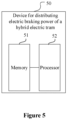
- FIG. 5 is a schematic diagram showing a hardware structure of a device 50 for distributing electric braking power of a hybrid electric tram.
- the device includes a memory 51 and a processor 52.
- the device shown in Figure 5 is given herein as an example merely instead of part of the present invention.
- the memory 51 is configured to store a computer program.
- the processor 52 is configured to execute the computer program to perform the method for distributing electric braking power of a hybrid electric tram.
- a computer readable storage medium is further provided according to an embodiment of the present invention.
- the computer readable storage medium stores a computer program that, when being executed by a processor, performs the method for distributing electric braking power of a hybrid electric tram.
- the steps of the method or algorithm described in connection with the embodiments disclosed herein may be implemented directly by hardware, a software module executed by a processor, or a combination thereof.
- the software module may be configured in a random access memory (RAM), a memory, a read only memory (ROM), an electrically programmable ROM, an electrically erasable programmable ROM, a register, a hard disk, a removable disk, a CD-ROM, or any other storage medium known in the art.
Landscapes
- Engineering & Computer Science (AREA)
- Transportation (AREA)
- Mechanical Engineering (AREA)
- Power Engineering (AREA)
- Chemical & Material Sciences (AREA)
- Combustion & Propulsion (AREA)
- Automation & Control Theory (AREA)
- Electric Propulsion And Braking For Vehicles (AREA)
- Charge And Discharge Circuits For Batteries Or The Like (AREA)
Claims (9)
- Verfahren zum Verteilen elektrischer Bremsleistung einer Hybrid-Elektrostraßenbahn, umfassend:Erfassen (S201) einer Bremsspannung und eines Bremsstroms eines Traktionswechselrichtersystems, wenn ein Triebmotor bremst;Erfassen einer Verbrauchsleistung eines Verbrauchsleistungssystems, einer Leistungsabgabe eines unidirektionalen Energiezufuhrsystems und einer maximalen Ladeleistung eines Energiespeichersystems;Berechnen (S203) einer maximalen Stromgrenze, die von einem einzelnen Traktionswechselrichter an eine Sammelschiene zurückgeführt wird, auf Grundlage der Verbrauchsleistung, der Leistungsabgabe, der maximalen Ladeleistung, der Anzahl von Traktionswechselrichtern und der Bremsspannung; undSteuern eines Bremswiderstandssystems, das auf Grundlage des Bremsstroms und der maximalen Stromgrenze ein- oder ausgeschaltet werden soll.
- Verfahren nach Anspruch 1, wobeidie Verbrauchsleistung eine Leistung Pauxiliary eines Hilfssystems und eine Leistung Pair conditioner einer Gleichstrom-Klimaanlage aufweist,wobei das Berechnen einer maximalen Stromgrenze, die von einem einzelnen Traktionswechselrichter an eine Sammelschiene zurückgeführt wird, basierend auf der Verbrauchsleistung, der Leistungsabgabe, der maximalen Ladeleistung, der Anzahl von Traktionswechselrichtern und der Bremsspannung umfasst:Berechnen der maximalen Leistung Pfeedback, die von einer Gleichstromsammelschiene zurückgeführt wird, aus einer Gleichung Pfeedback=Ppower storage charging+Pauxiliary+Pair conditioner-Pdc, wobei Pdc die Leistungsabgabe des unidirektionalen Energiezufuhrsystems repräsentiert und Ppower storage charging die maximale Ladeleistung des Energiespeichersystems repräsentiert; undBerechnen der maximalen Stromgrenze Ifeedback, die von dem einzelnen Traktionswechselrichter an die Sammelschiene zurückgemeldet wird, aus einer Gleichung: Ifeedback=Pfeedback (N×UVH2 ), wobei N die Anzahl der Traktionswechselrichter und UVH2 die Bremsspannung des Traktionswechselrichtersystems repräsentiert.
- Verfahren nach Anspruch 2, wobei das Steuern eines Bremswiderstandssystems, das auf Grundlage des Bremsstroms und der maximalen Stromgrenze, die von dem einzelnen Traktionswechselrichter an die Sammelschiene zurückgemeldet wird, ein- oder auszuschalten ist, umfasst:Steuern eines Schaltkreises, in dem das Bremswiderstandssystem so angeordnet ist, dass es eingeschaltet wird, wenn ein Bremsstrom ILH1 größer ist als ein Ergebnis von k1 ×Ifeedback ; undSteuern des Schaltkreises, in dem das Bremswiderstandssystem so angeordnet ist, dass es ausgeschaltet wird, wenn der Bremsstrom ILH1 kleiner ist als ein Ergebnis von k2 × feedback, wobei k1 und k2 jeweils einen Steuerparameter darstellen.
- Verfahren nach Anspruch 3, ferner umfassend: nach der Steuern eines Schaltkreises, in dem das Bremswiderstandssystem so angeordnet ist, dass es eingeschaltet wird,Aufzeichnen einer kumulativen Zeitspanne, während der der Schaltkreis, in dem das Bremswiderstandssystem angeordnet ist, geschlossen ist;Bestimmen, ob die kumulative Zeitspanne einen vorgegebenen Zeitschwellenwert überschreitet;
undAnhalten der elektrischen Bremsung, wenn bestimmt wird, dass die kumulative Zeitspanne den vorgegebenen Zeitschwellenwert überschreitet. - Verfahren nach Anspruch 4, ferner umfassend: nach dem Anhalten der elektrischen Bremsung
Anzeigen von Eingabeaufforderungsinformationen, die angeben, dass die elektrische Bremsung nicht verfügbar ist. - Vorrichtung zum Verteilen der elektrischen Bremsleistung einer Hybrid-Elektrostraßenbahn, aufweisend:eine Sammeleinheit (41), die derart konfiguriert ist, dass sie eine Bremsspannung und einen Bremsstrom eines Traktionswechselrichtersystems erfasst, wenn ein Triebmotor bremst;eine Erfassungseinheit (42), die derart konfiguriert ist, dass sie die Verbrauchsleistung eines Verbrauchsleistungssystems, die Leistungsabgabe eines unidirektionalen Energiezufuhrsystems und die maximale Ladeleistung eines Energiespeichersystems erfasst;eine Berechnungseinheit (43), die derart konfiguriert ist, dass sie auf Grundlage der Verbrauchsleistung, der Leistungsabgabe, der maximalen Ladeleistung, der Anzahl der Traktionswechselrichter und der Bremsspannung eine maximale Stromgrenze berechnet, die von einem einzelnen Traktionswechselrichter an eine Sammelschiene zurückgemeldet wird; undeine Steuerungseinheit (44), die derart konfiguriert ist, dass sie ein Bremswiderstandssystem basierend auf dem Bremsstrom und der maximalen Stromgrenze ein- oder ausschaltet.
- Vorrichtung nach Anspruch 6, wobei
die Verbrauchsleistung eine Leistung Pauxiliary eines Hilfssystems und eine Leistung Pair conditioner einer Gleichstrom-Klimaanlage aufweist, wobei die Berechnungseinheit aufweist:eine Leistungsberechnungs-Untereinheit, die derart konfiguriert ist, dass sie die maximale Leistung Pfeedback berechnet, die von einer Gleichstromsammelschiene zurückgemeldet wird, aus einer Gleichung Pfeedback = Ppower storage charging + Pauxiliary power + Pair conditioner - Pdc, wobei Pdc die Leistungsabgabe des unidirektionalen Energiezufuhrsystems repräsentiert und Ppower storage charging die maximale Ladeleistung des Energiespeichersystems repräsentiert; undeine Stromberechnungs-Untereinheit, die derart konfiguriert ist, dass sie die maximale Stromgrenze Ifeedback berechnet, die von dem einzelnen Traktionswechselrichter von einer Gleichung an die Sammelschiene zurückgemeldet wird: Ifeedback=Pfeedback (N × UVH2 ), wobei N die Anzahl der Traktionswechselrichter repräsentiert und UVH2 die Bremsspannung des Traktionswechselrichtersystems repräsentiert. - Vorrichtung nach Anspruch 6, wobei die Steuerungseinheiteine Einschalt-Untereinheit, die derart konfiguriert ist, dass sie einen Schaltkreis steuert, in dem das Bremswiderstandssystem so angeordnet ist, dass es eingeschaltet wird, wenn der Bremsstrom ILH1 größer ist als ein Ergebnis von k1 ×Ifeedback;
undeine Abschalt-Untereinheit, die derart konfiguriert ist, dass sie den Schaltkreis steuert, in dem das Bremswiderstandssystem so angeordnet ist, dass es abgeschaltet wird, wenn der Bremsstrom ILH1 kleiner ist als ein Ergebnis von k2 ×Ifeedback, wobei k1 und k2 jeweils einen Steuerparameter darstellen, aufweist. - Computerlesbares Speichermedium, wobei das computerlesbare Speichermedium ein Computerprogramm speichert, das, wenn es von einem Prozessor ausgeführt wird, das Verfahren zum Verteilen der elektrischen Bremsleistung einer Hybrid-Elektrostraßenbahn nach einem der Ansprüche 1 bis 5 durchführt.
Applications Claiming Priority (2)
| Application Number | Priority Date | Filing Date | Title |
|---|---|---|---|
| CN201910604442.XA CN112172763B (zh) | 2019-07-05 | 2019-07-05 | 一种混合动力有轨电车电制动功率分配方法、装置和介质 |
| PCT/CN2019/112184 WO2021003881A1 (zh) | 2019-07-05 | 2019-10-21 | 一种混合动力有轨电车电制动功率分配方法、装置和介质 |
Publications (4)
| Publication Number | Publication Date |
|---|---|
| EP3971014A1 EP3971014A1 (de) | 2022-03-23 |
| EP3971014A4 EP3971014A4 (de) | 2023-09-06 |
| EP3971014C0 EP3971014C0 (de) | 2025-02-12 |
| EP3971014B1 true EP3971014B1 (de) | 2025-02-12 |
Family
ID=73915766
Family Applications (1)
| Application Number | Title | Priority Date | Filing Date |
|---|---|---|---|
| EP19937172.5A Active EP3971014B1 (de) | 2019-07-05 | 2019-10-21 | Verfahren und vorrichtung zur verteilung elektrischer bremsleistung einer hybridelektrostrassenbahn und speichermedium |
Country Status (3)
| Country | Link |
|---|---|
| EP (1) | EP3971014B1 (de) |
| CN (1) | CN112172763B (de) |
| WO (1) | WO2021003881A1 (de) |
Families Citing this family (5)
| Publication number | Priority date | Publication date | Assignee | Title |
|---|---|---|---|---|
| AT524823B1 (de) | 2021-02-26 | 2023-08-15 | Tgw Mechanics Gmbh | Verfahren und Regallagersystem mit erhöhter Sicherheit beim Anhalten eines Regalbediengeräts |
| CN114454720A (zh) * | 2022-02-21 | 2022-05-10 | 中国铁道科学研究院集团有限公司 | 列车供电控制装置、系统以及方法 |
| CN115402113B (zh) * | 2022-08-19 | 2025-07-18 | 河南嘉晨智能控制股份有限公司 | 一种适用于电动叉车四象限控制的方法 |
| CN115782698B (zh) * | 2022-11-24 | 2025-05-30 | 中车南京浦镇车辆有限公司 | 一种基于数轨车辆混合动力系统的控制方法和控制电路 |
| CN115848153A (zh) * | 2022-11-25 | 2023-03-28 | 中车长春轨道客车股份有限公司 | 一种制动控制方法和相关装置 |
Family Cites Families (16)
| Publication number | Priority date | Publication date | Assignee | Title |
|---|---|---|---|---|
| KR100837939B1 (ko) * | 2006-10-11 | 2008-06-13 | 현대자동차주식회사 | 하이브리드 연료전지 버스의 파워 시스템 및 그 제어 방법 |
| WO2010089889A1 (ja) * | 2009-02-09 | 2010-08-12 | トヨタ自動車株式会社 | 電源システムおよびそれを備えた電動車両 |
| CN101707462B (zh) * | 2009-11-16 | 2012-07-11 | 肖海乐 | 一种制动单元及其igbt模块保护方法 |
| CN201571006U (zh) * | 2009-11-16 | 2010-09-01 | 肖海乐 | 一种制动单元 |
| JP2012205318A (ja) * | 2011-03-23 | 2012-10-22 | Toyota Central R&D Labs Inc | 制動装置 |
| GB2510186B (en) * | 2013-01-29 | 2015-07-15 | Protean Electric Ltd | An energy system for an electric vehicle |
| CN203472853U (zh) * | 2013-09-30 | 2014-03-12 | 长沙瑞纬电气有限公司 | 一种8g机车电阻制动系统测试装置 |
| EP3188357B1 (de) * | 2014-08-25 | 2019-04-03 | Mitsubishi Electric Corporation | Steuerungsvorrichtung für elektrisches rollmaterial |
| KR101703590B1 (ko) * | 2015-03-30 | 2017-02-07 | 현대자동차 주식회사 | 연료전지 차량의 비상운전 제어 시스템 및 그 방법 |
| CN106443241B (zh) * | 2016-08-31 | 2019-08-16 | 株洲中车时代电气股份有限公司 | 一种车载制动电阻的监测方法、装置和保护方法、装置 |
| CN106394261B (zh) * | 2016-09-30 | 2018-11-06 | 株洲中车时代电气股份有限公司 | 一种储能式城轨列车充电功率分配方法及系统 |
| CN108859775B (zh) * | 2017-05-09 | 2020-09-01 | 郑州宇通客车股份有限公司 | 一种制动能量回馈控制电路及功率分配方法 |
| CN109823187B (zh) * | 2017-11-23 | 2020-12-29 | 株洲中车时代电气股份有限公司 | 一种电制动能量回馈系统 |
| CN108189674B (zh) * | 2018-03-15 | 2023-06-09 | 西南交通大学 | 一种混合动力有轨电车制动能量回收方法及系统 |
| CN108790840A (zh) * | 2018-07-12 | 2018-11-13 | 西南交通大学 | 一种混合动力有轨电车再生制动能量回收优化方法和系统 |
| CN109204012A (zh) * | 2018-09-03 | 2019-01-15 | 中车大连机车车辆有限公司 | 用于轨道车辆的动力制动控制系统及轨道车辆 |
-
2019
- 2019-07-05 CN CN201910604442.XA patent/CN112172763B/zh active Active
- 2019-10-21 WO PCT/CN2019/112184 patent/WO2021003881A1/zh not_active Ceased
- 2019-10-21 EP EP19937172.5A patent/EP3971014B1/de active Active
Also Published As
| Publication number | Publication date |
|---|---|
| EP3971014A4 (de) | 2023-09-06 |
| CN112172763A (zh) | 2021-01-05 |
| EP3971014C0 (de) | 2025-02-12 |
| CN112172763B (zh) | 2021-09-10 |
| WO2021003881A1 (zh) | 2021-01-14 |
| EP3971014A1 (de) | 2022-03-23 |
Similar Documents
| Publication | Publication Date | Title |
|---|---|---|
| EP3971014B1 (de) | Verfahren und vorrichtung zur verteilung elektrischer bremsleistung einer hybridelektrostrassenbahn und speichermedium | |
| CN102164772B (zh) | 用于控制运载工具能量存储装置的方法和系统 | |
| US20160082844A1 (en) | Methods and systems for multiple source energy storage, management, and control | |
| AU2021322990B2 (en) | Feedback current control device and aerial platform truck | |
| KR101500080B1 (ko) | 친환경 자동차의 회생 제동시 저전압 직류변환장치의 출력 제어 방법 | |
| AU2021347695B2 (en) | Lithium battery system and overhead working truck | |
| JP2008099538A (ja) | 自動車バッテリー管理システム | |
| CN101284532A (zh) | 一种混合动力汽车的电池荷电状态soc的控制方法 | |
| CN209111978U (zh) | 一种燃料电池汽车混合动力的能量分配控制系统 | |
| CN108638874A (zh) | 一种基于增程式车辆的储能管理系统 | |
| KR102656116B1 (ko) | 멀티 세트의 하이브리드 전원에 의해 구동되는 전기 트램의 에너지 관리 시스템 | |
| CN102897043A (zh) | 一种增程式电动汽车的能量的分配方法 | |
| Lin et al. | Charge depleting range dynamic strategy with power feedback considering fuel-cell degradation | |
| Torreglosa et al. | Application of cascade and fuzzy logic based control in a model of a fuel-cell hybrid tramway | |
| CN114475352A (zh) | 电池供电电路、电池管理系统、mpu和汽车动力系统 | |
| Burnett et al. | A power system combining batteries and supercapacitors in a solar/hydrogen hybrid electric vehicle | |
| JP2020174490A (ja) | 電池システム、鉄道車両および電池管理方法 | |
| CN115916583A (zh) | 车辆电池过充电防止系统和方法 | |
| Ritter et al. | Energy saving potential of a battery-assisted fleet of trolley buses | |
| CN108162781A (zh) | 基于新能源汽车的动力系统 | |
| Shah et al. | An energy management system for a battery ultracapacitor hybrid electric vehicle | |
| CN112078569B (zh) | 一种混合动力机车的控制方法及控制装置 | |
| CN213305000U (zh) | 用于捕获回馈电流的电路装置及高空作业车 | |
| US11658502B2 (en) | Power supply system | |
| CN105599578A (zh) | 一种双动力电动汽车的控制系统 |
Legal Events
| Date | Code | Title | Description |
|---|---|---|---|
| STAA | Information on the status of an ep patent application or granted ep patent |
Free format text: STATUS: THE INTERNATIONAL PUBLICATION HAS BEEN MADE |
|
| PUAI | Public reference made under article 153(3) epc to a published international application that has entered the european phase |
Free format text: ORIGINAL CODE: 0009012 |
|
| STAA | Information on the status of an ep patent application or granted ep patent |
Free format text: STATUS: REQUEST FOR EXAMINATION WAS MADE |
|
| 17P | Request for examination filed |
Effective date: 20211213 |
|
| AK | Designated contracting states |
Kind code of ref document: A1 Designated state(s): AL AT BE BG CH CY CZ DE DK EE ES FI FR GB GR HR HU IE IS IT LI LT LU LV MC MK MT NL NO PL PT RO RS SE SI SK SM TR |
|
| DAV | Request for validation of the european patent (deleted) | ||
| DAX | Request for extension of the european patent (deleted) | ||
| A4 | Supplementary search report drawn up and despatched |
Effective date: 20230804 |
|
| RIC1 | Information provided on ipc code assigned before grant |
Ipc: B60W 30/18 20120101ALI20230731BHEP Ipc: B60W 10/30 20060101ALI20230731BHEP Ipc: B60W 10/26 20060101ALI20230731BHEP Ipc: B60L 7/10 20060101ALI20230731BHEP Ipc: B60L 7/22 20060101AFI20230731BHEP |
|
| RIC1 | Information provided on ipc code assigned before grant |
Ipc: B60W 30/18 20120101ALI20240724BHEP Ipc: B60W 10/30 20060101ALI20240724BHEP Ipc: B60W 10/26 20060101ALI20240724BHEP Ipc: B60L 7/10 20060101ALI20240724BHEP Ipc: B60L 7/22 20060101AFI20240724BHEP |
|
| GRAP | Despatch of communication of intention to grant a patent |
Free format text: ORIGINAL CODE: EPIDOSNIGR1 |
|
| STAA | Information on the status of an ep patent application or granted ep patent |
Free format text: STATUS: GRANT OF PATENT IS INTENDED |
|
| INTG | Intention to grant announced |
Effective date: 20240905 |
|
| GRAS | Grant fee paid |
Free format text: ORIGINAL CODE: EPIDOSNIGR3 |
|
| GRAA | (expected) grant |
Free format text: ORIGINAL CODE: 0009210 |
|
| STAA | Information on the status of an ep patent application or granted ep patent |
Free format text: STATUS: THE PATENT HAS BEEN GRANTED |
|
| AK | Designated contracting states |
Kind code of ref document: B1 Designated state(s): AL AT BE BG CH CY CZ DE DK EE ES FI FR GB GR HR HU IE IS IT LI LT LU LV MC MK MT NL NO PL PT RO RS SE SI SK SM TR |
|
| REG | Reference to a national code |
Ref country code: GB Ref legal event code: FG4D |
|
| REG | Reference to a national code |
Ref country code: CH Ref legal event code: EP |
|
| REG | Reference to a national code |
Ref country code: DE Ref legal event code: R096 Ref document number: 602019065996 Country of ref document: DE |
|
| REG | Reference to a national code |
Ref country code: IE Ref legal event code: FG4D |
|
| U01 | Request for unitary effect filed |
Effective date: 20250212 |
|
| U07 | Unitary effect registered |
Designated state(s): AT BE BG DE DK EE FI FR IT LT LU LV MT NL PT RO SE SI Effective date: 20250218 |
|
| PG25 | Lapsed in a contracting state [announced via postgrant information from national office to epo] |
Ref country code: RS Free format text: LAPSE BECAUSE OF FAILURE TO SUBMIT A TRANSLATION OF THE DESCRIPTION OR TO PAY THE FEE WITHIN THE PRESCRIBED TIME-LIMIT Effective date: 20250512 |
|
| PG25 | Lapsed in a contracting state [announced via postgrant information from national office to epo] |
Ref country code: PL Free format text: LAPSE BECAUSE OF FAILURE TO SUBMIT A TRANSLATION OF THE DESCRIPTION OR TO PAY THE FEE WITHIN THE PRESCRIBED TIME-LIMIT Effective date: 20250212 |
|
| PG25 | Lapsed in a contracting state [announced via postgrant information from national office to epo] |
Ref country code: ES Free format text: LAPSE BECAUSE OF FAILURE TO SUBMIT A TRANSLATION OF THE DESCRIPTION OR TO PAY THE FEE WITHIN THE PRESCRIBED TIME-LIMIT Effective date: 20250212 |
|
| PG25 | Lapsed in a contracting state [announced via postgrant information from national office to epo] |
Ref country code: NO Free format text: LAPSE BECAUSE OF FAILURE TO SUBMIT A TRANSLATION OF THE DESCRIPTION OR TO PAY THE FEE WITHIN THE PRESCRIBED TIME-LIMIT Effective date: 20250512 Ref country code: IS Free format text: LAPSE BECAUSE OF FAILURE TO SUBMIT A TRANSLATION OF THE DESCRIPTION OR TO PAY THE FEE WITHIN THE PRESCRIBED TIME-LIMIT Effective date: 20250612 |
|
| PG25 | Lapsed in a contracting state [announced via postgrant information from national office to epo] |
Ref country code: HR Free format text: LAPSE BECAUSE OF FAILURE TO SUBMIT A TRANSLATION OF THE DESCRIPTION OR TO PAY THE FEE WITHIN THE PRESCRIBED TIME-LIMIT Effective date: 20250212 |
|
| PG25 | Lapsed in a contracting state [announced via postgrant information from national office to epo] |
Ref country code: GR Free format text: LAPSE BECAUSE OF FAILURE TO SUBMIT A TRANSLATION OF THE DESCRIPTION OR TO PAY THE FEE WITHIN THE PRESCRIBED TIME-LIMIT Effective date: 20250513 |
|
| PG25 | Lapsed in a contracting state [announced via postgrant information from national office to epo] |
Ref country code: SM Free format text: LAPSE BECAUSE OF FAILURE TO SUBMIT A TRANSLATION OF THE DESCRIPTION OR TO PAY THE FEE WITHIN THE PRESCRIBED TIME-LIMIT Effective date: 20250212 |
|
| PG25 | Lapsed in a contracting state [announced via postgrant information from national office to epo] |
Ref country code: CZ Free format text: LAPSE BECAUSE OF FAILURE TO SUBMIT A TRANSLATION OF THE DESCRIPTION OR TO PAY THE FEE WITHIN THE PRESCRIBED TIME-LIMIT Effective date: 20250212 |
|
| PG25 | Lapsed in a contracting state [announced via postgrant information from national office to epo] |
Ref country code: SK Free format text: LAPSE BECAUSE OF FAILURE TO SUBMIT A TRANSLATION OF THE DESCRIPTION OR TO PAY THE FEE WITHIN THE PRESCRIBED TIME-LIMIT Effective date: 20250212 |
|
| U1N | Appointed representative for the unitary patent procedure changed after the registration of the unitary effect |
Representative=s name: LORENZ SEIDLER GOSSEL PART. MBB; DE |
|
| U20 | Renewal fee for the european patent with unitary effect paid |
Year of fee payment: 7 Effective date: 20251024 |
|
| PLBE | No opposition filed within time limit |
Free format text: ORIGINAL CODE: 0009261 |
|
| STAA | Information on the status of an ep patent application or granted ep patent |
Free format text: STATUS: NO OPPOSITION FILED WITHIN TIME LIMIT |
|
| 26N | No opposition filed |
Effective date: 20251113 |