EP3969486B1 - Elastomere silikonzusammensetzungen mit glycerin, cyclodextrin und octenidin - Google Patents
Elastomere silikonzusammensetzungen mit glycerin, cyclodextrin und octenidin Download PDFInfo
- Publication number
- EP3969486B1 EP3969486B1 EP20725770.0A EP20725770A EP3969486B1 EP 3969486 B1 EP3969486 B1 EP 3969486B1 EP 20725770 A EP20725770 A EP 20725770A EP 3969486 B1 EP3969486 B1 EP 3969486B1
- Authority
- EP
- European Patent Office
- Prior art keywords
- silicone
- octenidine
- glycerol
- elastomer
- cyclodextrin
- Prior art date
- Legal status (The legal status is an assumption and is not a legal conclusion. Google has not performed a legal analysis and makes no representation as to the accuracy of the status listed.)
- Active
Links
Images



Classifications
-
- C—CHEMISTRY; METALLURGY
- C08—ORGANIC MACROMOLECULAR COMPOUNDS; THEIR PREPARATION OR CHEMICAL WORKING-UP; COMPOSITIONS BASED THEREON
- C08B—POLYSACCHARIDES; DERIVATIVES THEREOF
- C08B37/00—Preparation of polysaccharides not provided for in groups C08B1/00 - C08B35/00; Derivatives thereof
- C08B37/0006—Homoglycans, i.e. polysaccharides having a main chain consisting of one single sugar, e.g. colominic acid
- C08B37/0009—Homoglycans, i.e. polysaccharides having a main chain consisting of one single sugar, e.g. colominic acid alpha-D-Glucans, e.g. polydextrose, alternan, glycogen; (alpha-1,4)(alpha-1,6)-D-Glucans; (alpha-1,3)(alpha-1,4)-D-Glucans, e.g. isolichenan or nigeran; (alpha-1,4)-D-Glucans; (alpha-1,3)-D-Glucans, e.g. pseudonigeran; Derivatives thereof
- C08B37/0012—Cyclodextrin [CD], e.g. cycle with 6 units (alpha), with 7 units (beta) and with 8 units (gamma), large-ring cyclodextrin or cycloamylose with 9 units or more; Derivatives thereof
- C08B37/0015—Inclusion compounds, i.e. host-guest compounds, e.g. polyrotaxanes
-
- C—CHEMISTRY; METALLURGY
- C08—ORGANIC MACROMOLECULAR COMPOUNDS; THEIR PREPARATION OR CHEMICAL WORKING-UP; COMPOSITIONS BASED THEREON
- C08L—COMPOSITIONS OF MACROMOLECULAR COMPOUNDS
- C08L83/00—Compositions of macromolecular compounds obtained by reactions forming in the main chain of the macromolecule a linkage containing silicon with or without sulfur, nitrogen, oxygen or carbon only; Compositions of derivatives of such polymers
- C08L83/04—Polysiloxanes
-
- A—HUMAN NECESSITIES
- A61—MEDICAL OR VETERINARY SCIENCE; HYGIENE
- A61F—FILTERS IMPLANTABLE INTO BLOOD VESSELS; PROSTHESES; DEVICES PROVIDING PATENCY TO, OR PREVENTING COLLAPSING OF, TUBULAR STRUCTURES OF THE BODY, e.g. STENTS; ORTHOPAEDIC, NURSING OR CONTRACEPTIVE DEVICES; FOMENTATION; TREATMENT OR PROTECTION OF EYES OR EARS; BANDAGES, DRESSINGS OR ABSORBENT PADS; FIRST-AID KITS
- A61F13/00—Bandages or dressings; Absorbent pads
- A61F13/00051—Accessories for dressings
- A61F13/00063—Accessories for dressings comprising medicaments or additives, e.g. odor control, PH control, debriding, antimicrobic
-
- A—HUMAN NECESSITIES
- A61—MEDICAL OR VETERINARY SCIENCE; HYGIENE
- A61K—PREPARATIONS FOR MEDICAL, DENTAL OR TOILETRY PURPOSES
- A61K47/00—Medicinal preparations characterised by the non-active ingredients used, e.g. carriers or inert additives; Targeting or modifying agents chemically bound to the active ingredient
- A61K47/30—Macromolecular organic or inorganic compounds, e.g. inorganic polyphosphates
- A61K47/36—Polysaccharides; Derivatives thereof, e.g. gums, starch, alginate, dextrin, hyaluronic acid, chitosan, inulin, agar or pectin
- A61K47/40—Cyclodextrins; Derivatives thereof
-
- A—HUMAN NECESSITIES
- A61—MEDICAL OR VETERINARY SCIENCE; HYGIENE
- A61K—PREPARATIONS FOR MEDICAL, DENTAL OR TOILETRY PURPOSES
- A61K9/00—Medicinal preparations characterised by special physical form
- A61K9/0012—Galenical forms characterised by the site of application
- A61K9/0014—Skin, i.e. galenical aspects of topical compositions
-
- A—HUMAN NECESSITIES
- A61—MEDICAL OR VETERINARY SCIENCE; HYGIENE
- A61K—PREPARATIONS FOR MEDICAL, DENTAL OR TOILETRY PURPOSES
- A61K9/00—Medicinal preparations characterised by special physical form
- A61K9/10—Dispersions; Emulsions
- A61K9/107—Emulsions ; Emulsion preconcentrates; Micelles
-
- A—HUMAN NECESSITIES
- A61—MEDICAL OR VETERINARY SCIENCE; HYGIENE
- A61K—PREPARATIONS FOR MEDICAL, DENTAL OR TOILETRY PURPOSES
- A61K9/00—Medicinal preparations characterised by special physical form
- A61K9/70—Web, sheet or filament bases ; Films; Fibres of the matrix type containing drug
- A61K9/7023—Transdermal patches and similar drug-containing composite devices, e.g. cataplasms
- A61K9/703—Transdermal patches and similar drug-containing composite devices, e.g. cataplasms characterised by shape or structure; Details concerning release liner or backing; Refillable patches; User-activated patches
- A61K9/7038—Transdermal patches of the drug-in-adhesive type, i.e. comprising drug in the skin-adhesive layer
- A61K9/7046—Transdermal patches of the drug-in-adhesive type, i.e. comprising drug in the skin-adhesive layer the adhesive comprising macromolecular compounds
- A61K9/7069—Transdermal patches of the drug-in-adhesive type, i.e. comprising drug in the skin-adhesive layer the adhesive comprising macromolecular compounds obtained otherwise than by reactions only involving carbon to carbon unsaturated bonds, e.g. polysiloxane, polyesters, polyurethane, polyethylene oxide
-
- C—CHEMISTRY; METALLURGY
- C08—ORGANIC MACROMOLECULAR COMPOUNDS; THEIR PREPARATION OR CHEMICAL WORKING-UP; COMPOSITIONS BASED THEREON
- C08G—MACROMOLECULAR COMPOUNDS OBTAINED OTHERWISE THAN BY REACTIONS ONLY INVOLVING UNSATURATED CARBON-TO-CARBON BONDS
- C08G77/00—Macromolecular compounds obtained by reactions forming a linkage containing silicon with or without sulfur, nitrogen, oxygen or carbon in the main chain of the macromolecule
- C08G77/04—Polysiloxanes
- C08G77/06—Preparatory processes
- C08G77/08—Preparatory processes characterised by the catalysts used
-
- C—CHEMISTRY; METALLURGY
- C08—ORGANIC MACROMOLECULAR COMPOUNDS; THEIR PREPARATION OR CHEMICAL WORKING-UP; COMPOSITIONS BASED THEREON
- C08K—Use of inorganic or non-macromolecular organic substances as compounding ingredients
- C08K5/00—Use of organic ingredients
- C08K5/04—Oxygen-containing compounds
- C08K5/05—Alcohols; Metal alcoholates
- C08K5/053—Polyhydroxylic alcohols
-
- C—CHEMISTRY; METALLURGY
- C08—ORGANIC MACROMOLECULAR COMPOUNDS; THEIR PREPARATION OR CHEMICAL WORKING-UP; COMPOSITIONS BASED THEREON
- C08K—Use of inorganic or non-macromolecular organic substances as compounding ingredients
- C08K5/00—Use of organic ingredients
- C08K5/16—Nitrogen-containing compounds
- C08K5/34—Heterocyclic compounds having nitrogen in the ring
- C08K5/3412—Heterocyclic compounds having nitrogen in the ring having one nitrogen atom in the ring
- C08K5/3432—Six-membered rings
-
- C—CHEMISTRY; METALLURGY
- C08—ORGANIC MACROMOLECULAR COMPOUNDS; THEIR PREPARATION OR CHEMICAL WORKING-UP; COMPOSITIONS BASED THEREON
- C08L—COMPOSITIONS OF MACROMOLECULAR COMPOUNDS
- C08L5/00—Compositions of polysaccharides or of their derivatives not provided for in groups C08L1/00 or C08L3/00
- C08L5/16—Cyclodextrin; Derivatives thereof
-
- C—CHEMISTRY; METALLURGY
- C09—DYES; PAINTS; POLISHES; NATURAL RESINS; ADHESIVES; COMPOSITIONS NOT OTHERWISE PROVIDED FOR; APPLICATIONS OF MATERIALS NOT OTHERWISE PROVIDED FOR
- C09J—ADHESIVES; NON-MECHANICAL ASPECTS OF ADHESIVE PROCESSES IN GENERAL; ADHESIVE PROCESSES NOT PROVIDED FOR ELSEWHERE; USE OF MATERIALS AS ADHESIVES
- C09J183/00—Adhesives based on macromolecular compounds obtained by reactions forming in the main chain of the macromolecule a linkage containing silicon, with or without sulfur, nitrogen, oxygen, or carbon only; Adhesives based on derivatives of such polymers
- C09J183/04—Polysiloxanes
-
- C—CHEMISTRY; METALLURGY
- C09—DYES; PAINTS; POLISHES; NATURAL RESINS; ADHESIVES; COMPOSITIONS NOT OTHERWISE PROVIDED FOR; APPLICATIONS OF MATERIALS NOT OTHERWISE PROVIDED FOR
- C09J—ADHESIVES; NON-MECHANICAL ASPECTS OF ADHESIVE PROCESSES IN GENERAL; ADHESIVE PROCESSES NOT PROVIDED FOR ELSEWHERE; USE OF MATERIALS AS ADHESIVES
- C09J7/00—Adhesives in the form of films or foils
- C09J7/30—Adhesives in the form of films or foils characterised by the adhesive composition
- C09J7/38—Pressure-sensitive adhesives [PSA]
-
- C—CHEMISTRY; METALLURGY
- C08—ORGANIC MACROMOLECULAR COMPOUNDS; THEIR PREPARATION OR CHEMICAL WORKING-UP; COMPOSITIONS BASED THEREON
- C08G—MACROMOLECULAR COMPOUNDS OBTAINED OTHERWISE THAN BY REACTIONS ONLY INVOLVING UNSATURATED CARBON-TO-CARBON BONDS
- C08G77/00—Macromolecular compounds obtained by reactions forming a linkage containing silicon with or without sulfur, nitrogen, oxygen or carbon in the main chain of the macromolecule
- C08G77/04—Polysiloxanes
- C08G77/12—Polysiloxanes containing silicon bound to hydrogen
-
- C—CHEMISTRY; METALLURGY
- C08—ORGANIC MACROMOLECULAR COMPOUNDS; THEIR PREPARATION OR CHEMICAL WORKING-UP; COMPOSITIONS BASED THEREON
- C08G—MACROMOLECULAR COMPOUNDS OBTAINED OTHERWISE THAN BY REACTIONS ONLY INVOLVING UNSATURATED CARBON-TO-CARBON BONDS
- C08G77/00—Macromolecular compounds obtained by reactions forming a linkage containing silicon with or without sulfur, nitrogen, oxygen or carbon in the main chain of the macromolecule
- C08G77/04—Polysiloxanes
- C08G77/20—Polysiloxanes containing silicon bound to unsaturated aliphatic groups
-
- C—CHEMISTRY; METALLURGY
- C08—ORGANIC MACROMOLECULAR COMPOUNDS; THEIR PREPARATION OR CHEMICAL WORKING-UP; COMPOSITIONS BASED THEREON
- C08L—COMPOSITIONS OF MACROMOLECULAR COMPOUNDS
- C08L2203/00—Applications
- C08L2203/02—Applications for biomedical use
-
- C—CHEMISTRY; METALLURGY
- C09—DYES; PAINTS; POLISHES; NATURAL RESINS; ADHESIVES; COMPOSITIONS NOT OTHERWISE PROVIDED FOR; APPLICATIONS OF MATERIALS NOT OTHERWISE PROVIDED FOR
- C09J—ADHESIVES; NON-MECHANICAL ASPECTS OF ADHESIVE PROCESSES IN GENERAL; ADHESIVE PROCESSES NOT PROVIDED FOR ELSEWHERE; USE OF MATERIALS AS ADHESIVES
- C09J2483/00—Presence of polysiloxane
-
- Y—GENERAL TAGGING OF NEW TECHNOLOGICAL DEVELOPMENTS; GENERAL TAGGING OF CROSS-SECTIONAL TECHNOLOGIES SPANNING OVER SEVERAL SECTIONS OF THE IPC; TECHNICAL SUBJECTS COVERED BY FORMER USPC CROSS-REFERENCE ART COLLECTIONS [XRACs] AND DIGESTS
- Y02—TECHNOLOGIES OR APPLICATIONS FOR MITIGATION OR ADAPTATION AGAINST CLIMATE CHANGE
- Y02A—TECHNOLOGIES FOR ADAPTATION TO CLIMATE CHANGE
- Y02A50/00—TECHNOLOGIES FOR ADAPTATION TO CLIMATE CHANGE in human health protection, e.g. against extreme weather
- Y02A50/30—Against vector-borne diseases, e.g. mosquito-borne, fly-borne, tick-borne or waterborne diseases whose impact is exacerbated by climate change
Definitions
- novel compositions comprising at least one cyclodextrin in particular cyclodextrin and an hydrophobic active substance, in particular pirtenidine or a derivative thereof such as e.g. octenidine, particularly comprising ⁇ -cyclodextrin and octenidine dihydrochloride, for active substance release e.g. to the skin of a mammal.
- the silicone elastomers provide a matrix for comprising at least one inclusion phase of glycerol, wherein the at least one glycerol phase can be present as distinct droplets or forming a bicontinuous network in the elastomeric matrix.
- the basis for the technology is mixing of two liquid phases of silicone pre-elastomer and glycerol, wherein the mixing results in the formation of glycerol-in-silicone-pre-elastomeric emulsions, which emulsions upon crosslinking of the silicone pre-elastomer can form a pressure sensitive silicone elastomeric matrix comprising a separate glycerolic phase embedded in the silicone elastomeric matrix.
- the embedded glycerolic phase can be present as a plurality of discrete globules of glycerol or, partially or fully, as a continuous glycerolic phase embedded in the continuous silicone elastomer (bicontinuous silicone-glycerol elastomeric composition).
- glycerol-silicone elastomers are generally stable and can be formed from a wide range of silicone pre-elastomers.
- the research has also shown, that some glycerol-in-silicone-pre-elastomer emulsions are less stable than others, generally where the silicone pre-elastomers are (very) hydrophobic, and that small amounts of surfactants, acting as stabilizing agents and added to the pre-emulsion mixture of glycerol and silicone pre-elastomer, after emulsification will stabilize a later formed glycerol-in-silicone-pre-elastomer emulsion for a sufficient time to permit crosslinking without de-mixing of the pre-elastomers for forming the resulting silicone elastomeric composition comprising an embedded glycerolic phase.
- silicone elastomeric matrices comprising glycerol detailed in WO 2016/189117 A1 are tunable matrices for active substance release, wherein by influencing the morphology of the comprised at least one glycerol phase, the release kinetics from the elastomeric matrices for active substances comprised in the glycerol phase become tunable between zero-order and first-order release.
- first-order, near-zero order, and zero-order release kinetics were documented for a range of hydrophilic active substances.
- the silicone matrices can be adhesives or not.
- the skilled person is considered capable of preparing adhesive and/or non-adhesive silicone elastomeric matrices as needed, and hence the silicone elastomeric matrices of the present invention may in some embodiments be adhesives and in other embodiments be non-adhesives depending on their intended use.
- combinations of adhesive and non-adhesive silicone elastomers can be used for forming the silicone elastomeric matrices of the present invention.
- the silicone provides mechanical integrity to the system whereas glycerol acts as a liquid filler in a form of micrometer-size droplets uniformly distributed within the silicone matrix as presented in Figure 1 .
- glycerol acts as a liquid filler in a form of micrometer-size droplets uniformly distributed within the silicone matrix as presented in Figure 1 .
- Research by some of the present inventors have shown that also submicron droplets are possible by addition of sufficient surfactant.
- Emulsions from silicone pre-elastomers and submicron glycerol droplets were found equally stable as emulsions of silicone pre-elastomers and micrometer-sized droplets.
- Glycerol acts as a carrier for active substances, which are released from the elastomer upon contact with e.g. an aqueous environment.
- a likely release mechanism of hydrophilic active substances from the glycerol-silicone elastomers is presented in Figure 2 .
- the release is considered a result of diffusion processes taking place at the interphase between glycerol, silicone and the phase in contact with the exterior surface of the elastomeric composition, in Figure 2 illustrated by the adjacent aqueous phase, however delivery is also influenced by active substance diffusion in the glycerol phase as well as in the formed elastomeric matrix.
- curing of the silicone elastomers are performed using normal methods known in the art, such as peroxide-based curing, condensation based curing e.g. in the presence of Sn as a catalyst, or addition-based curing, e.g. in the presence of Pt as a catalyst, wherein during addition-based curing, Si-H groups of a crosslinking agent react with vinyl groups on the silicone pre-elastomers.
- any catalysts and crosslinkers to the pre-elastomer solutions prior to addition of glycerol, as adding catalysts and crosslinkers later result in emulsions with a tendency to form uneven, dumpy elastomeric matrices.
- members of the family of cyclodextrins are suitable for use in the prevention of catalytic poisoning of metal catalysts, particular the prevention of catalytic poisoning of platinum catalysts, in compositions comprising emulsions of glycerol-in-silicone-pre-elastomer.
- ⁇ -cyclodextrin can protect a platinum catalyst from catalyst poisoning in a polymerization process of silicone gels in the presence of plant oils comprising elements selected from N, S and P. Protection was obtained by preparing insoluble microparticles of plant oils and ⁇ -cyclodextrin prior to polymerization of the silicone. After polymerization, the microparticles remained intact and non-diffusive in the cured silicone.
- the strong interaction of ⁇ -cyclodextrin and the examined plant oils, and the resulting formation of insoluble microparticles, are however a significant drawback of the prior art, by increasing the retention capacity for the plant oils of the cured silicone, and limiting the resulting delivery of the investigated plant oils.
- the present invention advantageously uses this surprising effect of cyclodextrin in preventing catalytic poisoning of at least platinum to propose improvements to existing dermal patch delivery systems of silicone elastomers comprising octenidine for antiseptic wound care.
- antiseptics which do not enter mammalian bodies, particularly the human body, in particularly do not enter into the dermis or the blood stream of the mammal, particular a human, after topical application are highly advantageous as their potential for harming the recipient of the treatment is thereby minimized.
- the list of potential antiseptics suitable for use in topical application is long, e.g. ethanol or chlorhexidine, however the list is substantially shorter, when the potential antiseptic is considered for inclusion into wound dressings for long-term release to a wound site during wound healing.
- Some suitable candidates comprise silver presented as silver sulfadiazine or silver nanoparticles but also hydrophobic antiseptics such as pirtenidine and derivatives thereof, such as e.g. octenidine, have found widespread use.
- octenidine base drug: octenidine dihydrochloride
- octenidine dihydrochloride which is a cationic surfactant antiseptic
- octenidine dihydrochloride a cationic surfactant antiseptic
- Its critical micellar concentration has been estimated by Steward et al. to be 3.79 mM. Effective concentrations in suspension for octenidine are generally above 0.005 wt%, such as e.g.
- formulations include hydrogels, e.g. hydrogels comprising hydroxyethylcellulose 4000 (c.f. e.g. US 2011/0091551 ) and octenidine co-formulated with small amounts of glycerol.
- hydrogels e.g. hydrogels comprising hydroxyethylcellulose 4000 (c.f. e.g. US 2011/0091551 ) and octenidine co-formulated with small amounts of glycerol.
- Formulations based on various polymers suitable for topical drug delivery of an active substance comprised within a polymer matrix c.f. e.g. WO 2008/008617 , WO 2010/005680 , WO 2014/044869
- polymer matrices from silicone comprising octenidine have received scientific attention (c.f. e.g. WO 2007/124855 , US 2016/0106104 ).
- the suggested formulations are suitable for providing octenidine to the skin of a mammal, e.g. a human
- the suggested formulations suffer from drawbacks in delivery kinetics, including burst delivery and fast octenidine depletion, whereby delivery of octenidine to a wound site under the dermal patch is disadvantaged, such as stable delivery, and/or constant long-term delivery.
- the present inventors are now presenting improvements in dermal silicone patches comprising pirtenidine and derivatives thereof, in particular and preferably, octenidine which can, inter alia, be formulated to allow zero-order or near-zero order release of octenidine over a substantial period of time, thereby avoiding burst effects and maintaining an active concentration of octenidine at a wound site during a substantial period of the time necessary for wound healing.
- silicone elastomer refers to a polymer that includes any inert compound made up of repeating units of siloxane of the formula -RR'SiO-, wherein R and R' are identical or different hydrocarbon groups and wherein the term is used in accordance with its IUPAC definition as a polymer that displays rubber-like elasticity.
- silicone elastomers of the present invention form a matrix for the glycerol phase, embedding the glycerol phase in a silicone elastomeric matrix.
- polysiloxane refers to a compound of the form [RR'SiO]n, wherein R and R' are identical or different hydrocarbon groups, and wherein n is the number of repeating units.
- polysiloxane also refers to a compound of the form [RR'SiO]n, which may be partly functionalized in the sense that some R, R' groups have been replaced by or substituted with substituent groups.
- substituent groups include Cl, CN, F, OH, alkenyl, and alkynyl.
- silicone compounds or silicone pre-elastomers or additives used for crosslinking may include functional groups known in the art, including compounds comprising SiH, SiOR, Si-oxime, and Si-carboxylate functions.
- polydimethylsiloxane refers to a compound of the formula CH 3 [Si(CH 3 ) 2 O] n Si(CH 3 ) 3 , where n is the number of repeating units.
- polydimethylsiloxane encompasses derivatives thereof, wherein one or more methyl groups in PDMS is replaced by, e.g. SiH, hydroxy-, vinyl-, allyl- groups in a pendant or terminal position.
- silicone pre-elastomer is used for describing any silicone starting composition which, upon polymerization and/or crosslinking will form a silicone elastomeric matrix suitable for use in the present invention.
- silicone pre-polymer is used, wherein pre-polymers of silicone are a subgroup of pre-elastomers of silicone, in that pre-polymers of silicone require full polymerization of silicone from relevant monomers and oligomers suitable for silicone elastomer formation, whereas pre-elastomers also include pre-formed silicone polymers wherein only crosslinking of the silicone polymers is the next necessary step for forming a silicone elastomer.
- silicone elastomers suitable for use with the present invention can be formed from silicone monomers, oligomers and/or polymers in accordance with the teachings of WO 2016/189117 .
- Suitable monomers, oligomers and/or polymers for use with the present invention comprise inter alia such monomers, oligomers and/or polymers as mentioned herein above.
- the present invention is not limited by a particular choice of silicone elastomer, whether adhesive or not, as long as the selected silicone elastomer can form a matrix elastomer for an included glycerolic phase, whether micellar or bicontinuous.
- a simple test for suitability of a particular silicone pre-elastomer for use with the present invention is whether the silicone pre-elastomer in the presence of from 20 phr to 140 phr glycerol will form silicone elastomers using the methods of preparing a silicone elastomer comprising glycerol as detailed in WO 2016/189117 A1 .
- a silicone pre-elastomer can be formulated to result in non-adhesive as well as adhesive silicone elastomers upon crosslinking.
- curing refers to the process of crosslinking of polymer chains.
- crosslinker and “crosslinking agent” are used interchangeably and refer to a chemical compound or compounds facilitating the crosslinking of polymer chains, in particular silicone polymer chains. No particular limitation on the actual composition of the crosslinker or crosslinking agent is to be inferred by the selected language or intended thereby.
- a crosslinker or a crosslinking agent may e.g. be a metal, a small molecule, a polymeric crosslinker or even a crosslinking composition comprising more than one active crosslinker or crosslinking agent involved in the crosslinking process.
- the term "phr" used for describing glycerol content in all compositions corresponds to glycerol weight amount per hundred weight parts of silicone pre-elastomer.
- the term "thin film” refers to an elastomeric film having a typical thickness range of about from 0.01 mm to 20 mm, such as about from 0.05 mm to 10 mm, such as about 0.1 mm to 5 mm, such as about 0.5 mm to 2.5 mm, such as about 1 mm.
- excipient is used in the sense of an added substance to either a silicone phase or a glycerol phase of the invention.
- an excipient is a substance comprised in the compositions of the invention additional to either glycerol or silicone.
- Excipients may e.g. be selected from the group consisting of active substances, in particular active substances for human or animal use, in particular drugs, and/or from catalysts, inhibitors, flow agents, silicone oils, solvents, fillers, blowing agents, reinforcing substances, and plasticizers. Other examples of excipients are given herein below.
- an active substance is a substance, which can be released from the compositions of the invention following a release rate of zero or higher orders as detailed herein.
- active substances are intended to comprise such substances, which upon their release from the compositions of the invention are chemically and/or biologically active at a surface or in a human or an animal body, such as pharmacological active ingredients and/or drugs.
- a dermal patch or (synonymously) a skin patch is a medicated adhesive patch that, when placed on the skin of e.g. a mammal, and particularly when placed on the skin of a human, will deliver an active substance or medication into the skin.
- the term dermal patch is therefore used to distinguish the objects of the present invention from transdermal patches, which are considered to be dermal patches comprising medications or active substances which can deliver the medication or active substance into the bloodstream upon placement of the transdermal patch on the skin of a mammal, particularly upon placement of the transdermal patch on the skin of a human.
- cyclodextrin is used to designate ring-closed and cone shaped molecules formed by 1->4 linking 5 or more ⁇ -D-glucopyranoside units, but less than 10 ⁇ -D-glucopyranoside units, and derivatives thereof such as e.g. methylated cyclodextrins.
- Preferred cyclodextrins in the embodiments of the present invention are ⁇ , ⁇ , or ⁇ -cyclodextrin (c.f. Figure 3 ) or derivatives thereof, such as e.g. methylated cyclodextrin.
- the cyclodextrin is ⁇ -cyclodextrin.
- cyclodextrins may be used, such as e.g. ⁇ CD for ⁇ -cyclodextrin or ⁇ CD for ⁇ -cydodextrin or ⁇ CD for ⁇ -cyclodextrin.
- pirtenidine is used for N, 1 -dioctylpyridin-4-imine and octenidine and octenidine dihydrochloride are used interchangeably for N-octyl-1-[10-(4-octyliminopyridin-1-yl)decyl]pyridin-4-imine dihydro-chloride (c.f. Figure 4 ). While pirtenidine is isolated as an uncharged covalent organic compound, octenidine is (usually) isolated as the dihydrochloride salt.
- octenidine in the compositions of the present invention, wherein the starting material is octenidine dihydrochloride, it is as yet unknown if the octenidine dihydrochloride salt loses one or both of its hydrochloride molecules upon mixing with glycerol and silicone pre-elastomer.
- octenidine shall be taken to mean N-octyl-1-[10-(4-octyliminopyridin-1-yl)decyl]pyridin-4-imine and any salt thereof, particular N-octyl-1-[10-(4-octyliminopyridin-1-yl)decyl]pyridin-4-imine dihydrochlor-ide.
- octenidine is considered a derivative of pirtenidine by condensation of two pirtenidine molecules resulting in octenidine and two Cs-leaving groups.
- a glycerol-in-silicone-pre-elastomer emulsion comprising a silicone pre-elastomer, glycerol, octenidine, a cyclodextrin and a metal catalyst suitable for use in the polymerization of the silicone pre-elastomer.
- a silicone elastomer comprising glycerol, octenidine and a cyclodextrin, preferably a silicone elastomer formed by polymerization of a glycerol-in-silicone-pre-elastomer emulsion according to any of the embodiments disclosed herein.
- the invention discloses glycerol-in-silicone-pre-elastomer emulsion comprising silicone pre-elastomer, glycerol, at least one cyclodextrin, and octenidine.
- the cyclodextrin is ⁇ -cyclodextrin and/or octenidine is octenidine dihydrochloride.
- the invention discloses a silicone elastomer comprising glycerol, octenidine and at least one cyclodextrin, preferably a silicone elastomer formed by polymerization of an glycerol-in-silicone-pre-elastomer emulsion according to any of the embodiments of the first aspect disclosed herein.
- the silicone elastomer is a silicone elastomeric matrix for comprising glycerol, octenidine and at least one cyclodextrin.
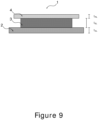
- a dermal patch (1) comprising a silicone elastomer (3) comprising glycerol, octenidine and at least one cyclodextrin, wherein the silicone elastomer is according to any embodiment of the second aspect.
- a method of forming a glycerol-in-silicone-pre-elastomer emulsion comprising silicone pre-elastomer, glycerol, octenidine and at least one cyclodextrin, the method comprising:
- the glycerol-in-silicone-pre-elastomer emulsion is an emulsion according to any embodiment of the first aspect.
- a method of forming a silicone elastomer comprising polymerizing a glycerol-in-silicone-pre-elastomer emulsion comprising silicone pre-elastomer, glycerol, octenidine and at least one cyclodextrin.
- the glycerol-in-silicone-pre-elastomer emulsion is a glycerol-in-silicone-pre-elastomer emulsion according to any embodiment of the first aspect.
- a molecular 1:1 -complex of octenidine dihydrochloride and ⁇ -cyclodextrin in preferred embodiments, is solubilized in glycerol. Further, there is disclosed the use of a molecular 1:1-complex of octenidine dihydrochloride and ⁇ -cyclodextrin in the emulsions, silicone elastomers and dermal patches according to any of the first to sixth aspects and embodiments thereof.
- silicone elastomers comprising a micellar glycerol phase dissolving the hydrophilic active substances.
- the silicone pre-elastomers are generally silicone oligomers and polymers, which are crosslinked to form the silicone matrix by curing as defined above.
- silicone pre-elastomers may also comprise silicone monomers, which undergo polymerization in addition to curing to form the silicone matrices of the present invention.
- cyclodextrins in some circumstances can be suitable for masking the tested active substance without interfering with the polymerization process of silicone pre-elastomer in emulsions with glycerol.
- solid hydrophobic active substances comprising at least one element selected from N, S, and P, which form a reversible complex with cyclodextrins, in particular ⁇ -cyclodextrin, whereby Pt catalysts present in the emulsions of the invention for curing the silicone pre-elastomer were protected from catalytic poisoning by the active substance, but without influencing total active substance delivery or active substance delivery rates.
- cyclodextrin partitions at least partially at the silicone/glycerol interface thus serving as a surfactant in relation to investigated emulsified systems comprising silicone pre-elastomer and glycerol, surprisingly providing improvements to the stability of the glycerol-in-silicone-pre-elastomer emulsions prior to polymerization (c.f. Figure 5 ); in addition to solubilizing and masking active substances comprising atoms such as nitrogen, sulfur or phosphorus, which may participate in catalyst poisoning.
- a glycerol-in-silicone-pre-elastomer emulsion comprising a silicone pre-elastomer, glycerol, a cyclodextrin, and a metal catalyst suitable for use in the polymerization of the silicone pre-elastomer. Further, the emulsion comprises octenidine.
- the cyclodextrin can be selected from ⁇ , ⁇ , or ⁇ -cyclodextrin or derivatives thereof, such as e.g. methylated cyclodextrin (c.f. Figure 3 ).
- a particularly preferred embodiment of the previously filed invention there is disclosed a glycerol-in-silicone-pre-elastomer emulsion according to any of the embodiments disclosed, wherein the cyclodextrin is ⁇ -cyclodextrin.
- glycerol-in-silicone-pre-elastomer emulsion according to any of the embodiments disclosed herein, wherein the metal catalyst is either Sn or Pt, preferably, wherein the metal catalyst is Pt.
- a silicone elastomer comprising glycerol, octenidine and a cyclodextrin, preferably a silicone elastomer formed by polymerization of an emulsion according to any of the embodiments disclosed.
- octenidine notably octenidine dihydrochloride (c.f. Figure 4 )
- octenidine dihydrochloride has several advantages as a dermal antiseptic, in particular efficacy and (very) limited passage of the dermal barrier, however successful formulations in dermal patches, and in particular in dermal patches comprising a silicone elastomer, are not yet available in the marketplace.
- Some drawbacks of the formulations suggested in the prior art include inadequate delivery kinetics, including burst delivery and fast octenidine depletion, lack of long-term delivery of octenidine and others.
- the improvements presented herein by the present inventors comprise dermal silicone patches comprising octenidine which can, inter alia, be formulated to allow zero-order or near-zero order release of octenidine over a substantial period of time, thereby avoiding burst effects and maintaining an active concentration of octenidine at a wound site during a substantial period of the time necessary for wound healing.
- silicone emulsions and silicone polymers suitable for use in forming such dermal patches of the invention are detailed herein as well as suitable methods for forming the objects of the present invention.
- a glycerol-in-silicone-pre-elastomer emulsion and embodiments thereof, the glycerol-in-silicone-pre-elastomer emulsion according to the invention comprising silicone pre-elastomer, glycerol, at least one cyclodextrin, and octenidine.
- a silicone pre-elastomer suitable for use with the invention may itself be a liquid, or it may comprise liquefying agents, such as e.g. silicone oils, permitting it to become comprised in the emulsions of the invention.
- the silicone pre-elastomer is a two-component silicone pre-elastomer which, when crosslinked, form the silicone elastomer of the invention.
- Such two-component silicone pre-elastomers are commercially available from a variety of manufacturers, the two-component silicone pre-elastomers having pretailored properties which, upon crosslinking, allow the formation of silicone elastomers which are known to be particularly suited for active substance release, such as e.g. for dermal or transdermal active substance release.
- the silicone pre-elastomer is a two-component silicone pre-elastomer.
- the actual composition and formulation of the silicone elastomeric matrix is considered outside the scope of the present invention. It is necessary, as discussed above, that the silicone pre-elastomer supports emulsion formation with glycerol and subsequent polymerization to form silicone elastomers comprising glycerol.
- Non-limiting examples of commercially available silicone pre-elastomers suitable for use with the present invention comprise, as of the date of filing, PDMS pre-elastomers including Sylgard ® 184 from Dow Corning and Elastosil ® RT625 from Wacker Chemie, Germany, and as used in the experiments presented herein the two-component pressure sensitive silicone adhesive MG7-9900 from Dow Corning, which is a di-vinyl-terminated polydimethylsiloxane pre-elastomer comprising a crosslinker as well as a Pt catalyst.
- silica is present as a reinforcing agent.
- the silicone pre-elastomer may be selected from the group comprising pre-elastomers of methylsilicone elastomers, phenylsilicone elastomers, chloroalkylsilicone elastomers and fluoro-silicone elastomers or combinations thereof.
- the silicone pre-elastomer may be selected from the group comprising pre-elastomers of polyalkylsiloxanes, preferably polydimethyl-siloxane (PDMS) and derivatives thereof.
- PDMS pre-elastomers include vinyl-functional PDMS pre-elastomer crosslinkable with hydridefunctional crosslinking agents, or hydroxyl-functional PDMS pre-elastomer crosslinkable in the presence of Sn or Pt.
- the silicone pre-elastomer may be an elastomeric composition suitable for use with the present invention.
- the silicone pre-elastomer may be an elastomeric composition suitable for use with the present invention, wherein the silicone pre-elastomer is a chlorosilicone pre-elastomer.
- suitable chlorosilicone pre-elastomers are chloroalkyl-based chlorosilicone pre-elastomers, compositions from chloromethyl-terminated polydimethyl-siloxanes (e.g. DMS-L21 from Gelest) or chlorosilicone elastomers as disclosed in WO 2015/043792 .
- the silicone pre-elastomer may be an elastomeric composition suitable for use with the present invention, wherein the silicone pre-elastomer is a fluorosilicone pre-elastomer.
- fluorosilicone pre-elastomers are of the Silastic ® F-LSR range of elastomers from Dow Corning, the FE/FEA series from ShinEtsu silicones, Krytox from DuPont, or the Elastosil ® FLR series from Wacker Chemie.
- the elastomeric composition further comprises one or more excipients selected from the group consisting of active substances, in particular active substances for human or animal use, in particular drugs, and/or from catalysts, inhibitors, flow agents, silicone oils, solvents, fillers, blowing agents, reinforcing substances, and plasticizers.
- one or more excipients can be selected from the group consisting of catalysts, such as Pt complexes (addition curing), Sn (condensation curing), peroxide (peroxide curing) and inhibitors, such as divinyltetramethyldisiloxane and 1,3,5,7-tetravinyl-1,3,5,7-tetramethylcyclotetrasiloxane.
- catalysts such as Pt complexes (addition curing), Sn (condensation curing), peroxide (peroxide curing)
- inhibitors such as divinyltetramethyldisiloxane and 1,3,5,7-tetravinyl-1,3,5,7-tetramethylcyclotetrasiloxane.
- SID4613.0 (1,3-divinyltetramethyldisiloxane) and SIT7900.0 (1,3,5,7-tetravinyl-1,3,5,7-tetramethylcyclotetrasiloxane) from Gelest Inc.
- the silicone pre-elastomer comprises a metal catalyst suitable for use in the polymerization of the silicone pre-elastomer.
- the metal catalyst is either Sn or Pt, most preferably Pt.
- the elastomeric composition may further comprise one or more excipients selected from the group consisting of fillers, reinforcing substances, and plasticizers, such as e.g. plasticizer oils for reducing the melt viscosity of the elastomer during its processing, for example, mineral oils comprising known quantities of, active fillers (e.g. zinc oxide and stearic acid), inactive fillers (such as carbon black, titanium dioxide, silica, carbonates, kaolin, clay and talc), or resins such as Vinyl Q resins from Gelest Inc.
- plasticizers such as e.g. plasticizer oils for reducing the melt viscosity of the elastomer during its processing, for example, mineral oils comprising known quantities of, active fillers (e.g. zinc oxide and stearic acid), inactive fillers (such as carbon black, titanium dioxide, silica, carbonates, kaolin, clay and talc), or resins such as Vinyl Q resins from Gelest Inc.
- plasticizers such
- the amount of excipient necessary can be varied independently depending on the elastomeric composition in question, but usually is in the range from 0 to 40% by weight, such as from 5 to 30% by weight, such as from 10 to 25% by weight of the elastomeric composition.
- the elastomeric composition may further comprise an excipient selected from the group consisting of flow agents, silicone oils and solvents.
- an excipient selected from the group consisting of flow agents, silicone oils and solvents.
- Commercially available examples thereof include silicone oil WACKER ® AK SILICONE FLUID or a solvent such as OS-20 from Dow Corning ® .
- Other suitable examples are e.g. low molecular weight cyclics, such as e.g. cyclomethicone (D4-D6).
- the elastomeric composition comprises as excipient at least one blowing agent.
- the at least one blowing agent is present in an amount in the range from 0.1 to 10 phr, such as from 0.2 to 8 phr, such as from 0.3 to 6 phr, such as from 0.4 to 5 phr, such as from 0.5 to 4 phr, such as from 0.6 to 3 phr, such as from 0.7 to 2 phr, such as from 0.8 to 1.5 phr, or such as from 0.9 to 1 phr.
- the at least one blowing agent in present in an amount less than from 1 phr, such as less than from 0.9 phr, such as less than from 0.8 phr.
- the blowing agent is a base.
- inorganic bases such as NaOH, KOH, and LiOH
- amine based compounds such as triethanolamine, ethanolamine, triethylamine, ethylamine, methylamine, polyetheramines (such as JeffAmines ® commercially available from Huntsman); and phosphazene bases such as BEMP (2-tert-Butylimino-2-diethylamino-1,3-dimethylperhydro-1,3,2-diazaphosphorine), and P1-t-Bu (N,N,N',N',N",N"-hexamethyl-N′′′-(2-methyl-2-propanyl) phosphorimidic triamide).
- a glycerol-in-silicone-pre-elastomer emulsion wherein the at least one cyclodextrin is selected from at least one of ⁇ , ⁇ , ⁇ -cyclodextrin or derivatives thereof.
- the at least one cyclodextrin comprised in the emulsion is ⁇ -cyclodextrin.
- the at least one cyclodextrin is hydroxy-propyl cyclodextrin (HPCD).
- a silicone elastomer comprising glycerol, octenidine and a cyclodextrin, preferably a silicone elastomer formed by polymerization of a glycerol-in-silicone-pre-elastomer emulsion according to any of the embodiments disclosed herein.
- a glycerol-in-silicone-pre-elastomer emulsion wherein octenidine is octenidine dihydrochloride.
- the octenidine is octenidine dihydrochloride and the cyclodextrin is ⁇ -cyclodextrin.
- octenidine dihydrochloride forms a complex with ⁇ -cyclodextrin which, based on the data, is consistent with the complex being a 1:1 molecular complex.
- the 1:1-complex of octenidine dihydrochloride and ⁇ -cyclodextrin can e.g. be formed by heating octenidine dihydrochloride and ⁇ -cyclodextrin in glycerolic solution to a temperature from 50°C to 90°C under stirring until a clear solution results.
- the temperature is 80°C.
- the present application further relates to a molecular 1:1-complex of octenidine dihydrochloride and ⁇ -cyclodextrin, in particular to a molecular 1:1-complex of octenidine dihydrochloride and ⁇ -cyclodextrin in glycerol.
- the present invention further relates to the use of such molecular complexes in the glycerol-in-silicone-pre-elastomer emulsions, elastomers and dermal patches of the present invention.
- cyclodextrin and octenidine are dissolved in glycerol prior to the addition of silicone pre-elastomer.
- cyclodextrin and octenidine are present as a 1:1 molecular complex in glycerol, more preferably ⁇ -cyclodextrin and octenidine are present as a 1:1 molecular complex in glycerol, and even more preferably, ⁇ -cyclodextrin and octenidine dihydrochloride are present as a 1:1 molecular complex in glycerol.
- the concentration of glycerol in the emulsion is from 20 phr to 150 phr, preferably from 30 to 140 phr, from 40 phr to 130 phr, from 50 phr to 120 phr, from 60 phr to 110 phr, from 70 phr to 100 phr, or from 80 phr to 90 phr.
- the release kinetics approaches near-zero order for small active substances, and when the concentration of glycerol is from about 20 phr to about 70 phr, the release kinetics follows a first-order release mechanism.
- the various emulsions, silicone elastomers and dermal patches were formulated to show first order release and hence had a glycerol content from 20 phr to 70 phr, notably 40 phr and 60 phr.
- a glycerol-in-silicone-pre-elastomer emulsion comprise a glycerol content from 20 phr to 70 phr, preferably from 30 phr to 60 phr, or from 40 phr to 50 phr for use in forming a silicone elastomer wherein octenidine release follows first order release kinetics.
- a glycerol-in-silicone-pre-elastomer emulsion comprise a glycerol content from 70 phr to 100 phr, preferably from 75 phr to 95 phr, or from 80 phr to 85 phr for use in forming a silicone elastomer wherein octenidine release follows near-zero order release kinetics.
- a glycerol-in-silicone-pre-elastomer emulsion comprise a glycerol content from 100 phr to 150 phr, preferably from 110 phr to 140 phr, or from 120 phr to 130 phr for use in forming a silicone elastomer wherein octenidine release follows zero order release kinetics.
- the concentration of octenidine in the emulsion is from 0.1 wt% to 6 wt% based on total mass of emulsion.
- the concentration of octenidine in the emulsion is from 0.3 wt% to 5.5 wt% based on total mass of emulsion, from 0.6 wt% to 5 wt%, from 1 wt% to 4.5 wt%, from 1.5 wt% to 4 wt%, from 2 wt% to 3.5 wt%, or from 2.5 wt% to 3 wt% based on the total mass of emulsion.
- octenidine is octenidine dihydrochloride and the concentration of octenidine dihydrochloride in the emulsion is from 0.1 wt% to 6 wt% based on total mass of emulsion.
- the concentration of octenidine in the emulsion is from 0.3 wt% to 5.5 wt% based on total mass of emulsion, from 0.6 wt% to 5 wt%, from 1 wt% to 4.5 wt%, from 1.5 wt% to 4 wt%, from 2 wt% to 3.5 wt%, or from 2.5 wt% to 3 wt% based on the total mass of emulsion.
- the concentration of the at least one cyclodextrin in the glycerol-in-silicone-pre-elastomer emulsion is from 0.1 wt% to 6 wt% based on total mass of emulsion.
- the concentration of cyclodextrin in the emulsion is from 0.3 wt% to 5.5 wt% based on total mass of emulsion, from 0.6 wt% to 5 wt%, from 1 wt% to 4.5 wt%, from 1.5 wt% to 4 wt%, from 2 wt% to 3.5 wt%, or from 2.5 wt% to 3 wt% based on the total mass of emulsion.
- the at least one cyclodextrin is ⁇ -cyclodextrin and the concentration of ⁇ -cyclodextrin in the emulsion is from 0.1 wt% to 6 wt% based on total mass of emulsion.
- the concentration of octenidine in the emulsion is from 0.3 wt% to 5.5 wt% based on total mass of emulsion, from 0.6 wt% to 5 wt%, from 1 wt% to 4.5 wt%, from 1.5 wt% to 4 wt%, from 2 wt% to 3.5 wt%, or from 2.5 wt% to 3 wt% based on the total mass of emulsion.
- the molar ratio of octenidine to cyclodextrin preferably the molar ratio of octenidine dihydrochloride to ⁇ -cyclodextrin, in the emulsion is from 4:1 to 1:1.5, preferably from 3:1 to 1:1.5.
- the molar ratio of octenidine to cyclodextrin in the emulsion is from 4:1 to 3:1, from 2.5:1 to 1:1.4, from 2:1 to 1:1.3, from 1.5:1 to 1:1.2, from 1.3:1 to 1:1.1, or 1:1.
- the emulsion comprises silicone pre-elastomer, from 20 phr to 150 phr glycerol based on silicone pre-elastomer mass, and from 0.1 wt% to 6 wt% of octenidine and from 0.1 wt% to 6 wt% of cyclodextrin based on total mass of emulsion.
- a silicone elastomer comprising glycerol, octenidine and at least one cyclodextrin.
- the silicone elastomer is a silicone elastomeric matrix for comprising glycerol in the form of a glycerolic phase in accordance with the prior art, preferably for comprising a glycerolic phase comprising octenidine and at least one cyclodextrin.
- the glycerolic phase may be present as discontinuous droplets or as a bicontinuous phase.
- the silicone elastomers according to this further aspect of the present invention are formed by polymerization of a glycerol-in-silicone-pre-elastomer emulsion according to any of the embodiments detailed with the present disclosure.
- silicone elastomers formed from the emulsions disclosed herein form silicone elastomeric matrices that reliably release octenidine and further are suitable for forming dermal patches in accordance with the aims and goals of the present invention.
- the silicone elastomers of the invention can be formed from the glycerol-in-silicone-pre-elastomer emulsions of the invention by polymerization of the emulsion at a polymerization temperature and for a polymerization time suitable for obtaining a polymerized emulsion.
- the polymerization time is from 1 minute to 120 minutes, preferably from 2 minutes to 90 minutes, from 3 minutes to 60 minutes, from 4 minutes to 50 minutes, from 5 minutes to 40 minutes, from 6 minutes to 30 minutes, from 7 minutes to 20 minutes, from 8 minutes to 17 minutes, from 9 minutes to 15 minutes, or from 10 minutes to 12 minutes.
- the polymerization temperature is from 50°C to 90°. It is within the skills of the person in the art to obtain suitable combinations of polymerization time and temperature for a given silicone pre-elastomer comprised in the emulsions of the present invention.
- the emulsion comprises a low temperature polymerization inhibitor, whereby polymerization and/or curing can be performed at a temperature above 90°C, such as above 100°C, above 110°, or even above 120°C. This can be advantageous where rapid silicone matrix formation is desired. If necessary, further guidance to the conditions of the polymerization can be obtained from WO 2016/189117 A1 .
- a dermal patch (1) comprising a silicone elastomer (3) comprising glycerol, octenidine and at least one cyclodextrin.
- the silicone elastomer is a silicone elastomeric matrix for comprising glycerol, octenidine and at least one cyclodextrin.
- Dermal patches are well known in the art and the construction of a dermal patch in accordance with the art is not part of the present invention. Rather, it is considered that the skilled person, when in possession of the information disclosed herein, can prepare a dermal patch according to his various needs.
- the dermal patch is a wound care device, such as a wound dressing.
- a dermal patch (1) comprising a silicone elastomer (3) comprising glycerol, octenidine and at least one cyclodextrin, wherein the silicone elastomer is according to any of the aspects and embodiments detailed in the present disclosure.
- a dermal patch (1) comprising a silicone elastomer (3) comprising glycerol, octenidine and at least one cyclodextrin, wherein the silicone elastomer is formed from a glycerol-in-silicone-pre-elastomer emulsion according to any of the aspects and embodiments detailed herein.
- a dermal patch (1) comprising a silicone elastomer (3) according to any of the aspects and embodiments detailed in the present disclosure, wherein the silicone elastomer releases octenidine at a dose rate of at least 0.1 ⁇ g/cm 2 /hour.
- the silicone elastomer of the invention releases octenidine at a dose rate of at least 0.3 ⁇ g/cm 2 /hour, at least 0.5 ⁇ g/cm 2 /hour, at least 0.8 ⁇ g/cm 2 /hour, at least 1 ⁇ g/cm 2 /hour, at least 1.3 ⁇ g/cm 2 /hour, at least 1.5 ⁇ g/cm 2 /hour, at least 1.8 ⁇ g/cm 2 /hour, at least 2 ⁇ g/cm 2 /hour, at least 2.3 ⁇ g/cm 2 /hour, at least 2.5 ⁇ g/cm 2 /hour, at least 2.8 ⁇ g/cm 2 /hour, at least 3 ⁇ g/cm 2 /hour, at least 3.3 ⁇ g/cm 2 /hour, at least 3.5 ⁇ g/cm 2 /hour, at least 3.8 ⁇ g/cm 2 /hour, at least 4 ⁇ g/cm
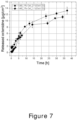
- the examined dermal patches released octenidine at rates from between about 0.2 ⁇ g/cm 2 /hour (0.3 wt% octenidine dihydrochloride, 2:1 molar ratio OCT: ⁇ CD) to about 4.1 ⁇ g/cm 2 /hour (3 wt% octenidine dihydrochloride, 2:1 molar ratio OCT: ⁇ CD) when measured during the initial constant release phase for the examined dermal patches (c.f. Figures 6-8 ).
- the observed total release of octenidine for all the dermal patches observed were in sufficient amounts to obtain an antiseptic effect against the common bacteria given in Table 1.
- the silicone elastomer is present in the dermal patch as a layer (3) of silicone elastomer having a thickness (t EL ) from 0.05 mm to 5 mm.
- the thickness (t EL ) is the thickness of the silicone elastomer measured perpendicular to the direction of intended application in accordance with known practices in the art of dermal patches.
- the dermal patches prepared for investigation in the experiments reported below have a thickness (t EL ) of 0.35 mm, which is a common thickness for many patches in dermal drug delivery.
- the thickness (t EL ), as is well known in the art, is routinely varied by the skilled person to adjust the reservoir content of the active substance, and is in general considered outside the context of the present invention.
- the thickness (t EL ) is from 0.05 mm to 2 mm, from 0.1 mm to 1.5 mm, from 0.2 mm to 1.3 mm, from 0.3 mm to 1 mm, from 0.4 mm to 0.9 mm, from 0.5 mm to 0.8 mm or from 0.6 mm to 0.7 mm.
- the silicone elastomer (3) is provided with a removable layer (4) formed by an inert plastic.
- the silicone elastomer (3) is provided with a support layer (2) formed by an inert plastic.
- the removable layer (4) and the support layer (2) are arranged opposite with respect to the silicone elastomer and interspaced by the thickness (t EL ) of the silicone elastomer, as is customary in the art of dermal patches.
- the support layer (2) may comprise an adhesive layer for contacting and adhering the silicone elastomer (3) to the support layer (2).
- the element of a dermal patch comprising the active substance is itself an adhesive as this may be disadvantageous for e.g. the wound healing of open wounds.
- the silicone elastomers of the present invention may be adhesive as well as non-adhesive towards the skin of mammals, particular towards human skin, as is required by the circumstances of their use.
- a method of forming a glycerol-in-silicone-pre-elastomer emulsion comprising silicone pre-elastomer, glycerol, octenidine and at least one cyclodextrin, the method comprising:
- Optimal temperatures of complexation of octenidine and cyclodextrin under ii. range from 50°C to 90°C, with 80°C being optimal. Below 50°C the complexation of octenidine and cyclodextrin is slow. It is generally preferable to mix the constituents prior to heating as detailed in the above method, however, it is possible to add octenidine and cyclodextrin directly to hot glycerol if desired.
- the resulting clear solution is of (ii.) is cooled to from 5°C to 50°C prior to adding the silicone pre-elastomer.
- this step can be omitted, however when the glycerol content is high and e.g. a mixing temperature of 80°C has been used, some unwanted heat-initiated polymerization of the silicone pre-elastomer can occur, which is avoided by prior cooling.
- the emulsion comprises a low temperature polymerization inhibitor, whereby polymerization and/or curing can be performed at a temperature above 90°C, such as above 100°C, above 110°, or even above 120°C. This can be advantageous where rapid silicone matrix formation is desired.
- the emulsion is an emulsion according to any of the aspects and embodiments of the present invention detailed herein.
- a method of forming a silicone elastomer comprising polymerizing a glycerol-in-silicone-pre-elastomer emulsion comprising silicone pre-elastomer, glycerol, octenidine and at least one cyclodextrin.
- the silicone elastomer is a silicone elastomeric matrix for comprising glycerol, octenidine and at least one cyclodextrin.
- the glycerol-in-silicone-pre-elastomer emulsion is an emulsion according to any of the aspects and embodiments of the present invention detailed herein.
- the glycerol-in-silicone-pre-elastomer emulsion has been formed according to a method in accordance with any of the aspects and embodiments of the present invention detailed herein.
- polymerization of the glycerol-in-silicone-pre-elastomer emulsion is from 1 minute to 120 minutes, preferably from 2 minutes to 90 minutes, from 3 minutes to 60 minutes, from 4 minutes to 50 minutes, from 5 minutes to 40 minutes, from 6 minutes to 30 minutes, from 7 minutes to 20 minutes, from 8 minutes to 17 minutes, from 9 minutes to 15 minutes, or from 10 minutes to 12 minutes.
- polymerization of the glycerol-in-silicone-pre-elastomer emulsion is at a polymerization temperature from 50°C to 90°.
- the emulsion comprises a low temperature polymerization inhibitor, whereby polymerization and/or curing can be performed at a temperature above 90°C, such as above 100°C, above 110°, or even above 120°C. This can be advantageous where rapid silicone matrix formation is desired.
- the method further comprises providing a removable layer (4) formed from an inert plastic onto the silicone elastomer (3) oppositely of the support layer (2).
- the method further comprises polymerizing the glycerol-in-silicone-pre-elastomer emulsion from 1 minute to 120 minutes, preferably from 2 minutes to 90 minutes, from 3 minutes to 60 minutes, from 4 minutes to 50 minutes, from 5 minutes to 40 minutes, from 6 minutes to 30 minutes, from 7 minutes to 20 minutes, from 8 minutes to 17 minutes, from 9 minutes to 15 minutes, or from 10 minutes to 12 minutes.
- the method further comprises polymerizing the glycerol-in-silicone-pre-elastomer emulsion at a polymerization temperature from 50°C to 90°, preferably 80°C.
- the emulsion comprises a low temperature polymerization inhibitor, whereby polymerization and/or curing can be performed at a temperature above 90°C, such as above 100°C, above 110°, or even above 120°C. This can be advantageous where rapid silicone matrix formation is desired.
- the method further comprises cutting the dermal patch (1) to a size from 1 cm 2 to 1000 cm 2 .
- a dermal patch for treating a wound site on the skin of a mammal comprising covering the wound site with a dermal patch (1) comprising octenidine, the dermal patch (1) according to any of the aspects and embodiments detailed herein; the dermal patch (1) releasing octenidine at a dose rate; the dermal patch (1) applied to the wound site for an application time sufficient to release an effective dose of octenidine, the effective dose sufficient to obtain an antiseptic effect on at least one gram-positive or gram-negative bacterium.
- the mammal is a human.
- the at least one gram-positive or gram-negative bacterium is selected from Staphylococcus aureus, Escherichia coli, Proteus mirabilis, Candida albicans, or Pseudomonas aeruginosa.
- the dose rate of octenidine release is at least 0.1 ⁇ g/cm 2 /hour.
- dose rate of octenidine release is at least 0.3 ⁇ g/cm 2 /hour, at least 0.5 ⁇ g/cm 2 /hour, at least 0.8 ⁇ g/cm 2 /hour, at least 1 ⁇ g/cm 2 /hour, at least 1.3 ⁇ g/cm 2 /hour, at least 1.5 ⁇ g/cm 2 /hour, at least 1.8 ⁇ g/cm 2 /hour, at least 2 ⁇ g/cm 2 /hour, at least 2.3 ⁇ g/cm 2 /hour, at least 2.5 ⁇ g/cm 2 /hour, at least 2.8 ⁇ g/cm 2 /hour, at least 3 ⁇ g/cm 2 /hour, at least 3.3 ⁇ g/cm 2 /hour.
- the application time is at least 1 hour.
- the effective dose of octenidine is at least 0.1 ⁇ g/cm 2
- the effective dose rate octenidine is at least 0.3 ⁇ g/cm 2 , at least 0.5 ⁇ g/cm 2 , at least 0.8 ⁇ g/cm 2 , at least 1 ⁇ g/cm 2 , at least 1.3 ⁇ g/cm 2 , at least 1.5 ⁇ g/cm 2 , at least 1.8 ⁇ g/cm 2 , at least 2 ⁇ g/cm 2 , at least 2.3 ⁇ g/cm 2 , at least 2.5 ⁇ g/cm 2 , at least 2.8 ⁇ g/cm 2 , at least 3 ⁇ g/cm 2 , at least 3.3 ⁇ g/cm 2 , at least 3.5 ⁇ g/cm 2 , at least 3.8 ⁇ g/cm 2 , at least 4
- octenidine is octenidine dihydrochloride.
- a dermal patch (1) according to any of herein detailed aspects and embodiments for use in a method according to any of the herein detailed aspects and embodiments, preferably, wherein octenidine is octenidine dihydrochloride and cyclodextrin is ⁇ -cyclodextrin.
- Two-component pressure sensitive silicone adhesive MG7-9900 i.e. divinyl-terminated polydimethylsiloxane comprising a crosslinker as well as a Pt catalyst, was purchased from Dow Corning.
- Glycerol food grade, max. 0.5% water
- ⁇ -cyclodextrin by Wacker Chemie was purchased from Sigma Aldrich.
- Octenidine dihydrochloride was purchased from Dishman Group. All chemicals were used as received.
- a dual asymmetric centrifuge SpeedMixer DAC 150 FVZ-K was used for mixing of all compounds.
- a Leica DM LB optical microscope was applied for investigation of glycerol in silicone emulsion morphology.
- the two-component MG7-9900 silicone kit was mixed in ratio 1:1 by weight as recommended by the manufacturer. Subsequently the desired amount of glycerol and where relevant, ⁇ -cyclodextrin and octenidine, was added to the silicone pre-elastomer and stirred with the help of the speed-mixer for 5 minutes at 3500 rpm unless mentioned otherwise until a stable emulsion had formed.
- compositions were cast onto a metal mold with a 1 mm spacer and cured at 80°C for 1 hour. Obtained films were then left at room temperature for at least two days for eventual post-curing to take place.
- Sample G40_1%Oct_2:1(Oct:CD)_MG7-9900 was selected as a model sample and will be used to present the sample preparation procedure in more detail. Mass amounts of individual compounds are listed in Table 3. Table 3. Mass amounts of individual compounds used for preparing sample G40_1%Oct_2:1(Oct:CD)_ MG7-9900. Material Mass MG7-9900 part A 12.5 g MG7-9900 part B 12.5 g Glycerol 10 g Octenidine 0.35 g ⁇ -cyclodextrin 0.3182
- Emulsion 1 Continuous phase of the glycerol-in-silicone-pre-elastomer emulsions - uncured pressure sensitive silicone adhesive MG7-9900 from Dow Corning. Dispersed phase - glycerol (40 phr).
- Emulsion 2 Continuous phase of the glycerol-in-silicone-pre-elastomer emulsions - uncured pressure sensitive silicone adhesive MG7-9900 from Dow Corning. Dispersed phase - glycerol (40 phr) with 3 wt% of ⁇ -cyclodextrin and 3 wt% of a pirtenidine-derivative (weight-percentages based on total composition).
- Average droplet size was calculated based on analysis of at least 100 adjacent glycerol domains in both emulsions.
- the experiments ( Fig. 4 ) revealed that the average droplet diameter 10 minutes after mixing is 16.0 ⁇ m ( ⁇ 4.9 ⁇ m) and 9.3 ⁇ m ( ⁇ 2.4 ⁇ m) for Emulsion 1 and Emulsion 2, respectively.
- the data show that cyclodextrin, particularly ⁇ -cyclodextrin, partition itself also at the interface between glycerol and silicone pre-elastomer and hence in relation to the present compositions serve as stabilizing surfactants on the emulsions resulting from mixing of the components.
- Octenidine is an amphiphilic substance therefore its solubility in glycerol is negligible, but may form micelles for higher solubility.
- ⁇ -cyclodextrin ⁇ CD
- Cyclodextrins as cyclic oligosaccharides that form host-guest complexes with hydrophobic molecules thereby enabling multiple potential uses.
- octenidine (0.35 g)
- ⁇ -cyclodextrin (0.3182 g) were added to glycerol.
- the molar ratio between octenidine and ⁇ -cyclodextrin in the example was 2:1.
- the mixture was heated up to 80°C and agitated using a magnetic stirrer until a clear solution was obtained (usually no longer than 30 minutes). Obtaining a clear mixture is indicative of successful preparation of a ⁇ CD-octenidine complex.
- the mixture containing glycerol and ⁇ CD-octenidine complex was put into a plastic container. Subsequently 12.5 g of MG7-9900 part A and 12.5 g of MG7-9900 part B were added. The composition was mixed using a dual asymmetric centrifuge Speed-Mixer Dac 150 FVZ-K for 5 minutes at 3500 revolutions per minute (rpm). In this way a glycerol-in-silicone-pre-elastomer emulsion was prepared. The emulsion was cast onto an inert plastic support and spread using a commercial knife to form 350 ⁇ m thick films (t EL ). Subsequently the material was placed in an oven for 1 hour at 80°C. Afterwards the resulting polymerized dermal patches were cut into 25 cm 2 square samples, while being still attached to the support. The resulting dermal patches showed good surface adhesiveness with respect to adhesion over time and ease of release from the surface after use.
- Release profiles of octenidine from the polymerized dermal patches were determined by immersing the samples in 200 ml of deionized water. The progress of octenidine release was monitored by measuring changes in concentration of octenidine in the aqueous environment. A UV-vis spectrophotometer, POLARstar Omega microplate reader by BMG LabTech was used for the tests, and outcomes were compared against a calibration curve for ⁇ CD-octenidine-complex in water solutions. Each release profile curve represents an average of three separate experiments. The samples were tested in tightly sealed containers (placed on a rotary shaker) in order to avoid water evaporation. Release profiles of various samples are presented as plots of released octenidine in ⁇ g/cm 2 as a function of time.
- Emulsion 1 Continuous phase of the emulsions - uncured pressure sensitive silicone adhesive MG7-9900 from Dow Corning. Dispersed phase - glycerol (40 phr).
- Emulsion 2 Continuous phase of the emulsions - uncured pressure sensitive silicone adhesive MG7-9900 from Dow Corning. Dispersed phase - glycerol (40 phr) with 3 wt% of ⁇ -cyclodextrin and 3 wt% of octenidine (weight-percentages based on total composition).
- Average droplet size was calculated based on analysis of at least 100 adjacent glycerol domains in both emulsions.
- the experiments revealed that the average droplet diameter 10 minutes after mixing is 16.0 ⁇ m ( ⁇ 4.9 ⁇ m) and 9.3 ⁇ m ( ⁇ 2.4 ⁇ m) for Emulsion 1 and Emulsion 2, respectively.
- the data show that ⁇ -cyclodextrin partitions itself in the glycerolic phase and also at the interface between glycerol and silicone pre-elastomer and that hence, in relation to the present compositions, serve as a stabilizing surfactant on the emulsions resulting from mixing of the components.
- Dermal patches comprising 0.3, 1 and 3 wt% of octenidine were investigated.
- the molar ratio between octenidine and ⁇ CD was kept constant at 2:1 (2 molecules of octenidine per one molecule of ⁇ CD). Release profiles presented in Figure 6 clearly indicate that the drug dose delivered from different dermal patches increases with increasing octenidine content as expected.
- the release of octenidine to water from dermal patches comprising octenidine to ⁇ -cyclodextrin in a 2:1 ratio is slightly faster than the release from the 1:1 composition and without substantial changes to the release kinetics between the two compositions.
- the data appear consistent with an assumption that octenidine and ⁇ -cyclodextrin form a 1:1 complex, wherein the 1:1 complex dominates the diffusion and release properties for the overall silicone elastomer.
- optimal formulations of octenidine to ⁇ -cyclodextrin should be formulated having a molar ratio of these two components close to 1:1 or lower, preferably, 1:1.1, 1:1.2, 1:1.3, 1:1.4 or even 1:1.5.
- octenidine will be complexed with ⁇ -cyclodextrin (the latter being in surplus), whereby substantially all of octenidine will be available for release via the faster octenidine- ⁇ CD-complex release mechanism, compared to the slower release-rate for octenidine that is not part of an octenidine- ⁇ CD-complex.
- octenidine in surplus to ⁇ -cyclodextrin such as e.g. in a molar ratio of 3:1, 2.5:1, 2:1, or even 1.5:1 surplus, has the advantage that the overall release of octenidine from the dermal patch is increased due to availability of octenidine for release via secondary release mechanisms.
- Samples with 40 and 60 phr (weight parts per hundred weight parts of silicone rubber) of glycerol were prepared and investigated.
- the octenidine and ⁇ -cyclodextrin amounts in the membranes were kept constant at 1 wt% with octenidine and ⁇ -cyclodextrin present in a 2:1 molar ratio.
- the release rates appear comparable however after around 5 hours the difference becomes substantial.
- the present inventors consider, without being bound to such a theory, that this is due to wall thinning in the polymerized silicone matrix, wherein passage of the silicone matrix walls by octenidine and/or the octenidine- ⁇ -cyclodextrin-complex is rate limiting.
- octenidine will be in surplus compared to cyclodextrin, thereby increasing delivery rates, with octenidine not complexed with a cyclodextrin serving as a long-term reservoir for slow-released octenidine from the dermal patch.
- cyclodextrin will be in surplus for fast delivery of octenidine and rapid depletion of the dermal patch of octenidine.
- silicone elastomeric matrices comprising 40 phr or 60 phr of glycerol have a micellar structure (compare Figures 1 and 5 ), whereas silicone elastomeric matrices comprising above 100 phr of glycerol are bicontinuous in both the silicone elastomer phase and the glycerolic phase.
- delivery rates of small hydrophilic active substances from discrete micellar structures below about 70 phr glycerol follow first-order release kinetics, from about 70 phr glycerol to about 100 phr glycerol, the delivery of small hydrophilic active substances follow near-zero release kinetics, and above about 100 phr glycerol, such as at 120 phr, the release of small active hydrophilic substances follow zero-order release kinetics.
- the presently presented release data are consistent with the previously made observations in that the release data show first order release kinetics as expected for glycerol contents below about 70 phr.
- the initial emulsions will be prepared with a glycerol content below 70 phr, whereby a micellar structure of glycerol in polymerized silicone elastomer is created; in other embodiments the glycerol content will be above 100 phr, whereby a bicontinuous emulsion and polymerized silicone elastomer is created.
- Embodiments wherein octenidine is in surplus to cyclodextrin and/or wherein the glycerol content is below 70 phr are beneficially applicable e.g. where dermal patches cannot easily be exchanged.
- Embodiments wherein octenidine is present in molar ratios lower than cyclodextrin and/or wherein the glycerol content is above 100 phr are beneficially applicable e.g. where the dermal patch is intended for short-term use only, or combined with frequent replacement, or where one-time skin coverage with the dermal patch is intended only during early wound healing.
Landscapes
- Health & Medical Sciences (AREA)
- Chemical & Material Sciences (AREA)
- Medicinal Chemistry (AREA)
- Organic Chemistry (AREA)
- Chemical Kinetics & Catalysis (AREA)
- Polymers & Plastics (AREA)
- Life Sciences & Earth Sciences (AREA)
- General Health & Medical Sciences (AREA)
- Engineering & Computer Science (AREA)
- Animal Behavior & Ethology (AREA)
- Public Health (AREA)
- Veterinary Medicine (AREA)
- Epidemiology (AREA)
- Pharmacology & Pharmacy (AREA)
- Bioinformatics & Cheminformatics (AREA)
- Dermatology (AREA)
- Dispersion Chemistry (AREA)
- Biochemistry (AREA)
- Molecular Biology (AREA)
- Materials Engineering (AREA)
- Biomedical Technology (AREA)
- Heart & Thoracic Surgery (AREA)
- Vascular Medicine (AREA)
- Inorganic Chemistry (AREA)
- Medicinal Preparation (AREA)
- Pharmaceuticals Containing Other Organic And Inorganic Compounds (AREA)
- Compositions Of Macromolecular Compounds (AREA)
Claims (13)
- Glycerol-in-Silicon-Präelastomeremulsion, umfassend ein Silicon-Präelastmer, Glycerol, ein Cyclodextrin und einen Metallkatalysator, der zur Verwendung bei der Polymerisation des Silicon-Präelastmers geeignet ist, und wobei die Emulsion ferner Octenidin umfasst.
- Glycerol-in-Silicon-Präelastomeremulsion gemäß Anspruch 1, wobei das Cyclodextrin ausgewählt ist aus α-, β- und γ-Cyclodextrin und Derivaten davon.
- Glycerol-in-Silicon-Präelastomeremulsion gemäß Anspruch 1 oder Anspruch 2, wobei das Cyclodextrin β-Cyclodextrin ist.
- Glycerol-in-Silicon-Präelastomeremulsion gemäß einem der Ansprüche 1 bis 3, wobei der Metallkatalysator Sn oder Pt ist.
- Emulsion, umfassend Silicon-Präelastomer, Glycerol, wenigstens ein Cyclodextrin und Octenidin.
- Emulsion gemäß Anspruch 5, wobei das wenigstens eine Cyclodextrin ausgewählt ist aus wenigstens einem von α-, β- und γ-Cyclodextrin und Derivaten davon.
- Emulsion gemäß einem der Ansprüche 5 bis 6, wobei Octenidin Octenidindihydrochlorid ist.
- Emulsion gemäß einem der Ansprüche 5 bis 7, wobei die Konzentration von Octenidin in der Emulsion von 0,1 Gew.-% bis 6 Gew.-%, bezogen auf die Gesamtmasse der Emulsion, beträgt.
- Siliconelastomer, umfassend Glycerol und wenigstens ein Cyclodextrin und ferner umfassend Octenidin oder Octenidindihydrochlorid.
- Hautpflaster (1) umfassend ein Siliconelastomer (3), das Glycerol, Octenidin und wenigstens ein Cyclodextrin umfasst, wobei das Siliconelastomer gemäß Anspruch 9 ist.
- Hautpflaster (1) umfassend ein Siliconelastomer (3) gemäß Anspruch 10, wobei das Siliconelastomer Octenidin in einer Dosisrate von wenigstens 0,1 µg/cm2/Stunde freisetzt.
- Verfahren zur Herstellung einer Emulsion, die Silicon-Präelastomer, Glycerol, Octenidin und wenigstens ein Cyclodextrin umfasst, wobei das Verfahren umfasst:i. Mischen von Glycerol, Octenidin und Cyclodextrin;ii. Erhitzen des erhaltenen Gemischs auf eine Temperatur von 50 °C bis 90 °C unter Rühren, bis eine klare Lösung gebildet ist;iii. Zugeben von Silicon-Präelastomer;iv. Anwenden von Scherkraft, bis eine Emulsion gebildet ist.
- Verfahren zur Herstellung eines Siliconelastomers, umfassend Polymerisieren einer Emulsion, die Silicon-Präelastomer, Glycerol, Octenidin und wenigstens ein Cyclodextrin umfasst.
Applications Claiming Priority (3)
| Application Number | Priority Date | Filing Date | Title |
|---|---|---|---|
| EP19174276 | 2019-05-14 | ||
| EP19174565 | 2019-05-15 | ||
| PCT/DK2020/050137 WO2020228917A1 (en) | 2019-05-14 | 2020-05-13 | Elastomeric silicone compositions comprising glycerol, cyclodextrin and octenidine |
Publications (2)
| Publication Number | Publication Date |
|---|---|
| EP3969486A1 EP3969486A1 (de) | 2022-03-23 |
| EP3969486B1 true EP3969486B1 (de) | 2023-07-12 |
Family
ID=70736563
Family Applications (1)
| Application Number | Title | Priority Date | Filing Date |
|---|---|---|---|
| EP20725770.0A Active EP3969486B1 (de) | 2019-05-14 | 2020-05-13 | Elastomere silikonzusammensetzungen mit glycerin, cyclodextrin und octenidin |
Country Status (5)
| Country | Link |
|---|---|
| US (1) | US20220227997A1 (de) |
| EP (1) | EP3969486B1 (de) |
| JP (2) | JP7654566B2 (de) |
| CN (1) | CN113795518B (de) |
| WO (1) | WO2020228917A1 (de) |
Families Citing this family (1)
| Publication number | Priority date | Publication date | Assignee | Title |
|---|---|---|---|---|
| EP4512871A1 (de) * | 2023-08-21 | 2025-02-26 | Glysious ApS | Lagerstabile zweiteilige silikonkits |
Family Cites Families (13)
| Publication number | Priority date | Publication date | Assignee | Title |
|---|---|---|---|---|
| US20070218115A1 (en) * | 2003-10-27 | 2007-09-20 | Bott Richard R | Preparation for Topical Application and Methods of Delivering an Active Agent to a Substrate |
| DE102006020644A1 (de) | 2006-04-28 | 2007-10-31 | Bayer Innovation Gmbh | Antiseptikahaltige Silikonelastomere |
| US9682256B2 (en) | 2006-07-14 | 2017-06-20 | Colgate-Palmolive Company | Methods of making compositions comprising films |
| US7883487B2 (en) | 2008-06-16 | 2011-02-08 | Shantha Totada R | Transdermal local anesthetic patch with injection port |
| DE102009049506A1 (de) * | 2009-10-15 | 2011-04-21 | Schülke & Mayr GmbH | Octenidindihydrochlorid enthaltende Wundauflage zur Anwendung bei der Antiseptik von Kathetereintrittsstellen |
| US20130004586A1 (en) | 2011-06-24 | 2013-01-03 | Vachon David J | Biologically Efficacious Compositions, Articles of Manufacture and Processes for Producing and/or Using Same |
| CN102716104B (zh) * | 2012-06-25 | 2014-05-14 | 武汉纺织大学 | 一种医用有机硅贴片及其制备方法 |
| DE102012019194B4 (de) | 2012-09-24 | 2024-08-01 | Wolfgang Winkelmann | Medizinisches Präparat umfassend einen Träger mit Polyhexanid oder Octenidin |
| FR3006149B1 (fr) | 2013-05-28 | 2016-05-27 | Univ Maine | Composition antimicrobienne a base de silicone |
| WO2015043792A1 (en) | 2013-09-30 | 2015-04-02 | Danmarks Tekniske Universitet | Silicone chain extender |
| WO2016072939A1 (en) * | 2014-11-07 | 2016-05-12 | National University Of Singapore | Formulations comprising antimicrobial agents with hydrophobic moieties and uses thereof |
| WO2016189117A1 (en) * | 2015-05-27 | 2016-12-01 | Danmarks Tekniske Universitet | Silicone elastomers and their preparation and use |
| JP6754193B2 (ja) * | 2016-02-19 | 2020-09-09 | 旭化成ワッカーシリコーン株式会社 | シリコーンゴム粒子分散エマルジョンの製造方法 |
-
2020
- 2020-05-13 CN CN202080033511.7A patent/CN113795518B/zh active Active
- 2020-05-13 WO PCT/DK2020/050137 patent/WO2020228917A1/en not_active Ceased
- 2020-05-13 US US17/611,226 patent/US20220227997A1/en active Pending
- 2020-05-13 EP EP20725770.0A patent/EP3969486B1/de active Active
- 2020-05-13 JP JP2021568174A patent/JP7654566B2/ja active Active
-
2025
- 2025-03-19 JP JP2025045703A patent/JP2025089382A/ja active Pending
Also Published As
| Publication number | Publication date |
|---|---|
| JP2022532895A (ja) | 2022-07-20 |
| JP2025089382A (ja) | 2025-06-12 |
| JP7654566B2 (ja) | 2025-04-01 |
| EP3969486A1 (de) | 2022-03-23 |
| CN113795518A (zh) | 2021-12-14 |
| CN113795518B (zh) | 2023-06-09 |
| US20220227997A1 (en) | 2022-07-21 |
| WO2020228917A1 (en) | 2020-11-19 |
Similar Documents
| Publication | Publication Date | Title |
|---|---|---|
| JP4987211B2 (ja) | 速硬性皮膜形成調合物 | |
| EP1968655B1 (de) | Anpassbarer verband und überzugsmaterial | |
| JP2821497B2 (ja) | 薬物放出性組成物 | |
| EP2800776B1 (de) | Silikonklebstoffzusammensetzung | |
| CN103079604B (zh) | 抗微生物硅酮系创伤敷料 | |
| JP2894738B2 (ja) | 圧力付着性シリコーンエラストマー組成物並びにその使用方法及び使用製品 | |
| US11464889B2 (en) | Antimicrobial-containing silicone lubricious coatings | |
| JP5185259B2 (ja) | 活性成分デリバリー用新規シリコーンフィルム形成剤 | |
| EP1677762A1 (de) | Zusammensetzumg mit kontrollierter freisetzung für die topische applikation und verfahren zur abgabe eines wirkstoffs an ein substrat | |
| JP2025089382A (ja) | グリセロールと、シクロデキストリンと、オクテニジンとを含有するエラストマーシリコーン組成物 | |
| Prabu et al. | Preparation and drug release activity of scaffolds containing collagen and poly (caprolactone) | |
| EP2753303B1 (de) | Silikonummantelte implantate | |
| Lwin et al. | Emerging role of polyethylene glycol on doxycycline hyclate-incorporated Eudragit RS in situ forming gel for periodontitis treatment | |
| CS276258B6 (en) | Process for preparing a pharmaceutical with laminated structure for transdermal administration of active component by zero kinetic order | |
| Huangfu et al. | pH-responsive bilayer hydrogel with synergistic antibacterial/anti-inflammatory effect for infected wound healing | |
| Mazurek et al. | Glycerol–silicone membranes for sustained and controlled topical delivery of antimicrobial and pain‐relief drugs | |
| Andreopoulos et al. | Biomedical silicone elastomers as carriers for controlled release | |
| JP4886929B2 (ja) | 減少されたコールドフローを有する感圧シリコーン接着剤 | |
| Tsoka et al. | Properties of polydimethylsiloxane modified by blending with polyvinylpyrrolidone and a poly (ethylene oxide)-poly (propylene oxide) triblock copolymer | |
| US11739194B2 (en) | Glycerol-silicone elastomers as active matrices with controllable release profiles | |
| EP4512871A1 (de) | Lagerstabile zweiteilige silikonkits | |
| BR102018014329B1 (pt) | Processo para fabricação de hidrogéis de quitosana e goma gelana e aplicações potenciais | |
| WO2026093913A1 (en) | Verteporfin containing silicone topical skin adhesive for wound closure and reduced scarring | |
| EP4727560A2 (de) | Mit molekularem jod infundierte polymere, gegenstände und produkte sowie deren herstellung und verwendung | |
| CN121130173A (zh) | 一种生物缓释支架及其制备方法和应用 |
Legal Events
| Date | Code | Title | Description |
|---|---|---|---|
| STAA | Information on the status of an ep patent application or granted ep patent |
Free format text: STATUS: UNKNOWN |
|
| STAA | Information on the status of an ep patent application or granted ep patent |
Free format text: STATUS: THE INTERNATIONAL PUBLICATION HAS BEEN MADE |
|
| PUAI | Public reference made under article 153(3) epc to a published international application that has entered the european phase |
Free format text: ORIGINAL CODE: 0009012 |
|
| STAA | Information on the status of an ep patent application or granted ep patent |
Free format text: STATUS: REQUEST FOR EXAMINATION WAS MADE |
|
| 17P | Request for examination filed |
Effective date: 20211214 |
|
| AK | Designated contracting states |
Kind code of ref document: A1 Designated state(s): AL AT BE BG CH CY CZ DE DK EE ES FI FR GB GR HR HU IE IS IT LI LT LU LV MC MK MT NL NO PL PT RO RS SE SI SK SM TR |
|
| DAV | Request for validation of the european patent (deleted) | ||
| DAX | Request for extension of the european patent (deleted) | ||
| GRAP | Despatch of communication of intention to grant a patent |
Free format text: ORIGINAL CODE: EPIDOSNIGR1 |
|
| STAA | Information on the status of an ep patent application or granted ep patent |
Free format text: STATUS: GRANT OF PATENT IS INTENDED |
|
| INTG | Intention to grant announced |
Effective date: 20230124 |
|
| GRAS | Grant fee paid |
Free format text: ORIGINAL CODE: EPIDOSNIGR3 |
|
| GRAA | (expected) grant |
Free format text: ORIGINAL CODE: 0009210 |
|
| STAA | Information on the status of an ep patent application or granted ep patent |
Free format text: STATUS: THE PATENT HAS BEEN GRANTED |
|
| AK | Designated contracting states |
Kind code of ref document: B1 Designated state(s): AL AT BE BG CH CY CZ DE DK EE ES FI FR GB GR HR HU IE IS IT LI LT LU LV MC MK MT NL NO PL PT RO RS SE SI SK SM TR |
|
| REG | Reference to a national code |
Ref country code: CH Ref legal event code: EP |
|
| REG | Reference to a national code |
Ref country code: DE Ref legal event code: R096 Ref document number: 602020013698 Country of ref document: DE |
|
| REG | Reference to a national code |
Ref country code: IE Ref legal event code: FG4D |
|
| REG | Reference to a national code |
Ref country code: LT Ref legal event code: MG9D |
|
| REG | Reference to a national code |
Ref country code: NL Ref legal event code: MP Effective date: 20230712 |
|
| REG | Reference to a national code |
Ref country code: AT Ref legal event code: MK05 Ref document number: 1587063 Country of ref document: AT Kind code of ref document: T Effective date: 20230712 |
|
| PG25 | Lapsed in a contracting state [announced via postgrant information from national office to epo] |
Ref country code: NL Free format text: LAPSE BECAUSE OF FAILURE TO SUBMIT A TRANSLATION OF THE DESCRIPTION OR TO PAY THE FEE WITHIN THE PRESCRIBED TIME-LIMIT Effective date: 20230712 |
|
| PG25 | Lapsed in a contracting state [announced via postgrant information from national office to epo] |
Ref country code: GR Free format text: LAPSE BECAUSE OF FAILURE TO SUBMIT A TRANSLATION OF THE DESCRIPTION OR TO PAY THE FEE WITHIN THE PRESCRIBED TIME-LIMIT Effective date: 20231013 |
|
| PG25 | Lapsed in a contracting state [announced via postgrant information from national office to epo] |
Ref country code: ES Free format text: LAPSE BECAUSE OF FAILURE TO SUBMIT A TRANSLATION OF THE DESCRIPTION OR TO PAY THE FEE WITHIN THE PRESCRIBED TIME-LIMIT Effective date: 20230712 |
|
| PG25 | Lapsed in a contracting state [announced via postgrant information from national office to epo] |
Ref country code: IS Free format text: LAPSE BECAUSE OF FAILURE TO SUBMIT A TRANSLATION OF THE DESCRIPTION OR TO PAY THE FEE WITHIN THE PRESCRIBED TIME-LIMIT Effective date: 20231112 |
|
| PG25 | Lapsed in a contracting state [announced via postgrant information from national office to epo] |
Ref country code: SE Free format text: LAPSE BECAUSE OF FAILURE TO SUBMIT A TRANSLATION OF THE DESCRIPTION OR TO PAY THE FEE WITHIN THE PRESCRIBED TIME-LIMIT Effective date: 20230712 Ref country code: RS Free format text: LAPSE BECAUSE OF FAILURE TO SUBMIT A TRANSLATION OF THE DESCRIPTION OR TO PAY THE FEE WITHIN THE PRESCRIBED TIME-LIMIT Effective date: 20230712 Ref country code: PT Free format text: LAPSE BECAUSE OF FAILURE TO SUBMIT A TRANSLATION OF THE DESCRIPTION OR TO PAY THE FEE WITHIN THE PRESCRIBED TIME-LIMIT Effective date: 20231113 Ref country code: NO Free format text: LAPSE BECAUSE OF FAILURE TO SUBMIT A TRANSLATION OF THE DESCRIPTION OR TO PAY THE FEE WITHIN THE PRESCRIBED TIME-LIMIT Effective date: 20231012 Ref country code: LV Free format text: LAPSE BECAUSE OF FAILURE TO SUBMIT A TRANSLATION OF THE DESCRIPTION OR TO PAY THE FEE WITHIN THE PRESCRIBED TIME-LIMIT Effective date: 20230712 Ref country code: LT Free format text: LAPSE BECAUSE OF FAILURE TO SUBMIT A TRANSLATION OF THE DESCRIPTION OR TO PAY THE FEE WITHIN THE PRESCRIBED TIME-LIMIT Effective date: 20230712 Ref country code: IS Free format text: LAPSE BECAUSE OF FAILURE TO SUBMIT A TRANSLATION OF THE DESCRIPTION OR TO PAY THE FEE WITHIN THE PRESCRIBED TIME-LIMIT Effective date: 20231112 Ref country code: HR Free format text: LAPSE BECAUSE OF FAILURE TO SUBMIT A TRANSLATION OF THE DESCRIPTION OR TO PAY THE FEE WITHIN THE PRESCRIBED TIME-LIMIT Effective date: 20230712 Ref country code: GR Free format text: LAPSE BECAUSE OF FAILURE TO SUBMIT A TRANSLATION OF THE DESCRIPTION OR TO PAY THE FEE WITHIN THE PRESCRIBED TIME-LIMIT Effective date: 20231013 Ref country code: FI Free format text: LAPSE BECAUSE OF FAILURE TO SUBMIT A TRANSLATION OF THE DESCRIPTION OR TO PAY THE FEE WITHIN THE PRESCRIBED TIME-LIMIT Effective date: 20230712 Ref country code: ES Free format text: LAPSE BECAUSE OF FAILURE TO SUBMIT A TRANSLATION OF THE DESCRIPTION OR TO PAY THE FEE WITHIN THE PRESCRIBED TIME-LIMIT Effective date: 20230712 Ref country code: AT Free format text: LAPSE BECAUSE OF FAILURE TO SUBMIT A TRANSLATION OF THE DESCRIPTION OR TO PAY THE FEE WITHIN THE PRESCRIBED TIME-LIMIT Effective date: 20230712 |
|
| PG25 | Lapsed in a contracting state [announced via postgrant information from national office to epo] |
Ref country code: PL Free format text: LAPSE BECAUSE OF FAILURE TO SUBMIT A TRANSLATION OF THE DESCRIPTION OR TO PAY THE FEE WITHIN THE PRESCRIBED TIME-LIMIT Effective date: 20230712 |
|
| REG | Reference to a national code |
Ref country code: DE Ref legal event code: R097 Ref document number: 602020013698 Country of ref document: DE |
|
| PG25 | Lapsed in a contracting state [announced via postgrant information from national office to epo] |
Ref country code: SM Free format text: LAPSE BECAUSE OF FAILURE TO SUBMIT A TRANSLATION OF THE DESCRIPTION OR TO PAY THE FEE WITHIN THE PRESCRIBED TIME-LIMIT Effective date: 20230712 Ref country code: RO Free format text: LAPSE BECAUSE OF FAILURE TO SUBMIT A TRANSLATION OF THE DESCRIPTION OR TO PAY THE FEE WITHIN THE PRESCRIBED TIME-LIMIT Effective date: 20230712 Ref country code: EE Free format text: LAPSE BECAUSE OF FAILURE TO SUBMIT A TRANSLATION OF THE DESCRIPTION OR TO PAY THE FEE WITHIN THE PRESCRIBED TIME-LIMIT Effective date: 20230712 Ref country code: DK Free format text: LAPSE BECAUSE OF FAILURE TO SUBMIT A TRANSLATION OF THE DESCRIPTION OR TO PAY THE FEE WITHIN THE PRESCRIBED TIME-LIMIT Effective date: 20230712 Ref country code: CZ Free format text: LAPSE BECAUSE OF FAILURE TO SUBMIT A TRANSLATION OF THE DESCRIPTION OR TO PAY THE FEE WITHIN THE PRESCRIBED TIME-LIMIT Effective date: 20230712 Ref country code: SK Free format text: LAPSE BECAUSE OF FAILURE TO SUBMIT A TRANSLATION OF THE DESCRIPTION OR TO PAY THE FEE WITHIN THE PRESCRIBED TIME-LIMIT Effective date: 20230712 |
|
| PLBE | No opposition filed within time limit |
Free format text: ORIGINAL CODE: 0009261 |
|
| STAA | Information on the status of an ep patent application or granted ep patent |
Free format text: STATUS: NO OPPOSITION FILED WITHIN TIME LIMIT |
|
| PG25 | Lapsed in a contracting state [announced via postgrant information from national office to epo] |
Ref country code: IT Free format text: LAPSE BECAUSE OF FAILURE TO SUBMIT A TRANSLATION OF THE DESCRIPTION OR TO PAY THE FEE WITHIN THE PRESCRIBED TIME-LIMIT Effective date: 20230712 |
|
| 26N | No opposition filed |
Effective date: 20240415 |
|
| PG25 | Lapsed in a contracting state [announced via postgrant information from national office to epo] |
Ref country code: SI Free format text: LAPSE BECAUSE OF FAILURE TO SUBMIT A TRANSLATION OF THE DESCRIPTION OR TO PAY THE FEE WITHIN THE PRESCRIBED TIME-LIMIT Effective date: 20230712 |
|
| PG25 | Lapsed in a contracting state [announced via postgrant information from national office to epo] |
Ref country code: BG Free format text: LAPSE BECAUSE OF FAILURE TO SUBMIT A TRANSLATION OF THE DESCRIPTION OR TO PAY THE FEE WITHIN THE PRESCRIBED TIME-LIMIT Effective date: 20230712 |
|
| PG25 | Lapsed in a contracting state [announced via postgrant information from national office to epo] |
Ref country code: BG Free format text: LAPSE BECAUSE OF FAILURE TO SUBMIT A TRANSLATION OF THE DESCRIPTION OR TO PAY THE FEE WITHIN THE PRESCRIBED TIME-LIMIT Effective date: 20230712 |
|
| REG | Reference to a national code |
Ref country code: CH Ref legal event code: PL |
|
| PG25 | Lapsed in a contracting state [announced via postgrant information from national office to epo] |
Ref country code: MC Free format text: LAPSE BECAUSE OF FAILURE TO SUBMIT A TRANSLATION OF THE DESCRIPTION OR TO PAY THE FEE WITHIN THE PRESCRIBED TIME-LIMIT Effective date: 20230712 |
|
| PG25 | Lapsed in a contracting state [announced via postgrant information from national office to epo] |
Ref country code: LU Free format text: LAPSE BECAUSE OF NON-PAYMENT OF DUE FEES Effective date: 20240513 |
|
| PG25 | Lapsed in a contracting state [announced via postgrant information from national office to epo] |
Ref country code: MC Free format text: LAPSE BECAUSE OF FAILURE TO SUBMIT A TRANSLATION OF THE DESCRIPTION OR TO PAY THE FEE WITHIN THE PRESCRIBED TIME-LIMIT Effective date: 20230712 Ref country code: LU Free format text: LAPSE BECAUSE OF NON-PAYMENT OF DUE FEES Effective date: 20240513 Ref country code: CH Free format text: LAPSE BECAUSE OF NON-PAYMENT OF DUE FEES Effective date: 20240531 |
|
| REG | Reference to a national code |
Ref country code: BE Ref legal event code: MM Effective date: 20240531 |
|
| PG25 | Lapsed in a contracting state [announced via postgrant information from national office to epo] |
Ref country code: IE Free format text: LAPSE BECAUSE OF NON-PAYMENT OF DUE FEES Effective date: 20240513 |
|
| PG25 | Lapsed in a contracting state [announced via postgrant information from national office to epo] |
Ref country code: BE Free format text: LAPSE BECAUSE OF NON-PAYMENT OF DUE FEES Effective date: 20240531 |
|
| PGFP | Annual fee paid to national office [announced via postgrant information from national office to epo] |
Ref country code: DE Payment date: 20250529 Year of fee payment: 6 |
|
| PGFP | Annual fee paid to national office [announced via postgrant information from national office to epo] |
Ref country code: GB Payment date: 20250527 Year of fee payment: 6 |
|
| PGFP | Annual fee paid to national office [announced via postgrant information from national office to epo] |
Ref country code: FR Payment date: 20250526 Year of fee payment: 6 |
|
| PG25 | Lapsed in a contracting state [announced via postgrant information from national office to epo] |
Ref country code: CY Free format text: LAPSE BECAUSE OF FAILURE TO SUBMIT A TRANSLATION OF THE DESCRIPTION OR TO PAY THE FEE WITHIN THE PRESCRIBED TIME-LIMIT; INVALID AB INITIO Effective date: 20200513 |
|
| PG25 | Lapsed in a contracting state [announced via postgrant information from national office to epo] |
Ref country code: HU Free format text: LAPSE BECAUSE OF FAILURE TO SUBMIT A TRANSLATION OF THE DESCRIPTION OR TO PAY THE FEE WITHIN THE PRESCRIBED TIME-LIMIT; INVALID AB INITIO Effective date: 20200513 |