EP3969451B1 - Substituierte naphthalendiimide und deren verwendung - Google Patents
Substituierte naphthalendiimide und deren verwendung Download PDFInfo
- Publication number
- EP3969451B1 EP3969451B1 EP20728161.9A EP20728161A EP3969451B1 EP 3969451 B1 EP3969451 B1 EP 3969451B1 EP 20728161 A EP20728161 A EP 20728161A EP 3969451 B1 EP3969451 B1 EP 3969451B1
- Authority
- EP
- European Patent Office
- Prior art keywords
- formula
- compound
- pyrrolidin
- phenyl
- bis
- Prior art date
- Legal status (The legal status is an assumption and is not a legal conclusion. Google has not performed a legal analysis and makes no representation as to the accuracy of the status listed.)
- Active
Links
Images

Classifications
-
- C—CHEMISTRY; METALLURGY
- C07—ORGANIC CHEMISTRY
- C07D—HETEROCYCLIC COMPOUNDS
- C07D471/00—Heterocyclic compounds containing nitrogen atoms as the only ring hetero atoms in the condensed system, at least one ring being a six-membered ring with one nitrogen atom, not provided for by groups C07D451/00 - C07D463/00
- C07D471/02—Heterocyclic compounds containing nitrogen atoms as the only ring hetero atoms in the condensed system, at least one ring being a six-membered ring with one nitrogen atom, not provided for by groups C07D451/00 - C07D463/00 in which the condensed system contains two hetero rings
- C07D471/06—Peri-condensed systems
-
- C—CHEMISTRY; METALLURGY
- C07—ORGANIC CHEMISTRY
- C07D—HETEROCYCLIC COMPOUNDS
- C07D471/00—Heterocyclic compounds containing nitrogen atoms as the only ring hetero atoms in the condensed system, at least one ring being a six-membered ring with one nitrogen atom, not provided for by groups C07D451/00 - C07D463/00
- C07D471/02—Heterocyclic compounds containing nitrogen atoms as the only ring hetero atoms in the condensed system, at least one ring being a six-membered ring with one nitrogen atom, not provided for by groups C07D451/00 - C07D463/00 in which the condensed system contains two hetero rings
- C07D471/04—Ortho-condensed systems
-
- A—HUMAN NECESSITIES
- A61—MEDICAL OR VETERINARY SCIENCE; HYGIENE
- A61K—PREPARATIONS FOR MEDICAL, DENTAL OR TOILETRY PURPOSES
- A61K31/00—Medicinal preparations containing organic active ingredients
- A61K31/33—Heterocyclic compounds
- A61K31/395—Heterocyclic compounds having nitrogen as a ring hetero atom, e.g. guanethidine or rifamycins
- A61K31/535—Heterocyclic compounds having nitrogen as a ring hetero atom, e.g. guanethidine or rifamycins having six-membered rings with at least one nitrogen and one oxygen as the ring hetero atoms, e.g. 1,2-oxazines
- A61K31/5375—1,4-Oxazines, e.g. morpholine
- A61K31/5377—1,4-Oxazines, e.g. morpholine not condensed and containing further heterocyclic rings, e.g. timolol
-
- A—HUMAN NECESSITIES
- A61—MEDICAL OR VETERINARY SCIENCE; HYGIENE
- A61P—SPECIFIC THERAPEUTIC ACTIVITY OF CHEMICAL COMPOUNDS OR MEDICINAL PREPARATIONS
- A61P35/00—Antineoplastic agents
Definitions
- the present invention relates to naphthalene diimides, NOls, and methods of synthesising them.
- the NDIs have DNA-quadruplex binding and stabilising activity, and potential in treatment of pancreatic, prostate, and other human cancers.
- the specification describes methods for producing tetra-substituted compounds starting from the dichlorosubstituted analogue of the dibromo compound used above.
- the processes proceeded in one step, in which case the same H 2 NR 1 reagent reacted at both anhydride groups and both -chlorine-substituted carbon to give 4 identical R 1 substituents on the product, or in two steps where in the first step a first reagent H 2 NR 2 is reacted at both the anhydride groups and in a second step a second reagent H 2 NR 3 is reacted at both chlorine-substituted carbon atoms.
- Compounds with basic substituents on the imide substituent and/or on the aromatic rings have strong DNA quadruplex binding properties.
- Y is H or Br
- the group R 12 are the same and are selected from the group consisting of straight and branched chain C 1-6 alkenediyl
- R 13 is selected from the group consisting of H and C 1-6 alkyl
- R 14 is selected from the group consisting of straight and branched chain C 1-6 alkanediyl and C 7-12 aralkanediyl
- X 2 is selected from the group consisting of halo
- R 11 is selected from the group consisting of H, optionally substituted C 1-6 alkyl, optionally substituted C 5-7 cycloalkyl, C 5-7 heterocycloalkyl and aryl
- each R 15 is selected from
- the invention further provides the new compounds for use in a method of treatment of an animal to treat cancer or to inhibit the growth of a solid tumour, or to reduce the size of a solid tumour, for instance pancreatic and prostate tumours.
- compositions containing the new compound and a diluent or carrier are preferably pharmaceutical compositions and the carrier is then pharmaceutically acceptable.
- Figure 1 shows the tumour regression in a pancreatic cancer tumour in mice treated with a compound of the invention and comparative compounds.
- alkyl As used herein, “alkyl”, “cycloalkyl”, “heterocycloalkyl”, “heterocyclic”, “aryl”, and “aralkyl” groups may be monovalent or divalent unless otherwise specified.
- aryl means a monocyclic, bicyclic, or tricyclic monovalent or divalent (as appropriate) aromatic radical, such as phenyl, biphenyl, naphthyl, anthracenyl, which can be optionally substituted with up to three substituent.
- heterocycloalkyl and heterocyclic groups are carbocyclic radicals containing up to 4 heteroatoms selected from oxygen, nitrogen and sulfur. They may be bicyclic or monocyclic. They are preferably saturated. If the heterocycle is a divalent linker, the heterocycle may be attached to neighbouring groups through a carbon atom, or through one of the heteroatoms, e.g. a nitrogen atom. Examples of heterocycles are pyrrolidine, piperazine, and morpholine.
- L is preferably (CH 2 ) 1-2 , even more preferably (CH 2 ).
- L is in the para position of the phenyl.
- R 1 is the optionally substituted nitrogen-containing 5-7 membered heterocycloalkyl or the NR 9 R 10 , it is preferable that R 1 is joined to L via the nitrogen atom of R 1 .
- L or R 1 comprises a basic nitrogen atom.
- R 1 is preferably a nitrogen-containing 5-7 membered heterocycloalkyl, preferably a nitrogen-containing 5-6 membered heterocycloalkyl, more preferably a nitrogen-containing 5 membered heterocycloalkyl.
- the nitrogen of the nitrogen-containing 5-7 membered heterocycloalkyl is the only heteroatom in the heterocycloalkyl.
- the nitrogen-containing 5-7 membered heterocycloalkyl comprises a second heteroatom, such as an oxygen atom.
- the nitrogen-containing 5-7 membered heterocycloalkyl is selected from the group consisting of pyrrolidinyl, imidazolidinyl, pyrazolidinyl, piperidinyl, piperazinyl, morpholinyl, azepanyl, diazepanyl, preferably pyrrolidinyl.
- L is (CH 2 ) and R 1 is pyrrolidinyl.
- R 1 is NR 9 R 10 .
- R 9 and R 10 are independently C 1-6 alkyl, more preferably C 2-4 alkyl, even more preferably C 2-3 alkyl.
- the NR 9 R 10 is diethylamino, dipropylamino or ethylpropylamino.
- L comprises the basic nitrogen atom.
- L is (CH 2 ) 1-5 NH, preferably (CH 2 ) 1-3 NH, more preferably (CH 2 ) 1-2 NH, even more preferably (CH 2 )NH and R 1 is a C 5-7 cycloalkyl, preferably a Cscycloalkyl.
- Preferably L is in the para position of the phenyl.
- R 2 is a straight chain C 2-4 -alkanediyl, most preferably straight chain C 3 -alkanediyl.
- R 4 may or may not be the same as R 2 , and is a straight chain C 2-4 -alkanediyl, most preferably C 2 -alkanediyl.
- X is NR 6 2 .
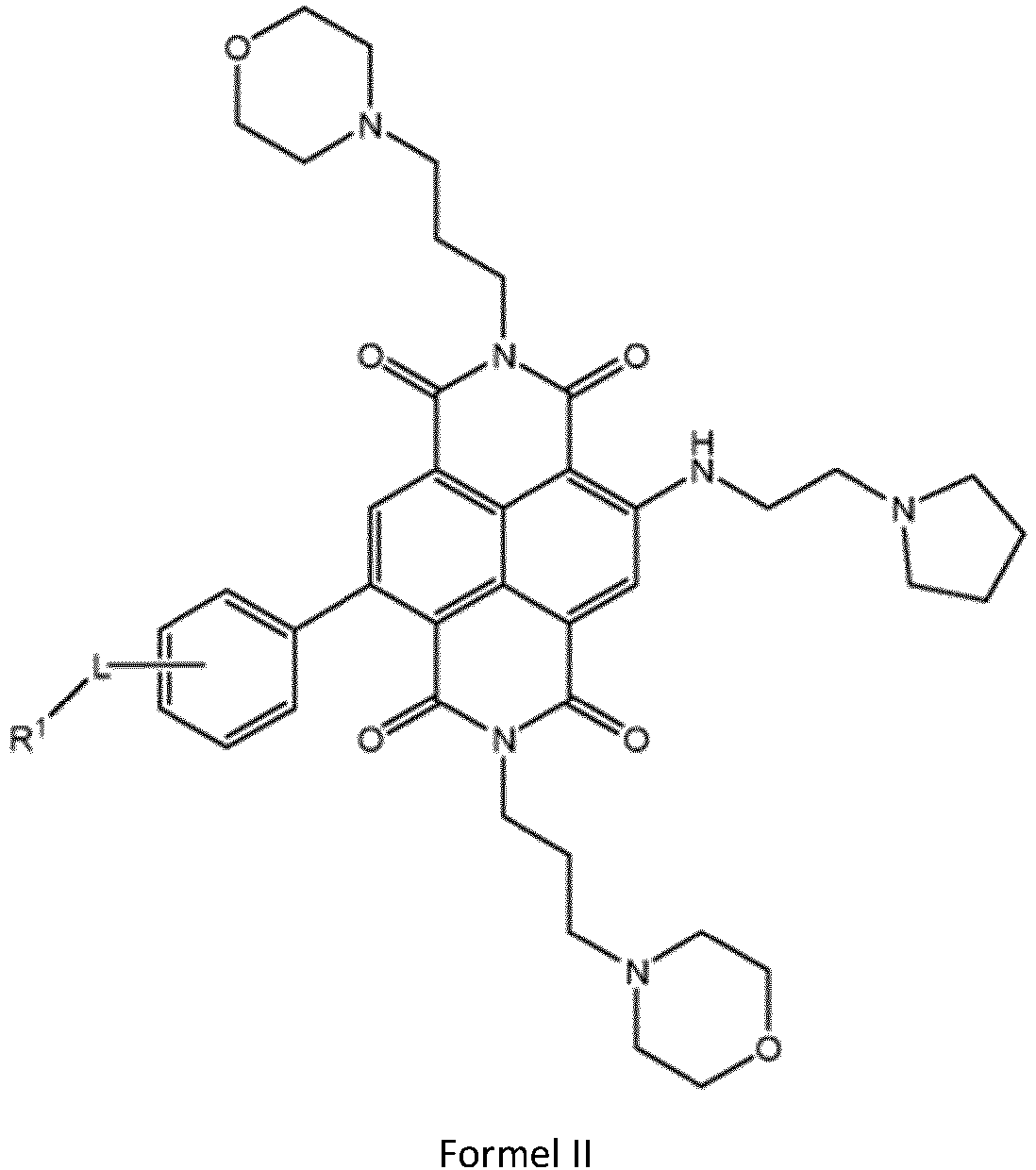
- Formula I has the following structure of Formula II: wherein L and R 1 are as defined for Formula I, with any of the preferred groups as outlined above.
- the compound is selected from the group consisting of: 2,7-bis(3-morpholinopropyl)-4-((2-(pyrrolidin-1-yl)ethyl)amino)-9-(4-(pyrrolidin-1-ylmethyl)phenyl)benzo[lmn][3,8]phenanthroline-1,3,6,8(2H,7H)-tetraone; 4-(4-(morpholinomethyl)phenyl)-2,7-bis(3-morpholinopropyl)-9-((2-(pyrrolidin-1-yl)ethyl)amino)benzo[lmn][3,8]phenanthroline-1,3,6,8(2H,7H)-tetraone; 2,7-bis(3-morpholinopropyl)-4-((2-(pyrrolidin-1-yl)ethyl)amino)-9-(3-(pyrrolidin-1-ylmethyl)phenyl)benzo[lmn
- L, X and R 1 to R 4 for Formula III to Formula VI are preferably as defined as the preferred features above for L, X and R 1 to R 4 of Formula I of the first aspect of the invention.
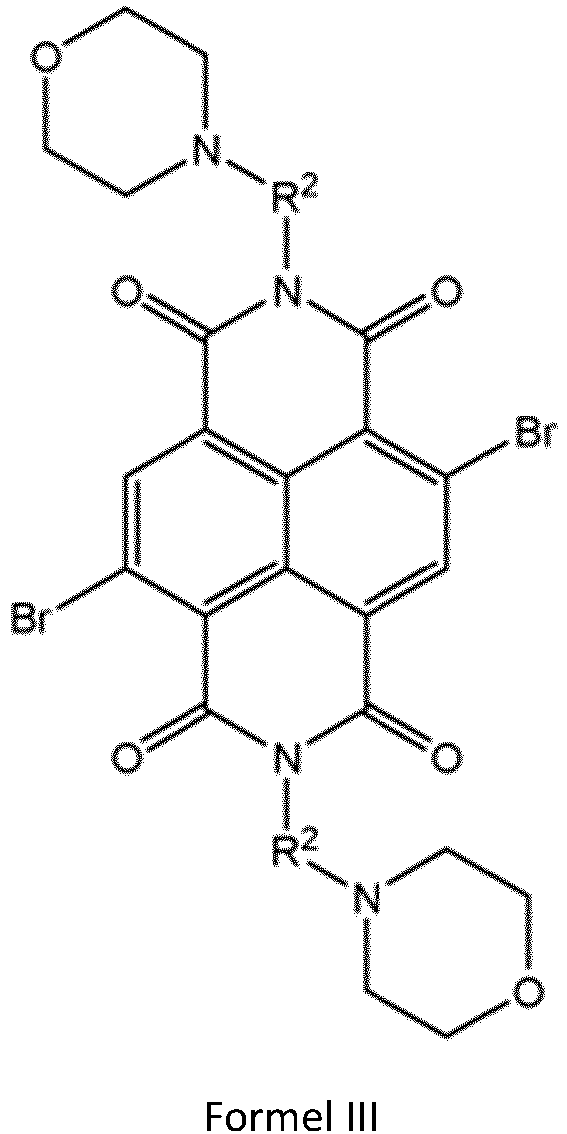
- the method of the invention comprises a first step of reacting a brominated naphthalene diimide of Formula III with an amine reagent of Formula IV in an aromatic nucleophilic substitution reaction whereby the bromine atom is replaced by an amino group N(R 3 )(R 4 X).
- the starting diimide is a dibromo compound, and the aromatic nucleophilic substitution reaction may result in both bromine atoms being replaced by an amine group or just one of them (i.e. a compound of Formula V), although it is preferred that just one of the bromines is replaced, and there must be at least one compound of Formula V produced. It is preferable to separate a mixture of both the singly and doubly substituted naphthalene diimide, for example by using column chromatography.
- the compound of Formula V produced in the first step is reacted with a reagent of Formula VI in a substitution reaction whereby the bromine atom is replaced by the phenyl in Formula VI via the carbon atom that the LG (leaving group) is attached to initially.
- the LG may be a boronic acid group, however, the skilled person will appreciate there are multiple ways to undergo the substitution reaction and form the aryl-aryl bond between Formulas V and VI. As a result, at least one compound of Formula I is produced.
- the compound of Formula I is isolated by using column chromatography.
- the specific form of column chromatography used is selected from gel and flash column chromatography.
- the compounds of the present invention may be provided in the form of pharmaceutically acceptable compositions.
- the compounds of the present invention especially when presented in the form of acid addition salts, for instance where some or all of the basic amine groups are converted to salt form, are water soluble and have approximately neutral pH.
- these salts are suitable for administration in the form of aqueous solution, which would be appropriate for intravenous administration.
- the pharmaceutical aqueous solutions preferably comprise 1 to 500 mg/I, of the compound.
- the compounds of the present invention may be provided in a form suitable to be made up into pharmaceutical compositions, for instance, in dried, rehydratable form, for instance with carrier or diluent. Such dried forms may be produced by crystallisation and/or evaporation. Alternatively, the compounds may be presented as concentrates, for instance in water or an organic, pharmaceutically acceptable, solvent for dilution before administration.
- a pharmaceutically acceptable salt is a salt with a pharmaceutically acceptable acid or base.
- Pharmaceutically acceptable acids include both inorganic acids such as hydrochloric, sulphuric, phosphoric, diphosphoric, hydrobromic or nitric acid and organic acids such as citric, fumaric, maleic, malic, ascorbic, succinic, tartaric, benzoic, acetic, methanesulfonic, ethanesulfonic, salicylic, stearic, benzenesulfonic or p -toluenesulfonic acid.
- Pharmaceutically acceptable bases include alkali metal (e.g. sodium or potassium) and alkali earth metal (e.g. calcium or magnesium) hydroxides and organic bases such as alkyl amines, aryl amines or heterocyclic amines.
- Combinations according to the present invention may also be used in conjunction with other agents to inhibit undesirable and uncontrolled cell proliferation, for example antibodies.
- the compound may be conjugated to the antibody or administered as two separate components.
- compositions comprising them may be administered by any route.
- a pharmaceutical composition comprising a compound of the invention may be formulated in a format suitable for oral, rectal, parenteral, intranasal or transdermal administration or administration by inhalation or by suppository. Typical routes of administration are parenteral, intranasal or transdermal administration or administration by inhalation. For chemotherapy of tumours, the compositions are most conveniently administered intravenously.
- the compounds of the present invention When used as treatment for existing tumours, the compounds of the present invention may be administered using regimens developed for chemotherapeutic agents.
- the compounds of the invention and compositions have utility in treating subjects who have cancer.
- One particular class of cancers are known as solid tumours, in which a solid mass of cancerous material can be identified.
- Another class comprises haematological cancers, known as cancers that affect the blood system.
- the cancer is prostate or pancreatic.
- the compounds of the invention and compositions are useful in treatment to inhibit the growth of a solid tumour, or to reduce the size of a solid tumour, for example wherein the tumour is a pancreatic or prostate tumour.
- the subject to be treated is suitably an animal, preferably a human.
- a series of tetrasubstituted naphthalene diimides have been synthesised and evaluated as G-quadruplex ligands, and as potential anti-cancer agents.
- Preparative HPLC was carried out using a Waters Xselect CSH C18, 5 ⁇ m, 19x50 mm column using either a gradient of either 0.1% Formic Acid in MeCN in 0.1% aqueous Formic Acid or a gradient of MeCN in aqueous 10 mM Ammonium Bicarbonate; or a Waters Xbridge BEH C18, 5 ⁇ m, 19x50 mm column using a gradient MeCN in aqueous 10 mM Ammonium Bicarbonate.
- Fractions were collected following detection by UV at a single wavelength measured by a variable wavelength detector on a Gilson 215 preparative HPLC or Varian PrepStar preparative HPLC; by mass and UV at a single wavelength measured by a ZQ single quadrupole mass spectrometer, with positive and negative ion electrospray, and a dual wavelength detector on a Waters FractionLynx LCMS.
- the residue was purified by reverse phase column chromatography (12 g Reveleris C-18, 75-100% (70 mM NH 3 in MeOH) in water), loading in DMSO) to afford product in better but still unsatisfactory purity.
- the residue was re-purified by reverse phase column chromatography (12 g Reveleris C-18, 75-100% (70 mM NH 3 in MeOH) in water, loading in DMSO) to afford the product as a bright red glassy solid (16 mg, 10%).
- Example 6 4-(4-((cyclopentylamino)methyl)phenyl)-2,7-bis(3-morpholinopropyl)-9-((2-(pyrrolidin-1-yl)ethyl)amino)benzo[lmn][3,8]phenanthroline-1,3,6,8(2H,7H)-tetraone
- Example 7 4-(4-(azepan-1-ylmethyl)phenyl)-2,7-bis(3-morpholinopropyl)-9-((2-(pyrrolidin-1-yl)ethyl)amino)benzo[lmn][3,8]phenanthroline-1,3,6,8(2H,7H)-tetraone
- Example 8 4-(4-((4-methylpiperazin-1-yl)methyl)phenyl)-2,7-bis(3-morpholinopropyl)-9-((2-(pyrrolidin-1-yl)ethyl)amino)benzo[mn][3,8]phenanthroline-1,3,6,8(2H,7H)-tetraone
- the CellTiter 96 ® AQueous One Solution Cell Proliferation Assay (Invitrogen) is a colorimetric method for determining the number of viable cells in proliferation or cytotoxicity assays.
- the CellTiter 96 ® AQueous One Solution Reagent contains a novel tetrazolium compound [3-(4,5-dimethylthiazol-2-yl)-5-(3-carboxymethoxyphenyl)-2-(4-sulfophenyl)-2H-tetrazolium, inner salt; MTS] and an electron coupling reagent (phenazine ethosulfate; PES).
- PES has enhanced chemical stability, which allows it to be combined with MTS to form a stable solution.
- the MTS tetrazolium compound (Owen's reagent) is bioreduced by cells into a colored formazan product that is soluble in tissue culture medium. Assays are performed by adding a small amount of the CellTiter 96 ® AQueous One Solution Reagent directly to culture wells, incubating for 1-4 hours and then recording the absorbance at 490nm with a 96-well plate reader. The quantity of formazan product as measured by absorbance at 490nm is directly proportional to the number of living cells in culture. The kit was used as per the manufacturers' instructions.
- mice aged 5-7 weeks weighing approximately 25-32g were implanted for the study and purchased from Charles River.
- the pancreatic tumour cell implantation procedure involved MIA-PACA2 cells (1 ⁇ 10 7 in Matrigel) being implanted subcutaneously using a 22-gauge needle onto the rear flank of the mice. Parameters evaluated include: tumour size and animal bodyweight. Tumour volume was measured three times weekly and bodyweight at least 3 times weekly. Allocation to treatment groups was done randomly when tumours reached approximately 50 mm 3 for animals in the efficacy study.
- Animals female athymic nude mice bearing MIA-PACA2 tumours were IV dosed for 28 days, twice weekly, at doses of 10 and 15 mg/kg for C1, and at doses of 0.5 and 1.0 mg/kg for Example 1, on account of its 10-fold greater cellular potency. Each group comprised 8 animals. All protocols used in this study were approved by the appropriate Animal Welfare and Ethical Review Board, and all procedures were carried out under the guidelines of the UK Animal (Scientific Procedures) Act 1986. Results are shown in the tables below and Figure 1 .
- Example 1 C1 Mol wt 791.99 632.33 clogP 5.65 3.72 Fluorescence excitation and emission max, in nm 510, 612 (em) 510 (ex) 510, 590 (em) 510 (ex) Formulation of free base, for cellular and in vivo studies, up to MTD Acidified phosphate-buffered saline (PBS) Acidified phosphate-buffered saline (PBS) Salt and aqueous Not made HCl/formate salt: solubility > 5mg/ml Stability in saline at 0° C > 1 month > 1 month t 1/2 mouse microsomal stability, min 268 >480 Plasma protein binding % in vitro 66.1 35 In vitro blood/plasma partitioning 6.1 10.9 FRET ⁇ T m , ° C with GQ 23.1 17.
- Example 1 is a significantly more potent compound in terms of its ability to inhibit cancer cell growth, and that its pharmacological properties are at least comparable.
- Example 1 C1 MIA-PACA2 1.3 13.0 PANC-1 1.4 15.6 CAPAN-1 5.9 26.5 Bx-PC3 2.6 15.5 MIA-PACA2 gemR 3.8 14.9
- the graph in Figure 1 shows the Xenograft data in the MIA-PACA2 model, after 28 days IV administration, followed by 28 days measurement (performed by AXIS BioServices).
- the data shows that the compound of Example 1 inhibited the growth of the pancreatic tumour and reduced the tumour's size considerably more than the comparative compound C1 or the known anti-cancer drug, Gemcitabine, did, even at a once-weekly dosing regimen.
- Example 1 and the dosing schedules were well-tolerated showing no sign of adverse effects.
- the starting tumour volumes were 0.4 mm 3 .
- Example 1 was active in both of the dosage regimens examined, 1 x weekly and 2 x weekly, both at a 1 mg/kg dose. Both had 5/8 complete regression in tumour volume at the end of the dosing period. In the complete regression cohorts, tumours have completely disappeared and no regrowth seen after 28 days post-dosing. A minority of tumours in the C1 and Example 1 groups do not show complete regression, but do show reductions in tumour growth, leading to consistently smaller volumes than in the vehicle control groups.
- the CyQUANT XTT Cell Viability Assay (Invitrogen) is a complete, optimized assay that generates a consistent colorimetric detection of viable mammalian cells.
- the assay kit consists of two reagents, XTT Reagent (2,3-bis-(2-methoxy-4-nitro-5-sulfophenyl)-2H-tetrazolium-5-carboxanilide) and Electron Coupling Reagent.
- XTT Reagent is used to assess cell viability as a function of cellular redox potential, and the electron coupling reagent improves the dynamic range of the assay.
- the kit was used as per the manufacturers' instructions.
- Table 4 Cell growth inhibition data for prostate cancer cell line panel for Example 1 compared with prior art compound C1 (with reference to WO2017/103587A1), and clinically-approved hormonal prostate cancer therapeutic agents Abiraterone and Enzalutamide; IC50 (nM) values from 72 hr XTT assays.
- the data shows that the compound of example 1, is highly active in a panel of prostate cancer cell lines, notably in the metastatic and androgen-independent PC-3 line, when compared to the C1 and even more so when compared to the two clinically used drugs.
- Example 1 Abiraterone Enzalutamide PC-3 3 94 4820 5350 DU145 32 113 N/A N/A LNCaP 247 394 3860 4820 VCaP 68 135 N/A N/A 22RV1 90 90 N/A N/A
- the compounds of the invention show anti-tumour activity in a number of cancer cell lines.
Landscapes
- Chemical & Material Sciences (AREA)
- Organic Chemistry (AREA)
- Health & Medical Sciences (AREA)
- Life Sciences & Earth Sciences (AREA)
- General Health & Medical Sciences (AREA)
- Veterinary Medicine (AREA)
- Public Health (AREA)
- Pharmacology & Pharmacy (AREA)
- Medicinal Chemistry (AREA)
- Animal Behavior & Ethology (AREA)
- Chemical Kinetics & Catalysis (AREA)
- General Chemical & Material Sciences (AREA)
- Nuclear Medicine, Radiotherapy & Molecular Imaging (AREA)
- Epidemiology (AREA)
- Nitrogen Condensed Heterocyclic Rings (AREA)
- Pharmaceuticals Containing Other Organic And Inorganic Compounds (AREA)
- Indole Compounds (AREA)
- Organic Low-Molecular-Weight Compounds And Preparation Thereof (AREA)
Claims (11)
- Verbindung der Formel I:
 L befindet sich in der meta oder para Position des Phenylrings;L (CH2)1-2 ist und R1 aus der Gruppe ausgewählt ist, bestehend aus Stickstoffenthaltendem 5-7 gliedrigem Heterocycloalkyl und NR9R10, oder L (CH2)1-5NH ist, und R1 ein C5-7Cycloalkyl ist; wobei das Stickstoff-enthaltende 5-7 gliedrige Heterocycloalkyl optional mit einer C1-C6 Alkylgruppe substituiert ist;R2 ein geradkettiges C2-4 Alkandiyl ist;R3 H ist;R4 ein geradkettiges C2-4-Alkandiyl ist;R9 und R10 unabhängig voneinander C1-6 Alkyl sind;X NR6 2 ist, wobei die R6-Gruppen zusammen mit dem N-Atom, an das sie gebunden sind, Pyrrolidin-1-yl bilden; undSalze, Hydrate und Solvate davon.
 - Verbindung nach Anspruch 1, wobei L (CH2)1-2 ist und R1 ein Stickstoff-enthaltendes 5-7 gliedriges Heterocycloalkyl ist.
- Verbindung nach einem von Anspruch 1 oder 1, wobei das Stickstoff-enthaltende 5-7 gliedrige Heterocycloalkyl aus der Gruppe ausgewählt ist, bestehend aus Pyrrolidinyl, Imidazolidinyl, Pyrazolidinyl, Piperidinyl, Piperazinyl, Morpholinyl, Azepanyl, Diazepanyl, vorzugsweise Pyrrolidinyl.
- Verbindung nach Anspruch 1 wobei L (CH2)1-5NH ist und R1 ein C5-7Cycloalkyl ist.
- Verbindung nach einem vorstehenden Anspruch, wobei L in der para Position ist.
- Verbindung nach Anspruch 1, wobei die Verbindung aus der Gruppe ausgewählt ist, bestehend aus:2,7-bis(3-Morpholinopropyl)-4-((2-(pyrrolidin-1-yl)ethyl)amino)-9-(4-(pyrrolidin-1-ylmethyl)phenyl)benzo[Imn][3,8]phenanthrolin-1,3,6,8(2H,7H)-tetraon;4-(4-(Morpholinomethyl)phenyl)-2,7-bis(3-Morpholinopropyl)-9-((2-(pyrrolidin-1-yl)ethyl)amino)benzo[Imn][3,8]phenanthrolin-1,3,6,8(2H,7H)-tetraon;2,7-bis(3-Morpholinopropyl)-4-((2-(pyrrolidin-1-yl)ethyl)amino)-9-(3-(pyrrolidin-1-ylmethyl)phenyl)benzo[Imn][3,8]phenanthrolin-1,3,6,8(2H,7H)-tetraon;2,7-bis(3-Morpholinopropyl)-4-(4-(piperidin-1-ylmethyl)phenyl)-9-((2-(pyrrolidin-1- yl)ethyl)amino)benzo[Imn][3,8]phenanthrolin-1,3,6,8(2H,7H)-tetraon;4-(4-((Diethylamino)methyl)phenyl)-2,7-bis(3-Morpholinopropyl)-9-((2-(pyrrolidin-1-yl)ethyl)amino)benzo[Imn][3,8]phenanthrolin-1,3,6,8(2H,7H)-tetraon;4-(4-((Cyclopentylamino)methyl)phenyl)-2,7-bis(3-Morpholinopropyl)-9-((2-(pyrrolidin-1-yl)ethyl)amino)benzo[Imn][3,8]phenanthrolin-1,3,6,8(2H,7H)- tetraon;4-(4-(Azepan-1-ylmethyl)phenyl)-2,7-bis(3-Morpholinopropyl)-9-((2-(pyrrolidin-1-yl)ethyl)amino)benzo[Imn][3,8]phenanthrolin-1,3,6,8(2H,7H)-tetraon;4-(4-((4-Methylpiperazin-1-yl)methyl)phenyl)-2,7-bis(3-Morpholinopropyl)-9-((2-(pyrrolidin-1-yl)ethyl)amino)benzo[Imn][3,8]phenanthrolin-1,3,6,8(2H,7H)- tetraon; undSalze, Hydrate und Solvate davon.
- Verbindung nach Anspruch 1 wobei die Verbindung 2,7-bis(3- Morpholinopropyl)-4-((2-(pyrrolidin-1-yl)ethyl)amino)-9-(4-(pyrrolidin-1-ylmethyl)phenyl)benzo[Imn][3,8]phenanthrolin-1,3,6,8(2H,7H)-tetraon ist.
- Verbindung nach einem der Ansprüche 1 bis 5, wobei die Formel I die folgende Struktur von Formel II aufweist:
- Zusammensetzung, welche die Verbindung nach einem vorstehenden Anspruch in Kombination mit einem Verdünnungsmittel umfasst, wobei die Zusammensetzung eine pharmazeutische Zusammensetzung ist und das Verdünnungsmittel ein pharmazeutisch verträgliches Verdünnungsmittel ist.
- Verbindung nach einem der Ansprüche 1 bis 8 oder Zusammensetzung nach Anspruch 9 zur Verwendung in einem Verfahren zur Behandlung eines Subjekts, um Krebs zu behandeln oder um das Wachstum eines festen Tumors zu hemmen, oder um die Größe eines festen Tumors zu verringern.
- Verfahren zu Synthetisieren einer substituierten Naphthalindiimid-Verbindung nach einem der Ansprüche 1 bis 8, das die Schritte umfasst, zum:i) Reagieren einer Verbindung von Formel III in einer nukleophilen Substitutionsreaktion mit einer Verbindung von Formel IV:
HN(R3)(R4X) Formel IV
wobei mindestens ein Br in der Verbindung von Formel III durch den nukleophilen Aminstickstoff in der Verbindung von Formel IV substituiert ist;ii) Reagieren einer Verbindung der Formel V, die aus dem Produkt erhältlich ist, das aus der nukleophilen Substitutionsreaktion von Formel III und von Formel IV resultiert, mit einer Verbindung von Formel VI:
 iii) Isolieren der Verbindung von Formel I aus dem Produkt, das aus der Reaktion von Formel V und Formel VI resultiert;wobei L, X und R1 bis R4 wie für Formel I in einem der Ansprüche 1 bis 5 definiert sind.
Priority Applications (1)
| Application Number | Priority Date | Filing Date | Title |
|---|---|---|---|
| EP24221737.0A EP4548919A3 (de) | 2019-05-16 | 2020-05-15 | Substituierte naphthalendiimide und deren verwendung |
Applications Claiming Priority (2)
| Application Number | Priority Date | Filing Date | Title |
|---|---|---|---|
| GBGB1906914.5A GB201906914D0 (en) | 2019-05-16 | 2019-05-16 | Substituted naphtahlene diimdes and their use |
| PCT/GB2020/051195 WO2020229840A1 (en) | 2019-05-16 | 2020-05-15 | Substituted naphthalene diimides and their use |
Related Child Applications (2)
| Application Number | Title | Priority Date | Filing Date |
|---|---|---|---|
| EP24221737.0A Division EP4548919A3 (de) | 2019-05-16 | 2020-05-15 | Substituierte naphthalendiimide und deren verwendung |
| EP24221737.0A Division-Into EP4548919A3 (de) | 2019-05-16 | 2020-05-15 | Substituierte naphthalendiimide und deren verwendung |
Publications (3)
| Publication Number | Publication Date |
|---|---|
| EP3969451A1 EP3969451A1 (de) | 2022-03-23 |
| EP3969451C0 EP3969451C0 (de) | 2025-02-12 |
| EP3969451B1 true EP3969451B1 (de) | 2025-02-12 |
Family
ID=67385141
Family Applications (2)
| Application Number | Title | Priority Date | Filing Date |
|---|---|---|---|
| EP24221737.0A Pending EP4548919A3 (de) | 2019-05-16 | 2020-05-15 | Substituierte naphthalendiimide und deren verwendung |
| EP20728161.9A Active EP3969451B1 (de) | 2019-05-16 | 2020-05-15 | Substituierte naphthalendiimide und deren verwendung |
Family Applications Before (1)
| Application Number | Title | Priority Date | Filing Date |
|---|---|---|---|
| EP24221737.0A Pending EP4548919A3 (de) | 2019-05-16 | 2020-05-15 | Substituierte naphthalendiimide und deren verwendung |
Country Status (10)
| Country | Link |
|---|---|
| US (3) | US11560380B2 (de) |
| EP (2) | EP4548919A3 (de) |
| JP (1) | JP7476238B2 (de) |
| KR (1) | KR102714961B1 (de) |
| CN (1) | CN114026089B (de) |
| AU (1) | AU2020276902B2 (de) |
| CA (1) | CA3141549A1 (de) |
| ES (1) | ES3013616T3 (de) |
| GB (1) | GB201906914D0 (de) |
| WO (1) | WO2020229840A1 (de) |
Families Citing this family (1)
| Publication number | Priority date | Publication date | Assignee | Title |
|---|---|---|---|---|
| IT202200012997A1 (it) * | 2022-06-20 | 2023-12-20 | Univ Degli Studi Padova | Ligandi dei g-quadruplex per la cura dei liposarcomi |
Family Cites Families (4)
| Publication number | Priority date | Publication date | Assignee | Title |
|---|---|---|---|---|
| GB0723439D0 (en) | 2007-11-29 | 2008-01-09 | Univ London Pharmacy | Naphthalene diimide compounds |
| US9493460B2 (en) * | 2013-03-13 | 2016-11-15 | Ucl Business Plc | Diimide compounds |
| TW201444849A (zh) | 2013-03-13 | 2014-12-01 | Janssen Pharmaceutica Nv | 經取代的7-氮雜雙環類及其作為食慾激素受體調節劑之用途 |
| GB201522118D0 (en) * | 2015-12-15 | 2016-01-27 | Ucl Business Plc | Substituted naphthalene diimides and their use |
-
2019
- 2019-05-16 GB GBGB1906914.5A patent/GB201906914D0/en not_active Ceased
-
2020
- 2020-05-15 WO PCT/GB2020/051195 patent/WO2020229840A1/en not_active Ceased
- 2020-05-15 CN CN202080044379.XA patent/CN114026089B/zh active Active
- 2020-05-15 KR KR1020217041360A patent/KR102714961B1/ko active Active
- 2020-05-15 EP EP24221737.0A patent/EP4548919A3/de active Pending
- 2020-05-15 EP EP20728161.9A patent/EP3969451B1/de active Active
- 2020-05-15 JP JP2021568642A patent/JP7476238B2/ja active Active
- 2020-05-15 AU AU2020276902A patent/AU2020276902B2/en active Active
- 2020-05-15 CA CA3141549A patent/CA3141549A1/en active Pending
- 2020-05-15 ES ES20728161T patent/ES3013616T3/es active Active
- 2020-05-15 US US17/611,890 patent/US11560380B2/en active Active
-
2022
- 2022-12-27 US US18/089,498 patent/US20230212166A1/en not_active Abandoned
-
2024
- 2024-05-17 US US18/667,825 patent/US20250129065A1/en active Pending
Also Published As
| Publication number | Publication date |
|---|---|
| WO2020229840A1 (en) | 2020-11-19 |
| ES3013616T3 (en) | 2025-04-14 |
| AU2020276902B2 (en) | 2026-01-29 |
| US20220220108A1 (en) | 2022-07-14 |
| US11560380B2 (en) | 2023-01-24 |
| KR102714961B1 (ko) | 2024-10-07 |
| GB201906914D0 (en) | 2019-07-03 |
| EP3969451C0 (de) | 2025-02-12 |
| JP2022533180A (ja) | 2022-07-21 |
| CA3141549A1 (en) | 2020-11-19 |
| EP4548919A2 (de) | 2025-05-07 |
| US20230212166A1 (en) | 2023-07-06 |
| CN114026089A (zh) | 2022-02-08 |
| EP3969451A1 (de) | 2022-03-23 |
| JP7476238B2 (ja) | 2024-04-30 |
| US20250129065A1 (en) | 2025-04-24 |
| KR20220035039A (ko) | 2022-03-21 |
| EP4548919A3 (de) | 2025-07-16 |
| AU2020276902A1 (en) | 2022-01-27 |
| CN114026089B (zh) | 2025-05-13 |
Similar Documents
| Publication | Publication Date | Title |
|---|---|---|
| CN115322209B (zh) | 作为dna-pk抑制剂的三并环化合物 | |
| EP3958976B1 (de) | Verbindungen mit n-methyl-2-pyridon und pharmazeutisch verwendbaren salzen | |
| JP7398135B2 (ja) | ユビキチン特異的プロテアーゼ阻害剤及びその製造方法と応用 | |
| Shao et al. | Discovery of 2-methoxy-3-phenylsulfonamino-5-(quinazolin-6-yl or quinolin-6-yl) benzamides as novel PI3K inhibitors and anticancer agents by bioisostere | |
| CN115028648B (zh) | 三并环化合物及其药物组合物和应用 | |
| ES2400450T3 (es) | Derivados de pirazolo[1,5-a][1,3,5]triazina y pirazolo[1,5-a]pirimidina para uso como inhibidores de la proteina quinasa | |
| US20250129065A1 (en) | Substituted naphthalene diimides and their use | |
| US20220041577A1 (en) | Heterocyclic Compound as CDK-HDAC Double-Channel Inhibitor | |
| HK40126675A (en) | Substituted naphthalene diimides and their use | |
| HK40062247B (en) | Substituted naphthalene diimides and their use | |
| HK40062247A (en) | Substituted naphthalene diimides and their use | |
| RU2834299C2 (ru) | Замещенные нафталиндиимиды и их применение | |
| JP2019505495A (ja) | 置換ナフタレンジイミドおよびその使用 | |
| CN116768906A (zh) | 一种三并环化合物及其制备方法和应用 | |
| Kamble et al. | Synthesis of new 4-chloro-(5-aliphatic/cyclic saturated amino)-2-o-chlorophenyl-(2H)-pyridazin-3-one derivatives as anticancer, antiangiogenic, and antioxidant agents | |
| Simonov et al. | Synthesis of 4-substituted 3-[3-(dialkylaminomethyl) indol-1-yl] maleimides and study of their ability to inhibit protein kinase C-α, prevent development of multiple drug resistance of tumor cells and cytotoxicity | |
| CN113801163B (zh) | 一类基于有机砷的ii型丙酮酸激酶抑制剂及其制备方法和用途 | |
| CN119060055B (zh) | 共价激酶抑制剂、制备方法、药物组合物和应用 | |
| CN116239610B (zh) | 一种嘧啶衍生物及其制备方法与在制备抗肿瘤药物中的应用 | |
| CN114573567B (zh) | 一种吲唑环联三氮唑类化合物及其制备方法和应用 | |
| WO2008126123A2 (en) | Water-soluble coronene derivatives active as inhibitors of telomerase | |
| CN119899178A (zh) | 芳香酰胺类衍生物、其制备方法和其在医药上的应用 | |
| CN121021539A (zh) | 一种嘧啶类衍生物及其用途 | |
| CN120230084A (zh) | 一种tdg抑制剂化合物及其用途 | |
| CN120098064A (zh) | 一种src-3 protac化合物及其制备方法和在治疗乳腺癌中的应用 |
Legal Events
| Date | Code | Title | Description |
|---|---|---|---|
| STAA | Information on the status of an ep patent application or granted ep patent |
Free format text: STATUS: UNKNOWN |
|
| STAA | Information on the status of an ep patent application or granted ep patent |
Free format text: STATUS: THE INTERNATIONAL PUBLICATION HAS BEEN MADE |
|
| PUAI | Public reference made under article 153(3) epc to a published international application that has entered the european phase |
Free format text: ORIGINAL CODE: 0009012 |
|
| STAA | Information on the status of an ep patent application or granted ep patent |
Free format text: STATUS: REQUEST FOR EXAMINATION WAS MADE |
|
| 17P | Request for examination filed |
Effective date: 20211215 |
|
| AK | Designated contracting states |
Kind code of ref document: A1 Designated state(s): AL AT BE BG CH CY CZ DE DK EE ES FI FR GB GR HR HU IE IS IT LI LT LU LV MC MK MT NL NO PL PT RO RS SE SI SK SM TR |
|
| RAP3 | Party data changed (applicant data changed or rights of an application transferred) |
Owner name: UCL BUSINESS LTD |
|
| REG | Reference to a national code |
Ref country code: HK Ref legal event code: DE Ref document number: 40062247 Country of ref document: HK |
|
| DAV | Request for validation of the european patent (deleted) | ||
| DAX | Request for extension of the european patent (deleted) | ||
| GRAP | Despatch of communication of intention to grant a patent |
Free format text: ORIGINAL CODE: EPIDOSNIGR1 |
|
| STAA | Information on the status of an ep patent application or granted ep patent |
Free format text: STATUS: GRANT OF PATENT IS INTENDED |
|
| INTG | Intention to grant announced |
Effective date: 20221219 |
|
| RIN1 | Information on inventor provided before grant (corrected) |
Inventor name: OXENFORD, SALLY Inventor name: ANGELL, RICHARD Inventor name: NEIDLE, STEPHEN |
|
| GRAJ | Information related to disapproval of communication of intention to grant by the applicant or resumption of examination proceedings by the epo deleted |
Free format text: ORIGINAL CODE: EPIDOSDIGR1 |
|
| STAA | Information on the status of an ep patent application or granted ep patent |
Free format text: STATUS: REQUEST FOR EXAMINATION WAS MADE |
|
| INTC | Intention to grant announced (deleted) | ||
| GRAP | Despatch of communication of intention to grant a patent |
Free format text: ORIGINAL CODE: EPIDOSNIGR1 |
|
| STAA | Information on the status of an ep patent application or granted ep patent |
Free format text: STATUS: GRANT OF PATENT IS INTENDED |
|
| P01 | Opt-out of the competence of the unified patent court (upc) registered |
Effective date: 20230522 |
|
| INTG | Intention to grant announced |
Effective date: 20230613 |
|
| GRAJ | Information related to disapproval of communication of intention to grant by the applicant or resumption of examination proceedings by the epo deleted |
Free format text: ORIGINAL CODE: EPIDOSDIGR1 |
|
| STAA | Information on the status of an ep patent application or granted ep patent |
Free format text: STATUS: REQUEST FOR EXAMINATION WAS MADE |
|
| INTC | Intention to grant announced (deleted) | ||
| GRAP | Despatch of communication of intention to grant a patent |
Free format text: ORIGINAL CODE: EPIDOSNIGR1 |
|
| STAA | Information on the status of an ep patent application or granted ep patent |
Free format text: STATUS: GRANT OF PATENT IS INTENDED |
|
| INTG | Intention to grant announced |
Effective date: 20231211 |
|
| GRAJ | Information related to disapproval of communication of intention to grant by the applicant or resumption of examination proceedings by the epo deleted |
Free format text: ORIGINAL CODE: EPIDOSDIGR1 |
|
| STAA | Information on the status of an ep patent application or granted ep patent |
Free format text: STATUS: REQUEST FOR EXAMINATION WAS MADE |
|
| INTC | Intention to grant announced (deleted) | ||
| GRAP | Despatch of communication of intention to grant a patent |
Free format text: ORIGINAL CODE: EPIDOSNIGR1 |
|
| STAA | Information on the status of an ep patent application or granted ep patent |
Free format text: STATUS: GRANT OF PATENT IS INTENDED |
|
| INTG | Intention to grant announced |
Effective date: 20240529 |
|
| GRAS | Grant fee paid |
Free format text: ORIGINAL CODE: EPIDOSNIGR3 |
|
| GRAA | (expected) grant |
Free format text: ORIGINAL CODE: 0009210 |
|
| STAA | Information on the status of an ep patent application or granted ep patent |
Free format text: STATUS: THE PATENT HAS BEEN GRANTED |
|
| AK | Designated contracting states |
Kind code of ref document: B1 Designated state(s): AL AT BE BG CH CY CZ DE DK EE ES FI FR GB GR HR HU IE IS IT LI LT LU LV MC MK MT NL NO PL PT RO RS SE SI SK SM TR |
|
| REG | Reference to a national code |
Ref country code: GB Ref legal event code: FG4D |
|
| REG | Reference to a national code |
Ref country code: CH Ref legal event code: EP |
|
| REG | Reference to a national code |
Ref country code: DE Ref legal event code: R096 Ref document number: 602020045906 Country of ref document: DE |
|
| REG | Reference to a national code |
Ref country code: IE Ref legal event code: FG4D |
|
| U01 | Request for unitary effect filed |
Effective date: 20250225 |
|
| P04 | Withdrawal of opt-out of the competence of the unified patent court (upc) registered |
Free format text: CASE NUMBER: APP_10346/2025 Effective date: 20250301 |
|
| U07 | Unitary effect registered |
Designated state(s): AT BE BG DE DK EE FI FR IT LT LU LV MT NL PT RO SE SI Effective date: 20250305 |
|
| REG | Reference to a national code |
Ref country code: ES Ref legal event code: FG2A Ref document number: 3013616 Country of ref document: ES Kind code of ref document: T3 Effective date: 20250414 |
|
| U20 | Renewal fee for the european patent with unitary effect paid |
Year of fee payment: 6 Effective date: 20250527 |
|
| PG25 | Lapsed in a contracting state [announced via postgrant information from national office to epo] |
Ref country code: RS Free format text: LAPSE BECAUSE OF FAILURE TO SUBMIT A TRANSLATION OF THE DESCRIPTION OR TO PAY THE FEE WITHIN THE PRESCRIBED TIME-LIMIT Effective date: 20250512 |
|
| PG25 | Lapsed in a contracting state [announced via postgrant information from national office to epo] |
Ref country code: PL Free format text: LAPSE BECAUSE OF FAILURE TO SUBMIT A TRANSLATION OF THE DESCRIPTION OR TO PAY THE FEE WITHIN THE PRESCRIBED TIME-LIMIT Effective date: 20250212 |
|
| PGFP | Annual fee paid to national office [announced via postgrant information from national office to epo] |
Ref country code: GB Payment date: 20250527 Year of fee payment: 6 Ref country code: ES Payment date: 20250602 Year of fee payment: 6 |
|
| PG25 | Lapsed in a contracting state [announced via postgrant information from national office to epo] |
Ref country code: NO Free format text: LAPSE BECAUSE OF FAILURE TO SUBMIT A TRANSLATION OF THE DESCRIPTION OR TO PAY THE FEE WITHIN THE PRESCRIBED TIME-LIMIT Effective date: 20250512 Ref country code: IS Free format text: LAPSE BECAUSE OF FAILURE TO SUBMIT A TRANSLATION OF THE DESCRIPTION OR TO PAY THE FEE WITHIN THE PRESCRIBED TIME-LIMIT Effective date: 20250612 |
|
| PG25 | Lapsed in a contracting state [announced via postgrant information from national office to epo] |
Ref country code: HR Free format text: LAPSE BECAUSE OF FAILURE TO SUBMIT A TRANSLATION OF THE DESCRIPTION OR TO PAY THE FEE WITHIN THE PRESCRIBED TIME-LIMIT Effective date: 20250212 |
|
| PG25 | Lapsed in a contracting state [announced via postgrant information from national office to epo] |
Ref country code: GR Free format text: LAPSE BECAUSE OF FAILURE TO SUBMIT A TRANSLATION OF THE DESCRIPTION OR TO PAY THE FEE WITHIN THE PRESCRIBED TIME-LIMIT Effective date: 20250513 |
|
| PGFP | Annual fee paid to national office [announced via postgrant information from national office to epo] |
Ref country code: CH Payment date: 20250601 Year of fee payment: 6 |
|
| PGFP | Annual fee paid to national office [announced via postgrant information from national office to epo] |
Ref country code: IE Payment date: 20250527 Year of fee payment: 6 |
|
| PG25 | Lapsed in a contracting state [announced via postgrant information from national office to epo] |
Ref country code: SM Free format text: LAPSE BECAUSE OF FAILURE TO SUBMIT A TRANSLATION OF THE DESCRIPTION OR TO PAY THE FEE WITHIN THE PRESCRIBED TIME-LIMIT Effective date: 20250212 |
|
| PG25 | Lapsed in a contracting state [announced via postgrant information from national office to epo] |
Ref country code: CZ Free format text: LAPSE BECAUSE OF FAILURE TO SUBMIT A TRANSLATION OF THE DESCRIPTION OR TO PAY THE FEE WITHIN THE PRESCRIBED TIME-LIMIT Effective date: 20250212 |
|
| PG25 | Lapsed in a contracting state [announced via postgrant information from national office to epo] |
Ref country code: SK Free format text: LAPSE BECAUSE OF FAILURE TO SUBMIT A TRANSLATION OF THE DESCRIPTION OR TO PAY THE FEE WITHIN THE PRESCRIBED TIME-LIMIT Effective date: 20250212 |
|
| PLBE | No opposition filed within time limit |
Free format text: ORIGINAL CODE: 0009261 |
|
| STAA | Information on the status of an ep patent application or granted ep patent |
Free format text: STATUS: NO OPPOSITION FILED WITHIN TIME LIMIT |
|
| 26N | No opposition filed |
Effective date: 20251113 |
|
| PG25 | Lapsed in a contracting state [announced via postgrant information from national office to epo] |
Ref country code: MC Free format text: LAPSE BECAUSE OF FAILURE TO SUBMIT A TRANSLATION OF THE DESCRIPTION OR TO PAY THE FEE WITHIN THE PRESCRIBED TIME-LIMIT Effective date: 20250212 |