EP3965212B1 - Battery and related apparatus thereof, and preparation method and preparation device - Google Patents
Battery and related apparatus thereof, and preparation method and preparation device Download PDFInfo
- Publication number
- EP3965212B1 EP3965212B1 EP21730788.3A EP21730788A EP3965212B1 EP 3965212 B1 EP3965212 B1 EP 3965212B1 EP 21730788 A EP21730788 A EP 21730788A EP 3965212 B1 EP3965212 B1 EP 3965212B1
- Authority
- EP
- European Patent Office
- Prior art keywords
- protrusion
- battery
- adhesive
- pressure relief
- battery cell
- Prior art date
- Legal status (The legal status is an assumption and is not a legal conclusion. Google has not performed a legal analysis and makes no representation as to the accuracy of the status listed.)
- Active
Links
Images






Classifications
-
- H—ELECTRICITY
- H01—ELECTRIC ELEMENTS
- H01M—PROCESSES OR MEANS, e.g. BATTERIES, FOR THE DIRECT CONVERSION OF CHEMICAL ENERGY INTO ELECTRICAL ENERGY
- H01M50/00—Constructional details or processes of manufacture of the non-active parts of electrochemical cells other than fuel cells, e.g. hybrid cells
- H01M50/20—Mountings; Secondary casings or frames; Racks, modules or packs; Suspension devices; Shock absorbers; Transport or carrying devices; Holders
- H01M50/204—Racks, modules or packs for multiple batteries or multiple cells
- H01M50/207—Racks, modules or packs for multiple batteries or multiple cells characterised by their shape
- H01M50/209—Racks, modules or packs for multiple batteries or multiple cells characterised by their shape adapted for prismatic or rectangular cells
-
- B—PERFORMING OPERATIONS; TRANSPORTING
- B05—SPRAYING OR ATOMISING IN GENERAL; APPLYING FLUENT MATERIALS TO SURFACES, IN GENERAL
- B05D—PROCESSES FOR APPLYING FLUENT MATERIALS TO SURFACES, IN GENERAL
- B05D5/00—Processes for applying liquids or other fluent materials to surfaces to obtain special surface effects, finishes or structures
- B05D5/10—Processes for applying liquids or other fluent materials to surfaces to obtain special surface effects, finishes or structures to obtain an adhesive surface
-
- H—ELECTRICITY
- H01—ELECTRIC ELEMENTS
- H01M—PROCESSES OR MEANS, e.g. BATTERIES, FOR THE DIRECT CONVERSION OF CHEMICAL ENERGY INTO ELECTRICAL ENERGY
- H01M10/00—Secondary cells; Manufacture thereof
- H01M10/05—Accumulators with non-aqueous electrolyte
- H01M10/052—Li-accumulators
- H01M10/0525—Rocking-chair batteries, i.e. batteries with lithium insertion or intercalation in both electrodes; Lithium-ion batteries
-
- H—ELECTRICITY
- H01—ELECTRIC ELEMENTS
- H01M—PROCESSES OR MEANS, e.g. BATTERIES, FOR THE DIRECT CONVERSION OF CHEMICAL ENERGY INTO ELECTRICAL ENERGY
- H01M10/00—Secondary cells; Manufacture thereof
- H01M10/60—Heating or cooling; Temperature control
- H01M10/61—Types of temperature control
- H01M10/613—Cooling or keeping cold
-
- H—ELECTRICITY
- H01—ELECTRIC ELEMENTS
- H01M—PROCESSES OR MEANS, e.g. BATTERIES, FOR THE DIRECT CONVERSION OF CHEMICAL ENERGY INTO ELECTRICAL ENERGY
- H01M10/00—Secondary cells; Manufacture thereof
- H01M10/60—Heating or cooling; Temperature control
- H01M10/62—Heating or cooling; Temperature control specially adapted for specific applications
- H01M10/625—Vehicles
-
- H—ELECTRICITY
- H01—ELECTRIC ELEMENTS
- H01M—PROCESSES OR MEANS, e.g. BATTERIES, FOR THE DIRECT CONVERSION OF CHEMICAL ENERGY INTO ELECTRICAL ENERGY
- H01M10/00—Secondary cells; Manufacture thereof
- H01M10/60—Heating or cooling; Temperature control
- H01M10/65—Means for temperature control structurally associated with the cells
- H01M10/655—Solid structures for heat exchange or heat conduction
- H01M10/6556—Solid parts with flow channel passages or pipes for heat exchange
-
- H—ELECTRICITY
- H01—ELECTRIC ELEMENTS
- H01M—PROCESSES OR MEANS, e.g. BATTERIES, FOR THE DIRECT CONVERSION OF CHEMICAL ENERGY INTO ELECTRICAL ENERGY
- H01M10/00—Secondary cells; Manufacture thereof
- H01M10/60—Heating or cooling; Temperature control
- H01M10/65—Means for temperature control structurally associated with the cells
- H01M10/656—Means for temperature control structurally associated with the cells characterised by the type of heat-exchange fluid
- H01M10/6567—Liquids
-
- H—ELECTRICITY
- H01—ELECTRIC ELEMENTS
- H01M—PROCESSES OR MEANS, e.g. BATTERIES, FOR THE DIRECT CONVERSION OF CHEMICAL ENERGY INTO ELECTRICAL ENERGY
- H01M50/00—Constructional details or processes of manufacture of the non-active parts of electrochemical cells other than fuel cells, e.g. hybrid cells
- H01M50/20—Mountings; Secondary casings or frames; Racks, modules or packs; Suspension devices; Shock absorbers; Transport or carrying devices; Holders
- H01M50/233—Mountings; Secondary casings or frames; Racks, modules or packs; Suspension devices; Shock absorbers; Transport or carrying devices; Holders characterised by physical properties of casings or racks, e.g. dimensions
- H01M50/24—Mountings; Secondary casings or frames; Racks, modules or packs; Suspension devices; Shock absorbers; Transport or carrying devices; Holders characterised by physical properties of casings or racks, e.g. dimensions adapted for protecting batteries from their environment, e.g. from corrosion
-
- H—ELECTRICITY
- H01—ELECTRIC ELEMENTS
- H01M—PROCESSES OR MEANS, e.g. BATTERIES, FOR THE DIRECT CONVERSION OF CHEMICAL ENERGY INTO ELECTRICAL ENERGY
- H01M50/00—Constructional details or processes of manufacture of the non-active parts of electrochemical cells other than fuel cells, e.g. hybrid cells
- H01M50/30—Arrangements for facilitating escape of gases
- H01M50/317—Re-sealable arrangements
- H01M50/325—Re-sealable arrangements comprising deformable valve members, e.g. elastic or flexible valve members
-
- H—ELECTRICITY
- H01—ELECTRIC ELEMENTS
- H01M—PROCESSES OR MEANS, e.g. BATTERIES, FOR THE DIRECT CONVERSION OF CHEMICAL ENERGY INTO ELECTRICAL ENERGY
- H01M50/00—Constructional details or processes of manufacture of the non-active parts of electrochemical cells other than fuel cells, e.g. hybrid cells
- H01M50/30—Arrangements for facilitating escape of gases
- H01M50/342—Non-re-sealable arrangements
-
- H—ELECTRICITY
- H01—ELECTRIC ELEMENTS
- H01M—PROCESSES OR MEANS, e.g. BATTERIES, FOR THE DIRECT CONVERSION OF CHEMICAL ENERGY INTO ELECTRICAL ENERGY
- H01M50/00—Constructional details or processes of manufacture of the non-active parts of electrochemical cells other than fuel cells, e.g. hybrid cells
- H01M50/30—Arrangements for facilitating escape of gases
- H01M50/342—Non-re-sealable arrangements
- H01M50/3425—Non-re-sealable arrangements in the form of rupturable membranes or weakened parts, e.g. pierced with the aid of a sharp member
-
- H—ELECTRICITY
- H01—ELECTRIC ELEMENTS
- H01M—PROCESSES OR MEANS, e.g. BATTERIES, FOR THE DIRECT CONVERSION OF CHEMICAL ENERGY INTO ELECTRICAL ENERGY
- H01M50/00—Constructional details or processes of manufacture of the non-active parts of electrochemical cells other than fuel cells, e.g. hybrid cells
- H01M50/30—Arrangements for facilitating escape of gases
- H01M50/35—Gas exhaust passages comprising elongated, tortuous or labyrinth-shaped exhaust passages
- H01M50/367—Internal gas exhaust passages forming part of the battery cover or case; Double cover vent systems
-
- H—ELECTRICITY
- H01—ELECTRIC ELEMENTS
- H01M—PROCESSES OR MEANS, e.g. BATTERIES, FOR THE DIRECT CONVERSION OF CHEMICAL ENERGY INTO ELECTRICAL ENERGY
- H01M50/00—Constructional details or processes of manufacture of the non-active parts of electrochemical cells other than fuel cells, e.g. hybrid cells
- H01M50/30—Arrangements for facilitating escape of gases
- H01M50/375—Vent means sensitive to or responsive to temperature
-
- H—ELECTRICITY
- H01—ELECTRIC ELEMENTS
- H01M—PROCESSES OR MEANS, e.g. BATTERIES, FOR THE DIRECT CONVERSION OF CHEMICAL ENERGY INTO ELECTRICAL ENERGY
- H01M50/00—Constructional details or processes of manufacture of the non-active parts of electrochemical cells other than fuel cells, e.g. hybrid cells
- H01M50/50—Current conducting connections for cells or batteries
- H01M50/572—Means for preventing undesired use or discharge
- H01M50/584—Means for preventing undesired use or discharge for preventing incorrect connections inside or outside the batteries
- H01M50/59—Means for preventing undesired use or discharge for preventing incorrect connections inside or outside the batteries characterised by the protection means
- H01M50/593—Spacers; Insulating plates
-
- H—ELECTRICITY
- H01—ELECTRIC ELEMENTS
- H01M—PROCESSES OR MEANS, e.g. BATTERIES, FOR THE DIRECT CONVERSION OF CHEMICAL ENERGY INTO ELECTRICAL ENERGY
- H01M50/00—Constructional details or processes of manufacture of the non-active parts of electrochemical cells other than fuel cells, e.g. hybrid cells
- H01M50/60—Arrangements or processes for filling or topping-up with liquids; Arrangements or processes for draining liquids from casings
- H01M50/673—Containers for storing liquids; Delivery conduits therefor
- H01M50/682—Containers for storing liquids; Delivery conduits therefor accommodated in battery or cell casings
-
- H—ELECTRICITY
- H01—ELECTRIC ELEMENTS
- H01M—PROCESSES OR MEANS, e.g. BATTERIES, FOR THE DIRECT CONVERSION OF CHEMICAL ENERGY INTO ELECTRICAL ENERGY
- H01M2200/00—Safety devices for primary or secondary batteries
- H01M2200/10—Temperature sensitive devices
-
- H—ELECTRICITY
- H01—ELECTRIC ELEMENTS
- H01M—PROCESSES OR MEANS, e.g. BATTERIES, FOR THE DIRECT CONVERSION OF CHEMICAL ENERGY INTO ELECTRICAL ENERGY
- H01M2200/00—Safety devices for primary or secondary batteries
- H01M2200/20—Pressure-sensitive devices
-
- H—ELECTRICITY
- H01—ELECTRIC ELEMENTS
- H01M—PROCESSES OR MEANS, e.g. BATTERIES, FOR THE DIRECT CONVERSION OF CHEMICAL ENERGY INTO ELECTRICAL ENERGY
- H01M2220/00—Batteries for particular applications
- H01M2220/20—Batteries in motive systems, e.g. vehicle, ship, plane
-
- H—ELECTRICITY
- H01—ELECTRIC ELEMENTS
- H01M—PROCESSES OR MEANS, e.g. BATTERIES, FOR THE DIRECT CONVERSION OF CHEMICAL ENERGY INTO ELECTRICAL ENERGY
- H01M2220/00—Batteries for particular applications
- H01M2220/30—Batteries in portable systems, e.g. mobile phone, laptop
-
- H—ELECTRICITY
- H01—ELECTRIC ELEMENTS
- H01M—PROCESSES OR MEANS, e.g. BATTERIES, FOR THE DIRECT CONVERSION OF CHEMICAL ENERGY INTO ELECTRICAL ENERGY
- H01M50/00—Constructional details or processes of manufacture of the non-active parts of electrochemical cells other than fuel cells, e.g. hybrid cells
- H01M50/50—Current conducting connections for cells or batteries
- H01M50/543—Terminals
- H01M50/547—Terminals characterised by the disposition of the terminals on the cells
- H01M50/55—Terminals characterised by the disposition of the terminals on the cells on the same side of the cell
-
- Y—GENERAL TAGGING OF NEW TECHNOLOGICAL DEVELOPMENTS; GENERAL TAGGING OF CROSS-SECTIONAL TECHNOLOGIES SPANNING OVER SEVERAL SECTIONS OF THE IPC; TECHNICAL SUBJECTS COVERED BY FORMER USPC CROSS-REFERENCE ART COLLECTIONS [XRACs] AND DIGESTS
- Y02—TECHNOLOGIES OR APPLICATIONS FOR MITIGATION OR ADAPTATION AGAINST CLIMATE CHANGE
- Y02E—REDUCTION OF GREENHOUSE GAS [GHG] EMISSIONS, RELATED TO ENERGY GENERATION, TRANSMISSION OR DISTRIBUTION
- Y02E60/00—Enabling technologies; Technologies with a potential or indirect contribution to GHG emissions mitigation
- Y02E60/10—Energy storage using batteries
-
- Y—GENERAL TAGGING OF NEW TECHNOLOGICAL DEVELOPMENTS; GENERAL TAGGING OF CROSS-SECTIONAL TECHNOLOGIES SPANNING OVER SEVERAL SECTIONS OF THE IPC; TECHNICAL SUBJECTS COVERED BY FORMER USPC CROSS-REFERENCE ART COLLECTIONS [XRACs] AND DIGESTS
- Y02—TECHNOLOGIES OR APPLICATIONS FOR MITIGATION OR ADAPTATION AGAINST CLIMATE CHANGE
- Y02P—CLIMATE CHANGE MITIGATION TECHNOLOGIES IN THE PRODUCTION OR PROCESSING OF GOODS
- Y02P70/00—Climate change mitigation technologies in the production process for final industrial or consumer products
- Y02P70/50—Manufacturing or production processes characterised by the final manufactured product
Definitions
- the present application relates to the field of batteries, and in particular, to a battery and a related apparatus, production method and production device therefor.
- a chemical battery, electrochemical battery, or electrochemical cell refers to a type of apparatus that converts chemical energy of positive and negative active substances into electrical energy through a redox reaction. Unlike an ordinary redox reaction, oxidation and reduction reactions are carried out separately, with the oxidation reaction taking place at a negative electrode and the reduction reaction taking place at a positive electrode, and gain and loss of electrons are carried out through an external circuit, and thus a current is formed. This is an essential characteristic of all batteries. After long-term research and development, the chemical battery has ushered in a situation of great varieties and wide applications, for example, it may be a huge apparatus that can accommodate a building, or a small apparatus in millimeter. With the development of modern electronic technology, high requirements are put forward for the chemical battery. Every breakthrough in chemical battery technology brings revolutionary development of an electronic device. Many electrochemical scientists in the world have focused their research and development interests in the field of chemical batteries that power electric automobiles.
- a lithium-ion battery As a kind of chemical battery, a lithium-ion battery has advantages of small size, high energy density, high power density, multiple cycle times, long storage time, and the like, and has been widely applied in some electronic devices, electric transport, electric toys and electric devices.
- the lithium-ion battery is widely applied in mobile phones, notebook computers, electromobiles, electric automobiles, electric airplanes, electric ships, electric toy cars, electric toy ships, electric toy airplanes, electric tools, or the like.
- CN209401662U provides a battery pack.
- the battery pack comprises a battery module, the battery module comprises a plurality of single batteries, each single battery comprises an explosion-proof valve, the explosion-proof valves are arranged on the bottom surfaces of one sides of the single batteries in the height direction, and the explosion-proof valves protrude out of the bottom surfaces; wherein a cavity structure is arranged at the bottom of the box body; the bonding layer is used for bonding the bottom surfaces of the single batteries to the bottom of the box body; wherein a weak area is arranged at the bottom of the box body towards the structural layer of the explosion-proof valve; the explosion-proof valve corresponds to the weak area in position; gas exhausted by the explosion-proof valve can be collected into the cavity structure through the weak area and exhausted.
- the bonding layer bonds the bottom surface of the single battery to the bottom of the box body, and the explosion-proof valve protrudes out of the bottom surface of the single battery, so that high-temperature and high-pressure gas exhausted by the explosion-proof valve cannot be jetted towards the direction of the vehicle cabin, and the safety in the vehicle cabin is prevented from being influenced; and the bonding layer cannot enter the space between the explosion-proof valve and the bottom of the box body, exhaust during explosion of the explosion-proof valve cannot be blocked, and waste gas emission of the battery pack cannot be affected.
- CN210535737U discloses a heat insulation assembly of a battery pack.
- the heat insulation assembly of the battery pack comprises a module upper cover, a sealing component and a fireproof cotton pad, wherein the sealing component, the module upper cover and the fireproof cotton pad are sequentially arranged from bottom to top; mutually independent exhaust channels are isolated between the top of each battery cell and the upper cover plate of the box body; therefore, when high-temperature gas is exhausted from the pressure release valves of the individual battery cells, the high-temperature gas cannot spread to the positions of other battery cells, the environment temperature of the other battery cells is increased, explosion and fire of the whole battery pack caused by thermal runaway of the individual battery cells are avoided, and the safety coefficient of the battery pack is improved.
- CN111106277A discloses a battery pack.
- the battery pack comprises a box body, wherein the bottom of the box body is of a cavity structure; and a plurality of single batteries, which are stacked on the bottom of the box body, an explosion-proof valve being arranged on the end surface, facing the bottom of the box body, of each single battery, wherein a weak area is arranged on the structural layer, facing the explosion-proof valve, of the bottom of the box body, and when any single battery is in thermal runaway, gas in the single battery can be collected into the cavity structure through the weak area and exhausted. High-temperature and high-pressure gas generated by thermal runaway of the battery pack is jetted in the direction deviating from the vehicle cabin, and gas in the box body can be rapidly exhausted to the external environment, so that the battery pack has the characteristic of high safety.
- first, second, and the like in the specification, the claims, or the foregoing accompanying drawings of the present application are intended to distinguish between different objects, rather than to describe a specific order or primary-secondary relationship.
- first and second are only intended for the purpose of description, and shall not be understood as an indication or implication of relative importance or implicit indication of the quantity of indicated technical features. Therefore, a feature limited by “first” or “second” may explicitly or implicitly include one or more features.
- a plurality of means two or more than two.
- orientations or positional relationships indicated by terms such as “center”, “crosswise”, “length”, “width”, “up”, “down”, “front”, “rear”, “left”, “right”, “vertical”, “horizontal”, “top”, “bottom”, “inside”, “outside”, “axial direction”, “radial direction” and “circumferential direction” are orientations or positional relationships shown based on the drawings, and the terms are merely for convenience of describing the present application and for simplifying the description, but for indicating or implying that an indicated apparatus or element must have a specific orientation, and must be constructed and operated in a specific orientation, which thus may not be understood as limiting the present application.
- a battery mentioned in the field can be divided into a primary battery and a rechargeable battery according to whether it is rechargeable.
- the primary battery Primary Battery
- the rechargeable battery is also called a secondary battery (Secondary Battery), a second-level battery, or a storage battery. Manufacturing materials and processes of the rechargeable battery are different from those of the primary battery. Its advantage is that it can be cycled multiple times after being charged, and output current load capacity of the rechargeable battery is higher than that of most primary batteries.
- lithium-ion battery has the advantages such as light weight, large capacity (1.5 to 2 times that of Ni-MH battery of the same weight), and no memory effect, and has a very low self-discharge rate, so even if its price is relatively high, it still gets widely used.
- the lithium-ion battery is also used in battery electric vehicles and hybrid vehicles. The capacity of lithium-ion battery for this purpose is relatively low, but it has a larger output and charging current, and a longer service life, but a higher cost.
- a battery described in an embodiment of the present application refers to a rechargeable battery.
- the battery mentioned in the embodiment of the present application refers to a single physical module including one or more battery cells to provide a higher voltage and capacity.
- the battery mentioned in the present application may include a battery module, a battery pack, and the like.
- the battery cell includes a positive electrode sheet, a negative electrode sheet, an electrolytic solution and a separator, and is a basic structural unit of a battery module and a battery pack.
- the battery cell is divided into three types according to the way of packaging: a cylindrical battery cell, a prismatic battery cell and a pouch battery cell.
- the operation of a lithium-ion battery cell mainly relies on movement of lithium ions between the positive electrode sheet and the negative electrode sheet.
- the lithium ion battery cell uses one embedded lithium compound as one electrode material.
- main common materials used as a cathode material of a lithium-ion battery are: lithium cobalt oxide (LiCoO 2 ), lithium manganese oxide (LiMn 2 O 4 ), lithium nickel oxide (LiNiO 2 ) and lithium iron phosphate (LiFePO 4 ).
- the separator is disposed between the positive electrode sheet and the negative electrode sheet to form a thin film structure with three layers of materials.
- the thin film structure is generally made into an electrode assembly in a desired shape by winding or stacking. For example, a thin film structure with three layers of materials in a cylindrical battery cell is wound into a cylindrical electrode assembly, while a thin film structure in a prismatic battery cell is wound or stacked into an electrode assembly in a substantially cuboid shape.
- a plurality of battery cells may be connected in series and/or in parallel via electrode terminals for various applications.
- application of a battery includes three levels: a battery cell, a battery module, and a battery pack.
- the battery module is formed by electrically connecting a certain number of battery cells together and putting them in a frame in order to protect the battery cells from external impact, heat, vibration, or the like.
- the battery pack is a final state of a battery system installed in an electric automobile.
- Most existing battery packs are made by assembling various control and protection systems such as a battery management system (BMS) and a thermal management component on one or more battery modules.
- BMS battery management system
- the level of battery module may be omitted, that is, a battery pack is directly formed from a battery cell. This improvement allows the battery system to significantly reduce the number of components while increasing weight energy density and volume energy density.
- the battery mentioned in the present application includes a battery module or a battery pack.
- the protection measures include at least a switching element, a properly selected separator material and a pressure relief mechanism.
- the switching element refers to an element that can stop the charging or discharging of the battery when the temperature or resistance in the battery cell reaches a certain threshold.
- the separator is configured to isolate a positive electrode sheet from a negative electrode sheet, and may automatically dissolve micron-sized (or even nanoscale) micropores attached to the separator when the temperature rises to a certain value, so that lithium ions cannot pass through the separator and the internal reaction of the battery cell is terminated.
- a pressure relief mechanism refers to an element or component that can be actuated when an internal pressure or internal temperature of a battery cell reaches a predetermined threshold, to relieve the internal pressure and/or internal substances.
- the pressure relief mechanism may specifically take the form of an anti-explosion valve, a gas valve, a pressure relief valve, a safety valve, or the like, and may specifically adopt a pressure-sensitive or temperature-sensitive element or structure. That is, when the internal pressure or temperature of the battery cell reaches a predetermined threshold, the pressure relief mechanism performs an action or a weakened structure disposed in the pressure relief mechanism is damaged, thereby forming an opening or channel for internal pressure relief.
- the threshold referred to in the present application may be a pressure threshold or a temperature threshold. The threshold design varies according to different design requirements.
- the threshold may be designed or determined according to an internal pressure or internal temperature value of a battery cell that is considered to have danger and a risk of being out of control.
- the threshold may, for example depend on the material of one or more of the positive electrode sheet, the negative electrode sheet, the electrolytic solution and the separator in the battery cell.
- the "actuation" mentioned in the present application means that the pressure relief mechanism acts or is activated to a certain state, so that the internal pressure of the battery cell can be relieved.
- the action executed by the pressure relief mechanism may include but be not limited to: at least a portion of the pressure relief mechanism being fractured, broken, torn or opened and so on.
- the emissions from the battery cell mentioned in the present application include but are not limited to: an electrolytic solution, dissolved or split positive and negative electrode sheets, fragments of a separator, high-temperature and high-pressure gas generated by reaction, flame, or the like.
- the high-temperature and high-pressure emissions are discharged in a direction in which the pressure relief mechanism of the battery cell is provided, and more specifically, may be discharged in a direction toward a region where the pressure relief mechanism is actuated.
- the strength and destructive power of such emissions may be very great, and may even be great enough to break through one or more structures such as a cover body in this direction.
- the pressure relief mechanism is generally disposed on a cover plate of the battery cell.
- the pressure relief mechanism may also be arranged on a housing structure on the battery cell on another side or in another direction.
- an adhesive also referred to as glue or a binder
- the attachment component may specifically include an attachment component in the battery such as a thermal management component and a support component
- the adhesive may adopt, for example, thermally conductive silica gel, epoxy resin adhesive, polyurethane adhesive, or the like.
- the support component referred to in the present application may generally be understood as a component for providing support for the battery cell or resisting the gravity of the battery cell, which can generally be attached for example to a bottom wall or bottom of the housing of the battery cell to support or fix the battery cell thereon.
- the thermal management component is a component for accommodating a fluid to adjust the temperature of the battery cell, where the fluid here may be liquid or gas, and temperature adjustment refers to heating or cooling or lowering the temperature of the battery cell.
- the thermal management component for cooling or lowering the temperature of the battery cell may also be referred to as a cooling component, a cooling system, a cooling plate, or the like, which accommodates a cooling medium such as cooling liquid or cooling gas, where the cooling medium may be designed to flow in a circulating manner to achieve better temperature adjustment effects.
- the cooling medium may specifically use water, a mixture of water and ethylene glycol, air, or the like.
- the attachment component generally refers to a part of the battery that is adhered with the battery cell by the adhesive.
- the attachment component may be provided by or composed of the thermal management component or the support component, besides, the attachment component may also be provided by any other suitable component in the battery.
- this manner of assembling the battery cell to the battery using the adhesive generally refers to applying or coating the adhesive on adhesive surfaces on which the attachment component and the battery cell are attached to each other, and then engaging the adhesive surfaces corresponding to the battery cell and the attachment component in a surface adhering manner by using the adhesive force and cohesive force generated after the curing of the adhesive, and thus the purpose of assembling the battery cell to the attachment component may be achieved.
- This design and its processing manner are widely applied because of its advantages of easy implementation, simple processes, low costs and firm and reliable attachment.
- the inventor of the present application found that the widely adopted design of attaching the battery cell to the attachment component in the battery by using the adhesive may unexpectedly have an adverse effect on the design of the pressure relief mechanism aimed at providing reliable guarantee for the use safety of the battery cell.
- some adhesive may flow into a region related to the actuation of the pressure relief mechanism due to careless coating of an excessive adhesive in a certain region or inclination of the adhesive surface coated with the adhesive.
- this portion of the adhesive after curing is possible to adversely affect the actuation of the pressure relief mechanism, and even block or partially block a channel or opening that is formed when the pressure relief mechanism is actuated for the emissions to flow out, thereby affecting the relief of the emissions.
- the pressure relief mechanism in the battery cell is actuated when the internal pressure or temperature of the battery cell reaches a predetermined threshold, the high-temperature and high-pressure substances inside the battery cell are discharged outwards from an actuated position as emissions.
- the high-temperature and high-pressure emissions enable, due to its own destructive power and/or high temperature in a relieving process, an adhesive coated on an adhesive surface near a path where emissions pass by to be melted and flow into a region related to the actuation of the pressure relief mechanism, such as a position where the pressure relief mechanism is actuated, or a channel or opening formed by the actuation of the pressure relief mechanism for emissions to flow out, thereby adversely affecting relief of the emissions.
- the adhesive such as thermally conductive silica gel from being applied to a region that may affect the actuation of the pressure relief mechanism or may affect the pressure relief mechanism to form an opening or channel for the emissions to flow out.
- abandonment of the manner of assembling the battery cell to the attachment component in the battery with the adhesive, or addition of a barrier structure around an adhesive surface on which the adhesive needs to be applied to the battery cell or the attachment component will significantly increase the manufacturing difficulty and production costs of the battery.
- the inventor of the present application proposes a battery, the design of which will be described in detail below. It can be understood that the battery described in the embodiment of the present application is applicable to various apparatuses using batteries, such as mobile phones, portable devices, notebook computers, electromobiles, electric automobiles, ships, spacecrafts, electric toys and electric tools.
- the spacecrafts include airplanes, rockets, space shuttles, spaceships, and the like;
- the electric toys include fixed or mobile electric toys, such as game consoles, electric vehicle toys, electric ship toys and electric airplane toys;
- the electric tools include electric metal cutting tools, electric grinding tools, electric assembling tools and electric railway tools, such as electric drills, electric grinders, electric spanners, electric screwdrivers, electric hammers, electric impact drills, concrete vibrators, and electric planers.
- the battery described in an embodiment of the present application is not only applicable to the device described above, but also applicable to all devices using batteries. However, the following embodiments are all described by an example of an electric automobile for brevity.
- FIG. 1 is a simplified schematic diagram of a vehicle 1 according to an embodiment of the present application.
- the vehicle 1 may be a fuel-powered vehicle, a gas-powered vehicle or a new energy vehicle, and the new energy vehicle may be a full electric vehicle, a hybrid vehicle, an extended-range vehicle, or the like.
- the vehicle 1 may be internally provided with a battery 10, for example, the battery 10 may be disposed at the bottom, head or tail of the vehicle 1.
- the battery 10 may be used for power supply to the vehicle 1, for example, the battery 10 may be used as an operation power source of the vehicle 1.
- the vehicle 1 may further include a controller 30 and a motor 40.
- the controller 30 is configured to control the battery 10 to supply power to the motor 40, for example, for a working power demand of the vehicle 1 during startup, navigation and driving.
- the battery 10 may be used not only as an operation power source of the vehicle 1, but also as a driving power source of the vehicle 1, replacing or partially replacing fuel or natural gas to provide driving power for the vehicle 1.
- the battery 10 referred to below may also be understood as a battery pack including a plurality of battery cells 20.
- a battery cell 20 includes a case 21, an electrode assembly 22 and an electrolytic solution, where the electrode assembly 22 is accommodated in the case 21 of the battery cell 20, and the electrode assembly 22 includes a positive electrode sheet, a negative electrode sheet and a separator.
- a material of the separator may be polypropylene (PP), polyethylene (PE), or the like.
- the electrode assembly 22 may be a winding structure or a laminated structure.
- the case 21 includes a housing 211 and a cover plate 212.
- the housing 211 includes an accommodation chamber 211a formed from a plurality of walls and an opening 211b.
- the cover plate 212 is arranged at the opening 211b to close the accommodation chamber 211a.
- the accommodation chamber 211a also accommodates an electrolytic solution.
- the positive electrode sheet and the negative electrode sheet in the electrode assembly 22 are generally provided with tabs, and the tabs generally include a positive tab and a negative tab.
- the positive electrode sheet includes a positive electrode current collector and a positive electrode active material layer.
- the positive electrode active material layer is coated on a surface of the positive electrode current collector, the positive electrode current collector not coated with the positive electrode active material layer protrudes from the positive electrode current collector coated with the positive electrode active material layer, and the positive electrode current collector not coated with the positive electrode active material layer is used as the positive tab.
- a material of the positive electrode current collector may be aluminum, and the positive electrode active material may be lithium cobalt oxides, lithium iron phosphate, ternary lithium, lithium manganate, or the like.
- the negative electrode sheet includes a negative electrode current collector and a negative electrode active material layer.
- the negative electrode active material layer is coated on a surface of the negative electrode current collector, the negative electrode current collector not coated with the negative electrode active material layer protrudes from the negative electrode current collector coated with the negative electrode active material layer, and the negative electrode current collector not coated with the negative electrode active material layer is used as the negative tab.
- a material of the negative electrode current collector may be copper, and the negative electrode active material may be carbon, silicon, or the like.
- the tabs are connected to a positive electrode terminal 214a and a negative electrode terminal 214b located outside the battery cell 20 through connecting members 23.
- the positive electrode terminal 214a and the negative electrode terminal 214b are also collectively referred to as an electrode terminal 214.
- the electrode terminal 214 may generally be disposed on the cover plate 212.
- FIGS. 5-6 show exploded views of a battery 10 according to some embodiments of the present application.
- the battery 10 may include a box 11 for enclosing a plurality of battery cells 20, and the box 11 can avoid liquid or other foreign matters to affect the charging or discharging of the battery cells 20, where the plurality of battery cells 20 are electrically connected to each other via a bus component 12, and the battery 10 may provide a higher voltage after the plurality of battery cells 20 are connected in series or in parallel through the bus component 12.
- the box 11 may include a cover body 111 and a box shell 112.
- a thermal management component 13 may constitute a portion of the box 11 for accommodating the plurality of battery cells 20.
- the thermal management component 13 may constitute a side portion 112b of the box shell 112 of the box 11 or constitute a portion of the side portion 112b, or as shown in FIG. 6 , a thermal management component 13 may constitute a bottom portion 112a of the box shell 112 of the box 11 or constitute a portion of the bottom portion 112a. This design that the thermal management component 13 is used to constitute a portion of the box shell 112 is helpful to make a structure of the battery 10 more compact, improve effective utilization of space, and improve energy density.
- the battery 10 may further include a protective member 115, as shown in FIGS. 6 and 7 .
- the protective member 115 in the present application refers to a component arranged on a side of the thermal management component 13 away from the battery cell 20 to provide protection for the thermal management component 13 and the battery cell 20.
- a collection chamber 11b may be arranged between the protective member 115 and the thermal management component 13.
- At least one battery cell 20 in the battery 10 includes a pressure relief mechanism 213.
- each battery cell 20 in the battery 10 is provided with a pressure relief mechanism 213, or a pressure relief mechanism 213 may be disposed on some battery cells 20 in the plurality of battery cells 20, which may be more prone to thermal runaway due to their positions in the battery 10 or characteristics of the other battery cells 20.
- the pressure relief mechanism 213 is capable of being actuated when an internal pressure or temperature of the battery cell 20 reaches a predetermined threshold, to relieve the internal pressure of the battery cell 20.
- the battery 10 also includes an attachment component adapted to be attached to the battery cell 20 by an adhesive, and the attachment component may be, for example, a thermal management component 13, a support component, or the like in the battery 10.
- the attachment component may be, for example, a thermal management component 13, a support component, or the like in the battery 10.
- the adhesive such as thermally conductive silica gel to be applied between the attachment component and the pressure relief mechanism 213, thereby not preventing or not affecting the pressure relief mechanism 213 from being actuated and performing its designed function as described above, that is, a function that the pressure relief mechanism 213 is actuated when the internal pressure or temperature of the battery cell 20 is relatively large to form a channel or opening for relieving the internal pressure of the battery cell 20
- the battery 10 may also be provided with an isolation component 14, which is capable of preventing the adhesive from being applied between the attachment component and the pressure relief mechanism 213.
- the attachment component is the thermal management component 13 and the design of the isolation component 14 involved therein will be exemplified below. It can be understood that in a case where the attachment component is the support component, a structure or configuration substantially the same as or similar to that of the isolation component 14 may be applied.
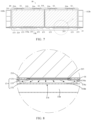
- an isolation component 14 is schematically depicted, and the isolation component 14 at least surrounds an actuation region of a pressure relief mechanism 213 to prevent an adhesive from entering the actuation region. In this way, it can avoid any hindrance or adverse influence on the execution of the actuation action of the pressure relief mechanism due to the adhesive flowing into the actuation region from any direction.
- the isolation component 14 adopted in various embodiments of the present application may adopt various possible constructions, so that the foregoing adhesive used for assembling the battery cell 20 to the attachment component can be isolated from a space between the attachment component and the pressure relief mechanism 213, or so that the coated adhesive can be isolated from a space that may affect the pressure relief mechanism 213 to perform its designed function of pressure relief once the adhesive flows in.
- the isolation component 14 may be designed to surround a partial region of the pressure relief mechanism 213, where the partial region can form a relief channel relieving the internal pressure of the battery cell 20 when the pressure relief mechanism 213 is actuated (which may be referred to as an actuation region or a relief region), for the emissions to flow out, or may also be attached to a region on the attachment component such as the thermal management component 13 corresponding to the pressure relief mechanism 213, so as to surround a space that is provided by the attachment component and allows the pressure relief mechanism 213 to be actuated (e.g., an avoidance structure 134 described below), or the like.
- the isolation component 14 may be attached to a region on the attachment component such as the thermal management component 13 corresponding to the pressure relief mechanism 213 before coating the adhesive. It should be noted that any component in the battery that is adhered together with the battery cell 20 by the adhesive may be considered as the attachment component or a portion of the attachment component, and these components may use the isolation component 14, that is, the isolation component 14 may be attached thereto before the adhesive is coated.
- the isolation component 14 can prevent the adhesive from entering a region on the attachment component corresponding to the pressure relief mechanism 213, especially corresponding to a region on the pressure relief mechanism 213 for actuation to form a relief channel relieving the internal pressure of the battery cell for the emissions to flow out, thereby ensuring that the pressure relief mechanism 213 can be actuated and normally achieve its designed function.
- the use of the isolation component 14 may also accelerate the coating speed and accuracy of the adhesive without worrying about coating the adhesive to a region related to the actuation of the pressure relief mechanism 213, and save costs of production time.
- FIG. 9 shows a perspective view of an isolation component 14 according to some embodiments of the present application
- FIG. 10 shows an exploded view in which the isolation component 14 shown in FIG. 9 and a thermal management component 13 as an example of an attachment component are not assembled together
- FIG. 11 shows a perspective view in which the isolation component 14 shown in FIG. 9 and a thermal management component 13 are attached together.
- an isolation component 14 may be attached to an attachment component such as a thermal management component 13 before coating the adhesive, so that a special structural feature on the isolation component 14 at least corresponds to a pressure relief mechanism 213 or an avoidance structure 134 disposed on the attachment component, where the avoidance structure 134 can provide a space allowing the relief mechanism 213 to be actuated.
- the specific structure and features of the avoidance structure 134 involved will be described in detail below.
- the isolation component 14 may include a main body 141 and a plurality of protrusions 142.
- the main body 141 is adapted to be attached or assembled to an attachment component such as a thermal management component 13.
- the protrusion 142 protrudes outward from a surface of the main body 141, and the protrusion 142 is arranged to be aligned with the pressure relief mechanism 213 or a relief region of the pressure relief mechanism 213 or an avoidance structure 134 or an avoidance chamber 134a in some embodiments described below in a protruding direction when the main body 141 is attached to the attachment component.
- the protrusion 142 is arranged to be aligned with the avoidance structure 134, in conjunction with FIG. 8 it is easy to understand that the arrangement of the avoidance structure 134 itself corresponds to the pressure relief mechanism 213 or both of which are aligned with each other, so the protrusion 142 may also be considered to be aligned with the pressure relief mechanism 213 or its actuation region (or relief region). Alternatively, in other embodiments not shown, for example, in an example where the battery 10 is not provided with the avoidance structure 134, the protrusion 142 may also be arranged to be directly aligned with the pressure relief mechanism 213 or aligned with its actuation region or relief region.
- the main body 141 and the protrusion 142 included in the isolation component 14 described here are not intended to indicate that the isolation component 14 must include independent components, and according to the following description of some preferred embodiments, it can be seen that a structure that the main body 141 and the protrusion 142 integrally form may be more advantageous in many aspects.
- the main body 141 may be understood as a portion of the isolation component 14 designed to be easily attached to an attachment component such as a support component or a thermal management component 13, the protrusion 142 is designed to protrude from the surface of the main body 141, and an outer peripheral dimension of the protrusion 142 is greater than or equal to an outer peripheral dimension of the pressure relief mechanism 213 or at least greater than or equal to that of the relief region of the pressure relief mechanism 213.
- a gluing machine may be guided to perform a gluing operation according to a predetermined path, and on the other hand, the adhesive may be ensured not to be coated to a position where the pressure relief mechanism 213 is located, thus ensuring that the adhesive can be coated to a proper position efficiently and accurately.
- the isolation component 14 is designed to have a long and thin sheet-shaped main body 141, and each main body 141 is provided with a row of protrusions 142.
- the main body 141 and the protrusion 142 in the present application may have various shapes according to the shape, structure and other factors of the pressure relief mechanism 213.
- the main body 141 generally has a relatively thin thickness, and therefore the main body 141 may generally be thin films or sheets in various shapes.
- a wall thickness of the isolation component 14 or the main body 141 may be between 0.01 mm and 0.05 mm.
- a shape of the protrusion 142 may be, for example, oblong, circular, elliptical, square, or the like as shown in the drawings.
- a single main body 141 may also be designed to have a single protrusion 142, multiple rows of protrusions 142, or a plurality of protrusions 142 arranged in other manners, as long as the arrangement and relative position of the protrusion 142 on the surface of the main body 141 can adapt to the setting position of the pressure relief mechanism 213 of the battery cell 20 in the battery.
- a single isolation component 14 may be designed to include one main body 141 and a plurality of protrusions 142 protruding from a surface of the main body 141, the main body 141 is integrally attached to the attachment component of the battery, and in such an attachment case, the plurality of protrusions 142 are respectively aligned with pressure relief mechanisms 213 (or aligned with relief regions of the pressure relief mechanisms 213) of a plurality of battery cells 20 included in the battery 10 in one-to-one correspondence, so that each protrusion 142 can surround a pressure relief mechanism 213 (or at least surround a relief region of the relief mechanism 213) with which it is aligned.
- a process of assembling the isolation component 14 to the attachment component of the battery is relatively simple, and meanwhile, the adhesive coated or to be coated can be isolated from the pressure relief mechanisms 213 or the relief regions thereof of the plurality of battery cells 20 included in the battery in a relatively independent manner by using the plurality of protrusions 142. Moreover, this can also assist an operator to properly complete the coating of the adhesive with higher efficiency when coating the adhesive, so that the operator does not need to carefully coat the adhesive, which helps to reduce assembling costs and production costs of the battery 10.
- a single isolation component 14 may be designed to have a plurality of protrusions 142, this design is particularly advantageous for a typical battery type in which a plurality of battery cells 20 are accommodated in one battery 10 and a plurality of battery cells 20 therein are respectively provided with pressure relief mechanisms 213, because when the single isolation component 14 is assembled in place, the plurality of protrusions 142 can play a role in isolating the adhesive for the pressure relief mechanisms 213 of the plurality of battery cells 20.
- the battery cells 20 may generally be attached to the attachment component of the battery 10 in rows.
- the isolation component 14 including one main body 141 and a plurality of protrusions 142 protruding from a surface of the main body 141 as described above may be adopted.
- the isolation component 14 may be an integrally formed sheet, and when the main body 141 of the isolation component 14 is attached to the attachment component of the battery 10, the plurality of protrusions 142 on the isolation component 14 may be respectively aligned with pressure relief mechanisms 213 of the plurality of battery cells 20 included in the battery in one-to-one correspondence.
- a plurality of isolation components 14 for the plurality of battery cells 20 may be integrally formed, where positions of the plurality of isolation components 14 arranged in rows respectively correspond to positions of the pressure relief mechanisms 213 of the plurality of battery cells 20. In this way, an assembling process of assembling a plurality of battery cells 20 to the battery 10 is simpler and the assembling efficiency is higher.
- an avoidance structure 134 may be disposed on an attachment component such as a thermal management component 13, and an avoidance chamber 134a is formed between the avoidance structure 134 and the pressure relief mechanism 213, thereby providing a space allowing the pressure relief mechanism 213 to be actuated.
- arrangements of the isolation component 14 and the protrusions 142 therein correspond to the arrangement of the avoidance structure 134 or the avoidance chamber 134 or both of which are aligned.
- the avoidance chamber 134a may be, for example, a closed cavity formed by joint enclosing of the avoidance structure 134 and the pressure relief mechanism 213.
- an inlet side surface of the avoidance chamber 134a may be opened due to the actuation of the pressure relief mechanism 213, while an outlet side surface opposite to the inlet side surface may be partially damaged and opened due to the high-temperature and high-pressure emissions, thus forming a relief channel for the emissions.
- the avoidance chamber 134a may be, for example, a non-closed cavity formed by joint enclosing of the avoidance structure 134 and the pressure relief mechanism 213, and an outlet side surface of the non-closed cavity may originally have a channel for the emissions flowing out. As indicated by the arrows in the avoidance chamber 134a of FIG. 8 , the emissions will be discharged outward in a fan-shaped direction.
- the thermal management component 13 further includes an avoidance bottom wall 134b at a bottom of the avoidance chamber 134 and an avoidance side wall 134c surrounding the avoidance chamber 134a.
- the avoidance bottom wall 134b referred to herein refers to a wall of the avoidance chamber 134a opposite to the pressure relief mechanism 213, and the avoidance side wall 134c is a wall adjacent to the avoidance bottom wall 134b and surrounding the avoidance chamber 134a at a certain angle, where an included angle formed by the avoidance side wall 134c and the avoidance bottom wall 134b may preferably be in a range of 105°-175°.
- the thermal management component 13 may also be provided with a fluid channel 133 for accommodating a fluid, and the fluid may be a cooling medium, so as to lower the temperature of the battery cell 20.
- the plurality of protrusions 142 of the isolation component 14 may be arranged as shown in FIGS. 10-11 , where each protrusion 142 may respectively surround its aligned avoidance chamber 134a, that is, the protrusion 142 is substantively covered and disposed at or beyond an upper peripheral edge of an avoidance side wall 134c of a corresponding avoidance chamber 134a. That is, the protrusion 142 of the isolation component 14 is substantively covered and disposed on an upper peripheral edge of the corresponding avoidance chamber 134a, thereby isolating the adhesive coated or to be coated from the avoidance structure 134 or the avoidance chamber 134a.
- the thermal management component 13 and the isolation component 14 are very beneficial to improving the assembling efficiency of the battery.
- a process of assembling the isolation component 14 to the attachment component of the battery is relatively simple, and meanwhile, the adhesive coated or to be coated can be isolated from avoidance chambers 134a corresponding to the pressure relief mechanisms 213 of the plurality of the battery cells 20 included in the battery in a relatively independent manner by using the plurality of protrusions 142.
- the coated adhesive may be prevented from influencing the pressure relief mechanism 213 of the battery cell 20 to perform its designed function, thereby ensuring the safety use of the battery.
- this can also assist an operator to properly complete the coating of adhesive with higher efficiency when coating the adhesive.
- an isolation operation of pressure relief mechanisms 213 of eight or more battery cells 20 may be achieved by assembling a single isolation component 14 at one time.
- the arrangement direction and position of the pressure relief mechanism 213 in the battery cell 20 are not limited in the present application. In fact, no matter whether the pressure relief mechanism 213 is arranged at a lower portion, upper portion or side portion of the battery cell 20, the relevant design of the isolation component 14 proposed in the present application may be properly applied, and it plays a beneficial role in ensuring that the pressure relief mechanism 213 achieves its designed function to relieve the high-temperature and high-pressure emissions in the battery cell when necessary, thus ensuring the safety use of the battery.
- the thermal management component 13 may be designed to have the following specific configuration.
- the thermal management component 13 may include a first thermally conductive plate 131 and a second thermally conductive plate 132.
- a groove structure corresponding to a fluid channel is formed on the second thermally conductive plate 132, and an avoidance structure 134 is formed on the first thermally conductive plate 131.
- thermal management component 13 by assembling the first thermally conductive plate 131 and the second thermally conductive plate 132 is only an example, and the foregoing thermal management component 13 may also be formed in other appropriate manners.
- the flow channel 133 disposed in the thermal management component 13 may be arranged to at least partially surround the avoidance chamber 134, that is, the avoidance side wall 134c separates the flow channel 133 from the avoidance chamber 134a, and a weakened structure which is easy to be damaged by the high-temperature and high-pressure emissions for example may be disposed on the avoidance side wall 134c.
- the weakened structure referred to in the present application may include, but is not limited to, a portion with reduced thickness, an indentation (e.g., a cross-shaped indentation 134d as shown in FIGS. 10 and 12 ), a fragile portion made of a fragile material, or a fragile portion made of a material with a lower melting point, or the like.
- the weakened structure on the avoidance side wall 134c is damaged, so that the cooling medium such as cooling liquid in the flow channel 133 flows out into the avoidance chamber 134a, and then the cooling liquid is in contact with the high-temperature and high-pressure emissions from the battery cell 20, and absorbs a large amount of heat and is vaporized.
- the temperature and intensity of pressure of the high-temperature and high-pressure emissions from the battery cell 20 are significantly reduced in a short time, thus protecting other components such as the battery cells 20 in the battery 10 in which thermally runaway does not occur.
- the isolation component 14 since the plurality of protrusions 142 of the isolation component 14 are substantively covered and disposed at or beyond the upper peripheral edge of the avoidance side wall 134c of the corresponding avoidance chamber 134a, this design can make the emissions damage the weakened structure of the avoidance side wall 134c and introduce the cooling medium, and meanwhile, the isolation component 14 and the protrusions 142 thereof still play a certain role in preventing the adhesive such as thermally conductive silica gel located outside thereof, thus improving the safety of the battery.
- the overall construction or configuration of the isolation component 14 is introduced above with reference to FIG. 9 to FIG. 14 , based mainly on the relative positional relationship between the isolation component 14 and another component, such as the attachment component or the pressure relief mechanism 213.
- the isolation component 14 may be designed into various possible constructions to achieve the function described above, that is, the adhesive used when the battery cell 20 is assembled to the attachment component is isolated from a space between the attachment component and the pressure relief mechanism 213, or the coated adhesive is isolated from a space that may affect the pressure relief mechanism 213 to perform its designed function of pressure relief once the adhesive flows in. More specific constructions of the isolation component 14 will be mainly described in detail below with reference to FIG. 15 to FIG. 32 .
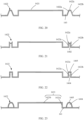
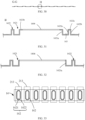
- FIG. 15 shows a perspective view of an isolation component 14 according to some embodiments of the present application
- FIG. 16 shows an enlarged view of a part C of the insolation component 14 shown in FIG. 15
- FIG. 17 shows a sectional view of the insolation component 14 shown in FIG. 15 in a direction of D-D
- FIG. 18 shows an enlarged view of a part E of a sectional plane of the insolation component 14 shown in FIG. 17 .
- the isolation component 14 can more effectively prevent an adhesive such as thermally conductive silica gel to isolate it from a space between the attachment component and the pressure relief mechanism 213, so as to ensure that the pressure relief mechanism 213 can be actuated and normally achieve its designed function.
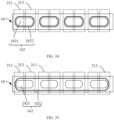
- the protrusion 142 disposed on the isolation component 14 includes a first protrusion 1421 and a second protrusion 1422, where the first protrusion 1421 and the second protrusion 1422 protrude from a surface of the main body 141 in the same direction.
- the isolation component 14 is disposed between the battery cell 20 and the attachment component. Therefore, specifically, in a case of attaching the main body 141 of the isolation component 14 to the attachment component, the first protrusion 1421 and the second protrusion 1422 are arranged to protrude from the surface of the main body 141 in a direction away from the attachment component, that is, to protrude toward the battery cell 20.
- the first protrusion 1421 corresponds to the position of the pressure relief mechanism 213. Specifically, as described above, the first protrusion 1421 may be arranged to be aligned with the pressure relief mechanism 213 or an actuation region (or a relief region) of the pressure relief mechanism 213 or the avoidance structure 134 or the avoidance chamber 134a in the embodiments described above in a protruding direction when the main body 141 is attached to the attachment component.
- a protruding height of the first protrusion 1421 is beneficial to preventing the adhesive from entering a space between the pressure relief mechanism 213 and the attachment component when the adhesive is applied, so as to avoid the inflow adhesive to hinder the normal operation of the pressure relief mechanism 213.
- the second protrusion 1422 and the first protrusion 1421 are spaced apart.
- the second protrusion 1422 is arranged to surround the first protrusion 1421.
- the second protrusion 1422 is in an annular structure, and is arranged to surround an outer periphery of the first protrusion 1421.
- a protruding height of the second protrusion 1422 is also beneficial to preventing the adhesive from entering the space between the pressure relief mechanism 213 and the attachment component around the first protrusion 1421.
- the cooperation of the two in structure has a multiple prevention effect on the adhesive, and thus can intercept the adhesive more effectively and reliably, to preventing the adhesive from entering between the attachment component and the pressure relief mechanism 213, hindering normal actuation of the pressure relief mechanism 213 when the internal pressure or temperature of the battery cell 20 reaches a threshold, and preventing the adhesive from flowing in to block the relief channel, to block discharge of the emissions relieved from the battery cell, so as to further improve safety performance of the battery 10.
- a groove 143 is formed between the first protrusion 1421 and the second protrusion 1422.
- the groove 143 may accommodate at least part of the adhesive to prevent the adhesive coated or to be coated from being applied between the attachment component and the pressure relief mechanism 213.
- the groove 143 may specifically accommodate part of the adhesive that overflows the second protrusion 1422, the adhesive that accidentally drips in the groove 143 in the process of attaching the battery cell 20 to the attachment component, the adhesive that enters the groove 143 due to other reasons, and the like.
- the groove 143 between the first protrusion 1421 and the second protrusion 1422 may accommodate at least part of the adhesive, which is equivalent to adding another barrier for the adhesive.
- the groove 143 may further store a certain amount of adhesive overflowing from the second protrusion 1422, thereby preventing the adhesive from further flowing to the space between the pressure relief mechanism 213 and the attachment component.
- the structure of the first protrusion 1421, the second protrusion 1422 or the groove 143 may be designed accordingly.
- the second protrusion 1422 includes a first side wall 1422a, a second side wall 1422b and a connecting wall 1422c for connecting the first side wall 1422a and the second side wall 1422b.
- the first side wall 1422a is connected to the main body 141
- the second side wall 1422b is connected to the main body 141
- the first side wall 1422a is arranged to opposite to the second side wall 1422b.
- the first side wall 1422a is close to the first protrusion 1421
- the first side wall 1422a is a wall shared by the second protrusion 1422 and the groove 143.
- the first side wall 1422a and the second side wall 1422b are parallel to a direction in which the attachment component faces the battery cell 20 when the battery cell 20 is attached to the attachment component, that is, the first side wall 1422a and the second side wall 1422b are parallel to a protruding direction of the second protrusion 1422.
- the connecting wall 1422c is perpendicular to the protruding direction of the second protrusion 1422.
- the isolation component 14 in this structure has a good effect of preventing the adhesive, it is simpler to process required modules, the processing is easy, and the costs are low.
- At least one of the first side wall 1422a and the second side wall 1422b includes a first projection 1401, and the first projection 1401 is arranged to protrude in a first direction X, where the first direction X is perpendicular to a protruding direction of the second protrusion 1422.
- the first direction X is a direction that is located in a D-D sectional plane shown in FIG. 17 and is perpendicular to the protruding direction of the second protrusion 1422. Therefore, the first direction X in the embodiments of the present application should be understood as a direction perpendicular to the protruding direction of the second protrusion 1422, such as a direction indicated by an arrow in FIG. 19 .
- the actual protruding direction of the second protrusion 1422 is a direction in which the attachment component faces the battery cell 20.
- the first direction X is a direction perpendicular to the protruding direction of the second protrusion 1422, toward the right along the paper surface for example. Therefore, the first projection 1401 may protrude in the first direction X indicated by the arrow.
- the first projection 1401 may further increase an accommodating volume of the groove 143, thereby accommodating more adhesive and preventing the adhesive from entering the space between the attach component and the pressure relief mechanism 213.
- first projection 1401 disposed on the first side wall 1422a may further protrude in a direction opposite to the direction indicated by the arrow in FIG. 19 , or the first projection 1401 may be further disposed on the second side wall 1422b, and the first projection 1401 on the second side wall 1422b may protrude in a direction perpendicular to the protruding direction of the second protrusion 1422, for example, protrude in a direction close to or away from the first side wall 1422a, which is not limited in the embodiments of the present application.
- the first projection 1401 may be disposed on the first side wall 1422a and/or the second side wall 1422b according to requirements, so as to achieve one or more of effects of effectively preventing the adhesive, increasing the accommodating volume of the groove 1443, reducing the space occupied by the second protrusion 1422, facilitating demoulding of the isolation component 14 in a producing process, and the like.
- the first projection 1401 is formed from at least part of the first side wall 1422a or the second side wall 1422b.
- At least one of the first side wall 1422a and the second side wall 1422b is arranged obliquely relative to a direction in which the attachment component faces the battery cell 20.
- first side wall 1422a and the second side wall 1422b are both arranged obliquely, as shown in FIG. 20 , one end of the first side wall 1422a connected to the connecting wall 1422c is oblique to a side on which the second side wall 1422b is located, and one end of the second side wall 1422b connected to the connecting wall 1422c is oblique to a side on which the first side wall 1422a is located.
- the oblique arrangement of the first side wall 1422a may increase the accommodating volume of the groove 143 to accommodate more adhesive, thereby effectively preventing the adhesive from entering between the pressure relief mechanism 213 and the attachment component.
- the oblique arrangement of the second side wall 1422b may increase a coating area of the adhesive on a periphery of the second protrusion 1422 to ensure reliability of adhesion.
- the oblique arrangements of the first side wall 1422a and/or the second side wall 1422b facilitate demoulding of the insolation component 14 in a producing process.
- the directions of the oblique arrangements of the first sidewall 1422a and/or the second side wall 1422b may also be in other forms.
- one end of the first side wall 1422a connected to the connecting wall 1422c is oblique to a side on which the first protrusion is located, and/or one end of the second side wall 1422b connected to the connecting wall 1422c is oblique to a side away from the first side wall 1422a, which is not limited in the embodiments of the present application.
- first projection 1401 may be disposed on the first side wall 1422a and/or the second side wall 1422b while the first side wall 1422a and/or the second side wall 1422b are obliquely arranged, which is not limited in the embodiments of the present application.
- first side wall 1422a or the second side wall 1422b when whether the first side wall 1422a or the second side wall 1422b is arranged obliquely relative to a direction in which the attachment component faces the battery cell 20 is determined, it can be determined according to a spatial relationship between a main plane where the first side wall 1422a or the second side wall 1422b is located and the direction in which the attachment component faces the battery cell 20.
- a main plane of the first side wall 1422a it may be a plane where the first side wall 1422a is located, or a plane where most of the first side wall 1422a is located, or a plane where a flat part on the first side wall 1422a is located, or the like.
- the connecting wall 1422c includes a second projection 1402, the second projection 1402 is arranged to protrude in a direction in which the attachment component faces the battery cell 20, or arranged to protrude in a direction in which the battery cell 20 faces the attachment component. Since the protruding direction of the second protrusion 1422 is the direction in which the attachment component faces the battery cell 20, the second projection 1402 may also be understood as being arranged to protrude in the protruding direction of the second protrusion 1422, or being arranged to protrude in a direction opposite to the protruding direction of the second protrusion 1422.
- the second projection 1402 is arranged to protrude in a direction in which the battery cell 20 faces the attachment component.
- the arrangement of the second projection 1402 makes a surface of the connecting wall 1422c uneven, thereby forming a space that can accommodate the adhesive.
- the adhesive may first remain in the accommodating space on the surface of the connecting wall 1422c, which is equivalent to adding another barrier, and preventing the adhesive from flowing in a direction of the first protrusion 1421 continuously. If a width of the second protrusion 1422 is sufficient, curvature of the surface of the connecting wall 1422c is smaller, and the adhesive that the connecting wall 1422c can store is more.
- the second projection 1402 is formed from at least part of the connecting wall 1422c.
- the second projection 1402 may also be arranged to protrude in a direction toward the battery cell 20, which is not limited in the embodiments of the present application.
- the space occupied by the second protrusion 1422 can be reduced, the accommodating volume of the groove 143 can be increased, and the like.
- the first projection 1401 may be disposed on at least one of the first side wall 1422a and the second side wall 1422b, and/or at least one of the first side wall 1422a and the second side wall 1422b is obliquely arranged, which is not limited in the embodiments of the present application.
- the second protrusion 1422 includes a cavity 1404. At least one of the first side wall 1422a, the second side wall 1422b and the connecting wall 1422c is provided with an opening 1405. The opening 1405 is in communication with the cavity 1404, so that at least part of the adhesive enters the cavity 1404 through the opening 1405.
- the adhesive located around the second protrusion 1422 can enter the cavity 1404 through the opening 1405, which not only makes full use of the space occupied by the second protrusion 1422, but also may reduce the adhesive around the second protrusion 1422 to prevent the adhesive from entering the space between the attachment component and the pressure relief mechanism 213.
- a shape of the second protrusion 1422 may be in any one of the structures as shown in the foregoing FIGS. 18-21 or the following drawings, and the embodiments of the present application do not limit the shape of the second protrusion 1422.
- the cavity 1404 may be a semi-enclosing structure. with reference to FIG. 22 , the cavity 1404 may be enclosed by walls of the second protrusion 1422, the walls of the second protrusion 1422 are located on a side of the isolation component 14 close to the battery cell 20, and the cavity 1404 is in communication with the outside on a side of the isolation component 14 close to the attachment component, to form a semi-closed chamber. In a case that the isolation component 14 is attached to the attachment component, an opening of the cavity 1404 in communication with the outside may be blocked by the attachment component.
- the cavity 1404 may be a fully enclosing structure. With reference to FIG. 23 , the cavity 1404 may be enclosed by walls of the second protrusion 1422 and the main body 141. Exemplarily, the second protrusion 1422 may be an independent component connected to the main body 141.
- the opening 1405 can be opened as large as possible to prevent the adhesive from having excessive resistance or directly blocking the opening 1405 when entering the cavity.
- a size of the opening 1405 may be correspondingly designed according to the structure of the second protrusion 1422, a coating thickness of the adhesive, and characteristic parameters of the adhesive, such as bonding strength, viscosity, and gel time.
- the structure of the second protrusion 1422 of the isolation component 14 is introduced above in detail, and the first protrusion 1421 of the isolation component 14 will be described below in detail with reference to the drawings. It should be understood that the structures of the first protrusion 1421 and the second protrusion 1422 are respectively described in an example of the same drawing in the embodiments of the present application, but this does not limit the isolation component 14 to be formed by combining the first protrusion 1421 and the second protrusion 1422 shown in the drawings.
- the first protrusion 1421 may include a third side wall 1421a and a top wall 1421b.
- the third side wall 1421a is connected to the main body141, and the third side wall 1421a is arranged opposite to the first side wall 1422a, where the third side wall 1421a is a wall shared by the first protrusion 1421 and the groove 143.
- the top wall 1421b is connected to one end of the third side wall 1421a close to the battery cell 20.
- a plane where the top wall 1421b is located is perpendicular or substantially perpendicular to a protruding direction of the first protrusion 1421.
- the third side wall 1421a is parallel to a direction in which the attachment component faces the battery cell 20 when the battery cell 20 is attached to the attachment component, that is, the third side wall 1421a is parallel to the protruding direction of the first protrusion 1421 (that is, the protruding direction of the second protrusion 1422).
- the isolation component 14 in this structure has a good effect of preventing the adhesive, it is simpler to process required modules, the processing is easy, and the costs are low.
- the third side wall 1421a may include a third projection 1403, and the third projection 1403 is arranged to protrude in a first direction X, where the first direction X is perpendicular to a protruding direction of the first protrusion 1421.
- the protruding direction of the first protrusion 1421 is the same as the protruding direction of the second protrusion 1422, and thus the first direction X here is also perpendicular to the protruding direction of the second protrusion 1422.
- a third projection 1403 is disposed on the third side wall 1421a, where the third projection 1403 is arranged to protrude in the first direction X indicated by an arrow.
- the third side wall 1421a is a wall shared by the first protrusion 1421 and the groove 143, the third projection 1403 is disposed on the third side wall 1421a and protrudes in a direction away from the first side wall 1422a, which may increase the accommodating volume of the groove 143, thereby accommodating more adhesive.
- the third projection 1403 may also be arranged to protrude in a direction opposite to the direction indicated by the arrow in FIG. 24 , which is not limited in the embodiments of the present application.
- the third side wall 1421a is arranged obliquely relative to a direction in which the attachment component faces the battery cell 20.
- one end of the third side wall 1421a connected to the top wall 1421b is oblique to a direction away from the second protrusion 1422, which may increase the accommodating volume of the groove 143 to accommodate more adhesive, thereby effectively preventing the adhesive from entering between the pressure relief mechanism 213 and the attachment component.
- the way to obliquely arranging the third side wall 1421a is beneficial to demoulding of the isolation component 14 in a producing process.
- the direction of the oblique arrangement of the third sidewall 1421a may also be in other forms.
- one end of the third side wall 1421a connected to the top wall 1421b is oblique to a side on which the second protrusion 1422 is located, which is not limited in the embodiments of the present application.
- a third projection 1403 may be disposed on the third side wall 1421a while the third side wall 1421 is obliquely arranged.
- the structures of the first protrusion 1421 shown in FIG. 23 to FIG. 25 and described in the related description may be combined with the structures of the second protrusion 1422 shown in FIG. 18 to FIG. 23 and described in the related description arbitrarily, which is not limited in the embodiments of the present application thereto.
- an opening may also be disposed on the third side wall 1421a, so that the adhesive in the groove 143 passes through the isolation component 14 through the opening, and enters between the isolation component 14 and the attachment component.
- the groove 143 is formed from the third side wall 1421a of the first protrusion 1421, the first side wall 1422a of the second protrusion 1422, and the main body 141. Therefore, by properly designing the structures of the first side wall 1422a, the third side wall 1421a and the main body 141, the groove 143 in a specific structure can be realized to achieve the purpose of increasing the volume of the groove 143 for accommodating the adhesive.
- a width of the second protrusion 1422 may be 1 mm to 8 mm.
- the width of the second protrusion 1422 involved here can be understood as a range of the width of the second protrusion 1422.
- the width is uniform, and the uniform width should be greater than 1 mm and less than 8 mm.
- the maximum width and the minimum width should be in a range from 1 mm to 8 mm.
- the width of the second protrusion 1422 refers to a width of the second protrusion in the first direction X, and the first direction X is perpendicular to the protruding direction of the second protrusion 1422.
- a sectional shape of the second protrusion 1422 is any one of the following shapes: a ⁇ shape, a convex lens type, a concave lens type, a trapezoid shape, an arch shape, and the like.
- a width of the groove 143 is 1 mm to 8 mm.
- the meaning of the width of the groove 143 is similar to the meaning of the width of the second protrusion 1422, which will not be repeated redundantly herein.
- a sectional shape of the groove 143 is any one of the following shapes: a drum type, a bag type, a bowl type, a trapezoid shape, a rectangle shape, and the like.
- the first protrusion 1421 and the second protrusion 1422 may be formed on the surface of the main body 141 by a blister process.
- the first protrusion 1421 and the second protrusion 1422 are processed and formed on a piece of thin sheet or film made of a thermoplastic material by a blister process on the basis of the piece of thin sheet or film, so as to produce the isolation component 14. This helps to simplify a manufacturing process of the isolation component 14 and reduce the costs.
- first protrusion 1421 and/or the second protrusion 1422 may be independent components connected to the main body 141.
- the first protrusion 1421 and/or the second protrusion 1422 are attached to the main body 141 after being produced, so as to produce the isolation component 14. This helps to reduce the costs of molds when a more complicated first protrusion 1421 and/or second protrusion 1422 are produced.
- the second protrusion 1422 may be an elastic component attached to the surface of the main body 141.
- the elastic component has a certain elastic deformation ability, and serves as the second protrusion 1422 to prevent the adhesive, which can adapt to larger installation errors.
- the elastic component may be, for example, a rubber pad, a silicone pad, foam, or the like.
- a loose hole inside the elastic component may be used to accommodate part of the adhesive.
- a channel may be disposed on the elastic component, and part of the adhesive is accommodated using the channel. It can be understood that, even if the second protrusion 1422 is made of a non-elastic component, a channel for accommodating the adhesive may also be disposed in the second protrusion 1422, which is not limited in the embodiments of the present application.
- a height of the first protrusion 1421 is greater than or equal to a predetermined application height of the adhesive, and the first protrusion 1421 is configured to be compressed when the battery cell 20 is attached to the attachment component, to have a height consistent with that of the adhesive; and/or a height of the second protrusion 1422 is greater than or equal to a predetermined application height of the adhesive, and the second protrusion 1422 is configured to be compressed when the battery cell 20 is attached to the attachment component, to have a height consistent with that of the adhesive.
- This arrangement ensures that the first protrusion 1421 and the second protrusion 1422 can effectively prevent the adhesive from being applied between the attachment component and the pressure relief mechanism 213. Meanwhile, this enables the isolation component 14 not to affect reliable adhesion between the attachment component and the pressure relief mechanism 213, and actuation of the pressure relief mechanism 213.
- the first protrusion 1421 and the second protrusion 1422 may be compressed to a height consistent with that of the adhesive, so that no gap is left between adhesive surfaces of the battery cell 20 and the attachment component of the battery 10 by the first protrusion 1421 and the second protrusion 1422, thus reliably ensuring that the adhesive is isolated from a region where the pressure relief mechanism 213 is actuated and where a channel for the emissions is formed.
- a height of the second protrusion 1422 is equal to a height of the first protrusion 1421. In this way, no gap is left between adhesive surfaces of the battery cell 20 and the attachment component of the battery 10 by the first protrusion 1421 and the second protrusion 1422, thus reliably ensuring that the adhesive is isolated from a region where the pressure relief mechanism 213 is actuated and where a channel for the emissions is formed.
- the protrusion 142 further includes a plurality of annular protrusions arranged to surround the second protrusion 1422, and the plurality of annular protrusions surround it in sequence and spaced apart from each other.
- the protrusion 142 further includes a third protrusion 1423, and the third protrusion 1423 is arranged around the second protrusion 1422.
- the structural design of the third protrusion 1423 is similar to that of the second protrusion 1422. Reference may be made to the above related description of the second protrusion 1422 for details, which will not be repeated redundantly herein for brevity.
- a groove 144 is formed between the second protrusion 1422 and the third protrusion 1423.
- the groove 144 is formed from one side wall (that is, the second side wall 1422b) of the second protrusion 1422, one side wall of the third protrusion 1423 and the main body 141.
- the function of the groove 144 is similar to that of the groove 143 for accommodating at least part of the adhesive. It should be understood that more protrusions may further be arranged on an outer periphery of the third protrusion 1423, the number of protrusions is greater, and the effect of preventing the adhesive is better. In addition, more grooves may further be disposed between the protrusions, the number of grooves is greater, and the effect of preventing the adhesive is better.
- an embodiment of the present application further provides another isolation component 14.
- FIG. 28 shows a perspective view of an isolation component 14 according to some embodiments of the present application
- FIG. 29 shows an enlarged view of a part F of the insolation component 14 shown in FIG. 28
- FIG. 30 shows a sectional view of the insolation component 14 shown in FIG. 28 in a direction of G-G
- FIG. 31 shows an enlarged view of a part H of a sectional plane of the insolation component 14 shown in FIG. 30 .
- the isolation component 14 can prevent the adhesive from adhering to the pressure relief mechanism 213, so as to ensure that the pressure relief mechanism 213 can be actuated smoothly.
- a through hole 1406 is disposed on a wall of the protrusion 142 facing the pressure relief mechanism 213, and the through hole 1406 is configured such that emissions from the battery cell 20 pass through the isolation component 14 when the pressure relief mechanism 213 is actuated.
- the protrusion 142 may be the protrusion 142 described in FIG. 9 to FIG. 14 , or the protrusion described in FIG. 15 to FIG. 27 .
- the protrusion 142 includes a first protrusion 1421 and a second protrusion 1422.
- the first protrusion 1421 includes a third side wall 1421a and a top wall 1421b, where the top wall 1421b is a wall facing the pressure relief mechanism 213.
- a through hole 1406 is disposed on a wall of the first protrusion 1421 facing the pressure relief mechanism 213, that is, the top wall 1421b.
- the through hole 1406 is configured such that the emissions from the battery cell 20 pass through the isolation component 14 when the pressure relief mechanism 213 is actuated.
- the through hole 1406 disposed on the top wall 1421b of the first protrusion 1421 can not only provide a space for actuation of the pressure relief mechanism 213, but also form a channel for the emissions. Moreover, the through hole can allow the adhesive to enter the through hole 1406 when the prevention functions of the first protrusion 1421, the groove 143 and the second protrusion 1422 all fail, to avoid the adhesive to adhere to the pressure relief mechanism 213 to affect the smooth opening of the pressure relief mechanism 213.
- the first protrusion 1421 may include only a third side wall 1421a, where one end of the third side wall 1421a close to the battery cell 20 constitutes an edge of the through hole 1406.
- the through hole 1406 is arranged around the pressure relief mechanism 213 to prevent the adhesive from entering between the pressure relief mechanism 213 and the attachment component, and avoid the pressure relief mechanism 213 to be adhered and unable to be actuated normally.
- the through hole 1406 is configured to correspond to a position of the avoidance chamber 134a, and the through hole 1406 surrounds a peripheral edge of a side of the avoidance chamber 134a facing the pressure relief mechanism 213 to avoid the pressure relief mechanism 213 to be adhered and unable to be actuated normally.
- the through hole 1406 is configured to correspond to a position of an actuation region of the pressure relief mechanism 213, and the through hole 1406 is arranged around the actuation region to prevent the adhesive from entering between the actuation region and the attachment component, and avoid the pressure relief mechanism 213 to be adhered and unable to be actuated normally.
- a single isolation component 14 may be designed to include one main body 141 and one or more protrusions 142 protruding from a surface of the main body 141.
- the battery 10 may include a plurality of battery cells 20, and each of the plurality of battery cells 20 includes the pressure relief mechanism 213. Manners of positional correspondence between the protrusion 142 and the pressure relief mechanism 213 (or the actuation region of the pressure relief mechanism 213, or an avoidance chamber 134a, or an avoidance structure 134) will be described below in detail with reference FIG. 33 to FIG. 35 . It should be understood that the approximate position of the pressure relief mechanism 213 is schematically shown with a frame with dashed lines in the drawings, which should not be construed as a limitation on the present application.
- a protrusion 142 may be in one-to-one correspondence to a pressure relief mechanism 213.
- the protrusion 142 here may be any one of the protrusions 142 described in FIG. 9 to FIG. 32 .
- a protrusion 142 may correspond to at least two pressure relief mechanisms 213.
- the protrusion 142 here may be any one of the protrusions 142 described in FIG. 9 to FIG. 32 .
- the protrusion 142 when the protrusion 142 is the protrusion described in FIG. 15 to FIG. 32 , the protrusion 142 includes the first protrusion 1421 and the second protrusion 1422. In some embodiments, the first protrusion 1421 and the second protrusion 1422 may be in one-to-one correspondence as shown in FIG. 15 to FIG. 32 . In some other embodiments, the second protrusion 1422 may correspond to at least two first protrusions 1421 as shown in FIG. 35 .
- the protrusion 142 is in one-to-one correspondence to the pressure relief mechanism 213 or the protrusion 142 corresponds to at least two pressure relief mechanisms 213 mentioned above, both of which are understood as that the first protrusion 1421 is in one-to-one correspondence to the pressure relief mechanism 213, or the first protrusion 1421 corresponds to at least two pressure relief mechanisms 213.
- the second protrusion 1422 is in one-to-one correspondence to the first protrusion 1421, and the second protrusion 1422 is in one-to-one correspondence to the pressure relief mechanism 213.
- the second protrusion 1422 is in one-to-one correspondence to the first protrusion 1421, and the second protrusion 1422 corresponds to at least two pressure relief mechanisms 213.
- the second protrusion 1421 corresponds to at least two first protrusions 1421
- the second protrusion 1422 corresponds to at least two pressure relief mechanisms 213.
- the second protrusion 1422 corresponds to a plurality of first protrusions 1421 (or a plurality of pressure relief mechanisms 213)
- the second protrusion 1422 is configured to prevent the adhesive for the plurality of first protrusions 1421.
- a gluing machine may be guided to perform a gluing operation according to a predetermined path, and on the other hand, the adhesive may be ensured not to be coated to a region within the range of the second protrusion 1422 to prevent the adhere from being coated to a position where the pressure relief mechanism 213 is located, thus ensuring that the adhesive can be coated to a proper position efficiently and accurately.
- the adhesive coated in the range of the second protrusion 1422 is reduced during the adhesive coating process, which can reduce the adhesive that may be applied to the first protrusion 1421, thereby preventing the adhesive from entering between the pressure relief mechanism 213 and the attachment component.
- the isolation component 14 and the protrusion 142 therein may adopt one or more of the following specific designs, materials or preparation processes, and the isolation component 14 according to the following preferred examples may be applied to any of the foregoing embodiments of the present application in principle.
- a height of the protrusion 142 in the isolation component 14 may be greater than or equal to a predetermined application height of the adhesive, which ensures that the adhesive will not enter or a small amount of adhesive enters a region between the pressure relief mechanism 213 and the attachment component when the adhesive is applied, and it is especially advantageous when the avoidance structure 134c is disposed in the attachment component.
- the protrusion 142 is also configured to be capable of being compressed when the battery cell 20 is attached to the attachment component, to have a height consistent with that of the adhesive, thereby ensuring the connection between the attachment component and the battery cell 20.
- the protrusion 142 may have a height slightly greater than the predetermined application height of the adhesive before the battery cell 20 is attached to the attachment component of the battery.
- the protrusion 142 may be compressed to a height consistent with the adhesive by simply pressing. At this time, no gap is left between the adhesive surfaces of the battery cell 20 and the attachment component of the battery by the protrusion 142, thereby ensuring that the adhesive is isolated from a region where the pressure relief mechanism 213 is actuated and where channel for the emissions is formed.
- the isolation component 14 may be made of a thermoplastic material by a blister process. This helps to simplify a manufacturing process of the isolation component 14 and reduce the costs. Moreover, for the isolation component 14 including the main body 141 and the plurality of protrusions 142, it is particularly economical to produce such an isolation component 14 by using the thermoplastic material through the blister process.
- the plurality of protrusions 142 may be processed and formed on a piece of thin sheet or film made of the thermoplastic material by the blister process on the basis of the piece of thin sheet or film, so as to produce the isolation component 14.
- the isolation component 14 is also made of a material which is easily damaged by the emissions from the battery cell 20, so that the emissions can easily break through the isolation component 14.
- the protrusion 142 or the whole isolation component 14 may be made of materials or structures which are easily damaged by high-temperature and high-pressure emissions or have low penetration strength.
- the protrusion 142 or the whole isolation component 14 may be made of a thermoplastic material with a melting point not higher than a discharge temperature of the emissions, so that the isolation component 14 has relatively high structural strength in a general use state where thermally runaway does not occur in the battery cell 20, and can be reliably damaged by the high-temperature and high-pressure emissions in a relatively short time in an emergency case where thermally runaway occurs in the battery cell 20.
- the isolation component 14 may adopt the structure including the main body 141 and the protrusion 142 protruding from the surface of the main body 141, according to some other embodiments, the isolation component 14 may also adopt a structure without the protrusion 142, but a special coating layer such as an adhesive-repellent layer, for preventing the adhesive from being applied between the attachment component and the pressure relief mechanism 213 is disposed at a position corresponding to the protrusion 142 in the foregoing embodiments.
- a special coating layer such as an adhesive-repellent layer
- a region coated with the adhesive-repellent layer covers at least a peripheral edge of a side of each avoidance chamber 134a facing the corresponding pressure relief mechanism 213, or at least covers the actuation region or the relief region of the pressure relief mechanism 213.
- an adhesive-repellent layer may be further disposed on the surface of the protrusion 142, so as to more reliably isolate the adhesive from the actuation region where the pressure relief mechanism 213 is actuated and where a channel for the emissions is formed or isolate the adhesive from the avoidance chamber 134a.
- FIG. 36 shows a schematic flowchart of a method 300 for producing a battery according to an embodiment of the present application.
- the method 300 includes: 301, providing a plurality of battery cells, at least one battery cell of the plurality of battery cells including a pressure relief mechanism configured to be capable of being actuated when an internal pressure or temperature of the battery cell reaches a threshold, to relieve the internal pressure; 302, providing an attachment component adapted to be attached to the battery cell by an adhesive; 303, providing an isolation component configured to be capable of preventing the adhesive from being applied between the attachment component and the pressure relief mechanism; and 304, applying the adhesive to attach the battery cell to the attachment component.
- the isolation component By providing the isolation component, it is possible to prevent the adhesive from being applied between the attachment component and the pressure relief mechanism in an effective manner in a process of battery production. Meanwhile, application efficiency and accuracy of the adhesive could be improved, thereby improving production efficiency of the battery.
- the pressure relief mechanism has an actuation region, and the pressure relief mechanism is configured, when the internal pressure or temperature of the battery cell reaches the threshold, to be capable of forming a relief channel for relieving the internal pressure in the actuation region; and the isolation component has a main body and a protrusion arranged to protrude from a surface of the main body, the protrusion is arranged to correspond to a position of the actuation region of the pressure relief mechanism, and the protrusion is configured to at least surround the actuation region to prevent the adhesive from entering the actuation region.
- the attachment component includes an avoidance structure configured to provide a space allowing the pressure relief mechanism to be actuated, and an avoidance chamber is formed between the avoidance structure and the pressure relief mechanism; and the isolation component has a main body and a protrusion arranged to protrude from a surface of the main body, the protrusion is arranged to correspond to a position of the avoidance chamber, and the protrusion is configured to at least surround a peripheral edge of a side of the avoidance chamber facing the pressure relief mechanism to prevent the adhesive from entering the avoidance chamber.
- an isolation component may be flexibly processed and manufactured according to actual needs, so that the manufactured single isolation component can achieve the effect of isolating the adhesive with a plurality of protrusions respectively corresponding to actuation regions of a plurality of pressure relief mechanisms or respectively corresponding to a plurality of avoidance chambers, which is helpful for reducing the production costs.
- the providing the isolation component includes forming the protrusion on the surface of the main body by a blister process.
- the required isolation component may be processed and manufactured conveniently and at a low cost. For the manufacture of a single isolation component provided with a plurality of protrusions, this processing and manufacturing advantage is particularly remarkable.
- FIG. 37 shows a schematic block diagram of a device 400 for producing a battery according to an embodiment of the present application.
- the device 400 according to some embodiments of the present application includes: a battery cell production module 401 for producing a plurality of battery cells, at least one battery cell of the plurality of battery cells including: a pressure relief mechanism configured to be capable of being actuated when an internal pressure or temperature of the battery cell reaches a threshold, to relieve the internal pressure; an attachment component production module 402 for producing an attachment component adapted to be attached to the battery cell by an adhesive; an isolation component production module 403 for producing an isolation component configured to be capable of preventing the adhesive from being applied between the attachment component and the pressure relief mechanism; and an assembling module 404 for mounting and fixing the isolation component relative to the battery cell or the attachment component, and applying the adhesive to attach the battery cell to the attachment component.
- a battery cell production module 401 for producing a plurality of battery cells, at least one battery cell of the plurality of battery cells including: a pressure relief mechanism configured to be capable of being
Landscapes
- Chemical & Material Sciences (AREA)
- Chemical Kinetics & Catalysis (AREA)
- Electrochemistry (AREA)
- General Chemical & Material Sciences (AREA)
- Engineering & Computer Science (AREA)
- Manufacturing & Machinery (AREA)
- Materials Engineering (AREA)
- Battery Mounting, Suspending (AREA)
- Gas Exhaust Devices For Batteries (AREA)
- Secondary Cells (AREA)
- Life Sciences & Earth Sciences (AREA)
- Biophysics (AREA)
- Measuring Or Testing Involving Enzymes Or Micro-Organisms (AREA)
- Heterocyclic Carbon Compounds Containing A Hetero Ring Having Oxygen Or Sulfur (AREA)
- Battery Electrode And Active Subsutance (AREA)
Description
- The present application relates to the field of batteries, and in particular, to a battery and a related apparatus, production method and production device therefor.
- A chemical battery, electrochemical battery, or electrochemical cell refers to a type of apparatus that converts chemical energy of positive and negative active substances into electrical energy through a redox reaction. Unlike an ordinary redox reaction, oxidation and reduction reactions are carried out separately, with the oxidation reaction taking place at a negative electrode and the reduction reaction taking place at a positive electrode, and gain and loss of electrons are carried out through an external circuit, and thus a current is formed. This is an essential characteristic of all batteries. After long-term research and development, the chemical battery has ushered in a situation of great varieties and wide applications, for example, it may be a huge apparatus that can accommodate a building, or a small apparatus in millimeter. With the development of modern electronic technology, high requirements are put forward for the chemical battery. Every breakthrough in chemical battery technology brings revolutionary development of an electronic device. Many electrochemical scientists in the world have focused their research and development interests in the field of chemical batteries that power electric automobiles.
- As a kind of chemical battery, a lithium-ion battery has advantages of small size, high energy density, high power density, multiple cycle times, long storage time, and the like, and has been widely applied in some electronic devices, electric transport, electric toys and electric devices. For example, currently, the lithium-ion battery is widely applied in mobile phones, notebook computers, electromobiles, electric automobiles, electric airplanes, electric ships, electric toy cars, electric toy ships, electric toy airplanes, electric tools, or the like.
- With the continuous development of lithium-ion battery technology, higher requirements are put forward for performance of the lithium-ion battery. It is hoped that design factors in multiple aspects can be considered at the same time for the lithium-ion battery, and safety performance of the lithium-ion battery is particularly important.
CN209401662U provides a battery pack. The battery pack comprises a battery module, the battery module comprises a plurality of single batteries, each single battery comprises an explosion-proof valve, the explosion-proof valves are arranged on the bottom surfaces of one sides of the single batteries in the height direction, and the explosion-proof valves protrude out of the bottom surfaces; wherein a cavity structure is arranged at the bottom of the box body; the bonding layer is used for bonding the bottom surfaces of the single batteries to the bottom of the box body; wherein a weak area is arranged at the bottom of the box body towards the structural layer of the explosion-proof valve; the explosion-proof valve corresponds to the weak area in position; gas exhausted by the explosion-proof valve can be collected into the cavity structure through the weak area and exhausted. In the application, the bonding layer bonds the bottom surface of the single battery to the bottom of the box body, and the explosion-proof valve protrudes out of the bottom surface of the single battery, so that high-temperature and high-pressure gas exhausted by the explosion-proof valve cannot be jetted towards the direction of the vehicle cabin, and the safety in the vehicle cabin is prevented from being influenced; and the bonding layer cannot enter the space between the explosion-proof valve and the bottom of the box body, exhaust during explosion of the explosion-proof valve cannot be blocked, and waste gas emission of the battery pack cannot be affected.
CN210535737U discloses a heat insulation assembly of a battery pack. The heat insulation assembly of the battery pack comprises a module upper cover, a sealing component and a fireproof cotton pad, wherein the sealing component, the module upper cover and the fireproof cotton pad are sequentially arranged from bottom to top; mutually independent exhaust channels are isolated between the top of each battery cell and the upper cover plate of the box body; therefore, when high-temperature gas is exhausted from the pressure release valves of the individual battery cells, the high-temperature gas cannot spread to the positions of other battery cells, the environment temperature of the other battery cells is increased, explosion and fire of the whole battery pack caused by thermal runaway of the individual battery cells are avoided, and the safety coefficient of the battery pack is improved.
CN111106277A discloses a battery pack. The battery pack comprises a box body, wherein the bottom of the box body is of a cavity structure; and a plurality of single batteries, which are stacked on the bottom of the box body, an explosion-proof valve being arranged on the end surface, facing the bottom of the box body, of each single battery, wherein a weak area is arranged on the structural layer, facing the explosion-proof valve, of the bottom of the box body, and when any single battery is in thermal runaway, gas in the single battery can be collected into the cavity structure through the weak area and exhausted. High-temperature and high-pressure gas generated by thermal runaway of the battery pack is jetted in the direction deviating from the vehicle cabin, and gas in the box body can be rapidly exhausted to the external environment, so that the battery pack has the characteristic of high safety. - The invention is set out in the appended set of claims.
- The accompanying drawings described herein are intended to provide a further understanding of the present application and constitute a part of the present application. The illustrative embodiments of the present application and the description thereof are used to explain the present application and do not constitute an undue limitation to the present application. In the drawings:
-
FIG. 1 shows a schematic structural diagram of some embodiments of a vehicle using a battery of the present application; -
FIG. 2 shows a schematic exploded view of a battery cell according to some embodiments of the present application; -
FIG. 3 shows a schematic perspective view of a battery cell according to some embodiments of the present application; -
FIG. 4 shows a schematic perspective view of a battery cell according to some embodiments of the present application; -
FIG. 5 shows a schematic exploded view of a battery according to some embodiments of the present application; -
FIG. 6 shows a schematic exploded view of a battery according to some embodiments of the present application; -
FIG. 7 illustrates a sectional view of a battery according to some embodiments of the present application; -
FIG. 8 shows an enlarged view of a part B of the battery shown inFIG. 7 ; -
FIG. 9 shows a perspective view of an isolation component according to some embodiments of the present application; -
FIG. 10 shows an exploded view of an isolation component that has not yet been attached to a thermal management component according to some embodiments of the present application; -
FIG. 11 shows an exploded view of an isolation component that has been attached to a thermal management component according to some embodiments of the present application; -
FIG. 12 shows a top view of a thermal management component according to some embodiments of the present application; -
FIG. 13 shows a sectional view of the thermal management component of the present application shown inFIG. 12 in a direction of A-A; -
FIG. 14 shows a bottom view of the thermal management component of the present application shown inFIG. 12 ; -
FIG. 15 shows a perspective view of an isolation component according to some embodiments of the present application; -
FIG. 16 shows an enlarged view of a part C of the insolation component of the present application shown inFIG. 15 ; -
FIG. 17 shows a sectional view of the insolation component of the present application shown inFIG. 15 in a direction of D-D; -
FIG. 18 to FIG. 27 show enlarged views of a part E of the isolation component of some embodiments of the present application shown inFIG. 17 ; -
FIG. 28 shows a perspective view of an isolation component according to some embodiments of the present application; -
FIG. 29 shows an enlarged view of a part F of the insolation component of the present application shown inFIG. 28 ; -
FIG. 30 shows a sectional view of the isolation component of the present application shown inFIG. 28 in a direction of G-G; -
FIG. 31 to FIG. 32 show enlarged views of an H part of the isolation component of some embodiments of the present application shown inFIG. 30 ; -
FIG. 33 to FIG. 35 show schematic diagrams of a corresponding relationship between a protrusion of an isolation component and a pressure relief mechanism according to some embodiments of the present application; -
FIG. 36 shows a schematic flowchart of some embodiments of a method for producing a battery according to the present application; and -
FIG. 37 shows a schematic structural diagram of some embodiments of a device for producing a battery according to the present application. - To make the objectives, technical solutions, and advantages of the present application clearer, the technical solutions in embodiments of the present application will be clearly and completely described below with reference to the accompanying drawings showing a plurality of embodiments according to the present application. It should be understood that, the described embodiments are merely some of, rather than all of, the embodiments of the present application. The scope of protection is defined by the appended claims.
- Unless otherwise defined, all technical and scientific terms used in the present application have the same meanings as those commonly understood by those skilled in the technical art to which the present application pertains. Terms used in the specification of the present application are merely for the purpose of describing specific embodiments, but are not intended to limit the present application. The terms "comprising", "including", "having", "possessing", "containing", "involving" and the like in the specification, the claims as well as the foregoing description of the foregoing accompanying drawings of the present application are open words. Therefore, a method or apparatus "comprising", "including" or "having" for example one or more steps or elements, has one or more steps or elements, but is not limited to merely having the one or more elements. The terms "first", "second", and the like in the specification, the claims, or the foregoing accompanying drawings of the present application, are intended to distinguish between different objects, rather than to describe a specific order or primary-secondary relationship. In addition, the terms "first" and "second" are only intended for the purpose of description, and shall not be understood as an indication or implication of relative importance or implicit indication of the quantity of indicated technical features. Therefore, a feature limited by "first" or "second" may explicitly or implicitly include one or more features. In the description of the present application, unless otherwise provided, "a plurality of" means two or more than two.
- In the description of the present application, it should be understood that orientations or positional relationships indicated by terms such as "center", "crosswise", "length", "width", "up", "down", "front", "rear", "left", "right", "vertical", "horizontal", "top", "bottom", "inside", "outside", "axial direction", "radial direction" and "circumferential direction" are orientations or positional relationships shown based on the drawings, and the terms are merely for convenience of describing the present application and for simplifying the description, but for indicating or implying that an indicated apparatus or element must have a specific orientation, and must be constructed and operated in a specific orientation, which thus may not be understood as limiting the present application.
- In the description of the present application, it should be noted that, unless explicitly specified and defined otherwise, terms "installation", "interconnection", "connection" and "attachment" should be understood broadly, for example, they may either be a fixed connection, or a detachable connection, or an integral connection; and they may either be a direct connection, or an indirect connection through an intermediary, and they may be an internal connection between two elements. Those of ordinary skill in the art may appreciate the specific meanings of the foregoing terms in the present application according to specific conditions.
- The phrase "embodiment" mentioned in the present application means that the specific features, structures, and characteristics described with reference to the embodiments may be included in at least one embodiment of the present application. The phrase at various locations in the specification does not necessarily refer to the same embodiment, or an independent or alternate embodiment that is mutually exclusive from another embodiment. Those skilled in the art understand, in explicit and implicit manners, that the embodiments described in the present application may be in combination with another embodiment.
- As described above, it should be emphasized that the term "comprising/including", when used in this specification, is used to clearly specify the presence of stated features, integers, steps or assemblies, but do not preclude the presence or addition of one or more other features, integers, steps, or components or groups of features, integers, steps or components. As used in the present application, the singular form "a", "an" and "the" include plural forms unless the context clearly dictates otherwise.
- The terms "a" and "an" in this specification can mean one, but may have the same meaning as "at least one" or "one or more". The term "about" generally means plus or minus 10%, or more specifically plus or minus 5%, of the mentioned value. The term "or" used in the claims means "and/or" unless it is clearly stated that it only refers to an alternative solution.
- The term "and/or" in the present application merely describes an association relationship between associated objects, and indicates that there may be three relationships. For example, A and/or B may indicate three cases: A exists alone, both A and B exist, and B exists alone. In addition, the character "/" in the present application generally indicates that the associated previous and next objects are in the relationship of "or".
- A battery mentioned in the field can be divided into a primary battery and a rechargeable battery according to whether it is rechargeable. The primary battery (Primary Battery) is also known as a "disposable" battery or a galvanic battery, because after its power is exhausted, it cannot be recharged and can only be discarded. The rechargeable battery is also called a secondary battery (Secondary Battery), a second-level battery, or a storage battery. Manufacturing materials and processes of the rechargeable battery are different from those of the primary battery. Its advantage is that it can be cycled multiple times after being charged, and output current load capacity of the rechargeable battery is higher than that of most primary batteries. At present, common types of rechargeable batteries are: a lead-acid battery, a Ni-MH battery and a lithium-ion battery. The lithium-ion battery has the advantages such as light weight, large capacity (1.5 to 2 times that of Ni-MH battery of the same weight), and no memory effect, and has a very low self-discharge rate, so even if its price is relatively high, it still gets widely used. The lithium-ion battery is also used in battery electric vehicles and hybrid vehicles. The capacity of lithium-ion battery for this purpose is relatively low, but it has a larger output and charging current, and a longer service life, but a higher cost.
- A battery described in an embodiment of the present application refers to a rechargeable battery. Hereinafter, the concept of the present application will be described mainly by an example of a lithium-ion battery. It should be understood that any other suitable type of a rechargeable battery is applicable. The battery mentioned in the embodiment of the present application refers to a single physical module including one or more battery cells to provide a higher voltage and capacity. For example, the battery mentioned in the present application may include a battery module, a battery pack, and the like. The battery cell includes a positive electrode sheet, a negative electrode sheet, an electrolytic solution and a separator, and is a basic structural unit of a battery module and a battery pack. Generally, the battery cell is divided into three types according to the way of packaging: a cylindrical battery cell, a prismatic battery cell and a pouch battery cell.
- The operation of a lithium-ion battery cell mainly relies on movement of lithium ions between the positive electrode sheet and the negative electrode sheet. The lithium ion battery cell uses one embedded lithium compound as one electrode material. Currently, main common materials used as a cathode material of a lithium-ion battery are: lithium cobalt oxide (LiCoO2), lithium manganese oxide (LiMn2O4), lithium nickel oxide (LiNiO2) and lithium iron phosphate (LiFePO4). The separator is disposed between the positive electrode sheet and the negative electrode sheet to form a thin film structure with three layers of materials. The thin film structure is generally made into an electrode assembly in a desired shape by winding or stacking. For example, a thin film structure with three layers of materials in a cylindrical battery cell is wound into a cylindrical electrode assembly, while a thin film structure in a prismatic battery cell is wound or stacked into an electrode assembly in a substantially cuboid shape.
- A plurality of battery cells may be connected in series and/or in parallel via electrode terminals for various applications. In some high-power applications such as electric automobiles, application of a battery includes three levels: a battery cell, a battery module, and a battery pack. The battery module is formed by electrically connecting a certain number of battery cells together and putting them in a frame in order to protect the battery cells from external impact, heat, vibration, or the like. The battery pack is a final state of a battery system installed in an electric automobile. Most existing battery packs are made by assembling various control and protection systems such as a battery management system (BMS) and a thermal management component on one or more battery modules. With the development of technology, the level of battery module may be omitted, that is, a battery pack is directly formed from a battery cell. This improvement allows the battery system to significantly reduce the number of components while increasing weight energy density and volume energy density. The battery mentioned in the present application includes a battery module or a battery pack.
- With respect to the battery cell, the main safety hazard comes from the charging and discharging processes, and in order to effectively avoid unnecessary risks and losses, at least triple protection measures are generally taken for the battery cell. Specifically, the protection measures include at least a switching element, a properly selected separator material and a pressure relief mechanism. The switching element refers to an element that can stop the charging or discharging of the battery when the temperature or resistance in the battery cell reaches a certain threshold. The separator is configured to isolate a positive electrode sheet from a negative electrode sheet, and may automatically dissolve micron-sized (or even nanoscale) micropores attached to the separator when the temperature rises to a certain value, so that lithium ions cannot pass through the separator and the internal reaction of the battery cell is terminated.
- A pressure relief mechanism refers to an element or component that can be actuated when an internal pressure or internal temperature of a battery cell reaches a predetermined threshold, to relieve the internal pressure and/or internal substances. The pressure relief mechanism may specifically take the form of an anti-explosion valve, a gas valve, a pressure relief valve, a safety valve, or the like, and may specifically adopt a pressure-sensitive or temperature-sensitive element or structure. That is, when the internal pressure or temperature of the battery cell reaches a predetermined threshold, the pressure relief mechanism performs an action or a weakened structure disposed in the pressure relief mechanism is damaged, thereby forming an opening or channel for internal pressure relief. The threshold referred to in the present application may be a pressure threshold or a temperature threshold. The threshold design varies according to different design requirements. For example, the threshold may be designed or determined according to an internal pressure or internal temperature value of a battery cell that is considered to have danger and a risk of being out of control. Moreover, the threshold may, for example depend on the material of one or more of the positive electrode sheet, the negative electrode sheet, the electrolytic solution and the separator in the battery cell.
- The "actuation" mentioned in the present application means that the pressure relief mechanism acts or is activated to a certain state, so that the internal pressure of the battery cell can be relieved. The action executed by the pressure relief mechanism may include but be not limited to: at least a portion of the pressure relief mechanism being fractured, broken, torn or opened and so on. When the pressure relief mechanism is actuated, high-temperature and high-pressure substances inside the battery cell are discharged outwards from an actuated position as emissions. In this way, the pressure of the battery cell can be relieved under a controllable pressure or temperature, thereby avoiding potential, more serious accidents. The emissions from the battery cell mentioned in the present application include but are not limited to: an electrolytic solution, dissolved or split positive and negative electrode sheets, fragments of a separator, high-temperature and high-pressure gas generated by reaction, flame, or the like. The high-temperature and high-pressure emissions are discharged in a direction in which the pressure relief mechanism of the battery cell is provided, and more specifically, may be discharged in a direction toward a region where the pressure relief mechanism is actuated. The strength and destructive power of such emissions may be very great, and may even be great enough to break through one or more structures such as a cover body in this direction.
- In some traditional solutions, the pressure relief mechanism is generally disposed on a cover plate of the battery cell. In some improved technical solutions, the pressure relief mechanism may also be arranged on a housing structure on the battery cell on another side or in another direction. However, regardless of an arrangement manner or arrangement position of the pressure relief mechanism, it is necessary to attach or assemble the battery cell to an attachment component by using the attachment component properly arranged in the battery through an adhesive (also referred to as glue or a binder), where the attachment component may specifically include an attachment component in the battery such as a thermal management component and a support component , and the adhesive may adopt, for example, thermally conductive silica gel, epoxy resin adhesive, polyurethane adhesive, or the like.
- It can be understood that the support component referred to in the present application may generally be understood as a component for providing support for the battery cell or resisting the gravity of the battery cell, which can generally be attached for example to a bottom wall or bottom of the housing of the battery cell to support or fix the battery cell thereon. The thermal management component is a component for accommodating a fluid to adjust the temperature of the battery cell, where the fluid here may be liquid or gas, and temperature adjustment refers to heating or cooling or lowering the temperature of the battery cell. Typically, the thermal management component for cooling or lowering the temperature of the battery cell may also be referred to as a cooling component, a cooling system, a cooling plate, or the like, which accommodates a cooling medium such as cooling liquid or cooling gas, where the cooling medium may be designed to flow in a circulating manner to achieve better temperature adjustment effects. The cooling medium may specifically use water, a mixture of water and ethylene glycol, air, or the like. The attachment component generally refers to a part of the battery that is adhered with the battery cell by the adhesive. As mentioned above, the attachment component may be provided by or composed of the thermal management component or the support component, besides, the attachment component may also be provided by any other suitable component in the battery.
- Regardless of which part of the battery is used as the attachment component, this manner of assembling the battery cell to the battery using the adhesive generally refers to applying or coating the adhesive on adhesive surfaces on which the attachment component and the battery cell are attached to each other, and then engaging the adhesive surfaces corresponding to the battery cell and the attachment component in a surface adhering manner by using the adhesive force and cohesive force generated after the curing of the adhesive, and thus the purpose of assembling the battery cell to the attachment component may be achieved. This design and its processing manner are widely applied because of its advantages of easy implementation, simple processes, low costs and firm and reliable attachment.
- However, after conducting a great deal of research and experiments, the inventor of the present application found that the widely adopted design of attaching the battery cell to the attachment component in the battery by using the adhesive may unexpectedly have an adverse effect on the design of the pressure relief mechanism aimed at providing reliable guarantee for the use safety of the battery cell.
- Specifically, on the one hand, when the adhesive is coated, some adhesive may flow into a region related to the actuation of the pressure relief mechanism due to careless coating of an excessive adhesive in a certain region or inclination of the adhesive surface coated with the adhesive. In this case, if the inflow adhesive is not cleaned additionally, this portion of the adhesive after curing is possible to adversely affect the actuation of the pressure relief mechanism, and even block or partially block a channel or opening that is formed when the pressure relief mechanism is actuated for the emissions to flow out, thereby affecting the relief of the emissions.
- On the other hand, the pressure relief mechanism in the battery cell is actuated when the internal pressure or temperature of the battery cell reaches a predetermined threshold, the high-temperature and high-pressure substances inside the battery cell are discharged outwards from an actuated position as emissions. At this time, the high-temperature and high-pressure emissions enable, due to its own destructive power and/or high temperature in a relieving process, an adhesive coated on an adhesive surface near a path where emissions pass by to be melted and flow into a region related to the actuation of the pressure relief mechanism, such as a position where the pressure relief mechanism is actuated, or a channel or opening formed by the actuation of the pressure relief mechanism for emissions to flow out, thereby adversely affecting relief of the emissions.
- In order to ensure that the pressure relief mechanism may play its designed function to relieve the high-temperature and high-pressure emissions inside the battery cell when necessary, it is necessary to prevent, in a certain manner, the adhesive such as thermally conductive silica gel from being applied to a region that may affect the actuation of the pressure relief mechanism or may affect the pressure relief mechanism to form an opening or channel for the emissions to flow out. However, for this reason, abandonment of the manner of assembling the battery cell to the attachment component in the battery with the adhesive, or addition of a barrier structure around an adhesive surface on which the adhesive needs to be applied to the battery cell or the attachment component will significantly increase the manufacturing difficulty and production costs of the battery. Therefore, how to ensure that the pressure relief mechanism disposed in the battery cell can play its designed function so as to ensure the use safety of the battery, while keeping the manufacturing difficulty and production costs of the battery at a relatively expected low level as much as possible is a difficult technical problem for a researcher or a person skilled in the art to be solved.
- In order to solve or at least partially solve the foregoing problems and other potential problems of a battery in the prior art, the inventor of the present application proposes a battery, the design of which will be described in detail below. It can be understood that the battery described in the embodiment of the present application is applicable to various apparatuses using batteries, such as mobile phones, portable devices, notebook computers, electromobiles, electric automobiles, ships, spacecrafts, electric toys and electric tools. For example, the spacecrafts include airplanes, rockets, space shuttles, spaceships, and the like; the electric toys include fixed or mobile electric toys, such as game consoles, electric vehicle toys, electric ship toys and electric airplane toys; the electric tools include electric metal cutting tools, electric grinding tools, electric assembling tools and electric railway tools, such as electric drills, electric grinders, electric spanners, electric screwdrivers, electric hammers, electric impact drills, concrete vibrators, and electric planers.
- The battery described in an embodiment of the present application is not only applicable to the device described above, but also applicable to all devices using batteries. However, the following embodiments are all described by an example of an electric automobile for brevity.
- For example, as shown in
FIG. 1, FIG. 1 is a simplified schematic diagram of avehicle 1 according to an embodiment of the present application. Thevehicle 1 may be a fuel-powered vehicle, a gas-powered vehicle or a new energy vehicle, and the new energy vehicle may be a full electric vehicle, a hybrid vehicle, an extended-range vehicle, or the like. As shown inFIG. 1 , thevehicle 1 may be internally provided with abattery 10, for example, thebattery 10 may be disposed at the bottom, head or tail of thevehicle 1. Thebattery 10 may be used for power supply to thevehicle 1, for example, thebattery 10 may be used as an operation power source of thevehicle 1. Moreover, thevehicle 1 may further include acontroller 30 and amotor 40. Thecontroller 30 is configured to control thebattery 10 to supply power to themotor 40, for example, for a working power demand of thevehicle 1 during startup, navigation and driving. In another embodiment of the present application, thebattery 10 may be used not only as an operation power source of thevehicle 1, but also as a driving power source of thevehicle 1, replacing or partially replacing fuel or natural gas to provide driving power for thevehicle 1. Thebattery 10 referred to below may also be understood as a battery pack including a plurality ofbattery cells 20. - As shown in
FIGS. 2-4 , abattery cell 20 includes acase 21, anelectrode assembly 22 and an electrolytic solution, where theelectrode assembly 22 is accommodated in thecase 21 of thebattery cell 20, and theelectrode assembly 22 includes a positive electrode sheet, a negative electrode sheet and a separator. A material of the separator may be polypropylene (PP), polyethylene (PE), or the like. Theelectrode assembly 22 may be a winding structure or a laminated structure. Thecase 21 includes ahousing 211 and acover plate 212. Thehousing 211 includes anaccommodation chamber 211a formed from a plurality of walls and anopening 211b. Thecover plate 212 is arranged at theopening 211b to close theaccommodation chamber 211a. In addition to theelectrode assembly 22, theaccommodation chamber 211a also accommodates an electrolytic solution. The positive electrode sheet and the negative electrode sheet in theelectrode assembly 22 are generally provided with tabs, and the tabs generally include a positive tab and a negative tab. - Specifically, the positive electrode sheet includes a positive electrode current collector and a positive electrode active material layer. The positive electrode active material layer is coated on a surface of the positive electrode current collector, the positive electrode current collector not coated with the positive electrode active material layer protrudes from the positive electrode current collector coated with the positive electrode active material layer, and the positive electrode current collector not coated with the positive electrode active material layer is used as the positive tab. A material of the positive electrode current collector may be aluminum, and the positive electrode active material may be lithium cobalt oxides, lithium iron phosphate, ternary lithium, lithium manganate, or the like. The negative electrode sheet includes a negative electrode current collector and a negative electrode active material layer. The negative electrode active material layer is coated on a surface of the negative electrode current collector, the negative electrode current collector not coated with the negative electrode active material layer protrudes from the negative electrode current collector coated with the negative electrode active material layer, and the negative electrode current collector not coated with the negative electrode active material layer is used as the negative tab. A material of the negative electrode current collector may be copper, and the negative electrode active material may be carbon, silicon, or the like. In order to ensure that no fusing occurs when a large current passes, there are a plurality of positive tabs which are stacked together, and there are a plurality of negative tabs which are stacked together. The tabs are connected to a
positive electrode terminal 214a and anegative electrode terminal 214b located outside thebattery cell 20 through connectingmembers 23. In the description of the present application, thepositive electrode terminal 214a and thenegative electrode terminal 214b are also collectively referred to as anelectrode terminal 214. For a prismatic battery cell, as shown inFIG. 2 andFIG. 4 , theelectrode terminal 214 may generally be disposed on thecover plate 212. -
FIGS. 5-6 show exploded views of abattery 10 according to some embodiments of the present application. As shown inFIGS. 5-6 , thebattery 10 may include abox 11 for enclosing a plurality ofbattery cells 20, and thebox 11 can avoid liquid or other foreign matters to affect the charging or discharging of thebattery cells 20, where the plurality ofbattery cells 20 are electrically connected to each other via abus component 12, and thebattery 10 may provide a higher voltage after the plurality ofbattery cells 20 are connected in series or in parallel through thebus component 12. Thebox 11 may include acover body 111 and abox shell 112. Thecover body 111 and thebox shell 112 may be combined together in a sealing manner to jointly enclose and form an electrical chamber 11a for accommodating the plurality ofbattery cells 20, and certainly, they may also be combined with each other in an unsealing manner. In some embodiments, athermal management component 13 may constitute a portion of thebox 11 for accommodating the plurality ofbattery cells 20. For example, thethermal management component 13 may constitute aside portion 112b of thebox shell 112 of thebox 11 or constitute a portion of theside portion 112b, or as shown inFIG. 6 , athermal management component 13 may constitute abottom portion 112a of thebox shell 112 of thebox 11 or constitute a portion of thebottom portion 112a. This design that thethermal management component 13 is used to constitute a portion of thebox shell 112 is helpful to make a structure of thebattery 10 more compact, improve effective utilization of space, and improve energy density. - In some alternative embodiments, the
battery 10 may further include aprotective member 115, as shown inFIGS. 6 and7 . Theprotective member 115 in the present application refers to a component arranged on a side of thethermal management component 13 away from thebattery cell 20 to provide protection for thethermal management component 13 and thebattery cell 20. In these embodiments, a collection chamber 11b may be arranged between theprotective member 115 and thethermal management component 13. - Referring to
FIGS. 7-8 , at least onebattery cell 20 in thebattery 10 includes apressure relief mechanism 213. In some embodiments, eachbattery cell 20 in thebattery 10 is provided with apressure relief mechanism 213, or apressure relief mechanism 213 may be disposed on somebattery cells 20 in the plurality ofbattery cells 20, which may be more prone to thermal runaway due to their positions in thebattery 10 or characteristics of theother battery cells 20. Thepressure relief mechanism 213 is capable of being actuated when an internal pressure or temperature of thebattery cell 20 reaches a predetermined threshold, to relieve the internal pressure of thebattery cell 20. - The
battery 10 also includes an attachment component adapted to be attached to thebattery cell 20 by an adhesive, and the attachment component may be, for example, athermal management component 13, a support component, or the like in thebattery 10. In order to avoid the adhesive such as thermally conductive silica gel to be applied between the attachment component and thepressure relief mechanism 213, thereby not preventing or not affecting thepressure relief mechanism 213 from being actuated and performing its designed function as described above, that is, a function that thepressure relief mechanism 213 is actuated when the internal pressure or temperature of thebattery cell 20 is relatively large to form a channel or opening for relieving the internal pressure of thebattery cell 20, thebattery 10 may also be provided with anisolation component 14, which is capable of preventing the adhesive from being applied between the attachment component and thepressure relief mechanism 213. Hereinafter, an embodiment in which the attachment component is thethermal management component 13 and the design of theisolation component 14 involved therein will be exemplified below. It can be understood that in a case where the attachment component is the support component, a structure or configuration substantially the same as or similar to that of theisolation component 14 may be applied. - In
FIG. 8 , anisolation component 14 is schematically depicted, and theisolation component 14 at least surrounds an actuation region of apressure relief mechanism 213 to prevent an adhesive from entering the actuation region. In this way, it can avoid any hindrance or adverse influence on the execution of the actuation action of the pressure relief mechanism due to the adhesive flowing into the actuation region from any direction. - The
isolation component 14 adopted in various embodiments of the present application may adopt various possible constructions, so that the foregoing adhesive used for assembling thebattery cell 20 to the attachment component can be isolated from a space between the attachment component and thepressure relief mechanism 213, or so that the coated adhesive can be isolated from a space that may affect thepressure relief mechanism 213 to perform its designed function of pressure relief once the adhesive flows in. As will be seen in the following description of some preferred embodiments, theisolation component 14 may be designed to surround a partial region of thepressure relief mechanism 213, where the partial region can form a relief channel relieving the internal pressure of thebattery cell 20 when thepressure relief mechanism 213 is actuated (which may be referred to as an actuation region or a relief region), for the emissions to flow out, or may also be attached to a region on the attachment component such as thethermal management component 13 corresponding to thepressure relief mechanism 213, so as to surround a space that is provided by the attachment component and allows thepressure relief mechanism 213 to be actuated (e.g., anavoidance structure 134 described below), or the like. - In some embodiments, the
isolation component 14 may be attached to a region on the attachment component such as thethermal management component 13 corresponding to thepressure relief mechanism 213 before coating the adhesive. It should be noted that any component in the battery that is adhered together with thebattery cell 20 by the adhesive may be considered as the attachment component or a portion of the attachment component, and these components may use theisolation component 14, that is, theisolation component 14 may be attached thereto before the adhesive is coated. In this way, when the adhesive is coated, theisolation component 14 can prevent the adhesive from entering a region on the attachment component corresponding to thepressure relief mechanism 213, especially corresponding to a region on thepressure relief mechanism 213 for actuation to form a relief channel relieving the internal pressure of the battery cell for the emissions to flow out, thereby ensuring that thepressure relief mechanism 213 can be actuated and normally achieve its designed function. In addition, the use of theisolation component 14 may also accelerate the coating speed and accuracy of the adhesive without worrying about coating the adhesive to a region related to the actuation of thepressure relief mechanism 213, and save costs of production time. -
FIG. 9 shows a perspective view of anisolation component 14 according to some embodiments of the present application,FIG. 10 shows an exploded view in which theisolation component 14 shown inFIG. 9 and athermal management component 13 as an example of an attachment component are not assembled together, andFIG. 11 shows a perspective view in which theisolation component 14 shown inFIG. 9 and athermal management component 13 are attached together. According to embodiments shown inFIGS. 9-11 , anisolation component 14 may be attached to an attachment component such as athermal management component 13 before coating the adhesive, so that a special structural feature on theisolation component 14 at least corresponds to apressure relief mechanism 213 or anavoidance structure 134 disposed on the attachment component, where theavoidance structure 134 can provide a space allowing therelief mechanism 213 to be actuated. The specific structure and features of theavoidance structure 134 involved will be described in detail below. - As shown in
FIGS. 9-11 , according to some preferred embodiments of the present application, theisolation component 14 may include amain body 141 and a plurality ofprotrusions 142. Themain body 141 is adapted to be attached or assembled to an attachment component such as athermal management component 13. Theprotrusion 142 protrudes outward from a surface of themain body 141, and theprotrusion 142 is arranged to be aligned with thepressure relief mechanism 213 or a relief region of thepressure relief mechanism 213 or anavoidance structure 134 or anavoidance chamber 134a in some embodiments described below in a protruding direction when themain body 141 is attached to the attachment component. Although in the examples shown inFIGS. 10-11 , theprotrusion 142 is arranged to be aligned with theavoidance structure 134, in conjunction withFIG. 8 it is easy to understand that the arrangement of theavoidance structure 134 itself corresponds to thepressure relief mechanism 213 or both of which are aligned with each other, so theprotrusion 142 may also be considered to be aligned with thepressure relief mechanism 213 or its actuation region (or relief region). Alternatively, in other embodiments not shown, for example, in an example where thebattery 10 is not provided with theavoidance structure 134, theprotrusion 142 may also be arranged to be directly aligned with thepressure relief mechanism 213 or aligned with its actuation region or relief region. - It can be understood that the
main body 141 and theprotrusion 142 included in theisolation component 14 described here are not intended to indicate that theisolation component 14 must include independent components, and according to the following description of some preferred embodiments, it can be seen that a structure that themain body 141 and theprotrusion 142 integrally form may be more advantageous in many aspects. - In the present application, the
main body 141 may be understood as a portion of theisolation component 14 designed to be easily attached to an attachment component such as a support component or athermal management component 13, theprotrusion 142 is designed to protrude from the surface of themain body 141, and an outer peripheral dimension of theprotrusion 142 is greater than or equal to an outer peripheral dimension of thepressure relief mechanism 213 or at least greater than or equal to that of the relief region of thepressure relief mechanism 213. In this way, when coating the adhesive, on the one hand, a gluing machine may be guided to perform a gluing operation according to a predetermined path, and on the other hand, the adhesive may be ensured not to be coated to a position where thepressure relief mechanism 213 is located, thus ensuring that the adhesive can be coated to a proper position efficiently and accurately. - Although in the embodiments shown in
FIGS. 9-11 , theisolation component 14 is designed to have a long and thin sheet-shapedmain body 141, and eachmain body 141 is provided with a row ofprotrusions 142. It can be understood that themain body 141 and theprotrusion 142 in the present application may have various shapes according to the shape, structure and other factors of thepressure relief mechanism 213. In consideration of the weight energy density or volume energy density of the battery, themain body 141 generally has a relatively thin thickness, and therefore themain body 141 may generally be thin films or sheets in various shapes. Typically, a wall thickness of theisolation component 14 or themain body 141 may be between 0.01 mm and 0.05 mm. A shape of theprotrusion 142 may be, for example, oblong, circular, elliptical, square, or the like as shown in the drawings. Moreover, a singlemain body 141 may also be designed to have asingle protrusion 142, multiple rows ofprotrusions 142, or a plurality ofprotrusions 142 arranged in other manners, as long as the arrangement and relative position of theprotrusion 142 on the surface of themain body 141 can adapt to the setting position of thepressure relief mechanism 213 of thebattery cell 20 in the battery. - According to some preferred embodiments, a
single isolation component 14 may be designed to include onemain body 141 and a plurality ofprotrusions 142 protruding from a surface of themain body 141, themain body 141 is integrally attached to the attachment component of the battery, and in such an attachment case, the plurality ofprotrusions 142 are respectively aligned with pressure relief mechanisms 213 (or aligned with relief regions of the pressure relief mechanisms 213) of a plurality ofbattery cells 20 included in thebattery 10 in one-to-one correspondence, so that eachprotrusion 142 can surround a pressure relief mechanism 213 (or at least surround a relief region of the relief mechanism 213) with which it is aligned. Therefore, a process of assembling theisolation component 14 to the attachment component of the battery is relatively simple, and meanwhile, the adhesive coated or to be coated can be isolated from thepressure relief mechanisms 213 or the relief regions thereof of the plurality ofbattery cells 20 included in the battery in a relatively independent manner by using the plurality ofprotrusions 142. Moreover, this can also assist an operator to properly complete the coating of the adhesive with higher efficiency when coating the adhesive, so that the operator does not need to carefully coat the adhesive, which helps to reduce assembling costs and production costs of thebattery 10. - Based on the foregoing solution, since a
single isolation component 14 may be designed to have a plurality ofprotrusions 142, this design is particularly advantageous for a typical battery type in which a plurality ofbattery cells 20 are accommodated in onebattery 10 and a plurality ofbattery cells 20 therein are respectively provided withpressure relief mechanisms 213, because when thesingle isolation component 14 is assembled in place, the plurality ofprotrusions 142 can play a role in isolating the adhesive for thepressure relief mechanisms 213 of the plurality ofbattery cells 20. - In a
battery 10 including a plurality ofbattery cells 20, thebattery cells 20 may generally be attached to the attachment component of thebattery 10 in rows. In view of this situation, theisolation component 14 including onemain body 141 and a plurality ofprotrusions 142 protruding from a surface of themain body 141 as described above may be adopted. Theisolation component 14 may be an integrally formed sheet, and when themain body 141 of theisolation component 14 is attached to the attachment component of thebattery 10, the plurality ofprotrusions 142 on theisolation component 14 may be respectively aligned withpressure relief mechanisms 213 of the plurality ofbattery cells 20 included in the battery in one-to-one correspondence. Alternatively, a plurality ofisolation components 14 for the plurality ofbattery cells 20 may be integrally formed, where positions of the plurality ofisolation components 14 arranged in rows respectively correspond to positions of thepressure relief mechanisms 213 of the plurality ofbattery cells 20. In this way, an assembling process of assembling a plurality ofbattery cells 20 to thebattery 10 is simpler and the assembling efficiency is higher. - According to some embodiments of the present application, as shown in
FIGS. 8 ,10 and12-13 mentioned above, anavoidance structure 134 may be disposed on an attachment component such as athermal management component 13, and anavoidance chamber 134a is formed between theavoidance structure 134 and thepressure relief mechanism 213, thereby providing a space allowing thepressure relief mechanism 213 to be actuated. In these embodiments, arrangements of theisolation component 14 and theprotrusions 142 therein correspond to the arrangement of theavoidance structure 134 or theavoidance chamber 134 or both of which are aligned. - Specifically, the
avoidance chamber 134a may be, for example, a closed cavity formed by joint enclosing of theavoidance structure 134 and thepressure relief mechanism 213. In this solution, for the discharge of the emissions from thebattery cells 20, an inlet side surface of theavoidance chamber 134a may be opened due to the actuation of thepressure relief mechanism 213, while an outlet side surface opposite to the inlet side surface may be partially damaged and opened due to the high-temperature and high-pressure emissions, thus forming a relief channel for the emissions. According to some other embodiments, theavoidance chamber 134a may be, for example, a non-closed cavity formed by joint enclosing of theavoidance structure 134 and thepressure relief mechanism 213, and an outlet side surface of the non-closed cavity may originally have a channel for the emissions flowing out. As indicated by the arrows in theavoidance chamber 134a ofFIG. 8 , the emissions will be discharged outward in a fan-shaped direction. - According to some embodiments, as shown in
FIGS. 12-14 , thethermal management component 13 further includes anavoidance bottom wall 134b at a bottom of theavoidance chamber 134 and anavoidance side wall 134c surrounding theavoidance chamber 134a. Theavoidance bottom wall 134b referred to herein refers to a wall of theavoidance chamber 134a opposite to thepressure relief mechanism 213, and theavoidance side wall 134c is a wall adjacent to theavoidance bottom wall 134b and surrounding theavoidance chamber 134a at a certain angle, where an included angle formed by theavoidance side wall 134c and theavoidance bottom wall 134b may preferably be in a range of 105°-175°. Thethermal management component 13 may also be provided with afluid channel 133 for accommodating a fluid, and the fluid may be a cooling medium, so as to lower the temperature of thebattery cell 20. - Accordingly, in these embodiments, the plurality of
protrusions 142 of theisolation component 14 may be arranged as shown inFIGS. 10-11 , where eachprotrusion 142 may respectively surround its alignedavoidance chamber 134a, that is, theprotrusion 142 is substantively covered and disposed at or beyond an upper peripheral edge of anavoidance side wall 134c of acorresponding avoidance chamber 134a. That is, theprotrusion 142 of theisolation component 14 is substantively covered and disposed on an upper peripheral edge of thecorresponding avoidance chamber 134a, thereby isolating the adhesive coated or to be coated from theavoidance structure 134 or theavoidance chamber 134a. - The
thermal management component 13 and theisolation component 14 according to the foregoing preferred embodiments are very beneficial to improving the assembling efficiency of the battery. A process of assembling theisolation component 14 to the attachment component of the battery is relatively simple, and meanwhile, the adhesive coated or to be coated can be isolated fromavoidance chambers 134a corresponding to thepressure relief mechanisms 213 of the plurality of thebattery cells 20 included in the battery in a relatively independent manner by using the plurality ofprotrusions 142. Thus, the coated adhesive may be prevented from influencing thepressure relief mechanism 213 of thebattery cell 20 to perform its designed function, thereby ensuring the safety use of the battery. Moreover, this can also assist an operator to properly complete the coating of adhesive with higher efficiency when coating the adhesive. - For example, in the embodiments shown in
FIGS. 10-11 , when a single long and thin sheet-shapedmain body 141 is assembled to thethermal management component 13 and is assembled in place, eightprotrusions 142 on themain body 141 are respectively covered and disposed on the aligned eightavoidance structures 134 oravoidance chambers 134a, so that the adhesive cannot enter theavoidance chambers 134a. In other words, an isolation operation ofpressure relief mechanisms 213 of eight ormore battery cells 20 may be achieved by assembling asingle isolation component 14 at one time. - It should be understood that the arrangement direction and position of the
pressure relief mechanism 213 in thebattery cell 20 are not limited in the present application. In fact, no matter whether thepressure relief mechanism 213 is arranged at a lower portion, upper portion or side portion of thebattery cell 20, the relevant design of theisolation component 14 proposed in the present application may be properly applied, and it plays a beneficial role in ensuring that thepressure relief mechanism 213 achieves its designed function to relieve the high-temperature and high-pressure emissions in the battery cell when necessary, thus ensuring the safety use of the battery. - In some embodiments, as shown in
FIGS. 12-14 , thethermal management component 13 may be designed to have the following specific configuration. Thethermal management component 13 may include a first thermallyconductive plate 131 and a second thermallyconductive plate 132. A groove structure corresponding to a fluid channel is formed on the second thermallyconductive plate 132, and anavoidance structure 134 is formed on the first thermallyconductive plate 131. By assembling the first thermallyconductive plate 131 and the second thermallyconductive plate 132 together, for example, the first thermallyconductive plate 131 and the second thermallyconductive plate 132 may be assembled together by welding (such as brazing), thethermal management component 13 as described in the foregoing embodiments may be formed. Certainly, it can be understood that this manner of forming thethermal management component 13 by assembling the first thermallyconductive plate 131 and the second thermallyconductive plate 132 is only an example, and the foregoingthermal management component 13 may also be formed in other appropriate manners. - The
flow channel 133 disposed in thethermal management component 13 may be arranged to at least partially surround theavoidance chamber 134, that is, theavoidance side wall 134c separates theflow channel 133 from theavoidance chamber 134a, and a weakened structure which is easy to be damaged by the high-temperature and high-pressure emissions for example may be disposed on theavoidance side wall 134c. It should be understood that the weakened structure referred to in the present application may include, but is not limited to, a portion with reduced thickness, an indentation (e.g., across-shaped indentation 134d as shown inFIGS. 10 and12 ), a fragile portion made of a fragile material, or a fragile portion made of a material with a lower melting point, or the like. - In this way, when the emissions from the
battery cell 20 enter theavoidance chamber 134a, the weakened structure on theavoidance side wall 134c is damaged, so that the cooling medium such as cooling liquid in theflow channel 133 flows out into theavoidance chamber 134a, and then the cooling liquid is in contact with the high-temperature and high-pressure emissions from thebattery cell 20, and absorbs a large amount of heat and is vaporized. In this way, the temperature and intensity of pressure of the high-temperature and high-pressure emissions from thebattery cell 20 are significantly reduced in a short time, thus protecting other components such as thebattery cells 20 in thebattery 10 in which thermally runaway does not occur. Moreover, since the plurality ofprotrusions 142 of theisolation component 14 are substantively covered and disposed at or beyond the upper peripheral edge of theavoidance side wall 134c of thecorresponding avoidance chamber 134a, this design can make the emissions damage the weakened structure of theavoidance side wall 134c and introduce the cooling medium, and meanwhile, theisolation component 14 and theprotrusions 142 thereof still play a certain role in preventing the adhesive such as thermally conductive silica gel located outside thereof, thus improving the safety of the battery. - The overall construction or configuration of the
isolation component 14 is introduced above with reference toFIG. 9 to FIG. 14 , based mainly on the relative positional relationship between theisolation component 14 and another component, such as the attachment component or thepressure relief mechanism 213. Based on this, theisolation component 14 may be designed into various possible constructions to achieve the function described above, that is, the adhesive used when thebattery cell 20 is assembled to the attachment component is isolated from a space between the attachment component and thepressure relief mechanism 213, or the coated adhesive is isolated from a space that may affect thepressure relief mechanism 213 to perform its designed function of pressure relief once the adhesive flows in. More specific constructions of theisolation component 14 will be mainly described in detail below with reference toFIG. 15 to FIG. 32 . -
FIG. 15 shows a perspective view of anisolation component 14 according to some embodiments of the present application,FIG. 16 shows an enlarged view of a part C of theinsolation component 14 shown inFIG. 15 ,FIG. 17 shows a sectional view of theinsolation component 14 shown inFIG. 15 in a direction of D-D, andFIG. 18 shows an enlarged view of a part E of a sectional plane of theinsolation component 14 shown inFIG. 17 . According to embodiments shown inFIG. 15 to FIG. 18 , with the special design of theprotrusion 142, theisolation component 14 can more effectively prevent an adhesive such as thermally conductive silica gel to isolate it from a space between the attachment component and thepressure relief mechanism 213, so as to ensure that thepressure relief mechanism 213 can be actuated and normally achieve its designed function. - As shown in
FIG. 15 to FIG. 18 , according to some embodiments of the present application, theprotrusion 142 disposed on theisolation component 14 includes afirst protrusion 1421 and asecond protrusion 1422, where thefirst protrusion 1421 and thesecond protrusion 1422 protrude from a surface of themain body 141 in the same direction. When assembled in place, theisolation component 14 is disposed between thebattery cell 20 and the attachment component. Therefore, specifically, in a case of attaching themain body 141 of theisolation component 14 to the attachment component, thefirst protrusion 1421 and thesecond protrusion 1422 are arranged to protrude from the surface of themain body 141 in a direction away from the attachment component, that is, to protrude toward thebattery cell 20. - The
first protrusion 1421 corresponds to the position of thepressure relief mechanism 213. Specifically, as described above, thefirst protrusion 1421 may be arranged to be aligned with thepressure relief mechanism 213 or an actuation region (or a relief region) of thepressure relief mechanism 213 or theavoidance structure 134 or theavoidance chamber 134a in the embodiments described above in a protruding direction when themain body 141 is attached to the attachment component. A protruding height of thefirst protrusion 1421 is beneficial to preventing the adhesive from entering a space between thepressure relief mechanism 213 and the attachment component when the adhesive is applied, so as to avoid the inflow adhesive to hinder the normal operation of thepressure relief mechanism 213. - The
second protrusion 1422 and thefirst protrusion 1421 are spaced apart. With reference toFIG. 16 , thesecond protrusion 1422 is arranged to surround thefirst protrusion 1421. Specifically, thesecond protrusion 1422 is in an annular structure, and is arranged to surround an outer periphery of thefirst protrusion 1421. A protruding height of thesecond protrusion 1422 is also beneficial to preventing the adhesive from entering the space between thepressure relief mechanism 213 and the attachment component around thefirst protrusion 1421. Moreover, since thesecond protrusion 1422 is arranged around the first protrusion the cooperation of the two in structure has a multiple prevention effect on the adhesive, and thus can intercept the adhesive more effectively and reliably, to preventing the adhesive from entering between the attachment component and thepressure relief mechanism 213, hindering normal actuation of thepressure relief mechanism 213 when the internal pressure or temperature of thebattery cell 20 reaches a threshold, and preventing the adhesive from flowing in to block the relief channel, to block discharge of the emissions relieved from the battery cell, so as to further improve safety performance of thebattery 10. - In some embodiments, with reference to
FIG. 16 andFIG. 18 , agroove 143 is formed between thefirst protrusion 1421 and thesecond protrusion 1422. Thegroove 143 may accommodate at least part of the adhesive to prevent the adhesive coated or to be coated from being applied between the attachment component and thepressure relief mechanism 213. Thegroove 143 may specifically accommodate part of the adhesive that overflows thesecond protrusion 1422, the adhesive that accidentally drips in thegroove 143 in the process of attaching thebattery cell 20 to the attachment component, the adhesive that enters thegroove 143 due to other reasons, and the like. - The
groove 143 between thefirst protrusion 1421 and thesecond protrusion 1422 may accommodate at least part of the adhesive, which is equivalent to adding another barrier for the adhesive. When thesecond protrusion 1422 prevents its peripheral adhesive from flowing to thefirst protrusion 1421, if the function of intercepting the adhesive by thesecond protrusion 1422 fails, thegroove 143 may further store a certain amount of adhesive overflowing from thesecond protrusion 1422, thereby preventing the adhesive from further flowing to the space between thepressure relief mechanism 213 and the attachment component. - In order to enable the
isolation component 14 to achieve a better adhesive preventing effect, the structure of thefirst protrusion 1421, thesecond protrusion 1422 or thegroove 143 may be designed accordingly. - In some embodiments, with reference to
FIG. 18 , thesecond protrusion 1422 includes afirst side wall 1422a, asecond side wall 1422b and a connectingwall 1422c for connecting thefirst side wall 1422a and thesecond side wall 1422b. In the embodiments of the present application, thefirst side wall 1422a is connected to themain body 141, thesecond side wall 1422b is connected to themain body 141, and thefirst side wall 1422a is arranged to opposite to thesecond side wall 1422b. Thefirst side wall 1422a is close to thefirst protrusion 1421, and thefirst side wall 1422a is a wall shared by thesecond protrusion 1422 and thegroove 143. - In some embodiments, as shown in
FIG. 18 , thefirst side wall 1422a and thesecond side wall 1422b are parallel to a direction in which the attachment component faces thebattery cell 20 when thebattery cell 20 is attached to the attachment component, that is, thefirst side wall 1422a and thesecond side wall 1422b are parallel to a protruding direction of thesecond protrusion 1422. The connectingwall 1422c is perpendicular to the protruding direction of thesecond protrusion 1422. Theisolation component 14 in this structure has a good effect of preventing the adhesive, it is simpler to process required modules, the processing is easy, and the costs are low. - In some embodiments, with reference to
FIG. 19 , at least one of thefirst side wall 1422a and thesecond side wall 1422b includes afirst projection 1401, and thefirst projection 1401 is arranged to protrude in a first direction X, where the first direction X is perpendicular to a protruding direction of thesecond protrusion 1422. - Here, the first direction X is a direction that is located in a D-D sectional plane shown in
FIG. 17 and is perpendicular to the protruding direction of thesecond protrusion 1422. Therefore, the first direction X in the embodiments of the present application should be understood as a direction perpendicular to the protruding direction of thesecond protrusion 1422, such as a direction indicated by an arrow inFIG. 19 . - Exemplarily, in an example that the
first side wall 1422a is provided with afirst projection 1401, the actual protruding direction of thesecond protrusion 1422 is a direction in which the attachment component faces thebattery cell 20. For convenience of understanding and description, in an example that a direction of thesecond protrusion 1422 upward along a paper surface is the protruding direction, the first direction X is a direction perpendicular to the protruding direction of thesecond protrusion 1422, toward the right along the paper surface for example. Therefore, thefirst projection 1401 may protrude in the first direction X indicated by the arrow. - In the embodiments of the present application, since the
groove 143 and thesecond protrusion 1422 share thefirst side wall 1422a, and thefirst projection 1401 is disposed on thefirst side wall 1422a and protrudes in a direction close to thesecond side wall 1422b, in this way, while thesecond protrusion 1422 meets a requirement of preventing the adhesive, thefirst projection 1401 may further increase an accommodating volume of thegroove 143, thereby accommodating more adhesive and preventing the adhesive from entering the space between the attach component and thepressure relief mechanism 213. - It should be understood that the
first projection 1401 disposed on thefirst side wall 1422a may further protrude in a direction opposite to the direction indicated by the arrow inFIG. 19 , or thefirst projection 1401 may be further disposed on thesecond side wall 1422b, and thefirst projection 1401 on thesecond side wall 1422b may protrude in a direction perpendicular to the protruding direction of thesecond protrusion 1422, for example, protrude in a direction close to or away from thefirst side wall 1422a, which is not limited in the embodiments of the present application. - In practical applications, the
first projection 1401 may be disposed on thefirst side wall 1422a and/or thesecond side wall 1422b according to requirements, so as to achieve one or more of effects of effectively preventing the adhesive, increasing the accommodating volume of the groove 1443, reducing the space occupied by thesecond protrusion 1422, facilitating demoulding of theisolation component 14 in a producing process, and the like. - In the embodiments of the present application, the
first projection 1401 is formed from at least part of thefirst side wall 1422a or thesecond side wall 1422b. - In some embodiments, with reference to
FIG. 20 , at least one of thefirst side wall 1422a and thesecond side wall 1422b is arranged obliquely relative to a direction in which the attachment component faces thebattery cell 20. - Exemplarily, in an example that the
first side wall 1422a and thesecond side wall 1422b are both arranged obliquely, as shown inFIG. 20 , one end of thefirst side wall 1422a connected to the connectingwall 1422c is oblique to a side on which thesecond side wall 1422b is located, and one end of thesecond side wall 1422b connected to the connectingwall 1422c is oblique to a side on which thefirst side wall 1422a is located. The oblique arrangement of thefirst side wall 1422a may increase the accommodating volume of thegroove 143 to accommodate more adhesive, thereby effectively preventing the adhesive from entering between thepressure relief mechanism 213 and the attachment component. The oblique arrangement of thesecond side wall 1422b may increase a coating area of the adhesive on a periphery of thesecond protrusion 1422 to ensure reliability of adhesion. In addition, the oblique arrangements of thefirst side wall 1422a and/or thesecond side wall 1422b facilitate demoulding of theinsolation component 14 in a producing process. - It should be understood that, in other embodiments, the directions of the oblique arrangements of the
first sidewall 1422a and/or thesecond side wall 1422b may also be in other forms. For example, one end of thefirst side wall 1422a connected to the connectingwall 1422c is oblique to a side on which the first protrusion is located, and/or one end of thesecond side wall 1422b connected to the connectingwall 1422c is oblique to a side away from thefirst side wall 1422a, which is not limited in the embodiments of the present application. - It can be understood that, in practical applications, the
first projection 1401 may be disposed on thefirst side wall 1422a and/or thesecond side wall 1422b while thefirst side wall 1422a and/or thesecond side wall 1422b are obliquely arranged, which is not limited in the embodiments of the present application. - It should be noted that when whether the
first side wall 1422a or thesecond side wall 1422b is arranged obliquely relative to a direction in which the attachment component faces thebattery cell 20 is determined, it can be determined according to a spatial relationship between a main plane where thefirst side wall 1422a or thesecond side wall 1422b is located and the direction in which the attachment component faces thebattery cell 20. In an example of a main plane of thefirst side wall 1422a, it may be a plane where thefirst side wall 1422a is located, or a plane where most of thefirst side wall 1422a is located, or a plane where a flat part on thefirst side wall 1422a is located, or the like. - In some embodiments, with reference to
FIG. 21 , the connectingwall 1422c includes asecond projection 1402, thesecond projection 1402 is arranged to protrude in a direction in which the attachment component faces thebattery cell 20, or arranged to protrude in a direction in which thebattery cell 20 faces the attachment component. Since the protruding direction of thesecond protrusion 1422 is the direction in which the attachment component faces thebattery cell 20, thesecond projection 1402 may also be understood as being arranged to protrude in the protruding direction of thesecond protrusion 1422, or being arranged to protrude in a direction opposite to the protruding direction of thesecond protrusion 1422. - Exemplarily, as shown in
FIG. 21 , thesecond projection 1402 is arranged to protrude in a direction in which thebattery cell 20 faces the attachment component. The arrangement of thesecond projection 1402 makes a surface of the connectingwall 1422c uneven, thereby forming a space that can accommodate the adhesive. In this way, when a height of the adhesive exceeds a height of thesecond protrusion 1422 to have a tendency of flowing to thefirst protrusion 1421, the adhesive may first remain in the accommodating space on the surface of the connectingwall 1422c, which is equivalent to adding another barrier, and preventing the adhesive from flowing in a direction of thefirst protrusion 1421 continuously. If a width of thesecond protrusion 1422 is sufficient, curvature of the surface of the connectingwall 1422c is smaller, and the adhesive that the connectingwall 1422c can store is more. - In the embodiments of the present application, the
second projection 1402 is formed from at least part of the connectingwall 1422c. - It should be understood that the
second projection 1402 may also be arranged to protrude in a direction toward thebattery cell 20, which is not limited in the embodiments of the present application. By rationally designing the structure of thesecond projection 1402, the space occupied by thesecond protrusion 1422 can be reduced, the accommodating volume of thegroove 143 can be increased, and the like. - It should also be understood that, in practical applications, while the
second projection 1402 is disposed on the connectingwall 1422c, thefirst projection 1401 may be disposed on at least one of thefirst side wall 1422a and thesecond side wall 1422b, and/or at least one of thefirst side wall 1422a and thesecond side wall 1422b is obliquely arranged, which is not limited in the embodiments of the present application. - In some embodiments, with reference to
FIG. 22 , thesecond protrusion 1422 includes acavity 1404. At least one of thefirst side wall 1422a, thesecond side wall 1422b and the connectingwall 1422c is provided with anopening 1405. Theopening 1405 is in communication with thecavity 1404, so that at least part of the adhesive enters thecavity 1404 through theopening 1405. - In the embodiments of the present application, by providing the
opening 1405 on at least one wall of thesecond protrusion 1422, the adhesive located around thesecond protrusion 1422 can enter thecavity 1404 through theopening 1405, which not only makes full use of the space occupied by thesecond protrusion 1422, but also may reduce the adhesive around thesecond protrusion 1422 to prevent the adhesive from entering the space between the attachment component and thepressure relief mechanism 213. - In the solution of disposing the
opening 1405 on at least one wall of thesecond protrusion 1422, a shape of thesecond protrusion 1422 may be in any one of the structures as shown in the foregoingFIGS. 18-21 or the following drawings, and the embodiments of the present application do not limit the shape of thesecond protrusion 1422. - In some embodiments, the
cavity 1404 may be a semi-enclosing structure. with reference toFIG. 22 , thecavity 1404 may be enclosed by walls of thesecond protrusion 1422, the walls of thesecond protrusion 1422 are located on a side of theisolation component 14 close to thebattery cell 20, and thecavity 1404 is in communication with the outside on a side of theisolation component 14 close to the attachment component, to form a semi-closed chamber. In a case that theisolation component 14 is attached to the attachment component, an opening of thecavity 1404 in communication with the outside may be blocked by the attachment component. - In some embodiments, the
cavity 1404 may be a fully enclosing structure. With reference toFIG. 23 , thecavity 1404 may be enclosed by walls of thesecond protrusion 1422 and themain body 141. Exemplarily, thesecond protrusion 1422 may be an independent component connected to themain body 141. - It should be understood that, in order to smoothly enter the
cavity 1404 from theopening 1405 for the adhesive, theopening 1405 can be opened as large as possible to prevent the adhesive from having excessive resistance or directly blocking theopening 1405 when entering the cavity. In practical applications, a size of theopening 1405 may be correspondingly designed according to the structure of thesecond protrusion 1422, a coating thickness of the adhesive, and characteristic parameters of the adhesive, such as bonding strength, viscosity, and gel time. - The structure of the
second protrusion 1422 of theisolation component 14 is introduced above in detail, and thefirst protrusion 1421 of theisolation component 14 will be described below in detail with reference to the drawings. It should be understood that the structures of thefirst protrusion 1421 and thesecond protrusion 1422 are respectively described in an example of the same drawing in the embodiments of the present application, but this does not limit theisolation component 14 to be formed by combining thefirst protrusion 1421 and thesecond protrusion 1422 shown in the drawings. - In some embodiments, with reference to
FIG. 23 , thefirst protrusion 1421 may include athird side wall 1421a and atop wall 1421b. Thethird side wall 1421a is connected to the main body141, and thethird side wall 1421a is arranged opposite to thefirst side wall 1422a, where thethird side wall 1421a is a wall shared by thefirst protrusion 1421 and thegroove 143. Thetop wall 1421b is connected to one end of thethird side wall 1421a close to thebattery cell 20. A plane where thetop wall 1421b is located is perpendicular or substantially perpendicular to a protruding direction of thefirst protrusion 1421. - In some embodiments, the
third side wall 1421a is parallel to a direction in which the attachment component faces thebattery cell 20 when thebattery cell 20 is attached to the attachment component, that is, thethird side wall 1421a is parallel to the protruding direction of the first protrusion 1421 (that is, the protruding direction of the second protrusion 1422). Theisolation component 14 in this structure has a good effect of preventing the adhesive, it is simpler to process required modules, the processing is easy, and the costs are low. - In some embodiments, with reference to
FIG. 24 , thethird side wall 1421a may include athird projection 1403, and thethird projection 1403 is arranged to protrude in a first direction X, where the first direction X is perpendicular to a protruding direction of thefirst protrusion 1421. In the embodiments of the present application, the protruding direction of thefirst protrusion 1421 is the same as the protruding direction of thesecond protrusion 1422, and thus the first direction X here is also perpendicular to the protruding direction of thesecond protrusion 1422. - Exemplarily, as shown in
FIG. 24 , athird projection 1403 is disposed on thethird side wall 1421a, where thethird projection 1403 is arranged to protrude in the first direction X indicated by an arrow. Thethird side wall 1421a is a wall shared by thefirst protrusion 1421 and thegroove 143, thethird projection 1403 is disposed on thethird side wall 1421a and protrudes in a direction away from thefirst side wall 1422a, which may increase the accommodating volume of thegroove 143, thereby accommodating more adhesive. It should be understood that thethird projection 1403 may also be arranged to protrude in a direction opposite to the direction indicated by the arrow inFIG. 24 , which is not limited in the embodiments of the present application. - In some embodiments, with reference to
FIG. 25 , thethird side wall 1421a is arranged obliquely relative to a direction in which the attachment component faces thebattery cell 20. Exemplarily, one end of thethird side wall 1421a connected to thetop wall 1421b is oblique to a direction away from thesecond protrusion 1422, which may increase the accommodating volume of thegroove 143 to accommodate more adhesive, thereby effectively preventing the adhesive from entering between thepressure relief mechanism 213 and the attachment component. Moreover, the way to obliquely arranging thethird side wall 1421a is beneficial to demoulding of theisolation component 14 in a producing process. - It should be understood that, in some other embodiments, the direction of the oblique arrangement of the
third sidewall 1421a may also be in other forms. For example, one end of thethird side wall 1421a connected to thetop wall 1421b is oblique to a side on which thesecond protrusion 1422 is located, which is not limited in the embodiments of the present application. In addition, athird projection 1403 may be disposed on thethird side wall 1421a while thethird side wall 1421 is obliquely arranged. In practical applications, the structures of thefirst protrusion 1421 shown inFIG. 23 to FIG. 25 and described in the related description may be combined with the structures of thesecond protrusion 1422 shown inFIG. 18 to FIG. 23 and described in the related description arbitrarily, which is not limited in the embodiments of the present application thereto. - Similarly, in some embodiments, an opening may also be disposed on the
third side wall 1421a, so that the adhesive in thegroove 143 passes through theisolation component 14 through the opening, and enters between theisolation component 14 and the attachment component. - In the embodiments of the present application, the
groove 143 is formed from thethird side wall 1421a of thefirst protrusion 1421, thefirst side wall 1422a of thesecond protrusion 1422, and themain body 141. Therefore, by properly designing the structures of thefirst side wall 1422a, thethird side wall 1421a and themain body 141, thegroove 143 in a specific structure can be realized to achieve the purpose of increasing the volume of thegroove 143 for accommodating the adhesive. - In some embodiments, a width of the
second protrusion 1422 may be 1 mm to 8 mm. - It should be noted that the width of the
second protrusion 1422 involved here can be understood as a range of the width of thesecond protrusion 1422. For thesecond protrusion 1422 with equal width, the width is uniform, and the uniform width should be greater than 1 mm and less than 8 mm. For thesecond protrusion 1422 with unequal width, the maximum width and the minimum width should be in a range from 1 mm to 8 mm. - It should also be noted that the width of the
second protrusion 1422 refers to a width of the second protrusion in the first direction X, and the first direction X is perpendicular to the protruding direction of thesecond protrusion 1422. - Exemplarily, a sectional shape of the
second protrusion 1422 is any one of the following shapes: a Ω shape, a convex lens type, a concave lens type, a trapezoid shape, an arch shape, and the like. - In some embodiments, a width of the
groove 143 is 1 mm to 8 mm. The meaning of the width of thegroove 143 is similar to the meaning of the width of thesecond protrusion 1422, which will not be repeated redundantly herein. - Exemplarily, a sectional shape of the
groove 143 is any one of the following shapes: a drum type, a bag type, a bowl type, a trapezoid shape, a rectangle shape, and the like. - In some embodiments, the
first protrusion 1421 and thesecond protrusion 1422 may be formed on the surface of themain body 141 by a blister process. For example, thefirst protrusion 1421 and thesecond protrusion 1422 are processed and formed on a piece of thin sheet or film made of a thermoplastic material by a blister process on the basis of the piece of thin sheet or film, so as to produce theisolation component 14. This helps to simplify a manufacturing process of theisolation component 14 and reduce the costs. - In some embodiments, the
first protrusion 1421 and/or thesecond protrusion 1422 may be independent components connected to themain body 141. For example, thefirst protrusion 1421 and/or thesecond protrusion 1422 are attached to themain body 141 after being produced, so as to produce theisolation component 14. This helps to reduce the costs of molds when a more complicatedfirst protrusion 1421 and/orsecond protrusion 1422 are produced. - In some embodiments, as shown in
FIG. 26 , thesecond protrusion 1422 may be an elastic component attached to the surface of themain body 141. The elastic component has a certain elastic deformation ability, and serves as thesecond protrusion 1422 to prevent the adhesive, which can adapt to larger installation errors. The elastic component may be, for example, a rubber pad, a silicone pad, foam, or the like. - In some embodiments, if the elastic component adopts a loose structure, a loose hole inside the elastic component may be used to accommodate part of the adhesive. Certainly, if the structure of the elastic component is relatively compact, a channel may be disposed on the elastic component, and part of the adhesive is accommodated using the channel. It can be understood that, even if the
second protrusion 1422 is made of a non-elastic component, a channel for accommodating the adhesive may also be disposed in thesecond protrusion 1422, which is not limited in the embodiments of the present application. - It should be noted that, no matter whether the
second protrusion 1422 is made of an elastic component or another material, the structural designs related to thesecond protrusion 1422 described inFIG. 15 to FIG. 25 are also applicable to this. - In some embodiments, a height of the
first protrusion 1421 is greater than or equal to a predetermined application height of the adhesive, and thefirst protrusion 1421 is configured to be compressed when thebattery cell 20 is attached to the attachment component, to have a height consistent with that of the adhesive; and/or a height of thesecond protrusion 1422 is greater than or equal to a predetermined application height of the adhesive, and thesecond protrusion 1422 is configured to be compressed when thebattery cell 20 is attached to the attachment component, to have a height consistent with that of the adhesive. - This arrangement ensures that the
first protrusion 1421 and thesecond protrusion 1422 can effectively prevent the adhesive from being applied between the attachment component and thepressure relief mechanism 213. Meanwhile, this enables theisolation component 14 not to affect reliable adhesion between the attachment component and thepressure relief mechanism 213, and actuation of thepressure relief mechanism 213. Moreover, when thebattery cell 20 and the attachment component of thebattery 10 are glued and pressed or engaged by the adhesive coated on adhesive surfaces, thefirst protrusion 1421 and thesecond protrusion 1422 may be compressed to a height consistent with that of the adhesive, so that no gap is left between adhesive surfaces of thebattery cell 20 and the attachment component of thebattery 10 by thefirst protrusion 1421 and thesecond protrusion 1422, thus reliably ensuring that the adhesive is isolated from a region where thepressure relief mechanism 213 is actuated and where a channel for the emissions is formed. - In some embodiments, a height of the
second protrusion 1422 is equal to a height of thefirst protrusion 1421. In this way, no gap is left between adhesive surfaces of thebattery cell 20 and the attachment component of thebattery 10 by thefirst protrusion 1421 and thesecond protrusion 1422, thus reliably ensuring that the adhesive is isolated from a region where thepressure relief mechanism 213 is actuated and where a channel for the emissions is formed. - In some embodiments, the
protrusion 142 further includes a plurality of annular protrusions arranged to surround thesecond protrusion 1422, and the plurality of annular protrusions surround it in sequence and spaced apart from each other. Exemplarily, with reference toFIG. 27 , theprotrusion 142 further includes athird protrusion 1423, and thethird protrusion 1423 is arranged around thesecond protrusion 1422. The structural design of thethird protrusion 1423 is similar to that of thesecond protrusion 1422. Reference may be made to the above related description of thesecond protrusion 1422 for details, which will not be repeated redundantly herein for brevity. - In some embodiments, a
groove 144 is formed between thesecond protrusion 1422 and thethird protrusion 1423. Thegroove 144 is formed from one side wall (that is, thesecond side wall 1422b) of thesecond protrusion 1422, one side wall of thethird protrusion 1423 and themain body 141. The function of thegroove 144 is similar to that of thegroove 143 for accommodating at least part of the adhesive. It should be understood that more protrusions may further be arranged on an outer periphery of thethird protrusion 1423, the number of protrusions is greater, and the effect of preventing the adhesive is better. In addition, more grooves may further be disposed between the protrusions, the number of grooves is greater, and the effect of preventing the adhesive is better. - In order to prevent the adhesive from passing over the above protrusion 142 (such as the
first protrusion 1421, thesecond protrusion 1422 and the third protrusion 1423) that prevents the adhesive to enter between thepressure relief mechanism 213 and theisolation component 14 and adhere to thepressure relief mechanism 213 to affect the smooth opening of thepressure relief mechanism 213, on the basis of the structure provided above, an embodiment of the present application further provides anotherisolation component 14. -
FIG. 28 shows a perspective view of anisolation component 14 according to some embodiments of the present application,FIG. 29 shows an enlarged view of a part F of theinsolation component 14 shown inFIG. 28 ,FIG. 30 shows a sectional view of theinsolation component 14 shown inFIG. 28 in a direction of G-G, andFIG. 31 shows an enlarged view of a part H of a sectional plane of theinsolation component 14 shown inFIG. 30 . According to embodiments shown inFIG. 25 to FIG. 28 , with the special design of theprotrusion 142, theisolation component 14 can prevent the adhesive from adhering to thepressure relief mechanism 213, so as to ensure that thepressure relief mechanism 213 can be actuated smoothly. - As shown in
FIG. 28 to FIG. 31 , according to some embodiments of the present application, a throughhole 1406 is disposed on a wall of theprotrusion 142 facing thepressure relief mechanism 213, and the throughhole 1406 is configured such that emissions from thebattery cell 20 pass through theisolation component 14 when thepressure relief mechanism 213 is actuated. In the embodiments of the present application, theprotrusion 142 may be theprotrusion 142 described inFIG. 9 to FIG. 14 , or the protrusion described inFIG. 15 to FIG. 27 . - Exemplarily, with reference to
FIG. 28 to FIG. 31 , description is made here by an example that theprotrusion 142 includes afirst protrusion 1421 and asecond protrusion 1422. Thefirst protrusion 1421 includes athird side wall 1421a and atop wall 1421b, where thetop wall 1421b is a wall facing thepressure relief mechanism 213. In the embodiments of the present application, a throughhole 1406 is disposed on a wall of thefirst protrusion 1421 facing thepressure relief mechanism 213, that is, thetop wall 1421b. The throughhole 1406 is configured such that the emissions from thebattery cell 20 pass through theisolation component 14 when thepressure relief mechanism 213 is actuated. - In the embodiments of the present application, the through
hole 1406 disposed on thetop wall 1421b of thefirst protrusion 1421 can not only provide a space for actuation of thepressure relief mechanism 213, but also form a channel for the emissions. Moreover, the through hole can allow the adhesive to enter the throughhole 1406 when the prevention functions of thefirst protrusion 1421, thegroove 143 and thesecond protrusion 1422 all fail, to avoid the adhesive to adhere to thepressure relief mechanism 213 to affect the smooth opening of thepressure relief mechanism 213. - In some embodiments, with reference to
FIG. 32 , thefirst protrusion 1421 may include only athird side wall 1421a, where one end of thethird side wall 1421a close to thebattery cell 20 constitutes an edge of the throughhole 1406. - In some embodiments, the through
hole 1406 is arranged around thepressure relief mechanism 213 to prevent the adhesive from entering between thepressure relief mechanism 213 and the attachment component, and avoid thepressure relief mechanism 213 to be adhered and unable to be actuated normally. - In some embodiments, when the attachment component is provided with an
avoidance chamber 134a, the throughhole 1406 is configured to correspond to a position of theavoidance chamber 134a, and the throughhole 1406 surrounds a peripheral edge of a side of theavoidance chamber 134a facing thepressure relief mechanism 213 to avoid thepressure relief mechanism 213 to be adhered and unable to be actuated normally. - In some embodiments, the through
hole 1406 is configured to correspond to a position of an actuation region of thepressure relief mechanism 213, and the throughhole 1406 is arranged around the actuation region to prevent the adhesive from entering between the actuation region and the attachment component, and avoid thepressure relief mechanism 213 to be adhered and unable to be actuated normally. - In the embodiments of the pressure application, a
single isolation component 14 may be designed to include onemain body 141 and one ormore protrusions 142 protruding from a surface of themain body 141. Thebattery 10 may include a plurality ofbattery cells 20, and each of the plurality ofbattery cells 20 includes thepressure relief mechanism 213. Manners of positional correspondence between theprotrusion 142 and the pressure relief mechanism 213 (or the actuation region of thepressure relief mechanism 213, or anavoidance chamber 134a, or an avoidance structure 134) will be described below in detail with referenceFIG. 33 to FIG. 35 . It should be understood that the approximate position of thepressure relief mechanism 213 is schematically shown with a frame with dashed lines in the drawings, which should not be construed as a limitation on the present application. - In some embodiments, as shown in
FIG. 33 , aprotrusion 142 may be in one-to-one correspondence to apressure relief mechanism 213. Theprotrusion 142 here may be any one of theprotrusions 142 described inFIG. 9 to FIG. 32 . - In some embodiments, as shown in
FIG. 34 , aprotrusion 142 may correspond to at least twopressure relief mechanisms 213. Theprotrusion 142 here may be any one of theprotrusions 142 described inFIG. 9 to FIG. 32 . - In the embodiments of the present application, when the
protrusion 142 is the protrusion described inFIG. 15 to FIG. 32 , theprotrusion 142 includes thefirst protrusion 1421 and thesecond protrusion 1422. In some embodiments, thefirst protrusion 1421 and thesecond protrusion 1422 may be in one-to-one correspondence as shown inFIG. 15 to FIG. 32 . In some other embodiments, thesecond protrusion 1422 may correspond to at least twofirst protrusions 1421 as shown inFIG. 35 . - In this way, the
protrusion 142 is in one-to-one correspondence to thepressure relief mechanism 213 or theprotrusion 142 corresponds to at least twopressure relief mechanisms 213 mentioned above, both of which are understood as that thefirst protrusion 1421 is in one-to-one correspondence to thepressure relief mechanism 213, or thefirst protrusion 1421 corresponds to at least twopressure relief mechanisms 213. - Regarding the correspondence between the
second protrusion 1422 and thepressure relief mechanism 213, in some embodiments, as shown inFIG. 33 , thesecond protrusion 1422 is in one-to-one correspondence to thefirst protrusion 1421, and thesecond protrusion 1422 is in one-to-one correspondence to thepressure relief mechanism 213. In some embodiments, as shown inFIG. 34 , thesecond protrusion 1422 is in one-to-one correspondence to thefirst protrusion 1421, and thesecond protrusion 1422 corresponds to at least twopressure relief mechanisms 213. In some embodiments, as shown inFIG. 35 , thesecond protrusion 1421 corresponds to at least twofirst protrusions 1421, and thesecond protrusion 1422 corresponds to at least twopressure relief mechanisms 213. - When the
second protrusion 1422 corresponds to a plurality of first protrusions 1421 (or a plurality of pressure relief mechanisms 213), thesecond protrusion 1422 is configured to prevent the adhesive for the plurality offirst protrusions 1421. In this way, when coating the adhesive, on the one hand, a gluing machine may be guided to perform a gluing operation according to a predetermined path, and on the other hand, the adhesive may be ensured not to be coated to a region within the range of thesecond protrusion 1422 to prevent the adhere from being coated to a position where thepressure relief mechanism 213 is located, thus ensuring that the adhesive can be coated to a proper position efficiently and accurately. In addition, the adhesive coated in the range of thesecond protrusion 1422 is reduced during the adhesive coating process, which can reduce the adhesive that may be applied to thefirst protrusion 1421, thereby preventing the adhesive from entering between thepressure relief mechanism 213 and the attachment component. - According to some preferred embodiments of the present application, the
isolation component 14 and theprotrusion 142 therein may adopt one or more of the following specific designs, materials or preparation processes, and theisolation component 14 according to the following preferred examples may be applied to any of the foregoing embodiments of the present application in principle. - In some preferred embodiments, a height of the
protrusion 142 in theisolation component 14 may be greater than or equal to a predetermined application height of the adhesive, which ensures that the adhesive will not enter or a small amount of adhesive enters a region between thepressure relief mechanism 213 and the attachment component when the adhesive is applied, and it is especially advantageous when theavoidance structure 134c is disposed in the attachment component. In addition, theprotrusion 142 is also configured to be capable of being compressed when thebattery cell 20 is attached to the attachment component, to have a height consistent with that of the adhesive, thereby ensuring the connection between the attachment component and thebattery cell 20. Typically, theprotrusion 142 may have a height slightly greater than the predetermined application height of the adhesive before thebattery cell 20 is attached to the attachment component of the battery. When thebattery cell 20 and the attachment component of the battery are glued and pressed or engaged by the adhesive coated on adhesive surfaces, with adhesive surfaces of thebattery cell 20 and the attachment component of the battery that are substantially parallel to each other, theprotrusion 142 may be compressed to a height consistent with the adhesive by simply pressing. At this time, no gap is left between the adhesive surfaces of thebattery cell 20 and the attachment component of the battery by theprotrusion 142, thereby ensuring that the adhesive is isolated from a region where thepressure relief mechanism 213 is actuated and where channel for the emissions is formed. - In some preferred embodiments of the present application, the
isolation component 14 may be made of a thermoplastic material by a blister process. This helps to simplify a manufacturing process of theisolation component 14 and reduce the costs. Moreover, for theisolation component 14 including themain body 141 and the plurality ofprotrusions 142, it is particularly economical to produce such anisolation component 14 by using the thermoplastic material through the blister process. For example, the plurality ofprotrusions 142 may be processed and formed on a piece of thin sheet or film made of the thermoplastic material by the blister process on the basis of the piece of thin sheet or film, so as to produce theisolation component 14. - In some embodiments, the
isolation component 14 is also made of a material which is easily damaged by the emissions from thebattery cell 20, so that the emissions can easily break through theisolation component 14. Alternatively, theprotrusion 142 or thewhole isolation component 14 may be made of materials or structures which are easily damaged by high-temperature and high-pressure emissions or have low penetration strength. According to some preferred embodiments, theprotrusion 142 or thewhole isolation component 14 may be made of a thermoplastic material with a melting point not higher than a discharge temperature of the emissions, so that theisolation component 14 has relatively high structural strength in a general use state where thermally runaway does not occur in thebattery cell 20, and can be reliably damaged by the high-temperature and high-pressure emissions in a relatively short time in an emergency case where thermally runaway occurs in thebattery cell 20. - It can be understood that, expect that the
isolation component 14 may adopt the structure including themain body 141 and theprotrusion 142 protruding from the surface of themain body 141, according to some other embodiments, theisolation component 14 may also adopt a structure without theprotrusion 142, but a special coating layer such as an adhesive-repellent layer, for preventing the adhesive from being applied between the attachment component and thepressure relief mechanism 213 is disposed at a position corresponding to theprotrusion 142 in the foregoing embodiments. In other words, in these embodiments, a region coated with the adhesive-repellent layer covers at least a peripheral edge of a side of eachavoidance chamber 134a facing the correspondingpressure relief mechanism 213, or at least covers the actuation region or the relief region of thepressure relief mechanism 213. - Certainly, according to some other embodiments, on the basis of the
isolation component 14 including themain body 141 and theprotrusion 142 protruding from the surface of themain body 141, an adhesive-repellent layer may be further disposed on the surface of theprotrusion 142, so as to more reliably isolate the adhesive from the actuation region where thepressure relief mechanism 213 is actuated and where a channel for the emissions is formed or isolate the adhesive from theavoidance chamber 134a. - The battery according to the embodiments of the present application is described above with reference to
FIGS. 1 to 35 , and a method and device for producing a battery according to embodiments of the present application will be described below with reference toFIGS. 36 and 37 . For the parts that are not described in detail, reference is made to the foregoing embodiments. - Specifically,
FIG. 36 shows a schematic flowchart of amethod 300 for producing a battery according to an embodiment of the present application. As shown inFIG. 36 , themethod 300 includes: 301, providing a plurality of battery cells, at least one battery cell of the plurality of battery cells including a pressure relief mechanism configured to be capable of being actuated when an internal pressure or temperature of the battery cell reaches a threshold, to relieve the internal pressure; 302, providing an attachment component adapted to be attached to the battery cell by an adhesive; 303, providing an isolation component configured to be capable of preventing the adhesive from being applied between the attachment component and the pressure relief mechanism; and 304, applying the adhesive to attach the battery cell to the attachment component. - By providing the isolation component, it is possible to prevent the adhesive from being applied between the attachment component and the pressure relief mechanism in an effective manner in a process of battery production. Meanwhile, application efficiency and accuracy of the adhesive could be improved, thereby improving production efficiency of the battery.
- In some embodiments, the pressure relief mechanism has an actuation region, and the pressure relief mechanism is configured, when the internal pressure or temperature of the battery cell reaches the threshold, to be capable of forming a relief channel for relieving the internal pressure in the actuation region; and the isolation component has a main body and a protrusion arranged to protrude from a surface of the main body, the protrusion is arranged to correspond to a position of the actuation region of the pressure relief mechanism, and the protrusion is configured to at least surround the actuation region to prevent the adhesive from entering the actuation region.
- In some embodiments, the attachment component includes an avoidance structure configured to provide a space allowing the pressure relief mechanism to be actuated, and an avoidance chamber is formed between the avoidance structure and the pressure relief mechanism; and the isolation component has a main body and a protrusion arranged to protrude from a surface of the main body, the protrusion is arranged to correspond to a position of the avoidance chamber, and the protrusion is configured to at least surround a peripheral edge of a side of the avoidance chamber facing the pressure relief mechanism to prevent the adhesive from entering the avoidance chamber.
- Based on the foregoing embodiments, it is possible to prevent the adhesive from being applied to a surface of the pressure relief mechanism or an avoidance chamber in a simple and effective manner in a process of battery production, thereby avoiding the adhesive from hindering the pressure relief mechanism when it is actuated. Moreover, an isolation component may be flexibly processed and manufactured according to actual needs, so that the manufactured single isolation component can achieve the effect of isolating the adhesive with a plurality of protrusions respectively corresponding to actuation regions of a plurality of pressure relief mechanisms or respectively corresponding to a plurality of avoidance chambers, which is helpful for reducing the production costs.
- In some preferred embodiments, the providing the isolation component includes forming the protrusion on the surface of the main body by a blister process. By adopting the blister process, the required isolation component may be processed and manufactured conveniently and at a low cost. For the manufacture of a single isolation component provided with a plurality of protrusions, this processing and manufacturing advantage is particularly remarkable.
-
FIG. 37 shows a schematic block diagram of adevice 400 for producing a battery according to an embodiment of the present application. As shown inFIG. 37 , thedevice 400 according to some embodiments of the present application includes: a batterycell production module 401 for producing a plurality of battery cells, at least one battery cell of the plurality of battery cells including: a pressure relief mechanism configured to be capable of being actuated when an internal pressure or temperature of the battery cell reaches a threshold, to relieve the internal pressure; an attachmentcomponent production module 402 for producing an attachment component adapted to be attached to the battery cell by an adhesive; an isolationcomponent production module 403 for producing an isolation component configured to be capable of preventing the adhesive from being applied between the attachment component and the pressure relief mechanism; and anassembling module 404 for mounting and fixing the isolation component relative to the battery cell or the attachment component, and applying the adhesive to attach the battery cell to the attachment component. - It should finally be noted that the foregoing embodiments are merely intended for illustrating rather than limiting the technical solutions of the present application. Although the present application is described in detail with reference to the foregoing embodiments, the scope of protection is defined by the appended claims.
Claims (12)
- A battery (10), comprising:a battery cell (20), comprising: a pressure relief mechanism (213) configured to be actuated when an internal pressure or temperature of the battery cell (20) reaches a threshold, to relieve the internal pressure;an attachment component, configured to support the battery cell (20) or adjust a temperature of the battery cell (20);an adhesive, configured to attach the attachment component to the battery cell (20); andan isolation component (14) configured to be attached to the attachment component to prevent the adhesive from being applied between the attachment component and the pressure relief mechanism (213);wherein the pressure relief mechanism (213) has an actuation region, and the pressure relief mechanism (213) is configured, when the internal pressure or temperature of the battery cell (20) reaches the threshold, to form a relief channel for relieving the internal pressure in the actuation region;the isolation component (14) has a main body (141) and a protrusion (142) arranged to protrude from a surface of the main body (141), the protrusion (142) is arranged to correspond to a position of the actuation region of the pressure relief mechanism (213), and the protrusion (142) is configured to at least surround the actuation region to prevent the adhesive from entering the actuation region.
- The battery (10) according to claim 1, wherein the protrusion (142) comprises a first protrusion (1421) and a second protrusion (1422) which are arranged to protrude from the surface of the main body (141) in a direction away from the attachment component, the first protrusion (1421) is arranged to be aligned with the actuation region of the pressure relief mechanism (213) in a protruding direction of the first protrusion (1421), the second protrusion (1422) is arranged around the first protrusion (1421), and the first protrusion (1421) and the second protrusion (1422) are configured to prevent the adhesive from being applied between the attachment component and the pressure relief mechanism (213).
- The battery (10) according to claim 2, wherein a groove (143) is formed between the first protrusion (1421) and the second protrusion (1422), the groove (143) is configured to accommodate at least part of the adhesive overflowing from the second protrusion (1422), to prevent the adhesive from entering between the attachment component and the pressure relief mechanism (213).
- The battery (10) according to claim 3, wherein the second protrusion (1422) comprises:a first side wall (1422a) configured to be connected to the main body (141), the first side wall (1422a) being a wall shared by the second protrusion (1422) and the groove (143);a second side wall (1422b) configured to be connect to the main body (141), the second side wall (1422b) being arranged opposite to the first side wall (1422a); anda connecting wall (1422c) configured to connect the first side wall (1422a) and the second side wall (1422b).
- The battery (10) according to claim 4, wherein at least one of the first side wall (1422a) and the second side wall (1422b) comprises a first projection (1401), and the first projection (1401) is arranged to protrude in a first direction, wherein the first direction is perpendicular to a protruding direction of the second protrusion (1422), and/or wherein at least one of the first side wall (1422a) and the second side wall (1422b) is arranged obliquely relative to a direction in which the attachment component faces the battery cell (20).
- The battery (10) according to claim 4 or 5, wherein the connecting wall (1422c) comprises a second projection (1402), the second projection (1402) is arranged to protrude in a direction in which the attachment component faces the battery cell (20), or arranged to protrude in a direction in which the battery cell (20) faces the attachment component.
- The battery (10) according to any one of claims 4 to 6, wherein the second protrusion (1422) comprises a cavity (1404), at least one of the first side wall (1422a), the second side wall (1422b) and the connecting wall (1422c) is provided with an opening (1405), and the opening (1405) is in communication with the cavity (1404), so that at least part of the adhesive enters the cavity (1404) through the opening (1405).
- The battery (10) according to any one of claims 4 to 7, wherein the first protrusion (1421) comprises:a third side wall (1421a) configured to be connected to the main body (141), the third side wall (1421a) being a wall shared by the first protrusion (1421) and the groove (143), and the third side wall (1421a) being arranged opposite to the first side wall (1422a);wherein the third side wall (1421a) comprises a third projection (1403), the third projection (1403) is arranged to protrude in a first direction, and the first direction is perpendicular to a protruding direction of the second protrusion (1422); and/or the third side wall (1421a) is arranged obliquely relative to a direction in which the attachment component faces the battery cell (20).
- The battery (10) according to any one of claims 2 to 8, wherein the second protrusion (1422) is an annular structure.
- The battery (10) according to any one of claims 1 to 9, wherein a through hole (1406) is disposed on a wall of the protrusion (142) facing the pressure relief mechanism (213), and the through hole (1406) is configured such that emissions from the battery cell (20) pass through the isolation component (14) when the pressure relief mechanism (213) is actuated;
wherein the through hole (1406) is configured to correspond to the position of the actuation region, and the through hole (1406) is arranged around the actuation region to prevent the adhesive from entering between the actuation region and the attachment component. - An apparatus comprising the battery according to any one of claims 1 to 10, the battery being configured to provide electrical energy.
- A device for producing a battery, comprising:a battery cell production module for producing a plurality of battery cells (20), at least one battery cell (20) of the plurality of battery cells (20) comprising:
a pressure relief mechanism (213) configured to be actuated when an internal pressure or temperature of the battery cell (20) reaches a threshold, to relieve the internal pressure;an attachment component production module for producing an attachment component, configured to support the battery cell (20) or adjust a temperature of the battery cell (20);an assembling module for an adhesive, configured to mount and fix the isolation component (14) relative to the battery cell (20) or the attachment component,an isolation component production module for producing an isolation component (14) configured to prevent the adhesive from being applied between the attachment component and the pressure relief mechanism (213); andan assembling module for mounting and fixing the isolation component (14) relative to the battery cell (20) or the attachment component, and then applying the adhesive to attach the battery cell (20) to the attachment component;wherein the pressure relief mechanism (213) has an actuation region, and the pressure relief mechanism (213) is configured, when the internal pressure or temperature of the battery cell (20) reaches the threshold, to form a relief channel for relieving the internal pressure in the actuation region;the isolation component (14) has a main body (141) and a protrusion (142) arranged to protrude from a surface of the main body (141), the protrusion (142) is arranged to correspond to a position of the actuation region of the pressure relief mechanism (213), and the protrusion (142) is configured to at least surround the actuation region to prevent the adhesive from entering the actuation region.
Applications Claiming Priority (2)
| Application Number | Priority Date | Filing Date | Title |
|---|---|---|---|
| PCT/CN2020/101443 WO2022006898A1 (en) | 2020-07-10 | 2020-07-10 | Battery, related apparatus therefor, preparation method therefor, and preparation device therefor |
| PCT/CN2021/082481 WO2022007435A1 (en) | 2020-07-10 | 2021-03-23 | Battery and related apparatus thereof, and preparation method and preparation device |
Publications (3)
| Publication Number | Publication Date |
|---|---|
| EP3965212A1 EP3965212A1 (en) | 2022-03-09 |
| EP3965212A4 EP3965212A4 (en) | 2022-03-30 |
| EP3965212B1 true EP3965212B1 (en) | 2025-01-29 |
Family
ID=77519086
Family Applications (3)
| Application Number | Title | Priority Date | Filing Date |
|---|---|---|---|
| EP22197975.0A Active EP4135111B1 (en) | 2020-07-10 | 2020-07-10 | Battery and related apparatus, production method and production device therefor |
| EP20803074.2A Active EP3965217B1 (en) | 2020-07-10 | 2020-07-10 | Battery, related apparatus therefor, preparation method therefor, and preparation device therefor |
| EP21730788.3A Active EP3965212B1 (en) | 2020-07-10 | 2021-03-23 | Battery and related apparatus thereof, and preparation method and preparation device |
Family Applications Before (2)
| Application Number | Title | Priority Date | Filing Date |
|---|---|---|---|
| EP22197975.0A Active EP4135111B1 (en) | 2020-07-10 | 2020-07-10 | Battery and related apparatus, production method and production device therefor |
| EP20803074.2A Active EP3965217B1 (en) | 2020-07-10 | 2020-07-10 | Battery, related apparatus therefor, preparation method therefor, and preparation device therefor |
Country Status (10)
| Country | Link |
|---|---|
| US (2) | US11611128B2 (en) |
| EP (3) | EP4135111B1 (en) |
| JP (2) | JP7473665B2 (en) |
| KR (2) | KR102818715B1 (en) |
| CN (2) | CN114175379B (en) |
| CA (1) | CA3167996A1 (en) |
| ES (1) | ES2934659T3 (en) |
| FI (2) | FI4135111T3 (en) |
| HU (1) | HUE071065T2 (en) |
| WO (2) | WO2022006898A1 (en) |
Families Citing this family (18)
| Publication number | Priority date | Publication date | Assignee | Title |
|---|---|---|---|---|
| CN114175379B (en) * | 2020-07-10 | 2023-11-28 | 宁德时代新能源科技股份有限公司 | Battery and related device, preparation method and preparation equipment thereof |
| WO2023004724A1 (en) * | 2021-07-29 | 2023-02-02 | 宁德时代新能源科技股份有限公司 | Heat exchange member and manufacturing method therefor and manufacturing system thereof, battery, and electrical apparatus |
| EP4379928A4 (en) * | 2022-02-28 | 2025-07-23 | Contemporary Amperex Technology Hong Kong Ltd | Battery cell, battery, and electrical device |
| WO2024000176A1 (en) * | 2022-06-28 | 2024-01-04 | 宁德时代新能源科技股份有限公司 | Battery cell, battery and electric device |
| KR102946788B1 (en) * | 2022-07-01 | 2026-03-31 | 주식회사 엘지에너지솔루션 | Battery module, battery pack and vehicle including the same |
| WO2024026778A1 (en) * | 2022-08-04 | 2024-02-08 | 宁德时代新能源科技股份有限公司 | Battery and electric device |
| CN118511377A (en) * | 2022-10-11 | 2024-08-16 | 宁德时代新能源科技股份有限公司 | Exhaust device, battery cell, battery and electricity utilization device |
| CN218906891U (en) * | 2022-10-13 | 2023-04-25 | 比亚迪股份有限公司 | Battery pack assembly and electric vehicle |
| CN116315415A (en) * | 2023-03-28 | 2023-06-23 | 惠州亿纬锂能股份有限公司 | Battery modules and battery packs |
| GB2628996A (en) * | 2023-04-12 | 2024-10-16 | Jaguar Land Rover Ltd | Battery pack servicing |
| CN116544488B (en) * | 2023-07-06 | 2023-11-14 | 宁德时代新能源科技股份有限公司 | Bottom support plate, battery unit, battery and electricity utilization device |
| CN119890578A (en) * | 2023-10-24 | 2025-04-25 | 宁德时代新能源科技股份有限公司 | Box, battery and electric equipment |
| CN117691266A (en) * | 2023-10-30 | 2024-03-12 | 中能瑞新(深圳)能源科技有限公司 | Single lithium-ion battery and manufacturing method and power equipment |
| KR20250085299A (en) * | 2023-12-05 | 2025-06-12 | 삼성에스디아이 주식회사 | Battery module |
| WO2025145333A1 (en) * | 2024-01-03 | 2025-07-10 | 宁德时代新能源科技股份有限公司 | Battery and electrical device |
| CN220934315U (en) * | 2024-02-23 | 2024-05-10 | 宁德时代新能源科技股份有限公司 | Battery and electric device |
| CN121769457A (en) * | 2024-09-29 | 2026-03-31 | 小米汽车科技有限公司 | Battery pack and electric equipment |
| EP4718604A1 (en) * | 2024-09-30 | 2026-04-01 | Huizhou Eve Power Co., Ltd | Battery box and battery pack |
Family Cites Families (45)
| Publication number | Priority date | Publication date | Assignee | Title |
|---|---|---|---|---|
| JPS5730961U (en) * | 1980-07-29 | 1982-02-18 | ||
| CA1143786A (en) * | 1981-02-02 | 1983-03-29 | Wolodymyr R. Elehew | Anti-spill device for electrolyte battery |
| JP3497919B2 (en) * | 1995-05-17 | 2004-02-16 | アルプス電気株式会社 | Pressure cutoff sensor |
| DE102005017648B4 (en) | 2005-04-15 | 2008-01-10 | Daimlerchrysler Ag | Liquid cooled battery and method of operating such |
| US7964300B2 (en) * | 2005-09-30 | 2011-06-21 | Tdk-Lambda Corporation | Battery pack |
| JP5100116B2 (en) * | 2006-12-29 | 2012-12-19 | 三洋電機株式会社 | Pack battery |
| JP4524336B2 (en) * | 2008-09-26 | 2010-08-18 | パナソニック株式会社 | Lead-acid battery manufacturing method and lead-acid battery |
| JP2010153213A (en) * | 2008-12-25 | 2010-07-08 | Sanyo Electric Co Ltd | Battery pack |
| JP5407683B2 (en) * | 2009-09-10 | 2014-02-05 | トヨタ自動車株式会社 | Battery and battery manufacturing method |
| DE102009046385A1 (en) | 2009-11-04 | 2011-05-05 | SB LiMotive Company Ltd., Suwon | Battery with degassing system and method for discharging spills |
| JP5492738B2 (en) * | 2010-11-05 | 2014-05-14 | 日立ビークルエナジー株式会社 | Secondary battery and secondary battery module |
| JP5722118B2 (en) * | 2011-05-18 | 2015-05-20 | 日立オートモティブシステムズ株式会社 | Power storage module and manufacturing method thereof |
| CN102403477A (en) * | 2011-10-25 | 2012-04-04 | 天津和平安耐高能电池科技有限公司 | Explosion-proof apparatus for lithium-manganese dioxide battery with large capacity and high power |
| JP5966922B2 (en) * | 2012-02-14 | 2016-08-10 | 株式会社Gsユアサ | Electricity storage element |
| JP5981809B2 (en) * | 2012-08-31 | 2016-08-31 | 日立オートモティブシステムズ株式会社 | Prismatic secondary battery |
| JP6174388B2 (en) * | 2013-06-19 | 2017-08-02 | 日立オートモティブシステムズ株式会社 | Battery module |
| CN103474599B (en) * | 2013-09-15 | 2018-08-31 | 宁德新能源科技有限公司 | Lithium ion battery with desired Safety performance and battery pack |
| JP6163261B2 (en) * | 2014-05-29 | 2017-07-12 | 日立オートモティブシステムズ株式会社 | Power storage module |
| CN104485479A (en) * | 2014-12-25 | 2015-04-01 | 宁德新能源科技有限公司 | Lithium ion battery |
| JP2015145881A (en) * | 2015-04-06 | 2015-08-13 | 日本メクトロン株式会社 | Pressure sensor |
| CN113402999A (en) * | 2015-05-29 | 2021-09-17 | 琳得科株式会社 | Adhesive sheet |
| CN105206895B (en) * | 2015-10-20 | 2017-08-22 | 方乐同 | The cooling means of battery pack and the battery pack with cooling device |
| US10454147B2 (en) | 2015-11-19 | 2019-10-22 | Intramicron, Inc. | Battery pack for energy storage devices |
| JP2017147128A (en) * | 2016-02-17 | 2017-08-24 | 三菱重工業株式会社 | Battery module and battery system |
| WO2017143748A1 (en) * | 2016-02-25 | 2017-08-31 | 比亚迪股份有限公司 | Power battery, protection system thereof, and electric vehicle |
| CN105811043A (en) * | 2016-03-21 | 2016-07-27 | 郑州比克新能源汽车有限公司 | Thermal management system for power battery of pure electric vehicle |
| KR102120118B1 (en) * | 2016-08-18 | 2020-06-08 | 주식회사 엘지화학 | Battery module |
| EP3318401A1 (en) * | 2016-11-04 | 2018-05-09 | Adler Pelzer Holding GmbH | Highly absorbent sound isolation vehicle cladding element and highly absorbent sound isolation vehicle cladding element manufacturing method |
| KR101916429B1 (en) * | 2017-03-30 | 2018-11-07 | 엘지전자 주식회사 | Battery pack for vehicle and vehicle |
| CN107230763B (en) * | 2017-07-12 | 2023-04-18 | 湖南艾威尔新能源科技有限公司 | Lithium battery insulation explosion-proof system |
| DE102017212223A1 (en) * | 2017-07-18 | 2019-01-24 | Bayerische Motoren Werke Aktiengesellschaft | BATTERY OF AN ELECTRICALLY DRIVEN MOTOR VEHICLE |
| CN207233830U (en) * | 2017-09-01 | 2018-04-13 | 宁德时代新能源科技股份有限公司 | Battery modules side plate and battery modules |
| US11024901B2 (en) * | 2018-01-19 | 2021-06-01 | Hanon Systems | Battery cooling plate with integrated air vents |
| JP2019192412A (en) * | 2018-04-20 | 2019-10-31 | カルソニックカンセイ株式会社 | Battery pack |
| JP7163615B2 (en) * | 2018-05-09 | 2022-11-01 | 株式会社Gsユアサ | power storage device |
| US10756398B2 (en) * | 2018-06-22 | 2020-08-25 | Wisk Aero Llc | Capacitance reducing battery submodule with thermal runaway propagation prevention and containment features |
| US20200185798A1 (en) * | 2018-12-05 | 2020-06-11 | Nio Usa, Inc. | Method and system for joining cells to a battery coldplate |
| CN111106277B (en) | 2018-12-29 | 2021-05-07 | 宁德时代新能源科技股份有限公司 | Battery pack |
| CN209104196U (en) * | 2018-12-29 | 2019-07-12 | 宁德时代新能源科技股份有限公司 | battery pack |
| CN209401662U (en) * | 2019-03-28 | 2019-09-17 | 宁德时代新能源科技股份有限公司 | battery pack |
| CN209947915U (en) | 2019-07-05 | 2020-01-14 | 东软睿驰汽车技术(沈阳)有限公司 | Battery pack and battery module |
| CN111106281B (en) * | 2019-08-27 | 2021-08-06 | 宁德时代新能源科技股份有限公司 | battery pack |
| CN210535737U (en) | 2019-10-29 | 2020-05-15 | 上海蔚来汽车有限公司 | Heat insulation assembly of battery pack |
| CN114175379B (en) * | 2020-07-10 | 2023-11-28 | 宁德时代新能源科技股份有限公司 | Battery and related device, preparation method and preparation equipment thereof |
| CN213026307U (en) * | 2020-07-10 | 2021-04-20 | 宁德时代新能源科技股份有限公司 | Battery, device comprising battery and equipment for preparing battery |
-
2020
- 2020-07-10 CN CN202080005954.5A patent/CN114175379B/en active Active
- 2020-07-10 EP EP22197975.0A patent/EP4135111B1/en active Active
- 2020-07-10 FI FIEP22197975.0T patent/FI4135111T3/en active
- 2020-07-10 ES ES20803074T patent/ES2934659T3/en active Active
- 2020-07-10 WO PCT/CN2020/101443 patent/WO2022006898A1/en not_active Ceased
- 2020-07-10 FI FIEP20803074.2T patent/FI3965217T3/en active
- 2020-07-10 JP JP2022552462A patent/JP7473665B2/en active Active
- 2020-07-10 EP EP20803074.2A patent/EP3965217B1/en active Active
- 2020-07-10 KR KR1020227029356A patent/KR102818715B1/en active Active
- 2020-12-05 US US17/113,018 patent/US11611128B2/en active Active
-
2021
- 2021-03-23 EP EP21730788.3A patent/EP3965212B1/en active Active
- 2021-03-23 HU HUE21730788A patent/HUE071065T2/en unknown
- 2021-03-23 KR KR1020227026951A patent/KR102684448B1/en active Active
- 2021-03-23 CN CN202180000892.3A patent/CN114175359B/en active Active
- 2021-03-23 JP JP2022546100A patent/JP7520130B2/en active Active
- 2021-03-23 WO PCT/CN2021/082481 patent/WO2022007435A1/en not_active Ceased
- 2021-03-23 CA CA3167996A patent/CA3167996A1/en active Pending
- 2021-12-27 US US17/562,608 patent/US11749865B2/en active Active
Also Published As
| Publication number | Publication date |
|---|---|
| JP2023513025A (en) | 2023-03-30 |
| CN114175379B (en) | 2023-11-28 |
| US20220123425A1 (en) | 2022-04-21 |
| EP3965217B1 (en) | 2022-12-07 |
| CN114175379A (en) | 2022-03-11 |
| JP7520130B2 (en) | 2024-07-22 |
| JP2023515651A (en) | 2023-04-13 |
| FI3965217T3 (en) | 2023-01-13 |
| HUE071065T2 (en) | 2025-07-28 |
| EP3965217A1 (en) | 2022-03-09 |
| US11611128B2 (en) | 2023-03-21 |
| JP7473665B2 (en) | 2024-04-23 |
| EP3965212A4 (en) | 2022-03-30 |
| KR102684448B1 (en) | 2024-07-12 |
| US20220013756A1 (en) | 2022-01-13 |
| WO2022006898A1 (en) | 2022-01-13 |
| KR102818715B1 (en) | 2025-06-10 |
| WO2022007435A1 (en) | 2022-01-13 |
| CN114175359A (en) | 2022-03-11 |
| FI4135111T3 (en) | 2026-04-30 |
| EP4135111A1 (en) | 2023-02-15 |
| EP3965212A1 (en) | 2022-03-09 |
| ES2934659T3 (en) | 2023-02-23 |
| KR20220133245A (en) | 2022-10-04 |
| CA3167996A1 (en) | 2022-01-13 |
| EP3965217A4 (en) | 2022-03-09 |
| KR20220124751A (en) | 2022-09-14 |
| US11749865B2 (en) | 2023-09-05 |
| EP4135111B1 (en) | 2026-02-18 |
| CN114175359B (en) | 2023-12-26 |
Similar Documents
| Publication | Publication Date | Title |
|---|---|---|
| EP3965212B1 (en) | Battery and related apparatus thereof, and preparation method and preparation device | |
| EP3965214B1 (en) | Battery and related apparatus thereof and preparation method and preparation device therefor | |
| CN114175377B (en) | Battery and related device, preparation method and preparation equipment thereof | |
| CN213026307U (en) | Battery, device comprising battery and equipment for preparing battery | |
| EP4235927B1 (en) | Battery and related apparatus thereof, preparation method therefor, and preparation device therefor | |
| JP7739585B2 (en) | Batteries and electrical equipment | |
| RU2815079C1 (en) | Battery and related device, method of its manufacture and device for its manufacture | |
| RU2805991C1 (en) | Battery and device associated with it, method for its manufacture and device for its manufacture |
Legal Events
| Date | Code | Title | Description |
|---|---|---|---|
| STAA | Information on the status of an ep patent application or granted ep patent |
Free format text: STATUS: UNKNOWN |
|
| STAA | Information on the status of an ep patent application or granted ep patent |
Free format text: STATUS: THE INTERNATIONAL PUBLICATION HAS BEEN MADE |
|
| PUAI | Public reference made under article 153(3) epc to a published international application that has entered the european phase |
Free format text: ORIGINAL CODE: 0009012 |
|
| STAA | Information on the status of an ep patent application or granted ep patent |
Free format text: STATUS: REQUEST FOR EXAMINATION WAS MADE |
|
| REG | Reference to a national code |
Ref country code: DE Ref legal event code: R079 Free format text: PREVIOUS MAIN CLASS: H01M0010613000 Ipc: H01M0010650000 Ref document number: 602021025407 Country of ref document: DE |
|
| 17P | Request for examination filed |
Effective date: 20210617 |
|
| AK | Designated contracting states |
Kind code of ref document: A1 Designated state(s): AL AT BE BG CH CY CZ DE DK EE ES FI FR GB GR HR HU IE IS IT LI LT LU LV MC MK MT NL NO PL PT RO RS SE SI SK SM TR |
|
| A4 | Supplementary search report drawn up and despatched |
Effective date: 20220301 |
|
| RIC1 | Information provided on ipc code assigned before grant |
Ipc: H01M 50/30 20210101ALI20220224BHEP Ipc: H01M 50/204 20210101ALI20220224BHEP Ipc: H01M 10/65 20140101AFI20220224BHEP |
|
| DAV | Request for validation of the european patent (deleted) | ||
| DAX | Request for extension of the european patent (deleted) | ||
| RAP1 | Party data changed (applicant data changed or rights of an application transferred) |
Owner name: CONTEMPORARY AMPEREX TECHNOLOGY(HONG KONG) LIMITED |
|
| REG | Reference to a national code |
Ref country code: DE Ref legal event code: R079 Ipc: H01M0010655600 Ref country code: DE Ref legal event code: R079 Ref document number: 602021025407 Country of ref document: DE Free format text: PREVIOUS MAIN CLASS: H01M0010650000 Ipc: H01M0010655600 |
|
| GRAP | Despatch of communication of intention to grant a patent |
Free format text: ORIGINAL CODE: EPIDOSNIGR1 |
|
| STAA | Information on the status of an ep patent application or granted ep patent |
Free format text: STATUS: GRANT OF PATENT IS INTENDED |
|
| RIC1 | Information provided on ipc code assigned before grant |
Ipc: H01M 50/375 20210101ALI20241024BHEP Ipc: H01M 50/367 20210101ALI20241024BHEP Ipc: H01M 50/342 20210101ALI20241024BHEP Ipc: H01M 50/209 20210101ALI20241024BHEP Ipc: H01M 10/6567 20140101ALI20241024BHEP Ipc: H01M 10/6556 20140101AFI20241024BHEP |
|
| GRAS | Grant fee paid |
Free format text: ORIGINAL CODE: EPIDOSNIGR3 |
|
| INTG | Intention to grant announced |
Effective date: 20241126 |
|
| GRAA | (expected) grant |
Free format text: ORIGINAL CODE: 0009210 |
|
| STAA | Information on the status of an ep patent application or granted ep patent |
Free format text: STATUS: THE PATENT HAS BEEN GRANTED |
|
| AK | Designated contracting states |
Kind code of ref document: B1 Designated state(s): AL AT BE BG CH CY CZ DE DK EE ES FI FR GB GR HR HU IE IS IT LI LT LU LV MC MK MT NL NO PL PT RO RS SE SI SK SM TR |
|
| REG | Reference to a national code |
Ref country code: GB Ref legal event code: FG4D |
|
| REG | Reference to a national code |
Ref country code: CH Ref legal event code: EP |
|
| REG | Reference to a national code |
Ref country code: DE Ref legal event code: R096 Ref document number: 602021025407 Country of ref document: DE |
|
| P01 | Opt-out of the competence of the unified patent court (upc) registered |
Free format text: CASE NUMBER: APP_1259/2025 Effective date: 20250109 |
|
| REG | Reference to a national code |
Ref country code: IE Ref legal event code: FG4D |
|
| PGFP | Annual fee paid to national office [announced via postgrant information from national office to epo] |
Ref country code: AT Payment date: 20250417 Year of fee payment: 5 |
|
| REG | Reference to a national code |
Ref country code: NL Ref legal event code: FP |
|
| REG | Reference to a national code |
Ref country code: SE Ref legal event code: TRGR |
|
| PG25 | Lapsed in a contracting state [announced via postgrant information from national office to epo] |
Ref country code: RS Free format text: LAPSE BECAUSE OF FAILURE TO SUBMIT A TRANSLATION OF THE DESCRIPTION OR TO PAY THE FEE WITHIN THE PRESCRIBED TIME-LIMIT Effective date: 20250429 |
|
| PG25 | Lapsed in a contracting state [announced via postgrant information from national office to epo] |
Ref country code: FI Free format text: LAPSE BECAUSE OF FAILURE TO SUBMIT A TRANSLATION OF THE DESCRIPTION OR TO PAY THE FEE WITHIN THE PRESCRIBED TIME-LIMIT Effective date: 20250129 |
|
| PG25 | Lapsed in a contracting state [announced via postgrant information from national office to epo] |
Ref country code: PL Free format text: LAPSE BECAUSE OF FAILURE TO SUBMIT A TRANSLATION OF THE DESCRIPTION OR TO PAY THE FEE WITHIN THE PRESCRIBED TIME-LIMIT Effective date: 20250129 |
|
| PG25 | Lapsed in a contracting state [announced via postgrant information from national office to epo] |
Ref country code: ES Free format text: LAPSE BECAUSE OF FAILURE TO SUBMIT A TRANSLATION OF THE DESCRIPTION OR TO PAY THE FEE WITHIN THE PRESCRIBED TIME-LIMIT Effective date: 20250129 |
|
| REG | Reference to a national code |
Ref country code: LT Ref legal event code: MG9D |
|
| PG25 | Lapsed in a contracting state [announced via postgrant information from national office to epo] |
Ref country code: NO Free format text: LAPSE BECAUSE OF FAILURE TO SUBMIT A TRANSLATION OF THE DESCRIPTION OR TO PAY THE FEE WITHIN THE PRESCRIBED TIME-LIMIT Effective date: 20250429 Ref country code: IS Free format text: LAPSE BECAUSE OF FAILURE TO SUBMIT A TRANSLATION OF THE DESCRIPTION OR TO PAY THE FEE WITHIN THE PRESCRIBED TIME-LIMIT Effective date: 20250529 |
|
| REG | Reference to a national code |
Ref country code: AT Ref legal event code: MK05 Ref document number: 1764405 Country of ref document: AT Kind code of ref document: T Effective date: 20250129 |
|
| PG25 | Lapsed in a contracting state [announced via postgrant information from national office to epo] |
Ref country code: HR Free format text: LAPSE BECAUSE OF FAILURE TO SUBMIT A TRANSLATION OF THE DESCRIPTION OR TO PAY THE FEE WITHIN THE PRESCRIBED TIME-LIMIT Effective date: 20250129 |
|
| PG25 | Lapsed in a contracting state [announced via postgrant information from national office to epo] |
Ref country code: LV Free format text: LAPSE BECAUSE OF FAILURE TO SUBMIT A TRANSLATION OF THE DESCRIPTION OR TO PAY THE FEE WITHIN THE PRESCRIBED TIME-LIMIT Effective date: 20250129 Ref country code: PT Free format text: LAPSE BECAUSE OF FAILURE TO SUBMIT A TRANSLATION OF THE DESCRIPTION OR TO PAY THE FEE WITHIN THE PRESCRIBED TIME-LIMIT Effective date: 20250529 |
|
| PG25 | Lapsed in a contracting state [announced via postgrant information from national office to epo] |
Ref country code: GR Free format text: LAPSE BECAUSE OF FAILURE TO SUBMIT A TRANSLATION OF THE DESCRIPTION OR TO PAY THE FEE WITHIN THE PRESCRIBED TIME-LIMIT Effective date: 20250430 Ref country code: BG Free format text: LAPSE BECAUSE OF FAILURE TO SUBMIT A TRANSLATION OF THE DESCRIPTION OR TO PAY THE FEE WITHIN THE PRESCRIBED TIME-LIMIT Effective date: 20250129 |
|
| PG25 | Lapsed in a contracting state [announced via postgrant information from national office to epo] |
Ref country code: AT Free format text: LAPSE BECAUSE OF FAILURE TO SUBMIT A TRANSLATION OF THE DESCRIPTION OR TO PAY THE FEE WITHIN THE PRESCRIBED TIME-LIMIT Effective date: 20250129 |
|
| REG | Reference to a national code |
Ref country code: HU Ref legal event code: AG4A Ref document number: E071065 Country of ref document: HU |
|
| PG25 | Lapsed in a contracting state [announced via postgrant information from national office to epo] |
Ref country code: SM Free format text: LAPSE BECAUSE OF FAILURE TO SUBMIT A TRANSLATION OF THE DESCRIPTION OR TO PAY THE FEE WITHIN THE PRESCRIBED TIME-LIMIT Effective date: 20250129 |
|
| PG25 | Lapsed in a contracting state [announced via postgrant information from national office to epo] |
Ref country code: DK Free format text: LAPSE BECAUSE OF FAILURE TO SUBMIT A TRANSLATION OF THE DESCRIPTION OR TO PAY THE FEE WITHIN THE PRESCRIBED TIME-LIMIT Effective date: 20250129 |
|
| PG25 | Lapsed in a contracting state [announced via postgrant information from national office to epo] |
Ref country code: MC Free format text: LAPSE BECAUSE OF FAILURE TO SUBMIT A TRANSLATION OF THE DESCRIPTION OR TO PAY THE FEE WITHIN THE PRESCRIBED TIME-LIMIT Effective date: 20250129 |
|
| PG25 | Lapsed in a contracting state [announced via postgrant information from national office to epo] |
Ref country code: CZ Free format text: LAPSE BECAUSE OF FAILURE TO SUBMIT A TRANSLATION OF THE DESCRIPTION OR TO PAY THE FEE WITHIN THE PRESCRIBED TIME-LIMIT Effective date: 20250129 Ref country code: EE Free format text: LAPSE BECAUSE OF FAILURE TO SUBMIT A TRANSLATION OF THE DESCRIPTION OR TO PAY THE FEE WITHIN THE PRESCRIBED TIME-LIMIT Effective date: 20250129 |
|
| PG25 | Lapsed in a contracting state [announced via postgrant information from national office to epo] |
Ref country code: RO Free format text: LAPSE BECAUSE OF FAILURE TO SUBMIT A TRANSLATION OF THE DESCRIPTION OR TO PAY THE FEE WITHIN THE PRESCRIBED TIME-LIMIT Effective date: 20250129 |
|
| REG | Reference to a national code |
Ref country code: CH Ref legal event code: H13 Free format text: ST27 STATUS EVENT CODE: U-0-0-H10-H13 (AS PROVIDED BY THE NATIONAL OFFICE) Effective date: 20251023 |
|
| PG25 | Lapsed in a contracting state [announced via postgrant information from national office to epo] |
Ref country code: SK Free format text: LAPSE BECAUSE OF FAILURE TO SUBMIT A TRANSLATION OF THE DESCRIPTION OR TO PAY THE FEE WITHIN THE PRESCRIBED TIME-LIMIT Effective date: 20250129 |
|
| REG | Reference to a national code |
Ref country code: DE Ref legal event code: R097 Ref document number: 602021025407 Country of ref document: DE |
|
| PG25 | Lapsed in a contracting state [announced via postgrant information from national office to epo] |
Ref country code: LU Free format text: LAPSE BECAUSE OF NON-PAYMENT OF DUE FEES Effective date: 20250323 |
|
| PLBE | No opposition filed within time limit |
Free format text: ORIGINAL CODE: 0009261 |
|
| STAA | Information on the status of an ep patent application or granted ep patent |
Free format text: STATUS: NO OPPOSITION FILED WITHIN TIME LIMIT |
|
| REG | Reference to a national code |
Ref country code: BE Ref legal event code: MM Effective date: 20250331 |
|
| 26N | No opposition filed |
Effective date: 20251030 |
|
| PG25 | Lapsed in a contracting state [announced via postgrant information from national office to epo] |
Ref country code: BE Free format text: LAPSE BECAUSE OF NON-PAYMENT OF DUE FEES Effective date: 20250331 |
|
| PG25 | Lapsed in a contracting state [announced via postgrant information from national office to epo] |
Ref country code: CH Free format text: LAPSE BECAUSE OF NON-PAYMENT OF DUE FEES Effective date: 20250331 |
|
| PG25 | Lapsed in a contracting state [announced via postgrant information from national office to epo] |
Ref country code: IE Free format text: LAPSE BECAUSE OF NON-PAYMENT OF DUE FEES Effective date: 20250323 |
|
| PGFP | Annual fee paid to national office [announced via postgrant information from national office to epo] |
Ref country code: SE Payment date: 20260326 Year of fee payment: 6 |
|
| PGFP | Annual fee paid to national office [announced via postgrant information from national office to epo] |
Ref country code: GB Payment date: 20260325 Year of fee payment: 6 |
|
| PGFP | Annual fee paid to national office [announced via postgrant information from national office to epo] |
Ref country code: DE Payment date: 20260324 Year of fee payment: 6 |
|
| PGFP | Annual fee paid to national office [announced via postgrant information from national office to epo] |
Ref country code: IT Payment date: 20260323 Year of fee payment: 6 |
|
| PGFP | Annual fee paid to national office [announced via postgrant information from national office to epo] |
Ref country code: HU Payment date: 20260316 Year of fee payment: 6 Ref country code: NL Payment date: 20260330 Year of fee payment: 6 |
|
| PGFP | Annual fee paid to national office [announced via postgrant information from national office to epo] |
Ref country code: FR Payment date: 20260330 Year of fee payment: 6 |