EP3963560B1 - Procédé pour avertir un véhicule suiveur qui ne respecte pas une distance de sécurité - Google Patents
Procédé pour avertir un véhicule suiveur qui ne respecte pas une distance de sécurité Download PDFInfo
- Publication number
- EP3963560B1 EP3963560B1 EP20726223.9A EP20726223A EP3963560B1 EP 3963560 B1 EP3963560 B1 EP 3963560B1 EP 20726223 A EP20726223 A EP 20726223A EP 3963560 B1 EP3963560 B1 EP 3963560B1
- Authority
- EP
- European Patent Office
- Prior art keywords
- vehicle
- distance
- follower
- warning
- safety
- Prior art date
- Legal status (The legal status is an assumption and is not a legal conclusion. Google has not performed a legal analysis and makes no representation as to the accuracy of the status listed.)
- Active
Links
Images


Classifications
-
- G—PHYSICS
- G08—SIGNALLING
- G08G—TRAFFIC CONTROL SYSTEMS
- G08G1/00—Traffic control systems for road vehicles
- G08G1/09—Arrangements for giving variable traffic instructions
- G08G1/0962—Arrangements for giving variable traffic instructions having an indicator mounted inside the vehicle, e.g. giving voice messages
- G08G1/09626—Arrangements for giving variable traffic instructions having an indicator mounted inside the vehicle, e.g. giving voice messages where the origin of the information is within the own vehicle, e.g. a local storage device, digital map
-
- B—PERFORMING OPERATIONS; TRANSPORTING
- B60—VEHICLES IN GENERAL
- B60Q—ARRANGEMENT OF SIGNALLING OR LIGHTING DEVICES, THE MOUNTING OR SUPPORTING THEREOF OR CIRCUITS THEREFOR, FOR VEHICLES IN GENERAL
- B60Q1/00—Arrangement of optical signalling or lighting devices, the mounting or supporting thereof or circuits therefor
- B60Q1/26—Arrangement of optical signalling or lighting devices, the mounting or supporting thereof or circuits therefor the devices being primarily intended to indicate the vehicle, or parts thereof, or to give signals, to other traffic
- B60Q1/30—Arrangement of optical signalling or lighting devices, the mounting or supporting thereof or circuits therefor the devices being primarily intended to indicate the vehicle, or parts thereof, or to give signals, to other traffic for indicating rear of vehicle, e.g. by means of reflecting surfaces
- B60Q1/302—Arrangement of optical signalling or lighting devices, the mounting or supporting thereof or circuits therefor the devices being primarily intended to indicate the vehicle, or parts thereof, or to give signals, to other traffic for indicating rear of vehicle, e.g. by means of reflecting surfaces mounted in the vicinity, e.g. in the middle, of a rear window
-
- B—PERFORMING OPERATIONS; TRANSPORTING
- B60—VEHICLES IN GENERAL
- B60Q—ARRANGEMENT OF SIGNALLING OR LIGHTING DEVICES, THE MOUNTING OR SUPPORTING THEREOF OR CIRCUITS THEREFOR, FOR VEHICLES IN GENERAL
- B60Q1/00—Arrangement of optical signalling or lighting devices, the mounting or supporting thereof or circuits therefor
- B60Q1/26—Arrangement of optical signalling or lighting devices, the mounting or supporting thereof or circuits therefor the devices being primarily intended to indicate the vehicle, or parts thereof, or to give signals, to other traffic
- B60Q1/50—Arrangement of optical signalling or lighting devices, the mounting or supporting thereof or circuits therefor the devices being primarily intended to indicate the vehicle, or parts thereof, or to give signals, to other traffic for indicating other intentions or conditions, e.g. request for waiting or overtaking
-
- B—PERFORMING OPERATIONS; TRANSPORTING
- B60—VEHICLES IN GENERAL
- B60Q—ARRANGEMENT OF SIGNALLING OR LIGHTING DEVICES, THE MOUNTING OR SUPPORTING THEREOF OR CIRCUITS THEREFOR, FOR VEHICLES IN GENERAL
- B60Q1/00—Arrangement of optical signalling or lighting devices, the mounting or supporting thereof or circuits therefor
- B60Q1/26—Arrangement of optical signalling or lighting devices, the mounting or supporting thereof or circuits therefor the devices being primarily intended to indicate the vehicle, or parts thereof, or to give signals, to other traffic
- B60Q1/50—Arrangement of optical signalling or lighting devices, the mounting or supporting thereof or circuits therefor the devices being primarily intended to indicate the vehicle, or parts thereof, or to give signals, to other traffic for indicating other intentions or conditions, e.g. request for waiting or overtaking
- B60Q1/503—Arrangement of optical signalling or lighting devices, the mounting or supporting thereof or circuits therefor the devices being primarily intended to indicate the vehicle, or parts thereof, or to give signals, to other traffic for indicating other intentions or conditions, e.g. request for waiting or overtaking using luminous text or symbol displays in or on the vehicle, e.g. static text
- B60Q1/5035—Arrangement of optical signalling or lighting devices, the mounting or supporting thereof or circuits therefor the devices being primarily intended to indicate the vehicle, or parts thereof, or to give signals, to other traffic for indicating other intentions or conditions, e.g. request for waiting or overtaking using luminous text or symbol displays in or on the vehicle, e.g. static text electronic displays
- B60Q1/5037—Arrangement of optical signalling or lighting devices, the mounting or supporting thereof or circuits therefor the devices being primarily intended to indicate the vehicle, or parts thereof, or to give signals, to other traffic for indicating other intentions or conditions, e.g. request for waiting or overtaking using luminous text or symbol displays in or on the vehicle, e.g. static text electronic displays the display content changing automatically, e.g. depending on traffic situation
-
- B—PERFORMING OPERATIONS; TRANSPORTING
- B60—VEHICLES IN GENERAL
- B60Q—ARRANGEMENT OF SIGNALLING OR LIGHTING DEVICES, THE MOUNTING OR SUPPORTING THEREOF OR CIRCUITS THEREFOR, FOR VEHICLES IN GENERAL
- B60Q1/00—Arrangement of optical signalling or lighting devices, the mounting or supporting thereof or circuits therefor
- B60Q1/26—Arrangement of optical signalling or lighting devices, the mounting or supporting thereof or circuits therefor the devices being primarily intended to indicate the vehicle, or parts thereof, or to give signals, to other traffic
- B60Q1/50—Arrangement of optical signalling or lighting devices, the mounting or supporting thereof or circuits therefor the devices being primarily intended to indicate the vehicle, or parts thereof, or to give signals, to other traffic for indicating other intentions or conditions, e.g. request for waiting or overtaking
- B60Q1/525—Arrangement of optical signalling or lighting devices, the mounting or supporting thereof or circuits therefor the devices being primarily intended to indicate the vehicle, or parts thereof, or to give signals, to other traffic for indicating other intentions or conditions, e.g. request for waiting or overtaking automatically indicating risk of collision between vehicles in traffic or with pedestrians, e.g. after risk assessment using the vehicle sensor data
- B60Q1/535—Arrangement of optical signalling or lighting devices, the mounting or supporting thereof or circuits therefor the devices being primarily intended to indicate the vehicle, or parts thereof, or to give signals, to other traffic for indicating other intentions or conditions, e.g. request for waiting or overtaking automatically indicating risk of collision between vehicles in traffic or with pedestrians, e.g. after risk assessment using the vehicle sensor data to prevent rear-end collisions, e.g. by indicating safety distance at the rear of the vehicle
-
- G—PHYSICS
- G01—MEASURING; TESTING
- G01S—RADIO DIRECTION-FINDING; RADIO NAVIGATION; DETERMINING DISTANCE OR VELOCITY BY USE OF RADIO WAVES; LOCATING OR PRESENCE-DETECTING BY USE OF THE REFLECTION OR RERADIATION OF RADIO WAVES; ANALOGOUS ARRANGEMENTS USING OTHER WAVES
- G01S13/00—Systems using the reflection or reradiation of radio waves, e.g. radar systems; Analogous systems using reflection or reradiation of waves whose nature or wavelength is irrelevant or unspecified
- G01S13/86—Combinations of radar systems with non-radar systems, e.g. sonar, direction finder
- G01S13/867—Combination of radar systems with cameras
-
- G—PHYSICS
- G01—MEASURING; TESTING
- G01S—RADIO DIRECTION-FINDING; RADIO NAVIGATION; DETERMINING DISTANCE OR VELOCITY BY USE OF RADIO WAVES; LOCATING OR PRESENCE-DETECTING BY USE OF THE REFLECTION OR RERADIATION OF RADIO WAVES; ANALOGOUS ARRANGEMENTS USING OTHER WAVES
- G01S13/00—Systems using the reflection or reradiation of radio waves, e.g. radar systems; Analogous systems using reflection or reradiation of waves whose nature or wavelength is irrelevant or unspecified
- G01S13/88—Radar or analogous systems specially adapted for specific applications
- G01S13/93—Radar or analogous systems specially adapted for specific applications for anti-collision purposes
- G01S13/931—Radar or analogous systems specially adapted for specific applications for anti-collision purposes of land vehicles
-
- G—PHYSICS
- G06—COMPUTING OR CALCULATING; COUNTING
- G06Q—INFORMATION AND COMMUNICATION TECHNOLOGY [ICT] SPECIALLY ADAPTED FOR ADMINISTRATIVE, COMMERCIAL, FINANCIAL, MANAGERIAL OR SUPERVISORY PURPOSES; SYSTEMS OR METHODS SPECIALLY ADAPTED FOR ADMINISTRATIVE, COMMERCIAL, FINANCIAL, MANAGERIAL OR SUPERVISORY PURPOSES, NOT OTHERWISE PROVIDED FOR
- G06Q50/00—Information and communication technology [ICT] specially adapted for implementation of business processes of specific business sectors, e.g. utilities or tourism
- G06Q50/40—Business processes related to the transportation industry
-
- G—PHYSICS
- G06—COMPUTING OR CALCULATING; COUNTING
- G06V—IMAGE OR VIDEO RECOGNITION OR UNDERSTANDING
- G06V20/00—Scenes; Scene-specific elements
- G06V20/50—Context or environment of the image
- G06V20/56—Context or environment of the image exterior to a vehicle by using sensors mounted on the vehicle
- G06V20/58—Recognition of moving objects or obstacles, e.g. vehicles or pedestrians; Recognition of traffic objects, e.g. traffic signs, traffic lights or roads
-
- G—PHYSICS
- G06—COMPUTING OR CALCULATING; COUNTING
- G06V—IMAGE OR VIDEO RECOGNITION OR UNDERSTANDING
- G06V20/00—Scenes; Scene-specific elements
- G06V20/60—Type of objects
- G06V20/62—Text, e.g. of license plates, overlay texts or captions on TV images
- G06V20/625—License plates
-
- G—PHYSICS
- G08—SIGNALLING
- G08B—SIGNALLING SYSTEMS, e.g. PERSONAL CALLING SYSTEMS; ORDER TELEGRAPHS; ALARM SYSTEMS
- G08B5/00—Visible signalling systems, e.g. visible personal calling systems or remote indication of seats occupied
- G08B5/22—Visible signalling systems, e.g. visible personal calling systems or remote indication of seats occupied using electric transmission; using electromagnetic transmission
- G08B5/36—Visible signalling systems, e.g. visible personal calling systems or remote indication of seats occupied using electric transmission; using electromagnetic transmission using visible light sources
-
- G—PHYSICS
- G08—SIGNALLING
- G08G—TRAFFIC CONTROL SYSTEMS
- G08G1/00—Traffic control systems for road vehicles
- G08G1/01—Detecting movement of traffic to be counted or controlled
- G08G1/017—Detecting movement of traffic to be counted or controlled identifying vehicles
- G08G1/0175—Detecting movement of traffic to be counted or controlled identifying vehicles by photographing vehicles, e.g. when violating traffic rules
-
- G—PHYSICS
- G08—SIGNALLING
- G08G—TRAFFIC CONTROL SYSTEMS
- G08G1/00—Traffic control systems for road vehicles
- G08G1/16—Anti-collision systems
- G08G1/166—Anti-collision systems for active traffic, e.g. moving vehicles, pedestrians, bikes
-
- G—PHYSICS
- G08—SIGNALLING
- G08G—TRAFFIC CONTROL SYSTEMS
- G08G1/00—Traffic control systems for road vehicles
- G08G1/16—Anti-collision systems
- G08G1/167—Driving aids for lane monitoring, lane changing, e.g. blind spot detection
-
- G—PHYSICS
- G09—EDUCATION; CRYPTOGRAPHY; DISPLAY; ADVERTISING; SEALS
- G09F—DISPLAYING; ADVERTISING; SIGNS; LABELS OR NAME-PLATES; SEALS
- G09F21/00—Mobile visual advertising
- G09F21/04—Mobile visual advertising by land vehicles
- G09F21/048—Advertisement panels on sides, front or back of vehicles
-
- H—ELECTRICITY
- H04—ELECTRIC COMMUNICATION TECHNIQUE
- H04W—WIRELESS COMMUNICATION NETWORKS
- H04W4/00—Services specially adapted for wireless communication networks; Facilities therefor
- H04W4/30—Services specially adapted for particular environments, situations or purposes
- H04W4/40—Services specially adapted for particular environments, situations or purposes for vehicles, e.g. vehicle-to-pedestrians [V2P]
- H04W4/48—Services specially adapted for particular environments, situations or purposes for vehicles, e.g. vehicle-to-pedestrians [V2P] for in-vehicle communication
-
- B—PERFORMING OPERATIONS; TRANSPORTING
- B60—VEHICLES IN GENERAL
- B60Q—ARRANGEMENT OF SIGNALLING OR LIGHTING DEVICES, THE MOUNTING OR SUPPORTING THEREOF OR CIRCUITS THEREFOR, FOR VEHICLES IN GENERAL
- B60Q1/00—Arrangement of optical signalling or lighting devices, the mounting or supporting thereof or circuits therefor
- B60Q1/26—Arrangement of optical signalling or lighting devices, the mounting or supporting thereof or circuits therefor the devices being primarily intended to indicate the vehicle, or parts thereof, or to give signals, to other traffic
- B60Q1/50—Arrangement of optical signalling or lighting devices, the mounting or supporting thereof or circuits therefor the devices being primarily intended to indicate the vehicle, or parts thereof, or to give signals, to other traffic for indicating other intentions or conditions, e.g. request for waiting or overtaking
- B60Q1/507—Arrangement of optical signalling or lighting devices, the mounting or supporting thereof or circuits therefor the devices being primarily intended to indicate the vehicle, or parts thereof, or to give signals, to other traffic for indicating other intentions or conditions, e.g. request for waiting or overtaking specific to autonomous vehicles
-
- B—PERFORMING OPERATIONS; TRANSPORTING
- B60—VEHICLES IN GENERAL
- B60Q—ARRANGEMENT OF SIGNALLING OR LIGHTING DEVICES, THE MOUNTING OR SUPPORTING THEREOF OR CIRCUITS THEREFOR, FOR VEHICLES IN GENERAL
- B60Q1/00—Arrangement of optical signalling or lighting devices, the mounting or supporting thereof or circuits therefor
- B60Q1/26—Arrangement of optical signalling or lighting devices, the mounting or supporting thereof or circuits therefor the devices being primarily intended to indicate the vehicle, or parts thereof, or to give signals, to other traffic
- B60Q1/50—Arrangement of optical signalling or lighting devices, the mounting or supporting thereof or circuits therefor the devices being primarily intended to indicate the vehicle, or parts thereof, or to give signals, to other traffic for indicating other intentions or conditions, e.g. request for waiting or overtaking
- B60Q1/509—Arrangement of optical signalling or lighting devices, the mounting or supporting thereof or circuits therefor the devices being primarily intended to indicate the vehicle, or parts thereof, or to give signals, to other traffic for indicating other intentions or conditions, e.g. request for waiting or overtaking specific to unauthorised use, e.g. for indicating stolen vehicles or infringements of traffic rules
-
- G—PHYSICS
- G01—MEASURING; TESTING
- G01S—RADIO DIRECTION-FINDING; RADIO NAVIGATION; DETERMINING DISTANCE OR VELOCITY BY USE OF RADIO WAVES; LOCATING OR PRESENCE-DETECTING BY USE OF THE REFLECTION OR RERADIATION OF RADIO WAVES; ANALOGOUS ARRANGEMENTS USING OTHER WAVES
- G01S13/00—Systems using the reflection or reradiation of radio waves, e.g. radar systems; Analogous systems using reflection or reradiation of waves whose nature or wavelength is irrelevant or unspecified
- G01S13/88—Radar or analogous systems specially adapted for specific applications
- G01S13/93—Radar or analogous systems specially adapted for specific applications for anti-collision purposes
- G01S13/931—Radar or analogous systems specially adapted for specific applications for anti-collision purposes of land vehicles
- G01S2013/932—Radar or analogous systems specially adapted for specific applications for anti-collision purposes of land vehicles using own vehicle data, e.g. ground speed, steering wheel direction
-
- G—PHYSICS
- G01—MEASURING; TESTING
- G01S—RADIO DIRECTION-FINDING; RADIO NAVIGATION; DETERMINING DISTANCE OR VELOCITY BY USE OF RADIO WAVES; LOCATING OR PRESENCE-DETECTING BY USE OF THE REFLECTION OR RERADIATION OF RADIO WAVES; ANALOGOUS ARRANGEMENTS USING OTHER WAVES
- G01S13/00—Systems using the reflection or reradiation of radio waves, e.g. radar systems; Analogous systems using reflection or reradiation of waves whose nature or wavelength is irrelevant or unspecified
- G01S13/88—Radar or analogous systems specially adapted for specific applications
- G01S13/93—Radar or analogous systems specially adapted for specific applications for anti-collision purposes
- G01S13/931—Radar or analogous systems specially adapted for specific applications for anti-collision purposes of land vehicles
- G01S2013/9322—Radar or analogous systems specially adapted for specific applications for anti-collision purposes of land vehicles using additional data, e.g. driver condition, road state or weather data
-
- G—PHYSICS
- G01—MEASURING; TESTING
- G01S—RADIO DIRECTION-FINDING; RADIO NAVIGATION; DETERMINING DISTANCE OR VELOCITY BY USE OF RADIO WAVES; LOCATING OR PRESENCE-DETECTING BY USE OF THE REFLECTION OR RERADIATION OF RADIO WAVES; ANALOGOUS ARRANGEMENTS USING OTHER WAVES
- G01S13/00—Systems using the reflection or reradiation of radio waves, e.g. radar systems; Analogous systems using reflection or reradiation of waves whose nature or wavelength is irrelevant or unspecified
- G01S13/88—Radar or analogous systems specially adapted for specific applications
- G01S13/93—Radar or analogous systems specially adapted for specific applications for anti-collision purposes
- G01S13/931—Radar or analogous systems specially adapted for specific applications for anti-collision purposes of land vehicles
- G01S2013/9325—Radar or analogous systems specially adapted for specific applications for anti-collision purposes of land vehicles for inter-vehicle distance regulation, e.g. navigating in platoons
-
- G—PHYSICS
- G01—MEASURING; TESTING
- G01S—RADIO DIRECTION-FINDING; RADIO NAVIGATION; DETERMINING DISTANCE OR VELOCITY BY USE OF RADIO WAVES; LOCATING OR PRESENCE-DETECTING BY USE OF THE REFLECTION OR RERADIATION OF RADIO WAVES; ANALOGOUS ARRANGEMENTS USING OTHER WAVES
- G01S13/00—Systems using the reflection or reradiation of radio waves, e.g. radar systems; Analogous systems using reflection or reradiation of waves whose nature or wavelength is irrelevant or unspecified
- G01S13/88—Radar or analogous systems specially adapted for specific applications
- G01S13/93—Radar or analogous systems specially adapted for specific applications for anti-collision purposes
- G01S13/931—Radar or analogous systems specially adapted for specific applications for anti-collision purposes of land vehicles
- G01S2013/9327—Sensor installation details
- G01S2013/93272—Sensor installation details in the back of the vehicles
Definitions
- the present invention relates to the field of road safety. More particularly, the present invention relates to a method for assisting in respecting the safety distances to be maintained between two vehicles following each other.
- the safe distance is the distance travelled during the time it takes for the driver of a vehicle to react when he sees an event occurring on his route, increased by the braking distance, i.e. the distance required for the vehicle to stop from the moment the driver applies the brake.
- driver assistance systems offered on recent vehicle models, which can warn the driver that he is too close to the vehicle in front of him.
- This assistance which is on the way to promoting autonomous vehicles - provides an undeniable additional safety feature.
- this assistance can generally be disengaged by the driver, if he does not want to have this safety barrier imposed on him; even if it is not disengaged, the driver remains free to take it into account or not.
- the rate of equipment of the vehicle fleet with such assistance is still low and it will take many more years before this equipment becomes widespread.
- patent application DE102005062275A1 discloses a method for warning of non-compliance with a safety distance, using a warning system.
- the aim of the invention is to propose a warning method which cannot be disengaged by the following driver, who is aggressive or distracted, who does not maintain a sufficient distance from a followed vehicle, and which encourages him to respect the warning received.
- the invention proposes a method for warning of non-compliance with a safety distance according to the appended claim 1.
- FIG. 1 represents a first vehicle 1 followed by a second vehicle 2.
- the first vehicle is called the “warning” and the second is called the “follower”.
- a distance D separates the two vehicles.
- the first vehicle is called the warning, since it is equipped with a system 100 which allows it to monitor a zone 19 behind it, to ensure that a safety distance DS is respected between it and the follower, i.e. the distance D which separating the two vehicles is greater than or equal to the distance DS, and to warn the follower when the distance DS is not respected.
- the processing means are advantageously designed to acquire data provided by the controller (ECU, acronym for the English terms for “Electronic Control Unit”) on board the warning vehicle.
- ECU Electronic Control Unit
- the system 100 further comprises computer processing means 20. These processing means may be those of a smartphone-type telephone, associated with a specific application.
- the global geographic positioning means may be those of the vehicle, if it has one, or those of the telephone. These positioning means may, for example, use the satellites of the European Galileo system. The positioning means serve in particular as acquisition means 13 for local speed limitation 14.
- communication between the controller and the telephone can be established using a short-range communication protocol, preferably of the Bluetooth ® type.
- the warning system determines the speed V2 of the follower from the speed V1 of the warning device and the closing speed of the follower.
- the closing speed is calculated from successive measurements of the distance D between the two vehicles.
- the safety distance can be calculated from the speed V1 of the warning device alone.
- the safety distance DS can be modulated, in particular depending on meteorological data 15.
- the system 100 When the system 100 is in operation, that is to say after its initialization 21, generally when the warning vehicle 1 is started, the system begins a recurring analysis 22, that is to say a watch, of the situation of the warning vehicle 1.
- the situation analysis first consists of carrying out, in parallel, an analysis 23 of lane change and an analysis 24 of a safety zone 19, behind warning device 1.
- the lane change analysis makes it possible to verify whether the vehicle is stabilized on a traffic lane or not.
- the system 100 uses the data relating to the angle A11 of the wheels, to the crossing of a continuous or discontinuous line, from the gyroscope 9.
- the system 100 does not make any further analysis, the analysis of the safety zone 19 not being significant.
- the system checks whether the analysis of the safety zone 19 has made it possible to detect the presence of a following vehicle and whether this vehicle is at a distance D less than the calculated safety distance DS. If this is not the case, the system 100 continues the analysis 24 of the rear zone and the analysis 23 of lane change.
- the system identifies 25 the following vehicle and displays a first warning message 31 on the display 26.
- the identification 25 of the follower 2 includes a recording of its registration plate number 16. This recording is made using the camera 4, in photo or video; this identification phase also includes a storage of a history of the distances D, as long as this following vehicle remains in the safety zone 19 or at a distance D lower than the safety distance DS.
- a reminder to order may be triggered in the warning vehicle, for example an audible beep and/or an indication on the dashboard of warning vehicle 1.
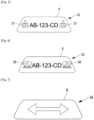
- the first warning message 31 represents the registration number 35 of the follower 2 associated with two flashing orange icons 36.
- Each icon 36 represents a palm facing backwards, instructing the driver of the follower 2 to keep some distance.
- the watch continues and the system 100 analyzes the evolution of the distance D.
- the system 100 displays a second warning message 32 on the display 26.
- the second warning message 32 represents the registration number 35 of the follower 2 associated with two flashing orange icons 37.
- Each icon 37 represents a camera facing backwards, indicating to the driver of the follower that his registration has been noted.
- the system 100 displays a third warning message 33 on the display 26.
- the third warning message 32 represents the registration number 35 of the follower 2 associated with two flashing red icons 38.
- Each icon represents a police officer's cap, indicating to the driver of the follower that his registration is transmitted to the police.
- the transmission includes the history of the distances, their timestamp and their geographic coordinates.
- this fourth message 34 represents a double green arrow.
- thresholds are advantageously set, both for the decrease and the increase in distance D, below which no change in display is made.
- system can comprise display means on the dashboard.
- a warning system affixed to the rear window of a warning vehicle can dissuade an aggressive driver from unduly reducing the distance separating him from the vehicle so equipped.
- this same “followed” vehicle may warn the "following” vehicle that it is in violation and that it is taking the risk of a complaint which could lead to a fine as described in the introduction.
- Such warning capability can also be applied to an autonomous vehicle. Indeed, the behavior of an autonomous vehicle can surprise a following driver who drives aggressively; it is therefore necessary to provide an additional safety margin.
- a system as described above in the invention is provided as standard or as an option on a new vehicle.
- the system can also be a piece of equipment independent of the vehicle intended to be installed retrospectively, for example on a used vehicle.
- the system can then include a refiner box which integrates a camera and a radar.
- a vehicle may not include a third brake light independent of the system display.
- the display may replace this third brake light; it then constitutes an extension of it.
- the display may include a projector that projects the display onto the rear window, using principles similar to those of head-up displays.
- the display can be of variable intensity.
- the size of the display can increase as the distance decreases; also, the light intensity can increase as the distance decreases.
Landscapes
- Engineering & Computer Science (AREA)
- Physics & Mathematics (AREA)
- General Physics & Mathematics (AREA)
- Remote Sensing (AREA)
- Radar, Positioning & Navigation (AREA)
- Mechanical Engineering (AREA)
- Computer Networks & Wireless Communication (AREA)
- Theoretical Computer Science (AREA)
- Electromagnetism (AREA)
- Business, Economics & Management (AREA)
- Multimedia (AREA)
- Marketing (AREA)
- Signal Processing (AREA)
- Economics (AREA)
- Health & Medical Sciences (AREA)
- Accounting & Taxation (AREA)
- General Health & Medical Sciences (AREA)
- Human Resources & Organizations (AREA)
- Primary Health Care (AREA)
- Strategic Management (AREA)
- Tourism & Hospitality (AREA)
- General Business, Economics & Management (AREA)
- Traffic Control Systems (AREA)
- Emergency Alarm Devices (AREA)
Description
- La présente invention se rapporte au domaine de la sécurité routière. Plus particulièrement, la présente invention se rapporte à un procédé d'aide au respect des distances de sécurité à maintenir entre deux véhicules qui se suivent.
- On constate que 43 % des accidents sur autoroute résultent de collisions par l'arrière qui peuvent être des collisions en chaîne. Parmi ces accidents, environ 15 % des accidents corporels sont des collisions par l'arrière ou en chaîne, provoquant le décès de près de 300 personnes par an.
- Le respect d'une distance de sécurité entre deux véhicules qui se suivent est donc une nécessité. La distance de sécurité est la distance parcourue durant le temps qu'il faut au conducteur d'un véhicule pour réagir lorsqu'il aperçoit un événement survenant sur son parcours, augmentée de la distance de freinage, c'est-à-dire la distance nécessaire au véhicule pour s'arrêter à partir du moment où le conducteur actionne le frein.
- En première approximation, la distance de sécurité est la distance parcourue par le véhicule en 2 secondes, soit :
- à 50 km/h, est de 30 m ;
- à 90 km/h, est de 50 mètres ;
- à 110 km/h, est de 70 mètres ; et,
- à 130 km/h, est de 80 mètres.
- En France, l'association « Prévention Routière » donne des recommandations plus prudentes encore. En outre, ces distances, calculées pour un sol sec, sont à augmenter sensiblement sur sol mouillé.
- Il existe des systèmes d'assistance à la conduite, proposés sur des modèles de véhicules récents, qui permettent d'avertir le conducteur qu'il est trop près du véhicule qui le précède. Cette assistance - qui est sur le chemin de la promotion de véhicules autonomes - apporte un supplément de sécurité indéniable. Cependant, cette assistance est généralement débrayable par le conducteur, s'il n'est pas désireux de se voir imposer ce garde-fou ; même si elle n'est pas débrayée, le conducteur reste libre d'en tenir compte, ou pas. De plus, le taux d'équipement du parc automobile avec une telle assistance est encore faible et cela prendra encore de nombreuses années avant que cet équipement ne soit généralisé.
- Les forces de l'ordre envisagent d'utiliser des drones qui surveilleraient le trafic, mais cette solution sera probablement couteuse, seulement répressive et ne pourra pas être globale. Elle sera insuffisante à assurer complètement la sécurité des nombreux conducteurs qui subissent l'agressivité d'autres conducteurs qui se collent très près de l'arrière de leur véhicule et qui exercent sur eux une pression pour leur laisser le passage.
- Par ailleurs, la demande de brevet
DE102005062275A1 divulgue un procédé pour avertir du non-respect d'une distance de sécurité, utilisant un système d'avertissement. - D'autres procédés de ce type sont également divulgués dans la demande de brevet
TW201135678A US2018222424A1 . - Le but de l'invention est de proposer un procédé d'avertissement qui ne puisse pas être débrayé par le conducteur suiveur, agressif ou distrait, qui ne respecterait pas une distance suffisante avec un véhicule suivi, et qui le pousse à respecter l'avertissement reçu.
- Pour résoudre ce problème l'invention propose un procédé pour avertir du non-respect d'une distance de sécurité selon la revendication 1 annexée.
- Les caractéristiques avantageuses sont exposées dans les revendications dépendantes annexées.
- Toute réalisation ou exemple de la description suivante qui ne relève pas du champ des revendications annexées est fourni à titre illustratif.
- Plusieurs modes d'exécution de l'invention seront décrits ci-après, à titre d'exemples non limitatifs, en référence aux dessins annexés dans lesquels :
- [Fig. 1]
- est une vue en perspective, d'une voiture équipée d'un système d'avertissement, suivie par une autre ;
- [Fig. 2]
- est une vue schématique illustrant le fonctionnement du système de la
figure 1 ; - [Fig. 3]
- est un organigramme illustrant le fonctionnement du système de la
figure 1 ; - [Fig. 4]
- illustre un premier affichage possible pour le système de la
figure 1 ; - [Fig. 5]
- illustre un deuxième affichage possible pour le système de la
figure 1 ; - [Fig. 6]
- illustre un troisième affichage possible pour le système de la
figure 1 ; et, - [Fig. 7]
- illustre un quatrième affichage possible pour le système de la
figure 1 . - La
figure 1 représente un premier véhicule 1 suivi par un deuxième véhicule 2. Dans la suite, le premier véhicule est nommé « avertisseur » et le deuxième est nommé « suiveur ». Une distance D sépare les deux véhicules. Le premier véhicule est nommé avertisseur, puisqu'il est équipé d'un système 100 qui lui permet de surveiller une zone 19 à son arrière, de veiller au respect d'une distance de sécurité DS entre lui et le suiveur, c'est-à-dire que la distance D qui sépare les deux véhicules est supérieure ou égale à la distance DS, et, d'avertir le suiveur lorsque la distance DS n'est pas respectée. - Le système 100 comprend plusieurs équipements illustrés à la
figure 1 : - des radars arrière 3 ;
- une caméra arrière 4 ;
- un afficheur 6, visible par un conducteur du suiveur 2 au travers de la limette arrière 7 de l'avertisseur 1 ; et,
- un feu « stop » 8 disposé en haut de la lunette arrière 7.
- Le système 100 est illustré plus en détail à la
figure 2 . Il comprend d'autres équipements qui y sont illustrés : - un gyroscope 9 ;
- des moyens d'acquisition 10 d'un angle de braquage instantané A11 des roues directrices, ici les roues avant ;
- un accéléromètre 12 ;
- des moyens d'acquisition 13 pour une limitation locale 14 de la vitesse ;
- des moyens d'acquisition 15 pour des données météorologiques 16 ; et,
- des moyens de communication 17 avec les forces de l'ordre.
- Les moyens de traitement sont avantageusement prévus pour acquérir des données fournies par le contrôleur (ECU, acronyme des termes anglais pour « Unité de Commande Electronique ») embarqué sur le véhicule avertisseur.
- Ces données peuvent notamment comprendre :
- la vitesse V1 du véhicule avertisseur ;
- certaines données météorologiques 16, par exemple la présence de pluie ou de brouillard ;
- des données de la caméra arrière ;
- des données des radars arrière ;
- l'angle de braquage A11 ; ou,
- des données relatives à un franchissement de ligne, le cas échéant.
- Le système 100 comprend en outre des moyens de traitement informatique 20. Ces moyens de traitement peuvent être ceux d'un téléphone de type smartphone, associés à une application spécifique.
- Les moyens de positionnement géographique global peuvent être ceux du véhicule, s'il en possède, ou ceux du téléphone. Ces moyens de positionnement peuvent par exemple utiliser les satellites du système européen Galileo. Les moyens de positionnement servent notamment de moyens d'acquisition 13 pour la limitation locale 14 de vitesse.
- Le cas échéant, la communication entre le contrôleur et le téléphone peut être établie selon un protocole de communication à courte distance, de préférence du type Bluetooth®.
- A partir des données recueillies, plusieurs modules de services sont mis en œuvre par le système selon l'invention :
- Récupération de la vitesse du véhicule équipé, l'avertisseur ;
- Analyse des changements de direction du véhicule équipé ;
- Récupération des alertes de franchissement de ligne (dis)continue ;
- Suivi des changements de direction (gyroscope) ;
- Calcul de la distance de sécurité ;
- Détection de la présence d'un véhicule suiveur ;
- Récupération de l'angle des roues du véhicule équipé ;
- Analyse de l'attitude du véhicule suiveur (éloignement ou rapprochement) ;
- Identification de la plaque du véhicule suiveur (photo) ;
- Mémorisation de la plaque et début de l'enregistrement ;
- Envoi des données collectées au serveur ;
- Affichage du premier niveau d'avertissement (voir
figures 1 et4 ) ; - Affichage du second niveau d'avertissement (voir
figure 5 ) ; - Affichage du troisième niveau d'avertissement (voir
figure 6 ) ; - Affichage du retour à la normale (voir
figure 7 ). - Pour déterminer la distance de sécurité DS, le système d'avertissement détermine la vitesse V2 du suiveur à partir de la vitesse V1 de l'avertisseur et de la vitesse de rapprochement du suiveur. La vitesse de rapprochement est calculée à partir de mesures successives de la distance D entre les deux véhicules. En première approximation, la distance de sécurité peut être calculée à partir de la seule vitesse V1 de l'avertisseur.
- La distance de sécurité DS peut être modulée, notamment en fonction des données météorologiques 15.
- On va maintenant décrire un fonctionnement pour le dispositif selon l'invention en référence au diagramme de la
figure 3 . - Lorsque le système 100 est en fonction, c'est-à-dire après son initialisation 21, généralement au démarrage du véhicule avertisseur 1, le système entame une analyse 22 récurrente, c'est-à-dire une veille, de la situation du véhicule avertisseur 1.
- L'analyse de situation consiste d'abord à faire, en parallèle, une analyse 23 de changement de file et une analyse 24 d'une zone de sécurité 19, à l'arrière de l'avertisseur 1.
- L'analyse de changement de file permet de vérifier que le véhicule est stabilisé sur une voie de circulation ou pas. Pour faire cette analyse 23, le système 100 utilise les données relatives à l'angle A11 des roues, au franchissement d'une ligne continue ou discontinue, issues du gyroscope 9.
- Tant que l'avertisseur 1 n'est pas stabilisé dans une voie de circulation, le système 100 ne fait pas d'autre analyse, l'analyse de la zone de sécurité 19 n' étant pas significative.
- Dès que l'avertisseur est considéré comme stabilisé dans une voie de circulation, le système vérifie si l'analyse de la zone de sécurité 19 a permis de détecter la présence d'un véhicule suiveur et si ce véhicule est à une distance D inférieure à la distance de sécurité calculée DS. Si ce n'est pas le cas, le système 100 continue l'analyse 24 de la zone arrière et l'analyse 23 de changement de file.
- Si un véhicule suiveur 2 est détecté à une distance D inférieure à la distance de sécurité DS, le système identifie 25 le véhicule suiveur et affiche sur l'afficheur 26 un premier message d'avertissement 31.
- L'identification 25 du suiveur 2 comprend un enregistrement du numéro de sa plaque d'immatriculation 16. Cet enregistrement est fait à l'aide de la caméra 4, en photo ou en vidéo ; cette phase d'identification comprend en outre une mémorisation d'un historique des distances D, tant que ce véhicule suiveur reste dans la zone de sécurité 19 ou à distance inférieure D à la distance de sécurité DS.
- La phase d'identification vérifie en outre, durant la surveillance et à chaque nouvel enregistrement dans l'historique des distances D, que :
- le véhicule suiveur est toujours le même ;
- si le véhicule suiveur vient de se placer derrière l'avertisseur ; ou bien,
- si l'avertisseur vient de se placer devant le suiveur.
- Lorsque c'est l'avertisseur qui vient de se placer devant le suiveur, sans laisser une distance de sécurité suffisante, un rappel à l'ordre peut se déclencher dans le véhicule avertisseur, par exemple un bip sonore et/ou une indication sur le tableau de bord de l'avertisseur 1.
- Dans l'exemple illustré, le premier message d'avertissement 31 représente le numéro d'immatriculation 35 du suiveur 2 associé à deux icônes 36 clignotantes de couleur orange. Chaque icône 36 représente une paume tournée vers l'arrière, intimant au conducteur du suiveur 2 de prendre de la distance.
- La veille continue et le système 100 analyse l'évolution de la distance D.
- Si la distance D diminue, le système 100 affiche sur l'afficheur 26 un deuxième message d'avertissement 32. Dans l'exemple illustré, le deuxième message d'avertissement 32 représente le numéro d'immatriculation 35 du suiveur 2 associé à deux icônes 37 clignotantes de couleur orange. Chaque icône 37 représente un appareil photo tourné vers l'arrière, signifiant au conducteur du suiveur que son immatriculation est relevée.
- Si la distance D diminue encore, le système 100 affiche sur l'afficheur 26 un troisième message d'avertissement 33. Dans l'exemple illustré, le troisième message d'avertissement 32 représente le numéro d'immatriculation 35 du suiveur 2 associé à deux icônes 38 clignotantes de couleur rouge. Chaque icône représente une casquette de policier, signifiant au conducteur du suiveur que son immatriculation est transmise aux forces de l'ordre. De préférence, la transmission comprend l'historique des distances, leur horodatage et leur coordonnées géographiques.
- Plus généralement, l'identité du suiveur 2 est transmise à un serveur informatique distant, accessible aux forces de l'ordres et/ou hébergé par les forces de l'ordre. Ainsi, le traitement des informations transmises, matérialisant des infractions, notamment une vidéo, une photo ou plusieurs photos prises en rafale, peut être effectué par envoi à un serveur centralisant toutes les données recueillies. Cet envoi pourra être effectué via un protocole d'échange à longue portée de type GSM par l'application présente sur le smartphone ou par un composant de communication intégré à l'électronique du véhicule. Ces informations pourront :
- servir de support pour déposer une plainte contre un conducteur agressif ayant commis une infraction caractérisée ; et/ou,
- être exploitées par une assurance du véhicule avertisseur dans le cas où le non-respect de la distance de sécurité soit une cause d'un accident dans lequel la responsabilité du conducteur du véhicule suiveur puisse être engagée.
- Si la distance D augmente au-delà de la distance DS, le système 100 affiche un quatrième message 34, signifiant que la distance de sécurité DS est respectée. Dans l'exemple illustré, ce quatrième message représente une double flèche verte.
- Bien entendu, des seuils sont avantageusement fixés, tant à la diminution qu'à l'augmentation de la distance D, en deçà desquels aucun changement d'affichage n'est effectué.
- Bien sûr, l'invention n'est pas limitée aux exemples qui viennent d'être décrits.
- Au contraire, l'invention est définie par les revendications qui suivent.
- Il apparaîtra en effet à l'homme de l'art que diverses modifications peuvent être apportées aux modes de réalisation décrits ci-dessus, à la lumière de l'enseignement qui vient de lui être divulgué.
- Ainsi, de nombreuses éléments et fonctions peuvent compléter un système selon l'invention. Notamment, le système peut comprendre des moyens d'affichage au tableau de bord.
- Un système d'avertissement apposé sur la vitre arrière d'un véhicule avertisseur, permet de dissuader un conducteur agressif de réduire abusivement la distance qui le sépare du véhicule ainsi équipé.
- De la même façon qu'un feu stop sur le véhicule « suivi » avertit le véhicule « suiveur » d'un freinage, ce même véhicule « suivi » pourra avertir le véhicule « suiveur » qu'il est en infraction et qu'il prend le risque d'une plainte pouvant déboucher sur une contravention telle que décrite en introduction.
- Une telle capacité d'avertissement peut aussi être apposée sur un véhicule autonome. En effet, le comportement d'un véhicule autonome peut surprendre un conducteur suiveur à la conduite agressive ; il faut donc prévoir une marge de sécurité complémentaire.
- De préférence, un système tel que décrit précédemment l'invention est prévu de série ou en option sur un véhicule neuf.
- Le système peut aussi être un équipement indépendant du véhicule prévu pour être installé a posteriori, par exemple sur un véhicule d'occasion. Le système peut alors comprendre un boitier affineur qui intègre une caméra et un radar.
- Contrairement à ce qui a été illustré plus haut, un véhicule peut ne pas comprendre de troisième feu stop indépendant de l'afficheur du système. L'afficheur peut se substituer à ce troisième feu stop ; il en constitue alors une extension.
- Aussi, l'afficheur peut comprendre un projecteur qui projette l'affichage sur la vitre arrière, selon des principes similaires à ceux des afficheurs « tête haute ».
- L'affichage peut être d'intensité variable. Par exemple, la taille de l'affichage peut augmenter lorsque la distance diminue ; aussi, l'intensité lumineuse peut augmenter lorsque la distance diminue.
Claims (7)
- Procédé pour avertir du non-respect d'une distance de sécurité, utilisant un système d'avertissement (100) équipant un premier véhicule (1), le système d'avertissement (100) comprenant :- un dispositif (3) pour mesurer, le cas échéant, une distance libre (D) à l'arrière dudit premier véhicule (1), entre le premier véhicule (1) et un deuxième véhicule (2) qui le suit ;- un afficheur (6) disposé à l'arrière dudit premier véhicule, pour afficher un message fonction de ladite distance (D), de sorte qu'il soit visible depuis le deuxième véhicule (2) suiveur, le cas échéant,- des moyens de calcul d'une distance de sécurité DS au moins en fonction de la vitesse (V1) dudit premier véhicule (1) ;- des moyens (20, 9, 11, 12) pour caractériser un changement de file du premier véhicule (1) et pour que le système (100) analyse si le premier véhicule (1) est stabilisé dans une voie de circulation ;- un dispositif (4) pour enregistrer une identité (35) du deuxième véhicule (2) suiveur et mémoriser un historique des distances (D), tant que le deuxième véhicule (2) suiveur reste dans une zone de sécurité (19) ou à distance (D) inférieure à la distance de sécurité DS, l'afficheur étant, de préférence, prévu pour afficher ladite identité ; et,- un dispositif (17) pour transmettre ladite identité (35) à un serveur distant ;le procédé comprenant, après une phase d'initialisation (21), une phase d'analyse de la situation du premier véhicule (1) consistant d'abord à faire, en parallèle :- une analyse (23) de changement de file pour vérifier que le premier véhicule (1) est stabilisé sur une voie de circulation ; et- une analyse (24) de la zone de sécurité (19), à l'arrière du premier véhicule (1), pour détecter la présence du deuxième véhicule (2) suiveur ;et :- tant que le premier véhicule (1) n'est pas stabilisé dans une voie de circulation, le système (100) ne fait pas d'autre analyse,- si le deuxième véhicule (2) suiveur pénètre ladite zone de sécurité à une distance (D) inférieure à ladite distance de sécurité (DS), le système (100) :o affiche sur l'afficheur (6) un premier message d'avertissement (31) ;o identifie (25) le deuxième véhicule (2) suiveur, l'identification (25) du deuxième véhicule (2) suiveur comprenant :▪ l'enregistrement de l'identité (35) du deuxième véhicule (2) suiveur ; et▪ la mémorisation de l'historique des distances (D), tant que le deuxième véhicule (2) suiveur reste dans la zone de sécurité (19).- si ladite distance (D) diminue, afficher sur l'afficheur (6) un deuxième message d'avertissement (32) ; et,- si ladite distance (D) diminue encore, afficher sur l'afficheur (6) un troisième message d'avertissement (32) et transmettre l'identité du deuxième véhicule (2), préalablement enregistré, au serveur distant.
- Procédé selon la revendications 1, selon lequel l'identité du véhicule suiveur (2) est enregistrée avant l'affichage du premier message et en ce que ledit premier message comprend ladite identité.
- Procédé selon l'une des revendications 1 ou 2, selon lequel si la distance (D) augmente de nouveau au-delà de la distance de sécurité, afficher un quatrième message.
- Procédé selon l'une des revendications 1 à 3, selon lequel les moyens de calcul du système (100) comprennent des moyens pour calculer la distance de sécurité en fonction de conditions extérieures (15).
- Procédé selon la revendication 4, selon lequel le système (100) comprend des moyens pour préciser la distance de sécurité en fonction de la vitesse du véhicule suiveur (2).
- Procédé selon l'une des revendications 1 à 5, selon lequel les moyens (20, 9, 11, 12) pour caractériser un changement de file comprennent des moyens parmi un gyroscope (9), des moyens d'acquisition d'un angle de braquage d'une roue directrice et un accéléromètre, et, de préférence pour l'analyse (23), le système (100) utilise des données relatives à l'angle (All) des roues, au franchissement d'une ligne continue ou discontinue, issues du gyroscope (9).
- Procédé selon l'une des revendications 1 à 6, selon lequel le système comprend des moyens de traitement (20) adaptés pour communiquer, de préférence selon un protocole courte distance, avec un contrôleur embarqué du premier véhicule (ECU).
Applications Claiming Priority (2)
| Application Number | Priority Date | Filing Date | Title |
|---|---|---|---|
| FR1904543A FR3095715B1 (fr) | 2019-04-30 | 2019-04-30 | Dispositif et procédé pour avertir un véhicule suiveur qui ne respecte pas une distance de sécurité. |
| PCT/FR2020/050573 WO2020221973A1 (fr) | 2019-04-30 | 2020-03-17 | Dispositif et procédé pour avertir un véhicule suiveur qui ne respecte pas une distance de sécurité |
Publications (3)
| Publication Number | Publication Date |
|---|---|
| EP3963560A1 EP3963560A1 (fr) | 2022-03-09 |
| EP3963560C0 EP3963560C0 (fr) | 2024-09-18 |
| EP3963560B1 true EP3963560B1 (fr) | 2024-09-18 |
Family
ID=68281519
Family Applications (1)
| Application Number | Title | Priority Date | Filing Date |
|---|---|---|---|
| EP20726223.9A Active EP3963560B1 (fr) | 2019-04-30 | 2020-03-17 | Procédé pour avertir un véhicule suiveur qui ne respecte pas une distance de sécurité |
Country Status (8)
| Country | Link |
|---|---|
| US (1) | US20220203887A1 (fr) |
| EP (1) | EP3963560B1 (fr) |
| JP (1) | JP2022533899A (fr) |
| KR (1) | KR20220002277A (fr) |
| CN (1) | CN113646818A (fr) |
| FR (1) | FR3095715B1 (fr) |
| MA (1) | MA55800A (fr) |
| WO (1) | WO2020221973A1 (fr) |
Families Citing this family (3)
| Publication number | Priority date | Publication date | Assignee | Title |
|---|---|---|---|---|
| JP1752914S (ja) * | 2022-01-18 | 2023-09-12 | 航空機模型[装飾] | |
| TWI819780B (zh) * | 2022-09-07 | 2023-10-21 | 城市學校財團法人臺北城市科技大學 | 人工智慧物聯網盲區偵測警示安全帽 |
| US20250329171A1 (en) * | 2024-04-23 | 2025-10-23 | Nnabike Ibe Okaro | Automobile tailing and surveillance detection system |
Citations (3)
| Publication number | Priority date | Publication date | Assignee | Title |
|---|---|---|---|---|
| EP0856431B1 (fr) * | 1997-01-31 | 2000-05-10 | Lorenz Hartl | Système avertisseur de collision |
| DE102005062275A1 (de) * | 2005-12-24 | 2007-06-28 | Daimlerchrysler Ag | Verfahren zur Erkennung eines drohenden Heckaufpralls |
| FR2995269A1 (fr) * | 2012-09-07 | 2014-03-14 | Peugeot Citroen Automobiles Sa | Dispositif holographique de signalisation pour vehicule |
Family Cites Families (8)
| Publication number | Priority date | Publication date | Assignee | Title |
|---|---|---|---|---|
| DE4305186C2 (de) * | 1993-02-19 | 1996-02-01 | Gerhaher Max | Verfahren zur Reduzierung der Gefahr von Auffahrunfällen im Straßenverkehr durch eine Verzögerungswarnung und Verzögerungswarnanlage |
| GB2291244B (en) * | 1994-07-15 | 1998-02-11 | Design Technology & Innovation | Vehicle safety systems |
| TWI403993B (zh) * | 2010-04-07 | 2013-08-01 | Univ Chaoyang Technology | 車用安全警示系統 |
| US9090203B2 (en) * | 2013-06-17 | 2015-07-28 | Jerry A. SEIFERT | Rear end collision prevention apparatus |
| US9031545B1 (en) * | 2013-03-08 | 2015-05-12 | Allstate Insurance Company | Encouraging safe driving using a remote vehicle starter |
| JP2015228092A (ja) * | 2014-05-30 | 2015-12-17 | 株式会社デンソー | 運転支援装置および運転支援プログラム |
| JP6090381B2 (ja) * | 2015-07-29 | 2017-03-08 | 横浜ゴム株式会社 | 衝突防止システム |
| CN107204128B (zh) * | 2017-05-04 | 2020-03-13 | 南京工程学院 | 基于ZigBee通信的汽车防碰撞预警系统与方法 |
-
2019
- 2019-04-30 FR FR1904543A patent/FR3095715B1/fr active Active
-
2020
- 2020-03-17 WO PCT/FR2020/050573 patent/WO2020221973A1/fr not_active Ceased
- 2020-03-17 JP JP2021560176A patent/JP2022533899A/ja active Pending
- 2020-03-17 KR KR1020217031303A patent/KR20220002277A/ko not_active Ceased
- 2020-03-17 US US17/600,378 patent/US20220203887A1/en not_active Abandoned
- 2020-03-17 MA MA055800A patent/MA55800A/fr unknown
- 2020-03-17 CN CN202080026026.7A patent/CN113646818A/zh active Pending
- 2020-03-17 EP EP20726223.9A patent/EP3963560B1/fr active Active
Patent Citations (3)
| Publication number | Priority date | Publication date | Assignee | Title |
|---|---|---|---|---|
| EP0856431B1 (fr) * | 1997-01-31 | 2000-05-10 | Lorenz Hartl | Système avertisseur de collision |
| DE102005062275A1 (de) * | 2005-12-24 | 2007-06-28 | Daimlerchrysler Ag | Verfahren zur Erkennung eines drohenden Heckaufpralls |
| FR2995269A1 (fr) * | 2012-09-07 | 2014-03-14 | Peugeot Citroen Automobiles Sa | Dispositif holographique de signalisation pour vehicule |
Also Published As
| Publication number | Publication date |
|---|---|
| CN113646818A (zh) | 2021-11-12 |
| EP3963560C0 (fr) | 2024-09-18 |
| FR3095715A1 (fr) | 2020-11-06 |
| MA55800A (fr) | 2022-03-09 |
| EP3963560A1 (fr) | 2022-03-09 |
| JP2022533899A (ja) | 2022-07-27 |
| WO2020221973A1 (fr) | 2020-11-05 |
| US20220203887A1 (en) | 2022-06-30 |
| FR3095715B1 (fr) | 2022-12-09 |
| KR20220002277A (ko) | 2022-01-06 |
Similar Documents
| Publication | Publication Date | Title |
|---|---|---|
| FR3049560B1 (fr) | Procede et systeme d'assistance au changement de voie de roulage pour vehicule automobile | |
| TWI654106B (zh) | 利用數位錄影方式以記錄行車資訊與產生汽車履歷之方法 | |
| EP3568803B1 (fr) | Procédé de pilotage d'un véhicule automobile autonome | |
| CA2735458A1 (fr) | Systeme interactif pour la prevention des accidents automobiles causes par le non respect des regles de la circulation, procede de fabrication et utilisation du systeme avec des vehicules | |
| EP3963560B1 (fr) | Procédé pour avertir un véhicule suiveur qui ne respecte pas une distance de sécurité | |
| EP2940671A1 (fr) | Système et méthode pour détecter des conditions accidentogènes avec une voiture | |
| FR3096948A1 (fr) | Procédé de calcul de la position latérale d'un véhicule automobile | |
| WO2025114187A1 (fr) | Procédé et un système d'évaluation de situations à risque d'accidentologie d'un véhicule en circulation sur un réseau routier dans un environnement déterminé | |
| FR3041917A1 (fr) | Procede adaptatif d’assistance a la reprise en main d’un vehicule automobile au terme d’une phase de conduite automatisee. | |
| FR3122391A1 (fr) | Procédé et dispositif de détermination d’un état d’attention d’un conducteur d’un véhicule autonome | |
| EP2723601B1 (fr) | Gestion de regulation de vitesse d'un vehicule | |
| EP3646306A1 (fr) | Procédé de signalement d'une suggestion d'un comportement et terminal associé | |
| WO2016162434A1 (fr) | Système embarqué sur un véhicule automobile pour une fonctionnalité de changement de voie, et procédé de contrôle associé | |
| FR3045546A1 (fr) | Procede d’emission d’une signaletique visuelle sur volant durant une phase de conduite entierement automatisee. | |
| FR3047217B1 (fr) | Dispositif de determination de l'etat d'un feu de signalisation, systeme embatque comprenant un tel dispositif, vehicule comprenant un tel systeme et procede de determination associe | |
| FR3099904A1 (fr) | Procédé de gestion d’un véhicule à moteur équipé d’un système avancé d’aide à la conduite | |
| EP2075776A1 (fr) | Procédé et système de surveillance et de rapport d' incidents récurrents de talonnement entre véhicules | |
| FR3119041A1 (fr) | Procédé et dispositif d’alerte à l’approche d’un élément ralentisseur | |
| EP4392300B1 (fr) | Procédé et système pour gérer le fonctionnement d'un appareillage d'aide à la conduite d'un véhicule automobile à l'approche de lieux soumis à une réglementation particulière du code de la route | |
| FR3154078A1 (fr) | Procédé et dispositif de contrôle d’un système de changement semi-automatique de voie de circulation d’un véhicule avec confirmation par commande d’accélération | |
| FR3142150A1 (fr) | Procédé et dispositif d’aide au stationnement d’un deuxième véhicule par un premier véhicule stationné | |
| FR3164164A1 (fr) | Véhicule et procédé permettant d’anticiper une situation de roulage en sens interdit | |
| JP2025078447A (ja) | 情報処理装置、情報処理システムおよび情報処理方法 | |
| CA2706762A1 (fr) | Systeme pour la prevention des accidents automobiles, procedes de fabrication et utilisation du systemes dans les vehicules | |
| FR3137887A1 (fr) | Procédé et dispositif de contrôle d’un système SALC d’un premier véhicule en fonction de la présence d’un deuxième véhicule sur une voie latérale de destination |
Legal Events
| Date | Code | Title | Description |
|---|---|---|---|
| STAA | Information on the status of an ep patent application or granted ep patent |
Free format text: STATUS: UNKNOWN |
|
| STAA | Information on the status of an ep patent application or granted ep patent |
Free format text: STATUS: THE INTERNATIONAL PUBLICATION HAS BEEN MADE |
|
| PUAI | Public reference made under article 153(3) epc to a published international application that has entered the european phase |
Free format text: ORIGINAL CODE: 0009012 |
|
| STAA | Information on the status of an ep patent application or granted ep patent |
Free format text: STATUS: REQUEST FOR EXAMINATION WAS MADE |
|
| 17P | Request for examination filed |
Effective date: 20210817 |
|
| AK | Designated contracting states |
Kind code of ref document: A1 Designated state(s): AL AT BE BG CH CY CZ DE DK EE ES FI FR GB GR HR HU IE IS IT LI LT LU LV MC MK MT NL NO PL PT RO RS SE SI SK SM TR |
|
| DAX | Request for extension of the european patent (deleted) | ||
| RAV | Requested validation state of the european patent: fee paid |
Extension state: MA Effective date: 20210817 |
|
| STAA | Information on the status of an ep patent application or granted ep patent |
Free format text: STATUS: EXAMINATION IS IN PROGRESS |
|
| 17Q | First examination report despatched |
Effective date: 20230727 |
|
| GRAP | Despatch of communication of intention to grant a patent |
Free format text: ORIGINAL CODE: EPIDOSNIGR1 |
|
| STAA | Information on the status of an ep patent application or granted ep patent |
Free format text: STATUS: GRANT OF PATENT IS INTENDED |
|
| INTG | Intention to grant announced |
Effective date: 20240620 |
|
| GRAS | Grant fee paid |
Free format text: ORIGINAL CODE: EPIDOSNIGR3 |
|
| GRAA | (expected) grant |
Free format text: ORIGINAL CODE: 0009210 |
|
| STAA | Information on the status of an ep patent application or granted ep patent |
Free format text: STATUS: THE PATENT HAS BEEN GRANTED |
|
| AK | Designated contracting states |
Kind code of ref document: B1 Designated state(s): AL AT BE BG CH CY CZ DE DK EE ES FI FR GB GR HR HU IE IS IT LI LT LU LV MC MK MT NL NO PL PT RO RS SE SI SK SM TR |
|
| REG | Reference to a national code |
Ref country code: GB Ref legal event code: FG4D Free format text: NOT ENGLISH |
|
| REG | Reference to a national code |
Ref country code: CH Ref legal event code: EP |
|
| REG | Reference to a national code |
Ref country code: DE Ref legal event code: R096 Ref document number: 602020037913 Country of ref document: DE |
|
| REG | Reference to a national code |
Ref country code: IE Ref legal event code: FG4D Free format text: LANGUAGE OF EP DOCUMENT: FRENCH |
|
| U01 | Request for unitary effect filed |
Effective date: 20241017 |
|
| U07 | Unitary effect registered |
Designated state(s): AT BE BG DE DK EE FI FR IT LT LU LV MT NL PT RO SE SI Effective date: 20241024 |
|
| PG25 | Lapsed in a contracting state [announced via postgrant information from national office to epo] |
Ref country code: NO Free format text: LAPSE BECAUSE OF FAILURE TO SUBMIT A TRANSLATION OF THE DESCRIPTION OR TO PAY THE FEE WITHIN THE PRESCRIBED TIME-LIMIT Effective date: 20241218 |
|
| PG25 | Lapsed in a contracting state [announced via postgrant information from national office to epo] |
Ref country code: GR Free format text: LAPSE BECAUSE OF FAILURE TO SUBMIT A TRANSLATION OF THE DESCRIPTION OR TO PAY THE FEE WITHIN THE PRESCRIBED TIME-LIMIT Effective date: 20241219 |
|
| PG25 | Lapsed in a contracting state [announced via postgrant information from national office to epo] |
Ref country code: HR Free format text: LAPSE BECAUSE OF FAILURE TO SUBMIT A TRANSLATION OF THE DESCRIPTION OR TO PAY THE FEE WITHIN THE PRESCRIBED TIME-LIMIT Effective date: 20240918 |
|
| PG25 | Lapsed in a contracting state [announced via postgrant information from national office to epo] |
Ref country code: RS Free format text: LAPSE BECAUSE OF FAILURE TO SUBMIT A TRANSLATION OF THE DESCRIPTION OR TO PAY THE FEE WITHIN THE PRESCRIBED TIME-LIMIT Effective date: 20241218 |
|
| PG25 | Lapsed in a contracting state [announced via postgrant information from national office to epo] |
Ref country code: RS Free format text: LAPSE BECAUSE OF FAILURE TO SUBMIT A TRANSLATION OF THE DESCRIPTION OR TO PAY THE FEE WITHIN THE PRESCRIBED TIME-LIMIT Effective date: 20241218 Ref country code: NO Free format text: LAPSE BECAUSE OF FAILURE TO SUBMIT A TRANSLATION OF THE DESCRIPTION OR TO PAY THE FEE WITHIN THE PRESCRIBED TIME-LIMIT Effective date: 20241218 Ref country code: HR Free format text: LAPSE BECAUSE OF FAILURE TO SUBMIT A TRANSLATION OF THE DESCRIPTION OR TO PAY THE FEE WITHIN THE PRESCRIBED TIME-LIMIT Effective date: 20240918 Ref country code: GR Free format text: LAPSE BECAUSE OF FAILURE TO SUBMIT A TRANSLATION OF THE DESCRIPTION OR TO PAY THE FEE WITHIN THE PRESCRIBED TIME-LIMIT Effective date: 20241219 |
|
| U20 | Renewal fee for the european patent with unitary effect paid |
Year of fee payment: 6 Effective date: 20250228 |
|
| PG25 | Lapsed in a contracting state [announced via postgrant information from national office to epo] |
Ref country code: IS Free format text: LAPSE BECAUSE OF FAILURE TO SUBMIT A TRANSLATION OF THE DESCRIPTION OR TO PAY THE FEE WITHIN THE PRESCRIBED TIME-LIMIT Effective date: 20250118 |
|
| PG25 | Lapsed in a contracting state [announced via postgrant information from national office to epo] |
Ref country code: SM Free format text: LAPSE BECAUSE OF FAILURE TO SUBMIT A TRANSLATION OF THE DESCRIPTION OR TO PAY THE FEE WITHIN THE PRESCRIBED TIME-LIMIT Effective date: 20240918 |
|
| PG25 | Lapsed in a contracting state [announced via postgrant information from national office to epo] |
Ref country code: ES Free format text: LAPSE BECAUSE OF FAILURE TO SUBMIT A TRANSLATION OF THE DESCRIPTION OR TO PAY THE FEE WITHIN THE PRESCRIBED TIME-LIMIT Effective date: 20240918 |
|
| PG25 | Lapsed in a contracting state [announced via postgrant information from national office to epo] |
Ref country code: PL Free format text: LAPSE BECAUSE OF FAILURE TO SUBMIT A TRANSLATION OF THE DESCRIPTION OR TO PAY THE FEE WITHIN THE PRESCRIBED TIME-LIMIT Effective date: 20240918 Ref country code: CZ Free format text: LAPSE BECAUSE OF FAILURE TO SUBMIT A TRANSLATION OF THE DESCRIPTION OR TO PAY THE FEE WITHIN THE PRESCRIBED TIME-LIMIT Effective date: 20240918 |
|
| PG25 | Lapsed in a contracting state [announced via postgrant information from national office to epo] |
Ref country code: SK Free format text: LAPSE BECAUSE OF FAILURE TO SUBMIT A TRANSLATION OF THE DESCRIPTION OR TO PAY THE FEE WITHIN THE PRESCRIBED TIME-LIMIT Effective date: 20240918 |
|
| PLBE | No opposition filed within time limit |
Free format text: ORIGINAL CODE: 0009261 |
|
| STAA | Information on the status of an ep patent application or granted ep patent |
Free format text: STATUS: NO OPPOSITION FILED WITHIN TIME LIMIT |
|
| 26N | No opposition filed |
Effective date: 20250619 |
|
| PG25 | Lapsed in a contracting state [announced via postgrant information from national office to epo] |
Ref country code: MC Free format text: LAPSE BECAUSE OF FAILURE TO SUBMIT A TRANSLATION OF THE DESCRIPTION OR TO PAY THE FEE WITHIN THE PRESCRIBED TIME-LIMIT Effective date: 20240918 |
|
| REG | Reference to a national code |
Ref country code: CH Ref legal event code: H13 Free format text: ST27 STATUS EVENT CODE: U-0-0-H10-H13 (AS PROVIDED BY THE NATIONAL OFFICE) Effective date: 20251023 |
|
| GBPC | Gb: european patent ceased through non-payment of renewal fee |
Effective date: 20250317 |
|
| PG25 | Lapsed in a contracting state [announced via postgrant information from national office to epo] |
Ref country code: GB Free format text: LAPSE BECAUSE OF NON-PAYMENT OF DUE FEES Effective date: 20250317 |
|
| PG25 | Lapsed in a contracting state [announced via postgrant information from national office to epo] |
Ref country code: CH Free format text: LAPSE BECAUSE OF NON-PAYMENT OF DUE FEES Effective date: 20250331 |
|
| PG25 | Lapsed in a contracting state [announced via postgrant information from national office to epo] |
Ref country code: IE Free format text: LAPSE BECAUSE OF NON-PAYMENT OF DUE FEES Effective date: 20250317 |
|
| VS25 | Lapsed in a validation state [announced via postgrant information from nat. office to epo] |
Ref country code: MA Free format text: LAPSE BECAUSE OF FAILURE TO SUBMIT A TRANSLATION OF THE DESCRIPTION OR TO PAY THE FEE WITHIN THE PRESCRIBED TIME-LIMIT; INVALID AB INITIO Effective date: 20200317 |
|
| U20 | Renewal fee for the european patent with unitary effect paid |
Year of fee payment: 7 Effective date: 20260318 |