EP3961841B1 - Leistungsverwaltungsverfahren und -vorrichtung, rechnervorrichtung, medium und produkt - Google Patents
Leistungsverwaltungsverfahren und -vorrichtung, rechnervorrichtung, medium und produkt Download PDFInfo
- Publication number
- EP3961841B1 EP3961841B1 EP19929523.9A EP19929523A EP3961841B1 EP 3961841 B1 EP3961841 B1 EP 3961841B1 EP 19929523 A EP19929523 A EP 19929523A EP 3961841 B1 EP3961841 B1 EP 3961841B1
- Authority
- EP
- European Patent Office
- Prior art keywords
- time period
- power consumption
- error
- power management
- data
- Prior art date
- Legal status (The legal status is an assumption and is not a legal conclusion. Google has not performed a legal analysis and makes no representation as to the accuracy of the status listed.)
- Active
Links
Images



Classifications
-
- H—ELECTRICITY
- H02—GENERATION; CONVERSION OR DISTRIBUTION OF ELECTRIC POWER
- H02J—ELECTRIC POWER NETWORKS; CIRCUIT ARRANGEMENTS OR SYSTEMS FOR SUPPLYING OR DISTRIBUTING ELECTRIC POWER; SYSTEMS FOR STORING ELECTRIC ENERGY
- H02J3/00—Circuit arrangements for AC mains or AC distribution networks
- H02J3/003—Load forecast, e.g. methods or systems for forecasting future load demand
-
- G—PHYSICS
- G05—CONTROLLING; REGULATING
- G05B—CONTROL OR REGULATING SYSTEMS IN GENERAL; FUNCTIONAL ELEMENTS OF SUCH SYSTEMS; MONITORING OR TESTING ARRANGEMENTS FOR SUCH SYSTEMS OR ELEMENTS
- G05B19/00—Program-control systems
- G05B19/02—Program-control systems electric
- G05B19/04—Program control other than numerical control, i.e. in sequence controllers or logic controllers
- G05B19/042—Program control other than numerical control, i.e. in sequence controllers or logic controllers using digital processors
-
- G—PHYSICS
- G05—CONTROLLING; REGULATING
- G05B—CONTROL OR REGULATING SYSTEMS IN GENERAL; FUNCTIONAL ELEMENTS OF SUCH SYSTEMS; MONITORING OR TESTING ARRANGEMENTS FOR SUCH SYSTEMS OR ELEMENTS
- G05B2219/00—Program-control systems
- G05B2219/20—Pc systems
- G05B2219/26—Pc applications
- G05B2219/2639—Energy management, use maximum of cheap power, keep peak load low
-
- H—ELECTRICITY
- H02—GENERATION; CONVERSION OR DISTRIBUTION OF ELECTRIC POWER
- H02J—ELECTRIC POWER NETWORKS; CIRCUIT ARRANGEMENTS OR SYSTEMS FOR SUPPLYING OR DISTRIBUTING ELECTRIC POWER; SYSTEMS FOR STORING ELECTRIC ENERGY
- H02J2103/00—Details of circuit arrangements for mains or AC distribution networks
- H02J2103/30—Simulating, planning, modelling, reliability check or computer assisted design [CAD] of electric power networks
-
- Y—GENERAL TAGGING OF NEW TECHNOLOGICAL DEVELOPMENTS; GENERAL TAGGING OF CROSS-SECTIONAL TECHNOLOGIES SPANNING OVER SEVERAL SECTIONS OF THE IPC; TECHNICAL SUBJECTS COVERED BY FORMER USPC CROSS-REFERENCE ART COLLECTIONS [XRACs] AND DIGESTS
- Y04—INFORMATION OR COMMUNICATION TECHNOLOGIES HAVING AN IMPACT ON OTHER TECHNOLOGY AREAS
- Y04S—SYSTEMS INTEGRATING TECHNOLOGIES RELATED TO POWER NETWORK OPERATION, COMMUNICATION OR INFORMATION TECHNOLOGIES FOR IMPROVING THE ELECTRICAL POWER GENERATION, TRANSMISSION, DISTRIBUTION, MANAGEMENT OR USAGE, i.e. SMART GRIDS
- Y04S10/00—Systems supporting electrical power generation, transmission or distribution
- Y04S10/50—Systems or methods supporting the power network operation or management, involving a certain degree of interaction with the load-side end user applications
Definitions
- the present disclosure in general relates to the field of electric power, and in particular to a power management method and apparatus, a computing device, medium, and product.
- Electrification is the general trend in today's world. Power consumption characteristics are variable, with, for example, new fluctuation characteristics and more complex time series characteristics, etc.
- the management of power consumption can be beneficial in many aspects. For example, it is an effective method for grid operators' power and energy optimization programs. In another aspect, it can help power retailers achieve more reliable transactions in the power market, and can identify the characteristics of end user power consumption to ensure their profits. In addition, it can help to identify potential value-adding services based on the power consumption characteristics of end users.
- a power management system may comprise multiple parts. In prior art, these parts usually work independently instead of forming a closed-loop power management system.
- the following three laws can be generally used to predict power consumption: the law of average growth rate, the law of seasonal coefficient, and the law of trend ratio.
- prediction at present is to use the power consumption data at a previously predicted time point to calculate the power consumption data at a future time point. It can be understood that the prediction data is not very reliable compared with the actual data during the prediction process. Therefore, the prediction data is comprised in the prediction leads to accumulation of errors.
- WO 2017/217466 A1 relates to an electric power management system for reducing large and rapid changes in power received from electricity delivery system.
- the present disclosure proposes a power management method, apparatus and system for closed-loop power management.
- a full-time scale prediction method is adopted, which can improve the prediction accuracy and meet the real-time requirement for error tracking.
- the power supply plan or a user's power demand can be adjusted appropriately to reduce the difference between the actual demand and the predicted demand, thereby improving the management of power consumption and increasing the efficiency of power consumption.
- a power management method according to claim 1 is provided.
- the method further comprises: a post-evaluation step: calculating a third error between the actual power consumption in the first time period and the first predicted power consumption after the first time period ends, and separately adjusting the first prediction model and the second prediction model when the third error is greater than a third predetermined threshold.
- the predicted power consumption and the actual power consumption can be analyzed, and the prediction model can be updated based on the analysis results to further improve the prediction accuracy.
- the post-evaluation step further comprises: ranking different users based on the third error calculated for the users.
- the first time period is one month
- the second time period is one day
- the first prediction model is a first machine learning model obtained through training using historical power consumption data of the first time period as the training data
- the second prediction model is a second machine learning model obtained through training using historical power consumption data of the second time period as the training data.
- a power management apparatus according to claim 6 is provided.
- the power management apparatus further comprises: a post-evaluation unit, configured to calculate a third error between the actual power consumption in the first time period and the first predicted power consumption after the first time period ends, and separately adjust the first prediction model and the second prediction model when the third error is greater than a third predetermined threshold.
- a post-evaluation unit configured to calculate a third error between the actual power consumption in the first time period and the first predicted power consumption after the first time period ends, and separately adjust the first prediction model and the second prediction model when the third error is greater than a third predetermined threshold.
- the post-evaluation unit is further configured to: rank different users based on the third error calculated for the users.
- a power management system comprising: an interface unit, used to enable the power management system to obtain power consumption data from an external system; a database, used to store the power consumption data; and a power management apparatus described above, wherein the power management apparatus obtains the power consumption data from the database.
- a computing device comprising: at least one processor; and a memory coupled to the at least one processor, wherein the memory is used to store an instruction that, when executed by the at least one processor, causes the processor to perform the method described above.
- a non-transitory machine readable medium which stores an executable instruction that, when executed, causes a machine to perform the method described above.
- a computer program product which is tangibly stored in a computer readable medium and comprises a computer executable instruction that, when executed, causes at least one processor to perform the method described above.
- the term “comprising” and its variations is an open term that means “including but not limited to”.
- the term “based on” means “at least partially based on”.
- the term “one embodiment” or “an embodiment” means “at least one embodiment”.
- the term “another embodiment” means “at least one other embodiment”.
- the term “first”, “second”, etc. may refer to different or the same objects. Other definitions, either explicit or implicit, may be included below. Unless clearly indicated in the context, the definition of a term is consistent throughout the description.
- the present disclosure discloses a power management method, apparatus and system for closed-loop power management.
- a full-time scale prediction method is adopted, which can improve the prediction accuracy and meet the real-time requirement for error tracking.
- the power supply plan or a user's power demand can be adjusted appropriately to reduce the difference between the actual demand and the predicted demand, thereby improving the management of power consumption and increasing the efficiency of power consumption.
- Figure 1 is a flowchart of an exemplary process of the power management method 100 according to one embodiment of the present disclosure.
- the monitoring step S102 is firstly executed to collect and store power consumption data of a user in real time.
- the collected power consumption data may be exported in a certain file format (for example, Excel or .txt), or monitored through a console.
- the prediction step S104 is executed, wherein first predicted power consumption of a first time period is predicted based on the collected power consumption data by use of a prestored first prediction model, and second predicted power consumption of each second time period comprised in the first time period is predicted by use of a prestored second prediction model.
- the first prediction model is a first machine learning model obtained through training using historical power consumption data of the first time period as the training data
- the second prediction model is a second machine learning model obtained through training using historical power consumption data of the second time period as the training data.
- a full-time scale prediction method is adopted in the power management method of one embodiment according to the present disclosure.
- the first time period is one month
- the second time period is one day
- step S104 power consumption in one month is firstly predicted, and then power consumption in each day of the month is predicted all at once.
- the data at a previously predicted time point will not be used to predict the data at a future time point, thereby preventing the accumulation of errors in previously predicted data.
- the prediction of daily power consumption can be constrained by the predicted monthly power consumption, thereby reducing the error between the predicted daily power consumption and monthly power consumption.
- the first time period may also be, for example, two months or one year, and the second time period may also be one week or one month, etc.
- the first time period comprises a plurality of the second time periods, they are not limited to one month and one day as defined in this embodiment.
- historical data of monthly power consumption may be used as the training data, and monthly power consumption (the first predicted power consumption) may be predicted by training the first machine learning model by use of the linear regression algorithm.
- Historical data of daily power consumption may be used as the training data, and daily power consumption (the second predicted power consumption) may be predicted by training a neural network model, for example, RNN (recurrent neural network), as the second machine learning model.
- RNN recurrent neural network
- the error calculation step S106 is executed, wherein, based on the collected real-time power consumption data, the following processing is performed sequentially for each of the second time periods from the first second time period to the last second time period comprised in the first time period: calculating a first error between the actual power consumption in the second time period and the second predicted power consumption of the second time period, and calculating a second error between the total actual power consumption from the first second time period to a current second time period and a sum of the second predicted power consumptions from the first second time period to the current second time period.
- the error between the actual power consumption and the predicted power consumption is inevitable. Therefore, it is necessary to monitor the actual power consumption and the predicted power consumption in real time, and the error will also be tracked during monitoring. In the method of the present disclosure, the error is calculated for different time intervals for further monitoring.
- the method will be described still with one month as the first time period and one day as the second time period.
- the first error between the actual power consumption in each day and the second predicted power consumption of the day is calculated, and the second error between the total actual power consumption from the first day of the month to the current day of the month and the sum of the predicted power consumption of each day from the first day to the current day of the month is calculated.
- Eai represents the actual power consumption in the ith day of the month
- Epi represents the predicted power consumption of the ith day of the month
- E1i represents the first error of the ith day of the month
- E2j represents the calculated second error of the jth day of the month.
- E11, E21, E12, E22, ... are calculated successively until the last day of the month, for example, E130 and E230 (assuming there are 30 days in the month).
- Real-time error tracking is possible through the calculation of the first error and the second error. By use of the results of error tracking, it is possible to trigger alarms based on different thresholds of the first error and the second error.
- the following adjustment step S108 is thus executed.
- step S108 when the first error is greater than the corresponding first threshold and/or the second error is greater than the corresponding second threshold, the power supply plan or the user's power demand is adjusted.
- the power supply plan may be adjusted, or the user's power demand may be adjusted, and it is possible to determine how to adjust (increase/reduce) it based on the sign and magnitude of the error. By proper adjustment, the difference between the actual demand and the predicted demand can be reduced.
- the power management method 100 may further comprise a post-evaluation step S110, wherein a third error between the actual power consumption in the first time period and the first predicted power consumption is calculated after the first time period, and the first prediction model and the second prediction model used to predict respectively the first predicted power consumption and the second predicted power consumption are separately adjusted when the third error is greater than a third predetermined threshold.
- the third error is that between the actual power consumption of the user in one month and the predicted monthly power consumption.
- adjusting the prediction models may comprise, for example: re-training the first machine learning model and the second machine learning model by use of newly collected monthly power consumption data and daily power consumption data, etc., which will not be detailed here.
- the above power management method can be performed on all the users in a power system to calculate the third error for each user, for example, the error between the actual power consumption of each user in one month and the predicted monthly power consumption, and then all the users in the power system can be ranked based on the calculated errors.
- the users may be ranked in the order from smaller errors to greater errors. Users with smaller errors have better power consumption.
- this ranking high-quality power users and the characteristics of different users can be easily identified, thereby improving the management of power users and increasing the efficiency of power consumption.
- Figure 2 is a block diagram of an exemplary configuration of the power management apparatus 200 according to one embodiment of the present disclosure.
- the power management apparatus 200 comprises: a monitoring unit 202, a prediction unit 204, an error calculation unit 206, and an adjustment unit 208.
- the monitoring unit 202 is configured to collect and store power consumption data of a user in real time.
- the prediction unit 204 is configured to predict a first predicted power consumption of a first time period based on the collected power consumption data by use of a prestored first prediction model, and predict a second predicted power consumption of each second time period comprised in the first time period by use of a prestored second prediction model.
- the error calculation unit 206 is configured to, based on the collected real-time power consumption data, perform the following processing sequentially for each of the second time periods from the first second time period to the last second time period comprised in the first time period: calculating a first error between the actual power consumption in the second time period and the second predicted power consumption of the second time period, and calculating a second error between the total actual power consumption from the first second time period to a current second time period and a sum of the second predicted power consumptions from the first second time period to the current second time period.
- the adjustment unit 208 is configured to adjust the power supply plan or the user's power demand when the first error is greater than the corresponding first threshold and/or the second error is greater than the corresponding second threshold.
- the power management apparatus 200 further comprises a post-evaluation unit 210, configured to calculate a third error between the actual power consumption in the first time period and the first predicted power consumption after the first time period, and separately adjust the first prediction model and the second prediction model when the third error is greater than a third predetermined threshold.
- a post-evaluation unit 210 configured to calculate a third error between the actual power consumption in the first time period and the first predicted power consumption after the first time period, and separately adjust the first prediction model and the second prediction model when the third error is greater than a third predetermined threshold.
- the post-evaluation unit is further configured to: rank different users based on the third error calculated for the users.
- the first time period is one month
- the second time period is one day
- the first prediction model is a first machine learning model obtained through training using historical power consumption data of the first time period as the training data
- the second prediction model is a second machine learning model obtained through training using historical power consumption data of the second time period as the training data.
- each part of the power management apparatus 200 may be the same as or similar to those of relevant parts of the power management method in the embodiments of the present disclosure described with reference to Figure 1 , and will not be detailed here.
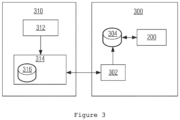
- Figure 3 is a block diagram of an exemplary configuration of the power management system 300 according to one embodiment of the present disclosure.
- the power management system 300 may comprise an interface unit 302, a database 304 and a power management apparatus 200 described above.
- the power management system 300 is interfaced with an external system 310 via the interface unit 302.
- the external system 310 may be, for example, a power consumption data monitoring system of the power company.
- the external system may comprise, for example, a measuring system 312 and a local server 314.
- the measuring system 312 is used to collect the power consumption data of each user in real time, and then send the collected power consumption data to the local server 314, and the power consumption data may be stored in a local database 316 of the server 314.
- the interface unit 302 may be, for example, a Jar package.
- the power management system 300 requests power consumption data from the external system 310 through the interface unit 302, and exports the obtained data to the database 304.
- the power management device 200 can obtain power consumption data from the database 304 and perform power management operations.
- the monitoring unit, error calculation unit, and post-evaluation unit comprised in the power management device 200 may be implemented as Web applications, which may comprise a back end and a front end.
- the prediction unit used to predict power consumption may be implemented in a data analysis module.
- the database may be shared between the web application and the data analysis module.
- prediction is an important technique. Prediction is performed on the full time scale. For example, not only daily power consumption but also monthly power consumption is predicted. As mentioned above, there are usually some bottlenecks in the prediction accuracy in prior art. In the method and apparatus of the present disclosure, the prediction accuracy can be improved by use of the full time-scale prediction.
- Error tracking may be performed to reduce the error between the actual power consumption and the predicted power consumption.
- an alarm can be sent to adjust the power supply plan or adjust the user's power demand.
- the method, apparatus and system according to one embodiment of the present disclosure can improve the accuracy of prediction, enhance the management of power consumption, and thus increase the efficiency of power consumption.
- the method, apparatus and system according to one embodiment of the present disclosure can lower costs for power sales companies and plants, and moreover can optimize the calculation of power supply and reduce the management cost due to large differences between predicted power consumption and the actual power consumption.
- the method, apparatus and system for power management according to the present disclosure are described above with reference to Figures 1 to 3 .
- the power management apparatus above may be implemented as hardware or software or a combination thereof.
- the power management apparatus 200 may be implemented as a computing device.
- Figure 4 is a block diagram of the computing device 400 for power management according to the embodiments of the present disclosure.
- the computing device 400 may comprise at least one processor 402, and the processor 402 executes at least one computer-readable instruction (i.e., an element implemented in the form of software as described above) stored or encoded in a computer-readable storage medium (i.e., the memory 404).
- a computer-executable instruction is stored in the memory 404, which, when executed, causes the at least one processor 402 to complete the following action: collecting and storing power consumption data of a user in real time; predicting first predicted power consumption of a first time period based on the collected power consumption data using a prestored first prediction model, and predicting, using a prestored second prediction model, second predicted power consumption of each second time period comprised in the first time period; sequentially performing, based on the collected real-time power consumption data, the following processing for each second time period from a first second time period to a last second time period comprised in the first time period: calculating a first error between the actual power consumption in the second time period and the second predicted power consumption of the second time period, and calculating a second error between the total actual power consumption from the first second time period to a current second time period and a sum of the second predicted power consumptions from the first second time period to the current second time period; and adjusting a power supply plan or a power demand of the
- the computer-executable instruction stored in the memory 404 when executed, causes the at least one processor 402 to perform the various operations and functions in each embodiment of the present disclosure described above with reference to Figures 1 to 3 .
- a non-transitory machine-readable medium may have a machine-executable instruction (i.e., element implemented in the form of software as described above) that, when executed by a machine, causes the machine to execute the various operations and functions in each of the embodiments of the present disclosure described above with reference to Figures 1 to 3 .
- a machine-executable instruction i.e., element implemented in the form of software as described above
- a computer program product comprising a computer-executable instruction, which, when executed, causes at least one processor to perform the various operations and functions described above in each of the embodiments of the present disclosure with reference to Figures 1 to 3 .
Landscapes
- Engineering & Computer Science (AREA)
- Power Engineering (AREA)
- Physics & Mathematics (AREA)
- General Physics & Mathematics (AREA)
- Automation & Control Theory (AREA)
- Supply And Distribution Of Alternating Current (AREA)
- Management, Administration, Business Operations System, And Electronic Commerce (AREA)
Claims (14)
- Leistungsverwaltungsverfahren, umfassend:einen Überwachungsschritt (S102): Sammeln und Speichern von Leistungsverbrauchsdaten eines Benutzers in Echtzeit;einen Vorhersageschritt (S104): Vorhersagen eines ersten vorhergesagten Leistungsverbrauchs eines ersten Zeitraums basierend auf den gesammelten Leistungsverbrauchsdaten unter Verwendung eines vorab gespeicherten ersten Vorhersagemodells und Vorhersagen eines zweiten vorhergesagten Leistungsverbrauchs jedes in dem ersten Zeitraum umfassten zweiten Zeitraums unter Verwendung eines vorab gespeicherten zweiten Vorhersagemodells;einen Fehlerberechnungsschritt (S106) : sequenzielles Durchführen der folgenden Verarbeitung für jeden in dem ersten Zeitraum umfassten zweiten Zeitraum von einem ersten zweiten Zeitraum bis zu einem letzten zweiten Zeitraum basierend auf den gesammelten Echtzeit-Leistungsverbrauchsdaten:
Berechnen eines ersten Fehlers zwischen dem tatsächlichen Leistungsverbrauch des zweiten Zeitraums und dem zweiten vorhergesagten Leistungsverbrauch des zweiten Zeitraums und Berechnen eines zweiten Fehlers zwischen dem tatsächlichen Gesamtleistungsverbrauch von dem ersten zweiten Zeitraum bis zu einem aktuellen zweiten Zeitraum und einer Summe des zweiten vorhergesagten Leistungsverbrauchs von dem ersten zweiten Zeitraum bis zu dem aktuellen zweiten Zeitraum; Verfolgen von Fehlern in Echtzeit durch die Berechnung des ersten Fehlers und des zweiten Fehlers; einen Anpassungsschritt (S108): Anpassen eines Leistungsversorgungsplans oder einer Leistungsanforderung des Benutzers, wenn der erste Fehler größer als ein erster vorgegebener Schwellenwert ist und/oder der zweite Fehler größer als ein zweiter vorgegebener Schwellenwert ist, und einen Leistungsverwaltungsschritt im geschlossenen Regelkreis basierend auf dem Anpassungsschritt. - Leistungsverwaltungsverfahren nach Anspruch 1, ferner umfassend einen Postevaluationsschritt (S110): Berechnen eines dritten Fehlers zwischen dem tatsächlichen Leistungsverbrauch des ersten Zeitraums und dem ersten vorhergesagten Leistungsverbrauch nach dem Ende des ersten Zeitraums und separates Anpassen des ersten Vorhersagemodells und des zweiten Vorhersagemodells, wenn der dritte Fehler größer als ein dritter vorgegebener Schwellenwert ist.
- Leistungsverwaltungsverfahren nach Anspruch 2, wobei der Postevaluationsschritt ferner umfasst:
Reihen verschiedener Benutzer basierend auf dem für die Benutzer berechneten dritten Fehler. - Leistungsverwaltungsverfahren nach einem der Ansprüche 1 bis 3, wobei der erste Zeitraum ein Monat ist und der zweite Zeitraum ein Tag ist.
- Leistungsverwaltungsverfahren nach einem der Ansprüche 1 bis 3, wobei das erste Vorhersagemodell ein erstes Maschinenlernmodell ist, das durch Trainieren unter Verwendung von historischen Leistungsverbrauchsdaten des ersten Zeitraums als Trainingsdaten erhalten wird, und das zweite Vorhersagemodell ein zweites Maschinenlernmodell ist, das durch Trainieren unter Verwendung von historischen Leistungsverbrauchsdaten des zweiten Zeitraums als Trainingsdaten erhalten wird.
- Leistungsverwaltungsvorrichtung (200) mit geschlossenem Regelkreis, umfassend:eine Überwachungseinheit (202), die zum Sammeln und Speichern von Leistungsverbrauchsdaten eines Benutzers in Echtzeit ausgelegt ist;eine Vorhersageeinheit (204), die zum Vorhersagen eines ersten vorhergesagten Leistungsverbrauchs eines ersten Zeitraums basierend auf den gesammelten Leistungsverbrauchsdaten unter Verwendung eines vorab gespeicherten ersten Vorhersagemodells und Vorhersagen eines zweiten vorhergesagten Leistungsverbrauchs jedes in dem ersten Zeitraum umfassten zweiten Zeitraums unter Verwendung eines vorab gespeicherten zweiten Vorhersagemodells ausgelegt ist;eine Fehlerberechnungseinheit (206), die zum sequenziellen Durchführen der folgenden Verarbeitung für jeden in dem ersten Zeitraum umfassten zweiten Zeitraum von einem ersten zweiten Zeitraum bis zu einem letzten zweiten Zeitraum basierend auf den gesammelten Echtzeit-Leistungsverbrauchsdaten ausgelegt ist:Berechnen eines ersten Fehlers zwischen dem tatsächlichen Leistungsverbrauch des zweiten Zeitraums und dem zweiten vorhergesagten Leistungsverbrauch des zweiten Zeitraums und Berechnen eines zweiten Fehlers zwischen dem tatsächlichen Gesamtleistungsverbrauch von dem ersten zweiten Zeitraum bis zu einem aktuellen zweiten Zeitraum und einer Summe des zweiten vorhergesagten Leistungsverbrauchs von dem ersten zweiten Zeitraum bis zu dem aktuellen zweiten Zeitraum; undeine Anpassungseinheit (208), die zum Anpassen eines Leistungsversorgungsplans oder einer Leistungsanforderung des Benutzers ausgelegt ist, wenn der erste Fehler größer als ein erster vorgegebener Schwellenwert ist und/oder der zweite Fehler größer als ein zweiter vorgegebener Schwellenwert ist.
- Leistungsverwaltungsvorrichtung (200) nach Anspruch 6, ferner umfassend eine Postevaluationseinheit (210), die zum Berechnen eines dritten Fehlers zwischen dem tatsächlichen Leistungsverbrauch des ersten Zeitraums und dem ersten vorhergesagten Leistungsverbrauch nach dem Ende des ersten Zeitraums und separaten Anpassen des ersten Vorhersagemodells und des zweiten Vorhersagemodells ausgelegt ist, wenn der dritte Fehler größer als ein dritter vorgegebener Schwellenwert ist.
- Leistungsverwaltungsvorrichtung (200) nach Anspruch 7, wobei die Nachbewertungseinheit (210) ferner ausgelegt ist zum: Reihen verschiedener Benutzer basierend auf dem für die Benutzer berechneten dritten Fehler.
- Leistungsverwaltungsvorrichtung (200) nach einem der Ansprüche 6 bis 8, wobei der erste Zeitraum ein Monat ist und der zweite Zeitraum ein Tag ist.
- Leistungsverwaltungsvorrichtung (200) nach einem der Ansprüche 6 bis 8, wobei das erste Vorhersagemodell ein erstes Maschinenlernmodell ist, das durch Trainieren unter Verwendung von historischen Leistungsverbrauchsdaten des ersten Zeitraums als Trainingsdaten erhalten wird, und das zweite Vorhersagemodell ein zweites Maschinenlernmodell ist, das durch Trainieren unter Verwendung von historischen Leistungsverbrauchsdaten des zweiten Zeitraums als Trainingsdaten erhalten wird.
- Leistungsverwaltungssystem (300), umfassend:eine Schnittstelleneinheit (302), die so ausgelegt ist, dass sie das Leistungsverwaltungssystem (300) zum Erhalten von Leistungsverbrauchsdaten von einem externen System (310) befähigt;eine Datenbank (304), die zum Speichern der Leistungsverbrauchsdaten ausgelegt ist; unddie Leistungsverwaltungsvorrichtung (200) nach einem der Ansprüche 6 bis 10, wobeidie Leistungsverwaltungsvorrichtung (200) die Leistungsverbrauchsdaten aus der Datenbank (304) erhält.
- Rechenvorrichtung (400), umfassend:mindestens einen Prozessor (402); undeinen Speicher (404), der mit dem mindestens einen Prozessor (402) gekoppelt ist, wobei der Speicher so ausgelegt ist, dass er eine Anweisung speichert, die bei Ausführung durch den mindestens einen Prozessor (402) den Prozessor (402) zum Durchführen des Verfahrens nach einem der Ansprüche 1 bis 5 veranlasst.
- Nicht-transitorisches maschinenlesbares Speichermedium, das eine ausführbare Anweisung speichert, die bei Ausführung eine Maschine zum Durchführen des Verfahrens nach einem der Ansprüche 1 bis 5 veranlasst.
- Computerprogrammprodukt, das physisch in einem computerlesbaren Medium gespeichert ist und eine computerausführbare Anweisung umfasst, die bei Ausführung mindestens einen Prozessor zum Durchführen des Verfahrens nach einem der Ansprüche 1 bis 5 veranlasst.
Applications Claiming Priority (1)
| Application Number | Priority Date | Filing Date | Title |
|---|---|---|---|
| PCT/CN2019/088002 WO2020232673A1 (zh) | 2019-05-22 | 2019-05-22 | 电力管理方法、装置、计算设备、介质以及产品 |
Publications (3)
| Publication Number | Publication Date |
|---|---|
| EP3961841A1 EP3961841A1 (de) | 2022-03-02 |
| EP3961841A4 EP3961841A4 (de) | 2022-12-28 |
| EP3961841B1 true EP3961841B1 (de) | 2024-10-23 |
Family
ID=73459296
Family Applications (1)
| Application Number | Title | Priority Date | Filing Date |
|---|---|---|---|
| EP19929523.9A Active EP3961841B1 (de) | 2019-05-22 | 2019-05-22 | Leistungsverwaltungsverfahren und -vorrichtung, rechnervorrichtung, medium und produkt |
Country Status (4)
| Country | Link |
|---|---|
| US (1) | US11502516B2 (de) |
| EP (1) | EP3961841B1 (de) |
| CN (1) | CN113826294B (de) |
| WO (1) | WO2020232673A1 (de) |
Families Citing this family (2)
| Publication number | Priority date | Publication date | Assignee | Title |
|---|---|---|---|---|
| US11972278B2 (en) * | 2020-05-21 | 2024-04-30 | Paypal, Inc. | Dynamic computing touchpoint journey recommendation platform |
| CN114737923B (zh) * | 2022-04-16 | 2023-07-07 | 盘锦辽河油田裕隆实业集团有限公司 | 游梁式抽油机曲柄定位系统 |
Family Cites Families (13)
| Publication number | Priority date | Publication date | Assignee | Title |
|---|---|---|---|---|
| US7216021B2 (en) * | 2003-10-30 | 2007-05-08 | Hitachi, Ltd. | Method, system and computer program for managing energy consumption |
| JP2006174654A (ja) | 2004-12-17 | 2006-06-29 | Nippon Telegr & Teleph Corp <Ntt> | 分散型エネルギー需給制御方法および設定装置 |
| KR20100090255A (ko) * | 2007-10-29 | 2010-08-13 | 어메리칸 파워 컨버젼 코포레이션 | 데이터 센터에 대한 전기 효율 측정 |
| JP6019566B2 (ja) * | 2011-11-17 | 2016-11-02 | ソニー株式会社 | 電力管理装置および電力管理方法 |
| AU2012344680B2 (en) * | 2011-11-29 | 2017-10-12 | Generac Power Systems, Inc. | Method and system for forecasting power requirements using granular metrics |
| CA2864758A1 (en) * | 2012-01-20 | 2013-08-25 | Energy Aware Technology Inc. | System and method of compiling and organizing power consumption data and converting such data into one or more user actionable formats |
| US10740775B2 (en) * | 2012-12-14 | 2020-08-11 | Battelle Memorial Institute | Transactive control and coordination framework and associated toolkit functions |
| BR112015029424B1 (pt) * | 2013-05-30 | 2021-07-13 | Toshiba Mitsubishi-Electric Industrial Systems Corporation | Dispositivo de gestão de energia |
| KR20150123540A (ko) * | 2014-04-25 | 2015-11-04 | 삼성전자주식회사 | 전력 소비 최적화를 위한 스마트 시스템의 동작방법 및 장치 |
| US10094586B2 (en) * | 2015-04-20 | 2018-10-09 | Green Power Labs Inc. | Predictive building control system and method for optimizing energy use and thermal comfort for a building or network of buildings |
| WO2017217466A1 (ja) * | 2016-06-17 | 2017-12-21 | パナソニックIpマネジメント株式会社 | 電力管理システム |
| CN109213098B (zh) * | 2018-08-29 | 2021-11-26 | 西门子电力自动化有限公司 | 调整运行参数的方法、装置、电子设备和计算机可读介质 |
| CN109118027A (zh) * | 2018-09-30 | 2019-01-01 | 广东小天才科技有限公司 | 电量预测模型训练方法、电量预测方法、智能设备及系统 |
-
2019
- 2019-05-22 US US17/612,650 patent/US11502516B2/en active Active
- 2019-05-22 WO PCT/CN2019/088002 patent/WO2020232673A1/zh not_active Ceased
- 2019-05-22 CN CN201980096443.6A patent/CN113826294B/zh active Active
- 2019-05-22 EP EP19929523.9A patent/EP3961841B1/de active Active
Also Published As
| Publication number | Publication date |
|---|---|
| EP3961841A4 (de) | 2022-12-28 |
| WO2020232673A1 (zh) | 2020-11-26 |
| CN113826294A (zh) | 2021-12-21 |
| US20220255317A1 (en) | 2022-08-11 |
| CN113826294B (zh) | 2023-08-29 |
| EP3961841A1 (de) | 2022-03-02 |
| US11502516B2 (en) | 2022-11-15 |
Similar Documents
| Publication | Publication Date | Title |
|---|---|---|
| US11876374B2 (en) | System and method for optimal control of energy storage system | |
| US10734816B2 (en) | Identifying operability failure in demand response (DR) assets | |
| CN109787855A (zh) | 基于马尔可夫链和时间序列模型的服务器负载预测方法及系统 | |
| CN104217091B (zh) | 一种基于历史走势权重的网站访问量预测方法 | |
| US20170323330A1 (en) | Media spend management using real-time predictive modeling of touchpoint exposure effects | |
| CN108470233A (zh) | 一种智能电网的需求响应能力评估方法和计算设备 | |
| CN104102875A (zh) | 基于加权朴素贝叶斯分类器的软件服务质量监控方法及系统 | |
| EP3961841B1 (de) | Leistungsverwaltungsverfahren und -vorrichtung, rechnervorrichtung, medium und produkt | |
| CN105721194A (zh) | 移动网故障隐患智能定位系统 | |
| CN106228257A (zh) | 一种面向钢铁企业生产工序的成本分析与评估系统及方法 | |
| Zhang et al. | IgS-wBSRM: A time-aware Web Service QoS monitoring approach in dynamic environments | |
| US20240412217A1 (en) | A communications server, a method, a user device, an e-commerce server and a system | |
| CN104252647B (zh) | 基于反距离权重插值法的用电负荷预测方法 | |
| CN111291957A (zh) | 生成客服调度信息的方法及装置、电子设备、存储介质 | |
| Fernandes et al. | Very short-term current and load forecasting for distribution systems in data constrained situations | |
| CN118134274A (zh) | 一种电力用户电量预估及监测方法及相关设备 | |
| CN101364286A (zh) | 一种火力发电机组等效强迫停运率的预测方法及系统 | |
| CN111563766B (zh) | 一种售电公司电量偏差控制系统 | |
| CN113052417A (zh) | 一种资源配置方法以及装置 | |
| CN107590571A (zh) | 一种基于用户行为分析的电量预测方法 | |
| CN108733661A (zh) | 一种面向非侵入式监测的在线负荷特征库维护方法 | |
| CN121210102A (zh) | 容器编排资源利用率优化方法、装置、设备及存储介质 | |
| CN119886409A (zh) | 投诉预测方法、装置、非易失性存储介质及电子设备 | |
| CN121094753A (zh) | 工程企业二级管理方法及系统 | |
| CN114819908A (zh) | 一种物料采购谈判时间确定方法、装置、计算机设备及存储介质 |
Legal Events
| Date | Code | Title | Description |
|---|---|---|---|
| STAA | Information on the status of an ep patent application or granted ep patent |
Free format text: STATUS: THE INTERNATIONAL PUBLICATION HAS BEEN MADE |
|
| PUAI | Public reference made under article 153(3) epc to a published international application that has entered the european phase |
Free format text: ORIGINAL CODE: 0009012 |
|
| STAA | Information on the status of an ep patent application or granted ep patent |
Free format text: STATUS: REQUEST FOR EXAMINATION WAS MADE |
|
| 17P | Request for examination filed |
Effective date: 20211122 |
|
| AK | Designated contracting states |
Kind code of ref document: A1 Designated state(s): AL AT BE BG CH CY CZ DE DK EE ES FI FR GB GR HR HU IE IS IT LI LT LU LV MC MK MT NL NO PL PT RO RS SE SI SK SM TR |
|
| DAV | Request for validation of the european patent (deleted) | ||
| DAX | Request for extension of the european patent (deleted) | ||
| A4 | Supplementary search report drawn up and despatched |
Effective date: 20221124 |
|
| RIC1 | Information provided on ipc code assigned before grant |
Ipc: H02J 3/00 20060101AFI20221118BHEP |
|
| STAA | Information on the status of an ep patent application or granted ep patent |
Free format text: STATUS: EXAMINATION IS IN PROGRESS |
|
| 17Q | First examination report despatched |
Effective date: 20230911 |
|
| GRAP | Despatch of communication of intention to grant a patent |
Free format text: ORIGINAL CODE: EPIDOSNIGR1 |
|
| STAA | Information on the status of an ep patent application or granted ep patent |
Free format text: STATUS: GRANT OF PATENT IS INTENDED |
|
| INTG | Intention to grant announced |
Effective date: 20240515 |
|
| GRAS | Grant fee paid |
Free format text: ORIGINAL CODE: EPIDOSNIGR3 |
|
| GRAA | (expected) grant |
Free format text: ORIGINAL CODE: 0009210 |
|
| STAA | Information on the status of an ep patent application or granted ep patent |
Free format text: STATUS: THE PATENT HAS BEEN GRANTED |
|
| AK | Designated contracting states |
Kind code of ref document: B1 Designated state(s): AL AT BE BG CH CY CZ DE DK EE ES FI FR GB GR HR HU IE IS IT LI LT LU LV MC MK MT NL NO PL PT RO RS SE SI SK SM TR |
|
| REG | Reference to a national code |
Ref country code: GB Ref legal event code: FG4D |
|
| REG | Reference to a national code |
Ref country code: CH Ref legal event code: EP |
|
| REG | Reference to a national code |
Ref country code: DE Ref legal event code: R096 Ref document number: 602019060978 Country of ref document: DE |
|
| REG | Reference to a national code |
Ref country code: IE Ref legal event code: FG4D |
|
| REG | Reference to a national code |
Ref country code: LT Ref legal event code: MG9D |
|
| REG | Reference to a national code |
Ref country code: NL Ref legal event code: MP Effective date: 20241023 |
|
| REG | Reference to a national code |
Ref country code: AT Ref legal event code: MK05 Ref document number: 1735640 Country of ref document: AT Kind code of ref document: T Effective date: 20241023 |
|
| PG25 | Lapsed in a contracting state [announced via postgrant information from national office to epo] |
Ref country code: NL Free format text: LAPSE BECAUSE OF FAILURE TO SUBMIT A TRANSLATION OF THE DESCRIPTION OR TO PAY THE FEE WITHIN THE PRESCRIBED TIME-LIMIT Effective date: 20241023 |
|
| PG25 | Lapsed in a contracting state [announced via postgrant information from national office to epo] |
Ref country code: NL Free format text: LAPSE BECAUSE OF FAILURE TO SUBMIT A TRANSLATION OF THE DESCRIPTION OR TO PAY THE FEE WITHIN THE PRESCRIBED TIME-LIMIT Effective date: 20241023 |
|
| PG25 | Lapsed in a contracting state [announced via postgrant information from national office to epo] |
Ref country code: PT Free format text: LAPSE BECAUSE OF FAILURE TO SUBMIT A TRANSLATION OF THE DESCRIPTION OR TO PAY THE FEE WITHIN THE PRESCRIBED TIME-LIMIT Effective date: 20250224 Ref country code: HR Free format text: LAPSE BECAUSE OF FAILURE TO SUBMIT A TRANSLATION OF THE DESCRIPTION OR TO PAY THE FEE WITHIN THE PRESCRIBED TIME-LIMIT Effective date: 20241023 Ref country code: IS Free format text: LAPSE BECAUSE OF FAILURE TO SUBMIT A TRANSLATION OF THE DESCRIPTION OR TO PAY THE FEE WITHIN THE PRESCRIBED TIME-LIMIT Effective date: 20250223 |
|
| PG25 | Lapsed in a contracting state [announced via postgrant information from national office to epo] |
Ref country code: FI Free format text: LAPSE BECAUSE OF FAILURE TO SUBMIT A TRANSLATION OF THE DESCRIPTION OR TO PAY THE FEE WITHIN THE PRESCRIBED TIME-LIMIT Effective date: 20241023 |
|
| PG25 | Lapsed in a contracting state [announced via postgrant information from national office to epo] |
Ref country code: BG Free format text: LAPSE BECAUSE OF FAILURE TO SUBMIT A TRANSLATION OF THE DESCRIPTION OR TO PAY THE FEE WITHIN THE PRESCRIBED TIME-LIMIT Effective date: 20241023 |
|
| PG25 | Lapsed in a contracting state [announced via postgrant information from national office to epo] |
Ref country code: ES Free format text: LAPSE BECAUSE OF FAILURE TO SUBMIT A TRANSLATION OF THE DESCRIPTION OR TO PAY THE FEE WITHIN THE PRESCRIBED TIME-LIMIT Effective date: 20241023 |
|
| PG25 | Lapsed in a contracting state [announced via postgrant information from national office to epo] |
Ref country code: NO Free format text: LAPSE BECAUSE OF FAILURE TO SUBMIT A TRANSLATION OF THE DESCRIPTION OR TO PAY THE FEE WITHIN THE PRESCRIBED TIME-LIMIT Effective date: 20250123 |
|
| PG25 | Lapsed in a contracting state [announced via postgrant information from national office to epo] |
Ref country code: AT Free format text: LAPSE BECAUSE OF FAILURE TO SUBMIT A TRANSLATION OF THE DESCRIPTION OR TO PAY THE FEE WITHIN THE PRESCRIBED TIME-LIMIT Effective date: 20241023 Ref country code: LV Free format text: LAPSE BECAUSE OF FAILURE TO SUBMIT A TRANSLATION OF THE DESCRIPTION OR TO PAY THE FEE WITHIN THE PRESCRIBED TIME-LIMIT Effective date: 20241023 Ref country code: GR Free format text: LAPSE BECAUSE OF FAILURE TO SUBMIT A TRANSLATION OF THE DESCRIPTION OR TO PAY THE FEE WITHIN THE PRESCRIBED TIME-LIMIT Effective date: 20250124 |
|
| PG25 | Lapsed in a contracting state [announced via postgrant information from national office to epo] |
Ref country code: PL Free format text: LAPSE BECAUSE OF FAILURE TO SUBMIT A TRANSLATION OF THE DESCRIPTION OR TO PAY THE FEE WITHIN THE PRESCRIBED TIME-LIMIT Effective date: 20241023 |
|
| PG25 | Lapsed in a contracting state [announced via postgrant information from national office to epo] |
Ref country code: RS Free format text: LAPSE BECAUSE OF FAILURE TO SUBMIT A TRANSLATION OF THE DESCRIPTION OR TO PAY THE FEE WITHIN THE PRESCRIBED TIME-LIMIT Effective date: 20250123 |
|
| PG25 | Lapsed in a contracting state [announced via postgrant information from national office to epo] |
Ref country code: SM Free format text: LAPSE BECAUSE OF FAILURE TO SUBMIT A TRANSLATION OF THE DESCRIPTION OR TO PAY THE FEE WITHIN THE PRESCRIBED TIME-LIMIT Effective date: 20241023 |
|
| PG25 | Lapsed in a contracting state [announced via postgrant information from national office to epo] |
Ref country code: DK Free format text: LAPSE BECAUSE OF FAILURE TO SUBMIT A TRANSLATION OF THE DESCRIPTION OR TO PAY THE FEE WITHIN THE PRESCRIBED TIME-LIMIT Effective date: 20241023 |
|
| PG25 | Lapsed in a contracting state [announced via postgrant information from national office to epo] |
Ref country code: EE Free format text: LAPSE BECAUSE OF FAILURE TO SUBMIT A TRANSLATION OF THE DESCRIPTION OR TO PAY THE FEE WITHIN THE PRESCRIBED TIME-LIMIT Effective date: 20241023 |
|
| PG25 | Lapsed in a contracting state [announced via postgrant information from national office to epo] |
Ref country code: RO Free format text: LAPSE BECAUSE OF FAILURE TO SUBMIT A TRANSLATION OF THE DESCRIPTION OR TO PAY THE FEE WITHIN THE PRESCRIBED TIME-LIMIT Effective date: 20241023 |
|
| REG | Reference to a national code |
Ref country code: DE Ref legal event code: R097 Ref document number: 602019060978 Country of ref document: DE |
|
| PG25 | Lapsed in a contracting state [announced via postgrant information from national office to epo] |
Ref country code: SK Free format text: LAPSE BECAUSE OF FAILURE TO SUBMIT A TRANSLATION OF THE DESCRIPTION OR TO PAY THE FEE WITHIN THE PRESCRIBED TIME-LIMIT Effective date: 20241023 |
|
| PG25 | Lapsed in a contracting state [announced via postgrant information from national office to epo] |
Ref country code: CZ Free format text: LAPSE BECAUSE OF FAILURE TO SUBMIT A TRANSLATION OF THE DESCRIPTION OR TO PAY THE FEE WITHIN THE PRESCRIBED TIME-LIMIT Effective date: 20241023 |
|
| PG25 | Lapsed in a contracting state [announced via postgrant information from national office to epo] |
Ref country code: IT Free format text: LAPSE BECAUSE OF FAILURE TO SUBMIT A TRANSLATION OF THE DESCRIPTION OR TO PAY THE FEE WITHIN THE PRESCRIBED TIME-LIMIT Effective date: 20241023 |
|
| PLBE | No opposition filed within time limit |
Free format text: ORIGINAL CODE: 0009261 |
|
| STAA | Information on the status of an ep patent application or granted ep patent |
Free format text: STATUS: NO OPPOSITION FILED WITHIN TIME LIMIT |
|
| PG25 | Lapsed in a contracting state [announced via postgrant information from national office to epo] |
Ref country code: SE Free format text: LAPSE BECAUSE OF FAILURE TO SUBMIT A TRANSLATION OF THE DESCRIPTION OR TO PAY THE FEE WITHIN THE PRESCRIBED TIME-LIMIT Effective date: 20241023 |
|
| 26N | No opposition filed |
Effective date: 20250724 |
|
| REG | Reference to a national code |
Ref country code: DE Ref legal event code: R119 Ref document number: 602019060978 Country of ref document: DE |
|
| REG | Reference to a national code |
Ref country code: CH Ref legal event code: H13 Free format text: ST27 STATUS EVENT CODE: U-0-0-H10-H13 (AS PROVIDED BY THE NATIONAL OFFICE) Effective date: 20251223 |
|
| PG25 | Lapsed in a contracting state [announced via postgrant information from national office to epo] |
Ref country code: LU Free format text: LAPSE BECAUSE OF NON-PAYMENT OF DUE FEES Effective date: 20250522 |
|
| PG25 | Lapsed in a contracting state [announced via postgrant information from national office to epo] |
Ref country code: CH Free format text: LAPSE BECAUSE OF NON-PAYMENT OF DUE FEES Effective date: 20250531 |
|
| GBPC | Gb: european patent ceased through non-payment of renewal fee |
Effective date: 20250522 |
|
| REG | Reference to a national code |
Ref country code: BE Ref legal event code: MM Effective date: 20250531 |
|
| PG25 | Lapsed in a contracting state [announced via postgrant information from national office to epo] |
Ref country code: MC Free format text: LAPSE BECAUSE OF FAILURE TO SUBMIT A TRANSLATION OF THE DESCRIPTION OR TO PAY THE FEE WITHIN THE PRESCRIBED TIME-LIMIT Effective date: 20241023 |
|
| PG25 | Lapsed in a contracting state [announced via postgrant information from national office to epo] |
Ref country code: GB Free format text: LAPSE BECAUSE OF NON-PAYMENT OF DUE FEES Effective date: 20250522 |
|
| PG25 | Lapsed in a contracting state [announced via postgrant information from national office to epo] |
Ref country code: IE Free format text: LAPSE BECAUSE OF NON-PAYMENT OF DUE FEES Effective date: 20250522 Ref country code: DE Free format text: LAPSE BECAUSE OF NON-PAYMENT OF DUE FEES Effective date: 20251202 |
|
| PG25 | Lapsed in a contracting state [announced via postgrant information from national office to epo] |
Ref country code: BE Free format text: LAPSE BECAUSE OF NON-PAYMENT OF DUE FEES Effective date: 20250531 |
|
| PG25 | Lapsed in a contracting state [announced via postgrant information from national office to epo] |
Ref country code: FR Free format text: LAPSE BECAUSE OF NON-PAYMENT OF DUE FEES Effective date: 20250531 |