EP3953244B1 - Fahrzeug - Google Patents
Fahrzeug Download PDFInfo
- Publication number
- EP3953244B1 EP3953244B1 EP20719975.3A EP20719975A EP3953244B1 EP 3953244 B1 EP3953244 B1 EP 3953244B1 EP 20719975 A EP20719975 A EP 20719975A EP 3953244 B1 EP3953244 B1 EP 3953244B1
- Authority
- EP
- European Patent Office
- Prior art keywords
- handle
- sensor
- positioning element
- electric scooter
- sensors
- Prior art date
- Legal status (The legal status is an assumption and is not a legal conclusion. Google has not performed a legal analysis and makes no representation as to the accuracy of the status listed.)
- Active
Links
Images



Classifications
-
- B—PERFORMING OPERATIONS; TRANSPORTING
- B62—LAND VEHICLES FOR TRAVELLING OTHERWISE THAN ON RAILS
- B62K—CYCLES; CYCLE FRAMES; CYCLE STEERING DEVICES; RIDER-OPERATED TERMINAL CONTROLS SPECIALLY ADAPTED FOR CYCLES; CYCLE AXLE SUSPENSIONS; CYCLE SIDECARS, FORECARS, OR THE LIKE
- B62K23/00—Rider-operated controls specially adapted for cycles, i.e. means for initiating control operations, e.g. levers, grips
- B62K23/02—Rider-operated controls specially adapted for cycles, i.e. means for initiating control operations, e.g. levers, grips hand actuated
- B62K23/04—Twist grips
-
- B—PERFORMING OPERATIONS; TRANSPORTING
- B60—VEHICLES IN GENERAL
- B60L—PROPULSION OF ELECTRICALLY-PROPELLED VEHICLES; SUPPLYING ELECTRIC POWER FOR AUXILIARY EQUIPMENT OF ELECTRICALLY-PROPELLED VEHICLES; ELECTRODYNAMIC BRAKE SYSTEMS FOR VEHICLES IN GENERAL; MAGNETIC SUSPENSION OR LEVITATION FOR VEHICLES; MONITORING OPERATING VARIABLES OF ELECTRICALLY-PROPELLED VEHICLES; ELECTRIC SAFETY DEVICES FOR ELECTRICALLY-PROPELLED VEHICLES
- B60L15/00—Methods, circuits, or devices for controlling the traction-motor speed of electrically-propelled vehicles
- B60L15/20—Methods, circuits, or devices for controlling the traction-motor speed of electrically-propelled vehicles for control of the vehicle or its driving motor to achieve a desired performance, e.g. speed, torque, programmed variation of speed
-
- B—PERFORMING OPERATIONS; TRANSPORTING
- B60—VEHICLES IN GENERAL
- B60L—PROPULSION OF ELECTRICALLY-PROPELLED VEHICLES; SUPPLYING ELECTRIC POWER FOR AUXILIARY EQUIPMENT OF ELECTRICALLY-PROPELLED VEHICLES; ELECTRODYNAMIC BRAKE SYSTEMS FOR VEHICLES IN GENERAL; MAGNETIC SUSPENSION OR LEVITATION FOR VEHICLES; MONITORING OPERATING VARIABLES OF ELECTRICALLY-PROPELLED VEHICLES; ELECTRIC SAFETY DEVICES FOR ELECTRICALLY-PROPELLED VEHICLES
- B60L15/00—Methods, circuits, or devices for controlling the traction-motor speed of electrically-propelled vehicles
- B60L15/20—Methods, circuits, or devices for controlling the traction-motor speed of electrically-propelled vehicles for control of the vehicle or its driving motor to achieve a desired performance, e.g. speed, torque, programmed variation of speed
- B60L15/2009—Methods, circuits, or devices for controlling the traction-motor speed of electrically-propelled vehicles for control of the vehicle or its driving motor to achieve a desired performance, e.g. speed, torque, programmed variation of speed for braking
-
- B—PERFORMING OPERATIONS; TRANSPORTING
- B62—LAND VEHICLES FOR TRAVELLING OTHERWISE THAN ON RAILS
- B62J—CYCLE SADDLES OR SEATS; AUXILIARY DEVICES OR ACCESSORIES SPECIALLY ADAPTED TO CYCLES AND NOT OTHERWISE PROVIDED FOR, e.g. ARTICLE CARRIERS OR CYCLE PROTECTORS
- B62J45/00—Electrical equipment arrangements specially adapted for use as accessories on cycles, not otherwise provided for
- B62J45/40—Sensor arrangements; Mounting thereof
- B62J45/41—Sensor arrangements; Mounting thereof characterised by the type of sensor
- B62J45/413—Rotation sensors
-
- B—PERFORMING OPERATIONS; TRANSPORTING
- B60—VEHICLES IN GENERAL
- B60L—PROPULSION OF ELECTRICALLY-PROPELLED VEHICLES; SUPPLYING ELECTRIC POWER FOR AUXILIARY EQUIPMENT OF ELECTRICALLY-PROPELLED VEHICLES; ELECTRODYNAMIC BRAKE SYSTEMS FOR VEHICLES IN GENERAL; MAGNETIC SUSPENSION OR LEVITATION FOR VEHICLES; MONITORING OPERATING VARIABLES OF ELECTRICALLY-PROPELLED VEHICLES; ELECTRIC SAFETY DEVICES FOR ELECTRICALLY-PROPELLED VEHICLES
- B60L2200/00—Type of vehicles
- B60L2200/12—Bikes
-
- Y—GENERAL TAGGING OF NEW TECHNOLOGICAL DEVELOPMENTS; GENERAL TAGGING OF CROSS-SECTIONAL TECHNOLOGIES SPANNING OVER SEVERAL SECTIONS OF THE IPC; TECHNICAL SUBJECTS COVERED BY FORMER USPC CROSS-REFERENCE ART COLLECTIONS [XRACs] AND DIGESTS
- Y02—TECHNOLOGIES OR APPLICATIONS FOR MITIGATION OR ADAPTATION AGAINST CLIMATE CHANGE
- Y02T—CLIMATE CHANGE MITIGATION TECHNOLOGIES RELATED TO TRANSPORTATION
- Y02T10/00—Road transport of goods or passengers
- Y02T10/60—Other road transportation technologies with climate change mitigation effect
- Y02T10/64—Electric machine technologies in electromobility
-
- Y—GENERAL TAGGING OF NEW TECHNOLOGICAL DEVELOPMENTS; GENERAL TAGGING OF CROSS-SECTIONAL TECHNOLOGIES SPANNING OVER SEVERAL SECTIONS OF THE IPC; TECHNICAL SUBJECTS COVERED BY FORMER USPC CROSS-REFERENCE ART COLLECTIONS [XRACs] AND DIGESTS
- Y02—TECHNOLOGIES OR APPLICATIONS FOR MITIGATION OR ADAPTATION AGAINST CLIMATE CHANGE
- Y02T—CLIMATE CHANGE MITIGATION TECHNOLOGIES RELATED TO TRANSPORTATION
- Y02T10/00—Road transport of goods or passengers
- Y02T10/60—Other road transportation technologies with climate change mitigation effect
- Y02T10/72—Electric energy management in electromobility
Definitions
- the present invention relates to an electric scooter, with a drive unit comprising an electric motor for driving the electric scooter and a rechargeable battery which is connected to the electric motor in such a way that the electric motor is powered by the battery, and with a handle arrangement with a rotatable handle to be operated by the user and with a controller which is in data connection with the handle arrangement and with the drive unit and which is designed to pass data transmitted by the handle arrangement to the drive unit in order to control the power of the electric motor depending on the rotational position of the handle, wherein the handle has an initial position and a first rotation angle range in which the electric scooter is in a drive mode and a signal driving the electric motor is output, wherein the first rotation angle range is reached by rotating the handle starting from the initial position in a first rotational direction.
- the handle assembly is arranged on the handlebar of the scooter, by rotating the handle the electric motor is supplied with power by the battery, whereby a control is provided which controls the rotation position of the handle and controls the motor power of the electric motor depending on this.
- the present invention is therefore based on the object of developing an electric scooter of the type mentioned at the outset in such a way that its range can be improved in a comparatively simple manner.
- the handle is provided with a second angle of rotation range, which is achieved by rotating the handle starting from the starting position in a second direction of rotation opposite to the first direction of rotation, wherein the handle is designed to output a signal in the second angle of rotation range which switches the electric scooter into a recuperation mode.
- the electric scooter is in drive mode, ie the electric scooter is driving, whereby it is preferably provided that the control is designed in such a way that the driving speed or the Motor power increases with increasing rotation of the handle, as is the case, for example, also known from conventional scooters or motorcycles with combustion engines.
- the control switches the vehicle to recuperation mode, which means that the vehicle's kinetic energy is at least partially converted into electrical energy and the battery is charged in the process.
- recuperation mode means that the vehicle's kinetic energy is at least partially converted into electrical energy and the battery is charged in the process.
- This also provides the advantage of a braking effect, as is known from recuperation brakes.
- this braking effect is so pronounced that it is sufficient for the normal operation of the electric scooter, so that one or more additional brakes acting on the wheels are only needed when a particularly sharp braking process is required.
- the recuperation mode not only charges the battery, but also results in deceleration, which protects the brakes of the electric scooter accordingly.
- the starting position of the handle is the position the handle assumes when it is not touched.
- a return element which always exerts a force on the handle which acts in the starting position, i.e. a return force which causes the handle to be rotated into its starting position by means of the return element as soon as it is released.
- the return element is preferably one or more springs which act on the handle.
- a particular advantage of the invention is that the recuperation mode is particularly easy to adjust. The user does not have to take his hand off the handlebars or the grip; a rotating movement of the grip is sufficient.
- An on/off switch is also conceivable, i.e. a recuperation mode that is activated when the handle is in the second angle of rotation range, whereby the extent of the recuperation in this case does not depend on the rotational position in the second angle of rotation range.
- the first and/or the second angle of rotation range immediately follows the starting position.
- the first angle of rotation range is reached by turning the handle anti-clockwise and the second angle of rotation range, i.e. the recuperation mode, is reached by turning the handle clockwise.
- the starting position neither a signal is emitted to drive the electric motor nor a signal is emitted to switch the electric scooter to recuperation mode.
- the starting position is therefore a "rest mode" in which the electric motor does not develop any power and the battery is not charged by recuperation.
- the electric scooter has a handlebar, wherein the handle assembly is preferably arranged on one side of the handlebar.
- the second handle, located on the other side of the handlebar, is preferably fixed, i.e. not rotatable.
- handlebar is to be understood broadly and includes any steering device.
- a handle holder is provided in which the handle is arranged so that it can rotate.
- the handle holder is designed in such a way that it does not rotate with the handle and thus forms a bearing for the handle.
- one or more position elements and one or more sensors are present which are designed to output one or more signals depending on the position of the position element(s) to the sensor(s), wherein the handle arrangement is designed such that the position of the sensor(s) relative to the position element(s) is changed by rotating the handle.
- position element refers to any element, such as a magnet, etc., whose presence or position can be detected by a sensor, such as a Hall sensor.
- the positioning element(s) are located on the handle, i.e. undergo a rotational movement with the handle, and the sensor(s) are located on an element that cannot be rotated with the handle, such as the above-mentioned handle holder.
- the reverse arrangement is also conceivable, whereby the positioning element(s) are located on an element that cannot be rotated with the handle and the sensor(s) are located on the handle, i.e. are rotated with it.
- one of the positioning elements is designed to be part-circular.
- This positioning element can interact with a sensor that is designed to derive a signal from the position of the positioning element relative to the sensor, wherein it is preferably provided that the signal strength can be changed by changing this position. It is conceivable that the signal strength becomes greater or smaller the further the positioning element has been moved past the sensor. It is possible for the sensor to output a signal dependent on this relative position, preferably an analog signal, which is transmitted to the drive unit via a controller.
- the embodiment of the invention according to the invention consists in that at least one of the sensors is designed as a Hall sensor and at least one of the position elements is designed as a magnet.
- the invention is not limited to this, but includes any elements by means of which the rotational position of the handle can be determined or by means of which signals dependent on the rotational position of the handle are generated, such as a potentiometer, etc.
- the part-circular positioning element preferably cooperates with at least one sensor such that the sensor outputs a signal, preferably an analog signal or digital signal, which depends on the rotational position of the positioning element relative to the sensor.
- a first sensor and a second sensor as well as a second position element and a third position element are provided and that the sensors and the position elements are arranged in such a way that in the starting position of the handle the third position element actuates the second sensor and the second position element actuates the first sensor.
- the control thus recognizes the starting position of the handle through this sensor actuation or through the sensor signals emitted as a result.
- the sensors and the positioning elements are arranged in such a way that in the drive mode the third positioning element actuates the second sensor and no positioning element actuates the first sensor. If this is the case, the control recognizes that the user wants to drive and activates the drive mode by supplying the vehicle's electric motor with power from the battery.
- a first position element can also be provided, wherein the sensors and the position elements are arranged such that in a boost mode the first position element actuates the first sensor and the third position element actuates the second sensor.
- the boost mode is characterized by a particularly high engine power It is preferably obtained by the user by turning the handle far into the first angle of rotation range, ie the boost mode preferably represents the area of the first angle of rotation range furthest away from the starting position.
- the position elements and the sensors can be arranged such that in the recuperation mode the third position element actuates the second sensor and no position element actuates the first sensor.
- the first rotation angle range is larger than the second rotation angle range, wherein it is preferably provided that the first rotation angle range is in the range from 0° to 75°, preferably in the range from 0° to 60° and particularly preferably in the range from 0° to 55° and/or that the second rotation angle range is in the range from 0° to -35°, preferably 0° to -30° and particularly preferably in the range from 0° to -27°.
- the angle 0° indicates the starting position of the handle, the negative signs indicate that the second rotation angle range is reached by a rotation that is opposite to a rotation in the first rotation angle range.
- the electric scooter has no further drive motor, in particular no combustion engine, apart from the electric motor(s), so that it is a purely electric vehicle.
- the invention also includes hybrid vehicles, i.e. those that have both an electric motor and an internal combustion engine for propulsion.
- Figure 1 shows a schematic view of the right part of the handlebar 100 of an electric scooter with a handle 10 arranged thereon.
- 0° indicates the starting position of the handle 10, which it assumes when the electric scooter is not in operation. Starting from this zero position, the user can select the drive mode by turning in a first direction of rotation, which in this embodiment extends over a range of 55°, whereby the angular range of 45° from the starting position indicates the conventional drive mode and the subsequent angular range of 10° indicates the boost mode.
- the recuperation mode is set, which in the example shown here extends over a second angle of rotation of the handle of 27° and whose operation only makes sense while driving, since only then can recuperation and a braking effect be achieved.
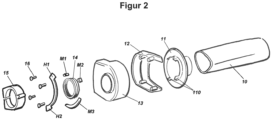
- Figure 2 shows an exploded view of the handle assembly with the rotating handle 10, the handle end piece 11, which is connected to the handle 10 in a rotationally fixed manner and which has grooves 110 for receiving the magnets M1, M2 and M3. These magnets are spaced apart from one another in the circumferential direction of the handle end piece 11 and are thus also rotated and their position changed relative to the parts not moved with the handle 10 when the handle 10 is rotated.
- the reference numerals 12, 13 identify a handle holder which is not rotatable with the handle 10, but is fixed, in which the handle 10 or the handle end piece 11 is rotatably arranged.
- the two parts 12 and 13 of the handle holder are connected to one another by means of screws 16.
- the Hall sensors H1 and H2 are located on part 13 of the handle holder, spaced apart from each other in the circumferential direction on a partially circular support bar.
- the reference number 14 designates a spring which is fixed by means of the clamp 15 and which interacts with the handle 10 or with its end piece 11 in such a way that the handle 10 and with it the end piece of the handle are always rotated back to the starting position when the handle 10 is not operated.
- the clamp is arranged in a rotationally fixed manner in one or both of the elements 12, 13 of the handle holder.
- FIG. 3 Another illustration shows the arrangement of the magnets M1 to M3 and the Hall sensors H1 and H2.
- the active i.e. interacting sensors and magnets are each marked by a circular area.
- the magnet M2 activates the Hall sensor H1 and the partially circular magnet M3 activates the Hall sensor H2.
- the magnets M1 and M2 are not partially circular.
- the scooter accelerates because the electric motor is now being supplied with power.
- the magnet M3 still activates the Hall sensor H2 (see circular area), but the magnet M2 no longer activates the Hall sensor H1.
- the extent of the rotation is recorded by the sensor H2 and passed on to the control system, so that the scooter travels faster as the angle of rotation increases or a higher power is provided by the electric motor. This function is available over an angle range of 0° to 45°, for example.
- the boost range of the drive mode is reached, in which the electric motor delivers particularly high power.
- This boost mode is in a exemplary angle range of 45° to 55°. In this range, the magnet M1 activates the Hall sensor H1 and the magnet M3 activates the Hall sensor H2.
- the magnet M3 activates the Hall sensor H2, whereas the magnets M1 and M2 do not activate the Hall sensor H1.
- This state is detected by the control system and the electric scooter is switched to recuperation mode, in which the kinetic energy is used to charge the battery and at the same time a braking effect occurs.
- the electric scooter according to the invention preferably has further braking devices, such as drum or disc brakes, in order to provide sufficient braking force in the event of a necessary strong deceleration.
- further braking devices such as drum or disc brakes
Landscapes
- Engineering & Computer Science (AREA)
- Mechanical Engineering (AREA)
- Power Engineering (AREA)
- Transportation (AREA)
- Electric Propulsion And Braking For Vehicles (AREA)
Description
- Die vorliegende Erfindung betrifft einen Elektroroller, mit einer Antriebseinheit, umfassend einen Elektromotor zum Antrieb des Elektrorollers und einen aufladbaren Akku, der mit dem Elektromotor derart in Verbindung steht, dass der Elektromotor von dem Akku gespeist wird, und mit einer Griffanordnung mit einem nutzerseitig zu betätigenden drehbaren Griff sowie mit einer Steuerung, die mit der Griffanordnung sowie mit der Antriebseinheit in Datenverbindung steht und die ausgebildet ist, von der Griffanordnung übermittelte Daten an die Antriebseinheit zu leiten, um die Leistung des Elektromotors in Abhängigkeit von der Drehposition des Griffes zu steuern, wobei der Griff eine Ausgangsstellung aufweist und einen ersten Drehwinkelbereich, in dem sich der Elektroroller in einem Antriebsmodus befindet und ein den Elektromotor antreibendes Signal ausgegeben wird, wobei der erste Drehwinkelbereich durch Drehen des Griffes ausgehend von der Ausgangsstellung in eine erste Drehrichtung erreicht wird.
- Die Griffanordnung ist an dem Lenker des Rollers angeordnet, durch eine Drehbewegung des Griffes wird der Elektromotor durch den Akku mit Strom versorgt, wobei eine Steuerung vorgesehen ist, die die Drehposition des Griffes auswertet und in Abhängigkeit davon die Motorleistung des Elektromotors steuert.
- Der Bremsvorgang derartiger bekannter Elektroroller erfolgt üblicherweise mittels Trommel- oder Scheibenbremsen.
- Die Reichweite derartiger Elektroroller ist in der Praxis von erheblicher Bedeutung und ein wesentliches Verkaufsargument, da Nutzer sich darauf verlassen möchten, ihr Ziel mit einer Akkuladung zuverlässig zu erreichen und nicht auf etwaige unterwegs befindliche Ladestationen angewiesen zu sein. Ist eine solche Ladung unterwegs notwendig, besteht für den Nutzer nicht nur der Nachteil, dass er ggf. nicht weiß, wo sich eine noch erreichbare Ladestation befindet, ob diese frei und funktionsfähig ist und schließlich, dass der Ladevorgang zeitintensiv ist.
- Der vorliegenden Erfindung liegt daher die Aufgabe zugrunde, einen Elektroroller der eingangs genannten Art dahingehend weiterzubilden, dass dessen Reichweite auf vergleichsweise einfache Art und Weise verbessert werden kann.
- Diese Aufgabe wird durch einen Elektroroller mit den Merkmalen des Anspruchs 1 gelöst.
- Danach ist vorgesehen, dass der Griff einen zweiten Drehwinkelbereich aufweist, der durch Drehen des Griffes ausgehend von der Ausgangsstellung in eine zweite, zu der ersten Drehrichtung entgegengesetzte Drehrichtung erreicht wird, wobei der Griff ausgebildet ist, in dem zweiten Drehwinkelbereich ein Signal auszugeben, das den Elektroroller in einen Rekuperations-Modus schaltet.
- Dreht der Nutzer den Griff somit in eine erste Richtung, befindet sich der Elektroroller im Antriebsmodus, d.h. der Elektroroller fährt, wobei vorzugsweise vorgesehen ist, dass die Steuerung derart ausgebildet ist, dass die Fahrgeschwindigkeit bzw. die Motorleistung mit zunehmender Drehung des Griffes zunimmt, wie dies beispielsweise auch von herkömmlichen Rollern oder Motorrädern mit Verbrennungsmotor bekannt ist.
- Dreht der Nutzer den Griff ausgehend von einer Ausgangsstellung in die andere Richtung, schaltet die Steuerung das Fahrzeug in den Rekuperations-Modus, was bedeutet, dass die Bewegungsenergie des Fahrzeuges zumindest teilweise in elektrische Energie umgewandelt und dabei der Akku geladen wird. Dabei ergibt sich gleichzeitig der Vorteil einer Bremswirkung, wie dies von Rekuperations-Bremsen bekannt ist.
- Vorzugsweise ist diese Bremswirkung so ausgeprägt, dass sie für den normalen Betrieb des Elektrorollers ausreichend ist, so dass eine oder mehrere weitere Bremsen, die auf die Räder einwirken, nur benötigt werden, wenn ein besonders scharfer Bremsvorgang erforderlich ist. Durch den Rekuperations-Modus wird somit nicht nur der Akku geladen, sondern es erfolgt auch eine Verzögerung, die die Bremsen des Elektrorollers entsprechend schont.
- Vorzugsweise handelt es sich bei der Ausgangsstellung des Griffes um die Position, die der Griff einnimmt, wenn er nicht berührt wird.
- Bevorzugt ist es, wenn ein Rückstellelement vorhanden ist, das auf den Griff stets eine in die Ausgangsposition wirkende Kraft ausübt, d.h. eine Rückstellkraft, die bewirkt, dass der Griff, sobald er losgelassen wird, mittels des Rückstellelementes in seine Ausgangsposition gedreht wird. Bei dem Rückstellelement handelt es vorzugsweise um eine oder um mehrere Federn, die auf den Griff einwirken.
- Ein besonderer Vorteil der Erfindung besteht darin, dass der Rekuperations-Modus besonders leicht einstellbar ist. Der Nutzer muss seine Hand nicht vom Lenker bzw. vom Griff nehmen, ausreichend ist eine Drehbewegung des Griffes.
- Denkbar ist es, dass das Ausmaß der Rekuperation davon abhängt, wie weit der Nutzer den Griff in den zweiten Drehwinkelbereich dreht. So ist es möglich, dass das Ausmaß der Rekuperation mit dem Drehwinkel in dem zweiten Drehwinkelbereich zunimmt.
- Denkbar ist auch eine Ein/Aus-Schaltung, d.h. ein Rekuperations-Modus, der aktiviert wird, wenn sich der Griff in dem zweiten Drehwinkelbereich befindet, wobei das Ausmaß der Rekuperation in diesem Fall nicht von der Drehposition in dem zweiten Drehwinkelbereich abhängt.
- Vorzugsweise ist vorgesehen, dass sich der erste und/oder der zweite Drehwinkelbereich unmittelbar an die Ausgangsstellung anschließen.
- Denkbar ist es, dass aus Sicht eines neben dem Elektroroller befindlichen Beobachters ausgehend von der Ausgangsstellung der erste Drehwinkelbereich durch Drehen des Griffes gegen den Uhrzeigersinn und der zweite Drehwinkelbereich, d.h. der Rekuperations-Modus durch Drehen des Griffes im Uhrzeigersinn erreicht wird.
- Vorteilhaft wird in der Ausgangsstellung weder ein den Elektromotor antreibendes Signal abgegeben noch ein den Elektroroller in den Rekuperations-Modus schaltendes Signal ausgegeben. Die Ausgangsstellung ist somit ein "Ruhemodus", in dem der Elektromotor keine Leistung entfaltet und der Akku auch nicht mittels Rekuperation aufgeladen wird.
- Der Elektroroller weist einen Lenker auf, wobei die Griffanordnung vorzugsweise an einer Seite des Lenkers angeordnet ist. Der zweite, auf der anderen Seite des Lenkers befindliche Griff ist vorzugsweise feststehend, d.h. nicht drehbar.
- Der Begriff "Lenker" ist weit zu verstehen und umfasst beliebige Lenkeinrichtungen. Vorzugsweise ist eine Griffhalterung vorgesehen, in der der Griff drehbar angeordnet ist. Die Griffhalterung ist so ausgebildet, dass sie sich nicht mit dem Griff dreht und somit eine Lagerung für den Griff bildet.
- Es ist erfindungsgemäss, wenn ein oder mehrere Positionselemente und ein oder mehrere Sensoren vorhanden sind, die ausgebildet sind, in Abhängigkeit von der Position des oder der Positionselemente zu dem oder den Sensoren ein oder mehrere Signale auszugeben, wobei die Griffanordnung ausgebildet ist, dass durch eine Drehung des Griffes die Position des oder der Sensoren relativ zu dem oder den Positionselementen verändert wird.
- Unter dem Begriff "Positionselement" ist jedes beliebige Element, wie z.B. ein Magnet etc. zu verstehen, dessen Anwesenheit bzw. Position durch einen Sensor, wie z.B. durch einen Hall-Sensor erfasst werden kann.
- Es ist erfindungsgemäss, wenn sich das oder die Positionselemente an dem Griff befinden, d.h. mit dem Griff eine Drehbewegung erfahren, und der oder die Sensoren an einem nicht mit dem Griff drehbarem Element befinden, wie beispielsweise an der o.g. Griffhalterung. Auch die umgekehrte Anordnung ist denkbar, wonach sich der oder die Positionselemente an einem nicht mit dem Griff drehbaren Element und der oder die Sensoren an dem Griff befinden, d.h. mit diesem gedreht werden.
- Erfindungsgemäss ist eines der Positionselemente teilkreisförmig ausgebildet ist. Dieses Positionselement kann mit einem Sensor zusammenwirken, der ausgebildet ist, aus der Lage des Positionselementes relativ zu dem Sensor ein Signal abzuleiten, wobei vorzugsweise vorgesehen ist, dass die Signalstärke durch eine Änderung dieser Lage verändert werden kann. Denkbar ist es, dass die Signalstärke umso größer oder kleiner wird, je weiter das Positionselement an dem Sensor vorbei bewegt wurde. Möglich ist es, dass der Sensor ein von dieser Relativposition abhängiges Signal, vorzugsweise Analogsignal ausgibt, dass über eine Steuerung an die Antriebseinheit übermittelt wird.
- Auf diese Weise ist es möglich, eine umso größere Motorleistung bereitzustellen, je weiter der Griff in den ersten Drehwinkelbereich bewegt wird.
- Wie ausgeführt, besteht erfindunsgemässe Ausgestaltung der Erfindung darin, dass wenigstens einer der Sensoren als Hall-Sensor und wenigstens eines der Positionselemente als Magnet ausgebildet ist.
- Die Erfindung ist jedoch nicht darauf beschränkt, sondern umfasst beliebige Elemente, mittels derer die Drehposition des Griffes ermittelbar ist bzw. mittels derer von der Drehposition des Griffes abhängige Signale generiert werden, wie z.B. ein Potentiometer etc.
- Wie ausgeführt, wirkt das teilkreisförmige Positionselement vorzugsweise mit zumindest einem Sensor derart zusammen, dass der Sensor ein Signal, vorzugsweise ein Analogsignal oder Digitalsignal ausgibt, das von der Drehposition des Positionselementes relativ zu dem Sensor abhängt.
- Denkbar ist es, dass ein erster Sensor und ein zweiter Sensor sowie ein zweites Positionselement und ein drittes Positionselement vorgesehen sind und dass die Sensoren und die Positionselemente so angeordnet sind, dass in der Ausgangsposition des Griffes das dritte Positionselement den zweiten Sensor und das zweite Positionselement den ersten Sensor betätigt. Die Steuerung erkennt somit die Ausgangsposition des Griffes durch diese Sensorbetätigung bzw. durch die dadurch abgegebenen Sensorsignale.
- Erfindungsgemäss sind die Sensoren und die Positionselemente so angeordnet dass in dem Antriebsmodus das dritte Positionselement den zweiten Sensor und kein Positionselement den ersten Sensor betätigt. Ist dies der Fall, erkennt die Steuerung, dass der Nutzer fahren möchte und aktiviert den Fahrmodus, indem der Elektromotor des Fahrzeuges aus dem Akku mit Strom versorgt wird.
- Es kann weiterhin ein erstes Positionselement vorgesehen sein, wobei die Sensoren und die Positionselemente so angeordnet sind, dass in einem Boost-Modus das erste Positionselement den ersten Sensor und das dritte Positionselement den zweiten Sensor betätigt. Der Boost-Modus ist durch eine besonders hohe Motorleistung gekennzeichnet. Er wird nutzerseitig vorzugsweise dadurch erhalten, dass der Nutzer den Griff weit in den ersten Drehwinkelbereich dreht, d.h. der Boost-Modus stellt vorzugsweise den von der Ausgangsstellung am weitesten entfernten Bereich des ersten Drehwinkelbereichs dar.
- Die Positionselemente und die Sensoren können derart angeordnet sein, dass in dem Rekuperations-Modus das dritte Positionselement den zweiten Sensor und kein Positionselement den ersten Sensor betätigt.
- In einer denkbaren Ausgestaltung ist vorgesehen, dass der erste Drehwinkelbereich größer ist als der zweite Drehwinkelbereich, wobei vorzugsweise vorgesehen ist, dass der erste Drehwinkelbereich in der Spanne von 0° bis 75°, vorzugsweise in der Spanne von 0° bis 60° und besonders bevorzugt in der Spanne von 0° bis 55° liegt und/oder dass der zweite Drehwinkelbereich in der Spanne 0° bis -35°, vorzugsweise 0° bis -30° und besonders bevorzugt in der Spanne von 0° bis -27° liegt. Der Winkel 0° kennzeichnet die Ausgangsstellung des Griffes, die negativen Vorzeichen kennzeichnen, dass der zweite Drehwinkelbereich durch eine Drehung erreicht wird, die zu einer Drehung in den ersten Drehwinkelbereich entgegengesetzt ist.
- In einer bevorzugten Ausgestaltung der Erfindung ist vorgesehen, dass der Elektroroller außer dem oder den Elektromotoren keinen weiteren Antriebsmotor, insbesondere keinen Verbrennungsmotor aufweist, dass es sich somit um ein reines Elektrofahrzeug handelt.
- Von der Erfindung sind auch Hybridfahrzeuge umfasst, d.h. solche, die zum Antrieb sowohl über einen Elektromotor, als auch über einen Verbrennungsmotor verfügen.
- An dieser Stelle wird darauf hingewiesen, dass die Begriffe "ein" und "eine" nicht zwingend auf genau eines der Elemente verweisen, wenngleich dies eine mögliche Ausführung darstellt, sondern auch eine Mehrzahl der Elemente bezeichnen können. Ebenso schließt die Verwendung des Plurals auch das Vorhandensein des fraglichen Elementes in der Einzahl ein und umgekehrt umfasst der Singular auch mehrere der fraglichen Elemente.
- Weitere Einzelheiten und Vorteile der Erfindung werden anhand eines in der Zeichnung dargestellten Ausführungsbeispiels näher erläutert. Es zeigen:
- Figur 1:
- eine schematische Ansicht eines Teils des Lenkers mit Griff sowie der je nach Griffdrehung einstellbaren Betriebsmodi,
- Figur 2:
- eine Explosionsdarstellung der Griffanordnung mit Griff mit Griffhalterung und Magneten sowie Sensoren,
- Figur 3:
- eine perspektivische Ansicht der Griffanordnung mit Griff in der Ausgangsstellung,
- Figur 4:
- eine schematische Seitenansicht der Griffanordnung in der Ausgangsstellung,
- Figur 5:
- eine schematische Seitenansicht der Griffanordnung in Antriebsstellung, und
- Figur 6:
- eine schematische Seitenansicht der Griffanordnung in Rekuperations-Stellung.
-
Figur 1 zeigt in schematischer Ansicht den rechten Teil des Lenkers 100 eines Elektrorollers mit einem daran angeordneten Griff 10. - Mit 0° ist die Ausgangsstellung des Griffs 10 gekennzeichnet, den dieser einnimmt, wenn der Elektroroller nicht betrieben wird. Ausgehend von dieser Nullstellung kann der Nutzer durch Drehung in eine erste Drehrichtung den Antriebsmodus wählen, der sich in diesem Ausführungsbeispiel über einen Bereich von 55° erstreckt, wobei der Winkelbereich von 45° ab der Ausgangsstellung den herkömmlichen Antriebsmodus kennzeichnet und der sich daran anschließende Winkelbereich von 10° den Boost-Modus kennzeichnet.
- Dreht der Nutzer den Griff in die andere, entgegengesetzte Richtung, wird der Rekuperations-Modus eingestellt, der sich in dem hier gezeigten Ausführungsbeispiel über einen zweiten Drehwinkelbereich des Griffes von 27° erstreckt und dessen Betätigung nur während der Fahrt Sinn macht, da nur dann eine Rekuperation und eine Bremswirkung entfaltet werden kann.
- Sämtliche Winkelangaben sind nur exemplarischer Natur und nicht beschränkend.
-
Figur 2 zeigt eine Explosionsansicht der Griffanordnung mit dem drehbaren Griff 10, dem Griffendstück 11, das drehfest mit dem Griff 10 in Verbindung steht und das Nuten 110 zur Aufnahme der Magnete M1, M2 und M3 aufweist. Diese Magnete sind im Umgangsrichtung des Griffendstückes 11 voneinander beabstandet und werden somit ebenfalls gedreht und in Ihrer Position relativ zu den nicht mit dem Griff 10 bewegten Teilen verändert, wenn der Griff 10 gedreht wird. - Die Bezugszeichen 12, 13 kennzeichnen eine nicht mit dem Griff 10 drehbare, sondern feststehende Griffhalterung, in der der Griff 10 bzw. das Griffendstück 11 drehbar angeordnet ist. Die beiden Teile 12 und 13 der Griffhalterung sind mittels Schrauben 16 miteinander verbunden.
- An dem Teil 13 der Griffhalterung befinden sich in Umfangsrichtung voneinander beabstandet an einer teilkreisförmigen Tragleiste die Hall-Sensoren H1 und H2.
- Das Bezugszeichen 14 kennzeichnet eine Feder, die mittels der Klammer 15 fixiert wird und die mit dem Griff 10 oder mit dessen Endstück 11 so zusammenwirkt, dass der Griff 10 und mit diesem das Griffendstück stets in die Ausgangsstellung zurückgedreht wird, wenn der Griff 10 nicht betätigt wird. Die Klammer ist drehfest in einem oder beiden der Elemente 12, 13 der Griffhalterung angeordnet.
-
Figur 3 zeigt ein einer weiteren Darstellung die Anordnung der Magnete M1 bis M3 sowie der Hall-Sensoren H1 und H2. - In den im Folgenden beschriebenen Figuren sind die jeweils aktiven, d.h. zusammenwirkenden Sensoren und Magnete jeweils durch einen kreisförmigen Bereich gekennzeichnet.
- In der Ausgangsstellung des Griffes gemäß
Figur 4 betätigt der Magnet M2 den Hall-Sensor H1 und der teilkreisförmige Magnet M3 den Hall-Sensor H2. Die Magnete M1 und M2 sind nicht teilkreisförmig ausgeführt. - Wird der Griff nun ausgehend von dieser Position in Antriebsrichtung gedreht (vgl.
Figur 5 ), beschleunigt der Roller, da der Elektromotor nun mit Leistung versorgt wird. In diesem Antriebsmodus betätigt der Magnet M3 nach wie vor den Hall-Sensor H2 (vgl. kreisförmiger Bereich), jedoch betätigt der Magnet M2 nicht mehr den Hall-Sensor H1. Das Ausmaß der Drehung wird von dem Sensor H2 erfasst und an die Steuerung weitergegeben, so dass der Roller mit zunehmendem Drehwinkel schneller fährt bzw. eine höhere Leistung des Elektromotors bereitgestellt wird. Diese Funktion liegt über einen Winkelbereich von z.B. 0° bis 45° vor. - Wird der Griff weiter in Pfeilrichtung gedreht, d.h. über den exemplarischen Winkel von 45° hinaus, wird der Boost-Bereich des Antriebsmodus erreicht, in dem der Elektromotor besonders viel Leistung abgibt. Dieser Boost-Modus liegt in einem exemplarischen Winkelbereich von 45° bis 55° vor. In diesem Bereich betätigt der Magnet M1 den Hall-Sensor H1 und der Magnet M3 den Hall-Sensor H2.
- Wird der Griff hingegen aus dem Drehwinkelbereich des Antriebsmodus über die Ausgangstellung hinaus in den zweiten Drehwinkelbereich gemäß Pfeilrichtung in
Figur 6 zurückgedreht, wird in dem Ausgangsmodus zunächst wieder die Position gemäßFigur 4 erhalten, d.h. der Magnet M2 betätigt den Hall-Sensor H1 und der teilkreisförmige Magnet M3 den Hall-Sensor H2. - Wird der Griff weiter gedreht, wie in
Figur 6 dargestellt, betätigt der Magnet M3 den Hall-Sensor H2, wohingegen, die Magnete M1 und M2 nicht den Hall-Sensor H1 betätigen. Dieser Zustand wird von der Steuerung erkannt und der Elektroroller wird in den Rekuperations-Modus geschaltet, in dem die Bewegungsenergie zur Aufladung des Akkus herangezogen wird und dabei gleichzeitig eine Bremswirkung eintritt. - Es wird ergänzend darauf hingewiesen, dass der Elektroroller gemäß der Erfindung vorzugsweise über weitere Bremseinrichtungen, wie z.B. Trommel- oder Scheibenbremsen verfügt, um bei einer notwendigen starken Verzögerung eine hinreichende Bremskraft bereitzustellen.
Claims (10)
- Elektroroller, mit einer Antriebseinheit, umfassend einen Elektromotor zum Antrieb des Elektrorollers und einen aufladbaren Akku, der mit dem Elektromotor derart in Verbindung steht, dass der Elektromotor von dem Akku gespeist wird, und mit einer Griffanordnung mit einem nutzerseitig zu betätigenden drehbaren Griff (10) sowie mit einer Steuerung, die mit der Griffanordnung sowie mit der Antriebseinheit in Datenverbindung steht und die ausgebildet ist, von der Griffanordnung übermittelte Daten an die Antriebseinheit zu leiten, um die Leistung des Elektromotors in Abhängigkeit von der Drehposition des Griffes (10) zu steuern, wobei der Griff (10) eine Ausgangsstellung aufweist und einen ersten Drehwinkelbereich, in dem sich der Elektroroller in einem Antriebsmodus befindet und ein den Elektromotor antreibendes Signal ausgegeben wird, wobei der erste Drehwinkelbereich durch Drehen des Griffes (10) ausgehend von der Ausgangsstellung in eine erste Drehrichtung erreicht wird, wobei der Griff (10) einen zweiten Drehwinkelbereich aufweist, der durch Drehen des Griffes (10) ausgehend von der Ausgangsstellung in eine zweite, zu der ersten Drehrichtung entgegengesetzte Drehrichtung erreicht wird, wobei die Griffanordnung ausgebildet ist, in dem zweiten Drehwinkelbereich ein Signal auszugeben, dass der Elektroroller in einen Rekuperations-Modus schaltet, dadurch gekennzeichnet, dass mindestens drei Positionselemente, und zwar ein erstes Positionselement (M1), ein zweites Positionselement (M2) und ein drittes Positionselement (M3) vorhanden sind, wobei wenigstens das zweite und das dritte Positionselement als Magnete ausgebildet sind, und mindestens zwei Sensoren, und zwar ein erster Sensor (H1) und ein zweiter Sensor (H2) vorhanden sind, wobei wenigstens einer der Sensoren als Hall-Sensor ausgebildet ist, wobei die Positionselemente (M1, M2, M3) und die Sensoren (H1, H2) ausgebildet sind, in Abhängigkeit von der Position der Positionselemente (M1, M2, M3) zu den Sensoren (H1, H2) ein oder mehrere Signale auszugeben, wobei der Griff (10) ausgebildet ist, dass durch eine Drehung des Griffes (10) die Position der Sensoren (H1, H2) relativ zu den Positionselementen (M1, M2, M3) verändert wird, dass sich die Positionselemente (M1, M2, M3) an dem Griff (10) und die Sensoren (H1, H2) an einem nicht mit dem Griff (10) drehbarem Element befinden, und dass das erste Positionselement (M1) und das zweite Positionselement (M2) nicht teilkreisförmig ausgeführt sind und das dritte Positionselement (M3) teilkreisförmig ausgeführt ist, und wobei die Sensoren (H1, H2), das zweite Positionselement (M2) und das dritte Positionselement (M3) so angeordnet sind, dass in der Ausgangsposition des Griffes (10) das dritte Positionselement (M3) den zweiten Sensor (H2) und das zweite Positionselement (M2) den ersten Sensor (H1) betätigt.
- Elektroroller nach Anspruch 1, dadurch gekennzeichnet, dass sich der erste und/oder der zweite Drehwinkelbereich unmittelbar an die Ausgangsstellung anschließen.
- Elektroroller nach Anspruch 1 oder 2, dadurch gekennzeichnet, dass aus Sicht eines neben dem Elektroroller befindlichen Beobachters ausgehend von der Ausgangsstellung der erste Drehwinkelbereich durch Drehen des Griffes (10) gegen den Uhrzeigersinn und der zweite Drehwinkelbereich durch Drehen des Griffes (10) im Uhrzeigersinn erreicht wird.
- Elektroroller nach einem der vorhergehenden Ansprüche, dadurch gekennzeichnet, dass in der Ausgangsstellung weder ein den Elektromotor antreibendes Signal, d.h. weder der Antriebsmodus vorliegt, noch ein den Elektroroller in den Rekuperations-Modus schaltendes Signal ausgegeben wird.
- Elektroroller nach einem der vorhergehenden Ansprüche, dadurch gekennzeichnet, dass die Griffanordnung eine Griffhalterung (12, 13) aufweist, in der der Griff (10) drehbar angeordnet ist.
- Elektroroller nach Anspruch 1, dadurch gekennzeichnet, dass das teilkreisförmige dritte Positionselement (M3) mit dem zweiten Sensor (H2) derart zusammenwirkt, dass der zweite Sensor (H2) ein Signal, vorzugsweise ein Analogsignal, ausgibt, dessen Größe von der Drehposition des dritten Positionselementes (M3) relativ zu dem zweiten Sensor (H2) abhängt.
- Elektroroller nach Anspruch 1, dadurch gekennzeichnet, dass die Sensoren (H1, H2) und die Positionselemente (M1, M2, M3) so angeordnet sind, dass in dem Antriebsmodus das dritte Positionselement (M3) den zweiten Sensor (H2) und kein Positionselement den ersten Sensor (H1) betätigt.
- Elektroroller nach Anspruch 1 oder 7, dadurch gekennzeichnet, dass die Sensoren (H1, H2) und die Positionselemente (M1, M2, M3) so angeordnet sind, dass in einem Boost-Modus das erste Positionselement (M1) den ersten Sensor (H1) und das dritte Positionselement (M3) den zweiten Sensor (H2) betätigt.
- Elektroroller nach einem der vorhergehenden Ansprüche, dadurch gekennzeichnet, dass die Positionselemente (M1, M2, M3) und die Sensoren (H1, H2) derart angeordnet sind, dass in dem Rekuperations-Modus das dritte Positionselement (M3) den zweiten Sensor (H2) und kein Positionselement (M1, M2, M3) den ersten Sensor (H1) betätigt.
- Elektroroller nach einem der vorhergehenden Ansprüche, dadurch gekennzeichnet, dass der erste Drehwinkelbereich größer ist als der zweite Drehwinkelbereich, wobei vorzugsweise vorgesehen ist, dass der erste Drehwinkelbereich in der Spanne von 0° bis 75 °, vorzugsweise in der Spanne von 0° bis 60 ° und besonders bevorzugt in der Spanne von 0° bis 55 ° liegt und/oder dass der zweite Drehwinkelbereich in der Spanne 0° bis -35 °, vorzugsweise 0° bis -30° und besonders bevorzugt in der Spanne von 0° bis - 27° liegt.
Applications Claiming Priority (3)
| Application Number | Priority Date | Filing Date | Title |
|---|---|---|---|
| DE102019110352 | 2019-04-18 | ||
| DE102019120866.1A DE102019120866A1 (de) | 2019-04-18 | 2019-08-01 | Fahrzeug |
| PCT/EP2020/060431 WO2020212329A1 (de) | 2019-04-18 | 2020-04-14 | Fahrzeug |
Publications (3)
| Publication Number | Publication Date |
|---|---|
| EP3953244A1 EP3953244A1 (de) | 2022-02-16 |
| EP3953244B1 true EP3953244B1 (de) | 2025-01-22 |
| EP3953244C0 EP3953244C0 (de) | 2025-01-22 |
Family
ID=72660415
Family Applications (1)
| Application Number | Title | Priority Date | Filing Date |
|---|---|---|---|
| EP20719975.3A Active EP3953244B1 (de) | 2019-04-18 | 2020-04-14 | Fahrzeug |
Country Status (4)
| Country | Link |
|---|---|
| EP (1) | EP3953244B1 (de) |
| DE (1) | DE102019120866A1 (de) |
| ES (1) | ES3021587T3 (de) |
| WO (1) | WO2020212329A1 (de) |
Citations (1)
| Publication number | Priority date | Publication date | Assignee | Title |
|---|---|---|---|---|
| EP2154057B1 (de) * | 2008-08-08 | 2011-11-02 | Magneti Marelli S.p.A. | Steuerungsverfahren und Steuereinheit für ein elektrisches Motorrad |
Family Cites Families (4)
| Publication number | Priority date | Publication date | Assignee | Title |
|---|---|---|---|---|
| TW201337092A (zh) * | 2012-01-13 | 2013-09-16 | Vectrix Internat Ltd | 具有非接觸式節流閥控制之車輛 |
| CN202696256U (zh) * | 2012-05-24 | 2013-01-23 | 田丽欣 | 电动车制动回馈装置 |
| JP6134363B2 (ja) * | 2015-09-28 | 2017-05-24 | ヤマハ発動機株式会社 | 鞍乗型電動車両 |
| DE102017122848A1 (de) * | 2017-10-02 | 2019-04-04 | Ujet S.A. | Lenkerbaugruppe, Fahrzeug, Verfahren zum Steuern eines Fahrzeugs und computerlesbares Speichermedium |
-
2019
- 2019-08-01 DE DE102019120866.1A patent/DE102019120866A1/de active Pending
-
2020
- 2020-04-14 ES ES20719975T patent/ES3021587T3/es active Active
- 2020-04-14 WO PCT/EP2020/060431 patent/WO2020212329A1/de not_active Ceased
- 2020-04-14 EP EP20719975.3A patent/EP3953244B1/de active Active
Patent Citations (1)
| Publication number | Priority date | Publication date | Assignee | Title |
|---|---|---|---|---|
| EP2154057B1 (de) * | 2008-08-08 | 2011-11-02 | Magneti Marelli S.p.A. | Steuerungsverfahren und Steuereinheit für ein elektrisches Motorrad |
Also Published As
| Publication number | Publication date |
|---|---|
| WO2020212329A1 (de) | 2020-10-22 |
| ES3021587T3 (en) | 2025-05-27 |
| EP3953244A1 (de) | 2022-02-16 |
| DE102019120866A1 (de) | 2020-10-22 |
| EP3953244C0 (de) | 2025-01-22 |
Similar Documents
| Publication | Publication Date | Title |
|---|---|---|
| DE4404594C2 (de) | Bedien- und Steuereinrichtung | |
| DE10315448A1 (de) | Elektronisches Gassystem für Motorräder | |
| EP1867826A2 (de) | Klappenantrieb | |
| DE202018100310U1 (de) | Drahtlose Bremssteuerung | |
| DE69404132T2 (de) | Ferngesteuerte einrichtung zum drehen des lenkrads eines kraftfahrzeugs | |
| DE102013012534A1 (de) | Antriebsvorrichtung für ein Elektrofahrrad, Elektrofahrrad mit Antriebsvorrichtung sowie Verfahren zum Bremsen eines Elektrofahrrads | |
| DE112019000257T5 (de) | Systeme und Verfahren zur autonomen Vorderradlenkung | |
| WO2019068577A1 (de) | Lenkerbaugruppe, fahrzeug, verfahren zum steuern eines fahrzeugs und computerlesbares speichermedium | |
| DE102017119355A1 (de) | Selbständiges Aufrichten eines selbstbalancierenden Fahrzeuges | |
| DE19547408A1 (de) | Vorrichtung zur Steuerung der Verstellung einer die Leistung eines Motorrad-Motors bestimmenden Drosselklappe | |
| EP3953244B1 (de) | Fahrzeug | |
| EP3539521B1 (de) | Rollstuhl | |
| DE102016104147A1 (de) | Von Hand bewegbare Transportvorrichtung, insbesondere Golfcaddy | |
| DE102019134750B4 (de) | Lenkrad mit Zweihandberührungserkennung | |
| EP2707274A1 (de) | Multifunktionale bedieneinheit für elektrofahrzeuge | |
| DE102021204278A1 (de) | Steer-by-wire-Lenksystem | |
| EP3135960B1 (de) | Schalteinrichtung zur betätigung eines schaltgetriebes eines motorrads zur durchführung eines gangwechsels bei geschlossener kupplung | |
| DE202017105543U1 (de) | Selbständiges Aufrichten eines selbstbalancierenden Fahrzeuges | |
| WO2021197768A1 (de) | Schaltvorrichtung einer getriebeeinheit insbesondere eines hybridantriebsstrangs | |
| DE102014011288A1 (de) | Vorrichtung zur mechanischen Energiespeicherung für Fahrräder | |
| DE102022207142A1 (de) | Gas-Drehgriffsystem mit einem haptischen Feedback zum Steuern eines motorisierten Zwei- oder Dreirads | |
| DE102022131422A1 (de) | Einklappbarer Lenker | |
| DE102023120187A1 (de) | Lenkungsanordnung zum Steuern eines Fortbewegungsmittels | |
| EP1834859A1 (de) | Eingabegerät für ein elektronisches Lenksystem eines virtuellen oder realen Fahrzeuges | |
| DE102022108906A1 (de) | Bremsbetätigungsvorrichtung mit elektronischer Signalvorrichtung |
Legal Events
| Date | Code | Title | Description |
|---|---|---|---|
| STAA | Information on the status of an ep patent application or granted ep patent |
Free format text: STATUS: UNKNOWN |
|
| STAA | Information on the status of an ep patent application or granted ep patent |
Free format text: STATUS: THE INTERNATIONAL PUBLICATION HAS BEEN MADE |
|
| PUAI | Public reference made under article 153(3) epc to a published international application that has entered the european phase |
Free format text: ORIGINAL CODE: 0009012 |
|
| STAA | Information on the status of an ep patent application or granted ep patent |
Free format text: STATUS: REQUEST FOR EXAMINATION WAS MADE |
|
| 17P | Request for examination filed |
Effective date: 20211111 |
|
| AK | Designated contracting states |
Kind code of ref document: A1 Designated state(s): AL AT BE BG CH CY CZ DE DK EE ES FI FR GB GR HR HU IE IS IT LI LT LU LV MC MK MT NL NO PL PT RO RS SE SI SK SM TR |
|
| DAV | Request for validation of the european patent (deleted) | ||
| DAX | Request for extension of the european patent (deleted) | ||
| STAA | Information on the status of an ep patent application or granted ep patent |
Free format text: STATUS: EXAMINATION IS IN PROGRESS |
|
| 17Q | First examination report despatched |
Effective date: 20240507 |
|
| GRAP | Despatch of communication of intention to grant a patent |
Free format text: ORIGINAL CODE: EPIDOSNIGR1 |
|
| STAA | Information on the status of an ep patent application or granted ep patent |
Free format text: STATUS: GRANT OF PATENT IS INTENDED |
|
| INTG | Intention to grant announced |
Effective date: 20241004 |
|
| GRAS | Grant fee paid |
Free format text: ORIGINAL CODE: EPIDOSNIGR3 |
|
| GRAA | (expected) grant |
Free format text: ORIGINAL CODE: 0009210 |
|
| STAA | Information on the status of an ep patent application or granted ep patent |
Free format text: STATUS: THE PATENT HAS BEEN GRANTED |
|
| AK | Designated contracting states |
Kind code of ref document: B1 Designated state(s): AL AT BE BG CH CY CZ DE DK EE ES FI FR GB GR HR HU IE IS IT LI LT LU LV MC MK MT NL NO PL PT RO RS SE SI SK SM TR |
|
| REG | Reference to a national code |
Ref country code: GB Ref legal event code: FG4D Free format text: NOT ENGLISH |
|
| REG | Reference to a national code |
Ref country code: CH Ref legal event code: EP |
|
| REG | Reference to a national code |
Ref country code: IE Ref legal event code: FG4D Free format text: LANGUAGE OF EP DOCUMENT: GERMAN |
|
| REG | Reference to a national code |
Ref country code: DE Ref legal event code: R096 Ref document number: 502020010267 Country of ref document: DE |
|
| U01 | Request for unitary effect filed |
Effective date: 20250122 |
|
| U07 | Unitary effect registered |
Designated state(s): AT BE BG DE DK EE FI FR IT LT LU LV MT NL PT RO SE SI Effective date: 20250128 |
|
| REG | Reference to a national code |
Ref country code: ES Ref legal event code: FG2A Ref document number: 3021587 Country of ref document: ES Kind code of ref document: T3 Effective date: 20250527 |
|
| U20 | Renewal fee for the european patent with unitary effect paid |
Year of fee payment: 6 Effective date: 20250423 |
|
| PG25 | Lapsed in a contracting state [announced via postgrant information from national office to epo] |
Ref country code: RS Free format text: LAPSE BECAUSE OF FAILURE TO SUBMIT A TRANSLATION OF THE DESCRIPTION OR TO PAY THE FEE WITHIN THE PRESCRIBED TIME-LIMIT Effective date: 20250422 |
|
| PG25 | Lapsed in a contracting state [announced via postgrant information from national office to epo] |
Ref country code: PL Free format text: LAPSE BECAUSE OF FAILURE TO SUBMIT A TRANSLATION OF THE DESCRIPTION OR TO PAY THE FEE WITHIN THE PRESCRIBED TIME-LIMIT Effective date: 20250122 |
|
| PGFP | Annual fee paid to national office [announced via postgrant information from national office to epo] |
Ref country code: GB Payment date: 20250426 Year of fee payment: 6 Ref country code: ES Payment date: 20250505 Year of fee payment: 6 |
|
| PG25 | Lapsed in a contracting state [announced via postgrant information from national office to epo] |
Ref country code: NO Free format text: LAPSE BECAUSE OF FAILURE TO SUBMIT A TRANSLATION OF THE DESCRIPTION OR TO PAY THE FEE WITHIN THE PRESCRIBED TIME-LIMIT Effective date: 20250422 Ref country code: IS Free format text: LAPSE BECAUSE OF FAILURE TO SUBMIT A TRANSLATION OF THE DESCRIPTION OR TO PAY THE FEE WITHIN THE PRESCRIBED TIME-LIMIT Effective date: 20250522 |
|
| PG25 | Lapsed in a contracting state [announced via postgrant information from national office to epo] |
Ref country code: HR Free format text: LAPSE BECAUSE OF FAILURE TO SUBMIT A TRANSLATION OF THE DESCRIPTION OR TO PAY THE FEE WITHIN THE PRESCRIBED TIME-LIMIT Effective date: 20250122 |
|
| PG25 | Lapsed in a contracting state [announced via postgrant information from national office to epo] |
Ref country code: GR Free format text: LAPSE BECAUSE OF FAILURE TO SUBMIT A TRANSLATION OF THE DESCRIPTION OR TO PAY THE FEE WITHIN THE PRESCRIBED TIME-LIMIT Effective date: 20250423 |
|
| PG25 | Lapsed in a contracting state [announced via postgrant information from national office to epo] |
Ref country code: SM Free format text: LAPSE BECAUSE OF FAILURE TO SUBMIT A TRANSLATION OF THE DESCRIPTION OR TO PAY THE FEE WITHIN THE PRESCRIBED TIME-LIMIT Effective date: 20250122 |
|
| PG25 | Lapsed in a contracting state [announced via postgrant information from national office to epo] |
Ref country code: CZ Free format text: LAPSE BECAUSE OF FAILURE TO SUBMIT A TRANSLATION OF THE DESCRIPTION OR TO PAY THE FEE WITHIN THE PRESCRIBED TIME-LIMIT Effective date: 20250122 |
|
| PG25 | Lapsed in a contracting state [announced via postgrant information from national office to epo] |
Ref country code: SK Free format text: LAPSE BECAUSE OF FAILURE TO SUBMIT A TRANSLATION OF THE DESCRIPTION OR TO PAY THE FEE WITHIN THE PRESCRIBED TIME-LIMIT Effective date: 20250122 |
|
| REG | Reference to a national code |
Ref country code: CH Ref legal event code: H13 Free format text: ST27 STATUS EVENT CODE: U-0-0-H10-H13 (AS PROVIDED BY THE NATIONAL OFFICE) Effective date: 20251125 |
|
| U1N | Appointed representative for the unitary patent procedure changed after the registration of the unitary effect |
Representative=s name: LORENZ SEIDLER GOSSEL PART. MBB; DE |
|
| PLBE | No opposition filed within time limit |
Free format text: ORIGINAL CODE: 0009261 |
|
| STAA | Information on the status of an ep patent application or granted ep patent |
Free format text: STATUS: NO OPPOSITION FILED WITHIN TIME LIMIT |
|
| PG25 | Lapsed in a contracting state [announced via postgrant information from national office to epo] |
Ref country code: MC Free format text: LAPSE BECAUSE OF FAILURE TO SUBMIT A TRANSLATION OF THE DESCRIPTION OR TO PAY THE FEE WITHIN THE PRESCRIBED TIME-LIMIT Effective date: 20250122 |
|
| 26N | No opposition filed |
Effective date: 20251023 |
|
| PG25 | Lapsed in a contracting state [announced via postgrant information from national office to epo] |
Ref country code: CH Free format text: LAPSE BECAUSE OF NON-PAYMENT OF DUE FEES Effective date: 20250430 |
|
| PG25 | Lapsed in a contracting state [announced via postgrant information from national office to epo] |
Ref country code: IE Free format text: LAPSE BECAUSE OF NON-PAYMENT OF DUE FEES Effective date: 20250414 |