EP3939962A1 - Method for preparing aromatic amino acid derivative - Google Patents
Method for preparing aromatic amino acid derivative Download PDFInfo
- Publication number
- EP3939962A1 EP3939962A1 EP20774227.1A EP20774227A EP3939962A1 EP 3939962 A1 EP3939962 A1 EP 3939962A1 EP 20774227 A EP20774227 A EP 20774227A EP 3939962 A1 EP3939962 A1 EP 3939962A1
- Authority
- EP
- European Patent Office
- Prior art keywords
- amino
- methoxy
- carbonyl
- fluoren
- methyl
- Prior art date
- Legal status (The legal status is an assumption and is not a legal conclusion. Google has not performed a legal analysis and makes no representation as to the accuracy of the status listed.)
- Granted
Links
- 0 *CC(*)(C(O)=O)N* Chemical compound *CC(*)(C(O)=O)N* 0.000 description 34
- GBSQTQRZHMQHGH-UHFFFAOYSA-N C1N=C(c2ccccn2)OC1 Chemical compound C1N=C(c2ccccn2)OC1 GBSQTQRZHMQHGH-UHFFFAOYSA-N 0.000 description 2
- LGDHZCLREKIGKJ-UHFFFAOYSA-N COc(c(OC)c1)ccc1N Chemical compound COc(c(OC)c1)ccc1N LGDHZCLREKIGKJ-UHFFFAOYSA-N 0.000 description 2
- CGSWCMRVWKVUSA-UHFFFAOYSA-N COc(cc1)cc(F)c1I Chemical compound COc(cc1)cc(F)c1I CGSWCMRVWKVUSA-UHFFFAOYSA-N 0.000 description 2
- MOTVIUSOANTTID-UHFFFAOYSA-N Cc1ccc(C(F)(F)F)cc1F Chemical compound Cc1ccc(C(F)(F)F)cc1F MOTVIUSOANTTID-UHFFFAOYSA-N 0.000 description 2
- KKKKCPPTESQGQH-UHFFFAOYSA-N C1N=C(C2=NCCO2)OC1 Chemical compound C1N=C(C2=NCCO2)OC1 KKKKCPPTESQGQH-UHFFFAOYSA-N 0.000 description 1
- ZGRHFCTYKGFKFP-SZFQZUEASA-N CC(C)(C)OC(C1([C@H](CC(ON(C(c2ccccc22)=O)C2=O)=O)C1)NC(OCC1c2ccccc2-c2c1cccc2)=O)=O Chemical compound CC(C)(C)OC(C1([C@H](CC(ON(C(c2ccccc22)=O)C2=O)=O)C1)NC(OCC1c2ccccc2-c2c1cccc2)=O)=O ZGRHFCTYKGFKFP-SZFQZUEASA-N 0.000 description 1
- RWOZAWGUIOITLO-DEOSSOPVSA-N CC(C)(C)OC([C@H](CCC(OCC=C)=O)N(C)C(OCC1c2ccccc2-c2ccccc12)=O)=O Chemical compound CC(C)(C)OC([C@H](CCC(OCC=C)=O)N(C)C(OCC1c2ccccc2-c2ccccc12)=O)=O RWOZAWGUIOITLO-DEOSSOPVSA-N 0.000 description 1
- QHGCJBFSYCTXGI-NRFANRHFSA-N CN([C@@H](CCC(OCC=C)=O)C(O)=O)C(OCC1c2ccccc2-c2ccccc12)=O Chemical compound CN([C@@H](CCC(OCC=C)=O)C(O)=O)C(OCC1c2ccccc2-c2ccccc12)=O QHGCJBFSYCTXGI-NRFANRHFSA-N 0.000 description 1
- CFDLZUIAPBQUQC-UHFFFAOYSA-N CNc1nccc(N)c1 Chemical compound CNc1nccc(N)c1 CFDLZUIAPBQUQC-UHFFFAOYSA-N 0.000 description 1
- POVSDXPEJZMSEJ-UHFFFAOYSA-N COc(c(F)cc(N)c1)c1F Chemical compound COc(c(F)cc(N)c1)c1F POVSDXPEJZMSEJ-UHFFFAOYSA-N 0.000 description 1
- PUCISUQLWLKKJH-UHFFFAOYSA-N COc(c(OC)c1)ccc1I Chemical compound COc(c(OC)c1)ccc1I PUCISUQLWLKKJH-UHFFFAOYSA-N 0.000 description 1
- FYPDCMMNYWMNHK-UHFFFAOYSA-N COc(cc(cc1)I)c1C(NS(C)(=O)=O)=O Chemical compound COc(cc(cc1)I)c1C(NS(C)(=O)=O)=O FYPDCMMNYWMNHK-UHFFFAOYSA-N 0.000 description 1
- JIXDOBAQOWOUPA-UHFFFAOYSA-N COc(cccc1)c1F Chemical compound COc(cccc1)c1F JIXDOBAQOWOUPA-UHFFFAOYSA-N 0.000 description 1
- DSCJETUEDFKYGN-UHFFFAOYSA-N COc(cccc1)c1S Chemical compound COc(cccc1)c1S DSCJETUEDFKYGN-UHFFFAOYSA-N 0.000 description 1
- BYDRTPRWAHNWFR-UHFFFAOYSA-N Cc(cc1)cc(OC)c1C(NC)=O Chemical compound Cc(cc1)cc(OC)c1C(NC)=O BYDRTPRWAHNWFR-UHFFFAOYSA-N 0.000 description 1
- WQOHEWKWIJOAHQ-UHFFFAOYSA-N Cc(ccc(OC)c1)c1F Chemical compound Cc(ccc(OC)c1)c1F WQOHEWKWIJOAHQ-UHFFFAOYSA-N 0.000 description 1
- GWWHXSLLCSBGRO-UHFFFAOYSA-N Cc1cc(F)c(C(F)(F)F)cc1 Chemical compound Cc1cc(F)c(C(F)(F)F)cc1 GWWHXSLLCSBGRO-UHFFFAOYSA-N 0.000 description 1
- CKQXPRSCSFUGRC-UHFFFAOYSA-N Cc1cc(F)cnc1 Chemical compound Cc1cc(F)cnc1 CKQXPRSCSFUGRC-UHFFFAOYSA-N 0.000 description 1
- OBCSAIDCZQSFQH-UHFFFAOYSA-N Cc1cc(N)ccc1N Chemical compound Cc1cc(N)ccc1N OBCSAIDCZQSFQH-UHFFFAOYSA-N 0.000 description 1
- JXUWZXFVCBODAN-UHFFFAOYSA-N Cc1cncc(N)c1 Chemical compound Cc1cncc(N)c1 JXUWZXFVCBODAN-UHFFFAOYSA-N 0.000 description 1
- TWGNOYAGHYUFFR-UHFFFAOYSA-N Cc1cncnc1 Chemical compound Cc1cncnc1 TWGNOYAGHYUFFR-UHFFFAOYSA-N 0.000 description 1
- FUUJYDUHNCZLMN-UHFFFAOYSA-N FC(C(C=CCC(I)=C1)=C1Cl)(F)F Chemical compound FC(C(C=CCC(I)=C1)=C1Cl)(F)F FUUJYDUHNCZLMN-UHFFFAOYSA-N 0.000 description 1
- GNZHVPIFPJKSDY-UHFFFAOYSA-N FC(C(CCC(I)=C1)=C1Cl)(F)F Chemical compound FC(C(CCC(I)=C1)=C1Cl)(F)F GNZHVPIFPJKSDY-UHFFFAOYSA-N 0.000 description 1
- OBRXTVDFVJAUAH-UHFFFAOYSA-N FC(c(ccc(I)c1)c1Cl)(F)F Chemical compound FC(c(ccc(I)c1)c1Cl)(F)F OBRXTVDFVJAUAH-UHFFFAOYSA-N 0.000 description 1
- IGZGUYVVBABKOY-UHFFFAOYSA-N FC(c(cccc1)c1I)(F)F Chemical compound FC(c(cccc1)c1I)(F)F IGZGUYVVBABKOY-UHFFFAOYSA-N 0.000 description 1
- GBOWGKOVMBDPJF-UHFFFAOYSA-N FC(c1cc(F)ccc1)(F)F Chemical compound FC(c1cc(F)ccc1)(F)F GBOWGKOVMBDPJF-UHFFFAOYSA-N 0.000 description 1
- GETTZEONDQJALK-UHFFFAOYSA-N FC(c1ccccc1)(F)F Chemical compound FC(c1ccccc1)(F)F GETTZEONDQJALK-UHFFFAOYSA-N 0.000 description 1
- MMJSSIRVEYQWMU-UHFFFAOYSA-N Fc1c[n]cc(I)c1 Chemical compound Fc1c[n]cc(I)c1 MMJSSIRVEYQWMU-UHFFFAOYSA-N 0.000 description 1
- DNWRLMRKDSGSPL-UHFFFAOYSA-N Ic1cncnc1 Chemical compound Ic1cncnc1 DNWRLMRKDSGSPL-UHFFFAOYSA-N 0.000 description 1
- FTZQXOJYPFINKJ-UHFFFAOYSA-N Nc(cccc1)c1F Chemical compound Nc(cccc1)c1F FTZQXOJYPFINKJ-UHFFFAOYSA-N 0.000 description 1
- MPHANXLXORNRFF-UHFFFAOYSA-N Nc1cc(I)cnc1 Chemical compound Nc1cc(I)cnc1 MPHANXLXORNRFF-UHFFFAOYSA-N 0.000 description 1
- WZCQRUWWHSTZEM-UHFFFAOYSA-N Nc1cc(N)ccc1 Chemical compound Nc1cc(N)ccc1 WZCQRUWWHSTZEM-UHFFFAOYSA-N 0.000 description 1
- ICSNLGPSRYBMBD-UHFFFAOYSA-N Nc1ccccn1 Chemical compound Nc1ccccn1 ICSNLGPSRYBMBD-UHFFFAOYSA-N 0.000 description 1
- LTXJLQINBYSQFU-UHFFFAOYSA-N Oc1cncnc1 Chemical compound Oc1cncnc1 LTXJLQINBYSQFU-UHFFFAOYSA-N 0.000 description 1
- XZAZUZSELBNYCL-UHFFFAOYSA-N Pc1cc(Cl)cnc1 Chemical compound Pc1cc(Cl)cnc1 XZAZUZSELBNYCL-UHFFFAOYSA-N 0.000 description 1
Classifications
-
- C—CHEMISTRY; METALLURGY
- C07—ORGANIC CHEMISTRY
- C07C—ACYCLIC OR CARBOCYCLIC COMPOUNDS
- C07C269/00—Preparation of derivatives of carbamic acid, i.e. compounds containing any of the groups, the nitrogen atom not being part of nitro or nitroso groups
- C07C269/06—Preparation of derivatives of carbamic acid, i.e. compounds containing any of the groups, the nitrogen atom not being part of nitro or nitroso groups by reactions not involving the formation of carbamate groups
-
- C—CHEMISTRY; METALLURGY
- C07—ORGANIC CHEMISTRY
- C07D—HETEROCYCLIC COMPOUNDS
- C07D207/00—Heterocyclic compounds containing five-membered rings not condensed with other rings, with one nitrogen atom as the only ring hetero atom
- C07D207/46—Heterocyclic compounds containing five-membered rings not condensed with other rings, with one nitrogen atom as the only ring hetero atom with hetero atoms directly attached to the ring nitrogen atom
-
- B—PERFORMING OPERATIONS; TRANSPORTING
- B01—PHYSICAL OR CHEMICAL PROCESSES OR APPARATUS IN GENERAL
- B01J—CHEMICAL OR PHYSICAL PROCESSES, e.g. CATALYSIS OR COLLOID CHEMISTRY; THEIR RELEVANT APPARATUS
- B01J31/00—Catalysts comprising hydrides, coordination complexes or organic compounds
- B01J31/16—Catalysts comprising hydrides, coordination complexes or organic compounds containing coordination complexes
- B01J31/18—Catalysts comprising hydrides, coordination complexes or organic compounds containing coordination complexes containing nitrogen, phosphorus, arsenic or antimony as complexing atoms, e.g. in pyridine ligands, or in resonance therewith, e.g. in isocyanide ligands C=N-R or as complexed central atoms
- B01J31/1805—Catalysts comprising hydrides, coordination complexes or organic compounds containing coordination complexes containing nitrogen, phosphorus, arsenic or antimony as complexing atoms, e.g. in pyridine ligands, or in resonance therewith, e.g. in isocyanide ligands C=N-R or as complexed central atoms the ligands containing nitrogen
- B01J31/181—Cyclic ligands, including e.g. non-condensed polycyclic ligands, comprising at least one complexing nitrogen atom as ring member, e.g. pyridine
- B01J31/1815—Cyclic ligands, including e.g. non-condensed polycyclic ligands, comprising at least one complexing nitrogen atom as ring member, e.g. pyridine with more than one complexing nitrogen atom, e.g. bipyridyl, 2-aminopyridine
-
- B—PERFORMING OPERATIONS; TRANSPORTING
- B01—PHYSICAL OR CHEMICAL PROCESSES OR APPARATUS IN GENERAL
- B01J—CHEMICAL OR PHYSICAL PROCESSES, e.g. CATALYSIS OR COLLOID CHEMISTRY; THEIR RELEVANT APPARATUS
- B01J31/00—Catalysts comprising hydrides, coordination complexes or organic compounds
- B01J31/16—Catalysts comprising hydrides, coordination complexes or organic compounds containing coordination complexes
- B01J31/22—Organic complexes
-
- C—CHEMISTRY; METALLURGY
- C07—ORGANIC CHEMISTRY
- C07B—GENERAL METHODS OF ORGANIC CHEMISTRY; APPARATUS THEREFOR
- C07B37/00—Reactions without formation or introduction of functional groups containing hetero atoms, involving either the formation of a carbon-to-carbon bond between two carbon atoms not directly linked already or the disconnection of two directly linked carbon atoms
- C07B37/04—Substitution
-
- C—CHEMISTRY; METALLURGY
- C07—ORGANIC CHEMISTRY
- C07B—GENERAL METHODS OF ORGANIC CHEMISTRY; APPARATUS THEREFOR
- C07B53/00—Asymmetric syntheses
-
- C—CHEMISTRY; METALLURGY
- C07—ORGANIC CHEMISTRY
- C07C—ACYCLIC OR CARBOCYCLIC COMPOUNDS
- C07C271/00—Derivatives of carbamic acids, i.e. compounds containing any of the groups, the nitrogen atom not being part of nitro or nitroso groups
- C07C271/06—Esters of carbamic acids
- C07C271/08—Esters of carbamic acids having oxygen atoms of carbamate groups bound to acyclic carbon atoms
- C07C271/10—Esters of carbamic acids having oxygen atoms of carbamate groups bound to acyclic carbon atoms with the nitrogen atoms of the carbamate groups bound to hydrogen atoms or to acyclic carbon atoms
- C07C271/22—Esters of carbamic acids having oxygen atoms of carbamate groups bound to acyclic carbon atoms with the nitrogen atoms of the carbamate groups bound to hydrogen atoms or to acyclic carbon atoms to carbon atoms of hydrocarbon radicals substituted by carboxyl groups
-
- C—CHEMISTRY; METALLURGY
- C07—ORGANIC CHEMISTRY
- C07D—HETEROCYCLIC COMPOUNDS
- C07D209/00—Heterocyclic compounds containing five-membered rings, condensed with other rings, with one nitrogen atom as the only ring hetero atom
- C07D209/02—Heterocyclic compounds containing five-membered rings, condensed with other rings, with one nitrogen atom as the only ring hetero atom condensed with one carbocyclic ring
- C07D209/44—Iso-indoles; Hydrogenated iso-indoles
- C07D209/48—Iso-indoles; Hydrogenated iso-indoles with oxygen atoms in positions 1 and 3, e.g. phthalimide
-
- C—CHEMISTRY; METALLURGY
- C07—ORGANIC CHEMISTRY
- C07D—HETEROCYCLIC COMPOUNDS
- C07D213/00—Heterocyclic compounds containing six-membered rings, not condensed with other rings, with one nitrogen atom as the only ring hetero atom and three or more double bonds between ring members or between ring members and non-ring members
- C07D213/02—Heterocyclic compounds containing six-membered rings, not condensed with other rings, with one nitrogen atom as the only ring hetero atom and three or more double bonds between ring members or between ring members and non-ring members having three double bonds between ring members or between ring members and non-ring members
- C07D213/04—Heterocyclic compounds containing six-membered rings, not condensed with other rings, with one nitrogen atom as the only ring hetero atom and three or more double bonds between ring members or between ring members and non-ring members having three double bonds between ring members or between ring members and non-ring members having no bond between the ring nitrogen atom and a non-ring member or having only hydrogen or carbon atoms directly attached to the ring nitrogen atom
- C07D213/24—Heterocyclic compounds containing six-membered rings, not condensed with other rings, with one nitrogen atom as the only ring hetero atom and three or more double bonds between ring members or between ring members and non-ring members having three double bonds between ring members or between ring members and non-ring members having no bond between the ring nitrogen atom and a non-ring member or having only hydrogen or carbon atoms directly attached to the ring nitrogen atom with substituted hydrocarbon radicals attached to ring carbon atoms
- C07D213/54—Radicals substituted by carbon atoms having three bonds to hetero atoms with at the most one bond to halogen, e.g. ester or nitrile radicals
- C07D213/55—Acids; Esters
-
- C—CHEMISTRY; METALLURGY
- C07—ORGANIC CHEMISTRY
- C07D—HETEROCYCLIC COMPOUNDS
- C07D213/00—Heterocyclic compounds containing six-membered rings, not condensed with other rings, with one nitrogen atom as the only ring hetero atom and three or more double bonds between ring members or between ring members and non-ring members
- C07D213/02—Heterocyclic compounds containing six-membered rings, not condensed with other rings, with one nitrogen atom as the only ring hetero atom and three or more double bonds between ring members or between ring members and non-ring members having three double bonds between ring members or between ring members and non-ring members
- C07D213/04—Heterocyclic compounds containing six-membered rings, not condensed with other rings, with one nitrogen atom as the only ring hetero atom and three or more double bonds between ring members or between ring members and non-ring members having three double bonds between ring members or between ring members and non-ring members having no bond between the ring nitrogen atom and a non-ring member or having only hydrogen or carbon atoms directly attached to the ring nitrogen atom
- C07D213/60—Heterocyclic compounds containing six-membered rings, not condensed with other rings, with one nitrogen atom as the only ring hetero atom and three or more double bonds between ring members or between ring members and non-ring members having three double bonds between ring members or between ring members and non-ring members having no bond between the ring nitrogen atom and a non-ring member or having only hydrogen or carbon atoms directly attached to the ring nitrogen atom with hetero atoms or with carbon atoms having three bonds to hetero atoms with at the most one bond to halogen, e.g. ester or nitrile radicals, directly attached to ring carbon atoms
- C07D213/61—Halogen atoms or nitro radicals
-
- C—CHEMISTRY; METALLURGY
- C07—ORGANIC CHEMISTRY
- C07D—HETEROCYCLIC COMPOUNDS
- C07D213/00—Heterocyclic compounds containing six-membered rings, not condensed with other rings, with one nitrogen atom as the only ring hetero atom and three or more double bonds between ring members or between ring members and non-ring members
- C07D213/02—Heterocyclic compounds containing six-membered rings, not condensed with other rings, with one nitrogen atom as the only ring hetero atom and three or more double bonds between ring members or between ring members and non-ring members having three double bonds between ring members or between ring members and non-ring members
- C07D213/04—Heterocyclic compounds containing six-membered rings, not condensed with other rings, with one nitrogen atom as the only ring hetero atom and three or more double bonds between ring members or between ring members and non-ring members having three double bonds between ring members or between ring members and non-ring members having no bond between the ring nitrogen atom and a non-ring member or having only hydrogen or carbon atoms directly attached to the ring nitrogen atom
- C07D213/60—Heterocyclic compounds containing six-membered rings, not condensed with other rings, with one nitrogen atom as the only ring hetero atom and three or more double bonds between ring members or between ring members and non-ring members having three double bonds between ring members or between ring members and non-ring members having no bond between the ring nitrogen atom and a non-ring member or having only hydrogen or carbon atoms directly attached to the ring nitrogen atom with hetero atoms or with carbon atoms having three bonds to hetero atoms with at the most one bond to halogen, e.g. ester or nitrile radicals, directly attached to ring carbon atoms
- C07D213/62—Oxygen or sulfur atoms
- C07D213/63—One oxygen atom
- C07D213/64—One oxygen atom attached in position 2 or 6
-
- C—CHEMISTRY; METALLURGY
- C07—ORGANIC CHEMISTRY
- C07D—HETEROCYCLIC COMPOUNDS
- C07D213/00—Heterocyclic compounds containing six-membered rings, not condensed with other rings, with one nitrogen atom as the only ring hetero atom and three or more double bonds between ring members or between ring members and non-ring members
- C07D213/02—Heterocyclic compounds containing six-membered rings, not condensed with other rings, with one nitrogen atom as the only ring hetero atom and three or more double bonds between ring members or between ring members and non-ring members having three double bonds between ring members or between ring members and non-ring members
- C07D213/04—Heterocyclic compounds containing six-membered rings, not condensed with other rings, with one nitrogen atom as the only ring hetero atom and three or more double bonds between ring members or between ring members and non-ring members having three double bonds between ring members or between ring members and non-ring members having no bond between the ring nitrogen atom and a non-ring member or having only hydrogen or carbon atoms directly attached to the ring nitrogen atom
- C07D213/60—Heterocyclic compounds containing six-membered rings, not condensed with other rings, with one nitrogen atom as the only ring hetero atom and three or more double bonds between ring members or between ring members and non-ring members having three double bonds between ring members or between ring members and non-ring members having no bond between the ring nitrogen atom and a non-ring member or having only hydrogen or carbon atoms directly attached to the ring nitrogen atom with hetero atoms or with carbon atoms having three bonds to hetero atoms with at the most one bond to halogen, e.g. ester or nitrile radicals, directly attached to ring carbon atoms
- C07D213/62—Oxygen or sulfur atoms
- C07D213/63—One oxygen atom
- C07D213/65—One oxygen atom attached in position 3 or 5
-
- C—CHEMISTRY; METALLURGY
- C07—ORGANIC CHEMISTRY
- C07D—HETEROCYCLIC COMPOUNDS
- C07D213/00—Heterocyclic compounds containing six-membered rings, not condensed with other rings, with one nitrogen atom as the only ring hetero atom and three or more double bonds between ring members or between ring members and non-ring members
- C07D213/02—Heterocyclic compounds containing six-membered rings, not condensed with other rings, with one nitrogen atom as the only ring hetero atom and three or more double bonds between ring members or between ring members and non-ring members having three double bonds between ring members or between ring members and non-ring members
- C07D213/04—Heterocyclic compounds containing six-membered rings, not condensed with other rings, with one nitrogen atom as the only ring hetero atom and three or more double bonds between ring members or between ring members and non-ring members having three double bonds between ring members or between ring members and non-ring members having no bond between the ring nitrogen atom and a non-ring member or having only hydrogen or carbon atoms directly attached to the ring nitrogen atom
- C07D213/60—Heterocyclic compounds containing six-membered rings, not condensed with other rings, with one nitrogen atom as the only ring hetero atom and three or more double bonds between ring members or between ring members and non-ring members having three double bonds between ring members or between ring members and non-ring members having no bond between the ring nitrogen atom and a non-ring member or having only hydrogen or carbon atoms directly attached to the ring nitrogen atom with hetero atoms or with carbon atoms having three bonds to hetero atoms with at the most one bond to halogen, e.g. ester or nitrile radicals, directly attached to ring carbon atoms
- C07D213/72—Nitrogen atoms
- C07D213/74—Amino or imino radicals substituted by hydrocarbon or substituted hydrocarbon radicals
-
- C—CHEMISTRY; METALLURGY
- C07—ORGANIC CHEMISTRY
- C07D—HETEROCYCLIC COMPOUNDS
- C07D239/00—Heterocyclic compounds containing 1,3-diazine or hydrogenated 1,3-diazine rings
- C07D239/02—Heterocyclic compounds containing 1,3-diazine or hydrogenated 1,3-diazine rings not condensed with other rings
- C07D239/24—Heterocyclic compounds containing 1,3-diazine or hydrogenated 1,3-diazine rings not condensed with other rings having three or more double bonds between ring members or between ring members and non-ring members
- C07D239/26—Heterocyclic compounds containing 1,3-diazine or hydrogenated 1,3-diazine rings not condensed with other rings having three or more double bonds between ring members or between ring members and non-ring members with only hydrogen atoms, hydrocarbon or substituted hydrocarbon radicals, directly attached to ring carbon atoms
-
- C—CHEMISTRY; METALLURGY
- C07—ORGANIC CHEMISTRY
- C07D—HETEROCYCLIC COMPOUNDS
- C07D263/00—Heterocyclic compounds containing 1,3-oxazole or hydrogenated 1,3-oxazole rings
- C07D263/02—Heterocyclic compounds containing 1,3-oxazole or hydrogenated 1,3-oxazole rings not condensed with other rings
- C07D263/08—Heterocyclic compounds containing 1,3-oxazole or hydrogenated 1,3-oxazole rings not condensed with other rings having one double bond between ring members or between a ring member and a non-ring member
- C07D263/16—Heterocyclic compounds containing 1,3-oxazole or hydrogenated 1,3-oxazole rings not condensed with other rings having one double bond between ring members or between a ring member and a non-ring member with hetero atoms or with carbon atoms having three bonds to hetero atoms with at the most one bond to halogen, e.g. ester or nitrile radicals, directly attached to ring carbon atoms
- C07D263/18—Oxygen atoms
-
- C—CHEMISTRY; METALLURGY
- C07—ORGANIC CHEMISTRY
- C07D—HETEROCYCLIC COMPOUNDS
- C07D309/00—Heterocyclic compounds containing six-membered rings having one oxygen atom as the only ring hetero atom, not condensed with other rings
- C07D309/02—Heterocyclic compounds containing six-membered rings having one oxygen atom as the only ring hetero atom, not condensed with other rings having no double bonds between ring members or between ring members and non-ring members
- C07D309/08—Heterocyclic compounds containing six-membered rings having one oxygen atom as the only ring hetero atom, not condensed with other rings having no double bonds between ring members or between ring members and non-ring members with hetero atoms or with carbon atoms having three bonds to hetero atoms with at the most one bond to halogen, e.g. ester or nitrile radicals, directly attached to ring carbon atoms
- C07D309/10—Oxygen atoms
- C07D309/12—Oxygen atoms only hydrogen atoms and one oxygen atom directly attached to ring carbon atoms, e.g. tetrahydropyranyl ethers
-
- C—CHEMISTRY; METALLURGY
- C07—ORGANIC CHEMISTRY
- C07F—ACYCLIC, CARBOCYCLIC OR HETEROCYCLIC COMPOUNDS CONTAINING ELEMENTS OTHER THAN CARBON, HYDROGEN, HALOGEN, OXYGEN, NITROGEN, SULFUR, SELENIUM OR TELLURIUM
- C07F15/00—Compounds containing elements of Groups 8, 9, 10 or 18 of the Periodic Table
- C07F15/04—Nickel compounds
- C07F15/045—Nickel compounds without a metal-carbon linkage
-
- B—PERFORMING OPERATIONS; TRANSPORTING
- B01—PHYSICAL OR CHEMICAL PROCESSES OR APPARATUS IN GENERAL
- B01J—CHEMICAL OR PHYSICAL PROCESSES, e.g. CATALYSIS OR COLLOID CHEMISTRY; THEIR RELEVANT APPARATUS
- B01J2231/00—Catalytic reactions performed with catalysts classified in B01J31/00
- B01J2231/60—Reduction reactions, e.g. hydrogenation
- B01J2231/64—Reductions in general of organic substrates, e.g. hydride reductions or hydrogenations
- B01J2231/641—Hydrogenation of organic substrates, i.e. H2 or H-transfer hydrogenations, e.g. Fischer-Tropsch processes
-
- B—PERFORMING OPERATIONS; TRANSPORTING
- B01—PHYSICAL OR CHEMICAL PROCESSES OR APPARATUS IN GENERAL
- B01J—CHEMICAL OR PHYSICAL PROCESSES, e.g. CATALYSIS OR COLLOID CHEMISTRY; THEIR RELEVANT APPARATUS
- B01J2531/00—Additional information regarding catalytic systems classified in B01J31/00
- B01J2531/80—Complexes comprising metals of Group VIII as the central metal
- B01J2531/84—Metals of the iron group
- B01J2531/847—Nickel
-
- B—PERFORMING OPERATIONS; TRANSPORTING
- B01—PHYSICAL OR CHEMICAL PROCESSES OR APPARATUS IN GENERAL
- B01J—CHEMICAL OR PHYSICAL PROCESSES, e.g. CATALYSIS OR COLLOID CHEMISTRY; THEIR RELEVANT APPARATUS
- B01J31/00—Catalysts comprising hydrides, coordination complexes or organic compounds
- B01J31/16—Catalysts comprising hydrides, coordination complexes or organic compounds containing coordination complexes
- B01J31/24—Phosphines, i.e. phosphorus bonded to only carbon atoms, or to both carbon and hydrogen atoms, including e.g. sp2-hybridised phosphorus compounds such as phosphabenzene, phosphole or anionic phospholide ligands
- B01J31/2404—Cyclic ligands, including e.g. non-condensed polycyclic ligands, the phosphine-P atom being a ring member or a substituent on the ring
-
- C—CHEMISTRY; METALLURGY
- C07—ORGANIC CHEMISTRY
- C07B—GENERAL METHODS OF ORGANIC CHEMISTRY; APPARATUS THEREFOR
- C07B2200/00—Indexing scheme relating to specific properties of organic compounds
- C07B2200/07—Optical isomers
-
- C—CHEMISTRY; METALLURGY
- C07—ORGANIC CHEMISTRY
- C07C—ACYCLIC OR CARBOCYCLIC COMPOUNDS
- C07C2603/00—Systems containing at least three condensed rings
- C07C2603/02—Ortho- or ortho- and peri-condensed systems
- C07C2603/04—Ortho- or ortho- and peri-condensed systems containing three rings
- C07C2603/06—Ortho- or ortho- and peri-condensed systems containing three rings containing at least one ring with less than six ring members
- C07C2603/10—Ortho- or ortho- and peri-condensed systems containing three rings containing at least one ring with less than six ring members containing five-membered rings
- C07C2603/12—Ortho- or ortho- and peri-condensed systems containing three rings containing at least one ring with less than six ring members containing five-membered rings only one five-membered ring
- C07C2603/18—Fluorenes; Hydrogenated fluorenes
-
- Y—GENERAL TAGGING OF NEW TECHNOLOGICAL DEVELOPMENTS; GENERAL TAGGING OF CROSS-SECTIONAL TECHNOLOGIES SPANNING OVER SEVERAL SECTIONS OF THE IPC; TECHNICAL SUBJECTS COVERED BY FORMER USPC CROSS-REFERENCE ART COLLECTIONS [XRACs] AND DIGESTS
- Y02—TECHNOLOGIES OR APPLICATIONS FOR MITIGATION OR ADAPTATION AGAINST CLIMATE CHANGE
- Y02P—CLIMATE CHANGE MITIGATION TECHNOLOGIES IN THE PRODUCTION OR PROCESSING OF GOODS
- Y02P20/00—Technologies relating to chemical industry
- Y02P20/50—Improvements relating to the production of bulk chemicals
- Y02P20/55—Design of synthesis routes, e.g. reducing the use of auxiliary or protecting groups
Definitions
- the present invention relates to aromatic amino acid derivatives useful as drug intermediates, and production methods thereof.
- middle-molecular weight compounds molecular weight: 500 to 2000
- middle-molecular weight compounds may be superior to antibodies in that they can transfer into cells.
- peptide drugs are valuable molecular species, with 40 or more peptide drugs having already been commercially available (NPL 1).
- Representative examples of such peptide drugs include cyclosporin A and polymyxin B. Focusing on their structures, it can be found that they are peptide compounds containing several unnatural amino acids.
- An unnatural amino acid refers to an amino acid that is not naturally encoded on mRNA, and it is highly interesting that unnatural amino acids are contained in naturally-occurring cyclosporin A and polymyxin B, and in addition, their pharmacological activity is expressed through the interaction between the structural sites of such unnatural amino acids and an in vivo action site.
- An example of unnatural amino acids that interact with an in vivo action site includes the homophenylalanine partial structure of an angiotensin-converting enzyme inhibitor represented by delapril (NPL 2).
- the following (6) to (9) are methods of producing an optically active aromatic amino acid of interest by introducing a functional group into a starting optically active amino acid:
- the present invention provides efficient and versatile methods of producing aromatic amino acid derivatives.
- the halogenated aralkyl compound used as an electrophilic reagent needs to be stable under basic conditions.
- the electrophilic reagent used therein is necessarily a highly reactive reagent such that a carbon-carbon bond is efficiently formed, which limits the reagents capable of being subjected to such reaction conditions. Therefore, the methods cannot be said to be versatile as a method of producing an aromatic amino acid derivative.
- raw materials used are an aromatic iodide and an N-hydroxyphthalimide ester (NHPI ester), which is readily prepared from aspartic acid, glutamic acid, or the like, and the method can be regarded as a versatile method from the view that various aromatic amino acid derivatives can be produced by changing aromatic iodides to be used.
- NHPI ester N-hydroxyphthalimide ester
- an excess of an NHPI ester form of an amino acid needs to be used, which may generate, as by-products, a plurality of amino acid derivatives derived from the excess amino acid.
- Such by-products have physical properties similar to the intended aromatic amino acid derivative, thereby possibly causing difficulty in obtaining a high-quality aromatic amino acid derivative.
- aromatic iodides are applicable to this method, and there remains a problem with respect to substrate universality.
- the method of producing a phenylalanine derivative and a homophenylalanine derivative described in NPL 4 requires an excess of an NHPI ester form of aspartic acid or an NHPI ester form of glutamic acid relative to the aromatic iodides.
- the reaction does not proceed under reaction conditions for using a stirring blade(s) that is employed in industrial-scale reactions.
- NPL 5 N-hydroxyphthalimide ester
- An objective of the present invention is to provide efficient and versatile methods of producing an optically active aromatic amino acid derivative from a readily available optically active amino acid using an industrial facility, and optically active aromatic amino acid derivatives that can be produced by the method and that can be used as a raw material of middle-molecular weight compounds.
- the present inventors have found reaction conditions for reacting a specific ester compound with an aromatic halide and a reducing agent in the presence of a catalyst. Specifically, the present inventors have found efficient methods of producing an optically active aromatic amino acid derivative by using an additive, the method being applicable to reaction conditions for utilizing an industrially commonly used stirring blade(s). Moreover, the present inventors have found highly versatile methods capable of producing various optically active aromatic amino acid derivatives from a common ester compound by changing aromatic halides used in the reaction, and thus completed the present invention.
- the present invention encompasses the following:
- optically active aromatic amino acid derivatives usable in searching for peptide drugs and/or supplying active ingredients of drugs can be efficiently produced.
- the present invention can provide structurally varied optically active aromatic amino acid derivatives.
- halogen atom herein includes F, Cl, Br or I.
- alkyl refers to a monovalent group derived by removing any one hydrogen atom from an aliphatic hydrocarbon, and covers a subset of hydrocarbyl or hydrocarbon group structures that contain hydrogen and carbon atoms, but do not contain a heteroatom (which refers to an atom other than carbon and hydrogen atoms) or an unsaturated carbon-carbon bond in the skeleton.
- the alkyl groups include linear or branched groups.
- the alkyl group is an alkyl group having 1 to 20 carbon atoms (C 1 -C 20 ; hereinafter, "C p -C q " means that it has p to q carbon atoms), preferred examples of which include a C 1 -C 6 alkyl group. Specific examples include methyl, ethyl, propyl, butyl, pentyl, hexyl, isopropyl, tert-butyl, and sec-butyl.
- alkoxy refers to an oxy group to which the above-defined "alkyl” is bonded. Preferred examples include C 1- C 4 alkoxy and C 1- C 3 alkoxy. Specific examples of the alkoxy include methoxy, ethoxy, 1-propoxy, 2-propoxy, n-butoxy, i-butoxy, sec-butoxy, and tert-butoxy.
- alkenyl refers to a monovalent group having at least one double bond (two adjacent sp 2 carbon atoms).
- the double bond can assume
- E E
- Z and cis or trans geometric forms depending on the arrangement of the double bond and substituents (if they exist).
- alkenyl include linear or branched chains, including straight chains containing internal olefins. Preferred examples thereof include C 2 -C 10 alkenyl, and more preferably C 2 -C 6 alkenyl and C 2 -C 4 alkenyl.
- alkenyloxy as used herein means an oxy group to which the above-defined “alkenyl” is bonded, and preferred examples include C 2 -C 6 alkenyloxy and C 2 -C 4 alkenyloxy.
- alkynyl refers to a monovalent group having at least one triple bond (two adjacent sp carbon atoms). Examples thereof include linear or branched chain alkynyl including internal alkylene. Preferred examples thereof include C 2 -C 10 alkynyl, and more preferably C 2 -C 6 alkynyl and C 2 -C 4 alkynyl.
- alkynyl examples include ethynyl, 1-propynyl, propargyl, 3-butynyl, pentynyl, hexynyl, 3-phenyl-2-propynyl, 3-(2'-fluorophenyl)-2-propynyl, 2-hydroxy-2-propynyl, 3-(3-fluorophenyl)-2-propynyl, and 3-methyl-(5-phenyl)-4-pentynyl.
- alkynyloxy as used herein means an oxy group to which the above-defined “alkynyl” is bonded, and preferred examples include C 2 -C 6 alkynyloxy and C 2 -C 4 alkynyloxy.
- haloalkyl as used herein means a group obtained by substituting one or more hydrogen atoms of the above “alkyl” with halogen atoms, and preferred examples include C 1 -C 6 haloalkyl, C 1 -C 4 haloalkyl, C 1 -C 3 haloalkyl, and C 1 -C 2 haloalkyl.
- haloalkoxy as used herein means an oxy group to which the above “haloalkyl” is bonded, and preferred examples include C 1 -C 4 haloalkoxy, C 1 -C 3 haloalkoxy, and C 1 -C 2 haloalkoxy.
- fluoroalkyl as used herein means a group obtained by substituting one or more hydrogen atoms of the "alkyl” with fluorine atoms, and preferred examples include C 1 -C 6 fluoroalkyl, C 1 -C 4 fluoroalkyl, C 1 -C 3 fluoroalkyl, and C 1 -C 2 fluoroalkyl.
- fluoroalkyl include difluoromethyl, trifluoromethyl, 2,2,2-trifluoroethyl, pentafluoroethyl, 2,2,3,3-tetrafluoropropyl, and heptafluoropropyl.
- alkylsulfonylamino as used herein means a group obtained by substituting one hydrogen atom of an amino group (-NH 2 ) with the above “alkylsulfonyl”.
- Preferred examples of alkylsulfonylamino include C 1 -C 6 alkylsulfonylamino and C 1 -C 4 alkylsulfonylamino, and specific examples include methylsulfonylamino, ethylsulfonylamino, n-propylsulfonylamino, and i-propylsulfonylamino.
- cycloalkyl refers to a saturated or partially saturated cyclic monovalent aliphatic hydrocarbon group, including single rings, bicyclo rings, and spiro rings. Preferred examples of cycloalkyl include C 3 -C 10 cycloalkyl. The cycloalkyl may be partially unsaturated. Specific examples of the cycloalkyl include cyclopropyl, cyclobutyl, cyclopentyl, cyclohexyl, cycloheptyl, cyclooctyl, and bicyclo[2.2.1]heptyl.
- R is not particularly specified, and examples include a hydroxy group, an alkyl group, and an alkylsulfonyl group. Specific examples of the substituent include methyl, ethyl, propyl, butyl, methanesulfonyl, and ethanesulfonyl.
- aryl refers to a monovalent aromatic hydrocarbon ring, preferred examples of which include C 6 -C 10 aryl. Specific examples of the aryl include phenyl, 1-naphthyl and 2-naphthyl.
- the aryl may be substituted with any substituent, and preferably, it may be substituted with alkyl, alkoxy, fluoroalkyl, fluoroalkoxy, oxo, aminocarbonyl, or halogen atom.
- heteroaryl as used herein means an aromatic monovalent heterocyclic group having preferably 1 to 5 heteroatoms in a ring among the atoms constituting the ring.
- the heteroatom is preferably N, O, or S, and the number of heteroatoms is preferably 1 or 2.
- Heteroaryl may be partially saturated, and may be a monocyclic or fused ring (such as a bicyclic heteroaryl in which a benzene ring or a monocyclic heteroaryl ring is condensed).
- the number of atoms constituting the ring is preferably 5 to 10 (5- to 10-membered heteroaryl).
- the term "having a heteroatom in the ring” means that the atoms constituting the ring include a heteroatom(s).
- the heteroatom is preferably N, O, or S, the number of heteroatoms is preferably 1 or 2, and a 4- to 6-membered ring is preferred.
- Examples of such rings include aromatic hetero rings such as pyridine, and non-aromatic hetero rings such as piperidine, morpholine, pyrrolidine, and azetidine.
- heterocyclic group refers to a group having at least one heteroatom (such as N, O, or S) in a ring, and the ring may be aromatic or non-aromatic, i.e., may be saturated, or may be completely or partially unsaturated.
- the number of heteroatoms contained in the ring is preferably 1 or 2, and the ring is preferably 3- to 7-membered.
- the heterocyclic group may be substituted with any substituent, and may be substituted preferably with alkyl, alkoxy, fluoroalkyl, fluoroalkoxy, oxo, aminocarbonyl, a halogen atom, or aryl.
- heterocyclic group examples include pyridyl, piperidino, morpholino, pyrrolidino, oxadiazolonyl, oxazolidin-2-yl, oxazolin-2-yl, aziridinyl, dihydrooxazolyl, and azetidinyl.
- heteroarylalkyl (heteroaralkyl) is a group containing both heteroaryl and alkyl, and means, for example, a group obtained by substituting at least one hydrogen atom of the alkyl with heteroaryl.
- Preferred examples of heteroarylalkyl include "5- to 10-membered heteroarylC 1 -C 6 alkyl", and specific examples include pyridylmethyl and pyridylethyl.
- heteroaryl group of heteroarylalkyl may be substituted with any substituents, and may be substituted preferably with alkyl, alkoxy, fluoroalkyl, fluoroalkoxy, oxo, aminocarbonyl, or a halogen atom.
- alkylene refers to a divalent group derived by removing any one hydrogen atom from the "alkyl.” Preferred examples of the alkylene include C 1 -C 2 alkylene, C 1- C 3 alkylene, C 1 -C 4 alkylene, C 1 -C 5 alkylene, and C 1 -C 6 alkylene.
- alkylene examples include -CH 2 -, -(CH 2 ) 2 -, -(CH 2 ) 3 -, CH(CH 3 )CH 2 -, -C(CH 3 ) 2 -, -(CH 2 ) 4 -, CH(CH 3 )CH 2 CH 2 -, -C(CH 3 ) 2 CH 2 -, -CH 2 CH(CH 3 )CH 2 -, -CH 2 C(CH 3 ) 2 -, -CH 2 CH 2 CH(CH 3 )-, - (CH 2 ) 5 -, and -(CH 2 ) 6 -.
- arylene refers to a divalent group derived by further removing any one hydrogen atom from the aryl.
- the arylene may be a single ring or fused rings.
- the number of the ring-forming atoms is not particularly limited, but is preferably 6 to 10 (C 6 -C 10 arylene).
- Specific examples of the arylene include phenylene.
- the arylene group may be substituted with any substituents, and may be substituted preferably with alkyl, alkoxy, fluoroalkyl, fluoroalkoxy, oxo, aminocarbonyl, or a halogen atom.
- heteroarylene refers to a divalent group derived by further removing any one hydrogen atom from the heteroaryl.
- the heteroarylene may be a single ring or fused rings.
- the number of the ring-forming atoms is not particularly limited, but is preferably 5 to 10 (5- to 10-membered heteroarylene).
- Specific examples of the heteroarylene include imidazolediyl, pyridinediyl, oxadiazolediyl, thiazolediyl and thiadiazolediyl.
- the heteroarylene group may be substituted with any substituents, and may be substituted preferably with alkyl, alkoxy, fluoroalkyl, fluoroalkoxy, oxo, aminocarbonyl, or a halogen atom.
- fused (condensed) ring structure refers to a cyclic structure in which in a cyclic compound having two or more rings, a plurality of rings share two or more atoms.
- a "fused ring structure composed of two or more aromatic rings” refers to a cyclic structure in which in a cyclic compound having two or more aromatic rings, a plurality of aromatic rings share two or more atoms.
- Examples of the fused ring structure include, but are not limited to, an indole skeleton, a benzofuran skeleton, a benzimidazole skeleton, a quinoline skeleton, and a bicyclo[4.4.0]decane skeleton.
- the "protecting group for an amino group” includes a carbamate-type protecting group, an amide-type protecting group, an arylsulfonamide-type protecting group, an alkylamine-type protecting group, an imide-type protecting group, and such.
- the protecting group for an amino group examples include an Fmoc group, a Boc group, an Alloc group, a Cbz group, a Teoc group, a trifluoroacetyl group, a benzene sulfonyl group, a tosyl group, a nosyl group, a dinitronosyl group, a t-Bu group, a trityl group, a cumyl group, a benzylidene group, a 4-methoxybenzylidene group, and a diphenylmethylidene group.
- the "protecting group for hydroxy” includes an alkyl ether-type protecting group, an aralkyl ether-type protecting group, a silyl ether-type protecting group, a carbonate ester-type protecting group, and such.
- Specific examples of the protecting group for hydroxy include a methoxymethyl group, a benzyloxymethyl group, a tetrahydropyranyl group, a tert-butyl group, an allyl group, a 2,2,2-trichloroethyl group, a benzyl group, a 4-methoxybenzyl group, a trimethylsilyl group, a triethylsilyl group, a triisopropylsilyl group, a t-butyldimethylsilyl group, a t-butyldiphenylsilyl group, a methoxycarbonyl group, a 9-fluorenylmethoxycarbonyl group, and a 2,2,2-
- protected hydroxy means a hydroxy group protected with the protecting group for hydroxy.
- examples of the substituent include an alkyl group, an alkoxy group, a fluoroalkyl group, a fluoroalkoxy group, oxo, an aminocarbonyl group, an alkylsulfonyl group, an alkylsulfonylamino group, a cycloalkyl group, an aryl group, a heteroaryl group, a heterocyclyl group, an arylalkyl group, a heteroarylalkyl group, a halogen atom, a nitro group, an amino group, a monoalkylamino group, a dialkylamino group, a cyano group, a carboxyl group, an alkoxycarbonyl group, and a formyl group.
- additional substituents may be attached to these substituents.
- Such additional substituents are not limited, and one or two or more may be freely selected independently from any substituents including, for example, a halogen atom, an oxygen atom, a sulfur atom, a nitrogen atom, a boron atom, a silicon atom, and a phosphorus atom.
- substituents include, for example, a halogen atom, an oxygen atom, a sulfur atom, a nitrogen atom, a boron atom, a silicon atom, and a phosphorus atom.
- Examples include optionally substituted alkyl, alkenyl, alkynyl, aryl, heteroaryl, aralkyl, and cycloalkyl.
- the compounds represented by the respective formulae of the present invention can be salts of the compounds or solvates of the compounds or the salts.
- the salts of the compounds represented by the respective formulae include hydrochlorides; hydrobromides; hydroiodides; phosphates; phosphonates; sulfates; sulfonates such as methanesulfonates and p-toluenesulfonates; carboxylates such as acetates, citrates, malates, tartarates, succinates, and salicylates; or alkali metal salts such as sodium salts and potassium salts; alkaline earth metal salts such as magnesium salts and calcium salts; and ammonium salts such as ammonium salts, alkylammonium salts, dialkylammonium salts, trialkylammonium salts, and tetraalkylammonium salts.
- solvates of the compounds represented by the respective formulae refer to a phenomenon in which a solute molecule(s) strongly attracts a solvent molecule(s) in a solution to form one molecular group, and when the solvent is water, the solvate refers to a hydrate.
- the compounds represented by the respective formulae of the present invention are each also capable of, in addition to forming a solvate formed with a single solvent selected from an organic solvent such as alcohol (e.g., methanol, ethanol, 1-propanol, or 2-propanol), dimethylformamide, or diglyme, and water, forming a solvate formed with a plurality of solvents selected therefrom.
- an organic solvent such as alcohol (e.g., methanol, ethanol, 1-propanol, or 2-propanol), dimethylformamide, or diglyme, and water, forming a solvate formed with a plurality of solvents selected therefrom.
- amino acid as used herein includes natural and unnatural amino acids (may also be referred to as amino acid derivatives).
- natural amino acid refers to Gly, Ala, Ser, Thr, Val, Leu, Ile, Phe, Tyr, Trp, His, Glu, Asp, Gln, Asn, Cys, Met, Lys, Arg, or Pro.
- unnatural amino acid include, but are not particularly limited to, ⁇ -amino acids, D-amino acids, N -substituted amino acids, ⁇ , ⁇ -disubstituted amino acids, amino acids having side chains that are different from those of natural amino acids, and hydroxycarboxylic acids.
- Amino acids herein may have any conformation.
- amino acid side chain there is no particular limitation on the selection of amino acid side chain, but in addition to a hydrogen atom, it can be freely selected from, for example, an alkyl group, an alkenyl group, an alkynyl group, an aryl group, a heteroaryl group, an aralkyl group, a heteroaralkyl group, a cycloalkyl group, and a spiro-bonded cycloalkyl group.
- Each group may have a substituent, and there are no limitations on the substituent.
- Substituents derived from halogen include fluoro (-F), chloro (-Cl), bromo (-Br), and iodo (-I).
- oxy examples include alkoxy, cycloalkoxy, alkenyloxy, alkynyloxy, aryloxy, heteroaryloxy, and aralkyloxy.
- Examples of oxycarbonyl include alkyloxycarbonyl, cycloalkyloxycarbonyl, alkenyloxycarbonyl, alkynyloxycarbonyl, aryloxycarbonyl, heteroaryloxycarbonyl, and aralkyloxycarbonyl.
- Examples of carbonyloxy include alkylcarbonyloxy, cycloalkylcarbonyloxy, alkenylcarbonyloxy, alkynylcarbonyloxy, arylcarbonyloxy, heteroarylcarbonyloxy, and aralkylcarbonyloxy.
- thiocarbonyl examples include alkylthiocarbonyl, cycloalkylthiocarbonyl, alkenylthiocarbonyl, alkynylthiocarbonyl, arylthiocarbonyl, heteroarylthiocarbonyl, and aralkylthiocarbonyl.
- Examples of carbonylthio include alkylcarbonylthio, cycloalkylcarbonylthio, alkenylcarbonylthio, alkynylcarbonylthio, arylcarbonylthio, heteroarylcarbonylthio, and aralkylcarbonylthio.
- Examples of sulfonylamino include alkylsulfonylamino, cycloalkylsulfonylamino, alkenylsulfonylamino, alkynylsulfonylamino, arylsulfonylamino, heteroarylsulfonylamino, and aralkylsulfonylamino. Additional examples include compounds in which the H atom attached to the N atom in -NH-SO 2 -R is further replaced with alkyl, cycloalkyl, alkenyl, alkynyl, aryl, heteroaryl, or aralkyl.
- aminosulfonyl examples include alkylaminosulfonyl, cycloalkylaminosulfonyl, alkenylaminosulfonyl, alkynylaminosulfonyl, arylaminosulfonyl, heteroarylaminosulfonyl, and aralkylaminosulfonyl. Additional examples include compounds in which the H atom attached to the N atom in -SO 2 -NHR is further replaced with alkyl, cycloalkyl, alkenyl, alkynyl, aryl, heteroaryl, or aralkyl.
- sulfamoylamino examples include alkylsulfamoylamino, cycloalkylsulfamoylamino, alkenylsulfamoylamino, alkynylsulfamoylamino, arylsulfamoylamino, heteroarylsulfamoylamino, and aralkylsulfamoylamino.
- the two H atoms bonded to the N atoms in -NH-SO 2 -NHR may be further replaced with substituents independently selected from the group consisting of alkyl, cycloalkyl, alkenyl, alkynyl, aryl, heteroaryl, and aralkyl, and these two substituents may form a ring.
- thio examples are selected from alkylthio, cycloalkylthio, alkenylthio, alkynylthio, arylthio, heteroarylthio, aralkylthio, and such.
- sulfinyl examples include alkylfulfinyl, cycloalkylsulfinyl, alkenylsulfinyl, alkynylsulfinyl, arylsulfinyl, heteroarylsulfinyl, and aralkylsulfinyl.
- sulfonyl examples include alkylsulfonyl, cycloalkylsulfonyl, alkenylsulfonyl, alkynylsulfonyl, arylsulfonyl, heteroarylsulfonyl, and aralkylsulfonyl.
- secondary amino examples include alkylamino, cycloalkylamino, alkenylamino, alkynylamino, arylamino, heteroarylamino, and aralkylamino.
- tertiary amino examples include amino groups having any two substituents each independently selected from alkyl, cycloalkyl, alkenyl, alkynyl, aryl, heteroaryl, aralkyl and such, such as alkyl(aralkyl)amino, where any two such substituents may form a ring.
- substituted amidino examples include groups in which three substituents R, R', and R" on the N atom are each independently selected from alkyl, cycloalkyl, alkenyl, alkynyl, aryl, heteroaryl, and aralkyl, such as alkyl(aralkyl)(aryl)amidino.
- substituted guanidino examples include groups in which R, R', R", and R′′′ are each independently selected from alkyl, cycloalkyl, alkenyl, alkynyl, aryl, heteroaryl, and aralkyl, or groups in which these substituents form a ring.
- aminocarbonylamino examples include groups in which R, R', and R" are each independently selected from a hydrogen atom, alkyl, cycloalkyl, alkenyl, alkynyl, aryl, heteroaryl, and aralkyl, or groups in which these substituents form a ring.
- B atom-derived substituents include boryl (-BR(R')) and dioxyboryl (-B(OR)(OR')). These two substituents, R and R', are each independently selected from alkyl, cycloalkyl, alkenyl, alkynyl, aryl, heteroaryl, and aralkyl; or they may form a ring. Specific examples include cyclic boryl groups, and more specific examples include a pinacolatoboryl group, a neopentanediolatoboryl group, and a catecholatoboryl group.
- substituent on the nitrogen atom of the N -substituted amino acid herein include alkyl, C 1 -C 6 alkyl, C 1 -C 4 alkyl, and methyl.
- aromatic amino acid derivative examples include, among the above amino acid derivatives, those containing an aromatic substituent in the side chain of amino acid.
- aromatic substituent include optionally substituted aryl and optionally substituted heteroaryl.
- the main-chain amino group of an amino acid may be unsubstituted (-NH 2 ) or substituted (i.e., -NHR: where R represents an optionally substituted alkyl, alkenyl, alkynyl, aryl, heteroaryl, aralkyl, or cycloalkyl, and a carbon chain bonded to the N atom and the carbon atom at ⁇ -position may form a ring, such as proline).
- Such an amino acid in which main-chain amino group is substituted may be referred to as " N -substituted amino acid" herein.
- N-s ubstituted amino acid include, but are not limited to, N -alkyl amino acid, N- C 1 -C 6 alkyl amino acid, N -C 1 -C 4 alkyl amino acid, and N -methyl amino acid.
- the “amino acid” as used herein includes corresponding all isotopes.
- an isotope of an “amino acid” at least one atom is substituted with an atom of the same atomic number (number of protons) and different mass number (total number of protons and neutrons).
- Examples of the isotope contained in the "amino acid” herein include a hydrogen atom, a carbon atom, a nitrogen atom, an oxygen atom, a phosphorus atom, a sulfur atom, a fluorine atom, and a chlorine atom, including 2 H, 3 H, 13 C, 14 C, 15 N, 17 O, 18 O, 32 P, 35 S, 18 F, and 36 Cl, respectively.
- the present invention relates to a method of producing a compound represented by Formula I, a salt of the compound, or a solvate of the compound or the salt: wherein
- R 1 is a hydrogen or a protecting group for an amino group.
- R 1 is a protecting group for an amino group
- specific examples of the protecting group include Fmoc, Boc, Alloc, Cbz, Teoc, trifluoroacetyl, a benzenesulfonyl group, a tosyl group, a nosyl group, a dinitronosyl group, a t-Bu group, a trityl group, a cumyl group, a benzylidene group, a 4-methoxybenzylidene group, and a diphenylmethylidene group, and among these, Fmoc, Boc, Alloc, Cbz, Teoc, or trifluoroacetyl is preferred.
- R 2 is hydrogen or C 1 -C 6 alkyl
- R 3 is hydrogen or a protecting group for a carboxyl group, or R 2 and R 3 together form a divalent protecting group.
- R 2 in Formula I is C 1 -C 6 alkyl
- the C 1 -C 6 alkyl is preferably methyl, ethyl, propyl, butyl, or the like, and methyl or ethyl is particularly preferred.
- R 3 in Formula I is a protecting group for a carboxyl group
- specific examples of the protecting group include methyl, ethyl, t-Bu, benzyl, trityl, cumyl, methoxytrityl, 2-(trimethylsilyl)ethyl, 2,2,2-trichloroethyl, and allyl, and among these, methyl, ethyl, t-Bu, benzyl, trityl, cumyl, methoxytrityl, or 2-(trimethylsilyl)ethyl is preferred.
- the divalent protecting group can be methylene optionally substituted with one or two substituents, and is preferably -(CR 8 R 9 )-.
- R 2 and R 3 together form -(CR 8 R 9 )- Formula I can be represented by formula IA:
- R 8 and R 9 can be independently hydrogen, C 1 -C 4 alkyl, or C 6 -C 10 aryl. More specifically, both R 8 and R 9 may be hydrogen, C 1 -C 4 alkyl or C 6 -C 10 aryl; one may be hydrogen and the other may be C 1 -C 4 alkyl or C 6 -C 10 aryl; or one may be C 1 -C 4 alkyl and the other may be C 6 -C 10 aryl. When one or both of R 8 and R 9 are C 1 -C 4 alkyl, the C 1 -C 4 alkyl is preferably methyl.
- the C 6 -C 10 aryl is preferably phenyl.
- the C 1 -C 4 alkyl or C 6 -C 10 aryl may have a substituent, and preferably, the C 1 -C 4 alkyl is methyl and the C 6 -C 10 aryl is phenyl.
- Examples of the substituent of optionally substituted C 6 -C 10 aryl or the substituent of optionally substituted heteroaryl include C 1 -C 4 alkyl, C 1 -C 4 haloalkyl, C 1 -C 4 alkoxy, C 1 -C 4 haloalkoxy, C 1 -C 6 alkenyloxy, halogen, C 3 -C 8 cycloalkyl, -NR p R q (wherein R p and R q are independently hydrogen or C 1 -C 4 alkyl), -CONR r R s (wherein R r and R s are independently selected from the group consisting of hydrogen, hydroxy, a protected hydroxy group, C 1 -C 4 alkyl, and C 1 -C 4 alkylsulfonyl), and cyclic boryl.
- substituents include methyl, methoxy, chloro, fluoro, isopropyl, cyclopropyl, trifluoromethyl, methylaminocarbonyl, methylsulfonylamino, hydroxycarbamoyl (including those in which the hydroxy group is protected with a protecting group, such as (tetrahydro-2H-pyran-2-yl)oxycarbamoyl and methyl((tetrahydro-2H-pyran-2-yl)oxy)carbamoyl), pinacolatoboryl, neopentanediolatoboryl, catecolatoboryl, and allyloxy.
- a protecting group such as (tetrahydro-2H-pyran-2-yl)oxycarbamoyl and methyl((tetrahydro-2H-pyran-2-yl)oxy)carbamoyl
- pinacolatoboryl pinacolatoboryl
- substituent combinations include combinations such as trifluoromethyl and one or two fluorines; trifluoromethyl and one or two chlorines; one trifluoromethyl and one fluorine and one chlorine; two methoxy groups; methoxy and one or two fluorines; one methylaminocarbonyl and one methoxy; and one methylsulfonylamino and one methoxy.
- R 6 include the following groups.
- ⁇ in the formulae means a point of bonding.
- R 7 is hydrogen or C 1 -C 4 alkyl, and is preferably hydrogen or methyl.
- n in Formula I is 1 or 2.
- R 1 , R 2 , R 3 , R 7 , and n in Formula II are the same as R 1 , R 2 , R 3 , R 7 , and n in Formula I, respectively.
- R 5 in Formula II can be: where " ⁇ " means a point of bonding, and R z is hydrogen, C 1 -C 4 alkyl, or halogen.
- R 5 include a group having the following structure:
- R 5 in Formula II can be: where " ⁇ " means a point of bonding, and Y is CH or N.
- specific examples of R 5 include groups having the following structures:
- R 6 -X More specific examples of R 6 -X include bromobenzene, 1-bromo-2-methylbenzene, 1-bromo-3-methylbenzene, 1-bromo-4-methylbenzene, 1-bromo-4-ethylbenzene, 1-bromo-2-chlorobenzene, 1-bromo-3-chlorobenzene, 1-bromo-4-chlorobenzene, 1-bromo-2-fluorobenzene, 1-bromo-3-fluorobenzene, 1-bromo-4-fluorobenzene, 1-bromo-2-cyclopropylbenzene, 1-bromo-3-cyclopropylbenzene, 1-bromo-4-cyclopropylbenzene, 1-bromo-2-(trifluoromethyl)benzene, 1-bromo-3-(trifluoromethyl)benzene, 1-bromo-4-(trifluoromethyl)benzene, 1-bromo-2-isopropyl
- R 6 -X can be used in an equal amount or an excessive amount relative to the compound represented by Formula II. Specifically, for example, 1 equivalent to 10 equivalents and preferably 1 equivalent to 5 equivalents of R 6 -X can be used relative to the compound represented by Formula II.
- the catalyst used in this step is:
- the metal used includes nickel, chromium, iron, copper, palladium, or a salt of these metals, or is a solvate of nickel, chromium, iron, copper, palladium, or a salt of these metals.
- R CX and R CY are independently selected from hydrogen, C 1 -C 4 alkyl, C 6 -C 10 aryl, and heteroaryl.
- Specific examples of the compound represented by Formula C include 1,10-phenanthroline, 5-methyl-1,10-phenanthroline, 2,9-dimethyl-1,10-phenanthroline, 5,6-dimethyl-1,10-phenanthroline, and 4,7-dimethoxy-1,10-phenanthroline.
- R DX and R DY are independently selected from hydrogen, C 1 -C 4 alkyl, C 1 -C 4 haloalkyl, and C 6 -C 10 aryl.
- Specific examples of the compound represented by Formula D include 2-(pyridin-2-yl)-4,5-dihydrooxazole, 4-isopropyl-2-(pyridin-2-yl)-4,5-dihydrooxazole, 4-(tert-butyl)-2-(pyridin-2-yl)-4,5-dihydrooxazole, 4-isopropyl-2-(6-methylpyridin-2-yl)-4,5-dihydrooxazole, 4-(tert-butyl)-2-(6-methylpyridin-2-yl)-4,5-dihydrooxazole, 4-(tert-butyl)-2-(5-(trifluoromethyl)pyridin-2-yl)-4,5-dihydrooxazole, 4-(tert
- R EX and R EY are independently selected from hydrogen, C 1 -C 4 alkyl, C 6 -C 10 arylC 1 -C 6 alkyl, and C 6 -C 10 aryl.
- Specific examples of the compound represented by Formula E include 4,4',5,5'-tetrahydro-2,2'-bioxazole, 4,4'-dimethyl-4,4',5,5'-tetrahydro-2,2'-bioxazole, 4,4'-diisopropyl-4,4',5,5'-tetrahydro-2,2'-bioxazole, 4,4'-di-tert-butyl-4,4',5,5'-tetrahydro-2,2'-bioxazole, 4,4'-diphenyl-4,4',5,5'-tetrahydro-2,2'-bioxazole, and 4,4'-dibenzyl-4,4',5,5'-tetrahydro-2,2'-biox
- R FX and R FY are independently selected from hydrogen, C 1 -C 4 alkyl, and C 6 -C 10 aryl.
- Specific examples of the compound represented by Formula F include 2,6-bis(4,5-dihydrooxazol-2-yl)pyridine, 2,6-bis(4-isopropyl-4,5-dihydrooxazol-2-yl)pyridine, 2,6-bis(4-(tert-butyl)-4,5-dihydrooxazol-2-yl)pyridine, and 2,6-bis(4-phenyl-2-oxazolin-2-yl)pyridine.
- the catalyst is a complex of a metal and ligand therefor
- specific examples of the complex of the metal and ligand therefor include tetrakis(triphenylphosphine)nickel(0), bis(triphenylphosphine)nickel(II) dichloride, bis(tricyclohexylphosphine)nickel(II) dichloride, dibromobis(triphenylphosphine)nickel(II), bis[(2-dimethylamino)phenyl]aminenickel(II) chloride, cis-[2,2'-bis(diphenylphosphino)-1,1'-binaphthyl](2-methylphenyl)nickel(II) chloride, and [1,2-bis(diphenylphosphino)ethane]dichloronickel(II).
- the catalyst is formed by further mixing, with the complex of a metal and a ligand therefor, a possible ligand compound for the metal
- specific examples of the complex of a metal and a ligand therefor include tetrakis(triphenylphosphine)nickel(0), bis(triphenylphosphine)nickel(II) dichloride, cis-[2,2'-bis(diphenylphosphino)-1,1'-binaphthyl](2-methylphenyl)nickel(II) chloride, and [1,2-bis(diphenylphosphino)ethane]dichloronickel(II).
- the possible ligand compound examples include 2,2'-bipyridine, 6-methyl-2,2'-bipyridine, 4,4'-dimethyl-2,2'-bipyridine, 5,5'-dimethyl-2,2'-bipyridine, 4,4'-di-tert-butyl-2,2'-bipyridine, 4,4'-dimethoxy-2,2'-bipyridine, 4,4'-diphenyl-2,2'-bipyridine, 6,6'-bis(4,5-dihydrooxazol-2-yl)-2,2'-bipyridine, 6,6'-bis(4-phenyl-4,5-dihydrooxazol-2-yl)-2,2'-bipyridine, 6,6'-bis(4-isopropyl-4,5-dihydrooxazol-2-yl)-2,2'-bipyridine, and 6,6'-bis(4-(tert-butyl)-4,5-dihydro
- the reducing agent used in this step can be a material that acts to lessen the positive charge of the catalyst used in this step.
- reducing agents include metals having a greater ionization tendency than the metals contained in the catalyst.
- Specific examples of such metals include zinc, manganese, iron, and magnesium, and among these, zinc and manganese are preferred, and zinc is particularly preferred.
- metals having a greater ionization tendency than nickel such as zinc, iron, and magnesium, can be used as reducing agents.
- the reducing agent can be used in an amount of 1 mol to 10 mol equivalents, preferably 1 mol to 5 mol equivalents, and more preferably 1 mol to 3 mol equivalents relative to the compound represented by Formula II.
- TMSC1 More specific examples of the compound represented by Formula A include TMSC1, TMSBr, TMSI, TMSOTf, TBDMSCl, TESCl, TIPSCl, TBDPSCl, and chlorotriethoxysilane, and among these, TMSCl, TMSBr, TESCl, and TIPSCl are preferred.
- the additive can be used in an amount of 1 mol% to 500 mol%, preferably 10 mol% to 500 mol%, and more preferably 25 mol% to 500 mol%, relative to the compound represented by Formula II.
- the rate of conversion from the compound represented by Formula II into the compound represented by Formula I can be greatly improved compared with the case where the additive is not used.
- the reaction can be caused to efficiently proceed at a high conversion rate irrespective of the mode of stirring such as stirring using stirring blade(s) or stirring using a stir bar(s).
- the solvent used in this step can be, for example, an aprotic solvent such as an amide solvent or a urea solvent.
- an aprotic solvent such as an amide solvent or a urea solvent.
- Specific examples of such solvents include DMF, DMA, NMP, DMI, and DMPU.
- the reaction of this step can be carried out at a temperature from -20°C to around the boiling point of the solvent.
- the reaction can be carried out at a reaction temperature of preferably -10°C to 110°C, -10°C to 90°C, and more preferably -10°C to 70°C.
- the reaction of this step can be carried out for a reaction time of 10 minutes to 1 week.
- the reaction can be carried out for a reaction time of preferably 10 minutes to 6 hours, and more preferably 0.5 hours to 4 hours.
- the order of mixing the compound represented by Formula II, the salt of the compound, or the solvate of the compound or the salt, the reducing agent, the additive, and R 6 -X is not particularly limited; however, the mixing is performed, for example, by the following: (a) the compound represented by Formula II, the salt of the compound, or the solvate of the compound or the salt, the reducing agent, and R 6 -X are mixed in the presence of the solvent and the catalyst, and then the additive is mixed therewith; (b) the reducing agent and the additive are mixed in the presence of the solvent and the catalyst, and then the compound represented by Formula II, the salt of the compound, or the solvate of the compound or the salt and R 6 -X are mixed therewith; or (c) the reducing agent is mixed with the solvent and the catalyst, and then the compound represented by Formula II, the salt of the compound, or the solvate of the compound or the salt, R 6 -X, and the additive are mixed therewith.
- More specific embodiments of (a) mentioned above include, for example, adding a solution obtained by dissolving the catalyst in the solvent dropwise to a solution obtained by dissolving the compound represented by Formula II, the salt of the compound, or the solvate of the compound or the salt, the reducing agent, and R 6 -X in the solvent, and then adding the additive thereto; or adding a solution obtained by dissolving the catalyst in the solvent dropwise to a solution obtained by dissolving the compound represented by Formula II, the salt of the compound, or the solvate of the compound or the salt and R 6 -X in the solvent, and then after adding the reducing agent thereto, adding the additive thereto.
- a more specific embodiment of (c) mentioned above includes, for example, adding the reducing agent to a solution obtained by dissolving the catalyst in the solvent, and then adding thereto a solution obtained by dissolving the compound represented by Formula II, the salt of the compound, or the solvate of the compound or the salt, R 6 -X, and the additive in the solvent.
- the compound represented by Formula II which is the starting material of the above step, can be synthesized using various methods known in the art.
- R 2 when R 2 is hydrogen, the compound represented by Formula II of the present invention can be synthesized, for example, according to the following scheme.
- R 1 , R 3 , R 5 , R 7 , and n are the same as R 1 , R 3 , R 5 , R 7 , and n of Formula II, respectively.
- This step can be carried out by mixing an alcohol (R 5 -OH) and a carboxylic acid with a dehydrative condensation agent such as a carbodiimide compound to condense the alcohol and the carboxylic acid following the method of Albert et al. (Synthesis, 1987, 7, 635-637 ) or the like.
- a dehydrative condensation agent such as a carbodiimide compound
- R 2 when R 2 is hydrogen, the compound represented by Formula II of the present invention can be synthesized, for example, according to the following scheme.
- the steps of attaching/detaching the protecting group can be carried out following the methods described in Greene's, "Protective Groups in Organic Synthesis” (5th edition, John Wiley & Sons 2014 ).
- the compound represented by Formula II of the present invention in which R 2 is C 1 -C 6 alkyl can be synthesized, for example, according to the following scheme.
- R 1 , R 3 , R 5 , R 7 , and n are the same as R 1 , R 3 , R 5 , R 7 , and n of Formula II, respectively
- R 4 is a protecting group for a carboxyl group
- "Alk" is C 1 -C 6 alkyl.
- the compound represented by Formula II of the present invention in which R 2 is C 1 -C 6 alkyl can be synthesized, for example, according to the following scheme.
- R 1 , R 3 , R 5 , R 7 , and n are the same as R 1 , R 3 , R 5 , R 7 , and n of Formula II mentioned above, respectively
- R 4 is a protecting group for a carboxyl group
- Alk is C 1 -C 6 alkyl
- R 12 is hydrogen or C 1 -C 5 alkyl.
- the steps of attaching/detaching protecting groups can be carried out following the methods described in " Greene's, "Protective Groups in Organic Synthesis” (5th edition, John Wiley & Sons 2014 )".
- the N -alkylation step involving deprotection can also be carried out following the method of Freidinger et al. (J. Org. Chem., 1983, 48, 77-81 ) or the method of Buba et al. (Eur. J. Org. Chem., 2013, 4509-4513 ).
- the step of introducing R 5 can be carried out by mixing an alcohol (R 5 -OH) and a carboxylic acid with a dehydrative condensation agent such as a carbodiimide compound to condense the alcohol and the carboxylic acid following the method of Albert et al. (Synthesis, 1987, 7, 635-637 ) or the like.
- a dehydrative condensation agent such as a carbodiimide compound
- the compound represented by Formula IIA of the present invention can be synthesized according to the following scheme.
- R 1 , R 5 , R 7 , R 8 , R 9 , and n are the same as R 1 , R 5 , R 7 , R 8 , R 9 , and n of Formula IIA mentioned above, respectively, and R 4 is a protecting group for a carboxyl group.
- the step of introducing a protecting group can be carried out by the method of dehydrative condensation with an aldehyde compound in the presence of an acid catalyst following the method of Freidinger et al. (J. Org. Chem., 1983, 48, 77-81 ) or the like, or the method described in “ Greene's, “Protective Groups in Organic Synthesis” (5th Edition, John Wiley & Sons 2014 )".
- the deprotection step can be carried out following the method described in “ Greene's, “Protective Groups in Organic Synthesis” (5th edition, John Wiley & Sons 2014 )".
- the step of introducing a side chain can be carried out following the method of Long et al. (J. Med.
- the step of introducing R 5 can be carried out by mixing an alcohol (R 5 -OH) and a carboxylic acid with a dehydrative condensation agent such as a carbodiimide compound to condense the alcohol and the carboxylic acid following the method of Albert et al. (Synthesis, 1987, 7, 635-637 ) or the like.
- a dehydrative condensation agent such as a carbodiimide compound
- the compound represented by Formula IIA of the present invention can be synthesized according to the following scheme.
- R 1 , R 5 , R 7 , R 8 , R 9 , and n are the same as R 1 , R 5 , R 7 , R 8 , R 9 , and n of Formula IIA mentioned above, respectively, and R 4 is a protecting group for a carboxyl group.
- the present invention enables preparation of further various amino acid analogs, salts of the analogs, or solvates of the analogs or the salts.
- R 3 of the compound represented by Formula I is a protecting group for a carboxyl group
- the compound represented by Formula III, the salt of the compound, or the solvate of the compound or the salt can be produced by using the compound represented by Formula I, the salt of the compound, or the solvate of the compound or the salt as a starting material, and removing the protecting group.
- the deprotection step can be carried out following the method described in " Greene's, “Protective Groups in Organic Synthesis” (5th edition, John Wiley & Sons 2014 )”.
- R 1 of the compound represented by Formula I, the salt of the compound, or the solvate of the compound or the salt is a protecting group for an amino group
- R 3 is a protecting group for a carboxyl group
- the compound represented by Formula V can be produced by simultaneously removing these protecting groups to produce the compound represented by Formula IV, and further introducing a protecting group R 1 ' to the amino group, as shown in the following scheme.
- the compound represented by Formula VI, the salt of the compound, or the solvate of the compound or the salt can be produced by using the compound represented by Formula IA, the salt of the compound, or the solvate of the compound or the salt as a starting material, and opening the oxazolidinone ring by a deprotection reaction.
- the present invention enables production of N -alkyl amino acid using the compound represented by Formula IA as a starting material, as shown in the following scheme.
- the present invention also relates to the amino acid derivatives represented by Formula I, and amino acid derivatives of the respective Formulae mentioned above obtained by modifying the amino acid derivatives.
- amino acid derivatives of the present invention include more preferably an amino acid derivative represented by Formula (1): wherein
- halogen is preferably F or Cl.
- X 2 and X 3 are halogen
- the type of halogen may be the same or different.
- amino acid derivative of Formula (1) include the following compounds, salts of the compounds, and solvates of the compounds or the salts:
- amino acid derivative of the present invention include compounds provided in the following tables, salts of the compounds, and solvates of the compounds or the salts.
- R 1 , R 2 , R 3 , R 6 , R 7 , and n in the tables mean R 1 , R 2 , R 3 , R 6 , R 7 , and n in the following formula, respectively. Furthermore, ⁇ indicates a point of bonding.
- Isolation/purification of the target compounds obtained through the above-described reaction steps can be carried out by applying ordinary chemical operations such as extraction, concentration, distillation, crystallization, filtration, recrystallization, and various types of chromatography.
- the compound, the salt of the compound, or the solvate of the compound or the salt of the present invention includes all stereoisomers of the target compound obtained through the above-described reaction steps (such as enantiomers and diastereomers (including cis and trans geometric isomers)), racemates of the isomers, and other mixtures.
- the compound of the present invention may have one or more asymmetric centers, and the present invention includes racemic mixtures, diastereomeric mixtures, and enantiomers of such a compound.
- the compound according to the present invention When the compound according to the present invention is obtained in a free form, the compound can be converted to the state of a salt of the compound or a hydrate or a solvate of the compound or the salt, which the compound may form, according to a conventional method.
- aromatic amino acid derivatives used in the working of the present invention which are represented by phenylalanine derivatives and homophenylalanine derivatives
- commercially available products were used without purification unless otherwise specifically described. Furthermore, such starting materials were produced by known methods as necessary, and used.
- a 1 H-NMR spectrum was measured using an AVANCE III HD 400 BBFO-SMART probe (manufactured by Bruker), the chemical shift of Me 4 Si used as an internal standard material was set at 0 ppm, and a deuterium lock signal from a sample solvent was referred to.
- the chemical shift of the signal of an analyte compound was expressed as ppm.
- the integrated value of a signal was calculated based on the ratio between the signal area intensities of respective signals.
- Nickel bromide trihydrate (0.12 g, 0.44 mmol) and 4,4'-di-tert-butyl-2,2'-bipyridine (0.12 g, 0.44 mmol) were dissolved in DMA (15 mL), and the mixture was purged with nitrogen and then stirred for 10 min to prepare a catalyst solution.
- Zinc powder (2.0 g, 31 mmol), 1-benzyl 5-(1,3-dioxoisoindolin-2-yl) (tert-butoxycarbonyl)-L-glutamate (3.0 g, 6.2 mmol), and DMA (15 mL) were added to a flask equipped with a stirring blade, 4-bromo-2-chloro-1-(trifluoromethyl)benzene (4.8 g, 19 mmol) was added, and then the mixture was purged with nitrogen.
- the prepared catalyst solution was added dropwise to the reaction solution under a nitrogen atmosphere, the solution was stirred at 25°C for 2 h, and the reaction mixture was analyzed by HPLC.
- the UV intensity ratio of the raw material to the target compound was 92.5:7.5 (detection wavelength: 210 nm), and thus it was confirmed that 90% or more of the raw material remained.
- Example 1 The case where 5 mol% of TMSC1 was used as additive, and stirring with stirring blade was performed
- Nickel bromide trihydrate (0.20 g, 0.73 mmol) and 4,4'-di-tert-butyl-2,2'-bipyridine (0.20 g, 0.73 mmol) were dissolved in DMA (25 mL), and the mixture was purged with nitrogen and then stirred for 10 min to prepare a catalyst solution.
- Zinc powder (3.4 g, 52 mmol), 1-benzyl 5-(1,3-dioxoisoindolin-2-yl) (tert-butoxycarbonyl)-L-glutamate (5.0 g, 10 mmol), and DMA (25 mL) were added to a flask equipped with a stirring blade, 4-bromo-2-chloro-1-(trifluoromethyl)benzene (8.1 g, 31 mmol) was added, and then the mixture was purged with nitrogen. After the prepared catalyst solution was added dropwise to the reaction solution under a nitrogen atmosphere, TMSC1 (56 mg, 0.52 mmol) was added.
- the solution was stirred at 25°C for 2 h, and the reaction mixture was analyzed by HPLC.
- the UV intensity ratio of the raw material to the target compound was 67:33 (detection wavelength: 210 nm), and it was thus confirmed that, while the raw material remained, the production of the target compound significantly increased as compared with the case where TMSC1 was not used (Reference Example 1).
- Example 2 The case where 50 mol% of TMSC1 was used as additive, and stirring with stirring blade was performed
- Zinc powder (0.68 g, 10 mmol), 1-benzyl 5-(1,3-dioxoisoindolin-2-yl) (tert-butoxycarbonyl)-L-glutamate (1.0 g, 2.1 mmol), and DMA (5.0 mL) were added to a flask equipped with a stirring blade, 4-bromo-2-chloro-1-(trifluoromethyl)benzene (1.6 g, 6.2 mmol) was added, and then the mixture was purged with nitrogen. After the prepared catalyst solution was added dropwise to the reaction solution under a nitrogen atmosphere, TMSC1 (0.11 g, 1.0 mmol) was added.
- the solution was stirred at 25°C for 2 h, and the reaction mixture was analyzed by HPLC.
- the UV intensity ratio of the raw material to the target compound was 0:100 (detection wavelength: 210 nm), and it was thus confirmed that the raw material had completely disappeared, and that the target compound was the main product.
- the reaction solution was purified by chromatography to afford (S)-2-((tert-butoxycarbonyl)amino)-4-(3-chloro-4-(trifluoromethyl)phenyl)butanoate (0.79 g, yield 80%).
- Nickel bromide trihydrate (0.20 g, 0.73 mmol) and 4,4'-di-tert-butyl-2,2'-bipyridine (0.20 g, 0.73 mmol) were dissolved in DMA (25 mL), and the mixture was purged with nitrogen and then stirred for 10 min to prepare a catalyst solution.
- Zinc powder (3.4 g, 52 mmol), 1-benzyl 5-(1,3-dioxoisoindolin-2-yl) (tert-butoxycarbonyl)-L-glutamate (5.0 g, 10 mmol), and DMA (25 mL) were added to a flask equipped with a stirring blade, 4-bromo-2-chloro-1-(trifluoromethyl)benzene (8.1 g, 31 mmol) was added, and then the mixture was purged with nitrogen. After the prepared catalyst solution was added dropwise to the reaction solution under a nitrogen atmosphere, TMSC1 (0.56 g, 5.2 mmol) was added and the solution was stirred at 25°C for 3 h.
- Nickel bromide trihydrate (4.0 mg, 0.015 mmol) and 4,4'-di-tert-butyl-2,2'-bipyridine (3.9 mg, 0.015 mmol) were dissolved in DMA (0.50 mL), and the mixture was purged with nitrogen and then stirred to prepare a catalyst solution.
- Nickel bromide trihydrate (0.14 g, 0.53 mmol) and 4,4'-di-tert-butyl-2,2'-bipyridine (0.14 g, 0.53 mmol) were dissolved in DMA (8.0 mL), and the mixture was purged with nitrogen and then stirred to prepare a catalyst solution.
- Zinc powder (0.57 g, 8.8 mmol), 5-(1,3-dioxoisoindolin-2-yl) 1-tert-butyl N-(((9H-fluoren-9-yl)methoxy)carbonyl)-L-glutamate (1.0 g, 1.8 mmol), and DMA (8.0 mL) were added to a flask, 3-iodopyridine (1.1 g, 5.3 mmol) was added, and then the mixture was purged with nitrogen.
- TMSC1 95 mg, 0.88 mmol
- 1,2-dibromoethane (0.33 g, 1.8 mmol) were added, and the mixture was stirred at 25°C for 3 h.
- the reaction solution was quenched with an aqueous EDTA ⁇ 2Na solution, then the organic layer extracted with MTBE was washed with saline, then the organic layer was dried over sodium sulfate, the desiccant was filtered off, and then the filtrate was concentrated under reduced pressure.
- tert-butyl (S)-2-((((9H-fluoren-9-yl)methoxy)carbonyl)amino)-4-(pyridin-3-yl)butanoate (0.21 g, yield 26%).
- Nickel bromide trihydrate (2.9 g, 11 mmol) and 4,4'-di-tert-butyl-2,2'-bipyridine (2.8 g, 11 mmol) were dissolved in DMA (175 mL), and the mixture was purged with nitrogen and then stirred to prepare a catalyst solution.
- Zinc powder (11 g, 175 mmol), 5-(1,3-dioxoisoindolin-2-yl) 1-tert-butyl N-(((9H-fluoren-9-yl)methoxy)carbonyl)-L-glutamate (20 g, 35 mmol) and DMA (175 mL) were added to a flask, 5-bromo-1,3-difluoro-2-(trifluoromethyl)benzene (27 g, 105 mmol) was added, and then the mixture was purged with nitrogen.
- the prepared catalyst solution was added dropwise to the reaction solution under a nitrogen atmosphere, then TMSC1 (1.9 g, 18 mmol) was added, and the mixture was stirred at 25°C for 1 h.
- TMSC1 1.9 g, 18 mmol
- the reaction solution was quenched with an aqueous EDTA ⁇ 2Na solution, and then the mixture was extracted with MTBE.
- Nickel bromide trihydrate (4.0 mg, 0.015 mmol) and 4,4'-di-tert-butyl-2,2'-bipyridine (3.9 mg, 0.015 mmol) were dissolved in DMA (0.50 mL), and the mixture was purged with nitrogen and then stirred to prepare a catalyst solution.
- Nickel bromide trihydrate (4.0 mg, 0.015 mmol) and 4,4'-di-tert-butyl-2,2'-bipyridine (3.9 mg, 0.015 mmol) were dissolved in DMA (0.50 mL), and the mixture was purged with nitrogen and then stirred to prepare a catalyst solution.
- Nickel bromide trihydrate (4.0 mg, 0.015 mmol) and 4,4'-di-tert-butyl-2,2'-bipyridine (3.9 mg, 0.015 mmol) were dissolved in DMA (0.50 mL), and the mixture was purged with nitrogen and then stirred to prepare a catalyst solution.
- reaction solution was purified by chromatography to afford tert-butyl (S)-2-((((9H-fluoren-9-yl)methoxy)carbonyl)(methyl)amino)-3-(pyrimidin-5-yl)propanoate (32 mg, yield 34%).
- Zinc powder (1.0 g, 16 mmol), 1-(tert-butyl) 4-(1,3-dioxoisoindolin-2-yl) N-(((9H-fluoren-9-yl)methoxy)carbonyl)-N-methyl-L-aspartate (1.8 g, 3.2 mmol), and DMA (8.0 mL) were added to a flask, 1-bromo-2-fluoro-4-(trifluoromethyl)benzene (2.3 g, 9.5 mmol) was added, and then the mixture was purged with nitrogen.
- Nickel bromide trihydrate (0.21 g, 0.77 mmol) and 4,4'-di-tert-butyl-2,2'-bipyridine (0.25 g, 0.95 mmol) were dissolved in DMA (15 mL), and the mixture was purged with nitrogen and then stirred to prepare a catalyst solution.
- Zinc powder (1.0 g, 16 mmol), 1-(tert-butyl) 4-(1,3-dioxoisoindolin-2-yl) N-(((9H-fluoren-9-yl)methoxy)carbonyl)-N-methyl-L-aspartate (1.8 g, 3.2 mmol) and DMA (8.0 mL) were added to a flask, 4-bromo-2-fluoro-1-(trifluoromethyl)benzene (2.3 g, 9.5 mmol) was added, and then the mixture was purged with nitrogen.
- Nickel bromide trihydrate (0.37 g, 1.4 mmol) and 4,4'-di-tert-butyl-2,2'-bipyridine (0.45 g, 1.7 mmol) were dissolved in DMA (25 mL), and the mixture was purged with nitrogen and then stirred to prepare a catalyst solution.
- Zinc powder (1.8 g, 28 mmol), 1-(tert-butyl) 4-(1,3-dioxoisoindolin-2-yl) N-(((9H-fluoren-9-yl)methoxy)carbonyl)-N-methyl-L-aspartate (3.2 g, 5.6 mmol) and DMA (25 mL) were added to a flask, 1-bromo-2-fluoro-4-methoxybenzene (3.5 g, 17 mmol) was added, and then the mixture was purged with nitrogen.
- Trifluoroacetic acid 29 g, 0.38 mol was added at room temperature to a suspension of (S)-2-((((9H-fluoren-9-yl)methoxy)carbonyl)amino)-4-(allyloxy)-4-oxobutanoic acid (50 g, 0.13 mol), magnesium sulfate (55 g, 0.38 mol), and paraldehyde (25 g, 0.19 mol) in toluene (0.50 L). The mixture was stirred at 90°C for 16 h, then cooled to room temperature, diluted with ethyl acetate, and washed with an aqueous sodium hydrogen carbonate solution.
- the aqueous layer was acidified by adding phosphoric acid to the aqueous layer, and the target compound was extracted with MTBE three times.
- the organic layer was washed with saline and then dried over sodium sulfate, and the concentrate was purified by chromatography to afford (S)-3-((((9H-fluoren-9-yl)methoxy)carbonyl)(ethyl)amino)-4-(tert-butoxy)-4-oxobutanoic acid (2 g, yield 46%).
- Nickel bromide trihydrate (4.0 mg, 0.015 mmol) and 4,4'-di-tert-butyl-2,2'-bipyridine (3.9 mg, 0.015 mmol) were dissolved in DMA (0.50 mL), and the mixture was purged with nitrogen and then stirred to prepare a catalyst solution.
- Nickel bromide trihydrate (3.8 mg, 0.014 mmol) and 4,4'-di-tert-butyl-2,2'-bipyridine (3.8 mg, 0.014 mmol) were dissolved in DMA (0.50 mL), and the mixture was purged with nitrogen and then stirred to prepare a catalyst solution.
- Zinc powder (65 mg, 1.0 mmol) and TMSC1 (11 mg, 0.10 mmol) were added to the solution, and the mixture was shaken for 10 min.
- Nickel bromide trihydrate (3.8 mg, 0.014 mmol) and 4,4'-di-tert-butyl-2,2'-bipyridine (3.8 mg, 0.014 mmol) were dissolved in DMA (0.50 mL), the mixture was purged with nitrogen and then stirred, and zinc powder (65 mg, 1.0 mmol) was further added to the solution to prepare a catalyst solution.
- (S)-2-((((9H-Fluoren-9-yl)methoxy)carbonyl)amino)-4-(4-methoxyphenyl)butanoic acid can be produced according to the following synthesis scheme including the step of reacting an N-hydroxyphthalimide ester with an aromatic bromide using the same conditions and method as in the above Examples to obtain an aromatic amino acid derivative.
- Nickel bromide trihydrate (4.0 mg, 0.015 mmol) and 4,4'-di-tert-butyl-2,2'-bipyridine (4.0 mg, 0.015 mmol) were dissolved in DMA (0.50 mL), and the mixture was purged with nitrogen and then stirred to prepare a catalyst solution.
- the present invention provides novel methods of producing optically active aromatic amino acid derivatives that are usable as a raw material of a pharmaceutical product.
- the use of the production method of the present invention enables efficient production and supply of an optically active aromatic amino acid derivative.
Landscapes
- Chemical & Material Sciences (AREA)
- Organic Chemistry (AREA)
- Chemical Kinetics & Catalysis (AREA)
- Inorganic Chemistry (AREA)
- Engineering & Computer Science (AREA)
- Materials Engineering (AREA)
- Organic Low-Molecular-Weight Compounds And Preparation Thereof (AREA)
- Catalysts (AREA)
- Low-Molecular Organic Synthesis Reactions Using Catalysts (AREA)
Abstract
Description
- The present invention relates to aromatic amino acid derivatives useful as drug intermediates, and production methods thereof.
- Access to a tough target, which is represented by inhibition of a protein-protein interaction, may be done better by middle-molecular weight compounds (molecular weight: 500 to 2000) than low molecular weight compounds. Furthermore, middle-molecular weight compounds may be superior to antibodies in that they can transfer into cells. Among middle-molecular weight compounds that have physiological activity, peptide drugs are valuable molecular species, with 40 or more peptide drugs having already been commercially available (NPL 1). Representative examples of such peptide drugs include cyclosporin A and polymyxin B. Focusing on their structures, it can be found that they are peptide compounds containing several unnatural amino acids. An unnatural amino acid refers to an amino acid that is not naturally encoded on mRNA, and it is highly interesting that unnatural amino acids are contained in naturally-occurring cyclosporin A and polymyxin B, and in addition, their pharmacological activity is expressed through the interaction between the structural sites of such unnatural amino acids and an in vivo action site. An example of unnatural amino acids that interact with an in vivo action site includes the homophenylalanine partial structure of an angiotensin-converting enzyme inhibitor represented by delapril (NPL 2).
- From the above, it can be said that for drug discovery research and drug manufacture, it is important to establish efficient and versatile methods of producing aromatic amino acid derivatives represented by homophenylalanine derivatives.
- The following methods are known as methods of producing optically active aromatic amino acids.
- The following (1) to (5) are methods of obtaining an optically active aromatic amino acid by inducing an asymmetric center from a prochiral starting material or methods of optically resolving a DL-mixture of an aromatic amino acid:
- (1) a method in which a highly reactive halogenated aralkyl compound represented by benzyl bromide is enantioselectively added to a glycine derivative or an alanine derivative by using an optically active phase transfer catalyst (PTL 1);
- (2) a method in which a highly reactive halogenated aralkyl compound represented by benzyl bromide is diastereoselectively added to optically active oxazolidinone that is derived from glycine (PTL 2);
- (3) a method in which an α-amino acid is produced from α-keto acid by an enzymatic process (PTL 3);
- (4) an optical resolution method, in which a DL-mixture of N-acetyl aromatic amino acid is deacetylated by an acylase in an L-aromatic amino acid selective manner (PTL 4); and
- (5) a method in which a homophenylalanine derivative is produced from an optically active alcohol obtained by an asymmetric reduction of a styrylglyoxylic acid derivative, which is a key reaction (NPL 3).
- The following (6) to (9) are methods of producing an optically active aromatic amino acid of interest by introducing a functional group into a starting optically active amino acid:
- (6) a method of production from an aromatic halide and a zinc reagent derived from optically active serine, in the presence of a palladium catalyst (PTL 5);
- (7) a method of production from an aromatic iodide and an N-hydroxyphthalimide ester derived from aspartic acid or glutamic acid, in the presence of a nickel catalyst (NPL 4);
- (8) a method of production from an aromatic zinc reagent and an N-hydroxyphthalimide ester derived from aspartic acid or glutamic acid, in the presence of a nickel catalyst (NPL 5); and
- (9) a method in which the side chain of aspartic acid is arylated by a Friedel-Crafts reaction, and then a homophenylalanine derivative is produced (NPL 6).
-
- [PTL 1] Japanese Patent Application Kokai Publication (
JP-A) 2001-48866 - [PTL 2]
JP-A (Kokai) 2009-96791 - [PTL 3]
JP-A (Kokai) S62-000289 - [PTL 4]
JP-A (Kokai) S60-169451 - [PTL 5] Japanese Patent Application Kohyo Publication (
JP-A) 2012-506909 -
- [NPL 1] Future Med. Chem. 2009, 1, 1289-1310.
- [NPL 2] Chem. Pharm. Bull., 1986, 34(7), 2852-2858.
- [NPL 3] Synlett, 2018, 29, 2203-2207.
- [NPL 4] J. Am. Chem. Soc., 2016, 138, 5016-5019.
- [NPL 5] J. Am. Chem. Soc., 2016, 138, 2174-2177.
- [NPL 6] Tetrahedron Lett., 2008, 49, 6566-6568.
- The present invention provides efficient and versatile methods of producing aromatic amino acid derivatives.
- In the methods of PTL 1 or PTL 2, the halogenated aralkyl compound used as an electrophilic reagent needs to be stable under basic conditions. The electrophilic reagent used therein is necessarily a highly reactive reagent such that a carbon-carbon bond is efficiently formed, which limits the reagents capable of being subjected to such reaction conditions. Therefore, the methods cannot be said to be versatile as a method of producing an aromatic amino acid derivative.
- The method described in PTL 3 requires that α-ketocarboxylic acid subjected to an enzymatic process should be stably supplied and that an enzyme having high substrate specificity suitable for the α-ketocarboxylic acid should be produced for each intended aromatic amino acid derivative, and thus the method is not suitable as a versatile method of producing an aromatic amino acid derivative.
- In the method described in PTL 4, when producing a plurality of aromatic amino acid derivatives each having different amino acid side chains, it is necessary to use, as raw materials, racemic acylated aromatic amino acid derivatives corresponding to the respective aromatic amino acid derivatives to be produced. Moreover, it is also necessary to produce a hydrolase capable of selectively hydrolyzing aromatic amino acid derivatives each having different side chain structures. More specifically, both a racemic starting material and a hydrolase corresponding to the type of an aromatic amino acid derivative are required, and this makes versatility as the production method poor.
- The method described in PTL 5 is not efficient because a multi-step reaction is required to prepare the zinc reagent from raw-material serine.
- The method described in NPL 3 is problematic as an industrial reaction in that the asymmetric reduction reaction, which is a key reaction, requires a hydrogen stream of 20 atm. Moreover, the styrylglyoxylic acid derivative used in the asymmetric reduction reaction is limited to an amide form and needs to be converted to a carboxylic acid form or an ester form useful as a drug intermediate, and thus the method is not efficient.
- In the method described in NPL 4, raw materials used are an aromatic iodide and an N-hydroxyphthalimide ester (NHPI ester), which is readily prepared from aspartic acid, glutamic acid, or the like, and the method can be regarded as a versatile method from the view that various aromatic amino acid derivatives can be produced by changing aromatic iodides to be used. However, in the method described in this document, an excess of an NHPI ester form of an amino acid needs to be used, which may generate, as by-products, a plurality of amino acid derivatives derived from the excess amino acid. Such by-products have physical properties similar to the intended aromatic amino acid derivative, thereby possibly causing difficulty in obtaining a high-quality aromatic amino acid derivative. Furthermore, among aromatic halides, only aromatic iodides are applicable to this method, and there remains a problem with respect to substrate universality. Specifically, while the reaction proceeds in a laboratory scale, the method of producing a phenylalanine derivative and a homophenylalanine derivative described in NPL 4 requires an excess of an NHPI ester form of aspartic acid or an NHPI ester form of glutamic acid relative to the aromatic iodides. Moreover, it has been found that the reaction does not proceed under reaction conditions for using a stirring blade(s) that is employed in industrial-scale reactions.
- In the method described in NPL 5, it is possible to use, as a raw material, an N-hydroxyphthalimide ester (NHPI ester) that is readily prepared from glutamic acid; however, since it is troublesome to prepare the aromatic zinc compound that requires strict anhydrous conditions, the method can be said to be problematic as an industrial production method.
- In the method described in NPL 6, the aryl group that can be introduced by a Friedel-Crafts reaction is limited to electron-rich aryl groups.
- As mentioned above, to date, there has been no known efficient and versatile method of industrially producing an optically active aromatic amino acid derivative, which involves industrially desirable conditions.
- An objective of the present invention is to provide efficient and versatile methods of producing an optically active aromatic amino acid derivative from a readily available optically active amino acid using an industrial facility, and optically active aromatic amino acid derivatives that can be produced by the method and that can be used as a raw material of middle-molecular weight compounds.
- As a result of dedicated research on methods of producing an optically active aromatic amino acid derivative, the present inventors have found reaction conditions for reacting a specific ester compound with an aromatic halide and a reducing agent in the presence of a catalyst. Specifically, the present inventors have found efficient methods of producing an optically active aromatic amino acid derivative by using an additive, the method being applicable to reaction conditions for utilizing an industrially commonly used stirring blade(s). Moreover, the present inventors have found highly versatile methods capable of producing various optically active aromatic amino acid derivatives from a common ester compound by changing aromatic halides used in the reaction, and thus completed the present invention.
- In one non-limiting specific embodiment, the present invention encompasses the following:
- [1] a method of producing a compound represented by Formula I, a salt of the compound, or a solvate of the compound or the salt:

- R1 is hydrogen or a protecting group for an amino group;
- R2 is hydrogen or C1-C6 alkyl, and R3 is hydrogen or a protecting group for a carboxyl group, or R2 and R3 together form a divalent protecting group;
- R6 is optionally substituted C6-C10 aryl or optionally substituted heteroaryl;
- R7 is hydrogen or C1-C4 alkyl; and
- n is 1 or 2,
- the method comprising the step of mixing a compound represented by Formula II, a salt of the compound, or a solvate of the compound or the salt with a reducing agent, an additive, and R6-X (wherein R6 is the same as R6 of the compound represented by Formula I, and X is halogen, OTf, or OMs) in the presence of a solvent and a catalyst to obtain the compound represented by Formula I, the salt of the compound, or the solvate of the compound or the salt:

- R1, R2, R3, R7, and n are the same as R1, R2, R3, R7, and n of the compound represented by Formula I, respectively;
- R5 is selected from the group consisting of:

- Rt, Ru, Rv, and Rw are independently hydrogen, halogen, or nitro;
- Rx and Ry are independently hydrogen, C1-C4 alkyl, or optionally substituted phenyl;
- Rz is hydrogen, C1-C4 alkyl, or halogen;
- Y is CH or N; and
- ∗ indicates a point of bonding;
- [2] the method of [1], wherein R1 is a protecting group for an amino group, and the protecting group for an amino group is selected from the group consisting of Fmoc, Boc, Alloc, Cbz, Teoc, and trifluoroacetyl;
- [3] the method of [1] or [2], wherein R3 is a protecting group for a carboxyl group, and the protecting group for a carboxyl group is selected from the group consisting of methyl, ethyl, t-Bu, benzyl, trityl, cumyl, methoxytrityl, and 2-(trimethylsilyl)ethyl;
- [4] the method of [1] or [2], wherein
R2 and R3 together form a divalent protecting group, the divalent protecting group is - (CR8R9)-, and Formula I is represented by Formula IA:
- R1, R6, R7, and n are the same as R1, R6, R7, and n of the compound represented by Formula I, respectively; and
- R8 and R9 are independently hydrogen, C1-C4 alkyl, or C6-C10 aryl, or R8 and R9 together form oxo (=O);
- [5] the method of any one of [1] to [4], wherein the additive is a silyl compound represented by Formula A:

- RAX and RAY are independently selected from the group consisting of C1-C4 alkyl, C1-C4 alkoxy, and phenyl; and
- L is selected from the group consisting of -Cl, -Br, -I, and -OTf] or 1,2-dibromoethane;
- [6] the method of [5], wherein the silyl compound is selected from the group consisting of TMSC1, TMSBr, TMSI, TMSOTf, TBDMSC1, TESC1, TIPSCl, TBDPSC1, and chlorotriethoxysilane;
- [7] the method of any one of [1] to [6], wherein R5 is:

- [8] the method of any one of [1] to [7], wherein X is iodine or bromine, and R6 is optionally substituted phenyl or optionally substituted pyridyl;
- [9-1] the method of [8], wherein the optionally substituted phenyl or the optionally substituted pyridyl is substituted with 0 to 3 substituents independently selected from the group consisting of C1-C4 alkyl, C1-C4 haloalkyl, C1-C4 alkoxy, C1-C4 haloalkoxy, C2-C6 alkenyloxy, halogen, C3-C8 cycloalkyl, -NRpRq (wherein Rp and Rq are independently hydrogen or C1-C4 alkyl), -CONRrRs (wherein Rr and Rs are independently selected from the group consisting of hydrogen, hydroxy, protected hydroxy, C1-C4 alkyl, and C1-C4 alkylsulfonyl), and cyclic boryl;
- [9-2] the method of [9-1], wherein the optionally substituted phenyl or the optionally substituted pyridyl is substituted with one C1-C4 alkyl; one -CONRrRs; one C1-C4 haloalkyl and one or two halogens; two C1-C4 alkoxy groups; one C1-C4 alkoxy and one or two halogens; or one -CONRrRs and one C1-C4 alkoxy;
- [9-3] the method of [9-2], wherein the optionally substituted phenyl or the optionally substituted pyridyl is substituted with one methyl; one methyl((tetrahydro-2H-pyran-2-yl)oxy)carbamoyl; one trifluoromethyl and one or two fluorines; one trifluoromethyl and one or two chlorines; one trifluoromethyl, one fluorine, and one chlorine; two methoxy groups; one methoxy and one or two fluorines; one methylaminocarbonyl and one methoxy; or one methylsulfonylaminocarbonyl and one methoxy;
- [10] the method of any one of [1] to [9-3], wherein
- the catalyst is:
- (a) a metal;
- (b) formed by mixing a metal and a possible ligand compound therefor;
- (c) a complex of a metal and a ligand therefor; or
- (d) formed by further mixing, with the complex of a metal and a ligand therefor, a possible ligand compound for the metal, and
- wherein the metal is nickel, chromium, iron, copper, palladium or a salt of these metals, or is a solvate of nickel, chromium, iron, copper, palladium or a salt of these metals;
- the catalyst is:
- [11] the method of [10], wherein the metal is selected from the group consisting of NiBr2, NiI2, NiCl2, NiF2, Ni(OAc)2, Ni(acac)2, Ni(OTf)2, NiCO3, Ni(NO3)2, NiSO4, (NH4)2Ni(SO4)2, allyl(cyclopentadienyl)nickel(II), bis(cyclopentadienyl)nickel, and bis(cyclooctadienyl)nickel, or is a solvate of these metals;
- [12] the method of [10] or [11], wherein the possible ligand compound is selected from:
- a compound represented by Formula B:

- wherein RBX and RBY are independently selected from hydrogen, C1-C4 alkyl, C1-C4 alkoxy,
- heterocyclyl, and C6-C10 aryl;
- a compound represented by Formula C:

- heteroaryl;
- a compound represented by Formula D:

- wherein RDX and RDY are independently selected from hydrogen, C1-C4 alkyl, C1-C4 haloalkyl, and C6-C10 aryl;
- a compound represented by Formula E:

- wherein REX and REY are independently selected from hydrogen, C1-C4 alkyl, C6-C10 aryl C1-C6 alkyl, and C6-C10 aryl;
- a compound represented by Formula F:

- wherein RFX and RFY are independently selected from hydrogen, C1-C4 alkyl, and C6-C10 aryl; and
- a compound represented by Formula G:

- wherein RGX and RGY are independently selected from hydrogen, C1-C4 alkyl, C6-C10 aryl C1-C6 alkyl, and C6-C10 aryl;
- a compound represented by Formula B:
- [13] the method of [10], wherein the catalyst is a complex of a metal and a ligand therefor, and the complex of a metal and a ligand therefor is selected from the group consisting of tetrakis(triphenylphosphine)nickel(0), bis(triphenylphosphine)nickel(II) dichloride, bis(tricyclohexylphosphine)nickel(II) dichloride, dibromobis(triphenylphosphine)nickel(II), bis[(2-dimethylamino)phenyl]aminenickel(II) chloride, cis-[2,2'-bis(diphenylphosphino)-1,1'-binaphthyl](2-methylphenyl)nickel(II) chloride, and [1,2-bis(diphenylphosphino)ethane]dichloronickel(II);
- [14] the method of any one of [1] to [13], wherein the reducing agent is selected from the group consisting of zinc, manganese, iron, and magnesium;
- [15] the method of any one of [1] to [14], wherein
- (a) the compound represented by Formula II, the salt of the compound, or the solvate of the compound or the salt, the reducing agent, and R6-X are mixed in the presence of the solvent and the catalyst, and then the additive is mixed therewith;
- (b) the reducing agent and the additive are mixed in the presence of the solvent and the catalyst, and then the compound represented by Formula II, the salt of the compound, or the solvate of the compound or the salt, and R6-X are mixed therewith; or
- (c) the reducing agent is mixed with the solvent and the catalyst, and then the compound represented by Formula II, the salt of the compound, or the solvate of the compound or the salt, R6-X, and the additive are mixed therewith;
- [16] the method of any one of [1] to [15], wherein 1 to 500 mol% of the additive is used relative to the compound represented by Formula II, the salt of the compound, or the solvate of the compound or the salt;
- [17] the method of any one of [1] to [16], wherein the step is carried out at a reaction temperature of -10°C to 70°C;
- [18] a method of producing a compound represented by Formula III, a salt of the compound, or a solvate of the compound or the salt:

- the method comprising the steps of:
- following the method of any one of [1] to [17] to produce the compound represented by Formula I, the salt of the compound, or the solvate of the compound or the salt; and
- when R3 is a protecting group for a carboxyl group, removing the protecting group from the compound represented by Formula I, the salt of the compound, or the solvate of the compound or the salt, to obtain the compound represented by Formula III, the salt of the compound, or the solvate of the compound or the salt;
- [19] a method of producing a compound represented by Formula IV, a salt of the compound, or a solvate of the compound or the salt:

- the method comprising the steps of:
- following the method of any one of [1] to [17] to produce the compound represented by Formula I, the salt of the compound, or the solvate of the compound or the salt; and
- when R1 is a protecting group for an amino group and R3 is a protecting group for a carboxyl group, removing these protecting groups to obtain the compound represented by Formula IV, the salt of the compound, or the solvate of the compound or the salt;
- [20] a method of producing a compound represented by Formula V, a salt of the compound, or a solvate of the compound or the salt:

- the method comprising the steps of:
- following the method of [19] to produce the compound represented by Formula IV, the salt of the compound, or the solvate of the compound or the salt, and
- introducing R1' into the compound represented by Formula IV, the salt of the compound, or the solvate of the compound or the salt to obtain the compound represented by Formula V, the salt of the compound, or the solvate of the compound or the salt;
- [21] a method of producing a compound represented by Formula VI, a salt of the compound, or a solvate of the compound or the salt:

- the method comprising the steps of:
- following the method of any one of [4] to [17] to produce the compound represented by Formula IA, the salt of the compound, or the solvate of the compound or the salt; and
- opening the oxazolidinone ring of the compound represented by Formula IA to obtain the compound represented by Formula VI, the salt of the compound, or the solvate of the compound or the salt;
- [22] a compound, a salt of the compound, or a solvate of the compound or the salt produced by the method of any one of [1] to [21];
- [23] an amino acid derivative represented by Formula I, a salt of the amino acid derivative, or a solvate of the amino acid derivative or the salt:

- R1 is hydrogen or a protecting group for an amino group;
- R2 is hydrogen or C1-C6 alkyl, and R3 is hydrogen or a protecting group for a carboxyl group, or R2 and R3 together form a divalent protecting group;
- R6 is optionally substituted C6-C10 aryl or optionally substituted heteroaryl;
- R7 is hydrogen or C1-C4 alkyl; and
- n is 1 or 2;
- [24] the amino acid derivative, the salt of the amino acid derivative, or the solvate of the amino acid derivative or the salt of [23], wherein R1 is a protecting group for an amino group, and the protecting group for an amino group is selected from the group consisting of Fmoc, Boc, Alloc, Cbz, Teoc, and trifluoroacetyl;
- [25] the amino acid derivative, the salt of the amino acid derivative, or the solvate of the amino acid derivative or the salt of [23] or [24], wherein R3 is a protecting group for a carboxyl group, and the protecting group for a carboxyl group is selected from the group consisting of methyl, ethyl, t-Bu, benzyl, trityl, cumyl, methoxytrityl, and 2-(trimethylsilyl)ethyl;
- [26] the amino acid derivative, the salt of the amino acid derivative, or the solvate of the amino acid derivative or the salt of [23] or [24], wherein R2 and R3 together form a divalent protecting group, the divalent protecting group is -(CR8R9)-, and Formula I is represented by Formula IA:

- R1, R6, R7, and n are the same as R1, R6, R7, and n of the compound represented by Formula I, respectively; and
- R8 and R9 are independently hydrogen, C1-C4 alkyl, or C6-C10 aryl, or R8 and R9 together form oxo (=O);
- [27] the amino acid derivative, the salt of the amino acid derivative, or the solvate of the amino acid derivative or the salt of any one of [23] to [26], wherein R6 is optionally substituted phenyl or optionally substituted pyridyl;
- [28] the amino acid derivative, the salt of the amino acid derivative, or the solvate of the amino acid derivative or the salt of [27], wherein the optionally substituted phenyl or the optionally substituted pyridyl is substituted with 0 to 3 substituents independently selected from the group consisting of C1-C4 alkyl, C1-C4 haloalkyl, C1-C4 alkoxy, C1-C4 haloalkoxy, C2-C6 alkenyloxy, halogen, C3-C8 cycloalkyl, -NRpRq (wherein Rp and Rq are independently hydrogen or C1-C4 alkyl), -CONRrRs (wherein Rr and Rs are independently selected from the group consisting of hydrogen, hydroxy, protected hydroxy, C1-C4 alkyl, and C1-C4 alkylsulfonyl), and cyclic boryl;
- [29] the amino acid derivative, the salt of the amino acid derivative, or the solvate of the amino acid derivative or the salt of [28], wherein the optionally substituted phenyl or the optionally substituted pyridyl is substituted with one C1-C4 alkyl; one -CONRrRs; one C1-C4 haloalkyl and one or two halogens; two C1-C4 alkoxy groups; one C1-C4 alkoxy and one or two halogens; or one -CONRrRs and one C1-C4 alkoxy;
- [30] the amino acid derivative, the salt of the amino acid derivative, or the solvate of the amino acid derivative or the salt of [29], wherein the optionally substituted phenyl or the optionally substituted pyridyl is substituted with one methyl; one methyl((tetrahydro-2H-pyran-2-yl)oxy)carbamoyl; one trifluoromethyl and one or two fluorines; one trifluoromethyl and one or two chlorines; one trifluoromethyl, one fluorine, and one chlorine; two methoxy groups; one methoxy and one or two fluorines; one methylaminocarbonyl and one methoxy; or one methylsulfonylaminocarbonyl and one methoxy;
- [31] an amino acid derivative selected from the group consisting of below, a salt of the amino acid derivative, or a solvate of the amino acid derivative or the salt:
- (1-1) benzyl 2-((tert-butoxycarbonyl)amino)-4-(3 -chloro-4-(trifluoromethyl)phenyl)butanoate,
- (1-2) tert-butyl 2-((tert-butoxycarbonyl)amino)-4-(3-chloro-4-(trifluoromethyl)phenyl)butanoate,
- (1-3) benzyl 2-((((9H-fluoren-9-yl)methoxy)carbonyl)amino)-4-(3 -chloro-4-(trifluoromethyl)phenyl)butanoate,
- (1-4) tert-butyl 2-((((9H-fluoren-9-yl)methoxy)carbonyl)amino)-4-(3 -chloro-4-(trifluoromethyl)phenyl)butanoate,
- (1-5) benzyl 2-(((benzyloxy)carbonyl)amino)-4-(3 -chloro-4-(trifluoromethyl)phenyl)butanoate,
- (1-6) tert-butyl 2-(((benzyloxy)carbonyl)amino)-4-(3-chloro-4-(trifluoromethyl)phenyl)butanoate,
- (1-7) benzyl 2-((tert-butoxycarbonyl)(methyl)amino)-4-(3-chloro-4-(trifluoromethyl)phenyl)butanoate,
- (1-8) tert-butyl 2-((tert-butoxycarbonyl)(methyl)amino)-4-(3-chloro-4-(trifluoromethyl)phenyl)butanoate,
- (1-9) benzyl 2-((((9H-fluoren-9-yl)methoxy)carbonyl)(methyl)amino)-4-(3-chloro-4-(trifluoromethyl)phenyl)butanoate,
- (1-10) tert-butyl 2-((((9H-fluoren-9-yl)methoxy)carbonyl)(methyl)amino)-4-(3 -chloro-4-(trifluoromethyl)phenyl)butanoate,
- (1-11) benzyl 2-(((benzyloxy)carbonyl)(methyl)amino)-4-(3-chloro-4-(trifluoromethyl)phenyl)butanoate,
- (1-12) tert-butyl 2-(((benzyloxy)carbonyl)(methyl)amino)-4-(3 -chloro-4-(trifluoromethyl)phenyl)butanoate,
- (1-13) 2-((tert-butoxycarbonyl)amino)-4-(3-chloro-4-(trifluoromethyl)phenyl)butanoic acid,
- (1-14) 2-((((9H-fluoren-9-yl)methoxy)carbonyl)amino)-4-(3 -chloro-4-(trifluoromethyl)phenyl)butanoic acid,
- (1-15) 2-(((benzyloxy)carbonyl)amino)-4-(3-chloro-4-(trifluoromethyl)phenyl)butanoic acid,
- (1-16) 2-((tert-butoxycarbonyl)(methyl)amino)-4-(3-chloro-4-(trifluoromethyl)phenyl)butanoic acid,
- (1-17) 2-((((9H-fluoren-9-yl)methoxy)carbonyl)(methyl)amino)-4-(3 -chloro-4-(trifluoromethyl)phenyl)butanoic acid,
- (1-18) 2-(((benzyloxy)carbonyl)(methyl)amino)-4-(3-chloro-4-(trifluoromethyl)phenyl)butanoic acid,
- (1-19) 2-amino-4-(3-chloro-4-(trifluoromethyl)phenyl)butanoic acid,
- (1-20) 4-(3-chloro-4-(trifluoromethyl)phenyl)-2-(methylamino)butanoic acid,
- (1-21) benzyl 2-((tert-butoxycarbonyl)amino)-3-(3-chloro-4-(trifluoromethyl)phenyl)propanoate,
- (1-22) tert-butyl 2-((tert-butoxycarbonyl)amino)-3-(3-chloro-4-(trifluoromethyl)phenyl)propanoate,
- (1-23) benzyl 2-((((9H-fluoren-9-yl)methoxy)carbonyl)amino)-3 -(3 -chloro-4-(trifluoromethyl)phenyl)propanoate,
- (1-24) tert-butyl 2-((((9H-fluoren-9-yl)methoxy)carbonyl)amino)-3-(3-chloro-4-(trifluoromethyl)phenyl)propanoate,
- (1-25) benzyl 2-(((benzyloxy)carbonyl)amino)-3-(3-chloro-4-(trifluoromethyl)phenyl)propanoate,
- (1-26) tert-butyl 2-(((benzyloxy)carbonyl)amino)-3-(3-chloro-4-(trifluoromethyl)phenyl)propanoate,
- (1-27) benzyl 2-((tert-butoxycarbonyl)(methyl)amino)-3-(3-chloro-4-(trifluoromethyl)phenyl)propanoate,
- (1-28) tert-butyl 2-((tert-butoxycarbonyl)(methyl)amino)-3 -(3 -chloro-4-(trifluoromethyl)phenyl)propanoate,
- (1-29) benzyl 2-((((9H-fluoren-9-yl)methoxy)carbonyl)(methyl)amino)-3-(3 -chloro-4-(trifluoromethyl)phenyl)propanoate,
- (1-30) tert-butyl 2-((((9H-fluoren-9-yl)methoxy)carbonyl)(methyl)amino)-3-(3-chloro-4-(trifluoromethyl)phenyl)propanoate,
- (1-31) benzyl 2-(((benzyloxy)carbonyl)(methyl)amino)-3-(3-chloro-4-(trifluoromethyl)phenyl)propanoate,
- (1-32) tert-butyl 2-(((benzyloxy)carbonyl)(methyl)amino)-3-(3-chloro-4-(trifluoromethyl)phenyl)propanoate,
- (1-33) 2-((tert-butoxycarbonyl)amino)-3-(3-chloro-4-(trifluoromethyl)phenyl)propanoic acid,
- (1-34) 2-((((9H-fluoren-9-yl)methoxy)carbonyl)amino)-3 -(3 -chloro-4-(trifluoromethyl)phenyl)propanoic acid,
- (1-35) 2-(((benzyloxy)carbonyl)amino)-3-(3 -chloro-4-(trifluoromethyl)phenyl)propanoic acid,
- (1-36) 2-((tert-butoxycarbonyl)(methyl)amino)-3-(3-chloro-4-(trifluoromethyl)phenyl)propanoic acid,
- (1-37) 2-((((9H-fluoren-9-yl)methoxy)carbonyl)(methyl)amino)-3-(3-chloro-4-(trifluoromethyl)phenyl)propanoic acid,
- (1-38) 2-(((benzyloxy)carbonyl)(methyl)amino)-3-(3-chloro-4-(trifluoromethyl)phenyl)propanoic acid,
- (1-39) 2-amino-3-(3-chloro-4-(trifluoromethyl)phenyl)propanoic acid,
- (1-40) 3-(3-chloro-4-(trifluoromethyl)phenyl)-2-(methylamino)propanoic acid,
- (2-1) tert-butyl 2-((((9H-fluoren-9-yl)methoxy)carbonyl)amino)-4-phenylbutanoate,
- (2-2) tert-butyl 2-((((9H-fluoren-9-yl)methoxy)carbonyl)amino)-4-(o-tolyl)butanoate,
- (2-3) tert-butyl 2-((((9H-fluoren-9-yl)methoxy)carbonyl)amino)-4-(m-tolyl)butanoate,
- (2-4) tert-butyl 2-((((9H-fluoren-9-yl)methoxy)carbonyl)amino)-4-(p-tolyl)butanoate,
- (2-5) tert-butyl 2-((((9H-fluoren-9-yl)methoxy)carbonyl)amino)-4-(4-ethylphenyl)butanoate,
- (2-6) tert-butyl 2-((((9H-fluoren-9-yl)methoxy)carbonyl)amino)-4-(2-chlorophenyl)butanoate,
- (2-7) tert-butyl 2-((((9H-fluoren-9-yl)methoxy)carbonyl)amino)-4-(3 -chlorophenyl)butanoate,
- (2-8) tert-butyl 2-((((9H-fluoren-9-yl)methoxy)carbonyl)amino)-4-(4-chlorophenyl)butanoate,
- (2-9) tert-butyl 2-((((9H-fluoren-9-yl)methoxy)carbonyl)amino)-4-(2-fluorophenyl)butanoate,
- (2-10) tert-butyl 2-((((9H-fluoren-9-yl)methoxy)carbonyl)amino)-4-(3 -fluorophenyl)butanoate,
- (2-11) tert-butyl 2-((((9H-fluoren-9-yl)methoxy)carbonyl)amino)-4-(4-fluorophenyl)butanoate,
- (2-12) tert-butyl 2-((((9H-fluoren-9-yl)methoxy)carbonyl)amino)-4-(2-cyclopropylphenyl)butanoate,
- (2-13) tert-butyl 2-((((9H-fluoren-9-yl)methoxy)carbonyl)amino)-4-(3 - cyclopropylphenyl)butanoate,
- (2-14) tert-butyl 2-((((9H-fluoren-9-yl)methoxy)carbonyl)amino)-4-(4-cyclopropylphenyl)butanoate,
- (2-15) tert-butyl 2-((((9H-fluoren-9-yl)methoxy)carbonyl)amino)-4-(2-(trifluoromethyl)phenyl)butanoate,
- (2-16) tert-butyl 2-((((9H-fluoren-9-yl)methoxy)carbonyl)amino)-4-(3-(trifluoromethyl)phenyl)butanoate,
- (2-17) tert-butyl 2-((((9H-fluoren-9-yl)methoxy)carbonyl)amino)-4-(4-(trifluoromethyl)phenyl)butanoate,
- (2-18) tert-butyl 2-((((9H-fluoren-9-yl)methoxy)carbonyl)amino)-4-(2-isopropylphenyl)butanoate,
- (2-19) tert-butyl 2-((((9H-fluoren-9-yl)methoxy)carbonyl)amino)-4-(3-isopropylphenyl)butanoate,
- (2-20) tert-butyl 2-((((9H-fluoren-9-yl)methoxy)carbonyl)amino)-4-(4-isopropylphenyl)butanoate,
- (2-21) tert-butyl 2-((((9H-fluoren-9-yl)methoxy)carbonyl)amino)-4-(2-methoxyphenyl)butanoate,
- (2-22) tert-butyl 2-((((9H-fluoren-9-yl)methoxy)carbonyl)amino)-4-(3-methoxyphenyl)butanoate,
- (2-23) tert-butyl 2-((((9H-fluoren-9-yl)methoxy)carbonyl)amino)-4-(4-methoxyphenyl)butanoate,
- (2-24) tert-butyl 2-((((9H-fluoren-9-yl)methoxy)carbonyl)amino)-4-(2-(allyloxy)phenyl)butanoate,
- (2-25) tert-butyl 2-((((9H-fluoren-9-yl)methoxy)carbonyl)amino)-4-(3-(allyloxy)phenyl)butanoate,
- (2-26) tert-butyl 2-((((9H-fluoren-9-yl)methoxy)carbonyl)amino)-4-(4-(allyloxy)phenyl)butanoate,
- (2-27) tert-butyl 2-((((9H-fluoren-9-yl)methoxy)carbonyl)amino)-4-(4-isopropoxyphenyl)butanoate,
- (2-28) tert-butyl 2-((((9H-fluoren-9-yl)methoxy)carbonyl)amino)-4-(3 -fluoro-4-(trifluoromethyl)phenyl)butanoate,
- (2-29) tert-butyl 2-((((9H-fluoren-9-yl)methoxy)carbonyl)amino)-4-(2-fluoro-4-(trifluoromethyl)phenyl)butanoate,
- (2-30) tert-butyl 2-((((9H-fluoren-9-yl)methoxy)carbonyl)amino)-4-(3,4-dimethoxyphenyl)butanoate,
- (2-31) tert-butyl 2-((((9H-fluoren-9-yl)methoxy)carbonyl)amino)-4-(2-fluoro-4-methoxyphenyl)butanoate,
- (2-32) tert-butyl 2-((((9H-fluoren-9-yl)methoxy)carbonyl)amino)-4-(3 -fluoro-4-methoxyphenyl)butanoate,
- (2-33) tert-butyl 2-((((9H-fluoren-9-yl)methoxy)carbonyl)amino)-4-(3,5-difluoro-4-methoxyphenyl)butanoate,
- (2-34) tert-butyl 2-((((9H-fluoren-9-yl)methoxy)carbonyl)amino)-4-(3,5-difluoro-4-(trifluoromethyl)phenyl)butanoate,
- (2-35) tert-butyl 2-((((9H-fluoren-9-yl)methoxy)carbonyl)amino)-4-(3-methoxy-4-(methylcarbamoyl)phenyl)butanoate,
- (2-36) tert-butyl 2-((((9H-fluoren-9-yl)methoxy)carbonyl)amino)-4-(4-methoxy-3-(methylcarbamoyl)phenyl)butanoate,
- (2-37) tert-butyl 2-((((9H-fluoren-9-yl)methoxy)carbonyl)amino)-4-(3-methoxy-4-((methylsulfonyl)carbamoyl)phenyl)butanoate,
- (2-38) tert-butyl 2-((((9H-fluoren-9-yl)methoxy)carbonyl)amino)-4-(4-(methyl((tetrahydro-2H-pyran-2-yl)oxy)carbamoyl)phenyl)butanoate,
- (2-39) tert-butyl 2-((((9H-fluoren-9-yl)methoxy)carbonyl)amino)-4-(3-methoxy-4-(((tetrahydro-2H-pyran-2-yl)oxy)carbamoyl)phenyl)butanoate,
- (2-40) tert-butyl 2-((((9H-fluoren-9-yl)methoxy)carbonyl)amino)-4-(pyridin-2-yl)butanoate,
- (2-41) tert-butyl 2-((((9H-fluoren-9-yl)methoxy)carbonyl)amino)-4-(pyridin-3 -yl)butanoate,
- (2-42) tert-butyl 2-((((9H-fluoren-9-yl)methoxy)carbonyl)amino)-4-(pyridin-4-yl)butanoate,
- (2-43) tert-butyl 2-((((9H-fluoren-9-yl)methoxy)carbonyl)amino)-4-(6-methylpyridin-3 - yl)butanoate,
- (2-44) tert-butyl 2-((((9H-fluoren-9-yl)methoxy)carbonyl)amino)-4-(5-methylpyridin-3-yl)butanoate,
- (2-45) tert-butyl 2-((((9H-fluoren-9-yl)methoxy)carbonyl)amino)-4-(4-methylpyridin-3 - yl)butanoate,
- (2-46) tert-butyl 2-((((9H-fluoren-9-yl)methoxy)carbonyl)amino)-4-(6-methoxypyridin-3 - yl)butanoate,
- (2-47) tert-butyl 2-((((9H-fluoren-9-yl)methoxy)carbonyl)amino)-4-(5-methoxypyridin-3-yl)butanoate,
- (2-48) tert-butyl 2-((((9H-fluoren-9-yl)methoxy)carbonyl)amino)-4-(5-fluoropyridin-3-yl)butanoate,
- (2-49) tert-butyl 2-((((9H-fluoren-9-yl)methoxy)carbonyl)amino)-4-(5-chloropyridin-3-yl)butanoate,
- (2-50) tert-butyl 2-((((9H-fluoren-9-yl)methoxy)carbonyl)amino)-4-(5-bromopyridin-3-yl)butanoate,
- (2-51) tert-butyl 2-((((9H-fluoren-9-yl)methoxy)carbonyl)amino)-4-(5-iodopyridin-3-yl)butanoate,
- (2-52) tert-butyl 2-((((9H-fluoren-9-yl)methoxy)carbonyl)amino)-4-(2-(methylamino)pyridin-4-yl)butanoate,
- (2-53) tert-butyl 2-((((9H-fluoren-9-yl)methoxy)carbonyl)amino)-4-(2-(dimethylamino)pyridin-4-yl)butanoate,
- (2-54) tert-butyl 2-((((9H-fluoren-9-yl)methoxy)carbonyl)amino)-4-(pyrimidin-5-yl)butanoate,
- (3-1) tert-butyl 2-((((9H-fluoren-9-yl)methoxy)carbonyl)(methyl)amino)-4-phenylbutanoate,
- (3-2) tert-butyl 2-((((9H-fluoren-9-yl)methoxy)carbonyl)(methyl)amino)-4-(o-tolyl)butanoate,
- (3-3) tert-butyl 2-((((9H-fluoren-9-yl)methoxy)carbonyl)(methyl)amino)-4-(m-tolyl)butanoate,
- (3-4) tert-butyl 2-((((9H-fluoren-9-yl)methoxy)carbonyl)(methyl)amino)-4-(p-tolyl)butanoate,
- (3-5) tert-butyl 2-((((9H-fluoren-9-yl)methoxy)carbonyl)(methyl)amino)-4-(4-ethylphenyl)butanoate,
- (3-6) tert-butyl 2-((((9H-fluoren-9-yl)methoxy)carbonyl)(methyl)amino)-4-(2-chlorophenyl)butanoate,
- (3-7) tert-butyl 2-((((9H-fluoren-9-yl)methoxy)carbonyl)(methyl)amino)-4-(3-chlorophenyl)butanoate,
- (3-8) tert-butyl 2-((((9H-fluoren-9-yl)methoxy)carbonyl)(methyl)amino)-4-(4-chlorophenyl)butanoate,
- (3-9) tert-butyl 2-((((9H-fluoren-9-yl)methoxy)carbonyl)(methyl)amino)-4-(2-fluorophenyl)butanoate,
- (3-10) tert-butyl 2-((((9H-fluoren-9-yl)methoxy)carbonyl)(methyl)amino)-4-(3-fluorophenyl)butanoate,
- (3-11) tert-butyl 2-((((9H-fluoren-9-yl)methoxy)carbonyl)(methyl)amino)-4-(4-fluorophenyl)butanoate,
- (3-12) tert-butyl 2-((((9H-fluoren-9-yl)methoxy)carbonyl)(methyl)amino)-4-(2-cyclopropylphenyl)butanoate,
- (3-13) tert-butyl 2-((((9H-fluoren-9-yl)methoxy)carbonyl)(methyl)amino)-4-(3-cyclopropylphenyl)butanoate,
- (3-14) tert-butyl 2-((((9H-fluoren-9-yl)methoxy)carbonyl)(methyl)amino)-4-(4-cyclopropylphenyl)butanoate,
- (3-15) tert-butyl 2-((((9H-fluoren-9-yl)methoxy)carbonyl)(methyl)amino)-4-(2-(trifluoromethyl)phenyl)butanoate,
- (3-16) tert-butyl 2-((((9H-fluoren-9-yl)methoxy)carbonyl)(methyl)amino)-4-(3-(trifluoromethyl)phenyl)butanoate,
- (3-17) tert-butyl 2-((((9H-fluoren-9-yl)methoxy)carbonyl)(methyl)amino)-4-(4-(trifluoromethyl)phenyl)butanoate,
- (3-18) tert-butyl 2-((((9H-fluoren-9-yl)methoxy)carbonyl)(methyl)amino)-4-(2-isopropylphenyl)butanoate,
- (3-19) tert-butyl 2-((((9H-fluoren-9-yl)methoxy)carbonyl)(methyl)amino)-4-(3-isopropylphenyl)butanoate,
- (3-20) tert-butyl 2-((((9H-fluoren-9-yl)methoxy)carbonyl)(methyl)amino)-4-(4-isopropylphenyl)butanoate,
- (3-21) tert-butyl 2-((((9H-fluoren-9-yl)methoxy)carbonyl)(methyl)amino)-4-(2-methoxyphenyl)butanoate,
- (3-22) tert-butyl 2-((((9H-fluoren-9-yl)methoxy)carbonyl)(methyl)amino)-4-(3-methoxyphenyl)butanoate,
- (3-23) tert-butyl 2-((((9H-fluoren-9-yl)methoxy)carbonyl)(methyl)amino)-4-(4-methoxyphenyl)butanoate,
- (3-24) tert-butyl 2-((((9H-fluoren-9-yl)methoxy)carbonyl)(methyl)amino)-4-(2-(allyloxy)phenyl)butanoate,
- (3-25) tert-butyl 2-((((9H-fluoren-9-yl)methoxy)carbonyl)(methyl)amino)-4-(3-(allyloxy)phenyl)butanoate,
- (3-26) tert-butyl 2-((((9H-fluoren-9-yl)methoxy)carbonyl)(methyl)amino)-4-(4-(allyloxy)phenyl)butanoate,
- (3-27) tert-butyl 2-((((9H-fluoren-9-yl)methoxy)carbonyl)(methyl)amino)-4-(4-isopropoxyphenyl)butanoate,
- (3-28) tert-butyl 2-((((9H-fluoren-9-yl)methoxy)carbonyl)(methyl)amino)-4-(3-fluoro-4-(trifluoromethyl)phenyl)butanoate,
- (3-29) tert-butyl 2-((((9H-fluoren-9-yl)methoxy)carbonyl)(methyl)amino)-4-(2-fluoro-4-(trifluoromethyl)phenyl)butanoate,
- (3-30) tert-butyl 2-((((9H-fluoren-9-yl)methoxy)carbonyl)(methyl)amino)-4-(3,4-dimethoxyphenyl)butanoate,
- (3-31) tert-butyl 2-((((9H-fluoren-9-yl)methoxy)carbonyl)(methyl)amino)-4-(2-fluoro-4-methoxyphenyl)butanoate,
- (3-32) tert-butyl 2-((((9H-fluoren-9-yl)methoxy)carbonyl)(methyl)amino)-4-(3-fluoro-4-methoxyphenyl)butanoate,
- (3-33) tert-butyl 2-((((9H-fluoren-9-yl)methoxy)carbonyl)(methyl)amino)-4-(3,5-difluoro-4-methoxyphenyl)butanoate,
- (3-34) tert-butyl 2-((((9H-fluoren-9-yl)methoxy)carbonyl)(methyl)amino)-4-(3,5-difluoro-4-(trifluoromethyl)phenyl)butanoate,
- (3-35) tert-butyl 2-((((9H-fluoren-9-yl)methoxy)carbonyl)(methyl)amino)-4-(3-methoxy-4-(methylcarbamoyl)phenyl)butanoate,
- (3-36) tert-butyl 2-((((9H-fluoren-9-yl)methoxy)carbonyl)(methyl)amino)-4-(4-methoxy-3-(methylcarbamoyl)phenyl)butanoate,
- (3-37) tert-butyl 2-((((9H-fluoren-9-yl)methoxy)carbonyl)(methyl)amino)-4-(3-methoxy-4-((methylsulfonyl)carbamoyl)phenyl)butanoate,
- (3-38) tert-butyl 2-((((9H-fluoren-9-yl)methoxy)carbonyl)(methyl)amino)-4-(4-(methyl((tetrahydro-2H-pyran-2-yl)oxy)carbamoyl)phenyl)butanoate,
- (3-39) tert-butyl 2-((((9H-fluoren-9-yl)methoxy)carbonyl)(methyl)amino)-4-(3-methoxy-4-(((tetrahydro-2H-pyran-2-yl)oxy)carbamoyl)phenyl)butanoate,
- (3-40) tert-butyl 2-((((9H-fluoren-9-yl)methoxy)carbonyl)(methyl)amino)-4-(pyridin-2-yl)butanoate,
- (3-41) tert-butyl 2-((((9H-fluoren-9-yl)methoxy)carbonyl)(methyl)amino)-4-(pyridin-3-yl)butanoate,
- (3-42) tert-butyl 2-((((9H-fluoren-9-yl)methoxy)carbonyl)(methyl)amino)-4-(pyridin-4-yl)butanoate,
- (3-43) tert-butyl 2-((((9H-fluoren-9-yl)methoxy)carbonyl)(methyl)amino)-4-(6-methylpyridin-3-yl)butanoate,
- (3-44) tert-butyl 2-((((9H-fluoren-9-yl)methoxy)carbonyl)(methyl)amino)-4-(5-methylpyridin-3-yl)butanoate,
- (3-45) tert-butyl 2-((((9H-fluoren-9-yl)methoxy)carbonyl)(methyl)amino)-4-(4-methylpyridin-3-yl)butanoate,
- (3-46) tert-butyl 2-((((9H-fluoren-9-yl)methoxy)carbonyl)(methyl)amino)-4-(6-methoxypyridin-3-yl)butanoate,
- (3-47) tert-butyl 2-((((9H-fluoren-9-yl)methoxy)carbonyl)(methyl)amino)-4-(5-methoxypyridin-3-yl)butanoate,
- (3-48) tert-butyl 2-((((9H-fluoren-9-yl)methoxy)carbonyl)(methyl)amino)-4-(5-fluoropyridin-3-yl)butanoate,
- (3-49) tert-butyl 2-((((9H-fluoren-9-yl)methoxy)carbonyl)(methyl)amino)-4-(5-chloropyridin-3-yl)butanoate,
- (3-50) tert-butyl 2-((((9H-fluoren-9-yl)methoxy)carbonyl)(methyl)amino)-4-(5-bromopyridin-3-yl)butanoate,
- (3-51) tert-butyl 2-((((9H-fluoren-9-yl)methoxy)carbonyl)(methyl)amino)-4-(5-iodopyridin-3-yl)butanoate,
- (3-52) tert-butyl 2-((((9H-fluoren-9-yl)methoxy)carbonyl)(methyl)amino)-4-(2-(methylamino)pyridin-4-yl)butanoate,
- (3-53) tert-butyl 2-((((9H-fluoren-9-yl)methoxy)carbonyl)(methyl)amino)-4-(2-(dimethylamino)pyridin-4-yl)butanoate,
- (3-54) tert-butyl 2-((((9H-fluoren-9-yl)methoxy)carbonyl)(methyl)amino)-4-(pyrimidin-5-yl)butanoate,
- (4-1) tert-butyl (((9H-fluoren-9-yl)methoxy)carbonyl)phenylalaninate,
- (4-2) tert-butyl 2-((((9H-fluoren-9-yl)methoxy)carbonyl)amino)-3-(o-tolyl)propanoate,
- (4-3) tert-butyl 2-((((9H-fluoren-9-yl)methoxy)carbonyl)amino)-3-(m-tolyl)propanoate,
- (4-4) tert-butyl 2-((((9H-fluoren-9-yl)methoxy)carbonyl)amino)-3-(p-tolyl)propanoate,
- (4-5) tert-butyl 2-((((9H-fluoren-9-yl)methoxy)carbonyl)amino)-3-(4-ethylphenyl)propanoate,
- (4-6) tert-butyl 2-((((9H-fluoren-9-yl)methoxy)carbonyl)amino)-3-(2-chlorophenyl)propanoate,
- (4-7) tert-butyl 2-((((9H-fluoren-9-yl)methoxy)carbonyl)amino)-3-(3-chlorophenyl)propanoate,
- (4-8) tert-butyl 2-((((9H-fluoren-9-yl)methoxy)carbonyl)amino)-3-(4-chlorophenyl)propanoate,
- (4-9) tert-butyl 2-((((9H-fluoren-9-yl)methoxy)carbonyl)amino)-3-(2-fluorophenyl)propanoate,
- (4-10) tert-butyl 2-((((9H-fluoren-9-yl)methoxy)carbonyl)amino)-3-(3-fluorophenyl)propanoate,
- (4-11) tert-butyl 2-((((9H-fluoren-9-yl)methoxy)carbonyl)amino)-3-(4-fluorophenyl)propanoate,
- (4-12) tert-butyl 2-((((9H-fluoren-9-yl)methoxy)carbonyl)amino)-3-(2-cyclopropylphenyl)propanoate,
- (4-13) tert-butyl 2-((((9H-fluoren-9-yl)methoxy)carbonyl)amino)-3-(3-cyclopropylphenyl)propanoate,
- (4-14) tert-butyl 2-((((9H-fluoren-9-yl)methoxy)carbonyl)amino)-3-(4-cyclopropylphenyl)propanoate,
- (4-15) tert-butyl 2-((((9H-fluoren-9-yl)methoxy)carbonyl)amino)-3-(2-(trifluoromethyl)phenyl)propanoate,
- (4-16) tert-butyl 2-((((9H-fluoren-9-yl)methoxy)carbonyl)amino)-3-(3-(trifluoromethyl)phenyl)propanoate,
- (4-17) tert-butyl 2-((((9H-fluoren-9-yl)methoxy)carbonyl)amino)-3-(4-(trifluoromethyl)phenyl)propanoate,
- (4-18) tert-butyl 2-((((9H-fluoren-9-yl)methoxy)carbonyl)amino)-3-(2-isopropylphenyl)propanoate,
- (4-19) tert-butyl 2-((((9H-fluoren-9-yl)methoxy)carbonyl)amino)-3-(3-isopropylphenyl)propanoate,
- (4-20) tert-butyl 2-((((9H-fluoren-9-yl)methoxy)carbonyl)amino)-3-(4-isopropylphenyl)propanoate,
- (4-21) tert-butyl 2-((((9H-fluoren-9-yl)methoxy)carbonyl)amino)-3-(2-methoxyphenyl)propanoate,
- (4-22) tert-butyl 2-((((9H-fluoren-9-yl)methoxy)carbonyl)amino)-3-(3-methoxyphenyl)propanoate,
- (4-23) tert-butyl 2-((((9H-fluoren-9-yl)methoxy)carbonyl)amino)-3-(4-methoxyphenyl)propanoate,
- (4-24) tert-butyl 2-((((9H-fluoren-9-yl)methoxy)carbonyl)amino)-3-(2-(allyloxy)phenyl)propanoate,
- (4-25) tert-butyl 2-((((9H-fluoren-9-yl)methoxy)carbonyl)amino)-3-(3-(allyloxy)phenyl)propanoate,
- (4-26) tert-butyl 2-((((9H-fluoren-9-yl)methoxy)carbonyl)amino)-3-(4-(allyloxy)phenyl)propanoate,
- (4-27) tert-butyl 2-((((9H-fluoren-9-yl)methoxy)carbonyl)amino)-3-(4-isopropoxyphenyl)propanoate,
- (4-28) tert-butyl 2-((((9H-fluoren-9-yl)methoxy)carbonyl)amino)-3-(3-fluoro-4-(trifluoromethyl)phenyl)propanoate,
- (4-29) tert-butyl 2-((((9H-fluoren-9-yl)methoxy)carbonyl)amino)-3-(2-fluoro-4-(trifluoromethyl)phenyl)propanoate,
- (4-30) tert-butyl 2-((((9H-fluoren-9-yl)methoxy)carbonyl)amino)-3-(3,4-dimethoxyphenyl)propanoate,
- (4-31) tert-butyl 2-((((9H-fluoren-9-yl)methoxy)carbonyl)amino)-3-(2-fluoro-4-methoxyphenyl)propanoate,
- (4-32) tert-butyl 2-((((9H-fluoren-9-yl)methoxy)carbonyl)amino)-3-(3-fluoro-4-methoxyphenyl)propanoate,
- (4-33) tert-butyl 2-((((9H-fluoren-9-yl)methoxy)carbonyl)amino)-3-(3,5-difluoro-4-methoxyphenyl)propanoate,
- (4-34) tert-butyl 2-((((9H-fluoren-9-yl)methoxy)carbonyl)amino)-3-(3,5-difluoro-4-(trifluoromethyl)phenyl)propanoate,
- (4-35) tert-butyl 2-((((9H-fluoren-9-yl)methoxy)carbonyl)amino)-3-(3-methoxy-4-(methylcarbamoyl)phenyl)propanoate,
- (4-36) tert-butyl 2-((((9H-fluoren-9-yl)methoxy)carbonyl)amino)-3-(4-methoxy-3-(methylcarbamoyl)phenyl)propanoate,
- (4-37) tert-butyl 2-((((9H-fluoren-9-yl)methoxy)carbonyl)amino)-3-(3-methoxy-4-((methylsulfonyl)carbamoyl)phenyl)propanoate,
- (4-38) tert-butyl 2-((((9H-fluoren-9-yl)methoxy)carbonyl)amino)-3-(4-(methyl((tetrahydro-2H-pyran-2-yl)oxy)carbamoyl)phenyl)propanoate,
- (4-39) tert-butyl 2-((((9H-fluoren-9-yl)methoxy)carbonyl)amino)-3-(3-methoxy-4-(((tetrahydro-2H-pyran-2-yl)oxy)carbamoyl)phenyl)propanoate,
- (4-40) tert-butyl 2-((((9H-fluoren-9-yl)methoxy)carbonyl)amino)-3-(pyridin-2-yl)propanoate,
- (4-41) tert-butyl 2-((((9H-fluoren-9-yl)methoxy)carbonyl)amino)-3-(pyridin-3-yl)propanoate,
- (4-42) tert-butyl 2-((((9H-fluoren-9-yl)methoxy)carbonyl)amino)-3-(pyridin-4-yl)propanoate,
- (4-43) tert-butyl 2-((((9H-fluoren-9-yl)methoxy)carbonyl)amino)-3-(6-methylpyridin-3-yl)propanoate,
- (4-44) tert-butyl 2-((((9H-fluoren-9-yl)methoxy)carbonyl)amino)-3-(5-methylpyridin-3-yl)propanoate,
- (4-45) tert-butyl 2-((((9H-fluoren-9-yl)methoxy)carbonyl)amino)-3-(4-methylpyridin-3-yl)propanoate,
- (4-46) tert-butyl 2-((((9H-fluoren-9-yl)methoxy)carbonyl)amino)-3-(6-methoxypyridin-3-yl)propanoate,
- (4-47) tert-butyl 2-((((9H-fluoren-9-yl)methoxy)carbonyl)amino)-3-(5-methoxypyridin-3-yl)propanoate,
- (4-48) tert-butyl 2-((((9H-fluoren-9-yl)methoxy)carbonyl)amino)-3-(5-fluoropyridin-3-yl)propanoate,
- (4-49) tert-butyl 2-((((9H-fluoren-9-yl)methoxy)carbonyl)amino)-3-(5-chloropyridin-3-yl)propanoate,
- (4-50) tert-butyl 2-((((9H-fluoren-9-yl)methoxy)carbonyl)amino)-3-(5-bromopyridin-3-yl)propanoate,
- (4-51) tert-butyl 2-((((9H-fluoren-9-yl)methoxy)carbonyl)amino)-3-(5-iodopyridin-3-yl)propanoate,
- (4-52) tert-butyl 2-((((9H-fluoren-9-yl)methoxy)carbonyl)amino)-3-(2-(methylamino)pyridin-4-yl)propanoate,
- (4-53) tert-butyl 2-((((9H-fluoren-9-yl)methoxy)carbonyl)amino)-3-(2-(dimethylamino)pyridin-4-yl)propanoate,
- (4-54) tert-butyl 2-((((9H-fluoren-9-yl)methoxy)carbonyl)amino)-3-(pyrimidin-5-yl) propanoate,
- (5-1) tert-butyl 2-(((9H-fluoren-9-yl)methoxy)carbonyl)-N-methylphenylalaninate,
- (5-2) tert-butyl 2-((((9H-fluoren-9-yl)methoxy)carbonyl)(methyl)amino)-3-(o-tolyl)propanoate,
- (5-3) tert-butyl 2-((((9H-fluoren-9-yl)methoxy)carbonyl)(methyl)amino)-3-(m-tolyl)propanoate,
- (5-4) tert-butyl 2-((((9H-fluoren-9-yl)methoxy)carbonyl)(methyl)amino)-3-(p-tolyl)propanoate,
- (5-5) tert-butyl 2-((((9H-fluoren-9-yl)methoxy)carbonyl)(methyl)amino)-3-(4-ethylphenyl)propanoate,
- (5-6) tert-butyl 2-((((9H-fluoren-9-yl)methoxy)carbonyl)(methyl)amino)-3-(2-chlorophenyl)propanoate,
- (5-7) tert-butyl 2-((((9H-fluoren-9-yl)methoxy)carbonyl)(methyl)amino)-3-(3-chlorophenyl)propanoate,
- (5-8) tert-butyl 2-((((9H-fluoren-9-yl)methoxy)carbonyl)(methyl)amino)-3-(4-chlorophenyl)propanoate,
- (5-9) tert-butyl 2-((((9H-fluoren-9-yl)methoxy)carbonyl)(methyl)amino)-3-(2-fluorophenyl)propanoate,
- (5-10) tert-butyl 2-((((9H-fluoren-9-yl)methoxy)carbonyl)(methyl)amino)-3 -(3 - fluorophenyl)propanoate,
- (5-11) tert-butyl 2-((((9H-fluoren-9-yl)methoxy)carbonyl)(methyl)amino)-3-(4-fluorophenyl)propanoate,
- (5-12) tert-butyl 2-((((9H-fluoren-9-yl)methoxy)carbonyl)(methyl)amino)-3 -(2-cyclopropylphenyl)propanoate,
- (5-13) tert-butyl 2-((((9H-fluoren-9-yl)methoxy)carbonyl)(methyl)amino)-3-(3-cyclopropylphenyl)propanoate,
- (5-14) tert-butyl 2-((((9H-fluoren-9-yl)methoxy)carbonyl)(methyl)amino)-3-(4-cyclopropylphenyl)propanoate,
- (5-15) tert-butyl 2-((((9H-fluoren-9-yl)methoxy)carbonyl)(methyl)amino)-3-(2-(trifluoromethyl)phenyl)propanoate,
- (5-16) tert-butyl 2-((((9H-fluoren-9-yl)methoxy)carbonyl)(methyl)amino)-3 -(3 - (trifluoromethyl)phenyl)propanoate,
- (5-17) tert-butyl 2-((((9H-fluoren-9-yl)methoxy)carbonyl)(methyl)amino)-3-(4-(trifluoromethyl)phenyl)propanoate,
- (5-18) tert-butyl 2-((((9H-fluoren-9-yl)methoxy)carbonyl)(methyl)amino)-3 -(2-isopropylphenyl)propanoate,
- (5-19) tert-butyl 2-((((9H-fluoren-9-yl)methoxy)carbonyl)(methyl)amino)-3 -(3-isopropylphenyl)propanoate,
- (5-20) tert-butyl 2-((((9H-fluoren-9-yl)methoxy)carbonyl)(methyl)amino)-3 -(4-isopropylphenyl)propanoate,
- (5-21) tert-butyl 2-((((9H-fluoren-9-yl)methoxy)carbonyl)(methyl)amino)-3 -(2-methoxyphenyl)propanoate,
- (5-22) tert-butyl 2-((((9H-fluoren-9-yl)methoxy)carbonyl)(methyl)amino)-3-(3-methoxyphenyl)propanoate,
- (5-23) tert-butyl 2-((((9H-fluoren-9-yl)methoxy)carbonyl)(methyl)amino)-3 -(4-methoxyphenyl)propanoate,
- (5-24) tert-butyl 2-((((9H-fluoren-9-yl)methoxy)carbonyl)(methyl)amino)-3 -(2-(allyloxy)phenyl)propanoate,
- (5-25) tert-butyl 2-((((9H-fluoren-9-yl)methoxy)carbonyl)(methyl)amino)-3 -(3 - (allyloxy)phenyl)propanoate,
- (5-26) tert-butyl 2-((((9H-fluoren-9-yl)methoxy)carbonyl)(methyl)amino)-3-(4-(allyloxy)phenyl)propanoate,
- (5-27) tert-butyl 2-((((9H-fluoren-9-yl)methoxy)carbonyl)(methyl)amino)-3 -(4-isopropoxyphenyl)propanoate,
- (5-28) tert-butyl 2-((((9H-fluoren-9-yl)methoxy)carbonyl)(methyl)amino)-3 -(3 -fluoro-4-(trifluoromethyl)phenyl)propanoate,
- (5-29) tert-butyl 2-((((9H-fluoren-9-yl)methoxy)carbonyl)(methyl)amino)-3 -(2-fluoro-4-(trifluoromethyl)phenyl)propanoate,
- (5-30) tert-butyl 2-((((9H-fluoren-9-yl)methoxy)carbonyl)(methyl)amino)-3-(3,4-dimethoxyphenyl)propanoate,
- (5-31) tert-butyl 2-((((9H-fluoren-9-yl)methoxy)carbonyl)(methyl)amino)-3-(2-fluoro-4-methoxyphenyl)propanoate,
- (5-32) tert-butyl 2-((((9H-fluoren-9-yl)methoxy)carbonyl)(methyl)amino)-3 -(3 -fluoro-4-methoxyphenyl)propanoate,
- (5-33) tert-butyl 2-((((9H-fluoren-9-yl)methoxy)carbonyl)(methyl)amino)-3-(3,5-difluoro-4-methoxyphenyl)propanoate,
- (5-34) tert-butyl 2-((((9H-fluoren-9-yl)methoxy)carbonyl)(methyl)amino)-3-(3,5-difluoro-4-(trifluoromethyl)phenyl)propanoate,
- (5-35) tert-butyl 2-((((9H-fluoren-9-yl)methoxy)carbonyl)(methyl)amino)-3-(3-methoxy-4-(methylcarbamoyl)phenyl)propanoate,
- (5-36) tert-butyl 2-((((9H-fluoren-9-yl)methoxy)carbonyl)(methyl)amino)-3-(4-methoxy-3-(methylcarbamoyl)phenyl)propanoate,
- (5-37) tert-butyl 2-((((9H-fluoren-9-yl)methoxy)carbonyl)(methyl)amino)-3-(3-methoxy-4-((methylsulfonyl)carbamoyl)phenyl)propanoate,
- (5-38) tert-butyl 2-((((9H-fluoren-9-yl)methoxy)carbonyl)(methyl)amino)-3 -(4-(methyl((tetrahydro-2H-pyran-2-yl)oxy)carbamoyl)phenyl)propanoate,
- (5-39) tert-butyl 2-((((9H-fluoren-9-yl)methoxy)carbonyl)(methyl)amino)-3-(3-methoxy-4-(((tetrahydro-2H-pyran-2-yl)oxy)carbamoyl)phenyl)propanoate,
- (5-40) tert-butyl 2-((((9H-fluoren-9-yl)methoxy)carbonyl)(methyl)amino)-3-(pyridin-2-yl)propanoate,
- (5-41) tert-butyl 2-((((9H-fluoren-9-yl)methoxy)carbonyl)(methyl)amino)-3 -(pyridin-3 - yl)propanoate,
- (5-42) tert-butyl 2-((((9H-fluoren-9-yl)methoxy)carbonyl)(methyl)amino)-3 -(pyridin-4-yl)propanoate,
- (5-43) tert-butyl 2-((((9H-fluoren-9-yl)methoxy)carbonyl)(methyl)amino)-3-(6-methylpyridin-3-yl)propanoate,
- (5-44) tert-butyl 2-((((9H-fluoren-9-yl)methoxy)carbonyl)(methyl)amino)-3-(5-methylpyridin-3-yl)propanoate,
- (5-45) tert-butyl 2-((((9H-fluoren-9-yl)methoxy)carbonyl)(methyl)amino)-3-(4-methylpyridin-3-yl)propanoate,
- (5-46) tert-butyl 2-((((9H-fluoren-9-yl)methoxy)carbonyl)(methyl)amino)-3 -(6-methoxypyridin-3-yl)propanoate,
- (5-47) tert-butyl 2-((((9H-fluoren-9-yl)methoxy)carbonyl)(methyl)amino)-3-(5-methoxypyridin-3-yl)propanoate,
- (5-48) tert-butyl 2-((((9H-fluoren-9-yl)methoxy)carbonyl)(methyl)amino)-3-(5-fluoropyridin-3-yl)propanoate,
- (5-49) tert-butyl 2-((((9H-fluoren-9-yl)methoxy)carbonyl)(methyl)amino)-3-(5-chloropyridin-3-yl)propanoate,
- (5-50) tert-butyl 2-((((9H-fluoren-9-yl)methoxy)carbonyl)(methyl)amino)-3-(5-bromopyridin-3-yl)propanoate,
- (5-51) tert-butyl 2-((((9H-fluoren-9-yl)methoxy)carbonyl)(methyl)amino)-3-(5-iodopyridin-3-yl)propanoate,
- (5-52) tert-butyl 2-((((9H-fluoren-9-yl)methoxy)carbonyl)(methyl)amino)-3 -(2-(methylamino)pyridin-4-yl)propanoate,
- (5-53) tert-butyl 2-((((9H-fluoren-9-yl)methoxy)carbonyl)(methyl)amino)-3-(2-(dimethylamino)pyridin-4-yl)propanoate,
- (5-54) tert-butyl 2-((((9H-fluoren-9-yl)methoxy)carbonyl)(methyl)amino)-3-(pyrimidin-5-yl)propanoate,
- (6-1) 2-((((9H-fluoren-9-yl)methoxy)carbonyl)amino)-4-phenylbutanoic acid,
- (6-2) 2-((((9H-fluoren-9-yl)methoxy)carbonyl)amino)-4-(o-tolyl)butanoic acid,
- (6-3) 2-((((9H-fluoren-9-yl)methoxy)carbonyl)amino)-4-(m-tolyl)butanoic acid,
- (6-4) 2-((((9H-fluoren-9-yl)methoxy)carbonyl)amino)-4-(p-tolyl)butanoic acid,
- (6-5) 2-((((9H-fluoren-9-yl)methoxy)carbonyl)amino)-4-(4-ethylphenyl)butanoic acid,
- (6-6) 2-((((9H-fluoren-9-yl)methoxy)carbonyl)amino)-4-(2-chlorophenyl)butanoic acid,
- (6-7) 2-((((9H-fluoren-9-yl)methoxy)carbonyl)amino)-4-(3 -chlorophenyl)butanoic acid,
- (6-8) 2-((((9H-fluoren-9-yl)methoxy)carbonyl)amino)-4-(4-chlorophenyl)butanoic acid,
- (6-9) 2-((((9H-fluoren-9-yl)methoxy)carbonyl)amino)-4-(2-fluorophenyl)butanoic acid,
- (6-10) 2-((((9H-fluoren-9-yl)methoxy)carbonyl)amino)-4-(3 -fluorophenyl)butanoic acid,
- (6-11) 2-((((9H-fluoren-9-yl)methoxy)carbonyl)amino)-4-(4-fluorophenyl)butanoic acid,
- (6-12) 2-((((9H-fluoren-9-yl)methoxy)carbonyl)amino)-4-(2-cyclopropylphenyl)butanoic acid,
- (6-13) 2-((((9H-fluoren-9-yl)methoxy)carbonyl)amino)-4-(3 -cyclopropylphenyl)butanoic acid,
- (6-14) 2-((((9H-fluoren-9-yl)methoxy)carbonyl)amino)-4-(4-cyclopropylphenyl)butanoic acid,
- (6-15) 2-((((9H-fluoren-9-yl)methoxy)carbonyl)amino)-4-(2-(trifluoromethyl)phenyl)butanoic acid,
- (6-16) 2-((((9H-fluoren-9-yl)methoxy)carbonyl)amino)-4-(3 -(trifluoromethyl)phenyl)butanoic acid,
- (6-17) 2-((((9H-fluoren-9-yl)methoxy)carbonyl)amino)-4-(4-(trifluoromethyl)phenyl)butanoic acid,
- (6-18) 2-((((9H-fluoren-9-yl)methoxy)carbonyl)amino)-4-(2-isopropylphenyl)butanoic acid,
- (6-19) 2-((((9H-fluoren-9-yl)methoxy)carbonyl)amino)-4-(3-isopropylphenyl)butanoic acid,
- (6-20) 2-((((9H-fluoren-9-yl)methoxy)carbonyl)amino)-4-(4-isopropylphenyl)butanoic acid,
- (6-21) 2-((((9H-fluoren-9-yl)methoxy)carbonyl)amino)-4-(2-methoxyphenyl)butanoic acid,
- (6-22) 2-((((9H-fluoren-9-yl)methoxy)carbonyl)amino)-4-(3 -methoxyphenyl)butanoic acid,
- (6-23) 2-((((9H-fluoren-9-yl)methoxy)carbonyl)amino)-4-(4-methoxyphenyl)butanoic acid,
- (6-24) 2-((((9H-fluoren-9-yl)methoxy)carbonyl)amino)-4-(2-(allyloxy)phenyl)butanoic acid,
- (6-25) 2-((((9H-fluoren-9-yl)methoxy)carbonyl)amino)-4-(3 -(allyloxy)phenyl)butanoic acid,
- (6-26) 2-((((9H-fluoren-9-yl)methoxy)carbonyl)amino)-4-(4-(allyloxy)phenyl)butanoic acid,
- (6-27) 2-((((9H-fluoren-9-yl)methoxy)carbonyl)amino)-4-(4-isopropoxyphenyl)butanoic acid,
- (6-28) 2-((((9H-fluoren-9-yl)methoxy)carbonyl)amino)-4-(3-fluoro-4-(trifluoromethyl)phenyl)butanoic acid,
- (6-29) 2-((((9H-fluoren-9-yl)methoxy)carbonyl)amino)-4-(2-fluoro-4-(trifluoromethyl)phenyl)butanoic acid,
- (6-30) 2-((((9H-fluoren-9-yl)methoxy)carbonyl)amino)-4-(3,4-dimethoxyphenyl)butanoic acid,
- (6-31) 2-((((9H-fluoren-9-yl)methoxy)carbonyl)amino)-4-(2-fluoro-4-methoxyphenyl)butanoic acid,
- (6-32) 2-((((9H-fluoren-9-yl)methoxy)carbonyl)amino)-4-(3-fluoro-4-methoxyphenyl)butanoic acid,
- (6-33) 2-((((9H-fluoren-9-yl)methoxy)carbonyl)amino)-4-(3,5-difluoro-4-methoxyphenyl)butanoic acid,
- (6-34) 2-((((9H-fluoren-9-yl)methoxy)carbonyl)amino)-4-(3,5-difluoro-4-(trifluoromethyl)phenyl)butanoic acid,
- (6-35) 2-((((9H-fluoren-9-yl)methoxy)carbonyl)amino)-4-(3-methoxy-4-(methylcarbamoyl)phenyl)butanoic acid,
- (6-36) 2-((((9H-fluoren-9-yl)methoxy)carbonyl)amino)-4-(4-methoxy-3-(methylcarbamoyl)phenyl)butanoic acid,
- (6-37) 2-((((9H-fluoren-9-yl)methoxy)carbonyl)amino)-4-(3-methoxy-4-((methylsulfonyl)carbamoyl)phenyl)butanoic acid,
- (6-38) 2-((((9H-fluoren-9-yl)methoxy)carbonyl)amino)-4-(4-(methyl((tetrahydro-2H-pyran-2-yl)oxy)carbamoyl)phenyl)butanoic acid,
- (6-39) 2-((((9H-fluoren-9-yl)methoxy)carbonyl)amino)-4-(3-methoxy-4-(((tetrahydro-2H-pyran-2-yl)oxy)carbamoyl)phenyl)butanoic acid,
- (6-40) 2-((((9H-fluoren-9-yl)methoxy)carbonyl)amino)-4-(pyridin-2-yl)butanoic acid,
- (6-41) 2-((((9H-fluoren-9-yl)methoxy)carbonyl)amino)-4-(pyridin-3-yl)butanoic acid,
- (6-42) 2-((((9H-fluoren-9-yl)methoxy)carbonyl)amino)-4-(pyridin-4-yl)butanoic acid,
- (6-43) 2-((((9H-fluoren-9-yl)methoxy)carbonyl)amino)-4-(6-methylpyridin-3-yl)butanoic acid,
- (6-44) 2-((((9H-fluoren-9-yl)methoxy)carbonyl)amino)-4-(5-methylpyridin-3-yl)butanoic acid,
- (6-45) 2-((((9H-fluoren-9-yl)methoxy)carbonyl)amino)-4-(4-methylpyridin-3-yl)butanoic acid,
- (6-46) 2-((((9H-fluoren-9-yl)methoxy)carbonyl)amino)-4-(6-methoxypyridin-3 -yl)butanoic acid,
- (6-47) 2-((((9H-fluoren-9-yl)methoxy)carbonyl)amino)-4-(5-methoxypyridin-3-yl)butanoic acid,
- (6-48) 2-((((9H-fluoren-9-yl)methoxy)carbonyl)amino)-4-(5-fluoropyridin-3-yl)butanoic acid,
- (6-49) 2-((((9H-fluoren-9-yl)methoxy)carbonyl)amino)-4-(5-chloropyridin-3-yl)butanoic acid,
- (6-50) 2-((((9H-fluoren-9-yl)methoxy)carbonyl)amino)-4-(5-bromopyridin-3-yl)butanoic acid,
- (6-51) 2-((((9H-fluoren-9-yl)methoxy)carbonyl)amino)-4-(5-iodopyridin-3-yl)butanoic acid,
- (6-52) 2-((((9H-fluoren-9-yl)methoxy)carbonyl)amino)-4-(2-(methylamino)pyridin-4-yl)butanoic acid,
- (6-53) 2-((((9H-fluoren-9-yl)methoxy)carbonyl)amino)-4-(2-(dimethylamino)pyridin-4-yl)butanoic acid,
- (6-54) 2-((((9H-fluoren-9-yl)methoxy)carbonyl)amino)-4-(pyrimidin-5-yl)butanoic acid,
- (7-1) 2-((((9H-fluoren-9-yl)methoxy)carbonyl)(methyl)amino)-4-phenylbutanoic acid,
- (7-2) 2-((((9H-fluoren-9-yl)methoxy)carbonyl)(methyl)amino)-4-(o-tolyl)butanoic acid,
- (7-3) 2-((((9H-fluoren-9-yl)methoxy)carbonyl)(methyl)amino)-4-(m-tolyl)butanoic acid,
- (7-4) 2-((((9H-fluoren-9-yl)methoxy)carbonyl)(methyl)amino)-4-(p-tolyl)butanoic acid,
- (7-5) 2-((((9H-fluoren-9-yl)methoxy)carbonyl)(methyl)amino)-4-(4-ethylphenyl)butanoic acid,
- (7-6) 2-((((9H-fluoren-9-yl)methoxy)carbonyl)(methyl)amino)-4-(2-chlorophenyl)butanoic acid,
- (7-7) 2-((((9H-fluoren-9-yl)methoxy)carbonyl)(methyl)amino)-4-(3-chlorophenyl)butanoic acid,
- (7-8) 2-((((9H-fluoren-9-yl)methoxy)carbonyl)(methyl)amino)-4-(4-chlorophenyl)butanoic acid,
- (7-9) 2-((((9H-fluoren-9-yl)methoxy)carbonyl)(methyl)amino)-4-(2-fluorophenyl)butanoic acid,
- (7-10) 2-((((9H-fluoren-9-yl)methoxy)carbonyl)(methyl)amino)-4-(3-fluorophenyl)butanoic acid,
- (7-11) 2-((((9H-fluoren-9-yl)methoxy)carbonyl)(methyl)amino)-4-(4-fluorophenyl)butanoic acid,
- (7-12) 2-((((9H-fluoren-9-yl)methoxy)carbonyl)(methyl)amino)-4-(2-cyclopropylphenyl)butanoic acid,
- (7-13) 2-((((9H-fluoren-9-yl)methoxy)carbonyl)(methyl)amino)-4-(3-cyclopropylphenyl)butanoic acid,
- (7-14) 2-((((9H-fluoren-9-yl)methoxy)carbonyl)(methyl)amino)-4-(4-cyclopropylphenyl)butanoic acid,
- (7-15) 2-((((9H-fluoren-9-yl)methoxy)carbonyl)(methyl)amino)-4-(2-(trifluoromethyl)phenyl)butanoic acid,
- (7-16) 2-((((9H-fluoren-9-yl)methoxy)carbonyl)(methyl)amino)-4-(3 - (trifluoromethyl)phenyl)butanoic acid,
- (7-17) 2-((((9H-fluoren-9-yl)methoxy)carbonyl)(methyl)amino)-4-(4-(trifluoromethyl)phenyl)butanoic acid,
- (7-18) 2-((((9H-fluoren-9-yl)methoxy)carbonyl)(methyl)amino)-4-(2-isopropylphenyl)butanoic acid,
- (7-19) 2-((((9H-fluoren-9-yl)methoxy)carbonyl)(methyl)amino)-4-(3-isopropylphenyl)butanoic acid,
- (7-20) 2-((((9H-fluoren-9-yl)methoxy)carbonyl)(methyl)amino)-4-(4-isopropylphenyl)butanoic acid,
- (7-21) 2-((((9H-fluoren-9-yl)methoxy)carbonyl)(methyl)amino)-4-(2-methoxyphenyl)butanoic acid,
- (7-22) 2-((((9H-fluoren-9-yl)methoxy)carbonyl)(methyl)amino)-4-(3-methoxyphenyl)butanoic acid,
- (7-23) 2-((((9H-fluoren-9-yl)methoxy)carbonyl)(methyl)amino)-4-(4-methoxyphenyl)butanoic acid,
- (7-24) 2-((((9H-fluoren-9-yl)methoxy)carbonyl)(methyl)amino)-4-(2-(allyloxy)phenyl)butanoic acid,
- (7-25) 2-((((9H-fluoren-9-yl)methoxy)carbonyl)(methyl)amino)-4-(3-(allyloxy)phenyl)butanoic acid,
- (7-26) 2-((((9H-fluoren-9-yl)methoxy)carbonyl)(methyl)amino)-4-(4-(allyloxy)phenyl)butanoic acid,
- (7-27) 2-((((9H-fluoren-9-yl)methoxy)carbonyl)(methyl)amino)-4-(4-isopropoxyphenyl)butanoic acid,
- (7-28) 2-((((9H-fluoren-9-yl)methoxy)carbonyl)(methyl)amino)-4-(3-fluoro-4-(trifluoromethyl)phenyl)butanoic acid,
- (7-29) 2-((((9H-fluoren-9-yl)methoxy)carbonyl)(methyl)amino)-4-(2-fluoro-4-(trifluoromethyl)phenyl)butanoic acid,
- (7-30) 2-((((9H-fluoren-9-yl)methoxy)carbonyl)(methyl)amino)-4-(3,4-dimethoxyphenyl)butanoic acid,
- (7-31) 2-((((9H-fluoren-9-yl)methoxy)carbonyl)(methyl)amino)-4-(2-fluoro-4-methoxyphenyl)butanoic acid,
- (7-32) 2-((((9H-fluoren-9-yl)methoxy)carbonyl)(methyl)amino)-4-(3-fluoro-4-methoxyphenyl)butanoic acid,
- (7-33) 2-((((9H-fluoren-9-yl)methoxy)carbonyl)(methyl)amino)-4-(3,5-difluoro-4-methoxyphenyl)butanoic acid,
- (7-34) 2-((((9H-fluoren-9-yl)methoxy)carbonyl)(methyl)amino)-4-(3,5-difluoro-4-(trifluoromethyl)phenyl)butanoic acid,
- (7-35) 2-((((9H-fluoren-9-yl)methoxy)carbonyl)(methyl)amino)-4-(3 -methoxy-4-(methylcarbamoyl)phenyl)butanoic acid,
- (7-36) 2-((((9H-fluoren-9-yl)methoxy)carbonyl)(methyl)amino)-4-(4-methoxy-3-(methylcarbamoyl)phenyl)butanoic acid,
- (7-37) 2-((((9H-fluoren-9-yl)methoxy)carbonyl)(methyl)amino)-4-(3-methoxy-4-((methylsulfonyl)carbamoyl)phenyl)butanoic acid,
- (7-38) 2-((((9H-fluoren-9-yl)methoxy)carbonyl)(methyl)amino)-4-(4-(methyl((tetrahydro-2H-pyran-2-yl)oxy)carbamoyl)phenyl)butanoic acid,
- (7-39) 2-((((9H-fluoren-9-yl)methoxy)carbonyl)(methyl)amino)-4-(3-methoxy-4-(((tetrahydro-2H-pyran-2-yl)oxy)carbamoyl)phenyl)butanoic acid,
- (7-40) 2-((((9H-fluoren-9-yl)methoxy)carbonyl)(methyl)amino)-4-(pyridin-2-yl)butanoic acid,
- (7-41) 2-((((9H-fluoren-9-yl)methoxy)carbonyl)(methyl)amino)-4-(pyridin-3-yl)butanoic acid,
- (7-42) 2-((((9H-fluoren-9-yl)methoxy)carbonyl)(methyl)amino)-4-(pyridin-4-yl)butanoic acid,
- (7-43) 2-((((9H-fluoren-9-yl)methoxy)carbonyl)(methyl)amino)-4-(6-methylpyridin-3-yl)butanoic acid,
- (7-44) 2-((((9H-fluoren-9-yl)methoxy)carbonyl)(methyl)amino)-4-(5-methylpyridin-3-yl)butanoic acid,
- (7-45) 2-((((9H-fluoren-9-yl)methoxy)carbonyl)(methyl)amino)-4-(4-methylpyridin-3-yl)butanoic acid,
- (7-46) 2-((((9H-fluoren-9-yl)methoxy)carbonyl)(methyl)amino)-4-(6-methoxypyridin-3-yl)butanoic acid,
- (7-47) 2-((((9H-fluoren-9-yl)methoxy)carbonyl)(methyl)amino)-4-(5-methoxypyridin-3-yl)butanoic acid,
- (7-48) 2-((((9H-fluoren-9-yl)methoxy)carbonyl)(methyl)amino)-4-(5-fluoropyridin-3-yl)butanoic acid,
- (7-49) 2-((((9H-fluoren-9-yl)methoxy)carbonyl)(methyl)amino)-4-(5-chloropyridin-3-yl)butanoic acid,
- (7-50) 2-((((9H-fluoren-9-yl)methoxy)carbonyl)(methyl)amino)-4-(5-bromopyridin-3-yl)butanoic acid,
- (7-51) 2-((((9H-fluoren-9-yl)methoxy)carbonyl)(methyl)amino)-4-(5-iodopyridin-3-yl)butanoic acid,
- (7-52) 2-((((9H-fluoren-9-yl)methoxy)carbonyl)(methyl)amino)-4-(2-(methylamino)pyridin-4-yl)butanoic acid,
- (7-53) 2-((((9H-fluoren-9-yl)methoxy)carbonyl)(methyl)amino)-4-(2-(dimethylamino)pyridin-4-yl)butanoic acid,
- (7-54) 2-((((9H-fluoren-9-yl)methoxy)carbonyl)(methyl)amino)-4-(pyrimidin-5-yl)butanoic acid, (8-1) (((9H-fluoren-9-yl)methoxy)carbonyl)phenylalanine,
- (8-2) 2-((((9H-fluoren-9-yl)methoxy)carbonyl)amino)-3-(o-tolyl)propanoic acid,
- (8-3) 2-((((9H-fluoren-9-yl)methoxy)carbonyl)amino)-3-(m-tolyl)propanoic acid,
- (8-4) 2-((((9H-fluoren-9-yl)methoxy)carbonyl)amino)-3-(p-tolyl)propanoic acid,
- (8-5) 2-((((9H-fluoren-9-yl)methoxy)carbonyl)amino)-3-(4-ethylphenyl)propanoic acid,
- (8-6) 2-((((9H-fluoren-9-yl)methoxy)carbonyl)amino)-3-(2-chlorophenyl)propanoic acid,
- (8-7) 2-((((9H-fluoren-9-yl)methoxy)carbonyl)amino)-3-(3-chlorophenyl)propanoic acid,
- (8-8) 2-((((9H-fluoren-9-yl)methoxy)carbonyl)amino)-3-(4-chlorophenyl)propanoic acid,
- (8-9) 2-((((9H-fluoren-9-yl)methoxy)carbonyl)amino)-3-(2-fluorophenyl)propanoic acid,
- (8-10) 2-((((9H-fluoren-9-yl)methoxy)carbonyl)amino)-3 -(3 -fluorophenyl)propanoic acid,
- (8-11) 2-((((9H-fluoren-9-yl)methoxy)carbonyl)amino)-3-(4-fluorophenyl)propanoic acid,
- (8-12) 2-((((9H-fluoren-9-yl)methoxy)carbonyl)amino)-3 -(2-cyclopropylphenyl)propanoic acid,
- (8-13) 2-((((9H-fluoren-9-yl)methoxy)carbonyl)amino)-3 -(3 -cyclopropylphenyl)propanoic acid,
- (8-14) 2-((((9H-fluoren-9-yl)methoxy)carbonyl)amino)-3 -(4-cyclopropylphenyl)propanoic acid,
- (8-15) 2-((((9H-fluoren-9-yl)methoxy)carbonyl)amino)-3 -(2-(trifluoromethyl)phenyl)propanoic acid,
- (8-16) 2-((((9H-fluoren-9-yl)methoxy)carbonyl)amino)-3 -(3 -(trifluoromethyl)phenyl)propanoic acid,
- (8-17) 2-((((9H-fluoren-9-yl)methoxy)carbonyl)amino)-3-(4-(trifluoromethyl)phenyl)propanoic acid,
- (8-18) 2-((((9H-fluoren-9-yl)methoxy)carbonyl)amino)-3-(2-isopropylphenyl)propanoic acid,
- (8-19) 2-((((9H-fluoren-9-yl)methoxy)carbonyl)amino)-3-(3 -isopropylphenyl)propanoic acid,
- (8-20) 2-((((9H-fluoren-9-yl)methoxy)carbonyl)amino)-3-(4-isopropylphenyl)propanoic acid,
- (8-21) 2-((((9H-fluoren-9-yl)methoxy)carbonyl)amino)-3-(2-methoxyphenyl)propanoic acid,
- (8-22) 2-((((9H-fluoren-9-yl)methoxy)carbonyl)amino)-3-(3 -methoxyphenyl)propanoic acid,
- (8-23) 2-((((9H-fluoren-9-yl)methoxy)carbonyl)amino)-3-(4-methoxyphenyl)propanoic acid,
- (8-24) 2-((((9H-fluoren-9-yl)methoxy)carbonyl)amino)-3-(2-(allyloxy)phenyl)propanoic acid,
- (8-25) 2-((((9H-fluoren-9-yl)methoxy)carbonyl)amino)-3-(3 -(allyloxy)phenyl)propanoic acid,
- (8-26) 2-((((9H-fluoren-9-yl)methoxy)carbonyl)amino)-3-(4-(allyloxy)phenyl)propanoic acid,
- (8-27) 2-((((9H-fluoren-9-yl)methoxy)carbonyl)amino)-3-(4-isopropoxyphenyl)propanoic acid,
- (8-28) 2-((((9H-fluoren-9-yl)methoxy)carbonyl)amino)-3-(3-fluoro-4-(trifluoromethyl)phenyl)propanoic acid,
- (8-29) 2-((((9H-fluoren-9-yl)methoxy)carbonyl)amino)-3-(2-fluoro-4-(trifluoromethyl)phenyl)propanoic acid,
- (8-30) 2-((((9H-fluoren-9-yl)methoxy)carbonyl)amino)-3-(3,4-dimethoxyphenyl)propanoic acid,
- (8-31) 2-((((9H-fluoren-9-yl)methoxy)carbonyl)amino)-3 -(2-fluoro-4-methoxyphenyl)propanoic acid,
- (8-32) 2-((((9H-fluoren-9-yl)methoxy)carbonyl)amino)-3 -(3 -fluoro-4-methoxyphenyl)propanoic acid,
- (8-33) 2-((((9H-fluoren-9-yl)methoxy)carbonyl)amino)-3-(3,5-difluoro-4-methoxyphenyl)propanoic acid,
- (8-34) 2-((((9H-fluoren-9-yl)methoxy)carbonyl)amino)-3-(3,5-difluoro-4-(trifluoromethyl)phenyl)propanoic acid,
- (8-35) 2-((((9H-fluoren-9-yl)methoxy)carbonyl)amino)-3-(3-methoxy-4-(methylcarbamoyl)phenyl)propanoic acid,
- (8-36) 2-((((9H-fluoren-9-yl)methoxy)carbonyl)amino)-3-(4-methoxy-3-(methylcarbamoyl)phenyl)propanoic acid,
- (8-37) 2-((((9H-fluoren-9-yl)methoxy)carbonyl)amino)-3-(3-methoxy-4-((methylsulfonyl)carbamoyl)phenyl)propanoic acid,
- (8-38) 2-((((9H-fluoren-9-yl)methoxy)carbonyl)amino)-3-(4-(methyl((tetrahydro-2H-pyran-2-yl)oxy)carbamoyl)phenyl)proanoic acid,
- (8-39) 2-((((9H-fluoren-9-yl)methoxy)carbonyl)amino)-3-(3-methoxy-4-(((tetrahydro-2H-pyran-2-yl)oxy)carbamoyl)phenyl)propanoic acid,
- (8-40) 2-((((9H-fluoren-9-yl)methoxy)carbonyl)amino)-3-(pyridin-2-yl)propanoic acid,
- (8-41) 2-((((9H-fluoren-9-yl)methoxy)carbonyl)amino)-3-(pyridin-3-yl)propanoic acid,
- (8-42) 2-((((9H-fluoren-9-yl)methoxy)carbonyl)amino)-3-(pyridin-4-yl)propanoic acid,
- (8-43) 2-((((9H-fluoren-9-yl)methoxy)carbonyl)amino)-3-(6-methylpyridin-3 -yl)propanoic acid,
- (8-44) 2-((((9H-fluoren-9-yl)methoxy)carbonyl)amino)-3-(5-methylpyridin-3-yl)propanoic acid,
- (8-45) 2-((((9H-fluoren-9-yl)methoxy)carbonyl)amino)-3-(4-methylpyridin-3 -yl)propanoic acid,
- (8-46) 2-((((9H-fluoren-9-yl)methoxy)carbonyl)amino)-3-(6-methoxypyridin-3 -yl)propanoic acid,
- (8-47) 2-((((9H-fluoren-9-yl)methoxy)carbonyl)amino)-3-(5-methoxypyridin-3-yl)propanoic acid,
- (8-48) 2-((((9H-fluoren-9-yl)methoxy)carbonyl)amino)-3-(5-fluoropyridin-3-yl)propanoic acid,
- (8-49) 2-((((9H-fluoren-9-yl)methoxy)carbonyl)amino)-3-(5-chloropyridin-3-yl)propanoic acid,
- (8-50) 2-((((9H-fluoren-9-yl)methoxy)carbonyl)amino)-3-(5-bromopyridin-3-yl)propanoic acid,
- (8-51) 2-((((9H-fluoren-9-yl)methoxy)carbonyl)amino)-3-(5-iodopyridin-3-yl)propanoic acid,
- (8-52) 2-((((9H-fluoren-9-yl)methoxy)carbonyl)amino)-3-(2-(methylamino)pyridin-4-yl)propanoic acid,
- (8-53) 2-((((9H-fluoren-9-yl)methoxy)carbonyl)amino)-3-(2-(dimethylamino)pyridin-4-yl)propanoic acid,
- (8-54) 2-((((9H-fluoren-9-yl)methoxy)carbonyl)amino)-3-(pyrimidin-5-yl)propanoic acid,
- (9-1) N-(((9H-fluoren-9-yl)methoxy)carbonyl)-N-methylphenylalanine,
- (9-2) 2-((((9H-fluoren-9-yl)methoxy)carbonyl)(methyl)amino)-3-(o-tolyl)propanoic acid,
- (9-3) 2-((((9H-fluoren-9-yl)methoxy)carbonyl)(methyl)amino)-3-(m-tolyl)propanoic acid,
- (9-4) 2-((((9H-fluoren-9-yl)methoxy)carbonyl)(methyl)amino)-3-(p-tolyl)propanoic acid,
- (9-5) 2-((((9H-fluoren-9-yl)methoxy)carbonyl)(methyl)amino)-3-(4-ethylphenyl)propanoic acid,
- (9-6) 2-((((9H-fluoren-9-yl)methoxy)carbonyl)(methyl)amino)-3-(2-chlorophenyl)propanoic acid,
- (9-7) 2-((((9H-fluoren-9-yl)methoxy)carbonyl)(methyl)amino)-3 -(3 -chlorophenyl)propanoic acid,
- (9-8) 2-((((9H-fluoren-9-yl)methoxy)carbonyl)(methyl)amino)-3-(4-chlorophenyl)propanoic acid,
- (9-9) 2-((((9H-fluoren-9-yl)methoxy)carbonyl)(methyl)amino)-3-(2-fluorophenyl)propanoic acid,
- (9-10) 2-((((9H-fluoren-9-yl)methoxy)carbonyl)(methyl)amino)-3 -(3 -fluorophenyl)propanoic acid,
- (9-11) 2-((((9H-fluoren-9-yl)methoxy)carbonyl)(methyl)amino)-3-(4-fluorophenyl)propanoic acid,
- (9-12) 2-((((9H-fluoren-9-yl)methoxy)carbonyl)(methyl)amino)-3 -(2-cyclopropylphenyl)propanoic acid,
- (9-13) 2-((((9H-fluoren-9-yl)methoxy)carbonyl)(methyl)amino)-3 -(3 - cyclopropylphenyl)propanoic acid,
- (9-14) 2-((((9H-fluoren-9-yl)methoxy)carbonyl)(methyl)amino)-3 -(4-cyclopropylphenyl)propanoic acid,
- (9-15) 2-((((9H-fluoren-9-yl)methoxy)carbonyl)(methyl)amino)-3 -(2-(trifluoromethyl)phenyl)propanoic acid,
- (9-16) 2-((((9H-fluoren-9-yl)methoxy)carbonyl)(methyl)amino)-3 -(3 - (trifluoromethyl)phenyl)propanoic acid,
- (9-17) 2-((((9H-fluoren-9-yl)methoxy)carbonyl)(methyl)amino)-3 -(4-(trifluoromethyl)phenyl)propanoic acid,
- (9-18) 2-((((9H-fluoren-9-yl)methoxy)carbonyl)(methyl)amino)-3 -(2-isopropylphenyl)propanoic acid,
- (9-19) 2-((((9H-fluoren-9-yl)methoxy)carbonyl)(methyl)amino)-3 -(3 -isopropylphenyl)propanoic acid,
- (9-20) 2-((((9H-fluoren-9-yl)methoxy)carbonyl)(methyl)amino)-3-(4-isopropylphenyl)propanoic acid,
- (9-21) 2-((((9H-fluoren-9-yl)methoxy)carbonyl)(methyl)amino)-3 -(2-methoxyphenyl)propanoic acid,
- (9-22) 2-((((9H-fluoren-9-yl)methoxy)carbonyl)(methyl)amino)-3 -(3 -methoxyphenyl)propanoic acid,
- (9-23) 2-((((9H-fluoren-9-yl)methoxy)carbonyl)(methyl)amino)-3-(4-methoxyphenyl)propanoic acid,
- (9-24)2-((((9H-fluoren-9-yl)methoxy)carbonyl)(methyl)amino)-3-(2-(allyloxy)phenyl)propanoic acid,
- (9-25) 2-((((9H-fluoren-9-yl)methoxy)carbonyl)(methyl)amino)-3 -(3 -(allyloxy)phenyl)propanoic acid,
- (9-26) 2-((((9H-fluoren-9-yl)methoxy)carbonyl)(methyl)amino)-3-(4-(allyloxy)phenyl)propanoic acid,
- (9-27) 2-((((9H-fluoren-9-yl)methoxy)carbonyl)(methyl)amino)-3-(4-isopropoxyphenyl)propanoic acid,
- (9-28) 2-((((9H-fluoren-9-yl)methoxy)carbonyl)(methyl)amino)-3 -(3 -fluoro-4-(trifluoromethyl)phenyl)propanoic acid,
- (9-29) 2-((((9H-fluoren-9-yl)methoxy)carbonyl)(methyl)amino)-3-(2-fluoro-4-(trifluoromethyl)phenyl)propanoic acid,
- (9-30) 2-((((9H-fluoren-9-yl)methoxy)carbonyl)(methyl)amino)-3-(3,4-dimethoxyphenyl)propanoic acid,
- (9-31) 2-((((9H-fluoren-9-yl)methoxy)carbonyl)(methyl)amino)-3-(2-fluoro-4-methoxyphenyl)propanoic acid,
- (9-32) 2-((((9H-fluoren-9-yl)methoxy)carbonyl)(methyl)amino)-3 -(3 -fluoro-4-methoxyphenyl)propanoic acid,
- (9-33) 2-((((9H-fluoren-9-yl)methoxy)carbonyl)(methyl)amino)-3-(3,5-difluoro-4-methoxyphenyl)propanoic acid,
- (9-34) 2-((((9H-fluoren-9-yl)methoxy)carbonyl)(methyl)amino)-3-(3,5-difluoro-4-(trifluoromethyl)phenyl)propanoic acid,
- (9-35) 2-((((9H-fluoren-9-yl)methoxy)carbonyl)(methyl)amino)-3-(3-methoxy-4-(methylcarbamoyl)phenyl)propanoic acid,
- (9-36) 2-((((9H-fluoren-9-yl)methoxy)carbonyl)(methyl)amino)-3-(4-methoxy-3-(methylcarbamoyl)phenyl)propanoic acid,
- (9-37) 2-((((9H-fluoren-9-yl)methoxy)carbonyl)(methyl)amino)-3-(3-methoxy-4-((methylsulfonyl)carbamoyl)phenyl)propanoic acid,
- (9-38) 2-((((9H-fluoren-9-yl)methoxy)carbonyl)(methyl)amino)-3-(4-(methyl((tetrahydro-2H-pyran-2-yl)oxy)carbamoyl)phenyl)propanoic acid,
- (9-39) 2-((((9H-fluoren-9-yl)methoxy)carbonyl)(methyl)amino)-3-(3-methoxy-4-(((tetrahydro-2H-pyran-2-yl)oxy)carbamoyl)phenyl)propanoic acid,
- (9-40) 2-((((9H-fluoren-9-yl)methoxy)carbonyl)(methyl)amino)-3 -(pyridin-2-yl)propanoic acid,
- (9-41) 2-((((9H-fluoren-9-yl)methoxy)carbonyl)(methyl)amino)-3-(pyridin-3-yl)propanoic acid,
- (9-42) 2-((((9H-fluoren-9-yl)methoxy)carbonyl)(methyl)amino)-3 -(pyridin-4-yl)propanoic acid,
- (9-43) 2-((((9H-fluoren-9-yl)methoxy)carbonyl)(methyl)amino)-3-(6-methylpyridin-3-yl)propanoic acid,
- (9-44) 2-((((9H-fluoren-9-yl)methoxy)carbonyl)(methyl)amino)-3-(5-methylpyridin-3-yl)propanoic acid,
- (9-45) 2-((((9H-fluoren-9-yl)methoxy)carbonyl)(methyl)amino)-3-(4-methylpyridin-3-yl)propanoic acid,
- (9-46) 2-((((9H-fluoren-9-yl)methoxy)carbonyl)(methyl)amino)-3-(6-methoxypyridin-3-yl)propanoic acid,
- (9-47) 2-((((9H-fluoren-9-yl)methoxy)carbonyl)(methyl)amino)-3-(5-methoxypyridin-3-yl)propanoic acid,
- (9-48) 2-((((9H-fluoren-9-yl)methoxy)carbonyl)(methyl)amino)-3-(5-fluoropyridin-3-yl)propanoic acid,
- (9-49) 2-((((9H-fluoren-9-yl)methoxy)carbonyl)(methyl)amino)-3-(5-chloropyridin-3-yl)propanoic acid,
- (9-50) 2-((((9H-fluoren-9-yl)methoxy)carbonyl)(methyl)amino)-3-(5-bromopyridin-3-yl)propanoic acid,
- (9-51) 2-((((9H-fluoren-9-yl)methoxy)carbonyl)(methyl)amino)-3-(5-iodopyridin-3-yl)propanoic acid,
- (9-52) 2-((((9H-fluoren-9-yl)methoxy)carbonyl)(methyl)amino)-3-(2-(methylamino)pyridin-4-yl)propanoic acid,
- (9-53) 2-((((9H-fluoren-9-yl)methoxy)carbonyl)(methyl)amino)-3-(2-(dimethylamino)pyridin-4-yl)propanoic acid,
- (9-54) 2-((((9H-fluoren-9-yl)methoxy)carbonyl)(methyl)amino)-3-(pyrimidin-5-yl)propanoic acid,
- (10-1) 2-amino-4-phenylbutanoic acid,
- (10-2) 2-amino-4-(o-tolyl)butanoic acid,
- (10-3) 2-amino-4-(m-tolyl)butanoic acid,
- (10-4) 2-amino-4-(p-tolyl)butanoic acid,
- (10-5) 2-amino-4-(4-ethylphenyl)butanoic acid,
- (10-6) 2-amino-4-(2-chlorophenyl)butanoic acid,
- (10-7) 2-amino-4-(3-chlorophenyl)butanoic acid,
- (10-8) 2-amino-4-(4-chlorophenyl)butanoic acid,
- (10-9) 2-amino-4-(2-fluorophenyl)butanoic acid,
- (10-10) 2-amino-4-(3-fluorophenyl)butanoic acid,
- (10-11) 2-amino-4-(4-fluorophenyl)butanoic acid,
- (10-12) 2-amino-4-(2-cyclopropylphenyl)butanoic acid,
- (10-13) 2-amino-4-(3-cyclopropylphenyl)butanoic acid,
- (10-14) 2-amino-4-(4-cyclopropylphenyl)butanoic acid,
- (10-15) 2-amino-4-(2-(trifluoromethyl)phenyl)butanoic acid,
- (10-16) 2-amino-4-(3-(trifluoromethyl)phenyl)butanoic acid,
- (10-17) 2-amino-4-(4-(trifluoromethyl)phenyl)butanoic acid,
- (10-18) 2-amino-4-(2-isopropylphenyl)butanoic acid,
- (10-19) 2-amino-4-(3-isopropylphenyl)butanoic acid,
- (10-20) 2-amino-4-(4-isopropylphenyl)butanoic acid,
- (10-21) 2-amino-4-(2-methoxyphenyl)butanoic acid,
- (10-22) 2-amino-4-(3-methoxyphenyl)butanoic acid,
- (10-23) 2-amino-4-(4-methoxyphenyl)butanoic acid,
- (10-24) 2-amino-4-(2-(allyloxy)phenyl)butanoic acid,
- (10-25) 2-amino-4-(3-(allyloxy)phenyl)butanoic acid,
- (10-26) 2-amino-4-(4-(allyloxy)phenyl)butanoic acid,
- (10-27) 2-amino-4-(4-isopropoxyphenyl)butanoic acid,
- (10-28) 2-amino-4-(3-fluoro-4-(trifluoromethyl)phenyl)butanoic acid,
- (10-29) 2-amino-4-(2-fluoro-4-(trifluoromethyl)phenyl)butanoic acid,
- (10-30) 2-amino-4-(3,4-dimethoxyphenyl)butanoic acid,
- (10-31) 2-amino-4-(2-fluoro-4-methoxyphenyl)butanoic acid,
- (10-32) 2-amino-4-(3-fluoro-4-methoxyphenyl)butanoic acid,
- (10-33) 2-amino-4-(3,5-difluoro-4-methoxyphenyl)butanoic acid,
- (10-34) 2-amino-4-(3,5-difluoro-4-(trifluoromethyl)phenyl)butanoic acid,
- (10-35) 2-amino-4-(3-methoxy-4-(methylcarbamoyl)phenyl)butanoic acid,
- (10-36) 2-amino-4-(4-methoxy-3-(methylcarbamoyl)phenyl)butanoic acid,
- (10-37) 2-amino-4-(3-methoxy-4-((methylsulfonyl)carbamoyl)phenyl)butanoic acid,
- (10-38) 2-amino-4-(4-(methyl((tetrahydro-2H-pyran-2-yl)oxy)carbamoyl)phenyl)butanoic acid,
- (10-39) 2-amino-4-(3-methoxy-4-(((tetrahydro-2H-pyran-2-yl)oxy)carbamoyl)phenyl)butanoic acid,
- (10-40) 2-amino-4-(pyridin-2-yl)butanoic acid,
- (10-41) 2-amino-4-(pyridin-3-yl)butanoic acid,
- (10-42) 2-amino-4-(pyridin-4-yl)butanoic acid,
- (10-43) 2-amino-4-(6-methylpyridin-3-yl)butanoic acid,
- (10-44) 2-amino-4-(5-methylpyridin-3-yl)butanoic acid,
- (10-45) 2-amino-4-(4-methylpyridin-3-yl)butanoic acid,
- (10-46) 2-amino-4-(6-methoxypyridin-3-yl)butanoic acid,
- (10-47) 2-amino-4-(5-methoxypyridin-3-yl)butanoic acid,
- (10-48) 2-amino-4-(5-fluoropyridin-3-yl)butanoic acid,
- (10-49) 2-amino-4-(5-chloropyridin-3-yl)butanoic acid,
- (10-50) 2-amino-4-(5-bromopyridin-3-yl)butanoic acid,
- (10-51) 2-amino-4-(5-iodopyridin-3-yl)butanoic acid,
- (10-52) 2-amino-4-(2-(methylamino)pyridin-4-yl)butanoic acid,
- (10-53) 2-amino-4-(2-(dimethylamino)pyridin-4-yl)butanoic acid,
- (10-54) 2-amino-4-(pyrimidin-5-yl)butanoic acid,
- (11-1) 2-(methylamino)-4-phenylbutanoic acid,
- (11-2) 2-(methylamino)-4-(o-tolyl)butanoic acid,
- (11-3) 2-(methylamino)-4-(m-tolyl)butanoic acid,
- (11-4) 2-(methylamino)-4-(p-tolyl)butanoic acid,
- (11-5) 2-(methylamino)-4-(4-ethylphenyl)butanoic acid,
- (11-6) 2-(methylamino)-4-(2-chlorophenyl)butanoic acid,
- (11-7) 2-(methylamino)-4-(3-chlorophenyl)butanoic acid,
- (11-8) 2-(methylamino)-4-(4-chlorophenyl)butanoic acid,
- (11-9) 2-(methylamino)-4-(2-fluorophenyl)butanoic acid,
- (11-10) 2-(methylamino)-4-(3-fluorophenyl)butanoic acid,
- (11-11) 2-(methylamino)-4-(4-fluorophenyl)butanoic acid,
- (11-12) 2-(methylamino)-4-(2-cyclopropylphenyl)butanoic acid,
- (11-13) 2-(methylamino)-4-(3-cyclopropylphenyl)butanoic acid,
- (11-14) 2-(methylamino)-4-(4-cyclopropylphenyl)butanoic acid,
- (11-15) 2-(methylamino)-4-(2-(trifluoromethyl)phenyl)butanoic acid,
- (11-16) 2-(methylamino)-4-(3-(trifluoromethyl)phenyl)butanoic acid,
- (11-17) 2-(methylamino)-4-(4-(trifluoromethyl)phenyl)butanoic acid,
- (11-18) 2-(methylamino)-4-(2-isopropylphenyl)butanoic acid,
- (11-19) 2-(methylamino)-4-(3-isopropylphenyl)butanoic acid,
- (11-20) 2-(methylamino)-4-(4-isopropylphenyl)butanoic acid,
- (11-21) 2-(methylamino)-4-(2-methoxyphenyl)butanoic acid,
- (11-22) 2-(methylamino)-4-(3-methoxyphenyl)butanoic acid,
- (11-23) 2-(methylamino)-4-(4-methoxyphenyl)butanoic acid,
- (11-24) 2-(methylamino)-4-(2-(allyloxy)phenyl)butanoic acid,
- (11-25) 2-(methylamino)-4-(3-(allyloxy)phenyl)butanoic acid,
- (11-26) 2-(methylamino)-4-(4-(allyloxy)phenyl)butanoic acid,
- (11-27) 2-(methylamino)-4-(4-isopropoxyphenyl)butanoic acid,
- (11-28) 2-(methylamino)-4-(3-fluoro-4-(trifluoromethyl)phenyl)butanoic acid,
- (11-29) 2-(methylamino)-4-(2-fluoro-4-(trifluoromethyl)phenyl)butanoic acid,
- (11-30) 2-(methylamino)-4-(3,4-dimethoxyphenyl)butanoic acid,
- (11-31) 2-(methylamino)-4-(2-fluoro-4-methoxyphenyl)butanoic acid,
- (11-32) 2-(methylamino)-4-(3-fluoro-4-methoxyphenyl)butanoic acid,
- (11-33) 2-(methylamino)-4-(3,5-difluoro-4-methoxyphenyl)butanoic acid,
- (11-34) 2-(methylamino)-4-(3,5-difluoro-4-(trifluoromethyl)phenyl)butanoic acid,
- (11-35) 2-(methylamino)-4-(3-methoxy-4-(methylcarbamoyl)phenyl)butanoic acid,
- (11-36) 2-(methylamino)-4-(4-methoxy-3-(methylcarbamoyl)phenyl)butanoic acid,
- (11-37) 2-(methylamino)-4-(3-methoxy-4-((methylsulfonyl)carbamoyl)phenyl)butanoic acid,
- (11-38) 2-(methylamino)-4-(4-(methyl((tetrahydro-2H-pyran-2-yl)oxy)carbamoyl)phenyl)butanoic acid,
- (11-39) 2-(methylamino)-4-(3-methoxy-4-((tetrahydro-2H-pyran-2-yl)oxy)carbamoyl)phenyl)butanoic acid,
- (11-40) 2-(methylamino)-4-(pyridin-2-yl)butanoic acid,
- (11-41) 2-(methylamino)-4-(pyridin-3-yl)butanoic acid,
- (11-42) 2-(methylamino)-4-(pyridin-4-yl)butanoic acid,
- (11-43) 2-(methylamino)-4-(6-methylpyridin-3-yl)butanoic acid,
- (11-44) 2-(methylamino)-4-(5-methylpyridin-3-yl)butanoic acid,
- (11-45) 2-(methylamino)-4-(4-methylpyridin-3-yl)butanoic acid,
- (11-46) 2-(methylamino)-4-(6-methoxypyridin-3-yl)butanoic acid,
- (11-47) 2-(methylamino)-4-(5-methoxypyridin-3-yl)butanoic acid,
- (11-48) 2-(methylamino)-4-(5-fluoropyridin-3-yl)butanoic acid,
- (11-49) 2-(methylamino)-4-(5-chloropyridin-3-yl)butanoic acid,
- (11-50) 2-(methylamino)-4-(5-bromopyridin-3-yl)butanoic acid,
- (11-51) 2-(methylamino)-4-(5-iodopyridin-3-yl)butanoic acid,
- (11-52) 2-(methylamino)-4-(2-(methylamino)pyridin-4-yl)butanoic acid,
- (11-53) 2-(methylamino)-4-(2-(dimethylamino)pyridin-4-yl)butanoic acid,
- (11-54) 2-(methylamino)-4-(pyrimidin-5-yl)butanoic acid,
- (12-1) phenylalanine,
- (12-2) 2-amino-3-(o-tolyl)propanoic acid,
- (12-3) 2-amino-3-(m-tolyl)propanoic acid,
- (12-4) 2-amino-3-(p-tolyl)propanoic acid,
- (12-5) 2-amino-3-(4-ethylphenyl)propanoic acid,
- (12-6) 2-amino-3-(2-chlorophenyl)propanoic acid,
- (12-7) 2-amino-3-(3-chlorophenyl)propanoic acid,
- (12-8) 2-amino-3-(4-chlorophenyl)propanoic acid,
- (12-9) 2-amino-3-(2-fluorophenyl)propanoic acid,
- (12-10) 2-amino-3-(3-fluorophenyl)propanoic acid,
- (12-11) 2-amino-3-(4-fluorophenyl)propanoic acid,
- (12-12) 2-amino-3-(2-cyclopropylphenyl)propanoic acid,
- (12-13) 2-amino-3-(3-cyclopropylphenyl)propanoic acid,
- (12-14) 2-amino-3-(4-cyclopropylphenyl)propanoic acid,
- (12-15) 2-amino-3-(2-(trifluoromethyl)phenyl)propanoic acid,
- (12-16) 2-amino-3-(3-(trifluoromethyl)phenyl)propanoic acid,
- (12-17) 2-amino-3-(4-(trifluoromethyl)phenyl)propanoic acid,
- (12-18) 2-amino-3-(2-isopropylphenyl)propanoic acid,
- (12-19) 2-amino-3-(3-isopropylphenyl)propanoic acid,
- (12-20) 2-amino-3-(4-isopropylphenyl)propanoic acid,
- (12-21) 2-amino-3-(2-methoxyphenyl)propanoic acid,
- (12-22) 2-amino-3-(3-methoxyphenyl)propanoic acid,
- (12-23) 2-amino-3-(4-methoxyphenyl)propanoic acid,
- (12-24) 2-amino-3-(2-(allyloxy)phenyl)propanoic acid,
- (12-25) 2-amino-3-(3-(allyloxy)phenyl)propanoic acid,
- (12-26) 2-amino-3-(4-(allyloxy)phenyl)propanoic acid,
- (12-27) 2-amino-3-(4-isopropoxyphenyl)propanoic acid,
- (12-28) 2-amino-3-(3-fluoro-4-(trifluoromethyl)phenyl)propanoic acid,
- (12-29) 2-amino-3-(2-fluoro-4-(trifluoromethyl)phenyl)propanoic acid,
- (12-30) 2-amino-3-(3,4-dimethoxyphenyl)propanoic acid,
- (12-31) 2-amino-3-(2-fluoro-4-methoxyphenyl)propanoic acid,
- (12-32) 2-amino-3-(3-fluoro-4-methoxyphenyl)propanoic acid,
- (12-33) 2-amino-3-(3,5-difluoro-4-methoxyphenyl)propanoic acid,
- (12-34) 2-amino-3-(3,5-difluoro-4-(trifluoromethyl)phenyl)propanoic acid,
- (12-35) 2-amino-3-(3-methoxy-4-(methylcarbamoyl)phenyl)propanoic acid,
- (12-36) 2-amino-3-(4-methoxy-3-(methylcarbamoyl)phenyl)propanoic acid,
- (12-37) 2-amino-3-(3-methoxy-4-((methylsulfonyl)carbamoyl)phenyl)propanoic acid,
- (12-38) 2-amino-3-(4-(methyl((tetrahydro-2H-pyran-2-yl)oxy)carbamoyl)phenyl)propanoic acid,
- (12-39) 2-amino-3-(3-methoxy-4-(((tetrahydro-2H-pyran-2-yl)oxy)carbamoyl)phenyl)propanoic acid,
- (12-40) 2-amino-3-(pyridin-2-yl)propanoic acid,
- (12-41) 2-amino-3-(pyridin-3-yl)propanoic acid,
- (12-42) 2-amino-3-(pyridin-4-yl)propanoic acid,
- (12-43) 2-amino-3-(6-methylpyridin-3-yl)propanoic acid,
- (12-44) 2-amino-3-(5-methylpyridin-3-yl)propanoic acid,
- (12-45) 2-amino-3-(4-methylpyridin-3-yl)propanoic acid,
- (12-46) 2-amino-3-(6-methoxypyridin-3-yl)propanoic acid,
- (12-47) 2-amino-3-(5-methoxypyridin-3-yl)propanoic acid,
- (12-48) 2-amino-3-(5-fluoropyridin-3-yl)propanoic acid,
- (12-49) 2-amino-3-(5-chloropyridin-3-yl)propanoic acid,
- (12-50) 2-amino-3-(5-bromopyridin-3-yl)propanoic acid,
- (12-51) 2-amino-3-(5-iodopyridin-3-yl)propanoic acid,
- (12-52) 2-amino-3-(2-(methylamino)pyridin-4-yl)propanoic acid,
- (12-53) 2-amino-3-(2-(dimethylamino)pyridin-4-yl)propanoic acid,
- (12-54) 2-amino-3-(pyrimidin-5-yl)propanoic acid,
- (13-1) methylphenylalanine,
- (13-2) 2-(methylamino)-3-(o-tolyl)propanoic acid,
- (13-3) 2-(methylamino)-3-(m-tolyl)propanoic acid,
- (13-4) 2-(methylamino)-3-(p-tolyl)propanoic acid,
- (13-5) 2-(methylamino)-3-(4-ethylphenyl)propanoic acid,
- (13-6) 2-(methylamino)-3-(2-chlorophenyl)propanoic acid,
- (13-7) 2-(methylamino)-3-(3-chlorophenyl)propanoic acid,
- (13-8) 2-(methylamino)-3-(4-chlorophenyl)propanoic acid,
- (13-9) 2-(methylamino)-3-(2-fluorophenyl)propanoic acid,
- (13-10) 2-(methylamino)-3-(3-fluorophenyl)propanoic acid,
- (13-11) 2-(methylamino)-3-(4-fluorophenyl)propanoic acid,
- (13-12) 2-(methylamino)-3-(2-cyclopropylphenyl)propanoic acid,
- (13-13) 2-(methylamino)-3-(3-cyclopropylphenyl)propanoic acid,
- (13-14) 2-(methylamino)-3-(4-cyclopropylphenyl)propanoic acid,
- (13-15) 2-(methylamino)-3-(2-(trifluoromethyl)phenyl)propanoic acid,
- (13-16) 2-(methylamino)-3-(3-(trifluoromethyl)phenyl)propanoic acid,
- (13-17) 2-(methylamino)-3-(4-(trifluoromethyl)phenyl)propanoic acid,
- (13-18) 2-(methylamino)-3-(2-isopropylphenyl)propanoic acid,
- (13-19) 2-(methylamino)-3-(3-isopropylphenyl)propanoic acid,
- (13-20) 2-(methylamino)-3-(4-isopropylphenyl)propanoic acid,
- (13-21) 2-(methylamino)-3-(2-methoxyphenyl)propanoic acid,
- (13-22) 2-(methylamino)-3-(3-methoxyphenyl)propanoic acid,
- (13-23) 2-(methylamino)-3-(4-methoxyphenyl)propanoic acid,
- (13-24) 2-(methylamino)-3-(2-(allyloxy)phenyl)propanoic acid,
- (13-25) 2-(methylamino)-3-(3-(allyloxy)phenyl)propanoic acid,
- (13-26) 2-(methylamino)-3-(4-(allyloxy)phenyl)propanoic acid,
- (13-27) 2-(methylamino)-3-(4-isopropoxyphenyl)propanoic acid,
- (13-28) 2-(methylamino)-3-(3-fluoro-4-(trifluoromethyl)phenyl)propanoic acid,
- (13-29) 2-(methylamino)-3-(2-fluoro-4-(trifluoromethyl)phenyl)propanoic acid,
- (13-30) 2-(methylamino)-3-(3,4-dimethoxyphenyl)propanoic acid,
- (13-31) 2-(methylamino)-3-(2-fluoro-4-methoxyphenyl)propanoic acid,
- (13-32) 2-(methylamino)-3-(3-fluoro-4-methoxyphenyl)propanoic acid,
- (13-33) 2-(methylamino)-3-(3,5-difluoro-4-methoxyphenyl)propanoic acid,
- (13-34) 2-(methylamino)-3-(3,5-difluoro-4-(trifluoromethyl)phenyl)propanoic acid,
- (13-35) 2-(methylamino)-3-(3-methoxy-4-(methylcarbamoyl)phenyl)propanoic acid,
- (13-36) 2-(methylamino)-3-(4-methoxy-3-(methylcarbamoyl)phenyl)propanoic acid,
- (13-37) 2-(methylamino)-3-(3-methoxy-4-((methylsulfonyl)carbamoyl)phenyl)propanoic acid,
- (13-38) 2-(methylamino)-3-(4-(methyl((tetrahydro-2H-pyran-2-yl)oxy)carbamoyl)phenyl)propanoic acid,
- (13-39) 2-(methylamino)-3-(3-methoxy-4-(((tetrahydro-2H-pyran-2-yl)oxy)carbamoyl)phenyl)propanoic acid,
- (13-40) 2-(methylamino)-3-(pyridin-2-yl)propanoic acid,
- (13-41) 2-(methylamino)-3-(pyridin-3-yl)propanoic acid,
- (13-42) 2-(methylamino)-3-(pyridin-4-yl)propanoic acid,
- (13-43) 2-(methylamino)-3-(6-methylpyridin-3-yl)propanoic acid,
- (13-44) 2-(methylamino)-3-(5-methylpyridin-3-yl)propanoic acid,
- (13-45) 2-(methylamino)-3-(4-methylpyridin-3-yl)propanoic acid,
- (13-46) 2-(methylamino)-3-(6-methoxypyridin-3-yl)propanoic acid,
- (13-47) 2-(methylamino)-3-(5-methoxypyridin-3-yl)propanoic acid,
- (13-48) 2-(methylamino)-3-(5-fluoropyridin-3-yl)propanoic acid,
- (13-49) 2-(methylamino)-3-(5-chloropyridin-3-yl)propanoic acid,
- (13-50) 2-(methylamino)-3-(5-bromopyridin-3-yl)propanoic acid,
- (13-51) 2-(methylamino)-3-(5-iodopyridin-3-yl)propanoic acid,
- (13-52) 2-(methylamino)-3-(2-(methylamino)pyridin-4-yl)propanoic acid,
- (13-53) 2-(methylamino)-3-(2-(dimethylamino)pyridin-4-yl)propanoic acid,
- (13-54) 2-(methylamino)-3-(pyrimidin-5-yl)propanoic acid,
- (14-1) tert-butyl 2-((((9H-fluoren-9-yl)methoxy)carbonyl)(ethyl)amino)-3 -(p-tolyl)propanoate,
- (14-2) benzyl 2-((((9H-fluoren-9-yl)methoxy)carbonyl)(ethyl)amino)-3 -(p-tolyl)propanoate,
- (14-3) tert-butyl 2-((tert-butoxycarbonyl)(ethyl)amino)-3-(p-tolyl)propanoate,
- (14-4) benzyl 2-((tert-butoxycarbonyl)(ethyl)amino)-3-(p-tolyl)propanoate,
- (14-5) tert-butyl 2-(((benzyloxy)carbonyl)(ethyl)amino)-3 -(p-tolyl)propanoate,
- (14-6) benzyl 2-(((benzyloxy)carbonyl)(ethyl)amino)-3-(p-tolyl)propanoate,
- (14-7) tert-butyl 2-(((allyloxy)carbonyl)(ethyl)amino)-3 -(p-tolyl)propanoate,
- (14-8) benzyl 2-(((allyloxy)carbonyl)(ethyl)amino)-3-(p-tolyl)propanoate,
- (14-9) tert-butyl 2-(ethyl((2-(trimethylsilyl)ethoxy)carbonyl)amino)-3 -(p-tolyl)propanoate,
- (14-10) benzyl 2-(ethyl((2-(trimethylsilyl)ethoxy)carbonyl)amino)-3-(p-tolyl)propanoate,
- (14-11) 2-((((9H-fluoren-9-yl)methoxy)carbonyl)(ethyl)amino)-3-(p-tolyl)propanoic acid,
- (14-12) 2-((tert-butoxycarbonyl)(ethyl)amino)-3-(p-tolyl)propanoic acid,
- (14-13) 2-(((benzyloxy)carbonyl)(ethyl)amino)-3-(p-tolyl)propanoic acid,
- (14-14) 2-(((allyloxy)carbonyl)(ethyl)amino)-3-(p-tolyl)propanoic acid,
- (14-15) 2-(ethyl((2-(trimethylsilyl)ethoxy)carbonyl)amino)-3-(p-tolyl)propionic acid, and
- (14-16) 2-(ethylamino)-3-(p-tolyl)propanoic acid.
- According to the present invention, optically active aromatic amino acid derivatives usable in searching for peptide drugs and/or supplying active ingredients of drugs can be efficiently produced. Moreover, since it is also possible to produce various optically active aromatic amino acid derivatives, the present invention can provide structurally varied optically active aromatic amino acid derivatives.
-
- Abbreviations used in the present invention are described below.
- AA or AcONH4: ammonium acetate
- AcOEt: ethylacetate
- Alloc group: allyloxycarbonyl group
- BF3·OEt2: boron trifluoride-diethyl ether complex
- Bn group: benzyl group
- Boc group: tert-butoxycarbonyl group
- Cbz group: benzyloxycarbonyl group
- DCM: dichloromethane
- DIC: N,N'-diisopropyl carbodiimide
- DMA: N,N-dimethylacetamide
- DMF: N,N-dimethylformamide
- DMI: 1,3-dimethyl-2-imidazolidinone
- DMPU: N,N'-dimethylpropyleneurea
- DMSO: dimethylsulfoxide
- dtbbpy: 4,4'-di-tert-butyl-2,2' -bipyridine
- EDTA·2Na: ethylenediaminetetraacetic acid disodium
- FA: formic acid
- Fmoc-Cl: 9-fluorenylmethyl chloroformate
- Fmoc-OSu: N-[(9H-fluoren-9-ylmethoxy)carbonyloxy]succinimide
- Fmoc group: 9-fluorenylmethyloxycarbonyl group
- HPLC: high performance liquid chromatography
- LC/MS: liquid chromatography/mass spectrometry
- MeCN: acetonitrile
- Ms group: mesyl group
- MTBE: methyl tert-butyl ether
- NHPI: N-hydroxyphthalimide
- NMP: N-methylpyrrolidone
- NMR: nuclear magnetic resonance spectrum
- PhSiH3: phenylsilane
- Ph group: phenyl group
- TBDMSC1: tert-butyldimethylsilyl chloride
- TBDMS group: tert-butyldimethylsilyl group
- TBDPSC1: tert-butyldiphenylsilyl chloride
- TBDPS group: tert-butyldiphenylsilyl group
- tBu or t-Bu group: tert-butyl group
- Teoc group: 2-(trimethylsilyl)ethoxycarbonyl group
- TESC1: triethylsilyl chloride
- TES group: triethylsilyl group
- TFA: trifluoroacetic acid
- TfOH: trifluoromethanesulfonic acid
- Tf group: trifluoromethanesulfonyl group
- THF: tetrahydrofuran
- TIPSCl: triisopropylsilyl chloride
- TIPS group: triisopropylsilyl group
- TMSBr: trimethylsilyl bromide
- TMSCl: trimethylsilyl chloride
- TMSI: trimethylsilyl iodide
- TMSOTf: trimethylsilyl trifluoromethanesulfonate
- TMS group: trimethylsilyl group
- Tr group: trityl group
- Ts group: tosyl group
- Gly: glycine
- Ala: alanine
- Ser: serine
- Thr: threonine
- Val: valine
- Leu: leucine
- Ile: isoleucine
- Phe: phenylalanine
- Tyr: tyrosine
- Trp: tryptophan
- His: histidine
- Glu: glutamic acid
- Asp: aspartic acid
- Gln: glutamine
- Asn: asparagine
- Cys: cysteine
- Met: methionine
- Lys: lysine
- Arg: arginine
- Pro: proline
- An example of "halogen atom" herein includes F, Cl, Br or I.
- The term "alkyl" as used herein refers to a monovalent group derived by removing any one hydrogen atom from an aliphatic hydrocarbon, and covers a subset of hydrocarbyl or hydrocarbon group structures that contain hydrogen and carbon atoms, but do not contain a heteroatom (which refers to an atom other than carbon and hydrogen atoms) or an unsaturated carbon-carbon bond in the skeleton. The alkyl groups include linear or branched groups. The alkyl group is an alkyl group having 1 to 20 carbon atoms (C1-C20; hereinafter, "Cp-Cq" means that it has p to q carbon atoms), preferred examples of which include a C1-C6 alkyl group. Specific examples include methyl, ethyl, propyl, butyl, pentyl, hexyl, isopropyl, tert-butyl, and sec-butyl.
- The term "alkoxy" as used herein refers to an oxy group to which the above-defined "alkyl" is bonded. Preferred examples include C1-C4 alkoxy and C1-C3 alkoxy. Specific examples of the alkoxy include methoxy, ethoxy, 1-propoxy, 2-propoxy, n-butoxy, i-butoxy, sec-butoxy, and tert-butoxy.
- Herein, the term "alkenyl" refers to a monovalent group having at least one double bond (two adjacent sp2 carbon atoms). The double bond can assume entgegen (E) or zusammen (Z) and cis or trans geometric forms depending on the arrangement of the double bond and substituents (if they exist). Examples of alkenyl include linear or branched chains, including straight chains containing internal olefins. Preferred examples thereof include C2-C10 alkenyl, and more preferably C2-C6 alkenyl and C2-C4 alkenyl. Specific examples of alkenyl include vinyl, allyl, 1-propenyl, 2-propenyl, 1-butenyl, 2-butenyl (including cis and trans forms), 3-butenyl, pentenyl, and hexenyl.
- The term "alkenyloxy" as used herein means an oxy group to which the above-defined "alkenyl" is bonded, and preferred examples include C2-C6 alkenyloxy and C2-C4 alkenyloxy.
- Herein, the term "alkynyl" refers to a monovalent group having at least one triple bond (two adjacent sp carbon atoms). Examples thereof include linear or branched chain alkynyl including internal alkylene. Preferred examples thereof include C2-C10 alkynyl, and more preferably C2-C6 alkynyl and C2-C4 alkynyl. Specific examples of alkynyl include ethynyl, 1-propynyl, propargyl, 3-butynyl, pentynyl, hexynyl, 3-phenyl-2-propynyl, 3-(2'-fluorophenyl)-2-propynyl, 2-hydroxy-2-propynyl, 3-(3-fluorophenyl)-2-propynyl, and 3-methyl-(5-phenyl)-4-pentynyl.
- The term "alkynyloxy" as used herein means an oxy group to which the above-defined "alkynyl" is bonded, and preferred examples include C2-C6 alkynyloxy and C2-C4 alkynyloxy.
- The term "haloalkyl" as used herein means a group obtained by substituting one or more hydrogen atoms of the above "alkyl" with halogen atoms, and preferred examples include C1-C6 haloalkyl, C1-C4 haloalkyl, C1-C3 haloalkyl, and C1-C2 haloalkyl.
- The term "haloalkoxy" as used herein means an oxy group to which the above "haloalkyl" is bonded, and preferred examples include C1-C4 haloalkoxy, C1-C3 haloalkoxy, and C1-C2 haloalkoxy.
- The term "fluoroalkyl" as used herein means a group obtained by substituting one or more hydrogen atoms of the "alkyl" with fluorine atoms, and preferred examples include C1-C6 fluoroalkyl, C1-C4 fluoroalkyl, C1-C3 fluoroalkyl, and C1-C2 fluoroalkyl. Specific examples of fluoroalkyl include difluoromethyl, trifluoromethyl, 2,2,2-trifluoroethyl, pentafluoroethyl, 2,2,3,3-tetrafluoropropyl, and heptafluoropropyl.
- The term "fluoroalkoxy" as used herein means an oxy group to which the above "fluoroalkyl" is bonded, and preferred examples include C1-C4 fluoroalkoxy, C1-C3 fluoroalkoxy, and C1-C2 fluoroalkoxy. Specific examples of fluoroalkoxy include trifluoromethoxy, difluoromethoxy, 2,2,2-trifluoroethoxy, pentafluoroethoxy, 2,2,3,3-tetrafluoropropoxy, and heptafluoropropoxy.
- The term "alkylsulfonyl" as used herein means a sulfonyl group to which the above "alkyl" is bonded (i.e., alkyl-SO2-). Preferred examples of alkylsulfonyl include C1-C6 alkylsulfonyl and C1-C4 alkylsulfonyl, and specific examples include methylsulfonyl, ethylsulfonyl, n-propylsulfonyl, and i-propylsulfonyl.
- The term "alkylsulfonylamino" as used herein means a group obtained by substituting one hydrogen atom of an amino group (-NH2) with the above "alkylsulfonyl". Preferred examples of alkylsulfonylamino include C1-C6 alkylsulfonylamino and C1-C4 alkylsulfonylamino, and specific examples include methylsulfonylamino, ethylsulfonylamino, n-propylsulfonylamino, and i-propylsulfonylamino.
- The term "cycloalkyl" as used herein refers to a saturated or partially saturated cyclic monovalent aliphatic hydrocarbon group, including single rings, bicyclo rings, and spiro rings. Preferred examples of cycloalkyl include C3-C10 cycloalkyl. The cycloalkyl may be partially unsaturated. Specific examples of the cycloalkyl include cyclopropyl, cyclobutyl, cyclopentyl, cyclohexyl, cycloheptyl, cyclooctyl, and bicyclo[2.2.1]heptyl.
- The term "aminocarbonyl" as used herein means a group in which optionally substituted nitrogen is bonded to carbonyl (i.e., -C=O-NHR), and is also referred to as a carboxamide group. The substituent represented by R is not particularly specified, and examples include a hydroxy group, an alkyl group, and an alkylsulfonyl group. Specific examples of the substituent include methyl, ethyl, propyl, butyl, methanesulfonyl, and ethanesulfonyl.
- The term "aryl" as used herein refers to a monovalent aromatic hydrocarbon ring, preferred examples of which include C6-C10 aryl. Specific examples of the aryl include phenyl, 1-naphthyl and 2-naphthyl. The aryl may be substituted with any substituent, and preferably, it may be substituted with alkyl, alkoxy, fluoroalkyl, fluoroalkoxy, oxo, aminocarbonyl, or halogen atom.
- The term "heteroaryl" as used herein means an aromatic monovalent heterocyclic group having preferably 1 to 5 heteroatoms in a ring among the atoms constituting the ring. The heteroatom is preferably N, O, or S, and the number of heteroatoms is preferably 1 or 2. Heteroaryl may be partially saturated, and may be a monocyclic or fused ring (such as a bicyclic heteroaryl in which a benzene ring or a monocyclic heteroaryl ring is condensed). The number of atoms constituting the ring is preferably 5 to 10 (5- to 10-membered heteroaryl). Heteroaryl may be substituted with any substituent, and may be substituted preferably with alkyl, alkoxy, fluoroalkyl, fluoroalkoxy, oxo, aminocarbonyl, or a halogen atom. Specific examples of heteroaryl include furyl, thienyl, pyrrolyl, imidazolyl, pyrazolyl, thiazolyl, isothiazolyl, oxazolyl, isooxazolyl, oxadiazolyl, thiadiazolyl, triazolyl, tetrazolyl, pyridyl, pyrimidyl, pyridazinyl, pyrazinyl, triazinyl, benzofuranyl, benzothienyl, benzothiadiazolyl, benzothiazolyl, benzoxazolyl, benzoxadiazolyl, benzimidazolyl, indolyl, isoindolyl, azaindolyl, indazolyl, quinolyl, isoquinolyl, cinnolinyl, quinazolinyl, quinoxalinyl, benzodioxolyl, indolizinyl, and imidazopyridyl.
- Herein, the term "having a heteroatom in the ring" means that the atoms constituting the ring include a heteroatom(s). The heteroatom is preferably N, O, or S, the number of heteroatoms is preferably 1 or 2, and a 4- to 6-membered ring is preferred. Examples of such rings include aromatic hetero rings such as pyridine, and non-aromatic hetero rings such as piperidine, morpholine, pyrrolidine, and azetidine. When the heteroatom is an oxygen atom, it is represented as "having an oxygen atom in the ring" or the like, and examples of such rings include aromatic hetero rings such as furan, and non-aromatic hetero rings such as tetrahydrofuran and 1,4-dioxane. When the heteroatom is a sulfur atom, it is represented as "having a sulfur atom in the ring" or the like, and examples of such rings include aromatic hetero rings such as thiophene, and non-aromatic hetero rings such as tetrahydrothiophene. When the heteroatoms are a nitrogen atom and an oxygen atom, it is represented as "having a nitrogen atom and an oxygen atom in the ring" or the like, and examples of such rings include aromatic hetero rings such as oxazole, and non-aromatic hetero rings such as oxazoline, oxazolidine, and oxazolidinone. Furthermore, when the heteroatoms are a nitrogen atom and a sulfur atom, it is represented as "having a nitrogen atom and a sulfur atom in the ring" or the like, and examples of such rings include aromatic hetero rings such as thiazole, and non-aromatic hetero rings such as thiazoline, thiazolidine, and thiazolidinone.
- Herein, the term "heterocyclic group" or "heterocyclyl" refers to a group having at least one heteroatom (such as N, O, or S) in a ring, and the ring may be aromatic or non-aromatic, i.e., may be saturated, or may be completely or partially unsaturated. The number of heteroatoms contained in the ring is preferably 1 or 2, and the ring is preferably 3- to 7-membered. The heterocyclic group may be substituted with any substituent, and may be substituted preferably with alkyl, alkoxy, fluoroalkyl, fluoroalkoxy, oxo, aminocarbonyl, a halogen atom, or aryl. Specific examples of the heterocyclic group include pyridyl, piperidino, morpholino, pyrrolidino, oxadiazolonyl, oxazolidin-2-yl, oxazolin-2-yl, aziridinyl, dihydrooxazolyl, and azetidinyl.
- The term "arylalkyl (aralkyl)" as used herein is a group containing both the above-described aryl and the above-described alkyl, and means, for example, a group obtained by substituting at least one hydrogen atom of the alkyl with the aryl. Preferred examples of arylalkyl include "C6-C10 aryl C1-C6 alkyl", and specific examples include benzyl and phenethyl. The aryl group of arylalkyl may be substituted with any substituents, and may be substituted preferably with alkyl, alkoxy, fluoroalkyl, fluoroalkoxy, oxo, aminocarbonyl, or a halogen atom.
- The term "heteroarylalkyl (heteroaralkyl)" as used herein is a group containing both heteroaryl and alkyl, and means, for example, a group obtained by substituting at least one hydrogen atom of the alkyl with heteroaryl. Preferred examples of heteroarylalkyl include "5- to 10-membered heteroarylC1-C6 alkyl", and specific examples include pyridylmethyl and pyridylethyl. The heteroaryl group of heteroarylalkyl may be substituted with any substituents, and may be substituted preferably with alkyl, alkoxy, fluoroalkyl, fluoroalkoxy, oxo, aminocarbonyl, or a halogen atom.
- The term "alkylene" as used herein refers to a divalent group derived by removing any one hydrogen atom from the "alkyl." Preferred examples of the alkylene include C1-C2 alkylene, C1-C3 alkylene, C1-C4 alkylene, C1-C5 alkylene, and C1-C6 alkylene. Specific examples of the alkylene include -CH2-, -(CH2)2-, -(CH2)3-, CH(CH3)CH2-, -C(CH3)2-, -(CH2)4-, CH(CH3)CH2CH2-, -C(CH3)2CH2-, -CH2CH(CH3)CH2-, -CH2C(CH3)2-, -CH2CH2CH(CH3)-, - (CH2)5-, and -(CH2)6-.
- The term "arylene" as used herein refers to a divalent group derived by further removing any one hydrogen atom from the aryl. The arylene may be a single ring or fused rings. The number of the ring-forming atoms is not particularly limited, but is preferably 6 to 10 (C6-C10 arylene). Specific examples of the arylene include phenylene. The arylene group may be substituted with any substituents, and may be substituted preferably with alkyl, alkoxy, fluoroalkyl, fluoroalkoxy, oxo, aminocarbonyl, or a halogen atom.
- The term "heteroarylene" as used herein refers to a divalent group derived by further removing any one hydrogen atom from the heteroaryl. The heteroarylene may be a single ring or fused rings. The number of the ring-forming atoms is not particularly limited, but is preferably 5 to 10 (5- to 10-membered heteroarylene). Specific examples of the heteroarylene include imidazolediyl, pyridinediyl, oxadiazolediyl, thiazolediyl and thiadiazolediyl. The heteroarylene group may be substituted with any substituents, and may be substituted preferably with alkyl, alkoxy, fluoroalkyl, fluoroalkoxy, oxo, aminocarbonyl, or a halogen atom.
- The term "fused (condensed) ring structure" as used herein refers to a cyclic structure in which in a cyclic compound having two or more rings, a plurality of rings share two or more atoms. A "fused ring structure composed of two or more aromatic rings" refers to a cyclic structure in which in a cyclic compound having two or more aromatic rings, a plurality of aromatic rings share two or more atoms. Examples of the fused ring structure include, but are not limited to, an indole skeleton, a benzofuran skeleton, a benzimidazole skeleton, a quinoline skeleton, and a bicyclo[4.4.0]decane skeleton.
- Herein, the "protecting group for an amino group" includes a carbamate-type protecting group, an amide-type protecting group, an arylsulfonamide-type protecting group, an alkylamine-type protecting group, an imide-type protecting group, and such. Specific examples of the protecting group for an amino group include an Fmoc group, a Boc group, an Alloc group, a Cbz group, a Teoc group, a trifluoroacetyl group, a benzene sulfonyl group, a tosyl group, a nosyl group, a dinitronosyl group, a t-Bu group, a trityl group, a cumyl group, a benzylidene group, a 4-methoxybenzylidene group, and a diphenylmethylidene group.
- Herein, the "protecting group for a carboxyl group" includes an alkyl ester-type protecting group, a benzyl ester-type protecting group, a substituted alkyl ester-type protecting group, and such. Specific examples of the protecting group for a carboxyl group include a methyl group, an ethyl group, a t-Bu group, a benzyl group, a trityl group, a cumyl group, a methoxytrityl group, a 2-(trimethylsilyl)ethyl group, a 2,2,2-trichloroethyl group, and an allyl group.
- Herein, the "protecting group for hydroxy" includes an alkyl ether-type protecting group, an aralkyl ether-type protecting group, a silyl ether-type protecting group, a carbonate ester-type protecting group, and such. Specific examples of the protecting group for hydroxy include a methoxymethyl group, a benzyloxymethyl group, a tetrahydropyranyl group, a tert-butyl group, an allyl group, a 2,2,2-trichloroethyl group, a benzyl group, a 4-methoxybenzyl group, a trimethylsilyl group, a triethylsilyl group, a triisopropylsilyl group, a t-butyldimethylsilyl group, a t-butyldiphenylsilyl group, a methoxycarbonyl group, a 9-fluorenylmethoxycarbonyl group, and a 2,2,2-trichloroethoxycarbonyl group.
- Herein, "protected hydroxy" means a hydroxy group protected with the protecting group for hydroxy.
- In the production of the compound described herein, when the defined groups undergo undesired chemical conversion under the conditions of the performed method, the compound can be produced by means of, for example, protection and deprotection of the functional group. Here, the operations of selecting and attaching/detaching protecting groups can include, for example, the methods described in "Greene's, "Protective Groups in Organic Synthesis" (5th edition, John Wiley & Sons 2014)", and these are suitably used according to the reaction conditions. Furthermore, the order of reaction steps such as introduction of a substituent can be changed, as necessary.
- Herein, when the modifying phrase "optionally substituted" is added, examples of the substituent include an alkyl group, an alkoxy group, a fluoroalkyl group, a fluoroalkoxy group, oxo, an aminocarbonyl group, an alkylsulfonyl group, an alkylsulfonylamino group, a cycloalkyl group, an aryl group, a heteroaryl group, a heterocyclyl group, an arylalkyl group, a heteroarylalkyl group, a halogen atom, a nitro group, an amino group, a monoalkylamino group, a dialkylamino group, a cyano group, a carboxyl group, an alkoxycarbonyl group, and a formyl group.
- Furthermore, additional substituents may be attached to these substituents. Such additional substituents are not limited, and one or two or more may be freely selected independently from any substituents including, for example, a halogen atom, an oxygen atom, a sulfur atom, a nitrogen atom, a boron atom, a silicon atom, and a phosphorus atom. Examples include optionally substituted alkyl, alkenyl, alkynyl, aryl, heteroaryl, aralkyl, and cycloalkyl.
- The compounds represented by the respective formulae of the present invention can be salts of the compounds or solvates of the compounds or the salts. Examples of the salts of the compounds represented by the respective formulae include hydrochlorides; hydrobromides; hydroiodides; phosphates; phosphonates; sulfates; sulfonates such as methanesulfonates and p-toluenesulfonates; carboxylates such as acetates, citrates, malates, tartarates, succinates, and salicylates; or alkali metal salts such as sodium salts and potassium salts; alkaline earth metal salts such as magnesium salts and calcium salts; and ammonium salts such as ammonium salts, alkylammonium salts, dialkylammonium salts, trialkylammonium salts, and tetraalkylammonium salts. These salts are produced by, for example, allowing a compound to contact with an acid or a base. The solvates of the compounds represented by the respective formulae refer to a phenomenon in which a solute molecule(s) strongly attracts a solvent molecule(s) in a solution to form one molecular group, and when the solvent is water, the solvate refers to a hydrate. The compounds represented by the respective formulae of the present invention are each also capable of, in addition to forming a solvate formed with a single solvent selected from an organic solvent such as alcohol (e.g., methanol, ethanol, 1-propanol, or 2-propanol), dimethylformamide, or diglyme, and water, forming a solvate formed with a plurality of solvents selected therefrom.
- The term "amino acid" as used herein includes natural and unnatural amino acids (may also be referred to as amino acid derivatives). The term "natural amino acid" as used herein refers to Gly, Ala, Ser, Thr, Val, Leu, Ile, Phe, Tyr, Trp, His, Glu, Asp, Gln, Asn, Cys, Met, Lys, Arg, or Pro. Examples of the unnatural amino acid (amino acid derivative) include, but are not particularly limited to, β-amino acids, D-amino acids, N-substituted amino acids, α,α-disubstituted amino acids, amino acids having side chains that are different from those of natural amino acids, and hydroxycarboxylic acids. Amino acids herein may have any conformation. There is no particular limitation on the selection of amino acid side chain, but in addition to a hydrogen atom, it can be freely selected from, for example, an alkyl group, an alkenyl group, an alkynyl group, an aryl group, a heteroaryl group, an aralkyl group, a heteroaralkyl group, a cycloalkyl group, and a spiro-bonded cycloalkyl group. Each group may have a substituent, and there are no limitations on the substituent. For example, one, or two or more substituents may be freely and independently selected from any substituents including a halogen atom, an O atom, an S atom, an N atom, a B atom, an Si atom, or a P atom. Examples include an optionally substituted alkyl group, alkoxy group, alkenyl group, alkynyl group, aryl group, heteroaryl group, aralkyl group, and cycloalkyl group, or oxo, aminocarbonyl, and halogen atoms. In a nonlimiting embodiment, amino acids herein may be compounds having a carboxy group and an amino group in the same molecule (even in this case, imino acids such as proline and hydroxyproline are also included in amino acids).
- Substituents derived from halogen include fluoro (-F), chloro (-Cl), bromo (-Br), and iodo (-I).
- Substituents derived from an O atom include hydroxy (-OH), oxy (-OR), carbonyl (-C=O-R), carboxyl (-CO2H), oxycarbonyl (-C=O-OR), carbonyloxy (-O-C=O-R), thiocarbonyl (-C=O-SR), carbonylthio (-S-C=O-R), aminocarbonyl (-C=O-NHR), carbonylamino (-NH-C=OR), oxycarbonylamino (-NH-C=O-OR), sulfonylamino (-NH-SO2-R), aminosulfonyl (-SO2-NHR), sulfamoylamino (-NH-SO2-NHR), thiocarboxyl (-C(=O)-SH), and carboxylcarbonyl (-C(=O)-CO2H).
- Examples of oxy (-OR) include alkoxy, cycloalkoxy, alkenyloxy, alkynyloxy, aryloxy, heteroaryloxy, and aralkyloxy.
- Examples of carbonyl (-C=O-R) include formyl (-C=O-H), alkylcarbonyl, cycloalkylcarbonyl, alkenylcarbonyl, alkynylcarbonyl, arylcarbonyl, heteroarylcarbonyl, and aralkylcarbonyl.
- Examples of oxycarbonyl (-C=O-OR) include alkyloxycarbonyl, cycloalkyloxycarbonyl, alkenyloxycarbonyl, alkynyloxycarbonyl, aryloxycarbonyl, heteroaryloxycarbonyl, and aralkyloxycarbonyl.
- Examples of carbonyloxy (-O-C=O-R) include alkylcarbonyloxy, cycloalkylcarbonyloxy, alkenylcarbonyloxy, alkynylcarbonyloxy, arylcarbonyloxy, heteroarylcarbonyloxy, and aralkylcarbonyloxy.
- Examples of thiocarbonyl (-C=O-SR) include alkylthiocarbonyl, cycloalkylthiocarbonyl, alkenylthiocarbonyl, alkynylthiocarbonyl, arylthiocarbonyl, heteroarylthiocarbonyl, and aralkylthiocarbonyl.
- Examples of carbonylthio (-S-C=O-R) include alkylcarbonylthio, cycloalkylcarbonylthio, alkenylcarbonylthio, alkynylcarbonylthio, arylcarbonylthio, heteroarylcarbonylthio, and aralkylcarbonylthio.
- Examples of aminocarbonyl (-C=O-NHR) include alkylaminocarbonyl, cycloalkylaminocarbonyl, alkenylaminocarbonyl, alkynylaminocarbonyl, arylaminocarbonyl, heteroarylaminocarbonyl, and aralkylaminocarbonyl. Additional examples include compounds in which the H atom bonded to the N atom in -C=O-NHR is further replaced with alkyl, cycloalkyl, alkenyl, alkynyl, aryl, heteroaryl, or aralkyl.
- Examples of carbonylamino (-NH-C=O-R) include alkylcarbonylamino, cycloalkylcarbonylamino, alkenylcarbonylamino, alkynylcarbonylamino, arylcarbonylamino, heteroarylcarbonylamino, and aralkylcarbonylamino. Additional examples include compounds in which the H atom bonded to the N atom in -NH-C=O-R is further replaced with alkyl, cycloalkyl, alkenyl, alkynyl, aryl, heteroaryl, or aralkyl.
- Examples of oxycarbonylamino (-NH-C=O-OR) include alkoxycarbonylamino, cycloalkoxycarbonylamino, alkenyloxycarbonylamino, alkynyloxycarbonylamino, aryloxycarbonylamino, heteroaryloxycarbonylamino, and aralkyloxycarbonylamino. Additional examples include compounds in which the H atom bonded to the N atom in -NH-C=O-OR is further replaced with alkyl, cycloalkyl, alkenyl, alkynyl, aryl, heteroaryl, or aralkyl.
- Examples of sulfonylamino (-NH-SO2-R) include alkylsulfonylamino, cycloalkylsulfonylamino, alkenylsulfonylamino, alkynylsulfonylamino, arylsulfonylamino, heteroarylsulfonylamino, and aralkylsulfonylamino. Additional examples include compounds in which the H atom attached to the N atom in -NH-SO2-R is further replaced with alkyl, cycloalkyl, alkenyl, alkynyl, aryl, heteroaryl, or aralkyl.
- Examples of aminosulfonyl (-SO2-NHR) include alkylaminosulfonyl, cycloalkylaminosulfonyl, alkenylaminosulfonyl, alkynylaminosulfonyl, arylaminosulfonyl, heteroarylaminosulfonyl, and aralkylaminosulfonyl. Additional examples include compounds in which the H atom attached to the N atom in -SO2-NHR is further replaced with alkyl, cycloalkyl, alkenyl, alkynyl, aryl, heteroaryl, or aralkyl.
- Examples of sulfamoylamino (-NH-SO2-NHR) include alkylsulfamoylamino, cycloalkylsulfamoylamino, alkenylsulfamoylamino, alkynylsulfamoylamino, arylsulfamoylamino, heteroarylsulfamoylamino, and aralkylsulfamoylamino. The two H atoms bonded to the N atoms in -NH-SO2-NHR may be further replaced with substituents independently selected from the group consisting of alkyl, cycloalkyl, alkenyl, alkynyl, aryl, heteroaryl, and aralkyl, and these two substituents may form a ring.
- Substituents derived from an S atom include thiol (-SH), thio (-S-R), sulfinyl (-S=O-R), sulfonyl (-S(O)2-R), sulfo (-SO3H), and pentafluorosulfanyl (-SF5).
- Examples of thio (-S-R) are selected from alkylthio, cycloalkylthio, alkenylthio, alkynylthio, arylthio, heteroarylthio, aralkylthio, and such.
- Examples of sulfinyl (-S=O-R) include alkylfulfinyl, cycloalkylsulfinyl, alkenylsulfinyl, alkynylsulfinyl, arylsulfinyl, heteroarylsulfinyl, and aralkylsulfinyl.
- Examples of sulfonyl (-S(O)2-R) include alkylsulfonyl, cycloalkylsulfonyl, alkenylsulfonyl, alkynylsulfonyl, arylsulfonyl, heteroarylsulfonyl, and aralkylsulfonyl.
- Substituents derived from an N atom include azido (-N3, also called "azido group"), cyano (-CN), primary amino (-NH2), secondary amino (-NH-R), tertiary amino (-NR(R')), amidino (-C(=NH)-NH2), substituted amidino (-C(=NR)-NR'R"), guanidino (-NH-C(=NH)-NH2), substituted guanidino (-NR-C(=NR‴)-NR'R"), and aminocarbonylamino (-NR-CO-NR'R").
- Examples of secondary amino (-NH-R) include alkylamino, cycloalkylamino, alkenylamino, alkynylamino, arylamino, heteroarylamino, and aralkylamino.
- Examples of tertiary amino (-NR(R')) include amino groups having any two substituents each independently selected from alkyl, cycloalkyl, alkenyl, alkynyl, aryl, heteroaryl, aralkyl and such, such as alkyl(aralkyl)amino, where any two such substituents may form a ring.
- Examples of substituted amidino (-C(=NR)-NR'R") include groups in which three substituents R, R', and R" on the N atom are each independently selected from alkyl, cycloalkyl, alkenyl, alkynyl, aryl, heteroaryl, and aralkyl, such as alkyl(aralkyl)(aryl)amidino.
- Examples of substituted guanidino (-NR-C(=NR‴-NR'R") include groups in which R, R', R", and R‴ are each independently selected from alkyl, cycloalkyl, alkenyl, alkynyl, aryl, heteroaryl, and aralkyl, or groups in which these substituents form a ring.
- Examples of aminocarbonylamino (-NR-CO-NR'R") include groups in which R, R', and R" are each independently selected from a hydrogen atom, alkyl, cycloalkyl, alkenyl, alkynyl, aryl, heteroaryl, and aralkyl, or groups in which these substituents form a ring.
- Examples of B atom-derived substituents include boryl (-BR(R')) and dioxyboryl (-B(OR)(OR')). These two substituents, R and R', are each independently selected from alkyl, cycloalkyl, alkenyl, alkynyl, aryl, heteroaryl, and aralkyl; or they may form a ring. Specific examples include cyclic boryl groups, and more specific examples include a pinacolatoboryl group, a neopentanediolatoboryl group, and a catecholatoboryl group.
- Specific examples of the substituent on the nitrogen atom of the N-substituted amino acid herein include alkyl, C1-C6 alkyl, C1-C4 alkyl, and methyl.
- Examples of the "aromatic amino acid derivative" herein include, among the above amino acid derivatives, those containing an aromatic substituent in the side chain of amino acid. Specific examples of the aromatic substituent include optionally substituted aryl and optionally substituted heteroaryl.
- The main-chain amino group of an amino acid may be unsubstituted (-NH2) or substituted (i.e., -NHR: where R represents an optionally substituted alkyl, alkenyl, alkynyl, aryl, heteroaryl, aralkyl, or cycloalkyl, and a carbon chain bonded to the N atom and the carbon atom at α-position may form a ring, such as proline). Such an amino acid in which main-chain amino group is substituted may be referred to as "N-substituted amino acid" herein. Preferred examples of the "N-substituted amino acid" herein include, but are not limited to, N-alkyl amino acid, N-C1-C6 alkyl amino acid, N-C1-C4 alkyl amino acid, and N-methyl amino acid.
- The "amino acid" as used herein includes corresponding all isotopes. In an isotope of an "amino acid", at least one atom is substituted with an atom of the same atomic number (number of protons) and different mass number (total number of protons and neutrons). Examples of the isotope contained in the "amino acid" herein include a hydrogen atom, a carbon atom, a nitrogen atom, an oxygen atom, a phosphorus atom, a sulfur atom, a fluorine atom, and a chlorine atom, including 2H, 3H, 13C, 14C, 15N, 17O, 18O, 32P, 35S, 18F, and 36Cl, respectively.
- In an embodiment, the present invention relates to a method of producing a compound represented by Formula I, a salt of the compound, or a solvate of the compound or the salt:


- R1 is hydrogen or a protecting group for an amino group;
- R2 is hydrogen or C1-C6 alkyl, and R3 is hydrogen or a protecting group for a carboxyl group, or R2 and R3 together form a divalent protecting group;
- R6 is optionally substituted C6-C10 aryl or optionally substituted heteroaryl;
- R7 is hydrogen or C1-C4 alkyl; and
- n is 1 or 2,
- the method comprising the step of mixing a compound represented by Formula II, a salt of the compound, or a solvate of the compound or the salt with a reducing agent, an additive, and R6-X (wherein R6 is the same as R6 of the compound represented by Formula I, and X is halogen, OTf, or OMs) in the presence of a solvent and a catalyst to obtain the compound represented by Formula I, the salt of the compound, or the solvate of the compound or the salt:

- R1, R2, R3, R7, and n are the same as R1, R2, R3, R7, and n of the compound represented by Formula I, respectively;
- R5 is selected from the group consisting of:

- Rx and Ry are independently hydrogen, C1-C4 alkyl, or optionally substituted phenyl;
- Rz is hydrogen, C1-C4 alkyl, or halogen;
- Y is CH or N; and
- ∗ indicates a point of bonding.
- In Formula I, R1 is a hydrogen or a protecting group for an amino group. When R1 is a protecting group for an amino group, specific examples of the protecting group include Fmoc, Boc, Alloc, Cbz, Teoc, trifluoroacetyl, a benzenesulfonyl group, a tosyl group, a nosyl group, a dinitronosyl group, a t-Bu group, a trityl group, a cumyl group, a benzylidene group, a 4-methoxybenzylidene group, and a diphenylmethylidene group, and among these, Fmoc, Boc, Alloc, Cbz, Teoc, or trifluoroacetyl is preferred.
- In Formula I, R2 is hydrogen or C1-C6 alkyl, and R3 is hydrogen or a protecting group for a carboxyl group, or R2 and R3 together form a divalent protecting group.
- When R2 in Formula I is C1-C6 alkyl, the C1-C6 alkyl is preferably methyl, ethyl, propyl, butyl, or the like, and methyl or ethyl is particularly preferred.
- When R3 in Formula I is a protecting group for a carboxyl group, specific examples of the protecting group include methyl, ethyl, t-Bu, benzyl, trityl, cumyl, methoxytrityl, 2-(trimethylsilyl)ethyl, 2,2,2-trichloroethyl, and allyl, and among these, methyl, ethyl, t-Bu, benzyl, trityl, cumyl, methoxytrityl, or 2-(trimethylsilyl)ethyl is preferred.
- When R2 and R3 together form a divalent protecting group, the divalent protecting group can be methylene optionally substituted with one or two substituents, and is preferably -(CR8R9)-. When R2 and R3 together form -(CR8R9)-, Formula I can be represented by formula IA:

- In one embodiment, R8 and R9 can be independently hydrogen, C1-C4 alkyl, or C6-C10 aryl. More specifically, both R8 and R9 may be hydrogen, C1-C4 alkyl or C6-C10 aryl; one may be hydrogen and the other may be C1-C4 alkyl or C6-C10 aryl; or one may be C1-C4 alkyl and the other may be C6-C10 aryl. When one or both of R8 and R9 are C1-C4 alkyl, the C1-C4 alkyl is preferably methyl. When one or both of R8 and R9 are C6-C10 aryl, the C6-C10 aryl is preferably phenyl. When one or both of R8 and R9 are C1-C4 alkyl or C6-C10 aryl, the C1-C4 alkyl or C6-C10 aryl may have a substituent, and preferably, the C1-C4 alkyl is methyl and the C6-C10 aryl is phenyl. In another embodiment, R8 and R9 together form oxo (=O).
- Specific examples of the compounds represented by Formula IA include those having the following structures:


- In Formula I, R6 is optionally substituted C6-C10 aryl or optionally substituted heteroaryl. When R6 is optionally substituted C6-C10 aryl, the C6-C10 aryl is preferably phenyl. Furthermore, when R6 is optionally substituted heteroaryl, the heteroaryl is preferably pyridyl. Examples of the substituent of optionally substituted C6-C10 aryl or the substituent of optionally substituted heteroaryl include C1-C4 alkyl, C1-C4 haloalkyl, C1-C4 alkoxy, C1-C4 haloalkoxy, C1-C6 alkenyloxy, halogen, C3-C8 cycloalkyl, -NRpRq (wherein Rp and Rq are independently hydrogen or C1-C4 alkyl), -CONRrRs (wherein Rr and Rs are independently selected from the group consisting of hydrogen, hydroxy, a protected hydroxy group, C1-C4 alkyl, and C1-C4 alkylsulfonyl), and cyclic boryl. More specific examples of these substituents include methyl, methoxy, chloro, fluoro, isopropyl, cyclopropyl, trifluoromethyl, methylaminocarbonyl, methylsulfonylamino, hydroxycarbamoyl (including those in which the hydroxy group is protected with a protecting group, such as (tetrahydro-2H-pyran-2-yl)oxycarbamoyl and methyl((tetrahydro-2H-pyran-2-yl)oxy)carbamoyl), pinacolatoboryl, neopentanediolatoboryl, catecolatoboryl, and allyloxy. The number of substituents of optionally substituted C6-C10 aryl or optionally substituted heteroaryl is not particularly limited, and, for example, having 0 to 3 substituents is preferred. When the number of substituents is two or more, examples of preferred substituent combinations include one C1-C4 haloalkyl and one or two halogens; two C1-C4 alkoxy groups, one C1-C4 alkoxy and one or two halogens; and one -CONRrRs and one C1-C4 alkoxy. More specific examples of these substituent combinations include combinations such as trifluoromethyl and one or two fluorines; trifluoromethyl and one or two chlorines; one trifluoromethyl and one fluorine and one chlorine; two methoxy groups; methoxy and one or two fluorines; one methylaminocarbonyl and one methoxy; and one methylsulfonylamino and one methoxy.
- Specific examples of R6 include the following groups. Here, "∗" in the formulae means a point of bonding.







- In Formula I, R7 is hydrogen or C1-C4 alkyl, and is preferably hydrogen or methyl.
- n in Formula I is 1 or 2.
- R1, R2, R3, R7, and n in Formula II are the same as R1, R2, R3, R7, and n in Formula I, respectively.
- R5 in Formula II can be:

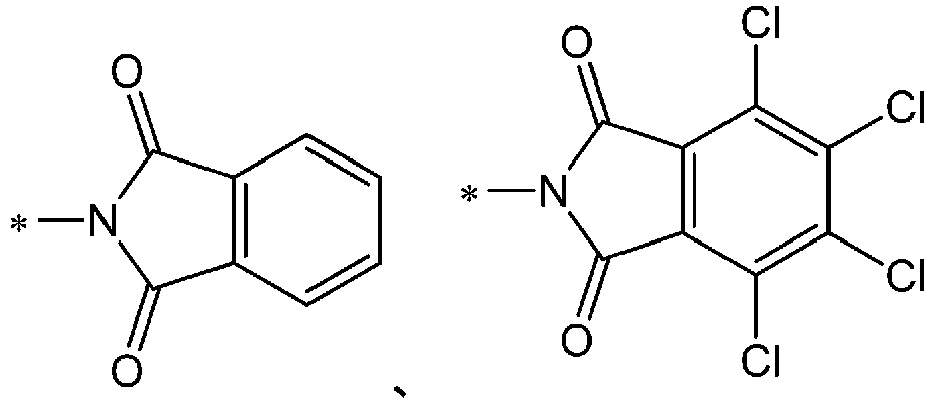
- R5 in Formula II can be:


- R5 in Formula II can be:


- R5 in Formula II can be:


- As for "R6-X" used in this step, R6 is optionally substituted C6-C10 aryl or optionally substituted heteroaryl, and X is halogen, OTf, or OMs. As for R6, R6 that is a group the same as R6 in Formula I can be used. X is preferably iodine, bromine, or OTf.
- More specific examples of R6-X include bromobenzene, 1-bromo-2-methylbenzene, 1-bromo-3-methylbenzene, 1-bromo-4-methylbenzene, 1-bromo-4-ethylbenzene, 1-bromo-2-chlorobenzene, 1-bromo-3-chlorobenzene, 1-bromo-4-chlorobenzene, 1-bromo-2-fluorobenzene, 1-bromo-3-fluorobenzene, 1-bromo-4-fluorobenzene, 1-bromo-2-cyclopropylbenzene, 1-bromo-3-cyclopropylbenzene, 1-bromo-4-cyclopropylbenzene, 1-bromo-2-(trifluoromethyl)benzene, 1-bromo-3-(trifluoromethyl)benzene, 1-bromo-4-(trifluoromethyl)benzene, 1-bromo-2-isopropylbenzene, 1-bromo-3-isopropylbenzene, 1-bromo-4-isopropylbenzene, 1-bromo-2-methoxybenzene, 1-bromo-3-methoxybenzene, 1-bromo-4-methoxybenzene, 1-(allyloxy)-2-bromobenzene, 1-(allyloxy)-3-bromobenzene, 1-(allyloxy)-4-bromobenzene, 1-bromo-4-isopropoxybenzene, 4-bromo-2-chloro-1-(trifluoromethyl)benzene, 4-bromo-2-fluoro-1-(trifluoromethyl)benzene, 1-bromo-2-fluoro-4-(trifluoromethyl)benzene, 4-bromo-1,2-dimethoxybenzene, 1-bromo-2-fluoro-4-methoxybenzene, 4-bromo-2-fluoro-1 -methoxybenzene, 5-bromo-1,3-difluoro-2-methoxybenzene, 5-bromo-1,3-difluoro-2-(trifluoromethyl)benzene, 4-bromo-2-methoxy-N-methylbenzamide, 5-bromo-2-methoxy-N-methylbenzamide, 5-bromo-1,3-dichloro-2-(trifluoromethyl)benzene, 5 -bromo-1 -chloro-3 -fluoro-2-(trifluoromethyl)benzene, 4-bromo-2-methoxy-N-(methylsulfonyl)benzamide, 4-bromo-N-methyl-N-((tetrahydro-2H-pyran-2-yl)oxy)benzamide, 4-bromo-2-methoxy-N-((tetrahydro-2H-pyran-2-yl)oxy)benzamide, 2-bromopyridine, 3-bromopyridine, 4-bromopyridine, 5-bromo-2-methylpyridine, 3-bromo-5-methylpyridine, 3-bromo-4-methylpyridine, 5-bromo-2-methoxypyridine, 3-bromo-5-methoxypyridine, 3-bromo-5-fluoropyridine, 3-bromo-5-chloropyridine, 3,5-dibromopyridine, 4-bromo-N-methylpyridin-2-amine, 4-bromo-N,N-dimethylpyridin-2-amine, 5-bromopyrimidine, iodobenzene, 1-iodo-2-methylbenzene, 1-iodo-3-methylbenzene, 1-iodo-4-methylbenzene, 1-ethyl-4-iodobenzene, 1-chloro-2-iodobenzene, 1-chloro-3-iodobenzene, 1-chloro-4-iodobenzene, 1-fluoro-2-iodobenzene, 1-fluoro-3-iodobenzene, 1-fluoro-4-iodobenzene, 1-cyclopropyl-2-iodobenzene, 1-cyclopropyl-3-iodobenzene, 1-cyclopropyl-4-iodobenzene, 1-iodo-2-(trifluoromethyl)benzene, 1-iodo-3-(trifluoromethyl)benzene, 1-iodo-4-(trifluoromethyl)benzene, 1-iodo-2-isopropylbenzene, 1-iodo-3-isopropylbenzene, 1-iodo-4-isopropylbenzene, 1-iodo-2-methoxybenzene, 1-iodo-3-methoxybenzene, 1-iodo-4-methoxybenzene, 1-(allyloxy)-2-iodobenzene, 1-(allyloxy)-3-iodo-benzene, 1-(allyloxy)-4-iodo-benzene, 1-iodo-4-isopropoxybenzene, 2-chloro-4-iodo-1-(trifluoromethyl)benzene, 2-fluoro-4-iodo-1 - (trifluoromethyl)benzene, 2-fluoro-1-iodo-4-(trifluoromethyl)benzene, 4-iodo-1,2-dimethoxybenzene, 2-fluoro-1-iodo-4-methoxybenzene, 2-fluoro-4-iodo-1-methoxybenzene, 1,3-difluoro-5-iodo-2-methoxybenzene, 1,3-difluoro-5-iodo-2-(trifluoromethyl)benzene, 4-iodo-2-methoxy-N-methylbenzamide, 5-iodo-2-methoxy-N-methylbenzamide, 1,3-dichloro-5-iodo-2-(trifluoromethyl)benzene, 1-chloro-3-fluoro-5-iodo-2-(trifluoromethyl)benzene, 4-iodo-2-methoxy-N-(methylsulfonyl)benzamide, 4-iodo-N-methyl-N-((tetrahydro-2H-pyran-2-yl)oxy)benzamide, 4-iodo-2-methoxy-N-((tetrahydro-2H-pyran-2-yl)oxy)benzamide, 2-iodopyridine, 3-iodopyridine, 4-iodopyridine, 5-iodo-2-methylpyridine, 3-iodo-5-methylpyridine, 3-iodo-4-methylpyridine, 5-iodo-2-methoxypyridine, 3-iodo-5-methoxypyridine, 3-fluoro-5-iodopyridine, 3-chloro-5-iodopyridine, 3-bromo-5-iodopyridine, 3,5-diiodopyridine, 4-iodo-N-methylpyridin-2-amine, 4-iodo-N,N-dimethylpyridin-2-amine, 5-iodopyrimidine, phenyl trifluoromethanesulfonate, o-tolyl trifluoromethanesulfonate, m-tolyl trifluoromethanesulfonate, p-tolyl trifluoromethanesulfonate, 4-ethylphenyl trifluoromethanesulfonate, 2-chlorophenyl trifluoromethanesulfonate, 3-chlorophenyl trifluoromethanesulfonate, 4-chlorophenyl trifluoromethanesulfonate, 2-fluorophenyl trifluoromethanesulfonate, 3-fluorophenyl trifluoromethanesulfonate, 4-fluorophenyl trifluoromethanesulfonate, 2-cyclopropylphenyl trifluoromethanesulfonate, 3-cyclopropylphenyl trifluoromethanesulfonate, 4-cyclopropylphenyl trifluoromethanesulfonate, 2-(trifluoromethyl)phenyl trifluoromethanesulfonate, 3 -(trifluoromethyl)phenyl trifluoromethanesulfonate, 4-(trifluoromethyl)phenyl trifluoromethanesulfonate, 2-isopropylphenyl trifluoromethanesulfonate, 3-isopropylphenyl trifluoromethanesulfonate, 4-isopropylphenyl trifluoromethanesulfonate, 2-methoxyphenyl trifluoromethanesulfonate, 3-methoxyphenyl trifluoromethanesulfonate, 4-methoxyphenyl trifluoromethanesulfonate, 2-(allyloxy)phenyl trifluoromethanesulfonate, 3-(allyloxy)phenyl trifluoromethanesulfonate, 4-(allyloxy)phenyl trifluoromethanesulfonate, 4-isopropoxyphenyl trifluoromethanesulfonate, 3-chloro-4-(trifluoromethyl)phenyl trifluoromethanesulfonate, 3-fluoro-4-(trifluoromethyl)phenyl trifluoromethanesulfonate, 2-fluoro-4-(trifluoromethyl)phenyl trifluoromethanesulfonate, 3,4-dimethoxyphenyl trifluoromethanesulfonate, 2-fluoro-4-methoxyphenyl trifluoromethanesulfonate, 3-fluoro-4-methoxyphenyl trifluoromethanesulfonate, 3,5-difluoro-4-methoxyphenyl trifluoromethanesulfonate, 3,5-difluoro-4-(trifluoromethyl)phenyl trifluoromethanesulfonate, 3-methoxy-4-(methylcarbamoyl)phenyl trifluoromethanesulfonate, 4-methoxy-3-(methylcarbamoyl)phenyl trifluoromethanesulfonate, 3,5-dichloro-4-(trifluoromethyl)phenyl trifluoromethanesulfonate, 3-chloro-5-fluoro-4-(trifluoromethyl)phenyl trifluoromethanesulfonate, 3-methoxy-4-((methylsulfonyl)carbamoyl)phenyl trifluoromethanesulfonate, 4-(methyl((tetrahydro-2H-pyran-2-yl)oxy)carbamoyl)phenyl trifluoromethanesulfonate, 3-methoxy-4-(((tetrahydro-2H-pyran-2-yl)oxy)carbamoyl)phenyl trifluoromethanesulfonate, pyridin-2-yl trifluoromethanesulfonate, pyridin-3-yl trifluoromethanesulfonate, pyridin-4-yl trifluoromethanesulfonate, 6-methylpyridin-3-yl trifluoromethanesulfonate, 5-methylpyridin-3-yl trifluoromethanesulfonate, 4-methylpyridin-3-yl trifluoromethanesulfonate, 6-methoxypyridin-3-yl trifluoromethanesulfonate, 5-methoxypyridin-3-yl trifluoromethanesulfonate, 5-fluoropyridin-3-yl trifluoromethanesulfonate, 5-chloropyridin-3-yl trifluoromethanesulfonate, 5-bromopyridin-3-yl trifluoromethanesulfonate, 2-(methylamino)pyridin-4-yl trifluoromethanesulfonate, 2-(dimethylamino)pyridin-4-yl trifluoromethanesulfonate, and pyrimidin-5-yl trifluoromethanesulfonate.
- In this step, R6-X can be used in an equal amount or an excessive amount relative to the compound represented by Formula II. Specifically, for example, 1 equivalent to 10 equivalents and preferably 1 equivalent to 5 equivalents of R6-X can be used relative to the compound represented by Formula II.
- The catalyst used in this step is:
- (a) a metal;
- (b) formed by mixing a metal and a possible ligand compound therefor;
- (c) a complex of a metal and a ligand therefor; or
- (d) formed by further mixing, with the complex of a metal and a ligand therefor, a possible ligand compound for the metal.
- In each of cases (a) to (d) above, the metal used includes nickel, chromium, iron, copper, palladium, or a salt of these metals, or is a solvate of nickel, chromium, iron, copper, palladium, or a salt of these metals. Specific examples of such metals include nickel, bis(1,5-cyclooctadiene)nickel(0), NiBr2, NiI2, NiCl2, NiF2, Ni(OAc)2, Ni(acac)2, Ni(OTf)2, NiCO3, Ni(NO3)2, NiSO4, (NH4)2Ni(SO4)2, allyl(cyclopentadienyl)nickel(II), bis(cyclopentadienyl)nickel, bis(cyclooctadienyl)nickel, or a solvate thereof formed with water, with methoxyethyl ether, with diglyme, or with ethylene glycol dimethyl ether.
- When the catalyst is formed by mixing a metal and a possible ligand compound therefor, the possible ligand compound is represented by, for example, the following Formulae B to G.


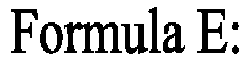


- In Formula B:

- In Formula C:

- In Formula D:

- In Formula E:

- In Formula F:

- In Formula G:

- When the catalyst is a complex of a metal and ligand therefor, specific examples of the complex of the metal and ligand therefor include tetrakis(triphenylphosphine)nickel(0), bis(triphenylphosphine)nickel(II) dichloride, bis(tricyclohexylphosphine)nickel(II) dichloride, dibromobis(triphenylphosphine)nickel(II), bis[(2-dimethylamino)phenyl]aminenickel(II) chloride, cis-[2,2'-bis(diphenylphosphino)-1,1'-binaphthyl](2-methylphenyl)nickel(II) chloride, and [1,2-bis(diphenylphosphino)ethane]dichloronickel(II).
- When the catalyst is formed by further mixing, with the complex of a metal and a ligand therefor, a possible ligand compound for the metal, specific examples of the complex of a metal and a ligand therefor include tetrakis(triphenylphosphine)nickel(0), bis(triphenylphosphine)nickel(II) dichloride, cis-[2,2'-bis(diphenylphosphino)-1,1'-binaphthyl](2-methylphenyl)nickel(II) chloride, and [1,2-bis(diphenylphosphino)ethane]dichloronickel(II). Specific examples of the possible ligand compound include 2,2'-bipyridine, 6-methyl-2,2'-bipyridine, 4,4'-dimethyl-2,2'-bipyridine, 5,5'-dimethyl-2,2'-bipyridine, 4,4'-di-tert-butyl-2,2'-bipyridine, 4,4'-dimethoxy-2,2'-bipyridine, 4,4'-diphenyl-2,2'-bipyridine, 6,6'-bis(4,5-dihydrooxazol-2-yl)-2,2'-bipyridine, 6,6'-bis(4-phenyl-4,5-dihydrooxazol-2-yl)-2,2'-bipyridine, 6,6'-bis(4-isopropyl-4,5-dihydrooxazol-2-yl)-2,2'-bipyridine, and 6,6'-bis(4-(tert-butyl)-4,5-dihydrooxazol-2-yl)-2,2'-bipyridine.
- The reducing agent used in this step can be a material that acts to lessen the positive charge of the catalyst used in this step. Examples of such reducing agents include metals having a greater ionization tendency than the metals contained in the catalyst. Specific examples of such metals include zinc, manganese, iron, and magnesium, and among these, zinc and manganese are preferred, and zinc is particularly preferred.
- In an embodiment, when a nickel-containing catalyst is used, metals having a greater ionization tendency than nickel, such as zinc, iron, and magnesium, can be used as reducing agents.
- The reducing agent can be used in an amount of 1 mol to 10 mol equivalents, preferably 1 mol to 5 mol equivalents, and more preferably 1 mol to 3 mol equivalents relative to the compound represented by Formula II.
- The additive used in this step can be a material capable of efficiently converting the compound represented by Formula II, which is the starting material of this step, into the compound represented by Formula I, which is the target material, e.g., capable of shortening the time required for conversion of the starting material into the target material, compared with the case where the additive is not used. Specific examples of such additives include silyl compounds and 1,2-dibromoethane. Specific examples of silyl compounds include compounds represented by Formula A:

- RAX and RAY in the Formula are independently selected from the group consisting of C1-C4 alkyl, C1-C4 alkoxy, and phenyl. More specific examples of RAX and RAY include methyl, ethyl, isopropyl, t-butyl, methoxy, ethoxy, isopropoxy, and phenyl.
- L is selected from the group consisting of -Cl, -Br, -I, and -OTf.
- More specific examples of the compound represented by Formula A include TMSC1, TMSBr, TMSI, TMSOTf, TBDMSCl, TESCl, TIPSCl, TBDPSCl, and chlorotriethoxysilane, and among these, TMSCl, TMSBr, TESCl, and TIPSCl are preferred.
- The additive can be used in an amount of 1 mol% to 500 mol%, preferably 10 mol% to 500 mol%, and more preferably 25 mol% to 500 mol%, relative to the compound represented by Formula II.
- By adding the additive in this step, the rate of conversion from the compound represented by Formula II into the compound represented by Formula I can be greatly improved compared with the case where the additive is not used. For example, the reaction can be caused to efficiently proceed at a high conversion rate irrespective of the mode of stirring such as stirring using stirring blade(s) or stirring using a stir bar(s).
- The solvent used in this step can be, for example, an aprotic solvent such as an amide solvent or a urea solvent. Specific examples of such solvents include DMF, DMA, NMP, DMI, and DMPU.
- The reaction of this step can be carried out at a temperature from -20°C to around the boiling point of the solvent. The reaction can be carried out at a reaction temperature of preferably -10°C to 110°C, -10°C to 90°C, and more preferably -10°C to 70°C.
- The reaction of this step can be carried out for a reaction time of 10 minutes to 1 week. The reaction can be carried out for a reaction time of preferably 10 minutes to 6 hours, and more preferably 0.5 hours to 4 hours.
- In this step, the order of mixing the compound represented by Formula II, the salt of the compound, or the solvate of the compound or the salt, the reducing agent, the additive, and R6-X is not particularly limited; however, the mixing is performed, for example, by the following: (a) the compound represented by Formula II, the salt of the compound, or the solvate of the compound or the salt, the reducing agent, and R6-X are mixed in the presence of the solvent and the catalyst, and then the additive is mixed therewith; (b) the reducing agent and the additive are mixed in the presence of the solvent and the catalyst, and then the compound represented by Formula II, the salt of the compound, or the solvate of the compound or the salt and R6-X are mixed therewith; or (c) the reducing agent is mixed with the solvent and the catalyst, and then the compound represented by Formula II, the salt of the compound, or the solvate of the compound or the salt, R6-X, and the additive are mixed therewith.
- More specific embodiments of (a) mentioned above include, for example, adding a solution obtained by dissolving the catalyst in the solvent dropwise to a solution obtained by dissolving the compound represented by Formula II, the salt of the compound, or the solvate of the compound or the salt, the reducing agent, and R6-X in the solvent, and then adding the additive thereto; or adding a solution obtained by dissolving the catalyst in the solvent dropwise to a solution obtained by dissolving the compound represented by Formula II, the salt of the compound, or the solvate of the compound or the salt and R6-X in the solvent, and then after adding the reducing agent thereto, adding the additive thereto.
- A more specific embodiment of (b) mentioned above includes, for example, adding the reducing agent and the additive to a solution obtained by dissolving the catalyst in the solvent, and then adding thereto a solution obtained by dissolving the compound represented by Formula II, the salt of the compound, or the solvate of the compound or the salt and R6-X in the solvent dropwise.
- A more specific embodiment of (c) mentioned above includes, for example, adding the reducing agent to a solution obtained by dissolving the catalyst in the solvent, and then adding thereto a solution obtained by dissolving the compound represented by Formula II, the salt of the compound, or the solvate of the compound or the salt, R6-X, and the additive in the solvent.
- When an optically active compound represented by Formula II is used in this step, the steric configuration thereof is maintained, and an optically active compound represented by Formula I can be obtained.
- The compound represented by Formula II, which is the starting material of the above step, can be synthesized using various methods known in the art.
- In an embodiment, when R2 is hydrogen, the compound represented by Formula II of the present invention can be synthesized, for example, according to the following scheme. In the scheme, R1, R3, R5, R7, and n are the same as R1, R3, R5, R7, and n of Formula II, respectively.
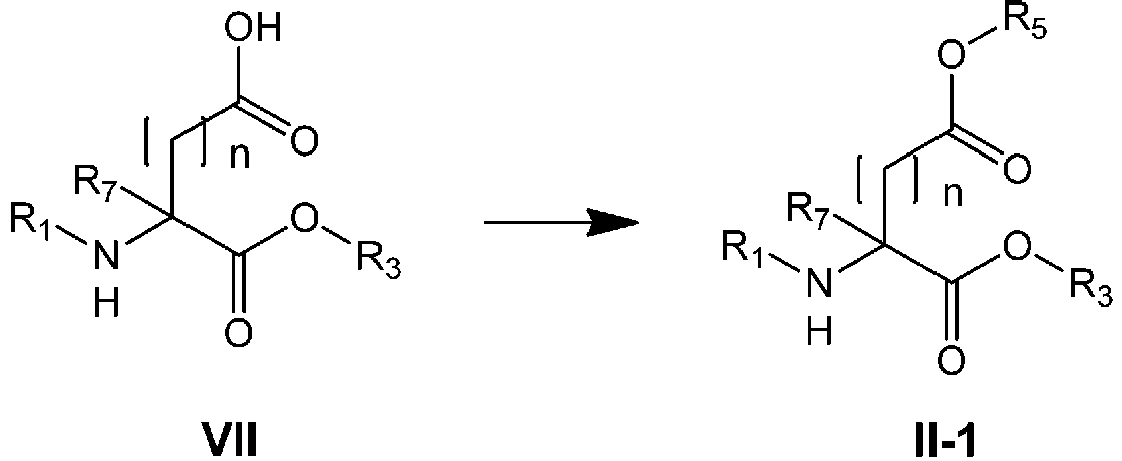
- This step can be carried out by mixing an alcohol (R5-OH) and a carboxylic acid with a dehydrative condensation agent such as a carbodiimide compound to condense the alcohol and the carboxylic acid following the method of Albert et al. (Synthesis, 1987, 7, 635-637) or the like.
- In another embodiment, when R2 is hydrogen, the compound represented by Formula II of the present invention can be synthesized, for example, according to the following scheme. In the scheme, R1, R3, R5, R7, and n are the same as R1, R3, R5, R7, and n of Formula II, respectively, and R10 and R11 are independently hydrogen, C1-C4 alkyl or C6-C10 aryl, or R10 and R11 together form oxo (=O).
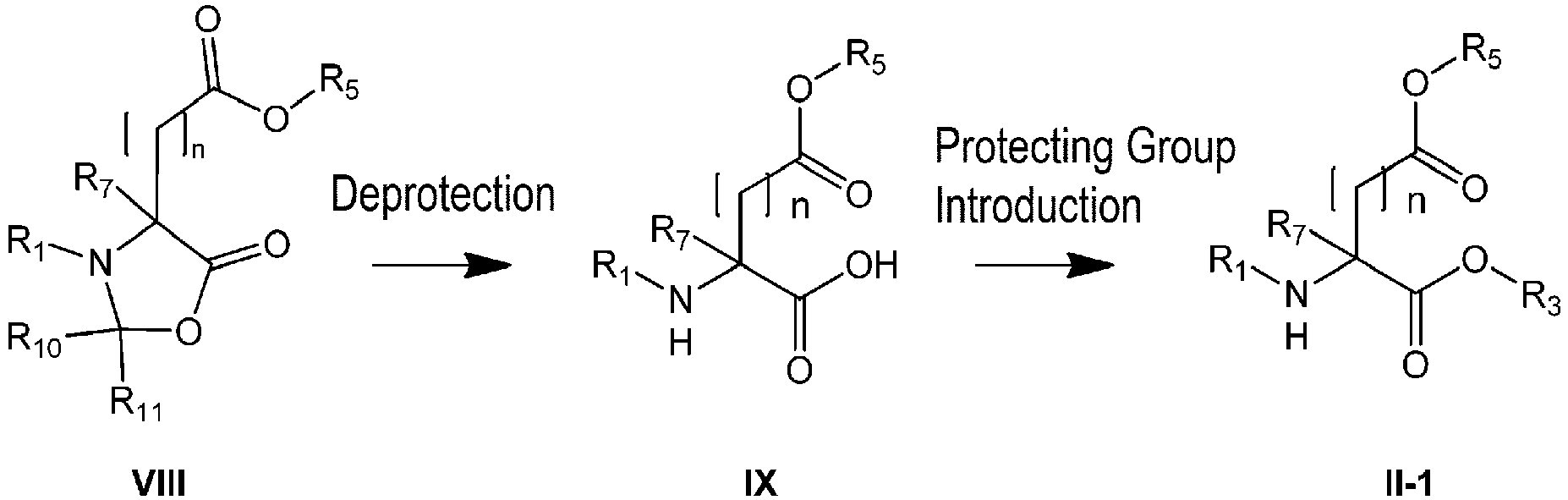
- The steps of attaching/detaching the protecting group can be carried out following the methods described in Greene's, "Protective Groups in Organic Synthesis" (5th edition, John Wiley & Sons 2014).
- In another embodiment, the compound represented by Formula II of the present invention in which R2 is C1-C6 alkyl can be synthesized, for example, according to the following scheme. In the scheme, R1, R3, R5, R7, and n are the same as R1, R3, R5, R7, and n of Formula II, respectively, R4 is a protecting group for a carboxyl group, and "Alk" is C1-C6 alkyl.
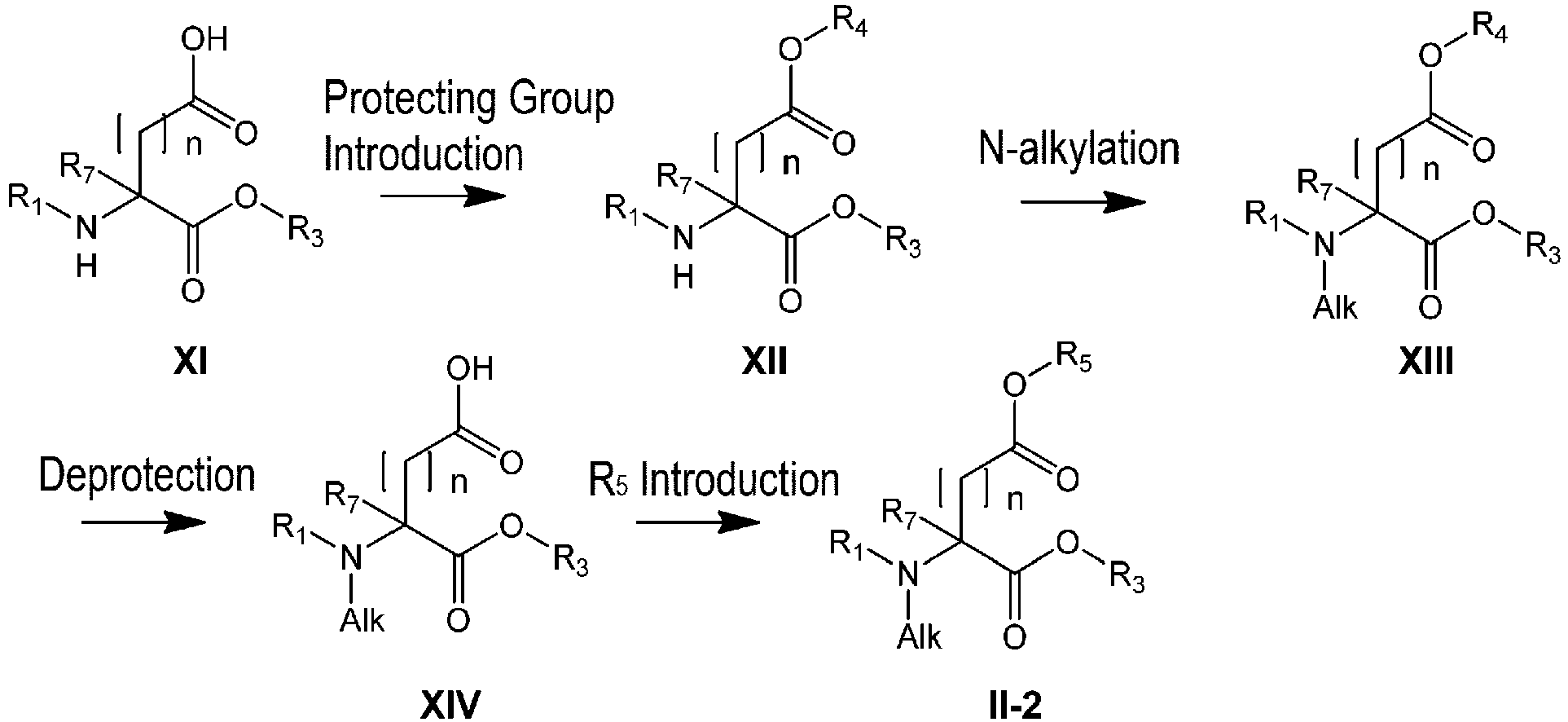
- Among these steps, the steps of attaching/detaching protecting groups can be performed following the methods described in "Greene's, "Protective Groups in Organic Synthesis" (5th edition, John Wiley & Sons 2014)". As for the N-alkylation step, a compound in which an alkyl group is introduced into a nitrogen atom can be produced by allowing an alkylating agent to react under basic conditions. The step of introducing R5 can be carried out by mixing an alcohol (R5-OH) and a carboxylic acid with a dehydrative condensation agent such as a carbodiimide compound to condense the alcohol and the carboxylic acid following the method of Albert et al. (Synthesis, 1987, 7, 635-637) or the like.
- In another embodiment, the compound represented by Formula II of the present invention in which R2 is C1-C6 alkyl can be synthesized, for example, according to the following scheme. In the scheme, R1, R3, R5, R7, and n are the same as R1, R3, R5, R7, and n of Formula II mentioned above, respectively, R4 is a protecting group for a carboxyl group, "Alk" is C1-C6 alkyl, and R12 is hydrogen or C1-C5 alkyl.

- Among these steps, the steps of attaching/detaching protecting groups can be carried out following the methods described in "Greene's, "Protective Groups in Organic Synthesis" (5th edition, John Wiley & Sons 2014)". The N-alkylation step involving deprotection can also be carried out following the method of Freidinger et al. (J. Org. Chem., 1983, 48, 77-81) or the method of Buba et al. (Eur. J. Org. Chem., 2013, 4509-4513). The step of introducing R5 can be carried out by mixing an alcohol (R5-OH) and a carboxylic acid with a dehydrative condensation agent such as a carbodiimide compound to condense the alcohol and the carboxylic acid following the method of Albert et al. (Synthesis, 1987, 7, 635-637) or the like.
- In another embodiment, when R2 and R3 together form -(CR8R9)-, the compound represented by Formula IIA of the present invention can be synthesized according to the following scheme. In the scheme, R1, R5, R7, R8, R9, and n are the same as R1, R5, R7, R8, R9, and n of Formula IIA mentioned above, respectively, and R4 is a protecting group for a carboxyl group.

- Among these reactions, the step of introducing a protecting group can be carried out by the method of dehydrative condensation with an aldehyde compound in the presence of an acid catalyst following the method of Freidinger et al. (J. Org. Chem., 1983, 48, 77-81) or the like, or the method described in "Greene's, "Protective Groups in Organic Synthesis" (5th Edition, John Wiley & Sons 2014)". The deprotection step can be carried out following the method described in "Greene's, "Protective Groups in Organic Synthesis" (5th edition, John Wiley & Sons 2014)". The step of introducing a side chain can be carried out following the method of Long et al. (J. Med. Chem., 2008, 51, 6371-6380) or the like. The step of introducing R5 can be carried out by mixing an alcohol (R5-OH) and a carboxylic acid with a dehydrative condensation agent such as a carbodiimide compound to condense the alcohol and the carboxylic acid following the method of Albert et al. (Synthesis, 1987, 7, 635-637) or the like.
- In another embodiment, when R2 and R3 together form -(CR8R9)-, the compound represented by Formula IIA of the present invention can be synthesized according to the following scheme. In the following scheme, R1, R5, R7, R8, R9, and n are the same as R1, R5, R7, R8, R9, and n of Formula IIA mentioned above, respectively, and R4 is a protecting group for a carboxyl group.

- Among these reactions, the step of introducing a protecting group can be carried out by the method of dehydrative condensation with an aldehyde compound in the presence of an acid catalyst following the method of Freidinger et al. (J. Org. Chem., 1983, 48, 77-81) or the like, or the method described in "Greene's, "Protective Groups in Organic Synthesis" (5th Edition, John Wiley & Sons 2014)". The deprotection step can be carried out following the method described in "Greene's, "Protective Groups in Organic Synthesis" (5th edition, John Wiley & Sons 2014)". The step of introducing R5 can be carried out by condensing an alcohol and a carboxylic acid following the method of Albert et al. (Synthesis, 1987, 7, 635-637) or the like.
- Starting from the compound represented by Formula I, the salt of the compound, or the solvate of the compound or the salt produced according to the method described above, the present invention enables preparation of further various amino acid analogs, salts of the analogs, or solvates of the analogs or the salts.
- In an embodiment, when R3 of the compound represented by Formula I is a protecting group for a carboxyl group, the compound represented by Formula III, the salt of the compound, or the solvate of the compound or the salt can be produced by using the compound represented by Formula I, the salt of the compound, or the solvate of the compound or the salt as a starting material, and removing the protecting group.

- The deprotection step can be carried out following the method described in "Greene's, "Protective Groups in Organic Synthesis" (5th edition, John Wiley & Sons 2014)".
- In an embodiment, when R1 of the compound represented by Formula I, the salt of the compound, or the solvate of the compound or the salt is a protecting group for an amino group, and R3 is a protecting group for a carboxyl group, the compound represented by Formula V can be produced by simultaneously removing these protecting groups to produce the compound represented by Formula IV, and further introducing a protecting group R1' to the amino group, as shown in the following scheme.

- The steps of attaching/detaching these protecting groups can be carried out following the methods described in "Greene's, "Protective Groups in Organic Synthesis" (5th edition, John Wiley & Sons 2014)".
- In an embodiment, when R2 and R3 of the compound represented by Formula I together form -(CR8R9)- and thus the compound represented by Formula I is represented by Formula IA, the compound represented by Formula VI, the salt of the compound, or the solvate of the compound or the salt can be produced by using the compound represented by Formula IA, the salt of the compound, or the solvate of the compound or the salt as a starting material, and opening the oxazolidinone ring by a deprotection reaction.

- The above deprotection step can be carried out following the method described in "Greene's, "Protective Groups in Organic Synthesis" (5th edition, John Wiley & Sons 2014)".
- In an embodiment, the present invention enables production of N-alkyl amino acid using the compound represented by Formula IA as a starting material, as shown in the following scheme.

- Among these steps, the steps of attaching/detaching protecting groups can be carried out following the methods described in "Greene's, "Protective Groups in Organic Synthesis" (5th edition, John Wiley & Sons 2014)". A compound in which an alkyl group is introduced into a nitrogen atom can be produced by allowing an alkylating agent to act under basic conditions following the method of Seebach et al. (Helv. Chim. Acta, 1987, 70, 237-261) or the like.
- The present invention also relates to the amino acid derivatives represented by Formula I, and amino acid derivatives of the respective Formulae mentioned above obtained by modifying the amino acid derivatives.
- In an embodiment, such amino acid derivatives preferably include those having the following combinations of groups in the compound of Formula (I):

- (a) R1 is hydrogen, Boc, Fmoc, Cbz, Alloc or Teoc, R2 is hydrogen or methyl, R3 is hydrogen, methyl, t-butyl or benzyl, R6 is 3-chloro-4-(trifluoromethyl)phenyl, R7 is hydrogen, and n is 1 or 2;
- (b) R1 is hydrogen, Boc, Fmoc, Cbz, Alloc or Teoc, R2 is ethyl, R3 is hydrogen, methyl, t-butyl or benzyl, R6 is 4-methylphenyl, R7 is hydrogen, and n is 1;
- (c) R1 is hydrogen, Boc, Fmoc, Cbz, Alloc or Teoc, R2 is hydrogen or methyl, R3 is hydrogen, methyl or t-butyl, R6 is 3,5-difluoro-4-(trifluoromethyl)phenyl, R7 is hydrogen, and n is 1 or 2;
- (d) R1 is hydrogen, Boc, Fmoc, Cbz, Alloc or Teoc, R2 is hydrogen or methyl, R3 is hydrogen, methyl or t-butyl, R6 is 3-methoxy-4-(methylcarbamoyl)phenyl, R7 is hydrogen, and n is 1 or 2;
- (e) R1 is hydrogen, Boc, Fmoc, Cbz, Alloc or Teoc, R2 is hydrogen or methyl, R3 is hydrogen, methyl or t-butyl, and R6 is 4-methoxy-3-(methylcarbamoyl)phenyl, R7 is hydrogen, and n is 1 or 2;
- (f) R1 is hydrogen, Boc, Fmoc, Cbz, Alloc or Teoc, R2 is hydrogen or methyl, R3 is hydrogen, methyl or t-butyl, R6 is 3-methoxy-4-((methylsulfonyl)carbamoyl)phenyl, R7 is hydrogen, and n is 1 or 2;
- (g) R1 is hydrogen, Boc, Fmoc, Cbz, Alloc or Teoc, R2 is hydrogen or methyl, R3 is hydrogen, methyl or t-butyl, R6 is 4-(methyl((tetrahydro-2H-pyran-2-yl)oxy)carbamoyl)phenyl, R7 is hydrogen, and n is 1 or 2;
- (h) R1 is hydrogen, Boc, Fmoc, Cbz, Alloc or Teoc, R2 is hydrogen or methyl, R3 is hydrogen, methyl or t-butyl, R6 is 3-methoxy-4-(((tetrahydro-2H-pyran-2-yl)oxy)carbamoyl)phenyl, R7 is hydrogen, and n is 1 or 2; or
- (i) R1 is hydrogen, Boc, Fmoc, Cbz, Alloc or Teoc, R2 is hydrogen or methyl, R3 is hydrogen, methyl or t-butyl, R6 is 6-methoxypyridin-3-yl, R7 is hydrogen, and n is 1 or 2.
- The amino acid derivatives of the present invention include more preferably an amino acid derivative represented by Formula (1):

- R1 is hydrogen or a protecting group for an amino group selected from the group consisting of Boc, Fmoc, Cbz, Alloc and Teoc;
- R2 is hydrogen or methyl;
- R3 is hydrogen or a protecting group for a carboxyl group selected from the group consisting of methyl, t-butyl and benzyl;
- R7 is hydrogen;
- n is 1 or 2; and
- X1, X2, and X3 are independently hydrogen or halogen; provided that
- when X1 is halogen, X2 and X3 are hydrogen; and
- when X1 is hydrogen, both X2 and X3 are halogen, or one of X2 and X3 is halogen.
- In Formula (1), when X1 is halogen, the halogen is preferably F or Cl.
- In Formula (1), when both X2 and X3 are halogen, the type of halogen may be the same or different. X2 and X3 are preferably X2 = F and X3 = F; X2 = F and X3 = Cl; or X2 = Cl and X3 = Cl.
- In Formula (1), when one of X2 and X3 is halogen, the halogen is preferably F or Cl.
- Specific examples of the amino acid derivative of Formula (1) include the following compounds, salts of the compounds, and solvates of the compounds or the salts:
- (C-001)2-(((benzyloxy)carbonyl)amino)-4-(3,5-difluoro-4-(trifluoromethyl)phenyl)butanoic acid,
- (C-002) methyl 2-(((benzyloxy)carbonyl)amino)-4-(3,5-difluoro-4-(trifluoromethyl)phenyl)butanoate,
- (C-003) tert-butyl 2-(((benzyloxy)carbonyl)amino)-4-(3,5-difluoro-4-(trifluoromethyl)phenyl)butanoate,
- (C-004) benzyl 2-(((benzyloxy)carbonyl)amino)-4-(3,5-difluoro-4-(trifluoromethyl)phenyl)butanoate,
- (C-005) 2-((((9H-fluoren-9-yl)methoxy)carbonyl)amino)-4-(3,5-difluoro-4-(trifluoromethyl)phenyl)butanoic acid,
- (C-006) methyl 2-((((9H-fluoren-9-yl)methoxy)carbonyl)amino)-4-(3,5-difluoro-4-(trifluoromethyl)phenyl)butanoate,
- (C-007) tert-butyl 2-((((9H-fluoren-9-yl)methoxy)carbonyl)amino)-4-(3,5-difluoro-4-(trifluoromethyl)phenyl)butanoate,
- (C-008) benzyl 2-((((9H-fluoren-9-yl)methoxy)carbonyl)amino)-4-(3,5-difluoro-4-(trifluoromethyl)phenyl)butanoate,
- (C-009) 2-((tert-butoxycarbonyl)amino)-4-(3,5-difluoro-4-(trifluoromethyl)phenyl)butanoic acid,
- (C-010) methyl 2-((tert-butoxycarbonyl)amino)-4-(3,5-difluoro-4-(trifluoromethyl)phenyl)butanoate,
- (C-011) tert-butyl 2-((tert-butoxycarbonyl)amino)-4-(3,5-difluoro-4-(trifluoromethyl)phenyl)butanoate,
- (C-012) benzyl 2-((tert-butoxycarbonyl)amino)-4-(3,5-difluoro-4-(trifluoromethyl)phenyl)butanoate,
- (C-013) 2-(((allyloxy)carbonyl)amino)-4-(3,5-difluoro-4-(trifluoromethyl)phenyl)butanoic acid,
- (C-014) methyl 2-(((allyloxy)carbonyl)amino)-4-(3,5-difluoro-4-(trifluoromethyl)phenyl)butanoate,
- (C-015) tert-butyl 2-(((allyloxy)carbonyl)amino)-4-(3,5-difluoro-4-(trifluoromethyl)phenyl)butanoate,
- (C-016) benzyl 2-(((allyloxy)carbonyl)amino)-4-(3,5-difluoro-4-(trifluoromethyl)phenyl)butanoate,
- (C-017) 4-(3,5-difluoro-4-(trifluoromethyl)phenyl)-2-(((2-(trimethylsilyl)ethoxy)carbonyl)amino)butanoic acid,
- (C-018) methyl 4-(3,5-difluoro-4-(trifluoromethyl)phenyl)-2-(((2-(trimethylsilyl)ethoxy)carbonyl)amino)butanoate,
- (C-019) tert-butyl 4-(3,5-difluoro-4-(trifluoromethyl)phenyl)-2-(((2-(trimethylsilyl)ethoxy)carbonyl)amino)butanoate,
- (C-020) benzyl 4-(3,5-difluoro-4-(trifluoromethyl)phenyl)-2-(((2-(trimethylsilyl)ethoxy)carbonyl)amino)butanoate,
- (C-021) 2-(((benzyloxy)carbonyl)(methyl)amino)-4-(3,5-difluoro-4-(trifluoromethyl)phenyl)butanoic acid,
- (C-022) methyl 2-(((benzyloxy)carbonyl)(methyl)amino)-4-(3,5-difluoro-4-(trifluoromethyl)phenyl)butanoate,
- (C-023) tert-butyl 2-(((benzyloxy)carbonyl)(methyl)amino)-4-(3,5-difluoro-4-(trifluoromethyl)phenyl)butanoate,
- (C-024) benzyl 2-(((benzyloxy)carbonyl)(methyl)amino)-4-(3,5-difluoro-4-(trifluoromethyl)phenyl)butanoate,
- (C-025) 2-((((9H-fluoren-9-yl)methoxy)carbonyl)(methyl)amino)-4-(3,5-difluoro-4-(trifluoromethyl)phenyl)butanoic acid,
- (C-026) methyl 2-((((9H-fluoren-9-yl)methoxy)carbonyl)(methyl)amino)-4-(3,5-difluoro-4-(trifluoromethyl)phenyl)butanoate,
- (C-027) tert-butyl 2-((((9H-fluoren-9-yl)methoxy)carbonyl)(methyl)amino)-4-(3,5-difluoro-4-(trifluoromethyl)phenyl)butanoate,
- (C-028) benzyl 2-((((9H-fluoren-9-yl)methoxy)carbonyl)(methyl)amino)-4-(3,5-difluoro-4-(trifluoromethyl)phenyl)butanoate,
- (C-029) 2-((tert-butoxycarbonyl)(methyl)amino)-4-(3,5-difluoro-4-(trifluoromethyl)phenyl)butanoic acid,
- (C-030) methyl 2-((tert-butoxycarbonyl)(methyl)amino)-4-(3,5-difluoro-4-(trifluoromethyl)phenyl)butanoate,
- (C-031) tert-butyl 2-((tert-butoxycarbonyl)(methyl)amino)-4-(3,5-difluoro-4-(trifluoromethyl)phenyl)butanoate,
- (C-032) benzyl 2-((tert-butoxycarbonyl)(methyl)amino)-4-(3,5-difluoro-4-(trifluoromethyl)phenyl)butanoate,
- (C-033) 2-(((allyloxy)carbonyl)(methyl)amino)-4-(3,5-difluoro-4-(trifluoromethyl)phenyl)butanoic acid,
- (C-034) methyl 2-(((allyloxy)carbonyl)(methyl)amino)-4-(3,5-difluoro-4-(trifluoromethyl)phenyl)butanoate,
- (C-035) tert-butyl 2-(((allyloxy)carbonyl)(methyl)amino)-4-(3,5-difluoro-4-(trifluoromethyl)phenyl)butanoate,
- (C-036) benzyl 2-(((allyloxy)carbonyl)(methyl)amino)-4-(3,5-difluoro-4-(trifluoromethyl)phenyl)butanoate,
- (C-037) 4-(3,5-difluoro-4-(trifluoromethyl)phenyl)-2-(methyl((2-(trimethylsilyl)ethoxy)carbonyl)amino)butanoic acid,
- (C-038) methyl 4-(3,5-difluoro-4-(trifluoromethyl)phenyl)-2-(methyl((2-(trimethylsilyl)ethoxy)carbonyl)amino)butanoate,
- (C-039) tert-butyl 4-(3,5-difluoro-4-(trifluoromethyl)phenyl)-2-(methyl((2-(trimethylsilyl)ethoxy)carbonyl)amino)butanoate,
- (C-040) benzyl 4-(3,5-difluoro-4-(trifluoromethyl)phenyl)-2-(methyl((2-(trimethylsilyl)ethoxy)carbonyl)amino)butanoate,
- (C-041) 2-(((benzyloxy)carbonyl)amino)-3-(3,5-difluoro-4-(trifluoromethyl)phenyl)propanoic acid,
- (C-042) methyl 2-(((benzyloxy)carbonyl)amino)-3-(3,5-difluoro-4-(trifluoromethyl)phenyl)propanoate,
- (C-043) tert-butyl 2-(((benzyloxy)carbonyl)amino)-3-(3,5-difluoro-4-(trifluoromethyl)phenyl)propanoate,
- (C-044) benzyl 2-(((benzyloxy)carbonyl)amino)-3-(3,5-difluoro-4-(trifluoromethyl)phenyl)propanoate,
- (C-045) 2-((((9H-fluoren-9-yl)methoxy)carbonyl)amino)-3-(3,5-difluoro-4-(trifluoromethyl)phenyl)propanoic acid,
- (C-046) methyl 2-((((9H-fluoren-9-yl)methoxy)carbonyl)amino)-3-(3,5-difluoro-4-(trifluoromethyl)phenyl)propanoate,
- (C-047) tert-butyl 2-((((9H-fluoren-9-yl)methoxy)carbonyl)amino)-3-(3,5-difluoro-4-(trifluoromethyl)phenyl)propanoate,
- (C-048) benzyl 2-((((9H-fluoren-9-yl)methoxy)carbonyl)amino)-3-(3,5-difluoro-4-(trifluoromethyl)phenyl)propanoate,
- (C-049) 2-((tert-butoxycarbonyl)amino)-3-(3,5-difluoro-4-(trifluoromethyl)phenyl)propanoic acid,
- (C-050) methyl 2-((tert-butoxycarbonyl)amino)-3-(3,5-difluoro-4-(trifluoromethyl)phenyl)propanoate,
- (C-051) tert-butyl 2-((tert-butoxycarbonyl)amino)-3-(3,5-difluoro-4-(trifluoromethyl)phenyl)propanoate,
- (C-052) benzyl 2-((tert-butoxycarbonyl)amino)-3-(3,5-difluoro-4-(trifluoromethyl)phenyl)propanoate,
- (C-053) 2-(((allyloxy)carbonyl)amino)-3-(3,5-difluoro-4-(trifluoromethyl)phenyl)propanoic acid,
- (C-054) methyl 2-(((allyloxy)carbonyl)amino)-3-(3,5-difluoro-4-(trifluoromethyl)phenyl)propanoate,
- (C-055) tert-butyl 2-(((allyloxy)carbonyl)amino)-3-(3,5-difluoro-4-(trifluoromethyl)phenyl)propanoate,
- (C-056) benzyl 2-(((allyloxy)carbonyl)amino)-3-(3,5-difluoro-4-(trifluoromethyl)phenyl)propanoate,
- (C-057) 3-(3,5-difluoro-4-(trifluoromethyl)phenyl)-2-(((2-(trimethylsilyl)ethoxy)carbonyl)amino)propanoic acid,
- (C-058) methyl 3-(3,5-difluoro-4-(trifluoromethyl)phenyl)-2-(((2-(trimethylsilyl)ethoxy)carbonyl)amino)propanoate,
- (C-059) tert-butyl 3-(3,5-difluoro-4-(trifluoromethyl)phenyl)-2-(((2-(trimethylsilyl)ethoxy)carbonyl)amino)propanoate,
- (C-060) benzyl 3-(3,5-difluoro-4-(trifluoromethyl)phenyl)-2-(((2-(trimethylsilyl)ethoxy)carbonyl)amino)propanoate,
- (C-061) 2-(((benzyloxy)carbonyl)(methyl)amino)-3-(3,5-difluoro-4-(trifluoromethyl)phenyl)propanoic acid,
- (C-062) methyl 2-(((benzyloxy)carbonyl)(methyl)amino)-3-(3,5-difluoro-4-(trifluoromethyl)phenyl)propanoate,
- (C-063) tert-butyl 2-(((benzyloxy)carbonyl)(methyl)amino)-3-(3,5-difluoro-4-(trifluoromethyl)phenyl)propanoate,
- (C-064) benzyl 2-(((benzyloxy)carbonyl)(methyl)amino)-3-(3,5-difluoro-4-(trifluoromethyl)phenyl)propanoate,
- (C-065) 2-((((9H-fluoren-9-yl)methoxy)carbonyl)(methyl)amino)-3 -(3 ,5-difluoro-4-(trifluoromethyl)phenyl)propanoic acid,
- (C-066) methyl 2-((((9H-fluoren-9-yl)methoxy)carbonyl)(methyl)amino)-3-(3,5-difluoro-4-(trifluoromethyl)phenyl)propanoate,
- (C-067) tert-butyl 2-((((9H-fluoren-9-yl)methoxy)carbonyl)(methyl)amino)-3-(3,5-difluoro-4-(trifluoromethyl)phenyl)propanoate,
- (C-068) benzyl 2-((((9H-fluoren-9-yl)methoxy)carbonyl)(methyl)amino)-3-(3,5-difluoro-4-(trifluoromethyl)phenyl)propanoate,
- (C-069) 2-((tert-butoxycarbonyl)(methyl)amino)-3-(3,5-difluoro-4-(trifluoromethyl)phenyl)propanoic acid,
- (C-070) methyl 2-((tert-butoxycarbonyl)(methyl)amino)-3-(3,5-difluoro-4-(trifluoromethyl)phenyl)propanoate,
- (C-071) tert-butyl 2-((tert-butoxycarbonyl)(methyl)amino)-3 -(3,5-difluoro-4-(trifluoromethyl)phenyl)propanoate,
- (C-072) benzyl 2-((tert-butoxycarbonyl)(methyl)amino)-3-(3,5-difluoro-4-(trifluoromethyl)phenyl)propanoate,
- (C-073) 2-(((allyloxy)carbonyl)(methyl)amino)-3-(3,5-difluoro-4-(trifluoromethyl)phenyl)propanoic acid,
- (C-074) methyl 2-(((allyloxy)carbonyl)(methyl)amino)-3-(3,5-difluoro-4-(trifluoromethyl)phenyl)propanoate,
- (C-075) tert-butyl 2-(((allyloxy)carbonyl)(methyl)amino)-3-(3,5-difluoro-4-(trifluoromethyl)phenyl)propanoate,
- (C-076) benzyl 2-(((allyloxy)carbonyl)(methyl)amino)-3-(3,5-difluoro-4-(trifluoromethyl)phenyl)propanoate,
- (C-077) 3-(3,5-difluoro-4-(trifluoromethyl)phenyl)-2-(methyl((2-(trimethylsilyl)ethoxy)carbonyl)amino)propanoic acid,
- (C-078) methyl 3-(3,5-difluoro-4-(trifluoromethyl)phenyl)-2-(methyl((2-(trimethylsilyl)ethoxy)carbonyl)amino)propanoate,
- (C-079) tert-butyl 3-(3,5-difluoro-4-(trifluoromethyl)phenyl)-2-(methyl((2-(trimethylsilyl)ethoxy)carbonyl)amino)propanoate, and
- (C-080) benzyl 3-(3,5-difluoro-4-(trifluoromethyl)phenyl)-2-(methyl((2-)carbonyl)amino)propanoate.
- In another embodiment, specific examples of the amino acid derivative of the present invention include compounds provided in the following tables, salts of the compounds, and solvates of the compounds or the salts.
- R1, R2, R3, R6, R7, and n in the tables mean R1, R2, R3, R6, R7, and n in the following formula, respectively. Furthermore, ∗ indicates a point of bonding.
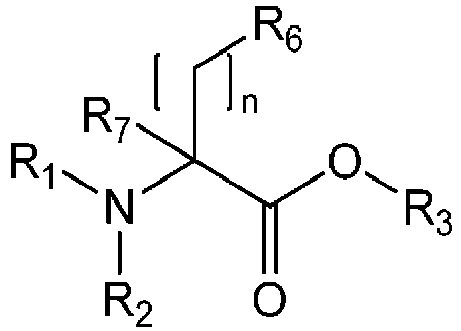
[Table 1] Compound ID R1 R2 n R3 R6 R7 Compound Name 1-1 Boc H 2 Bn 
H Benzyl 2-((tert-butoxycarbonyl) amino)-4-(3-chloro-4-(trifluoromethyl) phenyl)butanoate 1-2 Boc H 2 tBu 
H tert-Butyl 2-((tert-butoxycarbonyl) amino)-4-(3-chloro-4-(trifluoromethyl) phenyl)butanoate 1-3 Fmoc H 2 Bn 
H Benzyl 2-((((9H-fluoren-9-yl)methoxy) carbonyl)amino)-4-(3-chloro-4-(trifluoromethyl)phenyl)butanoate 1-4 Fmoc H 2 tBu 
H tert-Butyl 2-((((9H-fluoren-9-yl)methoxy) carbonyl)amino)-4-(3-chloro-4-(trifluoromethyl)phenyl)butanoate 1-5 Cbz H 2 Bn 
H Benzyl 2-(((benzyloxy)carbonyl) amino)-4-(3-chloro4-(trifluoromethyl) phenyl)butanoate 1-6 Cbz H 2 tBu 
H tert-Butyl 2-(((benzyloxy)carbonyl) amino)-4-(3-chloro-4-(trifluoromethyl) phenyl)butanoate 1-7 Boc Me 2 Bn 
H Benzyl 2-((tert-butoxycarbonyl)(methyl) amino)-4-(3-chloro-4-(trifluoromethyl) phenyl)butanoate 1-8 Boc Me 2 tBu 
H tert-Butyl 2-((tert-butoxycarbonyl)(methyl) amino)-4-(3-chloro-4-(trifluoromethyl) phenyl)butanoate 1-9 Fmoc Me 2 Bn 
H Benzyl 2-((((9H-fluoren-9-yl)methoxy) carbonyl)(methyl)amino)-4-(3-chloro-4-(trifluoromethyl)phenyl)butanoate 1-10 Fmoc Me 2 tBu 
H tert-Butyl 2-((((9H-fluoren-9-yl)methoxy) carbonyl)(methyl)amino)-4-(3-chloro-4-(trifluoromethyl)phenyl)butanoate 1-11 Cbz Me 2 Bn 
H Benzyl 2-(((benzyloxy)carbonyl)(methyl) amino)-4-(3-chloro-4-(trifluoromethyl) phenyl)butanoate 1-12 Cbz Me 2 tBu 
H tert-Butyl 2-(((benzyloxy)carbonyl) (methyl)amino)-4-(3-chloro-4-(trifluoromethyl)phenyl)butanoate 1-13 Boc H 2 H 
H 2-((tert-Butoxycarbonyl)amino)-4-(3-chloro-4-(trifluoromethyl)phenyl) butanoic acid 1-14 Fmoc H 2 H 
H 2-((((9H-Fluoren-9-yl)methoxy)carbonyl) amino)-4-(3-chloro-4-(trifluoromethyl) phenyl)butanoic acid 1-15 Cbz H 2 H 
H 2-(((Benzyloxy)carbonyl)amino)-4-(3-chloro-4-(trifluoromethyl)phenyl)butanoic acid 1-16 Boc Me 2 H 
H 2-((tert-Butoxycarbonyl)(methyl) amino)-4-(3-chloro-4-(trifluoromethyl) phenyl)butanoic acid 1-17 Fmoc Me 2 H 
H 2-((((9H-Fluoren-9-yl)methoxy)carbonyl) (methyl)amino)-4-(3-chloro-4-(trifluoromethyl)phenyl)butanoic acid 1-18 Cbz Me 2 H 
H 2-(((Benzyloxy)carbonyl)(methyl) amino)-4-(3-chloro-4-(trifluoromethyl) phenyl)butanoic acid 1-19 H H 2 H 
H 2-Amino-4-(3-chloro-4-(trifluoromethyl) phenyl)butanoic acid 1-20 H Me 2 H 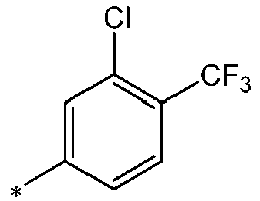
H 4-(3-Chloro-4-(trifluoromethyl) phenyl)-2-(methylamino)butanoic acid 1-21 Boc H 1 Bn 
H Benzyl 2-((tert-butoxycarbonyl)amino)-3-(3-chloro-4-(trifluoromethyl)phenyl) propanoate 1-22 Boc H 1 tBu 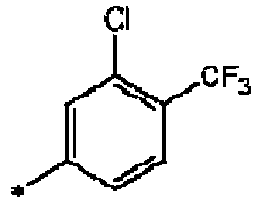
H tert-Butyl 2-((tert-butoxycarbonyl) amino)-3-(3-chloro-4-(trifluoromethyl) phenyl)propanoate 1-23 Fmoc H 1 Bn 
H Benzyl 2-((((9H-fluoren-9-yl)methoxy) carbonyl)amino)-3-(3-chloro-4-(trifluoromethyl)phenyl)propanoate 1-24 Fmoc H 1 tBu 
H tert-Butyl 2-((((9H-fluoren-9-yl)methoxy) carbonyl)amino)-3-(3-chloro-4-(trifluoromethyl)phenyl)propanoate 1-25 Cbz H 1 Bn 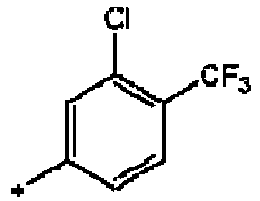
H Benzyl 2-(((benzyloxy)carbonyl)amino)-3-(3-chloro-4-(trifluoromethyl)phenyl) propanoate 1-26 Cbz H 1 tBu 
H tert-Butyl 2-(((benzyloxy)carbonyl) amino)-3-(3-chloro-4-(trifluoromethyl) phenyl)propanoate 1-27 Boc Me 1 Bn 
H Benzyl 2-((tert-butoxycarbonyl)(methyl) amino)-3-(3-chloro-4-(trifluoromethyl) phenyl)propanoate 1-28 Boc Me 1 tBu 
H tert-Butyl 2-((tert-butoxycarbonyl)(methyl) amino)-3-(3-chloro-4-(trifluoromethyl) phenyl)propanoate 1-29 Fmoc Me 1 Bn 
H Benzyl 2-((((9H-fluoren-9-yl)methoxy) carbonyl)(methyl)amino)-3-(3-chloro-4-(trifluoromethyl)phenyl)propanoate 1-30 Fmoc Me 1 tBu 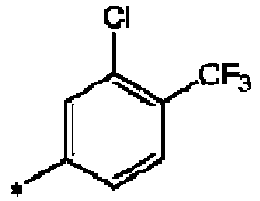
H tert-Butyl 2-((((9H-fluoren-9-yl)methoxy) carbonyl)(methyl)amino)-3-(3-chloro-4-(trifluoromethyl)phenyl)propanoate 1-31 Cbz Me 1 Bn 
H Benzyl 2-(((benzyloxy)carbonyl)(methyl) amino)-3-(3-chloro-4-(trifluoromethyl) phenyl)propanoate 1-32 Cbz Me 1 tBu 
H tert-Butyl 2-(((benzyloxy)carbonyl) (methyl)amino)-3-(3-chloro-4-(trifluoromethyl)phenyl)propanoate 1-33 Boc H 1 H 
H 2-((tert-Butoxycarbonyl)amino)-3-(3-chloro-4-(trifluoromethyl)phenyl) propanoic acid 1-34 Fmoc H 1 H 
H 2-((((9H-Fluoren-9-yl)methoxy)carbonyl) amino)-3-(3-chloro-4-(trifluoromethyl) phenyl)propanoic acid 1-35 Cbz H 1 H 
H 2-(((Benzyloxy)carbonyl)amino)-3-(3-chloro-4-(trifluoromethyl)phenyl) propanoic acid 1-36 Boc Me 1 H 
H 2-((tert-Butoxycarbonyl)(methyl)amino)-3-(3-chloro-4-(trifluoromethyl)phenyl) propanoic acid 1-37 Fmoc Me 1 H 
H 2-((((9H-Fluoren-9-yl)methoxy)carbonyl) (methyl)amino)-3-(3-chloro-4-(trifluoromethyl)phenyl)propanoic acid 1-38 Cbz Me 1 H 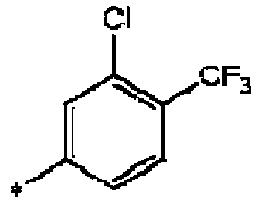
H 2-(((Benzyloxy)carbonyl)(methyl) amino)-3-(3-chloro-4-(trifluoromethyl) phenyl)propanoic acid 1-39 H H 1 H 
H 2-Amino-3-(3-chloro-4-(trifluoromethyl) phenyl)propanoic acid 1-40 H Me 1 H 
H 3-(3-Chloro-4-(trifluoromethyl)phenyl)-2-(methylamino)propanoic acid [Table 2] Compound ID R1 R2 n R3 R6 R7 Compound Name 2-1 Fmoc H 2 tBu 
H tert-Butyl 2-((((9H-fluoren-9-yl)methoxy) carbonyl)amino)-4-phenylbutanoate 2-2 Fmoc H 2 tBu 
H tert-Butyl 2-((((9H-fluoren-9-yl)methoxy) carbonyl)amino)-4-(o-tolyl)butanoate 2-3 Fmoc H 2 tBu 
H tert-Butyl 2-((((9H-fluoren-9-yl)methoxy) carbonyl)amino)-4-(m-tolyl)butanoate 2-4 Fmoc H 2 tBu 
H tert-Butyl 2-((((9H-fluoren-9-yl)methoxy) carbonyl)amino)-4-(p-tolyl)butanoate 2-5 Fmoc H 2 tBu 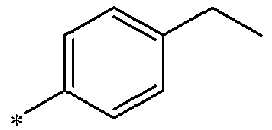
H tert-Butyl 2-((((9H-fluoren-9-yl)methoxy) carbonyl)amino)-4-(4-ethylphenyl) butanoate 2-6 Fmoc H 2 tBu 
H tert-Butyl 2-((((9H-fluoren-9-yl)methoxy) carbonyl)amino)-4-(2-chlorophenyl) butanoate 2-7 Fmoc H 2 tBu 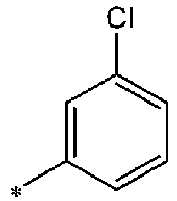
H tert-Butyl 2-((((9H-fluoren-9-yl)methoxy) carbonyl)amino)-4-(3-chlorophenyl) butanoate 2-8 Fmoc H 2 tBu 
H tert-Butyl 2-((((9H-fluoren-9-yl)methoxy) carbonyl)amino)-4-(4-chlorophenyl) butanoate 2-9 Fmoc H 2 tBu 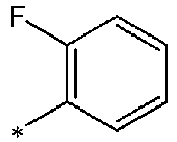
H tert-Butyl 2-((((9H-fluoren-9-yl)methoxy) carbonyl)amino)-4-(2-fluorophenyl) butanoate 2-10 Fmoc H 2 tBu 
H tert-Butyl 2-((((9H-fluoren-9-yl)methoxy) carbonyl)amino)-4-(3-fluorophenyl) butanoate 2-11 Fmoc H 2 tBu 
H tert-Butyl 2-((((9H-fluoren-9-yl)methoxy) carbonyl)amino)-4-(4-fluorophenyl) butanoate 2-12 Fmoc H 2 tBu 
H tert-Butyl 2-((((9H-fluoren-9-yl)methoxy) carbonyl)amino)-4-(2-cyclopropylphenyl) butanoate 2-13 Fmoc H 2 tBu 
H tert-Butyl 2-((((9H-fluoren-9-yl)methoxy) carbonyl)amino)-4-(3-cyclopropylphenyl) butanoate 2-14 Fmoc H 2 tBu 
H tert-Butyl 2-((((9H-fluoren-9-yl)methoxy) carbonyl)amino)-4-(4-cyclopropylphenyl) butanoate 2-15 Fmoc H 2 tBu 
H tert-Butyl 2-((((9H-fluoren-9-yl)methoxy) carbonyl)amino)-4-(2-(trifluoromethyl) phenyl)butanoate 2-16 Fmoc H 2 tBu 
H tert-Butyl 2-((((9H-fluoren-9-yl)methoxy) carbonyl)amino)-4-(3-(trifluoromethyl) phenyl)butanoate 2-17 Fmoc H 2 tBu 
H tert-Butyl 2-((((9H-fluoren-9-yl)methoxy) carbonyl)amino)-4-(4-(trifluoromethyl) phenyl)butanoate 2-18 Fmoc H 2 tBu 
H tert-Butyl 2-((((9H-fluoren-9-yl)methoxy) carbonyl)amino)-4-(2-isopropylphenyl) butanoate 2-19 Fmoc H 2 tBu 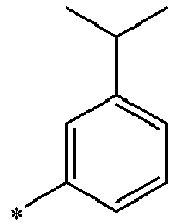
H tert-Butyl 2-((((9H-fluoren-9-yl)methoxy) carbonyl)amino)-4-(3-isopropylphenyl) butanoate 2-20 Fmoc H 2 tBu 
H tert-Butyl 2-((((9H-fluoren-9-yl)methoxy) carbonyl)amino)-4-(4-isopropylphenyl) butanoate 2-21 Fmoc H 2 tBu 
H tert-Butyl 2-((((9H-fluoren-9-yl)methoxy) carbonyl)amino)-4-(2-methoxyphenyl) butanoate 2-22 Fmoc H 2 tBu 
H tert-Butyl 2-((((9H-fluoren-9-yl)methoxy) carbonyl)amino)-4-(3-methoxyphenyl) butanoate 2-23 Fmoc H 2 tBu 
H tert-Butyl 2-((((9H-fluoren-9-yl)methoxy) carbonyl)amino)-4-(4-methoxyphenyl) butanoate 2-24 Fmoc H 2 tBu 
H tert-Butyl 2-((((9H-fluoren-9-yl)methoxy) carbonyl)amino)-4-(2-(allyloxy)phenyl) butanoate 2-25 Fmoc H 2 tBu 
H tert-Butyl 2-((((9H-fluoren-9-yl)methoxy) carbonyl)amino)-4-(3-(allyloxy)phenyl) butanoate 2-26 Fmoc H 2 tBu 
H tert-Butyl 2-((((9H-fluoren-9-yl)methoxy) carbonyl)amino)-4-(4-(allyloxy)phenyl) butanoate 2-27 Fmoc H 2 tBu 
H tert-Butyl 2-((((9H-fluoren-9-yl)methoxy) carbonyl)amino)-4-(4-isopropoxyphenyl) butanoate 2-28 Fmoc H 2 tBu 
H tert-Butyl 2-((((9H-fluoren-9-yl)methoxy) carbonyl)amino)-4-(3-fluoro-4-(trifluoromethyl)phenyl)butanoate 2-29 Fmoc H 2 tBu 
H tert-Butyl 2-((((9H-fluoren-9-yl)methoxy) carbonyl)amino)-4-(2-fluoro-4-(trifluoromethyl)phenyl)butanoate 2-30 Fmoc H 2 tBu 
H tert-Butyl 2-((((9H-fluoren-9-yl)methoxy) carbonyl)amino)-4-(3,4-dimethoxyphenyl) butanoate 2-31 Fmoc H 2 tBu 
H tert-Butyl 2-((((9H-fluoren-9-yl)methoxy) carbonyl)amino)-4-(2-fluoro-4-methoxyphenyl)butanoate 2-32 Fmoc H 2 tBu 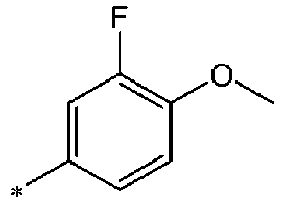
H tert-Butyl 2-((((9H-fluoren-9-yl)methoxy) carbonyl)amino)-4-(3-fluoro-4-methoxyphenyl)butanoate 2-33 Fmoc H 2 tBu 
H tert-Butyl 2-((((9H-fluoren-9-yl)methoxy) carbonyl)amino)-4-(3,5-difluoro-4-methoxyphenyl)butanoate 2-34 Fmoc H 2 tBu 
H tert-Butyl 2-((((9H-fluoren-9-yl)methoxy) carbonyl)amino)-4-(3,5-difluoro-4-(trifluoromethyl)phenyl)butanoate 2-35 Fmoc H 2 tBu 
H tert-Butyl 2-((((9H-fluoren-9-yl)methoxy) carbonyl)amino)-4-(3-methoxy-4-(methylcarbamoyl)phenyl)butanoate 2-36 Fmoc H 2 tBu 
H tert-Butyl 2-((((9H-fluoren-9-yl)methoxy) carbonyl)amino)-4-(4-methoxy-3-(methylcarbamoyl)phenyl)butanoate 2-37 Fmoc H 2 tBu 
H tert-Butyl 2-((((9H-fluoren-9-yl)methoxy) carbonyl)amino)-4-(3-methoxy-4-((methylsulfonyl)carbamoyl)phenyl) butanoate 2-38 Fmoc H 2 tBu 
H tert-Butyl 2-((((9H-fluoren-9-yl)methoxy) carbonyl)amino)-4-(4-(methyl((tetrahydro-2H-pyran-2-yl)oxy) carbamoyl)phenyl)butanoate 2-39 Fmoc H 2 tBu 
H tert-Butyl 2-((((9H-fluoren-9-yl)methoxy) carbonyl)am ino)-4-(3-methoxy-4-(((tetrahydro-2H-pyran-2-yl)oxy) carbamoyl)phenyl)butanoate 2-40 Fmoc H 2 tBu 
H tert-Butyl 2-((((9H-fluoren-9-yl)methoxy) carbonyl)amino)-4-(pyridin-2-yl)butanoate 2-41 Fmoc H 2 tBu 
H tert-Butyl 2-((((9H-fluoren-9-yl)methoxy) carbonyl)amino)-4-(pyridin-3-yl)butanoate 2-42 Fmoc H 2 tBu 
H tert-Butyl 2-((((9H-fluoren-9-yl)methoxy) carbonyl)amino)-4-(pyridin-4-yl)butanoate 2-43 Fmoc H 2 tBu 
H tert-Butyl 2-((((9H-fluoren-9-yl)methoxy) carbonyl)amino)-4-(6-methylpyridin-3-yl) butanoate 2-44 Fmoc H 2 tBu 
H tert-Butyl 2-((((9H-fluoren-9-yl)methoxy) carbonyl)amino)-4-(5-methylpyridin-3-yl) butanoate 2-45 Fmoc H 2 tBu 
H tert-Butyl 2-((((9H-fluoren-9-yl)methoxy) carbonyl)amino)-4-(4-methylpyridin-3-yl) butanoate 2-46 Fmoc H 2 tBu 
H tert-Butyl 2-((((9H-fluoren-9-yl)methoxy) carbonyl)amino)-4-(6-methoxypyridin-3-yl)butanoate 2-47 Fmoc H 2 tBu 
H tert-Butyl 2-((((9H-fluoren-9-yl)methoxy) carbonyl)amino)-4-(5-methoxypyridin-3-yl)butanoate 2-48 Fmoc H 2 tBu 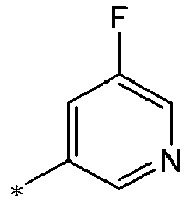
H tert-Butyl 2-((((9H-fluoren-9-yl)methoxy) carbonyl)amino)-4-(5-fluoropyridin-3-yl) butanoate 2-49 Fmoc H 2 tBu 
H tert-Butyl 2-((((9H-fluoren-9-yl)methoxy) carbonyl)amino)-4-(5-chloropyridin-3-yl) butanoate 2-50 Fmoc H 2 tBu 
H tert-Butyl 2-((((9H-fluoren-9-yl)methoxy) carbonyl)amino)-4-(5-bromopyridin-3-yl) butanoate 2-51 Fmoc H 2 tBu 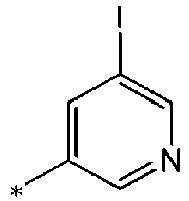
H tert-Butyl 2-((((9H-fluoren-9-yl)methoxy) carbonyl)amino)-4-(5-iodopyridin-3-yl) butanoate 2-52 Fmoc H 2 tBu 
H tert-Butyl 2-((((9H-fluoren-9-yl)methoxy) carbonyl)amino)-4-(2-(methylamino) pyridin-4-yl)butanoate 2-53 Fmoc H 2 tBu 
H tert-Butyl 2-((((9H-fluoren-9-yl)methoxy) carbonyl)amino)-4-(2-(dimethylamino) pyridin-4-yl)butanoate 2-54 Fmoc H 2 tBu 
H tert-Butyl 2-((((9H-fluoren-9-yl)methoxy) carbonyl)amino)-4-(pyrimidin-5-yl) butanoate [Table 3] Compound ID R1 R2 n R3 R6 R7 Compound Name 3-1 Fmoc Me 2 tBu 
H tert-Butyl 2-((((9H-fluoren-9-yl)methoxy) carbonyl)(methyl)amino)-4-phenylbutanoate 3-2 Fmoc Me 2 tBu 
H tert-Butyl 2-((((9H-fluoren-9-yl)methoxy) carbonyl)(methyl)amino)-4-(o-tolyl) butanoate 3-3 Fmoc Me 2 tBu 
H tert-Butyl 2-((((9H-fluoren-9-yl)methoxy) carbonyl)(methyl)amino)-4-(m-tolyl) butanoate 3-4 Fmoc Me 2 tBu 
H tert-Butyl 2-((((9H-fluoren-9-yl)methoxy) carbonyl)(methyl)amino)-4-(p-tolyl) butanoate 3-5 Fmoc Me 2 tBu 
H tert-Butyl 2-((((9H-fluoren-9-yl)methoxy) carbonyl)(methyl)amino)-4-(4-ethylphenyl)butanoate 3-6 Fmoc Me 2 tBu 
H tert-Butyl 2-((((9H-fluoren-9-yl)methoxy) carbonyl)(methyl)amino)-4-(2-chlorophenyl)butanoate 3-7 Fmoc Me 2 tBu 
H tert-Butyl 2-((((9H-fluoren-9-yl)methoxy) carbonyl)(methyl)amino)-4-(3-chlorophenyl)butanoate 3-8 Fmoc Me 2 tBu 
H tert-Butyl 2-((((9H-fluoren-9-yl)methoxy) carbonyl)(methyl)amino)-4-(4-chlorophenyl)butanoate 3-9 Fmoc Me 2 tBu 
H tert-Butyl 2-((((9H-fluoren-9-yl)methoxy) carbonyl)(methyl)amino)-4-(2-fluorophenyl)butanoate 3-10 Fmoc Me 2 tBu 
H tert-Butyl 2-((((9H-fluoren-9-yl)methoxy) carbonyl)(methyl)amino)-4-(3-fluorophenyl)butanoate 3-11 Fmoc Me 2 tBu 
H tert-Butyl 2-((((9H-fluoren-9-yl)methoxy) carbonyl)(methyl)amino)-4-(4-fluorophenyl)butanoate 3-12 Fmoc Me 2 tBu 
H tert-Butyl 2-((((9H-fluoren-9-yl)methoxy) carbonyl)(methyl)amino)-4-(2-cyclopropylphenyl)butanoate 3-13 Fmoc Me 2 tBu 
H tert-Butyl 2-((((9H-fluoren-9-yl)methoxy) carbonyl)(methyl)amino)-4-(3-cyclopropylphenyl)butanoate 3-14 Fmoc Me 2 tBu 
H tert-Butyl 2-((((9H-fluoren-9-yl)methoxy) carbonyl)(methyl)amino)-4-(4-cyclopropylphenyl)butanoate 3-15 Fmoc Me 2 tBu 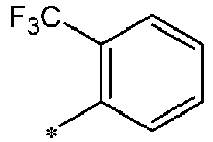
H tert-Butyl 2-((((9H-fluoren-9-yl)methoxy) carbonyl)(methyl)amino)-4-(2-(trifluoromethyl)phenyl)butanoate 3-16 Fmoc Me 2 tBu 
H tert-Butyl 2-((((9H-fluoren-9-yl)methoxy) carbonyl)(methyl)amino)-4-(3-(trifluoromethyl)phenyl)buta noate 3-17 Fmoc Me 2 tBu 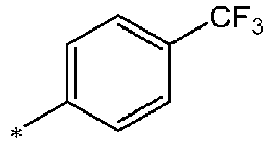
H tert-Butyl 2-((((9H-fluoren-9-yl)methoxy) carbonyl)(methyl)amino)-4-(4-(trifluoromethyl)phenyl)butanoate 3-18 Fmoc Me 2 tBu 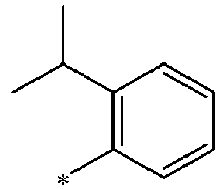
H tert-Butyl 2-((((9H-fluoren-9-yl)methoxy) carbonyl)(methyl)amino)-4-(2-isopropylphenyl)butanoate 3-19 Fmoc Me 2 tBu 
H tert-Butyl 2-((((9H-fluoren-9-yl)methoxy) carbonyl)(methyl)amino)-4-(3-isopropylphenyl)butanoate 3-20 Fmoc Me 2 tBu 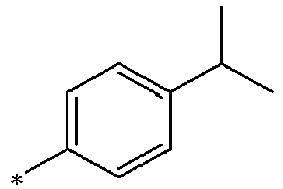
H tert-Butyl 2-((((9H-fluoren-9-yl)methoxy) carbonyl)(methyl)amino)-4-(4-isopropylphenyl)butanoate 3-21 Fmoc Me 2 tBu 
H tert-Butyl 2-((((9H-fluoren-9-yl)methoxy) carbonyl)(methyl)amino)-4-(2-methoxyphenyl)butanoate 3-22 Fmoc Me 2 tBu 
H tert-Butyl 2-((((9H-fluoren-9-yl)methoxy) carbonyl)(methyl)amino)-4-(3-methoxyphenyl)butanoate 3-23 Fmoc Me 2 tBu 
H tert-Butyl 2-((((9H-fluoren-9-yl)methoxy) carbonyl)(methyl)amino)-4-(4-methoxyphenyl)butanoate 3-24 Fmoc Me 2 tBu 
H tert-Butyl 2-((((9H-fluoren-9-yl)methoxy) carbonyl)(methyl)amino)-4-(2-(allyloxy) phenyl)butanoate 3-25 Fmoc Me 2 tBu 
H tert-Butyl 2-((((9H-fluoren-9-yl)methoxy) carbonyl)(methyl)amino)-4-(3-(allyloxy) phenyl)butanoate 3-26 Fmoc Me 2 tBu 
H tert-Butyl 2-((((9H-fluoren-9-yl)methoxy) carbonyl)(methyl)amino)-4-(4-(allyloxy) phenyl)butanoate 3-27 Fmoc Me 2 tBu 
H tert-Butyl 2-((((9H-fluoren-9-yl)methoxy) carbonyl)(methyl)amino)-4-(4-isopropoxyphenyl)butanoate 3-28 Fmoc Me 2 tBu 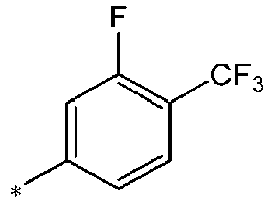
H tert-Butyl 2-((((9H-fluoren-9-yl)methoxy) carbonyl)(methyl)amino)-4-(3-fluoro-4-(trifluoromethyl)phenyl)butanoate 3-29 Fmoc Me 2 tBu 
H tert-Butyl 2-((((9H-fluoren-9-yl)methoxy) carbonyl)(methyl)amino)-4-(2-fluoro-4-(trifluoromethyl)phenyl)butanoate 3-30 Fmoc Me 2 tBu 
H tert-Butyl 2-((((9H-fluoren-9-yl)methoxy) carbonyl)(methyl)amino)-4-(3,4-dimethoxyphenyl)butanoate 3-31 Fmoc Me 2 tBu 
H tert-Butyl 2-((((9H-fluoren-9-yl)methoxy) carbonyl)(methyl)amino)-4-(2-fluoro-4-methoxyphenyl)butanoate 3-32 Fmoc Me 2 tBu 
H tert-Butyl 2-((((9H-fluoren-9-yl)methoxy) carbonyl)(methyl)amino)-4-(3-fluoro-4-methoxyphenyl)butanoate 3-33 Fmoc Me 2 tBu 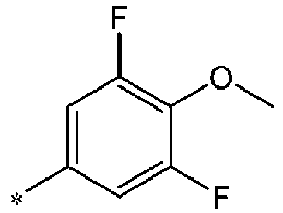
H tert-Butyl 2-((((9H-fluoren-9-yl)methoxy) carbonyl)(methyl)amino)-4-(3,5-difluoro-4-methoxyphenyl)buta noate 3-34 Fmoc Me 2 tBu 
H tert-Butyl 2-((((9H-fluoren-9-yl)methoxy) carbonyl)(methyl)amino)-4-(3,5-difluoro-4-(trifluoromethyl)phenyl) butanoate 3-35 Fmoc Me 2 tBu 
H tert-Butyl 2-((((9H-fluoren-9-yl)methoxy) carbonyl)(methyl)amino)-4-(3-methoxy-4-(methylcarbamoyl)phenyl)butanoate 3-36 Fmoc Me 2 tBu 
H tert-Butyl 2-((((9H-fluoren-9-yl)methoxy) carbonyl)(methyl)amino)-4-(4-methoxy-3-(methylcarbamoyl)phenyl)butanoate 3-37 Fmoc Me 2 tBu 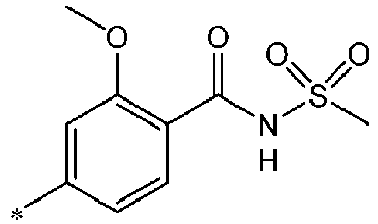
H tert-Butyl 2-((((9H-fluoren-9-yl)methoxy) carbonyl)(methyl)amino)-4-(3-methoxy-4-((methylsulfonyl)carbamoyl)phenyl) butanoate 3-38 Fmoc Me 2 tBu 
H tert-Butyl 2-((((9H-fluoren-9-yl)methoxy) carbonyl)(methyl)amino)-4-(4-(methyl((tetrahydro-2H-pyran-2-yl)oxy) carbamoyl)phenyl)butanoate 3-39 Fmoc Me 2 tBu 
H tert-Butyl 2-((((9H-fluoren-9-yl)methoxy) carbonyl)(methyl)amino)-4-(3-methoxy-4-(((tetrahydro-2H-pyran-2-yl)oxy) carbamoyl)phenyl)butanoate 3-40 Fmoc Me 2 tBu 
H tert-Butyl 2-((((9H-fluoren-9-yl)methoxy) carbonyl)(methyl)amino)-4-(pyridin-2-yl) butanoate 3-41 Fmoc Me 2 tBu 
H tert-Butyl 2-((((9H-fluoren-9-yl)methoxy) carbonyl)(methyl)amino)-4-(pyridin-3-yl) butanoate 3-42 Fmoc Me 2 tBu 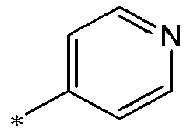
H tert-Butyl 2-((((9H-fluoren-9-yl)methoxy) carbonyl)(methyl)amino)-4-(pyridin-4-yl) butanoate 3-43 Fmoc Me 2 tBu 
H tert-Butyl 2-((((9H-fluoren-9-yl)methoxy) carbonyl)(methyl)amino)-4-(6-methylpyridin-3-yl)butanoate 3-44 Fmoc Me 2 tBu 
H tert-Butyl 2-((((9H-fluoren-9-yl)methoxy) carbonyl)(methyl)amino)-4-(5-methylpyridin-3-yl)butanoate 3-45 Fmoc Me 2 tBu 
H tert-Butyl 2-((((9H-fluoren-9-yl)methoxy) carbonyl)(methyl)amino)-4-(4-methylpyridin-3-yl)butanoate 3-46 Fmoc Me 2 tBu 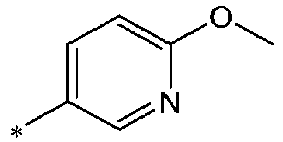
H tert-Butyl 2-((((9H-fluoren-9-yl)methoxy) carbonyl)(methyl)amino)-4-(6-methoxypyridin-3-yl)butanoate 3-47 Fmoc Me 2 tBu 
H tert-Butyl 2-((((9H-fluoren-9-yl)methoxy) carbonyl)(methyl)amino)-4-(5-methoxypyridin-3-yl)butanoate 3-48 Fmoc Me 2 tBu 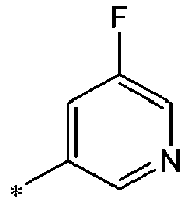
H tert-Butyl 2-((((9H-fluoren-9-yl)methoxy) carbonyl)(methyl)amino)-4-(5-fluoropyridin-3-yl)butanoate 3-49 Fmoc Me 2 tBu 
H tert-Butyl 2-((((9H-fluoren-9-yl)methoxy) carbonyl)(methyl)amino)-4-(5-chloropyridin-3-yl)butanoate 3-50 Fmoc Me 2 tBu 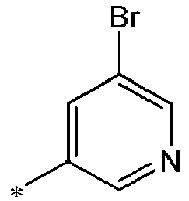
H tert-Butyl 2-((((9H-fluoren-9-yl)methoxy) carbonyl)(methyl)amino)-4-(5-bromopyridin-3-yl)butanoate 3-51 Fmoc Me 2 tBu 
H tert-Butyl 2-((((9H-fluoren-9-yl)methoxy) carbonyl)(methyl)amino)-4-(5-iodopyridin-3-yl)butanoate 3-52 Fmoc Me 2 tBu 
H tert-Butyl 2-((((9H-fluoren-9-yl)methoxy) carbonyl)(methyl)amino)-4-(2-(methylamino)pyridin-4-yl)butanoate 3-53 Fmoc Me 2 tBu 
H tert-Butyl 2-((((9H-fluoren-9-yl)methoxy) carbonyl)(methyl)amino)-4-(2-(dimethylamino)pyridin-4-yl)butanoate 3-54 Fmoc Me 2 tBu 
H tert-Butyl 2-((((9H-fluoren-9-yl)methoxy) carbonyl)(methyl)amino)-4-(pyrimidin-5-yl)butanoate [Table 4] Compound ID R1 R2 n R3 R6 R7 Compound Name 4-1 Fmoc H 1 tBu 
H tert-Butyl (((9H-fluoren-9-yl)methoxy) carbonyl)phenylalaninate 4-2 Fmoc H 1 tBu 
H tert-Butyl 2-((((9H-fluoren-9-yl)methoxy) carbonyl)amino)-3-(o-tolyl)propanoate 4-3 Fmoc H 1 tBu 
H tert-Butyl 2-((((9H-fluoren-9-yl)methoxy) carbonyl)amino)-3-(m-tolyl)propanoate 4-4 Fmoc H 1 tBu 
H tert-Butyl 2-((((9H-fluoren-9-yl)methoxy) carbonyl)am ino)-3-(p-tolyl)propanoate 4-5 Fmoc H 1 tBu 
H tert-Butyl 2-((((9H-fluoren-9-yl)methoxy) carbonyl)amino)-3-(4-ethylphenyl) propanoate 4-6 Fmoc H 1 tBu 
H tert-Butyl 2-((((9H-fluoren-9-yl)methoxy) carbonyl)amino)-3-(2-chlorophenyl) propanoate 4-7 Fmoc H 1 tBu 
H tert-Butyl 2-((((9H-fluoren-9-yl)methoxy) carbonyl)amino)-3-(3-chlorophenyl) propanoate 4-8 Fmoc H 1 tBu 
H tert-Butyl 2-((((9H-fluoren-9-yl)methoxy) carbonyl)amino)-3-(4-chlorophenyl) propanoate 4-9 Fmoc H 1 tBu 
H tert-Butyl 2-((((9H-fluoren-9-yl)methoxy) carbonyl)amino)-3-(2-fluorophenyl) propanoate 4-10 Fmoc H 1 tBu 
H tert-Butyl 2-((((9H-fluoren-9-yl)methoxy) carbonyl)amino)-3-(3-fluorophenyl) propanoate 4-11 Fmoc H 1 tBu 
H tert-Butyl 2-((((9H-fluoren-9-yl)methoxy) carbonyl)amino)-3-(4-fluorophenyl) propanoate 4-12 Fmoc H 1 tBu 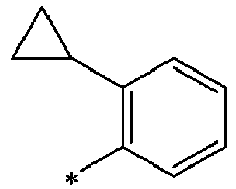
H tert-Butyl 2-((((9H-fluoren-9-yl)methoxy) carbonyl)amino)-3-(2-cyclopropylphenyl) propanoate 4-13 Fmoc H 1 tBu 
H tert-Butyl 2-((((9H-fluoren-9-yl)methoxy) carbonyl)amino)-3-(3-cyclopropylphenyl) propanoate 4-14 Fmoc H 1 tBu 
H tert-Butyl 2-((((9H-fluoren-9-yl)methoxy) carbonyl)amino)-3-(4-cyclopropylphenyl) propanoate 4-15 Fmoc H 1 tBu 
H tert-Butyl 2-((((9H-fluoren-9-yl)methoxy) carbonyl)amino)-3-(2-(trifluoromethyl) phenyl)propanoate 4-16 Fmoc H 1 tBu 
H tert-Butyl 2-((((9H-fluoren-9-yl)methoxy) carbonyl)amino)-3-(3-(trifluoromethyl) phenyl)propanoate 4-17 Fmoc H 1 tBu 
H tert-Butyl 2-((((9H-fluoren-9-yl)methoxy) carbonyl)amino)-3-(4-(trifluoromethyl) phenyl)propanoate 4-18 Fmoc H 1 tBu 
H tert-Butyl 2-((((9H-fluoren-9-yl)methoxy) carbonyl)amino)-3-(2-isopropylphenyl) propanoate 4-19 Fmoc H 1 tBu 
H tert-Butyl 2-((((9H-fluoren-9-yl)methoxy) carbonyl)amino)-3-(3-isopropylphenyl) propanoate 4-20 Fmoc H 1 tBu 
H tert-Butyl 2-((((9H-fluoren-9-yl)methoxy) carbonyl)amino)-3-(4-isopropylphenyl) propanoate 4-21 Fmoc H 1 tBu 
H tert-Butyl 2-((((9H-fluoren-9-yl)methoxy) carbonyl)amino)-3-(2-methoxyphenyl) propanoate 4-22 Fmoc H 1 tBu 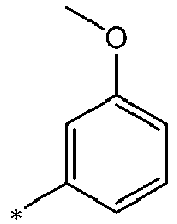
H tert-Butyl 2-((((9H-fluoren-9-yl)methoxy) carbonyl)amino)-3-(3-methoxyphenyl) propanoate 4-23 Fmoc H 1 tBu 
H tert-Butyl 2-((((9H-fluoren-9-yl)methoxy) carbonyl)amino)-3-(4-methoxyphenyl) propanoate 4-24 Fmoc H 1 tBu 
H tert-Butyl 2-((((9H-fluoren-9-yl)methoxy) carbonyl)amino)-3-(2-(allyloxy)phenyl) propanoate 4-25 Fmoc H 1 tBu 
H tert-Butyl 2-((((9H-fluoren-9-yl)methoxy) carbonyl)amino)-3-(3-(allyloxy)phenyl) propanoate 4-26 Fmoc H 1 tBu 
H tert-Butyl 2-((((9H-fluoren-9-yl)methoxy) carbonyl)amino)-3-(4-(allyloxy)phenyl) propanoate 4-27 Fmoc H 1 tBu 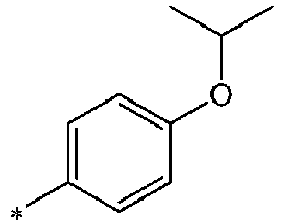
H tert-Butyl 2-((((9H-fluoren-9-yl)methoxy) carbonyl)amino)-3-(4-isopropoxyphenyl) propanoate 4-28 Fmoc H 1 tBu 
H tert-Butyl 2-((((9H-fluoren-9-yl)methoxy) carbonyl)amino)-3-(3-fluoro-4-(trifluoromethyl)phenyl)propanoate 4-29 Fmoc H 1 tBu 
H tert-Butyl 2-((((9H-fluoren-9-yl)methoxy) carbonyl)amino)-3-(2-fluoro-4-(trifluoromethyl)phenyl)propanoate 4-30 Fmoc H 1 tBu 
H tert-Butyl 2-((((9H-fluoren-9-yl)methoxy) carbonyl)amino)-3-(3,4-dimethoxyphenyl) propanoate 4-31 Fmoc H 1 tBu 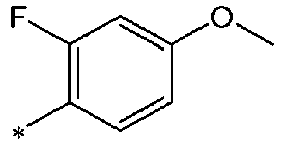
H tert-Butyl 2-((((9H-fluoren-9-yl)methoxy) carbonyl)amino)-3-(2-fluoro-4-methoxyphenyl)propanoate 4-32 Fmoc H 1 tBu 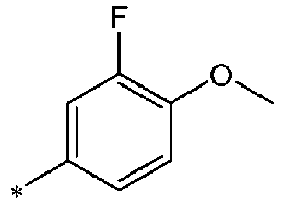
H tert-Butyl 2-((((9H-fluoren-9-yl)methoxy) carbonyl)amino)-3-(3-fluoro-4-methoxyphenyl)propanoate 4-33 Fmoc H 1 tBu 
H tert-Butyl 2-((((9H-fluoren-9-yl)methoxy) carbonyl)amino)-3-(3,5-difluoro-4-methoxyphenyl)propanoate 4-34 Fmoc H 1 tBu 
H tert-Butyl 2-((((9H-fluoren-9-yl)methoxy) carbonyl)amino)-3-(3,5-difluoro-4-(trifluoromethyl)phenyl)propanoate 4-35 Fmoc H 1 tBu 
H tert-Butyl 2-((((9H-fluoren-9-yl)methoxy) carbonyl)amino)-3-(3-methoxy-4-(methylcarbamoyl)phenyl)propanoate 4-36 Fmoc H 1 tBu 
H tert-Butyl 2-((((9H-fluoren-9-yl)methoxy) carbonyl)amino)-3-(4-methoxy-3-(methylcarbamoyl)phenyl)propanoate 4-37 Fmoc H 1 tBu 
H tert-Butyl 2-((((9H-fluoren-9-yl)methoxy) carbonyl)amino)-3-(3-methoxy-4-((methylsulfonyl)carbamoyl)phenyl) propanoate 4-38 Fmoc H 1 tBu 
H tert-Butyl 2-((((9H-fluoren-9-yl)methoxy) carbonyl)amino)-3-(4-(methyl((tetrahydro-2H-pyran-2-yl)oxy) carbamoyl)phenyl)propanoate 4-39 Fmoc H 1 tBu 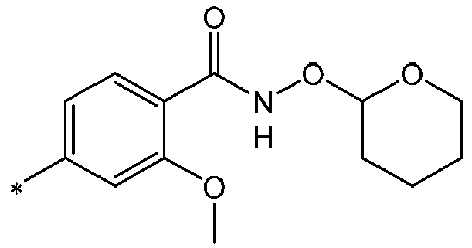
H tert-Butyl 2-((((9H-fluoren-9-yl)methoxy) carbonyl)amino)-3-(3-methoxy-4-(((tetrahydro-2H-pyran-2-yl)oxy) carbamoyl)phenyl)propanoate 4-40 Fmoc H 1 tBu 
H tert-Butyl 2-((((9H-fluoren-9-yl)methoxy) carbonyl)amino)-3-(pyridin-2-yl) propanoate 4-41 Fmoc H 1 tBu 
H tert-Butyl 2-((((9H-fluoren-9-yl)methoxy) carbonyl)amino)-3-(pyridin-3-yl) propanoate 4-42 Fmoc H 1 tBu 
H tert-Butyl 2-((((9H-fluoren-9-yl)methoxy) carbonyl)amino)-3-(pyridin-4-yl) propanoate 4-43 Fmoc H 1 tBu 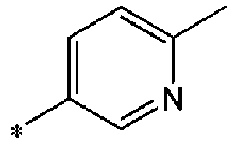
H tert-Butyl 2-((((9H-fluoren-9-yl)methoxy) carbonyl)amino)-3-(6-methylpyridin-3-yl) propanoate 4-44 Fmoc H 1 tBu 
H tert-Butyl 2-((((9H-fluoren-9-yl)methoxy) carbonyl)amino)-3-(5-methylpyridin-3-yl) propanoate 4-45 Fmoc H 1 tBu 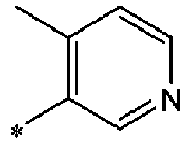
H tert-Butyl 2-((((9H-fluoren-9-yl)methoxy) carbonyl)amino)-3-(4-methylpyridin-3-yl) propanoate 4-46 Fmoc H 1 tBu 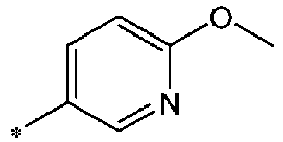
H tert-Butyl 2-((((9H-fluoren-9-yl)methoxy) carbonyl)amino)-3-(6-methoxypyridin-3-yl)propanoate 4-47 Fmoc H 1 tBu 
H tert-Butyl 2-((((9H-fluoren-9-yl)methoxy) carbonyl)amino)-3-(5-methoxypyridin-3-yl)propanoate 4-48 Fmoc H 1 tBu 
H tert-Butyl 2-((((9H-fluoren-9-yl)methoxy) carbonyl)amino)-3-(5-fluoropyridin-3-yl) propanoate 4-49 Fmoc H 1 tBu 
H tert-Butyl 2-((((9H-fluoren-9-yl)methoxy) carbonyl)amino)-3-(5-chloropyridin-3-yl) propanoate 4-50 Fmoc H 1 tBu 
H tert-Butyl 2-((((9H-fluoren-9-yl)methoxy) carbonyl)amino)-3-(5-bromopyridin-3-yl) propanoate 4-51 Fmoc H 1 tBu 
H tert-Butyl 2-((((9H-fluoren-9-yl)methoxy) carbonyl)amino)-3-(5-iodopyridin-3-yl) propanoate 4-52 Fmoc H 1 tBu 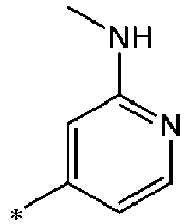
H tert-Butyl 2-((((9H-fluoren-9-yl)methoxy) carbonyl)amino)-3-(2-(methylamino) pyridin-4-yl)propanoate 4-53 Fmoc H 1 tBu 
H tert-Butyl 2-((((9H-fluoren-9-yl)methoxy) carbonyl)amino)-3-(2-(dimethylamino) pyridin-4-yl)propanoate 4-54 Fmoc H 1 tBu 
H tert-Butyl 2-((((9H-fluoren-9-yl)methoxy) carbonyl)amino)-3-(pyrimidin-5-yl) propanoate [Table 5] Compound ID R1 R2 n R3 R6 R7 Compound Name 5-1 Fmoc Me 1 tBu 
H tert-Butyl 2-(((9H-fluoren-9-yl)methoxy) carbonyl)-N-methylphenylalaninate 5-2 Fmoc Me 1 tBu 
H tert-Butyl 2-((((9H-fluoren-9-yl)methoxy) carbonyl)(methyl)amino)-3-(o-tolyl) propanoate 5-3 Fmoc Me 1 tBu 
H tert-Butyl 2-((((9H-fluoren-9-yl)methoxy) carbonyl)(methyl)amino)-3-(m-tolyl) propanoate 5-4 Fmoc Me 1 tBu 
H tert-Butyl 2-((((9H-fluoren-9-yl)methoxy) carbonyl)(methyl)amino)-3-(p-tolyl) propanoate 5-5 Fmoc Me 1 tBu 
H tert-Butyl 2-((((9H-fluoren-9-yl)methoxy) carbonyl)(methyl)amino)-3-(4-ethylphenyl)propanoate 5-6 Fmoc Me 1 tBu 
H tert-Butyl 2-((((9H-fluoren-9-yl)methoxy) carbonyl)(methyl)amino)-3-(2-chlorophenyl)propanoate 5-7 Fmoc Me 1 tBu 
H tert-Butyl 2-((((9H-fluoren-9-yl)methoxy) carbonyl)(methyl)amino)-3-(3-chlorophenyl)propanoate 5-8 Fmoc Me 1 tBu 
H tert-Butyl 2-((((9H-fluoren-9-yl)methoxy) carbonyl)(methyl)amino)-3-(4-chlorophenyl)propanoate 5-9 Fmoc Me 1 tBu 
H tert-Butyl 2-((((9H-fluoren-9-yl)methoxy) carbonyl)(methyl)amino)-3-(2-fluorophenyl)propanoate 5-10 Fmoc Me 1 tBu 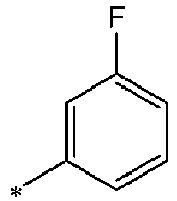
H tert-Butyl 2-((((9H-fluoren-9-yl)methoxy) carbonyl)(methyl)amino)-3-(3-fluorophenyl)propanoate 5-11 Fmoc Me 1 tBu 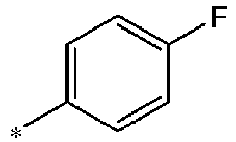
H tert-Butyl 2-((((9H-fluoren-9-yl)methoxy) carbonyl)(methyl)amino)-3-(4-fluorophenyl)propanoate 5-12 Fmoc Me 1 tBu 
H tert-Butyl 2-((((9H-fluoren-9-yl)methoxy) carbonyl)(methyl)amino)-3-(2-cyclopropylphenyl)propanoate 5-13 Fmoc Me 1 tBu 
H tert-Butyl 2-((((9H-fluoren-9-yl)methoxy) carbonyl)(methyl)amino)-3-(3-cyclopropylphenyl)propanoate 5-14 Fmoc Me 1 tBu 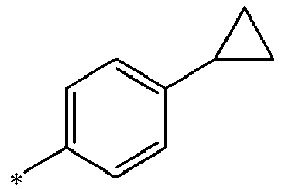
H tert-Butyl 2-((((9H-fluoren-9-yl)methoxy) carbonyl)(methyl)amino)-3-(4-cyclopropylphenyl)propanoate 5-15 Fmoc Me 1 tBu 
H tert-Butyl 2-((((9H-fluoren-9-yl)methoxy) carbonyl)(methyl)amino)-3-(2-(trifluoromethyl)phenyl)propanoate 5-16 Fmoc Me 1 tBu 
H tert-Butyl 2-((((9H-fluoren-9-yl)methoxy) carbonyl)(methyl)amino)-3-(3-(trifluoromethyl)phenyl)propanoate 5-17 Fmoc Me 1 tBu 
H tert-Butyl 2-((((9H-fluoren-9-yl)methoxy) carbonyl)(methyl)amino)-3-(4-(trifluoromethyl)phenyl)propanoate 5-18 Fmoc Me 1 tBu 
H tert-Butyl 2-((((9H-fluoren-9-yl)methoxy) carbonyl)(methyl)amino)-3-(2-isopropylphenyl)propanoate 5-19 Fmoc Me 1 tBu 
H tert-Butyl 2-((((9H-fluoren-9-yl)methoxy) carbonyl)(methyl)amino)-3-(3-isopropylphenyl)propanoate 5-20 Fmoc Me 1 tBu 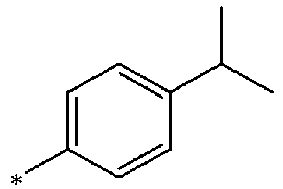
H tert-Butyl 2-((((9H-fluoren-9-yl)methoxy) carbonyl)(methyl)amino)-3-(4-isopropylphenyl)propanoate 5-21 Fmoc Me 1 tBu 
H tert-Butyl 2-((((9H-fluoren-9-yl)methoxy) carbonyl)(methyl)amino)-3-(2-methoxyphenyl)propanoate 5-22 Fmoc Me 1 tBu 
H tert-Butyl 2-((((9H-fluoren-9-yl)methoxy) carbonyl)(methyl)amino)-3-(3-methoxyphenyl)propanoate 5-23 Fmoc Me 1 tBu 
H tert-Butyl 2-((((9H-fluoren-9-yl)methoxy) carbonyl)(methyl)amino)-3-(4-methoxyphenyl)propanoate 5-24 Fmoc Me 1 tBu 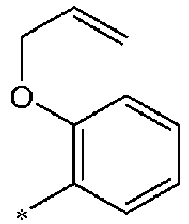
H tert-Butyl 2-((((9H-fluoren-9-yl)methoxy) carbonyl)(methyl)amino)-3-(2-(allyloxy) phenyl)propanoate 5-25 Fmoc Me 1 tBu 
H tert-Butyl 2-((((9H-fluoren-9-yl)methoxy) carbonyl)(methyl)amino)-3-(3-(allyloxy) phenyl)propanoate 5-26 Fmoc Me 1 tBu 
H tert-Butyl 2-((((9H-fluoren-9-yl)methoxy) carbonyl)(methyl)amino)-3-(4-(allyloxy) phenyl)propanoate 5-27 Fmoc Me 1 tBu 
H tert-Butyl 2-((((9H-fluoren-9-yl)methoxy) carbonyl)(methyl)amino)-3-(4-isopropoxyphenyl)propanoate 5-28 Fmoc Me 1 tBu 
H tert-Butyl 2-((((9H-fluoren-9-yl)methoxy) carbonyl)(methyl)amino)-3-(3-fluoro-4-(trifluoromethyl)phenyl)propanoate 5-29 Fmoc Me 1 tBu 
H tert-Butyl 2-((((9H-fluoren-9-yl)methoxy) carbonyl)(methyl)amino)-3-(2-fluoro-4-(trifluoromethyl)phenyl)propanoate 5-30 Fmoc Me 1 tBu 
H tert-Butyl 2-((((9H-fluoren-9-yl)methoxy) carbonyl)(methyl)amino)-3-(3,4-dimethoxyphenyl)propanoate 5-31 Fmoc Me 1 tBu 
H tert-Butyl 2-((((9H-fluoren-9-yl)methoxy) carbonyl)(methyl)amino)-3-(2-fluoro-4-methoxyphenyl)propanoate 5-32 Fmoc Me 1 tBu 
H tert-Butyl 2-((((9H-fluoren-9-yl)methoxy) carbonyl)(methyl)amino)-3-(3-fluoro-4-methoxyphenyl)propanoate 5-33 Fmoc Me 1 tBu 
H tert-Butyl 2-((((9H-fluoren-9-yl)methoxy) carbonyl)(methyl)amino)-3-(3,5-difluoro-4-methoxyphenyl)propanoate 5-34 Fmoc Me 1 tBu 
H tert-Butyl 2-((((9H-fluoren-9-yl)methoxy) carbonyl)(methyl)amino)-3-(3,5-difluoro-4-(trifluoromethyl)phenyl) propanoate 5-35 Fmoc Me 1 tBu 
H tert-Butyl 2-((((9H-fluoren-9-yl)methoxy) carbonyl)(methyl)amino)-3-(3-methoxy-4-(methylcarbamoyl)phenyl)propanoate 5-36 Fmoc Me 1 tBu 
H tert-Butyl 2-((((9H-fluoren-9-yl)methoxy) carbonyl)(methyl)amino)-3-(4-methoxy-3-(methylcarbamoyl)phenyl)propanoate 5-37 Fmoc Me 1 tBu 
H tert-Butyl 2-((((9H-fluoren-9-yl)methoxy) carbonyl)(methyl)amino)-3-(3-methoxy-4-((methylsulfonyl)carbamoyl)phenyl) propanoate 5-38 Fmoc Me 1 tBu 
H tert-Butyl 2-((((9H-fluoren-9-yl)methoxy) carbonyl)(methyl)amino)-3-(4-(methyl((tetrahydro-2H-pyran-2-yl)oxy) carbamoyl)phenyl)propanoate 5-39 Fmoc Me 1 tBu 
H tert-Butyl 2-((((9H-fluoren-9-yl)methoxy) carbonyl)(methyl)amino)-3-(3-methoxy-4-(((tetrahydro-2H-pyran-2-yl)oxy) carbamoyl)phenyl)propanoate 5-40 Fmoc Me 1 tBu 
H tert-Butyl 2-((((9H-fluoren-9-yl)methoxy) carbonyl)(methyl)amino)-3-(pyridin-2-yl) propanoate 5-41 Fmoc Me 1 tBu 
H tert-Butyl 2-((((9H-fluoren-9-yl)methoxy) carbonyl)(methyl)amino)-3-(pyridin-3-yl) propanoate 5-42 Fmoc Me 1 tBu 
H tert-Butyl 2-((((9H-fluoren-9-yl)methoxy) carbonyl)(methyl)amino)-3-(pyridin-4-yl) propanoate 5-43 Fmoc Me 1 tBu 
H tert-Butyl 2-((((9H-fluoren-9-yl)methoxy) carbonyl)(methyl)amino)-3-(6-methylpyridin-3-yl)propanoate 5-44 Fmoc Me 1 tBu 
H tert-Butyl 2-((((9H-fluoren-9-yl)methoxy) carbonyl)(methyl)amino)-3-(5-methylpyridin-3-yl)propanoate 5-45 Fmoc Me 1 tBu 
H tert-Butyl 2-((((9H-fluoren-9-yl)methoxy) carbonyl)(methyl)amino)-3-(4-methylpyridin-3-yl)propanoate 5-46 Fmoc Me 1 tBu 
H tert-Butyl 2-((((9H-fluoren-9-yl)methoxy) carbonyl)(methyl)amino)-3-(6-methoxypyridin-3-yl)propanoate 5-47 Fmoc Me 1 tBu 
H tert-Butyl 2-((((9H-fluoren-9-yl)methoxy) carbonyl)(methyl)amino)-3-(5-methoxypyrid in-3-yl)propanoate 5-48 Fmoc Me 1 tBu 
H tert-Butyl 2-((((9H-fluoren-9-yl)methoxy) carbonyl)(methyl)amino)-3-(5-fluoropyridin-3-yl)propanoate 5-49 Fmoc Me 1 tBu 
H tert-Butyl 2-((((9H-fluoren-9-yl)methoxy) carbonyl)(methyl)amino)-3-(5-chloropyridinn-3-yl)propanoate 5-50 Fmoc Me 1 tBu 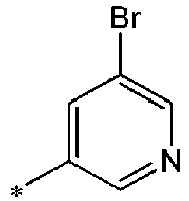
H tert-Butyl 2-((((9H-fluoren-9-yl)methoxy) carbonyl)(methyl)amino)-3-(5-bromopyridinn-3-yl)propanoate 5-51 Fmoc Me 1 tBu 
H tert-Butyl 2-((((9H-fluoren-9-yl)methoxy) carbonyl)(methyl)amino)-3-(5-iodopyridin-3-yl)propanoate 5-52 Fmoc Me 1 tBu 
H tert-Butyl 2-((((9H-fluoren-9-yl)methoxy) carbonyl)(methyl)amino)-3-(2-(methylamino)pyridin-4-yl)propanoate 5-53 Fmoc Me 1 tBu 
H tert-Butyl 2-((((9H-fluoren-9-yl)methoxy) carbonyl)(methyl)amino)-3-(2-(dimethylamino)pyridin-4-yl)propanoate 5-54 Fmoc Me 1 tBu 
H tert-Butyl 2-((((9H-fluoren-9-yl)methoxy) carbonyl)(methyl)amino)-3-(pyrimidin-5-yl)propanoate [Table 6] Compound ID R1 R2 n R3 R6 R7 Compound Name 6-1 Fmoc H 2 H 
H 2-((((9H-Fluoren-9-yl)methoxy)carbonyl) amino)-4-phenylbutanoic acid 6-2 Fmoc H 2 H 
H 2-((((9H-Fluoren-9-yl)methoxy)carbonyl) amino)-4-(o-tolyl)butanoic acid 6-3 Fmoc H 2 H 
H 2-((((9H-Fluoren-9-yl)methoxy)carbonyl) amino)-4-(m-tolyl)butanoic acid 6-4 Fmoc H 2 H 
H 2-((((9H-Fluoren-9-yl)methoxy)carbonyl) amino)-4-(p-tolyl)butanoic acid 6-5 Fmoc H 2 H 
H 2-((((9H-Fluoren-9-yl)methoxy)carbonyl) amino)-4-(4-ethylphenyl)butanoic acid 6-6 Fmoc H 2 H 
H 2-((((9H-Fluoren-9-yl)methoxy)carbonyl) amino)-4-(2-chlorophenyl)butanoic acid 6-7 Fmoc H 2 H 
H 2-((((9H-Fluoren-9-yl)methoxy)carbonyl) amino)-4-(3-chlorophenyl)butanoic acid 6-8 Fmoc H 2 H 
H 2-((((9H-Fluoren-9-yl)methoxy)carbonyl) amino)-4-(4-chlorophenyl)butanoic acid 6-9 Fmoc H 2 H 
H 2-((((9H-Fluoren-9-yl)methoxy)carbonyl) amino)-4-(2-fluorophenyl)butanoic acid 6-10 Fmoc H 2 H 
H 2-((((9H-Fluoren-9-yl)methoxy)carbonyl) amino)-4-(3-fluorophenyl)butanoic acid 6-11 Fmoc H 2 H 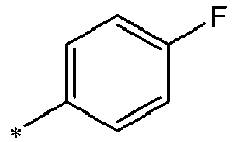
H 2-((((9H-Fluoren-9-yl)methoxy)carbonyl) amino)-4-(4-fluorophenyl)butanoic acid 6-12 Fmoc H 2 H 
H 2-((((9H-Fluoren-9-yl)methoxy)carbonyl) amino)-4-(2-cyclopropylphenyl)butanoic acid 6-13 Fmoc H 2 H 
H 2-((((9H-Fluoren-9-yl)methoxy)carbonyl) amino)-4-(3-cyclopropylphenyl)butanoic acid 6-14 Fmoc H 2 H 
H 2-((((9H-Fluoren-9-yl)methoxy)carbonyl) amino)-4-(4-cyclopropylphenyl)butanoic acid 6-15 Fmoc H 2 H 
H 2-((((9H-Fluoren-9-yl)methoxy)carbonyl) amino)-4-(2-(trifluoromethyl)phenyl) butanoic acid 6-16 Fmoc H 2 H 
H 2-((((9H-Fluoren-9-yl)methoxy)carbonyl) amino)-4-(3-(trifluoromethyl)phenyl) butanoic acid 6-17 Fmoc H 2 H 
H 2-((((9H-Fluoren-9-yl)methoxy)carbonyl) amino)-4-(4-(trifluoromethyl)phenyl) butanoic acid 6-18 Fmoc H 2 H 
H 2-((((9H-Fluoren-9-yl)methoxy)carbonyl) amino)-4-(2-isopropylphenyl)butanoic acid 6-19 Fmoc H 2 H 
H 2-((((9H-Fluoren-9-yl)methoxy)carbonyl) amino)-4-(3-isopropylphenyl)butanoic acid 6-20 Fmoc H 2 H 
H 2-((((9H-Fluoren-9-yl)methoxy)carbonyl) amino)-4-(4-isopropylphenyl)butanoic acid 6-21 Fmoc H 2 H 
H 2-((((9H-Fluoren-9-yl)methoxy)carbonyl) amino)-4-(2-methoxyphenyl)butanoic acid 6-22 Fmoc H 2 H 
H 2-((((9H-Fluoren-9-yl)methoxy)carbonyl) amino)-4-(3-methoxyphenyl)butanoic acid 6-23 Fmoc H 2 H 
H 2-((((9H-Fluoren-9-yl)methoxy)carbonyl) amino)-4-(4-methoxyphenyl)butanoic acid 6-24 Fmoc H 2 H 
H 2-((((9H-Fluoren-9-yl)methoxy)carbonyl) amino)-4-(2-(allyloxy)phenyl)butanoic acid 6-25 Fmoc H 2 H 
H 2-((((9H-Fluoren-9-yl)methoxy)carbonyl) amino)-4-(3-(allyloxy)phenyl)butanoic acid 6-26 Fmoc H 2 H 
H 2-((((9H-Fluoren-9-yl)methoxy)carbonyl) amino)-4-(4-(allyloxy)phenyl)butanoic acid 6-27 Fmoc H 2 H 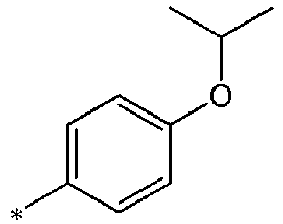
H 2-((((9H-Fluoren-9-yl)methoxy)carbonyl) amino)-4-(4-isopropoxyphenyl)butanoic acid 6-28 Fmoc H 2 H 
H 2-((((9H-Fluoren-9-yl)methoxy)carbonyl) amino)-4-(3-fluoro-4-(trifluoromethyl) phenyl)butanoic acid 6-29 Fmoc H 2 H 
H 2-((((9H-Fluoren-9-yl)methoxy)carbonyl) amino)-4-(2-fluoro-4-(trifluoromethyl) phenyl)butanoic acid 6-30 Fmoc H 2 H 
H 2-((((9H-Fluoren-9-yl)methoxy)carbonyl) amino)-4-(3,4-dimethoxyphenyl)butanoic acid 6-31 Fmoc H 2 H 
H 2-((((9H-Fluoren-9-yl)methoxy)carbonyl) amino)-4-(2-fluoro-4-methoxyphenyl) butanoic acid 6-32 Fmoc H 2 H 
H 2-((((9H-Fluoren-9-yl)methoxy)carbonyl) amino)-4-(3-fluoro-4-methoxyphenyl) butanoic acid 6-33 Fmoc H 2 H 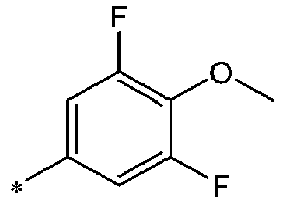
H 2-((((9H-Fluoren-9-yl)methoxy)carbonyl) amino)-4-(3,5-difluoro-4-methoxyphenyl) butanoic acid 6-34 Fmoc H 2 H 
H 2-((((9H-Fluoren-9-yl)methoxy)carbonyl) amino)-4-(3,5-difluoro-4-(trifluoromethyl) phenyl)butanoic acid 6-35 Fmoc H 2 H 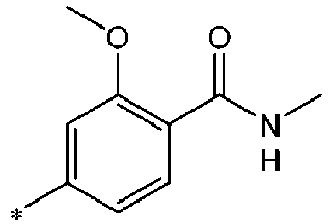
H 2-((((9H-Fluoren-9-yl)methoxy)carbonyl) amino)-4-(3-methoxy-4-(methylcarbamoyl)phenyl)butanoic acid 6-36 Fmoc H 2 H 
H 2-((((9H-Fluoren-9-yl)methoxy)carbonyl) amino)-4-(4-methoxy-3-(methylcarbamoyl)phenyl)butanoic acid 6-37 Fmoc H 2 H 
H 2-((((9H-Fluoren-9-yl)methoxy)carbonyl) amino)-4-(3-methoxy-4-((methylsulfonyl) carbamoyl)phenyl)butanoic acid 6-38 Fmoc H 2 H 
H 2-((((9H-Fluoren-9-yl)methoxy)carbonyl) amino)-4-(4-(methyl((tetrahydro-2H-pyran-2-yl)oxy)carbamoyl)phenyl) butanoic acid 6-39 Fmoc H 2 H 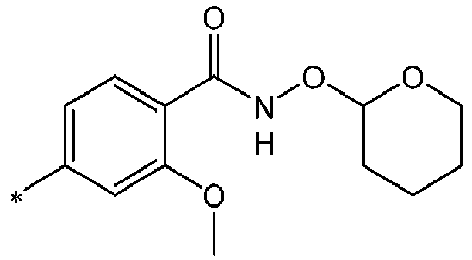
H 2-((((9H-Fluoren-9-yl)methoxy)carbonyl) amino)-4-(3-methoxy-4-(((tetrahydro-2H-pyran-2-yl)oxy)carbamoyl)phenyl) butanoic acid 6-40 Fmoc H 2 H 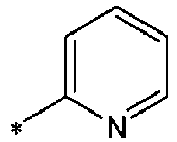
H 2-((((9H-Fluoren-9-yl)methoxy)carbonyl) amino)-4-(pyridin-2-yl)butanoic acid 6-41 Fmoc H 2 H 
H 2-((((9H-Fluoren-9-yl)methoxy)carbonyl) amino)-4-(pyridin-3-yl)butanoic acid 6-42 Fmoc H 2 H 
H 2-((((9H-Fluoren-9-yl)methoxy)carbonyl) amino)-4-(pyridin-4-yl)butanoic acid 6-43 Fmoc H 2 H 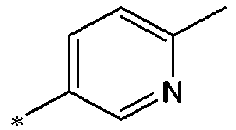
H 2-((((9H-Fluoren-9-yl)methoxy)carbonyl) amino)-4-(6-methylpyridin-3-yl)butanoic acid 6-44 Fmoc H 2 H 
H 2-((((9H-Fluoren-9-yl)methoxy)carbonyl) amino)-4-(5-methyipyridin-3-yl)butanoic acid 6-45 Fmoc H 2 H 
H 2-((((9H-Fluoren-9-yl)methoxy)carbonyl) amino)-4-(4-methylpyridin-3-yl)butanoic acid 6-46 Fmoc H 2 H 
H 2-((((9H-Fluoren-9-yl)methoxy)carbonyl) amino)-4-(6-methoxypyridin-3-yl)butanoic acid 6-47 Fmoc H 2 H 
H 2-((((9H-Fluoren-9-yl)methoxy)carbonyl) amino)-4-(5-methoxypyridin-3-yl)butanoic acid 6-48 Fmoc H 2 H 
H 2-((((9H-Fluoren-9-yl)methoxy)carbonyl) amino)-4-(5-fluoropyridin-3-yl)butanoic acid 6-49 Fmoc H 2 H 
H 2-((((9H-Fluoren-9-yl)methoxy)carbonyl) amino)-4-(5-chloropyridin-3-yl)butanoic acid 6-50 Fmoc H 2 H 
H 2-((((9H-Fluoren-9-yl)methoxy)carbonyl) amino)-4-(5-bromopyridin-3-yl)butanoic acid 6-51 Fmoc H 2 H 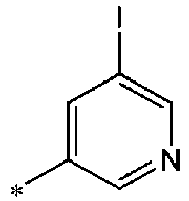
H 2-((((9H-Fluoren-9-yl)methoxy)carbonyl) amino)-4-(5-iodopyridin-3-yl)butanoic acid 6-52 Fmoc H 2 H 
H 2-((((9H-Fluoren-9-yl)methoxy)carbonyl) amino)-4-(2-(methylamino)pyridin-4-yl) butanoic acid 6-53 Fmoc H 2 H 
H 2-((((9H-Fluoren-9-yl)methoxy)carbonyl) amino)-4-(2-(dimethylamino)pyridin-4-yl) butanoic acid 6-54 Fmoc H 2 H 
H 2-((((9H-Fluoren-9-yl)methoxy)carbonyl) amino)-4-(pyrimidin-5-yl)butanoic acid [Table 7] Compound ID R1 R2 n R3 R6 R7 Compound Name 7-1 Fmoc Me 2 H 
H 2-((((9H-Fluoren-9-yl)methoxy)carbonyl) (methyl)amino)-4-phenylbutanoic acid 7-2 Fmoc Me 2 H 
H 2-((((9H-Fluoren-9-yl)methoxy)carbonyl) (methyl)amino)-4-(o-tolyl)butanoic acid 7-3 Fmoc Me 2 H 
H 2-((((9H-Fluoren-9-yl)methoxy)carbonyl) (methyl)amino)-4-(m-tolyl)butanoic acid 7-4 Fmoc Me 2 H 
H 2-((((9H-Fluoren-9-yl)methoxy)carbonyl) (methyl)amino)-4-(p-tolyl)butanoic acid 7-5 Fmoc Me 2 H 
H 2-((((9H-Fluoren-9-yl)methoxy)carbonyl) (methyl)amino)-4-(4-ethylphenyl)butanoic acid 7-6 Fmoc Me 2 H 
H 2-((((9H-Fluoren-9-yl)methoxy)carbonyl) (methyl)amino)-4-(2-chlorophenyl) butanoic acid 7-7 Fmoc Me 2 H 
H 2-((((9H-Fluoren-9-yl)methoxy)carbonyl) (methyl)amino)-4-(3-chlorophenyl) butanoic acid 7-8 Fmoc Me 2 H 
H 2-((((9H-Fluoren-9-yl)methoxy)carbonyl) (methyl)amino)-4-(4-chlorophenyl) butanoic acid 7-9 Fmoc Me 2 H 
H 2-((((9H-Fluoren-9-yl)methoxy)carbonyl) (methyl)amino)-4-(2-fluorophenyl) butanoic acid 7-10 Fmoc Me 2 H 
H 2-((((9H-Fluoren-9-yl)methoxy)carbonyl) (methyl)amino)-4-(3-fluorophenyl) butanoic acid 7-11 Fmoc Me 2 H 
H 2-((((9H-Fluoren-9-yl)methoxy)carbonyl) (methyl)amino)-4-(4-fluorophenyl)butanoic acid 7-12 Fmoc Me 2 H 
H 2-((((9H-Fluoren-9-yl)methoxy)carbonyl) (methyl)amino)-4-(2-cyclopropylphenyl) butanoic acid 7-13 Fmoc Me 2 H 
H 2-((((9H-Fluoren-9-yl)methoxy)carbonyl) (methyl)amino)-4-(3-cyclopropylphenyl) butanoic acid 7-14 Fmoc Me 2 H 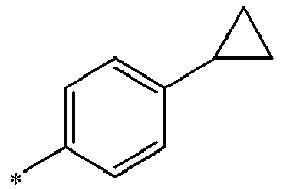
H 2-((((9H-Fluoren-9-yl)methoxy)carbonyl) (methyl)amino)-4-(4-cyclopropylphenyl) butanoic acid 7-15 Fmoc Me 2 H 
H 2-((((9H-Fluoren-9-yl)methoxy)carbonyl) (methyl)amino)-4-(2-(trifluoromethyl) phenyl)butanoic acid 7-16 Fmoc Me 2 H 
H 2-((((9H-Fluoren-9-yl)methoxy)carbonyl) (methyl)amino)-4-(3-(trifluoromethyl) phenyl)butanoic acid 7-17 Fmoc Me 2 H 
H 2-((((9H-Fluoren-9-yl)methoxy)carbonyl) (methyl)amino)-4-(4-(trifluoromethyl) phenyl)butanoic acid 7-18 Fmoc Me 2 H 
H 2-((((9H-Fluoren-9-yl)methoxy)carbonyl) (methyl)amino)-4-(2-isopropylphenyl) butanoic acid 7-19 Fmoc Me 2 H 
H 2-((((9H-Fluoren-9-yl)methoxy)carbonyl) (methyl)amino)-4-(3-isopropylphenyl) butanoic acid 7-20 Fmoc Me 2 H 
H 2-((((9H-Fluoren-9-yl)methoxy)carbonyl) (methyl)amino)-4-(4-isopropylphenyl) butanoic acid 7-21 Fmoc Me 2 H 
H 2-((((9H-Fluoren-9-yl)methoxy)carbonyl) (methyl)amino)-4-(2-methoxyphenyl) butanoic acid 7-22 Fmoc Me 2 H 
H 2-((((9H-Fluoren-9-yl)methoxy)carbonyl) (methyl)amino)-4-(3-methoxyphenyl) butanoic acid 7-23 Fmoc Me 2 H 
H 2-((((9H-Fluoren-9-yl)methoxy)carbonyl) (methyl)amino)-4-(4-methoxyphenyl) butanoic acid 7-24 Fmoc Me 2 H 
H 2-((((9H-Fluoren-9-yl)methoxy)carbonyl) (methyl)amino)-4-(2-(allyloxy)phenyl) butanoic acid 7-25 Fmoc Me 2 H 
H 2-((((9H-Fluoren-9-yl)methoxy)carbonyl) (methyl)amino)-4-(3-(allyloxy)phenyl) butanoic acid 7-26 Fmoc Me 2 H 
H 2-((((9H-Fluoren-9-yl)methoxy)carbonyl) (methyl)amino)-4-(4-(allyloxy)phenyl) butanoic acid 7-27 Fmoc Me 2 H 
H 2-((((9H-Fluoren-9-yl)methoxy)carbonyl) (methyl)amino)-4-(4-isopropoxyphenyl) butanoic acid 7-28 Fmoc Me 2 H 
H 2-((((9H-Fluoren-9-yl)methoxy)carbonyl) (methyl)amino)-4-(3-fluoro-4-(trifluoromethyl)phenyl)butanoic acid 7-29 Fmoc Me 2 H 
H 2-((((9H-Fluoren-9-yl)methoxy)carbonyl) (methyl)amino)-4-(2-fluoro-4-(trifluoromethyl)phenyl)butanoic acid 7-30 Fmoc Me 2 H 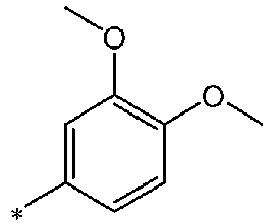
H 2-((((9H-Fluoren-9-yl)methoxy)carbonyl) (methyl)amino)-4-(3,4-dimethoxyphenyl) butanoic acid 7-31 Fmoc Me 2 H 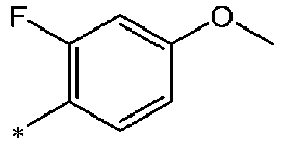
H 2-((((9H-Fluoren-9-yl)methoxy)carbonyl) (methyl)amino)-4-(2-fluoro-4-methoxyphenyl)butanoic acid 7-32 Fmoc Me 2 H 
H 2-((((9H-Fluoren-9-yl)methoxy)carbonyl) (methyl)amino)-4-(3-fluoro-4-methoxyphenyl)butanoic acid 7-33 Fmoc Me 2 H 
H 2-((((9H-Fluoren-9-yl)methoxy)carbonyl) (methyl)amino)-4-(3,5-difluoro-4-methoxyphenyl)butanoic acid 7-34 Fmoc Me 2 H 
H 2-((((9H-Fluoren-9-yl)methoxy)carbonyl) (methyl)amino)-4-(3,5-difluoro-4-(trifluoromethyl)phenyl)butanoic acid 7-35 Fmoc Me 2 H 
H 2-((((9H-Fluoren-9-yl)methoxy)carbonyl) (methyl)amino)-4-(3-methoxy-4-(methylcarbamoyl)phenyl)butanoic acid 7-36 Fmoc Me 2 H 
H 2-((((9H-Fluoren-9-yl)methoxy)carbonyl) (methyl)amino)-4-(4-methoxy-3-(methylcarbamoyl)phenyl)butanoic acid 7-37 Fmoc Me 2 H 
H 2-((((9H-Fluoren-9-yl)methoxy)carbonyl) (methyl)amino)-4-(3-methoxy-4-((methylsulfonyl)carbamoyl)phenyl) butanoic acid 7-38 Fmoc Me 2 H 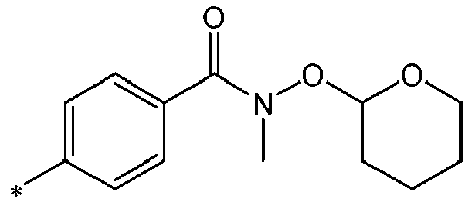
H 2-((((9H-Fluoren-9-yl)methoxy)carbonyl) (methyl)amino)-4-(4-(methyl((tetrahydro-2H-pyran-2-yl)oxy) carbamoyl)phenyl)butanoic acid 7-39 Fmoc Me 2 H 
H 2-((((9H-Fluoren-9-yl)methoxy)carbonyl) (methyl)amino)-4-(3-methoxy-4-(((tetrahydro-2H-pyran-2-yl)oxy) carbamoyl)phenyl)butanoic acid 7-40 Fmoc Me 2 H 
H 2-((((9H-Fluoren-9-yl)methoxy)carbonyl) (methyl)amino)-4-(pyridin-2-yl)butanoic acid 7-41 Fmoc Me 2 H 
H 2-((((9H-Fluoren-9-yl)methoxy)carbonyl) (methyl)amino)-4-(pyridin-3-yl)butanoic acid 7-42 Fmoc Me 2 H 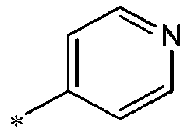
H 2-((((9H-Fluoren-9-yl)methoxy)carbonyl) (methyl)amino)-4-(pyridin-4-yl)butanoic acid 7-43 Fmoc Me 2 H 
H 2-((((9H-Fluoren-9-yl)methoxy)carbonyl) (methyl)amino)-4-(6-methylpyridin-3-yl) butanoic acid 7-44 Fmoc Me 2 H 
H 2-((((9H-Fluoren-9-yl)methoxy)carbonyl) (methyl)amino)-4-(5-methylpyridin-3-yl) butanoic acid 7-45 Fmoc Me 2 H 
H 2-((((9H-Fluoren-9-yl)methoxy)carbonyl) (methyl)amino)-4-(4-methylpyridin-3-yl) butanoic acid 7-46 Fmoc Me 2 H 
H 2-((((9H-Fluoren-9-yl)methoxy)carbonyl) (methyl)amino)-4-(6-methoxypyridin-3-yl) butanoic acid 7-47 Fmoc Me 2 H 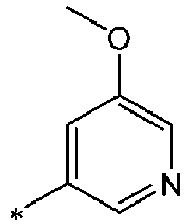
H 2-((((9H-Fluoren-9-yl)methoxy)carbonyl) (methyl)amino)-4-(5-methoxypyridin-3-yl) butanoic acid 7-48 Fmoc Me 2 H 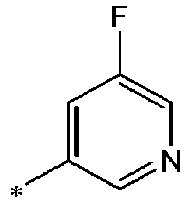
H 2-((((9H-Fluoren-9-yl)methoxy)carbonyl) (methyl)amino)-4-(5-fluoropyridin-3-yl) butanoic acid 7-49 Fmoc Me 2 H 
H 2-((((9H-fluoren-9-yl)methoxy)carbonyl) (methyl)amino)-4-(5-chloropyridin-3-yl) butanoic acid 7-50 Fmoc Me 2 H 
H 2-((((9H-Fluoren-9-yl)methoxy)carbonyl) (methyl)amino)-4-(5-bromopyridin-3-yl) butanoic acid 7-51 Fmoc Me 2 H 
H 2-((((9H-Fluoren-9-yl)methoxy)carbonyl) (methyl)amino)-4-(5-iodopyridin-3-yl) butanoic acid 7-52 Fmoc Me 2 H 
H 2-((((9H-Fluoren-9-yl)methoxy)carbonyl) (methyl)amino)-4-(2-(methylamino) pyridin-4-yl)butanoic acid 7-53 Fmoc Me 2 H 
H 2-((((9H-Fluoren-9-yl)methoxy)carbonyl) (methyl)amino)-4-(2-(dimethylamino) pyridin-4-yl)butanoic acid 7-54 Fmoc Me 2 H 
H 2-((((9H-Fluoren-9-yl)methoxy)carbonyl) (methyl)amino)-4-(pyrimidin-5-yl)butanoic acid [Table 8] Compound ID R1 R2 n R3 R6 R7 Compound Name 8-1 Fmoc H 1 H 
H (((9H-Fluoren-9-yl)methoxy)carbonyl) phenylalanine 8-2 Fmoc H 1 H 
H 2-((((9H-Fluoren-9-yl)methoxy)carbonyl) amino)-3-(o-tolyl)propanoic acid 8-3 Fmoc H 1 H 
H 2-((((9H-Fluoren-9-yl)methoxy)carbonyl) amino)-3-(m-tolyl)propanoic acid 8-4 Fmoc H 1 H 
H 2-((((9H-Fluoren-9-yl)methoxy)carbonyl) amino)-3-(p-tolyl)propanoic acid 8-5 Fmoc H 1 H 
H 2-((((9H-Fluoren-9-yl)methoxy)carbonyl) amino)-3-(4-ethylphenyl)propanoic acid 8-6 Fmoc H 1 H 
H 2-((((9H-Fluoren-9-yl)methoxy)carbonyl) amino)-3-(2-chlorophenyl)propanoic acid 8-7 Fmoc H 1 H 
H 2-((((9H-Fluoren-9-yl)methoxy)carbonyl) amino)-3-(3-chlorophenyl)propanoic acid 8-8 Fmoc H 1 H 
H 2-((((9H-Fluoren-9-yl)methoxy)carbonyl) amino)-3-(4-chlorophenyl)propanoic acid 8-9 Fmoc H 1 H 
H 2-((((9H-Fluoren-9-yl)methoxy)carbonyl) amino)-3-(2-fluorophenyl)propanoic acid 8-10 Fmoc H 1 H 
H 2-((((9H-Fluoren-9-yl)methoxy)carbonyl) amino)-3-(3-fluorophenyl)propanoic acid 8-11 Fmoc H 1 H 
H 2-((((9H-Fluoren-9-yl)methoxy)carbonyl) amino)-3-(4-fluorophenyl)propanoic acid 8-12 Fmoc H 1 H 
H 2-((((9H-Fluoren-9-yl)methoxy)carbonyl) amino)-3-(2-cyclopropylphenyl)propanoic acid 8-13 Fmoc H 1 H 
H 2-((((9H-Fluoren-9-yl)methoxy)carbonyl) amino)-3-(3-cyclopropylphenyl)propanoic acid 8-14 Fmoc H 1 H 
H 2-((((9H-Fluoren-9-yl)methoxy)carbonyl) amino)-3-(4-cyclopropylphenyl)propanoic acid 8-15 Fmoc H 1 H 
H 2-((((9H-Fluoren-9-yl)methoxy)carbonyl) amino)-3-(2-(trifluoromethyl)phenyl) propanoic acid 8-16 Fmoc H 1 H 
H 2-((((9H-Fluoren-9-yl)methoxy)carbonyl) amino)-3-(3-(trifluoromethyl)phenyl) propanoic acid 8-17 Fmoc H 1 H 
H 2-((((9H-Fluoren-9-yl)methoxy)carbonyl) amino)-3-(4-(trifluoromethyl)phenyl) propanoic acid 8-18 Fmoc H 1 H 
H 2-((((9H-Fluoren-9-yl)methoxy)carbonyl) amino)-3-(2-isopropylphenyl)propanoic acid 8-19 Fmoc H 1 H 
H 2-((((9H-Fluoren-9-yl)methoxy)carbonyl) amino)-3-(3-isopropylphenyl)propanoic acid 8-20 Fmoc H 1 H 
H 2-((((9H-Fluoren-9-yl)methoxy)carbonyl) amino)-3-(4-isopropylphenyl)propanoic acid 8-21 Fmoc H 1 H 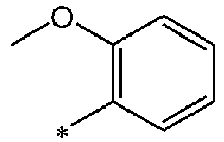
H 2-((((9H-Fluoren-9-yl)methoxy)carbonyl) amino)-3-(2-methoxyphenyl)propanoic acid 8-22 Fmoc H 1 H 
H 2-((((9H-Fluoren-9-yl)methoxy)carbonyl) amino)-3-(3-methoxyphenyl)propanoic acid 8-23 Fmoc H 1 H 
H 2-((((9H-Fluoren-9-yl)methoxy)carbonyl) amino)-3-(4-methoxyphenyl)propanoic acid 8-24 Fmoc H 1 H 
H 2-((((9H-Fluoren-9-yl)methoxy)carbonyl) amino)-3-(2-(allyloxy)phenyl)propanoic acid 8-25 Fmoc H 1 H 
H 2-((((9H-Fluoren-9-yl)methoxy)carbonyl) amino)-3-(3-(allyloxy)phenyl)propanoic acid 8-26 Fmoc H 1 H 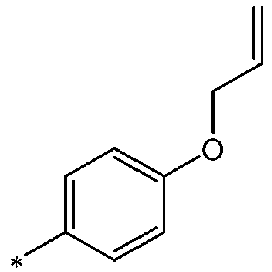
H 2-((((9H-Fluoren-9-yl)methoxy)carbonyl) amino)-3-(4-(allyloxy)phenyl)propanoic acid 8-27 Fmoc H 1 H 
H 2-((((9H-Fluoren-9-yl)methoxy)carbonyl) amino)-3-(4-isopropoxyphenyl)propanoic acid 8-28 Fmoc H 1 H 
H 2-((((9H-Fluoren-9-yl)methoxy)carbonyl) amino)-3-(3-fluoro-4-(trifluoromethyl) phenyl)propanoic acid 8-29 Fmoc H 1 H 
H 2-((((9H-Fluoren-9-yl)methoxy)carbonyl) amino)-3-(2-fluoro-4-(trifluoromethyl) phenyl)propanoic acid 8-30 Fmoc H 1 H 
H 2-((((9H-Fluoren-9-yl)methoxy)carbonyl) amino)-3-(3,4-dimethoxyphenyl) propanoic acid 8-31 Fmoc H 1 H 
H 2-((((9H-Fluoren-9-yl)methoxy)carbonyl) amino)-3-(2-fluoro-4-methoxyphenyl) propanoic acid 8-32 Fmoc H 1 H 
H 2-((((9H-Fluoren-9-yl)methoxy)carbonyl) amino)-3-(3-fluoro-4-methoxyphenyl) propanoic acid 8-33 Fmoc H 1 H 
H 2-((((9H-Fluoren-9-yl)methoxy)carbonyl) amino)-3-(3,5-difluoro-4-methoxyphenyl) propanoic acid 8-34 Fmoc H 1 H 
H 2-((((9H-Fluoren-9-yl)methoxy)carbonyl) amino)-3-(3,5-difluoro-4-(trifluoromethyl) phenyl)propanoic acid 8-35 Fmoc H 1 H 
H 2-((((9H-Fluoren-9-yl)methoxy)carbonyl) amino)-3-(3-methoxy-4-(methylcarbamoyl)phenyl)propanoic acid 8-36 Fmoc H 1 H 
H 2-((((9H-Fluoren-9-yl)methoxy)carbonyl) amino)-3-(4-methoxy-3-(methylcarbamoyl)phenyl)propanoic acid 8-37 Fmoc H 1 H 
H 2-((((9H-Fluoren-9-yl)methoxy)carbonyl) amino)-3-(3-methoxy-4-((methylsulfonyl) carbamoyl)phenyl)propanoic acid 8-38 Fmoc H 1 H 
H 2-((((9H-Fluoren-9-yl)methoxy)carbonyl) amino)-3-(4-(methyl((tetrahydro-2H-pyran-2-yl)oxy)carbamoyl)phenyl) proanoic acid 8-39 Fmoc H 1 H 
H 2-((((9H-Fluoren-9-yl)methoxy)carbonyl) amino)-3-(3-methoxy-4-(((tetrahydro-2H-pyran-2-yl)oxy)carbamoyl)phenyl) propanoic acid 8-40 Fmoc H 1 H 
H 2-((((9H-Fluoren-9-yl)methoxy)carbonyl) amino)-3-(pyridin-2-yl)propanoic acid 8-41 Fmoc H 1 H 
H 2-((((9H-Fluoren-9-yl)methoxy)carbonyl) amino)-3-(pyridin-3-yl)propanoic acid 8-42 Fmoc H 1 H 
H 2-((((9H-Fluoren-9-yl)methoxy)carbonyl) amino)-3-(pyridin-4-yl)propanoic acid 8-43 Fmoc H 1 H 
H 2-((((9H-Fluoren-9-yl)methoxy)carbonyl) amino)-3-(6-methylpyridin-3-yl)propanoic acid 8-44 Fmoc H 1 H 
H 2-((((9H-Fluoren-9-yl)methoxy)carbonyl) amino)-3-(5-methylpyridin-3-yl)propanoic acid 8-45 Fmoc H 1 H 
H 2-((((9H-Fluoren-9-yl)methoxy)carbonyl) amino)-3-(4-methylpyridin-3-yl)propanoic acid 8-46 Fmoc H 1 H 
H 2-((((9H-Fluoren-9-yl)methoxy)carbonyl) amino)-3-(6-methoxypyridin-3-yl) propanoic acid 8-47 Fmoc H 1 H 
H 2-((((9H-Fluoren-9-yl)methoxy)carbonyl) amino)-3-(5-methoxypyridin-3-yl) propanoic acid 8-48 Fmoc H 1 H 
H 2-((((9H-Fluoren-9-yl)methoxy)carbonyl) amino)-3-(5-fluoropyridin-3-yl)propanoic acid 8-49 Fmoc H 1 H 
H 2-((((9H-Fluoren-9-yl)methoxy)carbonyl) amino)-3-(5-chloropyridin-3-yl)propanoic acid 8-50 Fmoc H 1 H 
H 2-((((9H-Fluoren-9-yl)methoxy)carbonyl) amino)-3-(5-bromopyridin-3-yl)propanoic acid 8-51 Fmoc H 1 H 
H 2-((((9H-Fluoren-9-yl)methoxy)carbonyl) amino)-3-(5-iodopyridin-3-yl)propanoic acid 8-52 Fmoc H 1 H 
H 2-((((9H-Fluoren-9-yl)methoxy)carbonyl) amino)-3-(2-(methylamino)pyridin-4-yl) propanoic acid 8-53 Fmoc H 1 H 
H 2-((((9H-Fluoren-9-yl)methoxy)carbonyl) amino)-3-(2-(dimethylamino)pyridin-4-yl) propanoic acid 8-54 Fmoc H 1 H 
H 2-((((9H-Fluoren-9-yl)methoxy)carbonyl) amino)-3-(pyrimidin-5-yl)propanoic acid [Table 9] Compound ID R1 R2 n R3 R6 R7 Compound Name 9-1 Fmoc Me 1 H 
H N-(((9H-Fluoren-9-yl)methoxy)carbonyl)-N-methylphenylalanine 9-2 Fmoc Me 1 H 
H 2-((((9H-Fluoren-9-yl)methoxy)carbonyl) (methyl)amino)-3-(o-tolyl)propanoic acid 9-3 Fmoc Me 1 H 
H 2-((((9H-Fluoren-9-yl)methoxy)carbonyl) (methyl)amino)-3-(m-tolyl)propanoic acid 9-4 Fmoc Me 1 H 
H 2-((((9H-Fluoren-9-yl)methoxy)carbonyl) (methyl)amino)-3-(p-tolyl)propanoic acid 9-5 Fmoc Me 1 H 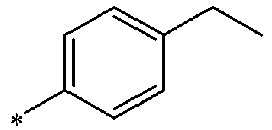
H 2-((((9H-Fluoren-9-yl)methoxy)carbonyl) (methyl)amino)-3-(4-ethylphenyl) propanoic acid 9-6 Fmoc Me 1 H 
H 2-((((9H-Fluoren-9-yl)methoxy)carbonyl) (methyl)amino)-3-(2-chlorophenyl) propanoic acid 9-7 Fmoc Me 1 H 
H 2-((((9H-Fluoren-9-yl)methoxy)carbonyl) (methyl)amino)-3-(3-chlorophenyl) propanoic acid 9-8 Fmoc Me 1 H 
H 2-((((9H-Fluoren-9-yl)methoxy)carbonyl) (methyl)amino)-3-(4-chlorophenyl) propanoic acid 9-9 Fmoc Me 1 H 
H 2-((((9H-Fluoren-9-yl)methoxy)carbonyl) (methyl)amino)-3-(2-fluorophenyl) propanoic acid 9-10 Fmoc Me 1 H 
H 2-((((9H-Fluoren-9-yl)methoxy)carbonyl) (methyl)amino)-3-(3-fluorophenyl) propanoic acid 9-11 Fmoc Me 1 H 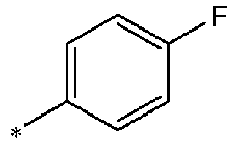
H 2-((((9H-Fluoren-9-yl)methoxy)carbonyl) (methyl)amino)-3-(4-fluorophenyl) propanoic acid 9-12 Fmoc Me 1 H 
H 2-((((9H-Fluoren-9-yl)methoxy)carbonyl) (methyl)amino)-3-(2-cyclopropylphenyl) propanoic acid 9-13 Fmoc Me 1 H 
H 2-((((9H-Fluoren-9-yl)methoxy)carbonyl) (methyl)amino)-3-(3-cyclopropylphenyl) propanoic acid 9-14 Fmoc Me 1 H 
H 2-((((9H-Fluoren-9-yl)methoxy)carbonyl) (methyl)amino)-3-(4-cyclopropylphenyl) propanoic acid 9-15 Fmoc Me 1 H 
H 2-((((9H-Fluoren-9-yl)methoxy)carbonyl) (methyl)amino)-3-(2-(trifluoromethyl) phenyl)propanoic acid 9-16 Fmoc Me 1 H 
H 2-((((9H-Fluoren-9-yl)methoxy)carbonyl) (methyl)amino)-3-(3-(trifluoromethyl) phenyl)propanoic acid 9-17 Fmoc Me 1 H 
H 2-((((9H-Fluoren-9-yl)methoxy)carbonyl) (methyl)amino)-3-(4-(trifluoromethyl) phenyl)propanoic acid 9-18 Fmoc Me 1 H 
H 2-((((9H-Fluoren-9-yl)methoxy)carbonyl) (methyl)amino)-3-(2-isopropylphenyl) propanoic acid 9-19 Fmoc Me 1 H 
H 2-((((9H-Fluoren-9-yl)methoxy)carbonyl) (methyl)amino)-3-(3-isopropylphenyl) propanoic acid 9-20 Fmoc Me 1 H 
H 2-((((9H-Fluoren-9-yl)methoxy)carbonyl) (methyl)amino)-3-(4-isopropylphenyl) propanoic acid 9-21 Fmoc Me 1 H 
H 2-((((9H-Fluoren-9-yl)methoxy)carbonyl) (methyl)amino)-3-(2-methoxyphenyl) propanoic acid 9-22 Fmoc Me 1 H 
H 2-((((9H-Fluoren-9-yl)methoxy)carbonyl) (methyl)amino)-3-(3-methoxyphenyl) propanoic acid 9-23 Fmoc Me 1 H 
H 2-((((9H-Fluoren-9-yl)methoxy)carbonyl) (methyl)amino)-3-(4-methoxyphenyl) propanoic acid 9-24 Fmoc Me 1 H 
H 2-((((9H-Fluoren-9-yl)methoxy)carbonyl) (methyl)amino)-3-(2-(allyloxy)phenyl) propanoic acid 9-25 Fmoc Me 1 H 
H 2-((((9H-Fluoren-9-yl)methoxy)carbonyl) (methyl)amino)-3-(3-(allyloxy)phenyl) propanoic acid 9-26 Fmoc Me 1 H 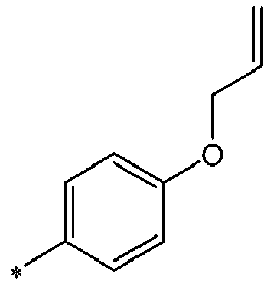
H 2-((((9H-Fluoren-9-yl)methoxy)carbonyl) (methyl)amino)-3-(4-(allyloxy)phenyl) propanoic acid 9-27 Fmoc Me 1 H 
H 2-((((9H-Fluoren-9-yl)methoxy)carbonyl) (methyl)amino)-3-(4-isopropoxyphenyl) propanoic acid 9-28 Fmoc Me 1 H 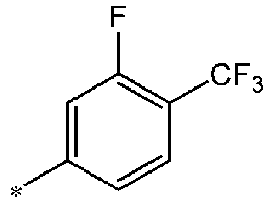
H 2-((((9H-Fluoren-9-yl)methoxy)carbonyl) (methyl)amino)-3-(3-fluoro-4-(trifluoromethyl)phenyl)propanoic acid 9-29 Fmoc Me 1 H 
H 2-((((9H-Fluoren-9-yl)methoxy)carbonyl) (methyl)amino)-3-(2-fluoro-4-(trifluoromethyl)phenyl)propanoic acid 9-30 Fmoc Me 1 H 
H 2-((((9H-Fluoren-9-yl)methoxy)carbonyl) (methyl)amino)-3-(3,4-dimethoxyphenyl) propanoic acid 9-31 Fmoc Me 1 H 
H 2-((((9H-Fluoren-9-yl)methoxy)carbonyl) (methyl)amino)-3-(2-fluoro-4-methoxyphenyl)propanoic acid 9-32 Fmoc Me 1 H 
H 2-((((9H-Fluoren-9-yl)methoxy)carbonyl) (methyl)amino)-3-(3-fluoro-4-methoxyphenyl)propanoic acid 9-33 Fmoc Me 1 H 
H 2-((((9H-Fluoren-9-yl)methoxy)carbonyl) (methyl)amino)-3-(3,5-difluoro-4-methoxyphenyl)propanoic acid 9-34 Fmoc Me 1 H 
H 2-((((9H-Fluoren-9-yl)methoxy)carbonyl) (methyl)amino)-3-(3,S-difluoro-4-(trifluoromethyl)phenyl)propanoic acid 9-35 Fmoc Me 1 H 
H 2-((((9H-Fluoren-9-yl)methoxy)carbonyl) (methyl)amino)-3-(3-methoxy-4-(methylcarbamoyl)phenyl)propanoic acid 9-36 Fmoc Me 1 H 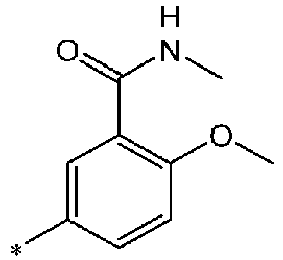
H 2-((((9H-Fluoren-9-yl)methoxy)carbonyl) (methyl)amino)-3-(4-methoxy-3-(methylcarbamoyl)phenyl)propanoic acid 9-37 Fmoc Me 1 H 
H 2-((((9H-Fluoren-9-yl)methoxy)carbonyl) (methyl)amino)-3-(3-methoxy-4-((methylsulfonyl)carbamoyl)phenyl) propanoic acid 9-38 Fmoc Me 1 H 
H 2-((((9H-Fluoren-9-yl)methoxy)carbonyl) (methyl)amino)-3-(4-(methyl((tetrahydro-2H-pyran-2-yl)oxy) carbamoyl)phenyl)propanoic acid 9-39 Fmoc Me 1 H 
H 2-((((9H-Fluoren-9-yl)methoxy)carbonyl) (methyl)amino)-3-(3-methoxy-4-(((tetrahydro-2H-pyran-2-yl)oxy) carbamoyl)phenyl)propanoic acid 9-40 Fmoc Me 1 H 
H 2-((((9H-Fluoren-9-yl)methoxy)carbonyl) (methyl)amino)-3-(pyridin-2-yl)propanoic acid 9-41 Fmoc Me 1 H 
H 2-((((9H-Fluoren-9-yl)methoxy)carbonyl) (methyl)amino)-3-(pyridin-3-yl)propanoic acid 9-42 Fmoc Me 1 H 
H 2-((((9H-Fluoren-9-yl)methoxy)carbonyl) (methyl)amino)-3-(pyridin-4-yl)propanoic acid 9-43 Fmoc Me 1 H 
H 2-((((9H-Fluoren-9-yl)methoxy)carbonyl) (methyl)amino)-3-(6-methylpyridin-3-yl) propanoic acid 9-44 Fmoc Me 1 H 
H 2-((((9H-Fluoren-9-yl)methoxy)carbonyl) (methyl)amino)-3-(5-methylpyridin-3-yl) propanoic acid 9-45 Fmoc Me 1 H 
H 2-((((9H-Fluoren-9-yl)methoxy)carbonyl) (methyl)amino)-3-(4-methylpyridin-3-yl) propanoic acid 9-46 Fmoc Me 1 H 
H 2-((((9H-Fluoren-9-yl)methoxy)carbonyl) (methyl)amino)-3-(6-methoxypyridin-3-yl) propanoic acid 9-47 Fmoc Me 1 H 
H 2-((((9H-Fluoren-9-yl)methoxy)carbonyl) (methyl)amino)-3-(5-methoxypyridin-3-yl) propanoic acid 9-48 Fmoc Me 1 H 
H 2-((((9H-Fluoren-9-yl)methoxy)carbonyl) (methyl)amino)-3-(5-fluoropyridin-3-yl) propanoic acid 9-49 Fmoc Me 1 H 
H 2-((((9H-Fluoren-9-yl)methoxy)carbonyl) (methyl)amino)-3-(5-chloropyridin-3-yl) propanoic acid 9-50 Fmoc Me 1 H 
H 2-((((9H-Fluoren-9-yl)methoxy)carbonyl) (methyl)amino)-3-(5-bromopyridin-3-yl) propanoic acid 9-51 Fmoc Me 1 H 
H 2-((((9H-Fluoren-9-yl)methoxy)carbonyl) (methyl)amino)-3-(5-iodopyridin-3-yl) propanoic acid 9-52 Fmoc Me 1 H 
H 2-((((9H-Fluoren-9-yl)methoxy)carbonyl) (methyl)amino)-3-(2-(methylamino) pyridin-4-yl)propanoic acid 9-53 Fmoc Me 1 H 
H 2-((((9H-Fluoren-9-yl)methoxy)carbonyl) (methyl)amino)-3-(2-(dimethylamino) pyridin-4-yl)propanoic acid 9-54 Fmoc Me 1 H 
H 2-((((9H-Fluoren-9-yl)methoxy)carbonyl) (methyl)amino)-3-(pyrimidin-5-yl) propanoic acid [Table 10] Compound ID R1 R2 n R3 R6 R7 Compound Name 10-1 H H 2 H 
H 2-Amino-4-phenylbutanoic acid 10-2 H H 2 H 
H 2-Amino-4-(o-tolyl)butanoic acid 10-3 H H 2 H 
H 2-Amino-4-(m-tolyl)butanoic acid 10-4 H H 2 H 
H 2-Amino-4-(p-tolyl)butanoic acid 10-5 H H 2 H 
H 2-Amino-4-(4-ethylphenyl)butanoic acid 10-6 H H 2 H 
H 2-Amino-4-(2-chlorophenyl)butanoic acid 10-7 H H 2 H 
H 2-Amino-4-(3-chlorophenyl)butanoic acid 10-8 H H 2 H 
H 2-Amino-4-(4-chlorophenyl)butanoic acid 10-9 H H 2 H 
H 2-Amino-4-(2-fluorophenyl)butanoic acid 10-10 H H 2 H 
H 2-Am ino-4-(3-fluorophenyl)butanoic acid 10-11 H H 2 H 
H 2-Amino-4-(4-fluorophenyl)butanoic acid 10-12 H H 2 H 
H 2-Amino-4-(2-cyclopropylphenyl)butanoic acid 10-13 H H 2 H 
H 2-Amino-4-(3-cyclopropylphenyl)butanoic acid 10-14 H H 2 H 
H 2-Amino-4-(4-cyclopropylphenyl)butanoic acid 10-15 H H 2 H 
H 2-Amino-4-(2-(trifluoromethyl)phenyl) butanoic acid 10-16 H H 2 H 
H 2-Amino-4-(3-(trifluoromethyl)phenyl) butanoic acid 10-17 H H 2 H 
H 2-Amino-4-(4-(trifluoromethyl)phenyl) butanoic acid 10-18 H H 2 H 
H 2-Amino-4-(2-isopropylphenyl)butanoic acid 10-19 H H 2 H 
H 2-Amino-4-(3-isopropylphenyl)butanoic acid 10-20 H H 2 H 
H 2-Amino-4-(4-isopropylphenyl)butanoic acid 10-21 H H 2 H 
H 2-Amino-4-(2-methoxyphenyl)butanoic acid 10-22 H H 2 H 
H 2-Amino-4-(3-methoxyphenyl)butanoic acid 10-23 H H 2 H 
H 2-Amino-4-(4-methoxyphenyl)butanoic acid 10-24 H H 2 H 
H 2-Amino-4-(2-(allyloxy)phenyl)butanoic acid 10-25 H H 2 H 
H 2-Amino-4-(3-(allyloxy)phenyl)butanoic acid 10-26 H H 2 H 
H 2-Amino-4-(4-(allyloxy)phenyl)butanoic acid 10-27 H H 2 H 
H 2-Amino-4-(4-isopropoxyphenyl)butanoic acid 10-28 H H 2 H 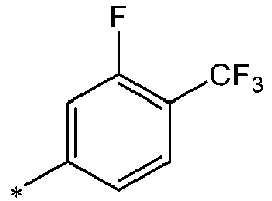
H 2-Am ino-4-(3-fluoro-4-(trifluoromethyl) phenyl)butanoic acid 10-29 H H 2 H 
H 2-Amino-4-(2-fluoro-4-(trifluoromethyl) phenyl)butanoic acid 10-30 H H 2 H 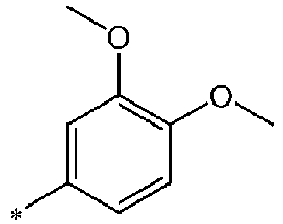
H 2-Amino-4-(3,4-dimethoxyphenyl) butanoic acid 10-31 H H 2 H 
H 2-Am ino-4-(2-fluoro-4-methoxyphenyl) butanoic acid 10-32 H H 2 H 
H 2-Amino-4-(3-fluoro-4-methoxyphenyl) butanoic acid 10-33 H H 2 H 
H 2-Amino-4-(3,5-difluoro-4-methoxyphenyl)butanoic acid 10-34 H H 2 H 
H 2-Amino-4-(3,5-difluoro-4-(trifluoromethyl)phenyl)butanoic acid 10-35 H H 2 H 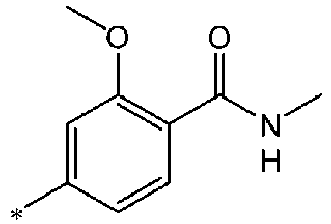
H 2-Amino-4-(3-methoxy-4-(methylcarbamoyl)phenyl)butanoic acid 10-36 H H 2 H 
H 2-Amino-4-(4-methoxy-3-(methylcarbamoyl)phenyl)butanoic acid 10-37 H H 2 H 
H 2-Ami no-4-(3-methoxy-4-((methylsulfonyl)carbamoyl)phenyl) butanoic acid 10-38 H H 2 H 
H 2-Amino-4-(4-(methyl((tetrahydro-2H-pyran-2-yl)oxy)carbamoyl)phenyl) butanoic acid 10-39 H H 2 H 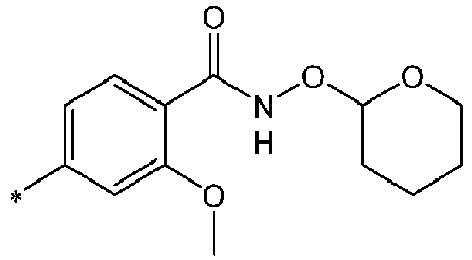
H 2-Amino-4-(3-methoxy-4-(((tetrahydro-2H-pyran-2-yl)oxy) carbamoyl)phenyl)butanoic acid 10-40 H H 2 H 
H 2-Amino-4-(pyridin-2-yl)butanoic acid 10-41 H H 2 H 
H 2-Amino-4-(pyridin-3-yl)butanoic acid 10-42 H H 2 H 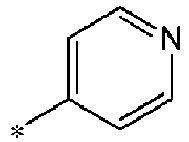
H 2-Amino-4-(pyridin-4-yl)butanoic acid 10-43 H H 2 H 
H 2-Amino-4-(6-methylpyridin-3-yl)butanoic acid 10-44 H H 2 H 
H 2-Amino-4-(5-methylpyridin-3-yl)butanoic acid 10-45 H H 2 H 
H 2-Amino-4-(4-methylpyridin-3-yl)butanoic acid 10-46 H H 2 H 
H 2-Amino-4-(6-methoxypyridin-3-yl) butanoic acid 10-47 H H 2 H 
H 2-Amino-4-(5-methoxypyridin-3-yl) butanoic acid 10-48 H H 2 H 
H 2-Amino-4-(5-fluoropyridin-3-yl)butanoic acid 10-49 H H 2 H 
H 2-Amino-4-(5-chloropyridin-3-yl)butanoic acid 10-50 H H 2 H 
H 2-Amino-4-(5-bromopyridin-3-yl)butanoic acid 10-51 H H 2 H 
H 2-Amino-4-(5-iodopyridin-3-yl)butanoic acid 10-52 H H 2 H 
H 2-Amino-4-(2-(methylamino)pyridin-4-yl) butanoic acid 10-53 H H 2 H 
H 2-Amino-4-(2-(dimethylamino)pyridin-4-yl)butanoic acid 10-54 H H 2 H 
H 2-Amino-4-(pyrimidin-5-yl)butanoic acid [Table 11] Compound ID R1 R2 n R3 R6 R7 Compound Name 11-1 H Me 2 H 
H 2-(Methylamino)-4-phenylbutanoic acid 11-2 H Me 2 H 
H 2-(Methylamino)-4-(o-tolyl)butanoic acid 11-3 H Me 2 H 
H 2-(Methylamino)-4-(m-tolyl)butanoic acid 11-4 H Me 2 H 
H 2-(Methylamino)-4-(p-tolyl)butanoic acid 11-5 H Me 2 H 
H 2-(Methylamino)-4-(4-ethylphenyl) butanoic acid 11-6 H Me 2 H 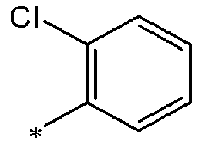
H 2-(Methylamino)-4-(2-chlorophenyl) butanoic acid 11-7 H Me 2 H 
H 2-(Methylamino)-4-(3-chlorophenyl) butanoic acid 11-8 H Me 2 H 
H 2-(Methylamino)-4-(4-chlorophenyl) butanoic acid 11-9 H Me 2 H 
H 2-(Methylamino)-4-(2-fluorophenyl) butanoic acid 11-10 H Me 2 H 
H 2-(Methylamino)-4-(3-fluorophenyl) butanoic acid 11-11 H Me 2 H 
H 2-(Methylamino)-4-(4-fluorophenyl) butanoic acid 11-12 H Me 2 H 
H 2-(Methylamino)-4-(2-cyclopropylphenyl) butanoic acid 11-13 H Me 2 H 
H 2-(Methylamino)-4-(3-cyclopropylphenyl) butanoic acid 11-14 H Me 2 H 
H 2-(Methylamino)-4-(4-cyclopropylphenyl) butanoic acid 11-15 H Me 2 H 
H 2-(Methylamino)-4-(2-(trifluoromethyl) phenyl)butanoic acid 11-16 H Me 2 H 
H 2-(Methylamino)-4-(3-(trifluoromethyl) phenyl)butanoic acid 11-17 H Me 2 H 
H 2-(Methylamino)-4-(4-(trifluoromethyl) phenyl)butanoic acid 11-18 H Me 2 H 
H 2-(Methylamino)-4-(2-isopropylphenyl) butanoic acid 11-19 H Me 2 H 
H 2-(Methylamino)-4-(3-isopropylphenyl) butanoic acid 11-20 H Me 2 H 
H 2-(Methylamino)-4-(4-isopropylphenyl) butanoic acid 11-21 H Me 2 H 
H 2-(Methylamino)-4-(2-methoxyphenyl) butanoic acid 11-22 H Me 2 H 
H 2-(Methylamino)-4-(3-methoxyphenyl) butanoic acid 11-23 H Me 2 H 
H 2-(Methylamino)-4-(4-methoxyphenyl) butanoic acid 11-24 H Me 2 H 
H 2-(Methylamino)-4-(2-(allyloxy)phenyl) butanoic acid 11-25 H Me 2 H 
H 2-(Methylamino)-4-(3-(allyloxy)phenyl) butanoic acid 11-26 H Me 2 H 
H 2-(Methylamino)-4-(4-(allyloxy)phenyl) butanoic acid 11-27 H Me 2 H 
H 2-(Methylamino)-4-(4-isopropoxyphenyl) butanoic acid 11-28 H Me 2 H 
H 2-(Methylamino)-4-(3-fluoro-4-(trifluoromethyl)phenyl)butanoic acid 11-29 H Me 2 H 
H 2-(Methylamino)-4-(2-fluoro-4-(trifluoromethyl)phenyl)butanoic acid 11-30 H Me 2 H 
H 2-(Methylamino)-4-(3,4-dimethoxyphenyl) butanoic acid 11-31 H Me 2 H 
H 2-(Methylamino)-4-(2-fluoro-4-methoxyphenyl)butanoic acid 11-32 H Me 2 H 
H 2-(Methylamino)-4-(3-fluoro-4-methoxyphenyl)butanoic acid 11-33 H Me 2 H 
H 2-(Methylamino)-4-(3,5-difluoro-4-methoxyphenyl)butanoic acid 11-34 H Me 2 H 
H 2-(Methylamino)-4-(3,5-difluoro-4-(trifluoromethyl)phenyl)butanoic acid 11-35 H Me 2 H 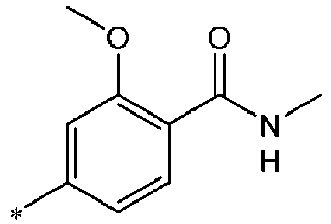
H 2-(Methylamino)-4-(3-methoxy-4-(methylcarbamoyl)phenyl)butanoic acid 11-36 H Me 2 H 
H 2-(Methylamino)-4-(4-methoxy-3-(methylcarbamoyl)phenyl)butanoic acid 11-37 H Me 2 H 
H 2-(Methylamino)-4-(3-methoxy-4-((methylsulfonyl)carbamoyl)phenyl) butanoic acid 11-38 H Me 2 H 
H 2-(Methylamino)-4-(4-(methyl((tetrahydro-2H-pyran-2-yl)oxy) carbamoyl)phenyl)butanoic acid 11-39 H Me 2 H 
H 2-(Methylamino)-4-(3-methoxy-4-((tetrahydro-2H-pyran-2-yl)oxy) carbamoyl)phenyl)butanoic acid 11-40 H Me 2 H 
H 2-(Methylamino)-4-(pyridin-2-yl)butanoic acid 11-41 H Me 2 H 
H 2-(Methylamino)-4-(pyridin-3-yl)butanoic acid 11-42 H Me 2 H 
H 2-(Methylamino)-4-(pyridin-4-yl)butanoic acid 11-43 H Me 2 H 
H 2-(Methylamino)-4-(6-methylpyridin-3-yl) butanoic acid 11-44 H Me 2 H 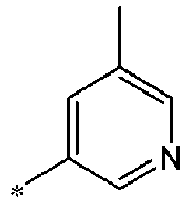
H 2-(Methylamino)-4-(5-methylpyridin-3-yl) butanoic acid 11-45 H Me 2 H 
H 2-(Methylamino)-4-(4-methylpyridin-3-yl) butanoic acid 11-46 H Me 2 H 
H 2-(Methylamino)-4-(6-methoxypyridin-3-yl)butanoic acid 11-47 H Me 2 H 
H 2-(Methylamino)-4-(5-methoxypyridin-3-yl)butanoic acid 11-48 H Me 2 H 
H 2-(Methylamino)-4-(5-fluoropyridin-3-yl) butanoic acid 11-49 H Me 2 H 
H 2-(Methylamino)-4-(5-chloropyridin-3-yl) butanoic acid 11-50 H Me 2 H 
H 2-(Methylamino)-4-(5-bromopyridin-3-yl) butanoic acid 11-51 H Me 2 H 
H 2-(Methylamino)-4-(5-iodopyridin-3-yl) butanoic acid 11-52 H Me 2 H 
H 2-(Methylamino)-4-(2-(methylamino) pyridin-4-yl)butanoic acid 11-53 H Me 2 H 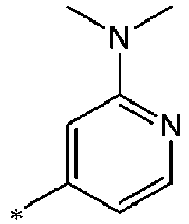
H 2-(Methylamino)-4-(2-(dimethylamino) pyridin-4-yl)butanoic acid 11-54 H Me 2 H 
H 2-(Methylamino)-4-(pyrimidin-5-yl) butanoic acid [Table 12] Compound ID R1 R2 n R3 R6 R7 Compound Name 12-1 H H 1 H 
H Phenylalanine 12-2 H H 1 H 
H 2-Amino-3-(o-tolyl)propanoic acid 12-3 H H 1 H 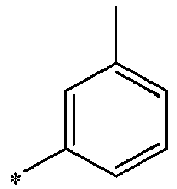
H 2-Amino-3-(m-tolyl)propanoic acid 12-4 H H 1 H 
H 2-Amino-3-(p-tolyl)propanoic acid 12-5 H H 1 H 
H 2-Amino-3-(4-ethylphenyl)propanoic acid 12-6 H H 1 H 
H 2-Amino-3-(2-chlorophenyl)propanoic acid 12-7 H H 1 H 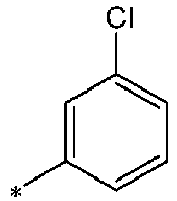
H 2-Amino-3-(3-chlorophenyl)propanoic acid 12-8 H H 1 H 
H 2-Amino-3-(4-chlorophenyl)propanoic acid 12-9 H H 1 H 
H 2-Amino-3-(2-fluorophenyl)propanoic acid 12-10 H H 1 H 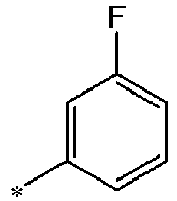
H 2-Amino-3-(3-fluorophenyl)propanoic acid 12-11 H H 1 H 
H 2-Amino-3-(4-fluorophenyl)propanoic acid 12-12 H H 1 H 
H 2-Amino-3-(2-cyclopropylphenyl) propanoic acid 12-13 H H 1 H 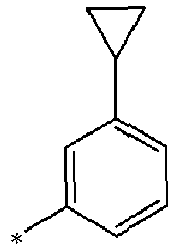
H 2-Amino-3-(3-cyclopropylphenyl) propanoic acid 12-14 H H 1 H 
H 2-Amino-3-(4-cyclopropylphenyl) propanoic acid 12-15 H H 1 H 
H 2-Amino-3-(2-(trifluoromethyl)phenyl) propanoic acid 12-16 H H 1 H 
H 2-Amino-3-(3-(trifluoromethyl)phenyl) propanoic acid 12-17 H H 1 H 
H 2-Amino-3-(4-(trifluoromethyl)phenyl) propanoic acid 12-18 H H 1 H 
H 2-Amino-3-(2-isopropylphenyl)propanoic acid 12-19 H H 1 H 
H 2-Amino-3-(3-isopropylphenyl)propanoic acid 12-20 H H 1 H 
H 2-Amino-3-(4-isopropylphenyl)propanoic acid 12-21 H H 1 H 
H 2-Amino-3-(2-methoxyphenyl)propanoic acid 12-22 H H 1 H 
H 2-Amino-3-(3-methoxyphenyl)propanoic acid 12-23 H H 1 H 
H 2-Amino-3-(4-methoxyphenyl)propanoic acid 12-24 H H 1 H 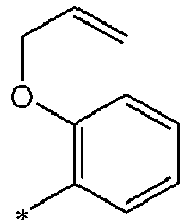
H 2-Amino-3-(2-(allyloxy)phenyl)propanoic acid 12-25 H H 1 H 
H 2-Amino-3-(3-(allyloxy)phenyl)propanoic acid 12-26 H H 1 H 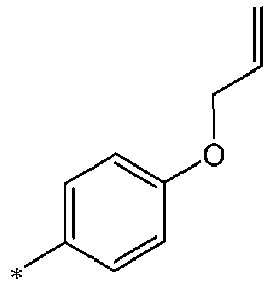
H 2-Amino-3-(4-(allyloxy)phenyl)propanoic acid 12-27 H H 1 H 
H 2-Amino-3-(4-isopropoxyphenyl) propanoic acid 12-28 H H 1 H 
H 2-Amino-3-(3-fluoro-4-(trifluoromethyl) phenyl)propanoic acid 12-29 H H 1 H 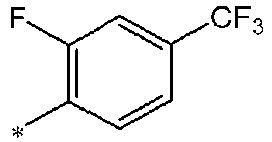
H 2-Amino-3-(2-fluoro-4-(trifluoromethyl) phenyl)propanoic acid 12-30 H H 1 H 
H 2-Amino-3-(3,4-dimethoxyphenyl) propanoic acid 12-31 H H 1 H 
H 2-Amino-3-(2-fluoro-4-methoxyphenyl) propanoic acid 12-32 H H 1 H 
H 2-Amino-3-(3-fluoro-4-methoxyphenyl) propanoic acid 12-33 H H 1 H 
H 2-Amino-3-(3,5-difluoro-4-methoxyphenyl)propanoic acid 12-34 H H 1 H 
H 2-Amino-3-(3,5-difluoro-4-(trifluoromethyl)phenyl)propanoic acid 12-35 H H 1 H 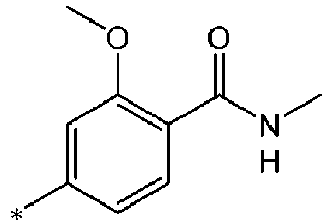
H 2-Amino-3-(3-methoxy-4-(methylcarbamoyl)phenyl)propanoic acid 12-36 H H 1 H 
H 2-Amino-3-(4-methoxy-3-(methylcarbamoyl)phenyl)propanoic acid 12-37 H H 1 H 
H 2-Amino-3-(3-methoxy-4-((methylsulfonyl)carbamoyl)phenyl) propanoic acid 12-38 H H 1 H 
H 2-Amino-3-(4-(methyl((tetrahydro-2H-pyran-2-yl)oxy)carbamoyl)phenyl) propanoic acid 12-39 H H 1 H 
H 2-Amino-3-(3-methoxy-4-(((tetrahydro-2H-pyran-2-yl)oxy) carbamoyl)phenyl)propanoic acid 12-40 H H 1 H 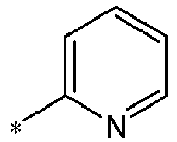
H 2-Amino-3-(pyridin-2-yl)propanoic acid 12-41 H H 1 H 
H 2-Amino-3-(pyridin-3-yl)propanoic acid 12-42 H H 1 H 
H 2-Amino-3-(pyridin-4-yl)propanoic acid 12-43 H H 1 H 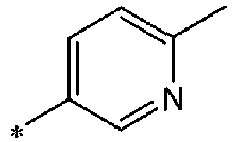
H 2-Amino-3-(6-methylpyridin-3-yl) propanoic acid 12-44 H H 1 H 
H 2-Amino-3-(5-methylpyridin-3-yl) propanoic acid 12-45 H H 1 H 
H 2-Amino-3-(4-methylpyridin-3-yl) propanoic acid 12-46 H H 1 H 
H 2-Amino-3-(6-methoxypyridin-3-yl) propanoic acid 12-47 H H 1 H 
H 2-Amino-3-(5-methoxypyridin-3-yl) propanoic acid 12-48 H H 1 H 
H 2-Amino-3-(5-fluoropyridin-3-yl)propanoic acid 12-49 H H 1 H 
H 2-Amino-3-(5-chloropyridin-3-yl) propanoic acid 12-50 H H 1 H 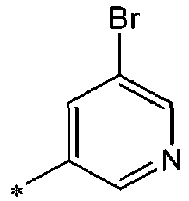
H 2-Amino-3-(5-bromopyridin-3-yl) propanoic acid 12-51 H H 1 H 
H 2-Amino-3-(5-iodopyridin-3-yl)propanoic acid 12-52 H H 1 H 
H 2-Amino-3-(2-(methylamino)pyridin-4-yl) propanoic acid 12-53 H H 1 H 
H 2-Amino-3-(2-(dimethylamino)pyridin-4-yl) propanoic acid 12-54 H H 1 H 
H 2-Amino-3-(pyrimidin-5-yl)propanoic acid [Table 13] Compound ID R1 R2 n R3 R6 R7 Compound Name 13-1 H Me 1 H 
H Methylphenylalanine 13-2 H Me 1 H 
H 2-(Methylamino)-3-(o-tolyl)propanoic acid 13-3 H Me 1 H 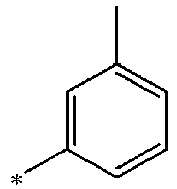
H 2-(Methylamino)-3-(m-tolyl)propanoic acid 13-4 H Me 1 H 
H 2-(Methylamino)-3-(p-tolyl)propanoic acid 13-5 H Me 1 H 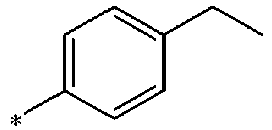
H 2-(Methylamino)-3-(4-ethylphenyl) propanoic acid 13-6 H Me 1 H 
H 2-(Methylamino)-3-(2-chlorophenyl) propanoic acid 13-7 H Me 1 H 
H 2-(Methylamino)-3-(3-chlorophenyl) propanoic acid 13-8 H Me 1 H 
H 2-(Methylamino)-3-(4-chlorophenyl) propanoic acid 13-9 H Me 1 H 
H 2-(Methylamino)-3-(2-fluorophenyl) propanoic acid 13-10 H Me 1 H 
H 2-(Methylamino)-3-(3-fluorophenyl) propanoic acid 13-11 H Me 1 H 
H 2-(Methylamino)-3-(4-fluorophenyl) propanoic acid 13-12 H Me 1 H 
H 2-(Methylamino)-3-(2-cyclopropylphenyl) propanoic acid 13-13 H Me 1 H 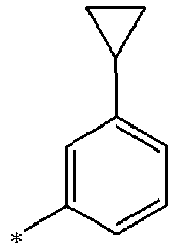
H 2-(Methylamino)-3-(3-cyclopropylphenyl) propanoic acid 13-14 H Me 1 H 
H 2-(Methylamino)-3-(4-cyclopropylphenyl) propanoic acid 13-15 H Me 1 H 
H 2-(Methylamino)-3-(2-(trifluoromethyl) phenyl)propanoic acid 13-16 H Me 1 H 
H 2-(Methylamino)-3-(3-(trifluoromethyl) phenyl)propanoic acid 13-17 H Me 1 H 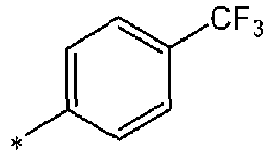
H 2-(Methylamino)-3-(4-(trifluoromethyl) phenyl)propanoic acid 13-18 H Me 1 H 
H 2-(Methylamino)-3-(2-isopropylphenyl) propanoic acid 13-19 H Me 1 H 
H 2-(Methylamino)-3-(3-isopropylphenyl) propanoic acid 13-20 H Me 1 H 
H 2-(Methylamino)-3-(4-isopropylphenyl) propanoic acid 13-21 H Me 1 H 
H 2-(Methylamino)-3-(2-methoxyphenyl) propanoic acid 13-22 H Me 1 H 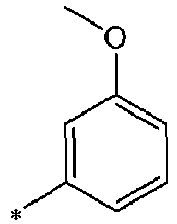
H 2-(Methylamino)-3-(3-methoxyphenyl) propanoic acid 13-23 H Me 1 H 
H 2-(Methylamino)-3-(4-methoxyphenyl) propanoic acid 13-24 H Me 1 H 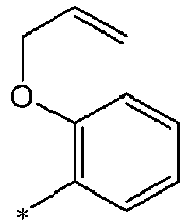
H 2-(Methylamino)-3-(2-(allyloxy)phenyl) propanoic acid 13-25 H Me 1 H 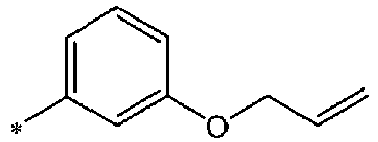
H 2-(Methylamino)-3-(3-(allyloxy)phenyl) propanoic acid 13-26 H Me 1 H 
H 2-(Methylamino)-3-(4-(allyloxy)phenyl) propanoic acid 13-27 H Me 1 H 
H 2-(Methylamino)-3-(4-isopropoxyphenyl) propanoic acid 13-28 H Me 1 H 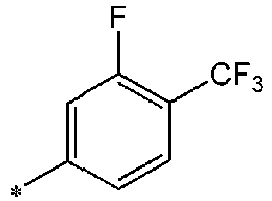
H 2-(Methylamino)-3-(3-fluoro-4-(trifluoromethyl)phenyl)propanoic acid 13-29 H Me 1 H 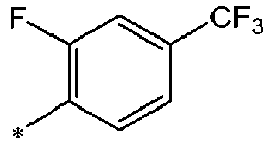
H 2-(Methylamino)-3-(2-fluoro-4-(trifluoromethyl)phenyl)propanoic acid 13-30 H Me 1 H 
H 2-(Methylamino)-3-(3,4-dimethoxyphenyl) propanoic acid 13-31 H Me 1 H 
H 2-(Methylamino)-3-(2-fluoro-4-methoxyphenyl)propanoic acid 13-32 H Me 1 H 
H 2-(Methylamino)-3-(3-fluoro-4-methoxyphenyl)propanoic acid 13-33 H Me 1 H 
H 2-(Methylamino)-3-(3,5-difluoro-4-methoxyphenyl)propanoic acid 13-34 H Me 1 H 
H 2-(Methylamino)-3-(3,5-difluoro-4-(trifluoromethyl)phenyl)propanoic acid 13-35 H Me 1 H 
H 2-(Methylamino)-3-(3-methoxy-4-(methylcarbamoyl)phenyl)propanoic acid 13-36 H Me 1 H 
H 2-(Methylamino)-3-(4-methoxy-3-(methylcarbamoyl)phenyl)propanoic acid 13-37 H Me 1 H 
H 2-(Methylamino)-3-(3-methoxy-4-((methylsulfonyl)carbamoyl)phenyl) propanoic acid 13-38 H Me 1 H 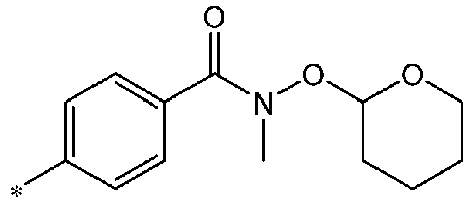
H 2-(Methylamino)-3-(4-(methyl((tetrahydro-2H-pyran-2-yl)oxy) carbamoyl)phenyl)propanoic acid 13-39 H Me 1 H 
H 2-(Methylamino)-3-(3-methoxy-4-(((tetrahydro-2H-pyran-2-yl)oxy) carbamoyl)phenyl)propanoic acid 13-40 H Me 1 H 
H 2-(Methylamino)-3-(pyridin-2-yl)propanoic acid 13-41 H Me 1 H 
H 2-(Methylamino)-3-(pyridin-3-yl)propanoic acid 13-42 H Me 1 H 
H 2-(Methylamino)-3-(pyridin-4-yl)propanoic acid 13-43 H Me 1 H 
H 2-(Methylamino)-3-(6-methylpyridin-3-yl) propanoic acid 13-44 H Me 1 H 
H 2-(Methylamino)-3-(5-methylpyridin-3-yl) propanoic acid 13-45 H Me 1 H 
H 2-(Methylamino)-3-(4-methylpyridin-3-yl) propanoic acid 13-46 H Me 1 H 
H 2-(Methylamino)-3-(6-methoxypyridin-3-yl)propanoic acid 13-47 H Me 1 H 
H 2-(Methylamino)-3-(5-methoxypyridin-3-yl)propanoic acid 13-48 H Me 1 H 
H 2-(Methylamino)-3-(5-fluoropyridin-3-yl) propanoic acid 13-49 H Me 1 H 
H 2-(Methylamino)-3-(5-chloropyridin-3-yl) propanoic acid 13-50 H Me 1 H 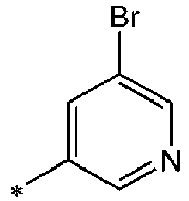
H 2-(Methylamino)-3-(5-bromopyridin-3-yl) propanoic acid 13-51 H Me 1 H 
H 2-(Methylamino)-3-(5-iodopyridin-3-yl) propanoic acid 13-52 H Me 1 H 
H 2-(Methylamino)-3-(2-(methylamino) pyridin-4-yl)propanoic acid 13-53 H Me 1 H 
H 2-(Methylamino)-3-(2-(dimethylamino) pyridin-4-yl)propanoic acid 13-54 H Me 1 H 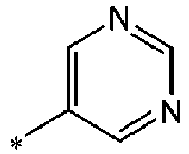
H 2-(Methylamino)-3-(pyrimidin-5-yl) propanoic acid [Table 14] Compound R1 R2 n R3 R6 R7 Compound Name 14-1 Fmoc Et 1 tBu 
H tert-Butyl 2-((((9H-fluoren-9-yl)methoxy) carbonyl)(ethyl)amino)-3-(p-tolyl) propanoate 14-2 Fmoc Et 1 Bn 
H Benzyl 2-((((9H-fluoren-9-yl)methoxy) carbonyl)(ethyl)amino)-3-(p-tolyl) propanoate 14-3 Boc Et 1 tBu 
H tert-Butyl 2-((tert-butoxycarbonyl)(ethyl) amino)-3-(p-tolyl)propanoate 14-4 Boc Et 1 Bn 
H Benzyl 2-((tert-butoxycarbonyl)(ethyl) amino)-3-(p-tolyl)propanoate 14-5 Cbz Et 1 tBu 
H tert-Butyl 2-(((benzyloxy)carbonyl)(ethyl) amino)-3-(p-tolyl)propanoate 14-6 Cbz Et 1 Bn 
H Benzyl 2-(((benzyloxy)carbonyl)(ethyl) amino)-3-(p-tolyl)propanoate 14-7 Alloc Et 1 tBu 
H tert-Butyl 2-(((allyloxy)carbonyl)(ethyl) amino)-3-(p-tolyl)propanoate 14-8 Alloc Et 1 Bn 
H Benzyl 2-(((allyloxy)carbonyl)(ethyl) amino)-3-(p-tolyl)propanoate 14-9 Teoc Et 1 tBu 
H tert-Butyl 2-(ethyl((2-(trimethylsilyl) ethoxy)carbonyl)amino)-3-(p-tolyl) propanoate 14-10 Teoc Et 1 Bn 
H Benzyl 2-(ethyl((2-(trimethylsilyl)ethoxy) carbonyl)amino)-3-(p-tolyl)propanoate 14-11 Fmoc Et 1 H 
H 2-((((9H-Fluoren-9-yl)methoxy)carbonyl) (ethyl)amino)-3-(p-tolyl)propanoic acid 14-12 Boc Et 1 H 
H 2-((tert-Butoxycarbonyl)(ethyl)amino)-3-(p-tolyl)propanoic acid 14-13 Cbz Et 1 H 
H 2-(((Benzyloxy)carbonyl)(ethyl)amino)-3-(p-tolyl)propanoic acid 14-14 Alloc Et 1 H 
H 2-(((Allyloxy)carbonyl)(ethyl)amino)-3-(p-tolyl)propanoic acid 14-15 Teoc Et 1 H 
H 2-(Ethyl((2-(trimethylsilyl)ethoxy) carbonyl)amino)-3-(p-tolyl)propionic acid 14-16 H Et 1 H 
H 2-(Ethylamino)-3-(p-tolyl)propanoic acid - Isolation/purification of the target compounds obtained through the above-described reaction steps can be carried out by applying ordinary chemical operations such as extraction, concentration, distillation, crystallization, filtration, recrystallization, and various types of chromatography.
- The compound, the salt of the compound, or the solvate of the compound or the salt of the present invention includes all stereoisomers of the target compound obtained through the above-described reaction steps (such as enantiomers and diastereomers (including cis and trans geometric isomers)), racemates of the isomers, and other mixtures. For example, the compound of the present invention may have one or more asymmetric centers, and the present invention includes racemic mixtures, diastereomeric mixtures, and enantiomers of such a compound.
- When the compound according to the present invention is obtained in a free form, the compound can be converted to the state of a salt of the compound or a hydrate or a solvate of the compound or the salt, which the compound may form, according to a conventional method.
- When the compound according to the present invention is obtained as a salt, hydrate, or solvate of the compound, the compound can be converted to a free form thereof according to a conventional method.
- All prior art documents cited in the present specification are incorporated herein by reference.
- The present invention is further illustrated by the following Examples, but is not limited thereto.
- As for the solvents used in the working of the present invention, exemplified by DMF, DMA, NMP, DMI, and DMPU, commercially available products were used without purification. In a reaction in which water was not added as a solvent, a commercially available dehydration solvent, super-dehydration solvent, anhydrous solvent, and the like were used without purification.
- As for the reagents used in the working of the present invention, such as additives exemplified by silyl compounds or 1,2-dibromoethane, metals, possible ligand compounds, metal-ligand complexes, reducing agents, reagents used in the step of introducing a protecting group, and reagents used in the deprotection step, commercially available products were used without purification unless otherwise specifically described.
- As for the starting materials of aromatic amino acid derivatives used in the working of the present invention, which are represented by phenylalanine derivatives and homophenylalanine derivatives, commercially available products were used without purification unless otherwise specifically described. Furthermore, such starting materials were produced by known methods as necessary, and used.
- A 1H-NMR spectrum was measured using an AVANCE III HD 400 BBFO-SMART probe (manufactured by Bruker), the chemical shift of Me4Si used as an internal standard material was set at 0 ppm, and a deuterium lock signal from a sample solvent was referred to. The chemical shift of the signal of an analyte compound was expressed as ppm. Abbreviations for signal splitting were s = singlet, brs = broad singlet, d = doublet, t = triplet, q = quartet, dd = double doublet, and m = multiplet, and the width of signal splitting was expressed as J value (Hz). The integrated value of a signal was calculated based on the ratio between the signal area intensities of respective signals.
-
- Apparatus: manufactured by Shimadzu Corporation
- Column: Ascentis Express RP-Amide (3.0 mm I.D. x 50 mm)
- Mobile Phase: water containing 0.05% trifluoroacetic acid (A) and acetonitrile containing 0.05% trifluoroacetic acid (B)
- Elution Method: Stepwise solvent gradient elution from 5% B to 95% B (5.0 min), maintained at 95% B (2.0 min)
- Flow Rate: 0.7 mL/min
- Column temperature: 30°C
-
- Apparatus: Waters Acquity UPLC/SQD
- Column: Ascentis Express C18 (2.1 mm I.D. x 50 mm)
- Mobile Phase: water containing 0.1% formic acid (A) and acetonitrile containing 0.1% formic acid (B)
- Elution Method: stepwise solvent gradient elution from 5% B to 100% B (5.0 min), maintained at 100% B (2.0 min)
- Flow Rate: 1.0 mL/min
-
- Apparatus: Waters Acquity UPLC/SQD
- Column: Ascentis Express C18 (2.1 mm I.D. × 50 mm)
- Mobile Phase: 10 mM aqueous ammonium acetate solution (A) and 10 mM ammonium acetate solution in acetonitrile (B)
- Elution Method: stepwise solvent gradient elution from 5% B to 100% B (1.0 min), maintained at 100% B (0.4 min)
- Flow Rate: 1.0 mL/min
-
- Apparatus: Waters Acquity UPLC/SQD
- Column: Ascentis Express C18 (2.1 mm I.D. x 50 mm)
- Mobile Phase: water containing 0.1% formic acid (A) and acetonitrile containing 0.1% formic acid (B)
- Elution Method: stepwise solvent gradient elution from 5% B to 100% B (1.0 min), maintained at 100% B (0.4 min)
- Flow Rate: 1.0 mL/min
-
- Apparatus: manufactured by Shimadzu Corporation
- Column: Ascentis Express C18 (3.0 mm I.D. x 50 mm)
- Mobile Phase: water containing 0.05% trifluoroacetic acid (A) and acetonitrile containing 0.05% trifluoroacetic acid (B)
- Elution Method: stepwise solvent gradient elution from 5% B to 95% B (2.0 min), maintained at 95% B (0.7 min)
- Flow Rate: 1.0 mL/min
-
- Apparatus: manufactured by Shimadzu Corporation
- Column: Ascentis Express C18 (3.0 mm I.D. x 50 mm)
- Mobile Phase: water containing 0.05% trifluoroacetic acid (A) and acetonitrile containing 0.05% trifluoroacetic acid (B)
- Elution Method: stepwise solvent gradient elution from 5% B to 95% B (1.1 min), maintained at 95% B (0.5 min)
- Flow Rate: 1.0 mL/min
-
- Production of benzyl (S)-2-((tert-butoxycarbonyl)amino)-4-(3-chloro-4-(trifluoromethyl)phenyl)butanoate

- Nickel bromide trihydrate (0.12 g, 0.44 mmol) and 4,4'-di-tert-butyl-2,2'-bipyridine (0.12 g, 0.44 mmol) were dissolved in DMA (15 mL), and the mixture was purged with nitrogen and then stirred for 10 min to prepare a catalyst solution. Zinc powder (2.0 g, 31 mmol), 1-benzyl 5-(1,3-dioxoisoindolin-2-yl) (tert-butoxycarbonyl)-L-glutamate (3.0 g, 6.2 mmol), and DMA (15 mL) were added to a flask equipped with a stirring blade, 4-bromo-2-chloro-1-(trifluoromethyl)benzene (4.8 g, 19 mmol) was added, and then the mixture was purged with nitrogen. The prepared catalyst solution was added dropwise to the reaction solution under a nitrogen atmosphere, the solution was stirred at 25°C for 2 h, and the reaction mixture was analyzed by HPLC. The UV intensity ratio of the raw material to the target compound was 92.5:7.5 (detection wavelength: 210 nm), and thus it was confirmed that 90% or more of the raw material remained.
- ESI (LC/MS positive mode m/z 472 (M+H)+)
- Production of benzyl (S)-2-((tert-butoxycarbonyl)amino)-4-(3-chloro-4-(trifluoromethyl)phenyl)butanoate
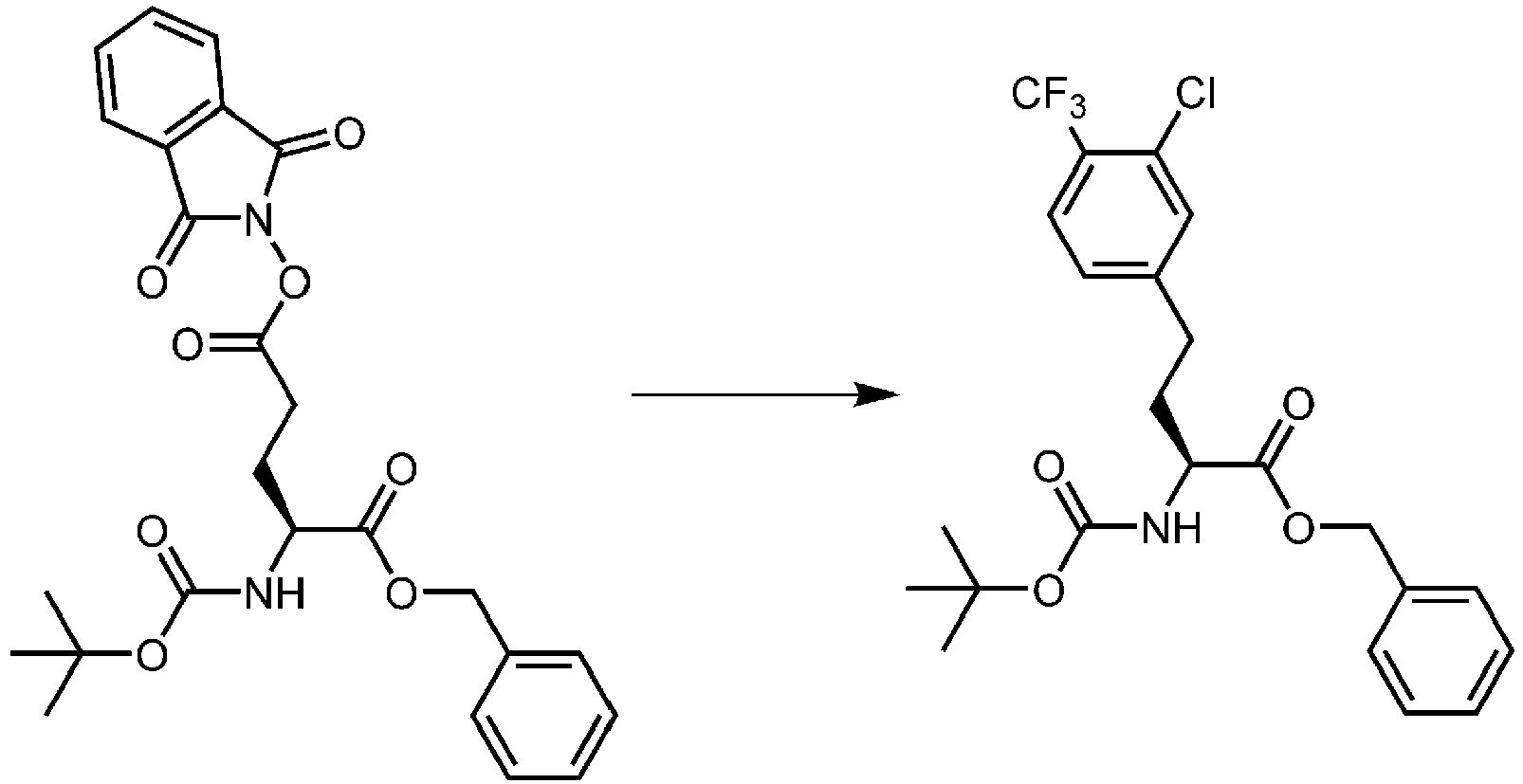
- Nickel bromide trihydrate (0.20 g, 0.73 mmol) and 4,4'-di-tert-butyl-2,2'-bipyridine (0.20 g, 0.73 mmol) were dissolved in DMA (25 mL), and the mixture was purged with nitrogen and then stirred for 10 min to prepare a catalyst solution. Zinc powder (3.4 g, 52 mmol), 1-benzyl 5-(1,3-dioxoisoindolin-2-yl) (tert-butoxycarbonyl)-L-glutamate (5.0 g, 10 mmol), and DMA (25 mL) were added to a flask equipped with a stirring blade, 4-bromo-2-chloro-1-(trifluoromethyl)benzene (8.1 g, 31 mmol) was added, and then the mixture was purged with nitrogen. After the prepared catalyst solution was added dropwise to the reaction solution under a nitrogen atmosphere, TMSC1 (56 mg, 0.52 mmol) was added. The solution was stirred at 25°C for 2 h, and the reaction mixture was analyzed by HPLC. The UV intensity ratio of the raw material to the target compound was 67:33 (detection wavelength: 210 nm), and it was thus confirmed that, while the raw material remained, the production of the target compound significantly increased as compared with the case where TMSC1 was not used (Reference Example 1).
- ESI (LC/MS positive mode m/z 472 (M+H)+)
- Production of benzyl (S)-2-((tert-butoxycarbonyl)amino)-4-(3-chloro-4-(trifluoromethyl)phenyl)butanoate
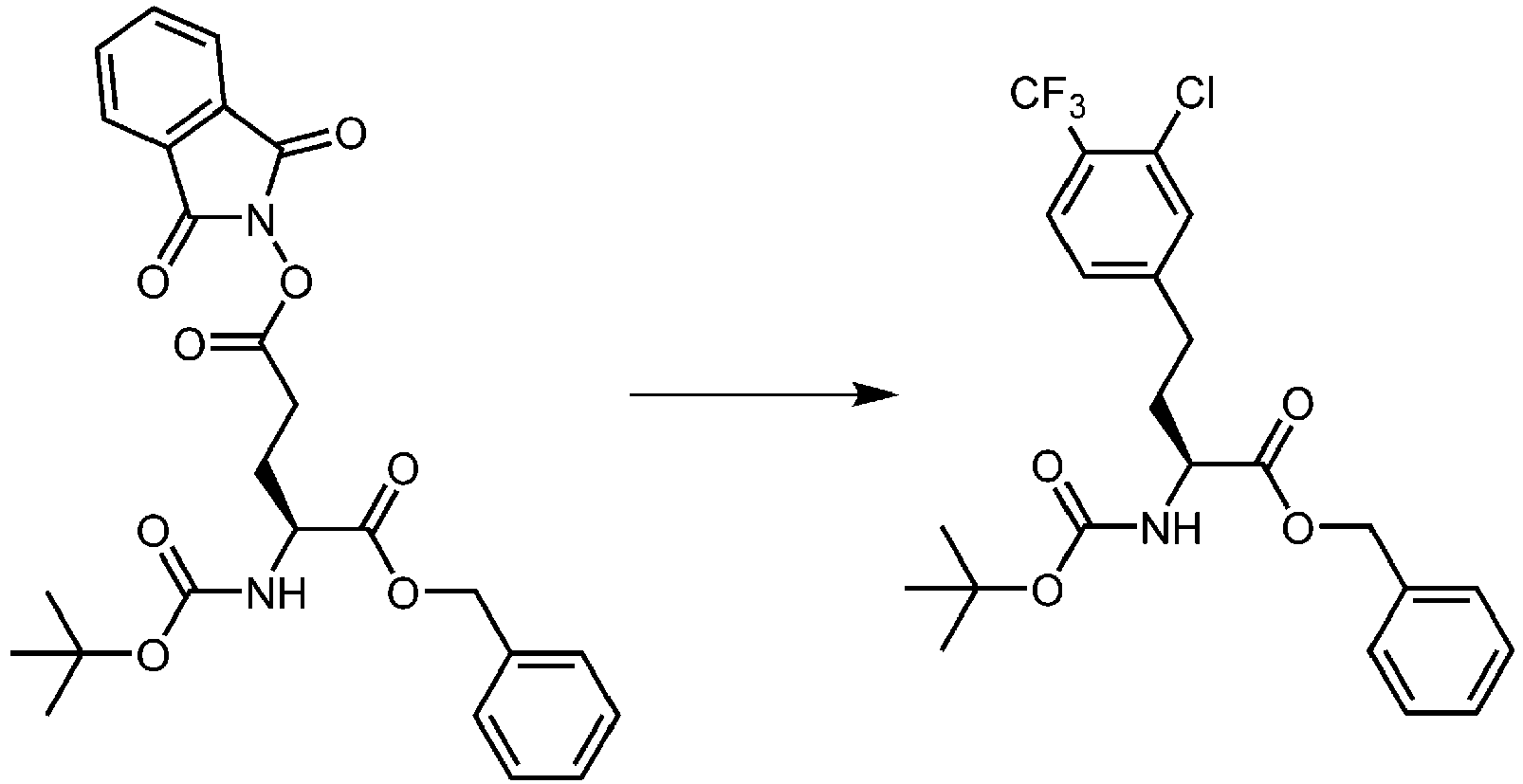
- Nickel bromide trihydrate (39 mg, 0.15 mmol) and 4,4'-di-tert-butyl-2,2'-bipyridine (40 mg, 0.15 mmol) were dissolved in DMA (5.0 mL), and the mixture was purged with nitrogen and then stirred for 10 min to prepare a catalyst solution. Zinc powder (0.68 g, 10 mmol), 1-benzyl 5-(1,3-dioxoisoindolin-2-yl) (tert-butoxycarbonyl)-L-glutamate (1.0 g, 2.1 mmol), and DMA (5.0 mL) were added to a flask equipped with a stirring blade, 4-bromo-2-chloro-1-(trifluoromethyl)benzene (1.6 g, 6.2 mmol) was added, and then the mixture was purged with nitrogen. After the prepared catalyst solution was added dropwise to the reaction solution under a nitrogen atmosphere, TMSC1 (0.11 g, 1.0 mmol) was added. The solution was stirred at 25°C for 2 h, and the reaction mixture was analyzed by HPLC. The UV intensity ratio of the raw material to the target compound was 0:100 (detection wavelength: 210 nm), and it was thus confirmed that the raw material had completely disappeared, and that the target compound was the main product. The reaction solution was purified by chromatography to afford (S)-2-((tert-butoxycarbonyl)amino)-4-(3-chloro-4-(trifluoromethyl)phenyl)butanoate (0.79 g, yield 80%). Benzyl (S)-2-((tert-butoxycarbonyl)amino)-4-(3-chloro-4-(trifluoromethyl)phenyl)butanoate: Retention time: Raw Material 4.0 min, Target compound 4.7 min (High performance liquid chromatography Condition 1)
- (DMSO-D6) δ: 7.76 (1H, d, J = 8.1 Hz), 7.55 (1H, s), 7.44 (0.8H, d, J = 7.8 Hz), 7.36-7.34 (6H, m), 7.10 (0.2H, m), 5.15 (1H, d, J = 12.5 Hz), 5.08 (1H, d, J = 12.5 Hz), 3.98-3.96 (0.8H, m), 3.87 (0.2H, br s), 2.71 (2H, t, J = 7.9 Hz), 2.01-1.87 (2H, m), 1.39 (8H, s), 1.27 (1H, s)
- Production of (S)-2-((((9H-fluoren-9-yl)methoxy)carbonyl)amino)-4-(3 -chloro-4-(trifluoromethyl)phenyl)butanoic acid

- Nickel bromide trihydrate (0.20 g, 0.73 mmol) and 4,4'-di-tert-butyl-2,2'-bipyridine (0.20 g, 0.73 mmol) were dissolved in DMA (25 mL), and the mixture was purged with nitrogen and then stirred for 10 min to prepare a catalyst solution. Zinc powder (3.4 g, 52 mmol), 1-benzyl 5-(1,3-dioxoisoindolin-2-yl) (tert-butoxycarbonyl)-L-glutamate (5.0 g, 10 mmol), and DMA (25 mL) were added to a flask equipped with a stirring blade, 4-bromo-2-chloro-1-(trifluoromethyl)benzene (8.1 g, 31 mmol) was added, and then the mixture was purged with nitrogen. After the prepared catalyst solution was added dropwise to the reaction solution under a nitrogen atmosphere, TMSC1 (0.56 g, 5.2 mmol) was added and the solution was stirred at 25°C for 3 h. When the reaction mixture was analyzed by HPLC, it was confirmed that the raw material had completely disappeared, and that the target compound was the main product. Ethyl acetate (50 mL) and a 10% aqueous EDTA·2Na solution (50 mL) were added to the reaction solution, and the organic layer was washed with a 10% aqueous NaCl solution (50 mL). The resulting organic layer was concentrated under reduced pressure, toluene (25 mL) was added to prepare a solution, and the solution was divided into two portions. The solution was cooled to 0°C, TfOH (2.3 g) was added dropwise, the temperature was raised to 25°C, and then water (2.5 mL) was added. After the mixture was stirred for 45 min, 10 mL of water was added for separation. A 40% aqueous K3PO4 solution (2.0 mL) and acetonitrile (13 mL) were added to the aqueous layer. FmocOSu (1.8 g) was added, and a 40% aqueous K3PO4 solution (3.5 mL) was added. After the lower layer was discharged, 5N HCl (2.2 mL) was added, the precipitated solids were filtered, and the resulting solids were dried to afford (S)-2-((((9H-fluoren-9-yl)methoxy)carbonyl)amino)-4-(3-chloro-4-(trifluoromethyl)phenyl)butanoic acid (1.8 g, yield 68%) as white solids. (S)-2-((((9H-fluoren-9-yl)methoxy)carbonyl)amino)-4-(3-chloro-4-(trifluoromethyl)phenyl)butanoic acid:
- Target compound retention time: 3.1 min (High performance liquid chromatography Condition 2)
- (DMSO-D6) δ: 12.65 (1H, s), 7.90 (2H, d, J = 7.5 Hz), 7.77-7.58 (5H, m), 7.44-7.32 (5H, m), 4.37-4.18 (3H, m), 3.91-3.88 (1H, m), 2.79-2.66 (2H, m), 2.07-1.86 (2H, m).
-

- Nickel bromide trihydrate (4.0 mg, 0.015 mmol) and 4,4'-di-tert-butyl-2,2'-bipyridine (3.9 mg, 0.015 mmol) were dissolved in DMA (0.50 mL), and the mixture was purged with nitrogen and then stirred to prepare a catalyst solution. 1-(tert-Butyl) 5-(1,3-dioxoisoindolin-2-yl) (((9H-fluoren-9-yl)methoxy)carbonyl)-L-glutamate (0.12 g, 0.21 mmol) and 1-fluoro-4-iodobenzene (0.14 g, 0.62 mmol) were added to and dissolved in DMA (0.5 mL). The prepared catalyst solution was added dropwise thereto under a nitrogen atmosphere, zinc powder (68 mg, 1.0 mmol) and then TMSC1 (11 mg, 0.1 mmol) were added, and the reaction vessel was shaken at 25°C for 2 h. When the reaction mixture was analyzed by HPLC, it was confirmed that the raw material had completely disappeared, and that the target compound was the main product. The reaction solution was purified by chromatography to afford tert-butyl (S)-2-((((9H-fluoren-9-yl)methoxy)carbonyl)amino)-4-(4-fluorophenyl)butanoate (70 mg, yield 71%). tert-Butyl (S)-2-((((9H-fluoren-9-yl)methoxy)carbonyl)amino)-4-(4-fluorophenyl)butanoate: Target compound retention time: 1.1 min (High performance liquid chromatography Condition 3)
- ESI (LC/MS positive mode m/z 498 (M+Na)+)
-

- Nickel bromide trihydrate (0.14 g, 0.53 mmol) and 4,4'-di-tert-butyl-2,2'-bipyridine (0.14 g, 0.53 mmol) were dissolved in DMA (8.0 mL), and the mixture was purged with nitrogen and then stirred to prepare a catalyst solution. Zinc powder (0.57 g, 8.8 mmol), 5-(1,3-dioxoisoindolin-2-yl) 1-tert-butyl N-(((9H-fluoren-9-yl)methoxy)carbonyl)-L-glutamate (1.0 g, 1.8 mmol), and DMA (8.0 mL) were added to a flask, 3-iodopyridine (1.1 g, 5.3 mmol) was added, and then the mixture was purged with nitrogen. After the prepared catalyst solution was added dropwise to the reaction solution under a nitrogen atmosphere, TMSC1 (95 mg, 0.88 mmol) and 1,2-dibromoethane (0.33 g, 1.8 mmol) were added, and the mixture was stirred at 25°C for 3 h. When the reaction mixture was analyzed by HPLC, it was confirmed that the raw material had completely disappeared, and that the target compound was produced. The reaction solution was quenched with an aqueous EDTA·2Na solution, then the organic layer extracted with MTBE was washed with saline, then the organic layer was dried over sodium sulfate, the desiccant was filtered off, and then the filtrate was concentrated under reduced pressure. The resulting crude product was purified by chromatography to afford tert-butyl (S)-2-((((9H-fluoren-9-yl)methoxy)carbonyl)amino)-4-(pyridin-3-yl)butanoate (0.21 g, yield 26%). tert-Butyl (S)-2-((((9H-fluoren-9-yl)methoxy)carbonyl)amino)-4-(pyridin-3-yl)butanoate: Target compound retention time: 1.0 min (High performance liquid chromatography Condition 3)
- ESI (LC/MS positive mode m/z 459 (M+H)+)
-

- Nickel bromide trihydrate (2.9 g, 11 mmol) and 4,4'-di-tert-butyl-2,2'-bipyridine (2.8 g, 11 mmol) were dissolved in DMA (175 mL), and the mixture was purged with nitrogen and then stirred to prepare a catalyst solution. Zinc powder (11 g, 175 mmol), 5-(1,3-dioxoisoindolin-2-yl) 1-tert-butyl N-(((9H-fluoren-9-yl)methoxy)carbonyl)-L-glutamate (20 g, 35 mmol) and DMA (175 mL) were added to a flask, 5-bromo-1,3-difluoro-2-(trifluoromethyl)benzene (27 g, 105 mmol) was added, and then the mixture was purged with nitrogen. The prepared catalyst solution was added dropwise to the reaction solution under a nitrogen atmosphere, then TMSC1 (1.9 g, 18 mmol) was added, and the mixture was stirred at 25°C for 1 h. When the reaction mixture was analyzed by HPLC, it was confirmed that the raw material had completely disappeared, and that the target compound was the main product. The reaction solution was quenched with an aqueous EDTA·2Na solution, and then the mixture was extracted with MTBE. After the organic layer was washed with an aqueous sodium hydrogen carbonate solution and with an aqueous ammonium chloride solution, the organic layer was concentrated, and the resulting crude product was purified by recrystallization to afford tert-butyl (S)-2-((((9H-fluoren-9-yl)methoxy)carbonyl)amino)-4-(3,5-difluoro-4-(trifluoromethyl)phenyl)butanoate (15 g, yield 76%).
- tert-Butyl (S)-2-((((9H-fluoren-9-yl)methoxy)carbonyl)amino)-4-(3,5-difluoro-4-(trifluoromethyl)phenyl)butanoate:
- Target compound retention time: 1.3 min (High performance liquid chromatography Condition 4)
- ESI (LC/MS positive mode m/z 562 (M+H)+)
-

- Target compound retention time: 1.1 min (High performance liquid chromatography Condition 4)
- ESI (LC/MS positive mode m/z 502 (M+Na)+)
-

- Target compound retention time: 0.88 min (High performance liquid chromatography Condition 4)
- ESI (LC/MS positive mode m/z 440 (M+H)+)
-

- Target compound retention time: 1.1 min (High performance liquid chromatography Condition 4)
- ESI (LC/MS positive mode m/z 585 (M+H)+)
-

- Target compound retention time: 1.1 min (High performance liquid chromatography Condition 3)
- ESI (LC/MS positive mode m/z 473 (M+H)+)
-
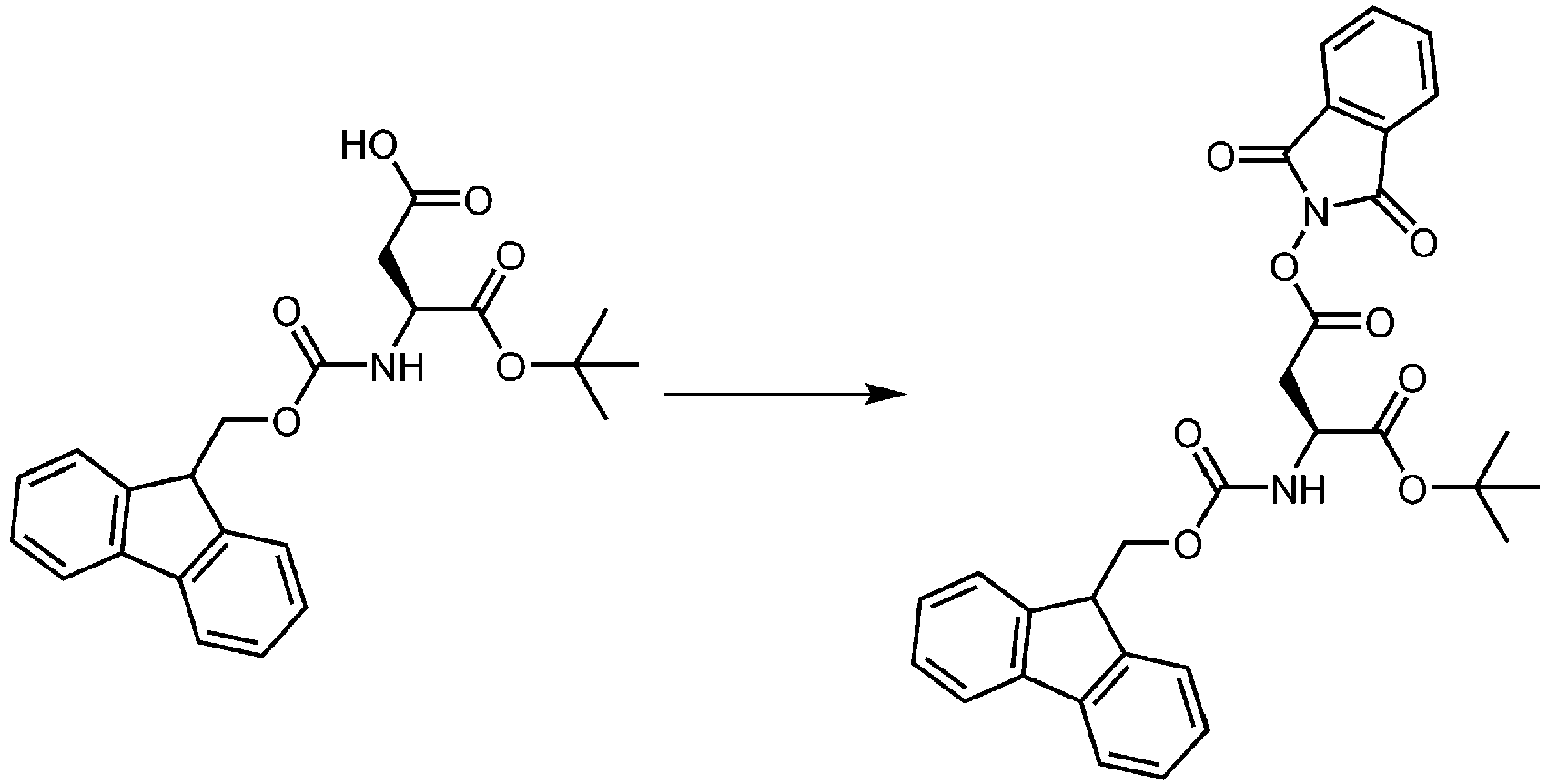
- (S)-3-((((9H-Fluoren-9-yl)methoxy)carbonyl)amino)-4-(tert-butoxy)-4-oxobutanoic acid (2.0 g, 4.9 mmol) and N-hydroxyphthalimide (0.87 g, 5.4 mmol) were dissolved in THF (19 mL), and N,N'-diisopropylcarbodiimide (0.92 g, 7.3 mmol) was added dropwise. The reaction solution was stirred at 25°C for 30 min, the solution was concentrated, toluene (20 mL) was added, and the solids were removed by filtration. The filtrate was concentrated, and purified by chromatography to afford 1-(tert-butyl) 4-(1,3-dioxoisoindolin-2-yl) (((9H-fluoren-9-yl)methoxy)carbonyl)-L-aspartate (2.7 g, yield 100%).
- 1-(tert-Butyl) 4-(1,3-dioxoisoindolin-2-yl) (((9H-fluoren-9-yl)methoxy)carbonyl)-L-aspartate: Target compound retention time: 1.0 min (High performance liquid chromatography Condition 4)
- ESI (LC/MS positive mode m/z 479 (M+Na)+)
-

- Nickel bromide trihydrate (4.0 mg, 0.015 mmol) and 4,4'-di-tert-butyl-2,2'-bipyridine (3.9 mg, 0.015 mmol) were dissolved in DMA (0.50 mL), and the mixture was purged with nitrogen and then stirred to prepare a catalyst solution. 1-(tert-Butyl) 4-(1,3-dioxoisoindolin-2-yl) (((9H-fluoren-9-yl)methoxy)carbonyl)-L-aspartate (0.12 g, 0.21 mmol) and 1-iodo-3-methoxybenzene (0.15 g, 0.62 mmol) were added to and dissolved in DMA (0.5 mL). The prepared catalyst solution was added dropwise thereto under a nitrogen atmosphere, zinc powder (68 mg, 1.0 mmol) and then TMSC1 (11 mg, 0.10 mmol) were added, and the reaction vessel was shaken at 25°C for 2 h. When the reaction mixture was analyzed by HPLC, it was confirmed that the raw material had completely disappeared, and that the target compound was the main product. The reaction solution was purified by chromatography to afford tert-butyl (S)-2-((((9H-fluoren-9-yl)methoxy)carbonyl)amino)-3-(3-methoxyphenyl)propanoate (70 mg, yield 71%). tert-Butyl (S)-2-((((9H-fluoren-9-yl)methoxy)carbonyl)amino)-3-(3-methoxyphenyl)propanoate: Target compound retention time: 1.1 min (High performance liquid chromatography Condition 3)
- ESI (LC/MS positive mode m/z 496 (M+Na)+)
-

- Target compound retention time: 1.1 min (High performance liquid chromatography Condition 4)
- ESI (LC/MS positive mode m/z 488 (M+Na)+)
-
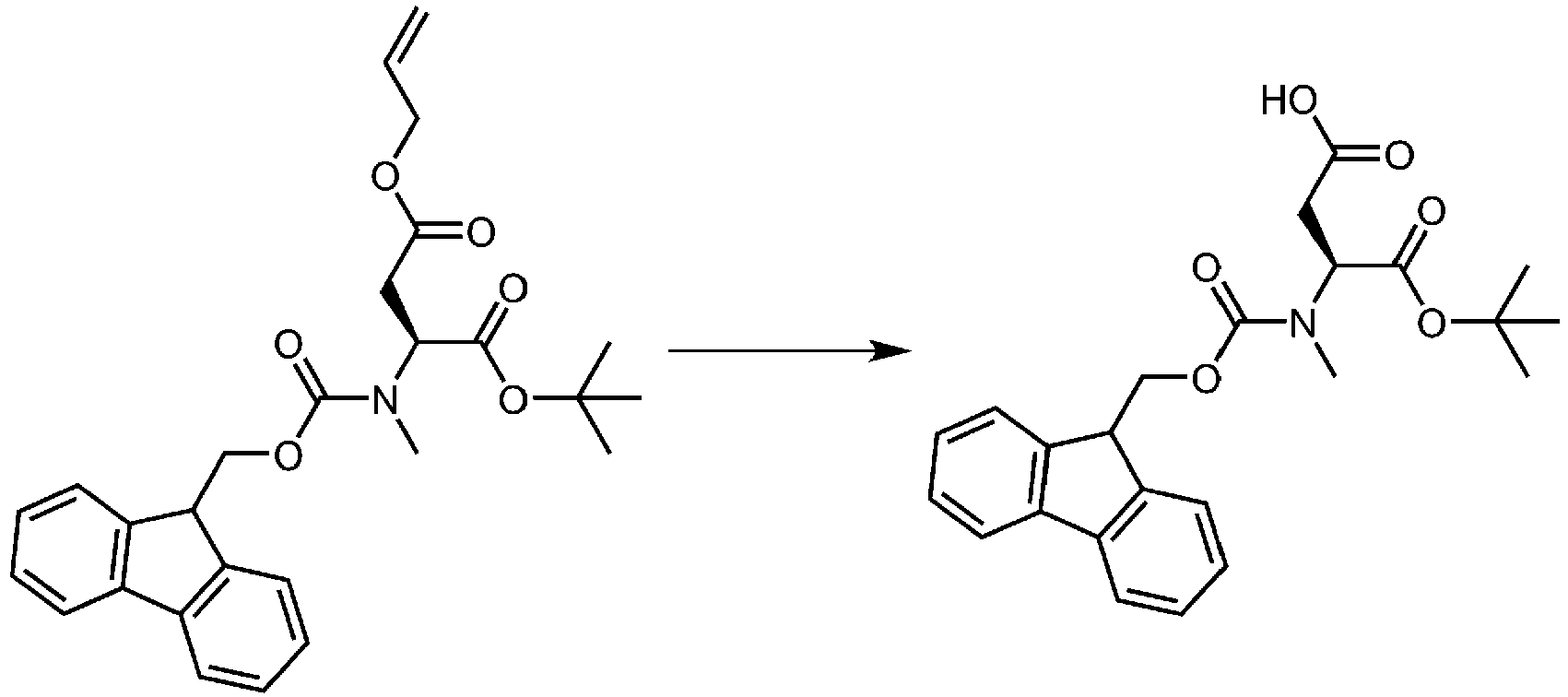
- Target compound retention time: 0.90 min (High performance liquid chromatography Condition 4)
- ESI (LC/MS positive mode m/z 448 (M+Na)+)
-

- Target compound retention time: 1.1 min (High performance liquid chromatography Condition 4)
- ESI (LC/MS positive mode m/z 593 (M+Na)+)
-

- Nickel bromide trihydrate (4.0 mg, 0.015 mmol) and 4,4'-di-tert-butyl-2,2'-bipyridine (3.9 mg, 0.015 mmol) were dissolved in DMA (0.50 mL), and the mixture was purged with nitrogen and then stirred to prepare a catalyst solution. 1-(tert-Butyl) 4-(1,3-dioxoisoindolin-2-yl) N-(((9H-fluoren-9-yl)methoxy)carbonyl)-N-methyl-L-aspartate (0.12 g, 0.21 mmol) and 5-bromopyrimidine (99 mg, 0.62 mmol) were added to and dissolved in DMA (0.50 mL). The prepared catalyst solution was added dropwise to the reaction solution under a nitrogen atmosphere, zinc powder (68 mg, 1.0 mmol) and then TMSC1 (34 mg, 0.31 mmol) were added, and the reaction vessel was shaken at 25°C for 2 h. When the reaction mixture was analyzed by HPLC, it was confirmed that the raw material had completely disappeared, and that the target compound was produced. The reaction solution was purified by chromatography to afford tert-butyl (S)-2-((((9H-fluoren-9-yl)methoxy)carbonyl)(methyl)amino)-3-(pyrimidin-5-yl)propanoate (32 mg, yield 34%).
- tert-Butyl (S)-2-((((9H-fluoren-9-yl)methoxy)carbonyl)(methyl)amino)-3-(pyrimidin-5-yl)propanoate:
- Target compound retention time: 1.0 min (High performance liquid chromatography Condition 3)
- ESI (LC/MS positive mode m/z 460 (M+H)+)
-

- Nickel bromide trihydrate (0.21 g, 0.77 mmol) and 4,4'-di-tert-butyl-2,2'-bipyridine (0.25 g, 0.95 mmol) were dissolved in DMA (15 mL), and the mixture was purged with nitrogen and then stirred to prepare a catalyst solution. Zinc powder (1.0 g, 16 mmol), 1-(tert-butyl) 4-(1,3-dioxoisoindolin-2-yl) N-(((9H-fluoren-9-yl)methoxy)carbonyl)-N-methyl-L-aspartate (1.8 g, 3.2 mmol), and DMA (8.0 mL) were added to a flask, 1-bromo-2-fluoro-4-(trifluoromethyl)benzene (2.3 g, 9.5 mmol) was added, and then the mixture was purged with nitrogen. After the prepared catalyst solution was added dropwise to the reaction solution under a nitrogen atmosphere, TMSC1 (0.17 g, 1.6 mmol) was added, and the mixture was stirred at 25°C for 30 min. When the reaction mixture was analyzed by HPLC, it was confirmed that the raw material had completely disappeared, and that the target compound was the main product. The reaction solution was quenched with an aqueous EDTA·2Na solution, and then the mixture was extracted with MTBE. After the organic layer was washed with saline, the organic layer was concentrated and the resulting crude product was purified by chromatography to afford tert-butyl (S)-2-((((9H-fluoren-9-yl)methoxy)carbonyl)(methyl)amino)-3-(2-fluoro-4-(trifluoromethyl)phenyl)propanoate (0.93 g, yield 55%).
- tert-Butyl (S)-2-((((9H-fluoren-9-yl)methoxy)carbonyl)(methyl)amino)-3-(2-fluoro-4-(trifluoromethyl)phenyl)propanoate:
- Target compound retention time: 1.2 min (High performance liquid chromatography Condition 4)
- ESI (LC/MS positive mode m/z 566 (M+Na)+)
-
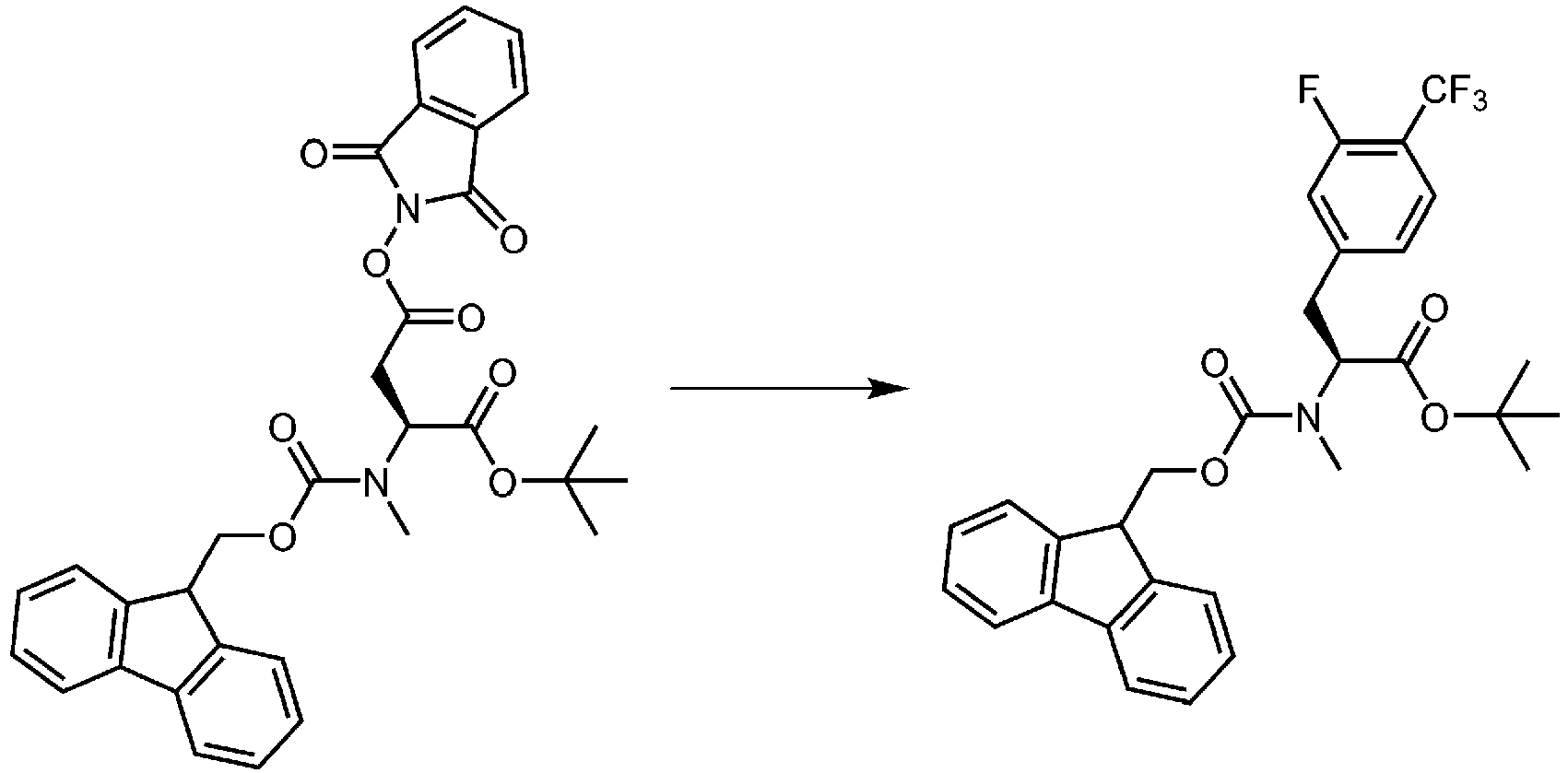
- Nickel bromide trihydrate (0.21 g, 0.77 mmol) and 4,4'-di-tert-butyl-2,2'-bipyridine (0.25 g, 0.95 mmol) were dissolved in DMA (15 mL), and the mixture was purged with nitrogen and then stirred to prepare a catalyst solution. Zinc powder (1.0 g, 16 mmol), 1-(tert-butyl) 4-(1,3-dioxoisoindolin-2-yl) N-(((9H-fluoren-9-yl)methoxy)carbonyl)-N-methyl-L-aspartate (1.8 g, 3.2 mmol) and DMA (8.0 mL) were added to a flask, 4-bromo-2-fluoro-1-(trifluoromethyl)benzene (2.3 g, 9.5 mmol) was added, and then the mixture was purged with nitrogen. After the prepared catalyst solution was added dropwise to the reaction solution under a nitrogen atmosphere, TMSC1 (0.17 g, 1.6 mmol) was added, and the mixture was stirred at 25°C for 30 min. When the reaction mixture was analyzed by HPLC, it was confirmed that the raw material had completely disappeared, and that the target compound was the main product. The reaction solution was quenched with an aqueous EDTA·2Na solution, and then the mixture was extracted with MTBE. After the organic layer was washed with saline, the organic layer was concentrated, and the resulting crude product was purified by chromatography to afford tert-butyl (S)-2-((((9H-fluoren-9-yl)methoxy)carbonyl)(methyl)amino)-3 -(3 -fluoro-4-(trifluoromethyl)phenyl)propanoate (1.2 g, yield 68%).
- tert-Butyl (S)-2-((((9H-fluoren-9-yl)methoxy)carbonyl)(methyl)amino)-3-(3-fluoro-4-(trifluoromethyl)phenyl)propanoate:
- Target compound retention time: 1.1 min (High performance liquid chromatography Condition 4)
- ESI (LC/MS positive mode m/z 566 (M+Na)+)
-

- Nickel bromide trihydrate (0.37 g, 1.4 mmol) and 4,4'-di-tert-butyl-2,2'-bipyridine (0.45 g, 1.7 mmol) were dissolved in DMA (25 mL), and the mixture was purged with nitrogen and then stirred to prepare a catalyst solution. Zinc powder (1.8 g, 28 mmol), 1-(tert-butyl) 4-(1,3-dioxoisoindolin-2-yl) N-(((9H-fluoren-9-yl)methoxy)carbonyl)-N-methyl-L-aspartate (3.2 g, 5.6 mmol) and DMA (25 mL) were added to a flask, 1-bromo-2-fluoro-4-methoxybenzene (3.5 g, 17 mmol) was added, and then the mixture was purged with nitrogen. After the prepared catalyst solution was added dropwise under a nitrogen atmosphere, TMSCl (0.31 g, 2.8 mmol) was added, and the mixture was stirred at 25°C for 30 min. When the reaction mixture was analyzed by HPLC, it was confirmed that the raw material had completely disappeared, and that the target compound was produced. The reaction solution was quenched with an aqueous EDTA·2Na solution, and then the mixture was extracted with MTBE. After the organic layer was washed with saline, the organic layer was concentrated, and the resulting crude product was purified by chromatography to afford tert-butyl (S)-2-((((9H-fluoren-9-yl)methoxy)carbonyl)(methyl)amino)-3-(2-fluoro-4-methoxyphenyl)propanoate (0.48 g, yield 17%).
- tert-Butyl (S)-2-((((9H-fluoren-9-yl)methoxy)carbonyl)(methyl)amino)-3-(2-fluoro-4-methoxyphenyl)propanoate:
- Target compound retention time: 1.1 min (High performance liquid chromatography Condition 4)
- ESI (LC/MS positive mode m/z 506 (M+H)+)
- (S)-2-((((9H-Fluoren-9-yl)methoxy)carbonyl)(ethyl)amino)-3-(p-tolyl)propanoic acid was produced according to the following synthesis scheme.

-

- Trifluoroacetic acid (29 g, 0.38 mol) was added at room temperature to a suspension of (S)-2-((((9H-fluoren-9-yl)methoxy)carbonyl)amino)-4-(allyloxy)-4-oxobutanoic acid (50 g, 0.13 mol), magnesium sulfate (55 g, 0.38 mol), and paraldehyde (25 g, 0.19 mol) in toluene (0.50 L). The mixture was stirred at 90°C for 16 h, then cooled to room temperature, diluted with ethyl acetate, and washed with an aqueous sodium hydrogen carbonate solution. The organic layer was dried over sodium sulfate and concentrated under reduced pressure to afford (9H-fluoren-9-yl)methyl (4S)-4-(2-(allyloxy)-2-oxoethyl)-2-methyl-5-oxooxazolidine-3-carboxylate (45 g, yield 82%).
- (9H-Fluoren-9-yl)methyl (4S)-4-(2-(allyloxy)-2-oxoethyl)-2-methyl-5-oxooxazolidine-3-carboxylate:
- Target compound retention time: 1.4 min (High performance liquid chromatography Condition 6)
- ESI (LC/MS positive mode m/z 422 (M+H)+)
-

- (9H-Fluoren-9-yl)methyl (4S)-4-(2-(allyloxy)-2-oxoethyl)-2-methyl-5-oxooxazolidine-3-carboxylate (46 g, 0.11 mol) and triethylsilane (38 g, 0.32 mol) were dissolved in dichloromethane (0.45 L), and trifluoroacetic acid (0.45 L) was added at 25°C. The solution was stirred at 25°C for 48 h and then concentrated under reduced pressure. MTBE was added to the concentrated residue, followed by extraction with an aqueous sodium hydrogen carbonate solution into an aqueous layer, and the aqueous layer was washed with hexane three times. The aqueous layer was regulated to pH 2 with hydrochloric acid, and extracted with MTBE twice. The organic layer was dried over sodium sulfate and then concentrated under reduced pressure to afford (S)-2-((((9H-fluoren-9-yl)methoxy)carbonyl)(ethyl)amino)-4-(allyloxy)-4-oxobutanoic acid (33 g, yield 71%).
- (S)-2-((((9H-Fluoren-9-yl)methoxy)carbonyl)(ethyl)amino)-4-(allyloxy)-4-oxobutanoic acid: Target compound retention time: 1.9 min (High performance liquid chromatography Condition 5)
- ESI (LC/MS positive mode m/z 424 (M+H)+)
-

- Target compound retention time: 1.6 min (High performance liquid chromatography Condition 6)
- ESI (LC/MS positive mode m/z 480 (M+H)+)
-

- 4-Allyl 1-(tert-butyl) N-(((9H-fluoren-9-yl)methoxy)carbonyl)-N-methyl-L-aspartate (4.9 g, 10 mmol) and tetrakistriphenylphosphine palladium (0.12 g, 0.10 mmol) were dissolved in dichloromethane (25 mL), and phenylsilane (0.77 g, 7.2 mmol) was added. The reaction solution was stirred at 25°C for 16 h and then concentrated, and MTBE was added to dissolve the concentrate. The target compound was extracted with an aqueous sodium carbonate solution into an aqueous layer. The aqueous layer was acidified by adding phosphoric acid to the aqueous layer, and the target compound was extracted with MTBE three times. The organic layer was washed with saline and then dried over sodium sulfate, and the concentrate was purified by chromatography to afford (S)-3-((((9H-fluoren-9-yl)methoxy)carbonyl)(ethyl)amino)-4-(tert-butoxy)-4-oxobutanoic acid (2 g, yield 46%).
- (S)-3-((((9H-Fluoren-9-yl)methoxy)carbonyl)(ethyl)amino)-4-(tert-butoxy)-4-oxobutanoic acid:
- Target compound retention time: 1.7 min (High performance liquid chromatography Condition 5)
- ESI (LC/MS positive mode m/z 440 (M+H)+)
-

- Target compound retention time: 1.1 min (High performance liquid chromatography Condition 4)
- ESI (LC/MS positive mode m/z 607 (M+Na)+)
-

- Nickel bromide trihydrate (4.0 mg, 0.015 mmol) and 4,4'-di-tert-butyl-2,2'-bipyridine (3.9 mg, 0.015 mmol) were dissolved in DMA (0.50 mL), and the mixture was purged with nitrogen and then stirred to prepare a catalyst solution. 1-(tert-Butyl) 4-(1,3-dioxoisoindolin-2-yl) N-(((9H-fluoren-9-yl)methoxy)carbonyl)-N-ethyl-L-aspartate (0.12 g, 0.21 mmol) and 1-iodo-4-methylbenzene (0.14 g, 0.62 mmol) were added to and dissolved in DMA (0.50 mL). The prepared catalyst solution was added dropwise to the reaction solution under a nitrogen atmosphere, zinc powder (68 mg, 1.0 mmol) and then TMSC1 (11 mg, 0.10 mmol) were added, and the reaction vessel was shaken at 25°C for 2 h. When the reaction mixture was analyzed by HPLC, it was confirmed that the raw material had completely disappeared, and that the target compound was produced. The reaction solution was purified by chromatography to afford tert-butyl (S)-2-((((9H-fluoren-9-yl)methoxy)carbonyl)(ethyl)amino)-3-(p-tolyl)propanoate (66 mg, yield 65%). tert-Butyl (S)-2-((((9H-fluoren-9-yl)methoxy)carbonyl)(ethyl)amino)-3-(p-tolyl)propanoate:
- Target compound retention time: 1.2 min (High performance liquid chromatography Condition 4)
- ESI (LC/MS positive mode m/z 508 (M+Na)+)
-

- Target compound retention time: 0.95 min (High performance liquid chromatography Condition 4)
- ESI (LC/MS positive mode m/z 430 (M+H)+)
-
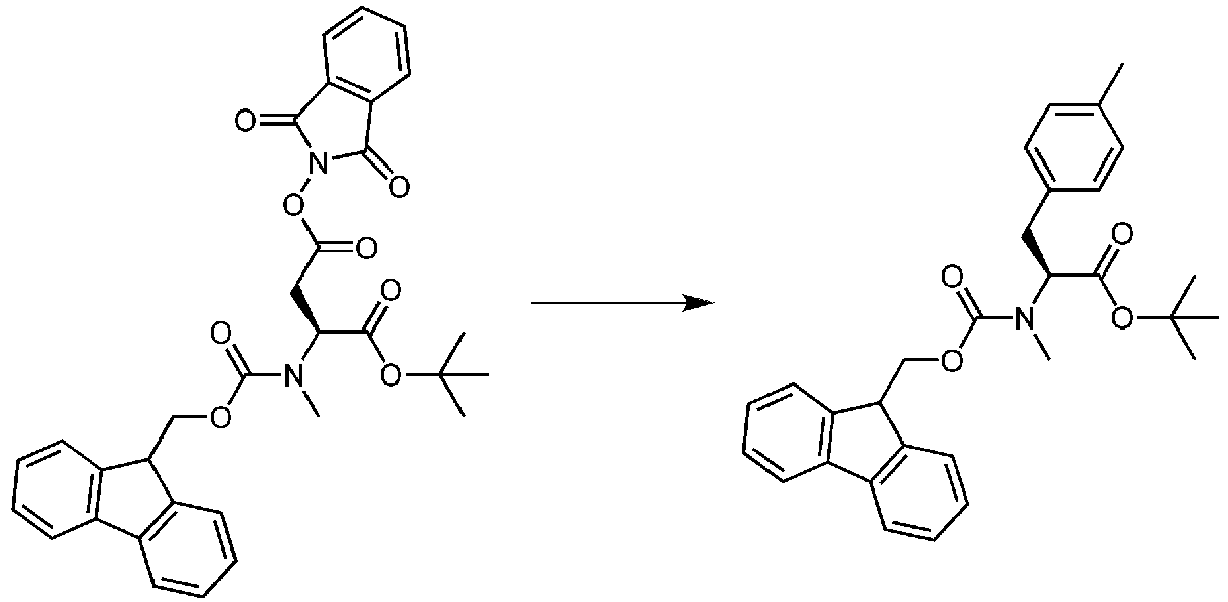
- Nickel bromide trihydrate (3.8 mg, 0.014 mmol) and 4,4'-di-tert-butyl-2,2'-bipyridine (3.8 mg, 0.014 mmol) were dissolved in DMA (0.50 mL), and the mixture was purged with nitrogen and then stirred to prepare a catalyst solution. Zinc powder (65 mg, 1.0 mmol) and TMSC1 (11 mg, 0.10 mmol) were added to the solution, and the mixture was shaken for 10 min. A solution of 1-(tert-butyl) 4-(1,3-dioxoisoindolin-2-yl) N-(((9H-fluoren-9-yl)methoxy)carbonyl)-N-methyl-L-aspartate (0.11 g, 0.20 mmol) and 1-iodo-4-methylbenzene (0.13 g, 0.60 mmol) in DMA (0.50 mL) was added dropwise to the catalyst solution under a nitrogen atmosphere, and the reaction vessel was shaken at 25°C for 2 h. When the reaction mixture was analyzed by HPLC, it was confirmed that the raw material had completely disappeared, and that the target compound was produced. The reaction solution was purified by chromatography to afford tert-butyl (S)-2-((((9H-fluoren-9-yl)methoxy)carbonyl)(methyl)amino)-3-(p-tolyl)propanoate (56 mg, yield 59%). tert-Butyl (S)-2-((((9H-fluoren-9-yl)methoxy)carbonyl)(methyl)amino)-3-(p-tolyl)propanoate:
- Target compound retention time: 1.2 min (High performance liquid chromatography Condition 4)
- ESI (LC/MS positive mode m/z 494 (M+Na)+)
-
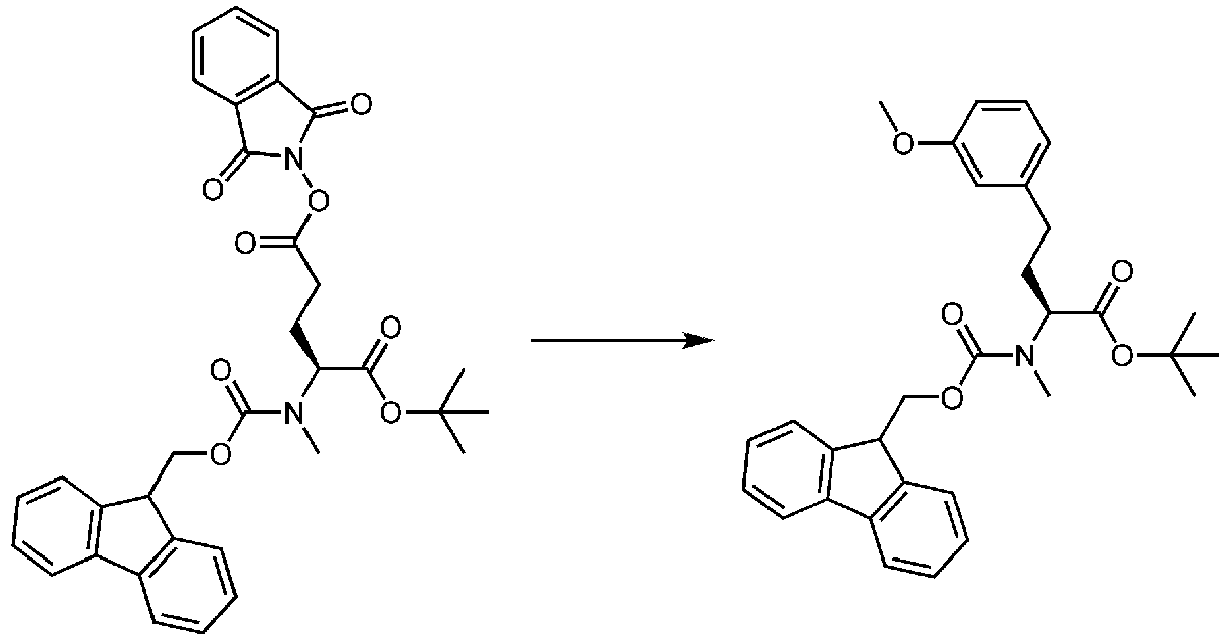
- Nickel bromide trihydrate (3.8 mg, 0.014 mmol) and 4,4'-di-tert-butyl-2,2'-bipyridine (3.8 mg, 0.014 mmol) were dissolved in DMA (0.50 mL), the mixture was purged with nitrogen and then stirred, and zinc powder (65 mg, 1.0 mmol) was further added to the solution to prepare a catalyst solution. 1-(tert-Butyl) 5-(1,3-dioxoisoindolin-2-yl) N-(((9H-fluoren-9-yl) methoxy)carbonyl)-N-methyl-L-glutamate (0.12 g, 0.20 mmol) and 1-iodo-3-methoxybenzene (0.14 g, 0.60 mmol) were dissolved in DMA (0.50 mL), and then TMSC1 (11 mg, 0.10 mmol) was added. The solution was added dropwise to the catalyst solution under a nitrogen atmosphere, and the reaction vessel was shaken at 25°C for 2 h. When the reaction mixture was analyzed by HPLC, it was confirmed that the raw material had completely disappeared, and that the target compound was produced. The reaction solution was purified by chromatography to afford tert-butyl (S)-2-((((9H-fluoren-9-yl)methoxy)carbonyl)(methyl)amino)-4-(3 - methoxyphenyl)butanoate (67 mg, yield 67%). tert-Butyl (S)-2-((((9H-fluoren-9-yl)methoxy)carbonyl)(methyl)amino)-4-(3-methoxyphenyl)butanoate:
- Target compound retention time: 1.1 min (High performance liquid chromatography Condition 4)
- ESI (LC/MS positive mode m/z 524 (M+Na)+)
- (S)-2-((((9H-Fluoren-9-yl)methoxy)carbonyl)amino)-4-(4-methoxyphenyl)butanoic acid can be produced according to the following synthesis scheme including the step of reacting an N-hydroxyphthalimide ester with an aromatic bromide using the same conditions and method as in the above Examples to obtain an aromatic amino acid derivative.

-
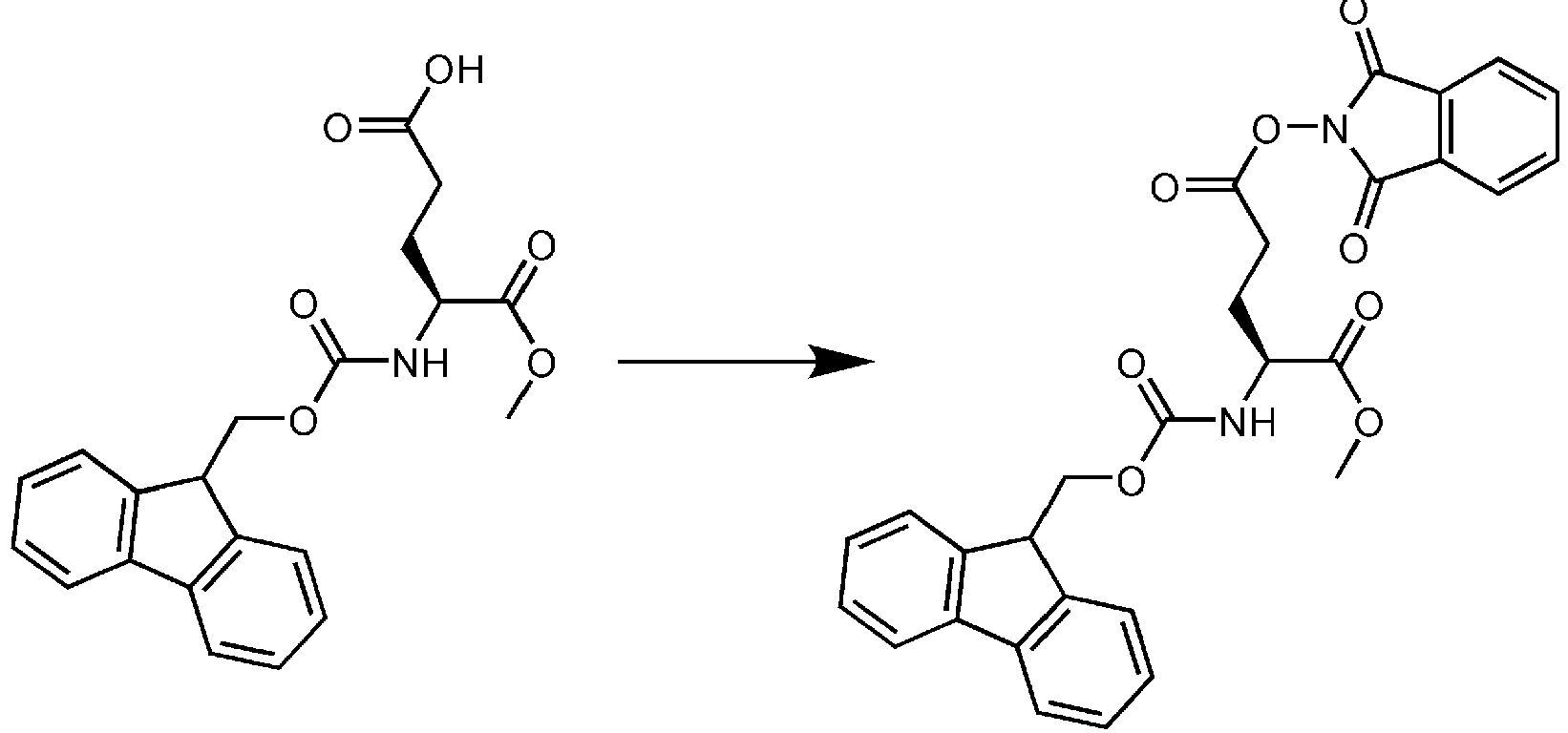
- (S)-4-((((9H-Fluoren-9-yl)methoxy)carbonyl)amino)-5-(methoxy)-5-oxopentanoic acid (1.0 g, 2.6 mmol) and N-hydroxyphthalimide (0.47 g, 2.9 mmol) were suspended in ethyl acetate (10 mL), and N,N'-diisopropylcarbodiimide (0.61 mL, 3.9 mmol) was added dropwise. The reaction solution was stirred at 25°C for 60 min, and solids were removed by filtration. The filtrate was concentrated, and purified by chromatography to afford 1-methyl 5-(1,3-dioxoisoindolin-2-yl) (((9H-fluoren-9-yl)methoxy)carbonyl)-L-glutamate (1.0 g, yield 73%). 1-Methyl 5-(1,3-dioxoisoindolin-2-yl) (((9H-fluoren-9-yl)methoxy)carbonyl)-L-glutamate:
- Target compound retention time: 1.0 min (High performance liquid chromatography Condition 3)
- ESI (LC/MS positive mode m/z 529 (M+H)+)
-

- Nickel bromide trihydrate (4.0 mg, 0.015 mmol) and 4,4'-di-tert-butyl-2,2'-bipyridine (4.0 mg, 0.015 mmol) were dissolved in DMA (0.50 mL), and the mixture was purged with nitrogen and then stirred to prepare a catalyst solution. In another vessel, zinc powder (69 mg, 1.1 mmol), 1-methyl 5-(1,3-dioxoisoindolin-2-yl) (((9H-fluoren-9-yl)methoxy)carbonyl)-L-glutamate (0.11 g, 0.21 mmol) and 1-iodo-4-methoxybenzene (0.15 g, 0.63 mmol) were added to and dissolved in DMA (0.50 mL). The prepared catalyst solution was added dropwise to the reaction solution under a nitrogen atmosphere, then TMSC1 (11 mg, 0.11 mmol) was added, and the reaction vessel was shaken at 25°C for 1 h. When the reaction mixture was analyzed by HPLC, it was confirmed that the raw material had completely disappeared, and that the target compound was produced. The reaction solution was purified by chromatography to afford methyl (S)-2-((((9H-fluoren-9-yl)methoxy)carbonyl)amino)-4-(4-methoxyphenyl)butanoate (64 mg, yield 68%).
- Methyl (S)-2-((((9H-fluoren-9-yl)methoxy)carbonyl)amino)-4-(4-methoxyphenyl)butanoate:
- Target compound retention time: 0.9 min (High performance liquid chromatography Condition 4)
- ESI (LC/MS positive mode m/z 446 (M+H)+)
-

- Water (0.49 mL) and 2-propanol (2.0 mL) were added to calcium chloride (0.19 g, 1.7 mmol) and lithium hydroxide hydrate (19 mg, 0.45 mmol), and the mixture was stirred at room temperature for 15 min. A solution of methyl (S)-2-((((9H-fluoren-9-yl)methoxy)carbonyl)amino)-4-(4-methoxyphenyl)butanoate (50 mg, 0.11 mmol) in THF (0.49 mL) was added dropwise at room temperature thereto, and the mixture was stirred for 20 h. Insoluble matter was removed by filtration, and solids were washed with THF. The filtrate was concentrated, and then purified by chromatography to afford (S)-2-((((9H-fluoren-9-yl)methoxy)carbonyl)amino)-4-(4-methoxyphenyl)butanoic acid (35 mg, 72%).
- (S)-2-((((9H-Fluoren-9-yl)methoxy)carbonyl)amino)-4-(4-methoxyphenyl)butanoic acid:
- Target compound retention time: 0.8 min (High performance liquid chromatography Condition 4)
- ESI (LC/MS positive mode m/z 432 (M+H)+)
- The present invention provides novel methods of producing optically active aromatic amino acid derivatives that are usable as a raw material of a pharmaceutical product. The use of the production method of the present invention enables efficient production and supply of an optically active aromatic amino acid derivative.
Claims (15)
- A method of producing a compound represented by Formula I, a salt of the compound, or a solvate of the compound or the salt:
 R1 is hydrogen or a protecting group for an amino group;R2 is hydrogen or C1-C6 alkyl, and R3 is hydrogen or a protecting group for a carboxyl group, or R2 and R3 together form a divalent protecting group;R6 is optionally substituted C6-C10 aryl or optionally substituted heteroaryl;R7 is hydrogen or C1-C4 alkyl; andn is 1 or 2,the method comprising the step of mixing a compound represented by Formula II, a salt of the compound, or a solvate of the compound or the salt with a reducing agent, an additive, and R6-X (wherein R6 is the same as R6 of the compound represented by Formula I, and X is halogen, OTf, or OMs) in the presence of a solvent and a catalyst to obtain the compound represented by Formula I, the salt of the compound, or the solvate of the compound or the salt:
 R1, R2, R3, R7, and n are the same as R1, R2, R3, R7, and n of the compound represented by Formula I, respectively;R5 is selected from the group consisting of:
 Rt, Ru, Rv, and Rw are independently hydrogen, halogen, or nitro;Rx and Ry are independently hydrogen, C1-C4 alkyl, or optionally substituted phenyl; Rz is hydrogen, C1-C4 alkyl, or halogen;Y is CH or N; and∗ indicates a point of bonding.
- The method of claim 1, wherein R1 is a protecting group for an amino group, and the protecting group for an amino group is selected from the group consisting of Fmoc, Boc, Alloc, Cbz, Teoc, and trifluoroacetyl.
- The method of claim 1 or 2, wherein R3 is a protecting group for a carboxyl group, and the protecting group for a carboxyl group is selected from the group consisting of methyl, ethyl, t-Bu, benzyl, trityl, cumyl, methoxytrityl, and 2-(trimethylsilyl)ethyl.
- The method of claim 1 or 2, whereinR2 and R3 together form a divalent protecting group, the divalent protecting group is - (CR8R9)-, and Formula I is represented by Formula IA:
 R1, R6, R7, and n are the same as R1, R6, R7, and n of the compound represented by Formula I, respectively; andR8 and R9 are independently hydrogen, C1-C4 alkyl or C6-C10 aryl, or R8 and R9 together form oxo (=O).
- The method of any one of claims 1 to 4, wherein the additive is a silyl compound represented by Formula A:
 RAX and RAY are independently selected from the group consisting of C1-C4 alkyl, C1-C4 alkoxy, and phenyl; andL is selected from the group consisting of -Cl, -Br, -I, and -OTf] or 1,2-dibromoethane.
- The method of claim 5, wherein the silyl compound is selected from the group consisting of TMSCl, TMSBr, TMSI, TMSOTf, TBDMSCl, TESCl, TIPSCl, TBDPSCl, and chlorotriethoxysilane.
- The method of any one of claims 1 to 6, wherein R5 is:

- The method of any one of claims 1 to 7, wherein X is iodine or bromine, and R6 is optionally substituted phenyl or optionally substituted pyridyl.
- The method of claim 8, wherein the optionally substituted phenyl or the optionally substituted pyridyl is substituted with 0 to 3 substituents independently selected from the group consisting of C1-C4 alkyl, C1-C4 haloalkyl, C1-C4 alkoxy, C1-C4 haloalkoxy, C1-C6 alkenyloxy, halogen, C3-C8 cycloalkyl, -NRpRq (wherein Rp and Rq are independently hydrogen or C1-C4 alkyl), -CONRrRs (wherein Rr and Rs are independently selected from the group consisting of hydrogen, hydroxy, protected hydroxy, C1-C4 alkyl, and C1-C4 alkylsulfonyl), and cyclic boryl.
- The method of any one of claims 1 to 9, wherein
the catalyst is:(a) a metal;(b) formed by mixing a metal and a possible ligand compound therefor;(c) a complex of a metal and a ligand therefor; or(d) formed by further mixing, with the complex of a metal and a ligand therefor, a possible ligand compound for the metal, and
wherein the metal is nickel, chromium, iron, copper, palladium or a salt of these metals, or is a solvate of nickel, chromium, iron, copper, palladium or a salt of these metals. - The method of claim 10, wherein the metal is selected from the group consisting of NiBr2, NiI2, NiCl2, NiF2, Ni(OAc)2, Ni(acac)2, Ni(OTf)2, NiCO3, Ni(NO3)2, NiSO4, (NH4)2Ni(SO4)2, allyl(cyclopentadienyl)nickel(II), bis(cyclopentadienyl)nickel, and bis(cyclooctadienyl)nickel, or is a solvate of these metals.
- The method of claim 10 or 11, wherein the possible ligand compound is selected from:a compound represented by Formula B:
 wherein RBX and RBY are independently selected from hydrogen, C1-C4 alkyl, C1-C4 alkoxy, heterocyclyl, and C6-C10 aryl;a compound represented by Formula C:
 wherein RCX and RCY are independently selected from hydrogen, C1-C4 alkyl, C6-C10 aryl, andheteroaryl;a compound represented by Formula D:
 wherein RDX and RDY are independently selected from hydrogen, C1-C4 alkyl, C1-C4 haloalkyl, and C6-C10 aryl;a compound represented by Formula E:
 wherein REX and REY are independently selected from hydrogen, C1-C4 alkyl, C6-C10 aryl C1-C6 alkyl, and C6-C10 aryl;a compound represented by Formula F:
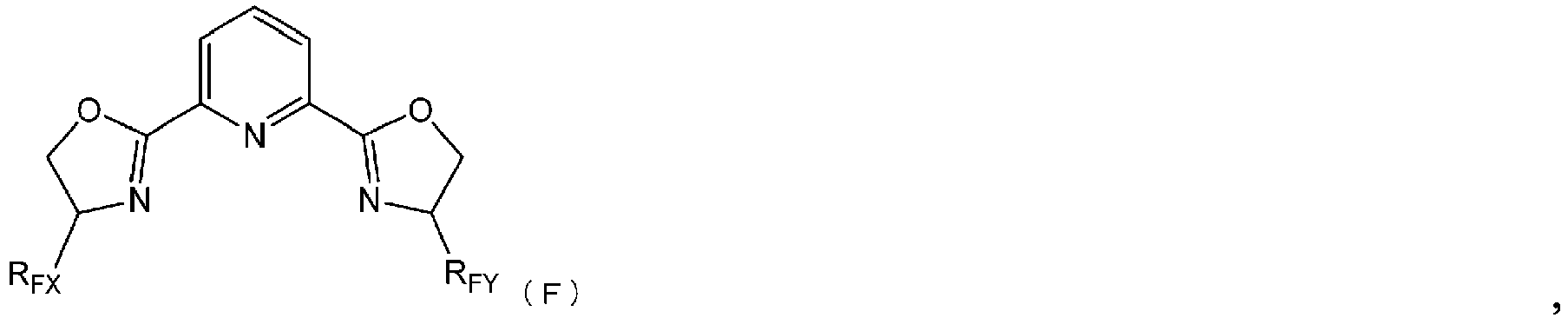 wherein RFX and RFY are independently selected from hydrogen, C1-C4 alkyl, and C6-C10 aryl; anda compound represented by Formula G:
 wherein RGX and RGY are independently selected from hydrogen, C1-C4 alkyl, C6-C10 aryl C1-C6 alkyl, and C6-C10 aryl.
- The method of claim 10, wherein the catalyst is a complex of a metal and a ligand therefor, and the complex of a metal and a ligand therefor is selected from the group consisting of tetrakis(triphenylphosphine)nickel(0), bis(triphenylphosphine)nickel(II) dichloride, bis(tricyclohexylphosphine)nickel(II) dichloride, dibromobis(triphenylphosphine)nickel(II), bis[(2-dimethylamino)phenyl]aminenickel(II) chloride, cis-[2,2'-bis(diphenylphosphino)-1,1'-binaphthyl](2-methylphenyl)nickel(II) chloride, and [1,2-bis(diphenylphosphino)ethane]dichloronickel(II).
- The method of any one of claims 1 to 13, wherein the reducing agent is selected from the group consisting of zinc, manganese, iron, and magnesium.
- The method of any one of claims 1 to 14, wherein(a) the compound represented by Formula II, the salt of the compound, or the solvate of the compound or the salt, the reducing agent, and R6-X are mixed in the presence of the solvent and the catalyst, and then the additive is mixed therewith;(b) the reducing agent and the additive are mixed in the presence of the solvent and the catalyst, and then the compound represented by Formula II, the salt of the compound, or the solvate of the compound or the salt, and R6-X are mixed therewith; or(c) the reducing agent is mixed with the solvent and the catalyst, and then the compound represented by Formula II, the salt of the compound, or the solvate of the compound or the salt, R6-X, and the additive are mixed therewith.
Applications Claiming Priority (5)
| Application Number | Priority Date | Filing Date | Title |
|---|---|---|---|
| JP2019048394 | 2019-03-15 | ||
| JP2019098657 | 2019-05-27 | ||
| JP2019178503 | 2019-09-30 | ||
| JP2019221297 | 2019-12-06 | ||
| PCT/JP2020/011012 WO2020189540A1 (en) | 2019-03-15 | 2020-03-13 | Method for preparing aromatic amino acid derivative |
Related Child Applications (1)
| Application Number | Title | Priority Date | Filing Date |
|---|---|---|---|
| EP26186467.2 Division-Into | 2026-06-19 |
Publications (3)
| Publication Number | Publication Date |
|---|---|
| EP3939962A1 true EP3939962A1 (en) | 2022-01-19 |
| EP3939962A4 EP3939962A4 (en) | 2022-12-28 |
| EP3939962B1 EP3939962B1 (en) | 2026-07-29 |
Family
ID=72519321
Family Applications (1)
| Application Number | Title | Priority Date | Filing Date |
|---|---|---|---|
| EP20774227.1A Active EP3939962B1 (en) | 2019-03-15 | 2020-03-13 | Method for preparing aromatic amino acid derivative |
Country Status (6)
| Country | Link |
|---|---|
| US (2) | US12071396B2 (en) |
| EP (1) | EP3939962B1 (en) |
| JP (3) | JP7472101B2 (en) |
| KR (1) | KR102994657B1 (en) |
| CN (2) | CN120518504A (en) |
| WO (1) | WO2020189540A1 (en) |
Families Citing this family (13)
| Publication number | Priority date | Publication date | Assignee | Title |
|---|---|---|---|---|
| TWI852183B (en) | 2011-12-28 | 2024-08-11 | 日商中外製藥股份有限公司 | Cyclization method of peptide compounds |
| US10815489B2 (en) | 2015-03-13 | 2020-10-27 | Chugai Seiyaku Kabushiki Kaisha | Modified aminoacyl-tRNA synthetase and use thereof |
| US12391971B2 (en) | 2017-01-31 | 2025-08-19 | Chugai Seiyaku Kabushiki Kaisha | Method for synthesizing peptides in cell-free translation system |
| EP3636656A4 (en) | 2017-06-09 | 2021-04-14 | Chugai Seiyaku Kabushiki Kaisha | PROCESS FOR SYNTHESIS OF A PEPTIDE CONTAINING AN N-SUBSTITUTED AMINO ACID |
| CN111479819B (en) | 2017-12-15 | 2024-06-14 | 中外制药株式会社 | Method for preparing peptide and method for treating base |
| US12312297B2 (en) | 2018-11-07 | 2025-05-27 | Chugai Seiyaku Kabushiki Kaisha | O-substituted serine derivative production method |
| CN119143631A (en) | 2018-11-30 | 2024-12-17 | 中外制药株式会社 | Deprotection method for peptide compound or amide compound and resin removal method in solid phase reaction and method for producing peptide compound |
| EP4043478A4 (en) | 2019-11-07 | 2024-01-03 | Chugai Seiyaku Kabushiki Kaisha | Cyclic peptide compound having kras inhibiting action |
| WO2021090856A1 (en) | 2019-11-07 | 2021-05-14 | 中外製薬株式会社 | Method for producing peptide compound comprising highly sterically hindered amino acid |
| AR125800A1 (en) | 2021-05-07 | 2023-08-16 | Chugai Pharmaceutical Co Ltd | METHODS FOR PRODUCING CYCLIC COMPOUNDS COMPRISING N-SUBSTITUTED AMINO ACIDS RESIDUES |
| CA3237911A1 (en) | 2021-12-28 | 2023-07-06 | Chugai Seiyaku Kabushiki Kaisha | Method for producing n-alkyl amino acid and peptide including n-alkyl amino acid |
| IL316253A (en) | 2022-05-06 | 2025-01-01 | Chugai Pharmaceutical Co Ltd | Cyclic compound having selective kras inhibitory effect on hras and nras |
| TW202506706A (en) | 2023-04-20 | 2025-02-16 | 日商中外製藥股份有限公司 | Method for producing cyclic peptide compound |
Family Cites Families (76)
| Publication number | Priority date | Publication date | Assignee | Title |
|---|---|---|---|---|
| JPS57159747A (en) | 1981-03-27 | 1982-10-01 | Kenji Okawa | Synthesis of amino acid derivative |
| JPS60169451A (en) | 1984-02-13 | 1985-09-02 | Mitsui Toatsu Chem Inc | Separation and purification of l-phenylalanine |
| FR2583432B1 (en) | 1985-06-13 | 1988-11-04 | Inst Francais Du Petrole | PROCESS FOR THE ENZYMATIC PRODUCTION OF L-A-AMINOACIDS FROM A-CETOACIDS |
| ES8607214A1 (en) | 1985-10-16 | 1986-06-01 | Gema Sa | Method for splitting and purifying n-phenylacetylamino compound |
| US4859736A (en) | 1987-03-30 | 1989-08-22 | Ciba-Geigy Corporation | Synthetic polystyrene resin and its use in solid phase peptide synthesis |
| DE3733198A1 (en) | 1987-10-01 | 1989-04-13 | Kernforschungsanlage Juelich | ENZYMATIC METHOD FOR PRODUCING DIPEPTIDES |
| JPH0681759B2 (en) | 1988-03-31 | 1994-10-19 | 信越化学工業株式会社 | Method for producing polypeptide |
| US5656600A (en) * | 1993-03-25 | 1997-08-12 | Corvas International, Inc. | α-ketoamide derivatives as inhibitors of thrombosis |
| US6214345B1 (en) * | 1993-05-14 | 2001-04-10 | Bristol-Myers Squibb Co. | Lysosomal enzyme-cleavable antitumor drug conjugates |
| IL131016A (en) | 1997-01-21 | 2004-12-15 | Gen Hospital Corp | Selection of proteins using rna-protein fusions |
| JP4502293B2 (en) | 1999-06-04 | 2010-07-14 | 長瀬産業株式会社 | Optically active quaternary ammonium salt having axial asymmetry, its production method and application to asymmetric synthesis of α-amino acid derivatives |
| DE19942624A1 (en) | 1999-08-28 | 2001-03-08 | Chemotopix Gmbh | Process for the preparation of cyclic peptidomimetics |
| AU2001253621A1 (en) | 2000-04-19 | 2001-11-07 | Schering Corporation | Macrocyclic NS3-serine protease inhibitors of hepatitis C virus comprising alkyl and aryl alanine P2 moieties |
| HK1049331A1 (en) | 2000-04-21 | 2003-05-09 | Nagase & Co., Ltd. | OPTICALLY ACTIVE QUATERNARY AMMONIUM SALT WITH AXIAL ASYMMETRY, PROCESS FOR PRODUCING THE SAME, AND APPLICATION TO ASYMMETRIC SYNTHESIS OF α-AMINO ACID DERIVATIVE |
| ES2464532T3 (en) | 2001-04-19 | 2014-06-03 | The Scripps Research Institute | Methods and compositions for the production of orthogonal pairs of tRNA-aminoacyl-tRNA synthetase |
| US7393670B2 (en) | 2001-08-01 | 2008-07-01 | Japan Science And Technology Agency | Tyrosyl-tRNA synthetase variants |
| US7288372B2 (en) | 2002-01-17 | 2007-10-30 | Ambergen, Inc. | Methods for the preparation of chemically misaminoacylated tRNA via protective groups |
| EP1504111A4 (en) | 2002-04-19 | 2005-11-23 | California Inst Of Techn | PEPTIDES NUCLEIC ACID PEPTIDE DISPLAY LIBRARS CONTAINING UNNATURELY AMINO-ACID-RESISTANT AND METHOD FOR THE PRODUCTION THEREOF |
| US7557137B2 (en) * | 2002-08-05 | 2009-07-07 | Bristol-Myers Squibb Company | Gamma-lactams as beta-secretase inhibitors |
| JP4490663B2 (en) | 2003-09-22 | 2010-06-30 | 株式会社東京大学Tlo | MesJ gene product and its homologous gene (COG0037) as lysidine synthase (TilS) of isoleucine tRNA (tRNAIle) |
| WO2005063791A2 (en) | 2003-12-31 | 2005-07-14 | F. Hoffmann-La Roche Ag | Process for peptide synthesis using a reduced amount of deprotection agent |
| US20080221303A1 (en) | 2004-02-18 | 2008-09-11 | Jehoshua Katzhendler | Method for the Preparation of Peptide-Oligonucleotide Conjugates |
| EP1964916B1 (en) | 2005-12-06 | 2012-08-01 | The University of Tokyo | Multi-purpose acylation catalayst and use thereof |
| AU2007224019A1 (en) | 2006-03-03 | 2007-09-13 | California Institute Of Technology | Site-specific incorporation of amino acids into molecules |
| EP2010556B1 (en) | 2006-04-11 | 2015-09-23 | Sloan-Kettering Institute for Cancer Research | Homogeneous erythropoietin and method for their preparation |
| JP2007319064A (en) | 2006-05-31 | 2007-12-13 | Japan Science & Technology Agency | Method for expressing a protein in which a modified amino acid is introduced site-specifically |
| JP5200241B2 (en) | 2006-11-17 | 2013-06-05 | 国立大学法人 東京大学 | Translational synthesis of polypeptides with non-natural backbone at the N-terminus and their applications |
| US9090668B2 (en) | 2007-03-26 | 2015-07-28 | The University Of Tokyo | Process for synthesizing cyclic peptide compound |
| JP2009096791A (en) | 2007-09-26 | 2009-05-07 | Kaneka Corp | Method for producing amino acid |
| EP2177533A1 (en) | 2008-10-09 | 2010-04-21 | TU München | Multiple N-methylated cyclic hexapeptides for treatment of neurogenic inflammation |
| TWI468375B (en) | 2008-10-27 | 2015-01-11 | Janssen Pharmaceutica Nv | Process for the preparation of protected l-alanine derivatives |
| WO2010053050A1 (en) | 2008-11-04 | 2010-05-14 | 株式会社カネカ | O-alkylserine, and process for producing n-benzyl-o-alkylserine |
| CN102239176A (en) | 2008-12-03 | 2011-11-09 | 弗·哈夫曼-拉罗切有限公司 | Process for preparing therapeutic peptide |
| WO2010125079A2 (en) | 2009-05-01 | 2010-11-04 | F. Hoffmann-La Roche Ag | Insulinotropic peptide synthesis using solid and solution phase combination techniques |
| JP5174971B2 (en) | 2009-10-22 | 2013-04-03 | ペプチドリーム株式会社 | RAPID display method in peptide translation synthesis |
| GB0919194D0 (en) | 2009-11-02 | 2009-12-16 | Lytix Biopharma As | Compounds |
| US20110118314A1 (en) | 2009-11-16 | 2011-05-19 | Weiya Yun | Piperidine analogs as glycogen synthase activators |
| JP2011139667A (en) | 2010-01-07 | 2011-07-21 | Tottori Univ | DIPEPTIDE HAVING PROLINE OR beta-ALANINE AT N-TERMINUS AND METHOD FOR ENZYMATICALLY SYNTHESIZING CYCLIC DIPEPTIDE THEREOF |
| EP2380596A1 (en) | 2010-04-20 | 2011-10-26 | Technische Universität München | Cyclopentapeptide derivatives and uses thereof |
| JP5725467B2 (en) | 2010-08-27 | 2015-05-27 | 国立大学法人 東京大学 | New artificial translation synthesis system |
| JP5818237B2 (en) | 2010-09-09 | 2015-11-18 | 国立大学法人 東京大学 | Translational construction and search for active species of special peptide compound library containing N-methylamino acid and other special amino acids |
| JP6206943B2 (en) | 2010-12-03 | 2017-10-04 | 国立大学法人 東京大学 | Method for producing peptide library, peptide library, and screening method |
| ES2586411T3 (en) | 2011-03-04 | 2016-10-14 | New York University | Hydrogen bond substitute macrocycles as Ras modulators |
| WO2012173762A1 (en) | 2011-06-13 | 2012-12-20 | Trustees Of Boston College | Cyclic lactadherin peptide mimetics and their uses |
| TWI852183B (en) | 2011-12-28 | 2024-08-11 | 日商中外製藥股份有限公司 | Cyclization method of peptide compounds |
| GB201215538D0 (en) | 2012-08-31 | 2012-10-17 | Stetsenko Dmitry | Method and compositions for removing acid-labile protecting groups |
| JP6440055B2 (en) | 2013-05-10 | 2018-12-19 | 国立大学法人 東京大学 | Method for producing peptide library, peptide library, and screening method |
| EP3031915B1 (en) | 2013-08-05 | 2019-03-06 | The University of Tokyo | Production method for charged non-protein amino acid-containing peptide |
| CN105980350B (en) | 2013-08-05 | 2018-11-27 | 米迪缪尼有限公司 | Amino acid derivativges |
| WO2015155676A1 (en) | 2014-04-08 | 2015-10-15 | Novartis Ag | Novel aldehyde acetal based processes for the manufacture of macrocyclic depsipeptides and new intermediates |
| WO2015179434A1 (en) | 2014-05-20 | 2015-11-26 | Ohio State Innovation Foundation | Small molecule ras inhibitors |
| CN106573959B (en) | 2014-06-06 | 2022-03-25 | 慕尼黑工业大学 | Modified cyclic pentapeptides and uses thereof |
| WO2016115168A1 (en) | 2015-01-12 | 2016-07-21 | Synthorx, Inc. | Incorporation of unnatural nucleotides and methods thereof |
| US10815489B2 (en) | 2015-03-13 | 2020-10-27 | Chugai Seiyaku Kabushiki Kaisha | Modified aminoacyl-tRNA synthetase and use thereof |
| US20180171321A1 (en) | 2015-03-27 | 2018-06-21 | The University Of Queensland | Platform for a non-natural amino acid incorporation into proteins |
| WO2017136708A1 (en) * | 2016-02-04 | 2017-08-10 | The Johns Hopkins University | Synthesis and composition of rapafucin libraries |
| WO2017150732A1 (en) | 2016-03-03 | 2017-09-08 | 中外製薬株式会社 | Production method for noncyclic peptide-nucleic acid complex having, at n-terminal, amino acid with thiol group near amino group, library thereof, and cyclic peptide-nucleic acid complex library derived from same |
| EP3442991A4 (en) | 2016-04-15 | 2019-11-20 | RA Pharmaceuticals, Inc. | PIN BINDING PEPTIDES AND METHODS OF USE |
| WO2017212390A1 (en) * | 2016-06-06 | 2017-12-14 | Emcure Pharmaceuticals Ltd, | Process for lanreotide acetate preparation |
| IT201600122363A1 (en) | 2016-12-02 | 2018-06-02 | Dolores Fregona | COMPOUNDS OF COORDINATION, SYNTHESIS, NANOFORMULATION AND USE OF THE SAME IN ONCOLOGY |
| US12391971B2 (en) | 2017-01-31 | 2025-08-19 | Chugai Seiyaku Kabushiki Kaisha | Method for synthesizing peptides in cell-free translation system |
| EP3636656A4 (en) | 2017-06-09 | 2021-04-14 | Chugai Seiyaku Kabushiki Kaisha | PROCESS FOR SYNTHESIS OF A PEPTIDE CONTAINING AN N-SUBSTITUTED AMINO ACID |
| EP3636807A4 (en) | 2017-06-09 | 2021-07-28 | Chugai Seiyaku Kabushiki Kaisha | HIGH PERMEABILITY CYCLIC PEPTIDE COMPOUND OF MEMBRANE AND LIBRARY CONTAINING IT |
| CN111479819B (en) | 2017-12-15 | 2024-06-14 | 中外制药株式会社 | Method for preparing peptide and method for treating base |
| US12312297B2 (en) | 2018-11-07 | 2025-05-27 | Chugai Seiyaku Kabushiki Kaisha | O-substituted serine derivative production method |
| CN119143631A (en) | 2018-11-30 | 2024-12-17 | 中外制药株式会社 | Deprotection method for peptide compound or amide compound and resin removal method in solid phase reaction and method for producing peptide compound |
| WO2020122182A1 (en) | 2018-12-12 | 2020-06-18 | 中外製薬株式会社 | Amino acid having functional group capable of intermolecular hydrogen bonding, peptide compound containing same and method for production thereof |
| KR102850080B1 (en) | 2018-12-26 | 2025-08-22 | 추가이 세이야쿠 가부시키가이샤 | Mutant tRNA for codon expansion |
| EP4043478A4 (en) | 2019-11-07 | 2024-01-03 | Chugai Seiyaku Kabushiki Kaisha | Cyclic peptide compound having kras inhibiting action |
| WO2021090856A1 (en) | 2019-11-07 | 2021-05-14 | 中外製薬株式会社 | Method for producing peptide compound comprising highly sterically hindered amino acid |
| CN114641569A (en) | 2019-12-26 | 2022-06-17 | 中外制药株式会社 | Composition for translation and method for producing peptide |
| JP7709920B2 (en) | 2019-12-27 | 2025-07-17 | 中外製薬株式会社 | Method for synthesizing peptide compounds |
| WO2021246471A1 (en) | 2020-06-03 | 2021-12-09 | 中外製薬株式会社 | Efficient peptide condensation method for difficult sequences |
| KR20230028363A (en) | 2020-06-25 | 2023-02-28 | 추가이 세이야쿠 가부시키가이샤 | Translation system with altered genetic code table |
| EP4249496A4 (en) | 2020-12-28 | 2024-11-13 | Chugai Seiyaku Kabushiki Kaisha | METHOD FOR SUPPORTING AMINO ACID ON RESIN FOR SOLID PHASE SYNTHESIS |
| AR125800A1 (en) | 2021-05-07 | 2023-08-16 | Chugai Pharmaceutical Co Ltd | METHODS FOR PRODUCING CYCLIC COMPOUNDS COMPRISING N-SUBSTITUTED AMINO ACIDS RESIDUES |
-
2020
- 2020-03-13 KR KR1020217033080A patent/KR102994657B1/en active Active
- 2020-03-13 CN CN202510618679.9A patent/CN120518504A/en active Pending
- 2020-03-13 WO PCT/JP2020/011012 patent/WO2020189540A1/en not_active Ceased
- 2020-03-13 CN CN202080028840.2A patent/CN113692401A/en active Pending
- 2020-03-13 EP EP20774227.1A patent/EP3939962B1/en active Active
- 2020-03-13 JP JP2021507300A patent/JP7472101B2/en active Active
- 2020-03-13 US US17/437,535 patent/US12071396B2/en active Active
-
2024
- 2024-04-10 JP JP2024063463A patent/JP7703071B2/en active Active
- 2024-07-23 US US18/781,112 patent/US20240376044A1/en active Pending
-
2025
- 2025-06-24 JP JP2025106120A patent/JP2025138728A/en active Pending
Also Published As
| Publication number | Publication date |
|---|---|
| JP2024095785A (en) | 2024-07-10 |
| CN120518504A (en) | 2025-08-22 |
| JPWO2020189540A1 (en) | 2020-09-24 |
| US12071396B2 (en) | 2024-08-27 |
| JP7703071B2 (en) | 2025-07-04 |
| JP7472101B2 (en) | 2024-04-22 |
| US20240376044A1 (en) | 2024-11-14 |
| EP3939962B1 (en) | 2026-07-29 |
| US20220144762A1 (en) | 2022-05-12 |
| KR20210139366A (en) | 2021-11-22 |
| WO2020189540A1 (en) | 2020-09-24 |
| KR102994657B1 (en) | 2026-07-22 |
| EP3939962A4 (en) | 2022-12-28 |
| JP2025138728A (en) | 2025-09-25 |
| CN113692401A (en) | 2021-11-23 |
Similar Documents
| Publication | Publication Date | Title |
|---|---|---|
| JP7703071B2 (en) | Method for producing aromatic amino acid derivatives | |
| EP3752496B1 (en) | Methods and intermediates for preparing a therapeutic compound useful in the treatment of retroviridae viral infection | |
| KR102841441B1 (en) | Method for preparing O-substituted serine derivatives | |
| CA2981503A1 (en) | Bile acid derivatives as fxr/tgr5 agonists and methods of use thereof | |
| US10450321B2 (en) | [1,2,3]triazolo[4,5-D]pyrimidine derivatives | |
| JP2022523726A (en) | Inhibitor of human immunodeficiency virus replication | |
| TW200831513A (en) | Anti-viral compounds | |
| JP2006519765A (en) | Anticancer drug | |
| CA2696725A1 (en) | Pyridine derivatives and methods of use thereof | |
| CN114929226A (en) | TYK2 pseudokinase ligands | |
| CN107250137B (en) | Substituted amino six-membered saturated heteroalicyclics as long-acting DPP-IV inhibitors | |
| JP2022500425A (en) | Inhibitor of human immunodeficiency virus replication | |
| EP4596539A1 (en) | Fused ring compound and pharmaceutical containing same | |
| TW202233591A (en) | 2-pyridones and methods of use thereof | |
| US9045462B2 (en) | Synthesis of an antiviral compound | |
| EP2509981B1 (en) | Inhibitors of diacylglycerol acyltransferase | |
| CN115605209A (en) | NLRP3 modulator | |
| KR20210119485A (en) | GPR35 modulators | |
| JP7025411B2 (en) | Method for producing indole carboxamide compound | |
| JP2025516839A (en) | N6-adenosine methyltransferase protacs and methods of use thereof | |
| HK40122830A (en) | Method for preparing aromatic amino acid derivative | |
| HK40057587A (en) | Method for preparing aromatic amino acid derivative | |
| CA2647163C (en) | Modified macrophage migration inhibitory factor inhibitors | |
| EP2079710A1 (en) | Caspase inhibitors based on pyridazinone scaffold | |
| TWI262180B (en) | Synthetic intermediate for benzoimidazole compound and preparation thereof |
Legal Events
| Date | Code | Title | Description |
|---|---|---|---|
| STAA | Information on the status of an ep patent application or granted ep patent |
Free format text: STATUS: THE INTERNATIONAL PUBLICATION HAS BEEN MADE |
|
| PUAI | Public reference made under article 153(3) epc to a published international application that has entered the european phase |
Free format text: ORIGINAL CODE: 0009012 |
|
| STAA | Information on the status of an ep patent application or granted ep patent |
Free format text: STATUS: REQUEST FOR EXAMINATION WAS MADE |
|
| 17P | Request for examination filed |
Effective date: 20211012 |
|
| AK | Designated contracting states |
Kind code of ref document: A1 Designated state(s): AL AT BE BG CH CY CZ DE DK EE ES FI FR GB GR HR HU IE IS IT LI LT LU LV MC MK MT NL NO PL PT RO RS SE SI SK SM TR |
|
| DAV | Request for validation of the european patent (deleted) | ||
| DAX | Request for extension of the european patent (deleted) | ||
| A4 | Supplementary search report drawn up and despatched |
Effective date: 20221124 |
|
| RIC1 | Information provided on ipc code assigned before grant |
Ipc: C07B 61/00 20060101ALI20221118BHEP Ipc: C07B 53/00 20060101ALI20221118BHEP Ipc: C07D 239/26 20060101ALI20221118BHEP Ipc: C07D 213/55 20060101ALI20221118BHEP Ipc: C07C 271/22 20060101ALI20221118BHEP Ipc: B01J 31/22 20060101ALI20221118BHEP Ipc: C07C 269/06 20060101AFI20221118BHEP |
|
| STAA | Information on the status of an ep patent application or granted ep patent |
Free format text: STATUS: EXAMINATION IS IN PROGRESS |
|
| 17Q | First examination report despatched |
Effective date: 20241219 |
|
| GRAP | Despatch of communication of intention to grant a patent |
Free format text: ORIGINAL CODE: EPIDOSNIGR1 |
|
| STAA | Information on the status of an ep patent application or granted ep patent |
Free format text: STATUS: GRANT OF PATENT IS INTENDED |
|
| INTG | Intention to grant announced |
Effective date: 20260216 |
|
| GRAS | Grant fee paid |
Free format text: ORIGINAL CODE: EPIDOSNIGR3 |
|
| GRAA | (expected) grant |
Free format text: ORIGINAL CODE: 0009210 |
|
| STAA | Information on the status of an ep patent application or granted ep patent |
Free format text: STATUS: THE PATENT HAS BEEN GRANTED |
|
| AK | Designated contracting states |
Kind code of ref document: B1 Designated state(s): AL AT BE BG CH CY CZ DE DK EE ES FI FR GB GR HR HU IE IS IT LI LT LU LV MC MK MT NL NO PL PT RO RS SE SI SK SM TR |
|
| REG | Reference to a national code |
Ref country code: CH Ref legal event code: F10 Free format text: ST27 STATUS EVENT CODE: U-0-0-F10-F00 (AS PROVIDED BY THE NATIONAL OFFICE) Effective date: 20260729 |
|
| REG | Reference to a national code |
Ref country code: DE Ref legal event code: R096 Ref document number: 602020074945 Country of ref document: DE |