EP3938263B1 - System and method for determining friction curve of tire - Google Patents
System and method for determining friction curve of tire Download PDFInfo
- Publication number
- EP3938263B1 EP3938263B1 EP19845619.6A EP19845619A EP3938263B1 EP 3938263 B1 EP3938263 B1 EP 3938263B1 EP 19845619 A EP19845619 A EP 19845619A EP 3938263 B1 EP3938263 B1 EP 3938263B1
- Authority
- EP
- European Patent Office
- Prior art keywords
- vehicle
- state
- tire friction
- function
- tire
- Prior art date
- Legal status (The legal status is an assumption and is not a legal conclusion. Google has not performed a legal analysis and makes no representation as to the accuracy of the status listed.)
- Active
Links
Images












Classifications
-
- B—PERFORMING OPERATIONS; TRANSPORTING
- B60—VEHICLES IN GENERAL
- B60T—VEHICLE BRAKE CONTROL SYSTEMS OR PARTS THEREOF; BRAKE CONTROL SYSTEMS OR PARTS THEREOF, IN GENERAL; ARRANGEMENT OF BRAKING ELEMENTS ON VEHICLES IN GENERAL; PORTABLE DEVICES FOR PREVENTING UNWANTED MOVEMENT OF VEHICLES; VEHICLE MODIFICATIONS TO FACILITATE COOLING OF BRAKES
- B60T8/00—Arrangements for adjusting wheel-braking force to meet varying vehicular or ground-surface conditions, e.g. limiting or varying distribution of braking force
- B60T8/17—Using electrical or electronic regulation means to control braking
- B60T8/176—Brake regulation specially adapted to prevent excessive wheel slip during vehicle deceleration, e.g. ABS
- B60T8/1761—Brake regulation specially adapted to prevent excessive wheel slip during vehicle deceleration, e.g. ABS responsive to wheel or brake dynamics, e.g. wheel slip, wheel acceleration or rate of change of brake fluid pressure
-
- B—PERFORMING OPERATIONS; TRANSPORTING
- B60—VEHICLES IN GENERAL
- B60T—VEHICLE BRAKE CONTROL SYSTEMS OR PARTS THEREOF; BRAKE CONTROL SYSTEMS OR PARTS THEREOF, IN GENERAL; ARRANGEMENT OF BRAKING ELEMENTS ON VEHICLES IN GENERAL; PORTABLE DEVICES FOR PREVENTING UNWANTED MOVEMENT OF VEHICLES; VEHICLE MODIFICATIONS TO FACILITATE COOLING OF BRAKES
- B60T8/00—Arrangements for adjusting wheel-braking force to meet varying vehicular or ground-surface conditions, e.g. limiting or varying distribution of braking force
- B60T8/17—Using electrical or electronic regulation means to control braking
- B60T8/172—Determining control parameters used in the regulation, e.g. by calculations involving measured or detected parameters
- B60T8/1725—Using tyre sensors, e.g. Sidewall Torsion sensors [SWT]
-
- B—PERFORMING OPERATIONS; TRANSPORTING
- B60—VEHICLES IN GENERAL
- B60W—CONJOINT CONTROL OF VEHICLE SUB-UNITS OF DIFFERENT TYPE OR DIFFERENT FUNCTION; CONTROL SYSTEMS SPECIALLY ADAPTED FOR HYBRID VEHICLES; ROAD VEHICLE DRIVE CONTROL SYSTEMS FOR PURPOSES NOT RELATED TO THE CONTROL OF A PARTICULAR SUB-UNIT
- B60W40/00—Estimation or calculation of non-directly measurable driving parameters for road vehicle drive control systems not related to the control of a particular sub unit, e.g. by using mathematical models
- B60W40/02—Estimation or calculation of non-directly measurable driving parameters for road vehicle drive control systems not related to the control of a particular sub unit, e.g. by using mathematical models related to ambient conditions
- B60W40/06—Road conditions
- B60W40/068—Road friction coefficient
-
- B—PERFORMING OPERATIONS; TRANSPORTING
- B60—VEHICLES IN GENERAL
- B60T—VEHICLE BRAKE CONTROL SYSTEMS OR PARTS THEREOF; BRAKE CONTROL SYSTEMS OR PARTS THEREOF, IN GENERAL; ARRANGEMENT OF BRAKING ELEMENTS ON VEHICLES IN GENERAL; PORTABLE DEVICES FOR PREVENTING UNWANTED MOVEMENT OF VEHICLES; VEHICLE MODIFICATIONS TO FACILITATE COOLING OF BRAKES
- B60T2210/00—Detection or estimation of road or environment conditions; Detection or estimation of road shapes
- B60T2210/10—Detection or estimation of road conditions
- B60T2210/12—Friction
-
- B—PERFORMING OPERATIONS; TRANSPORTING
- B60—VEHICLES IN GENERAL
- B60W—CONJOINT CONTROL OF VEHICLE SUB-UNITS OF DIFFERENT TYPE OR DIFFERENT FUNCTION; CONTROL SYSTEMS SPECIALLY ADAPTED FOR HYBRID VEHICLES; ROAD VEHICLE DRIVE CONTROL SYSTEMS FOR PURPOSES NOT RELATED TO THE CONTROL OF A PARTICULAR SUB-UNIT
- B60W50/00—Details of control systems for road vehicle drive control not related to the control of a particular sub-unit, e.g. process diagnostic or vehicle driver interfaces
- B60W2050/0001—Details of the control system
- B60W2050/0019—Control system elements or transfer functions
- B60W2050/0022—Gains, weighting coefficients or weighting functions
- B60W2050/0024—Variable gains
-
- B—PERFORMING OPERATIONS; TRANSPORTING
- B60—VEHICLES IN GENERAL
- B60W—CONJOINT CONTROL OF VEHICLE SUB-UNITS OF DIFFERENT TYPE OR DIFFERENT FUNCTION; CONTROL SYSTEMS SPECIALLY ADAPTED FOR HYBRID VEHICLES; ROAD VEHICLE DRIVE CONTROL SYSTEMS FOR PURPOSES NOT RELATED TO THE CONTROL OF A PARTICULAR SUB-UNIT
- B60W50/00—Details of control systems for road vehicle drive control not related to the control of a particular sub-unit, e.g. process diagnostic or vehicle driver interfaces
- B60W2050/0001—Details of the control system
- B60W2050/0019—Control system elements or transfer functions
- B60W2050/0028—Mathematical models, e.g. for simulation
-
- B—PERFORMING OPERATIONS; TRANSPORTING
- B60—VEHICLES IN GENERAL
- B60W—CONJOINT CONTROL OF VEHICLE SUB-UNITS OF DIFFERENT TYPE OR DIFFERENT FUNCTION; CONTROL SYSTEMS SPECIALLY ADAPTED FOR HYBRID VEHICLES; ROAD VEHICLE DRIVE CONTROL SYSTEMS FOR PURPOSES NOT RELATED TO THE CONTROL OF A PARTICULAR SUB-UNIT
- B60W50/00—Details of control systems for road vehicle drive control not related to the control of a particular sub-unit, e.g. process diagnostic or vehicle driver interfaces
- B60W2050/0001—Details of the control system
- B60W2050/0043—Signal treatments, identification of variables or parameters, parameter estimation or state estimation
- B60W2050/0052—Filtering, filters
-
- B—PERFORMING OPERATIONS; TRANSPORTING
- B60—VEHICLES IN GENERAL
- B60W—CONJOINT CONTROL OF VEHICLE SUB-UNITS OF DIFFERENT TYPE OR DIFFERENT FUNCTION; CONTROL SYSTEMS SPECIALLY ADAPTED FOR HYBRID VEHICLES; ROAD VEHICLE DRIVE CONTROL SYSTEMS FOR PURPOSES NOT RELATED TO THE CONTROL OF A PARTICULAR SUB-UNIT
- B60W50/00—Details of control systems for road vehicle drive control not related to the control of a particular sub-unit, e.g. process diagnostic or vehicle driver interfaces
- B60W2050/0062—Adapting control system settings
- B60W2050/0075—Automatic parameter input, automatic initialising or calibrating means
- B60W2050/0083—Setting, resetting, calibration
- B60W2050/0088—Adaptive recalibration
-
- B—PERFORMING OPERATIONS; TRANSPORTING
- B60—VEHICLES IN GENERAL
- B60W—CONJOINT CONTROL OF VEHICLE SUB-UNITS OF DIFFERENT TYPE OR DIFFERENT FUNCTION; CONTROL SYSTEMS SPECIALLY ADAPTED FOR HYBRID VEHICLES; ROAD VEHICLE DRIVE CONTROL SYSTEMS FOR PURPOSES NOT RELATED TO THE CONTROL OF A PARTICULAR SUB-UNIT
- B60W2520/00—Input parameters relating to overall vehicle dynamics
- B60W2520/26—Wheel slip
Definitions
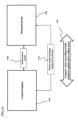
- one embodiment of the invention as defined in claim 1 includes at least a system for calibrating a function of a tire friction of a vehicle traveling on a road, wherein the tire friction function is a nonlinear function describing a friction between a surface of the road and a tire of the vehicle as a function of wheel slip of a wheel of the vehicle.
- Figure 1B shows a schematic of how the force of a tire of vehicle varies when the values of the slip vary, in both longitudinal and lateral direction used by some embodiments.
- the situation shows the results for two different tire friction functions 110b and 120b.
- one of either the longitudinal and lateral slip is zero for simplicity, but it is to be understood, and as a reader with experience within the field will appreciate, various embodiments described herein also cover the case for combined slip.
- Figure 1C shows a zoomed-in version of Figure 1A , where the force has been normalized with the normal force resting on the wheel, where the case of dry asphalt 110 is considered in more detail.
- the value where the force attains its maximum is called the peak friction 112.
- the peak friction 112 is useful to know in several automotive control systems. For example, the knowledge of peak friction is important in order to know how much brake torque that can be applied to a particular wheel in electronic stability control systems (ESCs).
- ESCs electronic stability control systems
- the peak friction value and the corresponding slip value 113 can be used in anti-lock braking systems (ABS) to achieve optimal braking force.
- the initial slope 111 of the force curve 110 is usually called the stiffness of the tire.
- Some embodiments are based on the recognition that while it is difficult to determine in real time the tire friction function, it is possible to collect data from a test drive and determine a tire friction function a posteriori, i.e., offline, based on the test driving data covering both normal and aggressive driving.
- Another embodiment recognizes the fact that although the measurements give valuable information, either about the vehicle state as for a wheel speed sensor, which in its turn provides valuable information for determining the tire friction function, or about the tire friction function as for an acceleration sensor, the measurements are subject to noise. For instance, noise due to mechanical vibrations of the placement of the sensor, or due to inherent measurement noise due to the electronics inside the sensor.
- Some embodiments are based on the realization that it is possible to sample a feasible space of functions of the tire friction and a feasible space of a variance of the stochastic disturbance, defined by their respective probability distribution, and use the sampled quantities in a joint estimation of the state trajectory, the tire friction, and the variance of the stochastic disturbance.
- the joint estimation of some embodiments updates probability distributions of the tire friction function, not the tire friction function.
- the PDF of the tire friction function is updated 130e to increase a probability of a sample of the tire friction function drawn on the updated PDF that reconciles the differences between the motion model 150e and measurement models 160e in state estimation of the vehicle.
- the method samples the probability distribution of the tire friction function, determines a state trajectory of the vehicle to fit the sequence measurements according to the measurement model and the sequence of control inputs according to the motion model including the sample of the tire friction function, and update the probability distribution of the tire friction function based on the state trajectory of the vehicle.
- Figure 1F shows an exemplar situation of how to collect motion data using a test drive 110e according to some embodiments.
- a PDF of a tire friction function is determined for different surfaces. For instance, for wet asphalt 101f the PDF of tire friction function will be different from data collected on loose snow 103f. Hence, in one embodiment the collecting the data is performed for several surfaces, e.g., including wet asphalt 101f, dry asphalt 102f, loose snow 103f, packed snow 104f, and gravel 105f.
- a human operator 115f of the vehicle After determining 110f a surface, a human operator 115f of the vehicle performs steering and braking maneuvers and data from different sensors are collected.
- Figure 1G shows a schematic of storing the PDF 107g of tire friction function 108g and data 109g indicative of the nature of the determining the PDF 107g according to some embodiments.
- data 109g can indicate a time of which day the PDF was determined, a position of the collected data.
- the PDF 107g is indicative of a vehicle located at the arrow 120g. This can be used by another vehicle indicated by the arrow 130g, either to determine another route to its goal since it intersects with the position of the vehicle of PDF 107g.
- the tire friction function and the control inputs are related to each other by the forces of the tire.
- the tire force is obtained from the tire friction by a scaling as a function of the vehicle mass and gravity.
- the control inputs include commands specifying values of one or combination of a steering angle of the wheels of the vehicle and a rotational velocity of the wheels.
- the steering angle of the wheel affects the forces 110b 120b that can be generated in either direction of the wheel. For example, if the steering angle of the wheel is zero the vehicle is moving along a line and the forces are directed in one direction. However, if a nonzero steering angle is enforced, the force are divided into a longitudinal component and a lateral component, which affects how the tire friction function can be determined.
- Figure 1H shows a schematic of a method of using states of a vehicle to update the PDF of tire friction function according to some embodiments.
- the embodiments determine a state trajectory of the vehicle that fits the sequence of measurements 120h according to the measurement model 130h and the sequence of control inputs 110h according to the motion model 111h including the sample of the tire friction function.
- the embodiments compare 140h states of the vehicle determined according to both models to update pdf of the tire friction function to reduce error of difference in the estimations. For example, by comparing a state trajectory determined using a motion model including a sampled tire friction, with a state trajectory determined using a measurement model, it is possible to update the PDF of tire friction function to improve the sample of tire friction function to fit both the control inputs 110h and the measurements 120h.
- such a comparison is performed probabilistically to consider noise acting on one or combination of the motion model and the measurement model.
- the embodiment uses motion data 120e determined in advance or in real time.
- the embodiment retrieves 110i from a memory a model 127i of the motion of the vehicle relating control inputs 105i to the vehicle with the state of the vehicle and a model 128i of the measurements of the vehicle, relating measurements 115i of the motion of the vehicle with the state of the vehicle, wherein the control inputs 105i and measurements 115i are contained in the motion data 120e.
- the control inputs can be a steering angle of the steering wheel and the rotation rate of the wheels.
- the measurements can be a heading rate of the vehicle and an acceleration of the vehicle.
- the method samples 120k a state trajectory from the distribution of the state trajectory, and updates 130k the distribution of the tire friction using the sampled state trajectory. Because the PDF of the state trajectory is updated using the sequence of measurements, updating the probability distribution of the tire friction iteratively using the sampled state trajectory from the state PDF successively reduces the error between the state trajectory and measurement sequence until the updated PDF 145j of the tire friction function leads to the estimated PDF of state trajectory that minimizes the error between the state trajectory and the motion data.
- the method adjusts a value of the sample of the tire friction function to reduce an error between the determined state trajectory and a state trajectory generated by the motion model with adjusted value of the sample of tire friction function and updates the probability distribution of the tire friction function to increase a probability of drawing the adjusted value of the sample from the updated probability distribution of the tire friction function.
- Another embodiment is based on the understanding that if the stochastic uncertainty caused by the unknown tire friction is the only stochastic component, all other errors, as the aforementioned, would be described by the unknown tire friction, which would cause wrong estimates of the tire friction. For instance, if a planar vehicle model is used and the springs of the suspension system affects the acceleration, adding a process noise can ensure that the effects of the suspension system to the acceleration measurements is attributed to an external disturbance and not the PDF of tire friction function. Hence, one embodiment introduces a stochastic disturbance, the process noise, acting on one or combination of the motion model and the measurement model of the vehicle, which in combination with a stochastic disturbance describing the tire friction defines the complete motion of the vehicle.
- the probability distribution of the process noise is modeled as a Gaussian distribution defined by its mean and variance, where the process noise is introduced to model effects not captured by the tire friction function.
- the process noise is treated differently. For instance, if the process is Gaussian, the mean and variance describes the Gaussian process noise. Doing in such a manner ensures that the tire friction function is kept fixed over the time of the indicative state trajectory for each iteration, which makes it possible to evaluate whether this tire friction function is a good sample or not.
- the stochastic nature of the process noise is incorporated when determining the state trajectory 135i.
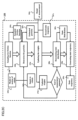
- Figure 2A shows a block diagram of a method for determining 130i the state trajectory 135i according to one embodiment.
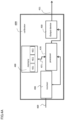
- This embodiment uses a variation of the Kalman filter configured to estimate a state of the vehicle and an uncertainty of the state at each time step to produce a distribution of state trajectories and sample the distribution of state trajectories to produce the state trajectory.
- this embodiment evaluates the sample of the PDF of the tire friction function in a probabilistic environment of the motion data.
- the method commences with sampling 250a the tire friction function, to produce a sampled 255a tire friction function. Then, using the samples tire friction, the model 245a of motion of the vehicle, the control inputs 247a to the vehicle, the method estimates 260a the state to produce an estimated state 265a. Using the estimated state 265a, the model 266a of measurement and the indicative state trajectory 267a at the current time step of control, the method updates 270a the state to reduce an error between the state and indicative state. If the end of the indicative state trajectory has been reached, the method determines the distribution of the state 280a, and generates 290a, using the determined distribution 285a, a state trajectory 295a.
- Estimating and updating the state can be done in several ways. For instance, in one embodiment the estimating the state is done by propagating a mean of a state and a variance of a state, and an update of the state is correcting the state with a multiple of the difference of the estimated state with the indicative state. For example, the estimating and updating can be done using a Kalman filter, possible combined with an additional Kalman smoothing step.
- the motion model includes an additive process noise w k as Gaussian distributed w k ⁇ (0, Q k ) .
- y t h ( x t , u t ) + D ( x t , u t ) ⁇ ( s t ) + e t
- h ( x t , u t ) + D( x t , u t ) is the known part and - e t is the stochastic measurement noise
- e k ⁇ (0, R k ) and C . includes the linearization of the measurement model.
- the Kalman filter is complemented with a backward recursion that iterates the motion data backwards in time. Doing in such manner ensures that all information is extracted from the data, as will be appreciated by a person skilled in the art.
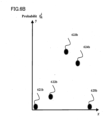
- the method uses the determined particles 265c and compares, using the model of measurement 266c, with the indicative state trajectory 267c of the vehicle, obtained from a memory, either located on the vehicle or remotely connected to a processor of the vehicle, to update the weights 270c that indicate how likely each particle is to be representative of the true state.
- the method 280c can directly use the finite set of weights 275c to reflect the distribution of the state trajectory, or the method can produce a continuous distribution of the state trajectories, by smoothing out the weights using, e.g., a kernel density smoother.
- the resulting distribution 285c is then used for generating the state trajectory 290c.
- one embodiment produces the first state trajectory 295c by generating a sample from the distribution 285c.
- a tire friction function is regarded as a weighted combination of a finite number of basis functions, wherein each basis function is a function of the wheel slip, which is a known function of the vehicle slip, and Gaussian process of the tire friction function is captured by Gaussian distributions of weights of basis function.
- Gaussian process of the tire friction function is captured by Gaussian distributions of weights of basis function.
- to update Gaussian process some embodiments can just update these Gaussian distributions of weights, and to sample tire friction function some embodiments can just sample N scalar weights from Gaussian distribution.
- the tire friction function as a weighted combination of basis functions significantly decreases the computational requirements for estimating the tire friction in probabilistic manner.
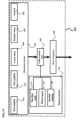
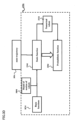
- Figure 4A shows a general structure of a system 499 for calibrating a function of a tire friction of a vehicle traveling on a road according to one embodiment.
- the tire friction is a nonlinear function describing a friction between a surface of the road and a tire of the vehicle as a function of slippage of a wheel of the vehicle.
- the tire function calibrator 499 includes at least one processor 470 for executing modules of the tire function calibrator 499, such as updating iteratively a probability distribution of the tire friction function until a termination condition is met.
- the processor is configured to sample the probability distribution of the tire friction function, determine a state trajectory of the vehicle to fit the sequence measurements according to the measurement model and the sequence of control inputs according to the motion model including the sample of the tire friction function, and update the probability distribution of the tire friction function based on the state trajectory of the vehicle. For example, an iteration samples the probability distribution of the tire friction function, determines a first state trajectory of the vehicle resulting from the sequence of control inputs according to the motion model including the sample of the tire friction function, determines a second state trajectory of the vehicle resulting from the sequence of measurements according to the measurement model, and updates the probability distribution of the tire friction function to reduce an error between the first state trajectory of the vehicle and the second state trajectory of the vehicle.
- the generating the first state trajectory is done by generating a set of particles at each time step of control, each particle representing a first state trajectory, determined with different sample drawn from a probability distribution of a process noise and associate a weight q t i with each particle, which reflects comparing each particle from the set with the second trajectory representing an error between the particle and the second state trajectory.
- the particle is removed from the estimating and replaced with a particle that has a higher weight, that is, a higher probability of being a good particle.
- the determining the first state trajectory is performed as a combination of the particles weighted according to the weights of each particle.
- the two models try to describe the same behavior, (a) and (b) show significant differences.
- the Pacejka model (a) exhibits a clear peak in the tire friction curve for the two relatively higher friction surfaces, whereas the HSRI tire model is monotonically increasing with increasing slip values.
- a priori made choice of which tire model to use helps to accurately describe the behavior of the tire friction function, and thus the behavior of the motion model including the tire friction function.
- One embodiment is based on the recognition that any tire model is dependent on parameters fitted to data for that tire model, and that the data is highly uncertain.
- Some embodiments are based on the realization that many control methods already used in production vehicles are based on different parametric tire models, and to deploy those controllers on a vehicle they need to be tuned according to the parameters of the tire model.
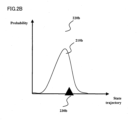
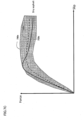
- Figure 7C shows a sample 720c of the determined probability density 730c as used by several embodiments.
- Each sample on the probability density 730c is the entire tire friction function, such as a function 720c.
- a parametric tire model For example, a common way to model the tire force relation is through the Magic formula, or Pacejka model, given by (1), which includes a number of parameters.
- the Pacejka model is oftentimes used for control design.
- the fitting 710c of the Pacejka model to the sample 720c of the probability density 130f is done by minimizing an error between the sample 720c and 710c. In one embodiment, the minimizing is done while taking into account the uncertainty 730c, such that the fitting 710c is well inside the probability density.
- the optimal control problem is known as a nonlinear programming (NLP), and there are various methods to solve this problem.
- Another embodiment uses blockstructured factorization techniques with low-rank updates to preconditioning of an iterative solver within a primal active-set algorithm. This results in a relatively simple to implement, but computationally efficient and reliable QP solver that is suitable for embedded control hardware.
Landscapes
- Engineering & Computer Science (AREA)
- Transportation (AREA)
- Mechanical Engineering (AREA)
- Physics & Mathematics (AREA)
- Automation & Control Theory (AREA)
- Mathematical Physics (AREA)
- Fluid Mechanics (AREA)
- Control Of Driving Devices And Active Controlling Of Vehicle (AREA)
- Tires In General (AREA)
- Steering Control In Accordance With Driving Conditions (AREA)
Applications Claiming Priority (2)
| Application Number | Priority Date | Filing Date | Title |
|---|---|---|---|
| US16/298,245 US11597364B2 (en) | 2019-03-11 | 2019-03-11 | System and method for determining friction curve of tire |
| PCT/JP2019/051347 WO2020183871A1 (en) | 2019-03-11 | 2019-12-11 | System and method for determining friction curve of tire |
Publications (2)
| Publication Number | Publication Date |
|---|---|
| EP3938263A1 EP3938263A1 (en) | 2022-01-19 |
| EP3938263B1 true EP3938263B1 (en) | 2025-04-16 |
Family
ID=69374341
Family Applications (1)
| Application Number | Title | Priority Date | Filing Date |
|---|---|---|---|
| EP19845619.6A Active EP3938263B1 (en) | 2019-03-11 | 2019-12-11 | System and method for determining friction curve of tire |
Country Status (5)
| Country | Link |
|---|---|
| US (1) | US11597364B2 (https=) |
| EP (1) | EP3938263B1 (https=) |
| JP (1) | JP7285971B2 (https=) |
| CN (1) | CN113573966B (https=) |
| WO (1) | WO2020183871A1 (https=) |
Families Citing this family (9)
| Publication number | Priority date | Publication date | Assignee | Title |
|---|---|---|---|---|
| DE102019205405A1 (de) * | 2019-04-15 | 2020-10-15 | Zf Friedrichshafen Ag | Ermittlung einer Eingangsgröße eines Fahrzeug-Aktuators mittels modellgestützter prädiktiver Regelung |
| FR3106885B1 (fr) * | 2020-02-03 | 2021-12-24 | Safran | Procede d’aide à la navigation d’un porteur mobile |
| CN113492882B (zh) * | 2021-07-14 | 2022-09-23 | 清华大学 | 一种实现车辆控制的方法、装置、计算机存储介质及终端 |
| US20230219572A1 (en) * | 2022-01-13 | 2023-07-13 | GM Global Technology Operations LLC | Traction control system using feedforward control |
| KR20230135225A (ko) * | 2022-03-15 | 2023-09-25 | 현대자동차주식회사 | 전동화 차량의 사운드 발생 장치 및 방법 |
| US12306316B2 (en) * | 2022-06-30 | 2025-05-20 | Mitsubishi Electric Research Laboratories, Inc. | System and method for controlling a device using a compound probabilistic filter |
| US20250319894A1 (en) * | 2024-04-15 | 2025-10-16 | Fca Us Llc | Driver aggression monitoring during use of vehicle |
| EP4703217A1 (en) * | 2024-08-29 | 2026-03-04 | Volvo Truck Corporation | Learned tire slip-power/ or -force characteristics for vehicles or machines |
| CN120846701B (zh) * | 2025-09-22 | 2025-12-09 | 成都赛力斯科技有限公司 | 一种汽车轮胎性能检测试验方法 |
Family Cites Families (15)
| Publication number | Priority date | Publication date | Assignee | Title |
|---|---|---|---|---|
| US6470731B1 (en) * | 1998-07-17 | 2002-10-29 | Continental Teves Ag & Co. Ohg | Method and device for determining a parameter for an instantaneously maximal frictional force coefficient |
| ATE528185T1 (de) | 2007-03-01 | 2011-10-15 | Haldex Brake Prod Ab | SYSTEME UND VERFAHREN ZUR BESTIMMUNG EINES PARAMETERS IN ZUSAMMENHANG MIT DEM KONTAKT ZWISCHEN REIFEN UND STRAßE UND/ODER DEM VERHÄLTNIS ZWISCHEN EINEM RAD UND EINER FAHRZEUGBEWEGUNG |
| US8306712B2 (en) * | 2009-03-24 | 2012-11-06 | GM Global Technology Operations LLC | Road surface condition identification based on statistical pattern recognition |
| DE102015005019B4 (de) * | 2015-04-20 | 2018-12-13 | Audi Ag | Verfahren zum Ermitteln von Reifeneigenschaften |
| DE102016208675A1 (de) * | 2016-05-19 | 2017-11-23 | Lucas Automotive Gmbh | Verfahren zur Bestimmung einer sicheren Geschwindigkeit an einem zukünftigen Wegpunkt |
| DE102016209984A1 (de) * | 2016-06-07 | 2017-12-07 | Lucas Automotive Gmbh | Verfahren zur Schätzung einer Wahrscheinlichkeitsverteilung des maximalen Reibwerts an einem aktuellen und/oder zukünftigen Wegpunkt eines Fahrzeugs |
| US10011284B2 (en) * | 2016-07-13 | 2018-07-03 | Mitsubishi Electric Research Laboratories, Inc. | System and method for determining state of stiffness of tires of vehicle |
| US9884585B1 (en) * | 2016-09-19 | 2018-02-06 | Faraday & Future Inc. | Exterior vehicle alerting system |
| US10073456B2 (en) * | 2016-11-17 | 2018-09-11 | GM Global Technology Operations LLC | Automated co-pilot control for autonomous vehicles |
| US10093321B1 (en) * | 2017-03-23 | 2018-10-09 | Mitsubishi Electric Research Laboratories, Inc. | System and method for calibrating parameters of tires |
| US20180281856A1 (en) * | 2017-03-31 | 2018-10-04 | Ford Global Technologies, Llc | Real time lane change display |
| DE102017214032A1 (de) * | 2017-08-11 | 2019-02-14 | Robert Bosch Gmbh | Verfahren zum Bestimmen eines Reibwerts für einen Kontakt zwischen einem Reifen eines Fahrzeugs und einer Fahrbahn und Verfahren zum Steuern einer Fahrzeugfunktion eines Fahrzeugs |
| CN107512262B (zh) * | 2017-08-14 | 2018-12-21 | 吉林大学 | 一种针对执行驱动空间受限时的车辆稳定控制系统轮胎力分配方法 |
| EP3480074B1 (en) * | 2017-11-01 | 2021-10-06 | Volvo Car Corporation | Method and system for controlling a vehicle tire-to-road friction estimation |
| US10836383B2 (en) * | 2018-05-04 | 2020-11-17 | The Regents Of The University Of Michigan | Collision imminent steering control systems and methods |
-
2019
- 2019-03-11 US US16/298,245 patent/US11597364B2/en active Active
- 2019-12-11 WO PCT/JP2019/051347 patent/WO2020183871A1/en not_active Ceased
- 2019-12-11 CN CN201980093569.8A patent/CN113573966B/zh active Active
- 2019-12-11 JP JP2021573625A patent/JP7285971B2/ja active Active
- 2019-12-11 EP EP19845619.6A patent/EP3938263B1/en active Active
Also Published As
| Publication number | Publication date |
|---|---|
| EP3938263A1 (en) | 2022-01-19 |
| WO2020183871A1 (en) | 2020-09-17 |
| CN113573966A (zh) | 2021-10-29 |
| US20200290577A1 (en) | 2020-09-17 |
| CN113573966B (zh) | 2023-08-29 |
| JP2022523276A (ja) | 2022-04-21 |
| US11597364B2 (en) | 2023-03-07 |
| JP7285971B2 (ja) | 2023-06-02 |
Similar Documents
| Publication | Publication Date | Title |
|---|---|---|
| EP3938263B1 (en) | System and method for determining friction curve of tire | |
| JP7475554B2 (ja) | 不確実システムの確率的モデル予測制御 | |
| EP3600985B1 (en) | System and method for calibrating tire of vehicle | |
| JP2022523276A5 (https=) | ||
| JP7204015B2 (ja) | 摩擦に適応した車両制御 | |
| US10370004B2 (en) | System and method for determining state of stiffness of tires of vehicle | |
| WO2022163013A1 (en) | System and method for adaptive control of vehicle dynamics | |
| EP4110663B1 (en) | System and method for determining friction curve of tire | |
| JPH08198131A (ja) | 車両状態推定装置 | |
| CN118560525B (zh) | 车辆横向控制方法、装置、车辆及介质 |
Legal Events
| Date | Code | Title | Description |
|---|---|---|---|
| STAA | Information on the status of an ep patent application or granted ep patent |
Free format text: STATUS: UNKNOWN |
|
| STAA | Information on the status of an ep patent application or granted ep patent |
Free format text: STATUS: THE INTERNATIONAL PUBLICATION HAS BEEN MADE |
|
| PUAI | Public reference made under article 153(3) epc to a published international application that has entered the european phase |
Free format text: ORIGINAL CODE: 0009012 |
|
| STAA | Information on the status of an ep patent application or granted ep patent |
Free format text: STATUS: REQUEST FOR EXAMINATION WAS MADE |
|
| 17P | Request for examination filed |
Effective date: 20210903 |
|
| AK | Designated contracting states |
Kind code of ref document: A1 Designated state(s): AL AT BE BG CH CY CZ DE DK EE ES FI FR GB GR HR HU IE IS IT LI LT LU LV MC MK MT NL NO PL PT RO RS SE SI SK SM TR |
|
| DAV | Request for validation of the european patent (deleted) | ||
| DAX | Request for extension of the european patent (deleted) | ||
| STAA | Information on the status of an ep patent application or granted ep patent |
Free format text: STATUS: EXAMINATION IS IN PROGRESS |
|
| 17Q | First examination report despatched |
Effective date: 20230804 |
|
| GRAP | Despatch of communication of intention to grant a patent |
Free format text: ORIGINAL CODE: EPIDOSNIGR1 |
|
| STAA | Information on the status of an ep patent application or granted ep patent |
Free format text: STATUS: GRANT OF PATENT IS INTENDED |
|
| INTG | Intention to grant announced |
Effective date: 20241125 |
|
| GRAS | Grant fee paid |
Free format text: ORIGINAL CODE: EPIDOSNIGR3 |
|
| GRAA | (expected) grant |
Free format text: ORIGINAL CODE: 0009210 |
|
| STAA | Information on the status of an ep patent application or granted ep patent |
Free format text: STATUS: THE PATENT HAS BEEN GRANTED |
|
| RAP3 | Party data changed (applicant data changed or rights of an application transferred) |
Owner name: MITSUBISHI ELECTRIC CORPORATION |
|
| AK | Designated contracting states |
Kind code of ref document: B1 Designated state(s): AL AT BE BG CH CY CZ DE DK EE ES FI FR GB GR HR HU IE IS IT LI LT LU LV MC MK MT NL NO PL PT RO RS SE SI SK SM TR |
|
| REG | Reference to a national code |
Ref country code: GB Ref legal event code: FG4D |
|
| REG | Reference to a national code |
Ref country code: CH Ref legal event code: EP |
|
| REG | Reference to a national code |
Ref country code: IE Ref legal event code: FG4D |
|
| REG | Reference to a national code |
Ref country code: DE Ref legal event code: R096 Ref document number: 602019068805 Country of ref document: DE |
|
| REG | Reference to a national code |
Ref country code: NL Ref legal event code: MP Effective date: 20250416 |
|
| PG25 | Lapsed in a contracting state [announced via postgrant information from national office to epo] |
Ref country code: NL Free format text: LAPSE BECAUSE OF FAILURE TO SUBMIT A TRANSLATION OF THE DESCRIPTION OR TO PAY THE FEE WITHIN THE PRESCRIBED TIME-LIMIT Effective date: 20250416 |
|
| REG | Reference to a national code |
Ref country code: AT Ref legal event code: MK05 Ref document number: 1785426 Country of ref document: AT Kind code of ref document: T Effective date: 20250416 |
|
| PG25 | Lapsed in a contracting state [announced via postgrant information from national office to epo] |
Ref country code: PT Free format text: LAPSE BECAUSE OF FAILURE TO SUBMIT A TRANSLATION OF THE DESCRIPTION OR TO PAY THE FEE WITHIN THE PRESCRIBED TIME-LIMIT Effective date: 20250818 Ref country code: ES Free format text: LAPSE BECAUSE OF FAILURE TO SUBMIT A TRANSLATION OF THE DESCRIPTION OR TO PAY THE FEE WITHIN THE PRESCRIBED TIME-LIMIT Effective date: 20250416 Ref country code: FI Free format text: LAPSE BECAUSE OF FAILURE TO SUBMIT A TRANSLATION OF THE DESCRIPTION OR TO PAY THE FEE WITHIN THE PRESCRIBED TIME-LIMIT Effective date: 20250416 |
|
| REG | Reference to a national code |
Ref country code: LT Ref legal event code: MG9D |
|
| PG25 | Lapsed in a contracting state [announced via postgrant information from national office to epo] |
Ref country code: NO Free format text: LAPSE BECAUSE OF FAILURE TO SUBMIT A TRANSLATION OF THE DESCRIPTION OR TO PAY THE FEE WITHIN THE PRESCRIBED TIME-LIMIT Effective date: 20250716 Ref country code: GR Free format text: LAPSE BECAUSE OF FAILURE TO SUBMIT A TRANSLATION OF THE DESCRIPTION OR TO PAY THE FEE WITHIN THE PRESCRIBED TIME-LIMIT Effective date: 20250717 |
|
| PG25 | Lapsed in a contracting state [announced via postgrant information from national office to epo] |
Ref country code: PL Free format text: LAPSE BECAUSE OF FAILURE TO SUBMIT A TRANSLATION OF THE DESCRIPTION OR TO PAY THE FEE WITHIN THE PRESCRIBED TIME-LIMIT Effective date: 20250416 |
|
| PG25 | Lapsed in a contracting state [announced via postgrant information from national office to epo] |
Ref country code: BG Free format text: LAPSE BECAUSE OF FAILURE TO SUBMIT A TRANSLATION OF THE DESCRIPTION OR TO PAY THE FEE WITHIN THE PRESCRIBED TIME-LIMIT Effective date: 20250416 |
|
| PG25 | Lapsed in a contracting state [announced via postgrant information from national office to epo] |
Ref country code: HR Free format text: LAPSE BECAUSE OF FAILURE TO SUBMIT A TRANSLATION OF THE DESCRIPTION OR TO PAY THE FEE WITHIN THE PRESCRIBED TIME-LIMIT Effective date: 20250416 |
|
| PG25 | Lapsed in a contracting state [announced via postgrant information from national office to epo] |
Ref country code: AT Free format text: LAPSE BECAUSE OF FAILURE TO SUBMIT A TRANSLATION OF THE DESCRIPTION OR TO PAY THE FEE WITHIN THE PRESCRIBED TIME-LIMIT Effective date: 20250416 |
|
| PG25 | Lapsed in a contracting state [announced via postgrant information from national office to epo] |
Ref country code: RS Free format text: LAPSE BECAUSE OF FAILURE TO SUBMIT A TRANSLATION OF THE DESCRIPTION OR TO PAY THE FEE WITHIN THE PRESCRIBED TIME-LIMIT Effective date: 20250716 |
|
| PG25 | Lapsed in a contracting state [announced via postgrant information from national office to epo] |
Ref country code: IS Free format text: LAPSE BECAUSE OF FAILURE TO SUBMIT A TRANSLATION OF THE DESCRIPTION OR TO PAY THE FEE WITHIN THE PRESCRIBED TIME-LIMIT Effective date: 20250816 |
|
| PG25 | Lapsed in a contracting state [announced via postgrant information from national office to epo] |
Ref country code: LV Free format text: LAPSE BECAUSE OF FAILURE TO SUBMIT A TRANSLATION OF THE DESCRIPTION OR TO PAY THE FEE WITHIN THE PRESCRIBED TIME-LIMIT Effective date: 20250416 |
|
| PGFP | Annual fee paid to national office [announced via postgrant information from national office to epo] |
Ref country code: DE Payment date: 20251028 Year of fee payment: 7 |
|
| PG25 | Lapsed in a contracting state [announced via postgrant information from national office to epo] |
Ref country code: SM Free format text: LAPSE BECAUSE OF FAILURE TO SUBMIT A TRANSLATION OF THE DESCRIPTION OR TO PAY THE FEE WITHIN THE PRESCRIBED TIME-LIMIT Effective date: 20250416 Ref country code: DK Free format text: LAPSE BECAUSE OF FAILURE TO SUBMIT A TRANSLATION OF THE DESCRIPTION OR TO PAY THE FEE WITHIN THE PRESCRIBED TIME-LIMIT Effective date: 20250416 |
|
| REG | Reference to a national code |
Ref country code: DE Ref legal event code: R097 Ref document number: 602019068805 Country of ref document: DE |
|
| PG25 | Lapsed in a contracting state [announced via postgrant information from national office to epo] |
Ref country code: CZ Free format text: LAPSE BECAUSE OF FAILURE TO SUBMIT A TRANSLATION OF THE DESCRIPTION OR TO PAY THE FEE WITHIN THE PRESCRIBED TIME-LIMIT Effective date: 20250416 |
|
| PG25 | Lapsed in a contracting state [announced via postgrant information from national office to epo] |
Ref country code: EE Free format text: LAPSE BECAUSE OF FAILURE TO SUBMIT A TRANSLATION OF THE DESCRIPTION OR TO PAY THE FEE WITHIN THE PRESCRIBED TIME-LIMIT Effective date: 20250416 |
|
| PG25 | Lapsed in a contracting state [announced via postgrant information from national office to epo] |
Ref country code: SK Free format text: LAPSE BECAUSE OF FAILURE TO SUBMIT A TRANSLATION OF THE DESCRIPTION OR TO PAY THE FEE WITHIN THE PRESCRIBED TIME-LIMIT Effective date: 20250416 Ref country code: RO Free format text: LAPSE BECAUSE OF FAILURE TO SUBMIT A TRANSLATION OF THE DESCRIPTION OR TO PAY THE FEE WITHIN THE PRESCRIBED TIME-LIMIT Effective date: 20250416 |
|
| PG25 | Lapsed in a contracting state [announced via postgrant information from national office to epo] |
Ref country code: IT Free format text: LAPSE BECAUSE OF FAILURE TO SUBMIT A TRANSLATION OF THE DESCRIPTION OR TO PAY THE FEE WITHIN THE PRESCRIBED TIME-LIMIT Effective date: 20250416 |
|
| PLBE | No opposition filed within time limit |
Free format text: ORIGINAL CODE: 0009261 |
|
| STAA | Information on the status of an ep patent application or granted ep patent |
Free format text: STATUS: NO OPPOSITION FILED WITHIN TIME LIMIT |
|
| REG | Reference to a national code |
Ref country code: CH Ref legal event code: L10 Free format text: ST27 STATUS EVENT CODE: U-0-0-L10-L00 (AS PROVIDED BY THE NATIONAL OFFICE) Effective date: 20260225 |
|
| 26N | No opposition filed |
Effective date: 20260119 |