EP3931586B1 - Parallel mr imaging using wave-encoding - Google Patents
Parallel mr imaging using wave-encoding Download PDFInfo
- Publication number
- EP3931586B1 EP3931586B1 EP20704325.8A EP20704325A EP3931586B1 EP 3931586 B1 EP3931586 B1 EP 3931586B1 EP 20704325 A EP20704325 A EP 20704325A EP 3931586 B1 EP3931586 B1 EP 3931586B1
- Authority
- EP
- European Patent Office
- Prior art keywords
- magnetic field
- coils
- gradient
- dimensional
- imaging
- Prior art date
- Legal status (The legal status is an assumption and is not a legal conclusion. Google has not performed a legal analysis and makes no representation as to the accuracy of the status listed.)
- Active
Links
Images


Classifications
-
- G—PHYSICS
- G01—MEASURING; TESTING
- G01R—MEASURING ELECTRIC VARIABLES; MEASURING MAGNETIC VARIABLES
- G01R33/00—Arrangements or instruments for measuring magnetic variables
- G01R33/20—Arrangements or instruments for measuring magnetic variables involving magnetic resonance
- G01R33/44—Arrangements or instruments for measuring magnetic variables involving magnetic resonance using nuclear magnetic resonance [NMR]
- G01R33/48—NMR imaging systems
- G01R33/54—Signal processing systems, e.g. using pulse sequences ; Generation or control of pulse sequences; Operator console
- G01R33/56—Image enhancement or correction, e.g. subtraction or averaging techniques, e.g. improvement of signal-to-noise ratio and resolution
- G01R33/561—Image enhancement or correction, e.g. subtraction or averaging techniques, e.g. improvement of signal-to-noise ratio and resolution by reduction of the scanning time, i.e. fast acquiring systems, e.g. using echo-planar pulse sequences
- G01R33/5611—Parallel magnetic resonance imaging, e.g. sensitivity encoding [SENSE], simultaneous acquisition of spatial harmonics [SMASH], unaliasing by Fourier encoding of the overlaps using the temporal dimension [UNFOLD], k-t-broad-use linear acquisition speed-up technique [k-t-BLAST], k-t-SENSE
-
- G—PHYSICS
- G01—MEASURING; TESTING
- G01R—MEASURING ELECTRIC VARIABLES; MEASURING MAGNETIC VARIABLES
- G01R33/00—Arrangements or instruments for measuring magnetic variables
- G01R33/20—Arrangements or instruments for measuring magnetic variables involving magnetic resonance
- G01R33/44—Arrangements or instruments for measuring magnetic variables involving magnetic resonance using nuclear magnetic resonance [NMR]
- G01R33/48—NMR imaging systems
- G01R33/54—Signal processing systems, e.g. using pulse sequences ; Generation or control of pulse sequences; Operator console
- G01R33/56—Image enhancement or correction, e.g. subtraction or averaging techniques, e.g. improvement of signal-to-noise ratio and resolution
- G01R33/561—Image enhancement or correction, e.g. subtraction or averaging techniques, e.g. improvement of signal-to-noise ratio and resolution by reduction of the scanning time, i.e. fast acquiring systems, e.g. using echo-planar pulse sequences
-
- G—PHYSICS
- G01—MEASURING; TESTING
- G01R—MEASURING ELECTRIC VARIABLES; MEASURING MAGNETIC VARIABLES
- G01R33/00—Arrangements or instruments for measuring magnetic variables
- G01R33/20—Arrangements or instruments for measuring magnetic variables involving magnetic resonance
- G01R33/44—Arrangements or instruments for measuring magnetic variables involving magnetic resonance using nuclear magnetic resonance [NMR]
- G01R33/48—NMR imaging systems
- G01R33/54—Signal processing systems, e.g. using pulse sequences ; Generation or control of pulse sequences; Operator console
- G01R33/56—Image enhancement or correction, e.g. subtraction or averaging techniques, e.g. improvement of signal-to-noise ratio and resolution
- G01R33/565—Correction of image distortions, e.g. due to magnetic field inhomogeneities
- G01R33/56563—Correction of image distortions, e.g. due to magnetic field inhomogeneities caused by a distortion of the main magnetic field B0, e.g. temporal variation of the magnitude or spatial inhomogeneity of B0
-
- G—PHYSICS
- G01—MEASURING; TESTING
- G01R—MEASURING ELECTRIC VARIABLES; MEASURING MAGNETIC VARIABLES
- G01R33/00—Arrangements or instruments for measuring magnetic variables
- G01R33/20—Arrangements or instruments for measuring magnetic variables involving magnetic resonance
- G01R33/44—Arrangements or instruments for measuring magnetic variables involving magnetic resonance using nuclear magnetic resonance [NMR]
- G01R33/48—NMR imaging systems
- G01R33/483—NMR imaging systems with selection of signals or spectra from particular regions of the volume, e.g. in vivo spectroscopy
- G01R33/4833—NMR imaging systems with selection of signals or spectra from particular regions of the volume, e.g. in vivo spectroscopy using spatially selective excitation of the volume of interest, e.g. selecting non-orthogonal or inclined slices
- G01R33/4835—NMR imaging systems with selection of signals or spectra from particular regions of the volume, e.g. in vivo spectroscopy using spatially selective excitation of the volume of interest, e.g. selecting non-orthogonal or inclined slices of multiple slices
-
- G—PHYSICS
- G01—MEASURING; TESTING
- G01R—MEASURING ELECTRIC VARIABLES; MEASURING MAGNETIC VARIABLES
- G01R33/00—Arrangements or instruments for measuring magnetic variables
- G01R33/20—Arrangements or instruments for measuring magnetic variables involving magnetic resonance
- G01R33/44—Arrangements or instruments for measuring magnetic variables involving magnetic resonance using nuclear magnetic resonance [NMR]
- G01R33/48—NMR imaging systems
- G01R33/54—Signal processing systems, e.g. using pulse sequences ; Generation or control of pulse sequences; Operator console
- G01R33/56—Image enhancement or correction, e.g. subtraction or averaging techniques, e.g. improvement of signal-to-noise ratio and resolution
- G01R33/561—Image enhancement or correction, e.g. subtraction or averaging techniques, e.g. improvement of signal-to-noise ratio and resolution by reduction of the scanning time, i.e. fast acquiring systems, e.g. using echo-planar pulse sequences
- G01R33/5615—Echo train techniques involving acquiring plural, differently encoded, echo signals after one RF excitation, e.g. using gradient refocusing in echo planar imaging [EPI], RF refocusing in rapid acquisition with relaxation enhancement [RARE] or using both RF and gradient refocusing in gradient and spin echo imaging [GRASE]
- G01R33/5616—Echo train techniques involving acquiring plural, differently encoded, echo signals after one RF excitation, e.g. using gradient refocusing in echo planar imaging [EPI], RF refocusing in rapid acquisition with relaxation enhancement [RARE] or using both RF and gradient refocusing in gradient and spin echo imaging [GRASE] using gradient refocusing, e.g. EPI
-
- G—PHYSICS
- G01—MEASURING; TESTING
- G01R—MEASURING ELECTRIC VARIABLES; MEASURING MAGNETIC VARIABLES
- G01R33/00—Arrangements or instruments for measuring magnetic variables
- G01R33/20—Arrangements or instruments for measuring magnetic variables involving magnetic resonance
- G01R33/44—Arrangements or instruments for measuring magnetic variables involving magnetic resonance using nuclear magnetic resonance [NMR]
- G01R33/48—NMR imaging systems
- G01R33/54—Signal processing systems, e.g. using pulse sequences ; Generation or control of pulse sequences; Operator console
- G01R33/56—Image enhancement or correction, e.g. subtraction or averaging techniques, e.g. improvement of signal-to-noise ratio and resolution
- G01R33/561—Image enhancement or correction, e.g. subtraction or averaging techniques, e.g. improvement of signal-to-noise ratio and resolution by reduction of the scanning time, i.e. fast acquiring systems, e.g. using echo-planar pulse sequences
- G01R33/5615—Echo train techniques involving acquiring plural, differently encoded, echo signals after one RF excitation, e.g. using gradient refocusing in echo planar imaging [EPI], RF refocusing in rapid acquisition with relaxation enhancement [RARE] or using both RF and gradient refocusing in gradient and spin echo imaging [GRASE]
- G01R33/5617—Echo train techniques involving acquiring plural, differently encoded, echo signals after one RF excitation, e.g. using gradient refocusing in echo planar imaging [EPI], RF refocusing in rapid acquisition with relaxation enhancement [RARE] or using both RF and gradient refocusing in gradient and spin echo imaging [GRASE] using RF refocusing, e.g. RARE
Definitions
- the invention relates to the field of magnetic resonance (MR) imaging. It concerns a method of MR imaging of an object.
- the invention also relates to a MR device and to a computer program to be run on a MR device.
- Image-forming MR methods which utilize the interaction between magnetic fields and nuclear spins in order to form two-dimensional or three-dimensional images are widely used nowadays, notably in the field of medical diagnostics, because for imaging of soft tissue they are superior to other imaging methods in many respects, do not require ionizing radiation and are usually not invasive.
- the object for example the body of the patient to be examined, is arranged in a strong, uniform magnetic field whose direction at the same time defines an axis (normally the z-axis) of the co-ordinate system on which the measurement is based.
- the magnetic field produces different energy levels for the individual nuclear spins in dependence on the magnetic field strength which can be excited (spin resonance) by application of an electromagnetic alternating field (RF field) of defined frequency (so-called Larmor frequency, or MR frequency).
- RF field electromagnetic alternating field
- Larmor frequency Larmor frequency
- the distribution of the individual nuclear spins produces an overall magnetization which can be deflected out of the state of equilibrium by application of an electromagnetic pulse of appropriate frequency (RF pulse), so that the magnetization performs a precessional motion about the z-axis.
- the precessional motion describes a surface of a cone whose angle of aperture is referred to as flip angle.
- the magnitude of the flip angle is dependent on the strength and the duration of the applied electromagnetic pulse.
- 90° pulse the spins are deflected from the z axis to the transverse plane (flip angle 90°).
- the magnetization relaxes back to the original state of equilibrium, in which the magnetization in the z direction is built up again with a first time constant T 1 (spin lattice or longitudinal relaxation time), and the magnetization in the direction perpendicular to the z direction relaxes with a second time constant T 2 (spin-spin or transverse relaxation time).
- T 1 spin lattice or longitudinal relaxation time
- T 2 spin-spin or transverse relaxation time
- the decay of the transverse magnetization is accompanied, after application of, for example, a 90° pulse, by a transition of the nuclear spins (induced by local magnetic field inhomogeneities) from an ordered state with the same phase to a state in which all phase angles are uniformly distributed (dephasing).
- the dephasing can be compensated by means of a refocusing pulse (for example a 180° pulse). This produces an echo signal (spin echo) in the receiving coils.
- the signal picked up in the receiving coils then contains components of different frequencies which can be associated with different locations in the body.
- the signal data obtained via the receiving coils corresponds to the spatial frequency domain and is called k-space data.
- the k-space data usually includes multiple lines (also referred to as profiles) acquired with different phase encoding. Each line is digitized by collecting a number of samples. A set of k-space data is converted to a MR image by means of an image reconstruction algorithm.
- SENSE Sensitivity Encoding
- SMASH Simultaneous Acquisition of Spatial Harmonics
- GRAPPA Generalized Auto-calibrating Partially Parallel Acquisition
- SENSE, SMASH, and GRAPPA and other parallel acquisition techniques use subsampled k-space data acquisition obtained from multiple RF receiving coils in parallel.
- the (complex) signal data from the multiple coils are combined with complex weightings in such a way as to suppress subsampling artifacts (aliasing) in the finally reconstructed MR images.
- This type of complex array signal combination is sometimes referred to as spatial filtering, and includes combining which is performed in the k-space domain (as in SMASH and GRAPPA) or in the image domain (as in SENSE), as well as methods which are hybrids.
- CAIPI is a parallel multi-slice imaging technique which is more efficient compared to other multi-slice parallel imaging concepts that use only a pure post-processing approach.
- multiple slices of arbitrary thickness and distance are excited simultaneously with the use of phase-modulated multi-slice RF pulses (similar to the known Hadamard pulses).
- the acquired MR signal data are subsampled, yielding superimposed slice images that appear shifted with respect to each other.
- the shift of the aliased slice images is controlled by the phase-modulation scheme of the RF pulses in accordance with the Fourier shift theorem. From phase-encoding step to phase-encoding step, the multi-slice RF pulses apply an individual phase shift to the MR signals of each slice.
- CAIPI has the potential to improve the separation of the superimposed slice images also in cases in which the slices are rather close to each other such that the coil sensitivities of the used RF receiving coils do not differ dramatically in the individual slices to be imaged.
- CAIPI has limitations.
- the so-called Wave-CAIPI method has been proposed for highly accelerated 3D imaging with negligible geometry factor and a low artifact level (see, e.g., Berkin Bilgic et al., Magn. Reson. Med. 2015, 73(6), 2152-2162 ).
- the Wave-CAIPI method involves the generation of sinusoidally modulated magnetic field gradients (GY, GZ) along the phase and slice encoding directions during the readout of each k x -encoding profile.
- the resulting acquisition spreads the aliasing evenly in all spatial directions, thereby taking full advantage of the three-dimensional coil sensitivity profiles for accelerated parallel imaging with a high level of subsampling.
- US 2006/247515 A1 discloses a bunched phase encoding (BPE) imaging method to reduce magnetic resonance imaging scan times by acquiring data from multiple phase encoding lines per readout, which is equivalent to Wave-CAIPI, wherein a oscillating phase encoding gradient during the MRI readout is used.
- BPE bunched phase encoding
- the technique of the invention generally corresponds to the known Wave-CAIPI approach. According to the invention, however, a variable frequency modulated wave encoding k-space trajectory is proposed to further improve the aliasing propagation along the readout direction, to reduce potential eddy current related adverse effects and to reduce the side lobes of the (transformed) point spread function (PSF).
- Known optimization strategies for the Wave-CAIPI technique have demonstrated that larger amplitudes of the wave encoding magnetic field gradients play an important role to improve the aliasing spreading effect and to reduce the geometry factor in comparison to adjusting the number of cycles of the gradient modulation (see Polak et al., ISMRM 2018, p. 0937 ).
- the PSF of conventional constant frequency wave encoding still follows a distribution with large oscillations along the readout direction and with large amplitude side lobes.
- increasing the magnetic field gradient amplitude introduces eddy current issues, in particular along the direction in which the wave encoding gradient stops with a large amplitude at the end of the acquisition interval of each MR signal profile (e.g. in the case of a cosine shaped gradient waveform).
- These residual eddy currents will further adversely influence the RF slice selection profile resulting in local image artifacts and global signal intensity loss.
- Such artifacts and further problems associated with constant amplitude and/or constant frequency wave encoding are overcome by the invention.
- the imaging sequence applied according to the invention can be any conventional two- or three-dimensional imaging sequence, or a multi-dimensional extension, such as a spatial-temporal (time-resolved) imaging sequence.
- the imaging sequence can be a two-dimensional, three-dimensional or higher-dimensional spin echo sequence, preferably a turbo spin echo sequence.
- the method of the invention can also be applied in combination with a two-dimensional, three-dimensional or higher-dimensional gradient echo sequence, preferably a turbo field echo sequence. Higher dimensions can include a spectral dimension or, as mentioned, a time dimension.
- the sequence may be designer to explore chemical shift (e.g.
- the instantaneous frequency of the sinusoidal modulation of the magnetic field gradient is increasing during the first half of the acquisition time interval of each MR signal profile and decreasing back to its initial value during the second half of the acquisition time interval.
- the corkscrew shaped readout trajectory rotates more frequently in the proximity of central k-space and behaves oppositely when approaching the peripheral k-space.
- the k-space sampling spacing is varying along the readout direction which mimics a variable density sampling to spread subsampling-induced aliasing more evenly while reducing the maximum side lobes of the PSF.
- the amplitude of the magnetic field gradient modulation is varied during the acquisition of the MR signals.
- the amplitude can be modulated, e.g., to be minimal at the start and at the end of the acquisition time interval of each MR signal profile.
- the additional amplitude modulation for the wave encoding gradient waveform can be employed to reduce eddy currents and, thus, to improve the slice selection profile.
- the MR signals are acquired with subsampling in the in-plane direction of the image slices.
- the MR images of the image slices can be reconstructed in this case by using a per se known parallel image reconstruction algorithm, like SENSE, SMASH or GRAPPA.
- the method of the invention described thus far can be carried out by means of a MR device including at least one main magnet coil for generating a uniform static magnetic field within an examination volume, a number of gradient coils for generating switched magnetic field gradients in different spatial directions within the examination volume, a set of RF coils for receiving MR signals from the body, a control unit for controlling the temporal succession of RF pulses and switched magnetic field gradients, and a reconstruction unit.
- the method of the invention can be implemented, for example, by a corresponding programming of the reconstruction unit and/or the control unit of the MR device.
- the method of the invention can be advantageously carried out in most MR devices in clinical use at present. To this end it is merely necessary to utilize a computer program by which the MR device is controlled such that it performs the above-explained method steps of the invention.
- the computer program may be present either on a data carrier or be present in a data network so as to be downloaded for installation in the control unit of the MR device.
- a MR device 1 With reference to Fig. 1 , a MR device 1 is shown.
- the device comprises superconducting or resistive main magnet coils 2 such that a substantially uniform, temporally constant main magnetic field is created along a z-axis through an examination volume.
- a magnetic resonance generation and manipulation system applies a series of RF pulses and switched magnetic field gradients to invert or excite nuclear magnetic spins, induce magnetic resonance, refocus magnetic resonance, manipulate magnetic resonance, spatially and otherwise encode the magnetic resonance, saturate spins, and the like to perform MR imaging.
- a gradient pulse amplifier 3 applies current pulses to selected ones of whole-body gradient coils 4, 5 and 6 along x, y and z-axes of the examination volume.
- a digital RF frequency transmitter 7 transmits RF pulses or pulse packets, via a send-/receive switch 8, to a whole-body volume RF coil 9 to transmit RF pulses into the examination volume.
- a typical MR imaging sequence is composed of a packet of RF pulse segments of short duration which taken together with each other and any applied magnetic field gradients achieve a selected manipulation of nuclear magnetic resonance. The RF pulses are used to saturate, excite resonance, invert magnetization, refocus resonance, or manipulate resonance and select a portion of a body 10 positioned in the examination volume.
- a set of local RF coils 11, 12, 13 are placed contiguous to the region selected for imaging.
- the resultant MR signals are picked up by the RF coils 11, 12, 13 and demodulated by a receiver 14 preferably including a preamplifier (not shown).
- the receiver 14 is connected to the RF coils 9, 11, 12 and 13 via send-/receive switch 8.
- a host computer 15 controls the gradient pulse amplifier 3 and the transmitter 7 to generate any of a plurality of MR imaging sequences, such as echo planar imaging (EPI), echo volume imaging, gradient and spin echo imaging, fast spin echo imaging, and the like.
- EPI echo planar imaging
- the receiver 14 receives a single or a plurality of MR data lines in rapid succession following each RF excitation pulse.
- a data acquisition system 16 performs analog-to-digital conversion of the received signals and converts each MR data line to a digital format suitable for further processing. In modern MR devices the data acquisition system 16 is a separate computer which is specialized in acquisition of raw image data.
- the digital raw image data is reconstructed into an image representation by a reconstruction processor 17 which applies a Fourier transform or other appropriate reconstruction algorithms.
- the MR image may represent a planar slice through the patient, an array of parallel planar slices, a three-dimensional volume, or the like.
- the image is then stored in an image memory where it may be accessed for converting slices, projections, or other portions of the image representation into appropriate format for visualization, for example via a video monitor 18 which provides a man-readable display of the resultant MR image.
- an imaging sequence for example a spin-echo sequence, like the known TSE sequence
- MR signals are received in parallel via the RF coils 11, 12, 13 having different spatial sensitivities.
- MR signal profiles are acquired in a Cartesian k-space scheme with subsampling in the phase encoding directions.
- each MR signal profile is acquired in the presence of a temporally constant magnetic field gradient along the readout direction and sinusoidally modulated magnetic field gradients along the phase encoding directions.
- the MR signal acquisition is a superposition of a Cartesian readout employing a linear readout magnetic field gradient G x with sinusoidally varying magnetic field gradients along the phase encoding directions G y and G z .
- the frequency of the sinusoidal modulation of the magnetic field gradients is varied during acquisition of each MR signal profile.
- h ( t ) can be any kind of symmetric, asymmetric, piecewise linear and nonlinear function.
- f m 1/ T acq is chosen to achieve a monotonous increasing or decreasing property during the first or second half of the acquisition time interval T acq
- ⁇ is a tunable parameter to optimize the performance and adapt to the hardware constraints including maximum gradient strength and slew rate.
- the above ideal gradient waveforms may be corrected for effects of the gradient modulation transfer function (i.e. eddy current compensation) and then applied in the MR scan. Also, additional pre-phasing and re-winding gradients may be applied to maintain the Carr-Purcell-Meiboom-Gill (CPMG) condition for the 3D TSE scan.
- CPMG Carr-Purcell-Meiboom-Gill
- each MR signal profile in the underlying three-dimensional image is convolved with the PSF that depends on the spatial position in the y- and z-directions to yield the acquired MR image.
- each k x line of the MR signal data at a given (y, z) position obtains a unique phase modulation contained in the PSF.
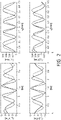
- Fig. 2 illustrates an example implementation of the proposed variable frequency wave encoding magnetic field gradient waveform (indicated by letter V in Fig. 2 ) and compares it with a constant frequency wave encoding waveform (indicated by letter C).
- the gradient waveform is shown in Fig. 2a while the corresponding k-space trajectories are shown in Fig. 2b , each time for constant and variable frequency wave encoding schemes.
- the wave encoding k-space trajectories in Fig. 2b are calibrated from in vivo imaging.
- the corresponding gradient waveforms in Fig. 2a are simulated by numerical derivative and scaling.
- Fig. 3 shows a comparison of the PSF for constant (C) and variable frequency (V) wave encoding schemes.
- Fig. 3a shows the employed CAIPI subsampling mask with reduction factor 2 in both y- and z-directions and a fully sampled central area.
- Figs. 3b and 3c show the resulting PSF for two different (y, z) positions. It can be seen from Fig. 3 that the variable frequency wave encoding scheme of the invention improves the aliasing propagation along the readout direction and significantly reduces the amplitude of side lobes of the PSF.
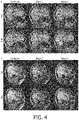
- Figs. 4a and 4b show central and lateral slices of a brain scan respectively.
- slice images are shown that have been reconstructed from fully sampled MR signal data.
- a conventional Cartesian sampling scheme has been employed for the images in the left column (indicated by 'Cartesian').
- Constant frequency wave encoding has been employed for the images in the middle column (indicated by 'Wave C') while variable frequency wave encoding has been employed for the images in the right column (indicated by 'Wave V').
- variable frequency wave encoding approach of the invention can provide better aliasing suppression results in both central and lateral image slices. It can clearly be seen in the bottom row of Fig. 4a that residual aliasing artifacts are reduced with variable frequency wave encoding. In addition, the variable frequency wave encoding can significantly reduce the signal loss due to eddy current induced slice profile degradation in lateral slices. A clear signal drop can clearly be seen in the middle column of Fig. 4b which is not present in the right column.
Landscapes
- Physics & Mathematics (AREA)
- General Physics & Mathematics (AREA)
- High Energy & Nuclear Physics (AREA)
- Condensed Matter Physics & Semiconductors (AREA)
- Nuclear Medicine, Radiotherapy & Molecular Imaging (AREA)
- Radiology & Medical Imaging (AREA)
- Engineering & Computer Science (AREA)
- Signal Processing (AREA)
- General Health & Medical Sciences (AREA)
- Health & Medical Sciences (AREA)
- Optics & Photonics (AREA)
- Spectroscopy & Molecular Physics (AREA)
- Magnetic Resonance Imaging Apparatus (AREA)
Applications Claiming Priority (3)
| Application Number | Priority Date | Filing Date | Title |
|---|---|---|---|
| US201962809779P | 2019-02-25 | 2019-02-25 | |
| EP19170549.0A EP3730962A1 (en) | 2019-04-23 | 2019-04-23 | Parallel mr imaging using wave-encoding |
| PCT/EP2020/054159 WO2020173749A1 (en) | 2019-02-25 | 2020-02-18 | Parallel mr imaging using wave-encoding |
Publications (2)
| Publication Number | Publication Date |
|---|---|
| EP3931586A1 EP3931586A1 (en) | 2022-01-05 |
| EP3931586B1 true EP3931586B1 (en) | 2022-06-22 |
Family
ID=69526280
Family Applications (1)
| Application Number | Title | Priority Date | Filing Date |
|---|---|---|---|
| EP20704325.8A Active EP3931586B1 (en) | 2019-02-25 | 2020-02-18 | Parallel mr imaging using wave-encoding |
Country Status (4)
| Country | Link |
|---|---|
| US (1) | US11815577B2 (enExample) |
| EP (1) | EP3931586B1 (enExample) |
| JP (1) | JP7559763B2 (enExample) |
| WO (1) | WO2020173749A1 (enExample) |
Families Citing this family (1)
| Publication number | Priority date | Publication date | Assignee | Title |
|---|---|---|---|---|
| CN120219554B (zh) * | 2025-05-28 | 2025-08-15 | 北京航空航天大学 | 基于数据重排的磁粒子成像方法和系统 |
Family Cites Families (7)
| Publication number | Priority date | Publication date | Assignee | Title |
|---|---|---|---|---|
| JP3847554B2 (ja) * | 2000-12-04 | 2006-11-22 | 株式会社日立メディコ | 磁気共鳴イメージング装置 |
| US7301342B2 (en) | 2005-04-15 | 2007-11-27 | Case Western Reserve University | Bunched phase encoding (BPE) |
| DE102007035176B4 (de) * | 2007-07-27 | 2010-03-18 | Siemens Ag | Verfahren zur Aufzeichnung und Verarbeitung einer Folge von zeitlich aufeinander folgenden Bilddatensätzen sowie Magnet-Resonanz-Gerät |
| DE102013100349B4 (de) * | 2013-01-14 | 2016-05-12 | Siemens Aktiengesellschaft | Echoplanare MR-Bildgebung mit zickzack-artigen k-Raum-Trajektorien |
| US10132889B2 (en) * | 2013-05-22 | 2018-11-20 | General Electric Company | System and method for reducing acoustic noise level in MR imaging |
| JP2016533838A (ja) * | 2013-09-10 | 2016-11-04 | コーニンクレッカ フィリップス エヌ ヴェKoninklijke Philips N.V. | 金属耐性mrイメージング |
| CN104714199B (zh) * | 2013-12-17 | 2018-04-24 | 西门子(深圳)磁共振有限公司 | 一种磁共振成像方法和装置 |
-
2020
- 2020-02-18 JP JP2021549205A patent/JP7559763B2/ja active Active
- 2020-02-18 WO PCT/EP2020/054159 patent/WO2020173749A1/en not_active Ceased
- 2020-02-18 EP EP20704325.8A patent/EP3931586B1/en active Active
- 2020-02-18 US US17/432,921 patent/US11815577B2/en active Active
Also Published As
| Publication number | Publication date |
|---|---|
| JP2022521277A (ja) | 2022-04-06 |
| JP7559763B2 (ja) | 2024-10-02 |
| WO2020173749A1 (en) | 2020-09-03 |
| US11815577B2 (en) | 2023-11-14 |
| US20220155396A1 (en) | 2022-05-19 |
| EP3931586A1 (en) | 2022-01-05 |
Similar Documents
| Publication | Publication Date | Title |
|---|---|---|
| EP2689261B1 (en) | Compressed sensing mr image reconstruction using constraint from prior acquisition | |
| EP3635425B1 (en) | Mr imaging using a stack-of-stars acquisition with variable contrast | |
| US10088543B2 (en) | Parallel multi-slice MR imaging using phase-modulated RF pulses | |
| JP7583858B2 (ja) | 並列マルチスライスmr撮像 | |
| US10401461B2 (en) | Parallel multi-slice MR imaging with suppression of side band artefacts | |
| EP3044604B1 (en) | Metal resistant mr imaging | |
| EP3931588A1 (en) | Epi mr imaging with distortion correction | |
| US11543482B2 (en) | Magnetic resonance imaging using motion-compensated image reconstruction | |
| US11959986B2 (en) | MR imaging with spiral acquisition | |
| WO2018114554A1 (en) | Dixon-type water/fat separation mr imaging | |
| US12467996B2 (en) | Spin echo MR imaging with spiral acquisition | |
| EP3931586B1 (en) | Parallel mr imaging using wave-encoding | |
| EP3736593A1 (en) | Dual echo steady state mr imaging using bipolar diffusion gradients | |
| EP2581756A1 (en) | MR imaging using parallel signal acquisition | |
| EP3730962A1 (en) | Parallel mr imaging using wave-encoding | |
| EP3432019A1 (en) | Parallel multi-slice mr imaging using signal averaging | |
| EP3792647A1 (en) | Dixon-type water/fat separation mr imaging | |
| EP3118643A1 (en) | Dynamic propeller mr imaging |
Legal Events
| Date | Code | Title | Description |
|---|---|---|---|
| STAA | Information on the status of an ep patent application or granted ep patent |
Free format text: STATUS: UNKNOWN |
|
| STAA | Information on the status of an ep patent application or granted ep patent |
Free format text: STATUS: THE INTERNATIONAL PUBLICATION HAS BEEN MADE |
|
| PUAI | Public reference made under article 153(3) epc to a published international application that has entered the european phase |
Free format text: ORIGINAL CODE: 0009012 |
|
| STAA | Information on the status of an ep patent application or granted ep patent |
Free format text: STATUS: REQUEST FOR EXAMINATION WAS MADE |
|
| 17P | Request for examination filed |
Effective date: 20210927 |
|
| AK | Designated contracting states |
Kind code of ref document: A1 Designated state(s): AL AT BE BG CH CY CZ DE DK EE ES FI FR GB GR HR HU IE IS IT LI LT LU LV MC MK MT NL NO PL PT RO RS SE SI SK SM TR |
|
| GRAP | Despatch of communication of intention to grant a patent |
Free format text: ORIGINAL CODE: EPIDOSNIGR1 |
|
| STAA | Information on the status of an ep patent application or granted ep patent |
Free format text: STATUS: GRANT OF PATENT IS INTENDED |
|
| DAV | Request for validation of the european patent (deleted) | ||
| DAX | Request for extension of the european patent (deleted) | ||
| INTG | Intention to grant announced |
Effective date: 20220215 |
|
| GRAS | Grant fee paid |
Free format text: ORIGINAL CODE: EPIDOSNIGR3 |
|
| GRAA | (expected) grant |
Free format text: ORIGINAL CODE: 0009210 |
|
| STAA | Information on the status of an ep patent application or granted ep patent |
Free format text: STATUS: THE PATENT HAS BEEN GRANTED |
|
| AK | Designated contracting states |
Kind code of ref document: B1 Designated state(s): AL AT BE BG CH CY CZ DE DK EE ES FI FR GB GR HR HU IE IS IT LI LT LU LV MC MK MT NL NO PL PT RO RS SE SI SK SM TR |
|
| REG | Reference to a national code |
Ref country code: GB Ref legal event code: FG4D |
|
| REG | Reference to a national code |
Ref country code: CH Ref legal event code: EP |
|
| REG | Reference to a national code |
Ref country code: DE Ref legal event code: R096 Ref document number: 602020003680 Country of ref document: DE |
|
| REG | Reference to a national code |
Ref country code: AT Ref legal event code: REF Ref document number: 1500102 Country of ref document: AT Kind code of ref document: T Effective date: 20220715 |
|
| REG | Reference to a national code |
Ref country code: IE Ref legal event code: FG4D |
|
| REG | Reference to a national code |
Ref country code: DE Ref legal event code: R084 Ref document number: 602020003680 Country of ref document: DE |
|
| REG | Reference to a national code |
Ref country code: GB Ref legal event code: 746 Effective date: 20220914 |
|
| REG | Reference to a national code |
Ref country code: LT Ref legal event code: MG9D |
|
| REG | Reference to a national code |
Ref country code: NL Ref legal event code: MP Effective date: 20220622 |
|
| PG25 | Lapsed in a contracting state [announced via postgrant information from national office to epo] |
Ref country code: SE Free format text: LAPSE BECAUSE OF FAILURE TO SUBMIT A TRANSLATION OF THE DESCRIPTION OR TO PAY THE FEE WITHIN THE PRESCRIBED TIME-LIMIT Effective date: 20220622 Ref country code: NO Free format text: LAPSE BECAUSE OF FAILURE TO SUBMIT A TRANSLATION OF THE DESCRIPTION OR TO PAY THE FEE WITHIN THE PRESCRIBED TIME-LIMIT Effective date: 20220922 Ref country code: LT Free format text: LAPSE BECAUSE OF FAILURE TO SUBMIT A TRANSLATION OF THE DESCRIPTION OR TO PAY THE FEE WITHIN THE PRESCRIBED TIME-LIMIT Effective date: 20220622 Ref country code: HR Free format text: LAPSE BECAUSE OF FAILURE TO SUBMIT A TRANSLATION OF THE DESCRIPTION OR TO PAY THE FEE WITHIN THE PRESCRIBED TIME-LIMIT Effective date: 20220622 Ref country code: GR Free format text: LAPSE BECAUSE OF FAILURE TO SUBMIT A TRANSLATION OF THE DESCRIPTION OR TO PAY THE FEE WITHIN THE PRESCRIBED TIME-LIMIT Effective date: 20220923 Ref country code: FI Free format text: LAPSE BECAUSE OF FAILURE TO SUBMIT A TRANSLATION OF THE DESCRIPTION OR TO PAY THE FEE WITHIN THE PRESCRIBED TIME-LIMIT Effective date: 20220622 Ref country code: BG Free format text: LAPSE BECAUSE OF FAILURE TO SUBMIT A TRANSLATION OF THE DESCRIPTION OR TO PAY THE FEE WITHIN THE PRESCRIBED TIME-LIMIT Effective date: 20220922 |
|
| REG | Reference to a national code |
Ref country code: AT Ref legal event code: MK05 Ref document number: 1500102 Country of ref document: AT Kind code of ref document: T Effective date: 20220622 |
|
| PG25 | Lapsed in a contracting state [announced via postgrant information from national office to epo] |
Ref country code: RS Free format text: LAPSE BECAUSE OF FAILURE TO SUBMIT A TRANSLATION OF THE DESCRIPTION OR TO PAY THE FEE WITHIN THE PRESCRIBED TIME-LIMIT Effective date: 20220622 Ref country code: LV Free format text: LAPSE BECAUSE OF FAILURE TO SUBMIT A TRANSLATION OF THE DESCRIPTION OR TO PAY THE FEE WITHIN THE PRESCRIBED TIME-LIMIT Effective date: 20220622 |
|
| PG25 | Lapsed in a contracting state [announced via postgrant information from national office to epo] |
Ref country code: NL Free format text: LAPSE BECAUSE OF FAILURE TO SUBMIT A TRANSLATION OF THE DESCRIPTION OR TO PAY THE FEE WITHIN THE PRESCRIBED TIME-LIMIT Effective date: 20220622 |
|
| PG25 | Lapsed in a contracting state [announced via postgrant information from national office to epo] |
Ref country code: SM Free format text: LAPSE BECAUSE OF FAILURE TO SUBMIT A TRANSLATION OF THE DESCRIPTION OR TO PAY THE FEE WITHIN THE PRESCRIBED TIME-LIMIT Effective date: 20220622 Ref country code: SK Free format text: LAPSE BECAUSE OF FAILURE TO SUBMIT A TRANSLATION OF THE DESCRIPTION OR TO PAY THE FEE WITHIN THE PRESCRIBED TIME-LIMIT Effective date: 20220622 Ref country code: RO Free format text: LAPSE BECAUSE OF FAILURE TO SUBMIT A TRANSLATION OF THE DESCRIPTION OR TO PAY THE FEE WITHIN THE PRESCRIBED TIME-LIMIT Effective date: 20220622 Ref country code: PT Free format text: LAPSE BECAUSE OF FAILURE TO SUBMIT A TRANSLATION OF THE DESCRIPTION OR TO PAY THE FEE WITHIN THE PRESCRIBED TIME-LIMIT Effective date: 20221024 Ref country code: ES Free format text: LAPSE BECAUSE OF FAILURE TO SUBMIT A TRANSLATION OF THE DESCRIPTION OR TO PAY THE FEE WITHIN THE PRESCRIBED TIME-LIMIT Effective date: 20220622 Ref country code: EE Free format text: LAPSE BECAUSE OF FAILURE TO SUBMIT A TRANSLATION OF THE DESCRIPTION OR TO PAY THE FEE WITHIN THE PRESCRIBED TIME-LIMIT Effective date: 20220622 Ref country code: CZ Free format text: LAPSE BECAUSE OF FAILURE TO SUBMIT A TRANSLATION OF THE DESCRIPTION OR TO PAY THE FEE WITHIN THE PRESCRIBED TIME-LIMIT Effective date: 20220622 Ref country code: AT Free format text: LAPSE BECAUSE OF FAILURE TO SUBMIT A TRANSLATION OF THE DESCRIPTION OR TO PAY THE FEE WITHIN THE PRESCRIBED TIME-LIMIT Effective date: 20220622 |
|
| PG25 | Lapsed in a contracting state [announced via postgrant information from national office to epo] |
Ref country code: PL Free format text: LAPSE BECAUSE OF FAILURE TO SUBMIT A TRANSLATION OF THE DESCRIPTION OR TO PAY THE FEE WITHIN THE PRESCRIBED TIME-LIMIT Effective date: 20220622 Ref country code: IS Free format text: LAPSE BECAUSE OF FAILURE TO SUBMIT A TRANSLATION OF THE DESCRIPTION OR TO PAY THE FEE WITHIN THE PRESCRIBED TIME-LIMIT Effective date: 20221022 |
|
| REG | Reference to a national code |
Ref country code: DE Ref legal event code: R097 Ref document number: 602020003680 Country of ref document: DE |
|
| PG25 | Lapsed in a contracting state [announced via postgrant information from national office to epo] |
Ref country code: AL Free format text: LAPSE BECAUSE OF FAILURE TO SUBMIT A TRANSLATION OF THE DESCRIPTION OR TO PAY THE FEE WITHIN THE PRESCRIBED TIME-LIMIT Effective date: 20220622 |
|
| PG25 | Lapsed in a contracting state [announced via postgrant information from national office to epo] |
Ref country code: DK Free format text: LAPSE BECAUSE OF FAILURE TO SUBMIT A TRANSLATION OF THE DESCRIPTION OR TO PAY THE FEE WITHIN THE PRESCRIBED TIME-LIMIT Effective date: 20220622 |
|
| PLBE | No opposition filed within time limit |
Free format text: ORIGINAL CODE: 0009261 |
|
| STAA | Information on the status of an ep patent application or granted ep patent |
Free format text: STATUS: NO OPPOSITION FILED WITHIN TIME LIMIT |
|
| 26N | No opposition filed |
Effective date: 20230323 |
|
| PG25 | Lapsed in a contracting state [announced via postgrant information from national office to epo] |
Ref country code: MC Free format text: LAPSE BECAUSE OF FAILURE TO SUBMIT A TRANSLATION OF THE DESCRIPTION OR TO PAY THE FEE WITHIN THE PRESCRIBED TIME-LIMIT Effective date: 20220622 |
|
| REG | Reference to a national code |
Ref country code: CH Ref legal event code: PL |
|
| REG | Reference to a national code |
Ref country code: BE Ref legal event code: MM Effective date: 20230228 |
|
| PG25 | Lapsed in a contracting state [announced via postgrant information from national office to epo] |
Ref country code: LU Free format text: LAPSE BECAUSE OF NON-PAYMENT OF DUE FEES Effective date: 20230218 Ref country code: LI Free format text: LAPSE BECAUSE OF NON-PAYMENT OF DUE FEES Effective date: 20230228 Ref country code: CH Free format text: LAPSE BECAUSE OF NON-PAYMENT OF DUE FEES Effective date: 20230228 |
|
| REG | Reference to a national code |
Ref country code: IE Ref legal event code: MM4A |
|
| PG25 | Lapsed in a contracting state [announced via postgrant information from national office to epo] |
Ref country code: IT Free format text: LAPSE BECAUSE OF FAILURE TO SUBMIT A TRANSLATION OF THE DESCRIPTION OR TO PAY THE FEE WITHIN THE PRESCRIBED TIME-LIMIT Effective date: 20220622 Ref country code: IE Free format text: LAPSE BECAUSE OF NON-PAYMENT OF DUE FEES Effective date: 20230218 |
|
| PG25 | Lapsed in a contracting state [announced via postgrant information from national office to epo] |
Ref country code: BE Free format text: LAPSE BECAUSE OF NON-PAYMENT OF DUE FEES Effective date: 20230228 |
|
| PG25 | Lapsed in a contracting state [announced via postgrant information from national office to epo] |
Ref country code: BG Free format text: LAPSE BECAUSE OF FAILURE TO SUBMIT A TRANSLATION OF THE DESCRIPTION OR TO PAY THE FEE WITHIN THE PRESCRIBED TIME-LIMIT Effective date: 20220622 |
|
| PG25 | Lapsed in a contracting state [announced via postgrant information from national office to epo] |
Ref country code: BG Free format text: LAPSE BECAUSE OF FAILURE TO SUBMIT A TRANSLATION OF THE DESCRIPTION OR TO PAY THE FEE WITHIN THE PRESCRIBED TIME-LIMIT Effective date: 20220622 |
|
| PG25 | Lapsed in a contracting state [announced via postgrant information from national office to epo] |
Ref country code: CY Free format text: LAPSE BECAUSE OF FAILURE TO SUBMIT A TRANSLATION OF THE DESCRIPTION OR TO PAY THE FEE WITHIN THE PRESCRIBED TIME-LIMIT; INVALID AB INITIO Effective date: 20200218 |
|
| PG25 | Lapsed in a contracting state [announced via postgrant information from national office to epo] |
Ref country code: HU Free format text: LAPSE BECAUSE OF FAILURE TO SUBMIT A TRANSLATION OF THE DESCRIPTION OR TO PAY THE FEE WITHIN THE PRESCRIBED TIME-LIMIT; INVALID AB INITIO Effective date: 20200218 |
|
| PG25 | Lapsed in a contracting state [announced via postgrant information from national office to epo] |
Ref country code: TR Free format text: LAPSE BECAUSE OF FAILURE TO SUBMIT A TRANSLATION OF THE DESCRIPTION OR TO PAY THE FEE WITHIN THE PRESCRIBED TIME-LIMIT Effective date: 20220622 |
|
| PG25 | Lapsed in a contracting state [announced via postgrant information from national office to epo] |
Ref country code: SI Free format text: LAPSE BECAUSE OF FAILURE TO SUBMIT A TRANSLATION OF THE DESCRIPTION OR TO PAY THE FEE WITHIN THE PRESCRIBED TIME-LIMIT Effective date: 20220622 |
|
| PGFP | Annual fee paid to national office [announced via postgrant information from national office to epo] |
Ref country code: GB Payment date: 20260223 Year of fee payment: 7 |
|
| PGFP | Annual fee paid to national office [announced via postgrant information from national office to epo] |
Ref country code: DE Payment date: 20260220 Year of fee payment: 7 |
|
| PGFP | Annual fee paid to national office [announced via postgrant information from national office to epo] |
Ref country code: FR Payment date: 20260224 Year of fee payment: 7 |