EP3926329B1 - Vorhersage von desinfektionsnebenprodukten - Google Patents
Vorhersage von desinfektionsnebenprodukten Download PDFInfo
- Publication number
- EP3926329B1 EP3926329B1 EP21174545.0A EP21174545A EP3926329B1 EP 3926329 B1 EP3926329 B1 EP 3926329B1 EP 21174545 A EP21174545 A EP 21174545A EP 3926329 B1 EP3926329 B1 EP 3926329B1
- Authority
- EP
- European Patent Office
- Prior art keywords
- water
- dbp
- sample
- measurement
- time
- Prior art date
- Legal status (The legal status is an assumption and is not a legal conclusion. Google has not performed a legal analysis and makes no representation as to the accuracy of the status listed.)
- Active
Links
Images



Classifications
-
- G—PHYSICS
- G01—MEASURING; TESTING
- G01N—INVESTIGATING OR ANALYSING MATERIALS BY DETERMINING THEIR CHEMICAL OR PHYSICAL PROPERTIES
- G01N33/00—Investigating or analysing materials by specific methods not covered by groups G01N1/00 - G01N31/00
- G01N33/18—Water
- G01N33/1826—Organic contamination in water
-
- G—PHYSICS
- G01—MEASURING; TESTING
- G01N—INVESTIGATING OR ANALYSING MATERIALS BY DETERMINING THEIR CHEMICAL OR PHYSICAL PROPERTIES
- G01N21/00—Investigating or analysing materials by the use of optical means, i.e. using sub-millimetre waves, infrared, visible or ultraviolet light
- G01N21/17—Systems in which incident light is modified in accordance with the properties of the material investigated
- G01N21/25—Colour; Spectral properties, i.e. comparison of effect of material on the light at two or more different wavelengths or wavelength bands
- G01N21/27—Colour; Spectral properties, i.e. comparison of effect of material on the light at two or more different wavelengths or wavelength bands using photo-electric detection ; circuits for computing concentration
- G01N21/272—Colour; Spectral properties, i.e. comparison of effect of material on the light at two or more different wavelengths or wavelength bands using photo-electric detection ; circuits for computing concentration for following a reaction, e.g. for determining photometrically a reaction rate (photometric cinetic analysis)
-
- G—PHYSICS
- G01—MEASURING; TESTING
- G01N—INVESTIGATING OR ANALYSING MATERIALS BY DETERMINING THEIR CHEMICAL OR PHYSICAL PROPERTIES
- G01N21/00—Investigating or analysing materials by the use of optical means, i.e. using sub-millimetre waves, infrared, visible or ultraviolet light
- G01N21/75—Systems in which material is subjected to a chemical reaction, the progress or the result of the reaction being investigated
- G01N21/77—Systems in which material is subjected to a chemical reaction, the progress or the result of the reaction being investigated by observing the effect on a chemical indicator
- G01N21/78—Systems in which material is subjected to a chemical reaction, the progress or the result of the reaction being investigated by observing the effect on a chemical indicator producing a change of colour
-
- G—PHYSICS
- G01—MEASURING; TESTING
- G01N—INVESTIGATING OR ANALYSING MATERIALS BY DETERMINING THEIR CHEMICAL OR PHYSICAL PROPERTIES
- G01N33/00—Investigating or analysing materials by specific methods not covered by groups G01N1/00 - G01N31/00
- G01N33/18—Water
- G01N33/1826—Organic contamination in water
- G01N33/184—Herbicides, pesticides, fungicides, insecticides or the like
-
- G—PHYSICS
- G01—MEASURING; TESTING
- G01N—INVESTIGATING OR ANALYSING MATERIALS BY DETERMINING THEIR CHEMICAL OR PHYSICAL PROPERTIES
- G01N35/00—Automatic analysis not limited to methods or materials provided for in any single one of groups G01N1/00 - G01N33/00; Handling materials therefor
- G01N35/00584—Control arrangements for automatic analysers
- G01N35/00722—Communications; Identification
- G01N35/00871—Communications between instruments or with remote terminals
-
- G—PHYSICS
- G01—MEASURING; TESTING
- G01N—INVESTIGATING OR ANALYSING MATERIALS BY DETERMINING THEIR CHEMICAL OR PHYSICAL PROPERTIES
- G01N35/00—Automatic analysis not limited to methods or materials provided for in any single one of groups G01N1/00 - G01N33/00; Handling materials therefor
- G01N2035/00346—Heating or cooling arrangements
- G01N2035/00356—Holding samples at elevated temperature (incubation)
-
- G—PHYSICS
- G01—MEASURING; TESTING
- G01N—INVESTIGATING OR ANALYSING MATERIALS BY DETERMINING THEIR CHEMICAL OR PHYSICAL PROPERTIES
- G01N35/00—Automatic analysis not limited to methods or materials provided for in any single one of groups G01N1/00 - G01N33/00; Handling materials therefor
- G01N35/00584—Control arrangements for automatic analysers
- G01N35/00722—Communications; Identification
- G01N35/00871—Communications between instruments or with remote terminals
- G01N2035/00881—Communications between instruments or with remote terminals network configurations
-
- G—PHYSICS
- G01—MEASURING; TESTING
- G01N—INVESTIGATING OR ANALYSING MATERIALS BY DETERMINING THEIR CHEMICAL OR PHYSICAL PROPERTIES
- G01N35/00—Automatic analysis not limited to methods or materials provided for in any single one of groups G01N1/00 - G01N33/00; Handling materials therefor
- G01N35/00584—Control arrangements for automatic analysers
- G01N2035/0097—Control arrangements for automatic analysers monitoring reactions as a function of time
-
- G—PHYSICS
- G01—MEASURING; TESTING
- G01N—INVESTIGATING OR ANALYSING MATERIALS BY DETERMINING THEIR CHEMICAL OR PHYSICAL PROPERTIES
- G01N35/00—Automatic analysis not limited to methods or materials provided for in any single one of groups G01N1/00 - G01N33/00; Handling materials therefor
- G01N35/10—Devices for transferring samples or any liquids to, in, or from, the analysis apparatus, e.g. suction devices, injection devices
- G01N2035/1027—General features of the devices
- G01N2035/1048—General features of the devices using the transfer device for another function
- G01N2035/1062—General features of the devices using the transfer device for another function for testing the liquid while it is in the transfer device
-
- Y—GENERAL TAGGING OF NEW TECHNOLOGICAL DEVELOPMENTS; GENERAL TAGGING OF CROSS-SECTIONAL TECHNOLOGIES SPANNING OVER SEVERAL SECTIONS OF THE IPC; TECHNICAL SUBJECTS COVERED BY FORMER USPC CROSS-REFERENCE ART COLLECTIONS [XRACs] AND DIGESTS
- Y02—TECHNOLOGIES OR APPLICATIONS FOR MITIGATION OR ADAPTATION AGAINST CLIMATE CHANGE
- Y02A—TECHNOLOGIES FOR ADAPTATION TO CLIMATE CHANGE
- Y02A20/00—Water conservation; Efficient water supply; Efficient water use
- Y02A20/20—Controlling water pollution; Waste water treatment
Definitions
- the present invention relates to forecasting of disinfection by-products (DBPs) levels in aqueous solutions. More particularly, this disclosure provides methods, systems, apparatuses and devices that can be used for forecasting DBPs levels expected to develop from disinfected water at a future point in time and for predicting DBP levels at desired locations and/or times in a water distribution system.
- DBPs disinfection by-products
- Water providers and distribution systems typically treat water to ensure its safe use by humans or in the environment.
- water is typically processed to remove unwanted particulate (including unwanted organics) and is typically disinfected by the addition of halogenating agents (halo is a prefix for chlorine, bromine and iodine). While these agents are beneficial to killing illness bearing microorganisms, they unfortunately can also produce various unwanted disinfection by-products (DBPs) that can be harmful to human health.
- halogenating agents halo is a prefix for chlorine, bromine and iodine
- DBPs include halogenated DBPs such as trihalomethanes (THMs), haloacetic acids (HAAs), haloaldehydes, haloacetones, haloacetonitriles and chloral hydrate.
- THMs in particular, head the USA EPA list of toxic and carcinogenic compounds highly regulated in drinking water.
- THMs as a group include chloroform (CHCl 3 ), bromodichloromethane (CHBrCl 2 ), dibromochloromethane (CHBr 2 Cl) and bromoform (CHBr 3 ).
- THMs are included among the 25 volatile organic compounds regulated under the Safe Drinking Water Act (SDWA) of 1974, and are the most abundant, and chemically stable and persistent once formed.
- SDWA Safe Drinking Water Act
- the formation and build-up of these DBPs occurs over time as a function of many factors, including organics present in the water, amount of halogenating agents added, pH, temperature of the water over time, residual sanitizers present, and age since the time of adding disinfectants.
- Other characteristics of the water supply system can also influence the formation and decay of DBPs. Note that these factors can change over time and can strongly influence both the manner in which water is treated as well as which sources of water are relied on.
- Water supplies therefore typically closely monitor DBP formation in potable water, either directly at a water treatment plant (WTP) or at remote locations in a water distribution network (e.g., close to the needed compliance points, such as near consumer taps). Both approaches have significant limitations. Early monitoring, for example at the point of water egress from a WTP, gives water treatment operators the opportunity to immediately control water treatment activities in response to DBP levels, but these DBP levels are typically low because the age of the water is so young; the detected levels can therefore be unreliable for predicting ultimate DBP levels in the network and/or at compliance points after the water has aged in the distribution network.
- WTP water treatment plant
- a water distribution network e.g., close to the needed compliance points, such as near consumer taps.
- FIG. 1 is used to graphically illustrate some of the dilemmas faced by water suppliers.
- water in this example is assumed to be drawn from two sources, including a reservoir 103 and a well water supply 105.
- composition of the water from the reservoir 103 can vary dependent on many factors, including how full the supply is, season, temperature, precipitation, current and past water demand and other factors; this water may require different treatments depending on these factors, e.g., to remove unwanted organics, metals and other particulate, and for disinfection.
- Water from the well water supply 105 is typically cleaner but typically is more expensive to extract, and not necessarily a resource that is quickly replenished.
- the water from the reservoir 103 is seen to be processed by chlorine dioxide injection 109 for disinfection, and by various processes, including coagulation and flocculation 111, sedimentation 113 and sand filtration 115, to remove unwanted dissolved components (including organics) and particulates.
- This filtered water can be combined with well water 105 at point 117; from there, it is subjected to ozone (O 3 ) treatment 119 and granular activated carbon (GAC) filtration 121, and to additional chlorination for final disinfection 123 before being sent out for distribution 107.
- Treated water as it is available may be added to stored, previously treated water in tanks 125, from which the distribution occurs.
- the raw water can be supplied from the alternative source, as exemplified by the reservoir 103 , and is to be subjected to different treatment activities including ultra-filtration 127 and reverse osmosis 129 for the removal of DBP precursor components in the water.
- this water can be re-mineralized 131 before being combined with water potentially drawn from other sources at junction 133.
- DBPs are typically produced as a function of the composition of water from each supply 103/105, treatment processes applied, residual disinfectants present, and potentially other factors.
- the depicted water supply might choose to draw water from either the depicted reservoir 103 or well water supply 105 dependent on the costs of processing each, as well the tendency of each to produce DBPs later on in distribution.
- the depicted water supply might choose to draw water from either the depicted reservoir 103 or well water supply 105 dependent on the costs of processing each, as well the tendency of each to produce DBPs later on in distribution.
- sources of water not represented in the example of FIG. 1 , including without limitation, river, aqueduct and desalinization sources, as well as water purchased from other water distribution systems.
- the two particular water sources seen in FIG. 1 are cited for purposes of discussion only.
- an understanding of tendency of water at different points in the water supply network to produce DBPs can influence how the water supply treats water as well as the extent to which the water supply should rely on source 103 versus source 105.
- DBPs e.g., such as water from either of depicted water sources 103 and 105, or at any other point in distribution, such as at the exit of the depicted sedimentation process 113
- measurements may not accurately represent either (a) the water constituency at a different point in time or at a different location in the water supply or distribution network or (b) DBPs that develop after measurement.
- the constituency of water in a typical water supply changes can change significantly over minutes or hours, and thus a water sample collected at one time may not represent characteristics of water being delivered at a later time, even if the laboratory analysis for the sample is otherwise accurate.
- DBPs continuously form while residual quantities of chlorine and organic matter remain in the water, leading to progressively increasing concentrations DBPs, according to many variables associated with a specific water delivery system (such levels typically only decrease through evaporation from the water surface into with air); thus, a measurement at one time may not accurately reflect DBPs that form and decay after the sample collection and/or sample testing processes, e.g., based on organics present in the measured water which have not yet formed DBPs, or based on differential treatment of the samples (e.g., based on storage methods, testing methods and other factors).
- US2013/029427 describes a real-time, on-line method and analytical system for determining halohydrocarbons in water which operate by (1) extracting on-line samples; (2) purging volatile halohydrocarbons from the water (e.g., with air or nitrogen); (3) carrying the purge gas containing the analytes of interest over a porous surface where the analytes are adsorbed; (4) recovering the analytes from the porous surface with heat (thermal desorption) or solvent (solvent elution) to drive the analytes into an organic chemical mixture; (5) generating an optical change (e.g., color change) in dependence upon a reaction involving the analytes and a pyridine derivative; and (6) measuring optical characteristics associated with the reaction to quantify the volatile halogenated hydrocarbon concentration.
- an optical change e.g., color change
- US2015/293070 relates to the provision of a portable kit that permits reliable and quantifiable analysis of trihaloamethanes and haloacetic acids within drinking water samples utilizing a hand-held (portable) fluorescing detection instrument for simultaneous measurements of such species.
- WO2008/045951 describes methods and compositions for improving water quality by reducing chlorine demand, decreasing disinfection by-products and controlling deposits in drinking water distribution systems include adding low concentrations of supplemental oxidants to the systems.
- Such techniques can be embodied, without limitation, as a water quality monitoring device (e.g., an in-situ DBP detection mechanism or a "monitor"), software and/or a control system for such a device (e.g., instructions stored on non-transitory machine-readable media), one or more network-based machines (e.g., one or more servers or other digital devices), methods for measuring DBPs and/or their formation potential, and methods for artificially aging collected samples to predict DBP formation potential.
- a water quality monitoring device e.g., an in-situ DBP detection mechanism or a "monitor”
- software and/or a control system for such a device e.g., instructions stored on non-transitory machine-readable media
- network-based machines e.g., one or more servers or other digital devices
- methods for measuring DBPs and/or their formation potential e.g., one or more servers or other digital devices
- these techniques can be partially embodied in an in-situ DBP detection mechanism or "monitor” which can detect trace levels of DBP and measure concentrations in real-time or near real time (i.e., less than two hours).
- some or all of these techniques can be embodied in systems, devices, methods or software that form part of a water quality monitoring network, e.g., which can perform the correlation, measurement and/or prediction functions just referenced; in one embodiment, control of water supply selection and or treatment can be automated and made reactive to such correlation, measurement and/or prediction.
- these techniques can be rooted in near real-time measurement of THM presence, including total THM (TTHM) and THM speciation.
- the various described correlation, measurement and prediction techniques can be mixed in any desired combination or permutation, providing a powerful tool for estimating DBP formation potential from any water source or combination of water sources, in a manner which accounts for water supply parameters such as source commingling, accumulated water storage, weather, temperature and other factors, as desired.
- these techniques provide powerful tools that permit water producers and water distribution systems ("water supplies”) to both regulate water source and treatment selection so as to ensure healthy water composition, while at the same time minimizing cost and maximizing efficiency associated with the water delivery process.
- aging of a water can be artificially accelerated in connection with the measurement process, to facilitate and/or accelerate DBP formation; these DBPs are then measured in-situ, and detected levels of DBPs are then used to form the basis of accurate prediction of DBP concentrations potential, even though those DBPs may not have yet formed in the water supply which sourced the sample that was rapidly artificially aged.
- a system can correlate these measurements with other environmental or other data to more accurately predict DBP formation at any desired point in the water delivery network (e.g., later in time or at a specific location); for example, predicted DBP concentrations can depend on factors such as temperature and season.
- a measurement system and/or water monitoring network can take environmental and other factors into account in predicting what DBPs will be formed given source water characteristics (and which treatment processes should be used) to optimize water distribution.
- techniques are presented for locally-based or network-based prediction of DBP presence at a desired point in a water delivery network based on in-situ DBP measurement processes (e.g., based on artificially aged samples or otherwise) and correlation of measurement results with data from one or more sources of other data.
- correlation can be based on many factors such as temperature, season, pH, residual sanitizers present and any further network re-dosing to maintain stable residual disinfectant levels, characteristics of water available from respective water sources, changing characteristics of water injected into the system at various points in time, water age, in-network blending at interconnects with other supply systems, tank or pipe materials, time of day, week or year, treatment processes applied (both at the original plant and otherwise in the network), and/or other factors.
- These techniques can be optionally embodied in software, in a device or monitor, or in a related network or computer system, or method of operating such things.
- operational or computational parameters of the DBP forecasting methods can be improved or learned over time, to provide for better results.
- the techniques described herein can be applied to a wide variety of analytical techniques.
- the described techniques can be applied to raw water, for example, so that operational decisions can be made early.
- raw water can be dosed, treated or processed in any desired manner (e.g., by adding disinfectants, chemicals, reagents, boosting elements, or in another manner) and then tested/measured in the manner otherwise described.
- a water utility has the opportunity to acquire water from two or more sources (e.g.
- FIGS. 6A-6C will be used to discuss one example of software and/or database design that can be used in association with the remote monitoring network or other systems described herein.
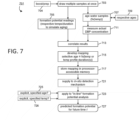
- FIG. 7 will be used to discuss correlation of water aging with parameters of the accelerated aging process, such that mapping information can be developed to permit accurate formation potential measurement for a sample for DBPs at a selective, future time, based on heating/processing characteristics adapted to simulate the selective water age at-issue.
- circuitry can refer to analog or digital electronic elements (e.g., dedicated logic gates), either arranged as special purpose circuitry that necessarily performs a certain function when electrically motivated, or as general purpose circuitry (e.g., a processor, FPGA or other configurable circuit) that is controlled or otherwise configured by instructions (software) so as to adapt that circuitry to perform a specific function and cause that circuitry to operate as though it was special purpose circuitry.
- general purpose circuitry e.g., a processor, FPGA or other configurable circuit
- the instructions are typically written or designed in a manner that has certain structure (architectural features) such that, when those instructions are ultimately executed, they cause the one or more general purpose circuits or hardware devices to necessarily perform certain described tasks.
- Logic can refer to software logic (i.e., instructional logic) or hardware logic (e.g., a digital chip or board design) or a combination of these things.
- Non-transitory machine-readable media means any tangible (i.e., physical) storage medium, irrespective of how data on that medium is stored, including without limitation, random access memory, hard disk memory, optical memory, a floppy disk, CD, server storage, volatile memory, nonvolatile memory, a memory card, a storage drive and/or other tangible mechanisms where instructions may subsequently be retrieved by a machine.
- the machine-readable media can be in standalone form (e.g., a program disk, solid state memory card, whether bootable or executable or otherwise, or in other memory) or embodied as part of a larger mechanism, for example, resident in a laptop computer, portable or mobile device, server, data center, "blade” device, subsystem, electronics "card,” storage device, network, or other set of one or more other forms of devices.
- standalone form e.g., a program disk, solid state memory card, whether bootable or executable or otherwise, or in other memory
- embodied as part of a larger mechanism for example, resident in a laptop computer, portable or mobile device, server, data center, "blade” device, subsystem, electronics "card,” storage device, network, or other set of one or more other forms of devices.
- the instructions can be implemented in different formats, for example, as metadata that when called is effective to invoke a certain action, as Java code or scripting, as code written in a specific programming language (e.g., as C++ code), as a processor-specific instruction set, or in some other form; the instructions can also be executed by the same processor or common circuits, or by different processors or circuits, depending on embodiment.
- "instructions stored on non-transitory machine-readable media” typically refers to software stored on disk or in other physical memory or storage, where the software is structured such that when it is later (ultimately) installed or executed by an operator or end user, it configures a machine (e.g., one or more processors) so that they operate in a prescribed manner.
- instructions on non-transitory machine-readable media can be executed by a single computer or processor and, in other cases as stated, can be stored and/or executed on a distributed basis, e.g., using one or more servers, web clients, or application-specific devices, whether collocated or remote from each other.
- Each function mentioned in the disclosure or FIGS. can be implemented as part of a combined program or as a standalone software module (i.e., an invocable or callable program or subroutine), either stored together on a single media expression (e.g., single floppy disk) or on multiple, separate storage devices, or in the form of dedicated circuitry or circuitry combined with such software.
- Module refers to a structure dedicated to a specific function; for example, a “first module” to perform a first specific function and a “second module” to perform a second specific function, when used in the context of instructions (e.g., computer code) refers to mutually-exclusive code sets.
- an “measurement module” When used in the context of mechanical or electromechanical structures (e.g., an "measurement module,” it refers to a dedicated set of components which might include hardware and/or software); for example, a “measurement module” and a “formation potential calculation module” would refer to dedicated, mutually exclusive structural elements for performing these functions.
- the term “module” is used to refer to a specific structure for performing a function or operation that would be understood by one of ordinary skill in the art to which the subject matter pertains as a conventional structure used in the specific art (e.g., a software module or hardware module), and not as a generic placeholder or “means” for "any structure whatsoever” (e.g., "a team of oxen”) for performing a recited function.
- a “mechanism” or “device” refers to a unit of hardware comprising one or more mechanically-, electrically-, fluidically- or electromechanically-actuated elements.
- a water quality monitoring network refers to a set of one or more systems or devices that receive measurements of water characteristics (and optionally control the measurement process), from one or more sources or measurement points.
- a water distribution network refers to paths, processes, blending, treatments and other handling of water from a water source until delivery of the water to a client; for example, it can include a system managed by a municipal water company, and it can also refer to a collections of entities/routes/systems extending from water collection to delivery to an end consumer (e.g., at a tap).
- THMs being one type of DBP that is particularly difficult to safely measure in-situ; however, it should be understood that many of the principles described herein can also be applied or adapted to the measurement of other DBPs (e.g., HAAs and other types of DBPs), particularly to the forecasting or measurement of formation potential for such DBPs, without departing from the inventive principles taught herein; in such cases, the use of other chemical procedures can be substituted and used to adapt the measurement process in a manner suitable to measurement of the particular DBP at-issue.
- DBPs e.g., HAAs and other types of DBPs
- FIG. 2 provides a block diagram of an embodiment 201 of an in-situ DBP detection mechanism. More specifically, FIG. 2 shows a method and system for measuring THMs in samples which are automatically drawn from a water source 203; the measurement process is based on a modified Fujiwara reaction, for example, as described in detail in US Patent No. 9134290 , and can be performed in real-time or near-real time (e.g., with results generally available within thirty minutes of measurement).
- Numeral 211 refers generally to this steps used to measure the current level of THMs formed in the drawn sample and/or the formation potential for such THMs.
- the depicted system selectively uses a process to artificially age the water sample 212 to accelerate further THM production based on the composition and quantities of remaining residual precursors that continue to form yet more DBPs in the water (including organics the residual organics and bromide still present in the sample, and the current level of chlorine).
- this aging process can be performed by heating the water sample to a controlled temperature for a controlled amount of time, where both the temperature and time have been correlated in advance with a particular age representing the forecast period for the sample measurement (e.g., the aging process corresponds to a "selective" age, and the process can be altered to simulate other ages).
- the amount of heating and the duration of heating applied is selected dependent on these metrics and optionally the current water temperature.
- other processing can also be performed, for example, raw source water (or previously processed but chlorine depleted water,) can be dosed (re-dosed) with chlorine, optionally pH adjusted with buffers, or temperature controlled, all per numeral 210; other types of processing can also be performed.
- the result of the accelerated aging process is a water sample with advanced DBP formation and/or decay. This sample is then measured using the various steps 211 represented in FIG. 2 , to detect DBPs then existing in the artificially aged sample. Per numeral 213, results of measurement can be logged either locally or in a remote database.
- this logging can be performed remotely; for example, as discussed below, a network can remotely control an in-situ DBP detection mechanism to automatically draw samples and perform ad hoc readings, operational tests and calibrations, as well as to program various parameters related to measurement factors (e.g., age to be simulated by the heating process and so forth).
- a network can remotely control an in-situ DBP detection mechanism to automatically draw samples and perform ad hoc readings, operational tests and calibrations, as well as to program various parameters related to measurement factors (e.g., age to be simulated by the heating process and so forth).
- Such a network or a control system automatically receives readings (measurements) via a local area network (“LAN”) or wide area network (“WAN”) connection, where those readings are based on DBP measurements processed in real-time or near-real time from each DBP measurement system, as they are completed, in a defined messaging format; the readings can be accompanied by data from other systems (for example, representing pH, water temperature, and other water quality statistics).
- LAN local area network
- WAN wide area network
- the in-situ DBP detection mechanism can simulate aging of a water sample for a selective age, or 2) can be commanded to measure only the current DBP concentrations (without application of the accelerated aging steps); as an example, a THM detector is advantageously of an architecture that permits it to be selectively commanded to measure current THM levels (e.g., TTHM and/or specific species concentrations) or to measure the higher THM formation potential employing the set of operational parameters (heat/time/chlorine dosing) most likely to provide a good correlation with THM levels that would in fact be produced at a specifically selected (or understood) future age.
- current THM levels e.g., TTHM and/or specific species concentrations
- THM formation potential employing the set of operational parameters (heat/time/chlorine dosing) most likely to provide a good correlation with THM levels that would in fact be produced at a specifically selected (or understood) future age.
- FIG. 2 performs this measurement in-situ, not just for total THM ("TTHM”) but optionally also for individual THM species as well; all results may be logged.
- TTHM total THM
- a destination e.g., a water delivery customer
- an electronically-actuated valve 207 or other actuation mechanism is used to draw a sample of water, for example, 100 mL.
- the sample is processed to extract at least one halohydrocarbon (THM) to an adsorbent medium, as indicated by step 215.
- THM halohydrocarbon
- the halohydrocarbons are transferred to a reaction medium having a pyridine derivative, as referenced by numeral 217.
- the reaction medium may be an organic solution used to elute the analytes from the adsorbent medium (such as acetonitrile).
- the analytes may be removed by a thermal desorption process, such as by heating the adsorbent medium to a point where the analytes become volatile, and then sweeping the volatile analytes into the reaction medium using gasses such as nitrogen or air.
- the reaction medium is typically of a known volume, such that DPB presence will be represented as a per-unit volume concentration.
- the analytes are subjected to a modified Fujiwara reaction, based on an organic developing agent (such as the hydroxide of an organic cation) and an optional organic co-solvent, at a controlled, elevated temperature, again, as more fully discussed in US Patent No. 9134290 .
- the color intensity of the reaction medium changes; this optical property is measured during the reaction, per numeral 221.
- the halohydrocarbon concentration is determined, as indicated by reference numeral 223.
- halohydrocarbons e.g., THMs
- the system of FIG. 2 may therefore optionally be applied to discriminate between the THM species and to determine their individual concentrations.
- dashed-line i.e., optional
- the optical properties of the reaction medium may be measured two or more times, at different times, to detect the change in color intensity.
- total THM presence may be determined and individual THM species concentrations determined from this data based on real-time or near real-time measurements.
- measurements can be correlated with other data and used to adjust, learn or improve the heating/aging parameters supplied to the system or a prediction algorithm for formation potential or DBP level prediction based on many variables (e.g., including one based on in-situ THM measurement or measured formation potential); as an example, if the system is configured to provide predictions of THM levels at a specific water retention age and location (e.g., seventy-two hours later at the exit of a designated storage tank), assuming stable operation of the network distribution system, the early measurement data associated with the "artificially and rapidly aged" samples can be compared with the later measurements taken from the tank-exit water supply, which has been slowly and naturally aging in the distribution system, and so forth.
- a specific water retention age and location e.g., seventy-two hours later at the exit of a designated storage tank
- analysis of the correlation using regressive analysis can be used to adjust/improve any of the process variables employed that affect the degree of THM-FP rate acceleration (e.g. adjustment to the water-heating time and/or temperature).
- the system's software can automatically adjust prediction through programmed response to known natural changes (e.g. seasonal dates), or sensed changes (e.g. self-and-internal measurements of the original water, or the same information inputted through an interface from another temperature recording device).
- the system can maintain a set of best operation parameters that correspond to a set of previously-learned water-treatment or network control configurations, and then selected as a 'recipe' by a water treatment operator with knowledge of these operational change that affect the natural aging of the sample - particularly those future events or activities that occur in the network, after the sampling and/or DBP prediction and/or formation potential prediction.
- predictions can also be used to take automated actions, including without limitation, generating alerts, emails, voice mails or other messages for automated sending to human operators (either locally or at a remote water supply), automatically controlling water source selection and/or adjusting flow rates, and/or modifying applied water treatments; other responses can be taken as well.
- the depicted water supply network can be prompted to invoke an additional filtration path 115/127/129/131 on an automated basis, or to reduce reliance on reservoir 103 in favor of the well water supply 105, or to provide additional/less chlorination 123 or chlorine dioxide addition 109, or to increase/decrease sand filtration 115, and so forth.
- a closed network e.g., within the network of a specific water treatment company or governmental entity
- a service bureau basis e.g., a services supplier can perform logging and provide alerts and automated control prompts to respective clients, as will be further described below in relation to FIGS. 6A-6C ).
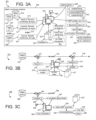
- FIGS. 3A-3C illustrate several implementations relating to prediction of DBP levels.
- FIG. 3A provides an illustrative diagram 301 showing a water monitoring network 303 and various actions that can be taken by that water monitoring network.
- a water supply e.g., a municipal water company
- a water supply has a number of possible sources of water, including water source 305, water source 307, water source 309, water source 315, and potentially other sources as represented by ellipses 311.
- the water supply utilizes in-situ DBP detection mechanisms 313, 317 and 321 as described herein; once again, these mechanisms are exemplified as measurement mechanisms for THM concentrations (e.g., TTHM), but analogous mechanisms can also be used for detection of other DBPs (including without limitation, HAAs; see, e.g., without limitation, US Patent No. 9222921 ).
- Other types of automated measurement systems can also be used, for example, pH detectors, water and ambient air temperature detectors, chlorine monitors (in all relevant forms of the chlorine chemical speciation), detectors for various types of metals, organics or other substances, and so forth. Note that while FIG.
- an in-situ detection mechanism can be configured to draw intermittent samples from a single water supply (e.g., as detection mechanism 321 draws samples from water source " n ,” 309) or from multiple alternate sources (e.g., as detection mechanism 313 draws water samples alternately from depicted water sources 305 and 315).
- Each in-situ detection mechanism is further seen to be networked with one or more computers (e.g., servers) 323 acting under auspices of suitable software 325 (denoted by a floppy disk icon in the FIG.).
- computers e.g., servers
- suitable software denoted by a floppy disk icon in the FIG.
- 3A denotes several possible architectures including: (a) one where each in-situ detection mechanism has its own dedicated control system (e.g., which shared data with network servers 323); (b) one where measurement control and control over maintenance functions such as system renewal and calibration are cooperative; (c) one where computers 323 are part of a local infrastructure (and where, for example, the processors can represent embedded systems or FPGAs); and (d) one where control is entirely remote (e.g., computers 323 issue commands over a LAN or WAN to take specified actions and effectuate specifically-commanded sequences). Other configurations are also possible.
- each in-situ detection mechanism performs a measurement and computes a result represented measured DBP presence
- the in-situ detection mechanism reports the result to the computers 223, which then store the reported results in a database 327 for purposes of logging and for purposes of current and prospective prediction services.
- the depicted water monitoring network 303 and computers/servers 323 provide predictions of DBP levels at a specific temporal or physical point based on correlation of measurement results with internal or external data or variables 329; for example, if a DBP concentration of " X " is measured by in-situ detection mechanism 313, and short-term atmospheric temperatures are expected to be warm, this can influence expected DBP concentration at a specific, later point in the water delivery process.
- the computers/servers 323 can produce a forecasted concentration that is different than " X " (e.g., greater than " X " based on the warm expected temperatures).
- the one or more computers/processors 303 advantageously build a model (algorithm) for prediction and update associated coefficients to predict DBP concentration at a given point and/time in the network given pertinent environmental variables and other factors; such a model can optionally be built and/or periodically updated using regression analysis.
- Numeral 339 represents that, as just above, these predictive techniques and system architecture can be structured so as to permit forecast of DBP levels at any desired location or point in time. For example, it is possible to monitor water sources 305, 307, 309 and 315 for DBP presence and, based on the data/variables 329, to predict DBP levels in a particular storage tank in the network.
- the system can be designed to provide feedback 331 based on actual downstream measurements 341 in order to update coefficients and prediction parameters, for example, using a recursive analysis 343 that looks at past predictions and adjusts the coefficients/parameters in dependence on divergence of true data from those predictions.
- the measurements from each in-situ DBP detection mechanism can represent in this embodiment either current DBP levels or measurement of formation potential, with the difference being that the in-situ DBP detection mechanism can be commanded to accelerate aging of a drawn water sample according to established heat, temperature and/or other parameters, in order to advance DBP formation to a desired degree.
- formation potential can be computed for each source for a selective age, and given certain assumptions such as average temperature during aging; for example, in-situ detection mechanism 317 can be commanded to measure formation potential using an assumed age of three days henceforth and an assumption that the water being measured will experience an average temperature of X degrees.
- in-situ detection mechanism 317 applies a heating profile (e.g., dependent on the three day period and the assumed X degrees) to artificially accelerate aging of a drawn water sample; it then measures the manipulated DBP levels currently in that age-accelerated water sample and provides measurements to computers/servers 323.
- the measured formation potential may or may not inherently be an accurate predictor of DBP concentration at any specific point in time or in the water delivery network; rather, the formation potential represents a measurement of DBP level expectation based on water sample that represents the state of water in a water supply at a particular instant in time, given assumed variables relating to the aging process.
- Measured formation potentials respective to one or more water sources and one or more sample times are therefore advantageously blended, modified or combined, so as to develop a prediction of DBP concentration that models a particular time and/or point in the water distribution network 303.
- the water will typically present ever-changing characteristics (and therefore continuously -changing formation potential); the DBP concentration that will be present in the accumulated water (e.g., in a storage tank) will therefore be a combination of a time-weighted window of potentially many formation potential measurements.
- periodic (e.g., hourly) formation potential measurements from in-situ detection mechanism 317 can be convolved with or blended with formation potential measurements for time-wise adjacent samples from the same water source, using a time window selected in dependence on average age of water in the storage tank of interest; the greater the average water age, the greater the accumulation and blending of water having dissimilar characteristics (and the wider the window of the applied function need be).
- average age is low, there is less blending/aggregation, and the optional blending function 347 can process a narrower range of formation potential measurements to develop an accurate prediction of DBP concentration, on a weighted basis if desired.
- the desired blending and associated predictions can be based on rules or scripting (349), for example, as established by the specific water supply as pertinent to its unique characteristics and circumstances.
- Rules/scripting 349 can also be used to take actions 351 in response to measurements and/or predictions.
- the rules/scripting 349 can be structured so that, if modeling forecasts elevated DBP concentrations (i.e., exceeding one or more thresholds), automated audible, email or voice mail alerts are triggered.
- the one or more computers/servers can be caused to continuously (or periodically) build and evaluate predictions for DBP concentrations at select temporal or physical points in the water distribution network; when certain conditions are evaluated to be true, as defined by a pertinent script or rule, the pertinent script or rule causes the computers/servers 323 to automatically generate a response.
- the response can include operator notifications as well as automated machine commands. That is, per function blocks 353 and 355, it is possible to automatically generate and transmit machine control values that will adjust treatment of water from specific sources or at specific locations, or switch source reliance. For example, as was referenced above in connection with the discussion of FIG. 1 , additional filtration can be selected if DBP formation potential is excessive, or alternatively, relative reliance on water sources and/or flow rates can be modified.
- FIG. 3B shows an embodiment 371 directed to forecasting of DBP concentrations generally in such a system. That is, in such an embodiment, DBP measurements are correlated with other factors or variables and used to predict DBP concentration at a specific point/time in the water distribution network.
- a water source 372 is seen to supply water for downstream delivery 378.
- a bleed valve, sample port or other sample extraction mechanism is used for in-line sample extraction, i.e., for provision to and measurement 374 by an in-situ DBP detection mechanism as referenced earlier, Measurements are reported to processor(s)/computer(s) 323, again acting under auspices of appropriate software 325.
- this type of process or prediction is advantageously calibrated using downstream measurement of actual DBP concentration 377, for example, using a second in-situ detection mechanism to perform automated sample measurement at the later point 376 being modeled; other techniques such as remote lab measurement can also be used for this correlation.
- These measurements 377 are compared to the predicted/forecast values 383, with results provided to a correlation engine 379 (e.g., implemented as part of software 325) to improve prediction/forecast accuracy.
- correlation can also be based on other variables, as represented by internal or external data 381, with predictions, measurements, coefficients and variables/parameter values being stored in database 327.
- the modeling represented by correlation can reflect comingling of water having difference characteristics (e.g., from different sources or based on accumulation, processes or materials), as represented by ellipses 375.
- FIG. 3C shows an embodiment diagram 385 directed to formation potential measurement.
- a water source 386 is similarly seen to supply water for delivery to downstream points 389 in the water delivery network.
- a bleed valve or sample port, or other sample extraction mechanism is used "in-line" to draw small samples corresponding to water from the water source 386 at a particular point in time.
- the sample is measured in near real-time (i.e., ⁇ 2 hours) for DBP presence and concentration 388, for example, TTHM and THM species concentrations.
- the in-situ detection mechanism further accelerates aging of the drawn water sample prior to measurement, e.g., according to a heat profile that has been established a priori.
- the applied aging process heats the sample to a temperature of 50-70 oC for thirty to sixty minutes, depending on the desired age simulation effect.
- These parameters represent certain age and temperature assumptions 392 that have been previously correlated to the amount of aging desired.
- the in-situ detection mechanism then detects DBP concentrations in the "accelerated" sample, and reports these measurements to computers/servers 323, for logging in the database 327.
- the measured results can then be used in an algorithm or model for purposes of providing an automated prediction of DBP levels, i.e., will exist at a future point in time or particular downstream point in the water delivery network (e.g., at a particular water storage tank).
- the measured formation potential or prediction can be blended in dependence on average age of accumulated water, or other factors, just as before.
- a monitoring network can be predicated on in-situ measurement of DBP concentrations. These measurements can be used to predict DBP levels at a particular point in the water delivery chain, for example, at a specific time and/or location.
- the in-situ detection mechanism applies a process to accelerate the effects of sample aging, such that DBP concentration measured in the sample represents an assumed (selective) later point in time.
- FIGS. 4A-4E are used to discuss certain concepts relating to accelerate aging of samples.
- FIG. 4A provides a block diagram 401 for an embodiment that performs DBP measurement based on accelerated sample aging.
- a measurement system is once again employed locally to extract water samples in-line at a water supply (or distribution facility) on a remote, automated basis 403.
- the samples can be raw water samples or already-treated samples; whatever the source, an in-situ mechanism receives or draws water, and then performs a series of steps to extract and concentrate DBPs.
- the water can be chlorine-dosed (and have other optional buffering performed, e.g., such as might occur in a WTP), and then is processed for DPB measurement based on desired (assumed) environmental factors.
- a water supply may add disinfection agents to water, including chlorine, bromine or other halogen-based compounds for purposes of sanitizing the water.
- disinfection agents including chlorine, bromine or other halogen-based compounds for purposes of sanitizing the water.
- DBPs form as a by-product of such treatment; the longer water is exposed to these sanitizers given the water's constituency and environmental factors, the more DBPs will generally be formed (in a manner potentially varying by DBP specie).
- DBPs can be formed to varying degrees dependent on factors mentioned previously.
- the in-situ mechanism in this embodiment is used to forecast DBP formation potential at such a future point in time by accelerating aging of the sample and by then taking measurements of DBPs in the accelerated sample.
- the depicted embodiment is directed to forecast of THM formation potential. Specifically with respect to THMs, this accelerated aging can be performed by heating a water sample in a pre-treatment (heating) vessel 405 at one or more specific temperatures, and for associated durations 407, to accelerate THM formation.
- an example duration and heat level can be 30-60 minutes at a temperature of 50-70 degrees centigrade 409, with the specific heat/duration chosen so as to mimic a particular (e.g., selective) amount of aging; this is contrasted with a typical THM measurement process performed at ambient temperature (e.g., 20 degrees centigrade).
- a dechlorinating agent 411 can then be added to the sample to quench all reactive chlorine and thus terminate the first step of DBP production (the incorporation of the reactive halogen onto the carbon atoms of the organic matter).
- THMs can at this time be extracted 412 by pre-concentration and extraction into a known volume of reagent, and the extracted THMs can immediately be measured (e.g., for total THM or any desired THM species).
- the extracted THMs are optionally measured using modified Fujiwara chemistry as taught herein to measure individual an individual THM species concentration 413. Measurements thereby represent THM formation potential for the water supply that sourced the water sample at the particular point in time, and can be used to forecast expected contribution to DBP levels at a later point in the water delivery process.
- the measurements and/or forecasts can be stored in a database 414 along with ambient measurement factors such as time, temperature, pipe/tank materials and pipe/tank age, and values for potentially many other variables 415.
- Such data can also be subjected to regression analysis or other curve fitting 416 in order to generate and/or improve an equational dependency of forecasted DBP concentration relative to measured formation potential, actual DPB concentration at various at various water sources or supply points, and/or the other variables.
- the in-situ mechanism is optionally programmed to, on a calendared basis, automatically remeasure DBP concentrations (and/or formation potential), and to report measurement results on a calendared basis 417.
- measurement results and/or DBP predictions can be compared to thresholds and used to generate alerts/alarms if lesser than or greater than expected.
- unused water from drawn water samples can also be stored in a manner corresponding to age assumptions and measured at a later point in time (e.g., 3-7 days later) in order to calibrate the formation potential measurement and adjust factors based on feedback, to improve accuracy.
- Per numeral 419 multiple measurements can be taken at different points in time in order to derive THM speciation. That is, as noted in the incorporated patents, the described measurement methodology takes advantage of the fact that individual THM species produce a red optical color at different rates (e.g., of the four THMs, chloroform reacts most slowly, whereas the next most similar species bromodichloromethane gives the fastest reaction rate).
- reaction rates and color intensities profiles are typically pre-determined for each THM (or combination of THM) on each individual analytical apparatus used for measurement, and these calibration parameters (Fujiwara colour intensity at specific reaction times for each THM) are then typically stored for use in speciation measurement.
- individual THM concentrations can be derived 419 by first making multiple colorimetric absorbances measurements at the appropriate times over the course of that Fujiwara reaction (e.g. 130, 500 and 1200 secs), and then by solving the set of simultaneous equations using the known THM calibration coefficients, in view of the absorbances just obtained.
- the sample's THM quantity information together with other measured data and analysis methods can be used to forecast DBP concentration levels at other temporal or spatial points in the distribution network (or an equivalent sample isolated from the network but aged in the laboratory under conditions that simulate the network); these measurements can also be factored into the learning process 423. Furthermore, as noted by numeral 422, averaging/blending of measurements with a window of adjacent samples is advantageously performed to simulate accumulation of water over time.
- the described processing provides an accurate way to measure DBP concentration on an real-time or near real-time basis, as well to predict DBP levels at various times/points in the water distribution network.
- proactive corrections and/or process modifications can be made to reduce the levels of and/or avoid the presence of DBPs before water is distributed to the consuming public.
- a water supply can take actions such as performing less filtering or changing water source reliance, so as to make water distribution more cost efficient. For example, returning once again to the introductory example provided by FIG.
- the subject water supply could choose to switch to well water delivery, to otherwise reduce the flow rate of water from the depicted reservoir 103, or to increase filtration or other processes (such as depicted by numerals 109, 111, 113, 115, 127, 129 from FIG. 1 ). Many other actions/reactions are possible, as noted.
- FIG. 4B shows a graph 431 of three hypothetical curves showing THM formation as a by-product of sanitizers in water; generally speaking, the longer a given water sample contains chlorine-based and bromine-based sanitizing agents, the greater the THM formation in the water. Breakdown of the sanitizers over time can also be a function of many variables that can affect a water supply, such as water temperature, exposure to sunlight, flow rate, exposure to other materials (e.g., metal pipes or other compounds present in the water), and potentially many other factors.
- FIG. 4B shows three hypothetical curves, 433, 435 and 437 that each represent different rates of THM formation over time.
- THMs are produced as a time-based function such as represented by curves 433, 435 or 437, but that the specific curve that accurately models THM formation is unknown; it should further be assumed that THMs (and/or other DBPs) will continue to develop up to a maximum value at some point after treatment (e.g., potentially after drinking water has left the control of the water supply), as represented by arrow 432, off to the right side of the FIG. It is typically desired both to understand maximum DBP development and also provide for appropriately sanitized water at the time of delivery of water to a consumer.
- the techniques described in this disclosure use pre-selected age acceleration parameters to forecast formation potential for a given facility, a given DBP, and given temperature and other aging assumptions. These parameters are employed at the time of measurement to accelerate DBP formation and thus simulate water aging in a manner that can be used to forecast both amount and time of maximum DBP formation (e.g., on a species-specific basis).
- a captured water sample is heated prior to THM extraction, in order to deliberately break down added sanitizers in a controlled manner and produce THMs on an accelerated basis; for example, if it is assumed that curve 433 accurately represents THM formation for a specific municipality over a certain period of time (e.g., a certain time of day, of a specific month in a specific season), the techniques described herein accelerate aging of the water sample in a manner consistent with line 443, using heat according to a predetermined temperature profile for a specific period of time. Note that a single temperature can be used, multiple temperatures and respective heating times can be used, or any other form of temperature profile can be used, to simulate THM formation at a future point in time.
- numeral 448 for example represents a period of two days (forty-eight hours out) and it is desired to forecast THM formation at that point in time, then the reaction is halted as represented by ellipse 445, in a manner that freezes THM development in a manner corresponding to the selected time, per horizontal line 447.
- a dechlorinating agent is introduced to a water sample to remove residual chlorine from the water sample (i.e., without affecting THMs already formed in the sample) and the sample is then measured in real-time (e.g., using a 20 minute measurement cycle) to measure THM species present at that time.
- the heat profile is slightly different, with the reaction allowed to proceed at a slightly longer time, with the dechlorinating agent then added to freeze THM development in a manner corresponding to that time, e.g., at the level represented at line 446.
- the temperature profile can be selected and refined so as to accurately model future DBP development (i.e., for THMs specifically in this example); this will be further discussed below in connection with FIG. 7 .
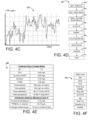
- FIG. 4C shows a graph 451 that illustrates typical variation in formation potential for any given water supply as circumstances change;
- the vertical axis represents DBP (THM) concentration (aggregated across THM species) in units of micrograms per Liter of water (ranging from 20 to 70, as demarked by horizontally-extending grid lines), while the horizontal axis represents time in days (with each vertical grid line representing a day); the graph 451 represents about six measurements per day, equally distributed throughout the day.
- DBP DBP
- THM DBP
- the raw measurement data itself may not accurately represent DBP levels at any specific point in the water distribution network, it represents DBP formation and decay that is expected from a given water sample at a specific future time, with a typical presumption that water corresponding to the sample was/is handled under the same (temperature and other) assumptions.
- a typical WTP or water distribution network continually-changing water is typically accumulated over time in storage tanks and elsewhere within the network; in other words, a more accurate formation potential prediction is obtained by combining multiple measurements in a type of convolution, i.e., dependent on average age of water at a given prediction point based on a water contributed at many different points in time, and depending on a function applied to a possibly-dynamic range of weighted samples.
- a digital filter is applied to a window of measurement results (and potentially measurement results representing plural sources) to predict actual DBP levels based on weighted combination of multiple formation potential measurements, and potentially other data.
- the filter accounts for time-wise adjacent measurements using weighting that is a function of average age of the water at the prediction point relative to the measurement point. For example, the filter can average or blend a group of measurements representing a relatively wide time window when the average age of water is relatively long, and a narrower time window when the age is reduced, i.e., accounting for greater turnover and less blending of the water, with emphasis for a specific measurements based on variation in flow rate.
- the function implemented by the digital filter in one embodiment is varied depending on environmental variables, including without limitation season (e.g., implied water usage/turnover), day, time, month, flow rate variation, mineral content, pH, and any other desired environmental or water delivery variable.
- FIG. 4D shows a flow chart associated with the forecasting process; an in-situ detection mechanism such as described above can be used for purposes of measurement, according to steps generally represented by numeral 461. More specifically, a measurement frequency is programmed 463 into memory for the in-situ detection mechanism, with resident software then being controlling the measurement cycle (and cleaning/renewal cycle) according to the programmed frequency; for example, as alluded to above, measurements can be taken automatically by the in-situ detection mechanism every hour, if desired. Per numeral 463, the programmer can program this frequency into a register of a specific in-situ detection mechanism (e.g., "hourly").
- a specific in-situ detection mechanism e.g., "hourly"
- the programmer optionally programs desired target age into memory 464 for use in selecting the accelerated aging process to be used to measure formation potential; in one embodiment, this value can be fixed or represent a standard (e.g., seventy two hours after sanitization) and, in other embodiments, this value can be set ad-hoc (e.g., by command operand) or made to be automatically variable according to factors such as water flow rate (e.g., the faster the water flows, the shorter the presumed time until water is delivered to a consumer).
- water flow rate e.g., the faster the water flows, the shorter the presumed time until water is delivered to a consumer.
- the in-situ DBP detection mechanism can accesses forecasting parameters which have also been stored by in the system database (466); these parameters can, as mentioned, optionally result from a learning algorithm which continuously updates the parameters based on historical data measured for the specific water supply at issue, or based on predicted environmental variables. These values are then applied to forecasting 467 with forecasts being logged or reported to an operator.
- Per numeral 468 such forecasting can represent a myriad of variables, to provide for an accurate DBP/THM concentration predictions.
- alerts and/or controls can be generated as a response to such forecasts/predictions.
- each prediction and/or measurement can be stored in the form of a standard template; that is, as will be further explained below in connection with FIG. 6A , in one embodiment, a normalized or common communications or data exchange format is established to provide one or more normalized structures for exchanging and storing data.
- Per numeral 471, stored measurements and forecasts can thereafter be applied to new forecasts and to periodically updating prediction models, as referenced elsewhere herein.
- FIG. 4E shows a table 485 providing hypothetical water quality data, e.g., such as might be reported by in associated with a water source or generated monitoring equipment (including one or more in-situ DBP detection or other monitoring mechanisms).
- a report for a particular water source i.e., a water treatment plant
- reports data at discrete periods of time i.e., on an intermittent basis, such as every hour, every four hours, etc.
- Such data can be logged in template form, as discussed below.
- the upper three-quarters of the table represents parameters reported by the water supply (source), for example, with respective fields as indicated for pH, total organic carbon (TOC), WTP chlorine dosage, bromide levels, acceptable concentration range for a one or more DBPs (e.g., TTHM in this example), water hardness, total alkalinity, a seasonal temperature or temperature range for fall/winter, a seasonal temperature or temperature range for spring and summer, and so forth.
- the lower quarter of the table represents in-situ measurements at another location in the water distribution network, for example, residual sanitizer detected to be present at the sampling point (Cl 2 ), measured DBP (e.g., TTHM) and average water age relative to source.
- FIG. 4F shows some variables or parameters that used to define DBP concentration prediction for a single water source.
- software is preprogrammed to look at a number of factors, and performs prediction based on the listed parameters in order to estimate DBP concentration; variables used in one embodiment are represented by numeral 491, and are seen to include water temperature, site of measurement, date, time, water composition (e.g., metal constituency), flow rate, tank level, age of the water (relative to sanitizer introduction) at the time of measurement, heat levels to be applied in i discrete heating cycles, each for a respective duration, and a function to average formation potential measurements.
- any desired function can be implemented as desired, e.g., if measurements are taken every hour, it might be desired to use a digital filter as described to perform a weighted analysis based on the immediately previous five samples and the sample taken at the same hour the previous day (or previous week); many examples are possible and will readily occur to those of ordinary skill in the art, and fewer, more or different variables can be considered, depending on embodiment.
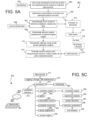
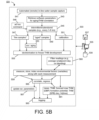
- FIGS. 5A-5C are collectively used to provide additional detail regarding a water monitoring network that interfaces with one or more in-situ DBP detection mechanisms.
- FIG. 5A relates to the operation, in one embodiment, of each in-situ DBP detection mechanism
- FIG. 5B provides detail regarding one embodiment formation potential measurement by either of an in-situ DBP mechanism or water monitoring network, or both cooperating together
- FIG. 5C provides detail regarding an implementation of the water monitoring network.
- FIG. 5A introduces an embodiment 501, including a business method, of operating an in-situ DBP detection mechanism.
- a mechanism may be used to test for at least one halohydrocarbon (THM specie), based on a modified Fujiwara process as introduced above and as reference by numeral 503.
- THM specie halohydrocarbon
- a modified chemical process is used which relies on substitute or modified chemistry, as referenced, and helps limit worker exposure to noxious fumes or hazardous chemicals; this therefore facilitates design of an in-situ detection mechanism that can be used at water supply facilities, with infrequent servicing by water supply personnel.
- concentration of at least one halohydrocarbon in a sample is locally determined, per numeral 505.
- dosing and/or sample preparation steps can optionally be performed 504 before measurement, for example, to measure absolute or relative effects of dosing or treatment on raw or previously processed water samples.
- Results of measurement may be electronically stored in a database, indexed by a time stamp and any other environmental factors deemed pertinent (e.g., water temperature at sampling), and a log may be generated for demonstrating regulatory compliance and for detecting situations when monitored substances exceed desired levels, as alluded to by numeral 507.
- FIG. 5A also references several optional steps.
- pyridine derivatives can be used for the referenced substitute chemistry, facilitating the goals of relatively safe chemicals and local maintenance, e.g., materials used for the reaction may be stored in local reservoirs and occasionally replenished, with waste materials being collected and safely disposed. As implied above, relatively easy maintenance facilitates in-situ systems without requiring extensive training of personnel.
- materials that degrade over time may be recalibrated and used until they need to be replaced using one or more locally stored calibration media (i.e., one or more "standards"). As discussed in US Patent No.
- an electronic control system may be used to run the same steps used to test the potable water supply with each locally stored calibration test medium (e.g., on THM-free water); self-calibration further enhances the ability to provide and effectively use in-situ devices for monitoring chemicals such as THMs. The same is true for automated renewal processes that, following one measurement, purge residual THMs from extraction media and measurement equipment, and prepares the detection mechanism for a new cycle of measurement.
- a LAN or internet connection 514 may also be provided for transmitting measurement results to a central monitoring facilities, e.g., the water monitoring network of FIG.
- data from the particular in-situ detection mechanism can be indexed by various factors, including unit serial number, time of measurement, particular THM values, other water quality data (e.g., chemicals/organics present, temperature, pH), location, etc.
- This data may be logged either in a dedicated file or, in connection with the network of FIG. 5C , as part of a database used to track several of the in-situ mechanisms.
- THM amounts may be compared to one or more thresholds, as indicated by dashed line “options" block 515, and a reaction such as an alert 519 may be generated if concentrations exceed desired level; alternatively, per numeral 521, an electronic control system may responsively and automatically adjust upstream water treatment processes via the generation of automated machine control values, i.e., to either increase or decrease the use of certain chemicals, or to provide for a sanitized water supply that will not exceeding recommended norms (either presently, or prospectively). Individual DBP species' contributions may also be used in diagnosing issues associated with the water treatment process.
- FIG. 5B provides a flowchart 531 used to explain calibration and measurement of formation potential from a control perspective (e.g., either the perspective of a control system and/or software for an in-situ DBP measurement system, or from the perspective of a remote water monitoring network).
- Software functions in performing this analysis are generally represented within the confines of a block referenced by numeral 533. These functions can be performed on a computer 535 having one or more processors that are controlled by instructions stored on non-transitory, machine-readable media, or by other types of circuitry.
- the computer or processors can manage one or more databases 539 (e.g., data stored in non-transitory memory), including without limitation a database that stores environmental variables associated with each water measurement, forecasted and actual DBP species' concentrations, and other parameters.
- this software controls operation of the in-situ mechanism including actuation of mechanical elements to perform water sampling, aging and response development.
- the software loads parameters (e.g., coefficients) that will be used for measurement and forecasting 543.
- these coefficients can be varied over time as water samples are taken, according to regression or feedback resulting from the comparison of forecasted values and measurement of aged samples.
- the software advantageously controls measurement on a calendared basis, for example, performing automated sampling, cleaning and systems renewal every 1-6 hours; this can result in 4 or more samples taken daily.
- control can also either be ad hoc, originating from control software 537, in response to occurrence of a triggering system event (e.g., scripted in response to other measurements), or as commanded by a human operator or a remote water monitoring network.
- a triggering system event e.g., scripted in response to other measurements
- Numerals 547, 549 and 541 represent three different processes that can then be performed: First, per numeral 547, the system can be used to process "live" samples, representing water samples instantaneously drawn automatically from the water supply that are to be measured right away for DBP presence or formation potential; Second, per numeral 549, the system can also process aged (stored) samples, e.g., water drawn by the system 2-3 days earlier (or at another prior interval) which are currently to be measured for DBP presence, with the results being compared against previously forecasted values (i.e., based on another, previously processed sample of the same water), and used to adjust forecasting parameters (coefficients) or the heat profile used for formation potential measurement, as appropriate; Third, per numeral 551, samples can also be drawn for purposes of system calibration, e.g., water from the actual supply being measured can be drawn, purged of disinfectant (and THMs), subjected to addition of a known amount of THMs, and then measured to calibrate the system, e.g.
- Patent No. 9134290 whichever process is performed, the sample in question is then heated 553 according to a predetermined temperature profile, as referenced previously; it is expected, given typical water supplies (e.g., municipal water supplies) that these heating profiles will be on the order of 50-70 degrees centigrade for thirty-to-sixty minutes. In other embodiments, these values are different.
- the heating is performed to accelerate DBP formation and artificially age the water sample relative to the water source being measured.
- the sample volume drawn for each sample 541 can be enough to fuel multiple measurements, for example, with each measurement iteration simulating a different age, so as to trace out a DBP formation and decay profile corresponding to the given sample.
- the DBP formation process is then halted, e.g., by the addition of a de-chlorination or other agent 555 to remove the chemicals that contribute to THM formation.
- DBP formation potential values e.g., including TTHM and individual species' concentrations
- TTHM TTHM and individual species' concentrations
- individual species' concentrations computed for each desired water age and each desired water source
- such data can then be applied to develop a heat profile that will be used to determine how samples are processed such that artificial aging represents a selective age; this will be further discussed below in connection with FIG. 7 .
- the system can be used for measurement of formation potential with measurements factored into predictive analysis with either internal data or external data (e.g., any pertinent environmental data) and used to assess the efficiency of the water distribution 561; once again, all predictions and measurement results can be logged, per numeral 563.
- one or more formation potential measurements can be supplied to a predictive algorithm based on variables such as temperature, date, time of day, water flow rate, and other variables, and used to predict actual DBP concentrations at a specific location and/or time in the network, based upon the various environmental or other variables used to model DBP concentrations.
- a predictive algorithm based on variables such as temperature, date, time of day, water flow rate, and other variables, and used to predict actual DBP concentrations at a specific location and/or time in the network, based upon the various environmental or other variables used to model DBP concentrations.
- multiple readings taken at respective times can be averaged or weighted in dependence on a window of adjacent samples to adjust for blending of water in the water distribution system or in specific storage tanks or units 560.
- Predictions can be compared against actual values and the variables used, e.g., correlation and regression 565 can be performed by software so as to improve the statistical accuracy of the predictive algorithm applied by software and update coefficient variables and/or the aging used to measure formation potential 567.
- Logging of measured formation potential, the values of variables used in the predications, and measurements of DBP presence in fact are advantageously made part of the logging process 563, with logged data either being stored locally or sent via LAN or WAN to a remote database 569.
- FIG. 5C shows another embodiment 571, this time from the perspective of a water monitoring network.
- one or more processors 573 acting under the control of suitably configured software, manage database logging and storage functions, and perform routine database maintenance functions 575.
- Data readings from DBP prediction efforts from in-situ DBP measurement systems are received and stored in the database 577, generally with a time stamp and an identifier as to the specific unit that produced the measurement, and associated data describing water quality.
- records are received and/or compiled as standard objects or database templates suitable for use in a relational database or equivalent.
- Measurement data can be received from via a LAN or WAN interface 579, for example, as relayed through the Internet (represented by a cloud icon) by a multitude of in-situ DBP detection mechanisms (or other systems) and/or clients 581, for purposes of logging and/or prediction and/or water monitoring.
- a LAN or WAN interface 579 for example, as relayed through the Internet (represented by a cloud icon) by a multitude of in-situ DBP detection mechanisms (or other systems) and/or clients 581, for purposes of logging and/or prediction and/or water monitoring.
- the one or more processors implement a monitoring engine 582, a prediction engine 583 and a correlation engine 585.
- the monitoring engine 582 implements tasks and alerts according to scripted rules, for example, taking an action dependent on a DBP reading, or as a function of multiple readings, satisfying a particular threshold.
- the prediction engine 583 performs prediction of DBP concentrations based on data reported from the in situ DBP detection mechanisms and desired environmental variables according to rules scripted for the particular water supply; for example, if the pertinent water supply was a municipal water supply with aqueduct and reservoir water sources available and a specific configuration of storage tanks, the prediction algorithm would be coded so as to be based on these sources and tanks and associated environment variables for that specific delivery network.
- the correlation engine 584 is used to update prediction models 597 (and associated coefficients or operators, and/or aging profiles used for formation potential measurement) using regressive or best fit analysis 595, e.g., so as to improve prediction based upon variables applied and correlation with measured true DBP values.
- a number of reactions can generally be implemented on processors 573, typically be a dedicated software application or by suitable scripting.
- alerts can be automatically generated in response to rules that operate on the pertinent environmental data, measurements of formation potential and/or predictions of specific DBP concentrations. For example, if DBPs are predicted to exceed safe norms, given predicted formation potential and expected temperatures, an alert can be automatically triggered to a human operator that advises that additional water treatment procedures should be applied (e.g., to reduce organics presence in pertinent water sources).
- additional water treatment procedures e.g., to reduce organics presence in pertinent water sources.
- rules can also be used to trigger automated actions, for example, invoking automated water treatment processes, changing treatment parameters (such as disinfecting agents used or associated concentrations, regulating flow, and potentially other actions). Such reactions can be based on programmed parameters 598 that take into account the cost analysis 599 pertinent to a given water distribution system.
- a water monitoring network also advantageously supports a query engine and API for interacting with the system/network; for example, the one or more processors 573, acting under control of suitable software, implement an API that permits a human operator to query for any desired historical record, to command ad hoc DBP or other automated water quality measurements, to change prediction models, command calibrations, and take other actions.
- Numeral 594 references a service engine 594, denoting that the functions depicted in FIG. 5C can in one embodiment be operated on a service bureau basis. That is, in one contemplated implementation, an entity may provide water monitoring services for one or more clients. Each client for example can be a municipal water company or other water supply having one of more in-situ DBP detection mechanisms.
- the water monitoring network provides a secure portal (i.e., in association with the WAN interface 585) that permits administrators or proxied users for each client to log in, view data, and establish rules for automated responses and alerts.
- the responses and alerts can be provided dependent on a subscription by the particular client, e.g., each client installs water measurements systems that automatically interact with the network software using push/pull functions to report/collect measurement data.
- the client can script rules ranging from periodic notifications (e.g., hourly emails or downloads of ever changing formation potential data), to alerts of conditions based on client-established parameters, to automated machine commands to change processes or control values.
- Tthe water monitoring network implements the functions seen in FIG. 5C while each client installs in-situ DBP detection mechanisms (and other measurement mechanisms) and employs client-side software to interact with the water monitoring network.
- Each detection or measurement mechanism can optionally be configured for direct network access if desired, so that data can be directly exchanged with the water monitoring network or the client's network, as pertinent to the installation.
- FIG. 6A is used to discuss one possible framework 601 for such an implantation, e.g., where an object model or relational database architecture is established for storage of results and some of the processes described earlier.
- FIG. 6A represents a schema of object properties or relational database fields that might be used to provide service bureau activity by an enterprise, but can also with suitable adaptation be applied to a closed network (e.g., such as the network of a large municipal water company). Note that the schema presented by FIG. 6A is exemplary only, i.e., one skilled in the art can select other fields or properties to use, depending on circumstance or implementation.
- templates are defined, such as template 603 or 605, with each listed value representing a property or field that would be stored as part of an instance of each such object or database record.
- the template type "unit” (603) is seen to have properties/fields of "site,” “location,” last reading (“Last(val.:tmstp)”), "Last diagnostic,” “Status” and “network/IP.”
- a record would be used to identify each in-situ detection mechanism in the field, respectively identifying (a) a unit number or serial number, (b) a number, address or other identifier indicating the site at which the particular unit is installed, (c) where the unit is installed at the indicated site, (d) last produced reading, including value, and timestamp, (e) current operating status, and (f) a network ID (e.g., the electronic address that can be used to communicate with the device).
- a network ID e.g., the electronic address that can be used to communicate with the device.
- a reading number e.g., a unique ID
- substance type representing the substance measured by the device
- TTHM e.g., "TTHM”
- unit number which identifies the in-situ detection mechanism which produced the particular reading
- templates 603 and 605 that the property/field "unit” is shown connected by a line 607; this denotes that this property is linked for the two referenced template or object types.
- this value can be used to access the "unit” template or object having a record number/property "004" and to retrieve information for the individual unit which produced the particular reading. That is, there may be many "readings” produced by unit "004" over time (all logged), and the value "004" can be used as a unique identifier to bring up information on "that" unit which produced these many readings, e.g., sorted by time of reading or other criteria.
- this type of architecture provides an infrastructure for servicing a wide variety of queries; as implied by this example, in one embodiment a hypothetical query can seek a return of all readings (or readings for a specific time or date range) produced by a specific unit.
- 6A depicts many other possible templates or object types, for example, one for "site” (e.g., indicating specifics associated with a particular point in a water distribution network, such as a facility, water source, storage tank, and so forth), one for "Rule,” (e.g., having properties/fields that can be crafted to invoke automated actions when specified conditions such as Boolean conditions are met relative to specified thresholds or values), "Substance Type” (e.g., specifying each individual substance that is to be measured or otherwise used as the basis of a rule, e.g., each DBP species being measured and/or monitored), "Machines” (e.g., non-detection mechanisms such as water treatment systems, valves, diverters and the like that can be used for automated control and/or reaction), and "Client_ID;” other templates and/or properties/fields can again be used as pertinent to the particular implementation.
- site e.g., indicating specifics associated with a particular point in a water distribution network, such
- the "Client_ID" template can be used to associated sites, rules and machines (and potentially other templates) with respective clients; for example, in one implementation, an enterprise performs online water monitoring functions on behalf of multiple clients (e.g., respective municipal water companies or other water supplies). Each client has an associated address, designated administrators and permissions backed by cryptographic credentials, and the service bureau receives automated "push” readings (or alternatively, performs polling) as configured by or for the particular client for in-situ detection mechanisms managed by that client (e.g., for potentially multiple THM, HAA or other DBP detection mechanisms used by that client).
- each client uses a secure web portal to run queries on that client's reported data and measurements, and to establish rules/scripts specific to that client and that client's available machines that take client-specified actions when client-specified thresholds are reached.
- rules/scripts specific to that client and that client's available machines that take client-specified actions when client-specified thresholds are reached.
- one client may elect to establish rules with the service bureau which generate email alerts when certain thresholds are reached (e.g., predicted formation potential for any source for a selected water age is found to be greater than a threshold, or peak formation potential at any age if found to be greater than a threshold), while another client might instead elect to automate responsive machine control as a function of its rules.
- the various rules in one implementation can be used to initiate automated machine commands directed to the particular client's machines using the machines templates, e.g., effectively, the client configures the service bureau to, as a response to client-reported data, issue a TCP/IP-based command directly to a network address associated with a specific one of the client's machines to initiate a control activity, for example, changing a chemical level, or a flow rate, or diverting water to a different flow path or treatment process.
- a control activity for example, changing a chemical level, or a flow rate, or diverting water to a different flow path or treatment process.
- FIG. 6B shows a layer diagram associated with a water monitoring network.
- Per numeral 653 hardware is allocated at a machine level to perform the various processing described herein, for example, one or more computers, servers or other digital devices.
- a machine or machines exchange communications by WAN with one or more in-situ DBP detection mechanisms and one or more other devices used for water quality control, supply or processing; in one implementation, some of the functions described herein may be made viewable or interactive via one or more mobile devices, for example, the receipt of operator queries which can then be run against database entries.
- each hardware machine can include one or more virtual machines running on hardware.
- Numeral 655 refers to a software layer, where one or more custom software applications (e.g., a database and logging application, or a correlation and regression application) can be installed to run the various tasks as described herein; as will be discussed further below in connection with FIG. 6C , a number of different functions, programs, routines or software modules can be provided for to perform the various described functions as pertinent to the desired implementation.
- Numeral 657 refers to the use of objects/templates and associated properties and fields, for example, as discussed above in connection with FIG.
- these objects / templates / properties / fields implement a common communication format ("CCF") for exchange of data between multiple machines and operators, and optionally, to reconcile potentially different data reported by different types of monitors/detection mechanisms used to monitor respective DBPs (i.e., such that data can be imported/translated to a standard format).
- CCF common communication format
- a scripting or web-application layer permits rules and automated responses to be developed and invoked when specified conditions are satisfied.
- FIG. 6C shows a collection 671 of software modules that can be used in one embodiment.
- each software module consists of a dedicated code set for performing an associated task.
- a first module 673 is seen to provide for on-line/in-line tool control and diagnostics, e.g., control over an in-situ DBP detection mechanism; for example, as referenced earlier, in one embodiment, such a tool receives programming to establish various parameters, such as frequency of automated measurement, or to ascertain levels of various consumables remaining, or to perform a calibration, ascertain machine status, obtain last reading, take an ad hoc measurement, set a selective age or assumed average temperature for which formation potential is to be measured, and so forth.
- the on-line/in-line tool control and diagnostics module is used, simply stated, is used to provide an interface between each in-situ detection mechanism and a remote network and/or a human operator.
- a second module 675 provides for functions relating to the CCF, network configuration, communications and an API for the database scheme; for example, such a module can be used to modify the database schema so as to interface with new control or monitoring equipment in a given water distribution network (including as to the definition of network address), or to expand data reporting so that new variables can be reported and linked to measured data.
- a query/database management and logging module 677 provides an interface to the reported measurements, forecasts and other data logged by the system; for example, such a module advantageously provides an API for query support of the database.
- Yet another module 679 provides for correlation functions, regression and parameter update; as an example, it was earlier mentioned that in one embodiment, as the amount of logged data increases (potentially including predictions and corresponding verification measurements), the prediction and/or formation potential aging algorithms can be refined to improve accuracy, for example, through the use of regression to improve correlation between certain environmental variables and formation potential measurements with measured DBP concentrations at a specific point in a water distribution network.
- a sixth module 681 permits a given network to implement scripting, rules or software functions to cause the water monitoring network or machine to take specified action in response to measured/forecasted data; for example, as alluded to earlier, such a module permits a particular water supply to specify that certain actions (e.g., notifications, alerts, automated machine control) be taken when in-situ DBP detection mechanisms generate particular readings, or when certain DBP concentrations are predicted.
- Numeral 683 refers to a security/permissions module, e.g., which allows a network to specify which login credentials are needed to access certain data, run queries, generate reports, or perform network/machine administration functions.
- a servicing module 685 implements functions relating to billing management and services selection for the particular client.
- FIGS. 5A-6C are exemplary only; nevertheless, they help illustrate a variety of different machine and/or network and/or service-based implementations that can make use of the DBP measurement and formation potential prediction capabilities introduced earlier.
- an in-situ DBP detection mechanism can be used to generate formation potential measurements for DBPs, that is, an expectation as to the concentration of DBPs that might result from a given water sample at a future, defined age, given certain assumptions.
- DBPs formation potential measurements for DBPs
- this mapping process is used to correlate time of aging and average temperature of the water sample during the assumed aging process with a specific temperature profile or set of temperatures/heating times; with such a mapping established a priori and provided to software that performs the formation potential measurement, the artificial aging process can be performed so as to measure formation potential for a selective age (e.g., "72 hours").
- FIG. 7 is used to discuss this mapping function.
- numeral 701 depicts a mapping process that can be performed for a range of ages and temperature assumptions, with the goal being to establish parameters that permit the real-time or near real-time measurement of DBP formation potential assuming a selective age and a selective average temperature during aging.
- these selective values can be implied - for example, a heat profile used to artificially age a sample can be structures such that measurements already represent formation potential corresponding to, e.g., "72 hours at 72oF.”
- one or more programmable parameters is received in association with the formation potential prediction process and used to dial in a specific temperature profile that will then be applied in the real-time or near real-time DBP aging and measurement process.
- a relatively large sample of water, sufficient to source multiple measurements according to different, respective heat profiles is first drawn from water supply.
- the water sample is used in two types of measurement processes 705 and 707.
- a value in a range of temperatures and a value in a range of heating durations is selected (50-70oC and 30-60 minutes for one embodiment), and this amount of heating is then applied to artificially age the specific measurement, and the resulting formation potential measurement is recorded (i.e., written to digital memory); the process is then repeated on a stepped basis for different temperatures and heating duration, such that measurement data for the same sample is obtained for values spanning each range (i.e., heat and time).
- the measurements are completed in short duration and are performed successively or in parallel (such that actual, un-accelerated water aging does not affect results), and preferably for multiple different water samples of differing constituency to ensure statistical accuracy of results).
- a portion of the water sample is aged 707 for a period of time in a range of ages 709 on a similar, stepped basis (e.g., 5 hours, 12 hours, 18 hours..., 72 hours, etc.) at an assumed temperature (e.g., 72oF), with each portion then being measured 711 for actual concentration of the DBP at issue once the particular age has been reached.
- the various measurements are then correlated 713 so as to link which heat treatments yield accelerated aging measurement results which closely align to measurements resulting from a specific age of the water sample, and a mapping is developed 715.
- This mapping is thereafter stored in processor accessible memory 717 and, as necessary or appropriate, is provided to or used to establish artificial aging parameters for an in-situ DBP detection mechanism 721, for "in-line” or “on-line” measurement of water in real-time or near real-time 723.
- this task can be effectuated simply by programming desired heating and duration parameters into such an in-situ DBP detection mechanism such that formation potential measurements implicitly correspond to a selective (but assumed) age and average water temperature; by contrast, in other embodiments, as represented by numerals 725 and 726, the selective age and/or temperature can also be used to dynamically vary heating temperatures and/or duration, e.g., they can be programmably-received prior to measurement or at the time of measurement, or as part of an ad hoc formation potential measurement command. Whichever mechanism is used, the result of in-line measurement is then a predictive formation potential corresponding to a future time t, per numeral 727.
- DBP measurements can be combined with other data (including measurements for other sources, and environmental and other variables) to develop a precise prediction of DBP presence a point that is downstream (i.e., time-wise or position-wise) in the water distribution process.
- formation potential can be measured in real-time or near real-time and then supplied for use in managing water quality.
- these techniques can be practiced by a single device or detection mechanism (or by software), while in another implementation, they can be implemented by a network, or otherwise on a remote basis.
- Any such embodiment may optionally include support for taking, automated reactions (such as alerts and/or automated machine control) in response to the various measurements or predictions.
- automated reactions such as alerts and/or automated machine control
- the disclosed techniques provide for significant improvement in the ability of water supplies to understand the effects that a given water supply or treatment process will have on water delivery at any point in time or in a water distribution process, and to manage water delivery accordingly, improving safety, efficiency and cost.
- all techniques can be implemented in-situ on a remote, calendared or ad-hoc basis, with equipment and software configured to perform sample extraction, measurement, cleaning, reporting of results and calibration, all on a fully automated basis.
Landscapes
- Chemical & Material Sciences (AREA)
- Life Sciences & Earth Sciences (AREA)
- Health & Medical Sciences (AREA)
- Physics & Mathematics (AREA)
- Pathology (AREA)
- Immunology (AREA)
- General Physics & Mathematics (AREA)
- Analytical Chemistry (AREA)
- Biochemistry (AREA)
- General Health & Medical Sciences (AREA)
- Engineering & Computer Science (AREA)
- Food Science & Technology (AREA)
- Medicinal Chemistry (AREA)
- Chemical Kinetics & Catalysis (AREA)
- Mathematical Physics (AREA)
- Theoretical Computer Science (AREA)
- Spectroscopy & Molecular Physics (AREA)
- Plasma & Fusion (AREA)
- Investigating Or Analyzing Non-Biological Materials By The Use Of Chemical Means (AREA)
Claims (15)
- Vorrichtung zur Vorhersage des zukünftigen Aufbaus von mindestens einem Desinfektionsnebenprodukt, DNP, in einer Wasserversorgung, wobei die Vorrichtung Folgendes umfasst:ein Mittel zum Erwärmen (390) einer Probe des Wassers gemäß einem vorbestimmten Erwärmungsprofil, wobei die spezifische Wärme/Dauer des vorbestimmten Erwärmungsprofils so gewählt ist, dass sie einen bestimmten Grad der Alterung nachahmt, und wobei die Anwendung des vorbestimmten Erwärmungsprofils dazu dient, einen beschleunigten Abbau eines Desinfektionsmittels in dem Maße zu bewirken, wie es in der Wasserversorgung vorhanden ist, und dadurch eine beschleunigte Produktion des mindestens einen DPB aus dem Desinfektionsmittel zu bewirken;ein Mittel zum Messen (388) der Konzentration des mindestens einen DNP in der Wasserprobe nach dem Erwärmen;ein Mittel zum Zugreifen (323) auf mindestens eine Datenbankdatei (327, 414), um Korrelationsdaten abzurufen, die frühere empirische Messungen von mindestens einer Umgebungsvariablen als einen Faktor darstellen, der die DNP-Produktion beeinflusst; undein Mittel zum Berechnen (393) der Vorhersage des zukünftigen Aufbaus des mindestens einen DNP aus der gemessenen Konzentration des mindestens einen DNP, aus einem Wert, der der mindestens einen Umweltvariablen entspricht, und aus den Korrelationsdaten, auf die von der mindestens einen Datenbankdatei zugegriffen wird.
- Vorrichtung nach Anspruch 1, wobei die mindestens eine Umweltvariable mindestens eine Variable aus einer Gruppe der Folgenden umfasst: Temperatur, eine Jahreszeit, ein pH-Wert, eine Quelle des Wassers, ein Alter des Wassers, eine Art des Wasseraufbereitungsprozesses, ein zum Transport des Wassers verwendeter Tank, eine Durchflussrate, eine zum Transport des Wassers verwendete Leitung, ein Wochentag und eine Uhrzeit.
- Vorrichtung nach Anspruch 2, wobei die mindestens eine Umweltvariable mindestens zwei Variablen aus der Gruppe umfasst.
- Vorrichtung nach einem der vorhergehenden Ansprüche, wobei die Vorrichtung ferner einen lokalen digitalen Speicher zum Speichern einer Datenbankdatei der mindestens einen Datenbankdatei umfasst.
- Vorrichtung nach einem der vorhergehenden Ansprüche, wobei die Vorrichtung ferner eine Netzwerkschnittstelle für den Zugriff auf eine Datenbankdatei der mindestens einen Datenbankdatei über ein Netzwerk umfasst.
- Vorrichtung nach einem der vorhergehenden Ansprüche, die ferner mindestens einen Sensor zur dynamischen Messung des Wertes umfasst.
- Vorrichtung nach Anspruch 6, wobei der mindestens eine Sensor dazu dient, mindestens einen pH-Wert des Wassers zum Zeitpunkt der Entnahme der Wasserprobe oder eine Temperatur des Wassers zum Zeitpunkt der Entnahme der Wasserprobe zu messen.
- Vorrichtung nach einem der vorhergehenden Ansprüche, wobei die Wasserprobe eine erste Probe ist, wobei die Vorrichtung ferner ein Mittel umfasst, um auf einer intermittierenden Basis automatisch Wasserproben aus der Wasserversorgung zu entnehmen, und zwar jeweils mit einem vorbestimmten Volumen und zu einem entsprechenden Zeitpunkt, wobei die Wasserproben die erste Probe umfassen, und wobei die Vorrichtung dazu dient, gemessene Konzentrationen des mindestens einen DNP zu erhalten, die den Wasserproben entsprechen.
- Vorrichtung nach einem der vorhergehenden Ansprüche, die ferner Mittel zum Erlernen der Korrelation zwischen den Werten des mindestens einen Umweltparameters und der Konzentration des mindestens einen DNP mit dem tatsächlichen Vorhandensein von DNP in der Wasserversorgung zu einem Zeitpunkt umfasst, der dem normativen Alter entspricht.
- Vorrichtung nach einem der vorhergehenden Ansprüche, wobei das Desinfektionsmittel eine Substanz auf Chlorbasis ist, und wobei die genannte Vorrichtung ein Mittel zur Zugabe eines Entchlorungsmittels nach dem Erwärmen, aber vor dem Messen der Konzentration umfasst.
- Vorrichtung nach einem der vorhergehenden Ansprüche, wobei das mindestens eine DNP eine oder mehrere Arten von Halogenkohlenwasserstoffen umfasst, und wobei das Mittel zum Messen ein Mittel zur Zugabe eines Pyridinderivats zu einer Lösung, die die eine oder mehrere Arten von Halogenkohlenwasserstoffen enthält, um eine Reaktion zu bewirken, die einen optischen Zustand erzeugt, und ein Mittel zum Messen des optischen Zustands umfasst, um die Messung der Konzentration zu erhalten.
- Vorrichtung nach Anspruch 11, wobei das Mittel zum Messen des optischen Zustands ferner ein Mittel zum Messen individueller Konzentrationen für mehrere Arten von Halogenkohlenwasserstoffen umfassen.
- Vorrichtung nach einem der vorhergehenden Ansprüche, wobei die Vorrichtung ferner ein Mittel (349, 351) zum Vergleichen der berechneten Vorhersage mit mindestens einem Schwellenwert, und ein Mittel (349, 351) zum Durchführen mindestens einer Aktion aus der Gruppe des Erzeugens eines Bedieneralarms, des Modifizierens eines Wasserverteilungsprozesses, des Änderns der Abhängigkeit von einer Wasserquelle und des Änderns eines Wasserbehandlungsprozesses umfasst.
- Vorrichtung nach einem der vorhergehenden Ansprüche, die ferner ein Mittel zur Durchführung einer Selbstkalibrierung umfasst, um das Mittel zur Messung der Konzentration zu kalibrieren.
- Verfahren zum Betreiben eines Systems zur Vorhersage des zukünftigen Aufbaus von mindestens einem Desinfektionsnebenprodukt, DNP, in einer Wasserversorgung, wobei das Verfahren mit dem System Folgendes umfasst:Erwärmen (707) einer Probe des Wassers gemäß einem vorbestimmten Erwärmungsprofil, wobei die spezifische Erwärmungsdauer des vorbestimmten Erwärmungsprofils so gewählt wird, dass ein bestimmter Grad der Alterung nachgeahmt wird, und wobei die Anwendung des vorbestimmten Erwärmungsprofils dazu dient, einen beschleunigten Abbau eines Desinfektionsmittels in dem Maße zu bewirken, wie es in der Wasserversorgung vorhanden ist, und dadurch eine beschleunigte Produktion des mindestens einen DPB aus dem Desinfektionsmittel zu bewirken;Messen (711) der Konzentration des mindestens einen DNP in der Wasserprobe nach dem Erwärmen;Zugreifen (713) auf mindestens eine Datenbankdatei, um Korrelationsdaten abzurufen, die frühere empirische Messungen von mindestens einer Umgebungsvariablen als einen Faktor darstellen, der die DNP-Produktion beeinflusst; undBerechnen (727) der Vorhersage des zukünftigen Aufbaus des mindestens einen DNP aus der gemessenen Konzentration des mindestens einen DNP, aus einem Wert, der der mindestens einen Umweltvariablen entspricht, und aus den Korrelationsdaten, auf die von der mindestens einen Datenbankdatei zugegriffen wird.
Applications Claiming Priority (3)
| Application Number | Priority Date | Filing Date | Title |
|---|---|---|---|
| US201662304929P | 2016-03-07 | 2016-03-07 | |
| PCT/US2017/020997 WO2017155896A1 (en) | 2016-03-07 | 2017-03-06 | Forecasting of disinfection byproducts |
| EP17763843.4A EP3427038B1 (de) | 2016-03-07 | 2017-03-06 | Vorhersage zur desinfektionsnebenprodukten |
Related Parent Applications (2)
| Application Number | Title | Priority Date | Filing Date |
|---|---|---|---|
| EP17763843.4A Division EP3427038B1 (de) | 2016-03-07 | 2017-03-06 | Vorhersage zur desinfektionsnebenprodukten |
| EP17763843.4A Division-Into EP3427038B1 (de) | 2016-03-07 | 2017-03-06 | Vorhersage zur desinfektionsnebenprodukten |
Related Child Applications (1)
| Application Number | Title | Priority Date | Filing Date |
|---|---|---|---|
| EP23181920.2 Division-Into | 2023-06-27 |
Publications (3)
| Publication Number | Publication Date |
|---|---|
| EP3926329A1 EP3926329A1 (de) | 2021-12-22 |
| EP3926329B1 true EP3926329B1 (de) | 2023-08-09 |
| EP3926329C0 EP3926329C0 (de) | 2023-08-09 |
Family
ID=59789677
Family Applications (2)
| Application Number | Title | Priority Date | Filing Date |
|---|---|---|---|
| EP17763843.4A Active EP3427038B1 (de) | 2016-03-07 | 2017-03-06 | Vorhersage zur desinfektionsnebenprodukten |
| EP21174545.0A Active EP3926329B1 (de) | 2016-03-07 | 2017-03-06 | Vorhersage von desinfektionsnebenprodukten |
Family Applications Before (1)
| Application Number | Title | Priority Date | Filing Date |
|---|---|---|---|
| EP17763843.4A Active EP3427038B1 (de) | 2016-03-07 | 2017-03-06 | Vorhersage zur desinfektionsnebenprodukten |
Country Status (3)
| Country | Link |
|---|---|
| US (1) | US12235256B2 (de) |
| EP (2) | EP3427038B1 (de) |
| WO (1) | WO2017155896A1 (de) |
Families Citing this family (7)
| Publication number | Priority date | Publication date | Assignee | Title |
|---|---|---|---|---|
| US9134290B2 (en) | 2010-04-22 | 2015-09-15 | Harmesh K. Saini | Methods and apparatus for determination of halohydrocarbons |
| US12235256B2 (en) | 2016-03-07 | 2025-02-25 | Ams Trace Metals, Inc. | Forecasting of disinfection byproducts |
| DE102019101867A1 (de) * | 2019-01-25 | 2020-07-30 | Endress+Hauser Conducta Gmbh+Co. Kg | Regeleinheit und Regelsystem zur Regelung eines Messwerts eines Messmediums sowie entsprechendes Regelverfahren |
| CN111929418B (zh) * | 2020-09-03 | 2022-12-02 | 北京市自来水集团有限责任公司 | 一种定量分析澄清池对消毒副产物影响的方法 |
| US12313618B2 (en) * | 2021-02-12 | 2025-05-27 | Hach Company | Predictive model for water quality deterioration |
| CN116008497A (zh) * | 2023-01-10 | 2023-04-25 | 宁波水表(集团)股份有限公司 | 一种给水管网水质的分析方法、装置及电子设备 |
| CN117434017A (zh) * | 2023-10-26 | 2024-01-23 | 南京大学 | 一种饮用水氯化消毒中的消毒副产物在线监测预警仪 |
Family Cites Families (17)
| Publication number | Priority date | Publication date | Assignee | Title |
|---|---|---|---|---|
| US5358875A (en) | 1993-06-25 | 1994-10-25 | Fic - Fiberchem, Inc. | Method and composition for halohydrocarbon detection |
| US5547877A (en) | 1994-10-25 | 1996-08-20 | Ensys Environmental Products, Inc. | Methods for the rapid detection of toxic halogenated hydrocarbons and kits useful in performing the same |
| US8958917B2 (en) | 1998-12-17 | 2015-02-17 | Hach Company | Method and system for remote monitoring of fluid quality and treatment |
| US20060210440A1 (en) | 1999-11-17 | 2006-09-21 | General Electric Company | Opto-acoustic sensor system and associated method |
| US20030092196A1 (en) | 2001-11-14 | 2003-05-15 | Saini Harmesh K. | Concentration module and method for on-site concentration of trace contaminants from a sample of a liquide for analytical analysis |
| US6789435B2 (en) * | 2002-10-01 | 2004-09-14 | Hottinger Baldwin Measurements, Inc. | Hermetically sealed load cell |
| US20080116144A1 (en) * | 2006-10-10 | 2008-05-22 | Spicer Randolph, Llc | Methods and compositions for reducing chlorine demand, decreasing disinfection by-products and controlling deposits in drinking water distribution systems |
| JP4861145B2 (ja) | 2006-12-07 | 2012-01-25 | メタウォーター株式会社 | トリハロメタン分析装置の分離溶解部構造 |
| JP2008241606A (ja) | 2007-03-28 | 2008-10-09 | Kitakyushu Foundation For The Advancement Of Industry Science & Technology | トリハロメタンの微量連続定量分析方法および装置 |
| JP4850788B2 (ja) | 2007-07-02 | 2012-01-11 | メタウォーター株式会社 | トリハロメタン測定装置 |
| EP2235495A1 (de) | 2008-01-18 | 2010-10-06 | Geoservices Equipements | Verfahren zur analyse einer reihe von in einem bohrfluid enthaltenen kohlenwasserstoffen und dazugehörige vorrichtung |
| US8076652B2 (en) * | 2008-05-07 | 2011-12-13 | The University Of Memphis Research Foundation | Real-time, on-line analysis of haloacetic acid species and amounts thereof in drinking water supplies |
| US9134290B2 (en) * | 2010-04-22 | 2015-09-15 | Harmesh K. Saini | Methods and apparatus for determination of halohydrocarbons |
| US9222921B2 (en) * | 2011-05-18 | 2015-12-29 | Harmesh K. Saini | Method and apparatus for determination of haloacetic acid (“HAA”) presence in aqueous solution |
| WO2012174442A1 (en) * | 2011-06-15 | 2012-12-20 | University Of Memphis | On-site kit for analysis of disinfectant byproducts species and amounts thereof in drinking water supplies |
| US9581578B1 (en) * | 2013-12-19 | 2017-02-28 | Gary L. Emmert | Fully automated sequential injection analysis method for preconcentration of haloacetic acids in drinking water samples |
| US12235256B2 (en) | 2016-03-07 | 2025-02-25 | Ams Trace Metals, Inc. | Forecasting of disinfection byproducts |
-
2017
- 2017-03-06 US US16/078,845 patent/US12235256B2/en active Active
- 2017-03-06 EP EP17763843.4A patent/EP3427038B1/de active Active
- 2017-03-06 WO PCT/US2017/020997 patent/WO2017155896A1/en not_active Ceased
- 2017-03-06 EP EP21174545.0A patent/EP3926329B1/de active Active
Also Published As
| Publication number | Publication date |
|---|---|
| WO2017155896A1 (en) | 2017-09-14 |
| EP3427038A1 (de) | 2019-01-16 |
| EP3926329C0 (de) | 2023-08-09 |
| US12235256B2 (en) | 2025-02-25 |
| EP3926329A1 (de) | 2021-12-22 |
| EP3427038B1 (de) | 2021-06-30 |
| US20190056371A1 (en) | 2019-02-21 |
| EP3427038A4 (de) | 2019-11-27 |
Similar Documents
| Publication | Publication Date | Title |
|---|---|---|
| EP3926329B1 (de) | Vorhersage von desinfektionsnebenprodukten | |
| Perelman et al. | Event detection in water distribution systems from multivariate water quality time series | |
| Pechlivanidis et al. | Catchment scale hydrological modelling: A review of model types, calibration approaches and uncertainty analysis methods in the context of recent developments in technology and applications | |
| US11788969B2 (en) | Methods and apparatus for determination of halohydrocarbons | |
| Burt et al. | Long-term monitoring of river water nitrate: how much data do we need? | |
| Li et al. | A reliable sewage quality abnormal event monitoring system | |
| Yang et al. | Dynamic water-quality simulation for contaminant intrusion events in distribution systems | |
| Elshorbagy | Kinetics of THM species in finished drinking water | |
| Zhang et al. | Hazard vs. exposure: Does it make a difference in identifying chemicals with persistence and mobility concerns? | |
| Di Cristo et al. | Assessing measurement uncertainty on trihalomethanes prediction through kinetic models in water supply systems | |
| Thorne et al. | The impact of climate change on reservoir water quality and water treatment plant operations: a UK case study | |
| Ardila et al. | Optimizing sampling location for water quality degradation monitoring in distribution systems: Assessing global representativeness and potential health risk | |
| Slini et al. | Regression analysis and urban air quality forecasting: An application for the city of Athens | |
| Riazi et al. | Uncertainty and sensitivity analysis of a travel‐time distribution‐based stream water electrical conductivity model | |
| Courtis et al. | Chlorine demand-based predictive modeling of THM formation in water distribution networks | |
| Moradi et al. | Estimating NDMA formation in a distribution system using a hybrid genetic algorithm | |
| Wang et al. | Reassessing seasonal variations of gaseous oxidized mercury in urban Beijing | |
| Leterme et al. | Including spatial variability in Monte Carlo simulations of pesticide leaching | |
| US20220334048A1 (en) | Techniques for forecasting and/or preventing degradation and corrosion | |
| Parker et al. | Stochastic cost optimization of multistrategy DNAPL site remediation | |
| Ghasemzadeh | Proactive Real-time Control of Multiple Interdependent Water Quality Variables in Buildings Water Networks | |
| Solomon et al. | Extrapolation in the context of criteria setting and risk assessment | |
| EFSA Panel on Plant Protection Products and their Residues (PPR) et al. | Scientific Opinion about the Guidance of the Chemical Regulation Directorate (UK) on how aged sorption studies for pesticides should be conducted, analysed and used in regulatory assessments | |
| Weiss et al. | Minimizing raw water NOM concentration through optimized source water selection | |
| Raihan et al. | Controls on Discharge and Drying in an Intermittent Grassland Stream: Temporal and Network Variability |
Legal Events
| Date | Code | Title | Description |
|---|---|---|---|
| PUAI | Public reference made under article 153(3) epc to a published international application that has entered the european phase |
Free format text: ORIGINAL CODE: 0009012 |
|
| STAA | Information on the status of an ep patent application or granted ep patent |
Free format text: STATUS: THE APPLICATION HAS BEEN PUBLISHED |
|
| AC | Divisional application: reference to earlier application |
Ref document number: 3427038 Country of ref document: EP Kind code of ref document: P |
|
| AK | Designated contracting states |
Kind code of ref document: A1 Designated state(s): AL AT BE BG CH CY CZ DE DK EE ES FI FR GB GR HR HU IE IS IT LI LT LU LV MC MK MT NL NO PL PT RO RS SE SI SK SM TR |
|
| B565 | Issuance of search results under rule 164(2) epc |
Effective date: 20211104 |
|
| STAA | Information on the status of an ep patent application or granted ep patent |
Free format text: STATUS: REQUEST FOR EXAMINATION WAS MADE |
|
| 17P | Request for examination filed |
Effective date: 20220614 |
|
| RBV | Designated contracting states (corrected) |
Designated state(s): AL AT BE BG CH CY CZ DE DK EE ES FI FR GB GR HR HU IE IS IT LI LT LU LV MC MK MT NL NO PL PT RO RS SE SI SK SM TR |
|
| GRAP | Despatch of communication of intention to grant a patent |
Free format text: ORIGINAL CODE: EPIDOSNIGR1 |
|
| STAA | Information on the status of an ep patent application or granted ep patent |
Free format text: STATUS: GRANT OF PATENT IS INTENDED |
|
| INTG | Intention to grant announced |
Effective date: 20230228 |
|
| GRAS | Grant fee paid |
Free format text: ORIGINAL CODE: EPIDOSNIGR3 |
|
| GRAA | (expected) grant |
Free format text: ORIGINAL CODE: 0009210 |
|
| STAA | Information on the status of an ep patent application or granted ep patent |
Free format text: STATUS: THE PATENT HAS BEEN GRANTED |
|
| AC | Divisional application: reference to earlier application |
Ref document number: 3427038 Country of ref document: EP Kind code of ref document: P |
|
| AK | Designated contracting states |
Kind code of ref document: B1 Designated state(s): AL AT BE BG CH CY CZ DE DK EE ES FI FR GB GR HR HU IE IS IT LI LT LU LV MC MK MT NL NO PL PT RO RS SE SI SK SM TR |
|
| REG | Reference to a national code |
Ref country code: GB Ref legal event code: FG4D |
|
| REG | Reference to a national code |
Ref country code: CH Ref legal event code: EP |
|
| REG | Reference to a national code |
Ref country code: IE Ref legal event code: FG4D |
|
| REG | Reference to a national code |
Ref country code: DE Ref legal event code: R096 Ref document number: 602017072690 Country of ref document: DE |
|
| U01 | Request for unitary effect filed |
Effective date: 20230831 |
|
| U07 | Unitary effect registered |
Designated state(s): AT BE BG DE DK EE FI FR IT LT LU LV MT NL PT SE SI Effective date: 20230907 |
|
| PG25 | Lapsed in a contracting state [announced via postgrant information from national office to epo] |
Ref country code: GR Free format text: LAPSE BECAUSE OF FAILURE TO SUBMIT A TRANSLATION OF THE DESCRIPTION OR TO PAY THE FEE WITHIN THE PRESCRIBED TIME-LIMIT Effective date: 20231110 |
|
| PG25 | Lapsed in a contracting state [announced via postgrant information from national office to epo] |
Ref country code: IS Free format text: LAPSE BECAUSE OF FAILURE TO SUBMIT A TRANSLATION OF THE DESCRIPTION OR TO PAY THE FEE WITHIN THE PRESCRIBED TIME-LIMIT Effective date: 20231209 |
|
| PG25 | Lapsed in a contracting state [announced via postgrant information from national office to epo] |
Ref country code: RS Free format text: LAPSE BECAUSE OF FAILURE TO SUBMIT A TRANSLATION OF THE DESCRIPTION OR TO PAY THE FEE WITHIN THE PRESCRIBED TIME-LIMIT Effective date: 20230809 Ref country code: NO Free format text: LAPSE BECAUSE OF FAILURE TO SUBMIT A TRANSLATION OF THE DESCRIPTION OR TO PAY THE FEE WITHIN THE PRESCRIBED TIME-LIMIT Effective date: 20231109 Ref country code: IS Free format text: LAPSE BECAUSE OF FAILURE TO SUBMIT A TRANSLATION OF THE DESCRIPTION OR TO PAY THE FEE WITHIN THE PRESCRIBED TIME-LIMIT Effective date: 20231209 Ref country code: HR Free format text: LAPSE BECAUSE OF FAILURE TO SUBMIT A TRANSLATION OF THE DESCRIPTION OR TO PAY THE FEE WITHIN THE PRESCRIBED TIME-LIMIT Effective date: 20230809 Ref country code: GR Free format text: LAPSE BECAUSE OF FAILURE TO SUBMIT A TRANSLATION OF THE DESCRIPTION OR TO PAY THE FEE WITHIN THE PRESCRIBED TIME-LIMIT Effective date: 20231110 |
|
| PG25 | Lapsed in a contracting state [announced via postgrant information from national office to epo] |
Ref country code: PL Free format text: LAPSE BECAUSE OF FAILURE TO SUBMIT A TRANSLATION OF THE DESCRIPTION OR TO PAY THE FEE WITHIN THE PRESCRIBED TIME-LIMIT Effective date: 20230809 |
|
| PG25 | Lapsed in a contracting state [announced via postgrant information from national office to epo] |
Ref country code: ES Free format text: LAPSE BECAUSE OF FAILURE TO SUBMIT A TRANSLATION OF THE DESCRIPTION OR TO PAY THE FEE WITHIN THE PRESCRIBED TIME-LIMIT Effective date: 20230809 |
|
| PG25 | Lapsed in a contracting state [announced via postgrant information from national office to epo] |
Ref country code: SM Free format text: LAPSE BECAUSE OF FAILURE TO SUBMIT A TRANSLATION OF THE DESCRIPTION OR TO PAY THE FEE WITHIN THE PRESCRIBED TIME-LIMIT Effective date: 20230809 Ref country code: RO Free format text: LAPSE BECAUSE OF FAILURE TO SUBMIT A TRANSLATION OF THE DESCRIPTION OR TO PAY THE FEE WITHIN THE PRESCRIBED TIME-LIMIT Effective date: 20230809 Ref country code: ES Free format text: LAPSE BECAUSE OF FAILURE TO SUBMIT A TRANSLATION OF THE DESCRIPTION OR TO PAY THE FEE WITHIN THE PRESCRIBED TIME-LIMIT Effective date: 20230809 Ref country code: CZ Free format text: LAPSE BECAUSE OF FAILURE TO SUBMIT A TRANSLATION OF THE DESCRIPTION OR TO PAY THE FEE WITHIN THE PRESCRIBED TIME-LIMIT Effective date: 20230809 Ref country code: SK Free format text: LAPSE BECAUSE OF FAILURE TO SUBMIT A TRANSLATION OF THE DESCRIPTION OR TO PAY THE FEE WITHIN THE PRESCRIBED TIME-LIMIT Effective date: 20230809 |
|
| U20 | Renewal fee for the european patent with unitary effect paid |
Year of fee payment: 8 Effective date: 20240328 |
|
| REG | Reference to a national code |
Ref country code: DE Ref legal event code: R097 Ref document number: 602017072690 Country of ref document: DE |
|
| PLBE | No opposition filed within time limit |
Free format text: ORIGINAL CODE: 0009261 |
|
| STAA | Information on the status of an ep patent application or granted ep patent |
Free format text: STATUS: NO OPPOSITION FILED WITHIN TIME LIMIT |
|
| 26N | No opposition filed |
Effective date: 20240513 |
|
| REG | Reference to a national code |
Ref country code: CH Ref legal event code: PL |
|
| PG25 | Lapsed in a contracting state [announced via postgrant information from national office to epo] |
Ref country code: MC Free format text: LAPSE BECAUSE OF FAILURE TO SUBMIT A TRANSLATION OF THE DESCRIPTION OR TO PAY THE FEE WITHIN THE PRESCRIBED TIME-LIMIT Effective date: 20230809 |
|
| PG25 | Lapsed in a contracting state [announced via postgrant information from national office to epo] |
Ref country code: MC Free format text: LAPSE BECAUSE OF FAILURE TO SUBMIT A TRANSLATION OF THE DESCRIPTION OR TO PAY THE FEE WITHIN THE PRESCRIBED TIME-LIMIT Effective date: 20230809 |
|
| PG25 | Lapsed in a contracting state [announced via postgrant information from national office to epo] |
Ref country code: IE Free format text: LAPSE BECAUSE OF NON-PAYMENT OF DUE FEES Effective date: 20240306 |
|
| PG25 | Lapsed in a contracting state [announced via postgrant information from national office to epo] |
Ref country code: IE Free format text: LAPSE BECAUSE OF NON-PAYMENT OF DUE FEES Effective date: 20240306 Ref country code: CH Free format text: LAPSE BECAUSE OF NON-PAYMENT OF DUE FEES Effective date: 20240331 |
|
| PGFP | Annual fee paid to national office [announced via postgrant information from national office to epo] |
Ref country code: GB Payment date: 20250327 Year of fee payment: 9 |
|
| U20 | Renewal fee for the european patent with unitary effect paid |
Year of fee payment: 9 Effective date: 20250325 |
|
| PG25 | Lapsed in a contracting state [announced via postgrant information from national office to epo] |
Ref country code: CY Free format text: LAPSE BECAUSE OF FAILURE TO SUBMIT A TRANSLATION OF THE DESCRIPTION OR TO PAY THE FEE WITHIN THE PRESCRIBED TIME-LIMIT; INVALID AB INITIO Effective date: 20170306 |
|
| PG25 | Lapsed in a contracting state [announced via postgrant information from national office to epo] |
Ref country code: HU Free format text: LAPSE BECAUSE OF FAILURE TO SUBMIT A TRANSLATION OF THE DESCRIPTION OR TO PAY THE FEE WITHIN THE PRESCRIBED TIME-LIMIT; INVALID AB INITIO Effective date: 20170306 |
|
| PG25 | Lapsed in a contracting state [announced via postgrant information from national office to epo] |
Ref country code: TR Free format text: LAPSE BECAUSE OF FAILURE TO SUBMIT A TRANSLATION OF THE DESCRIPTION OR TO PAY THE FEE WITHIN THE PRESCRIBED TIME-LIMIT Effective date: 20230809 |