EP3921801B1 - Erzeugung von lerndatenvariabilität beim maschinellen lernen zur objekterkennung aus bildern - Google Patents
Erzeugung von lerndatenvariabilität beim maschinellen lernen zur objekterkennung aus bildern Download PDFInfo
- Publication number
- EP3921801B1 EP3921801B1 EP20716113.4A EP20716113A EP3921801B1 EP 3921801 B1 EP3921801 B1 EP 3921801B1 EP 20716113 A EP20716113 A EP 20716113A EP 3921801 B1 EP3921801 B1 EP 3921801B1
- Authority
- EP
- European Patent Office
- Prior art keywords
- images
- digital camera
- control apparatus
- data
- display
- Prior art date
- Legal status (The legal status is an assumption and is not a legal conclusion. Google has not performed a legal analysis and makes no representation as to the accuracy of the status listed.)
- Active
Links
Images



Classifications
-
- B—PERFORMING OPERATIONS; TRANSPORTING
- B25—HAND TOOLS; PORTABLE POWER-DRIVEN TOOLS; MANIPULATORS
- B25J—MANIPULATORS; CHAMBERS PROVIDED WITH MANIPULATION DEVICES
- B25J9/00—Program-controlled manipulators
- B25J9/16—Program controls
- B25J9/1694—Program controls characterised by use of sensors other than normal servo-feedback from position, speed or acceleration sensors, perception control, multi-sensor controlled systems, sensor fusion
- B25J9/1697—Vision controlled systems
-
- B—PERFORMING OPERATIONS; TRANSPORTING
- B25—HAND TOOLS; PORTABLE POWER-DRIVEN TOOLS; MANIPULATORS
- B25J—MANIPULATORS; CHAMBERS PROVIDED WITH MANIPULATION DEVICES
- B25J9/00—Program-controlled manipulators
- B25J9/16—Program controls
- B25J9/1612—Program controls characterised by the hand, wrist, grip control
-
- G—PHYSICS
- G06—COMPUTING OR CALCULATING; COUNTING
- G06T—IMAGE DATA PROCESSING OR GENERATION, IN GENERAL
- G06T7/00—Image analysis
- G06T7/50—Depth or shape recovery
-
- G—PHYSICS
- G06—COMPUTING OR CALCULATING; COUNTING
- G06T—IMAGE DATA PROCESSING OR GENERATION, IN GENERAL
- G06T7/00—Image analysis
- G06T7/70—Determining position or orientation of objects or cameras
-
- G—PHYSICS
- G06—COMPUTING OR CALCULATING; COUNTING
- G06T—IMAGE DATA PROCESSING OR GENERATION, IN GENERAL
- G06T7/00—Image analysis
- G06T7/70—Determining position or orientation of objects or cameras
- G06T7/73—Determining position or orientation of objects or cameras using feature-based methods
- G06T7/74—Determining position or orientation of objects or cameras using feature-based methods involving reference images or patches
-
- G—PHYSICS
- G06—COMPUTING OR CALCULATING; COUNTING
- G06T—IMAGE DATA PROCESSING OR GENERATION, IN GENERAL
- G06T7/00—Image analysis
- G06T7/97—Determining parameters from multiple pictures
-
- G—PHYSICS
- G06—COMPUTING OR CALCULATING; COUNTING
- G06V—IMAGE OR VIDEO RECOGNITION OR UNDERSTANDING
- G06V10/00—Arrangements for image or video recognition or understanding
- G06V10/70—Arrangements for image or video recognition or understanding using pattern recognition or machine learning
- G06V10/77—Processing image or video features in feature spaces; using data integration or data reduction, e.g. principal component analysis [PCA] or independent component analysis [ICA] or self-organising maps [SOM]; Blind source separation
- G06V10/774—Generating sets of training patterns; Bootstrap methods, e.g. bagging or boosting
- G06V10/7747—Organisation of the process, e.g. bagging or boosting
-
- G—PHYSICS
- G05—CONTROLLING; REGULATING
- G05B—CONTROL OR REGULATING SYSTEMS IN GENERAL; FUNCTIONAL ELEMENTS OF SUCH SYSTEMS; MONITORING OR TESTING ARRANGEMENTS FOR SUCH SYSTEMS OR ELEMENTS
- G05B2219/00—Program-control systems
- G05B2219/30—Nc systems
- G05B2219/40—Robotics, robotics mapping to robotics vision
- G05B2219/40564—Recognize shape, contour of object, extract position and orientation
-
- G—PHYSICS
- G05—CONTROLLING; REGULATING
- G05B—CONTROL OR REGULATING SYSTEMS IN GENERAL; FUNCTIONAL ELEMENTS OF SUCH SYSTEMS; MONITORING OR TESTING ARRANGEMENTS FOR SUCH SYSTEMS OR ELEMENTS
- G05B2219/00—Program-control systems
- G05B2219/30—Nc systems
- G05B2219/40—Robotics, robotics mapping to robotics vision
- G05B2219/40613—Camera, laser scanner on end effector, hand eye manipulator, local
-
- G—PHYSICS
- G06—COMPUTING OR CALCULATING; COUNTING
- G06N—COMPUTING ARRANGEMENTS BASED ON SPECIFIC COMPUTATIONAL MODELS
- G06N20/00—Machine learning
-
- G—PHYSICS
- G06—COMPUTING OR CALCULATING; COUNTING
- G06T—IMAGE DATA PROCESSING OR GENERATION, IN GENERAL
- G06T2207/00—Indexing scheme for image analysis or image enhancement
- G06T2207/20—Special algorithmic details
- G06T2207/20081—Training; Learning
-
- G—PHYSICS
- G06—COMPUTING OR CALCULATING; COUNTING
- G06T—IMAGE DATA PROCESSING OR GENERATION, IN GENERAL
- G06T2207/00—Indexing scheme for image analysis or image enhancement
- G06T2207/20—Special algorithmic details
- G06T2207/20084—Artificial neural networks [ANN]
-
- G—PHYSICS
- G06—COMPUTING OR CALCULATING; COUNTING
- G06T—IMAGE DATA PROCESSING OR GENERATION, IN GENERAL
- G06T2207/00—Indexing scheme for image analysis or image enhancement
- G06T2207/30—Subject of image; Context of image processing
- G06T2207/30108—Industrial image inspection
- G06T2207/30164—Workpiece; Machine component
-
- G—PHYSICS
- G06—COMPUTING OR CALCULATING; COUNTING
- G06V—IMAGE OR VIDEO RECOGNITION OR UNDERSTANDING
- G06V10/00—Arrangements for image or video recognition or understanding
- G06V10/40—Extraction of image or video features
- G06V10/44—Local feature extraction by analysis of parts of the pattern, e.g. by detecting edges, contours, loops, corners, strokes or intersections; Connectivity analysis, e.g. of connected components
- G06V10/443—Local feature extraction by analysis of parts of the pattern, e.g. by detecting edges, contours, loops, corners, strokes or intersections; Connectivity analysis, e.g. of connected components by matching or filtering
- G06V10/449—Biologically inspired filters, e.g. difference of Gaussians [DoG] or Gabor filters
- G06V10/451—Biologically inspired filters, e.g. difference of Gaussians [DoG] or Gabor filters with interaction between the filter responses, e.g. cortical complex cells
- G06V10/454—Integrating the filters into a hierarchical structure, e.g. convolutional neural networks [CNN]
-
- G—PHYSICS
- G06—COMPUTING OR CALCULATING; COUNTING
- G06V—IMAGE OR VIDEO RECOGNITION OR UNDERSTANDING
- G06V20/00—Scenes; Scene-specific elements
- G06V20/10—Terrestrial scenes
Definitions
- the present invention relates to an image labeling system.
- Machine Learning systems such as an example, Neural Networks
- the fundamental data type is the image.
- the images to be used to train such models are hand-labeled by humans.
- Image labeling means generating content and associating it to the image.
- the content can be series of digital boxes around objects of interest present in the images.
- Further examples of labeling are "colouring" each pixel differently or providing a text description in a way closely related to the content of the scene (e.g. to the objects within it).
- the present invention addresses the problem of providing an image labelling system, which allows reducing the human intervention in the labeling procedure.
- the present invention relates to an image labelling system as defined by the appended independent claim 1.
- Particular embodiments of the system are defined by the dependent claims 2-10.
- Figure 1 schematically shows a first embodiment of an image labeling system 100 comprising: a digital camera 1, a support 2 for at least one object 3 to be labeled and a digital display 4.
- the image labeling system 100 (hereinafter, also "system 100", for the sake of brevity) is also provided with a process and control apparatus 5 connected to the digital camera 1 and the digital display 4 (in wireless and/or wired connections).
- the process and control apparatus 5 can comprise one or more computers having suitable human interfaces, graphical interfaces and memories storing software instructions.
- the software instructions stored into the process and control apparatus 5 allows the system 100 performing an object labeling procedure.
- image labeling means associating to an image a content, which can be needed to train a machine learning system.
- the digital camera 1 is configured to capture a plurality of images of one or more objects 3 positioned on the support 2.
- the digital camera 1 can be a video camera, a still camera, a thermal camera, an infrared camera or a 3D camera.
- the digital camera 1 is preferably movable in order to assume different positions and orientations in the space with reference to the object 3.
- the support 2 can be a transparent screen, which can be part of the digital display 4.
- the digital display 4 can be of a known type and, preferably, it is an E-INK Display showing the advantage that it well simulates a surface similar to paper, since it is not backlit.
- the system 100 can be configured to perform an automatic labeling of the object of interests.
- the digital camera 1 is a calibrated camera, i.e. the optical parameter associated to the digital camera 1 are known and, can be stored in the memory of the process and control apparatus 5.
- the position and orientation of the digital camera 1, in space are known; e.g. the corresponding data are stored in the memory of the process and control apparatus 5.
- the positions and orientations of the objects 3 are also known and, particularly, stored in the memory of the process and control apparatus 5.
- the 3D shapes of the objects 3 are known data (as, for example as 3D CAD Models), or they can be reconstructed by a know Structure From Motion technique based on the knoweledge of the position and orientation of the digital camera 1.
- the system 100 can be provided with a movable support 6 for supporting and displacing the digital camera 1.
- the movable support 6 can be a mechanical manipulator which, particularly, is able to move the digital camera 1 and track its position and orientation in a Common Reference Frame (that is originated in the base of the mechanical manipulator itself).
- the movable support 6 is controlled by the process and control apparatus 5.
- the mechanical manipulator 6 can be a robot having at least one degree of freedom.
- the manipulator 6 can be a robot selected from the following group: a cartesian/gantry robot, a cylindrical robot, a spherical robot, a SCARA robot, an articulated robot (robotic arms), a parallel robot or a passive arm.
- the robot 6 is able to control with submillimeter precision the position and orientation of the digital camera 1.
- the passive arm which is basically a robot without motors (i.e. movable by a human operator), can represent a portable solution having a precision equivalent to that of the robot 6.
- the digital camera 1 can be hand supported (i.e. no movable support 6 is employed) but, in this case, the digital camera 1 has, preferably, an embedded Localization Capability , i.e. the capability to localize itself in the environment by means of on-board sensors.
- the digital camera 1 is provided with an Inertial Measurement Unit (IMU) analogous to those included in currently available smartphones and a specific software (resident on the digital camera 1 or in the process and control apparatus 5) allows computing position and orientation of the digital camera 1 also taking into consideration the data provided by the IMU together with acquired images.
- IMU Inertial Measurement Unit
- the digital display 4 is, as an example, mounted in front of the movable support 6 in such a way as each of the screen points of the digital display 4 has a known position; which can be expressed in the Common Reference Frame.
- the digital display 4 can accommodate the objects 3 on its transparent screen 2 which will then have a known position and orientation with respect to the mechanical manipulator 6 (i.e. the digital camera 1).
- the digital camera 1 is configured to capture at least an image of scene including the digital display 4 and one or more objects 3 placed on the support 2.
- the process and control apparatus 5 is configured (with suitable software instructions) to receive said image and generate labeling data associated to the object 3 as represented in the captured image of the captured scene.
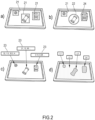
- the labeling data can be selected from the following data group: a text description of the scene represented in the captured image (not represented in the drawings), a 2D Bounding Box 21, a 3D Bounding Box and a3D Pose information 23 (i.e. numerical data).
- Other type of labeling data comprise: a Depth Map and a Semantic Map (symbolically represented in figure 2D as labels L1-L4).
- other type of Bounding Contours can be used, such as an example, 2D Bounding Circles 22 or 2D Bounding Polygons 24.
- 3D Bounding Boxes other 3D Bounding Shapes can be employed.
- a 2D Bounding Box 21 is rectangular digital frame around the object 3 represented in the captured image. 2D Bounding Boxes 21 are useful, as an example, to train an Object Detector as described in the above cited prior art documents [1] and [2].
- 3D Bounding Boxes and 3D Pose information 23 of each object in the scene are useful, as an example, to train a Pose Estimator as described in the above cited documents [3] and [4].
- a Depth Map is an image in which each pixel represents the distance of that point w.r.t. to the digital camera 1, which could be used to train a Monocular-Stereo as described, according to an example, in the previously cited document [5].
- Semantic Maps ( figure 2d ), i.e. an image in which each pixel is "coloured" with the category of belonging of the underlying object.
- Semantic Maps can be used to train a generic Semantic Segmentator as described in the above indicated document [6].
- Semantic Maps can be used to train a fine-grained Object Detector as described in the previously listed document [7].
- the digital display 4 is configured to display additional images to be employed in the label procedure of the objects 3.
- the additional images play the role of background images for the plurality of images of the objects 3 to be captured by the digital camera 1.
- digital display 4 is configured to selectively display a different background image for each captured scene including the objects 3.
- the digital display 4 can change colour and/or texture (i.e. pattern) of the displayed background images. More particularly, the digital display 4 can change colour and/or texture (i.e. pattern) of the displayed background image repeatedly in order to introduce the required variability.
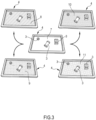
- Figure 3 shows examples of different background images 7-11 that can be displayed by the digital display 4.
- a user places one or more objects 3 on the transparent screen 2 of the digital display 4.
- the user provides orientation and position data of the objects 3 to the process and control apparatus 5 or, according to another example, the orientation and position data of the objects 3 can be automatically evaluated.
- the process and control apparatus 5 manages the subsequent steps by controlling the digital display 4, the digital camera 1 and the mechanical manipulator 6 (if provided).
- the digital display 4 displays a first background image 7 ( figure 2 ) and the mechanical manipulator 6 assumes a first position. Then, the digital camera 1 captures a first image of the scene comprising the objects 3 with the first background image 7.
- the process and control apparatus 5 processes the first image (taking into account the known position and orientation data of the digital camera 1 and the objects 3) and associates labeling data to each object 3.
- a 2D Bounding Box 21 is generated around each object 3 and the corresponding coordinates are stored in connection with each portion of the image including the specific object 3.
- the operator may act on the process and control apparatus 5 (e.g. via a suitable interface) to introduce the data necessary generate the specific labeling data.
- the digital display 4 changes the visualized background and displays a second background image 8, while the object 3 and the digital camera 1 are maintained in the position and orientation already assumed.
- the digital camera 1 captures a second image of the scene comprising the objects 3 on the second background image 8.
- the process and control apparatus 5 processes the second image and associates the corresponding labeling data in a manner analogous to the one described above.
- the above-described steps can be repeated for the other background images 9-11 to label the objects 3 in different background conditions.
- the labeling as described above can be also performed by capturing images of a plurality of scenarios in which the digital camera 1 and the objects 3 have assumed different relative positions and orientations, in order to collect a large amount of labeled data in connection with different images of the scenario including the objects 3.
- the plurality of captured images together with the labeling data associated to each objects 3 form a dataset to be employed in training procedures.
- the dataset obtained with the system 100 can be employed in training procedures in the field of Artificial Intelligence, and in particular Machine Learning and Deep Learning, in which the data availability, with which to perform models such as Neural Networks, is of crucial relevance.
- the obtained dataset can be used to train data-driven models (i.e. a model which train/reconfigure itself using a dataset and not a handcrafted algorithm) in which the fundamental data type is the image.
- Figure 4 refers to a second example of additional images which can be generated by the digital display 4 (in addition or alternatively to the background images 7-11).
- the digital display 4 is controlled in such a way to display placeholders 12, i.e. images that indicate the position and, preferably, the orientation in which to place each object on the transparent screen 2 of the digital display 4.
- the placeholder 12 represents by a continuous line the projection of the object 3 on a plane corresponding to the transparent screen 2.
- the placeholders 12 can be generated starting from shape data of the objects 3 available to the process and control apparatus 5.
- the visualization of placeholders 12 allows avoiding that the process and control apparatus 5 has to compute the position and orientation of the objects 3 on the digital display 4 from the images captured by the digital camera 1.
- Figure 4a shows the digital display 4 without any visualization; figure 4c shows the placeholders 12 as displayed; figure 4c shows the objects 3 (of different types) placed in the corresponding placeholders 12.
- figure 4d also shows the labeling data 21 (i.e. associated data under the form of 2D bounding boxes) generated by the process and control apparatus 5.
- Figure 6 refers to a third example of additional images which can be generated by the digital display 4 (in addition or alternatively to the background images 7-11 and the placeholders 12).
- the process and control apparatus 5 is configured to control the digital display 4 to display markers 13, i.e. specific patterns, preferably, having high distinctive capability.
- markers 13 can be used by the digital camera 1 and the process and control apparatus 5 to locate the digital camera 1 by a suitable tracking algorithm.
- the markers 13 are particularly useful when position and orientation of the digital camera 1 cannot be obtained from a mechanical manipulator 6 or directly from the camera itself.
- the markers 13 are displayed at a certain frequency during the labeling procedure to avoid that such markers 13 could appear in the captured images so compromising the collected dataset. More particularly, the markers 13 are displayed with a frequency chosen so as the frames including the markers 13 are used for tracking, and the frames not including the markers 13 are used to form the dataset.
- the digital display 4 can generate (in addition or alternatively to the background images 7-11 and the markers 13) a further typology of images.
- Such images are captured by the digital camera 1 after the objects 3 have been placed on the support 2 and are provided to the process and control apparatus 5.
- the images so captured by the digital camera 1 are processed by the process and control apparatus 5 to allow such apparatus evaluating (by means of a suitable software, executing a corresponding algorithm) at least one of the following data of the objects 3: position, orientation, 3D shape of the object.
- the images employed according to the fourth example can be specific colours assumed by the digital display 1 that allow light up the objects 3. Algorithms that allow reconstructing the position, orientation, 3D shape of an object from digital images of the same object under different light conditions are known to the skilled person.
- a further embodiment refers to the system 100 employing as mechanical manipulator 6 a Robot, as the ones described above.
- the mechanical manipulator 6 is provided with a gripper 14 configured to grab the object 3.
- the mechanical manipulator 6 having the gripper 14 can grab and rearrange the objects 3 (to capture further images) autonomously as it knows the exact position and orientation on the digital display 4.
- This additional feature allows the system 100 to be fully automated, also removing the burden of an operator having to rearrange, from time to time, the scene.
- the use of the gripper 14 allows the system 100 to generate mixed data, comprising images, labeling data and physical robot actions. Such mixed data are very useful for training modern systems based on Reinforcement Learning. Reinforcement learning is described in [8].
- the described image labeling system 100 allows for reducing significantly the human intervention in the labeling procedure.
- the image labeling system 100 employing the digital display 4 producing the background images according to the first example, allows producing a dataset of labeled images according to Domain Randomization, in efficient manner, limiting time and costs of the procedure.
- the described image labeling system 100 is compatible with an automatic labeling that further reduces time and costs of the labelling procedure.
Landscapes
- Engineering & Computer Science (AREA)
- Theoretical Computer Science (AREA)
- Computer Vision & Pattern Recognition (AREA)
- Physics & Mathematics (AREA)
- General Physics & Mathematics (AREA)
- Robotics (AREA)
- Mechanical Engineering (AREA)
- General Health & Medical Sciences (AREA)
- Health & Medical Sciences (AREA)
- Artificial Intelligence (AREA)
- Computing Systems (AREA)
- Databases & Information Systems (AREA)
- Evolutionary Computation (AREA)
- Medical Informatics (AREA)
- Software Systems (AREA)
- Multimedia (AREA)
- Orthopedic Medicine & Surgery (AREA)
- Image Analysis (AREA)
- Processing Or Creating Images (AREA)
Claims (10)
- Bildetikettierungssystem (100), das Variabilität bei der Erzeugung von etikettierten Trainingsdaten für maschinelles Lernen erzeugt, wobei das System umfasst:Einen Träger (2) für ein zu etikettierendes Objekt (3);eine Digitalkamera (1), die so konfiguriert ist, dass sie eine Vielzahl von Bildern einer Szene aufnimmt, die das auf dem Träger (2) platzierte Objekt (3) enthält;eine Prozess- und Steuervorrichtung (5), die so konfiguriert ist, dass sie die Vielzahl von Bildern empfängt und entsprechende Etikettierungsdaten (21-24, L1-L4) erzeugt, die dem Objekt (3) zugeordnet sind;eine Digitalanzeige (4), die mit dem Träger (2) verbunden ist und an die Prozess- und Steuervorrichtung (5) angeschlossen ist, um selektiv zusätzliche Bilder (7-13) anzuzeigen, die von der Digitalkamera (1) als Teil der Vielzahl von Bildern der Szene erfasst werden und aus einer Gruppe von Bildern ausgewählt werden, von denen jedes von der Anzeige bei der Auswahl angezeigt werden kann, wobei die Gruppe umfasst:Erste Bilder (7-11) in Form von Hintergründen für die Vielzahl von Bildern, und zwar so, dass durch Variieren des Hintergrunds der Zweck einer Bereichs-Randomisierung einen Grad an Variabilität in die von der Digitalkamera (1) zu erfassende und von der Prozess- und Steuervorrichtung (5) zu verarbeitende Szene einführt;zweite Bilder (12), die die Position und/oder Orientierung angeben, nach der das Objekt (3) von einem Benutzer auf dem Träger (2) platziert wird, um von der Digitalkamera (1) erfasst zu werden;dritte Bilder (13), die von der Digitalkamera (1) aufgenommen und an die Prozess- und Steuervorrichtung (5) geliefert werden, um eine Position der Digitalkamera (1) in Bezug auf die digitale Anzeige (4) zu bewerten;vierte Bilder, die zu erzeugen sind, wenn das Objekt (3) bereits auf dem Träger (2) platziert ist, die von der Digitalkamera (1) aufgenommen und der Prozess- und Steuervorrichtung (5) zur Verfügung gestellt werden, um mindestens eine der folgenden Daten des Objekts (3) auszuwerten: Position, Orientierung und 3D-Form.
- System (100) nach Anspruch 1, wobei die Prozess- und Steuervorrichtung (5) so konfiguriert ist, dass sie die digitale Anzeige (4) veranlasst, selektiv die ersten Bilder (7-11) anzuzeigen, die ein erstes Hintergrundbild (7) mit entsprechender Farbe und Textur und ein zweites Hintergrundbild (10) mit relativer Farbe und/oder Textur, die sich von der Farbe und Textur des ersten Hintergrundbildes unterscheidet, umfassen.
- System (100) nach Anspruch 1, wobei:die Digitalkamera (1) in Bezug auf den Träger (2) beweglich ist;die Prozess- und Steuervorrichtung (5) so konfiguriert ist, dass sie die folgenden Daten speichert:
Optische Parameter der Digitalkamera (1), Positionsdaten und Orientierungsdaten der Digitalkamera (1), Positionsdaten und Orientierungsdaten des Objekts (3). - System (100) nach Anspruch 1, wobei die entsprechenden Beschriftungsdaten aus der folgenden Datengruppe ausgewählt sind: Textbeschreibung der in dem aufgenommenen Bild dargestellten Szene, 2D-Begrenzungskontur (21, 22, 24), 3D-Begrenzungsform, 3D-Positionsinformationen (23), Tiefenkarte und semantische Karte (L1-L4).
- System nach Anspruch 2, ferner versehen mit einer beweglichen Halterung (6) zum Halten und Verschieben der Digitalkamera (1) oder der digitalen Anzeige (4), um die Szene aus verschiedenen Blickwinkeln zu erfassen.
- System nach Anspruch 5, wobei der bewegliche Träger ein mechanischer Manipulator (6) ist, ausgewählt aus der Gruppe: kartesischer/Gantry-Roboter, zylindrischer Roboter, sphärischer Roboter, SCARA-Roboter, Gelenkroboter und Parallelroboter.
- System nach Anspruch 5, wobei der bewegliche Träger ein passiver Arm ist.
- System nach Anspruch 2, wobei die Digitalkamera (1) von Hand getragen wird und eine Vielzahl von Sensoren umfasst, um die Positions- und Orientierungsdaten der Digitalkamera (1) an die Prozess- und Steuerungsvorrichtung (5) zu liefern.
- System nach Anspruch 1, wobei die Prozess- und Steuervorrichtung (5) so konfiguriert ist, dass sie die dritten Bilder (13) mit einer vorher festgelegten Häufigkeit anzeigt, um zu vermeiden, dass die dritten Bilder (13) in der Vielzahl von Bildern einer Szene mit dem Objekt (3) erscheinen.
- System nach Anspruch 6, wobei der mechanische Manipulator (6) ferner einen Greifer (14) umfasst, der zum Ergreifen des Objekts (3) konfiguriert ist.
Applications Claiming Priority (2)
| Application Number | Priority Date | Filing Date | Title |
|---|---|---|---|
| IT201900006070 | 2019-04-18 | ||
| PCT/IB2020/052657 WO2020212776A1 (en) | 2019-04-18 | 2020-03-21 | Creating training data variability in machine learning for object labelling from images |
Publications (3)
| Publication Number | Publication Date |
|---|---|
| EP3921801A1 EP3921801A1 (de) | 2021-12-15 |
| EP3921801C0 EP3921801C0 (de) | 2023-06-07 |
| EP3921801B1 true EP3921801B1 (de) | 2023-06-07 |
Family
ID=67185678
Family Applications (1)
| Application Number | Title | Priority Date | Filing Date |
|---|---|---|---|
| EP20716113.4A Active EP3921801B1 (de) | 2019-04-18 | 2020-03-21 | Erzeugung von lerndatenvariabilität beim maschinellen lernen zur objekterkennung aus bildern |
Country Status (6)
| Country | Link |
|---|---|
| US (1) | US12005592B2 (de) |
| EP (1) | EP3921801B1 (de) |
| CN (1) | CN113711275B (de) |
| ES (1) | ES2950961T3 (de) |
| PL (1) | PL3921801T3 (de) |
| WO (1) | WO2020212776A1 (de) |
Families Citing this family (7)
| Publication number | Priority date | Publication date | Assignee | Title |
|---|---|---|---|---|
| IT202000006856A1 (it) * | 2020-04-01 | 2021-10-01 | Daniele Bernardini | Sistema automatizzato per l’acquisizioni di immagini per il training automatizzato di algoritmi di intelligenza artificiale per il riconoscimento di oggetti |
| DE102021203779B4 (de) * | 2021-04-16 | 2023-12-14 | Volkswagen Aktiengesellschaft | Verfahren und Vorrichtung zum Annotieren von mit Hilfe einer Kamera aufgenommenen Bildern eines Objektes |
| CN113681552B (zh) * | 2021-06-30 | 2022-08-16 | 大连理工江苏研究院有限公司 | 一种基于级联神经网络的机器人混杂物体五维抓取方法 |
| CN116175540B (zh) * | 2021-11-28 | 2023-11-10 | 梅卡曼德(北京)机器人科技有限公司 | 基于位置及朝向的抓取控制方法、装置、设备和介质 |
| JPWO2023145901A1 (de) * | 2022-01-27 | 2023-08-03 | ||
| IT202200024777A1 (it) | 2022-12-01 | 2024-06-01 | Eyecan Ai S R L | Metodo per la creazione automatizzata di database di training di algoritmi di machine learning per la generazione di mappe tridimensionali di una superficie avente una configurazione tridimensionale, e sistema per l’attuazione di detto metodo, nonché sistema di rilevamento ottico della posizione di singoli oggetti in un sistema di riferimento tridimensionale operante con un algoritmo di machine learning addestrato secondo il suddetto metodo e sistema di prelevamento di singoli oggetti da un gruppo di detti oggetti in un volume di contenimento tridimensionale comprendente un detto sistema di rilevamento ottico |
| KR102779600B1 (ko) * | 2024-08-29 | 2025-03-12 | 주식회사 엑스와이지 | 로봇을 이용한 주문 제품 전달 및 전달 위치 표시 방법 및 이를 이용한 주문 제품 전달 시스템 |
Family Cites Families (17)
| Publication number | Priority date | Publication date | Assignee | Title |
|---|---|---|---|---|
| US8103085B1 (en) * | 2007-09-25 | 2012-01-24 | Cognex Corporation | System and method for detecting flaws in objects using machine vision |
| KR20110081240A (ko) * | 2008-10-03 | 2011-07-13 | 쓰리엠 이노베이티브 프로퍼티즈 컴파니 | 다중-시야 장면 분석을 위한 시스템 및 방법 |
| US9311531B2 (en) * | 2013-03-13 | 2016-04-12 | Kofax, Inc. | Systems and methods for classifying objects in digital images captured using mobile devices |
| JP6448767B2 (ja) * | 2014-04-24 | 2019-01-09 | ナント・ホールデイングス・アイ・ピー・エル・エル・シー | 画像物体認識におけるロバスト特徴特定 |
| WO2016029939A1 (en) * | 2014-08-27 | 2016-03-03 | Metaio Gmbh | Method and system for determining at least one image feature in at least one image |
| WO2017072534A2 (en) * | 2015-10-30 | 2017-05-04 | 2Mee Ltd | Communication system and method |
| JP6348093B2 (ja) * | 2015-11-06 | 2018-06-27 | ファナック株式会社 | 入力データから検出対象物の像を検出する画像処理装置および方法 |
| US20170161592A1 (en) * | 2015-12-04 | 2017-06-08 | Pilot Ai Labs, Inc. | System and method for object detection dataset application for deep-learning algorithm training |
| US10289925B2 (en) * | 2016-11-29 | 2019-05-14 | Sap Se | Object classification in image data using machine learning models |
| US10049308B1 (en) * | 2017-02-21 | 2018-08-14 | A9.Com, Inc. | Synthesizing training data |
| AU2018326171A1 (en) | 2017-09-01 | 2020-04-23 | The Regents Of The University Of California | Robotic systems and methods for robustly grasping and targeting objects |
| DE102017216821A1 (de) * | 2017-09-22 | 2019-03-28 | Siemens Aktiengesellschaft | Verfahren zur Erkennung einer Objektinstanz und/oder Orientierung eines Objekts |
| WO2019113510A1 (en) * | 2017-12-07 | 2019-06-13 | Bluhaptics, Inc. | Techniques for training machine learning |
| US10984287B2 (en) * | 2018-05-14 | 2021-04-20 | Panasonic Intellectual Property Management Co., Ltd. | Learning device, learning method, and storage medium |
| WO2020039121A1 (en) * | 2018-08-20 | 2020-02-27 | Aalto University Foundation Sr. | Method and system for generating annotated training data |
| WO2020081470A1 (en) * | 2018-10-15 | 2020-04-23 | Flir Commercial Systems, Inc. | Deep learning inference systems and methods for imaging systems |
| US10297070B1 (en) * | 2018-10-16 | 2019-05-21 | Inception Institute of Artificial Intelligence, Ltd | 3D scene synthesis techniques using neural network architectures |
-
2020
- 2020-03-21 EP EP20716113.4A patent/EP3921801B1/de active Active
- 2020-03-21 WO PCT/IB2020/052657 patent/WO2020212776A1/en not_active Ceased
- 2020-03-21 ES ES20716113T patent/ES2950961T3/es active Active
- 2020-03-21 PL PL20716113.4T patent/PL3921801T3/pl unknown
- 2020-03-21 CN CN202080029506.9A patent/CN113711275B/zh active Active
- 2020-03-21 US US17/603,175 patent/US12005592B2/en active Active
Also Published As
| Publication number | Publication date |
|---|---|
| ES2950961T3 (es) | 2023-10-17 |
| US20220203548A1 (en) | 2022-06-30 |
| US12005592B2 (en) | 2024-06-11 |
| WO2020212776A1 (en) | 2020-10-22 |
| CN113711275A (zh) | 2021-11-26 |
| PL3921801T3 (pl) | 2023-07-24 |
| EP3921801C0 (de) | 2023-06-07 |
| CN113711275B (zh) | 2025-03-18 |
| EP3921801A1 (de) | 2021-12-15 |
Similar Documents
| Publication | Publication Date | Title |
|---|---|---|
| EP3921801B1 (de) | Erzeugung von lerndatenvariabilität beim maschinellen lernen zur objekterkennung aus bildern | |
| JP7410499B2 (ja) | 組立ロボットの遠隔操作環境のデジタルツインモデリング方法及びシステム | |
| CN112639846A (zh) | 一种训练深度学习模型的方法和装置 | |
| JP7458741B2 (ja) | ロボット制御装置及びその制御方法及びプログラム | |
| US20200145588A1 (en) | Information processing apparatus presenting information, information processing method, and storage medium | |
| CN110648274B (zh) | 鱼眼图像的生成方法及装置 | |
| CN113449570A (zh) | 图像处理方法和装置 | |
| US12263590B2 (en) | Machine vision parsing of three-dimensional environments employing neural networks | |
| JP2019518297A (ja) | ロボット支援型物体学習視覚システム | |
| Kohn et al. | Towards a real-time environment reconstruction for VR-based teleoperation through model segmentation | |
| US20210035326A1 (en) | Human pose estimation system | |
| CN109711472B (zh) | 训练数据生成方法和装置 | |
| US12254671B2 (en) | Using SLAM 3D information to optimize training and use of deep neural networks for recognition and tracking of 3D object | |
| CN109444146A (zh) | 一种工业加工产品的缺陷检测方法、装置及设备 | |
| CN113284184A (zh) | 面向机器人rgbd视觉感知的6d位姿估计方法及系统 | |
| CN117415051A (zh) | 一种基于rgb-d图像的机器人智能分拣方法及教学实验平台 | |
| Tao et al. | Manufacturing assembly simulations in virtual and augmented reality | |
| CN108305250A (zh) | 非结构化机器人视觉检测机械零件的同步识别与定位方法 | |
| CN119722998A (zh) | 基于多模态物联感知与虚实共生的实训方法及系统 | |
| WO2022195157A1 (en) | Detection of test object for virtual superimposition | |
| CN110544278A (zh) | 刚体运动捕捉方法及装置、agv位姿捕捉系统 | |
| CN120676130A (zh) | 三维多相机感知系统和应用 | |
| CN117916773A (zh) | 用于在移动设备中同时重建姿态和参数化3d人体模型的方法和系统 | |
| US20230112409A1 (en) | Motion determination apparatus, learning apparatus, motion determination method, learning method, and program | |
| CN115909402B (zh) | 行人视线聚集区的确定方法、装置及计算机可读存储介质 |
Legal Events
| Date | Code | Title | Description |
|---|---|---|---|
| STAA | Information on the status of an ep patent application or granted ep patent |
Free format text: STATUS: UNKNOWN |
|
| STAA | Information on the status of an ep patent application or granted ep patent |
Free format text: STATUS: THE INTERNATIONAL PUBLICATION HAS BEEN MADE |
|
| PUAI | Public reference made under article 153(3) epc to a published international application that has entered the european phase |
Free format text: ORIGINAL CODE: 0009012 |
|
| STAA | Information on the status of an ep patent application or granted ep patent |
Free format text: STATUS: REQUEST FOR EXAMINATION WAS MADE |
|
| 17P | Request for examination filed |
Effective date: 20210909 |
|
| AK | Designated contracting states |
Kind code of ref document: A1 Designated state(s): AL AT BE BG CH CY CZ DE DK EE ES FI FR GB GR HR HU IE IS IT LI LT LU LV MC MK MT NL NO PL PT RO RS SE SI SK SM TR |
|
| DAV | Request for validation of the european patent (deleted) | ||
| DAX | Request for extension of the european patent (deleted) | ||
| GRAP | Despatch of communication of intention to grant a patent |
Free format text: ORIGINAL CODE: EPIDOSNIGR1 |
|
| STAA | Information on the status of an ep patent application or granted ep patent |
Free format text: STATUS: GRANT OF PATENT IS INTENDED |
|
| RIC1 | Information provided on ipc code assigned before grant |
Ipc: B25J 9/16 20060101ALI20221107BHEP Ipc: G06N 3/08 20060101ALI20221107BHEP Ipc: G06T 7/73 20170101ALI20221107BHEP Ipc: G06T 7/50 20170101AFI20221107BHEP |
|
| INTG | Intention to grant announced |
Effective date: 20221123 |
|
| GRAS | Grant fee paid |
Free format text: ORIGINAL CODE: EPIDOSNIGR3 |
|
| GRAA | (expected) grant |
Free format text: ORIGINAL CODE: 0009210 |
|
| STAA | Information on the status of an ep patent application or granted ep patent |
Free format text: STATUS: THE PATENT HAS BEEN GRANTED |
|
| AK | Designated contracting states |
Kind code of ref document: B1 Designated state(s): AL AT BE BG CH CY CZ DE DK EE ES FI FR GB GR HR HU IE IS IT LI LT LU LV MC MK MT NL NO PL PT RO RS SE SI SK SM TR |
|
| REG | Reference to a national code |
Ref country code: GB Ref legal event code: FG4D |
|
| REG | Reference to a national code |
Ref country code: CH Ref legal event code: EP Ref country code: AT Ref legal event code: REF Ref document number: 1577276 Country of ref document: AT Kind code of ref document: T Effective date: 20230615 Ref country code: DE Ref legal event code: R096 Ref document number: 602020011984 Country of ref document: DE |
|
| U01 | Request for unitary effect filed |
Effective date: 20230607 |
|
| U07 | Unitary effect registered |
Designated state(s): AT BE BG DE DK EE FI FR IT LT LU LV MT NL PT SE SI Effective date: 20230612 |
|
| REG | Reference to a national code |
Ref country code: NO Ref legal event code: T2 Effective date: 20230607 |
|
| REG | Reference to a national code |
Ref country code: LT Ref legal event code: MG9D |
|
| REG | Reference to a national code |
Ref country code: ES Ref legal event code: FG2A Ref document number: 2950961 Country of ref document: ES Kind code of ref document: T3 Effective date: 20231017 |
|
| PG25 | Lapsed in a contracting state [announced via postgrant information from national office to epo] |
Ref country code: RS Free format text: LAPSE BECAUSE OF FAILURE TO SUBMIT A TRANSLATION OF THE DESCRIPTION OR TO PAY THE FEE WITHIN THE PRESCRIBED TIME-LIMIT Effective date: 20230607 Ref country code: HR Free format text: LAPSE BECAUSE OF FAILURE TO SUBMIT A TRANSLATION OF THE DESCRIPTION OR TO PAY THE FEE WITHIN THE PRESCRIBED TIME-LIMIT Effective date: 20230607 Ref country code: GR Free format text: LAPSE BECAUSE OF FAILURE TO SUBMIT A TRANSLATION OF THE DESCRIPTION OR TO PAY THE FEE WITHIN THE PRESCRIBED TIME-LIMIT Effective date: 20230908 |
|
| U1N | Appointed representative for the unitary patent procedure changed after the registration of the unitary effect |
Representative=s name: PRAXI INTELLECTUAL PROPERTY MILANO; IT |
|
| PG25 | Lapsed in a contracting state [announced via postgrant information from national office to epo] |
Ref country code: SK Free format text: LAPSE BECAUSE OF FAILURE TO SUBMIT A TRANSLATION OF THE DESCRIPTION OR TO PAY THE FEE WITHIN THE PRESCRIBED TIME-LIMIT Effective date: 20230607 |
|
| PG25 | Lapsed in a contracting state [announced via postgrant information from national office to epo] |
Ref country code: IS Free format text: LAPSE BECAUSE OF FAILURE TO SUBMIT A TRANSLATION OF THE DESCRIPTION OR TO PAY THE FEE WITHIN THE PRESCRIBED TIME-LIMIT Effective date: 20231007 |
|
| PG25 | Lapsed in a contracting state [announced via postgrant information from national office to epo] |
Ref country code: SM Free format text: LAPSE BECAUSE OF FAILURE TO SUBMIT A TRANSLATION OF THE DESCRIPTION OR TO PAY THE FEE WITHIN THE PRESCRIBED TIME-LIMIT Effective date: 20230607 Ref country code: SK Free format text: LAPSE BECAUSE OF FAILURE TO SUBMIT A TRANSLATION OF THE DESCRIPTION OR TO PAY THE FEE WITHIN THE PRESCRIBED TIME-LIMIT Effective date: 20230607 Ref country code: RO Free format text: LAPSE BECAUSE OF FAILURE TO SUBMIT A TRANSLATION OF THE DESCRIPTION OR TO PAY THE FEE WITHIN THE PRESCRIBED TIME-LIMIT Effective date: 20230607 Ref country code: IS Free format text: LAPSE BECAUSE OF FAILURE TO SUBMIT A TRANSLATION OF THE DESCRIPTION OR TO PAY THE FEE WITHIN THE PRESCRIBED TIME-LIMIT Effective date: 20231007 Ref country code: CZ Free format text: LAPSE BECAUSE OF FAILURE TO SUBMIT A TRANSLATION OF THE DESCRIPTION OR TO PAY THE FEE WITHIN THE PRESCRIBED TIME-LIMIT Effective date: 20230607 |
|
| REG | Reference to a national code |
Ref country code: DE Ref legal event code: R097 Ref document number: 602020011984 Country of ref document: DE |
|
| PLBE | No opposition filed within time limit |
Free format text: ORIGINAL CODE: 0009261 |
|
| STAA | Information on the status of an ep patent application or granted ep patent |
Free format text: STATUS: NO OPPOSITION FILED WITHIN TIME LIMIT |
|
| U20 | Renewal fee for the european patent with unitary effect paid |
Year of fee payment: 5 Effective date: 20240314 |
|
| 26N | No opposition filed |
Effective date: 20240308 |
|
| PG25 | Lapsed in a contracting state [announced via postgrant information from national office to epo] |
Ref country code: MC Free format text: LAPSE BECAUSE OF FAILURE TO SUBMIT A TRANSLATION OF THE DESCRIPTION OR TO PAY THE FEE WITHIN THE PRESCRIBED TIME-LIMIT Effective date: 20230607 |
|
| PG25 | Lapsed in a contracting state [announced via postgrant information from national office to epo] |
Ref country code: MC Free format text: LAPSE BECAUSE OF FAILURE TO SUBMIT A TRANSLATION OF THE DESCRIPTION OR TO PAY THE FEE WITHIN THE PRESCRIBED TIME-LIMIT Effective date: 20230607 |
|
| PG25 | Lapsed in a contracting state [announced via postgrant information from national office to epo] |
Ref country code: IE Free format text: LAPSE BECAUSE OF NON-PAYMENT OF DUE FEES Effective date: 20240321 |
|
| PG25 | Lapsed in a contracting state [announced via postgrant information from national office to epo] |
Ref country code: IE Free format text: LAPSE BECAUSE OF NON-PAYMENT OF DUE FEES Effective date: 20240321 |
|
| PGFP | Annual fee paid to national office [announced via postgrant information from national office to epo] |
Ref country code: PL Payment date: 20250220 Year of fee payment: 6 |
|
| U20 | Renewal fee for the european patent with unitary effect paid |
Year of fee payment: 6 Effective date: 20250323 |
|
| PGFP | Annual fee paid to national office [announced via postgrant information from national office to epo] |
Ref country code: ES Payment date: 20250401 Year of fee payment: 6 |
|
| PGFP | Annual fee paid to national office [announced via postgrant information from national office to epo] |
Ref country code: CH Payment date: 20250401 Year of fee payment: 6 |
|
| PG25 | Lapsed in a contracting state [announced via postgrant information from national office to epo] |
Ref country code: CY Free format text: LAPSE BECAUSE OF FAILURE TO SUBMIT A TRANSLATION OF THE DESCRIPTION OR TO PAY THE FEE WITHIN THE PRESCRIBED TIME-LIMIT; INVALID AB INITIO Effective date: 20200321 |
|
| PG25 | Lapsed in a contracting state [announced via postgrant information from national office to epo] |
Ref country code: HU Free format text: LAPSE BECAUSE OF FAILURE TO SUBMIT A TRANSLATION OF THE DESCRIPTION OR TO PAY THE FEE WITHIN THE PRESCRIBED TIME-LIMIT; INVALID AB INITIO Effective date: 20200321 |
|
| PG25 | Lapsed in a contracting state [announced via postgrant information from national office to epo] |
Ref country code: TR Free format text: LAPSE BECAUSE OF FAILURE TO SUBMIT A TRANSLATION OF THE DESCRIPTION OR TO PAY THE FEE WITHIN THE PRESCRIBED TIME-LIMIT Effective date: 20230607 |
|
| REG | Reference to a national code |
Ref country code: CH Ref legal event code: U11 Free format text: ST27 STATUS EVENT CODE: U-0-0-U10-U11 (AS PROVIDED BY THE NATIONAL OFFICE) Effective date: 20260401 |
|
| PGFP | Annual fee paid to national office [announced via postgrant information from national office to epo] |
Ref country code: GB Payment date: 20260330 Year of fee payment: 7 |
|
| PGFP | Annual fee paid to national office [announced via postgrant information from national office to epo] |
Ref country code: NO Payment date: 20260327 Year of fee payment: 7 |