EP3921147B1 - Verbundradkonstruktionsvorrichtung und -verfahren - Google Patents
Verbundradkonstruktionsvorrichtung und -verfahren Download PDFInfo
- Publication number
- EP3921147B1 EP3921147B1 EP20709423.6A EP20709423A EP3921147B1 EP 3921147 B1 EP3921147 B1 EP 3921147B1 EP 20709423 A EP20709423 A EP 20709423A EP 3921147 B1 EP3921147 B1 EP 3921147B1
- Authority
- EP
- European Patent Office
- Prior art keywords
- reinforcement layer
- matrix material
- layer
- width
- matrix
- Prior art date
- Legal status (The legal status is an assumption and is not a legal conclusion. Google has not performed a legal analysis and makes no representation as to the accuracy of the status listed.)
- Active
Links
Images


Classifications
-
- B—PERFORMING OPERATIONS; TRANSPORTING
- B29—WORKING OF PLASTICS; WORKING OF SUBSTANCES IN A PLASTIC STATE IN GENERAL
- B29C—SHAPING OR JOINING OF PLASTICS; SHAPING OF MATERIAL IN A PLASTIC STATE, NOT OTHERWISE PROVIDED FOR; AFTER-TREATMENT OF THE SHAPED PRODUCTS, e.g. REPAIRING
- B29C70/00—Shaping composites, i.e. plastics material comprising reinforcements, fillers or preformed parts, e.g. inserts
- B29C70/04—Shaping composites, i.e. plastics material comprising reinforcements, fillers or preformed parts, e.g. inserts comprising reinforcements only, e.g. self-reinforcing plastics
- B29C70/28—Shaping operations therefor
- B29C70/30—Shaping by lay-up, i.e. applying fibres, tape or broadsheet on a mould, former or core; Shaping by spray-up, i.e. spraying of fibres on a mould, former or core
- B29C70/32—Shaping by lay-up, i.e. applying fibres, tape or broadsheet on a mould, former or core; Shaping by spray-up, i.e. spraying of fibres on a mould, former or core on a rotating mould, former or core
-
- B—PERFORMING OPERATIONS; TRANSPORTING
- B29—WORKING OF PLASTICS; WORKING OF SUBSTANCES IN A PLASTIC STATE IN GENERAL
- B29C—SHAPING OR JOINING OF PLASTICS; SHAPING OF MATERIAL IN A PLASTIC STATE, NOT OTHERWISE PROVIDED FOR; AFTER-TREATMENT OF THE SHAPED PRODUCTS, e.g. REPAIRING
- B29C70/00—Shaping composites, i.e. plastics material comprising reinforcements, fillers or preformed parts, e.g. inserts
- B29C70/003—Shaping composites, i.e. plastics material comprising reinforcements, fillers or preformed parts, e.g. inserts characterised by the matrix material, e.g. material composition or physical properties
- B29C70/0035—Shaping composites, i.e. plastics material comprising reinforcements, fillers or preformed parts, e.g. inserts characterised by the matrix material, e.g. material composition or physical properties comprising two or more matrix materials
-
- B—PERFORMING OPERATIONS; TRANSPORTING
- B29—WORKING OF PLASTICS; WORKING OF SUBSTANCES IN A PLASTIC STATE IN GENERAL
- B29C—SHAPING OR JOINING OF PLASTICS; SHAPING OF MATERIAL IN A PLASTIC STATE, NOT OTHERWISE PROVIDED FOR; AFTER-TREATMENT OF THE SHAPED PRODUCTS, e.g. REPAIRING
- B29C70/00—Shaping composites, i.e. plastics material comprising reinforcements, fillers or preformed parts, e.g. inserts
- B29C70/04—Shaping composites, i.e. plastics material comprising reinforcements, fillers or preformed parts, e.g. inserts comprising reinforcements only, e.g. self-reinforcing plastics
- B29C70/28—Shaping operations therefor
- B29C70/40—Shaping or impregnating by compression not applied
- B29C70/42—Shaping or impregnating by compression not applied for producing articles of definite length, i.e. discrete articles
- B29C70/46—Shaping or impregnating by compression not applied for producing articles of definite length, i.e. discrete articles using matched moulds, e.g. for deforming sheet moulding compounds [SMC] or prepregs
- B29C70/465—Shaping or impregnating by compression not applied for producing articles of definite length, i.e. discrete articles using matched moulds, e.g. for deforming sheet moulding compounds [SMC] or prepregs and impregnating by melting a solid material, e.g. sheets, powders of fibres
-
- B—PERFORMING OPERATIONS; TRANSPORTING
- B32—LAYERED PRODUCTS
- B32B—LAYERED PRODUCTS, i.e. PRODUCTS BUILT-UP OF STRATA OF FLAT OR NON-FLAT, e.g. CELLULAR OR HONEYCOMB, FORM
- B32B5/00—Layered products characterised by the non- homogeneity or physical structure, i.e. comprising a fibrous, filamentary, particulate or foam layer; Layered products characterised by having a layer differing constitutionally or physically in different parts
- B32B5/22—Layered products characterised by the non- homogeneity or physical structure, i.e. comprising a fibrous, filamentary, particulate or foam layer; Layered products characterised by having a layer differing constitutionally or physically in different parts characterised by the presence of two or more layers which are next to each other and are fibrous, filamentary, formed of particles or foamed
- B32B5/24—Layered products characterised by the non- homogeneity or physical structure, i.e. comprising a fibrous, filamentary, particulate or foam layer; Layered products characterised by having a layer differing constitutionally or physically in different parts characterised by the presence of two or more layers which are next to each other and are fibrous, filamentary, formed of particles or foamed one layer being a fibrous or filamentary layer
- B32B5/26—Layered products characterised by the non- homogeneity or physical structure, i.e. comprising a fibrous, filamentary, particulate or foam layer; Layered products characterised by having a layer differing constitutionally or physically in different parts characterised by the presence of two or more layers which are next to each other and are fibrous, filamentary, formed of particles or foamed one layer being a fibrous or filamentary layer another layer next to it also being fibrous or filamentary
-
- B—PERFORMING OPERATIONS; TRANSPORTING
- B60—VEHICLES IN GENERAL
- B60B—VEHICLE WHEELS; CASTORS; AXLES FOR WHEELS OR CASTORS; INCREASING WHEEL ADHESION
- B60B21/00—Rims
- B60B21/02—Rims characterised by transverse section
-
- B—PERFORMING OPERATIONS; TRANSPORTING
- B60—VEHICLES IN GENERAL
- B60B—VEHICLE WHEELS; CASTORS; AXLES FOR WHEELS OR CASTORS; INCREASING WHEEL ADHESION
- B60B3/00—Disc wheels, i.e. wheels with load-supporting disc body
-
- B—PERFORMING OPERATIONS; TRANSPORTING
- B60—VEHICLES IN GENERAL
- B60B—VEHICLE WHEELS; CASTORS; AXLES FOR WHEELS OR CASTORS; INCREASING WHEEL ADHESION
- B60B5/00—Wheels, spokes, disc bodies, rims, hubs, wholly or predominantly made of non-metallic material
- B60B5/02—Wheels, spokes, disc bodies, rims, hubs, wholly or predominantly made of non-metallic material made of synthetic material
-
- B—PERFORMING OPERATIONS; TRANSPORTING
- B29—WORKING OF PLASTICS; WORKING OF SUBSTANCES IN A PLASTIC STATE IN GENERAL
- B29C—SHAPING OR JOINING OF PLASTICS; SHAPING OF MATERIAL IN A PLASTIC STATE, NOT OTHERWISE PROVIDED FOR; AFTER-TREATMENT OF THE SHAPED PRODUCTS, e.g. REPAIRING
- B29C70/00—Shaping composites, i.e. plastics material comprising reinforcements, fillers or preformed parts, e.g. inserts
- B29C70/04—Shaping composites, i.e. plastics material comprising reinforcements, fillers or preformed parts, e.g. inserts comprising reinforcements only, e.g. self-reinforcing plastics
- B29C70/28—Shaping operations therefor
- B29C70/40—Shaping or impregnating by compression not applied
- B29C70/42—Shaping or impregnating by compression not applied for producing articles of definite length, i.e. discrete articles
- B29C70/46—Shaping or impregnating by compression not applied for producing articles of definite length, i.e. discrete articles using matched moulds, e.g. for deforming sheet moulding compounds [SMC] or prepregs
- B29C70/48—Shaping or impregnating by compression not applied for producing articles of definite length, i.e. discrete articles using matched moulds, e.g. for deforming sheet moulding compounds [SMC] or prepregs and impregnating the reinforcements in the closed mould, e.g. resin transfer moulding [RTM], e.g. by vacuum
-
- B—PERFORMING OPERATIONS; TRANSPORTING
- B29—WORKING OF PLASTICS; WORKING OF SUBSTANCES IN A PLASTIC STATE IN GENERAL
- B29D—PRODUCING PARTICULAR ARTICLES FROM PLASTICS OR FROM SUBSTANCES IN A PLASTIC STATE
- B29D99/00—Subject matter not provided for in other groups of this subclass
- B29D99/0032—Producing rolling bodies, e.g. rollers, wheels, pulleys or pinions
-
- B—PERFORMING OPERATIONS; TRANSPORTING
- B29—WORKING OF PLASTICS; WORKING OF SUBSTANCES IN A PLASTIC STATE IN GENERAL
- B29K—INDEXING SCHEME ASSOCIATED WITH SUBCLASSES B29B, B29C OR B29D, RELATING TO MOULDING MATERIALS OR TO MATERIALS FOR MOULDS, REINFORCEMENTS, FILLERS OR PREFORMED PARTS, e.g. INSERTS
- B29K2063/00—Use of EP, i.e. epoxy resins or derivatives thereof, as moulding material
-
- B—PERFORMING OPERATIONS; TRANSPORTING
- B29—WORKING OF PLASTICS; WORKING OF SUBSTANCES IN A PLASTIC STATE IN GENERAL
- B29K—INDEXING SCHEME ASSOCIATED WITH SUBCLASSES B29B, B29C OR B29D, RELATING TO MOULDING MATERIALS OR TO MATERIALS FOR MOULDS, REINFORCEMENTS, FILLERS OR PREFORMED PARTS, e.g. INSERTS
- B29K2079/00—Use of polymers having nitrogen, with or without oxygen or carbon only, in the main chain, not provided for in groups B29K2061/00 - B29K2077/00, as moulding material
- B29K2079/08—PI, i.e. polyimides or derivatives thereof
-
- B—PERFORMING OPERATIONS; TRANSPORTING
- B29—WORKING OF PLASTICS; WORKING OF SUBSTANCES IN A PLASTIC STATE IN GENERAL
- B29K—INDEXING SCHEME ASSOCIATED WITH SUBCLASSES B29B, B29C OR B29D, RELATING TO MOULDING MATERIALS OR TO MATERIALS FOR MOULDS, REINFORCEMENTS, FILLERS OR PREFORMED PARTS, e.g. INSERTS
- B29K2105/00—Condition, form or state of moulded material or of the material to be shaped
- B29K2105/06—Condition, form or state of moulded material or of the material to be shaped containing reinforcements, fillers or inserts
- B29K2105/08—Condition, form or state of moulded material or of the material to be shaped containing reinforcements, fillers or inserts of continuous length, e.g. cords, rovings, mats, fabrics, strands or yarns
- B29K2105/0872—Prepregs
- B29K2105/0881—Prepregs unidirectional
-
- B—PERFORMING OPERATIONS; TRANSPORTING
- B29—WORKING OF PLASTICS; WORKING OF SUBSTANCES IN A PLASTIC STATE IN GENERAL
- B29L—INDEXING SCHEME ASSOCIATED WITH SUBCLASS B29C, RELATING TO PARTICULAR ARTICLES
- B29L2031/00—Other particular articles
- B29L2031/32—Wheels, pinions, pulleys, castors or rollers, Rims
-
- B—PERFORMING OPERATIONS; TRANSPORTING
- B29—WORKING OF PLASTICS; WORKING OF SUBSTANCES IN A PLASTIC STATE IN GENERAL
- B29L—INDEXING SCHEME ASSOCIATED WITH SUBCLASS B29C, RELATING TO PARTICULAR ARTICLES
- B29L2031/00—Other particular articles
- B29L2031/32—Wheels, pinions, pulleys, castors or rollers, Rims
- B29L2031/322—Wheels, pinions, pulleys, castors or rollers, Rims made wholly of plastics
-
- B—PERFORMING OPERATIONS; TRANSPORTING
- B32—LAYERED PRODUCTS
- B32B—LAYERED PRODUCTS, i.e. PRODUCTS BUILT-UP OF STRATA OF FLAT OR NON-FLAT, e.g. CELLULAR OR HONEYCOMB, FORM
- B32B2260/00—Layered product comprising an impregnated, embedded, or bonded layer wherein the layer comprises an impregnation, embedding, or binder material
- B32B2260/02—Composition of the impregnated, bonded or embedded layer
- B32B2260/021—Fibrous or filamentary layer
- B32B2260/023—Two or more layers
-
- B—PERFORMING OPERATIONS; TRANSPORTING
- B32—LAYERED PRODUCTS
- B32B—LAYERED PRODUCTS, i.e. PRODUCTS BUILT-UP OF STRATA OF FLAT OR NON-FLAT, e.g. CELLULAR OR HONEYCOMB, FORM
- B32B2262/00—Composition or structural features of fibres which form a fibrous or filamentary layer or are present as additives
- B32B2262/02—Synthetic macromolecular fibres
- B32B2262/0261—Polyamide fibres
- B32B2262/0269—Aromatic polyamide fibres
-
- B—PERFORMING OPERATIONS; TRANSPORTING
- B32—LAYERED PRODUCTS
- B32B—LAYERED PRODUCTS, i.e. PRODUCTS BUILT-UP OF STRATA OF FLAT OR NON-FLAT, e.g. CELLULAR OR HONEYCOMB, FORM
- B32B2262/00—Composition or structural features of fibres which form a fibrous or filamentary layer or are present as additives
- B32B2262/10—Inorganic fibres
- B32B2262/101—Glass fibres
-
- B—PERFORMING OPERATIONS; TRANSPORTING
- B32—LAYERED PRODUCTS
- B32B—LAYERED PRODUCTS, i.e. PRODUCTS BUILT-UP OF STRATA OF FLAT OR NON-FLAT, e.g. CELLULAR OR HONEYCOMB, FORM
- B32B2262/00—Composition or structural features of fibres which form a fibrous or filamentary layer or are present as additives
- B32B2262/10—Inorganic fibres
- B32B2262/106—Carbon fibres, e.g. graphite fibres
-
- B—PERFORMING OPERATIONS; TRANSPORTING
- B32—LAYERED PRODUCTS
- B32B—LAYERED PRODUCTS, i.e. PRODUCTS BUILT-UP OF STRATA OF FLAT OR NON-FLAT, e.g. CELLULAR OR HONEYCOMB, FORM
- B32B2605/00—Vehicles
-
- B—PERFORMING OPERATIONS; TRANSPORTING
- B32—LAYERED PRODUCTS
- B32B—LAYERED PRODUCTS, i.e. PRODUCTS BUILT-UP OF STRATA OF FLAT OR NON-FLAT, e.g. CELLULAR OR HONEYCOMB, FORM
- B32B5/00—Layered products characterised by the non- homogeneity or physical structure, i.e. comprising a fibrous, filamentary, particulate or foam layer; Layered products characterised by having a layer differing constitutionally or physically in different parts
- B32B5/14—Layered products characterised by the non- homogeneity or physical structure, i.e. comprising a fibrous, filamentary, particulate or foam layer; Layered products characterised by having a layer differing constitutionally or physically in different parts characterised by a layer differing constitutionally or physically in different parts, e.g. denser near its faces
- B32B5/142—Variation across the area of the layer
-
- B—PERFORMING OPERATIONS; TRANSPORTING
- B60—VEHICLES IN GENERAL
- B60B—VEHICLE WHEELS; CASTORS; AXLES FOR WHEELS OR CASTORS; INCREASING WHEEL ADHESION
- B60B2310/00—Manufacturing methods
- B60B2310/20—Shaping
- B60B2310/204—Shaping by moulding, e.g. injection moulding, i.e. casting of plastics material
-
- B—PERFORMING OPERATIONS; TRANSPORTING
- B60—VEHICLES IN GENERAL
- B60B—VEHICLE WHEELS; CASTORS; AXLES FOR WHEELS OR CASTORS; INCREASING WHEEL ADHESION
- B60B2310/00—Manufacturing methods
- B60B2310/20—Shaping
- B60B2310/241—Shaping by weaving or knitting of fibers
-
- B—PERFORMING OPERATIONS; TRANSPORTING
- B60—VEHICLES IN GENERAL
- B60B—VEHICLE WHEELS; CASTORS; AXLES FOR WHEELS OR CASTORS; INCREASING WHEEL ADHESION
- B60B2310/00—Manufacturing methods
- B60B2310/20—Shaping
- B60B2310/242—Shaping by laminating, e.g. fabrication of sandwich sheets
-
- B—PERFORMING OPERATIONS; TRANSPORTING
- B60—VEHICLES IN GENERAL
- B60B—VEHICLE WHEELS; CASTORS; AXLES FOR WHEELS OR CASTORS; INCREASING WHEEL ADHESION
- B60B2360/00—Materials; Physical forms thereof
- B60B2360/30—Synthetic materials
- B60B2360/34—Reinforced plastics
- B60B2360/341—Reinforced plastics with fibres
-
- B—PERFORMING OPERATIONS; TRANSPORTING
- B60—VEHICLES IN GENERAL
- B60B—VEHICLE WHEELS; CASTORS; AXLES FOR WHEELS OR CASTORS; INCREASING WHEEL ADHESION
- B60B2360/00—Materials; Physical forms thereof
- B60B2360/30—Synthetic materials
- B60B2360/34—Reinforced plastics
- B60B2360/341—Reinforced plastics with fibres
- B60B2360/3412—Glass fibres
-
- B—PERFORMING OPERATIONS; TRANSPORTING
- B60—VEHICLES IN GENERAL
- B60B—VEHICLE WHEELS; CASTORS; AXLES FOR WHEELS OR CASTORS; INCREASING WHEEL ADHESION
- B60B2360/00—Materials; Physical forms thereof
- B60B2360/30—Synthetic materials
- B60B2360/34—Reinforced plastics
- B60B2360/341—Reinforced plastics with fibres
- B60B2360/3416—Carbone fibres
-
- B—PERFORMING OPERATIONS; TRANSPORTING
- B60—VEHICLES IN GENERAL
- B60B—VEHICLE WHEELS; CASTORS; AXLES FOR WHEELS OR CASTORS; INCREASING WHEEL ADHESION
- B60B2360/00—Materials; Physical forms thereof
- B60B2360/30—Synthetic materials
- B60B2360/34—Reinforced plastics
- B60B2360/341—Reinforced plastics with fibres
- B60B2360/3418—Aramid fibres
-
- B—PERFORMING OPERATIONS; TRANSPORTING
- B60—VEHICLES IN GENERAL
- B60B—VEHICLE WHEELS; CASTORS; AXLES FOR WHEELS OR CASTORS; INCREASING WHEEL ADHESION
- B60B2900/00—Purpose of invention
- B60B2900/20—Avoidance of
- B60B2900/212—Damage
-
- B—PERFORMING OPERATIONS; TRANSPORTING
- B60—VEHICLES IN GENERAL
- B60B—VEHICLE WHEELS; CASTORS; AXLES FOR WHEELS OR CASTORS; INCREASING WHEEL ADHESION
- B60B2900/00—Purpose of invention
- B60B2900/30—Increase in
- B60B2900/311—Rigidity or stiffness
-
- B—PERFORMING OPERATIONS; TRANSPORTING
- B60—VEHICLES IN GENERAL
- B60B—VEHICLE WHEELS; CASTORS; AXLES FOR WHEELS OR CASTORS; INCREASING WHEEL ADHESION
- B60B2900/00—Purpose of invention
- B60B2900/50—Improvement of
- B60B2900/513—Cooling, e.g. of brakes
-
- B—PERFORMING OPERATIONS; TRANSPORTING
- B60—VEHICLES IN GENERAL
- B60Y—INDEXING SCHEME RELATING TO ASPECTS CROSS-CUTTING VEHICLE TECHNOLOGY
- B60Y2200/00—Type of vehicle
- B60Y2200/10—Road Vehicles
- B60Y2200/11—Passenger cars; Automobiles
Definitions
- the present disclosure relates to a vehicle wheel construction. More particularly, the present disclosure relates to a vehicle wheel construction including multiple matrix materials across the width of the wheel.
- Passenger vehicle wheels are known in the art, and are typically formed of one or more materials to define the shape of the wheel.
- the wheel may be sized and shaped such that it is configured to support a tire mounted thereon, and such that the wheel may be mounted to a rotatable axle so the wheel can be driven by a vehicle transmission and rotated in response to the vehicle being driven.
- the wheel may have various thicknesses, fiber angles, and/or carbon fiber materials that are used throughout the different wheel portions or areas.
- a typical wheel may include a pair of tire bead flanges, such as an inner bead flange and an outer bead flange.
- the bead flanges typically must have very high impact performance and toughness to perform well when subjected to a pothole impact. Thus, increasing the toughness at this area is advantageous.
- WO 2015/069111 A1 discloses a wheel suitable for a vehicle, comprising a rim, wherein the rim comprises a rim bed, characterised in that the rim bed comprises a wound tape comprising a fibre reinforced thermoplastic or thermoset polymer matrix.
- Typical composite wheel manufacturing processes utilize the same resin or material matrix for the entire wheel construction. This process therefore results in a single material being used for each of the areas of the wheel. Wheels may be manufactured using the same resin and varying the radial thickness of the wheel to provide different strengths at different portions of the wheel. Nevertheless, the use of the same matrix material will result in a compromise between strength, temperature performance, and cost.
- a first preform is constructed which includes one matrix system, which may be uncured or already cured.
- a second preform may be constructed using a different matrix system, which may be cured or uncured. The preforms may then be placed in a mold together and then cured together.
- a preform such as a fiber preform
- RTM Resin Transfer Mold
- a liquid thermoset resin is used to saturate the fiber preform in a closed mold.
- a first matrix system may be infused into one region of the preform, and a second matrix system is infused into another region of the preform.
- the two matrix systems may then be cured together to define an overall composite with the embedded preform.
- the above-described methods are typically used for simplifying the bonding of multiple composite parts.
- the result is typically a difference in thickness along the axial width of the wheel.
- the reinforcement materials are not continuous across the multiple resin regions. Put another way, one reinforcement area with a first resin material will overlap another portion with a reinforcement area with a second resin, such that the first resin overlaps the second resin at an increased thickness area.
- This method is known as an overlap method, and is illustrated in Figure 1 .
- a first resin material is formed in layers with different lengths, such that a middle layer may have a longer length, and is received in a recess formed between layers, with the second resin material having a shorter length such that the longer length can be received in a recess defined by the shorter length.
- a composite wheel structure including a wheel body having an axial width extending between an inner end and an outer end.
- the wheel structure includes an inner flange portion of the wheel body disposed at the inner end and an outer flange portion of the wheel body disposed at the outer end.
- a first intermediate portion of the wheel body is disposed between the inner flange portion and the outer flange portion.
- a second intermediate portion of the wheel body is disposed between the first intermediate portion and the outer flange portion.
- a first reinforcement layer of material extends between the inner and outer ends and extends through the inner flange portion, the outer flange portion, the first intermediate portion, and the second intermediate portion.
- the first reinforcement layer is in the form of a single continuous fiber layer.
- a first matrix material is integrated with the first reinforcement layer along the inner flange portion.
- a second matrix material is integrated with the first reinforcement layer along the first intermediate portion.
- a third matrix material is integrated with the first reinforcement layer along the second intermediate portion.
- the outer flange portion and inner flange portion each include the first matrix material.
- the first matrix material has high toughness and low temperature performance.
- the second matrix material has high temperature performance and low toughness.
- the third matrix material has low temperature performance and low toughness.
- the second matrix material comprises a Bismaleimide polymer and the first and third matrix materials are epoxy.
- the first reinforcement layer is a carbon fiber fibric, Kevlar, or fiberglass.
- the first reinforcement layer is seamless across the axial width of the wheel body.
- the first, second, and third matrix materials are joined with the first reinforcement layer in a single layer, such that the single reinforcement layer includes different matrix materials across its width.
- the composite wheel structure further includes at least one additional reinforcement layer overlaying the first reinforcement layer, wherein the at least one additional reinforcement layer is continuous and seamless and includes multiple different integrated matrix materials across an axial width thereof.
- a method of forming a composite layer for use in a composite wheel layup process includes the steps of providing a single reinforcement layer in the form of a continuous fabric material having a lateral width. The method further includes applying a first matrix material onto a first portion of the reinforcement layer and applying a second matrix material onto a second portion of the reinforcement layer. The method also includes consolidating the first and second matrix materials and the reinforcement layer into a single composite layer.
- the step of consolidating includes prepregging the reinforcement layer with the first and second matrix materials.
- the step of consolidating includes applying pressure and heat to the reinforcement layer and the first and second matrix materials.
- the step of consolidating includes using a resin film infusion process.
- the method further includes providing a substrate having a length and a width; applying the first matrix material to the substrate across a first portion of the width; applying the second matrix material to the substrate across a second portion of the width; defining a single resin film that includes the first and second matrix materials applied to the substrate; wherein the steps of applying the first and second matrix materials includes overlaying the single resin film on the reinforcement layer.
- the method further includes providing a first substrate having a length and a width; applying the first matrix material to the first substrate across the width thereof; providing a second substrate having a length and a width; applying the second matrix material to the second substrate across the width thereof; defining a first resin film that includes the first matrix material applied to the first substrate; defining a second resin film that includes the second matrix material and the second substrate; wherein the steps of applying the first and second matrix materials includes overlaying the first resin film and the second resin film onto the reinforcement layer.
- the first matrix material and the second material are applied to the reinforcement layer side-by-side during a first time period.
- the first matrix material and the second matrix material are applied to the reinforcement layer side-by-side, with the first matrix material applied during a first time period and the second matrix material applied during a second time period.
- the single composite layer is formed with the single reinforcement layer impregnated with first and second matrix materials across the width of the reinforcement layer, wherein the first and second matrix materials do not overlap across the width of the reinforcement layer, and the reinforcement layer is seamless.
- the first and second matrix materials are applied to the reinforcement layer using a direct reinforcement coating process in which the first and second matrix materials are directly applied to the reinforcement layer without previously applying the matrix materials to a substrate.
- a composite wheel structure in yet another aspect, includes a wheel body having an axial width extending between an inner end and an outer end.
- the wheel structure includes a first axial portion of the wheel body, and a second axial portion of the wheel body.
- the structure further includes a fabric reinforcement layer in the form of a single axially continuous layer extending through the first and second axial portions.
- the reinforcement layer is impregnated with a first matrix material along the first axial portion and a second matrix material along the second axial portion.
- the wheel 10 may include a wheel body 12 having multiple axial zones, areas, or portions 12a, b, c, d, etc.
- the body portions may be referred to generally using the reference numeral 12, with specific zones being referred to as 12a, b, c, d, etc.
- the zones 12 may be formed as a continuous fiber layer having different resin materials used in the different zones 12.
- a first zone 12a may be disposed at and may define an axially inner end portion of the wheel 12, and may further define an inner bead 14.
- a second zone 12b may extend generally axially outwardly away from the first zone 12a, and may define a generally cylindrical portion 16.
- a third zone 12c may extend generally axially outwardly from the second zone 12b, and may define a curved or tapered cross-section with a diameter that reduces relative to the second zone 12b along the axial width of the wheel 10, which may be described as a curved portion 18 or stepped portion.
- a fourth zone 12d may extend generally axially outwardly from the third zone 12c, and may have a diameter that increases relative to the third zone 12c.
- the fourth zone 12d may define an outer bead 20.
- the reference to extending generally axially outwardly refers to the general direction away from the inner bead 14, and may include tapering or other complex diameter changes, and should not necessarily be interpreted as extending parallel to the rotational axis of the wheel due to the possible tapering and diameter changes.
- zones 12 may be modified in accordance with design needs.
- the illustrated zones 12a-12d may be tailored to accommodate a particular use environment, such as for temperature resistance or strength at different areas.
- additional zones may be included, or the relative sizes of the illustrated zones 12a-12d may be modified.
- the number and arrangement of zones 12a-12d will be referenced herein.
- the inner bead 14 and the outer bead 20 may be sized and configured to support a tire (not shown) in a traditional manner, such that the tire may be inflated when mounted and sealed to the wheel 10 in a manner known in the art.
- the zones 12 may combine to define an outer surface 22 and an inner surface 24.
- the outer surface 22 faces radially outward and combines with a mounted tire to define an interior space within the tire in which pressurized air may be introduced to inflate the tire.
- the inner surface 24 faces radially inward and toward the axis of the rotation of the wheel.
- the inner surface 24 may be the surface that interfaces with a vehicle braking mechanism or is disposed near or adjacent a braking mechanism (not shown).
- the braking mechanism as is known, will generate a substantial amount of heat during operation.
- the third zone 12c that defines the curved portion 18 is the area of the wheel 10 that may interface or be disposed adjacent or near the brake mechanism, and may therefore be the portion of the wheel 10 that receives a large amount of heat from the braking mechanism.
- zone 12c may extend further axial distances to include these areas of increased temperatures.
- zone 12b illustrated in Figure 3 may be the zone that is subjected to increased temperature.
- the illustrated zone 12c is the zone subjected to increased temperature.
- the inner bead 14 and the outer bead 20 have larger outer diameters relative to the cylindrical portion 16 and the curved portion 18, and are the portions that directly support the tire that is mounted to the wheel 10. Accordingly, the inner bead 14 and the outer bead 20 are the portions of the wheel 10 that receive the majority of an impact load, for instance when impacting a pothole or other road imperfection or bump.
- the inner bead 14 and outer bead 20 are therefore preferably constructed with high strength and toughness to resist such loads and to prevent or otherwise limit damage in the wheel 10 that could lead to depressurization of the tires and require replacement.
- the inner bead 14 and the outer bead 20 of the wheel 10 do not typically undergo significant temperature increases during operation. Accordingly, the first zone 12a and the fourth zone 12d may be constructed with a high toughness material but without requiring high temperature performance. Put another way, these zones defining the inner bead 14 and outer bead 20 may have high toughness performance but low temperature performance.
- the resin used for these zones may be an epoxy resin material but it is understood this may be any polymeric or non-polymeric material.
- the various materials that can be used in the various zones may also be referred to as matrix materials.
- the third zone 12c may be the zone that receives a large amount of heat because of its proximity to the brake caliper. In operation, this region of the wheel 10 may undergo temperatures as much as 300 degrees F above the other zones of the wheel 10.
- a polymer from a different polymer family relative to the first and fourth zones 12a and 12d may be used.
- a polymer from the Bismaleimide family may be used in the third zone 12c, while the other zones use an epoxy.
- the matrix material used in this zone 12c may have a higher temperature performance and consequently a lower toughness than the matrix materials used in zones 12a and 12d.
- the third zone 12c is disposed radially inward relative to the inner bead 14 and the outer bead 20, and therefore does not undergo substantial impact forces from potholes and the like. Accordingly, the third zone 12c may have a relative low toughness performance.
- zone 12c having a relative low toughness performance may be understood to mean a lower toughness performance relative to the zones 12a and 12d.
- zones 12a and 12d having a relative high toughness performance may be understood to mean a higher toughness performance than the zone 12c.
- the second zone 12b which is disposed axially between the first zone 12a (requiring high toughness but allowing low temperature performance) and the third zone 12c (requiring high temperature performance but allowing low toughness), may be constructed to have both low toughness and low temperature performance.
- the second zone 12b may have this low toughness and low temperature performance because this zone does not receive substantial impact loads because it is radially recessed relative to the inner bead 14 and the outer bead 20, and further because it does not undergo substantially high temperatures like the third zone 12c.
- the second zone 12b may be constructed using low cost materials because it does not require these levels of high performance.
- the second zone 12b having low toughness and temperature performance may be understood to mean a lower toughness performance relative to the zones 12a and 12d and a lower temperature performance relative to zone 12c.
- zones both being described as having low toughness performance may have differing levels of toughness performance relative to each other.
- one of the zones 12b or 12c may have a lower toughness performance than the other of zone 12b or 12c.
- Tg refers to the glass-liquid transition, or glass transition, value.
- Glass-liquid transition, or glass transition is the gradual and reversible transition in amorphous materials (or in amorphous regions with semicrystalline materials) from a hard and relatively brittle "glassy" state into a viscous or rubbery state as temperature is increased.
- the glass-transition temperature Tg of a material characterizes the range of temperatures over which this glass transition occurs. The Tg value is lower than the melting temperature of the crystalline state of the material, if one exists.
- High toughness performance may refer to a fracture toughness of 1000 J/m ⁇ 2 to 2000 J/m ⁇ 2.
- Low toughness performance may refer to a fracture toughness of less than 500 J/m ⁇ 2.
- the multiple zones of the wheel body 12 may be constructed in a continuous manner, unlike the prior art solutions of overlapping or splicing of reinforcements utilizing different matrix systems and separate fiber reinforcement. Rather, the multiple zones of the body 12 of the wheel 10 may have a continuous single fiber reinforcement layer 30, but with multiple different matrix or resin materials across the axial width of the reinforcement layer 30.
- the single layer 30 may act as the base, skeleton, body, or the like to which the various resin formulations and/or matrix materials are incorporated in the reinforcement layer 30, which may be in the form of a preform. Incorporating the resin formulations into the preform is performed at the reinforcement level. Alternatively, the incorporation of the resin formulations can be performed at the component level or laminate level.
- the reinforcement layer 30 may be made from a carbon-fiber fabric, fiberglass, Kevlar, or similar material suitable for acting as a continuous reinforcement layer.
- the resin materials or formulations that are carried on the reinforcement layer 30 can be joined with the reinforcement layer 30 in different ways.
- the combined resin materials may be referred to as a resin layer 40.
- the resin or matrix materials in the form of films or layers, can be fully consolidated with the reinforcement layer 30 before the wheel layup process.
- the reinforcement layer 30 When the resin or matrix materials are consolidated with the reinforcement layer 30, this may be referred to as the reinforcement layer 30 being impregnated.
- the matrix materials and reinforcement layer 30 are consolidated and impregnated prior to the wheel layup process, this approach may be referred to as "prepregged,” where a consolidated preform is defined that can be applied to a mold during the layup process.
- one or more resin films or layers 40 may be defined, having one or more matrix materials carried on a substrate, and can be applied to the mold along with the reinforcement layer 30 during the wheel layup process.
- the reinforcement layer 30 and the resin film can be then be consolidated on the mold in a resin film infusion molding process, also known as "RFI.”
- RFI resin film infusion molding process
- the layers are not "prepregged” because the impregnating occurs on the mold in response to the RFI process.
- a portion of the resin layer 40 is devoid of resin film, leaving a portion of the reinforcement layer 30 uncovered by the resin film layer 40.
- the consolidated reinforcement and resin film layer 50 can be prepregged or utilize the RFI process.
- the portion of the reinforcement layer 30 devoid of resin can be infused with resin from the adjacent material zones.
- this portion of the reinforcement layer 30 can be infused with a resin supplied via resin transfer molding or other infusion process during the molding and curing process.
- the matrix materials and the reinforcement layer 30 become consolidated in the consolidated layer 50 in response to the application of heat and pressure.
- the various resin materials that may be used for the different zones 12a-12d across the width of the reinforcement layer 30 can be applied as separate films or layers 40 for each material, or as one film or layer 40 with regions of differing resin material. Separate films 40 may be combined with the single reinforcement layer 30 in the prepregged approach or the RFI approach. Similarly, a single layer 40 of multiple resins may be combined with the reinforcement layer 30 in the prepregged approach or the RFI approach.
- the selection of the prepregged approach vs. the RFI approach can depend on the particular manufacturing capabilities or needs of the user. For example, prepregged layers may require specific handling or storage requirements, and the RFI process may require a specific type of molding equipment.
- the resin layer 40 and the reinforcement layer 30 are heated and partially or completely consolidated together to define the single composite layer 50, which includes both the reinforcement layer 30 and the resin layer 40, as shown in Figure 4A .
- the fabric-like structure of the reinforcement layer 30 is embedded within the resin layer 40 when the single composite layer 50 is formed.
- Multiple composite layers 50 may be prepregged, which may then be applied on a mold for performing the wheel layup process.
- the resin layer 40 and reinforcement layer 30 may be separately placed on the wheel mold, and the RFI process is performed that will consolidate and bond the resin layer 40 to the reinforcement layer 30 under heat and pressure, which will impregnate the resin layer 40 with the reinforcement layer 30 on the mold, creating a molded composite layer 50 in the shape of the mold.
- Figure 4A also illustrates the resulting composite layer 50 of the RFI approach having both the reinforcement layer 30 and the resin layer 40 in a single layer.
- the resin layer 40 is provided and produced before being applied to the reinforcement layer 30.
- multiple resin materials are used across the width of the reinforcement layer 30.
- the resin layer 40 can therefore be provided having multiple materials across its width.
- the resin layer 40 may include a substrate that may be used to receive the matrix materials, which can later be peeled away.
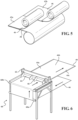
- the resin layer 40 can be in the form of multiple separate layers 42a, 42b, etc. ( Figure 5 ), or the resin layer can be in the form of a single layer with multiple resin portions 44a, 44b, 44c, etc. ( Figure 4 ). It will be appreciated that Figure 4 may illustrate either a single layer with multiple resin portions or multiple layers laid side-by-side. Figure 5 shows an example of multiple separate layers. In each of these cases, the resin layer(s) 40 may be produced prior to being applied to the reinforcement material 30. In the case of separate layers, the resin layer 40 may become a single layer after the separate layers have been consolidated with the reinforcement layer 30. In each of these cases, the resin or matrix material forming the layers or portions may be applied to a substrate 46.
- the substrate 46 may be a layer of material on which the resin or matrix materials can be applied, such that the resin layer 40 may be produced and carried on the substrate 46 for later application to the reinforcement layer 30.
- the substrate 46 may be a paper, polymeric, or other material suitable to act a substrate for a resin material.
- the multiple separate resin layers 42a, b, etc. each having a different resin material are produced separately and on separate substrates 46. It will be appreciated that different substrate materials could be used for the separate layers. It will be further appreciated that the same resin materials could be used in separate layers 42a, b, etc. and laid adjacent each other or separated by a layer of a different resin material, depending on the desired performance of the resin material along the width of the reinforcement layer 30. For example, a first resin material may be used for layer 42a, a second resin material may be used for layer 42b, and the first resin material may be used for layer 42c. Or the first material may be used for both zone 42a and 42b, and a second material may be used for zone 42c.
- the use of different separate layers 42 thereby allows for a modular assembly of resin materials across the width of the reinforcement layer.
- the resin films or layers 42 can be produced using various filming processes.
- the layers 42a, b, etc. may be produced by gravure coating, reverse roll coating, knife-over-roll coating, metering rod coating, slot die coating, curtain coating, all knife coating, spray coating, powder coating, or any other known coating technique.
- the filming processes, when complete, may therefore produce the multiple separate resin layers 42a, b, etc. It will be appreciated that different layers could be made by different coating processes.
- the reinforcement layer 30 and the resin layers 42 may be in the form of a roll of material.
- the reinforcement layer 30 may be provided, with the separate layers 42 being applied over a surface of the reinforcement layer 30.
- one of the layers 42 may be applied to the reinforcement layer 30 first, thereby covering a portion of the width of the reinforcement layer 30.
- the reinforcement layer 30 and the resin layer 42 may then be laminated together, providing a portion of the reinforcement layer 30 in a laminated state.
- Subsequent resin layers 42 may be applied and laminated in a similar and sequential manner, until the entire width of the reinforcement layer 30 has been covered (or the entire desired amount of the reinforcement layer 30 has been covered).
- heat and pressure may be applied to consolidate the layers according to the prepregged approach or the RFI approach.
- the reinforcement layer 30 may be placed on the wheel mold separately from the matrix material layers 42, or the layers may be laminated together and then applied to the mold. In either version of the RFI approach, the layers 42 will be consolidated on the mold to arrive at the consolidated layer 50 illustrated in Figure 4A .
- each of the layers 42 may be applied to the reinforcement layer 30 side-by-side generally simultaneously or during the same time period.
- the rolls of the layers 42 may be located side by side and the lamination may occur at the same distance along the reinforcement layer 30.
- the multiple layers 42 may be applied across the width at the same longitudinal location.
- This approach of applying multiple separate layers 42 to the reinforcement layer 30 can thereby provide a laminated and prepregged composite layer 50 that may be applied to the wheel mold in the wheel layup process, or a laminated assembly of layers that can be consolidated in the RFI approach.
- the prepregged approach heat and pressure are applied to the overlaid reinforcement layer 30 and layers 42, and the consolidated layer 50 is placed on or in the wheel mold.
- the overlaid layers 30 and 42 are placed on or in the mold prior to applying heat and pressure to create the consolidated layer 50.
- the resin layer 40 in the form of a single layer with multiple portions 44a, b, c, etc., can be produced and subsequently laminated with the reinforcement layer 30.
- the resin layer 40 may be produced using a filming process in which multiple resin formulations are applied to the substrate 46 at approximately the same time.
- An example of such a filming process is shown in Figure 6 , in which a filming setup 60 for a knife-over-roll process is illustrated.
- the substrate 46 may be fed in a first direction toward a lower roller 60a, and directed upward toward an upper roller 60b. At the upper roller 60b, the substrate 46 is directed in a second direction that is opposite the first direction.
- the substrate 46 may be fed in the second direction toward a doctor blade head 62 having multiple sections 64 with damming 66 disposed between the sections 64.
- Each section 64 may include a different resin formulation.
- the different resin formulations may be applied to the substrate 46.
- the substrate may be fed toward the doctor blade head 62 in another manner, and not necessarily using the two-roller setup illustrated in Figure 6 .
- the resin layer 40 will be formed having different resin material formulations disposed across the width of the substrate 46, yielding a single resin layer 40 with multiple zones.
- the resin layer 40 may then be removed from the setup 60.
- the resin layer 40 is in the form of a single layer, and may then be combined with the reinforcement layer 30 to create the composite layer 50 in a manner similar to that described above for multiple layers.
- the single resin layer 40 may be applied to the reinforcement layer 30, and heat and pressure may be applied to the resin layer 40 and the reinforcement layer 30 to form the prepregged composite layer 50.
- the composite layer 50 may then be applied to the mold in the wheel layup process.
- the single resin layer 40 may be applied to the reinforcement layer, and consolidated as part of an RFI process in the mold.
- the single layer 40 having multiple different resin zones may also be combined with additional separate layers and overlaid with the reinforcement layer 30 in a manner similar to that described above for multiple layers 42.
- the substrate material 46 may be fed through multiple filming stations to apply to the multiple resin formulations to the single substrate 46, rather than a single filming station where the resin formulation are added at approximately the same longitudinal location.
- the substrate 46 may be passed through a first filming station, and the resin material may be applied across a portion of the width of the substrate 46.
- the substrate 46 may continue to be advanced to a subsequent filming station, where another resin material may be applied across a different portion of the width of the substrate 46. This process may be continued until the desired width of the substrate 46 is covered with the desired resin materials.
- one resin material may be applied to a portion of the substrate 46 at a first filming station, and then multiple resin materials may be applied at a subsequent filming station.
- a first resin formulation may be applied at a first filming station, and then second and third resin formulations may be applied at the same filming station, with regions separated by damming or the like.
- the single resin layer 40 may be removed and then applied to the reinforcement layer 30, and they can then be combined under heat and pressure to define a prepregged composite layer 50.
- the composite layer 50 may then be applied to the wheel mold in the wheel layup process.
- the single resin layer 40 and the reinforcement layer 30 may be consolidated on the mold using an RFI process.
- the above-described methods have related to create a prepregged composite layer 50 that is subsequently applied to the wheel mold or creating an assembly of layers for an RFI process that creates a consolidated layer 50 in the mold.
- a resin layer 40 is produced and then combined with a single reinforcement layer 30 under pressure and heat to consolidate the layers.
- the resin material may be applied in other ways, as well.
- a direct reinforcement coating process may be used to apply the different resin or matrix materials to the single reinforcement layer 30.
- the substrate material and the separate resin layer may not be used in the manner described above. Instead, the resin material may be applied directly to the reinforcement layer 30.
- the reinforcement layer 30 may be optionally placed over a backing material, such as a substrate, table, roller, or the like, to limit the resin coating from seeping through the reinforcement layer 30.
- the reinforcement layer 30 Upon coating the reinforcement layer with the resin material directly, the reinforcement layer 30 will include the various resin or matrix materials, and may be placed under heat and pressure to produce the composite layer 50. The composite layer 50 may then be applied to the wheel mold for use in the wheel layup process.
- the resulting single composite layer 50 includes a continuous fiber reinforcement extending across the width of the composite layer 50.
- This continuous reinforcement will thereby extend continuously across the width of the wheel 10 that is produced, such that there is no seam or break in the reinforcement layer 30, or an overlap of matrix materials and reinforcing layers. Accordingly, the different portions of the wheel 10 having different temperature or strength requirements can be accommodated with the desired resin formulation in each region that can suit the specific requirements. In this manner, it is not necessary to compromise on the toughness and heat requirements to find a suitable resin that could be applied to all zones.
- the ability to select a particular resin for the requirement of a particular zone allows for increased toughness capability, increased temperature capability, and reduced cost.
Landscapes
- Engineering & Computer Science (AREA)
- Mechanical Engineering (AREA)
- Chemical & Material Sciences (AREA)
- Composite Materials (AREA)
- Materials Engineering (AREA)
- Physics & Mathematics (AREA)
- Mathematical Physics (AREA)
- Moulding By Coating Moulds (AREA)
Claims (14)
- Struktur eines Verbundrades (10), die umfasst:einen Radkörper (12), der eine axiale Breite aufweist, die sich zwischen einem inneren Ende und einem äußeren Ende erstreckt;einen inneren Flanschabschnitt des Radkörpers (12), der an dem inneren Ende angeordnet ist;einen äußeren Flanschabschnitt des Radkörpers (12), der an dem äußeren Ende angeordnet ist;einen ersten Zwischenabschnitt des Radkörpers (12), der zwischen dem inneren Flanschabschnitt und dem äußeren Flanschabschnitt angeordnet ist;einen zweiten Zwischenabschnitt des Radkörpers (12), der zwischen dem ersten Zwischenabschnitt und dem äußeren Flanschabschnitt angeordnet ist;eine erste Verstärkungsschicht aus Material, das sich zwischen dem inneren und dem äußeren Ende erstreckt und sich durch den inneren Flanschabschnitt, den äußeren Flanschabschnitt, den ersten Zwischenabschnitt und den zweiten Zwischenabschnitt erstreckt;wobei die erste Verstärkungsschicht in Form einer einzigen kontinuierlichen Faserschicht (30) vorliegt;ein erstes Matrixmaterial, das in der ersten Verstärkungsschicht entlang des inneren Flanschabschnitts integriert ist;ein zweites Matrixmaterial, das in der ersten Verstärkungsschicht entlang des ersten Zwischenabschnitts integriert ist; undein drittes Matrixmaterial, das in der ersten Verstärkungsschicht entlang des zweiten Zwischenabschnitts integriert ist, dadurch gekennzeichnet, dass das erste Matrixmaterial, das zweite Matrixmaterial und das dritte Matrixmaterial unterschiedlich sind.
- Radstruktur nach Anspruch 1, wobei der äußere Flanschabschnitt und der innere Flanschabschnitt jeweils das erste Matrixmaterial einschließen und/oder wobei die erste Verstärkungsschicht eine Kohlenstofffaser, Kevlar oder Glasfaser ist und/oder wobei die erste Verstärkungsschicht über die axiale Breite des Radkörpers (12) hinweg nahtlos ist.
- Radstruktur nach Anspruch 1, wobei das erste Matrixmaterial eine hohe Zähigkeit und ein Niedertemperaturverhalten aufweist, wobei die hohe Zähigkeit eine Zähigkeit ist, die sich auf eine Bruchzähigkeit von 1000 J/m^2 bis 2000 J/m^2 bezieht und die niedrige Temperatur eine Temperatur zwischen 80 °C und 120 °C ist, und wobei optional das zweite Matrixmaterial ein Hochtemperaturverhalten und eine niedrige Zähigkeit aufweist, wobei die hohe Temperatur eine Temperatur über 108 °C ist und die niedrige Zähigkeit eine Zähigkeit ist, die sich auf eine Bruchzähigkeit von weniger als 500 J/m^2 bezieht, und wobei optional das dritte Matrixmaterial ein Niedertemperaturverhalten und eine niedrige Zähigkeit aufweist, wobei die niedrige Temperatur eine Temperatur zwischen 80 °C und 120 °C ist und die niedrige Zähigkeit eine Zähigkeit ist, die sich auf eine Bruchzähigkeit von weniger als 500 J/m^2 bezieht.
- Radstruktur nach einem der vorhergehenden Ansprüche, wobei das zweite Matrixmaterial ein Bismaleimidpolymer umfasst und das erste und dritte Matrixmaterial Epoxid ist.
- Radstruktur nach einem der vorhergehenden Ansprüche, wobei das erste, das zweite uns das dritte Matrixmaterial mit der ersten Verstärkungsschicht in einer einzigen Schicht verbunden sind, sodass die einzige Verstärkungsschicht über ihre Breite hinweg unterschiedliche Matrixmaterialien einschließt.
- Radstruktur nach einem der vorhergehenden Ansprüche, die ferner mindestens eine zusätzliche Verstärkungsschicht umfasst, die die erste Verstärkungsschicht überlagert, wobei die mindestens eine zusätzliche Verstärkungsschicht durchgehend und nahtlos ist und mehrere verschiedene integrierte Matrixmaterialien über ihre axiale Breite hinweg einschließt.
- Verfahren zum Bilden einer Verbundstoffschicht (50) zur Verwendung in einem Verbundradadauflegeverfahren,
wobei das Verfahren die Schritte umfasst:Bereitstellen einer einzigen Verstärkungsschicht (30) in Form eines kontinuierlichen Gewebematerials, das eine laterale Breite aufweist;Auftragen eines ersten Matrixmaterials auf einen ersten Abschnitt der Breite der Verstärkungsschicht;Auftragen eines zweiten Matrixmaterials auf einen zweiten Abschnitt der Breite der Verstärkungsschicht; undVerfestigen des ersten des zweiten Matrixmaterials und der Verstärkungsschicht zu einer einzigen Verbundschicht, bei der das erste und das zweite Matrixmaterial in die einzige Verstärkungsschicht integriert sind,dadurch gekennzeichnet,dass die einzige Verstärkungsschicht über ihre Breite hinweg unterschiedliche Matrixmaterialien einschließt. - Verfahren nach Anspruch 7, wobei der Schritt des Verfestigens das Vorimprägnieren der Verstärkungsschicht mit dem ersten und dem zweiten Matrixmaterial einschließt oder
wobei der Schritt des Verfestigens das Anwenden von Druck und Wärme auf die Verstärkungsschicht und das erste und das zweite Matrixmaterial einschließt oder wobei der Schritt des Verfestigens das Verwenden eines Harzfilminfusionsprozesses einschließt. - Verfahren nach Anspruch 7, das ferner umfasst:Bereitstellen eines Substrats, das eine Länge und eine Breite aufweist;Auftragen des ersten Matrixmaterials auf das Substrat über einen ersten Abschnitt der Breite hinweg;Auftragen des zweiten Matrixmaterials auf das Substrat über einen zweiten Abschnitt der Breite hinweg;Definieren eines einzigen Harzfilms, der das erste und das zweite auf das Substrat aufgetragene Matrixmaterial einschließt;wobei die Schritte des Auftragens des ersten und des zweiten Matrixmaterials das Auflegen des einzigen Harzfilms auf die Verstärkungsschicht einschließen.
- Verfahren nach Anspruch 7, das ferner umfasst:Bereitstellen eines ersten Substrats, das eine Länge und eine Breite aufweist; Auftragen des ersten Matrixmaterials auf das erste Substrat über dessen Breite hinweg;Bereitstellen eines zweiten Substrats, das eine Länge und eine Breite aufweist; Auftragen des zweiten Matrixmaterials auf das zweite Substrat über dessen Breite hinweg;Definieren eines zweiten Harzfilms, der das auf das erste Substrat aufgetragene erste Matrixmaterial einschließt;Definieren eines zweiten Harzfilms, der das zweite Matrixmaterial und das zweite Substrat einschließt;wobei die Schritte des Auftragens des ersten und zweiten Matrixmaterials das Auflegen des ersten Harzfilms und des zweiten Harzfilms auf die Verstärkungsschicht einschließen.
- Verfahren nach einem der Ansprüche 7, 9 oder 10, wobei das erste Matrixmaterial und das zweite Material während eines ersten Zeitraums nebeneinander auf die Verstärkungsschicht aufgetragen werden.
- Verfahren nach einem der Ansprüche 7 oder 10, wobei das erste Matrixmaterial und das zweite Matrixmaterial nebeneinander auf die Verstärkungsschicht aufgetragen werden, wobei das erste Matrixmaterial während einer ersten Zeitspanne und das zweite Matrixmaterial während einer zweiten Zeitspanne aufgetragen werden.
- Verfahren nach Anspruch 7, wobei die einzige Verbundschicht mit der einzigen Verstärkungsschicht gebildet wird, die mit dem ersten und dem zweiten Matrixmaterial über die Breite der Verstärkungsschicht hinweg imprägniert ist, wobei sich das erste und das zweite Matrixmaterial nicht über die Breite der Verstärkungsschicht hinweg überlappen und die Verstärkungsschicht nahtlos ist.
- Verfahren nach Anspruch 7,
wobei das erste und das zweite Matrixmaterial auf die Verstärkungsschicht unter Verwendung eines direkten Verstärkungsbeschichtungsverfahrens aufgetragen werden, bei dem das erste und das zweite Matrixmaterial direkt auf die Verstärkungsschicht aufgetragen werden, ohne die Matrixmaterialien zuvor auf ein Substrat aufzutragen.
Applications Claiming Priority (3)
| Application Number | Priority Date | Filing Date | Title |
|---|---|---|---|
| US201962801507P | 2019-02-05 | 2019-02-05 | |
| US16/781,390 US11807039B2 (en) | 2019-02-05 | 2020-02-04 | Composite wheel construction apparatus and method |
| PCT/US2020/016768 WO2020163460A1 (en) | 2019-02-05 | 2020-02-05 | Composite wheel construction apparatus and method |
Publications (2)
| Publication Number | Publication Date |
|---|---|
| EP3921147A1 EP3921147A1 (de) | 2021-12-15 |
| EP3921147B1 true EP3921147B1 (de) | 2024-12-18 |
Family
ID=71836153
Family Applications (1)
| Application Number | Title | Priority Date | Filing Date |
|---|---|---|---|
| EP20709423.6A Active EP3921147B1 (de) | 2019-02-05 | 2020-02-05 | Verbundradkonstruktionsvorrichtung und -verfahren |
Country Status (3)
| Country | Link |
|---|---|
| US (1) | US11807039B2 (de) |
| EP (1) | EP3921147B1 (de) |
| WO (1) | WO2020163460A1 (de) |
Families Citing this family (2)
| Publication number | Priority date | Publication date | Assignee | Title |
|---|---|---|---|---|
| CN113815767B (zh) * | 2021-09-30 | 2022-07-22 | 中国人民解放军海军工程大学 | 一种夹层复合材料耐压壳体端部连接结构及其制造方法 |
| WO2025171080A1 (en) * | 2024-02-09 | 2025-08-14 | Lacks Enterprises, Inc. | Composite wheel with fiber-reinforced molding compound having multiple resin chemistries, and method |
Family Cites Families (8)
| Publication number | Priority date | Publication date | Assignee | Title |
|---|---|---|---|---|
| US4636344A (en) * | 1984-11-21 | 1987-01-13 | The Budd Company | Method of molding fiber reinforced composite wheel |
| FR2755897A1 (fr) * | 1996-11-15 | 1998-05-22 | Michelin & Cie | Procede et dispositif de fabrication de preforme de jantes |
| US20140117745A1 (en) * | 2012-10-26 | 2014-05-01 | Trek Bicycle Corp. | Enhanced bicycle braking surfaces |
| US20150099103A1 (en) * | 2013-10-04 | 2015-04-09 | Rohr, Inc. | Variable matrix composite |
| NL2011783C2 (en) * | 2013-11-11 | 2015-05-13 | Luinstra Beheer B V | A wheel and method of manufacturing. |
| JP6637842B2 (ja) * | 2016-06-01 | 2020-01-29 | 株式会社シマノ | 自転車用リム |
| US11110742B2 (en) * | 2017-09-08 | 2021-09-07 | Superior Industries International, Inc. | Hybrid wheel assembly with attachment pin |
| KR102614130B1 (ko) * | 2018-05-25 | 2023-12-14 | 현대자동차주식회사 | 차량용 휠의 복합재 림 및 이의 제조방법 |
-
2020
- 2020-02-04 US US16/781,390 patent/US11807039B2/en active Active
- 2020-02-05 WO PCT/US2020/016768 patent/WO2020163460A1/en not_active Ceased
- 2020-02-05 EP EP20709423.6A patent/EP3921147B1/de active Active
Also Published As
| Publication number | Publication date |
|---|---|
| WO2020163460A1 (en) | 2020-08-13 |
| US11807039B2 (en) | 2023-11-07 |
| US20200247178A1 (en) | 2020-08-06 |
| EP3921147A1 (de) | 2021-12-15 |
Similar Documents
| Publication | Publication Date | Title |
|---|---|---|
| US4030754A (en) | Composite lightweight wheel rim | |
| US6893733B2 (en) | Modified contoured crushable structural members and methods for making the same | |
| US20030175520A1 (en) | Formed composite structural members and methods and apparatus for making the same | |
| US5958533A (en) | Covered roll and a method for making the same | |
| US20050258575A1 (en) | Non-isothermal method for fabricating hollow composite parts | |
| CN106314545B (zh) | 用于车辆的纤维增强塑料构件及其制造方法和相关车辆 | |
| EP4037917B1 (de) | Verstärkte thermoplastische komponenten und verfahren zu ihrer herstellung | |
| EP3921147B1 (de) | Verbundradkonstruktionsvorrichtung und -verfahren | |
| JP2011516316A (ja) | 両側にカバー層を備えたコア複合体を製造する方法 | |
| WO2013178748A1 (en) | Press moulding method | |
| WO2002004826A1 (en) | Structural members containing vibration damping mechanisms and methods for making the same | |
| WO2002004203A1 (en) | Contoured crushable composite structural members and methods for making the same | |
| US20050104441A1 (en) | Fiber reinforced composite wheels | |
| JP2004506537A (ja) | コーティングが施された圧壊可能な賦形構造部材及びその製造方法 | |
| US12325263B2 (en) | Composite rim of vehicle wheel and method of manufacturing the same | |
| US20150148206A1 (en) | Roller, and method for manufacturing the same | |
| EP2569145B1 (de) | Verbundartikel mit partikeln und verfahren zur herstellung eines verbundartikels | |
| JP2020117689A (ja) | 複合オーバーラップツールのための熱可塑性複合in−situ溶融処理法 | |
| US9616621B2 (en) | Wheel made of fiber composites and process for the manufacture thereof | |
| US20250256466A1 (en) | Composite wheel with fiber-reinforced molding compound having multiple resin chemistries, and method | |
| JP6718478B2 (ja) | 円筒状複合材料の成形方法 | |
| WO2010003460A1 (en) | A roll for a fiber web machine and a method for manufacturing the roll | |
| JP2004502573A (ja) | コア入り賦形複合構造部材及びその製造方法 | |
| JP2010143766A (ja) | 印刷機械用ローラ、このローラを備えた印刷機械およびこのローラを製造するための方法 | |
| JP3152478B2 (ja) | 多層ハニカムコアを有する翼形状構造体及びその製造方法 |
Legal Events
| Date | Code | Title | Description |
|---|---|---|---|
| STAA | Information on the status of an ep patent application or granted ep patent |
Free format text: STATUS: UNKNOWN |
|
| STAA | Information on the status of an ep patent application or granted ep patent |
Free format text: STATUS: THE INTERNATIONAL PUBLICATION HAS BEEN MADE |
|
| PUAI | Public reference made under article 153(3) epc to a published international application that has entered the european phase |
Free format text: ORIGINAL CODE: 0009012 |
|
| STAA | Information on the status of an ep patent application or granted ep patent |
Free format text: STATUS: REQUEST FOR EXAMINATION WAS MADE |
|
| 17P | Request for examination filed |
Effective date: 20210903 |
|
| AK | Designated contracting states |
Kind code of ref document: A1 Designated state(s): AL AT BE BG CH CY CZ DE DK EE ES FI FR GB GR HR HU IE IS IT LI LT LU LV MC MK MT NL NO PL PT RO RS SE SI SK SM TR |
|
| DAV | Request for validation of the european patent (deleted) | ||
| DAX | Request for extension of the european patent (deleted) | ||
| P01 | Opt-out of the competence of the unified patent court (upc) registered |
Effective date: 20230601 |
|
| STAA | Information on the status of an ep patent application or granted ep patent |
Free format text: STATUS: EXAMINATION IS IN PROGRESS |
|
| 17Q | First examination report despatched |
Effective date: 20240221 |
|
| GRAP | Despatch of communication of intention to grant a patent |
Free format text: ORIGINAL CODE: EPIDOSNIGR1 |
|
| STAA | Information on the status of an ep patent application or granted ep patent |
Free format text: STATUS: GRANT OF PATENT IS INTENDED |
|
| RIC1 | Information provided on ipc code assigned before grant |
Ipc: B60B 5/02 20060101ALI20240708BHEP Ipc: B60B 3/00 20060101ALI20240708BHEP Ipc: B32B 5/26 20060101ALI20240708BHEP Ipc: B29C 70/46 20060101ALI20240708BHEP Ipc: B29C 70/32 20060101ALI20240708BHEP Ipc: B29D 99/00 20100101ALI20240708BHEP Ipc: B32B 5/14 20060101AFI20240708BHEP |
|
| INTG | Intention to grant announced |
Effective date: 20240722 |
|
| GRAS | Grant fee paid |
Free format text: ORIGINAL CODE: EPIDOSNIGR3 |
|
| GRAA | (expected) grant |
Free format text: ORIGINAL CODE: 0009210 |
|
| STAA | Information on the status of an ep patent application or granted ep patent |
Free format text: STATUS: THE PATENT HAS BEEN GRANTED |
|
| AK | Designated contracting states |
Kind code of ref document: B1 Designated state(s): AL AT BE BG CH CY CZ DE DK EE ES FI FR GB GR HR HU IE IS IT LI LT LU LV MC MK MT NL NO PL PT RO RS SE SI SK SM TR |
|
| REG | Reference to a national code |
Ref country code: CH Ref legal event code: EP |
|
| REG | Reference to a national code |
Ref country code: DE Ref legal event code: R096 Ref document number: 602020043305 Country of ref document: DE |
|
| REG | Reference to a national code |
Ref country code: IE Ref legal event code: FG4D |
|
| REG | Reference to a national code |
Ref country code: LT Ref legal event code: MG9D |
|
| PG25 | Lapsed in a contracting state [announced via postgrant information from national office to epo] |
Ref country code: HR Free format text: LAPSE BECAUSE OF FAILURE TO SUBMIT A TRANSLATION OF THE DESCRIPTION OR TO PAY THE FEE WITHIN THE PRESCRIBED TIME-LIMIT Effective date: 20241218 |
|
| PG25 | Lapsed in a contracting state [announced via postgrant information from national office to epo] |
Ref country code: FI Free format text: LAPSE BECAUSE OF FAILURE TO SUBMIT A TRANSLATION OF THE DESCRIPTION OR TO PAY THE FEE WITHIN THE PRESCRIBED TIME-LIMIT Effective date: 20241218 |
|
| PG25 | Lapsed in a contracting state [announced via postgrant information from national office to epo] |
Ref country code: BG Free format text: LAPSE BECAUSE OF FAILURE TO SUBMIT A TRANSLATION OF THE DESCRIPTION OR TO PAY THE FEE WITHIN THE PRESCRIBED TIME-LIMIT Effective date: 20241218 |
|
| PG25 | Lapsed in a contracting state [announced via postgrant information from national office to epo] |
Ref country code: NO Free format text: LAPSE BECAUSE OF FAILURE TO SUBMIT A TRANSLATION OF THE DESCRIPTION OR TO PAY THE FEE WITHIN THE PRESCRIBED TIME-LIMIT Effective date: 20250318 |
|
| REG | Reference to a national code |
Ref country code: NL Ref legal event code: MP Effective date: 20241218 |
|
| PG25 | Lapsed in a contracting state [announced via postgrant information from national office to epo] |
Ref country code: LV Free format text: LAPSE BECAUSE OF FAILURE TO SUBMIT A TRANSLATION OF THE DESCRIPTION OR TO PAY THE FEE WITHIN THE PRESCRIBED TIME-LIMIT Effective date: 20241218 Ref country code: GR Free format text: LAPSE BECAUSE OF FAILURE TO SUBMIT A TRANSLATION OF THE DESCRIPTION OR TO PAY THE FEE WITHIN THE PRESCRIBED TIME-LIMIT Effective date: 20250319 |
|
| PG25 | Lapsed in a contracting state [announced via postgrant information from national office to epo] |
Ref country code: RS Free format text: LAPSE BECAUSE OF FAILURE TO SUBMIT A TRANSLATION OF THE DESCRIPTION OR TO PAY THE FEE WITHIN THE PRESCRIBED TIME-LIMIT Effective date: 20250318 |
|
| PG25 | Lapsed in a contracting state [announced via postgrant information from national office to epo] |
Ref country code: NL Free format text: LAPSE BECAUSE OF FAILURE TO SUBMIT A TRANSLATION OF THE DESCRIPTION OR TO PAY THE FEE WITHIN THE PRESCRIBED TIME-LIMIT Effective date: 20241218 |
|
| REG | Reference to a national code |
Ref country code: AT Ref legal event code: MK05 Ref document number: 1751962 Country of ref document: AT Kind code of ref document: T Effective date: 20241218 |
|
| PG25 | Lapsed in a contracting state [announced via postgrant information from national office to epo] |
Ref country code: SM Free format text: LAPSE BECAUSE OF FAILURE TO SUBMIT A TRANSLATION OF THE DESCRIPTION OR TO PAY THE FEE WITHIN THE PRESCRIBED TIME-LIMIT Effective date: 20241218 |
|
| PG25 | Lapsed in a contracting state [announced via postgrant information from national office to epo] |
Ref country code: PL Free format text: LAPSE BECAUSE OF FAILURE TO SUBMIT A TRANSLATION OF THE DESCRIPTION OR TO PAY THE FEE WITHIN THE PRESCRIBED TIME-LIMIT Effective date: 20241218 |
|
| PG25 | Lapsed in a contracting state [announced via postgrant information from national office to epo] |
Ref country code: ES Free format text: LAPSE BECAUSE OF FAILURE TO SUBMIT A TRANSLATION OF THE DESCRIPTION OR TO PAY THE FEE WITHIN THE PRESCRIBED TIME-LIMIT Effective date: 20241218 |
|
| PG25 | Lapsed in a contracting state [announced via postgrant information from national office to epo] |
Ref country code: IS Free format text: LAPSE BECAUSE OF FAILURE TO SUBMIT A TRANSLATION OF THE DESCRIPTION OR TO PAY THE FEE WITHIN THE PRESCRIBED TIME-LIMIT Effective date: 20250418 |
|
| PG25 | Lapsed in a contracting state [announced via postgrant information from national office to epo] |
Ref country code: PT Free format text: LAPSE BECAUSE OF FAILURE TO SUBMIT A TRANSLATION OF THE DESCRIPTION OR TO PAY THE FEE WITHIN THE PRESCRIBED TIME-LIMIT Effective date: 20250421 |
|
| PG25 | Lapsed in a contracting state [announced via postgrant information from national office to epo] |
Ref country code: EE Free format text: LAPSE BECAUSE OF FAILURE TO SUBMIT A TRANSLATION OF THE DESCRIPTION OR TO PAY THE FEE WITHIN THE PRESCRIBED TIME-LIMIT Effective date: 20241218 |
|
| PG25 | Lapsed in a contracting state [announced via postgrant information from national office to epo] |
Ref country code: AT Free format text: LAPSE BECAUSE OF FAILURE TO SUBMIT A TRANSLATION OF THE DESCRIPTION OR TO PAY THE FEE WITHIN THE PRESCRIBED TIME-LIMIT Effective date: 20241218 Ref country code: RO Free format text: LAPSE BECAUSE OF FAILURE TO SUBMIT A TRANSLATION OF THE DESCRIPTION OR TO PAY THE FEE WITHIN THE PRESCRIBED TIME-LIMIT Effective date: 20241218 |
|
| PG25 | Lapsed in a contracting state [announced via postgrant information from national office to epo] |
Ref country code: SK Free format text: LAPSE BECAUSE OF FAILURE TO SUBMIT A TRANSLATION OF THE DESCRIPTION OR TO PAY THE FEE WITHIN THE PRESCRIBED TIME-LIMIT Effective date: 20241218 |
|
| PG25 | Lapsed in a contracting state [announced via postgrant information from national office to epo] |
Ref country code: CZ Free format text: LAPSE BECAUSE OF FAILURE TO SUBMIT A TRANSLATION OF THE DESCRIPTION OR TO PAY THE FEE WITHIN THE PRESCRIBED TIME-LIMIT Effective date: 20241218 |
|
| PG25 | Lapsed in a contracting state [announced via postgrant information from national office to epo] |
Ref country code: SE Free format text: LAPSE BECAUSE OF FAILURE TO SUBMIT A TRANSLATION OF THE DESCRIPTION OR TO PAY THE FEE WITHIN THE PRESCRIBED TIME-LIMIT Effective date: 20241218 |
|
| PG25 | Lapsed in a contracting state [announced via postgrant information from national office to epo] |
Ref country code: MC Free format text: LAPSE BECAUSE OF FAILURE TO SUBMIT A TRANSLATION OF THE DESCRIPTION OR TO PAY THE FEE WITHIN THE PRESCRIBED TIME-LIMIT Effective date: 20241218 |
|
| REG | Reference to a national code |
Ref country code: DE Ref legal event code: R097 Ref document number: 602020043305 Country of ref document: DE |
|
| REG | Reference to a national code |
Ref country code: CH Ref legal event code: PL |
|
| PG25 | Lapsed in a contracting state [announced via postgrant information from national office to epo] |
Ref country code: DK Free format text: LAPSE BECAUSE OF FAILURE TO SUBMIT A TRANSLATION OF THE DESCRIPTION OR TO PAY THE FEE WITHIN THE PRESCRIBED TIME-LIMIT Effective date: 20241218 |
|
| PG25 | Lapsed in a contracting state [announced via postgrant information from national office to epo] |
Ref country code: LU Free format text: LAPSE BECAUSE OF NON-PAYMENT OF DUE FEES Effective date: 20250205 |
|
| PG25 | Lapsed in a contracting state [announced via postgrant information from national office to epo] |
Ref country code: CH Free format text: LAPSE BECAUSE OF NON-PAYMENT OF DUE FEES Effective date: 20250228 |
|
| PLBE | No opposition filed within time limit |
Free format text: ORIGINAL CODE: 0009261 |
|
| STAA | Information on the status of an ep patent application or granted ep patent |
Free format text: STATUS: NO OPPOSITION FILED WITHIN TIME LIMIT |
|
| 26N | No opposition filed |
Effective date: 20250919 |
|
| REG | Reference to a national code |
Ref country code: BE Ref legal event code: MM Effective date: 20250228 |
|
| PG25 | Lapsed in a contracting state [announced via postgrant information from national office to epo] |
Ref country code: FR Free format text: LAPSE BECAUSE OF NON-PAYMENT OF DUE FEES Effective date: 20250218 |
|
| PG25 | Lapsed in a contracting state [announced via postgrant information from national office to epo] |
Ref country code: BE Free format text: LAPSE BECAUSE OF NON-PAYMENT OF DUE FEES Effective date: 20250228 |
|
| PG25 | Lapsed in a contracting state [announced via postgrant information from national office to epo] |
Ref country code: IE Free format text: LAPSE BECAUSE OF NON-PAYMENT OF DUE FEES Effective date: 20250205 |
|
| PGFP | Annual fee paid to national office [announced via postgrant information from national office to epo] |
Ref country code: GB Payment date: 20260227 Year of fee payment: 7 |
|
| PGFP | Annual fee paid to national office [announced via postgrant information from national office to epo] |
Ref country code: DE Payment date: 20260227 Year of fee payment: 7 |
|
| PGFP | Annual fee paid to national office [announced via postgrant information from national office to epo] |
Ref country code: IT Payment date: 20260219 Year of fee payment: 7 |