EP3920127B1 - Verfahren und system zum informieren, organisieren, transportieren, an bord bringen und unterbringen von passagieren in flugzeugen, ausrüstung und zugehörige computerprogramme - Google Patents
Verfahren und system zum informieren, organisieren, transportieren, an bord bringen und unterbringen von passagieren in flugzeugen, ausrüstung und zugehörige computerprogramme Download PDFInfo
- Publication number
- EP3920127B1 EP3920127B1 EP19912222.7A EP19912222A EP3920127B1 EP 3920127 B1 EP3920127 B1 EP 3920127B1 EP 19912222 A EP19912222 A EP 19912222A EP 3920127 B1 EP3920127 B1 EP 3920127B1
- Authority
- EP
- European Patent Office
- Prior art keywords
- boarding
- passengers
- wave
- aircraft
- passenger
- Prior art date
- Legal status (The legal status is an assumption and is not a legal conclusion. Google has not performed a legal analysis and makes no representation as to the accuracy of the status listed.)
- Active
Links
Images







Classifications
-
- B—PERFORMING OPERATIONS; TRANSPORTING
- B64—AIRCRAFT; AVIATION; COSMONAUTICS
- B64F—GROUND OR AIRCRAFT-CARRIER-DECK INSTALLATIONS SPECIALLY ADAPTED FOR USE IN CONNECTION WITH AIRCRAFT; DESIGNING, MANUFACTURING, ASSEMBLING, CLEANING, MAINTAINING OR REPAIRING AIRCRAFT, NOT OTHERWISE PROVIDED FOR; HANDLING, TRANSPORTING, TESTING OR INSPECTING AIRCRAFT COMPONENTS, NOT OTHERWISE PROVIDED FOR
- B64F1/00—Ground or aircraft-carrier-deck installations
- B64F1/30—Ground or aircraft-carrier-deck installations for embarking or disembarking passengers
-
- G—PHYSICS
- G06—COMPUTING OR CALCULATING; COUNTING
- G06Q—INFORMATION AND COMMUNICATION TECHNOLOGY [ICT] SPECIALLY ADAPTED FOR ADMINISTRATIVE, COMMERCIAL, FINANCIAL, MANAGERIAL OR SUPERVISORY PURPOSES; SYSTEMS OR METHODS SPECIALLY ADAPTED FOR ADMINISTRATIVE, COMMERCIAL, FINANCIAL, MANAGERIAL OR SUPERVISORY PURPOSES, NOT OTHERWISE PROVIDED FOR
- G06Q50/00—Information and communication technology [ICT] specially adapted for implementation of business processes of specific business sectors, e.g. utilities or tourism
- G06Q50/40—Business processes related to the transportation industry
-
- G—PHYSICS
- G06—COMPUTING OR CALCULATING; COUNTING
- G06Q—INFORMATION AND COMMUNICATION TECHNOLOGY [ICT] SPECIALLY ADAPTED FOR ADMINISTRATIVE, COMMERCIAL, FINANCIAL, MANAGERIAL OR SUPERVISORY PURPOSES; SYSTEMS OR METHODS SPECIALLY ADAPTED FOR ADMINISTRATIVE, COMMERCIAL, FINANCIAL, MANAGERIAL OR SUPERVISORY PURPOSES, NOT OTHERWISE PROVIDED FOR
- G06Q10/00—Administration; Management
-
- G—PHYSICS
- G06—COMPUTING OR CALCULATING; COUNTING
- G06Q—INFORMATION AND COMMUNICATION TECHNOLOGY [ICT] SPECIALLY ADAPTED FOR ADMINISTRATIVE, COMMERCIAL, FINANCIAL, MANAGERIAL OR SUPERVISORY PURPOSES; SYSTEMS OR METHODS SPECIALLY ADAPTED FOR ADMINISTRATIVE, COMMERCIAL, FINANCIAL, MANAGERIAL OR SUPERVISORY PURPOSES, NOT OTHERWISE PROVIDED FOR
- G06Q10/00—Administration; Management
- G06Q10/02—Reservations, e.g. for tickets, services or events
-
- B—PERFORMING OPERATIONS; TRANSPORTING
- B64—AIRCRAFT; AVIATION; COSMONAUTICS
- B64D—EQUIPMENT FOR FITTING IN OR TO AIRCRAFT; FLIGHT SUITS; PARACHUTES; ARRANGEMENT OR MOUNTING OF POWER PLANTS OR PROPULSION TRANSMISSIONS IN AIRCRAFT
- B64D45/00—Aircraft indicators or protectors not otherwise provided for
-
- G—PHYSICS
- G06—COMPUTING OR CALCULATING; COUNTING
- G06Q—INFORMATION AND COMMUNICATION TECHNOLOGY [ICT] SPECIALLY ADAPTED FOR ADMINISTRATIVE, COMMERCIAL, FINANCIAL, MANAGERIAL OR SUPERVISORY PURPOSES; SYSTEMS OR METHODS SPECIALLY ADAPTED FOR ADMINISTRATIVE, COMMERCIAL, FINANCIAL, MANAGERIAL OR SUPERVISORY PURPOSES, NOT OTHERWISE PROVIDED FOR
- G06Q10/00—Administration; Management
- G06Q10/06—Resources, workflows, human or project management; Enterprise or organisation planning; Enterprise or organisation modelling
- G06Q10/063—Operations research, analysis or management
- G06Q10/0631—Resource planning, allocation, distributing or scheduling for enterprises or organisations
- G06Q10/06311—Scheduling, planning or task assignment for a person or group
-
- G—PHYSICS
- G06—COMPUTING OR CALCULATING; COUNTING
- G06Q—INFORMATION AND COMMUNICATION TECHNOLOGY [ICT] SPECIALLY ADAPTED FOR ADMINISTRATIVE, COMMERCIAL, FINANCIAL, MANAGERIAL OR SUPERVISORY PURPOSES; SYSTEMS OR METHODS SPECIALLY ADAPTED FOR ADMINISTRATIVE, COMMERCIAL, FINANCIAL, MANAGERIAL OR SUPERVISORY PURPOSES, NOT OTHERWISE PROVIDED FOR
- G06Q10/00—Administration; Management
- G06Q10/08—Logistics, e.g. warehousing, loading or distribution; Inventory or stock management
-
- G—PHYSICS
- G06—COMPUTING OR CALCULATING; COUNTING
- G06Q—INFORMATION AND COMMUNICATION TECHNOLOGY [ICT] SPECIALLY ADAPTED FOR ADMINISTRATIVE, COMMERCIAL, FINANCIAL, MANAGERIAL OR SUPERVISORY PURPOSES; SYSTEMS OR METHODS SPECIALLY ADAPTED FOR ADMINISTRATIVE, COMMERCIAL, FINANCIAL, MANAGERIAL OR SUPERVISORY PURPOSES, NOT OTHERWISE PROVIDED FOR
- G06Q90/00—Systems or methods specially adapted for administrative, commercial, financial, managerial or supervisory purposes, not involving significant data processing
-
- G—PHYSICS
- G09—EDUCATION; CRYPTOGRAPHY; DISPLAY; ADVERTISING; SEALS
- G09F—DISPLAYING; ADVERTISING; SIGNS; LABELS OR NAME-PLATES; SEALS
- G09F19/00—Advertising or display means not otherwise provided for
- G09F19/12—Advertising or display means not otherwise provided for using special optical effects
- G09F19/18—Advertising or display means not otherwise provided for using special optical effects involving the use of optical projection means, e.g. projection of images on clouds
-
- G—PHYSICS
- G09—EDUCATION; CRYPTOGRAPHY; DISPLAY; ADVERTISING; SEALS
- G09F—DISPLAYING; ADVERTISING; SIGNS; LABELS OR NAME-PLATES; SEALS
- G09F19/00—Advertising or display means not otherwise provided for
- G09F19/22—Advertising or display means on roads, walls or similar surfaces, e.g. illuminated
- G09F19/228—Ground signs, i.e. display signs fixed on the ground
-
- B—PERFORMING OPERATIONS; TRANSPORTING
- B64—AIRCRAFT; AVIATION; COSMONAUTICS
- B64D—EQUIPMENT FOR FITTING IN OR TO AIRCRAFT; FLIGHT SUITS; PARACHUTES; ARRANGEMENT OR MOUNTING OF POWER PLANTS OR PROPULSION TRANSMISSIONS IN AIRCRAFT
- B64D45/00—Aircraft indicators or protectors not otherwise provided for
- B64D2045/007—Indicators or signs in the cabin, e.g. exit signs or seat numbering
Definitions
- the present invention is related to the field of data and information processing, planning, organization and resource allocation, as well as people transportation logistics.
- the present invention is related to a method and a system aimed at resource optimization through sorting and leading passengers in sequential waves formed by groups of passengers.
- Parameterization of each wave is made according to transportation means, number of passengers and aisles and their available seats and, especially, according to the occupied space of the aisles by passengers of each wave, in counterflow of the boarding direction while they are still are in the process of settling (standing and/or storing luggage and/or hand luggage and/or getting up again to allow for settling of another passenger and the like).
- the present invention is also related to an equipment and corresponding computer program.
- boarding phase is only one component of a larger and more complex aviation process, it is one of the most critical and costly events. Substantial reduction in boarding times will reduce aircraft turn time and physical traffic flow of airports, which in turn lessens logistics and operational costs, reduces labor demand, improves ground equipment use, and reduces pollutant emissions.
- the method of US20060206353A1 essentially relates to managing the entry of line members through an entrance, comprising the steps of identifying a plurality of line members wherein each has an allocated final destination; mapping each final destination onto a virtual destination location; guiding each line member, using the virtual destination location, towards the corresponding final destination by the steps of determining a sequence in which the line members should pass through the entrance so as to not delay other line members in the sequence as each moves to their respective final destinations.
- Boarding sequence is determined by managing a row distant from the entry (row n) in relation to a row that is less distant from the entry (row m), not yet occupied by passengers, that is, always in groups of rows from a more distant row (n- 1) to a less distant row (m -1), until all seats are occupied, following the occupying parameter of "from back to front".
- the update sequence always considers sequential row groups, which leaves no margin for safety and comfort in boarding.
- the system and method begin by instructing passengers to board starting from a more distant row "n", for example, row 30, to a less distant row "m", for example, row number 26, thus beginning boarding with a set of rows, 30 ("n") to row 26 ("m").
- a boarding agent or equipment activates the upgrade.
- the system after upgrading, calls passengers from rows "n-1" to "m-1" or 29 to 25, and after boarding of row 29 and further update by the boarding agent, it calls rows 28 through 24, and so on.
- This solution only considers passenger conditions at or near the aircraft entrance, disregarding settling conditions for passengers in the boarding region of the airport and those already boarded, and thus not solving the problem of space occupied by passengers in the aisle standing and/or storing luggage or carry-on items and/or standing up again to accommodate another passenger.
- US20060206353 A1 makes no reference nor suggests how the projection is to be made, and in particular how the projection update behaves if there is no movement by the passengers or in the event of displacement or movement not anticipated.
- German patent document DE102009058848 A1 discloses and describes a device for preparing passengers for sorted boarding into aircrafts, revealing a barrier-shaped device for guiding and directing passengers in a departure lounge according to boarding sequences, providing, but not detailing, the use of projections onto the ground, wall, ceiling, etc.
- Patent WO201622209 A1 describes a method and apparatus for aircraft boarding, using ground projection of the seat configuration of the aircraft so that each passenger occupies their position in the departure lounge, then keeping with the sorting so as to board the aircraft from back to front and additionally from the window to the aisle.
- the WO201622209 A1 solution is not concerned with the space condition of boarded passengers, it relies on specific commands in instructing/starting boarding and fails to describe how the upgrade of boarding conditions is made.
- boardings in groups or by categories wherein boarding happens, for example, first for the passengers having seats by the windows, then intermediate seats and finally, aisle seats, as well as boardings which will subdivide the plane in two parts, rear and front, wherein boarding starts with passengers belonging to the rear and then to the front, also fail to eradicate passenger obstruction and long waiting times, considering ground time spent standing and sitting, as well as inside the aircraft.
- One of the objectives of the present invention is, therefore, to provide a method and a system able to overcome the deficiencies of the state of the art whilst being a simple and cost-effective solution, intuitive for the user and the operator, easy to install, which is also flexible and adaptive, avoiding clashes with the pre-existing airport infrastructure, being thus capable of reducing passenger waiting time, facilitating sorting and leading of passengers and their subsequent boarding and, above all, reducing the aircraft turn time.
- Yet another objective of the present invention is an equipment that comprises the system according to the invention and is capable of carrying out a method according to the invention.
- Another objective of the present invention is to provide corresponding computer programs.
- a method according to the invention is a method for passenger information, organization, leading, boarding and settling in collective transportation means.
- the method aims at resource optimization through passenger boarding in sequential waves formed by groups of passengers.
- Sequential waves in the context of the invention, are sets of one or more groups of people with qualitative and quantitative characteristics determined according to the nature of the transportation means, that is, the number, grouping and physical arrangement of the seats available within the transportation means.
- parameterization of the waves by the method of the invention considers the space occupied by passengers of each wave in the aircraft's aisles, while they are still in the process of settling.
- Settling process in the context of the invention, should be understood as any intermediate passenger situation, from entry into the aircraft to final seat occupation. This includes, for example, situations comprising one or more passengers still standing and/or storing hand luggage and/or belongings and/or standing up again to allow passage for another passenger and/or any similar intermediate conditions.
- Boarding by the method of the invention is preferably initiated by the last row of seats or the row of seats which is furthest from the access to the aircraft. This goes for front or rear boarding, as well as front and rear boarding and, finally, for boarding when there are more than two access doors, in which case necessary adaptations must be made.
- a first wave of passengers according to the invention will be that which is composed of one or more passenger groups and intended to start occupying seats from the row farthest from the aircraft entrance, considering the boarding counterflow and having a maximum number of passengers obviously limited to the number of seats in said last row.
- all seats includes all seats sold and/or reserved that, in some way, can be occupied according to a passenger or boarding or occupancy list.
- the present method can be designed considering effectively all seats, regardless of the aircraft's occupancy rate, without harming boarding, since passengers will immediately notice the vacancy of one or more seats in their row.
- the present method can also be applied considering the aircraft's occupancy rate or specific occupancy conditions, for example, skipping rows and/or empty seats when forming the groups.
- boarding of the first group will be followed by a second group having, at first but not necessarily, the same maximum number of passengers as the first group, which will occupy, in counterflow boarding direction, a next row at a distance from the row of the first group such that it allows simultaneous permanence, in a line (in line and/or side by side and/or one after the other), of all passengers of the first group in the aircraft aisle, which would be the worst case in terms of movement and settling.
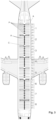
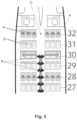
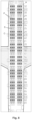
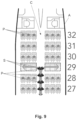
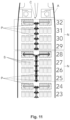
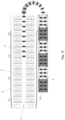
- an aircraft with 32 rows having 6 seats each, the spacing between rows being of 0.75 meters and with passengers standing in the aisle occupying, on average, a space equivalent to one circumference of 0.5 meters in diameter around them, will have a first group of up to 6 passengers destined to occupy the seats of row 32, and a second group, also having up to 6 passengers, destined to occupy a row that is at least 6 passengers away in the conditions described above, therefore, at least 3 meters or 4 rows away from row 32, that is, to occupy row 28.
- a third group will occupy row 24, a fourth group row 20, a fifth group row 16, a sixth group row 12, a seventh group row 8 and an eighth group row 4, thus completing boarding for the first wave, totaling 48 passengers boarded in sequences of 8 groups of 6 people in each group.
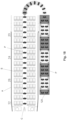
- a second wave will follow the same standard as the first wave, being also made up of 8 groups, each formed by 6 passengers, the first group intended to occupy the next row furthest from the aircraft entrance, in the counterflow direction, preferably skipping one of the rows and, preferably, the next row of an even number (if the first wave started with an even-numbered row) or an odd number (if the first wave started with an odd-numbered row). That is, it should preferably start with the seats in row 30, being followed by the other groups so as to occupy, according to the rule of the first wave, rows distant enough to allow passengers from the previous groups to have room in the aisle, that is, rows 26, 22, 18, 14, 10, 6 and 2, boarding of the second wave being concluded with 48 passengers, totaling 96 passengers on board.
- a third wave will follow the same structure as the previous waves, being made up of 8 groups, each formed by 6 passengers, boarding for the first group intended to occupy the next row furthest from the aircraft entrance, in the counterflow direction, preferably skipping one of the rows and, preferably, the next row of an odd number (if the first wave started with an even-numbered row) or an even number (if the first wave started with an odd-numbered row).That is, it should preferably start with the seats in row 31, being followed by the other groups so as to occupy, according to the rule of the first wave, rows distant enough to allow passengers from the previous groups to have room, that is, rows 27, 23, 19, 15, 11, 7 and 3, boarding of the third wave being concluded with 48 passengers, totaling 144 passengers on board.
- the fourth and last wave will follow the same standard as the previous waves, being also made up of 8 groups, each formed by 6 passengers, starting with the next row furthest from the aircraft entrance, in the counterflow direction, preferably skipping one of the rows and, preferably, with the next row of odd number (if the third wave started with an odd-numbered row) or an even number (if the third wave started with an even-numbered row).That is, it should preferably start with the seats in row 29, being followed by the other groups so as to occupy, according to the rule of the first wave, rows distant enough to allow passengers from the previous groups to have room, that is, rows 25, 21, 17, 13, 9, 5 and 1, boarding of the fourth wave being concluded with 48 passengers, totaling 192 passengers on board, thus concluding the process of passenger boarding.
- the distance between the first rows of each group in each wave creates specific events for each group, preventing confrontation between passengers from different groups, ensuring passenger comfort as well as boarding promptness, as it respects the room between rows of seats needed so that the total number of people in each group can settle themselves properly.
- Confrontation in the context of the invention, means any situation that results in delays or creates discomfort for passengers, waiting caused by passage blockages or situations in which one or more passengers stand up so that another passenger can be seated.
- the possibility of confrontation between passengers in boarding situations is reduced to just one confrontation, possible between subsequent waves, that is, there may be a confrontation by wave, between the last passengers of a wave and the first passengers of the next wave.
- the aircraft has rows with different seat numbers and/or rows with different distances and/or seating configurations, as is the case, for example, in the regions near the airplane's emergency ends or exits, or for subdivision of room into classes (first class, business class, economy with additional room, economy, etc.), the row with the largest number of seats can be considered as the basis for calculations, it is also possible to assign waves and groups with different sizes, considering these conditions.
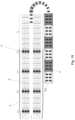
- the method of the invention suggests forming groups of 10 passengers each, for example, depending on the situation, each group can be divided into subgroups, one for the right aisle and another for the left aisle. Each group would have 10 passengers arranged in intervals of 3 rows of seats, making up to 10 groups per wave.
- a first wave would call passengers in rows 30, 27, 24, 21, 18, 15, 12, 9, 6 and 3, respectively
- the second wave would be formed by passengers in rows 29, 26, 23, 20, 17, 14, 11, 8, 5, 2
- the last one would be formed by rows 28, 25, 22, 19, 16, 13, 10, 7, 4 and 1.
- 10 passengers will be boarded every 30 seats, in a 10 by 30 scheme. It should be noted that in this example, there was no need to alternate between odd and even, thus demonstrating the flexibility and versatility of the method.
- An example of the situation of subdividing the aircraft room into classes may be that of an aircraft with the first class formed of 4 rows having 4 seats each, with row spacing higher than conventional or different from usual.
- 2 waves of 2 groups would be formed, the first wave being of rows 4 and 2 and the second wave of rows 3 and 1, boarding 4 passengers every 8 seats, in a scheme called herein 4 by 8.
- the method of the invention therefore, is flexible and makes it possible to expedite boarding for any type and model of aircraft and practically all seat configurations, also allowing for variations in accordance with specific needs.
- the example of boarding 6 passengers for every 24 seats shown initially for an aircraft with 32 rows of 6 seats each, can also be applied to a 24-row aircraft with 6 seats each (4 waves of 6 groups), while this same aircraft configuration can be loaded with 6 passengers every 36 seats (6 by 36), that is, in 6 waves of 4 groups each, with a first wave formed by seats 24, 18, 12, 6, the second by seats 22, 16, 10, 4, the third by seats 20, 14, 8, 2, the fourth by seats 23, 17, 11, 5, the fifth by seats 21, 15, 9, 3 and the sixth by seats 19, 13, 7, 1.
- This variation in the boarding scheme will depend on several factors, such as the distance between rows and the room for each passenger standing in the aisle.
- sequential waves on a same boarding process can have different group numbers, for example, in an aircraft with 29 rows of 6 seats each, the waves can be formed by groups with, respectively, seats 28, 24, 20, 16, 12, 8, 4, then 26, 22, 18, 14, 10, 6, 2, then 29, 25, 21, 17, 13, 9, 5, 1 and, finally, 27, 23, 19, 15, 11, 7, 3, thus having 3 waves with 7 groups and 1 wave with 8 groups.
- boarding did not start from the last row, proving, once again, the flexibility and versatility of the method of the invention. This example refers to boarding of 6 passengers for every 24 seats.
- the method according to the invention is simple and intuitive, easily understood by the passenger, eliminating any and all additional tools for leading passengers, complementary codes or signals, legends, instructions and, noticeably, does not require the passenger to be connected to any devices or assisted by the ground crew.
- Each wave corresponds to the total number of passengers who may stand at the same time in the aircraft's aisle, with enough room for everyone to stand and/or settle at the same time, with the confrontation between passengers being possible only between subsequent waves.
- the method of the invention does not require intermediate commands and additional control and supervision services by the boarding agents, since the lines formed will be of short duration and automatically dissipated following the forward pace of the last passenger of the last group of a wave, that is, as the last passenger of each wave settles.
- a system according to the invention is a system for passenger information, organization, leading, boarding and settling in collective transportation means, which aims to optimize resources by boarding passengers in sequential waves formed by groups of passengers, therefore, assisting in carrying out a method according to the invention.
- the system of the invention presupposes an airport physical structure and at least one boarding region of the airport physical structure, being basically composed of a main unit comprising one or more data processing centers, one or more databases, one or more information presentation equipment and other devices and/or equipment that enable its operation for perfect integral and/or partial carrying out of the method according to the invention.
- a data processing center is an electronic processor, preferably a computer equipped with a connection to a data network and a remote database or an information storage and retrieval means, local and/or centralized and/or decentralized and/or in the cloud, and also equipped with all the usual peripherals of the state of the art, being able to exchange information with electronic and physical means, interfaces, applications, mobile equipment, etc.
- the data processing center can be connected to the airport's data and communication network, the internet, the cloud, computer terminals, mobile devices, phone devices, ticket and boarding pass readers, credit cards, NFC or BLE devices, check-in counters, travel agencies, in short, to any equipment or interface directly or indirectly necessary to implement the method of the invention.
- An information presentation equipment is any set of visual signaling formed by devices capable of projecting and/or emitting and/or presenting images and lights and of emitting visual and audible signals in general, being directly connected to the data processing center.
- the information presentation equipment can also comprise auxiliary support monitors distributed throughout the airport infrastructure environments.
- the information presentation equipment of the invention is a virtual guide that indicates the boarding sequence according to the method of the invention, being disposed directly on the ground and/or projected on the ground by means of projectors located above the passengers.
- the number of projectors above or under passengers is such that shadows or regions with poor presentation are not formed.
- the virtual guide has the form of a dynamic mat formed by adjacent cloths and that accompanies the movement of passengers in an adaptive way, in that sensors on the ground and/or above and/or laterally to the passengers, together with a computer program or application, boarded or accessed via a data processing center, identify, count and sort the number of people on/in the virtual guide, detecting their movement and following the flow and speed of each passenger and of the set of passengers, following with the boarding sequence instructions in real time, according to the monitored flow and speed.
- the virtual guide is placed in the boarding area of the airport physical structure, preferably in the airport lounges next to the boarding gates, wherefrom boarding coordination is carried out according to the method of the invention.
- the virtual guide will basically present to passengers the procedure instructions and indications according to the method of the invention, that is, it will present, sequentially, the numbers of the seats and/or rows and/or waves and/or groups to be boarded, according to each situation and boarding scheme chosen.
- passengers belonging to the first group of the first wave will be the first to receive instructions from the virtual guide to proceed to the boarding gate and present themselves to boarding control, having the number of their rows and/or their respective seat numbers projected or presented in the virtual guide, having, individually or in group, reserved room for them to position themselves in the boarding region of the physical airport structure.
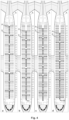
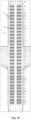
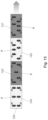
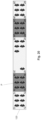
- the virtual guide initiates projection or presentation of an initial cloth of a certain color and/or initial visual pattern, measuring 1.20 meters wide by 1.80 meters long, for example, with the indicative numbering of row 32 (first wave of the first group in the example used). In this shape and size, there is enough room to accommodate the 6 passengers in said row 32.
- cloth 8 After cloth 12 has moved, cloth 8 will begin to show, and advance along the path of the mat, forming a size of at least 1.80 meters, and remaining so until there is no passenger positioned on it. After the passengers enter the current cloth area, the movement will become organic, keeping a minimum size of 1.80.
- the virtual guide creates the effect of a living organism, since passengers will only be guided by the guide when accessing it. After that, there is no longer any need for the passenger to be guided by it, simply being required to follow the passenger (s) in front of them as in a common line, as all movement of the cloths in the guide will adapt to the movement of the passengers, in size, speed, acceleration and pause. In this way, it is clear that it is the passengers who move the guide and not the guide who moves the passengers.
- control of the mat can be carried out by a human operator, who would manually control the advance of the first cloths to create an effect similar to that of the movement in the partially organic scheme, carried out through a simple command given by the operator, moving forward or stopping or even pulling back the cloths.
- the virtual guide although smart, is simple and intuitive, easily understood by the passenger, eliminating any and all additional tools for leading passengers, complementary codes or signals, legends, instructions and, noticeably, does not require the passenger to be connected to any devices or assisted by the ground crew.
- the virtual guide informs passengers, in the departure lounge, the passenger attendance sequence for boarding, projecting sequential spaces, in the passenger movement direction, sufficient to allow for physical settling, even in the departure lounge, of all passengers in each group.
- the method according to the invention can be performed independently of the system of the invention, as a whole, as well as without the use of a virtual guide, and can be coordinated, for example, by visual and/or audible command and/or voice of the ground crew, making use of the infrastructure already installed, for example, monitors, displays, indicative arrows, paintings etc. already present at the airport.
- An equipment according to the invention is an equipment for passenger information, organization, leading, boarding and settling in collective transportation means, which aims to optimize resources by boarding passengers in sequential waves formed by groups of passengers, therefore, assisting in carrying out a method according to the invention, and being part of a system according to the invention.
- the equipment of the invention is part of a composite set, being basically composed of a main unit comprising one or more data processing centers, one or more databases, one or more information presentation equipment and other devices and/or equipment that enable its operation for perfect integral and/or partial carrying out of the method according to the invention.
- the equipment of the invention is, in particular, a "virtual guide” equipment which is part of a system according to the invention for carrying out a method according to the invention.
- a computer program in accordance with the present invention is a computer program set in a computer-readable medium, associated to a system and/or one or more equipment in accordance with the invention, intended for carrying out a method in accordance with the invention and to coordination of one or more elements of the system according to the invention.
- Another program in accordance with the present invention is a computer program set in a computer-readable medium, able to carry out a method according to the invention in a "virtual guide” equipment according to the invention.
- a boarding model of 6 passengers was used for every 24 seats, therefore with 4 waves having 8 groups per wave.
- a double counter was also considered in the simulation for the method of the invention, with two people checking the boarding tickets, thus in this model the bottleneck would've been the counter, if a simple counter were used.
- the time obtained in the simulations corresponds to the average time between entry into the aircraft by the first passenger and settling of the last passenger.
- the average time obtained for the single line model was 22 minutes and 6 seconds, while the average time obtained in the double line model was 23 minutes and 3 seconds.
- the average time obtained with the model of the invention was 10 minutes and 55 seconds.
- the time saved inside the aircraft is at least 50% in relation to the boarding models most commonly used in single-aisle aircrafts.
- the present invention provides a method, system, equipment and computer program that augment in a new and inventive way the solutions to problems of the state of the art for aircraft boarding logistics.
Landscapes
- Business, Economics & Management (AREA)
- Engineering & Computer Science (AREA)
- Human Resources & Organizations (AREA)
- Theoretical Computer Science (AREA)
- General Physics & Mathematics (AREA)
- Physics & Mathematics (AREA)
- Economics (AREA)
- Marketing (AREA)
- Tourism & Hospitality (AREA)
- Strategic Management (AREA)
- General Business, Economics & Management (AREA)
- Entrepreneurship & Innovation (AREA)
- Operations Research (AREA)
- Quality & Reliability (AREA)
- Development Economics (AREA)
- Aviation & Aerospace Engineering (AREA)
- Accounting & Taxation (AREA)
- General Health & Medical Sciences (AREA)
- Health & Medical Sciences (AREA)
- Primary Health Care (AREA)
- Mechanical Engineering (AREA)
- Educational Administration (AREA)
- Game Theory and Decision Science (AREA)
- Management, Administration, Business Operations System, And Electronic Commerce (AREA)
- Train Traffic Observation, Control, And Security (AREA)
- Traffic Control Systems (AREA)
- Alarm Systems (AREA)
Claims (4)
- System zum Informieren, Organisieren, Führen, An-Bord-Bringen und Abfertigen von Passagieren in Luftfahrzeugen, das aus einer Haupteinheit, die eine oder mehrere Datenverarbeitungszentraleinheiten umfasst, einer oder mehreren Datenbanken, einer oder mehreren Informationspräsentationseinrichtungen (100) und anderen Vorrichtungen und/oder Einrichtungen zusammengesetzt ist, die seinen Betrieb zum vollständigen oder teilweisen Ausführen des unten definierten Verfahrens ermöglichen,wobei die Informationspräsentationseinrichtung (100) ein virtueller Führer (120) ist, der die Reihenfolge des An-Bord-Bringens gemäß dem unten definierten Verfahren angibt, direkt auf dem Boden angeordnet ist und/oder mittels über den Passagieren (P) befindlicher Projektoren (110) auf den Boden projiziert wird, und wobeider virtuelle Führer (120) eine aus benachbarten Stoffflächen (121, 122, 123, 124, 125, 126) gebildete dynamische Matte (120) ist, die direkt auf dem Boden angeordnet ist und/oder mittels über den Passagieren (P) befindlicher Projektoren (110) auf den Boden projiziert wird, wobei die dynamische Matte (120) der Bewegung von sich auf dem virtuellen Führer zu einem Abflugsteig hin bewegenden Passagieren (P) folgt, und wobei das Verfahren einVerfahren zum Informieren, Organisieren, Führen, An-Bord-Bringen und Abfertigen von Passagieren in Luftfahrzeugen ist, umfassend:i. Auswählen eines Modells und eines für das An-Bord-Bringen dienenden Schemas eines Luftfahrzeugs (A) basierend auf Daten von einer Datenverarbeitungszentraleinheit;ii. Aufteilen einer Anzahl von Passagieren (P), basierend auf den Daten von der Datenverarbeitungszentraleinheit, in Wellen, wobei jede Welle der Gesamtzahl von Passagieren (P) entspricht, die zur selben Zeit im Gang (C) des Luftfahrzeugs stehen können, wobei genügend Platz dafür vorhanden ist, dass alle zur selben Zeit stehen und/oder abgefertigt werden können, wobei die Konfrontation zwischen Passagieren (P) nur zwischen darauffolgenden Wellen mit einer Größe möglich ist, die der Anzahl von Passagieren (P) bei einem Abfertigungsprozess, die zur selben Zeit im Gang (C) eines Luftfahrzeugs (A) stehen können, entspricht;iii. Aufteilen jeder Welle, basierend auf dem vorherigen Schritt, in eine oder mehrere Gruppen und/oder Untergruppen von Passagieren (P), wobei die Größe jeder Gruppe auf die Anzahl von Sitzplätzen (S) in der für sie festgelegten Reihe begrenzt ist;iv. Informieren der Passagiere (P), unter Nutzung einer mit der Datenverarbeitungszentraleinheit verbundenen Informationsanzeigeeinrichtung, über eine Passagier(P)-Anwesenheitsreihenfolge für das An-Bord-Bringen, Projizieren der Nummer ihrer Reihen und/oder der Nummern ihrer jeweiligen Sitzplätze (S) auf den Boden und Beginnen mit dem An-Bord-Bringen durch Ausgeben einer Anweisung an die Passagiere (P), zum Flugsteig weiterzugehen;v. Ausgeben einer Anweisung an die Passagiere (P), sich bei der Bordkontrolle einzufinden;vi. Führen, An-Bord-Bringen und Abfertigen, basierend auf den vorherigen Schritten, einer ersten Gruppe einer ersten Welle;vii. Wiederholen der Schritte iv und v;viii. Führen, An-Bord-Bringen und Abfertigen, basierend auf den vorherigen Schritten, einer zweiten Gruppe der ersten Welle, die in der Gegenstromeinstiegsrichtung eine nächste Reihe von Sitzplätzen (S) mit einem Abstand zu der Reihe der vorherigen Gruppe einnehmen wird, sodass ein gleichzeitiges Verweilen, in einer Schlange, aller Passagiere (P) der vorherigen Gruppe im Gang (C) des Luftfahrzeugs (A) zugelassen wird;ix. Wiederholen des Schritts vii;x. Führen, An-Bord-Bringen und Abfertigen, basierend auf den vorherigen Schritten, einer oder mehrerer nächster Gruppen, bis alle Passagiere (P) einer ersten Welle an Bord gebracht worden sind;xi. Wiederholen des Schritts ix; undxii. Führen, An-Bord-Bringen und Abfertigen, basierend auf den vorherigen Schritten, einer oder mehrerer nächster Wellen gemäß den Schritten i bis ix, bis alle an Bord zu bringenden Passagiere (P) an Bord gebracht worden sind, wobei eine zweite Welle demselben Muster wie die erste Welle folgen wird, wobei die erste Gruppe, die dafür vorgesehen ist, die nächste, am weitesten vom Luftfahrzeugeingang entfernte Reihe in der Gegenstromrichtung einzunehmen, eine der Reihen und die nächste Reihe mit einer geraden Zahl, wenn die erste Welle mit einer Reihe mit einer geraden Zahl begonnen hat, oder mit einer ungeraden Zahl, wenn die erste Welle mit einer Reihe mit einer ungeraden Zahl begonnen hat, auslässt, wobei es sich bei dem Abfertigungsprozess um eine beliebige Zwischensituation des Passagiers (P) zwischen dem Einstieg in das Luftfahrzeug (A) und der abschließenden Sitzplatzeinnahme (S) handelt.
- System nach Anspruch 1, umfassend eine Einrichtung zum Informieren, Organisieren, Führen, An-Bord-Bringen und Abfertigen von Passagieren, bei der es sich um einen Satz zur visuellen Signalisierung handelt, der von Vorrichtungen gebildet wird, die Bilder und Lichter projizieren und/oder aussenden und/oder präsentieren und die visuelle und akustische Signale aussenden und die direkt mit der Datenverarbeitungszentraleinheit verbunden sind, in Form eines virtuellen Führers (120).
- System nach Anspruch 1 oder 2, wobei die gebildeten Schlangen von Passagieren (P) nach dem Vorwärtsgehen des letzten Passagiers (P) der letzten Gruppe einer Welle, also sobald der letzte Passagier (P) jeder Welle abgefertigt wird, automatisch aufgelöst werden.
- Verfahren zum Informieren, Organisieren, Führen, An-Bord-Bringen und Abfertigen von Passagieren in Luftfahrzeugen, umfassend:i. Auswählen eines Modells und eines für das An-Bord-Bringen dienenden Schemas eines Luftfahrzeugs (A) basierend auf Daten von einer Datenverarbeitungszentraleinheit;ii. Aufteilen einer Anzahl von Passagieren (P), basierend auf den Daten von der Datenverarbeitungszentraleinheit, in Wellen; wobei jede Welle der Gesamtzahl von Passagieren (P) entspricht, die zur selben Zeit im Gang (C) des Luftfahrzeugs stehen können, wobei genügend Platz dafür vorhanden ist, dass alle zur selben Zeit stehen und/oder abgefertigt werden können, wobei die Konfrontation zwischen Passagieren (P) nur zwischen darauffolgenden Wellen möglich ist;iii. Aufteilen jeder Welle, basierend auf dem vorherigen Schritt, in eine oder mehrere Gruppen und/oder Untergruppen von Passagieren (P), wobei die Größe jeder Gruppe auf die Anzahl von Sitzplätzen (S) in der für sie festgelegten Reihe begrenzt ist;iv. Informieren der Passagiere (P), unter Nutzung einer mit der Datenverarbeitungszentraleinheit verbundenen Informationsanzeigeeinrichtung, über eine Passagier(P)-Anwesenheitsreihenfolge für das An-Bord-Bringen, Projizieren der Nummer ihrer Reihen und/oder der Nummern ihrer jeweiligen Sitzplätze (S) auf den Boden und Beginnen mit dem An-Bord-Bringen durch Ausgeben einer Anweisung an die Passagiere (P), zum Flugsteig weiterzugehen;v. Ausgeben einer Anweisung an die Passagiere (P), sich bei der Bordkontrolle einzufinden;vi. Führen, An-Bord-Bringen und Abfertigen, basierend auf den vorherigen Schritten, einer ersten Gruppe einer ersten Welle;vii. Wiederholen der Schritte iv und v;viii. Führen, An-Bord-Bringen und Abfertigen, basierend auf den vorherigen Schritten, einer zweiten Gruppe der ersten Welle, die in der Gegenstromeinstiegsrichtung eine nächste Reihe von Sitzplätzen (S) mit einem Abstand zu der Reihe der vorherigen Gruppe einnehmen wird, sodass ein gleichzeitiges Verweilen, in einer Schlange, aller Passagiere (P) der vorherigen Gruppe im Gang (C) des Luftfahrzeugs (A) zugelassen wird;ix. Wiederholen des Schritts vii;x. Führen, An-Bord-Bringen und Abfertigen, basierend auf den vorherigen Schritten, einer oder mehrerer nächster Gruppen, bis alle Passagiere (P) einer ersten Welle an Bord gebracht worden sind;xi. Wiederholen des Schritts ix; undxii. Führen, An-Bord-Bringen und Abfertigen, basierend auf den vorherigen Schritten, einer oder mehrerer nächster Wellen gemäß den Schritten i bis ix, bis alle an Bord zu bringenden Passagiere (P) an Bord gebracht worden sind, wobei eine zweite Welle demselben Muster wie die erste Welle folgen wird, wobei die erste Gruppe, die dafür vorgesehen ist, die nächste, am weitesten vom Luftfahrzeugeingang entfernte Reihe in der Gegenstromrichtung einzunehmen, eine der Reihen und die nächste Reihe mit einer geraden Zahl, wenn die erste Welle mit einer Reihe mit einer geraden Zahl begonnen hat, oder mit einer ungeraden Zahl, wenn die erste Welle mit einer Reihe mit einer ungeraden Zahl begonnen hat, auslässt,wobei es sich bei dem Abfertigungsprozess um eine beliebige Zwischensituation des Passagiers (P) zwischen dem Einstieg in das Luftfahrzeug (A) und der abschließenden Sitzplatzeinnahme (S) handelt und das Verfahren unter Nutzung eines Systems zum Informieren, Organisieren, Führen, An-Bord-Bringen und Abfertigen von Passagieren in Luftfahrzeugen nach einem der Ansprüche 1 bis 3 ausgeführt wird.
Applications Claiming Priority (1)
| Application Number | Priority Date | Filing Date | Title |
|---|---|---|---|
| PCT/BR2019/050026 WO2020154778A1 (pt) | 2019-01-29 | 2019-01-29 | Método e sistema de informação, organização, condução, embarque e acomodação de passageiros em aeronaves, equipamento e programas de computador correspondentes |
Publications (4)
| Publication Number | Publication Date |
|---|---|
| EP3920127A1 EP3920127A1 (de) | 2021-12-08 |
| EP3920127A4 EP3920127A4 (de) | 2022-08-10 |
| EP3920127C0 EP3920127C0 (de) | 2024-05-01 |
| EP3920127B1 true EP3920127B1 (de) | 2024-05-01 |
Family
ID=71839896
Family Applications (1)
| Application Number | Title | Priority Date | Filing Date |
|---|---|---|---|
| EP19912222.7A Active EP3920127B1 (de) | 2019-01-29 | 2019-01-29 | Verfahren und system zum informieren, organisieren, transportieren, an bord bringen und unterbringen von passagieren in flugzeugen, ausrüstung und zugehörige computerprogramme |
Country Status (20)
| Country | Link |
|---|---|
| US (1) | US12060169B2 (de) |
| EP (1) | EP3920127B1 (de) |
| JP (2) | JP2022525710A (de) |
| KR (1) | KR102775635B1 (de) |
| CN (1) | CN113474808B (de) |
| AR (1) | AR117909A1 (de) |
| AU (1) | AU2019427259A1 (de) |
| CA (1) | CA3128056A1 (de) |
| CO (1) | CO2021011285A2 (de) |
| CU (1) | CU20210064A7 (de) |
| ES (1) | ES2981404T3 (de) |
| IL (1) | IL285140B2 (de) |
| JO (1) | JOP20210189A1 (de) |
| MA (1) | MA53776A1 (de) |
| MX (1) | MX2021009096A (de) |
| PE (1) | PE20212376A1 (de) |
| SA (1) | SA521422477B1 (de) |
| SG (1) | SG11202108309XA (de) |
| WO (1) | WO2020154778A1 (de) |
| ZA (1) | ZA202106197B (de) |
Families Citing this family (3)
| Publication number | Priority date | Publication date | Assignee | Title |
|---|---|---|---|---|
| US20210209714A1 (en) * | 2020-01-06 | 2021-07-08 | Omer Kropf | Passenger boarding system |
| EP4343648A1 (de) * | 2022-09-23 | 2024-03-27 | B/E Aerospace, Inc. | System zur optimierung der einstiegsbewegung in einem flugzeug |
| DE102023136549B4 (de) * | 2023-12-22 | 2025-08-21 | Deutsches Zentrum für Luft- und Raumfahrt e.V. | Verfahren und Vorrichtung zum Koordinieren einer Vielzahl von Passagieren beim Boarding |
Family Cites Families (31)
| Publication number | Priority date | Publication date | Assignee | Title |
|---|---|---|---|---|
| US6917301B2 (en) * | 1999-05-04 | 2005-07-12 | Intellimats, Llc | Floor display system with variable image orientation |
| US7205903B2 (en) * | 1999-05-04 | 2007-04-17 | Intellimat, Inc. | Interactive and dynamic electronic floor advertising/messaging display |
| US6722612B2 (en) * | 2002-04-09 | 2004-04-20 | The Boeing Company | Method and apparatus for controlling passenger flow into and out of aircraft |
| US6766986B2 (en) * | 2002-04-09 | 2004-07-27 | The Boeing Company | Method and apparatus for controlling passenger flow on aircraft |
| JP3908137B2 (ja) * | 2002-09-18 | 2007-04-25 | 株式会社日立製作所 | 情報表示方法及びシステム |
| US20060206353A1 (en) * | 2005-03-08 | 2006-09-14 | International Business Machines Corporation | Method and system for intelligent queue management |
| US20060278764A1 (en) * | 2005-06-13 | 2006-12-14 | Yun Zhao | A method of commercial flight passenger boarding efficiently and safely |
| JP2007058763A (ja) * | 2005-08-26 | 2007-03-08 | Toshiba Corp | 入場管理システムおよび入場管理方法 |
| US20070265890A1 (en) * | 2006-05-12 | 2007-11-15 | Curtis Vicki A | Interactive electronic boarding display |
| US20080097799A1 (en) * | 2006-10-24 | 2008-04-24 | Janet Ellen Scribner | Method for processing data requests |
| US8534216B2 (en) * | 2008-06-10 | 2013-09-17 | Roundpeg Innovations Pty Ltd. | Device and method for boarding an aircraft |
| DE102009058848A1 (de) | 2009-12-18 | 2011-06-22 | Dirnberger, Albert, 92431 | Vorrichtung für die Abfertigung von Passagieren für den geordneten Einstieg in ein Transportmittel |
| US8618909B1 (en) * | 2011-02-15 | 2013-12-31 | Mark Clausen | Apparatus to sequence and control passenger queues |
| US9187176B2 (en) * | 2011-09-20 | 2015-11-17 | The Boeing Company | Dual boarding system for aircraft |
| KR20130111694A (ko) * | 2012-04-02 | 2013-10-11 | 박형진 | 비행기 탑승 방법 및 그에 사용되는 안내장치 |
| US20130268303A1 (en) * | 2012-04-06 | 2013-10-10 | Rene Lawrence Messier | Method and system to host electronic interactive passenger boardings |
| US9736654B2 (en) * | 2013-03-27 | 2017-08-15 | Udviklingsselskabet Af 2014 A/S | Method and hand luggage trolley for facilitating a flow of passengers in an airport terminal |
| JP6075154B2 (ja) * | 2013-03-28 | 2017-02-08 | 沖電気工業株式会社 | 旅客機の搭乗システム及び旅客機の搭乗方法 |
| US20150025920A1 (en) * | 2013-07-17 | 2015-01-22 | Alaska Airlines, Inc. | Check-in reduced carry on baggage system and other boarding process enhancements |
| US20190050758A1 (en) * | 2014-01-30 | 2019-02-14 | Modutram Mexico, S.A. De. C.V. | System and method for grouping passengers together in an automated collective form of transport |
| GB2524158A (en) * | 2014-02-04 | 2015-09-16 | Borealis Tech Ltd | Aircraft passenger boarding system |
| US20170113801A1 (en) * | 2014-04-07 | 2017-04-27 | Zodiac Aerotechnics | Cabin monitoring system and cabin of aircraft or spacecraft |
| CN104077826B (zh) * | 2014-06-26 | 2016-06-08 | 北京航空航天大学 | 基于乘客属性的登机系统 |
| US20160039539A1 (en) * | 2014-08-06 | 2016-02-11 | Rectrix Commercial Aviation Services Inc. | Methods and apparatus for aircraft boarding |
| CN104386261B (zh) | 2014-11-17 | 2017-01-11 | 北京交通大学 | 一种民航客机登机设施及方法 |
| US10185920B2 (en) * | 2015-02-26 | 2019-01-22 | United Airlines, Inc. | Method and system for automating passenger seat assignment procedures |
| US11037074B2 (en) * | 2015-03-09 | 2021-06-15 | The Boeing Company | Digital seat ordering and management |
| BR102017012338A2 (pt) * | 2017-06-09 | 2018-12-26 | Ricardo Pocai | sistema, método e tapete multimídia interativo destinado a informações e ordenação do acesso de passageiros a aeronaves |
| US11145015B2 (en) * | 2017-06-30 | 2021-10-12 | Safran Cabin Inc. | Display system with projector |
| US11068806B2 (en) * | 2017-06-30 | 2021-07-20 | Safran Cabin Inc. | Information display system |
| JP7633376B2 (ja) * | 2020-07-28 | 2025-02-19 | ポカイ,リカルド | 搭乗情報を処理して有機的仮想案内を生成するためのシステム及び方法、対応する機器、並びにコンピュータ読み取りメモリ |
-
2019
- 2019-01-29 WO PCT/BR2019/050026 patent/WO2020154778A1/pt not_active Ceased
- 2019-01-29 KR KR1020217027526A patent/KR102775635B1/ko active Active
- 2019-01-29 AU AU2019427259A patent/AU2019427259A1/en not_active Abandoned
- 2019-01-29 ES ES19912222T patent/ES2981404T3/es active Active
- 2019-01-29 PE PE2021001238A patent/PE20212376A1/es unknown
- 2019-01-29 US US17/282,367 patent/US12060169B2/en active Active
- 2019-01-29 MA MA53776A patent/MA53776A1/fr unknown
- 2019-01-29 CU CU2021000064A patent/CU20210064A7/es unknown
- 2019-01-29 CA CA3128056A patent/CA3128056A1/en active Pending
- 2019-01-29 CN CN201980085969.4A patent/CN113474808B/zh active Active
- 2019-01-29 SG SG11202108309XA patent/SG11202108309XA/en unknown
- 2019-01-29 JP JP2021513808A patent/JP2022525710A/ja active Pending
- 2019-01-29 MX MX2021009096A patent/MX2021009096A/es unknown
- 2019-01-29 IL IL285140A patent/IL285140B2/en unknown
- 2019-01-29 EP EP19912222.7A patent/EP3920127B1/de active Active
-
2020
- 2020-01-29 AR ARP200100226A patent/AR117909A1/es active IP Right Grant
-
2021
- 2021-07-06 SA SA521422477A patent/SA521422477B1/ar unknown
- 2021-07-11 JO JOP/2021/0189A patent/JOP20210189A1/ar unknown
- 2021-08-26 ZA ZA2021/06197A patent/ZA202106197B/en unknown
- 2021-08-26 CO CONC2021/0011285A patent/CO2021011285A2/es unknown
-
2024
- 2024-03-12 JP JP2024038145A patent/JP2024086725A/ja active Pending
Also Published As
| Publication number | Publication date |
|---|---|
| EP3920127C0 (de) | 2024-05-01 |
| KR102775635B1 (ko) | 2025-02-28 |
| WO2020154778A9 (pt) | 2020-09-24 |
| MA53776A1 (fr) | 2021-11-30 |
| AR117909A1 (es) | 2021-09-01 |
| JOP20210189A1 (ar) | 2021-07-11 |
| CN113474808A (zh) | 2021-10-01 |
| BR112021013212A2 (pt) | 2021-09-14 |
| JP2024086725A (ja) | 2024-06-28 |
| CA3128056A1 (en) | 2020-08-06 |
| SG11202108309XA (en) | 2021-08-30 |
| CN113474808B (zh) | 2025-02-21 |
| IL285140B2 (en) | 2024-08-01 |
| AU2019427259A9 (en) | 2021-06-17 |
| SA521422477B1 (ar) | 2024-10-01 |
| KR20210130160A (ko) | 2021-10-29 |
| IL285140B1 (en) | 2024-04-01 |
| US20210342753A1 (en) | 2021-11-04 |
| CO2021011285A2 (es) | 2021-12-10 |
| CU20210064A7 (es) | 2022-03-07 |
| IL285140A (en) | 2021-09-30 |
| EP3920127A4 (de) | 2022-08-10 |
| WO2020154778A1 (pt) | 2020-08-06 |
| JP2022525710A (ja) | 2022-05-19 |
| PE20212376A1 (es) | 2021-12-23 |
| ES2981404T3 (es) | 2024-10-08 |
| US12060169B2 (en) | 2024-08-13 |
| EP3920127A1 (de) | 2021-12-08 |
| ZA202106197B (en) | 2023-06-28 |
| AU2019427259A1 (en) | 2021-06-03 |
| MX2021009096A (es) | 2021-12-10 |
Similar Documents
| Publication | Publication Date | Title |
|---|---|---|
| JP7805700B2 (ja) | 乗客輸送システムの使用のための、乗客のための利用可能なスペース及び座席を管理するシステム | |
| JP2024086725A (ja) | 航空機における乗客の通知、組織化、移送、搭乗及び着席のための方法及びシステム、設備、及び、関連するコンピュータプログラム | |
| Manataki et al. | A generic system dynamics based tool for airport terminal performance analysis | |
| CN107567422B (zh) | 用于分配电梯轿厢内的空间的系统与方法 | |
| US8534216B2 (en) | Device and method for boarding an aircraft | |
| US20150039279A1 (en) | Systems and methods for modeling a complex system using abridged petri nets | |
| US20060206353A1 (en) | Method and system for intelligent queue management | |
| EP4191510A1 (de) | System und verfahren zur verarbeitung von einstiegsinformationen und zur erzeugung eines organischen virtuellen leiters, entsprechende ausrüstung und computerlesespeicher | |
| US20150025920A1 (en) | Check-in reduced carry on baggage system and other boarding process enhancements | |
| EP4343648A1 (de) | System zur optimierung der einstiegsbewegung in einem flugzeug | |
| BR112021013212B1 (pt) | Método, sistema e equipamento de informação, organização, condução, embarque e acomodação de passageiros em aeronaves e meio legível por computador | |
| Dong et al. | Boarding strategies accounting for properties of the blended wing body aircraft | |
| BR112022004227B1 (pt) | Sistema, método e equipamento para processamento de informações de embarque e geração de um guia virtual orgânico e memória legível por computador | |
| Félix | Micro-simulation of check-in operations: case study of Terminal 1 of Lisbon's Airport | |
| JP7661095B2 (ja) | 予測装置、予測方法及び予測プログラム | |
| Saberi et al. | How improve passenger experience in peak time of airport flights | |
| Kelemen | Resource management system-the first step to the airport information system integration | |
| Van Landeghem | A simulation study of passenger boarding times in airplanes | |
| Chen et al. | Optimal Aircraft Aprons Assignment for Close Proximity Parking Demands | |
| KR20230115481A (ko) | 시트 정보 제공 방법 및 장치 | |
| JP2025026130A (ja) | 建物管理システム及び建物管理方法 | |
| Wales et al. | Rethinking Human-Centered Computing: Finding the Customer and Negotiated Interactions at the Airport | |
| Płanda et al. | Model for Evaluation of Aircraft Boarding Under Disturbances. Aerospace 2025, 12, 403 | |
| Hansman et al. | Implementation Issues for Departure Planning Systems |
Legal Events
| Date | Code | Title | Description |
|---|---|---|---|
| STAA | Information on the status of an ep patent application or granted ep patent |
Free format text: STATUS: UNKNOWN |
|
| STAA | Information on the status of an ep patent application or granted ep patent |
Free format text: STATUS: THE INTERNATIONAL PUBLICATION HAS BEEN MADE |
|
| PUAI | Public reference made under article 153(3) epc to a published international application that has entered the european phase |
Free format text: ORIGINAL CODE: 0009012 |
|
| STAA | Information on the status of an ep patent application or granted ep patent |
Free format text: STATUS: REQUEST FOR EXAMINATION WAS MADE |
|
| 17P | Request for examination filed |
Effective date: 20210315 |
|
| AK | Designated contracting states |
Kind code of ref document: A1 Designated state(s): AL AT BE BG CH CY CZ DE DK EE ES FI FR GB GR HR HU IE IS IT LI LT LU LV MC MK MT NL NO PL PT RO RS SE SI SK SM TR |
|
| DAV | Request for validation of the european patent (deleted) | ||
| DAX | Request for extension of the european patent (deleted) | ||
| REG | Reference to a national code |
Ref country code: DE Free format text: PREVIOUS MAIN CLASS: G06Q0050280000 Ipc: G06Q0010060000 Ref country code: DE Ref legal event code: R079 Ref document number: 602019051729 Country of ref document: DE Free format text: PREVIOUS MAIN CLASS: G06Q0050280000 Ipc: G06Q0010060000 |
|
| A4 | Supplementary search report drawn up and despatched |
Effective date: 20220712 |
|
| RIC1 | Information provided on ipc code assigned before grant |
Ipc: B64D 45/00 20060101ALI20220706BHEP Ipc: B64F 1/30 20060101ALI20220706BHEP Ipc: G09F 19/22 20060101ALI20220706BHEP Ipc: G06Q 50/30 20120101ALI20220706BHEP Ipc: G06Q 10/02 20120101ALI20220706BHEP Ipc: G06Q 10/06 20120101AFI20220706BHEP |
|
| STAA | Information on the status of an ep patent application or granted ep patent |
Free format text: STATUS: EXAMINATION IS IN PROGRESS |
|
| 17Q | First examination report despatched |
Effective date: 20230609 |
|
| REG | Reference to a national code |
Ref country code: DE Ref legal event code: R079 Free format text: PREVIOUS MAIN CLASS: G06Q0010060000 Ipc: G06Q0010063100 Ref document number: 602019051729 Country of ref document: DE |
|
| GRAP | Despatch of communication of intention to grant a patent |
Free format text: ORIGINAL CODE: EPIDOSNIGR1 |
|
| STAA | Information on the status of an ep patent application or granted ep patent |
Free format text: STATUS: GRANT OF PATENT IS INTENDED |
|
| RIC1 | Information provided on ipc code assigned before grant |
Ipc: B64D 45/00 20060101ALI20231116BHEP Ipc: B64F 1/30 20060101ALI20231116BHEP Ipc: G06Q 50/30 20120101ALI20231116BHEP Ipc: G06Q 10/02 20120101ALI20231116BHEP Ipc: G06Q 10/0631 20230101AFI20231116BHEP |
|
| INTG | Intention to grant announced |
Effective date: 20231128 |
|
| GRAS | Grant fee paid |
Free format text: ORIGINAL CODE: EPIDOSNIGR3 |
|
| GRAA | (expected) grant |
Free format text: ORIGINAL CODE: 0009210 |
|
| STAA | Information on the status of an ep patent application or granted ep patent |
Free format text: STATUS: THE PATENT HAS BEEN GRANTED |
|
| AK | Designated contracting states |
Kind code of ref document: B1 Designated state(s): AL AT BE BG CH CY CZ DE DK EE ES FI FR GB GR HR HU IE IS IT LI LT LU LV MC MK MT NL NO PL PT RO RS SE SI SK SM TR |
|
| REG | Reference to a national code |
Ref country code: GB Ref legal event code: FG4D |
|
| REG | Reference to a national code |
Ref country code: CH Ref legal event code: EP |
|
| REG | Reference to a national code |
Ref country code: IE Ref legal event code: FG4D |
|
| REG | Reference to a national code |
Ref country code: DE Ref legal event code: R096 Ref document number: 602019051729 Country of ref document: DE |
|
| U01 | Request for unitary effect filed |
Effective date: 20240517 |
|
| U07 | Unitary effect registered |
Designated state(s): AT BE BG DE DK EE FI FR IT LT LU LV MT NL PT SE SI Effective date: 20240529 |
|
| PG25 | Lapsed in a contracting state [announced via postgrant information from national office to epo] |
Ref country code: IS Free format text: LAPSE BECAUSE OF FAILURE TO SUBMIT A TRANSLATION OF THE DESCRIPTION OR TO PAY THE FEE WITHIN THE PRESCRIBED TIME-LIMIT Effective date: 20240901 |
|
| REG | Reference to a national code |
Ref country code: ES Ref legal event code: FG2A Ref document number: 2981404 Country of ref document: ES Kind code of ref document: T3 Effective date: 20241008 |
|
| PG25 | Lapsed in a contracting state [announced via postgrant information from national office to epo] |
Ref country code: HR Free format text: LAPSE BECAUSE OF FAILURE TO SUBMIT A TRANSLATION OF THE DESCRIPTION OR TO PAY THE FEE WITHIN THE PRESCRIBED TIME-LIMIT Effective date: 20240501 |
|
| PG25 | Lapsed in a contracting state [announced via postgrant information from national office to epo] |
Ref country code: GR Free format text: LAPSE BECAUSE OF FAILURE TO SUBMIT A TRANSLATION OF THE DESCRIPTION OR TO PAY THE FEE WITHIN THE PRESCRIBED TIME-LIMIT Effective date: 20240802 |
|
| PG25 | Lapsed in a contracting state [announced via postgrant information from national office to epo] |
Ref country code: PL Free format text: LAPSE BECAUSE OF FAILURE TO SUBMIT A TRANSLATION OF THE DESCRIPTION OR TO PAY THE FEE WITHIN THE PRESCRIBED TIME-LIMIT Effective date: 20240501 |
|
| PG25 | Lapsed in a contracting state [announced via postgrant information from national office to epo] |
Ref country code: PL Free format text: LAPSE BECAUSE OF FAILURE TO SUBMIT A TRANSLATION OF THE DESCRIPTION OR TO PAY THE FEE WITHIN THE PRESCRIBED TIME-LIMIT Effective date: 20240501 Ref country code: NO Free format text: LAPSE BECAUSE OF FAILURE TO SUBMIT A TRANSLATION OF THE DESCRIPTION OR TO PAY THE FEE WITHIN THE PRESCRIBED TIME-LIMIT Effective date: 20240801 Ref country code: IS Free format text: LAPSE BECAUSE OF FAILURE TO SUBMIT A TRANSLATION OF THE DESCRIPTION OR TO PAY THE FEE WITHIN THE PRESCRIBED TIME-LIMIT Effective date: 20240901 Ref country code: HR Free format text: LAPSE BECAUSE OF FAILURE TO SUBMIT A TRANSLATION OF THE DESCRIPTION OR TO PAY THE FEE WITHIN THE PRESCRIBED TIME-LIMIT Effective date: 20240501 Ref country code: GR Free format text: LAPSE BECAUSE OF FAILURE TO SUBMIT A TRANSLATION OF THE DESCRIPTION OR TO PAY THE FEE WITHIN THE PRESCRIBED TIME-LIMIT Effective date: 20240802 Ref country code: RS Free format text: LAPSE BECAUSE OF FAILURE TO SUBMIT A TRANSLATION OF THE DESCRIPTION OR TO PAY THE FEE WITHIN THE PRESCRIBED TIME-LIMIT Effective date: 20240801 |
|
| PG25 | Lapsed in a contracting state [announced via postgrant information from national office to epo] |
Ref country code: CZ Free format text: LAPSE BECAUSE OF FAILURE TO SUBMIT A TRANSLATION OF THE DESCRIPTION OR TO PAY THE FEE WITHIN THE PRESCRIBED TIME-LIMIT Effective date: 20240501 |
|
| PG25 | Lapsed in a contracting state [announced via postgrant information from national office to epo] |
Ref country code: RO Free format text: LAPSE BECAUSE OF FAILURE TO SUBMIT A TRANSLATION OF THE DESCRIPTION OR TO PAY THE FEE WITHIN THE PRESCRIBED TIME-LIMIT Effective date: 20240501 Ref country code: SK Free format text: LAPSE BECAUSE OF FAILURE TO SUBMIT A TRANSLATION OF THE DESCRIPTION OR TO PAY THE FEE WITHIN THE PRESCRIBED TIME-LIMIT Effective date: 20240501 |
|
| PG25 | Lapsed in a contracting state [announced via postgrant information from national office to epo] |
Ref country code: SM Free format text: LAPSE BECAUSE OF FAILURE TO SUBMIT A TRANSLATION OF THE DESCRIPTION OR TO PAY THE FEE WITHIN THE PRESCRIBED TIME-LIMIT Effective date: 20240501 |
|
| PG25 | Lapsed in a contracting state [announced via postgrant information from national office to epo] |
Ref country code: SM Free format text: LAPSE BECAUSE OF FAILURE TO SUBMIT A TRANSLATION OF THE DESCRIPTION OR TO PAY THE FEE WITHIN THE PRESCRIBED TIME-LIMIT Effective date: 20240501 Ref country code: SK Free format text: LAPSE BECAUSE OF FAILURE TO SUBMIT A TRANSLATION OF THE DESCRIPTION OR TO PAY THE FEE WITHIN THE PRESCRIBED TIME-LIMIT Effective date: 20240501 Ref country code: RO Free format text: LAPSE BECAUSE OF FAILURE TO SUBMIT A TRANSLATION OF THE DESCRIPTION OR TO PAY THE FEE WITHIN THE PRESCRIBED TIME-LIMIT Effective date: 20240501 Ref country code: CZ Free format text: LAPSE BECAUSE OF FAILURE TO SUBMIT A TRANSLATION OF THE DESCRIPTION OR TO PAY THE FEE WITHIN THE PRESCRIBED TIME-LIMIT Effective date: 20240501 |
|
| REG | Reference to a national code |
Ref country code: DE Ref legal event code: R097 Ref document number: 602019051729 Country of ref document: DE |
|
| PLBE | No opposition filed within time limit |
Free format text: ORIGINAL CODE: 0009261 |
|
| STAA | Information on the status of an ep patent application or granted ep patent |
Free format text: STATUS: NO OPPOSITION FILED WITHIN TIME LIMIT |
|
| 26N | No opposition filed |
Effective date: 20250204 |
|
| U21 | Renewal fee for the european patent with unitary effect paid with additional fee |
Year of fee payment: 7 Effective date: 20250320 |
|
| REG | Reference to a national code |
Ref country code: CH Ref legal event code: PL |
|
| PG25 | Lapsed in a contracting state [announced via postgrant information from national office to epo] |
Ref country code: MC Free format text: LAPSE BECAUSE OF FAILURE TO SUBMIT A TRANSLATION OF THE DESCRIPTION OR TO PAY THE FEE WITHIN THE PRESCRIBED TIME-LIMIT Effective date: 20240501 |
|
| PG25 | Lapsed in a contracting state [announced via postgrant information from national office to epo] |
Ref country code: CH Free format text: LAPSE BECAUSE OF NON-PAYMENT OF DUE FEES Effective date: 20250131 |
|
| PG25 | Lapsed in a contracting state [announced via postgrant information from national office to epo] |
Ref country code: IE Free format text: LAPSE BECAUSE OF NON-PAYMENT OF DUE FEES Effective date: 20250129 |
|
| U20 | Renewal fee for the european patent with unitary effect paid |
Year of fee payment: 8 Effective date: 20260126 |
|
| PGFP | Annual fee paid to national office [announced via postgrant information from national office to epo] |
Ref country code: GB Payment date: 20260127 Year of fee payment: 8 |
|
| PGFP | Annual fee paid to national office [announced via postgrant information from national office to epo] |
Ref country code: ES Payment date: 20260201 Year of fee payment: 8 |