EP3919733B1 - Splitter and guide vane arrangement for gas turbine engines - Google Patents
Splitter and guide vane arrangement for gas turbine engines Download PDFInfo
- Publication number
- EP3919733B1 EP3919733B1 EP21177641.4A EP21177641A EP3919733B1 EP 3919733 B1 EP3919733 B1 EP 3919733B1 EP 21177641 A EP21177641 A EP 21177641A EP 3919733 B1 EP3919733 B1 EP 3919733B1
- Authority
- EP
- European Patent Office
- Prior art keywords
- bypass
- flow path
- blades
- splitter
- engine
- Prior art date
- Legal status (The legal status is an assumption and is not a legal conclusion. Google has not performed a legal analysis and makes no representation as to the accuracy of the status listed.)
- Active
Links
Images





Classifications
-
- F—MECHANICAL ENGINEERING; LIGHTING; HEATING; WEAPONS; BLASTING
- F02—COMBUSTION ENGINES; HOT-GAS OR COMBUSTION-PRODUCT ENGINE PLANTS
- F02K—JET-PROPULSION PLANTS
- F02K3/00—Plants including a gas turbine driving a compressor or a ducted fan
- F02K3/02—Plants including a gas turbine driving a compressor or a ducted fan in which part of the working fluid by-passes the turbine and combustion chamber
- F02K3/04—Plants including a gas turbine driving a compressor or a ducted fan in which part of the working fluid by-passes the turbine and combustion chamber the plant including ducted fans, i.e. fans with high volume, low pressure outputs, for augmenting the jet thrust, e.g. of double-flow type
- F02K3/068—Plants including a gas turbine driving a compressor or a ducted fan in which part of the working fluid by-passes the turbine and combustion chamber the plant including ducted fans, i.e. fans with high volume, low pressure outputs, for augmenting the jet thrust, e.g. of double-flow type being characterised by a short axial length relative to the diameter
-
- F—MECHANICAL ENGINEERING; LIGHTING; HEATING; WEAPONS; BLASTING
- F02—COMBUSTION ENGINES; HOT-GAS OR COMBUSTION-PRODUCT ENGINE PLANTS
- F02K—JET-PROPULSION PLANTS
- F02K3/00—Plants including a gas turbine driving a compressor or a ducted fan
- F02K3/02—Plants including a gas turbine driving a compressor or a ducted fan in which part of the working fluid by-passes the turbine and combustion chamber
- F02K3/04—Plants including a gas turbine driving a compressor or a ducted fan in which part of the working fluid by-passes the turbine and combustion chamber the plant including ducted fans, i.e. fans with high volume, low pressure outputs, for augmenting the jet thrust, e.g. of double-flow type
- F02K3/075—Plants including a gas turbine driving a compressor or a ducted fan in which part of the working fluid by-passes the turbine and combustion chamber the plant including ducted fans, i.e. fans with high volume, low pressure outputs, for augmenting the jet thrust, e.g. of double-flow type controlling flow ratio between flows
-
- F—MECHANICAL ENGINEERING; LIGHTING; HEATING; WEAPONS; BLASTING
- F02—COMBUSTION ENGINES; HOT-GAS OR COMBUSTION-PRODUCT ENGINE PLANTS
- F02K—JET-PROPULSION PLANTS
- F02K3/00—Plants including a gas turbine driving a compressor or a ducted fan
- F02K3/02—Plants including a gas turbine driving a compressor or a ducted fan in which part of the working fluid by-passes the turbine and combustion chamber
- F02K3/04—Plants including a gas turbine driving a compressor or a ducted fan in which part of the working fluid by-passes the turbine and combustion chamber the plant including ducted fans, i.e. fans with high volume, low pressure outputs, for augmenting the jet thrust, e.g. of double-flow type
- F02K3/077—Plants including a gas turbine driving a compressor or a ducted fan in which part of the working fluid by-passes the turbine and combustion chamber the plant including ducted fans, i.e. fans with high volume, low pressure outputs, for augmenting the jet thrust, e.g. of double-flow type the plant being of the multiple flow type, i.e. having three or more flows
-
- F—MECHANICAL ENGINEERING; LIGHTING; HEATING; WEAPONS; BLASTING
- F01—MACHINES OR ENGINES IN GENERAL; ENGINE PLANTS IN GENERAL; STEAM ENGINES
- F01D—NON-POSITIVE DISPLACEMENT MACHINES OR ENGINES, e.g. STEAM TURBINES
- F01D5/00—Blades; Blade-carrying members; Heating, heat-insulating, cooling or antivibration means on the blades or the members
- F01D5/12—Blades
- F01D5/14—Form or construction
- F01D5/141—Shape, i.e. outer, aerodynamic form
- F01D5/145—Means for influencing boundary layers or secondary circulations
-
- F—MECHANICAL ENGINEERING; LIGHTING; HEATING; WEAPONS; BLASTING
- F02—COMBUSTION ENGINES; HOT-GAS OR COMBUSTION-PRODUCT ENGINE PLANTS
- F02K—JET-PROPULSION PLANTS
- F02K1/00—Plants characterised by the form or arrangement of the jet pipe or nozzle; Jet pipes or nozzles peculiar thereto
- F02K1/54—Nozzles having means for reversing jet thrust
- F02K1/64—Reversing fan flow
- F02K1/70—Reversing fan flow using thrust reverser flaps or doors mounted on the fan housing
- F02K1/72—Reversing fan flow using thrust reverser flaps or doors mounted on the fan housing the aft end of the fan housing being movable to uncover openings in the fan housing for the reversed flow
-
- F—MECHANICAL ENGINEERING; LIGHTING; HEATING; WEAPONS; BLASTING
- F02—COMBUSTION ENGINES; HOT-GAS OR COMBUSTION-PRODUCT ENGINE PLANTS
- F02K—JET-PROPULSION PLANTS
- F02K3/00—Plants including a gas turbine driving a compressor or a ducted fan
- F02K3/02—Plants including a gas turbine driving a compressor or a ducted fan in which part of the working fluid by-passes the turbine and combustion chamber
- F02K3/04—Plants including a gas turbine driving a compressor or a ducted fan in which part of the working fluid by-passes the turbine and combustion chamber the plant including ducted fans, i.e. fans with high volume, low pressure outputs, for augmenting the jet thrust, e.g. of double-flow type
- F02K3/06—Plants including a gas turbine driving a compressor or a ducted fan in which part of the working fluid by-passes the turbine and combustion chamber the plant including ducted fans, i.e. fans with high volume, low pressure outputs, for augmenting the jet thrust, e.g. of double-flow type with front fan
-
- F—MECHANICAL ENGINEERING; LIGHTING; HEATING; WEAPONS; BLASTING
- F04—POSITIVE - DISPLACEMENT MACHINES FOR LIQUIDS; PUMPS FOR LIQUIDS OR ELASTIC FLUIDS
- F04D—NON-POSITIVE-DISPLACEMENT PUMPS
- F04D29/00—Details, component parts, or accessories
- F04D29/40—Casings; Connections of working fluid
- F04D29/52—Casings; Connections of working fluid for axial pumps
- F04D29/54—Fluid-guiding means, e.g. diffusers
- F04D29/541—Specially adapted for elastic fluid pumps
- F04D29/542—Bladed diffusers
-
- F—MECHANICAL ENGINEERING; LIGHTING; HEATING; WEAPONS; BLASTING
- F04—POSITIVE - DISPLACEMENT MACHINES FOR LIQUIDS; PUMPS FOR LIQUIDS OR ELASTIC FLUIDS
- F04D—NON-POSITIVE-DISPLACEMENT PUMPS
- F04D29/00—Details, component parts, or accessories
- F04D29/66—Combating cavitation, whirls, noise, vibration or the like; Balancing
- F04D29/661—Combating cavitation, whirls, noise, vibration or the like; Balancing especially adapted for elastic fluid pumps
-
- Y—GENERAL TAGGING OF NEW TECHNOLOGICAL DEVELOPMENTS; GENERAL TAGGING OF CROSS-SECTIONAL TECHNOLOGIES SPANNING OVER SEVERAL SECTIONS OF THE IPC; TECHNICAL SUBJECTS COVERED BY FORMER USPC CROSS-REFERENCE ART COLLECTIONS [XRACs] AND DIGESTS
- Y02—TECHNOLOGIES OR APPLICATIONS FOR MITIGATION OR ADAPTATION AGAINST CLIMATE CHANGE
- Y02T—CLIMATE CHANGE MITIGATION TECHNOLOGIES RELATED TO TRANSPORTATION
- Y02T50/00—Aeronautics or air transport
- Y02T50/60—Efficient propulsion technologies, e.g. for aircraft
Definitions
- This disclosure relates generally to flow distribution for gas turbine engines, and more particularly to arranging guide vanes relative to one or more flow splitters.
- Gas turbine engines can include a fan section, a compressor section, a combustor section and a turbine section.
- the fan section includes a fan having fan blades for compressing a portion of incoming air to produce thrust and also for delivering a portion of air to the compressor section. Air entering the compressor section is compressed and delivered into the combustor section where it is mixed with fuel and ignited to generate a high-speed exhaust gas flow. The high-speed exhaust gas flow expands through the turbine section to drive the compressor section and the fan.
- Some fan sections may include guide vanes positioned in a bypass flow path downstream of the fan blades and a flow splitter.
- the guide vanes may direct the bypass airflow from the fan blades before being ejected from the bypass flow path.
- GB 2 165 892 A discloses a prior art engine with variable area exhaust including annular flow splitters spaced radially outwardly of a core engine and generally aft of a fan.
- WO 2015/0060005 A1 discloses a prior art gas turbine engine with a stream diverter including first, second and third air ducts and an associated door.
- WO 2011/038213 A1 discloses a prior art convertible fan engine with a fan system having a front stage fan rotor, an aft fan rotor, a core, an annular inner bypass passage and an annular outer bypass passage.
- EP 3 489 461 A2 discloses a prior art gas turbine engine with a fan having blades with a camber distribution relative to a covered passage of the fan.
- a gas turbine engine as set forth in claim 1.
- a method of operation for a gas turbine engine as set forth in claim 12. Further embodiments are provided as set forth in dependent claims 2-11 and 13.
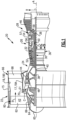
- FIG. 1 schematically illustrates a gas turbine engine 20.
- the gas turbine engine 20 is disclosed herein as a two-spool turbofan that generally incorporates a fan section 22, a compressor section 24, a combustor section 26 and a turbine section 28.
- the fan section 22 drives air along a bypass flow path B in a bypass duct defined within a housing 15 such as a fan case or nacelle, and also drives air along a core flow path C for compression and communication into the combustor section 26 then expansion through the turbine section 28.
- the exemplary engine 20 generally includes a low speed spool 30 and a high speed spool 32 mounted for rotation about an engine central longitudinal axis A relative to an engine static structure 36 via several bearing systems 38. It should be understood that various bearing systems 38 at various locations may alternatively or additionally be provided, and the location of bearing systems 38 may be varied as appropriate to the application.
- the low speed spool 30 generally includes an inner shaft 40 that interconnects, a first (or low) pressure compressor 44 and a first (or low) pressure turbine 46.
- the inner shaft 40 is connected to the fan 42 through a speed change mechanism, which in exemplary gas turbine engine 20 is illustrated as a geared architecture 48 to drive a fan 42 at a lower speed than the low speed spool 30.
- the high speed spool 32 includes an outer shaft 50 that interconnects a second (or high) pressure compressor 52 and a second (or high) pressure turbine 54.
- a combustor 56 is arranged in exemplary gas turbine 20 between the high pressure compressor 52 and the high pressure turbine 54.
- a mid-turbine frame 57 of the engine static structure 36 may be arranged generally between the high pressure turbine 54 and the low pressure turbine 46.
- the mid-turbine frame 57 further supports bearing systems 38 in the turbine section 28.
- the inner shaft 40 and the outer shaft 50 are concentric and rotate via bearing systems 38 about the engine central longitudinal axis A which is colline
- the core airflow is compressed by the low pressure compressor 44 then the high pressure compressor 52, mixed and burned with fuel in the combustor 56, then expanded through the high pressure turbine 54 and low pressure turbine 46.
- the mid-turbine frame 57 includes airfoils 59 which are in the core airflow path C.
- the turbines 46, 54 rotationally drive the respective low speed spool 30 and high speed spool 32 in response to the expansion.
- gear system 48 may be located aft of the low pressure compressor, or aft of the combustor section 26 or even aft of turbine section 28, and fan 42 may be positioned forward or aft of the location of gear system 48.
- the engine 20 in one example is a high-bypass geared aircraft engine.
- the engine 20 bypass ratio is greater than about six (6), with an example embodiment being greater than about ten (10)
- the geared architecture 48 is an epicyclic gear train, such as a planetary gear system or other gear system, with a gear reduction ratio of greater than about 2.3
- the low pressure turbine 46 has a pressure ratio that is greater than about five.
- the engine 20 bypass ratio is greater than about ten (10:1)
- the fan diameter is significantly larger than that of the low pressure compressor 44
- the low pressure turbine 46 has a pressure ratio that is greater than about five 5:1.
- Low pressure turbine 46 pressure ratio is pressure measured prior to inlet of low pressure turbine 46 as related to the pressure at the outlet of the low pressure turbine 46 prior to an exhaust nozzle.
- the geared architecture 48 may be an epicycle gear train, such as a planetary gear system or other gear system, with a gear reduction ratio of greater than about 2.3:1 and less than about 5:1. It should be understood, however, that the above parameters are only exemplary of one embodiment of a geared architecture engine and that the present invention is applicable to other gas turbine engines including direct drive turbofans.
- the fan section 22 of the engine 20 is designed for a particular flight conditiontypically cruise at about 0.8 Mach and about 35,000 feet (10,668 meters).
- the flight condition of 0.8 Mach and 35,000 ft (10,668 meters), with the engine at its best fuel consumption - also known as "bucket cruise Thrust Specific Fuel Consumption ('TSFC')" - is the industry standard parameter of lbm of fuel being burned divided by lbf of thrust the engine produces at that minimum point.
- "Low fan pressure ratio” is the pressure ratio across the fan blade alone, without a Fan Exit Guide Vane (“FEGV”) system.
- the low fan pressure ratio as disclosed herein according to one non-limiting embodiment is less than about 1.45.
- the "Low corrected fan tip speed” as disclosed herein according to one non-limiting embodiment is less than about 1150 ft / second (350.5 meters/second).
- the fan 42 includes at least one row 60 of airfoils or blades 62 that are circumferentially distributed about, and are supported by, a rotatable hub 64.
- the row 60 of blades 62 can extend in a generally spanwise or radial direction R outwardly from the hub 64.
- the radial direction R can be perpendicular to the engine axis A.
- the hub 64 is rotatable in a clockwise or counterclockwise direction RR ( Figure 4 ) about the engine axis A such that the blades 62 deliver airflow to the bypass flow path B and core flow path C in operation.
- the hub 64 is driven by the low pressure (or fan drive) turbine 46 through the geared architecture 48.
- a spinner or nosecone 65 is supported relative to the hub 64 to provide an aerodynamic inner flow path into the fan section 22.
- the fan section 22 includes at least one row 66 of turning or fan exit guide vanes 68.
- the guide vanes 68 are positioned in the bypass flow path B axially aft of the row 60 of blades 62 relative to the engine axis A.
- the row 66 of guide vanes 68 extend in the radial direction R across the bypass flow path B between the fan (e.g., first) case 15 and a core engine (e.g., second case) 17.
- the fan case 15 includes a bypass (e.g., first) duct 19 surrounding the row 60 of blades 62 and the row 66 of guide vanes 68 to establish the bypass flow path B.
- the engine case 17 is dimensioned to extend about and along the engine axis A to at least partially surround and house the compressors 44, 52, combustor 56 and turbines 46, 54.
- the fan case 15 and engine case 17 establish a portion of the engine static structure 36.
- the engine case 17 includes a flow splitter 70 situated downstream and axially aft of the row 60 of blades 62 relative to the engine axis A.
- the flow splitter 70 can have a generally V-shaped cross sectional geometry and is arranged to divide airflow communicated from the row 60 of blades 62 between the bypass flow path B and a second duct 21 establishing the core flow path C.
- the second duct 21 can serve as an entrance or inlet to the compressor section 24 and is bounded by the flow splitter 70.
- each of the blades 62 includes an airfoil body 62A that extends in the radial direction R from the hub 64 ( Figure 1 ) between a root 62R coupled to the hub 64 and a tip 62T.
- Each airfoil body 62A extends axially in an axial or chordwise direction H between a leading edge 62LE and a trailing edge 62TE, and extends circumferentially in a thickness or circumferential direction T between a pressure side 62P and a suction side 62S.
- the directions R, H, T are perpendicular to each other.
- the chordwise direction H can be substantially parallel or transverse to the engine axis A.
- the radial direction R can have a major component that extends generally from or toward an axis of rotation of the blades 62, which in the illustrated example coincides with the engine axis A. It should be understood that the radial direction R can include a minor component in the axial and/or circumferential directions H, T such that the blades 62 have a predefined amount of sweep and/or lean, for example.
- the airfoil body 62A has an exterior airfoil surface 62E providing a contour that extends in the chordwise direction H between the leading and trailing edges 62LE, 62TE.
- the exterior airfoil surface 62E generates lift based upon its geometry and directs flow along the core flow path C and bypass flow path B.
- Each blade 62 can be constructed from a composite material, a metallic material such as steel, an aluminum or titanium alloy, or a combination of one or more of these. Abrasion-resistant coatings or other protective coatings may be applied to the blade 62.
- each of the guide vanes 68 includes an airfoil body 68A that extends in the radial direction R between inner and outer surfaces 19A, 19B of the duct 19, axially in the chordwise direction H between a leading edge 68LE and a trailing edge 68TE, and circumferentially in the thickness direction T between a pressure side 68P and a suction side 68S.
- the inner surfaces 19A of the first duct 19 can be provided by the engine case 17 at a location downstream of the flow splitter 70, as illustrated in Figure 1 .
- the airfoil body 68A has an exterior airfoil surface 68E providing a contour that extends in the chordwise direction H between the leading and trailing edges 68LE, 68TE.
- the exterior airfoil surface 68E can be contoured to direct airflow F ( Figures 2A , 2B ) compressed by the blades 62 through a gas path such as the bypass flow path B.
- the guide vanes 68 can be constructed from a composite material, a metallic material such as steel, an aluminum or titanium alloy, or a combination of one or more of these.
- the guide vanes 68 can serve as a structural component to transfer loads between the fan case 15 and the engine case 17 or another portion of the engine static structure 36.
- the fan section 22 of Figure 1 includes a single stage fan 42 having only one row 60 of blades 62 and only one row 66 of guide vanes 68. In other examples, the fan section 22 has more than one row of blades 62 and/or guide vanes 68 configured with respect to any of the quantities disclosed herein.
- Figures 3-4 schematically illustrate span positions of a blade 62 and guide vane 68, respectively.
- Span positions are schematically illustrated from 0% to 100% in 25% increments, for example, to define a plurality of sections 62C of the blade 62 and a plurality of sections 68C of the guide vane 68.
- Each section 62C, 68C at a given span position is provided by a conical cut that corresponds to the shape of segments of the respective gas path, such as the bypass flowpath B or core flow path C, as shown by the large dashed lines.
- the 0% span position (or zero span) corresponds to the generally radially innermost location where airfoil body 62A meets the fillet joining the airfoil body 62A to an adjacent platform 69 (see also Figure 1 ).
- the 0% span position corresponds to the generally radially innermost location where the discrete platform 69 meets the exterior blade surface 62E of the airfoil body 62A.
- a 100% span position (or full span) corresponds to a section 62C of the blade 62 at the tip 62T.
- the 50% position (or midspan) corresponds to a generally radial position halfway between the 0% and 100% span positions.
- the 0% span position of the vane 68 can correspond to the generally radially innermost location where the exterior surface 68E of the airfoil body 68A meets the inner surfaces 19A of the duct 19.
- the 100% span position can correspond to the generally radially outermost location where the exterior surface 68E of the airfoil body 68A meets the outer surfaces 19B of the duct 19.
- the 50% span position (or midspan) corresponds to a generally radial position halfway between the 0% and 100% span positions.
- each blade 62 is sectioned at a first generally radial position between the root 62R and the tip 62T, and each vane 68 is sectioned at a second generally radial position between the inner and outer surfaces 19A, 19B of the duct 19.
- the first and second radial positions can be the same (e.g., both at 25%, 50% or 100% span) or can differ (e.g., one at 50% and the other at 100% span).
- Airfoil geometric shapes, stacking offsets, chord profiles, stagger angles, axial sweep and dihedral angles, tangential lean angles, bow, and/or other three-dimensional geometries, among other associated features, can be incorporated individually or collectively into the blades 62 and/or guide vanes 68 to improve various characteristics such as aerodynamic efficiency, structural integrity, and vibration mitigation.
- the blades 62 and guide vanes 68 can be arranged at various orientations relative to the engine axis A.
- Each blade 62 establishes a chord dimension BCD.
- Each vane 68 establishes a chord dimension VCD.
- the chord dimension BCD/VCD is a length between the respective leading and trailing edges 62LE/68LE, 62TE/68TE.
- the chord dimension BCD/VCD may vary along the span of the airfoil body 62A/68A.
- the chord BCD/VCD forms a respective stagger angle ⁇ / ⁇ relative to the chordwise direction H or a plane parallel to the engine axis A.
- the stagger angles ⁇ , ⁇ can vary along the airfoil span to define a twist.
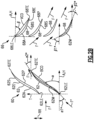
- the blades 62 and guide vanes 68 in Figure 2A may be at a first span position, such as at 0% span, and the blades 62 and guide vanes 68 in Figure 2B may be at a second, different span position, such as at 100% span.
- the stagger angle ⁇ of the blades 62 is larger at 100% span than the stagger angle ⁇ of the blades 62 corresponding to the span position of Figure 2A .
- the stagger angle ⁇ of the blade 62 is greater than or equal to about 5 degrees at 0% span, or more narrowly less than or equal to about 40 degrees, such as between about 10 and 30 degrees at 0% span. In examples, the stagger angle ⁇ is less than or equal to about 70 degrees at 100% span, or more narrowly less than or equal to about 60 degrees, such as between about 30 and 50 degrees at 100% span.
- the stagger angle ⁇ of the vane 68 can be substantially the same from 0% span to 100% span or can differ. In examples, the stagger angle ⁇ is greater than or equal about 10 degrees at 0% span, or more narrowly less than or equal to about 60 degrees, such as between about 20 and 40 degrees at 0% span. In examples, the stagger angle ⁇ is less than or equal about 70 degrees at 100% span, or more narrowly less than or equal to about 60 degrees, such as between about 30 and 50 degrees at 100% span.
- Each of the blades 62 can be cambered.
- a mean camber line 62M bisects the airfoil body 62A between the leading and trailing edges 62LE, 62TE of the blade 62.
- a leading edge metal angle ⁇ 1* at the leading edge 62LE and a trailing edge metal angle ⁇ 2* at the trailing edge 62TE are established with respect to the mean camber line 62M and the chordwise direction H.
- the tip 62T of the blade 62 can rotate at a relatively faster speed, and the stagger of the blade 62 can be aligned with a relative flow direction F' to achieve an optimum incidence of the flow F relative to the leading edge metal angle ⁇ 1* of the blade 62.
- a camber ⁇ 1 of the blade 62 is equal to a difference between the leading edge metal angle ⁇ 1* and the trailing edge metal angle ⁇ 2*.
- the camber ⁇ 1 of the blade 62 can be substantially less at 100% span ( Figure 2B ) than the camber ⁇ 1 of the blade 62 at less than 100% span ( Figure 2A ).
- the camber ⁇ 1 of the airfoil body 62A contour that extends in the chordwise direction H between the leading and trailing edges 62LE, 62TE of the blade 62 can be less than or equal to about 80 degrees at 0% span, or more narrowly less than or equal to about 70 degrees, such as between about 40 and 60 degrees at 0% span.
- the camber ⁇ 1 can be greater than or equal to about 5 degrees at 100% span, or more narrowly less than or equal to about 50 degrees, such as between about 10 and 40 degrees at 100% span.
- Each of the vanes 68 can be cambered.
- a mean camber line 68M bisects the airfoil body 68A between the leading and trailing edges 68LE, 68TE of the vane 68.
- a leading edge metal angle ⁇ 1* at the leading edge 68LE and a trailing edge metal angle ⁇ 2* at the trailing edge 68TE are established with respect to the mean camber line 68M and the chordwise direction H.
- a camber ⁇ 2 of the vane 68 is equal to a difference between the leading edge metal angle ⁇ 1* and the trailing edge metal angle ⁇ 2*.
- the camber ⁇ 2 of the airfoil body 68A contour that extends in the chordwise direction H between the leading and trailing edges 68LE, 68TE of the vane 68 can be greater than or equal to about 5 degrees at 0% span, or more narrowly less than or equal to about 50 degrees, such as between about 10 and 40 degrees at 0% span.
- the camber ⁇ 2 can be less than or equal to about 80 degrees at 100% span, or more narrowly less than or equal to about 70 degrees, such as between about 40 and 60 degrees at 100% span.
- the terms "about” and “approximately” mean ⁇ 3% of the stated value unless otherwise indicated.
- FIG. 5 illustrates a gas turbine engine 120 according to another example.
- the engine 120 includes a fan section 122 including a fan (or rotor) 142, a compressor section 124, a combustor section 126 and a turbine section 128.
- the compressor, combustor and turbine sections 124, 126, 128 establish respective portions of the core flow path C.
- the turbine section 128 drives the fan section 122 and the compressor section 124.
- the compressor section 124 includes a low pressure compressor 144 and a high pressure compressor 152.
- the turbine section 128 includes a low pressure (or fan drive) turbine 146 and a high pressure turbine 154.
- the fan 142 includes at least one row 160 of blades 162 carried by and mounted to a rotatable hub 164.
- the blades 162 are incorporated into a fixed-pitch arrangement in which the blades 162 have a fixed stagger angle ⁇ .
- the blades 162 are incorporated into a variable-pitch arrangement in which the stagger angle ⁇ varies in response to rotation of the blades 162 about a respective blade axis that extends between the blade root 162R and tip 162T.
- the engine 120 can include a geared architecture 148 that drives the fan 142 at a different speed than a speed of the fan drive turbine 146 in operation.
- the geared architecture 148 is an epicyclic gear system such as a planetary gear system having a fixed ring gear and a rotatable carrier, or such as a star gear system having a fixed carrier and a rotatable ring gear.
- the geared architecture 48 can establish a gear reduction ratio of greater than about 2.3 or 2.6, or more narrowly less than about 4.0 or 5.0, for example.
- the geared architecture 148 is omitted such that the fan drive turbine 146 directly drives the fan 142 at a common speed and in a common direction.
- the fan section 122 includes a fan (e.g., first) case 115 including a bypass (e.g., first) duct 119 surrounding the row 160 of blades 162 to establish a bypass (e.g., first) flow path B.
- the engine 120 includes an engine (e.g., second) case 117 that establishes a core (e.g., second) flow path C.
- the engine 120 can include a nacelle 123 and core cowling (or housing) 125.
- the nacelle 123 is mechanically attached or otherwise secured to the fan case 115 and establishes an engine inlet 1231.
- the engine inlet 123I conveys airflow F to the fan 142 in operation.
- the core cowling 125 is mechanically attached or otherwise secured to the engine case 117.
- the core cowling 125 at least partially surrounds the engine case 117.
- the bypass flow path B terminates at a bypass exit (or nozzle) 131 established by a trailing edge of the nacelle 123.
- At least one row 166 of turning or fan exit guide vanes 168 are situated in the bypass duct 119.
- the guide vanes 168 extend in a radial direction R across the bypass flow path B.
- Each guide vane 168 extends in the radial direction R between a 0% span position along an inner surface 119A and a 100% span position along an outer surface 119B of the bypass duct 119.
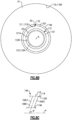
- An airfoil body 168A of the guide vane 168 extends along a longitudinal axis LA, as illustrated in Figure 8C .
- a projection of the longitudinal axis LA intersects the engine axis A to establish a vane angle ⁇ .
- the vane angle ⁇ can be approximately 90 degrees such that the guide vane is substantially perpendicular to the engine axis A, as illustrated by the guide vane 68 of Figure 1 .
- the vane angle ⁇ is less 90 degrees such that the guide vane has a component that extends aftwards in the axial direction from 0% to 100% span with respect to the engine axis A, as illustrated by the guide vane 168 of Figure 8A .
- the vane angle ⁇ can be greater than or equal to 15 degrees, or more narrowly between 30 and 60 degrees, for example.
- blades 162 and guide vanes 168 can be incorporated into the engine 120.
- the row 160 of blades 162 establishes a blade quantity (BQ).
- the row 166 of guide vanes 168 establishes a vane quantity (VQ), which can be the same or can differ from the blade quantity (BQ).
- the blade quantity (BQ) can be less than 24 or 26 blades, or more narrowly at least 12 but not more than 20 blades, such as 14 or 16 blades, for example.
- the vane quantity (VQ) can be no more than 40 guide vanes, or more narrowly at least 20 guide vanes, for example.
- the ratio of VQ/BQ is between 2.0 and 2.6, or more narrowly between 2.2 and 2.5, which may reduce noise due to flow interaction between the blades 162 and guide vanes 168.
- the term "between” is inclusive of the stated value(s) unless otherwise stated.
- the low pressure compressor 144 can include at least 3 but no more than 5 compressor stages, such as 3 compressor stages as illustrated by Figures 1 and 5 .
- the low pressure turbine 146 includes at least 3 but no more than 6 turbine stages, such as 3 turbine stages as illustrated by Figure 5 , 4 turbine stages, or 5 turbine stages as illustrated by Figure 1 .
- the high pressure turbine 154 can include a single stage, or can include two stages as illustrated by Figures 1 and 5 , for example.
- a ratio between the blade quantity (BQ) and a quantity of the stages of the low pressure turbine 146 can be between about 3.3 and about 8.6, or more narrowly less than or equal to about 4.0, such as about 3.5.
- the example low pressure turbine 146 provides the driving power to rotate the fan 142 and therefore the relationship between the number of turbine stages of the low pressure turbine 146 and the blade quantity (BQ) disclose an example gas turbine engine 120 with increased power transfer efficiency.
- the engine 120 includes a core bypass (or third) duct 127 established between the engine case 117 and core cowling 125.
- the core bypass duct 127 establishes an intermediate (or third) flow path I.
- the core bypass duct 127 can be a separate and distinct structure or can be established by a volume of the core engine bay between the engine core and core cowling 125.
- the core bypass duct 127 can be coupled to an annular core vent port (or nozzle) 129 established along an outer periphery of the core cowling 125.
- the guide vanes 168 are an axially aftmost row of fan exit guide vanes in the bypass flow path B between the row 160 of blades 162 and the bypass exit 131 relative to the engine axis A.
- one or more rows of vanes are arranged in the bypass flow path B axially forward and/or aft of the row 166 of guide vanes 168.
- the hub 164 is rotatable about the engine axis A such that the row 160 of blades 162 deliver or convey airflow to the bypass, intermediate and core flow paths B, I, C in operation.
- the engine 120 includes a first flow splitter 170 and a second flow splitter 172 arranged in a cascade.
- the flow splitters 170, 172 are situated downstream and axially aft of the row 160 of blades 162 relative to the engine axis A.
- the first flow splitter 170 can be incorporated into or mechanically attached to the core cowling 125.
- the second flow splitter 172 can be incorporated into or mechanically attached to the engine case 117.
- the first flow splitter 170 establishes a portion of the bypass duct 119 and a portion of the second duct 121.
- the second flow splitter 172 establishes a portion of the second duct 121 and a portion of an entrance (e.g., fourth) duct 133.
- the entrance duct 133 can establish an entrance or inlet to the compressor section 124.
- the first flow splitter 170 is arranged to divide airflow conveyed by the row 160 of blades 162 between the bypass flow path B and the second duct 121.
- the second flow splitter 172 is radially inboard of the first flow splitter 170 relative to the engine axis A.
- the second duct 121 branches between the core flow path C and the intermediate flow path I at the second flow splitter 172.
- the second flow splitter 172 is arranged to divide airflow conveyed to the second duct 121 between the intermediate flow path I and the core flow path C along the entrance duct 133.
- the flow splitters 170, 172 can have a generally V-shaped cross sectional geometry dimensioned to divide the airflow.
- a bypass port 174 is established along an outer periphery 125P of the core cowling 125.
- the bypass port 174 interconnects the intermediate flow path I and bypass flow path B at a position downstream of the row 166 of guide vanes 168 relative to a general direction of airflow through the bypass flow path B such that airflow conveyed by the intermediate flow path I through the bypass port 174 bypasses or otherwise is not communicated across the guide vanes 168 in operation.
- the bypass port 174 can interconnect the intermediate flow path I and bypass flow path B at a position axially aft of the 0% span position of the row 166 of guide vanes 168 relative to the engine axis A.
- the vent port 129 is established downstream and axially aft of both the bypass port 174 and the bypass exit 131 relative to the engine axis A. In other examples, the vent port 129 is established upstream and axially forward of the bypass exit 131 such that airflow in the bypass flow path B mixes in the bypass duct 119 with airflow conveyed by the vent port 129 prior to exiting the bypass exit 131.
- louvers 176 can be situated in the bypass port 174.
- the louvers 176 can have a generally airfoil-shaped cross sectional geometry and are arranged to direct airflow from the intermediate flow path I into the bypass flow path B in a direction generally downstream of the guide vanes 168 and toward the bypass exit 131.
- the engine 120 can establish an adaptive fan flow arrangement in which a relative distribution of airflow conveyed by the fan 142 to the flow paths B, I and/or C varies during one or more modes.
- One or more blocker doors 178 can be moved between opened and closed positions to selectively communicate airflow through the bypass port 174 (open and closed positions indicated in dashed lines at 184, 184' of Figure 8A for illustrative purposes).
- the engine 120 includes one or more blocker doors 178 situated in the core bypass duct 127 to modulate airflow through the intermediate flow path I.
- the blocker doors 178 are situated in the intermediate flow path I downstream of the bypass port 174.
- the blocker doors 178 are moveable between a closed position ( Figure 5 ) and an open position ( Figure 6 ) to selectively communicate airflow in the intermediate flow path I downstream to the vent port 129.
- the blocker doors 178 at least partially or substantially block airflow through the intermediate flow path I in the closed position.
- the blocker doors 178 are pivotable flaps having a pivot point established along the core bypass duct 127.
- the nacelle 123 can include at least one thrust reverser 180 and/or a variable area fan nozzle (VAFN) 182 for adjusting various characteristics of the bypass flow.
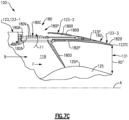
- Figure 7A illustrates the thrust reverser 180 and the variable area fan nozzle 182 in stowed positions.
- Figure 7B illustrates the thrust reverser 180 in the stowed position and the variable area fan nozzle 182 in a deployed position.
- Figure 7C illustrates the thrust reverser 180 in a deployed position and the variable area fan nozzle 182 in the stowed position.
- the nacelle 123 includes a stationary portion 123-1 mounted to the fan case 115, a first moveable portion 123-2 and a second movable portion 123-3.
- the moveable portions 123-2, 123-3 are moveable relative to the stationary portion 123-1 and relative to each other.
- the thrust reverser 180 is operable to convey airflow in the bypass flow path B for producing reverse thrust such as during approach and/or landing conditions of an aircraft associated with the engine 120.
- the thrust reverser 180 includes a thrust reverser body 180B, which is configured with the first moveable portion 123-2 of the nacelle 123.
- the thrust reverser body 180B may have a generally tubular geometry.
- the thrust reverser 180 can include one or more blocker doors 180D, one or more actuators 180A, and/or one or more cascades 180C of turning vanes 180V arranged circumferentially about the engine axis A.
- the thrust reverser body 180B can include at least one recess 180R that houses the cascades 180C and the actuators 180A when the thrust reverser 180 is in the stowed position.
- the cascades 180C are dimensioned to span across a reversal port 180P when the thrust reverser 180 is in the deployed position, as illustrated by Figure 7C .
- the cascade 180C selectively communicates airflow from the bypass duct 119 outwardly through the reversal port 180P in the deployed position.
- the cascade 180C can extend axially aft of both the row 166 of guide vanes 168 and the bypass port 174 with respect to the engine axis A, and the row 168 of guide vanes 168 can be situated axially forward of the blocker doors 180D relative to the engine axis A, as illustrated by Figures 5-6 .
- Each blocker door 180D is pivotally connected to the thrust reverser body 180B.
- the bypass port 174 can be established axially forward of the blocker doors 180D with respect to the engine axis A, as illustrated in Figures 5-6 .
- the actuators 180A are operable to axially translate the thrust reverser body 180B between the stowed and deployed positions. As the thrust reverser body 180B translates aftwards, the blocker doors 180B pivot radially inward into the bypass duct 119 and divert at least some or substantially all of the bypass airflow F as flow F1 through the cascades 180C to provide the reverse engine thrust, as illustrated in Figure 7C .
- the cascades 180C are configured to translate axially with a respective thrust reverser body 180B.
- the thrust reverser body 180B and/or cascades 180C can include one or more circumferential segments that synchronously or independently translate or otherwise move between deployed and stowed positions.
- the variable area fan nozzle 182 includes a nozzle body 182B and one or more actuators 182A.
- the nozzle body 182B is configured with the second movable portion 123-3 of the nacelle 123, and is arranged radially within and may nest with the thrust reverser body 180B.
- the nozzle body 182B may have a generally tubular geometry that extends about an axially contoured outer periphery 125P of the core cowling 125.
- the actuators 182A are operable to axially translate the nozzle body 182B between the stowed position of Figure 7A and the deployed position of Figure 7B .
- a radial distance RD of the bypass exit 131 between a trailing edge or aft end 123TE of the nacelle 123 and the outer periphery 125P of the core cowling 125 established at the stowed position may change (e.g., increase) to a radial distance RD' and thereby change (e.g., increase) a flow area of the bypass exit 131.
- the variable area fan nozzle 182 may adjust a pressure drop or ratio across the bypass flowpath B defined by the bypass duct 119 by changing the flow area of the bypass exit 131.
- the variable area fan nozzle 182 can define or otherwise include at least one auxiliary port 182P to vary the bypass flow.
- the auxiliary port 182P can be established in the nozzle body 182B, as illustrated by Figures 7A-7C .
- the auxiliary port 182P is moveable relative to a trailing edge portion 123P of the first moveable portion 123-1 of the nacelle 123 to selectively block and open the auxiliary port 182P.
- the auxiliary port 182P is opened as the nozzle body 182B translates axially aftwards relative to the engine axis A.
- a flow area through the auxiliary port 182P augments the flow area of the bypass exit 131, thereby increasing an effective flow area of the variable area fan nozzle 182.
- variable area fan nozzle 182 therefore may adjust a pressure drop or ratio across the bypass flowpath B defined by the bypass duct 119 while translating the nozzle body 182B over a relatively smaller axial distance.
- the variable area fan nozzle 182 is omitted.
- the blades 162 can be dimensioned to provide a relatively radially compact engine arrangement.
- Each of the blades 162 extends in the radial direction R between a 0% span position at the hub 164 and a 100% span position at a tip 162T.
- a tip radius RT of the blades 162 is established between a radially outermost portion of the tip 162T and the engine axis A.
- a forwardmost portion of a leading edge 162LE of each the blades 162 is arranged along a first reference plane REF1.
- the first reference plane REF1 is perpendicular to the engine axis A.
- a hub radius RH is established along the first reference plane REF1 between an outer periphery of the hub 164 and the engine axis A.
- the tip radius RT can be between 35 and 60 inches (889 and 1,524mm), or more narrowly between 40 and 55 inches (1,016 and 1,397mm), for example.
- Each of the blades 162 extends in the radial direction R between the 0% span position and the 100% span position to establish a geometric hub-to-tip ratio (RH:RT).
- the hub-to-tip ratio (RH:RT) can be less than or equal to about 0.4, or more narrowly greater than or equal to about 0.1, measured relative to the forwardmost portion of the leading edge 162LE of the blades 162.
- the hub-to-tip ratio (RH:RT) is between 0.16-0.36, or more narrowly between 0.2-0.3.
- the hub-to-tip ratio (RH:RT) is established such that a maximum value of the fan pressure ratio across the blade 162 alone is less than or about equal to about 1.45 measured at cruise at 0.8 Mach and 35,000 feet (10,668m). In further examples, a maximum value of the fan pressure ratio is greater than or equal to about 1.1, or more narrowly less than or equal to about 1.35.
- the fan pressure ratios and hub-to-tip ratios disclosed herein can be utilized alone or in combination to establish relatively high bypass turbo fan engine arrangements.
- the flow splitters 170, 172 are arranged at respective positions relative to each other and the row 160 of blades 162 to establish a predetermined distribution of airflow through the bypass, intermediate and core flow paths B, I, C in operation.
- a forwardmost edge 170F of the first flow splitter 170 is situated in the radial and axial directions R, H at a first splitter position P1 relative to the engine axis A.
- the first splitter position P1 is established along a second reference plane REF2.
- a forwardmost edge 172F of the second flow splitter 172 is situated in the radial and axial directions R, H at a second splitter position P2 relative to the engine axis A.
- the second splitter position P2 is established along a third reference plane REF3.
- the reference planes REF2, REF3 are perpendicular to the engine axis A.
- the reference planes REF2, REF3 are established at different positions relative to the engine axis A to establish a cascade arrangement.
- the forwardmost edge 172F of the second flow splitter 172 is axially aft of the forwardmost edge 170F of the first flow splitter 170 with respect to the engine axis A.
- the forwardmost edges 170F, 172F of the flow splitters 170, 172 are axially forward of the leading edges 168LE of the row 166 of guide vanes 168 at the 0% span position with respect to the engine axis A.
- the forwardmost edges 170F, 172F can be dimensioned to extend axially forward of the geared architecture 148 relative to the engine axis A, as illustrated by Figure 8A , which can establish a relatively compact core engine arrangement.
- a first annulus area A1 is established by, and between, inner and outer diameter surfaces 119A, 119B of the bypass duct 119 at the forwardmost edge 170F of the first flow splitter 170.
- a second annulus area A2 is established by, and between, inner and outer diameter surfaces 121A, 121B of the second duct 121 at the forwardmost edge 170F of the first flow splitter 170.
- a third annulus area A3 is established by, and between, inner and outer diameter surfaces 133A, 133B of the entrance duct 133 at the second flow splitter 172.
- the annulus areas A1, A2, A3 extend about the engine axis A to establish a portion of the respective flow paths B, I, C.
- the annulus areas A1, A2, A3 can be dimensioned to establish a predetermined distribution of airflow to the flow paths B, I, C in operation.
- a first geometric bypass area ratio (A1:A2) associated with the first flow splitter 170 is defined as the first annulus area A1 divided by the second annulus area A2.
- a second geometric bypass area ratio (A1:A3) associated with the second flow splitter 172 is defined as the first annulus area A1 divided by the third annulus area A3.
- the annulus areas A1, A2, A3 can be dimensioned to establish a predetermined value of the first bypass area ratio (A1: A2) and a predetermined value of the second bypass area ratio (A1:A3).
- the first bypass area ratio (A1:A2) is greater than or equal to about 10 to establish a relatively high bypass turbo fan arrangement. In examples, the first bypass area ratio (A1:A2) is less than or equal to about 35, or more narrowly less than or equal to about 20.
- the second bypass area ratio (A1:A3) is greater than the first bypass area ratio (A1:A2).
- a value of the second bypass area ratio (A1:A3) can be between about 150-250% of the first bypass area ratio (A1:A2), such as approximately twice or 200% of the first bypass area ratio (A1:A2).
- the second bypass area ratio (A1:A3) is greater than or equal to about 15, or more narrowly greater than or equal to about 20.
- the forwardmost edges 170F, 172F of the flow splitters 170, 172 can be dimensioned relative to a span of the blades 162 to establish the predetermined distribution of airflow through the bypass, intermediate and core flow paths B, I, C in operation.
- the first splitter position P1 can be radially aligned with or radially inward of a 25% span position of the blades 162, or more narrowly can be radially aligned with or radially outward of a 10% span position of the blades 162 relative to the radial direction R, such as between about 16-22% span.
- the second splitter position P2 can be radially aligned with or radially outward of a 5% span position of the blades 162, or more narrowly can be radially aligned with or radially inward of a 15% span position of the blades 162 relative to the radial direction R, such as between about 8-13% span.
- the splitter positions P1, P2 can be established at a radial distance of at least 5% span apart from each other relative to the blades 162 such that a relatively larger amount of airflow is communicated to the intermediate flow path I and bypasses the guide vanes 168.
- the radial distance between the splitter positions P1, P2 is between about 6-12% span, relative to the blades 162.
- the blades 162 can have any of the stagger angles ⁇ and/or camber ⁇ values disclosed herein at the respective spanwise positions of the first splitter position P1 and/or second splitter position P2 to convey airflow in a predetermined direction towards the splitters 170, 172, which can improve efficiency.
- the guide vanes 168 and flow splitters 170, 172 can be arranged relative to the fan blades 162 to establish a relatively axially compact envelope.
- the leading edges 162LE of the blades 162 at the 100% span position are established along a fourth reference plane REF4.
- the leading edges 168LE of the guide vanes 168 at the 100% span position are established along a fifth reference plane REF5.
- the reference planes REF4, REF5 are perpendicular to the engine axis A.
- a first axial length L1 is established between the reference planes REF4, REF5.
- a ratio (LLRT) of the first axial length L1 divided by the tip radius RT is greater than or equal to about 0.5, which can reduce fan noise propagation through the bypass flow path B.
- the ratio (LLRT) can be less than or equal to about 0.75, which can establish a relatively axially compact fan section.
- a second axial length L2 is established between the first and second splitter positions P1, P2 along the reference planes REF2, REF3 relative to the engine axis A.
- a ratio (L2:L1) of the second axial length L2 divided by the first axial length L1 is less than or equal to about 0.5, or more narrowly between about 0.1 and about 0.3, which can further establish a relatively axially compact engine.
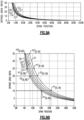
- Figure 9A illustrates a plot of bypass area ratio relative to airfoil span position, such as span positions of the blades 162.
- Figure 9B illustrates selected portions of Figure 9A .
- Example profiles or curves C1-C6 are shown.
- the curves C1-C6 correspond to fan or rotor arrangements having hub-to-tip ratios (RH:RT) of 0.16, 0.20, 0.24, 0.28, 0.32, 0.36, respectively.
- the fan 142 can be dimensioned to establish any of the hub-to-tip ratios (RH:RT) and corresponding values along the curves C1-C6.
- Each curve C1-C6 can be established as function of annulus area associated with respective bypass area ratios.
- the plot of curves C1-C6 can serve as a nomograph utilized to select radial locations of the first and second positions P1, P2 of the flow splitters 170, 172 with respect to hub-to-tip (RH:RT) ratio and/or bypass area ratio (A1:A2), (A1:A3), or vice versa.
- the fan 142 can establish a hub-to-tip (RH:RT) ratio of 0.16 corresponding to the curve C1.
- the radial location of the first and second splitter positions P1, P2 of the flow splitters 170, 172 correspond to points P1 (0.16) , P2( 0.16 ) selected along the curve C1.
- the points P1 (0.16) , P2( 0.16 ) can be selected with respect to a predetermined bypass area ratio.
- point P1 (0.16) of the first flow splitter 170 can be established in the radial direction R at about a 21.5% span position of the blades 162.
- Point P1 (0.16) corresponds to a first bypass area ratio (A1:A2) of about 10 and a mass average fan pressure ratio of about 1.260.
- the radial location of the second flow splitter 172 can be determined by assuming analytically that the second flow splitter 172 is the first flow splitter 170 (e.g., a single flow splitter arrangement).
- Point P2( 0.16 ) of the second flow splitter 172 can be established in the radial direction R at about a 13.1% span position of the blades 162.
- Point P2 (0.16) corresponds to a second bypass area ratio (A1:A3) of about 20 and a mass average fan pressure ratio of about 1.225.
- mass average fan pressure ratio is defined as an average pressure ratio across the blades 162 alone measured at cruise at 0.8 Mach and 35,000 feet between the 0% span position and the corresponding span position of the respective splitter 170, 172.
- the mass across the blades 162 associated with the mass average fan pressure ratio is approximately equal to the amount of the mass captured by the respective splitter 170, 172.
- the fan 142 can establish a hub-to-tip (RH:RT) ratio of 0.36 corresponding to the curve C6.
- the radial location of the first and second splitter positions P1, P2 of the flow splitters 170, 172 correspond to points P1 (0.36) , P2 (0.36) selected along the curve C6.
- Point P1 (0.36) of the first flow splitter 170 can be established in the radial direction R at about a 15.5% span position of the blades 162.
- Point P1 (0.36) corresponds to a first bypass area ratio (A1:A2) of about 10 and a mass average fan pressure ratio of about 1.260.
- Point P2 (0.36) of the second flow splitter 172 can be established in the radial direction R at about a 7.6% span position of the blades 162.
- Point P2( 0.36 ) corresponds to a second bypass area ratio (A1:A3) of about 20 and a mass average fan pressure ratio of about 1.185.
- the flow splitters 170, 172 and other portions of the fan section 122 can be dimensioned with respect to any other values along the curves C1-C6.
- points P1' (0.16) , P2' (0.16) can be established along the curve C1 at about 11.0% and about 7.6% span corresponding to first and second bypass area ratios (ALA2), (ALAS) of about 25 and 35, respectively.
- points P1' (0.36) , P2' (0.36) can be established along the curve C6 at about 7.0% and about 5.5% span corresponding to first and second bypass area ratios (A1:A2), (A1:A3) of about 20 and 35, respectively.
- a lower hub-to-tip ratio (RH:RT) can result in the splitter positions P1, P2 of the splitters 170, 172 being relatively further away from the 0% span position of the blades 162.
- the splitters 170, 172 can be dimensioned with respect to relatively lower % span positions to establish relatively larger bypass area ratios, as illustrated by the curves C1-C6 of Figure 9B .
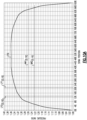
- Figure 10A illustrates a plot of fan pressure ratio relative to airfoil span position, such as span positions of the blades 162.
- Figure 10B illustrates selected portions of the plot of Figure 10B .
- Curve PR1 corresponds to discrete fan pressure ratios at each span position.
- Lines LP1 (0.16) , LP2 (0.16) correspond to the splitter positions P1 (0.16) , P2 (0.16) of the splitters 170, 172 associated with a hub-to-tip ratio (RH:RT) equal to 0.16.
- Lines MA1 (0.16) , MA2 (0.16) are the mass averaged fan pressure ratios corresponding to the respective splitter positions P1 (0.16) , P2 (0.16) .
- Figure 10B depicts a curve PR1 (INT) representing a spanwise integration of the discrete fan pressure ratios of curve PR1.
- An intersection of the lines LP1( 0.16 ), LP2( 0.16 ) corresponding to the points P1 (0.16) , P2 (0.16) and the curve PR1 (INT) establish a position of the respective lines MA1 (0.16) , MA2 (0.16) relative to the y-axis.
- lines MA1 (0.16) , MA2 (0.16) correspond to mass average fan pressure ratios of 1.260 and 1.225, respectively, which correspond to values previously discussed with respect to the points P1 (0.16) , P2( 0.16 ) along the curve C1 of Figure 9B .
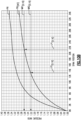
- Figure 11 illustrates another plot of fan pressure ratio relative to airfoil span position, such as span positions of the blades 162.
- Curve PR2 corresponds to discrete fan pressure ratios at each span position of the blade 162.
- Lines LP1 (0.36) , LP2 (0.36) correspond to splitter positions P1 (0.36) , P2 (0.36) of the splitters 170, 172 associated with a hub-to-tip ratio (RH:RT) equal to 0.36.
- RH:RT hub-to-tip ratio
- lines MA1 (0.36) , MA2 (0.36) correspond to mass average fan pressure ratios of 1.260 and 1.185, respectively, which correspond to values previously discussed with respect to the points P1 (0.36) , P2( 0.36 ) along the curve C6 of Figure 9B .
- the engine 120 can include a controller CONT (shown in dashed lines in Figure 5 for illustrative purposes).
- the controller CONT is operable to cause the blocker doors 178, 184, thrust reverser 180 and variable area fan nozzle 182 to move between the various disclosed positions or modes.
- the controller CONT can include one or more computing devices, each having one or more of a computer processor, memory, storage means, network device and input and/or output devices and/or interfaces according to some example.
- the memory may, for example, include UVPROM, EEPROM, FLASH, RAM, ROM, DVD, CD, a hard drive, or other computer readable medium which may store data and/or the algorithms corresponding to the various functions of this disclosure.
- the controller CONT is an analog or electromechanical device configured to provide the disclosed functions of this disclosure.
- the controller CONT can be a portion of a full-authority digital electronic control FADEC or an electronic engine control (EEC), another system, or a stand-alone system located within the aircraft remote from the engine 120.
- EEC electronic engine control
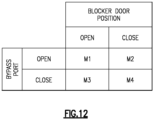
- Figure 12 illustrates a plurality of discrete modes M1-M4 established by the position of the blocker door(s) 178 and position of the blocker door(s) 184 across the bypass port 174.
- the controller CONT can be programmed with logic or otherwise configured to cause the engine 120 to execute each of the modes M1-M4.
- modes M1 and M3 the blocker doors 178 are stowed to establish an open position to at least partially communicate airflow through vent port 129.
- modes M2 and M4 the blocker doors 178 are deployed to establish a closed position to at least partially block airflow from being communicated to the vent port 129.
- bypass port 174 is open or uncovered to at least partially communicate airflow from the intermediate flow path I to the bypass flow path B.
- the bypass port 174 is closed or covered to at least partially block airflow being communicated from the intermediate flow path I to the bypass flow path B.
- the engine 120 can be operated in the first mode M1 during takeoff, for example, which may be associated with relatively lower engine inlet airflow such that the fan 142 communicates relatively more airflow which may improve fan stability.
- the engine 120 can be operated in the first mode M1 and/or the second mode M2 during cruise, for example.
- the engine 120 can be operated in the second mode M2 during a beginning of climb condition to increase fan pressure ratio and generate relatively greater thrust.
- the thrust reverser 180 can be deployed during the second mode M2, for example, to increase an amount of airflow being communicated to the bypass flow path to the thrust reverser 180 for generating reverse thrust.
- the engine 120 can be operated in the third mode M3 during a middle of climb condition (i.e., between beginning climb and top of climb).
- the engine 120 can be operated in the fourth mode M4 during a top of climb condition to increase airflow to the core flow path C and bypass flow path B to maximize or otherwise increase thrust.
- the modes M1-M4 are exemplary and it should be appreciated the blocker door(s) 178 and bypass port 174 can be configured to establish fewer or more than four modes.
- the controller CONT can be coupled to one or more sensors to determine any of the conditions disclosed herein, such as temperature, pressure and/or speed sensors operable to measure various conditions or states of the engine 120. Temperature and/or pressure sensors can be situated along the bypass, intermediate and/or core flow paths B, I, C, for example. Speed sensors can be situated adjacent to the rotors to determine a speed of the fan rotor, low spool, and/or high spool, for example. The controller CONT can utilize other data and information to determine any of the conditions disclosed herein, including aircraft velocity, altitude and throttle position. One would understand how to situate the sensors and program or otherwise configure the controller CONT with logic to obtain data and other information from the sensors and other systems in view of the teachings disclosed herein.
- the engine 120 can be operated as follows. Referring to Figure 5 , the fan 142 is driven by the fan drive turbine 146 such that the blades 162 deliver airflow to the bypass, intermediate and core flow paths B, I, C. Driving the fan 142 can include driving the hub 164 of the fan 142 through the geared architecture 148 at a different speed than a speed of the fan drive turbine 146.
- the engine 120 can be operated in any of the modes disclosed herein, including the modes M1-M4 of Figures 12 . Airflow in the intermediate flow path I can be ejected from the bypass port 174 into the bypass flow path B to bypass the guide vanes 168.
- One or more blocker doors 178 can be selectively moved between open and closed positions to at least partially block airflow from the intermediate flow path I being communicated downstream to the core bypass duct 127 and vent port 129.
- One or more of the blocker doors 184 can be moved between open and closed positions to selectively communicate airflow through the bypass port 174 (184 shown in dashed lines in Figure 8A for illustrative purposes).
- an operating line of the fan 142 at an operating condition such as takeoff can be shifted relatively further away from the stall line by upflowing the fan 142 in response to selectively communicating airflow to the vent port 129.
- One or more of the blocker doors 178 can be selectively moved to the open position to communicate airflow in the intermediate flow path I downstream to the vent port 129.
- Airflow communicated to the core bypass duct 127 can be ejected from the vent port 129 downstream of the bypass port 174 and/or bypass exit 131.
- the disclosed splitter arrangements can improve aerodynamic loading and efficiency of the guide vanes, including lowering inlet Mach number to the guide vanes and improving aerodynamic diffusion in the guide vanes.
- the disclosed splitter arrangements can improve blade and guide vane performance near 0% span, which can be utilized to achieve a relatively more efficient spanwise pressure ratio across the entire span of the blade and the entire span of the guide vane.
- Engines made with the disclosed architecture, and including arrangements as set forth in this application, and with modifications coming from the scope of the claims in this application, thus provide very high efficient operation, relatively high stall margins, and are compact and lightweight relative to their thrust capability.
- Two-spool and three-spool direct drive engine architectures can also benefit from the teachings herein.
Landscapes
- Engineering & Computer Science (AREA)
- Mechanical Engineering (AREA)
- General Engineering & Computer Science (AREA)
- Chemical & Material Sciences (AREA)
- Combustion & Propulsion (AREA)
- Structures Of Non-Positive Displacement Pumps (AREA)
- Physics & Mathematics (AREA)
- Fluid Mechanics (AREA)
Description
- This disclosure relates generally to flow distribution for gas turbine engines, and more particularly to arranging guide vanes relative to one or more flow splitters.
- Gas turbine engines can include a fan section, a compressor section, a combustor section and a turbine section. The fan section includes a fan having fan blades for compressing a portion of incoming air to produce thrust and also for delivering a portion of air to the compressor section. Air entering the compressor section is compressed and delivered into the combustor section where it is mixed with fuel and ignited to generate a high-speed exhaust gas flow. The high-speed exhaust gas flow expands through the turbine section to drive the compressor section and the fan.
- Some fan sections may include guide vanes positioned in a bypass flow path downstream of the fan blades and a flow splitter. The guide vanes may direct the bypass airflow from the fan blades before being ejected from the bypass flow path.
-
GB 2 165 892 A -
WO 2015/0060005 A1 -
WO 2011/038213 A1 discloses a prior art convertible fan engine with a fan system having a front stage fan rotor, an aft fan rotor, a core, an annular inner bypass passage and an annular outer bypass passage. -
EP 3 489 461 A2 discloses a prior art gas turbine engine with a fan having blades with a camber distribution relative to a covered passage of the fan. - According to a first aspect of the present invention, there is provided a gas turbine engine as set forth in claim 1. According to a further aspect of the present invention, there is provided a method of operation for a gas turbine engine as set forth in
claim 12. Further embodiments are provided as set forth in dependent claims 2-11 and 13. - The various features and advantages of this disclosure will become apparent to those skilled in the art from the following detailed description. The drawings that accompany the detailed description can be briefly described as follows.
-
-
Figure 1 illustrates a gas turbine engine. -
Figure 2A illustrates an example arrangement of blades and guide vanes at a span position. -
Figure 2B illustrates an example arrangement of blades and guide vanes at another span position. -
Figure 3 is a schematic view of airfoil span positions for a blade. -
Figure 4 is a schematic view of airfoil span positions for a guide vane. -
Figure 5 illustrates a gas turbine engine according to another example including blocker doors in a closed position. -
Figure 6 illustrates the blocker doors ofFigure 5 in an opened position. -
Figure 7A is a partial cross section view of a thrust reverser and a variable area nozzle in stowed positions. -
Figure 7B is a partial cross section view of the thrust reverser ofFigure 7A in the stowed position and the variable area nozzle ofFigure 7A in a deployed position. -
Figure 7C is a partial cross section view of the thrust reverser and the variable area nozzle ofFigure 7A in deployed positions. -
Figure 8A illustrates a section of the engine ofFigure 5 . -
Figure 8B illustrates a sectional view taken alongline 8B-8B ofFigure 8A . -
Figure 8C illustrates an exemplary guide vane. -
Figure 9A illustrates an example plot of bypass area ratio with respect to span position. -
Figure 9B illustrates selected portions of the plot ofFigure 9A . -
Figure 10A illustrates an example plot of fan pressure ratio with respect to span position. -
Figure 10B illustrates selected portions of the plot ofFigure 10A . -
Figure 11 illustrates another example plot of fan pressure ratio with respect to span position. -
Figure 12 illustrates exemplary engine modes. - Like reference numbers and designations in the various drawings indicate like elements.
-
Figure 1 schematically illustrates agas turbine engine 20. Thegas turbine engine 20 is disclosed herein as a two-spool turbofan that generally incorporates afan section 22, acompressor section 24, acombustor section 26 and aturbine section 28. Thefan section 22 drives air along a bypass flow path B in a bypass duct defined within ahousing 15 such as a fan case or nacelle, and also drives air along a core flow path C for compression and communication into thecombustor section 26 then expansion through theturbine section 28. Although depicted as a two-spool turbofan gas turbine engine in the disclosed non-limiting embodiment, it should be understood that the concepts described herein are not limited to use with two-spool turbofans as the teachings may be applied to other types of turbine engines including three-spool architectures. - The
exemplary engine 20 generally includes alow speed spool 30 and ahigh speed spool 32 mounted for rotation about an engine central longitudinal axis A relative to an enginestatic structure 36 viaseveral bearing systems 38. It should be understood thatvarious bearing systems 38 at various locations may alternatively or additionally be provided, and the location ofbearing systems 38 may be varied as appropriate to the application. - The
low speed spool 30 generally includes aninner shaft 40 that interconnects, a first (or low)pressure compressor 44 and a first (or low)pressure turbine 46. Theinner shaft 40 is connected to thefan 42 through a speed change mechanism, which in exemplarygas turbine engine 20 is illustrated as a gearedarchitecture 48 to drive afan 42 at a lower speed than thelow speed spool 30. Thehigh speed spool 32 includes anouter shaft 50 that interconnects a second (or high)pressure compressor 52 and a second (or high)pressure turbine 54. Acombustor 56 is arranged inexemplary gas turbine 20 between thehigh pressure compressor 52 and thehigh pressure turbine 54. Amid-turbine frame 57 of the enginestatic structure 36 may be arranged generally between thehigh pressure turbine 54 and thelow pressure turbine 46. Themid-turbine frame 57 further supports bearingsystems 38 in theturbine section 28. Theinner shaft 40 and theouter shaft 50 are concentric and rotate viabearing systems 38 about the engine central longitudinal axis A which is collinear with their longitudinal axes. - The core airflow is compressed by the
low pressure compressor 44 then thehigh pressure compressor 52, mixed and burned with fuel in thecombustor 56, then expanded through thehigh pressure turbine 54 andlow pressure turbine 46. Themid-turbine frame 57 includesairfoils 59 which are in the core airflow path C. Theturbines low speed spool 30 andhigh speed spool 32 in response to the expansion. It will be appreciated that each of the positions of thefan section 22,compressor section 24,combustor section 26,turbine section 28, and fandrive gear system 48 may be varied. For example,gear system 48 may be located aft of the low pressure compressor, or aft of thecombustor section 26 or even aft ofturbine section 28, andfan 42 may be positioned forward or aft of the location ofgear system 48. - The
engine 20 in one example is a high-bypass geared aircraft engine. In a further example, theengine 20 bypass ratio is greater than about six (6), with an example embodiment being greater than about ten (10), the gearedarchitecture 48 is an epicyclic gear train, such as a planetary gear system or other gear system, with a gear reduction ratio of greater than about 2.3 and thelow pressure turbine 46 has a pressure ratio that is greater than about five. In one disclosed embodiment, theengine 20 bypass ratio is greater than about ten (10:1), the fan diameter is significantly larger than that of thelow pressure compressor 44, and thelow pressure turbine 46 has a pressure ratio that is greater than about five 5:1.Low pressure turbine 46 pressure ratio is pressure measured prior to inlet oflow pressure turbine 46 as related to the pressure at the outlet of thelow pressure turbine 46 prior to an exhaust nozzle. The gearedarchitecture 48 may be an epicycle gear train, such as a planetary gear system or other gear system, with a gear reduction ratio of greater than about 2.3:1 and less than about 5:1. It should be understood, however, that the above parameters are only exemplary of one embodiment of a geared architecture engine and that the present invention is applicable to other gas turbine engines including direct drive turbofans. - A significant amount of thrust is provided by the bypass flow B due to the high bypass ratio. The
fan section 22 of theengine 20 is designed for a particular flight conditiontypically cruise at about 0.8 Mach and about 35,000 feet (10,668 meters). The flight condition of 0.8 Mach and 35,000 ft (10,668 meters), with the engine at its best fuel consumption - also known as "bucket cruise Thrust Specific Fuel Consumption ('TSFC')" - is the industry standard parameter of lbm of fuel being burned divided by lbf of thrust the engine produces at that minimum point. "Low fan pressure ratio" is the pressure ratio across the fan blade alone, without a Fan Exit Guide Vane ("FEGV") system. The low fan pressure ratio as disclosed herein according to one non-limiting embodiment is less than about 1.45. "Low corrected fan tip speed" is the actual fan tip speed in ft/sec divided by an industry standard temperature correction of [(Tram °R) / (518.7 °R)]0.5 (where °R = K x 9/5). The "Low corrected fan tip speed" as disclosed herein according to one non-limiting embodiment is less than about 1150 ft / second (350.5 meters/second). - The
fan 42 includes at least onerow 60 of airfoils orblades 62 that are circumferentially distributed about, and are supported by, arotatable hub 64. Therow 60 ofblades 62 can extend in a generally spanwise or radial direction R outwardly from thehub 64. The radial direction R can be perpendicular to the engine axis A. Thehub 64 is rotatable in a clockwise or counterclockwise direction RR (Figure 4 ) about the engine axis A such that theblades 62 deliver airflow to the bypass flow path B and core flow path C in operation. In the illustrative example ofFigure 1 , thehub 64 is driven by the low pressure (or fan drive)turbine 46 through the gearedarchitecture 48. A spinner ornosecone 65 is supported relative to thehub 64 to provide an aerodynamic inner flow path into thefan section 22. - The
fan section 22 includes at least onerow 66 of turning or fan exit guide vanes 68. The guide vanes 68 are positioned in the bypass flow path B axially aft of therow 60 ofblades 62 relative to the engine axis A. Therow 66 ofguide vanes 68 extend in the radial direction R across the bypass flow path B between the fan (e.g., first)case 15 and a core engine (e.g., second case) 17. Thefan case 15 includes a bypass (e.g., first) duct 19 surrounding therow 60 ofblades 62 and therow 66 ofguide vanes 68 to establish the bypass flow path B. The engine case 17 is dimensioned to extend about and along the engine axis A to at least partially surround and house thecompressors combustor 56 andturbines fan case 15 and engine case 17 establish a portion of the enginestatic structure 36. - The engine case 17 includes a
flow splitter 70 situated downstream and axially aft of therow 60 ofblades 62 relative to the engine axis A. Theflow splitter 70 can have a generally V-shaped cross sectional geometry and is arranged to divide airflow communicated from therow 60 ofblades 62 between the bypass flow path B and asecond duct 21 establishing the core flow path C. Thesecond duct 21 can serve as an entrance or inlet to thecompressor section 24 and is bounded by theflow splitter 70. - Referring to
Figures 2-3 , with continuing reference toFigure 1 , each of theblades 62 includes anairfoil body 62A that extends in the radial direction R from the hub 64 (Figure 1 ) between aroot 62R coupled to thehub 64 and atip 62T. Eachairfoil body 62A extends axially in an axial or chordwise direction H between a leading edge 62LE and a trailing edge 62TE, and extends circumferentially in a thickness or circumferential direction T between apressure side 62P and asuction side 62S. The directions R, H, T are perpendicular to each other. The chordwise direction H can be substantially parallel or transverse to the engine axis A. The radial direction R can have a major component that extends generally from or toward an axis of rotation of theblades 62, which in the illustrated example coincides with the engine axis A. It should be understood that the radial direction R can include a minor component in the axial and/or circumferential directions H, T such that theblades 62 have a predefined amount of sweep and/or lean, for example. - The
airfoil body 62A has anexterior airfoil surface 62E providing a contour that extends in the chordwise direction H between the leading and trailing edges 62LE, 62TE. Theexterior airfoil surface 62E generates lift based upon its geometry and directs flow along the core flow path C and bypass flow path B. Eachblade 62 can be constructed from a composite material, a metallic material such as steel, an aluminum or titanium alloy, or a combination of one or more of these. Abrasion-resistant coatings or other protective coatings may be applied to theblade 62. - Referring to
Figures 2 and4 , with continuing reference toFigures 1 and3 , each of the guide vanes 68 includes anairfoil body 68A that extends in the radial direction R between inner andouter surfaces pressure side 68P and asuction side 68S. Theinner surfaces 19A of the first duct 19 can be provided by the engine case 17 at a location downstream of theflow splitter 70, as illustrated inFigure 1 . - The
airfoil body 68A has anexterior airfoil surface 68E providing a contour that extends in the chordwise direction H between the leading and trailing edges 68LE, 68TE. Theexterior airfoil surface 68E can be contoured to direct airflow F (Figures 2A ,2B ) compressed by theblades 62 through a gas path such as the bypass flow path B. The guide vanes 68 can be constructed from a composite material, a metallic material such as steel, an aluminum or titanium alloy, or a combination of one or more of these. The guide vanes 68 can serve as a structural component to transfer loads between thefan case 15 and the engine case 17 or another portion of the enginestatic structure 36. Thefan section 22 ofFigure 1 includes asingle stage fan 42 having only onerow 60 ofblades 62 and only onerow 66 ofguide vanes 68. In other examples, thefan section 22 has more than one row ofblades 62 and/or guidevanes 68 configured with respect to any of the quantities disclosed herein. -
Figures 3-4 schematically illustrate span positions of ablade 62 and guidevane 68, respectively. Span positions are schematically illustrated from 0% to 100% in 25% increments, for example, to define a plurality ofsections 62C of theblade 62 and a plurality ofsections 68C of theguide vane 68. Eachsection - In the case of a
blade 62 with an integral platform, the 0% span position (or zero span) corresponds to the generally radially innermost location whereairfoil body 62A meets the fillet joining theairfoil body 62A to an adjacent platform 69 (see alsoFigure 1 ). In the case of ablade 62 without an integral platform, the 0% span position corresponds to the generally radially innermost location where thediscrete platform 69 meets theexterior blade surface 62E of theairfoil body 62A. A 100% span position (or full span) corresponds to asection 62C of theblade 62 at thetip 62T. The 50% position (or midspan) corresponds to a generally radial position halfway between the 0% and 100% span positions. - The 0% span position of the
vane 68 can correspond to the generally radially innermost location where theexterior surface 68E of theairfoil body 68A meets theinner surfaces 19A of the duct 19. The 100% span position can correspond to the generally radially outermost location where theexterior surface 68E of theairfoil body 68A meets theouter surfaces 19B of the duct 19. The 50% span position (or midspan) corresponds to a generally radial position halfway between the 0% and 100% span positions. As illustrated inFigures 2A and2B , eachblade 62 is sectioned at a first generally radial position between theroot 62R and thetip 62T, and eachvane 68 is sectioned at a second generally radial position between the inner andouter surfaces - Airfoil geometric shapes, stacking offsets, chord profiles, stagger angles, axial sweep and dihedral angles, tangential lean angles, bow, and/or other three-dimensional geometries, among other associated features, can be incorporated individually or collectively into the
blades 62 and/or guidevanes 68 to improve various characteristics such as aerodynamic efficiency, structural integrity, and vibration mitigation. - Referring to
Figure 2A , theblades 62 and guidevanes 68 can be arranged at various orientations relative to the engine axis A. Eachblade 62 establishes a chord dimension BCD. Eachvane 68 establishes a chord dimension VCD. The chord dimension BCD/VCD is a length between the respective leading and trailing edges 62LE/68LE, 62TE/68TE. The chord dimension BCD/VCD may vary along the span of theairfoil body 62A/68A. The chord BCD/VCD forms a respective stagger angle α/β relative to the chordwise direction H or a plane parallel to the engine axis A. - The stagger angles α, β can vary along the airfoil span to define a twist. For example, the
blades 62 and guidevanes 68 inFigure 2A may be at a first span position, such as at 0% span, and theblades 62 and guidevanes 68 inFigure 2B may be at a second, different span position, such as at 100% span. Referring toFigure 2B , the stagger angle α of theblades 62 is larger at 100% span than the stagger angle α of theblades 62 corresponding to the span position ofFigure 2A . In examples, the stagger angle α of theblade 62 is greater than or equal to about 5 degrees at 0% span, or more narrowly less than or equal to about 40 degrees, such as between about 10 and 30 degrees at 0% span. In examples, the stagger angle α is less than or equal to about 70 degrees at 100% span, or more narrowly less than or equal to about 60 degrees, such as between about 30 and 50 degrees at 100% span. - The stagger angle β of the
vane 68 can be substantially the same from 0% span to 100% span or can differ. In examples, the stagger angle β is greater than or equal about 10 degrees at 0% span, or more narrowly less than or equal to about 60 degrees, such as between about 20 and 40 degrees at 0% span. In examples, the stagger angle β is less than or equal about 70 degrees at 100% span, or more narrowly less than or equal to about 60 degrees, such as between about 30 and 50 degrees at 100% span. - Each of the
blades 62 can be cambered. Amean camber line 62M bisects theairfoil body 62A between the leading and trailing edges 62LE, 62TE of theblade 62. A leading edge metal angle α1* at the leading edge 62LE and a trailing edge metal angle α2* at the trailing edge 62TE are established with respect to themean camber line 62M and the chordwise direction H. Thetip 62T of theblade 62 can rotate at a relatively faster speed, and the stagger of theblade 62 can be aligned with a relative flow direction F' to achieve an optimum incidence of the flow F relative to the leading edge metal angle α1* of theblade 62. A camber κ1 of theblade 62 is equal to a difference between the leading edge metal angle α1* and the trailing edge metal angle α2*. In the illustrative example ofFigures 2A-2B , the camber κ1 of theblade 62 can be substantially less at 100% span (Figure 2B ) than the camber κ1 of theblade 62 at less than 100% span (Figure 2A ). The camber κ1 of theairfoil body 62A contour that extends in the chordwise direction H between the leading and trailing edges 62LE, 62TE of theblade 62 can be less than or equal to about 80 degrees at 0% span, or more narrowly less than or equal to about 70 degrees, such as between about 40 and 60 degrees at 0% span. The camber κ1 can be greater than or equal to about 5 degrees at 100% span, or more narrowly less than or equal to about 50 degrees, such as between about 10 and 40 degrees at 100% span. - Each of the
vanes 68 can be cambered. Amean camber line 68M bisects theairfoil body 68A between the leading and trailing edges 68LE, 68TE of thevane 68. A leading edge metal angle β1* at the leading edge 68LE and a trailing edge metal angle β2* at the trailing edge 68TE are established with respect to themean camber line 68M and the chordwise direction H. A camber κ2 of thevane 68 is equal to a difference between the leading edge metal angle β1* and the trailing edge metal angle β2*. The camber κ2 of theairfoil body 68A contour that extends in the chordwise direction H between the leading and trailing edges 68LE, 68TE of thevane 68 can be greater than or equal to about 5 degrees at 0% span, or more narrowly less than or equal to about 50 degrees, such as between about 10 and 40 degrees at 0% span. The camber κ2 can be less than or equal to about 80 degrees at 100% span, or more narrowly less than or equal to about 70 degrees, such as between about 40 and 60 degrees at 100% span. For the purposes of this disclosure, the terms "about" and "approximately" mean ±3% of the stated value unless otherwise indicated. -
Figure 5 illustrates agas turbine engine 120 according to another example. In this disclosure, like reference numerals designate like elements where appropriate and reference numerals with the addition of one-hundred or multiples thereof designate modified elements that are understood to incorporate the same features and benefits of the corresponding original elements. Theengine 120 includes afan section 122 including a fan (or rotor) 142, acompressor section 124, acombustor section 126 and aturbine section 128. The compressor, combustor andturbine sections turbine section 128 drives thefan section 122 and thecompressor section 124. Thecompressor section 124 includes alow pressure compressor 144 and ahigh pressure compressor 152. Theturbine section 128 includes a low pressure (or fan drive)turbine 146 and ahigh pressure turbine 154. - The
fan 142 includes at least one row 160 ofblades 162 carried by and mounted to arotatable hub 164. In examples, theblades 162 are incorporated into a fixed-pitch arrangement in which theblades 162 have a fixed stagger angle α. In other examples, theblades 162 are incorporated into a variable-pitch arrangement in which the stagger angle α varies in response to rotation of theblades 162 about a respective blade axis that extends between the blade root 162R andtip 162T. - The
engine 120 can include a gearedarchitecture 148 that drives thefan 142 at a different speed than a speed of thefan drive turbine 146 in operation. In examples, the gearedarchitecture 148 is an epicyclic gear system such as a planetary gear system having a fixed ring gear and a rotatable carrier, or such as a star gear system having a fixed carrier and a rotatable ring gear. The gearedarchitecture 48 can establish a gear reduction ratio of greater than about 2.3 or 2.6, or more narrowly less than about 4.0 or 5.0, for example. In other examples, the gearedarchitecture 148 is omitted such that thefan drive turbine 146 directly drives thefan 142 at a common speed and in a common direction. - The
fan section 122 includes a fan (e.g., first)case 115 including a bypass (e.g., first)duct 119 surrounding the row 160 ofblades 162 to establish a bypass (e.g., first) flow path B. Theengine 120 includes an engine (e.g., second)case 117 that establishes a core (e.g., second) flow path C. - The
engine 120 can include anacelle 123 and core cowling (or housing) 125. Thenacelle 123 is mechanically attached or otherwise secured to thefan case 115 and establishes anengine inlet 1231. The engine inlet 123I conveys airflow F to thefan 142 in operation. Thecore cowling 125 is mechanically attached or otherwise secured to theengine case 117. Thecore cowling 125 at least partially surrounds theengine case 117. The bypass flow path B terminates at a bypass exit (or nozzle) 131 established by a trailing edge of thenacelle 123. - At least one
row 166 of turning or fanexit guide vanes 168 are situated in thebypass duct 119. The guide vanes 168 extend in a radial direction R across the bypass flow path B. Eachguide vane 168 extends in the radial direction R between a 0% span position along aninner surface 119A and a 100% span position along anouter surface 119B of thebypass duct 119. - An
airfoil body 168A of theguide vane 168 extends along a longitudinal axis LA, as illustrated inFigure 8C . A projection of the longitudinal axis LA intersects the engine axis A to establish a vane angle ϕ. The vane angle ϕ can be approximately 90 degrees such that the guide vane is substantially perpendicular to the engine axis A, as illustrated by theguide vane 68 ofFigure 1 . In examples, the vane angle ϕ is less 90 degrees such that the guide vane has a component that extends aftwards in the axial direction from 0% to 100% span with respect to the engine axis A, as illustrated by theguide vane 168 ofFigure 8A . The vane angle ϕ can be greater than or equal to 15 degrees, or more narrowly between 30 and 60 degrees, for example. - Various quantities of
blades 162 and guidevanes 168 can be incorporated into theengine 120. The row 160 ofblades 162 establishes a blade quantity (BQ). Therow 166 ofguide vanes 168 establishes a vane quantity (VQ), which can be the same or can differ from the blade quantity (BQ). The blade quantity (BQ) can be less than 24 or 26 blades, or more narrowly at least 12 but not more than 20 blades, such as 14 or 16 blades, for example. The vane quantity (VQ) can be no more than 40 guide vanes, or more narrowly at least 20 guide vanes, for example. In examples, the ratio of VQ/BQ is between 2.0 and 2.6, or more narrowly between 2.2 and 2.5, which may reduce noise due to flow interaction between theblades 162 and guidevanes 168. For the purposes of this disclosure, the term "between" is inclusive of the stated value(s) unless otherwise stated. - Various stage counts can be incorporated in the
compressors turbines low pressure compressor 144 can include at least 3 but no more than 5 compressor stages, such as 3 compressor stages as illustrated byFigures 1 and5 . In examples, thelow pressure turbine 146 includes at least 3 but no more than 6 turbine stages, such as 3 turbine stages as illustrated byFigure 5 ,4 turbine stages, or 5 turbine stages as illustrated byFigure 1 . Thehigh pressure turbine 154 can include a single stage, or can include two stages as illustrated byFigures 1 and5 , for example. A ratio between the blade quantity (BQ) and a quantity of the stages of thelow pressure turbine 146 can be between about 3.3 and about 8.6, or more narrowly less than or equal to about 4.0, such as about 3.5. The examplelow pressure turbine 146 provides the driving power to rotate thefan 142 and therefore the relationship between the number of turbine stages of thelow pressure turbine 146 and the blade quantity (BQ) disclose an examplegas turbine engine 120 with increased power transfer efficiency. - The
engine 120 includes a core bypass (or third)duct 127 established between theengine case 117 andcore cowling 125. Thecore bypass duct 127 establishes an intermediate (or third) flow path I. Thecore bypass duct 127 can be a separate and distinct structure or can be established by a volume of the core engine bay between the engine core andcore cowling 125. Thecore bypass duct 127 can be coupled to an annular core vent port (or nozzle) 129 established along an outer periphery of thecore cowling 125. In the illustrated example ofFigure 5 , theguide vanes 168 are an axially aftmost row of fan exit guide vanes in the bypass flow path B between the row 160 ofblades 162 and thebypass exit 131 relative to the engine axis A. In other examples, one or more rows of vanes are arranged in the bypass flow path B axially forward and/or aft of therow 166 ofguide vanes 168. Thehub 164 is rotatable about the engine axis A such that the row 160 ofblades 162 deliver or convey airflow to the bypass, intermediate and core flow paths B, I, C in operation. - The
engine 120 includes afirst flow splitter 170 and asecond flow splitter 172 arranged in a cascade. Theflow splitters blades 162 relative to the engine axis A. Thefirst flow splitter 170 can be incorporated into or mechanically attached to thecore cowling 125. Thesecond flow splitter 172 can be incorporated into or mechanically attached to theengine case 117. Thefirst flow splitter 170 establishes a portion of thebypass duct 119 and a portion of thesecond duct 121. Thesecond flow splitter 172 establishes a portion of thesecond duct 121 and a portion of an entrance (e.g., fourth)duct 133. Theentrance duct 133 can establish an entrance or inlet to thecompressor section 124. - The
first flow splitter 170 is arranged to divide airflow conveyed by the row 160 ofblades 162 between the bypass flow path B and thesecond duct 121. Thesecond flow splitter 172 is radially inboard of thefirst flow splitter 170 relative to the engine axis A. Thesecond duct 121 branches between the core flow path C and the intermediate flow path I at thesecond flow splitter 172. Thesecond flow splitter 172 is arranged to divide airflow conveyed to thesecond duct 121 between the intermediate flow path I and the core flow path C along theentrance duct 133. Theflow splitters - A
bypass port 174 is established along anouter periphery 125P of thecore cowling 125. Thebypass port 174 interconnects the intermediate flow path I and bypass flow path B at a position downstream of therow 166 ofguide vanes 168 relative to a general direction of airflow through the bypass flow path B such that airflow conveyed by the intermediate flow path I through thebypass port 174 bypasses or otherwise is not communicated across theguide vanes 168 in operation. Thebypass port 174 can interconnect the intermediate flow path I and bypass flow path B at a position axially aft of the 0% span position of therow 166 ofguide vanes 168 relative to the engine axis A. In the illustrated example ofFigure 5 , thevent port 129 is established downstream and axially aft of both thebypass port 174 and thebypass exit 131 relative to the engine axis A. In other examples, thevent port 129 is established upstream and axially forward of thebypass exit 131 such that airflow in the bypass flow path B mixes in thebypass duct 119 with airflow conveyed by thevent port 129 prior to exiting thebypass exit 131. - One or
more louvers 176 can be situated in thebypass port 174. Thelouvers 176 can have a generally airfoil-shaped cross sectional geometry and are arranged to direct airflow from the intermediate flow path I into the bypass flow path B in a direction generally downstream of theguide vanes 168 and toward thebypass exit 131. - The
engine 120 can establish an adaptive fan flow arrangement in which a relative distribution of airflow conveyed by thefan 142 to the flow paths B, I and/or C varies during one or more modes. One ormore blocker doors 178 can be moved between opened and closed positions to selectively communicate airflow through the bypass port 174 (open and closed positions indicated in dashed lines at 184, 184' ofFigure 8A for illustrative purposes). - In
Figure 6 , theengine 120 includes one ormore blocker doors 178 situated in thecore bypass duct 127 to modulate airflow through the intermediate flow path I. Theblocker doors 178 are situated in the intermediate flow path I downstream of thebypass port 174. Theblocker doors 178 are moveable between a closed position (Figure 5 ) and an open position (Figure 6 ) to selectively communicate airflow in the intermediate flow path I downstream to thevent port 129. Theblocker doors 178 at least partially or substantially block airflow through the intermediate flow path I in the closed position. In the illustrative example ofFigures 5-6 , theblocker doors 178 are pivotable flaps having a pivot point established along thecore bypass duct 127. - Referring to
Figures 7A-7C , with continuing reference toFigures 5-6 , thenacelle 123 can include at least onethrust reverser 180 and/or a variable area fan nozzle (VAFN) 182 for adjusting various characteristics of the bypass flow.Figure 7A illustrates thethrust reverser 180 and the variablearea fan nozzle 182 in stowed positions.Figure 7B illustrates thethrust reverser 180 in the stowed position and the variablearea fan nozzle 182 in a deployed position.Figure 7C illustrates thethrust reverser 180 in a deployed position and the variablearea fan nozzle 182 in the stowed position. Thenacelle 123 includes a stationary portion 123-1 mounted to thefan case 115, a first moveable portion 123-2 and a second movable portion 123-3. The moveable portions 123-2, 123-3 are moveable relative to the stationary portion 123-1 and relative to each other. - The
thrust reverser 180 is operable to convey airflow in the bypass flow path B for producing reverse thrust such as during approach and/or landing conditions of an aircraft associated with theengine 120. Thethrust reverser 180 includes athrust reverser body 180B, which is configured with the first moveable portion 123-2 of thenacelle 123. Thethrust reverser body 180B may have a generally tubular geometry. Thethrust reverser 180 can include one ormore blocker doors 180D, one ormore actuators 180A, and/or one ormore cascades 180C of turningvanes 180V arranged circumferentially about the engine axis A. - The
thrust reverser body 180B can include at least onerecess 180R that houses thecascades 180C and theactuators 180A when thethrust reverser 180 is in the stowed position. Thecascades 180C are dimensioned to span across areversal port 180P when thethrust reverser 180 is in the deployed position, as illustrated byFigure 7C . Thecascade 180C selectively communicates airflow from thebypass duct 119 outwardly through thereversal port 180P in the deployed position. Thecascade 180C can extend axially aft of both therow 166 ofguide vanes 168 and thebypass port 174 with respect to the engine axis A, and therow 168 ofguide vanes 168 can be situated axially forward of theblocker doors 180D relative to the engine axis A, as illustrated byFigures 5-6 . - Each
blocker door 180D is pivotally connected to thethrust reverser body 180B. Thebypass port 174 can be established axially forward of theblocker doors 180D with respect to the engine axis A, as illustrated inFigures 5-6 . Theactuators 180A are operable to axially translate thethrust reverser body 180B between the stowed and deployed positions. As thethrust reverser body 180B translates aftwards, theblocker doors 180B pivot radially inward into thebypass duct 119 and divert at least some or substantially all of the bypass airflow F as flow F1 through thecascades 180C to provide the reverse engine thrust, as illustrated inFigure 7C . In other examples, thecascades 180C are configured to translate axially with a respectivethrust reverser body 180B. Thethrust reverser body 180B and/or cascades 180C can include one or more circumferential segments that synchronously or independently translate or otherwise move between deployed and stowed positions. - The variable
area fan nozzle 182 includes anozzle body 182B and one ormore actuators 182A. Thenozzle body 182B is configured with the second movable portion 123-3 of thenacelle 123, and is arranged radially within and may nest with thethrust reverser body 180B. Thenozzle body 182B may have a generally tubular geometry that extends about an axially contouredouter periphery 125P of thecore cowling 125. Theactuators 182A are operable to axially translate thenozzle body 182B between the stowed position ofFigure 7A and the deployed position ofFigure 7B . As thenozzle body 182B translates aftwards, a radial distance RD of thebypass exit 131 between a trailing edge or aft end 123TE of thenacelle 123 and theouter periphery 125P of thecore cowling 125 established at the stowed position may change (e.g., increase) to a radial distance RD' and thereby change (e.g., increase) a flow area of thebypass exit 131. In this manner, the variablearea fan nozzle 182 may adjust a pressure drop or ratio across the bypass flowpath B defined by thebypass duct 119 by changing the flow area of thebypass exit 131. - The variable
area fan nozzle 182 can define or otherwise include at least oneauxiliary port 182P to vary the bypass flow. Theauxiliary port 182P can be established in thenozzle body 182B, as illustrated byFigures 7A-7C . Theauxiliary port 182P is moveable relative to a trailingedge portion 123P of the first moveable portion 123-1 of thenacelle 123 to selectively block and open theauxiliary port 182P. Theauxiliary port 182P is opened as thenozzle body 182B translates axially aftwards relative to the engine axis A. A flow area through theauxiliary port 182P augments the flow area of thebypass exit 131, thereby increasing an effective flow area of the variablearea fan nozzle 182. The variablearea fan nozzle 182 therefore may adjust a pressure drop or ratio across the bypass flowpath B defined by thebypass duct 119 while translating thenozzle body 182B over a relatively smaller axial distance. In the illustrative example ofFigures 5-6 , the variablearea fan nozzle 182 is omitted. - Referring to
Figure 8A , with continuing reference toFigure 5 , theblades 162 can be dimensioned to provide a relatively radially compact engine arrangement. Each of theblades 162 extends in the radial direction R between a 0% span position at thehub 164 and a 100% span position at atip 162T. A tip radius RT of theblades 162 is established between a radially outermost portion of thetip 162T and the engine axis A. A forwardmost portion of a leading edge 162LE of each theblades 162 is arranged along a first reference plane REF1. The first reference plane REF1 is perpendicular to the engine axis A. A hub radius RH is established along the first reference plane REF1 between an outer periphery of thehub 164 and the engine axis A. The tip radius RT can be between 35 and 60 inches (889 and 1,524mm), or more narrowly between 40 and 55 inches (1,016 and 1,397mm), for example. - Each of the
blades 162 extends in the radial direction R between the 0% span position and the 100% span position to establish a geometric hub-to-tip ratio (RH:RT). The hub-to-tip ratio (RH:RT) can be less than or equal to about 0.4, or more narrowly greater than or equal to about 0.1, measured relative to the forwardmost portion of the leading edge 162LE of theblades 162. In examples, the hub-to-tip ratio (RH:RT) is between 0.16-0.36, or more narrowly between 0.2-0.3. In examples, the hub-to-tip ratio (RH:RT) is established such that a maximum value of the fan pressure ratio across theblade 162 alone is less than or about equal to about 1.45 measured at cruise at 0.8 Mach and 35,000 feet (10,668m). In further examples, a maximum value of the fan pressure ratio is greater than or equal to about 1.1, or more narrowly less than or equal to about 1.35. The fan pressure ratios and hub-to-tip ratios disclosed herein can be utilized alone or in combination to establish relatively high bypass turbo fan engine arrangements. - The
flow splitters blades 162 to establish a predetermined distribution of airflow through the bypass, intermediate and core flow paths B, I, C in operation. Aforwardmost edge 170F of thefirst flow splitter 170 is situated in the radial and axial directions R, H at a first splitter position P1 relative to the engine axis A. The first splitter position P1 is established along a second reference plane REF2. Aforwardmost edge 172F of thesecond flow splitter 172 is situated in the radial and axial directions R, H at a second splitter position P2 relative to the engine axis A. The second splitter position P2 is established along a third reference plane REF3. The reference planes REF2, REF3 are perpendicular to the engine axis A. - The reference planes REF2, REF3 are established at different positions relative to the engine axis A to establish a cascade arrangement. The
forwardmost edge 172F of thesecond flow splitter 172 is axially aft of theforwardmost edge 170F of thefirst flow splitter 170 with respect to the engine axis A. The forwardmost edges 170F, 172F of theflow splitters row 166 ofguide vanes 168 at the 0% span position with respect to the engine axis A. The forwardmost edges 170F, 172F can be dimensioned to extend axially forward of the gearedarchitecture 148 relative to the engine axis A, as illustrated byFigure 8A , which can establish a relatively compact core engine arrangement. - Referring to
Figure 8B , with continuing reference toFigure 8A , a first annulus area A1 is established by, and between, inner and outer diameter surfaces 119A, 119B of thebypass duct 119 at theforwardmost edge 170F of thefirst flow splitter 170. A second annulus area A2 is established by, and between, inner and outer diameter surfaces 121A, 121B of thesecond duct 121 at theforwardmost edge 170F of thefirst flow splitter 170. A third annulus area A3 is established by, and between, inner and outer diameter surfaces 133A, 133B of theentrance duct 133 at thesecond flow splitter 172. The annulus areas A1, A2, A3 extend about the engine axis A to establish a portion of the respective flow paths B, I, C. - The annulus areas A1, A2, A3 can be dimensioned to establish a predetermined distribution of airflow to the flow paths B, I, C in operation. A first geometric bypass area ratio (A1:A2) associated with the
first flow splitter 170 is defined as the first annulus area A1 divided by the second annulus area A2. A second geometric bypass area ratio (A1:A3) associated with thesecond flow splitter 172 is defined as the first annulus area A1 divided by the third annulus area A3. The annulus areas A1, A2, A3 can be dimensioned to establish a predetermined value of the first bypass area ratio (A1: A2) and a predetermined value of the second bypass area ratio (A1:A3). In examples, the first bypass area ratio (A1:A2) is greater than or equal to about 10 to establish a relatively high bypass turbo fan arrangement. In examples, the first bypass area ratio (A1:A2) is less than or equal to about 35, or more narrowly less than or equal to about 20. The second bypass area ratio (A1:A3) is greater than the first bypass area ratio (A1:A2). For example, a value of the second bypass area ratio (A1:A3) can be between about 150-250% of the first bypass area ratio (A1:A2), such as approximately twice or 200% of the first bypass area ratio (A1:A2). In examples, the second bypass area ratio (A1:A3) is greater than or equal to about 15, or more narrowly greater than or equal to about 20. - Referring back to
Figure 8A , the forwardmost edges 170F, 172F of theflow splitters blades 162 to establish the predetermined distribution of airflow through the bypass, intermediate and core flow paths B, I, C in operation. In examples, the first splitter position P1 can be radially aligned with or radially inward of a 25% span position of theblades 162, or more narrowly can be radially aligned with or radially outward of a 10% span position of theblades 162 relative to the radial direction R, such as between about 16-22% span. The second splitter position P2 can be radially aligned with or radially outward of a 5% span position of theblades 162, or more narrowly can be radially aligned with or radially inward of a 15% span position of theblades 162 relative to the radial direction R, such as between about 8-13% span. The splitter positions P1, P2 can be established at a radial distance of at least 5% span apart from each other relative to theblades 162 such that a relatively larger amount of airflow is communicated to the intermediate flow path I and bypasses the guide vanes 168. In examples, the radial distance between the splitter positions P1, P2 is between about 6-12% span, relative to theblades 162. Theblades 162 can have any of the stagger angles α and/or camber κ values disclosed herein at the respective spanwise positions of the first splitter position P1 and/or second splitter position P2 to convey airflow in a predetermined direction towards thesplitters - The guide vanes 168 and flow
splitters fan blades 162 to establish a relatively axially compact envelope. The leading edges 162LE of theblades 162 at the 100% span position are established along a fourth reference plane REF4. The leading edges 168LE of theguide vanes 168 at the 100% span position are established along a fifth reference plane REF5. The reference planes REF4, REF5 are perpendicular to the engine axis A. A first axial length L1 is established between the reference planes REF4, REF5. In examples, a ratio (LLRT) of the first axial length L1 divided by the tip radius RT is greater than or equal to about 0.5, which can reduce fan noise propagation through the bypass flow path B. The ratio (LLRT) can be less than or equal to about 0.75, which can establish a relatively axially compact fan section. A second axial length L2 is established between the first and second splitter positions P1, P2 along the reference planes REF2, REF3 relative to the engine axis A. In examples, a ratio (L2:L1) of the second axial length L2 divided by the first axial length L1 is less than or equal to about 0.5, or more narrowly between about 0.1 and about 0.3, which can further establish a relatively axially compact engine. -
Figure 9A illustrates a plot of bypass area ratio relative to airfoil span position, such as span positions of theblades 162.Figure 9B illustrates selected portions ofFigure 9A . Example profiles or curves C1-C6 are shown. The curves C1-C6 correspond to fan or rotor arrangements having hub-to-tip ratios (RH:RT) of 0.16, 0.20, 0.24, 0.28, 0.32, 0.36, respectively. Thefan 142 can be dimensioned to establish any of the hub-to-tip ratios (RH:RT) and corresponding values along the curves C1-C6. - Each curve C1-C6 can be established as function of annulus area associated with respective bypass area ratios. Splitter position values for each % span position along the respective curve C1-C6 can be defined in one of the following ways:


respective splitter - The plot of curves C1-C6 can serve as a nomograph utilized to select radial locations of the first and second positions P1, P2 of the
flow splitters Figure 9B , thefan 142 can establish a hub-to-tip (RH:RT) ratio of 0.16 corresponding to the curve C1. The radial location of the first and second splitter positions P1, P2 of theflow splitters first flow splitter 170 can be established in the radial direction R at about a 21.5% span position of theblades 162. Point P1(0.16) corresponds to a first bypass area ratio (A1:A2) of about 10 and a mass average fan pressure ratio of about 1.260. The radial location of thesecond flow splitter 172 can be determined by assuming analytically that thesecond flow splitter 172 is the first flow splitter 170 (e.g., a single flow splitter arrangement). The point P2(0.16) of thesecond flow splitter 172 can be established in the radial direction R at about a 13.1% span position of theblades 162. Point P2(0.16) corresponds to a second bypass area ratio (A1:A3) of about 20 and a mass average fan pressure ratio of about 1.225. For the purposes of this disclosure, mass average fan pressure ratio is defined as an average pressure ratio across theblades 162 alone measured at cruise at 0.8 Mach and 35,000 feet between the 0% span position and the corresponding span position of therespective splitter blades 162 associated with the mass average fan pressure ratio is approximately equal to the amount of the mass captured by therespective splitter - As another example, the
fan 142 can establish a hub-to-tip (RH:RT) ratio of 0.36 corresponding to the curve C6. The radial location of the first and second splitter positions P1, P2 of theflow splitters first flow splitter 170 can be established in the radial direction R at about a 15.5% span position of theblades 162. Point P1(0.36) corresponds to a first bypass area ratio (A1:A2) of about 10 and a mass average fan pressure ratio of about 1.260. Point P2(0.36) of thesecond flow splitter 172 can be established in the radial direction R at about a 7.6% span position of theblades 162. Point P2(0.36) corresponds to a second bypass area ratio (A1:A3) of about 20 and a mass average fan pressure ratio of about 1.185. - The
flow splitters fan section 122 can be dimensioned with respect to any other values along the curves C1-C6. For example, points P1'(0.16), P2'(0.16) can be established along the curve C1 at about 11.0% and about 7.6% span corresponding to first and second bypass area ratios (ALA2), (ALAS) of about 25 and 35, respectively. As another example, points P1'(0.36), P2'(0.36) can be established along the curve C6 at about 7.0% and about 5.5% span corresponding to first and second bypass area ratios (A1:A2), (A1:A3) of about 20 and 35, respectively. - As illustrated by the curves C1-C6 of
Figures 9B , for the same bypass area ratio, a lower hub-to-tip ratio (RH:RT) can result in the splitter positions P1, P2 of thesplitters blades 162. Thesplitters Figure 9B . -
Figure 10A illustrates a plot of fan pressure ratio relative to airfoil span position, such as span positions of theblades 162.Figure 10B illustrates selected portions of the plot ofFigure 10B . Curve PR1 corresponds to discrete fan pressure ratios at each span position. Lines LP1(0.16), LP2(0.16) correspond to the splitter positions P1(0.16), P2(0.16) of thesplitters Figure 10B depicts a curve PR1(INT) representing a spanwise integration of the discrete fan pressure ratios of curve PR1. An intersection of the lines LP1(0.16), LP2(0.16) corresponding to the points P1(0.16), P2(0.16) and the curve PR1(INT) establish a position of the respective lines MA1(0.16), MA2(0.16) relative to the y-axis. In the illustrative example ofFigures 10A-10B , lines MA1(0.16), MA2(0.16) correspond to mass average fan pressure ratios of 1.260 and 1.225, respectively, which correspond to values previously discussed with respect to the points P1(0.16), P2(0.16) along the curve C1 ofFigure 9B . -
Figure 11 illustrates another plot of fan pressure ratio relative to airfoil span position, such as span positions of theblades 162. Curve PR2 corresponds to discrete fan pressure ratios at each span position of theblade 162. Lines LP1(0.36), LP2(0.36) correspond to splitter positions P1(0.36), P2(0.36) of thesplitters Figure 11 , lines MA1(0.36), MA2(0.36) correspond to mass average fan pressure ratios of 1.260 and 1.185, respectively, which correspond to values previously discussed with respect to the points P1(0.36), P2(0.36) along the curve C6 ofFigure 9B . - The
engine 120 can include a controller CONT (shown in dashed lines inFigure 5 for illustrative purposes). The controller CONT is operable to cause theblocker doors reverser 180 and variablearea fan nozzle 182 to move between the various disclosed positions or modes. The controller CONT can include one or more computing devices, each having one or more of a computer processor, memory, storage means, network device and input and/or output devices and/or interfaces according to some example. The memory may, for example, include UVPROM, EEPROM, FLASH, RAM, ROM, DVD, CD, a hard drive, or other computer readable medium which may store data and/or the algorithms corresponding to the various functions of this disclosure. In other examples, the controller CONT is an analog or electromechanical device configured to provide the disclosed functions of this disclosure. The controller CONT can be a portion of a full-authority digital electronic control FADEC or an electronic engine control (EEC), another system, or a stand-alone system located within the aircraft remote from theengine 120. -
Figure 12 illustrates a plurality of discrete modes M1-M4 established by the position of the blocker door(s) 178 and position of the blocker door(s) 184 across thebypass port 174. The controller CONT can be programmed with logic or otherwise configured to cause theengine 120 to execute each of the modes M1-M4. During modes M1 and M3, theblocker doors 178 are stowed to establish an open position to at least partially communicate airflow throughvent port 129. During modes M2 and M4, theblocker doors 178 are deployed to establish a closed position to at least partially block airflow from being communicated to thevent port 129. During modes M1 and M2, thebypass port 174 is open or uncovered to at least partially communicate airflow from the intermediate flow path I to the bypass flow path B. During modes M3 and M4, thebypass port 174 is closed or covered to at least partially block airflow being communicated from the intermediate flow path I to the bypass flow path B. Theengine 120 can be operated in the first mode M1 during takeoff, for example, which may be associated with relatively lower engine inlet airflow such that thefan 142 communicates relatively more airflow which may improve fan stability. - The
engine 120 can be operated in the first mode M1 and/or the second mode M2 during cruise, for example. Theengine 120 can be operated in the second mode M2 during a beginning of climb condition to increase fan pressure ratio and generate relatively greater thrust. Thethrust reverser 180 can be deployed during the second mode M2, for example, to increase an amount of airflow being communicated to the bypass flow path to thethrust reverser 180 for generating reverse thrust. Theengine 120 can be operated in the third mode M3 during a middle of climb condition (i.e., between beginning climb and top of climb). Theengine 120 can be operated in the fourth mode M4 during a top of climb condition to increase airflow to the core flow path C and bypass flow path B to maximize or otherwise increase thrust. The modes M1-M4 are exemplary and it should be appreciated the blocker door(s) 178 andbypass port 174 can be configured to establish fewer or more than four modes. - The controller CONT can be coupled to one or more sensors to determine any of the conditions disclosed herein, such as temperature, pressure and/or speed sensors operable to measure various conditions or states of the
engine 120. Temperature and/or pressure sensors can be situated along the bypass, intermediate and/or core flow paths B, I, C, for example. Speed sensors can be situated adjacent to the rotors to determine a speed of the fan rotor, low spool, and/or high spool, for example. The controller CONT can utilize other data and information to determine any of the conditions disclosed herein, including aircraft velocity, altitude and throttle position. One would understand how to situate the sensors and program or otherwise configure the controller CONT with logic to obtain data and other information from the sensors and other systems in view of the teachings disclosed herein. - The
engine 120 can be operated as follows. Referring toFigure 5 , thefan 142 is driven by thefan drive turbine 146 such that theblades 162 deliver airflow to the bypass, intermediate and core flow paths B, I, C. Driving thefan 142 can include driving thehub 164 of thefan 142 through the gearedarchitecture 148 at a different speed than a speed of thefan drive turbine 146. Theengine 120 can be operated in any of the modes disclosed herein, including the modes M1-M4 ofFigures 12 . Airflow in the intermediate flow path I can be ejected from thebypass port 174 into the bypass flow path B to bypass the guide vanes 168. One ormore blocker doors 178 can be selectively moved between open and closed positions to at least partially block airflow from the intermediate flow path I being communicated downstream to thecore bypass duct 127 and ventport 129. One or more of theblocker doors 184 can be moved between open and closed positions to selectively communicate airflow through the bypass port 174 (184 shown in dashed lines inFigure 8A for illustrative purposes). - Referring to
Figure 6 , an operating line of thefan 142 at an operating condition such as takeoff can be shifted relatively further away from the stall line by upflowing thefan 142 in response to selectively communicating airflow to thevent port 129. One or more of theblocker doors 178 can be selectively moved to the open position to communicate airflow in the intermediate flow path I downstream to thevent port 129. Airflow communicated to thecore bypass duct 127 can be ejected from thevent port 129 downstream of thebypass port 174 and/orbypass exit 131. - The disclosed splitter arrangements can improve aerodynamic loading and efficiency of the guide vanes, including lowering inlet Mach number to the guide vanes and improving aerodynamic diffusion in the guide vanes. The disclosed splitter arrangements can improve blade and guide vane performance near 0% span, which can be utilized to achieve a relatively more efficient spanwise pressure ratio across the entire span of the blade and the entire span of the guide vane. Engines made with the disclosed architecture, and including arrangements as set forth in this application, and with modifications coming from the scope of the claims in this application, thus provide very high efficient operation, relatively high stall margins, and are compact and lightweight relative to their thrust capability. Two-spool and three-spool direct drive engine architectures can also benefit from the teachings herein.
- It should be understood that relative positional terms such as "forward," "aft," "upper," "lower," "above," "below," and the like are with reference to the normal operational attitude of the vehicle and should not be considered otherwise limiting.
- Although the different examples have the specific components shown in the illustrations, embodiments of this disclosure are not limited to those particular combinations. It is possible to use some of the components or features from one of the examples in combination with features or components from another one of the examples.
- Although particular step sequences are shown, described, and claimed, it should be understood that steps may be performed in any order, separated or combined unless otherwise indicated and will still benefit from the present disclosure.
- The foregoing description is exemplary rather than defined by the limitations within. Various non-limiting embodiments are disclosed herein, however, one of ordinary skill in the art would recognize that various modifications and variations in light of the above teachings will fall within the scope of the appended claims. It is therefore to be understood that within the scope of the appended claims, the disclosure may be practiced other than as specifically described. For that reason, the appended claims should be studied to determine true scope and content.
Claims (13)
- A gas turbine engine (20) comprising:a fan section (122) including a fan having a row of blades (162) extending in a radial direction (R) between a 0% span position at a hub (164) and a 100% span position at a tip (162T), wherein the hub (164) is rotatable about an engine longitudinal axis (A) such that the row of blades (162) deliver flow to a bypass flow path (B), an intermediate flow path (I) and a core flow path (C);a compressor section (124) establishing the core flow path (C);a turbine section (128) that drives the fan section (122) and the compressor section (124);a fan case (115) including a bypass duct (119) surrounding the row of blades (162) to establish the bypass flow path (B);a housing including a first flow splitter (170) that divides flow between the bypass flow path (B) and a second duct (121);a row of guide vanes (168) in the bypass duct (119) that extend in the radial direction (R) across the bypass flow path (B);an engine case (117) including a second flow splitter (172) radially inboard of the first flow splitter (170) and that divides flow from the second duct (121) between the intermediate flow path (I) and the core flow path (C);a bypass port (174) that interconnects the intermediate and bypass flow paths (I, B) at a position downstream of the row of guide vanes (168); andone or more blocker doors (178) situated in the intermediate flow path (I) downstream of the bypass port (174), wherein the one or more blocker doors (178) are moveable to selectively communicate flow in the intermediate flow path (I) to a vent port (129);wherein each of the blades (162) extends in the radial direction (R) between the 0% span position and 100% span position to establish a hub-to-tip ratio, and the hub-to-tip ratio is less than or equal to 0.4 measured relative to a forwardmost portion of a leading edge (162LE) of the blades (162), and wherein a forwardmost edge of the second flow splitter (172) is axially aft of a forwardmost edge of the first flow splitter (170) with respect to the engine longitudinal axis (A), and the forwardmost edges of the first and second flow splitters (170, 172) are axially forward of the row of guide vanes (168) with respect to the engine longitudinal axis (A).
- The gas turbine engine (20) as recited in claim 1, wherein the turbine section (128) includes a fan drive turbine (146), and further comprising a geared architecture (148) that drives the fan at a different speed than a speed of the fan drive turbine (146).
- The gas turbine engine (20) as recited in claim 1 or 2, wherein a pressure ratio across the blades (162) alone is less than 1.45 at cruise at 0.8 Mach and 35,000 feet (10,668m).
- The gas turbine engine (20) as recited in any of claims 1 to 3, further comprising a thrust reverser (180) including a cascade (180C) that selectively communicates airflow from the bypass duct (119), wherein the cascade (180C) extends axially aft of both the row of guide vanes (168) and the bypass port (174) with respect to the engine longitudinal axis (A).
- The gas turbine engine (20) as recited in any preceding claim, wherein a first annulus area (A1) is established by the bypass duct (119) at the forwardmost edge of the first flow splitter (170), a second annulus area (A2) is established by the second duct (121) at the forwardmost edge of the first flow splitter (170), a bypass area ratio is defined as the first annulus area (A1) divided by the second annulus area (A2), and the bypass area ratio is greater than or equal to 10.
- The gas turbine engine (20) as recited in any preceding claim, wherein the forwardmost edge of the first flow splitter (170) is situated in the radial direction (R) at a first splitter position (P1), the first splitter position (P1) is radially aligned with or radially inward of a 25% span position of the blades (162), the forwardmost edge of the second flow splitter (172) is situated in the radial direction at a second splitter position (P2), and the second splitter position (P2) is radially aligned with or radially outward of a 5% span position of the blades (162).
- The gas turbine engine (20) as recited in claim 6, wherein the hub-to-tip ratio is between 0.16-0.36.
- The gas turbine engine (20) as recited in claim 7, wherein the leading edges (162LE) of the blades (162) at the 100% span position is established along a first reference plane (REF4), leading edges (162LE) of the guide vanes (168) at a 100% span position are established along a second reference plane (REF5), the first and second reference planes (REF4, REF5) are perpendicular to the longitudinal axis (A), a first axial length (L1) is established between the first and second reference planes (REF4, REF5), a tip radius (RT) of the blades (162) is established between the tip (162T) and the longitudinal axis (A), and a ratio of the first axial length (L1) divided by the tip radius (RT) is greater than or equal to 0.5.
- The gas turbine engine (20) as recited in claim 8, wherein:the first splitter position (P1) radially aligned with or radially outward of a 10% span position of the blades (162), and the second splitter position (P2) being radially aligned with or radially inward of a 15% span position of the blades (162); anda second axial length (L2) is established between the first and second splitter positions (P1, P2) relative to the longitudinal axis (A), and a ratio of the second axial length (L2) divided by the first axial length (L1) is between 0.1 and 0.3.
- The gas turbine engine (20) as recited in any preceding claim, wherein the row of blades (162) establishes a blade quantity (BQ), the blade quantity (BQ) is at least 12 but not more than 20 blades (162), the row of guide vanes (168) establishes a vane quantity (VQ), and the vane quantity (VQ) is at least 20 but not more than 40 guide vanes (168).
- The gas turbine engine (20) as recited in claim 10, wherein the ratio of VQ/BQ is between 2.0 and 2.6.
- A method of operation for a gas turbine engine (20) comprising:driving a rotor having a hub (164) and a row of blades (162) to deliver airflow to a bypass flow path (B), an intermediate flow path (I) and a core flow path (C), wherein a first duct (119) surrounds the row of blades (162) to establish the bypass flow path (B);wherein a first flow splitter (170) divides airflow between the bypass flow path (B) and the intermediate flow path (I);wherein a row of guide vanes (168) extend across the bypass flow path (B);wherein a second flow splitter (172) divides airflow between the intermediate flow path (I) and the core flow path (C);communicating the airflow through a bypass port (174) that interconnects the intermediate flow path (I) to the bypass flow path (B) at a position downstream of the row of guide vanes (168);selectively moving one or more blocker doors (178) situated in the intermediate flow path (I) downstream of the bypass port (174), to communicate airflow in the intermediate flow path (I) to a vent port, the vent port (129) established downstream of the bypass port (174); andwherein each of the blades (162) extends in a radial direction between a 0% span position at the hub (64) and a 100% span position at a tip (62T, 162T) to establish a hub-to-tip ratio, and the hub-to-tip ratio is less than or equal to 0.4 measured relative to a forwardmost portion of a leading edge (162LE) of the blades (162) and wherein a forwardmost edge of the second flow splitter (172) is axially aft of a forwardmost edge of the first flow splitter (170) with respect to the engine longitudinal axis (A), and the forwardmost edges of the first and second flow splitters (170, 172) are axially forward of the row of guide vanes (168) with respect to an engine longitudinal axis (A).
- The method as set forth in claim 12, wherein:the driving step including driving the rotor through a geared architecture (148) at a different speed than a turbine (146);the hub-to-tip ratio is between 0.16-0.36;a pressure ratio across the blades (162) alone is less than 1.45 at cruise at 0.8 Mach and 35,000 feet (10,668m); anda first annulus area (A1) is established at the forwardmost edge of the first flow splitter (170), a second annulus area (A2) is established at the forwardmost edge of the first flow splitter (170), a bypass area ratio is defined as the first annulus area (A1) divided by the second annulus area (A2), and the bypass area ratio is greater than or equal to 10.
Applications Claiming Priority (1)
| Application Number | Priority Date | Filing Date | Title |
|---|---|---|---|
| US16/891,492 US11781506B2 (en) | 2020-06-03 | 2020-06-03 | Splitter and guide vane arrangement for gas turbine engines |
Publications (2)
| Publication Number | Publication Date |
|---|---|
| EP3919733A1 EP3919733A1 (en) | 2021-12-08 |
| EP3919733B1 true EP3919733B1 (en) | 2024-10-16 |
Family
ID=76269668
Family Applications (1)
| Application Number | Title | Priority Date | Filing Date |
|---|---|---|---|
| EP21177641.4A Active EP3919733B1 (en) | 2020-06-03 | 2021-06-03 | Splitter and guide vane arrangement for gas turbine engines |
Country Status (2)
| Country | Link |
|---|---|
| US (2) | US11781506B2 (en) |
| EP (1) | EP3919733B1 (en) |
Families Citing this family (11)
| Publication number | Priority date | Publication date | Assignee | Title |
|---|---|---|---|---|
| US11834196B2 (en) * | 2019-10-15 | 2023-12-05 | General Electric Company | System and method for control for unducted engine |
| US12140040B2 (en) * | 2022-02-07 | 2024-11-12 | General Electric Company | Airfoil assembly with a differentially oriented stage |
| US12320418B2 (en) * | 2022-06-22 | 2025-06-03 | General Electric Company | Gearbox assembly with lubricant extraction volume ratio |
| US12326115B2 (en) * | 2022-06-22 | 2025-06-10 | General Electric Company | Gearbox assembly with lubricant extraction volume ratio |
| US20250122848A1 (en) * | 2022-06-22 | 2025-04-17 | General Electric Company | Gearbox assembly with lubricant extraction volume ratio |
| CN115154893B (en) * | 2022-07-18 | 2025-12-12 | 利为惠德无锡医疗科技有限公司 | An adjustable rear guide vane structure and an artificial heart |
| FR3145379A1 (en) * | 2023-01-26 | 2024-08-02 | Safran Aircraft Engines | Aeronautical propulsion system including an optimized fan section |
| GB202301166D0 (en) * | 2023-01-27 | 2023-03-15 | Rolls Royce Plc | A gas turbine engine |
| US12379645B2 (en) * | 2023-04-18 | 2025-08-05 | Rtx Corporation | Propulsor blade imaging assembly for an aircraft propulsion system |
| US12326114B2 (en) * | 2023-08-15 | 2025-06-10 | Rtx Corporation | Gas turbine engine with core debris protection |
| EP4553276A1 (en) * | 2023-11-07 | 2025-05-14 | PAPIZTURBINE Europe GmbH | Gas turbine and turboprop engine |
Family Cites Families (196)
| Publication number | Priority date | Publication date | Assignee | Title |
|---|---|---|---|---|
| US2258792A (en) | 1941-04-12 | 1941-10-14 | Westinghouse Electric & Mfg Co | Turbine blading |
| US3021731A (en) | 1951-11-10 | 1962-02-20 | Wilhelm G Stoeckicht | Planetary gear transmission |
| US2936655A (en) | 1955-11-04 | 1960-05-17 | Gen Motors Corp | Self-aligning planetary gearing |
| US3194487A (en) | 1963-06-04 | 1965-07-13 | United Aircraft Corp | Noise abatement method and apparatus |
| US3287906A (en) | 1965-07-20 | 1966-11-29 | Gen Motors Corp | Cooled gas turbine vanes |
| US3352178A (en) | 1965-11-15 | 1967-11-14 | Gen Motors Corp | Planetary gearing |
| US3412560A (en) | 1966-08-03 | 1968-11-26 | Gen Motors Corp | Jet propulsion engine with cooled combustion chamber, fuel heater, and induced air-flow |
| US3477231A (en) * | 1967-12-26 | 1969-11-11 | Gen Electric | Noise reduction |
| US3664612A (en) | 1969-12-22 | 1972-05-23 | Boeing Co | Aircraft engine variable highlight inlet |
| GB1350431A (en) | 1971-01-08 | 1974-04-18 | Secr Defence | Gearing |
| US3892358A (en) | 1971-03-17 | 1975-07-01 | Gen Electric | Nozzle seal |
| US3765623A (en) | 1971-10-04 | 1973-10-16 | Mc Donnell Douglas Corp | Air inlet |
| US3747343A (en) | 1972-02-10 | 1973-07-24 | United Aircraft Corp | Low noise prop-fan |
| GB1418905A (en) | 1972-05-09 | 1975-12-24 | Rolls Royce | Gas turbine engines |
| US3820628A (en) * | 1972-10-02 | 1974-06-28 | United Aircraft Corp | Sound suppression means for rotating machinery |
| US3843277A (en) | 1973-02-14 | 1974-10-22 | Gen Electric | Sound attenuating inlet duct |
| CA1020365A (en) | 1974-02-25 | 1977-11-08 | James E. Johnson | Modulating bypass variable cycle turbofan engine |
| US3988889A (en) | 1974-02-25 | 1976-11-02 | General Electric Company | Cowling arrangement for a turbofan engine |
| US3932058A (en) | 1974-06-07 | 1976-01-13 | United Technologies Corporation | Control system for variable pitch fan propulsor |
| US3935558A (en) | 1974-12-11 | 1976-01-27 | United Technologies Corporation | Surge detector for turbine engines |
| GB1497477A (en) * | 1975-07-19 | 1978-01-12 | Rolls Royce | Gas turbine engine |
| US4130872A (en) | 1975-10-10 | 1978-12-19 | The United States Of America As Represented By The Secretary Of The Air Force | Method and system of controlling a jet engine for avoiding engine surge |
| GB1516041A (en) | 1977-02-14 | 1978-06-28 | Secr Defence | Multistage axial flow compressor stators |
| US4240250A (en) | 1977-12-27 | 1980-12-23 | The Boeing Company | Noise reducing air inlet for gas turbine engines |
| US4896499A (en) | 1978-10-26 | 1990-01-30 | Rice Ivan G | Compression intercooled gas turbine combined cycle |
| GB2041090A (en) | 1979-01-31 | 1980-09-03 | Rolls Royce | By-pass gas turbine engines |
| CH638869A5 (en) | 1979-03-14 | 1983-10-14 | Bbc Brown Boveri & Cie | METHOD FOR PROMOTING AND CONTROLLING THE BYPASS AIR FLOW IN CHARGED COMBUSTION ENGINES AND COMBUSTION ENGINE FOR CARRYING OUT THE METHOD. |
| US4284174A (en) | 1979-04-18 | 1981-08-18 | Avco Corporation | Emergency oil/mist system |
| US4220171A (en) | 1979-05-14 | 1980-09-02 | The United States Of America As Represented By The Administrator Of The National Aeronautics And Space Administration | Curved centerline air intake for a gas turbine engine |
| US4289360A (en) | 1979-08-23 | 1981-09-15 | General Electric Company | Bearing damper system |
| DE2940446C2 (en) | 1979-10-05 | 1982-07-08 | B. Braun Melsungen Ag, 3508 Melsungen | Cultivation of animal cells in suspension and monolayer cultures in fermentation vessels |
| US4478551A (en) | 1981-12-08 | 1984-10-23 | United Technologies Corporation | Turbine exhaust case design |
| GB2165892B (en) | 1984-10-22 | 1988-10-26 | Gen Electric | Variable cycle engine |
| US4817756A (en) * | 1985-08-26 | 1989-04-04 | Aeronautic Development Corp. Ltd. | Quiet nacelle system and hush kit |
| US4722357A (en) | 1986-04-11 | 1988-02-02 | United Technologies Corporation | Gas turbine engine nacelle |
| US4696156A (en) | 1986-06-03 | 1987-09-29 | United Technologies Corporation | Fuel and oil heat management system for a gas turbine engine |
| US4916894A (en) | 1989-01-03 | 1990-04-17 | General Electric Company | High bypass turbofan engine having a partially geared fan drive turbine |
| FR2645911B1 (en) | 1989-04-18 | 1991-06-07 | Snecma | HIGH DILUTION MOTOR WITH UPSTREAM BLOWER AND DOWNSTREAM BLOWER |
| US4979362A (en) | 1989-05-17 | 1990-12-25 | Sundstrand Corporation | Aircraft engine starting and emergency power generating system |
| US5003773A (en) | 1989-06-23 | 1991-04-02 | United Technologies Corporation | Bypass conduit for gas turbine engine |
| US5694768A (en) | 1990-02-23 | 1997-12-09 | General Electric Company | Variable cycle turbofan-ramjet engine |
| US5058617A (en) | 1990-07-23 | 1991-10-22 | General Electric Company | Nacelle inlet for an aircraft gas turbine engine |
| US5141400A (en) | 1991-01-25 | 1992-08-25 | General Electric Company | Wide chord fan blade |
| US5102379A (en) | 1991-03-25 | 1992-04-07 | United Technologies Corporation | Journal bearing arrangement |
| US5169288A (en) | 1991-09-06 | 1992-12-08 | General Electric Company | Low noise fan assembly |
| US5174525A (en) | 1991-09-26 | 1992-12-29 | General Electric Company | Structure for eliminating lift load bending in engine core of turbofan |
| US5317877A (en) | 1992-08-03 | 1994-06-07 | General Electric Company | Intercooled turbine blade cooling air feed system |
| US5261227A (en) | 1992-11-24 | 1993-11-16 | General Electric Company | Variable specific thrust turbofan engine |
| US5447411A (en) | 1993-06-10 | 1995-09-05 | Martin Marietta Corporation | Light weight fan blade containment system |
| US5466198A (en) | 1993-06-11 | 1995-11-14 | United Technologies Corporation | Geared drive system for a bladed propulsor |
| US5361580A (en) | 1993-06-18 | 1994-11-08 | General Electric Company | Gas turbine engine rotor support system |
| US5524847A (en) | 1993-09-07 | 1996-06-11 | United Technologies Corporation | Nacelle and mounting arrangement for an aircraft engine |
| RU2082824C1 (en) | 1994-03-10 | 1997-06-27 | Московский государственный авиационный институт (технический университет) | Method of protection of heat-resistant material from effect of high-rapid gaseous flow of corrosive media (variants) |
| US5433674A (en) | 1994-04-12 | 1995-07-18 | United Technologies Corporation | Coupling system for a planetary gear train |
| US5778659A (en) | 1994-10-20 | 1998-07-14 | United Technologies Corporation | Variable area fan exhaust nozzle having mechanically separate sleeve and thrust reverser actuation systems |
| WO1997000381A1 (en) | 1994-12-14 | 1997-01-03 | United Technologies Corporation | Compressor stall and surge control using airflow asymmetry measurement |
| GB2303884B (en) | 1995-04-13 | 1999-07-14 | Rolls Royce Plc | A mounting for coupling a turbofan gas turbine engine to an aircraft structure |
| JP2969075B2 (en) | 1996-02-26 | 1999-11-02 | ジャパンゴアテックス株式会社 | Degassing device |
| US5634767A (en) | 1996-03-29 | 1997-06-03 | General Electric Company | Turbine frame having spindle mounted liner |
| US5794432A (en) | 1996-08-27 | 1998-08-18 | Diversitech, Inc. | Variable pressure and variable air flow turbofan engines |
| US5857836A (en) | 1996-09-10 | 1999-01-12 | Aerodyne Research, Inc. | Evaporatively cooled rotor for a gas turbine engine |
| US5848526A (en) * | 1996-10-21 | 1998-12-15 | United Technologies Corporation | Noise reducing stator assembly for a gas turbine engine |
| US5894721A (en) * | 1996-10-21 | 1999-04-20 | United Technologies Corporation | Noise reducing stator assembly for a gas turbine engine |
| US5975841A (en) | 1997-10-03 | 1999-11-02 | Thermal Corp. | Heat pipe cooling for turbine stators |
| US6134880A (en) | 1997-12-31 | 2000-10-24 | Concepts Eti, Inc. | Turbine engine with intercooler in bypass air passage |
| US5985470A (en) | 1998-03-16 | 1999-11-16 | General Electric Company | Thermal/environmental barrier coating system for silicon-based materials |
| US6517341B1 (en) | 1999-02-26 | 2003-02-11 | General Electric Company | Method to prevent recession loss of silica and silicon-containing materials in combustion gas environments |
| US6410148B1 (en) | 1999-04-15 | 2002-06-25 | General Electric Co. | Silicon based substrate with environmental/ thermal barrier layer |
| US6315815B1 (en) | 1999-12-16 | 2001-11-13 | United Technologies Corporation | Membrane based fuel deoxygenator |
| US6223616B1 (en) | 1999-12-22 | 2001-05-01 | United Technologies Corporation | Star gear system with lubrication circuit and lubrication method therefor |
| US6318070B1 (en) | 2000-03-03 | 2001-11-20 | United Technologies Corporation | Variable area nozzle for gas turbine engines driven by shape memory alloy actuators |
| US6444335B1 (en) | 2000-04-06 | 2002-09-03 | General Electric Company | Thermal/environmental barrier coating for silicon-containing materials |
| US6612106B2 (en) | 2000-05-05 | 2003-09-02 | The Boeing Company | Segmented mixing device having chevrons for exhaust noise reduction in jet engines |
| EP1780387A3 (en) | 2000-09-05 | 2007-07-18 | Sudarshan Paul Dev | Nested core gas turbine engine |
| FR2817912B1 (en) | 2000-12-07 | 2003-01-17 | Hispano Suiza Sa | REDUCER TAKING OVER THE AXIAL EFFORTS GENERATED BY THE BLOWER OF A TURBO-JET |
| US6708482B2 (en) | 2001-11-29 | 2004-03-23 | General Electric Company | Aircraft engine with inter-turbine engine frame |
| US6732502B2 (en) | 2002-03-01 | 2004-05-11 | General Electric Company | Counter rotating aircraft gas turbine engine with high overall pressure ratio compressor |
| US6619030B1 (en) | 2002-03-01 | 2003-09-16 | General Electric Company | Aircraft engine with inter-turbine engine frame supported counter rotating low pressure turbine rotors |
| US6607165B1 (en) | 2002-06-28 | 2003-08-19 | General Electric Company | Aircraft engine mount with single thrust link |
| US6814541B2 (en) | 2002-10-07 | 2004-11-09 | General Electric Company | Jet aircraft fan case containment design |
| US7021042B2 (en) | 2002-12-13 | 2006-04-04 | United Technologies Corporation | Geartrain coupling for a turbofan engine |
| US6709492B1 (en) | 2003-04-04 | 2004-03-23 | United Technologies Corporation | Planar membrane deoxygenator |
| FR2864996B1 (en) | 2004-01-13 | 2006-03-10 | Snecma Moteurs | SYSTEM FOR COOLING HOT PARTS OF AN AIRCRAFT ENGINE, AND AIRCRAFT ENGINE EQUIPPED WITH SUCH A COOLING SYSTEM |
| JP2005226584A (en) | 2004-02-13 | 2005-08-25 | Honda Motor Co Ltd | Compressor and gas turbine engine |
| DE102004016246A1 (en) | 2004-04-02 | 2005-10-20 | Mtu Aero Engines Gmbh | Turbine, in particular low-pressure turbine, a gas turbine, in particular an aircraft engine |
| US7328580B2 (en) | 2004-06-23 | 2008-02-12 | General Electric Company | Chevron film cooled wall |
| US7195456B2 (en) | 2004-12-21 | 2007-03-27 | United Technologies Corporation | Turbine engine guide vane and arrays thereof |
| GB0506685D0 (en) | 2005-04-01 | 2005-05-11 | Hopkins David R | A design to increase and smoothly improve the throughput of fluid (air or gas) through the inlet fan (or fans) of an aero-engine system |
| US7374403B2 (en) | 2005-04-07 | 2008-05-20 | General Electric Company | Low solidity turbofan |
| US7484356B1 (en) | 2005-07-26 | 2009-02-03 | Aeronautical Concepts Of Exhaust, Llc | Cascade reverser without blocker doors |
| FR2891250B1 (en) | 2005-09-28 | 2007-10-26 | Airbus France Sas | AIRCRAFT ENGINE ASSEMBLY COMPRISING AN ENGINE AND A HITCHING MACHINE OF SUCH AN ENGINE |
| EP1928952B1 (en) | 2005-09-28 | 2014-07-09 | Entrotech Composites, LLC. | Braid-reinforced composites and processes for their preparation |
| FR2896481B1 (en) | 2006-01-23 | 2009-12-04 | Aircelle Sa | FIXING SYSTEM FOR COMPONENT ELEMENT OF A TURBOJET CAPACITY |
| US7591754B2 (en) | 2006-03-22 | 2009-09-22 | United Technologies Corporation | Epicyclic gear train integral sun gear coupling design |
| GB0607773D0 (en) * | 2006-04-20 | 2006-05-31 | Rolls Royce Plc | A gas turbine engine |
| BE1017135A3 (en) | 2006-05-11 | 2008-03-04 | Hansen Transmissions Int | A GEARBOX FOR A WIND TURBINE. |
| FR2902142B1 (en) * | 2006-06-09 | 2008-09-05 | Snecma Sa | SYSTEM FOR DISCHARGING A LOW PRESSURE COMPRESSOR FROM TURBOMACHINE |
| US20080003096A1 (en) | 2006-06-29 | 2008-01-03 | United Technologies Corporation | High coverage cooling hole shape |
| JP4911344B2 (en) | 2006-07-04 | 2012-04-04 | 株式会社Ihi | Turbofan engine |
| US7926260B2 (en) | 2006-07-05 | 2011-04-19 | United Technologies Corporation | Flexible shaft for gas turbine engine |
| US8585538B2 (en) | 2006-07-05 | 2013-11-19 | United Technologies Corporation | Coupling system for a star gear train in a gas turbine engine |
| WO2008105815A2 (en) | 2006-08-22 | 2008-09-04 | Rolls-Royce North American Technologies, Inc. | Gas turbine engine with intermediate speed booster |
| US7632064B2 (en) | 2006-09-01 | 2009-12-15 | United Technologies Corporation | Variable geometry guide vane for a gas turbine engine |
| US7662059B2 (en) | 2006-10-18 | 2010-02-16 | United Technologies Corporation | Lubrication of windmilling journal bearings |
| US7797944B2 (en) | 2006-10-20 | 2010-09-21 | United Technologies Corporation | Gas turbine engine having slim-line nacelle |
| EP2092163A4 (en) | 2006-11-14 | 2013-04-17 | Volvo Aero Corp | Vane assembly configured for turning a flow ina a gas turbine engine, a stator component comprising the vane assembly, a gas turbine and an aircraft jet engine |
| US8020665B2 (en) | 2006-11-22 | 2011-09-20 | United Technologies Corporation | Lubrication system with extended emergency operability |
| US7791235B2 (en) | 2006-12-22 | 2010-09-07 | General Electric Company | Variable magnetic coupling of rotating machinery |
| US7721549B2 (en) | 2007-02-08 | 2010-05-25 | United Technologies Corporation | Fan variable area nozzle for a gas turbine engine fan nacelle with cam drive ring actuation system |
| US8157518B2 (en) | 2007-03-05 | 2012-04-17 | Xcelaero Corporation | Low camber microfan |
| US8017188B2 (en) | 2007-04-17 | 2011-09-13 | General Electric Company | Methods of making articles having toughened and untoughened regions |
| FR2916426B1 (en) | 2007-05-22 | 2010-04-02 | Aircelle Sa | NACELLE REAR ASSEMBLY FOR TURBOJET ENGINE. |
| US7950237B2 (en) | 2007-06-25 | 2011-05-31 | United Technologies Corporation | Managing spool bearing load using variable area flow nozzle |
| US20120124964A1 (en) | 2007-07-27 | 2012-05-24 | Hasel Karl L | Gas turbine engine with improved fuel efficiency |
| US8256707B2 (en) | 2007-08-01 | 2012-09-04 | United Technologies Corporation | Engine mounting configuration for a turbofan gas turbine engine |
| US11149650B2 (en) * | 2007-08-01 | 2021-10-19 | Raytheon Technologies Corporation | Turbine section of high bypass turbofan |
| US8844265B2 (en) | 2007-08-01 | 2014-09-30 | United Technologies Corporation | Turbine section of high bypass turbofan |
| US9494084B2 (en) | 2007-08-23 | 2016-11-15 | United Technologies Corporation | Gas turbine engine with fan variable area nozzle for low fan pressure ratio |
| FR2920476B1 (en) | 2007-09-05 | 2018-04-27 | Safran Aircraft Engines | ACTUATING DEVICE, DISCHARGE SYSTEM WHERE IT IS EQUIPPED AND TURBOJET ENGINE COMPRISING THE SAME |
| US8075261B2 (en) | 2007-09-21 | 2011-12-13 | United Technologies Corporation | Gas turbine engine compressor case mounting arrangement |
| US20140157754A1 (en) | 2007-09-21 | 2014-06-12 | United Technologies Corporation | Gas turbine engine compressor arrangement |
| US20140165534A1 (en) | 2007-09-21 | 2014-06-19 | United Technologies Corporation | Gas turbine engine compressor arrangement |
| US8277174B2 (en) | 2007-09-21 | 2012-10-02 | United Technologies Corporation | Gas turbine engine compressor arrangement |
| US7955046B2 (en) | 2007-09-25 | 2011-06-07 | United Technologies Corporation | Gas turbine engine front architecture modularity |
| US8205432B2 (en) | 2007-10-03 | 2012-06-26 | United Technologies Corporation | Epicyclic gear train for turbo fan engine |
| US9212623B2 (en) | 2007-12-26 | 2015-12-15 | United Technologies Corporation | Heat exchanger arrangement for turbine engine |
| US7762086B2 (en) | 2008-03-12 | 2010-07-27 | United Technologies Corporation | Nozzle extension assembly for ground and flight testing |
| US20090293495A1 (en) | 2008-05-29 | 2009-12-03 | General Electric Company | Turbine airfoil with metered cooling cavity |
| US8128021B2 (en) | 2008-06-02 | 2012-03-06 | United Technologies Corporation | Engine mount system for a turbofan gas turbine engine |
| US8099944B2 (en) | 2008-10-08 | 2012-01-24 | The Invention Science Fund I, Llc | Hybrid propulsive engine including at least one independently rotatable propeller/fan |
| US7997868B1 (en) | 2008-11-18 | 2011-08-16 | Florida Turbine Technologies, Inc. | Film cooling hole for turbine airfoil |
| US8307626B2 (en) | 2009-02-26 | 2012-11-13 | United Technologies Corporation | Auxiliary pump system for fan drive gear system |
| US8181441B2 (en) | 2009-02-27 | 2012-05-22 | United Technologies Corporation | Controlled fan stream flow bypass |
| GB0903423D0 (en) | 2009-03-02 | 2009-04-08 | Rolls Royce Plc | Variable drive gas turbine engine |
| US8172716B2 (en) | 2009-06-25 | 2012-05-08 | United Technologies Corporation | Epicyclic gear system with superfinished journal bearing |
| US8176725B2 (en) | 2009-09-09 | 2012-05-15 | United Technologies Corporation | Reversed-flow core for a turbofan with a fan drive gear system |
| US20110171007A1 (en) | 2009-09-25 | 2011-07-14 | James Edward Johnson | Convertible fan system |
| FR2953490B1 (en) | 2009-12-07 | 2012-02-24 | Aircelle Sa | REPLACEMENT OF NACELLE FOR TURBOJET ENGINE |
| US9170616B2 (en) | 2009-12-31 | 2015-10-27 | Intel Corporation | Quiet system cooling using coupled optimization between integrated micro porous absorbers and rotors |
| US8910465B2 (en) | 2009-12-31 | 2014-12-16 | Rolls-Royce North American Technologies, Inc. | Gas turbine engine and heat exchange system |
| US8256229B2 (en) | 2010-04-09 | 2012-09-04 | United Technologies Corporation | Rear hub cooling for high pressure compressor |
| US10294795B2 (en) | 2010-04-28 | 2019-05-21 | United Technologies Corporation | High pitch-to-chord turbine airfoils |
| US8905713B2 (en) | 2010-05-28 | 2014-12-09 | General Electric Company | Articles which include chevron film cooling holes, and related processes |
| US8602740B2 (en) | 2010-09-08 | 2013-12-10 | United Technologies Corporation | Turbine vane airfoil |
| US8961114B2 (en) | 2010-11-22 | 2015-02-24 | General Electric Company | Integrated variable geometry flow restrictor and heat exchanger |
| US9121412B2 (en) | 2011-07-05 | 2015-09-01 | United Technologies Corporation | Efficient, low pressure ratio propulsor for gas turbine engines |
| US9790797B2 (en) | 2011-07-05 | 2017-10-17 | United Technologies Corporation | Subsonic swept fan blade |
| US8516789B2 (en) | 2011-07-26 | 2013-08-27 | United Technologies Corporation | Gas turbine engine with aft core driven fan section |
| EP2559850A1 (en) | 2011-08-19 | 2013-02-20 | Siemens Aktiengesellschaft | Exhaust diffuser and method for manufacturing an exhaust diffuser |
| US9140188B2 (en) * | 2011-10-25 | 2015-09-22 | United Technologies Corporation | Gas turbine engine with intercooling turbine section |
| FR2981989B1 (en) | 2011-10-31 | 2013-11-01 | Aircelle Sa | MOBILE SCREW REVERSE INVERTER AND MONOBLOC MOBILE HOOD |
| US9279388B2 (en) | 2011-11-01 | 2016-03-08 | United Technologies Corporation | Gas turbine engine with two-spool fan and variable vane turbine |
| FR2983173B1 (en) | 2011-11-24 | 2014-02-28 | Aircelle Sa | ACTUATOR FOR AN AIRCRAFT AIRCRAFT TURBO AIRBASE WITH REAR PART, PARTICULARLY ANNULAR MONOBLOC |
| US20130149112A1 (en) | 2011-12-08 | 2013-06-13 | Gregory A. Kohlenberg | Gas turbine engine with fan variable area nozzle |
| US8935912B2 (en) | 2011-12-09 | 2015-01-20 | United Technologies Corporation | Gas turbine engine with variable overall pressure ratio |
| BR102012028940A2 (en) | 2011-12-30 | 2015-10-06 | United Technologies Corp | gas turbine engine |
| FR2985501B1 (en) | 2012-01-05 | 2013-12-27 | Aircelle Sa | SEAL FOR PYLONE AND TURBOREACTOR NACELLE AND PYLONE ASSEMBLY AND TURBOREACTEUR NACELLE INCORPORATING SUCH A SEAL |
| US9243563B2 (en) | 2012-01-25 | 2016-01-26 | Honeywell International Inc. | Gas turbine engine in-board cooled cooling air system |
| US8935913B2 (en) | 2012-01-31 | 2015-01-20 | United Technologies Corporation | Geared turbofan gas turbine engine architecture |
| US20130192196A1 (en) | 2012-01-31 | 2013-08-01 | Gabriel L. Suciu | Gas turbine engine with high speed low pressure turbine section |
| GB201202790D0 (en) | 2012-02-20 | 2012-04-04 | Rolls Royce Plc | An aircraft propulsion system |
| FR2991670B1 (en) | 2012-06-12 | 2014-06-20 | Aircelle Sa | RETRACTABLE GRID RETRACTABLE INVERTER AND VARIABLE TUBE |
| US9623976B2 (en) * | 2012-07-25 | 2017-04-18 | Rohr, Inc. | Nacelle for a high bypass ratio engine with multiple flow paths |
| US9885291B2 (en) | 2012-08-09 | 2018-02-06 | Snecma | Turbomachine comprising a plurality of fixed radial blades mounted upstream of the fan |
| FR2999154B1 (en) | 2012-12-12 | 2014-11-28 | Aircelle Sa | ASSEMBLY CENTER FOR TURBOREACTOR NACELLE |
| FR3002785B1 (en) | 2013-03-01 | 2015-03-27 | Aircelle Sa | TRANSLATANT AND FIXED GRIDS WITH A T / R O-DUCT. |
| WO2014143248A1 (en) | 2013-03-15 | 2014-09-18 | KARAM, Michael | Ultra high bypass ratio turbofan engine |
| US9523329B2 (en) | 2013-03-15 | 2016-12-20 | United Technologies Corporation | Gas turbine engine with stream diverter |
| FR3003542A1 (en) | 2013-03-19 | 2014-09-26 | Aircelle Sa | SECURE MANEUVER SYSTEM FOR MOBILE ROOFING TURBO CURTAUS PARTS WHEN SERVICING AND TURBOJET NACELLE INCORPORATING SUCH A SYSTEM |
| EP2989313A4 (en) | 2013-04-24 | 2016-04-20 | United Technologies Corp | Geared turbine engine with o-duct and thrust reverser |
| US10502163B2 (en) | 2013-11-01 | 2019-12-10 | United Technologies Corporation | Geared turbofan arrangement with core split power ratio |
| US10030606B2 (en) * | 2014-01-27 | 2018-07-24 | United Technologies Corporation | Variable exhaust mixer and cooler for a three-stream gas turbine engine |
| WO2015126448A1 (en) | 2014-02-19 | 2015-08-27 | United Technologies Corporation | Gas turbine engine airfoil |
| US9567858B2 (en) | 2014-02-19 | 2017-02-14 | United Technologies Corporation | Gas turbine engine airfoil |
| US9964037B2 (en) * | 2014-02-26 | 2018-05-08 | United Technologies Corporation | Staged heat exchangers for multi-bypass stream gas turbine engines |
| US20160032826A1 (en) | 2014-08-04 | 2016-02-04 | MTU Aero Engines AG | Turbofan aircraft engine |
| GB201414071D0 (en) * | 2014-08-08 | 2014-09-24 | Rolls Royce Plc | Gas turbine engine |
| US9915225B2 (en) | 2015-02-06 | 2018-03-13 | United Technologies Corporation | Propulsion system arrangement for turbofan gas turbine engine |
| US9470093B2 (en) | 2015-03-18 | 2016-10-18 | United Technologies Corporation | Turbofan arrangement with blade channel variations |
| US10161316B2 (en) * | 2015-04-13 | 2018-12-25 | United Technologies Corporation | Engine bypass valve |
| US10184426B2 (en) * | 2015-06-22 | 2019-01-22 | Rohr, Inc. | Thrust reverser with forward positioned blocker doors |
| US10113486B2 (en) * | 2015-10-06 | 2018-10-30 | General Electric Company | Method and system for modulated turbine cooling |
| PL415534A1 (en) * | 2016-01-04 | 2017-07-17 | General Electric Company | System for the shield and partition unit of initial guide vanes |
| US20170314471A1 (en) * | 2016-04-28 | 2017-11-02 | General Electric Company | Systems and methods for thermally integrating oil reservoir and outlet guide vanes using heat pipes |
| US20170314562A1 (en) * | 2016-04-29 | 2017-11-02 | United Technologies Corporation | Efficient low pressure ratio propulsor stage for gas turbine engines |
| US10774788B2 (en) * | 2016-06-28 | 2020-09-15 | Raytheon Technologies Corporation | Particle extraction system for a gas turbine engine |
| US10670040B2 (en) * | 2017-02-22 | 2020-06-02 | Honeywell International Inc. | Core-protecting fan modules and turbofan engines containing the same |
| GB201712993D0 (en) | 2017-08-14 | 2017-09-27 | Rolls Royce Plc | Gas turbine engine |
| GB2566045B (en) | 2017-08-31 | 2019-12-11 | Rolls Royce Plc | Gas turbine engine |
| GB2566046B (en) | 2017-08-31 | 2019-12-11 | Rolls Royce Plc | Gas turbine engine |
| GB2566047B (en) | 2017-08-31 | 2019-12-11 | Rolls Royce Plc | Gas turbine engine |
| US10364750B2 (en) * | 2017-10-30 | 2019-07-30 | General Electric Company | Thermal management system |
| GB201719538D0 (en) | 2017-11-24 | 2018-01-10 | Rolls Royce Plc | Gas turbine engine |
| US11994089B2 (en) * | 2019-04-10 | 2024-05-28 | Rtx Corporation | After-fan system for a gas turbine engine |
| US10927761B2 (en) * | 2019-04-17 | 2021-02-23 | General Electric Company | Refreshing heat management fluid in a turbomachine |
| US11448131B2 (en) * | 2019-04-17 | 2022-09-20 | General Electric Company | Fluid exchange apparatuses and methods of exchanging fluids between streams |
-
2020
- 2020-06-03 US US16/891,492 patent/US11781506B2/en active Active
-
2021
- 2021-06-03 EP EP21177641.4A patent/EP3919733B1/en active Active
-
2023
- 2023-09-06 US US18/461,709 patent/US12385449B2/en active Active
Also Published As
| Publication number | Publication date |
|---|---|
| US12385449B2 (en) | 2025-08-12 |
| EP3919733A1 (en) | 2021-12-08 |
| US20230407817A1 (en) | 2023-12-21 |
| US11781506B2 (en) | 2023-10-10 |
| US20210381431A1 (en) | 2021-12-09 |
Similar Documents
| Publication | Publication Date | Title |
|---|---|---|
| EP3919733B1 (en) | Splitter and guide vane arrangement for gas turbine engines | |
| EP3199766B1 (en) | Variable pitch fan blade arrangement for gas turbine engine | |
| US8459035B2 (en) | Gas turbine engine with low fan pressure ratio | |
| EP3108106B1 (en) | Gas turbine engine airfoil | |
| US8347633B2 (en) | Gas turbine engine with variable geometry fan exit guide vane system | |
| EP3239459B1 (en) | Efficient low pressure ratio propulsor stage for gas turbine engines | |
| EP3290643B1 (en) | Short inlet with low solidity fan exit guide vane arrangements | |
| US20120124964A1 (en) | Gas turbine engine with improved fuel efficiency | |
| US10184483B2 (en) | Gas turbine engine airfoil | |
| EP3108118B1 (en) | Gas turbine engine airfoil | |
| EP3108110B1 (en) | Gas turbine engine airfoil | |
| EP3812570B1 (en) | Gas turbine engine with low fan pressure ratio | |
| EP3108109B1 (en) | Gas turbine engine fan blade | |
| WO2013106223A1 (en) | Gas turbine engine with geared architecture | |
| US20120222398A1 (en) | Gas turbine engine with geared architecture | |
| EP3604741B1 (en) | Turbomachinery transition duct for wide bypass ratio ranges | |
| EP3464833A2 (en) | Method and system for a two frame gas turbine engine | |
| US20150192298A1 (en) | Gas turbine engine with improved fuel efficiency | |
| EP3108101B1 (en) | Gas turbine engine airfoil | |
| US20150132106A1 (en) | Gas turbine engine with low fan pressure ratio | |
| EP3108103B1 (en) | Fan blade for a gas turbine engine | |
| US12338770B1 (en) | Thrust diverter for an open rotor aircraft propulsion system | |
| EP2809936B1 (en) | Gas turbine engine with improved fuel efficiency | |
| EP3048266A1 (en) | Gas turbine engine with low fan pressure ratio |
Legal Events
| Date | Code | Title | Description |
|---|---|---|---|
| PUAI | Public reference made under article 153(3) epc to a published international application that has entered the european phase |
Free format text: ORIGINAL CODE: 0009012 |
|
| STAA | Information on the status of an ep patent application or granted ep patent |
Free format text: STATUS: THE APPLICATION HAS BEEN PUBLISHED |
|
| AK | Designated contracting states |
Kind code of ref document: A1 Designated state(s): AL AT BE BG CH CY CZ DE DK EE ES FI FR GB GR HR HU IE IS IT LI LT LU LV MC MK MT NL NO PL PT RO RS SE SI SK SM TR |
|
| B565 | Issuance of search results under rule 164(2) epc |
Effective date: 20211027 |
|
| STAA | Information on the status of an ep patent application or granted ep patent |
Free format text: STATUS: REQUEST FOR EXAMINATION WAS MADE |
|
| 17P | Request for examination filed |
Effective date: 20220608 |
|
| RBV | Designated contracting states (corrected) |
Designated state(s): AL AT BE BG CH CY CZ DE DK EE ES FI FR GB GR HR HU IE IS IT LI LT LU LV MC MK MT NL NO PL PT RO RS SE SI SK SM TR |
|
| RAP3 | Party data changed (applicant data changed or rights of an application transferred) |
Owner name: RTX CORPORATION |
|
| GRAP | Despatch of communication of intention to grant a patent |
Free format text: ORIGINAL CODE: EPIDOSNIGR1 |
|
| STAA | Information on the status of an ep patent application or granted ep patent |
Free format text: STATUS: GRANT OF PATENT IS INTENDED |
|
| RIC1 | Information provided on ipc code assigned before grant |
Ipc: F02K 3/077 20060101ALI20231114BHEP Ipc: F02K 3/075 20060101ALI20231114BHEP Ipc: F02K 3/068 20060101AFI20231114BHEP |
|
| INTG | Intention to grant announced |
Effective date: 20231208 |
|
| GRAJ | Information related to disapproval of communication of intention to grant by the applicant or resumption of examination proceedings by the epo deleted |
Free format text: ORIGINAL CODE: EPIDOSDIGR1 |
|
| STAA | Information on the status of an ep patent application or granted ep patent |
Free format text: STATUS: REQUEST FOR EXAMINATION WAS MADE |
|
| GRAP | Despatch of communication of intention to grant a patent |
Free format text: ORIGINAL CODE: EPIDOSNIGR1 |
|
| STAA | Information on the status of an ep patent application or granted ep patent |
Free format text: STATUS: GRANT OF PATENT IS INTENDED |
|
| INTC | Intention to grant announced (deleted) | ||
| INTG | Intention to grant announced |
Effective date: 20240510 |
|
| GRAS | Grant fee paid |
Free format text: ORIGINAL CODE: EPIDOSNIGR3 |
|
| GRAA | (expected) grant |
Free format text: ORIGINAL CODE: 0009210 |
|
| STAA | Information on the status of an ep patent application or granted ep patent |
Free format text: STATUS: THE PATENT HAS BEEN GRANTED |
|
| AK | Designated contracting states |
Kind code of ref document: B1 Designated state(s): AL AT BE BG CH CY CZ DE DK EE ES FI FR GB GR HR HU IE IS IT LI LT LU LV MC MK MT NL NO PL PT RO RS SE SI SK SM TR |
|
| REG | Reference to a national code |
Ref country code: GB Ref legal event code: FG4D |
|
| REG | Reference to a national code |
Ref country code: CH Ref legal event code: EP Ref country code: DE Ref legal event code: R096 Ref document number: 602021020235 Country of ref document: DE |
|
| REG | Reference to a national code |
Ref country code: IE Ref legal event code: FG4D |
|
| REG | Reference to a national code |
Ref country code: LT Ref legal event code: MG9D |
|
| REG | Reference to a national code |
Ref country code: NL Ref legal event code: MP Effective date: 20241016 |
|
| REG | Reference to a national code |
Ref country code: AT Ref legal event code: MK05 Ref document number: 1733081 Country of ref document: AT Kind code of ref document: T Effective date: 20241016 |
|
| PG25 | Lapsed in a contracting state [announced via postgrant information from national office to epo] |
Ref country code: NL Free format text: LAPSE BECAUSE OF FAILURE TO SUBMIT A TRANSLATION OF THE DESCRIPTION OR TO PAY THE FEE WITHIN THE PRESCRIBED TIME-LIMIT Effective date: 20241016 |
|
| PG25 | Lapsed in a contracting state [announced via postgrant information from national office to epo] |
Ref country code: NL Free format text: LAPSE BECAUSE OF FAILURE TO SUBMIT A TRANSLATION OF THE DESCRIPTION OR TO PAY THE FEE WITHIN THE PRESCRIBED TIME-LIMIT Effective date: 20241016 |
|
| PG25 | Lapsed in a contracting state [announced via postgrant information from national office to epo] |
Ref country code: IS Free format text: LAPSE BECAUSE OF FAILURE TO SUBMIT A TRANSLATION OF THE DESCRIPTION OR TO PAY THE FEE WITHIN THE PRESCRIBED TIME-LIMIT Effective date: 20250216 Ref country code: PT Free format text: LAPSE BECAUSE OF FAILURE TO SUBMIT A TRANSLATION OF THE DESCRIPTION OR TO PAY THE FEE WITHIN THE PRESCRIBED TIME-LIMIT Effective date: 20250217 Ref country code: HR Free format text: LAPSE BECAUSE OF FAILURE TO SUBMIT A TRANSLATION OF THE DESCRIPTION OR TO PAY THE FEE WITHIN THE PRESCRIBED TIME-LIMIT Effective date: 20241016 |
|
| PG25 | Lapsed in a contracting state [announced via postgrant information from national office to epo] |
Ref country code: FI Free format text: LAPSE BECAUSE OF FAILURE TO SUBMIT A TRANSLATION OF THE DESCRIPTION OR TO PAY THE FEE WITHIN THE PRESCRIBED TIME-LIMIT Effective date: 20241016 |
|
| PG25 | Lapsed in a contracting state [announced via postgrant information from national office to epo] |
Ref country code: BG Free format text: LAPSE BECAUSE OF FAILURE TO SUBMIT A TRANSLATION OF THE DESCRIPTION OR TO PAY THE FEE WITHIN THE PRESCRIBED TIME-LIMIT Effective date: 20241016 |
|
| PG25 | Lapsed in a contracting state [announced via postgrant information from national office to epo] |
Ref country code: ES Free format text: LAPSE BECAUSE OF FAILURE TO SUBMIT A TRANSLATION OF THE DESCRIPTION OR TO PAY THE FEE WITHIN THE PRESCRIBED TIME-LIMIT Effective date: 20241016 |
|
| PG25 | Lapsed in a contracting state [announced via postgrant information from national office to epo] |
Ref country code: NO Free format text: LAPSE BECAUSE OF FAILURE TO SUBMIT A TRANSLATION OF THE DESCRIPTION OR TO PAY THE FEE WITHIN THE PRESCRIBED TIME-LIMIT Effective date: 20250116 |
|
| PG25 | Lapsed in a contracting state [announced via postgrant information from national office to epo] |
Ref country code: AT Free format text: LAPSE BECAUSE OF FAILURE TO SUBMIT A TRANSLATION OF THE DESCRIPTION OR TO PAY THE FEE WITHIN THE PRESCRIBED TIME-LIMIT Effective date: 20241016 Ref country code: LV Free format text: LAPSE BECAUSE OF FAILURE TO SUBMIT A TRANSLATION OF THE DESCRIPTION OR TO PAY THE FEE WITHIN THE PRESCRIBED TIME-LIMIT Effective date: 20241016 Ref country code: GR Free format text: LAPSE BECAUSE OF FAILURE TO SUBMIT A TRANSLATION OF THE DESCRIPTION OR TO PAY THE FEE WITHIN THE PRESCRIBED TIME-LIMIT Effective date: 20250117 |
|
| PG25 | Lapsed in a contracting state [announced via postgrant information from national office to epo] |
Ref country code: PL Free format text: LAPSE BECAUSE OF FAILURE TO SUBMIT A TRANSLATION OF THE DESCRIPTION OR TO PAY THE FEE WITHIN THE PRESCRIBED TIME-LIMIT Effective date: 20241016 |
|
| PG25 | Lapsed in a contracting state [announced via postgrant information from national office to epo] |
Ref country code: RS Free format text: LAPSE BECAUSE OF FAILURE TO SUBMIT A TRANSLATION OF THE DESCRIPTION OR TO PAY THE FEE WITHIN THE PRESCRIBED TIME-LIMIT Effective date: 20250116 |
|
| PG25 | Lapsed in a contracting state [announced via postgrant information from national office to epo] |
Ref country code: SM Free format text: LAPSE BECAUSE OF FAILURE TO SUBMIT A TRANSLATION OF THE DESCRIPTION OR TO PAY THE FEE WITHIN THE PRESCRIBED TIME-LIMIT Effective date: 20241016 |
|
| PGFP | Annual fee paid to national office [announced via postgrant information from national office to epo] |
Ref country code: DE Payment date: 20250520 Year of fee payment: 5 |
|
| PG25 | Lapsed in a contracting state [announced via postgrant information from national office to epo] |
Ref country code: DK Free format text: LAPSE BECAUSE OF FAILURE TO SUBMIT A TRANSLATION OF THE DESCRIPTION OR TO PAY THE FEE WITHIN THE PRESCRIBED TIME-LIMIT Effective date: 20241016 |
|
| PGFP | Annual fee paid to national office [announced via postgrant information from national office to epo] |
Ref country code: GB Payment date: 20250520 Year of fee payment: 5 |
|
| REG | Reference to a national code |
Ref country code: DE Ref legal event code: R097 Ref document number: 602021020235 Country of ref document: DE |
|
| PG25 | Lapsed in a contracting state [announced via postgrant information from national office to epo] |
Ref country code: EE Free format text: LAPSE BECAUSE OF FAILURE TO SUBMIT A TRANSLATION OF THE DESCRIPTION OR TO PAY THE FEE WITHIN THE PRESCRIBED TIME-LIMIT Effective date: 20241016 |
|
| PGFP | Annual fee paid to national office [announced via postgrant information from national office to epo] |
Ref country code: FR Payment date: 20250520 Year of fee payment: 5 |
|
| PG25 | Lapsed in a contracting state [announced via postgrant information from national office to epo] |
Ref country code: RO Free format text: LAPSE BECAUSE OF FAILURE TO SUBMIT A TRANSLATION OF THE DESCRIPTION OR TO PAY THE FEE WITHIN THE PRESCRIBED TIME-LIMIT Effective date: 20241016 |
|
| PG25 | Lapsed in a contracting state [announced via postgrant information from national office to epo] |
Ref country code: SK Free format text: LAPSE BECAUSE OF FAILURE TO SUBMIT A TRANSLATION OF THE DESCRIPTION OR TO PAY THE FEE WITHIN THE PRESCRIBED TIME-LIMIT Effective date: 20241016 |
|
| PG25 | Lapsed in a contracting state [announced via postgrant information from national office to epo] |
Ref country code: CZ Free format text: LAPSE BECAUSE OF FAILURE TO SUBMIT A TRANSLATION OF THE DESCRIPTION OR TO PAY THE FEE WITHIN THE PRESCRIBED TIME-LIMIT Effective date: 20241016 |
|
| PG25 | Lapsed in a contracting state [announced via postgrant information from national office to epo] |
Ref country code: IT Free format text: LAPSE BECAUSE OF FAILURE TO SUBMIT A TRANSLATION OF THE DESCRIPTION OR TO PAY THE FEE WITHIN THE PRESCRIBED TIME-LIMIT Effective date: 20241016 |
|
| PLBE | No opposition filed within time limit |
Free format text: ORIGINAL CODE: 0009261 |
|
| STAA | Information on the status of an ep patent application or granted ep patent |
Free format text: STATUS: NO OPPOSITION FILED WITHIN TIME LIMIT |
|
| PG25 | Lapsed in a contracting state [announced via postgrant information from national office to epo] |
Ref country code: SE Free format text: LAPSE BECAUSE OF FAILURE TO SUBMIT A TRANSLATION OF THE DESCRIPTION OR TO PAY THE FEE WITHIN THE PRESCRIBED TIME-LIMIT Effective date: 20241016 |
|
| 26N | No opposition filed |
Effective date: 20250717 |
|
| REG | Reference to a national code |
Ref country code: CH Ref legal event code: H13 Free format text: ST27 STATUS EVENT CODE: U-0-0-H10-H13 (AS PROVIDED BY THE NATIONAL OFFICE) Effective date: 20260127 |
|
| PG25 | Lapsed in a contracting state [announced via postgrant information from national office to epo] |
Ref country code: MC Free format text: LAPSE BECAUSE OF FAILURE TO SUBMIT A TRANSLATION OF THE DESCRIPTION OR TO PAY THE FEE WITHIN THE PRESCRIBED TIME-LIMIT Effective date: 20241016 |
|
| PG25 | Lapsed in a contracting state [announced via postgrant information from national office to epo] |
Ref country code: LU Free format text: LAPSE BECAUSE OF NON-PAYMENT OF DUE FEES Effective date: 20250603 |
|
| REG | Reference to a national code |
Ref country code: BE Ref legal event code: MM Effective date: 20250630 |
|
| PG25 | Lapsed in a contracting state [announced via postgrant information from national office to epo] |
Ref country code: IE Free format text: LAPSE BECAUSE OF NON-PAYMENT OF DUE FEES Effective date: 20250603 |
|
| PG25 | Lapsed in a contracting state [announced via postgrant information from national office to epo] |
Ref country code: BE Free format text: LAPSE BECAUSE OF NON-PAYMENT OF DUE FEES Effective date: 20250630 |
|
| PG25 | Lapsed in a contracting state [announced via postgrant information from national office to epo] |
Ref country code: CH Free format text: LAPSE BECAUSE OF NON-PAYMENT OF DUE FEES Effective date: 20250630 |