EP3915945A1 - Cathode active material precursor for secondary battery, cathode active material, preparation method therefor, and lithium secondary battery comprising same - Google Patents
Cathode active material precursor for secondary battery, cathode active material, preparation method therefor, and lithium secondary battery comprising same Download PDFInfo
- Publication number
- EP3915945A1 EP3915945A1 EP20763320.7A EP20763320A EP3915945A1 EP 3915945 A1 EP3915945 A1 EP 3915945A1 EP 20763320 A EP20763320 A EP 20763320A EP 3915945 A1 EP3915945 A1 EP 3915945A1
- Authority
- EP
- European Patent Office
- Prior art keywords
- positive electrode
- active material
- electrode active
- material precursor
- secondary battery
- Prior art date
- Legal status (The legal status is an assumption and is not a legal conclusion. Google has not performed a legal analysis and makes no representation as to the accuracy of the status listed.)
- Pending
Links
- 239000002243 precursor Substances 0.000 title claims abstract description 91
- 229910052744 lithium Inorganic materials 0.000 title claims description 58
- WHXSMMKQMYFTQS-UHFFFAOYSA-N Lithium Chemical compound [Li] WHXSMMKQMYFTQS-UHFFFAOYSA-N 0.000 title claims description 57
- 238000002360 preparation method Methods 0.000 title description 3
- 239000006182 cathode active material Substances 0.000 title 2
- 239000007774 positive electrode material Substances 0.000 claims abstract description 123
- PXHVJJICTQNCMI-UHFFFAOYSA-N Nickel Chemical compound [Ni] PXHVJJICTQNCMI-UHFFFAOYSA-N 0.000 claims abstract description 119
- 239000011572 manganese Substances 0.000 claims abstract description 93
- 229910052748 manganese Inorganic materials 0.000 claims abstract description 46
- PWHULOQIROXLJO-UHFFFAOYSA-N Manganese Chemical compound [Mn] PWHULOQIROXLJO-UHFFFAOYSA-N 0.000 claims abstract description 44
- 229910052759 nickel Inorganic materials 0.000 claims abstract description 43
- 239000007789 gas Substances 0.000 claims abstract description 37
- 229910017052 cobalt Inorganic materials 0.000 claims abstract description 36
- 239000010941 cobalt Substances 0.000 claims abstract description 36
- GUTLYIVDDKVIGB-UHFFFAOYSA-N cobalt atom Chemical compound [Co] GUTLYIVDDKVIGB-UHFFFAOYSA-N 0.000 claims abstract description 36
- -1 transition metal cation Chemical class 0.000 claims abstract description 31
- XLYOFNOQVPJJNP-UHFFFAOYSA-N water Chemical group O XLYOFNOQVPJJNP-UHFFFAOYSA-N 0.000 claims abstract description 27
- 229910052760 oxygen Inorganic materials 0.000 claims abstract description 25
- QVGXLLKOCUKJST-UHFFFAOYSA-N atomic oxygen Chemical compound [O] QVGXLLKOCUKJST-UHFFFAOYSA-N 0.000 claims abstract description 23
- 239000001301 oxygen Substances 0.000 claims abstract description 23
- 239000000243 solution Substances 0.000 claims abstract description 23
- 238000000034 method Methods 0.000 claims abstract description 22
- 238000000975 co-precipitation Methods 0.000 claims abstract description 19
- 239000012670 alkaline solution Substances 0.000 claims abstract description 9
- 229910052723 transition metal Inorganic materials 0.000 claims abstract description 9
- QGZKDVFQNNGYKY-UHFFFAOYSA-O Ammonium Chemical compound [NH4+] QGZKDVFQNNGYKY-UHFFFAOYSA-O 0.000 claims abstract description 7
- 239000002994 raw material Substances 0.000 claims description 23
- 239000002245 particle Substances 0.000 claims description 21
- 239000011164 primary particle Substances 0.000 claims description 20
- NUJOXMJBOLGQSY-UHFFFAOYSA-N manganese dioxide Chemical compound O=[Mn]=O NUJOXMJBOLGQSY-UHFFFAOYSA-N 0.000 claims description 12
- 239000011163 secondary particle Substances 0.000 claims description 11
- XKRFYHLGVUSROY-UHFFFAOYSA-N Argon Chemical compound [Ar] XKRFYHLGVUSROY-UHFFFAOYSA-N 0.000 claims description 10
- 239000002131 composite material Substances 0.000 claims description 10
- 239000010949 copper Substances 0.000 claims description 10
- 238000002156 mixing Methods 0.000 claims description 10
- 238000005245 sintering Methods 0.000 claims description 10
- 239000010936 titanium Substances 0.000 claims description 10
- 229910052782 aluminium Inorganic materials 0.000 claims description 9
- XAGFODPZIPBFFR-UHFFFAOYSA-N aluminium Chemical compound [Al] XAGFODPZIPBFFR-UHFFFAOYSA-N 0.000 claims description 9
- BVKZGUZCCUSVTD-UHFFFAOYSA-N carbonic acid Chemical compound OC(O)=O BVKZGUZCCUSVTD-UHFFFAOYSA-N 0.000 claims description 8
- 239000011777 magnesium Substances 0.000 claims description 8
- IJGRMHOSHXDMSA-UHFFFAOYSA-N Atomic nitrogen Chemical compound N#N IJGRMHOSHXDMSA-UHFFFAOYSA-N 0.000 claims description 7
- RTAQQCXQSZGOHL-UHFFFAOYSA-N Titanium Chemical compound [Ti] RTAQQCXQSZGOHL-UHFFFAOYSA-N 0.000 claims description 7
- 239000008188 pellet Substances 0.000 claims description 7
- 229910052719 titanium Inorganic materials 0.000 claims description 7
- RYGMFSIKBFXOCR-UHFFFAOYSA-N Copper Chemical compound [Cu] RYGMFSIKBFXOCR-UHFFFAOYSA-N 0.000 claims description 6
- 239000011651 chromium Substances 0.000 claims description 6
- 229910052802 copper Inorganic materials 0.000 claims description 6
- 239000010955 niobium Substances 0.000 claims description 6
- 239000011734 sodium Substances 0.000 claims description 6
- 229910000314 transition metal oxide Inorganic materials 0.000 claims description 6
- 229910052786 argon Inorganic materials 0.000 claims description 5
- FYYHWMGAXLPEAU-UHFFFAOYSA-N Magnesium Chemical compound [Mg] FYYHWMGAXLPEAU-UHFFFAOYSA-N 0.000 claims description 4
- 229910052749 magnesium Inorganic materials 0.000 claims description 4
- VYZAMTAEIAYCRO-UHFFFAOYSA-N Chromium Chemical compound [Cr] VYZAMTAEIAYCRO-UHFFFAOYSA-N 0.000 claims description 3
- DGAQECJNVWCQMB-PUAWFVPOSA-M Ilexoside XXIX Chemical compound C[C@@H]1CC[C@@]2(CC[C@@]3(C(=CC[C@H]4[C@]3(CC[C@@H]5[C@@]4(CC[C@@H](C5(C)C)OS(=O)(=O)[O-])C)C)[C@@H]2[C@]1(C)O)C)C(=O)O[C@H]6[C@@H]([C@H]([C@@H]([C@H](O6)CO)O)O)O.[Na+] DGAQECJNVWCQMB-PUAWFVPOSA-M 0.000 claims description 3
- XEEYBQQBJWHFJM-UHFFFAOYSA-N Iron Chemical compound [Fe] XEEYBQQBJWHFJM-UHFFFAOYSA-N 0.000 claims description 3
- ZOKXTWBITQBERF-UHFFFAOYSA-N Molybdenum Chemical compound [Mo] ZOKXTWBITQBERF-UHFFFAOYSA-N 0.000 claims description 3
- ZLMJMSJWJFRBEC-UHFFFAOYSA-N Potassium Chemical compound [K] ZLMJMSJWJFRBEC-UHFFFAOYSA-N 0.000 claims description 3
- 229910052804 chromium Inorganic materials 0.000 claims description 3
- 229910052750 molybdenum Inorganic materials 0.000 claims description 3
- 239000011733 molybdenum Substances 0.000 claims description 3
- 229910052758 niobium Inorganic materials 0.000 claims description 3
- GUCVJGMIXFAOAE-UHFFFAOYSA-N niobium atom Chemical compound [Nb] GUCVJGMIXFAOAE-UHFFFAOYSA-N 0.000 claims description 3
- 229910052700 potassium Inorganic materials 0.000 claims description 3
- 239000011591 potassium Substances 0.000 claims description 3
- VSZWPYCFIRKVQL-UHFFFAOYSA-N selanylidenegallium;selenium Chemical compound [Se].[Se]=[Ga].[Se]=[Ga] VSZWPYCFIRKVQL-UHFFFAOYSA-N 0.000 claims description 3
- 229910052708 sodium Inorganic materials 0.000 claims description 3
- LEONUFNNVUYDNQ-UHFFFAOYSA-N vanadium atom Chemical compound [V] LEONUFNNVUYDNQ-UHFFFAOYSA-N 0.000 claims description 3
- 150000001768 cations Chemical class 0.000 claims 1
- 230000000052 comparative effect Effects 0.000 description 28
- OKTJSMMVPCPJKN-UHFFFAOYSA-N Carbon Chemical compound [C] OKTJSMMVPCPJKN-UHFFFAOYSA-N 0.000 description 17
- 239000000203 mixture Substances 0.000 description 15
- 239000003792 electrolyte Substances 0.000 description 12
- 239000010410 layer Substances 0.000 description 12
- 239000011230 binding agent Substances 0.000 description 11
- 238000006243 chemical reaction Methods 0.000 description 11
- 239000006258 conductive agent Substances 0.000 description 11
- 239000007773 negative electrode material Substances 0.000 description 11
- 239000002904 solvent Substances 0.000 description 11
- XLYOFNOQVPJJNP-UHFFFAOYSA-M hydroxide Chemical compound [OH-] XLYOFNOQVPJJNP-UHFFFAOYSA-M 0.000 description 10
- BVKZGUZCCUSVTD-UHFFFAOYSA-L Carbonate Chemical compound [O-]C([O-])=O BVKZGUZCCUSVTD-UHFFFAOYSA-L 0.000 description 9
- HEMHJVSKTPXQMS-UHFFFAOYSA-M Sodium hydroxide Chemical compound [OH-].[Na+] HEMHJVSKTPXQMS-UHFFFAOYSA-M 0.000 description 9
- 229910052799 carbon Inorganic materials 0.000 description 9
- 150000001875 compounds Chemical class 0.000 description 9
- WMFOQBRAJBCJND-UHFFFAOYSA-M Lithium hydroxide Chemical compound [Li+].[OH-] WMFOQBRAJBCJND-UHFFFAOYSA-M 0.000 description 8
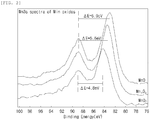
- 238000004833 X-ray photoelectron spectroscopy Methods 0.000 description 8
- 150000002500 ions Chemical class 0.000 description 8
- 239000003960 organic solvent Substances 0.000 description 8
- NLXLAEXVIDQMFP-UHFFFAOYSA-N Ammonia chloride Chemical compound [NH4+].[Cl-] NLXLAEXVIDQMFP-UHFFFAOYSA-N 0.000 description 7
- VHUUQVKOLVNVRT-UHFFFAOYSA-N Ammonium hydroxide Chemical compound [NH4+].[OH-] VHUUQVKOLVNVRT-UHFFFAOYSA-N 0.000 description 7
- JBTWLSYIZRCDFO-UHFFFAOYSA-N ethyl methyl carbonate Chemical compound CCOC(=O)OC JBTWLSYIZRCDFO-UHFFFAOYSA-N 0.000 description 7
- KFZMGEQAYNKOFK-UHFFFAOYSA-N Isopropanol Chemical compound CC(C)O KFZMGEQAYNKOFK-UHFFFAOYSA-N 0.000 description 6
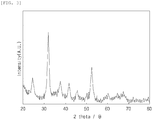
- 238000002441 X-ray diffraction Methods 0.000 description 6
- QGZKDVFQNNGYKY-UHFFFAOYSA-N ammonia Natural products N QGZKDVFQNNGYKY-UHFFFAOYSA-N 0.000 description 6
- 235000011114 ammonium hydroxide Nutrition 0.000 description 6
- 239000007864 aqueous solution Substances 0.000 description 6
- OIFBSDVPJOWBCH-UHFFFAOYSA-N Diethyl carbonate Chemical compound CCOC(=O)OCC OIFBSDVPJOWBCH-UHFFFAOYSA-N 0.000 description 5
- LFQSCWFLJHTTHZ-UHFFFAOYSA-N Ethanol Chemical compound CCO LFQSCWFLJHTTHZ-UHFFFAOYSA-N 0.000 description 5
- KMTRUDSVKNLOMY-UHFFFAOYSA-N Ethylene carbonate Chemical compound O=C1OCCO1 KMTRUDSVKNLOMY-UHFFFAOYSA-N 0.000 description 5
- HBBGRARXTFLTSG-UHFFFAOYSA-N Lithium ion Chemical compound [Li+] HBBGRARXTFLTSG-UHFFFAOYSA-N 0.000 description 5
- 229910001416 lithium ion Inorganic materials 0.000 description 5
- 229910003002 lithium salt Inorganic materials 0.000 description 5
- 159000000002 lithium salts Chemical class 0.000 description 5
- 229910052751 metal Inorganic materials 0.000 description 5
- 239000002184 metal Substances 0.000 description 5
- LGQLOGILCSXPEA-UHFFFAOYSA-L nickel sulfate Chemical compound [Ni+2].[O-]S([O-])(=O)=O LGQLOGILCSXPEA-UHFFFAOYSA-L 0.000 description 5
- 229910000363 nickel(II) sulfate Inorganic materials 0.000 description 5
- CURLTUGMZLYLDI-UHFFFAOYSA-N Carbon dioxide Chemical compound O=C=O CURLTUGMZLYLDI-UHFFFAOYSA-N 0.000 description 4
- IAZDPXIOMUYVGZ-UHFFFAOYSA-N Dimethylsulphoxide Chemical compound CS(C)=O IAZDPXIOMUYVGZ-UHFFFAOYSA-N 0.000 description 4
- VGGSQFUCUMXWEO-UHFFFAOYSA-N Ethene Chemical compound C=C VGGSQFUCUMXWEO-UHFFFAOYSA-N 0.000 description 4
- 239000005977 Ethylene Substances 0.000 description 4
- 150000001242 acetic acid derivatives Chemical class 0.000 description 4
- 239000003575 carbonaceous material Substances 0.000 description 4
- 229920001577 copolymer Polymers 0.000 description 4
- 235000019441 ethanol Nutrition 0.000 description 4
- 239000010408 film Substances 0.000 description 4
- 150000004820 halides Chemical class 0.000 description 4
- 150000004679 hydroxides Chemical class 0.000 description 4
- KWGKDLIKAYFUFQ-UHFFFAOYSA-M lithium chloride Chemical compound [Li+].[Cl-] KWGKDLIKAYFUFQ-UHFFFAOYSA-M 0.000 description 4
- AMWRITDGCCNYAT-UHFFFAOYSA-L manganese oxide Inorganic materials [Mn].O[Mn]=O.O[Mn]=O AMWRITDGCCNYAT-UHFFFAOYSA-L 0.000 description 4
- SQQMAOCOWKFBNP-UHFFFAOYSA-L manganese(II) sulfate Chemical compound [Mn+2].[O-]S([O-])(=O)=O SQQMAOCOWKFBNP-UHFFFAOYSA-L 0.000 description 4
- 229910000357 manganese(II) sulfate Inorganic materials 0.000 description 4
- 229910044991 metal oxide Inorganic materials 0.000 description 4
- 150000004706 metal oxides Chemical class 0.000 description 4
- 150000002823 nitrates Chemical class 0.000 description 4
- 239000004745 nonwoven fabric Substances 0.000 description 4
- 238000005096 rolling process Methods 0.000 description 4
- 229910001220 stainless steel Inorganic materials 0.000 description 4
- 239000010935 stainless steel Substances 0.000 description 4
- 150000003467 sulfuric acid derivatives Chemical class 0.000 description 4
- CSCPPACGZOOCGX-UHFFFAOYSA-N Acetone Chemical compound CC(C)=O CSCPPACGZOOCGX-UHFFFAOYSA-N 0.000 description 3
- UHOVQNZJYSORNB-UHFFFAOYSA-N Benzene Chemical compound C1=CC=CC=C1 UHOVQNZJYSORNB-UHFFFAOYSA-N 0.000 description 3
- XEKOWRVHYACXOJ-UHFFFAOYSA-N Ethyl acetate Chemical compound CCOC(C)=O XEKOWRVHYACXOJ-UHFFFAOYSA-N 0.000 description 3
- ZMXDDKWLCZADIW-UHFFFAOYSA-N N,N-Dimethylformamide Chemical compound CN(C)C=O ZMXDDKWLCZADIW-UHFFFAOYSA-N 0.000 description 3
- SECXISVLQFMRJM-UHFFFAOYSA-N N-Methylpyrrolidone Chemical compound CN1CCCC1=O SECXISVLQFMRJM-UHFFFAOYSA-N 0.000 description 3
- KWYUFKZDYYNOTN-UHFFFAOYSA-M Potassium hydroxide Chemical compound [OH-].[K+] KWYUFKZDYYNOTN-UHFFFAOYSA-M 0.000 description 3
- BQCADISMDOOEFD-UHFFFAOYSA-N Silver Chemical compound [Ag] BQCADISMDOOEFD-UHFFFAOYSA-N 0.000 description 3
- 230000002411 adverse Effects 0.000 description 3
- 229910021383 artificial graphite Inorganic materials 0.000 description 3
- 239000011248 coating agent Substances 0.000 description 3
- 238000000576 coating method Methods 0.000 description 3
- KTVIXTQDYHMGHF-UHFFFAOYSA-L cobalt(2+) sulfate Chemical compound [Co+2].[O-]S([O-])(=O)=O KTVIXTQDYHMGHF-UHFFFAOYSA-L 0.000 description 3
- 239000012153 distilled water Substances 0.000 description 3
- 239000008151 electrolyte solution Substances 0.000 description 3
- 229910021382 natural graphite Inorganic materials 0.000 description 3
- 239000005518 polymer electrolyte Substances 0.000 description 3
- 229920002981 polyvinylidene fluoride Polymers 0.000 description 3
- 239000011148 porous material Substances 0.000 description 3
- RUOJZAUFBMNUDX-UHFFFAOYSA-N propylene carbonate Chemical compound CC1COC(=O)O1 RUOJZAUFBMNUDX-UHFFFAOYSA-N 0.000 description 3
- 229910052709 silver Inorganic materials 0.000 description 3
- 239000004332 silver Substances 0.000 description 3
- 238000003756 stirring Methods 0.000 description 3
- 239000000126 substance Substances 0.000 description 3
- 150000003568 thioethers Chemical class 0.000 description 3
- YEJRWHAVMIAJKC-UHFFFAOYSA-N 4-Butyrolactone Chemical compound O=C1CCCO1 YEJRWHAVMIAJKC-UHFFFAOYSA-N 0.000 description 2
- 229920000049 Carbon (fiber) Polymers 0.000 description 2
- 229920002943 EPDM rubber Polymers 0.000 description 2
- 229910001290 LiPF6 Inorganic materials 0.000 description 2
- 239000002033 PVDF binder Substances 0.000 description 2
- 239000004698 Polyethylene Substances 0.000 description 2
- JUJWROOIHBZHMG-UHFFFAOYSA-N Pyridine Chemical compound C1=CC=NC=C1 JUJWROOIHBZHMG-UHFFFAOYSA-N 0.000 description 2
- KAESVJOAVNADME-UHFFFAOYSA-N Pyrrole Chemical compound C=1C=CNC=1 KAESVJOAVNADME-UHFFFAOYSA-N 0.000 description 2
- CDBYLPFSWZWCQE-UHFFFAOYSA-L Sodium Carbonate Chemical compound [Na+].[Na+].[O-]C([O-])=O CDBYLPFSWZWCQE-UHFFFAOYSA-L 0.000 description 2
- WYURNTSHIVDZCO-UHFFFAOYSA-N Tetrahydrofuran Chemical compound C1CCOC1 WYURNTSHIVDZCO-UHFFFAOYSA-N 0.000 description 2
- XLOMVQKBTHCTTD-UHFFFAOYSA-N Zinc monoxide Chemical compound [Zn]=O XLOMVQKBTHCTTD-UHFFFAOYSA-N 0.000 description 2
- 239000000654 additive Substances 0.000 description 2
- 230000000996 additive effect Effects 0.000 description 2
- 238000004458 analytical method Methods 0.000 description 2
- 239000001569 carbon dioxide Substances 0.000 description 2
- 229910002092 carbon dioxide Inorganic materials 0.000 description 2
- 239000004917 carbon fiber Substances 0.000 description 2
- 239000003660 carbonate based solvent Substances 0.000 description 2
- 238000005266 casting Methods 0.000 description 2
- 239000003795 chemical substances by application Substances 0.000 description 2
- UFMZWBIQTDUYBN-UHFFFAOYSA-N cobalt dinitrate Chemical compound [Co+2].[O-][N+]([O-])=O.[O-][N+]([O-])=O UFMZWBIQTDUYBN-UHFFFAOYSA-N 0.000 description 2
- 150000005676 cyclic carbonates Chemical class 0.000 description 2
- JHIVVAPYMSGYDF-UHFFFAOYSA-N cyclohexanone Chemical compound O=C1CCCCC1 JHIVVAPYMSGYDF-UHFFFAOYSA-N 0.000 description 2
- 238000009831 deintercalation Methods 0.000 description 2
- 238000001739 density measurement Methods 0.000 description 2
- 235000014113 dietary fatty acids Nutrition 0.000 description 2
- IEJIGPNLZYLLBP-UHFFFAOYSA-N dimethyl carbonate Chemical compound COC(=O)OC IEJIGPNLZYLLBP-UHFFFAOYSA-N 0.000 description 2
- 238000001035 drying Methods 0.000 description 2
- LYCAIKOWRPUZTN-UHFFFAOYSA-N ethylene glycol Natural products OCCO LYCAIKOWRPUZTN-UHFFFAOYSA-N 0.000 description 2
- 239000000194 fatty acid Substances 0.000 description 2
- 229930195729 fatty acid Natural products 0.000 description 2
- 239000000835 fiber Substances 0.000 description 2
- 239000006260 foam Substances 0.000 description 2
- 239000011888 foil Substances 0.000 description 2
- 229910002804 graphite Inorganic materials 0.000 description 2
- 239000010439 graphite Substances 0.000 description 2
- 238000009830 intercalation Methods 0.000 description 2
- 229910000765 intermetallic Inorganic materials 0.000 description 2
- 238000010030 laminating Methods 0.000 description 2
- 239000011244 liquid electrolyte Substances 0.000 description 2
- XIXADJRWDQXREU-UHFFFAOYSA-M lithium acetate Chemical compound [Li+].CC([O-])=O XIXADJRWDQXREU-UHFFFAOYSA-M 0.000 description 2
- AMXOYNBUYSYVKV-UHFFFAOYSA-M lithium bromide Chemical compound [Li+].[Br-] AMXOYNBUYSYVKV-UHFFFAOYSA-M 0.000 description 2
- 229910000625 lithium cobalt oxide Inorganic materials 0.000 description 2
- IIPYXGDZVMZOAP-UHFFFAOYSA-N lithium nitrate Chemical compound [Li+].[O-][N+]([O-])=O IIPYXGDZVMZOAP-UHFFFAOYSA-N 0.000 description 2
- FUJCRWPEOMXPAD-UHFFFAOYSA-N lithium oxide Chemical compound [Li+].[Li+].[O-2] FUJCRWPEOMXPAD-UHFFFAOYSA-N 0.000 description 2
- INHCSSUBVCNVSK-UHFFFAOYSA-L lithium sulfate Chemical compound [Li+].[Li+].[O-]S([O-])(=O)=O INHCSSUBVCNVSK-UHFFFAOYSA-L 0.000 description 2
- BFZPBUKRYWOWDV-UHFFFAOYSA-N lithium;oxido(oxo)cobalt Chemical compound [Li+].[O-][Co]=O BFZPBUKRYWOWDV-UHFFFAOYSA-N 0.000 description 2
- 230000003647 oxidation Effects 0.000 description 2
- 238000007254 oxidation reaction Methods 0.000 description 2
- 230000001590 oxidative effect Effects 0.000 description 2
- 229920000573 polyethylene Polymers 0.000 description 2
- 229920006254 polymer film Polymers 0.000 description 2
- 239000000843 powder Substances 0.000 description 2
- 239000002244 precipitate Substances 0.000 description 2
- 238000006722 reduction reaction Methods 0.000 description 2
- 238000007789 sealing Methods 0.000 description 2
- 239000002002 slurry Substances 0.000 description 2
- 239000007787 solid Substances 0.000 description 2
- 238000001228 spectrum Methods 0.000 description 2
- XOLBLPGZBRYERU-UHFFFAOYSA-N tin dioxide Chemical compound O=[Sn]=O XOLBLPGZBRYERU-UHFFFAOYSA-N 0.000 description 2
- WNXJIVFYUVYPPR-UHFFFAOYSA-N 1,3-dioxolane Chemical compound C1COCO1 WNXJIVFYUVYPPR-UHFFFAOYSA-N 0.000 description 1
- DURPTKYDGMDSBL-UHFFFAOYSA-N 1-butoxybutane Chemical compound CCCCOCCCC DURPTKYDGMDSBL-UHFFFAOYSA-N 0.000 description 1
- XNWFRZJHXBZDAG-UHFFFAOYSA-N 2-METHOXYETHANOL Chemical compound COCCO XNWFRZJHXBZDAG-UHFFFAOYSA-N 0.000 description 1
- OAVRWNUUOUXDFH-UHFFFAOYSA-H 2-hydroxypropane-1,2,3-tricarboxylate;manganese(2+) Chemical compound [Mn+2].[Mn+2].[Mn+2].[O-]C(=O)CC(O)(CC([O-])=O)C([O-])=O.[O-]C(=O)CC(O)(CC([O-])=O)C([O-])=O OAVRWNUUOUXDFH-UHFFFAOYSA-H 0.000 description 1
- DSMUTQTWFHVVGQ-UHFFFAOYSA-N 4,5-difluoro-1,3-dioxolan-2-one Chemical compound FC1OC(=O)OC1F DSMUTQTWFHVVGQ-UHFFFAOYSA-N 0.000 description 1
- 229910000838 Al alloy Inorganic materials 0.000 description 1
- USFZMSVCRYTOJT-UHFFFAOYSA-N Ammonium acetate Chemical compound N.CC(O)=O USFZMSVCRYTOJT-UHFFFAOYSA-N 0.000 description 1
- 229920002134 Carboxymethyl cellulose Polymers 0.000 description 1
- 229910000925 Cd alloy Inorganic materials 0.000 description 1
- 229910018916 CoOOH Inorganic materials 0.000 description 1
- 229910021503 Cobalt(II) hydroxide Inorganic materials 0.000 description 1
- PIICEJLVQHRZGT-UHFFFAOYSA-N Ethylenediamine Chemical compound NCCN PIICEJLVQHRZGT-UHFFFAOYSA-N 0.000 description 1
- YCKRFDGAMUMZLT-UHFFFAOYSA-N Fluorine atom Chemical compound [F] YCKRFDGAMUMZLT-UHFFFAOYSA-N 0.000 description 1
- GYHNNYVSQQEPJS-UHFFFAOYSA-N Gallium Chemical compound [Ga] GYHNNYVSQQEPJS-UHFFFAOYSA-N 0.000 description 1
- 229920002153 Hydroxypropyl cellulose Polymers 0.000 description 1
- 229910010088 LiAlO4 Inorganic materials 0.000 description 1
- 229910001559 LiC4F9SO3 Inorganic materials 0.000 description 1
- 229910000552 LiCF3SO3 Inorganic materials 0.000 description 1
- 229910052493 LiFePO4 Inorganic materials 0.000 description 1
- 229910002993 LiMnO2 Inorganic materials 0.000 description 1
- 229910013131 LiN Inorganic materials 0.000 description 1
- 229910002097 Lithium manganese(III,IV) oxide Inorganic materials 0.000 description 1
- 229910021380 Manganese Chloride Inorganic materials 0.000 description 1
- GLFNIEUTAYBVOC-UHFFFAOYSA-L Manganese chloride Chemical compound Cl[Mn]Cl GLFNIEUTAYBVOC-UHFFFAOYSA-L 0.000 description 1
- ZHGDJTMNXSOQDT-UHFFFAOYSA-N NP(N)(N)=O.NP(N)(N)=O.NP(N)(N)=O.NP(N)(N)=O.NP(N)(N)=O.NP(N)(N)=O Chemical compound NP(N)(N)=O.NP(N)(N)=O.NP(N)(N)=O.NP(N)(N)=O.NP(N)(N)=O.NP(N)(N)=O ZHGDJTMNXSOQDT-UHFFFAOYSA-N 0.000 description 1
- 229910016533 Ni0.2Co0.2Mn0.6(OH)2 Inorganic materials 0.000 description 1
- 229910016719 Ni0.5Co0.5(OH)2 Inorganic materials 0.000 description 1
- 229910005581 NiC2 Inorganic materials 0.000 description 1
- 229910002640 NiOOH Inorganic materials 0.000 description 1
- 229920000265 Polyparaphenylene Polymers 0.000 description 1
- 239000004743 Polypropylene Substances 0.000 description 1
- 239000004372 Polyvinyl alcohol Substances 0.000 description 1
- XBDQKXXYIPTUBI-UHFFFAOYSA-M Propionate Chemical compound CCC([O-])=O XBDQKXXYIPTUBI-UHFFFAOYSA-M 0.000 description 1
- 229910000676 Si alloy Inorganic materials 0.000 description 1
- XUIMIQQOPSSXEZ-UHFFFAOYSA-N Silicon Chemical compound [Si] XUIMIQQOPSSXEZ-UHFFFAOYSA-N 0.000 description 1
- 229910001128 Sn alloy Inorganic materials 0.000 description 1
- 229920002472 Starch Polymers 0.000 description 1
- NINIDFKCEFEMDL-UHFFFAOYSA-N Sulfur Chemical compound [S] NINIDFKCEFEMDL-UHFFFAOYSA-N 0.000 description 1
- ATJFFYVFTNAWJD-UHFFFAOYSA-N Tin Chemical compound [Sn] ATJFFYVFTNAWJD-UHFFFAOYSA-N 0.000 description 1
- GWEVSGVZZGPLCZ-UHFFFAOYSA-N Titan oxide Chemical compound O=[Ti]=O GWEVSGVZZGPLCZ-UHFFFAOYSA-N 0.000 description 1
- GSEJCLTVZPLZKY-UHFFFAOYSA-N Triethanolamine Chemical compound OCCN(CCO)CCO GSEJCLTVZPLZKY-UHFFFAOYSA-N 0.000 description 1
- 238000000026 X-ray photoelectron spectrum Methods 0.000 description 1
- RLTFLELMPUMVEH-UHFFFAOYSA-N [Li+].[O--].[O--].[O--].[V+5] Chemical compound [Li+].[O--].[O--].[O--].[V+5] RLTFLELMPUMVEH-UHFFFAOYSA-N 0.000 description 1
- RTBHLGSMKCPLCQ-UHFFFAOYSA-N [Mn].OOO Chemical compound [Mn].OOO RTBHLGSMKCPLCQ-UHFFFAOYSA-N 0.000 description 1
- KFDQGLPGKXUTMZ-UHFFFAOYSA-N [Mn].[Co].[Ni] Chemical compound [Mn].[Co].[Ni] KFDQGLPGKXUTMZ-UHFFFAOYSA-N 0.000 description 1
- XHCLAFWTIXFWPH-UHFFFAOYSA-N [O-2].[O-2].[O-2].[O-2].[O-2].[V+5].[V+5] Chemical compound [O-2].[O-2].[O-2].[O-2].[O-2].[V+5].[V+5] XHCLAFWTIXFWPH-UHFFFAOYSA-N 0.000 description 1
- KXKVLQRXCPHEJC-UHFFFAOYSA-N acetic acid trimethyl ester Natural products COC(C)=O KXKVLQRXCPHEJC-UHFFFAOYSA-N 0.000 description 1
- 239000006230 acetylene black Substances 0.000 description 1
- 239000011149 active material Substances 0.000 description 1
- 239000005456 alcohol based solvent Substances 0.000 description 1
- 229910052783 alkali metal Inorganic materials 0.000 description 1
- 150000001340 alkali metals Chemical class 0.000 description 1
- 229910052784 alkaline earth metal Inorganic materials 0.000 description 1
- 150000001342 alkaline earth metals Chemical class 0.000 description 1
- PNEYBMLMFCGWSK-UHFFFAOYSA-N aluminium oxide Inorganic materials [O-2].[O-2].[O-2].[Al+3].[Al+3] PNEYBMLMFCGWSK-UHFFFAOYSA-N 0.000 description 1
- VSCWAEJMTAWNJL-UHFFFAOYSA-K aluminium trichloride Chemical compound Cl[Al](Cl)Cl VSCWAEJMTAWNJL-UHFFFAOYSA-K 0.000 description 1
- 150000001408 amides Chemical class 0.000 description 1
- 150000003863 ammonium salts Chemical class 0.000 description 1
- BFNBIHQBYMNNAN-UHFFFAOYSA-N ammonium sulfate Chemical compound N.N.OS(O)(=O)=O BFNBIHQBYMNNAN-UHFFFAOYSA-N 0.000 description 1
- 229910052921 ammonium sulfate Inorganic materials 0.000 description 1
- 229910003481 amorphous carbon Inorganic materials 0.000 description 1
- 150000004945 aromatic hydrocarbons Chemical class 0.000 description 1
- 125000003118 aryl group Chemical group 0.000 description 1
- 229910052797 bismuth Inorganic materials 0.000 description 1
- JCXGWMGPZLAOME-UHFFFAOYSA-N bismuth atom Chemical compound [Bi] JCXGWMGPZLAOME-UHFFFAOYSA-N 0.000 description 1
- IAQRGUVFOMOMEM-UHFFFAOYSA-N butene Natural products CC=CC IAQRGUVFOMOMEM-UHFFFAOYSA-N 0.000 description 1
- 229910052793 cadmium Inorganic materials 0.000 description 1
- BDOSMKKIYDKNTQ-UHFFFAOYSA-N cadmium atom Chemical compound [Cd] BDOSMKKIYDKNTQ-UHFFFAOYSA-N 0.000 description 1
- AXCZMVOFGPJBDE-UHFFFAOYSA-L calcium dihydroxide Chemical compound [OH-].[OH-].[Ca+2] AXCZMVOFGPJBDE-UHFFFAOYSA-L 0.000 description 1
- 239000000920 calcium hydroxide Substances 0.000 description 1
- 229910001861 calcium hydroxide Inorganic materials 0.000 description 1
- 239000003990 capacitor Substances 0.000 description 1
- 239000006229 carbon black Substances 0.000 description 1
- 150000004649 carbonic acid derivatives Chemical class 0.000 description 1
- 239000000919 ceramic Substances 0.000 description 1
- 150000005678 chain carbonates Chemical class 0.000 description 1
- 239000006231 channel black Substances 0.000 description 1
- 150000001860 citric acid derivatives Chemical class 0.000 description 1
- 239000011294 coal tar pitch Substances 0.000 description 1
- 239000000571 coke Substances 0.000 description 1
- 239000008139 complexing agent Substances 0.000 description 1
- 229920001940 conductive polymer Polymers 0.000 description 1
- 150000004292 cyclic ethers Chemical class 0.000 description 1
- 125000004122 cyclic group Chemical group 0.000 description 1
- XUCJHNOBJLKZNU-UHFFFAOYSA-M dilithium;hydroxide Chemical compound [Li+].[Li+].[OH-] XUCJHNOBJLKZNU-UHFFFAOYSA-M 0.000 description 1
- 150000004862 dioxolanes Chemical class 0.000 description 1
- NJLLQSBAHIKGKF-UHFFFAOYSA-N dipotassium dioxido(oxo)titanium Chemical compound [K+].[K+].[O-][Ti]([O-])=O NJLLQSBAHIKGKF-UHFFFAOYSA-N 0.000 description 1
- 230000000694 effects Effects 0.000 description 1
- 229920001971 elastomer Polymers 0.000 description 1
- 238000003487 electrochemical reaction Methods 0.000 description 1
- 239000003759 ester based solvent Substances 0.000 description 1
- RTZKZFJDLAIYFH-UHFFFAOYSA-N ether Chemical group CCOCC RTZKZFJDLAIYFH-UHFFFAOYSA-N 0.000 description 1
- 239000004210 ether based solvent Substances 0.000 description 1
- 238000011156 evaluation Methods 0.000 description 1
- 239000011737 fluorine Substances 0.000 description 1
- 229910052731 fluorine Inorganic materials 0.000 description 1
- 239000006232 furnace black Substances 0.000 description 1
- 229910052733 gallium Inorganic materials 0.000 description 1
- 239000003365 glass fiber Substances 0.000 description 1
- 239000011357 graphitized carbon fiber Substances 0.000 description 1
- 229910021385 hard carbon Inorganic materials 0.000 description 1
- XLYOFNOQVPJJNP-ZSJDYOACSA-N heavy water Substances [2H]O[2H] XLYOFNOQVPJJNP-ZSJDYOACSA-N 0.000 description 1
- 229920001519 homopolymer Polymers 0.000 description 1
- 239000001863 hydroxypropyl cellulose Substances 0.000 description 1
- 235000010977 hydroxypropyl cellulose Nutrition 0.000 description 1
- 150000002461 imidazolidines Chemical class 0.000 description 1
- 229910052738 indium Inorganic materials 0.000 description 1
- APFVFJFRJDLVQX-UHFFFAOYSA-N indium atom Chemical compound [In] APFVFJFRJDLVQX-UHFFFAOYSA-N 0.000 description 1
- 230000001788 irregular Effects 0.000 description 1
- 239000003273 ketjen black Substances 0.000 description 1
- 239000005453 ketone based solvent Substances 0.000 description 1
- 239000006233 lamp black Substances 0.000 description 1
- XGZVUEUWXADBQD-UHFFFAOYSA-L lithium carbonate Chemical compound [Li+].[Li+].[O-]C([O-])=O XGZVUEUWXADBQD-UHFFFAOYSA-L 0.000 description 1
- 229910052808 lithium carbonate Inorganic materials 0.000 description 1
- PQXKHYXIUOZZFA-UHFFFAOYSA-M lithium fluoride Chemical compound [Li+].[F-] PQXKHYXIUOZZFA-UHFFFAOYSA-M 0.000 description 1
- 229910001547 lithium hexafluoroantimonate(V) Inorganic materials 0.000 description 1
- 229910001540 lithium hexafluoroarsenate(V) Inorganic materials 0.000 description 1
- SIAPCJWMELPYOE-UHFFFAOYSA-N lithium hydride Chemical compound [LiH] SIAPCJWMELPYOE-UHFFFAOYSA-N 0.000 description 1
- 229910002102 lithium manganese oxide Inorganic materials 0.000 description 1
- 229910001947 lithium oxide Inorganic materials 0.000 description 1
- MHCFAGZWMAWTNR-UHFFFAOYSA-M lithium perchlorate Chemical compound [Li+].[O-]Cl(=O)(=O)=O MHCFAGZWMAWTNR-UHFFFAOYSA-M 0.000 description 1
- 229910001486 lithium perchlorate Inorganic materials 0.000 description 1
- 229910001537 lithium tetrachloroaluminate Inorganic materials 0.000 description 1
- 229910001496 lithium tetrafluoroborate Inorganic materials 0.000 description 1
- 229910000686 lithium vanadium oxide Inorganic materials 0.000 description 1
- ACFSQHQYDZIPRL-UHFFFAOYSA-N lithium;bis(1,1,2,2,2-pentafluoroethylsulfonyl)azanide Chemical compound [Li+].FC(F)(F)C(F)(F)S(=O)(=O)[N-]S(=O)(=O)C(F)(F)C(F)(F)F ACFSQHQYDZIPRL-UHFFFAOYSA-N 0.000 description 1
- VROAXDSNYPAOBJ-UHFFFAOYSA-N lithium;oxido(oxo)nickel Chemical compound [Li+].[O-][Ni]=O VROAXDSNYPAOBJ-UHFFFAOYSA-N 0.000 description 1
- VLXXBCXTUVRROQ-UHFFFAOYSA-N lithium;oxido-oxo-(oxomanganiooxy)manganese Chemical compound [Li+].[O-][Mn](=O)O[Mn]=O VLXXBCXTUVRROQ-UHFFFAOYSA-N 0.000 description 1
- 230000014759 maintenance of location Effects 0.000 description 1
- 150000002696 manganese Chemical class 0.000 description 1
- 229940071125 manganese acetate Drugs 0.000 description 1
- 239000011656 manganese carbonate Substances 0.000 description 1
- 239000011565 manganese chloride Substances 0.000 description 1
- 235000002867 manganese chloride Nutrition 0.000 description 1
- 229940099607 manganese chloride Drugs 0.000 description 1
- 239000011564 manganese citrate Substances 0.000 description 1
- 235000014872 manganese citrate Nutrition 0.000 description 1
- 229940097206 manganese citrate Drugs 0.000 description 1
- ZAUUZASCMSWKGX-UHFFFAOYSA-N manganese nickel Chemical compound [Mn].[Ni] ZAUUZASCMSWKGX-UHFFFAOYSA-N 0.000 description 1
- UOGMEBQRZBEZQT-UHFFFAOYSA-L manganese(2+);diacetate Chemical compound [Mn+2].CC([O-])=O.CC([O-])=O UOGMEBQRZBEZQT-UHFFFAOYSA-L 0.000 description 1
- PPNAOCWZXJOHFK-UHFFFAOYSA-N manganese(2+);oxygen(2-) Chemical class [O-2].[Mn+2] PPNAOCWZXJOHFK-UHFFFAOYSA-N 0.000 description 1
- 229910000016 manganese(II) carbonate Inorganic materials 0.000 description 1
- MIVBAHRSNUNMPP-UHFFFAOYSA-N manganese(II) nitrate Inorganic materials [Mn+2].[O-][N+]([O-])=O.[O-][N+]([O-])=O MIVBAHRSNUNMPP-UHFFFAOYSA-N 0.000 description 1
- GEYXPJBPASPPLI-UHFFFAOYSA-N manganese(III) oxide Inorganic materials O=[Mn]O[Mn]=O GEYXPJBPASPPLI-UHFFFAOYSA-N 0.000 description 1
- 238000004519 manufacturing process Methods 0.000 description 1
- 239000000463 material Substances 0.000 description 1
- 238000005259 measurement Methods 0.000 description 1
- 238000002844 melting Methods 0.000 description 1
- 230000008018 melting Effects 0.000 description 1
- 239000002931 mesocarbon microbead Substances 0.000 description 1
- 239000011302 mesophase pitch Substances 0.000 description 1
- 150000002739 metals Chemical class 0.000 description 1
- PYLWMHQQBFSUBP-UHFFFAOYSA-N monofluorobenzene Chemical compound FC1=CC=CC=C1 PYLWMHQQBFSUBP-UHFFFAOYSA-N 0.000 description 1
- 229910000008 nickel(II) carbonate Inorganic materials 0.000 description 1
- 229910021508 nickel(II) hydroxide Inorganic materials 0.000 description 1
- KBJMLQFLOWQJNF-UHFFFAOYSA-N nickel(II) nitrate Inorganic materials [Ni+2].[O-][N+]([O-])=O.[O-][N+]([O-])=O KBJMLQFLOWQJNF-UHFFFAOYSA-N 0.000 description 1
- GNRSAWUEBMWBQH-UHFFFAOYSA-N nickel(II) oxide Inorganic materials [Ni]=O GNRSAWUEBMWBQH-UHFFFAOYSA-N 0.000 description 1
- 150000002825 nitriles Chemical class 0.000 description 1
- 150000005181 nitrobenzenes Chemical class 0.000 description 1
- 239000005486 organic electrolyte Substances 0.000 description 1
- 150000003891 oxalate salts Chemical class 0.000 description 1
- 239000011301 petroleum pitch Substances 0.000 description 1
- 239000011295 pitch Substances 0.000 description 1
- 229920005569 poly(vinylidene fluoride-co-hexafluoropropylene) Polymers 0.000 description 1
- 229920002239 polyacrylonitrile Polymers 0.000 description 1
- 229920000139 polyethylene terephthalate Polymers 0.000 description 1
- 239000005020 polyethylene terephthalate Substances 0.000 description 1
- 229920000642 polymer Polymers 0.000 description 1
- 239000002861 polymer material Substances 0.000 description 1
- 229920000098 polyolefin Polymers 0.000 description 1
- 229920001155 polypropylene Polymers 0.000 description 1
- 229920002451 polyvinyl alcohol Polymers 0.000 description 1
- 229920000036 polyvinylpyrrolidone Polymers 0.000 description 1
- 239000001267 polyvinylpyrrolidone Substances 0.000 description 1
- 235000013855 polyvinylpyrrolidone Nutrition 0.000 description 1
- 239000000047 product Substances 0.000 description 1
- 229920001384 propylene homopolymer Polymers 0.000 description 1
- UMJSCPRVCHMLSP-UHFFFAOYSA-N pyridine Natural products COC1=CC=CN=C1 UMJSCPRVCHMLSP-UHFFFAOYSA-N 0.000 description 1
- 239000002296 pyrolytic carbon Substances 0.000 description 1
- 239000001008 quinone-imine dye Substances 0.000 description 1
- 239000004627 regenerated cellulose Substances 0.000 description 1
- 238000012827 research and development Methods 0.000 description 1
- 230000002441 reversible effect Effects 0.000 description 1
- 239000005060 rubber Substances 0.000 description 1
- 229910052710 silicon Inorganic materials 0.000 description 1
- 239000010703 silicon Substances 0.000 description 1
- 239000002356 single layer Substances 0.000 description 1
- 229910000029 sodium carbonate Inorganic materials 0.000 description 1
- 229910021384 soft carbon Inorganic materials 0.000 description 1
- 239000008107 starch Substances 0.000 description 1
- 235000019698 starch Nutrition 0.000 description 1
- 238000003860 storage Methods 0.000 description 1
- 229920003048 styrene butadiene rubber Polymers 0.000 description 1
- HXJUTPCZVOIRIF-UHFFFAOYSA-N sulfolane Chemical class O=S1(=O)CCCC1 HXJUTPCZVOIRIF-UHFFFAOYSA-N 0.000 description 1
- 229920005608 sulfonated EPDM Polymers 0.000 description 1
- 229910052717 sulfur Inorganic materials 0.000 description 1
- 239000011593 sulfur Substances 0.000 description 1
- JBQYATWDVHIOAR-UHFFFAOYSA-N tellanylidenegermanium Chemical compound [Te]=[Ge] JBQYATWDVHIOAR-UHFFFAOYSA-N 0.000 description 1
- 238000012360 testing method Methods 0.000 description 1
- BFKJFAAPBSQJPD-UHFFFAOYSA-N tetrafluoroethene Chemical group FC(F)=C(F)F BFKJFAAPBSQJPD-UHFFFAOYSA-N 0.000 description 1
- YLQBMQCUIZJEEH-UHFFFAOYSA-N tetrahydrofuran Natural products C=1C=COC=1 YLQBMQCUIZJEEH-UHFFFAOYSA-N 0.000 description 1
- 239000006234 thermal black Substances 0.000 description 1
- 239000010409 thin film Substances 0.000 description 1
- 239000002733 tin-carbon composite material Substances 0.000 description 1
- OGIDPMRJRNCKJF-UHFFFAOYSA-N titanium oxide Inorganic materials [Ti]=O OGIDPMRJRNCKJF-UHFFFAOYSA-N 0.000 description 1
- 238000012546 transfer Methods 0.000 description 1
- BDZBKCUKTQZUTL-UHFFFAOYSA-N triethyl phosphite Chemical compound CCOP(OCC)OCC BDZBKCUKTQZUTL-UHFFFAOYSA-N 0.000 description 1
- 229910001935 vanadium oxide Inorganic materials 0.000 description 1
- 239000011787 zinc oxide Substances 0.000 description 1
- PAPBSGBWRJIAAV-UHFFFAOYSA-N ε-Caprolactone Chemical compound O=C1CCCCCO1 PAPBSGBWRJIAAV-UHFFFAOYSA-N 0.000 description 1
Images



Classifications
-
- C—CHEMISTRY; METALLURGY
- C01—INORGANIC CHEMISTRY
- C01G—COMPOUNDS CONTAINING METALS NOT COVERED BY SUBCLASSES C01D OR C01F
- C01G53/00—Compounds of nickel
- C01G53/80—Compounds containing nickel, with or without oxygen or hydrogen, and containing one or more other elements
- C01G53/82—Compounds containing nickel, with or without oxygen or hydrogen, and containing two or more other elements
-
- C—CHEMISTRY; METALLURGY
- C01—INORGANIC CHEMISTRY
- C01G—COMPOUNDS CONTAINING METALS NOT COVERED BY SUBCLASSES C01D OR C01F
- C01G53/00—Compounds of nickel
- C01G53/40—Complex oxides containing nickel and at least one other metal element
- C01G53/42—Complex oxides containing nickel and at least one other metal element containing alkali metals, e.g. LiNiO2
- C01G53/44—Complex oxides containing nickel and at least one other metal element containing alkali metals, e.g. LiNiO2 containing manganese
-
- H—ELECTRICITY
- H01—ELECTRIC ELEMENTS
- H01M—PROCESSES OR MEANS, e.g. BATTERIES, FOR THE DIRECT CONVERSION OF CHEMICAL ENERGY INTO ELECTRICAL ENERGY
- H01M10/00—Secondary cells; Manufacture thereof
- H01M10/05—Accumulators with non-aqueous electrolyte
- H01M10/052—Li-accumulators
-
- H—ELECTRICITY
- H01—ELECTRIC ELEMENTS
- H01M—PROCESSES OR MEANS, e.g. BATTERIES, FOR THE DIRECT CONVERSION OF CHEMICAL ENERGY INTO ELECTRICAL ENERGY
- H01M4/00—Electrodes
- H01M4/02—Electrodes composed of, or comprising, active material
- H01M4/36—Selection of substances as active materials, active masses, active liquids
- H01M4/48—Selection of substances as active materials, active masses, active liquids of inorganic oxides or hydroxides
- H01M4/50—Selection of substances as active materials, active masses, active liquids of inorganic oxides or hydroxides of manganese
- H01M4/505—Selection of substances as active materials, active masses, active liquids of inorganic oxides or hydroxides of manganese of mixed oxides or hydroxides containing manganese for inserting or intercalating light metals, e.g. LiMn2O4 or LiMn2OxFy
-
- H—ELECTRICITY
- H01—ELECTRIC ELEMENTS
- H01M—PROCESSES OR MEANS, e.g. BATTERIES, FOR THE DIRECT CONVERSION OF CHEMICAL ENERGY INTO ELECTRICAL ENERGY
- H01M4/00—Electrodes
- H01M4/02—Electrodes composed of, or comprising, active material
- H01M4/36—Selection of substances as active materials, active masses, active liquids
- H01M4/48—Selection of substances as active materials, active masses, active liquids of inorganic oxides or hydroxides
- H01M4/52—Selection of substances as active materials, active masses, active liquids of inorganic oxides or hydroxides of nickel, cobalt or iron
- H01M4/525—Selection of substances as active materials, active masses, active liquids of inorganic oxides or hydroxides of nickel, cobalt or iron of mixed oxides or hydroxides containing iron, cobalt or nickel for inserting or intercalating light metals, e.g. LiNiO2, LiCoO2 or LiCoOxFy
-
- C—CHEMISTRY; METALLURGY
- C01—INORGANIC CHEMISTRY
- C01P—INDEXING SCHEME RELATING TO STRUCTURAL AND PHYSICAL ASPECTS OF SOLID INORGANIC COMPOUNDS
- C01P2002/00—Crystal-structural characteristics
- C01P2002/70—Crystal-structural characteristics defined by measured X-ray, neutron or electron diffraction data
- C01P2002/72—Crystal-structural characteristics defined by measured X-ray, neutron or electron diffraction data by d-values or two theta-values, e.g. as X-ray diagram
-
- C—CHEMISTRY; METALLURGY
- C01—INORGANIC CHEMISTRY
- C01P—INDEXING SCHEME RELATING TO STRUCTURAL AND PHYSICAL ASPECTS OF SOLID INORGANIC COMPOUNDS
- C01P2002/00—Crystal-structural characteristics
- C01P2002/80—Crystal-structural characteristics defined by measured data other than those specified in group C01P2002/70
- C01P2002/85—Crystal-structural characteristics defined by measured data other than those specified in group C01P2002/70 by XPS, EDX or EDAX data
-
- C—CHEMISTRY; METALLURGY
- C01—INORGANIC CHEMISTRY
- C01P—INDEXING SCHEME RELATING TO STRUCTURAL AND PHYSICAL ASPECTS OF SOLID INORGANIC COMPOUNDS
- C01P2004/00—Particle morphology
- C01P2004/01—Particle morphology depicted by an image
- C01P2004/03—Particle morphology depicted by an image obtained by SEM
-
- C—CHEMISTRY; METALLURGY
- C01—INORGANIC CHEMISTRY
- C01P—INDEXING SCHEME RELATING TO STRUCTURAL AND PHYSICAL ASPECTS OF SOLID INORGANIC COMPOUNDS
- C01P2004/00—Particle morphology
- C01P2004/30—Particle morphology extending in three dimensions
- C01P2004/45—Aggregated particles or particles with an intergrown morphology
-
- C—CHEMISTRY; METALLURGY
- C01—INORGANIC CHEMISTRY
- C01P—INDEXING SCHEME RELATING TO STRUCTURAL AND PHYSICAL ASPECTS OF SOLID INORGANIC COMPOUNDS
- C01P2004/00—Particle morphology
- C01P2004/50—Agglomerated particles
-
- C—CHEMISTRY; METALLURGY
- C01—INORGANIC CHEMISTRY
- C01P—INDEXING SCHEME RELATING TO STRUCTURAL AND PHYSICAL ASPECTS OF SOLID INORGANIC COMPOUNDS
- C01P2004/00—Particle morphology
- C01P2004/60—Particles characterised by their size
- C01P2004/62—Submicrometer sized, i.e. from 0.1-1 micrometer
-
- C—CHEMISTRY; METALLURGY
- C01—INORGANIC CHEMISTRY
- C01P—INDEXING SCHEME RELATING TO STRUCTURAL AND PHYSICAL ASPECTS OF SOLID INORGANIC COMPOUNDS
- C01P2004/00—Particle morphology
- C01P2004/60—Particles characterised by their size
- C01P2004/64—Nanometer sized, i.e. from 1-100 nanometer
-
- C—CHEMISTRY; METALLURGY
- C01—INORGANIC CHEMISTRY
- C01P—INDEXING SCHEME RELATING TO STRUCTURAL AND PHYSICAL ASPECTS OF SOLID INORGANIC COMPOUNDS
- C01P2006/00—Physical properties of inorganic compounds
- C01P2006/11—Powder tap density
-
- C—CHEMISTRY; METALLURGY
- C01—INORGANIC CHEMISTRY
- C01P—INDEXING SCHEME RELATING TO STRUCTURAL AND PHYSICAL ASPECTS OF SOLID INORGANIC COMPOUNDS
- C01P2006/00—Physical properties of inorganic compounds
- C01P2006/40—Electric properties
-
- H—ELECTRICITY
- H01—ELECTRIC ELEMENTS
- H01M—PROCESSES OR MEANS, e.g. BATTERIES, FOR THE DIRECT CONVERSION OF CHEMICAL ENERGY INTO ELECTRICAL ENERGY
- H01M10/00—Secondary cells; Manufacture thereof
- H01M10/05—Accumulators with non-aqueous electrolyte
- H01M10/052—Li-accumulators
- H01M10/0525—Rocking-chair batteries, i.e. batteries with lithium insertion or intercalation in both electrodes; Lithium-ion batteries
-
- Y—GENERAL TAGGING OF NEW TECHNOLOGICAL DEVELOPMENTS; GENERAL TAGGING OF CROSS-SECTIONAL TECHNOLOGIES SPANNING OVER SEVERAL SECTIONS OF THE IPC; TECHNICAL SUBJECTS COVERED BY FORMER USPC CROSS-REFERENCE ART COLLECTIONS [XRACs] AND DIGESTS
- Y02—TECHNOLOGIES OR APPLICATIONS FOR MITIGATION OR ADAPTATION AGAINST CLIMATE CHANGE
- Y02E—REDUCTION OF GREENHOUSE GAS [GHG] EMISSIONS, RELATED TO ENERGY GENERATION, TRANSMISSION OR DISTRIBUTION
- Y02E60/00—Enabling technologies; Technologies with a potential or indirect contribution to GHG emissions mitigation
- Y02E60/10—Energy storage using batteries
Definitions
- the present invention relates to a positive electrode active material precursor for a secondary battery, a positive electrode active material, methods of preparing the positive electrode active material precursor and the positive electrode active material, and a lithium secondary battery including the positive electrode active material.
- lithium secondary battery is lightweight and has high energy density, the lithium secondary battery is in the spotlight as a driving power source for portable devices. Accordingly, research and development efforts for improving the performance of the lithium secondary battery have been actively conducted.
- Lithium cobalt oxide LiCoO 2
- lithium nickel oxide LiNiO 2
- lithium manganese oxide LiMnO 2 or LiMn 2 O 4 , etc.
- a lithium iron phosphate compound LiFePO 4
- LiNiO 2 Lithium cobalt oxide
- LiNiO 2 lithium nickel oxide
- LiMnO 2 or LiMn 2 O 4 lithium manganese oxide
- LiFePO 4 lithium iron phosphate compound
- a nickel manganese-based lithium composite metal oxide in which a portion of nickel (Ni) is substituted with manganese (Mn) having excellent thermal stability
- a nickel cobalt manganese-based lithium composite metal oxide in which a portion of nickel (Ni) is substituted with manganese (Mn) and cobalt (Co)
- 'NCM-based lithium oxide' they are advantageous in that cycle characteristics and thermal stability are relatively better.
- Li-rich NCM-based positive electrode active material capable of meeting high capacity while containing a relatively low amount of the cobalt (Co) has been developed.
- the Li-rich NCM-based positive electrode active material has high energy density and a cost advantage.
- a precursor of the NCM-based positive electrode active material is synthesized by a co-precipitation method, wherein the precursor is mainly in the form of hydroxide or carbonate.
- the precursor is mainly in the form of hydroxide or carbonate.
- Ni 1- ⁇ 1- ⁇ 1 Co ⁇ 1 Mn ⁇ 1 (OH) 2 (0 ⁇ 1 ⁇ 1.0, 0 ⁇ 1 ⁇ 1.0)
- primary particles have a relatively large diameter of about 1 ⁇ m to about 3 ⁇ m and are not dense, it is disadvantageous in that ionic conductivity is low and electrochemical performance and density are low.
- Ni 1- ⁇ 2- ⁇ 2 Co ⁇ 2 Mn ⁇ 2 CO 3 (0 ⁇ 2 ⁇ 1.0, 0 ⁇ 2 ⁇ 1.0)
- primary particles have a relatively small diameter of about 10 nm to about 40 nm and pores in a secondary particle become very large due to the release of carbon dioxide during a sintering process, strength is reduced, and thus, it is disadvantageous in that the particles are crushed during rolling and density is very low.
- a positive electrode active material which may exhibit high density due to small primary particles and dense secondary particles, may prevent particle breakage during rolling due to excellent particle strength, and may exhibit excellent battery performance, such as high capacity, high efficiency, and high rate capability, when the positive electrode active material is used in a secondary battery, and its precursor.
- An aspect of the present invention provides an NCM-based positive electrode active material precursor, which may exhibit high density due to small primary particles and dense secondary particles and may exhibit excellent particle strength, and a method of preparing the same.
- a positive electrode active material as a lithium (Li)-rich NCM-based positive electrode active material prepared by using the positive electrode active material precursor, which may exhibit excellent battery performance, such as high capacity, high efficiency, and high rate capability, when the positive electrode active material is used in a secondary battery, and a method of preparing the same.
- a positive electrode active material precursor for a secondary battery which includes nickel (Ni), cobalt (Co), and manganese (Mn), wherein the nickel (Ni) and the cobalt (Co) are in non-oxidized hydroxide forms, and the manganese (Mn) is in an oxidized form.
- a method of preparing a positive electrode active material precursor for a secondary battery which includes the steps of: continuously adding a nickel (Ni), cobalt (Co), and manganese (Mn) transition metal cation-containing solution, an alkaline solution, and an ammonium ion-containing solution to a reactor; and forming a positive electrode active material precursor, in which nickel (Ni) and cobalt (Co) are in non-oxidized hydroxide forms and manganese (Mn) is in an oxidized form, by co-precipitation while a gas is not added or an oxygen-containing gas is continuously added to the reactor.
- a method of preparing a positive electrode active material for a secondary battery which includes the steps of: mixing the positive electrode active material precursor prepared as described above with a lithium raw material; and sintering at 750°C to 1,000°C after the mixing to form a lithium composite transition metal oxide.
- a positive electrode active material prepared as described above, and a positive electrode and a lithium secondary battery which include the same.
- an NCM-based positive electrode active material precursor which may exhibit high density due to small primary particles and dense secondary particles and may exhibit excellent particle strength, may be prepared.
- a lithium (Li)-rich NCM-based positive electrode active material prepared by using the positive electrode active material precursor may exhibit excellent battery performance, such as high capacity, high efficiency, and high rate capability, when the positive electrode active material is used in a secondary battery.
- the positive electrode active material precursor of the present invention is prepared by a method_including the steps of: continuously adding a nickel (Ni), cobalt (Co), and manganese (Mn) transition metal cation-containing solution, an alkaline solution, and an ammonium ion-containing solution to a reactor; and forming a positive electrode active material precursor, in which nickel (Ni) and cobalt (Co) are in non-oxidized hydroxide forms and manganese (Mn) is in an oxidized form, by co-precipitation while a gas is not added or an oxygen-containing gas is continuously added to the reactor.
- Ni nickel
- Co cobalt
- Mn manganese
- the transition metal cation-containing solution includes a nickel (Ni)-containing raw material, a cobalt (Co)-containing raw material, and a manganese (Mn)-containing raw material.
- the nickel (Ni)-containing raw material may include nickel-containing acetic acid salts, nitrates, sulfates, halides, sulfides, hydroxides, oxides, or oxyhydroxides, and may specifically include Ni(OH) 2 , NiO, NiOOH, NiCO 3 ⁇ 2Ni(OH) 2 ⁇ 4H 2 O, NiC 2 O 2 ⁇ 2H 2 O, Ni(NO 3 ) 2 ⁇ 6H 2 O, NiSO 4 , NiSO 4 ⁇ 6H 2 O, a fatty acid nickel salt, a nickel halide, or a combination thereof, but the present invention is not limited thereto.
- the cobalt (Co)-containing raw material may include cobalt-containing acetic acid salts, nitrates, sulfates, halides, sulfides, hydroxides, oxides, or oxyhydroxides, and may specifically include Co(OH) 2 , CoOOH, Co(OCOCH 3 ) 2 ⁇ 4H 2 O, Co(NO 3 ) 2 ⁇ 6H 2 O, CO(SO 4 ) 2 , Co(SO 4 ) 2 ⁇ 7H 2 O, or a combination thereof, but the present invention is not limited thereto.
- the manganese (Mn)-containing raw material may include manganese-containing acetic acid salts, nitrates, sulfates, halides, sulfides, hydroxides, oxides, oxyhydroxides, or a combination thereof, and may specifically include a manganese oxide such as Mn 2 O 3 , MnO 2 , and Mn 3 O 4 ; a manganese salt such as MnCO 3 , Mn(NO 3 ) 2 , MnSO 4 , manganese acetate, manganese dicarboxylate, manganese citrate, and a fatty acid manganese salt; a manganese oxyhydroxide, manganese chloride, or a combination thereof, but the present invention is not limited thereto.
- the transition metal cation-containing solution may be prepared by adding the nickel (Ni)-containing raw material, the cobalt (Co)-containing raw material, and the manganese (Mn)-containing raw material to a solvent, specifically water, or a mixture of water and an organic solvent (e.g., alcohol etc.) which may be uniformly mixed with the water, or may be prepared by mixing an aqueous solution of the nickel (Ni)-containing raw material, an aqueous solution of the cobalt (Co)-containing raw material, and the manganese (Mn)-containing raw material.
- a solvent specifically water, or a mixture of water and an organic solvent (e.g., alcohol etc.
- the ammonium ion-containing solution may include NH 4 OH, (NH 4 ) 2 SO 4 , NH 4 NO 3 , NH 4 Cl, CH 3 COONH 4 , NH 4 CO 3 , or a combination thereof, but the present invention is not limited thereto.
- the ammonium ion-containing solution may be used in the form of an aqueous solution, and, in this case, water or a mixture of water and an organic solvent (specifically, alcohol etc.), which may be uniformly mixed with the water, may be used as a solvent.
- the alkaline solution may include a hydroxide of alkali metal or alkaline earth metal, such as NaOH, KOH, or Ca(OH) 2 , a hydrate thereof, or an alkaline compound of a combination thereof.
- the alkaline solution may also be used in the form of an aqueous solution, and, in this case, water or a mixture of water and an organic solvent (specifically, alcohol etc.), which may be uniformly mixed with the water, may be used as a solvent.
- the alkaline solution is added to adjust a pH of a reaction solution, wherein the alkaline solution may be added in an amount such that the pH of the metal solution is 11 to 13.
- a positive electrode active material precursor in which nickel (Ni) and cobalt (Co) are in non-oxidized hydroxide forms and manganese (Mn) is in an oxidized form, is formed by co-precipitation while a gas is not added or an oxygen-containing gas is continuously added to the reactor.
- N 2 nitrogen
- Ar argon
- H 2 CO 3 carbonic acid
- a positive electrode active material precursor in order to provide a NCM-based positive electrode active material precursor which may exhibit high density due to small primary particles and dense secondary particles and may exhibit excellent particle strength, a positive electrode active material precursor is prepared by co-precipitation while a gas is not added or an oxygen-containing gas is continuously added during the precursor co-precipitation reaction. Accordingly, a positive electrode active material precursor, in which nickel (Ni) and cobalt (Co) are in non-oxidized hydroxide forms and manganese (Mn) is in an oxidized form, is formed.
- manganese (Mn) ions may be precipitated as an oxide by combining with oxygen (O 2 ) gas added or oxygen (O 2 ) gas in the air even if the manganese (Mn) ions do not react with an alkaline compound after they are coordinated with ammonium ions, or even if the manganese (Mn) ions are precipitated by reacting with the alkaline compound, since the precipitates may be oxidized in the reactor, a reaction rate may be very fast, and thus, small primary particles are formed.
- nitrogen (N 2 ), argon (Ar), and/or carbonic acid (H 2 CO 3 ) gases may not be added to the reactor during the co-precipitation reaction in the present invention.
- an oxygen-containing gas may be continuously added, wherein, according to an embodiment of the present invention, a flow rate of oxygen (O 2 ) gas added may more specifically satisfy the following Equation 1.
- a flow rate of the oxygen (O 2 ) gas added may be in a range of 15.1 L/h to 16.61 L/h. If, with respect to a gas containing 20 vol% of oxygen (O 2 ) gas, a flow rate of the total gas added may be in a range of 75.5 L/h to 83.05 L/h.
- a positive electrode active material precursor in which nickel (Ni) and cobalt (Co) are in non-oxidized hydroxide forms and manganese (Mn) is in an oxidized form, may be formed, and, accordingly, the positive electrode active material precursor may exhibit high density due to small primary particles and dense secondary particles and may exhibit excellent particle strength.
- the positive electrode active material precursor prepared according to an embodiment of the present invention may be represented by Formula 1 below. [Formula 1] x (Ni 1-a-b Co a M 1 b(OH) 2 ) ⁇ y(MnO 2 )
- the positive electrode active material precursor prepared according to the present invention includes nickel (Ni), cobalt (Co), and manganese (Mn), wherein the nickel (Ni) and the cobalt (Co) are in non-oxidized hydroxide forms and the manganese (Mn) is in an oxidized form.
- the positive electrode active material precursor is in the form of a secondary particle in which primary particles are aggregated, wherein the primary particle may have a particle diameter of 50 nm to 500 nm, preferably 80 nm to 400 nm, and more preferably 100 nm to 300 nm.
- the manganese (Mn) ions may be precipitated as an oxide by combining with the oxygen (O 2 ) gas added or oxygen (O 2 ) gas in the air even if the manganese (Mn) ions do not react with the alkaline compound after they are coordinated with the ammonium ions, or even if the manganese (Mn) ions are precipitated by reacting with the alkaline compound, since the precipitates may be oxidized in the reactor, the reaction rate may be very fast, and thus, primary particles smaller than the conventional precursor in the form of hydroxide may be formed. Since the positive electrode active material precursor satisfies the primary particle diameter range, the positive electrode active material precursor may exhibit high density due to small primary particles and dense secondary particles and may exhibit excellent particle strength.
- the positive electrode active material precursor may have a high tap density of 1.4 g/cc or more, preferably 1.4 g/cc to 2.0 g/cc, and more preferably 1.5 g/cc to 1.8 g/cc.
- the tap density was measured by putting 50 g of the positive electrode active material precursor in a 50 ml mass cylinder and performing 1,250 strokes using a STAV-2 tap density meter (J. Engelsmann AG).
- the present invention provides a positive electrode active material which is prepared by using the positive electrode active material precursor.
- the positive electrode active material of the present invention is prepared by a method including the steps of: mixing the positive electrode active material precursor with a lithium raw material; and sintering at 750°C to 1,000°C after the mixing to form a lithium composite transition metal oxide.
- the positive electrode active material precursor of the present invention and a lithium raw material are mixed.
- the positive electrode active material precursor includes nickel (Ni), cobalt (Co), and manganese (Mn), wherein the nickel (Ni) and cobalt (Co) are in non-oxidized hydroxide forms and the manganese (Mn) is in an oxidized form.
- the lithium raw material lithium-containing sulfates, nitrates, acetic acid salts, carbonates, oxalates, citrates, halides, hydroxides, or oxyhydroxides may be used, and these materials are not particularly limited as long as they may be dissolved in water.
- the lithium source may include Li 2 CO 3 , LiNO 3 , LiNO 2 , LiOH, LiOH ⁇ H 2 O, LiH, LiF, LiCl, LiBr, LiI, CH 3 COOLi, Li 2 O, Li 2 SO 4 , CH 3 COOLi, or Li 3 C 6 H 5 O 7 , and any one thereof or a mixture of two or more thereof may be used.
- the positive electrode active material precursor and the lithium raw material may be mixed in amounts such that a molar ratio of the positive electrode active material precursor to lithium (Li) of the lithium raw material is in a range of 1:1.2 to 1:1.6, preferably 1:1.2 to 1:1.55, and more preferably 1:1.25 to 1:1.5.
- a Li-rich lithium composite transition metal oxide may be formed by mixing the positive electrode active material precursor and the lithium raw material in the above molar ratio, and, accordingly, high capacity may be achieved.
- a lithium composite transition metal oxide is formed by sintering at 750°C to 1,000°C after the mixing.
- sintering may be performed at 800°C to 975°C, for example, 850°C to 950°C, and sintering may be performed for 5 hours to 20 hours, for example, 7 hours to 15 hours.
- the positive electrode active material of the present invention is a Li-rich lithium composite transition metal oxide in which a molar ratio (Li/M) of lithium (Li) to total metals (M) excluding the lithium is in a range of 1.2 to 1.6, wherein pellet density may be high, at 2.0 g/cc or more, preferably 2.2 g/cc to 3.0 g/cc, and more preferably 2.3 g/cc to 2.9 g/cc. 5 g of the positive electrode active material was put in a mold having a diameter of 22 mm, and the pellet density was measured at a pressure of 2 tons using HPRM-A2 (Hantech Co., Ltd.).
- a positive electrode for a secondary battery and a lithium secondary battery which include the positive electrode active material.
- the positive electrode includes a positive electrode collector and a positive electrode active material layer which is disposed on the positive electrode collector and includes the positive electrode active material.
- the positive electrode collector is not particularly limited as long as it has conductivity without causing adverse chemical changes in the battery, and, for example, stainless steel, aluminum, nickel, titanium, fired carbon, or aluminum or stainless steel that is surface-treated with one of carbon, nickel, titanium, silver, or the like may be used.
- the positive electrode collector may typically have a thickness of 3 ⁇ m to 500 ⁇ m, and microscopic irregularities may be formed on the surface of the collector to improve the adhesion of the positive electrode active material.
- the positive electrode collector for example, may be used in various shapes such as that of a film, a sheet, a foil, a net, a porous body, a foam body, a non-woven fabric body, and the like.
- the positive electrode active material layer may include a conductive agent and a binder in addition to the above-described positive electrode active material.
- the conductive agent is used to provide conductivity to the electrode, wherein any conductive agent may be used without particular limitation as long as it has suitable electron conductivity without causing adverse chemical changes in the battery.
- the conductive agent may be graphite such as natural graphite or artificial graphite; carbon based materials such as carbon black, acetylene black, Ketjen black, channel black, furnace black, lamp black, thermal black, and carbon fibers; powder or fibers of metal such as copper, nickel, aluminum, and silver; conductive whiskers such as zinc oxide whiskers and potassium titanate whiskers; conductive metal oxides such as titanium oxide; or conductive polymers such as polyphenylene derivatives, and any one thereof or a mixture of two or more thereof may be used.
- the conductive agent may be typically included in an amount of 1 wt% to 30 wt% based on a total weight of the positive electrode active material layer.
- the binder improves the adhesion between the positive electrode active material particles and the adhesion between the positive electrode active material and the current collector.
- the binder may be polyvinylidene fluoride (PVDF), polyvinylidene fluoride-hexafluoropropylene copolymer (PVDF-co-HFP), polyvinyl alcohol, polyacrylonitrile, carboxymethyl cellulose (CMC), starch, hydroxypropyl cellulose, regenerated cellulose, polyvinylpyrrolidone, tetrafluoroethylene, polyethylene, polypropylene, an ethylene-propylene-diene monomer (EPDM), a sulfonated EPDM, a styrene-butadiene rubber (SBR), a fluorine rubber, or various copolymers thereof, and any one thereof or a mixture of two or more thereof may be used.
- the binder may be included in an amount of 1 wt% to 30 wt% based on
- the positive electrode may be prepared according to a typical method of preparing a positive electrode except that the above-described positive electrode active material is used. Specifically, a composition for forming a positive electrode active material layer, which includes the above-described positive electrode active material as well as selectively the binder and the conductive agent, is coated on the positive electrode collector, and the positive electrode may then be prepared by drying and rolling the coated positive electrode collector. In this case, types and amounts of the positive electrode active material, the binder, and the conductive are the same as those previously described.
- the solvent may be a solvent normally used in the art.
- the solvent may include dimethyl sulfoxide (DMSO), isopropyl alcohol, N-methylpyrrolidone (NMP), acetone, or water, and any one thereof or a mixture of two or more thereof may be used.
- An amount of the solvent used may be sufficient if the solvent may dissolve or disperse the positive electrode active material, the conductive agent, and the binder in consideration of a coating thickness of a slurry and manufacturing yield, and may allow to have a viscosity that may provide excellent thickness uniformity during the subsequent coating for the preparation of the positive electrode.
- the positive electrode may be prepared by casting the composition for forming a positive electrode active material layer on a separate support and then laminating a film separated from the support on the positive electrode collector.
- an electrochemical device including the positive electrode is provided.
- the electrochemical device may specifically be a battery or a capacitor, and, for example, may be a lithium secondary battery.
- the lithium secondary battery specifically includes a positive electrode, a negative electrode disposed to face the positive electrode, a separator disposed between the positive electrode and the negative electrode, and an electrolyte, wherein the positive electrode is as described above. Also, the lithium secondary battery may further selectively include a battery container accommodating an electrode assembly of the positive electrode, the negative electrode, and the separator, and a sealing member sealing the battery container.
- the negative electrode includes a negative electrode collector and a negative electrode active material layer disposed on the negative electrode collector.
- the negative electrode collector is not particularly limited as long as it has high conductivity without causing adverse chemical changes in the battery, and, for example, copper, stainless steel, aluminum, nickel, titanium, fired carbon, copper or stainless steel that is surface-treated with one of carbon, nickel, titanium, silver, or the like, and an aluminum-cadmium alloy may be used.
- the negative electrode collector may typically have a thickness of 3 ⁇ m to 500 ⁇ m, and, similar to the positive electrode collector, microscopic irregularities may be formed on the surface of the collector to improve the adhesion of a negative electrode active material.
- the negative electrode collector for example, may be used in various shapes such as that of a film, a sheet, a foil, a net, a porous body, a foam body, a non-woven fabric body, and the like.
- the negative electrode active material layer selectively includes a binder and a conductive agent in addition to the negative electrode active material.
- the negative electrode active material layer may be prepared by coating a composition for forming a negative electrode active material layer in the form of a slurry, which includes selectively the binder and the conductive agent as well as the negative electrode active material, on the negative electrode collector and drying the coated negative electrode collector, or may be prepared by casting the composition for forming a negative electrode active material layer on a separate support and then laminating a film separated from the support on the negative electrode collector.
- a compound capable of reversibly intercalating and deintercalating lithium may be used as the negative electrode active material.
- the negative electrode active material may be a carbonaceous material such as artificial graphite, natural graphite, graphitized carbon fibers, and amorphous carbon; a metallic compound alloyable with lithium such as silicon (Si), aluminum (Al), tin (Sn), lead (Pb), zinc (Zn), bismuth (Bi), indium (In), magnesium (Mg), gallium (Ga), cadmium (Cd), a Si alloy, a Sn alloy, or an Al alloy; a metal oxide which may be doped and undoped with lithium such as SiO ⁇ (0 ⁇ ⁇ ⁇ 2), SnO 2 , vanadium oxide, and lithium vanadium oxide; or a composite including the metallic compound and the carbonaceous material such as a SiC composite or a Sn-C composite, and any one thereof or a mixture of two or more thereof may be used.
- a metallic lithium thin film may be used as the negative electrode active material.
- both low crystalline carbon and high crystalline carbon may be used as the carbon material.
- Typical examples of the low crystalline carbon may be soft carbon and hard carbon
- typical examples of the high crystalline carbon may be irregular, planar, flaky, spherical, or fibrous natural graphite or artificial graphite, Kish graphite, pyrolytic carbon, mesophase pitch-based carbon fibers, meso-carbon microbeads, mesophase pitches, and high-temperature sintered carbon such as petroleum or coal tar pitch derived cokes.
- the binder and the conductive agent may be the same as those previously described in the positive electrode.
- the separator separates the negative electrode and the positive electrode and provides a movement path of lithium ions
- any separator may be used as the separator without particular limitation as long as it is typically used in a lithium secondary battery, and particularly, a separator having high moisture-retention ability for an electrolyte as well as low resistance to the transfer of electrolyte ions may be used.
- a porous polymer film for example, a porous polymer film prepared from a polyolefin-based polymer, such as an ethylene homopolymer, a propylene homopolymer, an ethylene/butene copolymer, an ethylene/hexene copolymer, and an ethylene/methacrylate copolymer, or a laminated structure having two or more layers thereof may be used.
- a typical porous nonwoven fabric for example, a nonwoven fabric formed of high melting point glass fibers or polyethylene terephthalate fibers may be used.
- a coated separator including a ceramic component or a polymer material may be used to secure heat resistance or mechanical strength, and the separator having a single layer or multilayer structure may be selectively used.
- the electrolyte used in the present invention may include an organic liquid electrolyte, an inorganic liquid electrolyte, a solid polymer electrolyte, a gel-type polymer electrolyte, a solid inorganic electrolyte, or a molten-type inorganic electrolyte which may be used in the preparation of the lithium secondary battery, but the present invention is not limited thereto.
- the electrolyte may include an organic solvent and a lithium salt.
- any organic solvent may be used as the organic solvent without particular limitation so long as it may function as a medium through which ions involved in an electrochemical reaction of the battery may move.
- an ester-based solvent such as methyl acetate, ethyl acetate, ⁇ -butyrolactone, and ⁇ -caprolactone
- an ether-based solvent such as dibutyl ether or tetrahydrofuran
- a ketone-based solvent such as cyclohexanone
- an aromatic hydrocarbon-based solvent such as benzene and fluorobenzene
- a carbonate-based solvent such as dimethyl carbonate (DMC), diethyl carbonate (DEC), methylethyl carbonate (MEC), ethylmethyl carbonate (EMC), ethylene carbonate (EC), and propylene carbonate (PC)
- an alcohol-based solvent such as ethyl alcohol and isopropyl alcohol
- nitriles such as R-CN (where R is
- the carbonate-based solvent may be used, and, for example, a mixture of a cyclic carbonate (e.g., ethylene carbonate or propylene carbonate) having high ionic conductivity and high dielectric constant, which may increase charge/discharge performance of the battery, and a low-viscosity linear carbonate-based compound (e.g., ethylmethyl carbonate, dimethyl carbonate, or diethyl carbonate) may be used.
- a cyclic carbonate e.g., ethylene carbonate or propylene carbonate
- a low-viscosity linear carbonate-based compound e.g., ethylmethyl carbonate, dimethyl carbonate, or diethyl carbonate
- the performance of the electrolyte solution may be excellent when the cyclic carbonate and the chain carbonate are mixed in a volume ratio of about 1:1 to about 1:9.
- the lithium salt may be used without particular limitation as long as it is a compound capable of providing lithium ions used in the lithium secondary battery. Specifically, LiPF 6 , LiClO 4 , LiAsF 6 , LiBF 4 , LiSbF 6 , LiAlO 4, LiAlCl 4 , LiCF 3 SO 3 , LiC 4 F 9 SO 3 , LiN(C 2 F 5 SO 3 ) 2 , LiN (C 2 F 5 SO 2 ) 2 , LiN (CF 3 SO 2 ) 2 , LiCl, LiI, or LiB(C 2 O 4 ) 2 may be used as the lithium salt.
- the lithium salt may be used in a concentration range of 0.1 M to 2.0 M. In a case in which the concentration of the lithium salt is included within the above range, since the electrolyte may have appropriate conductivity and viscosity, excellent performance of the electrolyte may be obtained and lithium ions may effectively move.
- At least one additive for example, a halo-alkylene carbonate-based compound such as difluoroethylene carbonate, pyridine, triethylphosphite, triethanolamine, cyclic ether, ethylenediamine, n-glyme, hexaphosphoric triamide, a nitrobenzene derivative, sulfur, a quinone imine dye, N-substituted oxazolidinone, N,N-substituted imidazolidine, ethylene glycol dialkyl ether, an ammonium salt, pyrrole, 2-methoxy ethanol, or aluminum trichloride, may be further added to the electrolyte in addition to the electrolyte components.
- the additive may be included in an amount of 0.1 wt% to 5 wt% based on a total weight of the electrolyte.
- the lithium secondary battery including the positive electrode active material according to the present invention stably exhibits excellent discharge capacity, output characteristics, and capacity retention
- the lithium secondary battery is suitable for portable devices, such as mobile phones, notebook computers, and digital cameras, and electric cars such as hybrid electric vehicles (HEVs).
- portable devices such as mobile phones, notebook computers, and digital cameras
- electric cars such as hybrid electric vehicles (HEVs).
- HEVs hybrid electric vehicles
- a battery module including the lithium secondary battery as a unit cell and a battery pack including the battery module are provided.
- the battery module or the battery pack may be used as a power source of at least one medium and large sized device of a power tool; electric cars including an electric vehicle (EV), a hybrid electric vehicle, and a plug-in hybrid electric vehicle (PHEV); or a power storage system.
- electric cars including an electric vehicle (EV), a hybrid electric vehicle, and a plug-in hybrid electric vehicle (PHEV); or a power storage system.
- EV electric vehicle
- PHEV plug-in hybrid electric vehicle
- precursor particles of 0.4 Ni 0.5 Co 0.5 (OH) 2 ) ⁇ 0.6(MnO 2 ) were formed by performing a co-precipitation reaction for 24 hours while supplying oxygen (O 2 ) gas at a rate of 13.0 L/hr.
- the precursor particles were separated, washed, and then dried in an oven at 130°C to prepare a positive electrode active material precursor.
- a metal aqueous solution with a concentration of 3.2 mol/L in which NiSO 4 , CoSO 4 , and MnSO 4 were mixed in amounts such that a molar ratio of nickel:cobalt:manganese was 2:2:6, and a 28 wt% aqueous ammonia solution were continuously added to the reactor at rates of 300 ml/hr and 42 ml/hr, respectively. Stirring was performed at an impeller speed of 400 rpm. In order to maintain a pH, a 40% wt% sodium hydroxide solution was added so that the pH was maintained at 10.0.
- Precursor particles of Ni 0.2 Co 0.2 Mn 0.6 (OH) 2 were formed by performing a co-precipitation reaction for 24 hours. The precursor particles were separated, washed, and then dried in an oven at 130°C to prepare a positive electrode active material precursor.
- a metal aqueous solution with a concentration of 3.2 mol/L in which NiSO 4 , CoSO 4 , and MnSO 4 were mixed in amounts such that a molar ratio of nickel:cobalt:manganese was 2:2:6, and a 28 wt% aqueous ammonia solution were continuously added to the reactor at rates of 300 ml/hr and 42 ml/hr, respectively. Stirring was performed at an impeller speed of 400 rpm. In order to maintain a pH, a 20% wt% sodium carbonate solution was added so that the pH was maintained at 7.5.
- Precursor particles of Ni 0.2 Co 0.2 Mn 0.6 CO 3 were formed by performing a co-precipitation reaction for 24 hours. The precursor particles were separated, washed, and then dried in an oven at 130°C to prepare a positive electrode active material precursor.
- Example 1 and Comparative Examples 1 and 2 were identified by using X-ray photoelectron spectroscopy (XPS) and X-ray diffraction (XRD). The results thereof are presented in FIGS 1 to 4 .
- XPS X-ray photoelectron spectroscopy
- XRD X-ray diffraction
- XPS analysis an XPS test was conducted by obtaining a survey scan spectrum and a narrow scan spectrum using ESCALAB 250 (Thermo Fisher Scientific) equipment under analytical conditions with an accelerating voltage of 15 kV (power: 150 W), an energy resolution of about 1.0 eV, an analysis area diameter of 500 micrometers, and a sputter rate of 0.1 nm/sec, and, in XRD analysis, XRD measurements were performed using D4 ENDEAVOR (Bruker AXS GmbH) equipment at a rate of 3° per minute within a range of 10° to 90° at an accelerating voltage of 40 kV and an accelerating current of 40 mA using a Cu target.
- D4 ENDEAVOR Brunauer-AXS GmbH
- an oxidation number of Mn may be known from an energy difference of two peaks separated in an XPS spectrum of Mn 3s, wherein, as may be seen from the reference data of FIG. 2 , it may be confirmed that Mn oxide is in the form of MnO 2 in which Mn is tetravalent.
- Comparative Example 1 is in the form of hydroxide of Ni, Co, and Mn
- Comparative Example 2 is in the form of carbonate of Ni, Co, and Mn.
- FIGS. 5 through 7 Magnified scanning electron microscope (SEM) images of the positive electrode active material precursors prepared in Example 1 and Comparative Examples 1 and 2 are illustrated in FIGS. 5 through 7 .
- FIG. 5 illustrates the positive electrode active material precursor of Comparative Example 1 in the form of hydroxide, wherein it may be confirmed that a primary particle is large and a secondary particle is not dense
- FIG. 6 illustrates the positive electrode active material precursor of Comparative Example 2 in the form of carbonate, wherein it may be confirmed that a primary particle is excessively small and pores in a particle is large.
- FIG. 7 illustrates the positive electrode active material precursor of Example 1, wherein it may be confirmed that a secondary particle is dense while a primary particle is small.
- Example 2 Comparative Example 3 Comparative Example 4 Pellet density (@2ton, g/cc) 2.38 1.99 1.96
- pellet density of the positive electrode active material of Example 2 was significantly higher than those of the positive electrode active materials of Comparative Examples 3 and 4 which were prepared by using the positive electrode active material precursors in the form of hydroxide/carbonate, respectively.
- Each of the positive electrode active materials prepared in Example 2 and Comparative Examples 3 and 4, a carbon black conductive agent, and a PVdF binder were mixed in an N-methylpyrrolidone solvent at a weight ratio of 96:2:2 to prepare a positive electrode material mixture, and one surface of an aluminum current collector was coated with the positive electrode material mixture, dried at 130°C, and then rolled to prepare a positive electrode.
- Lithium metal was used as a negative electrode.
- Each lithium secondary battery was prepared by preparing an electrode assembly by disposing a porous polyethylene separator between the positive electrode and negative electrode prepared as described above, disposing the electrode assembly in a case, and then injecting an electrolyte solution into the case.
- Each lithium secondary battery half cell prepared as described above was charged at 0.1 C to a voltage of 4.65 V in a constant current/constant voltage (CCCV) mode at 25°C (termination current of 0.05 C), and discharged at a constant current of 0.1 C to a voltage of 2.0 V to measure initial charge and discharge capacity and efficiency. Also, C-rates were measured, and these were ratios of capacities when each half cell was respectively discharged at 0.5 C and 1 C to capacity when each half cell was charged at 0.1 C and discharged at 0.1 C. The results thereof are presented in Table 3.
- CCCV constant current/constant voltage
Landscapes
- Chemical & Material Sciences (AREA)
- Organic Chemistry (AREA)
- Inorganic Chemistry (AREA)
- Chemical Kinetics & Catalysis (AREA)
- Electrochemistry (AREA)
- General Chemical & Material Sciences (AREA)
- Engineering & Computer Science (AREA)
- Manufacturing & Machinery (AREA)
- Battery Electrode And Active Subsutance (AREA)
- Inorganic Compounds Of Heavy Metals (AREA)
Abstract
Description
- This application claims priority from
Korean Patent Application No. 10-2019-0024312, filed on February 28, 2019 - The present invention relates to a positive electrode active material precursor for a secondary battery, a positive electrode active material, methods of preparing the positive electrode active material precursor and the positive electrode active material, and a lithium secondary battery including the positive electrode active material.
- Recently, with the rapid spread of electronic devices using batteries, such as mobile phones, notebook computers, and electric vehicles, demand for secondary batteries with relatively high capacity as well as small size and lightweight has been rapidly increased. Particularly, since a lithium secondary battery is lightweight and has high energy density, the lithium secondary battery is in the spotlight as a driving power source for portable devices. Accordingly, research and development efforts for improving the performance of the lithium secondary battery have been actively conducted.
- In the lithium secondary battery in a state in which an organic electrolyte solution or a polymer electrolyte solution is filled between a positive electrode and a negative electrode which are respectively formed of active materials capable of intercalating and deintercalating lithium ions, electrical energy is produced by oxidation and reduction reactions when the lithium ions are intercalated/deintercalated into/from the positive electrode and the negative electrode.
- Lithium cobalt oxide (LiCoO2), lithium nickel oxide (LiNiO2), lithium manganese oxide (LiMnO2 or LiMn2O4, etc.), or a lithium iron phosphate compound (LiFePO4) has been mainly used as a positive electrode active material of the lithium secondary battery. Also, as a method to improve low thermal stability while maintaining excellent reversible capacity of the LiNiO2, a method of substituting a portion of nickel (Ni) with cobalt (Co) or manganese (Mn) has been proposed. However, with respect to LiNi1-αCoαO2 (α=0.1 to 0.3) in which a portion of nickel is substituted with cobalt, it exhibits excellent charge/discharge characteristics and life characteristics, but has low thermal stability. With respect to a nickel manganese-based lithium composite metal oxide, in which a portion of nickel (Ni) is substituted with manganese (Mn) having excellent thermal stability, and a nickel cobalt manganese-based lithium composite metal oxide in which a portion of nickel (Ni) is substituted with manganese (Mn) and cobalt (Co) (hereinafter, simply referred to as 'NCM-based lithium oxide'), they are advantageous in that cycle characteristics and thermal stability are relatively better.
- However, due to the recent increase in the price of cobalt (Co), a lithium-rich (Li-rich) NCM-based positive electrode active material capable of meeting high capacity while containing a relatively low amount of the cobalt (Co) has been developed. The Li-rich NCM-based positive electrode active material has high energy density and a cost advantage.
- In general, a precursor of the NCM-based positive electrode active material is synthesized by a co-precipitation method, wherein the precursor is mainly in the form of hydroxide or carbonate. With respect to a hydroxide precursor, Ni1-α1-β1Coα1Mnβ1(OH)2(0<α1<1.0, 0<β1<1.0), since primary particles have a relatively large diameter of about 1 µm to about 3 µm and are not dense, it is disadvantageous in that ionic conductivity is low and electrochemical performance and density are low. With respect to a carbonate precursor, Ni1-α2-β2Coα2Mnβ2CO3 (0<α2<1.0, 0<β2<1.0), since primary particles have a relatively small diameter of about 10 nm to about 40 nm and pores in a secondary particle become very large due to the release of carbon dioxide during a sintering process, strength is reduced, and thus, it is disadvantageous in that the particles are crushed during rolling and density is very low.
- Thus, there is still a need to develop a positive electrode active material, which may exhibit high density due to small primary particles and dense secondary particles, may prevent particle breakage during rolling due to excellent particle strength, and may exhibit excellent battery performance, such as high capacity, high efficiency, and high rate capability, when the positive electrode active material is used in a secondary battery, and its precursor.
- An aspect of the present invention provides an NCM-based positive electrode active material precursor, which may exhibit high density due to small primary particles and dense secondary particles and may exhibit excellent particle strength, and a method of preparing the same.
- Another aspect of the present invention provides a positive electrode active material, as a lithium (Li)-rich NCM-based positive electrode active material prepared by using the positive electrode active material precursor, which may exhibit excellent battery performance, such as high capacity, high efficiency, and high rate capability, when the positive electrode active material is used in a secondary battery, and a method of preparing the same.
- According to an aspect of the present invention, there is provided a positive electrode active material precursor for a secondary battery which includes nickel (Ni), cobalt (Co), and manganese (Mn), wherein the nickel (Ni) and the cobalt (Co) are in non-oxidized hydroxide forms, and the manganese (Mn) is in an oxidized form.
- According to another aspect of the present invention, there is provided a method of preparing a positive electrode active material precursor for a secondary battery which includes the steps of: continuously adding a nickel (Ni), cobalt (Co), and manganese (Mn) transition metal cation-containing solution, an alkaline solution, and an ammonium ion-containing solution to a reactor; and forming a positive electrode active material precursor, in which nickel (Ni) and cobalt (Co) are in non-oxidized hydroxide forms and manganese (Mn) is in an oxidized form, by co-precipitation while a gas is not added or an oxygen-containing gas is continuously added to the reactor.
- According to another aspect of the present invention, there is provided a method of preparing a positive electrode active material for a secondary battery which includes the steps of: mixing the positive electrode active material precursor prepared as described above with a lithium raw material; and sintering at 750°C to 1,000°C after the mixing to form a lithium composite transition metal oxide.
- According to another aspect of the present invention, there is provided a positive electrode active material prepared as described above, and a positive electrode and a lithium secondary battery which include the same.
- According to the present invention, an NCM-based positive electrode active material precursor, which may exhibit high density due to small primary particles and dense secondary particles and may exhibit excellent particle strength, may be prepared.
- Also, a lithium (Li)-rich NCM-based positive electrode active material prepared by using the positive electrode active material precursor may exhibit excellent battery performance, such as high capacity, high efficiency, and high rate capability, when the positive electrode active material is used in a secondary battery.
-
-
FIG. 1 is X-ray photoelectron spectroscopy (XPS) data of a positive electrode active material precursor prepared in Example 1; -
FIG. 2 is an XPS reference data of manganese oxides; -
FIG. 3 is X-ray diffraction (XRD) data of a positive electrode active material precursor prepared in Comparative Example 1; -
FIG. 4 is XRD data of a positive electrode active material precursor prepared in Comparative Example 2; -
FIG. 5 is a magnified scanning electron microscope (SEM) image of the positive electrode active material precursor prepared in Comparative Example 1; -
FIG. 6 is a magnified scanning electron microscope (SEM) image of the positive electrode active material precursor prepared in Comparative Example 2; and -
FIG. 7 is a magnified scanning electron microscope (SEM) image of the positive electrode active material precursor prepared in Example 1. - Hereinafter, the present invention will be described in more detail to allow for a clearer understanding of the present invention. In this case, it will be understood that words or terms used in the specification and claims shall not be interpreted as the meaning defined in commonly used dictionaries, and it will be further understood that the words or terms should be interpreted as having a meaning that is consistent with their meaning in the context of the relevant art and the technical idea of the invention, based on the principle that an inventor may properly define the meaning of the words or terms to best explain the invention.
- The positive electrode active material precursor of the present invention is prepared by a method_including the steps of: continuously adding a nickel (Ni), cobalt (Co), and manganese (Mn) transition metal cation-containing solution, an alkaline solution, and an ammonium ion-containing solution to a reactor; and forming a positive electrode active material precursor, in which nickel (Ni) and cobalt (Co) are in non-oxidized hydroxide forms and manganese (Mn) is in an oxidized form, by co-precipitation while a gas is not added or an oxygen-containing gas is continuously added to the reactor.
- The method of preparing the positive electrode active material precursor will be described in detail for each step.
- First, a nickel (Ni), cobalt (Co), and manganese (Mn) transition metal cation-containing solution, an alkaline solution, and an ammonium ion-containing solution are continuously added to a reactor.
- The transition metal cation-containing solution includes a nickel (Ni)-containing raw material, a cobalt (Co)-containing raw material, and a manganese (Mn)-containing raw material.
- The nickel (Ni)-containing raw material, for example, may include nickel-containing acetic acid salts, nitrates, sulfates, halides, sulfides, hydroxides, oxides, or oxyhydroxides, and may specifically include Ni(OH)2, NiO, NiOOH, NiCO3·2Ni(OH)2·4H2O, NiC2O2·2H2O, Ni(NO3)2·6H2O, NiSO4, NiSO4·6H2O, a fatty acid nickel salt, a nickel halide, or a combination thereof, but the present invention is not limited thereto.
- The cobalt (Co)-containing raw material may include cobalt-containing acetic acid salts, nitrates, sulfates, halides, sulfides, hydroxides, oxides, or oxyhydroxides, and may specifically include Co(OH)2, CoOOH, Co(OCOCH3)2·4H2O, Co(NO3)2·6H2O, CO(SO4)2, Co(SO4)2·7H2O, or a combination thereof, but the present invention is not limited thereto.
- The manganese (Mn)-containing raw material, for example, may include manganese-containing acetic acid salts, nitrates, sulfates, halides, sulfides, hydroxides, oxides, oxyhydroxides, or a combination thereof, and may specifically include a manganese oxide such as Mn2O3, MnO2, and Mn3O4; a manganese salt such as MnCO3, Mn(NO3)2, MnSO4, manganese acetate, manganese dicarboxylate, manganese citrate, and a fatty acid manganese salt; a manganese oxyhydroxide, manganese chloride, or a combination thereof, but the present invention is not limited thereto.
- The transition metal cation-containing solution may be prepared by adding the nickel (Ni)-containing raw material, the cobalt (Co)-containing raw material, and the manganese (Mn)-containing raw material to a solvent, specifically water, or a mixture of water and an organic solvent (e.g., alcohol etc.) which may be uniformly mixed with the water, or may be prepared by mixing an aqueous solution of the nickel (Ni)-containing raw material, an aqueous solution of the cobalt (Co)-containing raw material, and the manganese (Mn)-containing raw material.
- The ammonium ion-containing solution, as a complexing agent, for example, may include NH4OH, (NH4)2SO4, NH4NO3, NH4Cl, CH3COONH4, NH4CO3, or a combination thereof, but the present invention is not limited thereto. The ammonium ion-containing solution may be used in the form of an aqueous solution, and, in this case, water or a mixture of water and an organic solvent (specifically, alcohol etc.), which may be uniformly mixed with the water, may be used as a solvent.
- The alkaline solution, as a precipitant, may include a hydroxide of alkali metal or alkaline earth metal, such as NaOH, KOH, or Ca(OH)2, a hydrate thereof, or an alkaline compound of a combination thereof. The alkaline solution may also be used in the form of an aqueous solution, and, in this case, water or a mixture of water and an organic solvent (specifically, alcohol etc.), which may be uniformly mixed with the water, may be used as a solvent. The alkaline solution is added to adjust a pH of a reaction solution, wherein the alkaline solution may be added in an amount such that the pH of the metal solution is 11 to 13.
- Next, a positive electrode active material precursor, in which nickel (Ni) and cobalt (Co) are in non-oxidized hydroxide forms and manganese (Mn) is in an oxidized form, is formed by co-precipitation while a gas is not added or an oxygen-containing gas is continuously added to the reactor.
- In a conventional precursor co-precipitation reaction of a typical NCM-based positive electrode active material, nitrogen (N2) or argon (Ar) gas was added to synthesize a precursor in the form of hydroxide in an inert atmosphere, or nitrogen (N2), argon (Ar), or carbonic acid (H2CO3) gas was added to synthesize a precursor in the form of carbonate. However, with respect to the conventional precursor in the form of hydroxide, since primary particles had a relatively large diameter of about 1 µm to about 3 µm and were not dense, it was disadvantageous in that ionic conductivity was low and electrochemical performance and density were low, and, with respect to the precursor in the form of carbonate, since primary particles had a relatively small diameter of about 10 nm to about 40 nm and pores in the particle became very large due to the release of carbon dioxide during a sintering process, strength was reduced, and thus, it was disadvantageous in that the particles were crushed during rolling and density was very low.
- Thus, in the present invention, in order to provide a NCM-based positive electrode active material precursor which may exhibit high density due to small primary particles and dense secondary particles and may exhibit excellent particle strength, a positive electrode active material precursor is prepared by co-precipitation while a gas is not added or an oxygen-containing gas is continuously added during the precursor co-precipitation reaction. Accordingly, a positive electrode active material precursor, in which nickel (Ni) and cobalt (Co) are in non-oxidized hydroxide forms and manganese (Mn) is in an oxidized form, is formed.
- In the present invention, a gas is not added or an oxygen-containing gas is continuously added during the co-precipitation reaction. Accordingly, manganese (Mn) ions may be precipitated as an oxide by combining with oxygen (O2) gas added or oxygen (O2) gas in the air even if the manganese (Mn) ions do not react with an alkaline compound after they are coordinated with ammonium ions, or even if the manganese (Mn) ions are precipitated by reacting with the alkaline compound, since the precipitates may be oxidized in the reactor, a reaction rate may be very fast, and thus, small primary particles are formed.
- Unlike a typical case in which nitrogen (N2), argon (Ar), and/or carbonic acid (H2CO3) gases are added during a co-precipitation reaction, nitrogen (N2), argon (Ar), and carbonic acid (H2CO3) gases may not be added to the reactor during the co-precipitation reaction in the present invention. Also, an oxygen-containing gas may be continuously added, wherein, according to an embodiment of the present invention, a flow rate of oxygen (O2) gas added may more specifically satisfy the following Equation 1.

- For example, in a case in which a transition metal cation-containing solution with a concentration of 3.2 mol/L including nickel (Ni), cobalt (Co), and manganese (Mn) in a ratio of 2:1:7 is continuously added at a rate of 0.3 L per hour, a flow rate of the oxygen (O2) gas added may be in a range of 15.1 L/h to 16.61 L/h. If, with respect to a gas containing 20 vol% of oxygen (O2) gas, a flow rate of the total gas added may be in a range of 75.5 L/h to 83.05 L/h.
- Since the flow rate (L/h) of the oxygen (O2) gas added is satisfied, a positive electrode active material precursor, in which nickel (Ni) and cobalt (Co) are in non-oxidized hydroxide forms and manganese (Mn) is in an oxidized form, may be formed, and, accordingly, the positive electrode active material precursor may exhibit high density due to small primary particles and dense secondary particles and may exhibit excellent particle strength.
- The positive electrode active material precursor prepared according to an embodiment of the present invention may be represented by Formula 1 below.
[Formula 1] x (Ni1-a-bCoaM1b(OH)2)·y(MnO2)
- In Formula 1, M1 includes at least one selected from the group consisting of iron (Fe), vanadium (V), molybdenum (Mo), aluminum (Al), sodium (Na), titanium (Ti), copper (Cu), chromium (Cr), niobium (Nb), zirconium (Zr), magnesium (Mg), and potassium (K), 0.25≤x≤0.5, 0.5≤y≤0.75, x+y=1, 0<a≤0.6, and 0≤b≤0.4.
- The positive electrode active material precursor prepared according to the present invention includes nickel (Ni), cobalt (Co), and manganese (Mn), wherein the nickel (Ni) and the cobalt (Co) are in non-oxidized hydroxide forms and the manganese (Mn) is in an oxidized form.
- Also, the positive electrode active material precursor is in the form of a secondary particle in which primary particles are aggregated, wherein the primary particle may have a particle diameter of 50 nm to 500 nm, preferably 80 nm to 400 nm, and more preferably 100 nm to 300 nm. With respect to the positive electrode active material precursor prepared according to the embodiment of the present invention, the manganese (Mn) ions may be precipitated as an oxide by combining with the oxygen (O2) gas added or oxygen (O2) gas in the air even if the manganese (Mn) ions do not react with the alkaline compound after they are coordinated with the ammonium ions, or even if the manganese (Mn) ions are precipitated by reacting with the alkaline compound, since the precipitates may be oxidized in the reactor, the reaction rate may be very fast, and thus, primary particles smaller than the conventional precursor in the form of hydroxide may be formed. Since the positive electrode active material precursor satisfies the primary particle diameter range, the positive electrode active material precursor may exhibit high density due to small primary particles and dense secondary particles and may exhibit excellent particle strength.
- Furthermore, the positive electrode active material precursor may have a high tap density of 1.4 g/cc or more, preferably 1.4 g/cc to 2.0 g/cc, and more preferably 1.5 g/cc to 1.8 g/cc. The tap density was measured by putting 50 g of the positive electrode active material precursor in a 50 ml mass cylinder and performing 1,250 strokes using a STAV-2 tap density meter (J. Engelsmann AG).
- Also, the present invention provides a positive electrode active material which is prepared by using the positive electrode active material precursor.
- The positive electrode active material of the present invention is prepared by a method including the steps of: mixing the positive electrode active material precursor with a lithium raw material; and sintering at 750°C to 1,000°C after the mixing to form a lithium composite transition metal oxide.
- First, the positive electrode active material precursor of the present invention and a lithium raw material are mixed.
- The positive electrode active material precursor includes nickel (Ni), cobalt (Co), and manganese (Mn), wherein the nickel (Ni) and cobalt (Co) are in non-oxidized hydroxide forms and the manganese (Mn) is in an oxidized form.
- As the lithium raw material, lithium-containing sulfates, nitrates, acetic acid salts, carbonates, oxalates, citrates, halides, hydroxides, or oxyhydroxides may be used, and these materials are not particularly limited as long as they may be dissolved in water. Specifically, the lithium source may include Li2CO3, LiNO3, LiNO2, LiOH, LiOH·H2O, LiH, LiF, LiCl, LiBr, LiI, CH3COOLi, Li2O, Li2SO4, CH3COOLi, or Li3C6H5O7, and any one thereof or a mixture of two or more thereof may be used.
- The positive electrode active material precursor and the lithium raw material may be mixed in amounts such that a molar ratio of the positive electrode active material precursor to lithium (Li) of the lithium raw material is in a range of 1:1.2 to 1:1.6, preferably 1:1.2 to 1:1.55, and more preferably 1:1.25 to 1:1.5. A Li-rich lithium composite transition metal oxide may be formed by mixing the positive electrode active material precursor and the lithium raw material in the above molar ratio, and, accordingly, high capacity may be achieved.
- Next, a lithium composite transition metal oxide is formed by sintering at 750°C to 1,000°C after the mixing. Preferably, sintering may be performed at 800°C to 975°C, for example, 850°C to 950°C, and sintering may be performed for 5 hours to 20 hours, for example, 7 hours to 15 hours.
- The positive electrode active material of the present invention thus prepared is a Li-rich lithium composite transition metal oxide in which a molar ratio (Li/M) of lithium (Li) to total metals (M) excluding the lithium is in a range of 1.2 to 1.6, wherein pellet density may be high, at 2.0 g/cc or more, preferably 2.2 g/cc to 3.0 g/cc, and more preferably 2.3 g/cc to 2.9 g/cc. 5 g of the positive electrode active material was put in a mold having a diameter of 22 mm, and the pellet density was measured at a pressure of 2 tons using HPRM-A2 (Hantech Co., Ltd.).
- According to another embodiment of the present invention, provided are a positive electrode for a secondary battery and a lithium secondary battery which include the positive electrode active material.
- Specifically, the positive electrode includes a positive electrode collector and a positive electrode active material layer which is disposed on the positive electrode collector and includes the positive electrode active material.
- In the positive electrode, the positive electrode collector is not particularly limited as long as it has conductivity without causing adverse chemical changes in the battery, and, for example, stainless steel, aluminum, nickel, titanium, fired carbon, or aluminum or stainless steel that is surface-treated with one of carbon, nickel, titanium, silver, or the like may be used. Also, the positive electrode collector may typically have a thickness of 3 µm to 500 µm, and microscopic irregularities may be formed on the surface of the collector to improve the adhesion of the positive electrode active material. The positive electrode collector, for example, may be used in various shapes such as that of a film, a sheet, a foil, a net, a porous body, a foam body, a non-woven fabric body, and the like.
- Also, the positive electrode active material layer may include a conductive agent and a binder in addition to the above-described positive electrode active material.
- In this case, the conductive agent is used to provide conductivity to the electrode, wherein any conductive agent may be used without particular limitation as long as it has suitable electron conductivity without causing adverse chemical changes in the battery. Specific examples of the conductive agent may be graphite such as natural graphite or artificial graphite; carbon based materials such as carbon black, acetylene black, Ketjen black, channel black, furnace black, lamp black, thermal black, and carbon fibers; powder or fibers of metal such as copper, nickel, aluminum, and silver; conductive whiskers such as zinc oxide whiskers and potassium titanate whiskers; conductive metal oxides such as titanium oxide; or conductive polymers such as polyphenylene derivatives, and any one thereof or a mixture of two or more thereof may be used. The conductive agent may be typically included in an amount of 1 wt% to 30 wt% based on a total weight of the positive electrode active material layer.
- Furthermore, the binder improves the adhesion between the positive electrode active material particles and the adhesion between the positive electrode active material and the current collector. Specific examples of the binder may be polyvinylidene fluoride (PVDF), polyvinylidene fluoride-hexafluoropropylene copolymer (PVDF-co-HFP), polyvinyl alcohol, polyacrylonitrile, carboxymethyl cellulose (CMC), starch, hydroxypropyl cellulose, regenerated cellulose, polyvinylpyrrolidone, tetrafluoroethylene, polyethylene, polypropylene, an ethylene-propylene-diene monomer (EPDM), a sulfonated EPDM, a styrene-butadiene rubber (SBR), a fluorine rubber, or various copolymers thereof, and any one thereof or a mixture of two or more thereof may be used. The binder may be included in an amount of 1 wt% to 30 wt% based on the total weight of the positive electrode active material layer.
- The positive electrode may be prepared according to a typical method of preparing a positive electrode except that the above-described positive electrode active material is used. Specifically, a composition for forming a positive electrode active material layer, which includes the above-described positive electrode active material as well as selectively the binder and the conductive agent, is coated on the positive electrode collector, and the positive electrode may then be prepared by drying and rolling the coated positive electrode collector. In this case, types and amounts of the positive electrode active material, the binder, and the conductive are the same as those previously described.
- The solvent may be a solvent normally used in the art. The solvent may include dimethyl sulfoxide (DMSO), isopropyl alcohol, N-methylpyrrolidone (NMP), acetone, or water, and any one thereof or a mixture of two or more thereof may be used. An amount of the solvent used may be sufficient if the solvent may dissolve or disperse the positive electrode active material, the conductive agent, and the binder in consideration of a coating thickness of a slurry and manufacturing yield, and may allow to have a viscosity that may provide excellent thickness uniformity during the subsequent coating for the preparation of the positive electrode.
- Also, as another method, the positive electrode may be prepared by casting the composition for forming a positive electrode active material layer on a separate support and then laminating a film separated from the support on the positive electrode collector.
- According to another embodiment of the present invention, an electrochemical device including the positive electrode is provided. The electrochemical device may specifically be a battery or a capacitor, and, for example, may be a lithium secondary battery.
- The lithium secondary battery specifically includes a positive electrode, a negative electrode disposed to face the positive electrode, a separator disposed between the positive electrode and the negative electrode, and an electrolyte, wherein the positive electrode is as described above. Also, the lithium secondary battery may further selectively include a battery container accommodating an electrode assembly of the positive electrode, the negative electrode, and the separator, and a sealing member sealing the battery container.
- In the lithium secondary battery, the negative electrode includes a negative electrode collector and a negative electrode active material layer disposed on the negative electrode collector.
- The negative electrode collector is not particularly limited as long as it has high conductivity without causing adverse chemical changes in the battery, and, for example, copper, stainless steel, aluminum, nickel, titanium, fired carbon, copper or stainless steel that is surface-treated with one of carbon, nickel, titanium, silver, or the like, and an aluminum-cadmium alloy may be used. Also, the negative electrode collector may typically have a thickness of 3 µm to 500 µm, and, similar to the positive electrode collector, microscopic irregularities may be formed on the surface of the collector to improve the adhesion of a negative electrode active material. The negative electrode collector, for example, may be used in various shapes such as that of a film, a sheet, a foil, a net, a porous body, a foam body, a non-woven fabric body, and the like.
- The negative electrode active material layer selectively includes a binder and a conductive agent in addition to the negative electrode active material. The negative electrode active material layer may be prepared by coating a composition for forming a negative electrode active material layer in the form of a slurry, which includes selectively the binder and the conductive agent as well as the negative electrode active material, on the negative electrode collector and drying the coated negative electrode collector, or may be prepared by casting the composition for forming a negative electrode active material layer on a separate support and then laminating a film separated from the support on the negative electrode collector.
- A compound capable of reversibly intercalating and deintercalating lithium may be used as the negative electrode active material. Specific examples of the negative electrode active material may be a carbonaceous material such as artificial graphite, natural graphite, graphitized carbon fibers, and amorphous carbon; a metallic compound alloyable with lithium such as silicon (Si), aluminum (Al), tin (Sn), lead (Pb), zinc (Zn), bismuth (Bi), indium (In), magnesium (Mg), gallium (Ga), cadmium (Cd), a Si alloy, a Sn alloy, or an Al alloy; a metal oxide which may be doped and undoped with lithium such as SiOβ(0 < β < 2), SnO2, vanadium oxide, and lithium vanadium oxide; or a composite including the metallic compound and the carbonaceous material such as a SiC composite or a Sn-C composite, and any one thereof or a mixture of two or more thereof may be used. Also, a metallic lithium thin film may be used as the negative electrode active material. Furthermore, both low crystalline carbon and high crystalline carbon may be used as the carbon material. Typical examples of the low crystalline carbon may be soft carbon and hard carbon, and typical examples of the high crystalline carbon may be irregular, planar, flaky, spherical, or fibrous natural graphite or artificial graphite, Kish graphite, pyrolytic carbon, mesophase pitch-based carbon fibers, meso-carbon microbeads, mesophase pitches, and high-temperature sintered carbon such as petroleum or coal tar pitch derived cokes.
- Also, the binder and the conductive agent may be the same as those previously described in the positive electrode.
- In the lithium secondary battery, the separator separates the negative electrode and the positive electrode and provides a movement path of lithium ions, wherein any separator may be used as the separator without particular limitation as long as it is typically used in a lithium secondary battery, and particularly, a separator having high moisture-retention ability for an electrolyte as well as low resistance to the transfer of electrolyte ions may be used. Specifically, a porous polymer film, for example, a porous polymer film prepared from a polyolefin-based polymer, such as an ethylene homopolymer, a propylene homopolymer, an ethylene/butene copolymer, an ethylene/hexene copolymer, and an ethylene/methacrylate copolymer, or a laminated structure having two or more layers thereof may be used. Also, a typical porous nonwoven fabric, for example, a nonwoven fabric formed of high melting point glass fibers or polyethylene terephthalate fibers may be used. Furthermore, a coated separator including a ceramic component or a polymer material may be used to secure heat resistance or mechanical strength, and the separator having a single layer or multilayer structure may be selectively used.
- Also, the electrolyte used in the present invention may include an organic liquid electrolyte, an inorganic liquid electrolyte, a solid polymer electrolyte, a gel-type polymer electrolyte, a solid inorganic electrolyte, or a molten-type inorganic electrolyte which may be used in the preparation of the lithium secondary battery, but the present invention is not limited thereto.
- Specifically, the electrolyte may include an organic solvent and a lithium salt.
- Any organic solvent may be used as the organic solvent without particular limitation so long as it may function as a medium through which ions involved in an electrochemical reaction of the battery may move. Specifically, an ester-based solvent such as methyl acetate, ethyl acetate, γ-butyrolactone, and ε-caprolactone; an ether-based solvent such as dibutyl ether or tetrahydrofuran; a ketone-based solvent such as cyclohexanone; an aromatic hydrocarbon-based solvent such as benzene and fluorobenzene; or a carbonate-based solvent such as dimethyl carbonate (DMC), diethyl carbonate (DEC), methylethyl carbonate (MEC), ethylmethyl carbonate (EMC), ethylene carbonate (EC), and propylene carbonate (PC); an alcohol-based solvent such as ethyl alcohol and isopropyl alcohol; nitriles such as R-CN (where R is a linear, branched, or cyclic C2-C20 hydrocarbon group and may include a double-bond, an aromatic ring or ether bond); amides such as dimethylformamide; dioxolanes such as 1,3-dioxolane; or sulfolanes may be used as the organic solvent. Among these solvents, the carbonate-based solvent may be used, and, for example, a mixture of a cyclic carbonate (e.g., ethylene carbonate or propylene carbonate) having high ionic conductivity and high dielectric constant, which may increase charge/discharge performance of the battery, and a low-viscosity linear carbonate-based compound (e.g., ethylmethyl carbonate, dimethyl carbonate, or diethyl carbonate) may be used. In this case, the performance of the electrolyte solution may be excellent when the cyclic carbonate and the chain carbonate are mixed in a volume ratio of about 1:1 to about 1:9.
- The lithium salt may be used without particular limitation as long as it is a compound capable of providing lithium ions used in the lithium secondary battery. Specifically, LiPF6, LiClO4, LiAsF6, LiBF4, LiSbF6, LiAlO4, LiAlCl4, LiCF3SO3, LiC4F9SO3, LiN(C2F5SO3)2, LiN (C2F5SO2)2, LiN (CF3SO2)2, LiCl, LiI, or LiB(C2O4)2 may be used as the lithium salt. The lithium salt may be used in a concentration range of 0.1 M to 2.0 M. In a case in which the concentration of the lithium salt is included within the above range, since the electrolyte may have appropriate conductivity and viscosity, excellent performance of the electrolyte may be obtained and lithium ions may effectively move.
- In order to improve lifetime characteristics of the battery, suppress the reduction in battery capacity, and improve discharge capacity of the battery, at least one additive, for example, a halo-alkylene carbonate-based compound such as difluoroethylene carbonate, pyridine, triethylphosphite, triethanolamine, cyclic ether, ethylenediamine, n-glyme, hexaphosphoric triamide, a nitrobenzene derivative, sulfur, a quinone imine dye, N-substituted oxazolidinone, N,N-substituted imidazolidine, ethylene glycol dialkyl ether, an ammonium salt, pyrrole, 2-methoxy ethanol, or aluminum trichloride, may be further added to the electrolyte in addition to the electrolyte components. In this case, the additive may be included in an amount of 0.1 wt% to 5 wt% based on a total weight of the electrolyte.
- As described above, since the lithium secondary battery including the positive electrode active material according to the present invention stably exhibits excellent discharge capacity, output characteristics, and capacity retention, the lithium secondary battery is suitable for portable devices, such as mobile phones, notebook computers, and digital cameras, and electric cars such as hybrid electric vehicles (HEVs).
- Thus, according to another embodiment of the present invention, a battery module including the lithium secondary battery as a unit cell and a battery pack including the battery module are provided.
- The battery module or the battery pack may be used as a power source of at least one medium and large sized device of a power tool; electric cars including an electric vehicle (EV), a hybrid electric vehicle, and a plug-in hybrid electric vehicle (PHEV); or a power storage system.
- Hereinafter, examples of the present invention will be described in detail in such a manner that it may easily be carried out by a person with ordinary skill in the art to which the present invention pertains. The invention may, however, be embodied in many different forms and should not be construed as being limited to the examples set forth herein.
- After 4 liters of distilled water was put in a co-precipitation reactor (capacity 20 L) and 100 ml of a 28 wt% aqueous ammonia solution was then added thereto while the temperature was maintained at 50°C, a transition metal cation-containing solution with a concentration of 3.2 mol/L, in which NiSO4, CoSO4, and MnSO4 were mixed in amounts such that a molar ratio of nickel:cobalt:manganese was 2:2:6, and a 28 wt% aqueous ammonia solution were continuously added to the reactor at rates of 300 ml/hr and 42 ml/hr, respectively. Stirring was performed at an impeller speed of 400 rpm, and, in order to maintain a pH, a 40% wt% sodium hydroxide solution was added so that the pH was maintained at 9.5.
- In this case, precursor particles of 0.4 (Ni0.5Co0.5(OH)2)·0.6(MnO2) were formed by performing a co-precipitation reaction for 24 hours while supplying oxygen (O2) gas at a rate of 13.0 L/hr. The precursor particles were separated, washed, and then dried in an oven at 130°C to prepare a positive electrode active material precursor.
- After 4 liters of distilled water was put in a co-precipitation reactor (capacity 20 L), the reactor was purged with nitrogen (N2) gas at a rate of 2 L/min for 1 hour while the temperature was maintained at 50°C to remove oxygen in the reactor and create a non-oxidizing atmosphere in the reactor. After 100 ml of a 28 wt% aqueous ammonia solution was added, a metal aqueous solution with a concentration of 3.2 mol/L, in which NiSO4, CoSO4, and MnSO4 were mixed in amounts such that a molar ratio of nickel:cobalt:manganese was 2:2:6, and a 28 wt% aqueous ammonia solution were continuously added to the reactor at rates of 300 ml/hr and 42 ml/hr, respectively. Stirring was performed at an impeller speed of 400 rpm. In order to maintain a pH, a 40% wt% sodium hydroxide solution was added so that the pH was maintained at 10.0. Precursor particles of Ni0.2Co0.2Mn0.6(OH)2 were formed by performing a co-precipitation reaction for 24 hours. The precursor particles were separated, washed, and then dried in an oven at 130°C to prepare a positive electrode active material precursor.
- After 4 liters of distilled water was put in a co-precipitation reactor (capacity 20 L), the reactor was purged with nitrogen (N2) gas at a rate of 2 L/min for 1 hour while the temperature was maintained at 50°C to remove oxygen in the reactor and create a non-oxidizing atmosphere in the reactor. After 100 ml of a 28 wt% aqueous ammonia solution was added, a metal aqueous solution with a concentration of 3.2 mol/L, in which NiSO4, CoSO4, and MnSO4 were mixed in amounts such that a molar ratio of nickel:cobalt:manganese was 2:2:6, and a 28 wt% aqueous ammonia solution were continuously added to the reactor at rates of 300 ml/hr and 42 ml/hr, respectively. Stirring was performed at an impeller speed of 400 rpm. In order to maintain a pH, a 20% wt% sodium carbonate solution was added so that the pH was maintained at 7.5. Precursor particles of Ni0.2Co0.2Mn0.6CO3 were formed by performing a co-precipitation reaction for 24 hours. The precursor particles were separated, washed, and then dried in an oven at 130°C to prepare a positive electrode active material precursor.
- The positive electrode active material precursors prepared in Example 1 and Comparative Examples 1 and 2 were identified by using X-ray photoelectron spectroscopy (XPS) and X-ray diffraction (XRD). The results thereof are presented in
FIGS 1 to 4 . Specifically, in XPS analysis, an XPS test was conducted by obtaining a survey scan spectrum and a narrow scan spectrum using ESCALAB 250 (Thermo Fisher Scientific) equipment under analytical conditions with an accelerating voltage of 15 kV (power: 150 W), an energy resolution of about 1.0 eV, an analysis area diameter of 500 micrometers, and a sputter rate of 0.1 nm/sec, and, in XRD analysis, XRD measurements were performed using D4 ENDEAVOR (Bruker AXS GmbH) equipment at a rate of 3° per minute within a range of 10° to 90° at an accelerating voltage of 40 kV and an accelerating current of 40 mA using a Cu target. - Referring to
FIGS. 1 and2 (XPS of Example 1 (FIG. 1 ) and reference data (FIG. 2 )), an oxidation number of Mn may be known from an energy difference of two peaks separated in an XPS spectrum ofMn 3s, wherein, as may be seen from the reference data ofFIG. 2 , it may be confirmed that Mn oxide is in the form of MnO2 in which Mn is tetravalent. - Referring to
FIGS. 3 and4 (XRD of Comparative Examples 1 and 2), it may be confirmed that Comparative Example 1 is in the form of hydroxide of Ni, Co, and Mn, and Comparative Example 2 is in the form of carbonate of Ni, Co, and Mn. - Magnified scanning electron microscope (SEM) images of the positive electrode active material precursors prepared in Example 1 and Comparative Examples 1 and 2 are illustrated in
FIGS. 5 through 7 .FIG. 5 illustrates the positive electrode active material precursor of Comparative Example 1 in the form of hydroxide, wherein it may be confirmed that a primary particle is large and a secondary particle is not dense, andFIG. 6 illustrates the positive electrode active material precursor of Comparative Example 2 in the form of carbonate, wherein it may be confirmed that a primary particle is excessively small and pores in a particle is large. In contrast,FIG. 7 illustrates the positive electrode active material precursor of Example 1, wherein it may be confirmed that a secondary particle is dense while a primary particle is small. - Tap density was measured by putting 50 g of each of the positive electrode active material precursors prepared in Example 1 and Comparative Examples 1 and 2 in a 50 ml mass cylinder and performing 1,250 strokes using a STAV-2 tap density meter (J. Engelsmann AG). The results thereof are presented in Table 1 below.
[Table 1] Example 1 Comparative Example 1 Comparative Example 2 Tap density (g/cc) 1.55 1.24 1.37 - Referring to Table 1, it may be confirmed that tap density of the positive electrode active material precursor of Example 1 was significantly higher than those of the positive electrode active material precursors of Comparative Examples 1 and 2 which were in the form of hydroxide/carbonate, respectively.
- After each of the positive electrode active material precursors prepared in Example 1 and Comparative Examples 1 and 2 and a lithium raw material, LiOH, were mixed in amounts such that a molar ratio of the precursor to lithium (Li) of the LiOH was 1:1.35, powder was put in an alumina crucible, the temperature was increased to 550°C in an air atmosphere, pre-sintering was then performed for 5 hours, and a pre-sintered product was cooled to room temperature, ground, and sieved. Then, after the temperature was increased to 900°C, sintering was performed for 10 hours to prepare positive electrode active materials of Example 2 and Comparative Examples 3 and 4.
- 5 g of each of the positive electrode active materials prepared in Example 2 and Comparative Examples 3 and 4 was put in a mold having a diameter of 22 mm, and pellet density was measured at a pressure of 2 tons using HPRM-A2 (Hantech Co., Ltd.). The results thereof are presented in Table 2 below.
[Table 2] Example 2 Comparative Example 3 Comparative Example 4 Pellet density (@2ton, g/cc) 2.38 1.99 1.96 - Referring to Table 2, it may be confirmed that pellet density of the positive electrode active material of Example 2 was significantly higher than those of the positive electrode active materials of Comparative Examples 3 and 4 which were prepared by using the positive electrode active material precursors in the form of hydroxide/carbonate, respectively.
- Each of the positive electrode active materials prepared in Example 2 and Comparative Examples 3 and 4, a carbon black conductive agent, and a PVdF binder were mixed in an N-methylpyrrolidone solvent at a weight ratio of 96:2:2 to prepare a positive electrode material mixture, and one surface of an aluminum current collector was coated with the positive electrode material mixture, dried at 130°C, and then rolled to prepare a positive electrode.
- Lithium metal was used as a negative electrode.
- Each lithium secondary battery was prepared by preparing an electrode assembly by disposing a porous polyethylene separator between the positive electrode and negative electrode prepared as described above, disposing the electrode assembly in a case, and then injecting an electrolyte solution into the case. In this case, the electrolyte solution was prepared by dissolving 1.0 M lithium hexafluorophosphate (LiPF6) in an organic solvent composed of ethylene carbonate/ethylmethyl carbonate/diethyl carbonate (mixing volume ratio of EC/EMC/DEC=3/5/2).
- Each lithium secondary battery half cell prepared as described above was charged at 0.1 C to a voltage of 4.65 V in a constant current/constant voltage (CCCV) mode at 25°C (termination current of 0.05 C), and discharged at a constant current of 0.1 C to a voltage of 2.0 V to measure initial charge and discharge capacity and efficiency. Also, C-rates were measured, and these were ratios of capacities when each half cell was respectively discharged at 0.5 C and 1 C to capacity when each half cell was charged at 0.1 C and discharged at 0.1 C. The results thereof are presented in Table 3.
[Table 3] Initial charge capacity (mAh/g) Initial discharge capacity (mAh/g) Initial efficiency (%) C-rate (0.5C/0.1C, %) C-rate (1C/0.1C, %) Example 2 295 252 85.4 89.2 78.1 Comparative Example 3 301 224 74.4 80.8 62.9 Comparative Example 4 286 224 78.3 84.6 68.9 - Referring to Table 3, when the positive electrode active material of Example 2 was used, initial capacity, efficiency, and C-rates were better than those when the positive electrode active materials of Comparative Examples 3 and 4 were used.
Claims (15)
- A positive electrode active material precursor for a secondary battery comprising nickel (Ni), cobalt (Co), and manganese (Mn),
wherein the nickel (Ni) and the cobalt (Co) are in non-oxidized hydroxide forms, and the manganese (Mn) is in an oxidized form. - The positive electrode active material precursor of claim 1, wherein the positive electrode active material precursor is represented by Formula 1:
[Formula 1] x (Ni1-a-bCOaM1 b(OH)2)·y(MnO2)
wherein, M1 comprises at least one selected from the group consisting of iron (Fe), vanadium (V), molybdenum (Mo), aluminum (Al), sodium (Na), titanium (Ti), copper (Cu), chromium (Cr), niobium (Nb), zirconium (Zr), magnesium (Mg), and potassium (K), 0.25≤x≤0.5, 0.5≤y≤0.75, x+y=1, 0<a≤0.6, and 0≤b≤0.4. - The positive electrode active material precursor of claim 1, wherein the positive electrode active material precursor is in a form of a secondary particle in which primary particles are aggregated, and a primary particle has a particle diameter of 50 nm to 500 nm.
- The positive electrode active material precursor of claim 1, wherein the positive electrode active material precursor has a tap density of 1.4 g/cc or more.
- A method of preparing a positive electrode active material precursor for a secondary battery, comprising:continuously adding nickel (Ni), cobalt (Co), and manganese (Mn) transition metal cation-containing solution, an alkaline solution, and an ammonium ion-containing solution to a reactor; andforming a positive electrode active material precursor, in which the nickel (Ni) and the cobalt (Co) are in non-oxidized hydroxide forms and the manganese (Mn) is in an oxidized form, by co-precipitation while a gas is not added or an oxygen-containing gas is continuously added to the reactor.
- The method of claim 5, wherein nitrogen (N2), argon (Ar), and carbonic acid (H2CO3) gases are not added to the reactor.
- The method of claim 5, wherein, when the oxygen-containing gas is added, a flow rate of oxygen (O2) gas added satisfies Equation 1,

- The method of claim 5, wherein the co-precipitation is performed by further adding a Ma cation-containing solution to the reactor.
- The method of claim 5, wherein the positive electrode active material precursor is represented by Formula 1:
[Formula 1] x (Ni1-a-bCoaM1 b(OH)2)·y(MnO2)
wherein, M1 comprises at least one selected from the group consisting of iron (Fe), vanadium (V), molybdenum (Mo), aluminum (Al), sodium (Na), titanium (Ti), copper (Cu), chromium (Cr), niobium (Nb), zirconium (Zr), magnesium (Mg), and potassium (K), 0.25≤x≤0.5, 0.5≤y≤0.75, x+y=1, 0<a≤0.6, and 0≤b≤0.4. - A method of preparing a positive electrode active material for a secondary battery, comprising:mixing the positive electrode active material precursor prepared according to claim 5 with a lithium raw material; andsintering at 750°C to 1,000°C after the mixing to form a lithium composite transition metal oxide.
- The method of claim 10, wherein the positive electrode active material precursor and the lithium raw material are mixed in amounts such that a molar ratio of the positive electrode active material precursor to lithium (Li) of the lithium raw material is in a range of 1:1.2 to 1:1.6.
- A positive electrode active material for a secondary battery which is prepared according to claim 10.
- The positive electrode active material claim 12, wherein the positive electrode active material has a pellet density of 2.0 g/cc or more.
- A positive electrode for a secondary battery, the positive electrode comprising the positive electrode active material of claim 12.
- A lithium secondary battery comprising the positive electrode of claim 14.
Applications Claiming Priority (2)
| Application Number | Priority Date | Filing Date | Title |
|---|---|---|---|
| KR1020190024312A KR102553588B1 (en) | 2019-02-28 | 2019-02-28 | Positive electrode active material precursor for secondary battery, positive electrode active material, method for preparing the same and lithium secondary battery comprising the same |
| PCT/KR2020/002782 WO2020175925A1 (en) | 2019-02-28 | 2020-02-27 | Cathode active material precursor for secondary battery, cathode active material, preparation method therefor, and lithium secondary battery comprising same |
Publications (2)
| Publication Number | Publication Date |
|---|---|
| EP3915945A1 true EP3915945A1 (en) | 2021-12-01 |
| EP3915945A4 EP3915945A4 (en) | 2022-04-20 |
Family
ID=72239772
Family Applications (1)
| Application Number | Title | Priority Date | Filing Date |
|---|---|---|---|
| EP20763320.7A Pending EP3915945A4 (en) | 2019-02-28 | 2020-02-27 | CATHODE ACTIVE MATERIAL PRECURSOR FOR SECONDARY BATTERY, CATHODE ACTIVE MATERIAL, METHOD OF MANUFACTURE THEREOF AND LITHIUM SECONDARY BATTERY THEREOF |
Country Status (6)
| Country | Link |
|---|---|
| US (1) | US12428313B2 (en) |
| EP (1) | EP3915945A4 (en) |
| JP (1) | JP7801013B2 (en) |
| KR (1) | KR102553588B1 (en) |
| CN (1) | CN113474299B (en) |
| WO (1) | WO2020175925A1 (en) |
Families Citing this family (6)
| Publication number | Priority date | Publication date | Assignee | Title |
|---|---|---|---|---|
| US20240425385A1 (en) * | 2021-07-16 | 2024-12-26 | Basf Se | Method for making precursors of cathode active materials for lithium ion batteries |
| CN114988495B (en) * | 2022-06-23 | 2023-08-11 | 万华化学(四川)有限公司 | A kind of preparation method and precursor of multi-generation co-agglomeration precursor for lithium battery |
| JP7417675B1 (en) | 2022-07-15 | 2024-01-18 | 株式会社田中化学研究所 | Metal composite hydroxide particles, method for producing metal composite compound, and method for producing positive electrode active material for lithium secondary batteries |
| CN115286051B (en) * | 2022-08-09 | 2023-06-27 | 荆门市格林美新材料有限公司 | Quaternary positive electrode precursor and preparation method and application thereof |
| FR3163873A1 (en) | 2024-06-28 | 2026-01-02 | Techlink | Process for obtaining a dry retentate without external contamination |
| FR3163880A1 (en) | 2024-06-28 | 2026-01-02 | Techlink | High shear and low drag centripetal mixer |
Family Cites Families (26)
| Publication number | Priority date | Publication date | Assignee | Title |
|---|---|---|---|---|
| NZ538480A (en) | 2003-04-17 | 2007-12-21 | Seimi Chem Kk | Lithium-nickel-cobalt-manganese containing composite oxide, material for positive electrode active material for lithium secondary battery, and methods for producing these |
| KR100668050B1 (en) | 2005-05-27 | 2007-01-11 | 대정화금주식회사 | Manganese Composite Oxide, Lithium Secondary Battery Spinel Type Cathode Active Material Using the Same and Method for Manufacturing the Same |
| KR100765970B1 (en) | 2006-09-29 | 2007-10-10 | 대정화금주식회사 | Manganese composite oxide using coprecipitation method and its manufacturing method, spinel type cathode active material for lithium secondary battery using same and manufacturing method |
| EP2214234B1 (en) | 2007-11-12 | 2014-01-08 | Toda Kogyo Corporation | Li-ni-based composite oxide particle powder for rechargeable battery with nonaqueous elctrolyte, process for producing the powder, and rechargeable battery with nonaqueous electrolyte |
| CN101952999A (en) * | 2007-12-22 | 2011-01-19 | 普里梅精密材料有限公司 | Small particle electrode material composition and method of forming same |
| KR101071336B1 (en) * | 2008-03-25 | 2011-10-07 | 주식회사 에너세라믹 | Olivine type positive active material precursor for lithium battery, and method for preparing the same |
| JP5638232B2 (en) | 2009-12-02 | 2014-12-10 | 住友金属鉱山株式会社 | Non-aqueous electrolyte secondary battery positive electrode active material nickel cobalt manganese composite hydroxide particles and production method thereof, non-aqueous electrolyte secondary battery positive electrode active material and production method thereof, and non-aqueous electrolyte secondary battery |
| KR20110111058A (en) | 2010-04-02 | 2011-10-10 | 주식회사 이엔드디 | Crystalline Manganese Composite Oxide, Lithium Manganese Composite Oxide for Lithium Secondary Battery and Manufacturing Method Thereof |
| HRP20160974T1 (en) * | 2010-09-22 | 2016-10-07 | Freeport Cobalt Oy | MIXTURE OF OXIDATED METAL HYDROXIDE AND PROCEDURE FOR PRODUCTION |
| JP2013144625A (en) | 2012-01-16 | 2013-07-25 | Tanaka Chemical Corp | Nickel cobalt manganese compound hydroxide, method for producing the same, positive electrode active material for non-aqueous electrolyte secondary battery, and non-aqueous electrolyte secondary battery |
| JP6221309B2 (en) * | 2012-04-05 | 2017-11-01 | 東ソー株式会社 | Metal compound composition and method for producing the same |
| CN104220378B (en) * | 2012-04-05 | 2017-07-18 | 东曹株式会社 | Metal-containing trimanganese tetraoxide composite particles and method for producing the same |
| JP6221310B2 (en) | 2012-04-05 | 2017-11-01 | 東ソー株式会社 | Trimanganese tetraoxide composition, method for producing the same, and use thereof |
| KR101502658B1 (en) * | 2012-05-22 | 2015-03-13 | 주식회사 엘지화학 | Cathode active material composition for lithium secondary battery, method of preparing the same, and lithium secondary battery comprising the same |
| EP2704239A1 (en) * | 2012-08-29 | 2014-03-05 | SolviCore GmbH & Co KG | Colloidal dispersions comprising precious metal particles and acidic ionomer components and methods of their manufacture and use |
| JP6133720B2 (en) | 2013-07-24 | 2017-05-24 | 住友金属鉱山株式会社 | Non-aqueous electrolyte secondary battery positive electrode active material, method for producing the same, and non-aqueous electrolyte secondary battery |
| JP6201146B2 (en) | 2013-10-03 | 2017-09-27 | 住友金属鉱山株式会社 | Method for producing positive electrode active material for non-aqueous electrolyte secondary battery, positive electrode active material for non-aqueous electrolyte secondary battery, and non-aqueous electrolyte secondary battery |
| US10547051B2 (en) * | 2014-09-22 | 2020-01-28 | North Carolina Agricultural and Technical University | Multi-phase structured cathode active material for lithium ion battery |
| JP6874676B2 (en) | 2015-02-17 | 2021-05-19 | 戸田工業株式会社 | Positive electrode active material for non-aqueous electrolyte secondary batteries, non-aqueous electrolyte secondary batteries |
| KR102004457B1 (en) * | 2015-11-30 | 2019-07-29 | 주식회사 엘지화학 | Positive electrode active material for secondary battery and secondary battery comprising the same |
| KR101937896B1 (en) * | 2016-03-04 | 2019-01-14 | 주식회사 엘지화학 | Precursor of positive electrode active material for secondary battery and positive electrode active material prepared by the same |
| KR101768374B1 (en) | 2016-04-29 | 2017-08-14 | 주식회사 엘지화학 | Composite transition metal oxide precursor and preparing method thereof, and cathode active material using the same |
| KR102081858B1 (en) | 2016-12-02 | 2020-02-26 | 주식회사 엘지화학 | Positive electrode active material precursor for secondary battery and positive electrode active material for secondary battery prepared by using the same |
| JP6856763B2 (en) * | 2017-03-03 | 2021-04-14 | ユミコア | Precursors and methods for preparing Ni-based cathode materials for rechargeable lithium-ion batteries |
| KR102322728B1 (en) * | 2017-03-14 | 2021-11-05 | 유미코아 | Precursor for cathode material with improved secondary battery performance and method for preparing the precursor |
| JP7319026B2 (en) | 2017-07-12 | 2023-08-01 | 住友金属鉱山株式会社 | Positive electrode active material precursor for non-aqueous electrolyte secondary battery, positive electrode active material for non-aqueous electrolyte secondary battery, method for producing positive electrode active material precursor for non-aqueous electrolyte secondary battery, positive electrode active material for non-aqueous electrolyte secondary battery manufacturing method |
-
2019
- 2019-02-28 KR KR1020190024312A patent/KR102553588B1/en active Active
-
2020
- 2020-02-27 CN CN202080016380.1A patent/CN113474299B/en active Active
- 2020-02-27 JP JP2021549856A patent/JP7801013B2/en active Active
- 2020-02-27 US US17/433,345 patent/US12428313B2/en active Active
- 2020-02-27 EP EP20763320.7A patent/EP3915945A4/en active Pending
- 2020-02-27 WO PCT/KR2020/002782 patent/WO2020175925A1/en not_active Ceased
Also Published As
| Publication number | Publication date |
|---|---|
| JP2022522164A (en) | 2022-04-14 |
| US20220048789A1 (en) | 2022-02-17 |
| KR102553588B1 (en) | 2023-07-11 |
| WO2020175925A1 (en) | 2020-09-03 |
| US12428313B2 (en) | 2025-09-30 |
| CN113474299A (en) | 2021-10-01 |
| CN113474299B (en) | 2023-08-18 |
| EP3915945A4 (en) | 2022-04-20 |
| JP7801013B2 (en) | 2026-01-16 |
| KR20200105305A (en) | 2020-09-07 |
Similar Documents
| Publication | Publication Date | Title |
|---|---|---|
| US20240258499A1 (en) | Positive Electrode Active Material For Secondary Battery, Method Of Preparing The Same, And Lithium Secondary Battery Including The Same | |
| US11973209B2 (en) | Positive electrode active material including single particles of lithium nickel composite transition metal oxide, method of preparing the same, and lithium secondary battery including the same | |
| EP3869594B1 (en) | Positive electrode active material for lithium secondary battery and preparation method therefor | |
| US12500237B2 (en) | Positive electrolyte active material for secondary battery, preparation method thereof, and lithium secondary battery including same | |
| US20230420649A1 (en) | Positive Electrode Active Material For Lithium Secondary Battery, Method Of Preparing The Same, And Positive Electrode For Lithium Secondary Battery And Lithium Secondary Battery Which Include The Positive Electrode Active Material | |
| US20240313210A1 (en) | Positive Electrode Active Material for Secondary Battery, Method for Preparing the Same and Lithium Secondary Battery Comprising the Same | |
| US12512456B2 (en) | Method of preparing positive electrode material for lithium secondary battery and positive electrode material for lithium secondary battery prepared thereby | |
| US12428313B2 (en) | Positive electrode active material precursor for secondary battery, positive electrode active material, preparation methods thereof, and lithium secondary battery including the positive electrode active material | |
| US12170367B2 (en) | Positive electrode active material precursor for secondary battery, preparation method thereof, and method of preparing positive electrode active material | |
| US20220190326A1 (en) | Positive Electrode Active Material for Secondary Battery, Method of Preparing the Same, and Lithium Secondary Battery Including the Positive Electrode Active Material | |
| US12378133B2 (en) | Method of preparing positive electrode active material for secondary battery | |
| EP3892589B1 (en) | Method for preparing positive electrode active material for lithium secondary battery and positive electrode active material prepared by the method | |
| EP4174989B1 (en) | POSITIVE ELECTRODE ACTIVE MATERIAL PRECURSOR AND METHOD FOR PRODUCING THEM | |
| US20250343230A1 (en) | Method of Preparing Positive Electrode Active Material and the Positive Electrode Active Material | |
| EP4604212A1 (en) | Cathode active material, method for preparing same, cathode comprising same, and lithium secondary battery | |
| EP4167323A1 (en) | Cathode active material precursor and manufacturing method therefor | |
| EP4708389A1 (en) | Positive electrode active material, method for preparing same, positive electrode comprising same, and lithium secondary battery |
Legal Events
| Date | Code | Title | Description |
|---|---|---|---|
| STAA | Information on the status of an ep patent application or granted ep patent |
Free format text: STATUS: THE INTERNATIONAL PUBLICATION HAS BEEN MADE |
|
| PUAI | Public reference made under article 153(3) epc to a published international application that has entered the european phase |
Free format text: ORIGINAL CODE: 0009012 |
|
| STAA | Information on the status of an ep patent application or granted ep patent |
Free format text: STATUS: REQUEST FOR EXAMINATION WAS MADE |
|
| 17P | Request for examination filed |
Effective date: 20210823 |
|
| AK | Designated contracting states |
Kind code of ref document: A1 Designated state(s): AL AT BE BG CH CY CZ DE DK EE ES FI FR GB GR HR HU IE IS IT LI LT LU LV MC MK MT NL NO PL PT RO RS SE SI SK SM TR |
|
| A4 | Supplementary search report drawn up and despatched |
Effective date: 20220318 |
|
| RIC1 | Information provided on ipc code assigned before grant |
Ipc: H01M 10/052 20100101ALI20220314BHEP Ipc: H01M 4/525 20100101ALI20220314BHEP Ipc: C01G 53/00 20060101AFI20220314BHEP |
|
| DAV | Request for validation of the european patent (deleted) | ||
| DAX | Request for extension of the european patent (deleted) |