EP3915778A1 - Koextrudierte fluoreszierende folie - Google Patents
Koextrudierte fluoreszierende folie Download PDFInfo
- Publication number
- EP3915778A1 EP3915778A1 EP20020252.1A EP20020252A EP3915778A1 EP 3915778 A1 EP3915778 A1 EP 3915778A1 EP 20020252 A EP20020252 A EP 20020252A EP 3915778 A1 EP3915778 A1 EP 3915778A1
- Authority
- EP
- European Patent Office
- Prior art keywords
- layer
- film
- layers
- radiation
- additive
- Prior art date
- Legal status (The legal status is an assumption and is not a legal conclusion. Google has not performed a legal analysis and makes no representation as to the accuracy of the status listed.)
- Granted
Links
Images



Classifications
-
- B—PERFORMING OPERATIONS; TRANSPORTING
- B32—LAYERED PRODUCTS
- B32B—LAYERED PRODUCTS, i.e. PRODUCTS BUILT-UP OF STRATA OF FLAT OR NON-FLAT, e.g. CELLULAR OR HONEYCOMB, FORM
- B32B3/00—Layered products comprising a layer with external or internal discontinuities or unevennesses, or a layer of non-planar shape; Layered products comprising a layer having particular features of form
- B32B3/10—Layered products comprising a layer with external or internal discontinuities or unevennesses, or a layer of non-planar shape; Layered products comprising a layer having particular features of form characterised by a discontinuous layer, i.e. formed of separate pieces of material
- B32B3/18—Layered products comprising a layer with external or internal discontinuities or unevennesses, or a layer of non-planar shape; Layered products comprising a layer having particular features of form characterised by a discontinuous layer, i.e. formed of separate pieces of material characterised by an internal layer formed of separate pieces of material which are juxtaposed side-by-side
-
- B—PERFORMING OPERATIONS; TRANSPORTING
- B29—WORKING OF PLASTICS; WORKING OF SUBSTANCES IN A PLASTIC STATE IN GENERAL
- B29C—SHAPING OR JOINING OF PLASTICS; SHAPING OF MATERIAL IN A PLASTIC STATE, NOT OTHERWISE PROVIDED FOR; AFTER-TREATMENT OF THE SHAPED PRODUCTS, e.g. REPAIRING
- B29C48/00—Extrusion moulding, i.e. expressing the moulding material through a die or nozzle which imparts the desired form; Apparatus therefor
- B29C48/022—Extrusion moulding, i.e. expressing the moulding material through a die or nozzle which imparts the desired form; Apparatus therefor characterised by the choice of material
-
- B—PERFORMING OPERATIONS; TRANSPORTING
- B29—WORKING OF PLASTICS; WORKING OF SUBSTANCES IN A PLASTIC STATE IN GENERAL
- B29C—SHAPING OR JOINING OF PLASTICS; SHAPING OF MATERIAL IN A PLASTIC STATE, NOT OTHERWISE PROVIDED FOR; AFTER-TREATMENT OF THE SHAPED PRODUCTS, e.g. REPAIRING
- B29C48/00—Extrusion moulding, i.e. expressing the moulding material through a die or nozzle which imparts the desired form; Apparatus therefor
- B29C48/03—Extrusion moulding, i.e. expressing the moulding material through a die or nozzle which imparts the desired form; Apparatus therefor characterised by the shape of the extruded material at extrusion
- B29C48/07—Flat, e.g. panels
-
- B—PERFORMING OPERATIONS; TRANSPORTING
- B29—WORKING OF PLASTICS; WORKING OF SUBSTANCES IN A PLASTIC STATE IN GENERAL
- B29C—SHAPING OR JOINING OF PLASTICS; SHAPING OF MATERIAL IN A PLASTIC STATE, NOT OTHERWISE PROVIDED FOR; AFTER-TREATMENT OF THE SHAPED PRODUCTS, e.g. REPAIRING
- B29C48/00—Extrusion moulding, i.e. expressing the moulding material through a die or nozzle which imparts the desired form; Apparatus therefor
- B29C48/03—Extrusion moulding, i.e. expressing the moulding material through a die or nozzle which imparts the desired form; Apparatus therefor characterised by the shape of the extruded material at extrusion
- B29C48/07—Flat, e.g. panels
- B29C48/08—Flat, e.g. panels flexible, e.g. films
-
- B—PERFORMING OPERATIONS; TRANSPORTING
- B29—WORKING OF PLASTICS; WORKING OF SUBSTANCES IN A PLASTIC STATE IN GENERAL
- B29C—SHAPING OR JOINING OF PLASTICS; SHAPING OF MATERIAL IN A PLASTIC STATE, NOT OTHERWISE PROVIDED FOR; AFTER-TREATMENT OF THE SHAPED PRODUCTS, e.g. REPAIRING
- B29C48/00—Extrusion moulding, i.e. expressing the moulding material through a die or nozzle which imparts the desired form; Apparatus therefor
- B29C48/16—Articles comprising two or more components, e.g. co-extruded layers
- B29C48/18—Articles comprising two or more components, e.g. co-extruded layers the components being layers
- B29C48/21—Articles comprising two or more components, e.g. co-extruded layers the components being layers the layers being joined at their surfaces
-
- B—PERFORMING OPERATIONS; TRANSPORTING
- B32—LAYERED PRODUCTS
- B32B—LAYERED PRODUCTS, i.e. PRODUCTS BUILT-UP OF STRATA OF FLAT OR NON-FLAT, e.g. CELLULAR OR HONEYCOMB, FORM
- B32B27/00—Layered products comprising a layer of synthetic resin
- B32B27/06—Layered products comprising a layer of synthetic resin as the main or only constituent of a layer, which is next to another layer of the same or of a different material
- B32B27/08—Layered products comprising a layer of synthetic resin as the main or only constituent of a layer, which is next to another layer of the same or of a different material of synthetic resin
-
- B—PERFORMING OPERATIONS; TRANSPORTING
- B32—LAYERED PRODUCTS
- B32B—LAYERED PRODUCTS, i.e. PRODUCTS BUILT-UP OF STRATA OF FLAT OR NON-FLAT, e.g. CELLULAR OR HONEYCOMB, FORM
- B32B27/00—Layered products comprising a layer of synthetic resin
- B32B27/18—Layered products comprising a layer of synthetic resin characterised by the use of special additives
-
- B—PERFORMING OPERATIONS; TRANSPORTING
- B32—LAYERED PRODUCTS
- B32B—LAYERED PRODUCTS, i.e. PRODUCTS BUILT-UP OF STRATA OF FLAT OR NON-FLAT, e.g. CELLULAR OR HONEYCOMB, FORM
- B32B3/00—Layered products comprising a layer with external or internal discontinuities or unevennesses, or a layer of non-planar shape; Layered products comprising a layer having particular features of form
- B32B3/02—Layered products comprising a layer with external or internal discontinuities or unevennesses, or a layer of non-planar shape; Layered products comprising a layer having particular features of form characterised by features of form at particular places, e.g. in edge regions
- B32B3/08—Layered products comprising a layer with external or internal discontinuities or unevennesses, or a layer of non-planar shape; Layered products comprising a layer having particular features of form characterised by features of form at particular places, e.g. in edge regions characterised by added members at particular parts
-
- B—PERFORMING OPERATIONS; TRANSPORTING
- B32—LAYERED PRODUCTS
- B32B—LAYERED PRODUCTS, i.e. PRODUCTS BUILT-UP OF STRATA OF FLAT OR NON-FLAT, e.g. CELLULAR OR HONEYCOMB, FORM
- B32B3/00—Layered products comprising a layer with external or internal discontinuities or unevennesses, or a layer of non-planar shape; Layered products comprising a layer having particular features of form
- B32B3/26—Layered products comprising a layer with external or internal discontinuities or unevennesses, or a layer of non-planar shape; Layered products comprising a layer having particular features of form characterised by a particular shape of the outline of the cross-section of a continuous layer; characterised by a layer with cavities or internal voids ; characterised by an apertured layer
- B32B3/266—Layered products comprising a layer with external or internal discontinuities or unevennesses, or a layer of non-planar shape; Layered products comprising a layer having particular features of form characterised by a particular shape of the outline of the cross-section of a continuous layer; characterised by a layer with cavities or internal voids ; characterised by an apertured layer characterised by an apertured layer, the apertures going through the whole thickness of the layer, e.g. expanded metal, perforated layer, slit layer regular cells B32B3/12
-
- B—PERFORMING OPERATIONS; TRANSPORTING
- B32—LAYERED PRODUCTS
- B32B—LAYERED PRODUCTS, i.e. PRODUCTS BUILT-UP OF STRATA OF FLAT OR NON-FLAT, e.g. CELLULAR OR HONEYCOMB, FORM
- B32B7/00—Layered products characterised by the relation between layers; Layered products characterised by the relative orientation of features between layers, or by the relative values of a measurable parameter between layers, i.e. products comprising layers having different physical, chemical or physicochemical properties; Layered products characterised by the interconnection of layers
- B32B7/02—Physical, chemical or physicochemical properties
- B32B7/023—Optical properties
-
- B—PERFORMING OPERATIONS; TRANSPORTING
- B42—BOOKBINDING; ALBUMS; FILES; SPECIAL PRINTED MATTER
- B42D—BOOKS; BOOK COVERS; LOOSE LEAVES; PRINTED MATTER CHARACTERISED BY IDENTIFICATION OR SECURITY FEATURES; PRINTED MATTER OF SPECIAL FORMAT OR STYLE NOT OTHERWISE PROVIDED FOR; DEVICES FOR USE THEREWITH AND NOT OTHERWISE PROVIDED FOR; MOVABLE-STRIP WRITING OR READING APPARATUS
- B42D25/00—Information-bearing cards or sheet-like structures characterised by identification or security features; Manufacture thereof
- B42D25/20—Information-bearing cards or sheet-like structures characterised by identification or security features; Manufacture thereof characterised by a particular use or purpose
- B42D25/23—Identity cards
-
- B—PERFORMING OPERATIONS; TRANSPORTING
- B42—BOOKBINDING; ALBUMS; FILES; SPECIAL PRINTED MATTER
- B42D—BOOKS; BOOK COVERS; LOOSE LEAVES; PRINTED MATTER CHARACTERISED BY IDENTIFICATION OR SECURITY FEATURES; PRINTED MATTER OF SPECIAL FORMAT OR STYLE NOT OTHERWISE PROVIDED FOR; DEVICES FOR USE THEREWITH AND NOT OTHERWISE PROVIDED FOR; MOVABLE-STRIP WRITING OR READING APPARATUS
- B42D25/00—Information-bearing cards or sheet-like structures characterised by identification or security features; Manufacture thereof
- B42D25/30—Identification or security features, e.g. for preventing forgery
- B42D25/346—Perforations
-
- B—PERFORMING OPERATIONS; TRANSPORTING
- B42—BOOKBINDING; ALBUMS; FILES; SPECIAL PRINTED MATTER
- B42D—BOOKS; BOOK COVERS; LOOSE LEAVES; PRINTED MATTER CHARACTERISED BY IDENTIFICATION OR SECURITY FEATURES; PRINTED MATTER OF SPECIAL FORMAT OR STYLE NOT OTHERWISE PROVIDED FOR; DEVICES FOR USE THEREWITH AND NOT OTHERWISE PROVIDED FOR; MOVABLE-STRIP WRITING OR READING APPARATUS
- B42D25/00—Information-bearing cards or sheet-like structures characterised by identification or security features; Manufacture thereof
- B42D25/30—Identification or security features, e.g. for preventing forgery
- B42D25/351—Translucent or partly translucent parts, e.g. windows
-
- B—PERFORMING OPERATIONS; TRANSPORTING
- B42—BOOKBINDING; ALBUMS; FILES; SPECIAL PRINTED MATTER
- B42D—BOOKS; BOOK COVERS; LOOSE LEAVES; PRINTED MATTER CHARACTERISED BY IDENTIFICATION OR SECURITY FEATURES; PRINTED MATTER OF SPECIAL FORMAT OR STYLE NOT OTHERWISE PROVIDED FOR; DEVICES FOR USE THEREWITH AND NOT OTHERWISE PROVIDED FOR; MOVABLE-STRIP WRITING OR READING APPARATUS
- B42D25/00—Information-bearing cards or sheet-like structures characterised by identification or security features; Manufacture thereof
- B42D25/30—Identification or security features, e.g. for preventing forgery
- B42D25/36—Identification or security features, e.g. for preventing forgery comprising special materials
-
- B—PERFORMING OPERATIONS; TRANSPORTING
- B42—BOOKBINDING; ALBUMS; FILES; SPECIAL PRINTED MATTER
- B42D—BOOKS; BOOK COVERS; LOOSE LEAVES; PRINTED MATTER CHARACTERISED BY IDENTIFICATION OR SECURITY FEATURES; PRINTED MATTER OF SPECIAL FORMAT OR STYLE NOT OTHERWISE PROVIDED FOR; DEVICES FOR USE THEREWITH AND NOT OTHERWISE PROVIDED FOR; MOVABLE-STRIP WRITING OR READING APPARATUS
- B42D25/00—Information-bearing cards or sheet-like structures characterised by identification or security features; Manufacture thereof
- B42D25/40—Manufacture
- B42D25/405—Marking
- B42D25/43—Marking by removal of material
- B42D25/435—Marking by removal of material using electromagnetic radiation, e.g. laser
-
- B—PERFORMING OPERATIONS; TRANSPORTING
- B42—BOOKBINDING; ALBUMS; FILES; SPECIAL PRINTED MATTER
- B42D—BOOKS; BOOK COVERS; LOOSE LEAVES; PRINTED MATTER CHARACTERISED BY IDENTIFICATION OR SECURITY FEATURES; PRINTED MATTER OF SPECIAL FORMAT OR STYLE NOT OTHERWISE PROVIDED FOR; DEVICES FOR USE THEREWITH AND NOT OTHERWISE PROVIDED FOR; MOVABLE-STRIP WRITING OR READING APPARATUS
- B42D25/00—Information-bearing cards or sheet-like structures characterised by identification or security features; Manufacture thereof
- B42D25/40—Manufacture
- B42D25/45—Associating two or more layers
-
- B—PERFORMING OPERATIONS; TRANSPORTING
- B29—WORKING OF PLASTICS; WORKING OF SUBSTANCES IN A PLASTIC STATE IN GENERAL
- B29K—INDEXING SCHEME ASSOCIATED WITH SUBCLASSES B29B, B29C OR B29D, RELATING TO MOULDING MATERIALS OR TO MATERIALS FOR MOULDS, REINFORCEMENTS, FILLERS OR PREFORMED PARTS, e.g. INSERTS
- B29K2105/00—Condition, form or state of moulded material or of the material to be shaped
- B29K2105/0005—Condition, form or state of moulded material or of the material to be shaped containing compounding ingredients
- B29K2105/0032—Pigments, colouring agents or opacifiyng agents
-
- B—PERFORMING OPERATIONS; TRANSPORTING
- B32—LAYERED PRODUCTS
- B32B—LAYERED PRODUCTS, i.e. PRODUCTS BUILT-UP OF STRATA OF FLAT OR NON-FLAT, e.g. CELLULAR OR HONEYCOMB, FORM
- B32B2250/00—Layers arrangement
- B32B2250/03—3 layers
-
- B—PERFORMING OPERATIONS; TRANSPORTING
- B32—LAYERED PRODUCTS
- B32B—LAYERED PRODUCTS, i.e. PRODUCTS BUILT-UP OF STRATA OF FLAT OR NON-FLAT, e.g. CELLULAR OR HONEYCOMB, FORM
- B32B2250/00—Layers arrangement
- B32B2250/04—4 layers
-
- B—PERFORMING OPERATIONS; TRANSPORTING
- B32—LAYERED PRODUCTS
- B32B—LAYERED PRODUCTS, i.e. PRODUCTS BUILT-UP OF STRATA OF FLAT OR NON-FLAT, e.g. CELLULAR OR HONEYCOMB, FORM
- B32B2250/00—Layers arrangement
- B32B2250/05—5 or more layers
-
- B—PERFORMING OPERATIONS; TRANSPORTING
- B32—LAYERED PRODUCTS
- B32B—LAYERED PRODUCTS, i.e. PRODUCTS BUILT-UP OF STRATA OF FLAT OR NON-FLAT, e.g. CELLULAR OR HONEYCOMB, FORM
- B32B2250/00—Layers arrangement
- B32B2250/24—All layers being polymeric
-
- B—PERFORMING OPERATIONS; TRANSPORTING
- B32—LAYERED PRODUCTS
- B32B—LAYERED PRODUCTS, i.e. PRODUCTS BUILT-UP OF STRATA OF FLAT OR NON-FLAT, e.g. CELLULAR OR HONEYCOMB, FORM
- B32B2264/00—Composition or properties of particles which form a particulate layer or are present as additives
- B32B2264/10—Inorganic particles
- B32B2264/102—Oxide or hydroxide
- B32B2264/1022—Titania
-
- B—PERFORMING OPERATIONS; TRANSPORTING
- B32—LAYERED PRODUCTS
- B32B—LAYERED PRODUCTS, i.e. PRODUCTS BUILT-UP OF STRATA OF FLAT OR NON-FLAT, e.g. CELLULAR OR HONEYCOMB, FORM
- B32B2264/00—Composition or properties of particles which form a particulate layer or are present as additives
- B32B2264/12—Mixture of at least two particles made of different materials
-
- B—PERFORMING OPERATIONS; TRANSPORTING
- B32—LAYERED PRODUCTS
- B32B—LAYERED PRODUCTS, i.e. PRODUCTS BUILT-UP OF STRATA OF FLAT OR NON-FLAT, e.g. CELLULAR OR HONEYCOMB, FORM
- B32B2307/00—Properties of the layers or laminate
- B32B2307/40—Properties of the layers or laminate having particular optical properties
- B32B2307/402—Coloured
- B32B2307/4026—Coloured within the layer by addition of a colorant, e.g. pigments, dyes
-
- B—PERFORMING OPERATIONS; TRANSPORTING
- B32—LAYERED PRODUCTS
- B32B—LAYERED PRODUCTS, i.e. PRODUCTS BUILT-UP OF STRATA OF FLAT OR NON-FLAT, e.g. CELLULAR OR HONEYCOMB, FORM
- B32B2307/00—Properties of the layers or laminate
- B32B2307/40—Properties of the layers or laminate having particular optical properties
- B32B2307/402—Coloured
- B32B2307/404—Multi-coloured
-
- B—PERFORMING OPERATIONS; TRANSPORTING
- B32—LAYERED PRODUCTS
- B32B—LAYERED PRODUCTS, i.e. PRODUCTS BUILT-UP OF STRATA OF FLAT OR NON-FLAT, e.g. CELLULAR OR HONEYCOMB, FORM
- B32B2307/00—Properties of the layers or laminate
- B32B2307/40—Properties of the layers or laminate having particular optical properties
- B32B2307/412—Transparent
-
- B—PERFORMING OPERATIONS; TRANSPORTING
- B32—LAYERED PRODUCTS
- B32B—LAYERED PRODUCTS, i.e. PRODUCTS BUILT-UP OF STRATA OF FLAT OR NON-FLAT, e.g. CELLULAR OR HONEYCOMB, FORM
- B32B2307/00—Properties of the layers or laminate
- B32B2307/40—Properties of the layers or laminate having particular optical properties
- B32B2307/422—Luminescent, fluorescent, phosphorescent
-
- B—PERFORMING OPERATIONS; TRANSPORTING
- B32—LAYERED PRODUCTS
- B32B—LAYERED PRODUCTS, i.e. PRODUCTS BUILT-UP OF STRATA OF FLAT OR NON-FLAT, e.g. CELLULAR OR HONEYCOMB, FORM
- B32B2307/00—Properties of the layers or laminate
- B32B2307/70—Other properties
- B32B2307/71—Resistive to light or to UV
-
- B—PERFORMING OPERATIONS; TRANSPORTING
- B32—LAYERED PRODUCTS
- B32B—LAYERED PRODUCTS, i.e. PRODUCTS BUILT-UP OF STRATA OF FLAT OR NON-FLAT, e.g. CELLULAR OR HONEYCOMB, FORM
- B32B2307/00—Properties of the layers or laminate
- B32B2307/70—Other properties
- B32B2307/75—Printability
-
- B—PERFORMING OPERATIONS; TRANSPORTING
- B32—LAYERED PRODUCTS
- B32B—LAYERED PRODUCTS, i.e. PRODUCTS BUILT-UP OF STRATA OF FLAT OR NON-FLAT, e.g. CELLULAR OR HONEYCOMB, FORM
- B32B2425/00—Cards, e.g. identity cards, credit cards
Definitions
- the present invention relates to a multi-layer coextruded film, a method for producing a multi-layer coextruded film, and a data carrier with a coextruded film which makes it possible to introduce a security feature into the data carrier which makes it forgery-proof.
- Data carriers within the meaning of the invention are in particular media with which proof of identity or authorization can be provided, such as passports, ID cards, driver's licenses, credit or SIM cards or the like.
- Security features or elements are often used in data carriers in order to protect them against forgery or copying or manipulation.
- security elements can be implemented using complex color patterns, laser engravings or electronic components, among other things, and incorporated into the data carrier using technically complex processes.
- a data carrier which has at least one coextruded strip film.
- the strip film is formed from alternating and overlapping strip layers in such a way that the different colors of the individual strip layers provide a security feature.
- the object of the present invention to provide a film by means of which a combination of different security features can be implemented and which can be provided with little technical effort. It is also an object of the present invention to provide a corresponding method for producing the film. Furthermore, it is an object of the present invention to provide a data carrier which is more secure against forgery.
- a multi-layer coextruded film which has a front side and a rear side, comprises at least three layers, the first of these layers and / or the second of these layers comprising a laser additive and the second layer a fluorescent additive and the third of these layers an area impermeable to UV radiation includes.
- This provides a film that integrates various security features and can be produced in a simple manner by means of coextrusion.
- various security elements be introduced into the film, but they can also be superimposed on one another, which can generate additional effects that further increase the security against forgery.
- laser engravings that have been made in one of the layers can appear fluorescent when the film is irradiated with UV light.
- the film according to the invention has a multilayer structure with components such as UV blockers, fluorescent pigments / dyes and laser additives, it being possible for the individual components to be different in the respective layers.
- the third layer can thus also comprise a laser additive.
- the first layer can also comprise a fluorescent additive.
- permanent markings such as, for example, personalized data and / or photos, can be optimally introduced in an area-limited manner by means of laser irradiation in the layers of the film provided with a laser additive.
- Additional color effects can be achieved by equipping additional layers with a fluorescent additive.
- the multilayer film is designed in such a way that the first layer, the second layer and the third layer are arranged one after the other, starting from the front side of the film, in the direction of the rear side of the film. Starting with the front side of the film, the first, second and third layers are thus arranged one after the other in this order in the direction of the rear side.
- the film comprises one or more further layers, in particular a fourth layer and a fifth layer.
- the fourth layer and the fifth layer, starting from the third layer, are arranged one after the other in the direction of the rear side of the film.
- the fourth and fifth layers follow the third layer in this order.
- the fourth layer and / or the fifth layer preferably comprises a laser additive and the fourth layer a fluorescent additive.
- the second layer and the fourth layer preferably comprise additives which fluoresce in different colors.
- the front and back of the film shine in different colors under UV light, while information is made visible in the layer provided with a laser additive, which was previously introduced there by means of a laser.
- a film constructed in this way can be used as an insert for a window in a data carrier.
- the first layer and the fifth layer can preferably comprise fluorescent additives, in particular additives which are different in color.
- the region of the third layer which is impermeable to UV radiation preferably extends over the entire third layer. This prevents the fluorescent layer arranged on the opposite side from being excited to luminescence when the front or rear side of the film is irradiated with UV radiation.
- the third layer can comprise at least one area that is permeable to UV radiation.
- the third layer has at least one further area which is impermeable to UV radiation, the areas which are transparent to UV radiation and the areas which are opaque to UV radiation being arranged alternately.
- Such an interruption or “penetration” of the UV blocker creates so-called transmitted-light-incident-light effects, such as those used, for example, in banknotes as security features.
- a secondary color can be produced when the film is irradiated with UV radiation.
- a secondary color is another color that is created when two different colors are mixed or their spectra are added.
- the invention relates to a method for producing a multilayer film according to the first aspect.
- the method comprises the steps of extruding a material with at least one laser additive, thereby forming at least a first layer of the film; extruding a material having at least one fluorescent additive, thereby forming at least a second layer of the film; extruding a material having at least one region that is opaque to UV radiation, thereby forming at least a third layer of the film; and joining the individual layers, thereby forming a multilayer film according to the first aspect.
- the process steps can preferably be carried out simultaneously in the context of a coextrusion process. This has the advantage that the film according to the invention can be produced with existing tools without great technical effort and without incurring high costs.
- the invention relates to a data carrier, in particular a value or identity document, comprising a window element which is implemented by means of a multilayer, coextruded film according to the first aspect.
- the window element preferably comprises a security feature implemented by the fluorescent additives of the film layers having different colors.
- the window element preferably comprises data which are introduced into layers of the film comprising the laser additives by means of a laser.
- the data carrier forms in particular an identity card, credit card, bank card, cash payment or authorization card, a chip card or a personalization data page for integration in a passport book.
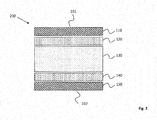
- Fig. 1 shows a schematic structure of a multilayer film 100 produced by coextrusion.
- the film 100 has a front side 101 and a rear side 102 and comprises three layers 110, 120, 130, which are arranged one after the other or one above the other in the direction of the rear side 102, beginning on the front side 101.
- the layers 110, 120, 130 can consist of thermoplastic materials and have different properties, which are brought about, for example, by using different additives and / or UV blockers.
- the film according to the invention has a multilayer structure with the components UV blocker, fluorescent pigments / dyes and laser additive, it being possible for the individual components to be enriched or present to different degrees in the respective layers.
- the first layer 110 can contain a laser additive, the second layer 120 a fluorescent additive and the third layer 130 a UV blocker.
- Known light stabilizers such as titanium dioxide or Tinuvin can be used as UV blockers or UV absorbers, i.e. as a region that is impermeable to UV radiation.
- the first layer 110 is colorless and transparent
- the second layer 120 contains a laser additive
- the third layer 130 contains a UV blocker.
- the second layer 120 contains an additive which, in particular, has a fluorescent color.
- a laser additive By adding a laser additive, permanent markings and / or lettering can be optimally introduced into the film with an optically controlled laser beam.
- personalized information can be incorporated into the film, such as personal data and / or photos.
- Fig. 2 shows a schematic structure of a multilayer film 200 produced by coextrusion according to a further embodiment of the invention.
- the film 200 contains a fourth layer 140 and a fifth layer 150.
- the fourth layer 140 and the fifth layer 150 are arranged below or after the third layer 130 in the direction of the rear side 102 of the film 200, so that the UV Third layer 130 having blockers is arranged between the second layer 120 and the fourth layer 140 and the fifth layer 150 forms the rear side 102 of the film.
- the fourth layer 140 and / or the fifth layer 150 can contain a laser additive and the fourth layer 140 can contain a fluorescent additive.
- the second layer 120 and the fourth layer 140 can contain additives which fluoresce in different colors.
- the first layer 110 and the fifth layer 150 can also include additives that fluoresce differently in terms of color.
- the first layer 110 and the fifth layer 150 can be colorless and transparent, while the second 120 and the fourth layer 140 can each contain additives that fluoresce differently in terms of color.
- the front and back of the film shine in different colors under UV light, while the information is made visible, which is introduced into the layer provided with a laser additive by means of a laser.
- a film constructed in this way can be used as an insert for a window in a data carrier, as shown below in connection with the color photographs Fig. 5.1 or their gray value representations according to Fig. 5.2 is explained.
- the region of the third layer 130 which is impermeable to UV radiation is continuous and extends over the entire third layer.
- the continuous distribution of the UV blocker over the entire third layer 130 prevents the fluorescent layer on the opposite side from being excited to luminescence when the front or rear side 101, 102 of the film is irradiated with UV radiation.
- the third layer 130 provided with the UV blocker can be interrupted or penetrated in order to form at least one region in the third layer 130 that is permeable to UV radiation.
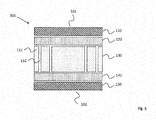
- Fig. 3 shows an embodiment of a film according to the invention in which the third layer has areas which are both impermeable to UV radiation and also UV-permeable.
- the film 300 shown is a strip film in which the third layer 130 has alternately arranged regions 131 which are impermeable to UV radiation and regions 132 which are transparent to UV radiation.
- regions 131, 132 which are impermeable to UV radiation
- Other arrangements of the two areas 131, 132 are also conceivable, such as any desired penetration pattern.
- Such a strip film can be produced in the coextrusion process with several coextrusion units using divisors.
- UV blocker-free areas can be generated by penetrating the third layer 130 by means of laser beam bombardment, for example in the course of introducing personalized data in the layers of the film which contain laser additives.
- the penetration of the UV blocker creates so-called transmitted-light effects, such as those used as security features in banknotes, for example.
- a secondary color can be generated through the penetration of the third layer 130 between them when the film 300 is irradiated with UV radiation.
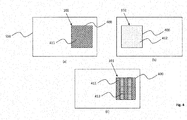
- Fig. 4 shows, under different viewing conditions, schematically specific designs and manifestations of films according to the invention after irradiation or excitation with UV radiation.
- the film 400 is shown within a data carrier 500, wherein the data carrier 500 can be, for example, a bank note or an identity card, as shown on the basis of the color photographs Fig. 5.1 or their gray value representations according to Fig. 5.2 is shown.
- the film shown is a multilayer film 400 in which the third layer contains a UV blocker throughout. Furthermore, the second and fourth layers contain fluorescent additives of different colors, for example red and blue. It shows Fig. 4 (a) the film 400 when viewing the front side 101 with UV excitation on the front side 101. The film 400 glows in a first fluorescent color 411, for example in red, if the fluorescent additive contains red color particles. Fig. 4 (b) shows the film 400 when viewing the rear side 102 with UV excitation on the rear side 102. Here, too, the film glows, but now in a second fluorescent color 412, for example in blue, corresponding to the additive contained in the fourth layer.
- a first fluorescent color 411 for example in red
- Fig. 4 (b) shows the film 400 when viewing the rear side 102 with UV excitation on the rear side 102.
- the film glows, but now in a second fluorescent color 412, for example in blue, corresponding to the additive contained in the fourth layer.
- FIG. 14 shows another exemplary film 400 that extends from the film in FIG Fig. 4 (a) and (b) differs in that the third layer is a strip film which comprises areas with a UV blocker and areas without a UV blocker, similar to the film 300 according to FIG Fig. 3 .
- FIG Fig. 4 (a) A new appearance now results when the film 400, as in FIG Fig. 4 (a) , is viewed from the front side 101 while being irradiated with ultraviolet light on the front side.
- a fluorescent stripe-shaped pattern appears. While the strips 411 light up in the first fluorescent color, i.e. according to the color additive of the first or second layer, e.g. red, the strips 413 appear with a third fluorescent color, which is created by mixing or adding the first fluorescent color and the fluorescent color the fourth or fifth layer in the areas without UV blockers.
- the third color is magenta, which becomes visible as a secondary color by mixing / adding the colors red and blue during UV excitation.
- the film according to the invention when irradiated with UV radiation, the film according to the invention enables not only different colors to be produced on the front side and the rear side of the film, but also different colors to be arranged on one side. This enables a security feature or security element to be defined in that certain colors become visible in certain patterns under UV excitation.
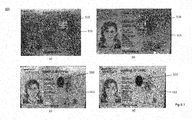
- the Fig. 5.1 shows four color photographs of a data carrier according to the invention in the form of an identity card.
- the color of these color photographs is part of the priority application to the European Patent Office and, in this respect, is also part of the disclosure of the present invention with regard to the color effects shown.
- the Fig. 5.2 additional gray value representations of the four color photographs according to Fig. 5.1 .
- the gray value representations according to Fig. 5.2 thus result from the color photographs according to Fig. 5.1 that the in Fig. 5.1 color characteristics shown in Fig. 5.2 can be recognized as corresponding gray value intensities.
- Fig.5.1 (a) and (b) respectively.
- Fig.5.2 (a) and (b) show a data carrier according to the invention in the form of an identity card 500.
- the data carrier 500 comprises a window element 510 which is implemented by means of a multilayer, coextruded film.
- the window element 510 comprises a security feature or security element 511 which is implemented by additives of the film layers which fluoresce in different colors and which contains a lasered image.
- Fig.5.1 (a) shows a data carrier comprising a film with yellow fluorescence
- Fig.5.1 (b) respectively.
- Fig.5.2 (b) shows a data carrier comprising a film with blue fluorescence.
- Fig.5.1 (c) and (d) respectively.
- Fig.5.2 (c) and (d) The data carriers shown are embodiments in which the security element 511 contains only lasered data.
- Fig.5.1 (c) respectively.
- Fig.5.2 (c) shows the disk on a white surface while Fig.5.1 (d) respectively.
- Fig.5.2 (d) shows the data carrier on a black surface.
- the Fig. 5.2 illustrates these color effects in that the window elements 510, which fluoresce in different colors, are shown in FIG Fig.5.1 (a) and (b) in Fig.5.2 (a) and (b) have different gray value intensities that stand out from the background and the white or black base of the Fig.5.1 (c) and (d) likewise by corresponding intensity differences in the window elements 510 of FIG Fig.5.2 (c) and (d) is recognizable.
- FIG.5.1 the window elements 510, which fluoresce in different colors
- the steps of a method according to the invention for producing a multilayer film of the described type according to the invention comprises the steps of extruding (S10) a material with at least one laser additive, whereby at least the first layer (110) is formed; extruding (S20) a material with at least one fluorescent additive, thereby forming at least the second layer (120); extruding (S30) a material having at least one region that is opaque to UV radiation, thereby forming at least the third layer (130); and bonding (S40) the individual layers, thereby forming the multilayer film.
- the steps can be carried out simultaneously in a coextrusion process.
Landscapes
- Engineering & Computer Science (AREA)
- Mechanical Engineering (AREA)
- Manufacturing & Machinery (AREA)
- Physics & Mathematics (AREA)
- Health & Medical Sciences (AREA)
- Electromagnetism (AREA)
- General Health & Medical Sciences (AREA)
- Optics & Photonics (AREA)
- Toxicology (AREA)
- Laminated Bodies (AREA)
- Extrusion Moulding Of Plastics Or The Like (AREA)
Abstract
Description
- Die vorliegende Erfindung betrifft eine mehrschichtige koextrudierte Folie, ein Verfahren zur Herstellung einer mehrschichtigen koextrudierten Folie, sowie einen Datenträger mit einer koextrudierten Folie, die es ermöglicht, ein Sicherheitsmerkmal in den Datenträger einzubringen, das ihn fälschungssicher macht.
- Datenträger im Sinne der Erfindung sind insbesondere Medien, mit denen der Nachweis einer Identität oder einer Berechtigung erbracht werden kann, wie zum Beispiel Reisepässe, Personalausweise, Führerscheine, Kredit- oder SIM-Karten oder dergleichen.
- Sicherheitsmerkmale oder -elemente werden vielfach in Datenträgern eingesetzt, um diese gegen Fälschung bzw. Kopieren oder gegen Manipulation zu sichern. Generell können Sicherheitselemente unter anderem durch farblich komplexe Muster, Lasergravuren oder elektronische Bauelemente realisiert und mittels technisch aufwendiger Verfahren in die Datenträger eingebracht werden.
- Aus der
DE 10 2016 009 261 A1 ist ein Datenträger bekannt, der mindestens eine koextrudierte Streifenfolie aufweist. Die Streifenfolie ist aus alternierend und sich überlappend angeordneten Streifenschichten derart gebildet, dass durch die unterschiedliche Farbgebung der einzelnen Streifenschichten ein Sicherheitsmerkmal gegeben ist. - Aus der
EP 3 470 236 A1 wiederum ist ein Datenträger und insbesondere ein Wert- oder Sicherheitsdokument bekannt, bei dem ein Sicherheitselement mittels lumineszierender Motivbereiche realisiert ist. - Es ist ein Nachteil der Herstellungsverfahren der bekannten Datenträger, dass das Einbringen verschiedener Sicherheitselemente in einem Datenträger mehrere unterschiedliche Herstellungsschritte erfordert, die gesondert und unabhängig voneinander vorgenommen werde müssen. So ist es oftmals notwendig, die verschiedenen Sicherheitsmerkmale einzeln in die jeweiligen Schichten einzubringen und anschließend die Schichten mittels Laminierverfahren zusammenzuführen bzw. zu verbinden
- Insofern ist es die Aufgabe der vorliegenden Erfindung, eine Folie bereitzustellen, mittels der eine Kombination verschiedener Sicherheitsmerkmale realisiert und die mit geringem technischen Aufwand bereitgestellt werden kann. Es ist weiter eine Aufgabe der vorliegenden Erfindung, ein entsprechendes Verfahren zur Herstellung der Folie bereitzustellen. Ferner ist es eine Aufgabe der vorliegenden Erfindung, einen Datenträger bereitzustellen, der über eine höhere Fälschungssicherheit verfügt.
- Gelöst wird diese Aufgabe durch eine Folie, ein Verfahren zur Herstellung einer solchen Folie, sowie einen Datenträger gemäß den unabhängigen Ansprüchen. Die davon abhängigen Ansprüche spezifizieren vorteilhafte Ausgestaltungen und Weiterbildungen der Erfindung.
- Gemäß einem ersten Aspekt der Erfindung wird eine mehrschichtige koextrudierte Folie vorgeschlagen. Die Folie, welche eine Vorderseite und eine Rückseite aufweist, umfasst mindestens drei Schichten, wobei die erste dieser Schichten oder/und die zweite dieser Schichten ein Laseradditiv umfasst sowie die zweite Schicht ein fluoreszierendes Additiv und die dritte dieser Schichten einen für UV-Strahlung undurchlässigen Bereich umfasst.
- Hierdurch wird eine Folie bereitgestellt, die verschiedene Sicherheitsmerkmale integriert und auf einfache Weise mittels Koextrusion hergestellt werden kann. Damit lassen sich nicht nur verschiedene Sicherheitselemente in die Folie einbringen, sondern auch einander überlagern, wodurch zusätzliche Effekte erzeugt werden können, die die Fälschungssicherheit noch weiter erhöhen. So können beispielsweise Lasergravuren, die in einer der Schichten eingebracht wurden, unter Bestrahlung der Folie mit UV-Licht fluoreszierend erscheinen.
- Insbesondere weist die erfindungsgemäße Folie einen mehrschichtigen Aufbau mit Komponenten, wie zum Beispiel UV-Blockern, fluoreszierenden Pigmenten/ Farbstoffen und Laseradditiven auf, wobei die einzelnen Komponenten in den jeweiligen Schichten unterschiedlich ausgeprägt sein können.
- So kann die dritte Schicht ebenfalls ein Laseradditiv umfassen. Darüber hinaus kann die erste Schicht ebenfalls ein fluoreszierendes Additiv umfassen.
- Durch Verwenden eines Laseradditivs in mindestens einer der Schichten lassen sich dauerhafte Markierungen, wie beispielsweise personalisierte Daten und/oder Fotos, mittels Laserbestrahlung in die mit einem Laseradditiv versehenen Schichten der Folie flächenbegrenzt optimal einbringen.
- Durch Ausstatten weiterer Schichten mit einem fluoreszierenden Additiv lassen sich weitere Farbeffekte realisieren.
- Gemäß einer bevorzugten Ausgestaltung ist die mehrschichtige Folie derart ausgebildet, dass die erste Schicht, die zweite Schicht und die dritte Schicht ausgehend von der Vorderseite der Folie nacheinander in Richtung der Rückseite der Folie angeordnet sind. Beginnend mit der Vorderseite der Folie sind die erste, zweite und dritte Schicht also in dieser Reihenfolge aufeinanderfolgend in Richtung der Rückseite angeordnet.
- In einer bevorzugten Ausgestaltung umfasst die Folie eine oder mehrere weitere Schichten, insbesondere eine vierte Schicht und eine fünfte Schicht. Dabei sind die vierte Schicht und die fünfte Schicht ausgehend von der dritten Schicht nacheinander in Richtung der Rückseite der Folie angeordnet. Die vierte und fünfte Schicht folgen also in dieser Reihenfolge auf die dritte Schicht. Vorzugsweise umfasst die vierte Schicht oder/und die fünfte Schicht ein Laseradditiv und die vierte Schicht ein fluoreszierendes Additiv.
- Vorzugsweise umfassen die zweite Schicht und die vierte Schicht farblich unterschiedlich fluoreszierende Additive.
- Durch das Verwenden von zwei unterschiedlich farbig fluoreszierenden Additiven leuchten unter UV-Licht die Vorderseite und die Rückseite der Folie farblich unterschiedlich, während Informationen in der mit einem Laseradditiv versehenen Schicht sichtbar gemacht werden, die dort zuvor mittels Laser eingebracht wurden. Eine derart aufgebaute Folie kann als Einsatz für ein Fenster in einen Datenträger verwendet werden.
- Vorzugsweise können die erste Schicht und die fünfte Schicht fluoreszierende, insbesondere farblich unterschiedliche Additive umfassen.
- Vorzugsweise erstreckt sich der für UV-Strahlung undurchlässige Bereich der dritten Schicht über die gesamte dritte Schicht. Dadurch wird verhindert, dass bei Bestrahlung der Vorder- oder Rückseite der Folie mit UV-Strahlung die auf der jeweils gegenüberliegenden Seite angeordnete fluoreszierende Schicht zur Lumineszenz angeregt wird.
- In einer bevorzugten Ausgestaltung der Folie kann jedoch die dritte Schicht zumindest einen für UV-Strahlung durchlässigen Bereich umfassen. Vorzugsweise umfasst die dritte Schicht zumindest einen weiteren für UV-Strahlung undurchlässigen Bereich, wobei die für UV-Strahlung durchlässigen Bereiche und die für UV-Strahlung undurchlässige Bereiche alternierend angeordnet sind.
- Durch eine derartige Unterbrechung oder "Penetration" des UV-Blockers entstehen sogenannte Durchlicht-Auflicht-Effekte, wie sie beispielsweise in Banknoten als Sicherheitsmerkmale zur Verwendung kommen. Außerdem lässt sich dadurch mit farblich unterschiedlich fluoreszierenden Additiven der zweiten und vierten Schicht, beziehungsweise der ersten und fünften Schicht, eine Sekundärfarbe erzeugen, wenn die Folie mit UV-Strahlung bestrahlt wird. Eine Sekundärfarbe ist hierbei eine weitere Farbe, die entsteht, wenn zwei unterschiedliche Farben gemischt bzw. deren Spektren addiert werden.
- Gemäß einem zweiten Aspekt betrifft die Erfindung ein Verfahren zur Herstellung einer mehrschichtigen Folie gemäß dem ersten Aspekt. Das Verfahren umfasst die Schritte des Extrudierens eines Materials mit zumindest einem Laseradditiv, wodurch zumindest eine erste Schicht der Folie gebildet wird; des Extrudierens eines Materials mit zumindest einem fluoreszierendes Additiv, wodurch zumindest eine zweite Schicht der Folie gebildet wird; des Extrudierens eines Materials mit zumindest einem für UV-Strahlung undurchlässigen Bereich, wodurch zumindest eine dritte Schicht der Folie gebildet wird; und des Verbindens der einzelnen Schichten, wodurch eine mehrschichtige Folie gemäß dem ersten Aspekt gebildet wird.
- Vorzugsweise lassen sich die Verfahrensschritte gleichzeitig im Rahmen eines Koextrusionsverfahrens ausführen. Dies hat den Vorteil, dass die erfindungsgemäße Folie mit vorhandenen Werkzeugen ohne großen technischen Aufwand und ohne hohe Kosten zu verursachen hergestellt werden kann.
- Gemäß einem dritten Aspekt betrifft die Erfindung einen Datenträger, insbesondere ein Wert- oder Identitätsdokument, umfassend ein Fensterelement, das mittels einer mehrschichtigen koextrudierten Folie gemäß dem ersten Aspekt realisiert ist.
- Vorzugsweise umfasst das Fensterelement ein durch die farblich unterschiedlichen fluoreszierenden Additive der Folienschichten realisiertes Sicherheitsmerkmal.
- Vorzugsweise umfasst das Fensterelement Daten, die mittels Laser in die Laseradditive umfassenden Schichten der Folie eingebracht werden.
- Der Datenträger bildet insbesondere eine Ausweis-, Kredit-, Bank-, Barzahlungs- oder Berechtigungskarte, eine Chipkarte oder eine Personalisierungsdatenseite zur Einbindung in ein Passbuch.
- Weitere Merkmale und Vorteile der Erfindung ergeben sich aus der folgenden Beschreibung erfindungsgemäßer Ausführungsbeispiele sowie weiteren Ausführungsalternativen im Zusammenhang mit den folgenden Zeichnungen, die zeigen:
- Figur 1
- eine schematische Ansicht einer erfindungsgemäßen mehrschichtigen Folie gemäß einer erste Ausführungsform;
- Figur 2
- eine schematische Ansicht einer erfindungsgemäßen mehrschichtigen Folie gemäß einer zweiten Ausführungsform;
- Figur 3
- eine schematische Ansicht einer erfindungsgemäßen mehrschichtigen Folie gemäß einer dritten Ausführungsform;
- Figur 4
- schematische Erscheinungsbilder erfindungsgemäßer Folien nach Anregung mit UV-Strahlung unter unterschiedlichen Betrachtungsbedingungen;
- Figur 5.1
- Farbfotographien on bevorzugten Ausführungsformen eines erfindungsgemäßen Datenträgers
- Figur 5.2
- Grauwertdarstellungen der Farbfotographien gemäß
Fig. 5.1 ; und - Figur 6
- eine bevorzugte Ausführungsform eines erfindungsgemäßen Verfahrens.
- In den genannten Figuren werden gleiche Bezugszeichen und Bezeichnungen für gleiche Elemente verwendet.
-
Fig. 1 zeigt einen schematischen Aufbau einer mehrschichtigen, durch Koextrusion hergestellten Folie 100. Die Folie 100 weist eine Vorderseite 101 und eine Rückseite 102 auf und umfasst drei Schichten 110,120,130, die beginnend auf der Vorderseite 101 nacheinander bzw. übereinanderliegend in Richtung der Rückseite 102 angeordnet sind. - Die Schichten 110,120,130 können aus thermoplastischen Materialien bestehen und unterschiedliche Eigenschaften aufweisen, die beispielsweise durch Verwenden verschiedener Additive und/oder UV-Blocker hervorgerufen werden. Insbesondere weist die erfindungsgemäße Folie einen mehrschichtigen Aufbau mit den Komponenten UV-Blocker, fluoreszierende Pigmente/Farbstoffe und Laseradditiv auf, wobei die einzelnen Komponenten in den jeweiligen Schichten unterschiedlich ausgeprägt angereichert bzw. vorhanden sein können.
- So kann gemäß einer bevorzugten Ausführungsform die erste Schicht 110 einen Laseradditiv, die zweite Schicht 120 ein fluoreszierendes Additiv und die dritte Schicht 130 einen UV-Blocker enthalten.
- Als UV-Blocker oder UV-Absorber, d.h. als ein für UV-Strahlung undurchlässiger Bereich, können bekannte Lichtstabilisatoren eingesetzt werden, wie beispielsweise Titandioxid oder Tinuvin.
- Bei einer alternativen Ausführungsform ist die erste Schicht 110 farblos und transparent, die zweite Schicht 120 enthält ein Laseradditiv und die dritte Schicht 130 enthält einen UV-Blocker. Des Weiteren enthält die zweite Schicht 120 ein insbesondere farblich fluoreszierendes Additiv.
- Durch die Zugabe eines Laseradditivs lassen sich mit einem optisch gesteuerten Laserstrahl dauerhafte Markierungen und/oder Beschriftungen in die Folie flächenbegrenzt optimal einbringen. So lassen sich beispielsweise personalisierte Informationen in die Folie einbringen, wie zum Beispiel Personaldaten und/ oder Fotos.
-
Fig. 2 zeigt einen schematischen Aufbau einer mehrschichtigen, durch Koextrusion hergestellten Folie 200 gemäß einer weiteren Ausführungsform der Erfindung. Zusätzlich zu den in derFig. 1 dargestellten drei Schichten enthält die Folie 200 eine vierte Schicht 140 und eine fünfte Schicht 150. Dabei sind die vierte Schicht 140 und die fünfte Schicht 150 unterhalb oder nach der dritten Schicht 130 in Richtung der Rückseite 102 der Folie 200 angeordnet, so dass die den UV-Blocker aufweisende dritte Schicht 130 zwischen der zweiten Schicht 120 und der vierten Schicht 140 angeordnet ist und die fünfte Schicht 150 die Rückseite 102 der Folie bildet. - Die vierte Schicht 140 oder/und die fünfte Schicht 150 können ein Laseradditiv enthalten und die vierte Schicht 140 kann ein fluoreszierendes Additiv enthalten.
- Dabei können die zweite Schicht 120 und die vierte Schicht 140 farblich unterschiedlich fluoreszierende Additive enthalten. Darüber hinaus können die erste Schicht 110 und die fünfte Schicht 150 ebenfalls farblich unterschiedlich fluoreszierende Additive umfassen. Alternativ können die erste Schicht 110 und die fünfte Schicht 150 farblos und transparent ausgestaltet sein, während die zweite 120 und die vierte Schicht 140 jeweils farblich unterschiedlich fluoreszierende Additive enthalten können.
- Durch Verwendung von zwei unterschiedlich fluoreszierenden Additiven leuchten unter UV-Licht die Vorderseite und die Rückseite der Folie farblich unterschiedlich, während die Information sichtbar gemacht wird, die mittels Laser in die mit einem Laseradditiv versehene Schicht eingebracht ist. Eine derart aufgebaute Folie kann als Einsatz für ein Fenster in einem Datenträger verwendet werden, wie weiter unten im Zusammenhang mit den Farbfotographien gemäß
Fig. 5.1 bzw. deren Grauwertdarstellungen gemäßFig. 5.2 erläutert wird. - In den in den
Figuren 1 und2 dargestellten Ausführungsformen der erfindungsgemäßen Folie ist der für UV-Strahlung undurchlässige Bereich der dritten Schicht 130 durchgehend und erstreckt sich über die gesamte dritte Schicht. - Grundsätzlich wir durch die durchgehende Verteilung des UV-Blockers über die gesamte dritte Schicht 130 verhindert, dass bei Bestrahlung der Vorder- oder Rückseite 101, 102 der Folie mit UV-Strahlung die auf der jeweils gegenüberliegenden Seite angeordnete fluoreszierende Schicht zur Lumineszenz angeregt wird.
- Jedoch kann, gemäß einer alternativen Ausgestaltung der erfindungsgemäßen Folie, die mit dem UV-Blocker versehene dritte Schicht 130 unterbrochen bzw. penetriert werden, um mindestens einen für UV-Strahlung durchlässigen Bereich in der dritten Schicht 130 zu bilden.
-
Fig. 3 zeigt eine Ausführungsform einer erfindungsgemäßen Folie bei der die dritte Schicht sowohl für UV-Strahlung undurchlässige also auch UV-durchlässige Bereiche aufweist. - Die in
Fig. 3 gezeigte Folie 300 ist eine Streifenfolie, bei der die dritte Schicht 130 alternierend angeordnete für UV-Strahlung undurchlässige Bereiche 131 und für UV-Strahlung durchlässige Bereiche 132 aufweist. Andere Anordnungen der beiden Bereiche 131, 132 sind ebenfalls denkbar, wie beispielsweise beliebige Penetrationsmuster. - Eine derartige Streifenfolie kann im Koextrusionsverfahren mit mehreren Koextrusionseinheiten unter Verwendung von Divisoren hergestellt werden.
- Des Weiteren können UV-Blocker-freie Bereiche durch Penetration der dritten Schicht 130 mittels Laserstrahlenbeschuss erzeugt werden, beispielsweise im Zuge der Einbringung personalisierter Daten in den Schichten der Folie, die Laseradditive enthalten.
- Eine Penetration durch mechanische Perforation ist ebenfalls möglich.
- Durch die Penetration des UV-Blockers entstehen sogenannte Durchlicht-Auflicht-Effekte, wie sie beispielsweise in Banknoten als Sicherheitsmerkmale zum Einsatz kommen.
- Des Weiteren lässt sich im Zusammenhang mit farblich unterschiedlich fluoreszierenden Additiven der zweiten Schicht 120 und vierten Schicht 140 durch die Penetration der dazwischenliegenden dritten Schicht 130 eine Sekundärfarbe erzeugen, wenn die Folie 300 mit UV-Strahlung bestrahlt wird.
-
Fig. 4 zeigt unter unterschiedlichen Betrachtungsbedingungen schematisch konkrete Ausgestaltungen und Erscheinungsformen erfindungsgemäßer Folien nach Bestrahlung bzw. Anregung mit UV-Strahlung. Dabei wird die Folie 400 innerhalb eines Datenträgers 500 gezeigt, wobei der Datenträger 500 beispielsweise eine Banknote oder ein Personalausweis sein kann, wie anhand der Farbfotographien gemäßFig. 5.1 bzw. deren Grauwertdarstellungen gemäßFig. 5.2 gezeigt ist. - Bei der in den
Figuren 4 (a) und (b) gezeigten Folie handelt es sich um eine mehrschichtige Folie 400, bei der die dritte Schicht durchgehend einen UV-Blocker enthält. Des Weiteren enthalten die zweite und die vierte Schicht unterschiedlich farbliche Fluoreszenz-Additive, z.B. rot und blau. Dabei zeigtFig. 4 (a) die Folie 400 bei Betrachtung der Vorderseite 101 bei UV-Anregung auf der Vorderseite 101. Die Folie 400 leuchtet in einer ersten Fluoreszenzfarbe 411, z.B. in Rot, falls das fluoreszierende Additiv rote Farbpartikel enthält.Fig. 4 (b) zeigt die Folie 400 bei Betrachtung der Rückseite 102 bei UV-Anregung auf der Rückseite 102. Auch hier leuchtet die Folie, jetzt jedoch in einer zweiten Fluoreszenzfarbe 412, z.B. in Blau, entsprechend dem in der vierten Schicht enthaltenen Additiv. -
Fig. 4 (c) zeigt eine weitere beispielhafte Folie 400, die sich von der Folie in denFig. 4 (a) und (b) dadurch unterscheidet, dass die dritte Schicht eine Streifenfolie ist, die Bereiche mit UV-Blocker und Bereiche ohne UV-Blocker umfasst, ähnlich der Folie 300 gemäßFig. 3 . - Ein neues Erscheinungsbild ergibt sich nun, wenn die Folie 400, wie auch in
Fig. 4 (a) , von der Vorderseite 101 betrachtet wird, während sie auf der Vorderseite mit UV-Licht bestrahlt wird. In diesem Fall erscheint ein fluoreszierendes streifenförmiges Muster. Während die Streifen 411 in der ersten Fluoreszenzfarbe leuchten, also entsprechend dem farblichen Additiv der ersten oder zweiten Schicht, z.B. rot, treten die Streifen 413 mit einer dritten Fluoreszenzfarbe in Erscheinung, die sich durch Vermischen bzw. Addition der ersten Fluoreszenzfarbe und der Fluoreszenzfarbe der vierten oder fünften Schicht in den Bereichen ohne UV-Blocker ergibt. Vorliegend ist die dritte Farbe Magenta, die als Sekundärfarbe durch Vermischen / Addieren der Farben Rot und Blau während der UV-Anregung sichtbar wird. - Somit lassen sich durch die erfindungsgemäße Folie unter Bestrahlung mit UV-Strahlung nicht nur verschiedene Farben auf der Vorderseite und der Rückseite der Folie erzeugen, sondern auch unterschiedliche Farben auf einer Seite anordnen. Dies ermöglicht ein Sicherheitsmerkmal bzw. Sicherheitselement dadurch zu definieren, dass bestimmte Farben in bestimmten Mustern unter UV-Anregung sichtbar werden.
- Die
Fig. 5.1 zeigt vier Farbfotographien eines erfindungsgemäßen Datenträgers in Form eines Personalausweises. Diese Farbfotographien sind in ihrer farbigen Ausgestaltung Bestandteil der Prioritätsanmeldung beim Europäischen Patentamt und insofern auch hinsichtlich der dargestellten Farbeffekte Teil der Offenbarung der vorliegenden Erfindung. Aus Gründen der Reproduzierbarkeit zeigt dieFig. 5.2 zusätzlich Grauwertdarstellungen der vier Farbfotographien gemäßFig. 5.1 . Die Grauwertdarstellungen gemäßFig. 5.2 ergeben sich derart aus den Farbfotographien gemäßFig. 5.1 , dass die inFig. 5.1 gezeigten Farbmerkmale inFig. 5.2 als entsprechende Grauwertintensitäten erkennbar sind. -
Fig. 5.1 (a) und (b) bzw.Fig. 5.2 (a) und (b) zeigen einen erfindungsgemäßen Datenträger in Form eines Personalausweises 500. Der Datenträger 500 umfasst ein Fensterelement 510, das mittels einer mehrschichtigen koextrudierten Folie realisiert ist. Das Fensterelement 510 umfasst ein Sicherheitsmerkmal oder Sicherheitselement 511, das durch farblich unterschiedlich fluoreszierende Additive der Folienschichten realisiert ist und ein gelasertes Bild beinhaltet. -
Fig. 5.1 (a) bzw.Fig. 5.2 (a) zeigt einen Datenträger umfassend eine Folie mit gelber Fluoreszenz, währendFig. 5.1 (b) bzw.Fig. 5.2 (b) einen Datenträger umfassend eine Folie mit blauer Fluoreszenz zeigt. - Bei den in
Fig. 5.1 (c) und (d) bzw.Fig. 5.2 (c) und (d) gezeigten Datenträgern handelt es sich um Ausführungsformen, bei denen das Sicherheitselement 511 nur gelaserte Daten enthält.Fig. 5.1 (c) bzw.Fig. 5.2 (c) zeigt den Datenträger auf einer weißen Unterlage, währendFig. 5.1 (d) bzw.Fig. 5.2 (d) den Datenträger auf einer schwarzen Unterlage zeigt. - Der konkrete Aufbau der Folien und die Anordnung von Schichten mit unterschiedlich fluoreszierenden Additiven, Laseradditiven und/oder UV-Blockern, die die Farbeffekte gemäß
Fig. 5.1 hervorrufen, ergibt sich im Zusammenhang mit denFiguren 1 bis 4 . DieFig. 5.2 illustriert diese Farbeffekte, indem die farblich unterschiedlich fluoreszierenden Fensterelemente 510 derFig. 5.1 (a) und (b) inFig. 5.2 (a) und (b) unterschiedliche und sich vom Hintergrund abhebende Grauwertintensitäten aufweisen und die weiße bzw. schwarze Unterlage derFig. 5.1 (c) und (d) ebenfalls durch entsprechende Intensitätsunterschiede in den Fensterelementen 510 derFig. 5.2 (c) und (d) erkennbar ist. Schließlich illustriertFig. 6 die Schritte eines erfindungsgemäßen Verfahrens zur Herstellung einer mehrschichtigen Folie der beschriebenen, erfindungsgemäßen Art. Das Verfahren umfasst die Schritte des Extrudierens (S10) eines Materials mit zumindest einem Laseradditiv, wodurch zumindest die erste Schicht (110) gebildet wird; des Extrudierens (S20) eines Materials mit zumindest einem fluoreszierenden Additiv, wodurch zumindest die zweite Schicht (120) gebildet wird; des Extrudierens (S30) eines Materials mit zumindest einem für UV-Strahlung undurchlässigen Bereich, wodurch zumindest die dritte Schicht (130) gebildet wird; und des Verbindens (S40) der einzelnen Schichten, wodurch die mehrschichtige Folie gebildet wird. Die Schritte können gleichzeitig in einem Koextrusionsverfahren ausgeführt werden.
Claims (15)
- Mehrschichtige koextrudierte Folie (100; 200; 300; 400) mit einer Vorderseite (101) und einer Rückseite (102), wobei die Folie zumindest drei Schichten umfasst, dadurch gekennzeichnet, dass eine erste Schicht (110) der zumindest drei Schichten oder/und eine zweite Schicht (120) der zumindest drei Schichten ein Laseradditiv umfasst, die zweite Schicht (120) ein fluoreszierendes Additiv umfasst und eine dritte Schicht (130) der zumindest drei Schichten einen für UV-Strahlung undurchlässigen Bereich umfasst.
- Mehrschichtige Folie (100; 200; 300; 400) nach Anspruch 1, dadurch gekennzeichnet, dass die dritte Schicht (130) ein Laseradditiv umfasst.
- Mehrschichtige Folie (100; 200; 300; 400) nach Anspruch 1 oder 2, dadurch gekennzeichnet, dass die erste Schicht (110) ein fluoreszierendes Additiv umfasst.
- Mehrschichtige Folie (100; 200; 300; 400) nach einem der Ansprüche 1 bis 3, dadurch gekennzeichnet, dass die erste Schicht (110), die zweite Schicht (120) und die dritte Schicht (130) ausgehend von der Vorderseite (101) der Folie (100; 200; 300; 400) nacheinander in Richtung der Rückseite (102) der Folie (100; 200; 300; 400) angeordnet sind.
- Mehrschichtige Folie (100; 200; 300; 400) nach einem der Ansprüche 1 bis 4, dadurch gekennzeichnet, dass die Folie (100; 200; 300; 400) eine vierte Schicht (140) und eine fünfte Schicht (150) umfasst, wobei die vierte Schicht (140) und die fünfte Schicht (150) ausgehend von der dritten Schicht (130) nacheinander in Richtung der Rückseite (102) der Folie (100; 200; 300; 400) angeordnet sind, wobei die vierte Schicht (140) oder/und die fünfte Schicht (150) ein Laseradditiv umfasst und die vierte Schicht (140) ein fluoreszierendes Additiv umfasst.
- Mehrschichtige Folie (100; 200; 300; 400) nach Anspruch 5, dadurch gekennzeichnet, dass die zweite Schicht (120) und die vierte Schicht (140) farblich unterschiedlich fluoreszierende Additive umfassen.
- Mehrschichtige Folie (100; 200; 300; 400) nach Anspruch 5 oder 6, dadurch gekennzeichnet, dass die erste Schicht (110) und die fünfte Schicht (150) farblich unterschiedlich fluoreszierende Additive umfassen.
- Mehrschichtige Folie (100; 200; 300; 400) nach einem der Ansprüche 1 bis 7, dadurch gekennzeichnet, dass sich der für UV-Strahlung undurchlässige Bereich der dritten Schicht (130) über die gesamte dritte Schicht (130) erstreckt.
- Mehrschichtige Folie (100; 200; 300; 400) nach einem der Ansprüche 1 bis 7, dadurch gekennzeichnet, dass die dritte Schicht (130) zumindest einen für UV-Strahlung durchlässigen Bereich (132) umfasst.
- Mehrschichtige Folie (100; 200; 300; 400) nach Anspruch 9, dadurch gekennzeichnet, dass die dritte Schicht (130) zumindest einen weiteren für UV-Strahlung undurchlässigen Bereich umfasst, wobei die für UV-Strahlung durchlässigen Bereiche und die für UV-Strahlung undurchlässigen Bereiche alternierend angeordnet sind.
- Verfahren zur Herstellung einer mehrschichtigen Folie (100; 200; 300; 400) mit einer Vorderseite (101) und einer Rückseite (102), wobei die Folie (100; 200; 300; 400) zumindest drei Schichten (110, 120, 130) umfasst, gekennzeichnet durch folgende Schritte:- Extrudieren (S10) eines Materials mit zumindest einem Laseradditiv, wodurch zumindest eine erste Schicht (110) der zumindest drei Schichten gebildet wird;- Extrudieren (S20) eines Materials mit zuminderst einem fluoreszierenden Additiv, wodurch zumindest eine zweite Schicht (120) der zumindest drei Schichten gebildet wird;- Extrudieren (S30) eines Materials mit zumindest einem für UV-Strahlung undurchlässigen Bereich, wodurch zumindest eine dritte Schicht (130) der zumindest drei Schichten gebildet wird; und- Verbinden (S40) der einzelnen Schichten (110, 120, 130) zum Bilden der mehrschichtigen Folie (100; 200; 300; 400).
- Verfahren nach Anspruch 11, dadurch gekennzeichnet, dass die Verfahrensschritte gleichzeitig in einem Koextrusionsverfahren ausgeführt werden.
- Datenträger (500), insbesondere Wert- oder Identitätsdokument, umfassend ein Fensterelement (510), dadurch gekennzeichnet, dass das Fensterelement (510) mittels einer mehrschichtigen koextrudierten Folie (100; 200; 300; 400) nach einem der Ansprüche 1 bis 10 realisiert ist.
- Datenträger (500) nach Anspruch 13, dadurch gekennzeichnet, dass das Fensterelement (510) ein Sicherheitselement umfasst, das durch die farblich unterschiedlichen fluoreszierenden Additive der zumindest drei Schichten (110, 120, 130) der koextrudierten Folie (100; 200; 300; 400) gebildet ist.
- Datenträger (500) nach einem der Ansprüche 13 oder 14, dadurch gekennzeichnet, dass das Fensterelement (510) Daten umfasst, die mittels Laser in die Laseradditiv umfassenden Schichten eingebracht sind.
Priority Applications (1)
| Application Number | Priority Date | Filing Date | Title |
|---|---|---|---|
| EP20020252.1A EP3915778B1 (de) | 2020-05-27 | 2020-05-27 | Koextrudierte fluoreszierende folie |
Applications Claiming Priority (1)
| Application Number | Priority Date | Filing Date | Title |
|---|---|---|---|
| EP20020252.1A EP3915778B1 (de) | 2020-05-27 | 2020-05-27 | Koextrudierte fluoreszierende folie |
Publications (2)
| Publication Number | Publication Date |
|---|---|
| EP3915778A1 true EP3915778A1 (de) | 2021-12-01 |
| EP3915778B1 EP3915778B1 (de) | 2023-08-16 |
Family
ID=71092231
Family Applications (1)
| Application Number | Title | Priority Date | Filing Date |
|---|---|---|---|
| EP20020252.1A Active EP3915778B1 (de) | 2020-05-27 | 2020-05-27 | Koextrudierte fluoreszierende folie |
Country Status (1)
| Country | Link |
|---|---|
| EP (1) | EP3915778B1 (de) |
Cited By (1)
| Publication number | Priority date | Publication date | Assignee | Title |
|---|---|---|---|---|
| WO2023126535A1 (de) * | 2022-01-03 | 2023-07-06 | Giesecke+Devrient Mobile Security Gmbh | Verfahren zum herstellen eines sicherheitsmerkmals, sicherheitsmerkmal für einen kartenförmigen datenträger und kartenförmiger datenträger |
Citations (5)
| Publication number | Priority date | Publication date | Assignee | Title |
|---|---|---|---|---|
| EP2736729B1 (de) * | 2011-07-26 | 2015-08-12 | Giesecke & Devrient GmbH | Datenträgerkarte mit sicherheitsfaden |
| DE102015212492A1 (de) * | 2015-07-03 | 2017-01-05 | Bundesdruckerei Gmbh | Sicherheits- oder Wertdokument mit einem Lumineszenzmerkmal und Verfahren zum Prüfen der Echtheit des Sicherheits- oder Wertdokuments |
| DE102016009261A1 (de) | 2016-07-29 | 2018-02-01 | Giesecke+Devrient Mobile Security Gmbh | Datenträgerkarte mit coextrudierter Streifenfolie |
| EP3418067A1 (de) * | 2017-06-19 | 2018-12-26 | Giesecke+Devrient Mobile Security GmbH | Fluoreszierende personalisierung mittels laser |
| EP3470236A1 (de) | 2017-10-12 | 2019-04-17 | Giesecke+Devrient Currency Technology GmbH | Datenträger mit lumineszierenden motivbereichen |
-
2020
- 2020-05-27 EP EP20020252.1A patent/EP3915778B1/de active Active
Patent Citations (5)
| Publication number | Priority date | Publication date | Assignee | Title |
|---|---|---|---|---|
| EP2736729B1 (de) * | 2011-07-26 | 2015-08-12 | Giesecke & Devrient GmbH | Datenträgerkarte mit sicherheitsfaden |
| DE102015212492A1 (de) * | 2015-07-03 | 2017-01-05 | Bundesdruckerei Gmbh | Sicherheits- oder Wertdokument mit einem Lumineszenzmerkmal und Verfahren zum Prüfen der Echtheit des Sicherheits- oder Wertdokuments |
| DE102016009261A1 (de) | 2016-07-29 | 2018-02-01 | Giesecke+Devrient Mobile Security Gmbh | Datenträgerkarte mit coextrudierter Streifenfolie |
| EP3418067A1 (de) * | 2017-06-19 | 2018-12-26 | Giesecke+Devrient Mobile Security GmbH | Fluoreszierende personalisierung mittels laser |
| EP3470236A1 (de) | 2017-10-12 | 2019-04-17 | Giesecke+Devrient Currency Technology GmbH | Datenträger mit lumineszierenden motivbereichen |
Cited By (1)
| Publication number | Priority date | Publication date | Assignee | Title |
|---|---|---|---|---|
| WO2023126535A1 (de) * | 2022-01-03 | 2023-07-06 | Giesecke+Devrient Mobile Security Gmbh | Verfahren zum herstellen eines sicherheitsmerkmals, sicherheitsmerkmal für einen kartenförmigen datenträger und kartenförmiger datenträger |
Also Published As
| Publication number | Publication date |
|---|---|
| EP3915778B1 (de) | 2023-08-16 |
Similar Documents
| Publication | Publication Date | Title |
|---|---|---|
| EP0659936B1 (de) | Sicherheitspapier mit einem faden- oder bandförmigen Sicherheitselement | |
| EP2448767B1 (de) | Sicherheitselement und herstellungsverfahren dafür | |
| DE102012111054B4 (de) | Sicherheitselement für ein Wert- und/oder Sicherheitsdokument | |
| DE102008037128A1 (de) | Sicherheitselement mit Auf- und Durchlicht-Informationen | |
| WO2023094028A1 (de) | Sicherheitsmerkmal für ein identifikationsdokument, identifikationsdokument und verfahren zur herstellung eines sicherheitsmerkmals | |
| EP3915778B1 (de) | Koextrudierte fluoreszierende folie | |
| DE112022001566T5 (de) | Gedrucktes Sicherheitsmerkmal | |
| EP3339049B1 (de) | Datenträger mit lumineszenzbereichen | |
| EP1214202A2 (de) | Kartenförmiger datenträger und verfahren zu seiner herstellung | |
| EP3609717A1 (de) | Sicherheitselement mit farbigem merkmalsbereich, datenträger und verfahren zur herstellung eines sicherheitselements | |
| EP1934893B1 (de) | Verfahren zur herstellung eines datenträgers | |
| EP2516175A1 (de) | Sicherheitselement und herstellverfahren dafür | |
| EP3196044B1 (de) | Datenträger mit foliensicherheitselement | |
| EP4489977A1 (de) | Datenträger mit von gegenüberliegenden seiten sichtbaren motivbildern und zugehöriges herstellungsverfahren | |
| EP3578381B1 (de) | Sicherheitselement zur absicherung von wertdokumenten | |
| EP3666542B1 (de) | Verfahren zum herstellen eines laminats und laminat sowie sicherheits- oder wertdokument mit einem innenliegenden sicherheitsmerkmal | |
| DE102023108753B3 (de) | Verfahren zum Prüfen eines Sicherheitsdokuments | |
| EP3829892B1 (de) | Lichtsteuerfolie, dokument mit einer lichtsteuerfolie und verfahren zur herstellung eines dokumentes mit einer lichtsteuerfolie | |
| DE102014110586A1 (de) | Mehrschichtaufbau für ein Sicherheits- und/oder Wertdokument sowie ein Verfahren zu dessen Herstellung | |
| EP4029702B1 (de) | Datenträger, verfahren zur herstellung eines datenträgers und wert-oder sicherheitsdokument | |
| DE102023112927A1 (de) | Druckplattenkombination und Verfahren zu deren Herstellung, Sicherheitsdruck und Verfahren zu dessen Herstellung, Ausweis-, Wert- oder Sicherheitsdokument mit einem solchen Sicherheitsdruck und Verfahren zur Verifikation des Sicherheitsdrucks | |
| DE102017005778A1 (de) | Fluoreszierende Personalisierung mittels Laser | |
| EP4219185A1 (de) | Folie, folienbahn, wertdokument und verfahren zur herstellung der solchen | |
| DE102024124689A1 (de) | Wertdokument mit einem Substrat und einem Sicherheitsmerkmal sowie zugehöriges Herstellungsverfahren | |
| DE102021002213A1 (de) | Sicherheitsmerkmal für ein Wertdokument, Wertdokument, Verfahren zur Herstellung eines Sicherheitsmerkmals und Verfahren zur Prüfung eines Sicherheitsmerkmals |
Legal Events
| Date | Code | Title | Description |
|---|---|---|---|
| PUAI | Public reference made under article 153(3) epc to a published international application that has entered the european phase |
Free format text: ORIGINAL CODE: 0009012 |
|
| STAA | Information on the status of an ep patent application or granted ep patent |
Free format text: STATUS: THE APPLICATION HAS BEEN PUBLISHED |
|
| AK | Designated contracting states |
Kind code of ref document: A1 Designated state(s): AL AT BE BG CH CY CZ DE DK EE ES FI FR GB GR HR HU IE IS IT LI LT LU LV MC MK MT NL NO PL PT RO RS SE SI SK SM TR |
|
| B565 | Issuance of search results under rule 164(2) epc |
Effective date: 20201021 |
|
| STAA | Information on the status of an ep patent application or granted ep patent |
Free format text: STATUS: REQUEST FOR EXAMINATION WAS MADE |
|
| 17P | Request for examination filed |
Effective date: 20220601 |
|
| RBV | Designated contracting states (corrected) |
Designated state(s): AL AT BE BG CH CY CZ DE DK EE ES FI FR GB GR HR HU IE IS IT LI LT LU LV MC MK MT NL NO PL PT RO RS SE SI SK SM TR |
|
| GRAP | Despatch of communication of intention to grant a patent |
Free format text: ORIGINAL CODE: EPIDOSNIGR1 |
|
| STAA | Information on the status of an ep patent application or granted ep patent |
Free format text: STATUS: GRANT OF PATENT IS INTENDED |
|
| RIC1 | Information provided on ipc code assigned before grant |
Ipc: B42D 25/00 20140101ALI20230210BHEP Ipc: B32B 27/18 20060101ALI20230210BHEP Ipc: B32B 27/08 20060101ALI20230210BHEP Ipc: B32B 3/18 20060101ALI20230210BHEP Ipc: B29C 48/07 20190101ALI20230210BHEP Ipc: B32B 7/023 20190101AFI20230210BHEP |
|
| INTG | Intention to grant announced |
Effective date: 20230320 |
|
| RAP3 | Party data changed (applicant data changed or rights of an application transferred) |
Owner name: GIESECKE+DEVRIENT MOBILE SECURITY GMBH |
|
| P01 | Opt-out of the competence of the unified patent court (upc) registered |
Effective date: 20230519 |
|
| GRAS | Grant fee paid |
Free format text: ORIGINAL CODE: EPIDOSNIGR3 |
|
| GRAA | (expected) grant |
Free format text: ORIGINAL CODE: 0009210 |
|
| STAA | Information on the status of an ep patent application or granted ep patent |
Free format text: STATUS: THE PATENT HAS BEEN GRANTED |
|
| AK | Designated contracting states |
Kind code of ref document: B1 Designated state(s): AL AT BE BG CH CY CZ DE DK EE ES FI FR GB GR HR HU IE IS IT LI LT LU LV MC MK MT NL NO PL PT RO RS SE SI SK SM TR |
|
| REG | Reference to a national code |
Ref country code: CH Ref legal event code: EP Ref country code: DE Ref legal event code: R096 Ref document number: 502020004684 Country of ref document: DE |
|
| REG | Reference to a national code |
Ref country code: IE Ref legal event code: FG4D Free format text: LANGUAGE OF EP DOCUMENT: GERMAN |
|
| RAP4 | Party data changed (patent owner data changed or rights of a patent transferred) |
Owner name: GIESECKE+DEVRIENT EPAYMENTS GMBH |
|
| REG | Reference to a national code |
Ref country code: LT Ref legal event code: MG9D |
|
| REG | Reference to a national code |
Ref country code: NL Ref legal event code: MP Effective date: 20230816 |
|
| PG25 | Lapsed in a contracting state [announced via postgrant information from national office to epo] |
Ref country code: GR Free format text: LAPSE BECAUSE OF FAILURE TO SUBMIT A TRANSLATION OF THE DESCRIPTION OR TO PAY THE FEE WITHIN THE PRESCRIBED TIME-LIMIT Effective date: 20231117 |
|
| PG25 | Lapsed in a contracting state [announced via postgrant information from national office to epo] |
Ref country code: IS Free format text: LAPSE BECAUSE OF FAILURE TO SUBMIT A TRANSLATION OF THE DESCRIPTION OR TO PAY THE FEE WITHIN THE PRESCRIBED TIME-LIMIT Effective date: 20231216 |
|
| PG25 | Lapsed in a contracting state [announced via postgrant information from national office to epo] |
Ref country code: SE Free format text: LAPSE BECAUSE OF FAILURE TO SUBMIT A TRANSLATION OF THE DESCRIPTION OR TO PAY THE FEE WITHIN THE PRESCRIBED TIME-LIMIT Effective date: 20230816 Ref country code: RS Free format text: LAPSE BECAUSE OF FAILURE TO SUBMIT A TRANSLATION OF THE DESCRIPTION OR TO PAY THE FEE WITHIN THE PRESCRIBED TIME-LIMIT Effective date: 20230816 Ref country code: PT Free format text: LAPSE BECAUSE OF FAILURE TO SUBMIT A TRANSLATION OF THE DESCRIPTION OR TO PAY THE FEE WITHIN THE PRESCRIBED TIME-LIMIT Effective date: 20231218 Ref country code: NO Free format text: LAPSE BECAUSE OF FAILURE TO SUBMIT A TRANSLATION OF THE DESCRIPTION OR TO PAY THE FEE WITHIN THE PRESCRIBED TIME-LIMIT Effective date: 20231116 Ref country code: NL Free format text: LAPSE BECAUSE OF FAILURE TO SUBMIT A TRANSLATION OF THE DESCRIPTION OR TO PAY THE FEE WITHIN THE PRESCRIBED TIME-LIMIT Effective date: 20230816 Ref country code: LV Free format text: LAPSE BECAUSE OF FAILURE TO SUBMIT A TRANSLATION OF THE DESCRIPTION OR TO PAY THE FEE WITHIN THE PRESCRIBED TIME-LIMIT Effective date: 20230816 Ref country code: LT Free format text: LAPSE BECAUSE OF FAILURE TO SUBMIT A TRANSLATION OF THE DESCRIPTION OR TO PAY THE FEE WITHIN THE PRESCRIBED TIME-LIMIT Effective date: 20230816 Ref country code: IS Free format text: LAPSE BECAUSE OF FAILURE TO SUBMIT A TRANSLATION OF THE DESCRIPTION OR TO PAY THE FEE WITHIN THE PRESCRIBED TIME-LIMIT Effective date: 20231216 Ref country code: HR Free format text: LAPSE BECAUSE OF FAILURE TO SUBMIT A TRANSLATION OF THE DESCRIPTION OR TO PAY THE FEE WITHIN THE PRESCRIBED TIME-LIMIT Effective date: 20230816 Ref country code: GR Free format text: LAPSE BECAUSE OF FAILURE TO SUBMIT A TRANSLATION OF THE DESCRIPTION OR TO PAY THE FEE WITHIN THE PRESCRIBED TIME-LIMIT Effective date: 20231117 Ref country code: FI Free format text: LAPSE BECAUSE OF FAILURE TO SUBMIT A TRANSLATION OF THE DESCRIPTION OR TO PAY THE FEE WITHIN THE PRESCRIBED TIME-LIMIT Effective date: 20230816 |
|
| PG25 | Lapsed in a contracting state [announced via postgrant information from national office to epo] |
Ref country code: PL Free format text: LAPSE BECAUSE OF FAILURE TO SUBMIT A TRANSLATION OF THE DESCRIPTION OR TO PAY THE FEE WITHIN THE PRESCRIBED TIME-LIMIT Effective date: 20230816 |
|
| PG25 | Lapsed in a contracting state [announced via postgrant information from national office to epo] |
Ref country code: ES Free format text: LAPSE BECAUSE OF FAILURE TO SUBMIT A TRANSLATION OF THE DESCRIPTION OR TO PAY THE FEE WITHIN THE PRESCRIBED TIME-LIMIT Effective date: 20230816 |
|
| PG25 | Lapsed in a contracting state [announced via postgrant information from national office to epo] |
Ref country code: SM Free format text: LAPSE BECAUSE OF FAILURE TO SUBMIT A TRANSLATION OF THE DESCRIPTION OR TO PAY THE FEE WITHIN THE PRESCRIBED TIME-LIMIT Effective date: 20230816 Ref country code: RO Free format text: LAPSE BECAUSE OF FAILURE TO SUBMIT A TRANSLATION OF THE DESCRIPTION OR TO PAY THE FEE WITHIN THE PRESCRIBED TIME-LIMIT Effective date: 20230816 Ref country code: ES Free format text: LAPSE BECAUSE OF FAILURE TO SUBMIT A TRANSLATION OF THE DESCRIPTION OR TO PAY THE FEE WITHIN THE PRESCRIBED TIME-LIMIT Effective date: 20230816 Ref country code: EE Free format text: LAPSE BECAUSE OF FAILURE TO SUBMIT A TRANSLATION OF THE DESCRIPTION OR TO PAY THE FEE WITHIN THE PRESCRIBED TIME-LIMIT Effective date: 20230816 Ref country code: DK Free format text: LAPSE BECAUSE OF FAILURE TO SUBMIT A TRANSLATION OF THE DESCRIPTION OR TO PAY THE FEE WITHIN THE PRESCRIBED TIME-LIMIT Effective date: 20230816 Ref country code: CZ Free format text: LAPSE BECAUSE OF FAILURE TO SUBMIT A TRANSLATION OF THE DESCRIPTION OR TO PAY THE FEE WITHIN THE PRESCRIBED TIME-LIMIT Effective date: 20230816 Ref country code: SK Free format text: LAPSE BECAUSE OF FAILURE TO SUBMIT A TRANSLATION OF THE DESCRIPTION OR TO PAY THE FEE WITHIN THE PRESCRIBED TIME-LIMIT Effective date: 20230816 |
|
| REG | Reference to a national code |
Ref country code: DE Ref legal event code: R097 Ref document number: 502020004684 Country of ref document: DE |
|
| PLBE | No opposition filed within time limit |
Free format text: ORIGINAL CODE: 0009261 |
|
| STAA | Information on the status of an ep patent application or granted ep patent |
Free format text: STATUS: NO OPPOSITION FILED WITHIN TIME LIMIT |
|
| 26N | No opposition filed |
Effective date: 20240517 |
|
| PG25 | Lapsed in a contracting state [announced via postgrant information from national office to epo] |
Ref country code: IT Free format text: LAPSE BECAUSE OF FAILURE TO SUBMIT A TRANSLATION OF THE DESCRIPTION OR TO PAY THE FEE WITHIN THE PRESCRIBED TIME-LIMIT Effective date: 20230816 Ref country code: SI Free format text: LAPSE BECAUSE OF FAILURE TO SUBMIT A TRANSLATION OF THE DESCRIPTION OR TO PAY THE FEE WITHIN THE PRESCRIBED TIME-LIMIT Effective date: 20230816 |
|
| PG25 | Lapsed in a contracting state [announced via postgrant information from national office to epo] |
Ref country code: BG Free format text: LAPSE BECAUSE OF FAILURE TO SUBMIT A TRANSLATION OF THE DESCRIPTION OR TO PAY THE FEE WITHIN THE PRESCRIBED TIME-LIMIT Effective date: 20230816 |
|
| PG25 | Lapsed in a contracting state [announced via postgrant information from national office to epo] |
Ref country code: BG Free format text: LAPSE BECAUSE OF FAILURE TO SUBMIT A TRANSLATION OF THE DESCRIPTION OR TO PAY THE FEE WITHIN THE PRESCRIBED TIME-LIMIT Effective date: 20230816 |
|
| REG | Reference to a national code |
Ref country code: CH Ref legal event code: PL |
|
| PG25 | Lapsed in a contracting state [announced via postgrant information from national office to epo] |
Ref country code: MC Free format text: LAPSE BECAUSE OF FAILURE TO SUBMIT A TRANSLATION OF THE DESCRIPTION OR TO PAY THE FEE WITHIN THE PRESCRIBED TIME-LIMIT Effective date: 20230816 |
|
| PG25 | Lapsed in a contracting state [announced via postgrant information from national office to epo] |
Ref country code: LU Free format text: LAPSE BECAUSE OF NON-PAYMENT OF DUE FEES Effective date: 20240527 |
|
| PG25 | Lapsed in a contracting state [announced via postgrant information from national office to epo] |
Ref country code: MC Free format text: LAPSE BECAUSE OF FAILURE TO SUBMIT A TRANSLATION OF THE DESCRIPTION OR TO PAY THE FEE WITHIN THE PRESCRIBED TIME-LIMIT Effective date: 20230816 Ref country code: LU Free format text: LAPSE BECAUSE OF NON-PAYMENT OF DUE FEES Effective date: 20240527 Ref country code: CH Free format text: LAPSE BECAUSE OF NON-PAYMENT OF DUE FEES Effective date: 20240531 |
|
| REG | Reference to a national code |
Ref country code: BE Ref legal event code: MM Effective date: 20240531 |
|
| PG25 | Lapsed in a contracting state [announced via postgrant information from national office to epo] |
Ref country code: IE Free format text: LAPSE BECAUSE OF NON-PAYMENT OF DUE FEES Effective date: 20240527 |
|
| PG25 | Lapsed in a contracting state [announced via postgrant information from national office to epo] |
Ref country code: BE Free format text: LAPSE BECAUSE OF NON-PAYMENT OF DUE FEES Effective date: 20240531 |
|
| PGFP | Annual fee paid to national office [announced via postgrant information from national office to epo] |
Ref country code: DE Payment date: 20250519 Year of fee payment: 6 |
|
| PGFP | Annual fee paid to national office [announced via postgrant information from national office to epo] |
Ref country code: GB Payment date: 20250522 Year of fee payment: 6 |
|
| PGFP | Annual fee paid to national office [announced via postgrant information from national office to epo] |
Ref country code: FR Payment date: 20250523 Year of fee payment: 6 |
|
| PGFP | Annual fee paid to national office [announced via postgrant information from national office to epo] |
Ref country code: AT Payment date: 20250721 Year of fee payment: 5 |
|
| PG25 | Lapsed in a contracting state [announced via postgrant information from national office to epo] |
Ref country code: HU Free format text: LAPSE BECAUSE OF FAILURE TO SUBMIT A TRANSLATION OF THE DESCRIPTION OR TO PAY THE FEE WITHIN THE PRESCRIBED TIME-LIMIT; INVALID AB INITIO Effective date: 20200527 |
|
| PG25 | Lapsed in a contracting state [announced via postgrant information from national office to epo] |
Ref country code: CY Free format text: LAPSE BECAUSE OF FAILURE TO SUBMIT A TRANSLATION OF THE DESCRIPTION OR TO PAY THE FEE WITHIN THE PRESCRIBED TIME-LIMIT; INVALID AB INITIO Effective date: 20200527 |