EP3914036B1 - Informationsanzeigeverfahren, informationsgewinnungsverfahren, endgerät und netzwerkknoten - Google Patents
Informationsanzeigeverfahren, informationsgewinnungsverfahren, endgerät und netzwerkknoten Download PDFInfo
- Publication number
- EP3914036B1 EP3914036B1 EP20741667.8A EP20741667A EP3914036B1 EP 3914036 B1 EP3914036 B1 EP 3914036B1 EP 20741667 A EP20741667 A EP 20741667A EP 3914036 B1 EP3914036 B1 EP 3914036B1
- Authority
- EP
- European Patent Office
- Prior art keywords
- link
- terminal
- failure
- node
- information
- Prior art date
- Legal status (The legal status is an assumption and is not a legal conclusion. Google has not performed a legal analysis and makes no representation as to the accuracy of the status listed.)
- Active
Links
Images

Classifications
-
- H—ELECTRICITY
- H04—ELECTRIC COMMUNICATION TECHNIQUE
- H04W—WIRELESS COMMUNICATION NETWORKS
- H04W76/00—Connection management
- H04W76/10—Connection setup
- H04W76/18—Management of setup rejection or failure
-
- H—ELECTRICITY
- H04—ELECTRIC COMMUNICATION TECHNIQUE
- H04W—WIRELESS COMMUNICATION NETWORKS
- H04W24/00—Supervisory, monitoring or testing arrangements
- H04W24/04—Arrangements for maintaining operational condition
-
- H—ELECTRICITY
- H04—ELECTRIC COMMUNICATION TECHNIQUE
- H04W—WIRELESS COMMUNICATION NETWORKS
- H04W76/00—Connection management
- H04W76/10—Connection setup
- H04W76/15—Setup of multiple wireless link connections
-
- H—ELECTRICITY
- H04—ELECTRIC COMMUNICATION TECHNIQUE
- H04W—WIRELESS COMMUNICATION NETWORKS
- H04W76/00—Connection management
- H04W76/10—Connection setup
- H04W76/19—Connection re-establishment
Definitions
- the present disclosure relates to the field of communications technologies, and in particular, to an information indication method, an information obtaining method, a terminal, and a network node.
- Dual connectivity is a technology introduced into a long term evolution (LTE) system, and is also used in a new radio (NR) system. Dual connectivity refers to that a terminal such as user equipment (UE) may be connected to two base stations at the same time, and the two base stations provide data receiving and sending services for the UE at the same time. In this way, because the UE can use radio resources of the two base stations at the same time, the service data transmission rate of the UE can be multiplied.
- LTE long term evolution
- NR new radio
- Serving base stations of dual-connectivity UE include one master node (MN) and one secondary node (SN). Each of the base stations can support carrier aggregation (CA).
- a network configures two special cells (special cell) for the dual-connectivity UE, that is, configures a serving cell of the MN to be a primary cell (Pcell) of the UE and configures a serving cell of the SN to be a primary secondary cell (PScell) of the UE.
- Other cells of the MN and the SN that serve the UE are secondary cells (Scell) of the UE.
- a set of cells of the MN can be referred to as a master cell group (MCG).
- the MCG includes the PCell and the SCell that are aggregated through CA.
- a set of cells of the SN can be referred to as a secondary cell group (SCG).
- the SCG includes the PSCell and the SCell that are aggregated through CA.
- a method for fast recovering link is that the UE may perform reporting through an SCG link of the SN and recover the MCG link fast (Fast recovery, FR).
- the FR may fail (FRF).
- CG failure handling for the MR-DC of CATT (3GPP DRAFT; R2-1813841, 3RD GENERATION PARTNERSHIP PROJECT (3GPP), MOBILE COMPETENCE CENTRE; 650, ROUTE DES LUCIOLES; F-06921 SOPHIA-ANTIPOLIS CEDEX; FRANCE, vol. RAN WG2 28 September 2018 (2018-09-18), pages 1-3, XP051523317 ) discusses the CG failure handling for MR-DC, including both MCG and SCG side.
- Embodiments of the present disclosure provide an information indication method, an information obtaining method, a terminal, and a network node, as defined by the appended independent claims, to resolve a current problem that a related network node cannot learn of an FRF when a terminal detects the FRF.
- a related network node can learn of that a terminal detects an FRF, so as to optimize configurations for the terminal, thereby helping optimize an FR procedure.
- Multi-connectivity refers to that a terminal may be connected to a plurality of base stations, that is, more than two base stations that provide a service for the same terminal at the same time. Similar to that in dual connectivity, serving base stations of a multi-connectivity terminal includes one master node MN and other secondary nodes SNs.
- serving base stations that is, one MN and one SN, of a dual-connectivity terminal may belong to a same radio access type (RAT), where for example, the MN and the SN are two LTE eNBs or two NR gNBs; or may belong to different RATs, where for example, one of the MN and the SN is an LTE eNB, and the other is an NR gNB.
- RAT radio access type
- serving base stations of a multi-connectivity terminal may belong to a same RAT, or may belong to different RATs. That is, the embodiments of the present disclosure can be applied to dual-connectivity base stations or multi-connectivity base stations with any type combination, and a type of a base station is not limited.
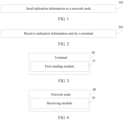
- FIG. 1 is a flowchart of an information indication method according to an embodiment of the present disclosure. The method is applied to a terminal. As shown in FIG. 1 , the method includes the following steps:
- Step 101 Send indication information to a network node.
- the indication information is used to indicate that the terminal detects a fast recovery failure (FRF).
- FRF is a failure of a fast recovery that is of a first link and that is initiated through a second link after a first link failure, the first link is a link between the terminal and a first node, and the second link is a link between the terminal and a second node.
- the first link is a link between the terminal and an MCG of a master node
- the second link is a link between the terminal and an SCG of a secondary node, that is, the FRF is a failure of a fast MCG link recovery (FR) initiated through the SCG link of the secondary node after the terminal detects an MCG link failure (MCG link failure) in the master node
- MCG link failure MCG link failure
- the first link is a link between the terminal and an SCG of a secondary node
- the second link is a link between the terminal and an MCG of a master node, that is, the FRF is a failure of a fast SCG link recovery (FR) initiated through the MCG link of the master node after the terminal detects an SCG link failure (SCG link failure) in the secondary node.
- the indication information is sent to the network node, so that the related network node can learn of that the terminal detects the FRF, so as to optimize configurations for the terminal, thereby helping optimize an FR procedure.
- the first link failure of the terminal that is, the MCG link failure (MCG link failure) in the master node or the SCG link failure (SCG link failure) in the secondary node, may include at least one of the following:
- the indication information may further be used to indicate information related to the FRF.
- the information related to the FRF may include at least one of the following:
- the FRF type may be understood as a cause for the FRF.
- the related network node can learn of the cause of the FRF of the terminal, so as to optimize configurations for the terminal, thereby helping optimize an FR procedure.
- the cell identification information and the cell signal related information may be understood as auxiliary information. Based on the information, the related network node can learn of cell information related to the FRF, thereby helping optimize an FR procedure.
- the FRF type may include at least one of the following:
- the related network node can learn of the cause of the FRF of the terminal, thereby helping optimize configurations for the terminal.
- the cell signal related information includes at least one of the following:
- information related to the FRF may include at least one of the following:
- the FRF type may be understood as a cause for the FRF.
- the related network node can learn of the cause of the FRF of the terminal, so as to optimize configurations for the terminal, thereby helping optimize an FR procedure.
- the cell identification information and the cell signal related information may be understood as auxiliary information. Based on the information, the related network node can learn of cell information related to the FRF, thereby helping optimize an FR procedure.
- the FRF type may include at least one of the following:
- the cell signal related information includes at least one of the following: an RSRP, an RSRQ, beam information, CSI-RS information, and SS block information.
- the foregoing network node may be any one of the following:
- FIG. 2 is a flowchart of an information obtaining method according to an embodiment of the present disclosure. The method is applied to a network node. As shown in FIG. 2 , the method includes the following steps:
- Step 201 Receive indication information sent by a terminal.
- the indication information is used to indicate that the terminal detects an FRF, the FRF is a failure of a fast recovery that is of a first link and that is initiated through a second link after a first link failure, the first link is a link between the terminal and a first node, and the second link is a link between the terminal and a second node.
- the indication information sent by the terminal is received, so that the related network node can learn of that the terminal detects the FRF, so as to optimize configurations for the terminal, thereby helping optimize an FR procedure.
- the first link is a link between the terminal and an MCG of a master node
- the second link is a link between the terminal and an SCG of a secondary node
- the first link is a link between the terminal and an SCG of a secondary node
- the second link is a link between the terminal and an MCG of a master node
- the first link is the link between the terminal and the MCG of the master node
- the second link is the link between the terminal and the SCG of the secondary node.
- the indication information is further used to indicate information related to the FRF, where the information related to the FRF includes at least one of the following:
- the FRF type includes at least one of the following:
- the first link is the link between the terminal and the SCG of the secondary node
- the second link is the link between the terminal and the MCG of the master node.
- the indication information is further used to indicate information related to the FRF, where the information related to the FRF includes at least one of the following:
- the FRF type includes at least one of the following:
- the network node is any one of the following:
- the method further includes: forwarding the indication information to a target node.
- the target node is at least one of a secondary node cell and a master node cell that are related to the FRF.
- the first link failure may include at least one of the following:
- FIG. 3 is a schematic structural diagram of a terminal according to an embodiment of the present disclosure.
- the terminal 30 includes: a first sending module 31, configured to send indication information to a network node.
- the indication information is used to indicate that the terminal detects an FRF, the FRF is a failure of a fast recovery that is of a first link and that is initiated through a second link after a first link failure, the first link is a link between the terminal and a first node, and the second link is a link between the terminal and a second node.
- the terminal 30 sends the indication information to the network node, so that the related network node can learn of that the terminal detects the FRF, so as to optimize configurations for the terminal, thereby helping optimize an FR procedure.
- the first link is a link between the terminal and an MCG of a master node, and the second link is a link between the terminal and an SCG of a secondary node; or the first link is a link between the terminal and an SCG of a secondary node, and the second link is a link between the terminal and an MCG of a master node.
- the indication information is further used to indicate information related to the FRF, where the information related to the FRF includes at least one of the following:
- the FRF type includes at least one of the following:
- the first link is the link between the terminal and the SCG of the secondary node
- the second link is the link between the terminal and the MCG of the master node.
- the indication information is further used to indicate information related to the FRF, where the information related to the FRF includes at least one of the following:
- the FRF type includes at least one of the following:
- the cell signal related information includes at least one of the following: an RSRP, an RSRQ, beam information, CSI-RS information, and SS block information.
- the network node is any one of the following:
- the first link failure includes at least one of the following:
- FIG. 4 is a schematic structural diagram of a network node according to an embodiment of the present disclosure.
- the network node 40 includes: a receiving module 41, configured to receive indication information sent by a terminal.
- the indication information is used to indicate that the terminal detects an FRF, the FRF is a failure of a fast recovery that is of a first link and that is initiated through a second link after a first link failure, the first link is a link between the terminal and a first node, and the second link is a link between the terminal and a second node.
- the network node 40 receives the indication information sent by the terminal, so that the related network node can learn of that the terminal detects the FRF, so as to optimize configurations for the terminal, thereby helping optimize an FR procedure.
- the first link is a link between the terminal and an MCG of a master node, and the second link is a link between the terminal and an SCG of a secondary node; or the first link is a link between the terminal and an SCG of a secondary node, and the second link is a link between the terminal and an MCG of a master node.
- the indication information is further used to indicate information related to the FRF, where the information related to the FRF includes at least one of the following:
- the FRF type includes at least one of the following:
- the indication information is further used to indicate information related to the FRF, where the information related to the FRF includes at least one of the following:
- the FRF type includes at least one of the following:
- the network node is any one of the following:
- the network node 40 further includes: a second sending module, configured to forward the indication information to a target node.
- the target node is at least one of a secondary node cell and a master node cell that are related to the FRF.
- the first link failure includes at least one of the following:
- an embodiment of the present disclosure further provides a terminal.
- the terminal includes a processor, a memory, and a computer program that is stored in the memory and that can be run on the processor.
- the computer program is executed by the processor, processes in the information indication method embodiment applied to the terminal are implemented, and a same technical effect can be achieved. To avoid repetition, details are not described herein again.
- FIG. 5 is a schematic diagram of a hardware structure of a terminal implementing embodiments of the present disclosure.
- the terminal 500 includes but is not limited to: a radio frequency unit 501, a network module 502, an audio output unit 503, an input unit 504, a sensor 505, a display unit 506, a user input unit 507, an interface unit 508, a memory 509, a processor 510, a power supply 511, and another component.
- a person skilled in the art may understand that the structure of the terminal shown in FIG. 5 does not constitute a limitation on the terminal, and the terminal may include more or fewer components than those shown in the figure, or combine some components, or have different component arrangements.
- the terminal includes but is not limited to a mobile phone, a tablet computer, a laptop computer, a palmtop computer, a vehicle-mounted terminal, a wearable device, a pedometer, and the like.
- the radio frequency unit 501 is configured to send indication information to a network node.
- the indication information is used to indicate that the terminal detects an FRF, the FRF is a failure of a fast recovery that is of a first link and that is initiated through a second link after a first link failure, the first link is a link between the terminal and a first node, and the second link is a link between the terminal and a second node.
- the terminal 500 can implement processes implemented in the foregoing method embodiment shown in FIG. 1 , and a same beneficial effect can be achieved. To avoid repetition, details are not described herein again.
- the radio frequency unit 501 may be configured to receive and send signals in a process of receiving and sending information or calling. Specifically, after receiving downlink data from a base station, the radio frequency unit 501 sends the downlink data to the processor 510 for processing; and sends uplink data to the base station.
- the radio frequency unit 501 includes but is not limited to an antenna, at least one amplifier, a transceiver, a coupler, a low noise amplifier, a duplexer, and the like.
- the radio frequency unit 501 may further communicate with a network and another device by using a wireless communications system.
- the terminal provides wireless broadband Internet access for a user by using the network module 502, for example, helps the user to receive and send an e-mail, brow a web page, and access streaming media.
- the audio output unit 503 may convert audio data received by the radio frequency unit 501 or the network module 502 or stored in the memory 509 into an audio signal and output as voice. In addition, the audio output unit 503 may further provide audio output (for example, a call signal received voice or a message received voice) related to a specific function performed by the terminal 500.
- the audio output unit 503 includes a loudspeaker, a buzzer, a receiver, and the like.
- the input unit 504 is configured to receive an audio signal or a video signal.
- the input unit 504 may include a graphics processing unit (GPU) 5041 and a microphone 5042.
- the graphics processing unit 5041 processes image data of a static picture or video obtained by an image capturing apparatus (for example, a camera lens) in a video capturing mode or an image capturing mode.
- a processed image frame may be displayed on the display unit 506.
- the image frame processed by the graphics processing unit 5041 may be stored in the memory 509 (or another storage medium) or sent by using the radio frequency unit 501 or the network module 502.
- the microphone 5042 may receive sound and can process such sound into audio data.
- the processed audio data may be converted, in a calling mode, into a format that can be sent to a mobile communication base station by using the radio frequency unit 501 for output.
- the terminal 500 further includes at least one sensor 505, for example, a light sensor, a motion sensor, and another sensor.
- the light sensor includes an ambient light sensor and a proximity sensor, where the ambient light sensor can adjust brightness of a display panel 5061 based on brightness of ambient light, and the proximity sensor can turn off the display panel 5061 and/or backlight when the terminal 500 is moved towards the ear.
- an accelerometer sensor may detect acceleration values in directions (that are generally three axes), and detect a value and a direction of gravity when the accelerometer sensor is static, and may be configured to: recognize a terminal posture (for example, screen switching between landscape and portrait modes, a related game, or magnetometer posture calibration), and perform a function related to vibration recognition (for example, a pedometer or a knock), and the like.
- the sensor 505 may further include a fingerprint sensor, a pressure sensor, an iris sensor, a molecular sensor, a gyroscope, a barometer, a hygrometer, a thermometer, an infrared sensor, and the like. Details are not described herein again.
- the display unit 506 is configured to display information entered by a user or information provided for the user.
- the display unit 506 may include the display panel 5061.
- the display panel 5061 may be configured in a form of a liquid crystal display (LCD), an organic light-emitting diode (OLED), or the like.
- the user input unit 507 may be configured to: receive input digit or character information, and generate key signal input related to user setting and function control of the terminal.
- the user input unit 507 includes a touch panel 5071 and another input device 5072.
- the touch panel 5071 is also referred to as a touchscreen, and may collect a touch operation of the user on or near the touch panel 5071 (for example, an operation performed on or near the touch panel 5071 by the user by using any appropriate object or accessory such as a finger or a stylus).
- the touch panel 5071 may include two parts: a touch detection apparatus and a touch controller.
- the touch detection apparatus detects a touch position of the user, detects a signal brought by a touch operation, and transmits the signal to the touch controller.
- the touch controller receives touch information from the touch detection apparatus, converts the touch information into contact coordinates, sends the contact coordinates to the processor 510, and receives and executes a command from the processor 510.
- the touch panel 5071 may be implemented by using a plurality of types such as a resistive type, a capacitive type, an infrared ray type, and a surface acoustic wave type.
- the user input unit 507 may further include another input device 5072 in addition to the touch panel 5071.
- the another input device 5072 may include but is not limited to a physical keyboard, function keys (for example, a volume control key and an on/off key), a trackball, a mouse, and a joystick. Details are not described herein.
- the touch panel 5071 may cover the display panel 5061.
- the touch panel 5071 transmits the touch operation to the processor 510 to determine a type of the touch event, and then the processor 510 provides corresponding visual output on the display panel 5061 based on the type of the touch event.
- the touch panel 5071 and the display panel 5061 are used as two independent parts to implement input and output functions of the terminal, in some embodiments, the touch panel 5071 and the display panel 5061 may be integrated to implement the input and output functions of the terminal. This is not specifically limited herein.
- the interface unit 508 is an interface connecting an external apparatus to the terminal 500.
- the external apparatus may include a wired or wireless headphone port, an external power supply (or a battery recharger) port, a wired or wireless data port, a memory card port, a port for link with an apparatus having an identification module, an audio input/output(I/O) port, a video I/O port, an earphone port, and the like.
- the interface unit 508 may be configured to: receive input (for example, data information and power) from an external apparatus, and transmit the received input to one or more elements inside the terminal 500; or may be configured to transmit data between the terminal 500 and the external apparatus.
- the memory 509 may be configured to store a software program and various data.
- the memory 509 may mainly include a program storage area and a data storage area.
- the program storage area may store an operating system, an application for at least one function (for example, a sound play function or an image play function), and the like.
- the data storage area may store data (for example, audio data or an address book) or the like created based on use of the mobile phone.
- the memory 509 may include a high-speed random access memory, or may include a nonvolatile memory, for example, at least one disk storage device, a flash memory, or another volatile solid-state storage device.
- the processor 510 is a control center of the terminal, and connects all parts of the entire terminal through various interfaces and lines. By running or executing a software program and/or a module stored in the memory 509 and invoking data stored in the memory 509, the processor 510 performs various functions of the terminal and data processing, to perform overall monitoring on the terminal.
- the processor 510 may include one or more processing units.
- an application processor and a modem processor may be integrated into the processor 510.
- the application processor mainly processes an operating system, a user interface, an application, and the like.
- the modem processor mainly processes wireless communication. It can be understood that, alternatively, the modem processor may not be integrated into the processor 510.
- the terminal 500 may further include a power supply 511 (for example, a battery) that supplies power to various components.
- a power supply 511 for example, a battery
- the power supply 511 may be logically connected to the processor 510 through a power supply management system, to perform functions of managing charging, discharging, and power consumption through the power supply management system.
- terminal 500 may further include some functional modules not shown. Details are not described herein again.
- An embodiment of the present disclosure further provides a network node.
- the network node includes a processor, a memory, and a computer program that is stored in the memory and that can be run on the processor.
- the computer program is executed by the processor, processes of the information obtaining method embodiment applied to the network node are implemented, and a same technical effect can be achieved. To avoid repetition, details are not described herein again.
- FIG. 6 is a schematic diagram of a hardware structure of a network node implementing embodiments of the present disclosure.
- the network node 60 includes but is not limited to a bus 61, a transceiver interface 62, an antenna 63, a bus interface 64, a processor 65, and a memory 66.
- the network node 60 further includes a computer program that is stored in the memory 66 and that can be run on the processor 65.
- a computer program that is stored in the memory 66 and that can be run on the processor 65.
- the computer program is executed by the processor 65, processes implemented in the foregoing method embodiment shown in FIG. 2 can be implemented, and a same beneficial effect can be achieved. To avoid repetition, details are not described herein again.
- the transceiver interface 62 is configured to receive and send data under control of the processor 65.
- the bus 61 may include any quantity of interconnected buses and bridges, and the bus 61 interconnects various circuits of one or more processors represented by the processor 65 and of a memory represented by the memory 66.
- the bus 61 may further interconnect various other circuits, for example, a peripheral device, a voltage regulator, and a power management circuit. These are all well known in the art. Therefore, this specification provides no further description.
- the bus interface 64 is an interface provided between the bus 61 and the transceiver interface 62.
- the transceiver interface 62 may be one or more elements, for example, a plurality of receivers and transmitters, and provides a unit configured to communicate with various other apparatuses on a transmission medium.
- Data processed by the processor 65 is transmitted on a wireless medium by using the antenna 63.
- the antenna 63 further receives data and transmits the data to the processor 65.
- the processor 65 is responsible for managing the bus 61 and general processing, and may further provide various functions, including timing, peripheral interfacing, voltage regulation, power management, and another control function.
- the memory 66 may be configured to store data used by the processor 65 when performing an operation.
- the processor 65 may be a CPU, an ASIC, an FPGA, or a CPLD.
- An embodiment of the present disclosure further provides a computer-readable storage medium, not being according to the invention as claimed.
- the computer-readable storage medium stores a computer program.
- processes of the information indication method embodiment applied to a terminal or processes of the information obtaining method embodiment applied to a network node are implemented, and a same technical effect can be achieved. To avoid repetition, details are not described herein again.
- the computer-readable storage medium is, for example, a read-only memory (ROM), a random access memory (RAM), a magnetic disk, or an optical disc.
- the method in the foregoing embodiments may be implemented by using software in addition to a necessary universal hardware platform, or by using hardware only. In most circumstances, the former is a preferred implementation.
- the technical solutions of the present disclosure essentially or the part contributing to the prior art may be implemented in a form of a software product.
- the computer software product is stored in a storage medium (for example, a ROM/RAM, a magnetic disk, or an optical disc), and includes several instructions for instructing a terminal (which may be a mobile phone, a computer, a server, an air conditioner, a network node, or the like) to perform the methods described in the embodiments of the present disclosure.
Landscapes
- Engineering & Computer Science (AREA)
- Computer Networks & Wireless Communication (AREA)
- Signal Processing (AREA)
- Mobile Radio Communication Systems (AREA)
Claims (10)
- Informationsanzeigeverfahren, das auf ein Endgerät angewendet wird und die folgenden Schritte umfasst:Senden von Anzeigeinformationen an einen Netzknoten, wobeidie Anzeigeinformationen verwendet werden, um anzuzeigen, dass das Endgerät einen schnellen Wiederherstellungsfehler FRF erfasst, der FRF ein Fehler einer schnellen Wiederherstellung ist, die von einer ersten Verbindung ist und durch eine zweite Verbindung nach einem ersten Verbindungsfehler initiiert wird, die erste Verbindung eine Verbindung zwischen dem Endgerät und einem ersten Knoten ist, und die zweite Verbindung eine Verbindung zwischen dem Endgerät und einem zweiten Knoten ist,wobei die erste Verbindung eine Verbindung zwischen dem Endgerät und einer Master-Zellengruppe MCG eines Master-Knotens ist, und die zweite Verbindung eine Verbindung zwischen dem Endgerät und einer Sekundär-Zellengruppe SCG eines Sekundär-Knotens ist; oderdie erste Verbindung eine Verbindung zwischen dem Endgerät und einer SCG eines Sekundär-Knotens ist, und die zweite Verbindung eine Verbindung zwischen dem Endgerät und einer MCG eines Master-Knotens ist.
- Verfahren nach Anspruch 1, wobei die erste Verbindung die Verbindung zwischen dem Endgerät und der MCG des Master-Knotens ist und die zweite Verbindung die Verbindung zwischen dem Endgerät und der SCG des Sekundär-Knotens ist; und
die Anzeigeinformationen ferner verwendet werden, um Informationen anzuzeigen, die sich auf den FRF beziehen, wobei die Informationen, die sich auf den FRF beziehen, Folgendes aufweisen:einen FRF-Typ; und/oderZellenidentifikationsinformationen des Sekundär-Knotens; und/oderzellensignalbezogene Informationen des Sekundär-Knotens; und/oderZellenidentifikationsinformationen des Master-Knotens, der eine schnelle Wiederherstellung FR initiiert; und/oderzellensignalbezogene Informationen des Master-Knotens, der die FR initiiert;wobei der FRF-Typ Folgendes aufweist:dass das Endgerät eine MCG-Rekonfigurationsnachricht nicht innerhalb einer voreingestellten Zeit empfangen hat; und/odereinen Fehler des Endgeräts beim Empfang der MCG-Rekonfigurationsnachricht auf einem Träger SRB 1 und/oder einem Split-Träger SRB 1S; und/odereinen Integritätsschutzfehler des SRBs 1 und/oder des SRBs 1S; und/odereine mangelnde Fähigkeit des Endgeräts, die empfangene MCG-Rekonfiguration zu erfüllen; und/odereinen Fehler eines Zufallszugriffsverfahrens, der von dem Endgerät auf der Grundlage der empfangenen MCG-Rekonfigurationsnachricht initiiert wird; und/odereinen Fehler des Endgeräts zum Melden der MCG-Verbindungsfehlerinformationen; und/odereinen Fehler des Endgeräts zum Finden einer geeigneten MCG, um eine FR zu initiieren; und/odereinen SCG-Verbindungsfehler des Endgeräts in einem FR-Verfahren. - Verfahren nach Anspruch 1, wobei die erste Verbindung die Verbindung zwischen dem Endgerät und der SCG des Sekundär-Knotens ist, und die zweite Verbindung die Verbindung zwischen dem Endgerät und der MCG des Master-Knotens ist; und
die Anzeigeinformationen weiterhin verwendet wird, um Informationen anzuzeigen, die sich auf den FRF beziehen, wobei die Informationen, die sich auf den FRF beziehen, Folgendes aufweisen:einen FRF-Typ; und/oderZellenidentifikationsinformationen des Sekundär-Knotens, der eine FR initiiert; und/oder zellensignalbezogene Informationen des Sekundär-Knotens, der die FR initiiert; und/oder Zellenidentifikationsinformationen des Master-Knotens; und/oder zellensignalbezogene Informationen des Master-Knotens;wobei der FRF-Typ Folgendes aufweist:dass das Endgerät keine SCG-Rekonfigurationsnachricht innerhalb einer voreingestellten Zeit empfangen hat; und/odereinen Fehler des Endgeräts beim Empfang einer SCG-Rekonfigurationsnachricht auf einem SRB 1 und/oder einem SRB 1S; und/odereinen Integritätsschutzfehler des SRBs 1 und/oder des SRBs 1S; und/odereine mangelnde Fähigkeit des Endgeräts, die empfangene SCG-Rekonfiguration zu erfüllen; und/odereinen Fehler eines Zufallszugriffsverfahrens, das von dem Endgerät auf der Grundlage der empfangenen SCG-Rekonfigurationsnachricht initiiert wird; und/odereinen Fehler des Endgeräts zum Melden der SCG-Verbindungsfehlerinformationen; und/odereinen Fehler des Endgeräts zum Finden einer geeigneten SCG, um eine FR zu initiieren; und/odereinen MCG-Verbindungsfehler des Endgeräts in einem FR-Verfahren. - Verfahren nach Anspruch 2 oder 3, wobei die zellensignalbezogenen Informationen Folgendes aufweisen:
eine Referenzsignal-Empfangsleistung RSRP, und/oder eine Referenzsignal-Empfangsqualität RSRQ, und/oder Strahlinformationen, und/oder Kanalzustandsinformationen-Referenzsignal, CSI-RS-Informationen, und/oder Synchronisationssignal- und PBCH-Block-SS-Block-informationen. - Verfahren nach Anspruch 1, wobei der Netzknoten einer der folgenden Zellen ist:eine Zelle, die von einem Sekundär-Knoten ist und mit dem Endgerät verbunden ist;eine Zelle, die von dem Sekundär-Knoten ist und mit dem Endgerät wieder verbunden wird;eine Zelle, die von einem Master-Knoten ist, die mit dem Endgerät wieder verbunden ist;eine Zelle, die von einem Ziel-Sekundär-Knoten ist und mit dem Endgerät wieder verbunden ist; undeine Zelle, die von einem Ziel-Master-Knoten ist und mit dem Endgerät wieder verbunden ist.
- Verfahren nach Anspruch 1, wobei der erste Verbindungsfehler Folgendes aufweist:einen Integritätsschutzfehler des Signalisierungsfunkträgers SRB;einen Rekonfigurationsfehler der Funkressourcensteuerung RRC;einen Handover-Fehler;einen Funkverbindungsfehler; undeinen Handover-Fehler nach einem bedingten Handover.
- Verfahren zur Informationsbeschaffung, das auf einen Netzknoten angewandt wird, wobei das Verfahren den folgenden Schritt umfasst:Empfangen der von dem Endgerät gesendeten Anzeigeinformationen,wobei die Anzeigeinformationen verwendet werden, um anzuzeigen, dass das Endgerät einen FRF erfasst, der FRF ein Fehler einer schnellen Wiederherstellung ist, die von einer ersten Verbindung ist und durch eine zweite Verbindung nach einem ersten Verbindungsfehler initiiert wird, die erste Verbindung eine Verbindung zwischen dem Endgerät und einem ersten Knoten ist und die zweite Verbindung eine Verbindung zwischen dem Endgerät und einem zweiten Knoten ist,wobei die erste Verbindung eine Verbindung zwischen dem Endgerät und einer Master-Zellengruppe MCG eines Master-Knotens ist, und die zweite Verbindung eine Verbindung zwischen dem Endgerät und einer Sekundär-Zellengruppe SCG eines Sekundär-Knotens ist; oderdie erste Verbindung eine Verbindung zwischen dem Endgerät und einer SCG eines Sekundär-Knotens ist, und die zweite Verbindung eine Verbindung zwischen dem Endgerät und einer MCG eines Master-Knotens ist.
- Verfahren nach Anspruch 7, wobei die erste Verbindung die Verbindung zwischen dem Endgerät und der MCG des Master-Knotens ist und die zweite Verbindung die Verbindung zwischen dem Endgerät und der SCG des Sekundärknotens ist; und
die Anzeigeinformationen weiterhin verwendet werden, um Informationen anzuzeigen, die sich auf den FRF beziehen, wobei die Informationen, die sich auf den FRF beziehen, Folgendes aufweisen:einen FRF-Typ; und/oderZellenidentifikationsinformationen des Sekundär-Knotens; und/oder zellensignalbezogene Informationen des Sekundär-Knotens; und/oderZellenidentifikationsinformationen des Master-Knotens, der eine schnelle Wiederherstellungs-FR initiiert; und/oderzellensignalbezogene Informationen des Master-Knotens, der die FR initiiert;wobei der FRF-Typ Folgendes aufweist:dass das Endgerät eine MCG-Rekonfigurationsnachricht nicht innerhalb einer voreingestellten Zeit empfangen hat; und/odereinen Fehler des Endgeräts beim Empfang der MCG-Rekonfigurationsnachricht auf einem SRB 1 und/oder einem SRB 1S; und/odereinen Integritätsschutzfehler des SRBs 1 und/oder des SRBs 1S; und/oder eine mangelnde Fähigkeit des Endgeräts, die empfangene MCG-Rekonfiguration zu erfüllen; und/odereinen Fehler eines Zufallszugriffsverfahrens, das von dem Endgerät auf der Grundlage der empfangenen MCG-Rekonfigurationsnachricht initiiert wird; und/odereinen Fehler des Endgeräts zum Melden der MCG-Verbindungsfehlerinformationen; und/odereinen Fehler des Endgeräts zum Finden einer geeigneten MCG, um eine FR zu initiieren; und/odereinen SCG-Verbindungsfehler des Endgeräts in einem FR-Verfahren. - Endgerät, aufweisend:ein erstes Sendemodul, das so konfiguriert ist, dass es Anzeigeinformationen an einen Netzknoten sendet, wobeidie Anzeigeinformationen verwendet werden, um anzuzeigen, dass das Endgerät einen schnellen Wiederherstellungsfehler FRF erfasst, wobei der FRF ein Fehler einer schnellen Wiederherstellung ist, die von einer ersten Verbindung ist und durch eine zweite Verbindung nach einem ersten Verbindungsfehler initiiert wird, wobei die erste Verbindung eine Verbindung zwischen dem Endgerät und einem ersten Knoten ist, und die zweite Verbindung eine Verbindung zwischen dem Endgerät und einem zweiten Knoten ist,wobei die erste Verbindung eine Verbindung zwischen dem Endgerät und einer Master-Zellengruppe MCG eines Master-Knotens ist, und die zweite Verbindung eine Verbindung zwischen dem Endgerät und einer Sekundär-Zellengruppe SCG eines Sekundär-Knotens ist; oderdie erste Verbindung eine Verbindung zwischen dem Endgerät und einer SCG eines Sekundär-Knotens ist, und die zweite Verbindung eine Verbindung zwischen dem Endgerät und einer MCG eines Master-Knotens ist.
- Netzknoten, aufweisend:ein Empfangsmodul, das konfiguriert ist, um von einem Endgerät gesendete Anzeigeinformationen zu empfangen, wobeidie Anzeigeinformationen verwendet werden, um anzuzeigen, dass das Endgerät einen FRF erfasst, der FRF ein Fehler einer schnellen Wiederherstellung ist, die von einer ersten Verbindung ist und durch eine zweite Verbindung nach einem ersten Verbindungsfehler initiiert wird, die erste Verbindung eine Verbindung zwischen dem Endgerät und einem ersten Knoten ist, und die zweite Verbindung eine Verbindung zwischen dem Endgerät und einem zweiten Knoten ist,wobei die erste Verbindung eine Verbindung zwischen dem Endgerät und einer Master-Zellengruppe MCG eines Master-Knotens ist, und die zweite Verbindung eine Verbindung zwischen dem Endgerät und einer Sekundär-Zellengruppe SCG eines Sekundär-Knotens ist; oderdie erste Verbindung eine Verbindung zwischen dem Endgerät und einer SCG eines Sekundär-Knotens ist, und die zweite Verbindung eine Verbindung zwischen dem Endgerät und einer MCG eines Master-Knotens ist.
Applications Claiming Priority (2)
| Application Number | Priority Date | Filing Date | Title |
|---|---|---|---|
| CN201910056579.6A CN111278168B (zh) | 2019-01-18 | 2019-01-18 | 信息指示方法、信息获取方法、终端及网络节点 |
| PCT/CN2020/071918 WO2020147703A1 (zh) | 2019-01-18 | 2020-01-14 | 信息指示方法、信息获取方法、终端及网络节点 |
Publications (4)
| Publication Number | Publication Date |
|---|---|
| EP3914036A1 EP3914036A1 (de) | 2021-11-24 |
| EP3914036A4 EP3914036A4 (de) | 2022-03-16 |
| EP3914036B1 true EP3914036B1 (de) | 2025-02-05 |
| EP3914036C0 EP3914036C0 (de) | 2025-02-05 |
Family
ID=71000025
Family Applications (1)
| Application Number | Title | Priority Date | Filing Date |
|---|---|---|---|
| EP20741667.8A Active EP3914036B1 (de) | 2019-01-18 | 2020-01-14 | Informationsanzeigeverfahren, informationsgewinnungsverfahren, endgerät und netzwerkknoten |
Country Status (7)
| Country | Link |
|---|---|
| US (2) | US11937321B2 (de) |
| EP (1) | EP3914036B1 (de) |
| JP (1) | JP7213993B2 (de) |
| KR (1) | KR102613334B1 (de) |
| CN (1) | CN111278168B (de) |
| ES (1) | ES3013926T3 (de) |
| WO (1) | WO2020147703A1 (de) |
Families Citing this family (7)
| Publication number | Priority date | Publication date | Assignee | Title |
|---|---|---|---|---|
| CN113825187B (zh) * | 2020-06-19 | 2023-03-24 | 维沃移动通信有限公司 | 小区组处理方法、装置及通信设备 |
| CN114071597B (zh) * | 2020-07-31 | 2023-07-11 | 大唐移动通信设备有限公司 | 一种信息处理方法、装置、设备及可读存储介质 |
| CN116326173A (zh) * | 2020-10-08 | 2023-06-23 | 三星电子株式会社 | 用于在无线通信中管理链路的方法和装置 |
| WO2022077183A1 (en) * | 2020-10-12 | 2022-04-21 | Lenovo (Beijing) Limited | Methods and apparatuses for a mro mechanism for a fast mcg link recovery procedure and an unbalanced ul and dl coverage scenario |
| JP2024517253A (ja) * | 2021-05-06 | 2024-04-19 | ノキア テクノロジーズ オサケユイチア | PSCell変更の障害に対するMRO分析の調整 |
| WO2024011588A1 (zh) * | 2022-07-15 | 2024-01-18 | Oppo广东移动通信有限公司 | 无线通信的方法、终端设备和网络设备 |
| EP4569857A1 (de) * | 2022-08-08 | 2025-06-18 | Qualcomm Incorporated | Netzwerkhandhabung einer änderung einer primären sekundärzellen-gruppenzelle (pscell) |
Family Cites Families (16)
| Publication number | Priority date | Publication date | Assignee | Title |
|---|---|---|---|---|
| CN101835242B (zh) * | 2010-05-04 | 2013-04-17 | 华为技术有限公司 | 一种重建拒绝后的业务恢复方法、终端和系统 |
| CN102281633B (zh) * | 2010-06-10 | 2014-07-16 | 华为技术有限公司 | 无线资源控制重配置处理方法和用户设备 |
| CN103298004A (zh) * | 2012-02-28 | 2013-09-11 | 北京三星通信技术研究有限公司 | 汇报无线链路失败信息的方法 |
| CN104604279B (zh) * | 2012-10-31 | 2018-07-20 | 富士通株式会社 | 报告连接重建信息的方法、装置和系统 |
| KR20210123428A (ko) * | 2014-01-17 | 2021-10-13 | 삼성전자주식회사 | 이중 연결에서의 특별한 Scell 선택의 처리를 위한 방법 및 시스템 |
| JP6542203B2 (ja) | 2014-05-07 | 2019-07-10 | 京セラ株式会社 | 通信制御方法、基地局、ユーザ端末 |
| CN105744626B (zh) * | 2014-12-25 | 2019-02-22 | 宏达国际电子股份有限公司 | 处理与多个基站间通信的失败的方法及其装置 |
| US10952110B2 (en) * | 2017-01-06 | 2021-03-16 | Telefonaktiebolaget Lm Ericsson (Publ) | Radio network nodes, wireless device, and methods performed therein for handling connections in a wireless communication network |
| US10548176B2 (en) * | 2017-02-02 | 2020-01-28 | Htc Corporation | Device and method of handling dual connectivity |
| CN110402592A (zh) * | 2017-03-24 | 2019-11-01 | 富士通株式会社 | 网络连接恢复方法及其装置、通信系统 |
| KR102388500B1 (ko) * | 2017-06-15 | 2022-04-21 | 삼성전자 주식회사 | 듀얼 rrc 시스템에서 이동성을 처리하는 방법 및 장치 |
| WO2018231021A1 (ko) * | 2017-06-15 | 2018-12-20 | 삼성전자 주식회사 | 듀얼 rrc 시스템에서 이동성을 처리하는 방법 및 장치 |
| EP4465551A3 (de) * | 2017-08-09 | 2025-05-07 | InterDigital Patent Holdings, Inc. | Verfahren und systeme zur strahlwiederherstellung und -verwaltung |
| WO2019093940A1 (en) * | 2017-11-10 | 2019-05-16 | Telefonaktiebolaget Lm Ericsson (Publ) | User equipment, nodes and methods performed therein |
| CN111448819A (zh) * | 2018-01-04 | 2020-07-24 | 富士通株式会社 | 波束失败恢复的配置和指示方法、装置及通信系统 |
| US11050610B2 (en) * | 2018-08-14 | 2021-06-29 | FG Innovation Company Limited | Reporting master node radio link failure |
-
2019
- 2019-01-18 CN CN201910056579.6A patent/CN111278168B/zh active Active
-
2020
- 2020-01-14 WO PCT/CN2020/071918 patent/WO2020147703A1/zh not_active Ceased
- 2020-01-14 ES ES20741667T patent/ES3013926T3/es active Active
- 2020-01-14 EP EP20741667.8A patent/EP3914036B1/de active Active
- 2020-01-14 KR KR1020217023550A patent/KR102613334B1/ko active Active
- 2020-01-14 JP JP2021540422A patent/JP7213993B2/ja active Active
-
2021
- 2021-07-16 US US17/378,081 patent/US11937321B2/en active Active
-
2024
- 2024-01-25 US US18/422,863 patent/US12495460B2/en active Active
Also Published As
| Publication number | Publication date |
|---|---|
| US11937321B2 (en) | 2024-03-19 |
| CN111278168B (zh) | 2022-10-18 |
| EP3914036A4 (de) | 2022-03-16 |
| KR20210103565A (ko) | 2021-08-23 |
| US12495460B2 (en) | 2025-12-09 |
| US20210345437A1 (en) | 2021-11-04 |
| WO2020147703A1 (zh) | 2020-07-23 |
| CN111278168A (zh) | 2020-06-12 |
| ES3013926T3 (en) | 2025-04-15 |
| KR102613334B1 (ko) | 2023-12-12 |
| JP7213993B2 (ja) | 2023-01-27 |
| EP3914036A1 (de) | 2021-11-24 |
| US20240237119A1 (en) | 2024-07-11 |
| JP2022517605A (ja) | 2022-03-09 |
| EP3914036C0 (de) | 2025-02-05 |
Similar Documents
| Publication | Publication Date | Title |
|---|---|---|
| US12231969B2 (en) | Secondary cell group maintenance method, terminal device, and network node | |
| US12495460B2 (en) | Information indication method, information obtaining method, terminal, and network node | |
| US11863381B2 (en) | Reconfiguration method and terminal | |
| US11671854B2 (en) | Cell beam failure processing method, mobile communication terminal and network side device | |
| WO2020034840A1 (zh) | 无线链路失败的信息处理方法、终端及网络设备 | |
| US12143838B2 (en) | Processing method and terminal | |
| WO2019154082A1 (zh) | 波束失败恢复的方法、终端设备及网络设备 | |
| US12245312B2 (en) | Method for reporting assistance information, method for configuring reporting of assistance information, terminal, and network side device | |
| US12177653B2 (en) | Path switching method and device | |
| US20210258840A1 (en) | Cell handover method, terminal, and communication node | |
| WO2020038294A1 (zh) | 传输方法及终端设备 | |
| WO2020073769A1 (zh) | 信息发送方法、接收方法、终端及辅基站 | |
| WO2019242464A1 (zh) | 一种资源指示方法、装置及系统 | |
| CN110839298B (zh) | 一种移动性管理方法及相关设备 | |
| HK40072715B (en) | Handover method, configuration method, terminal, and network device | |
| HK40044314A (en) | Redistribution method and terminal | |
| HK40044314B (en) | Redistribution method and terminal |
Legal Events
| Date | Code | Title | Description |
|---|---|---|---|
| STAA | Information on the status of an ep patent application or granted ep patent |
Free format text: STATUS: THE INTERNATIONAL PUBLICATION HAS BEEN MADE |
|
| PUAI | Public reference made under article 153(3) epc to a published international application that has entered the european phase |
Free format text: ORIGINAL CODE: 0009012 |
|
| STAA | Information on the status of an ep patent application or granted ep patent |
Free format text: STATUS: REQUEST FOR EXAMINATION WAS MADE |
|
| 17P | Request for examination filed |
Effective date: 20210813 |
|
| AK | Designated contracting states |
Kind code of ref document: A1 Designated state(s): AL AT BE BG CH CY CZ DE DK EE ES FI FR GB GR HR HU IE IS IT LI LT LU LV MC MK MT NL NO PL PT RO RS SE SI SK SM TR |
|
| A4 | Supplementary search report drawn up and despatched |
Effective date: 20220215 |
|
| RIC1 | Information provided on ipc code assigned before grant |
Ipc: H04W 76/15 20180101ALN20220209BHEP Ipc: H04W 76/19 20180101AFI20220209BHEP |
|
| DAV | Request for validation of the european patent (deleted) | ||
| DAX | Request for extension of the european patent (deleted) | ||
| STAA | Information on the status of an ep patent application or granted ep patent |
Free format text: STATUS: EXAMINATION IS IN PROGRESS |
|
| 17Q | First examination report despatched |
Effective date: 20230629 |
|
| RIC1 | Information provided on ipc code assigned before grant |
Ipc: H04W 76/15 20180101ALN20240905BHEP Ipc: H04W 76/19 20180101AFI20240905BHEP |
|
| GRAP | Despatch of communication of intention to grant a patent |
Free format text: ORIGINAL CODE: EPIDOSNIGR1 |
|
| STAA | Information on the status of an ep patent application or granted ep patent |
Free format text: STATUS: GRANT OF PATENT IS INTENDED |
|
| RIC1 | Information provided on ipc code assigned before grant |
Ipc: H04W 76/15 20180101ALN20240906BHEP Ipc: H04W 76/19 20180101AFI20240906BHEP |
|
| INTG | Intention to grant announced |
Effective date: 20241014 |
|
| GRAS | Grant fee paid |
Free format text: ORIGINAL CODE: EPIDOSNIGR3 |
|
| GRAA | (expected) grant |
Free format text: ORIGINAL CODE: 0009210 |
|
| STAA | Information on the status of an ep patent application or granted ep patent |
Free format text: STATUS: THE PATENT HAS BEEN GRANTED |
|
| AK | Designated contracting states |
Kind code of ref document: B1 Designated state(s): AL AT BE BG CH CY CZ DE DK EE ES FI FR GB GR HR HU IE IS IT LI LT LU LV MC MK MT NL NO PL PT RO RS SE SI SK SM TR |
|
| REG | Reference to a national code |
Ref country code: GB Ref legal event code: FG4D |
|
| REG | Reference to a national code |
Ref country code: CH Ref legal event code: EP |
|
| REG | Reference to a national code |
Ref country code: IE Ref legal event code: FG4D |
|
| REG | Reference to a national code |
Ref country code: DE Ref legal event code: R096 Ref document number: 602020045739 Country of ref document: DE |
|
| U01 | Request for unitary effect filed |
Effective date: 20250224 |
|
| U07 | Unitary effect registered |
Designated state(s): AT BE BG DE DK EE FI FR IT LT LU LV MT NL PT RO SE SI Effective date: 20250228 |
|
| REG | Reference to a national code |
Ref country code: ES Ref legal event code: FG2A Ref document number: 3013926 Country of ref document: ES Kind code of ref document: T3 Effective date: 20250415 |
|
| PG25 | Lapsed in a contracting state [announced via postgrant information from national office to epo] |
Ref country code: RS Free format text: LAPSE BECAUSE OF FAILURE TO SUBMIT A TRANSLATION OF THE DESCRIPTION OR TO PAY THE FEE WITHIN THE PRESCRIBED TIME-LIMIT Effective date: 20250505 |
|
| PG25 | Lapsed in a contracting state [announced via postgrant information from national office to epo] |
Ref country code: PL Free format text: LAPSE BECAUSE OF FAILURE TO SUBMIT A TRANSLATION OF THE DESCRIPTION OR TO PAY THE FEE WITHIN THE PRESCRIBED TIME-LIMIT Effective date: 20250205 |
|
| PG25 | Lapsed in a contracting state [announced via postgrant information from national office to epo] |
Ref country code: IS Free format text: LAPSE BECAUSE OF FAILURE TO SUBMIT A TRANSLATION OF THE DESCRIPTION OR TO PAY THE FEE WITHIN THE PRESCRIBED TIME-LIMIT Effective date: 20250605 Ref country code: NO Free format text: LAPSE BECAUSE OF FAILURE TO SUBMIT A TRANSLATION OF THE DESCRIPTION OR TO PAY THE FEE WITHIN THE PRESCRIBED TIME-LIMIT Effective date: 20250505 |
|
| PG25 | Lapsed in a contracting state [announced via postgrant information from national office to epo] |
Ref country code: HR Free format text: LAPSE BECAUSE OF FAILURE TO SUBMIT A TRANSLATION OF THE DESCRIPTION OR TO PAY THE FEE WITHIN THE PRESCRIBED TIME-LIMIT Effective date: 20250205 |
|
| PG25 | Lapsed in a contracting state [announced via postgrant information from national office to epo] |
Ref country code: GR Free format text: LAPSE BECAUSE OF FAILURE TO SUBMIT A TRANSLATION OF THE DESCRIPTION OR TO PAY THE FEE WITHIN THE PRESCRIBED TIME-LIMIT Effective date: 20250506 |
|
| PG25 | Lapsed in a contracting state [announced via postgrant information from national office to epo] |
Ref country code: SM Free format text: LAPSE BECAUSE OF FAILURE TO SUBMIT A TRANSLATION OF THE DESCRIPTION OR TO PAY THE FEE WITHIN THE PRESCRIBED TIME-LIMIT Effective date: 20250205 |
|
| PG25 | Lapsed in a contracting state [announced via postgrant information from national office to epo] |
Ref country code: CZ Free format text: LAPSE BECAUSE OF FAILURE TO SUBMIT A TRANSLATION OF THE DESCRIPTION OR TO PAY THE FEE WITHIN THE PRESCRIBED TIME-LIMIT Effective date: 20250205 |
|
| PG25 | Lapsed in a contracting state [announced via postgrant information from national office to epo] |
Ref country code: SK Free format text: LAPSE BECAUSE OF FAILURE TO SUBMIT A TRANSLATION OF THE DESCRIPTION OR TO PAY THE FEE WITHIN THE PRESCRIBED TIME-LIMIT Effective date: 20250205 |
|
| PLBE | No opposition filed within time limit |
Free format text: ORIGINAL CODE: 0009261 |
|
| STAA | Information on the status of an ep patent application or granted ep patent |
Free format text: STATUS: NO OPPOSITION FILED WITHIN TIME LIMIT |
|
| PGFP | Annual fee paid to national office [announced via postgrant information from national office to epo] |
Ref country code: GB Payment date: 20251127 Year of fee payment: 7 |
|
| 26N | No opposition filed |
Effective date: 20251106 |
|
| U20 | Renewal fee for the european patent with unitary effect paid |
Year of fee payment: 7 Effective date: 20251205 |