EP3901296A1 - Surface-treated steel sheet - Google Patents
Surface-treated steel sheet Download PDFInfo
- Publication number
- EP3901296A1 EP3901296A1 EP19897735.7A EP19897735A EP3901296A1 EP 3901296 A1 EP3901296 A1 EP 3901296A1 EP 19897735 A EP19897735 A EP 19897735A EP 3901296 A1 EP3901296 A1 EP 3901296A1
- Authority
- EP
- European Patent Office
- Prior art keywords
- mass
- steel sheet
- hot
- dip
- coating
- Prior art date
- Legal status (The legal status is an assumption and is not a legal conclusion. Google has not performed a legal analysis and makes no representation as to the accuracy of the status listed.)
- Pending
Links
Images
Classifications
-
- C—CHEMISTRY; METALLURGY
- C23—COATING METALLIC MATERIAL; COATING MATERIAL WITH METALLIC MATERIAL; CHEMICAL SURFACE TREATMENT; DIFFUSION TREATMENT OF METALLIC MATERIAL; COATING BY VACUUM EVAPORATION, BY SPUTTERING, BY ION IMPLANTATION OR BY CHEMICAL VAPOUR DEPOSITION, IN GENERAL; INHIBITING CORROSION OF METALLIC MATERIAL OR INCRUSTATION IN GENERAL
- C23C—COATING METALLIC MATERIAL; COATING MATERIAL WITH METALLIC MATERIAL; SURFACE TREATMENT OF METALLIC MATERIAL BY DIFFUSION INTO THE SURFACE, BY CHEMICAL CONVERSION OR SUBSTITUTION; COATING BY VACUUM EVAPORATION, BY SPUTTERING, BY ION IMPLANTATION OR BY CHEMICAL VAPOUR DEPOSITION, IN GENERAL
- C23C2/00—Hot-dipping or immersion processes for applying the coating material in the molten state without affecting the shape; Apparatus therefor
- C23C2/04—Hot-dipping or immersion processes for applying the coating material in the molten state without affecting the shape; Apparatus therefor characterised by the coating material
- C23C2/06—Zinc or cadmium or alloys based thereon
-
- C—CHEMISTRY; METALLURGY
- C23—COATING METALLIC MATERIAL; COATING MATERIAL WITH METALLIC MATERIAL; CHEMICAL SURFACE TREATMENT; DIFFUSION TREATMENT OF METALLIC MATERIAL; COATING BY VACUUM EVAPORATION, BY SPUTTERING, BY ION IMPLANTATION OR BY CHEMICAL VAPOUR DEPOSITION, IN GENERAL; INHIBITING CORROSION OF METALLIC MATERIAL OR INCRUSTATION IN GENERAL
- C23C—COATING METALLIC MATERIAL; COATING MATERIAL WITH METALLIC MATERIAL; SURFACE TREATMENT OF METALLIC MATERIAL BY DIFFUSION INTO THE SURFACE, BY CHEMICAL CONVERSION OR SUBSTITUTION; COATING BY VACUUM EVAPORATION, BY SPUTTERING, BY ION IMPLANTATION OR BY CHEMICAL VAPOUR DEPOSITION, IN GENERAL
- C23C28/00—Coating for obtaining at least two superposed coatings either by methods not provided for in a single one of groups C23C2/00 - C23C26/00 or by combinations of methods provided for in subclasses C23C and C25C or C25D
- C23C28/30—Coatings combining at least one metallic layer and at least one inorganic non-metallic layer
- C23C28/34—Coatings combining at least one metallic layer and at least one inorganic non-metallic layer including at least one inorganic non-metallic material layer, e.g. metal carbide, nitride, boride, silicide layer and their mixtures, enamels, phosphates and sulphates
-
- C—CHEMISTRY; METALLURGY
- C22—METALLURGY; FERROUS OR NON-FERROUS ALLOYS; TREATMENT OF ALLOYS OR NON-FERROUS METALS
- C22C—ALLOYS
- C22C18/00—Alloys based on zinc
- C22C18/04—Alloys based on zinc with aluminium as the next major constituent
-
- C—CHEMISTRY; METALLURGY
- C23—COATING METALLIC MATERIAL; COATING MATERIAL WITH METALLIC MATERIAL; CHEMICAL SURFACE TREATMENT; DIFFUSION TREATMENT OF METALLIC MATERIAL; COATING BY VACUUM EVAPORATION, BY SPUTTERING, BY ION IMPLANTATION OR BY CHEMICAL VAPOUR DEPOSITION, IN GENERAL; INHIBITING CORROSION OF METALLIC MATERIAL OR INCRUSTATION IN GENERAL
- C23C—COATING METALLIC MATERIAL; COATING MATERIAL WITH METALLIC MATERIAL; SURFACE TREATMENT OF METALLIC MATERIAL BY DIFFUSION INTO THE SURFACE, BY CHEMICAL CONVERSION OR SUBSTITUTION; COATING BY VACUUM EVAPORATION, BY SPUTTERING, BY ION IMPLANTATION OR BY CHEMICAL VAPOUR DEPOSITION, IN GENERAL
- C23C2/00—Hot-dipping or immersion processes for applying the coating material in the molten state without affecting the shape; Apparatus therefor
- C23C2/26—After-treatment
-
- C—CHEMISTRY; METALLURGY
- C23—COATING METALLIC MATERIAL; COATING MATERIAL WITH METALLIC MATERIAL; CHEMICAL SURFACE TREATMENT; DIFFUSION TREATMENT OF METALLIC MATERIAL; COATING BY VACUUM EVAPORATION, BY SPUTTERING, BY ION IMPLANTATION OR BY CHEMICAL VAPOUR DEPOSITION, IN GENERAL; INHIBITING CORROSION OF METALLIC MATERIAL OR INCRUSTATION IN GENERAL
- C23C—COATING METALLIC MATERIAL; COATING MATERIAL WITH METALLIC MATERIAL; SURFACE TREATMENT OF METALLIC MATERIAL BY DIFFUSION INTO THE SURFACE, BY CHEMICAL CONVERSION OR SUBSTITUTION; COATING BY VACUUM EVAPORATION, BY SPUTTERING, BY ION IMPLANTATION OR BY CHEMICAL VAPOUR DEPOSITION, IN GENERAL
- C23C2/00—Hot-dipping or immersion processes for applying the coating material in the molten state without affecting the shape; Apparatus therefor
- C23C2/34—Hot-dipping or immersion processes for applying the coating material in the molten state without affecting the shape; Apparatus therefor characterised by the shape of the material to be treated
- C23C2/36—Elongated material
- C23C2/40—Plates; Strips
-
- C—CHEMISTRY; METALLURGY
- C23—COATING METALLIC MATERIAL; COATING MATERIAL WITH METALLIC MATERIAL; CHEMICAL SURFACE TREATMENT; DIFFUSION TREATMENT OF METALLIC MATERIAL; COATING BY VACUUM EVAPORATION, BY SPUTTERING, BY ION IMPLANTATION OR BY CHEMICAL VAPOUR DEPOSITION, IN GENERAL; INHIBITING CORROSION OF METALLIC MATERIAL OR INCRUSTATION IN GENERAL
- C23C—COATING METALLIC MATERIAL; COATING MATERIAL WITH METALLIC MATERIAL; SURFACE TREATMENT OF METALLIC MATERIAL BY DIFFUSION INTO THE SURFACE, BY CHEMICAL CONVERSION OR SUBSTITUTION; COATING BY VACUUM EVAPORATION, BY SPUTTERING, BY ION IMPLANTATION OR BY CHEMICAL VAPOUR DEPOSITION, IN GENERAL
- C23C22/00—Chemical surface treatment of metallic material by reaction of the surface with a reactive liquid, leaving reaction products of surface material in the coating, e.g. conversion coatings, passivation of metals
- C23C22/05—Chemical surface treatment of metallic material by reaction of the surface with a reactive liquid, leaving reaction products of surface material in the coating, e.g. conversion coatings, passivation of metals using aqueous solutions
- C23C22/06—Chemical surface treatment of metallic material by reaction of the surface with a reactive liquid, leaving reaction products of surface material in the coating, e.g. conversion coatings, passivation of metals using aqueous solutions using aqueous acidic solutions with pH less than 6
- C23C22/07—Chemical surface treatment of metallic material by reaction of the surface with a reactive liquid, leaving reaction products of surface material in the coating, e.g. conversion coatings, passivation of metals using aqueous solutions using aqueous acidic solutions with pH less than 6 containing phosphates
- C23C22/08—Orthophosphates
-
- C—CHEMISTRY; METALLURGY
- C23—COATING METALLIC MATERIAL; COATING MATERIAL WITH METALLIC MATERIAL; CHEMICAL SURFACE TREATMENT; DIFFUSION TREATMENT OF METALLIC MATERIAL; COATING BY VACUUM EVAPORATION, BY SPUTTERING, BY ION IMPLANTATION OR BY CHEMICAL VAPOUR DEPOSITION, IN GENERAL; INHIBITING CORROSION OF METALLIC MATERIAL OR INCRUSTATION IN GENERAL
- C23C—COATING METALLIC MATERIAL; COATING MATERIAL WITH METALLIC MATERIAL; SURFACE TREATMENT OF METALLIC MATERIAL BY DIFFUSION INTO THE SURFACE, BY CHEMICAL CONVERSION OR SUBSTITUTION; COATING BY VACUUM EVAPORATION, BY SPUTTERING, BY ION IMPLANTATION OR BY CHEMICAL VAPOUR DEPOSITION, IN GENERAL
- C23C22/00—Chemical surface treatment of metallic material by reaction of the surface with a reactive liquid, leaving reaction products of surface material in the coating, e.g. conversion coatings, passivation of metals
- C23C22/05—Chemical surface treatment of metallic material by reaction of the surface with a reactive liquid, leaving reaction products of surface material in the coating, e.g. conversion coatings, passivation of metals using aqueous solutions
- C23C22/06—Chemical surface treatment of metallic material by reaction of the surface with a reactive liquid, leaving reaction products of surface material in the coating, e.g. conversion coatings, passivation of metals using aqueous solutions using aqueous acidic solutions with pH less than 6
- C23C22/07—Chemical surface treatment of metallic material by reaction of the surface with a reactive liquid, leaving reaction products of surface material in the coating, e.g. conversion coatings, passivation of metals using aqueous solutions using aqueous acidic solutions with pH less than 6 containing phosphates
- C23C22/23—Condensed phosphates
-
- C—CHEMISTRY; METALLURGY
- C23—COATING METALLIC MATERIAL; COATING MATERIAL WITH METALLIC MATERIAL; CHEMICAL SURFACE TREATMENT; DIFFUSION TREATMENT OF METALLIC MATERIAL; COATING BY VACUUM EVAPORATION, BY SPUTTERING, BY ION IMPLANTATION OR BY CHEMICAL VAPOUR DEPOSITION, IN GENERAL; INHIBITING CORROSION OF METALLIC MATERIAL OR INCRUSTATION IN GENERAL
- C23C—COATING METALLIC MATERIAL; COATING MATERIAL WITH METALLIC MATERIAL; SURFACE TREATMENT OF METALLIC MATERIAL BY DIFFUSION INTO THE SURFACE, BY CHEMICAL CONVERSION OR SUBSTITUTION; COATING BY VACUUM EVAPORATION, BY SPUTTERING, BY ION IMPLANTATION OR BY CHEMICAL VAPOUR DEPOSITION, IN GENERAL
- C23C22/00—Chemical surface treatment of metallic material by reaction of the surface with a reactive liquid, leaving reaction products of surface material in the coating, e.g. conversion coatings, passivation of metals
- C23C22/05—Chemical surface treatment of metallic material by reaction of the surface with a reactive liquid, leaving reaction products of surface material in the coating, e.g. conversion coatings, passivation of metals using aqueous solutions
- C23C22/60—Chemical surface treatment of metallic material by reaction of the surface with a reactive liquid, leaving reaction products of surface material in the coating, e.g. conversion coatings, passivation of metals using aqueous solutions using alkaline aqueous solutions with pH greater than 8
- C23C22/66—Treatment of aluminium or alloys based thereon
-
- C—CHEMISTRY; METALLURGY
- C23—COATING METALLIC MATERIAL; COATING MATERIAL WITH METALLIC MATERIAL; CHEMICAL SURFACE TREATMENT; DIFFUSION TREATMENT OF METALLIC MATERIAL; COATING BY VACUUM EVAPORATION, BY SPUTTERING, BY ION IMPLANTATION OR BY CHEMICAL VAPOUR DEPOSITION, IN GENERAL; INHIBITING CORROSION OF METALLIC MATERIAL OR INCRUSTATION IN GENERAL
- C23C—COATING METALLIC MATERIAL; COATING MATERIAL WITH METALLIC MATERIAL; SURFACE TREATMENT OF METALLIC MATERIAL BY DIFFUSION INTO THE SURFACE, BY CHEMICAL CONVERSION OR SUBSTITUTION; COATING BY VACUUM EVAPORATION, BY SPUTTERING, BY ION IMPLANTATION OR BY CHEMICAL VAPOUR DEPOSITION, IN GENERAL
- C23C28/00—Coating for obtaining at least two superposed coatings either by methods not provided for in a single one of groups C23C2/00 - C23C26/00 or by combinations of methods provided for in subclasses C23C and C25C or C25D
- C23C28/30—Coatings combining at least one metallic layer and at least one inorganic non-metallic layer
- C23C28/32—Coatings combining at least one metallic layer and at least one inorganic non-metallic layer including at least one pure metallic layer
- C23C28/322—Coatings combining at least one metallic layer and at least one inorganic non-metallic layer including at least one pure metallic layer only coatings of metal elements only
Definitions
- the present invention relates to surface-treated steel sheets used in fields such as electric machines and building materials.
- the present invention particularly relates to a surface-treated steel sheet with excellent worked part corrosion resistance (end part corrosion resistance).
- a hot-dip Zn-Al alloy coated steel sheet including a coated layer containing Al: 1 mass% to 15 mass% has more excellent corrosion resistance as compared to hot-dip Zn coated steel sheets and is, therefore, widely used mainly in the field of electric machines and building materials.
- a hot-dip Zn-Al alloy coated steel sheet having an Al content of more than 15 mass% an alloy layer at a base steel-coating interface is thick and has reduced adhesion properties. Therefore, a hot-dip Zn-Al alloy coated steel sheet containing Al: 1 mass% to 15 mass% is widely used.
- Galfan (GF) containing Al: about 5 mass% has been produced since the 1980s and has been often used.
- GF Galfan
- a highly functional hot-dip Zn-Al alloy coated steel sheet including a coating containing an element such as Mg has been developed and has been used.
- Examples of such a highly functional hot-dip Zn-Al alloy coated steel sheet include a hot-dip Zn-Al alloy coated steel sheet including a coated layer which contains Al: 1.0 mass% to 10 mass% and Mg: 0.2 mass% to 1 mass% such that the occurrence of coarse spangles which are problematic in Galfan is suppressed (for example, Patent Literature 1) and a hot-dip Zn-Al alloy coated steel sheet including a coated layer which contains Al: 2 mass% to 19 mass% and Mg: 1 mass% to 10 mass% such that the corrosion resistance is further enhanced (for example, Patent Literature 2).
- hot-dip Zn-Al alloy coated steel sheets are often used without painting. Therefore, a surface-treated steel sheet including a chemical conversion coating formed on a surface of a hot-dip Zn-Al alloy coating has been developed for the purpose of further enhancing the blackening resistance, the corrosion resistance, and the like and is used.
- a surface-treated steel sheet which includes a metal sheet coated with a water-based resin containing oxide particles and an anti-rust additive in combination and which has excellent adhesion to paint films and excellent weldability (Patent Literature 6).
- hot-dip Zn-Al alloy coated steel sheets are used in the field of electric machines and building materials, worked part corrosion resistance, particularly end part corrosion resistance, is a problem.
- the hot-dip Zn-Al alloy coated steel sheet is supplied to a manufacturer in the form of a coil or sheet, is sheared to a necessary size, and is then worked into a target shape.
- an uncoated end surface of the steel sheet is inevitably exposed at a sheared part and iron (Fe) and metal (Zn, Al, Mg, or the like) contained in a coating film in the vicinity form a local cell, so that corrosion originating from an end part proceeds.
- iron (Fe) or an interface alloy layer forms a local cell together with metal (Zn, Al, Mg, or the like) contained in a coating film in the vicinity, so that corrosion originating from the cracks proceeds.
- Patent Literature 1 and 2 worked part corrosion resistance, particularly end part corrosion resistance, is not investigated.
- a surface-treated steel sheet described in Patent Literature 5 is improved in worked part corrosion resistance in such a manner that a chemical conversion coating containing a phosphate is formed on a hot-dip Zn-Al alloy coating.
- worked part corrosion resistance particularly end part corrosion resistance, cannot be fully improved.
- the composition of a coating film, the oxide particles, and the anti-rust additive are not specifically identified and worked part corrosion resistance, particularly end part corrosion resistance, cannot necessarily be fully improved.
- the present invention has been made in view of the above circumstances and has an object to provide a surface-treated steel sheet having coating adhesion properties and excellent worked part corrosion resistance, particularly excellent end part corrosion resistance.
- the inventors have performed investigations to solve the above problem and, as a result, have found that unprecedented excellent worked part corrosion resistance, particularly excellent end part corrosion resistance, can be achieved in such a manner that a chemical conversion coating containing AlH 2 P 3 O 10 and a compound containing one or more elements selected from Mg, Ca, and Sr is further formed on a surface of a hot-dip Zn-Al alloy coating film, formed on a surface of a steel sheet, having a specific composition.
- the present invention has been made on the basis of the above finding and provides a summary below.
- a surface-treated steel sheet excellent in worked part corrosion resistance, particularly end part corrosion resistance is obtained.
- Using a surface-treated steel sheet according to the present invention in the field of electric machines and building materials enables the product life of home appliances and the life of buildings to be extended.
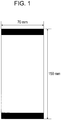
- Fig. 1 is a schematic view of a sample for evaluating end surface corrosion resistance.
- the present invention includes a chemical conversion coating with a thickness of 3.0 ⁇ m or less, the chemical conversion coating being placed on a surface of a hot-dip Zn-Al alloy coated steel sheet including a hot-dip Zn-Al alloy coating film containing Al: more than 1.0 mass% and 15 mass% or less, the balance being Zn and inevitable impurities.
- the chemical conversion coating contains AlH 2 P 3 O 10 ⁇ 2H 2 O and a compound containing one or more elements selected from Mg, Ca, and Sr such that the sum of the contents of AlH 2 P 3 O 10 ⁇ 2H 2 O and the compound is 3.0 mass% to 50 mass%.
- the coating film used is a hot-dip Zn-Al alloy coating film containing Al: more than 1.0 mass% and 15 mass% or less.
- the hot-dip Zn-Al alloy coating film contains Al: more than 1.0 mass% and 15 mass% or less, the effect of enhancing the corrosion resistance is obtained.
- the content of Al is 1.0 mass% or less, the effect of enhancing the corrosion resistance is not fully obtained.
- the Al content is more than 15 mass%, the effect of enhancing the corrosion resistance is saturated and an Fe-Al alloy layer grows significantly at a base steel-coating interface to reduce coating adhesion properties.
- the Al content is preferably 11 mass% or less.
- the hot-dip Zn-Al alloy coating film forms a stable corrosion product during corrosion as described above.
- the hot-dip Zn-Al alloy coating film has more excellent corrosion resistance as compared to surface-treated steel sheets including a coating film having an Al content of 1.0 mass% or less.
- the hot-dip Zn-Al alloy coating film preferably further contains Mg: 0.1 mass% to 10 mass%. Containing Mg: 0.1 mass% to 10 mass% allows the effect of stabilizing a corrosion product to significantly enhance the corrosion resistance to be obtained when a coated steel sheet corrodes. When the content of Mg is less than 0.1 mass%, the effect of enhancing the corrosion resistance is not fully obtained. When the Mg content is more than 10 mass%, the effect of enhancing the corrosion resistance is saturated, oxide dross containing Mg is likely to be generated, and the appearance deteriorates because of the occurrence of dross defects due to the adhesion of granular dross.
- the Mg content is preferably 1.0 mass% or more and is preferably 5.0 mass% or less.
- the hot-dip Zn-Al alloy coating film preferably further contains one or more elements selected from Si, Ca, Ti, Cr, and Ni such that the sum of the contents of the elements is 0.01 mass% to 1.0 mass%.
- the hot-dip Zn-Al alloy coating film contains these elements alone or in combination, an effect below can be obtained in the hot-dip Zn-Al alloy coated steel sheet.
- Si, Cr, and/or Ni is mainly contained in an interfacial alloy layer formed at the base steel-coating interface of a coated steel sheet.
- Hot-dip Zn-Al alloy coated steel sheets provided with such an interfacial alloy layer have enhanced coating adhesion properties.
- Hot-dip Zn-Al alloy coated steel sheets including a coating film containing Ca have enhanced coating appearance.
- Ti precipitates in the form of TiAl 3 , which functions as a precipitation nucleus for an ⁇ -Al phase, to suppress the formation of a coarse ⁇ -Al phase in a coating film composition in which the ⁇ -Al phase mainly precipitates in the form of proeutectic. As a result, uneven corrosion is suppressed and the corrosion resistance of a hot-dip Zn-Al alloy coated steel sheet is enhanced.
- the sum of the contents of one or more elements selected from Si, Ca, Ti, Cr, and Ni is less than 0.01%, the effect of enhancing each of the above-mentioned functions does not develop.
- the sum of the contents is more than 1.0 mass%, each effect is saturated and the appearance quality of a coating film is impaired by the adhesion of dross generated in a large amount. As a result, the corrosion resistance of the surface-treated steel sheet deteriorates in some cases.
- the sum of the contents thereof is 0.01 mass% to 1.0 mass% or less.
- the sum of the contents thereof is more preferably 0.05 mass% or more and is more preferably 0.5 mass% or less.
- the balance is Zn and inevitable impurities.
- composition of the hot-dip Zn-Al alloy coating film is substantially the same as the composition of a coating bath, the composition of the hot-dip Zn-Al alloy coating film can be adjusted by controlling the composition of the coating bath.
- the coating weight of the hot-dip Zn-Al alloy coating film is preferably 30 g/m 2 or more (coating weight per side).
- the coating weight is preferably 200 g/m 2 or less (coating weight per side).
- the thickness of the chemical conversion coating is 3.0 ⁇ m or less.
- the thickness is more than 3.0 ⁇ m, a problem that the chemical conversion coating powders in working occurs and manufacturing costs are high.
- the lower limit of the thickness is not particularly limited and is preferably 0.1 ⁇ m or more in order to stably obtain an effect of the chemical conversion coating.
- the thickness is preferably 0.5 ⁇ m or more and is preferably 1.0 ⁇ m or less.
- the chemical conversion coating of the surface-treated steel sheet according to the present invention contains AlH 2 P 3 O 10 ⁇ 2H 2 O and the compound containing one or more elements selected from Mg, Ca, and Sr such that the sum of the contents of AlH 2 P 3 O 10 ⁇ 2H 2 O and the compound is 3.0 mass% to 50 mass%.
- the chemical conversion coating contains AlH 2 P 3 O 10 ⁇ 2H 2 O
- P 3 O 10 5- dissolved from the chemical conversion coating chelates Al 3+ , Zn 2+ , Fe 2+ , and Fe 3+ dissolved from the hot-dip Zn-Al alloy coated steel sheet, which is a base, to form a passivation film.
- the effect of reducing the corrosion rate of a base steel sheet develops.
- the chemical conversion coating contains a Mg-containing compound (Mg compound) and AlH 2 P 3 O 10 ⁇ 2H 2 O in combination
- the pH-buffering action works during corrosion to stabilize the pH of a corroded part to about 10, at which the dissolution rate of Al and Zn is low, whereby the dissolution rate of the hot-dip Zn-Al alloy coating film is reduced.
- the chemical conversion coating contains AlH 2 P 3 O 10 and the compound containing one or more elements selected from Mg, Ca, and Sr, the formation of the passivation film and/or the development of the pH-buffering action occurs during corrosion and the corrosion rate of the obtained hot-dip Zn-Al alloy coated steel sheet can be reduced.
- the surface-treated steel sheet according to the present invention includes the hot-dip Zn-Al alloy coated steel sheet, which includes the hot-dip Zn-Al alloy coating film containing Al: more than 1.0 mass% and 15 mass% or less, the balance being Zn and inevitable impurities.
- the hot-dip Zn-Al alloy coated steel sheet forms the stable corrosion product during corrosion.
- the corrosion resistance is excellent as compared to a coating film which serves as a base of a surface-treated steel sheet and which has an Al content of 1.0 mass% or less.
- the hot-dip Zn-Al alloy coated steel sheet which contains the compound containing one or more elements selected from Mg, Ca, and Sr, as a base allows Mg, Ca, or Sr to be dissolved from a coating film during corrosion. Therefore, the effect of reducing the corrosion rate in the presence of AlH 2 P 3 O 10 ⁇ 2H 2 O, as well as an effect due to the Mg compound, the Ca compound, or the Sr compound, which is contained in the chemical conversion coating, can be generated.
- the effect due to the Mg compound, the Ca compound, or the Sr compound in the chemical conversion coating contributes more significantly to the corrosion resistance than an effect due to Mg, Ca, or Sr in the coating film.
- the chemical conversion coating contains the compound containing one or more elements selected from Mg, Ca, and Sr.
- the sum of the contents of AlH 2 P 3 O 10 ⁇ 2H 2 O and the compound containing one or more elements selected from Mg, Ca, and Sr is less than 3.0 mass%, the effect of improving the corrosion resistance is not fully obtained. However, when the sum of the contents is more than 50 mass%, the effect of improving the corrosion resistance is saturated and the amount of resin serving as a binder relatively decreases to embrittle the coating. Thus, the sum of the contents of AlH 2 P 3 O 10 ⁇ 2H 2 O and the compound containing one or more elements selected from Mg, Ca, and Sr is 3.0 mass% to 50 mass%.
- the sum of the contents is preferably 5.0 mass% or more and is preferably 30 mass% or less.
- the Mg compound, the Ca compound, and the Sr compound are not particularly limited as long as they can generate the effect of reducing the corrosion rate; and may be, for example, oxides, nitrates, sulfates, or intermetallic compounds.
- the Mg compound is preferably one or more oxides selected from MgO or MgAl 2 O 4 . These oxides are stable, are inexpensive, and are therefore preferable.
- the Ca compound include CaO, CaCO 3 , Ca(OH) 2 , Ca(NO 3 ) 2 ⁇ 4H 2 O, CaSO 4 ⁇ 2H 2 O, and the like.
- the Sr compound include, but are not limited to, SrO and the like.
- one or more oxides selected from MgO, MgAl 2 O 4 , CaO, and SrO are preferably used from the viewpoint that the effect of reducing the corrosion rate is higher.
- the chemical conversion coating preferably further contains SiO 2 .
- SiO 2 may be contained such that the sum of the contents of SiO 2 ; the compound containing one or more elements selected from Mg, Ca, and Sr; and AlH 2 P 3 O 10 ⁇ 2H 2 O is 3.0 mass% to 50 mass%. Containing SiO 2 enables the corrosion resistance of the hot-dip Zn-Al alloy coated steel sheet to be enhanced.
- Resin is used as a binder in the chemical conversion coating.
- the resin used is not particularly limited and may be an epoxy resin, a urethane resin, an acrylic resin, an acrylic silicon resin, an alkyd resin, a polyester resin, an ethylene resin, a fluorocarbon resin, or the like.
- an organic polymer resin containing an OH group and/or a COOH group is preferably used from the viewpoint of corrosion resistance.
- organic polymer resin containing the OH group and/or the COOH group examples include epoxy resins, acrylic copolymer resins, ethylene-acrylic acid copolymer resins, alkyd resins, polybutadiene resins, phenol resins, polyurethane resins, polyamine resins, phenylene resins, mixtures of two or more of these resins, addition polymers, and the like.
- the epoxy resin used may be an epoxy resin prepared by the glycidyl etherification of bisphenol A, bisphenol F, novolac, or the like; an epoxy resin prepared by the glycidyl etherification of an adduct of bisphenol A with polyphenylene oxide, ethylene oxide, or polyalkylene glycol; an aliphatic epoxy resin; an alicyclic epoxy resin; a polyether epoxy resin; or the like.
- urethane resin examples include oil-modified polyurethane resins, alkyd polyurethane resins, polyester polyurethane resins, polyether urethane resins, polycarbonate polyurethane resins, and the like.
- acrylic resin examples include polyacrylic acids, copolymers thereof, polyacrylates, copolymers thereof, polymethacrylic acids, copolymers thereof, polymethacrylates, copolymers thereof, urethane-acrylic acid copolymers (or urethane modified-acrylic resins), styrene-acrylic acid copolymers, and the like. Furthermore, resins prepared by modifying these resins with another alkyd resin, epoxy resin, phenol resin, or the like may be used.
- acrylic silicon resin examples include those obtained by adding curing agents to acrylic copolymers which serve as a base resin and which have a side chain or terminal containing a hydrolyzable alkoxysilyl group. In a case where the acrylic silicon resin is used, excellent weather resistance can be expected.
- alkyd resin examples include oil-modified alkyd resins, rosin-modified alkyd resins, phenol-modified alkyd resins, styrenated alkyd resins, silicon-modified alkyd resins, acrylic-modified alkyd resins, oil-free alkyd resins, high-molecular weight oil-free alkyd resins, and the like.
- ethylene resin examples include ethylenic copolymers such as ethylene-acrylic acid copolymers, ethylene-methacrylic acid copolymers, and carboxyl-modified polyolefin resins; ethylene-unsaturated carboxylic acid copolymers; ethylenic ionomers; and the like. Furthermore, resins obtained by modifying these resins with another alkyd resin, epoxy resin, phenol resin, or the like may be used.
- ethylenic copolymers such as ethylene-acrylic acid copolymers, ethylene-methacrylic acid copolymers, and carboxyl-modified polyolefin resins; ethylene-unsaturated carboxylic acid copolymers; ethylenic ionomers; and the like.
- resins obtained by modifying these resins with another alkyd resin, epoxy resin, phenol resin, or the like may be used.
- the fluorocarbon resin is a fluoroolefinic copolymer.
- examples of this include copolymers prepared by copolymerizing a fluoroolefinic monomer (fluoroolefin) with monomers such as alkyl vinyl ethers, cycloalkyl vinyl ethers, carboxylic acid-modified vinyl esters, hydroxyalkyl allyl ethers, tetrafluoropropyl vinyl ethers, and the like.
- fluorocarbon resin is used, excellent weather resistance and excellent hydrophobicity can be expected.
- the above organic resins can be used alone or in combination of two or more of them.
- thermosetting resin is particularly preferably used for the purpose of enhancing the corrosion resistance and the workability.
- an amino resin such as a urea resin (butylated urea resin or the like), a melamine resin (butylated melamine resin), a butylated urea-melamine resin, or a benzoguanamine resin; a curing agent such as a blocked isocyanate, an oxazoline compound, or a phenol resin; or the like may be blended.
- the type of a base steel sheet for the hot-dip Zn-Al alloy coating film is not particularly limited.
- a hot-rolled steel sheet or steel strip descaled by pickling, a cold-rolled steel sheet or steel strip obtained by cold-rolling the hot-rolled steel sheet or steel strip, or the like can be used.
- a steel sheet used as a base steel sheet need not be particularly limited and may be appropriately selected from known steel sheets depending on applications.
- the hot-rolled steel sheet or steel strip descaled by pickling, the cold-rolled steel sheet or steel strip obtained by cold-rolling the hot-rolled steel sheet or steel strip, or the like can be used as described above.
- hot-dip coating hot dipping
- the steel sheet is pulled out of the coating bath and is cooled such that a hot-dip Zn-Al alloy coated layer is formed on a surface of the steel sheet, whereby the hot-dip Zn-Al alloy coated steel sheet is obtained.
- composition of the above-mentioned hot-dip Zn-Al alloy coating film is substantially the same as the composition of the coating bath as described above, the composition of the hot-dip Zn-Al alloy coating film can be adjusted by controlling the composition of the coating bath.
- the hot-dip Zn-Al alloy coating bath (hereinafter simply referred to as the coating bath in some cases), which is used in the manufacturing method according to the present invention, has a bath composition which mainly contains Zn and also contains Al of more than 1.0 mass% and 15 mass% or less.
- Al in the coating bath has the effect of enhancing the corrosion resistance of the hot-dip Zn-Al alloy coated steel sheet and the effect of suppressing the generation of dross when the coating bath further contains Mg.
- the content of Al is 1.0 mass% or less, the effect of enhancing the corrosion resistance is not sufficient and the effect of suppressing the generation of oxide dross containing Mg is low.
- the Al content is more than 15 mass%, the effect of enhancing the corrosion resistance is saturated and an Fe-Al alloy layer grows significantly at a base steel-coating interface to reduce coating adhesion properties.
- the Al content is preferably 11 mass% or less.
- the coating bath may further contain Mg: 0.1 mass% to 10 mass% or less as required.
- Mg has the effect of stabilizing a corrosion product to significantly enhance the corrosion resistance when the hot-dip Zn-Al alloy coated steel sheet corrodes.
- the content of Mg is more than 10 mass%, the effect of enhancing the corrosion resistance is almost saturated.
- the Mg content is preferably 0.1 mass% to 10 mass%.
- the mass ratio of the Mg content [Mg] to Al content [Al] of the coating bath is preferably [Mg]/[Al] ⁇ 5 and more preferably [Mg]/[Al] ⁇ 1.
- [Mg]/[Al] > 5 the effect of suppressing the generation of dross (oxide dross containing Mg) by Al is low; hence, dross defects due to the adhesion of granular dross are likely to occur and the appearance of the steel sheet is likely to deteriorate. That is, when [Mg]/[Al] ⁇ 5, the occurrence of the dross defects can be suppressed.
- [Mg]/[Al] ⁇ 1 the occurrence of the dross defects can be more stably suppressed.
- the coating bath may further contain one or more elements selected from Si, Ca, Ti, Cr, and Ni such that the sum of the contents of the elements is 0.01 mass% to 1.0 mass% as required.
- an interfacial alloy layer containing Si, Cr, and/or Ni is formed at the base steel-coating interface of the hot-dip Zn-Al alloy coated steel sheet and therefore coating adhesion properties are enhanced.
- an interfacial alloy layer containing Ni is formed with an acicular shape in a thickness direction of a coating and therefore generates an anchoring effect to enhance the adhesion to a coating upper layer.
- the coating bath contains Ca, the formation of oxide dross mainly containing Mg oxides is suppressed and the number of surface defects due to the adhesion of dross decreases, resulting in the enhancement of coating appearance.
- Adding Ti into the coating bath precipitates TiAl 3 in the form of proeutectic, so that TiAl 3 functions as a precipitation nucleus for an ⁇ - Al phase in a coating system in which the ⁇ -Al phase precipitates naturally in the form of proeutectic.
- the formation of a coarse ⁇ -Al phase causing uneven corrosion can be suppressed.
- the sum of the contents of one or more elements selected from Si, Ca, Ti, Cr, and Ni is less than 0.01 mass%, the above-mentioned effects are not fully obtained. However, when the sum of the contents is more than 1.0 mass%, each effect is saturated and appearance quality is impaired by the adhesion of dross generated in a large amount in some cases.
- the sum of the contents thereof is 0.01 mass% to 1.0 mass%.
- Si, Ca, Ti, Cr, or Ni is preferably contained alone from the viewpoint of adjusting and controlling a component of the coating bath.
- the cooling rate of the coated steel sheet pulled out of the hot-dip Zn-Al coating bath is not particularly limited and is preferably 5°C/s to 30°C/s.
- the temperature of the coating bath is preferably 40°C to 60°C higher than the solidification start temperature of the coating bath.
- the chemical conversion coating is formed on a surface of the obtained hot-dip Zn-Al alloy coated steel sheet.
- the chemical conversion coating is formed in such a manner that the obtained hot-dip Zn-Al alloy coated steel sheet is treated with a chemical conversion solution for forming the chemical conversion coating according to the present invention by, for example, an application method, a dipping method, a spraying method, or the like, followed by heat drying.
- the chemical conversion solution contains AlH 2 P 3 O 10 ⁇ 2H 2 O and the compound containing one or more elements selected from Mg, Ca, and Sr and a solvent.
- the solvent may be either an aqueous solvent or an organic solvent.
- a method for applying the chemical conversion solution may be a method using a roll coater (a three-roll system, a two-roll system, or the like), a squeeze coater, or the like. After an application treatment using a squeeze coater or the like, a dipping treatment, or a spraying treatment is performed, the adjustment of the amount of application, the homogenization of appearance, and/or the equalization of thickness may be performed by an air knife method or a squeeze roll method.
- Means used for heat drying may be a dryer, a hot-blast stove, a high-frequency induction furnace, an infrared oven, or the like.
- the temperature of the steel sheet is preferably 25°C or higher. It is preferable that, after the steel sheet is kept in contact with the chemical conversion solution for one second or more, the steel sheet is heated at a heating rate of 20°C/s or more. When these conditions are not satisfied, a concentration layer cannot be not fully formed at a coating interface, thereby causing a reduction in corrosion resistance, blackening resistance, or perspiration resistance.
- the attained temperature of the steel sheet is 200°C or lower and is preferably 180°C or lower. A heating temperature of higher than 200°C is not cost-effective and causes defects in a coating to reduce the corrosion resistance.
- the composition of each of the coating bath, the coating film, and the chemical conversion coating can be measured by an approximate method.
- the composition of the coating bath can be confirmed (measured) in such a manner that, for example, after a portion of the coating bath is taken out, is solidified, is immersed in hydrochloric acid or the like, and is then dissolved therein, the solution is analyzed by ICP emission spectrometry or atomic absorption spectroscopy.
- the composition of the coating film can be confirmed (measured) in such a manner that, for example, after the coating film is dissolved in hydrochloric acid, the solution is analyzed by ICP emission spectrometry or atomic absorption spectroscopy.
- the composition of the chemical conversion coating can be confirmed by measuring the intensity of each element by X-ray fluorescence.
- a crystalline compound present in the chemical conversion coating can be identified by thin-film X-ray diffraction.
- the composition of the chemical conversion coating only can be identified in such a manner that the intensity of the coated steel sheet provided with no coating film is measured as a background. In a case where a steel sheet provided with no coating film is not obtained, it is difficult to measure the background and therefore another method is used.
- the following method may be used: a method in which a cross-sectional sample of a steel sheet is prepared; a chemical conversion coating (from the outermost surface of a coating to the outermost surface of the chemical conversion coating) is observed with a scanning electron microscope (SEM), an electron probe microanalyzer (EPMA), a transmission electron microscope (TEM), or the like; and compositional analysis and quantification are performed by energy-dispersive X-ray spectroscopy (EDS) or wavelength-dispersive X-ray spectroscopy (WDS).
- SEM scanning electron microscope
- EPMA electron probe microanalyzer
- TEM transmission electron microscope
- EDS energy-dispersive X-ray spectroscopy
- WDS wavelength-dispersive X-ray spectroscopy
- Hot-dip Zn-Al alloy coated steel sheets were manufactured in a continuous hot-dip coating line using cold-rolled steel sheets, manufactured by a common method, having a thickness of 1.0 mm as base steel sheets under conditions including a target coating weight per side of 70 g/m 2 to 80 g/m 2 (a target coating weight of 140 g/m 2 to 160 g/m 2 for both sides) .
- Chemical conversion solutions were prepared by adding inorganic compounds shown in Table 1 to a bisphenol-A polyurethane resin. Surfaces of the hot-dip Zn-Al alloy coated steel sheets were treated with 60°C pure water (deionized water), whereby surface stains were removed. Next, after the hot-dip Zn-Al alloy coated steel sheets were washed with water and were dried, each of the hot-dip Zn-Al alloy coated steel sheets was treated with a corresponding one of the chemical conversion solutions. Thereafter, each hot-dip Zn-Al alloy coated steel sheet was intermediately heat-dried for several seconds to ten and several seconds such that the surface temperature of the steel sheet reached a predetermined temperature, whereby a chemical conversion coating was formed and a surface-treated steel sheet was obtained.
- the thickness of the chemical conversion coating was adjusted to 0.8 ⁇ m depending on the solid matter (heating residue) of a coating film composition, the treatment time, or the like.
- the coating film composition of the hot-dip Zn-Al alloy coated steel sheet, the coating weight (coating weight per side) thereof, and the composition of the chemical conversion coating are shown in Tables 1 and 2.
- composition of a coating film was confirmed (measured) as described below.
- the hot-dip Zn-Al alloy coated steel sheet was punched into a sample with a diameter of 100 mm ⁇ .
- the sample was immersed in fuming nitric acid, whereby the coating film (a coated layer excluding an interfacial alloy layer) was peeled off.
- hydrochloric acid was added to the stripping solution such that Al remaining undissolved was completely dissolved, the solution was analyzed by ICP emission spectrometry, whereby the composition was confirmed (measured).
- the thickness of the chemical conversion coating was measured in such a manner that the surface-treated steel sheet was cold-cracked and a fracture surface of the coating was measured with a scanning electron microscope (SEM).
- the obtained surface-treated steel sheets were evaluated for performance as described below.
- Each hot-dip Zn-Al alloy coated steel sheet was sheared into a sample with a size of 50 mm ⁇ 50 mm.
- the sample was subjected to a Dupont impact test under conditions including an impact diameter of 3/8 inches, a load weight of 1.0 kg, and a drop height of 1,000 mm.
- a cellophane tape was tightly attached to an outer surface of a tested projecting part, the cellophane tape was peeled off, followed by rating coating adhesion properties from the condition of the outer surface of the projecting part and the condition of the cellophane tape in accordance with standards below.
- a sample was prepared in such a manner that, after each surface-treated steel sheet was sheared to a size of 70 mm (top and bottom sides) ⁇ 150 mm (right and left sides), 10-mm end parts on the top and bottom sides of an evaluation surface and a non-evaluation surface (back surface) were sealed with a tape and 150-mm sheared end parts on the right and left sides were exposed.
Landscapes
- Chemical & Material Sciences (AREA)
- Engineering & Computer Science (AREA)
- Materials Engineering (AREA)
- Mechanical Engineering (AREA)
- Metallurgy (AREA)
- Organic Chemistry (AREA)
- Chemical Kinetics & Catalysis (AREA)
- General Chemical & Material Sciences (AREA)
- Inorganic Chemistry (AREA)
- Coating With Molten Metal (AREA)
- Chemical Treatment Of Metals (AREA)
- Other Surface Treatments For Metallic Materials (AREA)
Abstract
Description
- The present invention relates to surface-treated steel sheets used in fields such as electric machines and building materials. The present invention particularly relates to a surface-treated steel sheet with excellent worked part corrosion resistance (end part corrosion resistance).
- A hot-dip Zn-Al alloy coated steel sheet including a coated layer containing Al: 1 mass% to 15 mass% has more excellent corrosion resistance as compared to hot-dip Zn coated steel sheets and is, therefore, widely used mainly in the field of electric machines and building materials. In a hot-dip Zn-Al alloy coated steel sheet having an Al content of more than 15 mass%, an alloy layer at a base steel-coating interface is thick and has reduced adhesion properties. Therefore, a hot-dip Zn-Al alloy coated steel sheet containing Al: 1 mass% to 15 mass% is widely used. As a typical hot-dip Zn-Al alloy coated steel sheet, Galfan (GF) containing Al: about 5 mass% has been produced since the 1980s and has been often used. However, recently, a highly functional hot-dip Zn-Al alloy coated steel sheet including a coating containing an element such as Mg has been developed and has been used.
- Examples of such a highly functional hot-dip Zn-Al alloy coated steel sheet include a hot-dip Zn-Al alloy coated steel sheet including a coated layer which contains Al: 1.0 mass% to 10 mass% and Mg: 0.2 mass% to 1 mass% such that the occurrence of coarse spangles which are problematic in Galfan is suppressed (for example, Patent Literature 1) and a hot-dip Zn-Al alloy coated steel sheet including a coated layer which contains Al: 2 mass% to 19 mass% and Mg: 1 mass% to 10 mass% such that the corrosion resistance is further enhanced (for example, Patent Literature 2).
- Furthermore, in the field of electric machines and building materials, hot-dip Zn-Al alloy coated steel sheets are often used without painting. Therefore, a surface-treated steel sheet including a chemical conversion coating formed on a surface of a hot-dip Zn-Al alloy coating has been developed for the purpose of further enhancing the blackening resistance, the corrosion resistance, and the like and is used.
- Many chemical conversion techniques for hot-dip Zn-Al alloy coated steel sheets have been developed. In recent years, chromate-free chemical conversion techniques in which hexavalent chromium, which is a pollution control substance, is not used have been developed with consideration for the environment. There are, for example, titanium- and zirconium-based chemical conversion techniques (for example, Patent Literature 3 and 4) and a phosphoric acid-based chemical conversion technique (for example, Patent Literature 5).
- Furthermore, the following sheet has been developed: a surface-treated steel sheet which includes a metal sheet coated with a water-based resin containing oxide particles and an anti-rust additive in combination and which has excellent adhesion to paint films and excellent weldability (Patent Literature 6).
-
- PTL 1:
Japanese Unexamined Patent Application Publication No. 2008-138285 - PTL 2:
Japanese Unexamined Patent Application Publication No. 2000-104154 - PTL 3:
Japanese Unexamined Patent Application Publication No. 2003-306777 - PTL 4:
Japanese Unexamined Patent Application Publication No. 2004-2950 - PTL 5:
Japanese Unexamined Patent Application Publication No. 2002-302776 - PTL 6:
International Publication No. 2016-159138 - In a case where hot-dip Zn-Al alloy coated steel sheets are used in the field of electric machines and building materials, worked part corrosion resistance, particularly end part corrosion resistance, is a problem. After a hot-dip Zn-Al alloy coated steel sheet is generally coated and is subjected to a chemical conversion treatment as required, the hot-dip Zn-Al alloy coated steel sheet is supplied to a manufacturer in the form of a coil or sheet, is sheared to a necessary size, and is then worked into a target shape. Therefore, an uncoated end surface of the steel sheet is inevitably exposed at a sheared part and iron (Fe) and metal (Zn, Al, Mg, or the like) contained in a coating film in the vicinity form a local cell, so that corrosion originating from an end part proceeds. Similarly, in a case where cracks are caused in a coating film by severe working such as 180° bending and a base steel or an interface alloy layer is exposed, iron (Fe) or an interface alloy layer (an Fe-Al alloy) forms a local cell together with metal (Zn, Al, Mg, or the like) contained in a coating film in the vicinity, so that corrosion originating from the cracks proceeds.
- In Patent Literature 1 and 2, worked part corrosion resistance, particularly end part corrosion resistance, is not investigated.
- In a case where a hot-dip Zn-Al alloy coated steel sheet subjected to a titanium- or zirconium-based chemical conversion treatment as described in Patent Literature 3 or 4 is used, worked part corrosion resistance, particularly end part corrosion resistance, cannot be fully improved.
- A surface-treated steel sheet described in Patent Literature 5 is improved in worked part corrosion resistance in such a manner that a chemical conversion coating containing a phosphate is formed on a hot-dip Zn-Al alloy coating. However, even if the surface-treated steel sheet described in Patent Literature 5 is used, worked part corrosion resistance, particularly end part corrosion resistance, cannot be fully improved.
- Furthermore, in a case where the hot-dip Zn-Al alloy coated steel sheet covered with the water-based resin, which contains the oxide particles and the anti-rust additive in combination, as described in Patent Literature 6 is used, the composition of a coating film, the oxide particles, and the anti-rust additive are not specifically identified and worked part corrosion resistance, particularly end part corrosion resistance, cannot necessarily be fully improved.
- The present invention has been made in view of the above circumstances and has an object to provide a surface-treated steel sheet having coating adhesion properties and excellent worked part corrosion resistance, particularly excellent end part corrosion resistance.
- The inventors have performed investigations to solve the above problem and, as a result, have found that unprecedented excellent worked part corrosion resistance, particularly excellent end part corrosion resistance, can be achieved in such a manner that a chemical conversion coating containing AlH2P3O10 and a compound containing one or more elements selected from Mg, Ca, and Sr is further formed on a surface of a hot-dip Zn-Al alloy coating film, formed on a surface of a steel sheet, having a specific composition.
- The present invention has been made on the basis of the above finding and provides a summary below.
- [1] A surface-treated steel sheet includes a chemical conversion coating with a thickness of 3.0 µm or less, the chemical conversion coating being placed on a surface of a hot-dip Zn-Al alloy coated steel sheet including a hot-dip Zn-Al alloy coating film containing Al: more than 1.0 mass% and 15 mass% or less, a balance being Zn and inevitable impurities. The chemical conversion coating contains AlH2P3O10·2H2O and a compound containing one or more elements selected from Mg, Ca, and Sr such that a sum of contents of AlH2P3O10·2H2O and the compound is 3.0 mass% to 50 mass%.
- [2] In the surface-treated steel sheet specified in Item [1], the compound containing one or more elements selected from Mg, Ca, and Sr is one or more oxides selected from MgO, MgAl2O4, CaO, and SrO.
- [3] In the surface-treated steel sheet specified in Item [1] or [2], the chemical conversion coating further contains SiO2 and a sum of contents of the SiO2; the compound containing one or more elements selected from Mg, Ca, and Sr; and the AlH2P3O10·2H2O is 3.0 mass% to 50 mass%.
- [4] In the surface-treated steel sheet specified in any one of Items [1] to [3], the hot-dip Zn-Al alloy coating film further contains Mg: 0.1 mass% to 10 mass%.
- [5] In the surface-treated steel sheet specified in any one of Items [1] to [4], the hot-dip Zn-Al alloy coating film further contains one or more elements selected from Si, Ca, Ti, Cr, and Ni such that a sum of contents of the elements is 0.01 mass% to 1.0 mass%.
- According to the present invention, a surface-treated steel sheet excellent in worked part corrosion resistance, particularly end part corrosion resistance, is obtained. Using a surface-treated steel sheet according to the present invention in the field of electric machines and building materials enables the product life of home appliances and the life of buildings to be extended.
- [
Fig. 1] Fig. 1 is a schematic view of a sample for evaluating end surface corrosion resistance. - The present invention includes a chemical conversion coating with a thickness of 3.0 µm or less, the chemical conversion coating being placed on a surface of a hot-dip Zn-Al alloy coated steel sheet including a hot-dip Zn-Al alloy coating film containing Al: more than 1.0 mass% and 15 mass% or less, the balance being Zn and inevitable impurities. The chemical conversion coating contains AlH2P3O10·2H2O and a compound containing one or more elements selected from Mg, Ca, and Sr such that the sum of the contents of AlH2P3O10·2H2O and the compound is 3.0 mass% to 50 mass%.
- First, a coating film of the hot-dip Zn-Al alloy coated steel sheet, which serves as a base, the coating film being a component of the surface-treated steel sheet according to the present invention, is described. The coating film used is a hot-dip Zn-Al alloy coating film containing Al: more than 1.0 mass% and 15 mass% or less.
- Since the hot-dip Zn-Al alloy coating film contains Al: more than 1.0 mass% and 15 mass% or less, the effect of enhancing the corrosion resistance is obtained. When the content of Al is 1.0 mass% or less, the effect of enhancing the corrosion resistance is not fully obtained. However, when the Al content is more than 15 mass%, the effect of enhancing the corrosion resistance is saturated and an Fe-Al alloy layer grows significantly at a base steel-coating interface to reduce coating adhesion properties. In order to stably obtain excellent coating adhesion properties, the Al content is preferably 11 mass% or less.
- The hot-dip Zn-Al alloy coating film forms a stable corrosion product during corrosion as described above. As a result, the hot-dip Zn-Al alloy coating film has more excellent corrosion resistance as compared to surface-treated steel sheets including a coating film having an Al content of 1.0 mass% or less.
- The hot-dip Zn-Al alloy coating film preferably further contains Mg: 0.1 mass% to 10 mass%. Containing Mg: 0.1 mass% to 10 mass% allows the effect of stabilizing a corrosion product to significantly enhance the corrosion resistance to be obtained when a coated steel sheet corrodes. When the content of Mg is less than 0.1 mass%, the effect of enhancing the corrosion resistance is not fully obtained. When the Mg content is more than 10 mass%, the effect of enhancing the corrosion resistance is saturated, oxide dross containing Mg is likely to be generated, and the appearance deteriorates because of the occurrence of dross defects due to the adhesion of granular dross. The Mg content is preferably 1.0 mass% or more and is preferably 5.0 mass% or less.
- The hot-dip Zn-Al alloy coating film preferably further contains one or more elements selected from Si, Ca, Ti, Cr, and Ni such that the sum of the contents of the elements is 0.01 mass% to 1.0 mass%. When the hot-dip Zn-Al alloy coating film contains these elements alone or in combination, an effect below can be obtained in the hot-dip Zn-Al alloy coated steel sheet.
- Si, Cr, and/or Ni is mainly contained in an interfacial alloy layer formed at the base steel-coating interface of a coated steel sheet. Hot-dip Zn-Al alloy coated steel sheets provided with such an interfacial alloy layer have enhanced coating adhesion properties. Hot-dip Zn-Al alloy coated steel sheets including a coating film containing Ca have enhanced coating appearance. In addition, Ti precipitates in the form of TiAl3, which functions as a precipitation nucleus for an α-Al phase, to suppress the formation of a coarse α-Al phase in a coating film composition in which the α-Al phase mainly precipitates in the form of proeutectic. As a result, uneven corrosion is suppressed and the corrosion resistance of a hot-dip Zn-Al alloy coated steel sheet is enhanced.
- When the sum of the contents of one or more elements selected from Si, Ca, Ti, Cr, and Ni is less than 0.01%, the effect of enhancing each of the above-mentioned functions does not develop. However, when the sum of the contents is more than 1.0 mass%, each effect is saturated and the appearance quality of a coating film is impaired by the adhesion of dross generated in a large amount. As a result, the corrosion resistance of the surface-treated steel sheet deteriorates in some cases. Thus, when one or more elements selected from Si, Ca, Ti, Cr, and Ni are contained, the sum of the contents thereof is 0.01 mass% to 1.0 mass% or less. The sum of the contents thereof is more preferably 0.05 mass% or more and is more preferably 0.5 mass% or less.
- The balance is Zn and inevitable impurities.
- Since the composition of the above-mentioned hot-dip Zn-Al alloy coating film is substantially the same as the composition of a coating bath, the composition of the hot-dip Zn-Al alloy coating film can be adjusted by controlling the composition of the coating bath.
- In order to obtain sacrificial protection ability sufficient for steel sheets, the coating weight of the hot-dip Zn-Al alloy coating film is preferably 30 g/m2 or more (coating weight per side). However, when the coating weight is large, exfoliation occurs in some cases on the occasion of performing heavy working such as 180° bending. Therefore, the coating weight is preferably 200 g/m2 or less (coating weight per side).
- Next, the chemical conversion coating, which is most important in the present invention, is described.
- In the surface-treated steel sheet according to the present invention, the thickness of the chemical conversion coating is 3.0 µm or less. When the thickness is more than 3.0 µm, a problem that the chemical conversion coating powders in working occurs and manufacturing costs are high. On the other hand, the lower limit of the thickness is not particularly limited and is preferably 0.1 µm or more in order to stably obtain an effect of the chemical conversion coating. The thickness is preferably 0.5 µm or more and is preferably 1.0 µm or less.
- Next, the chemical conversion coating of the surface-treated steel sheet according to the present invention contains AlH2P3O10·2H2O and the compound containing one or more elements selected from Mg, Ca, and Sr such that the sum of the contents of AlH2P3O10·2H2O and the compound is 3.0 mass% to 50 mass%.
- Since the chemical conversion coating contains AlH2P3O10·2H2O, when the worked part corrodes, P3O10 5- dissolved from the chemical conversion coating chelates Al3+, Zn2+, Fe2+, and Fe3+ dissolved from the hot-dip Zn-Al alloy coated steel sheet, which is a base, to form a passivation film. As a result, the effect of reducing the corrosion rate of a base steel sheet develops.
- Furthermore, when the chemical conversion coating contains a Mg-containing compound (Mg compound) and AlH2P3O10·2H2O in combination, the pH-buffering action works during corrosion to stabilize the pH of a corroded part to about 10, at which the dissolution rate of Al and Zn is low, whereby the dissolution rate of the hot-dip Zn-Al alloy coating film is reduced.
- When one or more selected from a Ca-containing compound (Ca compound) and a Sr-containing compound (Sr compound) are contained in the chemical conversion coating instead of or together with the Mg compound in combination with AlH2P3O10·2H2O, a corrosion inhibition effect generated during corrosion is high. Although the mechanism of this phenomenon is not necessarily clear, it is conceivable that Ca2+ and Sr2+ are dissolved from a compound containing one or more elements selected from Ca and Sr during corrosion; stable corrosion products containing them are formed; and, as a result, the effect of suppressing the progress of subsequent corrosion develops.
- Thus, since the chemical conversion coating contains AlH2P3O10 and the compound containing one or more elements selected from Mg, Ca, and Sr, the formation of the passivation film and/or the development of the pH-buffering action occurs during corrosion and the corrosion rate of the obtained hot-dip Zn-Al alloy coated steel sheet can be reduced.
- As described above, the surface-treated steel sheet according to the present invention includes the hot-dip Zn-Al alloy coated steel sheet, which includes the hot-dip Zn-Al alloy coating film containing Al: more than 1.0 mass% and 15 mass% or less, the balance being Zn and inevitable impurities. The hot-dip Zn-Al alloy coated steel sheet forms the stable corrosion product during corrosion. As a result, the corrosion resistance is excellent as compared to a coating film which serves as a base of a surface-treated steel sheet and which has an Al content of 1.0 mass% or less.
- Furthermore, in the surface-treated steel sheet according to the present invention, using the hot-dip Zn-Al alloy coated steel sheet, which contains the compound containing one or more elements selected from Mg, Ca, and Sr, as a base allows Mg, Ca, or Sr to be dissolved from a coating film during corrosion. Therefore, the effect of reducing the corrosion rate in the presence of AlH2P3O10·2H2O, as well as an effect due to the Mg compound, the Ca compound, or the Sr compound, which is contained in the chemical conversion coating, can be generated. However, the effect due to the Mg compound, the Ca compound, or the Sr compound in the chemical conversion coating contributes more significantly to the corrosion resistance than an effect due to Mg, Ca, or Sr in the coating film. Thus, it is essential that the chemical conversion coating contains the compound containing one or more elements selected from Mg, Ca, and Sr.
- When the sum of the contents of AlH2P3O10·2H2O and the compound containing one or more elements selected from Mg, Ca, and Sr is less than 3.0 mass%, the effect of improving the corrosion resistance is not fully obtained. However, when the sum of the contents is more than 50 mass%, the effect of improving the corrosion resistance is saturated and the amount of resin serving as a binder relatively decreases to embrittle the coating. Thus, the sum of the contents of AlH2P3O10·2H2O and the compound containing one or more elements selected from Mg, Ca, and Sr is 3.0 mass% to 50 mass%. The sum of the contents is preferably 5.0 mass% or more and is preferably 30 mass% or less.
- The Mg compound, the Ca compound, and the Sr compound are not particularly limited as long as they can generate the effect of reducing the corrosion rate; and may be, for example, oxides, nitrates, sulfates, or intermetallic compounds. In the present invention, the Mg compound is preferably one or more oxides selected from MgO or MgAl2O4. These oxides are stable, are inexpensive, and are therefore preferable. Examples of the Ca compound include CaO, CaCO3, Ca(OH)2, Ca(NO3)2·4H2O, CaSO4·2H2O, and the like. Examples of the Sr compound include, but are not limited to, SrO and the like. In the present invention, one or more oxides selected from MgO, MgAl2O4, CaO, and SrO are preferably used from the viewpoint that the effect of reducing the corrosion rate is higher.
- In the present invention, the chemical conversion coating preferably further contains SiO2. When the chemical conversion coating contains SiO2, SiO2 may be contained such that the sum of the contents of SiO2; the compound containing one or more elements selected from Mg, Ca, and Sr; and AlH2P3O10·2H2O is 3.0 mass% to 50 mass%. Containing SiO2 enables the corrosion resistance of the hot-dip Zn-Al alloy coated steel sheet to be enhanced.
- Resin is used as a binder in the chemical conversion coating. The resin used is not particularly limited and may be an epoxy resin, a urethane resin, an acrylic resin, an acrylic silicon resin, an alkyd resin, a polyester resin, an ethylene resin, a fluorocarbon resin, or the like. In particular, an organic polymer resin containing an OH group and/or a COOH group is preferably used from the viewpoint of corrosion resistance.
- Examples of the organic polymer resin containing the OH group and/or the COOH group include epoxy resins, acrylic copolymer resins, ethylene-acrylic acid copolymer resins, alkyd resins, polybutadiene resins, phenol resins, polyurethane resins, polyamine resins, phenylene resins, mixtures of two or more of these resins, addition polymers, and the like.
- The epoxy resin used may be an epoxy resin prepared by the glycidyl etherification of bisphenol A, bisphenol F, novolac, or the like; an epoxy resin prepared by the glycidyl etherification of an adduct of bisphenol A with polyphenylene oxide, ethylene oxide, or polyalkylene glycol; an aliphatic epoxy resin; an alicyclic epoxy resin; a polyether epoxy resin; or the like.
- Examples of the urethane resin include oil-modified polyurethane resins, alkyd polyurethane resins, polyester polyurethane resins, polyether urethane resins, polycarbonate polyurethane resins, and the like.
- Examples of the acrylic resin include polyacrylic acids, copolymers thereof, polyacrylates, copolymers thereof, polymethacrylic acids, copolymers thereof, polymethacrylates, copolymers thereof, urethane-acrylic acid copolymers (or urethane modified-acrylic resins), styrene-acrylic acid copolymers, and the like. Furthermore, resins prepared by modifying these resins with another alkyd resin, epoxy resin, phenol resin, or the like may be used.
- Examples of the acrylic silicon resin include those obtained by adding curing agents to acrylic copolymers which serve as a base resin and which have a side chain or terminal containing a hydrolyzable alkoxysilyl group. In a case where the acrylic silicon resin is used, excellent weather resistance can be expected.
- Examples of the alkyd resin include oil-modified alkyd resins, rosin-modified alkyd resins, phenol-modified alkyd resins, styrenated alkyd resins, silicon-modified alkyd resins, acrylic-modified alkyd resins, oil-free alkyd resins, high-molecular weight oil-free alkyd resins, and the like.
- Examples of the ethylene resin include ethylenic copolymers such as ethylene-acrylic acid copolymers, ethylene-methacrylic acid copolymers, and carboxyl-modified polyolefin resins; ethylene-unsaturated carboxylic acid copolymers; ethylenic ionomers; and the like. Furthermore, resins obtained by modifying these resins with another alkyd resin, epoxy resin, phenol resin, or the like may be used.
- The fluorocarbon resin is a fluoroolefinic copolymer. Examples of this include copolymers prepared by copolymerizing a fluoroolefinic monomer (fluoroolefin) with monomers such as alkyl vinyl ethers, cycloalkyl vinyl ethers, carboxylic acid-modified vinyl esters, hydroxyalkyl allyl ethers, tetrafluoropropyl vinyl ethers, and the like. In a case where the fluorocarbon resin is used, excellent weather resistance and excellent hydrophobicity can be expected.
- The above organic resins can be used alone or in combination of two or more of them.
- Furthermore, a thermosetting resin is particularly preferably used for the purpose of enhancing the corrosion resistance and the workability. In this case, an amino resin such as a urea resin (butylated urea resin or the like), a melamine resin (butylated melamine resin), a butylated urea-melamine resin, or a benzoguanamine resin; a curing agent such as a blocked isocyanate, an oxazoline compound, or a phenol resin; or the like may be blended.
- In the present invention, the type of a base steel sheet for the hot-dip Zn-Al alloy coating film is not particularly limited. For example, a hot-rolled steel sheet or steel strip descaled by pickling, a cold-rolled steel sheet or steel strip obtained by cold-rolling the hot-rolled steel sheet or steel strip, or the like can be used.
- Next, a method for manufacturing the surface-treated steel sheet according to the present invention is described.
- A steel sheet used as a base steel sheet need not be particularly limited and may be appropriately selected from known steel sheets depending on applications. For example, the hot-rolled steel sheet or steel strip descaled by pickling, the cold-rolled steel sheet or steel strip obtained by cold-rolling the hot-rolled steel sheet or steel strip, or the like can be used as described above. After hot-dip coating (hot dipping) is performed by dipping the steel sheet (base steel sheet) in a hot-dip Zn-Al alloy coating bath, the steel sheet is pulled out of the coating bath and is cooled such that a hot-dip Zn-Al alloy coated layer is formed on a surface of the steel sheet, whereby the hot-dip Zn-Al alloy coated steel sheet is obtained. Since the composition of the above-mentioned hot-dip Zn-Al alloy coating film is substantially the same as the composition of the coating bath as described above, the composition of the hot-dip Zn-Al alloy coating film can be adjusted by controlling the composition of the coating bath.
- The hot-dip Zn-Al alloy coating bath (hereinafter simply referred to as the coating bath in some cases), which is used in the manufacturing method according to the present invention, has a bath composition which mainly contains Zn and also contains Al of more than 1.0 mass% and 15 mass% or less. Al in the coating bath has the effect of enhancing the corrosion resistance of the hot-dip Zn-Al alloy coated steel sheet and the effect of suppressing the generation of dross when the coating bath further contains Mg. When the content of Al is 1.0 mass% or less, the effect of enhancing the corrosion resistance is not sufficient and the effect of suppressing the generation of oxide dross containing Mg is low. However, when the Al content is more than 15 mass%, the effect of enhancing the corrosion resistance is saturated and an Fe-Al alloy layer grows significantly at a base steel-coating interface to reduce coating adhesion properties. In order to stably obtain excellent coating adhesion properties, the Al content is preferably 11 mass% or less.
- The coating bath may further contain Mg: 0.1 mass% to 10 mass% or less as required. The addition of Mg is preferable from the viewpoint of corrosion resistance. Mg has the effect of stabilizing a corrosion product to significantly enhance the corrosion resistance when the hot-dip Zn-Al alloy coated steel sheet corrodes. When the content of Mg is more than 10 mass%, the effect of enhancing the corrosion resistance is almost saturated. In a case where Mg is contained in the coating bath, when the Mg content is less than 0.1 mass%, the effect of enhancing the corrosion resistance is not fully obtained. Thus, the Mg content is preferably 0.1 mass% to 10 mass%.
- When Mg is contained in the coating bath, the mass ratio of the Mg content [Mg] to Al content [Al] of the coating bath is preferably [Mg]/[Al] ≤ 5 and more preferably [Mg]/[Al] ≤ 1. When [Mg]/[Al] > 5, the effect of suppressing the generation of dross (oxide dross containing Mg) by Al is low; hence, dross defects due to the adhesion of granular dross are likely to occur and the appearance of the steel sheet is likely to deteriorate. That is, when [Mg]/[Al] ≤ 5, the occurrence of the dross defects can be suppressed. When [Mg]/[Al] ≤ 1, the occurrence of the dross defects can be more stably suppressed.
- The coating bath may further contain one or more elements selected from Si, Ca, Ti, Cr, and Ni such that the sum of the contents of the elements is 0.01 mass% to 1.0 mass% as required.
- When the coating bath contains Si, Cr, and/or Ni, an interfacial alloy layer containing Si, Cr, and/or Ni is formed at the base steel-coating interface of the hot-dip Zn-Al alloy coated steel sheet and therefore coating adhesion properties are enhanced. In particular, an interfacial alloy layer containing Ni is formed with an acicular shape in a thickness direction of a coating and therefore generates an anchoring effect to enhance the adhesion to a coating upper layer. When the coating bath contains Ca, the formation of oxide dross mainly containing Mg oxides is suppressed and the number of surface defects due to the adhesion of dross decreases, resulting in the enhancement of coating appearance. Adding Ti into the coating bath precipitates TiAl3 in the form of proeutectic, so that TiAl3 functions as a precipitation nucleus for an α-Al phase in a coating system in which the α-Al phase precipitates naturally in the form of proeutectic. As a result, the formation of a coarse α-Al phase causing uneven corrosion can be suppressed. When the sum of the contents of one or more elements selected from Si, Ca, Ti, Cr, and Ni is less than 0.01 mass%, the above-mentioned effects are not fully obtained. However, when the sum of the contents is more than 1.0 mass%, each effect is saturated and appearance quality is impaired by the adhesion of dross generated in a large amount in some cases. Thus, when one or more elements selected from Si, Ca, Ti, Cr, and Ni are contained in the coating bath, the sum of the contents thereof is 0.01 mass% to 1.0 mass%. Furthermore, Si, Ca, Ti, Cr, or Ni is preferably contained alone from the viewpoint of adjusting and controlling a component of the coating bath.
- The cooling rate of the coated steel sheet pulled out of the hot-dip Zn-Al coating bath is not particularly limited and is preferably 5°C/s to 30°C/s.
- The temperature of the coating bath is preferably 40°C to 60°C higher than the solidification start temperature of the coating bath.
- Next, the chemical conversion coating is formed on a surface of the obtained hot-dip Zn-Al alloy coated steel sheet. The chemical conversion coating is formed in such a manner that the obtained hot-dip Zn-Al alloy coated steel sheet is treated with a chemical conversion solution for forming the chemical conversion coating according to the present invention by, for example, an application method, a dipping method, a spraying method, or the like, followed by heat drying. The chemical conversion solution contains AlH2P3O10·2H2O and the compound containing one or more elements selected from Mg, Ca, and Sr and a solvent. The solvent may be either an aqueous solvent or an organic solvent.
- A method for applying the chemical conversion solution may be a method using a roll coater (a three-roll system, a two-roll system, or the like), a squeeze coater, or the like. After an application treatment using a squeeze coater or the like, a dipping treatment, or a spraying treatment is performed, the adjustment of the amount of application, the homogenization of appearance, and/or the equalization of thickness may be performed by an air knife method or a squeeze roll method.
- Means used for heat drying may be a dryer, a hot-blast stove, a high-frequency induction furnace, an infrared oven, or the like. When the steel sheet in contact with the chemical conversion solution is heated, the temperature of the steel sheet is preferably 25°C or higher. It is preferable that, after the steel sheet is kept in contact with the chemical conversion solution for one second or more, the steel sheet is heated at a heating rate of 20°C/s or more. When these conditions are not satisfied, a concentration layer cannot be not fully formed at a coating interface, thereby causing a reduction in corrosion resistance, blackening resistance, or perspiration resistance. In a heating treatment, the attained temperature of the steel sheet is 200°C or lower and is preferably 180°C or lower. A heating temperature of higher than 200°C is not cost-effective and causes defects in a coating to reduce the corrosion resistance.
- In embodying the present invention, the composition of each of the coating bath, the coating film, and the chemical conversion coating can be measured by an approximate method. The composition of the coating bath can be confirmed (measured) in such a manner that, for example, after a portion of the coating bath is taken out, is solidified, is immersed in hydrochloric acid or the like, and is then dissolved therein, the solution is analyzed by ICP emission spectrometry or atomic absorption spectroscopy. The composition of the coating film can be confirmed (measured) in such a manner that, for example, after the coating film is dissolved in hydrochloric acid, the solution is analyzed by ICP emission spectrometry or atomic absorption spectroscopy. The composition of the chemical conversion coating can be confirmed by measuring the intensity of each element by X-ray fluorescence. A crystalline compound present in the chemical conversion coating can be identified by thin-film X-ray diffraction. The composition of the chemical conversion coating only can be identified in such a manner that the intensity of the coated steel sheet provided with no coating film is measured as a background. In a case where a steel sheet provided with no coating film is not obtained, it is difficult to measure the background and therefore another method is used. For example, the following method may be used: a method in which a cross-sectional sample of a steel sheet is prepared; a chemical conversion coating (from the outermost surface of a coating to the outermost surface of the chemical conversion coating) is observed with a scanning electron microscope (SEM), an electron probe microanalyzer (EPMA), a transmission electron microscope (TEM), or the like; and compositional analysis and quantification are performed by energy-dispersive X-ray spectroscopy (EDS) or wavelength-dispersive X-ray spectroscopy (WDS).
- Hot-dip Zn-Al alloy coated steel sheets were manufactured in a continuous hot-dip coating line using cold-rolled steel sheets, manufactured by a common method, having a thickness of 1.0 mm as base steel sheets under conditions including a target coating weight per side of 70 g/m2 to 80 g/m2 (a target coating weight of 140 g/m2 to 160 g/m2 for both sides) .
- Chemical conversion solutions were prepared by adding inorganic compounds shown in Table 1 to a bisphenol-A polyurethane resin. Surfaces of the hot-dip Zn-Al alloy coated steel sheets were treated with 60°C pure water (deionized water), whereby surface stains were removed. Next, after the hot-dip Zn-Al alloy coated steel sheets were washed with water and were dried, each of the hot-dip Zn-Al alloy coated steel sheets was treated with a corresponding one of the chemical conversion solutions. Thereafter, each hot-dip Zn-Al alloy coated steel sheet was intermediately heat-dried for several seconds to ten and several seconds such that the surface temperature of the steel sheet reached a predetermined temperature, whereby a chemical conversion coating was formed and a surface-treated steel sheet was obtained. The thickness of the chemical conversion coating was adjusted to 0.8 µm depending on the solid matter (heating residue) of a coating film composition, the treatment time, or the like. The coating film composition of the hot-dip Zn-Al alloy coated steel sheet, the coating weight (coating weight per side) thereof, and the composition of the chemical conversion coating are shown in Tables 1 and 2.
- The composition of a coating film was confirmed (measured) as described below.
- The hot-dip Zn-Al alloy coated steel sheet was punched into a sample with a diameter of 100 mmϕ. The sample was immersed in fuming nitric acid, whereby the coating film (a coated layer excluding an interfacial alloy layer) was peeled off. After hydrochloric acid was added to the stripping solution such that Al remaining undissolved was completely dissolved, the solution was analyzed by ICP emission spectrometry, whereby the composition was confirmed (measured). The thickness of the chemical conversion coating was measured in such a manner that the surface-treated steel sheet was cold-cracked and a fracture surface of the coating was measured with a scanning electron microscope (SEM).
- The obtained surface-treated steel sheets were evaluated for performance as described below.
- Each hot-dip Zn-Al alloy coated steel sheet was sheared into a sample with a size of 50 mm × 50 mm. The sample was subjected to a Dupont impact test under conditions including an impact diameter of 3/8 inches, a load weight of 1.0 kg, and a drop height of 1,000 mm. After a cellophane tape was tightly attached to an outer surface of a tested projecting part, the cellophane tape was peeled off, followed by rating coating adhesion properties from the condition of the outer surface of the projecting part and the condition of the cellophane tape in accordance with standards below.
- Five points (acceptable): No crack or exfoliation is observed.
- Four points (acceptable): A fine crack is observed and no exfoliation is observed.
- Three points (acceptable): A crack is observed and no exfoliation is observed.
- Two points (unacceptable): Slight exfoliation is observed. One point(unacceptable): Significant exfoliation is observed.
- A sample was prepared in such a manner that, after each surface-treated steel sheet was sheared to a size of 70 mm (top and bottom sides) × 150 mm (right and left sides), 10-mm end parts on the top and bottom sides of an evaluation surface and a non-evaluation surface (back surface) were sealed with a tape and 150-mm sheared end parts on the right and left sides were exposed. Salt spray testing (SST): JIS Z 2371 was performed for 480 hours using the evaluation sample (
Fig. 1 ), the length (the maximum corrosion width from an end part) of rust on a coating surface that proceeds from a sheared end part was measured, and the end part corrosion resistance was evaluated in accordance with standards below. - A: A maximum corrosion width of 20 mm or less.
- B: A maximum corrosion width of 25 mm or less.
- C: A maximum corrosion width of more than 25 mm.
- Results are shown in Tables 1 and 2.
[Table 1] No Coating film Chemical conversion coating Coating adhesion properties End part corrosion resistance Remarks Composition (mass%) Coating weight per side (g/m2) Inorganic Compound (1) Inorganic Compound (2) Inorganic Compound (3) Zn Al Mg Si Ca Ti Cr Ni Inorganic compound Content (mass%) Inorganic compound Content (mass%) Inorganic compound Content (mass%) 1 Balance 0.2 - - - - - - 70 AlH2P3O10·2H2O 45 MgO 5.0 - - 5 C Comparative example 2 Balance 1.1 - - - - - - 75 Zn3(PO4)2 45 MgO 5.0 - - 5 C Comparative example 3 Balance 1.1 - - - - - - 71 Zn3(PO4)2 46 MgO 2.0 SiO2 1.0 5 C Comparative example 4 Balance 1.1 - - - - - - 75 Zn3(PO4)2 44 SiO2 5.0 - - 5 C Comparative example 5 Balance 1.1 - - - - - - 71 AlH2P3O10·2H2O 50 - - - - 5 C Comparative example 6 Balance 1.1 - - - - - - 76 AlH2P3O10·2H2O 45 MgO 5.0 - - 5 B Inventive example 7 Balance 1.1 0.1 - - - - - 74 AlH2P3O10·2H2O 45 MgO 5.0 - - 5 B Inventive example 8 Balance 5.2 - - - - - - 75 - - - - - - 4 C Comparative example 9 Balance 5.2 - - - - - - 75 AlH2P3O10·2H2O 3 - - - - 4 C Comparative example 10 Balance 5.2 - - - - - - 72 AlH2P3O10·2H2O 2.5 MgO 0.5 - - 4 B Inventive example 11 Balance 5.2 - - - - - - 75 AlH2P3O10·2H2O 30 MgZn2 2.0 - - 4 B Inventive example 12 Balance 5.2 - - - - - - 70 AlH2P3O10·2H2O 30 MgO 3.0 SiO2 1.0 4 B Inventive example 13 Balance 5.2 - - - - - - 75 AlH2P3O10·2H2O 40 MgAhO4 5.0 - - 4 A Inventive example 14 Balance 4.8 4.5 - - - - - 72 AlH2P3O10·2H2O 35 MgO 5.0 - - 4 A Inventive example 15 Balance 4.5 1.0 - - - - 0.02 75 AlH2P3O10·2H2O 35 MgO 5.0 - - 5 A Inventive example 16 Balance 4.5 0.8 0.01 - - - - 76 AlH2P3O10·2H2O 35 Mg(NO3)2·6H2O 5.0 - - 5 B Inventive example 17 Balance 6.1 3.5 - 0.5 - - - 75 AlH2P3O10·2H2O 40 MgO 3.0 - - 3 A Inventive example 18 Balance 9.0 3.2 - - - 0.1 - 78 AlH2P3O10·2H2O 40 MgO 2.0 SiO2 2.0 5 B Inventive example 19 Balance 10.4 1.6 - - 0.1 - 0.01 75 AlH2P3O10·2H2O 25 MgO 5.0 - - 5 A Inventive example 20 Balance 13.1 9.8 - - - - - 74 AlH2P3O10·2H2O 25 MgSO4·7H2O 5.0 - - 3 B Inventive example 21 Balance 14.8 9.8 0.2 9.6 - - - 72 AlH2P3O10·2H2O 25 MgO 5.0 - - 4 B Inventive example 22 Balance 15.6 3.0 - - - - - 75 AlH2P3O10·2H2O 25 MgO 2.0 - - 2 B Comparative example 23 Balance 17.2 3.2 - - - - - 75 AlH2P3O10·2H2O 25 MgO 5.0 - - 1 B Comparative example 24 Balance 5.5 - - - - - - 73 AlH2P3O10·2H2O 2.5 MgO 0.1 - - 4 C Comparative example 25 Balance 5.5 - - - - - - 73 AlH2P3O10·2H2O 25 ZrO2 5.0 - - 4 C Comparative example 26 Balance 5.5 - - - - - - 74 AlH2P3O10·2H2O 25 SiO2 5.0 - - 4 C Comparative example 27 Balance 5.5 - - - - - - 73 AlH2P3O10·2H2O 25 Al2O3 5.0 - - 4 C Comparative example 28 Balance 5.5 - - - - - - 74 AlH2P3O10·2H2O 25 Cr2O3 5.0 - - 4 C Comparative example 29 Balance 5.5 - - - - - - 73 AlH2P3O10·2H2O 25 Fe-Cr (SUS-430L) 5.0 - - 4 C Comparative example [Table 2] No. Coating film Chemical conversion coating Coating adhesion properties End part corrosion resistance Remarks Composition (mass%) Coating weight per side (g/m2) Inorganic Compound (1) Inorganic Compound (2) Inorganic Compound (3) Zn Al Mg Si Ca Ti Cr Ni Inorganic compound Content (mass%) Inorganic compound Content (mass%) Inorganic compound Content (mass%) 1 Balance 1.1 - - - - - - 75 Zn3(PO4)2 45 CaO 5 - - 5 C Comparative example 2 Balance 1.1 - - - - - - 72 Zn3(PO4)2 46 CaO 2 SiO2 1 5 C Comparative example 3 Balance 1.1 - - - - - - 74 Zn3(PO4)2 44 SiO2 5 - - 5 C Comparative example 4 Balance 1.1 - - - - - - 75 AlH2P3O10·2H2O 50 - - - - 5 C Comparative example 5 Balance 1.1 - - - - - - 76 AlH2P3O10·2H2O 45 SrO 5 - - 5 A Inventive example 6 Balance 1.1 0.1 - - - - - 74 AlH2P3O10·2H2O 45 CaO 5 - - 5 A Inventive example 7 Balance 5.2 - - - - - - 80 - - - - - - 4 C Comparative example 8 Balance 5.2 - - - - - - 75 AlH2P3O10·2H2O 3 - - - - 4 C Comparative example 9 Balance 5.2 - - - - - - 72 AlH2P3O10·2H2O 2.5 CaO 0.5 - - 4 B Inventive example 10 Balance 5.2 - - - - - - 76 AlH2P3O10·2H2O 30 CaCO3 2 - - 4 B Inventive example 11 Balance 5.2 - - - - - - 74 AlH2P3O10·2H2O 30 CaO 3 SiO2 1 4 A Inventive example 12 Balance 5.2 - - - - - - 75 AlH2P3O10·2H2O 40 Ca(OH)2 5 - - 4 B Inventive example 13 Balance 4.8 4.5 - - - - - 71 AlH2P3O10·2H2O 35 SrO 5 - - 4 A Inventive example 14 Balance 4.5 1.0 - - - - 0.02 75 AlH2P3O10·2H2O 35 CaO 4 SrO 1 5 A Inventive example 15 Balance 4.5 0.8 0.01 - - - - 75 AlH2P3O10·2H2O 35 Ca(NO3)2·4H2O 5 - - 5 B Inventive example 16 Balance 6.1 3.5 - 0.5 - - - 70 AlH2P3O10·2H2O 40 CaO 3 - - 4 A Inventive example 17 Balance 9.0 3.2 - - - 0.1 - 75 AlH2P3O10·2H2O 40 SrO 2 SiO2 2 5 B Inventive example 18 Balance 10.4 1.6 - - 0.1 - 0.01 75 AlH2P3O10·2H2O 25 CaO 5 - - 5 A Inventive example 19 Balance 13.1 9.8 - - - - - 70 AlH2P3O10·2H2O 25 CaSO4·2H2O 5 - - 3 B Inventive example 20 Balance 14.8 9.8 0.2 9.6 - - - 72 AlH2P3O10·2H2O 25 CaO 5 - - 4 B Inventive example - According to Tables 1 and 2, it is clear that surface-treated steel sheets each including a chemical conversion coating, formed on a surface of a hot-dip Al-Zn alloy coated steel sheet, containing AlH2P3O10·2H2O and a compound containing one or more elements selected from Mg, Ca, and Sr in combination exhibit excellent end part corrosion resistance.
Claims (5)
- A surface-treated steel sheet comprising a chemical conversion coating with a thickness of 3.0 µm or less, the chemical conversion coating being placed on a surface of a hot-dip Zn-Al alloy coated steel sheet including a hot-dip Zn-Al alloy coating film containing Al: more than 1.0 mass% and 15 mass% or less, a balance being Zn and inevitable impurities,
wherein the chemical conversion coating contains AlH2P3O10·2H2O and a compound containing one or more elements selected from Mg, Ca, and Sr such that a sum of contents of AlH2P3O10·2H2O and the compound is 3.0 mass% to 50 mass%. - The surface-treated steel sheet according to Claim 1, wherein the compound containing one or more elements selected from Mg, Ca, and Sr is one or more oxides selected from MgO, MgAl2O4, CaO, and SrO.
- The surface-treated steel sheet according to Claim 1 or 2, wherein the chemical conversion coating further contains SiO2 and a sum of contents of the SiO2; the compound containing one or more elements selected from Mg, Ca, and Sr; and the AlH2P3O10·2H2O is 3.0 mass% to 50 mass%.
- The surface-treated steel sheet according to any one of Claims 1 to 3, wherein the hot-dip Zn-Al alloy coating film further contains Mg: 0.1 mass% to 10 mass%.
- The surface-treated steel sheet according to any one of Claims 1 to 4, wherein the hot-dip Zn-Al alloy coating film further contains one or more elements selected from Si, Ca, Ti, Cr, and Ni such that a sum of contents of the elements is 0.01 mass% to 1.0 mass%.
Applications Claiming Priority (2)
| Application Number | Priority Date | Filing Date | Title |
|---|---|---|---|
| JP2018237854 | 2018-12-20 | ||
| PCT/JP2019/044450 WO2020129473A1 (en) | 2018-12-20 | 2019-11-13 | Surface-treated steel sheet |
Publications (2)
| Publication Number | Publication Date |
|---|---|
| EP3901296A1 true EP3901296A1 (en) | 2021-10-27 |
| EP3901296A4 EP3901296A4 (en) | 2022-01-19 |
Family
ID=71101227
Family Applications (1)
| Application Number | Title | Priority Date | Filing Date |
|---|---|---|---|
| EP19897735.7A Pending EP3901296A4 (en) | 2018-12-20 | 2019-11-13 | SURFACE TREATED STEEL SHEET |
Country Status (12)
| Country | Link |
|---|---|
| US (1) | US11795526B2 (en) |
| EP (1) | EP3901296A4 (en) |
| JP (1) | JPWO2020129473A1 (en) |
| KR (1) | KR20210092258A (en) |
| CN (1) | CN113195757A (en) |
| AU (1) | AU2019402263B2 (en) |
| MX (1) | MX2021007340A (en) |
| MY (1) | MY201244A (en) |
| PH (1) | PH12021551445A1 (en) |
| SG (1) | SG11202105521SA (en) |
| TW (1) | TWI738128B (en) |
| WO (1) | WO2020129473A1 (en) |
Families Citing this family (4)
| Publication number | Priority date | Publication date | Assignee | Title |
|---|---|---|---|---|
| JP7641726B2 (en) * | 2020-11-13 | 2025-03-07 | 日本製鉄株式会社 | Surface-treated metal plate |
| TWI884544B (en) * | 2022-10-06 | 2025-05-21 | 日商日本製鐵股份有限公司 | Surface treated steel plate |
| WO2025164782A1 (en) * | 2024-02-01 | 2025-08-07 | 日本製鉄株式会社 | Surface-treated steel material and method for producing surface-treated steel material |
| JPWO2025164788A1 (en) * | 2024-02-01 | 2025-08-07 |
Family Cites Families (18)
| Publication number | Priority date | Publication date | Assignee | Title |
|---|---|---|---|---|
| JP2890401B2 (en) | 1987-06-30 | 1999-05-17 | 松下電器産業株式会社 | Teletext receiver |
| JPH0647863A (en) * | 1992-07-29 | 1994-02-22 | Kawasaki Steel Corp | Organically coated aluminum material with excellent spot resistance weldability and workability |
| JPH09173971A (en) * | 1995-12-27 | 1997-07-08 | Kawasaki Steel Corp | Lubricant resin treated metal plate with excellent press workability, spot weldability and corrosion resistance |
| JP3179446B2 (en) | 1998-07-02 | 2001-06-25 | 新日本製鐵株式会社 | Coated steel sheet and coated steel sheet excellent in corrosion resistance and method for producing the same |
| JP3903740B2 (en) * | 2000-05-30 | 2007-04-11 | Jfeスチール株式会社 | Organic coated steel plate with excellent corrosion resistance |
| CN1297688C (en) | 2000-05-30 | 2007-01-31 | 杰富意钢铁株式会社 | Organic coating covered steel sheet and manufacturing method thereof |
| JP3702193B2 (en) | 2001-04-06 | 2005-10-05 | 新日本製鐵株式会社 | Non-delaminating lubricated galvanized steel sheet with excellent corrosion resistance after machining |
| JP3992561B2 (en) | 2002-04-16 | 2007-10-17 | 新日本製鐵株式会社 | Chromate-free metal plate with excellent corrosion resistance and alkali resistance |
| JP2003306777A (en) | 2002-04-19 | 2003-10-31 | Nisshin Steel Co Ltd | Zn-Al ALLOY PLATED STEEL SHEET HAVING IMPROVED CORROSION RESISTANCE |
| JP4534528B2 (en) * | 2004-03-04 | 2010-09-01 | Jfeスチール株式会社 | Environment-friendly pre-coated steel sheet with excellent corrosion resistance, moisture resistance, workability, and coating peel resistance |
| JP4042913B2 (en) * | 2004-09-08 | 2008-02-06 | 大日本塗料株式会社 | Water-based coating composition for galvanized steel sheet or zinc alloy plated steel sheet and coated steel sheet |
| JP2006290157A (en) * | 2005-04-11 | 2006-10-26 | Nisshin Steel Co Ltd | Molding member for automobile |
| JP5194465B2 (en) * | 2006-03-08 | 2013-05-08 | Jfeスチール株式会社 | Painted steel sheet, processed product, thin panel for TV, and method for producing painted steel sheet |
| JP5101249B2 (en) | 2006-11-10 | 2012-12-19 | Jfe鋼板株式会社 | Hot-dip Zn-Al alloy-plated steel sheet and method for producing the same |
| EP3266900B1 (en) | 2015-03-02 | 2021-05-05 | JFE Steel Corporation | Molten al-zn-mg-si-plated steel sheet |
| US11028276B2 (en) * | 2015-03-31 | 2021-06-08 | Nippon Steel Corporation | Surface-treated metal sheet, coated member, and method for producing coated member |
| JP6555133B2 (en) * | 2016-01-08 | 2019-08-07 | 日本製鉄株式会社 | Coated steel sheet |
| BR112019009769A2 (en) * | 2016-11-17 | 2019-08-13 | Nippon Steel Corp | coated steel plate and painted member |
-
2019
- 2019-11-13 AU AU2019402263A patent/AU2019402263B2/en active Active
- 2019-11-13 US US17/312,626 patent/US11795526B2/en active Active
- 2019-11-13 JP JP2020519456A patent/JPWO2020129473A1/en active Pending
- 2019-11-13 MX MX2021007340A patent/MX2021007340A/en unknown
- 2019-11-13 EP EP19897735.7A patent/EP3901296A4/en active Pending
- 2019-11-13 CN CN201980083925.8A patent/CN113195757A/en active Pending
- 2019-11-13 MY MYPI2021003313A patent/MY201244A/en unknown
- 2019-11-13 KR KR1020217018241A patent/KR20210092258A/en not_active Ceased
- 2019-11-13 WO PCT/JP2019/044450 patent/WO2020129473A1/en not_active Ceased
- 2019-11-13 SG SG11202105521SA patent/SG11202105521SA/en unknown
- 2019-11-27 TW TW108143051A patent/TWI738128B/en active
-
2021
- 2021-06-18 PH PH12021551445A patent/PH12021551445A1/en unknown
Also Published As
| Publication number | Publication date |
|---|---|
| PH12021551445A1 (en) | 2021-12-06 |
| JPWO2020129473A1 (en) | 2021-02-15 |
| KR20210092258A (en) | 2021-07-23 |
| MY201244A (en) | 2024-02-13 |
| US11795526B2 (en) | 2023-10-24 |
| TWI738128B (en) | 2021-09-01 |
| TW202028527A (en) | 2020-08-01 |
| AU2019402263B2 (en) | 2022-12-01 |
| AU2019402263A1 (en) | 2021-06-17 |
| CN113195757A (en) | 2021-07-30 |
| WO2020129473A1 (en) | 2020-06-25 |
| SG11202105521SA (en) | 2021-07-29 |
| EP3901296A4 (en) | 2022-01-19 |
| US20220112579A1 (en) | 2022-04-14 |
| MX2021007340A (en) | 2021-07-15 |
Similar Documents
| Publication | Publication Date | Title |
|---|---|---|
| EP3266900B1 (en) | Molten al-zn-mg-si-plated steel sheet | |
| JP5586224B2 (en) | Flat steel product with anticorrosion coating and method for producing flat steel product with anticorrosion coating | |
| US11795526B2 (en) | Surface-treated steel sheet | |
| KR101786358B1 (en) | Solution composition for surface treating of steel sheet, zinc-based metal plated steel sheet using the same, and manufacturing method of the same | |
| EP4036273B1 (en) | Ternary hot-dip galvannealed steel sheet surface treatment solution composition for providing excellent blackening resistance and alkali resistance, ternary hot-dip galvannealed steel sheet surface-treated using same, and manufacturing method therefor | |
| EP2644737A1 (en) | Al-Zn-BASED HOT-DIP PLATED STEEL SHEET | |
| KR101415349B1 (en) | Hot dipped aluminum alloy coated steel material with excellent cut edge surface corrosion resistance and processed part corrosion resistance, and method for producing same | |
| WO2020189769A1 (en) | Surface-treated metal material | |
| JP6943232B2 (en) | Surface treatment liquid, manufacturing method of surface treatment steel sheet, and surface treatment steel sheet | |
| CN118742667A (en) | Hot dip Al-Zn coated steel sheet, its manufacturing method, surface treated steel sheet and coated steel sheet | |
| KR101249583B1 (en) | Chromate-free film-covered hot-dip galvanized steel sheet possessing high corrosion resistance | |
| US6677053B2 (en) | Surface-treated steel sheet and production method therefor | |
| TWI869659B (en) | Molten Al-Zn-Si-Mg plated steel plate and its manufacturing method, surface treated steel plate and its manufacturing method, and coated steel plate and its manufacturing method | |
| JP2003055777A (en) | Chromate-free treated hot-dip zinc-aluminum alloy coated steel sheet with excellent weldability and corrosion resistance | |
| EP4230756A1 (en) | Plated steel sheet for automobile structural members | |
| JP7127628B2 (en) | Surface treatment liquid, method for producing surface-treated steel sheet, and surface-treated steel sheet | |
| JP2018188707A (en) | Steel sheet with excellent delayed fracture resistance with a tensile strength of 1180 MPa or more | |
| JP2022140248A (en) | Surface-treated steel sheet and its manufacturing method | |
| JP7564134B2 (en) | Surface-treated steel sheet and its manufacturing method | |
| TW202546252A (en) | Coated steel | |
| JP2023038245A (en) | Surface-treated steel sheet and its manufacturing method | |
| CN116888298A (en) | Molten Al-Zn-Si-Mg-based plated steel sheet and method for producing same, surface-treated steel sheet and method for producing same, and coated steel sheet and method for producing same | |
| JP2003147543A (en) | Chromium-free surface treatment agent for silicon steel sheet, and surface treated silicon steel sheet | |
| JP3381649B2 (en) | Surface treated steel sheet with excellent workability, corrosion resistance and blackening resistance | |
| JP3319389B2 (en) | Chromate treated lead-containing hot-dip galvanized steel sheet with excellent resistance to blackening and white rust |
Legal Events
| Date | Code | Title | Description |
|---|---|---|---|
| STAA | Information on the status of an ep patent application or granted ep patent |
Free format text: STATUS: THE INTERNATIONAL PUBLICATION HAS BEEN MADE |
|
| PUAI | Public reference made under article 153(3) epc to a published international application that has entered the european phase |
Free format text: ORIGINAL CODE: 0009012 |
|
| STAA | Information on the status of an ep patent application or granted ep patent |
Free format text: STATUS: REQUEST FOR EXAMINATION WAS MADE |
|
| 17P | Request for examination filed |
Effective date: 20210618 |
|
| AK | Designated contracting states |
Kind code of ref document: A1 Designated state(s): AL AT BE BG CH CY CZ DE DK EE ES FI FR GB GR HR HU IE IS IT LI LT LU LV MC MK MT NL NO PL PT RO RS SE SI SK SM TR |
|
| A4 | Supplementary search report drawn up and despatched |
Effective date: 20211220 |
|
| RIC1 | Information provided on ipc code assigned before grant |
Ipc: C23C 22/22 20060101ALI20211214BHEP Ipc: C23C 22/20 20060101ALI20211214BHEP Ipc: C23C 22/12 20060101ALI20211214BHEP Ipc: C23C 22/23 20060101ALI20211214BHEP Ipc: C23C 2/40 20060101ALI20211214BHEP Ipc: C23C 2/26 20060101ALI20211214BHEP Ipc: C23C 2/06 20060101ALI20211214BHEP Ipc: C23C 28/00 20060101ALI20211214BHEP Ipc: C22C 18/04 20060101AFI20211214BHEP |
|
| DAV | Request for validation of the european patent (deleted) | ||
| DAX | Request for extension of the european patent (deleted) |